

For this upcoming Earth Day, ThredUP asked me and 11 other artists to turn secondhand t-shirts into statement art about climate change! All proceeds go to Cool Effect’s carbon pollution-reducing projects, see all the limited-edition designs here!
For this upcoming Earth Day, ThredUP asked me and 11 other artists to turn secondhand t-shirts into statement art about climate change! All proceeds go to Cool Effect’s carbon pollution-reducing projects, see all the limited-edition designs here!
V.w.verweijThis plant makes sure an orchid has babies, so it can eat them...

In the Atlantic forests of Brazil resides a small orchid known scientifically as Dichaea cogniauxiana. Like most plant species, this orchid experiences plenty of pressure from herbivores. It faces rather intense pressures from two species of weevil in the genus Montella. These weevils are new to science and have yet been given full species status. What's more, they don't appear to eat the leaves of D. cogniauxiana. Instead, female weevils lay eggs in the developing fruits and the larvae hatch out and consume the seeds within. In other words, they treat the fruits like a nursery chamber.
This is where this relationship gets interesting. You see, the weevils themselves appear to take matters into their own hands. Instead of waiting to find already pollinated orchids, an event that can be exceedingly rare in the dense Amazonian forests, these weevils go about pollinating the orchids themselves. Females have been observed picking up orchid pollinia and depositing the pollen onto the stigmas. In this way, they ensure that there will be developing fruits in which they can raise their young.

Left unchecked, the weevil larvae readily consume all of the developing seeds within the pod, an unfortunate blow to the reproductive efforts of this tiny orchid. However, the situation changes when parasitoid wasps enter the mix. The wasps are also looking for a place to rear their young but the wasp larvae do not eat orchid seeds. Instead, the wasps must find juicy weevil larvae in which to lay their eggs. When the wasp larvae hatch out, they eat the weevil larvae from the inside out and this is where things get really interesting.
The wasp larvae develop at a much faster rate than do the weevil larvae. As such, they kill the weevil long before it has a chance to eat all of the orchid seeds. By doing so, the wasp has effectively rescued the orchids reproductive effort. Over a five year period, researchers based out of the University of Campinas found that orchid fruits in which wasp larvae have killed off the weevil larvae produced nearly as many seeds as uninfected fruits. As such, the parasitoid wasps have made effective pollinators out of otherwise destructive herbivorous weevils.
The fact that a third party (in this case a parasitic wasp) can change a herbivore into an effective pollinator is quite remarkable to say the least. It reminds us just how little we know about the intricate ways in which species interact and form communities. The authors note that even though pollination in this case represents selfing and thus reduced genetic diversity, it nonetheless increases the reproductive success of an orchid that naturally experiences low pollination rates to begin with. In the hyper diverse and competitive world of Brazilian rainforests, even self-pollination cab be a boost for this orchid.
Further Reading: [1]
V.w.verweijA WEIRD PLANT

The dogbane family, Apocynaceae, comes in many shapes, sizes, and lifestyles. From the open-field milkweeds we are most familiar with here in North America to the cactus-like Stapeliads of South Africa, it would seem that there is no end to the adaptive abilities of this family. Being an avid gardener both indoors and out, the diversity of Apocynaceae means that I can be surrounded by these plants year round. My endless quest to grow new and interesting houseplants was how I first came to know a genus within the family that I find quite fascinating. Today I would like to briefly introduce you to the Dischidia vines.

Bullate leaves help the vine clasp to the tree as well as house ant colonies.
The genus Dischidia is native to tropical regions of China. Like its sister genus Hoya, these plants grow as epiphytic vines throughout the canopy of warm, humid forests. Though they are known quite well among those who enjoy collecting horticultural curiosities, Dischidia as a whole is relatively understudied. These odd vines do not attach themselves to trees via spines, adhesive pads, or tendrils. Instead, they utilize their imbricated leaves to grasp the bark of the trunks and branches they live upon.

The odd, bulb-like leaves of the urn vine (Dischidia rafflesiana)
One thing we do know about this genus is that most species specialize in growing out of arboreal ant nests. Ant gardens, as they are referred to, offer a nutrient rich substrate for a variety of epiphytic plants around the world. What's more, the ants will visciously defend their nests and thus any plants growing within.

The flowers of Dischidia ovata
Some species of Dischidia take this relationship with ants to another level. A handful of species including D. rafflesiana, D. complex, D. major, and D. vidalii produce what are called "bullate leaves." These leaves start out like any other leaf but after a while the edges stop growing. This causes the middle of the leaf to swell up like a blister. The edges then curl over and form a hollow chamber with a small entrance hole.

These leaves are ant domatia and ant colonies quickly set up shop within the chambers. This provides ample defense for the plant but the relationship goes a little deeper. The plants produce a series of roots that crisscross the inside of the leaf chamber. As ant detritus builds up inside, the roots begin to extract nutrients. This is highly beneficial for an epiphytic plant as nutrients are often in short supply up in the canopy. In effect, the ants are paying rent in return for a place to live.
Growing these plants can take some time but the payoff is worth. They are fascinating to observe and certainly offer quite a conversation piece as guests marvel at their strange form.
Photo Credits: [1] [2] [3] [4] [5]
Further Reading: [1]
V.w.verweijShared for amazing picture of bat pollination

Where does one begin with a plant like the saguaro cactus (Carnegiea gigantea)? It is recognized the world over for its iconic appearance yet its native range is disproportionately small compared to its popularity. It is easily one of the most spectacular plants I have ever encountered and I will never forget the sound the wind makes as it blows over its spiny pleated trunk. It would be impossible to sum up our collective knowledge of this species in one article, however, I feel that some form of an introduction is necessary. Today I want to honor this icon of the Sonoran Desert.
The saguaro is the only member of the genus Carnegiea, which is part of a subtribe of cacti characterized by their columnar appearance. Despite its unique taxonomic affinity, the evolutionary origins of this cactus remains a bit of a mystery. Though it is undoubtedly related to other columnar cacti of the Americas, a proper family tree seems to be just out of our reach. Due to lots of convergent and parallel evolution as well as conflicts between genealogies and species histories, we still aren't sure of its evolutionary origins. What we do know about this species on a genetic level is nonetheless quite interesting. For instance the saguaro has one of the smallest chloroplast genomes of any non-parasitic plant and we aren’t exactly sure why this is the case.

Saguaro are long lived cacti. Estimating age of a cactus can be rather tricky considering that they don’t produce annual growth rings. This is where long term monitoring projects have come in handy. By observing hundreds of saguaro throughout the Sonoran Desert, experts believe that saguaro can regularly reach ages of 150 to 170 years and some individuals may be able to live for more than 200 years. Amazingly, it is thought that saguaro will not begin to grow their characteristic arms until they reach somewhere around 50 to 100 years of age. That being said, some saguaro never bother growing arms. It all depends on where the conditions they experience throughout their lifetime.
Growth for a saguaro depends on where they are rooted. Under favorable conditions, a saguaro can grow to heights of 50 feet or more, with the world record holder clocking in at a whopping 78 feet in height. Such growth becomes all the more impressive when you realize just how agonizingly slow the process can be. Studies have shown that juvenile saguaro only put on about 1.5 inches of growth in their first eight years of life.

Despite preconceived notions about the hardy nature of most cacti, saguaro have proven to be rather specific in their needs. They are limited in their growth and distribution by the availability of water and warm temperatures. Saguaro, especially young individuals, cannot tolerate periods of prolonged frost. Additionally, germination and seedling survival occur most frequently only during the wettest years. In fact, one study showed that successful years for reproduction in these beloved cacti were tied to volcanic eruptions that cooled the climate just enough to allow the young saguaro to become established.
Outside of volcanic eruptions, saguaro appear to have friends in the surrounding vegetation. Studies have shown that saguaro seedlings seem to do best when growing under the shade of trees like the palo verde (Parkinsonia florida), ironwood (Olneya tesota), and mesquite (Prosopis velutina). The microclimates produced by these trees are much more favorable for saguaro growth than are open desert conditions. In essence, these trees serve as nurseries for young saguaro until they are large enough to handle more exposed conditions. Their nursery habits are not mutually beneficial however as research suggests that saguaro eventually compete with the trees that once protected them for precious resources like nutrients and water.

Saguaros outgrowing their palo verde nurse tree.
At roughly 35 years of age, a saguaro will begin to flower. Flowers are small compared to the size of the cactus but they are abundant. Most flowers are produced at the apex of the cactus and it is thought that the growth of saguaro arms is largely a way of increasing the reproductive potential of large individuals. The flowers are cream colored and night scented. They open in the evening but will stay open and continue to produce nectar well into the morning hours.
Though a wide variety of animals will visit these flowers, the main pollinators are bees during the day and lesser long-nosed bats at night. Interestingly, it has been found that certain amino acids within the nectar of the saguaro can actually help female bats sustain lactation while raising their young, making them a valuable food source for these flying mammals. Catering to such a broad spectrum of potential pollinators is thought to have evolved as a means of increasing seed set. Each saguaro ovary contains many ovules and the more pollen that makes it onto the stigma, the more seeds will be produced.


A lesser long-nosed bat pollinates a saguaro bloom.
Due to their size and abundance, it is easy to understand why the saguaro is such an ecologically important species in the Sonoran Desert ecosystem. In essence, they function similar to trees in that they serve as vital sources of shelter and food for myriad desert animals. Woodpeckers, especially the gila and the gilded flicker, regularly hollow out and build nests in saguaro trunks. These hollows are subsequently used by many different bird, mammal, and reptile species. The flowers and fruits are important sources of food for wildlife.

Gila woodpecker with its nesting hole.

Gila woodpecker holes become homes for other birds like owls.

On rare occasions, woodpecker holes can even become home to other cacti!
I sincerely hope that this brief introduction does at least some justice to the wonderful organism that is the saguaro cactus. The Sonoran Desert would be a shell of an ecosystem without its presence. What’s more, it has played a significant role in the culture of this region for millennia. Though it appears quite numerous on the landscape, the long-term status of the saguaro is cause for concern. Numerous declines have been reported throughout its range. With its slow growth rates and infrequent recruitment events, the saguaro can be quite sensitive to rapid changes in its environment. Luckily it has received special protection laws throughout its US range.
V.w.verweijDorothy is Hamming it up in here.

V.w.verweijThe chocolate oat milk is pretty good tbh
 From Oatly to DIY, the latest darling of the dairy-free milk set has a lot going for it.
 Our photo of the day is a lesson in fooling your enemies.
If you have any animal/pet photos you’d like to share please send an email to princeofpetworth(at)gmail(dot)com with ‘Animal Fix’ in the title and say the name of your pet and your neighborhood. If you love the animal fix and want to ensure PoPville’s long term viability please consider donating to our Patreon page here. Every little bit helps. Thank you. Though I should really be paying you for sending in your pets that brighten my day, every day – thanks for that too!!

“Dublin in Trinidad.”

“Intrepid Tartufi (or Tufi for short) on our roof deck between Dupont Circle and Adams Morgan.”

“5 Month Old Rescue Puppy Lt. Olivia Benson Investigating the “White Stuff” in Bethesda, MD”

“Here’s Elsie braving the elements in Kalorama Park!”

“Moe in Navy Yard”
Many, many more after the jump.

“his is my dog, Charlie (instagram: dc_frenchiecharlie).
As you can see, he isn’t very amused this morning. We’re in the McLean area.”
“Bear in Court House”

“Manny of Adams Morgan”

“Bennett from Woodley Park!”

“Finnegan of Penn Quarter NOSE a snow day when he sees one!”

“Harvey the schnoodle is not so sure about the snow in Bloomingdale”

“Moose of Cleveland Park enjoys a snow day in Charlottesville.”

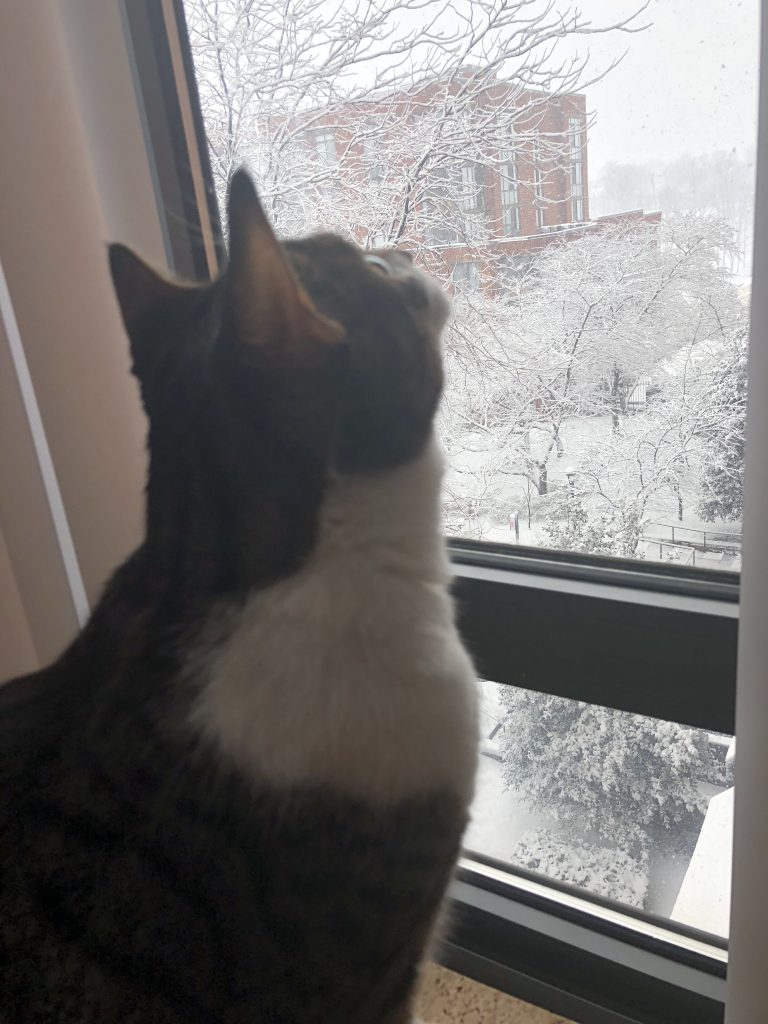
“Liam the Cat enjoying today’s snow from the comfort of his perch (Eastern Market).”
And thanks to Abigail for sending via twitter:


And from AE Becca:

“Nothing like Park View DC on a snow day”
V.w.verweijLet's go Nothing!
 Embracing life's pauses is healthy, restorative, and can boost creativity.
V.w.verweijI've got an even better idea for air purification....
 The 100-meter high purification tower in Xian is said to cover an area of 10 square kilometers.





This week’s Arlington Pet of the Week is Patches, a 5-year-old French bulldog who loves to watch Law and Order marathons and sunbathe.
Here is what her owner, Jean Marie, had to say:
I’d like to introduce you to Patches, our 5 year old French Bulldog. She has been an Arlington resident ever since we picked her up from West Virginia in 2013 when she was just a 16 week old pup. She has lived in Ballston, Rosslyn, Courthouse, and is now permanently settled in our first house in South Arlington. My husband and I (not married at the time) had decided we wanted a French Bulldog, but we were going to wait until the Spring…until I came across Patches’ pictures online. When we reached out, the breeder, and owners of Patches’ parents, let us know that they had actually decided to keep her as a pet, but they had forgotten to take the picture of her down from their website. I was crushed at first, but then decided I would just have to be somewhat persistent and let them know how much we had fallen in love with the pictures we saw online. They finally gave us the OK to come see her, and we just knew that we’d be coming home with her. From that moment, we were absolutely in love!
She likes to see who the Pet of the Week is each week, and finally, we thought we’d submit her as we feel she is well deserving of the title!
Patches is a purebred Frenchie who is super affectionate and fun, and loves meeting new people and pups. She enjoys Law and Order marathons, sunbathing wherever she can, lots of snuggles, brief walks around the neighborhood, and giving humans the stare-down when you’re in possession of bacon – or any food for that matter. She is such a fun loving dog who can brighten anyone’s day. If you’re feeling under the weather, she’s also a very qualified caretaker who will snuggle with you all day long.
Patches is very much looking forward to the warmer weather, when she can frolic around the neighborhood, do some patio entertaining, and provide oversight while grilling out.
Want your pet to be considered for the Arlington Pet of the Week? Email arlingtonnews@gmail.com with a 2-3 paragraph bio and at least 3-4 horizontally-oriented photos of your pet. Please don’t send vertical photos, they don’t fit in our photo galleries!
Each week’s winner receives a sample of dog or cat treats from our sponsor, Becky’s Pet Care, along with $100 in Becky’s Bucks. Becky’s Pet Care is the winner of six consecutive Angie’s List Super Service Awards, the National Association of Professional Pet Sitters’ 2013 Business of the Year and a proud supporter of the Arlington County Pawsitively Prepared Campaign.
Becky’s Pet Care provides professional dog walking and pet sitting in Arlington and all of Northern Virginia, as well as PetPrep training courses for Pet Care, CPR and emergency preparedness.
V.w.verweijSNUGGLING AND DIGGING.... AND EARS




This week’s Arlington Pet of the Week is Finley, a 5-month-old mixed breed puppy rescued from Mississippi who likes snuggling and digging.
Here is what his owner, Holly, had to say:
This if Finley the Rescue Puppy. He is a rescue from Mississippi, brought to Northern Virginia after the hurricane season by Wolf Trap Animal Rescue out of Vienna, VA. We adopted him on October 21, 2017. He is a mixed breed puppy (currently 5 months) with an ancestry of Boston Terrier, Boxer and other Terrier breeds. Finley was adopted two years after we lost our last dog friend, Riggs, who was 14 when he passed away. It took our family a long time to be emotionally ready for another dog, but once we saw Finley, we knew it was time and that he would be the perfect fit.
In the months that we’ve had him, he as been a joy to our family. He is a snuggler and very trainable. Because of his mixed breed ancestry, he can do a little bit of everything. He, of course, has some of the negative traits of his breeds, such as digging, boxing, and resource aggression, but he has the potential to be an agility star and to guard our family well.
He doesn’t shed, sleeps through the night, and is a great listener. We are looking forward to the warm weather of the Spring and the completion of his vaccinations, so that we can take him to dog parks. Luckily, we have many friends and neighbors who have also gotten puppies, so he has lots of opportunities for socialization. We feel blessed to have found a rescue that fits so perfectly in our family. Many thanks to Wolf Trap Animal Rescue!
Want your pet to be considered for the Arlington Pet of the Week? Email arlingtonnews@gmail.com with a 2-3 paragraph bio and at least 3-4 horizontally-oriented photos of your pet. Please don’t send vertical photos, they don’t fit in our photo galleries!
Each week’s winner receives a sample of dog or cat treats from our sponsor, Becky’s Pet Care, along with $100 in Becky’s Bucks. Becky’s Pet Care is the winner of six consecutive Angie’s List Super Service Awards, the National Association of Professional Pet Sitters’ 2013 Business of the Year and a proud supporter of the Arlington County Pawsitively Prepared Campaign.
Becky’s Pet Care provides professional dog walking and pet sitting in Arlington and all of Northern Virginia, as well as PetPrep training courses for Pet Care, CPR and emergency preparedness.
V.w.verweijPut a tariff on this




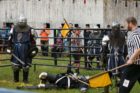


Arlington residents Zoheir El-Eita and Sam Jenson flew to Arizona early this morning, after carefully packing 60-75 pounds of steel armor and stowing away their weapons into their checked luggage.
The two medieval steel fighters are set to compete this weekend at the Armored Combat League’s National Championship in Lake Havasu City, Ariz., and a little finesse is necessary to get their gear across the country. Jensen, 27, studied up on exactly what he could and could not bring on board the flight, and weighed everything ahead of time.
The pair won’t be the only ones with a packing problem; the competition, from March 9-11, brings 49 fighters from across the country to “execute real medieval combat techniques to earn a spot in an international arena” while wearing medieval armor and using medieval weapons, according to a championship press release. They’ll be fighting with the Atlantic First Swords, a mid-Atlantic regional team.
Tournament play consists of one-on-one fights, three-on-three fights, five-on-five fights, and an “ultimate rush” fight of 16-on-16.
“Oh gosh, how do I describe it?” Jensen laughed before diving into an explanation of tournament technicalities. The overall goal is to fight the other team into submission, according to Jensen, by either “hitting someone so hard that they don’t feel like standing up any more or forcibly throwing them to the ground.”
Points are scored when players win a round, and a team needs 11 points to win. Rounds can last anywhere from 20 seconds to eight minutes, and the most rounds that Jensen has ever undertaken at once was either 23 or 24, but that isn’t normal.
“A man with 260 pounds of mass at a fairly quick rate will knock most people down,” said Jensen, so these melee rounds tend to last a minute.
The teams follow almost the same rules from French tournaments in the 1300s, with modern modifications for safety.
“I’d say we’re playing it a bit safer than the 14th century French were,” he added.
Successful steel fighters are chosen to represent the United States at an international championship in May in Scone, Scotland, about 45 miles north of Edinburgh.
While some of the local steel fighters may have discovered the sport through attending Renaissance fairs, Jensen was introduced by a friend living across the country who invited him to a tournament outside of Philadelphia.
Jensen was quickly hooked, and a month later he was getting his “butt kicked, but was absolutely hooked” and quit his pack a day smoking habit to get in better shape. He had been working odd jobs, at one point as a bouncer at D.C.’s Madhatter tavern, but nothing had been clicking.
“I was at a point in my life where, it’s cliche, but I was feeling listless,” he said. “I didn’t have a hobby or a passion, but I thought that this could be it.”
“If anything, I wish I’d found it sooner.”
Though he’s currently studying accounting and finance at Northern Virginia Community College, he meets every Tuesday and Thursday to train at Ashburn’s Silver Eagle Group Shooting Range with his usual, seven member team, the DC Juggernauts.
Jensen doesn’t think he’ll make it to the international tournament in Scotland, but that isn’t what’s important to him. The friendships made and the feelings of camaraderie and competition are enough for him — and he isn’t even sure if there is a physical prize to be won, anyway.
V.w.verweijTHIS IS A SAD BUT GOOD STORY
| archive - contact - sexy exciting merchandise - search - about | |||
 |
|||
| ← previous | March 2nd, 2018 | next | |
|
March 2nd, 2018: I'm at ECCC today, table O4! COME SAY HELLO – Ryan | |||
V.w.verweijNEAT

Extinction is a hard status to confirm for many types organisms. Whereas discovering a new species requires finding only a single individual, declaring one extinct requires knowing that there are no individuals left at all. This is especially true when organisms live cryptic lifestyles, a point recently made quite apparent by the rediscovery of a small parasitic plant known scientifically ask Thismia neptunis.
Thismia neptunis is a type of parasite called a mycoheterotroph, which means it makes its living by parasitizing mycorrhizal fungi in the soil. It obtains all of its needs in this way. As such, it produces no leaves, no chlorophyll, and really nothing that would readily identify it outright as a plant. All one would ever see of this species are its bizarre flowers that look more like a sea anemone than anything botanical. Like most mycoheterotrophs, when not in flower it lives a subterranean lifestyle.

The original drawing of Thismia neptunis (from Beccari 1878).
This is why finding them can be so difficult. Even when you know where they are supposed to grow, infrequent flowering events can make assessing population numbers extremely difficult. Add to this the fact that Thismia neptunis is only known from a small region of Borneo near Sarawak where it grows in the dense understory of hyperdiverse Dipterocarp forests. It was first found and described back in 1866 but was not seen again for 151 years. To be honest, it is hard to say whether or not most folks were actively searching.
Regardless, after a 151 year absence, a team of botanists recently rediscovered this wonderful little parasite flowering not too far from where it was originally described. Though more study will be needed to flesh out the ecology of this tiny parasitic plant, the team was fortunate enough to witness a few tiny flies flitting around within the flower tube. It could very well be that these odd flowers are pollinated by tiny flies that frequent these shaded forest understories.
As exciting as this rediscovery is, it nonetheless underscores the importance of forest conservation. The fact that no one had seen this plant in over a century speaks volumes about how little we understand the diversity of such biodiverse regions. The rate at which such forests are being cleared means that we are undoubtedly losing countless species that we don't even know exist. Forest conservation is a must.
Click here to support forest conservation efforts in Borneo.
Photo Credit and Further Reading: [1]
V.w.verweijNot fucking around here, either.






(Updated at 4:25 p.m.) Arlington high school students walked out of class Wednesday at about noon, joining nationwide protesters responding to a recent school shooting in Parkland, Fla.
Wakefield High School students made their way to the athletic stadium for a rally in favor of stricter gun control laws during a 30 minute class walkout. Administrators agreed to consider the walkout an excused absence, according to several Wakefield students.
Students spoke to the crowd with a public address system, calling themselves “moving targets” and shouting that gun violence won’t be resolved until everyone helps them “rise together and create that change.”
(Other Arlington students, including those at H-B Woodlawn and Yorktown High School, also staged walkouts today, as did students in Montgomery County and elsewhere in the region.)
Hannah Jones, a 17-year-old junior at Wakefield and an Arlington Young Democrats member, referenced tweets from an account called National School Walkout as her and her peers’ inspiration for the walkout.
Another student, 16-year-old sophomore Natasa Volk, only recently has become involved in politics.
“I think my mom wanted me to swivel in my own ideas and figure out what my values are,” said Volk. “But definitely this year I have engaged a lot more in political conversations, whether its with teachers or with my mother and other students.”
“I guess I started to care, which is kind of disappointing that I didn’t care as much.”
Volk and other students drew protest posters in their morning classes, with slogans like “317 Last Year — How Many This Year?” The walkout crowd was a few hundred teenagers and adults, a portion of the school’s 2016 enrollment rate of around 2,000 students.
Student protests are being staged as widespread as Chicago and Florida in response to the Parkland shooting, but Volk says that it wasn’t just the most recent shooting that inspired action, but that she learned last year that mass shootings happen much more frequently than one might see reported in the national media.
Some students were pessimistic about the protest, reportedly believing that it would just be an excuse for the apathetic to skip class. But, Jones believes, even those students will benefit from the walkout.
“Even if that’s their motive, being around this many people and to see this many people caring” about gun control legislation, said Jones. “I feel that if the news that they’re hearing hasn’t affected them, then this will get them to change their minds and get them to be a bit more directly involved.”
Reporters from ARLnow and WJLA (ABC 7) were not permitted to follow students to the rally at Wakefield High School.
Students, parents, and administrators alike took to Twitter in support of the march — including Virginia’s 2018 teacher of the year, Michelle Cottrell-Williams.
Further protests have been called for by student and adult activists nationwide, and a nationwide “March For Our Lives” protest has been scheduled for March 24.
Tweets from the Wakefield walkout, along with emails sent to H-B Woodlawn and Yorktown parents, after the jump.
From H-B Woodlawn Principal Casey Robinson:
Dear H-B Woodlawn Parent or Guardian:
Today at noon many H-B Woodlawn students participated in a student walkout to protest gun violence following the recent events at Marjory Stoneman Douglas High School in Parkland, Florida. This walkout occurred during lunch; students congregated in the front circle for about 20 minutes. These students were supervised by school staff and the School Resource Officer. It was a peaceful and safe gathering. During this student initiated protest some students suggested that the group should walk to the White House. We told students that they must have parent permission and sign out in the office since this was not a school-sponsored activity, and school staff would not be with them.
Most students walked a short distance and then returned to school. Other students participated in the longer protest. We were not aware of plans for this protest, but we know that other walkouts and protests are being planned for March and April. We will continue to support students by providing them a safe space to exercise their constitutional rights, while also respecting the right of all students to continue with their education during these activities.
From Yorktown Principal Bridget Loft.
Dear Yorktown Parent or Guardian,
Today at noon many Yorktown students engaged in a student walkout to raise awareness of gun violence following the recent events at Marjory Stoneman Douglas High School in Parkland, Florida. During this walkout, many students left their fifth period classes or lunch to congregate primarily in the amphitheater at the front the building for approximately 20 minutes. These students were supervised by school staff and all gathered peacefully, respectfully, and safely before returning to class. Students who were out of class during this time and returned to class with their classmates will be marked as ‘excused absent’.
Like all of us, many students at Yorktown have been trying to make sense of the shooting at Marjory Stoneman Douglas last week and have been concerned about their safety in our school. As a school staff, we are committed to ensuring that our students know that their safety is our top priority and to giving them a space to talk about and process the events of last week.
Today’s walkout at Yorktown was planned and organized by several students here. When we learned that it was being planned, school staff made arrangements for the students to congregate in the amphitheater as they had direct access to it as they left through the front doors and it made it easier for Yorktown staff to provide supervision and to monitor who was entering and exiting the building.
I was exceptionally proud of our students today. Those who participated did so respectfully and peacefully. Those who chose to participate respected the feelings of those who opted not to, and those who opted to not participate supported their classmates who did. With the walkouts and protests that are being planned for March and April, we will continue to support students by providing them a safe space to exercise their constitutional rights.
Via Twitter:
Real life learning happening now! Students prepare signs for today's walkout at Wakefield. 12:00 in front of the school. @ARLnowDOTcom @WHSHappenings pic.twitter.com/thAvzQQ0Sr
— Michelle Cottrell-Williams (@WakeHistory) February 21, 2018
Proud teacher today. #NeverAgain #MarchForOurLives pic.twitter.com/qHQNI9jGBS
— Michelle Cottrell-Williams (@WakeHistory) February 21, 2018
Wakefield shows up to say NO to gun violence today #guncontrol #Walkout #EndGunViolence #GunControlNow pic.twitter.com/rbjm7af0qv
— Ms. Hsu 許 (@wasamshsu) February 21, 2018
Wakefield High School Arlington, VA is walking out for "The Movement" right now, and I am so proud because one of my daughter's is marching now with her friends and fellow students.
— Steve Hellem (@Navista7) February 21, 2018
@studentswalkout Here we go Wakefield!!!! let's be the change!!
— emma ashley heavey (@EmmaKatherine29) February 21, 2018
V.w.verweijThe shape of water is totally amazing tho




This week’s Arlington Pet of the Week is Pistachio, an English Cocker Spaniel who enjoys a good tooth brushing and a nice long walk every now and then.
Here is what his owner Casey had to say:
Say hello to the cutest little nut in Arlington – Pistachio! He also likes to go by Mr. P, or ‘P’ for short.
Pistachio loves to go on long walks, visits to the dog park, and learning new tricks. One could say that Pistachio is an outgoing pup, because he loves meeting new people and dogs! Any time we are out on a walk, Pistachio is the center of attention. Our family and extended family all have dogs, so Pistachio loves going to family events for all of the extra play time (and treats).
Pistachio also enjoys snuggles, giving a million kisses, having his teeth brushed, and spreading out in his parent’s bed. He’s still learning to behave around food and to not eat everything he finds on the floor, but hey! Being a puppy is hard work!
Pistachio has become so entertaining that we found we needed to share his adventures with everyone we know – feel free to follow him on Instagram at @pistachio_theenglishcocker.
Want your pet to be considered for the Arlington Pet of the Week? Email arlingtonnews@gmail.com with a 2-3 paragraph bio and at least 3-4 horizontally-oriented photos of your pet. Please don’t send vertical photos, they don’t fit in our photo galleries!
Each week’s winner receives a sample of dog or cat treats from our sponsor, Becky’s Pet Care, along with $100 in Becky’s Bucks. Becky’s Pet Care is the winner of six consecutive Angie’s List Super Service Awards, the National Association of Professional Pet Sitters’ 2013 Business of the Year and a proud supporter of the Arlington County Pawsitively Prepared Campaign.
Becky’s Pet Care provides professional dog walking and pet sitting in Arlington and all of Northern Virginia, as well as PetPrep training courses for Pet Care, CPR and emergency preparedness.

Tillandsia tectorum
Air plants (genus Tillandsia) are remarkable organisms. All it takes is seeing one in person to understand why they have achieved rock start status in the horticulture trade. Unlike what we think of as a "traditional" plant lifestyle, most species of air plants live a life free of soil. Instead, they attach themselves to the limbs and trunks of trees as well as a plethora of other surfaces.

Living this way imposes some serious challenges. The biggest of these is the acquisition of water. Although air plants are fully capable of developing roots, these organs don't live very long and they are largely incapable of absorbing anything from the surrounding environment. The sole purpose of air plant roots is to anchor them to whatever they are growing on. How then do these plants function? How do they obtain water and nutrients? The answer to this lies in tiny structures called trichomes.
Trichomes are what gives most air plants their silvery sheen. To fully appreciate how these marvelous structures work, one needs some serious magnification. A close inspection would reveal hollow, nail-shaped structures attached to the plant by a stem. Instead of absorbing water directly through the leaf tissues, these trichomes mediate the process and, in doing so, prevent the plant from losing more water than it gains.
The trichomes themselves start off as living tissue. During development, however, they undergo programmed cell death, leaving them hollow. When any amount of moisture comes into contact with these trichomes, they immediately absorb that water, swelling up in the process. As they swell, they are stretched out flat along the surface of the leaf. This creates a tiny film of water between the trichomes and the rest of the leaf, which only facilitates the absorption of more water.

Trichomes up close.
Because the trichomes form a sort of conduit to the inside of the leaf, water and any nutrients dissolved within are free to move into the plant until the reach the spongy mesophyll cells inside. In this way, air plants get all of their water needs from precipitation and fog. Not all air plants have the same amount of trichomes either. In fact, trichome density can tell you a lot about the kind of environment a particular air plant calls home.

The fuzzier the plant looks, the drier the habitat it can tolerate. Take, for instance, one of the fuzziest air plants - Tillandsia tectorum. This species hails from extremely arid environments in the high elevation regions of Ecuador and Peru. This species mainly relies on passing clouds and fog for its moisture needs and thus requires lots of surface area to collect said water. Now contrast that with a species like Tillandsia bulbosa, which appears to have almost no trichome cover. This smoother looking species is native to humid low-land habitats where high humidity and frequent rain provide plenty of opportunities for a drink.

Absorbing water in this way would appear to have opened up a plethora of habitats for the genus Tillandsia. Air plants are tenacious plants and worthy of our admiration. One could learn a lot from their water savvy ways.

If you have any animal/pet photos you’d like to share for the regular fix please send an email to princeofpetworth(at)gmail(dot)com with ‘Animal Fix’ in the title and say the name of your pet and your neighborhood. AdoPtville is run by two volunteers who compile these pets weekly from local shelters.

Astro, Hubble and Lyra are all 3 month old Plott Hound/Mountain Cur mix puppies looking for a home. (Don’t worry, these litter-mates are each looking for their own separate homes!) Hubble, pictured below, should steal your heart with his adorable antics. Astro and Lyra are pretty cute too! Check them all out on the City Dogs Rescue & City Kitties website under “Cosmos Puppies”.

Darling Winona had a tough start in life. She was left at a shelter with a number of other cats who were all very sick. Winona was the worst off and had to have her eye removed due to the trauma it received when she was ill. She is an adorable pirate cat that you should definitely apply to meet to see how sweet she is in person! You can tell Winona is truly grateful to have been rescued because she’s such an affectionate, sweet kitty. She loves to be petted and she enjoys snuggling with her blankets — while she doesn’t scratch furniture, she enjoys kneading whatever fabric she’s standing on. More info on Winona here.
V.w.verweijYeah, but should it be driving that car?
 The injured owl, saved by a Maryland Natural Resources Police officer, is being nursed back to health and is set to be released this spring.
V.w.verweijPLANTS WITH TINY COMPLEX COW STOMACHS

The bladderworts (Utricularia spp.) are among the most cosmopolitan groups of carnivorous plants on this planet. Despite their popularity, their carnivorous habits have been subject to some debate. Close observation reveals that prey capture rates are surprisingly low for most species. This has led some to suggest that the bladderworts may be benefiting from more passive forms of nutrient acquisition. To better understand how these plants utilize their traps, a team of researchers decided to take a closer look at the microbiome living within.
The team analyzed the trap fluid of a handful of floating aquatic bladderwort species - U. vulgaris, U. australis, and U reflexa. In doing so, they uncovered a bewildering variety of microorganisms perfectly at home within the bladderwort traps. Thanks to sophisticated genetic tools, they were able to classify these microbes in order to investigate what exactly they might be doing inside the traps.
Their findings were quite astonishing to say the least. The traps of these plants harbor extremely rich microbial communities, far richer than the microbial diversity of other carnivorous plant traps. In fact, the richness of these microbial communities were more akin to the richness seen in the rooting zone of terrestrial plants or the gut of a cow. In terms of the species present, the microbial communities of bladderwort traps most closely resembled that of the pitchers of Sarracenia species as well as the guts of herbivorous iguanas.

The similarities with herbivore guts is quite remarkable. Its not just coincidental either. The types of microbes they found weren't new to science but their function was a bit of a surprise. A large percentage of the bacteria living within the fluid are famously known for producing enzymes that digest complex plant tissues. Similarly, the team found related microbe groups that specialize on anaerobic fermentation. These types of microbes in particular are largely responsible for the breakdown of plant materials in the rumen of cattle.
As it turns out, the microbes living within the traps of these bladderworts are serving a very important purpose for the plant - they are breaking down plant and algae cells that find their way into the traps each time they open and close. In doing so, they give off valuable nutrients that the bladderworts can then absorb and utilize. Let me say that again, the bacteria living in bladderwort traps are digesting algae and other plant materials that these carnivorous plants can then absorb.
Now these bacteria are also responsible for producing a lot of methane in the process. Interestingly enough, the team was not able to detect measurable levels of methane leaving the traps. This would be odd if it wasn't for the community of methane-feeding microbes also discovered living within the traps. The team believes that these organisms metabolize all of the methane being produced before it can escape the traps.
As remarkable as these findings are, I don't want to give the impression that these carnivorous plants have taken up a strict vegetarian lifestyle. The team also found myriad other microorganisms within the bladder traps, many of them being carnivores themselves. The team also found a rich protist community. A majority of these were euglenids and ciliates.

These sorts of protists are important microbial predators and the numbers recorded within the traps suggest that they are a rather significant component of these trap communities. As they chase down and consume bacteria and other protists, they release valuable nutrients that the plants can absorb and utilize. Numbers of these predatory protists were much higher in older traps, which have had much more time to accumulate a diverse microbiome. Astonishingly, it is estimated that the protist communities can cycle the entire contents of the bladderwort traps upwards of 4 or 5 times in a 24 hour period. That is some serious turnover of nutrients!
The protists weren't the only predators found within the traps either. There are also a considerable amount of bacterial predators living there as well. These not only cycle nutrients in similar ways to the protist community, it is likely they also exhibit strong controls on the biodiversity within this miniature ecosystem. In other words, they are considered keystone predators of these microcosms.
Also present within the traps were large amounts of fungal DNA. None of the species they found are thought to actually live within the traps. Rather, it is thought that they are taken up as spores blown in from the surrounding environment. Exactly how these organisms find themselves living inside bladderwort traps is something worth considering. The plants themselves are known for being covered in biomfilms. It is likely that many of the organisms living within the traps were those found living on the plants originally.

Taken together, the remarkable discovery of such complex microbial communities living on and within these carnivorous plants shows just how complex the ecology of such systems really are. Far from the active predators we like to think of them as, the bladderworts nonetheless rely on a mixture of symbiotic orgnaisms to provide them with the nutrients that they need. The fact that these plants are in large part digesting plant and algae materials is what I find most astonishing.
Essentially, one can almost think of bladderworts as plants adorned with tiny, complex cow stomachs, each utilizing their microbial community to gain as much nutrients as they can from their living environment. The bladderworts gain access to nutrients and the microbes get a place to live. The bladderworts really do seem to be cultivating a favorable habitat for these organisms as well. Analysis of the bladder fluid demonstrated that the plants actively regulate the pH of the fluid to maintain their living community of digestive assistants. In doing so, they are able to offset the relative rarity of prey capture. Keep in mind that this research was performed on only three species of bladderwort originating from similar habitats. Imagine what we will find in the traps of the multitude of other Utricularia species.
Photo Credits: [1] [2] [3] [4]
Further Reading: [1]


![[3]](https://commons.wikimedia.org/wiki/File:Urn_Vine_(Dischidia_rafflesiana)_(8438459766).jpg)
![[4]](https://commons.wikimedia.org/wiki/File:Dischidia_ovata_kz1.jpg)
![[5]](https://commons.wikimedia.org/wiki/File:Dischidia_platyphylla_kz1.jpg)
![[1]](https://upload.wikimedia.org/wikipedia/commons/f/ff/Saguaroflowers.jpg)
![[3]](https://commons.wikimedia.org/wiki/File:Gila_woodpecker_on_Saguaro.jpg)
![[3]](https://commons.wikimedia.org/wiki/File:Spanish_moss_under_20x_magnification.jpg)
![[4]](https://commons.wikimedia.org/wiki/File:Air_Plant_(Tillandsia_caput-medusae)_(6766707151).jpg)
![[5]](https://en.wikipedia.org/wiki/Tillandsia_bulbosa#/media/File:Tillandsia_bulbosa_20090111.jpg)
![[1]](https://upload.wikimedia.org/wikipedia/commons/9/99/Utricularia_australis_sl5.jpg)
![[2]](https://upload.wikimedia.org/wikipedia/commons/9/91/Utricularia_aurea_8_Darwiniana.jpg)
![[3]](https://i.makeagif.com/media/3-21-2015/F5ULck.gif)
![[4]](https://www.fs.fed.us/wildflowers/plant-of-the-week/images/commonbladderwort/utricularia_macrorhiza_bladders_lg.jpg)