Scott Lord
Shared posts
28 Jan 21:07
Old Ironsides: Literary, Art Issue Number One
by Unknown
I lack a regular poetry reading and when I saw that I could add my You Tube videos easily without downloading I thought that a daily film would be a beginning for an art-literary magazine. This was one of the first films that I bought in 1972, my screening room being a Keystone 8mm and white projection screen, my Magic Lantern, and a room called "the addition", which was off the original living
Scott Lord, Scott Lord Mystery Film likes this
21 Oct 04:52
Scott Lord Mystery: Frankenstein (James Whale) 1931 theatrical trailer
by Scott Lord Silent Film
Scott Lord likes this
19 Oct 06:27
Scott Lord Mystery: Frankenstein (James Whale) 1931 theatrical trailer
by Scott Lord Silent Film
Scott Lord likes this
18 Aug 03:59
Scott Lord Silent Film: The Craving (John and Francis Ford, 1919)
by Scott Lord Silent Film
In the extratextural discourse that may have developed the confections of genre, Motion Picture Weekly published press sheets for Bluebird's "sensational melodrama" "The Craving" with "Suggestions for Putting This Picture Over", their having announced that in some shots of its "remarkable photography" there were "as many as four distinct exposures" that would "make audiences gasp." The film's "Distinctive Feature" was "mysterious illusions of weird beauty."
Silent Film
Silent Film
Scott Lord Mystery Film, Scott Lord likes this
17 Aug 03:33
Scott Lord Silent Film: Mary Pickford in The Love Light (Frances Marion, 1921)
by Scott Lord Silent Film
Scott Lord Scott Lord Scott Lord

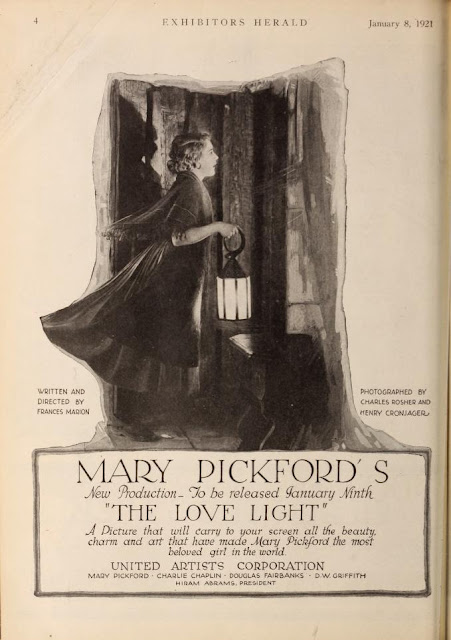

DUring 1921 actress Mary Pickford also filmed "Little Lord Fauntleroy" (Grenn/Oickford) and "Through The Backdoor" (Green/Pickford). Silent Film Mary Pickford

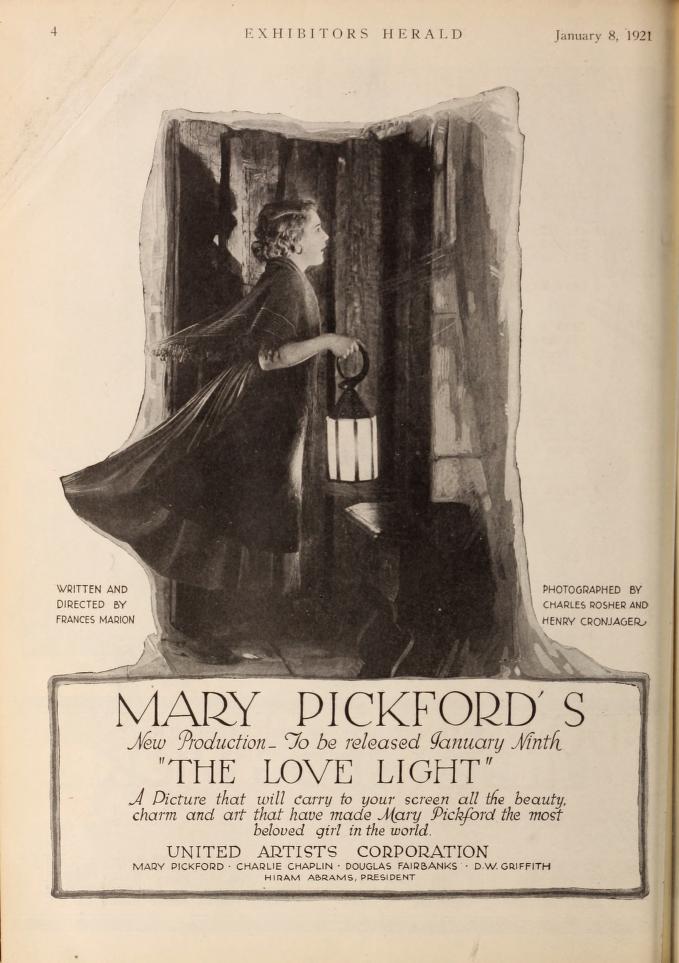

DUring 1921 actress Mary Pickford also filmed "Little Lord Fauntleroy" (Grenn/Oickford) and "Through The Backdoor" (Green/Pickford). Silent Film Mary Pickford
Scott Lord Mystery Film, Scott Lord likes this
17 Aug 02:31


 In addition to directing Mary Pickford in “Rebecca of Sunnybrook Farm”, during 1917, Marshall Neilan directed Pickford in the film “The Little Princess Princess”. Both photplays were scripted by Frances Marion.
Silent Film
Silent Film
Scott Lord Silent Film: Mary Pickford in Rebecca of Sunnybrook Farm (Neilan, 1917)
by Scott Lord Silent Film


Silent Film
Silent Film
Scott Lord Mystery Film, Scott Lord likes this
17 Aug 02:31
Scott Lord Silent Film: Mary Pickford in The Hoodlum (Franklin, 1919)
by Scott Lord Silent Film


Scott Lord likes this
17 Aug 02:29
Scott Lord Silent Film: Mary Pickford in A Little Princess (Neilan, 1917)
by Scott Lord Silent Film
Silent Film Scott Lord


 Marshall Neilan during 1917 directed actress Mary Pickford with actresses Kathleen Griffith, Zazu Pitts, and Ann Schraeder in "The Little Princess" (five reels) with a photplay written by Frances Marion. The film was photographed by Charles Rosner and Walter Strandling.
The periodical Picture Play magazine during 1917 came in with a very straitforward announcement, "Mary Pickford, after a short rest following the completion of 'Rebecca of Sunnybrook Farm'is now hard at work in 'The Little Princess' under the direction of Marshall Neilan."
Silent Film Mary Pickford


The periodical Picture Play magazine during 1917 came in with a very straitforward announcement, "Mary Pickford, after a short rest following the completion of 'Rebecca of Sunnybrook Farm'is now hard at work in 'The Little Princess' under the direction of Marshall Neilan."
Silent Film Mary Pickford
Silent Film
Scott Lord Mystery Film, Scott Lord likes this
17 Aug 02:28


In his volume Eighty Years of CInema, author Peter Cowie describes the film "Poor Little Rich Girl" as "the fey beauty of Mary Pickford at its most beguiling." Directed by Maurice Tourneur from a photoplay written by Frances Marion, the film stars Mary Pickford with actresses Gladys Fairbanks, Madlaine Traverse and Maxine Eliot Hicks.
Silent Film Silent Film
Scott Lord Silent Film: Mary Pickford in The Poor Little Rich Girl (Tour...
by Scott Lord Silent Film


In his volume Eighty Years of CInema, author Peter Cowie describes the film "Poor Little Rich Girl" as "the fey beauty of Mary Pickford at its most beguiling." Directed by Maurice Tourneur from a photoplay written by Frances Marion, the film stars Mary Pickford with actresses Gladys Fairbanks, Madlaine Traverse and Maxine Eliot Hicks.
Silent Film Silent Film
Scott Lord Mystery Film, Scott Lord likes this
17 Aug 02:28
Sven Gustafson screenwriter, Europa 1942-1948
by Scott Lord Silent Film
Fan magazines continued to supply short biographies of Greta Garbo well into the 1940's, retelling how she was discovered and repeating stories with which the public was already familiar, it continually meeting John Gilbert and Mauritz Stiller as well as Lars Hanson. Modern Screen magazine, most certainly a periodical from only the sound film era, excerpted The True Life Story of Greta Garbo by William Stewart. "The second disaster to occur during the filming of 'The Temptress' was the death of Greta's sister. It was the crowning heartbreak of a picture that had been ill fated for Greta since the starting crank of the camera." Alva Maria Gustafsson, Alva Garbo, died in 1926 at the age of twenty six years old.
While Alva, apart from appearing as an extra with sister Greta for the Swedish Silent Film director John Brunius, only made one screen appearance, that of a part in the film "Two Kings" ("Tva Kongungar", Elis Ellis,1925), the brother of actress Alva Gustafson and actress Greta Garbo, Sven Gustafson, infrequently billed as Sven Garbo, although the elder of the three siblings, went on to become a screenwriter after his brief foray into acting. It would usually seem reasonable to say that both Greta Garbo and brother Sven retired during the same period in light of Sven Gustafson having later visited the United States before his death if it were not for Greta Garbo having at that time having completely become a recluse to the public, only contemplating a return to making films.
The wife of Sven Gustafson, Emy Owandner, made only one screen appearance, that of a role in the film "Sun Over Klara" ("Sol over Klara"), directed by Emil A. Lingheim and written by Erik Lundegard, which lists her role as uncredited. The Swedish Film Institute, rather lists her as appearing in two earlier comedies for Europa, one in which she appeared with Sven Gustafson.
Swedish Silent Film director Gustaf Edgren co-wrote the screenplay to the 1929 film "Kongstjorda Svensson" in which Sven Garbo appeared with actresses Brita Appelgren and Karen Gillberg. The film was photographed by Hugo Edlund.
Photoplay magazine during 1934, in an article entitled "Greta Garbo Wanted to be a Tightrope Walker, by Leonard Clairmont, mentioned Sven Garbo as being Greta Garbo's agent in Sweden for the pruchase of an estate called Dyvik which afforded a two mile long beach.
During 1943, Sven Gustafson co-wrote the screenplay to the film "A Girl Fir Me" (En flicka mej) for Europa with director Borje Larsson, it having been photographed by Harald Bergland and having starred actresses Sickan Carlsson, Gull Natorp, Hilda Borgstrom and Kerstin Lindahl.
The periodical New Movies, The National Board of Review during November 1945 listed the film "Skepper Jansson" to Sven Gustafson co-wrote the screenplay with director of Sigurd Wallen. "Humorous and warm hearted in tone, and lovingly photographed, the film should please Swedish speaking audiences."
Greta Garbo
Sven Garbo
Gustaf Molander
Silent Film Greta Garbo
Greta Garbo and Mauritz Stiller
Silent Film Greta Garbo
Greta Garbo
Back to top: Sven Garbo
The wife of Sven Gustafson, Emy Owandner, made only one screen appearance, that of a role in the film "Sun Over Klara" ("Sol over Klara"), directed by Emil A. Lingheim and written by Erik Lundegard, which lists her role as uncredited. The Swedish Film Institute, rather lists her as appearing in two earlier comedies for Europa, one in which she appeared with Sven Gustafson.
Swedish Silent Film director Gustaf Edgren co-wrote the screenplay to the 1929 film "Kongstjorda Svensson" in which Sven Garbo appeared with actresses Brita Appelgren and Karen Gillberg. The film was photographed by Hugo Edlund.
Edvin Adolphson had directed "When Roses Bloom" ("Na rosorna sla ut"), starring Sven Garbo during 1930. The film was scripted by Gosta Stevens and also stars Karin Swanstrom, Margita Alven, and Anna-Lisa Baude. Else Marie Hansen was given her first appearance on screen in with the film. Greta Garbo visited her brother, Sven Gustafson, while in Stockholm. The Private Life of Greta Garbo, published in Photoplay Magazine during 1930 is, much like the biography of Greta Garbo penned by Norman Zierold, an enjoyable, if not charming read; it includes a brief mention of Sven Garbo, "At one time Miss Garbo's brother, Sven, who has been quite successful abroad both on stage and screen, wanted to come to Hollywood. He even sent screen tests of himself to Metro-Goldwyn Mayer." Rilla Page PalMborg again mentioned that Sven Garbo had sent screen tests of himself to M.G.M the following year when publishing the biography The Private Life of Greta Garbo in book form during 1931. While giving an account of Garbo's activities while filming the silent film "The Kiss" it relies heavily on quotes of her housekeeper-valet Gustaf, according to whom she kept a large portrait of her brother in her living room, arranged upright on a table. "Garbo was all upset the day she received a letter from her brother saying that the motion picture company for whom he was working wanted to change his name to Garbo. She said that she made the name of Garbo herself, that it was her name and there should be no one else using it. She called her brother not to allow the motion picture company to use it....but he answered that it was too late."
To complement whispers that Sven Gustafson would have like to film in America, when in actuality it was Greta Garbo that travelled between the two countries, Screenland Magazine related,"Everyone says there is only one Garbo in pictures, but the Swedish cyclone's brother Sven has been signed to Paramount for talkies. Sven Garbo is tall and handsome and reported to be a good bet for pictures." Yet, without dispelling this, Photoplay Magazine during 1931 translated the title of Edvin Adolphson's film "Na Rosarna Sla Ut" as "Hole in the Wall" and listed it as being produced by Paramount. Photoplay later added,"Sven Gustafsson, brother of Gret Garbo, makes his American debut in it. He's a tall, limp, black-haired boy with a moustache and doesn't beT the faintest resemblance to his famous sister. And he's a punk actor, if this is a sample. The picture tells a light, chatty love story. There's one good actor in the troupe- an ugly gentleman named Uno Henning." Inches above a synopsis of the Greta Garbo film "Inspiration", Photoplay magazine again looked at the film in brief, "Swedish talkie brings us Sven Gustaffson, Garbo's brother, but nothing like his famous sister. Light and chatty love story."
To complement whispers that Sven Gustafson would have like to film in America, when in actuality it was Greta Garbo that travelled between the two countries, Screenland Magazine related,"Everyone says there is only one Garbo in pictures, but the Swedish cyclone's brother Sven has been signed to Paramount for talkies. Sven Garbo is tall and handsome and reported to be a good bet for pictures." Yet, without dispelling this, Photoplay Magazine during 1931 translated the title of Edvin Adolphson's film "Na Rosarna Sla Ut" as "Hole in the Wall" and listed it as being produced by Paramount. Photoplay later added,"Sven Gustafsson, brother of Gret Garbo, makes his American debut in it. He's a tall, limp, black-haired boy with a moustache and doesn't beT the faintest resemblance to his famous sister. And he's a punk actor, if this is a sample. The picture tells a light, chatty love story. There's one good actor in the troupe- an ugly gentleman named Uno Henning." Inches above a synopsis of the Greta Garbo film "Inspiration", Photoplay magazine again looked at the film in brief, "Swedish talkie brings us Sven Gustaffson, Garbo's brother, but nothing like his famous sister. Light and chatty love story."
Photoplay magazine during 1934, in an article entitled "Greta Garbo Wanted to be a Tightrope Walker, by Leonard Clairmont, mentioned Sven Garbo as being Greta Garbo's agent in Sweden for the pruchase of an estate called Dyvik which afforded a two mile long beach.
During 1943, Sven Gustafson co-wrote the screenplay to the film "A Girl Fir Me" (En flicka mej) for Europa with director Borje Larsson, it having been photographed by Harald Bergland and having starred actresses Sickan Carlsson, Gull Natorp, Hilda Borgstrom and Kerstin Lindahl.
The periodical New Movies, The National Board of Review during November 1945 listed the film "Skepper Jansson" to Sven Gustafson co-wrote the screenplay with director of Sigurd Wallen. "Humorous and warm hearted in tone, and lovingly photographed, the film should please Swedish speaking audiences."
Greta Garbo
Sven Garbo
Gustaf Molander
Silent Film Greta Garbo
Greta Garbo and Mauritz Stiller
Silent Film Greta Garbo
Greta Garbo
Back to top: Sven Garbo
Scott Lord Mystery Film, Scott Lord likes this
17 Aug 02:27

Studio manager of Rasunda was relegated to Vilhelm Bryde during 1923. Author Forsyth Hardy Gaines an account, "His influence was most clearly seen in 'Damen med Kamelioarna', a static, theatrical adaptation of the Camille theme, directed by Olof Molander. The film derived some distinction from the delicately composed interiors...a reversion to a theatrical style of filmmaking quite foreign to the Sjostrom-Stiller."
For those familiar with the history of Danish Silent Film Lady of the Camellias, (Kameliadamen, Camille) adapted from the novel by Dumas, was filmed by Viggo Larsen, who starred in front of the camera as well as creating from behind it, as he was often won't to do, the film also starring Oda Alstrup, Robert Storm Petersen and Helga Tonnesen. It was produced by Nordisk Film and Ole Olsen and it's cinematographer was Axel Graatkjaer Sorensen.


The Divine Bernhardt that was immortalized as a model for Alphonse Mucha exists, the plays that Louis Mercanton adapted for the screen, Jeanne Dore (1915, three reels), starring Madame Tissot with actress Sarah Bernhardt and shown in the United States by Bluebird Photoplays, and Adrienne Lecouvveur (1913, two/three reels), do not, and belong to the province of Film Preservation, if not Lost Films, Found Magazines, a vital part of From Stage to Screen, the transition of the proscenium arc to visual planes achieved by film editing and composition having been relegated to desuetude. By all accounts there still is a copy of Sarah Bernhardt performing Camille on film.


Camille (J. Gordon Edwards, 1917, five reels) starring Theda Bara is, like The Divine Woman (Victor Seastrom), a lost silent film, there being no surviving copies of it. Motography not I coincidentally revealed, "Theda Bara in a sumptuous picturization of Camille is the latest announcement of William Fox to the public...Theda Bara as the unhappy Parisian girl who sacrifices herself on the altar of convention, has surpassed all her previous work. This production...Parisian life is followed in every detail so that the atmosphere of the story fits admirably with the acting in it." Surepetitiously, Motion Picture News used the exact same wording, it concluding with, The tears it caused were genuine and the emotions it stirred were deep." J. Gordon Edwards directed Theda Bara in several films for the Fox Film Corporation during 1917 which are now lost, with no surviving copies, including the films "Cleopatra" (ten reels), "Heart and Soul" (five reels), "Her Greatest Lobe" (five reels) and "The Rose Blood" (six reels), as well as the lost films "Under the Yoke" (five reels), "When a Woman Sins" (seven reels) and "The Forbidden Path" from 1918.
Most significant may be that the script to Poor Violetta (Arme Violetta, 1920) was written by Hans Kraly, who later emigrated to Hollywood; directed by Paul L. Stein, it was released by Paramount as The Red Peacock, with the alternate title Camille, purportedly only loosely an adaptation of the novel by Dumas. The film is thought to be lost, with no surviving copies. in her autobiography Memories of a Star, actress Pola Negri describes filming in Europe, "Even before Hemmingway and Fitzgerald made The Lost Generation internationally famous, it was a city intent on losing itself. Jazz was beginning to become a rage in all the little chic clubs.... When production began on Camille, I was ready for it. Nightlife had served its purpose. The mixture of wild gaiety and sense of loss which had been so much part of the last few weeks gave me fresh insights into the character I was to portray. Certainly, the doomed tubercular Marguerite Gautier would not have felt out of place in Berlin at the dawn of the twenties. My sojourn among those people who lived on the opposite side of the clock had been a useful and pleasant interlude, but it was now over." Negri, who would leave for Warsaw after filming Camille had been writing about a city that would soon embrace Expressionism and where Asta Nielsen that year had been filming an adaption of Hamlet as a Silent Film.
In the United States The Film Daily during 1922 reviewed the film by claiming it had "No Visible Drawing Power in this Except for Sensation". While giving a brief synopsis it wrote, "as for the story, it is certain to offend the decency of some and practically everyone with any sense of refinement. There isn't anything very tasteful or entertaining in this depiction of a series of liaisons even though you can hardly blame the girl for running away from her drunken step father...Another matter which you will do well to consider in connection with this picture is the type of patron you cater to." Their sentiment was echoed by Exhibitor's Herald magazine, who saw Pola Ngeri in the film as depicting a woman who was " that of the tennis-ball tossed lightly from one gentleman's racquet to another" to which it appended, " This is made abroad and their standards are not ours."

Using a still where the two lovers were in embrace on a couch, reminiscent of John Gilbert and Greta Garboin Flesh and the Devil, captioned with "Armand pours out his love to the adored Camille, Picture Play magazine during 1927 introduced the nine reel film starring Norma Talmadge and Gilbert Roland as "the latest screen version of the Dumas' masterpiece." MPotion Picture magazine noted that it was a film in which Norma Talmadge would wear her hair bobbed, the studio having reported to the magazine that it would be an adaptation located in the then present day Paris of Gerturde Stien, Fitzgerald and Hemmingway and that the cast of the film would also include Lilyan Tashman. Photoplay reviewed the film with,"Norma Talmadge shifted the background to the present day. This change seems to have affected the story itself but slightly. 'Camille has one fault. it is too long...Rather actory but worth IT. Super-sexy stuff this." Amateur Movie Makers magazine looked at Niblo's camerawork during 1927, noting that the film as having a Titleless Start. "Eliminating the usual series of opening titles, 'Camille' opens with a series of swift dissolves which move from the general to the specific, from a shot down to a mass of moving umbrellas, to a salient bit of portraiture of the auctioneer hawking Camille's effects."

The 1915 screen version of Camille was scripted by Frances Marion. the five reel film starred Clara Kimbal Young under the direction of Albert Cappellani. There is thought to be a lost film from 1912 starring actress Gertrude Shipman that was based on Dumas' work possibly one reel in legnth.
Greta Garbo John Gilbert
Greta Garbo
Greta Garbo in Love
Greta Garbo photographed
Greta Garbo
Remade by Greta Garbo: Camille
by Scott Lord Silent Film

Studio manager of Rasunda was relegated to Vilhelm Bryde during 1923. Author Forsyth Hardy Gaines an account, "His influence was most clearly seen in 'Damen med Kamelioarna', a static, theatrical adaptation of the Camille theme, directed by Olof Molander. The film derived some distinction from the delicately composed interiors...a reversion to a theatrical style of filmmaking quite foreign to the Sjostrom-Stiller."
For those familiar with the history of Danish Silent Film Lady of the Camellias, (Kameliadamen, Camille) adapted from the novel by Dumas, was filmed by Viggo Larsen, who starred in front of the camera as well as creating from behind it, as he was often won't to do, the film also starring Oda Alstrup, Robert Storm Petersen and Helga Tonnesen. It was produced by Nordisk Film and Ole Olsen and it's cinematographer was Axel Graatkjaer Sorensen.


The Divine Bernhardt that was immortalized as a model for Alphonse Mucha exists, the plays that Louis Mercanton adapted for the screen, Jeanne Dore (1915, three reels), starring Madame Tissot with actress Sarah Bernhardt and shown in the United States by Bluebird Photoplays, and Adrienne Lecouvveur (1913, two/three reels), do not, and belong to the province of Film Preservation, if not Lost Films, Found Magazines, a vital part of From Stage to Screen, the transition of the proscenium arc to visual planes achieved by film editing and composition having been relegated to desuetude. By all accounts there still is a copy of Sarah Bernhardt performing Camille on film.


Camille (J. Gordon Edwards, 1917, five reels) starring Theda Bara is, like The Divine Woman (Victor Seastrom), a lost silent film, there being no surviving copies of it. Motography not I coincidentally revealed, "Theda Bara in a sumptuous picturization of Camille is the latest announcement of William Fox to the public...Theda Bara as the unhappy Parisian girl who sacrifices herself on the altar of convention, has surpassed all her previous work. This production...Parisian life is followed in every detail so that the atmosphere of the story fits admirably with the acting in it." Surepetitiously, Motion Picture News used the exact same wording, it concluding with, The tears it caused were genuine and the emotions it stirred were deep." J. Gordon Edwards directed Theda Bara in several films for the Fox Film Corporation during 1917 which are now lost, with no surviving copies, including the films "Cleopatra" (ten reels), "Heart and Soul" (five reels), "Her Greatest Lobe" (five reels) and "The Rose Blood" (six reels), as well as the lost films "Under the Yoke" (five reels), "When a Woman Sins" (seven reels) and "The Forbidden Path" from 1918.
Most significant may be that the script to Poor Violetta (Arme Violetta, 1920) was written by Hans Kraly, who later emigrated to Hollywood; directed by Paul L. Stein, it was released by Paramount as The Red Peacock, with the alternate title Camille, purportedly only loosely an adaptation of the novel by Dumas. The film is thought to be lost, with no surviving copies. in her autobiography Memories of a Star, actress Pola Negri describes filming in Europe, "Even before Hemmingway and Fitzgerald made The Lost Generation internationally famous, it was a city intent on losing itself. Jazz was beginning to become a rage in all the little chic clubs.... When production began on Camille, I was ready for it. Nightlife had served its purpose. The mixture of wild gaiety and sense of loss which had been so much part of the last few weeks gave me fresh insights into the character I was to portray. Certainly, the doomed tubercular Marguerite Gautier would not have felt out of place in Berlin at the dawn of the twenties. My sojourn among those people who lived on the opposite side of the clock had been a useful and pleasant interlude, but it was now over." Negri, who would leave for Warsaw after filming Camille had been writing about a city that would soon embrace Expressionism and where Asta Nielsen that year had been filming an adaption of Hamlet as a Silent Film.
In the United States The Film Daily during 1922 reviewed the film by claiming it had "No Visible Drawing Power in this Except for Sensation". While giving a brief synopsis it wrote, "as for the story, it is certain to offend the decency of some and practically everyone with any sense of refinement. There isn't anything very tasteful or entertaining in this depiction of a series of liaisons even though you can hardly blame the girl for running away from her drunken step father...Another matter which you will do well to consider in connection with this picture is the type of patron you cater to." Their sentiment was echoed by Exhibitor's Herald magazine, who saw Pola Ngeri in the film as depicting a woman who was " that of the tennis-ball tossed lightly from one gentleman's racquet to another" to which it appended, " This is made abroad and their standards are not ours."

Using a still where the two lovers were in embrace on a couch, reminiscent of John Gilbert and Greta Garboin Flesh and the Devil, captioned with "Armand pours out his love to the adored Camille, Picture Play magazine during 1927 introduced the nine reel film starring Norma Talmadge and Gilbert Roland as "the latest screen version of the Dumas' masterpiece." MPotion Picture magazine noted that it was a film in which Norma Talmadge would wear her hair bobbed, the studio having reported to the magazine that it would be an adaptation located in the then present day Paris of Gerturde Stien, Fitzgerald and Hemmingway and that the cast of the film would also include Lilyan Tashman. Photoplay reviewed the film with,"Norma Talmadge shifted the background to the present day. This change seems to have affected the story itself but slightly. 'Camille has one fault. it is too long...Rather actory but worth IT. Super-sexy stuff this." Amateur Movie Makers magazine looked at Niblo's camerawork during 1927, noting that the film as having a Titleless Start. "Eliminating the usual series of opening titles, 'Camille' opens with a series of swift dissolves which move from the general to the specific, from a shot down to a mass of moving umbrellas, to a salient bit of portraiture of the auctioneer hawking Camille's effects."

The 1915 screen version of Camille was scripted by Frances Marion. the five reel film starred Clara Kimbal Young under the direction of Albert Cappellani. There is thought to be a lost film from 1912 starring actress Gertrude Shipman that was based on Dumas' work possibly one reel in legnth.
Greta Garbo John Gilbert
Greta Garbo
Greta Garbo in Love
Greta Garbo photographed
Greta Garbo
Scott Lord Mystery Film, Scott Lord likes this
17 Aug 02:24
 Greta Garbo
I enjoy quoting Greta Garbo biographer Norman Zierold, from whom I recieved a cryptic email long ago (I have a knowledgeable friend with similar religious experiences and write very little about the subject philosophicly). Zierold has been credited with having started the rumor, which is fair owing to the year that his biography was published and the recluse life style of the Swedish Sphinx known to everyone on Hollywood and known to no one, that Greta Garbo had been pregnant and that they child had lived to the age of five. It was recirculated during peer review to include the period October 1926 to June 1927 and that it had involved Swedish Silent Film director Mauritz Stiller.
Greta Garbo, Victor Sjostrom, Mauritz Stiller Silent Greta Garbo Greta Garbo
Greta Garbo
Greta Garbo
Greta Garbo
Greta Garbo
Greta Garbo biography
by Scott Lord Silent Film
I enjoy quoting Greta Garbo biographer Norman Zierold, from whom I recieved a cryptic email long ago (I have a knowledgeable friend with similar religious experiences and write very little about the subject philosophicly). Zierold has been credited with having started the rumor, which is fair owing to the year that his biography was published and the recluse life style of the Swedish Sphinx known to everyone on Hollywood and known to no one, that Greta Garbo had been pregnant and that they child had lived to the age of five. It was recirculated during peer review to include the period October 1926 to June 1927 and that it had involved Swedish Silent Film director Mauritz Stiller.
Greta Garbo, Victor Sjostrom, Mauritz Stiller Silent Greta Garbo

Scott Lord Mystery Film, Scott Lord likes this
17 Aug 02:23
Swedish Silent Film: Karin Swanstrom
by Scott Lord Silent Film
Author Anne-Kristin Wallgren, on Nordic Academic Press, notes that the films of Swedish Silent film actress turned director Karin Swanstrom may have seemed atypical with the Swedish Silent Film of Sweden's Golden Age. In Welcome Home, Mr Swanson- Swedish Emigrants and Swedishness on Film, she writes, "Of the few Twenties films to mention America, only one has a happy ending, namely, Boman pa utsallningen (Boman at the Exhibition/Boman at the Fair, Karin Swanstrom, 1923, Ironically, Forsyth Hardy, in the volume Scandinavian Film notes, "Svensk Filmindustri, through its producers Karin Swanstrom and Sickan Claesson, was content to produce modestly conceived films for the home front. They were for the most part comedies with a strong theatrical flavor, or farces."
Hjalmar Bergman scripts to two photoplays for director Karin Swanstrom during 1925, "Kalle Utter", in which the director also appeared an actress in front of the camera, her costarring with actress Edit Rolf and the film "The Flying Dutchman" (Flygande Hollandaren) in which actress Edit Rolf appeared with Margareta Wendel. The film "Flygande Hollandaren" is presumed to be lost, with no surviving copies known to exist.
Greta Garbo
Silent Film
Swedish Silent Film
Hjalmar Bergman scripts to two photoplays for director Karin Swanstrom during 1925, "Kalle Utter", in which the director also appeared an actress in front of the camera, her costarring with actress Edit Rolf and the film "The Flying Dutchman" (Flygande Hollandaren) in which actress Edit Rolf appeared with Margareta Wendel. The film "Flygande Hollandaren" is presumed to be lost, with no surviving copies known to exist.
Greta Garbo
Silent Film
Swedish Silent Film
Scott Lord Mystery Film, Scott Lord likes this
15 Aug 01:37

 It may be that the recent histoiography of the earliest adaptations of the plays of Ibsen to the screen can be seen as "transnational film adaptations", the effect of Hollywood upon an international film market before and after the First World War in a competetive emergence of directorial systems, including the vying screenwriting techniques of Griffith and Ince. Author Eirk Frsvold Hanssen writes that in 1918 there were twenty eight silent film adaptations of the plays of Henrik Ibsen, of which only nine still exist today, the others presumed lost, with no surviving copies, the version directed by George Nichols "employing montage techniques of the emerging classical Hollywood style".
Scholar Mark Sandberg looks at the "difficulties of transposing a densely verbal naturalist drama to the visual regime of silent film", invluding the "evocation of the unsaid underneath all that is said". Sandberg continues to describe Griffith's adaptations as "pantomime" and "paratext". Thanhouser began producing one reel adaptations of literature and in 1911 filmed three plays written by Norwegain playwright Henrik Ibsen: "Pillars of Society" (Samfundets stotter), starring Julia M. Taylor, "Lady of the Sea" (Fruen fra havnet, Theodore Morsten) starring Marguerite Snow and "A Doll's House" (Ettdukkenhjem).
 Lubin that year filmed a two reel version of Ibsen's "Sins of the Father" (Genggarare), directed by William Baumann. The Oliver Morosco Photoplay Company followed suit during 1915 with a five reel version of "Peer Gynt" (Apfel, Walsh) starring Myrtle Stedman, Mary Ruebens and Mary Ruby.
The Thanhauser film "Lady of the Sea" from 1917 that film historians will find is not a lost film but rather one abandoned by actress Valda Valkyrien before changing studios. Born Baroness De Witz, Valkyrien made five films for Thanhouser between 1915-1917.
Charles Bryant in 1922 directed a seven reel adaptation of "A Doll's House, photographed by Charles van Enger.
Lubin that year filmed a two reel version of Ibsen's "Sins of the Father" (Genggarare), directed by William Baumann. The Oliver Morosco Photoplay Company followed suit during 1915 with a five reel version of "Peer Gynt" (Apfel, Walsh) starring Myrtle Stedman, Mary Ruebens and Mary Ruby.
The Thanhauser film "Lady of the Sea" from 1917 that film historians will find is not a lost film but rather one abandoned by actress Valda Valkyrien before changing studios. Born Baroness De Witz, Valkyrien made five films for Thanhouser between 1915-1917.
Charles Bryant in 1922 directed a seven reel adaptation of "A Doll's House, photographed by Charles van Enger.
Swedish Silent Film D.W. Griffith D.W. Griffith
Scott Lord Silent Film: Henrik Ibsen’s Ghosts (George Nichols- D.W. Griffith, 1915)
by Scott Lord Silent Film


Scholar Mark Sandberg looks at the "difficulties of transposing a densely verbal naturalist drama to the visual regime of silent film", invluding the "evocation of the unsaid underneath all that is said". Sandberg continues to describe Griffith's adaptations as "pantomime" and "paratext". Thanhouser began producing one reel adaptations of literature and in 1911 filmed three plays written by Norwegain playwright Henrik Ibsen: "Pillars of Society" (Samfundets stotter), starring Julia M. Taylor, "Lady of the Sea" (Fruen fra havnet, Theodore Morsten) starring Marguerite Snow and "A Doll's House" (Ettdukkenhjem).

Swedish Silent Film D.W. Griffith D.W. Griffith
Scott Lord Mystery Film, Scott Lord likes this
12 Aug 02:07
Thomas C. Christenson, Who was kind enough to write to me from the Danish Film Institute last year, in his articles Restoration of Danish Silent Films: In Colour and Restoring a Danish Silent Film: Nedbrute Nerver writes about the restoration of what he deems to be “a comic mystery plot set in contemporary time in an unnamed Western country.” Nordisk Film Kompagni title books were used in the restoration to augment the original nitrate print.
Starring in "The Hill Park Mystery" was actress Olga d'Org, the photoplay having been written by Laurids Skands.
During 1924, Anders W. Sandberg showcased both Karina Bell and Karen Casperson in the film "House of Shadows" (Moraenen), photographed by Chresten Jourgensen, the photoplay written by Laurids Skandis.
A.W. Sandberg, notably at a time when Denmark was looking for foreign markets to which to export Film to quell an economic crisis caused by competion from Hollywood, gained recognition as a director by adapting the works of Charles Dickens, including “Our Mutual Friend” (1921), starring Karen Caspersen, ”Great Expectations” (1922), starring Olga d'Org, “David Copperfield” (1922) and “Little Dorritt” (1924), starring Karina Bell and Karen Winther. Peter Cowie, in his volume Scandinavian Cinema, writes that Anders Wilhelm Sanders had chosen Dickens because of his "fondness of emotional drama". Forsyth Hardy, in his volume Scandinavian Film writes, "These films had some success in Scandinavia where their wistful sentimentality had an appeal, but for audiences in Britain and America they failed to capture the essential flavor of Dickens' work."
Danish Silent Film
A.W. Sandberg
Nedbrudt nerven/The Hill Park Mystery (A. W. Sandberg, 1923)
by Scott Lord Silent Film
Thomas C. Christenson, Who was kind enough to write to me from the Danish Film Institute last year, in his articles Restoration of Danish Silent Films: In Colour and Restoring a Danish Silent Film: Nedbrute Nerver writes about the restoration of what he deems to be “a comic mystery plot set in contemporary time in an unnamed Western country.” Nordisk Film Kompagni title books were used in the restoration to augment the original nitrate print.
Starring in "The Hill Park Mystery" was actress Olga d'Org, the photoplay having been written by Laurids Skands.
During 1924, Anders W. Sandberg showcased both Karina Bell and Karen Casperson in the film "House of Shadows" (Moraenen), photographed by Chresten Jourgensen, the photoplay written by Laurids Skandis.
A.W. Sandberg, notably at a time when Denmark was looking for foreign markets to which to export Film to quell an economic crisis caused by competion from Hollywood, gained recognition as a director by adapting the works of Charles Dickens, including “Our Mutual Friend” (1921), starring Karen Caspersen, ”Great Expectations” (1922), starring Olga d'Org, “David Copperfield” (1922) and “Little Dorritt” (1924), starring Karina Bell and Karen Winther. Peter Cowie, in his volume Scandinavian Cinema, writes that Anders Wilhelm Sanders had chosen Dickens because of his "fondness of emotional drama". Forsyth Hardy, in his volume Scandinavian Film writes, "These films had some success in Scandinavia where their wistful sentimentality had an appeal, but for audiences in Britain and America they failed to capture the essential flavor of Dickens' work."
Danish Silent Film
A.W. Sandberg
Scott Lord Mystery Film, Scott Lord likes this
24 Jul 19:13


 By then a producer for United Artists, after directing actresses Carol Dempster and Mae Marsh in “The White Rose” (twelve reels) in 1923, D. W. Griffith in 1924 directed the film “America” and “Isn’t Life Wonderful” during 1924.
D.W. Griffith
Silent Film
Scott Lord Silent Film: The White Rose (D.W. Griffith, 1923)
by Scott Lord Silent Film


D.W. Griffith
Silent Film
Scott Lord Mystery Film, Scott Lord likes this
23 Jul 15:32


The periodical Wid's Daily credited Frances Marion with the photoplay of "Pollyana", reviewing the script with, "They admit its not a story; just a 'rainbow', and it surely is pretty."
In addition to one of the most beautiful films made by Mary Pickford, “Pollyanna” (Paul Powell, six reels), during 1920 Pickford also made the film “Suds” (five reels) under the direction of Francis Dillon. The former also stars William Courtleigh, the latter William Austin
"Pollyanna was the first film Mary Pickford had made for United Artists, which she founded during 1919 with Douglas Fairbanks, D.W. Griffith and Charles Chaplin.
Silent Film Mary Pickford Mary Pickford
Scott Lord Silent Film: Mary Pickford as Pollyanna (Powell, 1920)
by Scott Lord Silent Film


The periodical Wid's Daily credited Frances Marion with the photoplay of "Pollyana", reviewing the script with, "They admit its not a story; just a 'rainbow', and it surely is pretty."
In addition to one of the most beautiful films made by Mary Pickford, “Pollyanna” (Paul Powell, six reels), during 1920 Pickford also made the film “Suds” (five reels) under the direction of Francis Dillon. The former also stars William Courtleigh, the latter William Austin
"Pollyanna was the first film Mary Pickford had made for United Artists, which she founded during 1919 with Douglas Fairbanks, D.W. Griffith and Charles Chaplin.
Silent Film Mary Pickford Mary Pickford
Silent Film
Scott Lord Mystery Film, Scott Lord likes this
23 Jul 01:59


Director Robert G. Vignola adapted "When Knighthood Was In Flower" (twelve reels) from a work by Charles Major. The 1922 film stars Marion Davies with actresses Ruth Shepley, Theresa Maxwell Conover and Flora Finch.
In her autobiography WHen Movies Were Young, Linda Arvidson, D.W. Griffith's wife, includes a publicity still from "When Knights Were Bold", a "tabloid version" of the play, claiming that Cosmopolitan and Marion Davies had produced a remake with "When Knighthood was in Flower", a remake which she noted had "a remarkable cast of eighteen principal characters representing the biggest names in the theatrical and motion picture world.", Arvidson seeing it as a compliment that Hollywood had returned to the subjects of theater from before Hollywood had moved from the East Coast.
The Best Moving PIctures of 1922-1923 gave its account of the writing of the film's scenario as an early example of its genre. "Charles Major's novel 'When Knighthood Was in Flower' was obtained by Mr. Hearst only after a death struggle with Mary Pickford, who controlled the rights. Miss Pickford wanted to produce it herself, but finally relinguished her hold, and it became a vehicle for the hitherto unrecognized art of Marion Davies".
Silent Film
Robert Vignnola
Scott Lord Silent Film: When Knighthood Was In Flower (Robert G. Vignola...
by Scott Lord Silent Film


Director Robert G. Vignola adapted "When Knighthood Was In Flower" (twelve reels) from a work by Charles Major. The 1922 film stars Marion Davies with actresses Ruth Shepley, Theresa Maxwell Conover and Flora Finch.
In her autobiography WHen Movies Were Young, Linda Arvidson, D.W. Griffith's wife, includes a publicity still from "When Knights Were Bold", a "tabloid version" of the play, claiming that Cosmopolitan and Marion Davies had produced a remake with "When Knighthood was in Flower", a remake which she noted had "a remarkable cast of eighteen principal characters representing the biggest names in the theatrical and motion picture world.", Arvidson seeing it as a compliment that Hollywood had returned to the subjects of theater from before Hollywood had moved from the East Coast.
The Best Moving PIctures of 1922-1923 gave its account of the writing of the film's scenario as an early example of its genre. "Charles Major's novel 'When Knighthood Was in Flower' was obtained by Mr. Hearst only after a death struggle with Mary Pickford, who controlled the rights. Miss Pickford wanted to produce it herself, but finally relinguished her hold, and it became a vehicle for the hitherto unrecognized art of Marion Davies".
Silent Film
Robert Vignnola
Silent Film
Scott Lord Mystery Film, Scott Lord likes this
14 Jul 01:46
Scott Lord Silent Film: Beau Brummel (Beaumont, 1924)
by Scott Lord Silent Film
Scott Lord, Scott Lord likes this
14 Jul 01:42
Scott Lord Silent Film: Orphans Of The Storm (D.W. Griffith, 1921)
by Scott Lord Silent Film
Scott Lord likes this
14 Jul 01:23
Scott Lord Silent Film: Scaramouche (Rex Ingram, 1923)
by Scott Lord Silent Film


Scott Lord Mystery Film, Scott Lord likes this
14 Jul 01:21
Scott Lord Silent Film: Scaramouche (Rex Ingram, 1923)
by Scott Lord Silent Film
Scott Lord likes this
12 Jul 07:21
Scott Lord Silent Film: Greta Garbo in Torrent ( Bell, 1926)
by Scott Lord Silent Film
Scott Lord likes this
08 Jul 22:36


 As a way of further introducing Silent Film director Maurice Tourner to American readers, the periodical Motional Picture News during 1919 announced in effect that 'the imported director would be exported' and while expaining transnational cinema as a historical document in regard to historiography within extratextural duscourse announced "Tourneur Productions to be shown in Belgium". Film houses would be showing the films "The Bluebird", "Prunella", "A Poor Little Rich Girl", "Trilby" and the "Rise of Jenny Craig". It stressed that "The Bluebird" was written written by Maurice Maeterlink, a Belgian playwright of world renown". The San Francisco Silent Film Festival has credited Maeterlink as having belonged to the French Symbolist literary movement. The Festival is preserving the film "White Heather", also directed by Maurice Tourneur during 1919 and previously considered to be a Lost Silent Film. The film stars actress Mabel Ballin.

 Silent Film
Scott Lord Silent Film: The Blue Bird (Mauice Tourneur, 1918)
by Scott Lord Silent Film


 As a way of further introducing Silent Film director Maurice Tourner to American readers, the periodical Motional Picture News during 1919 announced in effect that 'the imported director would be exported' and while expaining transnational cinema as a historical document in regard to historiography within extratextural duscourse announced "Tourneur Productions to be shown in Belgium". Film houses would be showing the films "The Bluebird", "Prunella", "A Poor Little Rich Girl", "Trilby" and the "Rise of Jenny Craig". It stressed that "The Bluebird" was written written by Maurice Maeterlink, a Belgian playwright of world renown". The San Francisco Silent Film Festival has credited Maeterlink as having belonged to the French Symbolist literary movement. The Festival is preserving the film "White Heather", also directed by Maurice Tourneur during 1919 and previously considered to be a Lost Silent Film. The film stars actress Mabel Ballin.


Scott Lord Mystery Film, Scott Lord and one other like this
26 May 02:52
Scott Lord Silent Film: The Female of the Species (D.W. Griffith, Biogra...
by Scott Lord Silent Film
Scott Lord likes this

28 Aug 18:42
Sherlock Holmes-Shadow On The Stairs (mystery without Rathbone)
by Scott Lord Silent Film
Scott Lord likes this
22 Jul 18:54
Scott Lord The Cat and the Canary (1927)
by Scott Lord Silent Film
Scott Lord likes this