Silent Film
silent film
Silent Film
silent film
|
|
| "Love?" She laughed softly, "Of course I have been in love. Love is the last and first of a women's education. How could you express love if you have never felt it? You can imagine, but its not like the feeling- who hasn't been in love?" Greta Garbo- Photoplay magazine |
|
Faith Service, who had for more than a decade been writing about silent film and adapting photo-plays into magazine short-stories, printed the article "Garbo Never Sleeps- This is Her Tragedy- The Real Explanation of her strange life and her Broken Romance." Interesting to read, it contains what seems to initially be a plausible theory that begins to explain the mystery of Greta Garbo with, "The reason why she does what she does, the reason why she doesn't do the things other people do, the reason for her famous eccentricities and hermit-like existence, her lack of response to a social life, her lack of response to eager lovers is this- Garbo is an insomniac. She never sleeps." The article claimed that Mauritz Stiller had experienced bouts of sleeplessness before his death and go back and forth between rooms before finding a suitable bed, and that Garbo too had had mild instances on occaision that she was now using "constant sunbaths" and "endless walks up and down the beach" to preempt. It continued that John Gilbert's heart was still broken- "Garbo, too tired to love." Motion Picture Classic magazine during 1930 instructed, "To locate Greta Garbo, take out your binoculars and study the sun. Discover the hottest ray, locate where it strikes Hollywood and with the aid of a compass seek the spot. There you will find the mysterious one sunbathing. She never misses, so you will not have wasted a minute." Tiding from Talkie Town, in Talking Screen magazines during 1930, reported an affinity between Greta Garbo and Mary Pickford as well as a penchant on the part of Greta Garbo for solitary sunbathing. Marion Davies had confirmed Lady and Lord Montbaten as guests at an upcoming party, and they had in turn requested the presence of Greta Garbo. As the actress was unable to contact Garbo, Mary Pickford offered to speak to her on the behest of the now socialite actress. Pickford found Greta Garbo on her patio sunbathing and the invitation to the party was then declined. New Movie Magazine during 1931 reported, "Greta Garbo seems to be emerging from her mysterious seclusion. She gave Malibu quite a thrill lately when she came down and spent a whole afternoon on the beach with friends." Journalist Cary Wilson later gave a portrait of the Greta Garbo he had met in Photoplay during 1936 claiming that he referred to her as "Fleck", which was short for "Svenskaflecka" and that he had first been introduced to her when she was standing on her head; she had been playing tennis which was then in turn followed by an hour's swimming and then another hour of hiking, "she still contained so much physical exuberance that standing on her head, on a sofa pillow, seemed to be the simple and desirable thing to do." Garbo had been winning at tennis after only having been playing for seventeen days. The extra-textural discourse depicting the off screen activities of motion picture actors, and sometimes directors, and more than often not the enigmatic ghostlike swirlings of the Swedish Sphix, Greta Garbo, who was by then established as the most reclusive actress in Hollwood, included an announcement during 1932 in the magazine Hollywood Filmograph, "Humphrey Pierson, one of Hollywood's best known writers was signed today by Joseph I Schnitzer and Samuel Schnitzner to do the adaptation and screenplay of "Greta, the Great", which is said to be based upon the life of Garbo." Earlier it had reported, "A number of feminine stars in Hollywood are said to be worried for fear that their private lives will soon be public since it has been revealed that Rilla Page Palmborg, author of the sensational 'Private life of Greta Garbo' is at work on a second book. It is not known whether or not this book will be a 'private life' although the book is said to concern Hollywood." Close Up magazine during 1932 also reviewed the biography, "But Rilla Page Palmborg in The Private Life of Greta Garbo got dope from Garbo's private servants. For the first time one learned that Garbo buys all the fan magazines and asks for her money back if there is nothing in them about herself. For the first time one learns that Garbo's favorite breakfast is grape fruit, creamed dried chipped beef, fried potatoes, an egg, home made coffee cake and coffee." Biographer John Bainbridge goes so far as to quote Gustaf and Sigrid Norin and after giving a similar account of Garbo reading, and returning fan magazines adds to that her bringing her lunch to the studio in a brown paper bag. "She also made a point of seeing every film directed by Ernst Lubitsch and Eric von Stroheim- in her opinion two of the most gifted directors in Hollywood. She usually saw her own pictures two or three times, on different occaisions." To the account is added that she avoided beauty shops and that she rinsed her hair after shampooing with camomile tea, which the housekeeper brewed from camomile seeds. Although Adrian had visited the house and had arranged its living room furniture and decorated its interior, the butler is quoted as having remarked that Garbo was apathetic about it and the making of purchases for it. During the filming of Sign of the Cross, Movie Classic quoted the film's director, without him expressing any further interest in the mysterious Garbo, and yet there is an allusion to the seductive roles that she was trying to ascend in his typifying her as a woman that could gain power through sensuality, "'The most voluptuous-looking woman in Hollywood,' adds DeMille. "is Greta Garbo. She has true voluptuousness- not of body, but of mind.'". To end the silent era, two months before Greta Garbo's last silent film, The Kiss (Feyder, 1929), Clarence Sinclair Bull became the gallery photographer of Greta Garbo, photographing her through several years, only in costume and only on the (closed) set. Author Mark A Vieira writes, "She liked him because, like Clarence Brown, he spoke softly, if at all." In an e-mailed correspondence with the present author, Mr. Vieira sent still photographs scanned from their original negatives in two seperate letters, their having been mostly left over and unused from the editorial decisions during the publication of his biography Greta Garbo, A Cinematic Legacy. One of the portraits taken by Clarence Sinclair Bull, as the reader will notice, is the one used on the cover of Mr. Vieira's biography without the publisher's title lettering. Vieira, who was an apprentice of Clarence Sinclair Bull, quotes Greta Garbo, "As she said, 'I had it all my own way and did it in my own fashion.' This is what ended her career and what makes her cinematic legacy the exquisite thing that it is." |
One portrait of Greta Garbo included in the Estate of Greta Garbo auction was a gelatin silver print on double-weight matte paper with Clarence Sinclair Bull's blind stamp from the film Susan Lennox Her Rise and Fall. Motion Picture Magazine during the release of Susan Lennox Her Rise and Fall was explicit, perhaps perfunctory, in its publishing a portrait of Greta Garbo by Clarence Sinclair Bull with the caption, "The One- and Only" Underneath read, "There's only one gown in the world like this, just as there is only one Greta Garbo. It was designed by Adrian. An exquisite portrait of Greta Garbo taken by Clarence Sinclair Bull appeared in Modern Screen Magazine in 1931 with the caption, "Although almost everyone in Hollywood knows where Greta Garbo lives, the swedish star hasn't moved for some time. Perhaps she's getting used to inquisitive fans peering through the hedges. She takes long hikes everyday and is usually accompanied by a woman companion." 1932 saw the article Garbo is like Lindbergh, written by R. Fernstrom and published in New Movie Magazine."Garbo is like Lindbergh. They act alike toward publicity.They shy away from reporters. Garbo is like the King of Sweden in many ways- kind, but aloof to everyone." Greta Garbo was in fact the owner of a letter written in Latin by her majesty Queen Christina of Sweden to Joachim of Wickfort during 1651. The document had been given to her by her companions Count and Countess Wachtmeister. Biographer John Bainbridge gives an account of Greta Garbo and Countess Wachtmeister having been introduced while crossing the Atlantic during 1928 en route to Gothenburg, Sweden.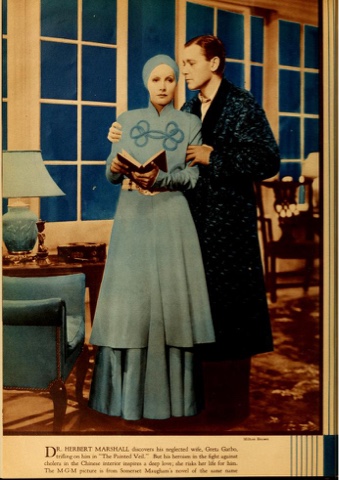 |
It is a gendered spectatorship that places Garbo as a Cleopatra, who, as an alluring Queen, is looking at wealth as an abstraction in that to her it is aphrodisiac, her displaying herself as desirable admidst a backdrop of opulence; to know the secrets of her body is to be allowed by her within the solitude of grandeur. After Victor Sjostrom had returned to Sweden, Robert Herring, writing in Close Up magazine on Uno Henning in En Natt, a classic early Swedish sound film directed by Gustaf Molander, abruptly interrupted his essay to enter into a legnthy discourse on Greta Garbo, it being glaring that the section on Garbo is displaced in the essay, as if by overenthusiasm, to where he compares Garbo to Bridgette Helm only to stall with more on Greta Garbo before returning to Molander's film, "For with Garbo, too, there is the same sense of being linked to something more than one's personal life. Of carrying on and of being carried. Garbo in love, uses her lover as a means of reaching that land, that mood, that peace she requires. That is what is so difficult for her leading men, and so hard to find scenarios in which her leading man can continued to be wooed...Garbo has never lost this, this restless quiet..It is what makes her sometimes tired, which the movies try to turn into langorousness; it is what makes her dynamic, determined...Garbo astonishes people by being alternatively strangely careless and suddenly precise, right and assured." Film Daily reviewed the film Inspiration, "Greta Garbo dominates every situation and is the Garbo the fans want....Miss Garbo brings to the screen all the great possibilities of her talents with a combination of heart-gripping emotion and carefree indifference." With the superlative photography of Clarence Sinclair Bull, Greta Garbo inherited Photoplay Magazine journalist Katherine Albert, who summarized her writing during 1931 by herself paraphrasing her, "I'm bored with Garbo.", her looking at and foreward to the sensation differently with the articles Did Brown and Garbo Fight and Exploding the Garbo Myth, the former concerned with "the carefully guarded walled in stage where Garbo was starring in Inspiration, the latter making an event of Greta Garbo objecting to a line of dialouge on the set of the film Romance, including a photocaption which read, "the writer, who knows hers says there is not mystery about Greta Garbo". After explaining how successful artisticlly the work of Clarence Brown and Greta Garbo had been it asks what happenned during the filming of Inspiration, "The piece is an adaptation of Sappho. The book is now old fashioned. So is the play. A new script had to be written and neither Garbo nor Brown were entirely satisfied, but there was nothing to do but experiment on the set and see how it read. In order to get anything out of it, they must rehearse and rehearse and change and change. That's where the trouble began. Garbo would not rehearse." Photoplay reviewed the release of the film The Rise and Fall of Susan Lennox, "If you like your romance thick, your passion strong and your Garbo hot, don't miss this...M.G.M. stuck closely to the tale, modernizing it of course, and adding a trick ending. Garbo does her utmost with the tile role, natural for her." Although the announcement may seem odd to this century, The New Movie Magazine in 1931 had reported, "King Vidor has selected Ernest Torreace for one of the important roles in The Rise and Fall of Susan Lennox, Greta Garbo's current picture." During 1932 it was well within the knowledge of "all the more studious Garbo fanatics" (Picture Play) that Greta Garbo was on the screen with Clark Gable, Their attraction to each other is understandable, their antagonism predestined, and their desperate reunion at the end of the picture holds no hope of tranquility." Picture Play thought highly of Greta Garbo adding, "Nor does she triumph in spite of her picture. it is a story entirely worthy of her." Richard Corliss includes Mata Hari with those films in which Greta Garbo's performance had been reviewed as "intentionally, or perhaps artisticly, lethargic". "M.G.M. had put Garbo through so many variations on the beautiful spider falling in love with the idealistic fly that the actress could have performed this part in her sleep- and more than one critic accused her of doing just that." During 1932 Regina Cannon directly quoted Ramon Novarro in New Movie Magazine in The Most Eligible Couple Will Never Marry, "Garbo is my ideal woman, but I shall never marry." The "startling frank article continued, "No other woman has impressed me so much; not even Barbara La Marr. Greta is everything that man desires. She has beauty, lure, mystery and aloofness that only men understand, for it is a quality which is usually to be found only in men. It is not coldness either. It is emotion." Journalist Ralph Wheelridge chronicled the making of Mata Hari for Photoplay magazine, "Announcements of the co-starring assignnment for Mata Hari sounded signal guns for rumors, conjecture and prognostication of all description. Those who have seen Miss Garbo about the lot during the making of the picture commented upon the gorgeousness of her costume and her unruffled contentment." The author mentions that her co-star had only met Greta Garbo socially on one or two occaisions, "On her dressing room table that morning Garbo found a huge mound of pink roses." He had sent a card reading, "I hope that the world will be as thrilled to see Mata Hari as I am to work with her- Ramon Novarro." Ben Maddox announced during the middle of his article Garbo and Novarro Together, Has Garbo found her Perfect Screen Lover at Last published in Screenland Magazine that he "had a long talk with Ramon during the making of Mata Hari. Ostensibly, little of it was about Greta Garbo, his quoting Novarro as having said, "Popularity is fleeting. So why should I be dazzled with a material success that is bound to end...However, I was delighted to do Mata Hari, it gives me an excellant role, one for which I am fitted. To me, the play is the thing. I like the co-starring plan. When one person alone is featured, the story is distorted to stress one character. And as a result the picture cannot be dramaticly effective..After thirty something happens to you. You get a more serious outlook on life." To begin My Hollywood Diary, the last work of Edgar Wallace, his wife explains that he wrote his letters in diary form, her publishing those from 1932. in one representative of the time period, while discussing his having dinner with Evelyn Brent and Lowell Sherman, who introduced the topic of Mata Hari, Wallace wrote, "By the way all Hollywood is agog as to whether Greta Garbo will turn up at her premiere. most people think she won't." Wallace included a portrait of Garbo in the volume captions with merely "Metro Goldwyn Mayer" and related that people in Hollwood referred to Greta Garbo only as Garbo. He later added, On Saturday night, I forgot to tell you I met a Mrs. Glazner. Greta's reticence is not pose. She told me a lot about her. She was an assistant in a barbershop-used to mix the lather- then went into that where Tiller (Stiller), the producer met." Owing to that Edgar Wallace wrote novels about Scotland Yard, it is uncanny, or eerie that decades later we would not hold the belief that he had met Garbo, the actress, in disguise or traveling under a pseudonym.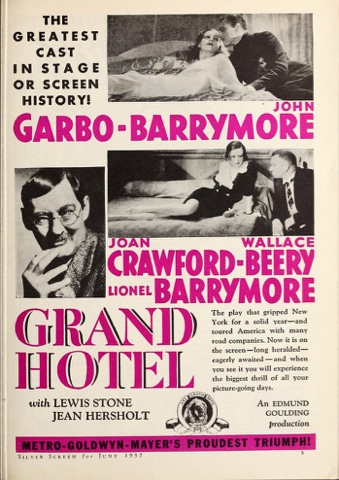 Scott Higgins, currently. Professor of Film at Wesleyean University and recently the editor of Arnheim for Film and Media draws a portrait of Arnheim as an outdated, archaic formalist lacking vision, but notes that the author, a proponent of the visual as the basis of aesthetic theory, maintained that "an action can gain expressive power through 'indirect representation'. This may be in part evident in Arnheim's 1934 piece on Motion, "When in Grand Hotel Greta Garbo walked through the lobby with a springy, dynamic gait, she produced not only the most beautiful moment of the film, but also the most telling characterization of the dancer, whose part she was playing. Sr risk of doing an injustice to the most animated face in the history of film art, it may be said that Greta Garbo could give equally strong expression to the human soul by the rhythm of her gait, which depending on the Occaisionalism was victorious Nd energetic, transfigured, or tied, broken anxious and feeble." Richard Corliss describes the work of Greta Garbo with director George Fitzmaurice, "As You Desire Me begins with a fascinating premise, and reworks a Pirandello play that seems intriguingly relevant to the creation of Garbo the star. indeed the film has everything going for it but good writing, acting and directing. For most of the film, Garbo looks as if she's simply finishing out her five year contract." Photoplay Magazine gave an eerie, perhaps unsettling, review of the film, " 'This may be the last Garbo picture you see' but at this moment she will not make any more now...if ever...And Garbo has never been more marvelous....The love scenes between Douglas and Garbo are the high points of the film and they are almost equal to the ones played so long ago by Gilbert and Garbo. if this must be her last picture, we are glad it is such a fitting swan song. And you don't need us to tell you not to miss the film." Picture Play Magazine during 1932 reviewed the film with, "There are only two kinds of fans- those who like Garbo and those who do not. Those who like her surely want 'As You Desire Me' to head the reviews this month, want praise of a more intriguing Garbo than has been for some time. I'm for Miss Garbo though and must say that her new film affords her one of her finer performances. it gives feeder range to natural talent for comedy....At the same time, she employs her reliable trick of expressing a whole speech in one husky monosyllable." Actor Melvyn Douglas 'co-authored' the article "Why is Garbo great?" for Silver Screen magazine with journalist Patricia Keats during 1932. It began with the explanation that Gret Garbo was filming on As You Desire on location in Laguna, California and that Melvyn Douglas was sullen over having watched his own on screen performance in the film The Broken Wing during the previous evening, a film which he felt would compromise his bid for immortality or impair his relation with his audience, but he went on to give a synopsis of the plot to the new film in which he would be appearing, " 'Pirandello, as usual, let's you draw your own conclusions.'" The article continued to fulfill the promise of its subtitle, which had been "Melvyn Douglas, her new leading man, describes Garbo..'Since I have been in pictures,' Mr. Douglas continued, ' I have never met anyone as interesting as Garbo. I expected a cold, haughty woman who demanded thus-and-so by means of temperamental outbursts. But instead I found charming, emotional girl suffering from one of the worst inferiority complexes I have ever seen.'" Film Daily tersely, perhaps succinctly, announced during 1932, "Greta Garbo, who gets more publicity by trying to avoid it, is reported due today with intentions of sailing on the liner Grispholm for Sweden. At the M.G.M. home office yesterday, nobody had any idea as to the whereabouts of the Glamorous Greta." It followed later with. "Greta Garbo wearing horn-rimmed spectacles and accompanied by the Countess Wactmeister has been reported in Paris for the last week shopping. She is expected to return to Stockholm this week. Hollywood Filmograph during 1932 chronicled that, "Greta Garbo, while in Djuisholm, Sweden, refused to see American reporters. But the door was opened to Rene Kraus, German writer. Greta told Mr. Kraus that she would not be back in Hollywood for two years. That Maurice Stiller had not left her any money. That she had not played a part in Ivar Kruger's life. That she was only a frien d to Newspaperman Sorensen. That she had no intention of getting married." The magazine later continued, "WILL GARBO RETURN seems to be a much mooted question with the executives as well as the fans debating the question since the Swedish star left our shores, but she's still elusive." Movie Classic in 1932 reported that the United States was on tenterhooks as Greta Garbo neared the shores of Sweden, "She permitted a young American poet, named Philip Cummings to share her society- and even to laugh with her. And when her boat docked at Gothenburg, she was so excited that she actually summoned reporters to her! She told them- with a smile- that she was not afraid of reporters...but that she was tired of being written about so much. She added that she was not returning to America in the near future...She said she could tell no one her future plans." Movie Classic reported that while talking to reporters Garbo had to admit to the eventuality of her returning to the Hollywood screen. John Bainbridge gives an account of the events around Greta Garbo and her having departed for Sweden for an entirety of eight months. "Besides arranging to have her name omitted from the ships passenger list, she quietly slipped aboard the liner the night before it sailed. She had spent a period of weeks on an island swimming and sunbathing before returning to Stockholm, where she was visited by Mercedes de Acosta. She had read a biography of on encouragement of Salka Viertel about the throne of Sweden and of one who, during her reign, her "distaste of marriage was profound, she had swarms of lovers...she rewarded her favorites lavishly with money, land and titles...She also gave away half the crown lands." Garbo read the completed script to Queen Christina written Viertel and a colleague, it being made a stipulation of the renewal of her contract. She was met by Viertel on her return to the United States. Nearing the end of 1933, Hollywood Filmograph reported. "The famous Lola Montez- will be the next character that Greta Garbo will try as M.G.M have bought a story of the dashing Lola that vamped The King of Bavaria. The title of the story Heavenly Sinner, which has a glamorous, picturesque background and should exactly fit the mysterious one. That year the periodical published Looking through the Telescope, by Lal Chand Mehra, which outlined filmic spectatorship as being concerned with "the channels of the mystery of knowledge" and that the spectator remained distant and aloof so as to mystify the view, "Greta Garbo's greatest appeal in my humble opinion lies in the fact that this consummate actress always leaves an air of mystery about her. Even though she has portrayed ordinary human characters in all her pictures, she has carried an aloofness that the audiences never understand. This very distance has made Miss Garbo an attractive character...Her human portrayals are mystically beautiful. This question is- what can she do in a real mystic part?" Rilla Page Palmborg, the journalist, who has on several occaisions been credited with having created the initial "Mysterious Stranger" image of Greta Garbo in regard to the interpretations of Greta Garbo's personal life and how they were or were not neccesarily translated on to the screen, returned to Photoplay in 1933 to write the article "Now Its $12,500 a week", the title coming from Garbo's apparently wondering if there would be an early retirement she would enter and if he current salary would compensate for her being neglected, "However that may be, Garbo is now busy with her friend, Mrs. Berthold Viertel, wife of the German motion picture director, hunting a house and otherwise getting established. Metro is humming with excitement- and these matters stand untill the next development." Garbo had returned from Sweden and "She didn't know whether she'd care to make pictures next year." To begin 1934, in Hollywood Reporter it was reported that, "M.G.M has quietly shelved The Paradine Case by Robert Hichens. Story was wrangled over as a possible vehicle for Greta Garbo, but no go, owing to a character problem that could not be cracked, to which it within months added, "M.G.M. cannot make up its mind as to the cast decisions for Indo-China, originally scheduling it under Bernie Hyman's wing for Constance Bennet, but now giving it serious consideration as possible Greta Garbo vehicle." New Movie Magazine anticipated the release of Queen Christina in Advanced News of Films in the making, "The Garbo set, as usual, was closed to all but the people actually working on it...Miss Garbo's schedule during production never varies a minute. You could set your watch by the entrance of her limousine through the front gates each morning at seven forty five. She spends an hour studying her lines and being made up. At nine o'clock on the dot she arrives on the set. At nine thirty, the first scene rehearsed or made, she disappeares into her portable dressing room and has fruit juice and tea, her breakfast" New Movie went on to outline the rest of her predictable day of shooting. During 1934, Photoplay succinctly encapsulated the onscreen Greta Garbo, "in Queen Christina, Greta Garbo and John Gilbert have a rendezvous in an inn. To Christina, all the inanimate things in their chummy room become very dear, due to their association with her romance. One sequence consists of Garbo hovering about the room, caressing various objects while Gilbert watches silently. She takes her time too." The caption of a portrait of Greta Garbo taken by Clarence Sinclair Bull published in Photoplay during 1934 read, "Greta Garbo as Queen Christina is impressively beautiful." In Three Weeks with Garbo, published in 1936, Leon Surmelian began with, "After twelve years of entertaining the public as the screen's No 1 glamour gal, my and your weakness, the incomparable Garbo remains the same elusive shadow, the same lovely enigma to the world that worships her at her feet...It was during the filming of the memorable Queen Chistina when Katerine Hepburn tried to crash Garbo's stage as an extra and failed where I succeeded. And now I will give you an intimate closeup of the Swedish Sphinx out of my won personal observations ." It reviewed the film, "The magnificient Greta, after an abscence of over a year, makes a glorious reappearance on the screen...on the whole, Rouben Mammoulian's direction is admirable; S.J. Behrman's dialouge is scintillating; settings and costumes are rich." Tucked away in a secluded corner of a 1933-4 issue of Cinema Quarterly is a review of Queen Christina written by Paul Rotha. "I do not find it in me to write about this picture, but I must write instead about Garbo, who contrives, though Heaven knows how, to surpass all the badness they thrust upon her...Here a lithe figure sheathed in men's breeches and stamping boots, she strides into our prescence and again reveals her dynamic personal magneticism. She is a woman, it seems, destined to contrive in a world that spells misunderstanding...Queen Christina perhaps comes nearest; with its great close-ups and sublime fading shot. But the showman tricks of Mamoulian and the falseness of the environment conspire against her." Cinema Quarterly was also a magazine that published The Film Critic of Today and Tommorow, by Rudolph Arnheim, who wrote, "In an essay....Mamoulian was blamed for having allowed himself to be influenced by the "innocent vanity" of Greta Garbo. Almost simultaneously there appeared in a German newspaper, an interview in which Greta Garbo said, "You ask whether I am satisfied with the Christina film? Not at all. How could you think that? If I had any say in the matter, it would be quite different. But what one would like oneself is never realized. I shall never act the part of which I have dreamed." After continuing to write that he and his readers were not to be concerned "with a defence of Greta Garbo", Arnheim notes a creative dichotomy between actor and director, much like the one posited by silent film historians that saw the two reel film evolve into the eight reel during the time of Bitzer and Griffith where the scenario and photoplay emerged and developed. Hollywood magazine during 1934 published an article titled, "Garbo Finds Love" without revealing the name of its author, the headline reading, "The budding and blossoming of Garbo's romance with Mammoulian, as seen through the eyes of an actress who worked with her in Queen Christina, but for obvious reasons must remain anonymous." It began, "As one of those who worked with Garbo in Queen Christina, I saw her romance with Rouben Mammoulian bud and grow and flower into love. And I, like the rest of Hollywood, believe they will soon marry." The cover Movie Classic magazine hosted the title, "Will Garbo marry her Director". Between the covers, underneath an oval photograph of Greta Garbo as Queen Christina, read the caption,"Portrait by Bull". It stated, "Greta Garbo and John Gilbert were only a few feet away from the city clerk and matrimony when she turned away, shaking her head. 'I have changed my mind.', she said. But now apparently the man for whom she has waited has now appeared. Rouben Mammoulian, the famous director of stage and screen, is that man." Journalist Dorothy Manners for New Movie Magazine that year asked, "Will Garbo Marry Mamoulian during an article in which she quoted the director, "Mamoulian only shrugs, 'The story that Miss Garbo and I plan to be married is absurd.'" Mamoulian, Greta Garbo and Salka Viertel had been dining together that evening. Silver Screen during 1934 observed, "The Garbo Mammoulian romance seems to develop steadily. The two have been quietly lunching at the Ambassador and dining at the Russian Eagle quite often lately." It was nestled on a page titled More Gossip-Whispers are Little Daggers. John Gilbert would make only one film after having been reunited with Greta Garbo in Queen Christina, The Captain Hates the Sea (1934). Bainbridge writes, "It was reported, erroneously, that when Garbo was informed of his death she said, 'What is that to me?' Actually she was vacationing in Stockholm when Gilbert died [1936] and was given the news by a Swedish reporter in the foyer of the Royal Dramatic Theater during an intermission. She refused to make any comment; shortly afterward she left the theater." There is one account, if not more, that the role in Queen Christina was first going to be offered to Lord Olivier and was given to John Gilbert on Greta Garbo's insistence. According to John Gilbert himself, it may seem to have been. John Bainbridge chronicles that not only had Lord Olivier filmed screen tests and signed a contract, but he and Greta Garbo had rehearsed love scenes before his having had been decided against by the actress. Modern Screen magazine during 1933 briefly reviewed Queen Chrstina with the exclamation, "Triumph for Garbo. The picture is an unending series of exceptional scenes, packed with fine characterization a and good direction." it saw the film as a "comeback" for John Gilbert. Pages later it ran an article by Gladys Hall that began, "John Gilbert called me on the phone one night. he said, 'I am filing a complaint against the studio to have my contract construed. When I gave you the first story about my comeback, thanks to Garbo, I told you I'd give you the next big story that might happen to me. it happened." The title of the article was "Don't Send Gilbert into Exile" and it carried a rectangle plaque I between the two vertical paragraphs which read, "His fate is in your hands...write and tell us your opinion...It will determine John Gilbert's fate". it is eminent that Roland Barthes is looking at the final pullback shot of Mammoulian's film during the essay The Face of Garbo, irrespective of the pullback shot itself having been first developed by silent film director Clarence Brown and any contrived metaphor that that the frozen facial expression of Greta Garbo may have been Intended to represent a farewell to the silent era itself within the loyalty of nostalgia. Barthes writes, "It is indeed an admirable face-object. In Queen Christina, a film which has been shown in Paris in the past few years, the make up has the snow thickness of a mask: it is not a painted face, but one set in plaster, protected by the surface of the color, not by it's lineaments. Amid all the snow, at once fragile and compact, the eyes alone, black like strange soft flesh, but not the least expressive, are two faintly tremulous wounds....Now the temptation of the absolute mask (the mask of antiquity for instance) perhaps implies less the theme of a secret...than that of an archetype of the human face...And yet in this deified face, something sharper than a mask is looming." It may seem unavoidable that we question the fictional characters of Ingmar Bergman's film Personna on their isolated island as we look at the mythology earlier written by Barthes in 1957. Hal E. Wood contributed Garbo Frowns Again to Hollywood in 1934, "Greta Garbo is anything but pleased over the action of Metro in signing assigning Victor Fleming to direct her in the Painted Veil. In fasct there are rumblings to the effect that the Swede is dusting off." The magazine claimed that Garbo wanted to leave for Sweden due to her lack of director approval and that she favored making a second film with Mammoulian, to which it appended, "Greta's lonely again" in its News Slueth section, "It's all over between garbo and Rouben mammoulian if you take the word of the chatters...Incidently, the star has rescinded her demand that Mammoulian, who directed her in Queen Christina be named her guide through The Painted veil and has approved Richard Boleslavsly as her megaphonist" Milton Brown photographed Greta Garbo on the set of The Painted Veil for The New Movie Magazine during 1934. It pointed out, "Notice the raised boards Garbo walks on to increse her height." A second photograph taken on the set of The Painted Veil by Milton Brown accompanying Garbo Starts Her New Picture took up more than three fourths of two pages in Photoplay, "Take 1- which means the first scene in Greta's new Metro-Goldwyn-Mayer film, The Painted Veil. The first call of 'Camera' for a Garbo picture is always a thrilling second. This time it stirred more excitement than ever before...All the sets for The Painted Veil were constructed on stilts, as this photograph reveals. The set has a ceiling, which is unusual from a scenic angle." Hollywood magazine during 1935 printed the article "Garbo's Cameraman Talks At Last, where William Daniels was quoted as having said, "She has been pictured as gloomy, aloof, frightened, imperious and a hundred other things as unlike her real self as are midnight and noon. The real Greta Garbo is the most sensible woman I have ever known. The keynotes of her character are intelligence, simplicity and absolute sincerity....Garbo likes to look through the camera to see what the scene is going to look like, but she does n't thrust her opinions on any of her fellow workers....She almost never troubles to look at the 'rushes' of her films, nor even at the first rough assembly of the picture. Instead she waits for the previews." In the article there is a photo caption reading, "Camerman Daniels wants to photograph Garbo in color. He believes her complexion is the loveliest he has ever filmed." William Daniels is quoted by journalist William Stoll as having related, "When it came time to film retakes on The Painted Veil, Director Boleslawski had been called away to another studio, so W.S. Van Dyke took charge. He is probably the breeziest, quickest shooting director in the business, he literally cuts and edits his pictures as he shoots them. Our first retake was a scene of Miss Garbo coming down a long flight of stairs. we made the shot- once. Van Dyke said to me, 'Okay-wrap it up! Now, let's move over here!' Miss Garbo's face was a study; then she slowly smiled and said,'Well, I suppose there is only one way to walk down stairs.'" Memory would be insufficient to serve in regard to the often related story about Greta Garbo's slippers as to whether it originated with Mauritz Stiller or William Daniels, but as Hollywood folklore, John Bainbridge whispers that it was Daniels, "Whenever possible, she wore an old pair of carpet slippers on the set for the sake of comfort. before a scene was shot she always asked Daniels, 'Is the feet in?'. If they were out of camera range, she kept the slippers on, regardless of what fabulous Adrain creations she was wearing." Perhaps, the wearing of slippers had prompted her remark to Daniels about how an actress should descend a staircase. Greta Garbo departed from her usual portrait photographers for four photos "posed exclusively for Photoplay", her reconfirming herself as a fashion model as the two page layout "Garbo's first fashion sitting in five years" described in detail three gowns that Adrian had designed for the film The Painted Veil. The first of which was a gray silk teagown, with pleated organiza jabot and deep dolman type sleeves. The second article photograph was described as "the sports type of thing Garbo loves- nonchalance in the swagger lines of a white flannel coat" whereas the third included "a new version of the famous Garbo pillbox hat," and a corded felt with jade ornament. Richard Corliss writes, "Boleslawski's visual effects here are adept without being ostentatious- as when Garbo looks distractedly into a window, and the reflection shows a much more disturbed face." John Bainbridge quotes director Richard Boleslawski, giving the impression, as elsewhere, that Greta Garbo approached acting in a professional manner, if not meticulous in regard to scene study, business-like in any event about the demands of the art, perhaps learned long before at the Royal Dramatic Academy in Stockhom. Boleslawski had said, "She was so completely thorough in her art that one found her almost as marvelous as the camera itself." Bainbridge goes on to describe her dependable punctuality while working for the studio and her being not only "letter-perfect in her lines" but that she would also know the lines of the actors that were to play alongside of her. Photoplay magazine journalist Otis Wiles affirmed What It's Like to Work with Garbo, with the claim that " Herbert Marshall's intimate revelations about Greta Will Suprise You." The article explains that Marshall was scheduled to film on adjacent sets, and that while he was finishing The Outcast Lady, with Constance Bennet, Greta Garbo was beginning production of The Painted Veil. Marshall, thinking that the make up for one film was too dark for the other went over to what was to soon be his next assignment. Richard Boleslavsky had built an entrance way to the set on stilts that were four feet in height. " 'Miss Garbo was in her portable bungalow,' said Marshall. 'She was told I was on the set to do a test and she flew out of the bungalow. I wasn't kept waiting a second. She came to me smiling and with a very friendly hand extended toward me. She said, 'Marshall, there seems to be some nonsense about make up...If your make up is wrong I will change mine.' of course I wouldn't permit her to go to all that trouble, but the incident gives a clear insight into the kindly, cooperative charcter of the woman." Marshall at the time was renting the home of Director Edmund Goulding. Photoplay gives an account of one afternoon Herbert Marshalll returned after work to find Greta Garbo and another woman on the tennis courts of the estate, playing "skillfully and gracefully"; she had taken Goulding up on a standing invitation she had obtained.   Photoplay provided a brief review of Greta Garbo in Anna Karenina during 1936, "The persuasive genius of Greta Garbo raises the rather weak picture into the class of art. Fredrick March is unconvincing as the lover for whom Greta sacrifices everything." It later rewrote its review, "This picture is really a weak and dull picture. yet the persuasive genius of Garbo raises it into the class of art. What should be moving seems dated, though the production is magnificient...But Frederick March seems stuffy." Film Daily reviewed the film not unsimilarily, "Greta Garbo in a sympathetic role that fits her admirably...with a fine appreciation of the poignant drama with all its subtle evaluations....Garbo has never appeared more hI'm uman and appealing." Motion Picture Daily's review of the film included the assessment, "The Tolstoi novel of Russia, containing as it does dramatic elements repeated time without end in many and far less distinguished pictures, make a fitting vehicle for the screen's leading tragedienne...Anna Karenina, slightly ponderous perhaps from the view of story, is nevertheless, a thoroughly worthwhile motion picture directed by Clarence Brown with pronounced ability." Picture Play magazine looked at the film as a remake, "So old that it served Garbo before she broke her silence and lapses into her present perfect speech. Then it was called Love. The new version is more interesting because it is more painstakingly done, speech giving it new refinements and subtleties. meticulous costumes and seetings complete a marvelous reproduction of St Petersburg society." Motion Picture Daily early in the year reported, "Basil Rathbone intends to leave for Hollywood in six weeks. He has turned down an offer by M.G.M. to appear in Anna Karenina with Greta Garbo and Frederick March. Rathbone is anxious to play the Sidney Carlton role in Tale of Two Cities, but he will most likely be signed by a company other than M.G.M." A month later it announced, "Reginald Denny goes in to Anna Karenina, which stars Greta Garbo at M.G.M." Basil Rathbone wrote of his aquaintance with Greta Garbo in his autobiography In and Out of Character- one of my copies mysteriously had the Players Cigarette Card featuring the actor from 1938 scotched taped to the inside cover, which, not unlike the persian slipper, the present author still keeps in my wallet- "I first met Miss Garbo in 1928 when Ouida and I were invited to lunch one Sunday." Rathbone and his wife had been present at the premiere of the film The Flesh and the Devil. There is an account that it had been Adrian that had designed the costume that Greta Garbo had worn to a party given by Basil Rathbone and Ouida Bergere during 1929. She had attended Mrs. Rathbone's affair as Hamlet. Of his starring in the film Anna Karenina with her he wrote, "And so upon the morning previously arranged I called upon Miss Garbo. The house, a small one, was as silent as a grave. There was no indication that it might be occupied." The atmosphere may not quite have been as conducive to a seance that Valentino would have attended as Rathbone may have made it out to be. Jane Ardmore's biography of Mae Murray, The Self Enchanted- Mae Murray: Image of an Era only briefly mentions Basil Rathbone or Greta Garbo, but it is an account of off-screen Hollywood, there having been a diegetic and non-diegetic aspect to the extra-textual as well. Rathbone had starred with Mae Murray in The Masked Bride (Christy Cabbane, 1925, six reels). "Every fourth Sunday, Mae threw open her house for lavish entertainment...Jack Gilbert brought Greta Garbo. They were in love and radiant, but Greta worried about the studio, she was shy, there seemed such commotion, her energies were sapped. 'You should have a dressing room as I do, Darling," Mae had told her. Mae Murray would later be attending a birthday party for Rudolph Valentino given by Pola Negri. On learning that Greta Garbo had already had the film Mata Hari in production, Pola Negri deciding between scripts that were in her studio's story department chose A Woman Commands as her first sound film, in which she starred with Basil Rathbone. Of Rathbone, she wrote in her autobiography, "As an actor I suspected basil Rathbone might be a little stiff and unromantic for the role, but he made a test that was suprisingly good. In an article titled Hissed to the Heights- That's Rathbone, written during 1936, Motion Picture quoted the actor, "Before I played Karenin I was puzzled about the technique of film acting, and wasn't satisfied at all with what I had been doing. During the filming of Anna Karenina I watched Garbo and learned from her what I think is the secret of good screen acting; play your part with the least possible movement and the greatest possible mental projection. It is different on the stage. There your whole body is constantly exposed to the audience and you must have perfect coordination from head to foot....And Garbo has this power of mental projection to a superb degree...I first met her in 1928. I found her very intelligent and charming. I didn't meet her again untill 1935, when we were cast in the same picture. She wasn't the same person, she had changed. You know I think Garbo suffers a great deal for being typed typed. Her camerman thinks so too." "And now in Anna Karenina she becomes newly romantic." To the left of a portrait of Greta Garbo taken by Clarence Sinclair Bull, a caption read, "And on her return from Sweden, she may do Camille." Screenland magazine made the fantastic announcement, "And here's another thing that concerns Miss Garbo. for years Fred Niblo has been trying to interest the financial powers at Metro in a story by Barney Glazer on the Emperess Josephine. unlike other yarns that mention Napoleon, he is to be, in this, a secondary character. it being women's day, the author feels the women of history should have their due. now it looks as though the deal will go through, and Greta will play Josephine." Screenland printed the article in August of 1930! M.G.M's own advertisements featuring Greta Garbo in Motion Picture Daily during 1937 told audiences, "Garbo and Boyer in Beloved. You'll hear plenty about it." During 1937 The Film Daily chronicled the interest Clarence Brown held in the script of Conquest, "Countess Walewska, M.G.M. Greta Garbo picture has literally become a 'Clarence Brown production'. Valuable tapestries, silver candlesticks and tableware that once graced the palaces of the Russian Czars, but which have adorned Brown's (Californian) ranch home are used as props in the picture." The magazine went on to explain that brown was a collector and had a letter in his library that was "the basis for one of the dramatic highlights of the vehicle," it having been written by a dying French Soldier. Motion Picture Herald, not entirely of a different opinion, reported that Greta Garbo had read the novel written by Waclaw Gastrorowski and asked Irving Thalberg before his death to adapt the romance of Maria Waleska. The script assignment accordingly went to Bernard H. Hyman. it elaborated that there had been "intensive exploratory research" and that "hundreds of thousands of feet of film were photographed and several secret previews were held prior to its being shown to press audiences.". Ruth Waterbury announced that Garbo would soon appear in the film Countess Walewska wearing a new type of jockey a cap, which would have a "deep long bill hanging down in front." Of the script, Richard Corliss later wrote that it was, "a model of civilized wit, which Clarence Brown direct with a rigorous lack of style that seems almost personal. But there is little of Garbo to comment upon untill the last scenes." Picture Play magazine that year had published a portrait of Greta Garbo taken by Clarence Sinclair Bull captioned, "Divine Lady; Garbo as Marie Waleska in Conquest." It also had published an article by Helen Louise Walker with the subtitle, "Garbo casts a spell of silence over those who know her well. They cannot talk about her even when they try. Why is this?"    Greta Garbo is reported to have mentioned to the press that Camille was too tragic a character, intonating a reluctance in regard to the studio's assignment. In Gabo Talks at Last- And Here is the Romantic Romantic Reason For Her Silence, printed in Photoplay during 1936, Jim Mason gives an account of meeting Garbo. "Garbo talked to me on the train that was bringing her to Hollywood...at first she refused to see me..she granted an interview that lasted twenty minutes...the longest exclusive interview she has given. 'I really want to find as much solitude as I can,' she said. 'I do not know why I should talk to people i do not know, but I am beginning to learn that it is necessary...They say I am difficult to talk to-Ah if you only knew how hard I've tried...Sometimes I become upset. When i arrive at a railway station and crowds force in and around me. I want to run...I can not say how long I will stay, a year, perhaps longer. I love it here, but I love Sweden, too. Its hard to say." It was then divulged to the readers of Photoplay that there were the remanants of a former romance, "The real reason for her change of heart is apparently George Brent."  The Camille of silent film actress Bernhardt remade by Greta Garbo was remade by several silent film actresses. The production of Camille (Kameliadamen, George Cukor,193) included screenwriter Frances Marion. Film Daily reported during 1936, "Greta Garbo has spent three full days this week in Adrian's studio going over designs for the costumes of her new starring production, Camille. During 1936, Photoplay related that Robert Taylor during the first week of filming had been without any contact with Greta Garbo, that he hadn't yet glimpsed her, his having been told that she was "making tests and couldn't begin work". Later that week, after his finally appearing on the set without out her, Photoplay directly quoted the actor, "'I thought this Garbo thing was a myth,' he mumbled." Later, it featured a two page fold of on the set photographs, "With these pictures, taken at the closely guarded set of "Camille", Photoplay proudly presents to you for the first time Garbo in color- and how lovely she is....Behind Cukor is Bill Daniels, Garbo's only camerman. Bill was rushed to the hospital twice during the shooting, but Garbo serenely waited for him. She will have no one else shoot her pictures." John Bainbridge quotes director George Cuckor as having said, "While we were doing Camille, Garbo didn't talk much to Robert Taylor. She was polite, but distant." Later during 1936, Photoplay added, "At M.G.M. we discover that Garbo and Robert Taylor are still making Camille- still on a sound stage that is hermetically sealed against visitors." Ruth Waterbury was so thrilled with her performance that while praising the actresses' enactment of the death scene, she suggested that Greta Garbo star in Marie Antoinette, "if Shearer decides not to make it." A photocaption in the article reads, "Garbo, entering her eleventh year as a star had to die- to live more glamorously than ever." It announced that she would appear as the Countess Walewska wearing. New type of jockey cap which would have a "deep long bill hanging down in front."   The whereabouts of Greta Garbo in 1936 was in most ways far from being kept entirely in secret; according to Photoplay Magazine, garbo owned a villa in Nyokoping, Sweden and was celebrating her thritieth birthday. During 1937, it confidently mentioned, "Garbo will make another picture instead of a trip to Sweden." |
| It was only after my recently revisiting the Gothic Hammond Castle, built on the Massachusetts Coast in 1929, that I read that it was a "secret hideaway" of Greta Garbo. More publicity has been given to it by moderns who persist in their claim that it is haunted and has a Swinging Chandelier, but the visitor to the vista of Norman's Woe, which provided the location to Longfellow's poem The Wreck of the Hesperus, will be informed that the swimming pool in its courtyard, which is encased in a glass canopy and houses a statue of St. Mark, was often used by John Barrymore. It was the favorite room in the castle of Greta Garbo when she visited with Stockowski. Nor was I aware, it also being seemingly omitted from fan magazines, that it is has become public knowledge that Greta Garbo owned a oceanfront estate across Gloucester Harbor on Dolliver's Neck also built by the Hammond family, erected in 1935 and sold before 1950, which she used during the summer. but interestingly, it was in Picture Play Magazine in A Woman Alone, published in 1937 during the release of Greta Garbo in the film Conquest, that journalist Helen Louise Walker depicted Greta Garbo as mysterious rather than eccentric while reported that she was without owning a home in Hollywood an inhabited only rented dwellings. "She does not care what is inside the house. Apparently she never moves a vase or changes the angle of a chair or the position of a picture. The astonished owners return to find everything as they left it, not one telltale detail to prove that one of the world's most glamorous women has been living there. Nothing is marred-Greta Never giving parties- no china has been broken, everything is spotless...Just now Greta is occupying th Niel Hamilton house in Brentwood...She employs a butler-houseman...and she changes servants rather often. Once a pair of trusted servants betrayed her trusted confidence- and took money for it." Walker related in the article, "'At first they hung spangles on her,' Adrian told me.'They considered her a sort of decorative prop. I saw that she was like a tree, with roots deep in the earth. You must never put an artificial jewel or imitation lace or fur on Garbo'" It seems understandable that Adrian may have only consented to interviews with caution, while on the other hand eagerly seeking them out when available. As a margin note, John Gilbert performed in Boston in a theater still open for performances of classical music which has no lingering blythe spirits other than Charles Dickens. |
Ruth Waterbury writing in 1938 for Photoplay added interest to the unreachable, nonavailable Greta Garbo, an untouchable star in the firmament, he having scheduled with M.G.M. make up man Jack Dawn, "First of all, he didn't think much of the way my hair was done...a grand girl named Olga came along to do something about that...I had heard she was Garbo's hairdresser so while she worked on me head, I worked on Olga trying to get Garbo information from her...well, she got further than I did." During 1938 Motion Picture Daily printed the announcement, Garbo-Stockowski to Wed, "Greta Garbo and Leopold Stokowski will be married," the location was planned as being in Europe. "It was stated her today by the M.G.M. office and Wallace Berry will be the best man. No date was given." Within weeks it recanted with, "Garbo today denied to the press that she was married to Leopold Stockowski or intended to marry him." Garbo Unhurt in Mishap drew the eye of the reader of Film Daily during 1938 to a report received from Stockholm by newcable. Leopold Stockowski apparently had been behind the wheel with Greta Garbo when the vehicle overturned while skidding. "After righting the car, the couple resumed their journey." Richard Corliss writes that there were discussions about Greta Garbo starring in the film Tristan and Isolde with Stockowski, which was upon his suggestion, but that when their 'affair', or involvement, had concluded, so did plans to put the film into production. Jim Simmons claimed to have talked with Greta Garbo after having chased her limosine with his car and published I Won't Marry Stokowski says Garbo in Photoplay which dispelled accounts that to two were to be wed, "'No,' she told me, 'No, I will not marry Mr. Stokowksi.' It was one of the rare interviews ever obtained by anyone from the glamorous star herself. The only one in which she openly discussed current romance rumors concerning herself." Anita Loos, the screenwriter, whom had known Stokowski and had encountered Greta Garbo causally, during walks, had introduced the two by inviting Greta Garbo to a party, at his request. Modern Screen also reported on the lovelife of Greta Garbo during 1938, "The rumors that Garbo's real romance is director William Wyler still float around town and Wyler is the most surprised guy in Hollywood because he's never met his alleged lady love". Apparently Wyler had quipped to a reporter's query when asked about his private life by having replied," I've been seeing a lot of Garbo lately.". The columnist had taken him too literally, to which Modern Screen responded with the summarization, "That's Hollywood."  The sentiment about Greta Ga rbo last film was crystallized by The Film Daily with "Hub Won't See Garbo Pic", which read, "The Garbo picture Two Faced Woman definitely will not allowed to be shown anywhere in the Metropolitan Boston area." Motion Picture Daily during 1941 elaborated on the "Condemned List" of the National Legion of Decency and their explanation of the film The Two Faced Woman having been placed on it and the ensuing debates on its censorship. "The Legion gave as the reason for the classification its belief that the picture is 'immoral and un-Christian in its attitude toward marriage and its obligations; imprudently suggestive scenes; dialogue and attitudes; suggestive costumes.'" A revised version of the film that otherwised would not have been released was shipped by train, du to their being a ban on shipping the film by air. The revision involved, "elimination of certain items of dialouge and scenes. It is learned that the effect of the changes is to show that the husband who did not detect the wife's disguise untill late in the original version discovers it early in the revised version." This resulted in a reclassification from "C" to "B" in the Motion Picture Production Code. Salka Viertel was one of the writers assigned to remake Her Sister From Paris (1928), which had starred Constance Bennet, restoring the original title from the play. "She didn't like the way things were going. There were clashes of temperment on the set, arguments and misunderstandings as well as frequent differences of opinion between producer and director." As interesting as it is, when describing Garbo's frame of mind during the filming John Bainbridge depicts Greta Garbo as having felt dismal, going so far as to again quote unnamed sources that claimed Garbo saw forces at work that desired a demise to her career with two seperate quotes, "'They're trying to ki... |
|
Danish Silent Film: Sherlock Holmes at Elsinore/Sherlock Holmes pa Marienlyst; Asta Nielsen, Ebba Thompsen, Betty Nansen, Valda Valkyrien and the Nordisk Film Kompagni, Great Northern Film and Carl Th. Dreyer: News Flash- missing Lost Silent Sherlock Holmes Films found and restored!! |
|
|
 Swedish Silent Film Swedish Silent Film
|
|
|
Sherlock Holmes pa Marienlyst/Sherlock Holmes at ElsinoreIn regard to The Tragedy of Hamlet, Prince of Denmark, written by William Shakespeare being compared to a lost film, there are elements to the characterization that lend themselves to the methods of the armchair detective, no matter how readily: ostensibly that the line "How all occasions do inform against me" appears in the First Quatro of Hamlet but is omitted from the First Folio printed posthumously by the Shakespearean acting company, the Kingsmen, and playwright Ben Jonson- it remains a fragment The pith of its events were designed by Shakespeare from the Danish legend Amlet that seems to not have had a character named Ophelia, nor a ghost- the Ghost first appeared in what is now a lost manuscript mentioned in Lodge's Wif's Miseries, and the allusion is to a ghost that cries like an oyster wife, "Hamlet Revenge" and, earlier than Shakespeare's Hamlet, is attributed to Thomas Kydd. While we wait for a filmmaker to add the play in its entirety despite its length, any production of Hamlet must confront that there are in fact three versions written by William Shakespeare. Notwithstanding, the history of silent film might at any time bring in not only the play as performed on stage, but the indefatigable Sherlock Holmes.Basil Phillip St. John Rathbone, who portrayed the fictional character Sherlock Holmes, had also appeared in silent films- Trouping with Ellen (T. Hayes Hunter, seven reels) in 1924, The Masked Bride (Christy Cabanne, six reels), starring Mae Murray, in 1925 and The Great Deception (Howard Higgin, six reels) in 1926. Rathbone and his wife had been present at the premiere of Flesh and the Devil. Anna Karenina (1914), filmed by J. Gordon Edwards, had starred Betty Nansen. On learning that Greta Garbo had already had the film Mata Hari in production, Pola Negri deciding between scripts that were in her studio's story department chose A Woman Commands as her first sound film, in which she starred with Basil Rathbone. Of Rathbone she wrote in her autobiography, 'As an actor, I suspected Rathbone might be a little stiff and unromantic for the role, but he made a test that was suprisingly good.' Directed by Paul L.Stein, the film also stars Reginald Owen and Roland Young. And like Rathbone, another Sherlock Holmes, Clive Brook who appeared in the 1929 film The Return of Sherlock Holmes (Basil Dean) and in the title role of Sherlock Holmes (Howard) in the film of 1930, was appearing in silent films during the early 1920's, including Woman to Woman (Cutts 1923) and Out to Win (Clift, 1923). As part of an interesting study, Clive Brook had appeared in the mysteries Trent's Last Case (1920), directed by Richard Garrick and based on the novel by E.C. Bentley and The Loudwater Mystery (1921), based on the novel by Edgar Jepson, before his appearing with Isobel Elsom in the 1923 film A Debt of Honor directed by Maurice Elvey. One of the most sought after lost, or missing films, listed by the British Film Institute as having been filmed but not surviving today in an existing print is The Mystery of the Red Barn (Maria Marton) dircted by Maurice Elvey in 1913. The following year Elvey was to direct the mysteries The Cup Final Mystery and Her Luck in London. One of the first directors Philip St John Basil Rathbone had appeared in front of the camera for had been Maurice Elvey, who had directed the 1921 film, The Fruitful Vine, adapted for the screen from the novel. Motography, the motion picture trade journal, reviewed the Sherlock Holme sof 1916, "Much of the photography is very good. A number of bog scenes standout prominently, in which the suspense is cleverly managed. But as a whole, seven reels seems too lengthy. The play drags in the first part and some of the story is vague. The acting is in keeping with the melodramatic situations. Gillette shows himself a clever screen actor in the title role." Sherlock Holmes (Arthur Berthelet, 1916) starring William Gillette, for nearly a century a silent film that if found in magazines has been reported as a lost film in regard to being seen on the movie projection screen, according to Photoplay magazine although not remade was the basis for the film Sherlock Holmes (nine reels) of 1922, starring John Barrymore, John Barrymore not only in the title role but also in a dual role as Moriarty. Photoplay magazine claimed that it was Barrymore's acting ability that was worth seeing, not so much the character itself being portrayed, but added that followers of the Arthur Conan Doyles stories were recommended to see the film, "You should see this film if you are a devotee of John the Barrymore...Albert Parker, the director, has not been afraid to follow his imaginative impulses, with interesting results." As the stories of Edgar Wallace were beginning to appear serialized in The Stand Magazine, alongside a Sherlock Holmes rejuvenated by its creator after the death of illustrator Sidney Paget, a Sherlock Holmes created by John Barrymore appeared in The Strand Magazine in the interview The Youth of Sherlock Holmes, conducted by Hayden Church during 1922. A photocaption read, "A well known incident from 'A Scandal in Bohemia', the first of the famous Sherlock Holmes stories. John Barrymore's wonderful makeup as the old clergyman is seen to better advantage in the small photograph." Jounalist Hayden church divulged to The Strand, "It was in a bedroom of the Ritz that I discovered Mr. Barrymore, who arrayed in flowered silk pajamas was at that very moment engaged in making up as the great Sherlock." The article explained that there was a prolouge to the film that provided biographical information on the fictional character and his youth that had been left out in the cannon. In the interview, Barrymore explains that the film was shot on location not in Baker Street or Gower Street, but in Torrington Square, for authenticity. "Our film will bring out the romantic side of Holmes...'At the beginning of the hour,'Holmes in our script, 'I met love and it passed me by. At the end of the hour, I met mysterious evil'" Film Daily magazine during 1922 described the film favorably with the provision, "It is too long and it is not easy to follow the story. In an effort to clarify matters numerous long titles and used that often confuse more than try to explain. The result is a 'talks' picture and if you happen in after the first half reel you are about lost because it's not the kind of story that you can pick up readily." The magazine described the lighting as "sometimes too dark on interiors" and the exteriors as "views of England and Switzerland; splendid". The scenario is listed as having been written by Earle Brown and Marion Fairfax, the cameraman as having been being J. Roy Hunt. In the film, Holmes is seen smoking a pipe in his armchair at 221 B Baker Street with a human skull on the end table where the Conan Doyle often kept his Stradivarius violin, his being seen reading a letter, the later shown in an intercut insert shot. Watson, now married, enters as Holmes reads a newspaper account of his having solved the Darton Mystery, the newspaper also shown in insert shot. There is a globe visible in the far corner of the room, a teapot diagnally in the foreground, and yet, the bust, remaining unidentified, but presumably Roman, can only be espied as a shadow, the light seeming to fall from a window that is blocked by its silhouette. The Persian slipper is on the mantle, ready for when Holmes' is in need of filling his pipe. It is there that Holmes attributes to Moriarty over fourth as of then unsolved mysteries. The film quickly concludes, first by Holmes disguising himself as Moriarty, then as he is removing the greasepaint he apprehended Moriarty, who in turn is in disguise, at that moment his announcing that he is embarking upon his honeymoon. While deciding whether Stoll and Ellie Norwoord could film the Adventures of Sherlock Holmes with Arthur Conan Doyle's remonstrance not to use the name Sherlock Holmes as it more properly belonged to William Gillette, Film Daily printed during 1922, "The author said he saw the film version in which John Barrymore appeared and stated that there was one act which was not authorized, nor in accordance worth his plots. 'That was the act in which Sherlock Homes goes to college', said Doyle." It added, without intimating that today an owner of a ouigi board would be more favored to acquire an interview with Doyle than a trade magazines from the twenties, "Doyle said that Gillette wired him for permission to make changes in the original theme in order to 'work in a romance' and that Gillette cabled,'May I marry Holmes?' Doyle replied,'Marry him, murder him or do anything you like with him.'" Sherlock Holmes as a film shot at the Essanay Studios in 1916 was lost, presumed nonexistent, found as a copy of a French print and restored in 2014. Edward Fielding essays as Doctor Watson in a scenario written by H.S.Sheldon. Actress Majorie Kay stars in references to "the woman". A nitrate dupe negative was found in the Cinemateque Francaise with French intertitles and color annotations which having had been being restored for its premiere in the United States, will be seen for the first time during May of 2015 at the San Francisco Silent Film Festival. The film, and the film version starring John Barrymore in which Roland Young appears as Dr. John H. Watson have not been seen in what appears to be more than three quarters of a century- the director of the 1922 film, Albert Parker assisted William K. Everson and Kevin Brownlow in restoring the Barrymore version during 2001. In regard to Sherlock Holmes at Elsinore, actor Jens Fredrick Sigfrid Dorph-Petersen brought an unauthorized four act version of the play Sherlock Holmes written by William Gillette to the Folkteatret for Christmas in 1901, sixteen years before Gillette himself had adapted the stage performance for the cinema. The play was performed in Stockholm, Sweden with actor Emil Bergendorff onstage as Sherlock Holmes during April of 1902. That same year, the play was staged in Kristiana, Norway with actor Ingolf Schanche as Gillette's Sherlock Holmes.  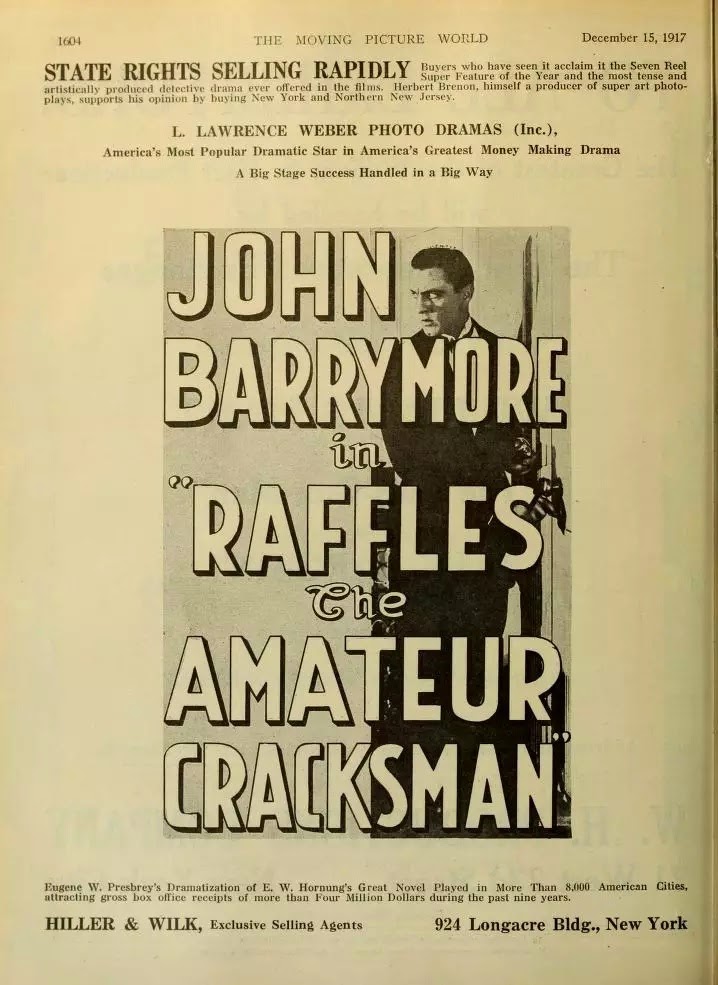 Maurice Elvey in 1921 directed actor Eille Norwood in the first 15 of 45 shorts in which he would star as Sherlock Holmes to begin with The Adventures of Sherlock Holmes. Published in The Strand Magazine by Hayden Church was his perception, "Almost simultaneously we have had a Sherlock Holmes in the person of Mr. Ellie Norwood, who, in "movie versions" of some of the most renown of the Adventures has revealed a genius of disguise worthy to rank with that possessed by Holmes himself." The Adventures of Sherlock Holmes would include The Empty House, which was reviewed by Film Daily Magazine, "This time the criminal takes a pot shot at the famous detective and for a moment you think all is lost. The suspense is great...While no women enter into the story it is well up to the standard of the series and holds the attention throghout." Elvey would also direct Norwood in the film The Man With The Twisted Lip, "Instead of opening in the usual manner of these stories in Holmes's office with a visitor describing the case in question, The Man With the Twisted Lip opens in an opium den with the well known detective is nowhere in evidence. However after a little while, you will begin to see him through his disguise. How the case is unravelled with a most unexpected kick at the end makes very good entertainment." The Beryl Coronet was reviewed with, "How Sherlock Holmes, the great detective, very well played by Ellie Norwood, unravels the mystery makes very good entertainment. The suspense is well held and though you are comparatively sure of the villian, the way in which the case is slowly drawn around him by the detective holds the interest closely.". Of The Priory School it was esteemed by Film Daily that "Ellie Norwood who plays the part of the famous detective has a most pleasing personality and gives an enjoyable performance.". To Film Daily, "The Resident Patient follows closely the Conan Doyle story of the same name." Also included in the series were A Scandal in Bohemia, The Red Headed League, The Yellow Face, The Copper Beeches, The Solitary Cyclist and The Dying Detective. Seperate from the two reel adventures, Maurice Elvey that year directed Norwood in the feature films The Sign of the Four and in the silent Sherlock Holmes film The Hound of the Baskervilles. Of Maurice Elvey's direction of The Hound of the Baskervilles Film Daily wrote that there was an exingency of "telling the story rather than in production values; some good effects." It continued, "Ellie Norwood looks the part of Holmes but has little to do" and noted that he was "not given much prominence as Holmes...Betty Cambell is a poor choice of leading lady." Photoplay Magazine in 1922 reviewed the work of Ellie Norwood as "the real Sherlock Holmes", declaring, "There is no sticky love interest to be upheld-this is the cool detective of the test tubes and the many clues- who walks, step by step, toward a solution." Exhibitor's Trade Review described the work of Ellie Norwood, "Ellie Norwood, famous English actor, portrays the role of Sherlock Holmes the detective in all of the adventures. His quiet repressed acting adds immensely to the power of these stories of mystery...The release of The Adventures of Sherlock Holmes begins at a paticularly opportune time, since the author of these famous stories is now in the United States on a lecture tour, which will attract added interest to his work, by far the most popular of which have always been the Sherlock Holmes Stories." After his having directed Matheson Long in the Stoll Film Company's 1919 production of the film Mr. Wu, Maurice Elvey had been earlier teamed with Eille Norwood in 1920 for two silent films before their having entered into the Sherlock Holmes series, The Hundreth Chance, adapted from the novel, and The Tavern Knight, also adapted from the novel. George Ridgewell would direct Eille Norwood in 30 short films in which he would star as the consulting detective, The Further Adventures of Sherlock Holmes (1922) and The Last Adventures of Sherlock Holmes (1923), among them being The Boscome Valley Mystery (1922), The Six Napoleons (1922), The Golden Pince-Nez (1922), The Reigate Squires (1922), The Musgrave Ritual (1922), Black Peter, The Norwood Builder, The Red Circle, The Stockbrokers Clerk, The Abbey Grange, The Engineer's Thumb (1923), The Dancing Men (1923), The Mystery of Thor Bridge (1923) , The Cardboard Box, Silver Blaze (1923) , Lady Frances Carfax, The Gloria Scott, The Crooked Man, The Mazarin Stone and The Final Problem (1923). George Ridgewell during 1922 also directed the mystery The Crimson Circle with Clifton Boyne. In regard to Maurice Elvey, there still lies the possibility that modern detective of lost film could find any conceivable treasure; in 1926 the director filmed several films in a series entitled Haunted Houses and Castles of Great Britain. Like Holmes, counterpart Nyland Smith, portrayed Fred Paul, was extended into a second series of films, the British studio and director A. E. Coleby, after having completed The Mystery of Dr. Fu Man Chu (1923), which when completed ran to fifteen individual short stories, having added The Further Mysteries of Dr. Fu Man Chu to make the number of adventures twenty two. During 1924, the studio added a series of silent adventures entitled Thrilling Stories from the Strand Magazine. During 1923, Pathe had ran an advertsiement asking, "Is Spiritualism Fake? See Is Conan Doyle Right? Two Parts by Cullom Holmes Ferrell. A sensational picture with a sensational pull." A second ad for the film read, "Can the dead talk with the living? It is reported that Sir Author Conan Doyle has said that in case of necessity the spirit of the great and good man for whom the nation mourns could communicate with his successor. Scientists are interested in studying spiritualism. See Is Conan Doyle Right? Two Parts by Cullom Holmes Ferrell. A real big oppurtunity for exhibitors if there ever was one. A third advertisement read, "Did you ever see a spirit? Do you know what "ectoplasm" and the aura are? See Is Conan Doyle Right? Sensational, startling, a miraculous money maker." "A sensation in two reel featrues", Exhibitor's Trade Review introduced the film, "It is said that the picture is in no way offensive to those who believe in spirit control, mediumship, or manifestations of the return of the departed. In fact, a portion of the picture deals with this phase and proceeds to sound its warning in a seance climax of unmistakable power." |

| By all sccounts, Sherlock Holmes at Elsinore Sherlock Holmes pa Marienlyst, written by Danish author Carl Muusmann during 1906 and republished by the Baker Street Irregulars on the fiftieth anniversay of its first appearance, has not been translated into filmic form and on to the screen, it detailing the pariculars to a visit Holmes made to a seaside hotel. Nor has The Vanished Footman, published in the Danish magazine Maaneds-Magisinet in 1910 by Severin Christensen. Sherlock Holmes in a New Light, an anthology of short stories published in Sweden by Sture Stig and the New Adventures of Sherlock Holmes, which he followed with two years later, also seem missing. What Carl Muusmann had in fact written in 1903 that was to find its way into Danish cinema was a novel that Carl Th Dreyer had adapted while a scriptwriter for Nordisk, Fange no 113, directed by Holger-Madsen in 1917 and he had contributed to a script Dreyer had been involved with in 1917 entitled Herregaards Mysteriet. Carl Muusmann had written the background material that went to three films directed by Hjalmer Davidson during 1915 and 1916, Manegens Born, Grevide Clara and Filmens Datter (The Films Datter, adapted from a novel published in 1914. Denmark had had its own early silent cinema with the Nordisk Film Kompagni, founded in 1906, and Swedish film historian Forsyth Hardy can be quoted as having written, "The Danes claim to have made the first dramatic film, in 1903." Most of its early narrative films having had been being directed by Viggo Larsen, they were for the most part "thrillers, tragedies and love stories" (Astrid Soderberg Widding) or "the social melodarama and dime novel that made a hit from 1910 onwards" (Bengt Forslund). Lisabeth Richter Larsen, writing on the internet about the films The Candle and the Moth, The Great Circus Catastrophe and Temptations of a Great City, looks specifically to actor Valdemar Psilander, and quite frankly, his daring, as bringing a wider international audience to Danish silent films, "The film is one of the first in a long row of 'erotic melodramas'- a genre that almost became the trademark of Danish film abroad- and Psilander was born for this type of film with his masculine charm and elegant poise..worth noting. Maybe not so much for Psilander's acting, but for the sensational, action packed story lines that he was in." Anne Bachmann, author of Locating Inter-Scandinavian Silent Film Culture: Connections, Contentions, Configurations, at first quotes a "caustic" Charles Magnusson, "In 1913, the head of Svenska Bio, Charles Magnusson disparingly used a Danish term to express his regret that Stockholm audiences statistically preferred "thrilling" dramas to nature films. Magnusson even contrasted it with overtones of the Romantic sublime associated with breathtaking nature, 'It is sad that I need to state that natural scenery as a rule is not appreciated at its full value. It is not sufficiently thrilling for our restless kind to stop in admiration before Swiss Alps and banal things like that.'" Whether or not Magnusson had adapted his choice of scripts to the Danish vogue, or had added scenes to Scandinavian literature to compensate for a lack of action-centered scripts, the quote displays "a covert critique of the sensationalism of Danish melodrama." Bachmann fittingly adds a quote from the Norwegian director Peter Lykke-Seest (Unge Hjerter, 1917; De Foraeldrevrelose, 1917), who had scripted six films for Nordisk during 1912-1916, "I think the public will soon have had enough of crime films, sensations and empty decorations. It will demand beauty. Beauty and atmosphere. And in that respect, nature will provide more than humans." Author Anna Strauss, while examining Danish silent film as an international cinema, cinema that was exported, writes that, "Danish film was associated with 'social drama' and 'erotic melodrama', so much so that she examines the alternative endings that were filmed in order to export narrative films (not films that are lost, but seperately filmed final acts to conclude their respective feature films). Isak Thorson also writes of the Russian endings to Nordisk films, "It is not easy to say exactly how widely these alternative endings were used. More than half the scrips of over 1100 Nordisk films made between 1911 and 1928 have survived in the Nordisk Special Collection, amid them we find various indications that some at least had alternative endings....On the basis of surviving films, letters and scripts, we know that at least 56 alternative endings were made from 1911 to 1928. Curiously enough, however, there are no indications that alternative endings were created for the five films in which we still have the actual endings. This demonstrates that Nordisk produced alternative endings for more films than the 56 which we know have double endings because they survive." The author notes in particular the American film Flesh and the Devil, with Greta Garbo and Lars Hanson as being a film that had an alternative international ending. More can be learned about the nature of early Danish narrative film as Isak Thosen titles his paper, "We had to Be Careful, the Self-Imposed Regulations, Alternations and Censorship Strategies of Nordisk Films Kompagni 1911-1928". It is taken from a quote from Ole Olsen, "We had to be careful and make films in such a way that the could be understood everywhere. As an example, I might mention that a film could not be sold in England if a man walked through a bedroom and no one else was in the room." Thorsen begins his premise about the Danish erotic melodrama and sensational film by writing, "What's striking about Olsen's recollection is that in his mind there is little distinction between making a film "understood everywhere" and getting it past the often obscure and culturally contingent censorship regulations- in this case the eyes of the British censors and their monitoring of sexual morality." Bo Florin gives an account of there being similar difficulty for Victor Sjostrom in Sweden, in that the censorship board, "continued to irritate producers by cutting out sequences or, worse still, banning entire films." What is in agreement with the Danish concept or necessarily leaving part of the erotic melodrama to the imagination is the later writing of director Peter Urban Gad. If only to characterize Gad as an artist or intellectual, Thomas J. Sanders writes, "Most emphatic was the prominent Danish author Urban Gad, who in early 1919 identified monumentalism, brutality and sentimentality as America's dominant film traits and advised German producers to focus on consistency and substance." Bela Belaz introduces the new subjects and the new characters of the "form language" with a discussion of Urban Gad, "Urban Gad, the famous Danish film producer, wrote a book on film as far back as 1918...According to him, every film should be placed in some specific natural enviornment which must affect the human being living in it and plays a part in directing their lives and destinies." Belaz, in Theory of Film-character and growth of a new art, looks at "photographed theater", and that including Scandinavian film, sees it as no longer being only the "photographed play", that nature itself could be included in the cast of players by the "dramatic features through the present action of the immediate effect of nature on the moods of human beings which sometimes excersise a decisive influence on their fate." While providing an analysis of the grammar of film, including the internal framing (proscenium arch, foreground figures, receding planes) of the shot within the temporal-spatiality of continuity, as well as the "tableau plus insert", Bordwell refers to Filmen:Dens Midler Og Maal, written by Peter Urban Gad, "Gad recommends recording a scene in long shot then replacing part of it for a closer view...Gad explicitly declares that one should not 'cut a scene into small bits'." Marguerite Engberg quotes Gad's volume in that there is an entire chapter on the tinting and toning of film, "He tells us that in the early years of cinema it was common to use loud colors such as scarlet, bright yellow, grass-green and purple in a jumble regardless of style and action and he continues, 'It is still important to pay attention to the use of light colors.'"Since then, as many as 19 films have been listed as lost and as having been directed by Peter Urban Gad, including Die Flasche Asta Nielsen (1915) in which Nielsen plays both her double, Boulette, and herself; after Gad's publication director, as the use of tint and toning was in decline Benjamin Christensen decided to change the color plan, using only three colors: light brown, dark brown and blue. Film historian Mark B. Sandberg, using the advent of the multi-reel film between 1910-1912 as a point of departure, adds, "Although Danish films often framed the most aggressive of female sexuality with diegetic performance situations or punished such transgressions with token strategies of narrative closure, the powerful female desire in the course of the erotic melodrama seems to have trumped any onscreen tactics of containment, at least judging from contemporary reactions. Danish films were not famous for their narrative frames, in other words, and the main force of their gender poetics was anything but recuperative." Amanda Elaine Doxtater, in Pathos, Performance, Voliton, a dissertation written for Mark Sandberg, after citing authors that view erotic melodrama itself as a reaction to gendered spectatorship and the need for the emerging Scandinavian female audience to find the sensational, explains, "The Kunst Film, as these mulit-reel features were called, played a key role in Nordisk's phenomenal success in the teens, both financial and artistic. Although literally meaning "art film", kunstfilm was originally used to designate all multi-reel films...for in contrast to the one-reel films...the longer format allowed Nordisk to develop characters and experiment with complex narrative structure. This would lay the ground work for Nordisk's great combination of humanistic stories, psychologically interesting drama and sensational spectacles." Kirsten Drotner, in Asta Nielsen, A Modern Woman Before Her Time summarizes, "The downfall of the female protagonist is a standard element in early film melodrama", but adds that the "first modern sensational drama" belonged to Fotora and that by 1914, there were 24 film studios in Denmark. "The phenomenal economic success of Nordisk Films rested largely on its export of multi-reel films, intiated in 1910 by a rival company, Fotorama...Longer films set new technical standards and demanded novel forms of narration. while it was Nordisk Films that first reaped the profits of these innovations, it neither invented the feature-length film nor initiated its form of narration." And yet the newsreel-like "life-fact" filming of Ole Olsen and Charles Magnusson had crossed into fiction and fantasy as the one-reel film, in summary, had begun to legnthen after the cinema of attractions- while awaiting the pastoral narrative films of Robert Olsson in Sweden, simultaneous to the release of Danish erotic melodrama, mysteries like Pat Corner (Masterdetektiven) and Nat Pinkerton, The Anarchists Plot (Det Mislykkede attentat), both in which the director Viggo Larsen appeared on screen with Elith Pio, had appeared in Denmark, not as early as 1909 but earlier, the Danish photographer Axel Graatjaer Sorensen having begun filming for Larsen in 1906 and having had continued solely for Larsen untill 1911, when he then began photographing first for Danish silent film director August Blom and then for danish silent film director Urban Gad under the name Axel Graatjkjae. Viggo Larsen by 1910, was in Germany, where he directed and starred with Wanda Treumann in Arsene Lupin Against Sherlock Holmes (Arsene Lupin contra Sherlock Holmes), which appears to have been a series consisting of The Old Secretaire, The Blue Diamond, The Fake Rembrandts, Arsene Lupin Escapes, and The Finish of Arsene Lupin. In 1911 he directed the more successful Sherlock Holmes contra Professor Moriarty, which having been filmed by Vitascope, was two reels in length. It has been reported from Norway that Viggo Larsen had resigned from Nordisk Film in 1909 due to a financial disagreement with Ole Olsen that had also include concerns about his artistic integrity. During 1908 Great Northern, The Nordisk Film Company, advertised "Next Issue: Sherlock Holmes the Noted Detective's Capture of the King of Criminals. An Absorbing Subject, the interest of which is enhanced by novel stage effects. The fight in the moving train is the Perfection of Realism. Undoubtedly this season's biggest feature." Moving Picture World wrote about the film, "a detective story by Great Northern Film Co. to be issued next week is a masterly production in every respect. The plot in itself is interesting and well worked out. The staging is splendid and introduces some novel effects, not claptrap contraptions, but very realistic in all details. The action throughout is natural and spirited in some parts." In Denmark, Larsen had played Holmesin one reel films to Holger-Madsen's Raffles in both Sherlock Holmes Risks His Life (Sherlock Holmes in Danger of His Life/ Sherlock Holmes i livsfare,1908), a film running seventeen minutes on screen in which Otto Dethefsen appeared as Moriarty and Sherlock Holmes Two, both films photographed by Axel Sorensen, the latter having a running time of ten minutes. Great Northern during 1909 advertised, "Among Many Headliners to go on the market in the very near future is Sherlock Holmes: Series II and III. Series I issued recently is crowding every theater in which it is exhibited." Moving Picture World reviewed the film, "It is quite as much of a thriller as the first. The audience will watch with the most intense interest as they see Raffles escape and afterward see Holmes enticed into a lonely place and into a sewer. But he escapes and captures Raffles in the act of shooting at an image in Holmes' window which Raffles takes to be Holmes himself...The cleverness of the film and the success of Holmes compensates for any shortcomings in other directions." Moving Picture World, surrounding with its text a photograph from the film caption, "The Capture of Raffles by Sherlock Holmes", wrote, "Once free, Raffles' first thought is to revenge himself on Sherlock Holmes and for this he enlists the services of a pretty, but depraved girl to decoy the detective to an old house, where he is met by Raffles under the disguise of an old woman. Sherlock Holmes, taken by suprise is thrown through a masked opening in the wall into an old sewer. When Raffles and his associates discover that Sherlock Holmes has been rescued they plan a second attempt on his life. Raffles takes lodgings opposite the detective's home and watches for a good chance to fire his gun...Sherlock Holmes guessing the intention of the criminal, pulls down the window blinds and arranges a dummy at the window." Raffles shoots, only to "find himself face to face with Sherlock Holmes in the flesh....In Sherlock Holmes II, you will find the same quiet, cool and possessed detective." Einar Zangenberg played the armchair detective in Larsen's Sherlock Holmes Three (The Secret Document/Det Hemmelige), a film with a running time of fourteen mintues, and in Hotel Thieves (Hotelmystierne/Sherlock Holme's Last Exploit) in 1911. Hotel Theives was screened that year in the United States as a Great Northern Film, its advertisement reading, "Another of our celebrated detective productions. A brimful of of exciting and sensational incidents." It shared its advertising space with the "exceedingly well-staged drama" Ghost of the Vaults. Which in Denmark, was seen as Spogelset i Garvkaeldern, directed by August Blom and starring Otto Langoni, Thilde Fonss and Ingeborg Larsen. One of those productions from Great Northern that year was The Conspirators, " A sensational drama of the Sherlock Holmes type." Rather than a detective, Einar Zanberg was to play a journalist in the 1911 film The Disappearance of the Mona Lisa (Den forms under Mona Lisa), directed bu Eduardo Schnedler-Sorensen and starring Carl Alstrup and Zanny Petersen;Einar Zangerberg then stepped behind the camera as director in 1912 to bring the photography of Poul Eibye to the screen in the films Kvindhjerter and Efter Dodsspriset, both with Edith Psilander, The Last Hurdle (Den Sidste Hurdle), in which he appeared on screen with Edith Psilander, and The Marconi-Operater (The Marconi Telegrafisten). Viggo Larsen would also direct the Sherlock Holmes films The Singer's Diamond (Sangerindens daiamanter (1908), starring Holger Madsen with Aage Brandt as the singer: int the case of Margaret Hayes, Sherlock Holmes returns the necklace after having climbed to the roof and then on to a balcony for a duel with revolvers near the chimney. Along with the synopsis of the film, Moving Picture World explained that it was often invited to visit Mr. Oes for advanced screenings of forthcoming releases and praised his for their photographic quality and variety of subject matter. It reviewed Theft of Diamonds, "This firm has made an attraction feature of films of this type in the past, its Sherlock Holmes series being graphic representations of this fact. In this film some very dramatic situations are reproduced and the acting is so sympathetic, and the actors develop so much capability in developing their parts that the audience becomes absorbed in the picture and regrets when it closes." The running time of the film was seventeen minutes. The Great Northern Film Company incidently would during 1910 run an advertisement for a film titled The Theft of the Diamonds crediting it only as "a stirring detective story" without identifying it as a Sherlock Holmes mystery. To follow were the films The Gray Lady (Den Graa Dame, 1909) with a running time of seventeen minutes and Cab Number 519 (Drokes 519), in which Larsen would play the consulting detective with co-star August Blom. Moving Picture World described Sherlock Holmes in the film, "Holmes, after all, is only a clever man of the world with highly developed reasoning powers. he is not a mere stage detective looking preternaturally wise and relying only upon time-worn expedients. No, he goes about his work in an ordinary matter of fact style, plus, of course, a little permissible exaggeration of acumen...The picture is full of excitement from start to finish...Melodrama such as Cab Number 519 does not call for subtlety of dramatic interpretation; it all has to be plain, decisive and incisive...Holmes works on very slender materials; he also works rationally." The Baker Street Journal mentions that the Nordisk Film The Gray Lady is often held to be the first film version of The Hound of the Baskervilles despite that it "does not feature a hound at all, but rather a phantom lady used for much the same purpose." Great Northern advetised the film in 1909 as "From Sherlock Holmes' Memoirs" while it was reviewed mostly as a synopsis outline, "There is a legend in a noble English family that when the Gray Dame, a respectable family ghost, appears then the eldest son of the house dies...In this dilemma, Sherlock Holmes is sent for and he discovers the secret doors...Disguising himself as the son of the house he awaits the next appearance of the Gray Dame...The story is full of exciting movements and the plot is worked out with decision. There is not a lingering moment in the story, which moves rapidly, tensely and convincingly, as all detective stories should". In Cab Number 519, "The only clue in the case is the number of the cab but this is quite sufficient to the intelligent detective. In less than an hour the cab is found and Sherlock Holmes is on the box dressed as a driver." Before becoming one of the finest, and most prolific, of Danish silent film directors, August Blom also starred as an actor with Viggo Larsen in front of the camera of Axel Sorensen in the film A Father's Grief (Fadern (1909), directed by Larsen. Ole Olsen in 1910 produced Sherlock Holmes in the Claws of the Confidence Men (Sherlock Holmes i Bondefangerkler) for Nordisk Films Kompagni, in which Otto Langoni starred as Holmes with the actress Ellen Kornbech. Langoni appeared as Holmes in the 1911 films Den Sorte A Haand (Mordet id Bakerstreet with the actress Ingeborg Rasmussen and in The Bogus Governess Den forklaedete Barnepige, both listed by the Danish Film Institute as being photographed by an unknown director-a pastiche titled Den Sorte Haand was filmed by William Augustinus. Great Northern advertised the film The Bogus Governess in Motion Picture World magazine with "One of the best Sherlock Holmes detective films ever produced...Secure a booking of this attraction at once...Don't delay in booking this headliner." It shared advertising space with The Love of a Gypsy Girl, "feature drama" and consequently Love Never Dies. Translators had added the titles Night of Terror and Who is She to the films produced by Nordisk Film chronicling the adventures Sherlock Holmes. During 1911 magazine readers in the United States were introduced to Alwin Nuess- Hamlet, Prince of Denmark, the film, directed by August Blom co-starring Emilie Sannom and Einar Zangenberg, who plays Laertes. Produced in the grounds of the original Castle Cronenberg (Elsinore) Denmark, the Great Northern film, "surpasses any previous Shakespearean productionin acting, natural scenery and ensemble. Although a classical subject appeals forcibly to every class of audience." Author Astrid Soderberg Widding recently noted that August Blom had Concieved Hamlet as a three act stage play but that the company had abridged the work to a one-reel play. In the article Hamlet of the Film, published in Motion Picture World during 1911 the author declined evaluating the actor Alvin Nuess by comparing him specifically to the elder Southern, Keanu and Irving with, "The pleasure of comparing many great Hamlets will belong to the critics of the following generations. But the Great Northern Film Company is to be congratulated on having the photograph of so interesting a Hamlet as Herr Neuss...Herr Neuss' Hamlet of the film vividly accents the heart qualities of character, when he first comes out on the castle's platform- it is the actual Castle Cronsberg (Elsinore)..Again, when he advises Ophelia (Fraulien Sannom) to enter a nunnery, his guest urges convey so deep a tenderness that the scene is poignantly affecting. Fraulien Sannom makes a very beautiful Northland Ophelia...she wasn't as pathetic as she might have been." Of interest to Skakespearian actors, underneath an advertisement for the 1910 detective film The Diamond Swindler, Great Northern proclaimed the release of the film Kean or The Prince and the Actor, based on the life of "Edward Kean, the famous tragedian, who was not only a great actor, but an intense self human man." The advertisement praised the film for its actors having originated from the Royal Theater at Copenhagen, the film an adaptation of a play by Dumas. The film had been directed by Holger Rasmussen, and it's actor were in fact Einar Zangenberg and August Bloom paired on screen with Agnes Nyrop Christensen, Thilda Fonss and Otto Langoni. Underneath the advertisement for Hamlet was mystery: A Confidence Trick, "A detective story full of exciting situations" and The Stolen Legacy, "a feature detective film of thrilling character." Motion Picture News reviewed The Stolen Legacy without naming its leading actor, "This is an exceedingly powerful detective story. Sherlock Holmes is in make up a life-like presentiment of Conan Doyle's famous character." A synopsis of the film was provided, there having had been being a Countess who was captured in an automobile chase by Dr. Morse, who instructed his assistant, a hunchback to kill her at midnight should he not return. Morse then goes to Baker Street and makes a "forcible entry" to find Holmes and bring him to his awaiting hostage, the Countess, whom Holmes saves." Great Northern advertised The Stolen Legacy alongside The Cossack and the Duke; in its place were in turn advertisements for The Nun and The Voice of Conscience. Alwin Nuess would portray Sherlock Holmes in the films The One Million Dollar Bond (Millionobilgationen) in 1911 and in The Hound of the Baskervilles (Rudolf Meinert) in 1914. The Baker Street Journal attributes the photography of The Hound of The Baskervilles to Karl Fruend; it also adds a sequel that was sped off under the title The Isolated House (Das einsarne Haus), Alwin Nuess continued playing Holmes in in the 1915 films William Voss and A Scream in the Night., reviewed in Motion Picture World during 1916. "A Sherlock Holmes drama, was written by Paul Rosenhayn and arranged by Alwin Nuess, who has won great popularity through his numerous interpretations of the world famous detective, chief among which as Holmes in Hound of the Baskerville...Contrary to a recent American criticism of the European depiction of the famous detective, thisSherlock Holmes neglected appearing at a soiree in his checkered cap with the inevitable pipe in mouth...That Mr. Nuess has made a careful study of American films is plainly evident in A Scream in the Night. Alwin Nuess had in fact preceded John Barrymore twice; Nuess also appearred in the with Emilie Sannon, portraying the title role in Den Skaebnesvagngre Opfindelse (August Blom, 1910), known to readers of British literature as The Strange Case of Dr, Jekyll and Mr. Hyde. Great Northern Film advertised the film in Moving Picture World, "This artistic and beautiful film admirably illustrates Stevenson's remarkable word renowned story. It is a production of genuine and thrilling interest and will hold every audience spellbound to the very finish. Splendidly enacted and reproduced in magnificient photographic sequence. Season's Biggest Headliner" Without mentioning the director August Blom in its advertisement, it very often billing films by title and synopsis only, it was next to advertise another film directed by August Blom, Necklace of the Dead (Dodes Halsband), "Enacted by Actors of the Royal Theater Copenhagen, a magnificient production of intense thrilling interest." The cast of the film includes Otto Langoni, Rasmussen Otteson and Ingeborg Middlebo Larsen. Moving Picture World carried an advertisement for the Great Northern Film Necklace of the Dead during 1910 claiming it was the "Biggest and Strongest Headliner of the Year, squeezing it into a half page with the films The Christmas Letter and the comedy Dickey's Courtship. During 1910 Great Northern Films also advertised the film The Diamond Swindler, "A detective story of the highest type. Adapted from the Adventures of Harry Taxon, the cleverest pupil of the celebrated Sherlock Holmes. A snappy production which will prove itself popular." Valdemar Psilander appearred as the fictional detective Otto Berg during 1913 in At the Eleventh Hour (Hven var Forbryderen) with Otto Langoni and Alma Hinding, the film being directed by August Blom. During 1913, Robert Dinesen directed both Otto Langoni and August Blom, together with Agnes Blom, in the mystery horror film, The Man With the Cloak (Manden med Kappen), which uses blue tint to create mood and stmosphere for a double exposure of a ghost-like character, one predating, but reminiscient of, Victor Sjostrom And his use of the device in The Phantom Carriage- the double exposure continues from shot to shot; while the spatio-temporality of the continuity trails behind the two characters in a follow-shot, the camera cuts from interior to exterior to show the progress of both the protagonist and the double-exposed spectre, who then suddenly disappears during the shot as though there had been a stop-motion. In turn, August Blom during that year of 1913 returned behind the camera to direct both Robert Dinesen and Otto Langoni with actress Emma Thomsen in the film The Stolen Treaty (Det Tredie Magt), adapted from a script written by Peter Lykke Seest. Sherlock Holmes in the Great Murder Mystery, a film produced by Crescent, was reviewed during 1908 as having a plot similar to The Murders in the Rue Morgue, Holmes returning to his study to play violin before proving his client innocent, but overall it seems like the film Miss Sherlock Holmes commanded just as much if not more publicity.There is in fact a film made in Hungary during 1908 and starring Bauman Karoly that is purportedly a synchronized sound film listed as Sherlock Hochmes, which is astonishingly early when compared to the Swedish Biophon synchronized sound film of that year He Who Catches a Crook (Hans som Klara Boven), a film which under the title He Who Takes Care of a Villian, produced by Franz G Wiberg in Kristianstad Sweden, is thought by film historians to be a film that was never released theatrically. More sensational may seem the Hungarian silent filming of Dracula, Dracula's Death (Drakula halala), which is believed to be a lost film of which there are no existant copies. More of a comedy than pastiche, Den firbende Sherlock Holmes directed by Lau Lauritzen for Nordisk in 1918 and starring Rasmus Christiansen, from its posters would seem to lack mystery, despite its being compared to the films made in the United States by Benjamin Christensen. The one reel film The Adventures of Sherlock Holmes or Held for Ransom directed in the United States by Stuart Blackton in 1905 and drawn from The Sign of Four, is thought to be a lost film. Harry Benham would later play Sherlock Holmes in in the two reeler Sherlock Holmes Solves the Sign of the Four, written and directed in the United States by Lloyd Lonergan. Thanhouser, during 1913 tucked away its advertisement for The Sign of the Four on the same page as its advertisement for the film The Ghost in Uniform as part of their Three-A-Week full page that seems to have relented after its mere brief announcement while Eclair had ran a full page advertisement with oval portraits of Conan Doyle, Longfellow, Poe and Washington Irving claiming that it had acquired the exclusive rights to film the Holmes stories, several of them having been filmed previously in England. The film listed by the Library of Congress as being from 1912 and titled The Stolen Papers, while being listed as being from the Adventures of Sherlock Holmes by Arthur C. Doyle and having no director was in all probability directed by George Treville, with he himself starring in the role of Holmes. During 1913, Motion Picture World magazine carried an advertisement that read, "There was never but One Sherlock Holmes and that one Originated in the mastermind of Sir Arthur Conan Doyle, who personally supervised the only authorized Sherlock Holmes series of motion pictures on the market. This wonderful series consists of eight complete stories, each featuring the inimitable Sherlock Holmes." The Dead Man's Child was unmistakably a "sensational three reel detective drama", the full page advertisement ran by Great Northern in Moving Picture World Magazine showing stills of the detective Newton "on the trail" and his "daring leap from the bridge", as well as three players in the drama and "Edith in the family vault". It was later that year advertised as "a detective drama that will start them all talking." A second advertisement for the film claimed "The Most Thrilling Detective Drama Ever Staged, a wonderfully exciting film." During 1913 while in the United States a diamond necklace had been the center of The Great Taxicab Mystery, among Nordisk Films that were being shown by Great Northern were The Man in the White Cloak, a "spectral and supernatural interest blend with Heart Throbs and thoroughly human thrills" and A Victim of Intrigue. Motography magazine in 1914 reviewed another Nordisk mystery, "a three-reel detective drama entitled The Charlotte Street Mystery. It is said to contain some novel and startling effects. The story deals with the interesting adventures of an exceptionally clever woman who seeks to elude the law and succeeds in baffling a detective for some time, but is finally captured after several thrilling escapes. The role of the woman is in the hands of Elsie Frolich, the capable Greta Northern leading woman, who gives a very vivid characterization. "In the United States during 1914 The Mystery of the Fatal Pearl with a plot premise reminiscent of The Moonstone was reviewed, of interest to the film detective being the mysteries of the photoplay, the secrets kept by the scenario. "It has been a generally accepted theory that the screen story must be told in chronological order-that events must be shown in a sequence- as opposed to the freedom of relation obtained in literature...there is a departure from the usual custom. The story is told in two sections, the first consisting of three parts, the second of two. The climax is reached at the end of the third part. We are deeply in doubt as to the situation of affairs-it is one that would give occasion for the consumption of many pipefuls of real strong tobbacco on the part of a most competent Sherlock Holmes." |
| During 1914, The Great Northern Special Feature Film Company advertised, "The Must Baffling Mystery Ever Filmed", By Whose Hand? which promised "Interest and Thrills from Beginning to End". The Great Northern Film Company released "Preferred Feature Attractions". Nordisk Film decidedly advertised the film The Stolen Treaty in 1913, and Great Northern that year distributed the silent film The Stolen Secret (three reels); Great Northern in fact ran more than a dozen full page advertisements accompanied by numerous one or two inch "coming attraction" notices for Nordisk films during 1913 in the magazine Motion Picture World. The Stolent Treaty was advertised as "A Photo Drama that Deals with Dramatic Intrigue and Interational Plotting. In three parts, with 90 Powerful and Thrilling Scenes." Great Northern also included a full page for Theresa the Adventuress, "a startling feature photodrama in three parts having in it a strong blending of detective cleverness and criminal cunning; a thrilling and gripping dramatic subject with a tremendous final scene; a sensational feature throughout; how fate overtakes the transgression." That year it also announced the film The White Ghost (Den Hivide Dame, 1913) directed by Holger-Madsen and starring Rita Sacchetto. The cameraman to the film had been Maurius Clausen, who with Holger Madsen was particularly noted for continuing the lighting effects that were singular to early Danish Silent Film. Although Ingvald Oes, the director of Great Northern was quoted as having said that three fourths of the films shown in Scandinavia were filmed in the United States, despite whether his film had been widely seen in the United States as a Great Northern Film Company silent film, Forest Holger Madsen not only directed The White Ghost that year, but also directed the films The Mechanical Saw and During the Plauge (Men's Pesten raster) or Nordisk Film. Actress Rita Sacchetto also that year appeared in the film The Gambler's Wife (Fran Fyrste till Knejpevart) under the direction of Holger-Madsen. It was a year that Danish audiences were present while Vilhelm Gluckstadt brought the film The Black Music Hall (Ven Sorte Variete), starring Gudrun Houlberg to the screen. Author Anne Bachman explains the contriving of a metafilm while describing the film The Woman Who Tempted Me (Holger Madsen, 1916) a mystery, "set during a film and features a murder which the film diva realizes is inspired by the detail of the plot of a film-in-the-film. The film-in-the-film provokes the murder's confession when screened in the courtroom in is thus the title's feels ends (redeeming) film for the innocent suspect. in this way the film's diva's inside knowledge of film production solves the mystery. " The photoplay to the film was scripted by Marius Clausen. Ebba Thomsen stars as the silent film actress. Anne Bachman contrasts the use of location shooting in Sweden to the Danish technique, method, perhaps, of filming, "The Danish film industry's predominant reliance on artificial sets was in particular Nordisk's recipe for success: Nordisk used their studio in Valby for both in and outdoor shots and had an extensive array of backgrounds ('master') for outdoors. " As Nordisk Films was waiting for its brief, although high-gear history to slide over the the precipice of the Great War, Thanhouser during 1917 went directly to the novel by Wilkie Collins, filming The Woman in White (Ernest C. Warde) with Florence LaBadie playing the dual role of Laura Fairlie and Ann Catherine in a film particularly noted for its lighting effects. Thanhouser, as a film studio would shortly thereafter fold its production and the film star, LaBadie would unexpectedly die in an automobile accident. Author Ron Mottram recently published the article The Great Northern Film Company: Nordisk Film in the American Motion Picture Market, out lining the transactions between Ole Olsen and Oes, president of Great Northern, that transpired between 1908-1917. Olsen had originally agreed to send more than one hundred silent films to the United States. During 1913, Great Northern advertising in the United States promised, "One Feature Every Week Hereafter, All of Incomparable Superiority." During a week in 1913 when Motion Picture World had also visited the studios of Famous Players, Motion Picture World chronicled Ivan C Ocs and The Great Northern Film Company having moved into a new office in the United States, "The feat was accomplished on Saturday last and was marked by no more serious incident than the breaking of a couple inkwell covers....we may expect to have flashlight photo of the new offices and a description of the interior of the new home of the 'Polar Bear' brand moving pictures." The Great Northern Special Feature Film Co. That week placed an advertisement that week in the magazine for the coming film "The Grain Speculator", one without photographs or the names of its cast. 143 fiction films were filmed by Nordisk Film during 1914 according to the present company, one that as its continuous existence reached into the 21st century had celebrated 100 years of filmmaking in its present location, Valby, Denmark. Olsen took the position of managing director of Nordisk in 1911, a year during which Denmark had become the first country to make multi-reel films, bringing the running-time up to three quarters of an hour. It was for Nordisk Films Kompani that year that August Blom had directed Asta Neilsen in the film The Ballet Dancer (Balletdanserinden)., she would return to Denmark to make the film Toward the Light (Mod Lyset) for Nordisk Film in 1919. Olsen had in fact entertained the view that the demand for film exceeded its production rate, which led him to export. Olsen required that alternative endings be fimed so that fims could be sent to foreign audiences, one of these being a different ending of August Blom's film Atlantis (1913) and another being Holger-Madsen's film Evangeliemanders Liv, the ending of both films having been changed suit Russian audiences. Ron Mottram writes that specifically, there were two films, His Most Difficult Part (Hans Vanskeligeste Rolle, 1912) and Paradise Lost (Bristet Lykke, 1913), for which two endings were filmed and sent to Oes, who had written that censorship had plight edx the business of distributing Great Northern Films in the United States, and Olsen designated that it would be for him to decide which version would be screened, the dramatic effect of one ending weighed against a happier one. Ole Olsen had appeared as an actor in the film Isbjornejagt, directed in 1907 by Viggo Larsen- Professor Ib Bondebjerg, University of Denmark, recently noted that as many as five hundred and sixty films were produced by Nordisk Film between 1907-1910. While briefly summarizing the history of Danish Silent Film, Professor Bondebjerg has attributed Gad's film The Abyss with not only being a steeping stone for Asta Nielsen's career, but as having "formed the basis of the golden age of Danish Silent Film", although it is not infrequent that Bondebjerg interestingly places Dreyer's Danish silent film, beginning with The President, belonging separate from the films of Nordisk and establishing a cinema of passion, "films that follow both some of the standards of classical Filmaking and at the same time in their expressive style and use of miss en scene, space, lighting and facial expressions refine and transcend the norms of classical cinema and style." Undoubtedly, classical narrative has gone from its brief period of newsreel like short films photographed by Peter Elfelt and Ole Olsen's first film, which lasted two minutes on the screen to more sensational films lasting between 10-15 minutes, much like they had in other international cinemas: Ole Olsen in 1911 would adapt the multi-reel film to a running length of 45 minutes only after purportedly having been given the idea from Fotorama and a year earlier having copied the script treatment of one of their first multi-reel films. The film The Little Hornblowing (Den Lille horn laser) produced in Arhaus by Fotorama, directed by Eduard Schnedler-Sorensen during 1909, had had a running length on screen of approximately up to 20 minutes.  David Bordwell sees the second decade of the twentieth century as one where Danish filmmakers produced both classic masterpieces and excitement packed melodrama, but in any event, film had emerged from mere photodocumentary and travel films to photoplays within a very brief interval- while pointing to Ron Mottram's observation that Danish director's used mirrors to create spatial depth,Bordwell adds that author Kristin Thompsen views the use of mirror to convey the spatial depth of the scene as inextricable from narrative technique. Bordwell when writing on The Cinematic Text and poetics likens stylistic and narrative devices when contrasting them to systems, such as spatial continuity or narrative causality. Author Yuri Tsivan is specific when describing the director August Blom's 1911 film Ved Farenglets Port and a mirror that intercepts the gendered gaze of a female who the spectator can view, but not the male character in the interplay of her entrance, or theatrical blocking and a doorway used in the scene. While advancing that Afgrunden was the most influential early Danish silent film by virtue of its subject matter and it's treatment of sexuality onscreen, author Ron Mottram tersely describes its link the chronology of the period,"After the making of Afgrunden, Kosmorama soon went out of business and it's managing director, Hjalmar Davidsen, was soon hired by Olsen." It has been written that Asta Nielsen was one of the first actresses to have commodified sexuality, endorsements for products soon appearing under her name, the spectator entering into a relation of purchasing the sexually desired on screen subject and that subject positioned in order to delineate the view of the male viewer to the look of the female glance. In his volume Scandinavian Film, Forsythe Hardy writes about the film The Abyss, "It was an immediate success and audiences everywhere responded to the sensitive, expressive style of acting which contrasted sharply with the grimacing antics of her contemporaries. Even as a girl, we are told, her face was already a tragic mask." Astrid Soderberg Widding has remarked upon the film, "It contained some innovative devices, for example the lack of intertitles, but achieved its reputation mainly as an erotic film with a touch of dark fatalism." The actress Asta Nielsen also during 1911 appeared with Valdemar Psilander in The Black Dream (Dem Sorte Drom), thought to be remarkable for the the use of silhouette, by Asta Neilsen's husband, Peter Urban Gad, the film's director. Even more startling to audiences that year was the Norwegian silent The Demon (Daemonen), directed by Jens Christian Gunderson, a film that quickly followed the subject matter of Nielsen's film The Abyss by including erotic dances between Per Krough and actress Carla Rasmussen. Photographed by Alfred Lind and starring Ellen Tenger, the film was almost responsible for an early rating system that would allow only adults into theaters. During 1912, an entire page of Moving Picture World magazine was devoted to the review of Gypsy Blood, "The First of a Series of Feature Films in which Miss Asta Nielsen appears. It in detail provides a synopsis to the film and on the opposite page there was a portrait of the actress with the caption "Miss Asta Nielsen Supreme Dramatic Artists 'Asta Nielsen Features'". The magazine briefly noted that they had reviewed her earlier- later that year there were advertisements for The Traitoress, "a Stupendous Military Drama". Great Northern during her absence from Denmark advertised the film Those Eyes, "a strong dramatic story enacted with an intensity which gives to every scene a semblence of reality. One of the most powerful stories which could be chosen for a moving picture drama." it adding that it was a Novel and Thrilling Drama full of Spirited Action". In Denmark, the film had been seen as Inbruddet Hos Skuespillerinden, directed by Eduard-Scnedler-Sorensen and starring Edith Psilander." The Great Northern Film Company that year also advertised Painter and Peasant, "a clever love story" and How to Make a Reputation, "a clever subject in which an artist 'dies' in order to live'. Great Northern also advertised the films Revenge is Blind, "a Splendid Dramtic Production and A Dream of Death, "a story certain to attract considerable attention." In the United States Asta Nielsen Features in 1912, after releasing Gypsy Blood and the Traitoress, announced in Motion Picture Magazine "Our next release featuring the 'German Bernhardt', The Course of True Love. |
Before her having appeared in several films directed by August Blom, exceptionally pretty Danish film actress Ebba Thomsen first appeared on the screen under the direction of Robert Dinesen in two films, When Bacchus Reigns (Den glade Lojtnant) and Lystrallan. Ebba Thomsen was brought to the screen by director Robert Dinesen for two films during 1913, Under the Lighthouse Beam (Under Blinkfyrets Straaler/Out on the Deep) and Dovstymmelegatet.  In the United States, it was unavoidable noticing that Ebba Thomsen was appearing in several films carrying full page magazine avertisements from Great Northern, one having been The Bank Run, another The Airship Fugatives in which she starred with Valdemar Psilander. This is indicative of how A Shot in the Dark, in which she was again paired with Psilander was reviewed, "This a dramatic offering has an appealing touch and in it are seen Miss Thompsen and Mr. Psilander in roles which are entirely suited to their personalities." Robert Dinsen directed Ebba Thomssn in the 1914 film Cupid's Devious Ways (Amor pa Krogveje). |
| Betty Nansen, before leaving Denmark to film in the United States, made two films advertised heavily in the United States as being from The Great Northern Film Company during 1913, A Paradise Lost (Bristet Lykke, August Blom) and Princess Elena (The Princesses' Dilema, Holger Madsen, her being introduced in the latter with "featuring the distinguished tragedienne Miss Betty Nansen in the title role." Not only was Paradise Lost advertised in the United States, it was fictionalized- early film magazines during the silent era centered less on the lives of the stars and more on the stories of the films themselves, many having been adaptations, the narrative of the film in magazine form serving the purpose of a short story. Illustrated Films Monthly published four pages of fiction, A Paradise Lost-Nordisk Film- featuring Betty Nansen, in chapters, a photograph inhabiting three quarters of a page being included with the paragraphs that concluded the story. Later during 1913 it added, "Miss Betty Nansen, the great Danish tragedienne, is now to be seen in a film entitled A Paradise Lost. This is her first appearance before the camera for cinema purposes; and her acting, her facial expressions, are perfect. One may realize a little of her talents when it is recalled that her performances on the legitimate stage called forth the highest praise from Ibsen and Bjornsen. 'Nansen' films prove equally as popular as the 'Nielsen' films." Author Ron Mottram points to "an unusual plot twist involving the husband's death" in the film By Love's Mercy/Was She Justified (Elskova Naade/Af Elskous Naade) in which Betty Nansen starred under the direction of August Blom during 1914. In Great Britain, the London weekly Pictures and the Picturegoer ran advertisements during 1915 Nordisk Exlclusives, one of which read, "Don't on any account fail to see charming Betty Nansen in the marvellous four part drama A Revolution Marriage. This wonderful picture is a dramatic and photographic masterpiece. It cannot fail to thrill you through and through with sheer delight." During 1915 Motion Picture News printed "Great Northern Brings Out Betty Nansen Subject", which ran, "The vast number of admirers of Betty Nansen are afforded an unusual treat in seeing this star in a masterwork produced by the Great Northern Film Company entitled A Revolutionary Wedding by the famous Danish author Sophus Michaelis, which under the title A Son of the People had a long successful run. With the superb acting of Betty Nansen as Alaine de l'Etiole...the rich and beautiful settings of the Great Northern Film Company, the production is justly meriting the enthusiasm of all who view." Great Northern advertised the film as The Heart of Lady Alaine, "The new four part Betty Nansen photoplay has been unanimously proclaimed by critics to be a supreme accomplishment. It is genuinely perfect in every respect. The exquisite interiors, magnificent exteriors, unexcelled acting, strong and fascinating story challenge comparision." While Betty Nansen was starring in a version of Tolstoy's novel Resurrection filmed in the United States directed by J. Gordon Edwards, Ebba Thomsen was starring in a version of the same novel, En Opstandelse, directed in Denmark by Holger-Madsen. The first filming of the novel, Opstandelse filmed by Nordisk had been produced by Ole Olsen in 1907 and had starred Viggo Larsen. Robert Dinesen during 1913 brought Ellen Aggerholm to the screen with Lili Beck in the film The Last of the Old Mill (Dramet iden Gamle Molle). Moving Picture World magazine during 1913 reported, "One of the latest additions to the Great Northern acting forces is Ellen Aggerholm, a talented young actress who has won fame for herself along the lines of versatility. She has played many important parts in her profession...Her father is a prominent artist in Norway and the Great Northern Company is having prepared a splendid on sheet poster of the woman in a characteristic pose." Aggerholm appeared under the direction of Eduard Schnedler-Sorensen in the 1912 film A Drama on the Ocean (Dodsangstens makespil) and in the 1913 film Nelly's Forlovelse, in which she played the title character. During 1913 Great Northern found acknowledgement of its trade name as having commercial value with its advertisement of In the Bonds of Passion, "A sterling feature abounding in thrilling dramatic situations entwining a tale heart interest out of the ordinary. An unusual feature with an unusual theme and cast."; and yet in the United States the cast itself could still occasionally remain unidentified. The half page add for the 1913 film Lost Memory or At the Mercy of Fate, "our latest non pareil feature" after claiming that in the film "Thrills and Heart Interest Are cleverly intertwined in this out of the ordinary production" it below listed four seperate scenes, "Storm in the Forest", "Rescue by Gypsies", Lightning Works Havoc" and "Wild ride on train top". Lithographed sheets and "exceptionally large photos" were offered for lobby display.  Great Northern utilized a full page advertisement during 1916 to announce it had the release of the First Complete Episode of a "series" or "Chapter Play", The Man With the Missing Finger with actor Alfred Hertel in the installment The Tragedy in the Villa Falcon A Detective Story of Unusual Enthralling Interest and Baffling Mystery. Nordisk Film was often screened and reviewed in London. Pictures and the Picturegoer ran an add for the first film of the two, The Mystery of the Villa Falcon with the exhortation, "Enquire at your favourite cinema when the will be show The Man With the Missing Finger No. 1. This great picture is the first of the wonderfully thrilling new Nordisk Detective Dramas." adding a second ad for The Man with the Missing Finger No. 2, The Mystery of the Midnight Express. "Full of thrilling, exciting, absorbing, heart-throbbing interest." The British publication followed with ads for The Cigarette Maker, "full of absorbing, heart-throbbing interest". It also that year claimed, "You must see From Forge to Footlights, this great Nordisk Drama will keep you a throb with tense eager excitement from start to finish. Ask the manager when it is coming. Then- see it." 1917 was invested with a review for a new Sherlock Holmes film, "Sherlock Holmes again makes his appearance in the latest A. Conan Doyle's detective story The Valley of Fear...Sir A, Conan Doyle, the author, displayed the keenest interest in the scenario, and personally gave his attention to the cast and brought forth the Sherlock Holmes as he pictures and understands him to be." Howver accurate or misleading, Motography magazine, "the motion picture trade journal", announced Conan Doyle Writes Scenario. Reviewing The Valley of Fear, it wrote "The film, a six reel feature, like the story is full of action, mystery and deductions, and holds the audience tense from beginning to end. Sir A. Conan Doyle, the author, personally gave his attention to the cast." If only a footnote, Vitagraph in 1917 had brought the novel Arsen Lupin (Paul Scardon, five reels) to the screen with Earle Williams as the titular character; a year earlier George Loan Tucker had filmed a British rendering of the drama; far from being a footnote is the fact that there no existing print of what seems to be the first feature filming of Doyle's armchair detective, A Study in Scarlet, directed by George Pearson in 1914 being among one of the most sought after films listed as missing by the British Film Institute. Whether it's existence after more than a century is credible, or whether the film has eroded and the like hood of its being found only marginal, The Liverpool Film Office has recently expressed a desire in finding the derive story, reason being that it was shot partly in Southport, and Southport Seas was employed to substitute for the Mormon areas of Utah, it's other scenes having been filmed in Worton hall Studios using a non-actor, James Braginton in his only onscreen performance. Less of being a footnote, if found as reviewed in magazines as The Valley of Fear, the film by that name, the second film with Sherlock Holmes directed by George Pearson is also lost, there being at present no known existing copies known to the British Film Institute. W. Scott Darling, a favorite of the present author, was certainly writing mystery scripts in Hollywood during 1920, his scenario to 813 (Scott Sidney-Charles Christie), based on an Arsene Lupin story written by Maurice Leblanc, was reviewed under the title Mystery Novel Loses interest In Screen Adaptation. It purportedly lost "some of its excitement and suspense in the pictorization...There is a morbid element to the tale which becomes unneccesarily vivid in the picture form." Apparently, "Lupin falls in love with Delores Castlebank, widow of the murdered man." At the bottom of the page, the magazine offerred a "box office analysis for the exhibitor" with "The Name of Arsene Lupin and A Promise of Mystery, Your Best Bets" and prompted, "If you want a catchline, this will do: Added, subtracted, divided, the mysterious numbers gave the answer 813. What does it mean?" Perplexing to the readers of the present author is that. although there is no reason to qualify the film as being "lost" the fact that the title of the film is a number, 813 makes it missing from catalogues of film that are not lost as well as those that are. |
 Sherlock Holmes as an Ordinary Vicar, Danish Silent Filmmakers Viggo Larsen and August BlomWere I a projectionist in Denmark, due to the scarcity of early film available today and how seminal early Danish silent film may be to the study of the origins of the mystery and detective film, I would enthusiasticly arrange a screening of the silent film Dr Nicholson and the Blue Diamond (Dr. Nicholson og den blaa Diamant, starring Edith Psilander, recently donated by the Danish Film Institute for public internet screening. What seems remarkable about the film is its running time, which is an hour. During 1910, Great Northern advertised the "Magnificent Feature Production, The Season's Biggest Hit", The Mystery of the Lama Convent or Dr. Nicola in Tibet. It was reviewed in Moving Picture World, "Dr. Nicola, a man of great determination who knows no obstacles in his desire to intrude into the secrets of nature has made up his mind to discover, and make known to the world what is hidden behind the walls of the Lama Monastery." Among the early danish narrative films of Viggo Larsen were The Black Mask (Den Sorte Maske (1906), Revenge (1906), Anarkistens svigermor (1907), with actress Margrethe Jespersen, The Lion Hunt (Lovejaten (1906), The Bankruptcy (Falliten, 1907), Mordet para fyn (1907) and, The Magic Bed (Tryllesaekken (1907); it is thought that Viggo Larsen was quite possibly the first director to cut from one long shot of a scene to its reverse angle, a long shot of the scene from an opposite angle during the film The Robber's Sweetie (Rovens Brod, 1907), starring Clara Nebelong. Clara Neblong has also been listed as appearing in the 1907 film Vikngeblod, directed by Larsen. Viggo Larsen directed and starred in the 1910 film Konflikter (Dodsspringet) with Edith Buemann Psilander and Sofus Wonder, the cinematographer to the film Axel Graatkjaer Sorensen.In 1907, actress Oda Astrup was directed by Viggo Larsen and photographed by Axel Graatkjaer Sorensen for Nordisk Films in Camille (Kameliadamen), Den glade Enke, Trilby (Little Trilby) and in Aeren Tabt-alt tabt and Handen (Haanden), both of which she starred in with Thora Nathansen. Viggo Larsen in 1908 directed actress Lili Jansen in several films photographed by Axel Graatkjaer Sorensen, including Lille Hanne, Peters Held, Urmagerns Bryllup and The School of Life (Gennom Livets Skole), which had also starred Thora Nathansen. Viggo Larsen also that year directed Mathiade Nielsen and Ptrine Sonne in the film Capricious Moment (Capriciosa). Nordisk Film during 1909 took out a full page advertisement for the film The Red Domino proclaiming it was "a high class production. Artistically tinted and colored throughout" and that it was its length was 900 ft. Motion Picture World provided a synopsis review of the film without attributing its director or actress. it read, "The countess X receives during a party a young man who brings her a message who she believed to be in exile asking her to come and see him the same evening in order to arrange with him how they can revenge themselves on their mutual enemy, the prince." In Denmark, the film was known as Grevinde X, directed by Viggo Larsen, who appeared in the film as well, it also starring August Blom and Gudrun Kjerulf. Interstingly, Julius Jaenzon had filmed The Dangers of a Fisherman's Life, An Ocean Drama (Fiskarliv ets farer et Drama paa havet as an early Norwegian silent film under the direction of Hugo Hermansen. Salsvinnapolttajet (The Moonshiners, directed in Finland during 1907 by Teuro Puro and Louis Sparre, is presently considered a lost film. The photographer is listed as having been Frans Engstrom. Interestingly enough, author Marguerite Engberg writes that photoplay dramatists were instructed to limit the use of inter-titles and thereby depict narrative as visual whenever possible. To parallel this, a steady number of guides on creative writing that can be found in the category of Photodrama or photodramatist appeared in the United State between 1912 and 1920, whether or not many seem more lurid than the films themselves- to arbitrarily look at them, to find a sense of meaning as to what early photo-drama plot was, there is Photodrama: the philosophy of its principles, the nature of its plot, its dramatic construction, from 1914, written by Henry Albert Phillips. It contains a chapter on Visualization: "Visualized action takes first and foremost place in the photoplay; all other matters are harmonious trappings and devices or illusion that decorate creaking machines with esthetic realities. Inserted matter, unless artisticlly used, becomes theatric instead of dramatic. The volume continues on to examine subjects like how characterization in the short story and photoplay differ and how there is a necessity within plot to create an "obstacle", the author striving to "analyze photo-drama, to embody it as a new and complete for of drama-literary art." Author Anna Strauss is of great assistance when writing about this, "In Nordisk, writers were instructed to compose 'simple stories, which were easily understood not only in Denmark, but everywhere', 'to use as few intertitles as possible' instead telling the story 'by means of the pictures shown.'" Her article includes that Nordisk films were rewritten with their endings shot twice for view in particular foriegn theaters, Strauus referring to the author Casper Tyberg in claiming that the changing of the films ending to an unhappy one was idiosyncratic to Ole Olsen and his view of exportation, or if you will, exploitation. The Danish Marguerite Engberg author sees a shift in Danish filmmaking during 1910 to a more sensational film with the work of August Blom (The Temptations of the Great City, Ved Faengslets Port, 1911;The Price of Beauty, Den Farliiege Alder, 1911), a shift that brought the subject of the camera from historical costume films to the more exciting modern period. With multi-reel films of longer running length, Fotorama, Kosmorama and Nordisk Film Kompagni added to film the erotic melodrama. Engberg notes that not only did early Danish cinema popularize the detective and mystery, it also addressed sex, "The woman of the erotic melodrama is as a rule an active partner in the lover story. It is often she who makes the decisions, she who is the sexually active one." She credits as August Blom creating the vamp with his The Vampire Dancer (Vampyrrdanserinden (1911) and she does in fact claim that chronologically, Vampyren (The Vampire, 1912), directed by Mauritz Stiller was a direct result of its influence. When showing a portrait of actress Ebba Thompsen in a full page advetisement in the United States, Great Northern had described its film The Temptations of the Great City as "An Absorbing Problem Photoplay in Four Stirring Acts." To begin 1910, the Great Northern Film Company had begun advertising "Quality Films", it providing a still from the film Vengence or The Forester's Sacrifice. A full page advertisement promised "One Quality Only- The Best" with the films Child as Benefactor and Death of the Brigand Chief, to which it shortly after added "a stirring dramatic production", Anarchist on Board. Its poster was described by Moving Picture World as "original and attractive", it not only including a still which there was depicted the discovery of a bomb and "type large enough to be read in the lobby", but also having a synopsis describing the plot of the film. It again lavished praise on Great Northern for its posters that year while looking at the film Madame Sans Gene, which was accompanied with "a gorgeous poster for this subject in which all the colors of the spectrum are utilized to produce a harmonious and rich effect, never before seen in a show poster." Great Northern that year urged exhibitors to "Ask for lithographs and large size descriptive posters" It exhorted, "The Great Northern Film is a film make by which others are judged." It continued in 1910 with Never Despair or From Misery to Happiness, reviewed with a plot synopsis and plot synopsis only, as was Ruined by His Son, "a realistic feature production of high standard". Doctor's Sacrifice, "a cleverly presented story of modern life. Photographic excellence superb", and A Father's Grief, "a powerful story of intense interest, splendidly enacted and superbly reproduced" were to follow. It was reported that "The Great Northern's new 'Time Table' is a neat trade bulletin, illustrated and printed in colors, containing much interesting news pertaining to the company's films of both past and future releases, Copies are sent to exhibitors free upon request." As the directors and leading players often went identified in the magazine advertisements ran in the United States, Moving Picture World used a scene from The King's Favorite for one of its covers, the paid advertisement in that particular issue claiming that it was a work of art that will tickle the palmate of all film connoisseurs." The following year, 1912, it featured an unidentified actor an actress in a scene from the film King's Power on one of its cover. Breaking from form, during 1913 it feature a portrait of "V.Psilander, Leading Man, Great Northern Player. Nordisk films were often given audiences in London, the company having an office in Cecil Court, Charing Cross Road. The Mystery of the Corner House was given a full page of synopsis during 1913 given a full page synopsis in Cinema News and Property Gazette, and a there was a full page advertisement to "our latest feature , A Harvest of Tarres. During 1915, Pictures and the Picturegoer not only ran an advertisement for A Woman With A Past, but it published the narrative in short story form, "adapted from the Nordisk Film by Claude Wilson...This sensational Nordisk three-reeler with it unusually interesting story is quite fascinating to watch." It feature a still from the film of Ebba Thomsen. Its next installment was a 'serialization', or pehaps 'fictitionalization', of The Sins of The Great City, "adapted from the Nordisk Film by Headly Bridge." It is well worth quoting not only as an example of how silent film Photoplays were transposed into short stories for magazines, but to illustrate the melodramatic quality of Danish silent films, "There stood Daphne, a look of utteranle misery on her beautiful face. Her hand was raised to her head, and in it, it's cold muzzle pressed firmly to her temple, the revolver. Seaton's whispered 'Daphne' reached her ears. She turned- saw in his face nothing but love and remorse for his hasty judgement- and with a glad cry,she flew into his arms." The next paragraph was a concluding summary of the synopsis, "There is no need to say that Sins of the Great City is a thrilling type of drama- the story narrated above will confirm that....The release date is December 30th." It again featured a still photograph of Ebba Thomsen. Pictures and the Picturegoer continued, it publishing another story from the screen, The Cigarette Maker, adapted into short story form by Billie Bristow. "The performance of Miss Sanburn, especially as 'Nita' is sure to please all picturegoers. Like many Danish actresses, she is really wonderful." It had, the year before, also put into print the storylines of D. W. Griffith, and by transposing The Inherited Burden into magazine pages had adapted Ibsen's play Ghosts, rewritten as a film in turn rewritten as a short story from a film, into an installment in a periodical. |
|
Although only its director, Leslie H. Hiscott, may know the whereabouts of The Missing Rembrant, die hard fans of Arthur Wotner and Ian Fleming can only wonder. The director is not only known to fans of Sherlock Holmes but is also listed as the director of The Murder of Roger Ackroyd, under the title Alibi, and of the film Black Coffee.;And yet there are several films that are now lost that appeared not only on the theater marquee, but in bookstores; Grosset and Dunlap having published Photoplay Editions of films rewritten as novels, in including intertextual photos, the illustrated photoplay edition of the novel London After Midnight, written by Marie Coolidge Rask, was published in 1928. Just as lost films have left behind their accompanying movie posters, as well as full page magazine advertisements that serve very much like movie posters when deciding not if we should see the film but what the film was like when first seen, each hardcover copy of an film adaptation into novel included a dustjacket, art that gives information about missing films: within there being Lost Films, Found Magazines. In regard to the 1918 film Mania (Evyen Illes), not only can it be included in Lost Films, Found Magazines, but it has been restored by the National Film Inatitute (Filmoteka Nardowa), who when announcing its premiere wrote, "its contents pertain to universal truths". The film is notable for its starring Pola Negri and the set design to the film having had been being crafted by Paul Leni. One lost film from that same year made in the United States is one of the films of Norma Talmadge, The Ghost of Yesterday (Miller, six reels). It is imperative that the word film study be surplanted by the word film appreciation. |
 |
 |
|
|
| On reviewing Sir Arne's Treasure/Snows of Destiny in 1922, Exceptional Photoplays wrote, "Mary Johnson, if she has a chance to become known on the American screen, will show us what it is to be lovely without being vapid, with the magic of a child and the magic of a woman- tender ness and sweetness that is not chiefly a product of simpering smiles and fluffy curls." Motion Picture Magazine during 1923 wrote, "Sigrid Holmquist has come to Lasky's to appear in The Gentlemen of Leisure. She is a Swedish Mary Pickford" Holmquist had appeared under the direction of Lau Lauritzen in 1920 in the film Love and Bear Hunting (Karlek och Bjornjakt) before coming to the United States to appear in the film directed by Joseph Henabery and also during 1923 appeared in an adaptation of the Kipling novel The Light that Failed (George Melford) with Jaqueline Logan. She had also appreared in the 1922 film The Prophet's Paradise directed by Alan Crosland. Bela Belaz introduces the new subjects and new characters of the "form language" with a discussion of Urban Gad, "Urban Gad, the famous Danish film producer, wrote a book on film as far back as 1918...According to him every film should be place in some specific natural enviornment which must affect the human beings living in it and plays a part in directing their lives and destinies." Belaz, in Theory of Film: character and growth of a new art, looks at "photographed theater", and that including Scandinavian Film, as no longer being only the "photographed play", that nature itself could be included in the cast of players by the "dramatic features through the present action of the immediate effect of nature on the moods and feelings of human beings which sometimes excersise a decisive influence in their fate." Although The Silent Cinema, authored by Liam O'Leary, is a "Pictureback" and includes numerous stills from films that are lost and represents them as though they were available for screening at the time of its 1965 printing, it not only presages internet writing with its combination of filmography and chronology, but astutely alerts us that while becoming an even more vesatile drama actress, Asta Neislen had found new directors with whom to film. During 1922, she appeared in an on screen production of the writing of Stendhal with Vanina (Vanina, order die galgenhochziet), directed by Arthur von Gerlach and photographed by Fredrik Fuglsang. In Germany, Marlene Dietrich by 1927 had begun to appear on the the screen in lead roles more often, her having that year starred in the film Cafe Electric (Gustav Ucicky). Not entirely ironically, while more and more films from Europe were becoming introduced to writers in the United States, two films from Germany that were filmed complicitly without subtitles yet still having a clear narrative development and depiction of plotline without expository or dialoge intertitle were being written about in the United States, Backstairs (1926), filmed by the stage director Leopold Jessner, a film about a young girl whose is in love and a mailman who witholds love letters written to her because he himself is in love with her, and Shattered (Lupu Pick,1921), scripted by Carl Mayer. Not only did Photoplay Magazine spy on Hollywood, but in 1929 it reported the release of Mata Hari: The Red Dancer, with Magda Sonja in the title role, the film directed in Germany by Fredrich Feher. |
| The Street of Sin (1928, seven reels) starring Fay Wray and Olga Barclanova was begun by Stiller and finished by the director Joseph von Sternberg. Kenneth MacGowan writing about the film notes, 'The film was more distinguished for its players-Jannings and Olga Barclanova- than for its script by Joseph Sternberg. Sternberg's work on Stiller's film has been credited as having secured his position as the writer and director ofthe silent films The Last Command (1928) with Evelyn Brent and The Case of Lena Smith (1929) with Esther Ralston. During 1928, actress Olga Barclanova also appeared in the films The Man Who Laughs (Paul Leni, ten reels), The Dove (Roland West, nine reels), Forgotten Faces (Victor Schertzinger, eight reels), Avalanche (Otto Brower, five reels) and Three Sinners (Rowland V. Lee, eight reels). Three Sinners, with Warner Baxter was the second film to pair Olga Backlanova and Pola Negri, their both having appeared in the film Cloak of Death in 1915. During 1928, Fay Wray appeared in the films Legion of the Condemned (William Wellman, eight reels), The First Kiss (Rowland V. Lee). It was the year she began her lengthy first marriage to playwright screenwriter John Monk Saunders. Legion of the Condemned also that year appeared in bookstore. The Grosset Dunlap Photoplay Edition advertised John Monk Saunders as having been the author of Wings and published the film as a novel rewritten from one narrative form into another by Eustace H Ball, with illustrations from the film. Ball himself was an author, his having written the mystery novel The Scarlet Fox and had previously adapted into novel form the photoplay of the Douglas Fairbanks film The Gaucho. Pola Negri during 1929 had starred in The Secret Hour (eight reels), directed by Rowland V Lee. An emailed newsletter from Norway reported that Silent Film actress Fay Wray had died early during the month of August, 200 4. The silent film actress and first of the screaming screen feminists of the horror genre had appreared in numerous silent films before having been cast in Eric von Strohiem's The Wedding March (1928), beginning with the films Gasoline Love (1923) and The Coast Patrol (1925). King Vidor in 1924 paired John Gilbert and Aileen Pringle in two films, Wife of the Centaur, with Kate Lester, and His Hour. Conrad Nagel would that year team with Aileeen Pringle for the film Three Weeks. Nagel would appear on the screen with Eleanor Boardman for the 1924 film Sinners in Silk (Henley) and then the following year for The Only Thing, directed by Jack Conway. Silent Film actress Norma Shearer, in 1924, was starring in Broadway After Dark (Monta Bell, seven reels) with Anna Q. Nilsson, The Snob (Monta Bell, seven reels) with John Gilbert, Empty Hands (Victor Fleming, seven reels), Married Flirts (Robert Vignola, seven reels) with Conrad Nagel and The Wolfman (Edward Mortimer, six reels) with John Gilbert. The next year she starred in Pretty Ladies (Monta Bell, six reels), one of the films that she had been given by being a contract player at the MGM studio, it having afforded her a cameo role. The film was based on a story by Adela Rogers St. Johns and had featured Conrad Nagel. Also that year Shearer appeared in the films Waking Up the Town (James Cruze, six reels), Lady of the Night (Monta Bell, six reels) and His Secretary (seven reels). She continued with Conrad Nagel the following year in The Waning Sex (seven reels) and appeared in Upstage (Monta Bell, seven reels). While Mauritz Stiller was in movie theaters with Hotel Imperial, Photoplay Magazine reviewed Monta Bell's direction of Norma Shearer in Upstage as "delightful. When an interviewer had asked Conrad Nagel if he had been in love with Norma Shearer, Nagel equivocated, 'Every man who knew or worked with her was in love with her. She had an unusual grace and tact, and she was very sensitive to other people's feelings.' Pola Negri appeared in two films directed by Dimitri Buchowetski during 1924, Men, with Robert Frazer and Lily of the Dust. Sir Thomas Henry Hall Caine had been secretary to Dante Gabriel Rosetti during the last year of the painter's life, his novels having been adapted to the screen by George Fitzmaurice, who filmed Barbara LaMarr in The Eternal City (1923) and by Hugh Ford, who filmed Katherine McDonald and Katherine Griffith in The Woman Thou Gavest Me (1919.) Cinematographer Charles Van Enger not only photographed the 1924 film Name the Man, directed by Victor Sjostrom but also that year photographed the films Lovers' Lane (Phil Rosen, seven reels) with actress Gertrude Olmstead, Three Women (Lubitsch, eight reels) with May McAvoy, Forbidden Paradise (Lubitsch, eight reels) with Pola Negri and Daughters of Pleasure (six reels) and Daring Youth (six reels), both directed by William Beaudine. In 1925, Edmund Goulding began directing with Sun-Up Sally (six reels), starring ConrPad Nagel and Irene and Sally (six reels), starring Constance Bennett, following the two films with Paris (six reels). Notably, Clarence Brown in 1925 directed Rudolph Valentino in the film The Eagle, which is of interest not only for its introduction of the pull-back shot, a tracking shot moving away from its subject similar to the present day zoom-out, but it was also one of the first films for which Adrain had designed the costumes, the other that year having had been being Her Sister From Paris. Ronald Colman had begun as a screen actor in England as well with the films The Live Wire (Dewhurst, 1917), The Toilers (1919), Sheba (Hepworth, 1919), Snow in the Desert (1919) and The Black Spider (1920). Like Basil Rathbone, William Powell had also appeared in silent films, among those being Romola (Henry King, 1924 twelve reels) with Lillian and Dorothy Gish, and The Beautiful City (Kenneth Webb, 1925) with Dorothy Gish. William Powel also appeared with Fay Wray and Richard Arlen in the 1929 silent Four Feathers directed by Merrian C. Cooper and Ernest B. Schoedsack. And like Rathbone, another Sherlock Holmes, Clive Brook who appeared in the 1929 film The Return of Sherlock Holmes (Basil Dean) and in the title role of Sherlock Holmes (Howard) in the film of 1930, was appearing in silent films during the early 1920's, including Woman to Woman (Cutts 1923) and Out to Win (Clift, 1923). As part of an interesting study, Clive Brook had appeared in the mysteries Trent's Last Case (1920), directed by Richard Garrick and based on the novel by E.C. Bentley and The Loudwater Mystery (1921), based on the novel by Edgar Jepson, before his appearing with Isobel Elsom in the 1923 film A Debt of Honor directed by Maurice Elvey. One of the most sought after lost, or missing films, listed by the British Film Institute as having been filmed but not surviving today in an existing print is The Mystery of the Red Barn (Maria Marton) dircted by Maurice Elvey in 1913. The following year Elvey was to direct the mysteries The Cup Final Mystery and Her Luck in London. Elvey later directed Norwood in The Sign of the Four and in the The Hound of the Baskervilles. |
|
During 1925 actress Vilma Banky was filming for George Fitzmaurice rather than Victor Sjostrom, who featured her in his first sound film, A Lady To Love, that being before her Hungarian accent purportedly had contributed to an unacceptance on the part of movie going audiences. The Great Goldwyn, an early biography on producer Sam Goldwyn written by Alva Johnston, gives an account of her having been brought to the United States States, "He discovered Miss Banky when he saw her picture in a photograph shop in Budapest. This was a feit, because when the photograph was sent to Hollywood, the Goldwyn executives could see no possibilites in her. She arrived in Hollywood herself a few days after her photograph. Miss Banky was bewildered on her arrival in Hollywood. 'I thought I was being tricked,' she told an interpreter, 'I didn't believe the man was Goldwyn untill he gave me two thousand dollars.'" Audiences in 1925 viewed Mary Pickford in the silent film Little Annie Rooney (William Beaudine, nine reels). Among the films in which flapper Clara Bow appeared in that year were Eves Lover (Roy Del Ruth, seven reels), The Scarlett West (John G. Adolphi, 9 reels) and The Keeper of the Bees (James Meehan, seven reels). During 1925, Sally of the Sawdust (ten reels) and That Royal Girl (ten reels) would both team W.C. Fields and Carol Dempster. Both films were directed by D.W. Griffith. n regard to D.W. Griffith still filming during the 1920's and Thomas Ince having been part of Triangle, it may have been that the photodramatists of the silent era in the United States had by 1925 seen a transformation. In a volume entitled Modern Photoplay Writing, published in 1922, Howard T. Dimick wrote, Thus the present era might be called the era of the detailed synopsis, which has evolved out of the era of the scenario." It concludes his thought from the previous sentence, "The modern playwright submits his story in the form of a detailed synopsis, amounting in length to a short story, casting the dramatic form, establishing the events, developing the characters, introducing the atmosphere, but minus all dialogue and moralizing not pertinent to the demands of the mechanism it is intended for, the camera." He adds that previously the scenario had been submitted to set the dramatic form and that the synopsis would not be able to veer from the dramatic line as developed, whereas in a more modern era, the synopsis had become a dramatic form of continuity. In a slightly earlier volume, Scenario Writing Today, published in 1921, Grace Lytton crawled to page 146 before adding the chapter Writing the Brief Synopsis or Outline and discusses the part played by the scenario editor, "Your brief synopsis is your card of introduction to the scenario editor...An outline of the plot is really all that is indispensible." Interestingly, she adds to the synopsis and scenario, continuity, but claims that, "The continuity will be written in the studio and if you send it one it will probably not be used" while optimisticlly claiming continuity writing, the adding of a full developed novel like description after the scenario and synopsis, to be a valuable thing to study in that its practice imporved scenario writing. A director that had worked with Griffith, Jack Conway, who had himself dropped out of highschool, would direct Jack Pickford in the 1926 film Brown of Harvard with Mary Brian, Mary Alden and Francis X Bushman. Ever since, there have been various murders and questionable characters surrounding the University. Sometimes sinister, it often boil down to that as a University, it has its own unique way of whether it does or doesn't know whom is attending, and or whom isn't. Conway was also to direct the film Soulmates that year. In the United States, in 1926, Dorothy Gish would begin filming with Herbert W. Wilcox, under whose direction she made the films Nell Gwyn (1926) with Randle Ayerton and Julie Compton, London (1927), with John Manners and Elissa Landi, Tip Toes (1927) with John Manners and Mme. Pompadour (1927), written by Frances Marion and starring Antonio Moreno. It was in 1926 that Lillian Gish, while filming La Boheme (King Vidor, nine reels) with John Gilbert, had met Victor Sjöström. |
|
The present author uploaded one google.video, as a test film, it covering only the first four minutes of the film, but it was one of those directors that become a favorite on reputation, rather than the availability of the entire catolog of film, he being James Kirkwood, who was married to silent film actress Gertrude Robinson before marrying Lilla Lee. In the United States, Fox Studios in 1927 continued their films of the Great West, pairing Tom Mix with Dorothy Dwan in The Great K and A Train Robbery (Lewis Seiler, five reels). During 1923, Universal Weekly, a magazine published by Universal Jewel and Universal-Super Jewel films, featured advertisements for two of the reigning movie queens at Universal, Priscilla Dean, who was appearing in Drifting, and Virginia Valli, appearing on screen in A Lady of Quality. It claimed that "millions will read this advertising in The Saturday Evening Post." and included outlines for particular Exploitation Campaigns. During the summer of 1925, Lon Chaney was on the magazine's cover for the film The Phantom of the Opera. The author Ian Conrich sees the film made in the United States by Universal Studios between 1923-1928 as being horror-spectacular, full legnth films that, along with the films of Douglas Fairbanks, tried to near the large-scale production standard of Griffith. Silent film pioneer D. W. Griffith had already by 1922 promised audiences entering the dark of the silver-nitrate screen's public sphere of reception One Exciting Night, a film purportedly built more for atmosphere and devices that would gradually become standard in mystery film than for plot twists and complications, its emphasis having been on trap doors that lead to hidden passageways known only to ghostlike persons. After starring in the film, Henry Hull was interviewed by Picture Play magazine and said, "But on the screen without my voice and without artificial disguise, what would I be. i wondered. 'But we don't photograph the face,' Mr Griffith assured me, 'we photograph the thought, the soul.'" Carol Dempster, who appears in the film was known to audiences as having been paired with John Barrymore in the film Sherlock Holmes By 1923 Silent Film director Friedrich Wilhelm Murnau had already made The Haunted Castle and Nosferatu, his continuing with Phantom and Driven from Home. The former cast Lil Dagover with Frieda Richard, and actress who filmed under the direction of several, in not numerous, silent filmmakers and appeared in Robert Dinesen's film Claire (Die Geschichte eines jugen madchens, 1924). Whether or not pertinent to every Nosferatu-Vampyr hollywood tale, if the idea of a precise, fully descriptive shootingscript intiated by silent film director Thomas Ince can be rediscovered from the photoplay, paricularly if it can be reconcieved passed any nouveau roman or nouvelle vague notion of film poetry only as an avaunt guarde act, it is interesting, without feeling that Griffith worked entirely without a script or that Ince wrote novels in the form of picture plays, that author Kenneth Macgowan associates Murnau with his camerman Karl Fruend and scriptwriter Carl Mayer in a way that makes theirs a reinterpretation of the ideas of keeping a shootingscript and of adding within it cameramovements that popularized the use of cameramobiltiy. "Mayer's scripts were detailed. They indicated every shot...In order to visualize action nad movements as he wrote, he used a camera viewfinder, a device that shows what ones shot will cover." From these script camera instructions Freund added subjectivity, reinterpreting the shootingscript with point of view. Still, it is certainly evident that by 1927, the horror film and art film would merge in eerie, atmospheric silent film essay on shadowplay and the black and white tones of mood and suspense, Paul Leni's The Cat and the Canary. To add to the mystery of silent film director Rubert Julian, the sound remake of the film The Cat and The Canary entitled The Cat Creeps (1930) is lost. Stills from the film show actress Helen Twelvetrees in the lead role. From a screenplay adapted from the novel by the Universal/Jewel script department, director Rupert Julian in 1925 would throw swirling silver shadows across the screen waiting untill Mary Philbin would remove the mask of the Phantom of the Opera. The Mystery of the Yellow Room, written by Gaston Leroux had been filmed earlier, in 1919, with Joseph von Sterberg as its assistant director, the film written and directed by Emile Chautard. Behind the mask and costumed in red during the tinted sequences, silent film actor Lon Chaney not only filmed on the famous Phantom of the Opera backlot, but he also appered in front of the camera at MGM, where he that year starred with Gertrude Olmsted in The Monster (Roland West, seven reels) and with Mae Busch in the silent film The Unholy Three (Tod Browning, seven reels). Mary Philbin later appeared in the 1928 silent Drums of Love (D. W. Griffith, nine reels) and in the 1929 silent The Last Performance (Paul Frejos, seven reels). Before becoming known to audiences as the consulting detective Sherlock Holmes, Clive Brook would appear with Jetta Goudal. After running advertisements for the film Phantom of the Opera, The Reel Journal, a sister publication to New England Film News, announced that the two would be paired together at DeMille studios under the direction of Rupert Julian during 1926 in the film Three Faces East, whereas Universal was to be filming The Radio Detective, "a mystery story by Arthur B. Reeve, as a chapter-play" Upon being invited to follow a story that began in Victorian-Edwardian London, 1925 Silent Film audiences were also that year thrilled by the writings of Arthur Conan Doyle as they were led by Challenger on an expedition into The Lost World through the magic lantern silent film. In 1925, Bela Lugosi had appeared on theater marquees starring in the film The Midnight Girl (Wilfred Noy, seven reels), with Lila Lee and Garreth Hughes. Lila Lee would appear under the direction of Scott Pembroke in the film The Black Pearl (1928,six years). Although two years earlier, he had appeared in the film Silent Command (J. Gordon Edwards, eight reels), it may be noted that Bela Lugosi appeared of the screen under the direction of F. W. Murnau while in front of the lens of Karl Fruend in the silent film Dr. Jeckell and Mr.Hyde/The Head of Janus (Der Januskopf, 1920), filmed in Germany. Lugosi would in 1929 on screen appear under the direction of Tod Browning with Conrad Nagel in The Thirteenth Chair, a mystery made more spine tingling by the appearances of actresses Lelila Hymas, Margaret Wycherly, Helene Millard and Mary Forbes. That year, The Last Warning, from the play by Thomas F. Fallon, would conclude the career of film director Paul Leni. Universal had entered the film Dark Stairways (Robert F. Hill) with the actress Ruth Dwyer into the filming of mystery in 1924. Photoplay in 1929 reviewed The Thirteenth Hour, an MGM entry, "Another mystery yarn with secret panels, trapdoors, underground passages and a series of other mysterious what-nots", only to later add Paramount's Something Always Happens, "It's dangerous business, girls, to pray to for something to "happen". You might get such a surprise as Esther Ralston gets when she finds herself in this haunted house of musty stains, sliding panels, walking chairs, ect." Not only is it uncertain from where magician Harry Houdini screened silent film in 1927, but the name of his director is shrouded in a cranking up of the kem light, he being listed as producer of his silent film. When he appearred in the the film The Grim Game (1919), serial "cliffhangers", adventure films much like the Danish melodramas and silent Sherlock Holmes, were still being made, the title of his being The Master of Mystery. He continued with the silent film Terror Island (1920), The Soul of Bronze (1921), The Man From Beyond (1922) and Halldane of the Secret Service (1923). Not only was there Houdini, the query Does Rudy Speak from Beyond- Natacha Rambova Talks of the Spirit Messages she claims to have recieved from Valentino appreared in Photoplay Magazine during 1927 from the pen of Fredrick James Smith. In 1935, the magazine International Photographer quoted cameraman Bert Longworth, ""Only by the correct usage of lights can photography be raised to the standard of art.'" The magazine continued, "His first job in motion pictures was with Universal. Among the pictures he shot the stills on were The Hunchback of Notre Dame and The Phantom of the Opera. After three years he transferred to M.G.M. Studio where he was the first man to take portraits of Greta Garbo and covered her two early hits Flesh and the Devil and The Temptress." An issue of Film Fun during 1922 also pointed out the same need for lighting to be essential to film-making, "Lighting is one of the most important elements in the making of a good picture... In Sweden, they have only four months during the year in which the sun shines and during that time they work eighteen hours a day. The Swedish pictures have a peculiar luminousity which we do not seem able to obtain in this country and it is probably due to the intense brightness of the sun." Included in the article are stills from the Swedish Silent films Synovia of Sundown Hill, The Dawn of Love and A Gay Knight. |
 |
Silent Film: Lost Film, Found MagazinesLon Chaney is quoted as having said, "I told Garbo that mystery served me well and it would do as much for her." During 1925, Lon Chaney, in an article entitled My Own Story and published by Movie Magazine, while pointing to the themes of "self-sacrifice and renunciation" in his films wrote, "The picture I have just completed, Tower of Lies, is the story of a father's enduring love and sacrifice, even to death, for his wayward daughter. I do not know that it is my favorite of all roles that I have portrayed, but certainly it is one of them and I consider Victor Seastrom, who directed it, the greatest director in the motion picture profession." Also in 1925, The Reel Journal, a sister publication to the magazine New England Film News, reviewed the films of Lon Chaney with the article "Lon Chaney Turns to Less Grotesque Roles". The article initially began by noting that, in regard to depiction of thematic character, "Lon Chaney, who has attracted stardom by playing roles of a weird and grotesque character, is turning to portrayals depending on more deeply human qualities for their interest.", the professionalism as a make-up artist on the part of Lon Chaney is not without having been noticed, "In his first Metro-Goldwyn Mayer picture, Victor Seastrom's production of Leonid Andreyev's He Who Gets Slapped...Chaney donned two make-ups, one as a European scientist, and the other as a clown. It was said by critics of the latter that this portrayal was the first circus clown interpretation to express the humanity which lies behind the painted mask of a mountebank...In The Tower of Lies, his make-up demonstrates a transition from middle age to old age." Both films The Tower of Lies and The Unholy Three were unreleased at the time of the review. An earlier film starring John Gilbert and Norma Shearer, The Wolfman, directed by Edmund Mortimer in 1924, is also among the myriad of films now thought to be lost. Included among them are The Dark Angel (George Fitzmaurice, 1924) pairing Vilma Banky and Ronald Coleman, The Chinese Parrot (1927, seven reels), adapted for the screen from the pen of Earl Der Biggers by Paul Leni and starring Marian Nixon and Florence Turner and Four Devils, filmed in the United States by F. W Murnau in 1928 and starring Janet Gaynor And Nacy Drexel. Photoplay, while providing a still from the film, saw The Four Devils as the "long awaited successor" to Murnau's Sunrise and as a source of a plot summary to the film, it alludes to the film's tone, "the final shot implies a happy ending. The film will probably be cut to eliminate the over drawn scenes before it is released." Paul Rotha in The Film till now, a survey of the cinema opined, "Murnau's second picture for Fox was Four Devils, a story of the circus ring, which (save for some moving camera work) an uninteresting film." Silent film journals have noted that no matter how star-struck audiences may have been, Laurence Reid of Motion Picture Classic magazine, The Celluloid Critic, reviewed the film in an article that read, "There are some highly graphic scenes- the outstanding being the expansive one of the trapeze act with the spectators seated in rows after the manner of the Roman Coliseum. there are suggestions of 'Variety' in this incident pertaining to the acrobatic work, though Murnau has used initiative in developing the story in his own dramatic way. So I highly recommend 'Four Devils', which is colorful, appealing and moving." Included among them are The Dark Angel (George Fitzmaurice, 1924) pairing Vilma Banky and Ronald Coleman, The Chinese Parrot (1927, seven reels), adapted for the screen from the pen of Earl Der Biggers by Paul Leni and starring Marian Nixon and Florence Turner and Four Devils, filmed in the United States by F. W Murnau in 1928 and starring Janet Gaynor And Nacy Drexel. Photoplay, while providing a still from the film, saw The Four Devils as the "long awaited successor" to Murnau's Sunrise and as a source of a plot summary to the film, it alludes to the film's tone, "the final shot implies a happy ending. The film will probably be cut to eliminate the over drawn scenes before it is released." Paul Rotha in The Film till now, a survey of the cinema opined, "Murnau's second picture for Fox was Four Devils, a story of the circus ring, which (save for some moving camera work) an uninteresting film." Silent film journals have noted that no matter how star-struck audiences may have been, Laurence Reid of Motion Picture Classic magazine, The Celluloid Critic, reviewed the film in an article that read, "There are some highly graphic scenes- the outstanding being the expansive one of the trapeze act with the spectators seated in rows after the manner of the Roman Coliseum. there are suggestions of 'Variety' in this incident pertaining to the acrobatic work, though Murnau has used initiative in developing the story in his own dramatic way. So I highly recommend 'Four Devils', which is colorful, appealing and moving." John Barrymore's film When a Man Loves was eclipsed and while thought to be a lost film, it was not screened between 1927 to 2000, but add to this that the film The Lotus Eater (Marshall Neilan, 1921), in which he appeared with Colleen Moore and Anna Q. Nilsson, was also during that entire time taken to be a lost film; one source listed as many as thirteen films in which John Barrymore starred that are believed to be missing. One film thought to be non-existent before preservation attempts is a film which introduced actor Nils Asther in his first appearance onscreen, a Lars Hanson film directed by Mauritz Stiller in 1916, The Wings (Vingarne)- it was remade, or re-adapted rather, as a silent by Carl Theodore Dreyer. Loves of An Actress (Rowland Lee,1928) in which Nils Asther starred with Pola Negri and Mary McAllister, as a matter of fact, is a lost film. If all that exists of The Chinese Parrot is a still photograph, the caption from Photoplay Magazine, cautioned that, alhtough mysteries were not meant to be divulged, the adaption had not kept faithful to the Earl Der Biggers plotline. Picture Play magazine, in two full pages using six still photographs toward the end of 1927, introduced the new Lon Chaney film, title The Hypnotist. the director and author was Tod Browning, with Chaney as "a Scotland Yard detective with a mystery to solve by means of mesmerism and a terrifying disguise. "the bat girl, played by Edna Techener, is an eerie creature." For silent film detectives piecing things together, when Ruth Waterbury interviewed Lon Chaney for Photoplay, she reported the film having been completed in its entirety that morning under the title The Hypnotist, a week ahead of schedule, " 'Tonight, I start out for the high Sierras,' Lon crowed. 'No shaving, no make up, no interviews, for four long lazy weeks.' " Chaney had planned to embark directly on a fishing trip with his wife. in the article The Life Story of Lon Chaney, Waterbury describes the actor filming," Earlier that day I had sat on The Hypnotist set watching Lon enact a monster creeping through a fearful room. Then he had worn a black frock coat and a high black hat. he had a wig matted grey ly about his shoulders and from his slobbering mouth, pointed teeth gleamed and tears of agony flowed from his awful distended eyes." In regard to Lost Films, Found Magazines, Photoplay reviewed the film London After Midnight, "Lon Chaney has a stellar role in this mystery drama and the disguise he uses while ferretting out the murderer is as gruesome as any has ever worn...Chaney plays a dual role." Carl Sandberg reviewed the film in 1928, "No wonder Inspector Burke is played by Lon Chaney with little or no make up. The world had forgotten what Lon Chaney's real face looks like and when he lets his own countenance shine forth he is disguised most of all...The story of how Inspector Burke solves the mystery is one of the most diverting and suspenseful in all the long associations of Chaney, the actor, and Tod Browning, the director. Conrad Nagel, Marceline day and H. B. Walthall have parts, but do not have them seriously enough to interfere with Mr. Chaney and his performance." National Board of Review magazine wrote, "An interesting mystery story. The story is tense and the acting excellant...The effect rendered by the use of vampires is eerie and the whole story is of an unusual nature." The Film Spectator during 1928 provided an eye witness account of London after Midnight, "For once, Tod Browning gets too deep for my poor understanding. I do not know if I was expected to take it seriously as a treatise on the application of hypnotism to crime detection or whether I was to regard it as a fanciful joke...This is about one reel of story embellished by six reels of utter rot. if the Scotland Yard man wants to hypnotize Conrad Nagel and Henry B. Eat hall surely he could have managed it without dragging in a vampire for which is no authority other than Slavic folklore, an old man with starling teeth and a woman who looks like a bit of animated death." An earlier film directed by Tod Browning, A Dangerous Flirt (1924), starring Evelyn Brent, is also included among the lost films of Silent Hollywood. A review of the lost film can be found in the magazine Photoplay. "an intriguing little drama spiced with the risqué. Threatened with a scandal because she has been out all night with a youth whose car broke down our heroine agrees to marry the hero. She loves him, but is afraid of love. Not understanding, he leaves for South America. She follows." Of Silent film director Tod Browning, Iris Barry wrote, "Browning has a peculiar gift for managing dramatic suspense, only rivaled by some of the Germans, though achieved by methods less dramatic than theirs." That Devil Bateese (William Wobert, 1918) in which Lon Chaney starred with Ada Gleason, is a lost silent film. Lon Chaney would return to the screen in 1926 in the films The Blackbird (Tod Browning, seven reels), The Road to Mandalay (Tod Browning, seven reels) and Tell It To the Marines (George Hill, ten reels). In 1927, Lon Chaney starred in front of the camera of silent film director William Nigh to portray Mr. Wu (eight reels), the film co-starring Renee Adoree and Gertrude Olmstead. It was reviewed in Photoplay as a "gory story and one that is not likely to equal most of Chaney's films in popularity." 1927 was a year in which Rupert Julian, director of Phantom of the Opera was collaborating with screenwriter Garret Fort on the film Yankee Clipper to showcase actress Elinor Fair. In The Devil's Circus Praised, Motion Picture Classic reviewed the Christenson's film, "Some of the metropolitan critics were impressed with Benjamin Christenson's first American film The Devil's Circus. To me it was just early Griffith plus a dash of Seastrom pseudo-symbolism. Christenson is responsible for both the story and the direction." Today, there are no known existant copies of the 1929 film The House of Horror (7 reels) for which Thelma Todd returned to the screen to film under the direction of Benjamin Christensen. Nor are there existant copies of the silent films The Haunted House and The Hawk's Nest; untill they are found and or restored, the films made in the United States by Benjamin Christensen continue to lurk within the shadows of the silver screen theaters, and although many of the theaters, with all their granduer that introduced the films are also gone, particularly in Boston, the detectives of film can find them in the world of Lost Film, Found Magazines with each newly discovered poster, still or full page advertisement. When Photoplay reviewed the film Seven Footprints to Satan (1929), it held, "You won't get very excited about this so-called mystery story because you feel down underneath that it will turn out to be a dream. The denoument is not quite as bad as that, but almost...Thelma Todd manages to look both beautiful and freightened while Chreighton Hale makes his knees stutter." Francis Taylor Patterson of Exceptional Photoplays reviewed the film, "Here a strong dramatic interest is built upon the legend of the Gray Driver, who drives his grim cart over the moors, through the cities, to the floor of the sea itself, collecting the souls of the dead...There is a wealth of imagery in the play, a freshness both of in conception and excecution, which combined with the admirable acting, again, of Victor Seastrom, place the play well forward among screen excellancies." Photoplay magazine in 1927 reviewed a unique foreign film, "A story of the City of the future, weirdly imagined, technically gorgeous, but almost ruined by terrible acting and awful subtitles. The settings are unbelievably beautiful; the mugging of the players unbelievably bad." In the United States, a newer version of the Silent Film Metropolis is currently being presented by Kino International. Karl Freund was the film's cameraman. Apparently, possibly as a lietmotif or metaphor for cranking up the kem and its dusty archive of sprockets and outdated take up reels once a tradition at Harvard, the University overlooked the dilapitated condition of the Fogg Art Musuem and screened actress-machine Brigitte Helm in the Silent Film at its Film Archive during September along with the film Sunrise (Murnau). |
|
Silent film was almost to an end. In 1927 alone, Alice Terry appeared in the films Lonesome Ladies (Joseph Henaberry), Notorious Lady (King Baggot), also starring Lewis Stone, An Affair of the Follies (Milland Webb), written by June Mathis, and The Prince of Headwaiters, also starring Lewis Stone (John Francis Dillon, seven reels). Roman Navarro that year appeared in the film Road to Romance (seven reels). During a year that he appeared with Delores Costello on the cover of the Scandinavian periodical Filmjournalen, John Barrymore in 1927 would begin what was to quickly become the only then whispered of crescendo of the silent film period, whith the film The Beloved Rogue, a year when Warner Oland appeared under the direction of Alan Crosland and with Delores Costello in A Man Loves (ten reels), starring Barrymore, and again in the film Old San Francisco (eight reels). Photographer Oliver Marsh that year would be behind the camera lens Norma Talmadge in the film The Dove (nine reels), director Roland West adapting the play written by Willard Mack for the screen. W. S. Van Dyke that year brought Wanda Hawley to the screen in the film The Eyes of Totem, also starring Ann Cornwall. That Movie Classic Magazine included the title New Styles for Sex Appeal on its November,1933 cover featuring Greta Garbois a fitting contrast to when the magazine had featured Garbo the silent actress on its cover during 1927 before it had changed its name, a look, from Motion Picture Classic. Alice Joyce had been the magazine's cover girl during the previous month and silent actress Betty Bronson followed during March. Included among those chosen to be covergirl for Photoplay Magazine during February of 1927 were actresses Olive Borden, Arlette Marchal, Lois Wilson, Mae Murray and Mary Brian. Actresses chosen by Screenland magazine in 1927 to grace its cover included Marie Provost, lya De Putti,Anita Parkhurst, Gilda Gray and Jetta Goudal: Each month Cal York wrote a page entitled Girl on the Cover; in regard to any personal favorite covers to Photoplay Magazine of the present author, so far there are two, both from 1926, Marion Davies and Alice Joyce. While author Deebs Taylor explains that 'it' as typified by Elinor Glyn was sex appeal, he also writes that silent film actress Clara Bow had brought the excitement of the flapper to the screen a year before her having been given the role in the 1927 film It (seven reels) during her appearance in the film Mantrap (Victor Fleming, seven reels). She appeared on the cover of Filmjournalen Magazine in 1927 and in 1929. Photoplay Magzine covers for the year 1928, featured the actresses Corinne Griffith, Marion Davies, Evelyn Brent, Billie Dove, Ruth Taylor, Ester Ralston and Eleanor Boardman. Clara Bow is a particular instance of Lost Films, Found Magazines; a highly publicized silent actress that was often written about, if not written about in within the extra-textual discourse of fan magazines as one the earliest forms of film criticism, with the expectation that modern novels that had not yet been filmed would soon be brought to the screen, Clara Bow apprearred in several films that have only been seen due to recent efforts to preserve them. Parts of silent films are missing- among the films featuring Clara Bow either still incomplete, but restored, or restored in their entirety are Down to the Sea in Ships (1922), Maytime (Gasnier, 1923), Poisoned Paradise (Gasnier, 1924), Black Oxen (Frank Lloyd, 1924) and the 1925 film My Lady of Whims. Without the films, all that is left are magazine advertisements where the screen star cordially invites our consumership, not only our consumership as spectators for the advertised product, but as spectators for the fantasies of 'a now by gone era', the look of the female directed to a time only preserved as being seldom seen on the silent silver screen, once captured by the moving camera and now guessed at through the pages of magazines. 1928 saw actress Loretta Young as she appeared in her first two films with silent film actress Julanne Johnston, Marshall Neilan having directed both actresses in Her Wild Oat (1927, seven reels), with Colleen Moore and Martha Mattox and Joseph Boyle having directed both actresses in The Whip Woman (1928, six reels), with Estelle Taylor, Lowell Sherman and Hedda Hopper. She had been acting under the name Gretchen, which was changed at the suggestion of Mervyn Leroy, and, according to the webpage of the estate of Loretta Young, at the suggestion of Colleen Moore. John Gilbert that year made the films The Show (Tod Browning, seven reels), Twelve Miles Out (Jack Conway, eight reels). John Gilbert also appeared that year with Jeanne Eagles in the film Man, Woman and Sin (seven reels), which Photoplay reviewed as being of interest because the actresses and actor were paired together but concluded, "Miss Garbo needn't worry over Miss Eagles.", it thinking that the film and the part played by the actress was tailored in order to substitute for Garbo. "Director-and author-Monta Bell knows his city room. After that the film disintegrates into cheap melodrama." The following year John Gilbert appeared in Four Walls, made with him by director William Nigh, (eight reels), and actress Vera Gordon. Actress Emily Fitzroy, who appeared with John Gilbert and Greta Garbo in the 1927 film Love, had that year appeared in the films Married Alive (Emmett Flynn, five reels), with Margaret Livingston and Gertrude Claire, Orchids and Ermine (Alfred Santell, seven reels) with Colleen Moore, Hedda Hopper and Alma Bennet, One Increasing Purpose (Harry Beaumont, eight reels), with Lila Lee, Jane Novak and May Allison, and Once and Forever (Phil Stone, six reels), with Patsy Ruth Miller and Adele Watson. |
| The screenplays to The Kiss (Kyssen, Feyder, seven reels) and Wild Orchids were both written by Hans Kraly during a year in which he had also written Eternal Love (Lubitsch, nine reels), Betrayal (Lewis Milestone, eight reels), The Garden of Eden (Lewis Milestone), starring Corrinne Griffith and Lowell Sherman, and The Last of Mrs. Cheyney. Kraly also in the United States had earlier penned the screenplays to Rosita (Lubitsch, 1923, nine reels), Black Oxen (Frank Lloyd, 1924, eight reels), Three Women (Lubitsch, 1924, eight reels), Forbidden Paradise (1924) and Her Night of Romance (Sidney Franklin, 1924, eight reels). In Germany, Kraly had written the scripts to the films of Danish director Urban Gad, including the 1913 film The Film Star (Die Filmprimaddonna, starring Asta Nielsen. Norma Shearer in 1928 appeared on theater marquees in The Actress (Sidney Franklin, seven reels), a film photographed by William Daniels, The Latest from Paris (eight reels) and A Lady of Chance. Silent film actress Vilma Banky was seen on the screen in theaters across the United States during 1928 with Ronald Colman in Two Lovers (nine reels), directed by Fred Niblo. That same year it was reported, "Vilma Banky's first picture following Two Lovers will be entitled The Awakening (nine reels) instead of The Innocent. It is an original Frances Marion. Victor Fleming is to direct." The fragment of Greta Garbo in The Divine Woman showcases the interior editing of Victor Sjostrom. Photoplay reviewed The Enemy in 1929, "This picture offers the most stirring anti-war propaganda wver filmed, yet maintains a heart interest which will thrill you every moment...Lillian Gish ceases to be the ethereal goddess. She is an everyday woman who sacrifices her man, her child and finally her honor, for the necessity rather than glory of battle." During 1929, Swedish author Harry Martinsson published his first volume of poetry, The Ghost Ship (Skokskepp), it followed in 1933 by the novel Cape Farewell (Kap Farval). Written by Solve Cederstrand and photographed by Hugo Edlund, Konstgjorda Svensson (1929) ,with Brita Appelgren, Ruth Weijden, Rolf Husberg and Weyeler Hildebrand, was directed by Gustaf Edgren. Also appearing in the film were Karin Gillberg and Sven Gustasfsson, the brother of Greta Garbo. Photoplay in 1929 featured a photo of the couple, its caption reading, "It's in the old Garbo blood, for Greta's brother is an actor too!! His name is Sven and he is shown rocking the boat in a scene from "The Robot", a new Swedish film. The young lady is Miss Karin Gillberg, another argument for better ship service to Scandinavia." In 1929 Edvin Adolphson directed his first film, it having been the first film made in Sweden to include sound, The Dream Waltz (Sag det i toner), co-directed by Julius Jaenzon and starring Jenny Hasselquist and Eric Malmberg. In the United States, Lars Hanson made the films Captain Salvation (eight reels), photographed by William Daniels and Buttons (George Hill, seven reels). On that return to Sweden, Photoplay Magazine recorded, "Contentment meant more to Lars than money. He writes that he is happier that he has ever been in the Royal Dramatic Theater in Stockholm. Photplay Magazine published, "Wild Orchids will do much for Nils Asther. Here is the role that will push the young Swedish actor up closer to stardom." It described the film with, "a story that proves tropical heat melts all conventions. The scene is java-the details are superb-and the picture is a riot for audiences." Before co-starring with Garbo, in 1928 alone, Nils Asther had appeared in the films Laugh Clown Laugh (Herbert Brenon, eight reels) with Lon Chaney and Loretta Young, The Cardboard Lover (eight reels), The Cossacks (George Hill, ten reels) with John Gilbert, Dream of Love (Fred Niblo, six reels) photographed by William Daniels and Oliver Marsh and starring Warner Oland, Adrienne Lecouvrer, and The Blue Danube (Paul Sloane, seven reels) with Seena Owen. Danish Silent Film director Robert Dinesen would film his last two films in Germany, both lensed by the photographer George Bruckbauer, Der Weg durch die Nacht (1929) having starred Kathe von Nagy and Margarethe Schon, and Ariane im Hoppegarten (1928), having starred Maria Jacobini. Nordisk film at that time made only one film, The Joker (Jokeren, directed by George Jacoby. It had made more than 350, although short, films during the year 1914. Among the silent films mentioned as having been notable by Eisenstien, author and Silent Film Director, were Six Girls Behind Monastery Walls (Hans Beherndt, 1927), The Awakening of a Woman (Fred Sauer, 1927) and The Green Manuela (1923, E.A. Dupont). I was midly suprised when reading the author Ben Singer, who gives an account of Eisenstien having seen two serial melodramas that were filmed in the United States, The Gray Ghost (1917) and The House of Hate (1918). It literally more important that he was aware of The Portrait of Dorian Gray (Vsevolod Meyerhold,1915) and Yakov Protazonaov's Father Sergius (1918). Eisenstien's first film was The Wise Man, which he directed in 1923. Author Raymond Spottiswoode adds the silent film of Russian director Alexander Room to noteworthy screen essays, particularly Bed and Sofa (1927) and The Ghost that Never Returns (1929), his remarking that the camera in a revolt against stage technique selected "guestures and facial expressions which a theater audience might have overlooked," and it can be asked if during complicated setups and successive shots whether the camera of silent pioneer D.W. Griffith intentionally or unintentionally does. In his volume, "Pictureback" rather, The Silent Cinema, author Liam O'Leary adds the films The Woman of Ryazan (Olga Preobrazhenskia, 1927) and Two Days (Georgi Stabovi, 1927) to "individual films" that were among those that were filmed in Russia. Before appearing on the screen under the direction of Rouben Mamoulian, King Vidor and E. A Dupont, actress Anna Sten during 1927 was seen in silent film by Russian audiences in The Girl With the Hatbox (Devuska S Korobki, Boris Barnet), Agent Provocatuer (1927), and during 1928 in Lash of the Czar (The White Eagle,Byeli Orel,Yakov Protaznov). Paul Rotha mentions the film New Babylon (1929), filmed by G. Kozintsev and A. Trauberg as having been a continuation of Eisenstien's theory and principles of cuttinng. The film Picture of Dorian Gray, seen by Eisenstien, has been listed as a now lost film.That Lars von Trier has had one of his works referred to as a Dogumentary is a silent nod to not only Vilgot Sjoman, but to silent film poet Dziga vertov (Man with a Movie Camera, 1929) and the constructivist principle of filming the life-fact and shooting life unawares. Vladimir Petric, in his book Constructivism in Film surveys the films of Vertov and his affinity to poetry, that explaining where the editing of his film might differ from the often handheld edting of the new, and yet slowly fading, avant-guard Dogme, that "montage could create life facts" following "the constructivist principle of an ideational justaposition of different materials to produce a more meaningful structural whole" and "the constructivist principle that a film is unified by the cinematic integration of its numerous components, each aspect acquiring meaning through its integration with the other elements and their relation to the photographed events." On the surface, or when looked at quickly, this would seem to bring about a narrative cinema, and at times it may. Interestingly, as Dogme was beginning to dissipate as a movement, one director advised holding the camera steady, thereby avoiding unnecessary, or obtrusive movement, irregardless of its being handheld. If Spottiswoode neglects to mention that Alexander Room was that year the director of Russia's first sound film, it had only been a documentary. To move the view from modern textbooks to then contemporary periodicals, the editors of Experimental Cinema, published between 1930-1934 at first seem to relegate art film and montage more to an intriguing subculture than a counter-movement with their Review of Arnheim's Film and the nod to the short films of Lewis Jacobs, Mobile Composition and Commercial Melody while staying avaunt-guard enough to introduce the early films of the sound era as being foreign- and yet the essay on Arnheim collapses after delegating his aesthetics as being given from an ivory tower and adds little worthwhile about how film is cut, with "The contemporary 'plastic criticism of painting divorced from any social or class forces has been prevalent throughout the bourgeois world". They include a publication of New Montage Concepts by V.S. Pudovkin. Hovering over the journal seems the hinting that there could be later a mention of the work of Carl Th. Dreyer while trying to align themselves with typical literary journals such as Cinema Quarterly, The Hound and the Horn and Film Art. In an essay on "Formal Cinema", Kirk Bond asked if there could not be, after the "functionalism" of Eggeling, more of a recognition of "the two-dimensional, monochrome character of the screen" where there is the "observed motion of light and shade on a limited plane surface". As the present author was born in New England, of particular interest is the noting of a film by Henwar Rodakiewicz and the claim that he had extracted graves stones in an old church cemetary from their social or thematic context, making their meaning, as shapes and geometric figure, more abstract than personally significant to the viewer. |
| As the silent era was coming to a close, Douglas Fairbanks would appear in the film The Iron Mask, directed by Silent Film Director Allan Dwan. Alfred Hitchcock in 1928 would direct one of his only Silent Films , The Farmer's Wife. John Ford, who's first sound film The Black Watch appeared on theater screens a year later in 1929, had by then directed several silent films, including The Girl in No. 29 (1920), Little Miss Smiles (1922), Thank You (1925) and Mother Machree (1928). |
| Directing A Modern Hero in the United States with cameraman William Rees in 1934, G. W. Pabst, the director of Greta Garbo's second feature film, had entered into the directing of sound film with the films Westernfront 1918 (1930), Die Greigroschen Oper (1931) and Kameradschaft (1932). His actress, Louise Brooks, whom in 1929 he had directed in the films Pandora's Box and Diary of a Lost Girl (Das Tagebuch einer verbrenen), was during that same year introduced to the sound film by being paired with William Powell in The Canary Murder Case. While A Cottage On Dartmoor (Anthony Asquith) includes a dialog intertitle written by the director reading,"Will you come with me to a talkie tonight?". |
 As the silent era was approaching nearer still to its close, The Mysterious Dr. Fu Manchu (1929), directed by Rowland Lee, pitted silent film actor Warner Oland against O.P. Heggie. Jean Arthur co-stars in the film. Warner Oland would become a nemesis by continuing in two sequels, The Return of Dr. Fu Man Chu (Rowland V. Lee, 1930) and Daughter of the Dragon (Lloyd Corriton, 1931). The first Charlie Chan film, The House Without a Key is lost. Based on the novel by Earl Der Biggers, it appeared in 1926 as part of a two-reel serial with Betty Caldwell and Carry Egan with George Kuwa appearing on as the sleuth. The review of one of the first "all-talking" or "talkie" motion pictures in which Warner Oland had starred in during 1929 while at Paramount explains the script and plotline centered around a foriegn film director, "No doubt you read the thrilling mystery in PHOTOPLAY. Perhaps you were among the many thousands who took part in 'The Studio Murder Mystery Contest' In any event you will still wnat to see 'The Sudio Murder Mystery" because it is a corking mystery melodrama with plenty of dramatic kicks and suprises. The story deals with the murder of a prominent actor in a big studio at midnight." We will not reveal the murderer here either. The 1936 film Charlie Chan at the Opera would reunite Swedish actor Warner Oland and British actor Boris Karloff; they had both starred together with actress Pearl White in the silent serial The Phantom Foe (1920) directed by Bertram Millhauser, who would later write the screenplays to the Universal filmsThe Spider Woman (1944), The Peal of Death (1944) and The Woman in Green (1945), starring Basil Rathbone and Nigel Bruce as Sherlock Holmes and Dr. Watson. A 1929 issue of Photoplay Magazine reported, "Lon Chaney has overcame his microphone phobia. One of his first talkies will be "Cher-Bibi", by Gaston Leroux. It then pealed with the announcement, "Snow storms, trainwrecks, and floods" were in fact promised, "with Lon Chaney at the throttle of the locomotive, with the film, "Thunder". In Chaney Talks!, Harry Lang lends insight to what lay behind Hollywood legend, the extratextual discourse that enveloped stage performer and screen character, while writing for Photoplay Magazine, "'I'll tell you frankly,' said Chaney, sitting back with his inevitable cap and his not so often seen horn-rimmed specs on, 'that my first talking picture is going to make me- or break me! Inside, I mean; in here...' He tapped his breast." Picture Play Magazine in 1930 announced, "Young, lovely, successful Vilma Banky has decided to abandon her career on the screen and find contentment in private life. She doesn't say that she prefers to be "just a wife, because to her the change entails no comedown, no sacrifice." The magazine felt that she was retiring at "the height of her beauty and fame." |


 From the advertising of 1927 for the film White Gold, actress Jetta Goudal seemed a sensation. The direction of William K Howard was reviewed as "distinctive". The Film Daily wrote, "His method of creating atmosphere appropriate to the action, while not relatively new, is most effective. The monotonous creaking of a rocker, the dreary routine of the sickening desert heat, all these and more,creating detail, makes his efforts outstanding." The photoplay was scripted by Garret Fort with scenario writer Marion Orth.
 |
Scott LordPreface: Modern Swedish FilmBefore the death of Ingmar Bergman, my contribution to the internet included, "He presently resides on the island of Faro, where the magic lantern of Bergman also resides; there is a theater seating fifteen that has a showing daily at 3:00."By all accounts, during the meantime, venerated cameraman Gunnar Fischer of Sweden made it passed any difficult hour he may have had to courageously face. Fischer was born November 18, 1910. please forward any kind regards from the present author. (Gunnar Fischer passed away during June of 2011, while this webpage was being revised) Years ago I recieved a letter from Ase Klevand, who e-mailed me on the 100th birthday of Swedish Film actress Greta Garbo, She returned to Norway, to be replaced by Cissi Elwin. Cissi Elwin, now remarkably Cissi Elwin Frenkel, during the interim decided to leave the Swedish Film Institute, her duties to currently inherited by acting manager Bengt Troll. If you are reacquainting yourself with Swedish Film as I am, Troll has continued with the publication of the magazine of the Swedish Film Institute, Swedish Film, and if you begin with issue #1, he has added a rare behind the scenes look at the work of Inmgar Bergman though unpublished photographs to mark actresses Live Ullmann, Gunnel Lindblom and Harriet Andersson having attended the Berlin Film Festival. Please welcome Anna Serner with me, who will reside as the new CEO of the Swedish Film Institute on October 1, 2011. During revision, I would switch verbs and their tenses to follow Swedish Films in production through to their post-production, notably, the press releases on Ingmar Bergman's film Saraband, a film that declined being unspooled at festivals in Cannes and Venice. For example, the phrase "will be screened" would be revised to "it having been screened" and the webpage was easily updated. It was that e-mailed newsletter from Norway that to me reported the death of actresses Ingrid Thulin and Eva Dahlbeck, who notably had appeared together in a film I would screen frequently, Brink of Life (Nara Livet, 1958). It is one of several films that had brought the topic of the Swedish tradition of connecting character to the enviornment thematicly and symbolicly into a deeper level through its contrasting style of filming interior scenes that are dependent upon theatrical dialoge, which was first explored by sound film director Gustuv Molander upon Victor Sjostrom's return to Sweden as an actor. As Ingmar Bergman was finishing his last sequence to the film Saraband, shot in Solna, at Stockholm's Filmstaden with assistant director Torbjorn Ehrnvall, the e-mailed newsletter announced when it was slated for theatrical release and its possible entries in film festivals while it was still in post-production and while Bergman was still at work on the digital print of the the film. Ingmar Bergman would announce his decision against theatrical release of the film and his decision that after that, he would continue with writing, but not directing. I then quoted Begnt Forslund, an author whose biography on Victor Sjostrom I often mimeographed pages from, as having remarked upon the teleplay, "He had announced that Saraband would be his last artistic endeavor- no more theater directing, no more films, no more television, no more radio. In this article I will take him at his word, though he's made that promise before." Long before the two new seminal biographies filmed by Stig Bjorkman, Swedish television aired the documentary In the Direction of Bergman (I regi av Bergman, it then adding a three part series of interviews conducted by Marie Nyrerod with the broadcast of Bergman and Cinema (Bergman och Filmen), Bergman och Theatern), and Bergman and Faro (Bergman och faro), and again, although my writing on the subject was incomplete, it was only a matter of diligently conjugating the be verb to update the Geocities webpage. Please allow the present author to update the webpage again to mark the passing of Swedish actor Erland Josephson during 2012. Having said goodbye to Geocities, "good grammar is clarity". Please note that in the wake of Geocities, video.google.com has announced that it may closing and that films that are embeded into personal webpages maybe in question. Since the death of Ingmar Bergman, Birgitta Steene. along with author Emil Tornquist, has translated the letters of August Strindberg in Strindberg on Drama and Theater. Tonight, I just completed a blog entry during a film starring Marie Liljedahl, which is easy to type if using the Blog This feature while the film is in progress. The Lunascape browser has a split screen feature while watching films on Veoh.com and Veehd.com.The film has so far had two beautiful scenes, one where Marie Liljedahl is show in a bathtub before a scene where the two women are suntanning nude and applying lotion before they begin to kiss- the other a scene filmed entire in red and silhouette, more haunting than Bergman's Cries and Whispers, where Marie Liljedahl is on her bed before she is seduced, the use of showing her pubic hair, as in the tub again an erotic effect, but far more sensual with the contrast in atmosphere in the two scenes. I donnot as of yet know what's going to happen in the film and apologize for the difficulty of its availability in the United States. And yet, since revising this page, I discovered from the Scandinavian Film Periodical Film International, that another Swedish Film actress, one central to my points of departure on the seminal work of the time period has since passed away.  Modern Swedish Film- Ingmar Bergman, Svenska Filmindustri and the emergence of the Svenska FilminstitutetIf it seems that after Persona (1966,) the film made in Sweden was influenced more by the Swedish Film director Arne Mattsson and his paen One Summer of Happiness/She Danced Only One Summer (Hon dansade en sommar, 1951) with Ulla Jacobsson and Folke Sundqvist, it may only be that Persona was in particular to follow Bergman's Winter Light trilogy, during which he had worked with Vilgot Sjoman and, oddly enough, during which Par Lagerkvist published his religious trilogy, beginning with the novel The Death of Ahasuerus in 1960 and continuing with the novels Pilgrim at Sea (1962) and The Holy Land (1964); there are themes that connect some of Ingmar Bergman's films and those that can be seen in some way in almost all of his films- they are themes that find variation within the particular film in which they appear. Perhaps Dreyer anticipates Ingmar Bergman by writing, 'Abstraction allows the director to get outside the fence with which naturalism has surrounded his medium. It allows his films to be not merely visual, but spiritual.' Also in Swedish bookstores while the Winter Light trilogy was in theaters were The Destitute, written by Swedish author Birgitta Trotzig in 1957, and The Expedition, written by the Swedish author P. O Sundman in 1962. Eyvind Johnson during this period was writing primarily historical novels, notably, The Days of His Grace (Hans Naden Tid, 1960), and including Nag Steg Mot Tystnaden (1963) and Livsdagen lang (1964). Whether or not his modernity has been put into question, it has been pointed out that there is an element of mysticism in the poetry of Tomas Transtrommer, leaving the question as to whether any form of modernity expresses a mystical relationship with past and present or whether it simply echoes a demystification of the surrounding present as it slowly drips off the the everflowing current swirl of events. In 1962, the poet published the volume The Half-finished Heaven (Den halvfardiga himlen). It is interesting to look at Swedish filmmaker Svenolow Olsson, who directed and photographed the 1961 film Bo Bergman, Svenska diktare. Through his correspondence with Hjalmer Sjoderberg, the poet of decadence anticipates there being a flanneur theory of gendered spectatorship in film criticism, but, as a poet, had published the volume Marionetterna in the year 1903 when a literary critic for Ord och Bild. Olsson, in his earlier film, Jan Fridegard, Svenska diktare, also looks at the more prolific poet Fidegard, who published one work a year untill the posthumous publication of Hallonflickan in 1968. In 1965 he published two volumes, Noveller and Lattingen. His 1961 work was entitled Mot oster soldat, which was follwed by Soldatans Karleck and Hemkonsten. Swedish bookstores were to also see the publication of the erotic poem En Karleksdikt, written by Lars Forssell in 1960. The novel The Costume Ball (Kostsymbalen), written by Swedish Modernist Sven Fagerberg, appeared the following year, his then in 1963 having published the novel The Fencers (Svardfaktarna). Meanwhile, Sveriges Radio during 1960 produced the television film Ovader, directed by Ingmar Bergman and starring Mona Malm, Birgitta Gronwald, and Gunnel Brostrom. The assistant director to the film was Gertrude Bjorklund. John Simon, author of Ingmar Bergman directs outlines that with Through a Glass Darkly, Bergman embarked upon a style of, and sturucture to, filmmaking new to him. Without comparing the disparate styles of technique of Sjostrom and Molander, the author sees the line more directly from the plays and theater of Strindberg, "the cast of characters does not usually exceed four or five, the action is confined in space and time, and the story is intensely intimate, although larger implications are by no means excluded, if anything, they are invited." If this analysis harkens back to the early work of the director, it can still certainly be applied to Cries and Whispers. Winter Light is seen as covering a three hour time period of plotline, reminiscent of John O'Hara's novel Appointment in Samsara, and as being divided into three "movements", which occur at three separate locations. John Simon looks at a close up that as a continuous take uses five minutes of screen running time, "with only Ingrid Thulin's sensitive and deeply sincere facial play, her expressive line readings and the slight movements of her head to hold our attention and provide variety." And yet John Simon restores the belief that film criticism is film appreciation by openly differing with Jorn Donner about Bergman's use of a short flashback as technique, in the same way that I would take being the proponent that the diegetic time elapse in this type of film should be intentionally left vague or ambiguous- that two hours of onscreen story could transpire in three hours of the characters fictional life on any given day, but if so, then the actual events should remain symbolic so as to impart the value personal subjectivity and the meaning of the storyline open-ended- the character's relationship to the three hour period is in itself a question, and so is the actual duration of event. Peter Cowie likens the film Blue Week (Sininen vikko, 1954) directed in Finnland by Matti Kassila, thematicly to Bergman's Summer with Monika and Summer Interlude, his even going so far as to compare its photography, filmed by Osmo Harkimo, to that of Gunnar Fischer. By 1970, one would only need look at the beautifully shot poster to the film Naisenkuvia, a nude woman on her knees photographed for the glamour of diaphaneity with lens filters, to know that director Jorn Donner had accompanied Scandinavian film into a then open-minded discussion of free love and love is to art as nudity is to marriage. Seminal to Swedish cinema, A Crime (Ett Brott, 1940), directed by Anders Henrikson with Edvin Adolphson and Karin Eckelund is distinguished as having brought the themes of marital complications to the screen. Strindberg writes, 'The author must be bound by no definite form, for form is conditioned by the plot and the subject matter.' Why themes of marriage are fitting subjects for literature is not merely because they are concerned with truth, as they particularly seem to be in the short stories of Strindberg, but also because they involve the character, known to himself and as participating in the drama of being individual. Writing in Film Quarterly, while reviewing Ingmar Bergman Directs by Emil Tornqvist, Sidney Gottlieb looks at Bergman's use of theme in a way similar to Strindberg. Although appreciative of Tornqvist's book and its examination of the theatricality of Begrman's films, Gottlieb cautions that Bergman's use of symbolism and abstracts shots that are seemingly, if not altogether, unconected to the narrative of the particular film, is not necessarily theatrical in a way contrary to the realism inherent in cinema, although Bergman may depend upon Strindberg, and possibly Ibsen. The author Maaret Koskin has added Carl Jonas Love Almqvist (The Queen's Diadem; Amorina, 1839) to the influences upon Bergman. A member of a mailing list had sent an e-mail this September announcing the publication of a new book by Emil Tornqvist entitled Bergman's Muses. Ingmar Bergman relates that 'Strindberg's way of experiencing women is ambivalent.' An 'obsessive worshiper of women' he examines them obsessively, 'most clearly in Miss Julie where the man and woman never stop swapping masks.' Why sadness depicted in film is beautiful at all is because it belongs to the individual, faced or confronted by the other character or characters; the over the shoulder, shot reverse shot dialouge scene more often than not can be used within the structure of storyline to connect character and theme. If the superimposure in Persona is metaphoric, it may be that characters build a relation to what is thematic and connect to it when with other characters. How a film is constructed aesthetically is often a matter of emotion, those emotions of the viewer in relation to the text and those of the protagonist, interpellated as subject through identification, it being the text that can bring about spectatorial positioning. Birgitta Steene views the film as being constructed around the two characters and their 'withdrawl from life and identification with one another'. It could be seen that the scene is a reworking of the wearing of the theatrical mask, if not both the wearing and the removing of the mask, the thematic itself a mask untill both characters dissolve on the screen. In that the silence of God is not ostensibly reffered to during the film and the silence of the actress is, it being in fact a visual referrent, silence becomes a mask worn by the actress and a mask that could be worn by God as well. There is a shot early in Persona of Liv Ullmann in close up after the exit of the nurse, the camera stationary and her head motionless as the light changes during the shot; only when the room has become darkened does she move her head into profile-thematically the change in light is a similie for the putting on and taking off of theatrical masks as it slowly moves over her (it can only be a telescoped or subtle metaphor for orgasm or post-coital resolution the way it is filmed, despite its being a bedroom scene). Later in the film, Bibi Andersson nearly combines the silence of God and the silence of the actress by putting them both into question when she imploringly adresses that silence by claiming that artists create from and out of compassion, as does Bergman in the concluding montage sequence, in which the camera intercuts shot of Liv Ullmann as the actress on stage, in front of the camera with shots of Bibi Andersson silently leaving. The shots are dramaticly linked when cut togther and have a temporal continuity similar to the spatial continuity in the early close shot scenes. The concluding shots of the actress on stage are much like the shots of Max von Sydow that conclude the Ingmar Bergman film The Magician (The Face, Ansiktet), the mask that Volger has removed toward the end of the film being that of the thespian, the relationship between the writer and society being a theme that is often central to the early films of Ingmar Bergman, a relationship that can be extended to the actor in front of the camera, if not to in front of the camera posited as a disembodied spectator.  In Images, Ingmar Bergman does explain more fully, or less abstractly the theme of The Seventh Seal (Det sjunde inseglet), "My fear of death was to a great degree linked to my religious concepts....Suddenly I realized that is how it is. One could be transformed from being to not-being- it was hard to grasp." He summarizes with a feeling of liberation that one is now alive. He continues, "Everything is of this world. Everything exists and happens inside us," which of course he later develops into a transcendent silence. In the first drafts of The Seventh Seal, of In Images, Ingmar Bergman does explain more fully, or less abstractly the theme of The Seventh Seal (Det sjunde inseglet), "My fear of death was to a great degree linked to my religious concepts....Suddenly I realized that is how it is. One could be transformed from being to not-being- it was hard to grasp." He summarizes with a feeling of liberation that one is now alive. He continues, "Everything is of this world. Everything exists and happens inside us," which of course he later develops into a transcendent silence. In the first drafts of The Seventh Seal, ofwhich there were five, Ingmar Bergman had written the role of the Knight (Max von Sydow) as having had been being silent, without dialouge. Death in the film, particularly after Bergman's having used the relationship between silence and a longing for belief or desire for faith as part of his characterization of the Knight, in many ways symbolizes silence and the unresponsiveness of the unknown, the game of chess a pursuit of something that is silent. Interestingly, Bergman on The Seventh Seal writes, 'Bengt Ekerot and I agreed that Death should have the features of a white clown.', which leaves the question of whether it may in part only have its origins in Bergman's early aquaintance with silent film, whether the Knight is a medieval symbol not only of Death but also of art as a personification of the immortality of the artist in that art, after it has already been created, is silent- in being silent nothing can be added to it and it can have nothing to add. Bergman, in regard to the double exposure scene in Personna, writes that it was while filming the monolouge, which to allow both characters to mirror each other appears in two forms, that it was decided to add to the screenplay the shot of both faces merging into one face, it being improvised but only so much as the screenplay had already been written. During an interview Liv Ullmann has said, 'We did not rehearse at all.' and that Bergman only rehearsed before each individual shot, his having seldom rehearsed before the shooting of any film. She as well explains that the double exposure was 'an idea he had thought about during the shooting.' During an interview with Torsten Manns, Ingmar Bergman related, 'The girls didn't know I meant to do that. It was an idea that came to me while we were shooting...They didn't recognize their own faces...Yes, it was easy to put the corresponding light sides together because one half of the scene is in virtual darkness.' Writing about the scene having been filmed twice, John Simon views it as being that, 'This repetition shows two identities sharing the same consciousness in one happening in time.' In outlining the scene, Simon looks to The Stronger by August Strindberg, 'The Stronger is a problem play, and one cannot be sure which of the two women really is stronger. And so it is in Peseona. He notes that there is an uncertainty on the part of the spectator as to what is taking place in the scene. In a subchapter on the later film of Ingmar Bergman, Stephen Prince notes that Bergman has filmed the narrative so that why the actress is silent is inexplicable, his remarking upon there subsequently being an emptiness between the two characters; in his advancing that the superimposure creates a fictional third person it may be that Prince, while observing the theater of the two onscreen characters and their two masks, at first neglects to note that Bergman has filmed the two characters in the third person, behind the camera as though a spectator. During the interview, Stig Bjorkman remarks upon Persona being shot mostly in close up and long shot, asking whether it was to contrast intimacy and detachment. Bergman replied that his decision to use close ups would often be contingent upon the content of the scene. Again discussing Persona, Bergman cautions, 'But at the same time the long shot demands tremendous density and a hight degree of awareness. It must never be used at random.' There is something, no matter how unintentional, that can metaphoricaly connect the character portrayed by Liv Ullmann and our image of Garbo, the reticient Greta Garbo that had fascinated the world at a distance, that had fascinated it sexually both on screen and after having left Hollywood. (The island that is the background in the film Persona is in fact remote, it serving as a metaphor for isolation and withdrawl.) There is a mystery to the eroticism of Greta Garbo. Writing in 1974, Richard Corliss concludes his volume Greta Garbo with a brief section about her retirement from film, claiming that neither she nor the studio had expected it. About her being reclusive and her need for solitude, he writes, 'she became the chief curator of her film image by staying completely as possible out of the public eye.' Objectively, it is the author's interpretation of a legend, written before Garbo had begun to again give interviews, particularly the conversation published in Bunte Illustierte, a magazine from West Germany, and yet, still, in the chapter it is almost as though the author writes to Garbo, 'the woman she is today.' Fredrick Sands writes about having interviewed Greta Garbo in 1977, 'The Garbo I met still recoils at the sight of strangers...her shyness is not fiegned.' She spoke fondly of Sweden and her hope that she might return. 'She spends her days mostly walking, reading, waiting- 'I don't know what for.'' It is in keeping with earlier biographies that Sands mentions that her aquaintances would ask not to be quoted after having been interviewed. Sands gives the account that, 'Garbo never answers the telephone at all unless she expects someone she wishes to talk to call her at a prearranged hour. Even then, she cannot be said to 'answer' the telephone: she simply picks up the reciever and waits for the caller to speak.' It is by being integral to, an element of the image, as in Cries and Whispers (Viskingar och rop, 1972), within the image as being in motion either toward the foreground or background of the shot or toward either sides of the frame, that each character can be 'integrated in the landscape in a completely different way' (Stig Bjorkman) and that a director can seperate them 'out from each other and show their oneness, or lack of oneness, with the enviornment.' (Bjorkman). There are two adjacent shots during Cries and Whispers where Ingmar Bergman reverses screen direction. A voice over delivers the line, 'I remember she would often seek the solitude and peace of the grounds.' and as the woman on the screen is walking slowly through a park, in the first shot she crosses the screen from left to right, in the second, from right to left. In both shots she is kept in longshot, the angle of her movement as her white gowned figure crosses similar in both shots, and what has a particular effect is the height of the trees; they are framed so that their top one fourth is above the frameline, the grove she is in seeming to contain ancient silence, ancient hollow space.As the two shots are adjacent, there is a unity of space between them. Fascinating to how some films are particularly made is that Cries and Whispers showcased actress Ann-Christine Lobaten, who happenned to pass away while I was independently studying Swedish Film with my not having seen any notice of it it and having been unnoted and neglected by me, and who brought with her previous working relationship with director Ingmar Bergman by her having been the art director for Bergman's 1971 Beroringen, a film which brought Swedish Film director Anders Henrickson's beautiful wife back to the screen. Aino Taube had been one of the most experienced actresses ever to have worked with Bergman. |
|
Victor Sjostrom had cautioned Bergman to 'Film actors from the front; they like that and its the best way.' In The Scarlet Letter (Den roda bokstaven, 1926, nine reels), Sjostrom introduces Lillian Gish by filming her frontally in medium shot, frequently using dissolves during the film. After her leaving the frame, the camera cuts to a medium shot of her in profile and then back to filming her frontally in a mirror shot of her deciding which hat to wear. It is almost as though Sjostrom uses reverse screen direction between two characters when, after structuring the film by reintroducing Gish with a dissolve, she one moment is crossing the screen from right to left, the next momement Lars Hanson crossing from left to right. Charles Affron writes, 'Seastrom redefines the space of the town square, making it an area successively filled and emptied, now a formal pattern with paths cleared, then serried with ranks of extras. The church, the town hall and the scaffold are other spatial elementsL that constitute the dynamics of the public drama.' Remarking upon Sjostroms 'sensitivity to landscape and texture', Affron looks to their being a 'stylistic unity' to the film. Lillian Gish, in her book Dorothy and Lillian Gish, writes of her having seen The Story of Gosta Berling and that, 'Mr. Mayer sent to Sweden for Lars Hanson, let me have Victor Sjostrom, the great Swedish artist, as director and put it into my hands. I worked with Frances Marion on the script, and we made a successful film that is regarded as a classic to this day.' Ingmar Bergman has said that when directing Sjostrom; it had in fact been that he 'drew his attention to the fact that he was playing to the gallery.' When the film was reviewed in the United States, Sjostrom was seen as 'painstaking in his studying his characters' and that there were 'some cleverly pictured scenes in the church and the sights of the crowds betray(ed) imaginative direction both in the handling of the players and in their arrangement to the shades of their costumes.' There had been an earlier film adapation of the novel, The Scarlett Letter (1917, five reels) starring Mary Martin, Stuart Holmes and Kittens Reichert, directed by Carl Harbaugh. There is an account of Sjostrom's shooting the exterior scenes to The Scarlet Letter, during which he climbed down from a platform after Stiller had announced he was there, Stiller then saying, 'This is Garbo.'; Stiller and her had met Warner Oland and his wife, Anna Q. Nilson earlier. Warner Oland later began the series of films featuring the Earl Der Biggers detective with Charlie Chan Carries On and The Black Camel, both made in 1931. In the film Ingmar Bergman Makes a Movie (Ingmar Bergman gor en film, 1963), Vilgot Sjöman begins with a brief synopsis of the film Winter Light before his interviewing director Ingmar Bergman. Bergman discusses his use of complete silence in the film, a silence that has fallen upon the character. He explains the use of the actors' eyes in the film. Edited into the film is behind the scenes footage, including numerous shots of Ingrid Thulin trying on various pairs of glasses. Sjöman shows Bergman filming and his methods of blocking, 'The faces and the dialogue are to tell the whole story.' Sjöman's camera films Bergman's tightly enough to fill half the screen with the same shot as Bergman's from a different angle. Sjöman then interviews Bergman during the postproduction of the film, 'You always cut during movement. That way the flow isn't interrupted.' All of the films of the Winter Light trilogy, Through a Glass Darkly (Sasom i spegel, 1961), Winter Light (Nattvardsgasterna, 1963) and The Silence (Tystnaden, 1963), were photographed by Sven Nykvist and scripted by Ingmar Berman. Katherina Farago was the script girl for to Ingmar Bergman's The Silence, which in fact only briefly opens silently with Gunnel Lindblom and Ingrid Thulin in a train compartment, both exhausted, the camera panning up on Gunnel Lindblom's tightly-fitted gown and curved body. As a sex-symbol, she has been deppened by the emotion of being drained, presumably from a journey. The metaphor of their being exhausted is kept intact by the camera shifting to the next interior, where, contrastingly, she crosses the set almost to avoid the camera, it briefly filming her from the knees down as she is waling, it near obliquely avoiding that she is in a dressing gown that outlines her movement. If , thematically, the mirror introduced early in the film is an objectification of an inward journey or, an objectification of the distance from which she is from the mirror spatially as a metaphor for her presently being on a journey itself, it is one that is reiterated throughout the film, as thoug it were a knowingness on the part of Lindblom. In a tub, bathing, the shimmer of water reflected upon her is almost to bring her nudity to a double symbol, it only being then in the film that the exhaustion on the train could be symbolic of her having tried to make love to God only to be tired of its being both fulfillment and the conception of the unattainable, the silence between both women being that they have found something that has only been answered in their exhaustion. Now within a calmness, the water fairly still while she bathes, the smoothness of her nudity complemented by her emotion of having been soothed. She then lays on a bed filmed horizontally over the shoulder, the semi-nudity filmed quickly from shot to shot, in bed, the curve of her hip motionless. She again is seen bathing, washing her face in two brief shots, which are in reverse angle, the first a strait-on shot, the camera panning out of frame during the second shot. She again is in front of the mirror, briefly, but not coyly, the camera then following her movement. Later, again in front of the mirror she pivots while undressing. Then seen in the mirror, after its presence has almost been replace by the camera, she is shown in an over the shoulder shot, combing her hair, pivoting during a close-up follow shot. During a later dialougue scene, the camera shows her in an evening gown as she is sitting, it almost being that she is aware of her being voluptuous, it quickly cutting to a reverse angle only to abruptly introduce a legnthy dialogue scene filmed in close shot in near darkness. The scene is continued as both actresses are filmed with sidelighting in closeshot in an adjacent room; in that it has been acknowledged by both women that they have been part of each other's journey, the exhaustion from earlier that seemed to have been left behind now is replaced be a quickness as events hasten within the film's plotline. Gunnel Lindblom moves through the adjacent scene as sex symbol, filmed nude in profile in tight medium close shot, only her being seen in the darkened room. That the scene itself is nearly silent is only later punctuated by Thulin's voice pronouncing the name of composer of classical music. She again passes the mirror in a post-coital scene, it being kept by the stationary camera to the far right of the frame as she walks toward the camera, the camera then cutting to her being filmed over the shoulder. One of the assistant directors to the concluding film of Ingmar Bergman's Winter Light trilogy, The Silence, was Lars Erik Liedholm, who directed the 1965 film June Night (Juninatt), photographed by Gunnar Fischer and written by Bengt Söderbergh. The film stars Bibi Andersson, Lennart Svensson, Vera Graffmann and Lena Hedström. Harry Schein appears on screen in the film. Early sound film director Tancred Ibsen wrote and directed the film Venner during 1960. Based on the play by that name it was photographed by Ragnar Sorensen and stars Eva Bergh, who had appeared in the 1949 film Doden er et kjaertegn (Edith Carlmar) and Ingervd vardund, who had appeared with Max von Sydow in the 1953 film Ingen mans kvinna (Kjellgren). It's interesting to not that Von Sydow had really only starred in less than a handful of films before working with Bergman in The Seventh Seal, one having been Miss Julie (1951). During 1961, Gunnar Fischer was in Denmark where he photgraphed Een blandt mance, directed by Astrid and Bjarne Henning Jensen, The film stars Marina Lund and Elsa Kouran, but also appearing in the film is Lili Lani, who, having been born in 1905, had appreared in the silent films Professor Peterson's Plejeborn (Lauritzen, 1924), Polis Paulus pa skasmell (1925) and Ingmarsavavet (1925), the latter two having been directed by Gustaf Molander. Swedish audiences in 1961 also viewed the film Halleback Manor (Hallebacks Gard), directed by Bengt Blomen and photographed by Hilding Bladh. The film starred Brita Oberg, Yvonne Ngren and Sif Ruud. Hilding Bladh returned as cameraman during 1962 when Sandrew produced the film One Zero Too Many (En Nolla For Myket), directed by Bjorje Nyberg. The film stars Birgitta Anderson, Toivo Pawlo, Mona Malm, Lil-Babs and Inger Taube. Jörn Donner began making films in Sweden during 1963 with Sunday in September (Sondag i september and To Love Att alska (1964). Both films were to star Harriet Andersson. The latter was photographed by Sven Nykvist. Donner, after making two more films in Sweden, then went to Finnland to direct, beginning with Black on White (Mustaa valkoisella 1967). Harriet Andersson starred with actresses Marrit Hyattinen and Marja Packalen in the Jön Donner film Anna (1970). Jörn Donner recently was present at the Midnight Sun Film Festival, held in June of 2004.  Hasse Ekman in 1963 directed My Love is a Rose (Min kara ar en ros) with Gunnel Lindblom and Gunnar Bjornstrand, the cinematographer to the film, Gunnar Fischer. The assistant director to the film, Christer Abrahamsen, later directed the film Drommen om Amerika (1976). Ekman followed by directing The Marriage Wrestler (Aktenskapsbrottaren, 1964) with Anna Sundqvist. Per G. Holmgren in 1963 directed Anna Sundqvist in the film Mordvapen till salu. Henning Carlsen directed his first film, Dilemma, in 1962, then following it with The Cats (Kattorna, 1965), photographed by Mac Ahlberg and starring Eva Dahlbeck, Gio Petre and Monica Nielsen, and with Hunger (Svalt, 1966) with Gunnel Lindblom. Swedish director Goran Gentele in 1963 returned Maud Hansson, who appears in Ingmar Bergman's film The Seventh Seal, to the screen in the film En vacker dag, the first film in which actress Inger Hayman was to appear. Jan Troell was behind the camera directing Max von Sydow during 1964 with the film Stay in Marshland (Uppehall i myrlandet). I usually leave Utvandrana and Nybyggarna (1972) on their respective shelfs as I was born and raised in Massachusetts, which is on the Atlantic Ocean. Karin Falk began in film as a director in 1964 with the film Dreamboy (Drompojken), written by Bengt Linder and photographed by Tony Forsberg. Starring in the film are Lena Soderblom, Lill Lindfors, Eva Stiberg and Sven-Bertil Taube. Falk later appeared as an actress in the 1974 film Rannstensungar, directed by Torgny Anderberg and starring Anita Lindblom, Monica Zetterlund and Monica Ekman. Swedish director Kage Gimtell during 1964 brought actress Anna Sundqvist to the screen in the film Alsking pa vift, the first film in which actress Victoria Kahn was to appear on the screen. Having written two plays during Bergman's period of Wild Strawberries and The Seventh Seal, in 1964 actress Eva Dahlbeck began publishing novels with Home to Chaos (Hem till kaos). In 1965 she followed with the novel The Last Mirror (Sista Spegeln), in 1966 with the novel The Seventh Night (Dem sjunde natten) and in 1967 with the novel The Judgement (Domen). Based on the writings of Agnes von Krusenstjerm, Loving Couples (Alskande par, 1964) brought Harriet Andersson, Gunnel Lindblom, Gio Petre, Inga Landgre, Anita Bjork and Eva Dahlbeck to the screen under the direction of Mai Zetterling. it was her first feature film as a director and photographed was by Sven Nykvist. Jan Halldoff directed his first two films in 1965, Haltimma, starring Karin Stenback and Bo Halldoff and Nilsson, starring Gosta Ekman. Vera Nordin in 1965 directed the film Pianolektionen, photographed by Gunnar Fischer. Ingela Romare directed her first two films in 1965, Kyrie, the assistant director to the film Ingvar Skogsberg, and Mitt ar efter morbor. Ingvar Skogsberg directed his first film in 1965 as well, Jessica Lockwood, his following it in 1966 with Krypkasino med T.T. and Stinsen. Summer Adventure (Ett sommaradventyr, 1965), starring Margit Carlqvist, was directed by Hakan Ersgard and written by Ov Tjernberg. The Vine Bridge (Lianbron), starring Harriet Andersson and Mai Zetterling, was directed in 1965 by Sven Nykvist. Zetterling would be paired with cameraman Rune Erikson for her second film as a director, Night Games (Nattleck, 1966). The Ballroom (Festivitessalongen) was produced by Sandrew Film in 1965 and was directed by Stig Ossian Ericson, who appears in the film with Swedish actress Lena Granhagen, Georg Rydeberg and Gosta Ekman. Vilgot Sjoman was at Sandrew Film and Theater during 1965 and filmed Syskonbadd 1782 (My Sister, My Love, 1966) with cameraman Lasse Bjorne. The film stars Bibi Andersson, Tini Hedstrom, Berta Hall, Kjers Dellert, Lena Hansson, Mona-Lisa Lundquist and Sonya Hedenbratt. That year Lasse Bjorne was cameraman on the film With Gunilla Monday Evening and Tuesday (Till Sammaas med Gunilla Mandag Kvall och Tisdag), directed by Lars Gorling. Swedish cinematographer Martin Bodin was under the direction of Tage Danielsson that year filming Att angora en brygga, starring Monica Zetterlund, Birgitta Andersson and Katie Rolfson. It is without hesitation that Rune Walderkranz and Bo Widerberg can ascribed adjacent paragraphs, irregardless of how the men differed. Chronologically Walderkranz began the first film school in Sweden after having produced two films by the director Ingmar Bergman and continued through untill the work of Mai Zetterling. At a studio founded by Anders Walderkranz was chief of production, supervising a miminimum of 67 films of which he scripted eight. He was also notable for his work Swedish Filmography, "a monumental film history in three volumes" (Astrid Soderberg Widding), it acknowledging him as "one of the most important first generation historians" (again, Astrid Soderberg Widding), to which there is added an unpublished licentiate thesis on Swedish Cinema 1896-1906. Bo Widerberg, author of the novel Autumn Term and the collected short stories Kissing, had directed his first film, The Pram (Barnvagnen) with Inger Taube in 1963, it being the first film in which Lena Brundin was to appear. Vilgot Sjoman wrote about the director's having been a critic of Swedish Film, "The impulses from Bo Widerberg are the most vital that have struck swedish films since Bergman...To leap into such a complicated medium as film without knowing the first thing about it- and then to conquer it, bit by bit, while i went to school and studied with Bergman! Those who go through colledge are usually envious of self-taught men." Widerberg, who had broken ground in film criticism and film theory with his essay Vision in Swedish Films (Vision in the Swedish Cinema/Visionen i Svensk Film), has been quoted as having written, "What Bergman exports abroad consists of mystic light and undisguised exotiscm, not suggestions for alternative modes of action or moral possibilities." His assistant, Roy Andersson would direct A Love Story (En Karlekshistoria) in 1970. During May of 2003, Andersson appeared at the Saga Theatre, Stockholm to introduce one of his films. Visiting One's Son (Besoka sin son, 1967) and To Fetch A Bicycle (Att hamta en cykel, 1968) were shown at the Rotterdam International Film Festival. Inger Taube also starred in Bo Widerberg's film Karlek 65, which was the first film in which Eva-Britt Strandberg had appeared. Love 65 was photographed by cinematographer Jan Lindeström. That year Agneta Ekmanner, who appears in Widerberg's Love 65 as well, was seen too in her first film, Hej, directed by Jonas Cornell. Sjoman writes,"Just what method did Widerberg use when he made Love 65? I still don't know....In that respect "improvisation" was superior to a script-he proved that time and again." Widerberg ub 1966 directed Mona Malm and Catharina Edfeldt in the film Hello Roland (Thirty times your Money/Heja Roland). Not only did Jan Troell in 1962 co-direct and photograph the the film A Boy with His Kite (Pojeken och draken), starring Bodil Mathiasson and Ulla Greta Starck, with Bo Widerberg, who wrote its manuscript, but Troell directed, wrote and photographed several other short television films, including Summertrain (Sommartag, 1961), New Years Eve in Skane (Nyar i Skane), The Ship (Baten), The Old Mill (De gamla kvarnen, 1964), again starring Bodil Mathiasson, and Spring in the Pastures of Dalby (Var i Dalby hage). In the film Elvira Madigan, Bo Widerberg's more obtrusive camerawork is during the opening sequence, the two lovers in a meadow, his camera quickly zooming in to them after cutting from shots of a little girl with a flower. He only briefly keeps Pia Dagermark in over the shoulder before cutting to another angle of her; she is often kept in close up, his using shot legnth to return to her close up. Although the sequence is intercut with shots of the soldier's regiment, for the most part the two lovers are kept on the screen together in brief shots from varying camera positions. Again, in an interior that is their bedroom, her closeups are fairly brief, the camera panning during a shot during which there is a cut that is nearly imperceptible. His zooming into close shot is also quick. The actress later in a profile close shot, Widerberg pans out of frame and then quickly cuts back to the previous shot of her; on thier bed together, she is again in close shot, her left shoulder bare while being filmed by the camera. Later in close shot, he pans down to show that she is knitting and when she is finally looking into the camera during a recital, he cuts back and forth between her close up and other shots of the room. Panning out of frame from one character and into frame to show the other, Widerberg quickly articulates the space between characters, or between them and what they are looking at, almost swishing, his then continuing to use brief shots from different positions. Pia Dagermark recieved the award for Best Actress at the Cannes Film Festival, 1967. Nina Widerberg also appears in the film. The film was produced by AB Europa Film.  The director Ake The director AkeFalk filmed Swedish Wedding Night (Brollopsbevsvar) in 1964 and in 1966 filmed The Princess (Princessan), based on a novel by Gunnar Mattsson, starring Grynet Molvig and Monica Nielsen. The film was photographed by Mac Ahlberg. In 1968, Falk directed Vindingvals with Diana Kjaer.The film is based on the novel by Arthur Lundkvist and photographed by Mac Ahlberg. In 1959 the director Olle Hellblom had brought Christina Schollin to the screen in Blackjakets (Raggare). Hans Abramson directed actress Christina Schollin with Harriet Andersson in Ormen-Berattelsen om Irene (1966), photographed by Mac Ahlberg for Minervafilm. Torgny Anderberg in directed her in the film Tofflan (1967). Torgny Anderberg in 1968 directed Anita Bjök in the film Comedy in Hagerskog (Komedi i Hagerskog). Based on a novel by Arthur Lunkvist, the film stars Ulf Brunnberg and Monica Nordqvist. Marianne Nilsson and Yvonne Norrman both starred in their first film in 1966, Den odesdigra klocken, as did Carina Malmqvist, daughter of the director Bertil Malmqvist. 1966 also brought Christer Banck to the screen in the title role of Peter Kyllberg's film Jag. Also in the film are Tove Waltenburg, Agneta Anjou-Scram and Magaretha Bergström. The screenplay to the film was written by its director. As a precursor to the fast moving rise of sexual-relationship/sexploitation on screen, erotic literature in 1965 and 1966 brought the publication of novels like Forvildad Ungdom by Leif Lindgren, Atra i Mote by Sten Jonson and Syndagogan by Alban Osterlund. Twilight Woman around the World, written by Leighton Hasselrot, had been published two years earlier in 1963 and Termac, if seemingly only to add titles to its catolog or not, reprinted the volume Mitt liv lust, written earlier in the century, bu Frank Harris. In his book I Was Curious, diary of the making of a film, (Jag Var Nyfiken), Vilgot Sjoman offers daily entries during the shooting of a film that he hoped would ' draw on the actors' own lives and ways of life for material.' The girl in the film, portrayed by Lena Nyman, is 'curious, lively, cute, with an extraordinary appetite for reality. She wants to know everything.' Sjoman begins the diary with an account of a discussion he had had with Swedish film director Keene Fant, two scripts he had been writing, The Hotel Room and The Art of Breaking it Up and a script written by Kristina Hassrlgren that he had hoped to film, Bessie, and then continues to a dinner conversation with Ingmar Bergman ,during 1966,where the two had discussed Sjoman's wanting to film with Lena Nyman. Bergman reminded Sjoman of his despair before his having filmed Persona. Sjoman wrote in his diary that he was also interested in bringing actress Maria Emmanuelsson-Scherer to the film, "She did a very fine screentest for The Dress." While considering, he thought highly of a screentest from actress Gunilla Ohlsson for her being cast instead the same character. Yngve Gamlin had originally loaned Sjoman the use of a summercottage on which to shoot location scenes with Gudron Brost, to which Brost had consented. During filming,Sjoman was privaleged to Lena Nyman's diary, where she begins to illustrate the character she was about to create in the first scene of the film, which the reader is immediately reminded of from her description. About the film, author Tytti Soila notes, 'Most of its content was improvised and put together with the help of those who participated in the film,' her calling it a 'metafilm where the different planes of reality flow in and out of each other.' Before filming, Kristen Berg is added as scriptgirl and Lena's diary includes the entry, "Vilgot wants us all to make suggestions. vilgot wants me to write down and send him all sorts of episodes of things that have happenned to me. Everything I've already told him and anything more I can find in my diaries." There is a patch of grass in Djurgarden that hopefully still belongs to the director Vilgot Sjoman and scriptgirl Kerstin Berg. He writes in his diary about having dinner with her, "Train as a scriptgirl? She'd make a good one. I'm suren of that." and adds, "She is twenty-three and goes to drama school (Royal Dramatic Theater). I am forty and direct films-in such a situation there's enough latent explosive material as it is." When Kerstin decided she wanted to be a scriptgirl, Sjoman visited Janne Halldoff and asked if she could become an unpaid assistant on his film Life is Just Great (Livet ar stenkul, 1967) I Am Curious Blue begins with there being actresesses interviewed by a film director, and then cuts to a group of women filmed in alternate close ups during a discussion on sex. There is a shot of two women in near profile in closeshot, one in the foreground of the shot, the other also in profile behind her within the same frame. Sjoman zooms on one of the women during a group shot of the women together. Intercut are scenes of him in a theater watching the rushes with Lena Nyman, who is then seen with him behind the camera. She begins being filmed in Stockholm's Tidninggen, near the water, wearing a tight skirt in profile, it almost being a mini-skirt. As to foreshadow, Sjoman, who often appears on the screen as an actor playing the director of the film, says, 'A love scene without consequences would be pointless.' The film almost cuts too quickly to a scene where Nyman is seen in bed with her lover before their both orgasming and quietly on a pillow in the darkened room with him in a post coital moment. The two wait to get dressed during their conversation, their being nude together as they talk possibly seeming prolonged compared to the legnth of the previous scene where they were in bed. The next scene begins with exterior shots of her kept in an introspective voice-over narrative, the scene itself being filmed mostly in a church and during a discussion on marriage, particularly in the churches of Sweden. It may seem as though the character is encountering what she sees as complacency within a culture then aspiring toward being moderately liberal, and yet this itself is for character interest, almost to where the actress in the film is kept too far from her sexual fantasies during the story line, and kept from disclosing them in as much as the plotline keeps it to the periphery. The story line is often kept minimal during the film, as though condensed as it follows Lena throughout its locations and yet the nudity is not entirely placed as being gratuituous be the film's being cenetered around her. Later, Lena Nyman is filmed at a lake in a nude swimming scene, her getting out of the water in full shot, in profile, the camera stationary as she moves in front of it. The camera is again stationary as she sits indian style by the waters edge. The scenes by the water are almost seperate from the scenes where she is making a film with Sjostrom. She is then filmed at what seems to be near dusk, watching two women making love, which ends abruptly as Lena leaves. During the revising of this webpage, the lovely, erotic fleshy sexually experienced Lena Nyman, passed away on February 4,2011. Hakan Bergstrom had directed Lena Nyman in her first film, Fargligt lofte (1955), that year her also appearring in the film Luffaren och Rasmus. Ms. Nyman appeared in the film Skenbart (2003), directed by Peter Dalle and starring Gosta Ekman, Anna Bjork and Kristina Tornquist, its screenplay having had been being penned by Lars Noren. She has also recently filmed under the direction of Colin Nutley. The films of Vilot Sjoman were screened of at the Festival du Cinema Nordique during the second week in March, 2004. Having directed Gia Petre The Doll (Vaxdockan) with Per Oscarsson in 1962, Arne Mattsson also that year directed Eva Dahlbeck, Christina Schollin and Sigge Furst in Ticket to Paradise (Biljet till paradiset) and Anita Bjork and Lena Granhagen in Lady in White (Vita frun) . In 1963 he directed The Yellow Car (Den Gula bilen), starring Barbro Kollberg and Ulla Stromstedt and Yes He Has Been With Me (Det ar hos mig han har varit). Actress Elsa Prawitz wrote three screenplays that were filmed in Sweden, all directed by Arne Mattsson, this the first, scripted under the name Pia Elitz based on a novel by Eva Seeberg. Produced by Nordisk Tonefilm, it is a film in which Eva Sjostrom, Lena Nyman and Britt Ekland appear on the screen, as do Elsa Prawitz, Inga Landre, Britta Petterson and Viveka Linder. Prawitz also wrote the screenplay to Mattsson's 1967 film Den Onda cirkeln. Swedish Film director Arne Mattsson followed in 1964 with Blue Boys. Arne Mattsson his then directing Morianera (I the Body, 1965), a film which starred Eva Dahlbeck and Elsa Prawitz. Gunnell Lindblom was in front of the camera for two films directed by Mattsson ,A Woman of Darkness (Yngsjomordet, 1966) and Den Onda Cirkeln (1967). The latter also stars Gio Petre, Marie-Louise Hakansson and Eva Larsson. Also that year Mattsson directedMordaren-en helt vanlig person (1967) with Allan Edwall. Before Hon Dansade en Sommar had been adapted to the screen by the director Arne Mattsson, the Swedish author of erotic literature, Per Olof Ekstrom had published his first novel, En Ensamme, in 1947. Mattsson was later to pair the actor and actress One of the most beautiful films to be shot in Sweden, although filmed with black and white stock, Inga (Jag en oskuld, 1967) introduced Marie Liljedahl to audiences in the United States. During the film, there is a dialouge scene that takes place in a suana during which the is a beautiful shot of her that dollies back before she comes toward the camera. During an early scene of the film, characters are kept at a diagnal to each other, one in the foreground of the shot, the other in the background, during their conversation. There is then a cut to a scene during which Greta is sunbathing and reintroduced to a former lover. . Like the film Inga, Therese and Isabelle is a film that can be cherished very much, it being the film that may have introduced her to most audiences in the United States. There is a scene where the Swedish actress is in bed alone begininng to orgasm that is particularly beautiful, filmed much like the scene in Gustav Mutachy's film Ectasy (1933) with Hedy Lamarr. There is also a later scene of the two women in bed together with a voice over poem included. Silently staring after having undressed before the two are in bed together and after, Anna Gael is stunning; Essy Persson is hauntingly beautiful. Writing about the film, author Joan Mellen describes it as being a film in which, suprisingly, both female characters are sexually fulfilled. Writing well into the second half of the last century, she views the onscreen subject positioning of femininity more as the difficulty of creating the image of the liberated woman. She cautions that in regard to the films of director Ingmar Bergman in particular, this is represented by a presenting of female characters as principally being a biological entity in that their sexuality may be dependent upon a fraility, a fraility which then becomes the object of a voyeurism for both women. Both Stellan Olsson and Jonas Cornell directed films in 1969, It's Up to You and Hugs and Kisses respectively. Cornell also directed Agneta Ekmanner and Gosta Ekman in Like Night and Day (Som natt och dag). Stellan Olsson directed and co-wrote with Per Oscarsson the 1969 film Close to the Wind (Oss Emellan) starring Per Oscarsson, Barbel Oscarsson and Beppe Wolgers. Livet at stenkul (1967), directed by Jan Halldoff, was the first of only two films in which the actress Mai Neilsen appeared, it also having included the actor Keve Hjelm. Bengt Forslund and Bengt Ekerot both appear on screen in the film, as does Halldoff. Jan Halldoff's Korridoren (1968) was co-scripted by Bengt Forslund with Bengt Bratt, it having starred Mona Andersson, Agneta Ekmanner and Pia Rydwall and having been photogrpahed by Inge Roos, who that year co-directed the film Mujina with Goran Strindberg. Bengt Forslund also appears briefly in in the film Portratt av en stad (Halldoff, 1969), which starred Monica Strommerstedt Happenings: First introduced to the present author by a televised broadcast of the film Hammerhead with Judy Geeson, a sequel to the Boisie Oakes spy film The Liquidator, Happenings in the United States and the accompanying underground cinema were well documented by Harvard University- during 1967 they were recorded as having originated not so much as from the inspiration of filmmaker Stan Brackage (Metaphors on Vision), who deemed himself to be among "aesthetic revolutionaries", but by Jonas Mekas, editor of Film Culture, and, much like the small group of Swedish writers in the 1940's, their influence was felt as Abstract Expressionists. If it seems that there is a lack of Modernism in the Swedish film of the late 1960's, early 1970's, I am Curious Blue and Yellow, certainly addresses the freethinking that was quickly becoming popular in the United States, the country in which the film was banned from being screened. During 1965, Ken Kelman wrote, "Mekas makes a good try at expressing the defeats and triumphs of the human spirit in a dehumanized society, through episodes connected by meaning rather than dramatic causality." Interestingly, in regard to the male-authored cinema and the relation between female spectatorship and the female subject within discourse, it was not until 1972 that the the periodical Women and Film appeared, it for the most part having become the magazine Camera Obscura by 1977. It was not until 1973 that the British Film Institute published Notes on Women's Cinema, Jump Cut magazine only then following in 1974. There is currently study at Stockholm University concerned with "embodied spectatorship", its point of departure being a look at "spectatorial processes at the intersection of film, body, time and place". To bring the separate arts into convergence, Stockholm is presently offering photographic exhibitions under the title Another Story. It uses the expression "post-medium condition" to describe, if not to question, the relationship between spectator and spectacle and whether these multiple relationships have been put into a "temporary and strategic mode of existence". As a sentry, if not as an everwatchful curator, a lighthouse keeper after the liquid swirls of Pollack, a copyrighted Monogram (Robert Rauschenberg 1955-59) stares back , much like The Syndics of the Clothmakers Guild (Rembrandt van Rijn, 1662) at those anticipating a Swedish Art involved in the modern period, the metaphor elusively evading it being a symbol for the photographer, or the cameraman, mythopoetic that the painting causes its effect without the use of a lens, or shutter. In Sweden, poet Tomas Transtrommer published the volume Night Vision (Morkserseende, 1970), while poet Robert Bly published a translation of earlier poems written by Transtromer in the collection Twenty Poems. Ingmar Bergman during 1970 directed the play Dromspelet (Ett Dromspel, A Dream Play) for the Royal Dramtic Theater in Stockholm. Thought to be a pessimistic play, it is grouped with Spoksonaten (The Spook Sonata), which Ingmar bergman directed for the Royal Dramatic Theater in Stockholm during 1973. Peter Cowie writes that in the film A Handfull of Love (En handfull karlek, 1974), 'She is indeed the character who matures throughout the film, and Anita Ekstrom's performance is a perfect blend of mindfullness and tenacity. Directed by Vilgot Sjoman and photographed by Jorgen Persson, the film also stars Ingrid Thulin and Eva-Britt Strandberg. In 1975 Vilgot Sjöman brought Agneta Ekmanner and Christina Schollin to the screen in the film Garagert, which also starred actresses Lil Terselius, Kerstin Hanström and Annika Tertow. Theater audiences in Denmark in 1974 were to view the film I Tgrens tegn, directed by Werner Hedman and starring actreeses Sigrid Horne-Rasmussen and Susanne Breuning. In 1975 Svenska Filmindustri produced the film The White Wall (Den Vita vaggen) starring actresses Harriet Andersson and Lena Nyman. Lasse Hallström that year directed the film A Lover and his Lass (En kille och en tjej) with Mariann Rudeberg and Catarina Larsson. Andrei Feher in 1977 wrote and directed the film Swedish Love Story (Karleksvirveln), with Ann Magle (Anne von Lindberg),Sonja Rivera, Mona Larsson and Eve Strand. Swedish actress Lena Olin, daughter of actor Stig Olin, in 1977 appearred with Tintin Anderzon in Viglot Sjoman's film Tabu. A showcase for Swedish film stars Gunnar Bjornstrand and Viveca Lindfors, the film also stars Anita Ekstrom, Gudron Brost and Mona Andersson. Written and directed by Sjoman, the cinematographer to the film is Lasse Bjorne. Lena Olin appeared with Kristina Tonqvist and Irene Lindh in the film Hebriana directed by Bo Widerberg. Finland, in 1977, saw The Year of the Hare (Janiksen vuosi), directed by Risto Jarva and based on the novel by Arto Paasilinna. The previous year Jarva had directed the film Holiday (Lorna). Bo Widerberg in 1979 adapted the 1898 novel Victoria, written by Knut Hamsunm for the screen, the film starring Pia Skagermark, Christiane Horbiger and Amelie von Essen. Liv Ullmann would return to Norway for the filming of Autumn Sonata (Hostsonat/Herbstonat,1978. It was there that she had been in front of the camera in 1964 for the film De Kalte ham Skarven, which seems to be the only work of director Eric Folke Gustavson. Swedish film maker Ingmar Bergman writes, "As it turned out, I felt perfectly content to work in the primitive studious on the outskirts of Oslo. Built in 1913 or 1914, the building have left just as they were...Everything we needed was there, even though the place was dilapitated and had not been had not been kept up." Peter Cowie notes that he had rehearsed the film for two weeks at the Swedish Film Institute and filmed within a month and a half, his then arriving back in Stockholm to direct Strindberg's Dance of Death. Please note that Katinka Farago was Production Manager for the film. Ullmann teamed with, played against, Lena Nyman. It could be that Nyman's character is a symbolic character in the film; with Bergman's knowledge of the Swedish avante guarde of the 1940's and Lagerkvist, it may be put in place to represent a subdued relovolution of the intellectual, the forefront of a subculture that has fizzled- I'm from the United States and was an existentialist, with a little of Tristan Tzara, Dadaist added at the time of Bergman's filming and was reading The Tragic Finale by Wilfred Desan, an encapsulation of Being and Nothingness. It could also be a substitute for a child of divorce and Bergman mourning over the unlimited possiblities of having a daughter and as a a character, only a symbolic of what could be in the future, so as to disappear as only a potentiality, were the story to be continued in the epic novel and Bergman to pull the strings of the Magic Lantern away theatrically. It has been written that there is a lack of plot in the film Autumn Sonata, that the core of its narrative is the resurfacing of what is retrospective, which is to say it leads back to the proscenium arc theory of silent film being a form of filmed theater. Novelist Linn Ullman, the daughter of director and actress, appears in the film. Liv Ullmann, first recipient of the Lifetime Achievement Award given at the Copenhagen Internation Film festival, toward the end of September 2003 was made honorary president of the European Association.  Still on my desk, looking for a wonderful new home, is a book which reads: Of the first edition of CHANGING three hundred copies have printed on special paper and specially bound. Each copy is signed by the author and numbered." I have had no autograph added to it, as I first thought that I would, in that it would be the best volume so far to casually add any autography to; you can only estimate the future, it itself an imaginary concept.  scottlord |
|
Photos and or links may be removed or replaced due to design considerations. Please write |

|
Scott LordPreface: Modern Swedish FilmIn order to return to the subject of Scandinavian film it was necessary to revisit a completed blog entry during a film starring Marie Liljedahl, which is easy to type if using the Blog This feature while the film is in progress. The Lunascape browser has a split screen feature while watching films on Veoh.com and Veehd.com.The film has so far had two beautiful scenes, one where Marie Liljedahl is show in a bathtub before a scene where the two women are suntanning nude and applying lotion before they begin to kiss- the other a scene filmed entire in red and silhouette, more haunting than Bergman's Cries and Whispers, where Marie Liljedahl is on her bed before she is seduced, the use of showing her pubic hair, as in the tub again an erotic effect, but far more sensual with the contrast in atmosphere in the two scenes. I donnot as of yet know what's going to happen in the film and apologize for the difficulty of its availability in the United States. And yet, since revising this page, I discovered from the Scandinavian Film Periodical Film International, that another Swedish Film actress, one central to my points of departure on the seminal work of the time period has since passed away.In the film Ingmar Bergman Makes a Movie (Ingmar Bergman gor en film, 1963), Vilgot Sjöman begins with a brief synopsis of the film Winter Light before his interviewing director Ingmar Bergman. Bergman discusses his use of complete silence in the film, a silence that has fallen upon the character. He explains the use of the actors' eyes in the film. Edited into the film is behind the scenes footage, including numerous shots of Ingrid Thulin trying on various pairs of glasses. Sjöman shows Bergman filming and his methods of blocking, 'The faces and the dialogue are to tell the whole story.' Sjöman's camera films Bergman's tightly enough to fill half the screen with the same shot as Bergman's from a different angle. Sjöman then interviews Bergman during the postproduction of the film, 'You always cut during movement. That way the flow isn't interrupted.' The director AkeFalk filmed Swedish Wedding Night (Brollopsbevsvar) in 1964 and in 1966 filmed The Princess (Princessan), based on a novel by Gunnar Mattsson, starring Grynet Molvig and Monica Nielsen. The film was photographed by Mac Ahlberg. In 1968, Falk directed Vindingvals with Diana Kjaer.The film is based on the novel by Arthur Lundkvist and photographed by Mac Ahlberg. In 1959 the director Olle Hellblom had brought Christina Schollin to the screen in Blackjakets (Raggare). Hans Abramson directed actress Christina Schollin with Harriet Andersson in Ormen-Berattelsen om Irene (1966), photographed by Mac Ahlberg for Minervafilm. Torgny Anderberg in directed her in the film Tofflan (1967). Torgny Anderberg in 1968 directed Anita Bjök in the film Comedy in Hagerskog (Komedi i Hagerskog). Based on a novel by Arthur Lunkvist, the film stars Ulf Brunnberg and Monica Nordqvist. Marianne Nilsson and Yvonne Norrman both starred in their first film in 1966, Den odesdigra klocken, as did Carina Malmqvist, daughter of the director Bertil Malmqvist. 1966 also brought Christer Banck to the screen in the title role of Peter Kyllberg's film Jag. Also in the film are Tove Waltenburg, Agneta Anjou-Scram and Magaretha Bergström. The screenplay to the film was written by its director. As a precursor to the fast moving rise of sexual-relationship/sexploitation on screen, erotic literature in 1965 and 1966 brought the publication of novels like Forvildad Ungdom by Leif Lindgren, Atra i Mote by Sten Jonson and Syndagogan by Alban Osterlund. Twilight Woman around the World, written by Leighton Hasselrot, had been published two years earlier in 1963 and Termac, if seemingly only to add titles to its catolog or not, reprinted the volume Mitt liv lust, written earlier in the century, bu Frank Harris. In his book I Was Curious, diary of the making of a film, (Jag Var Nyfiken), Vilgot Sjoman offers daily entries during the shooting of a film that he hoped would ' draw on the actors' own lives and ways of life for material.' The girl in the film, portrayed by Lena Nyman, is 'curious, lively, cute, with an extraordinary appetite for reality. She wants to know everything.' Sjoman begins the diary with an account of a discussion he had had with Swedish film director Keene Fant, two scripts he had been writing, The Hotel Room and The Art of Breaking it Up and a script written by Kristina Hassrlgren that he had hoped to film, Bessie, and then continues to a dinner conversation with Ingmar Bergman ,during 1966,where the two had discussed Sjoman's wanting to film with Lena Nyman. Bergman reminded Sjoman of his despair before his having filmed Persona. Sjoman wrote in his diary that he was also interested in bringing actress Maria Emmanuelsson-Scherer to the film, "She did a very fine screentest for The Dress." While considering, he thought highly of a screentest from actress Gunilla Ohlsson for her being cast instead the same character. Yngve Gamlin had originally loaned Sjoman the use of a summercottage on which to shoot location scenes with Gudron Brost, to which Brost had consented. During filming,Sjoman was privaleged to Lena Nyman's diary, where she begins to illustrate the character she was about to create in the first scene of the film, which the reader is immediately reminded of from her description. About the film, author Tytti Soila notes, 'Most of its content was improvised and put together with the help of those who participated in the film,' her calling it a 'metafilm where the different planes of reality flow in and out of each other.' Before filming, Kristen Berg is added as scriptgirl and Lena's diary includes the entry, "Vilgot wants us all to make suggestions. vilgot wants me to write down and send him all sorts of episodes of things that have happenned to me. Everything I've already told him and anything more I can find in my diaries." There is a patch of grass in Djurgarden that hopefully still belongs to the director Vilgot Sjoman and scriptgirl Kerstin Berg. He writes in his diary about having dinner with her, "Train as a scriptgirl? She'd make a good one. I'm suren of that." and adds, "She is twenty-three and goes to drama school (Royal Dramatic Theater). I am forty and direct films-in such a situation there's enough latent explosive material as it is." When Kerstin decided she wanted to be a scriptgirl, Sjoman visited Janne Halldoff and asked if she could become an unpaid assistant on his film Life is Just Great (Livet ar stenkul, 1967) I Am Curious Blue begins with there being actresesses interviewed by a film director, and then cuts to a group of women filmed in alternate close ups during a discussion on sex. There is a shot of two women in near profile in closeshot, one in the foreground of the shot, the other also in profile behind her within the same frame. Sjoman zooms on one of the women during a group shot of the women together. Intercut are scenes of him in a theater watching the rushes with Lena Nyman, who is then seen with him behind the camera. She begins being filmed in Stockholm's Tidninggen, near the water, wearing a tight skirt in profile, it almost being a mini-skirt. As to foreshadow, Sjoman, who often appears on the screen as an actor playing the director of the film, says, 'A love scene without consequences would be pointless.' The film almost cuts too quickly to a scene where Nyman is seen in bed with her lover before their both orgasming and quietly on a pillow in the darkened room with him in a post coital moment. The two wait to get dressed during their conversation, their being nude together as they talk possibly seeming prolonged compared to the legnth of the previous scene where they were in bed. The next scene begins with exterior shots of her kept in an introspective voice-over narrative, the scene itself being filmed mostly in a church and during a discussion on marriage, particularly in the churches of Sweden. It may seem as though the character is encountering what she sees as complacency within a culture then aspiring toward being moderately liberal, and yet this itself is for character interest, almost to where the actress in the film is kept too far from her sexual fantasies during the story line, and kept from disclosing them in as much as the plotline keeps it to the periphery. The story line is often kept minimal during the film, as though condensed as it follows Lena throughout its locations and yet the nudity is not entirely placed as being gratuituous be the film's being cenetered around her. Later, Lena Nyman is filmed at a lake in a nude swimming scene, her getting out of the water in full shot, in profile, the camera stationary as she moves in front of it. The camera is again stationary as she sits indian style by the waters edge. The scenes by the water are almost seperate from the scenes where she is making a film with Sjostrom. She is then filmed at what seems to be near dusk, watching two women making love, which ends abruptly as Lena leaves. During the revising of this webpage, the lovely, erotic fleshy sexually experienced Lena Nyman, passed away on February 4,2011. Hakan Bergstrom had directed Lena Nyman in her first film, Fargligt lofte (1955), that year her also appearring in the film Luffaren och Rasmus. Ms. Nyman appeared in the film Skenbart (2003), directed by Peter Dalle and starring Gosta Ekman, Anna Bjork and Kristina Tornquist, its screenplay having had been being penned by Lars Noren. She has also recently filmed under the direction of Colin Nutley. The films of Vilot Sjoman were screened of at the Festival du Cinema Nordique during the second week in March, 2004. Having directed Gia Petre The Doll (Vaxdockan) with Per Oscarsson in 1962, Arne Mattsson also that year directed Eva Dahlbeck, Christina Schollin and Sigge Furst in Ticket to Paradise (Biljet till paradiset) and Anita Bjork and Lena Granhagen in Lady in White (Vita frun) . In 1963 he directed The Yellow Car (Den Gula bilen), starring Barbro Kollberg and Ulla Stromstedt and Yes He Has Been With Me (Det ar hos mig han har varit). Actress Elsa Prawitz wrote three screenplays that were filmed in Sweden, all directed by Arne Mattsson, this the first, scripted under the name Pia Elitz based on a novel by Eva Seeberg. Produced by Nordisk Tonefilm, it is a film in which Eva Sjostrom, Lena Nyman and Britt Ekland appear on the screen, as do Elsa Prawitz, Inga Landre, Britta Petterson and Viveka Linder. Prawitz also wrote the screenplay to Mattsson's 1967 film Den Onda cirkeln. Swedish Film director Arne Mattsson followed in 1964 with Blue Boys. Arne Mattsson his then directing Morianera (I the Body, 1965), a film which starred Eva Dahlbeck and Elsa Prawitz. Gunnell Lindblom was in front of the camera for two films directed by Mattsson ,A Woman of Darkness (Yngsjomordet, 1966) and Den Onda Cirkeln (1967). The latter also stars Gio Petre, Marie-Louise Hakansson and Eva Larsson. Also that year Mattsson directedMordaren-en helt vanlig person (1967) with Allan Edwall. Before Hon Dansade en Sommar had been adapted to the screen by the director Arne Mattsson, the Swedish author of erotic literature, Per Olof Ekstrom had published his first novel, En Ensamme, in 1947. Mattsson was later to pair the actor and actress of the film together for a second film. Ulla Jacobsson and Folke Sundquist, along with Gio Petre, starred together in The Teddy Bear(Bamse, 1968). Bergman has said, possibly only softly, 'Take a look at any of Arne Mattsson's films and you'll see how camera movmement replaces everything. What I call technique is knowing how to affect the viewer. And that's why its a wrong use of words to say that Arne Mattsson and Torbjorn Axelman are clever technicians.' And yet it is particularly this that in the art film can be combined with narrative; especially beautiful is the scene where harpsicord is being played in Ann and Eve (Ann och Eve, 1971); especially beautiful is Marie Liljedhal, varying camera positions keeping her on the screen. One of the opening scenes to the film is an interior dialouge scene where she says, 'All I know is that I love him and that's enough for me.' and 'I'm sure marriage isn't easy.'. In the scene there is almost a dramatic use of space that carries their conversation and lends added significance to each line as it is delivered. To conclude the scene, Mattsson tightly films her in medium close shot from a low angle, her then pivoting during the shot to walk away from the camera in over the shoulder shot, it then cutting abruptly, almost before she is in medium shot. Marie Liljedahl has not yet been seen nude or semi-nude in the film. While in the opening scene the camera zooms into close shot on each character as they are looking at each other in two adjacents shots, one instance of an approximation of the feminine gaze later in the film is where both female characters in the scene are looking off camera toward another character as they discuss how much they might happen to know about him, Marie Liljedahl listening to Gio Petre without her eyes changing the direction in which she is looking. One of the most beautiful films to be shot in Sweden, although filmed with black and white stock, Inga (Jag en oskuld, 1967) introduced Marie Liljedahl to audiences in the United States. During the film, there is a dialouge scene that takes place in a suana during which the is a beautiful shot of her that dollies back before she comes toward the camera. During an early scene of the film, characters are kept at a diagnal to each other, one in the foreground of the shot, the other in the background, during their conversation. There is then a cut to a scene during which Greta is sunbathing and reintroduced to a former lover. Marie Liljedahl enters the film by entering a living room from what appears to have been her bedroom, as though already dressed for bed, she had returned to say good night; in the film she is about to leave to meet Greta, who is her aunt. Characters during the early scenes often deliver lines at a diagnal to each other, but in close shot, one behind the other at their shoulders, almost off to the side, as they both face the camera. In a scene where she is showering she begins by balleticly holding her soap over her head before she lathers herself. Before getting out of the shower to towel herself and brush her hair, whether or not it is the work of a young actress who had been a ballerina and a way for her to play the scene easier, she again reaches into the air with the grace and timing of ballet, which when filmed brings an eroticism to her solitude and makes her seem not only less aware of the camera but less subject to its inhibitions as her movements are allowed an unseen freedom of beauty. I included the actress Marie Liljedahl in the internetcopy of the novel that I'm writing, not only hoping that a theme that could complementarily complement what I am now writing, but hoping that the actress Marie Liljedahl's interpretation of Inga in the film and its sequel, Inga Two,The Seduction of Inga would deepen the character as a sex-symbol, as a desired object and interpellate the reader into a deeper identification with the character that I am still at the moment creating and developing. Whether or not my created character is a ballerina, or actress, or university student, I would like there to be facets attributed to Ms. Liljedahl onscreen, much like the feeling of one gets with Vadim's Barbarella, or Bardot in Viva Zapata (Malle). Marie Liljedahl also appeared in the film Inga Two/The Seduction of Inga (Nagon att alska, 1971). Nearly titled Inga and Greta, the film was shot in part on location in Stockholm. The title sequence of the film opens with the camera dollying back on Marie Liljedahl about to get out of bed and then cuts to a shot of the camera panning up to film her in the shower in close shot, slowly beginning with a close shot of her feet, the water sliding downward on her skin and in front of the lens, it keeping her in near profile as it pans up to her nude hips and above them untill the actress is in close up. The camera then cuts to a shot of her dressing, as she puts on a pair of blue underwear and a flowered blouse as she is introduced by a voice over narrative. She is almost more beautiful filmed in color on the screen than in Inga during the first scens of the film, her long hair upon her shoulders framing her face, much as in the film Anna and Eve, which opens with a similar scene of the actress in a bedroom before getting dressed. She is demure with something reticient about her feminity as in the earlier film, there being a sensuality of her looking almost near the camera with her lips tightly closed and all expression left to her eyes. In an early scen she is shown in a retrospective narrative on her bed in a thin pink nightgown whith shots from the earlier Inga intercut, again with the use of a voiceover narrative, her questioning herself about her needing to be in love. She becomes the secretary for a writer of erotic novels, with whom she begins a romatic intrigue. She is exceptionally beautiful, quite possibly sultry shown making love, although only briefly on the screen, the curve of her hip and thigh in close shot. In a later scene she is again brought to the screen while making love, shown in close shot horizontally from only her shoulders to her knees. The director cuts to a post-coital scene to reveal her body more fully as she outs on a coat nude, in profile full shot, her shoulders pivoted so that the contour of her shoulder and outline of her breasts is within the frame, but the outline of her hips in three quarter profile is shot near over the shoulder, the back of her thigh toward the camera and her knees facing away from it as though hidden, the back of her calves toward it. In a later scene she is again filmed nude over the shoulder while dressing, her bending her knees to bring the camera and the beauty of movement into relationship, the actress silently graceful as the position of the camera waits during a stationary shot that ends a series of shots. The plotline of the film tightens as Inga is reunited with the novelist, who in turn is reunited with Greta, portrayed by Inger Sundh. It is brought to a near resolution with the line of dialougue, 'Inga, I don't know what to say.' She again dresses silently in front of the camera before Greta and Inga make love, their beginning noth on their knees, facing each other.  
|
 
|
|
For anyone who has seen her in film, particularly of interest is her brief inclusion in a dialouge scene in Eva-den uttstotta. Shown in the United States as Swedish and Underage(1973), the film stars Solveig Andersson. During the film there is a dialouge scene where Ms. Andersson, in an attic, is trying on a hat in a mirror shot. The line delivered by Marie Liljedahl is 'But I don't see a connection between them.' In between the films Inga and The Seduction of Inga, ballerina-actress Marie Liljedahl appeared onscreen as Snow White in West Germany, during the film Grimms Marchen von lusternen Paichen (1969), written and directed by Rolf Thiele and starring Ingrid van Bergen, Eva V. Rueber, Kitty Gschgof, gaby Fuchs, Evelyn Putree and Isolde Stiegler. More stirring is her appearance in Eugenie (Franco,1970). It is a horror film with Christopher Lee, but the scenes are intercut, so that the film, like Veil of Blood, with Swedish actress Marie Forsa, is listed under sexploitation, and filmed in Liechestien centers around a plot near to the film Anna och Eva, it opening on an island and moving quuickly to a bedroom interior, there being included a panning shot of Marie Liljedahl while she is on her bed that equally shows how provacative the miniskirt is that she is wearing. The scene later is rearticulated with Liljedahl in her underwear. In that there is an earlier scene of Maria, the older lesbian, nude on a table during a cult worship, the shot within the context of the film may be used as contrast, one actress being positioned nude on her back, whereas the other is on her stomach; if so, it is atmospheric in regard to the dramatic, and discloses no plot event, merely depicting both characters in their contrasting and not yet conflicting circumstances. The red miniskirt fits accurately, snuggly, upon Liljedahl's breasts while she is in profile, and, she bends her knees to show the glamour of its hemline. The lesbian activity begins with a mirror shot with a direct cut to a scene where she is taking a bath, the mirror as surface and and the water as surface within which she is immersed only atmosphericlly dramatic and not overtly symbolic of a narcissism within lebianism, and yet there is a beautiful early use of showing her pubic hair within the adjacent shots that connects the mirror with her being a loved object and object of desire- her pubic hair being included in the shots seems like freedom and gratification have been both released, although the scene is queit and subdued in its excitement. The scene is continuous, leading to a nude sunbathing scene where the two apply lotion before they kiss. Following it is seduction scene belong to the horror plot proper filmed entirely in red, the entire interior bright crimson as she is in bed, the shift of scene converging two dramtic tones, both erotic and cinematic syntax bringing the different mood into play. She is seen by the vampire-occult figure as vouyer and is filmed in close shot making love, her nipples prominent on the screen.The film returns to a beautiful mirror shot filmed in her bedroom before the plot is resolved and he can have her without the others, pleasure, and inevitably the pleasure of their seperating-it is almost his effort to save her, which includes how the film ends, with a temporal loop. I also include with my novel, trailers to the film in which actress Essy Persson appears. For the one, I like her and secondly, they are early pre-sexplotation films that weave plots of erotic romance. Torjborn Axelman directed Essy Persson and Margareta Sjodin in Vibration (Lejonsommar, 1968), photographer by Swedish cinematographer Hans Dittmer. Like the film Inga, Therese and Isabelle is a film that can be cherished very much, it being the film that may have introduced her to most audiences in the United States. There is a scene where the Swedish actress is in bed alone begininng to orgasm that is particularly beautiful, filmed much like the scene in Gustav Mutachy's film Ectasy (1933) with Hedy Lamarr. There is also a later scene of the two women in bed together with a voice over poem included. Silently staring after having undressed before the two are in bed together and after, Anna Gael is stunning in the film, Essy Persson is hauntingly beautiful. Writing about the film, author Joan Mellen describes it as being a film in which, suprisingly, both female characters are sexually fulfilled. Writing well into the second half of the last century, she views the onscreen subject positioning of femininity more as the difficulty of creating the image of the liberated woman. She cautions that in regard to the films of director Ingmar Bergman in particular, this is represented by a presenting of female characters as principally being a biological entity in that their sexuality may be dependent upon a fraility, a fraility which then becomes the object of a voyeurism for the spectator, one film in which this curiousity on the part of the audience is sought being The Silence. |
|
In 1966, Essy Persson had starred with Gunnar Bjornstrand in Trafracken, directed by Lars-Magnus Lindgren (the film was shown in the United States under the title Her Only Desire in 1969). In 1965, Ms. Persson appeared in the films Flygpan saknas and Operation Lovebirds(Sla forst, Frede!). Torbjorn Axelman directed Margareta Sjodin and Grynet Molvig in the film Hot Snow (Het sno, 1968), photographed by Hans Dittmer.  By 1974 Mac Ahlberg, who had directed Ms. Persson in I, a Woman (Jag en kvinna), was directing in Sweden under the name of Bert Torn with the films Swedish Sex Kitten (Flossie) and The Second Coming of Eva (Porr i Skandalskolan). Absolutely gorgeous, her face kept in medium close shot while she is orgasming under the direction of Joseph W. Sarno, Marie Forsa appeared in films that are nearly seminal to contemporary film-making, among those she appeared in being Ahlberg's film Molly (1977). Anne Magle (Anee von Lindberger) also appears in the film. Christa Linder and Marie Forsa both appeared in the film Bel Ami. Before having directed Marie Liljedahl and Marie Forsa, Joseph W. Sarno directed the films Sin in the Suburbs, The Love Merchant (1966), Come Ride the Wild Pink Horse (1967), The Love Rebellion (1967) and Scarf of the Mist, Thigh of Satin (1967). |

|
|
In Finland, Kristina Halkola and Kristi Wallasvaara had been fiming under the direction of Mikko Niskanen with Under Your Skin (Kapy Selan alla), their both appearing the following year in the director's film Girl of Finland (Lapualaismorsian). Based on a novel by Gustaf Sandgren, ...som havet nakna vind, starring Lilemor Ohlson and Gio Petre, was directed by Gunnar Hoglund. In 1969, Claes Fellbom wrote and directed The Shot (Skottet, starring Diana Kjaer, his also that year directing Den vilda jakten pa linkbilen. The previous year Fellbom had directed Monica Nordqvist, Erik Hell, Ollegard Wellton and Lissi Alandh in the film Swedish Love Play (Carmilla), photographed by Ake Dahlqvist. Both Stellan Olsson and Jonas Cornell directed films in 1969, It's Up to You and Hugs and Kisses respectively. Cornell also directed Agneta Ekmanner and Gosta Ekman in Like Night and Day (Som natt och dag). Stellan Olsson directed and co-wrote with Per Oscarsson the 1969 film Close to the Wind (Oss Emellan) starring Per Oscarsson, Barbel Oscarsson and Beppe Wolgers. Astrid Henning Jensen directed and co-wrote with David Richardson the 1969 film Me and You (Mej och Dej/Mig och Dig) starring Sven-Bertil Taube and Lone Hertz. Swedish film director Jan Halldoff appears on screen in the film. Torgny Wickman in 1969 directed the film The Language of Love (Ur Karlekens Sprak) with Maj-Briht Bergstrom-Walen, Solveig Andersson and Inge Hegeler. Inge Ivarson produced the film for Filmproduction Investment. Torbjorn Axelman that year directed Kameleonterna with Ulf Brunnberg, Mona Hakan and Monica Stenbeck. Behind the camera for the film was photographer Hans Dittmer. Goran Gentele in 1969 teamed Jarl Kulle and Gunn Wallgren, along with Meg Westergren, Per Oscarsson and Margareta Sjodin in the film Miss and Mrs. Sweden, scripted by Lars Forssell. Stig Lasseby in 1969 directed King Adil's Necklace (Sveagris), following it in 1970 with the film For sakerhets skull. Jarl Kulle wrote and directed the both the 1969 film The Bookseller Who Gave Up Bathing (Bokhandlaren som slutade bara) and the 1970 film Ministern, the Swedish actress Helena Brodin having appeared in both. In 1969 Gun Falck and Gunilla Iwanson appeared in a fairly beautiful film, Yes (Kvinnolek), shown in the United States as To Lisa My Love Ingrid, photographed by Ake Dahlqvist, his almost studying the contour of the nude bodies of the two women while they are together, in bed. The screenplay was written by Chris Tonner. |

|
1969 also saw the publication of Den som ar utan synd, writtten by per Olaf Ekstrom. |
|
Although they include the film Anita (Anita- ur en tonrasflikas dagbok, 1973), which, directed by Torgny Wickman and photographed by Hans Dittmer for Swedish Filmproductions, starring Stellan Skarsgard, is in fact stunning mostly after its first fourty minutes, it including a bedroom scene between the two women characters and between the two lovers, the films of Christina Lindberg show an attempt to bring the complexities of erotic relationships to the screen, the erotic narrative within the development of character. Among them are Maid in Sweden which has a scene during which she is taking a shower filmed in slow motion in which she is exquisite. Nude in front of the camera, only the camera is in the room with her as the water flows down on to her bare shoulders; only the camera is watching her and it is only to the camera that her subjectivity is imparted. Young Playthings, with Christina Lindberg, Eva Portnoff and Margareta Hellstrom, is fairly imaginative and alothough not metaphorical, within the context of its storyline, it connects the characters as well as bringing them into fantasy. Its opening shots are of a dialougue scene as the two women are sunbathing nude, there then being a cut to an interior mirror shot of Ms. Lindberg combing her hair that is beautifully photographed; the dialougue scene is continued as the beginning of the film particular is photographed for glamour, a glamour that is only achieved by Ms. Lindberg's being in front of the camera and the look given by her eyes. The film begins a series of scenes that are fantasy interwoven into the story of the three women, their putting on erotic stage plays in between indivdual scenes of the film. In Jan Halldoff's film Dog Days (Rotmanad, 1970) Christina Lindberg is also photographed for glamour, her being more frequently kept in close shot, including a close shot that cutting with the camera tightly pans down to end the film by cutting to a brief mirror shot. There are scenes in the film where she is in full shot and long shot where if she is not only being filmed for glamour, then she is being photographed for nude glamour. In more than one of her films, she is given a character that is voyeuristic, held in close-up near a doorway. Spectatorship- a second looking through the viewfinder at the details that appear in the frame, the director having selected what the attention of the viewer will be brought to by allowing the camera to be authorial as it records the scene unseen- would include the look of the character as a metaphor for the camera, a character that as a voyeur would be intradiegetic. In that the erotic object is gazed at voyeuristicly, as the desire for pleasure, there nears an objectification of the erotic by the character on the screen, the spectator in the audience an observer of the emotion brought by the erotic. The temporal structure of the shots, the camera cutting back and forth between voyeur and erotic object as both experience pleasure and ectasy offer an immediacy, an instantaneity to the spectator, an event that is taking place within female subjectivity-the fantasies of the character, the fantasies of the character as they are fulfilled. Christina Lindberg also appeared with Ulrike Butz in the film Secrets of Sweet Sixteen (What Schoolgirls don't tell, Was Schulmadchen verschwigen, 1973) directed by Ernst Hofbauer. Ms. Lindberg enters the film midway through during an exterior follow shot of the three women, the camera tracking with the womenn and their conversation as they walk. There is later a shot of her on a bed on her knees as she is in profile with an accompanying shot of her nude stomach. Editing is used in the film to connect similar scenes, the body of an actress at a near dialgnal to the camera in the foreground of the shot, tightly framed on her back in only her underwear, later there being a scene where an actress is positioned nude, on her stomach, the camera cutting back and forth between close shots of her face and a close shot of her hips and below her waist. Although ostensibly a comedy by the time the film reaches its end, there are early scenes that seem indistinguishable from the narrative of a drama, or erotic drama, which are used to establish its black humor, its acting carrying the narrative: early fin the film a retrospective voice over narrative of Cornelia riding in a train is used to photograph the glamour, near haunting glamour, of her motionless face.Christina Lindberg wrote and directed the film Christinas svampskola. The copy of Exposed (Exponerad, Gustav Wiklund 1971), starring Christina Lindberg and the actress Siv Ericks, seen by the present writer was in Swedish and had no subtitles. Livet at stenkul (1967), directed by Jan Halldoff, was the first of only two films in which the actress Mai Neilsen appeared, it also having included the actor Keve Hjelm. Bengt Forslund and Bengt Ekerot both appear on screen in the film, as does Halldoff. Jan Halldoff's Korridoren (1968) was co-scripted by Bengt Forslund with Bengt Bratt, it having starred Mona Andersson, Agneta Ekmanner and Pia Rydwall and having been photogrpahed by Inge Roos, who that year co-directed the film Mujina with Goran Strindberg. Bengt Forslund also appears briefly in in the film Portratt av en stad (Halldoff, 1969), which starred Monica Strommerstedt and Lars Hansson. Jan Halldoff directed The Office Party in 1971 and The Last Adventure (Det Sista Aventyret) in 1975. Happenings: First introduced to the present author by a televised broadcast of the film Hammerhead with Judy Geeson, a sequel to the Boisie Oakes spy film The Liquidator, Happenings in the United States and the accompanying underground cinema were well documented by Harvard University- during 1967 they were recorded as having originated not so much as from the inspiration of filmmaker Stan Brackage (Metaphors on Vision), who deemed himself to be among "aesthetic revolutionaries", but by Jonas Mekas, editor of Film Culture, and, much like the small group of Swedish writers in the 1940's, their influence was felt as Abstract Expressionists. If it seems that there is a lack of Modernism in the Swedish film of the late 1960's, early 1970's, I am Curious Blue and Yellow, certainly addresses the freethinking that was quickly becoming popular in the United States, the country in which the film was banned from being screened. During 1965, Ken Kelman wrote, "Mekas makes a good try at expressing the defeats and triumphs of the human spirit in a dehumanized society, through episodes connected by meaning rather than dramatic causality." Interestingly, in regard to the male-authored cinema and the relation between female spectatorship and the female subject within discourse, it was not until 1972 that the the periodical Women and Film appeared, it for the most part having become the magazine Camera Obscura by 1977. It was not until 1973 that the British Film Institute published Notes on Women's Cinema, Jump Cut magazine only then following in 1974. There is currently study at Stockholm University concerned with "embodied spectatorship", its point of departure being a look at "spectatorial processes at the intersection of film, body, time and place". To bring the separate arts into convergence, Stockholm is presently offering photographic exhibitions under the title Another Story. It uses the expression "post-medium condition" to describe, if not to question, the relationship between spectator and spectacle and whether these multiple relationships have been put into a "temporary and strategic mode of existence". As a sentry, if not as an everwatchful curator, a lighthouse keeper after the liquid swirls of Pollack, a copyrighted Monogram (Robert Rauschenberg 1955-59) stares back , much like The Syndics of the Clothmakers Guild (Rembrandt van Rijn, 1662) at those anticipating a Swedish Art involved in the modern period, the metaphor elusively evading it being a symbol for the photographer, or the cameraman, mythopoetic that the painting causes its effect without the use of a lens, or shutter. In Sweden, poet Tomas Transtrommer published the volume Night Vision (Morkserseende, 1970), while poet Robert Bly published a translation of earlier poems written by Transtromer in the collection Twenty Poems. Ingmar Bergman during 1970 directed the play Dromspelet (Ett Dromspel, A Dream Play) for the Royal Dramtic Theater in Stockholm. Thought to be a pessimistic play, it is grouped with Spoksonaten (The Spook Sonata), which Ingmar bergman directed for the Royal Dramatic Theater in Stockholm during 1973. In 1970, Torgny Wickman directed Kim Anderzon in The Lustful Vicar (Kyrokherden), based on the novel Nar det gick for kyrkoherdan by Bengt Anderberg. Anderzon also starred in the film Midsommardansen (1971), directed by Arne Stivall. Her daughter, Tintin Anderzon, appeared in Den attonde dagen (1979). Arne Stivall had directed Monica Eckman in Pappa Varfor ar du arg (1968). After More About the Language of Love (Mera ur karleckens sprak, 1970), starring Inge Hegeler and Maj-Briht Bergstrom-Walan and Skracken har 1000 ogon, in 1971 Torgny Wickman directed The Birdcall (Lockfageln) with Louise Edlind, Gunnar Bjornstrand and both includes the first onscreen appearances of actresses Marie Ekorre and Christine Gyhagen. Love 3 (Karlekens XYZ, 1971) had also starred Inge Hegeler and Maj-Briht Bergstrom-Walan. Ms. Bergstrom-Walan appearred with Kim Anderszon in the film Karlekens Sprak 2004, starring Regina Lund with Emma Torstensdotter Aberg, Helena Lindblom and Julia Klingener and directed by Anders Lennberg. Maj-Brit Bergstrom-Walan directed the film Att vara ta in 1972. Gunnar Hoglund in 1970 brought Diana Kjaer, Sune Mangs, Lissi Alandh and Cia Lowgren to the screen in the film Do you believe in Swedish Sin? (Som hon baddar far han ligga). Vivian Gude would direct her first film in 1970, Longina, starring silent film actress Linnea Hillberg, Gret Crafoord and Lena Brundin. Gude also that year directed actress Kerstin Osterlin in her first film Den stora Salongen. That year Jeanette Swensson starred with Gudron Brost in De manga sangarna, written and directed by Bertil Malqvist. The film was based on the 1966 novel by Lucille Borgier and photographed by Arne Brandhild. Norwegian audiences in 1970 were viewing the film Shall we play Hide and Seek (Ska Vi Lege Gemsel?) filmed by Tom Hedegaard and photographed by Claus Loof. The film stars Eva Bergh, Helga Backer, Sisse Reingaard and Lykke Nielsen. In Denmark, director John Hilbard brought actress Birte Tove to the screen in the first of a series of film based on a novel by C. E Soyas, Mazurka pa Sengekanten, photographed by Erik Wittrup Willumsen. Also in the film are Anne Grete Nissen, Susanne Jagd and Jeanette Swenson. Birte Tove continued with the director in 1971 for the film Tandlaege pa sekanten and again in 1972 for the film Rektor pa sengekanten, both starring Anne Birgit Garde. In 1967, John Hilbard had directed Ghita Norby in the film Min Kones Ferie, photographed by Aage Wiltrup. Garbriel Axel during 1971 directed the actress in the film Love Me Darling/With Love (Med Kaerlig Hilsen) with Grethe Holmer, Lily Broberg and Ann Birgit Garde. Although the film Komed i Hagerskog (Comedy in Hagerskog), starring Ulf Brunnberg may not have been the particular influence upon films that were to be made later, quite apart from erotic drama, and erotic romance that may have been honestly filmed as erotica but deemed to be an exploitation of the dramatic film in having been filmed for commercial screenings, the erotic comedy also quickly appeared more often in Sweden, Denmark and Germany, particularly glamourous actresses showcased on the screen within the erotic comedy. Although more of a film that would seem the exploitation of nude glamour than an erotic comedy, Love in 3D (Liebe in drei, Boos) brought Swedish erotic film actress Christina Lindberg together on the screen with actress Ingrid Steeger. Christina Lindberg is particulalry alluring in the film, which, filmed in Germany, was in fact screened to audiences in 3-D. Along with Ingrid Steeger, the actresses Rena Bergen and Evelyne Traeger can be included in the actresses that appeared in erotic comedies filmed in Germany. In Germany, actress Christine Schuberth appeared in two films during 1970, Das Glocklein unterm Himmelbett, directed Hans Heinrich, and Abarten der Korperlichen Liebe, directed by Franz Marischka. The films of Ernst Hofbauer are centered around actresses that are among the most intriguing and sensuous of nude glamour, including Elke Deuringer, Sonja Embriz and Marisa FeldyMarissa Feldy. Hofbauer directed the 1973 Fruhreilen Report. Among the films screened in Sweden during 1972 was the film Provocation (Du gamla, du fria) produced by Pro Film AB and directed by Oyvind Falström. The films stars Marie-Louise Geer, Ann Charlotte Hult, Lena Svendber and Anki Rahlskog. Jorn Donner that year film Hellyys (Tenderness), with Kristi Wallasvaara. Not entirely history in the making, it was often that the cameramen of the silent film era, much like the onscreen cameos of director Alfred Hitchcock, would appear as actors for one film. Danish silent cameraman Einar Olsen circled to appear in front of the camera in 1973 directed by Svend Wam in the Norwegian film Five days in August (Fem Dogn i August, starring Margaret Robsahm, Kjersti Dovigen and Elianne Linnestad. Nor is it far from being out of place that Bengt Forslund in 1973 wrote and directed the film Luftburen, which starred Olof Lunstrom, Margaretha Bystrom and Solveig Ternstrom. Forslund appearred briefly on screen in the film Keep All Doors Open (Halla alla dorar oppna, 1973), directed by Per-Arne Ehlin and starring Kisa Magnusson. Per Oscarsson in 1973 directed and starred in the title role of the film Ebon Lundin with Gudron Brost and Sonya Hedenbrett and Marie-Louise Fors. Jorn Donner in 1973 directed the film Baksmalla, starring Diana Kjaer, Lisbeth Vestergaard and Birgitta Molin. It was the first film in the which Swedish actresses Anita Ericsson, Christine Hagan and Irina Lindholm were to appear. Peter Cowie writes that in the film A Handfull of Love (En handfull karlek, 1974), 'She is indeed the character who matures throughout the film, and Anita Ekstrom's performance is a perfect blend of mindfullness and tenacity. Directed by Vilgot Sjoman and photographed by Jorgen Persson, the film also stars Ingrid Thulin and Eva-Britt Strandberg. In 1975 Vilgot Sjöman brought Agneta Ekmanner and Christina Schollin to the screen in the film Garagert, which also starred actresses Lil Terselius, Kerstin Hanström and Annika Tertow. Theater audiences in Denmark in 1974 were to view the film I Tgrens tegn, directed by Werner Hedman and starring actreeses Sigrid Horne-Rasmussen and Susanne Breuning. In 1975 Svenska Filmindustri produced the film The White Wall (Den Vita vaggen) starring actresses Harriet Andersson and Lena Nyman. Lasse Hallström that year directed the film A Lover and his Lass (En kille och en tjej) with Mariann Rudeberg and Catarina Larsson. Vilgot Sjoman during 1975 brought Agneta Ekmanner, Christina Schollin, Lil Terselius and Kerstin Hamstrom to the screen for the film Garaget, to which he also penned the screenplay, In 1975, Solveig Andersson starred in the first film directed by Mats Helge Olsson, I dod mans spar, with Isabella Kaliff. 1975 also brought Wide Open (Sangkamrater) to the screen, starring Solveig Andersson, Christina Lindberg and Gunnilla Ohlsson. The film was directed by Gustav Wickland. Solveig Andersson and Christina Lindberg both appear with Cia Lowgren in the film Swedish Wildcats (Every Afternoon, Nardet Skymmer), and on the one hand it is beautifully filmed with a plotline that develops changes in the characters as much as it does storyline; on the other hand there are short gratuitous scenes which should be edited from the film for viewing. Particularly beautiful is Cia Lowgren and there is a softness in the glamour of Solveig Andersson that is remarkable when compared to her earlier film roles. In the opening sequences there is a mirror shot during which the mirror is angled obliquely as the two women are brushing on eye shadow. There is then an instance of the female gaze as the camera cuts back and forth to show one actress looking at another as she is dressing. later in the film the two actress are shown in the same room in a series of alternating close shots in a scene during which the mirror is only seen toward its end. The glamour of both actresses is then balanced on the screen in medium close shot during their dialouge as the two actress in profile medium close shot are facing each other, the space between both characters being the center of the screen, both actress wearing a nightgown seen at their shoulders. The director Egil Holmsen, who directed his first film, Kampen om kaffet, in 1947, appears in the film Swedish Wildcats. Mac Ahlberg, directing Marie Forsa as Bert Torn, combines voyeurism and spectatorship as he positions as subject her and her lover in a darkened room where there is what is apparently a 16mm film projector. After he threads the film, the camera cuts back and forth between shots of Marie Forsa facing the camera with the projector behind her, it backlighting her while a film is running, and shots of the erotic film being shown on the screen in which a couple are near a bed, undressing and beginning to make love. As the film runs her lover is behind her also watching and begins to seduce her, their making love during the film as they both face the screen, him behind her and the camera filming her being in front of him between him and the camera as she is begining to orgasm. Justine and Juliette begins with two women walking down a country road, the sequence accompanied by a voice over narrative. Justine returns to her apartment, the two women having seperated. Ahlberg cuts back and forth between a near photographic essay of Forsa, on the screen under the name of Marie Lynn, nude in profile, alone in her apartment and shots of Justine making love being subject and the audience intentifying with it being that she is on the screen by herself and alone within the narrative as opposed to the couple together making love in the nearly juxtaposed complementary shots, in most instances it being that although reception within the theater takes places within the public sphere, movie viewing is individualistic; there is a visual representation of the first person narrative used in the novel in her being alone in her apartment being intercut with the couple making love, particularly in as much as it is an instance of foreshadowing. The tone of the voice over is accordingly introspective, there being a seriousness, one that is morose or doleful, that contrasts with Juliette's playfulness and frolicking. There then begins a transformation in Justine's character that is not allowed to retrun to showing her as being pensive. The two women reunite at an orgy where Juliette and another woman are making love. Justine is asked by someone there if she can be brought to bed in a sequence that was shot for the glamour of the nude and for its depiction of the erotic as romance. Her now in love, the camera superimposes close shots of her orgasming, her head dangling in mid air over the side of the bed in close shot as she arches her back, the scene followed by her lover photographing a scrapbook of her nude on the beach. A later scene cuts from close shots of her orgasming to her nude in bed the next morning. From this her character again begins a transformation, toward becoming libertine, with Juliette entering the orgy as it is about to begin, Ahlberg depicting female gratification as Marie Forsa is present while another couple is making love, her beside them taking to them. In earlier scenes Alberg had cut back and forth between interspersed shots, near reaction shots, of a couple present at an orgy watching it take place, female desire now occuring by Justine centering on the couple during dialouge. During 1974, Joseph Sarno had directed Marie Forsa in Butterfly, Bibi- sundig und suss and in Veil of Blood (Den pornografiska jungfrun). Among two or three films that I love and watch regularly is Abagail Lesley Is back in Town and Laura's Toys, both written and directed by Joseph Sarno in 1975. The former begins with a vertical division of sand sea and sky b efore it cuts in a shot of a wharf. It stars Rebecaa Brooke and the beautiful Jennifer Wells. The film features early uses of pubic hair on screen, particularly during a scene where two women are in bed together. Ocean, sky and sand divide the screen as the actress runs toward the camera. Laura's Toy's stars Catithja Graff, Rebecca Brooke, Anita Eriksson, Anita Redling and Anita Haarla. It was filmed on an island near Stockholm, with scenes filmed in the Old Town; the location belonged to Swedish cameraman Gunnar Westfelt. If not one of the most sensual and erotic films ever made, the nude glamour photography is stunning. There is a vibrator scene with heavy breathing which is later repeated as lesbian orgy. Threre is a cut in of a vouyer listening behind the door. It is repeated again, spliced to alternate shots with a lesbian lovemaking scene. Leena Hiltonen appeared in two films under the direction of Joseph W. Sarno, Love Island (Karlekson, 1977) and Come Blow Your Horn (Fabodjantan), in which she starred with Marie Bergman. Ewa Froling's first film, We Have Many Names (Vi har manga namn, 1976) was written and directed by the Swedish actress-director Mai Zetterling. The film was photographed by Rune Ericson. Jan Halldoff in 1976 brought Anik Linden to the screen in her first film Polare, starring Kisa Magnusson, Anne Nord, Inger Ellmann, Maj Nielsen-Blom, Ingela Sjostrom, Gunnel Wadner and Marrit Ohlsson. Andrei Feher in 1977 wrote and directed the film Swedish Love Story (Karleksvirveln), with Ann Magle (Anne von Lindberg),Sonja Rivera, Mona Larsson and Eve Strand. Swedish actress Lena Olin, daughter of actor Stig Olin, in 1977 appearred with Tintin Anderzon in Viglot Sjoman's film Tabu. A showcase for Swedish film stars Gunnar Bjornstrand and Viveca Lindfors, the film also stars Anita Ekstrom, Gudron Brost and Mona Andersson. Written and directed by Sjoman, the cinematographer to the film is Lasse Bjorne. Lena Olin appeared with Kristina Tonqvist and Irene Lindh in the film Hebriana directed by Bo Widerberg. Finland, in 1977, saw The Year of the Hare (Janiksen vuosi), directed by Risto Jarva and based on the novel by Arto Paasilinna. The previous year Jarva had directed the film Holiday (Lorna). Bo Widerberg in 1979 adapted the 1898 novel Victoria, written by Knut Hamsunm for the screen, the film starring Pia Skagermark, Christiane Horbiger and Amelie von Essen. Liv Ullmann would return to Norway for the filming of Autumn Sonata (Hostsonat/Herbstonat,1978. It was there that she had been in front of the camera in 1964 for the film De Kalte ham Skarven, which seems to be the only work of director Eric Folke Gustavson. Swedish film maker Ingmar Bergman writes, "As it turned out, I felt perfectly content to work in the primitive studious on the outskirts of Oslo. Built in 1913 or 1914, the building have left just as they were...Everything we needed was there, even though the place was dilapitated and had not been had not been kept up." Peter Cowie notes that he had rehearsed the film for two weeks at the Swedish Film Institute and filmed within a month and a half, his then arriving back in Stockholm to direct Strindberg's Dance of Death. Please note that Katinka Farago was Production Manager for the film. Ullmann teamed with, played against, Lena Nyman. It could be that Nyman's character is a symbolic character in the film; with Bergman's knowledge of the Swedish avante guarde of the 1940's and Lagerkvist, it may be put in place to represent a subdued relovolution of the intellectual, the forefront of a subculture that has fizzled- I'm from the United States and was an existentialist, with a little of Tristan Tzara, Dadaist added at the time of Bergman's filming and was reading The Tragic Finale by Wilfred Desan, an encapsulation of Being and Nothingness. It could also be a substitute for a child of divorce and Bergman mourning over the unlimited possiblities of having a daughter and as a a character, only a symbolic of what could be in the future, so as to disappear as only a potentiality, were the story to be continued in the epic novel and Bergman to pull the strings of the Magic Lantern away theatrically. It has been written that there is a lack of plot in the film Autumn Sonata, that the core of its narrative is the resurfacing of what is retrospective, which is to say it leads back to the proscenium arc theory of silent film being a form of filmed theater. Novelist Linn Ullman, the daughter of director and actress, appears in the film. Liv Ullmann, first recipient of the Lifetime Achievement Award given at the Copenhagen Internation Film festival, toward the end of September 2003 was made honorary president of the European Association. Still on my desk, looking for a wonderful new home, is a book which reads: Of the first edition of CHANGING three hundred copies have printed on special paper and specially bound. Each copy is signed by the author and numbered." I have had no autograph added to it, as I first thought that I would, in that it would be the best volume so far to casually add any autography to; you can only estimate the future, it itself an imaginary concept. scottlord Scott Lord Swedish Film |
|
Photos and or links may be removed or replaced due to design considerations. Please write |