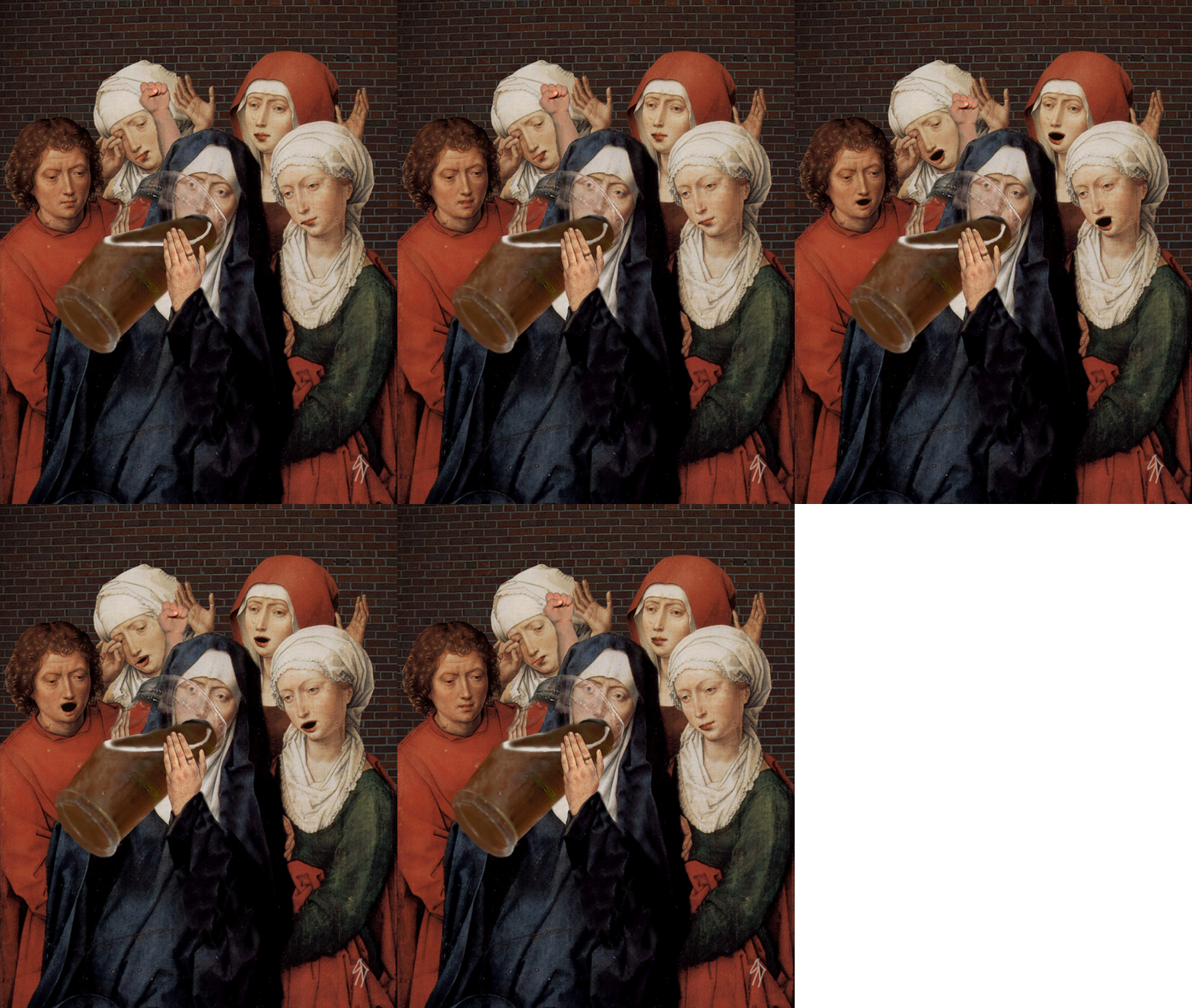
sky3000
Shared posts
André Franquin
The Frail Second
Htet T San is a visual artist/photographer and retoucher based in New York City, USA since 2011. She grew up in Yangon, the old capital city of Burma. The year 2008 was a turning point in her life. Htet received a scholarship to study photography and art studies in University of Alabama-Huntsville. Although she was on the verge of becoming a doctor, she pursued her hidden passion by setting out to study art. One of her current projects is ‘The Frail Second’ where she visualizes ‘the complete nothingness – so huge and overwhelming that I suddenly felt like I am going to collapse in any moment and never I will find myself again. In the memory of that split moment, I created this project ‘The Frail Second”.


All images © Htet T San
‘Medusa’ Lake Turns Animals to Stone
In Greek mythology, Medusa was a monster with the face of a human female and a head of venomous snakes for hair. Gazing directly upon her would turn any creature to stone.
In northern Tanzania, Lake Natron has had similar effects—on birds in particular. As part of his latest book, Across the Ravaged Land, award-winning photographer Nick Brandt explains:
“I unexpectedly found the creatures – all manner of birds and bats – washed up along the shoreline of Lake Natron in Northern Tanzania. No-one knows for certain exactly how they die, but it appears that the extreme reflective nature of the lake’s surface confuses them, and like birds crashing into plate glass windows, they crash into the lake. The water has an extremely high soda and salt content, so high that it would strip the ink off my Kodak film boxes within a few seconds. The soda and salt causes the creatures to calcify, perfectly preserved, as they dry. I took these creatures as I found them on the shoreline, and then placed them in ‘living’ positions, bringing them back to ‘life’, as it were. Reanimated, alive again in death.” [Source]
The arresting images below were taken with a medium format Pentax 67II. Each roll of film comes with only 10 shots and there is no zoom, auto-focus, auto-metering, motor drive or image stabilizing lenses. Brandt only uses two fixed lenses, a 35mm (standard 50mm equivalent) and a 100mm. You can read more about his preference for film and his inspiration for this book in a personal essay entitled, I am the Walrus [PDF].
Across the Ravaged Land is the third and final volume in Brandt’s trilogy of books documenting the disappearing animals of eastern Africa. The book offers a darker vision of this world, still filled with a stunning beauty but now tragically tainted and fast disappearing at the hands of man.
In addition to a range of starkly powerful animal portraits, Brandt introduces some new themes, as humans make an appearance for the first time. He also contributes two essays summing up his photographic odyssey, which has taken more than a decade of intensive work to complete.
[via Gizmodo, New Scientist]
1.
Hasted Kraeutler (New York) | Fahey/Klein (LA) | Photo-eye (Santa Fe) | Iris (Boston)
Atlas (UK) | Camera Work (Berlin) | A Galerie (Paris) | Fotografiska (Stockholm) | Source Photographica (AUS)
2.
Hasted Kraeutler (New York) | Fahey/Klein (LA) | Photo-eye (Santa Fe) | Iris (Boston)
Atlas (UK) | Camera Work (Berlin) | A Galerie (Paris) | Fotografiska (Stockholm) | Source Photographica (AUS)
3.
Hasted Kraeutler (New York) | Fahey/Klein (LA) | Photo-eye (Santa Fe) | Iris (Boston)
Atlas (UK) | Camera Work (Berlin) | A Galerie (Paris) | Fotografiska (Stockholm) | Source Photographica (AUS)
4.
Hasted Kraeutler (New York) | Fahey/Klein (LA) | Photo-eye (Santa Fe) | Iris (Boston)
Atlas (UK) | Camera Work (Berlin) | A Galerie (Paris) | Fotografiska (Stockholm) | Source Photographica (AUS)
5.
Hasted Kraeutler (New York) | Fahey/Klein (LA) | Photo-eye (Santa Fe) | Iris (Boston)
Atlas (UK) | Camera Work (Berlin) | A Galerie (Paris) | Fotografiska (Stockholm) | Source Photographica (AUS)
6.
Hasted Kraeutler (New York) | Fahey/Klein (LA) | Photo-eye (Santa Fe) | Iris (Boston)
Atlas (UK) | Camera Work (Berlin) | A Galerie (Paris) | Fotografiska (Stockholm) | Source Photographica (AUS)
If you enjoyed this post, the Sifter
highly recommends:
To Die For
I have a new Kickstarter campaign - To Die For - A Pin-Up Calendar celebrating some of the greatest women in history as they pose from beyond the grave. It would be amazing if you can participate or spread the word - here are the details:
Pin-up art, for me, is a window into the golden age of illustration, when artists such as Alberto Varges, Gil Elvgren and Robert McGinnis created masterful drawings celebrating female beauty in a playful and slightly naive way. But as photography emerged as the dominant representational medium, the Pin-ups began to disappear, and now they remain just a sweet memory from a different era, popping up here and there on your tumblr feed.

My idea was to revive this dead medium, or at least bring it into a state of half life; I knew I couldn't just make old timey Pin-ups - what would be the point? we live in a different time now, the naiveté is gone, and the need for sexual art has been eradicated by photography. Furthermore, although charming, there is a sense of objectification to those old Pin-ups; the traditional Pin-up would depict a thinly clad lady doing house chores, baking, or frolicking in the fields - a very reductive, demeaning and dated view of women that fit into the zeitgeist of the 50's much more than to our time.

(Above: Bonnie Parker)
So I decided to create something new, A series of Pin-up illustrations celebrating some of the most memorable, influential and important women in history. Women who broke the sex constrictions of the time they lived in, and etched their names into world history. My idea was to take the template of the Pin-up calendar - a collection of women objectified and glorified for their looks and sexuality, and flip it - inserting featuring women who were remembered for their acts, achievements, and courage (in addition to their beauty). But all these woman I admired were dead - the solution? conjure them up from the grave to pose for the calendar!
Below are the Pin-ups:
Natalie Wood

Isadora Duncan

Jayne Mansfield

Zelda Fitzgerald

Frida Kahlo

Cleopatra VII

Marie Antoinette

Tomoe Gozen

Amelia Earhart

Joan of Arc

The Top 75 ‘Pictures of the Day’ for 2013
At the end of every quarter the Sifter highlights the top 25 ‘Pictures of the Day‘, culminating in an epic Top 100 at the end of the year (check out the ‘Top 100 POTDs for 2012‘).
It’s hard to believe we’re already in the last quarter of 2013. Below you will find the third installment of this quarterly compilation. All credit goes to the individual photographers and their inspiring visions of our beautiful planet.
For more information on any individual photograph, click the title or image to be taken to the original post.
*Please note the photographs themselves were not necessarily taken in 2013, they just happened to be featured as a POTD on TwistedSifter. The pictures are also listed in reverse chronological order. There is no ranking amongst the photos :)
For more info, click any title or image to see the original post
If you enjoyed this post, the Sifter highly recommends:
Thumbdemon is Harikrishnan Panicker

Hyper-realistic Sculptural Installation by Sun Yuan and Peng Yu

The Artist Was Born When the Designer Died
Picture of the Day: Airplane View of a Distant Storm
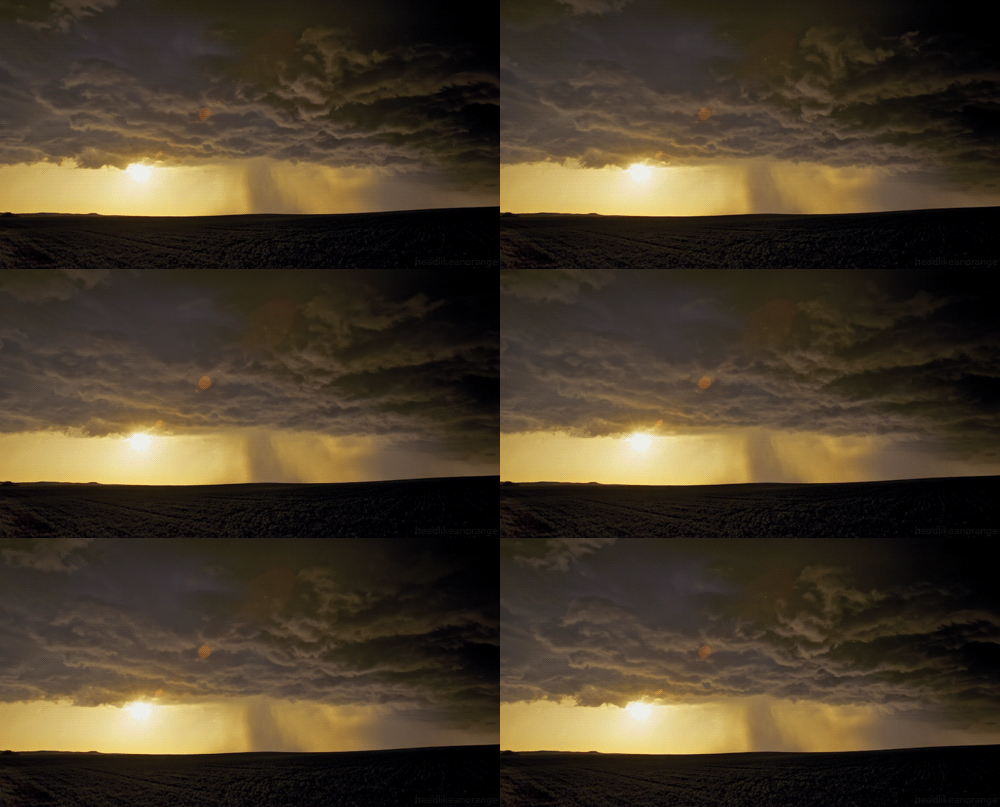
AIRPLANE VIEW OF A DISTANT STORM
Photographer Haley Luna took this amazing photograph while flying into Denver, Colorado. As a fellow flier that always requests the window seat, this must have been an incredible sight to see! The way the sun peeks through, illuminating the storm, is simply wonderful.
The photo was posted by Haley to Reddit on September 16 where it reached #1 on the front page (on Imgur alone it has been viewed over 1.48m times!).
When she’s not taking photographs, Haley also makes laser cut jewelry which you can peruse at Teal Deer. She’s also active online and you can keep up with her latest at the online links below.
Vintage Photos of New York Superimposed onto Present Day
Marc Hermann (@MHermannPhoto) is a professional news photographer born and raised in Brooklyn, New York. He is an official historian and interim trustee of the New York Press Photographers Association. As of November 2012, Hermann has been a staff photographer with the Corporate Communications department of MTA New York City Transit.
In a fascinating ‘Now & Then’ series, Hermann superimposes photographs from the Daily News Photo Archive onto present day photos, taking time to match the angle and framing of the original. The resulting 15-picture series provides a fascinating way to experience a city’s history, especially one as rich and well-documented as New York’s.
As Hermann explains:
In a city as large as New York, the history seems layered, but invisible. So much has happened in so many places that it’s difficult to imagine that the given street corner we pass daily was the scene of someone’s life-changing event once upon a time. This project was originally inspired by the early visual sleuthing of William Frassanito who sought out locations of photographs taken on the Gettysburg battlefield. Since then, the work of people like Sergey Larenkov and Joeri Teeuwisse, who blend historic pictures of war-torn Europe with modern-day views of the same locations, has brought the concept of “then-and-now” into the digital age.
Having covered breaking news since 1997, I shot various locations throughout the city where both the momentous and routine had occurred. Using the Daily News’ massive photo archive, I combined the modern scenes with the vintage images that had been made at those sites.
Most importantly, to me, is that the work of my predecessors is getting another look. It is my way of reminding people, too, to realize that they are part of the same continuum of time, and by seeing these sites in a familiar, modern way, that the “then” of history is also a “now.”
You can find the complete series on Hermann’s official site. You can also follow Marc on Twitter and Instagram.
[NY Daily News via Gizmodo]
1. 497 Dean St., Brooklyn
March 19, 1942
Blending and Colour Photography by MARC A. HERMANN
Edna Egbert proudly displayed a blue-star banner in her window, in honor of her son being the service. However, after not hearing from him since his enlistment, she became distraught and climbed out onto her ledge. Cops Ed Murphy and George Munday distracted her so she could be pushed into a safety net, the precursor of today’s standard airbags. [Source]
2. Hicks St. & Summit St., Brooklyn
January 11, 1951
Blending and Colour Photography by MARC A. HERMANN
The bells in the steeple rang even as flames consumed the Church of the Sacred Hearts of Jesus and Mary one chilly afternoon. The 90-year-old landmark was practically destroyed by the five-alarm blaze, but was rebuilt and still stands today. [Source]
3. 66 Court St., Brooklyn
January 13, 1961
Blending and Colour Photography by MARC A. HERMANN
A leaky gas pipe wa the cause of a massive explosion at this Downtown Brooklyn office building that shattered storefronts and injured 28 people. The sturdy 30-story building survived without any lasting scars from this incident. [Source]
4. Classon Ave. & Pacific St., Brooklyn
July 28, 1957
Blending and Colour Photography by MARC A. HERMANN
A recently released inmate of the Brooklyn House of Detention had forgotten some clothing, so the obvious solution was to steal a car with two friends to go retrieve it. They didn’t get far, however, coming to a crashing stop against a light pole at Classon Ave. & Pacific St. The auto body shop visible in the background is still in business, though relocated across the street. [Source]
5. 137 Wooster St., Manhattan
February 16, 1958
Blending and Colour Photography by MARC A. HERMANN
A massive fire in the Elkins Paper & Twine Co. on Wooster St. claimed the lives of two firefighters and four members of the New York Fire Patrol. The building was a total loss, and was demolished shortly after the last of the victims’ bodies was recovered. Eight years later, the carnage would be eclipsed by a fire on 23rd St. in which 12 firefighters were killed, leaving the tragedy on Wooster St. to fade into a distant memory. [Source]
6. Park Row, Manhattan
July 22, 1943
An M-7 Priest, a self-propelled 105mm gun, rolls up Park Row in front of City Hall en route to Fifth Ave. library where it was placed on display as part of a war bonds drive. [Source]
If you enjoyed this post, the Sifter
highly recommends:
Picture of the Day: Grand Canyon Light Show
GRAND CANYON LIGHT SHOW
In this amazing night-time scene, we are treated to a lightning show at the Grand Canyon in Arizona, USA. The photograph was taken by Rolf Maeder of photographysedona.com, who drove two hours to the canyon to try to get some sunset shots. As Maeder explains:
“Sometimes an opportunity comes very unexpected. Last week, my friends Scott Stulberg, Holly Kehrt (both wonderful photographers) and I were driving from Sedona to the Grand Canyon to get some sunset shots. After a short time being there we noticed that we couldn’t get what we wanted because of the very hazy light. So we decided to return to Sedona, just shortly checking out some more viewpoints. On the Moran Point we noticed that far away a lightning storm was building up. That was even more than we expected, so we started setting up our tripods and started to take pictures! This shot was taken 9pm with a Nikon D800, 24mm at f/8, ISO 400 and a 25 sec. exposure. – The long exposure made it possible to catch two lightning bolts with one shot! The foreground was light-painted with a flashlight by Scott.”
The Grand Canyon is 277 miles (446 km) long, up to 18 miles (29 km) wide and attains a depth of over a mile (6,000 feet or 1,800 meters). Nearly two billion years of the Earth’s geological history has been exposed as the Colorado River and its tributaries cut their channels through layer after layer of rock.
Moran Point (elevation: 7160 ft / 2182 m) is a popular spot on the South Rim for gazing into the canyon. It is situated near the main park visitor center east of the Grand Canyon Village. According to Sarah Gerke of Arizona State University, the point was likely named after Peter Moran, brother to famous American landscape artist Thomas Moran. It was Peter who traveled to the South Rim in 1881 with explorer and army captain John Bourke. His brother Thomas did not visit until 1892.
If you’d like to order an HD print of this shot you can contact Rolf through his website. You can also sign up for a free monthly wallpaper on his Blog.
flirtingwithutopia: Paper on Paper, Oragami series, Marc...


Paper on Paper, Oragami series, Marc Fichou
"He crafts the origami sculpture first, then photographs it. After, he uses the print as an unfolded version of the first creation. The folds in the picture blends with the actual folds, referencing the object’s starting point and ‘creating a visual link between past and present.’" more here.
Zack Seckler
Zack Seckler’s work is filled with humor and you can’t help but smile when you look at his pictures. He plays with our expectations of the world often focussing on absurd clichés that seem surreal at times, yet totally plausible. The New York based artist states, that people view life through their own lens. ‘I enjoy refocusing that lens by putting an uncommon twist on common experiences, I create images that inspire humor and imagination’. With that, he hopes to expand each person’s view, at least for a moment.


All images © Zack Seckler
Jared Muralt
Bern-based Jared Muralt is one of our favorite illustrators. We really like how detailed yet effortless his drawings are and we especially enjoy the view into his Sketchbook. Thus we were really happy, when he agreed to our interview. Instead of answering just in words he does what he can best; he draws. Jared’s passion for comics drove him towards pen and ink at young age and he is carrying his sketchbook everywhere. He is also a member and founder of the illustration and graphic design studio BlackYard. Enjoy.
How do you feel today?

What do you do in your spare time?

What’s your secret passion?

What’s your favorite spot?

Your latest genius purchase?

How does the source of inspiration look like?

Who’s your childhood hero?

How do you picture us?

All images © Jared Muralt
GIF art by James Kerr
James Kerr started his project ‘Scorpion Dagger’ without any real direction, except for the intention to make one GIF everyday(ish) for one year. He had been making collages for some time and ‘Scorpion Dagger’ started out to be a test of discipline and a way for him to learn how to animate. Making GIFs was a logical evolution to him. The project represents many different things to him, the works from which he draws upon are so powerful and inspirational to him, that he is now nearly obsessed with repurposing them to share his vision of the world, and perhaps inspire people to look at art differently. The project is tremendously personal to him, it’s a lot more than the humor that’s at its surface and he is still trying to work out what ‘Scorpion Dagger’ really is.


All images © James Kerr
Behind a Little House
Manuel Cosentino’s work ‘Behind a Little House’ is an intimate participatory art project where wall-mounted photographs and a participatory artist book lead the viewer to turn from an outside observer, a spectator, into an active participant.
The first image resembles a Big-Bang like notion, that sets everything into motion, while the last picture represents a new beginning – ‘that piece of ‘carte blanche’ that we are all given with our lives’. The book is an essential part of the project. By drawing into the book everybody is free to share their dream, hopes and fears, contributing to the world behind the little house or even destroying it. ‘As for the location, I never mention where the little house is, I prefer it to transcend geographical placement and become an idea. We all live under the same sky after all… ’


All images © Manuel Cosentino | Via: My Modern Met
132. JIDDU KRISHNAMURTI: Don’t compare yourself to others
Jiddu Krishnamurti (1895-1986) was a philosopher, writer and lecturer. As a young boy in India, Krishnamurti was groomed by the Theosophical Society for 20 years to be the ‘World Teacher’, a spiritual saviour they believed appeared on Earth periodically to propel humankind to a higher evolutionary stage. A special organisation, the Order of the Star, was formed to herald the ‘arrival’ of Krishnamurti as World Teacher. Little did they know that Krishnamurti had no intentions of being a messiah, and in a famous speech in 1929, Krishnamurti told everyone ‘thanks, but no thanks’ and disbanded the Order of the Star, cut all allegiances with the Theosophical society and spent the next 50-plus years travelling the world, writing and lecturing.
I became aware of Krishnamurti during my ‘Bruce Lee obsession’ years. Lee was a huge admirer of Krishnamurti and he borrowed a lot of Krishnamurti’s teachings and applied them directly to his martial arts philosophy (here’s a video clip about Lee and Krishnamurti). When I discovered this, I bought a few of Krishnamurti’s books to read for myself and I have to admit, they were not easy to absorb and a lot of it went over my head. Even though most of the books left me confused, the core of Krishnamurti’s teachings can be understood in his famous 1929 speech Truth is a Pathless Land (delivered when he disbanded the Order of the Star), and also in this quote from his book Freedom From the Known: “That is the first thing to learn — not to seek. When you seek you are really only window-shopping. The question of whether or not there is a God or truth or reality, or whatever you like to call it, can never be answered by books, by priests, philosophers or saviours. Nobody and nothing can answer the question but you yourself and that is why you must know yourself. Immaturity lies only in total ignorance of self. To understand yourself is the beginning of wisdom.”
RELATED COMICS: Bruce Lee Absorb What is Useful. Alan Watts What if Money was no Object?
Thanks to Shankar for submitting this quote.
The 40 Most Detailed Close-Ups of Arthropods You Will See Today
An arthropod is an invertebrate animal having an exoskeleton (external skeleton), a segmented body, and jointed appendages. Arthropods include all insects, arachnids, and crustaceans. Their body plan consists of repeated segments, each with a pair of appendages. Their versatility has enabled them to become one of the most species-rich members on the planet. [Source]
They have over a million described species, making up more than 80% of all described living animal species. They range in size from microscopic plankton up to forms a few meters long. [Source]
The USGS Native Bee Inventory and Monitoring Program designs and develops large and small-scale surveys and identification tools for native bees. A vital aspect of the program is to create accurate and detailed pictures of native bees as well as the plants and insects they interact with.
On their 1200+ Flickr photostream, the USGS Bee Inventory and Monitoring Lab (USGS BIML) has uploaded an astounding collection of macro photographs that you can see in full resolution. The detail and clarify is unlike anything I’ve ever seen.
The Sifter went through all 1200 photos earlier today and compiled our 40 favourites. Be sure to check them out on Flickr to appreciate the volume of work they have shared for the benefit of all visitors.
1. Unknown Wasp

2. Yellow Jacket Mimic Fly

3. Female Northern Black Widow Spider
(Latrodectus variolus)

4. The Endangered Karner Blue
(Lycaeides melissa samuelis)

5. Melissodes dentiventris

6. Beetle on glass

7. Black Horse Fly
(Tabanus atratus)

8. Augochlora regina

9. Oblong-winged katydid
(Amblycorypha oblongifolia)

10. Megachile-campanulae

11. Lasioglossum nr longifrons

12. Lace Bug

13. Rove Beetle

14. Trypoxylon mexicanum

15. Centris haemorrhoidalis

16. Cone Head

17. Agapostemon coloradinus

18. Leptochilus acolhuus

19. Harlequin Bug Eggs
(Murgantia histrionica)

20. Polistes metricus

21. Spider Wasp

22. Gryllus species

23. Hoplitis truncata

24. Deer Fly
(Tabanidae)

25. Drepanaporus collaris

26. Triepeolus donatus

27. Drepanaporus collaris

28. Sharpshooter
(Oncometopia orbona)

29. Trypoxylon mexicanum

30. Yellow Jacket Mimic Fly

31. Pearl Crescent
(Phyciodes tharos)

32. Camel Cricket
(Diestrammena asynamora)

33. Harlequin Bug Nymphs
(Murgantia histrionica)

34. Lachnopus guerinii

35. Bombus griseocollis

36. Coelioxys sayi

37. Unknown Spider

38. Brown marmorated stinkbug
(Halyomorpha halys)

39. Osmia sandersoneae

40. Dianthidium curvatum

If you enjoyed this post, the Sifter
highly recommends:
Picture of the Day: Lone Chamois Above the Clouds
LONE CHAMOIS ABOVE THE CLOUDS
In this beautiful capture by Rado Gadoczi, we see a lone Tatra chamois above the clouds in the High Tatras. The High Tatras or High Tatra Mountains, are a mountain range along the border of northern Slovakia in the Prešov Region, and southern Poland in the Lesser Poland Voivodeship. The 15 highest peaks are all over 2500 m (8200 ft).
The chamois (Rupicapra rupicapra), is a goat-antelope species native to mountains in Europe. The Tatra chamois are a subspecies and considered critically endangered. Their habitat is protected by national parks in both countries. Their population hit a low of 160 in the year 2000, but their numbers have since increased to almost 1100 in 2012.