12 May 18:38
by Xiaoli Zheng, Jianbo Xu, Keyou Yan, Hong Wang, Zilong Wang and Shihe Yang

Chemistry of Materials
DOI: 10.1021/cm500347r

01 Apr 19:25
J. Mater. Chem. C, 2014, 2,3914-3920
DOI: 10.1039/C3TC32462A, Paper
Vladimir V. Vinogradov, Alexander Agafonov, David Avnir
We report that silver nanowires (AgNW) entrapped in a series of sol-gel thin films - zirconia, alumina, titania and silica - provide conductive, highly flexible, highly adhesive, transparent thin films with excellent thermal and electrical stability.
The content of this RSS Feed (c) The Royal Society of Chemistry
01 Apr 19:15
by Sanghyun Jo, Nicolas Ubrig, Helmuth Berger, Alexey B. Kuzmenko and Alberto F. Morpurgo

Nano Letters
DOI: 10.1021/nl500171v

31 Mar 20:54
Dalton Trans., 2014, 43,8565-8576
DOI: 10.1039/C4DT00506F, Perspective
Naresh S. Dalal, Carlos A. Murillo
A discussion of how EPR spectroscopy has contributed to the understanding of the electronic structure of paddlewheel compounds with multiple bonds between metal atoms is presented while commemorating the 50th anniversary of the paper describing the quadruple bond and the identification of the delta bond in the Re2Cl82- anion.
The content of this RSS Feed (c) The Royal Society of Chemistry

31 Mar 20:51
J. Mater. Chem. A, 2014, 2,7829-7836
DOI: 10.1039/C4TA00892H, Paper

Open Access
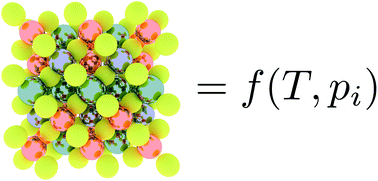
Adam J. Jackson, Aron Walsh
The formation and decomposition of Cu2ZnSnS4 (CZTS), a quaternary semiconductor and promising photovoltaic absorber, is modelled as a function of temperature and pressure by ab initio methods.
The content of this RSS Feed (c) The Royal Society of Chemistry
31 Mar 20:45
by Stefan Höfle, Alexander Schienle, Michael Bruns, Uli Lemmer, Alexander Colsmann

Inverted device architectures for organic light-emitting diodes (OLEDs) require suitable interfaces or buffer layers to enhance electron injection from highwork-function transparent electrodes. A solution-processable combination of ZnO and PEI is reported, that facilitates electron injection and enables efficient and air-stable inverted devices. Replacing the metal anode by highly conductive polymers enables transparent OLEDs.
31 Mar 20:45
by Jean Roncali, Philippe Leriche, Philippe Blanchard
An overview of some recent developments of the chemistry of molecular donor materials for organic photovoltaics (OPV) is presented. Although molecular materials have been used for the fabrication of OPV cells from the very beginning of the field, the design of molecular donors specifically designed for OPV is a relatively recent research area. In the past few years, molecular donors have been used in both vacuum-deposited and solution-processed OPV cells and both fields have witnessed impressive progress with power conversion efficiencies crossing the symbolic limit of 10 %. However, this progress has been achieved at the price of an increasing complexity of the chemistry of active materials and of the technology of device fabrication. This evolution probably inherent to the progress of research is difficult to reconcile with the necessity for OPV to demonstrate a decisive economic advantage over existing silicon technology. In this short review various classes of molecular donors are discussed with the aim of defining possible basic molecular structures that can combine structural simplicity, low molecular weight, synthetic accessibility, scalability and that can represent possible starting points for the development of simple and cost-effective OPV materials.

Various classes of molecules used as donor materials in heterojunction organic solar cells are presented. Special emphasis is placed on molecular structures that combine low molecular weight, (in general inferior to 500) structural simplicity and synthetic accessibility with reasonable yield. Such systems are discussed as possible working structures for the development of simple and cost-effective materials for organic photovoltaics.
31 Mar 20:43
by Partha Pratim Das, Shruti A. Agarkar, Soumita Mukhopadhyay, Unnikrishnan Manju, Satishchandra B. Ogale and P. Sujatha Devi

Inorganic Chemistry
DOI: 10.1021/ic500279q

29 Mar 12:46
by Lei Zhang, Xiong Wen (David) Lou
Abstract
Hierarchical MoS2 shells supported on carbon spheres (denoted as C@MoS2) have been synthesized through a one-step hydrothermal method. The obtained hierarchical C@MoS2 microspheres simultaneously integrate the structural and compositional design rationales for high-energy electrode materials based on two-dimensional (2D) nanosheets. When evaluated as an anode material for lithium-ion batteries (LIBs), the hierarchical C@MoS2 microspheres manifest high specific capacity, enhanced cycling stability and good rate capability.

High-energy anode materials: Hierarchical MoS2 shells supported on carbon spheres (denoted as C@MoS2) have been synthesized through a one-step hydrothermal method. When evaluated as an anode material for lithium-ion batteries, the hierarchical C@MoS2 microspheres manifest high specific capacity, enhanced cycling stability and good rate capability (see figure).
29 Mar 12:35
by Ronnie H. Fang, Che-Ming J. Hu, Brian T. Luk, Weiwei Gao, Jonathan A. Copp, Yiyin Tai, Derek E. O’Connor and Liangfang Zhang

Nano Letters
DOI: 10.1021/nl500618u

28 Mar 15:11
by Prashant V. Kamat, Jeffrey A. Christians and James G. Radich

Langmuir
DOI: 10.1021/la500555w

28 Mar 15:00
J. Mater. Chem. C, 2014, 2,3777-3781
DOI: 10.1039/C4TC00391H, Paper
Wei Wu, Yanyan Cao, Jonathan V. Caspar, Qijie Guo, Lynda K. Johnson, Irina Malajovich, H. David Rosenfeld, Kaushik Roy Choudhury
This work studies the composition and optoelectronic properties of the fine-grain sub-layer in the printed CZTSSe photovoltaic devices.
The content of this RSS Feed (c) The Royal Society of Chemistry
28 Mar 14:57
J. Mater. Chem. A, 2014, 2,8644-8651
DOI: 10.1039/C4TA00485J, Paper
Guang-Sheng Wang, Ying-Ying Wu, Xiao-Juan Zhang, Yong Li, Lin Guo, Mao-Sheng Cao
The PVDF/ZnO composites were prepared by a simple hot-press method. The dielectric behavior of the composites was improved at a lower percolation threshold. For the composites with a filler content of 10 wt%, the reflection loss appears as two peaks that can reach -15.90 dB at 6.60 GHz and -25.44 dB at 16.48 GHz.
The content of this RSS Feed (c) The Royal Society of Chemistry
28 Mar 14:56
J. Mater. Chem. A, 2014, 2,7759-7765
DOI: 10.1039/C4TA00839A, Paper
Yuanqing Li, Yarjan Abdul Samad, Kyriaki Polychronopoulou, Saeed M. Alhassan, Kin Liao
Carbon aerogel (CA) produced from melon was used to fabricate CA-wax composites, which can achieve solar-thermal and electric-thermal energy conversion effectively, and can store the heat in the composites.
The content of this RSS Feed (c) The Royal Society of Chemistry
28 Mar 14:56
J. Mater. Chem. A, 2014, 2,7680-7685
DOI: 10.1039/C4TA01004C, Communication
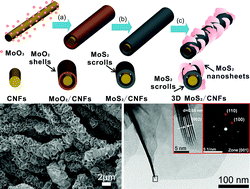
Han Zhu, MingLiang Du, Ming Zhang, MeiLing Zou, TingTing Yang, YaQin Fu, JuMing Yao
Rose-petal-shaped MoS2 hierarchical nanostructures were designed and constructed using carbonized electrospun nanofibers as a template, which exhibit highly structure-sensitive properties for the hydrogen evolution reaction (HER).
The content of this RSS Feed (c) The Royal Society of Chemistry
28 Mar 11:08
by Lorenzo Rovigatti, Frank Smallenburg, Flavio Romano and Francesco Sciortino

ACS Nano
DOI: 10.1021/nn501138w

28 Mar 11:05
by Christopher Szakal, Stephen M. Roberts, Paul Westerhoff, Andrew Bartholomaeus, Neil Buck, Ian Illuminato, Richard Canady and Michael Rogers

ACS Nano
DOI: 10.1021/nn501108g

28 Mar 11:05
by Yu-Chuan Lin, Ning Lu, Nestor Perea-Lopez, Jie Li, Zhong Lin, Xin Peng, Chia Hui Lee, Ce Sun, Lazaro Calderin, Paul N. Browning, Michael S. Bresnehan, Moon J. Kim, Theresa S. Mayer, Mauricio Terrones and Joshua A. Robinson

ACS Nano
DOI: 10.1021/nn5003858

25 Mar 21:42
J. Mater. Chem. A, 2014, 2,7727-7733
DOI: 10.1039/C4TA01336K, Communication
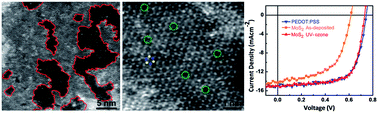
Xi Yang, Weifei Fu, Wenqing Liu, Jinghua Hong, Yu Cai, Chuanhong Jin, Mingsheng Xu, Haibo Wang, Deren Yang, Hongzheng Chen
The effects of different local crystalline structures of two-dimensional (2D) MoS2 sheets on the performance of organic solar cells (OSCs) are studied, providing new insights towards high-performance devices.
The content of this RSS Feed (c) The Royal Society of Chemistry
25 Mar 21:38
by Ryo Ishikawa, Andrew R. Lupini, Scott D. Findlay, Takashi Taniguchi and Stephen J. Pennycook

Nano Letters
DOI: 10.1021/nl500564b

25 Mar 21:30
by Alexander Hübner, Andreas M. Diehl, Martin Diefenbach, Burkhard Endeward, Michael Bolte, Hans-Wolfram Lerner, Max C. Holthausen, Matthias Wagner
Abstract
Is one electron sufficient to bring about significant σ bonding between two atoms? The chemist’s view on the chemical bond is usually tied to the concept of shared electron pairs, and not too much experimental evidence exists to challenge this firm belief. Whilst species with the unusual one-electron σ-bonding motif between homonuclear atoms have so far been identified mainly by spectroscopic evidence, we present herein the first crystallographic characterization, augmented by a detailed quantum-chemical validation, for a radical anion featuring a B⋅B one-electron-two-center σ bond.

One is enough: The first structurally characterized radical anion containing a B⋅B one-electron σ bond shows a significantly shorter B⋅⋅⋅B distance than the uncharged starting material, while the boron centers largely maintain their local planarity.
25 Mar 21:25
by Hennrik Schmidt, Shunfeng Wang, Leiqiang Chu, Minglin Toh, Rajeev Kumar, Weijie Zhao, A. H. Castro Neto, Jens Martin, Shaffique Adam, Barbaros Özyilmaz and Goki Eda

Nano Letters
DOI: 10.1021/nl4046922

18 Mar 21:51
by Qunfeng Cheng, Lei Jiang and Zhiyong Tang

Accounts of Chemical Research
DOI: 10.1021/ar400279t

18 Mar 21:50
by M. Saghir, M. R. Lees, S. J. York and G. Balakrishnan

Crystal Growth & Design
DOI: 10.1021/cg500122b

18 Mar 21:47
by Cécile Bonnaud, Christophe A. Monnier, Davide Demurtas, Corinne Jud, Dimitri Vanhecke, Xavier Montet, Ruud Hovius, Marco Lattuada, Barbara Rothen-Rutishauser and Alke Petri-Fink

ACS Nano
DOI: 10.1021/nn406349z

18 Mar 21:46
by Feng Gao, Zhe Li, Jianpu Wang, Akshay Rao, Ian A. Howard, Agnese Abrusci, Sylvain Massip, Christopher R. McNeill and Neil C. Greenham

ACS Nano
DOI: 10.1021/nn501185h

11 Mar 21:12
by Xiao Huang, Chaoliang Tan, Zongyou Yin, Hua Zhang
Two-dimensional (2D) nanomaterials, such as graphene and transition metal dichalcogenides (TMDs), receive a lot of attention, because of their intriguing properties and wide applications in catalysis, energy-storage devices, electronics, optoelectronics, and so on. To further enhance the performance of their application, these 2D nanomaterials are hybridized with other functional nanostructures. In this review, the latest studies of 2D nanomaterial-based hybrid nanostructures are discussed, focusing on their preparation methods, properties, and applications.

Two-dimensional (2D) nanomaterials, such as graphene and transition metal dichalcogenides (TMDs), receive a lot of attention due to their attractive properties and wide applications. Their performance can be further enhanced by the formation of hybrid structures with other functional materials. In this review, the latest studies in 2D nanomaterial-based hybrid nanostructures are discussed, focusing on their preparation methods, properties, and applications.
11 Mar 21:11
by Paul Simon, Lydia Bahrig, Igor A. Baburin, Petr Formanek, Falk Röder, Jan Sickmann, Stephen G. Hickey, Alexander Eychmüller, Hannes Lichte, Rüdiger Kniep, Elena Rosseeva

Make it connected! 2D close-packed layers of inorganic nanoparticles are interconnected by organic fibrils of oleic acid as clearly visualized by electron holography. These fibrils can be mineralised by PbS to transform an organic-inorganic framework to a completely interconnected inorganic semiconducting 2D array.
11 Mar 21:05
by Benjamin J. Coe, Madeleine Helliwell, Martyn K. Peers, James Raftery, Daniela Rusanova, Koen Clays, Griet Depotter and Bruce S. Brunschwig

Inorganic Chemistry
DOI: 10.1021/ic500145r

09 Mar 22:22
by Thomas J. A. Slater, Alexandra Macedo, Sven L. M. Schroeder, M. Grace Burke, Paul O’Brien, Pedro H. C. Camargo and Sarah J. Haigh

Nano Letters
DOI: 10.1021/nl4047448

   This article is licensed under a Creative Commons Attribution 3.0 Unported Licence.