26 May 22:45
by Sen Kang, Amanda R. Jones, Jeffrey S. Moore, Scott R. White, Nancy R. Sottos

On page 2947, N. R. Sottos and co-workers report the preparation of robust microcapsules that contain high concentration carbon black suspensions. Prior to encapsulation, carbon black particles are surface functionalized with octadecyl chains to create stable particle suspensions, which is critical for the release of carbon black. When ruptured, these microcapsules exhibit significant particle release, enabling full conductivity restoration of damaged battery electrodes.
26 May 21:59
by Mohammadali Foroozandeh, Ralph W. Adams, Nicola J. Meharry, Damien Jeannerat, Mathias Nilsson, Gareth A. Morris

All psyched up: A flexible and general pure shift experiment (PSYCHE) has been developed that offers superior sensitivity, spectral purity, and tolerance of strong coupling over existing methods for broadband homonuclear decoupling. The partial spectra of estradiol in [D6]DMSO obtained by normal 1H NMR spectroscopy and PSYCHE are shown for comparison.
26 May 21:54
by Gyula Eres, Murari Regmi, Christopher M. Rouleau, Jihua Chen, Ilia N. Ivanov, Alexander A. Puretzky and David B. Geohegan

ACS Nano
DOI: 10.1021/nn500209d

26 May 16:58
by Jing Zhang, Hua Yu, Wei Chen, Xuezeng Tian, Donghua Liu, Meng Cheng, Guibai Xie, Wei Yang, Rong Yang, Xuedong Bai, Dongxia Shi and Guangyu Zhang

ACS Nano
DOI: 10.1021/nn5020819

25 May 21:45
by Xin Liu, Yue Li, Bin Zhou, Xianliang Wang, Alexander N. Cartwright and Mark T. Swihart

Chemistry of Materials
DOI: 10.1021/cm501023w

25 May 21:45
by Mark C. Weidman, Megan E. Beck, Rachel S. Hoffman, Ferry Prins and William A. Tisdale

ACS Nano
DOI: 10.1021/nn5018654

23 May 11:23
by Hyun Ho Kim, Yoonyoung Chung, Eunho Lee, Seong Kyu Lee, Kilwon Cho

K. Cho and co-workers develop on page 3213 a water-free transfer method for placing chemical vapor depositiongrown graphene onto arbitrary substrates. Transferring graphene without water enables water-sensitive substrates to be used in graphene electronics. Using this method, high-performance flexible air-stable graphene transistors are fabricated. A polymeric bilayer (poly(methyl methacrylate)/polybutadiene) is used as supporting layer during the transfer process, which provides not only robust support but also effective passivation that protects graphene from undesirable charged impurities.
23 May 11:20
by Anu Naik, Riccardo Rubbiani, Gilles Gasser, Bernhard Spingler
Abstract
Despite the extensive use of porphyrins in photodynamic therapy (PDT), tetraplatinated porphyrins have so far not been studied for their anticancer properties. Herein, we report the synthesis of such novel platinum–porphyrin conjugates as well as their photophysical characterization and in vitro light-induced anticancer properties. These conjugates showed only minor cytotoxicity in the dark, but IC50 values down to 19 nM upon irradiation with light at 420 nm.These values correspond to an excellent phototoxic index (PI=IC50 in the dark/IC50 in light), which reached 5000 in a cisplatin-resistant cell line. After incubation with HeLa cells, nuclear Pt concentrations were 30 times higher than with cisplatin. All of these favorable characteristics imply that tetraplatinated porphyrin complexes are worthy of exploration as novel PDT anticancer agents in vivo.

A fatal synergy: A series of tetraplatinated porphyrins (see example; Pt red, Cl green, N blue, C gray, H white) were shown to be promising photosensitizers for photodynamic therapy. The complexes displayed excellent toxicity profiles under low-energy irradiation, with a phototoxic index of up to 5000, and high potency against a range of cancerous cell lines.
23 May 11:19
by Shuvo Jit Datta, Won Kyung Moon, Do Young Choi, In Chul Hwang, Kyung Byung Yoon
Abstract
The effective removal of 137Cs+ ions from contaminated groundwater and seawater and from radioactive nuclear waste solutions is crucial for public health and for the continuous operation of nuclear power plants. Various 137Cs+ removers have been developed, but more effective 137Cs+ removers are still needed. A novel microporous vanadosilicate with mixed-valence vanadium (V4+ and V5+) ions is now reported, which shows an excellent ability for Cs+ capture and immobilization from groundwater, seawater, and nuclear waste solutions. This material is superior to other known materials in terms of selectivity, capacity, and kinetics, and at very low Cs+ concentrations, it was found to be the most effective material for the removal of radioactive Cs+ ions under the test conditions. This novel vanadosilicate also contains hexadeca-coordinated Cs+ ions, which corresponds to the highest coordination number ever described.

A novel vanadosilicate is an excellent remover of Cs+ ions from groundwater, seawater, and highly acidic or basic nuclear waste solutions. This material can therefore be used for the removal of radioactive 137Cs+ ions from contaminated water.
23 May 11:16
by Hsun-Jen Chuang, Xuebin Tan, Nirmal Jeevi Ghimire, Meeghage Madusanka Perera, Bhim Chamlagain, Mark Ming-Cheng Cheng, Jiaqiang Yan, David Mandrus, David Tománek and Zhixian Zhou

Nano Letters
DOI: 10.1021/nl501275p

23 May 11:14
by Gang Liu, Hua Gui Yang, Jian Pan, Yong Qiang Yang, Gao Qing (Max) Lu and Hui-Ming Cheng

Chemical Reviews
DOI: 10.1021/cr400621z

23 May 11:13
by Bruno Peña, Rola Barhoumi, Robert C. Burghardt, Claudia Turro and Kim R. Dunbar

Journal of the American Chemical Society
DOI: 10.1021/ja503774m

22 May 11:58
by Annemieke van Dam, Janina C. V. Schwarz, Judith de Vos, Maria Siebes, Titia Sijen, Ton G. van Leeuwen, Maurice C. G. Aalders, Saskia A. G. Lambrechts
Abstract
No forensic method exists that can reliably estimate the age of fingermarks found at a crime scene. Information on time passed since fingermark deposition is desired as it can be used to distinguish between crime related and unrelated fingermarks and to support or refute statements made by the fingermark donors. We introduce a non-contact method that can estimate the age of fingermarks. Fingermarks were approached as protein–lipid mixtures and an age-estimation model was build based on the expected protein and lipid oxidation reactions. Two measures of oxidation are required from the fingermark to estimate its age: 1) the relative amount of fluorescent oxidation products 2) the rate at which these products are formed. Fluorescence spectroscopy was used to obtain these measures. We tested the method on 44 fingermarks and were able to estimate the age of 55 % of the male fingermarks, up to three weeks old with an uncertainty of 1.9 days.

Marking time: Currently no method exists that can estimate the age of a fingermark. Information on the time passed since fingermark deposition is of forensic value as it may link the fingermark donor not only to the crime scene but also to the assumed time of crime. Based on the oxidation of proteins present in fingermarks and the corresponding change in fluorescence, the age of a subset of fingermarks could be estimated up to three weeks after deposition with an uncertainty of 1.9 days.
22 May 11:57
by Chih-Jen Shih, Qing Hua Wang, Youngwoo Son, Zhong Jin, Daniel Blankschtein and Michael S. Strano

ACS Nano
DOI: 10.1021/nn500676t

22 May 11:52
by Xuejun Xie, Deblina Sarkar, Wei Liu, Jiahao Kang, Ognian Marinov, M. Jamal Deen and Kaustav Banerjee

ACS Nano
DOI: 10.1021/nn4066473

21 May 16:15
by Emanuele Panizon, Davide Bochicchio, Giulia Rossi and Riccardo Ferrando

Chemistry of Materials
DOI: 10.1021/cm501001f

21 May 16:15
by Richard D. Westover, Ryan A. Atkins, Jeffrey J. Ditto and David C. Johnson

Chemistry of Materials
DOI: 10.1021/cm500720x

21 May 16:14
by Jie Zhong, Zhe Xia, Cheng Zhang, Bing Li, Xinsheng Liu, Yi-Bing Cheng and Jiang Tang

Chemistry of Materials
DOI: 10.1021/cm501270j

21 May 16:14
by Wei-Chang Yang, Caleb K. Miskin, Charles J. Hages, Evan C. Hanley, Carol Handwerker, Eric A. Stach and Rakesh Agrawal

Chemistry of Materials
DOI: 10.1021/cm501111z

21 May 16:14
by Pei-Jung Wu, Jhe-Wei Yu, His-Jung Chao and Jia-Yaw Chang

Chemistry of Materials
DOI: 10.1021/cm500959a

21 May 16:14
by Xiaoyong Liang, Qing Yi, Sai Bai, Xingliang Dai, Xin Wang, Zhizhen Ye, Feng Gao, Fengling Zhang, Baoquan Sun and Yizheng Jin

Nano Letters
DOI: 10.1021/nl501763z

21 May 08:36
by Deborah Prezzi, Daejin Eom, Kwang T. Rim, Hui Zhou, Shengxiong Xiao, Colin Nuckolls, Tony F. Heinz, George W. Flynn and Mark S. Hybertsen

ACS Nano
DOI: 10.1021/nn500583a

21 May 08:36
by Haiyan Nan, Zilu Wang, Wenhui Wang, Zheng Liang, Yan Lu, Qian Chen, Daowei He, Pingheng Tan, Feng Miao, Xinran Wang, Jinlan Wang and Zhenhua Ni

ACS Nano
DOI: 10.1021/nn500532f

21 May 08:35
by Daisuke Kiriya, Mahmut Tosun, Peida Zhao, Jeong Seuk Kang and Ali Javey

Journal of the American Chemical Society
DOI: 10.1021/ja5033327

hailul and -1 others like this
19 May 18:20
Chem. Commun., 2014, Advance Article
DOI: 10.1039/C4CC01962H, Communication
Yingzhuang Ma, Lingling Zheng, Yao-Hsien Chung, Saisai Chu, Lixin Xiao, Zhijian Chen, Shufeng Wang, Bo Qu, Qihuang Gong, Zhaoxin Wu, Xun Hou
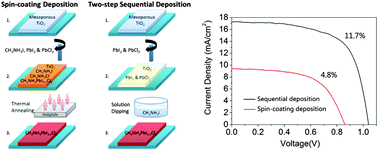
A mixed halide perovskite of CH3NH3PbI3-xClx is synthesized via sequential solution deposition by using a mixture of PbCl2 and PbI2 as the precursor with 11.7% power conversion efficiency for the mesoscopic cell.
To cite this article before page numbers are assigned, use the DOI form of citation above.
The content of this RSS Feed (c) The Royal Society of Chemistry

19 May 18:12
by Liang Cheng, Wenjing Huang, Qiufang Gong, Changhai Liu, Zhuang Liu, Yanguang Li, Hongjie Dai
Abstract
Much has been done to search for highly efficient and inexpensive electrocatalysts for the hydrogen evolution reaction (HER), which is critical to a range of electrochemical and photoelectrochemical processes. A new, high-temperature solution-phase method for the synthesis of ultrathin WS2 nanoflakes is now reported. The resulting product possesses monolayer thickness with dimensions in the nanometer range and abundant edges. These favorable structural features render the WS2 nanoflakes highly active and durable catalysts for the HER in acids. The catalyst exhibits a small HER overpotential of approximately 100 mV and a Tafel slope of 48 mV/decade. These ultrathin WS2 nanoflakes represent an attractive alternative to the precious platinum benchmark catalyst and rival MoS2 materials that have recently been heavily scrutinized for the electrocatalytic HER.

Ultrathin WS2 nanoflakes were synthesized according to a new high-temperature solution-phase method. These nanoflakes may be used as efficient catalysts for the electrocatalytic hydrogen evolution reaction and represent an attractive alternative to the expensive platinum benchmark catalysts.
18 May 20:29
by Nan Chen, Hui Wang, Qing Huang, Jiang Li, Juan Yan, Dannong He, Chunhai Fan, Haiyun Song
Nanoparticles have shown great potential in biological and biomedical applications due to their distinct physical and chemical properties. In the meanwhile, the biosafety of nanoparticles has also raised intense concerns worldwide. To address such concerns, great efforts have been made to examine short-term effects of nanoparticles on cell survival and proliferation. More recently, exploration of long-term effects of nanomaterials, particularly those with promising biomedical applications in vivo, has aroused significant interest. For example, gold nanoparticles (AuNPs) are generally considered non-toxic to cell growth, whereas recent studies suggest that AuNPs might have long-term effects on cellular metabolism and energy homeostasis. In this Review, recent advances in this direction are summarized. Further, possible mechanisms under which nanoparticles regulate metabolic signaling pathways, potential long-term effects on cellular anabolic or catabolic processes, and their implications in human health and metabolic disorders are discussed.

Nanoparticles can interfere with metabolic signaling pathways, which have potential biological consequences on lipid, glucose, and protein homeostasis, and implications in human health and metabolic diseases.
18 May 20:19
by Yongwoo Shin, Jaikai Liu, Joseph J. Quigley, Heng Luo and Xi Lin

ACS Nano
DOI: 10.1021/nn5014066

18 May 20:19
Publication date: 15 August 2014
Source:Wear, Volume 316, Issues 1–2
Author(s): S. Mahathanabodee , T. Palathai , S. Raadnui , R. Tongsri , N. Sombatsompop
Mechanical properties and wear behavior of stainless steel supplemented with different solid lubricants were investigated. Hexagonal boron nitride (h-BN), molybdenum disulfide (MoS2), and a mixture of h-BN/MoS2 embedded in 316L stainless steels (SS316L/h-BN, SS316L/MoS2 and SS316L/h-BN/MoS2) were prepared by powder metallurgy method. Various solid lubricant contents (10, 15 and 20vol%) were mixed with 316L stainless steel powders and then sintered at 1200°C in H2 atmosphere for 60min. Dry sliding wear behavior of the composites was investigated using a pin-on-disc test rig at sliding speeds of 0.1 and 0.2m/s and an applied load of 3N. The experimental results showed that small boride phase and h-BN powder occupied the pores in the microstructure of the SS316L/h-BN composite, whereas the MoS2 second phase occupied the pores of the sintered 316L matrix in the microstructure of the SS316L/MoS2 composite. The addition of h-BN decreased the sintered density and hardness, whereas that of MoS2 produced the opposite effect. The results showed that the MoS2 composite had higher wear resistance than the h-BN composite, but the h-BN composite yielded better friction reduction. Furthermore, the addition of an h-BN/MoS2 mixture could promote the hardness and wear resistance of the composites. The incorporation of h-BN and MoS2 had the potential to provide friction reduction in SS316L composites as compared with sintered 316L stainless steel. The dry sliding wear process of stainless steel composites with added h-BN, MoS2 and h-BN/MoS2 involved adhesive wear, abrasive wear, oxidative wear and delamination wear mechanisms of the compacted layer.
17 May 19:27
by Huimeng Wu, Zhongwu Wang and Hongyou Fan

Journal of the American Chemical Society
DOI: 10.1021/ja503320s