03 Sep 10:18
J. Mater. Chem. C, 2014, 2,8903-8910
DOI: 10.1039/C4TC01629G, Paper
S. Obuchovsky, I. Deckman, M. Moshonov, T. Segal Peretz, G. Ankonina, T. J. Savenije, G. L. Frey
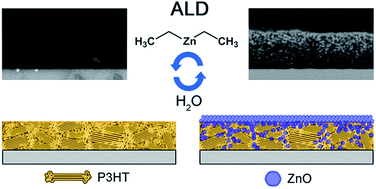
ALD ZnO precursors diffuse into the disordered regions of a P3HT film yielding the bulk heterojunction morphology for hybrid photovoltaics.
The content of this RSS Feed (c) The Royal Society of Chemistry
03 Sep 10:18
by T. Plötzing, T. Winzer, E. Malic, D. Neumaier, A. Knorr and H. Kurz

Nano Letters
DOI: 10.1021/nl502114w

03 Sep 10:18
Dalton Trans., 2014, 43,15779-15784
DOI: 10.1039/C4DT02258K, Paper
Nicolas Zigon, Patrick Larpent, Abdelaziz Jouaiti, Nathalie Kyritsakas, Mir Wais Hosseini
Optical reading of the open and closed states of a molecular turnstile.
The content of this RSS Feed (c) The Royal Society of Chemistry

03 Sep 10:18
Dalton Trans., 2014, 43,15851-15860
DOI: 10.1039/C4DT01788A, Paper
Sameera Saithathul Fathimah, Padala Prabhakar Rao, Vineetha James, Athira K. V. Raj, G. R. Chitradevi, Sandhyakumari Leela
Multifunctional materials in BiV1-xNbxO4 solid solutions display high NIR reflecting brilliant yellow hues with notable MB dye degradation under sunlight.
The content of this RSS Feed (c) The Royal Society of Chemistry

03 Sep 10:18
by Justus Chukwunonso Ndukaife, Avanish Mishra, Urcan Guler, Agbai George Agwu Nnanna, Steven T. Wereley and Alexandra Boltasseva

ACS Nano
DOI: 10.1021/nn502294w

02 Sep 12:12
Nanoscale, 2014, 6,13082-13089
DOI: 10.1039/C4NR04644G, Paper
Zdenek Sofer, Petr Simek, Ondrej Jankovsky, David Sedmidubsky, Premysl Beran, Martin Pumera
Diffraction methods are most suitable for the evaluation of the graphene structure - the number of layers and crystallite size.
The content of this RSS Feed (c) The Royal Society of Chemistry

02 Sep 12:12
Nanoscale, 2014, 6,12414-12420
DOI: 10.1039/C4NR04464A, Communication
B. D. Liu, B. Yang, B. Dierre, T. Sekiguchi, X. Jiang
Local defect-induced red-shift of cathodoluminescence in individual ZnS nanobelts has been observed using a high-resolution spatially-resolved CL technique. Structural defects such as strip stacking faults and the heterostructure area with a size of 10-20 nm are responsible for luminescence difference.
The content of this RSS Feed (c) The Royal Society of Chemistry

02 Sep 12:12
Nanoscale, 2014, 6,13090-13096
DOI: 10.1039/C4NR03220A, Paper
Yan Wen, Haijun Zhang, Shaowei Zhang
Typical morphology of W@WS2 nanorattles and their catalytic performance.
The content of this RSS Feed (c) The Royal Society of Chemistry

01 Sep 19:32

My biggest inspiration is nature. My favorite time of day is the evening.
01 Sep 19:21
by Xiaoyun Song, Zhiwen Qiu, Xiaopeng Yang, Haibo Gong, Shaohua Zheng, Bingqiang Cao, Hongqiang Wang, Helmuth Möhwald and Dmitry Shchukin

Chemistry of Materials
DOI: 10.1021/cm502426y

01 Sep 19:07
by Michele Buscema
Article
Ambipolar transport, necessary to realise PN-junctions, is unfortunately missing from most two-dimensional semiconductors. Here, the authors fabricate few-layer black phosphorous field-effect transistors, define PN-junctions and demonstrate full electrostatic control of the device by means of local gating.
Nature Communications doi: 10.1038/ncomms5651
Authors: Michele Buscema, Dirk J. Groenendijk, Gary A. Steele, Herre S.J. van der Zant, Andres Castellanos-Gomez

01 Sep 19:07
Publication date: 15 November 2014
Source:Wear, Volume 319, Issues 1–2
Author(s): Zhen-bing Cai , Harry M. Meyer III , Cheng Ma , Miaofang Chi , Huimin Luo , Jun Qu
Tribological evaluations were conducted on lubricating base oils of different viscosity grades with and without an anti-wear (AW) additive in lubricating steel-steel and ceramic-steel contacts. Two AW additives were applied: a conventional secondary zinc dialkyldithiophosphate (ZDDP) and an oil-miscible phosphonium-phosphate ionic liquid (IL). Tests were carried out using reciprocating ball-on-flat sliding at room temperature. The flat material was AISI A2 tool steel, and the ball material was either AISI 52100 bearing steel or silicon nitride. Four lubricants were tested: Chevron SAE 15W40 and 0W30 base oils, and the 0W30 base oil plus 1 wt% ZDDP or IL. For the steel–steel contact, the lower-viscosity 0W30 base oil resulted in a higher wear rate than did the 15W40 base oil, as expected. Both the ZDDP and the IL substantially reduced wear, and the IL-additized 0W30 base oil was the best performer. For the ceramic–steel contact, the ZDDP provided moderate wear protection for both ball and flat. In contrast, the IL reduced the steel flat wear more effectively but increased the ceramic ball wear rate. Cross-sectional transmission electron microscopy (TEM) examination and x-ray photoelectron spectroscopy (XPS) chemical analysis were used to reveal the thickness, nanostructure, and composition of the tribofilms formed by ZDDP and IL on the steel and silicon nitride surfaces.
01 Sep 18:46
Energy Environ. Sci., 2014, Advance Article
DOI: 10.1039/C4EE01943A, Paper

Open Access
Andrew J. Ritenour, Jason W. Boucher, Robert DeLancey, Ann L. Greenaway, Shaul Aloni, Shannon W. Boettcher
We report the use of a simple close-spaced vapor transport technique for the growth of high-quality epitaxial GaAs films using potentially inexpensive GaAs powders as precursors.
To cite this article before page numbers are assigned, use the DOI form of citation above.
The content of this RSS Feed (c) The Royal Society of Chemistry

01 Sep 18:46
Dalton Trans., 2014, 43,14179-14180
DOI: 10.1039/C4DT90136C, Editorial
Eva Hevia
Welcome to this themed issue of Dalton Transactions entitled "New Expeditions in Polar Organometallic Chemistry".
The content of this RSS Feed (c) The Royal Society of Chemistry

01 Sep 18:45
CrystEngComm, 2014, 16,9408-9424
DOI: 10.1039/C4CE00882K, Highlight
Lydia Bahrig, Stephen G. Hickey, Alexander Eychmuller
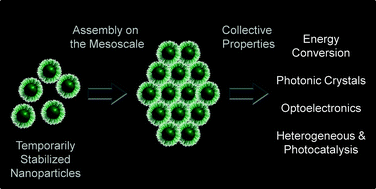
In this work the oriented attachment and mesocrystal formation via non-classical pathways have been reviewed with particular emphasis being placed on their self-assembly mechanisms as well as the new collective properties of the resulting crystalline nanoparticular arrangements and their potential uses in applications.
The content of this RSS Feed (c) The Royal Society of Chemistry

01 Sep 18:43
by Yuanyue Liu, Fangbo Xu, Ziang Zhang, Evgeni S. Penev and Boris I. Yakobson

Nano Letters
DOI: 10.1021/nl5021393

01 Sep 18:42
by Tushar Debnath, Partha Maity, Hirendra N. Ghosh
Abstract
Ultrafast charge-transfer dynamics has been demonstrated in CdSe quantum dots (QD), CdSe/ZnS type-I core–shell, and CdSe/CdTe type-II core–shell nanocrystals after sensitizing the QD materials by aurin tricarboxylic acid (ATC), in which CdSe QD and ATC form a charge-transfer complex. Energy level diagrams suggest that the conduction and valence band of CdSe lies below the LUMO and the HOMO level of ATC, respectively, thus signifying that the photoexcited hole in CdSe can be transferred to ATC and that photoexcited ATC can inject electrons into CdSe QD, which has been confirmed by steady state and time-resolved luminescence studies and also by femtosecond time-resolved absorption measurements. The effect of shell materials (for both type-I and type-II) on charge-transfer processes has been demonstrated. Electron injection in all the systems were measured to be <150 fs. However, the hole transfer time varied from 900 fs to 6 ps depending on the type of materials. The hole-transfer process was found to be most efficient in CdSe QD. On the other hand, it has been found to be facilitated in CdSe/CdTe type-II and retarded in CdSe/ZnS type-I core–shell materials. Interestingly, electron injection from photoexcited ATC to both CdSe/CdTe type-II and CdSe/ZnS type-I core–shell has been found to be more efficient as compared to pure CdSe QD. Our observation suggests the potential of quantum dot core–shell super sensitizers for developing more efficient quantum dot solar cells.

Steady state and time-resolved luminescence studies as well as femtosecond time-resolved absorption measurements have shown that grand charge separation occurs in CdSe/ATC composite systems. The hole-transfer process has been found to be most efficient in CdSe QD. On the other hand, it has been found to be facilitated in CdSe/CdTe type-II and retarded in CdSe/ZnS type-I core–shell materials (see figure).
30 Aug 23:21
by Stanislav Filippov, Supanee Sukrittanon, Yanjin Kuang, Charles Tu, Per O. Å. Persson, Weimin M. Chen and Irina A. Buyanova

Nano Letters
DOI: 10.1021/nl502281p

30 Aug 23:21
by Anielle Christine Almeida Silva, Marcelo José Barbosa Silva, Felipe Andrés Cordero da Luz, Danielle Pereira Silva, Samantha Luara Vieira de Deus and Noelio Oliveira Dantas

Nano Letters
DOI: 10.1021/nl5028028

30 Aug 23:21
by Reza Sanatinia, Srinivasan Anand and Marcin Swillo

Nano Letters
DOI: 10.1021/nl502521y

30 Aug 23:18
by Satyapriya Bhandari, Shilaj Roy, Sabyasachi Pramanik and Arun Chattopadhyay

Langmuir
DOI: 10.1021/la502764a

30 Aug 23:11
by Yeonwoong Jung, Jie Shen, Yong Sun and Judy J. Cha

ACS Nano
DOI: 10.1021/nn503853a

Daivid and -1 others like this
30 Aug 23:09
by Yuan Liu, Tao Chen, Cuichen Wu, Liping Qiu, Rong Hu, Juan Li, Sena Cansiz, Liqin Zhang, Cheng Cui, Guizhi Zhu, Mingxu You, Tao Zhang and Weihong Tan

Journal of the American Chemical Society
DOI: 10.1021/ja5060324

30 Aug 23:05
by Shai Mangel, Eran Aronovitch, Andrey N. Enyashin, Lothar Houben and Maya Bar-Sadan

Journal of the American Chemical Society
DOI: 10.1021/ja506323s

30 Aug 23:05
by Satya N. Guin, Jaysree Pan, Arghya Bhowmik, Dirtha Sanyal, Umesh V. Waghmare and Kanishka Biswas

Journal of the American Chemical Society
DOI: 10.1021/ja5059185

26 Aug 15:50
Publication date: 15 November 2014
Source:Wear, Volume 319, Issues 1–2
Author(s): E. Olsson , P.-L. Larsson
The problem of tangential contact between an elastic–plastic sphere and a rigid plane is studied analytically and numerically with the specific aim to derive force–displacement relations to be used in numerical simulations of granular materials. The simulations are performed for both ideal-plastic and strain hardening materials with different yield stresses and including large deformation effects in order to draw general conclusions. The results are correlated using normalized quantities pertinent to the correlation of indentation testing experiments leading to a general description of the tangential contact problem. Explicit formulas for the normal and tangential forces are presented as a function of the tangential displacement using data that are easily available from axi-symmetric analyses of spherical contact. The proposed model shows very good agreement when compared with the FE-simulations.
26 Aug 15:49
Publication date: 15 November 2014
Source:Wear, Volume 319, Issues 1–2
Author(s): T. Larionova , T. Koltsova , Yu. Fadin , O. Tolochko
Cu–CNFs compact composites with a CNFs content up to 33vol% were fabricated out of the powder produced in a one-step CVD process for the purpose of developing a functional material with high electrical and tribological characteristics. The friction coefficient, wear and microstructure of the proposed material were compared to conventional Cu–graphite composites consolidated under the same conditions. The friction coefficient of the Cu-(17–33)vol%CNF was found to be 8 times less than that of pure copper and coincides within experimental error with the Cu–graphite composites. The reduction of the friction coefficient in Cu–CNFs is caused in less extent by squeezed out lubricating carbon debris, as it is in Cu–graphite materials, but by the sliding of very thin wear sheets along the grain boundaries enriched with CNFs. The wear in Cu–33vol%CNFs material was more than two times less compared to that of Cu–33vol% graphite samples, which is explained by the delamination of thinner wear sheets.
26 Aug 15:38
by Hyunseob Lim, Seong In Yoon, Gwangwoo Kim, A-Rang Jang and Hyeon Suk Shin

Chemistry of Materials
DOI: 10.1021/cm502170q

26 Aug 15:35
by Lei Liao, Hailin Peng and Zhongfan Liu

Journal of the American Chemical Society
DOI: 10.1021/ja5048297

24 Aug 09:31
by Hui Cen et al
Tribology Transactions, Volume 57, Issue 6, Page 1066-1071, November-December 2014.