15 Sep 13:07
Chem. Commun., 2014, 50,13334-13337
DOI: 10.1039/C4CC04767B, Communication

Open Access
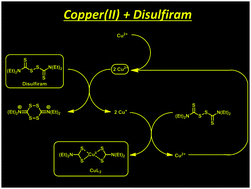
David J. Lewis, Parikshit Deshmukh, Aleksander A. Tedstone, Floriana Tuna, Paul O'Brien
The interaction of copper(II) ions with disulfiram, potentially important for new anticancer treatments, is explored under steady-state and kinetic conditions using a multi-spectroscopic approach which could lead to a deeper understanding of the mechanism of the reaction and may have implications for in vitro cytotoxicity studies.
The content of this RSS Feed (c) The Royal Society of Chemistry

15 Sep 12:31
by Yuh Kohyama, Takashi Murase, Makoto Fujita
Abstract
The discrete cavity of a self-assembled palladium–tris(4-pyridyl)triazine cage dictates the ratio of metal, ligand, and a non-coordinative molecule in the formation of silver(I)–dialkyl chalcogenide (Et, nBu; S, Se) complexes and defines their coordination arrangement.

Complexed in a complex: Complexation of a silver(I) ion with dialkyl chalcogenides is performed in the cavity of a self-assembled cage. This method modulates the number and geometry of the chalcogenides coordinated to silver(I) and generates a metal–organic proximal state.
15 Sep 12:31
by Olivier Deschaume, Bert De Roo, Margriet J. Van Bael, Jean-Pierre Locquet, Chris Van Haesendonck and Carmen Bartic

Chemistry of Materials
DOI: 10.1021/cm502652t

15 Sep 12:21
by Audrey Zak, Michael A. Andersson, Maris Bauer, Jonas Matukas, Alvydas Lisauskas, Hartmut G. Roskos and Jan Stake

Nano Letters
DOI: 10.1021/nl5027309

10 Sep 12:25
by Amin Azizi
Article
Two-dimensional (2D) crystals offer exciting opportunities to study dislocations, including their migration dynamics. Here, the authors show the local strain field at the dislocation core and dislocation motion leading to grain boundary migration in a monolayer of tungsten disulphide.
Nature Communications doi: 10.1038/ncomms5867
Authors: Amin Azizi, Xiaolong Zou, Peter Ercius, Zhuhua Zhang, Ana Laura Elías, Néstor Perea-López, Greg Stone, Mauricio Terrones, Boris I. Yakobson, Nasim Alem

10 Sep 12:10
Chem. Soc. Rev., 2014, 43,8240-8254
DOI: 10.1039/C4CS00213J, Review Article
Min-Quan Yang, Nan Zhang, Mario Pagliaro, Yi-Jun Xu
This review highlights a few problems associated with improving the photocatalytic performance of semiconductors via methodological coupling with graphene (GR) and particularly addresses the strategies for harnessing the structure and electronic conductivity of GR, which is hoped to advance the research in designing the next-generation artificial photosynthesis systems based on GR-semiconductor composites with high performance.
The content of this RSS Feed (c) The Royal Society of Chemistry

09 Sep 13:22
Chem. Commun., 2014, 50,13323-13326
DOI: 10.1039/C4CC05508J, Communication
Ye Lu, Bing Yan
We report a new ratiometric fluorescent pH sensor based on postsynthetically modified nanoscale MOF-253. By a PSM, two types of Eu3+ with different characteristic excitation wavelengths are realized in MOF-253. The pH sensor requires no calibration because only one of the two types of Eu3+ is affected by the pH variation.
The content of this RSS Feed (c) The Royal Society of Chemistry

09 Sep 12:59
by Shuang Zhang, Jiong Yang, Renjing Xu, Fan Wang, Weifeng Li, Muhammad Ghufran, Yong-Wei Zhang, Zongfu Yu, Gang Zhang, Qinghua Qin and Yuerui Lu

ACS Nano
DOI: 10.1021/nn503893j

09 Sep 12:53
by Martha E. Grady, Philippe H. Geubelle, Paul V. Braun and Nancy R. Sottos

Langmuir
DOI: 10.1021/la502271k

09 Sep 10:01
Chem. Commun., 2014, 50,13338-13341
DOI: 10.1039/C4CC05752J, Communication
Open Access
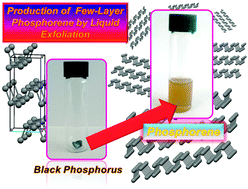
Jack R. Brent, Nicky Savjani, Edward A. Lewis, Sarah J. Haigh, David J. Lewis, Paul O'Brien
We report the liquid exfoliation of black phosphorus to form few-layer phosphorene nanosheets.
The content of this RSS Feed (c) The Royal Society of Chemistry

08 Sep 20:30
by Casey N. Brodsky, Allison P. Young, Ka Chon Ng, Chun-Hong Kuo and Chia-Kuang Tsung

ACS Nano
DOI: 10.1021/nn503379w

05 Sep 17:11
Dalton Trans., 2014, Advance Article
DOI: 10.1039/C4DT90098G, Editorial
Richard Taylor
Celebrating 50 years of Chemistry at University of York.
To cite this article before page numbers are assigned, use the DOI form of citation above.
The content of this RSS Feed (c) The Royal Society of Chemistry

05 Sep 17:11
Chem. Commun., 2014, 50,12656-12658
DOI: 10.1039/C4CC05663A, Communication
Ravi Raninga, Kristopher Page, Ivan P. Parkin
A technique for functionalizing glass frits is described for use in separating water and organic solvents.
The content of this RSS Feed (c) The Royal Society of Chemistry

05 Sep 10:30
by Lei Shi, Zhenyu Chu, Yu Liu, Wanqin Jin, Nanping Xu
In this work, novel three-dimensional graphene films (3D GFs) with controllable pore structures are directly fabricated on gold substrates through the hydrothermal reduction. An interfacial technique of the self-assembled monolayer is successfully introduced to address the binding issue between the graphene film and substrate. Adscititious silica spheres, serving as new connection centers, effectively regulate the dimensions of framework in graphene films, and secondary pore structures are produced once removing the spheres. Based on hierarchically porous 3D GFs with large surface area, excellent binding strength, high conductivity, and distinct interfacial micro-environments, selected examples of electrochemical aptasensors are constructed for the assay of adenosine triphosphate (ATP) and thrombin (Tob) respectively. Sensitive ATP and Tob aptasensors, with high selectivity, excellent stability, and promising potential in real serum sample analysis, are established on 3D GFs with different structures. The results demonstrate that the surface area, as well as interfacial micro-environments, plays a critical role in the molecular recognition. The developed reliable and scalable protocol is envisaged to become a general path for in situ fabrication of more graphene films and the as-synthesized 3D GFs would open up a wide horizon for potential applications in electronic and energy-related systems.

Three dimensional graphene film
s (GFs) with controllable pore structures are directly fabricated on the gold substrate through a facile and reliable approach. The resulting GFs exhibit large surface area, excellent binding strength and high conductivity, which will enable many advanced applications in electronic and energy-related systems. As examples, novel electrochemical aptasensors with high performance are constructed in this work.
05 Sep 10:30
by Nengjie Huo, Jun Kang, Zhongming Wei, Shu-Shen Li, Jingbo Li, Su-Huai Wei
Van der Waals heterostructures designed by assembling isolated two-dimensional (2D) crystals have emerged as a new class of artificial materials with interesting and unusual physical properties. Here, the multilayer MoS2–WS2 heterostructures with different configurations are reported and their optoelectronic properties are studied. It is shown that the new heterostructured material possesses new functionalities and superior electrical and optoelectronic properties that far exceed the one for their constituents, MoS2 or WS2. The vertical transistor exhibits a novel rectifying and bipolar behavior, and can also act as photovoltaic cell and self-driven photodetector with photo-switching ratio exceeding 103. The planar device also exhibits high field-effect ON/OFF ratio (>105), high electron mobility of 65 cm2/Vs, and high photoresponsivity of 1.42 A/W compared to that in isolated multilayer MoS2 or WS2 nanoflake transistors. The results suggest that formation of MoS2–WS2 heterostructures could significantly enhance the performance of optoelectronic devices, thus open up possibilities for future nanoelectronic, photovoltaic, and optoelectronic applications.

Newly designed MoS
2
–WS
2
heterostructures perform novel and enhanced optoelectronic performances. Vertical transistors possess new functionalities such as rectifying, bipolarity, photovoltaic effect, and self-driven photodetection. Planar devices exhibit superior optoelectronic properties with high field-effect ON/OFF ratio (>105), electron mobility of 65 cm2/Vs, and photoresponsivity of 1.42 A/W that far exceed the one for their constituents MoS2 or WS2.
Mr.Q and -1 others like this
05 Sep 10:10
by Shinobu Takemura, Sayaka Kawakami, Masafumi Harada and Masayasu Iida

Inorganic Chemistry
DOI: 10.1021/ic501177t

05 Sep 09:09
Nanoscale, 2014, 6,12287-12297
DOI: 10.1039/C4NR04144E, Minireview
Baohua Wang, Xudong Xiao, Tao Chen
This minireview comments on the development and potential impact of perovskite solar cells on the solar cell family.
The content of this RSS Feed (c) The Royal Society of Chemistry

04 Sep 13:44
Dalton Trans., 2014, 43,16424-16430
DOI: 10.1039/C4DT01941E, Paper
Javeed Akhtar, Mateusz Banski, Mohammad Azad Malik, Neerish Revaprasadu, Artur Podhorodecki, Jan Misiewicz
Ultra-small PbSe nanocrystals (NCs) were synthesized via a 'one-pot' approach in olive oil as the reaction medium and capping agent.
The content of this RSS Feed (c) The Royal Society of Chemistry

04 Sep 12:16
Nanoscale, 2014, 6,12792-12797
DOI: 10.1039/C4NR04228J, Paper
Chung-Che Huang, Feras Al-Saab, Yudong Wang, Jun-Yu Ou, John C. Walker, Shuncai Wang, Behrad Gholipour, Robert E. Simpson, Daniel W. Hewak
Nano-scale MoS2 thin films are fabricated by APCVD at ambient temperature, followed by a two-step annealing process.
The content of this RSS Feed (c) The Royal Society of Chemistry

04 Sep 11:16
Nanoscale, 2014, 6,13135-13144
DOI: 10.1039/C4NR04262J, Paper
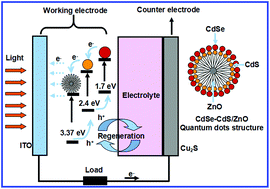
Zhimin Yuan, Longwei Yin
A sketch of the photoelectrical conversion of the CdSe-CdS QDs co-sensitized ZnO hierarchical structure with a Cu2S-counter electrode.
The content of this RSS Feed (c) The Royal Society of Chemistry

zkevin and -1 others like this
04 Sep 11:16
Chem. Commun., 2014, 50,12930-12932
DOI: 10.1039/C4CC05703A, Communication
Chang-Soo Park, Yu Zhao, Heetae Kim, Yoon Shon, Eun Kyu Kim
We report on the transport and magnetic properties of graphene annealed at 800 [degree]C under an Ar atmosphere.
The content of this RSS Feed (c) The Royal Society of Chemistry

04 Sep 11:15
CrystEngComm, 2014, 16,10754-10759
DOI: 10.1039/C4CE01493F, Paper
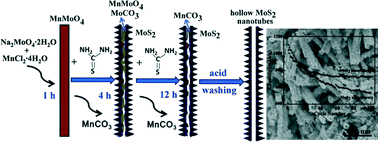
Guangda Li, Xiaoying Zeng, Tiandong Zhang, Wanyong Ma, Wenpeng Li, Meng Wang
Novel hierarchical hollow MoS2 nanotubes have been fabricated, which exhibited excellent electrochemical performance as anode materials for lithium-ion batteries.
The content of this RSS Feed (c) The Royal Society of Chemistry

04 Sep 11:11
by Adam T. Neal, Yuchen Du, Han Liu and Peide D. Ye

ACS Nano
DOI: 10.1021/nn5027164

03 Sep 12:37
Nanoscale, 2014, 6,13028-13035
DOI: 10.1039/C4NR03703K, Paper
Open Access
Krishna P. Dhakal, Dinh Loc Duong, Jubok Lee, Honggi Nam, Minsu Kim, Min Kan, Young Hee Lee, Jeongyong Kim
Absorption spectral maps of MoS2 show the variation of optical transitions depending on the atomic thickness and the chemical doping.
The content of this RSS Feed (c) The Royal Society of Chemistry

03 Sep 12:35
Nanoscale, 2014, 6,12814-12821
DOI: 10.1039/C4NR04537H, Paper
Babak Nikoobakht, Andrew Herzing
In metal-catalyzed horizontal growth of nanowires, our results show that the lattice match with substrate exists along the width of the nanowire and not its length. This finding is in contrast with what has been observed in the traditional planar growth of nanowires and could be used for fine tuning the nanowire structure at nanoscale.
The content of this RSS Feed (c) The Royal Society of Chemistry

03 Sep 10:18
by Kyung Eun Lee, Ji Eun Kim, Uday Narayan Maiti, Joonwon Lim, Jin Ok Hwang, Jongwon Shim, Jung Jae Oh, Taeyeong Yun and Sang Ouk Kim

ACS Nano
DOI: 10.1021/nn5024544

03 Sep 10:18
by Nicklas Anttu, Sebastian Lehmann, Kristian Storm, Kimberly A. Dick, Lars Samuelson, Phillip M. Wu and Mats-Erik Pistol

Nano Letters
DOI: 10.1021/nl502306x

03 Sep 10:17
by Hyun Soo Lee, Juyong Chung, Geon-Tae Hwang, Chang Kyu Jeong, Youngdo Jung, Jun-Hyuk Kwak, Hanmi Kang, Myunghwan Byun, Wan Doo Kim, Shin Hur, Seung-Ha Oh, Keon Jae Lee
For patients who suffer from sensorineural hearing loss by damaged or loss of hair cells in the cochlea, biomimetic artificial cochleas to remedy the disadvantages of existing implant systems have been intensively studied. Here, a new concept of an inorganic-based piezoelectric acoustic nanosensor (iPANS) for the purpose of a biomimetic artificial hair cell to mimic the functions of the original human hair cells is introduced. A trapezoidal silicone-based membrane (SM) mimics the function of the natural basilar membrane for frequency selectivity, and a flexible iPANS is fabricated on the SM utilizing a laser lift-off technology to overcome the brittle characteristics of inorganic piezoelectric materials. The vibration amplitude vs piezoelectric sensing signals are theoretically examined based on the experimental conditions by finite element analysis. The SM is successful at separating the audible frequency range of incoming sound, vibrating distinctively according to varying locations of different sound frequencies, thus allowing iPANS to convert tiny vibration displacement of ≈15 nm into an electrical sensing output of ≈55 μV, which is close to the simulation results presented. This conceptual iPANS of flexible inorganic piezoelectric materials sheds light on the new fields of nature-inspired biomimetic systems using inherently high piezoelectric charge constants.

The new concept of a biomimetic artificial hair cell using a flexible inorganic piezoelectric acoustic nanosensor (iPANS) is presented. A highly sensitive flexible piezoelectric sensor that responds to sound-driven vibrations of a thin silicone membrane is fabricated using a laser lift-off process. The iPANS shows remarkable capability to sense tiny vibrations caused by an external sound wave.
03 Sep 10:16
by Jason K. Cooper, Sheraz Gul, Francesca M. Toma, Le Chen, Per-Anders Glans, Jinghua Guo, Joel W. Ager, Junko Yano and Ian D. Sharp

Chemistry of Materials
DOI: 10.1021/cm5025074

03 Sep 10:02
by Tim Blazina
Article
Selenium deficiency is a major health problem, particularly in the selenium-poor belt in China, yet its distribution in the terrestrial environment is poorly understood. Here, the authors combine geochemical and palaeoclimate data and show that selenium distribution in China may be related to East Asian monsoon rainfall.
Nature Communications doi: 10.1038/ncomms5717
Authors: Tim Blazina, Youbin Sun, Andreas Voegelin, Markus Lenz, Michael Berg, Lenny H.E. Winkel

   This article is licensed under a Creative Commons Attribution 3.0 Unported Licence.