22 Sep 10:11
by Thomas C. Fitzgibbons
Nature Materials.
doi:10.1038/nmat4088
Authors: Thomas C. Fitzgibbons, Malcolm Guthrie, En-shi Xu, Vincent H. Crespi, Stephen K. Davidowski, George D. Cody, Nasim Alem & John V. Badding
Low-dimensional carbon nanomaterials such as fullerenes, nanotubes, graphene and diamondoids have extraordinary physical and chemical properties. Compression-induced polymerization of aromatic molecules could provide a viable synthetic route to ordered carbon nanomaterials, but despite almost a century of study this approach has produced only amorphous products. Here we report recovery to ambient pressure of macroscopic quantities of a crystalline one- dimensional sp3carbon nanomaterial formed by high-pressure solid-state reaction of benzene. X-ray and neutron diffraction, Raman spectroscopy, solid-state NMR, transmission electron microscopy and first-principles calculations reveal close- packed bundles of subnanometre-diameter sp3-bonded carbon threads capped with hydrogen, crystalline in two dimensions and short-range ordered in the third. These nanothreads promise extraordinary properties such as strength and stiffness higher than that of sp2carbon nanotubes or conven tional high-strength polymers. They may be the first member of a new class of ordered sp3 nanomaterials synthesized by kinetic control of high-pressure solid-state reactions.

20 Sep 16:55
by Yaroslav E. Romanyuk, Harald Hagendorfer, Patrick Stücheli, Peter Fuchs, Alexander R. Uhl, Carolin M. Sutter-Fella, Melanie Werner, Stefan Haass, Josua Stückelberger, Cédric Broussillou, Pierre-Philippe Grand, Veronica Bermudez, Ayodhya N. Tiwari
Solution processing of inorganic thin films has become an important thrust in material research community because it offers low-cost and high-throughput deposition of various functional coatings and devices. Especially inorganic thin film solar cells – macroelectronic devices that rely on consecutive deposition of layers on large-area rigid and flexible substrates – could benefit from solution approaches in order to realize their low-cost nature. This article critically reviews existing deposition approaches of functional layers for chalcogenide solar cells with an extension to other thin film technologies. Only true solutions of readily available metal salts in appropriate solvents are considered without the need of pre-fabricated nanoparticles. By combining three promising approaches, an air-stable Cu(In,Ga)Se2 thin film solar cell with efficiency of 13.8% is demonstrated where all constituent layers (except the metal back contact) are processed from solutions. Notably, water is employed as the solvent in all steps, highlighting the potential for safe manufacturing with high utilization rates.

A Cu(In,Ga)Se2 thin film solar cell with efficiency of 13.8% is demonstrated where all constituent layers (except the metal back contact) are processed from aqueous solutions of metal salts using industrially scalable processes.
20 Sep 16:50
by Jianbing Zhang, Jianbo Gao, Carena P. Church, Elisa M. Miller, Joseph M. Luther, Victor I. Klimov and Matthew C. Beard

Nano Letters
DOI: 10.1021/nl503085v

20 Sep 16:46
Publication date: 15 December 2014
Source:Wear, Volume 320
Author(s): Alexey Moshkovich , Vladyslav Perfilyev , Igor Lapsker , Lev Rapoport
Friction, wear and plastic deformation of copper (Cu) and α/β brass were studied under lubrication conditions. Hardness and microstructure of surface layers were evaluated. The friction properties were presented by Stribeck curves. The friction coefficient and wear of brass were significantly larger in comparison to Cu. The critical load of transition from the elasto-hydrodynamic lubrication (EHL) to boundary lubrication (BL) was two times lower for brass. Superplastic deformation of α-phase grains in brass is appeared under friction in BL, whereas plastic deformation localized at thin surface layers is observed for Cu. Intragranular sliding in α-phase is accompanied with the formation of shear bands and many pores coalesced to cracks. Thickness of the wear particles of brass is close to the width of shear bands. The deformation hardness of brass is significantly higher in comparison to Cu rubbed in the BL region.
20 Sep 16:45
Publication date: 15 November 2014
Source:Wear, Volume 319, Issues 1–2
Author(s): Yan Chen , Yunping Li , Shingo Kurosu , Kenta Yamanaka , Ning Tang , Akihiko Chiba
Cobalt–chromium–molybdenum (CoCrMo) alloys are widely applied as wear-resistant material. This article aims to illustrate the influence of phase constitution and precipitate morphology on the wear behavior of hot-pressed high carbon alloys. Wear behavior of two kinds of CoCrMo alloys, HP (hot-pressed) and HPA (hot-pressed+annealing) with various microstructure, hardness and surface topography were evaluated in detail. The ε phase dominant HP alloy with homogenous lamellar precipitates demonstrates higher hardness, consequently lower coefficient of friction and prominent wear resistance with mild sliding wear. In contrary, the γ phase dominant HPA alloy with carbide-free grains was characterized by abrasive wear of micro grooves. The matrix hardness strengthened by ε phase is more significant to affect wear behavior than precipitate hardening. Homogenous lamellar precipitates have a stand-out effect to block abrasion and accumulate tribochemical products.
20 Sep 16:44
Publication date: 15 November 2014
Source:Wear, Volume 319, Issues 1–2
Author(s): S. Fouvry , C. Paulin
Bonded MoS2 solid lubricant coatings are extensively used in tribology to reduce friction coefficient and wear rate. This coating strategy is particularly appreciated in aeronautical applications to limit fretting wear damage. A major question, however, concerns prediction of endurance for such palliatives (Nc: µ>µ c ). Focusing on a MoS2-bonded solid lubricant coating fretted against a Ti–6Al–4V counter-body, an extensive fretting wear analysis coupling a large spectrum of contact pressures, sliding amplitudes, contact sizes and contact geometries was undertaken. The study showed that different friction responses could be activated depending on contact pressure and sliding amplitude conditions. Low pressures and small sliding amplitudes induced a lubrication plateau friction response (I) whereas high pressures and large sliding amplitudes induced continuously rising friction combined with titanium transfer (II). The transition from friction response (I) to friction response (II) could be formalised using an “effective” pveff factor. Moreover, bonded-MoS2 coating endurance could be predicted by an “effective friction” energy density parameter expressed as the difference between the nominal friction energy density imputed in the interface and an energy contribution related to the titanium transfer activation. Using this φ–N chart representation, all the experimental friction endurance values followed a single endurance master curve, formalised as an inverse function of the “effective” friction energy density parameter. An equivalent “effective” Archard work density approach is also introduced. Based on a pressure work density parameter, this formulation is easier to apply but displays a wider scatter because friction fluctuations are not taken into consideration.
Graphical abstract

19 Sep 13:06
by Till H. Metzger, Yael Politi, Gerardina Carbone, Bernd Bayerlein, Igor Zlotnikov, Emil Zolotoyabko and Peter Fratzl

Crystal Growth & Design
DOI: 10.1021/cg501068e

19 Sep 13:03
by Kaihui Liu
Article
Interlayer coupling between two-dimensional materials is known to result in interesting physical properties. Here, the authors study the effect of a twist angle between two-dimensional molybdenum disulphide on interlayer coupling, observing an indirect bandgap, the size of which depends on the twist angle.
Nature Communications doi: 10.1038/ncomms5966
Authors: Kaihui Liu, Liming Zhang, Ting Cao, Chenhao Jin, Diana Qiu, Qin Zhou, Alex Zettl, Peidong Yang, Steve G. Louie, Feng Wang

19 Sep 13:03
Chem. Soc. Rev., 2014, 43,8271-8298
DOI: 10.1039/C4CS00185K, Review Article
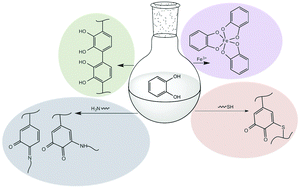
Juan Yang, Martien A. Cohen Stuart, Marleen Kamperman
This review discusses the versatile and complex chemistry of catechols, detailing the various mechanisms and affecting parameters under different reaction conditions.
The content of this RSS Feed (c) The Royal Society of Chemistry

19 Sep 13:01
J. Mater. Chem. C, 2014, 2,9132-9140
DOI: 10.1039/C4TC01571A, Paper
Tsofnat Safrani, Tatipamula Arun Kumar, Matvey Klebanov, Neta Arad-Vosk, Rotem Beach, Amir Sa'ar, Ibrahim Abdulhalim, Gabby Sarusi, Yuval Golan
Lead sulfide semiconducting thin films were chemically deposited on indium tin oxide coated glass plates for use as photoreceptor layers in conjugation with optically addressed spatial light modulators (OASLMs).
The content of this RSS Feed (c) The Royal Society of Chemistry
19 Sep 13:00
by Yao Wang, Hongchen Gu
Advances in nanotechnology and nanomedicine offer great opportunities for the development of nanoscaled theranostic platforms. Among various multifunctional nanocarriers, magnetic mesoporous silica nanocomposites (M-MSNs) attract prominent research interest for their outstanding properties and potential biomedical applications. This Research News article highlights recent progress in the design of core–shell-type M-MSNs for both diagnostic and therapeutic applications. First, an overview of synthetic strategies for three representative core–shell-type M-MSNs with different morphologies and structures is presented. Then, the diagnostic functions of M-MSNs is illustrated for magnetic resonance imaging (MRI) applications. Next, magnetic targeted delivery and stimuli-responsive release of drugs, and effective package of DNA/siRNA inside mesopores using M-MSNs as therapeutic agent carriers are discussed. The article concludes with some important challenges that need to be overcome for further practical applications of M-MSNs in nanomedicine.

Magnetic mesoporous silica nanocomposites (M-MSNs) attract increasing attention due to their unique properties and high potential in biomedical applications. This Research News article highlights recent progress in the design of core–shell-type M-MSNs and several biomedical applications in magnetic resonance imaging (MRI), magnetic targeted delivery and stimuli-responsive release of drugs, and successful encapsulation of DNA/siRNA inside mesopores.
18 Sep 20:18
by Xiao-lei Huang, Dan Xu, Shuang Yuan, De-long Ma, Sai Wang, Huai-yu Zheng, Xin-bo Zhang

A highly conductive 3D current collector that is dendritic, lightweight, and robust is synthesized for binder-free electrodes in lithium-ion batteries. It has excellent chemical/electrochemical stability in a wide voltage window (0–5 V) and robust mechanical behavior even after 600 cycles of compression. When active materials are grown in situ on the as-obtained current collector, the resulting cycling stability and rate capability far exceed those of conventional electrodes and other 3D current collectors.
18 Sep 20:17
by Lianzhe Hu, Xiaoqing Liu, Alessandro Cecconello and Itamar Willner

Nano Letters
DOI: 10.1021/nl503299f

18 Sep 06:26
Nanoscale, 2014, 6,13301-13313
DOI: 10.1039/C4NR04584J, Review Article
Jun Yang, Mingze Ma, Laiquan Li, Yufei Zhang, Wei Huang, Xiaochen Dong
Graphene, an atomic-scale honeycomb crystal lattice, is increasingly becoming popular because of its excellent mechanical, electrical, chemical, and physical properties.
The content of this RSS Feed (c) The Royal Society of Chemistry

18 Sep 06:25
J. Mater. Chem. A, 2014, 2,18229-18235
DOI: 10.1039/C4TA04329D, Communication
Chaoqun Dong, Yan Wang, Junling Xu, Guanhua Cheng, Wanfeng Yang, Tianyi Kou, Zhonghua Zhang, Yi Ding
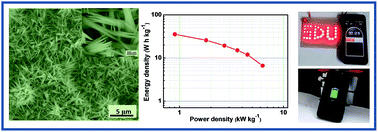
3D binder-free Cu2O@Cu nanoneedle arrays electrode fabricated via facile electrochemical strategy exhibits excellent pseudocapacitive properties for high-performance asymmetric supercapacitors.
The content of this RSS Feed (c) The Royal Society of Chemistry
18 Sep 06:24
Nanoscale, 2014, 6,13838-13844
DOI: 10.1039/C4NR03824J, Paper
Shengnan Wang, Satoru Suzuki, Hiroki Hibino
A simple and effective way to visualize the polycrystalline structures of CVD-grown graphene has been developed by a stepwise isotope labeling process, combined with Raman spectroscopy.
The content of this RSS Feed (c) The Royal Society of Chemistry

18 Sep 06:21
Publication date: January 2015
Source:Tribology International, Volume 81
Author(s): J. Hol , V.T. Meinders , M.B. de Rooij , A.H. van den Boogaard
A physical based friction model is presented to describe friction in full-scale forming simulations. The advanced friction model accounts for the change in surface topography and the evolution of friction in the boundary lubrication regime. The implementation of the friction model in FE software codes is discussed. Results show that friction coefficients vary in space and time, and depend on local process conditions such as the nominal contact pressure and the plastic strain in the sheet material. The advanced friction model is validated by two small-scale forming processes, proving the enhanced predictive capabilities of FE simulations. The moderate increase in FE computation time, compared to using a Coulomb based friction model, demonstrates the efficiency of the proposed friction model.
16 Sep 20:10
by Jianping Shi, Donglin Ma, Gao-Feng Han, Yu Zhang, Qingqing Ji, Teng Gao, Jingyu Sun, Xiuju Song, Cong Li, Yanshuo Zhang, Xing-You Lang, Yanfeng Zhang and Zhongfan Liu

ACS Nano
DOI: 10.1021/nn503211t

16 Sep 20:07
by Ado Jorio, Mark Kasperczyk, Nick Clark, Elke Neu, Patrick Maletinsky, Aravind Vijayaraghavan and Lukas Novotny

Nano Letters
DOI: 10.1021/nl502412g

16 Sep 20:07
by Vipin Kumar, Afriyanti Sumboja, Jiangxin Wang, Venkateswarlu Bhavanasi, Viet Cuong Nguyen and Pooi See Lee

Chemistry of Materials
DOI: 10.1021/cm502558t

16 Sep 19:54
by Bowen Zhu, Zhiqiang Niu, Hong Wang, Wan Ru Leow, Hua Wang, Yuangang Li, Liyan Zheng, Jun Wei, Fengwei Huo, Xiaodong Chen

Flexible tactile sensors with outstanding sensitivity in the low pressure regime are in demand for the development of artificial skin. On page 3625, X. Chen and co-workers devise a resistive tactile sensor using microstructured graphene arrays as sensitive layers. The introduction of the anisotropic microstructure arrays makes the sensor sensitive and fast to external pressure. It also shows a remarkable capability in information transmission, demonstrating great potential for application in human-machine interfaces.
16 Sep 19:53
by T. R. deBoer, I. Chakraborty, M. M. Olmstead and P. K. Mascharak

Crystal Growth & Design
DOI: 10.1021/cg501175g

16 Sep 19:52
by Ross Lockwood, Zhenyu Yang, Ramaswami Sammynaiken, Jonathan G. C. Veinot and Al Meldrum

Chemistry of Materials
DOI: 10.1021/cm5008125

16 Sep 19:48
by Yaron Tidhar, Eran Edri, Haim Weissman, Dorin Zohar, Gary Hodes, David Cahen, Boris Rybtchinski and Saar Kirmayer

Journal of the American Chemical Society
DOI: 10.1021/ja505556s

15 Sep 22:52
by Nakita K. Noel, Antonio Abate, Samuel D. Stranks, Elizabeth S. Parrott, Victor M. Burlakov, Alain Goriely and Henry J. Snaith

ACS Nano
DOI: 10.1021/nn5036476

15 Sep 22:52
by Francesca Cavallo, Richard Rojas Delgado, Michelle M. Kelly, José R. Sánchez Pérez, Daniel P. Schroeder, Huili Grace Xing, Mark A. Eriksson and Max G. Lagally

ACS Nano
DOI: 10.1021/nn503381m

15 Sep 12:25
Abstract
The effect in the tribological performance of WS2 fullerene-like nanoparticles in PAO base oil when adding a ZDDP additive was studied at 100 °C in the boundary lubrication regime. The tribological properties of the dispersion surpass those obtained without one of the two additives. The friction modifier properties of the particles are improved in the presence of ZDDP, while the anti-wear properties of the ZDDP are increased when the particles are added to the dispersion. The composition of the formed tribofilm was investigated. Results show that a 50–60 nm tribofilm is formed on the steel surface composed by WS2 mixed on the ZDDP chemical tribofilm. A WS2-rich layer is observed at the top of the tribofilm. A correlation between the chemical composition of the tribofilm and the tribological properties of the “PAO + WS2 + ZDDP” dispersion was made. Synergy between the two additives was proven.
15 Sep 12:20
by Joseph D. Keene, James R. McBride, Noah J. Orfield and Sandra J. Rosenthal

ACS Nano
DOI: 10.1021/nn504235w

15 Sep 12:19
by Maher F. El-Kady and Richard B. Kaner

ACS Nano
DOI: 10.1021/nn504946k

15 Sep 12:05
by Jong-Seon Kim, Hae-Wook Yoo, Hyung Ouk Choi and Hee-Tae Jung

Nano Letters
DOI: 10.1021/nl502906a