01 Oct 15:48
Abstract
Macrotribological studies of microcrystalline graphite powder reveal a drastic decrease in the friction coefficient when the experiments are carried out in the presence of low-viscosity liquids. The friction reduction is attributed to the simultaneous presence of particles and liquid in the sliding contact, but the mechanisms involved remain unclear. In order to contribute to the understanding of liquid action in friction reduction mechanisms, nanoscale investigations of the tribofilms have been performed using lateral force microscopy. Attention is devoted to the nanostructure of the film surfaces and their nanofriction behavior using an atomic force microscope. The influence of the tip/sample interfaces on friction properties is investigated by using AFM tips constituted of different compounds (silicon, gold/chromium alloy, silicon nitride or carbon-covered AFM tip) and by performing the nanofriction tests in air or liquid environments. The results indicate that the friction reduction observed at macroscale is attributed neither to the lowering of the shear strength of the carbon/carbon interface in the presence of liquid nor to the nanostructure of the film surface. Collective liquid/particles effects inside the contact during sliding are probably involved.
29 Sep 20:57
Nanoscale, 2014, 6,14467-14472
DOI: 10.1039/C4NR04351K, Paper
Duckjong Kim, Hye Kyung Park, Hyekyoung Choi, Jaehong Noh, Kyungnam Kim, Sohee Jeong
Nanocrystal quantum dots are continuously purified by moving them to the impurity-free target solvent stream.
The content of this RSS Feed (c) The Royal Society of Chemistry

29 Sep 20:54
by Ehren M. Mannebach, Karel-Alexander N. Duerloo, Lenson A. Pellouchoud, Meng-Ju Sher, Sanghee Nah, Yi-Hong Kuo, Yifei Yu, Ann F. Marshall, Linyou Cao, Evan J. Reed and Aaron M. Lindenberg

ACS Nano
DOI: 10.1021/nn5044542

29 Sep 20:47
by Yuan Huang, Eli Sutter, Jerzy T. Sadowski, Mircea Cotlet, Oliver L.A. Monti, David A. Racke, Mahesh R. Neupane, Darshana Wickramaratne, Roger K. Lake, Bruce A. Parkinson and Peter Sutter

ACS Nano
DOI: 10.1021/nn504481r

29 Sep 20:46
by Jiye Kim, Jaeyoung Jang, Kyunghun Kim, Haekyoung Kim, Se Hyun Kim, Chan Eon Park

Tuning of the energetic barriers to charge transfer at the semiconductor/dielectric interface in organic field-effect transistors (OFETs) is achieved by varying the dielectric functionality. Based on this, the correlation between the magnitude of the energy barrier and the gate-bias stress stability of the OFETs is demonstrated, and the origin of the excellent device stability of OFETs employing fluorinated dielectrics is revealed.
26 Sep 21:43
by K. M. Grant
Article
Detailed sea-level records beyond ~150,000 years ago are limited. Here, the authors present a radiometrically constrained sea-level record from the Red Sea, spanning five glacial cycles and examine sea-level rise rates and the effects of past global ice-volume changes on monsoon intensity.
Nature Communications doi: 10.1038/ncomms6076
Authors: K. M. Grant, E. J. Rohling, C. Bronk Ramsey, H. Cheng, R. L. Edwards, F. Florindo, D. Heslop, F. Marra, A. P. Roberts, M. E. Tamisiea, F. Williams

26 Sep 21:36
Chem. Soc. Rev., 2014, Advance Article
DOI: 10.1039/C4CS00258J, Tutorial Review
Qingqing Ji, Yu Zhang, Yanfeng Zhang, Zhongfan Liu
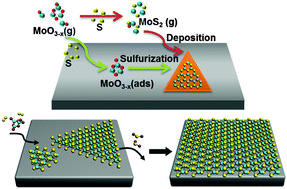
This review focuses on the CVD growth of monolayer MX2 with engineered morphologies on diverse substrates.
To cite this article before page numbers are assigned, use the DOI form of citation above.
The content of this RSS Feed (c) The Royal Society of Chemistry

26 Sep 21:22
RSC Adv., 2014, 4,50981-50987
DOI: 10.1039/C4RA09001B, Paper
Wen Qiao, Shiming Yan, Xuemin He, Xueyin Song, Zhiwen Li, Xing Zhang, Wei Zhong, Youwei Du
An optimal power to exfoliate MoS2 nanoflakes for high yield and small lateral size with narrow size distribution was obtained.
The content of this RSS Feed (c) The Royal Society of Chemistry

26 Sep 21:22
Chem. Soc. Rev., 2015, 44,2587-2602
DOI: 10.1039/C4CS00258J, Tutorial Review
Qingqing Ji, Yu Zhang, Yanfeng Zhang, Zhongfan Liu
This review focuses on the CVD growth of monolayer MX2 with engineered morphologies on diverse substrates.
The content of this RSS Feed (c) The Royal Society of Chemistry

26 Sep 21:10
by Sudhanshu Shukla, Nguyen Huu Loc, Pablo P. Boix, Teck Ming Koh, Rajiv Ramanujam Prabhakar, Hemant K. Mulmudi, Jun Zhang, Shi Chen, Chin Fan Ng, Cheng Hon Alfred Huan, Nripan Mathews, Thirumany Sritharan and Qihua Xiong

ACS Nano
DOI: 10.1021/nn5040982

24 Sep 20:44
by Miao Zhang, Liang Huang, Ji Chen, Chun Li, Gaoquan Shi

Freestanding, paper-like films of reduced graphene oxide (rGO) containing trace amounts of polymers are fabricated by an operationally simple, cost-effective, and environmentally friendly gel-film approach. The films, which can have a large area, display ultrahigh strengths and toughnesses as well as high electrical conductivities.
24 Sep 20:44
by Jin Wang, Jilei Liu, Dongliang Chao, Jiaxu Yan, Jianyi Lin, Ze Xiang Shen

Honeycomb-like MoS2 nanoarchitectures anchored into 3D graphene foam are successfully fabricated as a high-performance positive electrode for enhanced Li-ion storage. The unique 3D interpenetrating honeycomb-like structure is the key to the high performance. High reversible capacity, superior high-rate capability, and excellent cycling stability are demonstrated.
24 Sep 20:43
by Ilya Sychugov, Anna Fucikova, Federico Pevere, Zhenyu Yang, Jonathan G. C. Veinot, and Jan Linnros

ACS Photonics
DOI: 10.1021/ph500221z
Publication Date (Web): September 11, 2014
23 Sep 19:48
Chem. Commun., 2014, 50,14261-14264
DOI: 10.1039/C4CC06603K, Communication
Ming Zhou, Mattias Grahn, Han Zhou, Allan Holmgren, Jonas Hedlund
Humidity and substrate properties are considered coordinately in the assembly of nano-sized crystals. The nanocrystal monolayers with thicknesses of 20-100 nm show large-area uniformity and excellent orientations.
The content of this RSS Feed (c) The Royal Society of Chemistry

23 Sep 19:42
by Mohammad Reza Golobostanfard, Saeed Mohammadi, Hossein Abdizadeh and Mohammad Amin Baghchesara

Langmuir
DOI: 10.1021/la5031608

23 Sep 19:40
CrystEngComm, 2014, 16,10553-10559
DOI: 10.1039/C4CE01371A, Paper
Tzvi Templeman, Moshiel Biton, Tsofnat Safrani, Michael Shandalov, Eyal Yahel, Yuval Golan
The early stages of growth in chemical solution deposition of lead selenide thin films on GaAs(100) substrates were studied in detail.
The content of this RSS Feed (c) The Royal Society of Chemistry

23 Sep 19:40
by Michael J. Turo and Janet E. Macdonald

ACS Nano
DOI: 10.1021/nn5032164

23 Sep 19:39
by Taro Uematsu, Masahiro Baba, Yoshifumi Oshima, Tetsuya Tsuda, Tsukasa Torimoto and Susumu Kuwabata

Journal of the American Chemical Society
DOI: 10.1021/ja506724w

23 Sep 07:16
by Dirk J. Groenendijk, Michele Buscema, Gary A. Steele, Steffen Michaelis de Vasconcellos, Rudolf Bratschitsch, Herre S. J. van der Zant and Andres Castellanos-Gomez

Nano Letters
DOI: 10.1021/nl502741k

23 Sep 07:15
by Zhijun Ning, Haopeng Dong, Qiong Zhang, Oleksandr Voznyy and Edward H. Sargent

ACS Nano
DOI: 10.1021/nn503569p

23 Sep 07:15
by In Soo Kim, Vinod K. Sangwan, Deep Jariwala, Joshua D. Wood, Spencer Park, Kan-Sheng Chen, Fengyuan Shi, Francisco Ruiz-Zepeda, Arturo Ponce, Miguel Jose-Yacaman, Vinayak P. Dravid, Tobin J. Marks, Mark C. Hersam and Lincoln J. Lauhon

ACS Nano
DOI: 10.1021/nn503988x

23 Sep 07:15
by Natasha Dropka, Alexander Glacki and Christiane Frank-Rotsch

Crystal Growth & Design
DOI: 10.1021/cg500814m

23 Sep 07:13
by Zhe Hu, Lixiu Wang, Kai Zhang, Jianbin Wang, Fangyi Cheng, Zhanliang Tao, Jun Chen
Abstract
MoS2 nanoflowers with expanded interlayer spacing of the (002) plane were synthesized and used as high-performance anode in Na-ion batteries. By controlling the cut-off voltage to the range of 0.4–3 V, an intercalation mechanism rather than a conversion reaction is taking place. The MoS2 nanoflower electrode shows high discharge capacities of 350 mAh g−1 at 0.05 A g−1, 300 mAh g−1 at 1 A g−1, and 195 mAh g−1 at 10 A g−1. An initial capacity increase with cycling is caused by peeling off MoS2 layers, which produces more active sites for Na+ storage. The stripping of MoS2 layers occurring in charge/discharge cycling contributes to the enhanced kinetics and low energy barrier for the intercalation of Na+ ions. The electrochemical reaction is mainly controlled by the capacitive process, which facilitates the high-rate capability. Therefore, MoS2 nanoflowers with expanded interlayers hold promise for rechargeable Na-ion batteries.

More active sites through peeling: MoS2 nanoflowers with expanded interlayers were investigated as a high-performance anode material for Na-ion batteries. Excellent discharge capacities and high cycling stability were observed and were directly correlated with the expanded layer space and the decreased layer numbers.
23 Sep 07:11
Abstract
A finite element model is used to simulate sliding inception of a rigid flat on a deformable sphere under combined normal and tangential loading. Sliding inception is treated as the loss of tangential contact stiffness under combined effects of plasticity, crack propagation and interfacial slip. Energy dissipation distribution is used to quantify the relative contribution of these mechanisms on the increased compliance during tangential loading. Materials with different strength and toughness properties, and varying local interface conditions ranging from fully adhered to finite friction, are studied to relate variations in plastic deformations, crack and slip to the sliding inception. For fully adhered contact condition, crack and fracture toughness have no effect on sliding inception, with plasticity, the dominant failure mechanism. A measure of recoverable strain (yield strength to Young’s modulus ratio) is found to be the most influential parameter in sliding inception. Interfacial slip is expectedly the dominant mechanism for sliding inception for lower coefficient of friction, modeling lubricated contacts. Interplay of plasticity and interfacial slip is found to govern the onset of sliding for higher local friction coefficients. Furthermore, the single asperity results are incorporated in a statistical model for nominally flat contacting rough surfaces under combined normal and tangential loading to investigate the stochastic effects due to surface roughness and material property uncertainties. The results show that the static coefficient of friction strongly depends on the normal load, material properties, local interfacial strength and roughness parameters.
22 Sep 18:35
Nanoscale, 2014, Accepted Manuscript
DOI: 10.1039/C4NR01600A, Review Article
Andrea C. Ferrari
We present the science and technology roadmap (STR) for graphene, related two-dimensional (2d) crystals, and hybrid systems, targeting an evolution in technology, with impacts and benefits reaching into most areas...
The content of this RSS Feed (c) The Royal Society of Chemistry

22 Sep 18:35
by Yu-Kuang Liao, Maël Brossard, Dan-Hua Hsieh, Tzu-Neng Lin, Martin D. B. Charlton, Shun-Jen Cheng, Chyong-Hua Chen, Ji-Lin Shen, Lung-Teng Cheng, Tung-Po Hsieh, Fang-I Lai, Shou-Yi Kuo, Hao-Chung Kuo, Pavlos G. Savvidis, Pavlos G. Lagoudakis
A novel scheme for hybridizing inkjet-printed thin film Cu(In,Ga)Se2 (CIGS) solar cells with self-assembled clusters of nanocrystal quantum dots (NQDs), which provides a 10.9% relative enhancement of the photon conversion efficiency (PCE), is demonstrated. A non-uniform layer of NQD aggregates is deposited between the transparent conductive oxide and a CdS/CIGS p-n junction using low cost pulsed-spray deposition. Hybridization significantly improves the external quantum efficiency of the hybrid devices in the absorption range of the NQDs and in the red to near-IR parts of the spectrum. The low wavelength response enhancement is found to be induced by luminescent down-shifting (LDS) from the NQD layer, while the increase at longer wavelengths is attributed to internal scattering from NQD aggregates. LDS is demonstrated using time-resolved spectroscopy, and the morphology of the NQD layer is investigated in fluorescence microscopy and cross-sectional transmission electron microscopy. The influence of the NQD dose on the PCE of the hybrid devices is investigated and an optimum value is obtained. The low costs and limited material consumptions associated with pulsed-spray deposition make these flexible hybrid devices promising candidates to help push thin-film photovoltaic technology towards grid parity.

Low-cost pulse-spray deposition is used to incorporate self-assembled clusters of luminescent nanocrystal quantum dots (NQDs) into a flexible thin-film Cu(In,Ga)Se2 (CIGS) solar cell. Luminescent down-shifting and internal scattering on NQD clusters are found to provide a large broadband improvement of the quantum efficiency, yielding a 10.9% relative increase of the efficiency.
22 Sep 18:34
by Mingzhao Liu, Jing Tao, Chang-Yong Nam, Kim Kisslinger, Lihua Zhang and Dong Su

Nano Letters
DOI: 10.1021/nl502208u

22 Sep 18:33
by Kidong Park, Jung Ah Lee, Hyung Soon Im, Chan Su Jung, Han Sung Kim, Jeunghee Park and Chang-Lyoul Lee

Nano Letters
DOI: 10.1021/nl5028843

22 Sep 18:33
by Jiang Wu, Lihui Liu, Shenting Liu, Peng Yu, Zerui Zheng, Muhammad Shafa, Zhihua Zhou, Handong Li, Haining Ji and Zhiming M. Wang

Nano Letters
DOI: 10.1021/nl503059t

22 Sep 15:14
Energy Environ. Sci., 2014, 7,3994-3999
DOI: 10.1039/C4EE02358G, Communication
Tae Il Lee, Woo Soon Jang, Eungkyu Lee, Youn Sang Kim, Zhong Lin Wang, Hong Koo Baik, Jae Min Myoung
An ultra-thin self-powered artificial skin, which harvests stored elastic deformation energy by the bending and stretching actions of the skin, is introduced.
The content of this RSS Feed (c) The Royal Society of Chemistry