17 Oct 21:17
by Kathryn A. Dooley, Damon M. Conover, Lisha Deming Glinsman, John K. Delaney
Abstract
Two imaging modalities based on molecular and elemental spectroscopy were used to characterize a painting by Cosimo Tura. Visible-to-near-infrared (400–1680 nm) reflectance imaging spectroscopy (RIS) and X-ray fluorescence (XRF) imaging spectroscopy were employed to identify pigments and determine their spatial distribution with higher confidence than from either technique alone. For example, Mary’s red robe was modeled through the distribution of an insect-derived red lake (RIS map) and lead white (XRF lead map), rather than a layer of red lake on vermilion. The RIS image cube was also used to isolate the preparatory design by mapping the reflectance spectra associated with it. In conjunction with results from an earlier RIS study (1650–2500 nm) to map and identify the binding media, a more thorough understanding was gained of the materials and techniques used in the painting.

Technical art history: Visible-to-near-infrared reflectance imaging spectroscopy (RIS) and X-ray fluorescence (XRF) imaging spectroscopy were used as complementary chemical imaging methods to provide a robust spatial distribution of pigments. Hyperspectral RIS analysis allowed the isolation of the preparatory drawing from both the overlying original paint of the artist and the inpaint of the conservator.
15 Oct 13:29
by Riikka L. Puurunen
Abstract
Atomic layer deposition (ALD) is a thin film growth technique based on the repeated use of separate, saturating gas-solid reactions. The principle of ALD has been discovered twice; in the 1960s under the name “molecular layering” in the Soviet Union, and in the 1970s under the name “atomic layer epitaxy” (ALE) in Finland. In 2014, it is forty years since the filing of the worldwide patent on ALE as a method for the growth of compound thin films. This essay celebrates the fortieth anniversary of ALE-ALD, briefly telling the story of ALE as shared by its Finnish inventor, Dr. Tuomo Suntola. Initially, ALE was aimed at the growth of high-quality polycrystalline ZnS thin films for electroluminescent (EL) display panels. Gradually, the material selection of ALE increased, and the application areas were extended to photovoltaics, catalysis, semiconductor devices, and beyond. Fast, production-worthy ALE reactors were imperative for industrial success. The unprejudiced creation of new technologies and products with ALE, initiated by Dr. Tuomo Suntola and led by him until early 1998, are an integral part of the Finnish industrial history, the fruits of which are seen today in numerous applications worldwide.
15 Oct 13:01
by Jung-Hoon Lee, Myung-Hwa You, Gyeong-Hwan Kim and Jwa-Min Nam

Nano Letters
DOI: 10.1021/nl502541u

15 Oct 10:40
Chem. Soc. Rev., 2015, 44,2732-2743
DOI: 10.1039/C4CS00257A, Review Article
Han Liu, Yuchen Du, Yexin Deng, Peide D. Ye
Phosphorus is one of the most abundant elements preserved in earth, and it comprises a fraction of [similar]0.1% of the earth crust.
The content of this RSS Feed (c) The Royal Society of Chemistry

15 Oct 10:18
by Luis G. Perla, Allen G. Oliver and Slavi C. Sevov

Inorganic Chemistry
DOI: 10.1021/ic502158e

14 Oct 14:27
by Zainul Aabdin, Jingyu Lu, Xi Zhu, Utkarsh Anand, N. Duane Loh, Haibin Su and Utkur Mirsaidov

Nano Letters
DOI: 10.1021/nl5032919

14 Oct 14:06
Abstract
Leonardo da Vinci (1452–1519) is universally regarded as a brilliant polymath, designer, astronomer, artist, philosopher, and a visionary engineer of the Renaissance era. Interestingly, due to the delayed discovery of several caches of his notebook pages (as late as the 1960s), his immense contribution to the field of tribology has only recently surfaced. From these salvaged documents, da Vinci’s three notable observations that preceded the development of the laws of friction were uncovered: (1) Friction is independent of apparent contact area, (2) the resistance of friction is directly proportional to applied load, and (3) friction has a consistent value of µ = 0.25. In this work, we have attempted to construct a nearly faithful recreation of Leonardo da Vinci’s apparatus for measuring friction based on his notebook illustrations and investigate the conditions under which Leonardo da Vinci’s experiments produced his findings. Our experiments, performed roughly 500 years later, reproduced Leonardo da Vinci’s findings of friction coefficients with wood of µ = 0.25, but only under conditions of roughly cut and brusquely squared samples of dry wood that were handled and sullied by hand in a fashion typical of wood working but inconsistent with the modern laboratory practice. Thus, our interpretation of Leonardo da Vinci’s findings is that these first tribological studies were actually performed on roughly cut and unpolished samples that had been handled extensively prior to and during testing; Such a procedure of sample preparation is entirely reasonable for the time period and suggests an active, dusty, and dynamic laboratory environment.
10 Oct 08:51
by Florence Pennetreau, Olivier Riant, Sophie Hermans
Abstract
Radical functionalization of reduced graphene oxide has been achieved by reaction with a xanthate in the presence of peroxide as a radical initiator. X-ray photoelectron spectroscopy, bulk elemental analyses, and thermogravimetric analyses showed that the xanthate grafting is covalent and efficient. The synthesis and use of seven xanthates and three peroxides showed that the highest grafting yield is obtained when xanthate and peroxide are introduced in stoichiometric amounts. It also revealed that the peroxide used as radical initiator is grafted at the graphenic surface during the functionalization. The method presented in this contribution therefore allows bifunctionalized reduced graphene oxide samples to be easily obtained in one single step. This method leads to undamaged graphene sheets with higher dispersibility than the pristine sample.

Two birds with one stone! Xanthates and peroxides are used as radical precursors to graft various functions at the reduced graphene oxide surface. The developed method allows a double functionalization by both xanthate and peroxide radicals to be performed in one single step. The versatility of the method is highlighted by the grafting of seven xanthates and four peroxides. The resulting material shows no visible structural damage and long-lasting dispersibility.
10 Oct 08:49
by Jiawen Chen, Jos C. M. Kistemaker, Jort Robertus and Ben L. Feringa

Journal of the American Chemical Society
DOI: 10.1021/ja507711h

10 Oct 08:48
by Weiwei Zhao, Chao Zhang, Feiyang Geng, Sifei Zhuo and Bin Zhang

ACS Nano
DOI: 10.1021/nn504755x

10 Oct 08:39
by K. Volgmann
Article
Point defects in a surface can subtly alter the bulk phonon spectra. Here, the authors show phonon spectra of point defects that are capable of differentiating between different degrees of integration—alloyed or loose in a vacancy—of an atom into a surface.
Nature Communications doi: 10.1038/ncomms6089
Authors: K. Volgmann, H. Gawronski, Ch Zaum, G. G. Rusina, S. D. Borisova, E. V. Chulkov, K. Morgenstern

09 Oct 23:09
by Helmut Schäfer, Claudia Hess, Heinrich Tobergte, Anna Volf, Sachar Ichilmann, Henning Eickmeier, Benjamin Voss, Nikolai Kashaev, Jörg Nordmann, Wajiha Akram, Brigitte Hartmann-Azanza, Martin Steinhart

A top-down approach, i.e., creating small particles by mechanical force starting from bulk materials, probably presents the most logical approach to particle size reduction and, therefore, top-down techniques are among the first to achieve small particles. A new solvent-free, amazingly simple approach is reported, suitable to achieve nanoparticles and sub-micro particles.
09 Oct 14:19
by Fabian Dielmann, Claudia Heindl, Florian Hastreiter, Eugenia V. Peresypkina, Alexander V. Virovets, Ruth M. Gschwind, Manfred Scheer
Abstract
The reaction of [CpBnFe(η5-P5)] (1) (CpBn=η5-C5(CH2Ph)5) with CuI selectively yields a novel spherical supramolecule (CH2Cl2)3.4@[(CpBnFeP5)12{CuI}54(MeCN)1.46] (2) showing a linkage of the scaffold atoms which is beyond the Fullerene topology. Its extended CuI framework reveals an outer diameter of 3.7 nm—a size that has not been reached before using five-fold symmetric building blocks. Furthermore, 2 shows a remarkable solubility in CH2Cl2, and NMR spectroscopy reveals that the scaffold of the supramolecule remains intact in solution. In addition, a novel 2D polymer [{CpBnFe(η5-P5)}2{Cu6(μ-I)2(μ3-I)4}]n (3) with an uncommon structural motif was isolated. Its formation can be avoided by using a large excess of CuI in the reaction with 1.

The four Ss: Novel scaffold, large size, remarkable solubility and high stability are the unique features of the supramolecule based on [CpBnFe(η5-P5)] (CpBn=C5(CH2Ph)5) and CuI. A scaffold beyond the fullerene topology is formed by an extended CuI framework. Its solubility is provided by the CpBn ligands, and the nano-sized sphere remains intact in solution demonstrating its stability.
09 Oct 14:12
Nanoscale, 2014, 6,14002-14002
DOI: 10.1039/C4NR90076F, Correction
Lee Kheng Tan, Bo Liu, Jing Hua Teng, Shifeng Guo, Hong Yee Low, Kian Ping Loh
The content of this RSS Feed (c) The Royal Society of Chemistry

09 Oct 14:10
Chem. Commun., 2014, 50,15175-15178
DOI: 10.1039/C4CC06952H, Communication
Tristan T. Y. Tan, Jerald T. M. Cham, Michael R. Reithofer, T. S. Andy Hor, Jia Min Chin
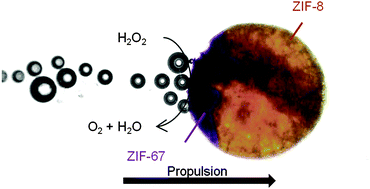
A Janus MOF crystal showing site-selective bubble ejection from the ZIF-67 covered surface.
The content of this RSS Feed (c) The Royal Society of Chemistry

09 Oct 13:50
by Edwin A. Chandross
Chemistry of Materials
DOI: 10.1021/cm5028157

09 Oct 13:46
by Minjie Li and Sean Xiao-An Zhang
Chemistry of Materials
DOI: 10.1021/cm503256m

09 Oct 13:38
by Rui Cheng
Article
Molybdenum disulfide holds great potential for advanced flexible electronic devices. Here, using a transferred gate technique, the authors fabricate molybdenum disulfide-based transistors with optimized device geometry and contact, improving device speed and demonstrating gigahertz circuits with voltage gain.
Nature Communications doi: 10.1038/ncomms6143
Authors: Rui Cheng, Shan Jiang, Yu Chen, Yuan Liu, Nathan Weiss, Hung-Chieh Cheng, Hao Wu, Yu Huang, Xiangfeng Duan

09 Oct 13:36
by Younan Xia

Nanotechnology has become ubiquitous in our everyday lives, from medicine and information storage to sunscreens and cosmetics. With so many applications, its risks also need to be considered. This issue, which starts with an Editorial by Y. Xia on page 12268, gives an overview of the most recent developments and challenges of nanotechnology. It contains five Reviews on current topics including nanosafety research, nanoparticles in the environment, inorganic nanoparticles, soot nanoparticles, and nanoparticles for drug delivery, as well as Communications that cover the whole spectrum of nanotechnology, from fundamental studies to catalysis, energy, and materials research.
06 Oct 14:50
CrystEngComm, 2014, Advance Article
DOI: 10.1039/C4CE00623B, Paper
I. Ch. Avetissov, E. N. Mozhevitina, A. V. Khomyakov, R. I. Avetisov, A. A. Davydov, V. P. Chegnov, O. I. Chegnova, N. V. Zhavoronkov
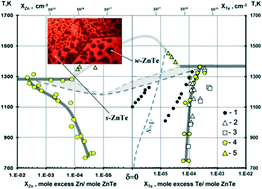
A new understanding of the wurtzite-spalerite phase transition in CdTe and ZnTe compounds in connection with the vapor growth of single crystals.
To cite this article before page numbers are assigned, use the DOI form of citation above.
The content of this RSS Feed (c) The Royal Society of Chemistry

06 Oct 14:27
J. Mater. Chem. A, 2014, 2,20112-20117
DOI: 10.1039/C4TA03433C, Paper
Deuk Ho Yeon, Seung Min Lee, Yeon Hwa Jo, Jooho Moon, Yong Soo Cho
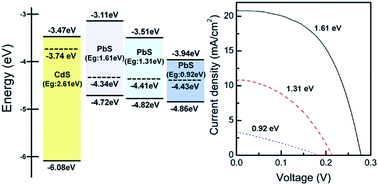
An enhanced conversion efficiency of [similar]3.1% was achieved for non-colloidal PbS/CdS thin film solar cells with suitable band alignments.
The content of this RSS Feed (c) The Royal Society of Chemistry
06 Oct 14:27
Chem. Commun., 2014, 50,14851-14854
DOI: 10.1039/C4CC05929H, Communication
Woochul Lee, Dong-Woo Lee, Myongsoo Lee, Jong-In Hong
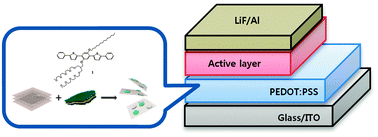
The self-assembled nanostructures of amphiphilic molecules enabled a direct exfoliation of carbon allotropes, which were successfully introduced into the HTL layer.
The content of this RSS Feed (c) The Royal Society of Chemistry

03 Oct 18:57
by Mehtap Büyükyazi, Corinna Hegemann, Thomas Lehnen, Wieland Tyrra and Sanjay Mathur

Inorganic Chemistry
DOI: 10.1021/ic501157e

03 Oct 18:51
by Shenghua Ma, Daming Yong, Ying Zhang, Xuejing Wang, Xiaojun Han
Abstract
The ability to engineer the surface properties of magnetic nanoparticles is important for their various applications, as numerous physical and chemical properties of nanoscale materials are seriously affected by the chemical constitution of their surfaces. For some specific applications, nanoparticles need to be transferred from a polar to a nonpolar environment (or vice versa) after synthesis. In this work we have developed a universal method for the phase transfer of magnetic nanoparticles that preserves their shape and size. Octadecyltrimethoxysilane was used to cap the surfaces of the aqueous magnetic nanoparticles, thereby allowing their transfer into nonpolar solution. The resulting hydrophobic magnetic nanoparticles were transferred back into aqueous solution by subsequently covering them with an egg-PC lipid monolayer. The superparamagnetic properties of the particles were retained after the phase transfer. The maximum transfer yields are dependent on their particle size with a maximum value of 93.16±4.75 % for magnetic nanoparticles with a diameter of 100 nm. The lipid-modified magnetic particles were stable over 1 week, and thus they have potential applications in the field of biomedicine. This work also provides a facile strategy for the controllable engineering of the surface properties of nanoparticles.

Reversible phase transfer: Octadecyltrimethoxysilane (ODTS) has been used to cap the surfaces of hydrophilic magnetic nanoparticles (NPs), thereby allowing their transfer into nonpolar solution. The resulting hydrophobic magnetic nanoparticles were transferred back into aqueous solution by covering them with a lipid monolayer (see figure; Egg-PC=egg yolk phosphatidylcholine).
02 Oct 22:26
by Haoyan Zhao, Dong Li, Guifang Dong, Lian Duan, Xiaohui Liu and Liduo Wang

Langmuir
DOI: 10.1021/la503481r

02 Oct 22:24
by Piljae Joo, Kiyoung Jo, Gwanghyun Ahn, Damien Voiry, Hu Young Jeong, Sunmin Ryu, Manish Chhowalla and Byeong-Su Kim

Nano Letters
DOI: 10.1021/nl502883a

02 Oct 22:23
CrystEngComm, 2014, Advance Article
DOI: 10.1039/C4CE00623B, Paper
I. Ch. Avetissov, E. N. Mozhevitina, A. V. Khomyakov, R. I. Avetisov, A. A. Davydov, V. P. Chegnov, O. I. Chegnova, N. V. Zhavoronkov
A new understanding of the wurtzite-spalerite phase transition in CdTe and ZnTe compounds in connection with the vapor growth of single crystals.
To cite this article before page numbers are assigned, use the DOI form of citation above.
The content of this RSS Feed (c) The Royal Society of Chemistry
02 Oct 22:22
by Xue Liu, Jin Hu, Chunlei Yue, Nicholas Della Fera, Yun Ling, Zhiqiang Mao and Jiang Wei

ACS Nano
DOI: 10.1021/nn505253p

01 Oct 15:33
J. Mater. Chem. A, 2014, 2,19011-19018
DOI: 10.1039/C4TA04496G, Paper
Paul R. Abel, Kyle C. Klavetter, Karalee Jarvis, Adam Heller, C. Buddie Mullins
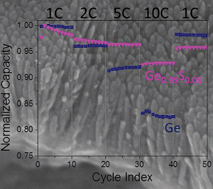
Nanocolumnar, sub-stoichiometric germanium sulfide thin-films with compositions of Ge0.9S0.1 and Ge0.95S0.05, deposited by glancing angle deposition, were investigated as lithium storage materials.
The content of this RSS Feed (c) The Royal Society of Chemistry