Shared posts

04 Nov 11:00

Double-blind peer review

Nature Nanotechnology. doi:10.1038/nnano.2014.273

We are making author anonymity an option in our peer review.

03 Nov 14:21

Phosphorene Oxide: Stability and electronic properties of a novel 2D material

Nanoscale, 2014, Accepted Manuscript
DOI: 10.1039/C4NR05384B, Paper
Gaoxue Wang, Ravi Pandey, Shashi Karna
Phosphorene, the monolayer form of the (black) phosphorus, was recently exfoliated from its bulk counterpart. Phosphorene oxide, by analogy to graphene oxide, is expected to have novel chemical and electronic...
The content of this RSS Feed (c) The Royal Society of Chemistry
01 Nov 08:30

Scalable route to CH3NH3PbI3 perovskite thin films by aerosol assisted chemical vapour deposition

J. Mater. Chem. A, 2015, 3,9071-9073
DOI: 10.1039/C4TA05522E, Communication
D. S. Bhachu, D. O. Scanlon, E. J. Saban, H. Bronstein, I. P. Parkin, C. J. Carmalt, R. G. Palgrave
An industrially relevant, scalable deposition route to high quality MAPI films is reported.
The content of this RSS Feed (c) The Royal Society of Chemistry
31 Oct 20:14

Scalable Route to CH3NH3PbI3 Perovskite Thin Films by Aerosol Assisted Chemical Vapor Deposition

DJL

Imitation the greatest form of flattery

J. Mater. Chem. A, 2014, Accepted Manuscript
DOI: 10.1039/C4TA05522E, Communication
Davinder Singh Bhachu, David Oliver Scanlon, Edward James Saban, Hugo Bronstein, Ivan P Parkin, Claire J Carmalt, Robert Palgrave
Methyl-ammonium lead iodide is the archetypal perovskite solar cell material. Phase pure, compositionally uniform methyl-ammonium lead iodide thin films on large glass substrates were deposited using ambient pressure aerosol assisted...
The content of this RSS Feed (c) The Royal Society of Chemistry
31 Oct 13:37

An analytical study of tribofilms generated by the interaction of ashless antiwear additives with ZDDP using XANES and nano-indentation

Publication date: February 2015
Source:Tribology International, Volume 82, Part A
Author(s): Vibhu Sharma , Ali Erdemir , Pranesh B. Aswath
Mixtures of zinc dialkyl dithiophosphates (ZDDP) and ashless fluorothiophosphates and thiophosphates were examined under tribological conditions. The tribofilms were studied using nano-indentation, electron microscopy and X-ray absorption near edge structure spectroscopy. With the addition of ashless fluorothiophosphates and thiophosphates, there is significant reduction in wear at identical phosphorous levels. Tribofilms formed with mixtures of ZDDP and ashless antiwear additives had stable pad-like structures, while those from ZDDP alone were more heterogeneous. When ZDDP alone is used, S L-edge indicates a preponderance of sulfates at the surface of the tribofilms, while in the presence of a mixture of antiwear additives a mixture of sulfates and sulfides was observed. In all the cases, the phosphates formed were short chain polyphosphates of Zn.

Graphical abstract

image
28 Oct 10:59

Near-Unity Quantum Yields from Chloride Treated CdTe Colloidal Quantum Dots

by Robert C. Page, Daniel Espinobarro-Velazquez, Marina A. Leontiadou, Charles Smith, Edward A. Lewis, Sarah J. Haigh, Chen Li, Hanna Radtke, Atip Pengpad, Federica Bondino, Elena Magnano, Igor Pis, Wendy. R. Flavell, Paul O'Brien, David J. Binks
DJL

He will be there

Colloidal quantum dots (CQDs) are promising materials for novel light sources and solar energy conversion. However, trap states associated with the CQD surface can produce non-radiative charge recombination that significantly reduces device performance. Here a facile post-synthetic treatment of CdTe CQDs is demonstrated that uses chloride ions to achieve near-complete suppression of surface trapping, resulting in an increase of photoluminescence (PL) quantum yield (QY) from ca. 5% to up to 97.2 ± 2.5%. The effect of the treatment is characterised by absorption and PL spectroscopy, PL decay, scanning transmission electron microscopy, X-ray diffraction and X-ray photoelectron spectroscopy. This process also dramatically improves the air-stability of the CQDs: before treatment the PL is largely quenched after 1 hour of air-exposure, whilst the treated samples showed a PL QY of nearly 50% after more than 12 hours.

Thumbnail image of graphical abstract

Photoluminescence with nearly 100% quantum yield is obtained from CdTe colloidal quantum dots by treating the surface with chloride ions. This process achieves near-complete passivation of the surface traps caused by dangling bonds, which otherwise cause significant non-radiative recombination, and also reduces the degradation of quantum yield with oxidation exposure.

28 Oct 10:49

Metal-Organic Framework Templated Inorganic Sorbents for Rapid and Efficient Extraction of Heavy Metals

by C. W. Abney, J. C. Gilhula, K. Lu, W. Lin
Thumbnail image of graphical abstract

An innovative wet-treatment with Na2S transforms two indium metal-organic frameworks (MOFs) into a series of porous inorganic sorbents. These MOF-templated materials display remarkable affinity for heavy metals with saturation occurring in less than 1 h. The saturation capacity for Hg(II) exceeds 2 g g-1, more than doubling the best thiol-functionalized sorbents in the literature.

25 Oct 22:05

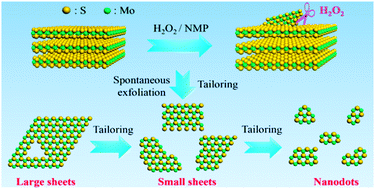
Spontaneous exfoliation and tailoring of MoS2 in mixed solvents

Chem. Commun., 2014, 50,15936-15939
DOI: 10.1039/C4CC07238C, Communication
Lei Dong, Shan Lin, Liu Yang, Jiajia Zhang, Chao Yang, Dong Yang, Hongbin Lu
Spontaneous exfoliation and tailoring of MoS2 were achieved in H2O2-NMP mixed solvents, operated under mild conditions.
The content of this RSS Feed (c) The Royal Society of Chemistry
25 Oct 22:03

Precise Tuning of the Charge Transfer Kinetics and Catalytic Properties of MoS2 Materials via Electrochemical Methods

by Xinyi Chia, Adriano Ambrosi, David Sedmidubský, Zdeněk Sofer, Martin Pumera

Abstract

MoS2 has become particularly popular for its catalytic properties towards the hydrogen evolution reaction (HER). It has been shown that the metallic 1T phase of MoS2, obtained by chemical exfoliation after lithium intercalation, possesses enhanced catalytic activity over the semiconducting 2H phase due to the improved conductivity properties which facilitate charge-transfer kinetics. Here we demonstrate a simple electrochemical method to precisely tune the electron-transfer kinetics as well as the catalytic properties of both exfoliated and bulk MoS2-based films. A controlled reductive or oxidative electrochemical treatment can alter the surface properties of the film with consequently improved or hampered electrochemical and catalytic properties compared to the untreated film. Density functional theory calculations were used to explain the electrochemical activation of MoS2. The electrochemical tuning of electrocatalytic properties of MoS2 opens the doors to scalable and facile tailoring of MoS2-based electrochemical devices.

Thumbnail image of graphical abstract

Electrochemistry turns MoS2 on: The electrochemical tuning of electrocatalytic properties of MoS2 opens the doors to scalable and facile tailoring of MoS2-based electrochemical devices. Here a simple electrochemical method to precisely tune the electron-transfer kinetics as well as the catalytic properties of both exfoliated and bulk MoS2-based films is demonstrated.

25 Oct 22:02

Digital Transfer Growth of Patterned 2D Metal Chalcogenides by Confined Nanoparticle Evaporation

by Masoud Mahjouri-Samani, Mengkun Tian, Kai Wang, Abdelaziz Boulesbaa, Christopher M. Rouleau, Alexander A. Puretzky, Michael A. McGuire, Bernadeta R. Srijanto, Kai Xiao, Gyula Eres, Gerd Duscher and David B. Geohegan

TOC Graphic

ACS Nano
DOI: 10.1021/nn5048124
24 Oct 12:46

MoS2 exhibits stronger toxicity with increased exfoliation

Nanoscale, 2014, 6,14412-14418
DOI: 10.1039/C4NR04907A, Paper
Elaine Lay Khim Chng, Zdenek Sofer, Martin Pumera
t-Bu-Li and n-Bu-Li exfoliated MoS2 nanosheets are more cytotoxic than MoS2 exfoliated by Me-Li.
The content of this RSS Feed (c) The Royal Society of Chemistry
24 Oct 12:40

Energy harvesting of non-emissive triplet excitons in tetracene by emissive PbS nanocrystals

by Nicholas J. Thompson

Nature Materials 13, 1039 (2014). doi:10.1038/nmat4097

Authors: Nicholas J. Thompson, Mark W. B. Wilson, Daniel N. Congreve, Patrick R. Brown, Jennifer M. Scherer, Thomas S. Bischof, Mengfei Wu, Nadav Geva, Matthew Welborn, Troy Van Voorhis, Vladimir Bulović, Moungi G. Bawendi & Marc A. Baldo

24 Oct 12:39

Green tea therapy

by Alison Stoddart

Nature Materials 13, 998 (2014). doi:10.1038/nmat4128

Author: Alison Stoddart

23 Oct 10:17

Low Overpotential in Vacancy-Rich Ultrathin CoSe2 Nanosheets for Water Oxidation

by Youwen Liu, Hao Cheng, Mengjie Lyu, Shaojuan Fan, Qinghua Liu, Wenshuai Zhang, Yuduo Zhi, Chengming Wang, Chong Xiao, Shiqiang Wei, Bangjiao Ye and Yi Xie

TOC Graphic

Journal of the American Chemical Society
DOI: 10.1021/ja5085157
23 Oct 10:07

Layer-Controlled CVD Growth of Large-Area Two-Dimensional MoS2 Films

Nanoscale, 2014, Accepted Manuscript
DOI: 10.1039/C4NR04532G, Paper
Jaeho Jeon, Sung Kyu Jang, Su Min Jeon, Gwangwe Yoo, Yun Hee Jang, Jin-Hong Park, Sungjoo Lee
In spite of the recent heightened interest in molybdenum disulfide (MoS2) as a two-dimensional material with substantial bandgaps and reasonably high carrier mobility, a method for the layer-controlled and large-scale...
The content of this RSS Feed (c) The Royal Society of Chemistry
22 Oct 08:59

Device Perspective for Black Phosphorus Field-Effect Transistors: Contact Resistance, Ambipolar Behavior, and Scaling

by Yuchen Du, Han Liu, Yexin Deng and Peide D. Ye

TOC Graphic

ACS Nano
DOI: 10.1021/nn502553m
22 Oct 08:43

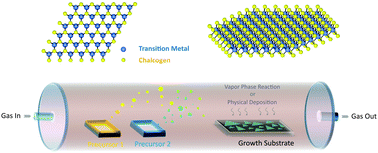
Recent advances in controlled synthesis of two-dimensional transition metal dichalcogenides via vapour deposition techniques

Chem. Soc. Rev., 2015, 44,2744-2756
DOI: 10.1039/C4CS00256C, Review Article
Yumeng Shi, Henan Li, Lain-Jong Li
This review describes recent progress in the synthesis of transition metal dichalcogenides via vapour deposition methods with the control of the layer number and band gap energy.
The content of this RSS Feed (c) The Royal Society of Chemistry
22 Oct 08:22

Opening up communications

Editorial

The transition to fully open access publishing establishes Nature Communications as the flagship Nature -branded open access journal.

Nature Communications doi: 10.1038/ncomms6523

Authors:

22 Oct 08:21

Towards intrinsic charge transport in monolayer molybdenum disulfide by defect and interface engineering

by Zhihao Yu

Article

Impurities in molybdenum disulfide are known to reduce charge mobility to below its intrinsic limit. Here, the authors demonstrate that impurities are associated with lattice defects and that a chemical route can repair sulfur vacancies and improve interface quality with a substrate, enhancing device performance.

Nature Communications doi: 10.1038/ncomms6290

Authors: Zhihao Yu, Yiming Pan, Yuting Shen, Zilu Wang, Zhun-Yong Ong, Tao Xu, Run Xin, Lijia Pan, Baigeng Wang, Litao Sun, Jinlan Wang, Gang Zhang, Yong Wei Zhang, Yi Shi, Xinran Wang

22 Oct 08:19

Click chemistry promoted by graphene supported copper nanomaterials

DJL

Binder's butter beans

Chem. Commun., 2014, 50,15374-15377
DOI: 10.1039/C4CC07774A, Communication
Ali Shaygan Nia, Sravendra Rana, Diana Dohler, Xavier Noirfalise, Alice Belfiore, Wolfgang H. Binder
Highly dispersed copper nanoparticles immobilized graphene nanosheets were prepared and used as a recyclable and reusable heterogeneous catalyst with excellent catalytic activity to achieve Cu(I)-catalyzed [3+2] cycloaddition "click" chemistry under both solvent and bulk conditions.
The content of this RSS Feed (c) The Royal Society of Chemistry
22 Oct 08:13

Actinide-Based Single-Molecule Magnets

Dalton Trans., 2014, Accepted Manuscript
DOI: 10.1039/C4DT02391A, Perspective
Katie R. Meihaus, Jeffrey R. Long
Actinide single-molecule magnetism has experienced steady growth over the last five years since the first discovery of slow magnetic relaxation in the mononuclear complex U(Ph2BPz2)3. Given their large spin-orbit coupling...
The content of this RSS Feed (c) The Royal Society of Chemistry
22 Oct 08:06

Nanoscale Imaging of Photocurrent and Efficiency in CdTe Solar Cells

by Marina S. Leite, Maxim Abashin, Henri J. Lezec, Anthony Gianfrancesco, A. Alec Talin and Nikolai B. Zhitenev

TOC Graphic

ACS Nano
DOI: 10.1021/nn5052585
22 Oct 07:59

Photocurrent Induced by Conducting Channels of Hole Transporting Layer to Adjacent Photoactive Perovskite Sensitized TiO2 Thin Film: Solar Cell Paradigm

by Sadia Ameen, M. Shaheer Akhtar, Hyung-Kee Seo and Hyung-Shik Shin

TOC Graphic

Langmuir
DOI: 10.1021/la502398x
22 Oct 07:54

Regulating the Electrical Behaviors of 2D Inorganic Nanomaterials for Energy Applications

by Feng Feng, Junchi Wu, Changzheng Wu, Yi Xie

Recent years have witnessed great developments in inorganic 2D nanomaterials for their unique dimensional confinement and diverse electronic energy bands. Precisely regulating their intrinsic electrical behaviors would bring superior electrical conductivity, rendering 2D nanomaterials ideal candidates for active materials in electrochemical applications when combined with the excellent reaction activity from the inorganic lattice. This Concept focuses on highly conducting inorganic 2D nanomaterials, including intrinsic metallic 2D nanomaterials and artificial highly conductive 2D nanomaterials. The intrinsic metallicity of 2D nanomaterials is derived from their closely packed atomic structures that ensure maximum overlapping of electron orbitals, while artificial highly conductive 2D nanomaterials could be achieved by designed methodologies of surface modification, intralayer ion doping, and lattice strain, in which atomic-scale structural modulation plays a vital role in realizing conducting behaviors. Benefiting from fast electron transfer, high reaction activity, as well as large surface areas arising from the 2D inorganic lattice, highly conducting 2D nanomaterials open up prospects for enhancing performance in electrochemical catalysis and electrochemical capacitors. Conductive 2D inorganic nanomaterials promise higher efficiency for electrochemical applications of energy conversion and storage.

Thumbnail image of graphical abstract

Synergetic advantages of superior electrical conductivity and excellent reaction activity from inorganic lattices render 2D nanomaterials ideal candidates for electrode active materials in electrochemical applications towards energy conversion and storage. In this concept article, recent progress on regulating the electrical behaviors of two-dimensional inorganic nanomaterials for energy applications are discussed.

22 Oct 07:52

Microwave Synthesis of Microstructured and Nanostructured Metal Chalcogenides from Elemental Precursors in Phosphonium Ionic Liquids

by Kunlun Ding, Hong Lu, Yichi Zhang, Matthew L. Snedaker, Deyu Liu, Juan Antonio Maciá-Agulló and Galen D. Stucky

TOC Graphic

Journal of the American Chemical Society
DOI: 10.1021/ja508628q
18 Oct 09:30

Quantum Carrier Reinvestment-Induced Ultrahigh and Broadband Photocurrent Responses in Graphene–Silicon Junctions

by Fangze Liu and Swastik Kar
DJL

Swastik Kar surely a false name

TOC Graphic

ACS Nano
DOI: 10.1021/nn503484s
18 Oct 09:28

Sensitization of ZnO Single Crystal Electrodes with CdSe Quantum Dots

by Yongqi Liang, James E. Thorne, Meghan E. Kern and B. A. Parkinson

TOC Graphic

Langmuir
DOI: 10.1021/la5023888
17 Oct 21:20

Tribological Performance of Attapulgite Nano-fiber/Spherical Nano-Ni as Lubricant Additive

DJL

Cheers bhoy

Abstract

Tribological properties of attapulgite, Ni and their composite nanoparticles suspended in mineral lubricating oil for a steel–steel contact were investigated with an optimal SRV-IV oscillating friction and wear tester. Results demonstrated that the composite nanoparticles exhibit better friction-reduction and anti-wear properties than the single additives. The oil containing a composite powder of 0.5 % attapulgite and 0.1 % Ni owns the best friction-reduction and anti-wear properties. Under the lubrication of oil containing composite nanoparticles, a smooth and compact tribofilm mainly composed of iron oxides, Ni, NiO and silicon oxide was formed on the rubbing surface.

17 Oct 20:51

Inkjet Printing Patterns of Highly Conductive Pristine Graphene on Flexible Substrates

by Yahui Gao, Wen Shi, Wucong Wang, Yuanpeng Leng, and Yaping Zhao

TOC Graphic

Industrial & Engineering Chemistry Research
DOI: 10.1021/ie502675z
Publication Date (Web): October 1, 2014
17 Oct 20:48

Parkin regulates kainate receptors by interacting with the GluK2 subunit

by AnnaMaria Maraschi

Article

Loss-of-function mutations in the PARK2 gene are implicated in autosomal recessive juvenile parkinsonism, but the mechanisms are unclear. Here, the authors show that these mutations cause accumulation of the kainate receptor subunit GluK2 in the plasma membrane of neurons, which facilitates neuronal death.

Nature Communications doi: 10.1038/ncomms6182

Authors: AnnaMaria Maraschi, Andrea Ciammola, Alessandra Folci, Francesca Sassone, Giuseppe Ronzitti, Graziella Cappelletti, Vincenzo Silani, Shigeto Sato, Nobutaka Hattori, Michele Mazzanti, Evelina Chieregatti, Christophe Mulle, Maria Passafaro, Jenny Sassone