Shared posts

25 Aug 09:04

Confessed Liar To Congress, James Clapper, Gets To Set Up The 'Independent' Review Over NSA Surveillance

by Mike Masnick
Well, this is rather incredible. Remember on Friday how one of President Obama's efforts to get people to trust the government more concerning the NSA's surveillance efforts was to create an "outside" and "independent" board to review it all? Specifically, he said:
Fourth, we're forming a high-level group of outside experts to review our entire intelligence and communications technologies. We need new thinking for a new era. We now have to unravel terrorist plots by finding a needle in the haystack of global telecommunications. And meanwhile, technology has given governments — including our own — unprecedented capability to monitor communications.

So I am tasking this independent group to step back and review our capabilities — particularly our surveillance technologies. And they'll consider how we can maintain the trust of the people, how we can make sure that there absolutely is no abuse in terms of how these surveillance technologies are used, ask how surveillance impacts our foreign policy — particularly in an age when more and more information is becoming public. And they will provide an interim report in 60 days and a final report by the end of this year, so that we can move forward with a better understanding of how these programs impact our security, our privacy, and our foreign policy.
Okay. Outside, independent. Sure, that might help. Except, that was Friday. Today is Monday. And, on Monday we learn that "outside" and "independent" actually means setup by Director of National Intelligence, James Clapper -- the same guy who has already admitted to lying to Congress about the program, and has received no punishment for doing so. This is independent? From this we're supposed to expect real oversight?!? This is from the letter sent to Clapper:
I believe it is important to take stock of how these technological advances alter the environment in which we conduct our intelligence mission. To this end, by the authority vested in me as President by the Constitution and the laws of the United States of America, I am directing you to establish a Review Group on Intelligence and Communications Technologies (Review Group).

The Review Group will assess whether, in light of advancements in communications technologies, the United States employs its technical collection capabilities in a manner that optimally protects our national security and advances our foreign policy while appropriately accounting for other policy considerations, such as the risk of unauthorized disclosure and our need to maintain the public trust. Within 60 days of its establishment, the Review Group will brief their interim findings to me through the Director of National Intelligence (DNI), and the Review Group will provide a final report and recommendations to me through the DNI no later than December 15, 2013.
In case you didn't catch that, he's asking Clapper to first create and set up this "outside" and "independent" review group... and then to have the group report its findings back to Clapper. The same strong defender of the program who flat out lied to Congress about it. If this was about "restoring the trust" of the American people that the government isn't pulling a fast one over on them, President Obama sure has a funny way of trying to rebuild that trust. This seems a lot more like giving the concerns of the American public a giant middle finger.

Permalink | Comments | Email This Story


25 Aug 08:57

The Tech Industry Is Making A Big Mistake: It's Time To Suck It Up And Fight Back Hard Over NSA Surveillance

by Mike Masnick
We've been trying to make the case over the past few months that the tech industry should be furious about what the NSA is doing, while also pointing out that it's likely to be very costly for a variety of American companies. Unfortunately, many still don't seem to be getting the message. Even with Lavabit shutting down rather than succumbing to order to do much greater surveillance, it still seems like many in the tech industry either seem to think this isn't a huge problem or that it will sort of blow over.

They're taking a really big risk there, and almost certainly making a huge mistake. Asking for the right to be more transparent is a good start, but it doesn't go nearly far enough. As we noted with President Obama's speech, it's not just more transparency that people want here -- they want less spying. And, as a part of that, they need to know that companies will stand up and fight for their users' rights. And while a few tech companies have shown signs of doing that, it's still be fairly muted.

Bruce Schneier has a great post over at The Atlantic highlighting why many in the tech industry need to be much more proactive in fighting back against government surveillance of their users, showing that they're protecting their users, rather than acquiescing to lots of government requests. The trust being lost in these companies won't come back easily. Schneier's column is targeting the heads of various tech companies directly:

The NSA probably told you that your cooperation would forever remain secret, but they're sloppy. They'll put your company name on presentations delivered to thousands of people: government employees, contractors, probably even foreign nationals. If Snowden doesn't have a copy, the next whistleblower will.

This is why you have to fight. When it becomes public that the NSA has been hoovering up all of your users' communications and personal files, what's going to save you in the eyes of those users is whether or not you fought. Fighting will cost you money in the short term, but capitulating will cost you more in the long term.

The fallout from not fighting back is going to be extremely costly. I know that many large companies have been trying to play it safe here, but if they're going to regain necessary trust, they need to ramp it up, going beyond just seeking greater transparency to being much more proactive in fighting back and standing up for their users' rights publicly.

Permalink | Comments | Email This Story


25 Aug 08:53

Snowden Leaks Have Likely Killed CISPA Dead

by Mike Masnick
The cybersecurity legislation pushed by Reps. Mike Rogers and Dutch Ruppersberger, CISPA, was already probably dead in the water because the Senate had shown no interest in supporting their privacy-destroying legislation for the past two years -- preferring instead to introduce bills that actually took privacy seriously. However, as we'd explained at the time, CISPA was always really about giving more power to the NSA as part of a turf war between the Defense Department (which the NSA is a part of) and Homeland Security. In fact, the biggest concerns that activists were raising about CISPA was the fact that it would give companies broad immunity from liability if they handed any information over to the NSA. Supporters of the bill kept bending over backwards insisting that this was entirely "voluntary" and that, of course, the NSA wouldn't do anything bad with the data -- rather it was all to "protect" us from evil hackers from China.

Of course, given the revelations over the last few months concerning the NSA's activities, it appears that they've driven the final nail in CISPA's coffin, as a growing number of people in Congress realize that handing even more power to the NSA is not such a good idea.
"The plan was always a little vague, at least as [NSA boss] Keith [Alexander] described it, but today it may be Snowden's biggest single victim," one senior intelligence official said recently, referring to Edward J. Snowden, the former N.S.A. contractor who released documents revealing details of many of the agency's surveillance programs.

"Whatever trust was there is now gone," the official added. "I mean, who would believe the N.S.A. when it insists it is blocking Chinese attacks but not using the same technology to read your e-mail?"
Exactly. So kudos to Snowden for stopping another really bad bill that was always really about giving the NSA that much more power to spy on people.

Permalink | Comments | Email This Story


24 Aug 18:11

austinkleon: Thomas Jefferson’s pocket...

Claus.dahl

pæne


austinkleon:

Thomas Jefferson’s pocket notebooks

erikkwakkel:

appendixjournal:

Thomas Jefferson’s pocket notebooks, composed of erasable ivory plates on which he would write scientific observations and memoranda before copying them into notebooks in the evening. At Monticello.

Jefferson made use of a practice that was a thousand years old: replace the ivory with parchment scraps (leftovers) and you end up with the medieval version of this handy “fan” notebook.

Filed under: notebooks, Thomas Jefferson

24 Aug 18:06

Samsung announces the Hennessy, a dual-screen, quad-core Android flip phone

by Alex Colon
Claus.dahl

aprilsnar?

When you think of smartphones, the image of a sleek, minimalist slab is probably what comes to mind. But how about a flip phone? Now there’s a form factor you don’t see everyday – at least, not on any phone that’s powered by Google. But Samsung, always willing to try something new, has announced the Hennessy, a dual-screen flip phone that runs on Android.

The Hennessy almost looks like a standard Android phone from the front, albeit with a lot of excess bezel. But then you realize the front actually flips open to reveal a second screen on the other side, along with a full-on keypad below it. If you didn’t know any better, you could mistake this for a smartphone or a feature phone, depending on the angle you look at it.

Samsung Hennessy 2

The 3.3-inch touch screens offer just 480-by-320-pixel resolution, which actually makes the 1.2GHz quad-core processor seem like overkill. The phone also has a 5-megapixel camera, a 1500mAh battery, and a microSD card slot. It’s running on Android 4.1 (Jelly Bean), which, judging by the photos, looks to have been given some of the Samsung TouchWiz treatment.

The Hennessy has only been announced in China and there’s no word on pricing or availability, or whether the phone will be introduced to any additional territories. Dual-SIM support is included for both CDMA and GSM radios, which means an unlocked version could potentially work in the U.S. if you manage to get your hands on one.

Hennessy front

Hennessy side

Hennessy camera

Hennessy open


Related research and analysis from GigaOM Pro:
Subscriber content. Sign up for a free trial.

24 Aug 18:05

Why free-to-play app pricing is so effective, and what you can do about it

by Geoffrey Goetz
Claus.dahl

Boy, De her spilfirmaers optimeringsteknikker er lige så hæderlige son narkopusheres

It should come as no surprise that free-to-play gaming has become a huge financial success in mobile gaming. Free-to-play (FTP) in the iTunes App Store refers to any iOS game that allows gamers to download a game without paying up front. In fact, 82 of the top 100 grossing games on the iPhone are currently FTP. And of the 18 games that you do have to pay for, only 5 titles do not offer any sort of in-app purchases. These 13 games are what are sometimes referred to as pay-to-play (PTP) games.

That leaves only 5 games in the current list of top 100 grossing games relying on their initial sale price alone for revenue. How are these FTP games making it to the top of this list? It is the sale ofvirtual goods through in-app purchases that is driving revenue for the top iOS games.

Growing opportunity for virtual goods

Virtual goods in iOS games are mostly fictional items that characters within the game interact with like weapons, vehicles or buildings. These items are often purchased within games by using real world currencies. The worldwide market for virtual goods reached $15 billion in 2012, and this number keeps rising. This global virtual goods market is expected to grow at a compound annual growth rate of 12.5 percent over the period from 2012 to 2016.

TechNavio found a correlation between the growing number of households with broadband internet access and the growth of the virtual goods market in their “Global Virtual Goods Market 2012-2016” report earlier this year. This report may show that more and more individuals now have the means to purchase virtual goods, but it does not help us understand their motivation to purchase virtual goods.

Monetization techniques used by developers

Motivating gamers to buy virtual goods in games is not a well-guarded secret. Simply search the internet for “monetization” and “free to play” and you will see several articles written to teach game developers how best to make money selling virtual goods.

Flow Theory – It is all about maximizing the amount of time a gamer spends in the game. This is accomplished by getting the gamer into a state of mind that Professor Mihaly Csikszentmihalyi calls “flow”. During flow, people typically experience deep enjoyment, creativity, and a total involvement with life. This is perhaps more obvious when one performs certain physical tasks like gardening, building or cleaning. You may refer to someone experiencing flow as being in the zone or on a roll. This could be why so many games that are successful at monetization have us hunting, gathering, building and collecting things.

Intermediate Currency – The second key ingredient to getting players to purchase virtual goods in games is by introducing an intermediary currency that is not directly associated to real world currencies. Ramin Shokrizade, and economist for Wargaming America, wrote on Gamasutra that “that putting even one intermediate currency between the consumer and real money, such as a “game gem” (premium currency), makes the consumer much less adept at assessing the value of the transaction.”

Dynamic Pricing – The final ingredient to monetization success is accomplished by implementing what is called dynamic pricing. Typically triggered by carefully timed events, dynamic pricing offers gamers multiple conversion rates between real world currency and in-game currency to create the illusion of getting a better deal by spending money at times controlled by the game, not the gamer.

Once all three conditions are met successfully, gamers are more likely to spend real money to increase the amount of premium currency they have in a game in order to possess the virtual goods they want. Regardless of how expensive these virtual goods really are.

The real expense of virtual goods

Pocket Gamer recently comprised a list of ten of the most expensive items for sale via an in-app purchase. Now keep in mind that many of these items are not directly for sale for real world currency as an in-app purchase. Most are sold within the game for in-game currency like gems, coins, or doughnuts. On the cheaper end of the list, you can participate in Barney’s Bowlarama in The Simpsons for 300 doughnuts (or $20 USD) or Blackbeard’s Ship in Playmobil Pirates for 5,200 gems (or $40 USD).

At the more expensive end you can be the proud owner of General’s Spear in Eternal Warriors for 5,200 gems (or $100 USD) or the Apathy Bear Gun in Gun Bros for 3,999 War Bucks (or $600 USD). While there are ways of earning such sums within the game, it takes a very long time to do so. For the impatient the problem is that you can rack up a real world bill for these virtual world currencies rather quickly.

Overspending by child gamers

We have heard the stories of the five-year-old boy in the U.K. that spent $2,500 in Zombies vs Ninja and the eight-year-old girl who spent $1,400 on Smurf Berries. Overspending events like this have surfaced often enough that the Office of Fair Trading in the U.K. is looking to find out if such games are putting undue pressure on children to pay for additional content. While this has created a lot of unhappy parents that are left paying the bill, this does not appear to apply to how the gamers themselves feel about their purchases.

Gamers couldn’t be happier with their purchases

When a game developer gets the formula just right, not only do they benefit monetarily, but they also have a satisfied customer base that feels that the money they spent within the game was worth it. Market research firm EEDAR shows that 75 percent of the players that spent $50 or more on a game were satisfied with their experience. The key to this research is that such gamers are selective in which FTP games they play.

How best to control your own spending

If you are looking for a way to help keep your virtual goods budget in check, one option is to prevent your device from making any in-app purchases in the first place. While this may be an option for some, it certainly is not an option for gamers, especially gaming children. Instead what seems to work out best is to move the buying decision to outside the gaming environment entirely. Using hard currency from one’s own piggy bank to purchase iTunes Gift Cards will help modify the frequency of impulse purchases made in the ‘flow’. This will also help associate real-world value to the virtual goods one desires.

When things go really wrong

The iTunes support staff at Apple has been very receptive to helping out when your purchases do not turn out the way you intended. The two or three times that I have called iTunes Support directly over the years in regard to a refund, I got it. If you feel that the situation may affect other customers, you can always let Apple know by clicking on the “Report a Problem” link provided in your receipt. Additionally you can also provide the iTunes support staff feedback directly.

Keeping iTunes customers happy is certainly key to standings in customer service. With a growing world appetite for virtual goods reaching $15 Billion dollars, the FTP gaming experience is clearly here to stay.  As more and more gamers get familiar with the experience, satisfaction among well-paid developers of such game and happy paying customers is becoming commonplace.


Related research and analysis from GigaOM Pro:
Subscriber content. Sign up for a free trial.

24 Aug 11:45

Flickr co-founder’s new tool, Slack, seeks to reform workplace conversation

by Lauren Hockenson
Claus.dahl

ok, team collab is seriously crowded - I think startups who can afford to give it away burn the field down, though.

In the world of online workplace conversation, here are plenty of options — in addition to Google Hangouts and individual chat clients like Pidgin or even AOL Instant Messenger, chatrooms aimed at the corporate world like Campfire and Yammer jockey for relevance in office culture. Flickr Co-Founder Stewart Butterfield and his team at Tiny Speck are entering the fray with Slack, a mashup of chatrooms and collaborative sharing tools that are meant to do away with redundant conversations in multiple places.

Slack was born out of a pivot, after Butterfield’s previous project, an MMO entitled Glitch, failed to gain traction.

SlackScreenshot

With the goal in mind to circumvent the slow conversations of email, Slack can be access via desktop or mobile and sorts every message into designated “channels” with hashtags. The app offers both group chat and private messaging as well as integration with a number of productivity apps including Heroku, Dropbox and ZenDesk. It also archives every chat and makes it searchable through a single toolbar, so important conversations don’t get lost in the shuffle. Ideally, it’s intended to work with small-to-medium sized companies with under 150 employees, according to All Things D.

While it’s possible that Slack will be a paid app later on down the road, it’s currently free to try. More collaborative work tools from Butterfield and his team are expected in the future, creating a comprehensive suite to filter and parse the continuous noise of a bustling office.


Related research and analysis from GigaOM Pro:
Subscriber content. Sign up for a free trial.

24 Aug 11:31

The fascinating backstory of Google’s Project Loon

by Kevin Fitchard
Claus.dahl

As much as I want to read that: This is pure garbage in my feed

Wired tells the story of Rich DeVaul, Project Loon’s first leader, as he and Google engineers try to tackle the problem of building a network that traverses the stratospheric winds. Loon sounds crazy and the project is rife with potential pitfalls, but as Wired shows, the tasks of creating a floating, impermanent network and crunching the meteorological data necessary to steer it don’t daunt DeVaul one bit.

Story posted at: wired.com

To leave a comment or share, visit: The fascinating backstory of Google’s Project Loon


Related research and analysis from GigaOM Pro:
Subscriber content. Sign up for a free trial.

24 Aug 11:12

sandandglass: Jessica Williams proposes applying New York’s...


sandandglass:

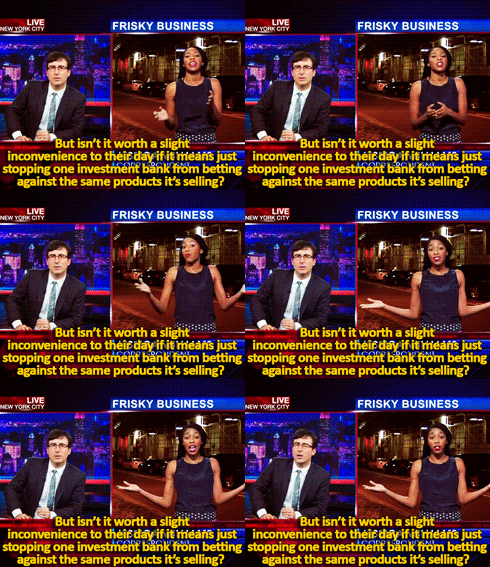
Jessica Williams proposes applying New York’s Stop and Frisk policy to Wall Street bankers. 

What’s this in your bag? Securities? Oh, yeah, I’ll bet these are A rated…

24 Aug 11:08

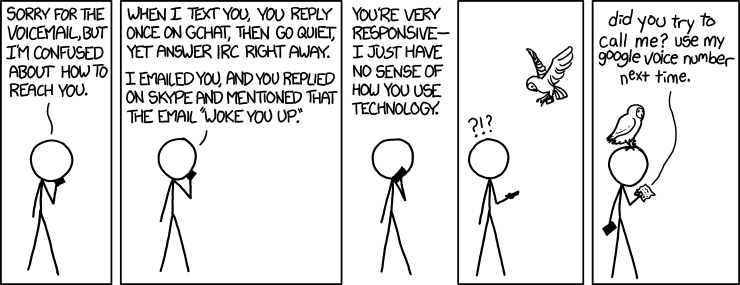
Preferred Chat System

Claus.dahl

And worst of all: None of these channels want to help you with a fix

If you call my regular number, it just goes to my pager.
24 Aug 11:07

Links for August 20th

by delicious
Claus.dahl

Haah, det er perfekt. Twine er en wifi-skildpadde....

  • "Connecting the Twine to a WiFi network is elegant and features a lovely twist: you flip the Twine on its “back”, like a turtle, and it makes its own WiFi network available. Connect to this from your computer, and you can then give the Twine the necessary credentials to log on to your home network, and once you’re done, flip it back onto its “belly” again and it will be ready to use. I really loved this simple, physical interaction." Oh, that's lovely.
24 Aug 10:59

Auralizing Pi

Claus.dahl

Minder mig om min egen https://soundcloud.com/clausdahl/expanding - der foregår noget vi bare ikke kan høre som støj når vi kombinerer skalaen med det her uendelige som har en kilde; Jeg skal have lavet en ordentlig undersøgelse af om man kan høre forskel på kaos og tilfældighed.

2-9 are tones, 0 and 1 are day and night  
24 Aug 09:46

Steve Jobs' Email Shows Apple Changed In-App Purchasing Rules Specifically To Retaliate Against Amazon

by Mike Masnick
Claus.dahl

Fuck jer, Apple

In the ongoing legal fight between Apple and the DOJ over how Apple will be punished for violating antitrust law concerning ebooks, the DOJ has presented one interesting bit of new evidence: an email from Steve Jobs, in which he flat out tells Phil Schiller to change how in-app purchases work solely to punish Amazon for daring to suggest that it's easy to switch from an iPhone to Android, since your Kindle books show up in both places. In case you can't read that, it involves Schiller complaining to Jobs and other top Apple execs about a Kindle TV ad that shows someone buying an ebook via an iPhone and having it appear on an Android phone as well. He then notes:
While the primary message is that there are Kindle apps on lots of mobile devices, the secondary message that can't be missed is that it is easy to switch from iPhone to Android.

Not fun to watch
Less than an hour later, Jobs replies with a suggestion:
The first step might be to say that they must use our payment system for everything, including books (triggered by the newspapers and magazines). If they want to compare us to Android, let's force them to use our far superior payment system. Thoughts?
That's pretty damning, as it shows the decision had little to do with reasonable choices for consumers, and a lot to do with punishing a competitor.

Permalink | Comments | Email This Story


23 Aug 22:20

Alexis Madrigal on Medium's blurry line between publication and platform

Claus.dahl

Fans gør meget ud af at Ev Williams nu for *tredie* gang har lavet en vigtig selvudtryksplatform. Jeg lægger selv mere vægt på at han skred fra de to første og at de siden er blevet til lort.

to me, seems like their editorial strategy is just meant to help people understand what the platform's for  
23 Aug 22:18

The Apollo Guidance Computer

by Jason Kottke

A 30-minute documentary from the 60s on the Apollo Guidance Computer.

Tags: Apollo   computing   NASA   space   video
23 Aug 20:22

Gone Home

Claus.dahl

Har ikke spillet spil i årevis, men er fristet nu

finally finished it; don't read spoilers, just get it and play it  
21 Aug 08:14

Why shutting down Groklaw, Lavabit, and Silent Circle was a bad move

by Adam L. Penenberg
Claus.dahl

Here's a strange thought: In the age of technology Big Brother can't exist unless it's sort of a secret Big Brother exists. If our expectation was that we had zero reason to trust the government we could stop trusting the government. At great cost, sure - but there is actually a convenience trade off here. If the NSA went completely O'Brien on us we'd actually be able to route around it in The World Of Ends. (http://www.worldofends.com/) - which is to say, the abuses of power need to be secret - or highly limited - or they would quickly become impossible. There's a little bit of comfort in that, if only a little bit. On the other hand, I'd like to contrast http://www.worldofends.com/ with Bruce Sterling's most recent State Of The World-assertion that the internet is now fully contained in The Five Silos; the television networks of our age - Microsoft, Amazon, Facebook, Apple, Google.

WATCHING_us

It seems that 2013 may go down as the year of 1984.

I didn’t make that up. It’s a meme making the rounds online and on Twitter. It’s an obvious comparison, of course, since Edward Snowden-fueled revelations surfaced that our government may be eavesdropping on its own citizenry. No wonder sales of George Orwell’s classic tale of a government-run surveillance state have spiked, even though Orwell published “1984,” which popularized the term “Big Brother,” three years before the NSA was formed.

As far as I can tell, the first 2013-1984 comparison, dated this past New Year’s Eve, appeared on a blog predicting economic collapse, “martial law declared across America,” “disagreement with the government characterized [as] a mental disorder,” President Obama deliberately destroying the economy, “riots in the street,” food shortages, and solar flares that threaten communication. We’re only approaching September, but I think it’s safe to say that, so far, none of this has occurred. Still, there are six more months before the New Year.

Actually, the blogger looked further ahead, mixing metaphors with his prediction that “2013 will be 1984 on steroids.” He says:

The ultimate plan, as you will see rolled out over the next few years, is installing Communism in America, which requires the complete government takeover of the economy, the total disarmament of the population so that people cannot fight back, the ‘elimination’ of all who believe in freedom and liberty, and the official destruction of the Constitution and the Bill of Rights.

It’s easy to dismiss this as typical radical right-wing claptrap, but unease over government snooping cuts across the political spectrum. Knowledge that the government may be surveilling email led the founder of Groklaw, an award-winning site that covers legal issues pertaining to the open source software community, to shut down. She followed in the footsteps of Lavabit – an email encryption service that counted Edward Snowden as a customer – which closed up shop earlier this month rather than, it appears, comply with a government investigation.

Ladar Levinson, Lavabit’s founder, told Kashmir Hill of Forbes:

This is about protecting all of our users, not just one in particular. It’s not my place to decide whether an investigation is just, but the government has the legal authority to force you to do things you’re uncomfortable with. The fact that I can’t talk about this is as big a problem as what they asked me to do.

Shortly after Lavabit made its announcement, encryption app Silent Circle followed suit, claiming it was also going out of business, but not before destroying all customer email.

Both Lavabit and Silent Circle say their revenues increased in the wake of the NSA revelations, so it’s refreshing to see entrepreneurs put principles before profits. Still, I think they – and Groklaw – have made a mistake. Instead of rallying the public around the issue I’m afraid their actions – as laudable as they are – will end up forgotten in the avalanche of news.

Pamela Jones, Groklaw’s operator, wrote that she was aghast “knowing that persons I don’t know can paw through all my thoughts and hopes and plans in my emails” with readers. She adds: “There is now no shield from forced exposure. . . You don’t expect a stranger to read your private communications to a friend. And once you know they can, what is there to say?”

In reality, though, Groklaw has always been subject to the possibility of a government subpoena – one that it would have to comply with or face the possibility of jail time. It’s been the case that you could only trust, say, Google, as much as you could trust the Bush Administration, and now the Obama administration. Email has never been a safe mode of contact for readers to provide input to any site. After all, the NSA has been operating for decades, and no one knows how long it has scooped up email messages from abroad.

Remember when the clarion call after 9/11 was, if you give in to paranoia, the terrorists win? Well, giving in to a nebulous threat that the NSA has the ability and wherewithal but probably not the desire or need to eavesdrop on your communication isn’t a good reason to quit. Because the NSA may have included you in an investigation, as the case appears to be with Lavabit, doesn’t mean you should shutter your doors. And while the government may hold on to encrypted communications for up to five years, hoping that its ability to decrypt them will improve, it shouldn’t lead you to a scorched earth policy of going out of business and destroying email – as with Silent Circle.

If you flip the analogy on its head, going out of business is like letting the terrorists win – by that, I mean giving in to fears. I’m not calling the US government terrorists, but closing down because of the faint possibility that it could monitor communications if it chose to doesn’t pressure it to change, if that is your goal.

You probably didn’t stop flying because you have to go through airport screeners, take off your shoes, let your laptop be X-rayed and your luggage possibly rummaged through by security personnel. You shouldn’t close your business either. Instead, level with your customers, tell them what the government is capable of doing, and allow them make up their own minds as to whether to do business with you or not.

Revelations aside, nothing has changed. The NSA monitored communications well before Edward Snowden leaked documents to Glenn Greenwald and Laura Poitras. It has long had the power of the subpoena to compel a business to hand over records and documents.

Shutting down won’t accomplish much. Staying open just might.

[Original image via Wikimedia]

Adam L. Penenberg

Adam Pix Book Jacket 2
Adam is the Editor of PandoDaily and a journalism professor at New York University. Author of several books, including the critically acclaimed "Viral Loop", he has written for The New York Times, Forbes, Fast Company, as well as many others. Follow him on Twitter @penenberg.


21 Aug 07:27

"Berg is trying to solve that problem by inventing a system that will allow multiple users to share..."

Claus.dahl

I either need to look closer or the only thing Berg Cloud does is reinvent network distributed OO

“Berg is trying to solve that problem by inventing a system that will allow multiple users to share smart, connected devices that can adjust to their individual tastes and preferences. “That’s the world we actually live in,” says Jack Schulze, Berg’s cofounder. “But it’s a massive challenge for software.””

- Why a New Golden Age for UI Design Is Around the Corner | Wired Design | Wired.com (via vanderwal)
20 Aug 21:26

Bootstrap 3 released

Claus.dahl

been waffling between this and purecss.io - but bootstrap 3 looks pretty solid + useful. Like purecss's theming better, though...

responsive by default, flat design with an optional legacy theme  
19 Aug 20:30

Ben Johnston – Suite for Microtonal Piano (1977)

by RONNIEROCKET.COM
Claus.dahl

Herligt! (caveat audiens: Avantgarde inside)

Suite for Microtonal Piano (1978) is a suite for specifically microtonally tuned piano(s) by Ben Johnston written in 1977 (see also just intonation). According to Bob Gilmore the piece, “take[s] extended just intonation well beyond the point reached by Harry Partch.”

“The piano is tuned to a selection of overtones from the fifth octave of the harmonic spectrum of C. All octaves are tuned in the same scale….The lowest C (33 Hz.) can be used to tune the scale by ear. In succession, touch the nodes producing the 3rd, 5th, 7th, 11th, 13th, 17th, [and] 19th partials. Then G, D; D, A; E, B; [and] B-flat, F; are just (beatless) fifths.”

Movements

  1. Alarum
  2. Blues
  3. Etude
  4. Song
  5. Toccata

Alarum is a Shakespeare era stage direction indicating “a grand entrance” and an archaic word for a call to arms, so
“Alarum” is a fanfare.

“Blues” and “Song” are both slow movements. “Blues” uses as blue notes the minor seventh (C-B♭) and mediant (in D dorian exactly halfway between E and G). “Song” is in E phrygian.

“Etude” is a study in serial technique and six-against-five polyrhythms in which Johnston indicates “blur with pedal”. This, “clues us in that the linear intricacies are only part of the story here: the amazing swirl of overtones resulting from an atonal application of this tuning are of equal importance.”

“Toccata” features diatonic outer sections and a spikier chromatic middle section.
The piece has been recorded and released on:

Microtonal Piano by Ben Johnston (1997). Phillip Bush, piano. Koch International Classics 3-7369-2.


benjohnston


18 Aug 20:46

Bootup: Blackberry's patent goldmine, Dell's glimmer of hope and Google encrypts cloud data

by Jemima Kiss

Also: Google blocks Microsoft's YouTube app again, what of the iPhone in China and the millionaire funding Ubuntu

A quick burst of 9 links for you to chew over, as picked by the Technology team

BlackBerry patent portfolio worth $2bn to $3bn >> AllThingsD

The company currently has 5,236 active U.S. patents and about 3,730 active applications in the wireless communications space. And, according to Chris Marlett, CEO of MDB Capital Group, an IP-focused investment bank, they're pretty valuable. Marlett figures that BlackBerry's IP is worth $2 billion to $3 billion if it were to be acquired by a consortium in some sort of cross-licensing deal. "$2 billion to $3 billion ... is easily justified ... as there are approximately 9,000 patent assets with probably 100,000 claims that someone could take a shot at you with in a lawsuit," Marlett told AllThingsD.


Dell reports decent Q2 earnings as company future still looks uncertain >> ZDNet

CFO Brian Gladden glossed over the hubbub, remarking, "In a challenging environment, we remain committed to our strategy and our customers, and we're encouraged by increasing customer interest in our end-to-end solutions offerings and continued growth in our Enterprise Solutions, Services and Software businesses."


Google follows Amazon with auto-encryption of cloud data >> The Register

Google has tossed a crumb of reassurance to people with cloudy security concerns by adding automatic server-side encryption to Google Cloud Storage. The free security measure was announced by Google on Thursday and spun as a way to "make securing your data as painless as possible," according to a blog post by the company.


Microsoft: the limits of Google's openness >> Technet

Trouble brewing in paradise as Google and Microsoft fall out over an app. Can't they keep it together for the children?

You may be wondering what happened to the YouTube app for Windows Phone. Last May, after we launched a much improved app on our platform, Google objected on a number of grounds. We took our app down and agreed to work with Google to solve their issues. This week, after we addressed each of Google's points, we re-launched the app, only to have Google technically block it.


The great Apple iPhone 5 question: China Mobile or not China Mobile? >> Forbes

Whichever new models Apple comes out with next month, the really interesting challenge will be how it tackles the challenge from China.

Even if Apple does bring out hardware which is compatible with the China Mobile network, the company still has to persuade China Mobile to take it. And that's not going to be entirely easy.


Why Ubuntu's creator still invests his fortune in an unprofitable company >> Ars Technica

Mark Shuttleworth is worth half a billion dollars, and funds Canonical out of his own pocket:

What may surprise some people is that Canonical could be profitable today if Shuttleworth was willing to give up his dream of revolutionizing end user computing and focus solely on business customers. Most people who know Ubuntu are familiar with it because of the free desktop operating system, but Canonical also has a respectable business delivering server software and the OpenStack cloud infrastructure platform to data centers. Canonical's clearest path to profitability would be dumping the desktop and mobile businesses altogether and focusing on the data center alone.


Legitimate study finds using Facebook makes you sad >> The Next Web

The study, which has U of M Emotion and Self-Control Laboratory director Ethan Kross listed as the lead author, sent regular surveys to 82 young adults asking how they felt and how much they had been using Facebook. The results found that Facebook use predicted a "decline in subjective well-being", irrespective of whether the time spent on Facebook was viewed as supportive.


App.Net turns one year old >> The Next Web

Developers are passionate about the vision, and praise Caldwell and his team for the support they are providing. Caldwell says App.net is paying out $30,000 per month via its Developer program -- a system that measures feedback from users -- while many of the apps are paid-for, providing another income stream. "We are just getting started," Caldwell writes in a blog post, which also announces the company has raised a further $2.5 million to show it is "on strong financial ground and here to stay".


Oz bank closes Bitcoin business' bank accounts >> The Register

The Commonwealth Bank, Australia's largest bank, has close accounts belonging to Australian Bitcoin payment processor CoinJar. CoinJar, which offers tools to buy or sell Bitcoins, and accept them as payment, has blogged about its experiences. The post says it has experienced some dodgy transactions, but no more than most e-commerce outfits.


You can follow Guardian Technology's linkbucket on Pinboard. To suggest a link, either add it below or tag it with @gdntech on the free Delicious service.


theguardian.com © 2013 Guardian News and Media Limited or its affiliated companies. All rights reserved. | Use of this content is subject to our Terms & Conditions | More Feeds


18 Aug 20:45

It-chefens plan: Få besked om it-sammenbrud på sms | Uniavisen

by clausd
Claus.dahl

Det er rimli fræk lowballing det her, synes jeg. 45 ud af 100 = bestået. Det passer sføli godt nok til universiteter, men come on - excellence kommer der ikke ud af det.

Han henviser til, at Koncern-it siden oktober 2012 har spurgt de ansatte og studerende, om it-systemerne er tilgængelige, når de har behov for det; om de synes systemerne svarer hurtigt nok, og om it-supporten har kunnet hjælpe dem. Ledelsens krav er en gennemsnitlig score på 45 point, hvor 100 point betyder, at brugerne er meget tilfredse, 50 at de hverken er tilfredse eller utilfredse og 0 at de er meget utilfredse. Tilfredsheden ligger for de fleste systemer ret stabilt mellem målet og 60.
18 Aug 20:44

Efter hensigten

by sinatra
Claus.dahl

Good stuff fra Søren

Når man skyder langt med riffel, må man ikke sigte direkte på målet. Kuglens bane begynder et falde efter at den har rejst de første 100 meter, og det kræver derfor en meget trænet skytte at ramme et mål længere fremme. Det samme gælder det med at score damer. Ifølge "The Game" skal man følge et nøje udregnet mønster af aktiv uinteresserethed. Man må endelig ikke vise sine virkelige følelser eller sine virkelige behov. På samme måde gælder det, at man ikke kan få et job hvis man virkelig trænger. Will work for food kan man skrive på sit skilt, men hvilken normal dansk arbejdsgiver vil ansætte sultne medarbejdere. Deres behov er alt for langt nede i Maslows behovspyramide. Apple må hellere ikke længere gøre det de er bedst til - udvikle vidunderlige teknologiske apparater. Successen er så stor, at de har fået problemer med at forrente deres enorme pengetank. Pengene er tjent ved at drive forretning, og nu kræver investorerne at formuen skal investeres, så ikke bare forretningen Apple er en god forretning, men også Apples formue i sig selv er en god forretning. Og risikabel forstås. Måske er Apples formue allerede blevet så stor, at selve forretningen er blevet en niche i formueplejen. At hovedproduktet er forrentning af formuen. Der er jo en regel om at jo flere penge man har, desto bedre kan man forrente den. Og det passer f.eks. med de danske pensionskasser, som i de seneste år med lav eller negativ vækst alligevel har formået at forrente formuen ganske betydeligt. Jeg tænker på hvor de penge egentlig kommer fra. Og jeg tænker på hvordan en formue som Apples skal forrentes, når den er så stor at 10%s årlig indtægt svarer til bruttonationalproduktet for et lille land. Altså taget til sit ekstrem, så betyder logikken om at store formuer skal forrentes bedre end ditto små, at det er direkte urentabelt at arbejde hvis man er rig. Man skal blot investere. Og på et tidspunkt rent matematisk, så vil pengene samle sig på meget få hænder. Hænder som er bedre til at puge end til at arbejde. Og måske er det allerede sådan. Nu tænker jeg så om ikke det ville være en ide at skyde lidt kortere med riflen så man kan bruge sigtekornet, sige til damen at hun er sød i stedet for at spille hende, arbejde fordi at tjene til dagen og vejen, og bruge pengene når man har tjent dem så de ikke hober sig op.
18 Aug 20:20

E Ink Reports 46% Sales Drop, Expects E-Reader Shipments To Be Flat This Year

by Romain Dillet
Claus.dahl

Skal muligvis have en Kindle mere - i stedet for en 7" tablet - men det bli'r så også sidste gang; og læser alligevel mest på telefonen....

Image1 for post Amazon Confirms Student Version Of Kindle

E-readers, such as the Kindle and the Sony Reader, were a novelty five years ago. But they are already on their way out. Display manufacturer E Ink Holdings reported its quarterly earnings and sales are down 46 percent year over year with a net loss of $33.6 million. It isn’t the first net loss, but it is the biggest one in four years. More importantly, the company announced on its conference call that it expects e-reader sales to range between 10 and 15 million for 2013 — flat compared with last year.

Overall, e-paper displays represent 70 percent of E Ink’s revenue. The vast majority of those displays go into e-readers. It has the advantage of consuming very little power and being easy on the eyes. Yet, it’s slow to refresh and black and white, making it exclusively useful for e-readers, smartwatches and other edge cases.

One of the reasons behind this quarter’s downturn is attributed to the fact that ereader companies are now updating their products during the third quarter, one quarter later. In other words, it suffers from seasonality. It’s not entirely true as the Kindle e-readers were updated during Amazon’s September event. Amazon still leads when it comes to market share.

E Ink is confident that sales will be much better as we get closer to the holidays, but still wants to diversify its offering to rely less on ereader sales. At the same time, the company relies on international growth in Asia and Russia to boost its display sales.

But the future of e-readers looks gloomy. Sales in North America and Europe are probably not as good as E Ink expected. E-readers were great devices when there wasn’t any cheap 7-inch tablet. But now, people can buy a Kindle Fire for $159 or a Nexus 7 for $269. The reading experience is worse on a tablet, but carrying multiple devices represents a cognitive burden. Moreover, e-readers were always a niche product. Market saturation of this small segment could come sooner than anticipated.


14 Aug 08:20

GearSketch

by Jason Kottke
Claus.dahl

Ku ikke få det blå loop til at virke, men det var smart

GearSketch is a cool and simple gear-making game. Click on the "?" for a quick demo. If you spend fewer than 20 minutes on this, you're a better person than I. (thx, nick)

14 Aug 06:25

Now it’s not even close – Elon Musk is more important to society than Steve Jobs ever was

by Hamish McKenzie
Claus.dahl

He's so precious in fact, that we CANNOT AFFORD to look cynically at anything he proposes. Like this pipe dream.

elon_musk

At South By Southwest in March, Google[x]’s “Captain of Moonshots” told an audience that Elon Musk is a “national treasure.” Musk’s brilliance doesn’t come from being the world’s smartest man, said Astro Teller, who is responsible for overseeing Google’s think-big projects such as self-driving cars and high-altitude wifi balloons, but it’s that he has the bravery and creativity to try things that others might regard as just a little bit crazy. And he’s put nearly $200 million of his own money into them.

“It’s not just that he’s built some exciting and really meaningful, positive things,” said Teller. “That’s great. But he’s like a walking moonshot. He’s so audacious. It seems limitless.”

That spirit was again on display today when Musk announced the details of his “Hyperloop” idea, a set of designs for a transport system so fast that it could transport a passenger from San Francisco to Los Angeles in just 30 minutes. It would also cost about 10 percent as much as the California High-Speed Rail project, which will take decades to build and will cost about $68 billion.

The Hyperloop, which Musk first discussed at a PandoMonthly event last year, would let people travel in aluminum pods within an enclosed steel tube that is filled with low-pressure air. The pods would travel up to 800 miles per hour by speeding along on an air cushion. (For more details, you can read Musk’s “alpha” plans, which he has written in both plain English and technical terms.)

Musk doesn’t plan to build the Hyperloop – he’s too busy with Tesla Motors, his electric car company, and SpaceX, his rocketship company, for that. Instead, he’s open-sourcing the plans and hoping that someone else takes on the project.

It’s a bummer that Musk doesn’t intend to make the Hyperloop a reality, but when it comes to cementing his place as a world-changing visionary – one of the few people who truly deserve the label – that doesn’t matter all that much. What’s more important is that he is stoking the public imagination for what can be achieved with audacious and unconventional thinking. And he’s doing it without any of the blowhard bombast of other innovators of his generation.

The Hyperloop is a radical idea, but Musk, through dry science and sober calculations, makes it seem eminently achievable – and incredibly desirable. Just consider the mode by which he made the Hyperloop plans public: a 57-page PDF with diagrams and graphs and an email address at the end published alongside a call for feedback. (Like any good nerd on the eve of submitting a science project, Musk pulled an all-nighter to get the assignment finished.)

It’s difficult to understate just how important Musk’s unconventional thinking is. While much of the tech industry froths over frivolities such as Snapchat, Instagram, Facebook, or whatever consumer app of the moment is grabbing an eye-popping valuation, Musk continues to raise the bar – not just in terms of what can be achieved, but in terms of what can be imagined. Through genuine thought leadership, he leads us to ask more of ourselves.

At the recent D11 conference, he even made the point explicit, pleading with successful entrepreneurs to think outside the Internet. “I recommend that people consider arenas outside of the Internet, because there’s a lot of industries that could use that entrepreneurial talent and the skills that people have learned in creating those companies,” he said.

Peter Thiel’s Founders Fund famously proclaims in its manifesto, “We wanted flying cars, instead we got 140 characters.” Well, here is a guy, Thiel’s PayPal co-founder no less, who is thinking beyond flying cars. Musk is thinking of, and, just as importantly, talking about, inter-planetary travel, colonizing Mars, eliminating the need for fossil fuels, and creating the most efficient transport systems imaginable – all on a budget. After the Hyperloop, he said in a Google Hangout last week, he’d like someone to build an aircraft that has an electric jet engine and can take off and land vertically, so it doesn’t have to rely on airports. That, he said, is the ultimate form of transport. “If somebody doesn’t do that, maybe at some point in the future I will.”

A concept sketch of the Hyperloop published in Elon Musk's plans.

A concept sketch of the Hyperloop published in Elon Musk’s plans.

This way of thinking not only spurs other entrepreneurs and innovators to aspire to a higher plane of achievement, but it also has a flow-on effect in inspiring future generations of innovators. Musk, who studied physics, is making science cool again to the extent that he even has a Hollywood movie character, Tony Stark of “Iron Man,” modeled after him. He’s a mad scientist in a muscle T.

Until now, the media’s preeminent tech hero of the decade has been Steve Jobs, who rightfully deserves credit for reinventing several industries, including entertainment, comptuer hardware, and telephony (to name a few). But Steve Jobs’ legacy, while important and impressive, will always be confined to business, tech, entertainment, and retail. While Jobs’ achievements came in the fields of design, consumer experience, and software platforms, Musk’s contributions to the world will ultimately be measured in light years.

PayPal introduced a new way transmit money. Elon Musk was one of the founders.

SolarCity is a solar company that brings cheaper and cleaner electricity to people’s homes. Elon Musk came up with the idea and funded it.

Tesla Motors produces electric cars that people want to buy, triggering an industry-wide rush to build cars that don’t burn fossil fuels. Many using his batteries. That was Elon Musk.

SpaceX is a private space company that can send rocketships to Mars and has produced spacecraft that can take off and land vertically. That was Elon Musk.

And at 42, he’s just getting started.

Musk has his flaws. When the New York Times published a critical review of the Tesla Model S, he reacted with a thin-skinned attack on the author’s credibility. His marital difficulties and other personal problems have been very publicly raked over. And there will be, no doubt, more things to come that will cause us to question his hero status.

But for now we ought to salute Musk’s wanton disregard for convention. More importantly, we should learn from it. Musk is, indeed, a walking moonshot. He is the sort of visionary that we should not just follow, but also emulate. The one thing he’s not, thankfully, is a superhero.

Elon Musk is no Tony Stark. But he is something much better than that: He’s real.

[Illustration by Hallie Bateman]

Hamish McKenzie

hamishmckenzie
Hamish McKenzie is a Baltimore-based reporter for PandoDaily who covers media, politics, and international startups. His first name is pronounced "hey-mish" and you can follow him on Twitter. Also: How to pitch Hamish.


12 Aug 09:25

Photo

Claus.dahl

Rimli spektakulære giffer


12 Aug 09:01

Congressional Oversight? Dianne Feinstein Says She's 'Not A High-Tech Techie' But Knows NSA Can't Abuse Surveillance

by Mike Masnick
Claus.dahl

Frankly, this criticism is a little disingenious. Sure it's oversight to ask people questions they could go to jail for answering deceitfully. Govt people generally don't take these obligations lightly - although I'm sure it's different in the secret services. But the notion that Feinstein would be able to elicit some answer above an assurence from somebody legally obligated to answer correctly is absurd.

As the NSA and defenders of NSA surveillance are trying to minimize the damage from the latest leak, which revealed the details of the XKeyscore program, they're bending over backwards to insist that this program is both limited and immune from abuse. We've already mentioned that the claims that it can't be abused are laughable since there's already a well-documented history of abuse. However, even more bizarre is the following quote from Senate Intelligence Committee boss, Senator Dianne Feinstein (a staunch defender of the surveillance programs):
Feinstein said, “I am not a high-tech techie, but I have been told that is not possible.”
Note that among Feinstein's jobs is oversight of this program. Yet, what kind of "oversight" is it when she admits that she's not qualified to understand the technology but "has been told" that such abuses are not possible? That doesn't seem like oversight. That seems like asking the NSA "can this system be abused?" and the NSA saying "oh, no no no, not at all." That's not exactly oversight, now is it?

Permalink | Comments | Email This Story


12 Aug 05:38

Kickstarter bans project creators from giving away genetically-modified organisms | The Verge

Claus.dahl

Sounds almost like sci-fi

11 Aug 22:47

Is Feedly’s new paid RSS service a good deal for users?

by Lauren Hockenson
Claus.dahl

Feedly: 12 mio brugere. TOR - i tvivl om de kan blive ved med at drive servicen overhovedet. Bummer. NB: Lader til at TOR har fået amerikanske venner med flere penge og bedre planlægning....

Since the demise of the Google Reader, a number of RSS options have cropped up to try to win over people looking for a good way to aggregate their news. One of them, Feedly, which has gained some traction with its free product over the past few months, is now offering a paid service with some premium features.

Between its free mobile app and its free browser-based version. Feedly now has more than 12 million users. Its new service, Feedly Pro, costs $5 per month, $45 per year, or $99 for a lifetime license for the first 500,000 users who purchase it. It offers some extra features that go beyond just streaming some news feeds.

Pro users will be able to search keywords within articles, and get one-click Evernote saves and priority access to Feedly’s customer-support line. The company promises more features down the line, and says users will have a hand in deciding what those will be.

With its new Pro product, Feedly is gambling that people with pay for a service that it’s still easy to get for nothing. A large portion of RSS apps remain free. And those that do have a freemium model tend to be priced under Feedly — like NewsBlur and Feedbin, which have prices of $2 and $3 per month, respectively — and offer similar features.

NewsBlur offers both feed search and priority customer service slots for premium users, while Feedbin has features Feedly does not, including video support. Digg Reader, meanwhile, is also considered a paid product.

What’s clear is that the RSS business is in flux. Since Google Reader closed up shop, RSS alternatives have been jockeying for users. Some, like The Old Reader and Reeder, have stumbled — struggling to cope with their increased user base. Paid products remain unproven in the world of RSS.

Check out our guide to the best news readers.


Related research and analysis from GigaOM Pro:
Subscriber content. Sign up for a free trial.