Shared posts

01 Jan 05:17

I do hope you didn’t lie to me, Somnath Bharti. You should now resign from AAP.

by Sanjeev Sabhlok

A few days ago I was surprised to find that Somnath Bharti was quoted in an interview in Economic Times that AAP would subsidise Delhi if needed, to provide 50 per cent reduction in electricity.

This is what he is quoted to have said:

"Fulfilling the promises made by our party is on top of every leader's agenda.

"Our first priority is to reduce the power tariff. If needed, we will give subsidy to the people."

Well. Given the fact that Somnath Bharti was once member of FTI (and remains a good friend) – a group of leaders that demand liberty and small government – I asked him about this on Facebook. He vigorously DENIED the subsidy suggestion and informed me that the journalist had misquoted him.

But now Surajit Dasgupta has drawn my attention to this news.

So well, there are two scenarios:

1. Somnath Bharti spoke the truth to the Economic Times reporter but lied to me.

2. Somnath Bharti spoke the truth to me but was over-ruled by Arvind's Cabinet.

I'd like to believe that Somnath is not a liar. I respect Somnath too much to expect him to lie to me. He was therefore misquoted by the journalist and he spoke the truth to me.

However, in that case Somnath has been overruled by the Arvind Cabinet.

The decision to subsidise power tariff, which will involve a cash outgo of Rs 61 crores in the next three months, was announced by Chief Minister Arvind Kejriwal after a meeting of the cabinet.

Somnath is a voice of reason in the wilderness of AAP. So he has to ask: Does he want to associate his name to the destruction of Delhi?

Somnath joined AAP late last year with my complete consent, after detailed discussion with me. But the aim of having him join AAP was to influence AAP's policy. That didn't happen. AAP kept making socialist announcements.

So finally I called upon FTI to resolve to remove any FTI member who joins AAP. The resolution was passed by FTI sometime in the first half of this year. Somnath had therefore to leave FTI. Similarly, Shantanu Bhagwat has had to leave FTI because of this resolution.

Now, my question to Somnath is: Is he comfortable with such a position in the Cabinet: where the socialist agenda is BLATANTLY visible?

Somnath told me in April in Delhi that Arvind says he is not a believer in any ideology. But what else is this but DEEP SOCIALISM? The most irresponsible policy making process? A process that will harm India even further.

I have always told Somnath that good intentions don't matter in the end. Knowledge does. And his voice and knowledge is clearly not heard in Arvind's Cabinet.

I ask Somnath to resign from AAP.

01 Jan 05:15

Ayn Rand, Adam Smith and I agree on the virtue of “selfishness”. This is much deeper than you may think.

by Sanjeev Sabhlok

The word "selfishness" is misleading. I avoid using it. I use the phrase "enlightened self-interest", instead. Similarly, Adam Smith used this concept even as he was clear that it is self-interest that drives a society toward morality and wealth. Enlightened self-interest is the highest form of self-interest, which encompasses what is commonly known as altruism. This concept is based on a strategic game theoretic conception of human rationality. There is a longer term perspective embedded into this concept.

Ayn Rand was bold enough to assert that "selfishness" is a virtue. She, however, meant something QUITE DIFFERENT to what is commonly understood. And few have cared to understand Rand, giving her a bad rap merely because of the word "selfishness".

For instance, the author of this article writes:

One time, at dinner, I complained that my brother was hogging all the food.

“He’s being selfish!” I whined to my father.

“Being selfish is a good thing,” he said. “To be selfless is to deny one’s self. To be selfish is to embrace the self, and accept your wants and needs.”

It was my dad’s classic response — a grandiose philosophical answer to a simple real-world problem. But who cared about logic? All I wanted was another serving of mashed potatoes.

This is a gross misrepresentation of Ayn Rand. It is important that anyone who critiques Ayn Rand at least try to understand her.

Here's a blog post I wrote some time ago, exploring Ayn Rand's concept: The virtue of selfishness: an exploration of the concept. The following paragraphs are KEY to understanding Rand.

The Objectivist ethics holds that the actor must always be the beneficiary of his action and that man must act for his own rational self-interest. But his right to do so is derived from his nature as man and from the function of moral values in human life – and, therefore, is applicable only in the context of a rational, objectively demonstrated and validated code of moral principles which define and determine his actual self-interest. It is not a license "to do as he pleases" and it is not applicable to the altruists' image of a "selfish" brute nor to any man motivated by irrational emotions, feelings, urges, wishes or whims.
 
This is said as a warning against the kind of "Nietzschean egoists" who, in fact, are a product of the altruist morality and represent the other side of the altruist coin: the men who believe that any action, regardless of its nature, is good if it is intended for one's own benefit. Just as the satisfaction of the irrational desires of others is not a criterion of moral value, neither is the satisfaction of one's own irrational desires. Morality is not a contest of whims.

There is great similarity between Adam Smith and Ayn Rand, and what I believe in. These are ideas about liberty, morality and accountability. There is AMPLE space within these ideas to assist others, to GENUINELY care for others.

I'm citing a few extracts from my draft manuscript, The Discovery of Freedom (which I've not had time to revise since over one year now):

One of my friends (who doesn’t’ understood me) asked: ‘Can we not build a society on something more admirable than selfishness?’

But I am talking about enlightened self-interest. Doing the best we can for ourselves (ethically – at all times) is the best way forward for all societies. The more we improve our skills, the better the quality of services we provide others, the more the society benefits, the more the rewards we receive. Note that if everyone helps himself or herself (ethically), there would be no poverty nor any need for charity, or even the police. We can’t possibly do better for ourselves without first doing good for others (since others pay us for the services we perform). Serving oneself is therefore compatible with serving others. If, instead of being self-interested, we were to live for others’ sake, then things would get seriously distorted. The society would step into the quicksand of moral confusion, incompetence and hypocrisy, and would lead to poverty, ill-health, and distress.

Classical liberalism does not preach morality. It is non-intrusive. In this calm, natural manner, it leads to desirable – what can be classified as moral – outcomes. For only by serving others’ interests can we hope to maximise our own interest. Self-interest in this sense does not movitate ‘selfishness’, for such narrow interest will be self-defeating, nor its counterpart at the ‘national’ level: mercantilism or jingoism. Instead, it involves our rational evaluation of (long-term) consequences of our actions, which necessarily leads us to respect others and to help them so they may help us in turn.

Altruism is part of enlightened self-interest because it generally involves indirect, strategic ‘selfishness’. Much altruism is strategic, hence consistent with narrow self-interest. We may, for instance, benefit through ‘salvation’ or just feeling good. Or we might undertake charity to reduce our angst at the existence of poverty. Thus, even though it might appear to a casual observer that I have paid an excessive price for the dubious privilege of trying to reform India and rid it of poverty, I do so because doing the right thing gives me mental satisfaction. So is it altruism or  just self-interest?

BOX

Altruism, enlightened self-interest, and sacrifice

            Ayn Rand wrote that ‘“Sacrifice” is the surrender of a greater value for the sake of a lesser one or of a nonvalue’, and that may refer to a situation where ‘something [is] given up or lost’[1]. When we say that ‘the soldiers of the Allied forces sacrificed their lives for our future’, we do so because of we belief think that the soldiers got nothing in return (but death, being the end of everything), in lieu of a thing of infinite value (life). But is such a view justified?

            First, the soldiers (unless they were conscripted) were fighting for something they cared for – the free society – and were acting as responsible citizens. The value they received (when alive) from the belief that they were fighting for a country they loved – was compensation for the likelihood of death in battle. Note also that the soldiers received a competitive salary (and, presumably, upon their death, a pension for their family). Other value received from their job included good health from exercise, deep friendship with fellow soldiers. We would be hard pressed to suggest that a voluntary act of fighting a war is sacrifice. What we choose to do for ourselves or for our beloved ones (or country) is not sacrifice. Calling it ‘sacrifice’ would demean our sentiments. As Ayn Rand wrote:

Any action that a man undertakes for the benefit of those he loves is not a sacrifice… Concern for the welfare of those one loves is a rational part of one’s selfish interests. If a man who is passionately in love with his wife spends a fortune to cure her of a dangerous illness, it would be absurd to claim that he does it as a “sacrifice” for her sake, not his own, and that it makes no difference to him, personally and selfishly, whether she lives or dies.

            What now if I forego an expensive dinner I had planned, and donate the savings so made to charity?  That I am being altruistic can’t be doubted. But I’d suggest that this does not amount to sacrifice because I get a warm glow in return; a feeling surely of equal or greater value to what I give. In any event, the moment we truly care, sacrifice does not exist.

If one’s friend is in trouble, one should act to help him by whatever nonsacrificial means are appropriate. For instance, if one’s friend is starving, it is not a sacrifice, but an act of integrity to give him money for food rather than buy some insignificant gadget for oneself, because his welfare is important in the scale of one’s personal values. If the gadget means more than the friend’s suffering, one had no business pretending to be his friend.[2]

            We can only sacrifice when we do something we don’t want to do. But if we do such a thing, then we either violate our self-interest or are (likely) being compelled, bot of which can’t happen in the free society. As Ayn Rand further noted:

The virtue involved in helping those one loves is not “selflessness” or “sacrifice,” but integrity.  Integrity is loyalty to one’s convictions and values; it is the policy of acting in accordance with one’s values, of expressing, upholding and translating them into practical reality.  If a man professes to love a woman, yet his actions are indifferent, inimical or damaging to her, it is his lack of integrity that makes him immoral. The same principle applies to relationships among friends.

            A ‘sacrifice’ is an action we have voluntarily chosen, an action based on one’s values, then it is an act of integrity. Clearly, the term ‘sacrifice’ is very misleading. I prefer ‘enlightened self-interest’ to clarify that everything we do voluntarily must necessarily be in our interest, else we wouldn’t do it. So if parents tell their children: ‘We sacrificed for you’, and therefore demand obedience or care in return, we should (while obeying them and caring for them out of the moral sense of duty) ask them: ‘Who forced you to do it?’ Parents must either want to have their children (in which case what they do for them can’t be a sacrifice), or not have them in the first place. They can’t eat the cake and have it too!

            Now we can look at the dictionary meaning of this word. Sacrifice is defined as the ‘[d]estruction, surrender, or foregoing of anything valued for the sake of anything else, esp. a higher consideration’[3] [emphasis mine]. This is a confusing definition where ‘higher consideration’ presumably represents some abstract moral valuation. Let’s say I give up something of value (say, my time or my money) that is worth X to me, and receive something I value Y in return, where Y ranges from 0 to ∞, with varying probabilities.

                In general, when we receive something of equal or greater value than what we give, that cant’ be called a sacrifice. In a market transaction, when we ‘give up’ Rs. 100 for a movie ticket, we get at least Rs. 100 worth of value in return (we usually get back more than Rs. 100 in value, the difference between what we value and what we pay being consumer surplus). Receiving Y ≥ X by ‘giving up’ X clearly involves no sacrifice: it is a bargain. Therefore trade-off of the following sort are not sacrifice: ‘We must sacrifice watching TV today to study and work for good results in the exam tomorrow’. Delayed gratification is not sacrifice, but a rational way to smooth lifecycle consumption, a pure display of self-interest.

 
[1] [http://www.merriam-webster.com/dictionary/sacrifice]

[2] Rand, Ayn, 1964, ‘The Ethics of Emergencies’, The Virtue of Selfishness, New York: New American Library, pp.45-46. – cited in Hospers, John, An Introduction to Philosophical Analysis, Bombay: Allied Publishers, 1977 [1967: Prentice Hall] reprint, p. 602.

[3] Chambers 20th Century Dictionary, 1983 edition.
 

31 Dec 11:06

Earning before learning – Did Indian IT Kill Innovation & Entrepreneurial Spirit?

by Guest Author

“Package kitna hai?” (What’s the compensation?)

That’s the typical question asked when a fresh college grad joins a company or when a techie/newbie with 0-2 year experience is looking to “switch”. The story doesn’t end here. First 7-10 years go by in taking these jumps before the talented guys throw in the growth towel and say:

Bas ho gaya. Ab isi company mein settle ho jaate hain. Kahan nayi company mein phir se apne aap ko prove karenge : I am done with job hopping. It’s time to settle. A new company will mean proving myself again.

What’s wrong with this picture? Some would say, it is (or was) an opportunity to grow and make money and the talented people took it. Good for them! But the question is what about the opportunity loss of what they could have learned in a smaller company or a start-up? What about the loss of appetite to grow once the society tells them, “Voh settle hai” (they are settled in life).

This mediocre run from a state of being nowhere to being in an ordinary position in search of an incrementally “better package” without the learning is what in my humble opinion the talent killing phenomenon which sets the stage for innovation destruction.

I come from a Marwari family where some say business runs in the DNA. An interesting fact published by TOI a few years ago was that 2% Marwaris control 35% of the business in India. How did that happen? Is it just the DNA or there is something more fundamental in their actions that encourages people to take risk and look for opportunities to fully realize their talent?

I take an instance from my childhood. My father would tell me

Dukaan par baitho. Khaali mat raho. Kuch seekho” (sit at the shop and learn something instead of wasting time doing nothing).

Or my uncle would say

Kuch kaam kar le pehle, seekh jayega tau aage jaake kama bhi lega (First learn something. Once you learn, you will be able to earn).

Earning was never in the equation in early years of a young lad’s career. Only learning was encouraged.

In contrast, when we look at today’s generation and the great disparity that India continues to build, the only question most people are asking, “package kitna hai”. Most people have stopped asking  “Kaam kaisa hai? Kuch seekhne ko mil raha hai ki nahi?”Kill Innovation

I am not the guy standing with a black flag against the IT industry. This is the industry that I have spent my last 17 years. Hence, I feel qualified enough to comment on this industry. With the rapid expansion and mass recruitment to establish manpower factories, the IT industry has taken the entire new gen talent by a storm and sucked everyone in. I remember our campus days when the only requirement for students to sit in a campus placement was >50% marks regardless of specialization. If you came from civil engineering background, it didn’t matter. You were still good for the IT services industry. This went on for close to two decades. And the result: most new-gen talent ended up in IT services industry. They lured people with good packages, killing whatever tiny desire a few among them had to realize their full potential. Killing whatever little risk appetite they may have had. Killing the tiny little spark, which could have potentially created an innovation revolution. The fundamental thought of learning first got replaced with earning first, at the same pace as the concept of earning and spending got replaced by spending and paying EMI (link to EMI: The entrepreneurship killer).

Today, when we are the crossroads where the rapid expansion of IT services industry is starting to show signs of sluggishness, people are starting to talk about IT products and innovation. People are now asking why hasn’t a Facebook or a Google come out of India. But, wait a minute. Where is the talent pool to take India to this next frontier? If someone tells me that the upcoming generation is where the innovation will come from, I won’t disagree but I would also ask them this question: What is our education system producing today? Hasn’t the desire to ‘earn first’ muddied our system? Don’t a majority of students get into engineering because “Usmein scope bahut hai” (it has a lot of potential) and the parental generation still suffering from the “Life mein settle hona mangta hai” syndrome sending their kids in the wrong direction? How much of this will become an impediment in making India the innovation leader in the world?

There are pockets of innovations happening in IT hubs like Bangalore, and NCR but they are still largely driven by returning Indians. And they are still far from levels where we see constant creation of global level product companies. The US, Germany, China, even Israel continue to stay ahead of us by a huge margin. We still hope the new generation takes this up as a challenge but we have still not looked at one of the fundamental reasons why innovation is such a huge challenge in India. Why this change in basic behavior where earning is of paramount importance is still hampering our growth in a very big way.


[About the Author: Mitesh Bohra has been working in the software industry for last 17 years in the US. Bohra is a serial entrepreneur and founded his first company in 2000 with two close friends. He currently runs Savetime Technologies, a  healthcare care information services company. Connect with him at LinkedIn or follow him on Twitter.]

Image Credit: Shutterstock

The post Earning before learning – Did Indian IT Kill Innovation & Entrepreneurial Spirit? appeared first on NextBigWhat.com.

30 Dec 03:46

You make no profit unless you localise

by Sudeshna Sen

A few weeks ago, I was talking to an old mentor from the British financial journalism establishment, over an Eritrean dinner. He said that Indians and Chinese are the two communities who never fully integrate into societies they emigrate to and live in — unlike Europeans or Africans — not until the third or fourth generation.


Don’t we ever integrate? I love Eritrean food, and I don’t really know where on earth Eritrea is.


Their food is cooked in ghee, spiced with green chillies and served on dosa-type bread to be eaten with hands. Yummy. Apparently, I don’t really integrate into quote-unquote English culture either.


That’s because, by British standards, I’m a Londoner who lives and works in Zone 1, kissing distance from the Big Ben — far more rarefied than, say, Newcastle. Hmm, like any of the Indian media from urban centres reporting on rapes in rural India has any real connect with remote villages in India.


At least I know where I’m coming from, even if I don’t know where I’m going. I’m a city girl and have always been. Under the skin, all big cities are similar. Mumbai, New York, London, Miami. So if have to say who I am today, yes, I’m a Mumbaikar by birth and a Londoner by circumstances beyond my control. And London is a way bigger melting pot than Mumbai is; status symbols that India uses don’t work here. We’re talking size, scale, volumes that even the biggest CEOs of India can only dream about. Think big. Multiply by n. Then do it again.


Sociologically, I’ve been finding India depressingly mono-racial and mono-cultural in my recent visits. I’ve kind of gotten used to living and working with people of every colour, creed, caste, nationality and culture. If you’re a big city animal, London is where the world gathers at the global water cooler for a chat.


That then is the essential existential crisis for those of us who live on cross-cultural borders, like gymnasts who live on the balance beam. We’re not immigrants. We’re not descendants of immigrants.


We went to Ukraine, Estonia, South Africa, Australia, China, England to work, or for whatever reason our companies thought we should be out there. We’ve battled to localise enough to get our work done – because we know that if we fully integrate with the local culture, we can’t work with the people back home.


When you step out into any brave new world, you have to meet it on its own terms, not yours. That’s something most Indians who travel just do not get. However rich or privileged you may be, you are always a tourist in a foreign land as a business visitor; you make no profits unless you localise. That knowledge itself is worth its weight in gold, Indian prices, not world prices, I would say.


This is the time of year when everyone takes stock. We look back in anger — and we look back with fondness. I still crave my pani-puris every other week. I miss my multiple festivals, the buzz, the madness at the workplace. But I’ve learnt to, as we say in Mumbai locals, kindly adjust. I’ve learnt how to claim, or give up, the equivalent of that fourth seat claim — in a developed country market.

28 Dec 18:02

Warm up the Helicopter of Happiness

by David Merkel

Here is a letter from a reader:

Hi David,

 Long-time reader of yours.  You put out some of the best blog content on the web and I am grateful for that.

I’ve got a question I’d hope you consider answering in the blog.  I’m almost embarrassed to ask it, for fear of appearing facile, but here goes:

Our economy is struggling with a lack of aggregate demand, low monetary velocity, and a whiff of deflation.  QE does not seem to be transmitting its monetary effects to the real economy, just helping to inflate asset prices instead.  So why wouldn’t we consider sending direct stimulus to households, similar to what we did in 2008-09, only on a much bigger scale?  Say there are 120MM households.  Send each one a $5k check, and if I’ve got the zeroes right, that’s a “mere” $600B we’re borrowing to disburse – about 60% of what the Fed is doing annually with QE.  Most of the money would recycle and multiply quickly to the economy (net of what gets allocated to debt paydown, and what gets banked by the well-off).  And due to some current one-times in the Federal budget, we’ve actually got a better balance sheet in the moment to do something with added borrowing/spending. 

Crazy thought, but these are uncommon times.  Curious what you think. 

Dear friend, I think about this in two ways: ethics and metaphysics.  The metaphysics are easy — yeah, let the Fed remit all of its seigniorage to the people rather than to the Treasury.  Far better than letting the government spend it.

But the ethics are touchy.  How do we define ethical taxation systems?  My view is that people should be taxed according to their increase in net worth, and at a flat rate, but with no ability to defer income from taxation.  Most wealthy people don’t care about tax rates because they can find ways to defer/reduce taxable income.  This is a major reason why you should distrust the Democrats, because their desire to raise tax rates would do little.  This is also a reason to distrust the GOP, because there is no decent reason to decrease tax rates.

We need to tighten up the definition of income in the US, and no longer allow citizens and businesses to defer income.  If we taxed all economic activity as it occurred we would have balanced budgets.

The rich aren’t paying enough in the US, not because of tax rates, but because they can hide their income.  That is the way that policy should proceed, to make the wealthy pay according to their increase in net worth.

I’ll write about this more later, but the main idea is to tax people proportionate to their increase in wealth.  That is the Bible’s solution for how people should give.


27 Dec 04:52

'Friendly' governors helping Congress protect its accused?

by Minakshi Lekhi

The abuse of Governor Office by central government is nothing new to India. Governors, handpicked by the Congress who dance to the tune of the party's high command in Delhi often work overtime to carry out their mandate, to somehow deliver what is required of them by their real bosses in Delhi. By preventing CBI from prosecuting Ashok Chavan under court instructions in the Adarsh Scam through Maharashtra governor, the Congress party has once again abused power to shield the corrupt.

An investigation should be launched into the conduct of those who, while using governor's office owe allegiance to party's main family and act to benefit the party alone. Victims of such conduct are mostly non Congress state governments. The people of the state must stand up and punish them socially, legislatively and politically within the framework of Indian constitution. Any immunity such people may enjoy must be withdrawn. Congress party has been harassing non-government states and people with a vengeance.

When investigations knock at Congress party's door, why is it shying away? Will Ashok Chavan spill out something which may further expose this Congress-led corrupt empire? The credentials of most of Congress governors are highly questionable. The Gujarat governor is facing charges of land grab, while another governor of a BJP state needs to be investigated for his role in the Augusta Westland chopper scam. Not to forget the great governor of Karnataka during BJP rule. His actions simply violated every rule of fair conduct and constitutional propriety.

In a polity where centre and state are closely but delicately inter-connected within deliberate shades for executive and judicial interpretation the role of Governor is of considerable significance. The Government of India Act. 1935 provided the powers to provinces by giving them an autonomous status but the position of the Governor remained supreme as the executive authority was vested in him. Under the Act, the Governor had to exercise his executive authority in the name of the Crown with the aid and advice of the Ministers of the Council except in the case of discretionary powers. Such a discretion often renders him a super chief minister. Here the notorious aspect to tweak a democratically elected government can be Dangerous. Most Congress governors blatantly perform a hit man's job to promote party interests. Such loyalists and agents must be removed and prosecuted for their corrupt conduct. The role of governor to uphold constitutional values is seriously compromised.

27 Dec 04:51

Married? ha now share your money…!

by subra

When a girl gets married what is the first thing that she does?

She changes her name and informs her bank, mutual funds, insurance companies, housing society, apart from her employer.

The next thing that both of them do is to make each other a second holder in their respective bank accounts.

Not so fast. Girls, wait.

Give the marriage 6 months before you join the bank accounts!

Let us take the case of Suresh Lamba and Manisha Sharma. What they did made a lot of sense. They had their personal accounts and opened a new bank account which was a joint account. Both of them would contribute about Rs. 15k per month into that account and pay for the common expenses – food, servants, car EMI, grocery…….This allowed them to have their ‘own’ money which they could send to their parents, spend on themselves, buy gifts for family and friends – without getting on each other’s nerves. This was useful because she was (is)  a big spender and he is very tight fisted person.

Then think of life and general insurance – the nominations may have to be changed. Do this especially quickly! Inform the employer about change in status and see whether your husband / spouse and his parents are included in the medical list of relatives. If your own parents are NOW EXCLUDED make sure you take a policy for them NOW.

Change all nominations – banks, mutual funds, other assets….

If there are a lot of properties make a WILL, you never know what tomorrow brings.

Post Footer automatically generated by Add Post Footer Plugin for wordpress.

26 Dec 04:48

The Baggage from Home

by TK Arun

Even as middle-class , TV watching India smoulders in outrage over the treatment meted out to Indian diplomat Devyani Khobragade , she leaves most Americans of Indian origin cold. Khobragade was, of course, arrested, handcuffed , cavity-searched and jailed before being let out on bail for paying her domestic help less than the amount declared in her visa application.


There are three reasons why people of Indian origin in the US respond so differently from people in India to the same development. One is the shabby reputation India’s consular officers have for the way they treat people. Even those Indian-Americans fortunate to have been treated with courtesy and dispatch by consular staff have two other reasons to eschew sympathy.


Diplomatic Gaps


One is the lived reality of middleclass Americans, in which they themselves perform all the jobs Khobragade had outsourced to a maid. The notion that you need a maid to be an emancipated woman professional is contrary to multiple American notions of self-worth and regard for manual work. And the second factor holding back Indian-American tears is the respect Americans have for contracts. To have two contracts for the maid, one for visa documentation and the other for actual payment of salary, is unacceptable.


There are useful insights to be drawn from these three factors that distinguish the reaction in India from the reaction in the US to the same development.


One, the government of India is being unfair to their diplomats deployed at their consulates by understaffing these offices in relation to the demand placed on their services . This is at the root of public disaffection with Indian consulates. Since all consular services are fully paid for, there is no reason whatsoever why consulates should not recruit the full complement of personnel required to handle their workload efficiently and fast. Fees are not cast in stone and can be revised and raised. There is no need for either those requiring consular services or consular staff to feel they are being treated unfairly.


Two, middle-class India, which vocally and volubly resents the symbols of privilege used by the political elite, is perfectly happy to treat as an underclass a segment of humanity that toils to make their genteel existence comfortable. The rights of domestic workers are on a different footing from the rights of middleclass Indians.


Elites at Work


The harsh reality is that the Indian woman professional’s relative emancipation is achieved at the cost of domestic workers. It is not the case that the division of work at home gets evenly distributed between the man and the woman so that the woman is released from what otherwise are deemed to be her chores to pursue a career. Domestic chores remain the woman’s responsibility , but she has the luxury of outsourcing them to a worker. The smaller the outlay on the worker, the more the work that can be outsourced and the more emancipated the woman professional.

Given this logic of work in India, it is not surprising at all that women diplomats think they cannot function abroad without carrying their load of domestic help along with them. If this can be achieved only by making false statements on official documents, so be it.


Of course, the US government is complicit in such misdeclaration when it issues visas to domestic workers of diplomats who are promised a salary comparable to what the concerned diplomat gets. And this would be true with diplomats not just from India but from a range of developing countries as well.


Inviting the Shame


But given the institutional structure of American democracy, this kind of complicity is not absolute. If a maid creates a legal dispute, it can take a course as ugly as the present one has. Especially if political ambitions come into play, such as those that seemingly drive Preet Bharara, US attorney for the Southern District of New York to pursue Khobragade with vigour. Bharara, who has high-profile prosecutions such as those of Rajat Gupta and Raj Rajaratnam to his credit, could hope to follow in the footsteps of Eliot Spitzer , who became governor of New York after catching the public eye for a series of prosecutions, including that of the 1990s Wall Street wizard Michael Milken.


It is unclear why and how the US government gave asylum to the maid’s immediate family in India before Khobragade was arrested. But it is more plausible to see in the present development exploitation of a good opportunity by an ambitious politician in the making than to nail a conspiracy by the US government to show an independent-minded India its place in the world.


But New Delhi would do well to bar its officials from bundling domestic help into their diplomatic baggage . It should pay those ranks it deems eligible a large enough allowance to hire local help wherever they are posted, rather than bear embarrassment of the kind the Khobragade affair has wrought.


26 Dec 04:42

2013 Portfolio Roundup

by Abhishek Basumallick


With the calendar year coming to an end, it is time to take stock and look back at the year and the developments in the portfolio.

For the majority part of the year, I was bearish on the Indian economy. Even today, I am not convinced that the country is in very good financial health. The recent rally is more based on hope than substance. This rally has been fuelled by the hope of a stable pro-reform BJP government at the centre in 2014. Purely on fundamentals, there is no improvement on the ground. Inflation continues to be high, specially food inflation. It is unlikely to come down any time in the near future as long as the supply side structural issues are not addressed. The Current Account Deficit, thankfully has come down with the prices and consumption of gold falling during the year. Rupee scared everyone (atleast the importers and of course cheered the exporters) by shying away from the Rs 68 mark and settling for some time around 60, up from the 45-50 range established for a fair number of years.

I made some changes to my portfolio. I booked profits on some of the stocks where I had made good profits and where the business climate was looking sluggish for the next few years like Balaji Amines, Titan, GRP, Shriram Transport Finance, Cravatex and JK Lakshmi Cement. I booked losses in CEBBCO (lost 70% of my investment on this), Sintex and Thangamayil Jewellery.

During the year, I added some stocks, which are either more export focused and thus likely to gain by the strength in the dollar or simply who businesses are faring well in this recessionary environment. Shilpa Medicare, Poly Medicure, Alembic Pharma, Ajanta Pharma and Finolex Cables. I have added to my initial positions in PI industries and Kaveri Seeds over the year in small quantities. I have reduced my positions in Cera as I think the price has run much ahead of fundamentals. I have added Page Ind to my portfolio as a dipstick investment more from a tracking perspective. I am still not decided on the valuation comfort in the stock. I have not made any changes to my top 3 holdings.

Over the year, my portfolio has returned 25.14% versus 8.27% of the Sensex and 3.3% of the HDFC Equity fund. I have chosen the HDFC Equity fund as it is one of the largest and best-managed equity fund over a 15 year period. The point is, if I am not beating a decent mutual fund, then I would rather put my money there and go sit on a beach ;-)


Name of Company
% of Portfolio (Dec'12)
% of Portfolio (Dec'13)
Comments
Mayur Uniquoters
19.08%
19.79%
Hold / Buy on dips
Supreme Ind
16.37%
16.42%
Hold / Reduce
Astral Poly
8.02%
14.75%
Hold
Kaveri Seeds
2.02%
6.78%
Hold / Buy on dips
Amara Raja
5.06%
4.98%
Hold
Cera Sanitaryware
7.88%
4.72%
Hold / Reduce
Finolex Cables
0.00%
4.44%
Hold / Buy on dips
Yes Bank
6.03%
3.89%
Buy
Auto Auto
2.88%
3.85%
Hold
PI Industries
0.50%
3.77%
Accumulate
Balkrishna Industries
2.44%
2%
Hold / Reduce
Shilpa Medicare
0.00%
1.99%
Accumulate
Alembic Pharma
0.00%
1.97%
Hold
Ajanta Pharma
0.00%
1.88%
Hold
Poly Medicure
0.00%
1.75%
Accumulate
Page Industries
0.00%
0.66%

Cash
0.31%
6.35%

Balaji Amines
3.51%
0%

CEBBCO
2.20%
0%
Analyze mistake
Cravatex
0.84%
0%

Gujarat Reclaim
2.56%
0%
Wait for turnaround
JK Lakshmi Cement
3.51%
0%
Keep watch; Buying time may be soon
Shriram Transport Finance
8.22%
0%
Keep watch; Buying time may be soon
Sintex India
3.00%
0%
Keep watch; Buying time may be soon
Thangamayil Jewellery
1.22%
0%
Analyze mistake
Titan Industries
4.32%
0%
Keep watch

26 Dec 03:57

National Housing Bank (NHB) 9.01% Tax Free Bonds

by Shiv Kukreja

This post is written by Shiv Kukreja, who is a Certified Financial Planner and runs a financial planning firm, Ojas Capital in Delhi/NCR. He can be reached at skukreja@investitude.co.in

National Housing Bank (NHB), a wholly-owned subsidiary of the Reserve Bank of India (RBI) and the regulator of the housing finance companies (HFCs) in India, will be coming out with its issue of tax free bonds from the coming Monday, 30th of December.

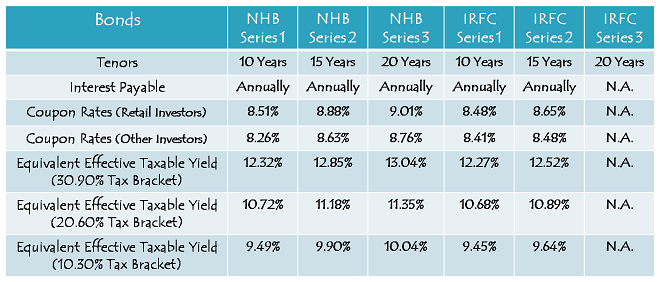
The good news is that the company is going to offer 9.01% per annum for the 20-year option and 8.88% per annum for the 15-year option, which is the highest rate of interest any ‘AAA’ rated issue has carried till date.

Though the issue is scheduled to remain open for the whole of next month to close on January 31st, 2014, the company reserves the right to close it earlier as well in case the issue gets oversubscribed anytime before the due date.

Size of the Issue - NHB is authorised to issue tax free bonds worth Rs. 3,000 crore this financial year, out of which it has already raised Rs. 900 crore through a private placement carried out on August 30th, 2013. NHB plans to raise the remaining Rs. 2,100 crore from this issue, including the green-shoe option to retain oversubscription to the tune of Rs. 1,100 crore.

Rating of the Issue - Being the regulator of the housing finance companies and a wholly-owned subsidiary of the RBI, this issue of NHB has been rated as ‘AAA’ by three credit rating agencies, CRISIL, CARE and ICRA, which is the highest rating by these rating agencies.

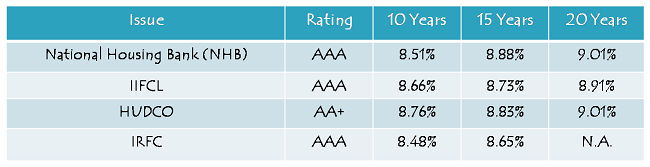
Interest Rates on Offer - The company has decided to offer 9.01% p.a. with the 20-year bonds, 8.88% p.a. with the 15-year bonds and 8.51% p.a. with the 10-year bonds. HUDCO is currently offering 9.01% p.a. for 20 years, 8.83% p.a. for 15 years and 8.76% p.a. for 10 years, but that is a ‘AA+’ rated issue. At 9.01% and 8.88%, NHB issue has become the best AAA rated issue for the 20-year and 15-year duration respectively.

If you want to have only AAA rated bonds in your portfolio and do not have more than 10 year investment horizon, then you can still subscribe to the IIFCL bonds which carry 8.66% p.a. interest rate for 10 years.

Investor Categories & Allocation Ratio - The investors have been classified in the following four categories and each category will have certain percentage of the issue size reserved during the allocation process:

Category I – Qualified Institutional Bidders (QIBs) – 10% of the issue i.e. Rs. 210 crore is reserved

Category II – Non-Institutional Investors (NIIs) – 25% of the issue i.e. Rs. 525 crore is reserved

Category III – High Net Worth Individuals including HUFs – 25% of the issue i.e. Rs. 525 crore is reserved

Category IV – Resident Indian Individuals including HUFs – 40% of the issue i.e. Rs. 840 crore is reserved

NRI Investment - Non-Resident Indians (NRIs) and Qualified Foreign Investors (QFIs) are not eligible to invest in this issue.

Allotment on First Come First Served Basis - Subject to the allocation ratio, allotment will be made on a first come first serve (FCFS) basis in each of the investor categories, based on the date of upload of each application into the electronic system of the stock exchanges.

Lock-in Period, Premature Redemption & Listing - There is no lock-in period with these bonds, but at the same time, you cannot redeem these bonds back to the company before their maturity period gets over. In order to encash your investment before maturity, you’ll have to compulsorily sell these bonds on the stock exchange(s) where they have been listed for trading.

The company has decided to get these bonds listed only on the National Stock Exchange (NSE) and has got the necessary in-principle listing approval for the same on December 20, 2013. The company will get these bonds allotted and listed within 12 working days from the closing date of the issue.

Demat/Physical Option - Though it is mandatory to have a demat account to sell/trade these bonds, you can subscribe to them in physical/certificate form as well and keep them till maturity. Interest will still get credited to your respective bank accounts through ECS.

Interest on Application Money & Refund - NHB will pay interest to the successful allottees on their application money, from the date of realization of application money up to one day prior to the deemed date of allotment, at the applicable coupon rates. Unsuccessful allottees will get interest @ 5% per annum on their refund money.

Face Value of the bonds & Minimum Investment - NHB is the first company this financial year to keep the face value of its bonds as Rs. 5,000 instead of Rs. 1,000. Considering its face value and minimum application size of one bond, an investor is required to invest at least Rs. 5,000 in this issue.

Interest Payment Date - NHB has not fixed its interest payment date as yet and the first due interest will be paid exactly one year after the deemed date of allotment. As the deemed date of allotment will be fixed once the issue gets closed and before the bonds get listed, I will update this post as and when it gets announced.

Should you invest in this issue?

I would say that one should definitely invest in this issue and I have many reasons to justify my view. Here are some of those reasons:

First, NHB issue is ‘AAA’ rated.

Second, you are going to get 9.01% p.a. and 8.88% p.a. coupon rates which are the best 20-year and 15-year rates offered by any AAA rated or AA+ rated issuer till date.

Third, NHB is a wholly-owned subsidiary of the RBI and I don’t foresee the RBI to ever let its subsidiary default on any such bond issue. Also, NHB is the regulator of the housing finance companies, like RBI is for the banks and SEBI is for the capital markets. I don’t think any government would allow any regulator to default on its payments.

Fourth, it is almost certain that the CPI inflation will start falling from next month onwards. If that materialises, we might have G-Sec yields falling quite sharply.

Fifth, IRFC is the next company to launch its tax-free bonds from January 6 and its coupon rates are lower than that of NHB at 8.48% p.a. for 10 years and 8.65% p.a. for 15 years. It is not going to issue these bonds for 20 years either.

Sixth, there are very few good companies left now to issue tax-free bonds this financial year. REC, PFC, NHPC and NTPC have already raised their quota of authorised amount from the markets. HUDCO is also very close to reach its targeted amount. Only IIFCL, NHAI, IREDA, Airport Authority of India (AAI), Ennore Port and Cochin Ship Yard are now left to issue these bonds and their issue sizes are also very small, except NHAI and IIFCL.

Seventh, it is still not certain whether tax-free bonds would see the light of the day next financial year onwards or not. Like 80CCF infrastructure bonds got stopped getting issued from FY 2012-13 onwards, it is possible that the next government decides to stop extending this budgetary support to all such companies.

Eighth, NTPC issue got listed a few days back and that too at a premium. If an issue with coupon rates lower than the NHB issue can trade at a premium, then it is almost certain that these NHB bonds would also trade at a premium on listing.

Ninth, NHB has reasonably strong fundamentals. It reported profit after tax (PAT) of Rs. 450 crore with total income of Rs. 3,030 crore for the period ended June 30, 2013 as against Rs. 387 crore and Rs. 2,492 crore respectively for the period ended June 30, 2012. Its net interest margin (NIM) also improved to 2.25% during this period as against 2.20% last year.

NHB’s asset quality has also been remarkable. Gross NPAs and Net NPAs remained quite close to zero for the periods ended June 30, 2011 and June 30, 2012. Though its gross NPAs and Net NPAs have jumped to 0.53% and 0.45% respectively in the latest period ending June 30, 2013, this relative poor performance was due to one large project exposure slipping into the NPA category. This large account was worth Rs. 179.60 crore out of its total NPAs of Rs. 180.62 crore.

Why you should not invest in this issue?

If I myself decide not to invest in this issue, I would have only one valid reason for that, higher expected coupon rates in the forthcoming issues. If any of you think that the rates would be higher with NHAI bonds or IIFCL tranche III bonds, then you can probably skip this issue. Personally, I would invest my family’s money in this issue and would also advise my clients to do that.

Application Form of NHB Tax Free Bonds

NHB Tax-Free Bonds – Bidding Centres

Note: As per SEBI guidelines, ‘Bidding’ is mandatory before banking the application form, else the application is liable to get rejected. For bidding of your application, any further info or to invest in NHB tax-free bonds, you can contact me at +919811797407

24 Dec 06:46

The minimum wage is a terrible idea. If you must have it, keep it really, really low.

by Sanjeev Sabhlok

This blog post is for the record, only, being a compilation of my views – and other related views – on the minimum wage. In brief I oppose a minimum wage but if it has to be established, it should be kept really low.  

==INDIAPOLICY DEBATES==

My view, 11 April 1998

Minimum wage: I have been involved in its implementation and know that this breeds corruption and other nasty things. In a fully computerized economy like USA this might work (even here ALL economists point out that it is a harmful thing and distorts incentives), but in India any control has bred and will breed corruption. Nobody actually receives a minimum wage: only the inspectors help increase the cost of the employers by taking bribes to show that the minimum wage laws are being upheld. Legislataion without a fool-proof (and I really can discuss any of these proposals since I have seen these in the field) method of implementation, is quite dangerous. We need to reduce, not increase, our laws.

==

My view 16 April 1998

I close my contribution to this extremely critical debate (since it determines the fundamental underpinnings of the Manifesto) by asking discussants to propose to me – as a teacher in the National Academy of Administration – what is the formula or methodology for determining any minimum wage that you would like me to teach these top bureaucrats.

Please propose any scientific and mathematical method within one page, and I will seriously consider your formula to determine a "fair" or a "minimum"  wage. The formula should be completely context-free. It should be implementable blindly by a computer by simply feeding in the data on the independent variables. The formula should also be supported by a theorem which shows that this formula is welfare enhancing for the entire society.

there is no way but the market solution, to determine a "fair"  and optimal wage in ** all ** situations.

==

My view, 17 April 1998

Minimum wages in the USA have been kept as low as possible through the effort of hundreds, nay, thousands of economists, who have always found minimum wages to be deleterious to employment of unskilled workers (the poor, basically).

Finally,

"The recognition that the minimum-wage law has adverse effects has made legislators reluctant to update the law frequently. Between 1981 (when the minimum wage was raised to $3.35) and 1990, prices rose 55 percent. Yet it took nine years and much debate to update the law and the result was only a 13 percent increase."

The Minimum Wage Study Commission set up by the US government clearly showed that minimum wages hurt the poor.

(This material is from a basic econ. text book: Principles of Economics by Henderson and Poole.  Please pick up ** any ** principles textbook on economics to study why min. wages hurt the poor: and here I am not even talking about its implementation in remote villages of India.)

This low increase is clearly one of the strong reasons for the continued low unemployment in the US economy, and its continued growth, leading to prosperity and most leading to most workers earning far higher than the minimum wage, automatically. By the way, these poor folk who are now employed at these "low" wages, are at least producing something, and crime in the USA has been falling consistently through the decade.

So much for economists who are hell-bent on saving the poor by eliminating the concept of minumum wages (the concept was never proposed or promoted by any economist; it only originated after the great depression by many well-meaning, socialistically thinking people).

No, there is NO formula in economics to arrive at min. wages. There is no way known to mankind to do that, unfortunately. If we allow everyone a choice, of course, we can arrive at 280 million possible wages in the USA itself. I propose a minimum wage of $2000 per minute, for me. Please propose other alternative wages and we can agree on the highest (!)

===

Parth Shah's comments, 22 Nov 1998

The employers have the option of not hiring or firing those already working if their marginal productivity is below the min wage.  If a worker's contribution is of Rs. 10 an hour then it won't make sense to hire him or keep him if i have to pay him anything more than Rs. 10/hr. If, say, the min wage is Rs. 15/hr, I'll let the workers go whose production is not valued at that level. Now who is likely lose the job in this situation?  The newly employed, less experienced and skilled, or a person of a particular race or caste or gender I don't really like. So the people who are able to keep the job may benefit to some extent by the new min wage, but other poor will lose out.

Given the higher labor costs, it becomes profitable to employ more capital intensive methods of production–buy more machinery instead of labor.  The power of the public sector unions in India explain why these firms are more capital intensive than expected given the abudance labor in India.  Given the wage structure of public sector employees it's rational to be more capital intensive.

One may say that for a time some low-wage workers may benefit at the cost of employers but many more workers will surely lose in the long run.  And most importantly, those who lose are really at the bottom of the labor market, the alleged beneficiaries of the min wage.

parth-

==FURTHER VIEWS==

Minimum wages protect union jobs but make the poor unemployable.

The Case Against the Minimum Wage (Part One)

The Case Against the Minimum Wage (Part Two) by Jon Riley

Homeless Man Takes Stand Against the Minimum Wage

The Minimum Wage: Good Intentions, Bad Results

Raising the Minimum Wage: Bad Ideas Have Consequences by James Sherk

How the minimum wage has led to MASSIVE unemployment among blacks in America

t=”315″ src=”//www.youtube.com/embed/siW0YAAfX6I” frameborder=”0″ allowfullscreen>

24 Dec 05:10

Completely wrong matrices?

by subra

When you talk to CEOs they talk about TOPLINE and when you talk to Analysts they talk about BOTTOMLINE.

Topline is of course ego driven, bottomline is EPS.

No, I am not going to talk about company performance, but about website performance. I keep looking at the number of people who visit this blog and that is now stagnating – for the past 3-4 months it has actually been following. So I had a conversation with a few kids who know something about SEO and I was told that the numbers to monitor are traffic, likes, number of registered users, number of followers, number of downloads, ….etc.

Then I realised that to me these indicators do not matter. Do not matter at all:

1. Number of comments: Every day about 12-24 comments are actually spam! with so many automatic commenting machines and software programs is it surprising that there are so many spams? How does it help a blog if there are a few more comments? I would rather have genuine comments. WordPress is perhaps over strict with spams, but I will live with that!

2. Number of followers: on FB I have many people following me – and frankly I have no clue how it helps, do you? People come, follow and go away. Not very sure except helping my ego!

3. No. of retweets: On twitter there are a lot of people who do retweet (#pvsubramanyam) – but most retweets are for posts on Khoparghade or Tarun Tejpal not for posts on mutual fund costs or ULIPs being expensive.

Honestly I would prefer people who come and ask genuine questions, or have arguments about investing, about asset allocation, about why equity will perform better than debt over say 10 years, on why an asset based on cash flow is easier to value than something like gold.

Not sure if I am right……………just some year end introspection. Even clicking on the Google ads is not of much use – unless of course you stay in New York, New Jersey, London, New zeland, Australia, South Africa, …..even Google likes hard currency…….

Post Footer automatically generated by Add Post Footer Plugin for wordpress.

23 Dec 09:31

IBM, we want freedom from monopolist unaccountable doctors. Please make Watson’s service available to ANYONE – on payment.

by Sanjeev Sabhlok

Watson has become really smart and becoming even smarter by the day:

"I've had a couple of patients where Watson found things that I had missed," says Dr. Neil Mehta, the staff physician who's leading the Cleveland Clinic's end of the Watson project. "It doesn't work every time, but it's getting better." One example is a patient suffering from sleep apnea-like symptoms. Years earlier, this patient had a blood gas test that would have confirmed the diagnosis, but the test results were hidden in a hard-to-find section of the medical record. Without Watson, Mehta says he never would have seen the result.” [Source]

And:

"It would take at least 160 hours of reading a week just to keep up with new medical knowledge as it's published, let alone consider its relevance or apply it practically. Watson's ability to absorb this information faster than any human should, in theory, fix a flaw in the current healthcare model. Wellpoint's Samuel Nessbaum has claimed that, in tests, Watson's successful diagnosis rate for lung cancer is 90 percent, compared to 50 percent for human doctors."  [Source]

I’m disappointed to learn that IBM doesn’t see Watson as a tool to DISPLACE doctors, but only as a doctor's assistant.

It is likely that the doctor monopolists (all monopolies are state created) will get government regulators to disallow the widespread PRIVATE availability of Watson through the cloud to every citizen on earth. That would be FATAL to the purpose of Watson. And destructive of human freedom.

Watson should aim for bigger things – to entirely DISPLACE doctors (like reference librarians have long been displaced by wikipedia), not to just be a doctor's helper.

There is currently so little trust of doctors amongst many patients (at least I have almost no trust in most doctors) that people want to be rid permanently of this monopoly profession of unaccountable crooks who fleece patients but NEVER assure them of any cure or even the right diagnosis. Despite their Hippocratic oath, most doctors today are ruthless mercenaries, driven by an insatiable urge to make money and BULLDOZE patients into submission, even when they have provided entirely wrong and costly advice – or even harmed the patient.

I would have been more sympathetic to the medical profession if its representatives behave professionally and in an accountable manner. But the average doctor is entirely unaccountable. After many, many wrong diagnoses, when I tried to hold one of these crooks to account, the medical fraternity – through its regulatory control over the system - very conveniently allowed that doctor to get away with BLATANT LIES. I finally gave up since this was costing me a huge amount of time (in addition to lost money and pain). They wore me out, but have made an enemy of the profession for life.

We want FREEDOM TO TREAT OURSELVES. That's our birthright. Our body is nobody's property but ours. And what we do or how we treat is, is our BASIC property right. We the free citizens would rather consult Watson (like we consult google today), and decide how to treat ourselves, than hand our our body to an unaccountable profession.

Citizens of the world want freedom from this monopolist profession of unaccountable doctors. IBM, please don’t make Watson available only to doctors. It is morally wrong for IBM to hire Watson out only to doctors.

Indeed, IBM will be commercially foolish to hire Watson only to doctors. It could in due course be out-competed by open source AI bsed competition. IBM must not make the commercially costly mistake of taking the side of doctors.

IBM can charge for Watson’s consultancy, but it should make Watson freely available to ANYONE in the world, without requiring citizens to visit an untrustworthy intermediary – a doctor.

We will hire a doctor when we feel it is appropriate to do so, but let us talk to Watson DIRECTLY.

22 Dec 04:26

Meaningless Sentence of the Day

by Greg Mankiw
This NY Times story on the middle class's struggle with the new healthcare law is generally pretty good, but this sentence struck me as comically meaningless:
Experts consider health insurance unaffordable once it exceeds 10 percent of annual income.

What the heck does this mean?  The typical American spends more than a third of income on housing.  Does that make housing unaffordable?  Presumably not.  What makes 10 percent the magic threshold for health insurance but not for other categories of crucial spending?  Who are these experts, and what criterion do they use to determine what is affordable?

Probably what the sentence means is that people have become accustomed to spending less than 10 percent of income on health insurance and are unhappy when they have to spend more.  But if healthcare costs keep rising as a share of national income, as many economists believe they will, then we will have to adjust our perceptions of what is affordable.

Addendum: The Times story, particularly the graphic, suggests that the implicit marginal tax rate some people face under the Affordable Care Act subsidies can sometimes exceed 100 percent.  It is hard to believe that the law is so badly written as to have this feature, but that seems to be the implication.
22 Dec 04:24

Who should engage a mutual fund advisor?

by subra


Many people have asked me this question:

Should we invest direct or through an advisor?

Like every economist or a CA I will also start by saying – ‘there is no yes or no’ kind of an answer. It depends on the following:

- were you investing in 1999, 2000, 2008, 2010…..? then you may not need an adviser.

- will you spend at least 3 hours a week reading about mutual funds, economy, company results, personal finance articles or are you busy with your social life, watching television, hobbies, etc  - then you may not need an adviser.

- will you invest in LEARNING before you invest your money – then you may not need an adviser.

if your answer to any of these is NO, you should have an adviser.

Your adviser should be able to do all this, help you with the form filling, annual review, asset re allocation based on some time based goals, changing your SIP amounts based on your goals, tell you when and how to change your term insurance policy, advise you regarding nomination, making a will, broad asset allocation and tactical asset allocation, …..

AND you think he can get you about 1% more than what you can get on your own, he deserves to be your adviser.

How much should be his fees?

I have heard a huge range of fees – everything from 20,000 Rs. to Rs. 5,00,000 – and frankly I feel all numbers are justified depending upon the client!

Largely for portfolios upto Rs. 2 crores: go through an adviser allowing him to earn a commission.

Portfolios of Rs. 5 crores and above : go for a fee + direct application….


Post Footer automatically generated by Add Post Footer Plugin for wordpress.

21 Dec 04:26

How to Fail at Almost Everything and Still Win Big

by Shane Parrish

Post image for How to Fail at Almost Everything and Still Win Big

Scott Adams, the famous creator of Dilbert, has made a very good living by understanding and revealing human psychology.

In How to Fail at Almost Everything and Still Win Big, Adams shares “the strategy he has used since he was a teen to invite failure in, embrace it, then pick its pocket.”

Among the unlikely truths he offers, you’ll discover that goals are for losers, passion is bullshit, and mediocre skills can make you valuable.

This is a story of one person’s unlikely success within the context of scores of embarrassing failures. Was my eventual success primarily a result of talent, luck, hard work, or an accidental just-right balance of each? All I know for sure is that I pursued a conscious strategy of managing my opportunities in a way that would make it easier for luck to find me.

Similar to the 10 things I took away from reading The Everything Store, here are 10 things I took away ‘from the Adams book.’

1. Do creative work first.
In the morning he is a creator, in the afternoon he’s a copier. Mindless tasks go later in the day. This is the single biggest change you can make in order to improve your odds of success.

The way I approach the problem of multiple priorities is by focusing on just one main metric: my energy. I make choices that maximize my personal energy because that makes it easier to manage all of the other priorities.

One of the most important tricks for maximizing your productivity involves matching your mental state to the task.

Mark McGuinness writes the same thing in Manage Your Day-to-Day.

2. Expecting people to use reason sets you up for frustration.
This sounds like you or someone you know. Trust me.

If your view of the world is that people use reason for their important decisions, you are setting yourself up for a life of frustration and confusion. You’ll find yourself continually debating people and never winning except in your own mind. Few things are as destructive and limiting as a worldview that assumes people are mostly rational.

3. The most important form of selfishness.
We’re taught that being selfish is bad but it all depends on how you look at it. Being selfish can be good.

The most important form of selfishness involves spending time on your fitness, eating right, pursuing your career, and still spending quality time with your family and friends.

You can’t be generous to others if you’re not in a good place. Adams argues that once your needs are met you can focus on the needs of others.

4. Witholding praise is immoral.
While I’ve long thought that organizational feedback systems were broken, I had never really thought about it in this way before.

Children are accustomed to a continual stream of criticisms and praise, but adults can go weeks without a compliment while enduring criticism both at work and at home. Adults are starved for a kind word. When you understand the power of honest praise (as opposed to bullshitting, flattery, and sucking up), you realize that withholding it borders on immoral. If you see something that impresses you, a decent respect to humanity insists you voice your praise.

5. Why to read the news.
As a long time subscriber to the physical newspaper, I cut the cord in July 2013. I’ll have more to say on this later but I like reading other people’s reasoning for reading or not reading papers. Some people argue we’re heading back to Yellow Journalism, a time when papers try to get attention however they can. Others argue it’s a waste of time. Adams argues that it broadens his exposure.

I don’t read the news to find truth, as that would be a foolish waste of time. I read the news to broaden my exposure to new topics and patterns that make my brain more efficient in general and to enjoy myself, because learning interesting things increases my energy and makes me feel optimistic.

6. Fake it till you make it.
Another manifestation of what we think influences what we do but what we do influences what we think. This is, at its core, the finding of the Stanford prison experiment.

[W]e are designed to become in reality however we act. We fake it until it becomes real. Our core personality doesn’t change, but we quickly adopt the mannerisms and skills associated with our new status and position.

In addition to this, we see ourselves as part of a new group and accordingly identify ourselves “with the other members and take on some of the characteristics of the group.” This is one of the reasons why sometimes people change when they get promoted.

This is also why if you’re having a crappy day, you should find some reason to smile. It actually does make you happier.

7. Change your mind.

The ability to change your mind is probably one of the best life skills you can ever hope to develop.

[Y]ou shouldn’t hesitate to modify your perceptions to whatever makes you happy, because you’re probably wrong about the underlying nature of reality anyway.

8. Systems trump goals.

This was fascinating. I’ve long thought that the balance of organizational thinking towards goals versus systems is in need of some reflection.

Adams has looked for examples of people who use systems versus those who use goals. In most cases, he’s discovered that people using systems do better and they are more innovative. “The systems-driven people have found a way to look at the familiar in new and more useful ways,” he says in the WSJ.

If you do something every day, it’s a system. If you’re waiting to achieve it someday in the future, it’s a goal.

[O]ne should have a system instead of a goal. The system-versus-goals model can be applied to most human endeavours. In the world of dieting, losing twenty pounds is a goal, but eating right is a system. In the exercise realm, running a marathon in under four hours is a goal, but exercising daily is a system. In business, making a million dollars is a goal, but being a serial entrepreneur is a system.

Goal-oriented people exist in a state of continuous pre-success failure at best, and permanent failure at worst if things never work out. Systems people succeed every time they apply their systems, in the sense that they did what they intended to do. The goals people are fighting the feeling of discouragement at each turn. The systems people are feeling good every time they apply their system. That’s a big difference in terms of maintaining your personal energy in the right direction. …

Goal-oriented people mostly fail. If your goal is to lose 20 pounds, you will constantly think that you are not at your goal until you reach it. If you fall short you’re still a failure. The only way to reach your goal is to lose the 20 pounds. It’s a state of near perpetual failure.

What you really want is a system that increases your odds of success. Even if that system only improves the odds a little it adds up over a long life. In organizations this means, for example, you should care more about the process by which you make decisions than analysis. It also means that you should focus on building a system that evolves, improves, and survives ego. Systems increase the odds of getting lucky. Or, if you want to put it another way, they reduce stupidity.

Goal seekers optimize whereas systems thinkers simplify.

9. Understanding psychology matters.
Understanding psychology is key. This is why Influence: The Psychology of Persuasion is one of the books I think everyone should read before they turn 30.

On a scale of one to ten, the importance of understanding psychology is a solid ten.

10. Consider how you look

Realistically, most people have poor filters for sorting truth from fiction, and there’s no objective way to know if you’re particularly good at it or not. Consider the people who routinely disagree with you. See how confident they look while being dead wrong? That’s exactly how you look to them.

How to Fail at Almost Everything and Still Win Big warrants a look.

— Brought to you by: The Suddes Group -- Changing the way nonprofits think, operate and fund.

21 Dec 04:24

Top 10 Sales & Marketing Innovations of the Past 10 Years

by Scott Gruher

Top Sales & Marketing InnovationsSales Leaders have experienced a lot change in the past 10 years.  Some have embraced it and some are still in denial.  This blog represents a test.  Look at the top 10 innovations and ask yourself each question below.  Is your team embracing each trend or fighting them?

As you go through the ten, grade yourself as a leader.  Have you embraced, or been skeptical about each of them?  The leaders that embrace innovation will get the next promotion.  They will outpace their peers.

The Top Innovation Improvement Resources will help you improve in each area listed below.  Download the tool to learn how to implement each and enable your sales team.  Assign an innovation area to each person on your team.  Ask them to become an expert in that category.  Have them share best practices on how to become more effective with the team.

Top Innovation Improvement Resources


Top 10 Sales Innovations

  1. The Smart Phone: Are you utilizing content that is mobile friendly?  Are you capturing cell phone numbers for leads, prospects and customers?  Are your systems and training mobile enabled?

  2. The Tablet: Do you provide content that addresses your buyer’s market problems?  Or is your buyer reading someone else’s content on their tablet?  

  3. CRM: Did you spend a lot of money on what amounts to a forecasting tool?  Or are you driving revenue because you have gained 100% adoption? Does your team understand the value of CRM?  Do you?

  4. Social Selling: Is your profile top tier?  Do you have a plan to connect to more of your target buyers? Are you getting referred to those target buyers?  Or are you waiting to see if this is another fad. 

  5. Content Marketing: Are you leading the charge or is this too much work?  Is your content accessible, customer focused, and organized properly?   

  6. Customer Aligned Sales Process: Do you sell the way the customer wants to buy?  Or are you selling the way you want to sell?

  7. Buyer Process Mapping:  Is your team able to spot where a buyer is in their buying journey?  Can they address questions the buyer is asking before they actually ask them?

  8. Marketing Automation: A larger percentage of the buying process takes place before a rep is engaged.  Do you have visibility to what buyers are doing during this time?  Are you making investments and qualifying based on how buyers interact with your website?

  9. Buyer Personas: Do you know your buyers better than the competition? 

  10. Insight Selling: Are you differentiating early in the sales cycle?  Or is your team still product pitching and commoditizing your offering?

You could argue that a couple of these existed prior to 10 years ago.  They might have, but were not widely adopted.  The best sales organizations have been early adopters of these innovations.  They are stealing mindshare from you right now. 

Top 5 Most Obsolete Sales Practices:

  • Solution Selling - developed in the 80s when hair bands were popular.

  • Cold Calling – using a more strategic approach is probably a better use of time.

  • Relying on a PC – everything a rep did on a PC should now be mobile enabled. Productivity dips every time a sales person visits the office.

  • Hiring for tenure and industry experience – the tenure scale has tipped.  Being tenured can actually be a bad thing.  Knowing a lot might mean wanting to learn a little. 

  • Closing techniques - buyers now have more control than ever.  In complex sales, you don’t close them.  You help them navigate their buyer’s journey to a logical conclusion.

What do all of these tell us?  With each new innovation sales is becoming less about art and more about science.  Sales people should be enabled with real time information at their fingerprints.  If you are still in the art world, you are falling behind. 

If you fall behind the competition, it will be difficult to catch up.  Innovation continues to accelerate and your competency gap is widening. Start now by downloading the Top 10 Innovation Improvement Resource Tool.


Author: Scott Gruher

sbi on linkedin

Follow @ScottGruher

Follow Sales Benchmark Index @MakingTheNumber

If you enjoyed this post, never miss one again by subscribing your Email Here and/or subscribing to the RSS.


20 Dec 06:22

Rajan's Pause Gamble Muddles Message

by MC GovardhanaRangan

Misreading a central banker's message could turn out to be a costly affair  - for investors as well as the central banker himself - as the Federal Reserve chairman Ben Bernanke found out after uttering the 'taper' word on May 22.

A central banker is often left to operate the monetary policy with just one tool - interest rate, when the factors influencing it are many. With billions at stake, investors, economists, businessmen and even the government keep reading the message to find out as to what is in store


Forecasters on Wednesday were in for their first shock since Raghuram Rajan, a Chicago University’s Booth School of Business professor known to be pragmatic in policymaking, took charge as the Governor of the Reserve Bank of India on Sept. 4.


``You have to focus the laser light on inflation,’’ Rajan told bankers on Nov. 15. ``That’s the only tool we have. That’s the blunt tool. (That’s why) across the world central bankers use it carefully.’’


That was not a one off for the sake of effect. On Dec. 12 he said, ``we can spend a long time debating the sources of this inflation. But ultimately, inflation comes from demand exceeding supply, and it can be curtailed only by bringing both in balance. We need to reduce demand somewhat without having serious adverse effects on investment and supply.’’


These utterances and many such statements from Rajan established his credentials as an inflation hawk, though as a central banker it may not to be his liking.


Rajan did not raise interest rate on Wednesday as many surveys predicted. There was near unanimity that the repo rate, the rate at which the RBI lends to banks, will be raised by 25 basis points to 8%. A basis point is 0.01 percentage point.


Why did he do that?


``The point we were trying to make is that we should not react to every reading of inflation if we believe that inflation will come down. If we set the level of policy consistent to the inflation level of 11.24% reading of CPI headline, and if it came down to 9 or whatever the number is, would we then react to that rate by changing the policy rate?’’


A simplistic reading of it is that the RBI believes that probably inflation has peaked, and growth should occupy the monetary policy centre stage.


But read his lips. The message is different.  


``If the expected softening of food inflation does not materialise and translate into a significant reduction in headline inflation in the next round of data releases, or if inflation excluding food and fuel does not fall, the Reserve Bank will act, including on off-policy dates if warranted, so that inflation expectations stabilise and an environment conducive to sustainable growth takes hold.’’


There would be caveats to almost every policy decisions in this dynamic world.  But as the previous governor Duvvuri Subbarao’s term showed that it takes double the efforts to regain the confidence if the signal received by the market is different from what was intended.


After prematurely announcing a pause in rate increase in 2011, Subbarao had to reverse his decision as inflation turned out to be a lot severe than thought. Once that was recognised, Subbarao had to administer heavier doses of increase to contain prices. Despite his best efforts and rupturing a relationship with the Finance Minister P. Chidambaram, the price rise beast is yet to be tamed.


Is this time different? There is little dispute that consumer prices will continue to rise at 11% pace, or more in the months to come. But it may not fall drastically either. Also, Rajan’s belief that savers should have positive real interest rates is still far away. That means either inflation has to cool substantially, or rates may have to move up. Which one will walk how far?


If he waits for too long for prices to ease, then it may be a risk to the RBI’s inflation fighting credentials. If he raises interest rates soon with inflation remaining stubborn, it could turn out to be a gamble on inflation that went wrong.


Rajan’s tenure so far, though just a quarter, has witnessed many macro economic adversities turning into advantage - some orchestrated and some accidental. Any one betting on that?

20 Dec 04:39

When You Criticize Someone, You Make It Harder for that Person to Change

by Daniel Goleman

“If everything worked out perfectly in your life, what would you be doing in ten years?”

Such a question opens us up to fresh possibilities, to reflect on what matters most to us, and even what deep values might guide us through life. This approach gives managers a tool for coaching their teams to get better results.

Contrast that mind-opening query with a conversation about what’s wrong with you, and what you need to do to fix yourself.  That line of thinking shuts us down, puts us on the defensive, and narrows our possibilities to rescue operations. Managers should keep this in mind, particularly during performance reviews.

That question about your perfect life in ten years comes from Richard Boyatzis, a professor at the Weatherhead School of Management at Case Western, and an old friend and colleague.  His recent research on the best approach to coaching has used brain imaging to analyze how coaching affects the brain differently when you focus on dreams instead of failings. These findings have great implications for how to best help someone – or yourself — improve.

As I quoted Boyatzis in my book Focus: The Hidden Driver of Excellence,  “Talking about your positive goals and dreams activates brain centers that open you up to new possibilities. But if you change the conversation to what you should do to fix yourself, it closes you down.”

Working with colleagues at Cleveland Clinic, Boyatzis put people through a positive, dreams-first interview or a negative, problems-focused one while their brains were scanned. The positive interview elicited activity in reward circuitry and areas for good memories and upbeat feelings – a brain signature of the open hopefulness we feel when embracing an inspiring vision. In contrast, the negative interview activated brain circuitry for anxiety, the same areas that activate when we feel sad and worried. In the latter state, the anxiety and defensiveness elicited make it more difficult to focus on the possibilities for improvement.

Of course a manager needs to help people face what’s not working. As Boyatzis put it, “You need the negative focus to survive, but a positive one to thrive. You need both, but in the right ratio.”

Barbara Frederickson, a psychologist at the University of North Carolina, finds that positive feelings enlarge the aperture of our attention to embrace a wider range of possibility and to motivate us to work toward a better future. She finds that people who do well in their private and work lives alike generally have a higher ratio of positive states to negative ones during their day.

Being in the positive mood range activates brain circuits that remind us of how good we will feel when we reach a goal, according to research by Richard Davidson at the University of Wisconsin. That’s the circuit that keeps us working away at the small steps we need to take toward a larger goal – whether finishing a major project or a change in our own behavior.

This brain circuitry — vital for working toward our goals — runs on dopamine, a feel-good brain chemical, along with endogenous opioids like endorphins, the “runner’s high” neurotransmitters. This chemical brew fuels drive and tags it with satisfying dollops of pleasure. That may be why maintaining a positive view pays off for performance, as Frederickson’s research has found: it energizes us, lets us focus better, be more flexible in our thinking, and connect effectively with the people around us.

Managers and coaches can keep this in mind. Boyatzis makes the case that understanding a person’s dreams can open a conversation about what it would take to fulfill those hopes. And that can lead to concrete learning goals. Often those goals are improving capacities like conscientiousness, listening, collaboration and the like – which can yield better performance.

Boyatzis tells of an executive MBA student, a manager who wanted to build better work relationships. The manager had an engineering background; when it came to getting a task done, “all he saw was the task,” says Boyatzis, “not the people he worked with to get it done.”

His learning curve involved tuning in to how other people felt. For a low-risk chance to practice this he took on coaching his son’s soccer team – and making the effort to notice how team members felt as he coached them. That became a habit he took back to work.

By starting with the positive goal he wanted to achieve – richer work relationships – rather than framing it as a personal flaw he wanted to overcome,  he made achieving his goal that much easier.

Bottom line: don’t focus on only on weaknesses, but on hopes and dreams. It’s what our brains are wired to do.

19 Dec 03:20

Clearing of OTC Derivatives

Dr. David Murphy of the Deus ex Machiatto blog has published a comprehensive book on clearing of OTC derivatives (OTC Derivatives, Bilateral Trading and Central Clearing, Palgrave Macmillan, 2013). I was surprised that the author information on the book cover flap does not mention the blog at all but gives prominence to his having been head of risk at ISDA. Had I found this book at a book shop, the ISDA connection might have made me less likely to buy the book because of the obvious bias that the position entails. This was a book that I read only because of my respect for the blogger. Many publishers have obviously not received the memo on how the internet changes everything.

The book presents a balanced discussion of most issues while of course leaning towards the ISDA view of things. Many of the arguments in the book against the clearing mandate would be familiar to those who read the Streetwise Professor blog. Yet, I found the book quite informative and enjoyable.

In Figure 10.1 (page 261), Murphy summarizes the winners and losers from the clearing reforms. To summarize that highly interesting summary:

  • Leading G14 dealers: Mixed (higher capital but reduced competition)
  • Smaller dealer: Lose (they will end up becoming clients of the G14)
  • End users: Mostly lose (higher costs)
  • Regulators: Mostly win (enhanced role and power)
  • CCPs: Win (new business)

Obviously, the clearing mandate has not quite worked out the way its advocates expected. Clearing was originally expected to lead to greater competition and reduce the dominance of the big (G14) dealers. Murphy explains that the big dealers will actually benefit from the mandate as they can more easily cope with the compliance costs.

I am not disturbed to find corporate end users listed as losers. If Too Big to Fail (TBTF) banks were being subsidized by the taxpayer to write complex customized derivatives, these products would clearly have been under priced and over produced. When the subsidy is removed, supply will drop and prices will rise. This is a feature and not a bug.

If the price rises sufficiently, end users may shift to more standardized and simpler products. Of course, this will imply basis risks because the hedge no longer matches the exposure exactly. This matters less than one might think. The Modigliani Miller (MM) argument applied to hedging (which is actually very similar to a capital structure decision) implies that most hedging decisions are irrelevant. The only relevant hedging decisions are the ones that involve risks large enough to threaten bankruptcy or financial distress and therefore invalidate the MM assumptions. Basis risks are small enough to allow the MM arguments to be applied. Inability to hedge them has zero real costs for the corporate end user and for society as a whole.

One could visualize many ways in which the market may evolve:

  1. The reforms could lead to the futurization of OTC derivatives. That might be the best possible outcome – exchange trading has even more social benefits than clearing in terms of transparency and competition. The increased basis risk is a non issue because of the MM argument.
  2. Another possible outcome could be a reduction in end user hedging and consequently a smaller derivatives market. Under the MM assumptions, this need not be problematic either.
  3. The worst possible outcome would be an OTC market that is even more concentrated (G10 or even G5) and that uses clearing services provided by badly managed CCPs. This would be a nightmare scenario with a horrendous tail risk.
19 Dec 03:19

Should you get a pre-nuptials done?

by subra

What is a pre-nup?

Well it is a short form for pre-nuptials. A pre-nup agreement is an agreement between two people who are about to get married or are just recently married.

It is an agreement that writes down:

- how the existing assets (pre marriage) will be divided among them,

- how the expenses will be shared

-who will fund the purchase of assets

-how will the assets be divided in case of a divorce / separation

- how will the children’s expenses be divided

-if there are children /inheritances from a previous marriage how will that be handled

- expenses of parents and inheritances from parents / other relatives

-existing real estate and new real estate – how funded and how it will be funded in future

- how the debt gets divided

- if one spouse were to give up his/ her career to have a baby / provide medical support to a parent/sibling how will the finances be handled…

So let us clear some myths regarding pre-nuptials in India…I am not sure it will work if it is made under the Hindu Marriages Act. I think it should be made under the Indian Contract Act, 1876 (please consult a lawyer). Now for the myths:

-getting a pre-nup done does not mean you are suspecting your marriage / spouse

- the Indian laws are extremely against the man. Men need a pre-nup to protect their inherited / accumulated property.

- when one partner has a lot of debt and the other partner has a lot of assets a pre-nup is absolutely essential

- even if you are married you CAN ENTER INTO AN AGREEMENT – even though it is called pre-nup

-do not try to do it yourself, go to a lawyer for the drafting and signing.

- if you have kids from the previous marriage their rights have to be protected NOW.

- if you are planning to leave the workforce to have kids, you need to know the financial implications of that

So go and find out about a good lawyer, understand what can and cannot be covered by a pre nup agreement. Then sit with your spouse and sign one.

Pre nup is just a safety net……just in case – like insurance.

I hope none of you ever need it….but knowing it is there is useful, na?

Post Footer automatically generated by Add Post Footer Plugin for wordpress.

17 Dec 04:24

Four missing ingredients in macroeconomic models

by Antonio Fatas
It is refreshing to see top academics questioning some of the assumptions that economists have been using in their models. Krugman, Brad DeLong and many others are opening a methodological debate about what constitute an acceptable economic model and how to validate its predictions. The role of micro foundations, the existence of a natural state towards the economy gravitates,... are all very interesting debates that tend to be ignored (or assumed away) in academic research.

I would like to go further and add a few items to their list that I wished could become part of the mainstream modeling in economics. In random order:

1. The business cycle is not symmetric. Most macroeconomic models start with the idea that fluctuations are caused by a succession of events that are both positive and negative (on average they are equal to zero). Not only this is a wrong representation of economic shocks but is also leads to the perception that stabilization policy cannot do much. Interestingly, it was Milton Friedman who put forward the "plucking" model of business cycles as an alternative to the notion that fluctuations are symmetric. In Friedman's model output can only be below potential or maximum. If we were to rely on asymmetric models of the business cycle, our views on potential output and the natural rate of unemployment would be radically different. We would not be rewriting history to claim that in 2007 GDP was above potential in most OECD economies and we would not be arguing that the natural unemployment rate in Souther Europe is very close to its actual.

2. As much as the NBER methodology emphasizes the notion of recessions (which, by the way, is asymmetric in nature), most academic research is produced around models where small and frequent shocks drive economic fluctuations, as opposed to large and infrequent events. The disconnect comes probably from the fact that it is so much easier to write models with small and frequent shocks than having to define a (stochastic?) process for large events. It gets even worse if one thinks that recessions are caused by the dynamics generated during expansions. Most economic models rely on unexpected events to generate crisis, and not on the internal dynamics that precede the crisis.

[A little bit of self-promotion: my paper with Ilian Mihov on the shape and length of recoveries presents some evidence in favor of these two hypothesis.]

3. There has to be more than price rigidity. Keynesian models rely on price rigidity to explain business cycles and why demand matters. There is plenty of evidence that price rigidities are important and they help us understand some of the features of the business cycle. But there must be more than that. There are other frictions in the real economy that produce a slow adjustment and are responsible for the persistence of business cycles. They might not be easy to measure or model, they might be different across different economies but it is difficult to imagine that an adjustment of prices and wages to its optimal level would automatically restore full employment. Larry Summers referred to these frictions in his recent IMF conference speech although he did not elaborate on them.

4. The notion that co-ordination across economic agents matters to explain the dynamics of business cycles receives very limited attention in academic research. It some times appear in our economic policy debate (e.g. Olivier Blanchard (at the IMF) has referred to multiple equilibria as a way to explain the sovereign-debt crisis in Europe) but it does nor receive the credibility it deserves in academia.

I am aware that they are plenty of papers that deal with these four issues, some of them published in the best academic journals. But most of these papers are not mainstream. Most economists are sympathetic to these assumption but avoid writing papers using them because they are afraid they will be told that their assumptions are ad-hoc and that the model does not have enough micro foundations (for the best criticism of this argument, read the latest post of Simon Wren-Lewis). Time for a change?

Antonio Fatás
16 Dec 17:31

It’s Not OK That Your Employees Can’t Afford to Eat

by Peter Cappelli

It wasn’t that long ago that in most companies, especially large ones, a fair amount of time was spent worrying about whether the company’s practices towards employees were fair. One of the functions of human resource departments was to advocate for the interests of employees.

The motivation wasn’t entirely altruistic. Since WWI, employers figured they could keep unions out by giving employees virtually all of the wage and benefits they would have gotten from joining unions. Even without that concern, though, the leadership of the company considered it part of their job to strike a balance between the other demands on the business and the needs of employees.  They were one of the important stakeholders in the business, along with customers, shareholders, and the community around them.

There is no doubt that shareholder activism as well as court cases sympathetic to shareholder interests pushed publicly-held companies to pay more attention to maximizing stock prices. But when exactly did the shift in corporate attention in the direction of shareholder concerns lead to virtually ignoring the needs of employees?

Let’s be clear about the wage levels that are associated with not having enough to eat. A family of four with one breadwinner is eligible for food stamps if they earn less than $2500 per month. That is the equivalent of a $15 per hour job and a 40 hour work week.  The government has determined that full-time workers earning less than that do not have enough money to feed their families on their own. If that breadwinner earns less than $16 per hour, they are also eligible for Medicaid assistance to provide healthcare. Depending on where they live, that breadwinner is also eligible for subsidies to help pay for housing.

Jobs paying $15 per hour are not the concern, though. Those are routinely seen as good jobs now. The concern is those jobs paying at or around the minimum wage, $7.25 per hour or only $1160 per month for a full-time job. About 1.6 million workers in the U.S. are paid at that level, and a surprising 2 million are actually paid less than that under various exemptions. If you are an employer paying the minimum wage or close to it, the Government has determined that your employees need help to pay for food, housing, and healthcare even if they have no family and no one to look after but themselves.  As we’ve been reminded this season, many of those workers also need help from families and coworkers to get by.

No doubt the reason low-wage companies continue to pay low wages is because there are plenty of workers willing to take jobs at those wages, and the need to pay more to avoid the risk of being unionized is largely gone. But “can” and “ought” are not the same thing.  Nothing about the minimum wage implies that it is morally ok as long as you pay at least that much. It simply says that the government will prosecute you if try to pay less than that level.

A longstanding principle in all developed countries including the U.S. is that labor is not like a commodity where taking advantage of the market to squeeze down prices is a fact of life. Employees have human rights that do not disappear when they enter the workplace. Even in business law, principles like the “mechanic’s lien” say that employees should be paid before other creditors because they are more vulnerable than businesses and do not get profits to compensate them for risks.

One of the things that I find surprising is how many companies that pay poverty-level wages or thereabouts to their employees spend a good deal of effort to be good corporate citizens in other areas. They try to make their operations “green,” lessening their impact on the environment, some even sponsor anti-poverty programs in Africa, and so forth. They just don’t seem very interested in the poverty among their own workforces.

Board of directors are responsible for making the trade-offs among stakeholders of businesses. If you are a member of the board of directors of a company that pays its workers so little that they need government subsidies to survive, isn’t that a little embarrassing? Most of these companies want to refer to themselves and their employees as a kind of family, but what kind of family allows its members to go hungry? And what prevents you from doing something about it?


For research on why higher wages are good for companies as well as employees, the editors of Harvard Business Review also recommend:

Why “Good Jobs” Are Good for Retailers by Zeynep Ton

The Case for Paying People More by Justin Fox

The High Cost of Low Wages by Wayne F. Cascio

16 Dec 17:29

Small samples from big populations shouldn't bother us

by Ajay Shah

by Rajeeva L Karandikar, Director, Chennai Mathematical Institute.

In the last few weeks, there has been a lot of discussion about opinion polls. Some people have questioned if these have a scientific basis. Indeed, each time we disclose our findings based on an opinion poll, someone raises this question.

In this article, I offer a simple explanation of the scientific basis of an opinion poll. The key result is this: If the methodology is sound, an opinion poll based on a sample size of 25 thousand respondents in our country, where there are over 500 million voters, can yield surprisingly good projections of the vote shares of major parties.

Consider a lottery. Suppose you are told that a box contains lottery tickets and that each ticket has a number written on it: 1 or 1000. You can pay Rs 100, and then put your hand inside the box and draw one ticket from the box. The prize would be the amount written on the ticket (in Rupees). Most people would not agree to play unless they are told how many tickets in the box have the number 1 or 1000 written on them. However, if they are told that 99 percent of the tickets have the number 1000 on them, many may be willing to play. Indeed, even if the cost of playing the game was Rs 900, many would opt to play if 99 per cent of the tickets have 1000 written on them.

Suppose, instead, you are told that host of the casino will put his hand in the box and draw a ticket. There are still 99 percent tickets with the number 1000 and only 1 percent with the number 1. And you have ascertained that all tickets are identical in all aspects other than the number written on it. Even then, you would be a bit apprehensive, as the host might have put the tickets with the number 1 at the bottom of the box, and given a chance the host can dig deep in and draw a ticket from the bottom. If you are allowed to shake the box and mix the tickets well, you would probably still play.

Now let us consider another scenario. A political party has two claimants for a Lok Sabha constituency, say Raghu and Prasad. Suppose the constituency has 5 lakh voters. Let us imagine that we have lottery tickets with the following characteristics: Each ticket has the names of 2501 voters from the constituency and also that the ticket is coloured Red if 1251 or more voters on that list prefer Raghu over Prasad and the ticket is coloured Blue if 1251 or more voters on that list prefer Prasad over Raghu. Suppose all such lists are written out on otherwise identical lottery tickets.

Let us assume that there is at least a 5 percent gap in the support level of the two candidates. It can then be shown that over 99 percent of the tickets will have the name of the candidate with more support. This is just a question of counting and is purely arithmetical- no element of probability or statistics enters here. Thus it is a matter of fact and not of belief! Indeed, 99.3939507 percent of the tickets will have the colour of the candidate with more support.

Return to our example of two candidates with a gap of 5 percent or more. If the party draws a ticket out of the box after mixing it well, it will end up knowing which candidate is more popular. Here the logic is that since 99 percent of the tickets have the colour of the more popular candidate, we can assume that the colour of the ticket drawn has the winner's colour. Once again the decision maker should ensure that the tickets have been mixed well.

Here are the percentage of tickets that will have the colour of the winner for different combinations of population sizes and sample sizes. In each case, we assume that there is a 5 percent gap in the vote shares of the two candidates.

Sample size Population size (Total number of voters)
500000 1000000 2500000 5000000 10000000 25000000
1001 94.35 94.34 94.34 94.33 94.33 94.33
1201 95.87 95.87 95.86 95.86 95.86 95.86
1401 96.96 96.96 96.95 96.95 96.95 96.95
1601 97.75 97.75 97.74 97.74 97.74 97.74
2001 98.75 98.75 98.74 98.74 98.74 98.74
2501 99.39 99.39 99.39 99.38 99.38 99.38
3201 99.77 99.77 99.77 99.77 99.77 99.77

The remarkable thing about this is that while accuracy increases as sample size increases, the population size (total number of voters) has only a negligible influence on the accuracy. This is somewhat counter intuitive but true. A sample of size 2501 will give the same accuracy when the population size is 1 million or 25 million!

The following table gives the percentage of lists which have the colour of the winner when the gap between the winner and loser is only 2 percent. Here again we see that sample size determines the accuracy and population size has very little effect on it.

Sample size Population size (Total number of voters)
500000 1000000 2500000 5000000 10000000 25000000
1601 78.86 78.85 78.84 78.83 78.83 78.83
2501 84.2 84.17 84.16 84.15 84.15 84.15
3601 88.58 88.54 88.52 88.51 88.5 88.5
5001 92.24 92.19 92.16 92.15 92.15 92.14
8001 96.44 96.38 96.34 96.33 96.33 96.32
10001 97.83 97.78 97.75 97.74 97.73 97.73
15001 99.36 99.32 99.3 99.29 99.29 99.29

At the bottom of this article is a computer program written in Python which does these computations. You have to believe me or have a mathematical expert confirm the accuracy of the program and then run the same on a computer with Python installed (which is available freely at http://www.python.org/). You can change the population size, the sample size and the gap between the support levels to get the accuracy level of the corresponding sampling scheme.

The same situation applies when we conduct an opinion poll. We select a group of 2501 voters, and ascertain the opinion of this group, called a sample. It is the percentage of votes for a party in this chosen sample that we report as the estimated vote share of the party. The crucial thing is that our choice should be as if we have written all possible lists on lottery tickets and put them in a box, mixed them well and then drew one and the names on the ticket constitute the group. This is what is called random sampling. One can use random number generators to generate such a random sample from any list of voters.

Colloquially, most people think that random means arbitrary. This is far from true in the scientific setting. Random sampling refers to the methodology of choosing a sample. In this context, it means choosing one list out of all possible lists as if we are drawing a lottery ticket (in the scenario described above). What I have described is the simplest sampling scheme. There are variations which may be more appropriate in a given situation.

Suppose we have access to a list of all telephone numbers in use in a constituency. We can use a computer program to generate a list of 2501 randomly generated phone numbers from this list. We can then call these numbers and ascertain the view of the owner. In this case we could estimate the opinion of the group of people who have phones. In this case, richer, urban, educated class will be over represented and our estimate could be biased. This methodology is used in the US and seems to work well (at least over the last 50 years, while it did not work in the '30s and '40s even in the USA when the telephones were not ubiquitous all across the country).

Thus the most important ingredient in the opinion poll is the methodology of sample selection. One must be sure of getting opinions from a representative sample. Unless the sampling is done properly, there is no statistical guarantee that the estimate would fall within 2.5 percent of the true vote share (with 99 percent probability for the sample size of 2501).

Readers can experiment with the program and obtain accuracy of random sample based prediction for a given sample size, population size and gap in the support for the winning candidate and the losing candidate. The program prints the total number of lists, number of lists where winner has majority and then the last line is the accuracy (in percent).

Python code:
g=5#Gap in percent support for winning candidate and the losing candidate
psize=500000
#population size
ssize=2501
#sample size
def binomlist(N, R):
    '''Return [binom(N,0), ... , binom(N, R-1)]'''
    a=[1]
    for k in range(1, R):
        a.append((a[k-1]*(N-k+1))//k)
        assert((a[k-1]*(N-k+1))%k==0)
    return a

n=psize
#Population size
print('Population Size :')
print(n)

m=(100+g)*n//200
print('Gap in the level of support between the two candidates 
(in percent):')
print(g)

#Total number of supporters of the winning candidate
print('Total number of supporters of the winning candidate :')
print(m)

k=n-m
#Number of supporters of the losing candidate
print('Total number of supporters of the losing candidate :')
print(k)

r=ssize
#Sample size
print('Sample Size :')
print(r)

s=1+(ssize)//2
#Majority mark in the sample
print('Majority mark in the sample :')
print(s)

t=r-s
b=binomlist(n,r+1)
c=binomlist(m,r+1)
d=binomlist(k,t+1)
print('Total number of lists :')
print(b[r])

z=sum([ c[r-k]*d[k] for k in range(0,t+1)])
print('Total number of lists in which winning candidate has majority support:')
print(z)

y=(z/b[r])*100
print('Percentage of lists in which winning candidate has majority support:')
print(y)
Output: Population Size: 500000
Gap in the level of support between the two candidates (in percent): 5
Total number of supporters of the winning candidate: 262500
Total number of supporters of the losing candidate: 237500
Sample Size: 2501
Majority mark in the sample: 1251
Total number of lists: 62231690581446480003124486564603608079722664287780679850769754811742042826440472887015830702924480575139486249657512804993096017025966527240485971677012460101302514218686266609441052100836909464169270524814906289825323267820948737888768638306721657325213500920099906234174550459916676877801122648015241862393226740611391693419690393435279384448846498164611917690485938916309022444186853678716540339720996823920632761895486203438380430254590374925296252761868287613362669749365125454631374879693160142819869304875906654921349095055838442562414668977024766179959130011021610575662910956134247564521738477313446196261604802302543410146068132670342155475007095024743323867045795400143176727384029281976933600168079297510291849445093067071083684685003730058946519710247034945376030279821029701472923740192102205025797475452531004667596413727636670465215729867754283833374385303145387948051359404453403594361525378558410033629759275932498192096982291800849470571518287063229431447959133385792138084490304666939123657615189822099874121079295131987178206767084477208423116361539422938568526859676309130466065888802081248462657939570182699815625453901386358318350022709995625288828603793916108904428008609734299699221437566336835240257534085393479491186665079655190103428237800738888006964700812940498236110822184478021780415260136866672164326231310650895521248121755859107866938779565130334913321094933601029730436184082485079029558170569819165053571542795991727217330966100414527221364686964529920726163238492293892228326948001117293468138858023516939457994664567261850006311933756947304285561086248788200803564375093003772848775681842197209982100478555863846338584281906599009475583222084487980818308040033671587984993515974558684475022277901970099053541223542134155842504516032224804445183451317380149589970032212804575628082098277081463957839077920898869597586620515995970008514248167231810555336158368760540858584640697240880859068759980546301544945173321069553721350972811702465776038261514751366432380505653269990734628912787921196828014924849957148325947484479478464943528525829530723712207177801854498505379313242978072796608415660424672105172137755545024900415945428256536045336980540671661266557344947764836566529722714879021182976140139129856559145427658178495007317534394739394235188377026548923486253173751616379130541552155758837114472809783850427754469844587936072840642351778220558057232669828423498123063458914684776588125631122103174618980604765576707899260689467306579408356058711623351399260178055917659963408455273580719144814560484832919904878765961591225700327651593973860864438116094850680456864518725262740928051582341539254987525019787256071659676928373298021282046954594050755383326687971809253561980088484298073161856459452325694037739274837365216230582263924667803583485781780218253284218391730866178085262881994066033816393829013721311131748672183078728900933581558734405974104874756534969248232592313582502037142672654121741282578372979805465908127950187274075397490336844923270342615399463969649554126623283032616619860556580636328136753628805680852851407963270089714073626621120839871909711594994253666342272359471320655869954863460407565986906474615595552330627592635455243206575046823339900668550971352633374485688587126074795047908585598712155945668417607256395345722088439538463447076588501001219788542858153049781833657942552401464715635534332260515218505056897905685877043364499338188335401451485749380823361891367165284575198795795706325965459245970820182968416588569262205864560967474390631523041120889653260589129456152566220058515917669342363795423128034942492225269840456119934077650384674330202082758512409968193166923108572334911544560155774100118425500347543423269124631844558114435125175017555500011451376956685419999212743508413967187310121355328643814596714505035428570563667905329220023568761920372318672748066491538386362503932919067623642006192288629490332239924529275660392604135364518178709645251568947829790968485350757937039473403892835221019104946380501456170261792541779653905610112609257982069288434883821539348456638978706277490266096785801912450185230638539829701924352942262894855270142930259031972046282586563892827754397261394135669853192369909536949252496489905384890519693644219374285311950869838840999862576449738089616498010247917038541443671710835200209258303429618341172828857210172546352033108320714086475275833013658816172562851640153013201594935921805444858511862222986921611649620787025702764928938030416878469784542178572899283792381712549547989957375712162715834971052306908424777553250398897933660688114626175343338296459105052106907815907800493632106153130371390265741118879621773827599268210510657654647567961805679873227774988494734117015705540753609174031970835793477945867907801468391170032234998449398312805494784365015754905261103496492914475522013784154069747889118167745622648817823453096293834552709425038099410751211010184684088478062229567458545385381873514215152003667097109597790568765198065077427946525045384254967053032767662079442599022863825992255697642670195087368061303544182026383279381793756537585195072034501032282072218014776155536686226067590207105059978962856264152015857329823054618874575107943555769313879322107342773045700458905454789107511870461578164581868782223102778218653491871855192270951818997164294958334974045773678167469423485625177317370915848177336736332836777996361609707902987046694214863048890113554854413050567534204094725686390362155721963672141096706581649992815877681713676063878647949708426533918893860041211338666717678506988337856766016039452351562182705851879530723219770661660390683134598036166887734683508116125393617837521663026650845446856218974787651129036755981552785539813024142173328570948759613346757263838152602944234205086327543051588254089090386593113031841672362875582419951045117676214677983892982215768091890388410459618648394701970636811984634408588565396887808598116836276413546396278428362439496050403104026679130181272599410000361010047778136678130879383747883747846895444550308537252212467158365879188315673992959209980186727731070450877815644643251764435971587530519135727567687253468334262068241333011975327403420996864840461485541038137569067936744784955690032673877577363436808601455485916733141230626610962300477240992891148835574452260329156066010179688692107195572679448377022660187493117482552354887255967959473828708949465982835085658015438685159219153348125861982966902706795929866032389611325518509983815234810190419913364567450264118122918625091636534133701922567413915709199174234722642774022748876761798838932368596471473383761819955993306073194192511980655731511111418734812039174839069481997922657860771600177158258301963426575629546453731005562602020307021534742971566271133060854173312518512084425581890020765636041299469386187750782069745075999996018174251440607754688000000
Total number of lists in which winning candidate has majority support: 61854535859474557855990802105237752997003079226915266398295566709786571570865126944390968210637518423542079527102570022999166688984274296235885139162890371514814845152010622805158620168912468690693188245682966954787357816511116779763733163402700476933630959164843305433201850578845370091288748854061390074747439388865845974202161930262599395731727353191068011590081152770196877407971636426951731994085907267804768852937825049803838100473521131063052926267944191522907342658317551764904960334072386631507754440746171433527467144733182012255305326199455319159497759562823152663968262865777457103271700128546028508185840232611523695405934728964035118237960868014973326447922706116544354336034347614678384022162974527037904321191181398534575569848882630055799910749797172304564491772423199336789851612216070203204275524094233112452914612289125662370386046257715156289616617574543451300214501841247096787674912979683070061713605543496243219427259075034171350439369320584086710980928379366489759203262100385124489235015029050551301074751781445992781257981654435667272527606697678067098831709443929240127929128547394461174871163509626564598556318324969348111671167120110424508155676842784775760059444981204834187739812753861969928971222420761131855788632604940532247374491023157683617994324064023325600495426562474895522481817088290306507602098761586556424183165192703406960550038339797967819973579603029824346542759436150333392596915015063750963940450511380855736879240949203056727957820806654033532382652697944335187351538193502302752677438979716069371383839023319581409715533431261519318056963567358615092916567918646344809017192689254441873194607032799176580005518847744513314944645132471407540662504364341425558288361717082939160655446029064670317732228963561205409737330114951013218590804768437809071092058235440817461936484573823922609954200258697063724572845222547780365519185476138723059149923014644555837546472430304327776379190867288941326831870645002682813073558114144397020856651396098641428245880407763399111302626215417904725128805326719787159608089308759310539659291511216704403271866844555932756610742675279329626214802593821101127278170409131325586212124151710165142757100487590767687382044871782315436075121171542572626492638808471680968040729208050469140926077912584273576340641257014821813020214765524809778864954507078512918888714254859177939535150020680594439865146499021168025610541634139341501484522062829556587659324452928788309544618343094453013332661828069966660143355367154612846409938357974206448260728642168060123578255631198332463974385754771418670196985850132396338939942461308023817769221799318621949923468227274010642413121733050935121767411991316887764568127280843446615938837129446630717759517950376477713807259688797866576252414083146600686650880207899667891677604126827061960251420067738418355966327207257392917436336731865485642950327130932493289464011591491047704107981756427219291055264143312206202230577972263205514048071843127797269511291476129899775547198248411450106880937713920234740112362636474232781683958078134701589591040282984364866200009733100910271820163097453414872456237992771088179902024383111236689464059435281063899471133588050088649308537531041274287153585336369394790451199357846698579951685792888991089679835339060335104126017261132825267018640531309505427477537620870911733521553658152454976725660963872168787051805718895517444599140932756344873557326427855400701615942270826310406658514734551562588662900750800729828396653844953945482326221733257969297201087018127132328768798046176023879900010060373993216522794747523289640979321071773794218866605017475730371283611610761350911346861500008729919019301067072919496561285987332861930046572860663808696120651875913544097783371879746140834717719015688160225361094599128341000683910024247665018933294496488786624226050404864707017014357988489253639376601921455654391172067437596345359240709330773941058600329053762687941644065922633145644130469148317865760411103692624307884683174819618671442069152710707134162672027346237374834097350336170928453416600244355207200811054739419529397124154126071051792133199895128726950214690751373964902723667255890924491013232603657299792685025004023713057058893428464868779315295174749486468550601318702477239163614341044641062996932687024872027811548077618001234615864548746268130250171192778617488138004967564306698248535187717421076365106348806106821537346949643846700449330358599365475382470246918611292871944809121969111017864598545829051438437850288221899022100184712042404754086803996345120912030499710004313022194682886744221708406796242511777371707223033713474614368940615606518938162404539717599572710179404281043850851420088512734477536989718707445595772395424620311444817067973609967777834700409297277415549465074115328057064442133675519804938678457212846870080100109455964899729071965181905612555945488493560180366058606748476317280119865991331975082418726690147297736709796082622562532706341896303468093693062647926409712747591212083935703258289194014940709114745569037161608333832469544837654632228442721822702724003627170996788824619104568972975934911932378037473120556765765762195941632676171512945909129242448444638553636536609594131129282152539412714009585868892428320440895663351867733881652239580949142684683481353248562798873757287916757580468627389991155852813550448917969327892911097933990419196015960374273051473175438993206323137256403186109363448282668586166311354485384932931804144339988774403004402405896945245725422702431733690124017022924657227323047668961814477218714072568186313359079987411940130396681799715540521231268441953447718529859895803980262710401387658027606656500057205126849851478255459358279161783808824363571309794095088890379247630444890577923100756584545549108006677956146637604172798742819492521507826898758791892006636607596635419708170718743967976837221333720083327132366807991394197404515600528862762389248905808587268155994320338244998724029406492065210164089814201328490050287743177666822378851971606713160006189128166640525745262825626356517895066557744597519977449314900187385212625277914375251622206262429685098796590400768356218087685302088179153086859311291523273637686891639986221244405181640484253991269897217169690609115907769063954029261659568602193333309944736964180426430695238571165245318661728551017255810873045429123026855411671804358355994634963743745030745365862888759330245538534977291471181991934485986474528502644452587454925992820425856177106615897073589580463926178212465336178760260176190531289730768305813149258314589213372104868616854925650428977268668149331635952396377069894057586620585416152265929820699770161781555434581354014880088969190425658318935898315061156729251402541740877913593377241246796287235439071594744201325364245711979195094423501588318728952447886937824706628041515791435885246207092104530611200000


Percentage of lists in which winning candidate has majority support: 99.39395070510206.

14 Dec 08:35

Pi of Life : Not enough time for…life?

by Sameer

Life’s gotten truly, overwhelmingly interrupt driven. There are always a dozen P1 things-to-do that demand your attention and fill up all available time. We’re go-getters, ambitious and seek to maximize our potential and make the most of our time – all the time.

We end up ignoring the P2s and P3s too often – those “not critical now” priorities that then start to add up real quick and the quality of your life and living deteriorates. Those are often the little things that make life worth living.

Finding time to exercise is a big casualty. You have multiple meetings to attend, things to carry, errands to run that need the car, so the planned cycling-to-work gets pushed out one more day, and continues to – over months. Going running or to the gym takes even more commitment and often does not sustain beyond the first couple of enthusiastic days.

Hiking

Then there’s all those relationships you need to invest into. Those are what will be with you long after the pain or the glory of success and your daily battles are long gone. The time you spend playing Scrabble, or a game of cards with your significant other and the kids. Or discussing nothing at all over coffee with a friend. Or that short vacation you should have taken a few months ago – sans the connected gadgets.

Reading books is another big one – whether it’s the dead-tree editions or digital ones. The sheer ‘opportunity cost’ and pending emails to respond to, spreadsheets to update and huge list of ideas to pursue ensures that reading is an early casualty of your battle-mode life. This is a major loss – reading both calms you, improves your attention span and expands your thinking. It’s a habit that’ll be a friend for a long long time.

There’s a gazillion other things – going to a movie with the gang, exploring a new restaurant in a new part of town without necessarily having read the reviews first, participating in the running of your apartment complex and even your local government – walking a dog – indeed, keeping one at home, starting those yoga lessons or breathing exercises you’ve been meaning to start as you get to the wrong side of 30, and so on and so forth.

There’s never enough time.

Just remember that in a decade or so, you’ll have lost the time to do a lot of this when you were younger. And all these lower priorities are what make your life so much richer and better, much more worth it. It’s not about a work-life balance, it’s about having a life altogether, or not.

Seriously, try doing at least one less-useful thing everyday.

The post Pi of Life : Not enough time for…life? appeared first on NextBigWhat.com.

13 Dec 15:28

Pay Yourself first: means what?

by subra


Many people may not have heard this. Of course many would have heard this, but may not know what it means…so here it goes!

When you earn a certain amount of money – all of that does not come to you. Some of it goes off as profession tax, income tax, insurance, provident fund….etc. What you get is the NET SALARY after all deductions.

This NET SALARY is YOUR money with which you have to live. Just wait a minute. Even this does not belong to you. Your home loan provider, car loan provider, landlord,….etc. have a claim on the amount before you can call it ‘your own money’.
So assuming you have a gross income of Rs. 50,000 pm, you may end up with about Rs. 18,000 after paying for all ‘COMPULSORY’ expenses including food, clothing, etc.

You think this money belongs to YOU,right? well, no.

All sensible calculators say that your retirement contribution should be AT LEAST 10% of your income. That means another Rs. 5000 is also gone. If you aspire to have a nice lifestyle you will need to accumulate some money for your future use – marriage (why should your parents have to spend on YOUR wedding?), buying a bigger house (or first house), etc. All this will also demand a portion of your money.

If you have some other goals, you have another Rs. 4000 available for them – like for e..g. getting good education for your children.

When financial planners and websites say ‘Pay yourself first’ – they mean PAY for all your OWN goals which are important. So consider your income as Rs. 8000 and then pay off Rs. 4000 as ‘Retirement account’, AND this amount as the ‘PAY YOURSELF FIRST’….SO THE discretionary amount available for  spending is Rs. 4000, not the TAKE HOME PAY…..

This is the meaning of PAY YOURSELF FIRST…

The advantage in thinking (and acting) like this is it leaves you with very little for indulgences. You will find it very difficult to think of the next apple upgrade or the Samsung S 5 (or is it S6 now in the making?) without seeing what can be sacrificed….


Post Footer automatically generated by Add Post Footer Plugin for wordpress.

13 Dec 09:54

Looking back at Gloom, Doom & Boom in 11 Years as An Entrepreneur: Muki Regunathan

by Guest Author

Anand serving chaat

When I look back on the 11-year journey of pepper square, many people and events flash back in my mind. There were days that were gloomy, days of laughter and anxious moments spread in between.

Before the 5 star gatherings and the business flights became affordable, there were many years of mooli parathas and bhelpuri on the streets. Not that I have anything against these tasty snacks, but it’s a question of choice and affordability. It’s one thing when you stop in your air conditioned car and have a chaat by the roadside and quite another story when you have to eat only chaat for lunch, sprinkled with heat and dust.

The truth is, dreams have nothing to do with the food you take in but with the choice of ingredients you feed the mind. Here’s a list of how I stayed hungry and foolish and how that hunger nurtured my dreams:

patience-eagle

Patience

Patience is dreams on pause. It’s not a passive act but a strenuous wait that tests your character — whether you are an eagle gathering courage under your wings before the flight, or just any bird that falters on the way. Patience is gathering all the information and the resources for preparing the birth of your dream. It needs more moral strength than muscle. Muscle power can be manufactured, but the fibers of patience are yet to come out of the most advanced labs.

numbers

Numbers

Numbers and preferential treatments have played an important role in my life. They have shaped me, saddened me and also saved me from becoming a slave to my job. Being the third child in the family, I was always competing for attention with my brother who was academically brilliant. I felt that he was the preferred child with centum (100%) scores on his report card, while I came home with zeros. I am sure many of you have experienced something similar in your life.

I remember my lovable and great math teacher P Ramaswamy (affectionately called PR) teaching me a math formula 32 times and finally giving up in exasperation saying, “kanna, unnaku enna pannalum kanaku varadhu” (my dear, whatever you do, you will never learn math).

It took me a number of years to figure out that there is no point in trying to do something just to please others when your heart is not in it. You might get temporary attention, but it fizzles out mostly because you cannot sustain the other’s interest. I accepted that I would never be as good as my brother in math because I simply hated studying. I love to study people instead. And I definitely scored better in the people department.

Passion

In business as in life, I follow the same principle: devote myself to what I love. I am in the Digital Agency business not because I want to please others, but because I love what I do everyday. Since I discovered this truth, I have charted my own destiny. But just when I thought I left numbers far behind, I find that they keep following me.

11 years, 550 projects, 250 clients, and 14 entrepreneurs born out of pepper square. We still don’t have a sales team. All our clients come to us through good references of our work and from our website. It seems that if you love what you do, the numbers will keep following you. People and numbers, are all that there is to make your dreams come true. Love people, you have a lovable organization; love numbers and you have a scalable organization.

passion

people

People

I find people and their behavior most intriguing. I notice the extent of risks people take to fulfill their parents’, wife’s, husband’s and kids’ wishes. I watch, with fascination, the daily automation of life that circles around our so-called wants. I can sense how people are treated based on the sum of their wealth, and also how power and arrogance result from it.

People’s wants continue to grow irrespective of how much money they have. There is no end to human want. But as an entrepreneur it is important to differentiate between NEED and WANT. Having a strong cash flow is a need in business, and the need to multiply fast is a want. If we understand this fundamental well enough, we will be able to make better decisions. After all, your decisions define your destiny.

freedom

12 years old Santro, still going strong

Freedom

I notice people becoming slaves to their wants, see them losing freedom and the time to enjoy simple pleasures in their pursuit of bigger dreams. In short, people have become automated while THINGS have begun to command more respect; the big car in the driveway is a symbol that you have arrived in life. It’s not that I don’t want it in my life, just that I want to be in control and not to be controlled by it. I would not buy a fancy car that I have to slave all my life to pay off; I would rather buy an affordable car. Because, deep in my heart, I know that there is peace of mind in frugal discipline and that lasts longer than the short-lived high of extravagance.

Hence, I decided I wouldn’t take loans or mortgage my house to fund my dreams but rather earn my way to them. Destiny does not change with a quick makeover; it’s built brick by brick on so many decisions, each affecting a change in lifestyle. Come what may, I am not the kind to mortgage my house, because it’s not just walls that I pledge with it, but the dreams and the lives of those living in it. I wouldn’t crush my home for a dream I keep chasing. I would rather bury the business, because I can always start another.

control

Control

I have witnessed the so-called struggle to make it big that takes away people’s health and happiness. But having become slaves to their habits, people don’t change, at least not until an external catastrophe leaves them with no choice. People indulge too much until the body says, ENOUGH, I have had it. If you are not in control of your own health, how can you ever take charge of anything else in life? Your heart’s been beating from even before you were born and continues to beat nonstop 24 hours each day, and you say you can’t spare 20 minutes in a day to take care of it?

Truly, the health of a business can be learned from your body. If you keep pushing things in life without exercising every day, your body will initially absorb the shocks, but one day it will collapse, and on that day it would mostly be too late to fix it. The best way to love yourself, is to take care of yourself, and similarly for your business, to take care of it everyday.

perfection

Perfection

Before we change anything, we need to change within. I learned perfection from several sources: the chiseled symmetry of Indian temples, emotions weaved into technicalities from Kamal Hassan and the precision in carpentry from my dad. I travelled abroad and learnt what it means to do things professionally. In India we often use culture as an excuse to deliver substandard stuff, but that needn’t be so. Quality has no boundaries. We just have to commit ourselves to perfection no matter what we do and where we are; it is a way of life, expect nothing lesser.

Often, people say, “The customer is paying only so much. If I have to make it perfect, then I need to charge extra.” I don’t buy this at all. Building a lovable brand is not about delivering what customers want, but delivering it pixel perfect and certified by your heart.

no-exit

Picture taken in a Mumbai taxi

No exit

Once you have discovered your passion, stick with it. I don’t believe in starting companies with an EXIT STRATEGY in my mind. In 2009 when a large Venture Capitalist in the U.S. asked me what my exit strategy was, I smiled, pointing my finger towards the sky. He didn’t understand. Then I told him that going up is the only exit strategy, but it has already been defined and I have no control over it.

Clients, employees and partners

I love to take people along and strive to make the journey worthwhile by providing a beautiful and meaningful environment to balance work and life. pepper square success in the last 11 years belongs to every single person who’s walked into our life, starting from my clients. I still remember my first client. Long before the office, the chairs and the employees, my visiting card or even the URL peppersquare.com a client gave me a check for Rs.10,500 ($200) as an advance to design a form. Indeed, without respecting and valuing clients we don’t go anywhere.

attitude-india-link

Attitude

I see opportunities everyday, everywhere and every time. But why are there so few entrepreneurs in India?

I come across two kinds of people who have the spark in them, but something is stopping them from making the next move. The first group is always wondering what others will think if they fail, how to pay their bills, and whether they have to sacrifice their lifestyle. The second one says their problems are bigger than yours. Neither can make it happen in life or in business, because the first one is driven by the society and cannot pursue their aspiration while the latter is imprisoned in a script of self-sympathy failing to see the world around them.

Lessons from my mistakes

Of course there will be obstacles and mistakes in every entrepreneur’s journey. But the one who shines is the one who can face challenges with a smile.
responsibility

1. Responsibility

I remember in 2005, when we had very little work, a prospect who was visiting India pressurized me to visit Mumbai so that he could understand pepper square service offering. I asked him to look up our website for the same, but he was hell-bent and threatened that if I didn’t visit him in Mumbai he wouldn’t consider doing business. I was thinking whether I should fly to Mumbai and spend on my stay or pay my employees? It was tempting to go get some work; some work was better than none.

I went to Mumbai and met him. But I discovered that it was a bad move as the work I was supposed to take up was not in my line of interest. It seemed such a waste of time and money. There will always be uncertainties, but the truth is you cannot escape from the certainties you are responsible for. Business is a two-way street. It’s important that vendors understand that they are on an equal professional footing, regardless of who is paying the bill. Learn to say NO.

no-desperate-acts

2. No desperate acts

Since then I decided never to accept work when I am desperate. I apply the same principle for hiring as well. We hire people when we don’t need them. Desperation clouds decision-making and we end up losing more than intended. That was also the time I made up my mind never to begin work without receiving an advance payment from the client. After all, I am responsible for paying my employees and partners on time. An advance also indicates whether the client’s commitment to the project is genuine or just some trend catching their fancy.

Temptations and transparency

3. Temptations and transparency

Just as the path to success is laden with obstacles, there are also many temptations that come your way. I am not for taking short cuts to success. I like to keep my transactions clean and transparent. I will not sign my soul away in exchange of a quick, lavish lifestyle. I have learnt to say NO to clients with whom I am not comfortable doing business. Choose your clients well like the way you select your life partner.

hype

4. Hype

It’s easy to get carried away after the initial dose of success when you start getting invites to events and speaking gigs. But you have to bounce back to reality else you will get sucked into the media hype. You tend to become an image of yourself and start living up to it, eventually losing your true identity.

I therefore visit my hometown Mayiladuthurai every now and then. Going back to my roots makes me happy because people there don’t care how much money I have or don’t have. They are just happy to be with me. Happiness is in sharing the little things that give you joy and spending time with the people you love. It’s not being in the numbers game or being seen in the so-called happening parties. I would rather go home to the people I love than to a bunch of currency notes I want to hide somewhere.


A few weeks back a group of young entrepreneurs visited pepper square from Mumbai for an event called Startup on Wheels organized by TiE Mumbai. I told them that I have achieved everything I dreamed of in my life and have no regrets. I asked them what they understood from that. The answers were “You are razor sharp focused”, “Goal oriented”, “Followed all the to-dos in your life”, “Risk taker”, etc.

I patiently listened to them and told them that none of their answers were correct. They were shocked, surprised and waiting to hear what I had to say. I said the reason I achieved everything in my life was because “My dreams were not BIG.” What I meant was that my dreams were small and achievable.


lovable-scalable

The REAL entrepreneur’s dream is to create a lovable and a scalable organization. Having created a lovable organization, I am now focusing on scaling pepper square.’


Recommended Video: Muki, Peppersquare Founder on ‘Art of Failing 7 times!’ [UnPluggd]

About the Author: Muki took to entrepreneurship straight after college selling garments from Tirupur . He failed 7 times with his startup and went bankrupt before starting Pepper Square, which is now a successful digital agency based in Bangalore.

The post Looking back at Gloom, Doom & Boom in 11 Years as An Entrepreneur: Muki Regunathan appeared first on NextBigWhat.com.

13 Dec 04:41

Are the numbers looking better for Modi now?

by Sriram Ramakrishnan


There is little similarity between a low-profile psephologist with an encyclopaedic knowledge of politics in the Hindi heartland and a global financial services giant known for its biting commentary and daring views on stock, currency markets and economies.


Dr Praveen Patil, who runs an election related blog called 5forty3.wordpress.com and securities giant CLSA are as different as the proverbial chalk and cheese but in a strange way they are both reading some startling conclusions into the assembly elections in the four states; The possibility that the Narendra Modi-led BJP could emerge from the elections with far strong numbers than initially projected.


When Modi was chosen as the party’s campaign manager and later as the prime ministerial candidate, the BJP was not given much of a chance of crossing 180 seats. Some opinion polls estimated the party to get about 160 -170 seats, not more, with the entire NDA projected to get 180+.


Has the just-concluded four state elections changed that equation? It is too early to tell but there are signs for the BJP to feel confident and the rivals to feel apprehensive. “We feel that Mr Narendra Modi of the BJP will be able to form a strong and stable government if the BJP is able to secure 200+ seats on its own,’” brokerage CLSA said in a report dated December 9. The report’s authors then analysed how the BJP would be able to secure the numbers. In Gujarat, its seat tally can rise to 22 from 15 in 2009 given the changed political scenario, CLSA said; Rajasthan can fetch it a handsome 22 (versus four last time), Maharashtra’s tally can rise to 18 from 9, while Bihar’s gains could be eight (12 to 20). The party could secure about 35 seats in UP (10 in 2009), 25 in Madhya Pradesh (16) taking its national tally (with gains from other states) to about 200.


Is this possible? CLSA is neither a polling nor a political research firm. It has crunched numbers based on published opinion polls so far and historic election data and there is no way to say that those numbers are reliable. But take a closer look and you will realise that these numbers are also not way out whack. Many of the predictions appear reasonable given the current political situation. For example, it is clear that the BJP will substantially increase its seats in Rajasthan given their thumping performance in the assembly polls. Ditto in Gujarat and Madhya Pradesh. That leaves the big three, Maharashtra, Bihar and Uttar Pradesh where it is difficult to make a prediction. The consensus opinion is that the BJP will improve its numbers but all opinion polls differ on the quantum of increase.


Support for the 200 seat theory comes from another quarter. Dr Praveen Patil, a psephologist with a keen understanding of the heartland’s electoral predilections, explores the stunning social churn that catapulted the BJP to power in the three states in his blog www.5forty3.wordpress.com. In Rajasthan, the BJP cornered 81% of the assembly seats, winning 37 lakh more votes than the Congress, Dr Patil says. The party’s victory margin over the Congress was an unprecedented 13%.


He attributes this development to a coalition of upper caste plus OBCs that swung the election the BJP’s way. Here is his post from the blog:


This broad social coalition of upper-castes, middle-castes and OBCs is almost insurmountable in a first past the post system of India. In Rajasthan, for instance, all the 15 Muslim Congress candidates lost because non-minority voters refused to vote for the party. In Madhya Pradesh too all Muslim legislators of the Congress party lost barring one. This is the ultimate polarization of votes, wherein the entire Hindu vote rallies behind one party and gives it a solid block of 35 to 40% of votes. It is a combination of governance model of Gujarat and the OBC status of BJP’s prime-ministerial candidate, Narendra Modi, which is delivering this impossible Hindu vote to a party that has been historically limited to a Brahmin-Bania demographic. What is significant is that this is a scalable electoral model, especially in North and central India. For instance, the Jat vote that BJP has accrued is not limited to Rajasthan alone, but has happened even in Delhi for almost the first time and is developing into a wave in western UP.


One doesn’t have to a psephologist to understand the implications of this OBC shift. A united Brahmin-uppercaste-OBC front would put BJP in an unenviable position in the Hindi heartland and possibly help it capture UP, the most important electoral prize of all.


Many pundits have wondered at the massive success of the BJP in the three states, a comprehensive sweep of MP and Rajasthan and retaining power in Chattisgarh despite a resurgent Congress. It is now clear this happened. There is more in Dr Patil’s blog www.5forty3.wordpress.com about how Chattisgarh was won. Do read when you have the time, and if what he is saying happens on a large scale in April-May, it is safe to say that the BJP is likely to be far ahead of others in the seat count on counting day.


13 Dec 04:38

AAP: The transition to Nehruvian Socialism 2.0

by Atanu Dey

Social media has a derogatory term for people who enthusiastically support the Aam Aadmi Party (AAP). They are called “AAPtards”. Perhaps retards is a little too extreme; maybe these people are merely seriously deluded, gullible, somewhat ignorant, easily misled, et cetera, et cetera. But that’s not the worst of it. Kejriwal is a serious threat to the possibility of India giving the Maino-led UPA a quick burial. Here’s why —

AAP: The transition to Nehruvian Socialism 2.0

Elections are to a large extent partly popularity contests and partly driven by narrowly defined individual self-interest expressed in a group setting. The popularity contest is peculiarly of the kind what is known as a Keynesian beauty contest where the individual votes not on her own assessment of the suitability of the candidates but instead on her beliefs about the others’ assessment of the candidates. That makes it quite possible that the winner of elections is not really the most competent but instead is one who has been able to mold public perception in his favor. This is true of all elections in general but more so in so-called developing countries where personalities matter more than issues. Personalities dominate over issues primarily because issues are harder to evaluate than personalities. Note it is personality and not character which drives the calculus of choice. That fact is illustrated by unending examples of characterless elected officials.

I make these general remarks to provide the context for my assessment of Arvind Kejriwal and his Aam Aadmi Party. To me, Kejriwal epitomizes all that is wrong with Indian politics. That is saying something when you consider that Indian politics is riddled with stupidity, dynastic succession, public corruption, insane populism, crude factionalism, blatant pandering, naked dishonesty, extreme selfishness, myopia and other repulsive features. The major concern that I have with the AAP and its leadership relates to its agenda.

It began as a coalition of people fighting against public corruption. Public corruption, we must remember, is a phenomenon that is directly linked to the government. There cannot be public corruption without an active involvement of the government. Public corruption arises out of a combination of power that wields control, and a lack of accountability and responsibility. If this basic feature of the problem of public corruption is not understood, all actions to eradicated corruption or even to curb it is going to be not just futile but could make the problem much worse. That lack of understanding by the group called “India Against Corruption” was the glaring problem with it. It led to the quite mindless proposed solution of creating yet another layer of government with even more control and even less accountability to fight the problem of public corruption which, as I note above, is because of too much government, not too little. It is akin to bringing more gasoline to put out a raging fire.

Regardless of motivations good or bad, all do-gooders are at some level people who want control over others. The desire to control and direct others is present in all to some degree but it reaches saturation levels in those who are convinced that only if they had greater control over people would the world become a better place. This tendency finds its most potent expression in politicians. It is cynically said that patriotism is the last refuge of the scoundrel. It can also be that the first impulse of an over-controlling person is politics. They want power but they justify it by claiming that personally they are not power-hungry but want it only as a means to fix the problem.

As if it was not evident during the IAC days, Kejriwal’s ambition and motivation became obvious when he and his cohort of hangers-on decided to start AAP. His basic mindset is not too different from the mindset of those whom he appears to be fighting against. The ones in power got there on the same promise to people — deliverance from the misery of daily existence — and here was AAP going to deliver the people from the control of a rapacious government. AAP will fight the monster by becoming a bigger monster. To make such a promise and be believed requires a lot of guts, and of course a gullible public that cannot see through even the most blatant of deceptions.

The public is gullible. There isn’t a nicer way to say it. The public has been electing venal politicians for decades and I don’t see any reason to believe that suddenly it has become smarter and is not going to be taken in by glib promises made by fast-talking charlatans. Certainly politicians do get voted out but the ones that get voted in are no different in any meaningful sense. It is a different bucketful but it is still drawn from the same cesspool as the one before.

Ambitious, opportunistic, manipulative, authoritarian, self-aggrandizing, controlling: these are descriptive of people you don’t want to associate with perhaps. Yet those are the characteristics of all successful politicians. But a good politician is more than that. A good politician is one who fundamentally understands what the public good is, knows what needs to be done to achieve it and is motivated to work for it. It is a matter of objectives, intelligence and diligence.

I don’t see Kejriwal as a good politician. He is clever and evidently very shrewd but not intelligent enough to understand the nature of the problem that he proclaims he will solve. Part of this inability arises from his background as a civil servant. Bureaucrats are trained to believe that controlling others is the key to solving problems. More rules, more regulations, more controls – these are the instinctive reactions of bureaucrats to any and all problems.

It was a bureaucratic mindset that created the notorious license-quota-permit-control raj, much beloved of the Nehru-Gandhi dynasty led Congress. It created the monster of public corruption that devours the poor and keeps the economy shackled. Kejriwal does not understand the root cause of public corruption. To my mind, that’s the first strike against him.

The second strike against him is closely related to the first. Not being content with just fighting corruption, he expanded his horizons and set a socialist agenda. Every time socialism has been advanced as the solution for poverty, it has only deepened poverty. This generalization is without exception. Why has socialism failed? Because it denies people freedom, and without freedom people are unable to produce what is needed to live decent, productive lives. Socialism imposes the will of a small set of people on the rest. Socialism is a recipe for disaster.

India had the double misfortune of first being entrapped by British colonialism and then escaping it only to fall into the deadly embrace of Nehruvian socialism. India went from British Raj 1.0 to British Raj 2.0. The transition was easy since the state machinery of extractive and exploitative policies was created by the British and readily adopted by Nehru and his descendants. The rulers of post-independence India continued the dysfunctional rule of India. It was not as if they were unhappy with the way things were; their major concern was that they themselves wanted to rule instead of the British.

The same type of transition is what India has in store if, god forbid, Kejriwal and AAP are able to come to power. The transition will be this time from Nehruvian Socialism 1.0 (aka British Raj 2.0) to Nehruvian Socialism 2.0 under the new AAP dispensation. The entire machinery is in place, waiting for new operators. Once again, it is not as if Kejriwal is unhappy about the way things are done – total bureaucratic control of the people – but rather he would like to be the one in control.

Truth be told, there is no danger that AAP will get to govern India at the center, even as a coalition partner. The danger is that it can spoil India’s chances of moving out of Nehruvian socialism. AAP has nuisance value and the Maino-led UPA/Congress is well aware of that. It will now attempt to use AAP to scuttle India’s chances of getting out of poverty. They know that a segment of the middle-class urban voters are seduced by idiotic notions of a “clean government by sincere people.” This segment will not vote for the UPA/Congress but to prevent it from voting for a Modi-led BJP, it would promote Kejriwal.

Here’s how that strategy would work. The UPA/Congress has bought and paid for a significant chunk of the mainstream media journalists. These will be instructed to talk up Kejriwal and provide him wall to wall media coverage. This will deflect attention from the prince and his little band of merry men. Voters have a short attention span and even shorter memories. Since the Modi versus Gandhi fight has already been called in favor of Modi, the new fighter the Congress will push into the ring against Modi will be Kejriwal. The Congress is a past master of the game and will fund the AAP to make sure that the BJP loses even if the Congress does not win.

Kejriwal is the willing useful idiot that the Congress/UPA was looking for and the Delhi voters have obliged. It is all karma, neh?

{This was previously published at Niti Central.}

12 Dec 05:28

Are you scared of money?

by subra

For all those people who believe in the power of the mind, visualisation, ..etc. it may not come as a surprise to know this! If you are scared of money, or treat money badly, chances are you will not HAVE too much money.

If you have borrowed in the past – or even worse if you have invested friends money and lost it – all these leave a great impact on your money psyche. All this make it difficult to think about money without bringing any emotion when you think about money.

So let us see what are the things which leave a mark on your money life story….here:

1. Have you had a difficult ‘Money’ childhood? This can make you miserly with your money OR it can make you spend money twice as fast as normal people! be careful…money footprints are easy to trace and CORRECT too.

2. You link money with poor reputation: ‘Behind every fortune is a crime’ – if this is your thought, you are REJECTING money at the intellectual level. You are not comfortable being rich, or having a lot of money. You could also extend this by thinking ‘Oh money does not buy happiness, money hurts relationships,…..etc…..

3. You worry when things go to well: you question your success, you think you do not deserve it, you are worried that quickly you will lose it all,….all these are thoughts which translate into manifestations of not LIKING money. You are sending out a signal to the Universe that you are scared or success or money.

4. You keep saying ‘I am satisfied I do not need money’ – more manifestation of   “Rich man thief, Poor man nice man’ syndrome working on your brain. This may be just jealousy, envy and not REAL satisfaction. If you are in utopia, the worst thing you can do is to think about it!!

5. You do NOT have enough savings, and that scares the hell out of you. External manifestation could be exactly the opposite!

6. You have money, but are very MISERLY with YOURSELF: this is the ultimate behavior when you are afraid to spend money, but you are worried about ‘what will others think’. In such a case you OVERSPEND when you need to create an impression (girl friends, parents, wife, children – anybody whose opinion matters to you) but when you are alone you cringe.

7. You hang out with people who fail with money: It gives you great satisfaction to be a giant in a group of pygmies….here you feel secure and superior because you are constantly praised saying ‘You are so well off….etc.’ – Just check whether your income is the average of 5 of  the income of  the 5 of your best friends…(this is am American formula not sure if it works).

http://www.subramoney.com/2013/08/why-we-lie-about-money/ 


Post Footer automatically generated by Add Post Footer Plugin for wordpress.