Shared posts

08 Jan 04:57

Why the Real World Will Matter More in 2014

by H. James Wilson

In 2013, three trends gained purchase and this year, they’ll ascend.  

The first trend is the democratization of access to the opportunities in the $130 trillion physical economy, which by the way is six time bigger than the digital economy, according to Oxford Economics.

The second trend is the historic growth in “wearables.” Kleiner Perkins analyst Mary Meeker showed in her influential 2013 D11 address that “wearable computing is coming on strong, faster than the typical 10 year cycle” of tech trends.

The third trend is the rise of user experience–UX–beyond screens, as consumers remake physical settings like offices and homes so they adapt to our behavior. Already more than 70 percent of global consumers say they are receptive to using sensors to tailor personal spaces to our quirky needs and habits.

Stitch these together and you see a distinct, welcome trend away from screens and toward the real world.

In 2014 concrete reality will be more technologically intriguing than virtual realms of Twitter and Facebook, and material compounds will hold more disruptive potential than computer code. Moreover, as we focus more attention and action on the real world, we won’t be left scratching our heads around questions of economic and societal value in the tech sector. Rather than just lining the pockets of a few digital tech elite and advertisers (as happens when we devote time to Facebook), this tilt toward technology in the real world will create value in entrepreneurship and improvements in everyday life will be literally seen and felt.

Here’s  a deeper look at each of the three trends and what to expect this year.

DEMOCRATIZATION OF ACCESS TO OPPORTUNITIES IN THE PHYSICAL ECONOMY. From making your own soup bowls to redesigning flawed windshield wipers, many of us are beginning to hear stories about everyday consumer uses for 3D scanners and printers. With these applications we see a vanishing distance—literal and cognitive—between manufacturing and consumer need. From the new vantage point of the burgeoning “maker movement,” we perceive ourselves as a one-person supply chain: in-shoring happens right in our own basement.

Perceptions will shift most dramatically in entrepreneurship, where 3D printing is making it easier to quickly realize ideas, prototype, gain feedback, and loosen the  grip of traditional firms on producing material things. For instance, Chilean entrepreneur Sebastian Errazuriz uses 3D printer MakerBot to turn his sketches into tangible tests for people to see, play with, and offer directional feedback. While he used to abandon some concepts in his head or on paper, he can now make “women’s shoes, racing motorcycles, and high-end furniture.” He observes: “this is the inception of an industrial revolution.”

Entrepreneurs who don’t want to buy a 3D printer can always try out one of the new DIY fabrication studios popping up. Just around the bend from San Francisco headquarters of Twitter, the exemplar of digital entrepreneurship, you’ll find storefronts like TechShop, which offer state of the art manufacturing tools and processes to anyone for about $125 a month.

Inside the studio, budding start-ups are crafting models of anything from lamps to “origami kayaks” that you can carry around like a briefcase but unfold into fully functional vessels. Within 5 months of building a prototype iPad cover at TechShop, for example, Dodo Case reached $1 million in sales.

Not only does this DIY manufacturing process generate feedback and results  quickly, but it also accelerates learning about how to grow the business. Since they are making physical products themselves, entrepreneurs see first-hand where they need to place investments—in talent, machines, and materials—to scale the business.

HISTORIC GROWTH IN WEARABLES. In Being and Time, perhaps the most influential work of the last century on how people perceive everyday things, Martin Heidegger describes how humans mainly see things as useful tools (“ready-to-hand”) rather than as objects for analysis (“presence-at-hand”). In other words, we generally grab a pen to jot a note, not to analyze the physics or efficiency of our penmanship.

But the longstanding perceptual divide between usage and reflection—between using things to complete tasks and leveraging them to analyze how we complete tasks—is eroding. From pens to office furniture to clothing to household tools, consumer goods are increasingly decked with sensors and auto-analytics functionality.  While some are “wearables,” many more are just ubiquitous items with which we occasionally interact, only now these interactions are also occasions to create useful insight.

Consider the sporting goods industry, a pioneer in innovating offerings that users perceive as filling a dual role. For example, you can use the Babolat Play Pure Drive tennis racquet to serve, stroke, and volley in your weekend matches. But you also use the racquet, which has lightweight sensors and chips in the handle, to track to your match analytics and trends (even during a match) on performance factors like ball spin, ball impact, and power.

Like most similarly disruptive sports offerings—from Kayak paddles to cycling power meters—the racquet offers the kind of useful feedback once available only to world-class athletes at a sports lab with a team of researchers and coaches. Now anyone can now see things with an expert eye, though autonomously and at a fraction of the cost.

THE RISE OF UX. When we interact with things we do so in specific physical environments, such as homes and offices. These days there are a multitude of new tools, from indoor GPS to mobile apps, that allow us to adapt actions and behaviors to the peculiarities of our setting. A simple example is LocationList, a smartphone app that uses your grocery list to help you navigate market aisles in the most efficient route possible.

But the bigger perceptual shift is that we are beginning to see physical settings as autonomously adaptive to our behaviors and needs. For instance, the Nest home thermostat not only monitors temperature but also your habits, using activity sensors and learning algorithms to help you minimize energy costs while optimizing heat settings to your preferences. It will learn, for instance, that you tend to rise at 6 a.m. on Mondays and Thursdays, an hour earlier than usual,  and make sure that the house is warmed up to 68 an hour earlier than usual only on those two days.

 The Internet won’t disappear, of course as these trends continue to grow. Rather, it’ll become the perfect tool to enable this shift back to the real world. It will be the utility you use to download code for printing a wiper blade, and a place to put your tennis data for analysis.

I welcome this shift, and you should, too. It makes the internet and screens less of a preoccupation, and living and doing more of one.
08 Jan 04:50

Do Pimco Nos Signal 2008 Like Scene Ahead For Markets?

by MC GovardhanaRangan

That someone has factored in the possibility of a crash before setting off on a highway does not automatically lead to an accident free drive to the destination. The outcome depends not only on the discipline of the driver, but also that of others, and road conditions.


Investors’ belief that the effect of the Federal Reserve’s decision to reduce its monthly bond purchases by $10 billion to $75 billion a month is already in asset prices and it is life as usual may be over simplifying the effects.


Redemptions and returns at the Pacific Investment Management Co.’s the Pimco Total Return Fund, the world’s largest bond fund, signals a different story. Investors lost 1.92% in 2013, and more than $41 billion was pulled out, a record.


For some in the market, there seems to be eerie similarity between May 2006 when stocks tumbled anticipating higher interest rates, and events of May 2013, when global markets were roiled after the Fed chairman Ben Bernanke first uttered the word `taper.’


After the initial reaction to higher interest rate fears in May 2006 when the MSCI Emerging Markets Index lost 15% in ten days, stocks climbed to new highs after `factoring in’ the higher cost of funds.


Lehman Brothers collapse in September 2008 did not lead to credit crisis, but it was the result of the crisis for which the seed was sown in 2006. In the 28 months, many events happened because of rising interest rates.


Two of Bear Stearns funds collapsed. BNP Paribas halted withdrawal from funds, and many such actions dotted financial institutions across Europe and the US.


Something similar seems to be happening since May 2013. Investors have taken the tapering in their stride. Indian equities are near new highs, the US equities are close to record. But Pimco’s numbers raise question how the May. 22 taper shock of Bernanke will play out? Top US banks such as Goldman Sachs and JPMorgan Chase did report reduced profits from fixed income in the September quarter.


If Pimco’s fixed income funds are losing money, so must be others. With near doubling of the US Treasury yield to more than 3%, almost everyone owning a bond would have suffered capital loss in the last six months.


The climb so far has dealt severe damage to many portfolios. With analysts forecasting the US yield to reach 3.5%, existing owners of bonds could lose further. Global interest rates – whether a country likes it or not – may rise with the US rates.


“Historically, markets are highly correlated, so if we see U.S. rates rising, it’s going to be hard for European rates to stay where they are,” Andrew Wilson, chief executive officer for Europe, the Middle East and Africa at Goldman Sachs Asset Management in London was quoted as saying by Bloomberg News. “It’s going to be interesting with central banks moving in different directions.”


It is anybody’s guess on what will be the damage to the financial system because of rising interest rates. But losses are a certainty which could create waves in the financial markets.


If the US economy recovers as many forecast and the days of cheap money are over, then Indian investors looking for the repeat of overseas flows to lift asset prices, may be in for disappointment. Something contrary might happen if fixed income investors lose money as sub prime investors did in 2008.


07 Jan 10:40

Status check: Life Insurance Industry

by subra

There are some very important players in this industry. Lets name them:

The Insurance Regulator: IRDA

The CXOs in the industry: mainly the CEO, the CMO, and the head of compliance.

The sales guys: who bring in the moolah. One is  a set of salaried guys and one is a set of commission earning guys.

Then there is the media: full of intellectuals who think they know how the business should be run, but are happy writing about it.

Bloggers: Most times think they are journalists who know a lot about the industry, but closet salesmen.

Priyanka Sambhav who regularly does programs on insurance on Cnbc TV – called ‘Pehredar’ – a.k.a. watchdog.

Well, each person’s role is clear – or is it?

What about the Editor who regularly sells ULIP through his column? Another editor who can take a fund with 20 year track record, see its 3 month performance and do articles like ‘Why you must get out of  X fund now’.

Or another editor who said ‘No liquid fund has EVER given negative return because its NAV has never fallen below 10′ .

To me these are the dangerous guys. More dangerous than the salesman who says lies about the product. Salesmen’s credibility is anyway low…but Editors? well, well.

CEO says: – Subra do you really think the Agent is bothered about client’s IRR or my fund performance? ‘I am paying that …..(unprintable even on my blog!!!) so much money that the dog has no choice but to bring his cheques here.’ Fairly obviously I cannot say this to him or her but no Agent can bring the topic of fund performance, classic endowment customers getting less than the money paid as a premium over 12 years, switching mistakes, fund composition, over concentration, OBVIOUSLY poor end of term bonus, etc. Like a dog he has to bring the cheques, take his commission, take his foreign trips, and tell his customers ” sir markets are in bad shape” at at time when the markets are at their historical highs.

Subra my Chairman is even questioning should I have the Agency channel – after all 80% of my business is coming from the banking channel, and if the Regulator makes all banks as brokers, we will NOT need the agency channel and associated costs. However I need the agency channel – the size of the organisation is important when I seek to change jobs. Cannot just say I managed 43 banking relationships. I need to say ‘We are planning to have a million agents by 201x so that the company can continue to look big’.

Hmmmm will give you details of the others soon..lol..

Post Footer automatically generated by Add Post Footer Plugin for wordpress.

07 Jan 10:29

Cong-AAP’s dangerous collusion on Kashmir

by Minakshi Lekhi

AAP’s seeking support of the Congress party after immense indignation of the latter’s policies is only symbolic of political hypocrisy. The Prime Minister’s recent address - that hinted at a solution to the Kashmir problem - was probably an acceptance of Pakistan’s proposal of' 'open' borders in Kashmir---a Pak ploy to merge Kashmir with itself. In the background of such a remark, the recent rhetoric of Prashant Bhushan on the Kashmir issue is reflective of a collusion that is taking place yet again between the two political parties. 


Among the erstwhile echelons of the Bharatiya Jana Sangh, Shri Shyama Prasad Mukherjee had lost his life in trying to ensure that Kashmir stays an integral party of India and it is in this regard that the BJP will continue to have a firm stance on Kashmir being central to Indian interests and thus its unity with the Union of India will be of paramount importance. The same has also been substantiated in India’s Constitutional mandate. 


The clarification issued by Arvind Kejriwal is merely an instance of his delivering lip service to the issue of Kashmir because the AAP seems to be indifferent to the entire issue. This can further be discerned because Mr. Kejriwal in a recent interview given to News X was found to be evading questions related to Pakistan. 


It is also believed that India was under tremendous pressure from international quarters as it had promised Pak leadership the same in exchange of Pak cooperation on Afghanistan. Accordingly, it is these very external quarters have been prevailing on India to not take punitive measures against cross-border terrorism and Pak provocation across the LoC. 


It is with this aim that govt. was encouraging withdrawal of Indian troops from Siachen. Again, a gift promised by international benefactors of Pak in the post Afghan pull-out phase. There are several indications to suggest that with the pull out of NATO forces from Afghanistan the entire Taliban and jihadi machinery is going to be pumped in Kashmir by Pak. It is for this reason and in keeping with American and Pak interest that Prashant Bhushan is talking about the withdrawal of army from Kashmir. In anticipation, most of the jihadi outfits active in Afghanistan are shifting base to Pak Punjab. It includes the Al-Qaeda. 


The PM dare not try to give away Kashmir as there is a resolution by Parliament that the whole of Kashmir -including Gilgit-Baltistan- belongs to India. He may be under tremendous pressure from international quarters to deliver on this score, but he dare not play with the will of the people of India. 

07 Jan 10:28

Rs. 500 crore advertising contract for the elections – Congress has already breached the limit

by Sanjeev Sabhlok

Before the elections were announced, Congress has breached the limit, by spending nearly Rs.1 crore per constituency purely on advertising. 

The election expenditure limit is Rs.45 lakhs per constituency.

What's the ECI going to do about it?

India is a poor developing country but its ruling party, FLOATING IN CORRUPT MONEY, is able to spend around $100 MILLION USD just on advertising!

Note that I oppose election spending limits, but once the law is in place, it MUST be followed.

ADDENDUM

CONGRESS DENIES THIS NEWSREPORT

http://www.indianexpress.com/news/stung-congress-says-rahul-gandhi-does-not-need-500-crore-image-makeover/1216963/


07 Jan 02:59

Why keeping records is a MUST, even if it is painful!

by subra

Advisor: Sir Please make this investment, it will get you great returns.

Client: How much will it give?

Advisor: Sir it will give at least 15% return over the next 5 years

Client: That is not exciting. May I have something better…

This is such a normal conversation, that I cannot even believe what is being missed. For me this is not a normal conversation.

Instead I get to see the situation like this.

One Sunday morning sitting with a client and his wife, she comes out with “I found this document, see if it is of some use…” and I find that it is a IDBI Bond matured in 2006, not claimed till 2009.

Bounced cheques – deposited in the wrong account – and now stale.

2 Life Insurance policies taken paid for 2 years…and then FORGOTTEN to pay the premium. Amount lost Rs. 23,000 in 1997 (paid for ’96 and ’97)

Shares bought, NOT transferred kept in a box in a cupboard. Cupboard cleaned up after Dad’s death – shares were bought in 1992. Shares of Century and Wipro. Benefits missed out worth lakhs in Wipro alone!

To me these are clearly not ‘investment’ mistakes, but INVESTMENT disasters waiting to happen.

Why does this happen?

1. Buying products without knowing what has been bought

2. Paying too high a premium (so policy lapses because you cannot afford it) or paying too little as premium (so you do not care about the lapsation).

3. Not keeping track of investments

4. Not buying products according to a financial goal / plan – so not missing the asset!

I Just opened my old cupboard…and found another….Oh my God! Not once again I said….

Post Footer automatically generated by Add Post Footer Plugin for wordpress.

06 Jan 15:37

Alcohol Problem Not Foreign to Ministry

by Vikram Doctor

External Affairs ministry has a long history of annoying other diplomats over alcohol issues


US diplomats in Delhi who must now sip Kingfisher instead of Coors may be bemoaning this posting, but they should not claim to be unprepared. The Indian government’s decision to halt the easy import of foreign liquor that the embassy has always enjoyed may be an unexpected way to respond to the arrest and strip search of an Indian diplomat in New York, but our Ministry of External Affairs (MEA) has a long history of annoying other diplomats over alcohol issues.


It goes back to Independence when a young nation had to figure out its attitude to alcohol given that its independence struggle had been lead by a fervent prohibitionist. Mahatma Gandhi was personally averse to stimulants of any kind and his political views were formed in the early 20th century when prohibition was a strong international cause. Prohibition was also a way for austere Indian nationalists to claim a moral advantage against a notoriously boozy British Raj and attack the way its profitable liquor trade created havoc in villages and factories.


When the Constituent Assembly debated the issue, it stopped short of imposing a Sharia style ban, but made it clear that prohibition was desirable and the few who opposed it, like BH Khardekar who gave a brave speech in defence of drinking, were shouted down. Other contentious issues like cow slaughter and use of Hindi could be fudged and pushed to the future, but the government was firm on prohibition, at least for its own functioning. The order went out for serving alcohol to be stopped from Rashtrapati Bhavan downwards.


But Indian embassies were another matter. Many of the first ones abroad were staffed by Indians who had lived abroad for decades and were used to drinking. Some were members of Indian princely families used to entertaining on a sozzling scale. More to the point, the people they were entertaining expected it. Health concerns might mean that the Indian position would find takers today, but the 1950s and ’60s were the era where smoking and drinking were seen not as an indulgence, but an imperative.


Diplomacy has, in any case, always been a preserve of alcohol. Because diplomatic enclaves broadly follow their own rules, not local ones, they have always been havens from prohibition, even in deadly dry places like Saudi Arabia. Diplomats – and local friends and contacts – make full use of this. A report by an Inspector General from the US State Department in 2010 noted that: “Each US diplomat based in Kabul is limited to no more than one bottle of hard liquor, three bottles of wine and two cases of beer per day.” It gives some idea of the scale of imports the Indian government has just blocked.


Some sympathy should be extended to diplomats. For all the perceived glamour of their lives, it is often a very boring job, with many identical receptions and speeches to be endured and even the real work, like inter-governmental negotiations can be so protracted that some liquid lubrication makes sense.


But this can get out of hand and in March 2013, Joseph Torsella, a US diplomat at the United Nations (UN), kicked up a minor furore when he suggested that the UN’s endless budget talks might speed up if “the negotiation rooms should in future be an inebriation free zone.” (One UN expert said this was greeted with “a lot of snickering” which doesn’t sound like things are going dry).


The dilemma that Indian embassies faced in the 1950s is clear, and it came down to Prime Minister Jawaharlal Nehru who was his own Foreign Minister. Nehru’s attitudes towards Gandhian austerity were complex. His closeness to the Mahatma on political issues was very strong, but less so on social and economic ones. He ate meat, though sparingly (there is a memo where he deplores the idea that on his visits across the country as PM he had to be served non-vegetarian food, which shows how wide the knowledge was) and seems to have felt no Gandhian guilt over his attraction to beautiful women.


Nehru drank when young, but had given it up by the time he became PM. Gandhi probably influenced this, though as BK Nehru, his cousin and Indian ambassador to the USA in the 1960s, explains in his entertaining memoirs the PM made a distinction between wine and spirits for a different reason: “In the days he was being educated in England, gentlemen never drank spirits; whisky and gin were drunk only by the ‘lower classes’.” MO Matthai, Nehru’s secretary, recalled how once in Switzerland, Charlie Chaplin persuaded him to have sherry: “Nehru took a sip, contorted his face, and put it away.”


This was not a problem when Nehru was being feted abroad – banquet organisers could just give him, and less happy Indian diplomats, fruit juice. The problem was when the Indian embassies organised reciprocal banquets, with Nehru presiding. Matthai describes one event in Germany in 1956 where Chancellor Konrad Adenauer was the chief guest.


Ambassador ACN (Nanu) Nambiar and NR Pillai, the secretary-general at the MEA both felt that alcohol had to be served, but at first Nehru refused. They got Matthai to try again and he pointed out that it was one thing for Indians to be abstemious, but it would be rude to force this on the Germans. Nehru thought about it, then said: “All right, tell Nanu he can serve sherry to begin with and Moselle wine (white) and Rhine wine (red) and nothing else.” But as a rider, all the Indians, including the Ambassador, weren’t allowed to drink.


Matthai says that this became unofficial policy, even in Delhi, where foreign visitors were provided alcohol in their rooms, to have in private, but it was never served at Nehru’s table. He gives a memo from the PM’s Secretariat regarding a visit to the Soviet Union where the policy even allows that: “the Russians may be served some sherry or light wine or vodka” but “no Indian present will be served or accept any alcoholic drinks.” The memo cites a recent visit to China where it says no alcohol at all was served, but there is a memoir by VV Paranjape, who was in the embassy there in the 1950s, which notes that they got Indira Gandhi to intercede and get a waiver for wines, so were able to serve Chinese yellow wine (actually brewed from grain) as was customary at Chinese banquets.


Nehru might have been willing to bend the rules for wine, or communist countries, but when it came to the US and spirits he was adamant. When the PM visited President Kennedy in 1961, BK Nehru was told firmly “No whisky or gin; only wines and champagne.” This was a problem since US political culture, especially in the ’60s, was firmly spirits based; BK knew this decision would be badly received so quietly decided to disregard it. Perhaps it was his family connection that gave him the courage to do this – and in the event, Nehru was too ill and tired to notice. This could also be why he even drank the champagne cocktail himself: “he gulped down a big glass, said it tasted very good, asked for more..."


This was some vindication for the urbane BK. When appointed Ambassador, he was already in the US, working with the World Bank, and had happily picked up local habits. In an interview with an American journalist at that time he joked that, “I took no exercise beyond bending the elbow to drink my luncheon martinis!” When this was printed, he panicked a bit, which was when he got a call from Jackie Kennedy, the President’s wife and a personal friend, congratulating him on how well the interview showed him “particularly that bit about the martinis.”


BK explained to Jackie why exactly that bit might lead to him losing his job even before he started. She said that would be really stupid, because the martini bit was actually the most useful part: “The trouble with Indians was that they seemed to live in a world apart. They were not approachable. They did not eat and drink and behave as the Americans did and it was difficult to make contact.” The obvious contrast was with Pakistanis, who might come from a Muslim country, but one founded by the alcohol-drinking Jinnah and led by whisky-guzzling generals. It is little wonder that the hard-drinking Richard Nixon favoured the generals so much, and loathed Mrs Gandhi.


Indian diplomats knew this, and did their best, especially under one famous foreign secretary of the post-Nehru years, to offer a spirited counter-narrative, to the point that the joke could be made that Indian diplomacy was “50% protocol, 30% alcohol and 20% TN Kaul.” But there was one non-negotiable teetotal event, and that was the National Day party that Indian embassies threw on January 26. Because it was so important, other diplomats had to attend, yet unfortunately, the date coincides with what is often the very depth of winter in the Northern Hemisphere.


Someone I know who was once attached to the Swedish embassy recalls the general misery felt by everyone, not least the embassy staff who had to dish out such hospitality to their diplomatic friends: “It would be way below freezing outside and we would be serving orange juice at the party.” This was MEA mandated teetotal torture at its worst, and cold as Delhi winters can get, at least the American diplomats now sullenly sipping Old Monk – which, they should at least concede, is as good as most American rums – can be thankful they are spared that.


vikram.doctor@timesgroup.com

06 Jan 15:33

Politicians must not act like monarchs and keep citizens on doles

by Sandip Sen

Queen Sonia's doles have pushed up India's fiscal deficit, CAD and inflation, a reason why she perhaps lost the recent polls. AAP and Kejriwal should desist from following her foot steps and play the politics of subsidy, which both the poor and the middle class have rejected. Already subsidies of Rs 300,000 crores plus annually for food, fertilizer, fuel and NREGA has destroyed India's economic growth and caused near stagflation. With Kejriwal showing the lead in Delhi subsidizing power tariffs and Maharashtra following in his foot steps, many states will perhaps follow the populist moves. The already crippled and inefficiently run energy sector of the country will only receive more poison pills to swallow.


SEB's and DISCOM's need to function efficiently and distribute electricity to the people. True their books need to be audited by the CAG to ensure that they have no inflated costs but that should help bring in efficiency and transparency. We need improvement in the energy sector not socialism. We have to drive down energy costs, modernize generation and distribution as well as reduce the carbon foot print. I thought Kejriwal being a fellow alumni of IIT would appreciate that. If he has to help build a modern, healthy India, Kejriwal the engineer must be able to overcome the compulsions of Kejriwal the politician. Fortunately he inherits a state with a healthy balance sheet. He need not reduce it to shambles by giving needless subsidies, especially because Delhi already gets cheaper and better quality power than neighbouring Ghaziabad where Kejriwal lived. He cannot drive away the Discom's and bring back DESU and better the quality and price of electricity. So he must help govern Delhi without any corrupting influences and with efficiency and modern technology that truly makes power cheaper in Delhi and still profitable without subsidization. Smart grids can help that, but surely not power subsidies.

In most states other than Gujarat, Karnataka and Kerala the electricity boards are kept perennially sick. They are necessary to distribute power so they are kept alive, but not healthy. A healthy and efficiently run SEB will not depend on political masters nor take orders from them blindly. They will not channelize back bribes to the political leadership. The politician's trick is to keep these SEBs perennially sick under constant pressure and permanently on cash infusions by the state. The rising losses of the electricity boards make it impossible to run it efficiently and measure and improve both employee and plant performance. The dole or subsidy distorts the price metric and the accountability. It also makes the SEB's more dependent and willing to listen to the politicians in charge. It also improves the negotiating power and control of the politicians who grant subsidy to farmers, jhuggi jhopri residents and even industries in some select industrial estates. Once the SEB's make losses it loses over a time the pride and respectability. It's employees, the administrators as well as the politicians do not really care, and the losses steadily mount. After all the tax payer pays the bill.


The Shunglu committee Report which was released in December 2011 shows that the accumulated losses of the state electricity boards that was just around Rs.19,000 crores or Rs 190 billion in March 2005 jumped nearly 6 times to over Rs 1,07,000 crore Rs.1070 billion as on March 2010. In five years, the loss increased by Rs 88,000 crore and as of March 2013 the estimated projections show that it would have once again doubled to Rs. 2,20,000 crore or Rs 2200 billion. The interesting part of the story is how the cash starved state electricity boards are having to depend on increasingly unplanned and expensive short term power buying to meet their needs and how the the losses were being financed through short term debts which was in turn was being adjusted from the states revenue share. If Kejriwal checks the power bills of UP and Delhi he would find that UP buys more expensive power off the grid just because UPSEB is short of cash. Does he want the Delhi to have a similar fate?


Of the fifteen states whose data was available and performance was measured by the Shunglu Committee till 2010 only 3 made profit that included Gujarat and Karnataka and the power surplus state of Kerala blessed by adequate low cost hydro electricity. The heaviest losses were in States of Tamilnadu Rs 23,000 crores or Rs 230 billion, Uttar Pradesh Rs, 19,000 crores or Rs. 190 billion and Madhya Pradesh Rs. 9,000 crores or Rs.90 billion. The huge losses of the SEB's have been funded by short term debts and the richer states have got better debt funding, for it is easier to adjust such debts from the states shares of revenue. The power ministry has estimated that short-term loans of seven state utilities financed at higher interest rates stood at Rs 1,20,000 crore or Rs. 1200 billion March 2011. The most heavily indebted utilities are from the states of Punjab, Haryana, Rajasthan, UP, Andhra Pradesh and Tamil Nadu. Total short-term debt of all state owned discoms is estimated between 1.6 lakh crore and 1.7 lakh crore as on March 2011. 


Politicians are just keepers of the nations wealth in a democracy and not its owners, like queen Sonia has wanted us to believe, during the past 10 years when subsidies went up sixty fold. Why should they start deciding on doles and handouts for voters if they do not own the money and the same is not profitable for the state. The state of Delhi or India loses out ultimately because of such adhoc decision making by politicians. Kejriwal must reconsider the decision of power subsidy, though he is justified when he asks for power audits. If necessary he must go back to the voter and the people of Delhi and find out what they want. We as citizens would believe that the nation needs good governance and the citizens need Shiksha and not Bhiksha.

06 Jan 15:30

The Political Instinct

by Nistula Hebbar

To ride or not to ride the lal batti gaadi. That seems to be the question that has seized the new government in Delhi. Along with, of course, the size of government accommodation that would suit the austere standards of the Aam Aadmi Party (AAP). Anyone who has been observing Indian politics for sometime could anticipate this particular moral dilemma which seems to have now taken over the discourse around AAP.


These dilemmas arise when a movement becomes the party of government, when agitation has to be replaced by decisions, and when leaders become the ultimate insiders from being the disruptors at large.


It wasn’t for nothing that Mahatma Gandhi advised, rather famously, that the Congress party must be dissolved after India gained independence. He wrote a set of instructions for his party a day before he died on January 30th, 1948, and these instructions have been reproduced in the Collected Works of Mahatma Gandhi, Vol. 90, pp 526-528.


In these pages, Gandhi says that the Congress must dissolve its present form and instead become a Lok Seva Sangh, with 10 rules of conduct for its members. The rules are remarkably specific and needless to say, haven’t been followed much by the Congress in the years following Gandhi’s death. The party didn’t dissolve, its social and political programmes geared for electoral politics, statist government and it has for the six decades come to symbolise the establishment to the Indian people.


AAPs fear that accepting the symbols of state would turn it into a clone of the Congress or any other statist party for that matter is well placed. Power transforms, and electoral politics transforms completely. This is however also an opportunity, where Arvind Kejriwal and band of followers can forge a new style of austerity in public life. We have had our share of austere ascetics who have strode the national political stage. Jayprakash Narayan, Vinoba Bhave, old communist war horses like Indrajit Gupta, A K Gopalan and even new leaders like Mamta Banerjee and Manik Sarkar. Except for Sarkar and Banerjee, none had led a government. Gupta was minister for a short while, but the austerity was never challenged by the imperatives of statism.


This lack of models in India should not deter Kejriwal. Other countries run perfectly good, democratically elected governments, where holders of office have been able to strike a balance between the imperatives of office and propriety. Of dealing with efficiency that comes from being distant, and the political dividend of being with the people. Kejriwal’s refusal to take security may not work well for the people of Delhi if he is mobbed every time he is outdoors (or even indoors for that matter), his refusal to take government housing can inconvenience his neighbourhood (according to recent reports, it has).


This is an election year, but Kejriwal needs to learn that he now rules Delhi. His leadership cannot be mired in useless controversy of perks of office. His voters will not grudge him a government house, as long as he is chief minister, their anger over VIP culture is against leaders who occupy bungalows well past their political sell by date. A couple of policemen to make way for him will not earn him less plaudits, people are only upset when they have to wait for hours in a traffic jam as VIP leaders make their way through the city. As the most communicative of a new generation of leaders in this country, he needs to understand what in VIP culture people object to, and take the perks of office which will help him do his job better. In the process he may make a decisive change in the culture of entitlement in our public servants, and that would be the change we really want from him.

06 Jan 08:08

Resolutions to make you rich!

by subra


The following resolutions are very common and each one can make you rich. Really rich, provided of course you stick to them…

1. Lose weight! A doc friend says all of us can aspire to be at the same weight levels at which we were at age 25. Does this sound difficult? Well assuming you were 65 kg at your age of 25 and now at age 55 you are 92kg – you need to give back about 27kg. How did this happen? Simple 1 extra cup of tea every day = 30 calories * 300 days =9000 calories = 1kg. over 30 years you have gained 27kg. Simple. Now give it back. For this you will need to track what you eat, what you spend (burn) and what gets accumulated. A brilliant accounting tool is available at www.myfitnessplan.com – do have a look at that….

2. Find a better job: Finding yourself a better paying job which will pay for a longer period is EASILY the best way to have a greater investment surplus. Make no mistake, start early, harness the power of compounding, etc. work for all, but how much you invest is how much you earn and how smartly you save. Converting that saving to investing is a later step. Take the first step NOW.

3. Keep financial records: for regular readers this is the billionth time I am saying this, so I will not elaborate!

4. Write down your financial goals ALONG with your family. Again….’WRITE IT DOWN’….repeat..

5. Exercise more. 1 hour a day 5 days a week. At least – but like all responsible posts, seek a doctor’s view before you do something big. If you have been a couch potato, start with walking, then go on to some sport. Age? that is just a number. Irrelevant to exercising.

6. Be a well informed customer – not just a well informed financial product customer but for all products. Start Now.

7. Reading www.subramoney.com may not make you very rich, but it might protect your money! After all money saved is money earned, right?

8. Eat healthy. If it comes from a plant, it is healthy. If it is MADE in a plant it has too much sugar and too much salt. Avoid 5 white things – sugar, salt, milk, white rice, maida. If you can, go Vegan. I am trying to go vegan and finding it tough!!

9. Improve relationship, create new ones – with people 25 years on either side of your age. It has huge, huge benefits.

10. Stop procrastinating. Change habits. Learn a new language. Learn a musical instrument. Get a new hobby.

Hey have fun!

Post Footer automatically generated by Add Post Footer Plugin for wordpress.

06 Jan 03:13

The world is cheering 2014

by Sudeshna Sen

And so we swing into yet another new year. The last of the champagne has been slugged, the last of the chocolates eaten, and leftovers finally disposed of. So now what? This is the time of the year when people start making resolutions — joining gyms and buying quinoa and alfalfa.


It’s also the time of the year for gurus and commentators to make predictions. I’m a compulsive prediction analyser. Over the last half-decade, amid the global turbulence created in the wake of the financial crisis, I’ve been cynically ripping through the usual baggage of ifs, buts and maybes that my community makes around this time of the year. Mostly, when you take all the crystal balls and put them on the same e-reader, all the eminent economists and columnists sound as clear about the future as looking through a doomsday kaleidoscope.


I’m sensing a shift in the wind this year, not just from the talking heads, but from that other class who live by predictions — analysts. There is, wonder of wonders, an underlying thread of consensus about the fate of the global economy in 2014. There is a pattern that is emerging from the kaleidoscope. And that is one I call cautious optimism, not in the same sense that the cliché is overused by newsbite seekers. There’s a sense of relief, added to a sense of optimism and, more important, a sense of calm about the global outlook; we’ve bottomed out, so it isn’t as bad as it has been the last five years.


When Barclays and BofA Merrill Lynch agree with Fed’s Ben Bernanke and ECB’s Mario Draghi and EU commissioners, when the Confederation of British Industry sounds similar to Canadian consumer sentiment survey results, I tend to think there’s something in all this. When Chris Williamson, chief economist of Markit that does those critical PMI surveys every month and one of the most cautious economists I know, is sounding relatively relaxed about what’s coming up next, I pay attention.


And when even Dr Doom, Nouriel Roubini, is sounding cautiously upbeat — saying that the developed world growth will be about 1.9 per cent — then I throw in the cynical towel. In January 2011, he was giving eurozone breakup at least a 50 per cent chance in the next couple of years. (Disclaimer: he’s still gloomy on the long term, but whatever.)


India’s fallen off the map


So here’s the good news. Everyone thinks that 2014, globally, is going to be the year when the developed economies start recovering, US is looking better all around, the eurozone is — almost — out of the implosion risk zone, and even emerging markets might look better. China’s exports may be dropping, but nobody’s worrying. Korea is looking better, so is Brazil. Nobody’s talking about India at all, but then that’s another story. We’ve fallen off the map, till next summer anyway.


So why is everyone in the rest of the world feeling happier?


For the eurozone, severe dieting for the past half-decade has created a leaner, healthier economy. It’s not out of the danger zone yet, but it’s past the screaming red alarms. Thanks to Draghi at the ECB, they’ve managed to brush past a lot of life-and-death crises — in Italy, in Portugal, in Spain.


And this is when I start to worry about India. Forget 2050 predictions. As economists say, in the long term we’re all dead. LK Advani used ’em way back in history when the BRICS report came out, and we all know what happened after. If India doesn’t want to become a footnote in global economic history, it needs to get its act together and keep up, at least with Brazil, Russia and Korea, since China is way beyond us.


Beware a resurgence of the rich world; they’re going to hit back, hard, because they’re not used to being supplicants. If you think the US is being stiff-necked about the Khobragade case, wait till it’s the richest and most powerful nation in the world again.

06 Jan 03:11

Will 2014 be good for the markets?

by Manshu

As is customary, the new year brings forth several articles about whether the market will be up or down this new year, and what investors should do in the coming year.

I have been reading several articles about the markets and the answer to this question seems to be a qualified yes in the minds of most experts. If the election brings back a Congress led government or a weak coalition then that will probably be bad for the markets but outside of that everyone seems to think that the markets will do well this year.

I would have been surprised to read a different answer to the question simply because of how the past couple of years have been.

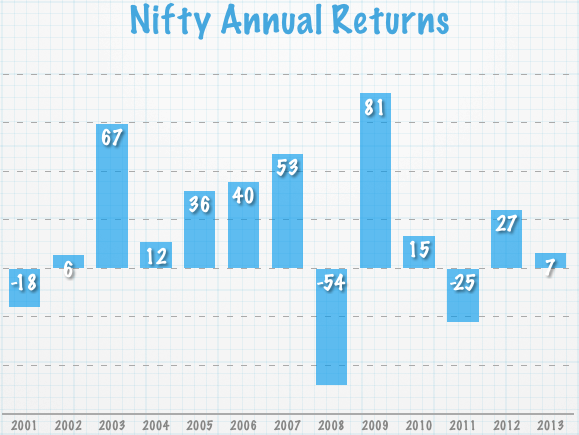
Here’s a chart that shows Nifty annual returns in the past few years.

Nifty Annual Returns Nifty Annual Returns

The future is never more of the past

The chart above shows that things have been going okay for the last couple of years, and generally such an environment lulls you into thinking that more of the past will continue going forward in the future. I know for a fact that the general consensus was really gloomy when the market fell by 54% and absolutely no one expected that 2009 would be a +81% year.

In the short run, there is just no way to predict what the market will do. That is specially true of a year such as this where you have elections whose outcome is very uncertain.

If you are relying on short term market predictions to make your strategy then you aren’t going to be very successful in investing and you are better off sticking with fixed income investments.

What you need is a strategy that doesn’t require you to predict how the market will behave in this year or the next. If you are invested in the market then you do expect the market to be higher than where it is today in 5 or 10 years time but what happens in the short run shouldn’t make much difference to you.

What does such a strategy look like?

My own strategy is one of investing heavily when there is panic or the market crashes badly, and investing moderately and building up cash reserves at other times, and that doesn’t require you to predict the market; just be in a position to react to how the market moves.

As part of this strategy what I plan to do in the recent future is to be invested about 60% in the market and 40% in cash. Right now this equation is 75% in the market, and 25% in cash, and that ratio will change as I sell some of my better performing stocks, and also add more to my reserve. It is important for me to mention here that all of my investments are currently in the US, with about 20% of my equity invested in the India ETF – INDY.

How can you adapt this strategy? 

The point of this post is to see if this strategy appeals to you, and if so, how you can adapt this strategy to work for you. I think the easiest and most practical way to do that is to invest below your comfort level of equity investment. For example, if you’re comfortable with investing Rs. 20,000 per month in equities, invest just Rs. 10,000 and put the rest in a debt fund which you can access at the time of a crash, and invest heavily in the market at that time.

Why not just keep everything in a debt fund and invest at the time of a crash? Well, because you don’t know when the crash is going to come, one year from today, two years from today, or five years from today, and how much the market will grow in the interim, so you don’t want to miss out on the gains that accrue in the interim.

In conclusion, as part of your investing journey you should try to develop a system for yourself that you can adhere to regardless of market conditions, and specially one that doesn’t require you to predict (guess?) where the market will be in ten months or twelve months from now.

06 Jan 03:09

Press Release by Nav Bharat Party on Prashant Bhushan’s views on Kashmir

by Sanjeev Sabhlok

I'm re-publishing Nav Bharat Party's press release of today:

==

Press Release Nav-Bharat Democratic Party January 5th, 2014 on Prashant Bhushan's dangerous views on Kashmir

Bangalore, January 5th, 2014:

Mr. RK Misra, President of Nav Bharat Democratic Party today reacted strongly to the quote of AAP leader, Mr. Prashant Bhushan in the media.

Mr Bhushan has asked for a Delhi style referendum in Kashmir asking people if army should be deployed in Kashmir for internal security and has added that the army is violating human rights. Calling it irresponsible politics – Mr. Misra said “AAP leadership should clarify if Mr. Bhushan’s views are subscribed by AAP as well. If not, then Mr. Bhushan should be asked to either apologize to the nation or to leave the party, because his views show a complete lack of understanding of national security and international geo-politics.”

Nav Bharat Democratic Party candidate from New Delhi Lok Sabha constituency, Veer Chakra Col (Retd) Anil Kaul added “This also shows extreme disregard for the sacrifices made by our armed forces to fight the nefarious designs of our enemies across the border.”

“National security should be accorded the highest priority and such anarchist views play in the hands of separatist elements. This is not the first time that Mr. Bhushan has done this and this shows his extreme views on this very important issue of national security. If these views are subscribed by AAP, which is gearing to fight general elections, the people of India should be made aware of the AAP’s dangerous views on national security”, said RK Misra.

Nav Bharat Democratic Party is committed to a secure, socially progressive, economically developed and efficiently governed India and is planning to contest over 200 Lok Sabha seats in the 2014 general elections.

Suhas S Nerurkar

Party General Secretary

Signature Logo

http://nav-bharat.org/


ABOUT Nav Bharat -
Nav Bharat Democratic Party is a new generation political party, which is committed to a socially progressive, economically developed & efficiently governed India.
 
Nav Bharat’s near term objective – Mission 2014 is to field capable, credible & winnable candidates in strategically selected constituencies representing 55-60 Lok Sabha seats across 5 states. We would seek to participate in the government formation and exert a positive influence on policy making and program implementation.
 
Nav Bharat is your opportunity to engage politically & make a difference. Join us at – www.nav-bharat.org
 
Being political is GOOD now!

06 Jan 03:08

Central Planners and Wooden Boards

by Atanu Dey

central planning In my favourite Bruce Lee movie Enter the Dragon (which I have watched at least a dozen times) there’s a very telling scene. Just before a particular fight, Bruce Lee’s opponent, to demonstrate how awesomely tough he is, holds up a wooden board and with one swift punch smashes it to bits. Bruce Lee impassively looks him in the eye and calmly says, “Boards don’t hit back.”

People are different from things. Things are easy to understand and deal with. But people hit back. They behave strategically. They respond to stimulus and they respond to incentives. This is why economies are hard to understand and even harder to manage. But some people labor hard under the delusion that they can do things that are impossible. Tragic consequences of hubris — somewhat like technological hubris.

Technology’s marvelous ability to bring all sorts of amazing things to life (pun intended) frequently inspires hubris and consequent disasters. Science, in contrast, teaches humility because basic scientific advance more often than not sets boundaries to what is possible.

In any area of ignorance, the limits are not known and everything is possible. But with increasing knowledge of science, we begin to know and appreciate the limits. These limits are useful since it prevents people from attempting to do what is impossible. People had no reason to believe that there is an ultimate speed limit until Einstein came along and showed that there was. Thermodynamics tells us that it is pointless to try to invent a perpetual motion machine. Heisenberg’s uncertainty principle imposed limits on how precisely you can know position and momentum.

There’s an analogue of this in the social sciences. In a sense, economics is the study of limits. The lesson a careful study of economics teaches is humility. One of the most fundamental lessons is that humans have bounded rationality and very limited ability to comprehend (leave alone direct) complex systems.

To the untutored mind, the idea that some social planner could manage a system as complex as a large economy may not be absurd. But it is. Economics says that it is futile to attempt to centrally plan an economy and shows that the problem is essentially an information and knowledge problem.

Central planning is as much an absurdity as the dreams of a perpetual motion machine. But while a crank wasting his life trying to invent one is mostly harmless, great leaders forcing central planning on poor nations inevitably leads to untold misery, poverty and death. The matter gets worse when an economics ignoramus blinded by technological hubris gets his hands on the controls. That’s when you get the most disastrous outcomes.

(Every time you hear of yet another IIT-trained technologist has got into the business of meddling with the economy, be very afraid. Be very very afraid it the person has been a very successful technologist. And be absolutely terrified when it is an IIT-trained technologist with bureaucratic tendencies and delusions of grandeur. Just saying.)

If there’s one lesson that has been demonstrated too often, it is the lesson that central planning does not work. Why, then, you may ask, does it get repeated so often? The simple answer is that it is good to be the central planner — fame and fortune are the perquisites of the job. Central planning enriches the planner, even as it impoverishes the people.

Unfortunately, once the disease of central planning takes hold, there is no escape. Afflicted with poverty, the people clamor for relief and there’s the central planner, ever ready to do a bit more planning, a bit more controlling, a bit more of messing with prices, with quotas, with more regulations and rules and a bit more of redistribution.

So how does this end? People have to stop being wooden boards. They have to hit back.

04 Jan 04:03

Africa’s Companies Need to Become More Like Training Schools

by Bryan Mezue

Youth unemployment is an issue that keeps many African politicians awake. Though data unavailability and informal economic activity make estimates difficult, youth unemployment rates in sub-Saharan Africa are believed to hover around 30-50% (and even higher in parts of North Africa). The World Bank puts the figure at 38% in Nigeria, while the Economist projects 55% for young black South Africans. This is set against the backdrop of a fast-growing youth population, expected to double from a base of 200 million by 2045. Africa’s youth are at a crossroads, and today’s decisions will determine whether they become a demographic dividend or a ticking time bomb.

Companies and entrepreneurs can bring a sustainable solution, while unlocking massive economic opportunity, but a change is required from today’s status quo.

In June 2013, some Harvard Business School classmates and I launched a social enterprise (WAVE: West Africa Vocational Education) targeted at the youth unemployment issue. We identified two sides to the problem: the jobs gap and the skills gap. On the one hand, decades of policy failures and stunted private sector growth have led to a shortage of formal jobs; on the other, many youths leave schools and universities wholly unprepared for employment. Our organization focuses mainly on plugging the ‘skills gap’: we identify, train, and place underprivileged youths in emerging industries like the hospitality sector. However, our experiences so far have highlighted opportunities for even broader impact through a different approach to in-house training at African companies.

A ‘Training-Heavy’ Strategy

Today many African companies employ a ‘Training-Light’ approach. In the hospitality sector, for example, they invest upfront into luxury real estate and equipment, but rarely into training programs. Some may have short onboarding programs for new employees; at best some multinational companies will budget similar training budgets as in their developed market businesses. But there is a marked lack of a holistic training strategy that over-invests in response to the challenging African environment, and prioritizes continuous learning and customer feedback.

Instead African companies need to adopt a ‘Training-Heavy’ strategy, which positions enterprises as remedial schools and emphasizes continuous, metric-based learning. There are many reasons for African companies to step back in 2014 and rethink their training approach:

  • The current system is broken. Many schools and universities pump out students who cannot string together coherent sentences. Companies that fail to take training seriously will face personnel issues sooner or later
  • A good training strategy is directly linked to reducing the unemployment problem. Companies who take the lead will find themselves on the right side of public policy momentum as government concern about the youth unemployment issue deepens
  • A good training strategy is a competitive advantage. In his work on interdependence vs. modularity (pdf, page 13), Harvard Professor Clay Christensen predicts that firms with integrated architectures perform very well in under-served markets with ‘not-good-enough’ products. Many emerging markets in Africa fall into this ‘not-good-enough’ category. In such an environment, companies should see training as an R&D investment – part of their secret sauce – rather than a distracting expense.

There are four essential elements of a ‘Training-Heavy’ strategy:

  1. Train early and often. The inferior quality of many schools necessitates early access to youths through internships, short-term placements and even school-based training programs. By finding high potential candidates early, companies can develop them for many years before bringing them onboard. As soon as the new hire is made, companies should emphasize the employee’s position as an apprentice and present each day as a learning opportunity. Regular job functions should be topped up with frequent top-up training sessions, and continuous access to e-learning.
  2. Use mentors and feedback. Mentorship is well-established within many African cultural norms, and exists in some form in many companies. However, companies should be careful to promote mentor-mentee relationships that are based on competence and company experience rather than external factors like age. Many companies also need to work hard to lower the cultural barriers towards giving and receiving feedback. Company executives can set a good example by being transparent in receiving feedback from subordinates.
  3. Metrics are your best friend. Companies need to identify objective metrics to assess the progress of employees – without metrics any training strategy will be haphazard and unsuccessful. These metrics should be linked to value drivers for the company’s business: for example in the hospitality industry, companies need better metrics on customer satisfaction and how individual employees may have contributed or detracted from it. Today, many hotels and restaurants even lack simple feedback forms, and have absolutely no idea how their customers feel.
  4. Align Culture and Incentives. Ultimately, most transformational initiatives will fail if the company’s culture is not aligned. Company leadership should frequently communicate training and development as priorities and promote objective measurements of employee progress. Compensation, promotions and other rewards should be tied to employees’ performance on the identified metrics.

Africa’s companies and entrepreneurs hold the key to making a real dent on the youth unemployment problem. But first, more companies must take training seriously and embrace a ‘Training-Heavy’ strategy. In my next post, I will address the status quo changes required for entrepreneurs.

04 Jan 04:01

Freedom is Incompatible with Free

by Atanu Dey

I hear that the new Delhi government is promising free stuff — water and electricity. It warms the cockles of this economist’s heart. Actually, I lie. What it does is deepen poverty and make people more dependent. Socialists love people to be dependent on them. So what we have in store for India is continued poverty. But we must remember that this is a choice made by the people of India, not something that is imposed from some force outside India. India is poor because Indians choose poverty over freedom. So be it. As I say, it is all karma, neh? (This piece was published on Niti Central today.)

Freedom is Incompatible with Free

“War is a judgement that overtakes societies when they have been living upon ideas that conflict too violently with the laws governing the universe . . . Never think that wars are irrational catastrophes: they happen when wrong ways of thinking and living bring about intolerable situations.” What Dorothy L Sayers wrote about wars can be usefully applied in the context of poverty. Societies that ignore basic economic principles are overcome by poverty. The most basic of those principles is that nothing can be had for free.

Poverty is a consequence of wrong ways of thinking. The prevalence of poverty shows that there is no shortage of wrong thinking among the movers and shakers of poor nations. The interesting thing is that the poorer the nation is, the more likely it is to suffer from the illusion that things can be had for free. And the illusion feeds back on itself and creates more poverty.

We all know that everything has a cost. Nothing can be had or produced costlessly. You have to either dig it out of the ground, or harvest it or make it or do a hundred different things – all of which requires effort – to produce something. Nothing that is of any use arises unbidden, spontaneously out of thin air. You get to have something when you have paid the cost of producing it.

What, then, does it mean when someone gets given something for free? It certainly does not mean that the free stuff was produced without cost. It just means that the person getting it did not incur the cost of producing it. And it also means that someone else who did incur the cost of producing it did not get rewarded for his or her labour.

Therefore, generally speaking, for there to be “free” stuff, there has to be theft. (The exception is charity – the voluntary giving of things without expectations of reciprocation.) One person cannot get stuff for free without someone else being deprived of what should be rightfully theirs. In societies, this theft is usually mediated through what is called the government. The people in government in such societies have a simple contract with their voters: we will help you in this theft if you support us at the polling booth.

This organized theft has pernicious side-effects. People who are the victims of theft realize that it does not pay to put in effort to produce only to see the result of their efforts being stolen. They therefore rationally respond by not putting in the effort to produce. This leads to less effort and therefore less production. This blunting of the incentive to produce is also seen in those who are the recipients of “free” stuff – if you can get something for free, why bother putting in the effort to produce?

The worst consequence of handing out “free” stuff is that people become dependent on the agent doing the intermediation in the theft, namely the government. Dependency and freedom are opposed concepts. People who depend on handouts from others – including the government – can not be free in any meaningful sense of the term. Accepting free stuff is the quickest road to serfdom.

The sad fact is that people who are determined to become serfs cannot be persuaded to be otherwise. Freedom and free don’t mix.

04 Jan 03:59

Indian Elections 2014 : Aam Aadmi and Power of Social Media

by Kirti

Jahen Daal Daal pe sone ki chidiyaan karti hain basera..woh bharat desh hai mera.

Jab Zero diya mere bharat ne , duniya ko tab ginti aayi, deta na dashawal bharat to chaand pe jaana mushik tha.

Yeh desh hai veer jawanoon ka, albeloon ka mastanoon ka, is desh ki dharti kya kehna, yeh desh hai duniya ka gehna

At the stroke of midnight hour, when the world sleeps, India will awake to life and freedom. A moment comes which comes but rarely in history, when we step out from the old to the new, then an age ends, and when the soul of a nation, long suppressed, finds utterance – Jawahar Lal Nehru’s Tryst with Destiny speech

India a land of sadhuas, snake charmers and poor people.

India and economic liberalization of 1991 

More than one billion people live in India. The nation is about one-third the size of the United States, but more than ten times as crowded. India the world’s largest democracy, and after unsatisfactory progress people of India were getting disillusioned with the politicians.Does my vote actually mean anything? Many believed “No use of voting. All politicians are same, har ko sirf kursi chahiye. A new person in chair probably won’t be any better than the earlier ones. Sorry to be so cynical but all Indian politicians end up the same when they are in power”

But slowly things changed,

  • Anna Andolan, made people of India wake up, express discontent.It made them realise that there is hope. Recent state elections have been eye-opener not only for the old political parties like Congress and BJP  but also for people of India.
  • Like world over aam aadmi, also realized that he has the power of Social media. Social media’s significance and role is palpable in how regime change demands were instigated in the Middle Eastern Arab Spring or an Istanbul Awakening or a Brazilian protest. Social media is empowering citizens to ask questions and demand answers. It is influencing opinions and pushing leaders to be transparent. Politicians and parties having realized the importance of social media, they are using social media as platform to attract youth. They are running social media campaigns. Social media is different from traditional forms of campaigning, it is direct communication  and that too two-way, it allows the audience to talk back. There is no intermediary.
  • Smart phones through the apps have made world a touch away.

Question  is how to build the momentum to make people exercise their right , their right to vote.  Social media is powerful but can also encourage and reward a shallow posturing culture in society. How do we harness the power of social media for a more engaging and productive debate that focusses on real issues in depth? If aam aadmi, social media and mobile apps can be  used together and  effectively it could make people exercise their vote for India General Elections 2014. Let’s look at some of the ways it can facilitate.

Increase awareness, Motivate : Exercise your right, Vote

 There are two areas that needs to be addressed. One is making people aware of  importance of voting, of how their vote counts, it matters. Secondly is motivate the people to actually go and vote.  We know we should vote. We understand the rationale behind it but…some of us become lazy, it’s just one vote, it doesn’t matter, it’s like drop in the ocean. So apps need to be developed to repeat the importance of voting through videos, songs, speeches, games,quizzes, contests. Aristotle once said “It is frequent repetition that produces a natural tendency.

  • If you don’t vote, you are killing democracy
  • Your single vote can help select the right candidate
  • To bring positive changes in society, one must vote
  • Voting gives us a chance to voice our opinion
  • Elections are an expensive affair. As per Ministry of Law and Justice, 2009 election cost was around 1200 crore. The 2004 Lok Sabha elections had cost the country Rs 4,500 crore against about Rs 3,200 crore in 1998 and Rs 2,100-2,200 crores in the 1996 Lok Sabha elections. Ref : Livemint’s Lok Sabha polls to cost more than US presidential election. More details at Open Governance webpage
  • How Politics has affected Indian economy as shown in image below (click on image to enlarge)
Indian politics and Economy

Indian politics and Economy

Provide Information to make the Right Choice

To make the right choice one needs information about the issues in the elections, parties involved, notifications regarding the latest happenings, the bigger picture. One also needs the local information about the candidates standing from their constituency, the work that they have done,their records. The information can be in varied forms : aggregation of data, links, most talked about articles,tweets,videos, summarise, declutter information. We also need a platform to discuss and debate issues,where anyone can ask pertinent questions and seek meaningful answers from our leaders, experts. Ex of information about candidates from ET is shown below,

Information about the candidates

Information about the candidates

Get set to vote

Need apps to verify that one’s name is in the voting list, know their voter id. Know where the voting booths are, directions to the booth. Maybe facilitate people to go together and vote, have their experience, pictures of having voted shared.

Our contribution 

I would encourage my readers to vote for general elections in 2014 by writing articles related to elections, using apps for facebook,twitter,pinterest to share information. Making people realise the “Power of Common Man”. Use technology like groups in wechat, google hangouts,facebook to discuss, debate about the general elections.Ask not what your country can do for you but what you can do for the country.  Making them aware of apps like India Politics app.

India Politics App

India Politics App

Note: This is entry for Indiblogger contest 

Related articles :

04 Jan 03:58

Where India's financial sector is truly world class

by T T Ram Mohan
India's financial sector is truly world class on one dimension- gender equality. Female-led lending institutions control 40% of assets, a figure not matched, perhaps, by any other economy's financial sector, says a report in FT. Some of the institutions that have female heads: SBI, Axis Bank, ICICI, JP Morgan, HSBC, Morgan Stanley and NSE. At one point, two out of the four deputy governors at RBI were women. Whew!
04 Jan 03:57

History would have been kinder had PM Manmohan Singh quit in 2009

by Bibek Debroy

Probability of UPA-III is low. Conditional probability of MMS as PM, assuming UPA-III, was also low. After the press conference, a rarity for PM, we formally know this conditional probability is zero. To use MMS clichés, only time will tell how historians judge him. However, had he opted not to remain PM in 2009, history would have been kinder. Despite whiffs of global slowdown being felt, economy was in better shape. There was glory of the nuclear deal, even if resultant power outcome was uncertain. The taint of corruption, and this isn’t just about family and friends, was fainter and hadn’t surfaced in entirety. (The argument that corruption didn’t show up in 2009 electoral outcomes won’t wash, though MMS has stated this more than once.) Trappings of power get to the best of us and few time exit when the going is good.


Under UPA-II, MMS presided over massacre of the economy and was an irrelevant PM (witness undermining of PM and PMO and collective decision-making in Cabinet) in a government widelyperceived to be the most corrupt ever. PPP came to be interpreted as perpetual policy paralysis. When government and PM use indicators to highlight the economic track record, it is invariably an average for entire UPA, subsuming UPA-I and UPA-II, and downplaying deceleration under UPA-II.


Why has UPA-II fared badly? The MMS lament lists malign global environment, coalition politics, recalcitrant opposition, unkind civil society and media. Anything but mea culpa and pointing a finger towards government. If government warrants none of blame under UPA-II, by the same token, it merits none of credit under UPA-I either. Any objective moving finger will write about executive collapse and fiscal profligacy. While definitions of reforms vary, as can their prioritization, there were few under UPA-I too. (Indirect tax reforms and roads were a legacy and MGNREGS/RTI aren’t quite reform.)


The economy chugged along, because circumstances were favourable. One doesn’t have to be a rated (under or over) economist to figure out toll such entitlement-based expenditure has on growth and inflation, with a lag, and with an unfavorable external world providing an unkind cut. As head of government, why didn’t PM put his foot down? After all, he was branded as harbinger of the idea whose time had come in 1991. There is only one answer. The 1991 branding was wrong. He wasn’t the head in 1991. Nor has he been the head since 2004. Both in 1991 and since 2004, he has been a risk-averse civil servant, hands rather than the head, doing what he has been asked to do, and hedging against transfers. Thus, an economy’s assets turned into liabilities.


Even in instances where the head wouldn’t have objected, the hands didn’t move. Oddly, an economist did nothing to leave his imprint in the economic domain and concentrated on foreign policy, int erpreted as US and Pakistan. (Natal chords from Pakistan still tug at his heart.) Not just with these two, but elsewhere too, foreign policy is in a mess. Relationships with a neighbor got stuck because PM couldn’t speak to a CM. Posterity’s historians will tell us whether this was because of some kind of Oslo or Stockholm Syndrome.


In the present, economics should have been a forte, but became weaker. Foreign policy was always a frailty, but became weaker still. If a person who was respected in 2009 became an object of ridicule in 2013/2014, MMS himself bears much of the blame. This isn’t only due to policy failures, but also because he, cocooned in 7 RCR, rarely communicated to the country, when all was not “theek hai”. He didn’t take the country into confidence and it shouldn’t be surprising that the country has no confidence in him. That is an omission that commissioned historians can’t rectify.

04 Jan 03:54

Inheriting a rich past will make their future richer

by Reshmi R Dasgupta

A school friend, visiting from the US, returned home with a bell metal idol of the Goddess Saraswati earlier this week. She was prompted by her son, a Harvard freshman, getting an email with the Saraswati vandana ahead of his first semester exams from the famous university’s Dharma Association. It touched a chord in this bright American boy with a Punjabi mother and Tamilian father and got him thinking.


Born and brought up in the US, this boy — like many other kids of Indian immigrants — is probably more conversant with traditions and culture of his parents’ motherland than his co-generationists in India. Significantly, he and his younger brother have read all the popular children’s stories that are now fashionably decried here and imbibed his parents’ Sikh and Hindu customs.


So, he has gone to Harvard as an Indian-American unabashed about his heritage, and finds no inconsistency between his scientific temper —he will probably major in maths and physics — and his cultural moorings. Yet, in India, similarly educated urban parents, perhaps because of proximity to the fount of their culture, are chary of initiating their children into it for fear of being dubbed “old fashioned”.


This clash between modernity and culture presents India with a unique challenge and we can learn a lesson on that from our diaspora. Not from those NRIs who live out their fantasies of an unchanging India but from those like my schoolmates who distil and pass on the best of Indian traditions as a sheet-anchor for future generations as the world becomes smaller and homogenous.


The challenge is unprecedented because for the first time in India’s long history, many Indians are emigrating around the world and more will follow as opportunities open up. Already, the middle class has seen entire generations moving abroad. Add to that the pressure to “fit in” to foreign societies, and the likelihood of a break in our multi-millennial cultural thread shoots up.


But this wilful disconnection with Indian culture is really not necessary as this young Harvard freshman’s example demonstrates. His identity as an American is, in fact, enriched by his north-south Indian genealogy, his legacy of our history, philosophies, culture and experiences will imbue his scientific endeavours with an additional perspective. Our new generations here need to be similarly equipped.


For that, we need to preserve every facet of our culture, including our religious heritage, and pass it on conscientiously but without squeamishness. And then it should be left to the common sense of the youngsters, domiciled here or merely ethnic Indians, to utilise their heritage in the future, wherever they may live, love and work, with a similar even-handedness — and pride.


Unfortunately, now there is a ringfencing of religions and cultures here. Cross-fertilisation — a hallmark of our long south Asian journey — or even devotion is regarded as aggressive or regressive. Not only does that hinder an honest dissemination of perfectly innocuous religious and cultural traditions, it fosters a skewed view of how different threads have peacefully intertwined and continued for millennia.


An incident my father recounted when he was growing up in Barisal, now in Bangladesh, is instructive. With matriculation exams approaching in 1942, some senior boys performed a pujato propitiate the Goddess of Learning, Saraswati. Their Muslim classmates also participated enthusiastically — on the very logical (and syncretic) grounds that any divine help is welcome when exams loom!


The latter was probably the reason why Harvard’s Dharma society sent that Saraswati vandanato a certain bright Indian-American freshman. But a continuation of the spirit of my father’s time would have led them to send it to students of all ethnic and religious backgrounds. Happily, that still may happen at Harvard. But if India’s culture and traditions are to survive, we need to shed our so-called “modern” inhibitions.

04 Jan 03:49

Indians may have one servant, but US kitchens run by many

by Vikram Doctor

Among the many reactions arising from the Devyani Khobragade affair one of the commonest, from Americans, has been the question: "But couldn't she do the chores herself?"


Most middle-class Americans do their own cooking and cleaning. So if middle-class Indians, whether abroad or in India, depend so much on servants then they must be lazy, full of a sense of entitlement and cruelly ready to exploit Indian income differentials.


I've been asked if these attitudes come from the caste system.


Many of these Khobragade stories have been running alongside coverage of ongoing battles by supermarket and fast food industry workers to raise their minimum wages which are often barely enough to allow a decent existence.


This only suggests that life is more complex than people asking that question might imagine. A major reason Americans can manage without servants is because so much of what servants do in India has been outsourced to the vast American service and retail industry whose labour practices are fairly dubious.


Cooking in New York City can be a simple matter of picking up a bag of salad (washed, cleaned and only needing added dressing, also probably ready-made) and a steak (neatly trimmed and ready to grill). But behind this is an army of low-paid farm labour - many of them illegal immigrants - who grow, clean and bag those salad greens; abattoir workers, often working in awful conditions, to kill, cut, clean and package the meat so neatly it hardly seems to have any connection with any animal; transport workers to take the food across the country, and supermarket workers to stock the shelves.


When it comes to service, someone somewhere is always being exploited, but Indians may just be more open about it.


A Legacy of World War II


When it comes to service, someone somewhere is always being exploited, but Indians may just be more open about it. For a long time, Americans were too.


This year marks the centenary of the start of the event that really doomed domestic service in the Western world: World War I, which opened up jobs in munitions and other industries to the women who earlier might only have got jobs as cooks and maids. And killing of so many young men ensured that some of those jobs remained after the war.


Domestic service was never easily available after that in Europe, but the US benefitted from the many people who fled there in the interwar years. Two classic of American food writing - Wanda Frolov's Katish: Our Russian Cook and Samuel Chamberlain's Clementine in the Kitchen - are warm, delightful books, replete with recipes of women who left Russia and France in those years to find happiness by cooking for American families. There's no suggestion of exploitation in these stories (Chamberlain's, in any case, was mostly made up), but they show a USA which took domestic service for granted.


This suggests that the real difference with domestic service comes not from social attitudes but access to alternative economic opportunities. Post WWII, American women got even more chances to work outside domestic service. (Kathryn Stockett's The Help, set in the 1960s, shows how the issue persisted with disempowered black women). As it happens, much of this work was in the service sectors to which domestic work was outsourced, but at least they were more independent and didn't have the humiliations that came with the earlier domestic jobs.


Still, it is ironic that David Cay Johnston, a writer specialising in finance and inequality in the US, has pointed out that low minimum wages and the refusal of companies to pay more (not least because anti-labour legislation has weakened unions) have combined with rising living costs to make service workers possibly worse off than earlier domestic workers. In words that echo some of the arguments of Khobragade's supporters, Johnston recently wrote in Al-Jazeera America: "The 1910 cook got room and board while the 2013 cook must provide his or her own living space and food." The 1910 cook also had tax-free income and no commuting costs, which today's cooks in restaurant jobs don't enjoy.


These ambiguities are worth keeping in mind as India starts to undergo the same processes the USA did in the 1950s. In large cities we are no longer the place of unquestioned domestic service that some US stories have portrayed. Servants are hard to get and complaining about the ones that are available is a favourite middle-class pastime. In Tamil Nadu and Kerala, you see how opportunities for women plus a network of government benefits have made domestic service less imperative - and it is no coincidence that such states are also leaders in compensatory services, such as retail outlets that sell cut vegetables, packaged versions of traditional foods or wet-grinders to replace the tedious grinding of idli-dosa batter.


Any servant-deprived person who sees this as a problem should read The Hour of the Goddess, Chitrita Banerji's brilliant collection of essays on women and food in Bengal. In the chapter entitled 'Patoler Ma' she recalls the woman who came everyday to grind spices in her family house. Working the stone shil-nora, the grinding surface and grinder, she broke hard lumps of turmeric, gritty dry spices, pungent chillies, eye-watering onions, but as she once told the girl Banerji was, these were spices she could not afford: "We only handle and smell it in the homes of people like you." Little wonder that Banerji concludes that she found it hard to object to the advent of electric grinders, easily substituting such endless, sad work.


I have to admit though, when I read that chapter, I guiltily remembered how much I prefer the slightly coarse textures of such hand ground spice mixtures and chutneys, done by my mother's maid, to the overly smooth mixie versions I make myself (before I get an angry call from my mother, I should note her maid is paid well enough to afford the same spices!). And I also remembered how chef Ananda Solomon, who feels the same way, had decided he needed such hand-ground masalas for Konkan Cafe, his outstanding coastal cuisine restaurant in Mumbai (which has recently reopened after a revamp).


Chef Solomon solved the problem by persuading an old lady in Goa who was an expert at such grinding to join his kitchen team in Mumbai. She was given salary and status on par with his young chefs, wore a white coat like them over her traditional nauvari sari, and hand ground the restaurant's requirements. Obviously this was an exceptional case, only possible in a luxury restaurant. But I hope, without quite knowing how it can happen, that as we evolve our approaches to domestic work, we find solutions like this that preserve and give full value to what was good about domestic work, instead of opting for the American model, superficially more equal, yet with more than one kind of hidden cost.


04 Jan 03:37

The continuing betrayal of India by so-called “liberals”

by Sanjeev Sabhlok

Swami Ramdev called Arvind Kejriwal a communist and despite knowing full well that BJP's policies are almost as socialist as AAP's, switched support to Modi. All this despite our 10 day discussions in Patanjali, in which we worked out a new party that would lead India to a new era. Six months I worked with him, and he switched without any consultation to Modi to the criminal, socialist Modi.

[I'm not saying that Ramdev is a classical liberal: his many recent sayings confirm his social conservatism. But on economic issues he is convinced that the government should not be in business.]

Shantanu Bhagwat swore on the joining conditions of FTI (which were established by me in the book, Breaking Free of Nehru) and committed himself to liberalism. But now has joined communist AAP.

No discussion with me. Just walked out and joined AAP. So he lied to me and lied to FTI.

And now Meera Sanyal, allegedly the president of the Indian Liberal Group. She has not only joined AAP but is making ALL KINDS OF FALSE STATEMENTS, FROM DAY ONE. This is what she has said: "From what I have seen, the policies are pragmatic and favour enterprise".

How can Meera possibly say that? Where's the proof of AAP being market friendly? ALL its founding leaders are deeply socialist. AAP's policies have followed the SAME socialist path that Indira Gandhi laid out. Even more socialist. Communist Party agrees with such polcies.

So we see the ongoing betrayal of India by these fake liberals of India, who do not know what they stand for and are keenly supporting socialism – the ideology that has DESTROYED INDIA.

Alternatively they are opportunists.

And they claim to be "honest". There is a thing called integrity they don't understand.

If this is all about power, so be it. Greed for power has turned millions of minds in the past, and will continue to do so. Power corrupts, but even the prospect of power corrupts.

But NONE OF THESE ACTIONS WILL HELP INDIA.

This amounts to a betrayal of India. I put them in the same basket now, as other socialists. Enemies of India.

If Ramdev had managed to change BJP, or Shantanu or Meera changed AAP, I'd have at least understood what they are doing. But they are all opportunists, is all I can deduce at this stage. They are starting to DEFEND socialist policies/ evil.

Ramdev has kept quiet about the sage of Mansi Soni. Shantanu is keeping quiet about AAP's free water and other socialist policies. Meera is starting to DEFEND the indefensible.

Honesty? What do these people know about the meaning of honesty?

03 Jan 10:21

Eliminating corruption from the Indian real estate sector #2

by Sanjeev Sabhlok

Continuing from here. [This topic is extremely topical, given the new Land Acquisition Act in India which effectively accepts that the price declared to the government is about one fourth its true value.]

 
FIVE PILLARS OF THE REAL ESTATE MARKET IN VICTORIA
To understand how a TOTALLY FLAWLESS system operates, I would like to outline the Victorian system. There is much to learn from this extremey well-designed system. Note that each of the five pillars outlined below is crucial. If any one of them is missing, rampant corruption will be certain – even in Victoria.
 
In brief the pillars are:
1. Independent record-keeper of ownership of land
2. Independent collector of stamp duty
3. Independent valuer of all lands in Victoria
4. Independent private real estate agents whose licence is conditional on ensuring integrity and probity.
5. Market based salaries (and contractual accountability) of all government functionaries.
 
1. Ownership of land: Independent land records management (Land Victoria)
Land records are managed centrally in the state of Victoria through a computerised database. The Torrens based system issues a Certificate of Title to the owner, on production of proof of identity. The system is supported by conveyancers (legal practitioners) who complete all forms, certify the truthfulness of the facts, and lodge them on behalf of the bank/buyer. With an electronic conveyancing system now in place (the first in the world), there is no face-to-face interaction between any of the parties involved: hence also limited opportunity for corruption. An authorised conveyancer sitting in one part of the world can now easily complete and lodge all documents for transfer of land title.
 
2. Payment of duty: Independent stamp duty collection (State Revenue Office)
The job of the land records managers is only to manage land records (names of onwers of land). They don’t deal with money at all. Money (stamp duty) is collected by the State Revenue Office.
 
Duty payable is based on the market value of the property or the purchase price, whichever is greater. The government has access to the estimated market value of all lands – which is prepared by a separate independent agency: the Valuer-General.
 
The SRO is very fussy about what it will accept as proof of the value of a transaction. Thus:
 
a) If the property was sold in the open market through auction, the SRO will accept the value certified by the relevant real estate agent.
 
b) If a “private sale” through a real estate agent, the SRO will accept the relevant certificate of a real estate agent.
 
c) If sold privately then the seller will still have to hire a licensed real estate agent to provide a letter of appraisal. This could also be procured from a certified practicing valuer who is a member of the Australian Property Institute (API) or from a member of the Real Estate Institute of Victoria (REIV) with a sworn valuer accreditation.
 
d) This form on the SRO website allows people to self-declare but with detailed explanations. Furher, the latest council rates notice will need to be provided (which contains the Valuer-General’s estimate of the property’s value). 
 
In this case (and in any other), the Commissioner will form his own opinion about the market value and charge stamp duty accordingly. In some cases, where the Commissioner considers the value is understated, the Commissioner may obtain a valuation of the property from the Valuer-General. If the valuation obtained from the Valuer-General exceeds the value provided in the taxpayer's information by 15 per cent, the taxpayer must pay the cost of the valuation.
 
3. Valuation of all lands: Independent land valuation (Valuer-General)
This is a critical part of the system, under which ALL property in Victoria is assigned a market value by an independent Government agency. This agency doesn’t deal with ownership nor with valuation at the time of transfer. It only assesses the market value based on all available evidence (including its own valuers). A database of 3 million properties is updated each year based on a complex but empirically tested methodology. This valuation is then used by local governments (councils) to set rates, and by the government to set the fire services property levy.
 
4. Certification of authenticity of the complete land transaction (ownership and value): Independent real estate agents 
A significant number of properties are sold through auction by agents. In Victoria, “The public clearly understand that appropriate licensing and educational standards not only underpins the best outcome for those selling, buying or leasing property but also ensures consumer protection.” [Source]
 
The Victorian Sale of Land Act 1962 states that:
29W Legal practitioner not to act for both vendor and purchaser under a terms contract
s. 29W
(1) A legal practitioner whose principal place of business is within a 50 kilometre radius of the intersection of Elizabeth and Bourke Streets in Melbourne must not act for both vendor and purchaser under a terms contract.
 
The seller’s real estate agent is paid a proportion of the sale price (generally around 4 per cent, which covers all costs of advertising and conduct of the auction). This aligns the interests of the seller and agent – to maximise the price of the property. The buyer, however, wants to pay as little as possible. This competitive tension leads to the discovery of the true market price. Since the agent is paid through the buyer, he will declare true value.
 
Most importantly, however, if any evidence arises (through database analysis or otherwise) that an agent has under-quoted the true price, the agent will lose his licence and entire business. I gather that this is almost unheard of, with no instance known of under-quoting. 
 
Cancellation of licence of real estate agents
The Estate Agents Act 1980 allows for the licence of a real estate agent to be cancelled if:
S22 (2)
A person's licence as an estate agent is automatically cancelled 30 days after the person—
(a) is convicted of, or has found proven against him or her, any offence involving fraud, dishonesty, drug trafficking or violence which is punishable by imprisonment for 3 months or more; or
(b) has, in relation to anything she or he has done or not done, a claim allowed against the Fund under Part VII or any corresponding fund established under any corresponding previous enactment; or
(c) is made the subject of an order by any regulatory body in or outside Victoria disqualifying him or her from acting as an estate agent or agent's representative (or an equivalent occupation under the jurisdiction of the regulatory body).
Inspection of agents
The act also provides for rigorous audit and inspection of agents's businesses by the government.
Inquiries into estate agents
s. 24C
(1) At any time the Director or the Chief Commissioner of Police may apply to the Tribunal for the holding of an inquiry to determine whether an estate agent—
(a) has contravened or failed to comply with this Act or the regulations; or
(aa) has contravened or failed to comply with the Sale of Land Act 1962; or
(b) is of good character or is otherwise a fit and proper person to hold a licence; or
(c) has been guilty of conduct as an estate agent which renders him or her unfit to hold a licence; or
(d) improperly obtained, or is improperly holding, a licence.
(2) In addition to the matters listed in subsection (1), in the case of an estate agent that is a corporation, the Director or the Chief Commissioner of Police may also apply to the Tribunal for the holding of an inquiry to determine whether a director of the corporation or the officer in effective control of the estate agency business of the corporation or, in the case of a private corporation, any member of the corporation—
(a) has contravened or failed to comply with this Act or the regulations or has failed to pay any fines imposed on him or her, or any costs that he or she was required to pay under this Act; or
s. 25
(aa) has contravened or failed to comply with the Sale of Land Act 1962 or has failed to pay any fines imposed on him or her, or any costs that he or she was required to pay under that Act; or
(b) is of good character or is otherwise a fit and proper person to hold a licence; or
(c) has been guilty of conduct as an estate agent which renders him or her unfit to hold a licence; or
(d) improperly obtained, or is improperly holding, a licence.
How to become a real estate agent
You must:
be at least 18 years old.
You must not:
be disqualified from holding an estate agent’s licence or acting as an agent's representative (or equivalent)
be a director or an officer of a company disqualified from holding an estate agent's licence (or equivalent)
have been a director or an officer of a company when it was disqualified from holding an estate agent's licence (or equivalent)
be a represented person under the Guardianship and Administration Act 1986
be the subject of an order by any regulatory body disqualifying you from acting as an estate agent or agent's representative.
For more information, view our Disqualification and permissions – estate agents page
Experience
You must have gained the equivalent of at least one year’s full-time experience as an agent’s representative in the three years immediately before applying for a licence.
Education
To meet the educational requirements to gain an estate agent’s licence, you must complete either the current course:
Certificate IV in Property Services (Real Estate)
or previously have completed one of the following prescribed courses:
Certificate IV in Property (Real Estate Agency Practice)
Certificate IV in Business (Estate Agency Practice)
Bachelor of Business Property (Agency & Marketing Stream)
Advanced Certificate in Estate Agency
Advanced Certificate in Real Estate
Certificate in Business Studies (Real Estate)
Estate Agency Certificate
the 16 prescribed units or equivalent units of the Certificate of Business Studies (Real Estate), started before 1 January 1987.
Your course must be delivered by a registered training organisation.
If you completed your course more than five years ago, you must also meet the prescribed course requirements under the Estate Agents (Education) Regulations 2008.
5. Market-based salaries for officials, and contractual accountability for senior officials
This is perhaps the most important of all – that the officials managing the system are well paid but held to account. The independent agencies are managed by highly qualified and paid professionals who are held to account in a number of ways (all senior officials are on contract, with the right to be fired without notice on even the slightest suspicion of corruption). I’ve detailed this system in BFN in chapter 4, at great length, so I won’t repeat it here.
 
Overall, corruption is UNHEARD OF in the Victorian real estate system. [Some corruption has been reported in the issue of permits to developers, but that’s a totally different matter and I’m not covering that issue here]
 
Summary
The Victorian system begins by asking: Why do people behave the way they do? Then it works out methods to ensure that the DESIRED OUTCOME is achieved despite the tendency of people to behave in the manner they do.
 
The Indian system runs on hope and wishful thinking. That's the key reason why it is a TOTAL DISASTER in every way.

Note that I've not provided all details of the system to Arvind, yet. The same five pillars, but there will need to be a few other changes as well. Even with this information I bet that he can't eliminate corruption. 

In the next blog post I'll outline the transitional steps from the Indian system to achieve a system that will be FOOLPROOF and completely free of corruption.

03 Jan 03:13

Why education should be made interesting?

by Ashvini Kumar Saxena

History is a great subject, equally interesting as science. However , in schools history is treated as just another subject, to be crammed at home and spitted in the exam. One rarely learns from what history actually teaches us.

I did my schooling years back and I remembered was that despite my deep interest in science, I liked history too very much. However more than the  text book of history I liked a comic series known as Amar Chitra Katha . Loosely translated as the legends that never die and expressed in pictorial forms, Amar Chitra Katha was my source of history. It taught me far more bigger concepts about history than any other text book did.

Why the text books need to be so boring ?

Unfortunately the purpose of academics in school is still to force students to cram unnecessary details like remembering figure of years( for eg 1867 )  when something took place in history rather than the impact it had on the world. This can render even the most exciting subject to dullest ever.

Even science is made dull because of overly high level of details which does not make any sense to young minds.

In this video , Tyler Dewitt talks about how a really difficult subject in science can be made easy to understand to the students if taught creatively.


Why should we make education interesting ?

The application of education has been to analyze things around us and then innovate and think independently. In today’s world, being ordinary is just not okay. One needs to find their sweet spot and build on it. If the kids’ imagination is not fired today, it is quite unlikely that a lot of them will go out and create extraordinary things. To stand out in the competition, it is not just good enough for society to create legions of literate people who cannot think for themselves.

We need more entrepreneurs, innovators and thinkers. It starts right there at the school level. Education should be able to trigger creativity rather than boredom.

02 Jan 04:16

Damage caused by Americans

by subra

We must thank the Americans for many good things that they have given us – of course for a price. Right from the fantastic technology platforms, Facebook, etc. etc.

On the other hand we must also know what huge damage they have done to the whole world. The damage that they have done and continue to do to India include the damage to the environment. And I am not even talking of all the porn, armaments, and the sin industry that they encourage. I am talking about their Big Food, Big Finance and Big Medicine – the damage that they are doing is really huge.

Look at what Coke, Pepsi, McDonalds, Dominos are doing to the youth. Every MONTH one kid in the office goes for a kidney stone operation. This happens simply because the simple water has been replaced by Coke, Pepsi or Thums Up.

The medicines that they have patents on are priced about 100x the cost to the wholesaler – and we get it at about 200x the costs.

Do we have a choice of whether to use their products? Sure we do. However their advertising to the brand slave generation ensures that the consumption goes up dramatically. The consumption of soft drinks has gone so down market that in big shops it is easy to see the financially weakest people buying big bottles of soft drinks and packets of chips.

Shame on the government of India for allowing all these products to be taxed so low. Let us face it chips and sugar colas are not FOOD. They are junk which cause a lot of harm to the bodies and the disposal of bottles causes a lot of damage to the environment.

 http://www.youthkiawaaz.com/2013/12/inspiring-story-struggle-coca-colas-attempt-destroy-environment-profit/


Post Footer automatically generated by Add Post Footer Plugin for wordpress.

02 Jan 04:14

The family living just outside Arvind’s office cannot benefit from AAP policies

by Sanjeev Sabhlok

True, Arvind's Parvirtan office in Kausambi is not part of Delhi, so his reach doesn't apply there, but this is the TYPE OF FAMILY who will not benefit from the reckless policies announced by AAP.

All its subsidies are directed towards the middle class – who don't need subsidies but assurance of economic growth through private enterprise. The real poor get NOTHING from Arvind's policies.

Source: My meeting with Arvind Kejriwal: a picture gallery.

Arvind's human neighbours who live practically in the same condition as wild cows, dogs and pigs.

01 Jan 09:59

2014 is here; What will you invest in?

by Dhaval Shah

As 2014 begins tomorrow, what asset classes are you planning your investments in? Real Estate? Equity? Gold & Silver? FD/Bonds? Or Cash? 2013 was marked with high volatility. Let us look back at few important instances of 2013. On 1st January 2013, Sensex was at 19,580 and at the year end, it is trading at around ...

More articles of Dhaval Shah

01 Jan 09:59

Simplify your financial life!

by subra

‘Subra I really feel I should have met you 30 years ago and my life would have been different’…..

‘Subra I wish you REALLY my father….my REAL father does not allow me to invest even my OWN MONEY.

‘So lucky Subra I met you when I was 22, my SIP is now 5 years old! Thank you…

‘Subra I wish my father had seen your blog 30 years ago….he is a financial mess at age 65 and completely dependent on me’

All reader sentiments….so here are some tips which will make you echo the same sentiments, again. It is not as though I have not written about them earlier, but then some reiteration is useful, especially on 1st of Jan, right? So here it is:

1. Pay your self first….if you do not know what it means…here is a link! http://www.subramoney.com/2013/12/pay-yourself-first-means-what/

2. Be financially literate. Read blogs, websites, books,…if you do not know which books to read here is a link! http://www.subramoney.com/2010/01/best-investment-books-to-read/

3. Buy term insurance. Pure term. Here is a link http://www.subramoney.com/2013/03/buy-pure-term-insurance-only/

http://www.subramoney.com/2012/09/buy-term-life-insurance/

4. Earn well. Spend smartly. Save well. Then convert these savings to Investment. http://www.subramoney.com/2011/07/earnings-spending-saving-and-investing/

5. Do asset allocation – you need lots of equity, some debt, real estate, gold in your portfolio. Choose dosage according to YOUR taste. My portfolio cannot be cut paste for all of you. Each person has to build his own according to his/her requirement.

6. If you are planning to do a business, start early there too! It is easier to handle small failures rather than big ones. If you are not generating enough cash in your business and you have no clue who will fund those losses, you are better off working for somebody.

7. If in a poker table you do not know who is going to be had that evening, it is you. True in real life also. Nothing changes, really.

8. Use your financial literacy while buying financial products. Even then keep it simple. If you do not understand, say NO.  http://www.subramoney.com/2011/09/one-word-that-can-make-you-rich/ 

9. Keep financial products / trading costs / holding costs low, but still be with reputed providers. Keep seeing the SEBI website for prosecutions. Keep a financial diary and have your investment philosophy statement ready.

10. Keep financial records properly and ha! Make your will. I know you will live for another 240 years, but still please make your will.

11. Do I need to say this? read www.subramoney.com – and please click on the ads – remember they are helping US to keep this free :-) we need advetisers!


and ha! Happy New Year……..

Post Footer automatically generated by Add Post Footer Plugin for wordpress.

01 Jan 09:57

Advice For Would-be Bloggers

by David Merkel

Today I read the following article 2014 Resolution: This Year, I Will Blog.  Good article, and it features useful advice from Susan Weiner, who writes the blog Investment Writing.  I think highly of Susan, and we are having her come speak to the Baltimore CFA Society on March 24th.  Writing is not so well-learned among many investment analysts, and employers of analysts would like to see better quality writing out of their employees.

But in response to the blogging article, I would like to give a few tips on blogging.  Most of these won’t be very profound, but there is basic “blocking and tackling” to do if you want to be a good blogger.

1) Choose the periodicity of your blogging.  Will it be multiple times per day, once a day, a few times per week, once a week, a few times a month, or monthly?  I think that is the limit in terms of keeping the attention of readers — you can’t blog less than monthly.

Now, the less frequently you blog, the higher the quality has to be.  Length is not an issue here.  Post length is not correlated with quality.  Make your thoughts and words count.  There is no prize for number of words.  There are only prizes for value added.

One more thing: once you choose how often you want to blog, stick with it.  Regularity is needed to establish an audience.

2) Define the area in which you want to blog.  What is your differential insight?  Where are your thoughts strongest versus the consensus?  There are relatively few bloggers that can cover a wide area.  (And as one that does cover a wide area, it means that posts covering different areas may not interest some of your readers.)

3) Start small.  You don’t have to write masterpieces from day one.  Commenting on articles that you excerpt can be a great way to begin.

Another great way is to start assembling linkfests a la Abnormal Returns.  You will not likely do better than Tadas, but I have seen many small linkfests that are worth reading.

4) Ask who your target audience is.  Are you aiming at professionals, intelligent amateurs, or Joe Lunchpail?  Then tailor your language to fit the audience, as well as your choice of topics.

Also remember that other bloggers and journalists may link to you, so consider what your extended audience might be like.  (I’ve seen my articles translated into so many languages that I have lost count.  I never thought that would happen.)

5) Get ready to be hurt.  The internet is a cruel place, and there is all manner of anonymous backbiting that goes on.  But there are way to minimize it:

  • Have a comments policy, and block people from commenting who violate it.
  • Be humble in your writing; more attacks come to those who are brash.
  • Double-check what you say before clicking “publish.”
  • When you are wrong, own up to it.  That establishes credibility, it does not destroy it.
  • Avoid profanity.  Bloggers that use profanity attract a bad crowd of commenters.

6) Reach out to other bloggers.  Link to good stuff from other bloggers, and when you write something good, send a copy to bloggers you respect (not too often).  Respect the time of leading bloggers, and only send the best.

7) Use Twitter, LinkedIn, and Facebook to expand your distribution.   Social media can enhance your influence; just be sure not to annoy your readers.

8 ) Be ready for the long haul.  Don’t enter into this unless you are thinking of doing this for years.  Of the major bloggers I knew back in 2007 when I started Aleph Blog, most of them are still in the game, and they are still hot stuff.  But I have seen many promising bloggers put out a few significant posts and fold.  It is like what Jesus said [Luke 14:28-33]:

For which of you, intending to build a tower, does not sit down first and count the cost, whether he has enough to finish it— lest, after he has laid the foundation, and is not able to finish, all who see it begin to mock him, saying, ‘This man began to build and was not able to finish’? Or what king, going to make war against another king, does not sit down first and consider whether he is able with ten thousand to meet him who comes against him with twenty thousand? Or else, while the other is still a great way off, he sends a delegation and asks conditions of peace. So likewise, whoever of you does not forsake all that he has cannot be My disciple.

Think about what it will cost you to blog before you start doing it.  Figure out what you can sustainably do without destroying important relationships that you have.  Blogging is about consistency, not occasional genius.

9) Don’t worry about your writing skills.  They will improve over time.  Oh, if you could read the turgid stuff that I wrote thirty years ago.  Between a writing Nazi who was my boss at AIG, and writing for RealMoney, my writing style improved dramatically as an adult.  Hint: Flesch Test your writing, and use the grammar and spelling checkers within Microsoft Word.  Aim for language that high schoolers should be able to read.

10) Every time you write, look into your heart and ask what you feel strongest about.  Then write about it, and be bold (yet still humble).  (Catch the balance.)

Summary

Blogging is not easy, but it is rewarding.  It may help you build a business.  It may gain new friends for you.

You won’t be perfect from the start, but aim for continuous improvement.  Aim to be “good enough,” and improve from there.

If you try and need advice, feel free to e-mail me.  I will try to aid you in what limited time I have.  After all, I write long blog posts once a day on average.

May you prosper more than me, and achieve far more.  May I see your name five years from now, a star, and say, “I knew him when…”

01 Jan 09:48

Warren Buffet partnership letters: A treasure trove for a value investor

by Dhwanil
Since last few days, I have been reading and re-reading Warren Buffet's partnership letters written to its limited partners from 1958 to 1969 and oh boy, what a pleasure it has been reading them! These letters gives very useful insights into thought process of this legendary investor in formative years of his investment management career. However what is more striking is the candour and forthrightness coming out of these letters. WB clearly articulates his investment philosophy, sets the expectations and moderates them fabulously while striving to provide a realistic picture of investment operations, its pitfalls and how the performance of such investment operations should be measured. These letters not only demonstrates clarity of thoughts and perseverance to stick with them but also the extremely strong character. My words will sound pale and insufficient to describe the richness of character and knowledge these letters carry. Hence I shall rest my desire to write any further and share the compiled letters from 1958 to 1969 here. 


It would be great to receive views on what are the key learning from these letters? Few pointers from my side

1) He created a basket/portfolio of stocks along different investment methodologies such as

 Generals: Undervalued business when analyzed from how much a private owner would pay; 

Work outs: special situations with specific time tables such as mergers, take over, de-merger etc and

Controls : where they had a management control or say in the day to day operations (resulted out of sustained buying of generals for long period of time)

This "portfolio approach" was very useful in ensuring consistent returns

2) Work out as a category was important factor in ensuring that returns from partnership outperformed the market in down years

3) WB always made it clear that this approach will substantially outperform the Dow Jones in declining market while may just match the market performance or slightly under perform Dow Jones in advancing market! 

4) Warren buffet had set a goal of outperforming index by 10% over long run and in most of the years, he made that goal "look" conservative...!

5) From a diversified portfolio, he moved towards loading up around 1965. This worked out handsomely in favour as Amex investment, single handedly helped partnership significantly outperform the index, in spite of lack lustre performance in other two categories

6) When there is no opportunity in sight which fits the criteria set by him he gave it "pass" and chose not to invest. He rather declared his inability to find such opportunities and liquidated the partnership.. a brave call indeed.

I am sure as you read through, you will gain many more insights and it would be immensely helpful to all, if you can share the same through your comments!