Shared posts

04 Sep 06:46

Latticework of Mental Models: Asymmetric Information

by Anshul Khare

Value Investing Workshop in Ahmedabad & Pune: Registrations are now open for our Value Investing Workshop in Ahmedabad (11th Sept., Sunday) and Pune (18th Sept., Sunday). Click here to register and claim early-bird discount.


Exactly eleven days after buying my windows smartphone, I realized my mistake. Unfortunately, the ten day return window (no pun intended) had already closed.

So I listed it for sale on couple of online used item marketplaces (OLX, Quikr etc.). To my utter surprise no one was willing to pay more than 70 percent of the original cost for my brand new phone. Was my phone model so bad?

But I found that almost all the other similar deals for used electronic gadgets (which were only few days old) were being sold at significant discount to MRP. I was quite sure that many of those sellers, like me, were selling because they didn’t like the product, and not because there was some defect in it.

Then why was the used-item-market heavily discounting the price for an item which was almost brand new? I also noticed that there wasn’t much difference between the price of a 1 year old phone a 1 month old phone of the exactly same brand and model.

Another observation – the number of listings for relatively newer items were very few as compared to the ones for 1-2 years old items. Why so?

Well that was the topic of George Akerlof’s research which won him a Nobel Prize in Economics in 2001. Akerlof wrote a paper titled ‘Market For Lemons’ which used the example of used-car market to explain the idea of Asymmetric Information and how it can create pockets of inefficiency in an otherwise efficient market.

Akerlof’s Lemons

Markets usually work on the principles of supply and demand. Which means in a used-car market also, the prices should be determined by supply and demand i.e. the more cars on offer the lower the price, right?

But Akerlof observed that it wasn’t true for used-cars. He found that all used-cars are cheap regardless of the availability. Akerlof argued that the culprit was asymmetric information.

Asymmetric Information, as the name suggests, is the phenomenon when one party to a transaction has more relevant information than the other. Now supply-demand pricing works in situations where clear and transparent information is accessible to both the parties involved in the transaction. When you have asymmetry in information, supply-demand pricing breaks down and markets favour the party that knows more.

So what transpires in used-car market?

Any individual selling a used car knows more about its quality than someone looking to buy it. So as an owner of a car, I have very specific information about the car’s repair history and operational condition. I can choose to hide the major problems from a prospective buyer and end up selling my car at a price much higher than what the car deserves.

With more such unfair transactions, where sellers exploit buyer’s ignorance, buyers start losing trust. This loss of trust reverses the effect of asymmetric information. Thus, used-car buyers anticipate hidden problems and start demanding a discount. And even people who are offering their relatively better cars at a genuinely fair price, become victim of this trend.

lemon-car

Put simply, once there is a discount built into the market, owners of good cars become even less likely to sell them because they can’t get a fair price. The overall effect on the used-car market is that it will be full of lemons.

Just in case you don’t know, the word “lemon” is informally used for anything which has defects and of poor quality.

This explained the conundrum I faced while trying to sell my phone in the used smartphone market. Call it Akerlof’s Smartphones!

So as I see it, the first problem that any marketplace has to deal with is – how to remove information asymmetry. Typically for new items, the issue of trust and transparency is taken care by the brand, warranty and promise of after-sales service. In almost all the second-hand marketplaces, there is no such established ecosystem for building trust. No wonder, used-item marketplaces (including many of the online e-commerce platforms) are hotbeds of asymmetric information.

If an English professor were asked to explain the idea of Akerlof’s lemon, he or she would probably say, “It’s just an Economist’s way of saying that you’re throwing the baby with the bathwater. ”

Lemons Aren’t Insured

Akerlof’s lemons aren’t just restricted to used-cars and second hand mobile phones. For an instance, let’s talk about the insurance business.

When I quit my job last year, one of the first thing I did was buying a medical insurance for my family and myself. Till that time I never had to worry about medical insurance because it was usually covered by my employer’s group medical insurance benefit. The corporate insurance policy covered my wife, kids and parents.

But I was surprised to know that if one buys a medical insurance policy as an individual, the family medical insurance policy doesn’t cover your parents. Even if your older folks are very healthy, the insurance premium is too high for them.

Tim Richards, in his book Investing Psychology, explains –

Only older people who want health insurance tend to be the ones who know they have something wrong with them, because the price of health insurance increases rapidly with age. Of course, one of the reasons it increases rapidly with age is because only sick people want the insurance, while all the healthy people decide it’s too expensive…This particular issue is known as adverse selection, and means that those elderly people who aren’t ill and simply want to protect themselves are unfairly penalized.

Explaining the effects of information asymmetry in health care sector, Charles Wheelan, in his book Naked Economics, writes –

Health care, for example, is plagued with information problems. Consumers of health care—the patients—almost always have less information about their care than their doctors do. Indeed, even after we see a doctor, we may not know whether we were treated properly. This asymmetry of information is at the heart of our healthcare woes.

Under any “fee for service” system, doctors charge a fee for each procedure they perform. Patients do not pay for these extra tests and procedures; their insurance companies (or the federal government, in the case of older Americans who are eligible for Medicare) do. At the same time, medical technology continues to present all kinds of new medical options, many of which are fabulously expensive. This combination is at the heart of rapidly rising medical costs: Doctors have an incentive to perform expensive medical procedures and patients have no reason to disagree.

In Business

Information asymmetry is actually a problem in all sorts of situations, writes Richards, “many corporations find themselves with a similar problem of how to distinguish themselves from inferior competitors and their solution is one based in the psychology of humans.”

We spend our lives shopping for products and services whose quality we cannot easily determine. So how do we solve the problem of information asymmetry in a crowded marketplace? The answer is Branding.

Wheelan explains –

In competitive markets, prices are driven relentlessly toward the cost of production. If it costs 10 cents to make a can of soda and I sell it for $1, someone is going to come along and sell it for 50 cents. Soon enough, someone else will be peddling it for a quarter, then 15 cents. Eventually, some ruthlessly efficient corporation will be peddling soda for 11 cents a can. From the consumer’s standpoint, this is the beauty of capitalism. From the producer’s standpoint, it is commodity hell…How does a firm save its profits from the death spiral of competition? By convincing the world (rightfully or not) that its mixture of corn syrup and water is different from everyone else’s mixture of corn syrup and water. Coca-Cola is not soda; it’s Coke.

Branding helps to provide an element of trust that is necessary for a complex economy to function. Modern business requires that we conduct major transactions with people whom we’ve never met before.

Branding, thus, is a way to come out of vicious circle created by information asymmetry. It’s a strategy to increase profitability by persuading customers about the uniqueness of a product in an otherwise commodity industry. And it solves an important problem for consumers too i.e. how do you select products whose quality you can’t test beforehand?

In Investing

For a small investor, information asymmetry is big challenge when it comes to making a decision about where to invest his or her money.

All financial advisors look and speak the same language, all mutual funds advertisements sound similar. You can never trust a financial expert’s intents when he comes on TV and recommends a particular stock or investment product.

A mutual fund manager has more specialized knowledge about industries and financial domain than a small investor. The company management knows more than a common investor. Although trading on inside information is illegal there’s no doubt that it does happen, and it disadvantages the private investor.

On one hand, the awareness is increasing among retail investors, but on the other hand these financial institutions are one step ahead by creating more complicated financial products. Institutions exploit issues of choice overload and deliberately make it difficult for an average investor to keep up. They know the mantra – “If you can’t convince them, confuse them.”

The only solution that seems viable is to educate yourself. Basic financial education is a must for everyone. Kids should be taught about money right from elementary school so when they are ready to earn their first paycheque, they don’t get fooled by financial lemons. It’s your responsibility to learn the basics of investing your money.

For a value investor, information asymmetry is an advantage. When you know that a market is prone to asymmetric information, you can rest assured that there will many babies in the bathwater. So if you’re smart just focus on learning how to differentiate the lemons (value traps) from peaches (the hidden gem or the quintessential mispriced bet).

As an aside, do read Prof. Bakshi’s wonderful short post on the role of information asymmetry in stock market crashes.

Conclusion

When Charlie Munger said, “Without worldly wisdom you’re like a single legged man in an ass-kicking contest.”, using the metaphor of missing leg, he was probably hinting at the huge chasm of information asymmetry between worldly wise people and the ignorant ones.

If you stop learning in this world, says Charlie Munger, “the world rushes right by you.”

So when life gives you a lemon, you now know what to do. Don’t you?

Take care and don’t stop learning.

The post Latticework of Mental Models: Asymmetric Information appeared first on Safal Niveshak.

    
04 Sep 06:45

Do we need universities?

by The Big Picture
I know that's hardly the right question for somebody sitting in an elite educational institution to ask. And it may sound dumb coming from anybody- who could argue against higher education? But the case needs to be made rigorously. Tim Harford, the undercover economist, takes a look at the pros and cons.

Pro: a recent study suggests that universities boost the growth of economies in the region:
Valero and Van Reenen find that universities do indeed seem to boost the income of their region. Double a region’s count of universities — say from five to 10 — and GDP per person can be expected to rise by 4 per cent. Double the university count again, from 10 to 20, and that’s another 4 per cent on GDP per person. Neighbouring regions also benefit. This is not a trivial effect.
Con: a degree from a reputed university is no more a signal of talent. You got into a good school, so you must be worth something. It's not that you have learnt something at the university that is useful at the workplace:
....undergraduate degrees have no value to society: they enable employers to pay higher wages to smarter workers, but lower wages to everyone else — and in order to enjoy these higher wages, smart people must waste time and money going to the trouble of acquiring a degree. Everyone might be better off if the whole business was abandoned.
In other words, as we at B-schools understand very well, universities, more often than not, are about placement, they are not about learning. But one mustn't carry this too far. What people learn at engineering and medical schools is, indeed, of value. To put it differently, you may start off as a trainee at a company without any B-school degree and rise to become CEO. But it's doubtful that somebody can simply land up at a hospital and be trained to become a doctor.
 
04 Sep 06:23

Doctor or chemist?

by subra
Let’s say you have a stomach ache. You go to a doctor..and he says “loosen your belt..go for a walk around the block…and comeback”. You do that. He says “Good, my fees is Rs. X”. You pay the fees and go away. Let’s now say you have a stomach ache. You go to a chemist […]
04 Sep 06:20

Indexing, Communism, Capitalism and Equilibrium

by SK

Leading global research and brokerage firm Sanford Bernstein, in a recent analyst report, described Index Funds (which celebrated their 40th birthday yesterday) as being “worse than Marxism“. This comes on the back of some recent research which have accused index funds of fostering “anticompetitive practices“.

According to an article that says that indexing is “capitalism at its best“, Sanford Bernstein’s contention is that indexers “free ride” on the investment and asset allocation decisions made by active investors who spend considerable time, money and effort in analysing the companies in order to pick the best stocks.

Sanford Bernstein, in their report, raise the spectre of all investors abandoning active stock picking and moving towards index funds. In this world, they argue, allocations to different assets will not change (since all funds will converge on a particular allocation), and there will be nobody to perform the function of actually allocating capital to companies that deserve them. This situation, they claim, is “worse than Marxism”.

The point, however, is that as long as there is no regulation that requires everyone to move to index funds, this kind of an equilibrium can never be reached. The simple fact of the matter is that as more and more people move to indexing, the value that can be gained from fairly basic analysis and stock picking will increase. So there will always be a non-negative flow (even if it’s a trickle) in the opposite direction.

In that sense, there is an optimal “mixed strategy” that the universe of investors can play between indexing and active management (depending upon each person’s beliefs and risk preferences). As more and more investors move to indexing, the returns from active management improve, and this “negative feedback” keeps the market in equilibrium!


So in that sense, it doesn’t matter if indexing is capitalist or communist or whateverist. The negative feedback and varying investor preferences means that there will always be takers for both indexing and active management. Whether we are already at equilibrium is another question!

04 Sep 06:10

Forcing yourself to invest more!

by subra
‘What money can do, only MONEY can do’ – is a Marwari saying. Add to that my take ‘What Time can do to your money, only TIME can do’. Let’s see how you can force yourself to save or invest MORE and EARLY for your Retirement or Financial Freedom… Understand the impact of TIME on […]
02 Sep 08:14

Books, Music, Disruption and Distribution

by SK

Having watched this short film by The Economist on disruption in the music business, I find the parallels between the books and the music businesses uncanny.

Both industries have been traditionally controlled by the middlemen – labels in the case of music, and publishers in the case of books. Both sets of middlemen are oligopolies – there are three big music labels and four (?) major publishers. This is primarily a result of production costs – traditionally, professional recording equipment has been both expensive and hard to get. Similarly, typesetting and printing a book was expensive business.

However, both industries have been massively disrupted in the last couple of decades, primarily thanks to new distribution models – streaming in the case of music, and online vendors and e-books in the case of books. Simultaneously, the cost of production have also plummeted – I can get studio quality recording and mixing software on my Macbook Pro, and I already have a version of my book that looks good on the Kindle.

Yet, in both industries, the incumbents strongly believe that they continue to add value despite the disruption, and staunchly defend the value of the marketing and distribution they bring. In the above video, for example, a record studio executive talks about how established artistes may do well going “indie”, but new artistes require support in production, marketing and distribution.

If you see blogs and news articles on publishing and self-publishing, on the other hand, most of the talk is about how little value publishers themselves bring into the marketing and distribution process. While publishers continue to have a broad monopoly on the traditional distribution chain (bookstores, primarily), they have no particular competitive advantage in the new channels.

One of the successful indie artistes interviewed in the above video talks about how he was successful thanks to the brand and following he built up on social media, which ensured that his album had several takers as soon as it was released. It is again similar to advice that authors who want to self-publish get!

As someone who has completed a book manuscript and is looking for production and distribution options, I find the developments in the indie space (across products) rather interesting. Going by all this, maybe I should just give up on the “stamp of approval” I’m looking for from a traditional publisher, and go indie myself!

I leave you with a few lines from one of my favourite poems, which I believe is a commentary about the music record label industry!

Now the frog puffed up with rage.
“Brainless bird – you’re on the stage –
Use your wits and follow fashion.
Puff your lungs out with your passion.”
Trembling, terrified to fail,
Blind with tears, the nightingale
Heard him out in silence, tried,
Puffed up, burst a vein, and died.


02 Sep 08:14

May a thousand market structures bloom

by SK

In my commentary on SEBI’s proposal to change the regulations of Indian securities markets in order to allow new kinds of market structures, I had mentioned that SEBI should simply enable exchanges to apply whatever market structures they wanted to apply, and let market participants sort out, through competition and pricing, what makes most sense for them.

This way, different stock exchanges in India can pick and choose their favoured form of regulation, and the market (and market participants) can decide which form of regulation they prefer. So you might have the Bombay Stock Exchange (BSE) going with order randomisation, while the National Stock Exchange (NSE) might use batch auctions. And individual participants might migrate to the platform of their choice.

Now, Matt Levine, who has been commenting on market structures for a long time now, makes a similar case in his essay on the Chicago Stock Exchange’s newly introduced “speed bump”:

A thousand — or at least a dozen — market structures can bloom, each subtly optimized for a different type of trader. It’s an innovative and competitive market, in which each exchange can figure out what sorts of traders it wants to favor, and then optimize its speed bumps to cater to those traders.

Maybe I should now accuse Levine of “borrowing” my ideas without credit! 😛


02 Sep 08:13

P2P lending: early warning signs

by The Big Picture
A storm has erupted over P2P (peer-to-peer) lending in China, FT  reports.

P2P platforms offer higher returns for savers. They do so in two ways. First, they identify borrowers who are willing to pay high rates because they do not have access to formal lending channels. Secondly, they reduce the intermediation cost- there are no branches and large staff that these platforms have to pay for. These platforms claim to have evaluated borrowers by using big data.

Alas, matters are not that simple:
Within the past year, ordinary Chinese people have fallen victim to scandals in which online financial platforms have disappeared with billions of dollars, provoking angry protests on the streets.
In February, more than 20 people were arrested for their involvement in Ezubao, a “complete Ponzi scheme”, that allegedly took more than Rmb50bn ($7.6bn) from investors, China’s biggest case of financial fraud to date. A month later, a court in southern China jailed 24 people for defrauding about 230,000 investors of nearly Rmb10bn in a similar scam.
In response to such problems, the regulator last week issued rules forbidding online lenders from accepting deposits or guaranteeing principal or interest on loans they facilitate. It also capped borrowing at Rmb1m for individuals and Rmb5m for companies.

One of the China's best known businessman calls P2P lending a "scam".  Looks as though those who think banks will disappear because of the arrival of such platforms need to wait for a while.
02 Sep 08:13

Coal scam and HC Gupta

by The Big Picture
H C Gupta, the former coal secretary, has drawn enormous support from the IAS association, assorted bureaucrats and the media in connection with the many CBI cases he's facing. He's an upright man, everybody says, the last person to use his position to make money for himself. His is a case of how the Prevention of Corruption Act can be used to harass an honest, retired bureaucrat.

As this article in Scroll.in points out, the issue is not just whether Mr Gupta made money out of the allocations are not. The issue is whether he was party to a seriously flawed process, whether he abetted wrong decisions on the part of higher-ups:
From all accounts, Gupta is an honest and upright officer. But when the coal scam was underway, what was needed from him was more than personal incorruptibility. He needed to hold his responsibility to the country higher than what the functionaries in the Congress seemed to have been telling him to do....

....The Screening Committee that Gupta headed disregarded its own internal comparisons of all the applicants, as a Central Bureau of India official had pointed out. Subsequently, as we know, several of the files pertaining to the allocations went missing as well.
In other words, Gupta is not in the dock because he made recommendations that benefitted some companies. He is in the dock because he cannot explain why those companies were chosen. He cannot explain those decisions because he is not the one who made those decisions to begin with. Politicians, especially from the ruling Congress Party, influenced the allocations, this reporter was repeatedly told while covering the coal scam.

The charge against Mr Gupta, then, appears to be that he looked the other way. Bureaucrats are riled because that's precisely what many of them are required to do- in order to move up the ladder, if not to keep their jobs. It frightens them that something that's considered routine now in the bureaucracy- looking the other way- can bring retribution down the line.

And why single out bureaucrats? In PSUs, in private sector companies, indeed, in every organisation, safety, comfort and prosperity lie in looking the other way, not raising the voice of dissent. People know that wrongs are being perpetrated but they rationalise their silence by telling themselves that they are not profiting directly from questionable decisions. (They do profit indirectly because the reward for keeping silent is that you get your promotions and bonuses).

The amendment that bureaucrats want now in the law against corruption is that they can prosecuted only if they are shown to have derived a personal benefit. If they did not uphold or defend the public interest, that's fine. Politicians may well be inclined to oblige them because otherwise the basis of the neta-babu nexus gets broken. Without pliant bureaucrats who will not stand in their way, the netas cannot make hay.

It will be interesting to see how Mr Gupta's case plays out- and whether the amendment sought by the bureaucracy will be forthcoming.

 
02 Sep 08:11

Where will production take place in a robot-intensive world?

by Ajay Shah
by Ajay Shah.

Vivek Wadhwa has an article in Quartz on China's difficulties in a robot-heavy world. Earlier this year, there was news about Foxconn replacing 60,000 workers by robots.Vivek Wadhwa says:

  • Shipping costs to the US go down when goods are made closer to the US. Today the supply chain is: Global raw materials -> China -> US. Instead it can be Global raw materials -> US.
  • The skills required to run a robot-intensive factory are greater than the skills required to do low-end manufacturing using humans.
  • Hence, a lot of robotic manufacturing will return to the US.

I agree with this. Similar things are going on with services production also, as improvements in artificial intelligence take work away from the cheap Indian BPO. There are three more perspectives that should be brought into this line of thought.

Three more reasons for robot-intensive manufacturing to favour production in mature market economies


1 Safety of expensive physical assets is a concern. A person who places vast physical assets into a certain location worries about expropriation risk. The investment in a factory can go bad owing to regime change, outbreaks of anarchy, unfair changes in taxation, imposition of capital controls, etc. China is a greater risk. Placing manufacturing in developed countries is safer. I am reminded of the vast Reliance facility in Jamnagar, which is partly about going as close to the crude oil of the Middle East as possible, but avoiding the political risk of the Middle East.

2 Cost of capital. When manufacturing becomes highly capital intensive, the cost of equity and debt becomes more important. Developed countries have mature financial systems where the cost of capital is low. Right now, the cost of capital is extremely low in developed countries as the policy rate is near zero. It is attractive to finance yourself in USD, manufacture in Oregon, and earn cashflows in dollars. Conversely, countries with capital account restrictions, such as China or India, will find it more difficult to attract investment as the cost of capital in these places is higher.

3 Cost of electricity. Firms like Google and Apple have placed data centres near hydel power in Oregon. Data centres, which consume a lot of electricity and require very few workers, are perhaps at the forefront of what robot-intensive manufacturing will be. There are many places in developed countries where there is reliable and cheap access to renewable energy. These would be ideal locations to place large scale robot-heavy factories. (They would need good infrastructure of transportation and communication also).

By this logic, there are five reasons why robot-intensive manufacturing will be attracted to developed economies instead of a place like China: (1) Reduced costs of transportation; (2) Skill intensity which requires a superior workforce; (3) Expropriation risk for a big block of $K$; (4) Cost of capital on a big block of $K$; (5) Cheap renewable energy.

I'm reminded of an earlier article on the economics of cloud computing from an Indian perspective, and the developments in that industry give us some insight into the new world of robot-intensive manufacturing.

Implications for China and India


These developments induce depreciation in the existing Chinese capital stock. There is a lot of $K$ in China which is oriented around the old ways of manufacturing. The market value of that $K$ will go down. This is similar to the dimunition of the capital stock of a country which comes about when trade liberalisation takes place, and a lot of the old factories are now worth less.

In China and in India, there is a low-skill middle class that got jobs in manufacturing or in BPO. These two kinds of jobs are threatened by improvements in artificial intelligence and robots. Millions of people who have got this prosperity for the first time will be unhappy. In both cases, their unhappiness could be exploited by messages of nationalism and religion.

How should a country like India compete in this world? Let's think about each of the five channels of influence: (1) Reduced costs of transportation to consumers in developed markets; (2) Skill intensity which requires a superior workforce; (3) Expropriation risk for a big block of $K$; (4) Cost of capital on a big block of $K$; (5) Cheap renewable energy.

We should respond to #1 by improving the infrastructure of transportation, and we should note that a lot of Indian firms will do outbound FDI to stay competitive in this landscape.

We should respond to #2 by building higher education.

We should respond to #3 by strengthening our foundations of liberal democracy and rule of law, with sophisticated institutional arrangements on issues like capital controls and taxation.

We should respond to #4 by doing inflation targeting, removing capital controls and ending financial repression.

We should respond to #5 by undertaking reforms which improve the working of the electricity sector.

Other interesting implications


When raw materials $\rightarrow$ China $\rightarrow$ DM is replaced by raw materials $\rightarrow$ DM, this will not be good for demand for shipping.

Economists think in terms of the HMY model where a firm faces fixed costs of setting up operations near the customer, and after that it saves money on transactions costs of shipping. Under the HMY model, more efficient firms export and the most efficient firms do outbound FDI. In a world of robotised manufacturing the tension will be between placing manufacturing close to a customer (thus minimising the cost of getting goods to the customer) versus economies of scale. If there were no economies of scale, we can think of a small 3D printer facility being placed near every Amazon warehouse. The right scale of manufacturing will depend on the extent to which even with modern manufacturing, there will be powerful economies of scale.

Middle and top management in the operations of global firms is about managing the complexities of manufacturing in China. In the new world, it will be about getting raw materials to DM factories, and the construction+management of robot-heavy manufacturing. There will be reduced demand for `China hands' who know how to build production systems involving China, or `India hands' who know how to build low end services production in India.
02 Sep 08:02

The trans-Atlantic tax avoidance stand-off

by noreply@blogger.com (Gulzar Natarajan)
The European Union's combative Competition Commissioner Margrethe Vesthager has issued orders directing Ireland to collect $14.5 bn in unpaid back taxes for 10 years, with interest, from Apple. The EU found that the sweetheart bilateral deal struck by Irish government with Apple allowed the company to pay just 50 Euros in taxes for every million euros in profit in 2014. This follows similar decisions by the Commissioner on Starbucks in Netherlands, Amazon in Luxembourg, and Anheuser-Busch InBev in Belgium.

The decision has evoked strong reaction across the Atlantic, with the US Treasury saying that EU is overstepping its jurisdiction, is unfairly targeting US companies, and is even hurting global efforts to curtail tax avoidance.

The US position on this is very interesting. Consider the issue in perspective. Ireland was charged with having broken EU laws by providing preferential tax treatment to Apple (at the expense of others). Now the competent authority, the Competition Commission, has found Ireland guilty of violating the law and Apple guilty of having benefited from the violation. The decision is obviously subject to appeal and due process. In this context, the reaction from Washington is clearly questioning the legitimacy of the EU legislation itself. This is ironical, coming as it does from the US, whose agencies regularly exercises extra-territorial jurisdiction, whether in allowing claims by vulture funds over sovereign debt or penalizing foreign subsidiaries of investment banks for doing business with those countries on which US has imposed sanctions.  

Even more surprisingly, the support for Apple for its tax avoidance strategy in Ireland stands in contrast to the flak that the same company, and several others, get for doing exactly the same thing to avoid paying tax in the US. In fact, US non-financial companies hold nearly $1.7 trillion in cash overseas, with Apple alone having $215 bn, in order to avoid paying higher taxes at home. 

Clearly, what is sauce for the American goose is not sauce for EU gander! 
Add to Technorati Favorites
02 Sep 07:51

The Cash Will Prove Itself

by David Merkel
Photo Credit: Renegade98 || What was it that Buffett said 'bout swimmin' naked?

Photo Credit: Renegade98 || What was it that Buffett said ’bout swimmin’ naked?

=-=-=-=-=-=-=-=-=-=-=-=-=-=-=-=-=-=-=-=-=-=

It’s only when the tide goes out that you learn who has been swimming naked.

— Warren Buffett, credit Old School Value

When I was 29, nearly half a life ago, Donald Trump was a struggling real estate developer.  In 1990, I was still trying to develop my own views of the economy and finance.  But one day heading home from work at AIG, I was listening to the business report on the radio, and I heard the announcer say that Donald Trump had said that he would be “the king of cash.”  My tart comment was, “Yeah, right.”

At that point in time, I knew that a lot of different entities were in need of financing.  Though the stock market had come back from the panic of 1987, many entities had overborrowed to buy commercial real estate.  The major insurance companies of that period were deeply at fault in this as well, largely driven by the need to issue 5-year Guaranteed Investment Contracts [GICs] to rapidly growing stable value funds of defined contribution plans.  Outside of some curmudgeons in commercial mortgage lending departments, few recognized that writing 5-year mortgages with low principal amortization rates against long-lived commercial properties was a recipe for disaster.  This was especially true as lending yield spreads grew tighter and tighter.

(Aside: the real estate area of Provident Mutual avoided most of the troubles, as they sold their building that they built seven years earlier for twice what they paid to a larger competitor.  They also focused their mortgage lending on small, ugly, economically necessary properties, and not large trophy properties.  They were unsung heroes of the company, and their reward was elimination eight years later as a “cost saving move.”  At a later point in time, I talked with the lending group at Stancorp, which had a similar philosophy, and expressed admiration for the commercial mortgage group at Provident Mutual… Stancorp saw the strength in the idea, and still follows it today as the subsidiary of a Japanese firm.  But I digress…)

Many of the insurance companies making the marginal commercial mortgage loans had come to AIG seeking emergency financing.  My boss at AIG got wind of the fact that I was looking elsewhere for work, and subtly regaled me of the tales of woe at many of the insurance companies with these lending issues, including one at which I had recently interviewed.    (That was too coincidental for me not to note, particularly as a colleague in another division asked me how the search was going.  All this from one stray comment to an actuary I met coming back from the interview…)

Back to the main topic: good investing and business rely on the concept of a margin of safety.  There will be problems in any business plan.  Who has enough wherewithal to overcome those challenges?  Plans where everything has to go right in order to succeed will most likely fail.

With Trump back in 1990, the goal was admirable — become liquid in order to purchase properties that were now at bargain prices.  As was said in the Wall Street Journal back in April of 1990, the article started:

In a two-hour interview, Mr. Trump explained that he is raising cash today so he can scoop up bargains in a year or two, after the real estate market shakes out. Such an approach worked for him a decade ago when he bet big that New York City’s economy would rebound, and developed the Trump Tower, Grand Hyatt and other projects.

“What I want to do is go and bargain hunt,” he said. “I want to be king of cash.”

That’s where Trump said it first.  After that he received many questions from reporters and creditors, because his businesses were heavily indebted, and property values were deflated, including the properties that he owned.  Who wouldn’t want to be the “king of cash” then?  But to be in that position would mean having sold something when times were good, then sitting on the cash.  Not only is that not in Trump’s nature, it is not in the nature of most to do that.  During good times, the extra cash that Buffett keeps on hand looks stupid.

Trump did not get out of the mess by raising cash, but by working out a deal with his creditors in bankruptcy.  Give Trump credit, he had convinced most of his creditors that they were better off continuing to finance him rather than foreclose, because the Trump name made the properties more valuable.  Had the creditors called his bluff, Trump would have lost a lot, possibly to the point where we wouldn’t be hearing much about him today.

Trump escaped, but most other debtors don’t get the same treatment Trump did.  The only way to survive in a credit crunch is plan ahead by getting adequate long-term financing (equity and long-term debt), and keep a “war kitty” of cash on the side.

During 2002, I had the chance to test this as a bond manager.  With the accounting disasters at mid-year, on July 27th, two of my best brokers called me and said, “The market is offered without bid.  We’ve never seen it this bad.  What do you want to do?”  I kept a supply of liquidity on hand for situations like this, so with the S&P falling, and the VIX over 50, I put out a series of lowball bids for BBB assets that our analysts liked.  By noon, I had used up all of my liquidity, but the market was turning.  On October 9th, the same thing happened, but this time I had a larger war chest, and made more bids, with largely the same result.

That’s tough to do, and my client pushed me on the “extra cash sitting around.”  After all, times are good, there is business to be done, and we could use the additional interest to make the estimates next quarter.

To give another example, we have the visionary businessman Elon Musk facing a cash crunch at Tesla and SolarCity.  Leave aside for a moment his efforts to merge the two firms when stockholders tend to prefer “pure play” firms to conglomerates — it’s interesting to look at how two “growth companies” are facing a challenge raising funds at a time when the stock market is near all time highs.

Both Tesla and Solar City are needy companies when it comes to financing.  They need a lot of capital to grow their operations before the day comes when they are both profitable and cash flow from operations is positive.  But, so did a lot of dot-com companies in 1998-2000, of which a small number exist to this day.  Elon Musk is in a better position in that presently he can dilute issue shares of Tesla to finance matters, as well as buy 80% of the Solar City bond issue.  But it feels weird to have to finance something in less than a public way.

There are other calls on cash in the markets today — many companies are increasing dividends and buying back stock.  Some are using debt to facilitate this.  I look at the major oil companies and they all seem to be levering up, which is unusual given the recent trajectory of crude oil prices.

We are in the fourth phase of the credit cycle now — borrowing is growing, and profits aren’t.  There’s no rule that says we have to go through a bear market in credit before that happens, but that is the ordinary way that excesses get purged.

That is why I am telling you to pull back on risk, and review your portfolio for companies that need financing in the next three years or they will croak.  If they don’t self finance, be wary.  When things are bad only cash flow can validate an asset, not hopes of future growth.

With that, I close this article with a poem that I saw as a graduate student outside the door of the professor for whom I was a teaching assistant when I first came to UC-Davis.  I did not know that is was out on the web until today.  It deserves to be a classic:

Quoth The Banker, “Watch Cash Flow”

Once upon a midnight dreary as I pondered weak and weary
Over many a quaint and curious volume of accounting lore,
Seeking gimmicks (without scruple) to squeeze through
Some new tax loophole,
Suddenly I heard a knock upon my door,
Only this, and nothing more.

Then I felt a queasy tingling and I heard the cash a-jingling
As a fearsome banker entered whom I’d often seen before.
His face was money-green and in his eyes there could be seen
Dollar-signs that seemed to glitter as he reckoned up the score.
“Cash flow,” the banker said, and nothing more.

I had always thought it fine to show a jet black bottom line.
But the banker sounded a resounding, “No.
Your receivables are high, mounting upward toward the sky;
Write-offs loom.  What matters is cash flow.”
He repeated, “Watch cash flow.”

Then I tried to tell the story of our lovely inventory
Which, though large, is full of most delightful stuff.
But the banker saw its growth, and with a might oath
He waved his arms and shouted, “Stop!  Enough!
Pay the interest, and don’t give me any guff!”

Next I looked for noncash items which could add ad infinitum
To replace the ever-outward flow of cash,
But to keep my statement black I’d held depreciation back,
And my banker said that I’d done something rash.
He quivered, and his teeth began to gnash.

When I asked him for a loan, he responded, with a groan,
That the interest rate would be just prime plus eight,
And to guarantee my purity he’d insist on some security—
All my assets plus the scalp upon my pate.
Only this, a standard rate.

Though my bottom line is black, I am flat upon my back,
My cash flows out and customers pay slow.
The growth of my receivables is almost unbelievable:
The result is certain—unremitting woe!
And I hear the banker utter an ominous low mutter,
“Watch cash flow.”

Herbert S. Bailey, Jr.

Source:  The January 13, 1975, issue of Publishers Weekly, Published by R. R. Bowker, a Xerox company.  Copyright 1975 by the Xerox Corporation.  Credit also to aridni.com.

02 Sep 07:45

Reliance Jio 4G Plan Tariffs – How disruptive would it be for Airtel & Idea?

by Shiv Kukreja

Reliance Industries today announced the tariffs of its 4G services during its Annual General Meeting (AGM) in Mumbai. The services, which are to be carried out in the name of Reliance Jio, would be commercially launched on September 5th. Whatever got announced today during this AGM with respect to Reliance Jio, its tariffs and the company’s plans to carry out its operations was extremely exciting for the Indian consumers.

But, it was a very bad day as far as the stock prices of Airtel, Idea, Reliance Communications and even Reliance Industries itself are concerned. Idea stock suffered the most of the brunt and closed down 10.49% at Rs. 83.65. Anil Ambani’s Reliance Communications was next in line with a fall of 8.99% at Rs. 49.10. While Bharti Airtel, the largest telecom service provider in India, suffered 6.27% fall in its share price to Rs. 310.85, Reliance itself got hammered by 2.91% to close the day at Rs. 1029.20.

So, what made these big companies fall so much in a single day of trading? The answer is – all Reliance Jio services, including voice calling, 4G data usage, SMS services etc. will be absolutely free for all its subscribers for almost four months before they get paid w.e.f. January 1, 2017. Even when these services become paid from January 1, voice calling would remain free across all its plans and there would be disruptive 4G tariffs, which are termed by Mukesh Ambani as the World’s cheapest data tariffs at Rs. 50 per GB of data.

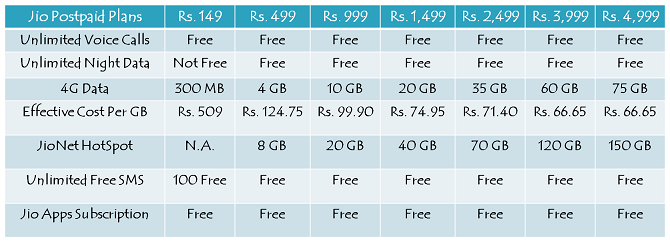
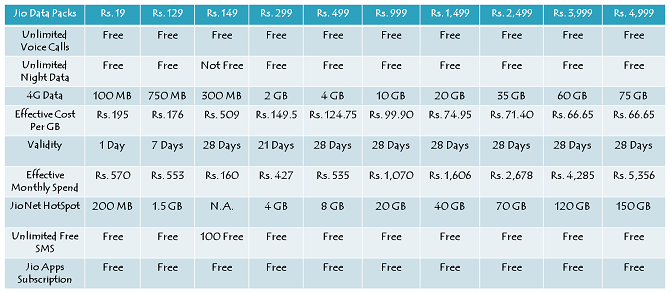
Reliance Jio’s tariffs are termed as disruptive and on the face of it they are truly intimidating for the incumbent telecom players. So, what are the Reliance Jio 4G plan tariffs which have made the existing players to rework their future strategies? Here you have the tariffs the consumers will have to pay to avail Reliance Jio services:

Postpaid Tariff Plans

Picture2

Prepaid Tariff Plans

Picture1

Base plan of Rs. 149

A consumer will get:

1) 300 MB 4G data

2) Free Unlimited local/ISD voice calls

3) Free Jio app subscription worth Rs. 1,250

4) Free 100 local/STD SMS

Effective cost per GB of data – Rs. 508

Rs. 499 Pack

A consumer will get:

1) 4 GB 4G data + Unlimited 4G data during night

2) Free Unlimited local/ISD voice calls

3) Free Jio app subscription worth Rs. 1,250

4) Free unlimited local/STD SMS

5) 8 GB JioNet WiFi Hotspot access

Effective cost per GB of data – Rs. 124.75

Rs. 999 Pack

A consumer will get:

1) 10 GB 4G data + Unlimited 4G data during night

2) Free Unlimited local/ISD voice calls

3) Free Jio app subscription worth Rs. 1,250

4) Free unlimited local/STD SMS

5) 20 GB JioNet WiFi Hotspot access

Effective cost per GB of data – Rs. 99.9

Rs. 1,499 Pack

A consumer will get:

1) 20 GB 4G data + Unlimited 4G data during night

2) Free Unlimited local/ISD voice calls

3) Free Jio app subscription worth Rs. 1,250

4) Free unlimited local/STD SMS

5) 40 GB JioNet WiFi Hotspot access

Effective cost per GB of data – Rs. 75

Rs. 2,499 Pack

A consumer will get:

1) 35 GB 4G data + Unlimited 4G data during night

2) Free Unlimited local/ISD voice calls

3) Free Jio app subscription worth Rs. 1,250

4) Free unlimited local/STD SMS

5) 70 GB JioNet WiFi Hotspot access

Effective cost per GB of data – Rs. 71.4

Rs. 3,999 Pack

A consumer will get:

1) 60 GB 4G data + Unlimited 4G data during night

2) Free Unlimited local/ISD voice calls

3) Free Jio app subscription worth Rs. 1,250

4) Free unlimited local/STD SMS

5) 120 GB JioNet WiFi Hotspot access

Effective cost per GB of data – Rs. 66.65

Rs. 4,999 Pack

A consumer will get:

1) 75 GB 4G data + Unlimited 4G data during night

2) Free Unlimited local/ISD voice calls

3) Free Jio app subscription worth Rs. 1,250

4) Free unlimited local/STD SMS

5) 150 GB JioNet WiFi Hotspot access

Effective cost per GB of data – Rs. 66.65

Is it really disruptive and will it affect you?

I think an average Indian telecom consumer does not want to spend more than Rs. 300 for its monthly voice calling and data usage. Airtel reported its average revenue per user (ARPU) to be Rs. 196 during its first quarter results in July 2016. As against Rs. 50/GB of data as announced by Jio, the cheapest Rs. 149 data pack would effectively cost you Rs. 508 per GB of data, but also provides you free unlimited voice calling.

As you can check from the plans above, even a Rs. 4,999 plan does not bring down cost per GB of data to Rs. 50. So, tariffs here are presented in a manner which sound music to your ears, but eventually they could end up higher. Incumbent players Airtel, Idea, Vodafone and RCom have sufficient time to act or react to these tariffs. Whether these tariffs would add to the overall growth of the telecom sector or to the woes of its existing players, that is something only time will tell. But, one thing is certain, the consumers here in India are going to enjoy some highly competitive data tariffs in the months to come.

01 Sep 08:24

State of Indian Stock Markets – August 2016

by Dev Ashish

New inclusion in this month’s State of Indian Stock Markets.

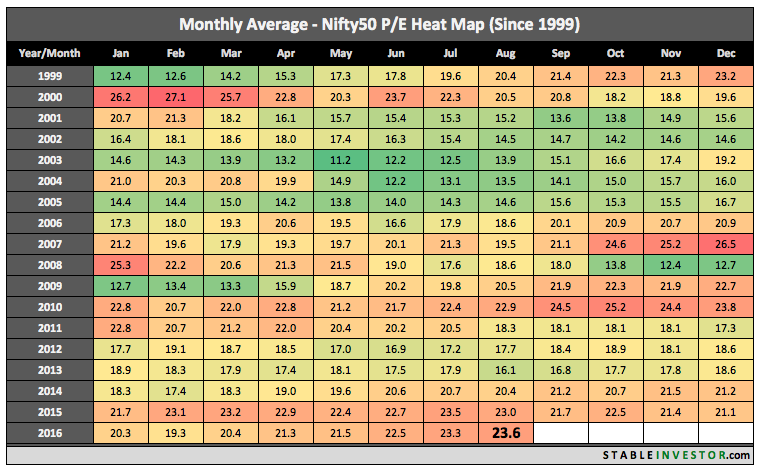
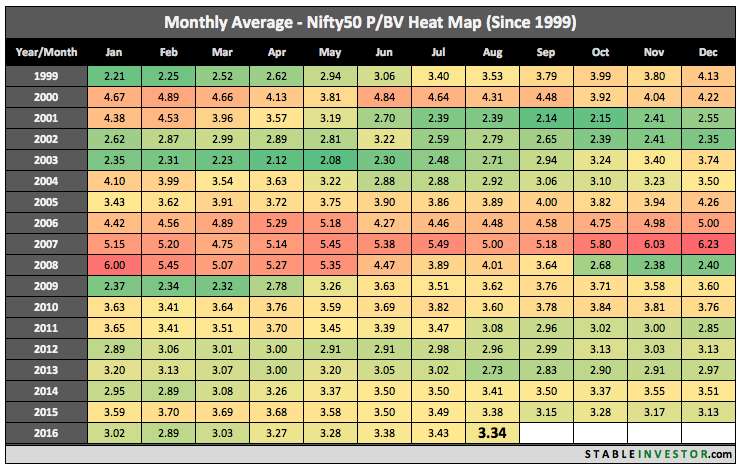
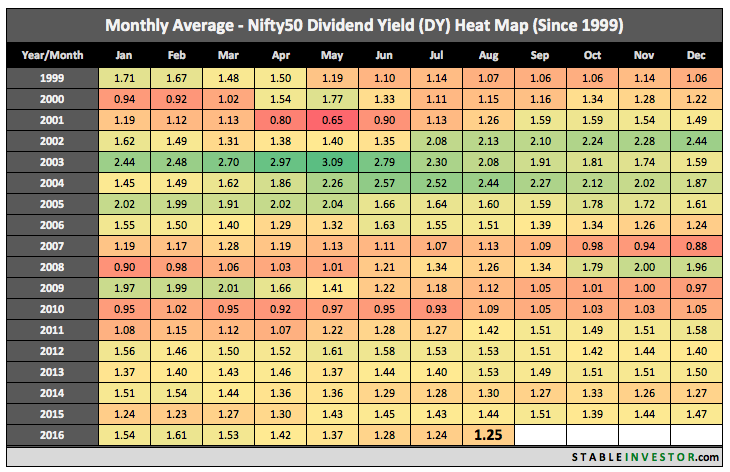
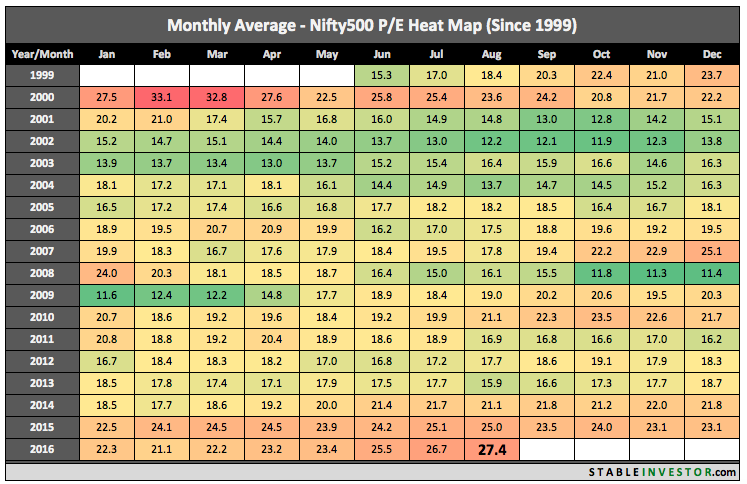
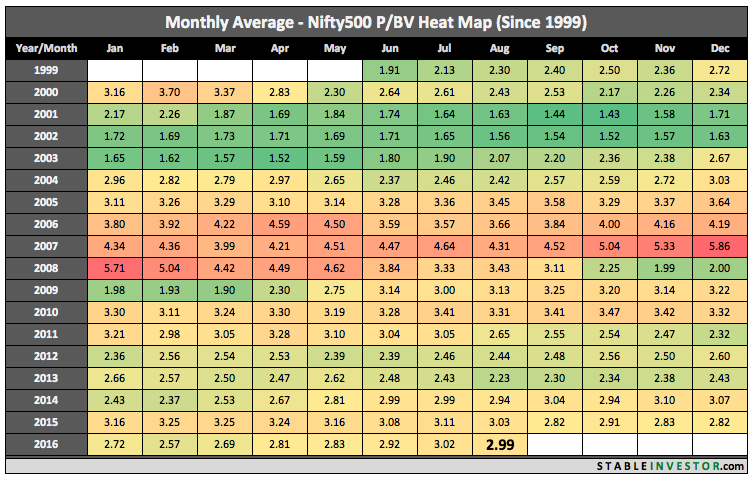
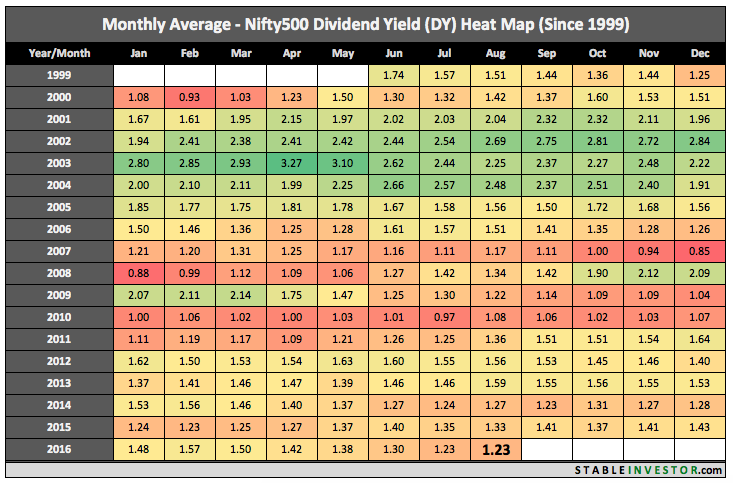
I have also included ratio analysis for Nifty500 this time. So from this month onwards, you get historical analysis and Heat Maps of Nifty50 as well as Nifty500‘s key ratios, namely P/E, P/BV ratios and Dividend Yield.

Please remember that these numbers are averages of P/E, P/BV and Dividend Yield in each month. Neither Nifty50 heat maps nor Nifty500 heat maps show the maximum or the minimum values for each month.

Caution – Never make any investment decision based on just one or two ‘average’ indicators. At most, treat these Nifty heat maps as broad indicators of market sentiments and a reference of market’s historical mood swings. 🙂

So here are the Nifty 50 Heat Maps…

Historical P/E Ratios – Nifty 50 (Monthly Average)

Nifty PE Ratio 2016 August

P/E Ratio (on last day of August 2016): 24.09
P/E Ratio (on last day of July 2016): 23.62

Historical P/BV Ratios – Nifty 50 (Monthly Average)

Nifty PB Ratio 2016 August
P/BV Ratio (on last day of August 2016): 3.36
P/BV Ratio (on last day of July 2016): 3.38

Historical Dividend Yield – Nifty 50 (Monthly Average)

Nifty Dividend Yield 2016 August
Dividend Yield (last day of August 2016): 1.22%
Dividend Yield (last day of July 2016): 1.27%

Now, to the historical analysis of Nifty500 companies…As the name suggests, Nifty500 is made up of top 500 companies which represent about 94% of the free float market capitalization of the stocks listed on NSE (as on March 31, 2016).

Nifty50 on other hand is an index of 50 of the largest and most frequently traded stocks on NSE. These represent about 65% of the free float market capitalization of the NSE listed stocks. So obviously, Nifty500 is a comparatively broader index than Nifty50.

Historical P/E Ratios – Nifty 500 (Monthly Average)

Nifty 500 PE Ratio 2016 August

P/E Ratio (on last day of August 2016): 28.23
P/E Ratio (on last day of July 2016): 27.16

Historical P/BV Ratios – Nifty 500 (Monthly Average)

Nifty 500 Price Book Ratio 2016 August
P/BV Ratio (on last day of August 2016): 3.01
P/BV Ratio (on last day of July 2016): 3.01

Historical Dividend Yield – Nifty 500 (Monthly Average)

Nifty 500 Dividend Yield 2016 August
Dividend Yield (last day of August 2016): 1.19%
Dividend Yield (last day of July 2016): 1.24%
You can read about last month’s update here. The State of Markets section has also been updated with new Nifty heat maps (link). For detailed analysis of how much returns you can expect depending on when the investments have been made (at various P/E, P/BV and Dividend Yield levels), please have a look at these 3 posts:
31 Aug 07:09

Storm over the revolving door

by The Big Picture
Former EU president Jose Manuel Barroso is the latest high-profile figure to go through the revolving door to the private sector. He joined Goldman Sachs as non-executive chairman of the bank's London operations in early July. This has triggered a massive online protest, with 76,000 signatures being collected already.

Barroso- not to be confused with the Hindi word bharosa - collects a cool 100,000 Euro as pension every year. Clearly, this isn't enough for him- it would be small change compared to what Goldman would pay him. Barroso complied with the 18 month cooling off period mandated by the EU. But the storm over his joining Goldman shows that people don't believe this limitation is adequate. As EU president, you would be dealing with cases involving high-profile companies. How you act is bound to be influenced if you know that there are post-retirement plums to be picked up from the companies you are dealing with.

No wonder French president Hollande calls it "unacceptable". The current EU president Jean Claude Juncker has a more nuanced comment. “The fact that Barroso works for a bank doesn’t bother me. But the fact that it’s that one causes me a problem.”

31 Aug 07:06

Isaac Watts and the Improvement of the Mind

by Farnam Street Team

What did an 18th-century hymn writer have to contribute to the modern understanding of the world? As it turns out, a lot. Sometimes we forget how useful the old wisdom can be.

***

One of the most popular and prolific Christian hymn writers of all time — including Joy to the World — was a man named Isaac Watts, who lived in England in the late 17th and early 18th century. Watts was a well educated Nonconformist (in the religious sense, not the modern one) who, along with his hymn writing, published a number of books on logic, science, and the learning process, at a time when these concepts were only just starting to grab hold as a dominant ideology, replacing the central role of religious teaching.

Watts’s book The Improvement of the Mind was an important contribution to the growing body of work emphasizing the importance of critical thinking and rational, balanced inquiry, rather than adhering to centuries of dogma. If, as Alfred North Whitehead once pronounced, modernity’s progress was due to the “invention of the method of invention,” Watts and his books (which became textbooks in English schools, including Oxford) can easily be credited with helping push the world along.

One non-conformist who would later come to be deeply influenced by Watts was the great scientist Michael Faraday. Faraday grew up in a poor area of 18th-century England and received a fairly crude education, and yet would go on to become the Father of Electromagnetism. How?

In part, Faraday credits his own “inventing the method of invention” to reading Watts’s books, particularly The Improvement of the Mind — a self improvement guide a few centuries before the internet. Watts recommended keeping a commonplace book to record facts, and Faraday did. Watts recommended he be guided by observed facts, and Faraday was. Watts recommended finding a great teacher, and Faraday starting attending lectures.

In Watts’s book, Faraday had found a guiding ethos for how to sort out truth and fiction, what we now call the scientific method. And, given his tremendous achievements from a limited starting point, it’s worth asking…what did Faraday find?

***

We needn’t search far to figure it out. Smack dab in Chapter One of the book, Watts lays out his General Rules for the Improvement of Knowledge.

Watts first lays out the goal of the whole enterprise. The idea is a pretty awesome one, the same ethos we promote constantly here: We all need to make decisions constantly, so why not figure out how to make better ones? You don’t have to be an intellectual to pursue this goal. Everybody has a mind worth cultivating in order to improve the practical outcome of their lives:

No man is obliged to learn and know every thing; this can neither be sought nor required, for it is utterly impossible : yet all persons are under some obligation to improve their own understanding; otherwise it will be a barren desert, or a forest overgrown with weeds and brambles. Universal ignorance or infinite errors will overspread the mind, which is utterly neglected, and lies without any cultivation.

Skill in the sciences is indeed the business and profession but of a small part of mankind; but there are many others placed in such an exalted rank in the world, as allows them much leisure and large opportunities to cultivate their reason, and to beautify and enrich their minds with various knowledge. Even the lower orders of men have particular railings in life, wherein they ought to acquire a just degree of skill; and this is not to be done well, without thinking and reasoning about them.

The common duties and benefits of society, which belong to every man living, as we are social creatures, and even our native and necessary relations to a family, a neighbourhood, or government, oblige all persons whatsoever to use their reasoning powers upon a thousand occasions; every hour of life calls for some regular exercise of our judgment, as to time and things, persons and actions; without a prudent and discreet determination in matters before as, we, shall be plunged into perpetual errors in our conduct. Now that which should always be practised, must at some time be learnt.

We then get into the Rules themselves, an 18th-century guide to becoming smarter, better, and more useful which is just as useful three hundred years later. In the Rules, Watts promotes the idea of becoming wiser, more humble, more hungry, and more broad-thinking. These are as good a guide to improving your mind as you’ll find.

Below as an abridged version of the Rules. Check them all out here or get it in book form here. Watts had a bit of a bent towards solemnity and godliness that need not be emulated (unless you’d like to, of course), but most of the Rules are as useful today as the day they were written.

***

Rule I. DEEPLY possess your mind with the vast importance of a good judgment, and the rich and inestimable advantage of right reasoning.

Review the instances of your own misconduct in life ; think seriously with yourselves how many follies and sorrows you had escaped, and how much guilt and misery you had prevented, if from your early years you had but taken due paius to judge aright concerning persons, times, and things. This will awaken you with lively vigour to address yourselves to the work of improving your reasoning powers, and seizing every opportunity and advantage for that end.

Rule II. Consider the weaknesses, frailties, and mistakes of human nature in general, which arise from the very constitution of a soul united to an animal body, and subjected to many inconveniences thereby.

Consider the many additional weaknesses, mistakes, and frailties, which are derived from our original apostasy and fall from a state of innocence; how much our powers of understanding are yet more darkened, enfeebled, and imposed upon by our senses, our fancies, and our unruly passions, &c.

Consider the depth and difficulty of many truths, and the flattering appearances of falsehood, whence arises an infinite variety of dangers to which we are exposed in our judgment of things.

Read with greediness those authors that treat of the doctrine of prejudices, prepossessions, and springs of error, on purpose to make your soul watchful on all sides, that it suffer itself, as far as possible, to be imposed upon by none of them.

Rule III. A slight view of things so momentous is not sufficient.

You should therefore contrive and practise some proper methods to acquaint yourself with your own ignorance, and to impress your mind with a deep and painful sense of the low and imperfect degrees of your present knowledge, that you may be incited with labour and activity to pursue after greater measures. Among others, you may find some such methods as these successful.

1. Take a wide survey now and then of the vast and unlimited regions of learning. […] The worlds of science are immense and endless.

2. Think what a numberless variety of questions and difficulties there are belonging even to that particular science in which you have made the greatest progress, and how few of them there are in which you have arrived at a final and undoubted certainty; excepting only those questions in the pure and simple mathematics, whose theorems are demonstrable, and leave scarce any doubt; and yet, even in the pursuit of some few of these, mankind have been strangely bewildered.

3. Spend a few thoughts sometimes on the puzzling enquiries concerning vacuums and atoms, the doctrine of infinites, indivisibles, and incommensurables in geometry, wherein there appear some insolvable difficulties: do this on purpose to give you a more sensible impression of the poverty of your understanding, and the imperfection of your knowledge. This will teach you what a vain thing it is to fancy that you know all things, and will instruct you to think modestly of your present attainments […]

4. Read the accounts of those vast treasures of knowledge which some of the dead have possessed, and some of the living do possess. Read and be astonished at the almost incredible advances which have been made in science. Acquaint yourself with some persons of great learning, that by converse among them, and comparing yourself with them, you may acquire a mean opinion of your own attainments, and may thereby be animated with new zeal, to equal them as far as possible, or to exceed: thus let your diligence be quickened by a generous and laudable emulation.

Rule IV. Presume not too much upon a bright genius, a ready wit, and good parts; for this, without labour and study, will never make a man of knowledge and wisdom.

This has been an unhappy temptation to persons of a vigorous and gay fancy, to despise learning and study. They have been acknowledged to shine in an assembly, and sparkle in a discourse on common topics, and thence they took it into their heads to abandon reading and labour, and grow old in ignorance; but when they had lost their vivacity of animal nature and youth, they became stupid and sottish even to contempt aud ridicule. Lucidas and Scintillo are young men of this stamp; they shine in conversation; they spread their native riches before the ignorant; they pride themselves in their own lively images of fancy, and imagine themselves wise and learned; but they had best avoid the presence of the skilful, and the test of reasoning; and I would advise them once a day to think forward a little, what a contemptible figure they will make in age.

The witty men sometimes have sense enough to know their own foible; and therefore they craftily shun the attacks of argument, or boldly pretend to despise and renounce them, because they are conscious of their own ignorance, aud inwardly confess their want of acquaintance with the skill of reasoning.

Rule V. As you are not to fancy yourself a learned man because you are blessed with a ready wit; so neither must you imagine that large and laborious reading, and a strong memory, can denominate you truly wise.

What that excellent critic has determined when he decided the question, whether wit or study makes the best poet, may well be applied to every sort of learning:

“Concerning poets there has been contest,
Whether they’re made by art, or nature best;
But if I may presume in this affair,
Among the rest my judgment to declare,
No art without a genius will avail,
And parts without the help of art will fail:
But both ingredients jointly must unite,
Or verse will never shine with a transcendent light.”
– Oldham.

It is meditation and studious thought, it is the exercise of your own reason and judgment upon all you read, that gives good sense even to the best genius, and affords your understanding the truest improvement. A boy of a strong memory may repeat a whole book of Euclid, yet be no geometrician; for he may not be able perhaps to demonstrate one single theorem. Memorino has learnt half the Bible by heart, and is become a living concordance, and a speaking index to theological folios, and yet he understands little of divinity. […]

Rule VII. Let the hope of new discoveries, as well as the satisfaction and pleasure of known trains, animate your daily industry.

Do not think learning in general is arrived at its perfection, or that the knowledge of any particular subject in any science cannot be improved, merely because it has lain five hundred or a thousand years without improvement. The present age, by the blessing of God on the ingenuity and diligence of men, has brought to light such truths in natural philosophy, and such discoveries in the heavens and the earth, as seemed to be beyond the reach of man. But may there not be Sir Isaac Newtons in every science? You should never despair therefore of finding out that which has never yet been found, unless you see something in the nature of it which renders it unsearchable, and above the reach of our faculties. […]

Rule VIII. Do not hover always on the surface of things, nor take up suddenly with mere appearances; but penetrate into the depth of matters, as far as your time and circumstances allow, especially in those things which relate to your own profession.

Do not indulge yourselves to judge of things by the first glimpse, or a short and superficial view of them; for this will fill the mind with errors and prejudices, and give it a wrong turn and ill habit of thinking, and make much work for retractation. Subito is carried away with title pages, so that he ventures to pronounce upon a large octavo at once, and to recommend it wonderfully when he had read half the preface. Another volume of controversies, of equal size, was discarded by him at once, because it pretended to treat of the Trinity, and yet he could neither find the word essence nor subsistences in the twelve first pages; but Subito changes his opinions of men and books and things so often, that nobody regards him.

As for those sciences, or those parts of knowledge, which either your profession, your leisure, your inclination, or your incapacity, forbid you to pursue with much application, or to search far into them, you must be contented with an historical and superficial knowledge of them, and not pretend to form any judgments of your own on those subjects which you understand very imperfectly.

Rule IX. Once a day, especially in the early years of life and study, call yourselves to an account what new ideas, what new proposition or truth you have gained, what further confirmation of known truths, and what advances you have made in any part of knowledge;

And let no day, if possible, pass away without some intellectual gain: such a course, well pursued, must certainly advance us in useful knowledge. It is a wise proverb among the learned, borrowed from the lips and practice of a celebrated painter,

“Let no day pass without one line at least.”

…and it was a sacred rule among the Pythagoreans, That they should every evening thrice run over the actions and affairs of the day, and examine what their conduct had been, what they had done, or what they had neglected: and they assured their pupils, that by this method they would make a noble progress on the path of virtue.

Rule X. Maintain a constant watch at all times against a dogmatical spirit;

Fix not your assent to any proposition in a firm and unalterable manner, till you have some firm and unalterable ground for it, and till you have arrived at some clear and sure evidence; till you have turned the proposition on all sides, and searched the matter through and through, so that you cannot be mistaken.

And even where you may think you have full grounds of assurance, be not too early, nor too frequent, in expressing this assurance in too peremptory and positive a manner, remembering that human nature is always liable to mistake in this corrupt and feeble state. A dogmatical spirit has man; inconveniences attending it: as

1. It stops the ear against all further reasoning upon that subject, and shuts up the mind from all farther improvements of knowledge. If you have resolutely fixed your opinion, though it be upon too slight and insufficient grounds, yet you will stand determined to renounce the strongest reason brought for the contrary opinion, and grow obstinate against the force of the clearest argument. Positive is a man of this character; and has often pronounced his assurance of the Cartesian vortexes: last year some further light broke in upon his understanding, with uncontrollable force, by reading something of mathematical philosophy; yet having asserted his former opinions in a most confident manner, be is tempted now to wink a little against the truth, or to prevaricate in his discourse upon that subject, lest by admitting conviction, he should expose himself to the necessity of confessing his former folly and mistake: and he has not humility enough for that.

2. A dogmatical spirit naturally leads us to arrogance of mind, and gives a man some airs in conversation which are too haughty and assuming. Audens is a man of learning, and very good company ; but his infallible assurance renders his carriage sometimes insupportable.

[…]

Rule XI. Though caution and slow assent will guard you against frequent mistakes and retractions; yet you should get humility and courage enough to retract any mistake, and confess an error.

Frequent changes are tokens of levity in our first determinations; yet you should never be too proud to change your opinion, nor frighted at the name of a changeling. Learn to scorn those vulgar bugbears, which confirm foolish man in his old mistakes, for fear of being charged with inconstancy. I confess it is better not to judge, than judge falsely; it is wiser to withhold our assent till we see complete evidence; but if we have too suddenly given up our assent, as the wisest man does sometimes, if we have professed what we find afterwards to be false, we should never be ashamed nor afraid to renounce a mistake. That is a noble essay which is found among the occasional papers ‘ to encourage the world to repractise retractations;’ and I would recommend it to the perusal of every scholar and every Christian.

Rule XV. Watch against the pride of your own reason, and a vain conceit of your own intellectual powers, with the neglect of divine aid and blessing.

Presume not upon great attainments in knowledge by your own self-sufficiency: those who trust to their own understandings entirely, are pronounced fools in the word of God; and it is the wisest of men gives them this character,

‘ He that trusteth in his own heart is a fool/ Prov. xxviii. 26. And the same divine writer advises us to ‘ trust in the Lord with all our heart, and not to lean to our understandings, nor to be wise in our own eyes,’ chap. iii. 5, 7*

Those who, with a neglect of religion and dependence on God, apply themselves to search out every article in the things of God by the mere dint of their own reason, have been suffered to run into wild excesses of foolery, and strange extravagance of opinions. Every one who pursues this vain course, and will not ask for the conduct of God in the study of religion, has just reason to fear he shall be left of God, and given up a prey to a thousand prejudices ; that he shall be consigned over to the follies of his own heart, and pursue his own temporal and eternal ruin. And even in common studies we should, by humility and dependence, engage the God of truth on our side. (Transcribers Note: This talk of God, pure nonsense that it is, does not diminish the value of his other rules.)


--
Sponsored by: Slack - Making teamwork simpler, more pleasant, and more productive.

31 Aug 06:20

The higher you go in economics, the more the common sense rains out of you…

by Amol Agrawal
This is a hard hitting post on the economics profession by Bill Bronner. He has written a book recently called Hormegeddon: How Too Much of a Good Thing Leads to Disaster. The post is based on his book. Friedrich Hayek made the point on numerous occasions that the more a person has been educated, the greater the likelihood […]
30 Aug 09:21

Equity financing of books

by SK

A rather uncharitable view of the book advances that legacy publishing houses give out to established (non first-time) authors is to look at it as “convertible debt”, as this piece by Matthew Yglesias points out.

An advance is bundled with a royalty agreement in which a majority of the sales revenue is allocated to someone other than the author of the book. In its role as venture capitalist, the publisher is effectively issuing what’s called convertible debt in corporate finance circles — a risky loan that becomes an ownership stake in the project if it succeeds.

Now, as I consider possibly self-publishing my book, while simultaneously attempting to sell it to established publishing houses, I realise that apart from the convertible debt, publishing a book also involves a massive sale of equity.

I’ve finished the manuscript, and edited it once. It needs further editing, but I’ve put it off so far in the hope that I can sell the book to a mainstream publisher, who will then take care of the publishing. However, given that I might end up self-publishing, and from what I read that publishers don’t do a great job of editing anyway, I might need another pass or two.

And then there are other things to be done before the book comes out in print – a cover needs to be designed, illustrations need to be put in, maybe we should get someone to do an audiobook, and all such. Now, if a mainstream publisher picks up the book, I’d expect them to take care of these. Else I’ll need to spend to get people to do these things for me.

When people first told me that royalties in book publishing are of the order of 7.5% of cover price, it was a little hard to believe. However, looking at the costs involved in the publishing process, it’s not hard to see why publishers take the cut that they take. The problem, though, is that it involves you selling equity in your book.

By going for a mainstream publisher (rather than self-publishing), you are saving yourself the upfront cost of getting your book edited, designed and “typeset”, in exchange for a large portion of the equity of the book.

Looking at it in another way, you are trading in your limited downside (what you spend in designing, printing, etc.) for what might be a massively unlimited upside (in case my book is a runaway success). For the most part, considering that most books don’t do that well, it isn’t a very bad deal. However, considering that downside is limited (in terms of costs) I wonder if it makes sense to trade it in for a large stake of what could be a large upside.

In any case, the main reason I’m still pushing to get mainstream publishers is because the self-publishing market is a “market for lemons“. With barrier to entry not being too high, lots of bad books are self-published, and so anyone who thinks they’ve written a half decent book will try to find a mainstream publisher. And this further diminishes the average quality of self-published books. And further dissuades people like me from self-publishing!


30 Aug 08:28

Intermediation and the battle for data

by SK

The Financial Times reports ($) that thanks to the rise of AliPay and WeChat’s payment system, China’s banks are losing significantly in terms of access to customer data. This is on top of the $20Billion or so they’re losing directly in terms of fees because of these intermediaries.

But when a consumer uses Alipay or WeChat for payment, banks do not receive data on the merchant’s name and location. Instead, the bank record simply shows the recipient as Alipay or WeChat.

The loss of data poses a challenge to Chinese banks at a time when their traditional lending business is under pressure from interest-rate deregulation, rising defaults, and the need to curb loan growth following the credit binge. Big data are seen as vital to lenders’ ability to expand into new business lines.

I had written about this earlier on my blog about how intermediaries such as Swiggy or Grofers, by offering a layer between the restaurant/shop and consumer, now have access to the consumer’s data which earlier resided with the retailer.

What is interesting is that before businesses realised the value of customer data, they had plenty of access to such data and were doing little to leverage and capitalise on it. And now that people are realising the value of data, new intermediaries that are coming in are capturing the data instead.

From this perspective, the Universal Payment Interface (UPI) that launched last week is a key step for Indian banks to hold on to customer data which they could have otherwise lost to payment wallet companies.

Already, some online payments are listed on my credit card statement in the name of the payment gateway rather than in the name of the merchant, denying the credit card issuers data on the customer’s spending patterns. If the UPI can truly take off as a successor to credit cards (rather than wallets), banks can continue to harness customer data.

29 Aug 04:54

On Pricing Grids, Part 1

by David Merkel

=-=-=-=-=-=-=-=-=-=-=-=-=-=-=-=-=-

This post may be a little more complex than most. It will also be more theoretical. For those disinclined to wade through the whole thing, skip to the bottom where the conclusions are (assuming that I have any). 😉

Asset Prices are (Mostly) Validated by a Thin Stream of Transactions

One thing that I have been musing about recently is how few transactions exist to validate the pricing of various markets.  I’ll start with two obvious ones, and then I will broaden out to some more markets that are less obvious.  (Hint: markets that have a high level of transactions relative to the underlying asset value have a lot of speculative “noise traders.”)

Let me start with the market that I know best as far as this topic goes: bonds.  Aside from some government and quasi-governmental bonds, very few bonds trade each day — less than a few percent.  It’s very difficult to use the small volume of trades to price the whole market, but it can be done.

When I was a bond manager for a semi-major insurance company, I was the only one of the top managers that was a mathematician, and familiar with all of the structures underlying the bonds.  I could create my own models of bonds if needed, and I often did for interest rate risk analyses (which was still a responsibility amid bond management).  Combined with my knowledge of insurance accounting, it made me ideal to do a certain monthly task: making sure all of the bonds got priced.

The first part of that isn’t hard.  The pricing service typically covers 90-98% the bonds  in the portfolio.  What I would receive on the first day of the month was a list of all the bonds the pricing service could not calculate a price for.  I would take that list and compare it to last month’s list of the same bonds and add to it any new bonds we had bought that month, and who the lead dealer was.  I would then ask the dealers for their prices on the bonds (which were typically illiquid).  I would compare those prices to the prices of the prior month, and maybe ask a question or two about the prices that were out of line.  That would usually elicit a comment from my coverage akin to, “The analyst thinks spreads have widened out for that credit because spreads in that industry have widened out, and a less liquid bond would widen out more.  The why the price fell more (or rose less).

After that was done, that left me with a small number of utterly illiquid bonds that we had sourced totally privately, or where the dealers who had originated the bonds had ceased to exist.  All of those deals lacked options to accelerate or decelerate payment, so it was a question of modeling the cash flows and applying an appropriate yield spread over the Treasury or Swap yield curve.  [Note: the swap curve gives the yield rates at which AA-rated banks are willing to trade fixed rate exposures in their own credit for floating rate exposures in their own credit, and vice-versa.]

But what is appropriate and how did the three methods of getting prices differ?  The second question is easier.  They didn’t differ much at all.  The dealers and I were likely doing the same things — just with different sets of bonds.  The pricing service, on the other hand, was much more complex, and the other two methods relied on its results.

It was was called “grid” or “matrix” pricing, though it was much more complex than a grid or a matrix.  The pricing service models would look at all of the most recent trades that had happened in the bond market, and use all of the prices to estimate yields that were adjusted for the options inherent in the bonds that could accelerate or decelerate payments.  From that, they would piece together yield curves that varied by industry and collateral type, credit rating (agency or implied by a model that involved stock prices and equity option prices), individual creditors, etc.  Trades on different days were adjusted for market conditions to make the pricing as similar as possible to the end of the month.  After that the yield and yield spread curves generated would be applied to the structures of individual bonds with a adjustments for whether the bonds were:

  • premium or discount
  • large deals that were widely traded or small illiquid deals
  • callable or putable
  • senior or subordinate or structurally subordinate (a bond of a subsidiary not guaranteed by the parent company)
  • secured or unsecured
  • bullet or laddered maturities (sinking funds, etc.)
  • different currencies
  • and more

And there you would have a set of self-consistent prices that would price most of the bond universe.  That’s not where transactions would necessarily take place… particularly with illiquid securities, what would matter most is who was more incented to make the trade happen — the buyer or the seller.

Implicitly, I learned a lot of this not just from modeling for risk purposes, but from trading a lot of bonds day by day.  How do you make the right adjustments when you compare two bonds to make a swap, and, how much of a margin do you put in as a provision to make sure you are getting a good deal without the other side of the trade walking away?  It’s tough, but if you know how all of the tradeoffs work, you can come to a reasonable answer.

One more note before the summary.  The less common it is for a bond or group of related bonds to trade, the more effect a trade has on the overall process.  It becomes a critical datapoint that can redefine where bonds like it trade.  Illiquidity begets volatile prices changes in the grid/matrix as a result.  On the bright side, illiquidity is usually associated with small sizes, so it doesn’t affect most of the market.  There is an exception to this rule: trades done during a panic or the recovery from a panic tend to be sparse as well.  The trades that happen then can temporarily change a wider area of pricing.  I remember that vividly from the whipsaw markets 2001-3, especially when the bond market was restarting after 9/11.  If that crisis had happened later in the month, the quarterly closing prices might not have been as accurate.

Summary for Part 1 (Bonds)

The bond market is complex, far more complex than the stock market.  Pricing the market as a whole is a complex affair, but one for which prices are reasonably calculable.  For the average retail investor investing in ETFs, the bonds are liquidi enough that pricing of NAVs is fairly clean.  But even for a large ugly insurance company bond portfolio, pricing can be significantly accurate.  Next time, I’ll talk about a related market that has its own pricing grid(s) — mortgages and real estate.  Till then.

29 Aug 04:54

How to Be A Fortunate Investor

by Anshul Khare

If you think I am going to talk about some mystical way to increase your luck in stock market, then you’ll be disappointed. Being fortunate in life and in investing is largely about increasing your odds of success. And how do you increase your odds?

“Study the principles of sound investing and work hard to implement those principles,” you might say. But is that sufficient? Studying, reading and working hard are all necessarily conditions for being successful in the stock market, however they are not sufficient. You need one more thing.

Let’s turn to world’s greatest investor to give us some clue. In his 1982 letter to investors, talking about two of his managers Phil Liesche and Ben Rosner, Warren Buffett wrote –

Both Ben and Phil ran their businesses for Berkshire with every bit of the care and drive that they would have exhibited had they personally owned 100% of these businesses. No rules were necessary to enforce or even encourage this attitude; it was embedded in the character of these men long before we came on the scene. Their good character became our good fortune. If we can continue to attract managers with the qualities of Ben and Phil, you need not worry about Berkshire’s future.

The lesson for an investor is that in stock market, you’re not just in the business of finding good businesses. Your real job is to find people who are running good businesses. That brings good fortune.

The words “we are fortunate” appears more than a dozen times in Buffett’s letters. Every time he has uttered those words, it was to describe his association with great managers running the businesses Berkshire owns.

Time and again Buffett has extolled the significance of associating with good people. In his 1987 letter, quoting Winston Churchill, he wrote-

Churchill once said, “You shape your houses and then they shape you.” We know the manner in which we wish to be shaped. For that reason, we would rather achieve a return of X while associating with people whom we strongly like and admire than realize 110% of X by exchanging these relationships for uninteresting or unpleasant ones.

It’s not sufficient to find a great business and ignore the character of the management. If you invest in a great business which is being run by crooked or dishonest management, it may bring profit to you in short term. However, on the longer term you will end up regretting your decision.

I have seen an example of this in my life. In 2008 I had a colleague who was assisting (part time) a group of people in setting up the technical infrastructure for a mobile software startup. He was working very hard because he had a full time job and he was also working nights and weekends in the startup. Although he was excited about the work, he would always complain to me about the integrity of his partners because of their questionable practices of generating funds for their operations. In the end, he was left with a personal debt of few lac without any results for his years of hard work.

Working with unscrupulous people, even if they’re on your side, is a deliberate invitation to misfortune. As Thomas Phelps wrote in his book 100 to 1 in the Stock Market – “Remember that a man who will steal for you, will steal from you.” Put simply, you can never strike a good deal with a bad person.

A wise man once said, your future is decided by the books you read and people you associate with. When you buy a stock, you decide to associate, albeit indirectly as a minority shareholder, with the owners/managers of the business. You’re essentially putting a trust on the managers running the business.

That person may be extremely good in his job, he may be a very smart businessman. He may also be growing the business profitably. But if you aren’t sure about his honesty and integrity then heed the advice of Woody Allen who said, “While the lamb may lie down with the lion, the lamb shouldn’t count on getting a whole lot of sleep.”

Once you find a good business, being run by competent and honest management, stick with it for a longer term, provided the quality of the business and management doesn’t deteriorate. Because the moment you break the partnership, you’re left with a task of finding another honest manager, which by the way isn’t an easy task.

Don’t be a fair-weather friend to the good stocks in your portfolio.

What if an honest manager suddenly turns evil? Well, chances are that he was always crooked, and you failed to judge his character. In that case, learn from it and move on.

At the same time, it’s delusional to hope that a dishonest CEO will have a change of heart. Crooks turn into saints only in movies and stories. It’s not impossible but very uncommon because people don’t change. Turnarounds seldom turn – Buffett may have said this for businesses, but it’s equally applicable to people’s character.

If a CEO has been known to display a clean character for a long time, he will seldom turn out to be of questionable character in future.

Fortune favours the brave, goes the saying. And in investing, fortune favours those who are brave enough to stick with their honest and competent partners through the ups and downs of market cycles.


fortunecookie
Apart from investing, if you want to be fortunate in life too, you now know the drill.

Surround yourself with people who posses the qualities that you admire. Who inspire, uplift and motivate you. Who set the right example by doing the right thing.

How do you find such people? Let them find you.

Like attracts like. Which means the best ways to find honest people is to be honest yourself. If you develop a good character yourself and practice those qualities which you’re looking in others, it attracts similar people in your life. I can personally vouch for it. The strategy has worked remarkably well in my life so far.

In the end, Lady Fortuna doesn’t just smile on honest business people. She likes anyone who possesses a good character.

The post How to Be A Fortunate Investor appeared first on Safal Niveshak.

28 Aug 08:11

Betting by other means

by SK

In India, officially, sports betting is illegal. Of course, there are lots of “underground” betting networks which we will not go into here. This post, instead, is about a different kind of “betting” on sports.

I’ve long maintained that Mahendra Singh Dhoni is grossly overrated as a cricket captain. While he did win that ICC World T20 in 2007 (back then his captaincy was pretty good), since then he’s shown himself to be too conservative as a captain. In that sense, I’m glad he retired from Tests (thus relinquishing captaincy as well) in 2014, paving the way for the more aggressive Virat Kohli to lead.

Even in limited overs games, I’ve maintained that while in the past he’s been instrumental in orchestrating chases, that ability is now on the wane, with last night’s choke being the latest example of him botching a chase. Earlier this year as well, he choked a chase in Zimbabwe. There are more such examples from the IPL as well.

Given last night’s fuck-up, I think it’s a great time to replace him as captain for limited overs games. I’m not hopeful of this happening, though, and this is in part due to the “betting at another level” that happens in elite sport.

Back in 2011 or 2012, a hashtag called #SachinRetire started making the rounds on Twitter. The context was that with the 2011 world cup having been won, it was a great opportunity for Sachin Tendulkar to retire on a high note. He continued playing on, though, in the hope of hitting “100 100s in international cricket”, the result of which was mostly mediocre cricket on his part.

Tendulkar’s 100th 100 finally came a year after his 99th, in an Asia Cup match against Bangladesh. He scored at a strike rate of 78, in a match India lost. A lot of the blame for the loss can be put on his slow rate of scoring, and consequently, on the 100th 100 hype.

It was another good opportunity to retire, but he continued playing, until a special Test series was organised in 2013 so that he could retire “at home”.

The dope in sports circles in those days was that while Tendulkar himself was keen to go, there were plenty of endorsements he was involved in, and those sponsors would have had to take a loss if he retired. Thus, the grapevine went, he had to take his sponsors into confidence and “prepare them” in order to choose an opportune time to retire.

Endorsements and sponsorships are the “other kind of betting” I mentioned earlier in the post. As soon as a sportsperson “makes it”, there is a clutch of brands who wants to cash in on his popularity by asking him to endorse them. The money involved makes it a good deal for the sportsperson as well.

By choosing to sponsor a sportsperson and getting him to endorse their brand, sponsors are effectively taking a bet on the player’s career – the better the player’s career goes, the greater the benefit for the brand from the sponsorship deal. In case the player’s career stalls, or he is caught in a scandal, the brand also suffers by association (think Tiger Woods or Maria Sharapova).

The concern with betting on sports in India is that bettors might try to influence the results of matches they’ve bet on, by possibly fixing them. This, along with “protecting the poor punter” are reasons why betting on sports is banned in India.

The problem, however, is that with this “other kind of betting” (sponsorships), the size and influence of the bettors (sponsors) means that there is a greater chance of the bettors seeking to influence the results of their investments.

A sponsor, for example, will not be happy if their “sponsee” is left out of his team, for whatever reason. Any negative impact on the sponsee’s career, from being dropped, to being demoted from captaincy to being sold to a “lesser club” negatively affects the brand value of the sponsor (by association).

And so, in cases where it’s possible (I can’t imagine a sponsor trying to influence Jose Mourinho’s decision, for example), the sponsor will try to influence selection decisions where it might benefit them. So Tendulkar’s sponsors will lobby with selectors to keep him in the team. Dhoni’s sponsors will lobby to keep him as captain. And so forth.

I’m not advocating that some kind of regulation be brought in to curb sponsors’ influence – any such regulation can only be counterproductive. All I’m saying is that betting already exists in Indian cricket, except that rather than betting on matches, bettors are betting on players! And so there is no real argument to ban “real” sports betting in India.

At least in that case, sponsors will be able to hedge their investments in the market rather than seeking to influence the powers behind the sport!


26 Aug 06:28

Latticework of Mental Models: The Halo Effect

by Anshul Khare

Complexity is the indispensable thread in the fabric of world of business today. As a result, in spite of all the secrets formulas and all the self-proclaimed thought leadership, success in business is as elusive as ever. Unlike hard sciences there are no immutable laws in management because managing business isn’t a science.

Rajiv Bajaj, Managing Director of Bajaj auto, said this in one of his talks

I joined the company [Bajaj Auto] twenty years back. In my college I was trained to think ‘Just in Time’ because it was supposed to be one solution for all the problems. And then somebody said, Just in Time is not enough. They said there must be Kaizen, World class manufacturing, Toyota production system, Kawasaki system, automation and robotics. Then they said you must also know CAD, CAM, simultaneous engineering, re-engineering, six-sigma, TQM, and you must wear six hats, follow seven habits, look for blue oceans, be a bit of a maverick and indulge in management by walking around. Every time I learnt something new, I found myself back at the starting point. There was always the new book on the shelf, and there was always the new consultant on the seminar circuit. And these guys would do anything to keep themselves in demand and keep all of us confused. So I decided to ignore all of these.

Rajiv Bajaj turned around Bajaj Auto from a loss making company in the year 2000 to the most profitable auto company in world and it’s pretty clear from his talk that he didn’t do it just by blindly listening to those management experts and celebrity CEOs who claim to have the next new thing.

Most theories and expert advice are either anecdotal or riddled with hindsight bias. A significant part of so called scientific research in business is nothing by pseudoscience in the garb of storytelling. Halo Effect is one psychological bias which clouds our ability to think clearly and critically about problems especially when it comes to understanding the reasons behind successful businesses.

Halo effect is the tendency to make inferences about specific traits on the basis of a general impression. It’s a way for the mind to create and maintain a coherent and consistent picture, to reduce cognitive dissonance.

A simple example would be when you meet a person who looks sharp, handsome and has a great posture, (which are all positive external qualities) it might lead you to make a subconscious judgement about his internal qualities also i.e. you’d think this person to be intelligent and extrovert.

The psychologist Edward Thorndike discovered halo effect in 1920. His research documents how U.S. army soldiers who earned high scores from commanders for one quality (such as neatness) also got high marks for entirely unrelated qualities (such as loyalty and physical strength).

It’s interesting how people seem not to think of other individuals in mixed terms. Instead we seem to see each person as roughly good or roughly bad across all categories of measurement. The halo of one good or bad quality severely affects our judgment about other uncorrelated qualities.

Daniel Kahneman, a nobel laureate and a pioneer in the field of behavioural finance, has a little more technical term for halo effect – Exaggerated Emotional Coherence. In his book, Thinking Fast and Slow, Kahneman writes –

The tendency to like (or dislike) everything about a person—including things you have not observed—is known as the halo effect. The term has been in use in psychology for a century, but it has not come into wide use in everyday language. This is a pity, because the halo effect is a good name for a common bias that plays a large role in shaping our view of people and situations.

You meet a woman named Joan at a party and find her personable and easy to talk to. Now her name comes up as someone who could be asked to contribute to a charity. What do you know about Joan’s generosity? The correct answer is that you know virtually nothing, because there is little reason to believe that people who are agreeable in social situations are also generous contributors to charities. But you like Joan and you will retrieve the feeling of liking her when you think of her. You also like generosity and generous people. By association, you are now predisposed to believe that Joan is generous. And now that you believe she is generous, you probably like Joan even better than you did earlier, because you have added generosity to her pleasant attributes.

Come to think of it, brands are nothing but halos. We may not know if a new product is good, but if it comes from a well-known company with an excellent reputation, we might reasonably infer it should be of good quality. That’s what brand building is about.

Companies that own famous brands are primarily in the business of creating halos so that consumers are more likely to think favourably of a product or service.

In Business

Phil Rosenzweig, in his book The Halo Effect, writes –

Perhaps nothing lends itself to the Halo Effect more than leadership. Good leaders are often said to have a handful of important qualities: clear vision, effective communication skills, self-confidence, personal charm, and more. Most people would agree these are elements of good leadership. But defining them is a different matter altogether, since several of these qualities tend to be in the eye of the beholder — which is affected by company performance.

And when the fortune turns for the company, experts opine that those very same leaders had lost their focus, became complacent and arrogant. Phil argues –

…you can always find good things to say about leaders at successful companies, and you can always find reasons to criticize leaders of failing firms. A critical reader ought to ask if any successful companies have inauthentic leaders, and if any unsuccessful companies are run by authentic leaders, because if not, it’s quite possible we’re just throwing around Halos.

Another example of the halo effect: We believe that CEOs who are successful in one industry will thrive in any sector. Whenever a successful CEO decides to venture into a new unrelated business, the news is met with excitement and great anticipation among investors and analysts. But the list of companies is endless where the CEO failed to replicate his earlier success in another unrelated new venture.

In Investing

Investors tend to focus on easily available facts, such as a company’s recent financial situation, and extrapolate conclusions from there that are harder to measure, such as the quality of its management or the feasibility of its strategy. Call it the halo of the last quarter performance.

Jason Zweig, a famous investment journalist, has written an excellent column on how halo effect can lead investors astray. Here’s an excerpt from the same –

Mr. Buffett’s reputation for probity and unrivalled investing record can cast a warm glow over the stocks he buys. In 2008, Goldman Sachs Group got the same kind of boost from his buying that Bank of America got this week. That is partly because many money managers, and countless individuals, copy any trades Mr. Buffett discloses.

…a soaring stock price can lead investors to regard the company’s managers as focused, disciplined and passionate—while, in the negative halo of a falling stock price, the same executives will now seem stubborn, unimaginative and resistant to change.

Investors think, at either time, that they are evaluating the stock and the managers independently, but one opinion inevitably colors the other, often leading investors to be too bullish on the upside and too bearish on the downside. The managers haven’t changed; our perceptions of them have.

I started this post with an excerpt from Rajiv Bajaj’s talk where he mentions how he disregarded the advice of experts as a measure to save himself from halo effect. In most of his talks he comes out as a thoughtful and intelligent business leader. It impresses me that Rajeev Bajaj will not allow halo effect to pollute his thinking and decision making. However, if one invests in Bajaj Auto only by listening to Rajeev’s talks, without evaluating the business of Bajaj Auto, he or she would again be falling for halo effect.

In fact, that’s the interesting aspect of most behavioural biases. Just when you think you have managed to avoid a bias, it secretly gains entry in your mind from a back door.

Flavours of Halo Effect

Halo effect has a cousin called devil effect. Just like halo effect is used mostly in context of positive qualities, devil effect explains the same phenomenon in context of bad traits. For example, selfishness of an individual can lower people’s opinion of all of his or her other traits.

If you were told that Hitler loved dogs and little children, your brain will find it extremely hard to accept this particular trait of the German dictator. Any trace of kindness, writes Kahneman, “in someone so evil violates the expectations set up by the halo effect.”

An extreme example of the devil effect is Stereotypes; where we know nothing about the person but use our quick judging mind to make snap decisions. All of the sudden our mind starts to think, because someone is dishonest he must not be good at sports, or he must be less intelligent.

Occasionally, halo effect has pleasant consequences at least in the short term, writes Rolf Dobelli in his book The Art of Thinking Clearly, “Have you ever been head over heels in love? If so, you know how flawless a person can appear. Your Mr. or Ms. Perfect seems to be the whole package: attractive, intelligent, likeable, and warm. Even when your friends might point out obvious failings, you see nothing but endearing quirks.”

Conclusion

In most simple words, halo effect occurs when a single aspect dazzles us and affects how we see the full picture. It increases the weight of first impressions, sometimes to the point that subsequent information is mostly wasted.

According to halo effect, first impression is not just the last impression but a lasting impression. If you look closely, you’ll find that halo effect is nothing but another interesting way in which confirmation and consistency bias shows up in human behaviour.

In the end, halo effect is the manifestation of human desire to tell a coherent story.

The need of the hour for investors and business managers is to think for themselves. And independent thinking requires a strong bullshit filter. And Halo effect mental model is one such bullshit filter.

Let me remind you again the importance of mental models. Mental models are to your brain as apps are to your smartphone. Just like apps, there are a ton of mental models. They help you make decisions, solve problems and see the world in an entirely new way… they basically make your brain more useful.

Take care and keep learning.

The post Latticework of Mental Models: The Halo Effect appeared first on Safal Niveshak.
    
25 Aug 05:54

The real benefit of direct benefit transfer

by SK

A week ago, I gave up. My LPG subsidy that is.

Having been out of the country for a few months, with our normal LPG usage being much lower than the average family’s, and having forgotten to book my spare cylinder, my LPG account had been “suspended”, for not booking a refill for over six months.

Back in the day when all domestic LPG connections were subsidised, you were required to book a cylinder every six months, else your account would get suspended. This was a measure to get rid of fake accounts and duplicate connections owned by a family (a family could have only one connection, legally).

So when I went to my dealer last week asking for my account to be unsuspended, I was told to submit my Aadhaar number to get it released. When I said I don’t have an Aadhaar number (I have one, but don’t want to use it unless mandatory), the clerk asked if I could give up my subsidy. With the LPG subsidy being a minuscule part of my overall annual expense, I quickly agreed, and after filling up a form and submitting a copy of my driving license, I had “given up”.

Later that day, my account was unsuspended, and I could presently book a refill, which arrived today. And having “given up”, there is no compulsion now to book a cylinder every six months!

The real benefit of the direct benefit transfer scheme adopted by the union government for LPG subsidy transfer is that it is now possible to have two classes of LPG connections, with several benefits.

Firstly, rules such as minimum and maximum frequency of booking don’t apply any more. Secondly, and more importantly, it is far easier nowadays to get an LPG connection – someone I know went to a nearby dealer to get a connection, and after submitting basic identification documents and paying a deposit, it took only a couple of days for the cylinders to arrive.

You might recall a campaign in the late 2000s by the then Karnataka Energy Minister Shobha Karandlaje to weed out duplicate LPG accounts in order to prevent wasteful subsidy. That brought in a regime of submitting a copy of an electricity bill to get LPG connections, in order to prevent one household from having more than one connection. Consequently, getting a new LPG connection became an absolute nightmare.

With the benefits now being targeted, and Aadhaar based, getting a new LPG connection is mostly straightforward, as long as you don’t claim a subsidy. And a lot of the times, the value of the subsidy is far lower than the additional cost of getting the cylinder itself!

In the earlier “indirect transfer regime”, this class of unsubsidided LPG connection did not exist (unless you went with one of the private sector players, most of whom have remained undependable), causing much harassment to consumers, and the need for various workarounds.

The direct benefit regime has thus not only saved the government the cost of wasteful subsidies, but also made life easier for consumers by making the market more rational!

24 Aug 17:16

PPF Interest Rate History & What You Should Really Know

by Dev Ashish

Updated (Sept 2016) – PPF rates revised to 8.0%

History of PPF interest rates is not very exciting. The changes have been very rare till recently (before government decided to go in for quarterly revisions of PPF rates).

But inspite of all the noise about other assets, Provident Funds remain the preferred mode of investments for most Indians.

PPF interest rate history

PPF (Public Provident Fund) continues to be looked at as a solid product to create a large corpus over time, with added benefit of tax savings. As of now, PPF falls under Exempt-Exempt-Exempt (EEE) tax regime. This means that:

  • 1st E – Investment in PPF account upto Rs 1.5 lac per year is eligible for deduction.
  • 2nd E – Interest earned is tax exempted.
  • 3rd E – Maturity amount is also exempt from tax.

Though this EEE treatment of PPF might change in near future. We will discuss that later in the post.

As of today (August 2016), the rate of interest on PPF is 8.1% per annum.

PPF Interest Rate History (Last 30 years)

This history of PPF interest rate in last 30 years has been as follows:

  • PPF Interest Rate 1986 to Jan-2000 – 12.0%
  • PPF Interest Rate Jan-2000 to Feb-2001 – 11.0%
  • PPF Interest Rate Mar-2001 to Feb-2002 – 9.5%
  • PPF Interest Rate Mar-2002 to Feb-2003 – 9.0%
  • PPF Interest Rate Mar-2003 to Nov-2011 – 8.0%
  • PPF Interest Rate Dec-2011 to Mar-2012 – 8.6%
  • PPF Interest Rate 2012-13 – 8.8%
  • PPF Interest Rate 2013-14 – 8.7%
  • PPF Interest Rate 2014-15 – 8.7%
  • PPF Interest Rate 2015-16 – 8.7%
  • PPF Interest Rate 2016-17 – 8.1% (till now)

Or, graphically speaking:

ppf interest rates history

As evident from the graph above, the change in rates have been rare:

  • Rates were fixed at 12% between 1986 and 2000 (sounds like heaven) 🙂
  • Then between 2000 and 2003, the rates slid down to 8%
  • The rates then remained stable at 8% till 2011
  • Rates were then revised to 8.6%, 8.8%, and 8.7%.
  • At last (for period April-June 2016), PPF rate was set to 8.1%.
  • Now the quarterly revision of rates is allowed. But the government has not changed the rates after the 8.1% revision.

The PPF interest calculation continues to be done on a monthly basis – on the lowest balance between the 5th day and end of the month. But the interest is credited only at the end of the year. So as far as compounding is concerned, it takes place on an annual basis.

By the way, a little too much importance is given to investing in PPF before the 5th of the month instead of after 5th. But it hardly matters… so relax.

How will PPF Interest Rates be changed now?

PPF is part of government’s small saving schemes portfolio. So the question who decides PPF interest rate has an obvious answer. 🙂

Earlier, the rates were considered for revision once every year.

But with effect from 1st April 2016, the rates for schemes like PPF, etc. are to be considered for revision every quarter, based on previous quarter’s yield on benchmark government securities (or bonds of corresponding maturities) with a small mark-up (around 0.25%).

So if yields go down, the PPF rates should go down few months after that. (and there will be hue and cry about why government is not investor-friendly)

If yields go up, the PPF rates should go up few months after that (and people will cheer as they will benefit from turnaround in the rate cycle).

But why is it that government decided to switch from annual to quarterly revision of rates? Is the government worried about something? Why is it that it wants to bring the rates as close to that of benchmark government securities?

The answer is and I quote from this article:

…according to a report in 2011 by Shyamala Gopinath committee (which was set up to review National Small Savings Fund, or NSSF), such a fixed rate regime caused a lot of volatility in collections.

When market rates declined, small savings collections went up as their rates remained unchanged. The opposite happened when market rates went up. This leads to a situation where when market rates are low, states are loaded with high-cost NSSF loans, and when market rates are high, NSSF loans as a source of financing fixed deposits dries up completely. It is therefore, very essential to align these rates with market rates.

In December 2011, acting on the recommendations of the report, the government made returns on small savings schemes market-linked. Rates on these products were benchmarked to government securities (G-secs) of similar maturity periods with a positive spread of 25 basis points.

Now interestingly, banks are effected by changes in interest rates of these small savings products.

Why?

Because the banks’ own saving products compete with government’s small savings products.

So having a positive mark-up on PPF, etc. made these products more suitable for customer looking for higher rates and in turn, put a lot of pressure on banks. So banks have good reason to push for reduction in rates offered by government products. This is the reason why banks have been lobbying (for years) to get this done. They cannot reduce rates on deposits as that would mean losing out to competition from schemes like PPF (and other short-duration government products)

The New Risk?

Earlier, rates were revised once every year. But now, the revision will take place every quarter.

So there is obviously an increase in interest rate risk as far as PPF is concerned. So in a falling rate scenario and for someone who has a large PPF balance, it can hurt a lot.

But when you compare the current rate (8.1%) with inflation numbers (around 5% to 6%), it still seems to be satisfactory. Isn’t it? After all, an inflation of 6% and PPF with a tax-free rate of 8.1% will offer you a real rate of at least 2% if not more. And that should work.

But we are missing one very important point – inflation rates published by government and RBI are not exactly equal to our own inflation. 😉

You spend on products that are facing higher price hikes. So your personal inflation might be 10% and not what RBI tells you.

So its possible that even with 8+ percent rate given by PPF, you are not getting any real returns.

You might feel that if that is the case, why not go for products that are known to given higher average returns (ofcourse with short-term volatility) like equity mutual funds.

But simply comparing returns of PPF and Equity Mutual Funds (or ELSS) is not correct. PPF is a part of your debt portfolio and equity MFs that of equity portion of your portfolio. Both parts have their own significance. I will come to this point in a bit…

Now there is another (future) risk in products like PPF.

Future of PPF?

No. I am not questioning the safety of PPF in future. It is run by the Government of India and hence it is (default) risk-free and extremely safe to invest in – no doubt.

But what about other kinds of risks? What if in future, the PPF is taxed? It almost happened this year for EPF before it was rolled back. But EEE status turning into EET is possible (eventually).

Another risk can be that withdrawal might have certain riders. Say you cant withdraw full amount on maturity. Or something similar. After all, the government is getting this large amount of money every year at relatively low cost (currently 8.1%). So government will want to reduce this rate and ‘try’ to keep money from going out. That is common sense and that is a future risk for young people like us.

So when you think that the PPF is risk-free, remember that primarily, it is the default risk that you are talking about. Other risks (known and unknown) still remain.

Now don’t think that I am against PPF as a product. It is an awesome product! It should definitely be part of one’s portfolio. But…

PPF is good. But not enough.

Previous generation’s automatic choice of investment was Provident Fund (PPF/EPF/VPF).

Why?

  • The contributions were (and is) eligible for deduction.
  • The returns were decent (12% till year 2000 – imagine that 🙂 ).
  • And even the maturity amount is tax free!

What else do you want in this world? 😉

But let us for a moment think about one thing:

PPF account has a maturity period of 15 years. So it is ideally created for goals that are atleast 15 years away.

Now due to the risk-free nature of the product, the returns given by PPF would ideally be less than those given by riskier assets. Isn’t it?

Also, you and me understand that when investing for long term goals, we can and should invest more in assets that give higher returns inspite of being volatile?

Why? Because average returns are higher when longer periods are considered.

So if we are investing for goals that are due in long term (i.e. 15 years) like say retirement, etc., shouldn’t we be investing in an asset that gives better returns?

I think we should. If not fully then atleast a major chunk of our investments. Short-term volatility should not be an excuse for avoiding an asset, which gives higher long term returns.

PPF is a wonderful instrument. It gives me peace of mind as returns don’t fluctuate like stocks or equity MFs. But if you and me are able to stomach some of these short term fluctuations, then we should have a higher exposure to equity as it provides higher long-term returns – which is necessary to build a healthy corpus. And also because in the long run, equity has a better potential of beating inflation and creating wealth.

I know when the topic of PPF comes up, it also brings up the topic of tax savings. And with that, comes the PPF vs. ELSS debate and questions like whether to invest in PPF or ELSS or both? But that is a detailed discussion in itself. So lets leave it for some other day.

I personally invest a lot more in equity MFs, direct equities than in PPF. So you can take that as a disclosure. 🙂

PPF (or EPF) should definitely be a part of your portfolio and you are right in regularly keeping track of PPF interest rates. 🙂 But investments should be made as per the goal requirements, suitability of asset allocation and not just because of tax considerations.

24 Aug 17:15

Marginal cost of public funds: a valuable tool for thinking about taxation and expenditure in India

by Ajay Shah
by Ajay Shah.

In an ideal world, taxation would be done in a frictionless way. The ideal world is a nice place where there are no transactions costs either for taxpayers in compliance, or for the tax authorities in collection. There would be no illegality and criminality surrounding the tax system. Most important, the presence of taxation would not modify the resource allocation in the slightest.

`Resource allocation' is economist-speak for the magnitudes of labour and capital, and the technology through which they are used. `Technology' is economist-speak for both the science and technology, and the business methods through which resources are utilised. In the ideal world, firms would produce based on pure efficiency considerations. Nothing about the questions `What to produce?' and `How to produce?' would be modified in the slightest by the tax system.

The government would collect taxes in this ideal world without imposing any excessive burden upon society. In other words, the cost to society of Rs.1 of spending by the government would be only Rs.1.

This notion is formalised as the `Marginal Cost of Public Funds' (MCPF). This answers the question: When the government spends Rs.1, what cost does it impose upon society? As with most economics, this question is posed `at the margin', i.e. what's the cost to society of the last Rs.1 that the government spent? In the ideal world, the MCPF is 1, but in the real world, it's always worse (i.e. bigger than 1).

The aspiration to get an MCPF of 1 was precisely expressed by Pranab Mukherjee in his July 2009 budget speech where, in para 31, he says:

I hope the Finance Minister can credibly say that our tax collectors are like honey bees collecting nectar from the flowers without disturbing them, but spreading their pollen so that all flowers can thrive and bear fruit.

This happy destination is one where the MCPF is 1, i.e. where the cost to society of Rs.1 of tax collection is 1.

Why do we get MCPF $> 1$?


Why is it that in the real world, we always have an MCPF that exceeds 1? There are costs of compliance, costs of administration, corruption, illegality, criminality. When all these costs are encountered, the cost to society of Rs.1 of marginal tax revenue exceeds 1.

Most important is the issue of a modified resource allocation. People respond to incentives. If income is taxed, people work less. If apples are taxed, people eat more oranges. This results in a distorted resource allocation, which results in lower welfare i.e. lower GDP. When the act of taxation distorts the resource allocation, and thus reduces GDP, the cost to society of the last Rs.1 of taxation exceeds 1.

There are seven sources of MCPF$>1$ in India:

  1. Income tax distorts the work-leisure tradeoff and the savings-consumption tradeoff.
  2. Commodity taxation distorts production and consumption, particularly when there are cascading taxes.
  3. We in India have a menagerie of `bad taxes' including taxation of inter-state commerce, cesses, transaction taxes such as stamp duties or the securities transaction tax, customs duties, taxation of the financial activities of non-residents. From 1991 to 2004, we thought the tax system was being reformed to get rid of these, but from 2004 onwards, things have become steadily worse, starting with the education cess and the securities transaction tax. All these are termed `bad taxes' in the field of public finance because when money is raised in these ways, the MCPF $\gg 1$.
  4. India relies heavily on the corporate tax, and has double taxation of the corporate form. In the last decade, corporate income tax and the dividend distribution tax added up to 35% of total tax collection. The double taxation induces firms to organise themselves as partnerships and proprietorships.
  5. There is the compliance cost by taxpayers and tax collectors, which is a pure deadweight cost. At the extreme, these include the costs imposed upon society by illegality and criminality owing to corruption in the tax system. When some firms get away with tax evasion, this changes the incentives of ethical firms to invest, which imposes enormous costs upon society as the most ethical firms are often the highest productivity firms.
  6. There are the consequences for GDP of the political economy of lobbying for tax changes, which arise when we do not have simple single-rate tax systems. E.g. if there was only one customs duty (e.g. 5%), this is much better than having different rates. Similarly, 80% of the countries which introduced the GST after 1995 have opted for a single rate GST.
  7. At the margin, public spending is actually financed out of deficits which are deferred taxation, intermediated through the processes of public debt management. Hence, in thinking about the MCPF, we must think about deficits and their financing also. Additional deadweight cost appears here, as we do financial repression (some financial firms are forced to buy government bonds). This is akin to a narrow commodity tax and is a bad tax.

All good thinking in tax policy and tax administration impinges upon the MCPF. If we setup a flawless GST, the MCPF will go down. If we reform tax administration, the MCPF will go down. The distortion associated with a tax goes up in proportion to the rate squared: hence the MCPF will be lower at a GST rate of 12% rather than at 24%.

How big is the MCPF in India?


As the discussion above suggests, there is the assessment of MCPF at the level of society as a whole and there is its measurement at the level of one tax at a time where the `bad taxes' will leap out of the page.

Estimation of MCPF is hard. Computable general equilibrium models are useful for thinking about shifting from commodity specific taxes to a single rate VAT. But most of the elements above are beyond the analytical reach of empirical economics.

One uniquely Indian problem is that on an international scale, most of these problems have been abolished. Most mature economies do not do financial repression, have low corruption in tax administration, do not have political economy of lobbying for tweaking of tax rates, do not have any of the bad taxes (taxation of inter-state commerce, cesses, transaction taxes, customs duties, taxation of financial activities of non-residents). Most mature economies have moved to a commodity neutral VAT or sales tax. As with most parts of the Indian macro/finance environment, India is an outlier with extremely poor institutional mechanisms in taxation. Nobody does the things that we do, and hence there is no international literature which helps us measure the MCPF in India. All we can know is that the Indian MCPF is very large.

Let's look at the international literature. Many papers find values from 1.25 to 2 in OECD countries. For an example of values from advanced economy, Dahlby and Ferede, 2011, find that the Canadian income tax has a marginal cost of public funds of 1.71, their personal income tax yields a value of 1.17 and their general sales tax has a value of 1.11. Feldstein, 1999, estimates a value of 2.65 for the US. Ahmad and Stern, 1984, estimate that the marginal cost of public funds in India for excise is between 1.66 and 2.15; for sales tax it is between 1.59 and 2.12; for import duties it is between 1.54 and 2.17.

When compared with conditions in India, the values seen in these existing papers are small, as the full blown distortions of the Indian tax system are not found in those countries. The one paper on India (Ahmad and Stern, 1984) only addresses a small part of the distortions associated with the Indian tax system. Indian policy thinkers who read Feldstein, 1999, which estimates a value of 2.65 in the US, would be delighted to achieve the conditions described in that paper.

Putting these considerations together, Vijay Kelkar, Arbind Modi and I believe that the true MCPF in India may exceed 3.

Further research on this question is very important. However, we are not able to visualise a research strategy that could put all the seven sources of distortion into one estimate, using today's knowledge of public economics. We are forced to form a guesstimate, and we propose the value of 3.

Implications


A central objective for tax reform should be to modify tax policy and tax administration so that the MCPF comes down. A central consideration in expenditure policy should be to narrow expenditure down to the few things where we can be convinced that the marginal gains for society exceed the MCPF, i.e. the last rupee of spending gives benefits to society exceeding the hurdle rate of Rs.3.

Spending on private goods. The value to society of gifting me Rs.1 to buy private goods that I like is Rs.1. Subsidy / transfer programs do not meet the test.

Leakages in private goods. If government intends for person $x$ to be the recipient of a private good of Rs.1, but owing to inefficiencies and corruption, Rs.0.5 reaches person $x$ while Rs.0.5 reaches an unintended beneficiary such as an official or a politician, this still yields gains for society of Rs.1, except that the gains are being allocated differently from what was intended. This does not change the fact that the aggregate gains to society was Rs.1, which is below the threshold of 3.

Spending on public goods. Spending on many public goods does yield gains that exceed the hurdle rate. We spend Rs.400 crore a year on running SEBI which produces the public good of financial markets regulation. SEBI does this poorly, and there are many ways in which SEBI can better utilise this money. But there is little doubt that the gains to society exceed Rs.1200 crore. If you imagined a world without SEBI, Indian GDP would drop by more than Rs.1200 crore.

Similarly, once we build a government agency to control air pollution, this will yield gains to society (in terms of the reduced burden of respiratory illness) vastly greater than the direct expenditures for running the agency. The same can't be said about public spending that makes the private goods of health care for people with respiratory ailments. In anticipation of the October 2016 epidemic of Dengue, let's fight mosquitoes. The gains to society from vector control easily exceed the hurdle rate, while the services of hospital beds and crematoriums are private goods.

Leakages in public goods. With public goods programs, we will sometimes get the situation where inefficiencies in the expenditure profile damage the marginal product to below Rs.3. Sometimes, these can be salvaged by improving spending efficiency. At other times, we should just admit that we have low State capacity in India and shut down the spending program.

How big should the State be? We should increase spending as long as the marginal gains to society exceed the MCPF. As the MCPF in India is high, this implies that the optimal scale of spending in India should be lower. Evaluating the possibility of a large State is the luxury for people who live in countries where the MCPF is low.

The free rider problem with sub-national governments. In India, the dominant source of resourcing of sub-national governments is central funds. In this case, if I am one state in India, it's efficient for me to advocate bigger expenses, as I don't pay the full cost of distortions experienced by the country. My marginal gains from spending one more rupee are mine, while the MCPF is imposed on the full country. To say this differently, Greece always wants more expenditure by the EU. Hence, sub-national governments should not have a say in the overall size of government. This perspective implies that in the new GST Council, the two-thirds vote share of states will generally favour a higher GST rate.
24 Aug 05:20

Capping price of movie tickets in multiplexes…a good idea?

by Amol Agrawal
There is little doubt that movie going has become a thing for the haves. There was a time that most people could afford going to cinema halls. There was just one screen and tickets were priced across income levels. There was dress circle for the lower income groups and balcony for the higher income ones. […]
24 Aug 05:19

The Indian Rupee & the Big Mac Index

by Bala

I wrote this for a fellow blogger-tweet friend. The blog posts are thought provoking.

The objective behind my piece is to provoke a debate. And irrespective of what we think the exchange rate should be or could be, the reality is the number we flashing every second on the monitors that report real time trades. We can all think about whether the rupee should be higher or lower. My firm view is that for India to be a great country, the rupee should buy more dollars and not the other way around. Exports have to become value added to get that commodity price mindset (weaker rupee higher exports etc bullshit) out of our heads.


23 Aug 06:57

20 Rules for a Knight: A Timeless Guide from 1483

by Farnam Street Team

“Often we imagine that we will work hard until we arrive at some distant goal, and then we will be happy. This is a delusion. Happiness is the result of a life lived with purpose. Happiness is not an objective. It is the movement of life itself, a process, and an activity. It arises from curiosity and discovery. Seek pleasure and you will quickly discover the shortest path to suffering.”

***

The quest to become a knight has occupied many over the years.

In 1483, Sir Thomas Lemuel Hawke of Cornwall was among 323 killed at the Battle of Slaughter Bridge. Foreseeing this outcome, Sir Thomas wrote a letter to his children in Cornish outlining the Rules for a Knight — the life lessons Sir Thomas wished to pass along to his four children.

The severely damaged letter was adapted and reconstructed by Ethan Hawke, after the family discovered it in the early 1970s in the basement of the family farm near Waynesville, Ohio after his great grandmother passed away.

Or, so the story goes.

The resulting book, Rules for a Knight — in reality a work of fiction — began over a decade ago. Why a book about knights? Hawke explains:

“I’ve just always loved the idea of knighthood,” he said. “It makes being a good person cool. Or, aspiring to be a good person cool.”

And so Hawke started applying the chivalry to his own household:

My wife was reading a book about step-parenting, and this book was talking about the value of rules, so we started saying, well, what are the rules of our house? And you start with the really mundane, like eight-o’clock bedtime, all that kind of stuff. And then, invariably, you start asking yourself, well, what do we really believe in? So I started riffing on this idea of ‘rules for a knight.’ Like, what does the king decree, you know? I wrote it out—the idea was we were going to put it on the wall, in calligraphy. Like, these are the rules.

The work stands alone as a blueprint of civilized growth and self-improvement, the path to becoming a humble, strong, and reliable gentleman (or lady). The ideas mostly come from “other knights,” including Muhammad Ali, Emily Dickinson, Dwight D. Eisenhower, and Mother Teresa, as Hawke credits them on the acknowledgment page.


“Never announce that you are a knight, simply behave as one.”
Click To Tweet


rules-for-a-knight

“Tonight,” Sir Thomas Lemuel Hawkes of Cornwall begins, “I will share with you some of the more valuable stories, events, and moments of my life so that somewhere deep in the recesses of your imagination these lessons might continue on and my experiences will live to serve a purpose for you.”

20 Rules for a Knight

1. Solitude

Create time alone with yourself. When seeking the wisdom and clarity of your own mind, silence is a helpful tool. The voice of our spirit is gentle and cannot be heard when it has to compete with others. Just as it is impossible to see your reflection in troubled water, so too is it with the soul. In silence, we can sense eternity sleeping inside us.

2. Humility

Never announce that you are a knight, simply behave as one. You are better than no one, and no one is better than you.

3. Gratitude

The only intelligent response to the ongoing gift of life is gratitude. For all that has been, a knight says, “Thank you.” For all that is to come, a knight says, “Yes!”

4. Pride

Never pretend you are not a knight or attempt to diminish yourself because you deem it will make others more comfortable. We show others the most respect by offering the best of ourselves.

5. Cooperation

Each one of us is walking our own road. We are born at specific times, in specific places, and our challenges are unique. As knights, understanding and respecting our distinctiveness is vital to our ability to harness our collective strength. The use of force may be necessary to protect in an emergency, but only justice, fairness, and cooperation can truly succeed in leading men. We must live and work together as brothers or perish together as fools.

6. Friendship

The quality of your life will, to a large extent, be decided by with whom you elect to spend your time.

7. Forgiveness

Those who cannot easily forgive will not collect many friends. Look for the best in others.

8. Honesty

A dishonest tongue and a dishonest mind waste time, and therefore waste our lives. We are here to grow and the truth is the water, the light, and the soil from which we rise. The armor of falsehood is subtly wrought out of the darkness and hides us not only from others but from our own soul.

9. Courage

Anything that gives light must endure burning.

10. Grace

Grace is the ability to accept change. Be open and supple; the brittle break.

11. Patience

There is no such thing as a once-in-a-lifetime opportunity. A hurried mind is an addled mind; it cannot see clearly or hear precisely; it sees what it wants to see, or hears what it is afraid to hear, and misses much. A knight makes time his ally. There is a moment for action, and with a clear mind that moment is obvious.

12. Justice

There is only one thing for which a knight has no patience: injustice. Every true knight fights for human dignity at all times.

13. Generosity

You were born owning nothing and with nothing you will pass out of this life. Be frugal and you can be generous.

14. Discipline

In the field of battle, as in all things, you will perform as you practice. With practice, you build the road to accomplish your goals. Excellence lives in attention to detail. Give your all, all the time. Don’t save anything for the walk home.The better a knight prepares, the less willing he will be to surrender.

15. Dedication

Ordinary effort, ordinary result. Take steps each day to better follow these rules. Luck is the residue of design. Be steadfast. The anvil outlasts the hammer.

16. Speech

Do not speak ill of others. A knight does not spread news that he does not know to be certain, or condemn things that he does not understand.

17. Faith

Sometimes to understand more, you need to know less.

18. Equality

Every knight holds human equality as an unwavering truth. A knight is never present when men or women are being degraded or compromised in any way, because if a knight were present, those committing the hurtful acts or words would be made to stop.

19. Love

Love is the end goal. It is the music of our lives. There is no obstacle that enough love cannot move.

20. Death

Life is a long series of farewells; only the circumstances should surprise us. A knight concerns himself with gratitude for the life he has been given. He does not fear death, for the work one knight begins, others may finish.

The rest of Rules For a Knight goes on to explore these ideas in greater detail. Despite its fiction status, the book is a timeless meditation on self-improvement and what it means to be a parent.


20 Rules for a Knight: a Timeless Guide from 1483
Click To Tweet


--
Sponsored by: Slack - Making teamwork simpler, more pleasant, and more productive.

23 Aug 06:57

The Global Village

by atanu

zzz404With all the great advances in the technology and engineering of global telecommunications systems, it is often claimed that the world has become integrated and is now a “global village.” Is it really?

What’s a village? One definition states that a village is “a group of houses and associated buildings, larger than a hamlet and smaller than a town, situated in a rural area.” Therefore a village has a few hundred people, and there is a high degree of dependence among them, they know and mind each other. Their knowledge of, and their interest in, the outside world is limited and their concerns are primarily parochial. A village, by its very nature, is not an agglomeration of millions of people. That would be a modern metropolitan area, or a mega-city.

With all its amazing instant interconnectivity, the global civilization does not live in a global village. People live in villages, in towns, cities and mega-regions. But to think of the world as one huge village is conceptually wrong and has practical negative consequences if taken seriously.

Many otherwise competent thinkers have advocated some sort of world government. It’s a stupid idea at best and exceedingly dangerous to even try to bring it about. It is just some harmless delusion as long as it remains in the fecund imaginations of the few. But when too many people start believing in it, and even attempt to implement it, that’s when the nightmare becomes a reality. The horrors that humanity imposes on its own kind is nothing compared to what would be if the world were to become a “global village” under one global government.

I believe that the best way forward for humanity is to live freely in voluntary communities of like-minded people. They would be self-organizing  and therefore will need little by way of governance. The type, extent and the nature of the government needed will be determined by the community.

The communities will be politically independent, and will choose the level of economic interactions with the rest of the world.

This idea of voluntary, politically independent, economically free communities needs a name. Let me call it “Post modern cities” or PMC. Someone may suggest something better in due course.

Most of the problems of the world are from people getting in each other’s way. The solution common to those is to separate people into self-selected groups living in PMCs.

How these post modern cities will be implemented I will consider later. But first I will go into the why of PMCs. I am against the idea of the political union of hundreds of millions of people, or nation states. They lead to all sorts of problems. These nation states compete militarily and economically. With PMCs, we can do away with nation states, national governments, and all the stupidity that comes from them.  Competition could then be channeled purely into the market place.

Nation states and nationalism is a bad idea in the modern world.