Indian ADRs took a beating on Friday:

The Dollar-Rupee Equation Went For A Little Toss

This is a two month high (last price is the FX-Clear price at 5 pm, earlier prices are RBI Ref rates).
This is a two month high (last price is the FX-Clear price at 5 pm, earlier prices are RBI Ref rates).
does HSBC have a cash flow problem?
should u withdraw your money if you have say Rs. 50L sitting in your bank account?
I have friends who have their accounts with HSBC…if they call up what am I going to say?
FRANKLY I do not know, i do not have an answer…but please read on
http://iacknowledge.net/hsbc-bank-on-verge-of-collapse-second-major-banking-crash-imminent/
also read this on BBC
http://www.bbc.co.uk/news/business-25861717
if you have YOUR MONEY IN your SAVINGS BANK account, Hsbc can say ‘you cannot withdraw cash because we are not happy with the reason why you need it?
amazing is it not? I want to make a payment to a house of ill repute, what is YOUR PROBLEM Mr. Banker?
Please do not stop me from withdrawing my money for MY needs…damn it. Damn u banker…
Post Footer automatically generated by Add Post Footer Plugin for wordpress.


Arvind Kejriwal has violated Section 3 of The Police (Incitement To Disaffection) Act, 1922 which says:
3. Penalty for causing disaffection etc. Whoever intentionally causes or attempts to cause, or does any act which he knows is likely to cause, disaffection towards disaffection etc. the Government established by law in India amongst the members of a police- force, or induces or attempts to induce, or does any act which he knows is likely to induce, any member of a police- force to withhold his services or to commit a breach of discipline shall be punished with imprisonment which may extend to six months. or with fine which may extend to two hundred rupees, or with both..
Explanation.- Expressions of disapprobation of the measures of the Government with a view to obtain their alteration by lawful means, or of disapprobation of the administrative or other action of the Government, do not constitute an offence under this section unless they cause or are made for the purpose of causing or are likely to cause disaffection.
In this case, Arvind incited the police to leave their jobs and join him in the protest. His statements:
1) He also asked upright police officials to take leave and join him in his protest. "I promise, in case the commissioner harasses you because of this, mein unhe dekh loonga," he said. [Source]
2) "Yes, I am an anarchist. There is unrest in every house. Now we have to spread this unrest in the homes of Union home minister Sushilkumar Shinde and the police commissioner" [Source]
In my view, these two statements would be sufficient to book him under s.3 of the Police Act. I hope someone is going to act on this.
This is a guest post by Rohit Shenoy, who runs a private investment firm in Bangalore. He has in the past worked with large fund management firms such as GE Capital and ERC in America. Disclosure: we’re related, and I’m …
After the HUGE ruckus caused by Somnath and Arvind, we now hear that Somnath wasn't aware of procedures.
Remember he is an IITian and is a LAWYER. A Supreme Court lawyer!
For him to now say that he didn't know the procedures (and for Arvind to act in violation of KEY LAWS of India) is damning indictment of the education system of India.
"I am new to this system, so I may commit mistakes, but someone should come forward and guide me. This system has been formed by common people, so I would try my best to give them a corruption-free system," he said. [Source]
What did they learn in the IITs? What did Somnath learn during his law degree?
These jokers don't know the laws and procedures of democracy, and want to CHANGE India!!
Somnath, this is NO EXCUSE for your actions. If a Law Minister can make such excuses, then every common man can argue that he doesn't know the rules so he should be spared. Without understanding EXISTING SYSTEMS you can't improve them. I'm sorry but AAP is totally incompetent and must go.
Sunday..thoda sa philosophy!
When ‘Pooja’ died and went to heaven, she was not very happy. She spoke to God and wanted to know how come she did not get many things in life that she wanted. God did not say anything. He just smiled at her and said ‘Kid go around Heaven and see everything for yourself’.
After a couple of days, she came across a room ‘things I wanted to give to people, but they did not want’. She wanted to see that room..and God said ‘Oh! this room I will have to show you myself…and He came along’.
The first gift they saw was a big huge gleaming Mercedes Benz. She was stunned that somebody could have refused to accept a lovely gift like this.
Out of curiosity she asked God…who was this person who refused such a nice gift! God said “it is you my dear Child”…she was aghast.
She said “impossible..I would never have refused this” God said “Every time when you prayed for a car I would keep this car ready, however when you prayed you thought of a small second hand car…clearly your visual prayer also reached me…”
So like everybody I remembered what I saw…..so kept on sending you what you visualized.
So the education you got, the husband you choose, the house,…..everything you got what you asked from your heart and what you visualized…now it is not fair that you blame me.
So all you kids out there who know who is Pooja….or those of you who do not know who she is go out there and remember, Visualization is a powerful tool. It is your communication with the outside world, and with HIM.
So, if you really want something in life, Visualize it EXACTLY how you want it, write it down, make copies of it, stick it in your bedroom, office, bathroom,..live your goal, dream your goal, pray for your goal…..and you will see Nature conspiring to make it happen.
I have seen it happen so often…that I could write a book…so go out there and VISUALIZE – it is a form of prayer.
Post Footer automatically generated by Add Post Footer Plugin for wordpress.
Every now and then, some will argue that there are no limits on valuations. This tends to happen in bull markets. We are getting that now.
This sentiment is sometimes due to ignorance, because bull markets encourage cheerleaders. There are few who will oppose a bull market, though many who will talk about it after the bear market emerges, as if they had predicted it.
But there are limits on valuations. Think of the bankruptcy pecking order.
That is the way you should think about risk. What are the odds that you do not get paid? The higher the odds that you don’t get paid, the higher the yield you must receive. Don’t own a stock unless you are likely to be earning significantly more then the preferred stock, much less debt instruments on the same company.
That is why I look at the value of various claims on a company. It gives me data on where the stock should be valued.
I encourage all readers to think like businessmen about investments, because it leads to the best results. Analyze where valuations are cheap, and where free cash flow is being productively deployed.
That is the way to think about investing. Think like an intelligent businessman, and only buy companies that you would like to run.
After independence “most of the politicians created their own vested interests, started manipulating to promote their own kith and kin as MPs MLAs. Almost every congress prime minister, chief minister or a minister in sixties and seventies adopted dynastic rule by promoting even low IQ progeny. Other political parties initially desisted from following undemocratic policy but some members of other political parties too have started falling prey to this selfish culture.“Imparting good education to majority could pose danger, they may start challenging MPs / MLAs. Congress therefore ensured that most people remain illiterate and in poverty. Over the years, every politician managed to send his children to schools of high standard. How considerate of them not to encroach on poorly run Government. schools set up under their supervision for public?”
Stocks and Shares
What is a stock / share ?
A share is a share in the share capital of the company. A shareholder is a part owner of the company, there fore has voting rights. He is entitled to a share of the profits of the company after all the other claim holders including the tax authorities have been paid off. The Profit After tax belongs to the equity share holder – after the preference shareholder has been paid his dividend. He gets an annual report of the company giving him details of what the company did during the year and its Profit and Loss account and the Balance Sheet.
Why should I invest in stock market?
As an investor what we look for is a REAL RETURN. Real return means actual return MINUS inflation. Debt, commodities, etc. give you negative returns, and equities give you POSITIVE returns. You need a nice big number compounding well if you have hopes of retiring whenever you want to retire. Such returns, though volatile, are necessary for you to build a corpus which could be used to meet your long term goals like children’s education, buying a house, retirement, etc.
How to invest in shares / stocks?
You need to first have a demat account. Once you have a demat account you can go to a broker / banker who will open a trading account. Once you have a demat account and a trading account you can start buying and selling shares through a broker – who is a member of a stock exchange. The broker is normally only expected to execute the transaction – which means YOU should know which share to buy and which share to sell. Practically, though brokers also act as ‘investment consultants’ and tell you which share to buy and which share to sell.
How to select a stock for investment?
In case you have a family history of investing in shares it becomes a little easier to invest! There are various websites dedicated to giving information about companies, industries, etc. this could be a starting point to know which share to buy. It takes a lot of effort and research to decide which share to buy. Once you decide on the industry pick up a few companies and read their balance sheet. Check for good companies with a nice track record, good shareholder attitude, and a nice future and short list them, On a day when it reaches an attractive price buy that share!
When should I start investing in stocks?
You can start investing when you are born! Even a minor can invest in shares through a parent or a guardian. However you can really start investing when you have money, have a demat account and an account with an equity broker – who is a member of a recognised stock exchange. You should start investing as soon as you earn and have built up some savings – there should be about 6 months expenses in bank fixed deposits before you start investing in equity shares. The sooner you start, the greater the impact of compounding, and hence greater the wealth created.
What are the types of shares in India?
There are largely 3 types of shares in India. When you say ‘shares’ we mean Equity shares or Ordinary shares. The other type of share that you see as an ordinary investor is ‘DVR’ – shares with differential voting rights. These shares do not carry the same voting strength as an equity share, but are generally compensated by getting a higher dividend than say an equity share. Tata Motors, Jain Irrigation, are 2 companies which have issued DVRs. The third type of shares is ‘Preference Share’. Preference shareholders get a priority when it comes to dividends and when a company is being wound up. However Preference shares are rarely listed, so as a regular investor you may not see it practically.
What are the risks involved in investing in stock market?
Risks involved in any type of investing is ‘Investing without knowledge’. If you do not know how the markets function you could lose a lot of money. Also markets are influenced by very many factors – national, international, economic, political, geographical…which means understanding equity or share market is a very difficult, time consuming, frustrating but rewarding. There could be huge fluctuations in the market, your whole capital could get wiped out, your broker could cheat, or you may underperform the index and / or the best mutual funds.
What is a time horizon for investing in stock market?
In the stock market you invest for a very long time. The people who tell you that the market is good place to invest could have been there for 30, 50, 70 years and created a lot of wealth. It is normally an intergenerational wealth transfer tool and not just for one life time. Having said that UNLESS you have a 5 year horizon coming to the share market as an INVESTOR makes no sense. However you could come in as a trader and do shorter term trades – with periods of holding in hours and minutes and not even days!
Post Footer automatically generated by Add Post Footer Plugin for wordpress.
From all the observing, talking to, investing for, and addressing doctors, here are some observations. Of the younger lot and the older lot:
1. They start earning late: Doctors, especially if they do specialisation and super specialisation start earning late. So when the money comes in, they start spending like there is no tomorrow. Why this happens seems to be simple – they are copying their friends and making up for lost time. It also comes from a lot of repression – and therefore a sense of ‘entitlement’. I have not spent for so long, my friends have, NOW I AM entitled to do some heavy spending….
2. Most doctors spend time with doctors, and in internships. During this ‘cocooned’ period of life they have no exposure to money. So they think money, well, is money! They have no clue about savings account, keeping detailed accounting records, investments, etc.
3. Nuclear scientists and doctors have one thing in common: disdain for ‘smaller’ things in life called finance! The doctors are in a complete denial mode about money. They make a virtue about being simple, but pine for the ‘more expensive things’. This creates a huge gap in their ‘mental’ image of themselves and the real image of themselves!
4. Doctors hate patients who ‘read up’ on Google and tell the doctors things about medicine….but do you see doctors doing that with finance? It is an awesome sight! Apart from this they talk to fellow doctors, take their advice, and lose very heavily. God bless them!
5. The doctors are the easiest prey for the bank Relationship Managers! As well as IFAs who can easily talk a doctor into buying anything. All they have to say is ‘Doctor you are so intelligent….do you still need to read these boring documents’ – bingo they sign on the dotted line….
6. Surgeons take fast decisions, physicians keep analysing…well for investing, decision making has to be thorough, but quick. So you need some physician qualities and some surgeon qualities too!
7. They of course do not know about insurance too….hey that is another post na?
Post Footer automatically generated by Add Post Footer Plugin for wordpress.
Aladdin asked the genie of his lamp to conjure up a new palace grander than the emperor’s, so that he could win the princess’ hand. There was no architectural, aesthetic or hedonistic feature that the genie could not provide.
The vision of India that Narendra Modi has outlined is a lot like the palace produced by the genie. It can have anything and everything. It is sui generis, meaning it does not have to grow out of a real-world process. It doesn’t entail trade-offs, it has no warts. Fairytales are closer to reality — they contain lurking sorcerers.
A few Modi promises are straight off the editorials of ET: the need for new towns, a gas pipeline network across the country to not only create a market for a relatively clean fuel but also to do away with costly, subsidised cooking gas in cylinders, the superiority of preventive health over health insurance as spending priority, for example. These are beyond criticism, naturally.
A national broadband network is already being rolled out. The spread of institutions of educational excellence is underway. The number of central universities has gone up from 17 in 2004 to 44 in 2013, the number of IIMs from six to 16, IITs from seven to 16. Modi gave credit to Vajpayee for the Golden Quadrilateral. But the North-South and East-West corridors and the Golden Quadrilateral were part of the paper shuffled between the ministry of surface transport and the Planning Commission in the early 1990s.
Vajpayee deserves credit for empowering the National Highway Authority of India and for thinking up the Pradhan Mantri Gram Sadak Yojana. The construction of all-weather rural roads began under the BJP-led government but took off since 2004. Rural road-building allocations have gone up 10-fold over the last 10 years.
Look at the Blind Side
Taking advantage of this network is the way to beat food inflation, not a price stabilisation fund. No fund could have stopped onion prices from zooming when a part of the crop failed to come to the market. Yes, farmers do need freedom from the middlemen’s clutches mandated by the Agricultural Produce Marketing Committee Act (the Congress chief ministers now exempting perishables from the Act’s purview follow the lead of Gujarat, where perishables are already exempt, and of Bihar, which abolished APMC).
Rural roads, rural power, commodity exchanges and climate-controlled warehouses whose receipts are negotiable instruments are what India needs to combat food inflation (apart from an embargo on morons at the food ministry). Of these, roads, commodity exchanges, warehouse regulator and receipts that can be discounted for cash are in place.
Many Roads to Growth
Power lines have been drawn to 4.6 lakh villages, but thanks to Coal India’s disastrous monopoly over coal, power still does not flow along much of those lines. Once all of India’s 2,29,000 MW of power generation capacity — more than half of that was added since 2004 — starts generating power, rural areas will see agro-processing industries and cold storages. These will integrate farmers in the villages with national and global demand, dampen volatility in price and volumes. A price stabilisation fund makes sense to supplement this framework, not in its place.
High-speed trains are commercial duds across the world (except for two, short-haul lines). They, like ghost cities built far ahead of the actual need, are totems of command-andcontrol grandeur. In India, where capital is not subsidised, demand comes first, supply follows. Yes, India will urbanise fast as industry and services grow faster than agriculture, absorb more labour and shift people from village to town.
If India’s urban population were to grow by 25 crore over the next 20 years, India will need more than 20,000 sq km of additional urban land. Whether these townspeople should be packed into 16 new cities, each the size of Delhi, or 150, is a function of many things, many of them related to organic growth, some to new concepts of urban planning and none to Tughlaqian epiphany.
Blighted Vision
But the main problem with Modi’s stated economic vision is not in itself, but in the unstated political vision of his chief sponsor, the Rashtriya Swayamsevak Sangh (RSS).
It abhors India’s syncretic tradition, in which every individual is free to reach his spiritual equilibrium in his own way, recognises no deviance in the worship of any god or of no god. The RSS wants to replace that tradition with its own brand of Hindutva. It wants India not as a liberal democracy but as a land of and for Hindus, where followers of other religions exist as second-class citizens, in the words of the Sangh’s venerated guru Golwalkar.
The diverse nation that India is can prosper only as a multicultural democracy, not as a Hindu majoritarian state. Any attempt to create one will be fraught with violence, civilian and state, violence that will consume prosperity and blow up gleaming new towns. Modi the efficient administrator is also Modi, proponent and implementer of the Sangh’s blighted vision. That is the problem.
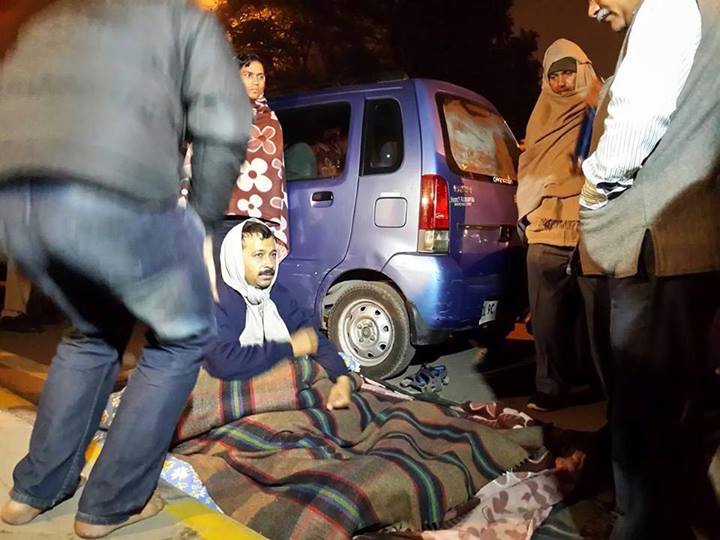
I'm not sure Arvind Kejriwal understands the seriousness of the damage he has caused to the democratic institutions of India today.
By sitting in dharna as CHIEF MINISTER of Delhi, he has violated his oath to protect the Constitution of India. When a role such as CM has to be discharged there can be all kinds of challenges, but the job of CM is not an anarchist's job.
He called himself anarchist, he acted as an anarchist. He literally kicked the Constitution of India and disrespected the office of the first citizen of Delhi.
Delhi, and India will not forget.


| Total income | 100 |
| Raw materials purchased | 58.45 |
| Other operating expenses | 27.66 |
| Operating profit | 13.88 |
Arvind, the humble tyrant, has essentially committed hara kiri today. #QuitAAP has gone ballistic on twitter. People are leaving AAP in droves.
As they say, the party is over.
No matter what happens, the bitter taste of an Indian CHIEF MINISTER running a dharna will never be forgiven. There is a MINIMUM standard of governance that has been breached today.
A nation’s prosperity eventually depends on its policies. The policies that obtain, in turn, depend on the objectives of the policymakers. Who these policymakers are is usually determined by the collective — through some democratic process but regardless of the details, the policymakers are ultimately chosen by consensus. No nation can be governed, dictatorially or democratically, without voluntary popular support. The people of India have much to answer for the misgovernance of India. Only when popular sentiment changes can one expect change in the outcome. Shri Narendra Modi appears to be the catalyst that may bring about a change in India.
Listening to Shri Narendra Modi delivering his address at the BJP National Council meeting in New Delhi today gives me hope for India. It was remarkable in many ways. First, he unequivocally named the Congress for failing India. They are all about privilege and not about substance or deed. Their rhetoric is hollow and ineffective. But that was just the start. His substantive comments were about development and progress.
Some of the issues he touched upon are close to my heart. He spoke about urbanization and why it is part of development. Another subject that he stressed was the need for a modern rail transportation system. He made a compelling case for education.
I desperately hope that Shri Modi is elected with a thumping majority in the upcoming general elections in India. I am reminded of a Shakespearean quote. “There is a tide in the affairs of men, Which taken at the flood, leads on to fortune. Omitted, all the voyage of their life is bound in shallows and in miseries. On such a full sea are we now afloat. And we must take the current when it serves, or lose our ventures.”
The tide for India is coming in. Modi is capable of leading India fortune,to ventures that will realize its potential. India stands at the threshold of a dream. We have to help Modi make that dream a reality.
There’s nothing quite like poverty and welfare issues to raise the headline temperatures to super-hot, and make the British go into orgies of navel-gazing and political correctness.
This time, everyone’s gone ballistic because of yet another controversial Channel 4 documentary, titled Benefits Street. It documents the lives of residents in one street near Birmingham, where almost everyone is on welfare or benefits. It also has the peculiar distinction of having received thousands of complaints at Ofcom, the media regulator and thousands of signatures to a petition to take it off air, while at the same time becoming the most watched show on British television, in the second of the fivepart series.
For those of you who don’t get — justifiably — why the UK is so touchy about benefits and its welfare state, a quick rewind. For years, the welfare and benefit system created an underclass of perennially poor people, stuck in a benefit trap.
That is, unlike India’s poor, who have to fend for themselves: the poor in the UK were thrown some money from the taxpayers to live like rats on council estates. In fact, they were thrown enough money that it was unprofitable for them to ever try and seek work, but never enough to get an education or skills to make them relevant in a developed society workforce.
It just seemed easier, in the days of easy government money to pay the unskilled and uneducated to stay out of society’s sight, and bring in immigrants to do the low-paid jobs. Keep wages low, so inflation can be controlled, and corporates can make big money, and oh, the City of London will bankroll the whole dodge. No need to retrain the poor, no need to raise real income levels.
There, problem of poverty solved, the fat cats could tell themselves smugly. The reason why so many allegedly left-leaning organisations are furious over Benefits Street, is that the mantra they believed in, for decades, is that welfare was the right way to solve the problem of a society’s poor. Don’t let them, like in India, lie in the streets for foreign telecasters to film, but hide them away in grim council estates.
Then came the big crash, and the fat cats weren’t so fat any more. Then came the Tories with their welfare reform policies, cleverly aided by a media campaign depicting benefit seekers as lazy scroungers, defrauding the honest taxpayer and worker, and creating a culture of hatred for welfare seekers.
It became politically correct to rant about the very poor, just as it became politically correct to rant about the super-rich. But you can’t take action against the super-rich, can you? Or pensioners, who form the largest voting chunk? So let’s reform the benefit system, and take it away from the poor.
The Benefit Trap
No doubt, it needs reform. At the heart of the matter is the “benefit trap”: why it’s impossible for a low-skilled person to survive through work, because welfare pays you enough to survive, while a minimum wage job does not.
None of the reforms in progress will solve that basic arithmetic imbalance. Or induce a single mother of four to go out and work as a cleaner or waitress. That, clearly, is what is annoying both left- and rightwing blocs about Benefits Street.
Politicians make great footage blaming other parties for it, but the truth is, the current state of affairs is a result of successive governments from after the war, both Labour and Conservative.
I’m not a great fan of Channel 4 documentaries — they tend to doggedly ignore any information that doesn’t fit in with their script. But whatever the merits of this TV show, pulling it off air will not make the residents of St James Street, which is what it is really called, go away or become suddenly richer.
A dose of what critics are calling poverty porn, unshorn of political correctness, might be just what the public needs.
The outcome was clear. From the day Prashant Bhushan announced that AAP would only accept mergers I pulled a stop to the Rule of Law Front effort.
But LSP has continued to dabble with AAP.
Now PB has made an even more clear statement. He says: "So far we have decided not to enter into pre-poll alliance. However, they (Lok Satta) may merge with AAP. There have been discussions (towards merger) in this regard."
AAP think that LSP is trying to merge with them!
LSP is sending a very wrong signal in the liberal space.
Why, when the rule of law front initiative was pulled off, has LSP continued to engage with AAP?
Why, when AAP has turned out to be the most illiberal and anti-liberty outfit we've seen in a long time (e.g. its position on FDI in retail, and looting the poor to pay the rich – e.g. water subsidies), has LSP not spoken out against AAP?
In the meanwhile Nav Bharat party has remained steadfast and clear about its principles and I have decided that NB is the right party to offer India good governance. Not once have I seen any confusion in the mind of NB party leaders. I commend them for sticking to their knitting.
Clarity of ideas is more valuable than anything else in the world. If you know what is good for India, SAY IT. The fact that you want to ride on someone's coat-tails despite that
someone causing grievous harm to India, says a lot about what you really want.
I urge LSP to, without any further delay, please come on board the Navbharat Manch and fight illiberal forces with one voice.
Do not deal with those who are intent on humiliating you, in addition to refusing to adopt ANY liberal policies.
My ONLY condition for support of AAP is the in-principle adoption of the SKCF reform agenda. Else it must be opposed.
With such an outstanding agenda such as the SKCF agenda on offer, why would anyone choose the RUBBISH policies being offered by AAP?
Given that Arvind Kejriwal is now threatening to go on "dharna outside North Block with his ministers to demand the suspension of four police officers, who allegedly did not perform their duties" [Source] let the Lt. Governor institute a judicial inquiry into the entire incident.
I believe (based on news reports) that in this case the Police were right. Somnath was wrong.
But more problematically, there are allegations that Somnath and AAP people confined and beat up women.
The public have a right to the truth. For GOI to suspend police officers on the basis of Arvind Kejriwal's dharna would be a denial of justice. In this case, there appear to be good reasonw why Somnath should be in jail, instead. Let the truth be brought out through a judicial inquiry.
Try telling people that saving/ investing money as well weight management have one thing in common – nice record keeping, and they screw up their nose!
Are you in that category?
Do you shudder thinking of the painful paper work or data entry on the comp?
Then come to a simple rule of budgeting. Nothing original, found it on the net. Adapted a little that is all.
Let us call it the 50/30/20 rule…..till you are 30 years of age.
The first 50% of your income at least till your age of 30 will go into: Housing, transport, food, medical and term insurance.
The absolute basics. When I mean food, I mean basic food. Preferably groceries and fuel – not that Barista or CCD coffee. Housing again means the basic – a 1bhk if you are newly married, nothing more. Public transport, or a basic bike/ car. No frills.
The next 30% goes into meeting your goals: saving/ investing for making a housing down payment, kids education, car repayment, retirement corpus.
The next 20% goes into lifestyle expenses! this is where your Canon, Nikon, Pentax cameras, Samsung or Nokia phones, oh that lovely Apple Ipod, Bosch speakers, designer dress, fancy gyms, fancy massages, …..whatever.
As long as you can keep that ratio reasonably close to what you are doing, you are in fine shape.
By the time you are 36 the ratios need to change. There are 2 reasons for this. Your income is now more stable – your spouse’s ‘kid bearing phase is over’ and you are CLEARLY a double income or a SINGLE income family. At this stage you need to spend about 30% on essentials, 50% on the second slot – of investing money for goals, and the 20% on lifestyle expenses. If you cannot meet your goals, it will be NECESSARY for you to reduce the 20% to about 10% – so that you can save/ invest more. Remember it is now that you see your parent’s finances more clearly.
You are now responsible to realize that you need life insurance, kids education corpus, parent’s protection, etc. So you start allocating in a different ratio till you are about 50 years of age.
By the time you are 55, your goals are met and you are now perhaps concentrating only on your retirement….well that is a different story, is it not?
Post Footer automatically generated by Add Post Footer Plugin for wordpress.
Other than the startups we had covered during the week, here are some others that caught our eye. Look for the best schools in your area using Chittischools, customise and have tailored the shirts you wear at Vitruvien.com, and learn via “social tests” at iTestiWin.
 Founded in 2011, Chittischools is a portal that helps parents find schools for students. The website enlists schools within any given area in cities across India. Users can find different schools in an area according to board type and school type as well.
The site also provides more information about the schools that are listed like the address, and reviews from other parents about the school. The portal also has a feature that gives admission information for each of the schools listed.
 Founded by Rajesh Goradia and Esha Jaggi, Vitruvien, is a place where users can get custom-made, tailored shirts for men. The company claims that every part of the shirt can be customised right to the buttons being used on the shirt.
Users can customise depending on type of material they want used, how they want the sleeves, collars, length etc. All customised clothing can be previewed in real time using the 3D revolutionary shirt designer on the website. Alterations to shirts in case of an ill fit is made by the company free of charge.
 iTestiWin is an education portal that depends on gamification and crowdsourcing to make tests fun. All tests and quizzes on the site are crowdsourced and users are rewarded for participating in activities. Targeting students and professionals, iTestiWin was developed by Lokesh Gupta and Iti Gupta to solve the problem of monotony while taking tests.
Users can create tests, take tests, review their performance and even engage with the community using the platform. Subject matters on which tests are conducted range from categories that include general aptitude tests, economics and finance, to engineering and design.
The post Startup Roundup: Chittischools, Vitruvien, iTestiWin appeared first on NextBigWhat.com.
On my way to India, I am in the university town of Leuven, close to Brussels. I have become quite a regular — last year I was here in February and then again in September. Along the way — I think it was on the flight from SFO to New Jersey — I caught a bug. I had a sore throat upon arrival at NJ and over the next few days it became a chest cold. By the time I left for Brussels, I was running a temperature (confirmed with a thermometer on board the flight) and I declared myself officially sick.
Jan 12th Boston
The talk in Boston on Sunday 12th January went well. It was a small gathering of about 40 people in a private home. Dr Mahesh Mehta spoke first, followed by Shri S. Gurumurthy who was in Chennai. I was the last speaker. Since it was Swami Vivekanand’s birth anniversary that day, I began by mentioning that Vivekanand had stressed the importance of physical fitness as a prerequisite to any spiritual development. Analogously, I said, it is important that India become economically strong before it attempts to give to the world whatever of value that it has to give.
As I always do, I began with the matter of India’s lack of economic prosperity. India has almost all of the ingredients necessary for prosperity — natural endowments, human resources, etc — except for good governance. Although the British raj ended in 1947, India continued to suffer the ill-effects of a colonial rule because the institutions that the British had created for their own exploitative and extractive purposes remained intact and fully functional under the new dispensation post political independence. India lacks freedom and therefore it continues to be underdeveloped.
Following my introductory remarks, I took questions from the audience. I find audience-led discussions much more interesting than making speeches because I learn a lot from the questions. The audience was expectedly right of center when it came to social matters. However I have noticed that the right of center are not right of center as regards economics. Most people are still mired in leftist rhetoric. If we follow free market economics, they ask, what about the poor? It takes some doing but eventually it is possible to persuade them that economic prosperity cannot bypass the poor even if one wanted to.
Overall the talk was well-received. I had a great time. A few people had read this blog and I enjoyed meeting them.
The Dramas
I don’t read newspapers nor watch TV news. However, I do keep an eye on twitter and it gives me a good sense of what is going on in India. From what I can tell, the Indian media’s obsession is almost entirely political. Nothing that happens in India is not tainted with politics. Journalism, sports, writing, commerce, entertainment, business, governance, policing, courts — everything is contaminated by politics. An endless stream of small matters march across the stage and capture the collective consciousness briefly, and nothing of any significance is debated or any enduring lessons learned.
The Tejpal drama lasted a couple of weeks. Then came the Khobragade drama. That was replaced by the Kejriwal/AAP drama. The drama du jour is Mani Shakar Aiyar’s statements.
Why do the trivial and the tawdry have such a hold on the popular mind? (I was tempted to write the aam aadmi mind.) Which came first: the trivia which molded the mind to be fascinated with it or did the small mind prompt the media to cater to it?
I find Kejriwal’s Aam Aadmi Party’s success in the Delhi elections very revealing. It is reminiscent of Tehelka’s success. Tehelka’s spiel was that it was out to fight the good fight against corruption and deceit. It would speak truth to power. In truth it was the powerful Congress party that was using Tehelka as a front. I consider AAP to be a “politically weaponized Tehelka” to counter Modi.
Like Tehelka, AAP started off with the grand promise to fighting corruption but beneath its mask (or shall we say beneath the Gandhi topi) is the ugly face of the money-grubbing Congressi. The front end is Kejriwal in his Gandhi topi; the back end is Madam Antonia Maino, aka Sonia Gandhi and her minions led by the despicably dishonest appointed prime minister Dr Manmohan Singh.
The bigger they are, the harder they fall. Karma is a bitch, as they say. It may take a few weeks or even a few years but Kejriwal will go the same way as others before him. His hubris will be his undoing.
I am going to be in India in a few days. Once again, I will be struck by the awful state that the home country is in. I know that it did not have to be so pathetically poor but it is so because of the small minds that govern its fate. Why do the people of India continue to allow these small-minded crooks to rule over them will continue to puzzle and sadden me.
India should have been a wonderful place for all Indians to be proud of and all the world to admire. It should have been but it is not. The people are distracted from the sad reality by trivial matters and petty dramas.
I am reminded of a favorite line by the great physicist Richard Feynman. In the context of the monotheists’ stories about the nature of the universe, he had said, “The stage is too big for the drama.”
India is too big a stage for the dramas that the media puts on for the entertainment of the masses. The people need to get out of the theater and create a story that is worthy of the stage.
As a person who has now spent more than 5 decades on the planet and of which 30 years at least thinking, earning, talking, writing, teaching about money, this post is not original.
Yes of course it is from what I have read and spoken about money across age groups. The older people feel that the younger people are more obsessed about money, and the younger people feel that the older people do not know how to live life king size.
Here is the version of older persons, reasonably financially successful, happy people.
1. The younger generation has not ‘earned’ its right to spend: well most of the younger kids in business families have a standard of living far higher than what wealth that they can create / have created in their life times.
my note: Most of the feel good, sadly, occurs from ONE asset class: Real estate, not really earned income.
2. None of the older persons earned money to buy things, but, yes they acquired most of the things that they enjoyed using.
3. The big regret many of these guys have is that they did not travel enough – within and outside the country.
4. A few of them regretted that they allowed their children INTO their business.
5. A few of them regretted that they did not experiment with new business ideas despite having money to do so.
6. The biggest impediment to their business growth was SYSTEMS – which meant they could not recruit strangers and monitor them.
7. Simple advice from them: If you are going to spend 40 hours a week ATLEAST at work, learn to enjoy it, or find a new career
8. To be successful, it is nice to be talented, but it is VITAL to be nice. Team skills far, far more important than individual skills.
9. Be frugal, but hey get a life. Enjoyment is NOT about money. Success is not about money. Happiness is not about money.
10. Invest for the long term. Eat for the long term, but live in the present. Short term pleasure in eating hurts and short term investing kills.
11. Stop worrying about things that you cannot control…
Post Footer automatically generated by Add Post Footer Plugin for wordpress.
A few days ago I had a short exchange with Tejus Sajwani on Twitter (who by the way you should definitely follow) when he asked the following question:
Without AAP, if Modi hadn’t done well in coming elections, he would have lost his raison d’être. But now, even if BJP doesn’t do well, Modi can still stick around, saying that BJP was jilted at the altar by an errant bride that ran off with AAP! So perhaps then, we have a cobbled up coalition for a few months, which perhaps ends up giving BJP a better chance in a 2nd election in say 1.5-2 years? Plausible??
This was my initial response:
@tejus_sawjiani Perhaps not because AAP won’t win enough seats to make a difference to BJP’s fortunes.
— Manshu (@Manshu) January 5, 2014
I’m embarrassed to say that at the time I didn’t realize that the current UPA II government has 276 MPs which is just one more than the 275 MPs required to stay in power, and also a little confused because the Lok Sabha website itself gives a different number.
| Parties | According to Lok Sabha Website | According to Wikipedia |
| Indian National Congress | 204 | 206 |
| Nationalist Congress Party | 9 | 9 |
| Rashtriya Lok Dal | 5 | 5 |
| Jammu & Kashmir National Conference | 3 | 3 |
| Indian Union Muslim League | 2 | 3 |
| Kerala Congress (Mani) | 1 | 1 |
| Sikkim Democratic Front | 1 | 1 |
| All India United Democratic Front | 1 | 1 |
| Outside Support | ||
| Samajwadi Party | 22 | 22 |
| Bahujan Samaj Party | 21 | 21 |
| Rashtriya Janata Dal | 3 | 4 |
| Total | 272 | 276 |
After checking with a few people, I feel that the Lok Sabha website is incorrect, but please leave a comment if you have any insight on this.
Going back to the original question, I think it is quite possible that the scenario Tejus mentioned plays out because AAP is planning to contest about 300 seats, and winning even 20 of those will give them significant sway over BJP which is expected to win the most seats.
This will create any coalition very difficult, and a distinct possibility for a re-election which the market never likes. I think this view is only beginning to gain momentum in the popular press now, but I feel it won’t be long before it gets a lot of attention, and rightly so.
Finally, it is worth mentioning here that I like AAP and although I frown upon many of their left leaning policies, overall, I think they are much better than the alternatives, and if nothing else, I feel that this is the best bad idea we have sir, by far.
Related posts:
It is customary for industry bodies to time and again talk about “irresponsible” selling or mis-selling by “unethical” agents (by what ever name called). Let us look at what exactly constitutes mis-selling.
Mis-selling as understood by the common man means “selling a product which is inappropriate for the client”. However let us look at the manufacturer’s attitude.
If an agent sold a life insurance policy with a “life-cover” to a bachelor on whom no person is dependent, I would think this is mis-selling. The industry would not.
If an insurance policy is sold to a non-earning member (sorry to be gender biased but I mean the house wife) and the husband is the beneficiary, I would think it is mis-selling, the industry may not think so. Similarly in case of a child. I am at a complete loss to know who would be paying the premium in case the breadwinner is no longer around to take care of the premium.
If the agent is the spouse of Mr. X and Mr. X is a full time employee in a foreign bank, and nicely taps the data base of the bank, I would think this is in the realm of what is wrong, the industry may not think so.
What really constitutes mis-selling in the minds of a life insurance company? This is very difficult to say, but I do not know of any company which has a comprehensive “mis selling policy”. If it does exist, I do not know about it, my apologies for the same. So mis-selling is not defined, not communicated, not monitored, and thus not bothered about! If it is not measured, monitored or acted upon, I guess the industry pretends that there is no mis-selling. GOD BLESS THEM.
Let us start by saying that the following actions should be mis-selling:
There are of course millions of instances of mis-selling happening in the market, let us see what can you do as a prospective client to avoid some of these pitfalls:
Post Footer automatically generated by Add Post Footer Plugin for wordpress.
2014 has already started and you must be feeling reinvigorated – just as you were when 2013 started :). How then do you expect 2014 to be different from 2013? Let me explain a bit. When we get on call with some of our clients, we ask them –
“Do you want your next 5 yrs of financial life, like your past 5 yrs ?”.
Naturally, We get an emphatic “NO” and horrified looks (though we cant see them). Now ask yourself the same question and I am confident, for most people the answer would be the same. If your financial life is all messed up, I am sure you must have thought to correct it in this New Year. Let me help you a bit and give you 5 suggestions that you can implement and improve your financial life by leaps and bounds. It will start small, but things will improve steadily.
Here are those 5 ideas, which you should look at. Trust me, these are proven to succeed for most people we work with and even ourselves.

I can proudly say today, that all my knowledge and understanding of personal finance has come from (and only from) solving other people’s queries on this blog and our Q&A forum. Of course, some part of my knowledge has also evolved by writing these articles. I write the articles and they elicit variety of questions in comments section. I then reply back to those who commented and try to solve their problem. It really takes a lot of time and effort from my side to do this, but in the process, I learn a lot. If I do not know the answer, I ensure I find it out by researching it on the Internet, or come up with an answer through disciplined thought and introspection.
This helps me learn new things and also it feels nice to be able to help someone – after all, I love bonding with people and I hunger to be able to “give” back to our community! Conversations in the comments section between me, and the person asking the question, allow both of us to come out with better knowledge of the topic. What’s more, it really feels amazing to realize that one’s help has contributed to someone’s decision-making process.
I occasionally get into face-to-face conversations with people who seek my help regarding personal finance, and I do my best in helping them. Over time, this has created a wealth of information and knowledge inside me. Heck – I wrote two books too on money just by helping others !
So if you want to learn about personal finance, I can tell you with 100% confidence, that there is no better way than helping someone else on personal finance and answering their queries. You might feel – “but I do not know much myself”. The truth is, even if you do not know the full answer, making an attempt to help someone and contributing a bit extra helps you realize that personal finance is more about common sense and less about expertise.
You can anytime go to our Jagoinvestor Q&A forum, where dozens of personal finance questions are asked each day and hundreds of investors just like you are helping out with all the knowledge they possess. So just pick a question and reply with an answer. You must have surely learnt a lot from this blog and other resources and I know you are 100% capable of giving suggestions to others. I know you might be scared at times, thinking how it would look if you do not give the right answers or best answers to someone. But do not try to give the “perfect answer” – just give an answer with a full commitment to help someone. You will find that not only is your effort genuinely appreciated, but you will also feel amazing yourself and will make a friend and learn in the process. Alternatively, you can also reply to the comments that are posted on the articles from time to time.
I strongly recommend reading this book this book called “Go-Giver”, which will truly transform your way of looking at life and help you in your professional life.
When someone wants to work with us on his/her financial life, One of the first things they have to do is, fill up a detailed datasheet we give to them to capture all their financial details. This is what most of the financial planners will do as initial steps. Now most people react by thinking – “Oh no, I am not filling up a lengthy excel spreadsheet” and some people ask us – “Do I really need to fill this up?”
We tell them very calmly – “Yes, in 2 days, and ONLY then do we move ahead”
4-5 days PASS and we remind them once again about it.
It is only then that we finally get a mail saying that the datasheet is filled and we also get from them something like this –
“Hi Manish & Nandish
Please find attached the datasheet in this mail. My Apologies for sending it late. But let me share with you something about filling up the datasheet. I never knew about my own financial life before I filled this datasheet (here is ZIP version). I mean, I always thought I know everything and all the things are inside my head, I know the details. But in reality, I was so much cut off from my financial life.
I had to find out so many things while filling up this datasheet. For the first time, I seriously looked at my policies, where are my mutual funds, what is their worth exactly. I have discovered how much is my EPF worth and had to discuss a lot with my spouse and few things from other family members. I discussed about my expenses with my spouse and we released so many tiny things we can change and improve. We never realize these things in daily life, because we are just not in touch with whats going on with our expenses. Money just comes in my account and goes off here and there.
We also for the first time, really talked about our long term goals, had to think about the numbers and discussed a bit about which one are more important the others. I felt a bit worried on how will I fill all this , but once I started it, me and wife got involved in it and really liked it. For the first time I feel I know where do I stand in my financial life and have some sense of what all we want from our financial life. This datasheet filling exercise was a short but amazing journey in itself. Thanks a lot Manish and Nandish”
Nandish and I often talk about this and we have now realized that just putting all your financial data in one place is a wonderful way to improve your financial life because you really get in touch with your finances and start thinking about them seriously. For almost 90% of people who do this, it’s their first time taking some time off to focus on their financial life. What was previously a fuzzy area for them suddenly becomes clear and obvious. Just noting down your financial data in one place solves so many queries you had earlier.
So next Sunday (or whenever you can take out some time), allocate 3-4 hours for your financial life and just open a blank excel sheet and put down all your income/expenses, policies details, mutual fund data, Fixed/recurring deposits data, loans details, long and short term goals and everything else you can imagine, and see the magic. You will thank us. Let me make your job easy and share with you this ready made excel datasheet (here is ZIP version) , you can download it and you can fill it up. This is the same datasheet we send to our clients.
Most investors are just moving with the flow of life. They get up, go to work, they earn, they spend and if something is left, they spend it again. If after all this, if still some money remains, it stays in their saving bank account, and is usually consumed for some useless reason – which looks reasonable and important at that point of time, but makes no sense in long term.
Nandish had recorded this wonderful audio on “slowing down” which talks about why you should step back for a moment and not be hasty with your personal finances It explains why you should “Slow down” and lower your pace in financial life and ask yourself where you are headed.
Listen to the “Slow Down” Audio below
Most people do not even know which direction they are going in their financial life and where they want to be in the next 5 years. In our Investors’ boot camp (next batch starts 20th Jan), we do an awesome exercise for one week, just to make you think what you want in your financial life and to get you in touch with your financial life.
So your current task is to apply some brakes on your momentum and investigate your own financial life. Ponder over few things and find out what is important for you. It is all about getting clarity and coming out from a state of confusion!
Investors keep on doing random things in their financial life for years, sometime with a rational mind and sometimes without much thinking. It would be a good idea to capture for the last 5 years – the major decisions you took in your financial life and the reasoning behind it. For example, you may have bought some policy after meeting an agent, or bought a property, or broken a Fixed deposit, or added major expenses in your life etc. Make a list of all those decisions over the last 5 years, and write down in detail, the reasoning behind those decisions. What made you do take the steps you did?
Do you still feel you did it for the correct reason? Do you feel you were right? Looking back at it, was it the right decision?
When you do this, you will be clearer about your own thinking and how you feel about a lot of things. Maybe you realize that you did something just to look good in front of someone. Maybe you find out that you focus too much on the short term and do not look at things from a long-term perspective. Maybe you will find out that you compromise on your long-term wealth creation just to fund some short-term happiness.
To give you a flavor of how people feel after writing down their history and all they have done in their financial life in past, here is an experience of one of the members of our Investors bootcamp
“I felt many emotions while filling out these questions – pride, great joy, regret & sadness. I saw how I had grown from a child to an adult as an investor and kept coming back to document what I missed. As the picture emerged, it was so interesting to see the patterns emerge and to find blind spots that would probably be immediately evident to someone else. It took me a long time to answer the second question. I was worried, but to document exactly what was worrying me took time. Now that I have it on paper, it feels a lot less worrying! I’m excited to see what the boot camp holds and am looking forward for the next week.”
So start this exercise the moment you complete this article.
In his book – “11 principles to achieve financial freedom” , Nandish talks about Level 1, Level 2 and Level 3 promises.
Level 1 promises are “professional promises”, which you fulfill and complete at any cost and ensure they are never left pending. You bring work home, stay up late, but complete those tasks. You are fully committed to your level 1 promise.
Level 2 promises are ones that are made to our families and we keep them sometimes and do not keep them sometimes. We are somewhat committed to those level 2 promises, but not fully.
Level 3 promises are those promises, which we make to ourselves.
We excel at not completing these Level 3 promises! We surpass others in forgetting those promises and on no occasion do we display the level of commitment we do with Level 1 and Level 2 promises. Waking up early to exercise falls in this level 3 promise. Starting a “SIP” also falls under level 3 promises. And, most importantly, all Personal Finance actions fall into Level 3.
| Level One | Professional promises | You keep them always |
| Level Two | Promises made to family members | You keep them at times |
| Level Three | Promises made with self | You break them all the time |
Ask yourself, how long has it been since you promised yourself to start that recurring deposit, write your budget, start your SIP or write a will? You will realize you are worse than you imagine :). This happens because you are not accountable to anyone. No one will complain, if you don’t do things and leave them incomplete. You can always rationalize your behavior and you will surely not “Punish” yourself – and that’s the weak point.
Your life goes on, and you give a clean-chit to yourself every time you break a promise made to yourself, citing reasons beyond your control. But this errant behavior is costing you your future. This small thing can jeopardize the happiness of your family some day, can make your retired life a nightmare and can mean your kids get a mediocre education because you were not able to accumulate enough wealth to pay their fees in the future.
This is more serious than you think, but you will realize it only later.
Be Accountable to Someone
The only way to improve it is to be accountable to someone about your promises and actions. Hire a professional Mentor who keeps track of your financial life and your promises, and to whom you report your actions.
A lot of people look at a financial planner as someone who will give “advice”, but not as someone who will help them track where they are headed, who will ask them – “Tell me, what did you achieve this month?” and someone who says things like – “Can you tell me, the reason you failed to change your bank account nomination which you promised to complete by this month? Didn’t you get 2 hours out of your schedule?”
The mentor can also be your family member or spouse if you want. Declare your actions and deadlines to your family. Do whatever it takes, but ensure you are answerable to someone, if only to some extent.
Importance of “Accountability” in your financial life
Let me also share with you, the “Accountability” feature of our Online Investors bootcamp (register for upcoming bootcamp on 20th Jan). At the bootcamp, each week you declare your weekly action and what you are going to complete in coming 4-5 days and then you go back and do those things. You have to report things back on Friday and share with us your progress. If you do not complete it, you are asked questions and reasons for not doing your tasks.
Now someone will not shoot you or put you behind bars for not doing what you promised, but when you see others declaring proudly how they completed their tasks and see them feeling euphoric about it, you feel bad for not keeping your words and feel ‘left out’. These group dynamics work for participants and they complete things most of the times. We have seen it working in Batch 1 and Batch 2 of our bootcamp. A little work each week improves your financial life, and at the end of 6 weeks, you move to the next level and realize – “Wow! I have finally done so many things which I was only thinking about all this time”
Now it need not be only at the investors bootcamp – you can report to your spouse, your friend, your Facebook friends (if you are okay declaring your actions) or else, you can pay a professional financial planner and take his help. Anything that helps you is a “great” option. There are no rules.
So bring some accountability structure in your financial life and you will surely see the results.
You really need to design your financial life based on these 5 ideas . Do not just read them, but really practice them and see the effect.
At any age being able to say this is great. It summarizes many of my thoughts….
Power of Money…by Adam Khoo (Singapore’s youngest millionaire at 26 yrs.)
Some of you may already know that I travel around the region pretty frequently, having to visit and conduct seminars at my offices in Malaysia, Indonesia, Thailand and Suzhou (China). I am in the airport almost every other week so I get to bump into many people who have attended my seminars or have read my books.
Recently, someone came up to me on a plane to KL and looked rather shocked. He asked, ‘How come a millionaire like you is traveling economy?’ My reply was, ‘That’s why I am a millionaire. ‘He still looked pretty confused.
This again confirms that greatest lie ever told about wealth (which I wrote about in my latest book ‘Secrets of Self-Made Millionaires’). Many people have been brainwashed to think that millionaires have to wear Gucci, Hugo Boss, Rolex, and sit on first class in air travel. This is why so many people never become rich because the moment that earn more money, they think that it is only natural that they spend more, putting them back to square one.
The truth is that most self-made millionaires are frugal and only spend on what is necessary and of value. That is why they are able to accumulate and multiply their wealth so much faster.
Over the last 7 years, I have saved about 80% of my income while today I save only about 60% (because I have my wife, mother in law, 2 maids, 2 kids, etc. to support). Still, it is way above most people who save 10% of their income (If they are lucky).
I refuse to buy a first class ticket or to buy a $300 shirt because I think that it is a complete waste of money. However, I happily pay $1,300 to send my 2-year old daughter to Julia Gabriel for Speech and Drama classes without thinking twice.
When I joined the YEO (Young Entrepreneur’s Orgn) a few years back (YEO is an exclusive club open to those who are under 40 and make over $1m a year in their own business), I discovered that those who were self-made thought like me. Many of them with net worth well over $5m, travelled economy class and some even drove Toyotas and Nissans – not Audis, Mercs, BMWs.
I noticed that it was only those who never had to work hard to build their own wealth (there were also a few ministers’ and tycoons’ sons in the club) who spent like there was no tomorrow. Somehow, when you did not have to build everything from scratch, you do not really value money. This is precisely the reason why a family’s wealth (no matter how much) rarely lasts past the third generation.
Thank God my rich dad foresaw this terrible possibility and refused to give me a cent to start my business.
Then some people ask me, ‘What is the point in making so much money if you don’t enjoy it?’ The thing is that I don’t really find happiness in buying branded clothes, jewellery or sitting in first class. Even if buying something makes me happy it is only for a while; it does not last. Material happiness never lasts, it just gives you a quick fix. After a while you feel lousy again and have to buy the next thing which you think will make you happy. I always think that if you need material things to make you happy, then you live a pretty sad and unfulfilled life…
Instead, what makes me happy is when I see my children laughing and playing and learning so fast. What makes me happy is when I see my companies and trainers reaching more and more people every year in so many more countries. What makes me really happy is when I read all the emails about how my books and seminars have touched and inspired someone’s life. What makes me really happy is reading all your wonderful posts about how this blog is inspiring you.
This happiness makes me feel really good for a long time, much much more than what a Rolex would do for me.
I think the point I want to put across is that happiness must come from doing your life’s work (be it teaching, building homes, designing, trading, winning tournaments etc.) and the money that comes is only a by-product. If you hate what you are doing and rely on the money you earn to make you happy by buying stuff, then I think that you are living a life of meaninglessness.
Post Footer automatically generated by Add Post Footer Plugin for wordpress.