Shared posts

06 Feb 09:56

4 kind of exclusions in your health insurance policy which are NOT covered

by Manish Chauhan

When health insurance claims are rejected, it disappoints the customer more than anything else. Its a disappointing moment for the policy holder, when his trust is lost in company and he starts feeling that he was a fool to buy the health insurance policy at the first place and waste his premium, because companies are just fraud, who wants to loot the customers, by giving silly reasons for not settling the claim.

They feel companies are coming up with unreasonable reasons to reject their claims. This situation is a big blow to customer financially, because now they have to bear all the expenses from their own pocket. This is exactly what happens with many customers who have no idea of what their health insurance policy covers and does not cover.

What does a Health Insurance Policy does not Cover ?

In almost all the cases where claims are rejected and customers are disappointed, its seen that it happens because companies reject claims based on the policy document rules and what is covered or not covered into the policy, however the customer disappointment is always there, because there was a lack of understanding of what is covered and what is not covered. There various clauses like waiting period concept or exlusion of pre-existing illness, which customers do not try to understand fully and see health insurance policy as something which will just pay their bills in any medical case. However thats not true.

In this article I want to make you aware about the 4 major clauses in almost all the health insurance policies which will help you understand how exclusions work in case of health insurance policies and when you will not be paid. This will help you and companies both to make sure you are on the same page.
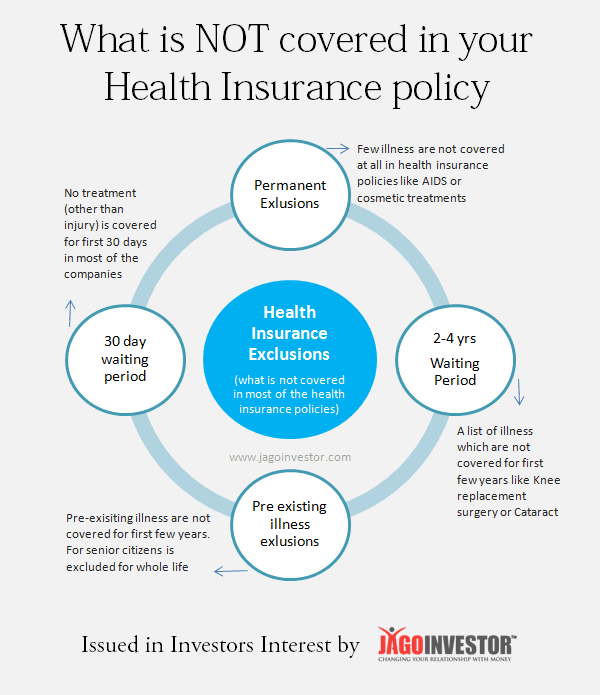
What is not covered in health insurance policies

Exclusion #1 – Permanent Exclusions

Permanent exclusions are listed category of treatments, which are never covered in health insurance policy for whole life. They are excluded permanently from the ambit of the health insurance scope. These permanent exclusions are clearly mentioned in the policy document of the health insurance product under section “Permanent Exclusions”.

Even before buying the policy, you can look at the PDF document of the policy which must be there on the health insurance company website. Almost all the companies have the same list of illnesses listed under this section, however you should anyways look at it.

Here is a sample list of some of the permanent exclusion taken from Religare Care Health Insurance policy(not the full list)

  • Any condition directly or indirectly caused or associated with any sexually transmitted disease
  • AIDS
  • Any Treatment arising from or traceable to pregnancy, miscarriage, maternity, abortion or complications of any of these.
  • Any Dental treatment or surgery unless necessitated due to an injury
  • Charges incurred in connection with cost of spectacles or contact lenses, routine eye and ear examinations
  • Any treatment related to sleep disorder etc
  • Treatment of mental illness, stress , psychiatric or psychological disorders
  • Any Treatment/surgery for change of sex or gender reassignments including any complication arising out of these treatments
  • All preventive care, vaccination, including inoculation and immunizations
  • Non Allopathic treatments
  • Any Out Patient Treatment
  • Treatment received outside India (unless its part of the policy)
  • Act of self destruction or self inflicted injury , attempted suicide
  • Any Hospitalization primarily for investigation or diagnosis purpose
  • Cosmetic and aesthetic treatments
  • plus, there are many others – which you should read in policy document

Here is an exact snapshot from Bharti Axa Health Insurance page
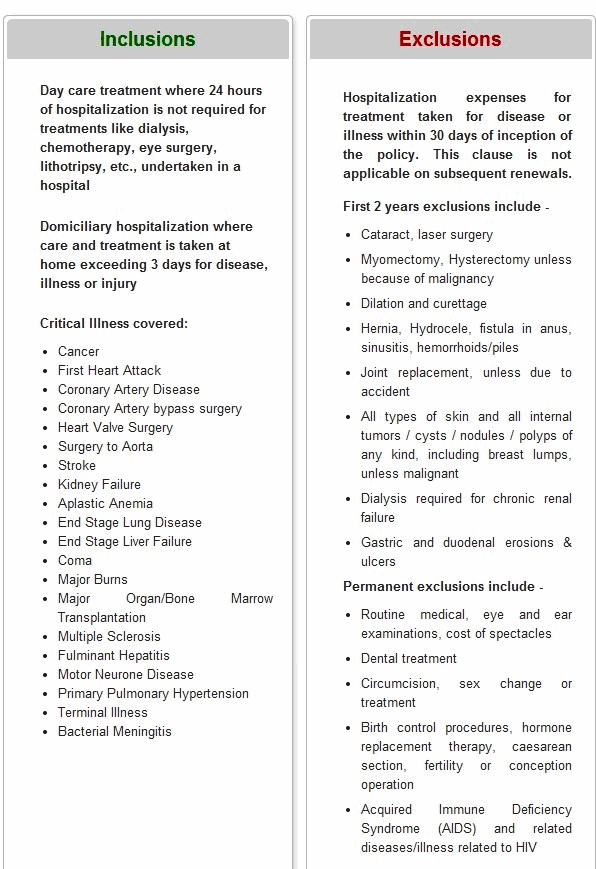
what is not covered in health insurance policies bharti axa

Exclusion #2 – Waiting Period Concept for selected illness

Each Health insurance policy has the concept of “Waiting Period” for a selected list of illnesses, which means that for first few years(which can be anywhere between 2-3 years) will not be covered under health insurance and only after that period they will be covered. So if waiting period is 2 years in some policy, and you take the policy in year 2014, the illness covered under waiting list will be covered only after 2 yrs are over.

This is one thing which customers do not pay attention to while taking the policy and if they get hospitalized due to some illness which is not covered under waiting period, their claim is rejected and then they feel cheated and complain about the company. Here is a real life case on our forum

Here is the list of some of the illness and diseases which are part of waiting period in most of the policies

  • Arthritis , Osteoarthritis , Osteoporosis , Spinal Disorders, Joint replacement surgery
  • ENT Disorders & surgeries, Deviation, Sinusitis and related disorders
  • Cataract
  • Dilation and Curettage
  • Piles, Gastric Ulcers
  • All types of Hernia , Hydrocele
  • Internal tumors, Skin Tumors , cysts
  • Kidney Stone , Gall Blader Stone

Some policies might have the specific waiting period for senior citizens, like in case of Family First policy by Max Bupa, there are few illness which are under 2 years waiting period for senior citizens, but not for young customers.

Specific Waiting period for senior citizens

Exclusion #3 – Pre-Exisitng Illness

Another exclusion is “Pre-existing illness” in all the policy documents of all the health insurance policies. Pre-existing illness are those illnesses which are already detected for the patient. Most of the companies do not cover these pre-existing illness for starting 2-4 yrs (exact time varies from one company to another). So if someone is suffering from some respiratory illness already, then any treatments or hospitalizations which occurs due to respiratory problems will not be covered for first few yrs (the exact tenure depends on company). This is to prevent situations where a person is detected for some disease and he takes the health insurance so that he is covered for the hospitalization, this is simply not allowed and does not make any business logic. So thats the reason its said that one should take health insurance as soon as possible so that those initial few years are passed and then you are covered for wide range of illness.

Pre-existing illness in case of Senior Citizens

In case of senior citizens, pre-existing illness are excluded for rest of the life in most of the policies, because anyways there is higher probability of senior citizens getting hospitalized due to their existing illness. So if someone has undergone bypass surgery and they are senior citizen, any heart related treatments will not be covered for all life. It will be permanently excluded from the policy. Thats one big reason why I keep on saying that you should take your parents health insurance before they turn 60 yrs. There are some companies like Oriental Insurance, which does not even require medical tests for persons upto age of 60 yrs, just the declarations given in the health insurance form is enough.

Exclusion #4 – First 30-90 days waiting period

Almost all the health insurance companies do not give cover for any medical treatment for the first 30-90 days of taking the policy, except the medical expenses which result from injury (like accident). For example Religare Care have a initial 30 days waiting period, however Max Bupa Family First policy has a 90 day waiting period

Conclusion

Health Insurance is a preventive financial product, not a reactive financial product. You take health insurance to make sure that you are covered from future problems, not to deal with current medical issues. So when you are healthy, you should go for medical policy, so that you are covered for any long term medical issues. Most of the people start the procedure of buying health insurance when some illness is detected, and that’s when health insurance policy will not help you much. Instead of having wrong expectations by assuming things, better analyse and research the health insurance policy properly and deeply by reading the policy document.

Let me know if you have any experiences on this or want to share something ?

06 Feb 09:52

An Expensive Kind of Insurance

by David Merkel

Strategy One: “Consistent Losses, with Occasional Big Gains when the Market is Stressed”

Strategy Two: “Consistent Gains, with Total Wipe-out Risk When Market is Highly Stressed”

How do these two strategies sound to you?  Not too appealing?  I would agree with that.  The second of those strategies was featured in an article at Bloomberg.com recently — Inverse VIX Fund Gets Record Cash on Calm Market Bet.  And though the initial graph confused me, because it was the graph for the exchange traded note VXX, which benefits when the VIX spikes, the article was mostly about the inverse VIX exchange traded note XIV.

Why would someone pursue the second strategy?  Most of the time, it makes money, and since January 2011 we haven’t a horrendous market event like the one from August 2008 through February 2009, it makes money.

I would encourage you to look at the decline in the second half of 2011, where it fell 75% when the VIX briefly burped up to around 50.  But given the amazing comeback as volatility abated, the lesson that some investors drew was this: “Volatility Spike? Time to buy XIV!”  And that explains the article linked above.

You might remember a recent book review of mine — Rule Based Investing.  In that review, I made the point that those that sell insurance on financial contracts tend to win, but it is a volatile game with the possibility of total loss.  To give another example from the recent financial crisis: most of the financial and mortgage insurers in existence prior to 2007 are gone.  Let me put it simply: though financial risks can be insured, the risks are so volatile that they should not be insured.  You are just one colossal failure away from death, and that colossal failure will tend to come when everyone is certain that it can’t come.

But what of the first strategy?  How has it done?

Wow!  Look at the returns over the last few weeks!  Rather, look at a strategy that consistently loses money because it rolls futures contracts for the VIX where the futures curve is upward-sloping almost all the time, leading to buy high, sell low.

Does it pay off in a crisis?  Yes.  Can you use it tactically?  Yes.  Can you hold it and make money?  No.

Back to the second strategy.  People are putting money into XIV because they “know” that implied volatility always mean-reverts, and so they will make easy money after a volatility spike.  But what if they arrive too early, and volatility spikes far higher than expected?  Worse yet, what if Credit Suisse goes belly-up in the volatility?  After all, it is an exchange-traded note where owners of XIV are lending money to Credit Suisse.

Back to Basics

Do I play in these markets?  No.

Do I understand them?  Mostly, but I can’t claim to be the best at this.

What if I try both strategies at the same time?  You will lose.  You are short fees and trading frictions.

What if I short both strategies at the same time?  Uncertain. It comes down to whether you can hold the shorts over the long term without getting “bought in” or panic when one side of the trade runs the wrong way.

Recently, someone pinged me to speak to CFA Institute, Baltimore, where he wanted to talk about “not all correlations of risky assets go to one in a crisis” and pointed to volatility investing as the way to improve asset allocation.  Sigh.  I’m inclined to say that “you can’t teach a Sneech.”

I favor simplicity in investing, and think that many exchange traded products will harm investors on average because the investors do not understand the underlying economics of what they own, while Wall Street uses them as a cheap way to hedge their risk exposures.

There may be some value to speculators in using “investments” like strategy one for a few days at a time.  But holding for any long time is poison.  Worse, if you are accidentally right, and the world comes to an end — this is an exchange-traded note, and the bank you lent to will be broke.  That will also kill strategy two.

So, my advice to you is this: avoid either side of this trade.  Stick with simple investments that do not invest in futures or options.  Complexity is the enemy of the average investor.  I can understand these investments and they don’t work for me.  You should avoid them too.

PS — before I close, let me mention:

Good article in both places.

06 Feb 03:04

But Subra YOU ARE WRONG! Completely wrong!!

by subra

When you talk to people who are say 22-30 years of age, you are normally prepared for all kinds of reactions, right?

Well one 27 year old girl had this brilliant conversation with me, and I am reproducing it more or less verbatim:

G: Subra Sir I need to invest Rs. 80,000 for my 80 C – tax provision where should I invest?

Me: ELSS – will give you a choice of 2-3 fund houses, take a pick, it does not matter.

G: Why not a bank fixed deposit, that also gives me the same tax benefit, or life insurance…..etc.

Me: In the long term…equity….etc. etc.

G: Sir why are you saying equities make money for EVERYBODY in the long run?

Me: Because it is true that in the long run (read 5 to 200 years as per your convenience and conviction and trust) one tends to make money. See Colgate, Gillette, Siemens, HUL, ITC, ….

G: You mean..ALWAYS, ALL SHARES?

Me: NO. Some good shares, but long term, most of the time.

G: How many shares have made money for share holders, and given a REAL return (nominal return minus inflation)?

Me: About 100 shares over the past 50 years out of 20,000 shares ever listed. (oops this girl was hurting!!)

G: How many PEOPLE have earned ENOUGH from equity markets to make a difference in their lives?

Me: About 100,000 out of about 2 crore investors (Sebi figure) or 1 crore investors (my estimate)

G: So about 5% of the companies and about 0.5% of the investors? Come on sir gimme a break. I cannot see how a mutual fund manager will pick ONLY those shares for such a small population, I am better off paying the tax.

Me: Hey kid you got me thinking…

G: I live in Malad and I have only heard of people losing money in Harshad scam, Ketan scam, trading….NOT HEARD ANY SINGLE Investment success story. I have ONLY heard of people making TONS OF MONEY IN real estate and gold.

Me: So?

G: I am planning to buy a house in Vasind for Rs. 19Lakhs. I have Rs. 5 lakhs of my money in a bank fd, will borrow Rs. 14 lakhs and pay an EMI of Rs. 14,000 for the next 20 years. I am sure I will get a tax break, appreciation,….What say sir?

Me: Some of my readers may react to you darling. God bless you.

Post Footer automatically generated by Add Post Footer Plugin for wordpress.

06 Feb 03:01

Global crisis: thinking out of the box

by T T Ram Mohan
The world appears to be suffering from 'crisis fatigue'. There's been so much talk over the past seven years and so little by way of results that policy-makers seem to have given up. Top economists, gathered in Philadelphia recently, proposed a clutch of stronger measures than austerity or monetary loosening, the Economist reports
Ms Reinhart and Mr Rogoff suggest debt write-downs and “financial repression”, meaning the use of a combination of moderate inflation and constraints on the flow of capital to reduce debt burdens…….
The Harvard professors were not the only economists who argued in Philadelphia that desperate times may call for desperate measures. Olivier Blanchard, chief economist at the International Monetary Fund, among others, mooted inflation as a means to provide monetary stimulus when interest rates are stuck near zero. Hans-Werner Sinn of the University of Munich reckoned that since Germans will not consent to the use of higher inflation to ease European rebalancing, several euro-area economies need to leave the single currency, at least temporarily. And Larry Summers of Harvard University acknowledged that higher inflation might propel the American economy out of “secular stagnation”, but suggested that an ambitious five-year programme of public investment would be better.
In short, a huge U-turn was in evidence amid the snow of Philadelphia. Before the crisis the talk among macroeconomists was all about the Great Moderation and the primacy of keeping inflation low. Now it is all about the Great Recession—and the possibility that a bit more inflation might just help.

05 Feb 13:56

On Misunderestimating Kejriwal and Shills like Medha Patkar

by Atanu Dey

The Merriam-Webster says about the word shill that its origins are unknown and the first known usage was in 1914. That makes it one hundred years old. I have usually encountered it in US political commentary. I like the sound of the word and it always brings up the almost similar word shrill to mind. The wikipedia describes the word well –

A shill, also called a plant or a stooge, is a person who publicly helps a person or organization without disclosing that they have a close relationship with the person or organization.

“Shill” typically refers to someone who purposely gives onlookers the impression that they are an enthusiastic independent customer of a seller (or marketer of ideas) for whom they are secretly working. . . .

What brought the word to mind was Medha Patkar. She was on a TV talk show with Arnab Goswami (the same fellow who had that little tête-à-tête with the super-genius, apple of Diggy’s eye, the Italian-Indian shehzada, the pride of the Maino family, etc etc, Raul Vinci aka Rahul Gandhi.) The matter being discussed was Arvind Kejriwal’s hypocrisy.

Kejriwal insists that he will not do something and then goes ahead and does it. He’s gained himself quite a reputation as “Mr U-Turn”. In the current example of a “Kejriwal-turn”, he vehemently, vociferously, publicly insisted that he will not live in a huge government-provided accommodations, but privately he demanded that two huge properties be allocated to him — around 12,000 sqft of living space and 18,000 sqft of lawns.

Among the talking heads was Medha Patkar. She was the sanctimonious shill. Wiki again:

Shill can also be used pejoratively to describe a critic who appears either all-too-eager to heap glowing praise upon mediocre offerings, or who acts as an apologist for glaring flaws. In this sense, the critic would be an implicit shill for the industry at large, possibly because his income is tied to its prosperity.

As an apologist for the lying Arvind Kejriwal, she gave a command performance. She epitomized sanctimonious shill-dom. I tweeted:

Medha Patkar has just demonstrated that she is an unprincipled shill. Shame. Shame. Shame.

— Atanu Dey (@atanudey) February 4, 2014

I was wrong about Medha Patkar being sanctimonious. She's really a sanctimonious bitch shilling for @ArvindKejriwal

— Atanu Dey (@atanudey) February 4, 2014

From time to time, I get inspired to tweet about Kejriwal. In November last year, I had called him several names. That was before he became the CM of Delhi. Most people did not realize what a sleazy scumbag he was. Last night I tweeted my view of Kejriwal and attached a screen capture of my November tweet:

Repeat: I don't usually call @ArvindKejriwal a lying hypocritical communal SOB but when I do he richly deserves it pic.twitter.com/swRzqXhmwA

— Atanu Dey (@atanudey) February 4, 2014

I am sure that I misunderestimate (thanks GW Bush) Kejriwal’s devious genius. He is communal to the core and could probably teach the insufferable Digvijaya Singh a few tricks. Here’s what I noted the other day:

Arvind "Secular" Kejriwal: "All the success is due to Allah's blessings. We are very small people." Not just small, very small-minded.

— Atanu Dey (@atanudey) February 4, 2014

So there we are watching the train-wreck that is the Delhi government run by #Dramebaaz #U-turnBaba Kejriwal and apologists like Ms Medha Patkar. Don’t these people have any sense or shame? Don’t they realize that they will be reviled by the millions once their nautanki is over?

Anyway, I reserve my severest criticism for the cretins, the brainless dolts, who supported AAP. Their stupidity will impoverish an already poor country.

05 Feb 11:27

The private sector IS the nation – for those confused about the concept of a nation.

by Sanjeev Sabhlok

Someone wrote to me today:

"Certainly the private sector needs to thrive but not at the cost of the nation."

MY RESPONSE:

It is such statements that create problems.

The nation IS the private sector, the citizen. There is no "nation" that somehow is "above" the private sector.

Government is a PARASITE that sits on top of the private sector and lives off its hard work.

To the extent government's activities are legitimate and severely curbed, we can call it a necessary evil. At best.

Beyond that, it becomes an ENEMY of the nation. Of the people.

05 Feb 11:27

Why Modi is almost certainly a criminal. We don’t want such a person as India’s leader.

by Sanjeev Sabhlok

I received an email (extract below)

Dear Sanjeev, My views are a little different on Narendra Modi. Cogress putting entire GOI machinery to nail him for over 12 yrs, no substantial proof of his direct involvement in the carnage has so far emerged. I visited Baroda, Bharuch, Ahmadabad and Ankleshwar several times in ninties. Several Muslim families of villages close to Ankleshwar that I dealt with have continued connections till today. As per their version Na Mo is a strong believer in Hindu faith but had no direct role in the riots. He had just taken over as CM few months earlier hence must be given benefit of doubt of inexperience. As per their version lacs of Muslims continue to prosper in Gujarat, may be better off than their counterparts in other parts of the country. If Na Mo had been ruthless towards Muslims as projected by Congress (due to their vested interests) most of the Muslims would have migrated to other parts of India, which hasn't happened in 12 long years. Old saying "give bad name to a dog and kill him" has been adopted by almost every political party in order to win Muslim votes.

My response:

Dear xx

I don't give Modi any benefit of doubt since the evidence of his direct involvement is overwhelming. These so-called 'clean chits' by SIT (NOT the supreme court) mean nothing to me since they (a) did not focus on the key questions and (b) did not demand evidence including key despatch registers, and (c) made false conclusions based on scanty data.

The actions of Modi on 27 February 2002 are critical to the whole story but that has been excluded from analysis. HUGE amount of evidence is still widely available of his active involvement (he was on the phone and met VHP people practically the whole day) not only in forcing a grossly insufficient inquiry into the events, thereby eliminating evidence about the cause of the Godhra incident, handing over bodies not to next of kin but to VHP, allowing the bodies to be taken to Ahmedabad, supporting  a bandh call in Ahmedabad, and making entirely false claims about this being a planned event by ISI. What he did next, on 28 February and the next few days, is even more shameful. 

I taught at the national academy as Professor (Dy. Director) re: communal riots and how to control them, and Modi did exactly the opposite. Those of his officers (in a few districts) who followed the discipline of riot control managed to have zero deaths despite there being a history of communal riots in those districts. Those who had sympathies for BJP/VHP/RSS (and a LOT of IAS/IPS officers are deeply sympathetic to such sentiments, probably more than half – I speak from intimate knowledge) and came under the obfuscation of Modi, allowed killings to be facilitated, not just to continue. 

Thereafter there are 10s of other pieces of evidence about his and (many of) his ministers' and police officer's complicity in a wide range of crimes. Many are now in jail. Many more will ultimately go to jail. 

As recently as a month or so ago, he has been caught red handed spying a few years ago on a woman using his police forces and is trying to bluff the country saying he was providing "discreet security".

He is a chronic liar, has intense hatred for Muslims, and Gujarat's status (not particularly unique) has much to do with it having a far better administrative mindset from decades ago. 

I have compiled some of my evidence re: Modi here: http://sanjeev.sabhlokcity.com/Misc/The-truth-about-Modi.doc

05 Feb 08:27

You Would Be Better Off Buying McDonalds

by David Merkel

Okay let’s roll the promoted stocks scoreboard:

Ticker Date of Article Price @ Article Price @ 2/4/14 Decline Annualized Splits
GTXO

5/27/2008

2.45

0.014

-99.4%

-59.9%

BONZ

10/22/2009

0.35

0.001

-99.6%

-72.4%

BONU

10/22/2009

0.89

0.001

-99.9%

-81.1%

UTOG

3/30/2011

1.55

0.000

-100.0%

-95.0%

OBJE

4/29/2011

116.00

0.200

-99.8%

-89.9%

1:40

LSTG

10/5/2011

1.12

0.017

-98.5%

-83.3%

AERN

10/5/2011

0.0770

0.0001

-99.9%

-94.2%

IRYS

3/15/2012

0.261

0.000

-100.0%

-100.0%

Dead
RCGP

3/22/2012

1.47

0.160

-89.1%

-69.4%

STVF

3/28/2012

3.24

0.500

-84.6%

-63.5%

CRCL

5/1/2012

2.22

0.015

-99.3%

-94.1%

ORYN

5/30/2012

0.93

0.132

-85.8%

-68.6%

BRFH

5/30/2012

1.16

0.440

-62.1%

-43.8%

LUXR

6/12/2012

1.59

0.013

-99.2%

-94.6%

IMSC

7/9/2012

1.5

0.780

-48.0%

-34.0%

DIDG

7/18/2012

0.65

0.038

-94.2%

-84.0%

GRPH

11/30/2012

0.8715

0.108

-87.6%

-83.0%

IMNG

12/4/2012

0.76

0.070

-90.9%

-87.1%

ECAU

1/24/2013

1.42

0.225

-84.2%

-83.3%

DPHS

6/3/2013

0.59

0.007

-98.9%

-99.9%

POLR

6/10/2013

5.75

0.060

-99.0%

-99.9%

NORX

6/11/2013

0.91

0.225

-75.3%

-88.3%

ARTH

7/11/2013

1.24

0.300

-75.8%

-91.7%

NAMG

7/25/2013

0.85

0.230

-72.9%

-91.5%

MDDD

12/9/2013

0.79

1.150

45.6%

1009.0%

TGRO

12/30/2013

1.2

0.350

-70.8%

-100.0%

2/4/2014

Median

-92.5%

-85.5%

Tonight’s loser-in-waiting is Fresh Healthy Vending [VEND].  But before I go there, let me point you to an article I read today regarding promoted stock scams.

We’ll start with the fact that there is [sic] essentially four kinds of penny stock companies in the Pump & Dump world: (1) the kind where the management is in on the scam and is directly knowledgeable and complicit with the intent to deceive the public; (2) the kind where some poor schmoe has a great idea (at least he thinks it is) that requires financing, and becomes the mark of a parasitic “funder” who makes all kinds of promises of unlimited monies and riches beyond the mark’s wildest dream; (3) the kind where the company is absolutely for real but the shares have been hyped (sometimes hijacked) into ridiculous valuations; and, (4) a hijacked empty and inactive shell.

The following article explains each type of promoted stock scam.  I appreciated it, because it clarified my thinking — I’ve seen all four of these, but I did n’t realize it until now.  My error was looking for one common modus operandi, when there are a variety of parties that can benefit from a stock promotion.

Fresh Healthy Vending fits the first category of promoted stock scams.  Read this portion of the Disclaimer:

The Wall Street Revelator and/or its publisher, Andrew & Lynn Carpenter, dba The Wall Street Revelator has received a total amount of Seventeen thousand five hundred dollars in cash compensation to assist in the writing of this Advertisement, as well as potential future subscription and advertising revenues, the amount of which is not known at this time with respect to the publication of this Advertisement and future publications. Brown Dog Marketing, Inc. paid two million three hundred thousand dollars to marketing vendors to pay for all the costs of creating and distributing this Advertisement, including printing and postage, in an effort to build investor and market awareness.

If successful, the Advertisement will increase investor and market awareness, which may result in increased numbers of shareholders owning and trading the common stock of Fresh Healthy Vending Inc. increased trading volumes, and possibly increased share price of the common stock of Fresh Healthy Vending Inc.

Brown Dog Marketing, Inc. was paid by non-affiliate shareholders who fully intend to sell their shares without notice into this Advertisement/market awareness campaign, including selling into increased volume and share price that may result from this Advertisement/market awareness campaign. The non-affiliate shareholders may also purchase shares without notice at any time before, during or after this Advertisement/market awareness campaign. Non-affiliate shareholders acted-as-advisors to Brown Dog Marketing, Inc. in this Advertisement and market awareness campaign, including providing outside research, materials, and information to outside writers to compile written materials as part of this market awareness campaign.

The bolding is mine.

The scam is rarely this bald.  The type for the disclaimer is 5 or 6 points.  Very tiny, though I have seen smaller.  But why be so plain?  Because few read it, and it immunizes them from any lawsuits.

In this case, one guy owns ~65% of the company, and he got the shares at a very low cost in the reverse merger that converted a “green advertising” company into a company that vends healthy snacks.  He has a history of his own that should raise a yellow flag.  But the rest of the holders that provided financing, have the chance to get out at much higher valuations as a result of the pump and dump going on here.

As a result of the reverse merger, this is a real company, unlike most promoted stocks.  It has real revenues, but still has negative net worth and regular losses.  Why this company has a market cap over $100 million is a mystery to me, aside from the promotional activity over the last few months.  Aside from that, its revenue growth is slowing, and it faces a number of lawsuits over its behavior as a franchisor.

Given trading volumes since the promotions began, it would not surprise me if the selling shareholders are out of their positions in full by now.  It would also not surprise me if this company did a PIPE or a secondary to monetize the gains of the main holder at a lower valuation.

As with all promoted stocks, this is something to stay away from.  On a speculative level, one can never tell where a stock like this will break down, but I can tell you this, it is coming soon, and holders at this price level will lose money.

05 Feb 06:41

Financial lies that I have heard…

by subra

Why do you not start Investing Rs…………… in a SIP?

Ask this question and the lies that you hear are amazing. Most of the lies are what people are telling themselves, and here are some of them:

1. I just cannot afford it!

Really? On a combined salary of Rs. 19,00,000 per annum, you cannot afford to put away Rs. 10,000 a month? How about that monthly eating out costing you Rs. 8000 or the bike you bought for 190,000, or that PS2? Give me a break.

2. Sir what is the hurry to save money for retirement?

I am just 34 – and I do not think I will retire before I am 55. That gives me 21 years to go! I will save later.

3. Once I am married my money problems will be solved.  Sir both of us will earn, and I will save 5k of rent. That I will be able do a SIP.

4. Markets are down – what if I lose more money?

5. Markets are UP – I will save money when the markets are down.

4 and 5 are just buying time for postponing. Procrastination is the key. These people do not want to invest, they just want to tell their own selves (telling lies to oneself!!) that they will start saving/ investing when conditions improve. A simple thing they could do is a RD in a bank – it has nothing to do with equity markets, but they will do nothing.

6. I am expecting an inheritance, why should I save?

Brilliant. What happens if your parents live much much longer than you expect? Or the money is finished off in paying for an illness? Or unexpectedly long recession erodes the money?

7. My house will appreciate tons…I will sell it off and go and stay in my hometown, I will save a lot of money.

8. I have to pay for my children’s education and marriage…I will invest as soon as the education expenses are over.

…..can the readers add more excuses?

Post Footer automatically generated by Add Post Footer Plugin for wordpress.

04 Feb 05:38

Breakpoint — Bigger is Not Better

by Shane Parrish
Jeff Stibel

Jeff Stibel

“What is missing—what everyone is missing—is that the unit of measure for progress isn’t size, it’s time.”

Jeff Stibel’s book Breakpoint: Why the Web will Implode, Search will be Obsolete, and Everything Else you Need to Know about Technology is in Your Brain is an interesting read. The book is about “understanding what happens after a breakpoint. Breakpoints can’t and shouldn’t be avoided, but they can be identified.”

In any system continuous growth is impossible. Everything reaches a breakpoint. The real question is how the system responds to this breakpoint. “A successful network has only a small collapse, out of which a stronger network emerges wherein it reaches equilibrium, oscillating around an ideal size.”

The book opens with an interesting example.

In 1944 , the United States Coast Guard brought 29 reindeer to St. Matthew Island, located in the Bering Sea just off the coast of Alaska. Reindeer love eating lichen, and the island was covered with it, so the reindeer gorged, grew large, and reproduced exponentially. By 1963, there were over 6,000 reindeer on the island, most of them fatter than those living in natural reindeer habitats.

There were no human inhabitants on St. Matthew Island, but in May 1965 the United States Navy sent an airplane over the island, hoping to photograph the reindeer. There were no reindeer to be found, and the flight crew attributed this to the fact that the pilot didn’t want to fly very low because of the mountainous landscape. What they didn’t realize was that all of the reindeer, save 42 of them, had died. Instead of lichen, the ground was covered with reindeer skeletons.

The network of St. Matthew Island reindeer had collapsed: the result of a population that grew too large and consumed too much. The reindeer crossed a pivotal point , a breakpoint, when they began consuming more lichen than nature could replenish. Lacking any awareness of what was happening to them, they continued to reproduce and consume. The reindeer destroyed their environment and, with it, their ability to survive. Within a few short years, the remaining 42 reindeer were dead. Their collapse was so extreme that for these reindeer there was no recovery.

In the wild of course reindeer can move if they run out of lichen, which allows lichen in the area to be replenished before they return.

Nature rarely allows the environment to be pushed so far that it collapses. Ecosystems generally keep life balanced. Plants create enough oxygen for animals to survive, and the animals, in turn, produce carbon dioxide for the plants. In biological terms, ecosystems create homeostasis.

We evolved to reproduce and consume whatever food is available.

Back when our ancestors started climbing down from the trees, this was a good thing: food was scarce so if we found some , the right thing to do was gorge. As we ate more, our brains were able to grow, becoming larger than those of any other primates. This was a very good thing. But brains consume disproportionately large amounts of energy and, as a result, can only grow so big relative to body size. After that point, increased calories are actually harmful. This presents a problem for humanity, sitting at the top of the food pyramid. How do we know when to stop eating? The answer, of course, is that we don’t. People in developed nations are growing alarmingly obese, morbidly so. Yet we continue to create better food sources, better ways to consume more calories with less bite.

Mother Nature won’t help us because this is not an evolutionary issue: most of the problems that result from eating too much happen after we reproduce, at which point we are no longer evolutionarily important. We are on our own with this problem. But that is where our big brains come in. Unlike reindeer, we have enough brainpower to understand the problem, identify the breakpoint, and prevent a collapse.

We all know that physical things have limits. But so do the things we can’t see or feel. Knowledge is an example. “Our minds can only digest so much. Sure, knowledge is a good thing. But there is a point at which even knowledge is bad.” This is information overload.

We have been conditioned to believe that bigger is better and this is true across virtually every domain. When we try to build artificial intelligence, we start by shoveling as much information into a computer as possible. Then we stare dumbfounded when the machine can’t figure out how to tie its own shoes. When we don’t get the results we want, we just add more data. Who doesn’t believe that the smartest person is the one with the biggest memory and the most degrees, that the strongest person has the largest muscles, that the most creative person has the most ideas?

Growth is great until it goes too far.

[W]e often destroy our greatest innovations by the constant pursuit of growth. An idea emerges, takes hold, crosses the chasm, hits a tipping point, and then starts a meteoric rise with seemingly limitless potential. But more often than not, it implodes, destroying itself in the process.

Growth isn’t bad. It’s just not as good as we think.

Nature has a lesson for us if we care to listen: the fittest species are typically the smallest. The tinest insects often outlive the largest lumbering animals. Ants, bees, and cockroaches all outlived the dinosaurs and will likely outlive our race. … The deadliest creature is the mosquito, not the lion. Bigger is rarely better in the long run. What is missing—what everyone is missing—is that the unit of measure for progress isn’t size, it’s time.

Of course, “The world is a competitive place, and the best way to stomp out potential rivals is to consume all the available resources necessary for survival.”

Otherwise, the risk is that someone else will come along and use those resources to grow and eventually encroach on the ones we need to survive.

Networks rarely approach limits slowly “… they often don’t know the carrying capacity of their environments until they’ve exceeded it. This is a characteristic of limits in general: the only way to recognize a limit is to exceed it. ” This is what happened with MySpace. It grew too quickly. Pages became cluttered and confusing. There was too much information. It “grew too far beyond its breakpoint.”

There is an interesting paradox here though: unless you want to keep small social networks, the best way to keep the site clean is actually to use a filter that prevents you from seeing a lot of information, which creates a filter bubble.

Stibel offers three phases to any successful network.

first, the network grows and grows and grows exponentially; second, the network hits a breakpoint, where it overshoots itself and overgrows to a point where it must decline, either slightly or substantially; finally, the network hits equilibrium and grows only in the cerebral sense, in quality rather than in quantity.

He offers some advice:

Rather than endless growth, the goal should be to grow as quickly as possible—what technologists call hypergrowth—until the breakpoint is reached. Then stop and reap the benefits of scale alongside stability.

Breakpoint goes on to predict the fall of facebook.


Brought to you by: CURIOSITYA curiously unconventional ad agency that helps you stand out in today’s crowded world.

04 Feb 04:48

Vote on Account 2014: Will Chidambaram do a Jaswant Singh?

by Hema Ramakrishnan

The UPA government will steer clear of any tax policy changes in the vote-on-account, but the field is wide open on changes in indirect tax rates. Finance minister made this clear at a press briefing on Monday. Not to meddle with tax policy is correct because the next government should have the prerogative to change both tax and expenditure policies when it presents a full fledged budget sometime in June or July.


However, Chidambaram will spell out policy and tax intent of the UPA that is desperate to woo voters and wrest power for a third term. Opinion surveys so far suggest its chances are slim. So, expect a vision document on mega welfare schemes.


His speech on February 17 could also be dotted with the UPA’s promises on direct tax policy changes in the future. But there will be no immediate giveaways for taxpayers and investors – be it a hike in the income tax exemption limit, cut in income tax and corporate tax rates, or tax holidays for companies. Surely,nothing prevents the UPA from promising the moon just as the NDA government did in 2004.


On indirect taxes, Chidambaram has left the field wide open simply because rate changes will not need Parliament’s nod. Recall, former finance minister Jaswant Singh slashed customs and excise duties across the board before the NDA quit office in 2004. The UPA has already made some changes in indirect taxes, and these will continue in the coming weeks, said Chidambaram. But isnt there an issue of propriety?


What can industry expect? A cut in duty on gold imports could be the big one. After all, Congress President Sonia Gandhi wants gold import duty to be lowered to bail out the jewellery industry. Chidambaram may not have much choice, even if he is still worried about India spending more dollars than it earns. But lowering the import duty on gold will curb smuggling, and is therefore not a bad idea.


He could also announce more sectoral-sops ahead of the polls, ostensibly to revive industry. It would be a convenient defence, but cherry-picking is a bad idea. It will kill the spirit of tax reform whose guiding principle has been simplification and uniformity. Having steered indirect tax reforms in his earlier avatar as finance minister, Chidambaram should desist individually tailored regimes for sectors. 


Concessional rates and exemptions spell patronage. The UPA, which has come under attack after a spate of scams, should not buckle under pressure from vested interest groups. Indirect tax rates must converge if the government is really serious about its commitment to the goods and services tax. Hopefully, Chidambaram will not roll back indirect tax reform.

04 Feb 04:46

All debt products..

by subra

Let us see what happens when a HNI wants to build a debt portfolio of his balance sheet!

Why only a HNI? Simply because a not very rich person may be happy with 4-5 PPF accounts (into which he can invest about Rs. 2-3 lakhs a year), some bank fixed deposits, etc.

However for a HNI, he has to look at the following assets:

Savings bank account, bank fixed deposits, PPF, Tax free bonds, taxable bonds, and a variety of debt funds from the insurance basket.

The mutual fund basket products are: liquid fund, ultra short term bond fund, short term bond fund, income fund, gilt fund, and FMP.

Assuming that the former set of products are well known, let us look at the debt offering from the Mutual fund industry. What distinguishes them is the DURATION of the fund schemes. Here we are ranking them from least duration to highest duration:

1. Liquid fund:

A fund that everybody should have. This should be like your savings bank account. Whenever you have money which you think is excess it should lie in this account, in the GROWTH mode. Unlike your savings bank account, this account gives you CAPITAL GAINS and hence you will pay lesser tax – say 10% instead of 30% that you pay on the savings bank interest. Also the returns could be greater than a savings account – but it could be lesser than the return you could get from a bank fixed deposit.

2. Ultra short term bond fund:

This has a greater duration than a liquid fund, but lesser than the other funds mentioned here. If you have a time duration greater than a few days – say a few months – 100 days – this fund could be a better option compared to a liquid fund. However the returns on this fund maybe very close to a liquid fund, and may not really matter. However if you know that you require the money after 130 days it might make sense to be in an Ultra short term bond fund.

3. Short term bond fund:

When you have money for slightly longer duration of say 12-18 -30 months you could look at this fund. Obviously this fund could give a higher return than the earlier 2 funds, but now the funds start getting a little riskier. When Interest rates go UP bond funds lose VALUE. How much value they lose depends on the ‘duration’ of the fund.  The first 2 funds have a very low duration, hence the impact is minimal. However the short term bond fund could lose some value. There is absolutely no need to panic – you have a 30 months view, so there is a good chance that the ‘notional loss’ could be made up.

4. Intermediate bond fund (upto 6-7 years duration)

Funds with higher maturity! this is likely to give you a good return, but carry a higher risk when interest rate changes.

5. Long bond fund (more than 8 years duration)

These funds invest in corporate bonds with longer duration. As India does not have many instruments in this genre…some portion of these funds go into GILT – Hdfc Income fund has about 50% in gilts! These funds are very safe from a default point of view, BUT VERY RISKY from any adverse movement in the interest rate in the country.

6. Gilt and Long tenure bonds

If you have a real long term view – then you can look at gilt funds with say 15 years duration. This is the riskiest set of bond funds! However if interest rates go down these funds will go up the maximum. For just a slight fall in interest rates you could see a fantastic jump!

So a HNI has to build a portfolio with a little of all of this – and hope to dynamically be in the best combination at any point in time. Or he could be in a Dynamic Bond fund…..

Post Footer automatically generated by Add Post Footer Plugin for wordpress.

03 Feb 13:48

Almost ALL Congress and BJP MPs and MLAs are corrupt. Here is proof.

by Sanjeev Sabhlok

This tamasha about Sibal being corrupt/not corrupt has gone too far.

Arvind Kejriwal clearly doesn't know how corruption occurs.

There is NO politician worth his salt who will ever allow records to be created that to prove his corruption. You can smell the stink of corruption, you can get incidental "proof" (e.g. family members suddenly start rolling in wealth) but you can't find documentary proof. Almost never. The whole thing is done "underground". No records. Only officers sign off documents, and politicians always manage without any documentary proof.

The ONLY real proof you need is this:

That ALL Congress and BJP MPs and MLAs spend exorbitant amounts of money on their election and:

1) under-declare that expenditure; and

2) earn a TINY FRACTION of that money back through official salary.

In practical terms, even if you spend only within the official limit, and earn only the official salary, you will be BANKRUPT.

But no Congress/BJP politician is bankrupt. Instead, all of them have increasing assets. They are ALL earning money by crooked means and funneling it into real estate and benami transactions.

The proof of their corruption is MATHEMATICAL, not "documentary".

But, of course, there is also anecdotal proof. In abundance. First hand (like proof of Hiteswar Saikia's corruption, which I've personally written about). But then anecdotes are not proof in the court of law.

03 Feb 03:55

What’s wrong with Arvind Kejriwal? That he simply doesn’t understand basics of economics or liberty.

by Sanjeev Sabhlok

Someone pointed me to this Reuters interview by Arvind.

If Rahul Gandhi is an innocent fool, Arvind has deliberately chosen folly.

So why is this interview a reconfirmation of my extremely dim view about Arvind and AAP?

1) That there are no ideologies, only "solutions"

Arvind presumably understands basic physics, so let me ask him: if man were to send a spaceship to the moon there could be two theories that could be applied: one, the Copernican/Newtonian theory and the other the geocentric theory (or even a circular orbit, heliocentric theory). Clearly, the trajectory in the two cases would differ, and the results would dramatically differ, as well.

If you apply a socialist ideology to a public policy problem, you'll come out with RIDICULOUS "solutions" like the one's Arvind keeps coming out with:

  • MPs to be paid Rs. 25,000 per month
  • water and electricity subsidies
  • government schools
  • converting contract employees into full time workers
  • Janlokpal bill
  • continuation of all socialist schemes and policies like NREGA so long as the 'gram sabha' monitors them.

These 'solutions' are derived from the WRONG worldview, and hence they are the wrong solutions.

The actual solutions India needs arise from the ideological model of capitalism, properly understood. These solutions are indicated in BFN, but also in the SKC reform agenda.

Of course, Arvind suffers from acute ignorance. He has never studied economics (just studying it for a couple of years in India can't enlighten anyone, anyway), and refused point blank to discuss public policy with those who may know better.

If someone had come to me saying: "We actually don’t understand all that — socialism, communalism, capitalism, right, left, centre", I'd say: "It is alright to be IGNORANT and not understand anything, but then what efforts have you made to try to understand public policy?"

If that person insists on babbling nonsense ("If someone comes and tells me I have a problem of water, if someone comes and tells me that, hey look, there is a solution in Left, we will be very happy to borrow it from there. Or if someone else comes and says, look, there is a solution in Right, there is a solution in capitalism, we will borrow it from there. We are not wedded to any ideology"), I'd eject that person as an insufferable fool. Arvind is one such insufferable fool who REFUSES to understand.

2) Total confusion regarding monopolies and government 'business'

I stopped reading after Arvind babbled about "Government sector is bad does not mean that if you privatize it, it will become good". Well, the funny thing is this joker says that the government should not be in business in the first place, but the moment he is asked about government business, he becomes defensive. Indeed, government should not be running even schools. This man has the audacity to interfere in the pricing decision of private schools, as well. How can then he claim to be supportive of business? He alleges that "if you privatize it, and it’s a monopolistic sector, you will set up a regulator and that regulator is also a part of the government. He turns corrupt. So then the regulator plays into the hands of the monopolistic entity."

The first thing he should note is that all monopolies are GOVERNMENT CREATED.  The second thing he must remember is that regulatory capture is a problem but governance systems that create genuine independence are able to resolve most issues, and ensure genuinely high quality output even in industries where government decides to create monopolies.

3) No understanding of governance reforms.

Not once has he ever drilled down into the basic governance reforms India needs. What improvements in governance is he talking about? No change in IAS/tenured services. No change in accountability mechanisms. He wants the SAME colonial bureaucracy but expects "improved governance".

4) The man thinks that "In U.S. itself, Wal-Mart is facing so much of resistance, right? It has led to so much of unemployment in many countries".

Colossal ignorance. Don't know what can be done.

Write him off.

Move on.

ADDENDUM

This comment I made here, should probably be kept here (but which TOI does not seem to have published) for the record:

Much as I admire Swami Aiyar's optimism, I'm deeply familiar with AAP's intellectual pedigree which has consistently rejected ANYTHING to do with liberty or good governance. Meera Sanyal is hardly a liberal, given her extremely weak appreciation of AAP's agenda and total silence when AAP's Delhi manifesto was released and its regressive policies implemented. I've never seen her take a stand for liberty. Laveesh Bhandari is a good choice but I am confident that he will not be heard. Yogendra Yadav and Prashant Bhushan are "card holding" communists, with a chronic desire to destroy business and expand government. Arvind has never objected to socialist policies so long as gram sabhas get to "supervise" these policies. To therefore suggest that socialist AAP will change colours and adopt liberty as its goal for India involves extended wishful thinking. I wish Swami Aiyar the best but I'm not waiting and will continue work hard to develop a liberal party that is long overdue in India.

02 Feb 05:09

A 2X in 3 years

by Rohit Chauhan
I wrote earlier about a Darwinian approach to portfolio construction. This approach involves the ranking all the stocks in a descending order and replacing the last position with a better stock/ idea. The key concept behind this idea is to replace the weakest position with a stronger one and thus improve the portfolio quality.


I did not discuss about how to rank the various stocks in the portfolio. I will discuss the business aspect of the ranking in a future post. Let me share some thoughts on how to consider valuation when doing this exercise.

A 2X in 3 years


As the title suggests, I have now started asking a question for each position (at the time of quarterly and annual results) – Does this position have the potential to double in 3 years ?


Note the use of the word  - potential. One can never be sure if the stock would double.

How does one look at the potential ? There are two variable driving the stock price – earnings growth and valuation. Lets say the stock is selling at intrinsic value and the earnings are growing at around 24% per annum. At the risk of over simplifying (and not stating some additional factors), we can expect the stock to increase at roughly the same rate and thus double in 2 years.


If however the stock is selling below fair value, then we may get an additional bump from an increase in the PE ratio. However I would prefer to place a higher wieghtage on the earnings growth than the valuation – which depends more on the whims of the market.

Not a scientific exercise


One can easily find a lot of flaws in the above thought process. You can argue that, no one knows the market situation three years from now. In addition, the company performance may turn out to be much lower than expected, thus negating the entire exercise.


All the above points are true and I could add more. However the point of the entire exercise is to look at the potential of each stock (atleast annually) and assess its attractiveness based on new information. It is easy to fall in love with a position (especially in my case) and hang on to an old thesis, whereas the world around the company has changed completely.

What do to with such cases


Lets say you identify a stock where the potential return is unlikely to be 2X in 3 years. What now ? do you sell and buy another stock ? What if you don’t have another idea ?


Lets bring in the concept of opportunity cost. Lets say you dont have a better idea. Then the alternative is to sell and invest it in a fixed income instrument. Is the opportunity cost around 9% then? .

I don’t think so. I would say the opportunity cost is the average returns you have made over the long term. Lets assume that your portfolio has returned  15% per annum on average in the last 10 years. I would say that this is your opportunity cost and the existing position has to be above this threshold to remain in the portfolio


Why is this your opportunity cost ? The reason is simple – you have been able to make this return in the past on average and if you sell the existing position and hold cash, something will surely come up in time to deliver this kind of return. You may not make this return the next month or next quarter, but can expect to make it over the next few years.

So the question to ask is – does this position meet my opportunity cost threshold? If yes, hold on to it till you can find a better idea – preferably a 2X or 3X in the next few years.


---------------
Stocks discussed in this post are for educational purpose only and not recommendations to buy or sell. Please contact a certified investment adviser for your investment decisions. Please read disclaimer towards the end of blog.
02 Feb 05:08

Lessons from finances of Queen of England

by Kirti

A article in Times Of India Jan 29 2014 caught my attention, summary of which are

The British monarch who once ruled half the world is today left with her last million. With the reserve fund of Queen Elizabeth II at a historic low of £1 million, the British parliament has for the first time pulled up the royal advisers for failing to control her finances.

“OMG Queen bankrupt?  How did it happen ? Doesn’t she have lot of money, doesn’t she have advisors’ to take care of her finances?” So I started googling about Queen of England and her finances. Found that though Times Of India published it now (or it caught my attention now) the information in Times of India was of June 2013 when Queen’s financial accounts were made available.  Then I stumbled upon the Finances section of the official website of  The British Monarchy which helped me make sense of the information. So in this article we shall get an overview of Queen of England Finances and then see what lessons we can learn from her.

Finances and Official Website of the Queen of England

Queen of England or rather British Monarchy have their own website which also has a section dedicated to finances aptly called Royal Finances. It has details about her source of funding,spendings as shown in the screen-shot of the webpage below(marked  by the marron box) .They answer questions like How is the work of The Queen funded? How much does the Royal Family cost the tax payer each year? Does The Queen pay tax – and if not, why not? And do the Crown Jewels and Royal Palaces belong to The Queen

Finances of Queen of England

Finances of Queen of England

Source of Fundings of Queen of England’s finances

There are three sources of funding for The Queen, or officials of the Royal Household acting on Her Majesty’s behalf, in both a public and private capacity. These are:

  • The Sovereign Grant : This is the amount of money provided by Government to the Royal Household in support of The Queen’s official duties, including the maintenance of the Occupied Royal Palaces. Funding for the Sovereign Grant comes from a percentage of the profits of the Crown Estate revenue (initially set at 15%). Crown Estate is a wealthy portfolio of agricultural land, buildings and property, ranging from a retail park in Liverpool to London’s Regent Street and Ascot racecourse – which has historically belonged to the monarchy but the profits of which have, since the reign of George III (1760), gone to the Treasury.The grant will be reviewed every five years by the Royal Trustees (the Prime Minister, the Chancellor of the Exchequer and the Keeper of the Privy Purse). It has been in effect since Apr 1 2012. In 2012-13 Sovereign grant was £31 million, Sovereign Grant is £36.1 million in 2013-14 and to £37.9 million in 2014-15.
    Until 31 March 2012 she used to receive the funding in two ways
    •  Civil List  a fixed annual payment, provided by Parliament to meet the official expenses of The Queen’s Household 
    • Grant in Aid  Funds from the Department of Culture, Media and Sport to meet maintenance of the official Royal Residencies cost and Communications and Information, and funds from the Department of Transport to meet Royal travel costs
  • The Privy Purse : This is a historical term used to describe income from the Duchy of Lancaster, which is used to meet both official and private expenditure by The Queen. The Duchy of Lancaster is a portfolio of land, property and assets held in trust for the Sovereign in his/her role as Sovereign. Keeper of the Privy Purse holds overall responsibility for the management of the Sovereign’s financial affairs.
  • Queen’s personal wealth and income : The Queen’s personal income, derived from her personal investment portfolio and private estates, is used to meet her private expenses

Estimates of The Queen’s wealth often mistakenly include items which are held by her as Sovereign on behalf of the nation and are not her private property. These include the official Royal residences, the majority of art treasures from the Royal Collection and the Crown Jewels. The Queen cannot sell these, they must pass to her successor as Sovereign.

The Queen pays tax. In 1992, The Queen volunteered to pay income tax and capital gains tax, and since 1993 her personal income has been taxable as for any other taxpayer.The Queen has always been subject to Value Added Tax and pays local rates on a voluntary basis.

Each year the Royal Household publishes a summary of Head of State expenditure, together with a full report on Royal public finances. These reports can be downloaded from royal finance section Annual Financial Reports.  The spendings does not include security and the costs of local royal visits , which if included the figure is likely to be over £200million each year 

UK’s Daily Mail has covered Queen’s finances in detail ands summary is shown in image below

Finances of Queen

Finances of Queen

If you are wondering (like I did) So how much does Royals cost each person in London : Just 52.5p per year.  

Lessons from Financial Position of Queen of England

Finances of Queen of England shows :

Queen’s household spent more than it took in : Queen’s net expenditure (£33.3m) was greater than the grant (£31 million) in 2012-13. The household had to draw out £2.3 million from its £3.3 million reserve fund, leaving a balance of only £1 million as on March 31, 2013, a historically low level of contingency. Reserve Funds were £35-million in 2001.

Queen has not been served well by the household and treasury, which is responsible for effective scrutiny of the financial planning and management. 

Areas in which household can improve (as suggested by committee)

  •  The household needs to get better at planning and managing its budgets for the longer term.
  • The household is not looking after nationally important heritage properties adequately. Back in March 2012, 39% of the royal estate was assessed as below an acceptable condition. It is likely to be worse, with some properties in a deteriorating condition. Buckingham Palace and Windsor Castle are reported to be in urgent need for repairs.
  • There is scope for the household to generate more income and reduce its costs. The good news is that the Queen of England has increased her ncome in 2012-2013 to £11.6 million such as by opening the palace to tourists. Since 2007-08, the household has cut its net costs by 16% in real terms, but 11% of that was achieved by increasing income, and just 5% by reducing expenditure.

Are our finances also in the same boat as the Queen’s? If it could happen to Queen how would ordinary people like us suffer (we don’t have govt. to bail us out. Though many consider their right to ask their parents /siblings/children to help them out).

As I was writing through the post I was checking,

  • I spend less than I earn – Yes
  • I have 3 months emergency funds – Yes
  • Is there scope to generate more income – Maybe need to investigate
  • If there a scope to reduce costs – Maybe
  • Am I taking care of my heritage,myself :  Yes and No
  • Have I done better or worse than last year? NO

One of the most important take away was

HAVING DATA TO KNOW WHAT YOU HAVE ,YOUR SPENDINGS, YOUR LIABILITIES,YOUR INVESTMENTS and USING IT

Personal Finance books, financial advisors (the good ones) ask as to find our net-worth before deciding what to do further. My father-in-law makes a capital account statement of the entire financial year and he has suggested that I also make the same(which I have not done more due to not understanding the importance). Today as I am writing this article I understand his words. I worry about  (or chase) returns of mutual fund,stock,fixed deposit, tracking them but if you ask me have I done better or worse this year than before I have no answer. (Okay I can say about individual investments  Fixed Deposit,MF but not in totality No. I have information with me and all it takes is some extra effort to mine the data.) And since I don’t have the data I can also say how will I do better next year? I am scared, damn scared.”Isn’t ignorance a bliss”, I ask myself  I have the same feeling when I have to go for health checkup. Delusion(I am fine), What’s the use(if I am suffering from something it’s better not to know) 

Related Articles :

So what do you think of finances of Queen of England? Will she become bankrupt? What lesson you can learn from the mistakes that Queen of England is committing?

02 Feb 05:05

Doctors selling their practice? part 1

by subra

Let us assume that your grandfather / father bought a space in South Mumbai or Delhi for Rs. 100,000 way back in 1940s…

Your father’s practice as a surgeon was very successful and he added some more space to that. Now you are 54 years of age and you are also a surgeon – as is your wife. Your son is not interested in medicine and he has gone off  in a completely different branch.

Let us come to the economics. Your practice is good and you make about Rs. 2 crores GROSS annually, and after expenses net about Rs. 1.5 crores. Take away another Rs. 50 lakhs in taxation, and you have about Rs. 1 crore income. Your wife brings in about Rs. 35Lakhs after taxes and expenses. Not bad at all considering that you live a very nice but simple life.

There is only one hassle. A builder has approached you with an offer. He is willing to buy your building for Rs. 35 crores.

Wow. You said it once, and then again.

What do you do? If you took the deal you lose the hospital – but get Rs. 35 crores. When this goes into a bank account, you can retire. You already have a huge (by Mumbai standards!) house – about 4000 sq ft. in South Mumbai, and you do not need anything more than that.

Your financial planner tells you that this Rs. 35 crores will yield enough income for you to meet your expenses and you will be able to make a foreign trip twice a year. No headaches of running the hospital, no strikes, no client backlash, – in short enough time for you to enjoy your hobbies of badminton, photography, and travel. Your son has had a brilliant academic career and is pursuing his MBA at an Ivy league school after finishing his Acturial science degree from Oxford. Absolutely no chance of his wanting to be in India.

You are also sick and tired of dealing with the municipal authorities, tax authorities, service tax, insurance paper work,  and the complaining patients…what should you do?

hey doc, go get a life. Sell of the premises, go on a world tour with your new camera and have fun.


Post Footer automatically generated by Add Post Footer Plugin for wordpress.

01 Feb 06:12

Amazing Intellectuals who write

by subra

It is amazing to see so much of writing on the BFSI space. Sadly not enough sales people write, nor do end consumers.

The only people who write are people who also write copy for the same set of people. Or people who sit in ivory towers.

Let us see some of these thoughts:

1. “If bankers become brokers instead of being agents, they will sell INSURANCE products which are appropriate for the customer”: Complete humbug. If this were true, there should be no mis-selling at all in the mutual fund space, right?

Life is not so simple. With complicated products and indifferent customers (who do not care being lynched) such an ‘ideal’ situation will NOT emerge.

2. “P Chidambaram says Life Insurance products should be made more simple”. Really Mr. PC? who will then buy your 9% bonds with 30 years maturity and zero liquidity? You need LIC to pick up those and the PSU equity that you are unable to off load in the market. Remember UTI is no longer the biggest institution?

3. P Chidambaram will reduce stake in Axis bank, L& T and ITC. No, he will not. The current satraps ruling those companies do not want it done. It will not happen.

4. “ULIP is the worst product from the life insurance industry”. Almost all writers have said this. There is no better statement than this for salesmen who sell classic endowment and money back plans. Thank you all you intellectual writers, from all the life insurance salesmen in the country.

5. ‘All commission should be only trail commission‘. Brilliant strategy, it will work if all products have a 30 year lock in. Not if the client moves from fund to fund every 2 years. See the average holding period in the hands of an end customer and then come up with such suggestions please.

6. The regulator is here to protect the small investor. Yawn. He is here to protect the biggest player. Any doubts? check the facts.


Post Footer automatically generated by Add Post Footer Plugin for wordpress.

31 Jan 15:05

The one question Arnab could have asked Rahul

by Raghu Krishnan

Is the IAS officer Ashok Khemka being hounded by Haryana's Congress government for cancelling a land deal between the realty giant DLF and Skylight Hospitality, a company owned by Robert Vadra, the son-in-law of the UPA chairperson and Congress president Sonia Gandhi?


Even if it is described as a deal between two private entities despite reports of agricultural land first being acquired by Skylight and its classification then officially changed to permit commercial development, why should Khemka who canceled the initial order for mutation be hounded by the Haryana government which first subjected him to arbitrary midnight transfers and has now recommended a CBI probe against him for installing galvalume roofing sheets instead of asbestos for warehouses when he was in charge of the state warehousing corporation in 2009-10? 


Those who have recommended the CBI probe have argued that Khemka should have done a cost-benefit analysis before going in for what they term as `new technology' and that he should not have given repeat orders to a Gujarat-based firm without inviting other bids. And so what if the galvalume roofing technology was developed 30 years ago and is now widely used! And so what if Khemka claims that the Haryana chief minister had, on December 18, 2008, approved the replacement of asbestos cement with galvalume for the roofing of food-grains storage godowns.


The Congress vice-president Rahul Gandhi's latest and much-publicized campaign against corruption is welcome. However, like charity, transparency should also begin at home. If Caesar's wife should be above suspicion in ancient Rome, so should sons-in-law in 21st-century India.


Since Rahul Gandhi was asked by Arnab Goswami during the Times Now interview to comment on Dr Subramaniam Swamy's allegation that he had not completed his thesis for the MPhil at Cambridge University in England, maybe he could have also been asked if Khemka was being hounded by the Congress(I) government in Haryana.


If senior bureaucrats like Khemka are being hounded for doing their duty, that surely is far greater cause for concern than whether or not Rahul Gandhi completed the thesis for his Cambridge University MPhil.

31 Jan 08:41

Do You Own the Stock or Does The Stock Own You?

by Vishal Khandelwal

That successful investing is more a matter of a strong heart than a strong mind is something I have repeated innumerable times on Safal Niveshak.

Of course, succeeding as an investor requires a strong mind – the ability to study and identify the good and great businesses while avoiding the gruesome.

But what you need is a stronger heart so as to keep your emotions at bay and behaviour in check, especially when stocks plunge – or soar.

I met a friend yesterday who has multiplied his money 8x in Symphony Ltd. in less than four years. Prior to that, I met a relative few weeks back who has grown his money in Bajaj Finance 6x in less than 5 years.

Surprisingly, instead of being happy about their stupendous gains in these stocks, these people were suffering from a peculiar fear.

In fact, I must not term their fear as surprising or peculiar because this is the exact emotion I have gone through a few times in my own investing life.

Like when I was sitting on a 5x gain in Page Industries in January 2011 and 7x in KPIT Technologies in October 2013.

More than being happy about my gains, I was stressed holding those stocks as they had grown to form a large chunk of my portfolio.

Jason Zweig, a leading financial writer in the US, recently revealed the cause of my agony when he wrote…

If you have a small stake in a company, you own the stock. But if that stake suddenly grows enormous, the stock owns you.

Thinking rationally about it then can become all but impossible — even if you have a doctorate in economics.

That was seemingly the cause of my fear and that of my friend and relative – our stocks had started to own us.

Meir Statman, a professor of behavioural finance at Santa Clara University, rightly says, “What many people are afraid of when they have a stock with a big gain is regret.”

You need to figure out which will bother you more: selling the stock and then watching it go up even more, or not selling and then watching it go down.

Zweig suggests a way out of this problem of being afraid of the regret of selling a stock and then watching it go up even more, or not selling and then watching it go down.

He suggests…

To manage both kinds of regret on a highflying stock, consider selling, say, 20% in five equal instalments at regular intervals. That reduces the risk of selling too soon and of holding too long.

I have personally employed a similar strategy for my portfolio for the past two years. Like I accumulate good stocks over a period of time, I sell expensive stocks from my portfolio over a period of time – largely in chunks of 25% in four equal instalments.

Please note here that I would not always sell a stock just because it has risen sharply in price, but sell it because that price is not justified in relation to the business’s intrinsic value.

But the key idea I want to share here is to be a disciplined seller of a stock when you realize it is starting to own you, and your peace of mind.

As Terrance Odean, a behavioural finance professor at the University of California, Berkeley, puts it brilliantly, “Investors should diversify emotionally as well as financially.”

What do you say?

Also Read: When a Giant Gain Causes Pain ~ Jason Zweig

P.S. Given the overwhelming number of requests I have received over the past few months, I am opening admissions for the 2nd batch of my Value Investing Course – The Safal Niveshak Mastermind – on 5th February 2014 (coming Wednesday). If you haven’t done it already, click here to read more about Mastermind.

31 Jan 08:40

A scandal in Srinagar

by Abheek Barman

Over the last few years, the Congress has had a tie up with the National Conference (NC) party in Jammu and Kashmir (J&K).


This alliance was formed after an earlier one with the People’s Democratic Party soured. Today, the glue is weak and the relationship with NC is under severe stress.


What went wrong? Like any party that has held power for some time, the popularity of the NC is starting to wear thin at the edges. In the Kashmir Valley, where the party enjoys maximum support, the father-son duo of Farooq and Omar Abdullah are increasingly perceived as remote, absentee landlords.


Or, as one Valley resident said, “they think they’re the new Dogras.” That’s a reference to the last monarchs of Kashmir.


One example of this alienation from the common people was a concert of western classical music. This was performed by the Bavarian state orchestra conducted by Zubin Mehta, in Srinagar in September.


Hours before it started, four young people were killed by the military in Shopian. The military claimed that they were terrorists, but locals said they were young boys from the area, out for a joyride on two motorbikes. Protests erupted.


The concert, initially pegged as a free, open access event for all Kashmiris, was instead a high security, restricted-access jamboree for the high and mighty from the state and Delhi. The city was locked down and streets deserted. Shalimar Garden, where Mehta performed, was turned into a fortress.


The last movement of the concert featured Kashmiri musicians, who played popular tunes, accompanied by the Bavarian orchestra. After the curtains came down, chief minister Abdullah invited Mehta and the German orchestra to a grand banquet. The local musicians were ignored.


Facing the music, soon


It’s a classic example of how a wellmeaning event to celebrate the universal genius of music could be botched by an arrogant, uncaring state mechanism. It shows how far apart the Abdullahs have moved from the common people of the state.


Fortunately, elections are a great leveller. Lok Sabha polls will start in 90 days or so. And J&K will also have to elect its own assembly, whose sixyear term runs out sometime around October.


A quick handout could win the troubled NC some votes. What better than government jobs, highly coveted things in a slow-moving economy like J&K’s?


So, recently, the NC announced that it had decided to set up 997 new posts at the lowest level of government, as additional patwaris, tehsildars and so on. Not to be outdone, a committee of some J&K cabinet members toured the state to find out if 997 was the correct number.


On returning, the committee said that 997 was not enough, the correct figure should be closer to 3,000. Rough calculations show that these new officials would cost the exchequer anything between Rs 800 crore andRs 900 crore.


Kashmir cannot afford such a gigantic payout.


Its total receipts for 2013-14 were a bit more than Rs 38,000 crore, of which 51 per cent is a grant from the Centre.


From the receipts, the J&K government uses up a staggering 75 per cent as salaries, pensions and interest payments, euphemistically termed revenue expenditure. Only a quarter is left for things like investment and capital formation.


Even now, salaries are delayed in many departments. How would it help to add another Rs 800 crore to this bill, swelling revenue spending to nearly 78 per cent of all receipts?


The government says that an additional 3,000 people will make the government more responsive. This is bunk. It is more likely to add another level of graft and nepotism to the many layers above it.


Net profit


Instead of hiring thousands of people, why doesn’t the J&K government simply do what many states are already doing? Why doesn’t it start making digital copies of land records, birth certificates, residence proof and so on and put them up online?


That way, people wouldn’t even have to visit government offices too often. They could simply download the records they wanted; those without access to the net could get others to do this for them.


Populist party


Though J&K has devolved a few subjects to the lowest tier of government, it doesn’t have a full-fledged Panchayati Raj structure in place like other states. The Congress has asked for this often, but it is fobbed off by the NC, which says that implementing Panchayati Raj would violate, in some abstract sense, its autonomy under Article 370 of the Constitution.


Panchayati Raj would have been proper decentralisation; digital records would have been real empowerment. Instead, to woo voters, the J&K government has embarked on a fiscally suicidal path.


Ultimately, this hiring spree will bust the exchequer and send the state into ruin. And it’ll show up the Congress in poor light if it falls in line with this scheme to buy voters with sarkari jobs.

30 Jan 07:45

Equality, and its After-Effects

by David Merkel

There are many in the US troubled over a number of problems:

  • Why are wages not rising faster, particularly on the low end?
  • Why isn’t the middle class doing better?

I may get a lot of flak over this post, similar to my post Rethinking Comparable Worth, but I think it is better that people understand what is happening, even if they don’t like it.

The world as a whole is getting better, bit-by-bit.  But that includes some places that prosper dramatically, while others sag.

Free trade is a good thing, and I think that free trade agreements should be sought globally.  It helps grow the global economy.  Those benefits are not evenly distributed.  Those whose wages are low relative to others who do the same thing are going to benefit disproportionately.  Those whose wages are high relative to others who do the same thing are going to lose disproportionately.

Here’s the simple way to put it.  If you do the same thing as a guy in China, or any other place, why should you earn something different than him?  What is happening to the lower classes in the US is pressure from the global economy.  There are a lot of people who find the work previously done by those in the US desirable, and at lower prices.  The forces making the world as a whole better off are making the low-skill portions of the US labor force conform to the pay that they get in the rest of the world.

I realize that this is not pleasant, and I spend time helping friends of mine who are affected by this.  But the global move to capitalism has had positive and negative effects on the US — positive for capital, negative for labor.

Some will be offended at this, but you might ask, why should we prevent companies in the US from contracting with foreign workers to do work more cheaply than in the US?  Is there a moral basis to do this?  I don’t think so, as people should be free to have legitimate contracts with those they wish to deal with. (Excluding things in wartime, that is different.)

People outside the US need to be able to improve their well-being.  Same for those in the US.  But what that means is that those wanting to improve their well-being must put a lot of effort forth:

  • Be zealous to improve your skills
  • Market yourself to many companies
  • Start your own company

I know it is tough to do this.  I was unemployed for a short period in 2003, and I put 40+ hours per week into seeking employment.  Seeking a job is a job, you are a one-man firm seeking to sell one unique product one time.  It is tough to do this, but it is the only way to do it.

What you have to understand is that the world is far more competitive than is was before the Cold War ended.  Fifty years from now, the world will be far more equal, and poverty will be far lower than it is today.  (That is, assuming there are no significant wars.)

What I say to my readers is be intelligent,  and seek productive niches in the economy that have some lasting potential.  That’s not true of most of the economy.

Younger people have to get the idea that they need to focus on how their careers will support them economically.

More generally, almost everyone needs to think on a long-term basis.  If you are going to college, aim for things that have the the possibility of giving you a good life over the long haul.  Don’t seek your bliss.  It is rare that your bliss will reward you in the long run.  Don’t seek what makes you happy.  Seek what makes others happy.  That is the true understanding of the golden rule — sacrifice yourself for the good of others, and you will be happy.

That is the secret to economic success — seek what makes others happy, not just yourself.  If you follow this, you will do well enough.  Capitalism exists to make the most people happy.  Other systems exist to control for those who are privileged.

My summary is this: seek the good of others, and look at where demand may growing, and you will do well.

Hoping that you will do well,

David

30 Jan 05:35

Doctors – Know your numbers!

by subra

If I tell a doctor that a friend has a good practice – and he grosses Rs. 50,000 a day, most doctors will not know how to react.

Why?

Correctly so. Is this a private clinic or a big hospital? What are the relative numbers? What was it last week? Last month? Last year?

However the sad part is that most doctors may not know enough about their own business too! Why simply because they do not know what parameters to measure.

Let us take a quick ride through a simple 2-3 doctors kind of a practice – say like a dentistry with 3 chairs, and 6 doctors working from 8am to 10pm.

1. How many POTENTIAL patients walked in: Very few doctors actually measure this, if at all. When you are located in one place for a very long time, chances are you will have walk ins. Knowing how many people walk in every day, what questions do they ask, and what makes them decide on whether to come again is a very important thing for the practice to do. If you are not doing it, start TODAY. Now.

2. The potential walk in to conversion ratio: Out of 100 people who walked in how many actually became patients? Are you happy with this? How many got converted last week? How was it last month? If you do not have data capture tools, data analytic tools are useless.

3. Once you have the ratios see what the boy/ girl at the reception is telling the potential patients! Some training could be useful. Does the front desk receptionist multi task? does the walk in potential patient feel neglected? Should you have a doctor attend to the prospect within 5 minutes or 3 minutes? Are people in a hurry or are they relaxed?

4. What is the average billing per patient? what is the trend over a period of time?

5. What kind of patients spend more? Is there a potential of attracting more patients of that kind?

6. How many patients give you a referral? Have you ASKED patients for a referral? Is your staff trained to take a feedback? Does the feedback form have space for referrals? Do they speak of you highly in their circles? If a man is coming to you for dentistry why are his family members not coming? his parents? wife? children? Is that a message?

All the above questions can be measured…..you need patience and a nice part time clerk to do this. I am sure there is some nice software which will process it and give you nice crisp reports. I have not done any research on that!

A simple book and excel sheet is not a bad place to make a start….

Post Footer automatically generated by Add Post Footer Plugin for wordpress.

29 Jan 06:48

10 Money Mistakes to Avoid

by subra

When you are an amateur investor you MUST know what mistakes to avoid. When you are a pro you need to make great moves.

This is the reason why at Subramoney I keep writing about critical mistakes, ordinary mistakes, general mistakes to avoid….here is another list…

1. Taking credit cards that you do not need: You need ONE credit card, not 3 or 4 or 5….at best 2. Keep the bigger one at home, NEVER take it out – use it once a while so that it keeps itself alive. I see kids with more than one credit card juggling with overstretched expenses. Avoid credit cards, avoid over spending.

2. ‘Entitled’ to spend feeling: I am 30 years of age, how can I buy a small car? This awesome sense of entitlement – depending on age or peer pressure is perhaps difficult for the earlier gen to understand, but it is very common. Do you see it in yourself? or your kids?

3. Not negotiating hard while seeking change of jobs: Depending on your comfort level of your existing job or even on your first job, try to say things like ‘Can you better that?’ – which means you are asking for a car, a better car or a more tax friendly structure – ask for something. This ‘extra’ (say Rs. 1000 per month) should go into a SIP so that at age 45 you realize how worthwhile it was – asking for that ‘something’ and the compounding power of that ‘question’.

4. Your spending power is Your Earning Power + What Your parents taught you: If you come from a rich family and do not have any financial pressures you can spend more, however if you are not so lucky, you need to be careful. Many boys and girls from ‘not so well to do’ background try to match their friends spending power. This ruins their investments. If your dad is a Vee Pee in a bank and takes you to eateries that cost Rs. 5000 per plate, does not mean YOU can afford it. Worse it does not mean that a friend whose father is a peon in a Municipal school can afford it. Look at your OWN spending habits.

5. Supporting a broke partner or friend: A romantic relationship with a guy who is always ‘looking for what to do’ or ‘taking a break for a few months’ or a ‘I will pay you later’  type of a guy can hurt a girl financially. The reverse can also be true, but normally it is a girl who is bleeding financially and the guy is living off her.

6. Girls not taking their career / finances seriously: ‘I am not the primary provider Subra Sir’ – when a girl aged 24 or age 39 says that I feel like responding ‘why do you expect your boss to ignore that body language?’ . No further comments. Girls please take your career seriously.

7. Thinking your husband understands finances! Many girls ‘assume’ that their husbands understand finance – and this can be very wrong and very very hurtful. I know one IIT, IIM grad making his wife buy a dud of a policy. She was supposed to call me – but he said ‘Ha I know everything’ and bought the WORST PRODUCT that his bank RM could sell. Good for the bank. She did not know on whose side her husband was!!

8. Taking too much risk and taking too little risk: Too much risk on the career front by joining some unkown place and own money portfolio in bank Fixed deposits. Strike a balance, quick.

9. Taking a loan to pay for that big fat Indian wedding: Whoever wants the tamasha of an Indian wedding pays for it. So if your parents want it, they pay for it. If you want it and cannot afford it, AND YOU BORROW for it – well, well this should be mistake number ONE i guess!

10. Not tracking expenses – when you have no clue about where your money is coming from and going to – it does not matter what happens to it!! Maintain accounts, it is far more important than you think……

Post Footer automatically generated by Add Post Footer Plugin for wordpress.

29 Jan 06:47

Why do I run a Marathon?

by subra

This is a difficult question to answer, and I have never been able to reply to this question.

Never.

Well at the outset let me clarify, I do not run a marathon (distance 42.1km) but run half the distance (21.04). The word Marathon is so abused that 3km runs are called Marathon. It is almost used as a synonym for running. Running is very different from sprinting – which is what small runs like up to 10 km are run.

Coming to why I run? The most honest answer is ‘I do not know’. I guess when a person reaches about 40 years of age he/she realises that life is now not going to change much. You have by and large done your bit. Those who wanted to reach the corner office have reached or by now they know that they cannot reach. Now is the time when they need to do something to keep their MIND occupied. The body remaining healthy, etc. follows from the MIND wanting some activity. This is a nice activity to keep busy.

So our 40 year old goes to the gym and finds out that doing a 450 lb leg press or a 400 lb lift are not exactly what he can do or wishes to do. He realises THAT HE CANNOT DO THIS without  the risk of a slip disc. Now no good trainer wants to be blamed for a slipped disc of an old man, does he?

So having ruled out these heavy weights, he turns to badminton / tennis. Here he realises that not too many people want to play with him. Sad but true.

That leaves him open to single sport like running, cycling, and swimming.

Ha! he has the money to buy equipment so he goes and collects cycles, helmets, shoes, visors, tee shirts, blazers, shots, shades, sun glasses, water bottles, water containers, …etc. and gets head on into swimming and running.

In my case I did none of these things. In fact I am too lazy to collect my medals at the runs that I participate…so even in case of Standard Chartered Mumbai Marathon, I did not collect the ‘Finisher’s Medal’ – and I am sure SCMM has about a few dozen medals – of people too lazy to collect it!


Post Footer automatically generated by Add Post Footer Plugin for wordpress.

29 Jan 06:46

Rahul Gandhi irresponsibly interprets facts, has a hollow vision for India

by Meenakshi Lekhi

In a recent interview to a TV channel Rahul has demonstrated what the Nehru dynasty is best known for - irresponsible interpretation of facts. The ‘shahzada’ claims credit for things his family always scuttled. Nehru and Indira’s attempt to curb any free speech is very well known. A snapshot of their respect for free information can be seen during the days of Emergency and later by way of the notorious Defamation Bill authored by late Rajiv Gandhi.


During the interview Rahul was vocal about the “Right to Information Act” as Congress party’s property which was gifted to Indian people by the Nehru dynasty. But the fact about Right to Information is contrary to what Rahul claims. The RTI movement actually started in India way back in the early eighties by several NGOs and was given a legislative framework during NDA. None other than Dr Subramanian Swamy had filed a private members bill way back in 1984. But, Congress leaders mislead and renamed NDA's Freedom of Information Act into the RTI.

Rahul’s ugly remark that the Gujarat Government engineered 2002 communal riots is typical of his arrogant shahzada-style rhetoric. India’s judicial system – unlike CBI, CAG, IB – cannot be made into a personal fiefdom. His remark on Gujarat government is contemptuous of a court verdict that Narendra Modi is not guilty of the unfortunate communal riots of 2002. The Gujarat Government in fact did everything it could to prevent the riots. The army was called in time as also the relief and rehabilitation of the victims. Efforts of Gujarat government facilitated speedy disposal of court cases and appropriate sentences were awarded to the guilty. But, what about cases of the 1984 riots accused? Several Congressmen are still evading justice.


In fact, recently a US court had summoned Sonia Gandhi over the issue as well. But for the blatant abuse of the investigative agencies Indian courts would have punished the murderers of the 1984 riots. If Congress did not engineer the 1984 Sikh riots in which thousands of Sikhs were murdered, why have his mother and Manmohan Singh apologized to the Sikh community repeatedly over the issue? Late Rajiv Gandhi’s unfortunate statement that “Jab ek bada ped girta hai, tab dharti kampti hai” justifying Congress massacre of the Sikh community is a testimony of the Nehru family and its cronies’ culpability.

Rahul’s observations on other legislative measures of the Congress party are as hollow as his vision of India. The Right to Education and Panchayati Raj legislations are paper tigers which would benefit a few rather than helping Indians. He had 10 years to destroy India and he did precisely that.


Lawlessness, inflation, communal-disharmony, gifting national interest to foreigners, import driven economy and more. The least, Sonia and the Nehru family should do is obey Mahatma Gandhi's advice that Congress party should be dissolved as it has lost its relevance. It must be interpreted that Mahatma Gandhi hinted at future disasters if Congress were to rule India.

28 Jan 08:17

How to Read an Income Statement

by Vishal Khandelwal

I recently did this video on understanding the Income Statement for subscribers of my Mastermind Value Investing Course.

However, since a lot of tribesmen have also requested me for this video, I’m sharing it here.

Watch the video below, or click here.


You can also download the video to your computer using a free software called Freemake Video Downloader, which you can download from here.

Let me know if you found the explanation easy (or difficult).

Post your feedback or any question you have in the Comments section below. I’m all ears.

If you wish to be part of the second batch of the Mastermind course, which I will be launching soon, click here to register.

28 Jan 03:23

NAMO-NOMICS: Snap shot of Modi's economic game-changers

by Minakshi Lekhi

During the swearing-in speech of AAP government, Kejriwal underlined the conduct of AAP activists to be humble and courteous. He prayed that arrogance must not creep into AAP.

In a few days it has been proven beyond doubt that AAP is actually an "Arrogant Aadmi Party". Those who voted for AAP must understand how they have been conned. A vibrant BJP government under Modi is the only alternative to the anarchy and socio-economic catastrophe which has been created by the Congress with its dummies like AAP, SP, NCP , BSP, DMK and the Owaisi brigade.


Be it un-employment, communal disharmony, a crippled economy or compromised territorial integrity - they have caused India to collapse. This coalition which has controlled India for more than 60 years must perish for India's prosperous existence.


 aap.jpg


With Congress led coalition of anarchy subscribing to failed ideologies of the 40s and a society depressed with socio-economic insecurities, a BJP government under Narendra Modi's leadership is the only choice left for Indians. Despite the Leftist onslaught in the media to discredit Modi, he stands tall and strong to lead the nation.

When we analyse Modi's Idea of India, it is important to diagnose the cancer Congress has spread in India. With its anti-people policies and favouritism agendas, Congress has done three significant things which need to be undone immediately. Firstly, it has made India into an "IMPORT DRIVEN" economy. Against an export of merely Rs 11 lakh crore annually, Indian imports are worth Rs 26 lakh crore from China, Middle-East, Europe and USA. Such a trade deficit not only drains the wealth we create, but, also takes away lakhs of local jobs.

Secondly, Congress has engineered India into an extremely divisive society - be it on religion or caste basis. By extending special status to religious and caste groups for vote bank purposes, Congress has destroyed India's composite culture. BJP's nationalist view brings all people under a national interest with equal opportunity to all and privileges to none. Such a paradigm develops mutual respect among all social groups and a sense of national oneness. Good governance is about empowering all individuals, irrespective of their social identities while severely punishing any form of discrimination.

And thirdly, Congress party has over the years harboured corrupt and malicious interests within the media, bureaucracy, academics and several institutions who aid and abet its oppressive governance. Modi has ensured little or no political intervention in the discharge of executive functions. By separating the politicos from the executive, inefficiency and corruption can be checked at all levels of governance.

One of the hallmarks of Modi's credibility and connection with people has been his ability to "walk the talk". He has done whatever he has promised, which is why people trust him. That he will deliver on his India Vision, is a guarantee that even his severest critics will acknowledge.

At the top of his agenda is an immediate check on imports. A new BJP government will prevent flow of Indian wealth worth Rs 9 lakh crore annually into Middle-East by reducing the oil import bill to 50% by 2020. India's energy needs can be met by investing in and quickly implementing wind, solar and other geo-thermal natural resources - an experiment which has been successfully proven in Gujarat.

Modi's call for an indigenous defence industry is important in many ways. India imports more than 70 per cent of its weapons and technology from potentially hostile countries, making it a sitting duck for security threats during wars. Nearly Rs 1.4 lakh crore worth of defence expenditure annually only on imports takes away nearly 5 lakh jobs. This at a time when competent Indian companies are ready to supply better quality defence related products at a cheaper price. For those who justify imports for foreign interests and his critics, Modi's defence indigenisation formula is quite viable within a paradigm where Indian talent can produce world class missile technology.

By introducing innovative technological solutions for farming and fertilizer usage, Gujarat has been one of India's few states which could achieve over 10% growth rate in the last decade. India under UPA, especially under Sharad Pawar is heading for an agro disaster - at one time, around 2,500 farmers were giving up the profession daily and over 270,000 farmers have committed suicide in the 20 years due to indebtedness. Modi's plan to implement a state-wise agro-export policy will be a significant step in optimising the respective agro potential of each state.

Nehru's mixed economy concept along with Left styled socialism has not only destroyed India's economy, but, also created an economic infrastructure which will bleed the country in the coming years. Public sector undertakings have been breeding grounds for big ticket corruption and vote bank politics. Several PSUs have become fiefdoms for activists of failed and outdated ideologies. Gujarat under Modi's leadership could script a successful narrative in this area. Be it the Gujarat Narmada Fertilizer Corporation or the Gujarat Electricity Board, cutting wasteful expenditure and increasing efficiency in sick PSUs of Gujarat have yielded desired results. Modi's ability of converting sick PSUs into socially responsible companies is a game-changer of sorts. The 17 sick PSUs controlled by central government drain over Rs 6 lakh crore in terms of assets and revival incentives. These PSU's not only sit on huge wealth, but, exert enormous pressure on the taxpayer. Modi's PPP business-model, foreign investments and efficient management practices will convert these cancerous PSUs into corporate entities with social responsibility.

Illegal Indian money worth Rs 1.4 lakh crore stashed abroad will be brought back into India in an all out effort by the new BJP government. This would not only help in fuelling development activity, but, also prosecute the criminals who looted India for so many years

To create 50 lakh new jobs every five years, new resources and new money is needed. Radical changes shall be implemented in systems which will plug the draining of money into black markets. Optimising the trade deficit; reducing imports to generate large manufacturing activity; restructuring existing agro infrastructure; building a robust indigenous defence industry for local and export needs; stopping flow of black money into foreign banks; corporatizing the PSUs, including railways are areas which will augment systemic economic changes. Modi promises hope, prosperity and complete make-over of India into a global leader.

28 Jan 03:22

FCCB and its implications

by Neeta Khilnani

Foreign Currency Convertible Bonds (FCCBs), as the name suggests, are convertible bonds used to raise foreign currency. The bond holders have the option to convert their bonds into equity at a predetermined conversion price. With this opportunity available to the bond holders,  the coupon rate on the bond is relatively lower than other debt instruments. ...

More articles of Neeta Khilnani

28 Jan 03:20

Critical Personal Finance mistakes

by subra

I am not sure whether the Internet and especially Google have done harm or good for the investing community. I see a bunch of self styled (or even qualified with great sounding and little meaning degrees) take some anecdotal examples and write about personal finance. I daresay that personal finance, portfolio management, investing are the most abused space on the net.

No. I am not saying that going to a personal finance adviser or expert will help. Neither am I saying that you need to get yourself a PhD in personal finance.

I am just saying ‘Please, please, see the pathetically poor quality of personal finance that is available at an atrocious price – not in terms of rupees, but in terms of what damage they can do to your portfolio’. If you do not know that, God bless you.

Now let me go about doing my job of the worst OR CRITICAL mistakes that I see:

1. Going to an ‘expert’ who actually messes up your portfolio. This could happen online or offline.

2. One ‘expert’ took money from a friend – fees for helping structure the portfolio – and then vanished.

3. Overconfidence of status quo: ‘Subra it has worked for me in the past 4 years, so it will work for the next 40′ – why a 55 year old with limited means will hold on to a 80% real estate portfolio. His financial planner is happy tinkering with his small mutual fund portfolio and charging a Rs. 7000 per annum charge – I have no clue for what :-)

4. Trust and Control: Many people – especially older people – are in a completely ‘I trust my planner and he is in control’ mode. I think if you do not participate, many planners have an amazing ability to destroy your portfolio. I see tons of damage already.

5. I do it myself : People who have now learnt that they can invest directly – completely swinging based on the market channels have done much more damage! If you are trying to save 0.5% of trail fees, you better be sure that you are getting returns far greater than 1% at least! Sheer incompetence gets worse when a person is aged 69+!!

6. Excessive concentration and excessive worrying.

7. Overspending and saving too less – and having no clue what they are doing….

8. Ignoring inflation. Not understanding compounding. Double whammy for portfolio destruction.

there are of course others like assuming that one’s brain will work perfectly till they day they drop dead, cognitive bias, etc. but I thought these 8 are critical…

Post Footer automatically generated by Add Post Footer Plugin for wordpress.