The government has repurchased bonds worth 10,590 cr. and all of the accepted ones are the 6.07% that is maturing in May 2014.

I had mentioned the repayment obligations in an earlier post:

Now, what has changed is that …
The government has repurchased bonds worth 10,590 cr. and all of the accepted ones are the 6.07% that is maturing in May 2014.
I had mentioned the repayment obligations in an earlier post:
Now, what has changed is that …
From Wikileaks. This cable was cleared by the US Embassy in Delhi. On the whole a balanced report but NOT investigative. The US clearly doesn't put in the effort to find the truth.
Summary and Comment
——————-
1. (C) Gujarat Chief Minister Narendra Modi has his sights on national politics. Everyone we spoke to during a recent trip to Ahmedabad told us that Modi will use an expected state election victory next year to make a bid for the national presidency of the BJP. RSS and BJP leaders in Delhi echo these sentiments. Many in the party leadership believe that Modi is the only person of the BJP's many aspiring leaders who can reinvigorate the party and stop its further slide into oblivion. No one doubts that Modi will be reelected as Chief Minister of Gujarat in elections scheduled for late 2007, since he remains immensely popular among Gujarat's largely Hindu voters. Modi has successfully branded himself as a non-corrupt, effective administrator, as a facilitator of business in a state with a deep commercial culture, and as a no-nonsense, law-and-order politician who looks after the interests of the Hindu majority. Modi's backers in the BJP now hope to convince the party leadership that he can use these positive traits to attract voters throughout India. Some BJP leaders believe, or hope, that voters will forget or forgive Modi's role in the 2002 bloodshed, once they learn to appreciate his other qualities. Views differ in Gujarat on whether Modi can overcome his negative baggage to assume a national role. Some think that the memory of 2002 will turn off voters. Others say his arrogant and blunt leadership style will alienate the BJP hierarchy in New Delhi as it has in Ahmedabad, or that Modi's lower caste origins could become an obstacle at the national level.
2. (C) Against this backdrop of opinions, we believe that Modi's rise in the BJP seems likely. In coordination with Embassy New Delhi, we intend to continue our policy of interaction with the Chief Minister, whose B1/B2 visa we revoked in 2005, at the level of the Consul General. Since 2002, Mumbai Consul Generals have routinely sought meetings with Modi whenever they visited Ahmedabad. Such interaction allows us to deliver a clear message on human rights and religious freedom directly to the source. It will also shield us from accusations of opportunism from the BJP that would invariably arise if we ignored Modi now but sought a dialogue with him in the likely event that he makes it to the national stage. End summary and comment.
Modi Sets Sights on National Politics
————————————-
3. (SBU) Gujarat Chief Minister Narendra Modi remains immensely popular among the state's non-Muslim voters. Everyone we spoke to during an Oct. 7-8 trip to Ahmedabad predicted that Modi would easily win the next state elections, scheduled for late 2007. Views differ only on how large his victory will be.
4. (C) Our interlocutors were also unanimous in their belief that Modi has already set his sights on national politics. Modi hopes to use an electoral success as a springboard into the national BJP leadership, we heard repeatedly. The BJP national leadership, and particularly former deputy prime minister L.K. Advani, were convinced that only Modi could rejuvenate the party, Gujarat MP and BJP politician Harin Pathak told us. According to our interlocutors, Advani and former law minister Aroon Jaitley are the biggest Modi votaries in the central leadership, as no other clear successor to the party's aging leadership is in sight, and Modi's relative youth and obvious leadership talents are attracting more attention at the party center. The RSS's Ram Madhav told Embassy New Delhi the same thing, going so far as to say that Modi's ascendancy is not a question of if but when, and the USG must start considering now how it will deal with Modi when he becomes head of the BJP and leads the party's electoral campaign in the national elections scheduled for 2009.
5. (C) Separately, Piyush Goyal, General Secretary for the BJP
MUMBAI 00001986 002 OF 005
in Maharashtra, said the BJP leadership is convinced that Modi can appeal to wide segments of Indian voters outside of Gujarat, and that his role in the 2002 bloodshed will not necessarily damage his popularity. Goyal said many within the BJP believe that Modi has the potential to become Prime Minister, and that voters may forget 2002 once the Chief Minister's other qualities become widely known. The attributes that have made Modi so popular in Gujarat are the qualities that the BJP would use at the national level as well, Goyal said.
Modi the Administrator
———————-
6. (C) Most BJP insiders tell us that Gujarat's voters like Modi because he has successfully branded himself as an effective administrator and a pro-business, no-nonsense, law-and-order politician. Supporters and critics alike acknowledge that Modi is an effective administrator. He has successfully cultivated the image of a clean politician who has reduced corruption in public life in Gujarat. Views differ on how clean and non-corrupt Modi actually is, however. All our interlocutors acknowledge that Modi is a modest man who, unlike many elected officials in India, has not used his position to enrich himself or his family. Most contacts also say that he has purged the state administration of petty corruption at the mid- and lower levels of the bureaucracy. However, several people tell us that big ticket corruption is still common. Journalist Javed Rahmatullah claimed that Reliance Industries Ltd. (RIL) paid a large bribe for permission to expand its refinery in Jamnagar. The money went into the BJP's party coffers, Rahmatullah claimed, and not to Modi or any other individual. Other contacts have told us that business money flows to the BJP in Gujarat, but nobody had been this specific. We have been unable to verify Rahmatullah's claim.
Modi and Business
—————–
7. (SBU) Modi's supporters claim that the state's economy has flourished under his leadership. They cite the state's annual growth rate of around nine percent, 15 percent growth in industrial production, sizable public investment in infrastructure and Gujarat's top ranking among Indian states as a destination for domestic investment. Among the five state governments in our Consular district, the GOG is the most visibly active in its attempts to attract investment, both domestic and foreign. One state agency recently supported a road show to the U.S. aimed at attracting foreign investment. The GOG is aggressively promoting special economic zones (SEZs) as a means to create new jobs and modernize infrastructure in the state.
8. (SBU) Modi's pro-business stance has won over the state's large business and trader community. Most businessmen say Modi has created a positive business climate in the state. Under Modi's leadership, red tape has been reduced, and most government officials support business rather than act as an obstacle to it, we hear repeatedly.
9. (SBU) The economic reality of Gujarat, however, may be far more complex than the ebullient statements of Modi's supporters suggest. Although Gujarat tops all Indian states in terms of investment intentions, actual investment is far less, and certainly less than the neighboring state of Maharashtra. Despite the presence of a few well-known international companies, FDI flows into the state are relatively small. Gujarat received less than four percent of the FDI coming into India in the past five years (Note: Delhi and Maharashtra, the top two FDI destinations, got 28 percent and 22 percent respectively. End Note) Ahmedabad does not have the visible construction activity, and increasingly noticeable foreign presence, of Pune in neighboring Maharashtra, for example. Many Gujaratis will say that the state is still not sufficiently known abroad. Some contacts are confident that investment will increase in tandem with growing awareness of Gujarat's business climate spawned by the GOG's aggressive marketing. Other sources were far less sanguine, and argue that the stain of the 2002 riots and the poor human rights record of its leadership continue to deter foreign companies fearful of further communal
MUMBAI 00001986 003 OF 005
violence. Arvind Agarwal, GOG Industries Commissioner, conceded to us that the riots continue to negatively influence images of the state abroad.
Modi, Law-and-Order and Hindutva
——————————–
10. (C) Modi has successfully cultivated the image of a no-nonsense, law-and order politician among Gujarat voters. This image of Modi as a strong, decisive leader is what his BJP supporters hope will help him establish a foothold at the national level.
11. (C) Modi's role in the 2002 bloodshed continues to divide Gujaratis and Indians in general. While he remains repugnant to large numbers of people, particularly Muslims, human rights activists and educated urbanites with liberal or leftist leanings, many in the Hindu majority view his actions in 2002 favorably. Negative attitudes towards Muslims remain firmly anchored among Gujarati Hindus. Many feel that they, and not the Muslim minority, are the true second class citizens of India. Muslims often "stepped out of line," prior to 2002, we often hear, demanding and receiving exceptional treatment by politicians who felt the need to placate them on the basis of perceived injustices carried out by the Hindu majority. That changed when Modi came into power in 2002, they say. While no one will openly condone the bloodshed of 2002, many Gujarati Hindus feel that Modi "put Muslims into their place." The BJP continues to echo these themes in its national political stance, especially over issues such as Hajj subsidies, the Muslim civil code, the singing of Vande Mataram, or other such religiously sensitive concerns.
12. (C) Modi continues to support a Hindutva agenda in the state, with the recent passage of amendments to the state's anti-conversion law (ref A) being seen as a concession to his supporters on the Hindu right. Both supporters and critics of Modi confirm that the state government continues to use administrative tools to marginalize and ghettoize the Muslim minority.
13. (C) At the same time, most interlocutors tell us that Modi cannot gain anything more by openly pursuing an aggressive Hindutva agenda. He already has the backing of those who applaud his firm stand against Muslims, and he risks alienating swing voters in Gujarat by being too openly communal. Modi understands that, outside of Gujarat, his role in the 2002 riots has damaged both his reputation and that of the state. He also realizes that outbreaks of communal violence in Gujarat will harm both his chances in the state and nationally, and hence he has given law enforcement agencies clear instructions to act swiftly if violence breaks out, we have been told. Several interlocutors cited Modi's rapid reaction to the communal rioting in Vadodara in May (ref B) as proof of his new strategy. Modi allowed federal army troops to establish order, and he even visited hospitalized Muslim victims of the riots in an attempt to portray himself as a leader of all Gujaratis.
Modi's Leadership Style
———————–
14. (C) Views remain divided on whether Modi's leadership style will help or harm him if he enters national politics. In public appearances, Modi can be charming and likeable. By all accounts, however, he is an insular, distrustful person who rules with a small group of advisors. This inner circle acts as a buffer between the Chief Minister and his cabinet and party. He reigns more by fear and intimidation than by inclusiveness and consensus, and is rude, condescending and often derogatory to even high level party officials. He hoards power and often leaves his ministers in the cold when making decisions that affect their portfolios. His abrasive leadership style alienated much of the state BJP leadership in 2005. He was able to quell their subsequent rebellion by branding them as corrupt opportunists who were angry because he denied them the tools of political patronage and corruption (ref C). Modi maintains the support of most MLAs in the state because they understand his popularity with voters. His leadership style has created many enemies within the state party, however. This opposition could
MUMBAI 00001986 004 OF 005
come back to haunt him at the national level, some critics hope. In any case there is consensus that Modi has failed to attract a sustainable, loyal cadre of followers within the state party, and that his few confidants will likely be pushed out of power and influence if and when Modi leaves the state for New Delhi. At the national stage, he will have to depend on opportunists who want to latch onto his bandwagon, some believe.
Modi and Caste
————–
15. (C) Caste resentments exacerbate the bad feelings between Modi and much of the state party's leadership. Modi heralds from a so-called Other Backward Caste (OBC), while many of his opponents are from higher castes, and in particular from the Patel caste that dominates public life in the state. The Chief Minister is openly distrustful of the higher-caste party officials around him, yet is careful not to make caste an issue since he seeks the support of the Gujarati commercial class, most of whom are Patels or other higher castes. Gujarat Congress spokesman Himanshu Vyas told us his party hopes to play the caste card in the 2007 elections to divide Modi's support among Hindus, yet none of our other interlocutors believed that caste issues could endanger a Modi victory at the polls. Some believe, however, that Modi's lower caste status could create problems for him in national politics.
Econoff's Unscheduled Meeting with the Chief Minister
——————————————— ——–
16. (C) The USG has not met Modi since his B1/B2 visa was revoked in 2005, yet Embassy Econoff had an unscheduled courtesy call with the Chief Minister on the margins of our recent visit to Gujarat. While paying a personal visit to a family friend who works in Modi's office, she was quickly whisked through the several perimeters of security surrounding the Chief Minister and introduced to Modi himself. Modi was pleasant and, conversing only in Gujarati, asked her the purpose of the USG visit to the state (Note: The local edition of the Times of India speculated earlier that day why USG officials were in Gujarat and indicated they might be on a "secret" mission. End note) After Econoff clarified the purpose of the visit to meet with contacts to assess Gujarat's political, economic, and social environment, Modi seemed surprised that U.S. officials would travel to Gujarat, saying the USG had warned the state is "unsafe." Econoff responded by stressing that while the USG has serious concerns about human rights and religious freedom, we do not restrict visitors or opportunities for U.S. companies to invest in Gujarat. Modi also asked what our contacts said about the current state of human rights and religious freedom in Gujarat. Econoff replied that the opinions were mixed.
Comment
——-
17. (C) Modi's dominance of Gujarat politics is likely to continue for now, and by all accounts he should get reelected easily next year. Among our contacts, there is not yet a consensus on Modi's chances for success at the national level, but some feel strongly in Delhi and Gujarat that his rise is inevitable. If Modi does eventually get a national leadership role in the BJP in the foreseeable future, the USG will be obliged to decide how it wants to deal with a figure of national prominence whose B1/B2 we revoked. We believe it would dilute our influence to avoid Modi completely. If we waited to engage Modi after he attains national stature within India's largest and most important opposition party, many in the BJP would likely view this as an opportunistic move and only deepen the suspicions cultivated by some BJP leaders in western India since the visa revocation. Since the riots of 2002, we have declined to engage Modi at the Ambassadorial level, but Mumbai Consul Generals have routinely sought meetings with Modi whenever they visited Ahmedabad. We will continue to seek such meetings at the level of the CG to emphasize that the USG does not have a formal no-contact policy (Note: The CG requested a meeting during his initial visit to Gujarat in 2005, but Modi was traveling that day), and to demonstrate to the BJP that we are interested in cultivating relationships with the party while it
MUMBAI 00001986 005 OF 005
is in the opposition. Direct encounters with Modi will also enable us to deliver a clear message regarding USG concerns for the state of human rights and religious freedom in Gujarat. End comment.
18. (U) Embassy New Delhi cleared this cable. OWEN
Those tasked with developing new products and experiences have long valued prototyping as a way to fuel creativity, explore options, and test assumptions. By making concepts real, we can more intimately understand the underlying mechanics and make informed judgments. There are two main ways that organizations prototype new products and services: rapid prototyping and piloting. However, we’ve discovered the need for an approach that falls somewhere between the two—to explore the customer value proposition and market appeal of a concept in the more turbulent and distracting context of the live market, but without full investment in a pilot. We call this approach “live prototyping.”
To better understand the value of live prototyping, it’s helpful to put it in the context of the two dominant types of prototyping. Rapid prototyping aims for quantity over quality. Dozens of sketches, wireframes, enacted service scenarios, and Play-Doh models are created quickly to get a feel for ideas. On the other end of the spectrum are pilots and technical prototypes, which generally aim to get as close to the “right” answer as possible and therefore cut few corners in delivering on the full experience. Pilots are used to prove economic viability, while technical prototypes are sometimes built to prove technical feasibility and to evaluate the merits of different technical approaches. They require a high degree of investment and are expected to be very close to the final version, because they’re generally precursors to launching at scale.
Live prototyping replaces techniques like surveys, bases testing, and focus groups. It involves releasing still-rough concepts into the context where consumers would eventually encounter them during the course of their daily routines—for example, on a store shelf, at a hotel check-in counter, or in an app store—with all the associated distractions and competing choices. Like all good market research, live prototyping is ideally both qualitative and quantitative in nature. We start by observing behavior naturally unfold before conducting intercepts and interviews with consumers to probe deeper. We also make sure to have enough consumer engagement to observe quantitative patterns with pre-selected metrics.
The table below explains where live prototyping lies within the process of bringing an idea to market.

We’ve used live prototyping in a variety of contexts and industries. We’ve used it to explore new brands for major food and beverage companies and start-ups like Koudai, an internet retailer in China; to gauge customer interest in workplace solutions for Steelcase; to test the waters for enterprise software packages for Salesforce; and even to explore ways to engage the live crowds at the “TODAY” show.
Of course, live prototyping has advantages and disadvantages, which you should understand before you add it to your product-development toolkit. Among its advantages, live prototyping:
Live prototyping has three main areas of disadvantage:
Consistently using live prototyping as part of a product-development process helps negate risks associated with the messiness and unpredictability of the market. For example, it reduces the chances of getting blindsided because people behave differently than they stated they would in a survey, or that a product that popped in a focus group gets lost in the retail environment, or that a new value proposition was just a bit too complex for consumers to learn about on a busy shopping trip. Ultimately, by testing more ideas in market, with lower investment, and only piloting the most promising ideas, a company can radically improve its return on invested capital for new products and experiences.
“Half a league, half a league, Half a league onward… into the Valley of Death” Alfred, Lord Tennyson “They had neither food nor money, they had neither service nor trade; They were only shiftless soldiers, the last of the Light Brigade…You wrote we were heroes once, sir. Please, write we are starving now.” Rudyard Kipling I am not usually given to start my columns with literary allusions.
The last time I did so, around 2010, quoting Ozymandias and the skyscraper index was when I said we were heading into recession – I was right. It is a matter of extreme distress that when I’m being a Nouriel Roubini, just like him, I’m almost always right. Sigh. Why can’t anyone let me be an optimist? This Crimean War, wakes, as Mr Kipling would say, the fever in my bones.
Whatever the spinmeisters may say, this is another Crimean War. I hope we don’t need a Florence Nightingale for this one. Hopefully, weshould not; but that is not to say that the collateral damage will not be immense. Dear people in India. I know you are more interested in Modi or Kejriwal and Mulayam than Putin.
Please get real. This is not Syria, or Egypt. It is the heart of Europe, and the border of WWII and the heart of cold war. Oil prices – does that hit home? Do not tell me when oil prices – most of which we import, and all of which we subsidise, goes through the roof. As does gold, and London prime property, and FII inflows and outflows from emerging markets.
I’d watch the rupee, and the rial, and the all the rest of them. It is unfortunate, to say the least, that both the Indian government and media have underestimated to cost of the Ukraine crisis. It would behoove anyone with a modicum of funds to deploy on Dalal Street to realise that India is not insulated from global crises, especially not oil ones. Sigh. If only anyone would listen beyond the next election rally.
Really, people , we are not the centre of the world, and we are not the Middle Kingdom, immune to what happens elsewhere. At the time of writing, Crimea in its plebiscite, was 96 odd % in favour of being annexed by Russia – they didn’t say that, but that’s what it means.
What is interesting is that, while all analysts expected repercussions to be announced – in terms on economic sanctions by the west – by early Monday, at the time of writing there’s still a bit of scrambling and vagueness. Odd that, given everyone knew what the outcome of the plebiscite would be.
After 24 hours, if a bloc isn’t able to produce a workable plan, the only conclusion is that the bloc isn’t working as a unit. US wants sanctions, and everything else, just short of troops on the ground.
As a cynic, the West will think twice about marines on the ground in Ukraine than they did in Afghanistan. Europe, as far as we can tell is withdrawing into its shell. Whatever its media may say, about illegal plebiscites and all that. At the end of the day, Mr Obama is in a cleft stick. The US must confront Russia, as the inheritor of the CCCP, at least in Ukraine, after it goofed up in Georgia.
Unfortunately, it doesn’t have the support of the EU – especially Germany – to do so. The most interesting thing I can contribute to this discussion is – none of my analysts’ reports care about the geo-political situation, except the oil analysts. Which means, the global markets are betting that there isn’t going to be a WWIII, they think the west will back off, oil prices will rise, but it’s not something they’re worrying about as much as US jobless rates.
Traders, of course, are always traditionally wrong. This Crimean war (circa 2014) will establish a different geopolitical axes than the US-China one. If anyone in India thinks that local elections are more important, God help her.
I was reading the book, 2 states, by Chetan Bhagat which is a story about inter-community marriages in modern India. How Punjabi Krish and Tamilian Ananya, meet at IIM (A) , fall in love and then struggle to convince their parents on getting married. It’s a light reading and movie based on the book starring Arjun Kapoor and Alia Bhatt will be released in April 2014. I enjoyed the book but there were portions in book which are about Krish experience in CitiBank in Chennai while trying to win over Ananya’s family. It talks about how he made an old lady invest 10 lakh in internet stocks, how when value of internet stocks fall he has to face the brunt of customer, how the manager Bala asks Krish to take the blame of selling internet stocks to retail customers in front of country manager as he is from IIM(A) and a Punjabi. Is it truth? Is it fiction ? Does it depict the real scenario? Who is relationship Manager?
2 states, by Chetan Bhagat which is a story about Krish and Ananya They are from two different states of India Punjab and Tamil Nadu, deeply in love and want to get married. Of course, their parents don’t agree. To convert their love story into a love marriage, the couple have a tough battle in front of them. Krish has to convince Ananya’s parents that he is perfect match for her and his parents also. For it is easy to fight and rebel, but it is much harder to convince. As the book says
Love marriages around the world are simple:
Boy loves girl. Girl loves boy. They get married.
In India, there are a few more steps:
Boy loves Girl. Girl loves Boy. Girl’s family has to love boy. Boy’s family has to love girl. Girl’s Family has to love Boy’s Family. Boy’s family has to love girl’s family. Girl and Boy still love each other. They get married.
Will they make it? From the author of blockbusters Five Point Someone, One Night @ the Call Center and The 3 Mistakes of My Life, comes another witty tale about inter-community marriages in modern India. The tag line of book is THE STORY OF MY MARRIAGE, so it is a real story of Chetan Bhagat. He married Anusha Suryanarayan, a Tamilian, his classmate in IIM(A) in 1991. He has twin sons Shyam and Ishaan. Read more about Chetan Bhagat at BooksIndiaReads

Book 2 states by Chetan Bhagat and the movie
2 States is an upcoming Bollywood Romantic Drama film directed by Abhishek Varman; based on the 2009 novel of the same name written by Chetan Bhagat and adapted as screenplay by Abhishek Varman. It is produced by Sajid Nadiadwala and Karan Johar. It stars Arjun Kapoor and Alia Bhatt in lead roles. It is releasing on 18 Apr 2014.
Following are excerpts from book 2 States by Chetan Bhagat. I have made some parts bold for attention of our readers.
I read reports for the next two hours. Each one had financial models done my overenthusiastic MBAs who were more keen to solve equations than to question what they were doing. One table compared value of Internet companies with the number of visitors to the site. The recommended company had the lowest value to eyeball ratio, a trendy term invented by the analyst. Hence, BUY! screamed the report. Of course, the analyst never questioned that none of the site visitors ever paid any money to the Internet company. ‘It is trading cheap on every multiple conceivable!’ the report said, complete with the exclamation mark.
Sir this is Ms Sreenivas,’Sri said. A fifty year old lady with gold bangles thicker than handcuffs came to my cubicle. We moved to sofa area,to give a more personal,living room feel as we robbed the customer.
“You are from IIT”? she peered at me?
“‘Yes,’ I said even as I readied my pitch about which loss-making company to buy.
‘Even my grandson is preparing for it,’ she said. She had dark hair, with oil that made it shine more.
‘You don’t look old enough to have a grandson preparing for IIT,’ I said.
Ms Sreenivas smiled. Sri smiled back at her. Yes, we had laid the mousetrap and the cheese. Walk in, baby.
‘Oh no, I am an old lady. He is only in class six though.’
‘How much is madam’s balance?’ I asked.
‘One crore and twenty lakh, sir,’ Sri supplied.
I imagined the number in my head; I’d need to work in this job for thirty years to get there. It almost felt right to part her from her money. ‘Madam, have you invested in any stocks? Internet stocks are cheap these days,’ I said.
Ms Sreenivas gave me a worried look. ‘Stocks? Never. And my son works in an Internet company abroad. He said they might close down.’
‘That’s USA, madam. This is India, we have one billion population, or two billion eyeballs. Imagine the potential of the Internet. And we have a mutual fund, so you don’t have to invest in any one company.’
We cajoled Ms Sreenivas for five minutes. I threw in a lot of MBA terms like strategic advantage, bottom-line vs. top line, top down vs. bottom up and it made me sound very intelligent. Ms Sreenivas and Sri nodded at whatever I said.
Ultimately, Ms Sreenivas agreed to nibble at toxic waste.
‘Let’s start with ten lakh,’ I said to close the case.
‘Five. Please, five,’ Ms Sreenivas pleaded with us on how to use her own money.
I settled at five and Sri was ecstatic, I had become their favourite customer service manager.
I came back to my desk in the afternoon. I met some customers, but most of them didn’t have time to stay long. Ms Sreenivas had given me a lucky break, but it wasn’t that easy to woo conservative Tamilians, after all. ‘Fixed deposit. I like fixed deposit,’ one customer told me when I asked him for his investment preferences.
‘Nothing. Ms Sreenivas is coming at ten today,’ I said.
‘And you haven’t prepared for it. Have you read the reports?’
‘Yes, I have. But the tricky part is she is down ten lakh. And that is because she believed these reports. So no matter how well I read these reports, she won’t trust them. Can I sit on my chair?’ I asked.
Bala stared at me, shocked by my defiance. I took my seat. ‘You told me to push these stocks,’ I said, ‘and now our clients are down. Ms Sreenivas is an old lady. She will panic. I want you to be prepared.’
‘Prepared for what?’
‘That she, and some other clients too, could move funds elsewhere.’
‘How? How can they? This is Citibank,’ Bala said.
‘Because even as the Citi never sleeps, we make our customers weep.’Ms Sreenivas’ panic mode was entertaining enough to attract bankers from other groups to come to our area. First, she spoke to me in Tamil for two minutes.
When she realised I didn’t know the language, she switched to English.
‘You, you said this will double. It’s down seventy percent-aa,’ Ms Sreenivas said.
‘Actually madam, the market went into self-correction mode,’ I said. I now understood the purpose of complex research terms. They deflect uncomfortable questions that have no answer.
‘But, I’ve lost ten lakh!’ she screamed.
‘Madam, stock market goes up and down. We do have some other products that are less risky,’ I said, capitalizing on her misery to sell more.
‘Forget it. I am done with Citibank. I told you to do a fixed deposit. You didn’t. Now I move my account to Vysya Bank.’
My sales rep brought several snacks and cold drinks for her. Ms Sreenivas didn’t budge.
‘Madam, but Citibank is a much better name than Vysya,’ I said.
‘Give me the account closing documents,’ Ms Sreenivas said. We had no choice. First hour in office, strike one. The TV in the reception showed the CNBC channel. Internet stocks had lost another five percent that day.
In the next two weeks, our most trusting customers, hence the most gullible ones to whom we had peddled companies that did nothing more than make a website, lost a total of two crore. My own customers’ losses were limited to the two ladies, as I could never sell those companies well anyway. Bala, however, with his empire of smart people who rip off rich people, had to answer country headquarters in Mumbai.
‘I have seven complaints,’ the country head of the customer service group said in a conference call.
‘Sir, it is just an overreaction to the volatility,’ Bala said.
‘Don’t quote from the research report. I’ve read it,’ the country head said.
The call ended. Bala’s face had turned pale. The bosses had decided to visit the Chennai branch. I first thought I imagined it, but it was true; Bala shivered a little at the news. Mumbai said we shouldn’t have marketed Internet stocks to individual investors, let alone housewives, in the first place. Of course, they never complained when the commission kept coming in. but now five customers had closed their accounts and one customer had sent a letter all the way to the CEO of Citibank in New York.
At my weekly sales meeting, I told my sales reps not to sell Chennai customers anything apart from fixed deposits, gold and saris.
‘Sir, we don’t sell saris,’ one of my reps clarified.
‘Sorry, I was trying to be funny. We don’t sell gold either, right?’
‘We do. Gold-linked deposit, sir,’ she said.
Yes, I didn’t even know my group’s products. Actually, I didn’t even know why I was doing this job. I nodded and smiled. In customer service, you need to smile more than a toothpaste model.
‘Is it true that Ms Sreenivas lost ten lakh?’ another of my lady customers walked into the bank. She chuckled, and sat close to the sales rep to get the full lowdown. Too bad we couldn’t give her the details due to confidentiality reasons.
We couldn’t offer returns, but at least we could have given gossip. Maybe that would lure customers.
Krish, come here,’ Bala came to me like a petrified puppy at seven in the evening.
‘The country manager is coming. They will ask how the Internet stocks sales to housewives came about. I have to take the heat anyway. But if you could …’
Could what?’ I prompted, just to make the scumbag say it. He didn’t.
‘You want me to take the blame?’ I hazarded a guess.
He gave a brief nod.
‘Wow. That’s unbelievable, Bala. I’m a trainee. Why will they believe me anyway?
‘You are from IIMA. It is conceivable you had a big say from early on.’
‘And if I say it, my career is fucked.’
‘No, you are a trainee. I have to recommend your promotion. Consider that done anyway. But if I am held responsible, I don’t get a promotion, ever.’
‘You are responsible,’ I stared into his eyes.
‘Please Krish,’ Bala said.
We met in the conference room two hours later. Bala loaded up the presentation. True to character, he had removed my name from the title slide.
Like all banking presentations in every department of every bank in India, it started with the 1991 liberalisation and how it presents tremendous opportunity for India. ‘As you can see, the IT space has seen tremendous volatility in the last three months,’ Bala said, pointing to a graph that only went down.
Our country head, Anil Mathur, had come on the first flight to Chennai. His day had started bad as he couldn’t get a business class seat last minute and had to rub shoulders with the common people. His grumpy expression continued to worsen during the presentation.
Anil was forty years old and seen as a young turk on his way up. Citi thrived on and loved the start system. People introduced him as ‘This is Anil, MD. He is a star performer.’
Again, there is nothing starry to do in a bank anyway. It is another thing Citi invented to reduce the dullness of our job. However, when Anil entered the room,some Chennai bankers’ eyes lit up, much like the auto driver who saw Rajni’s poster.
“Bala, you have said a lot,’ Anil said. ‘All I care about is why have you lost seven big customers in a month. In every other market we have grown.’
All of us studied the floor.
‘Two crore? How can retail customers lose two crore? They come to save their money in the bank, not lose it,’ Anil said. Such truisms had led him to become the star in the jargon-filled bank.
‘So, whose big idea was it to sell these ladies net stocks?’ Anil asked.
‘Sir,’ Bala said and looked at me. Everyone turned to me. I had become guilty by collective gaze.
‘You are?’ Anil asked.
“Krish, sir,’ I said.
‘You are from Chennai?’ Anil said, puzzled at my accent that didn’t match the rest of the table.
‘No, I’m from Delhi.’
‘Punjabi?’
I nodded.
Obviously you still care, you obnoxious, insecure prick, I said to myself even as I smiled. What would life be without mental dialogue.
‘So, you had the idea of selling Internet stocks to housewives?’ Anil asked after he touched down from his gloat-flight. ‘And Bala, you didn’t stop him.’
‘Sir, I always try to encourage young talent. Plus, IIMA, I thought he’d know,’ Bala said, picking on Anil’s resentment against my bluest of the blue-blooded institute.
‘IIMA, yeah right,’ Anil said. ‘You have cost the bank more business than you can ever make back in five years.’
I wondered if I should cancel my deal with Bala. Even the personalized coffee didn’t seem worth it.
‘What about monitoring? Bala, you didn’t monitor when the losses started?’
‘I was getting more business, sir,’ Bala said.
We had a lunch-break. I didn’t join the group. One, I had to prepare for IIT trigonometry for the class tomorrow with brother-in-law. Two, I didn’t need any more slamming. And three, the food was South Indian special, which I had begun to hate by now and I was sure Anil would too.
Post-lunch, Anil wrapped up the meeting. ‘I want good customer numbers. Either bring those customers back or win new ones, I don’t care. And please have better food next time.’
‘We will, sir, we are working super hard,’ Bala said.
The other trainees nodded. Apart from the IIMC guy, they hadn’t spoken a word during the meeting.
‘I can tell you this Internet debacle will lead to layoffs across the bank. And if we see Chennai at the bottom, literally and figuratively, there will be layoffs.’ Anil said and horror showed on all faces at his last words.
‘And you, HR error,’ Anil said and tapped my shoulder. ‘You need to buck up big time.’
The BMW came to the branch to take Anil and our anxieties away. Bala came to my desk after we had come back to our seats. ‘Thanks, buddy. I owe you,’ he said.
You talk to people or read and you come across. “My relationship manager made me do this’… Who is Relationship Manager?
A Relationship Manager is professional who works to improve a firm’s relationships with customers. Practically relationship manager of the bank is the foot soldier who meets the customer and tries to get revenue for the bank or brokerage house. What is his role as expected by the client
In reality the Relationship Manager has to achieve a lot of sales targets of a product that the organisation wants to sell.
Times of India article How relationship managers cheat you? (2011) shows how relationship Manager tried to sell Mutual Funds and Ulip . Remember when you point a finger at others, 4 fingers point back at you. As it is your hard-earned money you have to take responsibility for a fool and his money is soon parted. We have discussed this in our article Mis-Selling or Mis-Buying: It’s My Money, My Responsibility
Related Articles :
Does it happen in reality or it is exaggerated fiction? Have your relationship managers or bank employee tried to push you to buy investment products you were not comfortable with? Have you made any investment mistakes? How did it happen? What can one do prevent being missold ? Please share your thoughts,comments and feedback, that’s what’s encourages us. Maybe I can ask Chetan Bhagat also 
After careful consideration, I've decided (in my individual capacity) to support Arvind Kejriwal/AAP for ONE seat – against Modi. But for no other seat.
AAP is a miserable party, dangerously harmful to India, but Modi is even more problematic, given his direct involvement in inciting anger and hatred post-Godhra and not defending the rule of law. He has also destroyed the justice system in Gujarat.
Regardless of the many debates about his "development" credentials or whether he believes in good economic policies (I've no solid evidence to confirm this – given his continued ban on a book and opposition to FDI in retail, both illiberal policies), there is simply no reason why India, a land that produced Mahatma Gandhi, should have a criminal Prime Minister.
Not only has my research confirmed his involvement (documented extensively on my blog) but one of the recent books on this topic further confirms this (http://www.nytimes.com/2014/02/27/world/asia/27iht-letter27.html?_r=0).
I'm a classical liberal who loves India and wants India to be the greatest country in the world. My belief begins with the defence of LIFE AND LIBERTY. Someone who was not just incompetent and incapable of defending 1000 innocent lives (if we are charitable and assume Modi was not directly involved) but who – from all evidence and accounts – DIRECTLY instigated and supported the environment for such killings, violates the basic purpose of a government.
Modi's police and justice system was put on trial through the past 12 years, and has miserably failed. His own minister (and major political competitor) Haren Pandya was killed, and his father isfirmly of the view that Modi was involved. Why did Modi's administration fail to find the killer till today? Why is he SO incompetent?
Modi was recently found to have been directly spying on Mansi Soni. To wiggle out of the criticism, he commissioned an inquiry the report which was due on 26 February. But it is now nearly a month after that and no mention of the inquiry report.
Further, people tell me that the Supreme Court has absolved Modi, given him a "clean chit". That is factually incorrect. The Supreme Court does not have primary jurisdiction in criminal matters and is only an appellate court. The cases will grind their way for years before they reach the Supreme Court. The acceptance of the SIT report (which was extremely dodgy) by a Gujarat lower court is not even remotely close to the "Supreme Court" giving him a 'clean chit'. The SIT did not even investigate the BLATANT lies that Modi gave to it (you can read my analysis of the ONLY written statements by Modi re: the riots, here: http://sanjeev.sabhlokcity.com/Misc/Modi-s-lies-to-the-SIT.doc)
Given the continuing SABOTAGE and manipulation of the justice system by Modi (proven repeatedly through various sting operations and giving sinecures and BJP tickets to SIT officers), he has managed to fool a very large number of people about his being "clean".
He has, however, not fooled me for I have applied my mind and examined the facts of the case for myself.
This is a very difficult situation for me, someone who has been fighting for good governance in India for the past 15 years. I do not directly support any major party for the 2014 elections, but will be willing to have BJP as a temporary party to rule India till a proper liberal party is created. Its agenda is SOMEWHAT more liberal than that of socialist Congress and dramatically more liberal than that of mega-socialist AAP.
Overall, in this terrible situation where no national classical liberal party has yet been formed in India – after 67 years of independence – I'd be willing to live with BJP temporarily till Swarna Bharat Party gets up and running.
However, in doing so I cannot support Modi. That is totally inimical to everything I stand for.
So here's my recommendation, for whatever it is worth:
1. Vote Lok Satta Party/ Navbharat Party/ Swatantra Bharat Party wherever possible. If Swarna Bharat Party manages to get registered in time, then vote for it – if it offers candidates.
2. Vote for Anna's candidates wherever he thinks fit to support honest people. He is highly confused but has still retained his commitment to integrity.
3. Vote BJP where none of these is available, except for the case (4), below.
4. Wherever Modi contests, vote either AAP or Congress. Since AK is a crazy street fighter, I'd suggest supporting AK and that Congress (and other parties) withdraw in his favour, else Modi can't be defeated. Let him win one seat for AAP. In ALL other seats, reject AAP.
I would hope that under the circumstances, BJP will get a conclusive majority in parliamentand provide stable governance. We SHOULD NOT, however, have Modi as PM.
For any future Lok Sabha elections (possibly 2019), I hope we would have created a serious national liberal party led by people of deep integrity and calibre – like Varun Arya. In that case there will be no ambiguity in what we will recommend for India.
Given this miserable and unsatisfactory situation, I'd like to request ALL those who profess to promote integrity, liberty and the rule of law to join Swarna Bharat Party and build it into the party they wish to see in India. This includes many – like Meera Sanyal – who joined AAP in absence of any 'good' alternative. To them I say this: please have BIG DREAMS for India. Don't settle for anything but the best. SBP is YOUR party. You will make it the party of India's dreams. Don't rely on others to do that for you.
ADDENDUM
Welcome the Bear Markets!
Although we are seeing a furious rally last in the past 4 months, are we already in the bull market or is it just a bear market rally?
If you said “I do not know”, welcome.
This is a good thing. Smart and Legendary investors understand this. Ordinary investors don’t.
If you haven’t spent much time buying stocks getting excited about a bear market doesn’t just sound counter-intuitive, it sounds nuts. After all, how can you feel appreciative watching the value of your life-savings grind lower? Life was so much fun when you were buying at 19000 and the index went to 22000 was it not?
However, if you are an investor, think a few months ahead. Or even years ahead. The kind of returns that you can get after a 30% fall in the market is phenomenal.
Every stock investor knows that you’re supposed to buy low and sell high. Bull markets give you a chance to sell high. Bear markets give you a chance to buy low. So if you are 22 years of age and are planning to buy stocks for the next 45 years, you need more bear markets than bull markets. At least till you are INVESTING you want a bear market, and when you are selling you want a bull market.
If you want to prosper during the next bull market – the one that will propel the averages to new highs in the years ahead – MAYBE now is your chance to pick up some bargains. When the Sensex goes up, please realize it could be just index manipulation. Just buying a lot of Reliance and Infosys takes the index higher. CHECK YOUR PORTFOLIO, and see if those shares have gone up.
Unfortunately, too many investors are lulled into complacency during bull markets and scared out of their wits in bear markets. So they do just the opposite, buying high and selling low. In fact a friend calls it a family hobby – buying high and selling low!
Read Dr. Jeremy Siegel, author of “Stocks for the Long Run, Read John Templeton, ….see how Warren Buffet and Peter Lynch have celebrated bear markets.
Remember 30% falls can be followed by 30% gains! However it can fall for some more time before it rises.
Take any rolling 7-year period over the last 30 years, and stocks have outperformed bonds.
Take any 10-year rolling period and shares have given a positive return even adjusted for inflation.
Bear in mind, no one when can tell you when the next bull market will begin, how long it will last, or how high the market will ultimately go.
At Berkshire Hathaway’s annual meeting in May, Warren Buffett said “I would offer you a significant sum of money if you could give me the opportunity for all of my stocks to go down 50% over the next month.” Why? He knows he owns great businesses. He would like to own them even cheaper.
During bull markets you hear “buy, they do not make stocks anymore” and in bear markets they tell you “sell, or at some time there will be no buyers”. Both are wrong. Completely wrong. Markets go up and go down. Do an SIP. That makes sense. Do it now. It makes more sense.
Post Footer automatically generated by Add Post Footer Plugin for wordpress.
A few days ago I wrote about Subrata Roy, chairperson of Sahara Group. Here are some points in discussion with Supratim Basu, combined from other sources. Would appreciate your thoughts/comments.
Subrata Roy's business involves taking unsecured loans from thousands of people, and investing in luxury resorts, sugar factories, distilleries, dairies.Two of his unlisted companies collected 2.9 billion from 30 million investors in 2008. [Details]. An outline as at 27 Feb 2014, of the case.
MONEY LAUNDERING INVESTIGATION
The Subroto Roy/Sahara case is potentially not about theft of money from small investors (SEBI can't find the investors!), but one of immense money laundering. SEBI has turned over much of its documentation to the Enforcement Directorate – if the ED does its work properly, Mr Roy's woes are just starting. [Source: Supratim Basu's comment on this blog]
ECHOES OF THE THE JAIN HAWALA CASE
All the political parties are silent because this case strikes at the heart of the black money system that prevails in India. Like the (in)famous Jain Hawala case, India is at inflection point with this particular case.
We did not do anything with the Jain Hawala case, and allowed everyone to get away in the mid-eighties. The result is clear to see for everyone in terms of the increase in both quantum and number of corruption cases from 1985 to 2014. Thirty years later – India faces another critical case for its system – the path that the courts and the regulator takes will probably determine the next 30 years of governance.
The first charge sheet in the Jain Hawala case was actually filed in 1991, and the case was tried in the mid-nineties, not mid-eighties as I mentioned, erroneously. This case was also linked to national security, as the same hawala route was also used allegedly by the ISI to fundKashmiri terrorists. None of the political big names were convicted – including VC Shukla,LK Advani and Balram Jakhar among others, as the Supreme Court held that the diaries of the Jain brothers were not sufficient evidence. The court castigated the CBI for its inept investigation and recommended that the CBI be moved under the supervision of the CVC, instead of the Home Ministry. Interestingly, the first conviction in the case was secured in May 2013 – when one of the middle-men in the case confessed/accepted the charges.
The first charge sheet in the Jain Hawala case was actually filed in 1991, and the case was tried in the mid-nineties, not mid-eighties as I mentioned, erroneously.
This case was also linked to national security, as the same hawala route was also used allegedly by the ISI to fund Kashmiri terrorists. None of the political big names were convicted – including VC Shukla, LK Advani and Balram Jakhar among others, as the Supreme Court held that the diaries of the Jain brothers were not sufficient evidence. The court castigated the CBI for its inept investigation and recommended that the CBI be moved under the supervision of the CVC, instead of the Home Ministry.
Interestingly, the first conviction in the case was secured in May 2013 – when one of the middle-men in the case confessed/accepted the charges. [Supratim Basu's comment on this blog]
SEBI HAS jurisdiction
The history is as follows: one of the Sahara group companies filed for IPO. Going through its prospectus, SEBI found an interesting data point that two other group companies had raised OFCDs worth Rs24,000 cr from the public. SEBI asked for more information about this capital raise. Sahara did not provide the information, claiming that those were private companies governed by the Ministry of Corporate Affairs. SEBI then asked MCA to provide the information, which the latter did. On perusing the information, SEBI ruled that these OFCDs were clearly collective investment schemes, with more than 50 investors, and hence should have been regulated by SEBI from the start – in the absence of this regulation, SEBI ruled that Sahara must return the money to its investors as the schemes were illegal under Indian Securities Law. This was in 2009.
Sahara appealed to Securities Appellate Tribunal (SAT) against the SEBI order – but, the SAT ruled that the SEBI order was correct, and Sahara must comply.
Sahara then went to the SC to appeal against the SAT order – the SC ruled that both SEBI and SAT were correct, these were collective investment schemes, should have been regulated by SEBI from the first, and hence illegal as it stood today.
The MCA also issued a clarification note in 2011 saying that the law was always clear – that any company raising money, even privately, from more than 49 investors would fall under the regulation of SEBI. There was no ambiguity that Sahara could claim. In fact, Sahara was the only company/group in India claiming this ambiguity.
So, the jurisdiction part of SEBI is crystal clear – it was re-affirmed by the SAT, the SC and the MCA.
Yet, the Sahara group keeps issuing advertisements claiming that it was not meant to be regulated by SEBI.
RE: Sahara – the issue I have with Sahara is that the group does not want to be regulated properly - when they are providing a banking service, why do they not want to be regulated by the RBI. The MFIs were all regulated by the RBI – they had to follow proper KYC norms. Why does Sahara think that they are beyond this kind of regulation?
Similarly, once RBI cracked down hard on their money raising activities, they switched to using instruments like OFCDs - but refused to be regulated by SEBI. Why? They could raise money as FDs and submit to regulation by the RBI or raise money through these collective investment schemes and submit to regulation by SEBI.
But, no, they wanted to be regulated only by the MCA, which does even have a proper regulatory and enforcement arm – the CLB is the weakest regulator in India. I can understand Sahara saying they wanted to be regulated as a private company, but, then why do things which are either borderline or clearly illegal? No one is stopping Sahara from becoming a bank – come clean before the RBI. Provide all the documentation that they want. Provide all the history that RBI wants. [Source: Supratim]
SEBI investigations indicated foul play
SEBI found plenty of issues in the first two truckloads of documents that it inspected – same names for multiple deposits, variations of the same name, same addresses being used for multiple investors with different family names, no KYC documents worth the name – nearly everyone in India has some form of identification today – ration card, voters ID, Electricity bill, telephone bill, passport copy, PAN card. Why were unique identification documents not presented with each deposit form/by each depositor? The IDs could still be fraudulent, but at least an ID should have been collected?
SEBI stopped accepting more truckloads of documents from Sahara after the first two, and asked them to warehouse the documents in Navi Mumbai, at Sahara's cost - it asked Sahara to validate the existing documents first to SEBI's satisfaction before it would open any more documents. I think that is perfectly fair. [Source: Supratim]
Supreme Court has used its contempt of court powers after TWO YEARS OF CONTEMPT of its orders
Subroto Roy had been given time since 2012 to comply with the SC orders – which repeatedly ordered the Sahara group to comply with SEBI's orders and to refund the monies. Every single time Sahara either asked for more time or did not bother to comply with their own set timelines or came up with some new excuse.
Finally, the SC demanded the presence of Subroto Roy in court, which demand he flouted multiple times, before the SC issued a non-bailable arrest warrant against him. It held him AND the other directors of Sahara in contempt of the court for not complying with what the court had ordered in the past and in fact, their own submissions and timelines to the court.
It also jailed other directors of Sahara. The SC said that it was exercising its "extraordinary powers" under the constitution to jail Subroto Roy and the other directors to prevent a complete breakdown of law and order – since the Sahara group had been violating its orders for the previous 2 years. [Source: Supratim]
POSSIBLE MODUS OPERANDI
In a recent reply to Parliament, minister of state for corporate affairs Sachin Pilot said his ministry had shared with the Reserve Bank of India (RBI) the particulars of around 34,000 companies with the objective of carrying on financial business. “RBI has taken up verification of such companies,” he said.
These companies are not registered with RBI or the Securities and Exchange Board of India (Sebi), the key agencies regulating the financial markets. A good number of these are into illegal money raising. Business Standard itself has brought to the fore the case with close to a dozen such companies over the past couple of years. They use instruments such as debentures, membership coupons, online currency and even registration papers of plots of land.
One of the narratives that have emerged is of the companies being crooked and the investors being small, uneducated and innocent. Slowly, this narrative is changing. What if the investor was equally cunning?
What does our neighbourhood revenue official do with all the bribes he takes? Where does our brake inspector who takes home thousands every day hide his haul? Our highways contractor, our film star, our politician and our cricket hero…
Laundering comes later. There are more immediate problems. Where do you even park this booty? Buy a house. Buy a second one… third. All done, money still keeps coming, now what? Swiss banks are too high-profile. There must be other options, our neighbourhood guy is wondering.
Enter our agent from one of our mushrooming finance shops, our own Swiss bank. The agent sells an investment scheme. Our neighbourhood guy says he cannot transact in cheques or other traceable instruments.
Our agent says, “No problem, Sir.” If your investment is in a few lakhs, the agent offers to open multiple accounts in your name; the money you invest is split into several deposits. It is done in such a way that the maturity amount is less than the RBI-prescribed cash limit of Rs 20,000. For example, a sum of Rs 2 lakh is split into 20 deposits of Rs 10,000 each; at the end of 15 years, you get back cash of Rs 15,000 per deposit and so on. The agent gets his cut, the company gets its cash flow and our neighbourhood guy gets his own Swiss bank. He is least bothered about the returns, nor is he worried about inflation. His problem is different: He needs a place to park.
The second level in this game starts when the money is so big that it will not disappear into multiple accounts in a single name. The agent and the company now generate a list of names. The sum is then distributed among these names and deposited into the company. Only the agent and the branch manager recognise, which group of names belong to which neighbourhood guy and so on. This is why the agent is key. And, this is why regulators are often not able to trace the investor. But, company officials do so in no time.
Also, the instruments, receipts which are serially numbered, play a part. Whoever produces it gets the money, as in some Swiss banks. There might be some real investors but the big numbers do not come from them. Hope RBI completes its verification soon. [Source: Business Standard]
POINTERS OF MONEY LAUNDERING
The fact remains that Sahara is unable to show who are the depositors for the Rs24,000 crores it has raised – more damningly, it deposited Rs5,000 odd crores of this money with SEBI to repay investors, claiming it has already repaid Rs19,000cr (one of its stories, which was also proved to be false, as they could not substantiate this in any manner) - SEBI then asked depositors to come forward with documents to claim this money from it – less than Rs10cr have so far been claimed from SEBI !!!! So, who are these FUNNY investors who gave Rs5,000 cr to Sahara and now do not want to claim their OWN money back??? We have some REALLY GENEROUS investors in the state of Uttar Pradesh!!!
That is why I believe this to be a mega money-laundering scheme, and not about rural investors at all. [Source: Supratim]
SUMMARY
There is every ground to believe that Subrata Roy is a Swiss Bank of India. I wouldn't be surprised if it turns out that Sahara is not a big money lender (as it makes itself out to be), it is the money launderer of big politicians and other such people. The key give away: there is no outcry from its "investors". And the FAKE "receipts" supplied to SEBI.
Swami Ramdev should realise that while he is worried about black money taken abroad, here is a case of black money within India being laundered into white. We can't just look abroad. We have to look at the HUGE amount of black money inside India. And Sahara seems to meet the prima facie test of being involved in black money on a grand scale.
Past performance is not an indicator of future performance” — the literature of every mutual fund you own, mentions something to this effect.
In fact once, when I was lecturing at a mutual fund house, which was not performing well, one of the managers said, jocularly, “Can we say our past non-performance is not an indicator that in future we will not perform?”
And yet, ignoring the past in investing or in any other field is rarely a wise move. What we should understand is that the past is only a proxy for the future.
Wall Street stock investor, Peter Lynch sums this up well; he says“You cannot look in the rear view mirror and drive.“
History is…history! An important lesson from history – you cannot learn from it!We tend to over-emphasise the recent events of the immediate past, and worry about it. When you look at a fund performance, you will be guided by past history, the true to label portfolio selection, the consistency of performance and so on. However, if you chase performance on the basis of its immediate past, you are likely to be sorry.
There is enough literature to show that equities are an excellent long-term instrument, and very volatile in the short term. Equities outperform other asset classes, and vis-à-vis inflation.In the Indian context if you had invested in the index, in say, 1978-79, and reshuffled it regularly (what an index fund would have done if it were available) your portfolio of Rs 100 would today be worth Rs 22,000.
This is an excellent rate of return, to hope for.
How to calculate stock returns
Studies show that stocks have returned about 19.2% per year from 1980 through 2014. This number however does not include the dividends reinvested. In the USA the dividend reinvested was twice the rate of appreciation.
Any return should be broken up into:
- Inflation
- Dividend
- Appreciation/capital gain
The buzzword: Long-term or average?
Think long-term. Does this mean that stocks have returned 19% per year in most years? Hardly.
The volatility of stocks is legendary. Markets returned a figure as high as 266% in 1992 and followed it up with a 46% fall in 1993. Thus the word average return does not make any sense for a volatile asset class like equity.
Historically we have never had a four-year bull run! Three good years have been followed by one bad year – that is to say March 2008 had to end at a sensex figure less than that of March 2007.
But this is also an outlandish statement. Statistics are to be used very, very carefully, to analyse rather than predict.
Talking about average in equities is like saying: Yesterday the air conditioner was not working, today it is freezing. So, on an average we are comfortable!
But what’s clear is that the probability of making losses is almost nil in case a person chooses a balanced fund, managed by a good manager (fund house), does an SIP and stays invested for say 10 years at least.
This wide disparity of returns makes holding stocks for long periods of time a better idea than holding them for short periods. So, where do we place our bets?
A thumbs down for this bond
If you are interested in steadier, more predictable returns, let’s take a look at bonds, which tend to fluctuate less than stocks. As a rule bonds cannot protect you against inflation. Let’s look at RBI bonds. It pays you 5.6% return (after tax) in a country where inflation is around 9%. That, effectively is a negative return of 3.4%.
When your advisor says, on an average you can expect to get 19% return over the next few years, what should you do? Baulk!Predicting is difficult especially if it is about the future (Mark Twain).
Surely this 19% return is fine, but the total return on an equity share (therefore a fund) is a function of how much dividends you get, the inflation rate, and capital appreciation that you can expect. If your advisor does not know that, you need to read and equip yourself before meeting him!
Investment wishlist
a. For long-term money, equities remain the best investment.They will not (perhaps cannot) return what they returned over the past five years. But other asset classes cannot be compared to equities.
b. Other asset classes like say debt funds protect your capital and give reasonably good returns. But they are not protected against inflation.
c. Well-diversified funds, index funds, unit linked equity funds (which by definition have a long term horizon) should all be in your wish list.
The final word:
Manage your emotions (this may be the most important part of investing). Lynch says: The amount of money you make is not a function of your IQ, but a function of the strength that your stomach muscles have!
Can you take a churn?
Post Footer automatically generated by Add Post Footer Plugin for wordpress.
If you want to get more things packed in a day, it makes sense to get up early in the morning! Well this would have been a completely unnecessary statement to be made – say 50 years ago. All our national leaders – Gandhi, Nehru, Rajaji, Vinoba Bhave, – all of them were early risers. Of course so are the Sankaracharyas.
What is so great about mornings? Do a Google search and you find many CEOs who are EARLY morning risers – from 4.30 am to 6am is what I mean!
Well, the advantages are here:
1. There is not much distraction at 4.30am: It is extremely unlikely that you will sit in front of the TV aimlessly switching channels like you did at 10 pm last night !
2. The mind is stronger: there is a greater will power to get things done in the morning.
3. There is almost a zero percent chance that somebody will disturb you: work can go on uninterrupted.
4. Hi energy work is easier to get done in the mornings – walk, run, gym. This also sets up a good positive mood for the day.
HOW TO GET UP EARLY:
1. Keep a diary to see where you are wasting time….
2. It is NOT about getting up early, it is about SLEEPING early the previous night
3. Do not be over ambitious. If you get up daily at 7.30, target 7.15 for a week. Keep one cheat day when you can sleep late. After a week go to 7.10….in 2 months time you would have reached your goal.
4. Set up a GOING TO BED TIME alarm – so that you are in bed at least 20 minutes before your ‘normal’ time.
5. Do not waste your morning time replying emails, etc – do that while travelling to work. If you do not know what to do Read Good Inspirational Quotes. Do not know where to start? Start with Swami Vivekananda’s books.
All the best.
Post Footer automatically generated by Add Post Footer Plugin for wordpress.
Let me start by putting in my disclaimers. I do not read too many other blogs, but once in a while a friend / reader / student sends me a forward and I read it.
These are perhaps not very palatable, and is bluntly on your face kind of observations, but as usual, Kalli Valli (see Google, Arabic word).
1. When you are selecting a term insurance plan you should look at the policies issued by LIC : Amazing reason to do so. This is because LIC has the best claim settlement ratio.
My view: Height of innumeracy. Comparing a company which settles 750,000 policies in a year and one which settles 645 policies in a year is height of foolishness.
Most people do not have a clue about how many term policies LIC has issued, and how many it settles. More importantly if you REALLY want to compare you must compare data of all the companies for the past 10 years (or say 14 years).
ONLY WHEN the numerator and the denominator are reasonably near each other can the ratios be compared. Basic mathematics and abc of ratio analysis.
If you do not know this, please do not blog nonsense.
2. A successful blog is one which has many hits: Hits are caused by SEO – and I have stayed away from anybody trying to increase my ‘hits’. I am happy with my students, friends, customers, friends of children, reading my blog. If I am not rated high, Kalli valli again.
3. The method of calculating commissions and how it impacts your total return is completely immaterial. What matters is what IRR you are generating on your weighted portfolio. If you have NEVER COMPUTED this, do not micro manage each investment and feel miserable. If you do, welcome to misery land.
4. If your Mutual fund portfolio adviser cannot improve your return by 1% by asset allocation / other strategies, it is time to change him anyway. Trail commission is about 0.40%. If he can get you that additional 1% p.a. he is worth it, if he does not, get a guy who can.
5. Personal financial planning is not as complicated as brain surgery, but it is not as simple either. Complications arise because it is REALLY PERSONAL, not because it is financial. So if you do not know yourself, and you do not respect your planner, sure go direct. You deserve it.
6. Personal financial planning is about the planner knowing YOU, not how well he fills the goddamn form.
7. If your planner cannot tell you (or will not tell you) that your idea deserves a place in hell, EVER, he is either not knowledgeable or he is not understanding ‘personal’. Finance? well most people claim to understand finance, right?
8. People take anecdotal examples and extrapolate over long periods of time and markets. This is perhaps the worst form of advisory that one can do. What worked for me in the past may not work for me in the future.
9. Hdfc, Hdfc bank, Hero Honda – have all given brilliant returns from 1979, 1994 and 1985. Now my portfolio has NIL of Hero Honda, insignificant numbers of Hdfc bank, but with lots of Hdfc. Different markets, different strategies. If you do not know that Cut paste does not work in the markets, be careful of cut paste advisers.
10. If you were invested in Technology exactly before the bust, in Infra at the peak (2007), Fmcg during 2003 to 2007, and recently again in Infra, please index your portfolio, and go to sleep. Stop buying those newsletters which come to you at a price. I get a few of them free, and they stink.
11. Many websites/ blogs which claim to educate are actually run by people who want to either sell a product or a service. I have nothing against that, but it is not easy for you to know whether it is a sales pitch or an education effort.
Learn to find out the difference….
http://www.subramoney.com/2013/05/bad-financial-advice-heard-from-planners/
Post Footer automatically generated by Add Post Footer Plugin for wordpress.
Is Gujarat’s development record as bad as Arvind Kejriwal claims? Let’s separate the wheat from the chaff. On August 2, 2013, using the latest statistics from the Planning Commission, the 2011 Census
and the International Monetary Fund (IMF), I’d compared the performance of India’s 10 largest states. That article can be read here.
Seven months later, not much has changed. It’s therefore useful to update the data where available and revisit the conclusions.
The first premise: when comparing development indices of different states, size matters. It’s unfair and statistically pointless to, for example, compare the Human Development Index (HDI) of a relatively affluent state like Goa with that of a large, poor state like Bihar. Our data therefore compares India’s 10 largest states by population.
The second premise: we must compare these states across both economic as well as social indices to capture a realistic picture of relative progress.
First, a snapshot of India’s 10 most populous states which form a part of this study:
Population (2011 census)
Start with economic indices of India’s 10 largest states:
Per capita income (FY 2012)
All-India Per Capita Income: Rs. 61,564
As I wrote in my August 2, 2013 piece, Maharashtra ranks no. 1, Gujarat no. 2 and Tamil Nadu no. 3. But Maharashtra has an unfair advantage because Mumbai, India’s wealthiest city, increases its average per capita income significantly. Let’s compute the precise impact.
Here are the GDPs of India’s wealthiest cities as per the IMF:
City GDPs (PPP)
(PPP: Purchasing Power Parity)
Again, as I wrote: if we exclude Mumbai’s $209 billion GDP from Maharashtra’s GDP (adjusting PPP GDP for exchange rate nominal GDP to align with Planning Commission figures) but keep Pune (whose $47-billion GDP is not dissimilar to the GDP of the capitals of other key states), Maharashtra’s per capita income falls from Rs. 1,01,314 to around Rs. 78,000. So without Mumbai (but including Pune), Maharashtra would slip to no. 3 in our per capita income chart. Gujarat would move up to no. 1, Tamil Nadu to no. 2.
Kejriwal’s criticism that Gujarat’s debt has tripled in 10 years is misleading if read in isolation. Fast-growing economies usually have rising debt but Gujarat’s debt: GDP ratio (the ratio that really matters) has not risen significantly because the state’s GDP during the past 10 years has also nearly tripled.
Is Kejriwal on sounder footing on Gujarat’s social indices? Alas no.
These are the Human Development Index (HDI) figures for India’s 10 largest states:
HDI (2011)
All-India HDI: .467
Gujarat is again in the top 3 on HDI, ahead of Karnataka and Andhra Pradesh. Its HDI of .527 is significantly higher than India’s overall HDI of .467.
Finally, consider poverty levels. India’s poverty ratio (2013 figures) is 21.9%. Gujarat’s poverty ratio is 16.6%. The poverty ratios of India’s 10 largest states in ascending order:
Poverty Ratio % (2013)
Among India’s 10 largest states, Gujarat’s poverty ratio is better than Maharashtra’s and Karnataka’s. But inclusiveness? How have Muslims fared under Modi? According to the Planning Commission’s latest data on poverty, the ratio of rural Muslims in Gujarat below the poverty line is the lowest across India (7.7%), a fact rarely noticed by the English-language media.
* * *
But let’s dig deeper into social indices. Take infant mortality rate (IMR). As a new UNICEFstudy notes, the all-India IMR is 42. Gujarat’s IMR is relatively better at 38.
Between 2003 and 2012, Gujarat’s IMR declined 33%, from 57 to 38. The all-India IMR declined more slowly, by 30%, during the same 2003-12 period. Over the last three years, Gujarat’s IMR has fallen 7.5% a year, among the steepest falls in India and ahead of the Millennium Development Goal (MDG) target of 7%.
Kejriwal was right to raise the issue of farmer suicides in Gujarat. He said 800 farmers have committed suicide over the past 10 years in the state – around 80 a year. He should, however, have compared this to the more tragic figures in Congress-governed Maharashtra and Andhra Pradesh where, as P. Sainath points out in his article in The Hindu, 3,786 and 2,572 farmers respectively committed suicide in one year alone (2012). That is roughly 30-40 times the farmer suicide rate in Gujarat. A single farmer’s suicide is an unacceptable tragedy. But it’s important to compare all available data across large states to provide perspective.
What about education and drop-out rates in Gujarat’s schools?
As Prof. Bibek Debroy points out here: “There is a decent database called DISE and is produced by NUEPA. The latest DISE tables are for 2011-12. For Gujarat, this covered 40,943 schools. I prefer to depend on this, because I can’t hope to visit 40,943 schools personally. What does this tell us about single-teacher schools?
“For Gujarat, in 2011-12, the percentage of single-teacher schools was 0.81%. Is 0.81% good, bad or ugly? The answer depends a bit on the perspective. The all-India comparable figure was 8.31%. But Gujarat is supposed to be a state where governance has improved. Why should we even have 0.81%? Fair point again. Therefore, let’s check out the similar analytical tables from DISE in 2004. In that year, in Gujarat, 2.73% of ‘all schools’ had no teachers and 5.04% of ‘all schools’ were single-teacher. 5.04% plus 2.73% is 7.77%. From 7.77% in 2004, it has come down to 0.81% in 2011-12.”
Turn now to school drop-out rates in Gujarat.
Prof. Debroy writes: “Drop-out rates are a pretty decent indicator. At what level of education shall we pick the drop-out rate? Let’s say primary education, defined as Standards I to V. Boys or girls? Perhaps both. In 2011-12, for that segment, the drop-out rate for girls was 2.08% and that for boys was 2.05%. In 2002-03, it was 19.14% for girls and 19.08% for boys. But like I said, one can always talk to the 2.08% of girls who dropped out and the 2.05% of boys who dropped out and create a song and dance out of it.”
* * *
Clearly, Gujarat is not perfect. It has much to do in health, education and child care. But on most income and social indicators it does better than any other large state in India.
Kejriwal wants to meet Narendra Modi to “discuss” Gujarat’s development model. He should first get his facts right so he doesn’t waste his and Modi’s time.
Follow @minhazmerchant on twitter
I have a brilliant friend who has worked for many big and important media houses. He told me once – when he was heading a magazine – “I have made up my mind, please do not confuse me with the facts!”.
This was when he was doing a story on mutual funds and unit linked plans.
In life I have found many such stories. A friend used to work for Hindustan Unilever (once upon a time when it was actually called Hindustan Lever). A new entrant had launched a product called ‘Nirma’. As a research guy he had to prove how Surf was better than Nirma. Every day he would have to do some experiment. Once he got tired and said ‘let me PRINT the conclusion that “Surf is superior to Nirma” – it really does not matter what I write above that, does it?”
Ability to read a lot, get contrarian views, speaking to the clerks, workers, and old frustrated employees IS A MUST WHEN YOU are researching the details of an old company. In one such company we found out that the MD and Chairman had created a partnership firm into which lots of commissions were diverted. This was told to us by a CA who worked with them during an Income Tax raid. This was a shock to us because of the reputation of the company. It is a top listed company – the raid had happened in a different company – not the main company.
Similarly there are some questions for which I can design calculators which will tell you EXACTLY what i want it to tell you. For example recently I found (in a very reputed personal finance magazine) a retirement calculator which assumed CPI (consumer price index) of 3.1% and had a ‘buy vs. rent’ calculator which assumed that over 20 years you will pay 12% interest on your home loan, and your investments will grow at 7% per annum! Now this is a funny assumption! In a country where interest rates are 12% if equity returns are 7% (for a period of 20 years) what happens to risk premium? Why are stock exchanges in existence at all?
The sub-prime problem in the USA has happened only because of this! ASSUMPTIONS. There is an old saying ASSUME – makes an ASS out of U and ME. If you take any number and extrapolate it over long periods of time, you can prove anything. But just as the trees do not grow to the heavens, mathematical projections should be used with some brains. I asked my daughter “If a cow has 4 legs at age 1, how many legs will it have at age 4?” In her keenness to show off her ‘table’ skills she said 16. However when this happend she was 7 years of age and not the head of risk in a BOND rating company.
The NHS (national health service) in UK is notorious for its delay. Once upon a time it used to take 4 hours waiting to get an abortion done. Then the time increased to 5 days. Surely an over enthusiastic excel freak can prove at in another 58 years it will take about 10 months to get an abortion done.
Similarly the population of Mumbai grows by a %age far greater than the population of India. In an excel sheet I will be prove that at some point in time the population of Mumbai will be greater than the population of India. Mathematically it should not be too difficult.
Your luck again. I do not head the risk function of any bank. I know some of them – they are the biggest risk the banks run! When you are doing equity research you come across a lot of data – you need to develop the skills to know how much of that research is worth keeping and how much worth junking. Basics.
Post Footer automatically generated by Add Post Footer Plugin for wordpress.
When Ukraine became an independent nation in 1991, it was on more or less the same economic footing as its neighbors. Look what’s happened since:

I did leave off Moldova, which shares a border with Ukraine and is even poorer. But Moldova is a landlocked little country of 3.5 million. Ukraine has 45 million inhabitants, is the second-largest European country by land area (after the European parts of Russia and not counting the Asian parts of Turkey) and by all rights ought to be one of the continent’s major economic powers.
It isn’t. Instead, Ukraine was deeply in debt and looking for bailouts from West and East when an uprising ousted president Viktor Yanukovych in February, then a Russian invasion of the Crimean peninsula made the country the focus of global political attention. I was curious about the economic roots of this turmoil, so I talked to Chrystia Freeland.
Freeland is a new Liberal Party member of the Canadian Parliament representing downtown Toronto. She also grew up speaking Ukrainian. Her late mother was a child of Ukrainian refugees, born in a displaced-persons camp in Germany right after World War II and raised in Canada, who returned to Ukraine in the early 1990s to help craft the country’s Constitution, among other things. Chrystia Freeland was in Ukraine in those days too, working as a stringer for several Western publications. She went onto a journalism career at the Financial Times, Globe and Mail, and Reuters, and wrote books on Russia’s transition to capitalism and the rise of the global plutocracy. She spent last week in Ukraine, and wrote an essay on the political situation there for last Sunday’s New York Times.
What initially made us think of calling you was that news a week or so ago that the new government in Ukraine was asking a few oligarchs to help out by becoming governors of Eastern provinces. What’s up with that?
I also was really struck by that news. I think the people of Ukraine should have some medium-term concerns about that — one of the reasons that you had this uprising against Yanukovych was because there was too much crony capitalism.
But in the short-term, particularly given the subsequent Russian invasion of Ukraine, it is turning out to be a rather prescient action. What is not fully apparent if you’re outside Ukraine is the extent to which Yanukovych compromised the entire structure of government. State institutions were incredibly compromised, incredibly corrupt. The result was, following the overthrow of Yanukovych, in parts of the country the government just melted away. What the Eastern Ukrainian oligarchs have been able to do because they are very, very wealthy and have their own strong local organizations and contacts, is rebuild some sort of government presence really fast.
The other consequence of putting them in charge of Eastern Ukraine is it shows the extent to which this image of the country as being divided along ethnic lines, of this being a Yugoslav-style ethnocultural conflict, just isn’t true. As it happens, many of these oligarchs are not ethnically Ukrainian.
Who are these oligarchs? We’re familiar with the Russian variety, what’s the same and what’s different about the Ukrainian ones?
In general they’ve made their money in heavy industry, so that’s quite different from most of the Russian oligarchs. That’s why they’re not quite as rich, because there wasn’t quite as much money to be made. There were a lot of Soviet-era machine-bulding plants in Eastern Ukraine, machine-building and metals. There is also some banking, and media interests.
The East has this old industrial base. What does the Ukrainian economy consist of on the whole? Is it heavily agricultural?
The industrial base is important, particularly in eastern Ukraine. We all know about Ukraine as the breadbasket of Europe, and it is indeed an incredibly fertile country. There’s been a lot of Chinese investment in that part of the Ukrainian economy. There is also a technology outsourcing industry. And then finally, in some parts of Ukraine, tourism has been becoming more important.
Why is the economy such a mess?
Because of very bad, kleptocratic governments. That is 90% of the reason. In terms of the economy, Ukraine only accomplished maybe half of the things that you need to do, when the Soviet Union collapsed and they moved to a market economy. They did do privatization. There are now a lot of private companies, and there is a market. It’s important for us to remember that not so long ago even selling a pair of jeans was illegal.
But what they failed to do was build an effective rule of law and government institutions. Corruption, in the Yanukovych era at least, was absolutely rampant. And some important reforms of state finances haven’t happened. In particular, energy prices are still subsidized. Of course, when you move to free-market prices that’s a huge shock to the society. But Ukraine’s failure to liberalize energy prices is part of the reason that it has this great dependency on Russia.
Having said all of that, and having been in Kyiv* last week, I think there’s a bit of an Italian phenomenon going on, where you actually have a highly educated, very entrepreneurial population, but because you had this incredibly corrupt state, a lot of the Ukrainian economy has gone underground. Walking through the streets of many Ukrainian cities — Kyiv, Lviv in Western Ukraine, Dnipropetrovsk in the East — you feel yourself to be in a much more prosperous society than the official data reflect.
The official data is incredible. Poland on the one side and Russia on the other are both in the low twenty-thousands in GDP per capita, and Ukraine is officially at $7,298.
There is no doubt that Ukraine has fared much, much worse than Poland. That is a testament to how important government decisions are. These countries were not so far apart in 1991 when Ukraine became independent, and the Poles by and large have done the right things, and the Ukrainian government has not.
The sense I get is that pretty much every government since independence has had big issues with corruption, but under Yanukovych it went from being this thing that the government did on the side to the entire reason the government existed. Is that fair?
One of the founders of the Maidan movement is this former investigative journalist named Yegor Sobolev. He said what drove him crazy was you couldn’t even call it corruption anymore. It was like a marauding horde. Corruption stopped being something that poorly paid government officials did on the side and became the main reason for the government’s existence.
Radek Sikorski, the Polish foreign minister who has been playing a very good and important role in Ukraine, said that before the Yanukovych regime fell he went into one meeting with Ukrainian officials and they laughed at him for having a regular watch. He said everyone in that room had a wristwatch worth $30,000. That’s the sign of a really corrupt government.
With this new regime do you see potential for Ukraine moving in the right direction?
I think this government has a better chance than any previous Ukrainian government has had. A lot will depend of course on the presidential elections, and then there will be a need for new parliamentary elections. But so far it’s a group of people who understand what they need to do. They’ve seen Central Europe and the Baltic republics walk that path. It’s pretty clear what needs to be done.
What was quite impressive to me was that the government immediately took some steps last week to be more transparent and less entitled. All the ministries had these huge fleets of cars, and they cut them back to just one car per ministry. When Yatsenyuk, the prime minister, traveled to Brussels last week, he demonstratively flew commercial. These are gestures absolutely, but they symbolize something important.
Having said all of that, economic reform, urgent though it is for Ukraine, falls by the wayside when you’re being invaded, and that is the state of the country right now.
* When Freeland said it, it sounded like “Kayiv,” so I went with this spelling instead of the old-fashioned “Kiev.”
How should I invest in equities?
IPO or secondary market? Direct equities or mutual funds?
Mutual funds or PMS? SIP or lumpsum? Why not a ULIP?
Frankly these are not questions that are easy to answer. The media does not make things easier. In fact I have not seen such a discussion on TV. No clue why.
I have not been able to answer this question for myself – forget answering this question for others. There are 2 big company CEOs who constantly have their portfolios reviewed by me – the equity portion of it. One of them is in financial services.
There are 3 fund managers who talk to me at least 6-7 times a quarter about the markets. Then there must be a dozen brokers who chat up about their investments.
Largely it is to get an unbiased view about what is happening – and this after I have semi-retired. What one super HNI told me was interesting. He said “There are 20 competent Hedge fund managers in the world and there are 1000 funds. In Indian conditions too, there are 10 good fund managers but we have 42 mutual funds”. Damning, but knowing this guy, should be true.
Feels scary to tell people – go only to mutual funds. Feels scary to send people just to index funds. ULIPs are not an insurance vehicle at all – the upfront charges and not being able to come out half way are HORRIBLE constraints. PMS horror stories are unprintable. What should the retail investor like you and me do? Mirror the index? One friend has a solution – completely American though – of starting a paid website (annual charges Rs. 100,000) for allowing you to track some brilliant souls who invest in the market. Not a high cost website development – but putting the risk document in place is really a nightmare, but I think it will fly.
What is my gain? He thinks I should provide equity content. LOL. Not a bad deal?
I do not think even that is easy. Explaining about equity is difficult. Personalizing it for a huge audience is really tough. Especially if you are not talking to all the investors.
So learn some reverse engineering. See the cost of the fund, see how much is the lock in and find out how quickly you can find liquidity for your exit
Not easy perhaps, but hey, nothing in life is easy, right?
Post Footer automatically generated by Add Post Footer Plugin for wordpress.
Here's my email sent to Sreekumar earlier today:
===
Dear Sh. Sreekumar
I'm writing to express disappointment at your not participating in genuine reforms for India but joining AAP instead.
AAP is nothing but a bunch of lawless hooligans. AK himself is a chronic liar and totally disinterested in governance reforms in India. He has protected his criminal minister Somnath Bharti, as well, and anti-national Prashant Bhushan.
http://sabhlokcity.com/2014/03/no-liar-bigger-in-indian-politics-than-arvind-kejriwal-a-manipulative-socialist-hooligan-liar/I'm trying to build a GENUINE, rule of law based party in India, Swarna Bharat Party. Its agenda is available here: http://sonekichidiya.in/publications/agenda-for-change/
I would urge you to resign from this anti-national party of hooligans and join Swatantra Bharat Party. I had recently issued an expression of interest for its national executive members.
Let me assure you – that the credibility and integrity of EVERYONE who joins AAP will be seriously questioned by the country in the coming years. If you are interested in power for the sake of power, then India doesn't need you. But if you want GENUINE REFORMS and GOOD GOVERNANCE, you can't possibly support this bunch of hooligans.
I'm dead against Modi (a criminal) and corrupt Congress.
We need a NEW MOVEMENT FOR REFORM, a genuine party that believes in the rule of law.
Do yourself and India a favour. Resign from the deplorable AAP.
Please let me know if you have any questions.
Risk is a matter of tremendous interest to me. Recently when I posted about Bharti Airtel – as a good buy at 290 somebody said ‘there are many multibaggers available’ . Sure – my multi-baggers search happens in the top 100 shares, and that is difficult.
If I wanted to take MORE RISK why would I not buy GMR Infra at Rs. 19? I am sure that could be a multi bagger. Right?
No. It is against my philosophy of buying a Hyd based company. Sorry if I am offending my Andhra readers, but I do not take a long term view on Hyd based companies. My view of those companies HAS NEVER BEEN GOOD….so even in Dr. Reddy Lab I have only held trading positions. Jupiter Bioscience, Satyam (of course) GTB, …are not really the greatest examples to show off…so no GMR in my portfolio – I may still punt on it at 21 hoping to sell it at 30…but that would be a trading call.
Having said all this RISK is still difficult to understand.
Let us say we are in a crunch match and Yuvraj is at the crease. He hits an inside out shot which goes for a brilliant 4 – and the next ball hits it even better. The ball goes for a six!
The ball after that he tries another extravagant shot, and perishes.
The commentators say “There was no need to take the RISK ..” especially if the commentator is India’s greatest politician Mr. S M Gavaskar.
ACTUALLY, the RISK had to be taken.
NO way how Yuvraj would have known how much to score. If he DID NOT TAKE THE RISKS, the pressure on the later players like Dhoni goes up.
Now greats of the game like Gavaskar (remember he scored 37 runs in 60 overs) who have NEVER played a crunch game do not appreciate the NEED for taking risks in the middle over.
Simple is it not?
Why invest in equities? Simply because if you do not invest in equities for very long periods of time..chances are :
1. You will not have enough amount of money to retire.
2. There will be tremendous pressure in the later years to dramatically reduce one’s standard of living.
3. Equity investing is not difficult, but YOU should know how to keep it simple. Avoiding MISTAKES far more important than hitting sixes. Look at yourself as Ishant Sharma while batting and as Dhoni while bowling. YOUR MAIN JOB IS TO MAKE SURE THAT YOU DO NOT GET OUT.
4. It is a big and famous investor / Cricketer who has to ‘spot winners’ – if you can index your investments (buy index stocks/ index industries) albeit in a different ratio – and you might be home.
well on risk…there is always more..
Post Footer automatically generated by Add Post Footer Plugin for wordpress.
When you make some high sounding statement, have you been asked:
‘Do you think you are Tata or Birla?’ right? or ‘Do you think you are Ambani?’
If you are born / brought up in India, chances are you would have heard that, right?
Well, I am not sure I want to be investing like the Birlas – in their areas NOR in the people that they have! But this post is not about that.
How many people have told you this: “Invest like Warren Buffett”.
Excellent piece of advice, now how I wish it were possible.
Let us get the facts right, WB is NOT the world’s greatest fund manager.
He is not the world’s most charitable person. He is not….there is a whole list of what he is not. So copying him is not only tough but also impossible. He is a hard nosed businessman who very strongly believes in the American capitalistic way and also is convinced that his strategy will work over the next few years.
Remember if you were born in a rich and prosperous nation, had the whole world market open to you, YOU WOULD BELIEVE in capitalism, nothing wrong.
Sadly we are NOW in a far more difficult world. Many of today’s younger people are worried about the bad effects by products which their companies make. WB had/ has no conscience pricks about investing in Tobacco, Goldman Sachs (he keeps criticising the BFSI space nevertheless), Coke (sugar addiction is worse than heroin addiction), Moody (the same people who rated all those junk bonds as AAA), …
NO THIS IS NOT A CRITICISM OF WB, just stating the facts.
Also do remember to invest like Buffet you should be able to buy a business outright, take part in the management, speak up the industry, speak up the markets, speak up the share. Take the company private, sell off the non productive assets, make wholesale changes, speak to the bankers and make funds cheaper, cancel ESOPs, issue Esops, induct a couple of billion as risk capital, subscribe to options, fund a few billion as a loan,….and then take the company public. How much of this do you EVEN understand, forget doing?
WB can buy 24% of the equity of a company, do a lending deal at usurious rates (taking the assets for collateral) and make money when the company does well.
Dammit, he can make money even if the company were to go into liquidation, HE COULD BE MAKING MONEY. He could pick up a stake in a very important supplier and make money on that deal.
Prashant Jain, Naren Sankaran, Balasubramainam, Sunil Singhania,……….none of them can do this. Forget whether they can, they CANNOT, because they are fund managers, not business owners.
The people who can do this are business owners like Deepak Parekh, Dhirubhai Ambani, Vellayan, Tatas, Birlas, Anand Mahindra…..et al.
So if you have to compare your performance compare yourself to fund managers – you can do all that they can, but not to WB. WB can only be compared to the second set of people – and please compare their performance to WB, it is comparable and in far more difficult circumstances 
And before you compare yourself to the fund managers please do remember they have research teams, analysts, assistant fund managers, …..etc. to help them. You are a lone ranger, so all the best.
I also assure you that YOU have it much easier than a fund manager when it comes to asset allocation, short term pressure, profit booking norms, making buy logic notes, re allocation, buying puts, etc.
Time I wrote on why ‘A fund manager is ENVIOUS of a retail investor’….wonder why I have not!
Post Footer automatically generated by Add Post Footer Plugin for wordpress.
The winds of global change are severe, swift and exhilarating. This is The Age of Dare Devil Dreams! We have changed the way we eat, pray, love, romance, transact business, audit governments performance, or vote for our leaders. Clearly this necessitates “Staying Hungry, Staying Foolish”,as Steve Jobs said, in quest of knowledge, power and perfection; thinking Big, and most importantly, the demise of Povertarian politics of entitlement!
Emotions and ambition have a propelling influence on decision-making and behavior. In the 2014 elections, I am emotionally motivated to vote for any government that is conducive to self-determination, in optimizing my true potential in creating wealth.
I aspire to belong to the illustrious league of the self-made: Indra Nooyi of Pepsi, Narayan Murthy of Infosys, Azim Premji of Wipro, Nadella of Microsoft... of achieving heights through meritocracy, and a government that felicitates conditions conducive to that feel-good factor in festering growth over mediocrity, and harnessing the power of entrepreneurial caliber. I aspire to be counted amongst those who have contributed to the GDP of the nation, as well as having done well by my own parameters.
There are two fallacious preconditions to the Indian psyche I want to thwart, before I build up to my thought: Why have I as an Indian, over 50 years felt guilty being wealthy or acquiring wealth? Two, why does the Congress who has dominated governance since freedom, still have to bank on sops, if their systems had delivered progress in terms of education, food, jobs, savings, security and health?
The Indian of 2014 has a new sense of self-worth. He is not motivated at the incentive of being in queue for a subsidized gas cylinder, a 90 day job guarantee for minimum wages, or for a mixer, grinder, bicycle, or sari handed out by politicians who have pilfered from national coffers, to redistribute as electoral sops!
When I read about India's reservation policies of competitive populism to qualify as a Jat, Gujjar, Meena, or any other OBC; a minority; or be BPL in order to be classified and entitled to NREGA, food security etc, my sense of self- pride is wounded, to put it mildly! Must I be one of the 90 million Jats in order to avail of government jobs and education in central institutions? After 67 years of India's independence, its too little, too late!
I am offended rulers classify me as a flock, a herd, an inanimate vote bank, who will offer me a sop, like a prince's condescending largesse! Could that be my raison d'être to caste my franchise in favour of Congress, or any other party?
Wake up Rahul! Wake up Akhilesh, Jayalalita, Mayawati.. and all ye crony politicians! You can't keep a polity deprived and suppressed under the might of doles. The disconnect between the ruling classes and the aspiration of a resurgent unforgiving Young India, Rural India, Middle Class India, or Minorities of India, is astounding. Being the youngest leader to contend for PMship, to be so out of sync with What India Wants, is political myopia, aside from emotional contempt.
The clamour is growing louder, as is the disparity between the powerful and powerless becoming glaring. The relationship between ruler and ruled has changed from archaic feudal attitudes, to one of self- determination. I refuse to self-limit my ambitions; if my rulers have under- performed, I refuse to be a victim any longer!
My birthright is education, prosperity, an honourable living I earn through the sweat of my brow, for which I pay my taxes. This is about a 'Race to the Top', not a marathon towards the 'Bottom of the Pyramid', for grants of patronage politics. Instead of political parties striving for votes from backwards by bribing them with electoral free-bees , do any of them think abundance and wealth creation? Is it a deemed crime?
Modi, viewed as the economic messiah, comes as an antidote to the 'feel-bad' factor of the Congress. The average Indian wants to feel affluent, secure &empowered. Modi unapologetically thinks wealth creation, as a secular deliverance across stratas. I enlarge the scope of defining 'secularism', from just believing in equality towards all religions, to being a synonym and mindset for inclusive prosperity to one and all economic classes, regardless of caste, creed or religious belief. That to my mind, is a true secular bent of mind!
If Congress offers welfarism, AAP offers extreme leftism! Take your pick from these products on offer in the political marketplace, where do you see 'Your India' 10 years from now?
The millenials, a generation born in the 1990s, has no time to waste. Impatience, and a rush to grab at their goals is what's defining these marathon- junkies. People are constantly challenging themselves to quantum leaps in growth momentum, as opposed to linear growth, unknown before. Youth believes in fast paced action, no time to waste, considering half the population in India is under 35 years.
Don't politicians get it?! Young India is not scrambling to aspire to belong to underprivileged, dispossessed groups, to stand in line for alms, 80% of which don't reach the beneficiary anyways. I will cast my franchise in favour of a party that encourages my right to optimum economic fulfillment, who don't tax the rest, in the name of the poor, only to replenish their personal coffers, and leave a pittance for the under privileged.
There has been a sabotage of democratic rights to equal fruits of progress by rogue politicians and capitalists, complicit in acting against national good, for private gains. “At the intersection of business and politics,lie a billion dreams” of 422 million Indians between 15 and 35 years of age, whose agenda is ease of getting loans for education, jobs, ease of doing business and optimizing entrepreneurial skills.
I end with a rare insight into the American mind, akin to our own:
“Sleep takes time away from the pursuit of the American dream of success, and must be eliminated.” That thought encapsules the mind of Young India too, eager, restless in pursuit of their goals, and no time to waste. We have slept enough! Let's awaken to our Tryst with a better Destiny. An India that wants to hasten the pace of change and make up for the lost years the locusts ate up, or more like: what our politicians devoured. We are a young nation, but governed by old minds.
My vote is for affluence, not poverty as a karmic punishment I was born into!
Post script: I truly would value and welcome a debate in my column, to get a pulse of What Young India Wants. We are at a historic inflection point in our history,one we collectively cannot throw away our chances to the winds of chance.
Follow me @BinduDalmia on twitter for more conversations on Indian
socio-economic and political scenario, on the twists and turns of India in Quest of her Destiny.
History has been invoked by many for absolution, game plan, strategy and symbol. Late Cuban president Fidel Castro famously said that history would absolve him, our own Prime Minister Manmohan Singh has left it to history to judge his 10 year tenure, and rewriting history by selective invoking of memory has been the hall mark of the 2014 General Elections. Be it the BJP’s co-option of Sardar Patel, or Rahul Gandhi accusing the RSS of being accessory to the assassination of the Mahatma.
One other bit of history, being repeated in the Congress party, however, seems to be happening quite under the radar. The generational shift in the Congress after Rahul Gandhi’s ascension as the party’s vice president in an election which presents nothing less than a doomsday scenario in the face of a saffron upsurge, is reminiscent of the events around the General Elections of 1967.
Indira Gandhi had been asked to be Prime Minister after the death of Lal Bahadur Shastri in 1966, in part because a group of Congress party bosses known as the “Syndicate” and headed by K Kamaraj thought her more pliable than senior Congressman Morarji Desai.
Quite in the manner of modern day Congressmen who cleave unto the Gandhi name, it wasn’t as if Indira Gandhi was considered the best person for the job, but that “the animosity against Morarji created the unanimity around Indira.”
In the brief while between her taking over as Prime Minister and the General elections 13 months away, Indira Gandhi lost no time in striking out on her own. She built her own team and challenged the way the party was run by the Syndicate.
As the party went to polls, a tug of war between the two on ticket distribution to party funds being disbursed raised the pitch of infighting. Something that contemporary Congressmen are witnessing right now. As one ticket hopeful said, “it is perhaps better if Rahul Gandhi does not nominate your name for a ticket.”
The tug of war between the old guard and Rahul Gandhi’s new guard appears a 1967 redux. The only difference is that Sonia Gandhi, the party president is a silent adjudicator hoping for the generational shift to occur, hopefully without blood shed.
Just as Indira Gandhi did, Rahul Gandhi is clocking up campaign miles, regardless of Narendra Modi or Arvind Kejriwal, he has initiated a process of primaries for ticket distribution, dismantled the now famous 15 Gurudwara Rakab Ganj “War Room” of the party run by old timers, and appointed his people to head key screening committees. Then as now, the old guard struggled, and tried to combat this erosion of authority.
The elections then, as is expected in this one as well, brought bad news for the Congress. In a Lok Sabha of 520 seats, the Congress got 283, a whisker thin majority but not expected of the Congress in 1967.
It is here that Rahul Gandhi needs to pray hard. The Congress’ loss in 1967 had left Indira Gandhi strengthened, as it wiped out the biggies of the syndicate. S K Patil, Atulya Ghosh and K Kamaraj all lost their seats.
In a badly mauled party, Rahul Gandhi’s indomitable grandmother was the last man standing. Will 2014 do that for Rahul Gandhi? Wipe the slate off the old order, and will he find his own version of the “Garibi Hatao” slogan, or be brave enough for radical economic measures as his grandmother was, or fight a fortuitous war as she did in 1971 to become Durga for all time?
Even more than the results of polls on May 16th then, Congressmen await these answers.
Rule: every rule has exceptions, including this one
In the long-run, and with hindsight, most actions of the market make sense. Sadly, we live in the short run, and our lives may only see one to 1.5 full macro-cycles of the market in our lives. We live in a haze, and wonder what useful economic and financial rules are persistently valid?
We live in a tension between imitation and thought, between momentum and valuation, between crowds and lonely reasoning, between short-term thinking and long-term thinking.
It would be nice to be like Buffett, who has no constraint on his time horizon, managing to the infinite horizon, because he has so much that setbacks would mean little to him. But most of us have retirements to fund, college expenses, a mortgage, and many other things that make us far more subject to risk.
Does valuation matter? You bet it does. When will it matter next? Uh, we can’t answer that. When we come up with a good measure of that, people begin using it, and the system changes.
My personal asset allocation for most of my life has been 75% risk assets/25% cash. Especially now, when bond yields are so low, I don’t see a lot of reason to extend the maturities of my bond portfolio, aside from a small position in ultra-long Treasuries, which is a hedge against deflation.
Investment reasoning is a struggle between the short-term and the long-term. The short-term gets the news day-by-day. The long term silently gains value.
If you invest long enough, you will have more than your share of situations where you say, “I don’t get this.” It can happen on the bull or bear sides of the market, and you may eventually be proved right, but how did you do while you were waiting?
Thus, uncertainty.
Is there a permanent return premium to investing in equities? I think so, but it is smaller than most imagine, particularly if compared against BBB/Baa bonds.
I’m not saying there are no rules. Far from it, why did I write this series?! What I am saying is that we have to have a firm understanding of the time horizon over which the “rules” will work, and an understanding of market valuations, sensing when valuations are high amid a surging market, and when valuations are low amid a plunging market. There are times to resist the trends, and times to embrace the trends.
The rules that I embrace and write about are useful. They reduce risk and enhance return. I once said to Jim Cramer before I started writing at RealMoney that the rules work 65% of the time, they don’t work 30% of the time, and 5% of the time, the opposite of the rules works. This is important to grasp, because any set of tools used to analyze the market will be limited — there is no perfect set of rules that can anticipate everything. You should expect disappointment, and even embarrassment with some degree of frequency. That’s the way of the market even for the best of us.
Hey, Buffett bought investment banks, textiles, shoes and airlines at the wrong times. But we remember the baseball players who had seasons that were better than .400, and Buffett is an example of that. In general, he made errors, but he rarely compounded them. His successes he compounded, and then some.
The rule I stated above is meant to be a paradox. In general, I am a long-term oriented, valuation-driven investor who seeks to maximize total return over the long haul, with significant efforts to avoid risk. Do I always succeed? No. Do I make significant mistakes? Yes. Have my winners more than paid for my losers over the 20+ years I have been an active investor? Yes, yes, and then some.
But this isn’t about me. Every investor will have days where they will have their head in their hands, like I did managing the huge corporate bond portfolio in September 2002, where I said to the high yield manager one evening as we were leaving work, “This can’t keep going on like like this, right? We’re close to this burning out, no?
He was a great aid to my learning, an optimist who embraced risk when it paid to do so. At the time, he agreed with me, but told me that you can never tell how bad it could get.
As it was, that was near the bottom, and the pains that we felt were those of the market shaking out the crud to reveal what had long lasting value. Or at least, value for a time, because the modus operandi of the Fed became inflating a financial/housing bubble. That would not work in the long run, but it would work for a time. After that, I worked at a place that assumed that it would fail very soon, and was shocked at how far the financial excesses would eventually run. I was the one reluctant semi-bull in a bear shop that would eventually be right, but we had to survive through 4+ years of increasing leverage, waiting for the moment when the leverage had gone too far, and then some.
Being a moderate risk-taker who respects risk is a good way to approach the markets. I have learned from such men, and that is what I aim for in my investing. That means I lag when things are crazy, and that is fine with me. I don’t play for the last nickel — that nickel may cost many bucks. Respect the markets, and realize that they aren’t here to serve you; they exist to allocate capital to the wise over the long run. In the process, some will try to profit via imitation — it’s a simple strategy, and time honored, but when too many people imitate, rather than think, bad things happen.
The End, for Now
This post is the end of a long series, and I thank those who have read me through the series. I think there is a lot of wisdom here, but markets play havoc with wisdom in the short run, even if it wins in the long run. If I find something particularly profound, I will add to this series, but aside from one or two posts, all of the “rules” were generated prior to 2003. Thus, this is the end of the series.
Many people think the prospect of a stable government post-elections drives up the Sensex. There are good reasons why India's short-term prospects are exceedingly bright regardless of the nature of the government.
India has had minority or coalition governments at the Centre since 1989, except for the latter half of Narasimha Rao's term, but grown and changed as never before under them.
The most unstable coalition was the United Front government over 1996-98. India had the fastest growth in the 1990s precisely during this period, when we saw compulsory dematerialisation of listed company shares, foreign institutional investor inflows into debt, sharp reduction in income-tax rates, a new exploration and licensing policy for hydrocarbons and many other reforms. Of course it helped that P Chidambaram was the UF finance minister.
Don't Blame Coalitions
In contrast, the 1980s had seen strong majorities for Indira Gandhi and Rajiv Gandhi. Rajiv Gandhi did manage to raise India's growth rate somewhat, but in an unsustainable fashion, with a huge rise in public and external debt.
UPA-I, too, was a coalition, hobbled, in addition, by outside support from the Left. Yet, India witnessed remarkable growth and strengthening of the founts of future growth, in terms of building human capacity and physical infrastructure.
Lesson: coalitions and minority governments are not necessarily bad for the economy, India's own history suggests just the opposite.
UPA-II's problems are best understood as growing-up pains of the polity, as it matures from a non-institutionally-funded, and therefore, corrupt democracy to one that uses the institutions of democracy themselves to check such corruption.
Since September 2012, the government has shaken off paralysis. The clearance process has been unclogged and public investment has gone up. But private sentiment will wait for the elections to be completed to revive. The new government will have political authority that had drained away from UPA-II. It can buildon what has been achieved and take fresh steps to inject new vigour into the system.
So Much to Build on
A goods and services tax is almost a done deal and can be realised fast.
Public sector monopoly in coal is the biggest binding constraint on the economy. Only renewed political authority is needed to scrap state monopoly in coal, break up Coal India into competing companies, auction off coal blocks to professional miners on terms similar to those used for oil and gas blocks, and build key rail links needed to bring coal from mines and ports.
Power lines have been drawn to 5.9 lakh villages. While 1,15,000 MW of generation capacity has been added since 2004, up to 50,000 MW of capacity lies idle, for want of fuel, creating bad loans for banks and depriving villages of power. Once coal is available and power is generated, the rural economy will be transformed.
Aadhaar and the ongoing rollout of optical fibre to 2,50,000 panchayats, in conjunction with rural power, will make possible financial inclusion as also huge efficiency gains in subsidy administration.
Rural Riches
Rural power will pave the way for climate-controlled warehouses. A warehouse regulator has been set up with statutory powers and warehouse receipts are now negotiable instruments that banks can discount for cash. These, along with a huge network of all-weather roads that has been built up, will boost farm incomes even further. Farmers will be able to use connectivity to access new markets and grow things that people need. Price, product and technology information will improve their bargaining power and income earning potential. A state-sponsored Small Farmers' Agribusiness Consortium helps farmers form companies and connect with markets.
When farmers step up production, food-driven urban inflation will come down. This, in turn, will allow the RBI to ease up on interest rates.
The good news does not stop here. Two developments will check the recent tendency for salaries to spiral out of control. The gross enrolment ratio for higher education has gone up from 11% in 2005-06 to 19.4% in 2010-11. A greater supply of graduates means a larger educated workforce. The framework of skills-training and certification according to standards and modules defined by industry-level groups, put in place by the National Skill Development Corporation and the All India Council of Technical Education, will ensure that a greater proportion of graduates are employable. This enhanced supply of employable workers will restrain wage inflation.
The corporation claims its efforts have trained one million people so far and that a million more can be trained every six months. Sheer propaganda? It turns out IL&FS Skill Development Corporation has made good money training and placing one lakh people just by itself.
So, short-term prospects are bright. Long-term prospects depend on political cohesion and what the electoral mandate does to that.
Not all hobbies are expensive. However, not all hobbies are inexpensive either!
Actually more than the hobby, it is your personality which impacts the money that you spend on any item (or hobby).
This is not a post supporting running or decrying running. I do not want a bunch of people saying ‘How running will save lakhs of rupees in doctors’ fees’.
Let me talk about a hobby like running.
On the one hand you have many women in our villages who run/ walk about 16km EVERYDAY to get water for their homes. On the other hand you have this YUPPIE runner who cannot step out of the house unless he has about Rs. 45k worth gadgets on his body!
What makes a hobby expensive? Well of course it is the gadgets – Cap (Rs. 2500), Flares (Rs. 9000), Headphones (3000), Tee shirt (Rs. 3000), Watch (Garmin 610 Rs. 25000) Running shorts (Rs. 3000), Water bottle (Rs. 4000), Socks (Rs. 500), Shoes (Rs. 15000).
That sums up to a nice Rs. 66,000 spent on equipment. Then having spent all this, you of course need a coach – a reasonable cost for a coach is about Rs. 25,000 a year – and you find coaches from Rs. 12,000 onwards.
Now the other cost. Rarely does a runner run near his house – so assume some fuel costs to reach the venue of the run. Even on a sharing basis, there has to be some costs – so assuming Rs. 150 per running day would mean about Rs. 30,000 a year.
Assuming you run about 5 races a year, the entrance fee for that would be Rs. 4000. The travel costs for 3 races outside your city can be assumed to be Rs. 9000.
So here is our total cost:
Equipment – 66,000 + Coach 25+fuel 30+race 13= 1,35,000 PER ANNUM.
This is assuming that there is no INTERNATIONAL EVENT. In case you go to a gym, well, add that amount also! Currently I am ignoring your Gym going expenses….
Now take this over a 40 year period, adjust it for inflation, and you will realize that it could be nudging Rs. 2 crores over its life time!
Is this the ONLY way of enjoying a hobby?
Hell, no. You could run with almost zilch gadgets, do not need to use a coach, do not participate in paid races, and run near your house.
All this will mean you will spend say Rs. 2000 a YEAR instead of Rs 1.5 lakhs! Go and make your choice.
Surely most of us would be somewhere between 2k a year to Rs. 1.5L a year….take your pick. Adjust for inflation at 10% p.a. and sum up the amount.
Over a 40 year period, that is YOUR total hobby cost. Over your life time Soch lo, bas.
Post Footer automatically generated by Add Post Footer Plugin for wordpress.
Maoists in Chhattisgarh have struck yet again. According to latest reports, they have killed 16 people, including 11 CRPF jawans, four men of the district force and one civilian, in the state’s treacherous Jhiram Ghati area.This area is quite close to the place where almost the entire Congress state leadership was killed in another Maoist attack in May, 2013.
Even as we come to terms with this dastardly attack on the hapless forces that were on a search mission, one cannot contain the angst against the corrupt and inefficient system that has denied our forces the resources and facilities to take on an enemy that seems to upstage them all the time. The prime among the resources/facilities missing is the woefully inadequate telecom connectivity in the area.
Security forces that operate in the inhospitable terrain in the area have been demanding for over years that a mobile network be set up in the area. They have often said that lack of connectivity hampers their operation. Someone seemed to wake up about 4 years ago when a proposal to set up a proper mobile network in the ‘Red Corridor’ was mooted.
But the insensitive and, dare I say corrupt, decision-makers in Delhi have been deaf to their pleas. Things seemed to finally move, or so we thought, after the deadly attack on the Congress leadership in May, last. Apparently, the politicos met that very evening to give the go ahead to the proposal and it finally received the cabinet nod on June 4, within ten days after the attack. The idea was to have the network operational in under 12 months.
But no! Seems we counted the chickens way before the eggs hatched. The proposal is yet again on the backburner. Apparently, it has now has been referred to a committee that would examine if the private companies that had bid for the project, can add VAT and other taxes levied by the states where the network is to come up.
The project was to be funded by the USO (Universal Service Obligations) Fund and the dispute is whether the additional fund can be paid for by USO. The amount of funding to be made available itself is a story of ping pong as it moved from Rs 5,800 crore, reduced to Rs 3,800 crore in December and then, inexplicably, to Rs 3,040 crore. And it is not as black and white as it seems.
The fact is when the government went in for this project and invited tenders, none of the foreign equipment suppliers were interested, as the rate was too low. But just as the government seemed to be moving ahead, these foreign suppliers started worrying.
Their worry was, rather is, that once the government buys equipment at such low rates, it would set a precedent. It would then make it impossible for them to continue selling equipment at the rate they have milked us thus far.
However, there was a cabinet decision and even the Prime Minister had made a commitment during the Telecom Summit in December last that mobile network with 2200 towers in different naxal violence prone areas would be set up and would be financed through the USO Fund. It was not easy to dilly dally too much. So, the best would be to reduce the quantum of funding itself, so that none can find the project viable and you are ‘forced’ to get back to a committee, which will not only delay the roll-out plan, but who knows, may even re-bid, so that those who chickened out earlier, can make a comeback.
Need I get into details of how they would have managed those who have to purchase equipment in this country? It is a story that plays itself with nauseating frequency, and we are none the wiser for it.
Seems the repeated deaths of our jawans mean nothing to our corrupt. Do we have to wait for another huge attack on the powerful political class before we see some movement on this?
And dear politicians and decisionmakers operating from their cozy confines in Delhi, the naxals succeed because you have done nothing to integrate the locals into the mainstream. Providing them with telephone connectivity would be a huge step in that direction. Do it. Think of your nation, sometime!
Sorry to be talking about the world’s greatest investor in a manner in which nobody addresses him.
Apologies, again.
However, what must be said, must be said.
I do not know whether WB suffers from guilt pangs, I do. When I hear about farmer deaths (Monsanto), Kids killing themselves on Mobikes (Hero, Bajaj Auto), Cancer (ITC), Diabetes (EiD parry)…etc.
However, I console myself that I do not lecture about Corporate Governance, Morals, and Ethics. Iam now not even talking about the BFSI space.
WB invests in Coke, Goldman Sachs, J P Morgan, Tobacco, Wrigleys, Wells Fargo, Bank of America – Merrill Lynch, …
These are EXACTLY the companies that he criticizes for paying too much, not being ethical,….
WB also says if you are a real investor, the Macros do not matter. Really? Then he should not say ‘when a war breaks out, cash is the worst asset class to be in’ – that is macro, right?
Or is he saying ‘listen to me on Macro’?
It is very difficult to judge a person over a long distance, just from reading the stuff he has written. Nor is it fair. Nor am I competent to do so.
Make no mistake – he is by far the world’s greatest investor. I would not be even a good investor in Ghatkopar. Forget a bigger geography. So apologies for calling him a hypocrite.
This is just a post to say that WB is as much a part of the W S gang that benefits from the system, likes the American domination (lets face it, there is no choice). So when you read his letter…read it with that in your mind.
by the way I did not coin this term…read on
http://dailyreckoning.com/warren-buffett-world-class-hypocrite/
Post Footer automatically generated by Add Post Footer Plugin for wordpress.
Andy Warhol said that in the future everyone will be famous for 15 minutes, in the age of constant information in 140 characters or less, Warhol’s 15 minutes have become more like 15 seconds. But then there was no way Warhol could have known about Arvind Kejriwal.
Kejriwal and his band of “honest” people rode to electoral success on the back of Delhi’s disenchantment. The people of Delhi were tired of the corruption, lack of governance, vested interests and self-serving politicians. The Aam Aadmi Party built itself as the honest alternative, the true champion of the common man. In this enterprise, the media has been an accomplice, however Kejriwal doesn’t tire from telling the media that it hasn’t done its job as the watchdog of democracy. As in the case of the 17 questions that Kejriwal has asked the Gujarat chief minister Narendra Modi. Each question cast doubt on the claims made by the Gujarat government about schools, higher education, healthcare delivery, and corruption. The self appointed voice of the common man made it clear that the media has been sleepwalking through the decade plus stewardship of Gujarat by the BJP’s prime ministerial candidate. If indeed the media has failed to report on the “ground realities” in Gujarat, is it not possible that the media is failing to tell the real story of AAP?
The truth, since Kejriwal is so fond of it, is that the difficult business of governance is not the Aam Aadmi Party’s cup of tea. As chief minister of Delhi, the nation’s capital, Kejriwal did little to demonstrate that he eschewed the business as usual politics. Governance took a back seat, falling back on the very same gimmicks the AAP leaders accused the established parties of.
As Arvind Kejriwal and the AAP set their sights on Parliament, there are questions that they must answer.
When the AAP government halved electricity tariffs for households consuming less than 400 units a month, did the private discoms he likes to rail against pay the difference or did the tax payer pick up the tab?
How does the AAP explain taking the support of Congress, a party he accused of being dishonest and corrupt, to form a government?
Does the AAP believe in the rule of law?
Does it believe that government should be run on the whims and demands of the majority of the people even if that means riding roughshod on others?
The Aam Aadmi Party’s meteoric rise holds a cautionary tale.
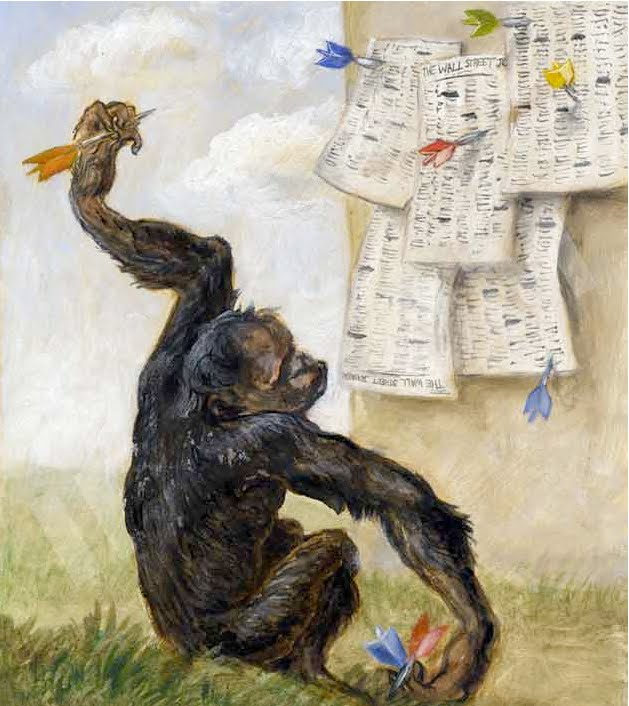 Any monkey can beat the market! That’s exactly how a headline of an article I recently came across reads.
This article was published in the Wall Street Journal in late 2012 (a tribesman recently shared it with me) and stated that if you give a monkey enough darts to throw at stock pages, they’ll beat the market. This was based on a research that simulated results of 100 monkeys throwing darts at the stock pages in a newspaper. The average monkey outperformed the US stock market index by an average of 1.7% per year since 1964.
Now, that would have bought them a lot of bananas!
In fact, as early as 1973, Burton Malkiel, a professor at Princeton University had claimed in his book, A Random Walk Down Wall Street, that “A blindfolded monkey throwing darts at a newspaper’s financial pages could select a portfolio that would do just as well as one carefully selected by experts.”
Now, given that the monkeys have not just earned as much as the US stock market index, but have handsomely outperformed it, there’s something worth pondering about for those who are trying to work hard to pick their own stocks.
Why care to analyze businesses and estimate intrinsic values when you can hire a monkey (or I will send one to you for a fee  ) to pick your stocks?
You must care, dear tribesman!
Monkeys and Stock-Picking
While I don’t have data going back 20-30 years, I definitely wanted to test this “Monkey Hypothesis” in the Indian stock market.
Thus I did this small exercise of creating three Monkey Portfolios, one each from the BSE-Sensex, BSE-200, and BSE-500 indices.
I did not throw dart at these indices (have never been good at that, you see!). Instead…
Here are the three Monkey Portfolios I created this way…
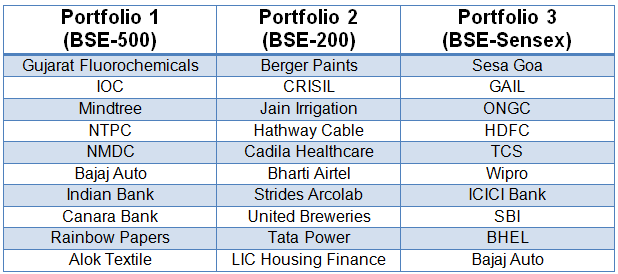
Anyways, here is the performance of the three portfolios against their respective indices over the past two years (since March 2012)…
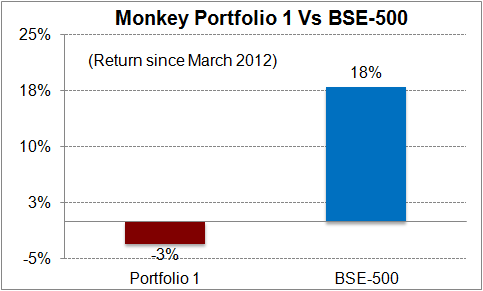

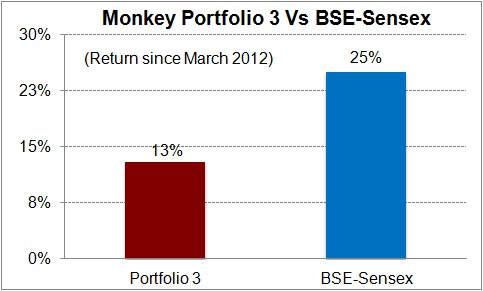

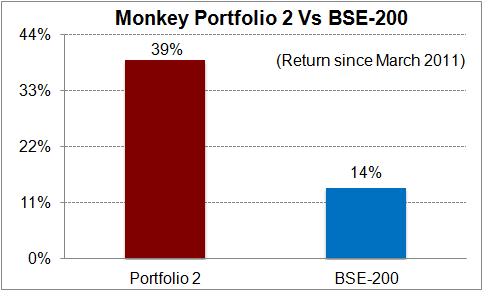


The only Monkey Portfolio that has outperformed is the one picked from the BSE-200 index and analysed for return over the past three years.
Now, 2 or 3 years are small periods to back-test a hypothesis, but then this analysis proves that Indian monkeys may not have been as lucky as their American counterparts in beating the stock market through their dart throwing skills.
As far as the American monkeys are concerned, as per the above-mentioned research, they were asked to dart-pick 30 stocks from a 1,000 stock universe. Now, when a monkey (or anyone else) would throw darts at 1,000 stocks, there is a greater probability of hitting a “small and micro-cap stock” than a “large or mid-cap stock”, simply given the bigger universe of the former.
And as we know that small companies have generally outperformed big companies in the past, this is how the American monkeys have beaten the US market, represented by 30 large-cap stocks.
Here is one more difference between the Indian and US situations. When you look at the performance charts I have shown above, the biggest disappointment my monkey faced was while dealing with the BSE-500 index, which is made up of most number of small-cap stocks as compared to the other two indices – BSE-200 and BSE-Sensex.
So, over the past two and three years, small companies in Indian have fared worse than their larger peers. This is unlike the US situation, though over a longer term period.
As far as Indian monkeys and their dart throwing skill is concerned, I find one big reason they may not outperform the broader markets even in the future. That one reason is…
Corporate Mis-Governance
To say the least, corporate governance standards in India are worse than in the US. While a few American corporate scams have been much bigger than those that have been reported in India, the malaise is more widespread here than there. Plus, very few corporate crimes get reported in India, so we do not know how deep this malaise is.
And thus, there is a great probability that if you employ a monkey to throw darts at stock tables, there is a great probability that it may hit upon a few companies that are indulging in some or the other activities of corporate mis-governance.
That’s why, it’s very important to be very careful of the kind of companies you are buying in India, because there is a great probability of you stepping on a landmine if you don’t know what you are stepping onto.
Now you may wonder – “Is there no hope to find honest businesses in India?”
Yes, there is, I believe. There are companies that go about their businesses as usual – without bothering to play around with numbers and governance standards.
These are among the simple businesses, which need no or minimal debt to grow (when a company has too much debt, be doubtful), generate ample amount of cash, and have history of not cheating on their shareholders.
Only you, through a careful analysis, can identify such businesses. A monkey, even if it is the best dart-thrower in the world and may consider itself as a future fund manager, won’t be able to help you a bit in this regard.
Yes, you may want to play it ultra-safe by investing through index funds – that have beaten Indian monkeys in the past. But carefully selected business (and just a few) can still be your biggest winners 20 years down the line.
Investing is, after all, all about knowing your advantages and your disadvantages, and not playing a game you have no advantages in.
So, if you can build an advantage in stock picking, you don’t need a monkey to do it for you.
Still not convinced? Hire a monkey and try it for yourself! (But please don’t hurt the monkey, if it underperforms!)
Related posts:
Despite the 160-year gap, there are interesting parallels between the ongoing Crimean conflict and the First Crimean War, to which India had a deep link, says Vikram Doctor
In late 1856 the British introduced a new rifle to their soldiers in India. It was called the Pattern 1853 Enfield and used a new kind of paper wrapped cartridge, pre-greased to make it waterproof and to lubricate the bullet. The Calcutta firm of Gangadarh Banerji & Co landed the contract to supply the grease and rumours soon spread that, as usual with military procurement, corners were being cut. In particular, it was alleged the grease was being mixed with pig and cow fat…
We know what came from this, but why were the British so quick to introduce the Enfield rifle? And why did no officers, many with decades of service in India and familiar with the feelings of sepoys, not catch on to what a problem the cartridges might be? Some answers might lie in the Crimea, the Black Sea peninsula which Vladimir Putin has just grabbed for Russia, but where in 1850s a British-led coalition scored a rather battered win over Russia, partly due to the new rifles.
That may now be called the First Crimean War and today it is mainly remembered for the nursing of Florence Nightingale and the suicidal charge of the Light Brigade. Yet despite the 160-year gap, there are interesting parallels between the two Crimean conflicts. Just as Putin claims he only stepped in to protect Russians in the Crimea from fascist Ukrainians, the tsar of Russia then claimed to be acting only to protect Orthodox Christians from the Muslim Ottomans who controlled the Black Sea coast.
Russian Bear Hug
In both cases the ostensible reasons covered something more basic: Russia’s determination to extend its influence and the determination of European (now Western) powers to resist this. Caught between them was a hapless local state, Ukraine now, Ottoman then. And where the earlier crisis brought together a curious British-French-Turkish-Sardinian (yes, really) coalition, we may yet see a curious coalition come together against Russia now. India, like most of the world, will be an anxious observer, but it was deeply linked to the earlier war, and may even have been partly its cause.
Through the 19th century Russia and Britain fought over Asia. This has been called the Great Game, since it was mostly covert and done through spies, with Crimea being the rare time it actually came to battle. The Game’s big prize was India, where after decades of battling both Indian and other European powers, the British were now in control and extracting considerable riches.
For the Russians India was a rich, warm target far more tempting than the bleak and chilly interiors of Asia that lay between them. And geography suggested a short-cut, sidestepping the barrier of the Himalayas. If they could control the Black Sea, then the Bosphorus gave them a sea road which was only guarded by the tottering Ottoman regime. And if they could gain that, then the whole eastern Mediterranean was in their grasp and so the approach to Arabia and India.
The British knew this and worried about Russia much as we do about China today. When the Bombay Times and Journal of Commerce, which would become The Times of India, launched in November 1838, among the first long articles it published was a multi-part series by a Dr McNeil describing Russia in detail, with particular emphasis on its persecution of religious minorities: “When the power of Russia was consolidated, the Christians naturally became the favoured people…The Musselman saw a mosque converted into a stable and another into a tavern…”
Media Blitz
The British were hardly guiltless in such matters in India, but sitting in Bombay, it was easy to forget the growing problems upcountry. As tensions mounted the Times kept publishing Russian news, and there was now a lot available. From the 1830s the British government started reducing a longstanding tax on newspapers (it finally went in 1855) which resulted in a media boom and increasingly vivid coverage. Russian was an obvious focus, and it is one reason why Crimea has been called the first media war.
In its early days the Times reprinted a lot of British news, and now it had many sources. It was getting them earlier, thanks to the telegraph, another breakthrough technology used in the Crimean War. Tom Standage in The Victorian Internet writes that, “for the first time French and British governments could communicate directly with commanders on a distant battlefield”. News also flowed to the public, from sources like the London Times’ war correspondent (a new designation) William Howard Russell. For the first time governments had to deal with an informed public, which rattled them, and made them send multiple, contradictory orders to the generals over the telegraph. Crimea was the first case of war’s chaos made worse by data deluge.
In 1853 the Times in Bombay was still getting the last leg of its news via ship (the telegraph would be in place by 1857), but slowly its coverage started reflecting this chaos. At first it was felt the war would be over soon. “The Russian forces have been in every way exaggerated and the conquest of Crimea will be a much easier affair than we anticipated,” the Times crowed on November 6, 1854. Even better, there was money to be made – this was Bombay, where business mattered, and the paper eagerly noted reports that Indian fibres like jute could make up for the hemp and flax that had been among the few exports from Russia.
The India Hands
But as the war dragged on, reports of calamities like the pointless loss of the Light Brigade emerged and also the sheer mismanagement that created horrors like the hospital in Scutari where more soldiers died than on the warfront. The British army’s high reputation, built on its defeat of Napoleon decades back, was looking fragile in the face of a modern age. It was headed by aristocrats, like the Lords Raglan, Lucan and Cardigan, who lost the Light Brigade largely because they were too snobbish to listen to experienced and professional, but lower-class officers.
Most of these officers had learned their skills in the hard conditions and constant campaigning of India. Yet it was these ‘Indian’ officers that the aristocrats were most prejudiced against, probably from fears of exposing their own failings. But as the Crimean War settled into stalemate with the long siege of Sebastopol, these “Indian” officers were in demand. (And not just by the British — some of the best like Sir Robert John Hussey Vivian of the General Madras Infantry joined the Anglo-Turkish Contingent, under the Ottoman sultan, where they didn’t have to deal with the British lords).
The Times started reporting about British officers moving to Crimea, followed by entire regiments: “Part of the 12th Lancers started from Bangalore, en route to Mangalore, for embarkation to Crimea…perhaps never to return to India,” it wrote on February 10, 1855. As the casualties grew in Crimea someone suggested posting Indian sepoys there. On June 27, 1855 the Times, perhaps reflecting general opinion in India, expressed real alarm: “A greater act of insanity than to take them beyond the limits of our Eastern dominions could not be conceived.”
The reasons for this fear were both practical and prejudiced. The Times doubted that Indians could operate in colder climates, without access to the food and the life they were used to. Many sepoys in the Bengal Army refused to travel abroad by sea for fear of losing caste status. And above all, there were the fears of attack from within India: “Had there been no British troops in India the Sikhs under Runjeet Sing, might have conquered the country any day they like.”
The year 1857 was to prove these fears prescient. Historians have suggested that while the greased cartridges lit the fuse, grievances were growing in the Bengal army over issues like deployment abroad. In July 1856 the Indian authorities passed the General Services Enlistment Act, part of a package of British army reforms instituted based on Crimean learnings, which stipulated that future recruits had to expect foreign postings, and sepoys started suspecting it would apply to them.
What made it worse was that many of the British officers who best knew the sepoys were now posted in Crimea. The military historian Larry H Addington in his Patterns of War Since the Eighteenth Century makes the connection: “Most of the British regulars in India at the beginning of the Crimean War were siphoned off to Crimea and not many had returned to India when the revolt broke out. In consequence, there were only 23,000 European soldiers among the 151,000 troops in India at the start of the rebellion.” Crimea, he writes, was an indirect cause of the 1857 rising in India.
And once the rising broke out, it was Crimea-hardened officers who subdued it. Sir Colin Campbell, who took back Lucknow played a critical role in Crimean battles like Alma and Balaklava. Sir Hugh Rose, who defeated the Rani of Jhansi and later became commander-in-chief of the Indian Army had an even longer role in the eastern Mediterranean.
In the end, Russia lost the Crimean war and the British hoped this ended the rivalry. In fact, as Peter Hopkirk points out in his wonderful history of the Great Game, the war was a half-time halt, after which it went into really high gear. The Russians had even planned during the war to divert British attention by launching an attack on India through Persia and Afghanistan. Nothing came of that, but after the loss put an end to their Black Sea ambitions, they focussed on Central Asia, conquering one Muslim khanate after another, to bring them close to India. Crimea drove the Russians to the climax of the Great Game in 1891 when the two powers came face to face in the Pamirs.
Lady With the Lamp
Amid all this fighting, perhaps the most lasting effect of the Crimea in India was more healing. It came from the most formidable person to emerge from the battlefield, Florence Nightingale, whose work at improving the standards of nursing care at Scutari tends to overshadow her much longer career after the War as a lobbyist for hygiene and medical reform, particularly in India. Nightingale never came to India, but she used her formidable talent for studying reports, devising statistics and developing policy to lobby successive Viceroys to improve medical and sanitation standards in India.
Nightingale’s initial focus, as in Crimea, was the British soldiers, but as she studied Indian conditions she realized that their lives in India couldn’t be easily separated from that of the regular people. She lobbied for the creation of an Indian sanitary service, usually going straight to the viceroy of the day. In his portrayal of her in Eminent Victorians, Lytton Strachey wrote how it was “de rigeur for the newly appointed Viceroy, before he left England, to pay a visit to Miss Nightingale”, in the course of which he was lectured at length about hygiene priorities in India. Nightingale’s work for better hygiene and hospitals in India, might be one of the few positive outcomes to come from the chaos in Crimea.
(With inputs from Times Archives)
In Capital Mind we start a series of posts on the economic future, and what policies must be adopted by whichever party will form the next government. We will tag these posts “EcoManifesto” and eventually have this wonderful …
All over Silicon Valley, venture capitalists are asking entrepreneurs “How scalable is your business model?” What they really mean is, “Can you grow without having to hire people?”
In our digital economy, value creation and job creation don’t always go together. Consider that Whatsapp just sold for $19 billion with only 55 employees. It used to be that business growth led to job growth. But as machines get smarter, labor becomes a reluctant necessity. Companies only hire as a last resort.
But what if the purpose of a company was to employ people? Instead of hiring enough people to make the greatest profit, it would make enough profit to hire the greatest number of people.
Put simply, these “job entrepreneurs” maximize jobs instead of profits. There is a precedent in this. “Social entrepreneurs” seek to maximize purpose over profits. They take a social problem, like health, poverty, or the environment, then work on finding a business model that can remedy the problem. They seek to make enough profit to make the greatest social impact.
Job entrepreneurs take a similar approach. They start with a group of people they seek to employ, then work on finding a sustainable business model that leverages their talent and experience. This isn’t about job placement. There are many organizations that help people find jobs in other companies. Job entrepreneurs bring people directly onto their own payroll.
One pioneer in the “job entrepreneur” movement is Dave Friedman. Two years ago, Friedman left his position as a Fortune 100 executive to start a new venture. His goal was to employ people on the autism spectrum – individuals who have traditionally been unemployable.
Friedman considered creating a traditional startup, but he realized that his goal was different. He didn’t want to maximize profits but rather employment. Many advised him to setup a non-profit. But Friedman didn’t want to rely on grants and donations. He believed the business needed to generate a sustainable profit to foster discipline and efficiency. He also wanted his employees to know that their jobs weren’t just charity, bringing a source of authentic empowerment.
Some advised Friedman to create a social enterprise, but the models didn’t really apply. Friedman wasn’t changing how the product was made (e.g. organic or sustainable) or where it was sold (e.g. low-income buyers). He was focused on changing who gets hired. Like social entrepreneurs, WHY mattered more than HOW MUCH. But in this case WHO mattered more than HOW or WHERE.
Without an existing model to guide him, Friedman set out to make his own. He had a powerful belief that people on the autism spectrum represent an exceptional yet hidden workforce. But he needed a business model that would turn what others saw as a deficit into a source of competitive advantage.
Friedman found his answer in what he calls “Process Execution” jobs. These are labor-intensive activities such as website maintenance, data entry, and software testing. Many companies struggle to fill these positions. But the repetitiveness and attention to detail are well-suited to the talents and abilities of people with autism.
As much as possible, Friedman downplays the fact that his employees have autism. He is not looking for charity. He wants to compete on the same playing field as other companies providing similar services. But on the inside, AutonomyWorks is unlike any of its competitors. Friedman has redesigned the way work is structured, organized, and managed to suit his employees.
With these changes, Friedman has found that not only can AutonomyWorks match traditional competitors, but it can produce better quality at a lower price. By generating profits, he is able to hire more people and fulfill his mission. In the process, he has empowered an overlooked workforce and relieved families of the costs of supporting autistic relatives.
Another company following a similar model is Shinola, a Detroit-based manufacturer originally known for its shoe polish. Shinola has recently reinvented itself to create jobs for unemployed auto workers. Like AutonomyWorks, Shinola started with jobs and worked backward to the business model. In this case, auto workers have unique skills in light manufacturing and upholstery. So Shinola produces watches, leather goods, and handcrafted bicycles. A traditional entrepreneur wouldn’t set out to make this combination of products. But for a job entrepreneur in Detroit, it makes all the sense in the world.
So what does it take to be a job maximizer?
Over the last twenty years, we have successfully created an entirely new economic sector in which social entrepreneurs maximize purpose over profit. It’s time to turn this entrepreneurial spirit on a new goal: job creation. We need more people like Dave Friedman and more companies like Shinola — job maximizers and employment entrepreneurs.


