Shared posts

16 May 03:06

Why is Rahul nasty to Manmohan

by Rajesh Ramachandran

Skipping the farewell dinner that his mother threw for Prime Minister Manhmohan Singh on Wednesday was one of Rahul Gandhi’s rare decisive and political acts. Rahul may be accused of exhibiting lack of form or grace, but hardnosed realpolitik is not about bowing and scraping for form’s sake.


There is no substance left in the relationship between Manmohan Singh and his benefactors, the Nehru-Gandhi family, so why drive the extra mile to his mom’s house for an empty gesture?


Sonia Gandhi is supposed to be extra sensitive about being nice and proper to party elders and may even offer an apology to the PM or get her son to say sorry, like most mothers are wont to do.


But the deed is done and post facto explanations only accentuate the effect because if Rahul had wanted he could have taken a bouquet of flowers and a camera crew to the PM beforehand and got himself excused from the dinner.


The Congress scion was sending out a message that all is not well between the PM and the family and that he does not approve of the Manmohan Singh government’s conduct.


By not publicly denouncing Sanjaya Baru’s Accidental Prime Minister,Singh has given the book an air of revealed truth, the definitive word on his relationship with the Nehru-Gandhis, at the end of his stay at 7 RCR.


Singh’s former media advisor Baru, who did not get his job back in UPA2 in 2009 because the Congress party disapproved of his functioning in UPA1, blames all that has gone wrong during Singh’s tenure on Sonia Gandhi and the party.


The party did indicate not-so-subtly in many news stories that emanated from Congress HQ that it expected an unqualified denial of the book’s contents about the Nehru-Gandhis from the PM. It did not come and that was regarded as a breach of propriety.


Therefore, compared with the PM’s silence on Baru’s book, Rahul’s absence at the farewell dinner pales into insignificance.


Nobody wants to be remembered by historians as responsible for all that went wrong with a country for 10 years. But that doesn’t mean the PM shifts all the blame to those who pitchforked him into the post.


The Nehru-Gandhis probably realize now that one of the biggest mistakes they committed was to have let Singh continue as PM for 10 years.


No elected leader or CEO gets a free hand to run a country or a company. The shadow of the promoters looms large over any enterprise.


The Westminster model of democracy is probably one of the toughest enterprises where the party organization is the real promoter and its concerns have to always be given primacy over the interests of their representatives in government.


Former PM Atal Bihari Vajpayee, elected to Parliament since 1957, had to repeatedly reaffirm his faith in and loyalty to the RSS while he was PM. He had to even change his choice for finance minister at the behest of the RSS, right at the beginning of his tenure.


Singh is no patch on Vajpayee as a parliamentarian, politician, orator or organiser. In fact, Singh is none of these. But the Nehru-Gandhis and the Congress gave him as much or more freedom as any organization could have given its representative in South Block.


Baru, for one, was definitely not the Congress party’s choice, nor was any important functionary in the PMO during UPA1.


There was even a serious move by certain influential leaders to get Rahul sworn in as Prime Minister and to face the elections with a fresh untainted face as the head of government. But Singh refused to budge. The family dropped the issue when people close to Singh told ET that he would continue till the election results.


“Had that happened, Congress would have won many more seats. But the PM was not ready to move out. As soon as the suggestion came out in the press, the PM made it clear that he wants to continue till the very end. The Gandhis gracefully dropped the idea. But the book was a terrible blow,” said an insider.


Rahul does not owe anything to the PM. But the PM owes much to a lot of people including the Nehru-Gandhis. Former PM Chandrashekhar made him University Grants Commission chairman, Narasimha Rao picked him up from the UGC to make him the country’s finance minister, the Congress party made him its leader of the Opposition in the Rajya Sabha and the Left Front with 63 crucial votes supported him to become Prime Minister. What has been his response to all those kind gestures? Manmohan Singh may have an answer in his memoirs.

15 May 03:03

Markets expectation from Na Mo?

by subra

What does the country want from Na Mo?

Frankly Judicial reforms, Police reforms and generally good governance.

However what can one expect from Na Mo (Wishlist?) from NaMo:

1. Quickly get rid of the politicians from the PSU boards and get rid of the rent seekers.

2. Ntpc, Nhpc, Bhel, Coal India, Sbi, Ongc – start with these 6 and in the next 100 days you can see all these share prices double. The p/e will catch up.

3. Find out the real number of Investors in India. The regulator is saying it is 10000000 (one crore) my gut feeling is it is about 1% of that.

4. Create ETFs of PSU stocks and SUTI holdings. Now. Today.

5. Give RBI full freedom to run the banks, get rid of the Banking bureaucrats in the Finance Ministry. You do not need them.

6. Get rid of steel, coal, civil aviation ministries. You will save a lot of time and energy.

7. Merge all the State Bank subsidiaries with SBI, and the others with Bank of Baroda. Period.

Too radical ?

Post Footer automatically generated by Add Post Footer Plugin for wordpress.

15 May 03:02

Portfolio creation and bias

by subra

We are amazingly smart people and remember all that we did, right? No. Wrong.

Let us criticize the MI management for a minute.

They gave up Dinesh Kartik, Maxwell, Jhonson , but kept Harbhajan, zaheer khan

The question is what made them choose the latter and give up the former? Well I assume that a think tank consisting of Sachin Tendulkar, Ricky Ponting, Anil Kumble, John Wright, Jhonty Rhodes, would have used some data apart from just a gut feeling. Right? well, presumably yes, presumably not. I have no data to make a statement either way.

HOWEVER, THE world is watching their decision about the choice made AND the choice foregone.

Now assuming that you had a nice portfolio – and you were very happy with your results, should I congratulate you? Hmm yes sure if you have got what YOU want.

However if you do not maintain a Portfolio of a) shares not bought and b) portfolio as on a particular date c) shares sold so that the money could be used to buy some other share – clearly in different parts of your portfolio tracker, I will not be able to say anything.

For example Infosys may have done well – but like a friend who sold a few lakh Infosys shares to buy TCS shares – if you had done it, you would have been far better off.

Or like another Engineer friend who sold all his Tata Motors, Ashok Leyland, etc. holdings and invested in Eicher Motors and Bharat Forge shares – his returns are surely far superior. I am personally guilty of selling out of Eicher much earlier than what I should have.

I recently saw a portfolio which had done well over the past 30 years – on a CAGR basis. However if the portfolio were left UNTOUCHED over that period it would have done much much better! Why? the shares sold were ITC, Colgate, Asian Paints, GSK, Tata Motors, Bajaj Auto and Hdfc. Not that the person had bought bad shares, but these shares (sold partially) had done so well in the past few years, that the new buys just did not match up. The only exception being TCS.

So keep track of shares that you studied but could not decide, or shares that you bought too less (I have said in an earlier post I bought 200 Bharti Airtel at 80 and held it till it reached 1200), or shares sold of too early, or shares bought for a different cause ( I bought Apollo Hospital at Rs. 9 because it was a yield share, sold it off at Rs. 200 when it was no longer a yield share, then it is now at 1000), ONLY then you can see your biases.

Once you know you are biased (we all are)…you can make sure that you do not make MISTAKES because of the bias.

Post Footer automatically generated by Add Post Footer Plugin for wordpress.

13 May 03:07

Currencies, Counterfeits and Confidence

by Vikram Doctor

This election a lot of the black money that changed hands may have been fake. But then counterfeits may not matter to the central bank in the larger scheme of things


Elections and money have an uneasy relationship. We fear money’s influence in elections, and how it might undermine trust in the democratic process. Yet, it is seen as essential, especially when campaigns are as protracted as this current one. Money pays for the logistics, the ads and even the food and drink that, in large parts of the country, is seen as a necessary inducement to voting.


But money might be a source for further unease with this election. Several media reports have quoted sources in organisations like the Directorate of Revenue Intelligence (DRI) on the large amounts of fake currency notes flooding the country. They are usually alleged to have been printed in Pakistan, both to finance terrorism and destabilize the Indian economy by destroying trust in our currency, and smuggled into India from other neighbouring countries.


ET recently reported a DRI alert for all international airports, ports and land transit roots to watch out for smuggled counterfeit notes. Law enforcement agencies know that in all counterfeiting operations the challenge is not just producing convincing notes, but also finding easy ways to distribute them — and that is what elections provide. With so much money thrown around and no accounts asked for, it’s easy to pass out large amounts of fake notes. One report suggests that four out of every 1,000 currency notes might be fake and that the total value in circulation is well over 3,200 crore.


This is wildly in variance with what the Reserve Bank of India (RBI) claims. The RBI’s annual report says that 4,98,252 fake notes were detected in 2012-13. This would be around 0.00067% of total Indian rupees in circulation, adding up to a value of around 25 crore. Central banks typically don’t like talking about counterfeits, but in a detailed report in the Toronto Globe & Mail on how Canada tackled its burgeoning counterfeiting problem it’s indicated that alarm bells went off when the number reached 0.47% of notes, which was 10 times what was acceptable in G20 countries.


The Real Problem of Fakes


By that norm India is still far from facing problems. The RBI’s currency department, through the bank’s spokesperson, says firmly: “The security features in genuine Indian banknotes have not been breached.” A directive to withdraw by March 2014 (later extended to January 2015) all pre-2005 notes stirred rumours it was meant to tackle counterfeiting, but the RBI says it was simply a regular process: “Earlier we withdrew older series banknotes in a passive manner where the banks were instructed not to re-issue such notes and send back those notes to RBI for disposal,” says the spokesperson. In the past few years banks were told to do this for all notes of 100 and above printed prior to 2005. “In the current withdrawal plan we have involved the public also,” says the spokesperson.


One response to this divergence in news might be that the RBI is understating the problem either because it is not convinced about the extent of counterfeiting or because it wants to dampen fears of its extent. After all, stories about Pakistan-printed notes are widespread. In January this year a National Investigative Agency (NIA) judge awarded life sentences to six people caught in 2009 distributing fake notes and explicitly stated, “It is certainly a terrorist act in which neighbouring sovereign country i.e. Pakistan is involved with the sole purpose and intention to damage and threaten the unity, integrity, economic security and sovereignty of this country…”


That would seem to state the matter plainly, yet there is room for some ambiguity in the issue and it is linked to the nature of money. Money, particularly paper currency, is in its essence just a matter of trust and this is why counterfeiting has always been seen as such a threat. Fake currency undermines trust and threatens the whole system of money, as can be seen from the NIA judge’s strong words. A state’s power is reflected in the trust its money commands, so counterfeiting is an attack on the state.


For this reason counterfeiting has always been punished very severely. The Romans varied the penalty depending on the value of currency — faking silver coins meant exile, but faking gold got you thrown to the lions. The British decreed hanging, drawing and quartering, which involved disemboweling the criminal before he was dead. The US also made it a capital crime, with a lesser penalty of being branded and having ones ears cropped. This no longer applies, but fighting counterfeiting is still the job of the US Secret Service, along with protecting the president.


Yet counterfeiting currency has always flourished. The gains seem too large and immediate — all you need to do is pass on the fake, and then it is literally out of your hands. Counterfeiting also appeals to an anarchic dislike for the state that many people harbour. Many counterfeiters in the US were acquitted by juries who felt it was a minor, ‘clean’ crime. When the state is the victim then all are, but few feel it that way. And once currency was delinked from bullion reserves and governments printed money easily to cover their needs, people were cynical and wondered why they couldn’t create value the same way.


When States Join ’em


Adding to this cynicism is the fact that states have done their share of faking. Rulers have devalued their own currency to cover their reckless spending, but printing an enemy state’s currency is also an established tactic. The most famous case is Operation Bernhard when the Nazis took Jewish artists into concentration camps and made them forge British pounds and US dollars which they planned to air drop to cause chaos in these countries. The Counterfeiters, an Austrian film based on this story, won an Oscar for Best Foreign Film in 2007.


But Jason Goodwin, in Greenback, a history of the US dollar, points out that the idea originated with the British during the American Revolution. The rebelling colonies printed their own currency, but the British felt this was illegal to start with, so it wasn’t wrong to fake these notes. They were open about it: “The more public their operations, the more successfully they cast doubt on the currency,” writes Goodwin, citing newspaper ads through which they offered the fakes to those travelling to the rebels.


Such brazenness was matched by Rajaram Waman Mudras who, The Times of India reported on April 12, 1960, was arrested when the police found a currency printing press in his office in Fort, Bombay. Mudras had an ingenious defence — he was forging the Portuguese currency of Goa, still not part of India then. Mudras said he was fighting for Goa’s freedom and “that one of the acts of hostility in this war was to print counterfeit notes and thereby inflate the value of the currency in the Portuguese settlement.” The judge didn’t buy this admirably anti-colonial argument and sentenced him to jail.


Superpower of the Superdollar


And then there is the Superdollar. This is a very high-quality fake dollar that is said to be printed by an enemy state to the US — perhaps Iran or Syria. The first Superdollars may have surfaced in the 1980s, with more details emerging after the capture of two Lebanese born drug traffickers in 1992 who revealed the operation. The Superdollar story made much news at that time but then, this is the interesting part, it neither entirely went away nor developed much beyond that.


Superdollar stories still emerge occasionally, focussing on North Korea now, and always suggesting economic danger and imminent collapse of the dollar — and then the story dies again. The US treasury department stonewalls, much as the RBI might be doing now. At most there is tinkering with security features, like new microprinting, panels or threads. The RBI is talking about polymer currency, the so-called plastic notes pioneered by Australia that are the most secure form of currency because the formula for the polymer substrate is closely guarded and does not, as yet, seem to have been copied.


Polymer notes are how Canadians solved their counterfeit problems and they are now widely used, including by our neighbours in Bangladesh, Sri Lanka, Singapore and Nepal. The RBI has plans to try them in five cities, Shimla, Kochi, Jaipur, Bhubaneswar and Mysore, but this has been the case for a while now. The RBI’s plans for polymer highlights its durability and environmental benefits as much as its security. India may get polymer notes one day, but the RBI doesn’t want to sound like counterfeiting is the compulsion.


Apart from the pre-2005 withdrawal proposal, quickly modified, the RBI has also not gone in for the wholesale withdrawal of bank note series. Countries like the UK which do this make it easier by doing a complete redesign of their notes each time. When new notes are introduced, with the latest security features, there are windows in which the old notes can be withdrawn, but after a point this closes. It is not a good idea to keep old UK pounds in your cupboard between trips.


Playing it Safe


As of now, India is like the US where every note printed in the independent country is legal tender (barring the high value rupee notes demonetized in 1978). Both countries also rarely change the basic designs of the notes, though the reasons probably differ — the US Treasury feels it adds to the stability of the currency, whereas the RBI probably knows that any design change is likely to cause objections from politicians, so it’s easiest just to keep things the same.


Yet such a static position is curious, given the frequency and urgency of allegations in both countries of fake currency printed by enemy states (claims of forged Indian notes in Pakistan go back to 1957). And perhaps there is a clue in Goodwin’s statement of how the British felt that even claims of counterfeiting could undermine trust. When you are in a situation where even a claim of an attack might work as well as an actual attack, perhaps the best solution is not to even bother repulsing the attack, but pretending the attack never happened. It is a mind game, but then that is what money is.


In any case, cash is becoming ever less important to central banks. This may not be the case with the RBI, given the extant of the cash economy in India, but the US treasury is clearly more concerned about digital dollars that trade invisibly and continuously across the world than their green and black real life counterparts. As for the Superdollars, perhaps they are a threat, perhaps just another sign, however backhanded the compliment, of the US’s power. Certainly, the US treasury doesn’t seem to want us to worry about them, and the RBI may feel the same way about fakes. And in the strange world of currencies, counterfeits and confidence, perhaps they may be right.

13 May 03:06

Interest expense: do you have it?

by subra

Most people who have no borrowings (visibly) think they do not pay any interest as an expense. Well, they may not be paying interest knowingly, but there could be other forms of interest. What if you are paying rent? What about a car taken on hire?

So if you have your own house, own car, etc. you do not pay interest, right? In other words –

When a company or an individual has NO borrowings, it pays no interest, right?

Well, NO.

Let us take the case of a company first. Interest is what you pay for using some other person’s cash. Well if you use an asset you are paying interest in another form – called rent. So if you do not own an office, you pay money to the landlord – this is again interest.

So if you own your office, and have no borrowings, you pay NO interest, right? Wrong.
When you hire a person from an out station location, and pay him a salary, he pays rent. So technically some part of your expenses can be classified as interest (we will use interest and rent interchangeably in this post).

When you travel on a road where they collect toll, you pay rent, because you do not own the road. When you eat a masala dosa for Rs. 65, at least Rs. 10 out of that is rent, there could be interest on the borrowed funds too.

When you hire the services of an advertising firm, and they send you a bill, remember THEIR costs also include interest and rent.

Thus there is a lot of interest and rent (expenses) HIDDEN in all your expenses – be it salary, services, goods, welfare…..

Similar story even when you are an individual.

Therefore the classic saying ‘better to RECEIVE interest instead of PAYING interest’…..

What is means is “if your UNEARNED income is greater than your TOTAL EXPENSES ADJUSTED FOR INFLATION you are FINANCIALLY free – assuming that your income is Rock solid guaranteed in REAL terms”.

Once you create a corpus to do that, EVEN, your KID can retire on the corpus that you create, assuming he/she continues to maintain the same spending and investing pattern.

Post Footer automatically generated by Add Post Footer Plugin for wordpress.

13 May 03:05

Teach Money to your daughter too!

by subra

‘Money is a Man thing, and Cooking is a Woman thing’ – most people are brought up with this stupid belief. It is not as though they are told explicitly, but by behavior.

The son is taught banking in class 9, the girl is taught how to buy vegetables. Such stereotyping may be bad, but it does exist. For some of us of course have no choice – when you have one kid, you cannot!! Please teach your children the following skills in the world:

1. Delayed Gratification: Let your kids wait and earn whatever they want. This is not to say that they should do NOTHING instinctively, but it is worth teaching them the patience of waiting.

2. Shopping / Bargaining can be fun: If he/she understand costing, then teaching things like Value, price, satisfaction, of the things we buy and the services we use are very useful. Remember they use it BACK on you and ASK you to justify all your expenses. Be ready for that too. Most of life’s learnings are ‘caught’ rather than ‘taught’. Enjoy your role of living a teacher’s life.

3. Power of starting early, and compounding: In class 8 this can be a great exercise and fantastic story telling opportunity. Do it. It will allow them to know that COMPOUNDING should not be INTERRUPTED.

4. Power of Equity: the stories are unlimited, and you can find many sub stories and sub plots on this blog.

5. There is nothing better than Ramayana and Mahabharata – by C Rajagopalachari to teach them about greed, deserving heirs, how undeserving heirs lose everything, lust (for power, kingdom, …etc.) has to be tempered and not yielded to, etc. etc. Once they read the story discussing parts of it can be a very useful exercise in long flights where phones and ipods are switched off :-)

6.Make your Own choice: right from a dress being bought in class 3, to a career teach her the process of decision making. On how to have a great database of choice, price, usage, etc. Once she knows the process she will make the best choice of career, spouse, friends, etc. Rest assured, the probability of your kids going wrong is EXACTLY the same as that of YOU making that mistake. Stop pretending that age improves the odds, it does not.

7. Enjoy the effort and the Journey as much as he destination: Remember what Gandhiji said? If not read.

8. Let him/ her read Anglophiles like Nehru and Jinnah, but Patel, Gandhiji, C Rajagopalachari, Rajendra Prasad, S Radhakrishnan bring far more variety. Make no mistake – Discovery of India, and Letters from a Father to a Daughter – both by Nehru are awesome books for kids, but that man is an Anglophile and hated everything Indian. Your kids need variety.

9. Make them read, read, read, – Kindle is an awesome gift. Read without guilt.

10. Teach her that Experiences are far more valuable than things. A trip to Jaipur is worth far more than a new 25k phone for example. Travel, and travel light.

many more things – but your daughter should know that whatever the world does to her, she will be safe in your arms. And you will love her, feed her and indulge her IMMATERIAL of what choices (mistakes) that she makes.

Post Footer automatically generated by Add Post Footer Plugin for wordpress.

12 May 16:34

Retirement Questions which NOBODY can answer!

by subra

It is easy for some of us to write an article saying ’10 questions for which you do not have an answer’ – what such an article does is it creates panic.

Let us say your wife reads an article saying ’10 retirement Qs which you do not understand’…these are actually leads to push / rush you to a Financial Planner. The big, terrible, horribly wrong assumption is that the Financial Planner has an answer. So here are the questions for which MOST financial planners, or bloggers (including yours truly of course) do not have an answer. The persons who have an answer to these questions are busy doing something else. They are not financial planners – certified or otherwise.

What are these questions?

1. How much to save for Retirement: There are a million calculators on the web (Google will help). If you are too lazy to search, and you are India centric go to www.freefincal.com – by Pattu. You could also look at Franklin Templeton India’s retirement calculator.

2. Having no clue how much you will spend on retirement: Again the calculators might help…

3. Knowing how long you will live: Even Pattu has not developed a calculator for this. You can use this method – look at the age of all your ancestors for 2-3 generations on your parents side. Take an average (ignore accidental deaths obviously). Add about 10 years to that. Is that accurate? No. However it is better than thinking ‘my father lived till 74, so I will live till 74′ as many people tell me. Adding 10 is a necessity because over the past 100 years we have captured too many diseases.

4. Which Pension Plan to buy: Sadly there is no single answer to this complicated question. You need to create a ‘Pension hamper’ and not just buy one plan and ‘hope’ that all your pension requirements will be met by that plan. Also most of the plans are excessively debt oriented, and hence completely useless unless you are about 45 years of age. If you are 24 and looking for a retirement plan (hey retirement is a sum of money, not an age) there is no plan that you can touch. The plans from the insurance companies are the worst of course.

5. Trying to estimate the cost of Medical expenses while at retirement. Again an impossible task. I know of a 82 year old who spends about Rs. 3000 A YEAR ON MEDICATION and a 64 year old who spends about Rs. 4500 a MONTH on medication. Again a game of chance, luck, genes, habits, – and in a country where there is no long term care insurance. We are not even talking about adult diapers, nursing care, etc.

6. Creating a diversified portfolio and constantly reallocating of assets: Seriously a very important question, but sadly many planners may not be able to help you in the reallocation strategies. You need to learn it YOURSELF and implement it.

7. Reacting wrongly to market fluctuations: If you are 54 years of age and need the money when you are 65 years of age, why should you worry about 16th May 2014? How does it matter whether Ra Ga, Arvind Kejriwal, Shah Rukh Khan or Narendra Modi becomes the Prime Minister? Your portfolio needs NO REACTION to the market – surely not on a weekly, monthly or worse on a daily basis.

8. Not having a clue about the costs of buying, selling, and holding the portfolio.

I am sure there are many more such questions, but I am not sure that there are ENOUGH people WITHOUT conflict of interest, and COMPETENCE to answer all these questions for YOU.

GO AND SEEK THE ANSWERS. Now. Yup, now.

Post Footer automatically generated by Add Post Footer Plugin for wordpress.

12 May 16:34

Uneasy lies Modi's head that inherits a 'Crown of Thorns'

by Bindu Dalmia

The Fourth estate is sworn to an unwritten oath of journalistic integrity,one that constrains emotional preferences. A thin line then prevails between a hagiographic rendering of the inevitability of Modi's ascent to Delhi ; as opposed to being accused of political heresy by proponents of those who fear his advent as the Aurangzeb- incarnate of Indian politics.


The dilemma of maintaining objectivity, over the emotional power that moves the pen, is indeed an onerous one, as a large sect of the nation is riveted with the Dream Merchant and the paradisio he promises, to an India that forgot to dream! The transformation Modi brings on the table, is of a 'one- stop- shop', from all that ails India. His core strategy stemming from fixing the economy, that could act as the leveler to quell communal mistrust& social unrest. Not fallacious reasoning, as prosperity delivered across the board mitigates, as it dilutes extremism. Six months from now, would be the litmus test of performance, and I would have won my spurs, if my assumptions bordered on Alice in Wonderland, for now.

A resurgent refrain of futuristic optimism is echoed across multiple stratas, from a shop-owner in tony Khan Market who despairs at low foot- falls, to the hi- browed of Delhi's Lutyens elite in grim financial straits as business has slumped: “Namo is coming”, so all will be well, is reminiscent of “Santa is coming”! Guys, has anyone realized, to conjure him as a messiah is fine, but he's not the magician who can undo in 6 months, a trail of 57 years of systemic rot, legaced to him by the last regime? Obama too augured hope, in a “Yes We Can” campaign, to salvage a damaged Bush economy. Despite a fierce political will, it eluded a set a time- frame for recovery.

When expectations ride high, a heavy burden of proof rests on Modis shoulders, one that may deny him the luxury of the first 100 days of honeymoon- grace all leaders are entitled to. While a softer Modi seems to be emerging, gauging from a series of interviews, some headwinds and operational constraints could pose challenges upon ascension:

-Depending on political arithmetic, how he affects consensus in:
1)Handling a bruised Congress opposition,one that could be prone to inflame communal tensions, if only to prove Modi is the worst that happened to India.
2) Adept skills needed in dealing with motley satraps, that come with demands of Shylocks pound of bargaining in demanding preferential treatment for their states, eg Bihar\Bengal.

-Keeping fiscal deficit low, neutralizing inflation, and balancing high growth  by bringing down interest rates, is 'Jigsaw no 2'. Will RBI governor Raghuram Rajan's writ prevail, or will Modi and his FM override? Scaling back to 7% growth, even if the backlog of stalled projects are cleared, could take a 2 year gestation period to translate to gains.

-Knowing Modi is pro-business and anti-retrospective changes, he would try to affect continuity in FDI in retail, to gain international business confidence. NaMo is expected to be guided by economic free-market thinkers, Jagdish Bhagwati, and his protege Panagarya as chief economists to the PM. Their views on welfarism are at divergence from Amartya Sen's strong influence on UPAs social spending. As a torrential in- flow of money awaits entry on the sidelines, Modi's pace in clearing hurdles for capital infusion by way of FDI in insurance, pension, and defense would be tested.

-The rising price of gas vs natural resource implementation: UPA had approved the Rangarajan formula which would double the price of natural gas from $4.20\unit to $8.40, having an inflationary impact across the board. Power deficit, as also rationalizing energy costs, would then pose a huge challenge.

-While Modi sounds consensual in winning over state- heads in an attempt towards collective leadership, his one big task would be GST implementation, that states feel will tantamount to revenue loss in their coffers, as a common market taxation threatens the states own levies.

-Changing the land acquisition act and simplifying it, so industry can procure land at reasonable price to facilitate urbanization, industrialization and infrastructure. The Chinese government acts as facilitators towards providing land as part of government equity, in a PPP (Public Private Partnership). Would Modi follow his successful, but much maligned “toffee model”, by which land is freed at a reasonable cost for industry and job creation?

-AAP and Congress are expected to play spoiler in dampening industry sentiments, by pressing the same levers of the vigilante CAG, thereby impeding the pace of transactions from going through.

-It will take time in phasing out populist schemes that are now law, which have least helped in asset creation. Subsidy costs are estimated at 2.2%of GDP  that includes outlays on food, fuel and fertilizers.

-A strong Modi is unlikely to be yielding to US imperialism in pursuing trade on unilateral terms. It is likely to have a give & take approach for example, in leveraging defence contracts in lieu of relaxation of H1B visas; or insisting on a tougher stance on Pak-appeasement by the US.

-How 'taper- ready' will NDA be? As US economy strengthens, the pace of asset purchase would reduce. The strengthening dollar will put a downward pressure on global currencies, halting the recovery of the rupee. With the drying of global liquidity, higher cost of capital will strain India's highly leveraged corporate sector. Already stressed loans account for 10% of the deteriorating NPAs of banks, and recapitalizing them will require upward of Rs 3.5 lakh crores.

-The impact of El Nino that threatens  agricultural sector performance for '14

-BJPs priority in repatriation of slush funds from tax havens like Switzerland, necessitates dragging these countries to forums like G20 for not having cooperated in requests for information. The era of bank secrecy may well have ended, but the ground reality is that these countries persist in not honouring the Double Taxation Avoidance Agreement.

-How Modi deals with restoring institutional autonomy, dignity & credibility of the PMO, CBI, CVC, EC of needs to be seen. Will the “caged parrots” become Modis pets, as masters change, or will he set them free?

The political exuberance to augur change, is on abundant display by the PM-in-waiting. But his efficacy would necessarily be determined only by achieving windfall electoral gains. In which case, there's no stopping his marathon run.. “On joue sur la Terre”, India then, is his playground for the next 5 years.

Follow me @BinduDalmia on twitter for more conversations on Indian socio-economic and political scenario, on the twists and turns of India in Quest of her Destiny.
12 May 16:32

Varanasi storm in an Election Commission cup

by Raghu Krishnan

In retrospect, the whole controversy on whether the Varanasi district magistrate/returning officer (DM/RO) should have banned Narendra Modi's only rally in the city of the constituency from which he was contesting seems totally unnecessary. Instead of retrospectively supporting the DM's decision, the Election Commission could have sorted out the matter amicably without allowing it to degenerate into a raging controversy.


If, as the TV news-channel interview by the Election Commissioner (EC) H S Brahma indicates, the problem was that the BJP wanted to hold its city rally in Benia Bagh late in the evening, the DM could have quietly pointed out that it would be safer to hold the rally in daylight, given the threat-perception vis-a-vis the Lotus Party's prime-ministerial candidate. Banning a rally is an extreme step of the kind which could have been avoided if there had been greater interaction between the Election Commission and the concerned political party. Instead of appointing a senior Tamil Nadu IAS officer as the Varanasi observer days after the controversial ban on the NaMo rally, the chief election commissioner (CEC) could have kept one or two of his senior colleagues free to immediately tackle suddenly-erupting high-profile constituency controversies by promptly interacting with the concerned DMs and representatives of political parties..


That is known as contingency planning so that any crisis is tackled when it arises even if the CEC and the two ECs are meeting and monitoring a phase of polling on a particular day, as happened on May 7 when the controversy over the ban on NaMo's rally erupted and the BJP leader Arun Jaitley was frantically trying to get in touch with the CEC., Mr Sampath, who, along with Mr Brahma and Mr Zaidi, was monitoring polling in some 64 constituencies throughout India.


Justice delayed is justice denied and the Election Commission ended up in a situation where it seemed to be forced to back the DM by arguing that it had cross-checked what the Varanasi official had stated with the senior-most officials in Lucknow--presumably the UP chief secretary and the DGP--and that the local administration had no other choice but to ban the NaMO rally in Benia Bagh. Surely, Mr Sampath is aware of the kind of pressure state governments in UP and elsewhere exert on top bureaucrats, given reports of hundreds of IAS and IPS officers being arbitrarily transferred by successive chief ministers, whether from the BSP, the SP or any other party. Chief secretaries and DGPs have been accused of playing along with their political masters whose very future is at stake each time an election is held. If the state bureaucrats know best, as Mr Sampath seemed to indicate when he stated that he had spoken to the top bras in Lucknow, then is an Election Commission needed at all? If today an SP government in Lucknow persuades the Election Commission to ban a rally by a political opponent, tomorrow the TMC government in Kolkata, the Congress-NCP one in Mumbai or the BJP one in Ahmedabad might be encouraged to make the same attempt.


The Election Commission has now laid itself open to all kinds of charges and counter-charges. Questions will and are being asked be asked how Rahul Gandhi and Akhilesh Yadav were allowed to hold rallies but the BJP's prime-ministerial candidate was not permitted to do so in his own constituency. Merely stating that the threat-perception varies from leader to leader--as Mr Sampath has done--is not enough. If rallies can be held in J&K and the Maoist-affected areas, why not Varanasi? Banning a prime-ministerial candidate's rally in his own constituency is tantamount to saying that the environment for a free and fair election does not exist in Varanasi. In the world's most populous democracy called India, it is through rallies that leaders interact with the masses of voters. Banning a rally is like undermining democracy.


Neither does it help to get on a high horse and maintain that the Election Commission is a constitutional body whose stature gets tarnished if its decisions are questioned or criticized as being biased. It is like saying that the Election Commission is more important than the free and fair elections it is supposed to conduct.


What we have now is the sorry spectacle of first Mr Brahma and then Mr Sampath giving exclusive interviews to different and competing TV news-channels. Mr Brahma has appeared on Headlines Today and given the impression that the matter could have been sorted out amicably instead of being allowed to degenerate into a raging controversy where the Election Commission is accused of being biased by the prime-ministerial candidate of a leading political party. Mr Sampath has subsequently appeared on the CNN-IBN channel to maintain that Mr Brahma had concurred with the decision to ban the NaMO rally in Varanasi.


If that is an example of how its "top leadership functions and acts as a team", as highlighted in an Election Commission statement put out after the `exclusive' TV interviews given by Messrs Brahma and Sampath, then God help the country.


If the Election Commission would like to be respected and obeyed by all political parties, including the BJP, it cannot be seen as banning a rally by a prime-ministerial candidate in his own constituency while allowing other political parties to organize road-shows and rallies. Quiet and transparently-fair Election-Commission decisions will always speak louder than bureaucratic words uttered on `exclusive' TV news-channel interviews.


There is also the danger that with the focus being so much on Varanasi, the Election Commission could take its eye off other key constituencies like Azamgarh where the SP leader and UP CM's father Mulayam is contesting and where it is equally necessary to ensure that polling is free and fair and that there is no booth-capturing and rigging. And, given the vital role played by the Election Commission, election commissioners should perhaps be appointed not by the government but chosen, like judges, by a collegium, as suggested by a former cabinet secretary, T S R Subramanian.

12 May 16:30

A proposal to abolish all licensing and affirm contestable rights, instead

by Sanjeev Sabhlok

Why do we have ANY licence? What theory of state allows a government to "give" us a licence?  - only feudal theories of the state, or collectivist theories in which we exist to serve the state. 

To licence is to "give", and you can only give if you own something. But a government in a free society doesn't own anything. Everything is privately owned, and only shared with the collective under certain conditions.

In a free society property rights, which are otherwise all-encompassing, are moderated and tempered through appropriate limitations.

When we want to engage in any economic activity or to build a house on our land, we have the natural right to do so.

All we can allow, is the government to contest our right under certain circumstances. These can be a range of limitations that we approve jointly in parliament. These portion of our all-encompassing rights can be called contestable rights.

Let me illustrate through a concerte example. Let's say I want to build a house on my private property. I have an innate and comprehensive property right, which includes the right to build my house, but in doing so I have agreed to comply with the laws that we've jointly decided in parliament. 

What is the practical impact of this approach?

Let's consider the effect of this approach on a "licensing" regime to build a house. Let's say the house construction will cost $400,000 excluding delays, and $420,000 if delayed by 2 months. 

1) Under the current regime, I have to apply (note the use of the word "apply" – it makes me a supplicant, a beggar, even though I own my land) to government to give me a "permit" or "licence" to build my house. This means I need a bureaucrat's signature on a "permit" (note the language!) before I proceed. Let's assume the bureaucrat has an objection to a small staircase that abuts an easement. This will cost me $5000 to make it compliant with the law. Resolving this issue will, however, take 2 months to negotiate with the owner of the easement (say a Water Authority).

Under the current system, in which the ENTIRE house has to be "approved" before I can commence, I'm prevented from starting work on building the house until the staircase issue is resolved. The delay costs me an additional $20,000.

2) However, under the new – liberating – approach, I will have the right to commence construction after a pre-determined period during which I allow the government to review my building plans (say, one month). If the government has any objection it can raise it during this period. Let's say the government raises the objection about the staircase. I am free to comply with the requirement anytime before the staircase is built. Assuming the staircase is the last thing to be built, I have around six months after the foundation to fix this matter. This objection or "contest" from government doesn't prevent me from laying the foundation of the house and proceeding with the construction. The government may, if it so chooses, keep a record (also purchasable by me at cost) of a "certificate of compliance" AFTER all issues have been dealt with. This means the certificate of compliance is needed before I start living in the house (or undertaking a business), not before I start construction.

In this manner I save $20,000 through unnecessary delays, and also retained my self-respect as the sovereign, with the bureaucrat being my servant, an agent paid by me through my taxes and rates. I don't have to beg for "permission". I allow the government to contest – within a nominated period. After that I'm free to do what I must, as a FREE MAN.

This approach – far more consistent with liberty and applicable to modern free societies than the current feudal approach – will also save enormous amounts of red tape costs and significantly ramp up economic activity 

We should abolish licensing entirely and replace it with contestable rights.

ADDENDUM

Imagine what this would do to a business "licence". A business would be required to provide any plan or document to demonstrate it complies with the laws, and it could go ahead within (say) one week of lodging these papers, unless a bureaucrat objected. Even then, the objection would only refer to a specific matter that – in all likelihood – could be resolved over the subsequent period, without in any substantive way hampering the conduct of business.

This freedom TO ACT is totally missing in the current system. The prohibition on freedom implied by licensing is largely unnecessary. Even if there is non-compliance with, say, a particular law, 99 per cent of the action/business activity is legitimate and should not be stopped till some "super-busy" bureaucrat has managed to find time to rubber stamp the business. In the end, there are punitive laws which punish for serious misdemeanours. Why, then, should a petty bureaucrat sit in judgement over our actions which are (a) largely compliant with the law and (b) which we commit to paying the penalty for, if we were to violate them. 

NOTE:

This is not about voluntary "licensing" it is about the total abolition of licensing and replacing with contestable property rights. Some rights are absolute, others can be contested. This means there are huge changes to the way the system works, with the same outcomes. It will lead both to significant reductions in regulatory burden and to restoring the self-respect and sovereignty of citizens.

This is also (very) different to negative licensing. Negative licensing is a prohibition on incompetent or irresponsible operators from operating in a particular industry.  

12 May 16:29

Can the UPA save face in Election 2014 with a little help from EC?

by Sandip Sen

The recent actions of the CEC of favoring Rahul in the EVM machine inspection incident has raised several doubts in the mind of the people about the neutrality of the Election Commission. Add to it the case of singling out BJP and disallowing Modi's address and roadshow while permitting Rahul, Kejriwal and Akhilesh roadshows has dented the EC image. Not only the BJPbut the media and the social media has come out angrily against this behavior causing elderly and eminent constitutional authorities like Subhash Kashyap to say that constitutional authorities must be accountable for their deeds.Right from the start of the elections 2014 it was clear that the UPA was on its way out. Kejriwal was considered the UPA team B but after his magic waned following AAP's sudden quitting of Delhi that earned them the quitters tag and voters distrust, people were wondering what would be Sonia's plan B to counter Modi.


At first the signs were not so clear and visible, so when the BJP started crying of foul play a few days ago people thought that it was merely hedging its bets. Bihar, Punjab, Uttar Pradesh and West Bengal were key states were rigging traditionally takes place but with the maturing of Indian democracy and BJP's swell in popularity few thought that it would actually matter in the outcome.


The early signs of panic in the UPA was evident when the Sonia started her plan B of consolidation of the anti Modi forces like Lalu, Nitish, Mayawati, Mamta, Kejriwal and Mulayam . The sleeping with the enemy process started when the UPA chalked out a strategy that effectively declared " if we can't win, we shall ensure that you can't either " theory. So Mamta, Mulayam and Kejri became all team members to stop Modi. At another level the NAC became active gathering support of the activists and intellectuals settled in the west or of western origin like Jean Dreze, Amartya Sen and Salman Rushdie and Vikram Seth a couple of weeks ago. However those were simply seen as attempts by Sonia to stop Modi through a last ditch attempt to stop a total UPA rout.


UPA's plan C was still not unfolded till the beginning of May. It all started looking differently after their were reports of booth capturing and rigging in certain places of UP, Bengal and Bihar where anti Modi forces like Mulayam and Lalu were pitted as key rivals. Soon the EC pitched in with the anti Modi forces at the behest of the UPA and an FIR was ?led by the EC against Modi following a UPA complaint without seeking the mandatory reply from the accused as per constitutional provision in the Modi lotus display case after voting. EC is within its rights to ?le an FIR but only after seeking a written reply from the accused and actually ascertaining the veracity of the claim and the response of the accused.


Then came the second piece of news of the EC disallowing Modi's rally in Varanasi on the 9th on grounds of security issue citing a IB report that surprisingly would have reached the DM Pranjal Yadav within hours of him receiving the request by BJP of such a meeting. As a matter of fact neither the EC nor Yadav while disallowing the rally at Beniabag gave any concrete reasons for the same. It was only in a late night press release that Yadav cited basing his decision on a IB report whose mention was not made initially. The EC claimed that its stand to disallow the rally was not biased and was purely based on the District Magistrate's appraisal which again was supposedly based on the IB report released from the UPA home ministry.


A third pierce of clinching evidence of the UPA nexus with the EC came to the fore when TOI and many other news channels showed in a front page story that Rahul Gandhi was freely going to the more than one polling booth at Amethi during polling hours between 9.15 to 10.24 A.M and even telling to the polling agents " Dekh Lena Bhaiya" which translated means "please look at my interests, brother" something that is prohibited under the Indian law. The EC blinked again and no FIR was filed against Rahul nor he reprimanded and instead the CEC whitewashed the incursion, saying after 80 hours of the incident that the EVM machines were not working......really, all of them !


Is the EC truly in league with the UPA and will the outcome of Elections 2014 be free and fair is a question that is now in the minds of every Indian voter. Will India's second most unpopular regime ( after Indira Gandhi during emergency ) come back to power adopting dubious means after the grueling 2014 elections. As James Bond would have said, First time happenstance, second time coincidence and third time enemy action.....Is it enemy action against the democratic traditions and the voice of the people of India that we now witness.

12 May 16:27

Was Manmohan Singh the architect of UPA victory in 2009?

by T T Ram Mohan
In his book, The Accidental Prime Minister, Sanjaya Baru contends that PM Manmohan Singh was responsible for the UPA coming back to power for a second term. He says that the strong performance of the economy, the PM's reputation for integrity (before the scams started erupting the UPA's second term) and, not least, the Indo-US nuclear deal boosted the UPA's standing amongst the middle classes. They voted solidly for him and that's how the Congress did so well in the cities. Singh's big mistake, according to Baru, was to let the party know that that is how he felt.

The party had other ideas. They wanted Singh to prepare the ground for Rahul Gandhi to take over and they wanted him to clearly understand that the vote-puller was the Gandhi family and hence Sonia Gandhi the boss. Since Singh seemed to claim credit for the UPA victory, they set out to 'defang' him. That's how Singh ended up losing stature and indeed becoming an object of ridicule.

It is a beguiling thesis. But how true is the claim that Singh brought about the UPA victory? T N Ninan has an interesting rejoinder in his column in BS. Ninan points out that the Congress victories in the cities were nowhere as impressive as Baru makes out:
It is true that the Congress swept Delhi and Mumbai, but it did poorly in Bangalore and got noticeably fewer votes in Hyderabad-Secunderabad than in 2004, while the two seats were split as before. In Kolkata and Chennai, the party was a non-player. Among the smaller cities, Pune voted the Congress as before, Ahmedabad and Vadodara voted the BJP with most of Gujarat, and Jaipur voted the Congress with the rest of Rajasthan.
Of the two cities that the Congress did sweep, Mumbai had the special circumstance of a split in the Shiv Sena, with Raj Thackeray's newly formed Maharashtra Navnirman Sena cutting into the Shiv Sena vote and pushing it into second place in four out of six constituencies. In fact, the Congress share of the vote fell in four Mumbai seats in 2009, compared to 2004. So the only city where the Congress saw an uptick was Delhi, but then it had won six of the seven seats here in 2004. Juxtapose that against the fact that the Congress in poorly urbanised Uttar Pradesh did better than in any election since 1984, and also swept hilly Uttarakhand, and it becomes hard to argue that the party's better showing in 2009 was because of one man and his urban appeal.
I would think that the Sixth Pay Commission award, MNREGA and the farm loan waiver were all crucial in fetching votes for the Congress and resulting in its bettering its performance over 2004. For the second and the third, credit must go Sonia Gandhi. One respects the instincts of politicians, their shrewd understanding of what would translate into votes. If Sonia Gandhi had not been convinced (on the basis of evidence) that welfarism had paid off, she would not have persisted with those policies in UPA- II. If one accepts this, Singh was wrong in his understanding and there was some justification for the party showing him his place.


12 May 16:25

Swaraj = self-rule. How does self-rule involve grabbing other people’s money (subsidies), Arvind Kejriwal?

by Sanjeev Sabhlok

I know the answer but let me ask a basic question of Arvind Kejriwal  – regarding his communist "swaraj".

Assumption: Do we agree on the definition – that Swaraj means self-rule. Yes?

If so, each of us must rule ourselves. We are sovereign. 

That's PRECISELY what I talk about. It is also known as liberty. So far, so good.

IMPLICATION OF SWARAJ

Let's say I'm a free man and Arvind is a free man. I set up my own business and Arvind sets up his own business. But one fine day Arvind knocks on my door with a gun and demands that I hand over my money so Arvind can get free water. 

So, Arvind, is this action of yours, called self-rule? Or theft?

Why is one free man responsible for giving another free man, free water?

There is NO government money. Government takes money from us. And if, then, the government gives away the money to those who are not desperately poor, it is STEALING FROM US.

Why does Arvind's government STEAL money?

Can he explain the logic in a systematic manner, like I've done (regarding freedom) in The Discovery of Freedom?

I bet he can't. There IS NO WAY THAT A SELF-RULING MAN WILL STEAL FROM OTHERS.

What Arvind is offering India is not swaraj but COMMUNISM.

12 May 16:24

Nifty at all time highs: What should you do now?

by Manshu

The Nifty crossed 7,000 today, and continued the uptrend which started a few months ago or the bigger trend that started a few years ago.

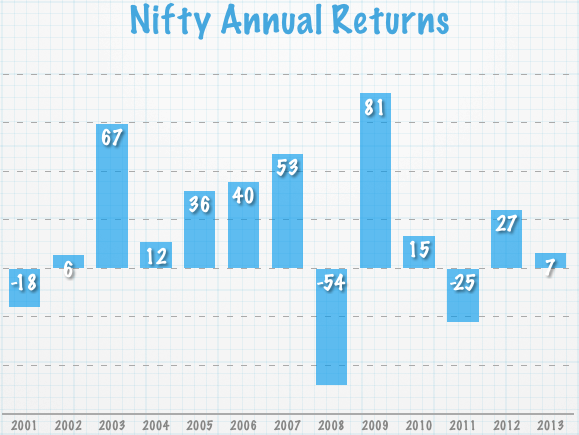
If you look at the annual Nifty returns — 2011 returned a negative 25%, 2012 returned a positive 27%, 2013 returned about 7% and we have seen the Nifty up about 11% already this year.

This kind of optimism usually brings with it new investors, and emboldens existing investors to invest more in the markets, which is what we’re seeing now as well.

AMFI reported that 400,000 new accounts were added last month taking the number of total equity folios to 29.56 million, which is still less than its peak of 41.13 million in March 2009, but does speak of people gaining confidence and returning to equity.  Interestingly, if you see the chart below you would see that the peak was reached in a year when the market did tremendously well. However, what the chart can’t tell you is that the pain you feel when the market halves in value is much more than any 81% gain you could ever witness.

Even personally, I feel that more people are talking about equity right now than any time in the past and I have a feeling this will continue for at least a few more months.

In terms of investing strategy though, getting into the markets, and increasing your equity positions when there is optimism in the market is not the right way to go and I’d caution any readers who are only now getting into the market, or increasing their SIPs at this time.

What you should have ideally done is buy into the markets when they were depressed, and that would have ensured that you were sitting on considerable gains right now, but if you haven’t done that and plan to chase returns right now, then that’s a dangerous approach.

The long term plan of any investor should be to get into a mindset where they can put in a reasonable sum of money into equity every month, and adjust that sum upwards or downwards based on market conditions. The hard part about this is you must adjust that sum upwards when the market is down, and lower it a little when the market is up. I’ve been doing this for years now, and also recommending others do this, as I find that this is a certain way to accumulate stocks at a reasonable price, and then take advantage of market highs to book some profits from time to time.

If you’re in the category of investors who don’t have any equity investments, and want to start now then I’d say start with a SIP that is smaller than the maximum you can put in the markets. That way when the market falls, you can increase that allocation and take advantage of the fall.

If you are already in the market, and were thinking about increasing your allocation, then I’d say there is no reason to increase your allocation just on the basis of this market rise alone. The time to increase allocation will eventually come, and you will be able to take advantage of that if you position yourself from now and be in a mindset that looks for crashes and downfalls.

If you were investing when the market were down and are sitting on profits now – good job, and I hope OneMint had a small part to play in it.

12 May 02:55

Markets salute the Victor

by Sudarshan Sukhani
Markets salute the Victor

The title of this post is cheeky since there is no victor yet. Results of the general election will be announced on May 16, which means, celebration of victory is a bit premature. yet, markets certainly celebrated on Friday, May 9' when the Nifty went up 200 points (3%) and the Bank nifty went up almost 800 points which is. Whopping 6%.

So, what was going on?

Well, news is often a trigger for market movements which were
already forecast by price charts. Chart for the Nifty has Been bullish for over two months. What should a bullish market do? Well, go up! So, this market also went up because it was already in a bull run.

The same reasoning applies to the bank nifty. The bank nifty was pushing against a six year old resistance around 13000. A breakout above this resistance should take the bank index all the way to 16000. This was our view and this view was repeatedly mentioned in CNBC-TV18 shows.

Now, often markets are ready to go up and some news or anticipation of news acts as trigger. The possibility or a stable government in Delhi acted as a trigger, but the rally came about because markets wear already in an uptrend.


Sent from my iPad
12 May 02:49

Vlad, do you have a plan?

by Sudeshna Sen

The fascinating thing about Russian President Vladimir Putin is how he keeps everyone guessing. His latest set of moves has in turn puzzled and angered the western powers.


On Friday, Putin visited the newly annexed Crimea to celebrate World War II commemoration day. US and Europe immediately called it provocative and insisted they would escalate tensions in the region. To where they think tensions can escalate, with bloody fighting in Eastern and Southeastern Ukraine, is beyond me. Then Putin asked pro-Russian protesters to calm down and postpone a referendum to secede. They did not listen.


Gone Out of Hand


So what is Putin’s gameplan? One camp insists he will invade eastern Ukraine, and has troops massed along the Crimean border. Another insists that he just wants to destabilise the Kiev junta and increase Russian influence high on his borders. I kind of agree with the third point of view — that things have gotten a bit out of control for all sides concerned. It is highly unlikely that Putin will want a prolonged civil war right on his borders, but will he use boots on the ground to stabilise matters?


Ukrainians, in the events of the past year, have shown scant respect for peace treaties or deals made by their leaders. And seem inclined to keep fighting. What has puzzled me is how little credible information is coming out of what, after all, is a high-tech country. Russian troops are there. No they’re not. The fighting is between the local authorities and terrorists. No, it’s between “fascists” from the west and brave local defenders. Eastern Ukraine wants to join Russia. No, actually not all of them do — they just don’t like what they call the “western” government in Kiev. Not just Putin, but what Ukrainians want is also something of a mystery.


In a world where satellites and Google can monitor your front door, the lack of information, or rather the amount of misinformation floating around, just goes to show that global communication and social media can do as much to obfuscate matters as it does to generate Arab Springs. Apparently, all sides are using every channel they have to put out their version of what’s going on. And we’re mostly looking at old-fashioned war correspondents who are out there on the frontlines, talking to people on the streets. As a professional journalist, I’ve never quite liked the way social media can escalate rumours in times of crisis. But that’s another story.


Too Little, Too Late


I’ve been pointing out for a while that in a globalised world, where markets are connected, and thanks precisely to all those communication channels that authorities can’t monitor or even influence, national leaders have become relatively powerless to guide geopolitical or economic policy directions. The Ukraine story just makes this even clearer.


Everyone always knew, from the day Russian troops walked into Ukraine, that other Russian ethnic regions would go ballistic. It is assumed that the US knew, Europeans knew, the interim government in Kiev they are handholding knew. And so did Putin.


So what were all the western governments doing? Putting sanctions on specific Russian banks and individuals, nudging the stable door after the entire cavalry had left. For the people of Eastern and Southeastern Ukraine, how did it matter how many rich Russians felt the pinch?


If anything, some of the most powerful and presumably well-informed people were intimately involved in the situation — so how did it get so badly out of hand? However many phone calls the White House and the Kremlin made, neither side seemed able to predict or minimise the chaos. I hope Putin does have a gameplan, however Machiavellian, because nobody else does.


Western powers are too busy vacillating, and being suspicious of Putin’s empire building motives, to actually help the government in Kiev restore law or order. Europe has absolutely no stomach for a warfront in Ukraine, nor is it keen to aggravate Russia too much. The US could, but will it go it alone? There’s an election scheduled for a new president in Ukraine — after all, this one was not elected — but there’s little hope that will go through without bloodshed.


In the end, peculiarly enough, Putin may be the region’s only hope to avoid a long-drawn out civil war.

11 May 16:11

Retirement Planning: Get it checked by a friend…

by subra

Of course Retirement planning is easy to talk. The question is HAVE YOU DONE IT? Cooking, running, cycling, yoga, pilates, all look so easy when somebody else does it! Try just doing the warm up for kick boxing, and see it take a toll on your lungs and legs!

So there is nothing so simple about DOING ANYTHING. However people do think that Retirement Planning is simple…

When people tell me Retirement Planning is simple, I tell them the following:

Of course it is simple, all you have to do is the following:

1. Estimate how long you will live. (yet to see even a 84 year old accept that he could live up till the age of 100). I personally know of about 5 people who have crossed the age of 100 years – I expect that number to at least double over the next 5 years. Not funny, this means about 42 years post retirement. Are you ready?

2. Did not start investing when you were 25, 30 or 35? Now you are 54 and worried? Simple save about 35% of your gross salary in a pension plan. You think I am exaggerating? Go to Pattabhiraman Murari’s Free Financial Calculators – www.freefincal.com

3. Which pension plan? well, well, that is another post, right? Maybe none. You may need a big box full of assets out of which an annuity could be one small part. Your pension assets could be Nsc, PPF, a house to be given on rent, equity funds, ….you may need a ‘retirement portfolio’ not just a retirement plan. Think hard. NOW.

4. Now the money that you are putting away CANNOT be touched for your kids education, marriage, illness of self or spouse, buying a house, car, etc. – it is a RETIREMENT plan, you dummy!

5. Ensure that you or your (contributing) spouse is not laid off, or is not too sick to work till you are about 70.

6. Hope (and pray) that your fund manager gets you a REAL RETURN of about 3-4% p.a. till the rest of your life.

7. Buy an annuity without return of premium in such a way that you spend the last rupee as a tip for the pall bearer.

Well, well, it is not difficult, I am sure.

But when a person says ‘Retirement planning is complicated’ I say the following:

When you are 25-30-40-50 – you need not worry about any of the above things.

Just get into a nice portfolio of good well managed funds and keeping growing your money in real terms. Once you touch 70 years of age many of the things above will not be very difficult for a planner – or for your own self to do.

So either way, do something, do not just sit there doing nothing :-).

Not a Nike fan, but like their ad which says ‘Just Do It’. Exactly my message.

Once you have set the process in motion, get a friend to check / review it. It should be a similar minded person with some knowledge, but going to a professional carries its own risks. Get it checked by a friend of similar age or ELDER to you :-)

Post Footer automatically generated by Add Post Footer Plugin for wordpress.

11 May 03:07

Hawaa Hawaai : A Movie Every Entrepreneur Should Watch

by Ashish Sinha

If you are wondering why a movie review on NextBigWhat? Well, that’s because Hawaa Hawaai depicts the mind of a dreamer, an entrepreneur.

Hawaa Hawaai Movie

Hawaa Hawaai Movie

Hawa hawai is the story of Arjun, a poor kid who finds his passion in skating, while serving tea at a local stall.

Right from bootstrapping (the poor kids didn’t have money to buy skates, so they make one out of scrap material) to DIY learning (learns from the coach while serving tea), the movie is well crafted and connects with those who dream a dream.

Directed by Amole Gupte (of Stanley ka dabba fame), the movie has no big star cast to boast of and that’s precisely why it’s also worth a watch – the entire movie revolves around dreams – of the poor kid (played by Partho Gupte, Amol’s son) to the dream of skating teacher (played by Saqib Saleem).

Hawa Hawai is no Milkha Singh fame story (except for the final race drama), but is a great attempt to make a sensible movie that also appeals to the ‘dreamy’ generation of entrepreneurs and achievers. Hawaa Hawaai is all about ordinary people who dare to dream!

For entrepreneurs and doers, Hawaa Hawaai gives you the connect, a hope of a great future!!

After all, kuchh sapne sone nahin dete.

Udne ki koshish mein nikal aayenge par..
Tu kar mat dar.
Angaaron pe chalna hai sahi!

PS: I was disappointed to see the theatre was 50% empty (while Spiderman 2 is running full-steam) and hence this review – apart from showing respect to directors like Amol Gupte who are doing their ‘own gig’ (without worrying about the box office collection), I believe a whole lot of 9-6 job goers need to watch Hawaa Hawaai – just to revisit their dreams!

[Image credit:wikipedia]

The post Hawaa Hawaai : A Movie Every Entrepreneur Should Watch appeared first on NextBigWhat.

11 May 03:06

Financial Crimes

by subra

No this is not a post about the crimes in the financial sector. It is just about crimes in the real world.

If you watch / read about real life crimes, you realize that there is some kind of a pattern….

Many of the crimes happen in the family and around the house. You can hear/see/ read stories (real life) which you would NEVER believe if it was a work of fiction. Let me give you a few examples:

1. A sister killing her brother who tried to stop her drinking and sleeping around.

2. A son who kills his mother – because he wanted some money.

3. A mother and son killing their own daughter (his own sister)

4. A daughter killing her own mother because her mother would not let her meet a guy she liked

5. A father killing his daughter because she answered back

6. A spouse killing because he/she wants to have an extra marital affair

the list is really endless.

Most of this is actually a pattern. The pattern of NOT BEING ABLE to ‘control’ their need for NOW.

As parents or friends it is very easy to see children (and many adults too) being very impulsive in real life. Whether it is a Rs. 1000 for a Tee Shirt or a Rs. 84,000 plasma television, many people MUST have it NOW. This kind of behavior when translated to real life, these people are unable to control their emotions. Imagine a sister killing her own brother – there is a good chance that there is regret later on, but the act is done. Worse, the REAL sufferer is the parent – one kid dead, and the other kid in jail. Does the parent pay for the court proceedings? How does one react to the other kid?

What can YOU do about this?

Simple. Learn the art of slowing things down. Once in a week (or month) do things slowly. No multi tasking. Take all the acts that you do. And slow it down. Take eating for example. Thank God for the meal. Thank your wife / mother / whoever is the person who put the food on the table (in my case floor!). Eat slowly. Every mouthful should be chewed say 25 times – see how it feels.

Now if the parents had taught patience, and picked up the signals, they would have been better off.

The sad part in such murders is that the price is paid by MANY people. Imagine a family with 2 children – where one sister kills the son. Parents stay back to pay the price. The wastrel daughter is in jail anyway…

So when you get the signals early on, pick them up. Do not ignore…..

Post Footer automatically generated by Add Post Footer Plugin for wordpress.

11 May 03:06

Today’s Children, Bank Account and RBI Governor

by Kirti

Reserve Bank of India (RBI) has allowed children over 10 years to open and operate their bank accounts independently from 6 May 2014. This article covers information about the change in opening of children’s bank account. Why RBI feels that children should be able to handle their own account? How much does a 10 year old understand about the economy and what did she do about it? What do today’s girls of 16-17 age think about money, what they look from husband and future.

Children Bank Account : Independent Operation

Reserve Bank of India (RBI) has allowed children over 10 years to open and operate their bank accounts independently from 6 May 2014. Till 5th May minors’ accounts (fixed, recurring and savings deposit accounts) could be opened and operated under the supervision of parents or guardians. So far, only individuals above the legal voting age of 18 years were allowed to operate their accounts.  RBI has left it to the banks to frame guidelines on operating the accounts. It’s up to the banks to set limitations on withdrawals and value of transactions. Banks can also decide, in their own discretion, as to what minimum documents are required for opening of accounts by minors. Banks are free to offer additional banking facilities like internet banking, ATM/debit card, cheque book facility etc., subject to the safeguards that minor accounts are not allowed to be overdrawn and that these always remain in credit.The aim is to get children to understand money matters and feel empowered. It will allow them to enter the banking system earlier. The latest change has been done with a view to promote the objective of financial inclusion and also to bring uniformity among banks in opening and operating minors’ accounts, RBI said. For details one can read  RBI Circular on Opening of Bank Accounts in the Names of Minors

Some of the questions that came to my mind on reading about RBI notice were : Has RBI done the right thing? Will parents take the initiative and open such accounts for their children? We want our children to be prepared for future. Sadly we don’t talk much about money with kids. Kids grow up seeing parents, neighbours, relatives and grow up with half cooked ideas. Infact I started bemoneyaware.com to teach my kids about money.  Though I was educated, had a engineering degree from a premier institute in India , I was financially uneducated. Till I had kids I did not think much about learning about money, doing what my parents or inlaws told us to do.

Coming to the question : Are children ready to handle such a responsibility? I am sharing with you two articles that I read which made me think that we tend to underestimate the kids. I am reminded of the new Tata DoCoMo ad where a father wants to talk to his 16 year old about Girls and boy says Yes Papa what do you want to know about it. You can see it on Youtube by clicking here .

  • One is a V standard girl writing to RBI governor Raghuram Rajan offering her $20 which she saved . This happened in Sep 2013 when the government and RBI were battling a major crisis with the rupee hitting record lows and the current account deficit going beyond acceptable level
  • Second is the article A Conversation with Today’s Girl! by Vinita Dawra Nangia where she wrote about the talk with four teenagers revealing an amazing level of emotional maturity and confidence.

Letter to RBI Raghuram Rajan by V Standard Girl

Quoting from Economic Times May 1 2014, A class V girl offered to help RBI governor Raghuram Rajan

One doesn’t expect a fifth grade student to be worried about the state of the economy and the country’s foreign exchange reserves, much less pen a letter to the Reserve Bank of India governor offering help. But last September, when the government and RBI were battling a major crisis with the rupee hitting record lows and the current account deficit going beyond acceptable levels, Laila Indira Alva, a class V student of Sanskriti School,Gurgaon wrote to central bank governor Raghuram Rajan.

I have heard about the crisis our economy is facing… I have also heard about the fall of the rupee with respect to the dollar,” Alva said in the letter to Rajan, which has now been published in her school magazine. But unlike several others who complained about the curbs, such as those on importing gold, to check the deteriorating forex situation, the girl from Gurgaon went on to offer help. “I have saved $20 on my last trip abroad with my parents. I thought that I could use it but the country needs it more than I do,” the letter dated September 5 said.

Rajan, who had just moved to Mumbai to take charge as RBI governor, wrote back to commend Alva’s response although he refused to tap into her savings. “I am deeply touched by your kind gesture. I am aware that this is a challenging time for the country and I have no doubt that the economy will emerge stronger,” the RBI chief assured the student.”I am returning the 20 not (note) that you had sent with the assurance that we have adequate foreign exchange reserves in RBI to manage the situation,” Rajan wrote on September 12, when the foreign exchange reserves were hovering around the $275 billion mark.

Where did the girl know about dollar crisis? My guess is she travelled with parents to foreign country and would have picked up the conversation about how expensive dollar has become , about crisis of our economy.  She knew RBI Governo(how many adults do), she offered whatever she saved and had courage to write to RBI governor Raghuram Rajan. I still can’t think of writing  to RBI governor to read my blog ;-(.  Her parents did not discourage her to write . If she is guided properly then will she not be able to handle her bank account? I think she and many kids like her can but are parents ready to take the challenge? With so much on parents shoulder, studies, extra curricular activities can parents find time and energy to give them money values. Sometime back our  reader Chetan shared What I learnt about Money from my Parents shows what we learn from parents stays with us even when we grow.

 What do today’s girls want? A Conversation

Do you think that girls aged 16-17 can talk expectations from the future, husband..I didn’t till I read this article  from  From Times Of India A Conversation with Today’s Girl! by Vinita Dawra Nangia.

This conversation with four girls in the age bracket 16-17 left me zapped at the emotional maturity and confidence levels of young girls from a privileged background today. A freewheeling discussion on expectations from life and relationships reveals an understanding far beyond their years. They expect to work for the kind of life they wish to lead, and have very simple expectations, if any, from the men in their lives – loyalty and nicety. Without a trace of cynicism, these girls admit that their only expectations are from themselves.

The talk happened with four girls, though I am presenting them as one for greater clarity (they all consulted each other and agreed on what was said). I am sharing the conversation because I believe it is an eye-opener. We think our children are immature and cannot make their own choices. Whereas I do not say these four represent all young girls today, but still they do represent the educated, upwardly mobile, cosmopolitan teenage girl. Read on…

On love and sex

“What do emotions have to do with sex? Sex is just sex, a need you satisfy like any other itch. Please don’t confuse the two. Sex lost its emotional value sadly. Sex and emotional intimacy are two different things. You can have sex with anyone, but save intimacy for just a few. I may have sex with someone I do not fall in love with, and on the other hand, I could even be deeply and emotionally involved with someone I never wish to have sex with! I may just like to talk with him, share my feelings, consult him, but not be attracted to him physically at all.When you love someone and commit to the person, it is another matter. When you commit, it has to be total.”

On expectations from the future

“A life of financial comfort and social acceptability (friends and dating) comes above my aspirations of marriage and having children. I’m not saying that I wouldn’t have children. However, I do see children as a hindrance to my professional life.”

Do you see a husband as a hindrance too?

“Haha, no, not at all. I would like to find a dependable spouse relatively early on. I would be happy with just someone loyal, who is there for me when I need to talk. Just a nice person, because nicety is really where a lot of other characteristics stem from. I would never settle for someone as a compromise. Remaining single is no big deal.”

Do you expect your partner to contribute towards a good life for you?

“I will build the life I wish to on my own and be responsible for it. It is my responsibility to become what I want to be. I can’t blame anyone else for how I am.”

What if you had to support the man in your life?

“I would be more than okay with supporting him financially as long as he is doing something I am able to respect. However, if I thought he was just lazy and wasn’t using his potential, I could not get myself to respect him and then the relationship would not survive. I believe everyone has a moral obligation to the society.”

You are all so grown up and so mature!

“Yes, true. We grow up much too early (chuckles). But really, it’s sad. I regret growing up too early. It’s just too much stress too early on in life. I feel like my brain has been slowly just disintegrating from stress, but really, life is just supposed to be beginning for me, right?”

Okay we are talking about girls from privileged background. But this over a period of time the thoughts, change would trickle down..I mean change has to start from somewhere , somewhere small before it becomes big . Gone are the days when a girl was taught “Study and get married, look after your husband and kids”. Today parents send their daughter to as good a school as their son, mostly co-ed (unlike my time when parents preferred girls/boys school). Girls  are being told to stand on their feet and think about using their talent and earn money.  .Infact I see many families who just have one daughter are pretty happy about it, their friends do not ask them “Oh you have only daughter. Don’t you want to try for son?”   Boys are being told to help in kitchen/running of house. Newspapers, Magazines are full of ads talking about grooming for men.As a parent (I had two children a teen and one who soon will be in double digit) believe me it scares  me ! I wonder what did the father in Tata Docomo ad (about teaching his son about girls) did next?

Related Articles :

Our website Bemoneyaware.com has articles organised on Bank, Plastic Cards, Earning money, Spending money, Understanding Indian Rupee,history which will be helpful for kids . Kids Let’s learn about money. You can see excerpt of our book on money for kids  You can also download the first chapter of our book from here.

What do you think the children these days think about money?How are you preparing your children about money, finances? When did get a bank account ? When do you plan to open bank account for your child? Do you think RBI has done right thing in allowing kids to handle their money? We look forward to hearing from you.

10 May 03:13

Finolex Cables - Quick Update

by Abhishek Basumallick
About a year back, I had posted on Finolex Cables (refer to the post here). The company has performed well. The company has delivered an EPS of 13.6 versus 11-12 that I had expected. 

The company had very good margin expansion (the OPM expanded by
2.31% yoy to 11.6%). 

The company has also commenced a solar power plant for which it has got a tax benefit. This has aided in Net Profit growth (79% yoy) for Q4. 

Operating cash flow was above Rs 200 crore (about 85% of the operating profit). It repaid 54 cr worth of debt.
I am expecting an FY15 EPS range between 16-18. At a PE range of 15-20, the possible price ranges are 240-360. There is a lot of potential that still remains in the stock, even after its sharp run-up. The stock continues to remain attractive for investors for the medium term.

CMP - 153.

Note: I am invested in the company and have a vested interest in the stock. Please do your own due diligence before investing.
10 May 03:11

Megaphone Pattern

by Sudarshan Sukhani
A reader asked me:, is Nifty is making a megaphone pattern?

    First of all, i want to explain a megaphone pattern for those who do not know about this pattern. A Megaphone Top also known as a Broadening Top is considered a bearish signal, indicating that the current uptrend may reverse to form a new downtrend. The pattern develops after a strong advance in a stock price and can last several weeks or even a few months. A Megaphone Top is formed because the stock makes a series of higher highs and lower lows.
After a sustained advance, when prices make higher highs as well as lower lows, a suggestion of uncertainty creeps in. Traders are becoming uncertain about the existing up move.
     
Well, in my view it could be possible but not so sure. It is possible because Nifty is also on a top and moving in a broadening formation. But it is not for sure, because it does not breakdown yet. One should wait until it breakout the resistance level or breakdown the support level. 

10 May 03:06

My Mistakes while Investing – I still make them….

by subra

The advantage of being in the market for a very long time is you can see really long back. Some of my mistakes include not keeping enough data on a year to year basis of my performance. I just will not be able to say how much return I got in say 1984-5 for example. Recently Pattu of the famous Free Fin cal asked me for some data, and I did not have it. So I really do not know the ‘opportunity cost’ of NOT having made changes in my portfolio. I could (should) have done much better data capture and retention.

However, here are some mistakes which I do, and I guess will continue to do:

1. Once I make up my mind, I do not let too many facts disturb me: a.k.a. Anchoring. Hdfc mutual fund, Templeton, and Naren Sankaran are good fund managers. I thought so in 2001 and think so in 2014. Tata group, Murugappa group, Eicher, TVS, MNCs, are the best companies in India. Again a belief held for a very long time.

My investment portfolio SURELY suffers from Anchoring bias. Since overall i have done well, I have not bothered about it too much.

2. Overconfidence: In my ability to pick stocks, in assuming that asset allocation works ONLY in asset classes which give a return of low standard deviation, of building a dividend flow to meet my Retirement needs, of thinking that one asset class will NOT go into a tailspin like Japan. I love Markowitz theories and that has helped in creating my dad’s portfolio. Hopefully I will use the same theories for my portfolio too.

3. Overconfidence in assuming that standard deviation can be understood – and the assumption that Gsecs will not fail in India. If Gsecs, PPF and equities fail in the SAME period, I will be doomed.

4. Hindsight bias: thinking of the 3 fund houses mentioned above MAY look like hindsight bias to many of you, but I have been an investor / a person recommending them since 2001 for Templeton and Hdfc and Naren’s funds since he joined I Pru. However it is not hindsight bias, I can assure you. I liked their processes.

5. Point no. 1 – not keeping good records meant I have no clue about what happened to those scores of shares that I DID NOT BUY – I only know what happened to shares that I bought. I still have some shit like Shaan Interval which went bust. However I have no clue about the MISSED OPPORTUNITIES of considering but not buying enough (Bharti Airtel), not holding long enough (Infosys), being location biased (missed Aurobindo, Dr. Reddy’s lab), of being biased because I knew the struggle at the IPO (Avanti Feeds), of not buying because of bias (Indiainfoline, Edelweiss), etc.

6. Representativeness: Very strong feelings towards some groups and crowd behavior. I got lucky that I bought Ken Fisher’s book in 2007 – and hence got rid of the infra in my portfolio (I wish I had sold more, much more) – NOT BECAUSE the market was at a peak, but because these infra stocks did not deserve the PE. In retrospect, i realize that 2007 was not really a boom, it was an INFRA BOOM and I got lucky. Hey I do not argue with luck!!

If I were to run a finance class today, I would run long sessions on Understanding biases, prejudices, psychology, philosophies of investing, reading authors on money, greed, human behavior – as much as I would want them to learn economics, accounting, and business laws. Ha, hindsight !!

http://www.subramoney.com/2010/01/my-investment-mistakes-part-3/

Post Footer automatically generated by Add Post Footer Plugin for wordpress.

09 May 03:42

Two-point agenda for next government: Fix administration & talk to States

by Bibek Debroy

On 16th May, we will have a new government. Not quite, we will have the election results. A new government will take a little bit more time to be sworn in. We will probably have a budget in July. For that new government, all kinds of people are producing all kinds of wish-lists as agendas for reform. Others look at such agendas, typically based on market principles, and argue it is unrealistic for that new government to implement this. Subsidy reform, privatization of PSEs, labour market reform, fiscal consolidation are instances. Therefore, there is skepticism about any new government being able to jack up GDP growth from the present 4.5% to something like 7%. Still others look for 100-day agendas. I think all these assertions are too much of simplification. For instance, take the 100-day agenda. UPA-II had one such and you will find references to that in the President’s Address to Parliament in June 2009. How many of those items got implemented? Very few. Government and governance are continuous processes. What’s the point of a 100-day agenda, other than assuring people about earnestness of reform, especially when it’s not very obvious that those items are going to be implemented?


We need to focus more on what caused problems under UPA-II. I don’t mean UPA-II’s profligate public expenditure. That’s obvious enough. In addition, there was a bunch of problems that are administrative, not legislative, in nature, some of which have been highlighted in Sanjaya Baru’s book. I mean collapse of PMO, collapse of Cabinet as a collective decision-making body and refusal on the part of bureaucracy in Delhi to take decisions. Some, not all, problems pertaining to land acquisition, forest and environmental clearances concern this. While fresh investments are indeed important, the reason behind existing investments getting stuck, increasing ICOR (incremental capital/output ratio) and leading to problems for banks, is this. CCI (Cabinet Committee on Investment) was meant to fix this. CCI came too late in UPA-II’s tenure and could fix little. We thus need to take a call on whether the new government can fix PMO, Cabinet and bureaucracy. Irrespective of the political composition of the new government, I think the answer is yes. The next proposition is trickier. From that base-line of 4.5%, what does this jack up growth to? Your guess is as good as mine. I would say somewhere around 5.5%, though there are friends who pitch for 6%. That’s the kind of GDP growth we are looking at in 2014-15, no more.


We don’t have a Chief Economic Adviser (CEA) now and a Special Economic Adviser has just been appointed. It’s perfectly possible to argue that a new Finance Minister doesn’t need any economic advice. In passing, not only do we not have a CEA, the bureaucracy/administrative staff associated with the CEA’s office has also been transferred elsewhere. Here is a new FM who has to produce an Economic Survey and a budget. You can certainly argue the existing bureaucracy must have done some work and FM can build on that. I am skeptical, no matter how good the new FM is. Any budget-driven reforms, including taxation, will have to wait for the next budget, 2015-16. Remember this is a new government in Delhi. Several items, subsidies, Centrally sponsored schemes, GST, require extensive discussions with States, none of which has happened. The 14th Finance Commission has to be involved. We do have a 14th Finance Commission, but its Chairman doesn’t generally operate out of Delhi. Hence, I will be happy to be proved wrong. But I don’t believe in any budget-driven reforms right now. Perhaps the only exception is diluting equity in public sector banks and using that to recapitalize banks. Add to that clarification about retrospective changes in tax laws. Fiscal consolidation will therefore be postponed, after correcting for the preceding FM’s sleight of hand with the numbers.


I don’t mean this to be entirely negative. In addition to what I have said about administration and that deficit, I expect the drive towards a more federal structure, with institutions for Union-State relations rehabilitated. In particular, this means Planning Commission, Finance Commission, NDC, Inter-State Council. These are important elements in driving reforms for the future. Why are pro-market writers arguing for repeal of MGNERGS, LAAR and FSB? Don’t misunderstand me. I too think they should be repealed. But I don’t think they can be repealed in a hurry. Nor do I think the Seventh Schedule can be changed in a hurry. But I do think it is possible to relax Central templates and allow States to tweak these schemes. Stated differently the immediate agenda is just a 2-point one – fix administration and talk to the States. Expect no more. But expect no less.

09 May 03:42

Online Baby Products Retailer Hopscotch Acquires Schools Supplies Startup SkoolShop

by Darshana S

Mumbai-based Hopscotch, that sells children’s products has acquired online school supplies retailer, SkoolShop. The website of SkoolShop now redirects customers to Hopscotch.

Hopscotch had earlier raised Rs 12 crore from Nisa Godrej, the daughter of industrialist Adi Godrej, Singapore based LionRock Capital and others. Hopscotch and SkoolShop are co-founded by ex-alumni of Harvard Business School.

hopscotch

“We found a lot of synergies between the two companies. The acquisition will help expand our customer base rapidly and also give us a larger vendor base,” said Rahul Anand, co-founder of Hopscotch.(via)

 Blume Ventures and angel investor Rajan Anand, investors of SkoolShop, will exit the company as part of this new deal.

Recently, AllSchoolStuff, online education and stationery market, had shut down. Another recent acquisition in the e-commerce industry was that of KoolSkool by BookAdda.


The post Online Baby Products Retailer Hopscotch Acquires Schools Supplies Startup SkoolShop appeared first on NextBigWhat.

09 May 03:41

Why would the Congress lose the election?

by T T Ram Mohan
What exactly is likely to cost the Congress the 2014 election? An FT commentator thinks it's not the growth slowdown or even rising inflation. It is the change in the voter profile over the years. The poor are no longer the dominant constituency with the proportion of those below the poverty line falling to 22%. And yet the Congress' policies have been targeted towards the poor, rather than the dominant segment with rising aspirations. The latter need jobs, not doles:

India in 2014, in other words, is not the same country it was in 2004. Congress’s undoing is that it has failed to recognise this. It has instituted socially laudable right-to-work and right-to-food programmes. But such schemes are costly and prone to rampant theft. By putting a strain on the Treasury, they have contributed to persistent inflation. That in turn has forced the central bank to raise interest rates, slowing growth.

..Most Indians are no longer satisfied with the make-work schemes or food handouts in which Congress has increasingly specialised. Many have caught the whiff of a better life. Now they want jobs and opportunity. Even those who have not yet clawed their way on to the bottom rung of the aspirational ladder have seen what it looks like, courtesy of the satellite television channels that beam images of a middle-class life into even the most benighted corners of the country. India’s villages are not what they once were. The bullock cart has given way to the motorbike; the dirt road to tarmac.
This is a rather simplistic explanation, I'm afraid. The UPA's schemes are targeted not just at the poor but at those above the poverty line as well. Schemes such as MNREGA and the right to education are not just for the poor. Subsidies, including those on cooking gas and even food, are intended for the middle class and those above the poverty line. Indeed, it could well be that it is the trend towards targeting of subsidies only for the poor that has alienated the middle class.

The other problem with the explanation is that it fails to tell us why the BJP, in its manifesto, is not arguing for the dismantling of subsidies and welfare schemes. As I have pointed out in my blogs, Mr Modi has been saying something to the contrary of late. He has argued, for instance, that MNREGA should be made more efficient- say, in terms of creating assets. He has not said the scheme should be wound up. He has also said subsidies must stay. If the FT commentator's thesis were correct, the BJP should be singing a different tune.

Whatever the statistics on poverty, it is more than likely that, in the medium-term, no government can afford any economic policy that is not centrist or even slightly to the left of centre. We have to look elsewhere for the disenchantment with the Congress. Mr Modi appeals on the strength of the fact that he is a self-made man, has not amassed wealth for himself and has a solid track record in Gujarat.

The Congress, in contrast, is projecting Rahul Gandhi, who is seen as a privileged scion of a dynasty, the UPA is tainted with corruption charges and Gandhi has yet to prove himself in an administrative capacity. The perceived diminishing of the office of PM under Manmohan Singh could also be a factor. Rightly or wrongly, the perception has gained ground that India needs a strong leader as PM and that Mr Modi could be that leader.


09 May 03:37

Children learn about money..

by subra

Teaching is always a difficult job. If people want to learn, you can take the trouble to help them learn!

So whether it is telling your children the ‘benefits’ of eating vegetables or repeating the Mathematical Tables everyday or going to bed early, or reading vs watching TV debates – all are a little tough. However teaching money is not so difficult. This is because kids themselves want to learn money!

So if your kid is gone past the age of 3-4 you can ask him/ her to play with coins. Arranging them from big to small, shining to not so shining, according to shapes (ha for that one paisa, 2 paise, 3 paise and 5 paise coins of different shapes!) .

As they get a little older like say they reach class 3 or 4 they could run errands like buying bread, butter..at the nearby grocery. They need to know how much money to give, how much to get back – the basic addition and subtraction are honed here. I have been allowing my daughter to decide how much she wants to spend on her dresses, on crackers for diwali, etc. This allows them to decide to buy 2 dresses for Rs. 2800 and crackers worth Rs. 200 on a budget of Rs. 3000!

As they get older involve them in family goals – and explain that a new TV vs an extra coaching class is a discussion worth having. Let them not feel that the ATM is a self funding machine. Many kids think that if you want money. you go to the ATM.

Explain to them that all things have a value and a price. And the value of your slog at the office is called cash! When they come to class 8 it is time to talk about funding their college education, power of compounding, equity, debt, rent, pay yourself first….and hey this is a good time to get your kid on to www.subramoney.com !!

See the Children and Money page…..

Post Footer automatically generated by Add Post Footer Plugin for wordpress.

09 May 03:32

The UK makes the Euro area look good.

by Antonio Fatas
A quick chart-of-the-day post motivated by some articles I was reading today about differences in country performances during the global financial crisis. Which economic policies worked best? How bad (or good) membership in the Euro area was to fight back the crisis? These are important questions to understand the effectiveness of different economic policies (monetary, fiscal, exchange rate).

When comparing performance across countries it is quite common to use a variety of indicators: GDP growth, unemployment, productivity,... They all tend to move together but they can sometimes provide a quite different view of the economic performance during a number of years. I decided to look at GDP growth but adjusting is by changes in demographics: GDP divided by working-age population (between 15 and 64 years old, as it is measured by the OECD). What I do is to compare the 2013 number with the 2007 number (which I use as the beginning of the crisis). [Click on the chart for a larger image]


What I find interesting (and surprising) is the similarities across countries, despite the differences in policies. With the exception of Greece (and possibly Italy) all the other countries are very close to each other. The three countries that originally opted out of the Euro do not look too different from the Euro countries. Yes, Sweden has done great but so has Germany. The UK has grown less than the Euro area (of 18 countries), less than France or the Netherlands and at a rate which is very similar to that of Spain. Same for Denmark. Among the small countries that are still outside of the Euro area some have done quite well, others not so well and, surprisingly, some of these countries manage to do well with a currency pegged to the Euro (Bulgaria and Latvia).

[Note on data: let me stress that I am using GDP divided by working-age population and this makes a difference for some economies. For example, Latvia's GDP in 2013 is still lower than in 2007 but its working-age population has been declining sharply over these years. Dividing by working-age population allows us to remove potential demographic changes during these years.]

So despite the stubbornness of the ECB and the constraints of a common currency, economic performance in the Euro area has not been too different from those of the other European countries that are outside. This might not really be good news. It might simply be the case that the anti-inflation obsession of the Swedish central bank and the fiscal policy austerity of the UK government have helped to make the Euro-area performance look not too bad.

Antonio Fatás
09 May 03:29

Low-Skilled Workers Everywhere Are Getting Squeezed

by Walter Frick

The supply chain for German cars is significantly more globalized than it was a decade and a half ago. In 1995, 79% of the value created in the process of manufacturing a German automobile was captured by domestic firms and workers; by 2008, German companies and workers captured only 66%.

The difference is explained by the phenomenon of “production fragmentation,” in which different firms (and countries) specialize in producing different parts of a final good. German car companies still assemble the final product, but the value chain leading up to that last step has become more fragmented in recent years, and the role of foreign firms has increased.

A recent paper from the Journal of Economic Perspectives looks at the phenomenon of fragmentation in manufacturing and seeks to determine who is capturing value in today’s more global supply chains, as well as who is getting left behind.

To answer those questions, the authors look at the share of value in manufacturing captured by high-skilled workers (those with a college degree or equivalent), medium-skilled workers (high school degree), low-skilled workers (less than high school), and capital. (The latter category includes machinery, factories, and other physical capital, as well as natural resources, intellectual capital like patents, and returns to financial capital.)

This method of accounting looks at the sale price of a product and subtracts the cost of raw materials and other inputs. What is left over is the financial value created by the production process, which is split up between wages paid to workers, and returns to capital.

The paper reveals a shift in who captured value from 1995 to 2008, away from low- and medium-skilled workers and toward high-skilled labor and capital. That trend is visible in the context of German car manufacturing:

Global-Value-Chain-of-German-Cars

Globalization, and the resulting fragmentation of supply chains, hasn’t just shifted the geography of production. It has meaningfully changed the returns to various stages of the production process. As the paper explains it:

Production processes in manufacturing have increasingly fragmented across national borders, and the change in their factor content was clearly biased towards high-skilled labor and capital. This pattern was not only found for activities carried out in high-income countries, but also in emerging economies.

It’s no secret that in developed economies, high-skilled workers are leaving their low-skilled counterparts behind. More interesting is the dynamic in emerging economies. Despite the fact that low-cost labor is a source of competitive advantage for many of these economies, the share of value captured by low-skilled workers has decreased in these countries as well:

Manufacturing-Value-Chain-Emerging-Economies

The bulk of value in emerging market manufacturing is captured by factory owners, financiers, and the like, because these investments are in shorter supply than is the low-skilled labor that complements them. But while capital’s share of value captured did increase between 1995 and 2008, on a percentage-basis it was high- and medium-skilled labor that increased the most.

Behind all of this, the authors argue, is “a pervasive process of technological change that is biased towards the use of skilled labor and capital.”

Less skilled workers in developed nations may be losing jobs to those in developing ones, but ultimately both groups face the same challenge. No matter where a product is assembled, high-skilled labor and capital reap the highest returns.

08 May 08:17

An Alternative to the Efficient Markets Hypothesis

by David Merkel

I read an article today, The Fallibility of the Efficient Market Theory: A New Paradigm  Good article, made me look through a major article cited: An Institutional Theory of Momentum and Reversal.

The former article explains in basic terms what the authors have illustrated.  The latter article, provides all of the complex math.  I get 50%+ of  it, and I think it is right.  This explains value, momentum, and mean-reversion, the largest anomalies that trouble the Efficient Markets Hypothesis.

This article deserves more attention from quants and academics.  The only thing that troubles me about it is that they assume a normal distribution for security returns.

Have a read, and for those that can understand the math, if you disagree with it, let me know.