Shared posts

08 May 03:08

A System for Remembering What you Read

by Shane Parrish

Last year, I read 161 books cover-to-cover. And that doesn’t include the ones that I started to read and put down. I learned a lot in the process about what works and what doesn’t work.

I have a system that I use for non-fiction books that enables me to remember quite a bit. And when I can’t remember I generally know where to look to find the answers.

Here are some of the tips that work for me:

  • Learn How to Read A Book.
  • Start with the index, table of contents, and the preface. This will give you a good sense of the book.
  • Be ok with deciding now is not the time to read the book.
  • Read one book at a time.
  • Put it down if you lose interest.
  • Mark up the book while reading it. Questions. Thoughts. And, more importantly, connections to other ideas.
  • At the end of each chapter, without looking back, write some notes on the main points/arguments/take-aways. Then look back through the chapter and put anything down you missed.
  • Specifically note anything that was in the chapter that you can apply somewhere else.
  • When you’re done the book, take out a blank sheet of paper and explain the core ideas/arguments of the book to yourself. Where you have problems, go back and review your notes. This is the Feynman Technique.
  • Put the book down for a week.
  • Pick the book back up, re-read all of your notes/highlights/marginalia/etc. Time is a good filter – what’s still important? Note this in the inside of the cover with a reference to the page number.
  • Put the notes that you want to keep in your common place book/resource.

But one thing that most people don’t appreciate enough is that what you read makes a huge difference for how well you remember things.

We fail to remember a lot of the stuff we read because it’s not building on any existing knowledge. We’re often trying to learn complex things (that change rapidly) without understanding the basic things (which change slowly or not at all).  Or, worse still, we’re uncritically letting other people do the thinking for us. This is the adult equivalent of regurgitating the definition of a bolded word in our high school textbook.

Both of these lead to the illusion of knowledge and overconfidence.

I’d argue that a better approach is to build a latticework of Mental Models. That is, acquire the core multi-disciplinary knowledge and use that as your foundation. This is the best investment because this stuff doesn’t change and if it does it changes really slowly. This becomes your foundation. This is what you build on. So when you read and connect things to the core knowledge, not only do you have a better idea of how things fit together but you strengthen those connections in your head from use.

If you’re looking to acquire worldly wisdom, time is your best filter. It makes sense to focus on learning the core ideas over multiple disciplines. These remain constant. And when you have a solid foundation it’s easier to build upon because you connect what you’re learning to the (now very solid) foundation.


Brought to you by: CURIOSITY: A curiously unconventional ad agency that helps you stand out in today’s crowded world.

08 May 02:59

Keeping clients out of trouble!

by subra

It is not easy being a financial planner, broker, adviser or even a blogger. As a blogger there is less ‘accountability’ towards a reader, and anyway no fees to be earned or lost, but let me give you some examples.

1. Subra Facebook is a great issue: When the FB issue hit the market 4 friends who had money in the US wanted to apply for the IPO. No amount of saying that an IPO is for the institutional investor, employees, and promoters to get an exit, they were all tempted. One is a good friend who said ‘fine, will not invest’. However the other 3 did apply and I have no clue whether they are happy or sad. Of course today they could rationalize and say ‘anyway it is only Rs. 500,000 or something like that.

2. Riskier portfolios get higher return – OMG no. NO. NO. When a person gets a higher return than say the index, we KNOW that the client had taken higher risk. However every time u take a high risk, it does not mean that YOU will get higher returns.

3. A few of my friends bought RE in the USA and have sold when they got 20% return in less than a year. However not everybody knows how to play the RE market in combination with the currency market. Most of these friends are regular travelers, have a place or residence in the US, and are familiar with the market. One is a builder based in Mumbai – and has a fantastic market assessment skills. I NEED TO HOLD THE HANDS OF OTHER friends and clients stopping them from dealing in foreign markets without a lawyer or a CA.

4. I understand the risk that I am taking in buying this junk bond. Amazing over confidence.

5. “My friends are all buying a plot of land near Mumbai, it is payable in installments and the promoter is a God fearing person.” When you are ‘told’ this, you just wish them luck, right?

In all such cases trying to talk the person out of deals which they do not comprehend is not easy. Also very very sadly in the BFSI space you get paid ONLY for consummated deals. So if I stop a client from investing in one of the above deals, I do not get rewarded. I have to IMMEDIATELY move that money into one of my products which will of course save the client but also make me MONEY. Here greed steps in. Alas.

Post Footer automatically generated by Add Post Footer Plugin for wordpress.

07 May 03:31

Can one keep driving on empty tank?

by Ashvini Kumar Saxena

As an entrepreneur, life is not easy as it seems. Though entrepreneurs escape from corporate life to start on their own, they often find that reality of entrepreneurship is not as rosy as it seems.

Entrepreneurs bear the brunt of unpaid bills, unhappy customers, low revenues etc. Cutting down on expenses mean loss of social life. The health issues that crop up ( as I discovered last year for myself ) also leave us and our businesses vulnerable.

The constant connectivity from mobile phones and tablets keep us glued to the business. There is absolutely no time to switch off.  We are worried about if people are writing about our business. If not then why and if yes ,then we want to know what are they writing.

Is grass green on the other side?

Isn’t it ironic that when we are in corporate world , we aspire to break out of it and on the other hand when we are entrepreneur, we long for safety of corporate job. The grass is always greener on the other side. It is true that there are lesser headaches in a 9 to 5 job. We need to deal only with work pressure and bosses.

As entrepreneurs here say that life is indeed tough for them. Read on.

Why did we become entrepreneurs in the first place?

The reasons we ventured into entrepreneurship were among the following

  • We felt under-appreciated for our work
  • We felt our capabilities could be put to better use
  • We saw how any system that we observed was inefficient and just one product could change it
  • We felt inspired to make an impact on the world

It is important to analyse what we came here for. Wasn’t it for “To go where no man ( or woman ) has gone before ?” If yes, isn’t taking a small stress now is part of the overall grand vision ?.

Taking care of health is very important

Last year, I realized that not taking care of health can bring the business to a halt. It is important to chart out how we are going to take care of our health. We need to switch off everything when we are working on our health.

Let law of compounding work slowly

We cannot rush success. Success is not only revenue that one is making. There are  a lot of intangibles that cannot be counted easily but which slowly build up with time. In a slow economy, money is hard to come by. People spend less and it directly impacts the revenue. However these times are very useful for building our brand.

A business can attract more attention by creating and often giving away things for free ( or for community use ). This would enable people to talk about our business and get a mindspace.

What I am doing for my business?

For example on my site http://webtecho.com, I am planning to build a few more plugins for WordPress. The main product remains but in the time of recession when sales are hard to come by, it is a good idea to remain focussed in delivering value to community and customers.

The point is simple; law of compounding works very slow initially. After a point, the returns rise rapidly. If we try to rush, we lose track of what is important to us. Giving more time to business to grow reaps bigger dividends.

Are we still excited and passionate about business as we were once?

Sir Richard Branson says that it is impossible to go on 100 miles per hour on empty tank. Read here. When we started our business, we were excited about possibilities. With time , some of the enthusiasm dies down. If one is not excited anymore, its time to relook at other options. Before that, however one needs to look at the reasons for drying up of excitement. Are they temporary causes? Can we come out of them?

07 May 03:30

Should I do business?

by subra

So many people ask this question, that I have no clue what to say without being impolite!

Many people ask me ‘My brother (wife, sister, father, uncle, in law,….) wants to do some new business and wants me to invest Rs. 20L in that business (20% of your liquid networth) ….what should I do?

or the more simple one ‘should i leave my job and start a business?’.

Frankly this is not a Business Question. This is a psychological Question.

Are you disciplined enough to be in office EVERY DAY at 9am and leave at 7pm like an employee does?

Do you realize that the top 5 DEMANDING customers is like having 5 bosses?

Do you have enough cash in the savings account (or liquid fund) to meet the next 5 years expenses – if things were to go wrong?

Will your spouse support you through this? what about other immediate family?

Now come to supporting your brother (wife……etc.) while they do business:

apart from the top 4 questions that YOU need to ask them, look for answers for the following questions:

1. does he/she have a track record of doing something disciplined? – academic, sports or professional.

2. Assuming that not a rupee comes back how will it impact your relationship with the others?

3. Will a full loss change your life style?

4. Will a full loss wipe you out completely?

5. Do you have any business analysing skills?

6. If the business does really well, what upside are you expecting? Interest payment or equity participation?

7. At the gut does this person inspire you to invest?

8. If he/she was not related to you would you consider investing?

9. If the person asking for money is an in-law, is your spouse enthsiastic about this investing (for you) about doing business (for the businessman)

10. Would you put all this down in writing – AND WHY NOT?

- ASK these questions to start with…later on there will be more….

Post Footer automatically generated by Add Post Footer Plugin for wordpress.

07 May 03:29

When all asset prices are too damn high.

by Antonio Fatas
Increases in stock prices over the last years combined with bond prices that remain high (yields are low) have raised the possibility of mispricing in assets, potential bubbles and future crashes. Are all assets too expensive? Some think so and refer to the current situation as a "gigantic financial asset bubble" where all assets (bonds, stocks, commodities,...) are priced too high. Others see trouble just in stock markets where valuations seem to be growing much faster than the real economy. But there are also those who think the stock market still offers a good return.

Here are two perspectives that can hopefully help understand such diverging views on asset prices:

1. How can it be that all asset prices are overvalued? When all asset prices look too high, we are making a statement about the disappointing returns these assets offer. The key question is whether we are really taking about mispricing or simply about surprisingly low (equilibrium) returns that saving is offered these days? Martin Wolf in today's FT offers many arguments on why low interest rates are here to stay because in a world of abundant saving, returns will be low and asset prices will be very high (I have written about this before). So maybe all asset prices are not too high, it is just that returns are not as high as they used to be.

2. How do you define a bubble? Before answering the question, it is good to get a perspective on the data. Neil Irwin at the New York Times has a great summary of the US stock market in six charts. What do we learn? Stock prices compared to the current level or earnings are high by historical standards. In other words, if you buy the stock market today, you should expect returns that are lower than typical returns. Is this a bubble? Maybe not if those low returns are consistent with the low returns that are offered anywhere else in the economy (back to the argument that "all asset prices are high"). If you do that comparison (see Irwin's article) and calculate the difference between returns one would expect from current stock prices and the returns that bonds offer, the difference is still positive and consistent with historical values (this is the same point that Brad DeLong makes). So stock prices look high but so do every other asset price. Once again, get used to low returns in a world where everyone wants to save.

So does it mean that everything is fine? No, it all depends on what are the expectations of current investors. A bubble in the stock market is not about how high stock prices are or about how low expected returns are. A bubble is about expected returns that are inconsistent with the current stock prices and their relationship to the fundamentals of the economy. If investors are buying stocks today having as a reference the returns that we have witnessed in the last years, then we are in a bubble. But if investors are buying stocks today as an investment that offers a low but consistent return with any other form of saving, then we are fine. From Irwin's article at the New York Times:

"Add it all up, and and it leads you to a conclusion.. Stocks may not be wildly overvalued relative to fundamentals. But for them to rise much from here, a lot of things will have to go just right for investors."

Correct. Stock are not a bargain like they were two years ago (when risk aversion was very high). Their prices are back to levels that are consistent with fundamentals and those fundamentals can deliver returns that are reasonable given other investment opportunities. But if all your fellow investors are hoping for yet another great year in the stock market, then run, because there is no way fundamentals can justify another couple of years of very high returns.

Antonio Fatás
06 May 03:03

Thank You Dear Shareholder / Unit Holder

by subra

If you bought a Hindalco, Tata Steel, Tata Motors when GD Birla and JRD Tata signed the share certificates, you must be a really long time shareholder. We are talking in excess of 50 years here.

Even if you bought Nestle, Colgate, Hindustan Lever in the 1970s, you must be a real long time shareholder. Simply because people think 37 years is a life time, not an investment time.

Now as a shareholder you got your growth, dividends, etc. and you are not expecting anything from the Company.

So why should a company send you a thank you letter for being such long term shareholder?

Well, they need not. HOWEVER, Let’s say a company sent out a letter thanking people for holding shares, what happens? People get more loyal to the company. Or mutual fund. Just a well drafted letter telling them how their holding has generated wealth, and how the shareholder was VERY SMART in buying the share, and holding it for such a long time. Suppose a company has generated 16% CAGR over 20 years, calculate the returns in terms of money and tell the person.

Similarly if an individual has created wealth for himself by investing in say SIP of a well managed fund, thank him, his IFA, and show him how much wealth has been created.

Ditto if a client has used your airconditioner or ….whatever.

Remember all these clients HAD A CHOICE — they chose you. Thank them for making that choice..Remember Kingfisher flights? They used to thank you for making that choice…

Post Footer automatically generated by Add Post Footer Plugin for wordpress.

05 May 11:24

Are you Overestimating your future income and getting into debt trap ?

by Manish Chauhan

Today I want to discuss a problem which is part of almost everyone’s life and creates some really big issues. I am talking about the problem of “Over Estimating your Future Income” . Yes – A lot of people take their current life decisions, based on what they feel about their future career and future income.

over estimation of future income

My Salary Hike

When I was working in Yahoo, Bangalore around 2008, I saw all the newcomers around me “expecting” their salary hike to be around 20% and 25%, and guess what – It actually happened.

Then in 2nd year, the same people “estimated” that they deserve a minimum 15-20% salary hike at any cost, because they have given their best. It happened again ! .

Then in the 3rd year, they got into the same – “I think my salary hike this year will be .. ” game and by then these people were using maxing out their credit card limits, had bought all the financial products for tax saving and committed to pay huge premium, at times as high as 80,000 per annum. They were all living a life which they deserved after 7-8 yrs of their career.

Then there was a layoff in Yahoo and some people got FIRED (some were my friends)

One guy had almost finalized a home loan, obviously based on his “future income”. Another guy could not pay his credit card bills for next 3 months, because there was no money (he eventually got another job in few months) . And most of them wished if they had saved a bit more, it would have been a better situation.

We focus on positive side, but not on negative’s

The incident I explained above looks fine at the start of career, there is less to loose. But just imagine the depth of this problem. This shapes our financial life.

If you have been working for many years now, you probably have lots of things to achieve in life and due to peer pressure, you can go overboard on your expenses, just by assuming that your future is too bright. The issue is not that we look at the brighter side, the issue is that we look “only” on the brighter side – the salary hike, the promotion, the better salary if we switch companies, the extra bonus which we will get, and then the side income which we can generate along with job .. etc

We do not look at the negative side seriously or just under rate them. We feel job loss is something which happens to others, not us! . The accidents can never happen to us. We cant loose our wealth due to some reason. What about a sudden medical emergency which can wipe out your wealth, what about “No Salary hike” this year , what about “bonus below the expectation” , what about a Fraud which creates a big hole in your pocket?

When we see our future from current situation, it looks like a straight line without any issue or problems, we extrapolate our smooth past into future and every thing looks promising. However the reality is full of surprises, and problems. Things can go terribly wrong and it can really damage your plans in life. How serious it will be depends on how much over estimation you have done for your future income. The image below clearly explains what I want to say here.

your plan in life vs reality

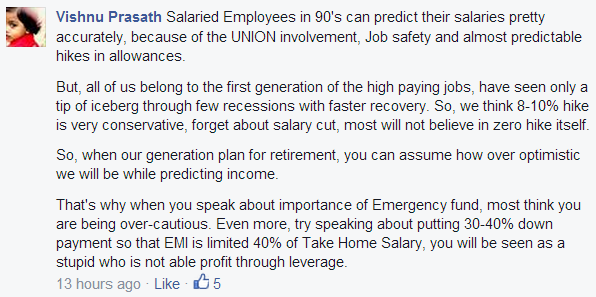
I posted this same point about “overestimation of future income” on my facebook wall, and I got a very good reply from Vishnu Prasath, which I feel everyone should read, below is that reply

Vishnu Prasath reply for overestimation of future income

In our 6 weeks online Investors Bootcamp, one of the weeks is about getting clarity of your current situation and where you stand in your financial life. With the help of an amazing excel sheet, participants are able to find out 12 insights which are related to their financial life, it tells them key hidden points about their financial life.

This helps them to control their habit of over-assumption about future and they get huge clarity of how much leverage they should expose themselves to, in their financial life. If you feel you want to have more control on your financial life, with our bootcamp, you can join the 7th batch (starting this 19th May).

Yeah .. I am starting my business !

Let me also touch upon the point – “starting my own business”. When you do calculations and plan for your business potential, MS Excel makes you millionaire on paper and shows you all the rosy picture. However things are so different in real life. Assume a person, who is going to leave his job and going to start a business/startup . He forcasts the cashflows and profits and declares that in next 1 yr itself he will break even and start making money. Life will be on track again, but in reality – it can take 4-5 yrs. There can be losses, things can go totally wrong ..

In that case, imagine the situation, the stress the family will go through , the “I told you so … ” the person has to be hear every month. This is one real life example almost all the not-yet-successful entrepreneurs can relate to .

How we spend more and more Today

So because we over-estimate our future income, we buy bigger car, bigger Home, we go on more longer and premium vacations, and commit to higher EMI’s which looks possible considering our future income and cash flows. I do not want to sound like a pessimist here, I am not saying don’t be confident in life or career, one always have to do a calculative move and take decisions based on some assumptions, but some people go over board and damage their future at the cost of today. On that point I want to focus on two main points – which are

We are Consuming more today and not leaving much for future

The biggest problem I see today in most of the people financial life is that they are consuming a lot on the name of “Life is here to Enjoy” .. Yes – its a crime if you dont enjoy your life despite earning so much, but there is a limit to it. There is a always a cieling to your spending. If your yearly salary package is Rs 8 lacs, then you should NOT be spending all 8 lacs , because you “feel” , next year your package will rise to 10 lacs and “at that time” you will save more. If your salary is 8 lacs per year, you should start with Rs 5 lac car, and not Rs 16 lacs car, because your future looks bright. It just does not work that way in most of the cases.

Getting into Debt Trap

Another issue is that, When things dont turn out as per your expectations, you also feel very disappointed and frustrated and start comparing your imagination with reality. Just because you assume future is too bright, you spend on those things, which you dont really need today, but have potential to pay. You also over spend and this is also a cause at times for Debt Trap, you get into a small debt first, you assume its normal and next month you will take care of it, and then it never happens and after 3 yrs, you feel you should have controlled yourself in the start itself.

One of the guys commented his real life experience on one of the facebook groups I am part of. Here is what he said

The biggest problem with our generation is that we overestimate our future cash flows,, think ourselves entitled to expensive lifestyle due to easy credit and fall prey to EMI trap rationalizing it with our increasing incomes every year. I represent this generation and have badly suffered the consequences of overestimating my future earnings.

I took personal loan for construction of my home, then took top up loan next year when my salary increase  and put it in interior and then again took maximum personal loan that I was entitled to for my sister’s marriage next year rationalizing every time that my income will only increase every year in my job.
But then I left job to start a business with one of my friends and all hell broke loose. All my cash flows dried up, debts increased and

I was reduced to begging for money. I had to live on borrowed money for more than a year. All my aggression,confidence,self image and big talks took a bad beating. It was hell of a time. Now I hate debt and credit of any kind. It is slavery, bondage and evil.

You never know when things can go wrong for no reason or for no mistake of yours. Think a hundred times before committing yourself for high EMI, high tenure loans.

(Source : Asan Ideas for Wealth Facebook Group)

How long can you survive financially if you loose your job ?

So you must be wondering about your own case right now. Let me ask a very simple question – “If you loose your job, how many months or year can you survive without working?” . This is a powerful and disturbing question at the same time. If you have been working for many years, and your answer to this question is in months, then there is some issue.

Whats the right way ?

There is no right or wrong way here, there is only logical way. You always have to keep a balance in your spending and saving. You can surely expect the future to be good and bright, but make sure you do not over leverage to a limit which turns out to be a disaster if things go wrong. Also think about situations which are negative and then take a balanced decision.

Let me know what are your comments on this topic ? Have you ever faced any issue because you over estimated things ?

05 May 11:21

The BJP’s better mousetrap syndrome

by Pran Kurup

When you present your business idea or plan to a venture capitalist, one of the first things they start to look for is an answer to a very basic question - “What is the new big idea here?” They will in all likelihood tell you that your idea is not scalable, it’s easy to do or that it takes too long to build, or that the market is not big enough to be exciting. Investors who have made up their mind not to invest in your venture have so many ways to turn you down. But at the end of the day, it’s important to recognize that you need an interesting idea to begin with to get investors excited. 


On the political front, India is faced with a historic election at a critical time when India’s economic growth indicators have dropped dramatically, corruption and crony capitalism are rampant, cynicism is at its peak, and trust in politicians and political institutions are at its nadir. Our population of 1.2 billion people is likely to overtake China by 2025. There is a desperate need for better governance that can ensure all-round improvements in infrastructure, education, health, poverty, illiteracy, women’s safety, etc. 


In short, the problems facing India are daunting and there is a desperate need for solutions, both short-term and long-term. With this in mind, if you put yourself in the shoes of an investor looking to make the next big political investment and evaluate your options, here is what you have in front of you: A whole host of regional parties who have a strong presence in one state for the most part. Most of them have existed for a while now, and had they the foresight and the reach, they wouldn’t still be restricted to their core state. In the investors’ mindset, these are good “lifestyle” businesses that will continue to exist and thrive within their “niche.” 


Then you have the two bigger national players - the Congress and the BJP. The Congress party has admittedly lost the perception battle and has an unenviable track record to defend. From an investor’s point of view, the Congress party is clearly a non-starter. It’s like a large troubled company in search of a credible CEO. The truth is that no investor would want to come anywhere near it, at least for now. 


The BJP, on the other hand, claims to offer better governance, stability, a track record in Gujarat, and a strong leader in Modi, among other goodies. From an electoral strategy point of view the BJP replicates the Congress model across the country where alliance deals are struck with all and sundry to cobble up the magic 272 seats. The country has seen the most stable government for the last decade under the UPA, so obviously stability isn’t good enough. In other words, the BJP offers what is referred to in the investment community as a “better mousetrap” - one that is wrapped in a slick MBA’s Powerpoint slide deck and backed by a massive PR campaign. The bad news is that the days of a better mousetrap succeeding are long gone. Simply having a product that claims to do the same things, but better, is just not sufficient in this day and age. 


The world has changed. India’s young population, often referred to as our “demographic dividend,” has multiplied the spread of information through the use of social media, SMS, and other latest technologies. The hyper-connected world we live in has led to greater awareness among Indian’s fast growing population. People have access to data, information, and news like never before. Another trend is the rising aspirations of people, especially the youth. The exposure to the rest of the world, especially the West, has fueled the hopes of the people. 


There is also a sense of impatience and frustration as was apparent during the anti-corruption movement, the anti-nuclear protests in Kudankulam, the Jal satyagraha, among others. People are now demanding solutions, and the so-called “good governance” of the kind “steam-rolled” in Gujarat at the behest of industrialists can’t address these needs. People want their issues addressed, they want them addressed in a timely manner, but they want to be part of the decision-making process. In such an environment, can a traditional better mousetrap be an exciting proposition? 


So what does the new political entrant, the AAP, have to offer? The big idea is people empowerment. It is Swaraj. It is about having a say in issues that affect your life. Even its worst critics will admit - It’s simple, it’s viral. it’s disruptive. it’s radical. it’s far from perfect but it is sufficiently different. It’s about instilling the realization among citizens that they have to participate in order to safeguard their rights and interests. There are no messiahs with secret wands to solve your problems. You snooze, you lose, as the saying goes. Not surprisingly, with this message, the AAP has unknowingly built an ecosystem that grows and breeds on itself. Small islands of supporters mushroom organically all over the globe on a daily basis and slowly multiply automatically without a grand command and control structure. Inspired by the energy and enthusiasm, many quit their day jobs to serve the party (an unheard-of move in India). Such an ecosystem is very hard to build but once established, is self-sustaining, and is very difficult to compete against. 


The TIME 100 survey in which Arvind Kejriwal beat Narendra Modi was one small example of this on display, where an organized, paid BJP machinery of trolls and social media experts were vanquished by a rag-tag, self-motivated, disorganized, yet zealous army of volunteers across the world. 


It is true that the Indian voter is the ultimate decider and there is an argument to be made that the Indian voter does not look at the election like a cold, money-minded venture capitalist (my apologies to my investor friends). One could also argue that opinion polls indicate a sweep for the BJP at the polls. Besides, there are enough journalists who sing Modi’s praise on a daily basis, while there others who are already getting ahead of themselves envisioning his new cabinet. The Indian voter has surprised the pundits on many an occasion. So don’t be surprised if there is a huge surprise in store when the results are announced on 16th May. 


You can follow Pran's tweets at http://twitter.com/pkurup

05 May 11:20

Why the light bulb is responsible for your gadget lust

by Hitesh Raj Bhagat

Why the light bulb is responsible for your gadget lust


It was the early 1900’s when the tungsten incandescent bulb was first invented and commercialised. It was the culmination of decades of research by hundreds of people (including Thomas Edison) that led to the creation of a stable, long lasting, inexpensive and (fairly) efficient artificial light source. But its makers had a peculiar problem. The tungsten filament that produced the light and the glass shell were so strong that the bulb didn’t really have a finite life. As long as it didn’t break, that bulb would continue to work, tirelessly, year-after-year, outliving the owners and be handed down as heirlooms from generation to generation. Ok, so I made up that last part. But there are still some examples of early light bulbs around the world (maybe a century old or more) that are still working. You can look up this piece of info on the web.


Now, a light bulb that outlasts its owner is a big problem. You can’t really charge per year of usage - so how will the poor, downtrodden light bulb company make any money? I don’t know who came up with the brilliant idea, but some genius did. All they had to do was engineer the bulb to fail after a certain amount of time. Thus came about the concept of planned obsolescence. Some of the most successful companies in the world today exploit this concept to the fullest.  


Bear with me now – I’m getting to the bit about your gadget lust – all the pieces will start to fit together in a minute. Broadly, there are two ways to ‘engineer’ obsolescence: either you make sure that the product itself stops working after a reasonable amount of time (the light bulb) or make the user want to stop using the product for some intangible reason (hello, gadget company).  


As the idea of building obsolescence grew, companies started looking at it more seriously. Car makers started introducing newer designs and newer features in car models every year with the hope that consumers would feel like upgrading. Coming to two recent examples, I’d like to mention shaving cartridges (razors) and printers.


The company selling shaving cartridges will sell you the cartridge holder (handle) for an unbelievably low price. Some variations of this include selling a handle and one bundled cartridge so that you get ‘hooked’. Thereafter, you have to buy cartridges of the same company and same type. The cartridge itself has a very visible colour that wears out long before the sharpness wears off – pushing you into purchasing more.


With printers, there’s an adage: the lesser you spend on buying it, the more it will cost to run and the sooner it will die. Relatively speaking, the ink inside those cartridges is one of the most expensive liquids on this planet. In late 2012, consumer organisation Which? published their now famous printer ink study wherein they concluded that printer ink was more expensive than expensive champagne, port wine or perfume (taking into count the cost per millilitre of the liquid, since a printer cartridge is usually only 3, 5 or 10ml).


Now, about that gadget lust of yours. That urge to empty your bank balance on the latest, shiny gadget. Ask yourself these questions. Is it really any better than the previous version you already own? Were some of those features deliberately withheld from the older versions? How long will it be till the urge to upgrade strikes again (hint: time between upgrades is getting shorter)? Then you can at least make an informed decision. Is that gadget lust worth your money?

05 May 11:18

10 Points to the New PM

by Shailesh Haribhakti

Dear Mr. Prime Minister,


This letter may reach you when you will be seized with the task of re-building our economy. As a concerned corporate citizen, I would like to suggest an action plan to cleanse the maladies on a war-footing and get the economy off the investment drought driven by policy paralysis. I propose the following initiatives:


Bring the power of the Executive, especially that of PMO, back
Every major policy decision and executive action should be backed by strong
research and public acceptability. Restore pre-eminence of the PMO, and the effect will be magical.


Set a 6-month deadline to roll out GST; 12 months for DTC
A rise in tax-GDP ratio will shore up resources so that another 15 million more poor are brought out of poverty over the next 5 years; and more public resources can be spent on infrastructure, health, education, justice delivery, and policing, without stretching fiscal deficit further.


3. Disbursement of subsidy
All subsidy payments should be by direct transfer to the intended beneficiary’s
bank account. Direct transfer has been one of the most innovative and successful policies that the nation has evolved since Independence. This will help phase out all fuel subsidies in a short span and will properly target food and fertilizer subsidies. Independent studies suggest that direct benefit transfer can save up to Rs 30,000 crore, or over 0.2% of GDP, from the subsidy bill.


4. Focus on Manufacturing & building cities
Increase our manufacturing to some respectable levels, say 20% of GDP, from the current low 12% or so over next 5 years. This is all the more needed as an
emergency-level focus has to be paid to job creation of at least 20 million per
annum considering the sheer number of youth coming onto the job market
every year. For this to happen, consolidate all ministries with a manufacturing
focus. Also, set a 3-year timeframe to complete all stalled projects by establishing a project closure ministry.
 
The dream of creating 100 more new cities can be a reality if the land laws are
practically implemented.  The DIMC has been a significant achievement in recent history with global support and needs to be encouraged to boost manufacturing and to build new cities.


5. Abolish the APMC markets
To tackle high inflation and interest rates along with abysmally low growth, please abolish the APMC. Abolish this anti-farmer, anti-consumer and anti-development practice. Transform FCI from a storer to a marketer of grains in the open market. We have been unsuccessfully fighting inflation for three years now. No central banker can bring down food inflation by hiking interest rates. If farmers are allowed free price discovery, it will encourage them to produce more, which in turn can suppress prices in the long-term.


6.  Amend the draconian labour laws that have been killing enterprise for decades
A new labour law is needed to encourage manufacturing, which in turn will create millions of urgently needed jobs. Corporates need a swift moving law to enable early winding up of unviable units. This can go a long way in preventing a collapse of our poorly capitalized banks which are now sinking under a mountain of bad loans. Establish great governance in state-run banks; re-capitalise them and allow their mergers.  A US$ 2-trillion economy needs many more stable banks.


7.  Assure all investors of a stable tax regime
Taxmen should be told in no unambiguous terms that sending demand notices after years should not be their hobby, but preventing any possible tax evasion is important. Bring in a moratorium on tax law amendments, say for a three-year period, after the DTC is implemented. Longer stability to be aimed at, along with simplification to ensure compliance under a framework of comprehensive e-connects between a taxpayer and gatherer; and instances of direct contacts by tax officials should be strictly monitored and controlled.


8. Lead the economy to an investment-led boom
Launch a massive drive to invest in roads, railroads, ports, schools, hospitals,
entertainment zones etc. to cover every district. Encourage creation of off-grid villages with full renewables based access to power and telecom.


9. Encourage swift decision making
Ensure that bureaucrats take timely decisions. For this to happen, please ensure that witch-hunting stops.


10. Improve justice delivery system; set deadlines
Though the past 10 years saw the government spending some billion of rupees to improve the justice delivery system, timely justice is a myth. Set a 3-5-year deadline to complete all pending commercial litigation; end the shortage of manpower and infrastructure at courts; use IT in a more aggressive manner; bundle related cases, reduce inflow of litigation.


A concerned citizen

05 May 04:07

Independent Directors: A professional responsibility

by subra

The job of an Independent Director in a big company is a huge, huge burden. You need to understand the company’s business, law, accountancy, psychology, body language, greed, – the list is really endless.

If you are a CA or a lawyer chances are some company will (or would have) approach you to be an ‘Independent Director’. This is an easy job if everything goes on fine. However, if there is a problem – like Satyam, Global Trust Bank, NSEL, Financial Technologies, McX, you are in a big hole. So it is necessary for the I.D. to know what he/she is getting into. There are many indicators available that the company is not doing something straight – but directors are usually the last to know.

We knew about the shit shape of a company to whom a big NBFC was lending – the guy on the board said ‘It is only Rs. 50 lakhs’. Of course the NBFC lost the money.

-Directors have to be alert to every transaction and make sure that there are no attempted frauds

-Directors have to be polite, firm, clear and clean. Greed is so difficult to control, that it is unbelievable what directors can seek from the company. Car, free tickets, usage of guest house is at the bottom of the favors sought :-)

-The sitting fees and %age of NP is now good enough for a person to be an I D of 3-4 big companies and treat that like a full time profession. Profession of being an Independent Director. Sadly it is not so well developed in India.

- An independent director SHOULD spend his OWN money and find out about the market share, HR conditions, informal feedback, meet analysts – without the CFO, do a independent image research, etc. NOT ENOUGH I.Ds do this.

- Meeting ex-employees, a few vendors at random, consultants, etc. should be done as a regular practice – some of these guys can tell you gut wrenching stories.

When we were doing the valuation of a brokerage company, one of the clerks gave us stunning info about the MD’s trades. We just froze. Such things are RARELY known to I.Ds unless they keep their ear to the ground.

Remember as an ID you need to open your MOUTH at the meeting of the company. Not just to eat the sandwiches, but to ask the RIGHT questions, in the RIGHT TONE, to the RIGHT person. I have met I.Ds who crib about a company OUTSIDE over a peg of whiskey but in the meeting they are happy saying ‘please pass the sugar’ :-) and nothing else.

Post Footer automatically generated by Add Post Footer Plugin for wordpress.

04 May 03:56

Financial Management Skills are important

by subra

Let us face it, either you are interested in financial accounting and understanding or you are not. Of course all of us are interested in money, but not all of us want to spend time to understand it.

So we use our half baked skills, depend on some quarter baked RM, some insurance agent, or worse a CA who is working in an oil company to plan our finances. Such things can ruin you financially.

Sadly YOU have NO choice. You need to develop some basic skills in handling money so that you are not deprived of your rightful retirement.

We have seen lawyers, musicians, CAs, doctors cribbing to us about their kids not having the skills to handle their business. Why should we assume that money management skills are hereditary or every body is born with this innate skill?

OBVIOUSLY WE ARE NOT. So if you have money, but no money management skills please inbox me on FB or do something to improve your finance skills….or you could be in trouble.

Read the following link to see the Riches to Rags story…

http://www.sanskritimagazine.com/india/never-underestimate-power-time/

Post Footer automatically generated by Add Post Footer Plugin for wordpress.

03 May 04:23

5 Dirty Secrets About the U.S. Economy

by Umair Haque

If there’s one thing I hate these days, it’s discussing the U.S. economy.

Will raising wages by seventeen cents destroy humanity? Will edible deodorant add 0.000007 percent to GDP? If we resurrected giant man-eating dinosaurs, could we use them to keep our warehouse pickers in line? Isn’t it awesome when the Dow hits a record high (but everything else flatlines or shrinks)?

I feel like I’m listening to a debate on the noble merits of true love between the Real Housewives and a bunch of broseph PUAs.

By my count, there are five dirty secrets about the economy we’re not supposed to know.

Number one. The biggest falsehood of all? That fixing it is something like teleporting to Jupiter: impossible! Beyond us! Science fiction!

Contrary to nearly everything you hear on the subject, my humble suggestion is this: fixing the U.S. economy isn’t impossible. It’s not even that difficult. It’s straightforward; about as complicated as tying your shoelaces if you’re wearing Velcro sneakers.

The US is a rich country that’s beginning to resemble, for the average person, a poor one. Its infrastructure is crumbling. Its educational systems barely educate. Its healthcare is still nearly nonexistent. I can take a high-speed train across Europe in eight hours; I can barely get from DC to Boston in nine. Most troubling of all, it is poisoning its food and water supplies by continuing to pursue dirty energy, while the rest of the rich world is choosing renewable energy. The US has glaring deficits in all these public goods — education, healthcare, transport, energy, infrastructure — not to mention the other oft- unmentioned, but equally important ones: parks, community centers, social services.

So the US should invest in its common wealth. For a decade, and more. Legions of people should be employed in rebuilding its decrepit infrastructure, schools, colleges, hospitals, parks, trains. To a standard that is the envy of the world — not its laughingstock.

Why? If the US invests in the public goods it so desperately needs, the jobs that it so desperately needs will be created — and they will be jobs that (wait for it) actually create useful stuff. You know what’s useless? Designer diapers, reality TV, listicles, reverse-triple-remortgages, fast food, PowerPoint decks, and the other billion flavors of junk that we slave over only to impress people we secretly hate so we can live lives we don’t really want with money we don’t really have by doing work that sucks the joy out of our souls. You know what’s useful, to sane people? Hospitals, schools, trains, parks, classes, art, books, clean air, fresh water … purpose, meaning, dignity. If you can’t attain that stuff, what good are five hundred aisles, channels, or megamalls?

So: invest in public goods; employ armies to build them; create millions of jobs. And they won’t be the dead-end, abusive, toxic McJobs that have come to plague the economy; they will be decent, well-paid, meaningful jobs which people will be proud to have.

Dirty secret number two: This is a bogus recovery—and it’s going to poison society, unless we are wise enough to recover from the recovery. The rich are getting vastly richer, to the point that it’s absurd that anyone should be so rich. But the average household is getting poorer; and the poor are getting trampled. The US is becoming a caste society; and the divisions between the castes are widening. Investing in basic goods is the only way—the only way — to lift millions out of the ruins of imploded lives, and into prosperity again. Yes; the only way.

Selling doggy dating apps for billions while the average household can’t afford healthcare and education isn’t an economy — it’s a travesty. Too many of our growth industries produce low-paying service “jobs” that amount to essentially being maids and butlers to the super-rich. Sound like a healthy economy to you? I didn’t think so. Hence: invest in the basic building blocks of society — if, that is, it’s a functioning society we wish to enjoy.

Where will the money come from? Dirty secret number three: It doesn’t matter. Print it. Borrow it. Tax it from the super-rich, in whose coffers it’s merely sitting idly. It does not matter one bit. It’s a second order question. If the U.S. doesn’t invest in public goods, it will not prosper; and if it doesn’t prosper, it cannot pay off the debts it already has. Conversely, if it does invest in public goods, and creates millions of decent jobs, the source of investment will matter little; for the economy will have grown and people will be prosperous. We can debate until kingdom come whether to borrow; print; tax; and we should. But we are having a fake “debate” if we pretend that we cannot invest in society first; and then wring our hands that society is falling apart.

Key word: pretend. Here’s dirty secret number four. The pundits don’t want you to know any of the above. They want you to believe that fixing the economy is unfeasible. It’s not. It’s simple. It’s straightforward. It’s obvious. It’s a problem whose solution is as plain as the sky on a perfect summer day.

So why don’t the pundits want you to know any of that? Duh. Because if you did, well, then they might be out of jobs. Here’s what they’re already out of: ideas, time, options, and most importantly, credibility.

Every quarter now, for more than half a decade, pundits and economists have dropped their jaws and proclaimed that they’re shocked. Shocked! That the economy’s still broken!

If every month for years, your doctor frowned, and said, “I’m shocked! The meds aren’t working!”… you’d probably find a new doctor. Maybe it’s time we did the same with pundits and economists.

Remember this old story: a Soviet citizen arrives in the US at the height of the cold war. On arriving, he’s taken to the grocery store. He looks around, eyes wide, and exclaims, bewildered: “But there are no bread lines! How can this be?”. You see, everything he’d been told about the US was a lie. It wasn’t a land of decadence and barbarism; but, at that time, a land of plenty, of opportunity.

Now, in a grand irony of history, the shoe’s on the other foot. Here’s my new version of the story above.

I live in Europe and the US. I tell my friends in the US that in Europe, if you’re disabled, or seriously ill, or just elderly, many national health services will send carers to your house. That’s right; your house. To … care for you. Like the Soviet citizen of yesterday, my American friends of today say, bewildered: “But how can this be?! That’s impossible.”

Wrong. It’s not impossible. It’s precisely how real prosperity happens.

And in that parable is the story of how economies grow into prosperity. A job is created; and not just a McJob; the carer earns an income; the sick are nurtured; the economy doesn’t just grow; but it creates real human prosperity.

An economy is not just a bunch of Very Serious and Highly Intelligent economists debating how many angels can dance on the head of pin — sorry, I meant another variable in an equation in a model. It is lives. Human lives.

So here’s dirty secret number five.

We don’t live the lives we were meant to by merrily shoving Artificially Fried Chicken Flavored Dorito Slurpees down our gullets while watching our societies crumble. We live them when we build things. Great things. Worthy things. Noble things. And the greatest, worthiest, and noblest of all things that mankind has ever built are not apps, drones, corporations, or profits. They are societies in which every life counts. In which every life is truly, fully lived.

So here’s my challenge to you. You know all the dirty secrets now. Live like they weren’t.

03 May 04:21

Asset Allocation: why it is difficult

by subra

Asset allocation is difficult because of a zillion reasons. Let me just write about why it is difficult and why people cannot get it right. Well most of the times.

Asset allocation is NOT a wealth creation tool. It is a risk REDUCTION tool, and has to be treated as such. I mean if you need Rs. 1 crore as term insurance, but you take Rs. 10 crores term insurance, you are NOT GOING TO GET richer. That is what I mean by making that statement.

Asset allocation is putting your money in 3-4-5 asset classes depending on your knowledge, and market access. Assuming that you are an average middle class investor (in India avg middle class investor can be from Rs. 2 lakhs to Rs. 2000 lakhs) you have reasonable access to equity, bonds, real estate, and gold. For purposes of argument we will assume that there is ZERO tax or the same rate is applicable to all the asset classes.

So if you have Rs. 100 you are told that you should have Rs. 25 in each asset class. In theory this is fine…so at the end of the year if your asset allocation has changed to 30% in equity, 25% in debt, 15% in gold, and 30% in RE, you should sell Equity and RE and re invest in gold. This is how asset allocation is supposed to work. That is assuming you are a reasonable person wanting a reasonable return. However in real life it is not very easy to do that. Over a long period of time it is only the INVESTING ASSETS (in this case only equities) – which means when equity does a secular run like 2003 to 2007, you constantly have less and less in equities. Sure it helps when the market falls – you will be buying in 2008 when the market fell. HOWEVER THE ASSUMPTION is that your 4 assets are perfectly well co-related or are perfectly diversified.

Let us take an interesting example (not practical, but just as an example) suppose you had the following asset allocation:

Rs. 25 in Equity shares of Hindalco, Rs. 25 in Debt of Hindalco, Rs. 25 in Aluminium and Rs. 25 in land in Renukoot.

What happens when Al prices are low? Your portfolio is doomed.

So a good portfolio diversification has to be 25% in BSE 500 fund, 25% in an index bond fund, 25% in a metal index fund, and 25% in a RE fund with a diversified portfolio. All the instruments SHOULD be ETFs, because that is the ONLY way how you can ensure liquidity, ability to work with very small amounts of money -especially for a switch, small transaction costs, etc.

Do not ask me whether I would recommend this. I will not. Simply because I deal with people who already have enough in debt instruments.

My asset allocation is very different.

Accumulation phase: debt for emergencies, enough RE to live and use (office?), rest in equities. Gold is an expense.

Consumption / Withdrawal phase: 1 years expenses in liquid fund, 3 years expenses in bond fund, next 2 years expenses in longer term bond fund. Balance in Equity. In fact I will be MORE than this in equity. Hope to meet my expenses from the dividends.

At age 70 years shift to Equity Index fund and Index Dynamic bond fund.

At age 75: Bank deposits, Bond fund. Index fund. No direct equity.

Unless one of he kids in the family is willing to take charge of my portfolio – privately as a business – not as a salaried employee….

Post Footer automatically generated by Add Post Footer Plugin for wordpress.

03 May 04:21

Engel’s law on food also applies to manufactured products

by Sanjeev Sabhlok

We all know Engel's law – that as income rises, the proportion of income spent on food falls, even if actual expenditure on food rises. [Wiki].

It is my hypothesis that Engel's law also applies to manufactures. As a society gets wealthier it spends a smaller proportion of its income on manufactures.

So what constitutes the rest? I.e. what grows?

Services.

And indeed, of these, it is personal services (luxury) that keep increasing as societies get wealthier over time. 

The diagram below (very crudely) illustrates this point.

03 May 04:20

Yes! a pay-per-click news platform HAS emerged. From India. Amit Goel will be the next billionaire.

by Sanjeev Sabhlok

Some of you might remember I had asked – a couple of months ago – about whether there exists any pay-per-click news consolidation platform.

The responses at that stage indicated that no such platform was yet in existence.

However, this concept is – in my view – a perfectly viable business model for the future, when there are no hardcopy newspapers and magazines, and therefore unbundling is entirely possible.

Well, Vishal Singh has pointed out that an Indian HAS CREATED such a platform. This, in my view, is a genuine pay-per-click platform. Thanks, Vishal, and hats off to Amit Goel.

If you can buy shares in Patterbuzz at any time, do so. Your ticket to super-riches.

Outline here:

Patterbuzz Helps Publishers Sell Micro Content; Pay for What You Read

There are over 70,000 magazines in all languages in India out of which only 30-40 are well-known. I have to admit that I’ve had a hard time believing it since Amit Goel, founder of Patterbuzz, said that. Imagine if you could make it possible for all these magazine publishers to make money by selling this content to the mobile reader?

Patterbuzz makes it possible. On the app, users can buy articles of choice at very cheap prices and avoid buying the whole magazine. Literally it is “unbundling the content” that is out there on the digital world.

Rs 2 huh?

That was the question many asked at the bigMobilityConf 2014, where the app was launched.When magazines are being priced at Rs.100 to Rs.200, how can you possibly get an article out of it from Rs.2? Some even wondered if a transaction could be conducted online at a price as low as Rs.2. Apparently you can and that’s the pricing model of Patterbuzz, ranging from a meagre Rs.2 to Rs.5!

Patterbuzz charges buyers in multiple ways. Carrier billing for Airtel and Vodafone users were launched recently. On the iPad application, users can top up their Patterbuzz Digital wallet and get equivalent amount of credit points (virtual currency) . The currency can be spent in buying articles, or issues. The users can earn currency by liking / rating / sharing an article. Also, users can subscribe a magazine directly by paying through credit card.

A 50:50 revenue split is done with the publishers by the app now.\\It’s not a copyright violation

The idea of associated content

When you have huge volumes of content on the magazines, it might be difficult to find related content to the topic you are already on. With this app you can find related articles or associated content . If you are on a particular topic, you are presented with an amalgamated buddle of content  to pick and choose from. So you do not have to waste time searching for the latest updates or related themes of the topic

Patterbuzz has partnered with publishing houses so that it doesn’t end up violating copyrights. Media houses are also given an idea of the kind of content people subscribe to.

Introducing SMS buying

At the bigmobilityConf 2014, Patterbuzz launched the idea of SMS buying. So if you want to buy an article, you can send  an SMS and the content will be delivered to your phone if its a smart phone. Not to worry, if you are using a regular phone, you can login to the site and read it as well.

Future plans

The company wants to launch contextual advertising and content syndication to connect publishers and individual authors.

“We’ll make sure that we cut the noise and let the users discover only quality content to enrich their reading experience and increase the value of time spent in reading content,” Amit said. As the app is gearing to go live on all devices within a few months, they are also launching regional segments. The idea is to get localised content for the reader. [Source]

03 May 04:17

While the British did drain economic surplus from India for a while, they left it richer than they found it

by Sanjeev Sabhlok

The drain theory is correct – at least to an extent. There WAS a fair bit taken out of India.

But first the innovation of the British rule created ADDITIONAL wealth to what was already found in India, and then took out a bit of that additional wealth. The net result was that India was left slightly RICHER than it was before the British came to India.

EXTRACTS FROM SOME OF MY RECENT EMAILS WHICH THROW LIGHT ON THIS TOPIC

It is a lie that the West “exploits” the world. The West offers INTEGRITY and OPPORTUNITY – two things that neither India or China offer. That is not exploitation.

As a result of integrity and opportunity, the best brains of India and China come to the West to live and contribute. The history of trade over the past 200 years will also conclusively set right the falsehood about the West “exploiting” the developing world. Most Western nations lost big money in their colonies, but most importantly, most of their trade was WITHIN the developed world, since there was literally nothing of value that the developing countries offered. Look at the flow of world trade in the past and you'll be amazed how little came from the colonies.

These Marxist ideas of “exploitation” – that you are referring to – were introduced by people like Nehru – and he has successfully converted the whole of India into unthinking parrots who chant this mantra of “exploitation”. 

As if there was this huge pile of money in India which the West "took". Well, the fact is that the West has created its wealth almost ENTIRELY (99.99 per cent) through its own innovation and creativity and scientific progress.

Yes, there is some merit in Dadabhai Naoroji’s theory, but very soon thereafter the situation was to reverse badly, leaving England with a big financial drain called India. The fact, though, is that when you grow SIXTY times in 200 years, you don’t do by stealing from another poor man.

Let’s say there are two poor men A and B. Poor man A steals from poor man B. Can A become 60 times richer than B by stealing?

And note that Indians were SLIGHTLY RICHER at the end of British rule than before British rule – by virtue of ordinary osmosis of technology. So the truth is that it was INTERNAL INNOVATION and freedom of the West that created their wealth. And yes, many (not all) were racists, and otherwise contemptible. Just like many Indians today with their deep casteism and religious bigotry are contemptible. Disgusting people have existed (and exist) in all societies. We should pin down individuals and not entire societies. There was ENORMOUS good in the West and there were extremely fine people in the West (and are), just as there are – some – excellent people in India in the midst of the most disgusting corrupt, ignorant and bigots.

And finally this email today:

See attached extract from The World Economy: Historical Statistics by Angus Maddison, the definitive comparative statistics in the field of economics. Maddison, who died a few years ago, spent an entire lifetime mainly on this project – of building up an understanding of the world economy from all possible records he could get hold of. 

According to this book, India's per capita income increased from $533 in 1820 to $618 in 1947. The income varied quite a bit, largely as population changed quite a bit (famines, etc.). For instance, the highest was $728 in 1929. Overall, however, India became SLIGHTLY RICHER after British rule, just as it became slightly richer after Mughal rule. I don't attribute increased prosperity positive actions from the respective government but due to the (slow and steady) spread of technology, including things like railways, steam boats, telegraph, motor cars, etc.

Here is the link (PDF) to the relevant Angus Maddison data cited above.

CONCLUSION

Could India have become even richer without British rule? This is a deeply counter-factual question to which no one can provide an answer. We can definitely say, though, that without the British, it was highly unlikely that India would have become united as a single nation. Without British rule, it is unlikely that idea of liberty, science and good governance brought by people like Macaulay would have been absorbed in India. It was these ideas which gave India its liberal constitution. Despite the mess subsequently created by Nehru and his socialist godchildren (including Congress, BJP and AAP), the constitution has broadly served India well.

Yes, there would have been fewer famines, fewer atrocities but almost certainly more internal wars.

The key is that the West grew largely OUTSIDE of its colonial relationship/s. Science technology and innovation happened in the West, not in the colonies. The colonies partially benefited from technology but they were not pivotal in the rise of the West.

So Naoroji was perhaps partially right, but he forgot that the key driver of British wealth was its internal ingenuity. It was becoming fabulously rich not because of the colonies but because it had found the secret of wealth creation – within. 

02 May 04:04

Chemistry vs Arithmetic

by Abheek Barman

Suddenly, pundits say that the elections of 2014 should not be analysed on the basis of arithmetic, the boring counting of votes and seats across states and parties, but on the basis of chemistry, which is supposed to come as a wave.


The last time I heard this one was in 2004 and we all know what happened then. Uttar Pradesh and Bihar are among India’s most electorally significant states, with 80 and 40 seats going to polls, respectively. UP’s elections are notoriously tough to predict: in 2009, the Samajwadi Party won 23 seats, followed (gulp) by the Congress with 21 and the Bahujan Samaj Party (BSP) with 20.


The BJP, with 10 seats, stood at a distant fourth place. Nobody, not least the Congress, could have predicted this outcome. After all, it had little or no organisation in the state and the outcome was a windfall gain. The BJP’s party apparatus had been steadily whittled down by the Mulayam-Mayawati duo over 20 years, as the mandir movement dwindled to insignificance in terms of political and electoral relevance. The 2009 numbers seemed to suggest that voters had conspired to minimise votes and seats for the BJP.


And, indeed, the only plausible explanation for what happened in UP in 2009, was tactical voting by the state’s substantial 19% Muslim population, designed to thwart the saffron party from coming to power in Delhi. That, plus the fact that non-Muslims always fail to congeal into a solid bloc of Hindu votes, opting for caste and other interests. In 2009, Bihar’s politics was the mirror image of what it is today.


That year, the Congress and Lalu Prasad’s Rashtriya Janata Dal (RJD) had had a bitter falling out. The BJP was in a strong partnership with Nitish Kumar’s Janata Dal (United). The results reflected this: the JD(U) won 20 seats and the BJP 12. The RJD managed to win only four seats, with the Congress tally at a miserable two, one of which was Sasaram, the constituency of Meira Kumar, Speaker of the last Lok Sabha.


Secular Alliance


In 2014, the BJP-JD(U) alliance is over, after Nitish Kumar decided to brandish his secular credentials by kicking the saffron party out of the alliance and his government.


The RJD and the Congress have, meanwhile, patched up. Though the Congress brings little to the table in Bihar in terms of organisation or manpower, its presence helps to burnish Lalu’s secular credentials.


More important, it keeps Muslim votes from splitting three ways between Lalu, Nitish and the Congress. The Yadavs, among Bihar’s largest and most vocal OBCs, have rallied behind Lalu. Don’t be surprised if the numbers in Bihar are similar to those of 2009, only the other way round.


The BJP is expected to do very well in states like Gujarat, Rajasthan, Madhya Pradesh, Chhattisgarh, Haryana and Delhi. These states alone could give it around 80 seats. It does poorly in the four southern states, but BJP optimists think it can win arouaround 15 seats in Karnataka.


The BJP knows it cannot succeed nationally without venturing into uncharted territory. Hence its alliance with three small Tamil parties, worth probably as many seats and with Chandrababu Naidu in Andhra Pradesh, whose prospects are dim. In Orissa, the BJP expects to win a handful of seats in the western part of the state. The Orissa Congress is riven by factionalism and will pay a price for that.


That brings us to Bengal. One columnist has bravely predicted six seats for the BJP in this state: Darjeeling, Alipurduar, Asansol, Serampore, Krishnanagar and Howrah. This tally, in a state where its best showing was two seats in 1999, will supposedly come on the back of glamorous candidates. Like who? Like Bappi Lahiri in Serampore?


Darjeeling a Hot Cuppa


In 2009, Jaswant Singh of the BJP won from Darjeeling with a solid lead of 2.5 lakh votes, a victory made possible by an alliance with a local Gorkha party. S S Ahluwalia of the BJP is contesting from Darjeeling on the same alliance, but this time he faces a formidable rival in the Trinamool’s (TMC’s) Baichung Bhutia.


The Bengal Test


The BJP could, perhaps, fancy its chances in Alipurduar, where its candidate came second in 2009, though he polled 1.8 lakh votes less than the winner. Anywhere else is, frankly, impossible. For example, the BJP candidate polled 1.7 lakh votes in Krishnanagar, but came third, because the TMC’s winner got 4.4 lakh and CPM came second with 3.6 lakh votes, more than twice as many as the BJP. In the other three seats, the BJP is nowhere in the reckoning.


In Howrah, Serampore and Asansol, the winners polled 4.8 lakh, 5.7 lakh and 4.3 lakh votes, respectively. The BJP’s tally in these three seats were around 38,000 in the first two and less than 50,000 in Asansol. Even if the BJP were to grow its votes by four times, it would be nowhere close to a winning tally in these seats. Besides, contemporary Bengal’s politics is a very non-bhadralok affair that involves stuff like turf capturing and coercion. There, only those with the sharpest elbows survive. For the BJP, Bengal door ast.

02 May 04:03

So you want to quit your job?

by subra

‘Subra I want to quit my job’

Me: and do what, may I ask?

I have this conversation with one person EVERY week, and these are the 2 answers that I get:

I want to see the world, have a nice life and spend some time with the family. OR

I am sick of working for somebody else, I want to do my own business.

I chuckle to myself and keep wondering about the second option (I am assuming that the first option has been written about enough on my blog, right?)…so let us see whether YOU are capable of the second option!

a. Can you dramatically cut down on your expenses? even if you are used to take home pay of Rs. 80000 per month, answer yourself HONESTLY how many months can you live with ZERO take home salary? 6 months? 3 years?

b. Do you have a clue on how to get YOUR first customer – WHO WILL PAY ON TIME? Cash flows can be tricky!

c. Is your spouse working? If so will he/she support you through your venture? have you asked or assumed?

d. Constantly be adding customers, well wishers, angel investors, EVEN IF YOU DO NOT NEED THE MONEY NOW.

e. If you keep borrowing and repaying you are building a credit track record, and that helps.

f. Form the company, create a web presence, get yourself legally on hard ground – logo, patent, etc. whatever it takes.

g. If you think you will need a personal loan, car loan, or whatever TAKE IT BEFORE YOU start your own business. Bankers like to see steady cash flows while giving a loan.

h. If you need a business loan, you will need your projections, profit and loss, balance sheet, Goal sheet, etc. This in itself is a good reason to take a small loan – you get one more person’s point of view.

there could be more….

Post Footer automatically generated by Add Post Footer Plugin for wordpress.

02 May 04:01

Honey, I blew up a few economies.

by Antonio Fatas
The International Comparison Program (hosted at the World Bank) just released its new estimates of Purchasing Power Parity that are used to compare GDP across countries. These estimates are released about every 5 years and they serve as the basis for the PPP-adjusted statistics used by most international organizations or statistical sources. These estimates get updated on an annual basis using inflation rates but it is the 5 year survey that produces the complete data that allows us to compare purchasing power across countries.

The release was picked up by all news outlets by emphasizing the fact that China looks bigger than what we thought before and it is likely to become the number one economy by the end of 2014 (e.g. Financial Times). The news on China makes for great headlines but the reality is that many countries saw significant changes in their PPP estimates, let's look at some magnitudes.

Before looking at magnitudes, a clarification on methodology: PPP estimates are done for a particular year (2011 in this case). The PPP adjusted figures released this week take the same GDP data that we already were using for that year and what they do is to publish a new set of PPP estimates that allows for a conversion of GDP to a purchasing-power basis just for that year (2011). Soon most databases will start using those PPP estimates (from 2011) to extrapolate and calculate the recent annual GDPs (2013). But this calculation will be done by adjusting 2011 PPP estimates with domestic inflation rates. To understand what has really changed with these new estimates and avoid the possible distortions that using inflation rates could cause let me do a simpler calculation: let's stick to 2011 GDP and ask the following question: How different is the size of economies as calculated using 2011 PPP compared to what we thought before these estimates were released? Before these estimates were released we were using PPP estimates calculated in 2005 updated using domestic inflation rates.

If you do that calculation, China increased its size by about 21%. But China is not alone. In fact there are 65 countries whose size increased even more than that. And there are about 30 countries where the increase was larger than 50%. Below are some examples:


Country

Increase in

2011 GDP PPP

UAE

109%

Myanmar

103%

Indonesia

85%

Saudi Arabia

65%

Egypt

64%

Pakistan

53%

Thailand

51%

Philippines

41%

Russia

36%

Iran

33%

Malaysia

32%

Romania

30%

India

28%

Nigeria

25%

Brazil

24%

Turkey

23%

China

21%


The UAE doubled its size and becomes a $500+ billion economy (larger than Belgium). Indonesia increased by 85% to pass $2 trillion and becomes the 10th largest economy in the world (larger than Italy and very close to the UK). All these are very large changes that clearly show that the most recent PPPs have introduced a completely different lens to compare price levels and living standards across countries. The pattern is that emerging markets tend to look a lot cheaper than what we thought earlier and therefore their GDP measured in purchasing power parity looks much larger.

What is interesting is that this has not always been the case. The previous release of PPP estimates (2005) caused a lot of controversy because they reduced the size of the Chinese economy by about 15%. 

One can argue that changes in the PPP-adjusted size of countries have very little practical impact, GDP has not really changed. It does have an impact on those who care about size and rankings of countries and think that PPP-adjusted series are better are capturing size (which is probably not correct, but I will leave this for another post). But it also has a large impact for those who care about comparisons of living standards (for which PPP correction is a must): these large movements in PPP estimates completely change our reading of living standards for many countries. if you are a researcher, get ready to update all your regressions!

Antonio Fatás 
30 Apr 13:50

Move over Google Docs. Microsoft Onedrive has totally outclassed you.

by Sanjeev Sabhlok

There is this fascinating competition between technologies.

I belong to the MS-DOS era, having learnt computers in 1985 or so, and purchased my first one for office in 1987, and personally in 1990 (these things used to cost an arm a leg at one time).

Microsoft didn't produce anything but the operating system then. For spreadsheets you had to get Lotus, and for wordprocessing Wordperfect or Word (not MS Word – that came much later). There were other programs, too, which I now forget (I've also thrown all my floppy disks, so I do hope someone is retaining these old programs, if only for history's sake).

Then came (much later), google docs. A creaky program very similar to those used in the 1980s and early 1990s, but the difference was that this was a document available to you everywhere.

Unfortunately, google docs doesn't have many options. Just can't beat Microsoft Word.

So one uses google docs only for minimalist text documents, with most of one's files being transferred through USB sticks.

But now, there is Microsoft's onedrive, which is available to all hotmail users. 

It is superb.

1) You sync your home computer with onedrive (there is a small software to install), and your files are automatically copied onto to onedrive (the cloud).

2) You log into the cloud from anywhere (say, work), and click on the file you want to edit. That file opens up MS Word software on the local computer (at work). You can then edit it using the fully-featured Word software.

3) Save the file, or close it. It AUTOMATICALLY uploads back on the cloud!

4) Come home and switch on the computer. The software AUTOMATICALLY downloads it to the 'sync' folder. 

5) You can now edit it on the local (home) computer using Word. 

6) Close it and it syncs to the cloud. [To be totally safe, directly work on the cloud version, for it is guaranteed that it will be updated when you quit]

This way you have a copy on the local computer and a DITTO COPY on the cloud. A great backup tool. 

And no need to edit on some primitive software like google docs.

Move over, google. You've been outclassed this time.

30 Apr 13:48

Basic Equity Research

by subra

You are looking to buy ONE good share (actually one or 2 in a year is fine if you start at 23 and stop at 55 – you would have a portfolio of about 60 shares, and you cannot manage more than that).

What do we (I do nothing, some kids do all the work, I take all the credit) look for in a company?

Well all these – if the share is being recommended. Much less rigorous if we are buying it (we should take risks because we have nothing else to take…):

Strong Fundamentals

Fantastic Capital Strength

Ability to attract talent

Fantastic / Dramatic market share or tremendous brand recall

Low Volatility

Resilience -especially during bad times

Low Floating stock

Dividend Growth / Split / Buyback

Growth funded by internal accruals

Non controversial, Corporate Governance, and a management which is more in the business instead of being in the television / main stream paid media.

If you search for all these qualities very, very few companies will pass muster. Then you see whether the valuation is fair. Remember Buffet saying ‘Quality at a Price’? All the above factors are Quality. Then you look for P/E – which means you look for PEG – price earning as related to the growth that the company gives.

Strong Fundamentals means what? well to me it means increasing earnings, low leverage, growth being funded by internal accruals – and not by borrowings, stable demand of end product. Self explanatory I guess.

Attracting talent: see a PnG or a Colgate attracting and retaining talent. Or a HUL – everybody in the campus wants to join them. Wow, what a luxury. When you see other companies struggling to recruit, kids do a show and dance to get into these companies. (Caveat all 3 companies fulfill all these criteria, and are in my portfolio too)

I guess all other points are self explanatory. In case of a large cap we also see if it is well held by mutual funds. Sadly Gillette, Colgate, PnG, LMW, MRF, etc. fail this test. However they fail this test because they have a low floating stock. THAT DOES NOT BOTHER me when the quality is so top class, and I would be holding a few thousand shares (not a few million shares)….

Anything else guys?

Well there are tons…

Post Footer automatically generated by Add Post Footer Plugin for wordpress.

30 Apr 13:47

Why Priyanka scares the daylights out of other parties

by Abheek Barman

It was inevitable that Priyanka Gandhi would enter politics. It was probable that she would do so in the fractious campaign during the long summer of 2014. 


And it was certain that when she did step into the televised gladiator-ring that is the proxy for electoral debate this year, the BJP would attack her husband, Robert Vadra’s, property deals in Haryana. 


Everything has come to pass. But what was not foretold was Priyanka’s response to the attack. 


Out campaigning in Uttar Pradesh, she has taken every comment and barb on the chin and hit back harder. When the BJP snipes at the Congress “jamai” making money, she compares the BJP to “rats who scurry around,” and dares it to come up with evidence of any wrongdoing. 


This is a far cry from the Congress’ defensive silence on Vadra, or even Rahul Gandhi’s genteel politics in favour of the wretched and the subaltern. 


When Narendra Modi, the BJP’s prime ministerial candidate and sole campaign mascot, boasts about a 56 inch chest, Priyanka gently reminds people that it’s not a bloated chest (or biceps) but a soft heart, and probably a listening ear, that voters really need. 


In Uttar Pradesh, the heart of Indian politics where 80 seats determine the shape of the government to come, Priyanka campaigns in starched saree and elbow-length blouse. On a padayatra (or march), the strap of her shoe breaks and she walks the rest of the way barefoot, much like the poor village women do everday, anyway. 


Her grandmother, Indira Gandhi, who traveled to Belchi in Bihar in 1977 after an inter-caste carnage, on an elephant, because flood waters allowed no other means of transport, would perhaps have done the same.  


In 1977, after being ejected from office after the Emergency of 1975, Indira Gandhi was persecuted by the new government. When law officers came to arrest her, Indira insisted that she should be manacled before being taken outdoor, representing the full extent of victimhood under a hostile regime. 


It worked. The pictures of Indira shackled revolted an electorate that had come to see her as a saviour after the war of 1971. 


Priyanka, under attack, has reacted in the same way. Taking it on the chin and asking for more punishment if any criminality can be proved against Vadra. 


In the heat of a summer campaign, there are no manacles in sight yet, but her messaging is clear: if Vadra is to be prosecuted for a 3.5 acre deal in Haryana, let Gautam Adani of Adani Enterprises also be investigated for the 9,000-odd acres he got, allegedly as a sweetheart deal, from Modi in Gujarat. 


It is not just physical resemblance to Indira – the tousled haircut and beaked nose – that defines Priyanka Gandhi. It is her immediate connect to people and fighting spirit against the odds that scares the daylight out of parties like the BJP.

30 Apr 03:40

Why the attack on Adani does not make sense

by Sriram Ramakrishnan


Let us assume 20 years ago, that a real estate builder purchased a barren piece of land on the road from Mumbai to Pune with the intention of building a residential complex with all amenities. His rivals and peers would have probably laughed at him and he may have had trouble getting bank funding. But let us assume he persevered and managed to scrape together some money and complete the project. Today, the project and the complex would possibly worth crores of rupees, possibly hundreds of crores of rupees.  The rapid economic development, the building of the Mumbai-Pune expressway would have ensured a windfall for the builder and the investors. Now, let us assume that a group of rival builders, jealous of not having seen the opportunity earlier, start a smear campaign accusing the owner of this capacious complex of colluding with the state government to acquire land at cheap rates. They point out that land was sold at throwaway prices and that our builder was a beneficiary of crony capitalism. Forgetting the fact that a project’s value increases with time and economic development in the vicinity, PILs are filed, heated debates are held in TV studios and the ruling government is viciously attacked.  


Something similar seems to be happening with the Adani group. It first started with the Aam Admi Party (AAP), who accused Narendra Modi, the BJP prime ministerial candidate of selling land to the group at throwaway prices. It was picked up later by Rahul Gandhi, the Congress vice president and by his sister Priyanka Vadra, campaigning extensively in Amethi and Rae Bareilly. Last week, the Business Standard newspaper detailed how the Adanis had secured land at negligible prices compared with companies in other places in Gujarat. The paper said Gujarat government allotted nearly 15,000 acres to the Adani port and SEZ in Mundra at between Re 1 and Rs 32 per square metre in the state’s Kutch district. This was far lower than the price paid by Tata Motors (Rs 900 per square metre for 1,100 acres) and Ford Motor Co (Rs 1,100 per sq metre for 460 acres) for their car factories in Sanand.


At first blush, this argument appears strong, but look deeper and you can notice several problems with it. Like the hypothetical example cited above, the price of the land allotted to the Adani group cannot be compared with the price paid by other companies. Adani bought land that was largely non-agricultural and barren, though mangroves existed in some portion of the 15,000 acres. Located close to the sea, a large chunk of it was salty with very little meaningful cultivation. This is not the case in Sanand and other places. The state sold industrial land, the price of which will definitely be higher considering that Sanand is located close to Ahmedabad, the commercial and consumption hub of Gujarat. The two cannot be compared.


The Business Standard says Adani did not face any land acquisition problems which only goes to show the barren nature of the land, the ease with which land acquisition was completed and the price that was paid. Do you think fertile land with bountiful harvests every year would have fetched Rs 32 per square metre?


Secondly, it is ridiculous to look at the price per acre alone when examining whether a project benefited from government patronage or not. Governments normally roll out a number of incentives to a prestigious industrial project like tax incentives, waivers etc. Some times they even offer to build roads and townships and give electricity at concessional rates. Many of these incentives actually reduce the project cost and can become big savings for companies. One has to factor in all these incentives before arriving at the project cost.


Take for example the Tata project in Sanand. The Gujarat government revealed, in January 2009, a range of incentives that it had given to the project. They include water, infrastructure, access roads etc. The requirement that 85% of locals be recruited for the project was also waived. Other incentives included provision of solid waste disposal facilities, water supply, electricity, access roads and land for 100 acre township. According to an Indian Express report dated January 20, 2009, Tata Motors was to pay the land purchase price in eight instalments at 8% rate of interest. The government also gave a soft loan at 0.1% interest to be repaid over 20 years. Any company could have recovered most of its initial acquisition with these incentives.


Thirdly, there is the small problem of how the value of an investment increases with time and economic development. Today, the value of land near the Mundra SEZ and port would be many times higher than what it was in 2006 or 2007. A complete port, power plant (two of them if you include Tata Power’s investment) and an SEZ has raised the value for everybody concerned and not just Adani. A farmer or a land owner will fetch a much better price today than 10 years ago. That is progress and economic development.


The point I am trying to make is that price per acre is an inaccurate and incomplete way of measuring benefits to a project. A low purchase price is actually meaningless if the nearby area is barren and in need of full development. If the Congress and the AAP can show that benefits and sops given to Adani are more generous than the ones given to other projects in the state, they may have a point. Otherwise, all this talk is rhetorical gibberish.


29 Apr 08:37

FT columnist roots for Modi

by T T Ram Mohan
The Economist cast its vote against Modi about a month ago, saying that the Gujarat riots of 2002 in his time could not be overlooked. Several intellectuals abroad have signed letters saying pretty much the same thing.

FT's foreign affairs editor has a different view- he thinks Modi deserves a chance. Here's why:
His rise would send an invigorating message across a country where too many people’s chances are still blighted by poverty, class or caste. That anti-dynastic message deserves to resonate well beyond India. The upper echelon of China’s government is still dominated by “princelings” – men such as President Xi Jinping who are descended from Mao Zedong’s close comrades. The US could well witness another presidential election contested between the Bush and Clinton clans. South Korea and Japan are led by the daughter and the grandson of former heads of government. Politics is also strongly dynastic in India’s neighbours Pakistan, Sri Lanka, Bangladesh and Myanmar. It would be a welcome change for India to elect a self-made man.

......The ruling Indian National Congress has reason to be proud of the liberal economic reforms that it unleashed in the 1990s. But the party has now lapsed back into the rhetoric of redistribution and big government. By contrast, Mr Modi emphasises economic policies that are focused on encouraging growth, helping business and reducing the size of government. This kind of liberal agenda is no longer so fashionable in the west. But it has been crowned with economic and political success in Gujarat.

As readers of this blog would know, I am a little sceptical about the view that Mr Modi stands for Thatcherite reforms, which means small government and leaving things to the market. He will, of course, be business-friendly. But that does mean rolling back the state. If his record in Gujarat is anything to go by, the Modi approach is to combine pro-growth policies with effective state institutions. Gujarat's leading PSUs have effected a turnaround under Modi. The erstwhile Gujarat Electricity Board is an astonishing story of recovery. Public distribution in Gujarat is reasonably effective. So are public hospitals- Gujarat has a first-rate public kidney hospital in Nadiad and a cardiology hospital in Ahmedabad. 

My own view is that Mr Modi will bring his administrative skills to bear on strengthening public enterprises and institutions. I also reckon that he will not roll back the present welfare schemes, although he may refrain from expanding them. India's polity is such that it  forces people who want to rule at the centre towards the centrist position when it comes to political ideology; likewise, the basic economic ideology will have to be slightly left-of-centre if it is gain acceptance in a still poor country riven with inequalities.

More on this in a TV discussion on CNBC in which I participated recently.  Here are link1 and link2
29 Apr 08:35

Calling into question Modi's leadership style

by Pran Kurup

There is an online blitzkrieg of information glorifying and even deifying Modi. One of those stories that are in circulation is about the boy Narendra swimming across a crocodile infested river only to hoist a flag atop a temple on the other side! Today, the deification of Modi is happening instantaneously right in front of our eyes, thanks to a focused PR campaign fueled by raw money power. It leads us to believe that Modi is the panacea to all the ills of Indian society, that he will transform India into a super power, replicate the Gujarat model of development in all the other states, kickstart industrial growth, and turn India into the land of milk and honey. That the Gujarat model could be intrinsically flawed is being pointed out by feeble voices that are drowned amidst the din of the Hindu brigade calling for change. That Modi and Gujarat have a poor human rights record in comparison with the rest of India is conveniently glossed over. For the moment, however, let us assume that it’s all hunky-dory in Gujarat, and let us look at Modi’s leadership style that has been on display since the start of his quest for prime ministership. 


Firstly, it has taken eons for Modi to step into TV studios. And now at the eleventh hour, it’s obvious that his media appearances have been so carefully choreographed and stage managed with biased TV hosts that it’s embarrassing, to say the least, and makes a mockery of TV journalism in this day and age. For example, the Ghoshnapatra format was changed to suit Modi with three relatively unknown, visibly terrified journalists quizzing the soon-to-be-king. Gone was the aggressive crowd of journalists and critics that spewed venom in a free-for-all “feed them to the lions” setting that the likes of Arvind Kejriwal and Yogendra Yadav were subjected to at previous Ghohnapatra shows. Clearly, when it comes to sheer courage to face up to issues head-on, it is undeniable that our PM-hopeful is found to be wanting. And this is troubling, to say the least. On the one hand, Modi has been moving around the country, unleashing some catchy rhetoric, laced with biting sarcasm, tempting inducements, and veiled promises of a rosy future. Ironically, for a man who has all the answers, Modi seems to want to hand-pick the questions and the hosts when it comes to his interviews. 


In the real world, BJP supporters beat up and attack opponents. The BJP cadres have already started unleashing violent attacks on perceived enemies like Arvind Kejriwal, Somnath Bharti, and AAP volunteers. They leaders are being singled out for attack, perhaps because their supporters are believed to be smaller in number and therefore incapable of proportionate retaliation. 


Sadly, the online world is no different. BJP trolls hurl abuses and target their critics. What does it take for Modi to keeps his forces in check and not allow them to go so overboard that it becomes impossible to have a civil dialogue or healthy debate on any topic whatsoever, both online and in the real world? Modi has never bothered to call upon his supporters to exercise restraint. He has never condemned such attacks. What message does his silence communicate? One of the worst outcomes of the Modi mania is that it has throttled public discourse. This is yet another opportunity to display leadership that Modi has shied away from, not only on the odd occasion but repeatedly.


Bihar's BJP leader, Giriraj Singh, stirred up a controversy saying that those opposing Narendra Modi would have to go to Pakistan after the Lok Sabha elections. VHP chief, Praveen Togadia, says Muslims should not be allowed to buy land in Hindu dominated areas. Yet, Modi has remained silent. Unfortunately, this is the norm for Modi and not an aberration. For instance, he has never said a word about Maya Kodnani, first MLA to be convicted in a post-Godhra riots case and former minister in his cabinet.


Then there is the mysterious snoopgate scandal where Modi as CM of Gujarat abused state power to keep tabs on a young woman by tapping her phone and her tracking her movements. The Sangh Parivar has never been known for being woman–friendly. With Modi at the helm, what can the women of this country expect? It is a frightening thought. Will the Sriram Sena influence and police women’s issues? Is there even a remote hope for a women’s reservation bill in an NDA administration? These are genuine and legitimate concerns and Modi has done little to quell such fears. Once again, an opportunity to display leadership that has gone abegging. 


In addition to these external challenges, Modi has plenty of intra-party challenges that test his leadership. It’s well-known that many in his party leadership view him with suspicion and are at best reluctant co-travelers in this Modi-mania. Also, his right hand man is Amit Shah, a man with a dubious track record. Does Modi believe in seeking inputs in the decision making process or is he an autocrat like his critics believe? His track record in Gujarat indicates the latter rather than the former. For instance, after all these years, Modi still holds on to the home ministry in Gujarat. Despite being in power for three terms, there is no sign of a second line of leadership. Modi has done little to address these concerns, implying an inherent inability to build consensus or be inclusive and a general lack of trust even in his own team. 


There is a Modi wave, we are told. Amit Shah predicts it will turn into a tsunami. Perhaps he is right. The tsunami is a destructive force - powerful, irresistible, yet devastating. It’s the fear of this devastation post-election that is terrifying Modi’s opponents the world over and with valid reasons. 


Effective leaders are not afraid to take on the most difficult issues of the day head-on. Besides, they step up and are “leader-like” in most matters. Modi has continued to pass up on so many such opportunities that seem to present themselves, almost on a daily basis. Sadly, even a small positive step from him in this direction will go a long way in calming nerves and improving the overall tenor of public discourse during a crucial election. 


In the interest of the country at large, let us hope that he seizes on such opportunities to display his leadership while still on the road to Delhi, because, as of today, he bodes fear more than hope, distrust more than confidence, belligerence more than calm, and war more than peace. 


You can follow Pran's tweets at htpp://twitter.com/pkurup

29 Apr 08:33

Mental Accounting: Dividend from Mutual Funds

by Parag Parikh

Mental Accounting: Money is fungible. That is Rs. 100 is equal to Rs. 100 only, not more nor less. However we human beings accord different values to the same amount of money depending on how the money is earned, the effort taken to earn, the quantum of money in consideration and the source of the money. To give you an example; Rs.5000 earned as salary has more value than Rs. 5000 earned in winning a lottery ticket. We are more likely to splurge on the earnings from lottery than on earnings from salary. We tend to separate Rs. 5000 in to two different mental accounts. Serious and hard work mental account for salary and free money mental account for the lottery. This mental accounting is responsible for a host of mistakes we make in our spending and investment decisions. Being aware of this will make us better and wiser decision makers.


In the investment world lets understand the mental accounting biases with refer-ence to interest and dividends. We make investments to earn a return and that could be by way of interest or dividends. If we make fixed income investments we get an interest which we know in advance. We treat this in a mental account of planned earnings and treat it with respect. However when we make investments in equities our returns are from dividends. Dividends are never fixed from before and are subject to the company’s performance. Hence when we are rewarded with divi-dend there is a different type of joy. This virtue of the unknown makes us treat this earning as free money and we put it in a mental account of free money and we are likely to splurge on the same. Although our interest and dividends are of the same quantum we would put them in different mental accounts. Interest would be earned and dividend would be gained.


If you do not understand your own biases then in a competitive market there are others who would exploit it to their advantage. Mutual Fund Industry does it best to exploit investors mental accounting bias by giving the dividend option. Lets under-stand the structure of a mutual fund. Investors pool in their resources and the same are managed by the asset management company. The monies entrusted are in-vested in the market and according to the prices of these investments, everyday the fund publishes its NAV.


Lets take a hypothetical example: A fund collects Rs. 10 crores and issues one crore units at Rs. 10 each. There are 1 lac investors holding 100 units of Rs. 10 each. Now this Rs.10 crores is invested in the market and with the prices of investments rising the NAV goes to Rs.15. Now this money belongs to the investors. The investor held 100 units of Rs. 10 each and had paid Rs. 1000. Now his investment fetches Rs. 1500. Now the mutual fund gives a dividend of Rs. 2 per share. This money will come directly from the corpus of the fund which at present is Rs. 15 crores. To pay a dividend of Rs.2 per share to one lac investors holding 100 units each will come to Rs.2 crores. So after paying the dividend the NAV will go down to Rs. 13 crores and the unit price will quote at Rs.13. The unit holders have been paid back their own money and they are happy. Mental Accounting is at work. Dividends are considered free money and hence the joy. Dividend from a mutual fund is very different than a dividend from a company. They are not representative although they seem to be. The company has a business, it earns profit and from the said profit, a part is distributed to shareholders as dividend and the rest is ploughed back. A mutual fund manages the money and returns a part of it as dividend and the corpus goes down. Although both seem the same they both are very different.


However if one is an investor in a debt mutual fund and is getting dividend then it is a double whammy. When his own money is given to him as dividend the fund is re-quired to pay a dividend distribution tax of 28%. It is surprising that fund houses follow such tax inefficient practices that are against investor interest. However Eq-uity funds are not liable to pay the dividend distribution tax.


Investors decide the dividend they need: PPFAS Long Term Value Fund has no dividend option in their scheme. The goal is to encourage investors think and act long term. The investor can decide the quantum of the dividend he wants and can redeem an equivalent amount of units. This way investors will be thrifty in dealing with their finances making them self disciplined. Investors will not fall in to the mental accounting trap and will redeem only that what their need is. Investors need to inculcate such discipline with their investments. In the long run they will benefit.

28 Apr 03:54

An agenda for the next government

by Minhaz Merchant

In the 1960s, the per capita incomes of India and China were roughly similar. After 1966, under Indira Gandhi, socialist India grew tortoise-like for two decades at an annual GDP growth rate of 3%.


With population rising at over 2.4% a year, real per capita income barely rose.


China meanwhile galloped ahead, especially after Deng Xiaoping’s 1979 economic reforms. Today China’s per capita income is 400% higher than India’s. Its cities – not just Beijing and Shanghai but several dozen others – are modern marvels of architecture and world-class infrastructure. 


Whichever government takes office next month after the Lok Sabha election will have to reverse years of economic stagnation, reform a corrupt, rent-seeking governance system and allow India’s economy to grow at its true potential: 9% a year. 


The IMF says India can grow at 6.5% a year if the economy is fixed. That may be true of 2014-15. But the growth target for the subsequent four years of the new government must be 9%. 


To achieve this, and ensure that growth is inclusive, the new government should focus on 10 key areas. It will have six weeks to present its budget in July 2014 and it must, literally, hit the ground running.


The 10 key focus areas:


1. Urban centres: Nearly 54% of China’s population lives in cities and towns. In India only 33% does. According to a new survey in The Economist, by 2030 nearly 1 billion Chinese will live in urban areas – around 66% of its population. 


China has developed from scratch new cities like Foshan near the metropolis Shenzen in the southern province of Guangdon. Foshan now has a population of 7 million and modern infrastructure. 


The new government must set up a task force with the objective of establishing new urban centres with high-tech facilities, infrastructure, transport and job opportunities. 


If many of these new cities are located within a radius of 50-100 km from town and village clusters, the whole area will become a hub for economic growth and upward social mobility. 


Not only will people migrate to these cities for better job opportunities but the whole region will be boosted by the spillover effect of new roads, housing, manufacturing, information technology, software hubs and consumer spending. 


2. Infrastructure: Projects with investment of nearly Rs. 10 lakh crore remain stuck due to multiple clearances. Manufacturing and industrial production is moribund. 


The new government must unclog the infrastructure pipeline. India needs not just new urban centres but new highways, bridges, houses, factories, airports and sea ports. 


Using e-governance to monitor each infrastructure project, India must write a new paradigm – the India model – which stands for swift decision-making, transparent processes and world-class infrastructure. 


3. Railways: Partnerships with Japan and China, which have the best levitated bullet train technology, can lead to a three-way tie-up: government financing through special rail bonds, Japanese bank loans at an annual interest rate of 1-2%, and Indian private sector participation. 


In this manner, the cost of linking India’s major cities with high-speed trains can be both practical and beneficial to passengers as well as ancillary industries in the manufacturing sector. 


Meanwhile, as a parallel project, Indian Railways needs to be restructured with monthly published audits in four areas: 1. Profitability per route; 2. Hygiene and sanitation upgradation and monitoring; 3. Recruitment transparency; 4. Targeted expenditure to ensure that modern new rakes and railway carriages as well as tracks are upgraded to the highest standards within defined timelines and budgets. 


4. Education: Not a single IIT or IIM features in global top 100 rankings. The new government must allocate a higher budget for these institutions, provide more incentives for original research papers and build a deeper industry-institute interface. 


The R&D divisions of the IITs could emulate the example of IIT Bombay which proactively seeks out innovative work by students and faculty and uses legal attorneys to swiftly file patent applications. India needs to create the next Google, not just low-level IT services for foreign clients. 


5. Healthcare: Chronic malnutrition and hunger require a two-fold solution. The first lies in women’s empowerment. Educate the girl child, give her job opportunities when she grows up and you will empower her entire family. 


The second part of the solution lies in inclusive economic growth. Once women become equal partners in a nation’s progress, half the battle is won. 


The new government must increase expenditure on health and improving overall sanitation. It should also focus on Primary Health Centres (PHCs) which enable villagers to seek medical help and regular check-ups for their children. 


6. Power: The new administration must cut power theft, install new equipment to reduce transmission & distribution (T&D) losses and restructure power distribution companies (discoms). 


Individual consumers, farmers and industrial users are prepared to pay a reasonable price for reliable, uninterrupted power. They don’t want unsustainable subsidies. They want electicity at reasonable rates with an assurance of regular supply to ensure that productivity in farms and industries is maximized. 


Renewable sources of energy today contribute around 12% to India’s total power output. The new government’s endeavour, through a combination of political will and a facilitating environment, should be to increase this to 20% by 2022. 


7. Water: The Sabarmati river begins in the foothills of the Aravalli ranges near Udaipur and flows into the Gulf of Cambay after passing through Ahmedabad. 


The 11-km stretch of the Sabarmati Riverfront in Ahmedabad, when complete, with its public promenade and commercial hubs, will be an example of how water-based urban renewal projects can add to the quality of life in a modern city. 


8. Defence: The new government can begin by indigenising military equipment. The Defence Research & Development Organisation (DRDO) has several decades of experience but India still imports most of its military hardware. 


The centre should now involve Indian corporates in public-private partnerships (PPPs) in defence manufacturing. A small beginning has been made with Tatas and Mahindras but the new government should expand the programme significantly. 


India has scientific and technical knowhow but the arms lobby has prevented indigenisation of military hardware. This must change. Making the Indian military more self-reliant is an important priority. 


9. Internal Security: Naxalism remains India’s greatest internal security threat. The solution lies in a dual approach. First, the centre needs to equip the state and central reserve police with modern weaponry and logistics support through drones to spot Maoist camps. 


Second, it must win the trust of local villagers in Naxal-affected areas. This can be done by increasing development activity in the region. Maoists thrive when clusters of villages are neglected. 


Economic development with effective policing is the only way to mitigate the scourge of Naxalism and rehabilitate affected villagers and tribals. 


10. Agriculture: New technology in farming and mechanization can sharply boost agricultural productivity. This would cut logistical and transport bottlenecks, sideline middlemen and give farmers better, more transparent prices for a wide range of crops. 


An agricultural growth rate of 5% a year – nearly double the historical growth rate over the past two decades – is possible if the new government implements these measures. 


Part 2 of this article will focus on foreign policy and fiscal reform – both priorities for the incoming government.


Follow @minhazmerchant on twitter 

28 Apr 03:53

Alternatives to Fixed Deposits: PPF,FMP,Debt MF,RD,CD

by Kirti

comThe goal of any investor is to accumulate wealth to fulfill future wants and needs.  Many of the conservative investors choose Bank Fixed deposits as they think it is a safe investment option. While there is no doubt that Bank Fixed Deposits come with the highest safety, the biggest disadvantage about them is Tax. In this article we have listed some of the most common debt instruments, along with their features, how they score on various parameters and which type of investors will find them useful. Find out which of these instruments suit you best.

Why Look Beyond Bank Fixed Deposits

For a conservative investor, protection of principle is of utmost importance. Many of the conservative investors choose Bank Fixed deposits as they think it is a safe investment option. While there is no doubt that Bank Fixed Deposits come with the highest safety, the biggest disadvantage about them is Tax. Interest on Fixed Deposit is fully taxable so  if you happen to be in the highest tax bracket you pay upto 30.6% tax on the interest income.  If a person is in the highest tax bracket, the post tax yield of a 9% fixed deposit comes down to 6.3%.   And if you break it before the tenure of the fixed deposit you may have to pay penalty for premature withdrawal.  Focusing only on the interest rate offered could backfire if one doesn’t examine the tax treatment of the returns, or the liquidity and flexibility offered by the product. Before investing, one should understand how the product works, how liquid it is and if there is a penalty for premature withdrawal.

Are there alternatives to Bank Fixed Deposits? Yes there are

  • Public Provident Fund (PPF),  Tax Free Bonds, which are tax free options
  • Bank Recurring Deposits  Company Deposits, Company Debentures which are taxable. 
  • Fixed Maturity Plans (FMP), Debt Mutual Funds which are taxed on maturity or withdrawal.

Due to lacklustre returns/volatility of the stock market and higher interest rates/tax free options offered by FMPs and tax-free bonds, In FY 2013-14 tax free bonds, Fixed Maturity Plans were lapped up by investors. Some even liquidated assets to invest in these bonds that will give tax-free returns for 15-20 years. After the issues dried up in the primary market, most bond prices went up by 2-3% in the secondary market.   But Investors who stocked up on these long-term bonds and FMPs can get into a tricky situation if they have to exit their investments prematurely in an emergency. This is because FMPs and tax-free bonds, though listed on the stock exchange, are extremely illiquid and rarely traded on exchanges. One is often forced to sell at a huge discount. Our article in  Think about Liquidity,Safety,Returns,Risk,Tax explains in detail about what should one look for in investment product.

Investors can reduce the tax on their debt investments in other ways as well. For example, investors can opt for the indexation benefit to maximise their returns. Indexation takes into account the inflation during the holding period and accordingly reduces the tax.

Investors can also use capital losses—both short-term and long-term—they have incurred to bring down their tax liability. You can carry forward them for next eight years and use them to reduce the tax liability arising from capital gains in the coming years. Let’s look at Bank Fixed Deposit

Bank fixed deposits : Taxed every Year

Fixed Deposit(FD) is an investment product which allows you to invest a lump of money for a fixed time period and at a fixed rate of interest.  Our article Overview of Fixed Deposits explains about Fixed Deposits. Articles related to FD ex  FAQon Tax and Fixed DepositsPremature withdrawal or Breaking of Fixed Deposit are organised at Learn about Investing 

RETURNS: 8.5-9.5% per year.

SAFETY: High. because banks tightly regulated; deposit insurance of Rs l lakh per

LIQUIDITY: Very high. You might have to pay penalty charges.

FLEXIBILITY: Very high. You can invest as little as {500, with no upper limit. Online transactions add to the convenience.

TAXATION: Income is fully taxable, so post-tax returns not attractive for investors in higher tax bracket.

BEST FOR: Risk-averse investors with income up to  Rs 5 lakh a year. High liquidity and flexibility make fixed deposits an ideal place for your contingency fund.

SMART  TIP Invest in fixed deposits of banks that do not charge/charge less  penalty for premature withdrawals.

 Public Provident Fund (PPF) : Tax Free Option

Public Provident Fund (PPF) is one of the safest forms of investment. Public Provident Fund (PPF) is a long-term ( 15 years), government backed small savings scheme   Our article Understanding Public Provident Fund, PPFOn Maturity of PPF accountPPF Account for Minor and Self etc covers different aspects of PPF which are organised at our Investing webpage. Features of PPF are as follows:

RETURNS: 8.7% for 2014-15. Linked to bond yield. 50 it can vary in future.

SAFETY: Very safe because it’s backed by government.

LIQUIDITY: Moderate. Term is 15 years but you can make partial withdrawals after 6 years or take a loan after 3 years

FLEXIBILITY: Moderate. Investment ceiling 0f 1 lakh per year for an individual. Minimum investment per year is Rs 500.

TAXATION: Eligible for deduction under Section 80C. Interest is completely tax-free.

BEST FOR: Conservative investors looking for tax deduction. assured returns and tax-free corpus on maturity

SMART TIP : Invest before the 5th of the month so that the investment gets interest for that month as well.

Tax-free bonds : Tax Free Option

Tax free bonds are those bonds issued for long term, for investment horizon of  10 to 20  years.  Tax free bonds do not provide any benefit of tax savings but only interest earned on these bonds is tax exemptThe interest on these bonds is paid annually on a fixed date and one gets the invested amount at maturity.   Our article Understanding Tax Free Bonds explains tax free bonds in detail. Tax Free Bonds of FY 2011-12, FY 2012-13Tax free Bonds of FY 2013-14 deals with tax free bonds in detail. Features of Tax Free Bonds are given below.

RETURNS: 8.25-8.5% per annum. Potential to earn capital gains in secondary market

SAFETY: High because the issuers are Public Sector Units (PSU) companies.

LIQUIDITY: Moderate Bonds are for 10-20 years, but they are listed on exchanges, so one can sell in the secondary market.

FLEXIBILITY: High because retail investors can put as little as  Rs 1,000 (price of one bond) and up to Rs 10 lakh. Investment of over Rs 10 lakh fetches a marginally lower interest.

TAXATION: While interest is tax-free, any capital gain from selling bonds in secondary market will be taxed at 10%. No indexation benefit available.

BEST FOR: High-income investors who want tax-free income and are willing to lock in for the long term. Who can also invest the interest amount received yearly.

SMART  TIP : Invest in bonds with a large issue size (minimum 2500 crore) as they are more liquid than bonds of smaller issues.

Bank recurring deposits

Recurring Deposits (RD) are a special kind of Term Deposits offered by banks in India in which people deposit a fixed amount every month into their Recurring Deposit account and earn interest. It is similar to making Fixed Deposits (FDs) of a certain amount in monthly installments, for example Rs 1000 every month. This deposit matures on a specific date in the future along with all the deposits made every month Our article Overview of Recurring Deposits covers RDs in detail.

RETURNS: 8.5-9.5% per year.

SAFETY: High, because banks are tightly regulated and deposit insurance of up to Rs 1 lakh per bank.

LIQUIDITY: High.  Most banks don’t slap a penalty for breaking an RD. You only get a reduced interest rate.

FLEXIBILITY: High. You can invest small amounts, and for up to 10 years.

TAXATION: Though there is no TDS, the interest is fully taxable at normal rates. Post-tax yield for high income bracket is not very attractive.

BEST FOR: Investors wanting to accumulate a predetermined amount by a specific date.

SMART  TIP  Instead of one large deposit. have multiple deposits, so that even if you close one early, others continue.

Company deposits

Company fixed deposits are offered by corporates that are linked to their businesses and are tied-in to the profits of the company. Our article Company Fixed Deposits : 5 Ways to Benefit from Corporate FDs covers how can one benefit from Company Deposits.

RETURNS: 9-12%

SAFETY: Moderate to low. depending on the Credit rating assigned to the deposit.

LIQUIDITY: Low because premature withdrawal could take weeks.

FLEXIBILITY: Moderate to low. Available in fixed denominations. You can invest up to Rs 1,000 with no upper limit. Few companies offer online investing facilities.

TAXATION: Like FDs, the interest is fully taxable, so post-tax yield is low in 30% tax slab

BEST FOR: Retirees wanting higher interest who can lock in the money for full term.

SMART TIP  Don‘t invest in deposits rated below AA. Even then. don’t  invest for very long terms of more than 5 years.

Company debentures

Debentures is a document that either creates a debt or acknowledges it, and it is a debt usually without physical assets or collateral.  Our article What are Non Convertible Debentures or NCD? explains it in detail.

RETURNS: 9-12%

SAFETY: Moderate to low. depending on the credit rating assigned to the issue.

LIQUIDITY: Moderate. Since they are Listed on exchanges, liquidity is better compared to company fixed deposits. You may have to sell at a discount if liquidity is low.

FLEXIBILITY: Moderate to Low. Available in fixed denominations. You can invest up to {1,000 with no upper limit. Few companies offer online investing facilities.

TAXATION: Interest is fully taxable at normal rates so investors in high income slabs won‘t find them attractive. Capital gains taxed at 10%. There is no indexation benefit.

BEST FOR: Savvy investors who can time the markets and earn capital gains.

SMART TIP Go with high rated papers and issues with large size around  Rs 500 crore) which are more liquid.

Debt mutual funds : Tax on withdrawal or maturity

A debt mutual fund is a active mutual fund, which invests money in government securities, bonds, money market instruments and corporate deposits. They include a small percentage of equity investment of around 10% in their portfolio to give investors capital appreciation. Hence, debt funds are associated with little or limited investor risk. Our article How to Choose Mutual Fund explain how to choose mutual funds. Features of Debt Mutual funds are :

RETURNS: 8-10% per annum.

SAFETY: Moderate. Diversification reduces the default risk but interest rate risk remains.

LIQUIDITY: High. The redemption reaches your bank account in a few days.

FLEXIBILITY: High. After the initial investment of 25000-10000. you can invest in small denominations of {SOD-1,000 and redeem whenever you like. Online facility also available.

TAXATION: Gains taxed as normal income if holding period is less than a year. If over a year, tax is 10% flat or 20% after indexation.

BEST FOR: Investors in the high income bracket who are looking for liquid but tax-efficient.

Closed-ended FMPs : Tax on withdrawal or maturity

Fixed maturity plans are closed-ended income schemes by Mutual Fund houses that invest in fixed income instruments or debt securities with maturity coinciding with the maturity of the scheme. Our article What are Fixed Maturity Plans (FMP)  explains it in detail.

RETURNS: 9-95% per annum.

SAFETY: High. Diversification cuts default risk, while holding till maturity cuts interest rate risk.

LIQUIDITY: Low. FMPs are locked till maturity. Though they can be traded on exchanges, the volumes are very low.

FLEXIBILITY: Moderate. Minimum investment is Rs 5,000. FMPs available from 1 month to 3 years. Can be purchased online as well.

TAXATION: Like debt funds, they are more tax-efficient than FDs and recurring deposits.

BEST FOR: Investors looking for tax-efficient returns and willing to hold till maturity.

SMART  TIP  : Buy FMPs that straddle more than two financial years so that you maximise the indexation benefit.

Indexation

Inflation is an increase in the price of a basket of goods and services.  Indexation takes into account the inflation during the holding period and accordingly reduces the tax. It is available on investments for more than a year. The indexation benefit is calculated on the basis of the financial year in which the investment was bought and sold. Smart investors use this by investing at the fag end of the financial year and redeeming at the beginning of another financial year. So, a 13-month FMP bought in March 2014 and maturing in April 2015 will qualify for double indexation benefit. This reduces the tax to almost nil or give you a credit in the form of a capital loss that can be set off against other gains. Our article Cost Inflation Index,Indexation and Long Term Capital Gains explains in detail. Following picture shows how indexation helps.If say one invests a amount of Rs 10 lakh at 9% returns for 1 year. 8% is rise in consumer calculation.

Fixed Deposit With 10.3% flat With Indexation
Amount Invest 1000000 1000000 1000000
Income(Interest) 90000 90000 90000
Taxability Fully taxable Only gains are taxable Only gains are taxable
Taxable Income 90000  7431  826
Tax rate  30.9%  10.3% flat  20.6% after indexation
Tax payable 27,810 765  170

Related articles :

Choose an investment option which optimises returns, ensures liquidity and minimises tax without compromising on safety.  And make sure  the investment fits into one’s overall financial plan. Other than FD which is your favourite fixed income option. 

28 Apr 03:52

Unit Linked Endowment Plan is good….

by subra

In a finance blog there cannot be a better Red Flag, right? Hey why do I assume that you are a bull?

OK. Let me tell you a story.

A young man about 27 years of age decides that he needs about Rs. 5 crores of life insurance. He is just providing for his parents (not dependent), wife, and to be children (right now he has no children). He also realizes that he can afford to pay about Rs. 300,000 as premium.

However, he wants ONE instrument covering his risk, and creating wealth.

A nice well meaning Life Insurance company creates a product which invests 100% of the investible surplus in equities and creates ‘Unit Linked Insurance Plan’. Here is a custom built product, taking into account this person’s risk profile, the mortality charges, the asset allocation according to age.

As the person gets older, he is able to increase the premium, withdraw for his families cash requirements, and all this while keeping his protection needs intact at Rs. 5 crores.

Good product? Of course yes. It was called ULIP.

Cut to Athletics.

One coach does an analysis of his pupil’s requirements. Sees how much salt he loses for every work out. Based on that creates a PRESCRIPTION drink. Calls it a drink for HIS athletes.

Now go back to banking.

The life insurance company now sees that they can create a product called “UNIT LINKED INSURANCE PLAN” and sell it to 500 million people. So all the care in the structuring, pricing, asset allocation are all MECHANISED and sold through agents. 99% of the agents and about 100% of the end buyers do not understand how a ULIP is structured, how it is cost, what are the risks, and who SHOULD NOT BUY.

Suddenly you want market share, 30% year on year growth, ads, commissions of 67%, etc…..and the product is DEMONISED. ULIP now becomes a dirty product.

Industry now sells term insurance. However there could be ULIPs which are better than term !!

The MEDICINAL drink is then sold to a small company which was selling worth about US $ 400,000 then gets taken over by a Cancer agent which increases the sales to about US $ 5 billion.

Are you getting the drift?

Do you need ULIP? Is it a good product? the answer is YES if the following conditions are met:

1. the investment is in a good index like Nifty, Sensex, Bse 200 etc. ONLY INDEXING.

2. the management fee is competitive.

3. asset allocation is allowed many times.

4. good company, well managed funds, and low sales cost – which means you can buy it direct, ONLINE.

5. You understand reverse engineering of the cost of the product….

So if a nice customised product is mass made, even nectar can be made poisonous….

Post Footer automatically generated by Add Post Footer Plugin for wordpress.