Shared posts

17 Jun 03:12

Why Would Amazon Want to Sell a Mobile Phone?

by Scott Anthony

If you believe the rumors, Amazon.com is going to enter the mobile phone business this week, with most pundits guessing that a mysterious video suggest that it will release a phone with novel 3-D viewing capabilities.

There are obvious reasons for Amazon to be eying the category. The mobile phone industry is massive, with close to 2 billion devices shipped annually and total spending on wireless-related services of more than $1.6 trillion across the world. As mobile devices increasingly serve as the center of the consumer’s world, their importance to a range of companies is increasing.

What should you watch for on Wednesday’s launch to see if Amazon is moving in the right direction? It is natural to start with the set of features that Amazon includes on its phone.

One of the basic principles behind Clayton Christensen’s famous conception of disruptive innovation is that the fundamental things people try to do in their lives actually change relatively slowly. The world advances not because our needs, hopes, and desires change, but because innovators come up with different and better ways to help us do what we were always trying to get done.

Take the big shifts in the music business. People have enjoyed listening to music for all of recorded history. But the biggest industry transformations came when innovators made it simpler and easier for people to listen to the music they want, where they want, and when they want. Thomas Edison’s phonograph was the first big democratization of music, allowing individuals to listen to music without having to hire a live performer, train to be a musician, or go to a concert. Sending sound through the airwaves, received in a radio, furthered this trend, enabling people to hear live sound remotely, or hear a wider variety of pre-recorded music.

Floor-standing radios were relatively expensive and consumed a lot of power. So it was hard for individuals to listen to what they wanted where they wanted until Sony popularized the highly portable transistor radio in the 1960s. The fidelity was low, but teenagers eager to listen to rock music out of earshot of disapproving parents or to baseball games late at night flocked to the device.

It’s difficult to enjoy music if everyone is blaring transistor radios on the subway, so Sony again made it simpler and easier for people to listen to what they wanted, when they wanted, when it introduced the Walkman in 1979. The device, and its offspring the Discman, had one obvious limitation — when people were away from home they couldn’t easily access their music collection. People compensated for this by making mix tapes or lugging around cases with dozens of CDs.

MP3 players, most notably Apple’s iPod, made it simpler and easier to listen to the precise music you wanted when and where you wanted. The first commercials for the iPod highlighted the value of having “1,000 songs in your pocket.” Finally, streaming music services like Spotify removed even the need to build a music collection.

Mobile phones follow a similar pattern. The first wave of growth came as devices from Motorola and Nokia made it easy and steadily more affordable for people to make phone calls and send short messages when they were on the go. Blackberry’s rise came from releasing office workers from their desks by making remote e-mail easy. The next wave of growth came as Apple and Android-based smart phones put productivity and entertainment applications from computers in the palm of your hand.

Leaving aside the hype of 3-D technologies, the big question about Amazon as it enters into this seemingly crowded arena will be whether its offering makes it easier or more affordable for people to do something they’ve historically cared about. Pundits are skeptical, with some calling the potential idea “silly.” But one job a 3-D phone might do better than existing alternatives is enable shoppers to see something before they buy it. People like finding and obtaining new goods, and replicating the in-store experience anywhere in the world could allow more people to shop more conveniently.

Of perhaps even more interest is Amazon’s business model. Market disruptions typically combine a simplifying technology with a business model that runs counter to the industry norm. The prevailing mobile phone model involves service carriers subsidizing the devices in return for locking consumers into two-year phone service contracts and charging them based on usage.

If Amazon were primarily interested in driving more retail purchasing it might come up with completely different pricing and usage models, subsidizing both the hardware and the phone service, perhaps in conjunction with a more disruptively oriented mobile carrier such as T-Mobile, and reaping its profits by taking a cut of transactions enabled by its 3-D platform.

Finally, remember that the true impact of an innovation isn’t always fully apparent when it launches. When Apple launched the iPod in 2001 it was interesting, but when it added the iTunes music store in 2003 an industry changed. Similarly, Google’s super-fast search technology caught people’s attention in the late 1990s, but the development of its AdWords business model a few years later is what made the company what it is.

So on Wednesday look to see if Amazon has found a way to make the complicated simple or the expensive affordable, pay particular attention to the business model it plans to follow, and, most critically, once the dust settles from the pundit reactions, watch what the company next has up its sleeves.
16 Jun 14:59

Health care fraud in America

by T T Ram Mohan
Guess what's the leakage in American health care paid for by the tax payer? $272 billion of  1.7% of GDP! That's nearly as large as the total subsidy budget in India. The Economist reports that a lot of ingenuity goes into perpetrating the fraud:

Patients claim benefits to which they are not entitled; suppliers charge Medicaid for non-existent services. One doctor was recently accused of fraudulently billing for 1,000 powered wheelchairs, for example. Fancier schemes involve syndicates of health workers and patients. Scammers scour nursing homes for old people willing, for a few hundred dollars, to let pharmacists supply their pills but bill Medicare for much costlier ones. Criminal gangs are switching from cocaine to prescription drugs—the rewards are as juicy, but with less risk of being shot or arrested. One clinic in New York allegedly wrote bogus prescriptions for more than 5m painkillers, which were then sold on the street for $30-90 each. Identity thieves have realised that medical records are more valuable than credit-card numbers. Steal a credit card and the victim quickly notices; photocopy a Medicare card and you can bill Uncle Sam for ages, undetected.

The Economist says that the way to tackle healthcare fraud is to simplify it and to cut out unnecessary treatment. It says the NHS in UK does a better job. Perhaps the journal has got it wrong. The problem could well be that healthcare is private sector dominated. It may be easier to control leakages if the state has a larger role in direct provision of healthcare.

What lessons might the US experience hold for our welfare programs? One obvious lesson is that we can't close down our welfare programs because of leakages- America is not shutting down healthcare because of the scale of the fraud. Another is that getting the private sector to provide a service and reimbursing the costs could prove most wasteful than the state providing the same services. Switching to private healthcare and trying to provide insurance for the same is quite the wrong way for us to go. It's difficult, it's challenging but we need to do more to make state institutions efficient.
16 Jun 14:57

Updates on the Quarterly Results – Q4FY14

by Ayush
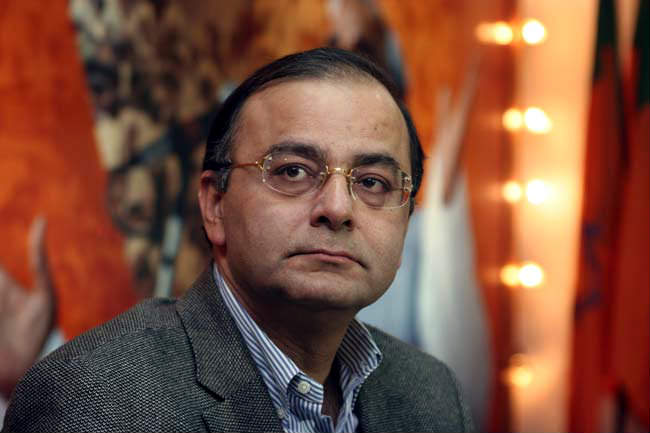
arun-j3_mini
Arun Jaitley – the new finance minister

First of all a heartiest congratulations to everyone for giving such a clear mandate. It was the need of the hour for our country and society to have a better and stable government. It is heartening to see that this time the election has been won on the agenda of development. From inaction and scams, lets hope the economy gets back on track.

The markets have witnessed a major change and upliftment in its mood over last few weeks. Those who were invested from before must be enjoying the gains. One should be careful, however, to not get carried away. These broad rallies are very useful for portfolio reconstruction – i.e. getting out of ideas or mistakes where the conviction levels were not high and moving into companies with a better clarity and visibility.

Lately, we have not been posting much because the companies we have discussed earlier are performing quite well fundamentally and continuing to grow consistently. We feel they still have a good long term potential.

Brief updates on our existing ideas:

Astral Poly – While the company continues to deliver an expected growth of about 30%, the stock keeps surprising everyone through a regular re-rating. Though the stock does trade at high valuations now, we recommend reading this article for some insights about the company’s high quality of business, management and growth prospects going forward.

Ajanta Pharma – Ajanta has once again come up with an excellent quarter – it continues to surprise everyone with the quality of its numbers. Do see their latest presentation, which gives a lot of insight on the brands they own and other qualitative aspects of their business. The slide number 14 is very interesting and is one of the key reasons behind their good growth and superior margins.

Shilpa Medicare – Shilpa Medicare too has reported a good quarter:

Particulars 2013 2014 % Change
Turnover 328.19 527.37 60.69%
EBIDT 69.82 126.57 81.28%
NP 46.06 80.86 75.55%
EPS 12.49 21.98

Its good to see a consistent increase in the gross block of the company. Recently the company has raised 75 Cr by way of preferential allotment to an FII. The company has been developing a product pipeline over the last 3-4 years; we expect the new facilities and products to give a revenue growth of 25-30%+ CAGR over the coming years.

Avanti Feeds – The company continues to maintain high growth rates with a revenue growth of 75% in 2014. Its amazing to see that the company has grown from just 72 Cr turnover in 2009 to 1135 Cr in 2014. The balance sheet is quite healthy with a debt of just 50 Crores.

Particulars 2009 2010 2011 2012 2013 2014 % CAGR
Turnover 72.51 96.16 199.62 393.41 648.04 1131.61 98.76%
NP -8.59 -1.20 3.42 28.06 30.20 69.75
EPS -10.74 -1.50 4.28 30.90 33.26 76.82

As per a recent article on the company, the company has recently set up a 85,000 tonne plant in addition to its capacity of 1,40,000 tonnes. With the industry continuing to do very well, it is expected that Avanti may again deliver high growth of 30-50% for the coming year FY15.

Its also good to see promoters buying over 1.7 lac shares since 1st April, 2014.

*Caution: Shrimp industry is a high risk industry, often affected by shrimp diseases and natural calamities.

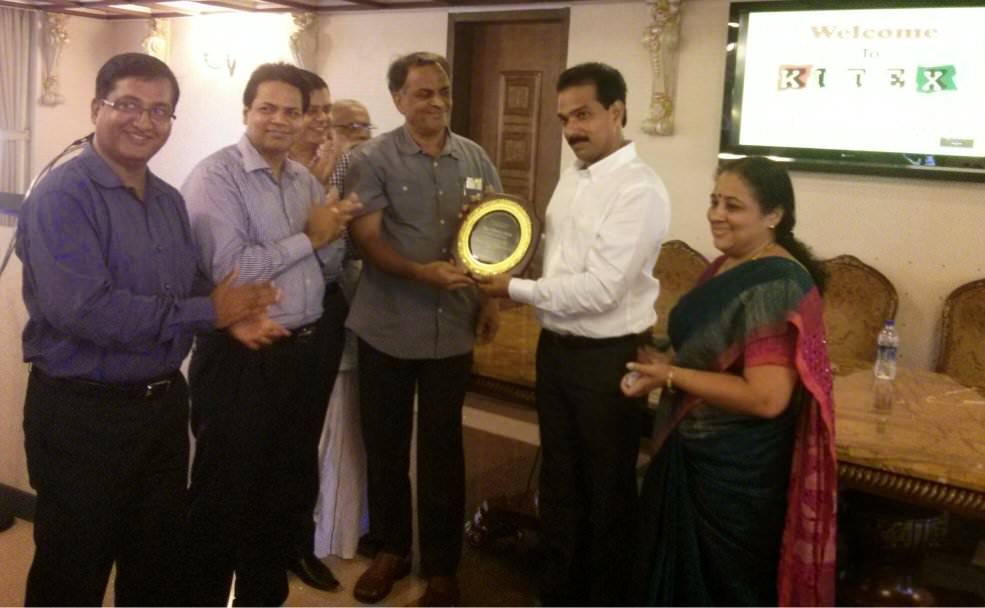
Kitex Garments – We visited the AGM of the company and it was a superb experience. Its one of the those extra-ordinary entrepreneurship stories where a person has created a great company from scratch, all in 15-20 years.

Shareholders awarding Mr. Sabu for the excellent performance

Today, KGL is the third largest infant garments manufacturer in the world and supplying to some of the best names in the world including Gerber, ToysRus and Carter. They are known for manufacturing the best quality garments. Compared to a normal textile industry, the infant’s garment industry does not have a high competition. Infants can be allergic to dyes and chemicals, or chew the buttons – thus Kitex uses the best of the dyes and yarns. They also invest heavily into social compliances and provide an air-conditioned factory, free food and free stay to almost 9000 workers, of which 90% are females. The company had done a recent capex – it aims to be the biggest in the world in this year and eventually double the current size in 3-4 years.

Though the stock has had a sharp run up in recent times, we feel that it is one high quality business and should do well over a long term.

GRP – The company continues to face tough times. We were expecting the things to get better with the improving turnover, but this quarter has been a disappointment. Till the previous quarter, the issue was underutilization of capacity and problems at the new plant set up; hence we had a hope of better times as and when the economy improves. During the last quarter, however, the raw material cost as a percentage of total cost has increased substantially and is now a new cause of worry. We have reduced some exposure (by about 15-20%) and look forward for an update at the company’s upcoming AGM.

Oriental Carbon – After a long wait, the company has posted a good set of numbers. One of the big positives is the increase in dividend from Rs 5 last year to Rs 7 this year. The stock is trading at 5 times earnings with a price to book value of 1.

Amongst the new ideas, we are working on Anuh Pharma these days. The latest quarterly numbers hint an improvement in the company’s operations. From being a general bulk drug company, the company seems to be making efforts on R&D and entering regulated markets. The negatives are – 1. the group has several other unlisted companies which are also into pharmaceutical business and 2. the listed company has had a dull past.

We look forward to a strong budget over the next month. Happy investing!

The post Updates on the Quarterly Results – Q4FY14 appeared first on Dalal-Street.

16 Jun 03:20

Are you and your assets safe?

by subra

As you get on in years it is not easy to look after your assets. Let me give you some examples:

A childless couple in a posh locality (stand alone Bungalows in the capital of the country) got a new ‘nephew’ to stay with them. No clue what happened, man found dead. Police arrested the nephew. Yes he killed the GOLDEN GOOSE. Anyway the old man was to give that house to that ‘nephew’. Property worth about Rs. 80 crores.

A cook and house maid took away all the silver ware from a senior citizen’s house. They found out, did not know whom to ask. They were too scared to ask. Sacked her. Loss? well about Rs. 80,000 AT LEAST.

Maids, drivers, etc – police keeps saying do a police verification, but we know it all, right?

What about your OWN children eyeing your property? Your son and daughter in law wanting your house NOW (you are 72, and with a chance of living up to age 100).

What about your tenant who does not pay the rent on time – knowing that a 73 year old cannot make too many trips to collect the rent?

Or your longish equity portfolio – and you are incapable of tracking all the dividends?

As you get on in age SAFEGUARDING your own assets is more and more difficult, and is becoming more challenging.

So once you reach a particular age (your call, not mine, but say 73) you need to much simpler assets. I am assuming that you and your spouse are the same age, you are childless, and thus, theoretically no interest in what happens to your assets AFTER you are gone.

What should those assets be?

Income funds, liquid fund, index funds, bank fd and savings bank account.

However once you hit say 80 years of age, you are better off if you can shift to just bank accounts. FD, and SB accounts. HOWEVER do remember if this amount is big, you will attract unnecessary attention of the bank. You are better off if you split the amount of money to 3-4 banks so that people do not know you as a HNI.

Tough, is it not?

Post Footer automatically generated by Add Post Footer Plugin for wordpress.

16 Jun 03:19

Clear and present danger to UK property

by Sudeshna Sen

Between the World Cup in Brazil, and the Iraq crisis, it isn’t surprising that most people would ignore a speech by B ank of England governor Mark Carney last week. Mr Carney said he’s expecting interest rates to rise sooner than everyone expected, which was sometime next year. For those of us who follow these kinds of things however, any such move by the central bank has one obvious impact – on UK’s property prices, especially in London.

The jury is still out on whether there’s a bubble or not. Some believe that property market will continue to rise, albeit more slowly than before. Others believe that this is a bubble, one that’s just waiting to meet a pin. And that pin could well be even a small rise in interest rates, coupled with a series of measures that the UK government is bringing in to dampen fears of a property bubble.

To take it from the top, in the past couple of years, in order to pump up the economy, the government introduced a help to buy scheme, giving potential buyers help to get on to what they call the property ladder. Aided by rock-bottom interest rates, and banks quite happy to dole out generous mortgages, not to mention international buyers, London’s house prices have gone through the roof. It’s not so high in the rest of the country, but as in all these things, prices have been steadily rising, to a level where even the International Monetary Fund was been warning that a bubble could blow a huge hole through UK’s economic recovery.

Now, they’re all trying to ensure that pin doesn’t meet that bubble, because the consequences will be somewhat similar to what happened in 2008. For anyone eyeing the boom in housing prices as an irresistible investment opportunity, it would be well to take a cautionary stand – nobody will actually come out and admit, but banks have been up to their old tricks, lending far more than they should.

The Bank of England has been given the authority to curb mortgage lending, because the fear is that when interest rates rise, homeowners will be left with huge debts, unable to offload their property to meet those debts. What has already started happening, thanks to all the warning noises from Mr Carney and Mr Osborne – who’s also worried about runaway house prices – is that banks are now raising the rates of the fixed interest mortgages, as they assume buyers will want to lock in at current rates for a longer period. In addition, estate agents say they’re seeing more “sell” orders, as investors want to cash out at the peak of the boom. That will automatically put price rises on lower gear. And while there’s a severe housing shortage in the low and medium ranges, an avalanche of luxury developments are waiting to hit the London market; a skew at the top end will inevitably have a trickle-down effect. On the other hand, if the crisis in the middle-east continues, I expect another huge dollop of overseas money heating up the market again.

It’s impossible to predict how these things will go, but like the authorities, my alarm system is on red – there is a clear and present danger of a possible crash. From the international perspective, there could both be good news and bad news – a bust would make it ideal to invest in property, but given the importance of housing in the overall economy, bad news for businesses in this market. A slowdown, however, will make investing a far more realistic proposition, especially for those who are looking to buy houses to live in, and not just as a bluechip investment.

15 Jun 04:50

Quadrilateral of global power

by Minhaz Merchant

Prime Minister Narendra Modi’s visit to Japan in the first week of July followed by the India-US strategic dialogue in August, a summit meeting with US President Barack Obama in September and a visit towards the end of the year by Chinese President Xi Jinping spells out the new government’s foreign policy agenda: look East, but engage the West as well.


The world’s four largest economies by purchasing power parity (PPP) are the US, China, India and Japan. It is no coincidence therefore that the leaders of all four will be involved in summit-level talks within months of Modi taking office.


India is well placed in this quadrilateral of global power.


The US wants to contain China’s rise. India is a natural counterweight.


China has littoral and land disputes across Southeast Asia. It would like a peaceful, trade-led relationship with India.


Japan, embroiled in its own dispute over the Senkaku islands with China, sees India as an investment partner for its high-technology companies and a stable democracy in a region where – as Thailand has recently shown – stable democracies are at a premium.


The Modi government’s challenge is to leverage its strengths with all three countries.


With the US, Prime Minister Modi will seek collaborations in advanced defence equipment projects, closer ties with US universities and joint intelligence sharing on terrorism.


Technology, knowledge and intelligence are what the US can offer. India can offer a great deal in return: a growing consumer market, opportunities for US firms in infrastructure, and joint ventures in manufacturing.


President Obama knows he’ll be dealing with a very different kind of Indian prime minister – direct, self-assured, well-briefed.


Their meeting in September will be short on ceremony, long on calibrated outcomes.


Modi’s meeting with Japanese Prime Minister Shinzo Abe will have a different timbre. The two have met twice in Japan – once when Abe was PM, the other when he was out of office.


They share a liberal market  economy philosophy. Japan’s low-interest loans could be a gamechanger for India’s infrastructure projects: high-speed trains, the Delhi-Mumbai industrial corridor, roads, ports and manufacturing. All of these will create productive assets and jobs.


The Chinese relationship is the hardest to nuance. Fortunately, Modi as Gujarat CM established important political and business linkages during his visit to China.


The border disputes in both Arunachal Pradesh and Ladakh will need to be set aside for the moment. Trade must grow. The strategic intent is to reduce China’s overt and covert assistance to Pakistan.


Chinese leaders constantly stress that their country’s manufacturing strength dovetails with India’s capabilities in services. Chinese investment in specific manufacturing projects must be encouraged even as Indian IT service companies gain traction in China (TCS has 3,300 employees in China and others should follow suit).


China needs India to contain the US as much as the US needs India to contain China. The Manmohan Singh-Sonia Gandhi government failed abysmally to leverage this rare geopolitical advantage. Modi will not. 


India’s per capita income at current exchange rates is $1,600 (around $4,000 by purchasing power parity). To “eliminate” rather than merely alleviate poverty, as Modi has pledged, we need to raise India’s per capita income above $5,000.


This means tripling GDP, factoring in a rise in population. How quickly can this be achieved?


At an annual GDP growth of 9%, it would take 12 years. At 10%, it would take 10.50 years.


Around 21% of Indians – over 250 million – live below the poverty line. By focusing on growth through strategic diplomatic engagement with the US, China and Japan, a majority of these can be lifted out of the crushing poverty they today endure.


Good economics is good politics. Good foreign policy is good economics.


Prime Minister Modi knows this. And he is not a man to waste time.


Follow @minhazmerchant on twitter 

15 Jun 04:46

Choosing to be poor?

by subra

Sounds very funny does it not? Why would anybody choose to be poor? Or unhappy? Or fail? Well if you read Hindu philosophy in detail you realise the following lessons are taught to you through stories:

You are a function of what you chose to be.

If you are happy you make the choices to be happy and successful – so success follows happiness and not necessarily the other way around!

Happiness is a state of mind – money is important but the importance we give to money is just too much. It is not so important as we make it out to be. It is just like health – you need to have it, but those who have health do not jump up and down saying they are healthy. Those who do not have it know how much it means. Remember the song from the film ‘Khatta Meetha’? ‘Thoda hai thode ki zaroorat hain’.

Our requirements are a few, so we need less :-)

I met a taxi driver (If Meru had a frequent user, I could benefit)…and got talking. He said he went to a barber’s shop and paid Rs. 20 for a shave. On probing I found that he normally spent Rs. 10 for a shave and that meant Rs. 100 a month – Rs. 1200 a year. Then I asked him about his food – he said he eats out every day – that meant about Rs. 100 a day ATLEAST – Rs. 36000 a year.

If he choses to buy a Gillette shaving blade (Rs. 20?) and it lasts him 15 days – he would end up spending Rs. 40 a month or Rs. 480 a year. He could of course choose some unknown brand and save still more! If he ate food from a ‘dabba’ packed by his family he could clearly save Rs. 25000 a year and save some stomach aches too! Do people not KNOW these basics? Actually NO. They cannot see the impact of small amounts on their total expenses. When I explained it to the taxi driver, he was stunned. I said ‘Rs. 40 a day can give u Rs. 3 crore by the time u retire….hmmm good habit

If you are in HR do you think it is your responsibility to tell people such basic things? No. Because HR (like most other professionals) do not ever get rewarded for avoiding trouble. If there is trouble and you sort it out you get rewarded!

Post Footer automatically generated by Add Post Footer Plugin for wordpress.

15 Jun 04:45

Edelweiss’ ECL Finance Limited 12% NCDs – June 2014 Issue

by Shiv Kukreja

This post is written by Shiv Kukreja, who is a Certified Financial Planner and runs a financial planning firm, Ojas Capital in Delhi/NCR. He can be reached at skukreja@investitude.co.in

Edelweiss Financial Services’ subsidiary, ECL Finance Limited, came out with its first NCD issue in January this year and the issue got oversubscribed on the 2nd day itself. The company then decided to close the issue on the 3rd day due to such oversubscription. Boosted by such a good response, the company is all set to launch its second public issue of unsecured, redeemable, non-convertible debentures (NCDs) from June 17th i.e. the coming Tuesday.

Size & Objective of the Issue - The company plans to raise Rs. 400 crore from this issue, including the green shoe option of Rs. 200 crore. The company plans to use the proceeds for various financing activities, including lending and investments, to repay its existing loans, for capital expenditures and other working capital requirements.

Credit Rating of the Issue - Two rating agencies, CARE and Brickwork Ratings, have rated this issue as ‘AA’ with a ‘Stable’ outlook. As mentioned above, these NCDs will be unsecured, unlike those offered during the first issue.

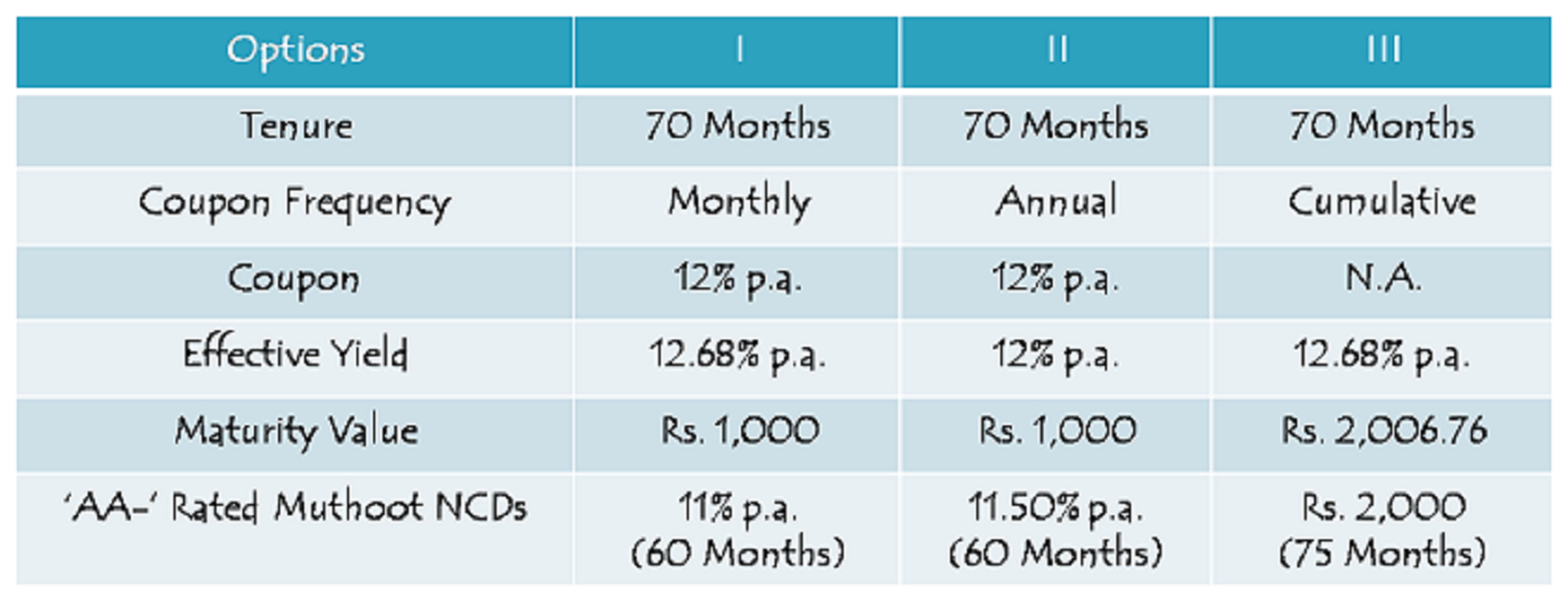
Coupon Rate & Tenor of the Issue - Last time, there were two tenor options – 36 months and 60 months. This time the company has decided to issue its NCDs for a duration of 70 months and that is the only tenor option. The company has decided to offer 12% per annum rate of interest, payable monthly, annually or on a cumulative basis at the end of 70 months.

ECL Finance vs. Muthoot NCDs -Muthoot NCDs issue is also open for subscription right now and it is scheduled to close on June 26. As you can check from the table above, Muthoot is offering relatively lower rate of interest. For a period of 60 months, Muthoot is offering 11% p.a. payable monthly, whereas ECL is going to pay 12% p.a. for 70 months payable monthly or annually. Muthoot is offering 0.50% extra if you opt for its annual interest payment option.

Also, ECL is offering to more than double your money in 70 months’ time, whereas Muthoot will return exactly the double of your investment in 75 months’ time.

Apart from being the issues of two different companies with different business models, ECL Finance NCDs are unsecured, whereas Muthoot Finance NCDs are secured, except the last option of 75 months.

Minimum Investment - If you want to apply for these NCDs, you need to invest a minimum of Rs. 10,000 i.e. at least 10 NCDs worth Rs. 1,000 each and in multiples of 1 NCD thereafter.

No Additional Benefit to Edelweiss Shareholders - In the last issue, Edelweiss shareholders were entitled to an additional coupon of 0.25% p.a. over and above the base coupon rates. No such special benefit has been granted to the shareholders this time around.

Categories of Investors & Allocation Ratio - The investors have been classified in the following three categories and each category will have the below mentioned percentage fixed in the allotment:

Category I – Institutional Investors – 30% of the issue is reserved

Category II – Non-Institutional Investors – 20% of the issue is reserved

Category III – Individual & HUF Investors – 50% of the issue is reserved

NCDs will be allotted on a first come first served basis.

NRIs Not Allowed - Non-Resident Indians (NRIs), foreign nationals and qualified foreign investors (QFIs) among others are not eligible to invest in this issue.

Demat & TDS - Demat account is not mandatory to invest in these bonds as the investors have the option to apply these NCDs in physical form as well. Also, though the interest income would be taxable with these bonds, NCDs taken in demat form will not attract any TDS.

Listing, Premature Withdrawal & Put/Call Option - These NCDs will get listed on both the national exchanges i.e. Bombay Stock Exchange (BSE) as well as National Stock Exchange (NSE). The investors can always sell these bonds on the exchanges anytime they want, but there is no put option with the investors to redeem these bonds before the maturity period gets over. The listing will take place within 12 working days after the issue gets closed.

Financials of ECL Finance

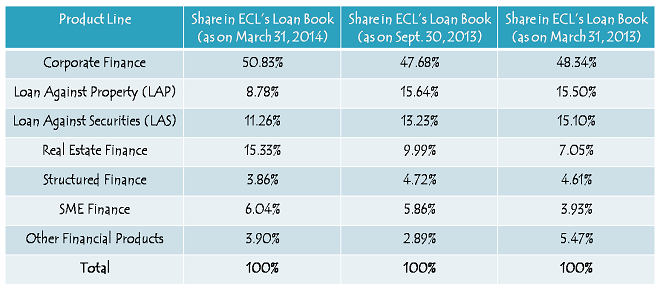
I covered the profile of ECL Finance while posting its first issue in January, so I don’t think there is a need to do it again. Rather I would like to cover its updated share of financials and product line here.

Picture2

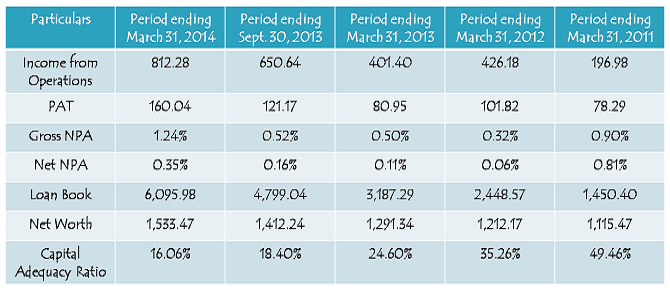
Table 3(Note: Figures are in Rs. Crore)

As you can check from the table above, the revenues of the company grew by 25% last year from Rs. 650.64 crore to Rs. 812.28 crore. Profit after tax (PAT) also rose 32% from Rs. 121.17 crore to Rs. 160.04 crore. This clearly shows that the company is on a growth path despite challenges in the economic environment.

As the loan book witnessed a satisfactory growth of 27%, gross and net NPAs of the company also jumped to 1.24% (0.52% earlier) and 0.35% (0.16% earlier) respectively. Capital Adequacy Ratio (CAR) also declined to 16.06% from 18.40% in the previous financial year, but it is still above the RBI’s stipulated minimum requirement of 15%.

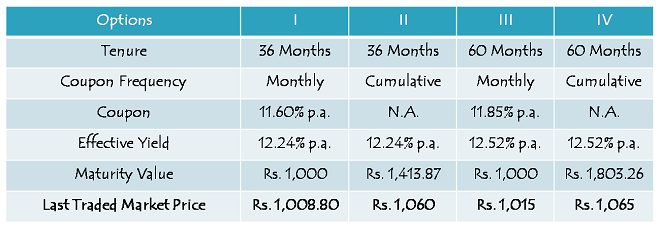
Performance of its Listed NCDs of Last Issue

Picture6

With a falling interest rate scenario and analysing the price performance of its NCDs of last issue, it seems to me that this issue also is fairly valued at 12% p.a. rate of interest. The only issue I have is that these NCDs are unsecured in nature. But, again I think the risk is fairly compensated with 12% p.a. rate of interest.

Application Form of ECL Finance NCDs

Note: As per SEBI guidelines, ‘Bidding’ is mandatory before banking the application form, else the application is liable to get rejected. For bidding of your application, any further info or to invest in ECL Finance NCDs, an investor can reach us at +919811797407

15 Jun 04:44

19th century UK gilts mispricing versus modern on-the-run bond

pricing

Andrew Odlyzko has an interesting paper entitled “Economically irrational pricing of 19th century British government bonds ” (available on SSRN) which demonstrates that more liquid perpetual bonds (consols) issued by the UK government often traded at prices about 1% higher than less liquid bonds with almost identical cash flows. Given that interest rates in that era were around 3%, these perpetual bonds would have a duration of well over 30 years. So the 1% pricing disparity would correspond to a yield differential of about 3 basis points. That is much less than the yield differential between long maturity on-the-run and off-the-run treasuries in the US in recent decades, let alone the differentials in the Indian gilt market.

In other words, contrary to what Odlyzko seems to imply, the 19th century UK gilt market would appear to have been more efficient than modern government bond markets! Odlyzko provides a solution to this puzzle. Most of UK consols in the 19th century were held by retail investors and very little was held by financial institutions. As Odlyzko rightly points out, this would substantially depress the premium for liquidity. Odlyzko argues that the liquidity premium should be zero because the stock of the liquid consols was more than adequate to meet any reasonable liquidity demands. I do not agree with this claim. The experience with quantitative easing since the global financial crisis tells us that the demand for safe and liquid assets can be almost insatiable. That might well have been true two centuries ago.

15 Jun 04:41

Risk is very difficult to understand because it is SIMPLE

by subra

I am sure the title has confused you. Totally, I hope.

Recently a friend posted on FB his achievement of running 30km on a hot and humid day without drinking any water.

I just did not understand what he was trying to prove, and to whom! When you take a risk you need to get a reward, right? For many people it does not seem to be necessary. To me that is stupid. If you are hanging out of a running train the chances are you are getting a nice breeze and you are sweating less than the guy who is standing inside the train.

HOWEVER THE QUESTION TO ASK IS: “IS IT WORTH RISKING YOUR LIFE?”.

When a neighbor locked herself outside her house, I asked her ‘where are the spare keys’. Was shocked when she said ‘Inside the house’. WHAT IS A SPARE KEY DOING INSIDE the house, dammit?

Know the case of a guy who was in Paris when somebody flicked his pouch. What did he have in the pouch? His passport AND all his credit cards, money, etc. When his colleague asked him ‘Do you have a photocopy of the passport’ – he said ‘Yes, in that pouch’. And he was just out for a walk. Why not leave the passport in the hotel, the credit cards in the pant pocket /purse? why not keep the cash partly in the pouch and partly with the other baggage?

When you ask people ‘Why do you not invest in equity mutual fund?’ – one girl says ‘because mutual fund investments are subject to market risks’ – I KNOW that she has not understood the words mutual fund, investments, market risks. So for her to understand this statement is IMPOSSIBLE.

Risk comes in various forms – neglecting to take care of health is the easiest to spot. Kids drink coffee, colas, eat pizzas and other unhealthy stuff, smoke, do not exercise and work on a computer for 12 hour days. Then suddenly when one of them has a heart attack or is asked to test for diabetes, blood pressure, etc. suddenly there is a sense of disbelief – and keep saying ‘he was so young’.

Come on the road to a heart attack is littered with tons of tempting items. You need to make a healthy choice dammit. Almost all risks are hidden by our inability to see it.

How many of you have tweeted from the driver’s seat? How many of you speak on the phone while driving a car or worse riding a bike? Did you know that ‘operating the cell phone’ is the BIGGEST KILLER – and the biggest cause of car accidents?

Remember the train accident in Germany where the driver was supposed to be tweeting?

Remember Risk is always lurking around. When you have to meet with disaster God puts a blinder on your eye. Be careful.

Post Footer automatically generated by Add Post Footer Plugin for wordpress.

13 Jun 16:05

NTPC: long term breakout

by Kirtan Shah
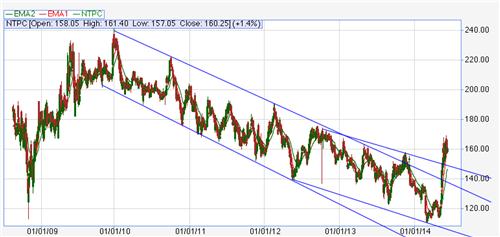
If we remember, Sudarshan Sir had quoted NTPC in his post 'Pattern of the Month - March 14' posted on April 3rd. In that chart, we saw how it formed a classic bullish Head & Shoulders pattern and broke out of it. 

As i just revisited a medium to long term chart of the same, i got to see something amazing. You might have noticed it too. If not, have a look: image

This classic formation of a downward trading range over a period of more than 4 years, and successful breaking out of the same signals that a strong upmove is coming. Since NTPC is one of those less volatile heavyweights, we cant expect it to run like one of those high beta stocks, but at the same time, such stocks offer less risky and easier trades.
13 Jun 14:48

History Backs Up Tesla’s Patent Sharing

by James Bessen

Yesterday, Elon Musk, CEO of Tesla, the electric car company, announced that Tesla would make its patents freely available to competitors. To many people this announcement seemed surprising if not shocking. After all, the conventional wisdom holds that patents are essential to keep competitors from imitating innovations, especially for small startup companies. If rivals imitate, they will drive down prices, wiping out the potential profits on innovation, thus making it difficult or impossible to earn a return on R&D investments.

But while this conventional wisdom applies to mature technologies, it is often wrong during the early stages of major new technologies. Indeed, since the Industrial Revolution, innovators have made their inventions and knowledge freely available to rivals during the early stages of critical new technologies including textile technology, Bessemer steel production, the personal computer, wireless communications, and the Open Source software that powers the Internet. Often innovators did not patent their inventions or when they did, they allowed other innovators to use them freely. Nearly two hundred years ago, the Boston Manufacturing Company, the leading producer of cotton cloth using the most important technologies of the Industrial Revolution, stopped enforcing its patents, allowing competitors to use its innovations, much like Tesla.

Moreover, these innovators shared knowledge for sound economic reasons. Some commentators have noted that Tesla’s move will help it hire talented engineers. Others see it as a brilliant PR move. They are right, but Tesla’s action is also central to their business strategy. There are real benefits to sharing knowledge that substantially outweigh the costs and this economic logic is very similar to the economics that motivated past innovators to share.

Consider first the benefits. Musk tells us “We believe that Tesla, other companies making electric cars, and the world would all benefit from a common, rapidly-evolving technology platform.” In order for Tesla to succeed, a lot of complementary knowledge and infrastructure needs to be developed. Auto mechanics need to learn how to repair electric vehicles; drivers need to learn to drive and to maintain them; new marketing and distribution channels need to emerge; and the roads need to be populated with charging stations for long distance travelers. All of these developments will happen faster if multiple electric vehicle makers coordinate around common, open standards, each contributing knowledge as new techniques are tried. The success of electric vehicles will benefit most from powerful “network effects” when they share enough knowledge to create a “common, rapidly-evolving technology platform.”

These benefits were much the same for early stage technologies in the past. A large body of complementary knowledge was needed to implement these technologies. The engineers of the early US Bessemer steel mills met regularly with their rivals as a self-described “band of loving brothers” until they had developed common standards for producing steel, slashing production costs by 78% in the process.

But what about the argument that competition will destroy profits? The critical thing about many major new technologies begin as a competition between two groups: those using the old, dominant technology and the other startups using the new technology. Musk realizes that, “Our true competition is not the small trickle of non-Tesla electric cars being produced, but rather the enormous flood of gasoline cars pouring out of the world’s factories every day.” This is likely to remain true for a decade or two. And as long as it remains true, the prices and profits of Tesla will be determined by the market share of gasoline cars, not by the trickle of rivals with whom Tesla is sharing its inventions. Sharing knowledge with them will not undercut profits in the near term.

This pattern, too, is seen in past examples of knowledge sharing. The early Bessemer steel mills competed mainly against makers of iron rails for the railroads, not against the trickle of other Bessemer mills. The early textile makers competed against home weavers and British imports.

This history explains why the conventional wisdom is sometimes wrong, but it also contains a warning for the future: the conditions that make knowledge sharing advantageous today won’t last forever. Eventually electric vehicles will replace much of the market for gasoline-powered cars. Then competition from other electric vehicle makers will affect Tesla’s profits and such extensive sharing might no longer be beneficial. But that is tomorrow’s problem. Elon Musk is shrewd to grasp today’s opportunity firmly, despite the conventional wisdom.

13 Jun 03:05

We the people

by Kamini Banga

Democracy is about numbers. India has spoken and given a clear mandate to Mr. Modi to reform and extricate India from the quagmire of corruption, paralysis and inefficiencies of polity and bureaucracy. Mandate means the populace has given the authority to Mr. Modi to carry out his policies. His 31% vote share comes nowhere close to Mrs Indira Gandhi's or Rajiv Gandhis much bigger sweep. In both those cases, however, it was more affirmation of faith and sympathy - this time round despite a smaller share, it is akin to deposing a ruler and empowering another to take the lead.


Mr Modi has played out the electorates expectations thus far. His instincts on foreign relations, business alliances, his loyal supporters finding a place in the Cabinet - have all definitely turned erstwhile rants to chants everywhere. The tribe of journalists who like to be seen as liberals in charge of the conscience and the voice of the nation are quick to redress their past grievances and diatribes against Mr Modi by bromides and by admitting their poor judgement regarding the pulse of the nation. Well the politicians and the media blinked. Talk about Marie Antoinette, French aristocracy and Nicholas II, czar of Russia being alienated from their people resulting in their being overthrown in bloody coups. Our polity saw Anna Hazare's movement as a middle class uprising which was not worth the newsprint and sound bites it was enjoying. Media's dismissive stance and second guessing on the Modi wave kept us all on the horns of a voter's dilemma.


At least, AAP should have understood the people - a Party born out of the ire and resentment of the masses. But it did not go down very well with the electorate when Arvind Kejriwal, true to his own dispensation, wanted people to ratify his every move.


No sir, 'we the people' want a decisive leader - Mr. Modi understands his mandate and acts decisively. We feel safe with such a leader at the helm, the stock market is going northwards, national pride, I am told, is at an all time high and the country now awakens to its tryst with destiny.


Mr Modi does not believe in asking the people how he should rule - he has chosen his Cabinet and played his cards pretty close to his chest as long as was necessary. Speculation was rife about who would not make it to the Cabinet - Arun Jaitley losing legitimacy on account of his losing his Amristar seat, or Sushma Swaraj- she and Modi have not seen eye to eye for some time. But he has proved his critics wrong. Some others who were beginning to hope their past tirades and public denouncements are erased, were politely but firmly rid of their disillusionments.


Mr Modi puts a premium on loyalty as is clear from his close rank and file and his team of ministers. Smriti Irani's announcement as HRD Minister did create a storm - but Mr Modi ignored it like one in a teacup. At first I took umbrage because I saw it as a sexist remark - what does Piyush Goyal know about energy for that matter? Nobody made any comments about that, eh. An enlightened writer wrote that competence and performance is to do with common sense not degrees. I thought of my mother then - how she toiled to send me to college and fought family seniors to send me to IIMA. I have been informed that those degrees are meaningless. In a country where the erstwhile ineffective PM had a degree from Cambridge, common sense definitely is probably what you need more than anything else. I am beginning to see the light. In a country where there are more people who are excluded from primary, secondary and higher education - it would be best that the representative is one of them. Let us remind ourselves that democracy is of the people, by the people, for the people and most importantly must be 'from the people'. Well to be fair to Mr Modi, I had always known that Jobs, Zuckerberg and Gates were all college dropouts. I was tempted - weren't you? I could see the children egging me on!


I suppose, soon there will be common sense tests on the Internet and you will be able to score yourself. Jokes aside, I was upset at the trivialisation of my post graduate degree, but I have complete faith that in is first 100 days, Mr. Modi will restore our confidence and pride in a once great nation.


With a clear majority, Mr Modi need not fear the bogey of a strong opposition or vagaries of a coalition. It is 'we the people' that he must keep his eye on. He must not blink, his ear must be to the ground - hearing the gentle murmurs of 'we the people' - does not take long for those to turn into angry roars of a tsunami.

13 Jun 02:55

Drone traffic policemen can reduce the cost of law enforcement and make the world a safer place

by Sanjeev Sabhlok

People jaywalk. So do I, sometimes. At times this can become dangerous.

While it is a low risk activity – overall,  there is a law against jaywalking and if caught one can be fined. However, the cost of putting policemen on a jaywalking beat is very high and the fines do not necessarily justify these costs. When a policeman is on a jaywalking beat (they generally are in pairs), they are visible from far, and people change their behaviour.

But what if you were able to install both a camera and artificial intelligence on existing super-efficient drones?

Then these drones could sit quietly, invisible to the world, on the ledge of a nearby tall building, watching the crowd below. The moment someone jaywalked, the drone would take off and hover in front of the jaywalker, taking in a video of the scene, as evidence. The drone would then issue a tickete and ask the jaywalker for his/her ID. The ID would be scanned, address recorded, and the jaywalker would receive the fine in the mail.

The existence of HIDDEN DRONES that surge out of their hiding places upon the eventuation of a jaywalking incident would also ensure that people become more careful in general.

I believe this and many similar robotic technologies will significantly reduce the cost of law enforcement, and make the world a safer place.

I can visualise tens of situations where monitoring costs prevent effective law enforcement. These costs will significantly drop in the future. 

12 Jun 03:19

I wager Rs.1 lakh that India will remain a GARBAGE DUMP after five years of Modi

by Sanjeev Sabhlok

Extracts from FB:

My post

My comment on a blogger's comment

FB friend responses

SH Sir, it's really tragic that the crowd is so dis-connected due to the deeply cosmopolitan inflow. As a reason no soul feels a belongingness to the soil. Ministers & bureaucrats are busy into real estate business a big time, given the huge flow of dollars from a small class of IT sector who believe no world exists beyond them. Above all people are the "most tolerant" of anything that comes up. Meri biwi, mere bacche, mera ghar.. no further thinking along. National sense is absent in totality, with response to anything as – "Why should I..!?" Let the city pay for it self centric greed. And yes, 10 astrologers are giving their darshan daily in all regional channels providing "aashwasan" to all problems of life..!!

Loknath Rao Pune is 100 % same story. Spilling of garbage all over the streets seems to be an intentional act of vandalism. It is done on purpose.. may be frustration or just plain arrogance of pathetically paid people who report in to no one. This country has still not understood that garbage collection and city management is not a mere "safaai" work obligation but needs the same efforts that are put in by large corporations to plan, produce and sell goods and services. We need to shut down these municipal corporations and corporators org structure that exists now. Its a sham.

SH-ji, you are right in that most inhabitants of these cities behave like tourists, temporary workers waiting for their next big chance somewhere in the Americas but these are not the people responsible for making this mess. Mere belonging ness does not keep the city clean. Movement of people from outside is integral to the economic activity that the state and city greatly benefit from. People are self-centric everywhere..even in New York city. The problem is the state and the city is completely unprepared for the REALITY that the cities cannot be kept clean with broomsticks and dumping trucks... the way it was done 40 years ago. The cleaning and management of the cities like Bangalore MUST be a few million dollars high tech industry that needs professional management at par with running the likes of Infosys… actually much more.

MY RESPONSE

Sanjeev Sabhlok The professionalism you refer to, Loknath, is DAILY business for local governments in the West. We have created impotent, hypocritical structures at every level in India. 

And BJP has NO CLUE ABOUT IT.

I am willing to WAGER Rs.1 lakh that India will remain a GARBAGE DUMP even after five years of Modi.

NOTE THAT – AS USUAL – MY WAGER IS ONLY WITH MODI. I DON'T CHALLENGE ANY MINION OF MODI. ONLY MODI. LET HIM TAKE MY CHALLENGE.

12 Jun 03:17

Why Smart People Like You Make Stupid Money Mistakes

by Vishal Khandelwal

Imagine yourself in the following situation: You sign up for a psychology experiment, and on a specified date you and nine others whom you think are also subjects arrive and are seated at a table in a small room.

You don’t know it at the time, but the nine others are actually associates (planted subjects) of the experimenter (they know about the experiment), and their behaviour has been carefully scripted.

You’re the only real subject.

The experimenter arrives and tells you that the study in which you are about to participate concerns people’s visual judgments.

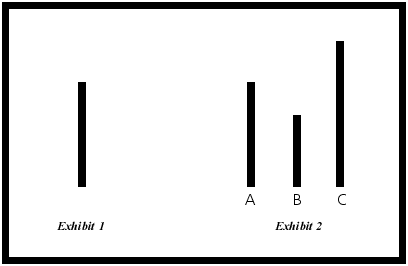
He places two cards before you. The card on the left contains one vertical line. The card on the right displays three lines of varying length.


He asks all of you, one at a time, to choose which of the three lines on the right card matches the length of the line on the left card. The task is repeated several times with different cards.

Value Investing Workshop in Hyderabad
After a great response from Mumbai and Delhi, I have my Art of Investing Workshop in Hyderabad on 20th July (Sunday). If you want to attend and want to claim an early-bird discount, click here to register now!

On some occasions, all or a majority of other “subjects” unanimously choose the wrong line. It is clear to you that they are wrong, but they have all given the same answer.

What would you do? Would you go along with the majority opinion, or would you “stick to your guns” and trust your own eyes?

What Solomon Asch Found
In 1951, social psychologist Solomon Asch devised this experiment to examine the extent to which pressure from other people could affect one’s perceptions.

Asch showed bars like those in the above image to college students in groups of 8 to 10. He told them he was studying visual perception and that their task was to decide which of the bars on the right was the same length as the one on the left.

As you can see, the task is simple, and the correct answer is obvious. Asch asked the students to give their answers aloud. He repeated the procedure with 18 sets of bars.

Only one student in each group was a real subject. All the others were “planted subjects” who had been instructed to give two correct answers and then to some incorrect answers.

Asch arranged for the real subject to be the second last person in each group to announce his answer so that he would hear most of the “insiders” incorrect responses before giving his own. Would he go along with the crowd?

To Asch’s surprise, 37 of the 50 (that’s 74%!) subjects conformed themselves to the ‘obviously incorrect’ answers given by the other group members at least once, and 14 of them conformed on more than 6 times out of the “scripted” trials.

Asch was disturbed by these results. As he said after the experiment…

The tendency to conformity in our society is so strong that reasonably intelligent and well-meaning young people are willing to call white black.

This is a matter of concern. It raises questions about our ways of education and about the values that guide our conduct.

Why We Conform
Now, since you know of this experiment, you might consider the real subject foolish to go with the scripted answers of the other nine planted subjects.

But the truth is that – most of all of us would conform to the majority when placed in such a situation.

Now, why do most of us conform to a group’s line of thinking, even if it is obviously wrong, and especially when a lot of other people who form that group think it is true?

There are two main reasons –

  1. We want to be liked by others, especially by a group, and
  2. We believe the group is better informed than we are.

What is more, conformity increases when…

  • Size of the group increases – Many people agreeing to a specific thing
  • Task at hand is difficult – Like identifying quality businesses for investment
  • We are uncertain – We find comfort in people’s predictions
  • Group as a whole is (or seems) influential – The majority are either smartly dressed and/or they speak well (look at CNBC!)

Suppose you go to a dinner party and notice to your dismay that there are three forks of different sizes beside your plate. When the first course arrives, you are not sure which fork to use.

If you are like most people, you look around and use the fork everyone else is using. You do this because you want to be accepted by the group and because you assume the others know more about table etiquette than you do.

Conformity and Investing
When it comes to investing, conformity is often disastrous but that is what most of us indulge in.

Look from your own investing experience or from that of people around you. It may have happened some times in the past that even if you could make a good investing decision on your own, you were led to make bad decisions “just because” you saw your peers making such decisions.

I see this happening a lot these days, when a lot of people are buying stocks “just because” a lot of other people are buying those stocks and are thus pushing the prices up.

So it’s a cycle – stock prices are rising because more people are buying stocks, and more people are buying stocks because stock prices are rising.

Then there are ‘experts’ (the “subjects” planted by brokers and investment bankers) who are appearing on television everyday predicting their next Sensex target – which has now reached 75,000 to 100,000.

Now, because the number of such planted subjects on TV is on a rise, they dress and talk well, and they make us comfortable with their predictions, I see a lot of investors conforming to their views and opinions and falling into the trap of buying even junk businesses.

Although we all know that we’re supposed to “buy low and sell high,” most of us usually have trouble pulling that off because emotions can override pure reason.

After all, even if you logically know what’s best, it’s hard to sell or avoid the market when everyone else is jumping in.

You might think: Are all those people really wrong? The answer is yes. They often are.

Funnily, I see a lot of people these days asking for stock advice on Facebook – mostly on investing groups. Some also seek others’ opinions on the stocks they already own.

Interestingly, these people also get “serious” advice from others.

Now, unlike taking advice on Facebook on a good location for vacation (which I often do), investing often requires doing the opposite of what others are doing.

Conforming to others’ opinions and buying what others are buying and winning at it is a short-term, temporary phenomenon. It is not a successful long-term investing strategy.

If everyone is piling into a certain stock, it’s frequently a good sign that it may have already had its run. And especially when you hear about a stock on business TV, it’s frequently a sign that the advisor is looking for you to buy that stock because he or she is looking to sell (so you are the bigger fool here!)

If you want to use conformity as part of your investing, use it to generate ideas – businesses that are good and thus being talked about.

Don’t blindly buy into “stock stories” because a lot of “planted subjects” want to offload them to you at prices you will hate in the future.

A lot of smart people make stupid money mistakes. I hope you don’t become one of them.

Also Read: Why Smart People Make Big Money Mistakes and How to Correct Them (Gary Belsky)

12 Jun 03:16

FDI is exactly the same as trade, and it should be totally free. NO exceptions.

by Sanjeev Sabhlok

A commentator wrote to me recently:

Sanjeev:
Pl provide ur brief argument over FDI in defence sector. I am sure u r not against fdi in defense sector.  
"@medhanarmada: RT  FDI in defence and railways will prove to be deshdroh. Chai ke badle desh bechna kya manjur  hoga deshbhaktonko?"

MY RESPONSE

FDI is not an issue in any sector. And we should entirely privatise both defence industry and railways. Wasting taxpayer money on producing rubbish is not a good idea. If Lockheed, etc. come in an start producing not only will Indians get jobs but will learn the best technology.

Similarly, my comment today from FB in relation to Harsh Vora's article here.

Why not all sectors, Harsh Vora? Any specific exemption in your mind? If so, why? And btw, you are TOTALLY WRONG on imports: "To be fair to them, they are partially right: Imports do hurt our economy". 

This is grossly incorrect. BOTH imports and exports BENEFIT the consumer and hence the economy. Chankaya understood this. Try reading Arthashastra. We have truly half-baked "economists" floating around in India at the moment. Let's get our basics right if we EVER wish to help India.

Finally, I will let you daydream. Modi is a ZERO and will NEVER – CAN NEVER – deliver a free and prosperous India. 

ALL trade is good – being only undertaken when it ADDS VALUE for both sides. No restrictions on ANY exports or imports, or FDI. In any sector.

Harsh Vora Sanjeev, did you read the article? I support completely free trade (with no restrictions). Re: FDI, I support it in most (not some) sectors. Have some qualms in defense. But would be open to considering it even there. The problem is publishers often have the last say on choosing the title of the articles.

Also, I explain the basic concept of comparative advantage there. You're right. No party would import any good or service if it doesn't benefit both. But "bad" imports is when one party imports it even when it hurts itself in the process. Coal is the classic case for India, isn't it?

Sanjeev Sabhlok FDI is ENTIRELY equivalent to trade. Instead of producing in his/her own country, the trader produces it here. In many ways it is much better than trade, since in the process we get the benefit of directly learning the technology.

Defence is an excellent area for FDI. 99 per cent of technological improvements in defence are in the private sector. Many such companies employ Indians. Why not let them set up shop here and have Indians work in India and learn these technologies at the same time?

Coal is an excellent area for imports as well. There are many types of coal, and the logistics of coal and coal differ from place to place in India. 

The fact that any government policies block coal production in India is a separate issue. Such policies should go. But the government has no business to stop trade. Let those who put their money on the line (importers) decide. If they find coal cheaper or better from abroad, it doesn't matter how much coal we have in India. It is always better to import, in that case.

NO argument that anyone can make to stop total free trade has any economic or sensible basis.

Harsh Vora Sanjeev, that's exactly what I'm saying. India clearly could have a comparative advantage in coal production. But the govt., through continuing its monopoly on Coal India, is distorting this advantage. I'm not calling an import "bad" to invite govt. regulation. Far from it! I'm calling it bad in the sense that India has the capacity to meet its coal requirement domestically, merely through free market policies and competition. Re: defense, let's leave the discussion to another day.

Sanjeev Sabhlok:  Harsh, good to know that you are not calling imports bad "to invite government regulation". 

But I take considerable issue with your view that "Imports do hurt our economy. They damage the companies that use imported goods as inputs, create inflation, devalue the currency, and make it difficult for us to make our ends meet. Imports are primarily of two kinds. There are imports that hurt, but also imports that bring prosperity. "

In NO case can you show me that imports are bad. They only bring prosperity. 

What harms are restrictions. Any restriction on production and trade. 

What we need it the FREEDOM to produce, freedom to trade, and to get the government out of our back. Let governments focus on rule of law and safety, etc. Not on how we produce and trade. 

Re: "devaluation" – that happens not because of imports but because of mindless government borrowings. In a free market the currency will find its true value, which is not something a government can determine. 

I sense a fear of the market (people) in your article. I don't think your fears are justified. 

Even defence. Why not have the best robotics companies come to India to produce directly in India? Why not have other people invest in India if they find it profitable (because of our talented labour)? Let us LEARN from the best, by attracting them to India.

Harsh Vora Sanjeev, you've borrowed my statement out of context. Note that I've mentioned that the fact that imports hurt our economy is only partially right. What I mean by "imports do hurt our economy. They damage the companies that use imported goods as inputs, create inflation," is that in the current scenario, India has to import coal at a substantially higher market price than what the price would be had India allowed a COMPETITIVE domestic production model (instead of a monopoly) to operate. Of course, imports only happen when the input costs of domestically sourced goods are higher or their quality is lower. And such imports do CREATE VALUE for all stakeholders. 

So the gist being let comparative advantage (resulting through liberty-based policies) determine imports and exports. When the govt. creates distortion in his advantage process through socialist policies, it only damages domestic economy.

And pl. read the ENTIRE article. I fear anti-market policies. Not pro-market. Again, don't go by the title.

Sanjeev Sabhlok Appreciated. It would have been better if you had a clearer title and did not put in strong qualifications against imports. We need blunt and forthright language to break through the thick heads of Indians, made totally unreceptive to the benefits of freedom by a hundred years of socialism (I now count Gandhi among the socialists, as well).

Harsh Vora I'll try better next time I write. Thanks for your inputs and feedback. Much appreciated.

Sanjeev Sabhlok Good work, anyway. I like your writing style.

12 Jun 03:05

May Exports Rise 12%, Imports Dip 11% YoY But Trade Deficit Highest in 10 months

by Deepak Shenoy

In May 2014, India’s trade balance widened marginally from April, with a $11bn deficit. This is the highest monthly deficit number since July 2013.

image

Export growth was strong at 12%,… (Read On...)

12 Jun 02:49

What makes you financially successful?

by subra

This is a slightly catchy headline. I have no clue whether the following traits will make you successful. However, these are the qualities / characteristics that I have seen in successful people:

1. To earn the basic money to invest, you need to work real hard, AND real smart: There is no escape from this. You also need to be a little lucky in the breaks that you get. You just got a nice degree and got a good break – you got a job paying you Rs. 2 million. Your classmate got a job paying Rs. 1.2 million. Your parents paid for your studies, but your friends are paying an EMI of Rs. 34,000 per month for 7 years. Yes a little bit of luck is needed, you have it, and you are up and running.

2. Knowing your priorities: Earning Rs. 2 million, having a nice life, and putting money away as saving for future investments is a MUST.

Having said this, let me now look at the traits:

1. Being Goal Oriented in what you do: When you are young and you do not see any great need to save or invest, you need to WRITE down your goals and save/ invest towards that. Later on it becomes a habit.

2. Learning and Risk taking: What looks like Risk taking is not so risky for the person who knows what he is doing. Imagine a tribal seeing you walk on the road with traffic! He must be thinking of you as a very brave man, would he not? It is just that YOU know that the cars will not come on to the footpath. Similarly when you see a person living within the forest – you will be amazed at the knowledge they have of which water to drink, which fruit to eat, and which animal to be scared of. Most of the risk can be well conquered by LEARNING.

3. Keep learning about new things: a fantastic characteristic that I have seen in many successful people. Equities, mutual funds, etf, FnO, the list goes on.

4. Be willing to experiment in a small way: A small experiment in investing, business, etc. can sometimes lead to a big windfall. So if you can invest, say Rs. 20L in a new business (assuming net worth Rs. 5 crores), it is surely worth the effort. Learning would be useful.

5. Save and Invest like a religion.

6. Satisfaction: I do lectures saying ‘Santhushthi hi Sampathi hai’ – satisfaction is the ONLY wealth.

7. Gratitude towards the world in general, and God in particular. Count your blessings.

8. Remember we get what we deserve, only problem is we think we deserve more.

9. Patience: remember ‘n’ is in the NUMERATOR in the compounding formula, ‘r’ is only in the body. Great wealth like Buffets have been built over 75 years. True for most wealth in the world. Overnight you can get RICH, but wealth creation is far, far more difficult.

Post Footer automatically generated by Add Post Footer Plugin for wordpress.

12 Jun 02:33

I’m now happy to be addressed as “Sanjeev Sabhlok, Arthashastri” (Economist)

by Sanjeev Sabhlok

I think the Doctorate awarded in the West is too generic. It applies uniformly to all disciplines, thereby losing its meaning.

I have long avoided writing Dr.Sanjeev Sabhlok since it can confuse people. 

Till a few years ago, I would have not liked to associate with Arthashastra since I had a relatively poor opinion about this book – having only tangentially read about it. 

But since I've read it (or, more precisely, skimmed through it, and searched my kindle version), and more so since I've read Balbir Sihag's writings on Chanakya's work, I'm far more charitably inclined towards Chanakya. In fact, I believe Chanakya is better by such a WIDE MARGIN than ANY other Indian political or economic thinker (including Rajaji) that I'm happy, finally, to take on the "title" Arthashastri.

I do so for two reasons:

a) One, that through it people (in India) can instantly make out my specialisation: economics

b) Two, that Arthashastra gets its rightful place in Indian society as a classic book on economics and governance.

I'd prefer that only those with a doctorate in economics use this title, so it doesn't get too diluted. Not that qualifications matter, but I suppose a title should serve some purpose.

So, there. 

Now I am happy (if you wish!) to be addressed as:

Sanjeev Sabhlok, Arthashastri 

Arthashastra is perhaps one of the most sensible books ever written in India. Let's read it and spread its message.

12 Jun 02:30

Is “Chanakaya Niti” or “Niti Shastra” an authentic book or mere fiction?

by Sanjeev Sabhlok

I had included Chanakya Niti in my compilation of Chanakya's works, here, unaware that there was a question re:Chanakya Niti's authenticity.

I'm posting below the following comment from Alex and request comments/inputs from readers who may have some knowledge/ time to explore this further.

Google Scholar turns up next to no scholarly publication on Chanakya Neeti, that does not seem to based in “Internet” sources of dubious auhtenticity. The leading Chanakya experts are regrettably few, and include Mr. Sen and Mr. Basu (of the Bengal Economic Society), along with Prof. Sihag. No authoritative work on Chanakya cites the “Neeti Shastra.” Even Encyclopædia Britannica, under “Chanakya,” has no mention of any “Neeti Shastra.” Since you’re in contact with Prof. Sihag, you can simply ask him!

Regarding Davis’ (aka ‘Patita Pavana Das’) translation, his credibility in my view is greatly reduced by the following:

1. He’s a member of a religious cult.
2. Chanakya “Neeti Shastra” was a pet of that cult’s founder.
3. He says in the preface: “In presenting this work I have traced out and referred to two old English versions of Chanakya Niti-sastra published at the close of the last century.*2 However, these apparently were translated by mere scholars (not devotees) who seem to have missed many subtleties of Chanakya’s vast wit and wisdom. Another unedited and unpublished manuscript Chanakya Niti-sastra with both English translation and Latinised transliteration produced by the Vrndavana ISKCON Centre was also referred to. It was however the learned Vaisnava pandit and Sanskrit scholar Sri V. Badarayana Murthy, of the South Indian Madhva School, who helped me see the depth and import of these verses from the original Devanagari. A very few slokas which were perhaps irrelevant or otherwise not useful for our Vaisnava readers have been omitted.” Thus his sources are doubtful.
4. The only remotely authentic source he mentions: “Sri K. Raghunathaji’s version of “Vriddha-Chanakya – The Maxims of Chanakya” (Family Printing Press, Bombay, 1890)” has nothing to do with alleged “Neeti Shastra.”

Most compellingly, Prof. Shrikant Prasoon says in the preface to his (non-academic pulp) book on Chanakya (http://www.pustakmahal.com/books/book.php/rule-world-way-i-did-chanakya-prof-shrikant-prasoon/isbn-9788122310108/zb,,3db,a,1d,USD,14,a/index.html) that “Most of the moral and ethical quotes are associated with the name of Chanakya. As we know virtually nothing about the poets and thinkers, so we have no option but to accept them as they are placed before us. We have no extra information to challenge any part of it, though we find the same couplet and the same doctrine at many places, even in the classics that are supposed to have been written centuries before Chanakya; as for example many of them are included in Manu Smriti, Mahabharat and Puranas.”

Thus I’d really like to know the provenance of Chanakya “Neeti Shastra,” whether it has anything to do with Chanakya/Kautilya at all!

11 Jun 02:57

Power woes in the seat of power

by Meenakshi Lekhi

Newspaper front pages today informed Dilliwallas that this is the hottest summer in 62 years. To make the situation worse, many of us read the newspaper without the comfort of a cooler or A.C. thanks to the power cuts across town.


The plight of Delhi is indeed very infuriating. Unlike other states, the problem is not that of inadequate power – Delhi has enough supply to keep up with the demands of the summer. The problem is that of inadequate distribution infrastructure. Just having adequate infrastructure will also not solve our power woes. The importance of adequate as well as immaculately maintained infrastructure cannot be emphasized enough.


The hapless victims – the citizens – are well within their rights when they complain about the situation. I am very impressed by the understanding shown by them towards the new government, which is not even a month old. It is heartening to see the Power Minister Shri Piyush Goel taking the issue personally even though it is the Delhi government (for the time being run by the Lt. Governor) that is responsible. Such center-state dynamic is what the honorable Prime Minister spoke about.


To solve the problem, first we need to understand it.


Role of Delhi Government: Power distribution in Delhi has seen 15 years of neglect in the Congress era. The same is true for almost all type of infrastructure nationwide as a result of the policy paralysis that had gripped the UPA government. The present power infrastructure of Delhi Transco Ltd. (DTL is the State Transmission Utility of the National Capital of Delhi) is inadequate for the job it’s expected to do. DTL is wholly owned and controlled by the Delhi government, and provides electricity to the DISCOMS. An example of the situation here is the Bawana substation. It is presently operating at 100% capacity. Across the world, the standard load on substations is upto 60%. This is done to ensure longevity, and avoid catastrophic equipment failure due to overuse and overheating. So if this substation fails, the situation can get worse.


Worth mentioning here is that the bill subsidy given by the 49 day AAP government has robbed the Delhi Government of precious money it needed to potentially install new infrastructure. So this policy has effectively contributed to the Delhi power woes.


Role of the DISCOMS:Even though the DISCOMS have been privatized, it is the duty of the government to ensure that they are doing their job and maintaining and upgrading their infrastructure as and when needed. This is done via DERC (Delhi Electricity Regulatory Commission). The infrastructure of the DISCOMS is in poor state of maintenance, and also needs up-gradation.


Also, the DISCOMS also got their estimation of power demand wrong, which led to many unpleasant surprise situations.


I’m confident that we will turn the present crisis can into an opportunity to showcase how Centre-State dynamic will lead to improved delivery of public utilities. We are committed to providing 24X7 electricity to our citizens.

11 Jun 02:48

It’s a bull run when… [infographics]

by Hemant Beniwal

Yesterday I got a call from my close friend; he is a banker - heading loan department. Before even saying Hi-hello, he said “I have 2-3 lakhs to invest for 6 months, please tell me few good stocks.” I was NOT surprised/shocked & told him, you called the wrong guy. I know he was frustrated at the end of the call but I can’t help. (before election results he told me that he is planning to sell ESOPs)

This conversation reminded me of this awesome article “It’s a bull run when…” by Mudar Patherya that was published in Business Standard. I have just picked few points & created this infographics… Here you go….

Bull Market Its a bull run when… [infographics]

Please share, if you come across something similar happening around you in last few weeks or if you remember something from last bull run 2004-2008.  

09 Jun 02:34

A Close At Life TIme High

by Sudarshan Sukhani
Nifty surged 354 points up in the week that was, breaking out from all previous highs. The Index  closed at new life time high of 7583 on Friday. The market remains firmly in a bull grip and higher levels could easily continue. However, a correction is still  to come, but no one knows when and after how much gain, the markets will cool off.

            DJIA trading in an uptrending channel. It broke out from the channel and closed yesterday at its new life time high of  16924. While S&P500 is making life time high on daily, trending strongly upward and closed at 1949 this week. Both of these indices are clearly indicating that U.S market are in a strong position and our market is getting support from them.

            Making life time highs and closing at these levels is a bullish sign and no one can predict that how much more upside is coming in near term. When we talk about S&P500, it is continuously making new life time highs from Jan 2013 and continuously making new life high after that till now.So try to be only long in this market with every dip as a buying opportunity.

            
08 Jun 03:32

Should you be buying PSU shares?

by subra

Caveat: Personally I do not like PSU shares at all. However I do have some in my portfolio – simply because I cannot get companies in certain businesses, and of a certain size in the private sector. So the shares that I have / had in my portfolio are Ntpc, Hpcl, Bpcl, Sbi, Nhpc, Bhel – mostly trading positions. However those that are there in my portfolio give me a fantastic yield – thanks to the low price (thanks to time), and high dividend payouts (bankrupt government forcing high payout). So take this article with that knowledge base.

Most PSU shares have galloped in the past few weeks, and some have done very well in the past 1 year.

Does this mean that the run up is over and you should stay away? OR

Is this the beginning of a bull run and it can go up many times more from here?

Well both these are very difficult to answer!

Let us look at Hpcl, Bpcl, Ntpc, Bhel, and Coal India.

If you take a 20 year view on all these shares, your answer will be very different from a guy who has been a trader and has been watching only in the past 6 months.

20 years ago the price of Hpcl was Rs. 294, in August 2013 it was Rs. 163, now it is Rs. 403.

Figures for Bpcl was 113, in Sep 2013 it was 278 and now it is Rs. 650. Sure for now it looks high, but if you take a 20 year view, the growth is not necessarily great is it?

If you take BHEL the story is not very different. In Nov 2007 it was Rs. 538, six months ago it was 161 (you have been ripped apart if you bought it at the peak of the boom), and is now at 257.

Coal India – terrible under performance over 5 years, but suddenly it has spurted. Ditto story for almost all energy and bank PSUs.

What has suddenly happened? well hope that Narendra Modi will kick ass and make these sleepy Kumbhakarnas perform. I am completely in agreement with the thought.

I have seen the amount of interference from the Ministry in various PSUs, the amount of idle Real Estate that they have, the luxurious offices, guest houses, the amount of corruption, the over staffing – very low hanging fruits for sure.

So I do expect Na Mo to crack whip and DRAMATICALLY improve performance. I do not expect the changes to be small time, but real kick ass performance is possible. The Tata Power share (Re. 1) is at Rs. 105, there is no reason that NTPC should not be at Rs. 1000 (sure we need many changes) (Caveat I have both TP and Ntpc in my portfolio).

What can happen? Take a simple example. Na Mo could get SUTI to sell L&T, Axis bank, ITC and raise say Rs. 50,000 crores. Use that cash to create a PSU Company’s REIT. Hpcl, Bpcl, Sbi, Ongc could sell their RE worth about Rs. 50k crore to this Reit. They could use the cash to pay off the more expensive loans.

The Reit could sell off some RE and use that cash to repeat that process with another set of PSUs. Then the Reit could raise money from the public…

Frankly I do not think there is any shortage of ideas. This article is to just say that 1. DO NOT GET CARRIED AWAY BY THE RECENT spurt in Psu share prices.
2. PSU shares could outperform many other shares, but one has to be selective for sure.
3. With a little honesty, and a driven market oriented top management, the PE ratios could change, and the change will be dramatic.
4. A dramatic change in the EPS, selling off of the non core unproductive assets, and a change in PE could be a dramatic and virtuous cycle of goodness.
5. I have met some very honest, brilliant managers in the PSUs. If they are empowered, hey it could be great.

HOWEVER:

1. All these PSUs require cash, so they could dilute their capital base.
2. GoI could create more ETFs (Goldman has a small PSU ETF) and dilute its holding.
3. GoI could place equity directly with FIIs or come out with many FPOs.
4. The whole process could take time.

So read the whole article, go to many free websites (or paid ones like Bloomberg or Reuters or CMIE) and do your own analysis. Then decide on what to buy.

Do not go by what I have said is there in my portfolio. My positions could change on an hourly basis. The companies that I chose are / were there in my portfolio.

Do remember this is an unedited site, I may/may not have vested interest in the shares mentioned. By the time you read this article I may have IOC, Bank of Baroda, Union Bank and puts in Bank of Baroda.

Post Footer automatically generated by Add Post Footer Plugin for wordpress.

07 Jun 04:09

Switch to Hindi? Yes he can

by Reshmi R Dasgupta

One of the more amusing postswearing-in stories emanating from the Saarc region was the one in a website about Sri Lankan President Mahinda Rajapaksa gripe about the new Indian Prime Minister’s preferred language of communication. "I will now have to learn Hindi, as he does not speak English!" he reportedly raged.


The website (and Rajapaksa, if indeed he was correctly quoted) can be forgiven for mixing up religion and language but you get the drift. But the fact is, Yes He Can, to misquote Narendra Modi’s campaign mantra slightly. Speak English, that is. He understands it perfectly too but chooses to respond in Hindi.


The Hindi hegemony implicit in Rajapaksa’s alleged rant is of course overstated, though the increasing soft power of Bollywood films cannot be dismissed. However, Modi’s decision makes sense as Singh-like silence is not one of his virtues and communication is sure to be a hallmark of his term.


Language, therefore, is important. Arguably, if Vladimir Putin, Angela Merkel and Li Keqiang can get by just fine speaking in the languages they are most comfortable in, there is no reason for Modi to switch to Barack Obama’s or David Cameron’s mother tongue while communicating with his international counterparts.


What are interpreters there for, anyway? More revealing, though, is the medium of his exchanges with India’s chief ministers, to whose ranks he too belonged till recently. Language is such a prickly issue in India – more than most places in the world – he knows CMs can easily take umbrage at the slightest hint of condescension or bullying when communicating.


By all accounts, part of Modi’s charm offensive on the CMs was his willingness to talk in whatever language it took to get the message across. And those who may have harboured doubts about his proficiency in English were pleasantly surprised. His choice of Hindi is apparently just that – a choice, not a compulsion. It is a testament to the big-heartedness and tolerance of us Indians that CMs of all backgrounds and linguistic proficiencies enjoy popular support.


There are English speaking sophisticates and vernacular icons, inspiring speakers and taciturn but indefatigable doers... We love (and vote for) them all! Tamil Nadu CM J Jayalalithaa’s elegant Tamil and English connects her to snobs and plebs alike.


Her bete noir K Karunanidhi speaks only in Tamil but is a force to reckon with too. And then there is four-time Odisha CM Naveen Patnaik, whose lack of ease in Odia hasn’t come in the way of huge, successive electoral victories. That there are so many bilingual, trilingual and multilingual CMs and ordinary Indians doesn’t merely reiterate that we desis love to talk, it also underlines that language is basically just a medium to communicate. And the message is definitely more important, at least when it comes to politics and governance.


Old habits die hard, though. So the apprehension in upscale drawing rooms about the shift from India to Bharat is couched in concern about the PM’s preference for Hindi over English. Even a cursory look at the youngest generation of Indians would show that they share the PM’s practical attitude towards language.


Indeed, if anything, his decision reflects India’s increasing ease with itself. Like paneer pizza, we are like this only. Even West Bengal CM Mamata Banerjee’s unabashed mash-up of three languages echoes that newfound insouciance where once there was an undue deference towards the polished English of the Jawaharlal Nehru kind.


That said, Hindi – speaking not understanding – is anathema to Bengalis like me, primarily because of its disconcerting and illogical propensity to ascribe genders to all inanimate objects. So gender-neutral English is often a better bet.


Perhaps those conversant with other Indian languages also turn to it over Hindi for the same reason. When Modi attends the UN General Assembly in September, he may use English as speeches there are most often just read out. But I may not be the only Indian who would secretly rejoice if he switches to Hindi when he heads to Washington DC. Because then an eager-to-make-amends Obama will need an interpreter but Modi won’t!

06 Jun 02:53

A Case Study Of Infosys

by Sudarshan Sukhani


           Infosys is in a continuous downtrend since March, in a Bull market and corrected almost 22% till now. While at the same time, Nifty rallied from 6000 to 7500 and trading at life time highs. However, Infosys is still holding its major support of 2950.

          When we look at the fundamentals of the stock then there is a lot of happening within it. The overall IT sector is in a downtrend due to Rupee strengthening against US dollar, which is major key of driving revenue.

          In Infosys, return of  Mr N.R Narayan Murthy as chairman last September, leads to resignation of many top executives one by one till now. The client base is still behind from TCS  and Wipro.

         There could be a lot more unknown factors behind its price decline, which we may not know about. It is also possible that the decline may have been overdone, and, we can say this since prices are near a support level. So it is good to keep an eye on chart, wait until (a) it breaks from support or (b) bounce back from support. There is likely to be a trade in either event.
05 Jun 03:17

One income tax change that the Narendra Modi government needs to bring

by Manshu

I don’t know how many readers will recognize this headline, but it is just one word changed from a recent headline in an ET article. The article in question talks about six changes they’d like to see and going through that article reminded of the very first draft of the Direct Tax Code which came out in 2009.

That draft was the best draft of DTC that came out, and it was great for its simplicity and potential effectiveness. It proposed the following tax slabs which I thought was one of the best things about it.

  • Up to Rs. 1,60,000 – Nil
  • Rs. 1,60,000 – Rs. 10,00,000 – 10%
  • Rs. 10,00,000 – Rs. 25,00,000 – 20%
  • Above Rs. 25,00,000 - 30%

If there is just one change I’d like the government to make, it will be this change. Raise the tax slabs for almost everyone, and let people benefit from the lower taxes.

However, this is a simplistic view because it doesn’t tell you where the shortfall is going to be met from and that is a problem because the Indian government isn’t exactly loaded with money.

What I would do is get rid of all tax exemptions under Section 80C and save the government some money there. I think this will be very good for most people whether they know it or not, and in most cases they wouldn’t actually know it.

In looking through portfolios of several people along the years, I’ve realized that the number one cause for problems is buying tax saving products towards the end of February and March. When the taxman comes knocking, they reach out to their relatives and friends in a bid to buy something that will save tax.

Usually, that something is sold to them, and that something has got high commissions, opaque returns, and long lock-ins. The beauty of this combination is that it allows you sell the same crap year after year without the customer understanding what’s going on.

This is a really big problem, and people are losing a lot of money because of it without realizing it, and in a lot of instances the entire category of financial products is getting a bad rep because of this, and then people are just turned away from everything altogether which makes the situation even worse for them.

I changed the one word from that headline because I felt the solutions that were being proposed there and elsewhere don’t attack the root of the problem and maybe to some extent even extend it because they don’t offer simplification and removal of the poor incentives that exist in the financial industry today.

Update: Corrected tax rate for the above Rs. 25,00,000 slab. 

04 Jun 03:02

Inflation Risk: Explained

by subra

Our real friend in the Government is the RBI Governor. He is the ONLY man who is concerned about Inflation. It is inflation that hurts YOUR capital, savings and investments. This is the figure that makes it necessary to build a huge corpus for our retirement. Use any calculator and see the amount of money that you need to save/ invest for your old age. Even a 1% change in assumption has a huge impact on your Retirement fund requirement.

What is Inflation risk?

I have referred to investment risk very many times in the past. This is a really scary risk in the Indian context NOW, as the inflation rates are sky rocketing.

What exactly is Inflation risk?

Inflation risk is the danger that an increase in price levels (normally for a sustained period of time) will undermine the purchasing power of a bond’s fixed interest payments. In case of a portfolio we normally try to earn more than the inflation rate.

The Real Return of a portfolio = Nominal return MINUS inflation.

Investors often are attracted to bond (this includes income funds, income opportunity funds, floating rate funds, gilt funds, etc. – normally talking of debt funds with maturity exceeding ONE year) mutual funds because of their regular payouts from interest earnings. These payouts, ARE, subject to inflation risk. Inflation erodes the purchasing power of any investment. It is particularly scary for investments that pay out a fixed stream of interest over a period of time, such as bonds, national savings certificates, post office schemes, and of course the Indian favorite, BANK deposits. As inflation increases the prices of goods and services, investors find that their interest earnings are not keeping pace.

For example, suppose Rs. 10,000 in a bond (remember we are talking of a single bond like State Bank of India bond) earns 9% interest, but inflation is 8 percent per year. Although this bond will earn Rs. 900 in interest every year, inflation will make goods and services more expensive. Initially, the Rs.500 in interest will buy a certain amount of goods and services (a basket). After a year, that same basket will cost Rs. 972 because of inflation, but the investor will still only receive Rs. 900 in interest income. Year after year as prices rise, the same Rs. 900 in interest earnings will buy lesser and lesser goods and services in the market. This is what is meant by inflation eroding the purchasing power of an investment. The longer a bond’s maturity, the greater its inflation risk. Bond yields often incorporate expectations of inflation so that investors are compensated for expected inflation risk. If inflation rises by more than was expected when the bond was issued, investors will find that the interest and principal returned to them will be worth less than they had anticipated.

So when the market expects higher inflation in the future, the market expects the bond issuer to pay a high rate of interest, for longer duration bonds. So if SBI were to come out with an issue today people WILL EXPECT SBI to pay about 9.3 % interest – simply because the CPI figures are pretty close to this number.

CPI: Consumer Price Index.

Post Footer automatically generated by Add Post Footer Plugin for wordpress.

04 Jun 03:01

Huge Bull Era on us ~ Vision 2018 ~ Strategy to Beat the Sensex

by Gaurav Parikh
Huge Bull Era dawning…actually has dawned on us ~Vision 2018 ~  Strategy to Beat the Sensex The next few years ought to be game changers…make that life changers….for all those who are invested in Indian Equity…Huge Wealth Creation is on the cards Time to move heavily into Equities from Physical Assets…Sensex from 25000 to 50000 [...]