Shared posts

27 Jun 03:12

What A Tulip Can Tell You About Sensex Reaching (Or Not Reaching) 100,000

by Vishal Khandelwal

This post has been authored by Dev Ashish of Stable Investor.

You must be wondering whether what you just read in the title of this post is correct or not? Isn’t it?

You are being told that a flower can tell you whether Sensex can reach 100,000 or not? Now this is really strange.

Not Warren Buffett. Not Charlie Munger. But a flower?

Well, a flower can help you in answering the question whether the Sensex will reach 1 Lac or not. But mind you, this figure of 1 lac is not a figure of imagination which I have pulled out of a magician’s hat. This is a number which has the blessings of many so-called market experts.

But for the time being, let’s park the discussion of whether Sensex will reach that target or not.

Let’s get back to the story of Tulip.

The story dates back to 1630s. Holland (or Netherlands) had become independent sometime back and people were looking for symbols to use as a mark of their freedom. And one of the symbols which caught attention of the people was Tulip. Now, Tulips do not grow very quickly. So there was a sustained increase in demand, which could not be met by the supply which was increasing at a much slower pace.

Result?

More and more transactions were being settled by using Tulip as currency. And since traders were easily able to find people willing to pay more for a bulb of Tulip, the speculators became 100% certain that tulips can never go down in prices. (Can you now draw similarities between the last statement and what is the general perception associated with real estate prices in India?)

The faith on value of tulips was so much that traders created the very first futures market for Tulips. They would simply trade commitments (Promises) rather than Tulips. And people were ready to buy these on the assumption that someone would be ready to pay more for the promise (future contract) tomorrow.

But a day came when the buyer did not come to purchase the contract. And that was it! The prices of Tulips started falling.

They fell from a high price where someone could exchange one Tulip for a big house, to the bottom where it was worth less than the price of an onion.
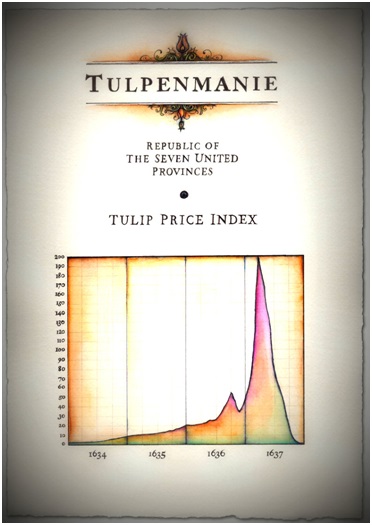

So what does this story of a flower tell us?

The most important thing this points to is the concept of Herding. It is the idea that people are more comfortable investing their money in the same way as the majority of others at any given time. Even if the majority of those (herd) are doing something really irrational.

I mean, how can you ever think of trading a piece of real estate for a single flower?

This also tells that crowd has a brain of its own and can do anything. It does not matter whether it is rational or not.

Now let’s come back from the 1600s to 2014.

So what is happening these days?

We have a new government. And the government is decisive and a very positive change considering the last 10 years.

And what are market experts doing? They are using this positive feeling and optimism surrounding the new government to come up with vivid, eye-catching numbers.

40,000…..75,000….100,000…it does not matter.

If one thinks objectively, the realization will occur that India is a very big country and change cannot happen overnight. There are so many dependencies that one negative trigger and entire over-optimism would be thrown out of the window. Recent Iraq crisis, which is still brewing hot, can have a really negative impact on the economy. And experts are downplaying the threat right now.

One man cannot decouple the entire county from the world economy. Period.

But markets have taken a breather in just last few days. And according to experts, it will continue the upward journey towards Mt. One Lac quite soon.

So since we all are poised to become very rich because markets will continue going higher and higher… why am I telling you all about Tulips?

It’s because the madness of the crowd has still not reached levels touched during Tulip mania. And to be honest, it might never reach those heights.

I am assuming that in present day, nobody will trade their house for a piece of flower. :-)

When the madness and irrationality will rise, I am sure that you will not be ready to listen to me. Isn’t it? When markets start going up, and your portfolio makes you feel like a Superman every day of the week, chances are that if you come across someone who is talking about risks associated with rising markets, you will not be interested in listening to him.

So my suggestion to you is that you should bookmark this page for future reference. If markets continue to rise for some time, and you start feeling that stock markets are the easiest way of making money, then please re-read this post. You will be thankful to me when markets eventually do start coming down in future.

About Dev: Dev Ashish is an engineer and MBA and is currently working with a private bank. Prior to it, he worked in a Fortune 500 organization in oil refining sector of India. Dev is also a founder of a site dedicated to long term investing – Stable Investor. His hobbies include travelling, photography, wealth management & blogging.


Admission to Financial Statements Analysis Course Ends in 3 Days: Just 25 seats remain to claim the Rs 1,000/- early-bird discount for my 2-months online course in financial statements analysis. If you wish to learn how to analyze financial statements to be able to make better and well-informed investment decisions, click here to join now!
27 Jun 03:10

PM Modi’s Letter on Completion of 1 Month in Office

by Atanu Dey

Prime Minister Narendra Modi wrote “A few thoughts as we complete a month in office.” I came across it in QUARTZ. QZ requested annotations. Someone named Vincent Lee did a fine job of summarizing the letter. Here are the annotations:

I’m your pal.

I love that people love me.
My job is hard.
But I have confidence in myself.
I like my new colleagues, here’s hoping we’ll get on.
Here’s also hoping the state heads will get along with me.
Did I mention my job is hard? I can use some slack…
Let’s remember how bad the previous dynasty was.
I’ll be using that memory as a mandate.
Thanks again for loving me, you won’t be disappointed.

If the first month sets the tone for the remaining, I am afraid that significant needed changes will not happen. Good to have a sincere, hardworking, nationalistic leader. That was a needed change. But sincerity, diligence and nationalism — while necessary — are not sufficient. What is needed is the vision and determination to formulate policies that are consistent with the fundamental principles of good governance and economic prosperity.

Here’s hoping for some fundamental change.

27 Jun 03:09

Smriti, you have NO business to regulate universities. Dissolve the University Grants Commission and “regulatory” bodies for higher education.

by Sanjeev Sabhlok

FTI has had a short discussion on the idiotic interference in Delhi University autonomy by Smriti Irani, the GREAT SOCIALIST PLANNER AND WISE 'KNOW-ALL' FROM BJP.

EXTRACTS

MY COMMENT

My two bits: this is a matter (3/4/5 years – my son took a dual degree with honours which requires five years) is a matter purely for each university to decide. When privatised let the market decide what it wants, and how it wants it. Executive MBA programs demonstrate that education CAN be customised in all sorts of ways by education experts and the market working together. 

We should not even try (even remotely) to sit in judgement over such things. The UGC must be dissolved and all universities privatised. That's the simple solution.

SUPRATIM'S COMMENT

The US has a community college system, where post 12th grade you can get a diploma by studying for 2 years.

All the universities in the US are independently run by their boards and trustees (both public and private universities) – there is no pan-US education "regulator" setting course content and durations for any of the univs. The only difference between private universities and public ones is that the latter get some state funding (from the state they are based in) and they offer a lower tuition rate for in-state students. Typically, each state has a marquee university eg University of Michigan, Penn State, U Mass, etc

=================

As I spent more time on the DU mess, the more I realise that this is straight forward political interfernce and jockeying for influence in a so-called "autonomous" university. The BJP wants to undermine and over turn the attitude of the previous education minister, Kapil Sibal, in allowing DU to determine how its courses should be structured.

It is a straight forward political fight – dirty and unedifying.

Watching some of the students on TV who were protesting against the Four year program, I did wonder why they could be classified as "lumpens" – I know the answer now.

And, what about the B.Tech students – a course introduced by the DU last year, as part of its revised 4-year program? The UGC is cutting their throats, under the pressure of the BJP politicians.

We are already the most third rate supplier of education in the world

 
I did an MA in economics from Panjab University (stood 7th in the university, first among correspondence course students) but when I went to Australia in an ordinary university to study economics and finance under the Colombo Plan I was shocked how DRAMATICALLY superior their education system was.  I was inspired to study more, and so I spent five more years abroad in studies, this time in USA.
 
What I learnt in these six years was only the beginning. Since then I've learnt how world-class governance actually works. That education – in a real-life world-class government – was worth 10 times more even than the world-class education I received abroad. 
 
This is now very clear: that we produce third rate thinkers and the only hope for Indians of any calibre (if they wish to find out their potential and thereby aspire to achieve it) is to LEAVE India.
 
The miserable mess of India can only be resolved if the world's top talent is actively sought and given the freedom to set standards and teach the BEST. And they have to pay very well. NO person of calibre worth his salt will EVER work under UGC and illiterate Ministers of Education.
 
In India IAS BUREAUCRATS and Minsters try to "regulate" universities – when they have NO clue about anything to do with education. In this case Smriti has not even a degree from India, leave alone ANY understanding of higher education.
 
I would not have objected to her being a Minster (in fact I opposed Madhu Kishwar's objections which were based only on her qualification) had Smriti insisted that government step out of higher education entirely. But she is determined to be the socialist that she is, the "planner". 
 
DUFFERS RUN INDIA. ONLY GOD CAN SAVE INDIA BUT GOD IS PROBABLY TOO SICK OF THIS ARROGANT BUNCH OF FOOLS OT BOTHER.
 
It is up to us to do something since I don't expect God to bother. A Liberal Party is long overdue. Join me as I try to offer my God-forsaken motherland some HOPE of self-respect in the distant future, when we have allowed talent to flourish, and not driven away (and soured) all Indian talent.
 
One of my classmates from Secunderabad is so disgusted with India (he lives in USA – as do 10s of my best classmates from across India) that he doesn't want to hear the word "India" in his entire life. 
 
Indians all over the world (including in India) are now starting to SPIT on India. Let's try to avoid driving away EVERY talented person out of India. 
 
The government should STEP out of the way, and let talented people run the country. Not fool bureaucrats and "know-all" Ministers.
27 Jun 02:54

If You Want To Multiply Your Investments 2x, 3x or even 5x in a Year, then Please Don’t Buy This

by Dev Ashish
In 1980s, a famous Chinese leader Deng Xiapong said – “To be Rich is Glorious” This slogan is believed to have unleashed a wave of personal entrepreneurship in China that is still driving its economy today. And there is no doubt that it is indeed glorious to make money. Even more so if you can double or triple your money in one year. But I am quite sure that there is no-one who can be 100
26 Jun 17:26

IO 2014: Google pushes Android everywhere. What’s in it for developers?

by Manish Singh

After Apple, it was Google’s turn to host its iconic developer conference. At its IO 2014 event earlier this morning, Google’s ambitions were clear. It wants to have its footprints all over your car, body, living room, to your laptop and, of course mobile, while making sure to have a continuity. The company announced a bevy of new products and new integration across them.

Android One

Android One
Chrome and Android Chief, Sundar Pichai took to the stage to announce Android One, a reference model that will allow manufacturers in developing countries to make cheaper — $100 — smartphones. Starting with India, nation’s biggest mobile maker, Micromax will make a 4.5-inch phone, which will get direct updates from Google. Karbonn Mobile and Spice will soon jump on the board.

Android L

Android-L

The latest update to Google’s Android operating system, Android L was finally announced. Sporting a new “material” design, the platform now supports 64-bit architecture. The notification system has been enhanced and will now allow people to interact with applications without having to launch them.

There is a new feature “heads-up” notification that will allow you to act on a notification without stopping what you were doing. It will also work from lockscreen. Speaking of lockscreens, Google says that now you won’t have to type out the whole password, as the device will automagically try to recognize and authenticate your presence.

The new version also features new animation capabilities, and the ability to add an illusion of depth including effects like ripples. It leaves a shadow like effect everywhere, it’s kind of amazing. Thanks to the grid-based layout, developers will be able to design for one device and have it easily ported to other sporting varied screen sizes.

Starting today, developers will be able to download Android L aka Android 5.0.

The Mobility

Chrome

The mobile browser Chrome will prompt cards instead of showing up search results when you make queries on Google. Interestingly, the tabs you have open on your Chrome browser will be considered as apps. Google wants to make the switching between what your browse on the Web and the apps you interact with on your phone lined up together. New APIs have been made available that will populate multiple tabs.

Furthermore, Google is now allowing developers to bring the search functionality to be used from within the apps. A new API will remind you of all the previous actions you have done in an app.

Android isn’t known for its great battery life. Google announced a new tool called Battery Historian that will monitor for the things that are affecting the battery life. Google says it will improve the battery performance by up to 90 percent.

Android Wear

Android Wear

Earlier this year, Google announced Android Wear, an operating system for wearable devices. At the event, company finally demonstrated it. It syncs with your mobile, and understands your voice, you can ask it to remind you of something, and it will set a reminder on your phone. It supports notifications — in fact, it will bring majority of your smartphone’s notification — including calls to your watch.

It will push all the important contextual information to your watch. Whether it is a flight you have to catch, or a hotel reservation, everything will be beamed to you via your watch. There is a Play API that lets you repeat an action over and over again. For instance, if you ordered a pizza a few days ago, you will be able to order it again from the same place without having to go through all the trouble. The full Android Wear SDK is available today.

Android Auto

We saw the self driving cars before, today, Google officially announced Android for your car. Bringing Android services and app to the automobile, Google is offering navigation, communication and music at your fingertip.

While everything is running on your phone, you will be able to mirror it on your car’s screen. The car controllers will be interacting with Android. Google is bringing — what has become company’s motto over the last few years — personalized experience — to car as well. Which means whether it is your car, or a friend’s or rented, the experience you will be provided will remain the same. Google Play is fully voice enabled.

And while you’re driving, you will be able to see phone notification — heads up notifications and incoming messages on the car screen.

Google says the Android Auto SDK will soon be made available to developers, allowing them to make apps for the car. There are two kinds of APIs — Audio and Message. While Audio APIs lets you listen to music, podcasts etc, the Messaging APIs will determine what texts you’re seeing on the car screen. And, these APIs are talking with each other, meaning, you will be able to respond to a text by voice.

Android TV

Android TV

Before we get to this, let’s take a look at company’s past attempts to get inside your TV. Back in 2010, it released Google TV, which failed miserably. Two years later, Nexus Q, a streaming service couldn’t find any takers.

Introducing Android TV, which neither is a set-top box, nor a streaming service. What it does is allow you to run several streaming services – Netflix and YouTube and its own content from the marketplace to your big screen. It allows you to control it from your Android phones, tablets, and even Android Wear.

Support for Chromecast, a USB dongle it released a couple of months ago that allows you to mirror your phone/tablet/Web browser’s content to a big screen, has been enhanced. Now you will be able to mirror your phone’s content as well.

Having Google services on your TV has its own benefits. For instance, you ask for a movie or show via voice command to your mobile, and the content becomes available on your TV. Can’t remember where else you’ve seen that actress? Ask Google, and the search results will appear at the sideways of your TV. And, not to forget, you can play games — especially multiplayer games on it as well.

The Google Cast support is now coming to other devices as well. The SDK is available for download.

Chromebook and Android integration

Android-Chromebook

Hands-down, it is easily one of the biggest features you should care about. Recently we talked about how Chromebooks have evolved and could easily replace your Windows laptops. The company has bigger plans. It is now bringing native Android support to Chromebooks. Which in simple terms mean, that you will be able to run Android apps on your Chromebook.
Check your phone’s notification on your laptop, get notified when your phone’s battery is low.

Opening up Gmail API

Google has now made Gmail service more accessible to other apps. It dropped the 1970 standard IMAP, a complex way for other apps to communicate with email services. This will now allow other apps to interact with Gmail. For instance, a travel app will be able to scan through your emails to keep you posted with your ticket booking information. ”Gmail wants to be the inbox of choice for everyone,” said, Alex Jones, general manager for consumer anddeveloper solutions . “If they can make a strong platform for users and developers, there’s no reason to stray to rival services.”

Google’s take on your fitness: Google Fit

Much like what Apple did with its Health Kit service, Google will be bringing all the health related information from multiple sources — apps to one place. Company has released Google Fit APIs that will allow several apps to interact with each other and share fitness activities — with user’s consent, of course.

Game developers, Google says that it will soon beef up its Google Play Games platform. But no information was provided at the event. “We aren’t building a vertically integrated product, we are building an open platform at scale,”, said Pichai.

The post IO 2014: Google pushes Android everywhere. What’s in it for developers? appeared first on NextBigWhat.

26 Jun 17:25

Addicted to central bank painkillers?

by Antonio Fatas
Claudio Borio (BIS) and Piti Disyatat write about the dangers of low interest rates at VoxEU. Using an argument that has been put forward many times by the BIS (Claudio Borio and co-authors), low interest rates during booms and expansions can create bubbles and financial instability. Central banks need to be aware of the costs of low interest rates.

The authors, while accepting the idea that low real interest rates might be the outcome of low growth and secular stagnation,  argue that central banks cannot simply be seen as passive agents adapting their policies to the macroeconomic environment; they are responsible for low interest rates. In their words "money and finance are not neutral". Quoting from the article:

"Not only can financial factors – especially leverage – amplify cyclical fluctuations, but they can also propel the economy away from a sustainable growth path. By influencing decisions to invest, variations in financial conditions affect the evolution of the capital stock, and hence, future economic fundamentals. An expanding capital stock during booms may help to constrain inflation and obviate the perceived need for monetary-policy tightening. At the same time, large changes in relative prices that typically occur in financial booms divert resources into surging sectors in ways that are not easily reversible. The long-lasting impact of the financial cycle becomes especially evident in the bust phase. The cumulative build-up in debt and associated resource misallocations – especially the overhang of capital – leave a legacy that takes time to resolve."

To support their claim, the authors produce a chart that shows how debt (public and private) has increased dramatically during the years where interest rate were coming down.


Their conclusion:

"More stimulus may boost output in the short run, but it can also exacerbate the problem, thus compelling even larger dosages over time. An unhealthy dependence on painkillers can be avoided, but only if we recognise the risk in time."

I have no objection to the idea that money and finance are not neutral and that central banks can have an important role in financial markets. But the analysis above is too simplistic and potentially misleading.

The logic it puts forward is that arbitrarily-low interest rates set by the central bank generate an unsustainable behavior in terms of accumulation of debt that is behind the bubbles we built in the good years and the crisis that resulted from the bursting of those bubbles.

What is always missing in this analysis is the fact that the world is a closed system. The debt that appears in the chart above has to be bought by someone. Those liabilities are assets for someone else. Who are the buyers? And who "forces" them to buy those assets at that price/yield?

Before we continue any further let's rule out the hypothesis that it is the central bank who is buying those assets. The easiest way to understand that it cannot be the central bank is that the chart above starts a lot earlier than the time when central banks' balance sheets started to increase (the second reason is that for every asset that the central bank buys it issues a liability but this will get us to a more complicated argument).

There is a simpler way to explain the chart above. A shift in the supply of saving by some agents/countries resulted in a decrease of interest rates and an increase in borrowing by the rest of the world. Some of this happens within countries, some happens across countries. This could still be an unsustainable development as borrowers go too far and lenders do not understand the risk involved but it is not simply be caused by the irresponsible policies of the central bank.

It could also be that, in addition, we have seen a significant increase in gross flows of assets and liabilities that do not result in a change in equity or net wealth but that they lead to an increase in the size of balance sheets across agents (i.e. increased leverage). Simplest example is households buying real estate with mortgages but it can also be financial institutions increasing leverage. This increases debt but it increases assets as well. This, once again, can generate instability but the borrowing that we see must come from somewhere else in the economy (not the central bank). Understanding that side of the balance sheet is important to have a complete story of what caused the crisis and what it takes to get out of it.

Antonio Fatás


26 Jun 17:24

Go Break all the Rules!

by subra

One of the fun things in life is to BREAK THE RULES. Please read this very carefully, I have said Break the Rules, not Break the Law.

So first go and make some sold Investment Rules and make money by adhering to them. Then when you understand how the rules were made, and how was it helpful, start wondering if you can break them, and if yes to what effect.

I normally do not go to a zero position in a good share. For example I am completely out of my trading positions in Reliance, but still hold my Investment position. Yes I have gone down a lot, but still have some position left. However in case of Wheels India I have gone to a zero trading and investing position because at Rs. 820 (25/6/2014) I thought the share was more than fully priced. I just exited the full position. Awesome price ever recorded on that day – upper limit..and it had hit the upper circuit two days in a row. Breaking of my own law. Sensible or foolish – time alone will tell.

Over the last few months (12-14 perhaps) I have been desperately seeking arbitrage opportunities because I did not think it was an investing market. So the arbitrage between Sabero, Liberty, and Coromandel International played out very well and I was surely impressed by my ability to spot all the opportunities – and but EID Parry. Obviously as the parent company EID was the biggest beneficiary, and that also played out well because the sugar prices started playing out. Luck, clearly luck that I was sitting on it when the share decided to go up. Broke all my rules of a Group Exposure, buying a share in a company not earning decent profits, holding on to an open position waiting for the prices to improve – amazingly stupid I guess…but hey it did work.

Buying PSUs – personally anti psu banks, and generally psus…however took position in psu banks, Ongc, Coal, Ntpc, etc. Again broke the rule of psu investments, doing arbitrage, etc…well it worked for me, ….

Post Footer automatically generated by Add Post Footer Plugin for wordpress.

26 Jun 03:11

A Few Notes on Bonds

by David Merkel

My comments this evening stem from a Bloomberg.com article entitled Bond Market Has $900 Billion Mom-and-Pop Problem When Rates Rise.  A few excerpts with my comments:

It’s never been easier for individuals to enter some of the most esoteric debt markets. Wall Street’s biggest firms are worried that it’ll be just as simple for them to leave.

Investors have piled more than $900 billion into taxable bond funds since the 2008 financial crisis, buying stock-like shares of mutual and exchange-traded funds to gain access to infrequently-traded markets. This flood of cash has helped cause prices to surge and yields to plunge.

Once bonds are issued, they are issued.  What changes is the perception of market players as they evaluate where they will get the best returns relative expected future yields, defaults, etc.

Regarding ETFs, yes, ETFs grow in bull markets because it pays to create new units.  They will shrink in bear markets, because it will pay to dissolve units.  That said when ETF units are dissolved, the bonds formerly in the ETF don’t disappear — someone else holds them.

But in a crisis, there is no desire to exchange existing cash for new bonds that have not been issued yet.  Issuance plummets as yields rise and prices fall for risky debt.  The opposite often happens with the safest debt.  New money seeks safety amid the panic.

Last week, Fed Chair Janet Yellen said she didn’t see more than a moderate level of risk to financial stability from leverage or the ballooning volumes of debt. Even though it may be concerning that Bank of America Merrill Lynch index data shows yields on junk bonds have plunged to 5.6 percent, the lowest ever and 3.4 percentage points below the decade-long average, the outlook for defaults does look pretty good.

Moody’s Investors Service predicts the global speculative-grade default rate will decline to 2.1 percent at year-end from 2.3 percent in May. Both are less than half the rate’s historical average of 4.7 percent.

Janet Yellen would not know financial risk even if Satan himself showed up on her doorstep offering to sell private subprime asset-backed securities for a yield of Treasuries plus 2%.  I exaggerate, but yields on high-yield bonds are at an all-time low:

Could spreads grind tighter?  Maybe, we are at 3.35% now.  The record on the BofA ML HY Master II is 2.41% back in mid-2007, when interest rates were much higher, and the credit frenzy was astounding.

But when overall rates are higher, investors are willing to take spread lower.  There is an intrinsic unwillingness for both rates and spreads to be at their lowest at the same time.  That has not happened historically, though admittedly, the data is sparse.  Spread data began in the ’90s, and yield data in a detailed way in the ’80s.  The Moody’s investment grade series go further back, but those are very special series of long bonds, and may not represent reality for modern markets.

Also, with default rates, it is not wise to think of them in terms of averages.  Defaults are either cascading or absent, the rating agencies, most economists and analysts do not call the turning points well.  The transition from “no risk at all” in mid-2007 to mega-risk 15 months later was very quick.  A few bears called it, but few bears called it shifting their view in 2007 – most had been calling it for a few years.

The tough thing is knowing when too much debt has built up versus ability to service it, and have all short-term ways to issue yet a little more debt been exhausted?  Consider the warning signs ignored from mid-2007 to the failure of Lehman Brothers:

  • Shanghai market takes a whack (okay, early 2007)
  • [Structured Investment Vehicles] SIVs fall apart.
  • Quant hedge funds have a mini meltdown
  • Subprime MBS begins its meltdown
  • Bear Stearns is bought out by JP Morgan under stress
  • Auction-rate preferred securities market fails.
  • And there was more, but it eludes me now…

Do we have the same amount of tomfoolery in the credit markets today?  That’s a hard question to answer.  Outstanding derivatives usage is high, but I haven’t seen egregious behavior.  The Fed is the leader in tomfoolery, engaging in QE, and creating lots of bank reserves, no telling what they will do if the economy finally heats up and banks want to lend to private parties with abandon.

That concern is also revealed in BlackRock Inc.’s pitch in a paper published last month that regulators should consider redemption restrictions for some bond mutual funds, including extra fees for large redeemers.

A year ago, bond funds suffered record withdrawals amid hysteria about a sudden increase in benchmark yields. A 0.8 percentage point rise in the 10-year Treasury yield in May and June last year spurred a sell-off that caused $248 billion of market value losses on the Bank of America Merrill Lynch U.S. Corporate and High Yield Index.

Of course, yields on 10-year Treasuries (USGG10YR) have since fallen to 2.6 percent from 3 percent at the end of December and company bonds have resumed their rally. Analysts are worrying about what happens when the gift of easy money goes away for good.

With demand for credit still weak, it is more likely that rates go lower for now.  That makes a statement for the next few months, not the next year.  The ending of QE and future rising fed funds rate is already reflected in current yields.  Bloomberg.com must be breaking in new writers, because the end of Fed easing is already expected by the market as a whole.  Deviations from that will affect the market.  But if the economy remains weak, and lending to businesses stays punk, then rates can go lower for some time, until private lending starts in earnest.

Summary

  • Is too much credit risk being taken?  Probably.  Spreads are low, and yields are record low.
  • Is a credit crisis near?  Wait a year, then ask again.
  • Typically, most people are surprised when credit turns negative, so if you have questions, be cautious.
  • Does the end of QE mean higher long rates?  Not necessarily, but watch bank lending and inflation.  More of either of those could drive rates higher.
26 Jun 03:11

Bharat (Still) Needs a $100 Android Phone. Google, Are You Listening?

by Manish Singh

India needs a $100 (Rs 5000-6000) Android phone. Wait, but don’t we already have a lot of them? Sure, but what we need is a real $100 phone which gives you a pure Android experience, without all the crapware on it. That is, something close to a Moto-E but a tad cheaper and similar experience.

Is there a Market?

Of course there is. Motorola sold 2.85 lakh Moto-E phones in India in a little over a month by selling it purely online. Imagine, if it could sell through all distributors?

India, the second most populated country in the world, also has second largest number of smartphone users. The country which homes 1.2 billion people, however, only has less than 200 mn smartphones users.

Looks like people are craving for a decent experience. But what’s wrong with the ones we have now?

Problem With Typical Cheap Smartphones

It’s not like that you cannot get an Android running handset for a cheaper price, but they are often sub-par devices and the experience leaves a lot to be desired.

One of the several issues with cheap devices is that they either have very low-specs or run an outdated operating system, and more often than not, both are the cases. The market is filled with Android Gingerbread smartphones, and that is certainly not the kind of experience Google wants its users to have in circa 2014.

Plus, the chipset these devices use is not really optimal for high performances. Phone makers makers get away with whatever they choose to deliver, especially in smaller cities.

Too Much Bloatware

Samsung, Sony, LG, HTC, and most of the mobile OEMs add their own bloatware to their phones. In the name of differentiating their phones from rest, the bloatware is evidently affecting the handset’s software performance (See Gionee Review).

The solution lies in a ‘stock experience.’ Both Moto G and Moto E offer almost stock experiences on the phone.

Messy Update Cycle

The majority of companies follow their own irregular update life cycle. And things get even worse when you talk about Indian manufacturers. A study by PriceBaba found that leading Indian mobile maker, Micromax only provides one update to their smartphones. Expect the same from other Indian OEMs.

Android-Segment

But not just that, on several occasions, Indian variants of popular smartphones were not provided with the latest update, whereas the global version is running the latest software. Samsung Galaxy S III is one example.

What we need is an authority, say Google looking at these manufacturers — noting the kind of relations that the Android maker had with Motorola — pushing them to roll out updates sooner.

A $100 phone will help to extend the reach of internet to more hands, allowing developers to tinker with their devices more often. It sits well with the search giant’s Internet for everyone strategy.

Today, the Indian market has hundreds of millions of potential customers that are going to buy smartphones very soon. A vast majority of them can’t afford the expensive flagship devices, but many of them can happily invest Rs 5,000, to Rs 6,000 on these handsets. And that’s where they need to step in.

The post Bharat (Still) Needs a $100 Android Phone. Google, Are You Listening? appeared first on NextBigWhat.

26 Jun 03:09

Indira Gandhi Imposed “Emergency” on June 25th, 1975

by Atanu Dey

Thirty-nine years have passed since that day when Indira Gandhi decided that Indians had enough of “democracy” and it was time that she dictated to them. Indians did what they have always been good at: they obeyed. Instead of resisting, they obeyed. Our problem, as Howard Zinn used to say, is not civil disobedience; our problem is civil obedience.

Emergency ended on 23rd March, 1977. Did the people learn much? No. She won a landslide victory and once again became the prime minister in January 1980. She was right: the people did not deserve freedom. The people believed that they were free but in truth it was — and still is — an illusion. Frank Zappa said it best. “The illusion of freedom will continue as long as it’s profitable to continue the illusion. At the point where the illusion becomes too expensive to maintain, they will just take down the scenery, they will pull back the curtains, they will move the tables and chairs out of the way and you will see the brick wall at the back of the theater.”

Indira Gandhi was an evil person. Indians suffered much because of her and her spawn. However it was well-deserved. It’s all karma, neh?

Note: The source of that Howard Zinn quote is from an opening statement in a 1972 debate at Johns Hopkins. Read the transcript here.

Our problem is civil obedience. Our problem is the numbers of people all over the world who have obeyed the dictates of the leaders of their government and have gone to war, and millions have been killed because of this obedience. And our problem is that scene in All Quiet on the Western Front where the schoolboys march off dutifully in a line to war. Our problem is that people are obedient all over the world, in the face of poverty and starvation and stupidity, and war and cruelty. Our problem is that people are obedient while the jails are full of petty thieves, and all the while the grand thieves are running the country. That’s our problem. We recognize this for Nazi Germany. We know that the problem there was obedience, that the people obeyed Hitler. People obeyed; that was wrong. They should have challenged, and they should have resisted; . . . Even in Stalin’s Russia we can understand that; people are obedient, all these herdlike people.

I agree. For the record I should state that I agree with Zinn on many, but not all, matters.

Speaking of obedience, do read this post: THE POLITICS OF OBEDIENCE: The Discourse of Voluntary Servitude.

And finally, here’s Matt Damon reading excerpts from the transcript of Howard Zinn’s speech:

26 Jun 03:05

Good Managers Look Beyond Their “Usual Suspects”

by Ron Ashkenas

In the movie Casablanca, there’s a famous scene where Captain Renault, the head of the French police, avoids investigating the murder of a Nazi officer by telling his people to “round up the usual suspects.” The implication, of course, is that everyone should look busy and professional, even if the routine doesn’t really accomplish anything.

I’m always reminded of this line when I see managers respond to performance challenges by putting together a task force of the “usual suspects” to deal with the issue. These task force members usually end up with multiple specialty assignments piled on top of their regular duties. And because these few go-to people are spread so thin, they ultimately don’t accomplish all that much.

Managers sometimes “round up the usual suspects” because they only trust a small number of people to handle key projects or initiatives. Every organization has its “glue people,” the ones who don’t show up in organization charts but are assigned to every task force or initiative because they are respected and trusted. For example, in one organization undergoing a major restructuring, each division designated a “transformation leader” as its point person for the work. However, each person also had significant managerial responsibilities, regularly represented the company at customer and industry forums, served on standing committees, and juggled other major project assignments. So while they were all capable and willing to do what was needed, the effort suffered due to lack of time and bandwidth.

Here’s another case in point: A financial services company was struggling to turn around a large business unit. One of the key initiatives was a new customer-service approach that involved a combination of new systems, training, and process changes. However, after almost a year of work and significant investment, very little had changed. In fact, the effort had generated some fear and resistance in the customer care centers and, if anything, performance was now worse. In response to pressure from the CEO to get the turnaround back on track, the business head “rounded up the usual suspects” into a task force to recommend how to accelerate progress. Of course, the members of this team, while all very capable and well-meaning, were the same ones who were leading the various project work streams – and they all had full-time “day jobs.” So due to the limited time available, they merely rehashed their recommendations for the project, and progress continued at a snail’s pace.

If any of this sounds familiar, take a step back and think about how to expand your talent pool to get the actual results you want. Do a quick mapping of your committees, task forces, and other special assignment groups, to see if you have a “usual suspect” bottleneck. Although individual executives may engage in this dynamic intentionally (like Captain Renault), most do not; it just happens. By sketching out these responsibilities, and looking at them holistically, it’s possible to see whether the same names come up again and again. If that’s indeed the case, then consider lightening the load for some by prioritizing assignments, consolidating teams, and, most importantly, adding other people to the list. Are there other capable people who would welcome additional assignments? Perhaps some high potentials who are not being fully challenged? Is it possible to trust some other people outside of your “usual suspects” circle?

On the flip side, if you feel that you are one of the overburdened few who gets called on over and over, speak up. In my experience, many of the “usual suspects” suffer in silence. They are flattered by the attention and the opportunities, but they become overwhelmed by the amount of responsibility and frustrated by the lack of time to get everything done. And because they are good corporate citizens who don’t want to disappoint, they don’t push back, which reinforces the “usual suspect” scenario.

Most organizations have ambitious agendas that are limited by the availability of key people. There may indeed be times when calling upon a few trusted people is the right approach, but doing it too often can be severely constraining. That’s why thinking outside the roster of “usual suspects” can help you distribute responsibilities in a more even, efficient way.

25 Jun 03:03

Investment Strategy statement…make it NOW

by subra

I keep talking about having an Investment Philosophy Statement. What exactly is this?

Well for an individual it should have the following: Objective, Constraints, Fears, Investing target, Asset allocation target, rebalancing strategy, Reasons or basis for change in strategy, Monitoring methodology.

The Objective / Goal statement can be as simple as:
Accumulating Rs. 10 crores for Retirement (30 year perspective)
Accumulating Rs. 4 crores for daughter’s education (18 year perspective)

Constraints (under which I operate now – this might change over time)
- I am a little scared of equities, but will learn about it over time
- Currently there are no taxes on investment income, that might change
- Current value of portfolio is only Rs. 55,000

Fears:
- Parents have NEVER invested in equities or other mutual funds
- Not sure of the company in which I am working
- My spouse puts pressure to open bank RD and PPF
- Not sure how my BRAIN will react if market remains down for 3 years

Investing Target:
- Can invest only Rs. 10,000 per month, but will increase it by 10% every year for the next 10 years for sure.

Asset Allocation Target:
- Will be 100% in Equities till 2028, then will decide on shifting some money to debt funds
- No balancing / rebalancing etc for the next 10 years, unless there is a huge bull run helping me reach the target much before the time when I need the money.

Monitoring Methodology:
- As long as my fund is in the top Quartile in performance (post costs, obviously) will not shift out of the 3 funds in which Subra has suggested.

Post Footer automatically generated by Add Post Footer Plugin for wordpress.

25 Jun 02:50

Before you quit your business

by Ashvini Kumar Saxena

Quitting a business is hard when one has put in the best years of life working on it. The challenges of keeping business profitable often prompt us to think about quitting it altogether.

Here are a few reasons that I believe may cause one to quit a business.

a) Passion: If you liked something before and no longer like it , it may be the end of your passion.

My passion for first business faded a few months after I launched it. Even though I was excited initially but later I saw that it was not the business I wanted to be in. Without passion it was not possible to enjoy something that you do.

b) Market condition: Sure all entrepreneurs would like to change the world with their  “awesome” product but what if the world is not ready for such a change.

It would be just great if the launch of a product coincides with the rise of the market that it seeks to address. But it does not happen often. Either market drops its growth or entrepreneur enters early into or enters quite late. All three are quite likely to happen ( based on my experience ).

c) Saturation: It is hard to find a space where marketers have not spent their time to saturate a market with me-too products. It is quite hard to be profitable in such a market.

But before one decides to quit, one must listen to what the topmost entrepreneur of the world, Richard Branson says about failures.

And read here some great tips that he shares.

Here are a few tips that I can give to you if you are thinking of quitting

Dont quit your business#1 : Failure is a way of life

#2: It is very hard to achieve profitability

#3: It is hard to get on the right side of demand curve ( when market is growing). But if you do, make most of it ( point (b) ) above

#4: Giving up is easy. Starting back is much harder. So before you give up, think of any way of salvaging things

#5: If you cannot make things work, give them for free ( as much as you can ). At least that would get in you a great publicity. Give out code, videos, blog posts anything that helps. Internet is a community. Add to it.

#6: Passion: If you lose the passion, ask yourself if it temporary or permanent. If it can be helped by for example getting an external help, do so. Don’t give up because you are down for a day or two.

#7: Listen with open ears -  In the noise of success, one often fails to listen to what for examples customers are telling.

#8: Innovate and improve. No product is a dead end. Improvements are always welcome. Any kind of improvements can be publicised to get better publicity

#9: Try something related - If market is saturated find a niche where you are good at. Build on that niche. For example if there are too many sugary colas in the market, create a fruit based drink. Put in some twist. Make it interesting.

#10: Keep trying - Not many have succeed in first shot. Success is never easy and it comes so late. But it comes to only those who are learning and trying again and again.

If you like this post, don’t forget to share Smile

“Image courtesy of [Stuart Miles] / FreeDigitalPhotos.net


24 Jun 02:50

End of the "hope rally". Focus back on fundamentals.

by Abhishek Basumallick
Last month, India may have witnessed a watershed moment in its history. The reason I say may, is because, only time will tell if it really was such a moment, or it was another great opportunity lost. Expectedly the markets rallied as the results poured in. All the common reasons were offered - Modi has a single majority so he can fix all the problems of the economy, India will push forward with its reform agenda, industrialization and fix governance.

So, the "easy" money based on the hope of "acche din" played out. During the hope rally, everything that a "India development" story went up - mining, power, infra, cement - almost everything. A lot of the PE re-rating for mid caps took place. It removed the glaring cheapness of most of the "good" midcaps. 

With the obvious cheap stocks now becoming well priced, we are back to the grind of making money on the fundamental basis. So, it is critical to focus back on individual companies and how they can perform and grow in the next few years. 

It is obvious that there are no easy answers (from Modi or anyone) of India's challenges. Inflation is stubbornly high and so are subsidies. Any reduction in subsidies (oil, LPG, fertilizers, rail fare etc) without a commensurate increase in efficiency is likely to increase inflation even higher. There is no magic wand that the PM has to fix the Indian economy. Once people start realizing that, markets are likely to correct or stagnate at the very least. And provide an opportunity for patient investors to buy into. The trick is to be prepared with a buy list and cash when (& if) that happens.
24 Jun 02:49

Why you lose money in a bank…

by subra

When you want to invest money, or even when you do not want to invest money it is your banker who knows about it.

Right? In most cases yes.

So you go to a bank and are wondering what to do…and there appears a Relationship manager. He comes and tells you the following:

It is convenient to invest through a bank (true, but convenience comes at a price)

We will do all the documentation, your KYC (know your customer forms), ulip forms, etc.
(this continues your amazing financial illiteracy longer)

We will give you a full range of products (income fund yielding 9% p.a. and a car loan where we charge you 14% – amazing range of products)

We think you should not have so much in savings account and fixed deposits but have it in a mutual fund (you think they are doing all this in YOUR interest, after all which bank does not like CASA?)

All this is told to you in the nice environment of a bank.

Ha have you heard of the word ‘uberrimae fidei’ – do you know what it means?

Here – this is what it means:

A legal agreement requiring the highest standard good faith. “Uberrimae fidei” or “uberrima fides” is Latin for “utmost good faith.” Insurance contracts are the most common type of uberrimae fidei contract.

Why only Insurance contract? so that the insurance company can reject your claim saying ‘Your husband did not disclose the diabetes that he had’.

Sadly however in a banking transaction there is no uberrimae fidei – the banker NEED NOT TELL YOU THE TRUTH. This is sad because we belong to a generation that BELIEVED(S) THE BANKER. We thought a banker will not cheat – ask your parent if you want. Most of us believed that when a banker offered a product it was capital guaranteed. Right? hmm

So here you are scared of investing, scarred by a family friend or own parent’s investing mistakes. You think your RM has your interest at heart (cannot blame you we are all created to trust our service providers unless proven other wise – my fruit vendor has NEVER cheated me in so many years – I just tell him ‘achha nahi tha, and he gives me a free replacement, no questions asked), You believe since you do not lie, he will also not lie.

So you see – the trap is very well set. Sadly we all walk into it.

When the returns do not come, you start panicking…and there is NOTHING that you can do. Sad. You are reminded of another Latin word : Caveat Emptor in banks.

Post Footer automatically generated by Add Post Footer Plugin for wordpress.

24 Jun 02:45

I condemn ALL middle Eastern Islamic nations as the most repressive and criminal on this earth

by Sanjeev Sabhlok

It was beyond shocking to watch this video (now no longer available!) and this newsreport [also this] [and this] [and this].

Some comments from my FB post.

MY COMMENT

INDIA IS PRODUCING SLAVES FOR [SAUDI MUSLIM] QATAR. THANKS, SOCIALISTS. THANKS, CONGRESS. THANKS, BJP.

Saleem Khan the summer temperatures here go between 45 – 50 deg C. do you know that during summer June 15 to September 31st the government enforces work ban between 12 pm – 3 pm and laborers are given rest. Any company which flouts this rule has to pay initial dirhams. 50,000/- fine irrespective how big they are or how influential they are. If they continue to violate the rule, their licenses are cancelled……. Now which government in the world gives this human right of "not to work" in uncomfortable situation. The workers have right to go back to their countries and continue to stay.

In UAE (and a few ME countries) all employees weather laborers or office going workers, must get his salary before 5th. To ensure this government has made direct debit from employers account to the employees account. Every beginning of every month, the companies, big or small must ensure that their accounts are sufficiently funded , if there are no salary transfers before 5th , the companies are fined and eventually license revoked. Which countries in the world ensure that the workers are paid in time irrespective of the health of the company . Even if the company is going bankrupt, the company in UAE and other ME countries must pay on time…..no excuses

In Saudi Arabia and UAE, when men stand in a long queue in a bank or to buy a ticket etc and if a woman irrespective of her religion or color etc can jump the queue only because she is a woman and she should be given preference ….In India or any other country the woman will be shouted out

what happens to the people from mexico in USA or Indian laborers in Japan or Spain. In Valencia I met a pakistani who told me , he gets 20 euros to pluck an x amount of oranges, but if there is Spanish laboror , he gets 100 euros…similarly an Argentinian waitress told me that her salary is 1000 euro while a Spanish waitress gets 2000 euro….. Mr sublok, in every country the migrants get less than locals…..unless ofcourse you are some highly educated person………….In Dubai and Saudi highly educated Indians are getting more than locals….Everywhere in the world it is the average educated or a laborer who gets the raw deal

MY COMMENT

Saleem Khan, kindly don't compare illegal migrants with legal ones. Second, I don't know about Spain or Japan, but in Australia it is totally illegal to pay any foreign worker less than the local worker.

It is WRONG to suggest that " in every country the migrants get less than locals". That is nothing but CRIMINAL exploitation.

By all means have outsourcing. Send work TO India, but once Indians live in your country, you MUST pay them as much as a local worker. And given them basic liberties.

Saleem, don't compare with THIRD WORLD THIRD RATE GUTTER SOCIALIST HELL HOLE called India. Qatar is one of the richest countires in the world but behaves like a TENTH WORLD nation.

Let's just say that I CONDEMN ALL middle Eastern Islamic nations for being the most repressive and criminal nations on earth.

23 Jun 03:22

Get rid of toxic people

by subra

Many a times you get into toxic relationships, OBVIOUSLY without realising that it is toxic. Why is it obvious? and to whom is it obvious? It is obvious to the outside world, but not to us!

This could be a colleague, a ‘friend’,  a relative, – the list is endless. I know a person who changed his car pool because one of the co-passengers was a painful cribber! So identifying the toxic relationship is necessary, and of utmost importance. Look around carefully. If there are persons who increase your blood pressure the minute you mention their name or when you see their name on the phone keypad, FOR YOU THEY ARE TOXIC.

Let us see what can be done in such a situation!

1. Remember cribbers can crib about anything: ‘It is a hot day’ or ‘It rains so much in Mumbai’ , ‘Politicians are so corrupt’. Why is all this a crib? Simply because you plan to do NOTHING ABOUT IT, but carry the burden all through the conversation (journey sometimes) and it does nothing to help you.

All days are God’s creations. You are an atheist? Ok all days are part of the calendar!

2. Identify the people who make you feel bad, low, guilty, – as soon as you identify the better it is for you.

3. See how important is the relationship to you: Other than a parent or a sibling you might be able to end any relationship – a change of job or a divorce is still possible. Sure you may not need such a drastic action, but one never knows.

4. Think how the relationship started, what went right, what went wrong. Introspect. Meditation and Introspection are very helpful for reducing stress.

5. If you cannot remove that person keep a time frame – half an hour once a week or half an hour once a fortnight. If it is a friend’s mother – and you are her next of kin for all practical purposes, try taking somebody along with you. A spouse, a friend, your kid – so that the toxicity is shared or you can talk some other subject.

6. If it is a colleague – request for a change of place.

7. If it is a friend, reduce the interaction – number of times and the time spent in each meet.

8. Take a deep breath to see whether you are being toxic to somebody. In a well intentioned manner you could be toxic for somebody else. Make sure you are not.


1. http://www.huffingtonpost.com/avril-carruthers/7-steps-to-freeing-yourself-from-toxic-relationships-in-2014_b_4533224.html?ncid=edlinkusaolp00000003

Post Footer automatically generated by Add Post Footer Plugin for wordpress.

23 Jun 03:08

Industry Analysis: Cement – Part 1

by Vishal Khandelwal

As part of my initiative to help you enhance your “circle of competence”, I am starting on a new series on analyzing key industries that can offer you profitable, long-term investment opportunities. I start this series by analyzing the Cement industry.

1. About Cement
Wikipedia defines ‘cement’ as…

…a binder, a substance that sets and hardens as the cement dries and also reacts with carbon dioxide in the air dependently, and can bind other materials together. The word “cement” traces to the Romans, who used the term opus caementicium to describe masonry resembling modern concrete that was made from crushed rock with burnt lime as binder. The volcanic ash and pulverized brick additives that were added to the burnt lime to obtain a hydraulic binder were later referred to as cementum, cimentum, cäment, and cement.

At the basic level, cement is a binding substance that is intended for use in building or construction material and can withstand varying environmental conditions. The four elements necessary for its creation are iron, aluminum, silicon, and calcium.

These elements are burned together in a kiln and are finely pulverized to create the powder and used as an ingredient of mortar and concrete we then call cement. This powder hardens once it is mixed with water but water does not break the bond once it is formed.

The manufacturing process of cement consists of mixing, drying, and grinding or limestone, clay, and silica into a composite mass. The mixture is then heated and burnt in a pre-heater and kiln to be cooled in an air-cooling system to form clinker. This is the semi-finished form of cement. This clinker is cooled by air and subsequently ground with gypsum to form cement.

You can watch the entire cement manufacturing process in the video below…


There are various varieties of cement manufactured and sold in India. The basic difference lies in the percentage of clinker used. Here are a few common types –
  • Portland Blast Furnace Slag Cement (PBFSC): This consists of 45% clinker, 50% blast furnace slag, and 5% gypsum. PBFSC accounts for around 10% of the total cement consumed in India. It is generally used in construction of dams and similar massive constructions.
  • Ordinary Portland Cement (OPC): This is commonly known as “grey” cement, and is used in ordinary concrete construction. It has 95% clinker and 5% gypsum and other materials.
  • Portland Pozolona Cement (PPC): PPC has 80% clinker, 15% Pozolona, and 5% gypsum. It accounts for around 18% of total cement consumption. As it prevents cracks, it is useful in the casting work of huge volumes of concrete. It can be availed at low cost in comparison to OPC.
  • White Cement: It is a kind of OPC. The ingredients of this cement are inclusive of clinker, fuel oil and iron oxide. The content of iron oxide is maintained below 0.4% to secure whiteness. White cement is largely used to increase the aesthetic value of a construction. It is preferred for tiles and flooring works. This cement costs more than grey cement.

2. About Indian Cement Industry
The cement industry plays a significant role in the economic development of any nation, providing a vital raw material for the basic building blocks of a nation’s infrastructure and housing development.

India’s cement industry has historically grown faster than the overall economy — in fact, its remarkable progress has made India the world’s second-largest cement producer (after China) — and it has evolved to become one of the most effective industries in the world in terms of process efficiencies.

The evolution of the Indian cement industry has been in three distinct phases, characterized by the extent of government regulation –

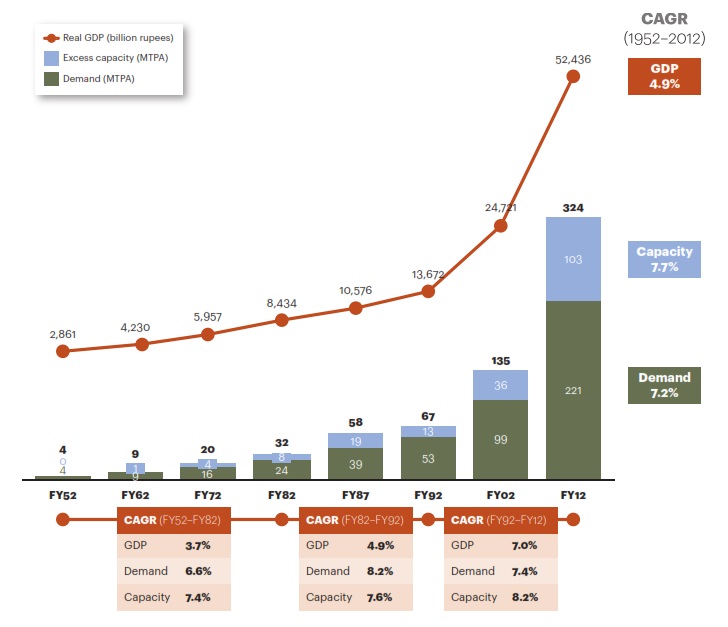
  1. Complete government control (1956–1982): Prices were regulated by the government. This period saw modest growth of 6.6% in overall demand on a very low starting base, with the prior decade facing a sharp slowdown in both demand and capacity creation. Entry of new players was limited because of suboptimal returns on investment.
  2. Partial government control – Quota system (1982–1989): To trigger growth in the industry and support emerging Indian infrastructure, the government introduced a system of partial deregulation in 1982. The new law required at least two-thirds of all sales to be to government and small developers; the companies were free to sell all remaining product on the open market at a ceiling price. The industry responded through moderate growth in capacity. By 1988, both the quota and the ceiling price were increased substantially, resulting in a growth increase of 8.2%.
  3. Free cement market (1989–present): In 1989, all price and distribution controls on the sale of cement were withdrawn, and the industry was deregulated by 1991. This resulted in a massive expansion of cement capacity, which has only accelerated as the country has developed.

As a country, India has one of the lowest per capita consumption of cement in the world, even when compared to other economies at similar prosperity levels (GDP per capita). Unlike developed markets and large developing markets such as China, India has some distance to go to create sufficient infrastructure, overcome a large housing deficit, and jump-start its slow pace of urbanization. The growth potential for the industry, thus, looks promising.

3. Production & Consumption

  • Indian cement industry is the second largest producer in the world. Production has increased at a compounded annual growth rate (CAGR) of 9.7% during FY06 to FY13, and currently stands at around 300 million tonnes (MT). Production is expected to grow to 550 MT by FY20.
  • As per a study by Global Construction Perspectives and Oxford Economics, India is expected to become the world’s third largest construction market by 2025, adding 11.5 million homes a year. Given this, the growth potential for the cement industry is huge. Domestic cement consumption is expected to rise from around 265 MT currently to 400 MT in the next three years. Around 65% of cement is consumed by the housing sector, while 17% goes into infrastructure.
  • Per capita consumption of cement in India – at 185 kg per person per year – is amongst the lowest in the emerging world. Indonesia and Brazil, for instance, have per capita consumption of 225 kg and 345 kg respectively. India’s low consumption levels are due to three key reasons – a). Low infrastructure intensity, as we are largely a services-oriented economy, b). High level of housing deficit, and c). Low pace of urbanization as compared to other countries. Per capita consumption is however going to rise due to rising consumption from urban areas, rising nuclear family households, and upgrades from non-pucca to more permanent pucca houses.
  • Cement capacity in India has always kept ahead of demand which, during times of slowdown, really hurts companies in the form of lower capacity utilisation and declining margins (as fixed costs remain high).


Source: CII’s Cement Vision 2025 Report

4. Industry Structure

  • Over the years, the industry has become more organized and structured, and average size of players has increased. Growing scale, coupled with improvement in manufacturing technology, has led to significant cost efficiencies as well. Energy use per kg of clinker production has dropped from 880 kcal per kg in 1991 to 690 kcal per kg now. Apart from this, power consumption has declined from 120 units per tonne to 65 units during the same period. What is more, average turnover per employee increased by more than 90% between 2006 and 2012.
  • Supply side bottlenecks have also intensified. For instance, the share of linkage coal in the overall energy mix of the industry has declined from 65% in FY06 to around 35% now. Companies are thus more dependent on alternative sources.
  • Setting up additional capacity has also gotten difficult (serves as an entry barrier) due to declining levels of linkage coal, inadequate logistics infrastructure (railways), shortage of skilled labour, and delays in getting land and environmental approvals.
  • Linkages of raw materials like limestone also serve as an entry barrier. Most cement companies have backward integration to limestone by way of owning captive mines. Most limestone deposits in India are located in Madhya Pradesh, Rajasthan, Andhra Pradesh, Maharashtra, and Gujarat, thus leading to concentration of cement units in these states. As far as gyspum is concerned, its domestic reserves are limited, which has led some cement companies to explore the option of acquiring overseas gypsum mines. In addition to gypsum, the domestic coal supply has also become a major bottleneck (around 160 kg of coal is consumed per tonne of cement production). As a result, cement companies are looking to secure access to coal, either through joint ventures with overseas players or through the acquisition of overseas coal mines.
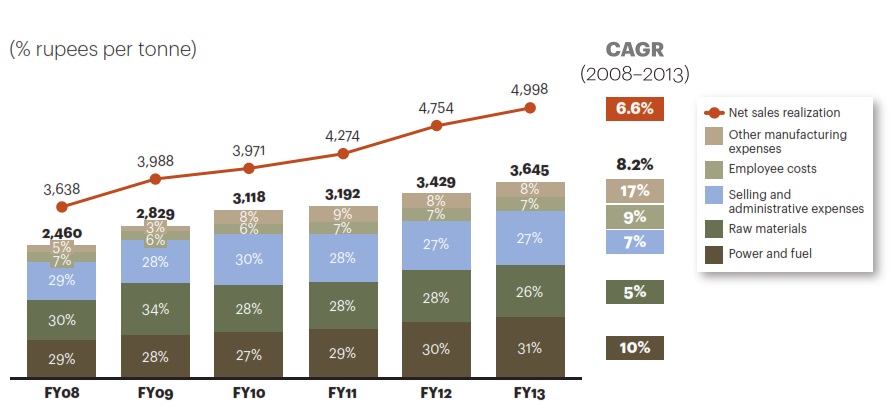
  • Cost of manufacturing cement has risen over the years, thanks to higher costs of fuel and financing, and high taxes. While the companies have been able to pass on a part of cost hike to consumers, costs are still rising faster than cement prices.

    Source: CII’s Cement Vision 2025 Report
  • Fixed costs in the cement industry are particularly high and significant relative to variable costs. Fixed costs generally account for more than 50% of the overall production costs. The fixed costs are usually sunk costs. Once built, a cement plant can serve no other purpose. As fixed costs are high with respect to the variable costs, the break-even point is high. With automation, labour costs have decreased, but energy consumption is a more significant variable cost. Thus, profits in the industry are sensitive to the level of utilisation of the production capacity. Significant cash flows are generated only when product increases beyond the break-even point, which depends on the efficiency of the plant.
  • Cement is largely a regional product – manufactured and sold in a region – as transporting it over long distances is not possible (due to the nature of the product). Transportation is a major cost element for cement companies (around 20-25% of sales), often a bigger line item than net profits.


    Source: Ramco’s and Ambuja’s Annual Reports
  • Thanks to the inability to pass on the entire cost increase to consumers, the IRR or internal rate of return for new cement plants has fallen to just around 9-10% (Source: CII).
  • Cement prices have not increased as much as production and capital costs in the past four to five years, which has taken a toll on industry profitability. The rate of technological improvements in the industry has been slowing down, with a large share of the industry already employing the best available technology in terms of material and energy efficiency.
  • While the widening gaps in operating costs and sales realization have been reducing the average EBITDA or operating profit per tonne for the industry, capital costs have been steadily rising (from an average of Rs 4,200 per tonne in 2009 to Rs 7,200 per tonne in 2013). As a result, the internal rate of return or IRR on a new green-field cement plant in India has seen a steady decline from 17% in 2008 to 9% in 2013.

5. Competition

  • Competition in the cement industry initially occurs at the local level due to high transportation costs. Competition cannot be based on price, as price cuts are easily spotted because of the nature of the product, which is undifferentiated. Competition is hence based on head-to-head market confrontation focused on price rebates and sales volume, in order to expand market share. Any substantial price cut by a competitor results in a price war. Rivalry also occurs when firms want to enhance their respective competitive advantages on the basis of improved product quality or reduced production costs.
  • High transportation costs make location an important factor in a cement company’s pricing policy. The best location combines three advantages – a) the plant is set up in a quarry with large quantities of high-quality and easily-workable limestone; b) the plant is close to large urban areas; and c) the plant is near a railway line or a road network allowing cement to be delivered to faraway places. A cement plant located inland rarely sells outside a 300 km radius and would normally sell the bulk of its production within 150-300 km.

6. Porter’s Five Forces Analysis
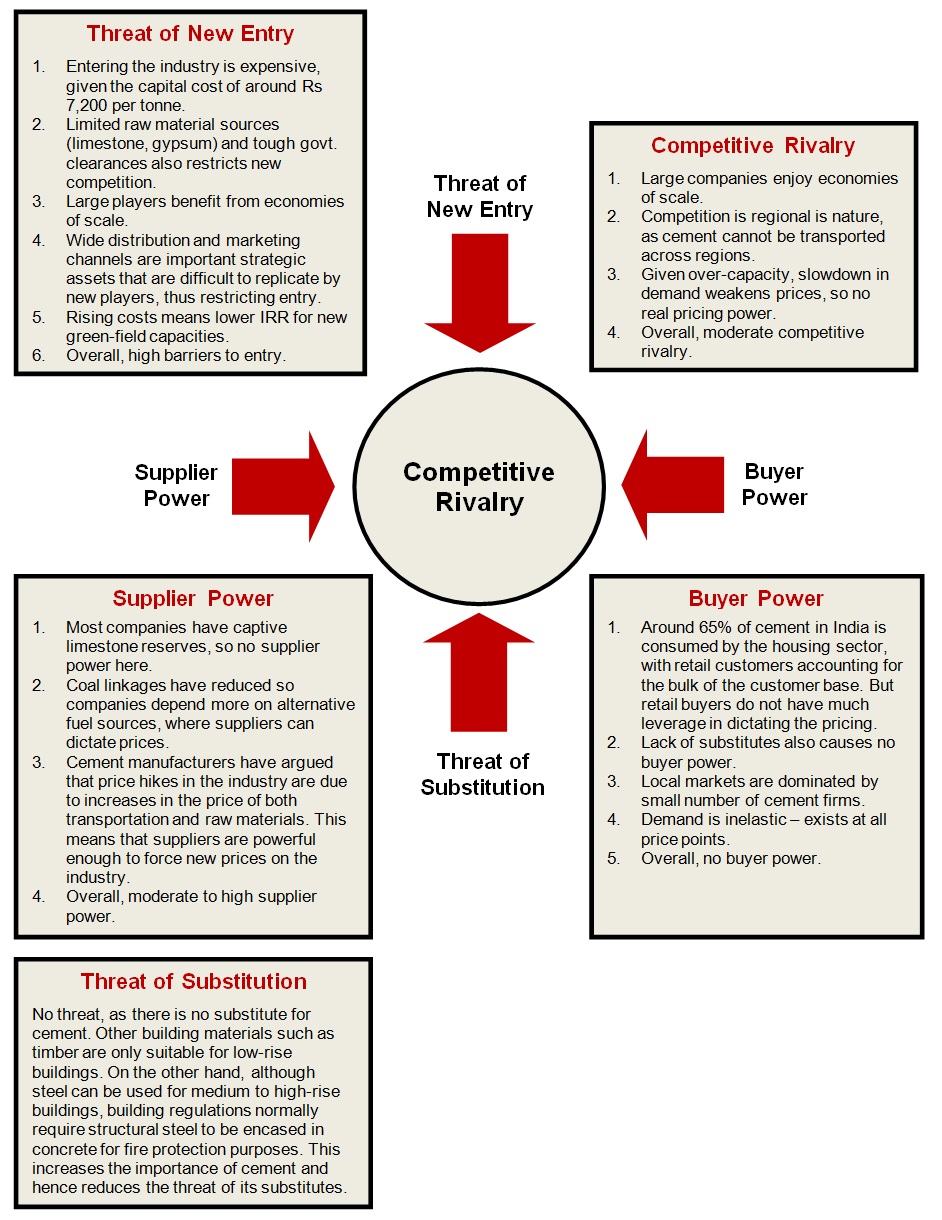
Porter’s Five Forces Analysis provides a “competitive forces” framework that allows us to better understand the different dimensions that govern competition within an industry. Porter’s five forces are –

  1. Competitive rivalry;
  2. Threat of substitutes;
  3. Bargaining power of buyers;
  4. Bargaining power of suppliers; and
  5. Barriers to entry and exit.

Let us use Porter’s framework to analyse the Indian cement industry…


The above figure depicts the five competitive forces that shape the Indian cement industry. As you can see…
  • Competitive rivalry in the industry is moderate;
  • Effect of substitutes is weak;
  • Buyer power is minimal;
  • Supplier power is high; and
  • Entry/exit barriers are high.

In essence, the horizontal supply chain has pricing power over final consumers, whereas the vertical dimension of competition (threat of new entry and threat of substitution) is lacking due to lack of the possibility of differentiated advantages in production.

Click here to read Part 2


Comments

 
21 Jun 03:22

5 Lesser-Known Must-Read Books For Entrepreneurs

by Anand

27-books-every-entrepreneur-should-readAs any entrepreneur will tell you, starting your own business is like giving birth to a child; only much more painful and demanding. Despite that, it’s an addiction that aspiring entrepreneurs just can’t let go of. There are a number of popular books available at your local bookstore that is aimed at aspiring entrepreneurs. A few of the popular ones include ‘The 4 hour work-week’, “The E-Myth Revisited”, “Rich Dad, Poor Dad”, “Think and Grow Rich” and “The Lean Startup”. While these are really good books and something that every wantrepreneur must read, they do not cover all aspects of entrepreneurship. Moreover, most of these books are from best-selling authors and celebrity entrepreneurs whose advices may not always apply to someone who only aspires to […]

The post 5 Lesser-Known Must-Read Books For Entrepreneurs appeared first on Dumb Little Man.

21 Jun 03:20

I have got excellent returns….

by subra

Many mails, smses, calls saying ‘I owe you a treat my portfolio is doing well’. Some who have not called are the ones who still have not seen their statements. So those who invested from say 2010 onwards are now in decent money and better than bank rates. I hope they can show it to their parents who did not like this product!

Let me start by saying that many of these callers / communicators may have been skeptical when I asked them to start a sip. I have been pushing SIPs as the ONLY sensible method of creating wealth in the long term especially for the kids that I am talking about. Now that they are in the money (thank you God) they are happy and many of them want to do ONE MORE SIP.

So here is a note for them.

1. The market did not go up because YOU did a SIP or because I told you it would. Market went up as a normal sequence.

2. Market will go up and down but you should continue your SIP during good times as well as bad times.

3. 80% of the readers on this blog are under the age of 30 years. So if you do invest all your life, you have another 25 years of investing.

4. If you will be a BUYER should you be rejoicing that the market is up OR feeling bad that the market is getting more EXPENSIVE? Ponder over it. There is nothing to do, but please do ponder.

5. I did not know when exactly the market would go up. Neither do I know when it will move parallel to the Y axis or when it will move parallel to the X axis. Nor its direction. HOWEVER TO MAKE MONEY YOU NEED NOT KNOW THAT.

6. You took the risk, you put in the money, YOU GOT THE RETURN, i HOPE you realize that such sensational returns which you got are not sustainable in the long run.

7. Soon as ‘n’ increases the returns will look more earthly. Just saw somebody with a 200% P.A. appreciation in one midcap fund.

8. Today it is possible to start a SIP with an amount like say Rs. 1000 and increase it by Rs. 500 every year (or 6 months!). This is much better – because the whole process is AUTOMATIC….

those who have not yet started investing, this is a good time and place to start…if in doubt ask will answer…

Post Footer automatically generated by Add Post Footer Plugin for wordpress.

20 Jun 02:57

Lots to do on labour laws

by Bibek Debroy

The Rajasthan government has proposals to amend the Industrial Disputes Act (IDA), raising the threshold for state permission to fire workers from 100 to 300. It also wants changes to the Contract Labour Act (CLA) and Factories Act. Trade unions aren’t happy. There is too much generalization on labour “laws” and the expression needs pinning down. Under Article 246 of the Constitution, the Seventh Schedule sets out a Union List, a State List and a Concurrent List. Consider Entry 55 in the Union List. This concerns “regulation of labour and safety in mines and oilfields”. Similarly, Entry 61 in the List is about “industrial disputes concerning Union employees”.


It is often said labour laws are on the Concurrent List. That’s largely true, especially if one is concerned with laws that directly concern labour. However, as the two examples given from Union List illustrate, it is actually a bit more complex. If one says that labour laws are on the Concurrent List, that’s mostly because of Entries 22, 23, 24 and 36, which cover a range of issues including unions, social welfare, provident funds and pensions on that list.


The law can be interpreted in the narrow sense of statutes, something that has been legislated by Parliament or state assemblies. For state laws, there can be two kinds of statutes for labour. First, with a basic Central statute, there can be state-level amendments. Second, there can be de novo state laws where there are no Central statutes. The Kerala Labour Laws Act of 2002 is an instance.


But the impression that labour laws are only about statutes is not correct. Statutes provide enabling framework. With that enabling framework, administrative law is framed, consisting of rules, orders and regulations. The Factories Act, 1948, is statutory. But rules under the Factories Act, 1948, are part of administrative law.


Administrative labour law can be both Central and state-level. Depending on how one counts, and whether one includes statutes that directly deal with labour or the indirect ones too, and whether one counts amending statutes separately, there are around 45 Central labour statutes.


What Do You Do?


The first extant labour statute was the Fatal Accidents Act, enacted in 1855. Over time, concepts and definitions have changed. So has the case law, contributing to further confusion. For example, there is lack of unanimity about definitions of wages, workman, employee, factory, industry, adolescent, child and even contract labour. Are special statutes really needed for cine workers, dock workers, motor transport workers, sales promotion employees, plantation labour, journalists and mine workers?


Unification and harmonization is an issue on which there should be a consensus. The report of Second National Commission, submitted in 2002, argued for such unification and harmonization of labour laws under five heads of industrial relations, wages, social security, safety and welfare and working conditions. A common perception is that labour laws apply to the organized sector, but not to the unorganized sector. This is not universally true and labour laws vary in their application. And, the services sector is generally covered by shops and establishments Acts.


Absurd Rules


State intervention is usually equated with laws on industrial relations, but this is a simplification too. There is state intervention outside industrial relations too. The Factories Act says that “the State Government may prescribe the number of latrines and urinals to be provided in any factory” and “may make rules prescribing the number of spittoons to be provided and their location in any factory”. The state government may also make rules “requiring the provision therein of suitable places for keeping clothing not worn during working hours and for the drying of wet clothing”.


The rules are worse. They provide for whitewashing of factories. Distemper won’t do. Earthen pots filled with water are required. Water coolers won’t suffice. Red-painted buckets filled with sand are required, not fire extinguishers.


There must be crèches within the factory. Making transport arrangements for accessing crèches outside the factory won’t be enough.


Let’s Talk Again


Shops and establishments Acts prescribe which day of the week must be observed as a weekly holiday and have restrictions on employing women outside what is perceived to be regular working-hours, a clause that adversely affects the efficient functioning of call-centres. Inspectors can descend under any labour laws and a system of a single inspector for all labour laws does not exist. Manual records have to be maintained, electronic records are not acceptable.


These are just as important as statutes/rules on industrial relations, such as IDA and CLA. But thanks to Rajasthan, we have got the debate going again.

18 Jun 15:16

Avoid Illiquidity

by David Merkel

There are several reasons to avoid illiquidity in investing, and some reasons to embrace it.   Let me go through both:

Embrace Illiquidity

  • You are offered a lot of extra yield for taking on a bond that you can’t easily sell, and where you are convinced that the creditor is impeccable, and there are no sneaky options that you have implicitly sold embedded in the bond to take value away from you.
  • An unusual opportunity arises to invest in a private company that looks a lot better than equivalent public companies and is trading at a bargain valuation with a sound management team.
  • You want income that will last for your lifetime, and so you take some of the money you would otherwise allocate to bonds, and buy a life annuity, giving you some protection against longevity.  (Warning: inflation and credit risks.)
  • In the past, you bought a Variable Annuity with some good-looking guarantees.  The company approaches you to buy out your annuity at a 10-20% premium, or a 20-30% premium if you roll the money into a new variable annuity with guarantees that don’t seem to offer much.  Either way, turn the insurance company down, and hold onto the existing variable annuity.
  • In all of these situations, you have to treat the money as money lost to present uses.  If there is any significant probability that you might need the money over the term of the asset, don’t buy the illiquid asset.

Avoid Illiquidity

  • Often the premium yield on an illiquid bond is too low, or the provisions take value away with some level of probability that is easy to underestimate.  Wall Street does this with structured notes.
  • Why am I the lucky one?  If you are invited to invest in a private company, be skeptical.  Do extra due diligence, because unless you bring something more than money to the table (skills, contacts), the odds increase that they are after you for your money.
  • Often the illiquid asset is more risky than one would suppose.   I am reminded of the times I was approached to buy illiquid assets as the lead researcher for a broker-dealer that I served.
  • Then again, those that owned that broker-dealer put all their assets on the line, and ended up losing it all.  They weren’t young guys with a lot of time to bounce back from the loss.  They saw the opportunity of a lifetime, and rolled the bones.  They lost.
  • We tend to underestimate how much we might need liquidity in the future.  In the mid-2000s people encumbered their future liquidity by buying houses at inflated prices, and using a lot of debt.  When everything has to go right, the odds rise that everything will not go right.
  • And yet, there are two more more reason to avoid illiquidity — commissions, and inability to know what is going on.

Commissions

Illiquid assets offer the purveyor of the assets the ability to pay a significant commission to their salesmen in order to move the product.   And by “illiquid” here, I include all financial instruments that carry a surrender charge.  Do you want to know how much the agent made selling you an insurance product?  On single-premium products, it is usually very close to the difference between the premium you paid, and the cash surrender value the next day.

Financial companies build their margins into their products, and shave off a portion of them to pay salesmen.  This not only applies to insurance products, but also mutual funds with loads, private REITs, etc.  There are many brokers masquerading as financial advisers, who do not have to act strictly in the best interests of the client.  The ability to receive a commission makes them less than neutral in advising, because they can make a lot of money selling commissioned products.  In general, it is good to avoid buying from commissioned salesmen.  Rather, do the research, and if you need such a product, try to buy it directly.

Not Knowing What Is Going On

There are some that try to turn a bug into a feature — in this case, some argue that the illiquid asset has no volatility, while its liquid equivalents are more volatile.  Private REITs are an example here: the asset gets reported at the same price period after period, giving an illusion of stability.  Public REITs bounce around, but they can be tapped for liquidity easily… brokerage commissions are low.  Some private REITs take losses and they come as a negative surprise as you find  large part of your capital missing, and your income reduced.

What I Prefer

In general, I favor liquid investments unless there is a compelling reason to go illiquid.  I have two private equity investments, both of which are doing very well, but most of my net worth is tied up in my equity investing, which has done well.  I like the ability to make changes as time goes along; there is value to being able to look forward, and adjust.

No one knows the future, but having some slack capital available to invest, like Buffett with his “elephant gun,” allows for intelligent investing when liquidity is scarce, and yet you have some.  Many wealthy people run a liquidity “barbell.”  They have a concentrated interest in one company, and balance that out by holding very safe cash equivalents.

So, in closing, avoid illiquidity, unless you don’t need the money, and the reward is very, very high for making that fixed commitment.

18 Jun 15:15

How to Manipulate the Stock Market, Legally?

by Vishal Khandelwal

Imagine you win a lottery of Rs 100 crore (just imagine!). What would you do with this “free” cash?

Spend it to buy all the luxuries of life? Maybe!

Give most of it to charity? Really?

Invest most of it in the stock market so that it grows over a period of 5-10 years? Maybe!

What about manipulating the stock market so that your Rs 100 crore doubles in the next 1 year?

“The last option looks great!” you think, and then ask, “But isn’t manipulating the stock market against law?”

Yes it is!

Goldman Sachs paid US$ 535 million (approx. Rs 3,200 crore) in 2010 for misleading investors with respect to a subprime mortgage product.

Then, again in 2010, Citigroup paid a US$ 75 million (approx Rs 450 crore) penalty for its failure to adequately disclose its exposure to subprime mortgage debt.

In India, if you have Rs 100+ crore net worth (which you just won in a lottery!), you don’t get fined much for manipulating stock market and you can enjoy living scot-free for years, as the cases against you won’t be solved for years.

Anyways, the reason I am talking about stock market manipulation today is not to teach you how to do it (I will never ever offer such a course on Safal Niveshak :-) )

The reason I am writing this is because I just read of a huge stock market manipulation that is being conducted in broad daylight these days – people know of this manipulation but no one can do anything about it!

“But who is the manipulator?” you wonder.

Global central banks, my dear friend!

As per a recent article I read on Financial Times (FT), central banks around the world, including China’s, have shifted decisively into investing in equities as low interest rates have hit their revenues.

This is based on a global study of 400 public sector financial institutions.

A report from the Official Monetary and Financial Institutions Forum (OMFIF), a central bank research and advisory group, suggests that “a cluster of central banking investors has become major players on world equity markets.”

It then warns that this trend “could potentially contribute to overheated asset prices.”

The OMFIF report also states that central banks (plus other public investors like sovereign wealth funds and pension funds) globally have already invested more than US$ 1 trillion into the stock market.

This number could go much higher given what the FT article says – that central banks around the world, including China’s, have shifted “decisively” into investing in equities as low interest rates have hit their revenues.

So, while it is illegal to manipulate stock prices and you can get yourself into a big problem if you are caught doing that, the world central bankers are doing it in broad daylight.

We can do nothing but watch the financial and monetary “circus” with one eye covered, fearing that the flying trapeze artist (central banks) may slip and hurt himself big time.

In the meanwhile, as central banks keep their interest rates low, the stock market continues to hit its all-time highs even as the source of its profits – corporate profits – struggles to find its footing.

And as Bill Bonner writes in his latest issue of Daily Reckoning

Now, with money they (central banks) create out of nowhere, they buy real companies. Otherwise, the companies might have been owned by real people….who earned real money providing real goods and services.

And so, more and more of the world’s real wealth shifts from the people who make it…to the people who take it.

Buy, Sell, or Hold Stocks?
If you ask me – “What should I do with my money now? Should I buy, sell, or hold stocks?” – the only advice I can give you is this…

Stop focusing on the stock market’s recent returns, especially because they have been rosy. This is because if you do that (focus on the recent returns), it will lead you to a quite illogical and dangerous conclusion that equally great results could be expected in the short-term future.

Finally, to reiterate the five quick rules I had shared recently…

  1. If you have been sitting on the sidelines for the past five years, and itching to surf the high tide now, don’t start at the top of the tide by investing in stocks that are on a momentum (like real estate, banking, and infra). There’s a chance that you will drown again if you start at the top of the tide!
  2. In real life, things don’t change as fast as the stock market may lead you to believe. So be careful of the kind of businesses you are looking to get into and don’t go by what the stock prices are doing. A complex economy like India won’t change in a year or two, however good the governance may be.
  3. FIIs seem to be rediscovering their love for Indian stocks following their faith in the new government. This is what their latest inflows suggest. Don’t take cues from FIIs and their stock trades. They have always been fair weather friends and may leave out of the exit doors before you can even notice and react.
  4. Remember Graham when he said that in the short run, the market is a voting machine but in the long run it is a weighing machine. So avoid investing in stocks like you vote (emotionally). Instead, invest only after weighing the quality of businesses you intend to invest in.
  5. If you own good quality stocks and want to book profits after last few months’ rally or today’s, don’t! Think in terms of the wealth these can help you create over the next 15-20 years, instead of short term profits you have earned from them in recent times. In fact, if you are young, you have to have a high allocation to equities, and for the next 15-20 years.

In short, don’t get fooled by the stock market manipulation that is being conducted by central banks worldwide.

Focus on the long term (that’s where you want to go), and please play it safe!


Value Investing Workshop in Hyderabad: After a great response from Mumbai and Delhi, I have my Art of Investing Workshop in Hyderabad on 20th July (Sunday). If you want to attend and want to claim an early-bird discount, click here to register now!
18 Jun 15:12

Speculating and hoarding are good, make them legal

by Bibek Debroy

Speculator, hoarder, black marketeer – these expressions are freely bandied around, more recently, in the context of food inflation. It is very tempting to blame them and assume that legislation and control will solve the problem. When is there a black market? Typically, when there is a shortage and administered prices that are unrealistic. With a shortage, prices rise to offset demand against supply. If price rises are controlled and products are rationed, there will naturally be a black market. For food products, especially food-grains, there is a controlled market and there is an open market. I am not sure that leakage from the former to the latter should be called black marketeering. Think of the black market or hawala market in foreign exchange. With easing of controls, that’s by and large gone. But then, we have the hallowed tradition of the Essential Commodities Act.


That became law in 1955, but was originally promulgated under the Defence of India Rules of 1939, during a period of shortages. Let me give you some quotes from successive amendments to ECA of 1955. In 1964, “There has been widespread public criticism of the manner in which some sections of the trade and middlemen were able to get round, and render ineffective, the legal and administrative measures devised for the maintenance of supplies essential to the community.” In 1974, “The hoarders, black-marketeers are playing hell with the lives of millions of people in the country by violating the provisions of the Essential Commodities Act, 1955.” In 1981, “In spite of extensive amendments made to the principal Act in 1976, experience has shown that some of the existing provisions of that Act have not been adequate…for curbing, hoarding and black-marketing of and profiteering in, such commodities.” We also had the Essential Commodities (Special Provisions) Act of 1981, to tighten action further. That didn’t help, it only harassed traders.


Think about it. Who is a speculator? Any person or entity who takes a position on the basis of an assumption about the price of a product or an asset going up or going down. Many of us are speculators, in real estate and capital markets. When we do it, there are no negative connotations associated with the term. But the moment it is an agro product, as consumers, we promptly bring in negative connotations. Similarly, a hoarder is anyone who stores things. In the days of foreign exchange shortages, when we stored up unused foreign exchange, we were hoarders. When we buy rice and wheat in bulk, we are hoarders too. I may be driving the point too hard. But for agro products, speculators and hoarders perform a useful function. Most agro products are associated with seasonal excess supply. Had speculators and hoarders not existed, there would have been a sharp drop in prices. And in periods of excess demand, prices would have shot up. Speculators and hoarders perform that useful function of smoothening price volatility. The way I see it, the problem isn’t with speculating and hoarding. There are three kinds of problems. First, many agro products (other than food-grains) are perishables. Instead of onions, we don’t have mechanisms for converting those onions into onion paste. Had it been possible to store onions in the form of paste, smoothing price volatility would have been easier. Second, there are entry barriers into that business of speculating and hoarding. There are too few players and they can function as cartels, compounded by restrictions on selling products through regulated markets. Traders, especially of the wholesale kind do gain at the expense of farmers and consumers, but that’s because of the entry barriers. Third, given the terrible state of data, there is asymmetry of information. Therefore, those traders get to know about price movements far before even the government does.


This entire business reminds me of money-lending. Have we been able to drive money-lending out? No. Indeed, microfinance and NBFCs are an attempt to recognize and legitimize money-lending. Far better to actually make money-lending legal. In a similar way, let’s not have statements about speculating and hoarding being bad. They are good. Let’s encourage the business and make it legal and organized. That will ensure better price intermediation.

18 Jun 15:11

Reliance Jio 4G Plans Delayed to 2015; Plans Include Android Set Top Box; Jio Drive; Mi-Fi & More

by Jayadevan P K

Update (June 18th, 2014) : Reliance Jio launch timeline has been moved to June 2015.

Mukesh Ambani’s Reliance Jio Infocomm on Monday gave us all a little tease of what is to come with its 4G services at Techfest, an anual science & technology festival held at the IIT-Bombay. The service will be 10-12x faster than 3G networks.

Here’s what Reliance, the only company which holds a pan India 4G license, showed off

1. Jio Television: Set-top box running on Android. The service will have live television (Jio Play) and Video on Demand (Jio World).
2. Jio Drive: 100 GB free storage to subscribers
3. Mi-Fi: The company’s customer premise equipment will connect to a Reliance operated mobile tower and provide local wi-fi network.

NextBigWhat has learned that Reliance Jio 4G plans also include the launch of a suite of services including

1. Music Streaming
2. Video Calling & VoIP services
3. Instant Messenger
4. Payment Services: Reliance Jio already has obtained a license to operate prepaid wallets for mobile transactions (this need not necessarily be linked to the 4G launch).

Reliance is also launching its own mobile apps to enable many of these services. According to Reliance, the 4G infrastructure will also support its portfolio of multi-media digital services in education, health-care, entertainment, payment and cloud services.

With these launches, Reliance will not only be making its much anticipated entry to 4G mobile services, it is also likely to corner a large share of the media & entertainment market in India. The idea is to capture the living room of the consumer which is otherwise the undisputed territory of cable television.

Pan India 4G services on the Reliance network could also give a leg-up to the digital economy in India. While the launch dates for the company’s big foray into 4G hasn’t been announced, it could be as early as the first half of this year.

Other telecom operators like Airtel & Aircel have already launched 4G services in some circles. But the Reliance Jio 4G service is expected to be on a much larger scale. Airtel was the first to launch 4G LTE service in India. It has 4G services in Bangalore, Kolkata, Pune and Chandigarh.

The post Reliance Jio 4G Plans Delayed to 2015; Plans Include Android Set Top Box; Jio Drive; Mi-Fi & More appeared first on NextBigWhat.

18 Jun 15:10

How to borrow $10 million against forged shares

James Altucher narrates a fascinating story about how a guy claiming to be related to Middle Eastern royalty almost succeeded in borrowing $10 million from a fund manager against forged shares representing $25 million of restricted stock of a private internet company (h/t Bruce Schneier).

To me the red flag in the story was that the borrower agreed without a murmur to the outrageous terms that the fund manager asked for:

  • 15% interest, paid quarterly
  • the full loan is due back in two years
  • $600,000 fee paid up front.
  • 25% of all the upside on the full $25 million in shares for the next ten years

Assuming that the loan is for all practical purposes without recourse to any other assets of the borrower because of the uncertainties of local law, all this can be valued using call and put options on the stock. The upside clause is just 25% of an at-the-money call option on the stock. The default loss is just the value of a put with a strike of $10 million. To discount the interest payments, we need the risk neutral probability of default which I conservatively estimate as the probability of exercise of the two year put option (In fact, the interest is paid quarterly and some interest payments will be received even if the loan ultimately defaults).

For simplicity, I assume the risk free rate to be zero which is realistic for the first two years, but probably undervalues the ten year call. To add to the conservatism, I assume that the volatility of the stock is 100% for the first two years (life of the loan) and drops sharply to 30% for the remaining life of the ten year period of the call option. Taking the square root of the weighted average variance gives the volatility of the call option to be 52%. Since it is an internet stock, one can safely assume that the dividends are zero.

Under these assumptions, the fund manager expects to lose $3 million (put option value) out of the $10 million loan, but expects to make $3.7 million on the call, $1.4 million in interest and $0.6 million upfront fee. That is a net gain of $2.7 million or 27%. If the short term volatility is reduced to 50%, the default loss drops to less than $0.5 million and the net gain rises to 52%. Even if the short term volatility is raised to 160% (without raising the long term volatility), the deal still breaks even.

If a deal looks too good to be true, it usually is. The fund manager should have got suspicious right there.

As an aside, forged shares were a big menace in India in the 1990s, but we have solved that problem by dematerialization. (It is standard while lending against shares in India to ask for the shares to be dematerialized before being pledged.) The Altucher story suggests that the US still has the forged share problem.

18 Jun 15:09

Turn Raj Bhawans into heritage museums or resorts

by Rajesh Ramachandran

Every nation state rightly spends a lot on pomp and show, to celebrate itself and to showcase its identity. So, the tanks and tableaux rolling down the Rajpath on January 26 is a hair-raising experience for every believer of the idea of India. But should the Indian State spend hundreds of crores of Rupees just to subsidise the geriatric fantasies of manipulative have-beens who have wormed their way into the Raj Bhawans in state capitals, merely to let them hoist the national flag on January 26?

The office of the governor should have been abolished five years ago when a governor was caught on camera with three women all over him satiating the 83-year-old sex addict’s sick mind. That was the right moment to strike at the roots of the gubernatorial humbug. Then, the UPA government itself was struck by a strange kind of paralysis, stopping it from governing, let alone do radical overhauling.

Narendra Modi sought a mandate for “less government and more governance”. He has the mandate now to cut the rotten flab and the make the State young, energetic and functional. Instead, the NDA government is going down the slimy path of political shenanigans.

Despite a Supreme Court order restraining the Union government from removing governors without reason, the Modi government is said to have asked the governors to move out of their plush old age homes. Something similar to what the Congress-led government had done in 2004. But, for what?

Of course, to accommodate NDA’s unemployable leaders well past their sell by date.

Politics, like every other enterprise, accumulate a lot of people not really needed to run it. However much the power-hungry politicians disagree, ageing and death are the only two certainties in life, even for politicians. So, like all other organisations, our political parties also do retirement planning. The post of governors in state capitals is, thus, a convenient retirement sinecure for unemployable (and often cantankerous) politicians, who need to feel important.


Our contemporary history is full of instances of high-handed governors, appointed by a strong Union government, turning against popular leaders in the state. Congressman Ram Lal has occupied a notorious space in the footnotes of history by deposing the elected government of NT Rama Rao and installing Nadendla Bhaskar Rao as chief minister of Andhra Pradesh for 31 days in August-September 1984.

That was the beginning of the end of Union government meddling with elected governments of the Opposition. Sure, in 1997, Romesh Bhandari too tried to ease Kalyan Singh out of the government and install Jagdambika Pal as chief minister. But the court’s intervention, intense media scrutiny and the political legitimacy of the Opposition gradually clipped the wings of political vultures in Raj Bhawans. During the Kalyan Singh crisis in Lucknow, Atal Behari Vajpayee, then Prime Ministerial candidate of BJP had announced a fast-unto-death.

Till 1967, when most of the country was ruled by Congress, the governor, usually an import from Delhi, acted as a parallel power centre used to rein in the more popular local leader. Now, with the rise in regional forces, no governor can afford to be a power centre and destroy the federal structure and independence of elected state governments.

Fortunately, the colonial-era Raj Bhawans now have only ceremonial functions. After a state assembly election, the governor receives the letter of the leader staking claim to form the government. In times of political crisis, the Raj Bhawan becomes a venue to parade political horses recently bought and sold. But in such crises too the governor’s role is limited to ordering a floor test of the relative strength of parties in the assembly, which is actually done by the Speaker.

Most of these functions can be done by the Chief Justice of the High Court of the respective states, who in any case swears in the governor. The Speaker can read out the “governor’s address to the assembly”, which is the elected government’s declaration of its intent and is totally unconnected to the office of the governor, who is often a political opponent.

So, the best course of action for the Modi government is to do away with the post of governors, declare those beautiful old Raj Bhawans as heritage museums or resorts and save a lot of money in terms of salaries, perks and “entertainment” expenses of doddering sex addicts who can do nothing worthwhile in office.

And let a really worthy, venerated, senior citizen, a teacher, a technocrat, a poet, a philosopher hoist the national flag in state capitals on January 26.

18 Jun 02:55

Keeping track of your investments

by subra

When you make a fixed deposit, you have already made your first investment. So when you make a fixed deposit, open a recurring deposit, open a PPF account, buy a ULIP, do a SIP in a mutual fund, YOU HAVE A PORTFOLIO!

NOW that you have a portfolio it is necessary to make a list of those investments and keep track of all that in ONE PLACE. Sure, you can keep track if you enter all this in www.valueresearchonline.com, yahoo finance, moneycontrol, Myiris, …there are a lot of choices – ALL FREE.

You could even keep it in excel if you do not trust these websites.

Surely there would be paid options where you can enter all the details of your portfolio – it will keep track of your dividends, interest, capital gains, tracks your expenses, and creates all the documents necessary to file your return.

Why do we need to do this? To know exactly what %age of your money is in which asset class, when you need money what is the sequence of assets to sell, how efficient is your investing, of course filing your IT return, etc. etc.

It is also important that your spouse knows about what you have done (or doing) so that if you drop dead (NOW!!) she will know how to take things forward. Of course it is difficult to be very accurate, but dammit make a start, NOW.

Post Footer automatically generated by Add Post Footer Plugin for wordpress.

18 Jun 02:54

How Airlines price their tickets

by Kirti

30-70% discount on airplane tickets. Reading about it, Raj Shah went online to book tickets for a trip to Delhi in month of August. But before he could decide which date to book ticket for, low cost tickets were shown as unavailable. He was disappointed as he was not  unable to get tickets at low prices. Do people really get such tickets, he asked me? Are these discount fares genuine?  Airlines do not offer all tickets at same price. They offer different types of tickets at different prices,called as  bucket pricing. Tickets priced higher are available in greater numbers while number of cheapest tickets is the least. This article talks about the how airlines price their tickets and why. Some Guidelines to get tickets at less price.

Pricing of AirLine Tickets

Airline ticket pricing is based on demand supply dynamics. An airline is always trying to get maximum value for its seats, but it has to try to sell them all before departure or they will become worthless forever. Just like a grocery store that puts stuff on sale to get food out the door before it spoils, an airline will sell tickets but not at one price but at a range of prices all this to run the airlines efficiently , technically called to have a high load factor. It kinds of  put fares in different buckets as shown in image below, hence called as bucket pricing. Passenger load factor, or load factor, measures the capacity utilization of public transport services like airlines, passenger railways, and intercity bus services. Load Factor is generally used to assess how efficiently a transport provider fills seats and generates fare revenue. It is passenger-kilometres flown as a percentage of seat-kilometres available. From EconomicTimes Busting discounted airfares myth: Do airlines really slash ticket prices?

How airlines prices its tickets bucket pricing

How airlines prices its tickets bucket pricing

In an ideal scenario, It would be easy for an airline to decide the fares for a flight that consistently shows a 60% load factor. So it would slash fares for more seats to attract passengers. However, unlike a grocery store, the airlines prices seem to go UP as the departure time approaches . Why does this happen?

Imagine that the airline knows in advance roughly how many tickets it will be able to sell at each price. If a plane holds 100 people, it may determine it can sell 105 tickets (assuming 5 no-shows) and it will assign the sale prices in advance. If there are 5 fare buckets, each bucket gets a certain number of available tickets, just like the grocery store assigning each apple a different price based on projected sales and putting them in different buckets. But there is a difference between selling an apple and selling airline ticket.  Unlike an apple, which really does start to decrease in quality every minute it sits on the shelf, the ticket will get you there whether you buy one month in advance or one day.When you go to buy a ticket or an apple, you’re very likely to buy the cheapest one, and as those cheaper tickets or apples disappear, you’re left with more expensive options. If you could get that same ticket at the last minute for half price, everyone would wait and there’d be a mad dash at the counter on the day of departure.

In the airline industry, there are two types of passengers: business travellers and leisure passengers. Business travellers are flexible on price, the company is paying, but not on dates. Leisure travellers aren’t flexible on price (the cheaper the better) but are on dates.  The airline knows that as the departure date gets closer, business travellers who are still buying tickets really need to get where they’re going on time. People who buy far in advance are typically leisure travellers who just pick whatever’s cheapest. A Delhi-Mumbai flight ticket that normally costs Rs 6,000-8,000 could go up to nearly Rs 15,000 if the purchase was delayed until the eleventh hour. So airlines come up with various algorithms on how many tickets it will sell at what price and it comes out with different prices over the day.

Airline revenue and inventory management algorithms are actually complex and vary across airlines. Prices go up and down for many reasons. No one can really predict when or if a price is going to go up or down. Only the airline knows that. But there are four things that drive prices:competition, supply, demand, and oil prices.  Airlines want to fill their planes and maximize profits. They do this by calculating a plane’s load factor. Essentially, this is the percentage of seats sold on a flight. They want this number to be as high as possible. Airlines tend to manage their load factor by constantly changing the price of tickets to fill the plane and get maximum revenue. Airlines are constantly trying to strike a balance between these business travellers and leisure passengers so they can make a profit. Why fly a plane full of cheap fares when you can get people to pay more? Airlines know that a certain number of people will book far in advance if they can find a decent price. Airlines also know that they need to hold a certain number of seats for business travellers who will book last-minute and pay more. Ticket prices jump up and down based on the demand for seats on a plane from these two types of passengers. To maximize their profit, airlines developed sophisticated computer systems that constantly compare booking trends to past sales history. If tickets are selling faster than in the past, the price rises. If a competitor raises fares, the airline will probably raise theirs too. Due to competition, airlines don’t  disclose the number of discounted seats.

In India, Routes where load factors are likely to be lower comprise mid-day flights on metro routes and flights during July to September, which is a lean season for airlines.

State of Indian Aviation and Why Airlines launch sales

India has around 61 million domestic fliers. Over the last seven years airlines are estimated to have lost $22 every time a passenger has stepped on board. That’s added up to a $10 billion loss in a market where the number of domestic travellers are expected to triple  to 159 million by 2021.   Jet Airways (India) Ltd. and SpiceJet Ltd. have posted annual losses, while Kingfisher Airlines Ltd, saddled with $1.4 billion of debt, has been grounded since 2012. India is one of the most expensive aviation markets to operate in the world. State taxes of as much as 30 percent make jet fuel, which contributes to about half an airline’s costs, the costliest in the region. Our article Base fare, UDF,Passenger Fees and Fuel Surcharge: Fees and charges of Airlines talks about how airline tickets are priced. The challenge is how to make money while fares continue to drop even as costs increase. AirAsia’s entry heightens competition in India. Market share of airlines in Indian in Dec 2013 is given in image below

Market share of airlines in India

Market share of airlines in India

Why do airlines launch sales? At the heart of all these actions is the desire to maximize yields, the money a flight makes.Flying empty seats increases losses but even if the load factor (a measure of occupancy) is high, a flight would make losses if ticket prices are low. There are mainly two gains for airlines from a sale they get to increase cash flows and bring in indecisive passengers.Therefore stimulating early demand to fill seats that would otherwise fly empty is a win-win for all concerned. Early birds do land good deals but most of people are disappointed. EconomicTimes research found that even the lowest fares were lower by only 15-25% than average fares on most sectors, contrary to the perception created by the airline marketing campaigns. From Economic Times Busting discounted airfares myth: Do airlines really slash ticket prices?

Airline tickets price before and during sale

Airline tickets price before and during sale

Guidelines to get Cheap Airline fare

One doesn’t have to wait for a sale to bag great fares.

Aditya Ghosh, president of IndiGo  said in an  interview that his airline has a simple pricing policy, book early and you get a low fare but as the plane fills up, fares will rise. “When my mother asks me how she will get a cheap fare or 60,000 passengers ask me the same question, it is the same story.” An economist, Makoto Watanabe, came up with the eight-week rule, calculating that the optimum time to buy an airline ticket is eight weeks before flying.

Experts also say buyers save a bundle if tickets are purchased midweek because Friday, the weekends and Monday inevitably see a rush. An airline is almost certain of a packed plane on a Monday 8 am flight. So it can afford to be miserly with discounts. But on a Tuesday, for the same flight, it has to reduce fares.

Related articles :

When do you book your Air place tickets? Have you managed to get tickets at low price? How often have you got your airline tickets at low price?Is there a trick to get ticket at low price. How do you compare the prices of airline tickets? Which travel website do you use and why?

17 Jun 14:48

Real estate and price Anchoring

by subra

‘Anchoring’ is a problem with which many of us have to live. We get into some belief and REFUSE to give it up EVEN in the face of tons of data to the contrary.

Suppose you had bought Bharti Airtel a few weeks ago at 370, YOU BELIEVE that the price of Airtel is 370 and the market is crazy to beat it down to Rs. 340.

HOWEVER YOU REALIZE THAT IF YOU HAVE TO BUY OR SELL TODAY, the price is Rs. 340.

Now take the case of this friend who has bought a decent size house in Gurgaon. He has bought it for Rs. 2.4 crores – out of which about Rs. 1.5 cr is a loan from Hdfc.

He had given it on rent, but the rent yields there were (are) quite abysmal, especially in the higher size segment. He has been able to keep the house on rent for just 6-9 months every year. This has dramatically reduced his IRR considering that the building maintenance costs are high and BORNE by the owner. He had ‘heard’ that the price of the flat had gone to about Rs. 3.2 crores and was happy (though he is far from making money if one considers the brokerage, the interiors expenses, the transfer charges to the building, etc.) but at least it was a feel good factor.

However, when he went to a broker, the broker told him ‘Sir you will get about Rs. 2.5 cr’. This sent him in a tizzy and he is yet to wake up. The problem is he is now willing to sell ONLY AT Rs. 3.3 cr. BECAUSE HE HEARD 3.2!!

This problem is called anchoring. He does not have a tenant, and he is refusing to drop the rentals (which the broker is insisting -saying Sir you will get a higher rent!!). Meanwhile the EMI is a tremendous pressure – with the missing rent cheques. His wife wants to give up her job – and he feels that it is an inappropriate time to do so.

So last time I met him he sent me his Valueresearchonline.com for me to tell him which mutual funds to sell so that he could reduce the size of the home loan. That would make his portfolio MORE CONCENTRATED on RE.

And there is nothing that I can do to help him.

Post Footer automatically generated by Add Post Footer Plugin for wordpress.