Shared posts

11 Aug 03:32

Fighting inflation: the RBI and the Fed

by T T Ram Mohan
The RBI and the Fed both enjoy a degree of independence or autonomy as central banks. At the moment, however, the two central banks seem to want to use their independence in quite different ways. The RBI would like to focus on inflation- it would like to bring the inflation rate down to 8% by January 2015 and 6% a year later. The finance ministry would like the RBI to give a little more weight to growth than the above policy would suggest. The RBI's present course run the risk of a collision with the finance ministry, as this report warns.

In the US, the situation today is rather different. The US Fed is taking a quite different approach at the moment. It would like to stick to its broad mandate of addressing both price stability and growth. However, the US Congress would like a sharper focus on price stability, as this article by Martin Feldstein points out. The US Fed is independent of the executive but not completely independent of Congress. The Congress is now pushing legislation that would commit the Fed to a monetary policy rule, namely, the well known Taylor rule. The Fed is resistant to such a rule for obvious reasons. Given an inflation target of 2 per cent, the Taylor rule would determine the fed funds rate which would end up much higher than today's rate:
It (the Taylor rule) states that the federal funds rate should be two per cent plus the current inflation rate plus one-half of the difference between current and target inflation and one-half of the percentage difference between current and full-employment gross domestic product (GDP). ....f the GDP gap is four per cent, as a recent Congressional Budget Office estimate implied, the Taylor rule would indicate an optimal federal funds rate of about 1.25 per cent (2 + 1.5 - 0.25 - 2), compared to the current rate of only 0.1 per cent.
While the federal funds rate may be heading to one per cent over the next 12 or 18 months, by then the narrowing GDP gap will imply an even higher Taylor-rule interest rate. And, complicating things further, given United States banks' vast holdings of excess reserves as a result of the Fed's bond-buying policies (quantitative easing), the federal funds rate is no longer the key policy rate that it once was. Instead, the Fed will be focusing on the interest rate on excess reserves.
Western central banks tend to be more hawkish on inflation than those in developing countries. Today, it would seem that the roles are getting reversed where the US and India are concerned.The US is willing to trade-off a little inflation with growth but not the RBI at the present level of inflation in India.

11 Aug 03:31

When I Had Plenty of Money, But Not Much Wealth

by Vishal Khandelwal

Most of what we think we know about people with a lot of money – the enviable lifestyle of the rich and famous – comes from television, movies and novels. A lot of it is inaccurate.

Apart from the happiness that is showcased, financially well-to-do people have their own set of concerns – uncertainty over their relationships, anxiety about their children, fear of isolation and, of course, fear of losing their financial wealth.

In fact, I have known plenty of such “poor rich” people over the last few years, who have lots of money and assets…but not much else.

They are financially wealthy but emotionally, physically, spiritually, mentally and even socially, bankrupt.

Imagine your own life. If you own one big house (or even five) but you live in an unhealthy, stressed, over-worked, sleep-deprived, over-medicated body that’s going to die twenty or thirty years too soon (as many do), are you really wealthy?

So maybe health equals wealth.

Or if you’re a millionaire but you live in an unhealthy marriage with a spouse you haven’t spoken (heartily) to for a year and kids who never see you invest time into their lives, are you really rich or do you just have lots of money?

So maybe time equals wealth.

Of course the answer is completely dependent on the criteria by which we personally evaluate wealth and therefore the answer will be different for all of us.

For the Love of Money
At the start of the last year of my job as a stock market analyst in 2010, my annual salary was Rs 2,200,000 (read again, and please calm down your “how-could-you-leave-this-job” feeling).

Compare this with my starting annual wage of Rs 144,000 in 2003 (I still remember my “but-I-am-an-MBA” feeling), and you know how your financial wealth can compound in a stock market job (my CAGR was 48%).

Anyways, I was 32 years old then, owned a house and a car of my own, and had no debts to repay – so overall, financially well-off.

But then, I wanted more money for exactly the same reason an alcoholic needs another drink – I was addicted. So, while a Rs 30,000 annual raise in 2004 thrilled me, I was disappointed in 2010 at receiving just a Rs 300,000 annual hike.


It was at a casual coffee meeting (sometime in 2010) with a financially well-off friend who worked as a relationship manager at a foreign bank that I realized the limitations of unlimited wealth.

“Why are you recommending this XYZ stock to your clients? It’s a dud business!” I told him after he showed me the latest research report his bank’s equity team had prepared.

He replied, “Boss, I don’t have the capacity to think about my clients. All I’m concerned with is how this benefits my company.”

“But what will you and your company lose if you don’t recommend such stocks to people?” I asked.

“A chance to make a lot of new money!” pat came his reply.

I felt as if that statement was a punch in my gut. “This man was afraid of losing money,” I asked myself, “…despite all that he had?”

This friend of mine was already going through a bad relationship with his wife and kids, carried an unhealthy body, and had gone alcoholic (it was maybe my 10th meeting with him to talk him back into a good life). But even this ended on a not-so-good note.

Thankfully for me, despite my little addiction for more money, I had a good equation with my wife and kids, kept okay (not great) health, and never touched alcohol (or any such killer addiction).

So this 10th meeting with my friend gave me a great perspective on how to look at financial wealth and its equation with things that were not material (esp. health and relationships).

And, as they say, the rest is history.

The Cost of Chasing Money
In chasing financial wealth, the cost people pay is, well, their own self. They seem to become their business, their titles, their money, their assets, and their achievements.

Their unquenchable quest for money and perceived status more often than not creates an abysmal situation in their lives.

What they do and what they earn and own becomes “who they are”. And as long as their identity is completely tied into their financial wealth, they will always be insecure and miserable because all that wealth is temporary.

Through all the senseless pursuit of money, relationships begin to suffer. Too much time is spent on working harder and harder to earn more. The loved ones are compensated with material possessions instead of quality time, nurture and tough love.

Yes, a big bank account can go hand in hand with these “other types” of wealth but so often, it doesn’t.

Maybe some of us need to change that criteria.

Luckily, I changed it with a cup of coffee in 2010. And now, I am wealthier…truly wealthier.

11 Aug 03:29

Equity Returns or Real Estate Returns?

by subra

How many of you have grudged your friends who say “My father had bought a flat in Santacruz for Rs. 200,000 in 1977, now it is worth Rs. 30,000,000” – surely you felt pangs of jealousy did you not?

Did you think – if I had this I could have retired instead of suffering this boss? You bet!

Did you know that unfortunately you cannot set the clock back? Which means even though this information about a flat in Santacruz is accurate, it is completely (well almost) useless information!

And since you cannot cry over spilt milk, let us at least cry over Vodka or Champagne.

Instead of buying a flat in Santacruz if your friend’s father had invested this amount in equity shares of Wipro it would have been worth, hold your breath Rs. 8100 crores (apart from the dividends that you consumed for your lavish lifestyle).

I am not sure about prices in Santacruz, but surely for Rs. 8100 crores (now tax free, viola!) you could have bought a sizeable chunk of Santacruz – or so I think!

And Wipro is not alone. Bajaj Auto, Hindustan Lever (Oh yes inspite of not participating in the ’02 to ’07 boom), Reliance, Cipla, Nestle, Ranbaxy….would have all done that.

If you had done a SIP in the equity index (sensex assuming you could buy from 1977) on a dividend consumed basis your returns should be in excess of 20% per annum. Not bad even considering that during some of those years inflation was at 12-15% p.a. It is still far ahead of Santacruz. Approximately 2 times as much.

Lesson number 1: Do not cry

Lesson number 2: If you insist on crying, cry for Champagne not milk.

MOST IMPORTANT LESSON:

You cannot set the clock back for sure. Start NOW. Start saving in a good equity fund. If you cannot choose a good fund, do a SIP in the Sensex. The last time I saw Templeton had one of the cheapest Index funds (buzz me I will give you my Arn code, if you want). It is equity (business) that gives better returns than gold or real estate.

Ask yourself the following questions:

- did I have Rs. 10,000 to invest in 1980 (ok ask your Dad or Grand dad as the case maybe)
– would have I had the patience to hold it on for 34 years?
- would I have been happy with my money DOUBLING in 3 years and sold it off for Rs. 20,000?
- would I have sold it off at Rs. 50 lakhs thinking ‘It cannot go up further’ and then put that amount in a tax saving bond?
- would I have sold it partially to invest in Silverline? Worse than that would I have sold everything and invest that in Silverline or Crest Animation?

It is not easy to make money in the share market if you are too intelligent by half. It rips you apart.

Never said Equities is easy, but I can assure you, it has created wealth.

Post Footer automatically generated by Add Post Footer Plugin for wordpress.

10 Aug 04:37

Mutual Funds : Why Indians don’t invest

by Kirti

According to a survey of around 2,600 people in India by Nielsen, only nine per cent were found to have invested in mutual funds. I explored this topic in detail in my article Why Mutual Funds in India are not popular. I then thought let’s find out what other people who are in this field think about it. And I contacted some of whom I have interacted over on twitter or over mails and most of them agreed. We are thankful to them for taking out time from their busy schedule and penning their thoughts for. So read to find out why Monika Halan(editor of MintMoney of Livemint), Manoj Nagpal (Financial Services Professional), InvestMutual (Offer financial advisory services), FundsIndia (platform for investing in Mutual Funds in India) , M. Pattabiraman aka pattu (a professor at IIT-Madras who runs freefincal.com), Paresh from Saving-Ideas.com, BikramJit Singh (a Government doctor and from tradethetechnicals.com)

Monika Halan

Monika Halan (@monikahalan) Edits  Mint Money, the money&markets pages of Mint. Work on financial literacy and retail facing regulation

Mutual funds are very popular with the people who understand them. If you don’t educate the people on the benefit of a vaccination, who will line up to get a jab? It is not the job of the government to do this. Those running the business need to do the work to get people to correctly understand what mutual funds are and what works for each person. Having said that, the dice in India is loaded against the mutual fund industry since there are competing products offered by entities who function under very different regulatory regimes. Add to this the fact that investment rules mandate a purchase of government bonds by these competing products and the sort of tax breaks and looser regulatory environment seen in the life insurance and banking sectors is explained. But if funds are able to gather over Rs 22 trillion of equity funds, it proves that they can do business in very tough circumstances. Once the regulatory arbitrage is over, as it will be, we can expect funds to actually reach the people who need the product.

Manoj Nagpal

Manoj Nagpal (@NagpalManoj) is Financial Services Professional. He  is chief executive officer, Outlook Asia Capital, a consulting and wealth management firm.

Last year has been a year of introspection in the Indian MF industry. There are two reasons for this introspection. One the MF industry has always been seen as an industry of great potential given the long term performance track record, strong regulation, transparency and an ever burgeoning Indian middle class with a high savings rate. Secondly and most importantly, after a long time the MF industry saw a friendly regulator in SEBI who was willing to go the extra mile in removing the obstacles in the growth of the industry. The regulator prodded the industry into this self introspection almost forcing the industry to put their thinking caps on and come with the key challenges that the industry faces and the changes that the industry needs so as to become a preferred long term investment vehicle rather than its current form of being a short term investment vehicle that provides investment solutions primarily to institutions and HNIs based on tax arbitrage. It was high time that the MF industry finally realizes it potential, the regulator said.

This was an opportunity that the MF industry could not let go by and got to work on it seriously. The MF industry head honchos got into a room and brainstormed for hours on why Mutual Funds are not popular in India and came up with the below 5 point list:

(i) Government: Absence of level playing field/parity in terms of tax benefits, Direct Tax Code – Equitable Tax Treatment to Mutual Funds, Restrictive Investment Guidelines of major institutional investors, financial inclusion

(ii) Regulator: Reviewing structural issues like entry norms, obligations, protection of investors’ interest, etc.

(iii) Industry: Lack of appropriate products for attracting long term savings

(iv) Investor: Lack of awareness of the need to save for long term and tendency to procrastinate, insufficient incentives to save privately for the long term, limited stamina for long term savings, lack of education making them prone to mis-selling

(v) Distribution: Developing alternative distribution channels, distributors’ regulation, etc. SEBI has taken up this seriously and in a series of steps implemented regulations and proposals to solve the issues highlighted in this list by the mutual fund industry.

Now comes the key question – Will this change the investor investing preferences and make mutual fund the preferred vehicle. Is this the list that will be the panacea for the mutual fund industry.

The first time I had read this list what struck me was the effacing inconspicuous focus on the industry and the patronizing nature. To start with the assumption that the investor does not know what is good for him in the long term, clearly itself points to the fact that either this will be a long term process of changing investor habits and consequently the impact of the changes will be marginal or at best incremental in the short term. And the industry will need to invest in each of these steps with a five to ten year focus to see these steps translate into changes in investment habits of individuals.

There is another ludicrous thinking process that the basic assumption, of the investor not knowing what is good for him, being wrong. This camp thinks that the investor knows both his short and long term goals but he doesn’t find the mutual fund industry giving him solutions that have that certainty that will help him achieve his goals. I unfortunately fall into this second camp.

FundsIndia

FundsIndia.com is India’s first online platform created in 2008 specifically for mutual fund investing. 

The answer to the question of why mutual funds are not popular in India is often framed in the context of cultural attitudes – that Indians are risk averse, they don’t like non-guaranteed products, their love for gold, etc. I think the answer is simpler than that and less insurmountable. The reason I think this is because I believe that risk tolerance is a secular, non-culture-sensitive, fundamental personality trait. That is, if you take different sets of random samplings of people, you’ll find that the capacity and willingness to take risk (with investments) adhere to a normal (bell-curve) distribution. A few people willing to take extreme amounts of risk (gambling, for example), a few people willing to take no risk at all (savings account, deposits), and the majority in the middle willing to accept risk if there is a reasonable assurance of commensurate returns.

So, if I believe that to be the case, then how can I explain the lack of popularity of a risk-adjusted return vehicle like mutual funds in India? The answer to me is simple – it is simply a lack of awareness of mutual funds as a class of investment.

Over the past six years, I’ve spoken to hundreds, if not thousands, of investors across demographics (region, age, income, etc.). Every time I interact with a new set of people – be it at social gatherings or at corporate meetings or IT seminars – it is becoming increasingly clear to me. A vast segment of people who are prime candidates for investing in mutual funds are simply not aware of its existence and/or its role in their money management.

In high-school physics, when we learn Newtonian laws of motion, we are told to assume an imaginary world where friction does not exist. If, similarly, we can assume an imaginary India where everybody knows about mutual funds (or let’s just say mutual funds are as known to people as bank FDs), then the risk bell- curve will take over, and the bulging middle of people who want risk-adjusted returns will choose different classes of mutual funds naturally.

In the current situation, there is also a small segment of people who have been, at various times in the past, mis-sold NFOs and other inappropriate products by unscrupulous agents. This set of people, unfortunately, is misinformed about mutual funds, and are probably lost forever as customers of mutual funds. But thankfully, given that the overall investor base is currently a small percentage of the addressable audience (if you take the current FD investors in the country as the addressable audience for mutual funds, we are talking about 7 crore people, while retail investors in mutual funds are less than a crore), this ‘lost’ segment is not impactful to overall growth prospects for the industry.

So, we’re in a bad news/good news scenario – the bad news is that the industry is trying to sell a product that its target audience does not even know exists, and creating awareness is a hard problem to solve (especially with tightening margins). The good news, of course, is that there is a lot of room for growth, and this growth will happen almost automatically if people come to know about the benefits of this product. Yes, there is a problem, but at least it is not as insurmountable as reforming the cultural biases of an ancient people.

InvestMutual

invest-mutual.blogspot.in (@investmutual) Offer financial advisory services. Financial Planning / Investor awareness workshops and training modules for corporates. They are based Chennai 

  • Lack of awareness on how they really work
  • No education but awareness. And MF AMCs don’t make effort to really inform
  • I see efforts only to sell when the going is good
  • Though I see MFs actually becoming popular among informed investors
  • In my workshops on financial literacy the attendees eyes open up when I explain what funds r really meant for
  • So I would not say that they are not popular. I would put it as ” awareness” is less on how they work
  • If they are unpopular at all I feel that is due sub optimal return coxes by mis selling and earlier NFO s

M. Pattabiraman aka pattu of freefincal.com

M. Pattabiraman  is a physicist working at IIT, Madras and runs blog freefincal.com. He has a strong interest in personal finance calculations and provides excel based calculators he has created for financial planning

Mutual Funds in India are not popular because:

  • Investors do not understand the difference between risk and volatility.
  • Distributors are not competent enough to educate them and AMCs don’t car about investor education.

Paresh from Saving-Ideas.com

Paresh runs a blog saving-ideas.com  and he regulaly comments on our article. His comment on our article was

Mutual funds can not be popular in a country where people are mad about real estate and Gold.As well people are comfortable with products like FDs at 9-10%….more than 70% AUM in debt and liquid funds and its mostly in form of FMPs …situation is really full of worry especially after recent taxation changes in debt funds.

Bikramjit Singh from tradethetechnicals.com

Bikramjit Singh runs blog tradethetechnicals.com. He is a M.B.B.S. graduate working as Medical Officer with Government of Punjab. His comment on our article

There is too much of Financial Illiteracy in India due to low education level and socio economic setup.If we talk about Mutual Fund to anybody,they listen carefully and are enthusiast by the returns but the moment you talk about Stock Market,they are not just interested.They know only of risk in the markets and not the return potential.

Being more conservative and less risk averse are the reasons for low popularity of the mutual funds.

Bemoneyaware

While we agree with what has been said. As an investor investing in Mutual Funds we have to answer so many questions, while choosing , while being invested if you see performance/ratings of fund fluctuating. Remember the advertisement of person getting frustrated on buying coffee?

    • Too many choices With over 850 schemes , finding scheme to invest is an onerous task. mutual fund investors are spoilt for choice there are large cap, small cap, equity, debt, gold, ETF, sector based funds such as pharma, bank, retail or energy to commodities to foreign indexes.
    • Should I invest in lump sum or invest regularly through Systematic Investment Plan or Systematic Transfer Plan .
    • Should I invest through a broker, a broking platform or directly.
    • Should I trust the ratings of the Mutual Funds. Often a  5 star fund became a 4 star (experts said don’t worry hold on it’s a temporary blip) then a 3 star. Same with performance
    • Volatility :The term roller coaster ride has very often been used for schemes of equity mutual funds, but this has of late become a reality for debt funds as well.
    • Over period of time trying different strategies I wanted a fund which is of good pedigree, has given handsome returns, is consistent, Just like Draupadi who asked Shiva for a husband who was noble and strong and skilled with the bow and handsome and wise. One ends up having many funds in the portfolio.
    • Government/SEBI changing regulations entry load,exit load, change on tax strategy on debt fund.

Somehow My parents KISS(Keep it simple stupid) strategy in Fixed Deposit seemed so easy ,kam se kam returns to assured tha and easy to decide. Or as my friend,Kartik, comparing investing in mutual fund to choosing between Salman Khan’s Kick and Akshay Kumar’s Its Entertainment  ”Salman ki movie hai I know what I will get. Unlike Akshay Kumar whose movie can range from Welcome to Special 26  you don’t know what to expect”

Related Articles:

Note: There is a poll embedded within this post, please visit the site to participate in this post's poll.

So what do you think is the reason why Mutual Funds is not something that Indians considers investing in? Do you invest in Mutual Funds? Which is your preferred mode of investment and why?

10 Aug 04:27

Industry Ranks August 2014

by David Merkel

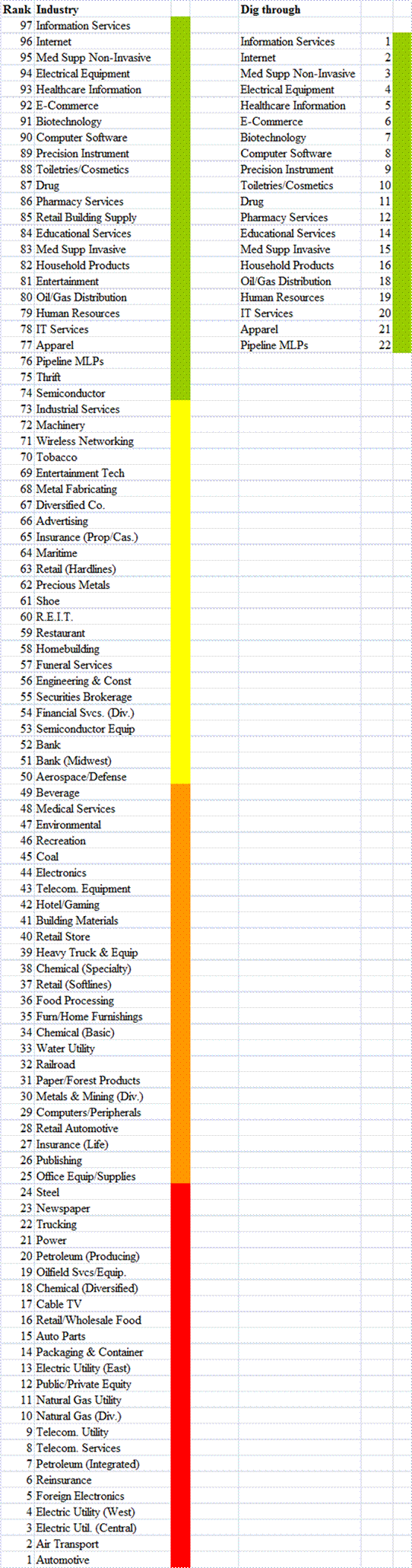
Industry Ranks 6_1521_image002My main industry model is illustrated in the graphic. Green industries are cold. Red industries are hot. If you like to play momentum, look at the red zone, and ask the question, “Where are trends under-discounted?” Price momentum tends to persist, but look for areas where it might be even better in the near term.

If you are a value player, look at the green zone, and ask where trends are over-discounted. Yes, things are bad, but are they all that bad? Perhaps the is room for mean reversion.

My candidates from both categories are in the column labeled “Dig through.”

You might notice that I have no industries from the red zone. That is because the market is so high. I only want to play in cold industries. They won’t get so badly hit in a decline, and they might have some positive surprises.

If you use any of this, choose what you use off of your own trading style. If you trade frequently, stay in the red zone. Trading infrequently, play in the green zone — don’t look for momentum, look for mean reversion. I generally play in the green zone because I hold stocks for 3 years on average.

Whatever you do, be consistent in your methods regarding momentum/mean-reversion, and only change methods if your current method is working well.

Huh? Why change if things are working well? I’m not saying to change if things are working well. I’m saying don’t change if things are working badly. Price momentum and mean-reversion are cyclical, and we tend to make changes at the worst possible moments, just before the pattern changes. Maximum pain drives changes for most people, which is why average investors don’t make much money.

Maximum pleasure when things are going right leaves investors fat, dumb, and happy — no one thinks of changing then. This is why a disciplined approach that forces changes on a portfolio is useful, as I do 3-4 times a year. It forces me to be bloodless and sell stocks with less potential for those with more potential over the next 1-5 years.

I like some technology stocks here, some industrials, some healthcare and consumer stocks, particularly those that are strongly capitalized.

I’m looking for undervalued industries. I’m not saying that there is always a bull market out there, and I will find it for you. But there are places that are relatively better, and I have done relatively well in finding them.

At present, I am trying to be defensive. I don’t have a lot of faith in the market as a whole, so I am biased toward the green zone, looking for mean-reversion, rather than momentum persisting. The red zone is pretty cyclical at present. I will be very happy hanging out in dull stocks for a while.

That said, some dull companies are fetching some pricey valuations these days, particularly those with above average dividends. This is an overbought area of the market, and it is just a matter of time before the flight to relative safety reverses.

The Red Zone has a Lot of utilities and other dividend-paying industries; as I said, be wary.  What I find fascinating about the red momentum zone now, is that it is loaded with cyclical companies.

In the green zone, I picked almost all of the industries. If the companies are sufficiently well-capitalized, and the valuation is low, it can still be an rewarding place to do due diligence.

Will cyclical companies continue to do well? Will the economy continue to limp along, or might it be better or worse?

But what would the stock screening model suggest that I have displayed the last few times I have done this post?

Wish I could tell you.  In an “upgrade” Value Line’s stock screener can’t do the Value Line subscription that it used to, because its 3-5 Year Projected Annual Total Return field is blank for the screening software.

Maybe next time, but until then, play it conservative in your industry and stock selections — look for companies that can easily survive if industry conditions worsen.  Once weaker players are marginalized, they will do well.

10 Aug 04:24

Ills of capitalism?

by subra

MDA – Mukesh Dhirubhai Ambani – the man the world loves to hate.

If you are a shareholder the chances are you love him, if you missed buying his shares, well he did give you a lot of chance to buy. In fact at  Rs. 970 it is still a good buy.

However, if you believe that he is a crook who takes the country for a ride, the bureaucrats are in his pocket, etc. etc. you may be right too. Most industrialists would love to do what he does, but are unable to do so.

Let us accept one thing – he has created shareholder value – despite the fact that in the last few years he has lagged even the index. That could be temporary – or permanent. However EVERY company that is working for shareholder interest has to work for the shareholder. I will judge a company by what it does to my share price. If you had invested Rs. 10,000 in Wipro in 1980 you would be sitting on more than Rs. 500 crores today. That is what Azim Premji did for your wealth. Ditto for many industrialists – Bajaj Auto, Hdfc, Cipla, Eicher,  Hero Honda, Infosys, TCS, Tata Motors, Colgate, HuL, ….the list is endless.

Similarly in the international space companies that have created wealth include Berkshire Hathaway, Coke, McDonalds, PnG, Exxon, Goldman Sachs, Barclays, …of course the list is wrong.

It is very important that as a shareholder you do not consider whether the company is moral, ethical, etc. IT IS NICE TO DEBATE ABOUT THAT, but as an investor your company should create wealth. THAT IS THE ONLY way to judge a company. Not whether the chairman leads a simple life, cleans his own toilet, travels economy – all humbug.

The Economist claims to be a good business magazine with good quality of writing. As a regular reader for a very long time, I too believed that they were. However, their coverage of India and India related events is nothing short of pathetic. They had done many many articles bashing Na Mo. I hope Na Mo treats it similarly when they seek an interview.

The Economist had done an article on Mukesh Ambani – and the article was nothing short of pathetic. Mukesh Dhirubhai Ambani is a good successful businessman who does what is good for his shareholders. If you do not like that, sell your holdings and move on.

Read this http://www.economist.com/news/business/21610238-mukesh-ambani-indias-most-powerful-tycoon-could-make-his-country-better-place-he-would

This article is flawed – about the facts, and about picking up wrong threads, and being selective.

So here is another story telling you why the Economist story is just poor journalism. It is not whether MDA is good or bad…read judiciously

http://www.sswaminathan.com/?p=633


Post Footer automatically generated by Add Post Footer Plugin for wordpress.

10 Aug 04:22

Tax avoidance with derivatives

Last month, the Permanent Subcommittee on Investigations of the United States Senate published a Staff Report on how hedge funds were using basket options to reduce their tax liability. The hedge fund’s underlying trading strategy used 100,000 to 150,000 trades per day and many of those trading positions lasted only a few minutes. Yet, because of the use of basket options, the trading profits ended up being taxed at the long term capital gains rate of 15-20% instead of the short term capital gains rate of 35%. The hedge fund saved $6.8 billion in taxes during the period 2000-2013. Perhaps, more importantly, the hedge fund was also able to circumvent leverage restrictions.

The problem is that derivatives blur a number of distinctions that are at the foundation of the tax law everywhere in the world. Alvin Warren described the problem in great detail more than two decades ago (“Financial contract innovation and income tax policy.” Harvard Law Review, 107 (1993): 460). More importantly, Warren’s paper also showed that none of the obvious solutions to the problem would work.

We have similar problems in India as well. Mutual funds that invest at least 65% in equities produce income that is practically tax exempt for the investor, while debt mutual funds involve substantially higher tax incidence. A very popular product in India is the “Arbitrage Mutual Fund” which invests at least 65% in equities, but also hedges the equity risk using futures contracts. The result is “synthetic debt” that has the favourable tax treatment of equities.

In some sense, this is nothing new. In the Middle Ages, usury laws in Europe prohibited interest bearing debt, but allowed equity and insurance contracts. The market response was the infamous “triple contract” (contractus trinus) which used equity and insurance to create synthetic debt.

What modern taxmen are trying to do therefore reminds me of Einstein’s definition of insanity as doing the same thing over and over again and expecting different results.

10 Aug 04:21

When you get wrong advice?

by subra

When you get advice from somebody you are hardly in a position to tell whether it is in YOUR interest, right?

Well, here are some tips! When you go to any professional these days they make their advice sound very ‘professional’ sounding. So what are the signals that you should look for?

1. You go to a doc with a Rs. 750 budget and he gives you a Rs. 84,000 solution: Sure it is the Merc that he is suggesting, and your whole body is screaming against it, listen to your GUT. Say No. Maybe you need a simple solution, look for one. Looking for 30 year solutions makes no sense when you are 50 years old or for worse looking for 30 year solutions when you 84 years of age. The wood that burns you is not likely to appreciate the quality of the dentistry, right? LISTEN TO YOUR GUT.

2. The advice is from somebody who is NOT bothered about YOUR GOALS: If you get a running coach who is interested in making you run faster, and harder may not be the right coach for you. Face it, if you are an amateur runner and run for fun and your coach wants to showcase you as a ‘show off’ or ‘beta’ client – your goals do not match. Do not listen to him and injure yourself. This is poor advice!

3. The advice is not aligned with your life goals or ultimate vision: If you are a CA and have also done your MBA in finance, maybe you wish to be in equity research. It is possible that you get a sales job and your boss is advising you to do aggressive wrong sales, it is poor advice. This is largely taking a short term view and looking for short term success whereas your long term goals are not in tandem with what you are doing. Avoid such jobs. If you can afford it work for a lesser salary in a job that co-ordinates better with your long term vision!

4. The adviser is wrongly qualified: He is a friend who has experience, but is not qualified. I have seen Electronic engineers, Marine Engineers, CAs, doctors, handling their equity portfolios. Many of them have done a fantastic job of managing their portfolios. However it does not qualify them to give you advice simply because they may not know asset allocation, may not understand risk covers, may have been lucky with a few deals. Be careful – education helps while giving advice – empirical evidence is not enough. Good track record is fine, but not adequate.

5. Your body feels wrong: When you feel somebody has a conflict of interest – a doc selling a particular action, an agent selling a particular product, …..scream and run away from the place. When you know that there is a conflict of interest, run away from there!

Post Footer automatically generated by Add Post Footer Plugin for wordpress.

09 Aug 04:11

Invisible Risk!

by subra

The problem with risk is it is generally not visible.
In most cases we wish to avoid it by PRETENDING that it is not there, or ignoring our inner voice which keeps telling us that there is risk. The worst thing is Risk is counter intuitive. Let me explain.

In 2007 end and perhaps the beginning of 2008, NOBODY thought that the equity markets are risky. It looked like 21000 will soon cross 25000 and then 30000.

Unfortunately that did not happen and the market came down – to about half of its recent high. Similarly in 2002-3 debt market instruments were giving good returns and people were hoping to get a 19% pa return in debt funds. Of course neither good returns in debt market continued nor did the equity market remain in the doldrums PERMANENTLY.

Today’s situation is again somewhat like 2002-3. Equity markets have not given a good return for the past few years, but the immediate past 12 months have been very good. Debt funds are giving decent returns, and the small investor is being wooed to the debt funds. YOU MUST REMEMBER THOUGH, Debt funds are giving about -1% returns…OR NEGATIVE RETURNS because inflation is high.

As an investor what can you do? Keep your SIP intact. You will see media stories that the government is useless, there is nothing happening, etc. but WE REALLY DO NOT KNOW WHAT IS HAPPENING IN DELHI.

Frankly I also have no clue – but the behavior of psu stocks clearly reveal that NOTHING is happening. So a NTPC goes from 130 to 167…and then comes down to 140. See the market for information aka prices.

Very good news (turning money from the banking industry to the mf industry is also good news for the government – the NPA risk has just shifted from the govt to the individual!!) – See more at: http://www.subramoney.com/2012/08/risk-is-normally-not-visible/#sthash.yei8TpyW.dpuf

Post Footer automatically generated by Add Post Footer Plugin for wordpress.

08 Aug 15:27

Should I call the prospective client?

by subra

A friend referred a client to you, you met the client. In fact the client had come to you and wanted to invest some money.

The immediate lump-sum was in 8 digits and the 3 SIPs were in late 5 digits, and the client sounded sincere and honest. He came with his wife, they liked you, they took the kyc forms, mutual fund forms, insurance form…whatever….etc. promising to call you back in 3 days time. However the call did not come. Now it is 6 days…12 days..and you are waiting.

Should you call, or should you wait?

You are wondering what went wrong? well many things could have gone wrong.

1. client changed his mind / he has still not made up his mind.

2. client’s RM did all the work for him, thank you Mr. IFA, it was a pleasure meeting you.

3. Client got so confused he put all the money in a SAFE and Risk free Lic endowment policy.

Well, nothing may have gone wrong. Look at it this way:

1. For YOU it is a top priority, for them it is just one of the things to do! their priorities may include a vacation, a kid’s visit, a relative’s wedding. So dropping a mail /sms/ or even calling is not a bad option.

2. Sound happy, and confident. Best is to keep a written script for the first few calls that you make. However lines like ‘I was anyway in your area…so I wanted to drop by’ or ‘Just called to ask how are you’ are too damn cliched and are rarely liked.

3. Make sure that the background noise does not include falling water, television, dogs barking, children yelling – does not sound professional at all, and the client could be put off.

4. Sit straight, in a proper office chair and smile while you talk to them.

5. If they say NO or indicate to you that they have made their choice elsewhere, sound polite. Thank them for their time – and if you are well composed bring out your competencies. If you are very calm ask them what swung against you. If he happens to be the brother in law of his boss, rest assured, you could have done NOTHING. Go and make your next call.

Post Footer automatically generated by Add Post Footer Plugin for wordpress.

08 Aug 03:28

Reforms- who's right, Modi or his critics?

by T T Ram Mohan

Some three months into Modi's government, the reforms brigade is getting worked up. What, no "big bang" reforms, they ask. Why isn't Modi privatising? Why isn't he pruning subsidies? And what about labour market reforms?

I argued in a post a few weeks ago that there are good reasons why the Indian polity is allergic to such reforms. But commentators are loath to accept these. In recent days, we have had an orgy of lamenting. The FT, which is normally sober, headlines a commentary piece as "Modi's transition from dictator to ditherer". There is little justification for the hysterical headline apart from the fact that it is alluringly alliterative. Victor Mallet writes:
Some of Mr Modi’s supporters, on the other hand, are nonplussed. They are disappointed by his near-silence on domestic matters, his obsession with foreign affairs and the absence of “big-bang” economic reforms after a decade of lacklustre Congress rule; “underwhelming” is the word used in New Delhi to describe the government’s first budget in July.
“Here is a government that came in with a lot of hope, riding a tide of high expectations, promising change. Ennui has already set in,” writes Bibek Debroy, co-editor of Getting India Back on Track, a book telling the government what it should do.

Ashoka Mody and Michael Walton, writing in BS, provide a rationale for reforms in slow motion:

The business-as-usual economic policy, with which this government has begun, should have been expected. For about a century, a motley group of lower middle class voters has steered Indian politics. Since independence, meeting their insistent livelihood demands has been the prime objective of every political party and government. The Bharatiya Janata Party (BJP) attentively wooed this coalition with finely-tailored promises and remains anxious to hold on to this constituency in the forthcoming state elections. India's central political dynamic remains intact.....

The absence of a transformative agenda is a calculated accommodation to India's political economy. Modi brilliantly channelled the cry for change into an electoral platform. But the government has neither the mental model nor the political courage to effect real change. As so often, political and bureaucratic elites have made promises to the Indian electorate that they cannot keep. Acchey din may be a long way off.  

Shreekant Sambrani, also writing in BS, suggests that Modi is trying to emulate what he did in the Gujarat, which is to focus  on execution rather than sweeping changes in the policy framework:
Modi's strategy was to run the state as a business entity. For this purpose, he depended on two younger members of his team, both with business background and experience, Nitin Patel (current finance minister) and Saurabh Patel (current industries and energy minister). Modi trusted their acumen and gave them key responsibilities. They delivered on issues such as 24x7 power supply and industry-friendly ambience, leading to showcase projects such as Vibrant Gujarat. Modi orchestrated and executed many a scheme with great aplomb, which caught everyone's imagination, most of all, that of India Inc. Thus was born the legend of the Gujarat Model.
To this end, Modi depended heavily on the bureaucracy. His chief secretaries such as P K Laheri, D Rajagopalan and A K Joti delivered plenty. All through his chief ministership, Modi was very much his own chief economist with little regard for theory or ideology, but possessing pragmatism in abundance and an unerring instinct for what sells.
Sambrani thinks this won't work at the national level. Well, we have to wait and see. After all, the political pundits were telling us that, whatever Modi's oratorical skills and record in Gujarat, he would find it impossible to win a national mandate on his own steam. And yet we know he brought it off. It may well be that the answer to India's problems is not to attempt radical reforms and face the political unrest these will trigger but to get the government machinery to deliver better.

Economists argue that reforms must come first, then you get growth. Modi's approach seems to be to do a little better on growth first; once the economy recovers and incomes rise, perhaps the receptivity to reforms will be greater. He may well be proved right. It is wise not to under-estimate the capabilities of extraordinary leaders.


07 Aug 03:01

Would you reinvent the wheel ?

by Ashvini Kumar Saxena

Reinventing a wheel is a stirring topic.

On the one hand, a great product/software is almost un-replicable. They are huge in size and usually provide support for everything that one can imagine. Nothing seems “out of scope” in that.

On the other hand, there is something that a user is looking for, which the product does either provides for or does it in a complicated way. In that case using the product may lead to more complications than developing something from scratch.

ID-100177424

So what’s the right way to go ahead?

I do not want to take sides here. I believe that it is all about business objectives that one wants to achieve.

WordPress, for example, is a software that runs a large number of websites around the world. It is free to use and take seconds to install. In my opinion WordPress is probably one of the reason there are millions of blogs on internet.

If one wants to create a software that does most of the things that WordPress does and also charge for it, they probably won’t be that successful. In fact even if they gave it for free, it would find a few takers because WordPress being there first, having a solid install base ( number of installation), community , free plugins would be impossible to beat.

Reinventing?

I think there in lies the crux of argument about “reinventing’. If the purpose of reinventing is to introduce new way of working that cuts down inefficiency in current system/software/process, it would be welcomed with open arms . If the purpose is to create a me-too product, it would be very hard to succeed.

A lot of people do reinvent because they want to learn how something original got invented. That is a very good thing. But to make it into something that is useful to customers is different than a hobby project. With new product one not only needs to be on top of design and development but also provide timely support .

If one feels that time spent for

Product development + future development + support + community

is worth it for amount of resources that have been already put by others in existing similar project, then one should definitely go for it.

When I created my plugin for Social media sharing, there was a giant free plugin to compete with. I was nevertheless able to compete at some level because of subtle differences between the two products and my offer of continuous support.

So when one needs to go for reinvention?

  • The old product does not suit new business requirements
  • The old product has too many features ( bloated )which are performance bottlenecks ( mostly in software field)
  • The old product has a few security issues which are hard to resolve or will take a lot of time
  • The new product provides a refreshing take on solving a business problem
  • Introduction of new channels need new products ( for example mobile based web sites)
  • Where needs can be fulfilled by development of a new product on a small scale rather than deploying existing large product
  • One wants to pursue creation of your product as lifelong career.
  • New development is going to provide path breaking features.

When is reinvention not useful?

  • When the current product can be used with little modifications
  • When you just want to create a hobby project
  • When you are motivated to write everything from scratch ( a few things are already perfected and improvements are only minimal)
  • Cost of reinvention is a lot more compared to benefits out of using existing.

When we start a project , the first thing we need to ask ourselves is

a) What do we plan to achieve with this product?

b) Is the time spent on it worth it?

c) Is it going to be our staple product in our business?

d) Is there a meaningful twist in features/service/support?

When do you think reinvention is useful and when is it not ?

Image courtesy of  Watiporn / FreeDigitalPhotos.net

07 Aug 03:00

Loan against Form No. 16

by subra

Many people think they (and the industry tells them) that they are eligible for a “home loan”, car loan, personal loan, credit card loan etc. Actually this is not true.

Just imagine a banker wanting to lend you money so that YOU can buy what you want! From when did the banker get to be such a nice human being?

The loan is against the biggest asset that you have. What is the biggest asset that you have?

Your ABILITY TO EARN IN THE FUTURE.

You only get a loan against your Form 16, which means this is a loan against your future earning capacity.

Imagine telling a lender that you want only Rs. 25 Lakhs for a house costing Rs. 200 lakhs HOWEVER, you will not have any income in the future and you will sell some shares to repay the loan. The lender will baulk.

The loans that you are getting is strictly against your future earning capacity, NOT ON YOUR NET-WORTH, not on the cost of the asset that you are buying, not on the reputation of the builder, not on the reputation of the car manufacturer, …just on your future earning capacity!!

So let us call it a Form 16 Loan. And if inflation is likely to be at 13% for the next week, you can rest assured the lending rates now would be in the region of 15% per annum.

The rate of interest is a function of inflation (at lease when sensible people head RBI). So if you have a loan at a fixed rate, and you expect inflation to be much worse than it is now, rest assured the lender will pressurize you to shift to a floating rate.

Till then, what can we do?

Welcome inflation. Nothing else.

Post Footer automatically generated by Add Post Footer Plugin for wordpress.

06 Aug 14:39

Mh 17- will the mystery be unravelled?

by T T Ram Mohan
Writing in Atimes, Pepe Escobar asks why it's taking so long for the black box recorder transcripts to be released. In the case of the Algerian plane that went down recently, these were ready within days. He points to increasing evidence that MH-17 was brought down by cannon fine from a Ukranian plane, not by a missile fired from the ground by pro-Russian separatists:
Meanwhile, the MH17 tragedy is undergoing a fast metamorphosis. When the on-site observations by this Canadian OSCE monitor (watch the video carefully) are compounded with this analysis by a German pilot, a strong probability points to a Ukrainian Su-25's 30 mm auto-cannon firing at the cockpit of MH17, leading to massive decompression and the crash.

No missile - not even an air-to-air R-60M, not to mention a BUK (the star of the initial, frenetic American spin). The new possible narrative fits with on-site testimony by eyewitness in this now famously "disappeared" BBC report. Bottom line: MH17 configured as a false flag, planned by the US and botched by Kiev. One can barely imagine the tectonic geopolitical repercussions were the false flag to be fully exposed. 

This has not prevented the US and Nato from trying to box in Putin, aided and abetted by vicious media propaganda:
NATO's Plan A is to install missile batteries in Ukraine; that is already being discussed in detail in the run-up to NATO's summit in Wales in early September. Needless to say, if that happens, for Moscow, that's way beyond a red line; it implies a first strike capability at Russia's western borderlands.

Washington's short Plan A, meanwhile, is to organize a wedge between the federalists in Eastern Ukraine and Russia. This implies progressive, direct funding of Kiev in parallel to building up, via American advisers already on the ground, and vast weaponizing, a huge proxy army (nearly 500,000 by the end of the year, according to Glazyev's projection). Endgame on the ground would be to seal the federalists off into a very small area. Ukrainian President Petro Poroshensko has been on the record saying this should happen by early September. If not, by the end of 2014.  

Commentators have noted that Cold War 2.0 has started. The consequences could be no less serious than what unfolded a 100 years ago following one assassination and ended up as a ruinous world war. Why would the western powers want to precipitate a crisis? The motivation is pretty stark:
For Western plutocracy, that 0.00001% at the top, the real Masters of the Universe, Russia is the ultimate prize; an immense treasure of natural resources, forests, pristine water, minerals, oil and gas. Enough to drive any NSA-to-CIA Orwellian/Panopticon war game to ecstasy. How to pounce and profit from such a formidable loot?
Note that India under PM Modi has kept a cool ahead in this unfolding drama. Sushma Swaraj fielded a press conference with US Secretary of State John Kerry during which she was asked how India intended to deal with Russia following the imposition of sanctions. Swaraj replied icily that a nation's foreign policy did not change with a change in government and that ties with Russia would remain unchanged.

06 Aug 14:36

How much do individual investors REALLY earn?

by subra

So sad we do not have a Dalbar (an US based research firm that compares returns of stock and bond markets with those of individual investors) research on Indian investor returns!

This study in the US has 2 startling facts:

Over the last 20 year period the Standard& Poor Index returned an annualized gain of 9.1% – which means SIP returns should be superior. The Individual Investor got a return of 3.8%.

The Bond Investor got a 1% yearly return vs. an annualized return of 6.9% of the Barclay’s Aggregate Bond Index.

(this is old data based on 2011 figures, but I guess if you change it to 2014 it would be somewhat similar)

Why do retail investors under-perform by such a HUGE MARGIN? Well many readers of this blog may have different views, but the retail investor, in general is a poor investor.

What are the normal mistakes? – Behavioral Investment experts have their reasons, the Media has its own reasons, and I have a combination of all of this!

1. Overconfidence: So many investors think it is easy to beat the index-it is not funny. And even when they have their OWN POOR TRACK RECORD to see, they insist that they know how to invest.

2. Amazingly stupid half investment lessons: – ‘If you invest in a good company, it will always make money in the long run’. Orkay, Nirlon, Mafatlal, Silverline,…are all companies which were once upon a time in the index. Now they are not. This is called survivor bias. Even today there are 5 companies which will surely not be there in 2024. Guaranteed.

‘My father made money in Infosys, so will I’ – replace it with ‘Nirlon’, ‘Orkay, ‘Patheja Forgings’ – and you will understand what I mean. History repeats itself, sure – we do not know how often, that is the problem. And we forget the MOST important lesson from history – ‘You cannot LEARN from history’.

3. I cannot see ahead, so I will look in the rear view mirror and drive: God bless the driver/investor – considering that we are driving around in a mountain.

4. Recency effect: ‘Market is going down’ – actually what they mean is ‘Market has gone down’ – now will it go up in the recent future? The true answer is I DO NOT KNOW. However retail investors will tell you ‘Market is going down…I think it will go to 21,000 on the Sensex…..what do you think Subra?’ If I keep quiet it gets reported as ‘Subra also kept silent…he must be in agreement’. Vow, actually I am not in agreement, I am wondering how people can make such statements, dude.

5. Herd Mentality: My brother in law just sold all his shares, and mutual funds and bought a flat….and the price has already gone up by 10%!! He tells me nothing will happen in equities for the next 3 years, SO I AM BUYING A FLAT. Oh! I forgot to add – he is a real estate broker.

6. Looking at the market everyday and getting confused. Listening to the experts and wondering who is an expert.

7. Running a 42km marathon like 420 races of 100 meters!

8. Fear – ‘My father lost Rs. 3 lakhs in Harshad Mehta scam’, ‘My brother lost Rs. 5 lakhs in Ketan Parekh scam’, ‘My uncle’s broker cheated him off Rs. 5 lakhs’…- all ‘fear indicators’ . Actually look hard enough.

The guy to be blamed is the same guy whose face you saw in the mirror this morning while shaving. Not Harshad Mehta, not SEBI, not the Prime Minister, not your wife, not your advisor…..just the bloody guy whose face…..LOL!!!

Post Footer automatically generated by Add Post Footer Plugin for wordpress.

06 Aug 03:19

What’s NextBigWhat For Online Real Estate Space in India? Consolidation.

by Guest Author

[Editorial notes : The online real estate market is currently going through disruption. Consolidation in in the making. Sandeep Reddy (@hsrdce) presents an analysis of the real estate model.]

In global news, Zillow, the largest real estate website in USA has acquired Trulia, the 2nd largest website in USA for US$3.5 bn(Source: Bloomberg).

IndiaProperty : 3D View

IndiaProperty : 3D View

Coming to India, we have currently close to 9 players vying for a market share in the online real estate classifieds market. It is extremely difficult for 9 players to survive in this ‘much smaller’ market compared to US (where the 2 largest players came together!), leaving no doubt that this space is going to see some consolidation soon- maybe in the next 12 months?

The battle will need tons of money since its going to be a battle around:

(1) Expansion to Tier-2/3 Indian cities- lot of hiring to happen

(2) Product improvement- focus on user experience, mobile app as mobile traffic increases, 3D views and similar such things

(3) Verification- customers don’t want to see fake listings and companies will have to invest in verification of listings

(4) Marketing- this will be a war and you will see them everywhere- online, print, radio and TV

(5) Data & Analytics- focus will be to build data backed marketing platform. Things like ratings, average prices in a locality, estimated prices, price trends, demand-supply heat maps will gain more prominence.

I think an evaluation of these companies on their news flow/announcements will give us a good idea on how they are gearing up for the battle. I have done some news collection for each of the companies to see any announcements that shows progress on any of the above 5 points:

1. 99acres

  • It made Rs76 cr revenues in full year 2013 and is showing good revenue growth.
  • Competition is pushing it to spend more on product (launched mobile app), verify properties, market more aggressively.
  • Announced plans to do a QIP of Rs750 crs (>US$125 mn), large portion of these proceeds to go to 99acres.
  • Loaded with this money, it looks like the only player to thrust consolidation in the space.

2. Magicbricks

A strong player till now but not much news flow except how they rank better than competition. As other players raise more money in this space, how much are they willing to invest in this business?

3. Makaan

  • Introduced a new section ‘Invest’, improved their UI but not anything major

4. Indiaproperty

  • Recently raised US$12 mn funding from Bertelsmann, Canaan and Mayfield in Dec 2013.
  • Over the past few months, they have reworked on their product a lot- which shows signs of fighting the battle!
  • They recently launched their 3D walkthrough view
  • Also launched Assisted Search to build a new revenue stream.

5. Commonfloor

  • Raised investment of US$10 mn from Tiger and Accel in Jan 2014. We all know the capability of Tiger to invest large amounts of funds.
  • Focus on apartment communities is unique to them
  • Clear product focus- augmented view, verification, mobile app
  • Spending aggressively on marketing- launched their first TV ad a couple of days back.

6. Housing

Housing Raincoats

Housing Raincoats

  • Raised US$20 mn in June 2014 from Helion, Nexus and Qualcomm.
  • Pioneers in listing verification, innovating on presenting ‘new projects’
  • However, I have concerns on how they will monetize, which will likely become an issue in the future if they are unable to solve it.
  • Hiring rumors on ET : Trip Wagoner rumored to join Housing as Chief Business Officer.

7/8/9. Sulekha / Olx / Quikr - Though they are horizontal classified sites, all these players have been strong in the real estate market. However I feel it will be tough for them to win the real estate battle given that they will not be just focusing only on this segment, unlike others.

If max 2-3 players have to survive, who will they be? Who’s doing enough and who’s not?

One thing is clear, 99acres may likely lead the consolidation- who will they buy or is it worth buying anyone?

The post What’s NextBigWhat For Online Real Estate Space in India? Consolidation. appeared first on NextBigWhat.

06 Aug 03:17

Whose money is it anyway?

by Atanu Dey

Milton Friedman used to elegantly distinguish between four ways of spending money. First, when you spend your own money on yourself, you are very careful to get the most benefit for your buck. After all, it is your money and you know what you want for yourself. Second, when you spend your own money on someone else. Here too you carefully economize to meet your objective but since you don’t know the other person’s needs as well as you do your own needs, your spending may not be as optimal for the other person. Third, you spend other people’s money on yourself. In this case, your incentive to economize is certainly blunted. You are much more concerned with getting the best and less with what it will cost.

Finally, when you spend other people’s money on someone else. That is, you transfer resources from one group to another group. In such cases, economizing goes out the window, and what is worse, you promote your own ends rather than the ends of those whose money you are spending or those who are the ostensible beneficiaries of the transfer. The most ubiquitous example of this is what he calls the “distributor of welfare funds” — taxpayers money being spent by government officials for welfare. Here’s Friedman in his own words:

The economic efficiency of spending is worth paying attention to. It means using the least cost method to achieve the desired objective. When it isn’t your own money, how much you spend does not matter. Economic efficiency suffers when other people’s money is spent on some other people. As C. Northcote Parkinson noted, when money is no object the only economizing done is in thinking.

But there is one really pernicious effect of spending other people’s money on others. It leads to what economists call “moral hazard” and “opportunistic behavior.” The spender of other people’s money often uses it the manipulate the beneficiaries of the spending. Government officials use taxpayers’ money to buy votes by distributing goodies to preferred groups. The power to tax and spend is dangerous as power usually is: it tends to corrupt.

Senator Crockett and Mr Bunce

A few months ago I came across a piece titled “Not Yours to Give.” It is attributed to a speech by Tennessee Congressman Colonel David Crockett in 1828. The story about Crokett’s speech is probably not historically accurate but the lesson is highly important and relevant.

Briefly this is the story. Congressman Crockett on his re-election campaign meets a voter, one Mr. Horatio Bunce, a farmer. Bunce tells Crockett that while he voted for him at the last election, he will not do so this time. Why? Bunce explains, because —

Horatio Bunce: “… you gave a vote last winter which shows that either you have not capacity to understand the Constitution, or that you are wanting in the honesty and firmness to be guided by it. In either case you are not the man to represent me. … I believe you to be honest. But an understanding of the Constitution different from mine I cannot overlook, because the Constitution, to be worth anything, must be held sacred, and rigidly observed in all its provisions. The man who wields power and misinterprets it is the more dangerous the more honest he is.”

Davy Crockett: “I admit the truth of all you say, but there must be some mistake about it, for I do not remember that I gave any vote last winter upon any constitutional question.”

HB: “No, Colonel, there’s no mistake. . . . My papers say that last winter you voted for a bill to appropriate $20,000 to some sufferers by a fire in Georgetown. Is that true?”

DC: “Certainly it is, and I thought that was the last vote which anybody in the world would have found fault with.”

HB: “Well, Colonel, where do you find in the Constitution any authority to give away the public money in charity?”

DC: “Well, my friend; I may as well own up. You have got me there. But certainly nobody will complain that a great and rich country like ours should give the insignificant sum of $20,000 to relieve its suffering women and children, particularly with a full and overflowing Treasury, and I am sure, if you had been there, you would have done just as I did.”

HB: “It is not the amount, Colonel, that I complain of; it is the principle. In the first place, the government ought to have in the Treasury no more than enough for its legitimate purposes. But that has nothing to do with the question. The power of collecting and disbursing money at pleasure is the most dangerous power that can be entrusted to man, particularly under our system of collecting revenue by a tariff, which reaches every man in the country, no matter how poor he may be, and the poorer he is the more he pays in proportion to his means. …

“So you see, that while you are contributing to relieve one, you are drawing it from thousands who are even worse off than he. If you had the right to give anything, the amount was simply a matter of discretion with you, and you had as much right to give $20,000,000 as $20,000. If you have the right to give to one, you have the right to give to all; and, as the Constitution neither defines charity nor stipulates the amount, you are at liberty to give to any and everything which you may believe, or profess to believe, is a charity, and to any amount you may think proper. You will very easily perceive what a wide door this would open for fraud and corruption and favoritism, on the one hand, and for robbing the people on the other.

“No, Colonel, Congress has no right to give charity. Individual members may give as much of their own money as they please, but they have no right to touch a dollar of the public money for that purpose. … There are about two hundred and forty members of Congress. If they had shown their sympathy for the sufferers by contributing each one week’s pay, it would have made over $13,000. There are plenty of wealthy men in and around Washington who could have given $20,000 without depriving themselves of even a luxury of life. The congressmen chose to keep their own money, which, if reports be true, some of them spend not very creditably; and the people about Washington, no doubt, applauded you for relieving them from the necessity of giving by giving what was not yours to give.

The people have delegated to Congress, by the Constitution, the power to do certain things. To do these, it is authorized to collect and pay moneys, and for nothing else. Everything beyond this is usurpation, and a violation of the Constitution.

“So you see, Colonel, you have violated the Constitution in what I consider a vital point. It is a precedent fraught with danger to the country, for when Congress once begins to stretch its power beyond the limits of the Constitution, there is no limit to it, and no security for the people. I have no doubt you acted honestly, but that does not make it any better, except as far as you are personally concerned, and you see that I cannot vote for you.” {Emphasis added.}

This story resonated very powerfully with me. Last year in March before I came across the Crockett speech, I had pondered the matter of government compensation of victims of tragedies in a piece that I had written for Quartz magazine, which I re-published here, “The Case Against Government Compensation of Crime Victims.

Constitutionality

One of the reasons that Crockett’s speech appeals to me has to do with the emphasis that Mr Bunce places on the constitutionality of the government as the distributor of welfare funds. The US constitution, as Bunce notes, does not give the US Congress the power to give away public money in charity. The Congress was not authorized by the people (through the constitution) and therefore it is unconstitutional.

We should stress one matter here: merely because something is constitutional does not mean that it is good, and conversely, just because something is unconstitutional does not make it bad. What makes something good or bad depends on whether it accords with reason, regardless of what the constitution says. All said and done, constitutions are human artifacts and like everything else, not perfect. However, if much thought has gone in framing the constitution based on sound fundamental principles, then it makes sense to refer to it to settle matters easily. It should act as an authenticating mechanism: if something is unconstitutional, it is probably unsound.

And now to the main point of this piece: Why the government must not be in the business of distributing public money for charity. Simply put, it leads to a reduction of freedom and is un-democratic in principle. Let’s explore why it implies a reduction of freedom.

Collective Goods

One of the main purposes of a government is the provision of “collective goods” — goods that usually cannot be efficiently provided by the private sector — such as national defense, internal law and order, funding of public health, public sanitation, etc. These goods and services are such that they cannot be individually purchased and provided. You cannot go to the market and buy a unit of national defense like you can go and buy a pair of jeans. These have to be collectively financed and the benefits accrue to the collective without discrimination. Collective or public financing is done through taxation.

One of the components of freedom is to spend your earnings in whatever way you wish. To the extent that some of your earnings are taxed away by the government to finance collective goods, your financial freedom is curtailed. However, when the taxes you pay buys you something that you value — security, for instance — it takes on the characteristics of a trade. You are “buying” collective goods with your tax money. Therefore, this transaction can be seen as a trade, much like the trade when you buy a pair of jeans. Both can be viewed as a transaction entered into voluntarily.

Without going into the question of precisely what can be characterized as essential collective goods, we can label the taxing and spending on them as “non-discretionary” — the government has to do it and that is that. Any government spending beyond that is discretionary and therefore subject to the closest scrutiny. Why? Because the financing of discretionary items, taxes have to be imposed and that, as noted before, reduces your financial freedom.

Just to be clear, “freedom” means the absence of coercion and dictation by others. You are not free if someone is dictating to you on what you may or may not do, or if someone forcibly takes away your property. Thus when someone — perhaps your neighbor or your government — takes away part of your income to finance something that is not a collective good, your freedom gets eroded.

Statues of Dead Politicians

Let’s concoct an unrealistic example of discretionary spending. The politicians decide that they will build a gigantic statue of a well-known dead politician. It will cost $1.2 billion. Consequently the citizens lose $1.2 billion worth of “financial freedom” — they could have used that money as they would have deemed fit but instead they are forced to pay for a statue whether they approve of it or not. True, given a population of 1.2 billion, per capita the waste comes out to be only $1. But remember that for a poor person, every dollar counts. And whether a person is poor or not, it is the violation of a principle — that a person should not be coerced to pay for non-essentials — that is unethical and wrong.

Now it is conceivable that people may say that a country needs to recognize the greatness of great dead politicians by erecting massively impressive tall statues. Well in that case, let the people decide. Let it be a democratic decision, especially if it happens to be a so-called democracy. Let the people vote with their wallets and do so directly, and not indirectly through their elected representatives.

I am not against the government’s involvement in discretionary public projects such as statues of dead politicians. I am sure that the government has a role but only indirectly. What I am arguing for is that the discretion should be exercised by the people and not by government officials and bureaucrats. If the government has to be involved at all, that role has to be limited to providing a coordinating signal. Let the government announce that “there is a need to finance a massive statue of this dead politician, and so we have put a huge big donation collection box into which you can put your hard-earned money.”

That’s an example of direct democracy. People choose to put their money where their mouths are. There is no force or coercion involved. People vote with their wallets and if enough votes are collected, the massive statue gets erected without fuss.

Limited Government

Lately we have heard a lot about “minimum government and maximum governance.” To move beyond the rhetoric and into action, one way to achieve minimum government is for the government to vacate the space that legitimately belongs to the people. Let the people decide, not the politicians or the bureaucrats, what they want to spend their money on. Let the people decide unless of course the claim is that the people are too immature or incapable of deciding for themselves on such matters. But then that leads to an inconsistency: on the one hand people are held to be mature and capable enough of self-governance and hence a democracy; and on the other hand they are regarded to be so immature that they cannot be trusted to decide for themselves how they should spend their money.

That sort of inconsistency should be evident to all — expect that it somehow eludes those who are in government. However, that is understandable. Politicians and bureaucrats have an incentive to increase taxes and increase spending because not only does it increase their power but they also get to handle all the money with very sticky fingers.

Politicians and bureaucrats award contracts to their favored firms, get kickbacks and then during elections get funding from the owners of the beneficiary firms.

Charity

Of all the pernicious things that a government does, arguably the worst is when the government gets into the business of charity. That’s the kind that Mr Bunce took exception to. If politicians and bureaucrats want to support charity, they should do that with their own money, not the public’s money. They are free to contribute as much as they wish of their own money, and they should extend that freedom to everybody else. Let people decide how much they want to spend and on which charity.

I can honestly claim that I contribute to charity regularly. Why? Because I am moved by empathy and compassion towards my fellow beings. I not only receive the joy of giving without expectations of return, I also derive psychic satisfaction by exercising the freedom of deciding on whom or what I spend my money. I wish I had more money so that I could give more of it away. A favorite quote from Khalil Gibran’s The Prophet goes, “All you have shall some day be given; Therefore give now, that the season of giving may be yours and not your inheritors.”

When the government takes my tax money to spend on what it considers charity, it deprives me of my freedom to give freely, it deprives me of the joy of giving, and takes away a responsibility from me that I treasure. What is worse, when I forced to do something, I resent it even if that something is something that I would have otherwise voluntarily done.

When the government taxes me to do charity, it is to me morally and functionally equivalent to someone putting a gun to my head and robbing me to help a poor person. Regardless of what the money is going to be used for, robbery is immoral and unethical.

{To be continued.}
06 Aug 03:04

What to Do When There’s Nothing to Buy?

by Vishal Khandelwal

Investing is difficult.

But not investing – sitting with cash and not finding stocks worth buying – is more painful.

After all, to most of us, activity equals achievement.

The need to remain active at all times is what leads CEOs to make bad capital allocation decisions, especially during heady times. And that is what leads most investors – big or small – to buy overpriced stocks.

We all want to be in the thick of action – largely because we hate the feeling of missing out on the party.

But then, as Charlie Munger says…

It takes character to sit there with all that cash and do nothing. I didn’t get to where I am by going after mediocre opportunities.

What to Do When There’s Nothing to Buy?
This is one of the most common questions I am being asked these days.

“I am not finding value in the stock market anymore.” asked a reader. “What should I do now?”

“Accumulate cash,” I replied.

“But that’s tough!” he said.

“Why?” I asked.

“Because cash in bank is a wasted opportunity,” he replied. “And why should I hold cash when it is paying nothing while stocks can grow my money much faster?”

Over the years and after learning my lessons (from not holding cash) the hard way, I’ve found several reasons to ‘hold cash’ when I have nothing to buy. Here are the biggest two –

  1. When cash is paying nothing and stocks have a greater probability of losing, nothing beats losing.
  2. If I don’t have cash, it is almost impossible for me to take advantage of opportunities that may present themselves in the future.

Accepting these reasons has made me fearless of holding/accumulating cash when I do not find (much) value in the stock market.

Of course, this is not with the intent to time the market – which is impossible. The intent is to avoid acting when I find no reasons to act.

As Seth Klarman writes in his wonderful paper titled The Painful Decision to Hold Cash, the idea is to….

…remain liquid, defy the steady drumbeat of performance pressures, and wait for the prices of at least some securities to drop. (One doesn’t need the entire market to become inexpensive to put significant money to work, just a limited number of securities.)

But then, as Klarman also writes…

Human beings are only endowed with so much patience, after all. Few are able to look past near-term returns, and today anything appears to offer better returns than cash.

Also, given their relative-performance-oriented, competitive nature, investors loathe the possibility of underperformance that comes from sitting on the sidelines; they find it better to be in the game (unless, of course, the market drops). Most significantly, they remain highly skewed toward the greed end (how much can you make?) and away from the fear end (how much can you lose?) of the spectrum of investor emotions. In short, investors remain the consummate yield gluttons, seeking high return without regard for the likelihood of actually achieving it or for the risk incurred in the process.

You see, investing doesn’t always mean “buying something”.

In fact, as Buffett says…

Much success can be attributed to inactivity. Most investors cannot resist the temptation to constantly buy and sell.

So you tell me – What do you do when there’s nothing to buy? Share in the Comments section below.

Here are some great insights from Prof. Sanjay Bakshi whom I asked this question –

There is no “nothing to buy” situation. If you ignore transaction costs and taxes, you are in-effect, selling every stock you want to hold, and buying it back at market price everyday. Remaining invested in a position is the functional equivalent of selling it for cash and deploying that cash in the position at its prevailing market price.

I think you mean “nothing new to buy.” But if you think about that carefully, there is a disconnect. If you are, in effect, “buying” your existing positions every day, then when you say there is nothing “new “to buy, aren’t you also, in effect saying that you prefer to own what you do but don’t want to deploy new cash in those very positions? Now there may be good reasons for not deploying new cash in old positions but the reason cannot be that your old positions are overvalued, for if they are overvalued, then why are you, in effect, buying them today?

Two good reasons to not deploy new cash in old positions could be: (1) need to diversify; (2) setting aside capital in expectation of a new, lucrative opportunity arriving in due course in which you prefer to hold cash (Mr. Buffett uses this “carrying-a-loaded-gun-waiting-for-the-right-elephant-to-appear” approach).

If there is nothing new to buy, by doing nothing, you’re still buying cash. Cash has huge option value, but delivers negative real rates of return. Sometimes, in life, when all choices are bad, you simply choose the least worse choice.

What else could you do? Holding cash which earns a small negative return may not be a great choice, but it’s better than holding other assets which can greatly depreciate in value.

Another advice when investors face such difficult choices is this: Lower Your Expectations.

I also put forward this question to my friend and fellow investor Neeraj Marathe, and here is what he had to say…

I think it’s wrong to simply take a blanket decision ‘not to buy anything’. Opportunities exist irrespective of the market conditions or the index level.

However, in times of exuberance, the decision to buy needs to be taken much more carefully. Human nature would, by default, make us exuberant too, hence, it makes sense to be all the more careful. Here is what I do in typical exuberant times:

  1. Track market price less frequently: The stock market incentivises us to do activity. (So does CNBC and our broker!). In exuberant times, I try to disconnect myself from the market. I talk to less to market participants and try to isolate myself.
  2. Read sensible stuff: We are influenced by what surrounds us. So in exuberant times, it makes sense to surround us with sensible stuff. I often read Howard Marks, Ben Graham and Taleb to keep myself grounded. Marks’ memos are my favourite. All these help me being grounded. I also read a huge number of annual reports, industry reports and talk to a lot of industry people to get a sense of the actual on-the-ground situation.
  3. Concentrate on downside: Build pessimistic scenarios and try to work out how much downside can be there in any stock you are evaluating. Assume worst case scenarios and valuations.
  4. Do non-market stuff: I am into motorcycling and often go for fast, long rides with my brother. I am a movie buff and watch a lot of movies too.

Now you tell me – What do you do when there’s nothing to buy? Share in the Comments section below.


Also Read: The Painful Decision to Hold Cash ~ Seth Klarman
05 Aug 03:04

Do you need personal financial planning at all?

by subra

I AM ASKING A BASIC QUESTION….AND the question is do you need p f p? I AM NOT asking whether you need a planner. That is a different question.

So, do you need the personal financial planning process? Read on

Maybe you’re saving to buy your first home.
Perhaps starting your own business is a dream.

The costs of a college education have spiraled and you may wonder how you will pay for your child’s education.

You will probably live longer. Additional years after retirement can cost more than originally planned.

Your company pension plan may not be enough to maintain your standard of living after retirement.

Complex financial marketplace and changing tax laws make it difficult to understand your financial picture.
Everyone needs to plan for tomorrow. At every income level, there are steps you can take to make more efficient use of your assets and to ensure a secure financial future. It makes sense to develop well-defined goals and to map out appropriate strategies to turn your dreams into reality. To help you get started, below are some frequently asked questions about personal financial planning.

What is personal financial planning?

Personal financial planning is a process, not a product. It is an organized, well-planned system of developing strategies for using your financial resources to achieve both short- and long-term goals. You may think of the process as helping you to answer three straightforward questions:

Where am I?
Where do I want to go?
How do I get there?
When should I start planning?

It is important to start planning as soon as you can. Time passes quickly – it is never too soon to start planning for tomorrow. Nor is it too late to start a plan.

Who should prepare my personal financial plan?

A well-qualified financial adviser should work with you to prepare your plan. A CA financial planner combines the objectivity and trust long associated with the CA profession and the years of experience and expertise in personal financial planning. However, if he does not do this for a profession (most of them do not), look for a financial planner who is a full time professional.

EVEN BETTER, READ AND LEARN TO DO IT YOURSELF – it is the best thing to do.

What should it include?

A comprehensive financial plan – one that addresses your entire financial picture – should include a review of your net worth, goals and objectives, property and other assets, liabilities, cash flow, investments, retirement planning, estate planning, tax planning and insurance needs, as well as a plan for implementing your goals.

I don’t have a lot of money. Do I need a full-scale financial plan?

You may not. You can seek out different levels of financial planning advice, from counseling on a particular issue to comprehensive planning. Speak to the advisers you are considering and discuss with them your requirements. You should be able to find one who meets your needs.

What role does goal-setting play in financial planning?

It is important to list both short- and long-term financial goals on paper. You can then rank the importance of the goals. If you are saving toward something tangible, instead of just saving, it may be easier. These goals could include: available cash for emergencies, education for children, care for family members, retirement, a nest egg to permit a career change, acquiring or selling a business, estate planning, financial independence or personal objectives such as a special vacation or second home.

How do I know how much I am worth?

One of the first things that you should do in reviewing your financial situation is to determine your net worth. Many people are surprised to find out how much they are really worth. First, estimate the value of your assets. If you have owned your home for a number of years, you may be sitting on a nice nest egg. Several different real estate appraisals will help you determine its worth. Organize bank, mutual funds, insurance policies and brokerage statements and record their value. List your liabilities such as housing loan, car loans or credit card debt. Subtract your liabilities from your assets and you will have a good estimate of net worth.

How can I plan for tomorrow when I can barely pay for today?

Create a budget. Determine what you actually spend each month. It is easy to keep track of large expenses such as mortgage and car payments. The variable items such as food, clothing and entertainment are often what get away from us. Write your expenses in a diary or an excel sheet – it is far more efficient than the human memory. The human memory is selective in remembering. Excel and diary are not

How much should I be saving?

It is hard to apply a rule of thumb toward savings, because it varies with age and income level. Ten percent of CTC is a good start. If that amount is too high for you, do not let that deter you. You can start by putting a little money aside each month and slowly increasing it.

How does insurance fit in to the process?

Evaluating your insurance needs is part of personal financial planning. The insurance industry has changed a great deal over the past few years and there is a wide array of new products. Some of them may be better options than your current coverage.

Do I need a will?

Everyone needs a will. Whether you are single or married, you need a will. No one but you knows how you want your estate divided after your death. It is especially important if you have children. If you do not have a will and both you and your spouse die, the court will appoint a guardian for your children. Maybe you would have chosen someone else.

What type of advice can I expect from a financial planner?

You can expect objective financial advice that is tailored to meet your financial goals and objectives, as well as the level of risk with which you are comfortable. Depending on your unique situation and goals, your financial planner may confer with your lawyer, stockbroker, insurance agent and other investment advisers to achieve the best plan for you.

After a plan is developed, what happens next?

The best plan is useless unless put into action. A financial planner can advise you how to implement the plan and can put you in touch with other financial experts as needed.

How often should I update the plan?

It is good to review the plan when there is a significant life event such as marriage, birth, death or divorce. Any change in financial position should be evaluated as well. Many people have an annual update that reviews how the plan is being implemented. The review also considers changing goals and circumstances.

Post Footer automatically generated by Add Post Footer Plugin for wordpress.

04 Aug 08:37

Hope rally dying: Where does that leave an investor?

by Sugata Ghosh

Like balloons losing gas in the morning after a birthday bash, the hope rally is dying a slow death. It couldn’t have gone any other way.


Dalal Street, like football fans after the World Cup revelry, is coming out of its hangover. It will take a close look at numbers, sit back and think. Indeed, losing froth is the best thing that can happen in a market. A correction would give fresh buyers a chance to step in. That’s fine.


The bigger questions are: How long would it take for demand to revive? When would bank loans pick up? Why aren’t companies whose projects have been cleared buying machinery to build new factories or expand
existing plants?


The truth is most industries are running with excess capacity and they are unlikely to set up new shop floors till capacity utilisation rises and there is some conviction that demand will surge. ( A point to note: private equity deals, both in number and value, are lower in June-July than what they were a year ago.)


While business confidence has improved, it will be unwise to focus on auto sales number, construction activity and luxury sales to conclude a turnaround in consumer sentiment: families have bought cars to beat a tax deadline, a delayed monsoon has led to prolonged construction (benefiting cement makers) and there is some wealth effect with the Sensex rallying since last year’s BJP summit in Goa.


Things are moving slower – and will continue to be so -- than what most had bet. But, that’s only to be expected. There are three ways by which a government can fuel growth: pump in money that creates bubbles and hurts many when they burst; push through dramatic, tough reforms that unsettle many; and third, take small steps to bring about a change that unfolds over time. Finance minister Jaitley has made it clear that his government will not splurge while NDA is unlikely to risk its political capital with radical reforms. This has left Mr Modi and his team with the third option of taking several baby steps. Some believe these aren’t enough. But, few disagree that they are in the right direction.


Where does that leave a stock investor? Eight out of ten analysts will tell her that a 10% correction is likely, and while there could be some ups and downs in the `short-run’, India story is positive in the `long-run’. It’s a comforting thought, but the reality could be a little more complicated. Here’s a guess of how things could unfold.


• Phase I: Over the next six months (at least till the next Budget), the market may not generate dramatic returns: US interest rates may rise, Europe can once again turn chaotic and Middle East may throw up the occasional, but nasty surprise; at home, Mr Modi is trying to improve efficiency by making it easier to deal with bureaucracy, bringing in greater co-ordination among ministries like power, coal and environment, and simplifying a few tax rules. These are reassuring stuff but are unlikely to mend things overnight. Macro numbers are a little better but they had started improving even before the elections. Better macro numbers may lend some support but are unlikely to stoke investor interest if corporate earnings languish.


• Phase II: Starting April 2015. The government gathers steam, some of the baby steps over the past one year begin to make an impact, a few good IPOs leave some money on the table for investors, and corporates, having lowered debts through equity floats and cheaper forex borrowings, show better bottomline. There’s excitement on Dalal Street (provided there isn’t another meltdown). The party could go on for two years.


• Phase III: The last three years of the government and possibly its toughest phase. The gains from low hanging fruits have been reaped, and investors are fishing for new, bigger stories like bolder, radical reforms that would lower user costs, widen tax base, bring in GST and make doing business in India easier and affordable. Will the government risk it as it moves towards another election? It may or may not.


Unlike money bags, it’s not the job of retail investors to time exits and entries into the market. Faced with inflation, tax on interest income from bank deposits and hurdles of owning multiple properties, the only way for them to grow savings is to bet on safe stocks that look may look expensive now but, nonetheless, give 15% compounded return over the next three to five years. Any day is a good day for such long term calls. Whether Mr Modi can pull it through will remain a moot point. But, he may be the best bet at the moment.


sugata.ghosh@timesgroup.com

04 Aug 03:30

Raghuram Rajan must prepare ground for a post-taper world

by Mythili Bhusnurmath

RBI governors have no option but to master the art of tightrope-walking. Regardless of what diehard inflation-targeters may say, the reality is central bankers have to strike a careful balance between price stability and growth while framing monetary policy.


In that sense, Raghuram Rajan's position as he contemplates his third bimonthly policy statement tomorrow is no different from US Federal Reserve chairman Janet Yellen's. But there the similarity ends. Unlike the US Fed that frames monetary policy with its eye on US fundamentals, RBI governors have no such luxury.


Over the last few years, and especially after the 2008 financial crisis, they have had to walk the tightrope with one eye on inflation, another on growth and a third, somewhat wary eye, on the Fed.


A Stitch in Time


So much as Rajan might weigh his options, look at inflation, growth and the government's fiscal numbers, and gaze skywards to try and figure out if the rain gods will make amends for their late appearance, and then take a call, there is one big imponderable.


By October 2014, when the RBI's next monetary policy statement is due, the Fed would be buying only $5-billion bonds, down from $85 billion before the taper started in December 2013. So, if the RBI has to safeguard the economy in a post-taper world, it has to prepare the ground now. And that is not going to be easy. More because no one knows what the post-taper world will be like. Interest rates will rise for sure, but no one quite knows when.


Rajan is aware of the pitfalls. In a speech earlier this year, he called for greater central bank coordination, "When monetary policy in large countries is extremely and unconventionally accommodative, capital flows into recipient countries tend to increase local leverage."


Falling on Yellen Ears


So, "recipient countries are not being irrational when they protest both the initiation of unconventional policy as well as an exit whose pace is driven solely by conditions in the source country".


However, his plea for greater sensitivity regarding the consequences for emerging market economies like India fell on deaf ears. The US position has been that the Fed is only concerned with domestic interests. Other countries need to put their own house in order before looking to the US to consider the "spillover" effects of its monetary policy. Fair enough.


Except that the US can afford to take this position only because of the dollar's privilege as the international reserve currency. No one is worried about spillovers from the actions of the central bank of Burkina Faso, which, incidentally, is also the central bank to seven other West African states. Hence Janet Yellen's cavalier dismissal of the Bank for International Settlements' warning of asset bubbles building up and leverage reaching danger levels.


Her argument that macroprudential, rather than monetary, policy is the right instrument for financial stability overlooks the reality that macroprudential measures are a poor substitute, especially when taken in isolation. Spain, for instance, had a housing boom despite countercyclical provisioning.


Free market fundamentalists might suggest freely floating exchange rates and liberalisation of financial markets as an answer. But research has shown that countries that undertook textbook policies of financial sector liberalisation often suffer more as deeper markets tend to draw in more flows. It also makes it easier to sell and exit when global conditions turn adverse.


Foundation is the Decider


The IMF's 2014 Spillover Report warns of turbulent times ahead. Yes, countries with strong fundamentals are likely to weather spillover issues better. Yes, countries that press ahead with structural reforms will be better placed than others. But there, the ball is in the government's court. The RBI's mandate and its sphere of influence are much more limited. Indeed, the RBI often has to overcorrect for government excesses. What should the governor do?


RBI executive director Deepak Mohanty's recent message provides some hints, "Foreign exchange reserves are the first line of defence to contain volatility" in case of capital outflow. Expect the RBI to beef up reserves.


Also, "to the extent capital outflows reflect an imbalance between demand for foreign currency vis-à-vis domestic currency, the price of domestic currency has to go up as a defence against capital outflows". Expect monetary tightening if flows reverse abruptly, although the bank is likely to keep its powder dry now to deal with any eventuality later. We are in uncharted waters. Rules of macroeconomics have broken down. It is each country for itself. Former RBI governor Bimal Jalan, who steered the country through the East Asian crisis with some rather unconventional monetary policy, put it best.


"The only test of whether correct actions (are) taken or not, is whether policy (is) successful in handling the problem and not whether it conforms to prescribed dictums of international institutions," he said. That home-grown wisdom has never been more true. Time for Rajan's third eye to take over.

03 Aug 15:43

The Investments Matter More than their Form

by David Merkel
  • Open-end Mutual Funds, including index funds
  • Closed-end Mutual Funds
  • Exchange Traded Funds, including index funds
  • Separately Managed Accounts
  • Unit Investment Trusts
  • Hedge Funds
  • Private Equity
  • Other Limited Partnerships [LPs], including MLPs
  • Variable Annuities (and Life Insurance)
  • Equity-Indexed Annuities (and Life Insurance)

What do all of the above have in common?  The first one is the easiest — they are all investments.  The second one is harder — they are all ways of investing in the ownership interests of corporations.

Think of the underlying investments within these investment forms when analyzing the forms as investments.  Now the forms aren’t entirely neutral:

  • Index funds don’t take a lot of fees.
  • Hedge Funds, Private Equity, and Insurance Products do take a lot of fees.
  • Insurance Products are tax favored.  LPs, MLPs and Private Equity have some tax advantages.  Separately managed accounts can have tax advantages, if managed right.  If you make the right investment, buying and holding has tax advantages, especially if you take it to the grave.

Thus, you should look at the manager, to try to analyze if he has skill.  You should look at the fees to see what you are giving up.  You should look at the tax advantages.

You should also think about the sensitivity of the investments to the overall risk cycle.  I don’t like the concept of beta, because it is not a stable concept, but in broad hedge funds have low beta, and private equity has high beta, relative to an S&P 500 index fund.  But neither in aggregate have much outperformance, after adjusting for the beta.

There are many clever investors scouring the world of investments looking for underpriced assets.  At a time like now, there aren’t a lot of underpriced assets.  I might find 2-4 per quarter, but they are only relatively underpriced, not absolutely underpriced (I.e. at this price, you should buy it regardless the the economic environment).

Every now and then, the market falls apart.  At such a time, two things happen.

1) Because some sector of the economy had too much debt, prices for the stocks and corporate bonds (or trade claims) fall, and the market as a whole falls along with them, though to a lesser extent.

2) During the crisis, many assets get oversold, and those with better knowledge can profit from the overselling.  The best example I can think of all of the hedge funds that bought non-agency mortgage-backed securities, when they were thrown out the window indiscriminately in 2008, and many of those securities have returned to par.

The ability to achieve alpha (outperformance) increases after a crisis.  Some who prepare for that, like Seth Klarman and Warren Buffett, create their own outperformance by taking more risk when other investors are running away in panic.

As my boss asked me in 2007, “Why have you not done so well for us the last few years, when you did so well 2003-5?  I answered, “When I came to you, the market was like an apple cart  that had fallen over and I picked up the undamaged apples.  Today, the market is rational, and there are not a lot of easy pickings to be had.  That is the difference between the bust and the boom.  It is much easier for a fundamental investor to act during the bust.

Thus I would encourage the following:

  • Pay attention to fees
  • Pay attention to tax advantages.
  • The time at which you invest matters  a great deal: try to invest when opportunities are the greatest (and others are scared stiff)
  • Ignore the form of investing, but invest with skilled managers (if you can find them, otherwise index funds).

Think of Seth Klarman who hands back money to his clients when markets are not promising.  Few professionals have the intelligence to do that.   Fewer have the ethics and courage to do so.

For my equity clients, I have reduced exposure, and I am close to my maximum cash level of 20%.  I am watching the market, and am willing to add to my positions, 10%, 20%, and 30% lower.  I own good companies.  As has been true in the past, I get close to zero cash as the market bottoms.  The market is somewhat high now — I think of it as the 80th percentile.  But it is not at nosebleed levels.

Analyze your investments, and sense the skill of managers, and lack thereof, and the degree of sensitivity to the market as a whole, which is likely higher than you expect.

Then adjust as you see fit.  Every situation is different, except for the parts that are the same.

All for now.

03 Aug 04:17

Composite culture: Don't look back for answers, look around

by Reshmi R Dasgupta

Many people are inclined to let out a polite yawn when they hear the old line about India’s unity in diversity and are reminded yet again about the greatness of their traditional “composite culture”. That’s because these truisms have remained mired in the marshlands of the Ganga-Jamuna tehzeeb instead of encompassing the true breadth and depth of India.


If we look at all of India for our raison d’être rather than just the parts we live in or are familiar with, we’d realise something else binds us together now. We are no longer a new nation needing markers from our past to stick together. The past 60 years have made many Indians bond in a comfortable partnership based on shared experiences, rather like old married couples.


This was brought home to me this month as I observed two young nurses who usually did night duty together at a hospital. Rinty is Malayali and Kumuni is Manipuri and the two represent the two major groups that make up this profession today in India - and they make a wonderfully complementary team. They are even roomies at their hostel.


When they were going off duty one day, I asked what they were going to do. “Cook!” said both as their canteen fare - made by a Bengali - clearly did not find favour with either the southerner or north easterner. Asked what they would cook, both replied, again in unison, “Fish!” So I presumed there would be a Manipuri - Malayali collaboration between these friends....


Far from it. “Her food is too spicy for me,” said Rinty, with a good humoured tolerance born of familiarity. “She uses those deadly chillies from her native place!” And Kumuni found the typical aromatics of Kerala cuisine not to her liking either. But those differences did not prevent the two from enthusiastically conducting their divergent culinary pursuits together.


Their easy partnership is an allegory for contemporary India, as it is based on understanding differences and tolerating them rather than looking for spurious links. Relying on history to connect Rinty and Kumuni would be fruitless too. But understanding their friendship is not hard at all if one looks at the cementing events of just the past 60 years.


History is both a bane and a boon. Those who forget history are indeed often condemned to repeat it, but relying too much on the sections of our past for today’s answers and solutions can be misleading and frustrating. The North East, after all, would certainly not find resonance in merely the stories of heartland valour any more than the south would.


On the other hand, observing the new composite culture coalescing for the past six decades at least in urban India can be far more illuminating. The presence of children from all over India in a typical urban school or college classroom, for instance, portends a more cohesive future than the homogenous - social and cultural -milieus of our parents’ time.


That so many service sector jobs are now dominated by particular communities, leading them to fan out all over the country, is another unifying development that history cannot provide parallels to beyond the pan-peninsular spread of Brahmins. Sports, medicine and transferable jobs also play a role in this truly secular - ie non religious - composite culture.


The word Hindu has become too politicised for it to ever again signify all the inhabitants within our borders. For me, however, Indian is a perfectly acceptable broad, allencompassing synonym as long as it too does not imply any majority meme either, be it the Northern heartland specific Ganga-Jamuna tehzeeb or the annoying composite culture synthesis.


The most enduring marriages or friendships are not necessarily between two people who are similar (or who forcibly become so) but rather between those who understand, appreciate and accept each others’ differences and revel in it. Left to themselves - sans cultural and ideological pressures - more and more Indians are hopefully opting for just that. Like Rinty and Kumuni.

03 Aug 04:16

Regarding Underemployment

by David Merkel

This is just meant to be a few thoughts.  I haven’t worked everything out, but I want to talk about how the labor markets are weak.

Yes, the headline statistics are strong.  The U-3 unemployment figure is low at 6.2%.  But look at a few other statistics:

My, but wages as a share of GDP has been falling.

And real wages have flatlined.  No surprise that many feel pinched in the present environment.  Even the Federal Reserve Chairwoman Janet Yellen expresses her doubts about the labor markets, which was expressed through the most recent FOMC Statement.

The problem is this: the relationship between labor employment and monetary policy is weak.  It is weaker than pushing on a string.  There are two major factors retarding the US labor market, and they are globalization and increased productivity from technology.

The value of knowledge is rising relative to less-skilled labor.  As such, we are seeing increased income inequality in the US, but lower income inequality globally.  Bright people in foreign lands who can transmit their skills over the internet can do better for themselves, even as more expensive counterparts in the US lose business.

Call this the revenge of the nerds.  The internet enables bright people to profit from their differential knowledge, as it can be applied to wider opportunities.

Think of India for a moment.  Many bright people with advanced degrees, but education amounts to little unless you can use it for your own benefit.

Here’s my main point.  The FOMC con’t do much about the labor markets; their power is weak.  The bigger factors of globalization and technology can’t be fought.  They are too big.

Thus, you are on your own.  The US Government does not have the power to re-create the unique middle class prosperity of the ’50s and ’60s.  If you work for others, you are not your own master.  Aim to make yourself the master of your situation, by making yourself invaluable to your clients.

03 Aug 04:15

ICICIDirect and Capital Gain Statement of Mutual Funds

by Kirti

Capital gain statement on Debt Mutual Funds from ICICIdirect is not matching with how you say Capital Gains should be calculated said email form my reader Shashank. After overcoming that panicky feeling of what we had told and why was it wrong, we took a deep breath when we realised that the capital gain statement was from ICICIDirect and like many people Shashank did not scroll down the page to see the Notes below the statement.

Capital Gain Statement for Mutual Fund on ICICIDirect

Capital Gain statment for Debt Mutual Fund Statement from ICICIDirect shown in image below shows

  • Purchase value of 75,000 on 09-Sep-2011 and
  • Sale Value of Rs 90,048 on 23-Sep-2013
  • Giving a long term gain of Rs 15,048.
ICICIDirect Mutual Fund Capital Gain Statement Example

ICICIDirect Mutual Fund Capital Gain Statement Example

While as per the Capital Gain Calculator, that capital gain on debt mutual fund was

Capital gain calculation for debt mutual fund

Capital gain calculation for debt mutual fund

Debt Mutual Funds and Capital Gains

A brief overview of capital gains for Mutual Funds are given below:

Stocks and Equity Funds: Long-term capital gains on stocks and equity mutual funds are not taxed. But short-term gains are taxed at 15%.

Non Equity Funds:In case of  non equity funds such as Gold funds, FMP debt mutual funds,

  • Both short-term and long-term capital gains are taxed. 
  • The fund house do  not deduct the tax from your gain. You have to calculate and pay tax on mutual fund income. But for NRIs, tax on mutual funds will be deducted as per the applicable rates before paying.
  • Short-term capital gains are added to the income and taxed as per the individual’s income tax slab.

For Debt Mutual Funds redeemed before 10 Jul 2014,

  • Any gain made after one year of purchase qualified as long  term capital gain while calculating indexation can be used to adjust the purchase value of your investment to indicate the impact of inflation .
  • Long-term capital gains from debt mutual funds are taxed at 20% with indexation and 10% without indexation. Indexation is adjusting the purchase price for inflation. This increases the purchase cost and, thus, lowers the gain.

After 10th July 2014 the holding period  has to be 36 months to qualify as long-term capital assets, and the rate of tax on long-term capital gains for Non Equity Funds is 20%.

So was ICICIDirect wrong in showing Capital Gain ?

Yes and No. Yes because the calculation showed did not take care of indexation. No because after the calculation in the same page they mention that it cannot be used for Income Tax purpose and it does not take care of indexation. The notes from ICICIDirect are given below with associated sections highlighted in red.

ICICIDirect notes on Capital Gain Statement

ICICIDirect notes on Capital Gain Statement

 In addition to this ICICIDirect has a Disclaimer (on upper right corner of Notes section in image below)  which says following.

ICICIDirect Disclaimer

ICICIDirect Disclaimer

The FAQ on the capital gain page link shows a blank screen.

Related articles:

Why can’t ICICIDirect show the right calculation beats me? Why provide a facility which is half baked? asked Shashank. We look forward to your comments and feedback

03 Aug 04:07

India's Coal Shortage is Back

by ET Data Blog

It never really went away of course, but the Indian power sector's coal shortage is back with a vengeance.


The chart below shows the current level of coal stocks available with the country's thermal power plants, in days. Ideally, at any point in time, India's thermal power plants should have about three weeks of coal stocks on hand. Currently, however, they have only about a week's supply. That's close to levels seen in 2011 and 2012, when the earlier phase of the coal crisis was at its worst.


The coal shortage moves in cycles. Ironically, when the economy is weak and demand for power is lower, coal stocks build up in the plant. In recent months, the upturn in economic sentiment may have lead to improved power demand, causing thermal plants to generate more power, and leading to a fall in coal stocks. During the monsoon, power demand is typically less - the weaker rainfall this season may have forced farmers to use water pumps to a greater extent, adding to the rise in demand.


The chart below shows another dimension to the shortage. It charts the number of plants with critical coal supplies i.e. those with less than 7 days stock, and those with less than 4 days stock.


India's shortage of domestic coal these last few years have left it with no option but to import coal from overseas. The chart below shows that the proportion of imported coal, in the stocks of thermal plants, is now at an all-time high of well over 10%.
There is a silver lining though. It is that global coal prices have softened sharply from the highs seen just a couple of years ago. So while, India may be importing coal at an ever-higher rate, it is doing so at a much lower price. On the flip-side, it makes the sector even more deeply vulnerable to a global coal price 'shock' of the kind we saw in 2011 and 2012.


Ultimately, unless long term policy measures are taken to fix the coal shortage, any broader economic recovery in the economy will face a serious risk of being hurt by weak coal supplies.


Notes: All data from Bloomberg. The global coal price used is the Richards Bay Steam Coal Price (FOB)

03 Aug 04:03

Be strong!

by subra

‘My will power is good Subra, but ITC’s Wills power is stronger’ – a friend used to say this during his smoking days!

Can your will power be strengthened like your body muscle? Many people do not even want to ask this question. they keep saying ‘I cannot do this’…My mother says ‘I will never be able to make good chappatis’ or ‘My father tells me I am weak and will never be able to run a sub 2 half marathon’ Amazing how people get into such traps.

So the answer to the question about will power being strengthened is ?

The answer is YES. Surely YES….

Do you realize that more work and better work gets done by the disciplined and regular man than the undisciplined man? Sure there are exceptions, but generally it is much better to be disciplined than be intelligent. So true in life as in Investing!

So let us accept that good habits can be made to stick. Let us see how to get disciplined:

1. Maintain a Diary of what you are doing: I am a big proponent of writing down what you do. This will help you know what you are doing and what you want to change..

2. Tell yourself once you do it for a few days, then it is NOT a struggle. Regular runners, sportsmen, gym goers, walkers do not see it as a struggle on a daily basis. It just becomes a habit.

3. Practice every day and reward yourself for good behavior! Far far more importantly do not kill yourself for a small slip up. If you have decided that you will do your long runs at a pace of 6.20, do not worry about a few miles being at 6.40. Celebrate the successes that you got at 6.20 pace. Have small celebrations for small victories.

4. Tell the people around you – and enlist their support. If you are trying to give up alcohol, give it up on 2 days – Sat and Sun. Most social drinking happens on weekends. If it is waking up early, do not be ambitious. Go from 7.30 to 5am over a 8 week period, not on day one. Does not work that way.

5. Control your environment: get rid of big boozers – DO NOT GO OUT WITH them. Get rid of packaged stuff from home. Stop buying things that YOU know how to make! Keep ONLY healthy stuff at home. Uninstall Solitaire from your laptop. Get rid of the FB application on your hand phone…WHATEVER….

6. Make things that YOU MUST DO a part of your ROUTINE. The brain does not argue with routine things. ONLY new things it argues. Keep it simple do not tire the brain. A tired brain is easy for a virus to attack.

7. Your will power is stronger in the mornings than in the evenings. Try to keep the harder things for the morning.

8. Do not be overambitious: If you get up everyday at 7.30am do not suddenly expect to get up at 5am. Try getting up at 7.15 for a start. After a week make it 7. After another week make it 6.45. And for doing all this, try going to bed EARLIER – from 12 midnight to 9.30 pm is again a 10 week process. Gradual change helps.

Post Footer automatically generated by Add Post Footer Plugin for wordpress.

03 Aug 04:01

Easiest Mistake to make Now!

by subra

You have been doing a SIP for the past 2-4-5 years. Your parents, friends, colleagues who have been investing in PPF and bank deposits are laughing at you. Your portfolio has always yielded less than the debt market returns.

They have been ridiculing you for reading Subramoney.com – an equity only kinda freak. Your monthly statements have not looked too good.

Suddenly in the past 140 days your portfolio reflects ‘achhe din aane wale hain’ and it is suddenly showing you a 12% cagr. You are in the profit, by a large margin.

So you are tempted to sell. Right?

I get many questions on this blog, in training sessions, on FB asking me the following:

1. should I stop the SIP 2. should i withdraw some money and put it in a Fixed deposit 3. should i book profits in my equity portfolio 4. has the market reached its peak

Frankly I do not know. I also do not know anybody who knows somebody who knows anybody who knows!! So the search has ended. I can ensure you that the Media does not know. I do not take this approach.

My approach is simpler – in case of mutual funds I have held through the last 13-15 years in fund schemes like Top 200, Franklin Bluechip, Prima, Prudence, and over a lesser period in I pru discovery…and have done well.

In case of direct equities I have been tracking and doing well in holding Bharti Airtel, Tata Motors when people were busy writing them off. It helped. I track and hold companies with good RoE, FCF, as well as looking at arbitrage opportunities. In fact my 2013 and 2014 successes can be largely attributed to arbitrage seeking and acting.

In fact over a long term in equities I am convinced that Money is not made in buying (come on if I could spot, so can you), not in correct timing while selling (I got lucky I guess when I sold infra and finance at the peak of the bull market – so you too could get lucky) – IT IS IN THE SITTING FOR LONG TIME with good shares. Like Biocon, Hero Honda (1985-2013), this seems to be difficult for most of you. Remember Compounding (Time) is the Archimedes principle of Investing. It has an amazing power called ‘lever’. If you do not use that, you choose to remain poor.

Just because we do not want to think hard we settle for simple products and simple solutions which do not beat inflation.

Post Footer automatically generated by Add Post Footer Plugin for wordpress.

02 Aug 04:12

When there is a death…

by subra

THIS IS NOT ORIGINAL…I GOT IT AS A FORWARD FROM FACEBOOK FROM A FRIEND..i DO NOT KNOW THE AUTHOR..it does not matter…it is a MUST READ….

Must Read:
Letter written by a wife after her husband’s death in an accident

“Few things I learnt after my husband’s death:-

We always believe we will live forever. Bad things always happen to others.

Only when things hit us bang on your head you realise… Life is so unpredictable….

My husband was an IT guy.AllTechnical. AndI am a chartered accountant.
Awesome combination you may think.

Techie guy so everything is on his laptop.His to do list. His e-bill and his bank statements in his email. He even maintained a folder which said IMPWDS wherein he stored all login id and passwords for all his online accounts.And even his laptop had a password. Techie guy so all the passwords were alpha-numeric with a special character not an easy one to crack.Office policy said passwords needed to be changed every 30 days.So every time I accessed his laptop I wouldrealizeit’s a new password again. I would simply opt for asking him ‘What’s the latest password’ instead of taking the strain tomemorizeit.

You may think me being a Chartered Accountant would means everything is documented and filed properly. Alas many of my chartered accountant friends would agree that the precision we follow with our office documents and papers do not flow in to day to day home life. At office you have be epitome of Reliability / Competent / Diligent etc but. At home front there is always a tomorrow.

One fine morning my hubby expired in a bike accident on his way home from office.. He was just 33.His laptop with all his data crashed.everything on his hard disk wiped off.No folder of IMPWDS to refer back to.His mobile with all the numbers on it was smashed.But that was just the beginning. I realised I had lot to learn.

9 years married to one of the best human beings.with no kids.just the two of us to fall back on.but now I stood all alone and lost.

Being chartered accountant helped in more ways than one but it was not enough. I needed help.His saving bank accounts, his salary bank accounts had no nominee.On his insurance his mom was the nominee and it was almost 2 years back she had expired. But this was just a start.I didn’t know the password to his email account where all his e-bill came.I didn’t know which expenses he paid by standing instructions.

His office front too was not easy. His department had changed recently.I didn’t know his reporting boss name to start with.when had he last claimed his shift allowance, his mobile reimbursement.

The house we bought with all the excitement on a loan thought with our joint salary we could afford the EMI. when the home loans guys suggested insurance on the loan.we decided the instead of paying the premium the difference in the EMI on account of the insurance could be used pay towards prepayment of the loan and get the tenure down.We never thought what we would do if we have to live on a single salary.So now there was huge EMI to look into .

I realised I was in for a long haul.

Road accident case. So everywhere I needed a Death certificate, FIR report, Post Mortem report. For everything there were forms running into pages.indemnity bonds.notary.surety to stand up for you.No objections certificates from your co-heirs.

I learnt other than your house, your land, Your car, your bike are also your property.So what if you are the joint owner of the flat.you don’t become the owner just because your hubby is no more. So what if your hubby expired in the bike accident and you are the nominee but if the bike is in a repairable condition .you have to get the bike transferred in your name to claim the insurance.And that was again not easy. The bike or car cannot be transferred in your name without going through a set of legal documents. Getting a Succession Certificate is another battle all together.

Then came the time you realise now you have to start changing all the bills, assets in your name.Your gas connection, electricity meter, your own house, your car, your investments and all sundries. And then change all the nominations where your own investments are concerned.And again a start of a new set of paperwork.

To say I was shaken.my whole life had just turned upside down was an understatement.You realise you don’t have time to morn and grieve for the person with whom you spend the best years of your life. Because you are busy sorting all the paper work.

I realised then how much I took life for granted.I thought being a chartered accountant I am undergoing so many difficulties.what would have happened to someone who was house maker who wouldn’t understand this legal hotchpotch.

A sweet friend then told me dear this was not an end.you have no kids.your assets will be for all who stand to claim.after my hubby’s sudden death.I realised it was time I took life more seriously. I now needed to make a Will. I would have laughed if a few months back if he had asked me to make one.But now life had taken a twist.

Lessons learnt this hard way were meant to be shared.After all why should the people whom we love the most suffer after we are no more.Sorting some paperwork before we go will at least ease some of their grief.

1. Check all your nominations…
It’s a usual practice to put a name (i.e in the first place if you have mentioned it) and royally forget about it. Most of us have named our parent as a nominee for investments, bank accounts opened before marriage. We have not changed the same even years after they are no longer there with us. Even your salary account usually has no nomination.. Kindly check all your Nominations.
- Bank Accounts
- Fixed Deposits, NSC
- Bank Lockers
- Demat Accounts
- Insurance (Life, Bike or Car or Property)
- Investments
- PF Pension Forms

2. Passwords..
We have passwords for practically everything. Email accounts, Bank accounts, even for the laptop you use. What happens when your next in kin cannot access any of these simply because they do not know your password… Put it down on a paper.

3. Investments.
Every year for tax purpose we do investments. Do we maintain a excel sheet about it. If so is it on the same laptop of which the password you had not shared. Where are those physical investments hard copy.

4. Will.
Make a Will. I know you will smile even I would.had I not gone through all what I did.It would have made my life lot easier.a lot less paperwork.I wouldn’t had to provide an indemnity bond, get it notarised, ask surety to stand up, no objections certificates from others…

5. Liabilities.
When you take a loan say for your house or car.Check out on all the what ifs.what if I am not there tomorrow.what if I loose my job.Will the EMI still be within my range.If not get an insurance on the loan.The people left behind will not have to worry on something as basic as their own house.

My battles have just begun…But let us at least try and make few changes so that our loved ones would not suffer after we go.We do not know what will happen in the future.But as the Scout motto goes: Be prepared ”

NEVER TAKE LIFE FOR GRANTED DO THINGS APPROPRIATE FOR THE ONES WHO DEPEND ON YOU WITH LOVE.
NOTE: THIS IS A REAL INCIDENT AND A FORWARD.

Post Footer automatically generated by Add Post Footer Plugin for wordpress.

01 Aug 11:36

How to Make Engineers in India Employable?

by Guest Author
Unemployed Engineers in India

Unemployed Engineers in India

So you are freshly out of college with an engineering degree in your hand, a sprint in your feet and a twinkle in your eye? Well, welcome to the harsh reality of the corporate world.

There are thousands of unemployed, unemployable engineers out there and every year thousands being added to this number as a number of engineering colleges churn out graduates with a degree but no expertise. Merely 18 to 20 % of engineering graduates are actually employable.

The problem lies with our education system which emphasizes on quantity rather than quality, theories rather than practical applications, traditional and obsolete courses rather than updated and revised curriculum.

As a result, where there is a dearth of professionals in IT and other industries, there is a dearth of jobs for engineering graduates who have spent four years waiting for something to happen as they walk out with their degrees in hand.

What is the Solution?

The institutions and employers have to work together and make changes to the curriculum so that it meets the needs of the industries. The institutions need to focus on quality on students rather than quantity. The traditional methods of teaching have to be done away with in this era of internet, information and technology. Professionals and experienced engineers from the industry should be included in the faculty or as special instructors so that the students get a real time experience and knowledge of the industry.

For Students

Where these changes needs to be applied to the education system as a whole, students can work on their part to make themselves employable in this competitive and fast changing economy. Here are some guidelines which can be followed to seek jobs as engineers:

  1. Score well: Your scores are your first impression (although both You and I would hate it!). Most of the companies filter out the resumes in the first stage comparing the scores. So, your obvious first step in getting a job as an engineer would be to score high marks in your exams.
  2. Bring originality to your resume: Most of the candidates prepare their resume looking at the resume of their seniors or friends or following the format given on internet. As a result, most of the resumes on the table of the HR manager look alike. Your resume should reflect your individuality and making it different would draw the attention of the employers.
  3. Get some training and practical experience: The projects and training modules that are done in engineering colleges are primarily useless and when the graduates look for jobs as freshers, they neither have skills nor confidence to carry out any project independently. You can pursue a free course at Coursera or take up online paid courses for web development or mobile app development where you can create a real world project. If you have time, it would be a good idea to join some company in your vacations to get real time experience and training.
  4. Build your expertise: the major trend among engineering students is joining short term courses and trying to collect more and more certificates during their vacations. As a result, what we get, are half-baked engineers who are neither good in their own discipline nor do they have in-depth knowledge in the courses they join. It is better to specialize in one particular field than being a jack of all trades. Determine your goal and work towards it.
  5. Stay informed: The economy is changing rapidly, so are the needs of the industry. You need to be aware of the current trends and requirements. Mere theoretical knowledge and academic skills will not help the graduates obtain employment. They have to acquire new skills to maintain their sustainability.
  6. Work on your confidence and communication skills: Honing up your communication skills is very important as it is as important to convince your employer about your skills as it is to develop your skills. Again, as an employment seeking graduate, you need to work on your confidence to impress your employer and to grab opportunities as they come by.

Without being preachier, I would like to say that most of the ideas listed above worked for me and my peers. It may be easy to blame the government for poor infrastructure or question the quality of teaching in the institutions. However, the real solution lies with each one of you and depends on how proactive are you are with your life. There is no dearth of jobs. All you need is to focus on your all round development as an engineer and jobs will follow you.

For Institutions and Government

Given the dearth of quality faculty and curriculum gap between Industry and Academia, Rajesh Kasturirangan in his article mentioned that Technology will be an answer to building capacity. He rightly pointed out that pure online MOOCs may not be a silver bullet for Higher Education. In addition to two suggestions by him (Training as industrial scale and central campus model), I have few more suggestions:

  1. Rich content vetted by Industry: eLearning content is one of the major contributors for driving online education. In order to steer student engagement and improve the overall learning experience, usage of rich content (with rich media content, indexed content) which is frequently updated by industry professionals will have an edge over static textbooks

classroom-design

  1. Analytics-driven platform: In order to focus on individualization and customized courses for students, the next generation of LMS platforms should run on artificial intelligence based predictive analytics which will be adaptive to a student’s lesson plan.
  2. Blended Learning: Blended Learning flips the present classroom setup where online MOOCs should be coupled with classroom sessions (physical or virtual). This would do away with the constraints of faculty.
    blended-learning
  3. Enable faculty reach: The institutions should provide training sessions for teachers which would enable them to conduct online delivery/ virtual classes. These trained teachers can teach a larger number of students effectively.

It is time where we choose a learning-centric system rather than examination or assessment-centric system so that the learners are allowed to select subjects based on their interests and pursue it to completion. This will enhance the skills-based education delivery and drive true employability at scale.
rishabh-bhandari
[About the author: Rishabh Bhandari is the Co-Founder at Yoda Learning, a start-up focused on teaching in-demand technologies using projects (MOOCs) to people across the world to make them employable. Prior to this he was part of the Investment Team at an Education-focused fund. Rishabh is an avid traveler and a music enthusiast. You can reach him at rishabh(dot)bhandari(at)ymail.com]

The post How to Make Engineers in India Employable? appeared first on NextBigWhat.