Shared posts

01 Aug 11:39

A Different Look at Neglect

by David Merkel

It’s good to look at stocks that not everyone else is looking at.  A little neglect can be a good thing.

  • Companies that are a little illiquid.
  • Companies with a dedicated shareholder base; they don’t sell at the drop of a hat.
  • Companies with control investors that don’t give outside passive minority investors the short end of the stick.
  • Companies that have odd business models that have most investors ignore them
  • Companies in boring businesses.

Let’s look at this top down, looking at neglect by market sector.  Days to turn over indicates how rapidly stocks are traded.  A high number means they trade more slowly.

Sector Market Cap ($M) Dollar Volume ($K) Days to turn over
05 – Consumer Non-Cyclical 1,536,807 7,274,592 211
07 – Financial 3,511,041 16,767,713 209
12 – Utilities 1,051,811 5,348,267 197
06 – Energy 2,425,787 14,781,550 164
02 – Capital Goods 1,253,361 7,882,012 159
08 – Health Care 2,428,969 16,080,916 151
Grand Total 23,817,027 161,861,109 147
01 – Basic Materials 947,830 6,770,631 140
11 – Transportation 594,989 4,279,380 139
03 – Conglomerates 15,805 116,462 136
09 – Services 4,936,835 37,308,869 132
10 – Technology 4,368,575 38,382,921 114
04 – Consumer Cyclical 745,217 6,867,798 109

In general, colder sectors attract more long-term holders.  Sectors where competitive conditions change more rapidly turn over faster.

An aside before we go on — I excluded from this analysis:

  • Foreign stocks trading on US exchanges
  • Over the counter stocks
  • Stocks with less than $10 million in market cap
  • Exchange traded products

That left me with around 3900 stocks.  As an aside, stock turnover seems have to increased, and I wonder if high frequency trading and ETP creation/liquidation might be driving that.  147 days for an average holding period means stocks trade their entire market capitalization  around 2.5x per year.  Cue up the commentary from Buffett and Munger about how most trading in the stock market is wasted effort.

But now let’s look at industries:

Industry Market Cap ($M) Dollar Volume ($K) Days to turn over
0715 – Insurance (Property & Casualty) 632,449 1,730,968 365
0112 – Fabricated Plastic & Rubber 3,298 10,484 315
1206 – Natural Gas Utilities 435,106 1,407,846 309
0506 – Beverages (Non-Alcoholic) 354,710 1,217,841 291
1103 – Air Courier 139,858 505,601 277
0521 – Personal & Household Products 434,008 1,574,389 276
1209 – Water Utilities 17,103 64,198 266
0724 – Money Center Banks 223,336 877,033 255
0524 – Tobacco 272,385 1,170,334 233
0606 – Oil & Gas – Integrated 438,181 1,900,557 231
0957 – Retail (Grocery) 398,981 1,740,963 229
0712 – Insurance (Miscellaneous) 51,749 227,575 227
0218 – Misc. Capital Goods 417,891 1,859,649 225
0975 – Waste Management Services 59,927 283,562 211
0730 – S&Ls/Savings Banks 1,887 9,013 209
1112 – Railroads 186,397 902,219 207
0809 – Major Drugs 227,419 1,135,147 200
0915 – Communications Services 692,373 3,519,894 197
0503 – Beverages (Alcoholic) 52,692 273,645 193
0727 – Regional Banks 1,227,813 6,422,106 191
1030 – Scientific & Technical Instruments 265,595 1,393,898 191
0706 – Insurance (Accident & Health) 247,622 1,310,785 189
0718 – Investment Services 554,225 2,934,362 189
0418 – Footwear 80,706 428,470 188
0512 – Fish/Livestock 1,917 10,383 185
0703 – Consumer Financial Services 405,697 2,203,610 184
0203 – Aerospace and Defense 402,223 2,254,100 178
0960 – Retail (Home Improvement) 169,283 956,876 177
0127 – Misc. Fabricated Products 77,222 439,594 176
0221 – Mobile Homes & RVs 5,297 31,414 169
0612 – Oil Well Services & Equipment 574,292 3,407,144 169
0106 – Chemicals – Plastics and Rubbers 173,053 1,038,370 167
0954 – Retail (Drugs) 230,495 1,417,370 163
1109 – Misc. Transportation 73,963 456,181 162
0103 – Chemical Manufacturing 353,360 2,227,847 159
0709 – Insurance (Life) 166,263 1,052,261 158
0803 – Biotechnology & Drugs 1,613,675 10,424,895 155
1203 – Electric Utilities 599,603 3,876,223 155
0415 – Auto & Truck Parts 203,596 1,324,773 154
0509 – Crops 4,889 31,874 153
0918 – Hotels & Motels 94,044 616,953 152
0609 – Oil & Gas Operations 1,386,175 9,141,482 152
0209 – Construction – Supplies and Fixtures 140,270 934,529 150
1006 – Computer Hardware 72,374 487,123 149
1036 – Software & Programming 1,152,944 7,816,781 147
Grand Total 23,817,027 161,861,109 147
0921 – Motion Pictures 159,568 1,105,864 144
1024 – Electronic Instruments & Controls 182,569 1,279,912 143
0515 – Food Processing 403,598 2,854,143 141
0909 – Business Services 446,084 3,157,933 141
0812 – Medical Equipment & Supplies 436,733 3,130,033 140
0930 – Printing Services 7,170 51,557 139
0109 – Containters & Packaging 81,869 590,633 139
0933 – Real Estate Operations 594,286 4,295,888 138
0206 – Construction & Agricultural Machinery 137,131 991,809 138
0303 – Conglomerates 15,805 116,462 136
0969 – Schools 21,108 160,274 132
1115 – Trucking 44,104 336,398 131
0939 – Rental & Leasing 238,564 1,828,936 130
0130 – Non-Metallic Mining 4,789 37,031 129
0942 – Restaurants 219,661 1,709,208 129
1118 – Water Transportation 32,241 255,920 126
0406 – Appliances & Tools 55,182 456,389 121
0927 – Printing & Publishing 91,943 760,613 121
0133 – Paper & Paper Products 30,855 256,597 120
0936 – Recreational Activities 75,698 643,463 118
0124 – Metal Mining 98,839 864,894 114
0430 – Recreational Products 54,015 474,019 114
0421 – Furniture & Fixtures 31,741 279,508 114
0948 – Retail (Catalog & Mail Order) 266,904 2,421,091 110
0806 – Healthcare Facilities 151,142 1,390,841 109
0121 – Iron & Steel 76,186 704,432 108
0924 – Personal Services 41,546 386,447 108
0403 – Apparel/Accessories 89,378 848,477 105
1018 – Computer Services 1,023,238 9,989,880 102
1003 – Communications Equipment 837,801 8,227,385 102
0972 – Security Systems & Services 8,892 88,979 100
1021 – Computer Storage Devices 124,136 1,290,696 96
0963 – Retail (Specialty Non-Apparel) 216,223 2,271,386 95
0945 – Retail (Apparel) 160,390 1,696,879 95
0906 – Broadcasting & Cable TV 471,387 5,029,758 94
0433 – Textiles – Non-Apparel 11,455 123,789 93
1033 – Semiconductors 670,980 7,309,563 92
0951 – Retail (Department & Discount) 102,849 1,133,640 91
1012 – Computer Networks 14,378 159,288 90
0903 – Advertising 39,473 442,180 89
0409 – Audio & Video Equipment 11,660 130,676 89
0518 – Office Supplies 12,608 141,981 89
0215 – Construction Services 119,782 1,361,922 88
0912 – Casinos & Gaming 109,703 1,259,520 87
0424 – Jewelry & Silverware 6,527 78,568 83
0603 – Coal 27,139 332,366 82
0118 – Gold & Silver 20,871 256,842 81
0115 – Forestry & Wood Products 27,489 343,907 80
1027 – Office Equipment 4,010 51,064 79
0412 – Auto & Truck Manufacturers 189,092 2,548,454 74
0436 – Tires 8,943 126,838 71
0212 – Construction – Raw Materials 30,768 448,589 69
1106 – Airline 118,426 1,823,061 65
0966 – Retail (Technology) 20,283 329,637 62
0427 – Photography 2,923 47,837 61
1015 – Computer Peripherals 20,549 377,330 54

Again, the pattern is more volatile and controversial industries trade more frequently than the more stable industries.  One one sense, this is obvious, because the stock market can be used for two purposes — investing and gambling.  Gambling is much more attractive when prices are volatile, and the prospects for making a big win are significant. (Even if the possibility of big losses is high as well.  Oh well, profits tend to flow to those  who eliminate the downside.)

Finally, let’s look at individual stocks, segmented by market capitalization.

Behemoth Stocks

Company Ticker Sector Industry Days
Berkshire Hathaway Inc. BRK.A 07 – Financial 0715 – Insurance (Property & Casualty) 6,579
Wal-Mart Stores, Inc. WMT 09 – Services 0957 – Retail (Grocery) 542
Exxon Mobil Corporation XOM 06 – Energy 0609 – Oil & Gas Operations 453
Johnson & Johnson JNJ 08 – Health Care 0803 – Biotechnology & Drugs 427
PepsiCo, Inc. PEP 05 – Consumer Non-Cyclical 0506 – Beverages (Non-Alcoholic) 365
Procter & Gamble Company, The PG 05 – Consumer Non-Cyclical 0521 – Personal & Household Products 362
General Electric Company GE 02 – Capital Goods 0218 – Misc. Capital Goods 353
Wells Fargo & Co WFC 07 – Financial 0727 – Regional Banks 345
Coca-Cola Company, The KO 05 – Consumer Non-Cyclical 0506 – Beverages (Non-Alcoholic) 341
Chevron Corporation CVX 06 – Energy 0606 – Oil & Gas – Integrated 339
         
Comcast Corporation CMCSA 09 – Services 0915 – Communications Services 196
QUALCOMM, Inc. QCOM 10 – Technology 1033 – Semiconductors 193
Citigroup Inc C 07 – Financial 0727 – Regional Banks 175
Cisco Systems, Inc. CSCO 10 – Technology 1003 – Communications Equipment 161
Intel Corporation INTC 10 – Technology 1033 – Semiconductors 146
Bank of America Corp BAC 07 – Financial 0727 – Regional Banks 138
Gilead Sciences, Inc. GILD 08 – Health Care 0803 – Biotechnology & Drugs 123
Amazon.com, Inc. AMZN 09 – Services 0948 – Retail (Catalog & Mail Order) 105
Apple Inc. AAPL 10 – Technology 1003 – Communications Equipment 93
Facebook Inc FB 10 – Technology 1018 – Computer Services 50

The table above lists the biggest stocks — the top ten that are less traded, and the top ten that are most traded.  No surprises, those that are most traded are more controversial than those that are traded less.  Also, some companies have investors with control positions, which further slows down trading as most control investors rarely trade.

Large Cap Stocks

Company Ticker Sector Industry Days
Cheniere Energy Partners LP Ho CQH 12 – Utilities 1206 – Natural Gas Utilities 1,709
CNA Financial Corp CNA 07 – Financial 0715 – Insurance (Property & Casualty) 1,647
Icahn Enterprises LP IEP 09 – Services 0963 – Retail (Specialty Non-Apparel) 1,355
Spectra Energy Partners, LP SEP 12 – Utilities 1206 – Natural Gas Utilities 1,190
Enable Midstream Partners LP ENBL 06 – Energy 0606 – Oil & Gas – Integrated 1,166
Cheniere Energy Partners LP CQP 12 – Utilities 1206 – Natural Gas Utilities 1,041
Thomson Reuters Corporation (U TRI 09 – Services 0927 – Printing & Publishing 1,012
Western Gas Equity Partners LP WGP 06 – Energy 0609 – Oil & Gas Operations 969
Enterprise Products Partners L EPD 12 – Utilities 1206 – Natural Gas Utilities 956
Plains GP Holdings LP PAGP 06 – Energy 0612 – Oil Well Services & Equipment 953
         
Citrix Systems, Inc. CTXS 10 – Technology 1036 – Software & Programming 54
United Continental Holdings In UAL 11 – Transportation 1106 – Airline 53
LinkedIn Corp LNKD 10 – Technology 1018 – Computer Services 47
Yahoo! Inc. YHOO 10 – Technology 1018 – Computer Services 47
Whole Foods Market, Inc. WFM 09 – Services 0957 – Retail (Grocery) 45
Micron Technology, Inc. MU 10 – Technology 1033 – Semiconductors 39
CBS Corporation CBS 09 – Services 0906 – Broadcasting & Cable TV 37
Tesla Motors Inc TSLA 04 – Consumer Cyclical 0412 – Auto & Truck Manufacturers 21
Netflix, Inc. NFLX 09 – Services 0906 – Broadcasting & Cable TV 19
Twitter Inc TWTR 10 – Technology 1018 – Computer Services 19

What fascinates me here about the low turnover stocks is the dominance of energy limited partnerships.  Since they are income vehicles, they don’t trade as much stocks used for speculative gains.

Mid-cap Stocks

Company Ticker Sector Industry Days
CIM Commercial Trust Corp CMCT 09 – Services 0939 – Rental & Leasing 9,382
Crown Media Holdings, Inc CRWN 09 – Services 0906 – Broadcasting & Cable TV 4,333
Clear Channel Outdoor Holdings CCO 09 – Services 0903 – Advertising 2,258
American National Insurance Co ANAT 07 – Financial 0715 – Insurance (Property & Casualty) 1,756
Gamco Investors Inc GBL 07 – Financial 0718 – Investment Services 1,627
Valhi, Inc. VHI 01 – Basic Materials 0103 – Chemical Manufacturing 1,385
OCI Partners LP OCIP 01 – Basic Materials 0103 – Chemical Manufacturing 1,205
Summit Midstream Partners LP SMLP 12 – Utilities 1206 – Natural Gas Utilities 1,199
TFS Financial Corporation TFSL 07 – Financial 0727 – Regional Banks 1,193
Global Partners LP GLP 06 – Energy 0609 – Oil & Gas Operations 1,131
         
FireEye Inc FEYE 10 – Technology 1036 – Software & Programming 21
AK Steel Holding Corporation AKS 01 – Basic Materials 0121 – Iron & Steel 21
Ariad Pharmaceuticals, Inc. ARIA 08 – Health Care 0803 – Biotechnology & Drugs 21
Zillow Inc Z 09 – Services 0933 – Real Estate Operations 20
Trulia Inc TRLA 09 – Services 0909 – Business Services 20
Sunedison Inc SUNE 10 – Technology 1033 – Semiconductors 19
J C Penney Company Inc JCP 09 – Services 0951 – Retail (Department & Discount) 17
SolarCity Corp SCTY 10 – Technology 1033 – Semiconductors 17
GT Advanced Technologies Inc GTAT 10 – Technology 1033 – Semiconductors 15
Yelp Inc YELP 09 – Services 0927 – Printing & Publishing 12

Again. hot stocks with uncertain returns at the bottom, and stocks with more certain prospects at the top.   Note the income vehicles in the less traded stocks.

Small Cap Stocks

Company Ticker Sector Industry Days
PHI Inc. PHII 06 – Energy 0612 – Oil Well Services & Equipment 13,434
First Mid-Illinois Bancshares, FMBH 07 – Financial 0727 – Regional Banks 10,674
QAD Inc. QADB 10 – Technology 1036 – Software & Programming 8,529
Intermountain Community Bancor IMCB 07 – Financial 0727 – Regional Banks 8,374
Greene County Bancorp GCBC 07 – Financial 0727 – Regional Banks 7,021
Oconee Federal Financial OFED 07 – Financial 0727 – Regional Banks 6,143
Bel Fuse, Inc. BELFA 10 – Technology 1024 – Electronic Instruments & Controls 5,131
PrimeEnergy Corporation PNRG 06 – Energy 0609 – Oil & Gas Operations 4,303
Community Financial Corp TCFC 07 – Financial 0727 – Regional Banks 3,608
Transcontinental Realty Invest TCI 09 – Services 0933 – Real Estate Operations 3,168
         
PowerSecure International, Inc POWR 12 – Utilities 1203 – Electric Utilities 20
Penn Virginia Corporation PVA 06 – Energy 0609 – Oil & Gas Operations 20
Pixelworks, Inc. PXLW 10 – Technology 1033 – Semiconductors 20
IsoRay, Inc. ISR 08 – Health Care 0812 – Medical Equipment & Supplies 18
Quantum Fuel Systems Tech Worl QTWW 04 – Consumer Cyclical 0415 – Auto & Truck Parts 17
Pacific Ethanol Inc PEIX 01 – Basic Materials 0103 – Chemical Manufacturing 17
Glu Mobile Inc. GLUU 10 – Technology 1036 – Software & Programming 15
Achillion Pharmaceuticals, Inc ACHN 08 – Health Care 0809 – Major Drugs 14
Walter Energy, Inc. WLT 06 – Energy 0603 – Coal 14
Plug Power Inc PLUG 10 – Technology 1024 – Electronic Instruments & Controls 8

Look at all of the regional banks amid those that turn over less.  Look at all of the controversial stocks amid  those that trade frequently.

Microcap Stocks

Company Ticker Sector Industry Days
Bridgford Foods Corporation BRID 05 – Consumer Non-Cyclical 0515 – Food Processing 20,286
Magyar Bancorp, Inc. MGYR 07 – Financial 0727 – Regional Banks 8,948
Bowl America Incorporated BWL.A 09 – Services 0936 – Recreational Activities 8,599
MSB Financial Corp. MSBF 07 – Financial 0727 – Regional Banks 5,562
Siebert Financial Corp. SIEB 07 – Financial 0718 – Investment Services 5,136
Pathfinder Bancorp, Inc. PBHC 07 – Financial 0727 – Regional Banks 4,764
Jacksonville Bancorp Inc JXSB 07 – Financial 0727 – Regional Banks 4,567
Oak Valley Bancorp(NDA) OVLY 07 – Financial 0727 – Regional Banks 4,363
Howard Bancorp Inc HBMD 07 – Financial 0727 – Regional Banks 4,308
Bay Bancorp Inc BYBK 07 – Financial 0727 – Regional Banks 4,240
         
Hyperdynamics Corporation HDY 06 – Energy 0609 – Oil & Gas Operations 16
InterCloud Systems Inc ICLD 09 – Services 0909 – Business Services 14
BioFuel Energy Corp. BIOF 01 – Basic Materials 0103 – Chemical Manufacturing 10
India Globalization Capital, I IGC 02 – Capital Goods 0215 – Construction Services 8
LiveDeal Inc LIVE 10 – Technology 1018 – Computer Services 8
Giga-tronics, Incorporated GIGA 10 – Technology 1024 – Electronic Instruments & Controls 7
Digital Ally, Inc. DGLY 04 – Consumer Cyclical 0409 – Audio & Video Equipment 5
DARA Biosciences Inc DARA 08 – Health Care 0803 – Biotechnology & Drugs 4
Spherix Inc SPEX 09 – Services 0909 – Business Services 4
USEC Inc. USU 12 – Utilities 1203 – Electric Utilities 3

Look at all of the bitty banks that don’t get traded.  Perfect for some of my friends who buy and hold such banks, if they can get the trade on.  And then, look at all of the controversial companies whose stocks trade trade like a spinning top.

I encourage all of my readers to analyze situations where there are fewer eyeballs looking.  Analyze situations where control investors limit the trading relative to the size of the firm.  Go where others don’t go, because it is dull.  Look for advantage where few others do.  And after that, be willing to hold for a while — years, not months.  Pay attention as to whether the company has a defensible business model — strong balance sheet, moat versus competition, etc.  Then look for a reasonable to low price.  There is the making of a good investment.

Full disclosure: long CVX & BRK/B

01 Aug 02:46

Is caste politics dead?

by Abheek Barman

Between the din and dust of Lok Sabha polls and assembly elections in major states, there seems to be a lull when nothing happens. This lull is actually an illusion. Between major elections, many states have by-elections in seats that have fallen vacant because incumbents have moved on to other things.


And the results of these local elections often point to the way political sympathies are shifting on the ground. By-elections were held in three assembly seats in Uttarakhand last month. Remember, this is a state that the BJP had swept comprehensively during this year’s Lok Sabha polls, winning each of the five seats and more than 55% of the vote.


Nobody gave anyone else a chance when the by-polls came around. A month and a half before polling day on July 21, Congress chief minister Harish Rawat was involved in a helicopter accident that left him with a broken vertebra and a longish stint in the Aiims hospital in Delhi. His own campaign was truncated and movements restricted because of these injuries.


Surprise Win


Given that handicap, nobody, even his aides, expected him to win. But win he did. Not only did Rawat win, his party, the Congress, swept all three seats that went to polls. The Congress party, initially surprised at this windfall, soon crowed that the Modi wave was over. We’ll have a better idea whether that is true or not, later this month. On August 21, five states will hold by-elections in 19 seats. Of these, Bihar, with 10 seats going to polls, will be the most critical weathervane. During the Lok Sabha elections, the BJP won 29% of the votes and 22 seats out of the 40 in Bihar. Its ally, Ram Vilas Paswan’s LJP, which switched sides at the last minute, did even better: it won six of the seven seats it contested.


Stand Alone


Even though Nitish Kumar was chief minister, his decision to throw the BJP out of his coalition in 2013 seemed to boomerang on him. Bihar’s upper castes, which had backed his story of good governance and better administration, turned on him. The intermediate castes, especially Yadavs, anyway voted for his bête noire Lalu Yadav’s RJD.


As a result, despite getting nearly 16% of all votes, Nitish’s tally fell to a measly two seats. That’s exactly equal to what the Congress, with near-zero presence in the state, got with an 8% vote share.


Lalu got plenty of votes, over 20%, but his tally too was an abysmal four seats. His wife and daughter both lost the seats they fought.


After the results, several theories were floated to explain the numbers. The one I like most is an obituary of the politics of caste. Its proponents argue that the 2014 Lok Sabha results demonstrate that Bihar no longer comprises a people divided by caste; most Hindus shed their primordial loyalties to rally behind the BJP, party of Hindutva and Narendra Modi.


There’s no way to test this by looking at the numbers: after all, the BJP, RJD and Nitish’s JD(U) won significant chunks of votes across the state. But the BJP won its votes in concentrated chunks across seats, while the other two parties got them scattered all over the place.


If caste were indeed finished, why would Modi pitch himself as a backward leader? Why would Lalu get more than 20% of votes, including those of Muslims and his fellow Yadavs? And how could Nitish, who appealed to the most backward castes, still manage to get around 16% of all votes? And how could each, with so many votes among themselves, get routed so badly?


The answer, obvious to both Bihari leaders, was that they divided up a lot of votes among themselves, and in a first-past-the-post system, allowed the BJP to canter home.


Triangular Cooperation


That belated realisation is why Lalu Yadav and Nitish Kumar have come together in what media has termed Bihar’s Maha Alliance. The Congress is also with this group. On Wednesday, this alliance announced that the RJD and the JD(U) would fight four seats each; the Congress will contest two seats.


The BJP and its ally, Paswan’s LJP, will now have a straight fight in each of the 10 seats. They’ll face a candidate from either the RJD or JD (U) or Congress, not all of them together cutting into each other’s votes in the same seat. Not dividing votes is the logic driving pre-election alliances. The Lok Sabha drubbing seems to have convinced Lalu and Nitish to bury their old Lohiaite hatchets and get on board.


On the same day, Bihar goes to polls, three seats each in Karnataka and Madhya Pradesh and two in Punjab will also have by-elections. Nevertheless, I’m keeping my eyes peeled only on Bihar.


If the BJP sweeps those 10 seats, then it’ll seem to strengthen the theory that in politics, caste is dead or at least on its way out.


But if that doesn’t happen, and the BJP’s performance is underwhelming, we’ll have to live with the realities of caste politics for some more time. And we’ll have to assume that at least for the aam voter, achchhe din — better days — as promised by Modi, are yet to arrive.

01 Aug 02:36

Tax deferral is a brilliant tax planning strategy

by subra

I have been thinking about this post for long, but last week I saw the portfolio of a 75+ year old man and almost puked.

A financial planner had (OMG you need to believe it please) had kept Rs. 100L in fixed deposits (full liquid net-worth) in post office schemes, bank fixed deposits, and company fixed deposits.

To cut a long story short, Corpus Rs. 1 crore, Interest income Rs. 10Lakhs, tax about Rs. 2.6L, the couple’s expenses Rs. 3-4L and the remaining money again ploughed back to bank fixed deposits.

If somebody had done this to your parents how would have you reacted?

I made some simple suggestions – shifted some money to a balanced fund, some to an MIP, some to an Income fund but kept the bank fixed deposits untouched. This would reduce his taxable income to about Rs. 3L, his wife’s income would be about Rs. 1.5 L, the couple would pay almost NIL tax. All the funds will go to growth scheme – and he will withdraw only in case of an emergency. A very small equity exposure will help him – in case there is some inflation protection required. May even do a SIP in an ELSS for both of them and keep more money in the bank.

Shifting of capital, deferring of tax, shifting current income to capital gains – these are things which should come naturally to a CA. If you financial planner cannot (or will not) suggest such things, he/she is a joker. Personal finance includes sensible tax planning.

Apart from this the planner should know clubbing, shifting a portfolio to a zero income person by methods like inheritance, etc. is something that a PF Planner SHOULD KNOW.

If he / she does not, dump him.

Post Footer automatically generated by Add Post Footer Plugin for wordpress.

31 Jul 14:38

3 Products That Could Have Been Mobile-First [35+ Don't Get Mobile?]

by Ashish Sinha

When we wrote “These 35+ Entrepreneurs Don’t Get Mobile-Only”, a lot of people asked us to give examples of product and feature implementations to bring more clarity to the debate.

India’s Internet story is largely a mobile one. We saw a primarily internet-only audience a couple of years ago, and since then the user base has been growing, and mobile data usage has just exploded – easily over half the number of internet users are mobile only, and many more access it way more often on the phone than over a desktop or laptop. Importantly, the consumption patterns are increasingly showing signs of mobile-only.

Mobile First / Mobile Only?

Mobile First / Mobile Only?

Take a look around – some of the startups we have profiled over the last few months are actually much better off in a mobile/app-only avataar. Today, we take a look at few services that could have been mobile-only or mobile-first. In no particular order, here it goes:

1. Snapdeal’s Local Language Focus

Snapdeal launched the localised version of the site in Hindi and Tamil. Actually, this should have first hit the mobile apps, before the web.

Mobile (apps) should have been the testing ground for all things local languages in India, especially given the consumption trend.

2. Dating/Matchmaking sites (example : TrulyMadlyDeeply)

ASL, please?

Well, if you come from that generation, the good news is that this has been answered by mobile apps.

Facebook integration (which most of the dating sites rely on) gives you age and sex, while mobile gives you location.

Tinder will disrupt this space. Not a laptop web company.

For sure, The ice-breaking discussion needs to move beyond ASL :)

3. Sharing economy services (example :  AdalBdal).

Most of these services are a function of one’s location. The eventual culmination of these services will happen over messaging – and you are better off with mobile than desktop.

And that’s where mobile-first thinking comes into the play. Disruption in this space will come from those who are thinking mobile first and build features on top of it.

-

We can go on and on, but we hope you get the point.

What are your thoughts? What services you are seeing that you believe could have been mobile-first (if not mobile-only)?


Image credit : shutterstock

» If you are somebody who falls under this definition, definitely make it to bigMobilityConf {Sep 13th/Bangalore].

The post 3 Products That Could Have Been Mobile-First [35+ Don't Get Mobile?] appeared first on NextBigWhat.

31 Jul 14:36

Social Security Troubles

by David Merkel

We have known for many years that Social Security’s Disability Trust Fund was in far worse  shape than the Retirement Trust Fund, which is also not in good shape.  The rolls for Social Security Disability have risen dramatically since 2009, with many applying for disability amid a time where jobs are hard to find.  Personally, I think that people should plan for their own possible disability, and it not be something that the government covers.

That said, the disability trust fund will run out of money in 2016.  The most likely result in my opinion, is that  the disability trust fund will borrow from the the retirement trust fund, accelerating the insolvency of the retirement trust fund, currently scheduled to make a change to payments in 2026, when it has only one year of payments left in the trust fund, and will have to pro-rate all payments, so that the payments will be made from existing tax payments plus assets on hand.  This means that social security retirement and disability payments will be cut by around 27%.

The politics of this is complicated, and I don’t pretend to have an absolute answer to how this will all work out.  My past dealings with these issues indicate that if the problem can be deferred, it will be deferred.   Borrowing from the retirement trust fund ruffles few feathers, and allows politicians 10 years or so of breathing room, after whichthey may have resigned or retired.

At some point in the future the following phrase will be common: “You got what you deserved, because you trusted the government.”  Add in the troubles at Medicare, where the trust fund also will run out before 2020.

If you are relying on Social Security, you are in a bad spot,  Either taxes will be raised, or benefits will be cut, either across-the-board, or selectively.

This will be a fight, as most other things in our government budget are, and there is no telling how it will turn out.  There is only one certain thing: if we had dealt with this 25-35 years ago, we would not be in this pickle now.  Shame on our parents’ generation, and shame on us, if you are over age 35.  More guilt to those who are older.

31 Jul 14:34

What really hurts us…as Investors?

by subra

Let me start by saying this again “Short Term Thinking Hurts” and hurts bad.

Let us take some examples: There is a wedding where food is served. Of course there are sweets, and very attractive food – well laid out, smelling good, looking good…and of course there is a huge salad table also. There is short term pleasure in choosing sweets, right? So let us say I choose a sweet.

It is actually a LONG TERM pain, even though it is a pleasure for the next 30 seconds. It stays on MY waist for the next 30 years.

So if you think long term pleasure = a series of short term pleasures, it is WRONG. Now if a 23 year old wants to invest what happens? He/she has some feeling that markets are risky (thank you media you have done a great job). Then she consults her parents – who scare her even more. They are sold on governmental products – jobs, banks, post office, etc. So even though this kid is born after 1980, she does not have the ‘guts’ to look at the more sensible options. So the kid goes to the ‘friendly’ uncle who sells her a LIC endowment policy.
Is this short term or long term? Clearly long term, no issues here. Is it a saving product or an investing product? Clearly a saving product.

Why? Simply because the markets are risky in the SHORT TERM. So a short term scare has made this kid go to a less volatile and a very inefficient product. In the short term equity markets look risky because of the volatility. However if you are investing for the long term you need to look at equity.

If you look at 1,2,5 year returns in equity you could see some brilliant returns or some terrible capital eroding kind of returns. This is surely scary. So this kid is made to react to an event closeby…with examples that are graphic!

“You know Kumar Uncle’s son na? He put money in equities…now every thing is gone” – this could be a kid who did FnO or something like that. Details are hidden beautifully.

The media with its shrill voices is not too great at improving the investment climate. They actually ENCOURAGE short term thinking and love trading. So one way to avoid short term thinking is to stay away from the TICKER channels. Honestly. One of the top wealth creators said this on television itself a few years ago almost shocking the host, Udyan.

The other thing that hurts us is the tendency to buy and sell REGULARLY – as an investor there is no need to do that, but again you will have the media playing a poor role. So it is a case of ‘Bajaj Auto did not have a good quarter…maybe you should sell it’ ‘Cyclicals will not do as well as some scrips like cement’ – so sell TCS and buy India Cement. The only way to stay sane is to get away from this cacophony.

I do not think of Bajaj Auto, TCS etc. as a quarter on quarter companies. I am not saying these are not good buys or are good sells -but you do not need to react to every news item on television.

These are surely 2 things that hurt us. Of course there are many others, but take care of these two, and many others will disappear..

Post Footer automatically generated by Add Post Footer Plugin for wordpress.

31 Jul 14:27

How the Next Generation Is Approaching Society’s Biggest Problems

by William A. Sahlman

Though governments around the world have mounted massive campaigns to address poverty, expensive (and poor) healthcare, crime, and ineffective education, daunting challenges remain. Fortunately, we are witnessing three fundamental changes that offer hope.

First, private citizens, particularly younger people, are choosing different types of career paths. The old model — get a job, earn money, pay back — is being replaced by an earlier commitment to change. Wendy Kopp, who founded Teach For America, and Linda Rottenberg, who founded Endeavor are just two well-known examples. Second, changes in technology have dramatically lowered the cost of experimentation and create unprecedented transparency into problems, solutions, and results. Finally, innovation in the financial markets are funding novel approaches to address these problems.

Take the story of Salman Khan and the eponymous Khan Academy. Kahn, 38 years old, graduated from MIT in 1998 and Harvard Business School in 2003. Soon after, when Khan began tutoring his niece in mathematics while working at a hedge fund, he hit upon the idea of developing short video tutorials on YouTube. Each video showed Khan writing on a graphics tablet while talking about the subject. His niece, and many others, enjoyed the videos and were able to master content they struggled with in school. In 2006, Khan launched Khan Academy to deliver “a free, world-class education for anyone, anywhere.” By 2014, the academy comprised over 3,000 videos on subjects from mathematics to art history. Approximately 10 million people engage with that content each month.

When Khan started tutoring his niece he did not imagine he would devote his life to education; he was simply trying to be helpful. In the process he discovered a fundamental problem in American K-12 education — that the traditional lock-step approach to mass public education of everyone taking the same courses at the same age in the same sequence, did not work for millions of kids. Khan’s self-paced, master-then-move-on model changed the paradigm. Individuals or even entire schools were able to flip the typical classroom structure — have students watch Khan videos at night and do homework with the support of teachers during the day. He created tools to help teachers, students, and parents track progress. Students who mastered materials quicker could help students who needed more time or could go through more advanced materials.

How did Sal Khan finance his venture? Private donors have invested over $40 million since Khan Academy was officially launched in 2009. Philanthropists have also supported efforts to translate the content for local use. Khan has been able to attract some of the best computer programmers and educational content experts in the country even though he has no profits to share or stock options to grant. His backers believe that investing in Khan Academy represents one of the highest returns in improving education around the world (see this HBS case for more on how funders decided to get involved).

The Khan Academy story well illustrates those three changes we’re witnessing. First, Sal Khan could have continued in finance and made far more money than he does in a nonprofit. The same is true of everyone on his team. But, instead, they want to make the world a better place. Second, technology made Khan Academy possible. The cost of running the initial experiment — attaching a graphics tablet and microphone to a personal computer — was trivial. Distributing content over the Internet is also inexpensive, while reaching a potential audience of billions. Khan has easily created tools to measure mastery and progress for individuals and institutions, comparing the effectiveness of his classroom model to the traditional one. His niece, who might have been assigned to the “slow” math class, zoomed to the top of the class. Khan Academy does not replace public education, though it might in other countries; it supplements or complements what is possible for all citizens.

Finally, venture philanthropists are willing to invest in projects like Khan’s that can reach millions of people with a modest amount of money. In this case, a select group of private philanthropists have funded the organization. That’s great but the sums involved are modest compared to the $200 trillion in global financial assets. What if some of that capital could be deployed to attack social challenges? A relatively new instrument called a social impact bond is a powerful example of how this might be done.

Several years ago, one of us (Sir Ronald Cohen) and a group of like-minded individuals in England hit upon the idea of using private capital to fund efforts to reduce prison recidivism. When prisoners are released without an effective support system they are highly likely to end up back in jail, which is devastating to them and their families and costly to government. However, private social enterprises have been effective at reducing recidivism rates. Cohen and his colleagues created a bond, backed by private investors. If the social enterprise delivers on the promise of reducing the recidivism rate relative to current best practice, the investors receive their capital back and a capped but attractive rate of return. If not, the investors receive a lower return and risk losing their capital. The government benefits by saving money.

One can imagine many similar areas in which there are measurable costs and outcomes that might benefit from this approach. Increasingly governments are publishing data on the costs and consequences of issues like recidivism, dropping out of school, or treating certain diseases. This data provides a benchmark against which a financial instrument can be devised.

For example, there have even been efforts to use securitization techniques to support finding and delivering better therapies or cures in certain disease areas. Professor Andrew Lo and colleagues at MIT have pointed out that individual company efforts to find new therapies for cancer or Alzheimer’s are risky and not able to attract debt financing. If, however, there were a way to invest in a pool of such efforts, the aggregate portfolio risk would be far lower. Some investors with modest risk tolerance could invest in a bond secured by the pooled research and intellectual property. Other investors might buy equity tranches that have a higher likelihood of low returns but the potential for outsized returns.

These are exactly the kinds of new solutions we need to succeed where previous monolithic attempts to tackle society’s woes have failed. But these efforts won’t make a difference if people continue to protect the status quo and block these new ideas. Instead, we need to encourage the trends we’re witnessing ­— the continued commitment of human and financial capital and the use of technology in new and innovative ways — if we are going to help future generations create an affordable and equitable society.

31 Jul 02:53

Forget Flipkart’s number, look at what rivals are doing

by Sriram Ramakrishnan


Can a stock worth a few cents last year suddenly change hands at a valuation of $6 bln? In frothy markets, the answer is yes and this is exactly what happened with Cynk Technology, a little-known Belize-based firm whose skyrocketing share price and shady origins were enough to rekindle bad memories of penny stock scams. It soared to $21.95 on July 10, a 36,000% increase before all hell broke loose.


Penny stocks of course are a perennial regulatory nightmare but this seems to be a season of acute investor concern over stretched valuations. Cynk has a dubious past and an equally dubious cast of promoters and CEOs but Amazon, the world’s biggest online retailer, is also feeling the heat. Among America’s most admired companies, it has been seen as a model for online retailers everywhere and is one of America’s fastest growing companies. In Jeff Bezos, it has a CEO whose gumption and aggression are widely admired. Its stock has also been lapped up by investors despite misgivings about profitability.


Last week, things changed when Amazon reported a big earnings miss and warned of poor performance in the second quarter. Suddenly, the surging stock price was forgotten and the huge market share opportunity began looking like an impossible mountain to climb. Amazon shares are off 18.96% this year as the need to be profitable becomes important and investors cast a wary eye on its multiple of over 500 times earnings.  


Flipkart, the Indian clone of Amazon, is in a different league. It neither has Amazon’s size and market position but the opportunity is a mouth-watering one and that is the way Flipkart’s investors are seeing it. GIC of Singapore is the latest investor on the Flipkart bandwagon and Tuesday’s deal which valued it at $7 bln would make it bigger than some of the country’s banks and manufacturing companies if it were listed.


Amidst all the excitement, it is easy to forget the plain truth about valuations. They soar in a bull market and have a tendency to collapse in a heap when things go bad as investors realise that the rosy scenario that propelled the stock price was probably too optimistic and unrealistic. This is stock market investing 101 and as basic as things get.


Now,  am not suggesting that Flipkart will suffer the same fate as numerous other hyper-valued companies but merely pointing out that the value an investor ascribes to a particular investment is never fixed and keeps changing. Valuation is a bet on a company at a particular point in time and a number of assumptions behind the numbers could change and change for the worse. When that happens, the Flipkart numbers may not look so good unless the firm turns profitable. When you have a sky-high valuation and little visibility on profits, you are basically depending upon someone else’s generosity.


Take for example the external environment. Today, Flipkart is at an advantage because it was an early mover and it has been able to grab market share through innovative savvy marketing and nimble-footed strategy. Sachin and Binny Bansal should get kudos for this effort. But what happens now is equally important. The competitive intensity which was very low when the Bansals began may start to change. Many Indian companies, big and small, have a strong brick-and-mortar presence but very little online presence. If they start expanding tomorrow, the competitive pressure on Flipkart will increase and suddenly it could find itself contending with not just an aggressive Amazon (which has just announced a $2bln investment) but also big conglomerates with deep pockets and an aggressive intent to conquer. For example, there is no reason why Croma, the Tata electronic retail chain, cannot be an aggressive online player. No reason why it cannot translate its strong offline presence into online sales and market share. Similarly, there is no reason why Reliance Fresh cannot expand online aggressively and replicate Flipkart’s success in selling a wide variety of household items. My bet is that they will start doing this soon and competition will increase. Kumar Mangalam Birla of the Aditya Birla group is already mapping out a ecomerce strategy,


We have seen this happen several times in Indian industry. An upstart who conquers a virgin market and discovers a golden opportunity triggers a mad rush of competitors who end up undercutting each other until there is a predictable shakeout. The ecommerce industry is probably also heading in this direction.


The question now for existing investors is this: At what point do they get out? It is a tricky one and everything about the ecommerce industry depends on this answer. Another question is also equally important. At what point should future investors get in? Obviously, the Flipkart founders and current investors would want that to happen at a very high number. Achieving that may not be a problem given the untapped potential and the wonders that can be wrought by deeper internet penetration and access but as discussed earlier, rising competitive intensity will bring more challenges for Flipkart and they will soon find investors asking questions about profitability. Today,  the Bansals can dismiss it by saying that it is not among the top three metrics being tracked by the founders and that they would start thinking about it when they touch the number of 100 mln customers. But will investors have that much patience. The Flipkart founders are obviously betting on the Amazon experience where investors have served them for more than 15 years without asking them uncomfortable questions. But Jeff Bezos’ giant was saved by leaden-footed response from brick-and-mortar retail giants. The Bansals shouldn’t bet on something similar happening here.


30 Jul 17:20

This RBI Circular on Exports Can Potentially Kill IT Startups and SMEs in India

by Guest Author

The circular we are talking about is dated 13th September, 2013 vide Notification No. RBI/2013-14/254 A.P. (DIR Series) Circular No.43, which is effective from October 1, 2013.

Yes, this circular would impact you if you have anything to do with export of software or even export of service from India irrespective of quantum of revenue you generate from export, thus you would like to read this.closed

What does the RBI circular say?

The Circular requires every exporter of software products or service to declare each and every invoice raised for export and get it certified by STPI (Software Technology Park of India), being the nodal designated agency irrespective of whatever value.

This is huge negative for IT Startups & SMEs especially who are not registered with STPI, since the STPI would levy certification charges on certification. This will shoot up the overall costs of doing business, apart from handling delays related to obtaining the certification from the STPI.

This new development would also affect existing STPI units, as they would also be required to get their exports of less than 25 K US$ certified by the STPI.

Thus, the erstwhile exemption for an invoice value of US $25000 is history, now even an export invoicing of 1 Dollar would be required to be declared to STPI and certified.

What was the erstwhile rule?

Earlier most of the Software exporters were registered with STPI as previously they were getting substantial tax exemptions and reliefs on their exports, popularly known as the “tax holiday schema”.

However, in the year 2011 these tax benefits were repelled, therein all the software exporters came under the same taxation norms as normal businesses. In view of the same majority of the software exporters did not pursue their membership with STPI.

Also earlier it was mandatory for software exporters to file a softex form with each export. But in the year 2004 a notification was issued wherein only if the invoice value exceeded 25000 US$ did the softex needed to be filed. This without doubt was a big time relief of Startups and SMEs software exporters.  

Serious Issues arising – Impacting Startups & SMEs engaged in software export business

Issue 1: Freelancers generally bag small software assignment from websites like elance.com normally in the range of around 100 US $ to 500US$.

Infact many of startup software exporters raise invoices as low as 100 US $ and /or have over 100 transactions per month. It will be a herculean task for them to file a form for all invoices. Also, in these assignments there are no formal invoices, Infact many times; it is difficult to even trace the end paying customer.

Issue 2:  Software exporters operating in “Software as a service model”, wherein the customer fills in small form and subscribes the SAAS software for as low as 5 US $.  Best examples can be WebEngage.com, VisualWebsiteOptimizer.com, Freshdesk.com, and InterviewStreet.com.

There is no way practically to get the details of each customers leave alone proper invoice. We all sometime or other buy or subscribe SAAS based model, how many of us would like to give our detailed information for just 5 US$ transaction?

Issue 3: Above all the certification by the STPI would be a cost normally referred to as “certification fees”. As a startup are you ready to pay invoice certification charges for an invoice as low as 100 US $?  This would escalate cost of business doing.

Issue 4: As we were hoping that startup ecosystem would improve in India, we have this circular killing the very fetus. At one hand we talk about next big software Product Company from India. Many of software startup companies operate with just 2 to 3 people and don’t have the desired infrastructure to handle such compliance.

This will also cause procedural nightmare, further is STPI have the bandwidth to handle all the paperwork and certification?

Issue 5: How would procedure work for exporters who earn out of micro payments and also use third party payment processors like 2checkout.com and even the appstores? In many cases, payments are also being received for exports through credit cards.

Issue 6: Assignment which are won online in most of cases are through email negotiations and thus do not have proper contracts, thus the need for supporting documents to be submitted to the authorised dealer will make things more complicated.  

Issue 7: Bank Reconciliation Certificate (BRC) for every invoice would become a very big issue, since with smaller companies there would be larger number of invoice having smaller values. Suppose a scenario wherein a mobile application developing company raising 300 invoices. First bank reconciliation would not be possible in smaller value invoices and this will cause undue delay in credit of money.

Do our Startups companies deserve this kind of hardship?

To Conclude: This circular seems to be perfect medicine to kill IT Startups and SMEs in India. The idea behind removing the thread hold limit of $25000 seems not to be well thought one. Infact, RBI could not appreciate the negative impact this can and will have on the smaller software exporters from India.

A very thoughtful representation is required to be made in this regard to the IT Ministry and also the Reserve bank of India.  We need to engage with RBI and explain the newer business models and the need to see in the new pricing, billing and payment models, the dinosaur saga of old softex times can no longer apply today in this dynamic technology environment.

Erstwhile threshold limit of 25K US$ was working fine and should be reinstated immediately for the benefit of the industry as a whole. We understand that RBI wants to regulate and track incoming foreign exchange but that is quite well done as all payments coming in India are tracked anyway through bank.

Please remember that this circular as on today stands and if you are not complying with the requirement, there is already an issue of non-compliance inviting penal actions. 

Circular can be downloaded from here http://rbi.org.in/scripts/NotificationUser.aspx?Id=8411&Mode=0

[About the author : Alok Patnia founded Taxmantra.com, an expert in tax advisory & compliance. He is a Chartered Accountant having prior exposure with Ernst & Young & KPMG. The article has been reproduced from his blog]

The post This RBI Circular on Exports Can Potentially Kill IT Startups and SMEs in India appeared first on NextBigWhat.

30 Jul 17:18

West's strategy: ignore Gaza, focus on Russia

by T T Ram Mohan
Western governments have chosen to turn a blind eye towards the horrific killings in Gaza, apart from making anodyne statements that equate Israel's brutal measures with rockets fired ineffectually by Hamas. Instead, they have ratcheted up tensions in Ukraine, aimed clearly at pushing Russia on the defensive through harsher sanctions.

The US and western nations claim that they know it was a Russian missile supplied to pro-Russian separatists that brought down MH-17. Even if true, it is hard to prove that it was a deliberate act of killing. At worst, the separatists would have judged wrongly. The mistake would be no different from the downing of an Iranian civilian airplane by an American warship in Iranian airspace over Iranian territorial waters and in the course of the normal flight of the airplane. That too was a mistake: the Americans mistook the place for a military craft. The Americans refused to apologise and eventually settled for compensation of $62 mn.

In the case of MH-17, the facts have yet to be established clearly. What we have so far is pure speculation from the western propaganda machine. Atimes brilliant columnist Pepe Escobar has some hard-hitting things to say about this and he warns us about what to expect when the black boxes are decoded by the Brits:

Based on the wealth of info now in the open, the top probability of what caused the MH17 tragedy was an R-60M air-to-air missile shot from a Ukrainian Su-25 - and not a BUK (there's also the possibility of a double down; first an R-60M and then a BUK). The R-60M is very fast, with an ideal engagement distance of up to five kilometers. That's how far the Su-25 detected by the Russians (they showed the graphics) was from MH17.

SBU - Ukrainian intel - for its part confiscated the recordings of Kiev control tower talking to MH17. That would certainly explain why MH17 was overflying a war zone (Malaysian Airlines revealed they were forced to). Hefty bets can be made the recordings are now being "doctored".

Then there are the black boxes, which will not de decoded by the Malaysians or by the Dutch, but by the Brits - acting under Washington's orders. As The Saker blogger summed up the view of top Russian specialists, "the Brits will now let the NSA falsify the data and that falsification will be coordinated with the SBU in Kiev which will eventually release the recordings who will fully 'confirm' the 'authenticity' of the NSA-doctored recordings from the UK." To make it more palatable, and erase suspicions about Anglo-American foul play, the Dutch will announce it. Everyone should be forewarned.
Take a look also at a piece by M K Bhadrakumar on how the West is moving resolutely forward to box in Russia. The objective, he argues, is not containment of Russia alone but sustaining US dominance of the world order:
The rest of the world understands perfectly well what the new Cold War is all about. Even the Europeans aren’t duffers, they too comprehend what is going on, as their great reluctance to isolate Russia testified all these weeks and months. 
Most certainly, there is no ideology involved here. It is not a war on socialism or on terrorism, nor is it a war about Ukraine or Russia intrinsically. In plain terms, the new Cold War is about the perpetuation of the US’ global dominance. 
Without the Bretton Woods system, without NATO, without nuclear superiority over Russia, the US faces the prospect of becoming a vastly diminished power over time. Without the trans-Atlantic leadership, it gets reduced to what it used to be before World War I one hundred years ago — an influential regional power in the Western Hemisphere.
In the meantime, hell will continue to be unleashed in Gaza.

30 Jul 17:15

Real Estate as an Investment Option?

by subra

I have always held that Real Estate is an expense. Not really an investment. You buy a house, use it, and then sell it off.

For using this asset you pay rent or you pay the person who gave you a loan to buy it. Of course the loan repayment has to be with interest. So the total amount repaid is about 2x the loan amount.

I have very strong views that a house is ONLY a usage asset and NOT an investment asset. So if you get a return less than the rate of interest that you borrowed at, YOU HAVE LOST MONEY DOING THE TRANSACTION…

Read on ….here is an article

http://www.business-standard.com/article/pf/does-a-housing-investment-pay-at-all-1140729

Post Footer automatically generated by Add Post Footer Plugin for wordpress.

30 Jul 17:14

Alan Watts: Why Modern Civilization is a Vicious Circle

by Shane Parrish

Alan Watts The Wisdom of Insecurity

“When we compare human with animal desire,” writes philosopher Alan Watts in The Wisdom of Insecurity: A Message for an Age of Anxiety, “we find many extraordinary differences.” Watts offers an interesting perspective on an age-old argument — that our society has its priorities messed up, that we need to live in the moment.

The animal tends to eat with its stomach, and the man with his brain. When the animal’s stomach is full, he stops eating, but the man is never sure when to stop. When he has eaten as much as his belly can take, he still feels empty, he still feels an urge for further gratification. This is largely due to anxiety, to the knowledge that a constant supply of food is uncertain. Therefore eat as much as you can while you can. It is due, also, to the knowledge that, in an insecure world pleasure is uncertain. Therefore the immediate pleasure of eating must be exploited to the full, even though it does violence to the digestion.

Human desire tends to be insatiable. We are so anxious for pleasure that we can never get enough of it. We stimulate our sense organs until they become insensitive, so that if pleasure is to continue they must have stronger and stronger stimulants. In self-defence the body gets ill from the strain, but the body wants to go on and on. The brain is in pursuit of happiness, and because the brain is much more concerned about the future than the present it conceives happiness as the guarantee of an indefinitely long future of pleasures. Yet the brain also knows that it does not have an indefinitely long future, so that, to be happy, it must try to crowd all of the pleasures of paradise and eternity into the span of a few years.

This is why modern civilization is in almost every respect a vicious circle.

The root of this frustration is that we live for the future. Yet the future is never, as we move forward it becomes the present.

To pursue (the future) is to pursue a constantly retreating phantom, and the faster you chase it, the faster it runs ahead. This is why all affairs of civilization are rushed, why hardly anyone enjoys what he has, and is forever seeking more and more. Happiness, then, will consist, not of solid and substantial realities, but of such abstract and superficial things as promises, hopes, and assurances.

Thus the “brainy” economy designed to produce this happiness is a fantastic vicious circle which must either manufacture more and more pleasures or collapse-providing a constant titillation of the ears, eyes, and nerve ends with incessant streams of almost inescapable noise and visual distractions.

Watts argues that one of the ills of modern society is that we believe sleep to be a waste of time, that life is short. Interestingly, we’d rather watch TV and chase our fantasies than rest.

Animals spend much of their time dozing and idling pleasantly, but, because life is short, human beings must cram into the years the highest possible amount of consciousness, alertness, and chronic insomnia so as to be sure not to miss the last fragment of startling pleasure.

Our quest for never-ending stimulation comes with a high cost. We become “incapable of real pleasure, insensitive to the most acute and subtle joys of life.” The more common the pleasure the less it interests us. We’d rather watch TV.

Watts tears into our wants and makes us question our desires.

Generally speaking, the civilized man does not know what he wants. He works for success, fame, a happy marriage, fun, to help other people, or to become a “real person.” But these are not real wants because they are not actual things. They are the by-products, the flavours and atmospheres of real things-shadows which have no existence apart from some substance. Money is the perfect symbol of all such desires, being a mere symbol of real wealth, and to make it one’s goal is the most blatant example of confusing measurements with reality.

Based on this we cannot, says Watts, call ourselves materialistic. We are in love with not things, but “measures, not solids but surfaces.”

The Wisdom of Insecurity: A Message for an Age of Anxiety is one of those books that makes you question not only yourself but the fabric of civilization.


Brought to you by: CURIOSITY: A curiously unconventional ad agency that helps you stand out in today’s crowded world.

30 Jul 03:32

Top dollar for top performers

by Saumya Bhattacharya

The Wipro move to give one in five employees a 16% salary hike does not come as a surprise. The company joins many others who have rewarded their top performers handsomely this year. Top talent across sectors has seen pay packets being bumped by far higher percentage than average increments in 2014.
 
It is the first time in the last three-four years when companies are walking the talk on rewarding the talent for performance. This indicates a clear and decisive shift in their reward strategy. Till a couple of years ago, there was hardly any difference in the salary increments for top performers and average performers. Now employers are becoming selective about whom to reward, given the amount of money at their disposal.
 
What has also compelled the companies to opt for differentiated salary increase is the roller coaster of a job market in the last five years. In a slow job market, retention of talent was not one of the critical priorities for companies. On their part, companies were not able to reward their talent due to business constraints. The difference between the top and the average salary increment in the last couple of years has been at best 4-5 per cent and in most cases, even less.
 
This has impacted the ability of the companies to retain and motivate its top performers now. With the job market picking up, companies are hoping to retain the talent by making the difference sharper when it comes to rewarding performers.
 
In a revived job market, there is likely to be a scramble to retain top performers simply because it is this set of people who can drive growth and innovate. IT companies that have the dubious distinction of high attrition among top performers, can’t afford to lose talent now.
 
However, will a high double digit salary increment make top performers stay in their current job? Talent pundits would like you to believe that the biggest driver of attrition is the ‘opportunity for career growth’. With the job market rebound, the next best way to keep the top performers engaged could be strong career planning programmes and clear career paths for them.

30 Jul 03:30

Mr Modi, get America to start respecting India again

by Saubhik Chakrabarti

John Kerry's visit to New Delhi this week has been set up nicely by America's chief diplomat making noises that should be pretty nice music to BJP's ears. It's not every day US secretaries of state approvingly quote campaign slogans of a foreign country's ruling party.

Our desi pundits will start OD-ing on Kerry's 'sabka saath, sabka vikas' reference, much bonhomous commentary will appear in the Indian press between now and the PM's September visit, the American press will largely ignore India, and yet again all of us will get the fundamental issue about India-US relations completely wrong.

That issue isn't a WTO deal, or other commercial disputes or security - it's respect, or rather lack of respect.

America doesn't respect India as much as it did in the early middle part of the last decade. This is the blunt truth and America's tepid responses to and boilerplate statements on various Indian 'concerns' make that clear.

America, a great power, understands power with brutal clarity, and frankly India doesn't even look like a middling power now. That's why Washington doesn't really respect New Delhi these days.

We screwed up the economy, on big global issues, Middle East fires, for example, we don't have a foreign policy, our best talent still migrates as maniacally as they did in the 1960s, we can't make anything military that's high value and hi tech, we still look like a dangerous third world puzzle to foreign companies wanting to open shop - really, if you were world's preeminent power would you have given India lots of respect? No.

The Prime Minister is the kind of politician who understands the world where achievement begets power and power begets respect. But his problem is that real achievement, if it comes, is at least three years away. Therefore, what he needs to do is to signal to America that his is the kind of government that understands the basics of geoeconomic and geopolitical power play - and that therefore India is now serious about a few big things.

Those big things should be 1. Big changes in business environment; this can be done in a few months 2. Big changes in foreign policy, as in if a Middle East dictator is being pilloried by his people, we should be as a democracy with the people, not with the dictator because it's the namby pamby non-aligned thing to do; this can be done in a few days, and one suspects Modi and Sushma Swaraj are willing to do this 3. Big push for private sector domestic defence production, so that Western arms manufacturers fight to become JV partners thanks to India's gargantuan defence orders 4. Big policy charge on education that the PM himself leads; foreign universities should be welcome and GoI should work closely with business leaders here who are spending good money on setting up universities; this can be done in a year. 5. Big revamp of Intelligence organisations aimed at demonstrating that India can play the espionage game with finesse and when required, ruthlessness; this will take three-four years, but the big signal can be send out in a few months after the first top deck reshuffle in RAW, IB, NTRO, NATGRID, etc.

If the PM can successfully communicate that he's serious about all of these and has the power and the charisma and the drive to ram changes through, America, and then the world, will start respecting India again, taking a bet that here's finally an Indian PM who understands India can and should be a big power. So, when you meet Americans, Mr Modi, get them to start respecting again.

30 Jul 03:29

Reads: IT Scrutiny, Loan Dis-Waiver, Retail in F&O, VC Changes

by Deepak Shenoy

Income Tax Department to run a city specific tax scrutiny: Co-op bank deposits in Bangalore, Cars in Lucknow, Films in Kolkata (Times of India). Nothing wrong with this drive, black(Read On...)

30 Jul 03:26

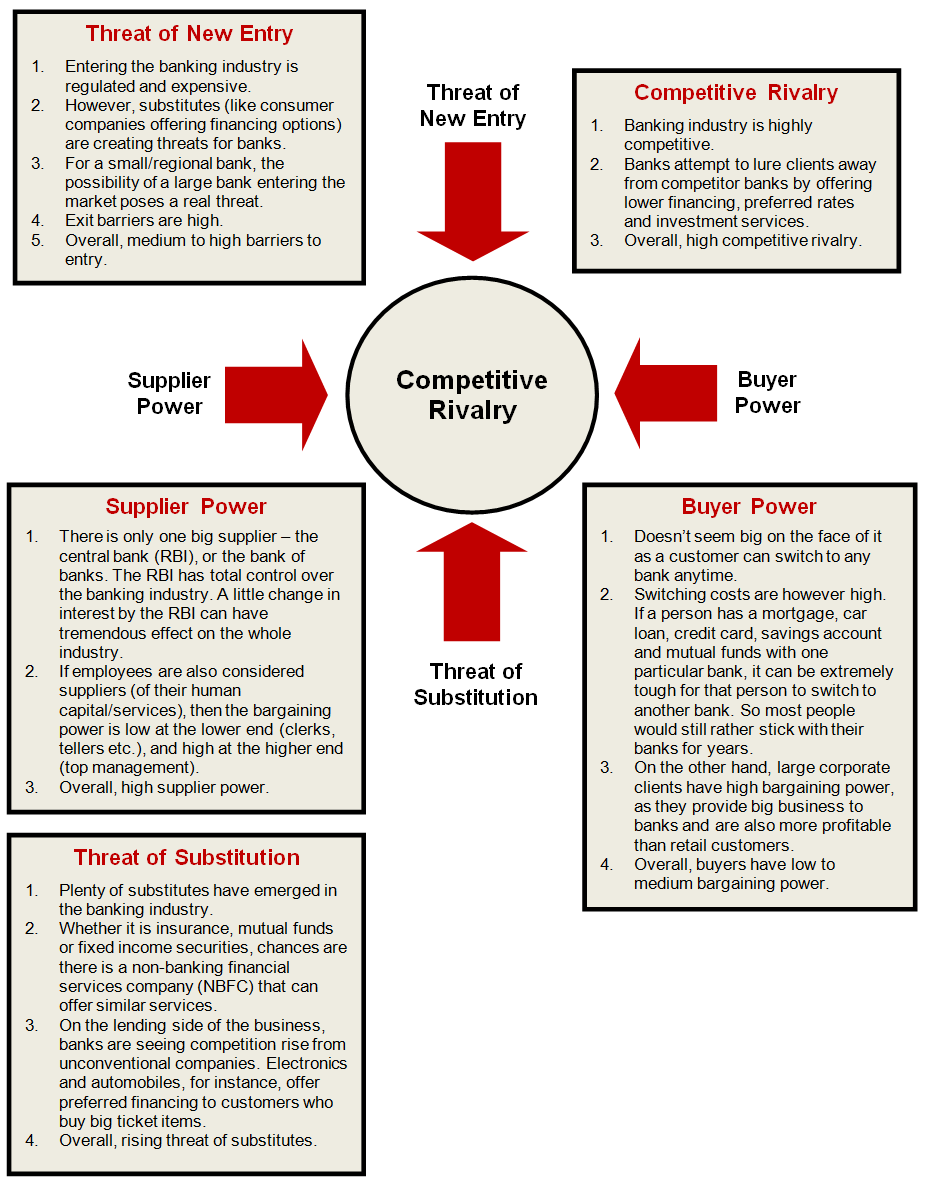
Industry Analysis: Banking – Part 1

by Vishal Khandelwal

First a warning – Banking is not within my circle of competence. This post is an attempt to put forward whatever little I have studied and know about this industry. It’s now upon you to build on the same and learn more about how this industry works.
About Banking
Wikipedia defines a bank as…

…a financial intermediary that accepts deposits and channels those deposits into lending activities, either directly by loaning or indirectly through capital markets. A bank links together customers that have capital deficits and customers with capital surpluses.

Banks have come a long way from the temples of the ancient world, but their basic business practices have not changed.

50% of the "early bird seats" for my Kolkata Value #Investing Workshop are gone! Register now if you wish to attend – http://t.co/dVRV8D4bmd

— Vishal Khandelwal (@safalniveshak) August 1, 2014

Banks issue credit to people who need it, but demand interest on top of the repayment of the loan. Although history has altered the fine points of the business model, a bank’s purpose is to make loans and protect depositors’ money. Even if the future takes banks completely off your street corner and onto the internet, or has you shopping for loans across the globe, the banks will still exist to perform this primary function.

Now, due to their importance in the financial system and influence on national economies, banks are highly regulated in most countries.

Most nations have institutionalized a system known as fractional reserve banking, under which banks hold liquid assets equal to only a portion of their current liabilities.

Prior to the Industrial revolution, the currencies were actually pegged against equal amount of gold, which was held by the issuing central bank; this was like; for every currency denomination present in the market, there was an equal amount of gold held by the issuing central bank (RBI is India’s central bank, or the ‘bank of banks’).

With the advent of Industrial revolution and resultant money multiplier effect, there was huge need for liquidity infusion in the market. Fractional currency reserve can be considered to be a response to this phenomenon.

Anyways, in addition to other regulations intended to ensure liquidity, banks are generally subject to minimum capital requirements based on an international set of capital standards, known as the Basel Accords.

About Indian Banking
The concept of borrowing money in India is as old as the Vedic period (beginning 1750 BC). Later during the Maurya dynasty (321 to 185 BC), an instrument called adesha was in use, which was an order on a banker desiring him to pay the money of the note to a third person, which corresponds to the definition of a bill of exchange as we understand it today.

In the modern sense, banking in India originated in the last decades of the 18th century. The first banks were Bank of Hindustan (1770-1829) and The General Bank of India, established 1786 and since defunct.

The State Bank of India (SBI) is the largest and the oldest bank still in existence. It originated in the Bank of Calcutta in June 1806, which almost immediately became the Bank of Bengal.

This was one of the three presidency banks, the other two being the Bank of Bombay and the Bank of Madras, all three of which were established under charters from the British East India Company. The three banks merged in 1921 to form the Imperial Bank of India, which, upon India’s independence, became the SBI in 1955.

For many years, the presidency banks acted as quasi-central banks, as did their successors, until the Reserve Bank of India (RBI) was established in 1935.

In 1969 the Indian government nationalised all the major banks that it did not already own and these have remained under government ownership. They are run under a structure know as ‘profit-making public sector undertaking’ (PSU) and are allowed to compete and operate as commercial banks. The

There are broadly two types of banks in India – Scheduled Commercial Banks (SCBs) and Scheduled Co-operative Banks.

Scheduled Commercial Banks are categorised into five different groups according to their ownership and/or nature of operation. These include:

  1. State Bank of India and its Associates
  2. Nationalised Banks
  3. Private Sector Banks
  4. Foreign Banks
  5. Regional Rural Banks

As per the census of 2011, just around 58% of Indian households avail banking services in the country. There are over 102,000 branches of SCBs in India, out of which 38,000 (37%) bank branches are in the rural areas and 27,000 (26%) in semi-urban areas, constituting 63% of the total numbers of branches in semi-urban and rural areas of the country. A significant proportion of the households, especially in rural areas, are still outside the formal fold of the banking system.

How a Bank Works
The primary function of banks is to put their account holders’ money to use by lending it out to others who can then use it to buy homes, businesses, send kids to college.

When you deposit your money in the bank, your money goes into a big pool of money along with everyone else’s, and your account is credited with the amount of your deposit. When you write cheques or make online withdrawals, that amount is deducted from your account balance. Interest you earn on your balance is also added to your account.

Banks create money in the economy by making loans. The amount of money that banks can lend is directly affected by the reserve requirement set by the central bank – the Reserve Bank of India or RBI in India’s case.

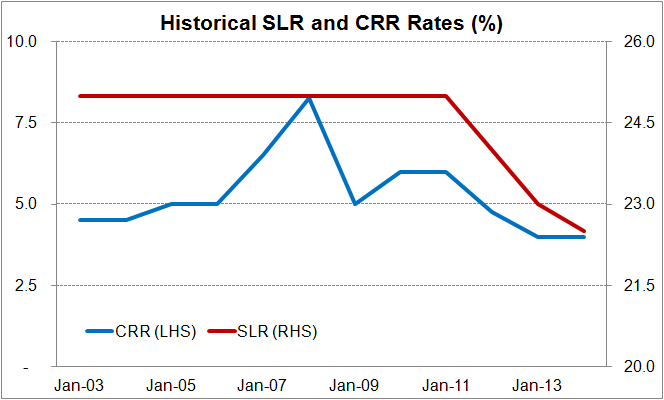
Two key mechanisms the RBI uses to regulate the supply of money in the Indian economy are –

  1. CRR or cash reserve ratio is a certain percentage (4% currently) of the total bank deposits that has to be kept in the current account with RBI. This means banks do not have access to that much amount for any economic activity or commercial activity. Banks can’t lend this money to companies or individual borrowers, and they can’t use this money for investment purposes. Also, CRR remains in current account with the RBI and thus banks don’t earn anything on that.
  2. SLR or statutory liquidity ratio, which is at 22.5% currently, is the amount of money (as % of total deposits) that banks have to invest in certain specified securities predominantly central government and state government securities. Banks earn some interest on their SLR investments, unlike CRR where the earnings are zero.


Data Source: RBI
This combination of CRR and SLR is the amount of money which remains blocked for statutory reasons and is not available for investment in various other high earning avenues like loans. While this restricts the resources a bank has in hand to carry on its business, this money also remains safe and with that mechanism the RBI offers safety to the depositors who have entrusted money in banks.

To see how this affects the economy, think about it like this. When a bank gets a deposit of Rs 100, assuming the total CRR and SLR requirement of 26.5%, the bank can then lend out Rs 73.5. That Rs 73.5 goes back into the economy, purchasing goods or services, and usually ends up deposited in another bank. That bank can then lend out Rs 54 of that Rs 73.5 deposit (after keeping aside 26.5% of Rs 73.5 as CRR and SLR), and that Rs 54 goes into the economy to purchase goods or services and ultimately is deposited into another bank that proceeds to lend out a percentage of it.

In this way, money grows and flows throughout the economy in a much greater amount than physically exists. That Rs 100 of original deposit makes a much larger ripple in the economy than you may realize!

How Banks Make Money?
Banks are just like other businesses. Their product just happens to be money. Other businesses sell products or services; banks sell money – in the form of loans, certificates of deposit (CDs) and other financial products.

They make money on the interest they charge on loans because that interest is higher than the interest they pay on depositors’ accounts.

The interest rate a bank charges its borrowers depends on both the number of people who want to borrow and the amount of money the bank has available to lend. As I mentioned above, the amount available to lend also depends upon the reserve requirement the RBI has set.

At the same time, it may also be affected by the funds rate, which is the interest rate that banks charge each other for short-term loans to meet their reserve requirements.

Loaning money is also inherently risky. A bank never really knows if it’ll get that money back. Therefore, the riskier the loan, the higher the interest rate the bank charges.

While paying interest may not seem to be a great financial move in some respects, it really is a small price to pay for using someone else’s money. Imagine having to save all of the money you needed in order to buy a house. We wouldn’t be able to buy houses until we retired!

Banks also charge fees for services like ATM access, overdraft, convenience fees for non-bank ATMs, annual fees on credit cards and other fees and penalties charged to customers. Loans have their own set of fees that go along with them. Another source of income for banks is investments and securities.

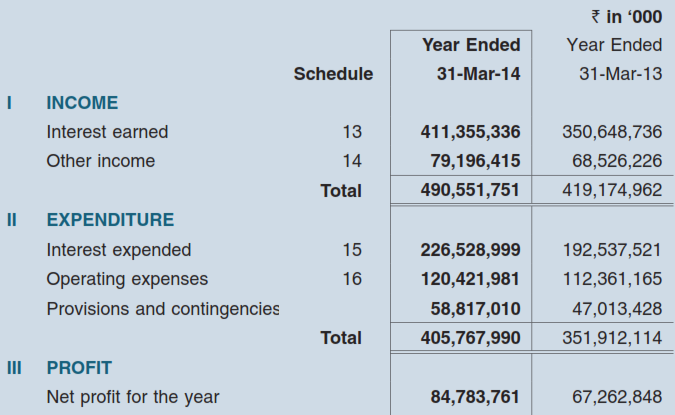
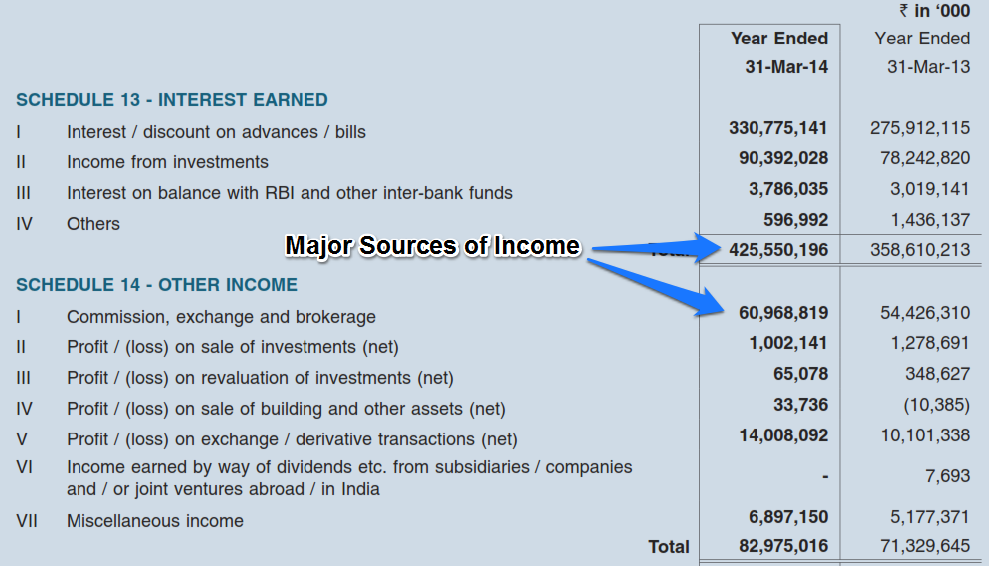
To see how a typical bank’s Income Statement looks like, look at the under-mentioned snapshot from HDFC Bank’s latest annual report. You would see that the major income sources for the bank include the interest it earned from several sources like loans, investments, and deposits with RBI, plus commissions and brokerage it earned for certain services. This is also the case with most banks.

Sources of Income for a Bank

Source: HDFC Bank’s FY14 Annual Report
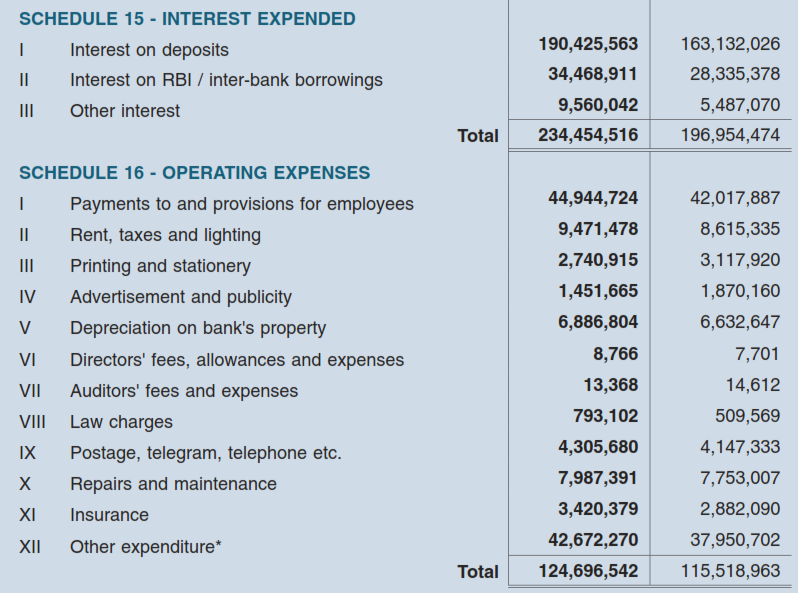
Now, unlike manufacturing or services companies that spend a lot of money on raw materials and employees respectively, the biggest expense for a bank is the interest it pays on its own borrowings (which is its raw material).

As you can see the snapshot below from HDFC Bank’s annual report, almost 65% of its total expenses are in the form of “Interest Expended” on deposits from individual depositors like you and me, borrowings from the RBI and other banks, and other interest.

Key Expenditure Items of a Bank

Source: HDFC Bank’s FY14 Annual Report
Now, if you were to look at the entire Income Statement of HDFC Bank, it looks as small and simple as…

Income Statement of a Bank

Source: HDFC Bank’s FY14 Annual Report
Thus, Net Profit = Interest and Other Income – Interest and Other Expenses – Provisions and Contingencies

Here, “Provisions and Contingencies” include provision for bad loans or expense set aside as an allowance for bad loans (customer defaults, or terms of a loan have to be renegotiated, etc) plus provision for tax.

Two key metrics to look at in a bank’s Income Statement are –

  1. NII or Net Interest Income – This is the difference between the interest income earned by a bank (from borrowers and on investments) and the amount of interest it pays out (to depositors, RBI, and other banks).
  2. NIM or Net Interest Margin – This is calculated as NII divided by the amount of a bank’s interest-earning assets.

NIM is similar to the gross margin of non-financial companies.

For example, a bank’s average loan to customers was Rs 100 in a year while it earned interest income of Rs 6 and paid interest of Rs 4. The NII in this case with be Rs 2 (Rs 6 – 4), and NIM will be 2%, calculated as (Rs 6 – 4) / Rs 100.

Let us understand NII and NIM using HDFC Bank’s Income Statement and Balance Sheet.

As you can calculate from the bank’s Income Statement above…

NII = Interest Earned – Interest Expended = Rs 41,136 crore – Rs 22,653 crore = Rs 18,483 crore

Now, consider the Assets side of the bank’s Balance Sheet and calculate the average interest-earning assets…


Source: HDFC Bank’s FY14 Annual Report
As per the above numbers, the average interest-earning assets for HDFC Bank equal Rs 421,075 crore.

Thus, NIM = Rs 18,483 crore / Rs 421,075 crore = 4.4%


Data Source – RBI;
Old Private Sector Banks include – City Union, ING Vysya, J&K, Karur Vysya, South India, etc.;
New Private Sector Banks include – Axis, HDFC Bank, ICICI, IndusInd, Kotak, and Yes


Source: RBI
Here are the NIMs of leading Indian banks for the year ended March 2013, as I have calculated using the reported Income Statements and Balance Sheets sourced from the RBI’s website.

Source: RBI
NIM is not a measure of a bank’s total profitability, since most banks also earn fees and other non-interest income from providing services, like brokerage and deposit account services, and it doesn’t take operating expenses, like employees and oither operating costs into account.

NIM can be used to track the profitability of a bank’s investing and lending activities over a time period. Like conventional profit margins, wider the NIM, better it is.

Also, comparisons between the NIMs of different banks are not always meaningful since the margin reflects the bank’s unique profile, that is, the nature of its activities, the composition of its customer base, and its funding strategies. No two banks are exactly the same.

On one end of the range, the widest NIMs probably would be found at banks with traditional lending and deposit businesses, that is, those for which loans make up the bulk of their interest-earning assets (loans, especially to consumers, typically have higher interest rates than investment securities and other short-term investments) and banks that fund their interest-earning assets mostly with deposits rather than higher-cost borrowed funds.

In India, such banks include HDFC Bank, which had a NIM of 4.4% (FY14). Loans accounted for nearly 63% of the bank’s average interest-earning assets, and deposits made up the lion’s share of its sources of funds. Against this, ICICI Bank, with an NIM of less than 3% had loans that were just about 57% of its interest-earning assets.

Overall, the trend in the NIM of a bank would give you a quick look at the profitability of its lending and investing activities.

Porter’s Five Forces Analysis
Porter’s Five Forces Analysis provides a “competitive forces” framework that allows us to better understand the different dimensions that govern competition within an industry. Porter’s five forces are –

  1. Competitive rivalry;
  2. Threat of substitutes;
  3. Bargaining power of buyers;
  4. Bargaining power of suppliers; and
  5. Barriers to entry and exit.

Let us use Porter’s framework to analyse the Indian banking industry…

The above figure depicts the five competitive forces that shape the Indian banking industry. As you can see…
  • Competitive rivalry in the industry is high;
  • Effect of substitutes is rising;
  • Buyer power is moderate;
  • Supplier power is high; and
  • Entry/exit barriers are high.

To be continued…


Key Documents
1. Income Statements of Indian Banks (Source: RBI)
2. Balance Sheets of Indian Banks (Source: RBI)
3. HDFC Bank’s FY14 Annual Report
4. About Banking Industry (Wikipedia)

Let me know your feedback on my above analysis of the Banking industry, which is the first of the two part analysis I will do on this industry.

Also, if you know of something important important about the Banking industry, which I missed in my analysis above and should cover in the second part, please suggest in the Comments section below.

29 Jul 04:29

Digital snooping (?) by the taxmen

by Lubna Kably

In his recent address to Income-tax officials, Finance Minister, Arun Jaitley, has emphasized that: “The Income-tax department should equip itself with state of the art technological skills, including, in the area of analysis of digital evidence.”


In this context, Zenobia Aunty promptly recalled a recent decision of the Income tax Appellate Tribunal (ITAT) – Delhi bench, which accepted as additional evidence ‘LinkedIn’ profiles of certain employees working in a liaison office (LO) in India, that were submitted by the tax department.


LinkedIn is a professional networking website, which enables its members (users( to post their details – such as past and current employment, designations and achievements. A lot of such information is available in the public domain – ie: via public profile. Those who are connected to the members via the LinkedIn platform (known as first degree connections) also have access to other additional details that have been uploaded.


But, let us come back to the main issue on hand. LOs are typically set up by multinational companies (MNCs) to test the waters before making a foray into the Indian market. Or in some other cases, they are set up as sourcing centers. Permission has to be taken from the Reserve Bank of India (RBI) for setting up of a LO. The activities that a LO is permitted to carry out are restrictive and are largely meant to be facilitative in nature. LOs are also required to bear their administrative costs through remittances received from the overseas group company. Technically there is no element of profit involved in their activities or operations.


However, tax authorities do carry out inquiries to ascertain whether or not a 'profit generating' activity has been carried out by a LO which, in turn, could result in tax incidence in India in the hands of the LO.


In this case, General Electric International Operations Inc (GEIOI) operated in India via a LO.  As per the application made to RBI and permission obtained, the LO was to act as a communication channel between the head office and the customers in India.


But, a survey carried out by the tax department showed that various employees (including expat employees) were providing services to the GE entities world wide.


According to the tax department in its submissions before the Delhi ITAT, the activities carried out by the employees indicated that GEIOI was carrying out business in India through a permanent establishment (ie: a fixed place of business in India). Thus, the income attributable to such a permanent establishment was taxable in India. But the company had not furnished such income in the return of income filed for any year.


During the appellate proceedings before the ITAT, the tax department argued that, in order to delve into the facts it requested for information - such as employment contracts to understand the role of such employees in the Indian LO. However, the information requested was not forthcoming. The tax department pointed out that such information was necessary to rebut the claim made by the company that the employees were merely acting as a ‘communication channel’. The tax department then extracted LinkedIn profiles of the concerned employees, which were available in public domain, to substantiate the qualification, role and the entity with which such employees were working.


The tax department, in the course of the ITAT proceedings relating to admission of additional evidence, pointed out that the LinkedIn profiles established that these individuals were very highly qualified, they had international experience and had worked at high positions in GE companies both in India and overseas. It also showed that they were responsible for the sale of GE products in India. The tax department also emphasized that the LO did not submit anything to disprove the details of the LinkedIn profiles.


On its part, in the course of proceedings before the ITAT, GEIOI submitted that each LinkedIn profile is merely a particular employee’s vision/appraisal of himself. It does not have the imprimatur or endorsement or approval directly or indirectly of his employer company. Further, an employee’s description of himself, without further and detailed inquiry and investigation cannot possibly form the basis for reaching any clear, cogent and/ or reliable conclusion with regard to precise nature of the activities of the Indian entities.


The ITAT did not accept the contention put forth by GEIOI that LinkedIn profiles are hearsay evidence, as it is the employees themselves who provide such data – and no third party is involved in the creation of the profile. “LinkedIn profiles are in the nature of admissions of persons on their job profile. The data is in pubic domain,” the ITAT emphasised.


The LinkedIn profiles of the relevant employees submitted by the tax department, are supportive in nature and would assist in appreciating the facts in a more judicial manner, stated the ITAT while admitting this evidence.


Ameya Kunte, co-founder of the tax centric portal TaxSutra was one of the first to comment on this ruling by saying:  “Taxpayers in future could be subject to ‘digital profiling’ from tax administrators.  Revenue may effectively use ‘digital graph’ of taxpayers in determining correct taxable income. GE ruling here is a classic example.”


According to news reports, the Delhi High Court has stayed this order of the ITAT – in other words it has for now, barred the tax department from producing or placing reliance on the LinkedIn profiles as evidence.


In the light of the recent comment made by the Finance Minister when addressing a meeting of the Directors General of Income tax (Investigation and Intelligence & Criminal Investigation) and Chief Commissioners of Income-Tax (Central) on analysis of digital evidence, the developments in the GEIOC case are bound to be watched carefully.


Zenobia Aunty airs a few words of caution when it comes to relying on digital evidence on social media sites that is publicly available: “Issues of bragging of one’s achievement on social media or of accounts being hacked cannot be denied. It is also plausible for users to upload details on a social media platform – casually – after all one is not filling in a legal affidavit. As regards digital data which is not in the public domain, any access to it by the tax department could result in breach of privacy.”


Thus, while a lot of information is available out there in the public domain, it would be prudent for the tax department to not take it at face value, but as mere supportive evidence.


In the days to come, it does seem like the tax department will leave no stone un-turned to gather data (albeit evidence) be it from digital platforms or otherwise. In fact, from October 1, 2014, prescribed tax officials will also be authorised to seek information or documents pertaining to third parties from any person, if the same is perceived as being useful or relevant to any enquiry or proceeding under the Income tax Act.

29 Jul 04:24

Drop import duty on gold, Ms Nirmala Sitharaman

by Hema Ramakrishnan

Gold smugglers are having a field day. But Nirmala Sitharaman, minister of state for finance, is firm saying the government won’t roll-back the high import duty. She is making a mistake. High duties have made gold smuggling a profitable option, after the pre-reform days of the 1970’s and 1980s. By the minister’s own admission, cases of smuggling had gone up in 2013-14 to 2,441 from 869 in 2012-13.


There is also enough anecdotal evidence. ET magazine has reported ingenious ways of people slipping in gold through airports of Kerala. Sample some of these: hiding gold in body cavities, grinding the yellow metal into powder, using it as chocolate toppings carried in sealed boxes and concealing gold in personal products like shoes and belts. Business is thriving on the back of a huge network of suppliers, couriers and hawala money dealers. When authorities turn the heat on one entry point, smugglers simply turn to another, a customs official was quoted saying. Surely, the tax sleuth’s job has become tougher as she hunts for gold in the most unlikely places. But that’s the diktat from her top bosses.


Demand for gold shot up last year, after people lost faith in mutual funds and other financial instruments due to high inflation. The government raised import duty from 2% to 10% in the hope that such a clampdown would discourage consumption of gold. There was also a gripping fear that continued import of gold would worsen the country’s current account deficit (CAD), which is equal to the gap between domestic investment and domestic saving, and hurt macro- economic stability.


CAD rose to $88.2 billion, a whopping 4.7% of GDP in 2012-13, and import curbs helped bring the level down to $ 32.4 billion or 1.7% of the GDP in 2013-14. It's time now to roll back the high import duty. Instead, the government should look for sustainable and long term ways to lower inflation and reduce CAD.


Sure, this year’s Budget has tried to woo savers into buying financial products, and not gold. Steps such as raising the tax exempt savings limit and letting people save more money in their public provident fund will help raise the country’s gross domestic savings that has seen a sharp fall over the last few years. But tax breaks are short-term palliatives. The government must look at long term solutions to raise people’s confidence in financial instruments. And the answer lies in taming inflation and reining the oil import bill.


Frankly, the country will not lose much by lowering the import duty on gold and bringing it at par with the price of gold in other countries. Only gold needed to make jewellery will then get imported. Already, world wide demand for jewellery has seen a moderation due to lower prices. Why is the government waiting for another Shubh Muhurat?

29 Jul 04:23

Of Faith and Markets

by David Merkel

Here’s another letter from a reader.  If reading about my faith turns you off, stop reading now, because this will be thicker than usual.

Hi David,

 I’ve just started reading your blog, and greatly enjoy it. I noticed you integrated your faith with your perception of the world and economics/policy. I am a Christian who is attracted to the wonder of the financial markets. So many individuals making so many decisions being affected in so many ways; it can be overwhelming. My question regards how you view financial markets within your faith.

 I was originally going to work at an internship at a hedge fund in 2008. I thought it’d be the dream: making big money! But that summer, when all hell broke lose, the hedge fund closed down before I could even start. Fast forward six years, and I’m working in corporate finance at a non-financial company – nothing to do with the markets. I want to jump back in, but not as a trader. I feel there was some Divine Providence in how I’ve perceived my “close call” with the trading world. I’m currently trying to understand how I can approach careers involving the financial markets that don’t force me to leave my faith at home. How do you approach the world of finance with your faith?

 Thank you so much for taking the time to read this, and God Bless.


Dear Friend,

I went through a similar experience early in my Christian walk, because sadly, I ran into some Evangelicals who denigrated earning money – Evangelical Leftists were more common in the late ‘70s.  Thus, I turned against Finance though I was good at it.  My Master’s thesis anticipated price and earnings momentum, and most quantitative long-short equity hedge funds.  Too bad for me; I aimed at doing development work in the Third World.  As it was, when I figured out that development economics tended to inhibit growth, and its opposite encouraged it, I gave up.  I started a career in finance as an actuary.

When I did that, I realized that I must do many things:

Be a good example to those around me.

  • Be friendly and pleasant to my co-workers.
  • Oppose fraudulent practices.
  • Be honest with those with whom I dealt.
  • Apologize when I sin or make mistakes.
  • Avoid bad language.  That not only means foul language, but also cruel language, even if it is technically clean.
  • Work hard.
  • Learn, learn, and learn.  A dirty secret about Evangelical Christians is that we read more than non-Christians, and have more Ph.Ds per capita.  Okay, the Jews have us beat there, and badly.
  • Avoid working on the Lord’s Day [Sunday].
  • Don’t be afraid about using the Bible as an analogy or as an example.  After all, people cite all manner of garbage as authorities, and the Bible is not permitted?  Is it because the Bible claims universal authority that people want to ban it?  Yes, that is why.  No one wants the Owner of the Earth to remind us of His claims.
  • I was always honest with coworkers about my faith in moments where it was natural, but I never beat them over the head with it.
  • Love your coworkers, and those with whom you interact.
  • Avoid investments in companies that have sinful goals — gambling, illicit sex, etc.  Also avoid companies that try to cheat people.

Practically, the most important thing is to be honest, keep your word, aim for competence, and be faithful in your dealings with others.

Any vocation can be pursued in a worldly or Christian way – most of it is the attitude that you bring to it.  “Whatever you do, do it heartily, as unto the Lord.”

One final note: one time, I was given a very hard time by a boss who was under a lot of pressure.  Nominally, I was his assistant, and so the rest of the team was amazed with what he put me through, while I largely kept a good attitude (it was not perfect).  One of my co-workers, a Christian, came to me privately and asked how I was doing.  I said that I was fine.  She knew me well, and said that she was praying for me, and that the entire staff was astounded that I would put up with what the boss was doing.  I told her that he was the boss, under a lot of pressure, and that if I pushed back, it could do a lot of harm to all of us.  I was not doing it for me.

It made an impression on the staff, and though they liked me, when the boss left six weeks later, they chose me to run the unit.  Truth, management above chose me, but without their support and love, I would not have been half the leader that I was.

So, serve for the good of others, and you will succeed.  “Love your neighbor as yourself.” [Lev 19:18]

Sincerely,


David

29 Jul 04:10

Mutual Funds and their service

by subra

I could have also called this ‘Mutual Fund and the Common Man’. This is a blog that is being written as a genuine feedback from IFAs and customers.

1. A good fund manager is a must: Only because a fund house has a good fund manager are clients coming to them.

2. However, having a good fund manager should not be the reason why the back office of an Asset management company (mutual fund as people call them) should be arrogant.

3. The fund statements are too complicated – especially if they are summarized. Even detailed statements do not show the IRR of the scheme FOR THE PARTICULAR CLIENT. Not logical at all.

4. Why does the fund house not send an ANNUAL statement of booked capital gains – afterall they have the purchase price, sale price, dates of the transaction – cannot this be automated?

5. Why do mutual funds send such complicated emails – and in many cases the files do not open. GRrrrrrrrrrrrrrrr.

6. For long running mutual funds, whey do they not send an annual summary with following details : year, amount invested, the market value of the investment, and IRR – for SIPs that are 3 years and older?

7. If banks can give us such detailed statements, why cannot Mutual funds give us an E-access to our statements so that we can see it in which ever format we WANT?

..CAN go on and on….but will stop…

Post Footer automatically generated by Add Post Footer Plugin for wordpress.

28 Jul 03:45

Strange things happen in stock market (and off-market)

by Chinmay
I am holding shares of a company 'Divyashakti Granites' for more than two years now. I had bought them at an average price of around INR 25 when the book value of the company was very high and even the net current assets are higher than the price. What I found was that in the month of June, there was an off-market transaction where somebody bought shares of the same company off-market for just
28 Jul 03:42

Do I really need Rs. 8 crores for my retirement?

by subra

Financial planners, mutual fund sellers, bank RMs, all of them have a knack of racking up a large number when it comes to your retirement corpus!

Normally they do this so that they can galvanize the client to act. However, from what I have seen it normally has a negative effect! When people look at a huge number – say Rs. 5 crores – the immediate thought is “Oh, my God!” I cannot do anything about this!

However this is not true, nor desirable. You as a customer (client) should understand that this is a nice round figure, but if you do reach Rs. 4 crores, it is not the end of the world. Also you need to understand that if you start to save, say 30 years in advance, you may need to invest only Rs. 80 a day to reach there. However if you start 5 years before retirement, you may need much, much, much more – say Rs. 6 Lakhs a month (or Rs. 20,000 a day!!).

So instead of killing your adviser, start, albeit with a small amount. Starting is more important than the amount with which you start. It is like getting a root canal treatment done – do not try doing 12 teeth at a time!

Far more importantly the inflation figure today is about 10-15% p.a. for many of our expenses. From where Financial Planners take this figure of 8% is not easy to understand. However if you do take a figure of 15% inflation for 20 years it will scare the hell out of you. And in an internationally competitive economy, salaries may not go up at that rate. So what are one’s options?

I am here just to ask questions – all of us need to find out our own answers for these complicated questions.

A simple lifestyle, low level of expenses, better understanding of health, wealth, and basic finances are a nice step in that direction. One illness (say blood pressure or diabetes) detected at age 42yrs can cost you about Rs. 55 lakhs over your remaining lifetime.

So not understanding EXACTLY how much you need for retirement is fine, but, however, taking steps to improve health, reduce weight and blood pressure, sugar, stress, improve flexibility of mind and body, AND investing for retirement is something that YOU HAVE TO DO. The money will take care of itself. Honestly.

Post Footer automatically generated by Add Post Footer Plugin for wordpress.

27 Jul 04:39

Balancing Quality Against Valuation

by David Merkel

A letter from a reader:

Hi David,

I am XXX, from India. I started reading your blog since few months. Few of the things i learnt, and much more are really complex for me to understand, the learning is ON.

Somehow i decided that ” being good value investor and control the behaviour” is a gift of long practice and learning. So it takes time and for me the learning is still in lower phase. I am in middle of understanding Financial statements.

But before that i want to invest and enjoy the power of compounding. Till now i used Mutual Fund, Fixed Deposit (bank) for my wealth creation. As part of my milestone, i want to go ahead with shares for my Kids education and retirement.

I like to Buy Consumer staples like Nestle india, Gillete India, Glaxo Smith india which are past compounders. Given a India’s Economic growth and Population growth, I foresee these socks can do well. But it is already at very high PE (Nestle – 42, GSk consumer- 39, GSK pharma – 52, Gillette -141). I don’t foresee any panic selling on these stocks. What i will do? how i do buy Quality business with good valuation?

Kindly guide.

thanks for sharing such wonderful posts.

Dear Friend,

You have described the optimal situation: buy businesses that have well-protected boundaries, and buy them cheap.  I wish I could do that.  Everyone would like to do that.

But that is where judgment comes in.  I would rather own cyclical businesses with competent and honest management  teams, than own high growth businesses at very high multiples of earnings.  I would also rather own slow growth businesses at modest multiples of earnings.  Ask yourself: where am I getting a reliable stream of earnings and growth relative to what I am paying for the stock?

In general, with growth stocks, never pay more than 2 times the earnings growth rate  for the P/E of the company.

Often you have to look at companies that are neglected, and I would like to recommend a book to you: Investing in India.  The author avoids highly valued companies in India, and aims to invest in companies that are fair to outside minority, passive shareholders.

Look at more stocks than just the highest quality stocks, and look at the valuation tradeoff between highest quality stocks, and lower quality stocks.  Most value investors accept the lower quality stocks, if their ability to produce value relative to their price is better than that of higher quality stocks.

All that said, part of the question is how long will the high quality stocks have a significant advantage.  In the US, on average, that advantage has not been long.  Maybe things are different in India, but maybe not.  Be careful.  Remember, the cardinal virtue of value investing is having  a margin of safety, not cheapness.

Sincerely,

David

27 Jul 04:37

Winner’s characteristics!

by subra

A chance to meet many people is a huge, huge advantage of being in sales, training and public speaking. It also helps you interact with people across age groups.

Some common characteristics of winners:

- Learning continually, and taking every opportunity as a learning opportunity

- when they find their boss unreasonable, they double their efforts, or ask their boss to prioritize what the boss wants first

- take responsibility, fully, not say ‘my part is well done, my colleague shirks’

- have a high tolerance (almost love) for uncertainty and disappointment

- embrace risk, understand and manage risk

- listen to people who either have a track record or justification of what they say

- they choose advisers whom they can trust

- love their area of work.

- if they find work that does not help them grow, they choose another area

- having the guts to speak their mind

- not saying ‘I have the qualifications to do a much bigger job’

- doing the job on hand well…and DEMAND better quality of work …

Post Footer automatically generated by Add Post Footer Plugin for wordpress.

27 Jul 04:36

Stock Idea - Bajaj Finance

by Abhishek Basumallick
Bajaj Finance Ltd (BFL) (CMP - 2293, NSE:BAJFINANCE) is a financial lending company from the Rahul Bajaj group. The company is involved in multiple areas of lending in 3 verticals - retail (consumer), SME & Commercial with a split of 40:50:10 as of now. The company is looking to increase the commercial loan book to 20%.

The NBFC sector is growing consistently. Consumer finance is growing very fast. This is reflected in the growth of the company in the past as well as anecdotal experience at all consumer electronics stores and auto dealerships. With more and more consumption-driven culture and higher disposable incomes (specially in urban centers with double income families), consumer loans is likely to grow well for a very long period of time. Indian penetration of consumer loans / GDP is 11%, whereas it is 20% for China, 23% for Brazil, 54% for Germany and 99% for US. Even at the lower end of the spectrum, there is an opportunity to double the loan/GDP ratio.

In 2 wheeler finance, BFL has a 18% market share. It is the largest 2-wheeler lender in India focused on semi-urban & rural markets. Currently contributes to 30% of Bajaj Auto's 2 domestic wheeler sales. 

It has a 15% market share in consumer electronics finance in India and is the largest in India.

The market is very fragmented with other NBFCs and banks in the fray. BFL has a competitive advantage of being from the Bajaj group so will get a first shot at customers buying Bajaj 2-wheelers.

A lot of banks & NBFCs are in the space. Main competitor is HDFC Bank, followed by other NBFCs like Sundaram Finance, Shriram City Union etc. 

BFL has two major advantages - i) it is already entrenched in Bajaj Auto dealerships and gets an advantage in sourcing customers in the 2-wheeler business and ii) it is well entrenched in the large malls / electronic stores/chains for consumer electronics loans. It is not going to be easy to replicate the reach by others. 

  • In FY2014, BFL’s total income was up 31% to 4,073 crore
  • Profit before tax (PBT) increased by 25% to 1,091 crore
  • Profit after tax (PAT) was up 22% to 719 crore
  • BFL’s assets under management rose by 37% to 24,061 crore
  • Loan deployment had risen by 34% to 26,024 crore. 
  • Consumer lending grew by 36%
  • Small and medium enterprise (SME) lending grew by 52%. 
  • Commercial lending de–grew by 11% due to the company’s cautious stance on the precarious state of India’s infrastructure sector
  • Capital adequacy as on 31 March 2014 was 19.14%, is well above the RBI norms
  • BFL’s net NPAs were at 0.28% of total assets
  • Present in 117 cities of India, BFL continued to be the largest consumer durables lender in country — and helped finance 15% of all consumer electronics sold in the year. 
The stock is available at a PE of 15 and a P/B of 2.7 which seems reasonable in an environment where all stocks have been bid up aggressively. BFL has good consistent profit growth of 87% over 5 years and a sales growth of 47% over the same duration, which has been rather difficult for the Indian economy. With any improvement in the economy and reduction of interest rates, BFL is well poised to outperform the industry and provide good growth over the longer term.

Note:- I am invested in the stock and thus have a vested interest. Please consult your financial advisor or do your own due diligence before investing.


27 Jul 04:36

India could be the most successful economy

by Shailesh Haribhakti

An economic think-tank has predicted that India will be the third largest economy in the world by 2030, hopping seven rungs from the current position. But, according to the World Bank's International Comparison Programme (ICP), we are already there in terms of purchasing power parity (PPP) since the past three years.


Let the predictions and presumptions go on. My strong feeling is that we can be the most successful economy, if not the largest economy, at any given time of our choice. But we have to make that willful choice.


First, let's resolve to make a quantum leap to improve our current sovereign credit rating of BBB with a negative bias. We have to improve this. But, what will it take us to get a positive investment grade?


I have the following suggestions, which are workable within the present budgetary allocations.


We badly need to make a long-cut of waiting and wading through the natural course of economic progress. Many predict that our young workforce is capable enough to spearhead the economy in the coming years.


But there is also a short-cut, which is possible even now. Curtail the fiscal deficit by about Rs. 2 trillion by the end of this fiscal and initiate a slew of steps to arrest the quantum from crossing beyond 3% of the GDP at any cost.


There are only four big levers that can get us there:


1) Reduce inflation to sub-4%. Let's accept that persistently high inflation is the biggest bug-bear of the economy. No number of monetary policy tightening will be as effective as kicking the middlemen out of the supply chain of fruits and vegetables. So the government should quickly dismantle the exploitative APMCs.


Just working against the hoarders will not work. Also there has to be strict monitoring of the end-use of credit. Also, link the MSP to global prices. If worked out in a concerted manner, these will be the best tools to kill the dragon called inflation once and for all.


2) Ramp up the disinvestment target. Already the proceeds from disinvestment are assumed at Rs. 58,000 crore. If retail investors are lured into the market, there is no reason why Rs. 1 trillion can't be easily added to this number simply from bank recapitalisation. For many reasons this has to become the center-piece of fiscal deficit reduction.


3) Ensure that the subsidies are fully targeted: Target the subsidy dole outs only to the needy and ensure sustained asset creation and income generation from their use.


4) Roll out GST by the end of the current fiscal: Extend the current model of gradual increase in diesel prices to LPG. Hike the price of cooking gas by Rs. 20 a month. Any substantial hike will be looked at as anti-people. All other subsidies must be delivered directly to beneficiaries using the Aadhaar-based DBT infrastructure already in place.


I firmly believe that this government will achieve these outcomes and will implement GST over the course of the current fiscal itself. The ground will thus be laid for a more growth-oriented next budget. We can easily reach 8% growth next year if the manufacturing and infrastructure projects are financed by the tsunami of money that will be attracted for investment with a BBB+ rating. Then we can sustain this growth for a decade.


27 Jul 04:34

Get the historic perspective right

by subra

It is customary for the average Indian to talk about the Caste system…

And there are many Brahmins – those who know history, and those who do not know it are just two varieties. So many of them (who are in the second category) feel that by being anti-Brahmin they are correcting a historical wrong, and that is the right way to behave. Of course most of us are just born in a B household and have almost NO RIGHT to be called a B. We may not know our history, our vedas, Sanskrit, …do nothing that a B is supposed to do…but hey we are ‘B’ .

Just to get the perspective right read this article by a friend Sanjeev Nayyar – it appeared in Hindustan Times and now it is available on this website. An interesting website, please feel free to explore what it has..

http://www.esamskriti.com/essay-chapters/When-caste-was-not-a-bad-word-1.aspx

Post Footer automatically generated by Add Post Footer Plugin for wordpress.

27 Jul 04:33

Some nice investment tips….

by subra

Markets in the country are going through a good (bad?) phase for sure. However, it may be an opportunity to buy if you are optimistic.

The main worries are –

1. There is a large sales force today far, far divorced from the end customer! They have no clue how the money is collected, aggregated, and managed. However, they have a target, have a commission and they run door to door to collect money. Their solutions are so oft repeated, they may start believing them. They have no clue about how the market is doing or whether it is up or down!

2. In the previous markets (pre internet days) the brokers were far, far more careful compared to todays’ Relationship Managers.

3. There is too much of aggressive product pushing – the greater the commission for the distributor, the harder the push!

4. In the olden times brokers looked at value investing during a bear market and at growth stocks during a bull market – now people change asset classes. So markets may go through faster cycles. However, investors will lose large amounts of money because of their own excessive trading.

5. Media is creating volatility. Hence the chances that a common man makes money in the market is getting tough and tougher! Only way the investor can make money on the stock exchange is keeping away from the media 6. Start with a prayer, it helps –

See more at: http://www.subramoney.com/2008/09/mayhem-in-world-markets-a-summary/#sthash.BH9Yf2Cz.dpuf

Post Footer automatically generated by Add Post Footer Plugin for wordpress.

25 Jul 03:52

Have you ever been Mis-sold a product? Read and Comment please!

by subra

It is customary for industry bodies to time and again talk about “irresponsible” selling or mis-selling by “unethical” agents (by what ever name called). Let us look at what exactly constitutes mis-selling.

Mis-selling as understood by the common man means “selling a product which is inappropriate for the client”. However let us look at the manufacturer’s attitude. Believe me it is very different. Did you know that one very very big ‘Wealth Manager’ sets such high targets that people squirm. He is ruthless in making ULIP sales (he is very polite when he talks about creating wealth for the client!).

If an agent sold a life insurance policy with a “life-cover” to a bachelor on whom no person is dependent, I would think this is mis-selling. The industry would not. They would say ‘sir the client wanted life cover’.

If an insurance policy is sold to a non-earning member (sorry to be gender biased but I mean the house wife) and the husband is the beneficiary, I would think it is mis-selling, the industry may not think so. Similarly in case of a child. I am at a complete loss to know who would be paying the premium in case the breadwinner is no longer around to take care of the premium. However, many people have bought child policies..with no possibility of client understanding. Have you made that mistake too? then you have been mis-sold too.

If the agent is the spouse of Mr. X and Mr. X is a full time employee in a foreign bank, and nicely taps the data base of the bank, I would think this is in the realm of what is wrong, the industry may not think so. Industry is happy with the sale. I know of one RM whose wife’s commission income is greater than her husband’s salary. I doubt if she can fill up a form – forget doing a sale. Industry sees this as best practice.

What really constitutes mis-selling in the minds of a life insurance company? This is very difficult to say, but I do not know of any company which has a comprehensive “mis selling policy”. If it does exist, I do not know about it, my apologies for the same. So mis-selling is not defined, not communicated, not monitored, and thus not bothered about! If it is not measured, monitored or acted upon, I guess the industry pretends that there is no mis-selling. GOD BLESS THEM.

Let us start by saying that the following actions should be mis-selling:

Selling a regular premium product as a single premium product: Very commonly done especially at quarter endings, last day for a scheme getting over, etc. In case you are wondering what is a “scheme”, it is a sales incentive to the agent and could be winning a top end car, a trip to Australia, 1 kg of gold, etc.

Selling a pension plan as an insurance plan, and saying “your medicals have been waived”! This is too simple to explain, correct?

Selling a term insurance plan as an endowment plan.

Not mentioning the charges involved in a mutual fund or an insurance plan – upfront charges, asset management charges, entry load, exit load, bid-buy price, surrender charges, all this may sound like Latin, but if your agent does not know these words, beware.

Saying “in the past 2 years we have achieved 80% return on equity…therefore

“Our charges are the lowest” lie. Very few people outside the actuary industry can understand charges the way it is to be understood. So this lie is perpetuated by the sales team – they have heard it from their own acturial team!

The guy/ gal who visits you is not the agent! It is the agent’s brother, sister, mother, husband, etc.! By a funny law – created by the big insurance companies to suit themselves – agents are “tied” to one company. Strictly speaking the agent should be the person who is “authorized” or “certified” by IRDA. However, knowingly all companies turn a blind eye.

However Indians being Indians they have nicely overcome this “handicap” by making everybody in their house an agent! Simple is it not?!

This is not exactly mis-selling but the guy who comes to you from one bank prospects for his “friend” who has a better product. Look no ones’ complaining!

There are of course millions of instances of mis-selling happening in the market, let us see what can you do as a prospective client to avoid some of these pitfalls:

ask questions: its your money, you are allowed One million questions(and you will decide whether it is a stupid question or not)
Learn more about the products you buy – on the net or in physical form
say what you want clearly, firmly and Loudly.

Post Footer automatically generated by Add Post Footer Plugin for wordpress.

25 Jul 03:52

Two months of Modi sarkar: Govt 1, critics 0

by Sriram Ramakrishnan


The left-liberal carping at Narendra Modi’s economic agenda is symptomatic of a larger problem within the community. Having proved themselves singularly inept at predicting Modi’s rise and in capturing the extent of his appeal across in the country, Modi critics have now trained their eyes on his economic agenda. The criticism so far has been broadly along the following lines. One, the Modi agenda lacks any vision or new ideas and is heavily dependant on the policies of the previous government; The budget was very uninspiring and therefore a missed opportunity for the government to put its best foot forward. Third, the agenda will fail as inflation will remain high and projects will not take off.


The point I am trying to make is that criticism so far of Modi seems to be relying too much on a narrative built around what a certain section of intellectuals think is the right way forward. These intellectuals, largely academicians, journalists, other assorted opinion writers and former bureaucrats, have formed a narrative about the economy and its ills and the measures needed to tackle it.


Let me elaborate. Much of the criticism that you hear is from people who believe that certain things have to be done in a certain way. For instance, they think economic growth is all about having a vision, a grand overarching strategy. This is irrespective of the fact that the economy needs quick implementation of existing ideas rather than brand new vision. There is this strong belief that reforms in the economy is all about bringing in FDI and more FDI into various sectors. Allied to that is this equally strong belief the only sectors that matter are the formal, corporate sector and that the rest of the economy is not so important.


As we approach the two-month anniversary of Modi sarkar, it is perhaps a good time to deal with these shibboleths and demolish them once and for all. Here are four important initiatives that have already been launched in the first two month. If implemented well, it could help deliver robust 7-8% GDP growth.


Speed up clearances and lift investment. Modi and his team have correctly identified that the biggest roadblocks to growth are lack of investment and long delay in securing clearances for projects. The first two months have been largely spent in clearing projects. The backlog is huge (According to the Business Standard, about 394 projects are waiting for environment ministry nod) and it will take a bit of time but nobody can find fault with the emphasis on quick clearances. So far, about 50 projects have been given environmental clearances. The Economic Times reported on June 20 that six major projects, including one held up for 30 years, have been cleared.


Cut red tape, reduce hassles. In his campaign pit stops, Modi spoke eloquently on cutting unnecessary procedural hassles and his government is focused on it for all the right reasons. ET did a story a few days ago citing the number of small measures announced by the government which are likely to have a big impact. The emphasis appears to be on making things simpler and easier for ordinary people, entrepreneurs, businessmen. In the next year or two, don't be surprised if you find fewer complaints about delays and governmental red tape.


Cutting subsidies maintaining fiscal credibility: Like other things, this still remains work in progress and a lot of will be known once the Arun Jaitley-appointed expenditure commission submits its report. This government’s credibility and its commitment to rein in the fiscal deficit will be tested on its willingness to drastically prune expenditure. Otherwise, minimum government, maximum governance will remain just a slogan.


Execution, Execution and more execution. India’s bane is not its lack of laws or its unwillingness to promote entrepreneurship, but its woeful track record in executing projects and programmes. Thousands of crores of rupees have been spent on various welfare programmes with uncertain outcomes. Crores marked for infrastructure, afforestation have not been properly spent. What the country needs is proper execution of all projects. The Modi sarkar seems to realise that this is a problem and that is a good beginning.


Naysayers will and should have their say but let us not forget we had a similar stream of negative reports in the run-up to the elections. It was said that BJP will not get a majority, that the Dalits, and minorities will not vote for it and that there is a massive consolidation against the upper-caste-OBC dominance in the heartland. What these pundits missed out was the consolidation in favour of the BJP. Similarly, the Modi critics may just miss out on the sweeping change ushered in by these so-called small measures and realise that the government’s priorities were right all along.