Shared posts

28 Aug 10:43

Smart Investing is simple!

by subra


Buy shares of a good profitable, successful business, hold on for inordinately long periods of time, and live off the dividends. You will surely get wealthy in the long run.

If you want to get wealthier,  use the dividends to buy MORE shares in the same company. Let us say you have shares of Hdfc Ltd., a very successful Home Mortgage company. You just received a dividend of Rs. 280,000 on your holdings. What do you do with the money?

Well you can celebrate, use it for household expenses, or buy invest the same. Instead of wondering which share to buy with this nice amount, just go and buy 280 shares of Hdfc Ltd which is currently selling at Rs. 1000. Thus you have converted a dividend scheme to a growth scheme. Similarly if you have / had Tata Power, Tata Motors, Ashok Leyland (by the way they skipped dividend this year),….

RE-INVESTING dividends is a brilliant tool available for the younger shareholders who have an independent source of income. However if you are older you may need the dividends to meet your day to day expenses, this option may not be available to you.

The advantage of using such steps is simple.

You can tune out of the screaming on television about Coal scam, how interest rates will go up in 2 weeks, but interest rates will come down in 3 months. How the melt down in US will hit the growth of IT companies….blah blah blah.

Just remember that the market is a slave of honest management, EPS, and an increasing PE. When a company shows awesome results Quarter after Quarter,  shows tons of Free Cash Flow, shows super growth without using great amounts of capital, …price has to go up. Look at TCS – if you were a regular investor who bought it at Rs. 800 odd about 10 years ago your money has gone up more than 10 times, and the dividend is about 20% of your investing. You really cannot ask for something much more than this, right?


Post Footer automatically generated by Add Post Footer Plugin for wordpress.

28 Aug 03:30

The costs of investing

by Rohit Chauhan
Cost is an important, though poorly understood aspect of investing. It is important for the simple reason that costs reduce the overall return one makes from an investment option. It is also poorly managed as people focus too much on explicit costs (cost of brokerage or fees) and ignore the hidden ones (such as opportunity costs).


As an investor, you have the following few options

a.    Fixed deposit : cost 0, likely return : 8-9% (pre-tax)


b.    Index fund ETF: cost 0.6% to 1%. Likely return : 14-15% (pre-tax)


c.    Mutual funds (HDFC equity fund): cost 2%. Likely return : 20-21% (pre-tax)


d.    PMS: usually 2% of asset and % of gains.  Likely returns: Who knows?


The options

Fixed deposit and index funds are zero or low cost options with the FDs having no volatility, but much lower returns. IF you want to build wealth, an FD is not going to get you there. Index funds are a decent alternative, where the risk of active portfolio management is removed. You don’t have to worry if your portfolio manager is an idiot who will underperform or worse lose money over the long term.


The third option is a well managed, diversified mutual fund with a long operating history. We can quibble about which mutual fund to choose, but I prefer one which has been conservatively managed for a long time. HDFC equity has been around since 1995 (almost 20 yrs) and has delivered good performance over the years. I am not recommending HDFC equity fund, but using it as an example of a well managed fund which has returned above average returns over the long term.

The last option is private vehicles such as PMS (portfolio management schemes). These involve high costs, and in some cases deliver good returns. However they have a mixed record and are generally not a good option for most investors due to a high minimum investment.


The math

Let’s take a hypothetical case


Let’s say you have 9 lacs to invest. It is Jan 2011 and you are looking for some avenues. You decide to invest equally in the three choices I have discussed above (lets ignore PMS for the time being)

At the end of 3.5 years, you will have following sums with you


Fixed deposit (pre-tax): 4.05 Lacs (pre-tax) and 3.84 Post tax


Index fund (pre-tax and post tax): 4.18 Lacs (net 1% as cost)


Mutual fund (pre-tax and post tax): 4.62 lacs (net 2% management fee )


The last 3.5 years have not been really that great for the stock markets (around 10% CAGR). Inspite of that, the index fund was able to do better than the FD on a post tax basis. The same held true for a well managed mutual fund too.

The explicit costs


In order to make the higher returns, an investor had to contend with all the volatility and noise in the market. In addition to the emotional toll, there was an explicit cost of around 3% for the index fund and around 6% for the mutual fund.


Most investors tend to ignore these costs unless it is pointed out to them. If someone  told them upfront that a 3 lac investment in a mutual fund would cost them 18000 over three years, they would balk at it and run towards FDs , real estate or gold.

Inspite of these costs, if an investor could stomach the volatility, he or she came out ahead during one of the lousy periods in the stock market.


Implicit costs

If you think explicit costs are bad, I would say the hidden costs are even worse.


So what is the hidden cost for an FD? It’s the opportunity cost to create wealth. In the above example an FD would cost 20% more than a mutual fund over a 3-3.5 year period (difference between the amounts after 3.5 years between the two options).

This difference only increases over time and would be even wider once the market performs close its long term average (15-17%) and interest rates drop.


I am sure I will get a counter point – how about real estate or gold. Let’s look at each of them –

If you bought 3 lacs of gold in Jan 2011, you would have around 3.78 Lacs of gold now (at pre-tax). I don’t want to discuss taxes as paying taxes on gold is different issue altogether. So gold did barely as well as an FD. Keep in mind that gold over a 20 year or longer period has delivered 9-10% per annum despite the recent runup (excluding transaction and holding costs)


Let’s move onto the next darling – real estate. So what returns can one get here? Well all of us have stories about how person xyz made 10X the capital in 5 years. Well, that is the equivalent of saying some investors made 20X their capital in page industries.

The returns on a specific investment – a stock or a property is not same as the return of an entire investment class. If you want to look at the average returns, look at this table by NHB. The returns vary from -15% for a Kochi to 249% returns for Chennai over a 7 year period. So we are talking of -2% to 15% per annum for different locations. This does not even include taxes, brokerage, and maintenance fee (For property).


Now the final argument would be – I was able to find a property and invest in it for a 10X gain in the last 5 years !

Congrats – but then you are missing the final point. The final point is the cost of time and effort – if you are a full time or even a part time investor in RE, you are using knowledge/ skill/ time to dig out such deals and investment in them. As you do this, you are not using your time do XYZ (spend time working, with your kids, play – whatever you can think of)


Compare all costs


IF you truly want to compare multiple investment options, compare all the costs – implicit and explicit


The explicit costs are fees and taxes. These are generally obvious and laid out to an investor (though still ignored). The implicit costs are usually hidden and often bigger – they are the opportunity costs of money (not investing in equity) and of time (spending time on investing versus other pursuits)

It is foolish to look at some costs and declare a particular option as better. Maybe I value peace of mind and time with family more than returns – in that case an FD is better.  My own dad valued these attributes more than returns and spent his spare time with his kids and on his own hobbies (without ever depriving us of anything in life)


On the other hand, there are people like me who love the process of investing and enjoy the higher returns. In my case, the vehicle is stocks and some other cases, it is real estate. There is an implicit cost  (time and energy) involved in earning the higher returns, which we don’t mind incurring, but it is a cost all the same (my wife can vouch for it !)

In addition to these costs and corresponding returns, I would say there are emotional and bragging benefits to various options which will be the subject of the next post.


28 Aug 03:26

The VIX Is Close to All Time Lows; But Does That Make Options Worth Buying?

by Deepak Shenoy

The VIX has touched close to an all time low at 13.07, and at this point options aren’t just cheap, they’re the cheapest they’ve ever been.

Since the Vix is really the implied volatility… (Read On...)

27 Aug 03:30

Concentration helps: Swami Vivekananda

by subra

Awake! Arise! Stop Not till the Goal is Reached said Swami Vivekananda. He was too much of a Motivator to be called a Saint, and too Saintly to be called a Motivator. Of course he was not like today’s Motivators..if only he had left tapes, videos, …it would have been great.

His books stir you, his words would have Charged you, big time. More than being a motivator he talks a lot about Concentration. Low end people like me need silence to concentrate.

One C A firm in London used to ban incoming calls for partners from 9am to 1pm – when they were to work uninterrupted, and concentrate on client meetings, audit finalization, etc.

This had been an age old practice – incoming calls if any would be answered after 2pm. Nowadays of course you can be disturbed at 2 am or 2pm by a message, a FB entry, a tweet, or even a phone call if your boss is awake.

Interruptions by the electronic invasion of our lives – mailing everything to everyone – just in case – have all ensured that we do not get enough time to concentrate unless you choose vampire hours to work.

Worse is what people call ‘multi-tasking’ this ensures that you do both the work badly. I know that certain things like peeling of potatoes and watching TV can be done together, but people have much worse combinations. So many people drive and talk on the mobile, talking on the mobile while getting into a train, getting off a train, crossing the road – it is perhaps the worst thing a sensible person can do. We are all guilty of doing this at some point in time in our lives.

Trying to multi task (especially women) is become so normal that watching Television (in all its gory) while having dinner seems to be such an In thing.  When we were younger, lunch was in the kitchen and television was in the drawing room. Today the dining table has been shifted to the television watching area…

Slavery to the screen – ‘Screen slavery’ – ipad, ipod, iphone, tab, lap top, television – let us be clear how many of us can stay away from all these screens for say 24 hours?

So we are back to our normal life and think ‘Ha once I get back home, nobody will disturb me.’. Ha!

Even then Google, FB, Linkedin, Wassup – can all disturb you. Of course it is your choice…but the urge is real and seemingly genuine. You realized how these have been horrible ‘IRAs’ as friends from BNI would call it. (IRA is Income Reducing Activity) and BNI is Business Network International – a networking organisation).


Now Harvard Business School says it is a good thing to have such ‘shut up time’…read on

http://blogs.bnet.com/harvard/?p=5798&tag=content;col2 

Post Footer automatically generated by Add Post Footer Plugin for wordpress.

27 Aug 03:28

The stock market is terribly misunderstood

by subra


Caveat: I like equity markets, as a family my father started investing in 1950s, I started investing in 1979, have enjoyed the process so far. I am completely indifferent to YOUR views on the market and whether you invest, hate, love or are obsessed with the market.

Article:

The equity markets are one of the most misunderstood markets and you have people with very strong views. Let us examine them:

1. You can make a lot of money in the equity markets: Even for big brilliant investors like a Warren Buffet or a Vallabh Bhansali, remember it is a few right calls, and YEARS OF SITTING on good calls. It is the power of compounding that has worked. In case of WB about 99% of his wealth was created AFTER his age of 50 years. Remember he started at age 11?

2. If you had invested in 1994 till the year 2014 you earned LESS than PPF: Only an absolutely idiotic person can write such an article. One needs to remember that even the index scrips would have paid about 3% annual dividend. Now if this dividend was REINVESTED in the same index, the returns would go up to about 7-8% over a 20 year period. ET’s Innumeracy.

3. Some people argue ‘What if I had invested in Satyam or Silverline instead of Infy or Wipro?: Look you genius, if you do not know how to pick stocks stick to mutual funds. If you know how to pick stocks, be vigilant. Stock picking is not Rocket Science – like riding a cycle – but it has to be learnt. People like Pattabhiraman (of Freefincal.com) can learn, but obviously lacks time. To learn about markets you need time and intellect. Having one cannot be substituted by the other.

4. Taking a view of the market is not my cup of tea I do not understand interest rates, technical analysis, fundamental analysis, etc. And I find it difficult to watch TV on a 24 hour basis: Well the good news is YOU need not know why somebody is raving and ranting about the Chinese economy, US slow down, Indian election, etc. Even assuming that all this is very important, if you pick a good company with a good business model, and have a long term view, the short term machinations of the market should not bother you. Just keep the media out of your investing life.

5. My father lost money in Harshad Mehta scam, CRB scam, Ketan…..Look it is not as if these people came to your father and asked him to invest. He chose to invest in companies that he did not understand, with the help of people who said money could be made. Be dispassionate in the analysis, stop blaming the markets. Do you stop sleeping on a cot because your grandfather died while sleeping on a cot?

6. There are short cuts in the market: I have not found them. It takes time to build contacts, understand markets, understand many things from Anthropology, Aviation, Ethics, Biology, Geography, Psychology, Philosophy, Accountancy, Human Behavior, Mathematics, Statistics, Equity Research….it also helps if you know some top Accountants, Lawyers, Research guys, Brokers, Fund managers, Fund analysts, Fund sales guys, etc. If you think you could read a couple of websites and make tons of money, revisit your thoughts.

7. WB’s techniques will work for me! Sure, when you reach the size of WB. Stop believing you can invest like WB or Mukesh Ambani. You cannot. Somethings can be achieved ONLY by size. If I buy 2000 Tata Power and 3000 Coromandel International – I should not confuse my self with a Rakesh who buys 500,000 in one shot, and can buy another 200,000 after a week. Or like another friend who bought 2 million shares in a company where I have under 40k shares. Size matters. Research matters too.


Post Footer automatically generated by Add Post Footer Plugin for wordpress.

27 Aug 03:25

Consumer protection in Indian finance: Going from ideas to action

by Ajay Shah
by Renuka Sane and Ajay Shah.

Financial regulation in India, at present, is oriented towards product regulation. While protecting the interest of customers is part of the mandate of all existing financial agencies, the present regulatory strategy is weak. The evidence on mis-selling is building up. The main focus of policy discussions has been prevention (e.g. ban on entry loads) with little work on enforcement (where orders are issued that impose penalties upon firms that have misbehaved).

Many piecemeal changes of regulations are underway. The Reserve Bank of India (RBI), for example, has recently published a Draft Charter of Customer Rights, which include: the right to fair treatment, the right to transparency, fair and honest dealing, right to suitability, right to privacy, and the right to grievance redress and compensation. When compared with the draft Indian Financial Code and the FSLRC Handbook, many weaknesses in this draft are apparent. But writing in the Mint today, Monika Halan emphasises the importance of this document: She says that it represents a big shift for RBI, when compared with 80 years of indifference to the problems of consumers in finance. In this sense, this Charter may reflect the beginnings of improved knowledge at RBI in consumer protection. But it is unlikely, in and of itself, to induce the desired effects.

The situation in India today, is reminiscent of the UK in the 1980s, which went through a consumer protection crisis, even though conduct requirements were in place, on paper. We can gain perspective by looking back at that experience.

An example of a consumer protection crisis: The personal pensions mis-selling scandal in the UK


In a paper  Personal Pensions Misselling: The Causes and Lessons of Regulatory Failure, Julia Black and Richard Nobles provide fascinating insights into the pensions mis-selling episode that rocked the UK in the late 1980s and early 1990s.

In 1985, the Government allowed employees to opt out of employer provided defined benefit pension schemes, known as Occupational Pension Schemes (OPS) and choose to buy personal pensions (PP). Given the differences in benefits between the OPS and the PP, it was not clear whether the shift was optimal for all employees. In fact, according to the authors, the PP was only beneficial to a few. The government was aware of the risk that wrong decisions could be made, and sought to rely on investor protection measures to prevent this.

This was a time when banks and building societies, life insurance companies and Independent Financial Advisors (IFAs) were regulated by the Securities and Investments Board Ltd (SIB), Life Assurance and Unit Trust Regulatory Organisation (Lautro) and Financial Intermediaries, Managers and Brokers Regulatory Association (Fimbra) respectively. The three regulators required distributors to obtain sufficient information on the customers financial circumstances, advise on products that were suitable to customers, recommend products that met the goals of the customers, disclose information regarding commissions received, and to provide detailed product information. Rules required agents to either tie up with one service provider, or advise on all products. And yet, a large number of people ended up giving up their rights in the OPSs for inferior PPs.

In comparison with where we are in India, it is important to see that the rules in place at a time, in the UK, were much more detailed when compared with what we have in India today. Yet, the desired outcome -- consumer protection -- was not obtained.

The authors suggest that the observed outcome was a result of a complex interaction of political ideology, product complexity, regulatory novelty and industry dynamics. Regulators themselves had limited knowledge of the product, and little experience of what kinds of standards should be imposed, and how. In a world where the only parameter of payments and promotions to the sales staff was commissions, compliance never became part of the business strategy. Regulators believed that general principles had been outlined, but firms argued that no guidance was ever given on what suitability meant.

The authors draw four lessons:

  • Regulators need to have specialist knowledge of individual products and business areas, and the risks from each of the products from an investor protection point of view.
  • Regulations can often themselves contribute to risk. Regulators, therefore, need to think through the potential impacts of current and proposed regulatory policies, and the preferred response should they arise.
  • General principles, such as that of suitability, have to be supported by a shared understanding of what is it that they require.
  • Firms need to provide a central place to regulation in their management strategy. Compliance with regulations must not be a side show; it must permeate the strategy formulation of the firm
    at the board level.

The way forward for India


It is important to trace the full arc from law to regulations to enforcement and jurisprudence, to the incentives of financial firms, in order to understand how the desired legal effect will be achieved. Improvements in consumer protection will only come about when financial firms internalise these principles, and treat customer protection as a core element of business strategy. Financial firms will behave in better ways only when (a) there is credible communication about what is expected under the law, and (b) there is tough enforcement when these expectations are not met.


The diagram above shows the story that must now unfold. The Indian Financial Code (IFC) writes down the foundations of consumer protection in the law at the level of timeless principles. At each financial agency, this would lead to drafting of regulations, through the formal regulation-making process of the IFC. Once this stage is set, some firms would inevitably violate the regulations. This would lead to enforcement actions and the issuance of reasoned orders. Some of these orders would be appealed and result in rulings in FSAT.

There has been too much emphasis on prevention in Indian work on consumer protection. As an example, entry loads of mutual funds were banned. The right strategy in public administration has to have a combination of prevention and enforcement [linklink]. As an example, consider suitability requirements. These will be dismissed as pious phrases by the industry until regulators show teeth in enforcing against violators. This will require considerable technical skills in supervision. The prosecution will need to demonstrate that suitability analysis was done in ways which violate the law and the regulations, beyond all reasonable doubt.

Consumer protection would come about when individuals inside financial agencies, and those inside financial firms, have a shared understanding of all four steps: of the law, the regulations, of the kinds of enforcement actions that get taken, and the stance of the judiciary on the standards of proof that are required and on contemporary interpretation of timeless principles from the IFC.

All four elements have to fall into place for the desired legal effect -- consumer protection -- to be achieved.

What is to be done?


Until the IFC is enacted, we have sectoral regulators. As has been argued in the FSLRC report, sectoral regulators are particularly vulnerable to abuses of consumer protection, as each one tends to advocate the interests of their own industry. Even under the IFC, there is a pocket of sectoral regulation in the form of payments and banking being regulated at RBI, which will generate enhanced problems in public administration. Whether with two agencies in the future (RBI and UFA) or multiple agencies today (RBI, SEBI, IRDA, PFRDA, FMC), there is a need for a consistent perspective on consumer protection all across the Indian financial system. Otherwise, it is all too easy to set off a race to the bottom where parts of the industry co-opt their regulator and try to gain market share by hurting consumers.

As emphasised above, the key requirement is a shared body of knowledge and perspective. In this journey, there is value in a Consumer Protection Handbook


This Consumer Protection Handbook would utilise the timeless principles of the IFC, and help shape the drafting of regulations and the work of enforcement. It would only be an interpretative document and have no legal status. It would help individuals in financial agencies and financial firms understand the full picture of consumer protection in finance, that is now unfolding. It would improve coherence across the Indian financial system, and accelerate the construction of State capacity. An understanding of consumer protection in finance is now found in 10 people in India; this needs to turn into a shared understanding between 10,000 individuals spanning financial agencies and financial firms.

For this viewpoint, four elements of work are now required.
  1. Enacting the Indian Financial Code. Consumer protection is at the heart of the draft Indian Financial Code (IFC). The IFC has given us the foundations for consumer protection, with a draft law which is at the global state of the art. The IFC also improves the financial regulatory architecture, thus reducing though not eliminating the problem of sectoral regulators in India that get captured by the interests of their industry.

  2. A Consumer Protection Handbook. At present, the key document which elucidates consumer protection in the IFC is the FSLRC Handbook which was released in late 2013. While this is useful, it is not adequate. Much more needs to be done in the field of consumer protection, in creating a document, which we may term the Consumer Protection Handbook, which translates the principles-based IFC into a shared contemporary practical understanding. This work needs to take place through a collaborative process between all financial agencies, so as to ensure a consistent approach across the Indian financial system. Regulators and the industry need to achieve a shared understanding of what the principles of consumer protection in the IFC imply, and how these can get translated into clear regulations on the ground. What are the risks of the various products from a customer protection point of view? What do the customer rights, specially those of suitability, imply for the different products and circumstances? What kind of compliance reports should be designed so that firms and regulators can communicate with each other? What kind of enforcement actions will be taken against errant firms?

  3. A new wave of regulations. The regulations that we ultimately desire under the IFC can be issued under present laws, hence the process of re-engineering financial agencies to come up to IFC quality consumer protection, embedded in regulations, can start once the Consumer Protection Handbook is in place. The immediate area of focus should be the achievement of a strong team with skills in consumer protection at one or two regulators, who produce a few high quality regulations.

  4. Enforcement.  Considerable knowledge is required in enforcement for consumer protection: the enforcement team needs to understand the law, the  Consumer Protection Handbook, the regulations, the actions by a financial firm, and demonstrate before a quasi-judicial authority that there was guilt beyond all reasonable doubt.
This is ultimately about building State capacity in the legislative and executive arms of regulators, to draft a new wave of regulations on consumer protection that are grounded in the IFC, and then to enforce them.
26 Aug 12:12

Peddling the Credit Cycle

by David Merkel

9142514184_9c85b423ae_z Starting again with another letter from a reader, but I will just post his questions in response to this article:

1) How much emphasis do you put on the credit cycle? I guess given your background rather a great deal, although as a fundamentals guy, I imagine you don’t try and make macro calls.

2)  What sources do you look at to make estimates of the credit cycle? Do you look at individual issues, personal models, or are there people like Grant’s you follow?

3) Do you expect the next credit meltdown to come from within the US (as your article suggests is possible) or externally?

4) How do you position yourself to avoid loss / gain from a credit cycle turn? Do you put more emphasis on avoiding loss or looking for profitable speculation (shorts or quality)

1) I put a lot of emphasis on the credit cycle.  I think it is the governing cycle in the overall economic cycle.  When some sector of the economy finds itself under credit stress, it has a large impact on stocks in that sector and related areas.

The problem is magnified when that sector is banks, S&Ls and other lending enterprises.  When that happens, all of the lending-dependent areas of the economy tend to slump, especially those that have had the greatest percentage increase in debt.

There’s a saying among bond managers to avoid the area with the greatest increase in debt.  That would have kept you out of autos in the early 2000s, Telecoms after that, and Banks/Finance heading into the Financial Crisis.  Some suggest that it is telling us to avoid the junior energy names now — those taking on a lot of debt to do fracking… but that’s too small to be a significant crisis.  Question to readers: where do you see debt rising?  I would add the US Government, other governments, and student loans, but where else?

2) I just read.  I look for elements of bad underwriting: loosening credit standards, poor collateral, financial entities focused on growth at all costs.  I try to look at credit spread relationships relative to risks undertaken.  I try to find risks that are under- and over-priced.  If I can’t find any underpriced risks, that tells me that we are in trouble… but it doesn’t tell me when the trouble will hit.

I also try to think through what the Fed is doing, and think what might be harmed in the next tightening cycle.  This is only a guess, but I suspect that emerging markets will get hit again, just not immediately once the FOMC starts tightening.  It may take six months before the pain is felt.  Think of nations that have to float short-term debt to keep things going, particularly if it is dollar-denominated.

I would read Grant’s… I love his writing, but it costs too much for me.  I would rather sit down with my software and try to ferret out what industries are financing with too much debt (putting it on my project list…).

3) At present, I think that an emerging markets crisis is closer than a US-centered crisis.  Maybe the EU, Japan, or China will have a crisis first… the debt levels have certainly been increasing in each of those places.  I think the US is the “least dirty shirt,” but I don’t hold that view strongly, and am willing to be challenged on that.

That last piece on the US was written about the point of the start of the last “bitty panic,” as I called it.  For a full-fledged crisis in US corporates, we need the current high issuance of  corporates to mature for 2-3 years, such that the cash is gone, but the debts remain, which will be hard amid high profit margins.  Unless profit margins fall, a crisis in US corporates will be remote.

4) My goal is not to make money off of the bear phase of the credit cycle, but to lose less.  I do this because this is very hard to time, and I am not good with Tactical Asset Allocation or shorting.  There are a lot of people that wait a long time for the cycle to turn, and lose quite a bit in the process.

Thus, I tend to shift to higher quality companies that can easily survive the credit cycle.  I also avoid industries that have recently taken on a lot of debt.  I also raise cash to a small degree — on stock portfolios, no more than 20%.  On bond portfolios, stay short- to intermediate-term, and high to medium high quality.

In short, that’s how I view the situation, and what I would do.  I am always open to suggestions, particularly in a confusing environment like this.  If you’re not puzzled about the current environment, you’re not thinking hard enough. ;)

Till next time.

26 Aug 12:09

Buy On Dips Says Bull Market

by Sudarshan Sukhani


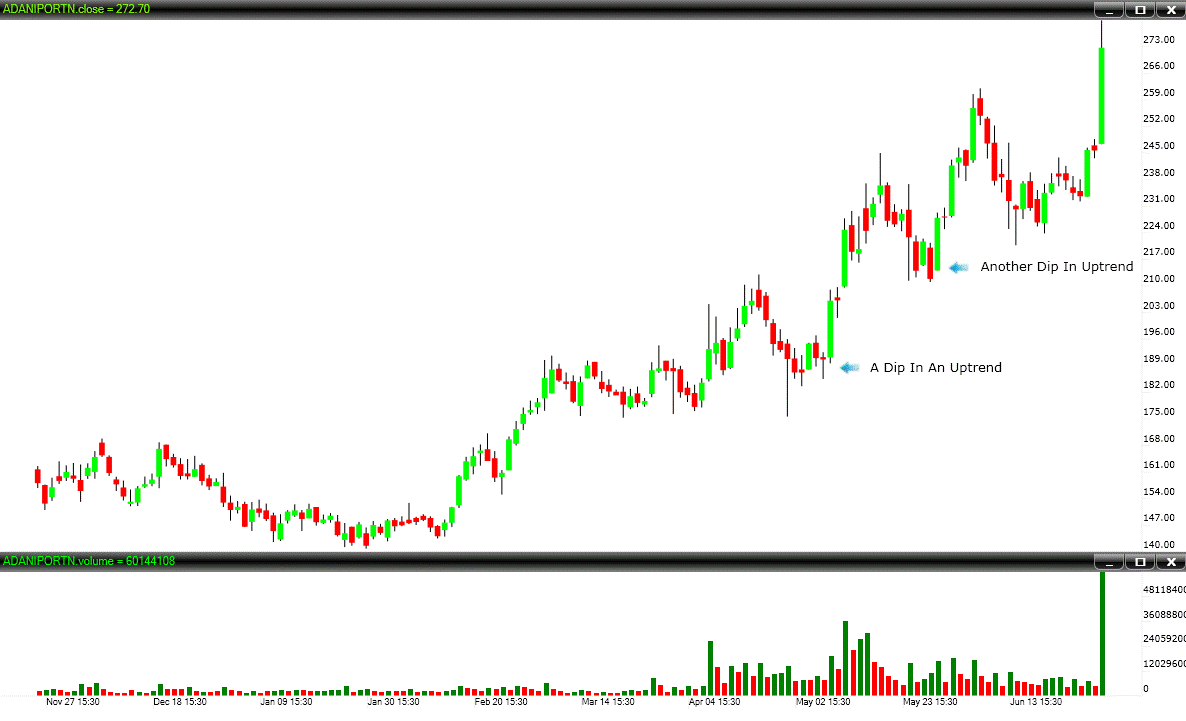
             Since this February we are in uptrend and almost every stock is running upside with a rocket speed. So we all know that we are in Bull market, but no one stock run continuously every day or week or month in same direction and must corrects.

            The above chart is of Adaniports which is also in an uptrend since February and gain almost 70% in last 5 months. But it does not run continuously and corrects every time after a consecutive rally. The first dip came on 23rd April and ends on 5th of May, where the stock corrects almost 8%, and then resumes its uptrend again. The second dip came on 21st May and ends at 29th May and stock corrects almost 11%.

          Generally, these dips are the perfect opportunity to join the rally when we clearly know that trend is up and should forget to short sell in a bull market. Adaniports is still running up, trading at its 52-week high and breakout again from its previous resistance on Wednesday.
26 Aug 12:08

US, ISIS and the "war on terror"

by T T Ram Mohan
The gruesome killing of US journalist James Foley by ISIS, the Islamic group which has gained control of big swathes of Iraq and Syria, has given impetus to a rethink of what the US should be doing about the outfit. The US has already bombed ISIS targets in Iraq and has commenced surveillance of Isis positions in Syria. Both US and British special forces are said to have commenced the hunt for the killer of Foley, now believed to be a Briton. The US government has commenced a steady drumbeat of propaganda on the threats posed by ISIS, which is now touted as 'beyond anything we have seen so far', with the US media following suit.

This is beginning to seem like a horrible re-run of America's dealings with the Taliban. The US funded the Taliban and various Islamic forces in its proxy war against Soviet occupation of Afghanistan. After 9/11, the US turned on the Taliban and its ally, Al Qaeda. The US has since been fighting the Taliban (both the Afghan and Pak varieties) in Afghanistan as well as the Afghan-Pak border.

So it is with ISIS. The US, at the very least, turned a blind eye to ISIS which first gained importance in the battle to overthrow President Assad of Syria. Other American allies, such as Saudi Arabia, Turkey and Qatar are known to be active supporters and funders of ISIS. Once ISIS crossed into Iraq and threatened the government of Iraq, the US seems to have had a change of heart. However, while attacking the ISIS in Iraq, it has been reluctant to attack it in Syria because that would mean strengthening Assad. (The Syrian government itself is open to support from any country, including the US, in its bitter war against ISIS).

This is changing fast as ISIS looms begin to larger in Iraq and begins to pose a threat to Kurds. The US, which has portrayed the "war on terror" as primarily one against, Al Qaeda, is now well on its way to creating a new demon to take its place, ISIS. A new front is to be opened on the "war on terror". One head of the hydra has been replaced by another. How has this come about?

Patrick Cockburn offers a compelling explanation:
The "war on terror" has failed because it did not target the jihadi movement as a whole and, above all, was not aimed at Saudi Arabia and Pakistan, the two countries that fostered jihadism as a creed and a movement. The US did not do so because these countries were important American allies whom it did not want to offend.

Saudi Arabia is an enormous market for American arms, and the Saudis have cultivated, and on occasion purchased, influential members of the American political establishment. Pakistan is a nuclear power with a population of 180 million and a military with close links to the Pentagon.


26 Aug 03:21

Swap Shares, Capital Gain and Tax

by Kirti

Got a comment from our reader  ”I have some share of Satyam Computer which i bought sometime between 2009-2011 on avg price of 85 Rs, now after merger with Tech MahindraI  have got share of Tech Mahindra (on swap ratio of 17:2) (current price around 2200) now if i sell my share, then what will be the tax liability on me on account of long term capital gain (more then 3 year)“. This article explains what is swap ratio, gives an overview of Capital gain, Long term capital gain and Short Term Capital gain, holding period for swap shares.

What is swap ratio?

Swap ratio is an exchange ratio used in mergers and acquisitions of companies. It is the ratio in which the acquiring company offers its own shares in exchange for the target company’s shares. For example, if company A is acquiring company B and offers a swap ratio of 1:5, it will issue one share of its own company (company A) for every 5 shares of the company B being acquired. In other words, if company B has 10 crore outstanding equity shares and 100% of it is being acquired by company A, then company A will issue 2 crore new equity shares of company A to the shareholders of company B, proportionately.

Examples of swap ratio

  • In Jul 2013 Shareholders of Mahindra Satyam received one share of Tech Mahindra (Rs 10 each) for every 8.5 shares of Rs. 2 each they had in the erstwhile Satyam that was absorbed in Tech Mahindra.
  • In Apr 2014 for Ranbaxy Sun Pharma deal  it was announced that Ranbaxy shareholders will receive 0.8 shares of Sun Pharma for each share of Ranbaxy

To calculate the swap ratio, companies analyse financial ratios such as book value, earnings per share, profits after tax as well as other factors, such as size of company, long-term debts, strategic reasons for the merger or acquisition etc.

Shares, Capital Gain and Tax

Period of Holding for Shares : Long Term Capital Gain/Short Term Capital Gain

Generally profits arising on sale of any capital assets are treated as long-term if the same have been held for 36 months or more on the date of sale. However, in case of shares or stocks in any company,

  • The holding period requirement is only 12 months or more in order to make such profits as long-term.
  •  In case the shares are sold within 12 months, the short-term capital gains arising on such transaction shall be included in your regular income and shall be taxed at the slab rate applicable to you.

Tax on LTCG or STCG for stocks

The taxability of long-term capital gain (LTCG) would depend on whether at the time of sale of shares, the securities transaction tax (STT) has been paid or not. STT is a tax paid for transactions made on a recognized stock exchange. Securities Transaction Tax (STT) has been applied on all stock market transactions since October 2004 but does not apply to off-market transactions and company buybacks.As per Section 10(38) of Income Tax Act, 1961 long term capital gains on shares or securities or mutual funds on which STT has been deducted and paid, no tax is payable.

If you are liable to pay STT at the time of sale of shares on a recognized stock exchange, then the LTCG can be claimed tax-exempt. This amount of exemption, however, should be disclosed in your personal income tax return to be compliant with reporting requirements.

If you are not liable to pay STT, then the LTCG should be taxed at 20%.  The LTCG could be claimed as exempt from tax by investing in prescribed investment avenues—residential apartment or specified bonds— subject to the fulfilment of conditions specified under the domestic tax law.

Short Term Capital Gain(STCG) : While selling the shares, if you are liable to pay the security transaction tax (STT), the STCG will be taxed at a flat 15%.

ITR and Long Term Capital Gain 

If an individual has made capital gains during the year, he needs to fill ITR Form 2, as Form 1 is only for income from salary/pension, one house property and other incomes (excluding from lottery).ITR Form 2, on the other hand, is for declaring income from (sources other than the one declared in Form 1) capital gains, all house properties and other sources (including lottery).

If one has Long Term capital Gain on Shares and that is tax free then one needs to show it in Schedule EI or Exempt Income point 3 in image shown below. The amount entered has to be difference in Sale Price and Cost Price of shares without any indexation. Our article Exempt Income and Income Tax Return explains it in detail.

Showing LTCG on shares for which STT has been paid in ITR

Showing LTCG on shares for which STT has been paid in ITR

Shares on Swap Ratio and Capital Gain

Tax laws, while defining long-term capital assets, also provide for beneficial treatment to shareholders covered under merger agreements in respect of their new shares, by including the period of shareholding of the original shares.  The period of holding of the original Satyam shares would be considered. Thus, assuming that

Mr. A had purchased 100 Satyam shares in January 2012, he got 850 shares of  Tech Mahindra in Jul 2013. If he sells the Tech Mahindra  shares soon after they are allotted to him, the sale will still be of a long-term capital asset (as the date for computing the period of holding will be from January 2012). If he sells in Aug 2014 that still is Long Term Capital Gain

So holding period of original shares is considered for swapped shares. The process of calculation of Long Term Capital Gain/Short Term Capital Gain remains the same as described above.

Related articles:

Hope this helped you in understanding Swap Shares, Capital Gains on Stocks, difference between Long Term Capital Gains and Short Term Capital Gains, their Taxability and how to show Long term capital gains in ITR2. Please share your comments and feedback.

23 Aug 13:32

NPAs processed by asset reconstruction companies -- where did we go wrong?

by Ajay Shah
by Ajay Shah, Anjali Sharma, Susan Thomas.

Background


Asset reconstruction companies (ARCs) in India came about after the SARFAESI Act of 2002 empowered banks and some financial institutions to seize collateral in secured loans, without the intervention of courts. This is about the in-sourcing vs. out-sourcing choice of banks. Some banks could choose to build internal distressed assets teams. Others could choose to sell distressed assets to specialised firms that have skills in dealing with distressed assets. This is a good thing because: (a) In general, specialisation is a good thing and (b) Processing distressed assets requires a certain kind of toughness that PSU banks are often unable to muster.

So far, this approach has not worked. Stressed assets at banks (NPAs + restructured loans) have increased from Rs. 0.7 trillion in 2003 to Rs. 5.3 trillion in 2013. In this period, the annual sale of assets by banks to ARCs has stagnated at Rs.0.05 to Rs.0.1 billion a year.

At the outset, the Indian approach to ARCs was better than that seen in many other countries, where specialised `asset management companies' (AMCs) were just a thinly disguised method for government recapitalisation of banks. But this clear thinking at the outset has not been translated into a well functioning private ARC industry.

In this post, we look at what went wrong with ARCs, recent developments and the way forward.

What went wrong?


  1. Excessive regulatory interference. The right way to think about an ARC is that the ARC is a buyer of distressed debt. After that, what the ARC does is the business of the ARC. The ARC might be an individual, or a private equity fund, or any other structure. The sale should be a clean transaction where distressed debt is sold and cash is paid to the lender. There are no problems with the working of the ARC on the counts of consumer protection, micro-prudential regulation or systemic risk, therefore the working of ARCs should be completely unregulated. This clarity of thought has been absent, and the working of ARCs has been riddled with poorly thought out RBI regulations.
  2. Mistakes in regulations about how banks sell distressed assets. Micro-prudential regulators of banks are often keen to cover up the problems of bank fragility. This problem has hampered sound thinking about regulations governing provisioning and the sale of assets by banks to ARCs.
    Provisioning norms by Indian banks, are driven by regulatory prescriptions rather than risk assessment. Even though an asset becomes non-performing after being overdue for 90 days, provisions for the loss associated with this are spread over a period of four years. This generates a perverse incentive to not sell NPAs: provisioning for an NPA has a gradual impact on the balance sheet of the bank while sale of the NPA has to be booked as an upfront loss. As a result banks either hold on to these assets for longer than it is economically sensible, or sell assets to ARCs only when the transaction is at or above book value. In addition, there are a variety of procedural problems with the process of banks selling NPAs including auctions that do not give adequate time for due diligence by ARCs, and auctions that are cancelled after bids are received.
    A closely related issue is the approach that the sale of bad assets is not a true sale for hard cash. Banks would think in a sensible and commercial way when and only when: (a) Tough provisioning rules kick in the moment an asset is NPA and (b) The sale of distressed debt is a simple sale in return for cash. Neither of these conditions holds today, reflecting poor thinking in banking regulation.
    The mistakes in regulation of banks interact with the HR practices of PSU banks. The typical CEO of a bank has a horizon of two years. On that horizon, it's been made preferable for him to hide bad news by not selling as compared with recognising bad news by selling. This peculiar situation represents a juxtaposition of mistakes at the Ministry of Finance in HR practices of PSU banks and mistakes at RBI in the regulation of banks.
  3. Weak bankruptcy process. The ability of ARCs to realise value is defined by the bankruptcy process. The legal framework for recovery are the debt recovery tribunals (DRTs), set up under the RDDBFI Act, 1993, and the enforcement of security interest under the SARFAESI Act. Both these mechanisms have performed poorly in resolving NPAs. Recovery as a percentage of the outstanding amount for cases filed was at 17 percent and 14 percent for DRTs, in 2012 and 2013 respectively. The recovery percentages were 24 percent and 22 percent under SARFAESI, in the same period.
    While RBI has allowed ARCs to takeover the management of the defaulting firm, restructuring under the provisions of the Companies Act is a time taking process. It requires specialised management skills and long term financing, both of which ARCs may not currently possess. Given the time and cost involved in this type of restructuring, only NPAs with very high recovery potential will be selected for this type of resolution.
  4. Is insourcing vs. outsourcing of distressed asset management a level playing field? Ideally, the rules about resolution should be neutral to the identity of the debt holder. However, in India, at numerous points, the powers in processing distressed debt favour banks and do not give non-bank actors comparable powers. This creates incentives for insourcing of the distressed debt function.
    SARFAESI provides for several mechanisms to enable ARCs to carry out recovery. These include taking possession of the collateral security, settlement or rescheduling of payments, sale or lease or takeover of the borrower's business and conversion of debt into equity. But the operational guidelines for many of these were issued by RBI much after 2002. For example, the guidelines for management takeover of the defaulting firm were issued in 2010, eight years after the Act was passed, with subsequent amendments in 2011, 2012, 2013 and 2014. The guideline allowing ARCs to sell assets to each other, which enables them to aggregate assets of a borrower for a management takeover, came in 2013. As a consequence, from 2002 to 2013, ARCs were handicapped.
    Banks have been given additional mechanisms for dealing with stressed assets, that are not available to ARCs. These include loan restructuring for individual assets, and the corporate debt restructuring (CDR) mechanism for dealing with stressed consortium loans. Banks have greater restructuring flexibility, under the CDR process, than do ARCs. For example, both the CDR lenders and ARCs have been allowed to convert debt of the borrower firm to equity. SEBI guidelines on lock-in period for share issuance, have been relaxed for issuance under the CDR mechanism. Unlike the requirement in the Indian Takeover Code, the acquirer of shares in the CDR process is exempted from making an open offer. No such exemptions have been provided for the conversion of debt to equity by ARCs.
  5. Barriers to foreign skills and capital. A natural pool of expertise are global firms with a specialisation in distressed debt management. Perhaps the only pool of capital that can pay cash for distressed assets is found overseas. However, autarkic policies by RBI have hampered the entry of foreign players, and capital controls have been used to block the inflow of foreign capital. This choked ARCs of both capital and knowledge.
In an environment riddled with mistakes in regulation, how have ARCs survived at all? There are two things that enable ARCs to remain viable even in such a market. The first is the low levels of capital that ARCs need to acquire NPAs. When ARCs issue SRs to finance the NPA acquisition, it is done through trusts in which ARCs, as per RBI guidelines, need to have at least 5 percent of own investment. These SRs have a maturity of 5 years, which can be extended to 8 years in special cases. This is the time-frame that ARCs have, in order to recover value from the acquired assets. Any loss at the end of this period has to be borne by SR holders proportionately. Since the ARC share in the loss from the asset is limited to 5 percent, it allows ARCs to acquire assets even at uneconomic valuations. In most cases, the seller bank, who can sell assets at close to book value, itself subscribes to the balance 95 percent SRs.

The second is the annual management fee that ARCs receive from the seller bank. This is typically 1.5-2 percent of the acquisition value of the asset. The fee has no link with the recovery from the asset. Hence, the ARC has little incentive to recover or resolve assets. They just need to hold the assets till maturity of the SRs, during which they continue to earn the management fee income.

This yields an exercise in sound and fury that achieves little. In this form of the sale transaction, the NPA risk remains in the bank balance sheets -- it is merely being reclassified as investment in SRs. Further, there is little improvement in the overall economic efficiency in resolution of NPAs. With this, the ARC industry in India suffers from the syndrome of numerous other parts of finance (e.g. the bond market or the currency market), where there is a show on display with apparent institutional arrangements and plenty of huffing and puffing, but the actual soul of a market economy is absent.

Recent developments


  1. On 30th January, RBI released the Framework for Revitalising Distressed Assets in the Economy, with several changes in the operational framework for ARCs.
  2. In April, a report estimated that banks sold Rs. 270 billion of non-performing assets (NPA) to ARCs in FY 2014, with most of the sale taking place during January to March 2014.
  3. The June release of the Financial Stability Report raised concerns that bank-ARC transactions were being used by banks as an option of evergreening their balance sheets. The report also questioned the 'real' incremental value addition of ARCs in the process of 'reconstruction' of assets, over banks' traditional skills and informational advantages.
  4. On 5th August, 2014, RBI issued a notification with amendments to the regulatory framework for securitisation companies and ARCs.

Evaluating recent policy changes


In the January 30th 2014 Framework for Revitalising Distressed Assets in the Economy, RBI proposed the following changes in the ARC framework:

  • Assets in the 61 to 90 days category can also be sold to ARCs. This would encourage early sale of distressed assets and better recovery.
  • Banks allowed to spread loss on sale over a two year period, for assets sold till March, 2015. They are also allowed to reverse provisions made for NPA, if there is gain on sale. This would address banks' concerns on loss on sale of assets.
  • It is mandatory for banks to accept bids in an auction that are above reserve price and fulfill conditions specified.
  • Steps to be taken to improve price transparency in bilateral sale of assets.
  • Sale of assets between ARCs and their sponsor banks is permitted only through a transparent and arms length auction. These would improve transparency in the sale process.
  • Promoters of companies allowed to buy-back assets from the ARCs, with ARCs demonstrating no prior collusion between the ARC and the defaulting borrower, to the RBI.

On one hand, these measures removed procedural hurdles faced by ARCs. On the other, there is pressure on PSBs to offload their growing NPAs or face an erosion of profits in the medium term. Both factors contributed to a sudden spurt in sale of NPAs from banks to ARCs in the last quarter of FY 2014. Most of this sale was by public sector banks (PSBs). For example, State Bank of India (SBI) in its Annual Report for FY 2014, has reported a sale of Rs. 36 billion of NPAs to ARCs. The book value and the sale value of these assets are Rs.15 billion and Rs.16 billion respectively, with SBI making a profit of Rs.1 billion on these transactions.

The spurt in NPA sale transactions in 2014 led to further changes through the 5th August, 2014 notification:

  • Increase ARCs capital commitment in the acquired asset from 5 to 15 percent.
  • ARCs fees linked to the net asset value (NAV) of the acquired assets rather than the outstanding value of the security receipts. Shortfalls in recovery now affect ARC fees.
  • Increased reporting and disclosure requirements for ARCs, specially for asset sale by banks above book value and for asset sale by ARCs at a significant discount.
  • Increased time that ARCs get for due diligence at asset auctions, at least two weeks.
  • Reduced planning period for acquired assets from one year to six months. This is also the time frame within which the acquired asset need to be rated and re-valued.
  • Inclusion of ARCs in the Joint Lenders Forum (JLF) and a mandate for them to put up a list of willful defaulters on their website.

These changes will help reduce three aspects of bank-ARC transactions as they have been proceeding:

  • Banks selling assets to ARCs without actual risk transfer, since 95 percent of the value of the sale got back into banks' balance sheets as investment in SRs.
  • ARCs earning fee income linked to the book value of the asset and not to its recovery value. Low levels of ARCs capital commitments meant no real incentive for them to resolve NPAs.
  • Promoters, even the willful defaulters, getting relief from repaying their dues under the ARC model, which was focused on warehousing instead of resolution of NPAs.

These latest amendments have increased the ARCs risk in acquiring assets. ARCs will now need to make recoveries to earn fees and to get returns on invested capital. However, the larger problems of these arrangements remain unresolved.

The way forward


In order to make distressed debt processing and ARCs work, the work plan for policy makers consists of the following elements:

  1. A clear understanding is required that the role of RBI in regulations should stop at the point of sale of distressed assets to the ARC. The working of the ARCs should be unregulated as there is no market failure there.
  2. Mistakes in micro-prudential regulations of banks, in recognition and provisioning by banks, need to be addressed.
  3. Banks should be required to do true sales in exchange for cash of distressed debt. This will yield closure on the books of the bank. After the transaction, the ARC would work to obtain recovery with no relationship to the original lender.
  4. The bankruptcy process should be improved.
  5. ARCs should be first class participants in the bankruptcy process. There should be no bias in the bankruptcy process in favour of any one kind of financial firm such as bank.
  6. Establishment of operations by foreign ARCs should be feasible with 100% equity ownership. Foreign capital into ARCs (whether private or foreign) should be welcome through private equity structures. All institutional investors in India -- but not banks -- should be able to invest capital into these private equity structures. Banks should only face the choice of selling (in exchange for cash) or not selling.


We are grateful for Harsh Vardhan of Bain Consulting and Badri Narayanan of Third Eye Capital for useful discussions.


Finance Research Group, IGIDR, Bombay

23 Aug 13:32

Secrets of Millionaire Mind : How Rich and Poor People think differently

by Kirti

Why some people  get rich(or seem to get rich) easily, while others are destined for a life of financial struggle?  Where lies the difference , Is it intelligence, street smartness,education,skill, background,people they know, choice of jobs or plain luck or ______???  We know even those who are lucky and win huge amounts in lottery soon end up being poorer.   The Answer as per author T. Harv Eker  of  Secrets of the Millionaire Mind  is our money blueprint and it is this blueprint, more than anything, that will determine our financial lives. Rich people have a different money blueprint, they think and act differently than poor people. If we start thinking and acting like Rich People we may become rich says the book Secrets of the Millionaire Mind by T. Harv Eker. This article gives an overview of the book and then talks about Rich and Poor People thinking differently talking in detail about how belief Rich people and Poor People, the  belief I create my Life or Life Happens to me.

Secrets of the Millionaire Mind by T. Harv Eker

Secrets of the Millionaire Mind by T. Harv Eker  is divided into two parts

Part I explains how your money blueprint works. Through Eker’s  of simple writing you will learn how your financial blueprint is made, how your childhood influences have shaped your financial destiny. You also come to know how to identify your own money blueprint and revise it to not only create success but, more important, to keep and continually grow it.

In Part II you are introduced to Seventeen Wealth Files, which tell 17 ways in how rich people think and act differently than most poor and middle-class people. Each Wealth File includes action steps for you to practice in the real world in order to dramatically increase your income and accumulate wealth. How do rich people think and act? According to T. Harv Eker If you think like rich people think and do what rich people do, chances are you’ll get rich too!

How Rich and Poor People think and act differently

Rich people think very differently from poor and middle- class people. They think differently about money, wealth, themselves, other people, and pretty well every other facet of life.  The Part II of the book, Secrets of the Millionaire Mind by T. Harv Eker, examines some of these differences and gives ways to think and act like them or as Eker says install wealth file.  Whether rich people are better than poor people is not the point here. The point is about Rich people being  just richer, it’s only about how different folks think and act rather than the actual amount of money they’ve got or their value to society. Please understand that it’s generalization and as Harv says  generalization is big time. Not all rich and not all poor people are the way it is described  but distinctions between the rich,poor mentality is made as extreme as possible. Middle class have a mix of both rich and poor mentality hence are not discussed.

17 Wealth Files of Secrets of Millionaire Mind Rich and Poor are given below.

  1. Rich people believe “I create my life.Poor people believe: “Life happens to me.” 
  2. Rich people play the money game to win. Poor people play the money game to not lose.
  3. Rich people are committed to being rich. Poor people want to be rich.
  4. Rich people think big. Poor people think small.
  5. Rich people focus on opportunities. Poor people focus on obstacles.
  6. Rich people admire other rich and successful people. Poor people resent rich and successful people. 
  7. Rich people associate with positive, successful people. Poor people associate with negative or unsuccessful people.
  8. Rich people are willing to promote themselves and their value. Poor people think negatively about selling and promotion.
  9. Rich people are bigger than their problems. Poor people are smaller than their problems.
  10. Rich people are excellent receivers. Poor people are poor receivers.
  11. Rich people choose to get paid based on results. Poor people choose to get paid based on time.
  12. Rich people think “both”. Poor people think “either/or”.
  13. Rich people focus on their net worth. Poor people focus on their working income.
  14. Rich people manage their money well. Poor people mismanage their money well.
  15. Rich people have their money work hard for them. Poor people work hard for their money.
  16. Rich people act in spite of fear. Poor people let fear stop them. 
  17. Rich people constantly learn and grow. Poor people think they already know.

The following picture or infographic by us bemoneyaware  gives an overview of 17 ways in which Rich and Poor people think and act differently. (To see the full infographic click here or on our Pinterest Board)

Secrets Of Miilionaire Mind by T Harv Eker Rich vs Poor

Secrets Of Millionaire Mind by T Harv Eker Rich vs Poor

First Wealth File :Belief I create my Life or Life Happens to me

Let’s see  the first wealth file in detail  ,

Rich people believe I create my life

Poor people believe Life happens to me.

Quoting from his book (some parts I have highlighted or underlined)

If you want to create wealth, it is imperative that you believe that you are at the steering wheel of your life, especially your financial life. If you don’t believe this, then you must inher- ently believe that you have little or no control over your life, and therefore you have little or no control over your financial success. Did you ever notice that it’s usually poor people who spend a fortune playing the lottery? They actually believe their wealth is going to come from someone picking their name out of a hat. They spend Saturday night glued to the TV, excitedly watching the draw, to see if wealth is going to “land” on them this week. Sure, everyone wants to win the lottery, and even rich people play for fun once in a while. But first, they don’t spend half their paycheck on tickets, and second, winning the lotto is not their primary “strategy” for creating wealth. You have to believe that you are the one who creates your success, that you are the one who creates your mediocrity, and that you are the one creating your struggle around money and success. Consciously or unconsciously, it’s still you. Instead of taking responsibility for what’s going on in their lives, poor people choose to play the role of the victim. A victim’s predominant thought is often “poor me.” So presto, by virtue of the law of intention, that’s literally what victims get: they get to be “poor.” Notice that I said they play the role of victim. I didn’t say they are victims. I don’t believe anyone is a victim.

Clues that one is playing victim

Victim Clue #1: Blame

When it comes to why they’re not rich, most victims are professionals at the “blame game”. The object of this game is to see how many people and circumstances you can point the finger at without ever looking at yourself. It’s fun for victims at least. Unfortunately it’s not such a blast for anyone else who is unlucky enough to be around them. That’s because those in close proximity to victims become easy targets. Victims blame the economy, they blame the government, they blame the stock market, they blame their broker, they blame their type of business, they blame their employer, they blame their employees, they blame their manager, they blame the head office, they blame their up-line or their down-line, they blame customer service, they blame the shipping department, they blame their partner, they blame their spouse, they blame God, and of course they always blame their parents. It’s always someone else or something else that is to blame. The problem is anything or anyone but them.

Victim Clue #2: Justifying

If victims aren’t blaming, you’ll often find them justifying or rationalizing their situation by saying something likeMoney’s not really important.” Let me ask you this question: If you said that your husband or your wife, or your boyfriend or your girlfriend, or your partner or your friend, weren’t all that important, would any of them be around for long? I don’t think so, and neither would money! At my live seminars, some participants always come up to me and say, “You know, Harv, money’s not really that im- portant.” I look them directly in the eyes and say, “You’re broke! Right?” They usually look down at their feet and meekly reply with something like “Well, right now I’m having a few financial challenges, but . . .” I interrupt, “No, it’s not just right now, it’s always; you’ve always been broke or close to it, yes or yes?” At this point they usually nod their head in agreement and woefully return to their seats, ready to listen and learn, as they finally realize what a disastrous effect this one belief has had on their lives. Of course they’re broke. Would you have a motorcycle if it wasn’t important to you? Of course not. Would you have a pet parrot if it wasn’t important to you? Of course not. In the same way, if you don’t think money is important, you simply won’t have any.

Let me put it bluntly: anyone who says money isn’t im- portant doesn’t have any! Rich people understand the IMPORTANCE  of money and the place it has in our society. On the other hand, poor people validate their financial ineptitude by using irrelevant comparisons. They’ll argue, “Well, money isn’t as important as love.” Now, is that comparison dumb or what? What’s more important, your arm or your leg? Maybe they’re both important. Listen up, my friends: Money is extremely important in the areas in which it works, and extremely unimportant in the areas in which it doesn’t. And although love may make the world go round, it sure doesn’t pay for the building of any hospitals, churches, or homes. It also doesn’t feed anybody.Not convinced? Try paying your bills with love. Still not sure? Then pop on over to the bank and try depositing some love and see what happens. I’ll save you the trouble. The teller will look at you as if you’ve just gone AWOL from the loony bin and scream only one word: “Security!” No rich people believe money is not important. And if I’ve failed to persuade you and you still somehow believe that money’s not important, then I have only two words for you, you’re broke, and you always will be until you eradicate that nonsupportive file from your financial blueprint.

Victim Clue #3: Complaining

Complaining is the absolute worst possible thing you could do for your health or your wealth. The worst! Why? I’m a big believer in the universal law that states, “What you focus on expands.” When you are complaining, what are you focusing on, what’s right with your life or what’s wrong with it? You are obviously focusing on what’s wrong with it, and since what you focus on expands, you’ll keep getting more of what’s wrong. Many teachers in the personal development field talk about the Law of Attraction. It states that “like attracts like,” meaning that when you are complaining, you are actually at- tracting “crap” into your life. Have you ever noticed that complainers usually have a tough life? It seems that everything that could go wrong does go wrong for them. They say, “Of course I complain— look how crappy my life is.” And now that you know better, you can explain to them, “No, it’s because you complain that your life is so crappy. Shut up… and don’t stand near me!” Which brings us to another point. You have to make darn sure not to put yourself in the proximity of complainers

There is no such thing as a really rich victim! Meanwhile, being a victim definitely has its rewards. What do people get out of being a victim? The answer is attention. Is attention important? You bet it is. In some form or another it’s what almost everyone lives for. And the reason people live for attention is that they’ve made a critical mistake. It is the same error that virtually all of us have made. We’ve confused attention with love. Believe me, it is virtually impossible to be truly happy and successful when you’re constantly yearning for attention. Be- cause if it’s attention you want, you’re at the mercy of others. You usually end up as a “people pleaser” begging for approval. Attention-seeking is also a problem because people tend to do stupid things to get it. It is imperative to “unhook” attention and love, for a number of reasons. First, you will be more successful; second, you will be hap- pier; and third, you can find “true” love in your life.

The bottom line is that each individual must believe that he or she is the one who creates success, creates mediocrity, and creates his or her own struggle around money and success.

Review of the book Secrets of the Millionaire Mind by T. Harv Eker

Many people might dismiss Secrets of the Millionaire Mind as useless (just like many people dismiss Rich Dad or commercial movies or Chetan Bhagat books). Let me clarify this Book does not offer concrete information on how to improve the details of your financial life. Instead, it tells readers of mental attitudes or wealth files that facilitate wealth or stop you from being ruch. It’s about changing your approach to money. Yes there are actions in the book which you may find funny. Like In the book after each section Eker encourages readers to touch the  head and say the  words, “I have a millionaire mind!” I did this(my kids laughed when they saw me doing it_ but it was liberating as if I have cleared some cobwebs.) The lesson he imparts with all of such declarations and affirmations is, “Your income can grow only to the extent that you do.”

Are people held back not only because of lack of money knowledge but also because of attitude. (I am reminded of Sachin and Kambli) Like anything in life, you become what you desire (desires are not wishes or mere thoughts) and are ready to work for it.  Desires do lead to thoughts, thoughts do lead to words, words do lead to actions, and actions do produce certain results.  You do need a certain mindset in order to increase your wealth. This book claims to show you the way.

I used to hear rich people are selfish or they have become rich by denying(or crushing) poor. But after reading about DhiruBhai Ambani, Bill Gates, Tatas and others my attitude towards rich people have changed. Boss kuch to baat hai inme, they created something but running a business , providing livelihood to many people is no easy feat.

The book sells, hardsells his seminars. The book is full of people who attended the seminar and became rich. Even the front cover advertises a Free Bonus- Two tickets to the Millionaire Mind Seminar, Worth $2,590- Details inside. But book is written in simple language, I felt as if author is actually talking to me (excerpt from the book are given below). I insist Don’t take everything(what he says, what I say,what you read, what you see ) at face value but with spoons(not pinch) of salt. Take the information and use it in ways that work for you.

This book is available as pdf on internet on a popular presentation sharing site. If you can’t find it drop us an email or comment and we shall pass the link.

Related Articles:

Do you think Rich people act and think differently than poor people? Do money attitudes affect your financial life? Do you resent rich people? Which difference or differences between Rich and Poor People you agree with and which one do you disagree with?Among Rich People whom do you admire and why?

22 Aug 03:17

Will Reits work in India?

by subra

It was in 2008 when the first time one Indian regulator used the word REIT. Many people in the industry got excited and the media said this will bring real estate within the reach of the common man and about US $ 10 billion will flow in.

I had seen the regulation and asked one senior fund manager. He said something interesting. He had asked 3 valuers in a B city to put a value to a nice office the amc had. He got values ranging from Rs. 6 lakhs to Rs. 10lakhs.  He asked me a simple question: How do I arrive at the NAV on a weekly basis?

Another thing that people do not appreciate is the need for an extremely well developed back end. For e.g. If I am a fund manager I am not worried about the guy who is executing rigging the price. The price discovery is scientific, and cannot be manipulated. I mean the guy who is buying the share is buying it in the Recognised Stock exchange and the price is recorded by a 3rd party called the exchanges.

Now come to the Real Estate Industry – I have seen it long enough to know that the price between 2 flats in the same compound can be very different. I know of houses given on very different rates on RENT in the same building. For a fund manager it is very difficult to justify the price / ensuring that he does not get cheated. This is not easy.

Also the pain of getting the RE transferred, the costs, the legal hassles, – something which is not there in the Equity Market.

Also technically the fund manager managing a REIT will have a lot of restrictions regarding the valuation basis of the property, bad debts – rents not being paid on time, taxation (assuming all goes well REIT dividends could be tax free) but do not expect great yields. We are not a very high rental yield market – which means REIT would have to necessarily hope for a good capital gains market. In that market for capital gains there is a huge amount of competition from many lalas!!

So will REIT be a success? Well most things which succeed abroad may not succeed in India, so I am not willing to say it will be. Nor am I wiling to say that it will be a failure.

My view? Reit will not be a big success in India…and I thought so like that about mutual funds and cell phones too!! all d best….

Post Footer automatically generated by Add Post Footer Plugin for wordpress.

22 Aug 03:11

What Not To Do With Rs 10 Lacs

by Dev Ashish
I have just come back from a trip to my hometown and this is the reason I could not update the site for last few days. During my stay at home, something interesting happened when I had to accompany a family member to the Aadhar Card registration center. Registrations take place at many places like ones nominated as permanent centers by the government, ones which are temporary in nature and
19 Aug 13:34

RBI's restructuring plan

by T T Ram Mohan
I was on Bloomberg TV India this morning for a discussion on the RBI's restructuring plan, including the proposal to create an office of COO with the rank of Deputy Governor.

The restructuring plan is facing resistance from employee unions. It is the COO proposal, however, that has attracted the most flak in the media and drawn a frosty response from the government of India. Media reports indicate that the proposal was put up to the board of directors of RBI around the time of the budget. The board of directors of RBI does not have the same monitoring authority as a corporate board; the key entity, when it comes to monitoring, is the finance ministry. It is strange that the RBI did not take the ministry into confidence in the matter before listing the item at the board meeting.

At the board meeting, the finance ministry asked that the matter be deferred since their representatives would not be able to attend. At the next board meeting, the finance ministry made it clear that an appointment of the rank of Deputy Governor would require an amendment to the RBI Act and that somebody of that rank could not be appointed by the RBI governor; the appointment would have to go to the Cabinet Committee on Appointments.

That is not the only problem with the COO post. As media reports have pointed out, it signals that the person occupying the post is no 2 in the hierarchy, so that you have on Deputy Governor who is superior in rank to the others. That is not the tradition  at RBI. Moreover, the perception has gained ground that the post is being created into order to accommodate one particular individual. The perception may not be well-founded. But the very fact that it has gained currency is damaging to the RBI.

There is also controversy over the proposal to facilitate lateral entry into RBI. Nothing wrong with lateral entry. But the case must first be made as to what specialist skills are required and at what level. The RBI spends lavishly on training so that people are ready to take up positions that require special skills. If this is not adequate, there would be room for a specialist from outside. But, as I said, this has to be justified.

The RBI has acquired a certain stature and reputation over the years, in part because it is seen to be a meritocratic organisation. It has steered clear of the sort of controversies over appointments that have bedevilled other public institutions. The RBI must be careful to safeguard this hard-won reputation.


19 Aug 13:33

Apparel Company, Arvind Forays Into E-commerce With Custom Clothing Brand ‘Creyate’

by News @NextBigWhat

Textile and apparels company, Arvind Ltd has launched Arvind Internet Ltd (AIL), a startup within the Arvind group has launched its online custom clothing brand – Creyate. Kulin Lalbhai, Executive Director of Arvind Ltd, is driving the e-commerce initiative at the company, which will be a major growth driver for Arvind moving forward.

“Arvind Internet Ltd will be the vehicle that will enable Arvind’s e-commerce vision. Arvind sees e-Commerce as a key growth driver for the group and we aim to be Rs. 1000 Cr plus business in 3 years.” , shares Kulin Lalbhai, Executive Director at Arvind Ltd.

As its first launch, AIL brings a revolution to the apparel retail with Creyate. You can create garments on a 3D visualisation engine, which would then be made for you – it’s like having a very own factory at your fingertips. “With more than 100,000 unique products to create, this is the next generation of fashion retail,” added Kulin.

Creyate from Arvind Group

Creyate from Arvind Group

Creyate intends to offer an alternative to ready-wear as well as traditional custom clothing and targets to be Rs. 100 crore plus brand by next year.

Creyate also has a curated collection of fabrics from choicest of Italian mills. Arvind group which owns product brands include Flying Machine, Colt, Ruggers, Excalibur amongst others while its licensed product brands have big global names like Arrow, Gant, Izod, Elle, Cherokee, US Polo Assn. etc has invested in an automated manufacturing setup for this business to make customised garments as per customers’ choice and measurements.

Creyate has plans of launching stores in 15 cities within the next year. It already has stores in Bengaluru, Ahmedabad and Delhi and offers home visits in major cities. Riding on Arvind group’s supply chain and manufacturing might, AIL is planning to take Creyate to global consumers next year starting with the US market, where online custom clothing is a large thriving market.

Read : Reliance to foray in to ecommerce | Future Group Launches The Big Bazaar Direct E-commerce store

The post Apparel Company, Arvind Forays Into E-commerce With Custom Clothing Brand ‘Creyate’ appeared first on NextBigWhat.com

19 Aug 03:08

Irrational exuberance meets secular stagnation

by Antonio Fatas
Robert Shiller warns us in the New York Times about the potential risks of high stock market valuations in the US. According to Shiller "the United States stock market looks very expensive right now". Brad DeLong and Dean Baker disagree with Shiller and argue that stock prices might look higher than historical averages but this could be ok given other changes in the economic environment.

Here is a restatement of their debate (and I will be repeating arguments I have made before):

Shiller's concern comes from the fact that price-to-earning (PE) ratios in the US are high by historical standards. Using his own measure, they stand at above 25 which is much higher than the 15 level that was common before the massive 2000 bubble that took that ratio all the way to 44. There is no disagreement about this fact.

Where Brad DeLong and Dean Baker disagree is in how relevant history is an indicator of what constitutes the right level for the PE ratio. The easiest way to think about the PE ratio is to first look at its inverse: earnings as a ratio to prices (EP). This gives us a sense on the yield that a share delivers today (let's keep aside for the sake of simplicity the difference between earnings and dividends). But this is just the static return that shares promise. We know that earnings will be higher in the future and the total return will then be the sum of the "static" return (EP) plus the expected growth of earnings.

Using similar numbers to Dean Baker's post, we can see that historically, a PE of about 15 corresponded to an EP of 6.7%. If we add to this real growth of earnings that was not far from the real growth in GDP, so about 3%, we ended up with a historical return of about 9.7% in real terms. How good was 9.7%? It was a good return. In fact, it was so good that many academics were puzzled by how high this level was. The way they expressed this puzzle is by comparing this return to the returns of alternative assets. Bonds paid somewhere below 4% (real) during most of those decades, which means that stocks yielded close to 6% premium over safe assets (this is what economists called the risk premium and because of its high level it led to a very prolific literature trying to explain the "equity premium puzzle").

Today, a PE of 25 translates into an EP of only 4%. This looks low compared to the historical average and that's where Shiller's concerns come from. But there are three potential reasons why the historical average might not be relevant:

1. Returns on other assets have gone down. Here is where secular stagnation meets irrational exuberance. A new eBook released by VoxEU presents convincing evidence in favor of the idea of secular stagnation. Secular stagnation is characterized, among other things, by real interest rates that are very low, possibly negative. But if this is true, it means that an EP of only 4%, which is about 2.7% lower than the historical one can be entirely justified by equilibrium real interest rates (returns) that are significantly lower than historical ones. What used to be a typical real return for bonds of 3-4% is now 0-1% (or even lower). This means that the return of stocks still remains significantly higher than those of other assets by a margin which is not far from historical levels. In other words, what used to be an EP of 6.7% should now an EP of 4%.

2. Not so fast! Secular stagnation also suggests that the growth rate of real GDP (and therefore earnings) is slowing down. This means that while the static EP ratio might look ok, when we factor in the lower growth of GDP we are back to stocks being too expensive. Correct but what matters here is the relative change in interest rates relative to the growth rate of GDP (earnings to be more precise). CBO projections of potential GDP for the US are lower than historical averages by somewhere around 0.5%. In contrast, interest rates are much lower, on the range of 2-4% relative to historical averages. Let's put these two numbers together: let's assume GDP growth slows down from 3% to 2.5%. This means that with an EP of 4%, stocks promise a return of about 6.5%. Much lower than in the past but still about 6% higher than bonds (if we take 0.5% as the real return on bonds). So we have the same risk premium as in the past and stocks are still a great investment even if prices are high relative to earnings. Of course, if you pick a much more pessimistic growth rate and a higher real equilibrium rate then stocks become expensive again (and if you go in the other direction then they become an even better deal).

3. Finally, why should the stock market risk premium be 6%? Is this a reasonable number? It is certainly be a function of the perceived risk of investing in stocks and arguments can be made in both directions. It is indeed very difficult to argue in favor of a particular number here but a historical perspective is useful: we cannot forget the fact that in the past such a high risk premium led to the conclusion that stock markets were undervalued and that investors were too-risk averse.

One final reflection: as much as I am offering support for the reading that Brad DeLong and Dean Baker do of the today's US stock market, we cannot forget that what will really matter is the perception of the market about how all these variables are likely to evolve going forward. And as Shiller argues, "sociology and social psychology" can be more useful in determining the future returns of the stock market than PE calculations or statements on equilibrium interest rates. But one still hopes that in the long run, fundamental analysis will produce a good indicators of rates of returns. But until the long run arrives, hold tight. As Brad DeLong puts it "If you are not in stocks for the long term, your stock portfolio should not consist of money that you cannot afford to lose."

Antonio Fatás
19 Aug 03:05

Handling peer pressure

by subra

When you are young peer pressure is difficult to handle. However even when you grow older peer pressure seems to be difficult to handle. If you have created an image for yourself (which is not true) and you keep trying to live up to that image, you really struggle. How does one really handle peer pressure?

Let me share a few tips – see what works for you:

1. Living up to the Joneses is a real trap: If you are NOT self confident, you try to compete with everybody around you. So suddenly your driver, yoga teacher, gym instructor, boss, wife, children – all of them start giving you a complex! So building up real self confidence is a very important step.

2. Others do not really care: Ask your friend whether he remembers what dress he (the friend) wore a week ago – and the chances are he will not. If he does not remember what dress he wore, why the hell will he remember what you wore? As long as your clothes do not stink (wash them regularly please), it is not falling apart (clothes do not tear these days, right?), and are not too out of place (wearing shorts to a temple or a dhoti to the beach) – chances are nobody gives a damn about what you do.

3. Your phone should receive calls and send sms messages. Along with that if you can check your email that would be great. So a simple smart phone is enough. Tell your friends that you want to see whether you are able to use a phone for 5 years. Tell them (and maybe start one on FB?) called the ’5 year challenge’ – and see who wins it.

4. Tell people you have a goal and you are saving / investing for it. Tell them you are planning to start a business and are saving for that.

5. Do a real big SIP in a mutual fund – and tell them that you are paying of a real big loan. This could be – a) an educational loan b) a personal loan taken for a family medical need c) a loan to repay some business gone wrong d) a gambling loan or a parent or a sibling – make a nice story. You get sympathy, and a solid reason to be broke for about 5 years. Then change jobs or geography.

6. Tell your friends that in your community a girl will not marry you unless you have a house in Mumbai. That will keep you broke for the next 70 years, no worries!! Of course no worries as long as you do not REALLY BUY a house…lol

7. Tell them your company is doing very badly, and you are terribly, terribly over paid. This means if you lose your job you will take a long time to find a new one, or you will find one that pays too badly, so you need some financial cushion.

8. Change your friends profile: If you are in a group that is from an economically much higher class than yours, YOU are the problem. You are in a wrong group. Change your friends. It is nice to be ambitious, but foolish to try to live up to the expectations of friends who are much richer or earning much more than you.

9. Just say NO. I do not think it is easy for young people, but it is working for a few of the kids I know.

10. Tell people you are saving for marriage – and all the expenses have to be borne by you. If you are a guy, you will get a lot of sympathy. If you are a girl your friends may not believe it, but what the hell, it is worth a try.

—see what works for you.

If you have better ideas please leave it on the comment section in the blog, not on Face book…please…

Post Footer automatically generated by Add Post Footer Plugin for wordpress.

18 Aug 14:14

End of relationships…

by subra

When you end a relationship it causes some pain. Normally.

And when you end relationships which were 28 and 35 years old, the pain should be more, right? Well, not really. You need to look at the good times, happy times and say ‘three decades of relationship is enough’.

Ok let me break the suspense. Last year I got rid of Hero Motors (erstwhile Hero Honda), and this year got rid of Bajaj Auto. Real long term association, and a happy one at that. No regrets at all.

The portfolio has also seen a lot of churn in the MNC portfolio that I control – sold Gillette, Wheels India, Ricoh, …all new positions taken some fully closed and some partially closed.

Taken and closed independent positions in Hdfc, Carborundum Universal, EiD parry, – again clearly maintaining a difference between a trading portfolio and an investment portfolio. It helps me.

Is it always a win win situation? Let me explain. If I have say 12,000 shares of a company in my portfolio, as an Investment, I may trade in that scrip.

If I find it is still a good buy, I buy another 3000 shares (25% of the owner position) – and will be happy to trade in at a 20% upside. This upside could happen in 3 months or 6 months. By the time it is 6 months and nothing is happening I might sell it off. Simply because it is not giving me a trading opportunity – and this share is a poor trading habit.

Suppose the share was all bought at 700 and it goes up to Rs. 1000, I sell off without any regrets. However it the share goes to say 1200, I have no regrets – my 12000 shares are doing even better, right? so what if I do not have a trading position?

Similarly I had bought Reliance (trading position) at Rs. 700 and when it immediately went to Rs. 900 I sold out from 900 to 925. Then I watched it go to 1145. Not much regret, but felt that I could have waited it out. However waited it out…and recently bought it again at a price HIGHER THAN THE PREVIOUS sale price. This  does not bother me. Buying RIL at 700 and selling at 900 was one transaction, now this is a new transaction. The fact that I had sold at 900 is irrelevant.

Such transaction teach you that like entry can be in stages, even exit can be in stages – like I did in Hero Honda. I exited partially in Monsanto Chemicals…and then fully exited it!!

As long as you get an IRR with which you are happy, do it.


I have an open position (at the time of writing) in Phoenix lamps – and in a few of the MNCs where one can expect a buy back soon (market rumors, do not believe them) types!


Post Footer automatically generated by Add Post Footer Plugin for wordpress.

18 Aug 14:14

My article in Economic Times, Wealth

by subra

this is my article as it appears in Economic Times as it appeared…such articles generate a lot of anger…people who have bought neither RE or stocks will keep asking:


1. what if I had bought in Mira road instead of  Santacruz?

2. Did the author do it himself ?

3. What nonsense is this?

4. Rs. 200,000 was  a huge lot of money in 1977

5. Share markets are risky – shares can vanish, but a house will always be there….

I AM NOT HERE TO ARGUE – THESE are just facts, use it as you wish. If you get rich good for you, If you do not get rich, God bless.

read on

http://economictimes.indiatimes.com/markets/analysis/which-is-better-real-estate-or-stocks/articleshow/40315598.cms

Post Footer automatically generated by Add Post Footer Plugin for wordpress.

18 Aug 03:05

Conversation Overheard….

by subra

This is a partly hypothetical and partly actual conversation. Not naming the people, area, location, – does not matter.

It was one of the not very expensive kinda hotels and it was empty. A few over grown kids were talking about their parents….

The first girl said: My dad will not wear a shirt costing more than Rs. 1500. I just cannot understand this. I am paying for it from my pocket out of my hard earned money – I have no clue why he will not.

All of them laughed and I am sure they were NOT SURPRISED at all.  And the second girl chipped in to say ‘It is not as though your dad cannot afford it. After all he has 2 earning kids, and apart from a house he and his wife have a pension of Rs. 40,000 per month!

More laughs.

Another guy chipped in and said: ‘I offered to take my dad to     XXXXXXXXX for lunch and he was aghast. He said I will not eat out in a place that costs Rs. 2500 for a meal.

And do not forget he retired as a Vee Pee in a bank with a salary in excess of Rs. 40 Lakhs, it is not as if he has not gone to such places, but does not want to spend his money (or even my money) on a a meal..If the 4 of us had gone it would have cost us Rs. 12,000 including taxes and one drink each.

The cheapstake that he is he suggested going to his cheap club.

Again a round of laughter.

MY TAKE:

I have no clue how to react to such a situation. I do not know these kids, but I am sure there are many fathers and mothers who are not comfortable spending Rs. 2000 on a shirt or Rs. 12000 on a dinner for four. Make no mistake, these are millionaires. They are about 60 years of age. They have seen hard times and have seen fantastic cash flows at the end of their careers. It is not as though they cannot afford it.

MAKE NO MISTAKE – If you have financially successful people around you do not laugh at them. Learn from them. Frugality by choice is worth celebrating. Know how your parents became millionaires. Know why a Gujju owning a Merc does not hesitate taking a train. Know that eating out in a fancy restaurant REGULARLY is actually delaying your financial freedom. I fancy my early retirement far, far more than a fancy restaurant or a fancy holiday.

Personally I am not comfortable spending Rs. 3000 on a meal. It is just not me.

Have I eaten at places which cost that kinda money? The answer is yes, and bluntly it was somebody else paying.  A few times when the business demanded it, I have had to eat at such places paying for it – surely it was tax deductible, but it was a business necessity.

Will I eat out at a place which costs Rs. 3k for a meal? I do doubt it -but I do not have an inkling of the prices at some of the expensive restaurants which I used to visit in the past so I am not commenting.

I know of people with a net worth of Rs. 10 crores who will find it difficult to sign a cheque of Rs. 1 million to go on a world tour. They may be able to buy a house worth Rs. 2 crores by selling off of some shares, but spend they may not!

Personal finance is personal. Your parent, you and your children can have a dramatically different attitude towards money.

I know how much a friend cried while bailing his son-in-law out of financial trouble. His net worth was about Rs. 40 crores and his son in law had lost Rs. 3.5 crores in the share market. The son-in-law’s father had a net worth of Rs. 1 crore (yes it was a love marriage!).

It is not easy to sign an expense cheque for many people whom I know. Sadly a lot of this money will be inherited by people who will not bat an eyelid before they buy a shoe for Rs. 12,000 with the money of a man who would NEVER have bought a shoe costing more than Rs. 1200.

That is life. Make sure your money is used for a good cause. In life as in death.

Remember YOU can covenant that.

Post Footer automatically generated by Add Post Footer Plugin for wordpress.

17 Aug 05:45

The Problem with the Phillips Curve

by David Merkel

7046305715_824084ddf1_o I remember sitting in my intermediate macroeconomics class at Johns Hopkins, when the Professor was trying to develop the concept of the Phillips Curve, which posits a trade-off between labor unemployment and price inflation, at least in the short run.  The time was the Fall of 1980, and macroeconomics was trying to catch up with what happened with stagflation, because that was not something that expected would come from their policy recommendations that offered the politicians a free lunch.

This trade-off underlies the concept of the dual mandate of the Federal Reserve, where they are not only to try to restrain price inflation, but also aim for full labor employment.  I don’t think it is realistic to do this for two reasons.

1) For the theory of the Phillips Curve to work, the central assumption is that price inflation funnels directly into wage inflation.  This is a questionable assumption, as I will explain below.

2) The FOMC has a hard enough time using monetary policy to restrain or accelerate price inflation.

Why might price inflation vary from wage inflation?  There are two main reasons in the present: technological improvements that require less labor to produce the same or better output, and an increase in overseas laborers available to produce good or services outside the US for sale inside the US.  Notice I am not mentioning immigration, though that might have a small impact on the wages of the lowest-skilled jobs in the short run.

I see both of these factors acting at present, which until our economy adjusts to create more jobs, initially at lower pay than most will want, will restrain the growth in wages, particularly adjusted for inflation.

  1. Now, give Janet Yellen some credit, because she recognizes the weakness of looking at the headline unemployment number as a guide to policy and has broadened out her labor market indicators to reflect that a low U-3 unemployment rate doesn’t mean the labor market is great.  She looks at the rates of layoffs/firings, job openings, voluntary quitting, hiring, and labor force partipation, among others.
  2. This is similar to what I suggested in a recent post on labor underemployment.  Payments to labor are a smaller fraction of the economy, and real wages have flatlined.
  3. That said, I don’t think the Fed can succeed here, because the relationship between monetary policy and real wages is nonexistent as far as I can see.  The Fed is better at inflating assets in an era where the better-off save, than it is in inflating prices, which it more direct effect on than wages.
  4. There is slow but steady pressure for wage rates to equalize globally, slowly but surely.  Being born in the West is not in itself a ticket to above average wages.

I don’t blame the Fed for the poor labor market conditions; it’s not in their power.  Maybe we can blame Congress and the Executive Branch for making laws that inhibit hiring and firing, both at the national and state levels.  We might blame the schools for not taking a more balanced approach to education, stressing vocational education alongside a strong liberal arts education that includes real science and math.  Parents, if the school systems don’t do this, if your children will listen to you, get them thinking along these lines.

You are your own best defender with respect to your own employment, so put some thought into alternative work, should you find yourself unemployed.  Analyze how you can meet the most needs/demands of others and fill those needs/demands, and you will never lack work.

I wish you the best in a tough labor market.

16 Aug 04:55

Too many advisors

by subra

There is a major crisis out there. People with various degrees, experiences, claims are all giving out personal finance gyan.

Most of them have good intentions, many of them have personal experience, and a few of them have burned their fingers in the market. However nothing really allows them to claim themselves as experts giving gyan, but they all do.

In fact like religious gurus some of them even have the audacity to claim that theirs is the only path, and all other paths are taken by ‘kafirs’.

Go back to news items of say 2008 , 2010 etc. and look at the advice that people have given. Check for yourself whether you would have liked that. The chances are you would not have liked it. In 2008 one south based news paper gave a very conservative asset allocation to a 42 year old EARLY RETIREE. Inflation would have gnawed his portfolio.

We need websites who will rip apart such recommendations.

Sadly people do not have the ability to understand the difference between ‘free’ advice by salesmen (these days it is respectfully couched in a website) and ‘free’ calculators like freefincal by Pattu.

So many websites, so many planners, so many advisers, an alphabet soup of qualifications, I really do not blame the common man. Most of them would be better off with PPF, Index fund, term insurance, and NO ADVISER kinda model.

One website which asked for reactions to their articles is here…read on…

http://sawbonessurio.wordpress.com/2010/02/08/planning-ones-retirement-with-1-1-crores-corpus-fund/

Post Footer automatically generated by Add Post Footer Plugin for wordpress.

15 Aug 13:56

Raghuram Rajan on venal politicians

by T T Ram Mohan
RBI Governor Raghuram Rajan's Lalit Doshi memorial lecture last week created a bit of a stir. Rajan chose to lash out against crony capitalism and the venal Indian politician:


Even as our democracy and our economy have become more vibrant, an important issue in the recent election was whether we had substituted the crony socialism of the past with crony capitalism, where the rich and the influential are alleged to have received land, natural resources and spectrum in return for payoffs to venal politicians. By killing transparency and competition, crony capitalism is harmful to free enterprise, opportunity, and economic growth. And by substituting special interests for the public interest, it is harmful to democratic expression. If there is some truth to these perceptions of crony capitalism, a natural question is why people tolerate it. Why do they vote for the venal politician who perpetuates it?
Rajan then proceeds to answer his question:
Our provision of public goods is unfortunately biased against access by the poor. In a number of states, ration shops do not supply what is due, even if one has a ration card – and too many amongst the poor do not have a ration card or a BPL card; Teachers do not show up at schools to teach; The police do not register crimes, or encroachments, especially if committed by the rich and powerful; Public hospitals are not adequately staffed and ostensibly free medicines are not available at the dispensary; …I can go on, but you know the all-too-familiar picture.

This is where the crooked but savvy politician fits in. While the poor do not have the money to “purchase” public services that are their right, they have a vote that the politician wants. The politician does a little bit to make life a little more tolerable for his poor constituents – a government job here, an FIR registered there, a land right honoured somewhere else. For this, he gets the gratitude of his voters, and more important, their vote.
What Rajan says is, of course, true. Go to the office of any municipal corporator, MLA and MP and you will see people queuing up for all sorts of favours. The politician dispenses these to win their goodwill. But this is not the only reason that the venal politician gets the vote. The venal politician delivers in other ways as well, by ensuring that various development measures happen in his constituency, whether new investment by the government or private sector, new schools, hospitals etc. The politician is often drawn from the oppressed classes and so the politician has a natural empathy with his constituents. Of course, he enriches himself but, in the process, he does his bit for his people as well. In other words, the venal politician is not as bad as Rajan makes him out to be.

Moreover, the politician is not the only venal character in the system. Businessmen, corporate professionals, lawyers, doctors, accountants- virtually all groups that constitute the upper classes- are venal in their own way. The voter sees the politician at least as being responsive to their needs- and that's because of the greatness of parliamentary democracy- in a way in which other groups are not. The rest can only look after themselves.

Rajan goes on to argue that the voter's dependence on the politician for favours is what keeps the politician from reforming the system, from ensuring better delivery of services: he has a vested interest in poor delivery so that he can then play saviour. That is why, Rajan argues, that direct benefit transfer linked to financial inclusion is so important.Then, the poor have the cash with which they can buy services from the private sector, they do not have to depend entirely on the public sector and the venal politician.

This is true only up to a point: there is only so much cash that the poor can get. There will still be a need to access public sector services, such as healthcare (the private provision of which cannot be bought with the cash given to the poor). It is also worth making another point: the focus on cash transfer and financial inclusion is being driven by the very venal politician on whom Rajan takes aim.

There are many ills in our polity and we need to address crony capitalism. It's a bad idea, however, to start off by condemning the political class.


15 Aug 03:40

Banking Confusion for the Common Man!

by subra

It is difficult not to see the advantages of an investment when approached by a good salesman.

Who can deny the need to save for his child’s education and his retirement, or to safeguard his family’s health and build wealth in the long term?

Or have a credit card that allows you to purchase at will and offers reward points when you splurge?

Position the financial product well and the retail customer will fall for the sales pitch. Focus on the need and the customer will buy. After all, if you have teeth, you do need toothpaste, right? So, if you have a child, you certainly need a child plan. If you have a family, you must have medical insurance. You also need a retirement plan. The result: you end up buying costly child Ulips, confusing medical policies and inflexible pension plans.

Then there are hawkers of complex investment strategies. They push you to diversify across stocks, gold, property, bonds, bank fixed deposits, post office savings, PPF and a host of other instruments. Even if you can’t afford a new home, a bigger car or a foreign holiday, they will get you to leverage on future income. So you take a home loan, a car loan and a personal loan for the foreign tour. Of course, you also pick up a few credit cards in the bargain.

Trust me, all this is a sureshot recipe for financial worries. But one word can safeguard your finances against such perils. I am sure you are dying to know the word. Well, it is simply No. Nahi. Naa. Nako. Vendam. This two-letter locution will act as a shield against financial planners, wealth managers, money quacks, banks, insurance companies, mutual funds and portfolio advisors who try to sell you something or the other.

Say No to your relative who wants to sell you an endowment insurance policy. Turn down the bank executive who is pushing a pension plan. Refuse the offer of a free add-on card from the credit card company. Don’t agree to buy the child plan that costs a bomb. Just keep your financial life as simple as possible. One term insurance plan to cover your life, SIPs in 2-3 well chosen diversified equity funds, a gold ETF if required and a simple medical insurance for your family. One credit card as well, not as an ATM but as a convenience to replace cash.

Post Footer automatically generated by Add Post Footer Plugin for wordpress.

13 Aug 18:09

Downsizing your life

by subra

Have you ever stood in front of your wardrobe and wondered what to wear?

Or have you re-arranged your clothes and found some unused / rarely used dress that you FORGOT existed?

Did these thoughts create stress? Did you feel overwhelmed?

It is time to de-stress. De- stress starts with de-cluttering.

Go to your desktop / laptop and delete files. Get rid of paper.

Surrender your ULIPs – the expensive ones. I have some real inexpensive ones (sadly the fund manager is a joker, so it is hurting me), surrender the endowment policies. Take a look at your mutual fund list. If there are more than 5 items in that list ask YOURSELF why do you have them. If you cannot answer that question, redeem it.

Explain your Investment philosophy to your wife and your 8 year old daughter. If you cannot, you need to LEARN better, and write down. So write down why you have invested, what rate of return were you expecting, where are you in that goal now, do you still need the product. If you have money in a bank fixed deposit BREAK IT AND put it in a mutual fund. Still makes sense to be in mutual funds (I have done an article on Mutual funds vs FD).

Now downsize the vehicle in which you are travelling – from a 7 seat SUV  to a 4 seat variant. Stop telling yourself…I need a bigger car when somebody comes from the airport. Your parents need a pick up? Go by bus to the airport and hire a cab. Stop telling a lie to yourself.

Next downsize meals, holidays,….

Reduced things, reduced emi, reduced stress, reduced clutter……try it on quick!!

Post Footer automatically generated by Add Post Footer Plugin for wordpress.

13 Aug 17:50

Why It’s Good to Be a “Technology Company”

by Justin Fox

Venture capitalist Chris Dixon’s declaration, after plunking $50 million down on Buzzfeed, that he was investing in a “technology company” has been causing a bit of head-scratching and gentle mockery in media circles. After all, what most of Buzzfeed’s 500 employees do is create lists and quizzes. That happens to be what many if not most magazine editors in the U.S. have been doing for the past 30-odd years. When magazine editors do it, it’s journalism. When Buzzfeed editors do it, it’s technology.

As Re/Code’s Peter Kafka points out, the $850 million valuation that the investment by Andreessen Horowitz (Dixon’s firm) puts on Buzzfeed is much lower than a true technology company of similar audience and maturity would get. But it’s much higher than what a conventional media company could hope to get. Buzzfeed is a technomedia company!

Or, more accurately, it’s a media company that’s been constructed around the latest means of finding audiences and selling things to them. Which you could, with some justification, call a technology. Here’s Dixon explaining his thinking on his blog:

Many of today’s great media companies were built on top of emerging technologies. Examples include Time Inc. which was built on color printing, CBS which was built on radio, and Viacom which was built on cable TV.

Now, he writes, we’re in the midst of another technological shift, in which more and more of the world’s news and entertainment are delivered via social networks to mobile devices — and Buzzfeed and its “100+ person tech team” are all over it. “BuzzFeed takes the internet and computer science seriously.”

These are not crazy arguments. John Huey, Martin Nisenholtz, and Paul Sagan paid a visit to HBR last year as they were completing their epic online oral history of the collision between old media and the internet, and they said the clearest lesson they learned was that organizations that had software engineers and Web enthusiasts in the room when big decisions were made navigated the seas of change more successfully than those that didn’t. And very few old media companies did.

It’s not that they didn’t know anything about technology — there were lots of experts in the technologies of printing, direct mail, audience measurement, and the like working at established media companies. It’s that they weren’t familiar with the new technologies that the industry was shifting to.

I’ve been spending some time lately with Dick Foster’s fascinating and underappreciated 1986 book Innovation: The Attacker’s Advantage. It’s a precursor — probably the most important precursor — to Clayton Christensen’s later work on disruptive innovation. In it, Foster argues that “technological discontinuities” were enabling upstart attackers to push aside market-leading defenders far more frequently than was then commonly understood.

One of his suggestions for would-be defenders (he worked at McKinsey, so that’s who he saw as the main audience for his advice): hire a CEO “who understands the process of scientific discovery.” Foster did not seem entirely comfortable with this wording — some of the potential discontinuities he discussed were in low-tech products like soda pop. But the point he was trying to make is that companies needed leaders who understood the technological underpinnings of their business, however simple those underpinnings might be, and thought hard about the limits of current technologies and the potential of new ones.

In the book, Foster describes the path of technological progress as a series of “S-curves” separated by discontinuous leaps. Like most S-curves, Foster’s looks less like an “S” than the left half of a bell curve: At the flat bottom left, investment in a new technology brings only modest rewards. At the top right, the curve flattens again as returns to investment diminish. In the middle, steep part of the curve, fortunes are made by whoever is the market leader at the time.

When you think about how news and entertainment have been delivered over the internet so far, four main S-curves come to mind: first proprietary networks, with AOL the market leader; then portals, with Yahoo No. 1; then search, with Google utterly dominant; and now social, with Facebook leading the way but other networks playing a big role as well. (And yeah, there are lots of other S-curves that could be drawn for the actual devices used, the kinds of internet connections, and the like. The world is never as simple as a consultant’s or professor’s model.)

The big question in Buzzfeed’s case is how long this social/mobile S-curve has to run. “I tend to think at least for the next five to 10 years that social is the thing,” is Dixon’s guess. “Nobody knows and I could be totally wrong.” For CBS, Time Inc., and Viacom, of course, the good times lasted for decades. In the internet era the cycles have been shorter. But that could be a transitional thing — and it’s not like the companies that dominated previous cycles have gone away. Google is a still a juggernaut. Yahoo and AOL, for all their troubles, are still profitable companies with multi-billion-dollar market caps (albeit single-digit billions in AOL’s case).

Of course, Buzzfeed isn’t master of this S-curve. For the moment, Facebook is and Buzzfeed is along for the ride. But it knows things about navigating it that other media companies don’t. And that’s worth something.

13 Aug 04:33

Robot Bees

by Pantech
Harvard is aiming  to push advances in miniature robotics and the design of compact high-energy power sources; spur innovations in ultra- low-power computing and electronic “smart” sensors; and refine coordination algorithms to manage multiple, independent machines.     Applications of … Continue reading →
12 Aug 12:17

Real estate prices to go up

by subra

There is something happening in Mumbai which will mean the real estate prices will go up. From the current numbers to the stratosphere…even before you click on the link given below.

My friend used to give me an example saying…’My neighbor sold his 1 BHK for Rs. 155 lakhs, but I will get Rs. 210 lakhs – because I have spent Rs. 22 lakhs on the interiors’.

Or ‘I have orange windows and he had green window’ or me telling people ‘there is a Jain temple near my house, so the price value is protected’ .


but you should read the link given here..it is well written, but the copy editor was sleeping..and has let in a couple of mistakes creep in….but the article is brilliantly written

http://scroll.in/article/673662/With-Donald-Trump%27s-entry,-Mumbai%27s-unreal-estate-market-becomes-even-more-surreal

read this also….this is a sensible story about Real Estate

http://janav.wordpress.com/2014/08/03/real-estate-psychology/

Post Footer automatically generated by Add Post Footer Plugin for wordpress.

12 Aug 12:15

The Shadows of the Bond Market’s Past, Part I

by David Merkel

Simulated Constant Maturity Treasury Yields 8-1-14_24541_image001


Source: FRED

Above is the chart, and here is the data for tonight’s piece:

Date T1 T3 T5 T7 T10 T20 T30 AAA BAA Spd Note
3/1/71 3.69 4.50 5.00 5.42 5.70 5.94 6.01* 7.21 8.46 1.25 High
4/1/77 5.44 6.31 6.79 7.11 7.37 7.67 7.73 8.04 9.07 1.03 Med
12/1/91 4.38 5.39 6.19 6.69 7.09 7.66 7.70 8.31 9.26 0.95 Med
8/1/93 3.44 4.36 5.03 5.35 5.68 6.27 6.32 6.85 7.60 0.75 Med
10/1/01 2.33 3.14 3.91 4.31 4.57 5.34 5.32 7.03 7.91 0.88 Med
7/1/04 2.10 3.05 3.69 4.11 4.50 5.24 5.23 5.82 6.62 0.80 Med
6/1/10 0.32 1.17 2.00 2.66 3.20 3.95 4.13 4.88 6.23 1.35 High
8/1/14 0.13 0.94 1.67 2.16 2.52 3.03 3.29 4.18 4.75 0.57 Low

Source: FRED   |||     * = Simulated data value  |||  Note: T1 means the yield on a one-year Treasury Note, T30, 30-year Treasury Bond, etc.

Above you see the seven yield curves most like the current yield curve, since 1953.  The table also shows yields for Aaa and Baa bonds (25-30 years in length), and the spread between them.

Tonight’s exercise is to describe the historical environments for these time periods, throw in some color from other markets, describe what happened afterward, and see if there might be any lessons for us today.  Let’s go!

March 1971

Fed funds hits a local low point as the FOMC loosens policy under Burns to boost the economy, to fight rising unemployment, so that Richard Nixon could be reassured re-election.  The S&P 500 was near an all-time high.  Corporate yield spreads  were high; maybe the corporate bond market was skeptical.

1971 was a tough year, with the Vietnam War being unpopular. Inflation was rising, Nixon severed the final link that the US Dollar had to Gold, an Imposed wage and price controls.  There were two moon landings in 1971 — the US Government was in some ways trying to do too much with too little.

Monetary policy remained loose for most of 1972, tightening late in the years, with the result coming in 1973-4: a severe recession accompanied by high inflation, and a severe bear market.  I remember the economic news of that era, even though I was a teenager watching Louis Rukeyser on Friday nights with my Mom.

April 1977

Once again, Fed funds is very near its local low point for that cycle, and inflation is rising.  After the 1975-6 recovery, the stock market is muddling along.  The post-election period is the only period of time in the Carter presidency where the economy feels decent.  The corporate bond market is getting close to finishing its spread narrowing after the 1973-4 recession.

The “energy crisis” and the Cold War were in full swing in April 1977.  Economically, there was no malaise at the time, but in 3 short years, the Fed funds rate would rise from 4.73% to 17.61% in April 1980, as Paul Volcker slammed on the brakes in an effort to contain rising inflation.  A lotta things weren’t secured and flew through the metaphorical windshield, including the bond market, real GDP, unemployment, and Carter’s re-election chances.  Oddly, the stock market did not fall but muddled, with a lot of short-term volatility.

December 1991

This yield curve is the second most like today’s yield curve.  It comes very near the end of the loosening that the FOMC was doing in order to rescue the banks from all of the bad commercial real estate lending they had done in the late 1980s.  A wide yield curve would give surviving banks the ability to make profits and heal themselves (sound familiar?).  Supposedly at the beginning of that process in late 1990, Alan Greenspan said something to the effect of “We’re going to give the banks a lay-up!”  Thus Fed funds went from 7.3% to 4.4% in the 12 months prior to December 1991, before settling out at 3% 12 months later.  Inflation and unemployment were relatively flat.

1991 was a triumphant year in the US, with the Soviet Union falling, Gulf War I ending in a victory (though with an uncertain future), 30-year bond yields hitting new lows, and the stock market hitting new all time highs.  Corporate bonds were doing well also, with tightening spreads.

What would the future bring?  The next section will tell you.

August 1993

This yield curve is the most like today’s yield curve.  Fed funds are in the 13th month out of 19 where they have been held there amid a strengthening economy.  The housing market is doing well, and mortgage refinancing has been high for the last three years, creating a situation where those investing in mortgages securities have a limited set of coupon rates that they can buy if they want to put money to work in size.

An aside before I go on — 1989 through 1993 was the era of clever mortgage bond managers, as CMOs sliced and diced bundles of mortgage payments so that managers could make exotic bets on moves in interest and prepayment rates.  Prior to 1994, it seemed the more risk you took, the better returns were.  The models that most used were crude, but they thought they had sophisticated models.  The 1990s were an era where prepayment occurred at lower and lower thresholds of interest rate savings.

As short rates stayed low, long bonds rallied for two reasons: mortgage bond managers would hedge their portfolios by buying Treasuries as prepayments occurred.  They did that to try to maintain a constant degree of interest rate sensitivity to overall moves in interest rates.  Second, when you hold down short rates long enough, and you give the impression that they will stay there (extended period language was used — though no FOMC Statements were made prior to 1994), bond managers start to speculate by buying longer securities in an effort to clip extra income.  (This is the era that this story (number 2 in this article) took place in, which is part of how the era affected me.)

At the time, nothing felt too unusual.  The economy was growing, inflation was tame, unemployment was flat.  But six months later came the comeuppance in the bond market, which had some knock-on effects to the economy, but primarily was just a bond market issue.   The FOMC hiked the Fed funds rate in February 1994 by one quarter percent, together with a novel statement issued by Chairman Greenspan.  The bond market was caught by surprise, and as rates rose, prepayments fell.  To maintain a neutral market posture, mortgage bond managers sold long Treasury and mortgage bonds, forcing long rates still higher.  In the midst of this the FOMC began raising the fed funds rate higher and higher as they feared economic growth would lead to inflation, with rising long rates a possible sign of higher expected inflation.  The FOMC raises Fed fund by 1/2%.

In April, thinking they see continued rises in inflation expectation, they do an inter-meeting surprise 1/4% raise of Fed funds, followed by another 1/2% in May.  It is at this pint that Vice Chairman McDonough tentatively realizes [page 27] that the mortgage market has now tightly coupled the response of the long end of the bond market to the short end the bond market, and thus, Fed policy.  This was never mentioned again in the FOMC Transcripts, though it was the dominant factor moving the bond markets.  The Fed was so focused on the real economy, that they did not realize their actions were mostly affecting the financial economy.

FOMC policy continued: Nothing in July, 1/2% rise in August, nothing in September, 3/4% rise in November, nothing in December, and 1/2% rise in February 1995, ending the tightening. In late December 1994 and January of 1995, the US Treasury and the Fed participated in a rescue of the Mexican peso, which was mostly caused by bad Mexican economic policy, but higher rates in the US diminished demand for the cetes, short-term US Dollar-denominated Mexican government notes.

The stock market muddled during this period, and the real economy kept growing, inflation in check, and unemployment unaffected.  Corporate spreads tightened; I remember that it was difficult to get good yields for my Guaranteed Investment Contract [GIC] business back then.

But the bond markets left their own impacts: many seemingly clever mortgage bond managers blew up, as did the finances of Orange County, whose Treasurer was a mortgage bond speculator.  Certain interest rate derivatives blew up, such as the ones at Procter & Gamble.  Several life insurers lost a bundle in the floating rate GIC market; the company I served was not one of them.  We even made extra money that year.

The main point of August 1993 is this: holding short rates low for an extended period builds up imbalances in some part of the financial sector — in this case, it was residential mortgages.  There are costs to providing too much liquidity, but the FOMC is not an institution with foresight, and I don’t think they learn, either.

This has already gotten too long, so I will close up here, and do part II tomorrow.  Thanks for reading.