Chaitanya Patel
Shared posts
Bonus and stock split are a waste!
Why businesses fail
Latticework of Mental Models: Denominator Blindness
Imagine you are engrossed in a very interesting book and your concentration is broken by a call from a friend (let’s call him Hobbes). It’s rather unusual to receive Hobbes’ call at this time during the day so, expecting to hear something urgent, you pick up the phone and ask him –
“What’s up, buddy? Is everything alright?”
“Dude, the stock that I bought last month has reported a decline in their quarterly profits by 50 crores! Is that a bad news? Should I sell it?” The panic in his voice is clearly evident.
What would you tell him?
As they say, the most useful way of answering a question is to ask another question in response. And in this case, you must ask Hobbes, “50 crores compared to what?”
“What do you mean ‘compared to what’? Isn’t 50 crores a huge number in itself?” You friend is little confused by your response.
The right answer is that the figure 50 crores needs to be considered in full context. The company’s profit declined by 50 crores but what’s the net worth of the company? Is the net worth comparable to 50 crores or is it something in the order of 10,000 crores? Asked in another way, was the profit decline almost 90 percent? Or was it less than 5 percent of the total profits, i.e. part of the daily noise?
Now consider these news headlines:
- ABC Fund Loses Rs. 100 crores;
- XYZ Corporation Lays off 100 people;
- Share Market Drops by 250 points.
Based on the headline alone all you see is a big scary number. Whether the number is meaningful or not depends on the total base on which that number stands. What makes these numbers meaningful is the denominator on which they sit.
Denominator blindness is an all too common thinking error. It is the failure to put big numbers into proper context. Put simply, information that provides only a numerator is of limited use.
Denominator blindness is part of a bigger mental model called Innumeracy, an inability to deal comfortably with the fundamental notion of numbers. Call it a lack of numerical perspective. Innumeracy is an important mental model which sits at the intersection of Psychology and Mathematics.
But before we dig deeper into this shortcoming of human mind, let me remind you that Innumeracy isn’t something to be ashamed of.
Homo Sapiens, i.e you, me and 7 billion other people on planet earth, carries a very heavy evolutionary baggage of 2.5 million years. For a large part of this human history, we have lived as hunter-gatherers and what helped us survive in the hostile African Savannah was the ability to be good with places, images, shapes, sounds, smell etc.
Numbers and text are fairly new invention and evolution is yet to catch up on this new development. Which means dealing with numbers doesn’t come naturally to us and it won’t for next few thousand years unless science finds a way to rev up the evolutionary engine. So we have to put conscious efforts to develop a feel for numbers.
The Jellybean Syndrome
I guess the most interesting part of being an experimental psychologist is to run harmless experiments on unsuspecting fellow humans.
One such team of psychologists took two bowls, a small one, and a larger one, and filled each bowl with jellybeans. The small one contained 10 jellybeans of which 9 were white and 1 was red. The large bowl held 100 jellybeans including 95 white ones and 5 red ones. People taking part in the experiment (usually referred to as subjects by these clever experimenters) could earn one dollar if they were able to pick a red jellybean out of either of the two containers. The subjects were informed beforehand the ratio of white/red jellybeans in each bowl. People were blindfolded and the bowls were shaken well so that the draw would be random, however, the participants were given the freedom to choose the bowl they wanted to pick from.

If you had to earn a dollar in this experiment, which bowl would you pick? The smaller one, where 10 percent of the jellybeans were red? Or the bigger bowl, where only 5 percent of the jellybeans were red colored? In spite of being aware of the low probability of red in the bigger bowl, most people in the experiment preferred to pick from the bigger bowl (where the odds of success were clearly, or at least mathematically, low) because they “felt” the bigger container offered more ways to win.
If your friend Hobbes was also in the race to win a dollar in one such experiment he would probably argue, “Dude, the bigger bowl has 5 red jellybeans which is a much big number as compared to the single red jellybean in the small bowl.”
Psychologists have dubbed this folly as The Jellybean Syndrome, which is a friendlier name to remember than the obtuse looking jargon – Denominator Blindness.
What Lies Beneath?
Any number can essentially be represented in this form –
Numerator / Denominator
The figure on the top of the division line is the numerator, and it tells you the absolute change that took place in any measured data; the number beneath is the denominator, and it indicates the total size of the dataset.
In the examples above, people (including your friend Hobbes) were only seeing numerators, not denominators. A company firing 100 employees does sound like a disturbing news but is that necessarily a sign of distress in the business? What if that company is a software giant like Infosys with 200,000 employees?
What about a 250 points drop in the market index? The question is which index are we talking about? If we are talking about Nifty, where the base is around 8,500, then it surely is a cause for concern. But if it’s Sensex then 250 points correction is barely 1 percent fluctuation. This example may seem very basic since most investors understand that market corrections are usually measured in percentages but I brought it up to illustrate the role of the denominator in determining the usefulness of any data point.
Risk Blindness
Denominator blindness gives rise to another related cognitive error called base rate neglect.
Every time there is a news of a plane crash, which are increasingly far and fewer these days, I shudder at the thought of being involved in such mishap and silently take a vow to never climb on an airplane again in my life. And I am not alone in fearing the possibility of dying in a plane crash. But this irrational fear is largely an outcome of our insensitivity to base rates.
We imagine the numerator—the tragic story we saw on the news—and forget the denominator. The denominator here is the millions of flight passengers who safely reach their destination every year. But the numerator, vividity of the event and the hype created by media around such disasters, is too compelling to ignore.
The base rate of surviving an air travel is so high that a person is more likely to die on his way to the airport than in a plane crash. But 200 people dying in an air crash is a worldwide news where a million people dying in road accidents is just a statistics which news channels find neither interesting nor worth sensationalizing.
As a tangent to our discussion on base rate, my prescription for a longer life is to live on an airplane. But on a second thought, you could still die early because of other adverse effects of flying which scientists are slowly discovering.
Daniel Gardner, in his book The Science Of Fear, writes…
To get a basic sense of the risk, we have to divide the numerator by the denominator. So being blind to the denominator means we are blind to the real risk. An editorial in The Times of London is a case in point. The newspaper had found that the number of Britons murdered by strangers had “increased by a third in eight years.” That meant, it noted in the fourth paragraph, that the total had increased from 99 to 130. Most people would find that at least a little scary. Certainly the editorial writers did. But what the editorial did not say is that there are roughly 60 million Britons, and so the chance of being murdered by a stranger rose from 99 in 60 million to 130 in 60 million. Do the math and the risk is revealed to have risen from an almost invisible 0.0001 percent to an almost invisible 0.00015 percent. (163)
In Investing
When it comes to investing, the impact of every investment you make can be expressed in following way –
Amount Of You Gain or Loss / Total Amount Of Your Wealth
Find out how much was the change in your portfolio value during any single trading day – that would become the amount of gain/loss in above equation and insert the value of your total net worth in the denominator. Do this for few days in a row and capture the values of those fractions. Now give a long hard thought to those fraction values. Assuming that you have a fairly diversified portfolio (say 10-15 stocks), you’d quickly realize that the numerator fluctuates constantly, and sometimes widely, but the denominator varies much more gradually over time.
The leap in the numerator values is usually very exciting but it’s the denominator that matter because that’s where the money is. After all, the sum total of your wealth is a much more important number than the amount by which it rose or fell on any given day. Still, many investors fixate on the numbers that change the most, overlooking the much larger amounts of money that are at stake overall.
If you don’t invest in equities directly and find mutual funds safer, here’s a caveat from the famous investment journalist Jason Zweig. In his book Your Money And Your Brain, Zweig writes…
The fees and expenses charged by mutual funds are a small number, typically less than 2% a year, while performance can be a big number, sometimes surpassing 20% a year. And the expense figures barely fluctuate at all, while the performance numbers are forever flashing up and down. No wonder individual investors consistently say that they consider past performance to be much more important than current expenses when they pick a fund.
Decades of rigorous research have proven that the single most critical factor in the future performance of a mutual fund is that small, relatively static number: its fees and expenses. Hot performance comes and goes, but expenses never go away. The flashier factors like performance and reputation have almost no power to predict a fund’s return but they are more vivid and changeable than the fund’s expenses, so they hijack our attention.
Similarly, transactional cost (brokerage) and taxes remain constant and silently eat away long term returns while the denominator blind investor is merrily focused on the numerator i.e. the money he made on frequent individual trades.
Conclusion
Whether it’s maths, investing or life, anytime someone throws a big number at you, make sure you understand the context and look for the denominator. Asking “compared to what?” can save a lot of trouble.
Denominator blindness is a cognitive bias which comes hardwired in our mental machinery. While we cannot exchange our brains with other people nor can we upgrade it at a hardware shop, we can certainly minimize mistakes that our biases cause by just taking notice of them.
I’ll wrap up the discussion by reminding you the significance of mental models. While mental models bolster thinking they are not crutches. They aren’t meant to provide you ready made answers. The last thing you want these mental models to do for you is to save you from thinking hard. These models should be treated as thinking tools to nudge you to discover even more useful questions. Questions that reveal penetrating insights on the problem being addressed.
In every field of human endeavour, one consistent source of innovation has been the transfer of ideas from one field to another. The practice of developing and refining your own Latticework of Mental Models adheres to the philosophy of multidisciplinary learning and constructing a view of the world which is increasingly useful.
Take care and keep learning.
The post Latticework of Mental Models: Denominator Blindness appeared first on Safal Niveshak.


How will your armed forces perform?
Backdrop
In the world of public policy, there are two dimensions to thinking about performance.
How hard is a problem? "High load problems" are those where there is more discretion, a large number of transactions, and the stakes are high.
Are there easy mechanisms for accountability? Performance is greater when measurement of outcomes is more feasible. As an example, it's relatively easy to get performance from a central bank which is tasked with delivering a 4% inflation target and nothing else, as success/failure are highly visible. Performance is measured every month. If the central bank performs poorly, within a few years, this becomes visible, and that would kick off remedial actions.
Feedback into superficial change or deeper change? When institutions are weak, a government agency is personified into a few individuals at the top. When failure is visible, the response is to seek staffing changes. As an example, the 1962 war led to the sacking of V. K. Krishna Menon; the scandal of 1991/1992 led to the sacking of S. Venkitaramanan. These were relatively superficial changes. For a display of better institutional capability, the Indian inflation crisis of 2006-2013 helped trigger off fundamental reform of RBI.
Rare events and feedback loops
The best feedback loops are those where measurement is frequent, and reports of low performance kick off small steps that address the problem. When measurement is infrequent, the feedback loop is much less effective.
A small number of actions, and thus a weak feedback loop, is something that we've seen in another domain: consumer finance. In the field of consumer protection in finance, there has long been a sense about why consumers do badly when buying certain financial products like home loans or pensions: the transactions are so infrequent. When a consumer engages with toothpaste, there are many transactions through life, and a feedback loop is in place through which performance is improved. In contrast, many consumers buy only one or two home loans or pension products in their life. There isn't enough experience with small course corrections through which the feedback loops kick in. This leads to big mistakes by consumers. While this is an example about consumers and finance, the principle is general: infrequent actions hamper feedback loops.
The puzzle of building the armed forces
The armed forces pose a difficult challenge for public administration as it's hard to know whether they are working properly. Using vast public resources, an organisation is built for the purpose of waging war. In peace time, it's hard to know whether the organisation has the advertised capabilities. Wars often have a decisive win/lose outcome, but wars are infrequent, and there also, there are extraneous factors that limit accountability.
With the armed forces, we face the Principal-Agent problem where the Principal (the political and civilian authorities) want to get a target level of capability at the minimum cost, and the Agent wants to pursue self-interest. In this Principal-Agent problem:
- Building the armed forces in peace, or using them in war, is a high load problem as it involves a lot of discretion, high stakes. It takes a lot of capability in the political and policy system to pull this off.
- The checks-and-balances of democracy are weak given the opacity that envelops the armed forces.
- The Principal (the civilian political leadership) knows little about the performance of the Agent (the armed forces). In peace time, years and years go by with no feedback loop about performance. For example, Germany knows little about the capabilities of their armed forces as they have been tested so little in recent decades. By this yardstick, the US fares best as there are frequent wars which generate data about performance.
- For countries where nationalist feelings are prevalent, there is a greater risk of civilian authorities glorifying the armed forces and thus failing to employ public choice reasoning. By this yardstick, Germany fares better than the US.
In advanced countries, there is a considerable extent of the rule of law, and review of the armed forces, in times of peace and war. For example, see the 19 occurrences of the word `lawyer' in Ghost Wars by Steve Coll, and the long history of the political leadership sacking military leaders. But this is complex institutional machinery which is hard to build. A recurring feature of underdevelopment is that civilian authorities have limited power over the top leadership of the armed forces. When the generals claim excellence, it is hard for civilian authorities to be intrusive, impose management and staffing changes, etc. Weak oversight by the Principal is then the breeding ground for failure by the Agent. Claims of the greatness of the Agent increasingly diffuse through society, unchallenged.
Mistakes by the Principal
War is an expensive way to resolve a dispute; it seems like a shame that ordinary processes of bargaining are not able to avert more wars. Why do wars take place as much as they do?
Nobody would go to war if they did not expect to win. Yet, half the time, one party has gone to war with the mistaken notion that he was going to win. Why does the Principal make this mistake?
Some ingredients of this excessive willingness to mistakenly wage war may be as follows. In each country, the Agent claims I'm doing a great job of using your money, we're very capable, we're ready for a war, we will win it. Exaggerated respect for capabilities of the armed forces would arise when these claims are not challenged widely in society. There is a toxic interplay between places with high nationalism (which would tend to glorify the armed forces) and low institutional capability (which would tend to leave the Agent free to do as he likes). Under these conditions, the Principal may be prone to inefficiently continue politics by other means.
Conclusion
- The armed forces are one of the hardest problems in public administration: high discretion, high stakes, high opacity. When wars are infrequent, the civilian authorities (the Principal) know little about the capabilities of their Agent. When a country suffers from nationalism, this further damages the ability of the Principal to coldly analyse and reshape the Agent.
- Overconfidence bias would make the Principal over-estimate how well he is handling the Agent. Nationalism is likely to delude the Principal too. Hence, civilian leaderships may have a bias in favour of over-estimating the capabilities of their armed forces.
- Fewer countries would go to war if they had a more accurate assessment about the incompetence of their armed forces.
I thank Shekhar Hari Kumar, Ila Patnaik, Kaushik Krishnan, Renuka Sane and Susan Thomas for useful discussions on this.
Working women, maternity and all that
As I write this, my wife is at work. Though her official gainful fulltime employment starts only a few months later (her employers have deferred her joining date thanks to the baby), she is continuing with her work as Marriage Broker Auntie (which she is now pivoting into something like a “Love Training School“).
In fact, our daughter was barely a week old when my wife decided to get back to business, in her quest to get more people “settled down” and “find partners” (she even brokered a deal from her hospital bed as they tried to induce labour in her). And so I’ve been able to observe, at reasonably close quarters, what it’s like to work while having a tiny baby.
Some times, you think it just doesn’t matter. That she works mainly from home means that she’s always with the baby. There are always sufficiently long periods of time when the baby sleeps when she can do her emails and writing. While sleep is definitely disturbed (by at least two hour-long feeding sessions each night), that she doesn’t engage in other strenuous work means she can handle the work stress.
But then there are the minor irritants. Meetings are a no-no, for example, since she can’t go out, and it doesn’t always make sense to call business acquaintances home. She’s been trying to substitute it with Skype/Facetime calls, but the challenge has been in terms of timing.
Given that some of the people she works with are fairly busy, she needs to pre-schedule calls, and with the baby’s feeding and sleeping schedule being rather uncertain, this is not an easy task. And then there is the problem of having someone take care of the baby during the call, which means the call has to take place at a time when I’m at home.
And so she is on a Skype call now. As she went in for the call, she asked me to handle the baby until it was done, promising that it would be a short call. As it usually happens in such situations, Abheri decided to start crying some two minutes after Priyanka went in for the call.
I tried all my usual tricks. I lay her down on my chest, a technique that usually comforts her in no time, but to no avail (I’ve read about the merits of skin-to-skin contact with the baby but given up on it after she decided to eat my chest hair). I then tried this face-down neck-hold (that I’ve nicknamed “choke slam”), which again usually works in calming her. Again no luck.
Then I smelt shit and thought she was crying because she needed a change of diapers. That didn’t help either. Rocking and singing and swaying and talking – all usually have an immediate effect but none whatsoever today. It was obvious that Abheri was hungry.
So I had to call emergency. Thankfully Priyanka’s Skype call is voice only (or maybe she switched, since she typically prefers video), so she managed to take a little break from the call to take Abheri from my hands. She (Abheri) immediately calmed down – food wasn’t far away.
Priyanka is still on her call, cradling Abheri with one hand against her breast, as Abheri feeds. And Priyanka continues to work.
Major level up in respect for her to see her work this way.
And major envy as well – that she can hold the baby and simultaneously work – nearly four weeks in and I’ve still not mastered the art of holding the baby with one hand, so I can’t work while carrying her!
PS: As for the new law that increases maternity leave, I’m sceptical, since I believe that full-time employment is something that will soon be history. More importantly, the law raises the cost of hiring women, so I’m not sure it will have its intended consequences. Read Priyanka’s excellent analysis here.
We are a tiny minority
Wishing you and your family a very happy Saraswathi pooja.
The middle class in India is around 2% of the households. Elite & rich would be another 1%.
We roughly have 300 million households in India.
Out of this only 3% (9 million households) have the potential to invest in capital markets.
The total demat (including NSDL & CDSL) accounts in the country is 26 million. Many investors have more than one demat account. So direct equity investors in India will not be more than 13 million. Many investors have demat accounts in the name of their spouse, children and parents as well. So in all likelihood around 8 million families may have demat accounts.
Recently I read that CDSL have only around 1.25 lakh demat accounts with holdings above Rs.10 lakhs. Including NSDL, after removing duplication, around 2 lakh investors may hold shares worth more than Rs.10 lakhs. This is around 2% of the total investor households.
Coming to mutual funds, there are around 50 million folios. This includes both retail and institutional investors. An investor, on an average may hold around 4 funds. This means we have around 12 million investors. Many families have more than one person investing in mutual funds. This means around 6 million households.
There would be overlap of investors who both invest in mutual funds and also shares. So the total households in India who are investing in capital market would be around 8 to 10 million.
There are 10 million SIP folios investing Rs.3500 crores a month in capital markets. Again this may mean around 4 million investors and 2 million households.
You may be surprised to know that there are only around 5000 advisors (excluding insurance agents) in India.
In the absence of detailed data, we have to do certain approximation. Better to know something approximately than having no knowledge at all.
There are around 1.3 million people who read financial newspapers in India. The viewers of business channels are also around 1 million.
In such a huge country, we are a tiny minority.
That is why capital markets or its movements have no relevance or impact for a common man.
Even the optimistic estimates suggest that only 10% to 12% of Indian households would be middle class during next 2 decades. Adding elite and rich, around 15% of households have potential to become investors over next 2 decades. This is a best case scenario because we are assuming 8% economic growth for next 2 decades. Achieving this growth rate is no easy job.
Make use of the opportunity you have been provided to participate and grow your wealth in the equity market.
Don’t forget to count your blessings.


Indian Call Center Suckers US Nationals With IRS Fraud
Thousands of Americans have been suckered by a call-fraud scam run through India-based call centers. What they do is:
- Call
The return of micro-lending
In 2015, after examining the results of randomised controlled trials in Bosnia, Ethiopia, India, Mexico, Morocco and Mongolia, American researchers questioned whether microlending worked at all. As expected, offering small loans increased business investment. But it had a negligible effect on poor people’s fortunes. Borrowers seemed to cut back on wage work in order to spend more time bent over their sewing machines or running their small, not terribly profitable shops. These days international donors and charities are much more excited about other approaches, including mobile money and “graduation” programmes, which give livestock to indigent people and teach them how to take care of them. As the development caravan rolls away, though, microlending is booming. MIX, which collects data on the industry, estimates that the number of borrowers worldwide grew by 16% between 2014 and 2015, to 130m. The total loan portfolio is now worth about $96 billion. In India, which has more microborrowers than any other country, lending was 64% higher in the second quarter of this year than a year earlier, according to MFIN, a national industry body.
If capturing new clients is essential to success in microlending, creating new loan products is not. “There is zero innovation,” says Ratna Vishwanathan, the head of MFIN. “It’s a vanilla product”. That is a shame because, although small loans are plainly popular and do no economic harm to the average borrower, they could equally plainly do a much better job of helping people become less poor. Like many tiny businesses, Mr Iqbal’s shop swings up and down. He can be extremely busy around Hindu festivals, when people like to shop, but is idle at other times (when your correspondent arrives at his shop, he is napping). In the slowest months, he cuts back spending on himself and his family until he can scrape together enough for the monthly payment. And he knows to take on only as much debt as he can service in the lean season. At this rate, he is no more likely to prosper than he is to default on his loan.
An experiment in Kolkata by two American researchers, Erica Field and Rohini Pande, found that offering borrowers a grace period of just two months at the beginning of a microloan doubled the rate at which new businesses were created. Borrowers were able to take bigger risks, which brought bigger rewards on average. After three years business profits were 41% higher and household incomes were up by 19.5%. If microlending could routinely deliver results like that, it would still be the height of fashion. IFMR Lead, a research organisation based in India, is now testing an even more flexible loan. In conjunction with Sonata, it is offering a few hundred people microloans with two three-month “holidays”. Borrowers will still have to pay something each month, but much less than usual.

Investing and the Art of Suffering
Pain is a complex experience involving sensory and emotional components: it is not just about how it feels, but also how it makes you feel. And it is these unpleasant feelings that cause the suffering we humans associate with pain.

Photo credit: Christopher Macsurak (Creative Commons)
When it comes to investing, there is a third angle to this thought – What you do when you feel the pain? How do you react to it?
Like what you do when the share market is going through a bad phase, and when your portfolio is giving you sleepless nights for reasons outside your control. I believe most people reading this associate the 2008 crisis with one such painful period that’s fresh in their memories.
I attended a lecture yesterday from a famous Indian investor, who has grown his wealth from Rs 0 to Rs 1,000 crore over a span of around 30 years. And what I understood from what he said about his journey was that he has been through several painful periods in his long experience in the markets. And apart from the fact that luck has played a very important role in this wealth creation process – being at the right place at the right time with the right people – it was also his capacity to suffer during the painful times that has helped him reach where he is now.
Now, one mental model to apply here is that of ‘survivorship bias’. We know of this person who has built a fortune, even as thousands like him who started then and who followed similar principles have not much to show for.
But with due and great respect to him and his journey, the lesson that stands out clearly is what most other successful investors would vouch for – Time in the market, not timing the market is what matters.
The ability to keep investing and staying put through thick and thin, ups and downs, bull markets and bear markets – and not worrying where the markets are going tomorrow, or next week, or next month – is what matters.
Anyways, the other, and more important mental model, to associate with this gentleman’s wealth creation is that of ‘delayed gratification’, or the ability to resist the temptation for an immediate (small) reward and wait for a later (large) and more enduring reward.
Here is a video on the famous Marshmallow test, which was based on experiments in delayed gratification – showing why self-discipline is better than a lack of discipline…
If you can’t watch the video above, watch here.
Between Failure and Success
You can easily replace “marshmallow” with “money” in the above video, and the context won’t change. More often than not, putting off pleasure ‘in the now’ is the difference between failure and success over the long term.
Now, only those who have time on their hands, plus the capacity to suffer, can delay gratification.
Most people reading this, I believe, have the first i.e., time on their hands, or 15-20 years to meet their financial goals. Many, however, may lack the second, i.e., the capacity to suffer.
- Either you don’t have that emotional capacity to bear the pain of seeing your stocks going down (with or without the market). Please don’t invest in stocks directly if you don’t have this capacity, or you’ll just be fooling around with your time, money, and peace of mind.
- Or you are so indebted – large part of your disposable income goes towards EMIs – that you don’t have the capacity to withstand any loss of income that also accompanies your stocks going down.
- Or you are not frugal by nature, which means that you may be looking at stocks as a way to “make-money-fast-so-I-can-spend-money-fast,” instead of a long term wealth creation tool.
- Or maybe you are managing other people’s money and thus also managing their expectations – and people often have funny expectations from you. In a prolonged bear market or a prolonged period when you are not asking them to act, they may ask you to liquidate against your wish.
You see, these are all situations that may undermine your capacity to suffer as an investor. But if you invert this, i.e., you realize that you have the capacity to suffer, the only thing that you now need to focus on is the time part – the time in the market part that helped the above-mentioned successful investor in his journey.
Anyways, after listening to this investor yesterday, I tweeted this – Lesson from an investor who’s grown wealth from Rs 0 to Rs 1000 cr – TIME in the market, not TIMING the market…is key to wealth creation.
Lesson from an investor who's grown wealth from Rs 0 to Rs 1000 cr – TIME in the market, not TIMING the market…is key to wealth creation.
— Vishal Khandelwal (@safalniveshak) October 6, 2016
Someone replied to this tweet – Seriously? There are more examples of folks making money timing markets rather than buy and hold.
To this, I replied – Real money is not in the “making”, but in “keeping”.
You see, this discussion about how some people have made a lot of money timing the market vs spending time in the market is endless. And time is really short for me to get into this debate.
But what I understand from my limited experience of observing successful investors over time, and also observing my own practice of investing in the share market is this – Sensible, successful investing is one that lets you sleep peacefully at night. It’s NOT about who makes the most returns and who makes the most money, but who is the most peaceful and stress-free during this journey of wealth creation.
After all, the real riches are the riches that cannot be counted because you possess them inside of you. As Ben Franklin said…
Money has never made man happy, nor will it, there is nothing in its nature to produce happiness. The more of it one has the more one wants.
Just Keep Walking
A Buddhist proverb goes thus…
If we are facing in the right direction, all we have to do is keep on walking.
This thought captures the essence of how we can train ourselves to be patient and stress-free, in life and while investing our hard-earned money. Look at patience like a muscle that grows stronger as we exercise it. So if you want to become a patient investor, it’s important you first practice patience in your daily life.
Impatience and the inability to delay gratification is the number one enemy for any investor and patience and the ability to delay gratification is possibly the greatest virtue an investor can have.
Always remember that life might be a race against time but it is enriched when we rise above our instincts and stop the clock to process and understand what we are doing and why.
A wise decision requires reflection, and reflection requires a pause.
Ultimately, as Jeremy Bentham, an 18th century philosopher, famously asked…
The question is not ‘can you reason?’ or ‘can you talk?’ but ‘can you suffer?’
If you can suffer amidst the trials that Mr. Market may force upon you from time to time, you may not end with Rs 1,000 crore…but an investing life peacefully lived. And the outcome will surely be gratifying too.
The post Investing and the Art of Suffering appeared first on Safal Niveshak.
Urjit Patel's maiden monetary policy marks a significant shift
The framework is the same as in Rajan's time, the mandate is the same (4% plus or minus 2% inflation) but the interpretation of the mandate is quite different. Rajan was committed to a 'glide path' whereby inflation would be brought down to 4% by 2018. Patel did not say so explicitly at any point but the message is pretty clear: 4% now is a target to be attained over five years with the flexibility to depart by 2% in the interim.
At the media interaction, Patel was asked whether the target of 4% by 2018 was still in place. He did not give a straight answer but read a statement on the mandate given to RBI. Most people would have read between the lines and understood.
How do we know? First, we have the 25 bp rate cut. True, food inflation has moderated. But we are looking at 5% inflation by 2017 with significant upside risks. The MPC would not be taking chances with a rate cut if it were fixated on bringing inflation down to 4% by 2018. It can afford to take chances only by interpreting the mandate more broadly.
Secondly, there was mention of the real interest rate target being lowered from 1.5-2% to 1.25%. At the present repo rate of 6.25%, this permits an inflation rate of 5%. The point was made that the real rate is not a fixed number, which means it can drift even lower. That gives even more flexibility in respect of lowering the interest rate.
Then, there's a softer approach towards NPAs- pragmatism will be the name of the game. The governor is keen to ensure that credit flows to industry are not stalled because of NPAs.
So, once again, the pundits have been proved wrong. They said that Patel's appointment marked continuity with Rajan's policies because Patel had authored the report on inflation targeting. They said he was a hawk who wouldn't budge on interest rates. They said two out of the three outside experts on the MPC were also hawks. What we have in the latest policy is six doves.
The pundits may also have been wrong in saying that the government did not persist with Rajan mainly because they didn't approve of some his speeches. I have argued in my blog that, within the Sangh parivar, there was considerable discomfort with the interest rate regime.
Finally, we were warned that any interest rate cut in the context of RRexit and Brexit would spark an exodus of foreign funds, the rupee and the stock market would collapse and economic doom was round the corner. Nothing of the sort has happened.
So much for punditry.
This time is no different
A total of 52 EPC road projects worth about Rs.26,700 crore have been awarded between January and June, according to data compiled by brokerage Equirus Securities Pvt. Ltd. Of these, close to 40 projects were won below the National Highways Authority of India’s estimated cost and each of the projects attracted three to 14 bidders. The government’s push for a new low-risk hybrid-annuity model (HAM), in which the state commits up to 40% of the project’s total cost to kick-start private sector investments, and the emergence of a number of smaller, regional companies have added to the competitive intensity, according to road developers and analysts.
Larsen and Toubro Ltd (L&T) has... won five awards in the six months ended 30 June, all of them below estimated costs. It won two EPC projects in Tamil Nadu in February by bidding 27% and 13% lower than the project cost... In March, L&T won a road project in Kerala at a bid that was 38% below the estimated project cost. Similarly, Bhopal-based Dilip Buildcon Ltd has won six contracts, which were between 13% and 31% below the estimated cost.
Easy to understand, difficult to follow
We keep repeating that patience and staying the course are critical requirements in building the wealth.
Time and time again, we give real life examples to reinforce this point.
There is a fund by name ‘Voya Corporate Leaders Trust’ in existence from 1935 in USA.
It has completed 80 years of existence.
This fund is holding the same set of companies since 1935. It invested in 30 leading US companies equally in 1935. After that it has not made any changes to portfolio except for automatic corporate actions like merger, spinoffs, bankruptcy etc.
Currently the fund holds 22 companies.
I read that $10,000 invested in this fund on Pearl Harbour Day (7th December 1941) would have become $18 million now. This implies an annualised return of 10.5% over last 75 years.
10.5% may not sound very appealing. As we always say, you need to look at real rate of return. Real rate of return is nominal returns adjusted for inflation. During last one century, the average inflation in US is around 3%. That gives you the real rate of return of 7%+ for this fund.
In India, the long term returns from equity is around 16%. The average rate of inflation has been around 8%. So we’ve got a real rate of return of 8%. When inflation becomes 4%, if you get 12% return from equity, it would be equal to 16% return of the past.
Some say they got FD returns of 14% 2 decades ago. Getting 14% return when inflation was 12% is no great deal. It is same as getting 6% FD returns, when inflation is 4%.
So Voya corporate leaders trust return of 10.5% over 8 decades is a great thing. Who would have got these returns? I’ll share a Buffett quote here:
“In the 20th century, the United States endured two world wars and other traumatic and expensive military conflicts; the Depression; a dozen or so recessions and financial panics; oil shocks; a flu epidemic; and the resignation of a disgraced president.”
Investors and their generations who stayed the course patiently despite all of the above would have got that returns.
We are not advising to buy and hold equity funds for next 8 decades. Portfolios do need changes depending upon performance and life situation. What we are trying to convey is that these changes should be as minimal as possible. Most of the time staying the course and doing nothing is the best thing to do. We are always there to suggest you changes as and when it becomes really necessary.
In good times it is easy to practice patience and staying the course. In bad times, it is extremely difficult to follow. Fear is such a strong emotion to derail the course.
By reinforcing these points continuously, we hope all you would be able to internalise and develop the required traits.
Staying the course is applicable in all situations except end of the world. But end of the world would happen only once and we would all not be there. So ignore repeated noises made by media every time there is a serious political or economic crisis that this is going to be the end of the world.
I hope this piece answers few of you who asked me whether to redeem all investments if there is going to be a war between India and Pakistan.
We know that this is easy to understand and difficult to follow. We are there to make you do the difficult job. Remember that what is difficult would be equally rewarding.


Arbitrage opportunities going waste….
How inflation hurts you? Exactly the way Compounding helps you…
10th Man Rule – Save Yourself
I am a fan of science fiction movies (only Hollywood and not Indian fantasy ones).
And there are many that I have already watched several times.
One such movie is World War Z (read more about it here). The movie is about how Brad Pitt tries to protect everyone from a zombie apocalypse.
In one of the scenes, an Israeli agent tries to explain how his country Israel has been able to protect itself from this apocalypse, unlike the rest of the world.
According to him, there is an Israeli council having 10 advisors that look into various issues that the country faces.
Now here is the interesting part.
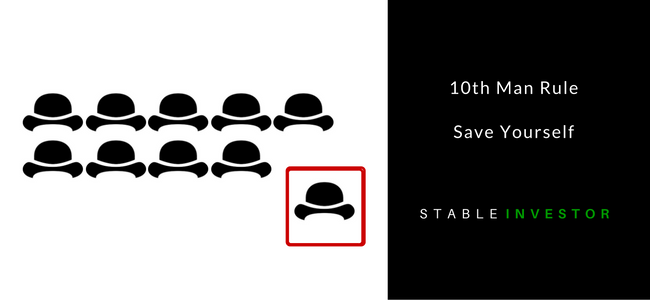
If 9 out of 10 advisors analyze an issue and come to the same conclusion, it is the duty of the 10th man to disagree and actively look for evidence to the contrary.
In the movie, it was this 10th Man Rule that helped Israel prepare for the zombie attack and build a high wall around the city to keep out the zombies. (There is an interesting thread on Quora about this 10th Man Rule).
I personally found this approach quite practical and useful.
To put it simply, if 9 out of 10 people reach the same conclusion after looking at the same set of information, it is the duty of the 10th person to look for evidence to disprove them.
I don’t know whether such a 10th Man Rule exists in Israel or not. But this rule makes a lot of sense.
The idea of this 10th Man Rule is to avoid unwanted surprises and be prepared for black swan events (low probability events).
Agreed that idea portrayed in the film about zombies is extremely far fetched.
But lets focus on this 10th Man Rule – which I think can help us in our investments too.
Think about it.
We as investors tend to move in herds.
If markets are going up, we believe that they will continue to go up. If they are going down, we think that the fall will never end.
But smart investors act like the 10th Man and question this herd behavior of other people (9 others if we refer to the people in 10-man analogy).
They know that more the market goes up, higher are the risks of a fall. So they act like the 10th man. They question the rationale behind the upmove. And if they find evidence to the contrary (like markets getting overvalued), they take the opposite stand (like short the stocks or sell out and increase their cash levels).
And more often than not, the results are profitable for such contrarian thinkers.
A case in point is the story depicted in another great movie The Big Short, which is based on the book The Big Short: Inside the Doomsday Machine.
Its about a hedge fund manager named Michael Burry – who acts as the ‘10th Man’ and recognizes that the U.S. housing market (in mid-2000s) was driven by an asset bubble inflated by high-risk loans. He shorts the US housing market much before the crash of 2007-08. Eventually, he ends up making billions of dollars with almost 500% returns on his short positions.
Coming back to ourselves.
Let us be honest.
We as investors always try to convince ourselves that we know things that are sufficient to evaluate any investment opportunity.
But fact is that most of the times, we over-estimate our abilities and under estimate the things we don’t know.
Result is that we tend to turn a blind eye to potential risks, knowingly or unknowingly. And this leads to losses.
Even if we were to talk about our personal finances, the story remains same.
I see so many people avoiding buying a large life (term) insurance cover.
Reason?
“I am not going to die today. Why should I waste money on something that gives no returns?”
Then there are still more people who think that buying health insurance is a waste of money.
Reason?
“I am fit and healthy – How can I end up in a hospital?”
Such ignorance works for most people most of the times. But if doesn’t, the cost is way too big.
So..
How to be the 10th Man?
It is tough no doubt.
We seek patterns. We look for confirmations everywhere. So if we see 9 people agreeing to something, then its really tough to take the opposite stand and be the 10th man.
Problem is…. that we are not a combination of 10 men who can oppose and counter oppose each other. We are simple people. Infact, each one of us is just one person – with one brain. We don’t have 10 brain parts too where one part can take a stand against the rest nine.
So no doubt it is tough to take the opposite stand against what everyone else believes.
But I am not asking you to prove yourself or others wrong.
I am only asking you (and myself too) to seek out viewpoints that oppose what crowd agrees too. Before accepting something as fact or norm, put yourself in the shoes of the 10th man and think. Think hard.
Mark Twain said,
When you find yourself on the side of the majority, you should pause and reflect.
It is not easy. But it is necessary. And it will help us protect us from unwanted surprises. When everybody is thinking outside the box, you should look inside the box.
Think about it.
We add 3% to your annual returns
Thanks to those of you who got back to us saying that the relationship would continue to be the same. For others too, we hope same is the case.
Some of you asked me as to what is the need to be this elaborate.
The idea is to cover all possible questions which may occur to you in the context of changing regulatory requirements.
This is in continuation of our yesterday piece on commission disclosure. We mentioned that the difference between ‘Regular’ and ‘Direct’ plan of funds is roughly between 0.6% and 0.8%. This is based on the sample check I did for the funds we recommend.
We also highlighted that the returns you see in your portfolio are after expenses, which includes our commission as well.
We’ve explained in the past that based on qualitative parameters as to what value we bring to the table. I was trying to see whether it can be quantified. I stumbled on studies done by Vanguard in this regard. There are many articles about the same. All you’ve to do is to Google ‘Vanguard Advisor Alpha’.
For those of you who may not know, Vanguard is one of the largest fund houses in the world. Though they manage both passive and active funds, they are known for passive funds or index investing. In US, since most fund managers fail to beat the index, investing in index is considered an appropriate and low cost solution. Whereas in India, majority of the funds beat the index, even after expenses. We would continue to suggest investing in actively managed funds. But we do see a time in future, when it would be better to move to passive funds. Since you’ve taken this journey with us, we would suggest course change if and when required. Looks like that is at least some years away.
Vanguard believes and it is true for USA that most fund managers don’t create alpha (returns over and above the benchmark index is called alpha); whereas advisors are able to create alpha for investors roughly to the tune of 4% per annum. Since US advisors charge 1% of assets as annual fee, the alpha after fees is 3%.
This advisor alpha is created by proper portfolio construction, asset allocation, regular rebalancing, planning for tax efficient withdrawals and behavioural coaching. Out of the 4% alpha, up to 2% is through advisor’s behavioural coaching which helps the client to stay the course.
So as an advisor we add up to 4% returns to your portfolio. We subtract around 0.6% to 0.8% due to your investing in ‘Regular’ plan instead of ‘Direct’ plan. So on a net basis; we add more than 3% to your portfolio every year.
In one of the Vanguard literature, I saw the following example.
“Consider three hypothetical investors during the period between October 9, 2007, and March 31, 2014, each starting the period with a balanced (50% equity, 50% debt) $100,000 portfolio. The investor who moved this balance to cash at the 2009 stock market bottom lost $29,000.
The investor who moved to an all-bond position at the stock market bottom lost $10,000. But the investor who stayed committed to the predetermined asset allocation, in the end, gained $41,000.
The biggest value your advisor can provide is behavioral coaching.
To sum up, your financial advisor is there to counsel you, listen to your concerns, and, essentially, guide you on the right path. Your advisor works with you to add value throughout the course of your relationship.”
To repeat, we add 4%, subtract 0.8% and on a net basis add around 3%+. So you still stand to gain even after paying us (indirectly, by investing in ‘Regular’ plan).
So our suggestion: Please stay the course.


Commission Disclosure
From coming October onwards, every six months, the CAS (Consolidated Account Statement) will carry the expense ratio of the funds and absolute amount of commission paid to the advisor.
You are aware that we do not charge you any fees. You also know that we are compensated for our advice and services through trail commission. This trail commission is paid out of the expense ratio of the scheme and is adjusted against the NAV. Both expense ratio and trail commission vary from fund to fund and type of assets (Equity, Debt and Liquid). Last year, we earned 0.87% from the assets we manage.
This year we expect our revenue to be around 0.9% of the assets we manage. Please note that this is gross revenue. Out of this we pay service tax of 15% (including cess).All our expenses like rent, salaries, software, subscriptions, fuel, telephone, broadband, stationery etc. are paid out of the amount available to us after paying service tax. The balance is our income for providing ongoing advice and services. Like all of you, we also pay income tax on our income.
Please note that the return you see in your portfolio is after accounting for expense ratio (which includes our commission).
There is a difference in expense ratio if you go through an advisor or direct. This difference also varies from fund to fund and type of assets. Roughly the difference is between 0.6% to 0.8%.
Last year I wrote a piece on why you need an advisor. I’m reproducing the same below.
“Few years ago, some of you wanted to stop your SIPs or exit mutual funds completely. You were frustrated with lack of results in your portfolio. We counselled you with various examples and data; the need to stay the course. You are now reaping the benefits of the same.
Through our periodical writing, daily sms etc. we keep reinforcing the value of long term orientation, patience and discipline. Many of you have told me that these serve us good pointers to continue the journey with focus and discipline.
We don’t let you chase hot funds or recent performers, invest in the current sectoral or thematic fads; but completely stay focussed on the chosen portfolio. This ensures that you avoid typical mistakes people make in a bull market.
You are aware how many mistakes you’ve avoided in your personal finance by listening to us. These mistakes, if done, would have had huge financial and emotional costs. We add significant value to you by ensuring that you don’t do things which can hurt you.
You’ve understood and internalised the power of compounding, time and equity. This has ensured that you’re in the path to achieve financial independence and create huge wealth. Some of you have already achieved financial independence by under taking the journey with us for last many years.
By making you to focus on SIPs for decades of your working life, we’ve eliminated completely the need of timing the market. Not only that the beauty of SIP is that, you buy more in bear markets and buy less in bull markets. This is against the crowd behaviour of buying more in bull markets and selling in bear markets. This has ensured you would end up in the small percentage of successful investors.
One key learning all of you have now is that all asset classes are cyclical. There is no such thing as permanent bull market in any asset class. What is important is that after adjusting for inflation, which asset class delivers better return over long run.
None of you invest for 3 or 5 years. The bare minimum tenure you have is 10 years and many of you are fine with 20 years or more. Some of you have even accepted the concept of multi-generational savings and investing. You don’t know how rare this trait is. Since most of you are first time investors and got exposed only to our philosophy and views; you’ve accepted this as a standard view. The unfortunate truth is most of the investors are not lucky to get this right view even after decades.
Once you choose the path; we do our best repeatedly to ensure that you stay the course without any digressions. ‘Doing nothing’ is most powerful after a right path and investments are chosen. Most investors keep tinkering with their investments and move away from the path carried away by greed or fear. Ensuring that you do nothing with the chosen path and investment is one of our key jobs.
Shaping the behaviour, acting as a coach and hand holding during tough times are some of the things we always do for you.
You may wonder why I’m writing all these. I’m aware that you see value in what we do and that is why you have chosen to be with us. Our blog is now read by thousands of investors and hundreds of advisors. I want this message to reach them so that these investors find right advisors and stick with them. For advisors, this would serve as a positive reinforcement on the value they bring to the table.
I take this opportunity to thank you for being our clients and want to reaffirm you that we would continue to add value to you as we always do.”
Going by a recent note from SEBI (Securities Exchange Board of India), over next 3 years or so, all mutual fund advisors may need to become RIAs (Registered Investment Advisors) and earn income only through clients. I assume that this means that we may not receive any commission after next few years and we need to charge you a fee for our advice and services.
Till we migrate to RIA model at appropriate time (over next few years), request you to stay with us in the current model.
Thanking you in advance for your continued trust and support.


The Chessboard Fallacy
“In the great chess-board of human society,
every single piece has a principle of motion of its own.”
— Adam Smith
***
One of our favorite dictums, much referenced here, is an idea by Joseph Tussman, about getting the world to do the work for you:
“What the pupil must learn, if he learns anything at all, is that the world will do most of the work for you, provided you cooperate with it by identifying how it really works and aligning with those realities. If we do not let the world teach us, it teaches us a lesson.”
By aligning with the world, as it really is and not as we wish it to be, we get it to do the work for us.
Tussman’s idea has at least one predecessor: Adam Smith.
In The Theory of Moral Sentiments, Smith excoriates the “Men of System” who have decided on an inflexible ideology of how the world should work, and try to fit the societies they lead into a Procrustean Bed of their choosing — the Mao Zedong-type leaders who would allow millions to die rather than sacrifice an inch of ideology (although Smith’s book predates Maoism by almost 200 years).
In his great wisdom, Smith perfectly explains the futility of swimming “against the tide” of how the world really works and the benefit of going “with the tide” whenever possible. He recognizes that people are not chess pieces, to be moved around as desired.
Instead, he encourages us to remember that everyone we deal with has their own goals, feelings, aspirations, and motivations, many of them not always immediately obvious. We must construct human systems with human nature in full view, fully harnessed, fully acknowledged.
Any system of human relations that doesn’t accept this truth will always be fighting the world, rather than getting it to work for them.
The man of system, on the contrary, is apt to be very wise in his own conceit; and is often so enamored with the supposed beauty of his own ideal plan of government, that he cannot suffer the smallest deviation from any part of it. He goes on to establish it completely and in all its parts, without any regard either to the great interests, or to the strong prejudices which may oppose it.
He seems to imagine that he can arrange the different members of a great society with as much ease as the hand arranges the different pieces upon a chess-board. He does not consider that the pieces upon the chess-board have no other principle of motion besides that which the hand impresses upon them; but that, in the great chess-board of human society, every single piece has a principle of motion of its own, altogether different from that which the legislature might choose to impress upon it.
If those two principles coincide and act in the same direction, the game of human society will go on easily and harmoniously, and is very likely to be happy and successful. If they are opposite or different, the game will go on miserably, and the society must be at all times in the highest degree of disorder.
Think of how many policies, procedures and systems of organization which forget this basic truth; systems of political control, price control, social control and behavioral control — from bad workplaces to bad governments – which have failed so miserably because they refused to account for the underlying motivations of the people in the system, and failed to do a second-step analysis of the consequences of their policies.
It’s just as true in personal relations: How often do we fail to treat others correctly because we haven’t taken their point of view, motivations, aspirations, and desires properly into account? How often is our own “system of relations” built on faulty assumptions that don’t actually work for us? (The old marriage advice “You can either be right, or be happy” is pure gold wisdom in this sense.)
Smith’s counsel offers us a nice out, though. If our own system for dealing with people and their own “principles of motion” are the same, then we are likely to get a harmonious result! If not? We get misery.
The choice is ours.
--
Sponsored by: Slack - Making teamwork simpler, more pleasant, and more productive.
Personal Finance and Marriage
New Zealand’s remarkable economic transformation – an unsung story

What Books Would You Recommend Someone Read to Improve their General Knowledge of the World?
Inspired by a reader’s question to me, I thought I’d ask our followers on Facebook and Twitter for an answer to the question: What books would you recommend someone read to improve their general knowledge of the world.
I must say the number and quality of the responses overwhelmed me. The box Amazon just delivered reminds me that I ordered 9 books off this list.
Here is the list of what 55,000 of the smartest readers on the internet came up with, and what a list it is!
International strategist Peter Zeihan examines how the hard rules of geography are eroding the American commitment to free trade; how much of the planet is aging into a mass retirement that will enervate markets and capital supplies; and how, against all odds, it is the ever-ravenous American economy that-alone among the developed nations-is rapidly approaching energy independence. Combined, these factors are doing nothing less than overturning the global system and ushering in a new (dis)order.
Sapiens: A Brief History of Humankind
“I would recommend this book to anyone interested in a fun, engaging look at early human history…you’ll have a hard time putting it down.”— Bill Gates
How to Read a Book
This book impacted us so much we created an entire course, The Art of Reading, around it.
William McNeill’s widely acclaimed one-volume history emphasizes the four Old World civilizations of the Middle East, India, China, and Europe, paying particular attention to their interaction across time as well as the impact on historical scholarship in light of the most recent archaeological discoveries. The engaging and informative narrative touches on all aspects of civilization, including geography, communication, and technological and artistic developments, and provides extensive coverage of the modern era.
The intelligent man’s guide to science
An Incomplete Education: 3,684 Things You Should Have Learned but Probably Didn’t
Here’s your chance to brush up on all those subjects you slept through in school, reacquaint yourself with all the facts you once knew (then promptly forgot), catch up on major developments in the world today, and become the Renaissance man or woman you always knew you could be!
A Short History of Nearly Everything
Taking as territory everything from the Big Bang to the rise of civilization, Bryson seeks to understand how we got from there being nothing at all to there being us. To that end, he has attached himself to a host of the world’s most advanced (and often obsessed) archaeologists, anthropologists, and mathematicians, travelling to their offices, laboratories, and field camps. He has read (or tried to read) their books, pestered them with questions, apprenticed himself to their powerful minds. A Short History of Nearly Everything is the record of this quest, and it is a sometimes profound, sometimes funny, and always supremely clear and entertaining adventure in the realms of human knowledge, as only Bill Bryson can render it. Science has never been more involving or entertaining.
Slaughterhouse-Five, an American classic, is one of the world’s great antiwar books. Centering on the infamous firebombing of Dresden, Billy Pilgrim’s odyssey through time reflects the mythic journey of our own fractured lives as we search for meaning in what we fear most.
One Hundred Years of Solitude tells the story of the rise and fall, birth and death of the mythical town of Macondo through the history of the Buend; a family. Inventive, amusing, magnetic, sad, and alive with unforgettable men and women — brimming with truth, compassion, and a lyrical magic that strikes the soul — this novel is a masterpiece in the art of fiction.
Anne Frank: The Diary of a Young Girl
Discovered in the attic in which she spent the last years of her life, Anne Frank’s remarkable diary has since become a world classic—a powerful reminder of the horrors of war and an eloquent testament to the human spirit. In 1942, with Nazis occupying Holland, a thirteen-year-old Jewish girl and her family fled their home in Amsterdam and went into hiding. For the next two years, until their whereabouts were betrayed to the Gestapo, they and another family lived cloistered in the “Secret Annex” of an old office building. Cut off from the outside world, they faced hunger, boredom, the constant cruelties of living in confined quarters, and the ever-present threat of discovery and death. In her diary Anne Frank recorded vivid impressions of her experiences during this period. By turns thoughtful, moving, and amusing, her account offers a fascinating commentary on human courage and frailty and a compelling self-portrait of a sensitive and spirited young woman whose promise was tragically cut short.
A History of the World in 100 Objects
Neil MacGregor has blazed an unusual path to international renown. As director of the British Museum, he organized an exhibit that aimed to tell the history of humanity through the stories of one hundred objects made, used, venerated, or discarded by man. The exhibit and its accompanying BBC radio series broke broadcasting records and MacGregor’s book became a bestselling sensation on both sides of the Atlantic and a huge Christmas hit, with more than 100,000 copies in print in the United States alone.
23 Things They Don’t Tell You about Capitalism
23 Things They Don’t Tell You about Capitalism uses twenty-three short essays (a few great examples: “There Is No Such Thing as a Free Market,” “The Washing Machine Has Changed the World More than the Internet Has”) to equip readers with an understanding of how global capitalism works, and doesn’t, while offering a vision of how we can shape capitalism to humane ends, instead of becoming slaves of the market.
The Structure of Scientific Revolutions
A good book may have the power to change the way we see the world, but a great book actually becomes part of our daily consciousness, pervading our thinking to the point that we take it for granted, and we forget how provocative and challenging its ideas once were—and still are. The Structure of Scientific Revolutions is that kind of book. When it was first published in 1962, it was a landmark event in the history and philosophy of science. Fifty years later, it still has many lessons to teach.
Meditations by Marcus Aurelius
Marcus Aurelius Antoninus (a.d. 121–180) succeeded his adoptive father as emperor of Rome in a.d. 161—and Meditations remains one of the greatest works of spiritual and ethical reflection ever written. With a profound understanding of human behavior, Marcus provides insights, wisdom, and practical guidance on everything from living in the world to coping with adversity to interacting with others. Consequently, the Meditations have become required reading for statesmen and philosophers alike, while generations of ordinary readers have responded to the straightforward intimacy of his style. In Gregory Hays’s new translation—the first in a generation—Marcus’s thoughts speak with a new immediacy: never before have they been so directly and powerfully presented.
… broadly focuses on Napoleon’s invasion of Russia in 1812 and follows three of the most well-known characters in literature: Pierre Bezukhov, the illegitimate son of a count who is fighting for his inheritance and yearning for spiritual fulfillment; Prince Andrei Bolkonsky, who leaves his family behind to fight in the war against Napoleon; and Natasha Rostov, the beautiful young daughter of a nobleman who intrigues both men. As Napoleon’s army invades, Tolstoy brilliantly follows characters from diverse backgrounds—peasants and nobility, civilians and soldiers—as they struggle with the problems unique to their era, their history, and their culture. And as the novel progresses, these characters transcend their specificity, becoming some of the most moving—and human—figures in world literature.
One of the supreme masterpieces of world literature, Crime and Punishment catapulted Dostoyevsky to the forefront of Russian writers and into the ranks of the world’s greatest novelists. Drawing upon experiences from his own prison days, the author recounts in feverish, compelling tones the story of Raskolnikov, an impoverished student tormented by his own nihilism, and the struggle between good and evil. Believing that he is above the law, and convinced that humanitarian ends justify vile means, he brutally murders an old woman — a pawnbroker whom he regards as “stupid, ailing, greedy…good for nothing.” Overwhelmed afterwards by feelings of guilt and terror, Raskolnikov confesses to the crime and goes to prison. There he realizes that happiness and redemption can only be achieved through suffering. Infused with forceful religious, social, and philosophical elements, the novel was an immediate success. This extraordinary, unforgettable work is reprinted here in the authoritative Constance Garnett translation.
The Prince shocked Europe on publication with its advocacy of ruthless tactics for gaining absolute power and its abandonment of conventional morality. Niccoló Machiavelli drew on his own experience of office under the turbulent Florentine republic, rejecting traditional values of political theory and recognizing the complicated, transient nature of political life. Concerned not with lofty ideal but with a regime that would last, The Prince has become the bible of realpolitik, and it still retains its power to alarm and to instruct. In this edition, Machiavelli’s tough-minded and pragmatic Italian is preserved in George Bull’s clear, unambiguous translation.
The Art of War: The Essential Translation of the Classic Book of Life
For more than two thousand years, Sun-tzu’s The Art of War has provided leaders with essential advice on battlefield tactics and management strategies. An elemental part of Chinese culture, it has also become a touchstone for the Western struggle for survival and success, whether in battle, in business, or in relationships. Now, in this crisp, accessible new translation, eminent scholar John Minford brings this seminal work to life for today’s readers. Capturing the literary quality of the work, Minford presents the core text in two formats: first, the unadorned ancient words of wisdom ascribed to Sun-tzu; then, the same text with extensive running commentary from the canon of traditional Chinese commentators. A lively, learned introduction and other valuable apparatus round out this authoritative volume.
Antifragile: Things That Gain from Disorder
Just as human bones get stronger when subjected to stress and tension, and rumors or riots intensify when someone tries to repress them, many things in life benefit from stress, disorder, volatility, and turmoil. What Taleb has identified and calls “antifragile” is that category of things that not only gain from chaos but need it in order to survive and flourish.
Winner of the Pulitzer prize in 1974 and the culmination of a life’s work, The Denial of Death is Ernest Becker’s brilliant and impassioned answer to the “why” of human existence. In bold contrast to the predominant Freudian school of thought, Becker tackles the problem of the vital lie — man’s refusal to acknowledge his own mortality. In doing so, he sheds new light on the nature of humanity and issues a call to life and its living that still resonates more than twenty years after its writing.
Nonzero: The Logic of Human Destiny
(Robert) Wright asserts that, ever since the primordial ooze, life has followed a basic pattern. Organisms and human societies alike have grown more complex by mastering the challenges of internal cooperation. Wright’s narrative ranges from fossilized bacteria to vampire bats, from stone-age villages to the World Trade Organization, uncovering such surprises as the benefits of barbarian hordes and the useful stability of feudalism. Here is history endowed with moral significance–a way of looking at our biological and cultural evolution that suggests, refreshingly, that human morality has improved over time, and that our instinct to discover meaning may itself serve a higher purpose. Insightful, witty, profound, Nonzero offers breathtaking implications for what we believe and how we adapt to technology’s ongoing transformation of the world.
Zero to One: Notes on Startups, or How to Build the Future
The great secret of our time is that there are still uncharted frontiers to explore and new inventions to create. In Zero to One, legendary entrepreneur and investor Peter Thiel shows how we can find singular ways to create those new things.
Manufacturing Consent: The Political Economy of the Mass Media
In this pathbreaking work, now with a new introduction, Edward S. Herman and Noam Chomsky show that, contrary to the usual image of the news media as cantankerous, obstinate, and ubiquitous in their search for truth and defense of justice, in their actual practice they defend the economic, social, and political agendas of the privileged groups that dominate domestic society, the state, and the global order.
[O]ne of the most talked-about climate change books of recent years, for reasons easy to understand: It tells the controversial story of how a loose-knit group of high-level scientists and scientific advisers, with deep connections in politics and industry, ran effective campaigns to mislead the public and deny well-established scientific knowledge over four decades. The same individuals who claim the science of global warming is “not settled” have also denied the truth about studies linking smoking to lung cancer, coal smoke to acid rain, and CFCs to the ozone hole. “Doubt is our product,” wrote one tobacco executive. These “experts” supplied it.
Confessions of an Economic Hit Man
From the U.S. military in Iraq to infrastructure development in Indonesia, from Peace Corps volunteers in Africa to jackals in Venezuela, Perkins exposes a conspiracy of corruption that has fueled instability and anti-Americanism around the globe, with consequences reflected in our daily headlines. Having raised the alarm, Perkins passionately addresses how Americans can work to create a more peaceful and stable world for future generations.
Lies My Teacher Told Me: Everything Your American History Textbook Got Wrong
Americans have lost touch with their history, and in Lies My Teacher Told Me Professor James Loewen shows why. After surveying eighteen leading high school American history texts, he has concluded that not one does a decent job of making history interesting or memorable. Marred by an embarrassing combination of blind patriotism, mindless optimism, sheer misinformation, and outright lies, these books omit almost all the ambiguity, passion, conflict, and drama from our past.
The remarkable best-seller — a long-lost, 300-year-old book of wisdom on how to live successfully yet responsibly in a society governed by self-interest — as acute as Machiavelli yet as humanistic and scrupulously moral as Marcus Aurelius.
Amoral, cunning, ruthless, and instructive, The 48 Laws of Power is the definitive manual for anyone interested in gaining, observing, or defending against ultimate control.
Seeking Wisdom: From Darwin to Munger, 3rd Edition
My most gifted book.
Negotiating Your Salary: How To Make $1000 a Minute
In addition to the basic rules of negotiation, $1000 a Minute tells readers when to apply them. The book is reorganized to tell: What to do at the start of the job search, how to “dodge” the salary issue during the job search, what to prepare before a job interview, when to enter into negotiations, and what order to ask for things. Special training is provided in how NOT to jeapordize the offer you have and still negotiate for the offer you want.
Against the Gods: The Remarkable Story of Risk
In this unique exploration of the role of risk in our society, Peter Bernstein argues that the notion of bringing risk under control is one of the central ideas that distinguishes modern times from the distant past. Against the Gods chronicles the remarkable intellectual adventure that liberated humanity from oracles and soothsayers by means of the powerful tools of risk management that are available to us today.
The Creators: A History of Heroes of the Imagination
By piecing the lives of selected individuals into a grand mosaic, Pulitzer Prize-winning historian Daniel J. Boorstin explores the development of artistic innovation over 3,000 years. A hugely ambitious chronicle of the arts that Boorstin delivers with the scope that made his Discoverers a national bestseller.
The User Illusion: Cutting Consciousness Down to Size
As John Casti wrote, “Finally, a book that really does explain consciousness.” This groundbreaking work by Denmark’s leading science writer draws on psychology, evolutionary biology, information theory, and other disciplines to argue its revolutionary point: that consciousness represents only an infinitesimal fraction of our ability to process information. Although we are unaware of it, our brains sift through and discard billions of pieces of data in order to allow us to understand the world around us. In fact, most of what we call thought is actually the unconscious discarding of information. What our consciousness rejects constitutes the most valuable part of ourselves, the “Me” that the “I” draws on for most of our actions–fluent speech, riding a bicycle, anything involving expertise. No wonder that, in this age of information, so many of us feel empty and dissatisfied. As engaging as it is insightful, this important book encourages us to rely more on what our instincts and our senses tell us so that we can better appreciate the richness of human life.
First published in 1939, Steinbeck’s Pulitzer Prize-winning epic of the Great Depression chronicles the Dust Bowl migration of the 1930s and tells the story of one Oklahoma farm family, the Joads—driven from their homestead and forced to travel west to the promised land of California. Out of their trials and their repeated collisions against the hard realities of an America divided into Haves and Have-Nots evolves a drama that is intensely human yet majestic in its scale and moral vision, elemental yet plainspoken, tragic but ultimately stirring in its human dignity. A portrait of the conflict between the powerful and the powerless, of one man’s fierce reaction to injustice, and of one woman’s stoical strength, the novel captures the horrors of the Great Depression and probes into the very nature of equality and justice in America. At once a naturalistic epic, captivity narrative, road novel, and transcendental gospel, Steinbeck’s powerful landmark novel is perhaps the most American of American Classics.
Please Kill Me: The Uncensored Oral History of Punk
A contemporary classic, Please Kill Me is the definitive oral history of the most nihilistic of all pop movements. Iggy Pop, Richard Hell, the Ramones, and scores of other punk figures lend their voices to this decisive account of that explosive era. This 20th anniversary edition features new photos and an afterword by the authors.
The Power Broker: Robert Moses and the Fall of New York
One of the most acclaimed books of our time, winner of both the Pulitzer and the Francis Parkman prizes, The Power Broker tells the hidden story behind the shaping (and mis-shaping) of twentieth-century New York (city and state) and makes public what few have known: that Robert Moses was, for almost half a century, the single most powerful man of our time in New York, the shaper not only of the city’s politics but of its physical structure and the problems of urban decline that plague us today.
Eureka Street: A Novel of Ireland Like No Other
“All stories are love stories,” begins Eureka Street, Robert McLiam Wilson’s big-hearted and achingly funny novel. Set in Belfast during the Troubles, Eureka Street takes us into the lives and families of Chuckie Lurgan and Jake Jackson, a Protestant and a Catholic—unlikely pals and staunch allies in an uneasy time. When a new work of graffiti begins to show up throughout the city—“OTG”—the locals are stumped. The harder they try to decipher it, the more it reflects the passions and paranoias that govern and divide them. Chuckie and Jake are as mystified as everyone else. In the meantime, they try to carve out lives for themselves in the battlefield they call home. Chuckie falls in love with an American who is living in Belfast to escape the violence in her own land; the best Jake can do is to get into a hilarious and remorseless war of insults with a beautiful but spitfire Republican whose Irish name, properly pronounced, sounds to him like someone choking. The real love story in Eureka Street involves Belfast—the city’s soul and spirit, and its will to survive the worst it can do to itself.
Larry Darrell is a young American in search of the absolute. The progress of his spiritual odyssey involves him with some of Maugham’s most brilliant characters – his fiancée Isabel whose choice between love and wealth have lifelong repercussions, and Elliott Templeton, her uncle, a classic expatriate American snob. Maugham himself wanders in and out of the story, to observe his characters struggling with their fates.
IDEAS: A HISTORY, From Wittgenstein to the World Wide Web, Two Volumes in Slipcase
For several years of his turbulent life, Seneca was the guiding hand of the Roman Empire. His inspired reasoning derived mainly from the Stoic principles, which had originally been developed some centuries earlier in Athens. This selection of Seneca’s letters shows him upholding the austere ethical ideals of Stoicism—the wisdom of the self-possessed person immune to overmastering emotions and life’s setbacks—while valuing friendship and the courage of ordinary men, and criticizing the harsh treatment of slaves and the cruelties in the gladiatorial arena. The humanity and wit revealed in Seneca’s interpretation of Stoicism is a moving and inspiring declaration of the dignity of the individual mind.
The Fish That Ate the Whale: The Life and Times of America’s Banana King
The fascinating, untold tale of Samuel Zemurray, the self-made banana mogul who went from penniless roadside banana peddler to kingmaker and capitalist revolutionary When Samuel Zemurray arrived in America in 1891, he was tall, gangly, and penniless. When he died in the grandest house in New Orleans sixty-nine years later, he was among the richest, most powerful men in the world. Working his way up from a roadside fruit peddler to conquering the United Fruit Company, Zemurray became a symbol of the best and worst of the United States: proof that America is the land of opportunity, but also a classic example of the corporate pirate who treats foreign nations as the backdrop for his adventures. Zemurray lived one of the great untold stories of the last hundred years. Starting with nothing but a cart of freckled bananas, he built a sprawling empire of banana cowboys, mercenary soldiers, Honduran peasants, CIA agents, and American statesmen. From hustling on the docks of New Orleans to overthrowing Central American governments and precipitating the bloody thirty-six-year Guatemalan civil war, the Banana Man lived a monumental and sometimes dastardly life. Rich Cohen’s brilliant historical profile The Fish That Ate the Whale unveils Zemurray as a hidden power broker, driven by an indomitable will to succeed.
The Master and His Emissary: The Divided Brain and the Making of the Western World
In a book of unprecedented scope–now available in a larger format—Iain McGilchrist presents a fascinating exploration of the differences between the brain’s left and right hemispheres, and how those differences have affected society, history, and culture. McGilchrist draws on a vast body of recent research in neuroscience and psychology to reveal that the difference is profound: the left hemisphere is detail oriented, while the right has greater breadth, flexibility, and generosity. McGilchrist then takes the reader on a journey through the history of Western culture, illustrating the tension between these two worlds as revealed in the thought and belief of thinkers and artists from Aeschylus to Magritte.
Things Fall Apart tells two intertwining stories, both centering on Okonkwo, a “strong man” of an Ibo village in Nigeria. The first, a powerful fable of the immemorial conflict between the individual and society, traces Okonkwo’s fall from grace with the tribal world. The second, as modern as the first is ancient, concerns the clash of cultures and the destruction of Okonkwo’s world with the arrival of aggressive European missionaries. These perfectly harmonized twin dramas are informed by an awareness capable of encompassing at once the life of nature, human history, and the mysterious compulsions of the soul.
Decolonising the Mind: The Politics of Language in African Literature
Ngugi describes this book as ‘a summary of some of the issues in which I have been passionately involved for the last twenty years of my practice in fiction, theatre, criticism and in teaching of literature’.
The Origin of Wealth: The Radical Remaking of Economics and What it Means for Business and Society
Over 6.4 billion people participate in a $36.5 trillion global economy, designed and overseen by no one. How did this marvel of self-organized complexity evolve? How is wealth created within this system? And how can wealth be increased for the benefit of individuals, businesses, and society? In The Origin of Wealth, Eric D. Beinhocker argues that modern science provides a radical perspective on these age-old questions, with far-reaching implications. According to Beinhocker, wealth creation is the product of a simple but profoundly powerful evolutionary formula: differentiate, select, and amplify. In this view, the economy is a “complex adaptive system” in which physical technologies, social technologies, and business designs continuously interact to create novel products, new ideas, and increasing wealth. Taking readers on an entertaining journey through economic history, from the Stone Age to modern economy, Beinhocker explores how “complexity economics” provides provocative insights on issues ranging from creating adaptive organizations to the evolutionary workings of stock markets to new perspectives on government policies. A landmark book that shatters conventional economic theory, The Origin of Wealth will rewire our thinking about how we came to be here—and where we are going.
The Company of Strangers: A Natural History of Economic Life
The Company of Strangers shows us the remarkable strangeness, and fragility, of our everyday lives. This completely revised and updated edition includes a new chapter analyzing how the rise and fall of social trust explain the unsustainable boom in the global economy over the past decade and the financial crisis that succeeded it. Drawing on insights from biology, anthropology, history, psychology, and literature, Paul Seabright explores how our evolved ability of abstract reasoning has allowed institutions like money, markets, cities, and the banking system to provide the foundations of social trust that we need in our everyday lives. Even the simple acts of buying food and clothing depend on an astonishing web of interaction that spans the globe. How did humans develop the ability to trust total strangers with providing our most basic needs?
Understanding Media: The Extensions of Man
When first published, Marshall McLuhan’s Understanding Media made history with its radical view of the effects of electronic communications upon man and life in the twentieth century. This edition of McLuhan’s best-known book both enhances its accessibility to a general audience and provides the full critical apparatus necessary for scholars. In Terrence Gordon’s own words, “McLuhan is in full flight already in the introduction, challenging us to plunge with him into what he calls ‘the creative process of knowing.'” Much to the chagrin of his contemporary critics McLuhan’s preference was for a prose style that explored rather than explained. Probes, or aphorisms, were an indispensable tool with which he sought to prompt and prod the reader into an “understanding of how media operates” and to provoke reflection. In the 1960s McLuhan s theories aroused both wrath and admiration. It is intriguing to speculate what he might have to say 40 years later on subjects to which he devoted whole chapters such as Television, The Telephone, Weapons, Housing and Money. Today few would dispute that mass media have indeed decentralized modern living and turned the world into a global village.
Poor Charlie’s Almanack: The Wit and Wisdom of Charles T. Munger, Expanded Third Edition
Letters From A Self-made Merchant To His Son
Lorimer’s Letters From A Self-Made Merchant To His Son is a timeless collection of Gilded Age aphorisms from a rich man – a prosperous pork-packer in Chicago to his son, Pierrepont, whom he ‘affectionately’ calls ‘Piggy.’ The writing is subtle and brilliant.
The Song of the Dodo: Island Biogeography in an Age of Extinction
David Quammen’s book, The Song of the Dodo, is a brilliant, stirring work, breathtaking in its scope, far-reaching in its message — a crucial book in precarious times, which radically alters the way in which we understand the natural world and our place in that world. It’s also a book full of entertainment and wonders. In The Song of the Dodo, we follow Quammen’s keen intellect through the ideas, theories, and experiments of prominent naturalists of the last two centuries. We trail after him as he travels the world, tracking the subject of island biogeography, which encompasses nothing less than the study of the origin and extinction of all species. Why is this island idea so important? Because islands are where species most commonly go extinct — and because, as Quammen points out, we live in an age when all of Earth’s landscapes are being chopped into island-like fragments by human activity. Through his eyes, we glimpse the nature of evolution and extinction, and in so doing come to understand the monumental diversity of our planet, and the importance of preserving its wild landscapes, animals, and plants. We also meet some fascinating human characters. By the book’s end we are wiser, and more deeply concerned, but Quammen leaves us with a message of excitement and hope.
Guns, Germs, and Steel: The Fates of Human Societies
In this “artful, informative, and delightful” (William H. McNeill, New York Review of Books) book, Jared Diamond convincingly argues that geographical and environmental factors shaped the modern world. Societies that had had a head start in food production advanced beyond the hunter-gatherer stage, and then developed religion –as well as nasty germs and potent weapons of war –and adventured on sea and land to conquer and decimate preliterate cultures. A major advance in our understanding of human societies, Guns, Germs, and Steel chronicles the way that the modern world came to be and stunningly dismantles racially based theories of human history. Winner of the Pulitzer Prize, the Phi Beta Kappa Award in Science, the Rhone-Poulenc Prize, and the Commonwealth club of California’s Gold Medal.
Henry Kissinger offers in World Order a deep meditation on the roots of international harmony and global disorder. Drawing on his experience as one of the foremost statesmen of the modern era—advising presidents, traveling the world, observing and shaping the central foreign policy events of recent decades—Kissinger now reveals his analysis of the ultimate challenge for the twenty-first century: how to build a shared international order in a world of divergent historical perspectives, violent conflict, proliferating technology, and ideological extremism.
What Went Wrong?: The Clash Between Islam and Modernity in the Middle East
For centuries, the world of Islam was in the forefront of human achievement — the foremost military and economic power in the world, the leader in the arts and sciences of civilization. Christian Europe was seen as an outer darkness of barbarism and unbelief from which there was nothing to learn or to fear. And then everything changed. The West won victory after victory, first on the battlefield and then in the marketplace. In this elegantly written volume, Bernard Lewis, a renowned authority an Islamic affairs, examines the anguished reaction of the Islamic world as it tried to make sense of how it had been overtaken, overshadowed, and dominated by the West. In a fascinating portrait of a culture in turmoil, Lewis shows how the Middle East turned its attention to understanding European weaponry, industry, government, education, and culture. He also describes how some Middle Easterners fastened blame on a series of scapegoats, while others asked not “Who did this to us?” but rather “Where did we go wrong?”
In the international bestseller, Thinking, Fast and Slow, Daniel Kahneman, the renowned psychologist and winner of the Nobel Prize in Economics, takes us on a groundbreaking tour of the mind and explains the two systems that drive the way we think. System 1 is fast, intuitive, and emotional; System 2 is slower, more deliberative, and more logical. The impact of overconfidence on corporate strategies, the difficulties of predicting what will make us happy in the future, the profound effect of cognitive biases on everything from playing the stock market to planning our next vacation―each of these can be understood only by knowing how the two systems shape our judgments and decisions. Engaging the reader in a lively conversation about how we think, Kahneman reveals where we can and cannot trust our intuitions and how we can tap into the benefits of slow thinking. He offers practical and enlightening insights into how choices are made in both our business and our personal lives―and how we can use different techniques to guard against the mental glitches that often get us into trouble. Winner of the National Academy of Sciences Best Book Award and the Los Angeles Times Book Prize and selected by The New York Times Book Review as one of the ten best books of 2011, Thinking, Fast and Slow is destined to be a classic.
When Elizabeth Bennet first meets eligible bachelor Fitzwilliam Darcy, she thinks him arrogant and conceited; he is indifferent to her good looks and lively mind. When she later discovers that Darcy has involved himself in the troubled relationship between his friend Bingley and her beloved sister Jane, she is determined to dislike him more than ever. In the sparkling comedy of manners that follows, Jane Austen shows the folly of judging by first impressions and superbly evokes the friendships,gossip and snobberies of provincial middle-class life.
Living within Limits: Ecology, Economics, and Population Taboos
In Living Within Limits, Hardin focuses on the neglected problem of overpopulation, making a forceful case for dramatically changing the way we live in and manage our world. Our world itself, he writes, is in the dilemma of the lifeboat: it can only hold a certain number of people before it sinks–not everyone can be saved. The old idea of progress and limitless growth misses the point that the earth (and each part of it) has a limited carrying capacity; sentimentality should not cloud our ability to take necessary steps to limit population. But Hardin refutes the notion that goodwill and voluntary restraints will be enough. Instead, nations where population is growing must suffer the consequences alone. Too often, he writes, we operate on the faulty principle of shared costs matched with private profits. In Hardin’s famous essay, “The Tragedy of the Commons,” he showed how a village common pasture suffers from overgrazing because each villager puts as many cattle on it as possible–since the costs of grazing are shared by everyone, but the profits go to the individual. The metaphor applies to global ecology, he argues, making a powerful case for closed borders and an end to immigration from poor nations to rich ones. “The production of human beings is the result of very localized human actions; corrective action must be local….Globalizing the ‘population problem’ would only ensure that it would never be solved.” Hardin does not shrink from the startling implications of his argument, as he criticizes the shipment of food to overpopulated regions and asserts that coercion in population control is inevitable. But he also proposes a free flow of information across boundaries, to allow each state to help itself.
The Book: On the Taboo Against Knowing Who You Are
At the root of human conflict is our fundamental misunderstanding of who we are. The illusion that we are isolated beings, unconnected to the rest of the universe, has led us to view the “outside” world with hostility, and has fueled our misuse of technology and our violent and hostile subjugation of the natural world. In The Book, philosopher Alan Watts provides us with a much-needed answer to the problem of personal identity, distilling and adapting the ancient Hindu philosophy of Vedanta to help us understand that the self is in fact the root and ground of the universe. In this mind-opening and revelatory work, Watts has crafted a primer on what it means to be human—and a manual of initiation into the central mystery of existence.
Accessible, riveting, and eloquently written, The Cave and the Light provides a stunning new perspective on the Western world, certain to open eyes and stir debate.
How to Win Friends and Influence People
Dale Carnegie’s time-tested advice has carried millions upon millions of readers for more than seventy-five years up the ladder of success in their business and personal lives. Now the first and best book of its kind has been rebooted to tame the complexities of modern times and will teach you how to communicate with diplomacy and tact, capitalize on a solid network, make people like you, project your message widely and clearly, be a more effective leader, increase your ability to get things done, and optimize the power of digital tools.
Learn or Die: Using Science to Build a Leading-Edge Learning Organization
Learn or Die examines the process of learning from an individual and an organizational standpoint. From an individual perspective, the book discusses the cognitive, emotional, motivational, attitudinal, and behavioral factors that promote better learning. Organizationally, Learn or Die focuses on the kinds of structures, culture, leadership, employee learning behaviors, and human resource policies that are necessary to create an environment that enables critical and innovative thinking, learning conversations, and collaboration. The volume also provides strategies to mitigate the reality that humans can be reflexive, lazy thinkers who seek confirmation of what they believe to be true and affirmation of their self-image. Exemplar learning organizations discussed include the secretive Bridgewater Associates, LP; Intuit, Inc.; United Parcel Service (UPS); W. L. Gore & Associates; and IDEO.
The Righteous Mind: Why Good People Are Divided by Politics and Religion
As America descends deeper into polarization and paralysis, social psychologist Jonathan Haidt has done the seemingly impossible—challenged conventional thinking about morality, politics, and religion in a way that speaks to everyone on the political spectrum. Drawing on his twenty five years of groundbreaking research on moral psychology, he shows how moral judgments arise not from reason but from gut feelings. He shows why liberals, conservatives, and libertarians have such different intuitions about right and wrong, and he shows why each side is actually right about many of its central concerns. In this subtle yet accessible book, Haidt gives you the key to understanding the miracle of human cooperation, as well as the curse of our eternal divisions and conflicts. If you’re ready to trade in anger for understanding, read The Righteous Mind.
The Future of the Mind: The Scientific Quest to Understand, Enhance, and Empower the Mind
The Future of the Mind brings a topic that once belonged solely to the province of science fiction into a startling new reality. This scientific tour de force unveils the astonishing research being done in top laboratories around the world—all based on the latest advancements in neuroscience and physics—including recent experiments in telepathy, mind control, avatars, telekinesis, and recording memories and dreams. The Future of the Mind is an extraordinary, mind-boggling exploration of the frontiers of neuroscience. Dr. Kaku looks toward the day when we may achieve the ability to upload the human brain to a computer, neuron for neuron; project thoughts and emotions around the world on a brain-net; take a “smart pill” to enhance cognition; send our consciousness across the universe; and push the very limits of immortality.
With their accessible compendium of philosophy and social progress, the Durants take us on a journey through history, exploring the possibilities and limitations of humanity over time. Juxtaposing the great lives, ideas, and accomplishments with cycles of war and conquest, the Durants reveal the towering themes of history and give meaning to our own.
Darrell Huff runs the gamut of every popularly used type of statistic, probes such things as the sample study, the tabulation method, the interview technique, or the way the results are derived from the figures, and points up the countless number of dodges which are used to full rather than to inform.
1984 was George Orwell’s chilling prophecy about the future. And while 1984 has come and gone, Orwell’s narrative is timelier than ever. 1984 presents a startling and haunting vision of the world, so powerful that it is completely convincing from start to finish. No one can deny the power of this novel, its hold on the imaginations of multiple generations of readers, or the resiliency of its admonitions—a legacy that seems only to grow with the passage of time.
A Splendid Exchange: How Trade Shaped the World
Acclaimed by readers and critics around the globe, A Splendid Exchange is a sweeping narrative history of world trade—from Mesopotamia in 3000 B.C. to the firestorm over globalization today—that brilliantly explores trade’s colorful and contentious past and provides new insights into its future.
Translated into 100 languages, winner of the National Book Award, and named one of the 100 Most Influential Books since World War II by the Times Literary Supplement, Anarchy, State and Utopia remains one of the most theoretically trenchant and philosophically rich defenses of economic liberalism to date, as well as a foundational text in classical libertarian thought. With a new introduction by the philosopher Thomas Nagel, this revised edition will introduce Nozick and his work to a new generation of readers.
Since it appeared in 1971, John Rawls’s A Theory of Justice has become a classic. The author has now revised the original edition to clear up a number of difficulties he and others have found in the original book. Rawls aims to express an essential part of the common core of the democratic tradition–justice as fairness–and to provide an alternative to utilitarianism, which had dominated the Anglo-Saxon tradition of political thought since the nineteenth century. Rawls substitutes the ideal of the social contract as a more satisfactory account of the basic rights and liberties of citizens as free and equal persons. “Each person,” writes Rawls, “possesses an inviolability founded on justice that even the welfare of society as a whole cannot override.” Advancing the ideas of Rousseau, Kant, Emerson, and Lincoln, Rawls’s theory is as powerful today as it was when first published.
Kautilya: The Arthashastra, published in 2000 by Penguin Classics is the English edition of the classic treatise on classical economics and political science by the ancient Indian philosopher Kautilya. The text of this great book includes 15 books, each addressing one topic pertaining to the state and its economy. The books include topics like the law, the king, foreign policy, discipline, capturing a fortress, and the duties of the government rulers. Kautilya explains in detail the duties and virtues of an ideal king. The descriptions include a break up of what the ideal king should do during the course of the day and how the king should behave in typical situations. The Arthashashtra also includes detailed strategies like gift, bribery, illusion, and strength to deal with the neighbouring countries. The other important sections of the book include maintenance of law and order in the state, forests and wildlife, and economic ideas. The book discusses how the Mauryans protected forest wealth, including trees and animals. The importance of maintaining law and order for smooth functioning of the state is also given importance.
Godel, Esher, Bach: An Eternal Golden Braid
Douglas Hofstadter’s book is concerned directly with the nature of “maps” or links between formal systems. However, according to Hofstadter, the formal system that underlies all mental activity transcends the system that supports it. If life can grow out of the formal chemical substrate of the cell, if consciousness can emerge out of a formal system of firing neurons, then so too will computers attain human intelligence. Gödel, Escher, Bach is a wonderful exploration of fascinating ideas at the heart of cognitive science: meaning, reduction, recursion, and much more.
Extraordinary Popular Delusions and the Madness of Crowds
This classic survey of crowd psychology offers an illuminating and entertaining look at three grand-scale swindles. Originally published in England in 1841, its remarkable tales of human folly reveal that the hysteria of the Wall Street Crash of 1929 and the junk-bonds frenzy of the 1980s were far from uniquely twentieth-century phenomena. The first of the financial scandals discussed, “The Mississippi Scheme,” concerns a disastrous eighteenth-century plan for the commercial exploitation of the Mississippi valley, where investors were lured by Louisiana’s repute as a region of gold and silver mountains. During the same era, thousands of English investors were ruined by “The South-Sea Bubble,” a stock exchange based on British trade with the islands of the South Seas and South America. The third episode involves Holland’s seventeenth-century “Tulipomania,” when people went into debt collecting tulip bulbs — until a sudden depreciation in the bulbs’ value rendered them worthless (except as flowers). Fired by greed and fed by naiveté, these historic investment strategies gone awry retain an irrefutable relevance for modern times. Extraordinary Popular Delusions is essential and enthralling reading for investors as well as students of history, psychology, and human nature.
Thinking Strategically: The Competitive Edge in Business, Politics, and Everyday Life
Thinking Strategically is a crash course in outmaneuvering any rival. This entertaining guide builds on scores of case studies taken from business, sports, the movies, politics, and gambling. It outlines the basics of good strategy making and then shows how you can apply them in any area of your life.
The Einstein Factor: A Proven New Method for Increasing Your Intelligence
New research suggests that the superior achievements of famous thinkers may have been more the result of mental conditioning than genetic superiority. Now you can learn to condition your mind in the same way and improve your performance in virtually all aspects of mental ability, including memory, quickness, IQ, and learning capacity.
--
Sponsored by: Slack - Making teamwork simpler, more pleasant, and more productive.
Real Estate, My Mom and Mr Charlie Munger

I had written an earlier post here on how real estate markets have become very expensive (especially in Chennai) and the need to be cautious. As expected and oblivious to whatever I write, the usual pressures from my family to buy a home continues and lectures on real estate from my mom have become a routine.
Being from the financial industry (which also makes me biased against real estate), I have the opinion that equities are better over the long run vis-a-vis real estate to create wealth. But when I look around, almost everyone around me has a real-estate-made-me-rich-story. I hardly hear stories of normal-neighbour-next-door kind of people who have made wealth from equities.
Am I missing something ??
In order to solve the confusion, let me seek the help of one of the greatest minds Mr Charlie Munger.

If interested, you can read the entire article in detail here
Applying this advice to our problem,
My opinion: Equities are better than Real estate to generate long term wealth
So let me try and argue on the opposite viewpoint i.e “Real Estate is better than equities to generate long term wealth” to see if I am entitled to hold my opinion.
The Wealth Creation Ingredients:

If you remove all the bells and whistles, wealth creation boils down to the simple formula:
Wealth = Invested amount * (1+returns)^no of years
Thus, wealth creation needs three ingredients in place:
- Long time horizon
- Adequate Investment Amount
- Reasonable returns
So we shall evaluate “real estate investment vs equities” in terms of ability to create wealth through these three parameters:
1. Long Time Horizon:

In my personal opinion I think this is probably the biggest advantage for real estate vis-a-vis equities.
While this is anecdotal, you would agree that majority of people who have created wealth in real estate have held it over decades. 10,20,30 year investment periods are numbers that you commonly hear when it comes to real estate.
In fact our own properties bought by my parents have been held for over 20 years and I don’t think for the next 10 years anyone is even thinking about selling.
The major reasons that contribute to this long term holding is primarily the emotional connect a home creates, the fact that Indian society still sees an own home as a status symbol and the inherent belief that over the long term, home prices will definitely keep going up. The lack of liquidity, taxation, black money etc are few other reasons I can think of for the long holding period.
Unfortunately this is not the case with equities. Thanks to the volatile nature of equity markets, most of us are not able to hold equities over a long time period. You hardly see people who are able to hold on to equities for long periods.
But what’s this fuss about longer time horizons. Why is it such a big deal ?
Let us understand this with an example of someone who makes 15% annualized returns

While the effect of 15% returns on your investment is gradual in the initial years the impact magnifies dramatically as your investment period increases.
The logic is pretty simple – you can see that the money approximately doubles every 5 years. As you move past the first 20 years, in the next 5 years your doubling effect is phenomenally magnified given that you already have a 16 times initial amount as your base. Similarly between 25 to 30 years the multiplying effect is doubling on a 33x base which gives you a 66x returns. See that!!
So as seen, an additional wait of 5 to 10 years brings about a significant change in your final investment value or put in other words, the mutiplier impact is dramatic as the time frame increases.
Hence the key thing to remember is:
Compounding or the multiplier effect is back ended
While most of us don’t realize this intuitively, real estate investing and the “my property multiplied by so much” stories are simply a reflection of this humble boring concept commonly referred to as compounding.
You can refer the table below to see the “multiplier effect” at various returns for various periods.
So when it comes to the first ingredient of wealth creation – long time horizon, real estate scores over equities hands down!!
2.Adequate Investment Amount
Most often than not, the first real estate investment for most of us happens around the age of 30 given the immediate pressures from our folks after getting married. The story generally goes like this – 20% down payment via our savings and some money from our families and the remaining 80% through a bank loan. Then for the next 20 years or so, you are forced to save in order to pay for the EMIs (Equated Monthly Installment).
While this of course is not something very enjoyable (and personally I am not a big fan of this working-your-ass-off-to-pay-emi’s-concept), you actually end up benefiting from the most essential behavior for wealth creation – the discipline of consistent savings!!

Equities have been trying their hand at implementing this behavioral change through the concept of SIPs (i.e Systematic Investment Plan) in mutual funds. While its a great start, I still think the forced saving which an EMI creates is just simply too powerful.
One one side, there is a sugar patient and on the other, someone like me who wants to reduce weight by avoiding sugar – the intent is the same – but who do you thing is likely to avoid sugar !! (I hope you are not checking my pics to confirm the answer)
Again the amount in play i.e your invested amount is significantly large in case of real estate. A long time frame + large investment amount is a deadly combination (assuming you get the returns part reasonably right).
In equities, it takes most of us some time to warm up to the idea of stocks or mutual funds. Most of us are testing waters with small amounts in the initial stages and take some time to get comfortable in deploying large amounts. Not able to do leverage is another disadvantage (and please.. taking leverage for equities is the last thing you should do)
So again, I guess real estate scores over equities in our second parameter – adequate investment amount as well.
(However if you are someone who has already saved enough and don’t need to take a loan for buying real estate then your ability to invest a large amount is the same be it in equity or real estate. In this case both equities and real estate have the same advantage.)
3.Reasonable returns

Equities definitely have an edge over real estate when it comes to long term returns. The zero long term gains tax post 1 year is the icing on the cake. Historically, equity returns in India as seen in the Sensex index has been around 15%. (Mutual Funds have given 2-4% above the Sensex)
Source: My own post here 
Real Estate Returns have historically been around 10-12% over long periods (Source: How to Buy a House by E.Jayashree Kurup). And as seen below you can see that for most periods equities have comfortably outperformed Real estate returns.

Source: Forbes Article
More than the data, my fundamental premise for believing that equities will have better returns over long term is that – ultimately equities are a proxy to entrepreneurship. And entrepreneurs logically should continue to make more money than an apartment.
After all isn’t it only fair that someone with the ability to generate ideas, convert them into viable products/services, market and sell them profitably, employ people, deploy land etc should generate a higher return at least more than the input costs (real estate is an input cost).
So finally, on our third parameter of long term returns, equities score over real estate.
Parting Thoughts
Thus putting all these together,
Real Estate in terms of wealth creation has the inherent advantage of long investment time horizon and large investment amount. So the key is to ensure that you don’t get it wrong on the third component – reasonable returns. Most important is to not blindly believe that real estate returns are always great and just like all asset classes, real estate also goes through cycles and the key is to buy when valuations are reasonable. (Read more on how to evaluate real estate investments here )
In Equities, while long term returns are good, the real problem lies in the fact that not many of us can hang on for a long period (as in real estate) and most often the capital in play is also not adequate. So as investors we need to start thinking more on “how do we survive the volatility” and “how do we inculcate the discipline to save and invest regularly”.
All other issues such as which stock to buy, fund selection, expense ratio, index vs active, direct vs regular, how to time equity markets blah blah.. which take up most of the media and blogging space is a clear example of missing the tree for the woods. While its good to read about these issues, lets make sure that as 80:20 investors we get our long term investment horizon and savings discipline in place first before we start worrying on these issues.
So thus by applying Munger’s framework and thinking through my mother’s advice, I have finally come to a conclusion.
My earlier opinion:
Equities are better than Real estate to generate long term wealth
My revised opinion:
Equities are better than Real estate to generate long term wealth only if you can hang on for a long time period and have a reasonably large investment amount in play
As always, happy investing folks..
Disclaimer: No content on this blog should be construed to be investment advice. You should consult a qualified financial advisor prior to making any actual investment or trading decisions. All information is a point of view, and is for educational and informational use only. The author accepts no liability for any interpretation of articles or comments on this blog being used for actual investments.


Redacted Version of the September 2016 FOMC Statement
| July 2016 | September 2016 | Comments |
| Information received since the Federal Open Market Committee met in June indicates that the labor market strengthened and that economic activity has been expanding at a moderate rate. | Information received since the Federal Open Market Committee met in July indicates that the labor market has continued to strengthen and growth of economic activity has picked up from the modest pace seen in the first half of this year. | FOMC shades GDP up. They have groupthink and confirmation bias, and thus interpret noise as signal. |
| Job gains were strong in June following weak growth in May. On balance, payrolls and other labor market indicators point to some increase in labor utilization in recent months. | Although the unemployment rate is little changed in recent months, job gains have been solid, on average. | Shades up their view on labor. |
| Household spending has been growing strongly but business fixed investment has been soft. | Household spending has been growing strongly but business fixed investment has remained soft. | No change. |
| Inflation has continued to run below the Committee’s 2 percent longer-run objective, partly reflecting earlier declines in energy prices and in prices of non-energy imports. | Inflation has continued to run below the Committee’s 2 percent longer-run objective, partly reflecting earlier declines in energy prices and in prices of non-energy imports. | No change. |
| Market-based measures of inflation compensation remain low; most survey-based measures of longer-term inflation expectations are little changed, on balance, in recent months. | Market-based measures of inflation compensation remain low; most survey-based measures of longer-term inflation expectations are little changed, on balance, in recent months. | No change. TIPS are showing higher inflation expectations since the last meeting. 5y forward 5y inflation implied from TIPS is near 1.65%, uunchanged from July. |
| Consistent with its statutory mandate, the Committee seeks to foster maximum employment and price stability. | Consistent with its statutory mandate, the Committee seeks to foster maximum employment and price stability. | No change. Any time they mention the “statutory mandate,” it is to excuse bad policy. |
| The Committee currently expects that, with gradual adjustments in the stance of monetary policy, economic activity will expand at a moderate pace and labor market indicators will strengthen. | The Committee expects that, with gradual adjustments in the stance of monetary policy, economic activity will expand at a moderate pace and labor market conditions will strengthen somewhat further. | No change. |
| Inflation is expected to remain low in the near term, in part because of earlier declines in energy prices, but to rise to 2 percent over the medium term as the transitory effects of past declines in energy and import prices dissipate and the labor market strengthens further. | Inflation is expected to remain low in the near term, in part because of earlier declines in energy prices, but to rise to 2 percent over the medium term as the transitory effects of past declines in energy and import prices dissipate and the labor market strengthens further. | No change. CPI is at +1.1% now, yoy. |
| Near-term risks to the economic outlook have diminished. The Committee continues to closely monitor inflation indicators and global economic and financial developments. | Near-term risks to the economic outlook appear roughly balanced. The Committee continues to closely monitor inflation indicators and global economic and financial developments. | Interesting change. Indicates that near-term risks have risen in their view. I think the risks are higher than they do, but I don’t see it has shifted in the last two months. |
| Against this backdrop, the Committee decided to maintain the target range for the federal funds rate at 1/4 to 1/2 percent. | Against this backdrop, the Committee decided to maintain the target range for the federal funds rate at 1/4 to 1/2 percent. | No change. |
| The Committee judges that the case for an increase in the federal funds rate has strengthened but decided, for the time being, to wait for further evidence of continued progress toward its objectives. | New sentence. Makes a bow to the hawks, but does not go with them, forgetting monetary policy lags. | |
| The stance of monetary policy remains accommodative, thereby supporting further improvement in labor market conditions and a return to 2 percent inflation. | The stance of monetary policy remains accommodative, thereby supporting further improvement in labor market conditions and a return to 2 percent inflation. | No change. They don’t get that policy direction, not position, is what makes policy accommodative or restrictive. Think of monetary policy as a drug for which a tolerance gets built up. |
| In determining the timing and size of future adjustments to the target range for the federal funds rate, the Committee will assess realized and expected economic conditions relative to its objectives of maximum employment and 2 percent inflation. | In determining the timing and size of future adjustments to the target range for the federal funds rate, the Committee will assess realized and expected economic conditions relative to its objectives of maximum employment and 2 percent inflation. | No change. |
| This assessment will take into account a wide range of information, including measures of labor market conditions, indicators of inflation pressures and inflation expectations, and readings on financial and international developments. | This assessment will take into account a wide range of information, including measures of labor market conditions, indicators of inflation pressures and inflation expectations, and readings on financial and international developments. | No change. Gives the FOMC flexibility in decision-making, because they really don’t know what matters, and whether they can truly do anything with monetary policy. |
| In light of the current shortfall of inflation from 2 percent, the Committee will carefully monitor actual and expected progress toward its inflation goal. The Committee expects that economic conditions will evolve in a manner that will warrant only gradual increases in the federal funds rate; the federal funds rate is likely to remain, for some time, below levels that are expected to prevail in the longer run. However, the actual path of the federal funds rate will depend on the economic outlook as informed by incoming data. | In light of the current shortfall of inflation from 2 percent, the Committee will carefully monitor actual and expected progress toward its inflation goal. The Committee expects that economic conditions will evolve in a manner that will warrant only gradual increases in the federal funds rate; the federal funds rate is likely to remain, for some time, below levels that are expected to prevail in the longer run. However, the actual path of the federal funds rate will depend on the economic outlook as informed by incoming data. | No change. Says that they will go slowly, and react to new data. Big surprises, those. |
| The Committee is maintaining its existing policy of reinvesting principal payments from its holdings of agency debt and agency mortgage-backed securities in agency mortgage-backed securities and of rolling over maturing Treasury securities at auction, and it anticipates doing so until normalization of the level of the federal funds rate is well under way. This policy, by keeping the Committee’s holdings of longer-term securities at sizable levels, should help maintain accommodative financial conditions. | The Committee is maintaining its existing policy of reinvesting principal payments from its holdings of agency debt and agency mortgage-backed securities in agency mortgage-backed securities and of rolling over maturing Treasury securities at auction, and it anticipates doing so until normalization of the level of the federal funds rate is well under way. This policy, by keeping the Committee’s holdings of longer-term securities at sizable levels, should help maintain accommodative financial conditions. | No change. Says it will keep reinvesting maturing proceeds of agency debt and MBS, which blunts any tightening. |
| Voting for the FOMC monetary policy action were: Janet L. Yellen, Chair; William C. Dudley, Vice Chairman; Lael Brainard; James Bullard; Stanley Fischer; Loretta J. Mester; Jerome H. Powell; Eric Rosengren; and Daniel K. Tarullo. | Voting for the FOMC monetary policy action were: Janet L. Yellen, Chair; William C. Dudley, Vice Chairman; Lael Brainard; James Bullard; Stanley Fischer; Jerome H. Powell; and Daniel K. Tarullo. | Note that the permanent members are all on board with the dovish policy. I’m surprised that Bullard is with them. |
| Voting against the action was Esther L. George, who preferred at this meeting to raise the target range for the federal funds rate to 1/2 to 3/4 percent. | Voting against the action were: Esther L. George, Loretta J. Mester, and Eric Rosengren, each of whom preferred at this meeting to raise the target range for the federal funds rate to 1/2 to 3/4 percent. | Three regional Fed Presidents voted to tighten policy. 9-3 votes or higher disagreements are relatively rare, since votes have been announced since the mid-1980s. |
Comments
- The FOMC tilts closer to tightening, though they changed their risk statement to neutral.
- Interesting to see such a large dissent. That is a relatively rare occurrence.
- Policy continues to stall, as the economy muddles along.
- But policy should be tighter. Savers deserve returns, and that would be good for the economy.
- The changes for the FOMC’s view are that GDP and labor indicators are stronger. The FOMC has groupthink and confirmation bias, and thus interpret noise as signal.
- Equities and bonds rise. Commodity prices rise and the dollar falls. Everything is a little looser.
- The FOMC says that any future change to policy is contingent on almost everything.
- The key variables on Fed Policy are capacity utilization, labor market indicators, inflation trends, and inflation expectations. As a result, the FOMC ain’t moving rates up much, absent much higher inflation, or a US Dollar crisis.
Interesting readings
Finance for the poor: policy and not programs by Ajay Shah in The Business Standard, 19 September.
Stopping the clock going back in Singur by Ashok K Lahiri in The Business Standard, 15 September.
SEBI's Flawed Attempt at Setting the Frequencies Right by Kanad Bagchi in The Wire, 15 September.
Accountability of justice by K. Parasaran in The Indian Express, 14 September.
Top Russian anti-corruption official had $120M in cash in his apartment by Cory Doctorow in The Boing Boing, 11 September. This reminds us about the fallacy of searching for something like a Lok Pal who will solve all our problems. This also made me find out the Weight of a million dollars by Richard-ga in Google Answers., 05 Feb 2006, and brings a new perspective to illicit money movements in the context of Faulty tradeoffs in security, 10 May 2010.
A note for Dr Patel by Ila Patnaik in The Indian Express, 9 September.
Before amending the law by Abhinav Kumar and Sudhanshu Sarangi in The Indian Express, 9 September.
NCRB data: handle with care by K. P. Asha Mukundan in The Hindu, 9 September.
Air pollution cost India 8.5% of its GDP in 2013: study by Dipti Jain in The Mint, 9 September.
Tariffs Do More Harm Than Good at Home by Maurice Obstfeld in The iMF direct Blog, 8 September.
The need for a 'totaliser' revolution by Sanjay Kumar in The Hindu, 7 September.
China's Summer of Discontent by Elizabeth C. Economy in The CFR Blog, 6 September.
Not majority vs minority by Pratap Bhanu Mehta in The Indian Express, 6 September.
Vaccination isn't just for babies by Sujata Kelkar Shetty in The Mint, 5 September.
No harm in pre-consultation by Somasekhar Sundaresan in The Business Standard, 5 September.
The house is on fire! by Gary Saul Morson in The New Criterion, September 2016.
Myths and realities about America's infrastructure spending by Edward L. Glaeser in The City Journal, Summer 2016.
Aadhaar by Numbers by Sunil Abraham in NIPFP YouTube Channel.
Academic snobbery about top journals and top universities is under serious attack. Even without retractions top journals publish the least reliable science in The Bjoern Brembs Blog, January 2012. Why might this be happening? The top journals probably encourage research that is more conscious of fashion, does more p-hacking, with authors who do more social engineering. Also see.
How to test your decision-making instincts by Andrew Campbell and Jo Whitehead in The McKinsey Quarterly, May 2010.
India and Foreign Direct Investment
The economic growth of any economy depends on how much is invested in creating productive assets in it. Factories, buildings, ports, the transportation network, natural resource extraction, manpower training, the use of modern methods of manufacturing, energy production and distribution networks — all require investment. Part of the investment arises from domestic savings, part from foreign borrowings, and part from foreign direct investment (FDI.) Let’s look at how India does in FDI compared to other countries.
Here I will not address what kind of changes need to happen for India to attract, say, 10 times as much FDI as it currently does. That’s feasible but not with the current policies and leadership. Anyway, here are the facts.
The following graphic is from howmuch.net.
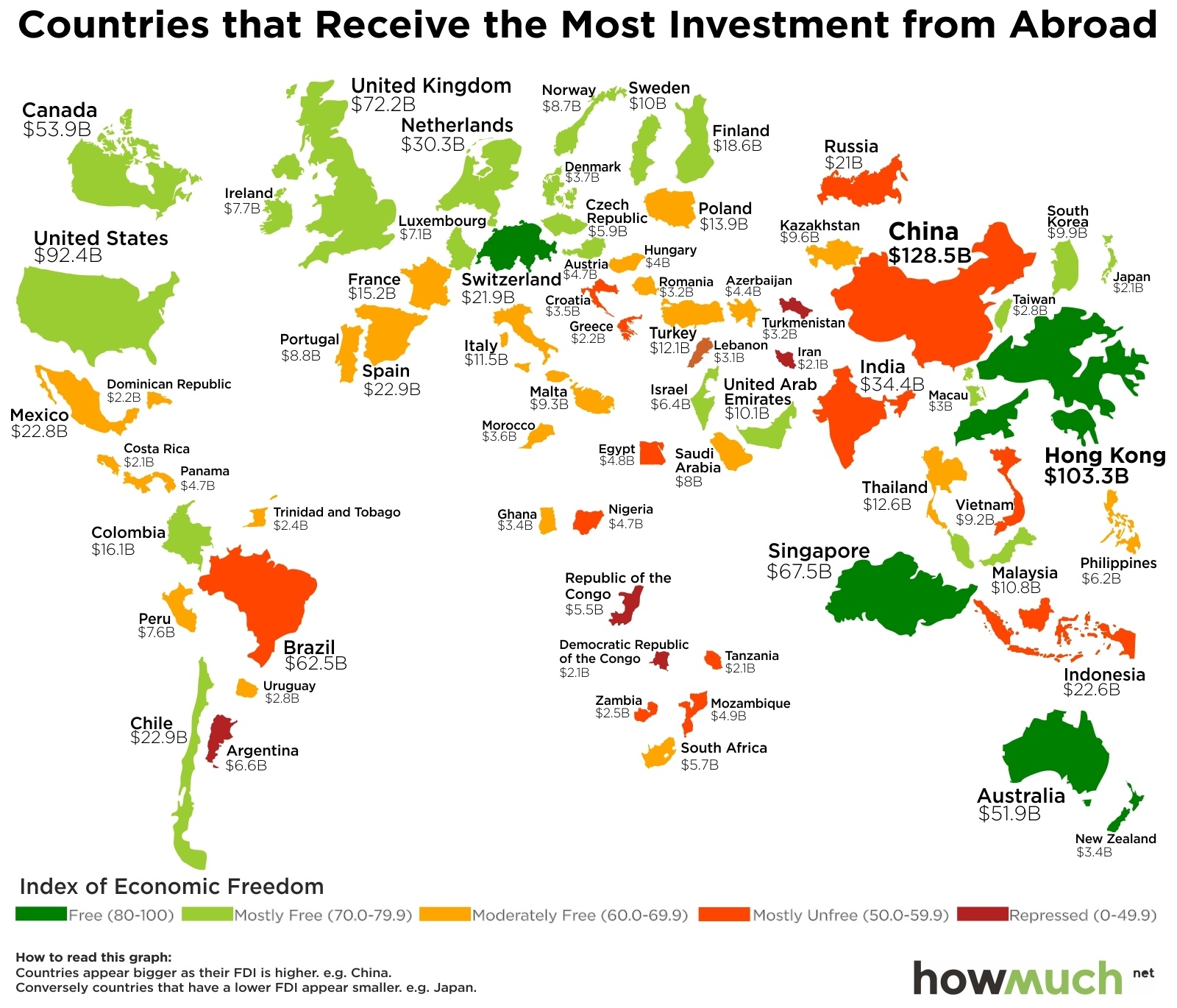
Click on the image for a larger version.
It is from “What Countries Attract More Foreign Investments?”
Note that the size of the images of the countries is in proportion to the FDI, and not their actual geographical size. Thus India (in “Mostly Unfree” red), which is vastly bigger than Singapore or Hong Kong (in “Free” green) in land mass, is shown much smaller than those two tiny regions.
The data allows us to draw broad conclusions. My interest lies in how India performs in FDI terms. The short answer is: DISMALLY. Why that is so, I will go into in a bit. But first let’s review the numbers.The graphic was published in July 2016, and the data are for the years 2014/15. Quote:
Top 5 Countries that Attract the Most Foreign Direct Investment
1. China – $128.5 billion
2. Hong Kong SAR – $103.3 billion
3. United States – $92.4 billion
4. United Kingdom – $72.2 billion
5. Singapore – $67.6 billion
Top 5 in the Index of Economic Freedom (Free Countries)
1. Hong Kong – 88.6 points (out of 100)
2. Singapore – 87.8 points (out of 100)
3. New Zealand – 81.6 points (out of 100)
4. Switzerland – 81.0 points (out of 100)
5. Australia – 80.3 points (out of 100)
India received $34.4 billion in FDI. That’s a quarter of what China received, and a third of tiny Hong Kong’s FDI. Since Hong Kong is part of China, the FDI for China as a whole is nearly seven times India’s FDI. That’s shameful, to put it very generously.
The empirical correlation between economic freedom and FDI is positive and causation can be analytically inferred: greater economic freedom translates into more FDI. (The explanation is simple and available upon request.)
There is a vast gulf between the FDI that India receives — an economically repressed country — and what Singapore (an economically free state) receives, for example. Singapore gets $67.6 billion, nearly twice as much as India. But until you normalize the numbers by population, you don’t get the real picture. Singapore’s population is less than 6 million and India’s population is over 1,200 million — around 200 times that of Singapore. Therefore Singapore’s per capita FDI is 400 times that of India.
Four hundred is a big multiplier. Imagine if you were paid $1 instead of $400.
Or take Hong Kong with its population of a little over 7 million and $103 billion in FDI. In per capita terms, Hong Kong got 520 times as much FDI as India. For every dollar an Indian receives in FDI, Hong Kong residents receive $520.
Five-hundred and twenty is an even bigger multiplier. Meaning, India receives on a per capita basis practically nothing compared to Hong Kong or Singapore. India’s performance is abysmally poor. Three cheers for Nehruvian socialism.
Indians Don’t Have Economic Freedom
India is not just poor, it has been impoverished. India’s poverty has been engineered.
The surest method of impoverishing someone is to deny the person the freedom to be productive. In other words, enslavement guarantees poverty. Freedom is a necessary (although not sufficient) condition for prosperity. Comprehensive barriers to individual economic freedom translates into mass poverty on the aggregate.
In the graphic above, India is listed as “mostly unfree.” Indians are not economically free. Why? The reason is historical.
The British enslaved the Indian economy by putting in place an extractive and exploitative regime. The administrative and governmental institutions they created for that purpose was handed over intact to the Indian leaders who took over from the British when they left in 1947. India became independent but Indians never became economically free. Why? For the same reason that the British enjoyed ruling India. The system was designed to give enormous powers to the government and thus those in power enjoyed royal privileges.
It is understandable, therefore, that when Gandhi and his protégé took control of India from the British, they figured that they had a good thing going and saw no reason to lose those privileges by granting economic freedom to Indians.
This pattern of maintenance of this freedom-denying status quo has been seen in every subsequent transition of power. Different political parties and coalitions take over but Indians continue to lack freedom. Just note what happened in the latest transition in 2014. The BJP and its NDA partners came into power with overwhelming majority in parliament but they continued (and even doubled-down on) every major economic freedom-denying policy of the Antonia Maino UPA government.
The British to Blame?
Mind you that I am not blaming the British for impoverishing India post-1947. They were the colonial masters and they did what was in their interest. The weak get ruled. That’s the law. What I find hard to countenance is how Indians continued to betray their own kind in their lust for power, wealth and control. So even after 70 years of independence, India languishes at the bottom of the heap. Although it is not a failed state, it is an economic basket case.
But can one reasonably assign all the blame to Indian politicians and bureaucrats alone? Honestly no. Indians have a collective responsibility for what they suffer or enjoy. Actions have unavoidable consequences.
It’s all karma, neh?
The answer to why Indians are not economically free has to ultimately be because Indians don’t value freedom and therefore they don’t demand it. Perhaps Indians have a hard time imagining what economic freedom is, having never really tasted it. Sure they do have the freedom to vote. (And we are all aware of the great treasures they vote into office.) But political freedom is not worth a damn absent economic freedom.
Freedom — Civic, Economic and Political
Not that we need to pull out the big guns to make the simple case that economic freedom trumps political freedom when it comes to material prosperity, let me do that just the same. Here’s a 91-year old Milton Friedman in conversation with Gary Becker back in 2003.
Friedman distinguishes between civic freedom, economic freedom and political freedom. Political freedom is the freedom of the people to choose their political leadership, and civic freedom is about freedom of speech, the freedom to assemble, and the like. He states that you cannot have economic freedom without a large measure of civic freedom
Here’s a rough transcription of what Friedman said (beginning around the 34 minute mark in the video below):
You can have economic freedom without political freedom, provided you have a large measure of civic freedom.
But you can have economic freedom without any political freedom at all. That’s been demonstrated by Hong Kong. Until the Chinese took over, Hong Kong had no political freedom at all. It was run by an emissary of the British government in London. … The emissaries they sent out believed in economic freedom as a way to make Hong Kong most productive. And they maintained complete economic freedom. In fact it is hard to find any country in the world that had as much economic freedom as Hong Kong did at that time. For example, no tariff protection at all, no restrictions on imports and exports. But it also maintained civic freedom. The citizens of Hong Kong were free to say what they wanted, to print what they wanted, to assemble, to meet.
Singapore is another example. Lee Kuan Yew was fundamentally a dictator but a benevolent dictator and he too saw the merits of economic freedom —not as much economic freedom as Hong Kong though.
Notice that Friedman mentions Hong Kong and Singapore — two economies that are in the top FDI list and in the economic freedom list.
The Way Ahead
After decades of considering the question of India’s lack of prosperity, I have concluded the following:
- Freedom is of value in itself but it also has instrumental value.
- Freedom comes in three flavors: civic, economic and political.
- Economic freedom is necessary for prosperity.
- Economic freedom is also necessary because without it political freedom is meaningless.
- Indians are unaware that they do not have economic freedom.
- Indians have awaken to the reality of their predicament.
- About 20 percent of the population needs to demand economic freedom for the government to act to free all India.
Gurudev Rabindranath Thakur wrote Gitanjali about a land of freedom into which he wanted his countrymen to awaken. We are far from there. A billion people have to freed to get there.
Free a Billion
And now for a shameless plug for a new initiative that we call “Free a Billion.” The idea is really very good, and certainly much better than the cheesy, hackneyed, unimaginative logo would lead you to believe. FAB—Free a Billion—is not one of those flag-waving jhanda uncha rahe hamara kind of deal. The main idea is to make people realize that they can—and must—get behind a struggle for real freedom, and not just be content with the fake freedom of socialism. Go take a look.
Be well, do good work, and keep in touch.


Rhetoric over Uri attack
First, as an editorial in today's Business Standard points out, there have been lapses on the part of the security forces. The infiltrators were able to cross the LOC and they were able to get into the camp quite easily. Among other things, it points to unsatisfactory vigil at the border. This is not just a matter of equipment or terrain, although these factors do count. BS makes the point that the border is porous because there's laxity on both sides. And the laxity is on account of the thriving drugs trade. Smugglers are able to move in and out because sections of the establishment make this possible. And once you relax the vigil for smugglers, the jihadis get their opportunity. So it's no use simply pointing the accusing finger at the Pak army.
Secondly, all talk of retaliation is futile because the international community at large and especially the US will not take kindly to a military strike, as ambassador M K Bhadrakumar points out. The writ of the US runs across the world and the Indian establishment has cosied up to the US in recent years. The question of any major military action on India's part without US approval does not arise. And hostilities with nuclear Pakistan is the last thing the US wants today:
...despite the government's sustained public diplomacy to create an impression in domestic opinion that its foreign policies have burnished India's international standing and image and so on, in reality, India's actions -- especially any military moves -- will come under close scrutiny and be weighed in terms of international law and the United Nations Charter.
The bottom line is that the present ruling elites dare not think of crossing any 'red line' that Washington demarcates.
The US State Department, in a series of statements, has distanced Washington from the Indian positions with regard to the situation in the Kashmir valley, India-Pakistan tensions and Balochistan.
Conceivably, the Americans have cautioned our leadership already against making any precipitate military moves. The kind of brazen military adventures that many self-styled Indian defence analysts are espousing will not get Washington's approval.
As the Barack Obama administration tiptoes toward the lame-duck period, the last thing Washington wants as legacy is an India-Pakistan conflict.......
.....If the Americans do not want a war between India and Pakistan or any precipitate Indian military moves that violated international law, Modi cannot act otherwise.The umbilical cord that ties the Sangh Parivar and our ruling elites to the US establishment may be invisible, but remains robust.So that's it- the rhetoric and sabre-rattling on our part will remain just that. The media pundits can rant as they much as they want. Perhaps the saner course for us is to simply put our house in order first.
India and Pakistan: A tale of two economies

Why people hate Narendra Modi
Distance between Indian fathers and kids
As a rule, Indian fathers are not terribly close to their kids (my father was a major exception to this rule), and I lay the blame on a “traditional practice” in Indian families.
This is the concept of “baaNantana” (don’t know words in other Indian languages) where the woman goes to her parents’ house for childbirth, and stays there till the child is a few months old, before returning to her own house. And this contributes to several reasons which contribute to distance between fathers and children.
For starters, the woman’s house and her parents’ house may not be in the same city or region, putting a physical distance between the father and the baby. Thus, for the first few months of the baby, there is little contact between them, and when the baby finally goes to live with its father, he is already a distant figure. And unless the father makes special efforts to bond with his child, this distance is only bound to grow.
Secondly, in India, childbirth and associated activities are generally seen as a primarily female pursuit. It is the mother’s parents (primarily mother’s mother) who accompany her to the hospital, and be there with her until childbirth. The father generally only makes a guest appearance where he appears, carries the baby for a bit, hands it back and disappears.
And then every subsequent activity of the mother is directed by her own female relatives, and the father has little to do in the process. Even if he is physically proximate to the baby (by virtue of living not too far from his in-laws), the “culture” of baby-related activities being female pursuits means that he is not a primary actor any more, and he generally prefers to hand over the baby to a “female elder” when it cries, rather than to learn to pacify it himself.
Given this background, I’m really impressed with the efforts of CloudNine, the hospital where my daughter was born, in involving the father in the delivery process and beyond. For starters, the hospital insists that the father be present at the time of delivery, and cut the baby’s cord. While this was always known, what I was pleasantly surprised was the process afterwards.
A couple of hours after my wife and daughter came to their room, a nurse materialised, offering to teach her how to breastfeed. I readied myself to be sent out for the process, but there was no such attempt. In fact, the nurse seemed encouraging of me watching on – the hospital has perhaps realised (maybe belatedly in the Indian context) that the wife’s boobs are unlikely to be a novelty to a man, and so there is absolutely no reason to send him out!
On the other hand, the joy in watching your child feed directly from your wife is totally unmitigated!
Then later in the evening on Thursday, another nurse materialised, to take my wife for bath. That time, both my motherinlaw and I were there in the room with her. The nurse presently put my motherinlaw in charge of looking after the baby, and asked me to accompany her to help give my wife a bath. When my motherinlaw gestured that she could help out with the bath, the nurse firmly said that she wants me to come.
Apart from the hospital’s efforts I’ve been doing my own efforts to make sure I bond with the baby. Rather than sending off my wife to her parents’ place for baaNantana, I’ve instead convinced them to come live with us for a month, to help us deal with the new baby. I’ve learnt to carry the baby in different ways and change diapers, and I’m trying to learn to calm the baby when she cries (lack of boobs is a big impediment in this process).
And I’ve found that the more involved I am with the baby, the more responsible I feel in taking care of her and looking after her. The more I’m sent to “do my thing” while others take care of the baby, the more I feel like handing her off to someone else when she cries, rather than pacifying her myself!
Thinking back, perhaps one reason my father was able to bond with me was that he lived fairly close to my maternal grandfather’s place when I was born, and even though my mother was away on “baaNantana”, he made sure to come see us for a few hours every day, and carry me. Hopefully I can propagate this process with my daughter!
Investing and the Paradox of Perfection
A lot of people I meet in the startup world and in investing are aiming for that perfect start when all their stars will align to take them off to the moon.
So, some keep waiting for their “best product” or “best design” before starting up their businesses, and others wait for the “perfect business to invest in” or “perfect price to invest at” before starting to invest their money.
The reason? They don’t want to be criticized for any mistake – like not getting business, or temporarily losing money in the stock market – they may make due to not being perfect at the start.
If you think about why we feel the need to be perfect in the first place, it all goes back to how we think about ourselves and our self-worth. If we have a strong desire to be perfect, then we may use the idea of perfection as a way to validate ourselves as worthy and valuable human beings.
If we were perfectly happy with who we are, why would we feel the need to be perfect in the first place? Or would we be perfectly happy, just the way we are?
What I’ve noticed is that people who constantly seek perfection – in business or investing – often worry about what others think of them. They’re actually seeking recognition – because if we’re perfect then surely no one can find fault in us, right?
And that’s why, most of such people keep aiming for perfecting, keep waiting endlessly for their perfect day, or perfect product, or perfect stock, or perfect price…which is a big fallacy.
The Investor Who’s Always Right
If you look back at the careers of the world’s most successful investors, a large majority of them have learned about successful investing in the best possible way – by making mistakes.
Warren Buffett did it with Berkshire Hathaway – the textile business. Charlie Munger admits he still makes mistakes even after many decades as a business person and investor. He has also said that it is important to “rub your nose” in your mistakes.
Peter Lynch said –
In this business, if you’re good, you’re right six times out of ten. You’re never going to be right nine times out of ten.
Doing wrong, or making mistakes (in investing, startup, or in life) is inevitable.
As Einstein once said, anyone who has never made a mistake (if there is such a person) has never tried anything new.
Munger, in fact, advises that people strive to make “new” mistakes (instead of repeating the old ones) and learn as a consequence. As he says…
There’s no way that you can live an adequate life without many mistakes. In fact, one trick in life is to get so you can handle mistakes. Failure to handle psychological denial is a common way for people to go broke.
Now, we have been brought up in a society where making mistakes or “being wrong” is seen as a stigma, and “being right” or “being perfect” is always looked upon.
“How could you make such mistakes?” my Math teacher in school would often tell me.
“Don’t dare to be wrong!” I would often tell myself before committing on to something new while in my job. After all, how could you dare to be wrong when your salary and reputation depended on being right, always?
That stigma vanished after I was on my own, and started reading Munger and the likes with greater attention. In fact, I proved the “dare-to-be-wrong” philosophy instantly with my analysis of Opto Circuits in 2013, despite some clear thinking about its business, but thanks to my fuzzy thinking about its intrinsic value.
Dare to Be Wrong
“Dare to be wrong,” Howard Marks wrote in one of his memos in 2014, very much like Charlie Munger told him, “It (investing) is not supposed to be easy. Anyone who finds it easy is stupid.”
Marks wrote…
You have to give yourself a chance to fail.” That’s what Kenny “The Jet” Smith said on TV the other night during the NCAA college basketball tournament, talking about a star player who started out cold and as a result attempted too few shots in a game his team lost. It’s a great way to make the point.
Failure isn’t anyone’s goal, of course, but rather an inescapable potential consequence of trying to do really well.
He then added…
Any attempt to compile superior investment results has to entail acceptance of the possibility of being wrong.
…since conventional behavior is sure to produce average performance, people who want to be above average can’t expect to get there by engaging in conventional behavior.
Their behavior has to be different. And in the course of trying to be different and better, they have to bear the risk of being different and worse. That truth is simply unarguable. There is no way to strive for the former that doesn’t require bearing the risk of the latter.
Of course, as Marks wrote, it’s important to play judiciously, to have more successes than failures, and to make more on your successes than you lose on your failures. But it’s crippling to have to avoid all failures, and insisting on doing so can’t be a winning strategy.
Such a strategy may guarantee you against losses, but it’s likely to guarantee you against gains as well.
I have seen so many people over the years who have sat on the stock market’s sidelines – either due to fear of losing money, or while waiting for a perfect opportunity to buy stocks – that they have paid huge opportunity costs of not being invested.
No one wants to look wrong now when everyone else is looking Mr. or Mrs. Right.
In his memo, Marks quoted Lou Brock, one of baseball’s best players of the late 1960s, as saying –
Show me a guy who’s afraid to look bad, and I’ll show you a guy you can beat every time.
The interesting part about the stock market is that wherever you look, you would find such guys aplenty – people who are afraid to look bad, and thus people who do things that everyone else is doing.
Anyways, here is how Marks ended his memo –
Unconventional behavior is the only road to superior investment results, but it isn’t for everyone. In addition to superior skill, successful investing requires the ability to look wrong for a while and survive some mistakes.
Thus each person has to assess whether he’s temperamentally equipped to do these things and whether his circumstances will allow it…when the chips are down and the early going makes him look wrong, as it invariably will.
Not everyone can answer these questions in the affirmative. It’s those who believe they can that should take a chance on being great.
Mark these words, and note them in your investment journal – Successful investing requires the ability to look wrong for a while and survive some mistakes.
But then, are you willing to bear the embarrassment of looking wrong when all others around you are looking right?
“Love all, trust a few, do wrong to none,” said William Shakespeare.
Vishal Khandelwal writes, “In the stock market, trust few (businesses), love even fewer, but don’t fear doing wrong.” 
Remember, you are born to be real, not perfect. And if you keep waiting for perfection in life and investing, you will be waiting for the rest of your life.
Now you decide.
P.S. We conducted our Value Investing Workshop in Pune yesterday, our biggest ever in the city so far. And here are the seemingly happy tribe members after the Workshop 

The post Investing and the Paradox of Perfection appeared first on Safal Niveshak.