Shared posts

27 Nov 03:39

Active patience

by Rohit Chauhan
I think the next 2-3 years are not going to be easy, just because we are in a bull market. A few of you who decided to invest when India was supposedly going down the drain, must be feeling good about it. It is fine to feel good about it, but one should not get carried away by it.


More noise


In a bear market, as we had in the last 3-4 years, almost no one spoke about the stock market except as a place to avoid. Unless you turned on one of the financial news channels, it was easy to avoid any talk about it.


The advantage of this comparative silence was that you could think investing without too much distraction. The situation has changed quite a bit in the last few months. We now have friends, colleagues and relatives, all getting excited about the market. If like me, your acquaintances know that you invest in the stock market, I am sure you must get badgered with tips for the top ten hot stocks which will double in 21 days – small caps especially.


In my case you can imagine the disappointment  – recommending people to invest in 2013 when no one wanted to, and being cautious now when everyone and his dog thinks we are at the start of a multi-year bull run.


Feeling envy


It is easy to feel envy when you see others do better  during such times. The media adds fuel to the fire by publishing the list of stocks which have gone by 50 or 100 times in the last 4-5 years. Ofcourse, they were silent when these stocks were starting the journey.


In addition, you now have friends and other investors boasting how they doubled their money in the last six months, by buying the hottest idea.


One can abandon his or her approach and start chasing such stocks which have worked well for others in the past. From personal experience, I can tell you that this never works out (atleast for me).


Unnecessary churn


As the market touches new high, I think some people get itchy to sell stocks which have given high returns and recycle them into new positions, which ‘appear’ to be cheap.


I am looking for new ideas too, but will not do it for the sake of ‘doing something’, unless I think it will add to the overall returns. If this means doing nothing for long periods of time – so be it.


Let me explain further – I currently have around 19-20 positions in my portfolio. I am constantly looking for new ideas. As I am close to fully invested, I will have to sell an existing idea, incur the brokerage and taxes (if any) and then buy the new position. The implication of this decision is that I expect this new idea which has been analyzed for a few weeks, will do better than an existing company which I have analyzed and followed for more than a year.


There are people who are smart enough to do this consistently – I am not one of them. I do not want to take these decisions lightly. If the time horizon is 2-3 years and more in my case, it is really important that I take a little more time to think through this decision.


Being patient is never easy


I have found bull markets to be far more difficult to handle than other times. For starters, it involves doing nothing for long stretches of time, when stocks are going up and you are missing out on easy money ( that the  easy money is lost in the end is a different matter).


Let me ask a few rhetorical questions (which I keep asking myself too) – is it really important to have all the hottest stocks in your portfolio? Is it really necessary or even possible to have the highest possible returns at all times, if a lower rate of return at much lesser risk will meet your goals ? Is this investing or just showing off?


The main challenge we will face in the coming months and years is to keep our heads amidst the euphoria. It is very easy to get carried away and starting buying marginal companies showing profit and stock price momentum – I have done that a bit in the past and it has always come back to bite me.


Let me suggest a few activities to keep you busy while waiting for the right opportunity


-          Watch TV soaps, especially the family dramas. They have a lot of twist and turns too (or so I have heard)


-          Take up body building or weights. You will have chiseled body if the bull market turns out to be a 10 year one J


-          Go for long walks and walk a little more every day. If this a long bull market, you may be walking the whole day


-          If you are single, go to parties and have fun. If you have been investing in the past and not partying, shame on you anyway – what a waste of youth!


For those of you who like me, cannot do any of the above – keep faith and hope. This too will pass. The skies will turn dark again, and they will be gloom and doom. You will get your chance then J


----------------
Stocks discussed in this post are for educational purpose only and not recommendations to buy or sell. Please contact a certified investment adviser for your investment decisions. Please read disclaimer towards the end of blog.
26 Nov 10:01

What is the Slumdog Millionaire effect?

by subra

Remember the Slumdog Millionaire movie?

Well, they picked up a kid from the slums and made a movie based on the book by the same name. The kid from a slum was scrubbed, cleaned and fitted into a world of ‘clean bodies and unclean souls’.

So far fine.

Now this kid went from slum to 7* comfort. Then the shooting was over. Cut.

Back to the slum. Will he see 7* comfort again? doubtful. Hopefully yes. Maybe not.

Cut to the investment side of life. If you were a young MBA starting life in 2001, 02, 03, 04…or even 07, life was good, well almost great.

Salaries went up 30% every year. People whom you would not have taken as clerks quickly became Vee Pees. Literally donkeys got the jobs of derby horses, and many came up trumps. The markets were booming, life insurance companies were recruiting managers, vee pees, agents, taking offices on rent, – and everything was hunky dory.

Then came 2008. All assumptions vanished. The feel good portfolio of Rs. 23 lakhs shrunk to Rs. 14 lakhs. No longer could you buy in the morning and sell in the evening and earn Rs. 5000.

No longer could you see your SIP statement on a monthly basis and feel…’ha I invested Rs. 28000 it is worth Rs. 43,000′ – it looked more like 26000!

Now tell these people that:

2002-7 was a dream run, they hate you.

such a steep rise MAY not happen in your LIFE time, they think you have lost it. (I am not saying a bull run will not happen, but a 7 fold rise in 4 years seems to be impossible in MY life time in the sensex).

forget 30%p.a.  increase in salary, be happy with 30% OVER 5 years, they look like you are from Mars.

Jobs are being lost – they say I have 3 job offers on hand (God bless them).

What to do?

Reconcile, the golden period may now be in the past, even if you are just 35 and have 20 WORKING years to go. However thanks to Modi, falling commodity prices, QE by many parts of the world, markets may continue to rise for some more time (25% for financial year 2013-14 is not bad, is it?).

This can happen to businessmen and companies too. One company I know which was totally dependent on a big pharma company for its business had to close down because of a merger. So be careful of the Slumdog Millionaire effect – it can come in terms of source of revenue, time or whatever. Be alert.

Sad but true.

Post Footer automatically generated by Add Post Footer Plugin for wordpress.

25 Nov 03:44

Only step to attain wealth

by subra

If you are a middle class male/ female there are not too many options available to get rich…but for a second let us see what Ken Fisher has to say!

Ken Fisher (very famous fund manager and son of the legendary Phil Fisher) says that there are 10 roads to wealthy, I think there is only one…

So, What are the Ten Roads? More importantly, what will work for you?

  1. Start a successful business—the richest road! Sure you can become a Bill Gates or a Azim Premji. However even if you do not become so successful you may still be able to make a couple of crores – not bad. This route is not for all – there are many people who do not consider giving up their jobs will not find this appealing.
  2. Become the CEO of an existing firm and juice it—a very mechanical function. Jack Welch did it. In the Indian context the name that comes to mind is Naik at L&T. There are many others who are in this boat, see whether you are academically inclined to do this is what you have to see. May not be easy for every one.
  3. Hitch to a successful visionary’s wagon and ride along—it’s high value-added. If you partner a great idea – the entrepreneur needs support, operations, HR, etc. and all the support at the start up stage. You need not be the visionary, you need to ride along.
  4. Turn celebrity into wealth—or wealth into celebrity and then more wealth! Again you need to get parents who push you hard enough to become a celebrity and you should have enough motivation to become a celebrity. Sachin Tendulkar, Anand Viswanathan are names which come to mind. However, not really easy.
  5. Marry well—really, really well. Well for those of you who are not married this is a good option. Though of course with divorce available, re-consider your options. However, not an easy option. This is an option available to both men and women – but it may be easier for very beautiful women than for ordinary looking men.
  6. Steal it, legally—no guns necessary! One qualification that helps in this is the law degree in the USA. However, we all know of another professional who tried doing it, unsuccessfully. He died before he could use the money!!
  7. Capitalize on other people’s money (OPM)—where most of the mega-rich are. There are more money managers in the Forbes list than the people whose money they manage. The kind of money people throw at fund managers chasing a rainbow of “index beating” returns is not funny.
  8. Invent an endless future revenue stream—even if you’re not an inventor! Well Bill Gates did it, maybe you can do it.
  9. Trump the land barons by monetizing unrealized real estate wealth! A very good idea if your surname is Hiranandani, Raheja, Parekh, etc. however if your surname is Patil, Athalye, Subramaniam, Ramakrishnan, do not try this. It may not work.
  10. Go down the Road More Traveled—save hard, invest well—forever! To me this seems to be the only option available to you and me. Just go through the grind. Work hard, invest well – choose a large (say 100+ scrips) index and do a SIP – assuming the amc charges are 0.5% p.a. Over a 20 year period treat it like a savings bank account. When you have money, you should invest. When you need money you should sell, simple.

To me only step 10 seems to be sensible…God bless you if you can do any of the others. If you do not do step 10, even the earlier steps may not help!!

Post Footer automatically generated by Add Post Footer Plugin for wordpress.

24 Nov 05:02

Lagging Long Yields

by David Merkel

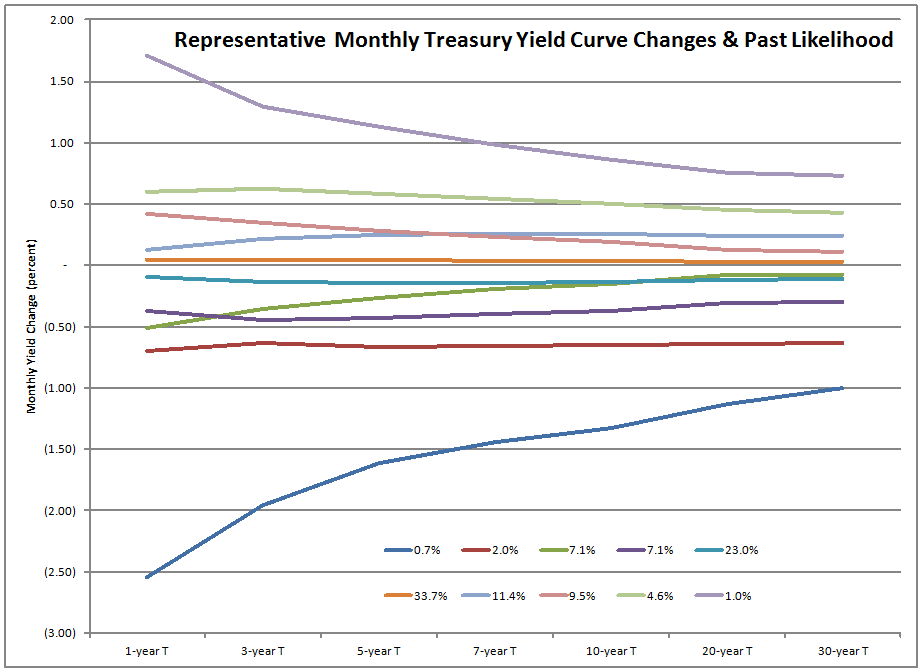
yield curve shifts_22703_image001I’m a very intellectually curious person — I could spend most of my time researching investing questions if I had the resources to do that and that alone.  This post at the blog will be a little more wonky than most.  If you don’t like reading about bonds, Fed Policy, etc., you can skip down to the conclusion and read that.

This post stems from an investigation of mine, and two recent articles that made me say, “Okay, time to publish the investigation.”  The investigation in question was over whether yield curves move in parallel shifts or not, thus justifying traditional duration [bond price interest-rate sensitivity] statistics or not.  That answer is complicated, and will be explained below.  Before I go there, here are the two articles that made me decide to publish:

The first article goes over the very basic idea that using ordinary tools like the Fed funds rate, you can’t affect the long end of the yield curve much.  Here’s a quote from Alan Greenspan:

“We wanted to control the federal funds rate, but ran into trouble because long-term rates did not, as they always had previously, respond to the rise in short-term rates,” Greenspan said in an interview last week. He called this a “conundrum” during congressional testimony in 2005.

This is partially true, and belies the type intelligence that a sorcerer’s apprentice has.  The full truth is that long rates have a forecast of short rates baked into them, and reductions in short term interest rates usually cause long-term interest rates to fall, but far less than short rates.  There are practical limits on the shape of the yield curve:

1) Interest rates can’t be negative, at least not very negative, and if they are negative, only with the shortest highest quality debts.

2) It is very difficult to get Treasury yield curves to have a positive slope of more than 4% (30Yr – 1Yr) or 2.5% (10Yr – 2Yr).

3) It is very difficult to get Treasury yield curves to have a negative slope of more than -1.5% (30Yr – 1Yr) or -1% (10Yr – 2Yr) in absolute terms (i.e., it’s hard to get more negative than that).

On points 2 and 3, when the yield curve is at extremes, the real economy and fixed income speculators react, putting pressure on the curve to normalize.

Aside from that, on average how much do longer Treasury yields move when the One-year Treasury yield moves?

Maturity Sensitivity
3-year T 94.64%
5-year T 89.31%
7-year T 85.17%
10-year T 81.14%
20-year T 75.41%
30-year T 72.89%

The answer is that the effect gets weaker the longer the bond is, bottoming out at 73% on 30-year Treasuries. But give Greenspan a little credit — in 2005 the 30-year Treasury yield was barely budging as short rates rose 4%.  Then take some of the credit away — markets hate being manipulated, so as the Fed uses the Fed funds rate over a long period of time, it gets less powerful.  In that sense, the Fed and the bond market integrated, as the market began looking past the tightening to the long-term future of US borrowing rates, what happened to short interest rates became less powerful on long yields.  This is particularly true in an era where China was aggressively buying in US debt, and interest rate derivatives allowed some financial institutions to escape the interest rate boundaries to which they were previously subject.

Also note my graph above.  I took the Treasury yield curves since 1953, and used an optimization model to estimate 10 representative curves for monthly changes in the yield curve, and the probability of each one occurring.  If yield curves moving in a parallel direction means the monthly changes at different points in the curve never vary by more than 0.15%, it means that monthly changes in yield curves are parallel roughly 70% of the time.

When do the non-parallel shifts occur?  When monetary policy moves aggressively, long rates lag, leading the yield curve to flatten or invert on tightening, and get very steep with loosening.

Later, the article hems and haws over whether rising long rates would be a good or a bad thing, ending with the idea that the Fed could sell its long Treasury bonds to raise long yields if needed.  That brings me to the second article, which says that long interest rates are at record lows, as measured by average Treasury yields on bonds with 10 years or more to mature.

The graph in the second article shows that it takes a long time for inflation to come back after the economy has been in a strongly deflationary mode, where bad debts have to be eliminated one way or another.  Given the way that monetary policy encouraged the buildup of the bad debts from 1984-2007, it should be little surprise that long rates are still low.

Conclusion

So what should the Fed do?  If they weren’t willing to try a more radical solution, I would tell them to experiment with selling long Treasuries outright, and not telling the market that it was doing so.  The reason for this is that it would allow the Fed to separate out the actual effect of more Treasury supply on yields, versus how much the market might panic when it learns that the long Treasuries might be available for sale.  The second effect would be like Ben Bernanke mentioning the word “taper” without thinking what the effect would be on the forward curve of interest rates.  It would be an expensive experiment, but I think it would show that selling the bonds in small amounts would have little impact, while the fear of a flood would have a big but temporary impact.

If the Fed doesn’t want to raise long rates, it could try moving Fed funds up more quickly.  Historically, long rates would lag more than with a slow rise. (Note: 2004-2007 experience does not validate that idea.)

What do I think the Fed will do?  I think that eventually they will let all long Treasuries and MBS mature on their own, and replace them with short Treasuries, should they decide not to shrink the balance sheet of the financial sector as a whole.  That’s similar to what they did after the 1951 Accord, which restored the Fed’s independence after monetizing some of the debt incurred in WWII.  Maybe this is the way they eliminate the debt monetization now, if they ever do it.

I think the present Fed will delay taking any significant actions until they feel forced to do so.  They have no incentive to take any risk of derailing any recovery, and will live with more inflation should it arrive.

PS — that long rates move more slowly than short rates may mean that duration calculations for longer bonds are overstated relative to shorter bonds.  It might mean that 30-year notes would be 2-3 years shorter relative to one year notes than a parallel shift would indicate.

24 Nov 05:00

Pension is the MOST sensible charity

by subra

I am sure you are wondering about the headline…but do spare a thought. Have you ever wondered what your old servant will do when he/she retire?

Will they go to their village (many of them have no roots), will they live with their children look after them? Will they be able to sell their existing houses and use the capital proceeds to live for the rest of their lives?

OR

Will you pay a pension to your servant? MOST of the servants do not even get a gratuity, forget getting a pension. So what do these people at the bottom of the pyramid do? Have you thought about it?

Well Gautam Bharadwaj also asked himself this question, and has come up with an answer. I had spoken to Gautam a few weeks ago but waited for a friend to actually buy this for his servant before I did the story. My friend had a good experience ..and hence the story. Why did I not do it myself? Well, I did not know whom to buy it for. Honest answer.

I will do the story in many parts…here..this is what Gautam said:

Gautam – “The more we spoke to friends about the work we did in the space of financial inclusion, i.e. enabling low income workers to save for their old age, the more wowed our audience invariably got. People would always ask us if they could do this for their maids/ drivers. After giving different variations of “No” to this question (Imagine the cost of meeting, educating, enrolling and then servicing individual maids and drivers located in different localities and different cities of the country!), we took this problem to the white-board, and decided to crack it. We read that there were about 40 million domestic workers in India, and a survey on maids and drivers across Delhi/ NCR showed not only the ability to save, but also the willingness to do so. Employers of this segment were also visibly keen to help their domestic help sign up for formal savings. With the facts laid down in front of us, we decided to reach out to these domestic workers through their employers, who were much easier to connect with, thanks to the internet. It was also clear that this workforce is highly migrant and would probably never use the internet, and so not only did the accounts have to be portable, but there was also a need for an offline system to service them and take care of all their requirements. And so, Gift a Pension was born. From the time we conceptualized it, to the launch this September 2014, it has been a very interesting journey. And when a front page article in the Financial Express talks about taking philanthropy online, and puts your initiative up with those of biggies like Amazon.in, it’s a great feeling. We hope that everyone we reach out to enables just one life. That can make a huge impact.”

This could be an amazing step towards a pension for the people at the bottom of the pyramid. I hope it works.

What is this?  Well it is a Gift a pension scheme.

More on this in the next article. With links to the videos that Gautam shared with me.

Post Footer automatically generated by Add Post Footer Plugin for wordpress.

24 Nov 04:55

How does Gift a Pension work?

by subra

Yesterday you read about How you can help your domestic help / driver / peon in the office…start saving some sensible money towards a pension, here is how Gift a Pension works:

It takes the objective of “financial inclusion” to each of our doorsteps. And very conveniently, at that. It enables individuals like you and I who employ domestic help, to sign them up for regulated financial products such as the NPS Lite, and life cover from SBI Life. (right now it comes as a packaged product with no choice, but hey this is just the beginning and for people with almost no savings or risk cover I am not getting too worried about choices).

They have simple videos to communicate the concept (http://bit.ly/102MyiN) and the process (http://bit.ly/1p5eVJ9) to employers. I am briefly describing it here as well – An employer simply logs on to the website (www.giftapension.com), uses videos and calculators on the site to explain the concept to their domestic worker(s), fills an application form and makes the first contribution online. The forms, along with a micro pension VISA prepaid card, get couriered to the employer, and once the employer has taken the signatures, the courier gets picked up again from their doorstep. Additionally, the platform directly communicates with the domestic worker after on boarding is complete. The card is portable with them to their next job, or city. They can use it to make regular contributions, exactly the way they recharge their mobile phones. Alternatively, the employer can continue to make payments for them using the same online platform. IMAGINE YOU PAYING ALL HER BONUSES INTO A PENSION FUND, every year. It will work wonders for her. The plan includes a small medical insurance and life insurance.

The platform takes care of seemingly trivial things like couriers  getting picked from the doorstep to ensure convenience at all stages. The email help desk for the employers, and regional language helpline for the domestic workers seem to be nice. One has to wait and see how the whole thing works. I am sure the intentions are very good, one has to see the implementation.

I see a far bigger application in this if the State and Central Governments want to contribute, they can just charge this card – it cannot get better than that, can it. This is surely financial inclusion at its best. I hope once they are all connected by a card (and a telephone line I presume) you may even be able to take financial education to them. And at a later stage it could become a brilliant source to inform them about dubious schemes in the market.

Even though this plan is implemented by a private body, all the money goes to big governmental companies (which means you run the risk of incompetence , but no great loss of capital (hopefully).

If each of us enables just one life, of say our domestic help, all 40 million domestic workers would have the chance at a dignified old age. Let charity begin at home.

Post Footer automatically generated by Add Post Footer Plugin for wordpress.

21 Nov 03:36

Number of ATM Transactions

by Kirti

There have been changes in the number of ATM transactions from 1 Nov 2014. An overview of the change in Number of ATM transactions are discussed in the article.

  • RBI has imposed a limit of 3 transactions per month from ATMs of other banks and 5 from the same bank in six metropolitan cities.So, you are allowed eight free ATM transactions, (five at your bank branch ATM and three at other banks ATMs).
  • The six metropolitan cities are Delhi, Mumbai, Chennai, Bangalore, Kolkata and Hyderabad.For non-metro users, the number of free transactions at other bank ATM will remain 5.
  • ATM transactions doesn’t necessarily have to be money withdrawal. Even non-financial instructions such as balance enquiry, chequebook request and mini-statement request will be included in this limit
  • The Reserve Bank of India (RBI) also made it clear that the said reduction will not apply to small/no frills/basic savings bank deposit account holders.
  • Beyond the permitted numbers of transactions for using Automated Teller Machines (ATMs)  a customer will be required to pay a maximum fee of up to Rs 20 plus service tax  for financial transaction and Rs 8.5 plus service tax for non-financial transactions.  Non-financial transactions include checking the balance, cheque book request and so on. For example If your sixth ATM transaction in a month is cash withdrawal, then you will be charged Rs 22.47. If it is a cheque book request you will be have to pay Rs 9.55.
  • The new guidelines came into effect from November 1, 2014.  Though the RBI regulation is in place, banks still have the right to decide whether they want to charge their customers.  SBI brought this into effect from 1 Nov but there are some leeway based on type of accounts. But some banks like HDFC Bank , Axis Bank will bring it in effect from 1 Dec 2014.
  • The central bank has asked lenders to ensure fair and transparent information to customers regarding the new charges with regard to ATM withdrawals beyond the stipulated cap. It has also asked banks to put in place proper mechanism to track such transactions and that no customer inconvenience or complaints arise on account of this. Further, RBI said that banks should clearly indicate the location of an ATM as metro or non-metro to enable customers identify status of the ATM in relation to availability of number of free transactions.

Though the RBI regulation is in place, banks still have the right to decide whether they want to charge their customers. As per the regulations, it is mandatory for banks to intimate their customers about any changes in service charges and fees. This means it is time to pay more attention to e-mails and SMSs from your bank. You can also visit the bank’s website to know the charges since it is mandatory for every bank to publish the changed service charges.

Why is there a limit on number of transactions?
The Reserve Bank said the cap on the number of free ATM transactions have been imposed in view of the growing cost of ATM deployment and maintenance incurred by banks and also in view of rising interchange outgo due to free usages. SBI,  had reported a loss of nearly Rs 400 crore by way of paying other banks as interbank ATM usage in FY14.

As per latest data from the RBI, at the end of June quarter there were 1,66,894 ATMs in the country. With 44,929 machines, SBI is way ahead of its nearest rival Axis Bank by more than three times or over 27 per cent of the market. SBI has 12.59 crore cardholders and accounts for 31 per cent of the 40.9 crore debit cards in the country and its cardholders are responsible for over 41 per cent of all ATM transactions

For details on why there is a change in number of free ATM transactions one can read official RBI circular Usage of ATMs – Rationalisation of number of free transactions

Banks and ATM Transactions

Though the RBI regulation is in place, banks still have the right to decide whether they want to charge their customers. Some of the banks and their decisions on ATM transactions are given below.

SBI and ATM Transactions

From 1 November, State Bank of India has set a monthly limit on the number of free financial and non-financial ATM transactions.

  • The bank has linked monthly balance with ATM charges.
    • If your average monthly balance is over Rs.1 lakh, there is no limit.
    • If it’s up to Rs. 25,000 in the savings account, you will have only five free transactions at your own-bank ATM and three free transactions at other-bank ATMs in a metro city.
  • Charges are Rs 5-20 per financial transaction and Rs. 5-8 for non-financial ones depending on the type of account.
  • Free ATM service for basic savings bank deposit account holders will continue.
  • The bank also stated that it will allow one-way inter-changeability between branch transaction and ATM transaction. For instance, a customer will be allowed nine free transactions at own-bank ATMs if she does not visit the branch at all during a month or eight free ATM transactions if she visits the branch once, and so on.

HDFC Bank and ATM Transactions

HDFC Bank Ltd has stated on its website that, effective 1 December, savings and salary account customers will be allowed first five transactions free across all cities at own-bank ATMs. In the six metros, first three transactions will be free at the non-HDFC Bank ATMs. In non-metros, first five transactions will be free. Anything over this limit will be charged.

Axis Bank and ATM Transactions

From 1 Dec 2014, Axis Bank will also charge Rs 20 and taxes for financial transactions and Rs 9.5 for non-financial ones. Axis Bank is offering 10 free transactions for its Prime Plus savings account and Prime salary account holders. But both these account holders need to have a minimum opening balance of Rs 1 lakh and they can have first five free transactions at non-home bank ATMs.

Other Banks and ATM Transactions

If you are with a smaller bank, chances are that you will continue to get free ATM service. Banks such as Yes Bank Ltd, Federal Bank Ltd have decided to continue giving free ATM services. Kotak Mahindra Bank, too, has decided not to revise charges.

Some banks, however, continue to allow free transactions, for a limited period.  For example Canara Bank has stated that it is not charging for transactions at own-bank ATMs. But more than three transactions at other-bank ATMs in the six metros and beyond five in other places are chargeable, Rs. 15 for every financial transaction and Rs. 5 for every non-financial one. Service tax will also be applicable.

How to avoid ATM

  • Swipe your debit card wherever possible instead of paying by cash.
  • Use online banking for fund transfer, utility and credit card payments. The charge for NEFT (the online payment mode for transactions up to Rs 2 lakh) is between Rs 2.5 and Rs 25 for amounts between Rs 10,000 and Rs 2 lakh. Our article Third Party Fund Transfer : NEFT,RTGS explains the NEFT in detail.
  • For getting updates on your account balance, opt for alerts through email, which is free, or through SMS, which is Rs 15 per quarter. Save these messages so that you don’t need to do an ATM transaction every now and then to know the balance.

Related Articles:

How many ATM transactions you do in the month? Are the transactions financial ex cash withdrawal or non financial transactions like balance enquiry? What do you think of the RBI mandate on decreasing the number of ATM transactions for Metro cities? What is your preferred mode of banking : online, visiting bank or ATM?

20 Nov 11:25

300 million Internet Users in India By Dec? Grossly Wrong [10+ Questions to IAMAI]

by Ashish Sinha

» Grab 40% Discounts On UnPluggd Tickets (Only Till November 24th). Use the code NEXTBIGWHATTWO (link</a)

One month and India will have more Internet users than US!!

Don’t believe me? Well, that’s the prediction from IAMAI and IMRB’s recent report.

Excerpts their report (emphasis is mine)

The number of Internet users in India would reach 302 million by December 2014, registering a Y-o-Y growth of 32% over last year.

In October 2014, there were 278 million internet users in India. Currently, India has the third largest internet users’ base in the world but it is estimated that by December 2014, India will overtake the US as the second largest Internet users’ base in the world. China currently leads with more than 600 million internet users while the US currently has estimated 279 million internet users.

According to the report, the number of internet users in urban India has grown by 29% from October 2013 to reach 177 million in October 2014. It is expected to reach 190 million by December 2014 and 216 million by June 2015. Significantly, compared to last year, in rural India, Internet users have increased by 39% to reach 101 million in October 2014. It is expected to reach 112 million by December 2014 and 138 million by June 2015.

As on June 2014, 31.5 million (61%) in 35 cities were using Internet on a daily basis. The daily user base has gone up by 51% from June 2013. 96% of the Internet users are accessing Internet at least once a week. Out of these, 18% access Internet 4 to 6 times a week and 14% access Internet 2 to 3 times a week.


Internet Users In India 2014

Internet Users In India 2014

The numbers are not just grossly wrong, but misleading as well. A look at Google and Facebook dashboard clearly tells that there is a potential of 120-140 million users at the maximum and we just want you (the entrepreneur/decision makers/CXOs/agencies) to be realistic about it and not be part of the hype creation cycle.

Questions to IAMAI and IMRB

1. Who do we call an Internet user?

– By tenure of usage

– By frequency of usage

– By place of access

– By device on which accessed internet

– Paying vs. Non-paying (mobiles on only free office wifi)

– Who is active? Who is occasional? Who is regular?

Basically, who are these 300million people (in terms of their activity)?

2. Where are they coming from?

– Urban vs. Rural India (by Census definition of Urban vs. Rural)

– Town classes by population?

– Age groups?

– Gender?

– Socio-economic class

– Percentage of computer users

– Percentage of mobile users

3. Methodology ? How did you arrive at these numbers?

– What is the methodology?

# Did you do a survey or Did you look at the current data?

# Did you count the subscriptions/connections (wired — lease line/cable/broadband/ethernet, wireless-mobile/dongle connections)?

# Did you count the subscribers from the operator reported data? How did you count?
How did you arrive at the average subscribers per household/connection? Average users per Office connection vs. Home Connection vs. Cyber cafe vs. Mobile connection? What’s the source?

# Did you look at the userbase of 20% websites of the long tail? Which are these websites?

# Did you look at the server logs of the ISPs/Gateways?

# Did you count the IP addresses?

– By the way, which one is the best method, in absence of a census data? (Indian Census 2011 didn’t really ask people whether they use Internet or not).

Wrong Way. Go Back, Please?

Wrong Way. Go Back, Please?

4. If you did a survey, please help with these questions:

– Where did you do the survey? (was it a mix of online and offline?)

# How many towns & villages?  Which are these towns and villages?

# How & Why did you select these towns and villages, not any other? Is the selection complete statistically random process? (Note: Statistically random is what www.random.org defines as random) Basically what is the rationale?

# Once you selected towns & villages, how did you decide which locations to go in the town and village? (e.g., Dehi has 2635 colonies, and 272 words and some 2300+ election polling stations/booths — which ones did you go to within Delhi?)

5. Who did you meet in the survey?

– How did you decide to meet a particular person in a survey? Who is your respondent?

– If you went to an office who did you meet?

– If you went to a household, who did you meet? Why did you meet this person and not anyone else?

– What percentage of your respondents are head of household, housewives, adult males, adult females, kids, mobile users vs. mobile non-users, internet users vs. internet non-users?

– How many of your respondents are Internet users? Who reported the total number of internet users in the household — an internet user or a non-internet user? What devices do they carry?

6. How did you project the survey to the population/universe figures?

What did you considered as the so called homogeneous cell, did you assume that all male and all females are 2 groups in India or you assumed that in a state, within a town class all people from a particular socio economic class, in a particular age, within a age group, with mother tongue as preferred language are homogeneous. Basically, how many cells did you divide whole urban and rural India into?

What’s the basis for you to arrive at the estimates of population for this universe or cells?

7. How did you verify that your estimate is correct?

– Can you tell us how some of the other numbers coming out of your estimate, like number of HHs in India with electricity is same as what Census India 2011 told us?

– Please share how the numbers you are coming out are verifiable, comparable to that of numbers coming from other sources?

8. Overlap, anyone?
Can you tell us what is the overlap between :
(A) Users accessing internet on PC/Laptop vs.
(B) Users Accessing Internet on Mobile Device (with data plan activated)
(C) vs. Users Unknowingly Accessing Internet through Operator WAP portal (like Airtel live, vodafone services, aircel pocket internet, tatadocomo dive-in)

– Basically, can you please show a Venn diagram of AUBUC? :) [We just hope that AUBUC != A+B+C]

9. How do you project numbers to different year or time period?

– Do you draw a trendline? Or you use some complex proprietary tool? Many a time BODMAS is the black box ;)

# What function in the trend? — liner, exponential, logarithmic, Why?

# Do you know, the estimates for 2015 in 2011 is never same as the estimate for 2015 for 2015m, because no one cares in 2015 usually there is an estimate for 2020 :)

And finally:

10. According to you, what are those couple of big things that has happened in Indian Internet that justifies the 32% y-o-y growth over the last year?

– Has the internet access opportunity (wired – ISP, wireless – mobile data network coverage) gone up?

# TRAI network report?

– Has internet access price gone down (wired – ISP, wireless – mobile) drastically?

# Number of new wired & wireless users added (Balance sheet of service providers)

– Has internet access device market has changed drastically?

# Shipment of access devices

# Internet connections activated

– Has local language computing environment changed?

# What has happened in local language computing space?

# Even if we believe touch will help us leapfrog from keyboard issue, how many with Non-SIM or SIM based tablets sold in India (are we assuming 100%) of them activated internet

Importantly, if this 32% growth has happened, then why is it not showing up in the revenues of the service providers and other players, their monthly unique users numbers and revenue?

Where is the money then? Let me ask again, Where is the money then ? What’s the impact of this growth in industries?


We hope IAMAI and related research agencies repsond to these queries and share this data (we aren’t sending any email to anybody and request no PR calls).

If you are an entrepreneur/decision maker/agency and you have started to rework on your business plan (pivoting?) with the new new 300 million userbase data, HOLD ON.

The numbers aren’t true.

On a practically positive note, start with 120 million userbase (go through this tweet conversation) and yes, please feel free to share this piece with peer entrepreneurs.

The 300 million is far far away from the reality. This euphoria isn’t really needed. India is a growing market and we will grow – but let’s be honest about the numbers and let’s not mislead our entrepreneurs and decision makers.

PS : If you are a senior leader/researcher and wish to share your opinion/insights on these numbers, please connect with us (ashish@nextbigwhat.com)
Image credit : shutterstock

» Grab 40% Discounts On UnPluggd Tickets (Only Till November 24th). Use the code NEXTBIGWHATTWO (link</a)


The post 300 million Internet Users in India By Dec? Grossly Wrong [10+ Questions to IAMAI] appeared first on NextBigWhat.com

20 Nov 11:23

13 awesome ideas to make extra income other than your regular job [part 5/5]

by Manish Chauhan

Do you want to make extra income on a consistent basis apart from your regular job ? In this 5th article under “increasing income” series, we are going to look at some of the ways you can make some extra money other than your salary. I will be discussing 13 ideas, out which which most of the things can be instantly tried out by most of you. Note that, here...

The post 13 awesome ideas to make extra income other than your regular job [part 5/5] appeared first on Jagoinvestor - Personal Finance Blog.

19 Nov 03:23

Power System State Estimation using Microsoft Excel

by K. S. Sastry Musti et al.

This paper presents the design and development of a Microsoft Excel based tool for Power System Static State Estimation. This tool can be effectively used to understand the process of state estimation and its real-time application. The tool contains Newton-Raphson load flow that provides system measurements, which are used as inputs to the state estimator that uses the popular weighted least square (WLS) algorithm. The spreadsheet has features for corrupting the data to simulate wide ranging scenarios of data errors. With the user-friendly screens, this can be a versatile desktop tool for learning and experimenting with the Power System State Estimation. Different system loading and operating configurations and wide range of corrupted measurements can be simulated for obtaining the reliable state estimator. All intermediate numerical results are made available for verification purposes. For illustration IEEE 14 bus system is considered.

17 Nov 03:38

What happens to your wealth when you die?

by subra

Are you a DOUBLE INCOME COUPLE, did not have a kid and getting on in years?

There is a serious worry for couples without children. The list (may not be in order) would be somewhat like this:

a. who will look after us when we are older

b. what happens to all our money, and

c. what happens to the house in which we live

d. God forbid if we were to run out of money what happens?

e. If one of us dies and the other spouse is unable to even COMMUNICATE this to the outside world, what happens?

f. Who will support us mentally and physically when we need them in our old age?

g. Did we make a mistake in not adopting a kid?

It is really difficult for me to enumerate all the questions, but some of these are serious ones. So they get some nephew / niece to help them. The worry here is  the senior citizens do not want to pay for these services, and the younger people think that they will anyway inherit all that is visible. Some of the younger people cheat, and thus compensate themselves – and they justify by saying ‘what will the old man do with the money….he does not even have kids’….life is tough is it not?

See around you and find out who are the hangers on. Many of them will sound very sweet, but could have ulterior motives.

More importantly how should you look after your portfolio as you age along. This is only a broad indicator – for each of us the exact ages could be a little different from what is mentioned here.

Age 55 (retirement) to age 65: you will be reasonably active, and will be able to take care of your financial requirements. You will know and remember your portfolio and will be able to ‘actively’ manage it. You should be invested in direct equities, mutual funds, government bonds (nsc, kvp), ppf and senior citizen account in the post office. You may have to go to the post office regularly to collect your interest, etc. but physically it should not be a problem.

Age 65-70: You would have by now settled well into a ‘retired’ routine, seen the world, finished most of your ‘desired’ travel, and be willing to get into a more relaxed world. At this stage your single biggest aim should be to SIMPLIFY your portfolio. This means getting out of direct equities and putting all that money in mutual funds – equity, balanced and debt schemes. If you have a very big corpus this is a great time to be buying an annuity from LIC. It is a sub-optimal investment, but is very easy to operate and you will get your cheque / direct credit on the 5th of every month without any effort.

70-75: Now is the time when you should have your annuity and the only other investment that you must have is a simple bank fixed deposit. Keep it in 4-5 banks so that there is no tax deducted at source. Along with your annuity this is your source of income. Get rid of all the assets other than this. No second house, sell most of the jewelry, and convert everything to cash. Make sure your spouse knows that she is a nominee, make sure she goes to the bank once in a while. If you are short of money, consider a Reverse Mortgage. Or even better sell your city house and shift to a old age home where you can spend the rest of your life.

above 75: You are very likely to need assisted living – changing of bulb, cleaning the curtains, Diwali cleaning, why even getting vegetables! If you are not sure about remembering your atm pin number, withdraw money with a cheque and from the branch. Spend lavishly on auto, taxi, etc. – it will ensure that you do not drop a bag or some other valuable item on the road. Searching, memory, etc become quite an issue so be aware of such worries.

I know of nephews and nieces cheating their uncles and aunts, do not let it happen. If you do not do a reverse mortgage you could sign off the house to your caretaker. ….


Post Footer automatically generated by Add Post Footer Plugin for wordpress.

17 Nov 03:37

Stable Investor Completes 3 Years – My Letter to You

by Dev Ashish
Hi Today Stable Investor completes 3 years. So congratulations are in place. :-) I wanted to write a long speech but that’s not my forte. So will keep it as simple and as direct as possible. So first of all, I take this opportunity to thank myself for being the one man unit behind the concept of Stable Investor. ;-P ;-P Secondly but more importantly, I thank You. It would not have been
17 Nov 03:36

German economic policy and chameleons

by Antonio Fatas
Wolfgang Munchau's FT article today is one of the most complete explanations I have seen about the origin and contradictions of the German economic orthodox dogma. The only issue that he does not address is how these economic views have survived over time despite the increasing evidence that their advice does not deliver the expected results.

Here is my guess from what I have learned from many heated discussions over the last years about economic policy in Europe: the resilience (stubbornness) of this view on economic policy comes from a combination of faith and the inability of the economic profession to apply enough real world filters to models.

Faith in a certain economic model comes from many years of being trained about the beauty of markets and all the inefficiencies that governments generate. But faith also comes from the belief that only through (individual) hard work and sacrifice (saving) one can achieve any economic progress. In this world (what Wolfgang Munchau refers to as Germany's parallel universe) there is no room for an economic crisis caused by lack of demand. Recessions only take place as a result of misbehavior, debt and lack of willingness to work hard (and reform). The only way to get out is to behave.

But faith alone might not be enough, policy makers and their advisors are required to look at the data and check how their priors allow them to understand economic outcomes. Here is where the economics profession and its ability to hide under economic models that have little empirical relevance provide the necessary support. A recent paper by Paul Pfleiderer about the misuse of theoretical models in finance and economics explains this logic very well. Many economic models are used in ways that make them "chameleons", they do not go through any real world filter and they fight back their criticisms with the argument that "the empirical-test jury is still out". In other words, we start with unrealistic assumptions, we generate a result that fits what we are looking for, we do not find evidence to support it but we can always claim that the evidence cannot conclusively reject the model either and we continue using the model for our economic policy advice.

So it is faith and the use of "chameleon" models that keeps the stubbornness of the German economic policy advice alive in Europe. And while this is going on, the Euro fatigue and discontent in many European countries keeps growing and polarizing the political landscape. The next round of elections will be an interesting test for the Euro/EU project.

Antonio Fatás
15 Nov 04:00

Nov 14th as the “Day of Shame and Lamentations for India.”

by Atanu Dey

Why Indians celebrate Children’s Day on Nov 14th is a bit of a mystery to me. Of course I know that Jawaharlal Nehru, the father of the Nehru-Gandhi political dynasty was born on Nov 14th. Why would anyone consider him to be significant for Indian children is the mysterious part. If the facts be considered, Indians should observe Children’s Day on some other day than a day that is somehow related to Nehru. For two very pertinent reasons. First, contrary to the government brainwashing, Nehru wasn’t particularly fond of children. He was, according to some reliable sources, very short-tempered with them and had them removed from his presence immediately after the de rigueur photo ops. Sure, he liked roses and the ladies but I find all claims that he somehow adored children rather incredible.

But there is a more significant reason why I believe that Nehru should be the last person you’d want to associate with children. His policies have condemned a few generations of Indian children to horrifically sad childhoods. Hundreds of millions of children have had to grow up hungry and without even a decent primary education. Perhaps he did not specifically intend it to be so, but his social and economic policies have direct and robust links to India’s poverty, and children are the most vulnerable segment of the population under the stress of poverty.

Nehru was in dictatorial command of India for 17 years following India’s “independence” in 1947. To the one at the top of the heap goes the credit or the blame for the success or the failure of the enterprise. When the British left (and I use the word “left” advisedly), they transferred power to the Indian National Congress. Mohandas Gandhi had made Nehru the supreme commander of the INC — and therefore the Supreme Commander and Dear Leader of India. Nehru set India on such a disastrous path that it took until 2014 merely to get rid of his progeny from the levers of government. How long it will take for India to dig itself out of the hole that Nehruvian socialism has buried it in? I can’t tell for sure but given the depth, I am guessing about half a century. It will require not only time, but consummate skill and infinite dedication. Most of all, it will require an educated citizenry and polity. Which, in our case, we have not got.

Ganesh, the Remover of Obstacles, needs to be petitioned most earnestly. Mere human effort will not suffice, I think.

But times they are a-changing. Once upon a time, the government had control over what was published and what was said over the air-waves. So they concocted a fake story about how wonderful MK Gandhi, his blue-eyed boy Nehru, Nehru’s daughter (half of India believes that Indira was Gandhi’s daughter), her son Rajiv (the glorified bus driver aka as a pilot), Rajiv’s Italian wife (not merely uneducated but incompetent in everything other than hatching evil schemes), her son (some village is definitely missing its idiot) — the whole Nehru-Gandhi-Maino clan has been for India.

That fake story is unraveling fast. Thanks to the internet, people have the opportunity to read a more accurate story. Also, I am most thankful for smart phones and the modern mobile network for people to access the content on the internet. I am technology optimist and if anyone needs convincing that technology can do immense good, all you have to do is to point them to how technology will perhaps help India’s motto — Satyam Eva Jayate or Truth Alone Prevails — become a reality for Indians. Indians will know the truth about Nehru and then they will observe Nov 14th as the “Day of Shame and Lamentations for India.”

I would give it about 10 years for that change to happen.

Here are a couple of pieces related to Nehru the Disaster. (Yes, in our lifetime itself, that’ll be the title. You have your Alexander the Great. Nehru the Disaster will roll off the tongue equally easily. Just like Teresa the Merciless. And Raul the Retard.)

1. “Judging Jawaharlal Nehru on his 125th Birth Anniversary” is a quick read by Kumar Anand over at Spontaneous Order. I even wrote a comment there. Here it is, for the record:

Kumar Anand, you have very succinctly answered some of the usual Nehruvian apologetics, Nehru was incompetent and furthermore, was blind to his incompetence. The fact that he believed in governmental control of the economy can be easily understood — although that does not justify governmental control — by noting that he was in control and that being in control was consistent with his authoritarian nature, and that it suited him personally that he dictated the path to the “commanding heights of the economy.”

2. Rajnikant Puranik wrote a blog post to mark the occasion and says, “This blog (Part-I) attempts a summary evaluation of Nehru as a political leader. Being a summary, it does not go into details. Subsequent blogs in this series would take up each aspect in detail.””Evaluating Nehru

Puranik’s post is really long. I have put it in the “to be read as soon as I am done with a blog post” pile. Now that I’m done with this blog post, I am ready to go read it and learn.

INCIDENTALLY:

1. I am in Leuven, Belgium. Got here on Tuesday morning and will leave for Mumbai on Monday morning.

2. I am done with most of what I was busy with (ask no questions and you’ll be told no lies) the last few months. That means I am now going to be regularly writing, on this blog and elsewhere.

14 Nov 03:09

Children should know about money!

by subra

Recently somebody sent me the syllabus that the Government of India expects a kid in class 8 to know. I mean the syllabus was a part of the National Financial Literacy Assessment Test (NFLAT).

Before I saw the syllabus I wanted my daughter to take the test. She is in class 8, has read a couple of books in finance and has heard words like mutual fund, bank, life insurance, etc. and has some rudimentary knowledge about all these terms. When I saw the syllabus, I changed my mind. Completely. In fact the syllabus put me off so much that it took me a long time to do this post!

My view:

The syllabus is just too vast: Knowing the role of ALL the financial regulators!! Imagine that. If I were the FM, I might just shut down all the regulators. Even if the people were to ask me “Are you serious” I would live with that.

Budgeting: Necessary and Useful, but to expect the kids to know words like Opportunity Cost is perhaps unnecessary.

Risk: Do children need to know about risk transfer mechanism? I struggle teaching these kids about risk – and it is easy to tell them about skating and the need to wear helmets, knee pads, etc. To explain concepts like risk pricing is not just ambitious, it is foolish.

Insurance Terminology: This is such a joke!! the industry does not have a uniform nomenclature. What will you teach Mr. NFLat? Face value, Sum assured, etc. are inter changeable. And why should a kid know all this, please?

“Diversification as a Risk Mitigating device” – amusing to say the least. It is easy to explain diversification – but to bring such kind of academic stuff looks so unnecessary.

I could just go on and on and on. I have no doubt that like all political things this too was started with good intentions…but lost its way.

In my training life I have trained upwards of 35,000 IFAs and bank employees selling wealth products. I can assure you with this syllabus MOST of those students would fail a test.

Knowing all this WILL not make you a great investor – this is just the starting point, BUT all this cannot (repeat cannot) be taught to a 14 year old kid who needs to know the following:

– how the BFSI can s….w her money

– why the bank will ONLY sell shit

– why the agreement that they signed with the builder is as useful as the toilet paper

– why a life insurance product should not be mixed with a wealth creating instrument

– how in the LONG RUN a mutual fund can be far MORE expensive,

trying to make a CFA out a class 8 student is a great idea….:-)

Post Footer automatically generated by Add Post Footer Plugin for wordpress.

12 Nov 11:49

Financial Justification for Corporate financial learning class….

by subra


Here a summary of why I think a comprehensive financial planning session is FINANCIALLY justified by a company.

Very few of large employers are offering broad financial education that includes emphasis on personal budgeting and credit management (Fee-based education should be favored, let the employee realize that there is no free lunch – lesson number One). A matrix of comprehensive financial education should be made available to guide employers that can help workers make informed decisions in four areas vital to personal financial wellness:

1. Employer-sponsored retirement plans – including plans like NPS.

Why? To increase participation in and contributions to retirement plans.

Why? To retain senior employees (say above 45) so that they look forward to the retirement, health plans for people who have put in say 15 years service. An awesome retention tool for sure.
2. Other employer-furnished fringe benefits

Why? To encourage workers to make satisfactory choices for their needs on health, auto, and life insurance, as well as long-term disability, and pre-tax medical spending and dependent care accounts and to find money to fund their retirement plans.

Why? So that if the employees know how collective bargaining can work, they could go to one builder and buy say 30 houses – can you imagine how brilliantly it works in terms of collective bargaining?

3. Credit and money management

Why? To encourage workers to make personal assessments about money management and the use of consumer credit and to find money to fund their retirement plans.

Why? Companies can go through hell if there are employees who are defaulting on loans, credit cards, etc. You do not want CIBIL to release some kind of a report saying ‘Kapila Consultants’ has the highest number of defaulters. Oops, that can hurt.
4. Consumer protection rights
Why? To empower workers to understand how to use consumer protective laws and regulations to get out of difficult financial situations and avoid them in the future and to find money to fund their retirement plans.

Why? A well informed employee is likely to be less plagued by financial mistakes – and thus will be able to concentrate on the job at hand.


Post Footer automatically generated by Add Post Footer Plugin for wordpress.

12 Nov 11:48

Is This Legit?

by David Merkel
Photo Credit: .SilentMode || Doubts that the deal is legitimate?

Photo Credit: .SilentMode || Doubts that the deal is legitimate?

I’ve written a lot about financial fraud at Aleph Blog.  I try to encourage people to be skeptical, because it is genuinely rare when a deal is exceptionally good for an average person.  Most of the time in life, you are doing pretty well if you are getting a fair deal, particularly when it comes to financial matters.  Most people selling financial products know more about the product than the prospective buyer.

Thus, Aleph Blog has written about a wide number of deals that are bad, and those that are outright fraudulent.  (At the end of this article, there will be a sample of articles that I have written.)  Not that anyone appointed me, but I regard this as one of my sub-missions, in writing this blog.  Cleaning up the investment world should be a goal of many legitimate investors, because the cleaner things are, the better the culture of trust will be for legitimate financial products.

Now, Aleph Blog does this service on two bases: free and paid.  Free is for the simple stuff.  If you write an e-mail to me asking “Is this legit?” and it is simple enough for me to give a quick answer through a blog post, I will likely (but not certainly) write a post on it, or point you to one I have written.  I may even answer the companion question, “Is it a smart thing to do?”  Most of what I do here will fall into the free category.

The complex stuff is another matter.  I have done analyses like these for prior employers, and on a freelance basis for wealthy individuals and corporations.  Examples have included:

  • Analyzing whether the Permanent Portfolio idea works or not (and other investing theory questions).
  • Analyzing a complex tax avoidance deal that involved insurance, securitization, and other factors.
  • Analyzing whether a private business deal looks legitimate.
  • Analyzing whether a securitization deal looks legitimate.
  • Analyzing complex bonds or other securities for value.
  • Giving a second opinion on an investment question.
  • Giving a second opinion on a new investment product.
  • Giving a second opinion on a financial plan.

I like an occasional complex project because it keeps my skills sharp.  I am a good financial modeler, and though I did not go to the finals the last two years in the Modeloff competition, I placed well in the first round the last two years, and in the second round in 2013 was in the top half, and though I qualified, this year I could not compete in the second round due to a schedule conflict (presbytery meeting).

If a project does not fit my expertise, I will turn it down.  Why waste your time and mine?  If I don’t have slack time, I will turn it down — my investment clients come first.  But if you have an interesting project that you think might fit me, email me, and let’s talk.  I am willing to sign confidentiality agreements, and not publish the results if need be.

Beyond that, let’s make the financial world better, and eliminate as many scams as we can.

Articles

Hey, thanks for reading… ;) and play it safe, please.


12 Nov 11:45

The BARBARIC vegetarians of India and their brutal (criminal) treatment of “cow mothers”, “bull fathers” and “calf brothers”

by Sanjeev Sabhlok

This article: "Dark and dairy: The sorry tale of the milch animals" is an eye-opener – that cattle bred for meat is far more likely to live a humane life than its milk-producing counterparts. Also see this: The Dairy Industry: Sanctioned Rape.

Things never add up in India. On the one hand we have a culture of "masculinity" with extreme barbarity against women – e.g. against the female child (mass killings of infants by the "Hindus" are rife), and massive levels of violence against women. On the other hand, we make claims to be "non-violent" and oppose "cow slaughter". We also claim that the cow is our "mother" (and therefore the bull our "father" and male calves our "brothers").

The article raises a fundamental question: Which is better? To kill an adult animal that has led a good life in the open painlessly for meat or to cut short that animal's life itself when very young, to prevent that animal from living?

The answer, I'm sure would be simple: FAR BETTER to be allowed to live a natural life and to be painlessly killed for meat when old, than to be prevented from living altogether.

These are the kinds of crimes against animals committed in India – which has one of the world's worst records regarding animal rights and protection.

1) Killing male calves: preventing them even from living a life.

Most male calves are either sent for slaughter or let loose to starve. he economic undesirability of male cattle is evident in the gender imbalance — 64.42 per cent female and 35.57 per cent male in cattle, and 85.18 per cent female and 14.8 per cent male in buffalo. The slaughter of male calves — whether intentional or incidental — is integral to milk production.

2) Preventing young calves from drinking THEIR OWN MOTHER'S milk

Calves, male and female, are separated or significantly restricted from accessing their mothers three to four days after birth. This separation is traumatic for both mother and calf, but leads to a 15-30 per cent increase in milk availability for humans. Following separation, calves are mainly fed on milk substitutes and are allowed only limited suckling. The mother’s milk is instead diverted for human consumption.

The above idol is purely mythical and this NEVER happens in India. No calf (including female) is allowed to drink its mother's milk. As usual, there is HUGE deception, chicanery and hypocrisy among the barbaric vegetarians.

We call the cow our "mother" but displace the cow's ACTUAL role of mother.

3) Forcing shut the mouths of starving male calves, who try to cry plaintively for their mother

Like human mothers, cows produce milk to nourish their babies. In the dairy industry, calves are stolen from their mothers immediately after they are born so that the milk meant for them can be consumed by humans. Their mothers cry out in vain, calling to their lost young ones. During PETA’s investigation of the Indian dairy industry, we found male calves whose mouths were tied shut with ropes so that they couldn’t cry out when they were hungry. These babies are then left to die a slow, agonising death in a corner. Once or twice a week, a haath gaadi wala comes by and picks up the dead bodies and sometimes dying calves and takes them to be skinned for calf leather.  

4) Castrating bulls without anaesthesia, whipping, etc.

 Some are used as draught animals where they are subject to castration without anaesthesia, nose-roping, whipping and hard labour [pulling massive weights] until they are old and weak. At that point, they are sent for slaughter or abandoned. 

(Note the bull being forcibly laid on the ground with people sitting on top of it. The machine used is surely painful enough:

5) Abandoning to eat plastic and garbage

The following are abandoned to eat plastic/garbage:

- unproductive cows whether young or old

- old bulls that can't be used anymore

There is also HUGE environmental harm caused by the dairy industry, but I won't go into that here.

I won't go here into the brutal ways by which these animals are transported and slaughtered. ALL THESE ACTIONS WOULD BE CRIMINAL in any civilised society, but in India this is business as usual.

And these "holier-than-thou" vegetarians preach to the rest of the world about how "holy" is their "mother cow".

Forsooth! Have SOME shame.

======xxxx=====

Keywords

Brutality against animals in India, animal rights, animal protection, PETA, RSPCA, cruelty to animals, dairy industry cruelty in India

12 Nov 03:08

Diwali 2014 Top 10 Stock Selects of to a wonderful start

by Gaurav Parikh
We had released our TOP TEN SS Fundamental DIWALI 2014 Firecrackers inside a month ago with Share Price as on October 17,2014….These were Top 5 Diwali Sparkler Selects safe to hold in the hand and Top 5 Diwali Rockets Our Top Ten Diwali 2013 Diyas had simply outperformed beyond expectation with some clocking life changing [...]
12 Nov 03:08

Focusing on the wrong thing?

by subra

A few days ago one person called me and wanted to meet me to discuss his portfolio. He did not send it to me, but started talking about it. I was happy to know that he was contributing to my life by being a customer of ITC and contributing tons to the big mortgage banker of India.

I thanked him, and said ‘Having said that your life insurance, pension plans and mutual funds all need a re jig’.

He was convinced that I was God sent and I would spot the next Wipro, Infosys, etc. or maybe even the next Facebook and Google.

I had to quickly bring him down to earth, and sat down to ask his expectations – he had a very small direct equity portfolio. So quickly I told him why his ulips, pension plans, and about 10 equity schemes had to go. Then he had to concentrate on about 7 schemes of which 3 were debt schemes.

He felt that one good scrip (like a Wipro, 1980) would dramatically change his life and he could become the King of Somenagar. I had to tell him that the concentration on ‘r’ is so wrong. Assuming that between us we could spot 5 shares – and he put in Rs. 10 lakhs in each of the shares today in 2014.

Say in 2030 we do a review and his portfolio of those 5 shares looks as follows:

the returns on the shares were : 16%, 21%, 4%, and 0 for two companies – which went bankrupt. Overall he got about 13% p.a. CAGR from 2014 to 2013. He has a total corpus of Rs. 4.14 crores.

Now instead of this AMAZINGLY risky strategy if he had put say Rs. 50L in an index fund AND DONE AN SIP of say Rs. 100,000 per month (of course he is capable of doing this) …and the index had also done about 13% – and assume his equity mutual fund portfolio had done about 16% during this period, he would have Rs. 20 crores.

What did he have in this period of 16 years? Peace of mind. He had to concentrate on 2 things – the amount that he had to invest, and the period for which he did not touch the amount.

INSTEAD OF CONCENTRATING ON “R” concentrate on how much more you can save / invest and how efficiently you can manage the money. All he needed to do was to concentrate on a few funds, dump the pension plans from life insurance companies (they have low yields and terrible tax implication even as an annuity). He would have been getting about 4-9% kinda return on about 70% of his portfolio. I had to just readjust / re jig the portfolio and give it more equity orientation, a sensible amount of SIP (all the savings from the endowment plans and pension plans)…and had to tell him the following:

Compounding worked for your grandfather, for your father and will work for you. It is mathematical, not skill based.

Concentrate on ‘n’ – not touching the portfolio for real long stretches of time. Term insurance and Medical Insurance can give peace of mind ONLY AND ONLY if you are sure that you have filled the form honestly, paid premia regularly, and told your nominee about the policy!!

Concentrate on your work.

Let the index or say  a fund manager do his job.

Post Footer automatically generated by Add Post Footer Plugin for wordpress.

12 Nov 03:03

A Short Story About Monkeys & Goats – To Convince You To Buy Stocks of Only Good Businesses

by Dev Ashish
Markets are making new highs. And increasing number of people around you are discussing about stock markets these days. Though we still haven’t reached a point where housewives start discussing stocks, there does seem to be an underlying current in market, which is making people believe that it’s easy to make money in stock markets. I know that most people won’t agree with me if I say that
12 Nov 02:59

Jainism, Hinduism, Humanism…..

by subra

I have no clue why the 2 religions – Jainism and Hinduism both very tolerant, soft and claiming to be friendly to animals.

Many Tambrahms and most Jains consume MILK. Milk is easily the worst thing to have – and the way the animals get treated…is really sad…read on…

This is for all my friends who really believe in Jainism –


http://www.rajesh.io/street-metaphysics/dark-and-dairy


Post Footer automatically generated by Add Post Footer Plugin for wordpress.

11 Nov 03:24

Taibbi Again: The Witness That Cost JP Morgan Chase $9 Billion

by Deepak Shenoy

Matt Taibbi brings you a story of JP Morgan Chase and a witness who, he says, cost the bank $9 billion. They were willing to pay that much just to keep Alayne Fleischmann from giving her testimony in court.

Fleischmann is the central witness in one of the biggest cases of white-collar crime in American history, possessing secrets that JPMorgan Chase CEO Jamie Dimon late last year paid $9 billion (not $13 billion as regularly reported – more on that later) to keep the public from hearing.

Back in 2006, as a deal manager at the gigantic bank, Fleischmann first witnessed, then tried to stop, what she describes as “massive criminal securities fraud” in the bank’s mortgage operations.

In late 2006, not long after the “no e-mail” policy was implemented, Fleischmann and her group were asked to evaluate a packet of home loans from a mortgage originator called GreenPoint that was collectively worth about $900 million.

(Read On...)
09 Nov 04:39

Everything you wanted to know about Income Tax Notice and scrutiny cases ?

by Manish Chauhan

If you are a taxpayer then you must have heard the recent news about Income tax department’s drive by keeping a close eye on all your transactions. Even the salaried employees are on the radar. Department has already identified 12 lakh taxpayers who have not filed their returns, more than 20 Crores high value transactions are being scrutinized and Notices/letters to more than 1.5 lakh people have already been issued....

The post Everything you wanted to know about Income Tax Notice and scrutiny cases ? appeared first on Jagoinvestor - Personal Finance Blog.

09 Nov 04:35

What is Stamp paper, Stamp Duty?

by Kirti

“Why do I have to pay stamp duty ?” asked my friend. He had just got an e-Stamp paper from his CA for representing him in a Income tax scrutiny case. Let’s explore about what is stamp paper, what is stamp duty, who pays it,how much to pay,what was Telgi Stamp Paper Scam

Why do you need stamping?

Certain transactions such as buying, selling or leasing property, power of attorney, business agreements need to be documented, especially those that has a financial aspect to it. But even if you write the agreement details on paper, and have  signed how do you ensure that other party (or relatives of other party) does not back out  or comes back to claim that transaction did not take place.  Many types of documents are only valid if printed on a specific value stamp paper (Rs. 10, Rs. 100, Rs. 500 and so on). The sale of these papers generates revenue for the government and acts as a kind of transaction tax. Paying stamp duty is an essential part of almost any transaction you do in India, from buying or selling a house to setting up a business agreement, all Agreements, Bonds, Powers of Attorney etc . Sample of a stamp paper is given below

Non Judicial Stamp paper

Non Judicial Stamp paper

What is stamp duty?

Stamp Duty is payable under Section 3 of the Indian Stamp Act, 1899. The levy of stamp duty is a state subject and thus the rates of stamp duty vary from state to state. The Centre levies stamp duty on specified instruments and also fixes the rates for these instruments. Rates of stamp duty payable for different types of documents.

The payment of proper stamp duty on a document creates its legality. Such document is admissible as evidence in a court of law. Documents that are not properly stamped, or are unstamped, are not admissible as evidence.  Some of the Documents for which stamp duty must be paid Adoption Deed Affidavit Divorce Entry or memorandum of marriage. Gift Indemnity Bond Lease

Stamp duty is one of the major sources of revenue for every state. For the state of Maharashtra, stamp duty is the second largest source of revenue after sales tax.

It must be ensured that, in any event, stamp duty is purchased in the name of a person or company who is party to the document. If this does not happens, it will be treated as a document executed (signed) on unstamped paper. To get a refund for an unused stamp paper, you must file a claim within six months from the date of purchase of the stamp paper.

Terms associated with stamp and stamp duty

Instrument means any document by which any right or liability is, or purports to be, created, transferred, limited, extended, extinguished or recorded.

Execution means putting signatures on the instruments by the person/persons executing the instruments.

How is stamp duty calculated?

Stamp duty is payable as per the rates provided in the Indian Stamp Act or the State Stamp Act and pay accordingly. First step to calculate the Stamp duty is to identify which category the document or instrument falls under. There are three categories of transaction for the purpose of stamp duty calculation:

  • Under the first category, the stamp duty remains fixed no matter what value is mentioned in the document or instrument. Examples of such instruments are Administration Bond, Affidavit, Adoption Deed, Appointment in Execution of Power, Divorce, Apprenticeship Deed, Award, Article of Clerkship, Cancellation Deed, Duplicate, Charter Party, Copy of Extracts, Indemnity Bond, Power of Attorney, etc.
  • Under the second category, Stamp duty charges are dependent upon the value mentioned in the document. Such documents are Mortgage Deed, Lease Agreement, Title Deeds, Security Bond, Hypothecation Deed, Article of Association, etc.
  • Under the third category, the Stamp duty depend either on the value mentioned in the document or on the true market value, whichever is higher. Instruments like Conveyance, Agreement for sale, Gift exchange, Partnership Deed, Development Agreement, Transfer of Immovable Property, Trust Deed, Partition, and so on.

Who pays stamp duty?

In the absence of any agreement to the contrary, the purchaser/transferee has to pay stamp duty or in case of exchange of properties, both parties have to bear stamp duty equally.

How to pay stamp duty?

There are three ways to pay stamp duty. However, not all states have all three options available. If all methods are available, all are recognised legally and the choice is with the individual(s) concerned. These options are discussed in detail in our article Stamp Paper,Franking and e Stamping.

  • Using papers bearing impressed stamps (non-judicial stamp paper)
  • Using the e-stamping facility
  • Using a franking machine

Difference between Stamping, Notarising and Registering a document

Paying Tax by means of stamp papers, notarisation and registration are three different things. For example : Possession is the physical transfer of the property, but it is not sufficient. You also need to have legal evidence of ownership. For this you will have to get the property registered in your name in the local municipal records, with the seller documenting that the property is being transferred to you. At the time of registration, you will also have to pay a stamp duty which is a government tax levied on property transactions. A person is considered the lawful owner of a property/vehicle only after he gets it registered in his name. Stamp duty is collected on the basis of property value at the time of registration. Stamp duty’s amount varies from state to state and also property type—old or new.

  • Notarisation is the act of a notary public authenticating by his signature and official seal, certifying the due execution in his presence of a deed, contract or other writing, or verifying some fact or thing about which the notary public has definite knowledge. In India notarisation is performed under Notaries Act, 1952.Documents are notarized to certify their genuineness and prevent fraud and to make sure they are properly executed. The Notary is considered as an impartial witness who verifies signers and ensures they have entered into agreements knowingly and willingly. In short, its objective is to determine everything is true and genuine on the document.
  • Registration means recording of the contents of the document. Registration of document  acts as notice to the general public.  The object of registration is conservation of evidence and title. Section 17 of the Indian Registration Act 1908, deals with the documents that are compulsory to be registered. For more details read  www.legalserviceindia.com/article/l408-Sec-17-of-Indian-Registration-Act,-1908.html
  • Stamp duty is a legal tax payable in full and acts as an evidence for any financial transaction such as sale or purchase of a property.Stamp paper must be purchased in the state where the document is executed.

Telgi Stamp Paper Scam 

Stamp paper scam or the Telgi scam involved printing duplicate stamp papers and selling them to banks and other institutions.  Across 72 towns and 18 States over a period of 10 years, the counterfeit stamp paper scam  dealt the Indian economy a  Rs.32,000-crore(some say 172 crore) blow. Abdul Karim Telgi was the mastermind of the multi-crore counterfeiting. He printed fake stamp papers worth thousands of crores of rupees using printing machines purchased illegally with the help of some of officials of the Central Govt.’s Security Printing Press (India Security Press) located in Nasik. The fake stamp papers penetrated in more than 12 states through a widespread network of vendors. The scam broke in August 2000 when Bangalore police arrested 2 possessing fake stamp. The Special Investigation Team was assigned the probe job. On 17 January 2006, Telgi and several associates were sentenced to ten years’ rigorous imprisonment. On June 28, 2007 Telgi was sentenced to rigorous imprisonment for 13 years and fined a whopping Rs 202 crore. For more details,timeline one can read Stamp Paper Scam – a racket that flourished on loopholes in the system or Rediff’s in.rediff.com/news/telgi.html


Stamp pap scam by Telgi

Stamp pap scam by Telgi

Related Articles:

Hope this helped you to understand What is stamp paper, What is stamp duty?About the Stamp paper scam masterminded by Telgi, legality of the document.

09 Nov 04:14

Step up your Investing, Now!

by subra


The year was 2004. You had just finished your education and had taken up a nice job.

You met somebody who made you start a SIP. You were not too happy about it, but somehow you just started. This was in 2005. You filled up a form for Rs. 1500 per month, and sadly the SIP form was filled up for 2 years. You thought the amount was was too much, but you went through with it. In 2007 it stopped, and you did not do much about it.

It was in 2008 that you started another SIP because another person asked you to start a SIP. This was another ELSS and you did this SIP for a period of 3 years and in 2011 this SIP was also over. One day you went to that fund house (a friend was going so you went) and the girl at the counter said ‘you can withdraw it, the lock in period is over’. So you withdrew Rs. 44,652, and that got converted to a nice television in your house. Not that you needed the television, but suddenly when you found nice, tax free money lying in your account, you and your wife decided that the Television was an immediate necessity.

In 2012 one bank RM sold you a unit linked pension plan for which you are paying a premium of Rs. 4000 per month. He has said that if you pay for 20 years it will reach a few million rupees, but you are skeptical about the amount that it will really accumulate. Last week when you checked it had an amount of Rs.98,000/- – this set you wondering how your contribution of Rs. 120,000 had shrunk despite the market being at an all time high!

Well could this story have been different? Sure.

If you had started a SIP in an ELSS (you wanted a tax break, right) in 2005 for Rs. 1500 per month with A standing instruction that it should go up by 15% every year – (or you could have said Rs. 500 every 6 months!) – can you guess how much would have been the amount accumulated so far?

you have no clue, right? Compounding is always difficult to understand..lets ask Pattabhiraman (Pattu) and use his compounding calculator…

http://freefincal.com/flexible-compound-interest-calculator/

Assuming you started with a SIP of Rs. 1500 about 10 years ago with a 15% p.a. increase, and assuming that the market grew at a rate of 12% p.a. you would have a nice Rs. 9 lakhs sitting in your mutual fund account. NOT BAD AT ALL, RIGHT? 

So, here is the Modus Operandi:

Go start a SIP and sign up for an annual increase of 10% (or an absolute amount increase of say Rs. 1500 per month per year) and see the greater impact of the SIP. SIP amounts have to increase along with inflation and your own income going up. So if the inflation is 9% p.a. your SIP should increase by at least 12% p.a. so that at a later stage you can reduce the STRESS of not being able to save more…

Use the Calculator King’s tool..play around with the numbers and returns…and then decide which fund house, what amount, etc. and start a 40 year SIP…YOU can stop it when ever you wish to…

Post Footer automatically generated by Add Post Footer Plugin for wordpress.

08 Nov 04:09

A contrarian view on Sachin Tendular

by T T Ram Mohan
An Australian commentator launches a scathing attack on Sachin Tendular following the publication of his memoirs recently. (I must thank Rediff.com for the pointer). He writes:
With a sweet, handsome face and smile that would melt a concrete slab, he always looked more lamb than lion as a man despite his great batting feats.

Align that to his boyish, high-pitched voice that always sounded so inoffensive and the fact that he barely expressed a strong opinion about any cricket matter in his 25-year career you might have Sachin neatly categorised as the choir boy who wandered on to a cricket field and decided to stay.

But when his autobiography was released worldwide on Thursday the choir boy ripped open his robes and pulled a loaded gun from a holster.
I am not in any way endorsing the commentator's views- my interest in cricket is pretty mild these days. Just highlighting a different viewpoint. 
08 Nov 04:09

Buy or Rent a house?

by subra

I have been saying this for a very long time (over 20 years now) and now somebody else in the MSM is also saying this.

Let us accept it. Unless the salaries: house price ratio moves in favor of the salaries, one should not buy a house.

This year the salary hikes in the mutual fund industry, software, banks, etc. have been fantastic, and it has been reasonably good in the insurance sector also.

So with mid level managers earning about Rs. 30-50 Lakhs, the buying in the fringes may happen….hey read on…


http://www.dnaindia.com/mumbai/report-better-to-rent-a-flat-than-buy-one-in-mumbai-2032716


Post Footer automatically generated by Add Post Footer Plugin for wordpress.

08 Nov 03:58

Hedonic Adjustments For Inflation: Shady Ways To Make Things Look Good

by Deepak Shenoy

Here’s an interesting piece by Zero Hedge on Hedonic Adjustments – in other words, how a 400% increase in price actually becomes a 7% DECLINE in price! You start with this:

regression2

Which then gets complicated and more complicated to compare, so you do a lot of up and down adjustments and try to put the price of Item A with the price of Item B. But you forget that Item A was 2001 and Item B was 2010, and in 2010 you couldn’t get item A even if you wanted to, or you would pay an obscene price for it. When you forget that and only do the math to equate them:

regression3

Essentially you decide that in 2001 you would have paid $1345 for what was Item B.

But consider this: if you get what is “entry level” in 2001 is different from entry level in 2010, you should be comparing the entry level prices only.… (Read On...)

08 Nov 03:57

Financial Freedom Means what?

by subra

In each of those financial planning classes somebody asked me this question. It is quite an easy question to answer, but a difficult answer to understand.

For different people it means different things.

If you wish to own a Mercedes having a spare Rs. 80 lakhs to buy and Rs. 50,000 per month to spend on it is a part of financial freedom. Financial freedom is not an amount of money but a state of mind. If you have enough money which allows you the freedom of when to wake up, what to wear, whom to say ‘It is a pleasure meeting you’, to decide what to do with your time, to listen to whatever music you desire, to decide on whether to play scrabble with your daughter, chat on the net, whenever you want, travel wherever you want, or just decide to do nothing….that is financial freedom.

If you do things that give you pleasure (making money is incidental), and it does not matter whether the work involves money or not….that is financial freedom.

If it means you do not have to ask anybody for anything – being it the fees for your children, or a ‘loan from a friend’ to pay the EMI, or …..that is financial freedom.

If all your expenses (for today and tomoro) come from a passive source – dividends, capital gains, interest, annuity, royalty, trail commission for work done in the past, you have financial freedom. If your expenses for the whole year is Rs. 300,000, and you have an income of Rs. 15 L, you are financially free. In such a case you are WEALTHY –  if your sources are much more than your income and for getting his opportunity.

Many people who live on a day to day basis and have no source to turn to (any thing other than your own money is turning) is not financially dependant. If you are dependant on your salary to pay your bills you are not independant. If you are dependant on your DAD to bail you out of financial trouble, or pay for your ‘unpayable’ bills, you are financially dependant on your BOSS or you DAD. You are not financially independant.


Post Footer automatically generated by Add Post Footer Plugin for wordpress.