Shared posts

05 Feb 06:55

Understanding one-rank-one-pension

by Ajay Shah
This is a post that should have been written a long time ago. It seems impossible to reverse one-rank-one-pension in India now, and it seems hopeless to fix the military pension. However, it's worth understanding what the issues are, and the mess that we've landed in.

Nominal annuities in a zero growth environment


Let's start with a country with no GDP growth. So a worker earns some income all his life. We want him to tuck some money away every year into a pension account that will buy an annuity at the age of retirement. He builds up this pension wealth, and at age 60, he buys an annuity. It's common to target a "50% benefit rate", i.e. the magnitude of the annuity should be half his last wage.

To fix intuition, let's assume the number A is the price of an annuity which yields a flow of income of Rs.1 per month. In this case, the pension wealth to get to half the last wage is Aw/2.

This is the challenge of the ordinary pensions discussion. If you want an unfunded, i.e. a `defined benefit' pension, then you want the taxpayer to pay Aw/2 for each person. There is no other difference; the basic story is the same.

In India today, A is roughly Rs.133. That is, if you buy an annuity at age 60 which pays Rs.1 per month until death, the price is Rs.133.

So far, we have asked the annuity provider a simple question: We have said: I want a fixed cash flow of Rs.1 per month until I die. What would you charge for this? The annuity market says: I will charge A for this contract. This is the lowest price of an annuity; this is a simple unindexed nominal annuity.

Now we can modify the terms of this annuity in many ways.

Real annuities in a zero growth environment


You could say: Instead of giving me a nominal Rs.1 per month, give me an inflation indexed Rs.1 per month. This is an inflation indexed annuity. This will of course cost a lot more than A. To produce a nominal annuity, the annuity provider invests in nominal bonds which produce a stream of cash. But to produce a real annuity, the annuity provider has to invest in inflation-indexed bonds, which yield a lower stream of cash. Hence, it needs much more than A to produce an inflation indexed stream of Rs.1 per month. Suppose the price is B, and we know B >> A.

A government that promises an unfunded inflation-indexed annuity is placing an expense on the tax payer of Bw/2.

The problem of GDP growth


Into this environment, let's inject high GDP growth. Let's go to the higher side by assuming per capita GDP growth of 7%, which means that per capita GDP doubles every decade.

When a person is 60, he was at half the wage of persons who are 59. But when he reaches 70, his pension has stood still, but the persons who are at age 59 have (roughly) got a doubling of their wage. The pensioner has lost ground compared with the worker.

That pensioners lose ground when compared with workers is a fact of life of all pension systems. In the West, where pensions were invented, this was not a big deal, as they have had a slow growth environment. But when there is high GDP growth, this can yield glaring gaps. A pensioner who is at the 90th percentile of the Indian income distribution at age 60 will endup at perhaps the 70th percentile of the Indian income distribution at age 70.

This is just a fact of life and you can't do anything about it. Anyone who builds up wealth in India over the working years 1980 to 2020 will seem prosperous in relative terms in 2021 but will seem less prosperous in relative terms in 2031 and in 2041. That's the inexorable logic of high GDP growth.

Suppose we go to the annuity provider and say: Sell me an annuity which is not just inflation indexed, but wage indexed. The payment per month will go up to reflect the average wage growth of the economy. This is a pension which will keep up with the Joneses.

In my knowledge, there is no private insurance company which will produce such an annuity. It's a very expensive annuity to produce. Let's use the symbol C for the price of this annuity. C >> B >> A.

A government that promises someone a wage indexed pension is asking the taxpayer to put up Cw/2 which is much bigger than Bw/2 or Aw/2.

That's one-rank-one-pension


This is the costliest pension imaginable. The Indian government seems to be on the trajectory of offering this for all military personnel. It is a dramatic escalation of the implicit pension debt for the government on account of military personnel.

Once this entitlement is in place, it will be hard for the government to go through with the NPS reform, where the second stage was supposed to be integrating uniformed personnel into the NPS.

It is a disappointment that we did not have adequate thinking on these issues in time. The delays and sloppiness of implementing the NPS have been extremely costly for India.
05 Feb 06:54

Retirement Calculators….

by subra

Sorry this is a favorite topic…and no I do not have a calculator.

I keep saying that if you are about 40 years of age, you need a MILLION DOLLARS for you to retire. I still stick my neck out on that. However just saw some interesting stats. There are about 7 billion people on the planet. About 12 million of them are millionaires (US $ denominated). That means an awful lot of people are going to retire with a lot less money than what I am predicting. Or is it? I am talking of 1 Million $ only AFTER 20 years, not today!

1. When I say US dollar 1 million, I mean this has to be your NET WORTH. This is Assets minus liabilities should be 1 million US $.

2. This assumes that you have no pensions, annuity, royalty….income. If you have one of those, your requirement falls.

3. Your cost of living, health care costs, and your ability to alter your life style based on the amount of money available. If you are the watch tv and sleep more type of a retiree, you will need less than the travelling type of a couple.

4. The surplus that your kids have – just in case you need to fall back on! It gives a lot of comfort to know that your kids ARE in a position to support you – YOU may not use it, but just that comfort is useful. It is therapeutic.

5. The age at which you retire – I hope to be dying with my boots on. So if you can earn – long enough post your retirement, that is likely to reduce the need for a US $ 1 million.

but hey….look at your own portfolio – you need protection from one big enemy.

The joker whose face you see while shaving :-) assuming of course that you are not a barber.

Post Footer automatically generated by Add Post Footer Plugin for wordpress.

04 Feb 11:50

Make India first to “Make in India”

by Atanu Dey

Let me tell you a story. It is about a friend who is building a school in India. Motivated by idealism to do something for India, some years ago he decided that he would build an excellent K-12 school. An expatriate for a few years in a developed nation, he thought it was time for him to “give back” something to his native land. Knowing of my interest in education, he asked me to advise him and I did as a friend without any pecuniary interest in the venture. I kept in touch. Just the other day he called me from India to tell me how things were going. Here’s what I heard. It is both instructive and depressing.

For around five years, Krishna (not his real name) has been busy building his school on the outskirts of a major Indian city. His aim was to educate students who would be able to meet the challenges of the modern world. Which is to say that he wanted the children to become capable of living and working in a rapidly changing world, a task that is not addressed by the overwhelming majority of Indian schools which operate on assumptions that have long become irrelevant. Putting his own savings in it and having persuaded his extended family members to invest in his venture, he got started on the arduous task of building a K-12 school from scratch.

It isn’t easy to convey the hard work that Krishna put into building the school. Land acquisition itself, to put it mildly, is a task that only the truly deluded or the supremely politically well-connected would undertake. But he did it by hook or by crook. Crook is the right word: the crooked deals involved in the otherwise simple matter of buying land is hard to comprehend for anyone who has not tried doing so in India. You’d imagine that it would be an uncomplicated transaction between a seller and a buyer. Not so. It involves the government, even though the government is neither the owner of the land nor the buyer. And that is the key to the rest of the story that I am about to tell: the government as a party to any deal in India.

There are literally hundreds of pages of rules and regulations. But it isn’t just rules that you understand and abide by. There are permissions to be obtained. There is a distinction between rules and permissions. India is a permissions based government. If it were merely rules, you would just consult the rules and do accordingly. But it is a matter of permissions. You have to obtain permission before you do something. And that is where bureaucratic discretion enters the picture. You have to obtain permissions from various institutions of the government — all of which involve some kind of side payment or the other.

Now the fact is that “the government” is an abstraction. In reality, there is no such thing. What is called the government is in practice a collection of individuals. People constitute the government. They are in charge of granting permissions. These are the people who hand out permissions without which you cannot move a muscle in India. For these individuals control (that’s the control of the “permit-quota-control” raj of India) is the operative word. They are in control and they permit you to do things at their pleasure. And their pleasure always involves a payoff.

Anything you do in India, or attempt to do, involves permissions from various governmental entities. And each permission involves some government official, an individual who has the power to deny you that permission that is required by law. They grant permissions based on how much you are willing to pay, and that depends on how desperate you are to get that permission. The larger the project, the bigger the payoff.

One morning a government bureaucrat shows up at the school. They are minor potentates in the Indian civil services. That structure was put in place by the British. During the British Raj, it was called the “Indian Civil Services”. When the British left India (note, the British left; they were not driven out), the new rulers — the brown skinned new rulers — changed the name to “Indian Administrative Services”, or IAS, but the function remained exactly as under the British Raj. It was British Raj 2.0. The natives were still serfs but it was subjugation by brown-skinned people. Anyway, let’s get on with our story.

Krishna had obtained many permissions, of course with suitable off the record payments to various government officials. Work on the school was progressing albeit slowly. But there always is something or the other that a government official could point to from among the hundreds of pages of rules and regulations. The bureaucrat demanded a pay-off or else he would shut down the work.

Krishna was at his wit’s end. He called up an influential politician one of the kids in Krishna’s school was related to. The politician ordered the bureaucrat to back off. In the permit-control-quota raj of India, what matters is who you know and you have to fight fire with fire — even if that fire could eventually burn you. You get protection from a mafia boss by appealing to an even bigger mafia boss.

We need not go into the details of the various problems that Krishna is facing in just running a school. Suffice it to say that there are easier way to make oneself miserable than fighting almost impossible odds. The government places hurdles to getting things done.

I wrote “the government places hurdles.” Let me unpack that. As I said before, “the government” is an abstraction which in reality is composed of people — ordinary people just like you and me. And just like you and me, these people are neither sociopaths nor psychopaths who disregard others’ rights or are devoid of a sense of what’s right or wrong, or of basic morality and decency. They don’t wake up in the morning with an evil glint in their eyes, intent on making others’ lives as miserable as they can.

What they are motivated by is plain old-fashioned self-interest. They want to get as much as they possibly can using the system that they are part of. The harm they cause is rarely intentional. The devastation and the destruction they cause is not their primary motive. They don’t intend the misery they cause. It is a by-product, a side-effect. I am certain that they would rather have others not suffer as a consequence of their actions. But their self-interest over-rides.

When I see the venal politicians make policies that enrich them and impoverish the country, I have to remind myself that they are not actually in the business of starving the poor. What they are mainly interested in is their own wealth, and the poverty they necessarily cause is not what they intend. They would rather that the poor didn’t have to suffer but since their gain is at the expense of the poor, the politicians are powerless to alter the outcome of the zero-sum (or even negative-sum) game.

As I mentioned before, I am convinced that most of the politicians are not sociopaths. They are rationally self-interested, just like you and I. What distinguishes them from us is that they have the kind of control that allows them to enrich themselves so immensely that they are unable to resist the temptation. Truth be told, if I did lust after billions of dollars (I don’t) and I had the opportunity to steal it from others (I don’t), I am not sure that I would not do the same thing. I cannot make a virtue of not doing something that I am neither inclined to do nor I have the opportunity to do.

I don’t know how the story of Krishna’s school will end. Perhaps he will be able to run the school, or perhaps he will acknowledge defeat and give up eventually. If he does give up, it would be a whole lot of wasted years and a cautionary tale for others. People are rational and can read the writing on the wall: that it is a fool’s errand to try to run schools in India.

The statistics about the Indian education system makes for really depressing reading. Most of the government run primary schools don’t provide education. Whatever is spent on them goes to waste. The majority of the students drop out before reaching high school and only a small minority graduate high school. Of these, a minority go on to college education. Then of the college graduates, only one out of four is employable.

The rich work around the scarcity of good colleges in India by sending their kids to study aboard. Time was when kids would go abroad mostly for post-graduate college education but now that is changing: the level at which kids are being sent abroad by the rich is gradually coming down. A few decades ago, I came to the US to get a PhD. I’d never heard of anyone going to the US for undergraduate studies. Then around the mid-90s, people started sending their kids to the US for undergraduate studies. And now they are sending kids abroad for high school.

Indians are not congenitally stupid. They are quite capable of getting things done. Creating schools and colleges is well within the capacity of Indians. The fact that the Indian education system is so worthless cannot be explained by the incompetence of people; it can only be explained by the fact that the government has a stranglehold on the system. Why would the government do that? Because of simple economics.

The economics of monopoly control explains the problem with India’s education system parsimoniously. If you want to make super-normal profits (what economists call “rents”), you cannot get it in a competitive market. You have to restrict entry of suppliers in the market and become the monopolistic supplier. Competition within the market always erodes rents. To capture the rents, the government can effectively shift competition within the market to competition for the market. Entry barriers is one way to effect this.

The government has entry barriers, major and minor. In essence, entry can be obtained by bribing the government. This reduces competition within the market and shifts the competition to “for the market.” One ex-chief minister of a major state of India is particularly infamous for controlling all entry into the education sector in the state and is reputed to have amassed a fortune valued at tens of billions of dollars. The high prices people have to pay to get a seat even in a worthless college in the state ends up in part in that man’s pocket. Rationally, therefore, some people make the decision to send their kids abroad if they can afford it.

Entry barriers guarantee low quality and high prices. Where there are no entry barriers, competition within the market guarantees a range of prices commensurate with quality and adequate supply. It also guarantees the absence of rents. These aspects of competitive markets make it particularly unattractive to the politicians. Rents are attractive to those who control. In this case, the politicians do the controlling and therefore collect the rents. That leads to high prices. Then there is the additional feature of a controlled market: low supply. When the supply is low, the politicians can ration out the limited supply to various favored groups in exchange for political support. This is where the caste- and religion-based quotas come into play. Naturally this is bad for the people as it fractures society along caste and religious lines. But it is good for the politicians.

The story is broadly simple. The constitution mandates the government involvement in the education sector. This is of course justified on the spurious grounds that education is a very critical sector and therefore the people cannot be trusted free-entry into providing that service. Government involvement in the sector politicizes education. The politicization of education corrupts the sector. In the end, the people suffer while the politicians enjoy the fruits of office.

The Modi government wants foreigners to invest and “Make in India.” Why would they want to make in India when people in India themselves are not allowed to make in India? I cannot fathom the logic of preventing Indians from doing things and then attempting to persuade outsiders to please do their business in India. It is time that the government removes all barriers to entry into the education sector. That will have the salutary effect of making education in India, lowering prices and raising quality. It will also save India a lot of foreign exchange that is lost to schools abroad. That will make India into a place where you won’t have to do a song and dance about “Make in India.”

Will it happen? I don’t think so. It is too lucrative a business for the government to give up.

04 Feb 11:50

Introducing: The DCF Calculator

by Vishal Khandelwal

First things first. I had a wonderful workshop in Pune last Sunday. And here are the amazing tribe members who attended it…


My upcoming Workshops would be in Chennai, Delhi, and Mumbai, and you will get an update on the same soon.

Anyways, let me now focus on today’s topic. Ever since I shared my stock analysis excel a couple of years back, I have received innumerable questions from people who’ve found it difficult to handle the excel. :-)

If you have been facing a similar problem, don’t worry, because I’m working on a few simple online calculators – like the one on DCF or discounted cash flow method below – that can help you analyze the financials of businesses and also value them.

Now, before you praise me for my tech skills which I don’t have, let me share that this calculator has been developed by my good friend and tribe member Anshul Khare, who is also working with me on other such calculators. Thanks Anshul!

Before you work on the calculator below, read this post I did on how to value stocks using DCF to understand the basics of sensible DCF usage, and how to avoid its misuse.

And after you work on the calculator below and arrive at DCF values for your chosen stocks, remember that your results will be proven wrong in the future (all valuations are wrong, you see!). :-)

A tool like calculator or excel must only be used for approximate estimation, and never to seek perfection. What matters more is whether the business is simple to understand and whether you understand it or not.

So, please focus on decisions, and not on outcomes of these tools.

Now, try out this DCF Calculator (please use only absolute values, i.e., without decimals and percentage signs). Hover on the “Help” links to understand what a specific term/field means.

If you can’t see the calculator below, click here.

DCF Calculator :

Initial FCF (Rs Cr)


Help!

Normalize.
Take 3 years’ average free cash flow (FCF) as this starting number. FCF can be calculated from the Cash Flow Statement. FCF formula = Net Cash from/(used in) Operating Activities minus Purchase of Fixed Assets

Growth Rate (1-5 Years)


Help!

Be conservative!
Be reasonable with your growth rate assumptions. Higher you set the growth rate, higher you set up the downside potential. Tip – For best businesses, cap the growth for first five years to 20% and 15% for next five.

Growth Rate (6-10 Years)

Discount Rate


Help!

Discount rate – Rate at which you discount the future cash flows to the present value. It’s your expected rate of return from the stock. 10-12% is good for stable, predictable businesses. 15% is good for relatively less predictable businesses. Using a high rate to discount the future cash just means you are willing to pay less today for the future cash and vice versa. It won’t really matter what rate you use as long as you are being intellectually honest and conservative about future cash flows.

Terminal Growth Rate


Help!

Since it isn’t practical to forecast cash flows for an infinite number of years, it’s usual to end the DCF with a terminal value. The best terminal growth rate is 0%, and the highest you should go (for safest businesses) is 2%.

Shares Outstanding (Cr)

Net Debt (Rs Cr)


Help!

Net Debt – Total debt of latest period minus Total cash and equivalents. Enter a negative value for cash positive companies.

Margin of Safety (%)


Help!

Valuation is an imprecise art (yes, however smart you may think you are!). Also, the future is inherently unpredictable. Thus, it’s important to bring in the most-important investing concept of Margin of Safety into the picture. About 20-30% discount to your intrinsic value calculation is a good margin.


DCF Value per Share

DCF Value (Adj. for MOS)


I’ll soon be sharing a few other calculators to perform financial analysis and stock valuations. So your questions and feedback on this DCF calculator and other relevant suggestions will be very helpful.

You can share the same in the Comments section below.

    
04 Feb 11:49

Improving as an Investor…part 4

by subra

As an investor, there are many questions that you do ask. That is nice. Now consider the following questions and see how many of you have asked the following questions:

1. Am I earning to the best of my potential: The best way for a company to do well is to do more sales. Shutting off the ac when not required, using public transport, using a train instead of a plane are all fine…but increasing sales is the super best answer. Similarly for an individual (the average age of a guy reading this blog is 33) is to increase your income. Are you in your best job? or are you just being lazy? Sorry, no excuses here.

2. As a corollary to 1 are you saving enough?

3. Is your asset allocation EQUITY oriented?

4. What if I am wrong – about the macro and with the stock that I picked?

5. I have learnt sector picking..should I pick a sectoral fund or ASSUME that I know stock picking also?

6. What are my advisor’s incentive? Is there a conflict for him and for me?

7. What (truthfully) is my time frame? Is it ‘permanent’ like Warren Buffett says?

8. Will I sell this investment, and will I really sell it?

9. Do I blame others for my investment mistakes?

10. Why am I listening to people who are incompetent, guessing, or benefitting from velocity of transactions?

11. Do I have a process in place, and do I have the guts to look at my process strategically and review?

12. Will i have a peer review done for my portfolio?

13. How did I react during the past market downturns? how often do I read about my experiences..

14. What am I doing to fight the biases?

15. Will I get a paid review of my portfolio?

16. Am I understanding the risk of this portfolio, sector allocation going wrong, and stock selection going wrong?

17. In the past one year, Torrent power has gone up dramatically, Tata Power has stagnated and GMR has come down. So much for my sector identification, MY left foot.

18. Should I fight my biases or treat some of them as experience moat builders ?

19. How do I handle my OWN insecurities while creating a portfolio?

20. My pain threshold of losing money is increasing – how do I deal with that…?

Post Footer automatically generated by Add Post Footer Plugin for wordpress.

04 Feb 11:48

The Artificial Intelligence Game: Disruption or Destruction?

by Alnoor PeerMohamed

Science-fiction has long been seen as a precursor for science-fact, and one such entity that’s expected to make this transition within our lifetimes is Artificial Intelligence (AI).

Honda Asimo


There’s a real fear that AI-powered computers might one day move beyond the control of humans, which as we’ve seen in several movies always end badly for us. These concerns aren’t being raised by any conservatists or anti-tech bodies, but by – Elon Musk and Stephen Hawking – some of the brightest minds in the today’s science and tech worlds.

Microsoft founder Bill Gates recently joined the group of people who’s concerned about super intelligent computers. In a Reddit AMA session Gates said, “I am in the camp that is concerned about super intelligence. First the machines will do a lot of jobs for us and not be super intelligent. That should be positive if we manage it well. A few decades after that though the intelligence is strong enough to be a concern.”

From his statement we gather that the transition won’t be sudden, but given the increasing pace of research into AI, it won’t take that long for computers to actually become intelligent. Indicative of things to come is the already widespread use of preliminary AI, of which the Google Now digital assistant is a great example. It’s more of a context aware search and discovery engine right now, but it’s what most experts expect will grow into true AI.

On The Flipside

There is however another side to the AI argument. Andrew Ng, the chief scientist at China’s Baidu claims that people should be scared of AI, but not because it’ll trigger Terminator style pandamonium, but because it’ll replace you from your job.

The “second mechanical age” is in the making, and unlike the first one which took over two centuries to introduce mechanization in pretty much every aspect of human life, the AI revolution is expected to spread much faster. AI will accelerate the adoption of digital technologies, which in turn could leave millions of low and medium skilled workers behind.

The prospects of self-driving vehicles is already within reach, and just like how the tractor and combines replaced hoards of farmers driving oxen and horses, it will first revolutionize the long haul and then intra city transport. Self-driving technology could put millions of drivers out of jobs, and unlike the farming revolution will take just a matter of years to do so.

If AI does indeed displace millions of jobs, our current education system just isn’t up to scratch to retrain them, says Ng, who also co-founded online learning company Coursera. He however believes that the current talk about the creation of pandemonium inducing computers is baseless, and said, “it’s a distraction from the conversation about…serious issues.”

Artificial Intelligence, like pretty much every technological development does have drawbacks, but its lure of disrupting every aspect of human life is too great to give it up. We therefore have to turn to modernizing some of the underlying systems such as education and data security, in order to make sure the negative impacts of AI are least felt.

[image source: wikipedia]

The post The Artificial Intelligence Game: Disruption or Destruction? appeared first on NextBigWhat.

04 Feb 11:48

An Idea Whose Time Should Not Come

by David Merkel
Media Credit: Bloomberg

Media Credit: Bloomberg

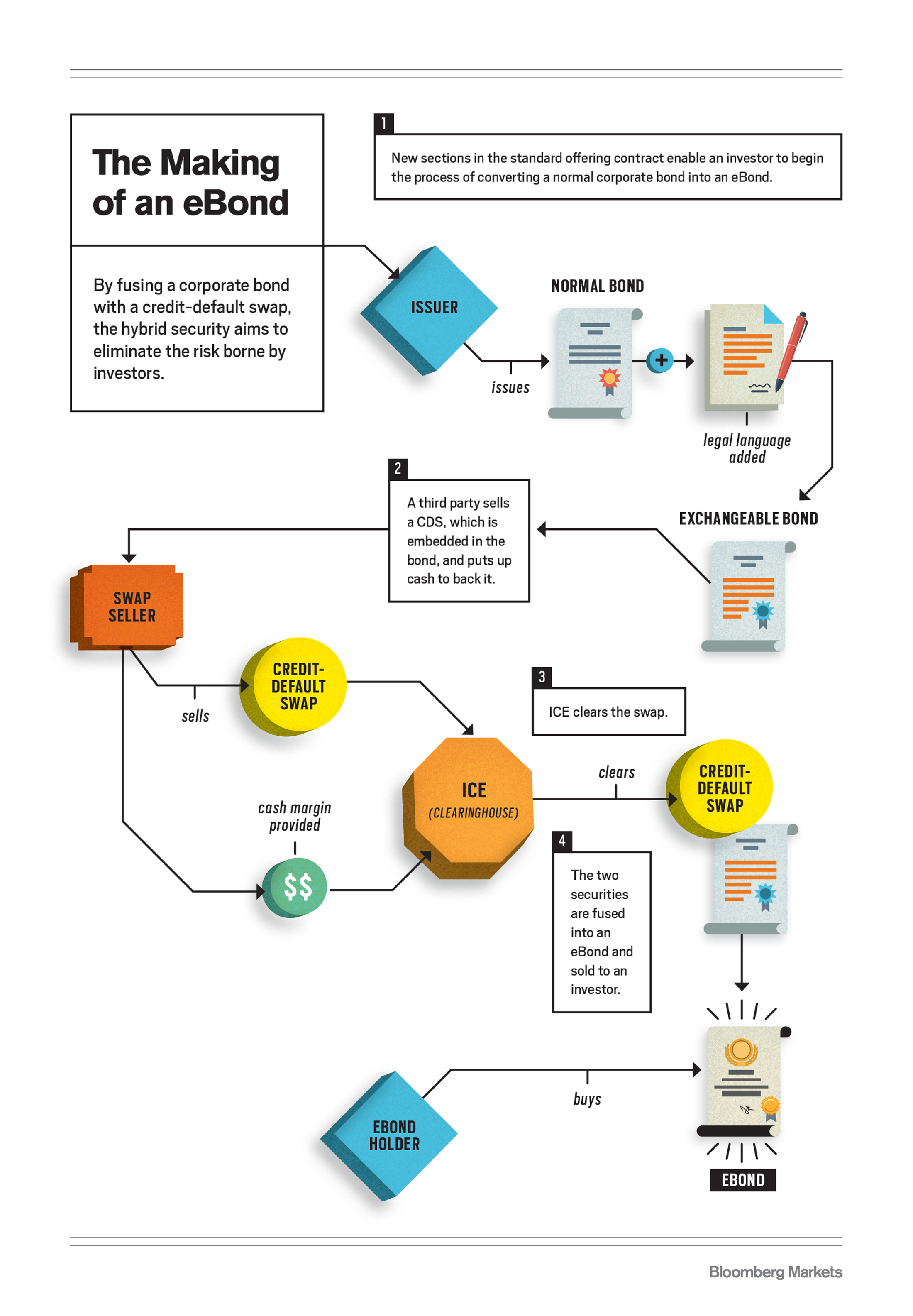
I get fascinated at how we never learn. Well, “never” is a little too strong because the following article from Bloomberg, Meet the 80-Year-Old Whiz Kid Reinventing the Corporate Bond had its share of skeptics, each of which had it right.

The basic idea is this: issue a corporate bond and then package it with a credit default swap [CDS] for the same corporate bond, with the swap cleared through a clearinghouse, which should have a AAA claims-paying ability.  Voila! You have created a AAA corporate bond.

Or have you?  Remember that bond X guaranteed by Y has many similarities to bond Y guaranteed by X, because both have to fail for there to be a default.  I used to help manage portfolios that had many different types of AAA bonds in them.  Some were natively AAA as governments, quasi-governments (really, Government Sponsored Enterprises) like Fannie and Freddie, or corporations.  Some were created by insurance guarantees from MBIA, Ambac, FGIC, or FSA.  Others were created via subordination, where the AAA portion took the losses only if they were greater than a highly stressed level.  Lesser lenders absorbed lesser losses in exchange for the ability to get a much greater yield if there was no default.

There is a lot of demand for AAA bonds if they have a high enough yield spread over Treasuries.  The amount of spread varies based on the structure, but greater complexity and greater credit risk tend to raise the spread needed.  Here are some simple examples: At one time, you could buy GE parent corporate bonds rated AAA, or GE Capital corporate bonds with an identical rating, but no guarantee from GE parent.  The GE Capital bonds always traded with more yield, even though the rating was identical.  AIG had a AAA credit rating, but its bonds frequently traded cheap to other AAA bonds because of the opacity of the financials of the firm (and among some bond managers, a growing sense that AIG had too much debt).

So how would one get a decent yield spread under this setup?  The CDS will have to require less spread to insure than the spread over Treasuries priced into the corporate bond.

How will that happen? Where does the willingness to accept the credit risk at a lower spread come from?  Note that the article doesn’t answer that question.  I will take a stab at an answer.  You could get a number of hedge funds trying to make money off of leveraging CDS for income, the excess demand forcing the CDS spread below that implied by the corporate bond.  Or, you could get a bid from synthetic Collateralized Debt Obligations [CDOs] demanding a lot of CDS for income.  I can’t think of too many other ways this could happen.

In either case, the CDS clearinghouse is dealing with weak counterparties in an event of default.  Portfolio margining should be capable of dealing with small negative scenarios like isolated defaults.  Where problems arise is when a lot of default and near defaults happen at once.  The article tells us what happens then:

ICE requires sellers of swaps to backstop their contracts with various margin accounts. If the seller fails to pay off, then ICE can tap a “waterfall” of margin funds to make the investor whole. In the event of a market crash, it can call on clearing members such as Citigroup and Goldman Sachs to pool their resources and fulfill swap contracts.

There’s still a danger that the banks themselves may be unable to muster cash in a crisis. But this shared responsibility marks a sea change from the bad old days when investors gambled their counterparties would make good on their contracts.

That shared responsibility is cold comfort.  Investment banks tend to be thinly capitalized, and even more so past the peak of a credit boom, when events like this happen.  Hello again, too big to fail.  Clearinghouses are not magic — they can fail also, and when they do, the negative effects will be huge.

Two more quotes from the article by those that “get it,” to reinforce my points:

The bond is a simple instrument with a debtor and creditor that’s proven its utility for centuries. The eBond inserts a third party into the transaction — the seller of the swap embedded in the security who now bears its credit risk.

Such machinations may be designed with good intentions, but they just further convolute the marketplace, says Turbeville, a former investment banker at Goldman Sachs.

“Why are we doing this? Is our society better off as a result of this innovation?” he asks. “You can’t destroy risk; you just move it around. I would argue that we have to reduce complexity and face the fact that it’s actually good for institutions to experience risks.”

and

“The way we make money for our clients is by assessing risk and generating risk-adjusted returns, and if you have a security that hedges that risk premium away, then why is it compelling? I would just buy Treasuries,” says Bonnie Baha, the head of global developed credit at DoubleLine Capital, a Los Angeles firm that manages about $56 billion in fixed-income assets. “This product sounds like a great idea in theory, but in practice it may be a solution in search of a problem.”

And, of course, fusing a security as straightforward as a bond with the notorious credit-default swap does ring a lot of alarms, says Phil Angelides, former chairman of the Financial Crisis Inquiry Commission, a blue-ribbon panel appointed by President Barack Obama in 2009 to conduct a postmortem on the causes of the subprime mortgage disaster. In September 2008, American International Group Inc. didn’t have the money to back the swaps it had sold guaranteeing billions of dollars’ worth of mortgage-backed securities. To prevent AIG’s failure from cascading through the global financial system, the U.S. Federal Reserve and the U.S. Treasury Department executed a $182 billion bailout of the insurer.

“When you look at this corporate eBond, it’s strikingly similar to what was done with mortgages,” says Angelides, a Democrat who was California state treasurer from 1999 to 2007. “Credit-default swaps were embedded in mortgage-backed securities with the idea that they’d be made safe. But the risk wasn’t insured; it was just shifted somewhere else.”

The article rambles at times, touching on unrelated issues like index funds, capital structure arbitrage, and alternative liquidity structures for bonds.  On its main point the article leave behind more questions than answers, and the two big ones are:

  • Should a sufficient number of these bonds get issued, what will happen in a very large credit crisis?
  • How will these bonds get issued?  When spreads are tight, no one will want to do these because of the cost of complexity.  When spreads are wide, who will have the capital to offer protection on CDS in exchange for income?

I’m not a fan of financial complexity.  Usually something goes wrong that the originators never imagined.  I may not have thought of what will go wrong here, but I’ve given you several avenues where this idea may go, so that you can avoid losing.

04 Feb 07:36

Here’s Why Legacy Tech Firms Can Still Pip Startups In The IoT Market

by Alnoor PeerMohamed

The smartphone revolution has largely been credited with the demise of several companies that were pioneers in the PC industry, in favor of leaner and meaner startups. Now however, given the onset of the Internet of Things (IoT) revolution, legacy tech firms could have a second shot at success in the Internet’s next evolutionary phase.

Internet of Things

Estimates suggest that by 2019 there could be twice as many IoT devices connected to the Internet than the number of PCs, smartphones and tablets combined. This will generate roughly $600 billion in revenues for companies that provide IoT products and services.

The biggest gainers from the IoT boom will be chip manufacturers, IT consulting firms and networking equipment manufacturers. Further, legacy tech firms could be in a better position to gain a stranglehold on a large chunk of the IoT market for the following reasons:

Existing Customers: While a big part of the IoT will be home automation, the two biggest early adopters of the technology will be businesses and governments. Here’s where legacy tech firms can flex their muscles to win orders given their longstanding sales relationships with such customers.

Favorable Product Portfolios: The building blocks for the IoT will be networking equipment, specialized chipsets, m2m communication and cloud & database systems. Legacy tech companies have expertise in these fields and it won’t require much work to align their product offerings to serve the needs of customers looking for IoT solutions.

Installation & Support: Hardware will indeed play a huge role in the IoT, but the space is expected to be dominated by companies serving the software and services sectors. Given the requirement for hands-on installation of IoT services and customer support by governments and businesses, companies will need to dedicate massive amounts of resources which only legacy tech firms can afford.

Data Security: As with any enterprise or government technology, security is the primary concern, and it will be no different for the IoT. Customers therefore are more likely to trust large vendors with the security of their data over untrusted startups, which will again rule in the favour of legacy tech firms.

Based on insights from a BI Intelligence report

[image source: wikipedia]

The post Here’s Why Legacy Tech Firms Can Still Pip Startups In The IoT Market appeared first on NextBigWhat.

03 Feb 06:52

Five Things We’ll See In Budget 2015

by Deepak Shenoy

I write at Outlook – Five Things We’ll See In Budget 2015:

There are a lot of expectations from the NDA’s first full budget. Here’s what might happen:

1. Lower Oil Subsidies

We have three major subsidies – oil, food and fertilizer. The food subsidy is likely to continue, in the form of funding the Food Corporation of India (FCI) to buy large amounts of grains from farmers in Haryana and Punjab and letting most of the food rot. This is, they say, very good for our GDP.

While they might restructure the FCI, the larger Food Security Bill might require us to increase food-related subsidy expenditure. They’ll have to buy more, distribute more for a low cost, and hope there isn’t a drought next year in which case they’ll buy even more. Fertilizer subsidies will continue as well, by giving money to fertilizer companies to ensure lower costs to farmers.… (Read On...)

03 Feb 06:48

The case for macro-prudential measures to limit financial vulnerability

by noreply@blogger.com (Gulzar Natarajan)
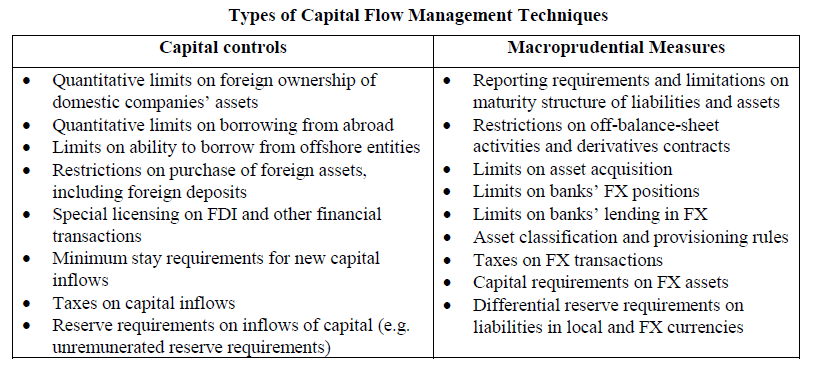
Kristin Forbes, Marcel Fratzscher, and Roland Straub have a new paper where they analyze capital flows management (CFM) measures in 60 countries during the 2009-11 period. They define two types of CFMs - capital controls (or restrictions on cross-border financial activity that discriminate based on residency) and macro-prudential measures (which do not discriminate based on residency but relate to cross-border or foreign currency exposure and lending).
Examining the impact of CFMs on their various targets - limiting exchange rate appreciation, reduce portfolio inflows, reduce inflation, and reduce financial fragility - they find mixed evidence,
The results indicate that certain CFMs can accomplish specific goals—especially in terms of reducing financial vulnerabilities—but most CFMs are ineffective at accomplishing other stated goals. More specifically, macroprudential measures related to international exposures can significantly improve measures linked to financial fragility, such as bank leverage, inflation expectations, bank credit growth, and exposure to portfolio liabilities. Increased controls on capital inflows can reduce private credit growth (although this effect, as well as that for portfolio liabilities, appears to fade and reverse after six months). 
CFMs, however, do not appear to have a significant effect on most other macroeconomic variables and financial market volatilities over the short and medium-term, including on equity indices, inflation, interest-rate differentials, or the volatility of exchange rates, portfolio flows, or interest-rate differentials. CFMs have limited effectiveness achieving two of their primary goals: reducing exchange rate appreciation and net capital inflows. One type of CFM—removing controls on capital outflows—can yield a significant but small depreciation of the real exchange rate (with a maximum depreciation of less than 2.5% over four months relative to the counterfactual). “Major” changes in capital controls which received more attention from investors are more likely to affect portfolio inflows, although major changes in inflow controls can also cause a significant increase in capital flow volatility and translate into no consistent, significant, or economically meaningful impact on the real exchange rate.
More evidence on why authorities in emerging economies should deploy macro-prudential instruments to limit exposure to external borrowings, especially short-term debts to specific sectors like real estate which inflate asset bubbles, and thereby minimize financial vulnerability.

The latest example of the problems arising from free capital inflows is Poland, which had allowed its citizens to take mortgages in foreign currencies. Attracted by the low Swiss interest rates and the apparent resolve of the Swiss central bank (SNB) authorities to prevent the currency's appreciation, many Poles took mortgages in franc, mainly from foreign owned banks, to finance their homes. The Polish Financial Authority estimated that in 2013 franc loans formed a third of all Polish mortgages. These people have been devastated by the SNB's decision last month to abandon the currency floor with euro which resulted in the one-day 23% appreciation of the Swiss franc against the euro. 
Add to Technorati Favorites
03 Feb 06:48

The adverse selection problem with PPPs

by noreply@blogger.com (Gulzar Natarajan)
Governments across the world see public private partnerships (PPPs) as a means to tide over their fiscal constraints and substitute for public spending. The government in New Delhi is no different. This view of PPPs is misplaced and is most likely to result in their failure. I have written about it here arguing that PPPs are effective when there are real efficiency gains to be had from involving private partners.

In normal times, creditors provide the most rigorous due diligence on projects. Since creditors are foremost concerned about repayment, their incentives are aligned towards ensuring that credit is channeled into financing only commercially viable projects. Such projects have a credibly guaranteed revenue stream to repay the project debt.

But this disciplining power of credit breaks down during the good times, especially during a credit boom. In an environment of cheap and plentiful credit, creditors go in pursuit of yield, assuming ever greater risks. This weakens the screening mechanism that distinguishes the commercially viable projects from the rest. Project developers are encouraged to peddle grandiose projects with large risks and doubtful commercial viability. Credit gets mis-allocated into projects of doubtful utility and commercial viability.

This is a classic case of adverse selection. PPP projects which otherwise would not have achieved financial closure, leave aside commercial break-even, find lenders when the disciplining powers of credit breaks-down as a credit bubble inflates. They get re-negotiated when the bubble bursts. This should not be seen as a symptom of deficient PPP plumbing or regulatory failures. These projects were never suitable for PPPs, should either never have been taken up or have been financed by public spending.

Accordingly, the re-negotiations in India's national highway toll road and ultra-mega power projects due to unrealistic traffic estimations and low-balled tariffs are less a problem of policy failure and more the manifestation of adverse selection. 
Add to Technorati Favorites
30 Jan 15:05

Excuses on the Bond-Currency-Derivatives Nexus

by Ajay Shah

What is the Bond-Currency-Derivatives Nexus


The Bond-Currency-Derivatives Nexus is the collection of the following markets:

  • The spot market for government bonds
  • Derivatives on government bonds
  • The spot market for corporate bonds
  • Credit derivatives
  • The spot market for exchange rates
  • Derivatives on exchange rates
  • Complicated products that mix up the above.

These sub-components are sometimes viewed as separate pieces. But they are deeply interconnected. Here are some examples of the interconnections:

  • The investor who buys a corporate bond is getting a bundle of credit risk (i.e. the risk that this firm will default on its obligations) and interest rate risk (i.e. the risk that interest rates will go up thus giving a decline in the price of a bond). Different people view these risks differently. Generally, some parts are hedged off, based on the specialisation of the investor. Some investors think their skill is in credit risk: in this case they will hold the credit risk and hedge off the interest rate risk. This could, further, lead to hedging off a change in the short rate vs. a change in the long rate.
  • A market maker who has inventory of a corporate bond will generally lay off extraneous risks and focus on credit risk. A liquid interest rate derivatives market is required for making liquidity on corporate bonds.
  • A foreign investor buying a rupee denominated bond (either government or corporate) will generally lay off some currency risk: this often generates a paired trade where two things go together: buy a corporate bond and buy protection using currency derivatives. On top of this, there may be an interest rate derivatives play also, as the foreign investor may not like to take the risk that interest rates will go up. A domestic firm issuing foreign currency bonds will generally lay off some currency risk.
  • There are many arbitrages that link up these markets. Covered interest parity is a one-shot arbitrage that links up the currency spot, currency futures, and the bond market. Uncovered interest parity arbitrage gives "carry trade" style structures where borrowing is done in one currency to make investments in the short dated bonds of another country.

This web of interconnections is of essence in thinking about these markets.  E.g. some people think "we should have a good government bond market" but see this in isolation. The insight behind the phrase "Bond-Currency-Derivatives Nexus" is that all these markets are deeply interconnected and should be viewed as one big edifice. It is not possible to sub-divide them. Market makers give liquidity on one security and constantly lay off as much risk as they can using related securities. Hence, liquidity in all these markets feeds into liquidity in all these markets. It is not possible to pick and choose: a country that works to kill the currency market and the government bond market will not have a corporate bond market either. A country that works to kill the currency market will not get a working government bond market. And so on.

What the Bond-Currency-Derivatives Nexus is not


In a recent speech, H. R. Khan, deputy governor of the RBI, said:

It is pertinent to mention briefly a theme current in contemporary discourse- Bond-Currency-Derivatives (BCD) nexus. This is an ideal objective in an open economy financial system. What it means is this: any foreign investor, using any international currency, can buy an Indian Government or corporate liability denominated in Rupees or otherwise and hedge all risks, either onshore or offshore, the attendant credit, interest rate & currency risks. This is a natural prerequisite for free international capital movements, and from an Indian perspective, for mobilisation of the much needed resources. The problem, however, is inherent in the proposition itself. This presupposes complete capital amount openness, particularly for financial institutions& transactions. The pros & cons of full capital account openness is a contentious issue and in any case, we are not ready for it at this point of time. Thus the full BCD nexus has to wait on progress in capital account liberalisation.

This is incorrect. There is no connection between having a well functioning Bond-Currency-Derivatives Nexus, and having full capital account convertibility.

It is feasible to have market development and to have capital controls. As an example, it is feasible to have a world class Bond-Currency-Derivatives Nexus, and also have a capital controls which says (as India does today) that all foreign investment into rupee denominated bonds should not exceed $76 billion. As an example, India has a well functioning equity market while having capital controls on it. As an example, many countries have well functioning Bond-Currency markets while having capital controls.

RBI has failed for 25 years on building the Bond-Currency-Derivatives Nexus. In the paragraph above, they are effectively saying: "Don't blame us for this, as this is about capital account convertibility. At some future date, India will have full capital account convertibility, and after that we will start market development".

The presence of capital controls is no excuse for failure on market development. This failure should have consequences. We require elementary principles of management: The principal (MOF) must take work away from the agent who failed (RBI failed on the Bond-Currency-Derivatives Nexus) and give it to the agent who succeeded (SEBI delivered on the equity market). India's interests are more important than RBI's turf. This reallocation of work is what all the expert committees have proposed, including one by Raghuram Rajan when he was unconflicted.

There are more sensible capital controls (e.g. a Chilean-style tax) and less sensible capital controls (e.g. the Indian barriers against CIP arbitrage). The analysis of capital controls is an interesting and important question. But it is distinct and orthogonal of the mistakes in financial sector policy that have blocked the Bond-Currency-Derivatives Nexus.
29 Jan 13:13

How to Master Analyzing the Cash Flow Statement

by Vishal Khandelwal

A wise man once said, “If your outgo exceeds your inflow, then your upkeep will be your downfall.”

That says a lot about the importance of cash flow in a person’s life. In fact, if your cash flow is healthy, it will cover a lot of sins. :-)

A company is no different. You will find businesses that generate a lot of cash flows, even when they may not be earning profits.

I have a friend who runs a company that did not make profit for five years in a row. But my friend never missed his yearly trip to the US, and he bought a high end car every two years. His employees were also paid well.

You may wonder, “But how he did it?”

The answer is – Great cash flow.

He was absolutely brilliant at timing income with outflow. When one product was selling great, he’d move the cash into product development. When nothing was happening, he’d slow down for a while and cut back on expenses.

He also had a smart accountant who knew how to spread losses around, as well as a few other tricks – all legal – for reducing the profit.

Now, if his company was listed, I may not have invested in it given the charismatic nature of the promoter ;-) , and high levels of uncertainty in his business and cash flows. A lot of listed companies are in fact like that – who cover up their sins by occasionally managing their cash flows well.

But a business that sustains a good positive cash flow performance year after year without manipulating expenses and profits is what you as an investor must look out for.

Now the problem that you may face is fundamental – how to assess whether a company has a good cash flow performance or not? This may be because you may not know how to analyze a company’s cash flow statement.

Not anymore! Here’s a video I’ve prepared for my Mastermind Value Investing Course, where I explain the working of a company’s cash flow statement.

For starters, a cash flow statement shows where the company’s cash came from (sources of cash) and where it went (uses of cash) during a given period (mostly a year).

Now please watch this video. I’ve tried to be as simple in my explanation as possible, so I believe you may find some value in what you see.


If you can’t view the video above, click here. Please don’t forget to turn on your speakers.

Let me know if you found the cash flow analysis easy (or difficult).

Post your feedback or any question you have in the Comments section below. I’m all ears.

P.S. Many tribe members have asked me how they can download the videos and see them at ease. Well, you can do this through Freemake Video Downloader, which you can download for free on your PC.

    
29 Jan 13:00

Greece, EMU and democracy

by Antonio Fatas
One more post on Greece, possibly not the last one.

Markets are more worried about what is going on and there is more and more talk about the possibility of and exit of Greece from the Euro area. As I have argued in my previous posts, exit will not be the choice of the Greek government, it will be the only solution for Greece as the ECB refuses to provide liquidity to Greek banks as depositors run to avoid capital losses on their Euro deposits in the scenario of Greece leaving the Euro.

Let me start by repeating (as I have expressed many times in this blog) that I find that the economic policies followed in Europe have been a disaster, that the suffering that countries such as Greece had to go through during the last years should not have taken place. And I am convinced that in many of these countries, austerity has produced higher debt-to-GDP ratios, as opposed to lower ones. A real disaster.

But this is not what this negotiation is going to be about. The reality is that the crisis has had an impact on the way we all see the experiment of sharing a single currency, the experiment of EMU. While in the early days we all talked about optimum currency areas, the synchronicity of business cycles, the absence of a fiscal transfer mechanism, what we now realize is that the real issue is how to handle a full-blown crisis that puts governments at the edge of default and creates bank runs among Euro countries (something that many l thought it was impossible). The role that the ECB plays in those circumstances is not the typical role a central bank plays and one cannot ignore the political aspects associated to the difficult decisions they face.

And while it is true that Syriza has been chosen by the Greek voters and as such it is a victory of democracy, there are also voters in other countries that also feel they want their say heard by their governments.

And here is the question that I think is fundamental: if voters had a choice now, would they choose to join the Euro area given its current membership? What if they were allowed to change some of the members? There is no doubt that in some countries voters would like a different configuration of the Euro area. No doubt that Germany would be happier with fewer countries, in particular the "trouble makers".

And this decision will not be just based on economic arguments, some of it will be about the emotions generated by the crisis and some of it will be generated by the first statements of the Syriza government (and proposing a rethinking of the sanctions to Russia does not help).

So if the current membership does not work anymore, what do we do? There is no explicit process for this. Countries can opt out of the Euro if they do not like what they see. But the current negotiations with Greece will be seen by some as an opportunity to change who is in and who is out of the Euro.

If (big if) contagion can be avoided, Germany and Brussels have all the power in these negotiations. Greece does not want to leave the Euro.

Can contagion be avoided? The answer to this question three years ago was a clear no. And that's why this was not an option. Today I am not so sure. Three years ago Spain or Ireland or Italy were facing very difficult economic conditions that looked similar to Greece. Today that's not the case. Growth is very low but deficits are under control, debt to GDP ratios decreasing in some countries and interest rates are low and not reacting much to the Greek elections. The possibility of contagion today could come more from the political side. If voters in other countries decide to elect similar parties, we might repeat the same scenario in a few months in Spain or Italy. But will voters do this if they see that exit from the Euro is a possibility? Remember these political parties do not want to leave the Euro. Most citizens even if they are critical with European policies do not want to leave the Euro. My guess is that an exit of Greece from the Euro area will change political outcomes in European countries relative to what we see in the polls today. And this will limit the possibility of "political contagion".

Interesting times. More to come.

Antonio Fatás
29 Jan 12:56

Now, International Woes at an Austrian Bank, But Not To Worry, Draghi Will Be Here

by Deepak Shenoy

Sorry for all those news coming from international sources. There’s one more. This time it’s an Austrian Bank, called Reiffeisen. These is how the bonds of this bank were, yesterday, from Zero Hedge.


The bonds fell to as low as 48 yesterday. The bank, says Bloomberg, has a large exposure to Russia, with a potential loss of 500 million Euros. It also has 4.3 billion euros worth of Swiss Franc based loans given mostly in Poland. That repayment cost just went up 20%! (So, expect defaults)

Banks don’t go down nowadays. They just get rescued after causing turmoil in the market. So yeah, let’s await the statement of superman Draghi that says Everything Must Be Rescued If It Is A Bank.… (Read On...)

29 Jan 04:17

Some thoughts on real estate

by Muthu

Every asset class goes through cycles. Ups and downs, bull and bear markets, boom and bursts, euphoria and despair are all very normal. No one and no asset class can escape this cycle. Likewise business and economy have their own cycles.

We Indians have been having for generations a peculiar belief that gold and real estate never fall in value. Last few years have been proving our people how wrong those beliefs are.

Gold price falling for last few years is nothing new.

Gold prices fell from $892 per ounce in 1980 to $272 in the year 2000. A fall of around 70% in value over 20 year period.

When gold has depreciated by 70%, the rupee has depreciated by 600% in the same period. One Dollar was worth Rs.8/- in 1981. Whereas the conversion rate was Rs.48/- in 2002.

So the gain we saw in the Indian market while prices fell globally was due to the depreciation in the value of rupee and strong appreciation in the value of dollar. It was not gold which gained but the dollar. This further strengthened our illusion that gold prices never fall.

Likewise people have forgotten the correction which happened in real estate prices between 1997 and 2003. Prices actually fell by around 30% even in places like Mumbai. Only from 2004 the mad appreciation of property prices started which again started slowing down from 2012. People are finding it difficult to sell properties for the last few years. Unsold inventories are piling up in all major cities. More than price correction, real estate goes through time correction. Let us assume a flat was bought in 2012 for Rs.1 crore. If it’s price remains stagnant for next 6 years and there are no buyers for the flat, people think that they have not made any loss. This is due to money illusion.

Money illusion is a separate topic I can write about. Let me explain the above. Rs.1 crore of 2018 is not same as Rs.1 crore in 2012. Inflation erodes the value of money. Assuming 8% inflation, if a buyer sells the flat for the same price after 6 years, he gets only around Rs.61 lakhs back in real term. There is a loss of 39% on the sale. Since most people buy on borrowing, if we take the interest paid, the loss would be more.

Government is taking steps to reduce black money. From recent news reports, it looks like having unaccounted money may even become a jailable offence. As India develop over years, we would become less corrupt and have less black money in circulation. The fall during the last few years would have been more severe but for the black money holding the prices.

People think that since our population is huge and as ‘God does not produce land any more’, real estate will go only in one direction, which is up. I’ve mentioned about this in May 2013 and I would mention it again.

Economist Ajay Shah says that if we place 1.2 billion people (population of India) in 4 person homes of 1000 square feet each and 2 workers of the above family in office or factory space of 400 square feet, it would occupy only 1% of land area of the country. Just 1% of land in India! FSI (Floor Space Index) assumed of the above calculation is just one. FSI is much higher in developed countries.

People lament that we are fast losing agricultural land near developing cities. What they do not know is that land under agriculture in India is higher than that of China. We are self sufficient in food, vegetables, minerals etc. India is one of the few places where one gets sunshine throughout the year. We are only 34% of the size of China but have more arable land then them. Vivek Kaul in one of his pieces has mentioned that at 157.35 million hectares, India holds the second largest agricultural land globally. Only, the United States has more agricultural land than India.

So just because more people want houses, housing prices are not going to hit the roof. The supply and supply capacity in India is much higher than what demand can be. Also as black money gets reduced and infrastructure improves, housing would become affordable for the masses.

Housing as an industry would develop a lot in the years to come. But for prices to pick up, it may take few more years. Real estate price growth in the long run would be 2% or 3% above inflation. If inflation is 6%, we may expect a long term price growth rate of around 9%.

These are some of the thoughts on real estate I want to share with you today.


29 Jan 04:12

Why a public investments led strategy may not work?

by noreply@blogger.com (Gulzar Natarajan)
Commentators from both the right and left have converged to the view that the Indian economy needs a large dose of public investment in infrastructure to provide the impetus to regain high economic growth rates. But there are atleast seven reasons to be sceptical of this strategy.

1. A first order reality is that neither the central nor state governments have the fiscal space to prime the pump in any significant manner. Also, unlike the developed economies, interest rates in India are not anywhere near the zero-bound to make capital expenditure borrowings a high-return strategy.

2. Public investments become effective in stimulating the economy only when they can be kick-started without delay. However, given the long time lag between identification of project and the first stone being laid, and the poor track record of in-time completion of public investments, the efficacy of public investments in providing the immediate thrust for regaining high growth rates appears questionable.

3. Even assuming a readily available shelf of "shovel-ready" projects, they can take off only when developers and banks have adequate space on their balance sheets to take on more projects. Given the debt-laden balance sheets of infrastructure firms and the high proportion of distressed assets of banks, the prospect of neither look promising.

4. If the objective is regaining the near double-digit growth rates, then public investments will not be able to achieve that without other critical enablers. Apart from the success of initiatives to improve business environment and stimulate manufacturing, the country can sustain high growth rates only if it is able to sharply increase its savings rate. Further, if the savings rate increases to the 35-40% of GDP range, then the desired level of public investments are in any case most likely to follow.

5. The argument that we only have a flow problem (high fiscal deficits) and no stock problem (lower debt-to-GDP ratio) is misleading. Our debt-to-GDP ratio has been held in the 60-65% range only by the long period of high inflation, which has helped the country inflate away its debt. If the inflation gets anchored at a lower rate, as looks likely, then the stock problem will start to assume significance.

6. The country has struggled hard to restore some macroeconomic stability by reining in revenue expenditure and tight monetary policy. A quick return to high fiscal deficits would certainly erode the hard-won and costly policy credibility. This assumes great significance in a world where massive amounts of capital slosh around and economies are deeply vulnerable to sudden-stops and flow reversals.

7. Finally, all this works on the premiss that we need to do everything possible to regain the high growth rates of the 2003-08 period and emulate China's spectacular three decade long near double-digit growth trajectory. But what if this premiss is itself questionable. Given the prevailing domestic macroeconomic and socio-economic environments and global trends, there are compelling reasons to argue that it may not be possible for India to sustain high growth rates for any long duration.
Add to Technorati Favorites
28 Jan 04:38

Retirement planning is a new concept.

by subra

In the year 1800 the average life expectancy in the USA was about 40 years. A kid born in 2014 in the US is likely to live till the age of 82 years. In fact the probability of this kid reaching the age of 100 years is very high.

Obviously retirement planning was not much of a concept even till the 1960s – the Social Security started at 60 and the life expectancy was less than 70. It is only in the 1980s or 1990s that the concept of retirement planning was being taken seriously.

Take the Indian context. Even today the concept of joint family is not completely dead. Balance sheets are not drawn up and there is not much clarity about whose money is being spent on what. Sure, if there are fights suddenly balance sheets are drawn up, but that is more the exception.

Most of the middle class in India who had a government job were secured by an indexed pension. I know of families which are still being run on the pensions – the longevity of a 89 year old father helps! The 64 year old son who does not have a pension continues to live on the parental pension. Remember Indexed pensions are so huge that a family of 2-4 people can live comfortably on a pension of say Rs. 94,000!!

That brings us to the persons who are now in their 30s to 50s who can do something about their pensions. Those who are in their 60s have already exhausted their ability to earn and accumulate. They are the people whose portfolios are full of LIC policies which are likely to get about 5% pa returns, and are likely to lose money in ULIPs. So if you are planning for the retirement of these people you should be looking at the weighted average yield on their portfolios. Assuming that they have about 70% of their assets in poor yielding assets like Life policies, ppf, etc. it is ONLY with the remaining 30% that you can improve the over all yield to combat inflation.

Tough ask, right? No. It just cannot be done. Ask them to take a walk.

They should have started earlier or increase the amount of equity in their portfolios. And this portfolio needs to be very well managed – for a high return and low capital risk. Easier said than done.

As the concept is new, we are all learning.

Also very few IFAs are capable of handling a staggered inflation adjusted steady withdrawal. Which reminds me of a story.

It was in 1962 that NASA knew how to put a man on the moon. However they actually put a man on the moon only in  1968. Why?

Simply because NASA had to perfect the art of bringing him back. Exactly how many IFAs can help you in the accumulation stage – but what they can do for you if you decide to withdraw it regularly is a tricky question.

Post Footer automatically generated by Add Post Footer Plugin for wordpress.

27 Jan 03:48

One Powerful Success Secret from Ben Franklin that Changed My Life

by Vishal Khandelwal

When I tell people how I manage my entire business on my own – from website management, to reading, writing, sending mailers, to organizing workshops and also booking a lot of travel tickets – a lot of them are in disbelief.

They disbelieve me even more when I tell them that I work for just 5-6 hours a day and take a lot of family holidays.

Well, I do not have any Masters degree in time management, but one thing that has really helped me manage my time well is a simple secret I’ve learned from people like Ben Franklin and Warren Buffett.

That simple secret is that of…

Daily Rituals
There are but 24 hours in a day! And when you have a seemingly overwhelming amount of work, it can be a quite a challenge to even know where to start.

But remember that history’s most legendary figures – from Ben Franklin to Warren Buffett – had just as little (or just as much) time as you have.

One of the biggest reasons I believe these men made it to the history books is because they never took giant steps to make it to the history books.

Instead, all they focused on was to do their daily rituals with complete integrity…and that seemingly made the difference.

Like, take a look at this ideal daily routine of Benjamin Franklin that he shared in his autobiography…


Every morning Franklin asked himself, “What good shall I do today?” Then, every night, he asked, “What good did I do today?”

Of course, Franklin’s schedule misses some things from modern life – like exercise, cooking, family and friends, trips to the grocery store, etc. But how else can you define simply how you would like to spend each of your days?

In a commencement address he gave at Stanford back in 2005, Steve Jobs revealed the motivational tactic he used to set the tone for the rest of his day…

For the past 33 years, I have looked in the mirror every morning and asked myself: “If today were the last day of my life, would I want to do what I am about to do today?”

And whenever the answer has been no for too many days in a row, I know I need to change something.

That’s powerful stuff to define what you would like to do daily.

Now consider what Buffett does daily. When asked how to get smarter, Buffett once held up stacks of paper and said, “Read 500 pages like this every day. That’s how knowledge builds up, like compound interest.”

Although we humans are capable of creating amazing new innovations, most of our daily lives are shaped instead by daily routines or rituals. We get up, brush our teeth, dress, have that first cup of tea or coffee, make the commute to work – and on, day after day.

Many such activities simply allow us to do certain things on autopilot so that our brains are not overtaxed by concentrating on each brushstroke and countless tiny adjustments of the steering wheel.

Some daily routines — taking a daily walk, for instance — are healthy. Others — having dessert after every meal — are not. Worse, the more routine a behaviour becomes, the less we are aware of it. This results in a sinister undercutting of our intentions such as happens when, say, those frequent desserts become extra pounds.

In some ways, habits can even resemble addictions, which are then to tough to part away with. Like Buffett often says…

Chains of habit are too light to be felt until they are too heavy to be broken.

Habits play a very important role in the building of successful lives. Like the habit of reading daily proved in case of Buffett.

We are all creatures of habit. As the French gastronome (a lover of good food) Jean Anthelme Brillat-Savarin said, “Tell me what you eat, and I shall tell what you are.” But habits build over time. And the benefits of good habits compound over a period of time.

But for this compounding to take place, the idea of working on the habit daily is what is required.

In the book Outliers, author Malcolm Gladwell says that it takes roughly ten thousand hours of practice to achieve mastery in a field. Now, while ten thousand hours look like a lot of time, if you can work on a habit – like reading books or learning value investing – diligently for just 2 hours daily, you’ll reach mastery in less than 14 years.

We Are What We Repeatedly Do
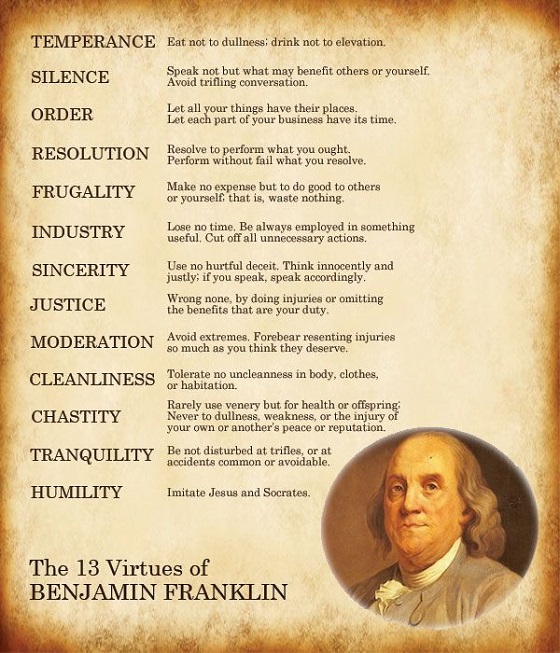
Apart from putting out his daily schedule, Franklin also laid down clearly 13 virtues as essential to good personhood…

Ben Franklin's 13 Vitues
He then set out to improve himself by devising a chart-based log for tracking his progress against these virtues. Each week, he would pick a virtue to cultivate, then put a black pencil mark in his calendar chart on any day he failed to uphold the virtue.


This visual feedback on his progress encouraged him, and allowed him to move to a different virtue the following week, hoping that each week would help him ingrain the habit of that specific virtue.

Neuroscience hadn’t developed much when Franklin was writing out his daily schedule and tracking his daily progress against the virtues. But as neuroscientists later found out, habits are a matter of daily, repeat performance. When we repeat a behaviour – good or bad – daily and over a period of time, our brain stores it as a “chunk” of action and then imprints it as a semi-permanent activity, or a habit.


Source: Scientific American
Such activities that our brain imprints in itself – that we also call as ‘habits’ – form around 45% of the actions we perform every day, with the rest 55% being actual decisions (as per research published by Duke University).

Napoleon Hill wrote this in his landmark book titled Think and Grow Rich

Any idea, plan, or purpose may be placed in the mind through repetition of thought.

On the inverse, here is what the French writer Ernest Dimnet said…

The happiness of most people is not ruined by great catastrophes or fatal errors, but by the repetition of slowly destructive little things.

So, repetition works both in the creative and destructive process. Mahatma Gandhi was a product of creative daily habits, Hitler of destructive.

Even when it comes to learning the art of investing, there’s not one book or course that can teach you to become a sensible investor, and in a few weeks or months.

Reading books and making notes is just a part of the habit building process, and I’m sure Gladwell’s ten thousand hours framework also applies here. On the contrary, people who regularly spend a lot of time watching business television, reading newspapers, discussing on stock forums, and looking at online stock portfolios, are just building the wrong habits…again through daily repetition.

So, if you want to diligently learn how to become sensible in your investment decision making – especially learning how to pick stocks on your own – you better start learning how to manage your behaviour and analyze businesses effectively.

And to do that, reading a few pages of annual reports daily and few pages of the best books on investing and human behaviour daily can go a long way.

Repetition – practicing daily rituals, daily – is the price you would have to pay to be great at something…and investing follows the same process.

This is one of the several big lessons I’ve learned from Ben Franklin.

How (I Think) Buffett Does It
Now, while even Buffett is granted a 24-hour day, based on my reading of his life and experience, I think here’s how he takes out time to practice his daily rituals of reading 500 pages and other important things that matter to him…

  • Says ‘no’ a lot of things – As per his letters and other communication, Buffett avoids businesses he doesn’t understand and as per him, these are much more in number than ones he understand.
  • Remains anti-social – Buffett reportedly doesn’t use Facebook, Twitter, and probably even emails. He’s largely disconnected from the online world, and thus must give him ample amount of time to use productively.
  • Loves inactivity – Buffett doesn’t go out there every day to find the next biggest 10 or 100-baggers. He doesn’t have to. Sometimes he can find but often times he don’t. There are usually 3-4 purchases in a year. It’s a laid back approach to investing. Remember the Blaise Pascal principle of sitting quietly in a room.
  • Spends time only with people he likes – As per his biographers, Buffett’s inner circle is quite small. He generally avoids people he doesn’t like, which makes his life easier and his working relationships better. If you are a on a job, this is almost impossible to do. But still try to do this and I’m sure you’ll create a lot of time to do things that really matter.
  • Does what he loves – You often find time for things you love doing. This is also true of learning how to invest. Reading books and annual reports may look boring to people who look at these as outsiders, but there’s an unbelievable amount of romance in these black and white pages if you love to go through them daily.

I’m not sure if Buffett has read any of those productivity books out there. But it seems that his practice of simplicity, avoidance of things that take a toll on his time and energy, and focusing on practicing the most important things daily has been the root causes behind his immense success.

If all this worked for him, why can’t it work for us? Don’t you think?

Seize the Day!
Remember this – What you do daily, day after day, has great powers in altering the course of your life ahead – both positively and negatively. I can personally vouch for this.

So, choose what you do daily very carefully…and then do it daily.

And finally remember what Steve Jobs said in his famous speech at Stanford…

Your time is limited, so don’t waste it living someone else’s life.

Your – and my – time is really very limited. How we decide to spend our days will ultimately decide how we would end up spending the rest of our lives.

P.S. How I Spend My Days
Though you may not be interested, but let me still share what I do on a normal day that has helped me immensely over the past few years (ever since I quit my job and took control over my time).

Taking inspiration from Ben Franklin, I recently formalized my daily routine thus…


Now, while this schedule looks ideal in theory, I knew while setting it up that day-to-day responsibilities and unpredictability would make it impossible for me to follow it strictly.

So, instead of any unrealistic expectation, I use this schedule as a guideline. And I would say that I have been able to meet this schedule 70% of the times since I set it up. But one aspect where I have tried to be extremely disciplined is to ask myself, “What good will I do today?” when I woke up, and end each evening by contemplating the good I’d done.

Another instance where I have taken help from neuroscience to set up a good habit is that of exercising every day (well, almost). One book that has helped me tremendously in this pursuit is Robert Maurer’s One Small Step Can Change Your Life – The Kaizen Way.

It’s basic premise of building a habit was to start small and then move ahead in small steps. So, I started with walking/running 1 km per day sometime in 2013, then increased it to 2 km/day, then 3 km, and so on.

Just last week, I completed a 21-day challenge to myself to ride bicycle 21 km per day (more on that in a later post).

Anyways, sticking to my daily rituals – written or not – has helped me channelize my energy well into my life and my business of writing and investing over these past few years. I’m sure it will benefit you too.

After all, no matter what’s happening in your life, coping and succeeding are both a matter of routine.


Further Reading – If you wish to learn how the world’s most creative minds from history used to spend their days, you must read this brilliant book called Daily Rituals: How Artists Work, written by Mason Currey. It contains accounts of Charles Darwin, Benjamin Franklin, Jane Austen, Beethoven, Karl Marx, Picasso, and many more.

Note: This post was originally published in January 2015, but I have updated it on request by adding a few more references and my personal experience.

The post One Powerful Success Secret from Ben Franklin that Changed My Life appeared first on Safal Niveshak.

    
26 Jan 05:27

The Difference Between Seeing and Observing

by Shane Parrish

The Art of Observation
In A Scandal in Bohemia, Sherlock Holmes teaches Watson the difference between seeing and observing:

“When I hear you give your reasons,” I remarked, “the thing always appears to me to be so ridiculously simple that I could easily do it myself, though at each successive instance of your reasoning, I am baffled until you explain your process. And yet I believe that my eyes are as good as yours.”

“Quite so,” he answered, lighting a cigarette, and throwing himself down into an armchair. “You see, but you do not observe. The distinction is clear. For example, you have frequently seen the steps which lead up from the hall to this room.”

“Frequently.”

“How often?”

“Well, some hundreds of times.”

“Then how many are there?”

“How many? I don’t know.”

“Quite so! You have not observed. And yet you have seen. That is just my point. Now, I know that there are seventeen steps, because I have both seen and observed.”

The difference between seeing and observing is fundamental to many aspects of life. Indeed, we can learn a lot from how Sherlock Holmes thinks. Noticing is even something that Nassim Taleb has chimed in on with Noise and Signal.

In the video below, Harvard Business School Professor Max Bazerman, author of The Power of Noticing: What the Best Leaders See, discusses how important it is not just to be able to focus, but to be a good noticer as well. What he’s really talking about is observation.

A number of years ago I had an opportunity to notice and I failed to do so and it’s been an obsession with me ever since. On March 10, 2005 I was hired by the U.S. Department of Justice in a landmark case that they were fighting against the tobacco industry. I was hired as a remedy witness. That is, I was hired to provide recommendations to the court about what the penalty would be if, in fact, the Department of Justice succeeded in its trial against the tobacco industry. I had spent a couple hundred hours working for the Department of Justice including submitting my written direct testimony which had been submitted to the court.

I was scheduled to be on the stand on May 4 where the tobacco industry attorneys would be asking me a series of questions. On April 30, a number of days before my May 4 testimony I was in Washington D.C. to meet with the Department of Justice attorneys to prepare for my time on the stand. When the day started the Department of Justice attorney that I had been working with said to me, “Professor Bazerman.” This occurred long after he had learned to call me Max. He said, “Professor Bazerman, the Department of Justice requests that you amend your testimony to note that the testimony would not be relevant if any of the following four conditions existed.”

He then read to me four legal conditions that I didn’t understand. When he was done talking I said to him, “Why would you ask me to amend my testimony when you know that I didn’t understand what you just said to me.” And his response was because if you don’t agree, there’s a significant chance that senior leadership in the Department of Justice will remove you from the case before you are on the stand on May 4. To which I said, “Okay, I don’t agree to those changes.” And his response was, “Good. Let’s continue with your preparation.” I was jarred by the fact that something very strange had occurred. But I was overwhelmed in life. I was trying to help this case and I didn’t quite know what had occurred. But to this day I’m critical of the fact that I took no action. I did appear on trial on May 4 and the trial ended in early June.

But on June 17 I woke up in a hotel room in London. I was working with another client at the time. And I woke up early at 5:00 a.m. and I opened up The New York Times web edition and I read a story about Matt Myers, the president of Tobacco Free Kids, who had come forward to the media with evidence about how Robert McCallum, the number two official in the Department of Justice, was involved in attempting to get him to change his testimony. And I then read basically the same account that I had experienced back on April 30. Matt Myers had the insight to know that he should do something with this information about what had occurred in terms of the attempt to tamper with this testimony. And at that point it was straightforward to come forward to the media to speak to congressional representatives about what happened. And my own role received media attention as well.

But to this day I’m still struck by the fact that I didn’t come forward on April 30 when, in the back of my mind I knew something had occurred. The reason I tell you this story is because I think a lot of our failure to notice happens when we’re busy. It happens when we don’t know exactly what’s happening. But I think it’s our job as executives, as leaders, as professionals to act when we’re pretty sure that there’s something wrong. It’s our job to notice and to not simply be passive when we can’t quite figure out the evidence. It’s our job to take steps to figure out what’s going on and to act on critical information.

***

Follow your curiosity and learn about why your decision making environment matters.

--
Sponsored By: Greenhaven Road Capital: You think differently - now invest differently.

26 Jan 05:24

Forex Reserves at the Highest Ever, but RBI Controls Balance Sheet to Restrict Inflation

by Deepak Shenoy

The RBI’s back to buying dollars by the truckload. Forex reserves have been going up substantially.

image

The RBI has over $322 bn of cash reserves, and then another $13 billion from forwards (it may even be higher since the forward exposure number is from November).

This is the highest ever forex reserve we have ever held.

The RBI has not just bought in the spot market this (financial) year, it’s bought a truckload in the forward market as well, totally over $66 billion:

image 

Offset by Sales in Govt Bonds, Inflation Stays on Hold

And the difference this time is that the RBI has managed to do this without stoking inflation. With every purchase of dollars, the RBI has sold government bonds. To buy dollars they have to print rupees which could introduce inflation. But when they sell government bonds, they get rupees back, which takes them out of circulation.… (Read On...)

26 Jan 05:24

LPG Subsidy and Number of cylinders : Verifying details on Distributor’s Transparency Portal

by Kirti

How many cylinder did you consume say in a year , when did you book your cylinders, what is the amount you paid, what is amount of subsidy you got? Answers to all these questions are provided to consumers through the Transparency portal of Oil company. This article talks about how can one get information about LPG Subsidy, number of cylinders through Transparency portal of Indane, HP Gas and Bharat Gas.

What is Transparency portal ?

The LPG transparency portals features quick search options to find one’s distributor,sort information based on consumer number and consumer name, get complete details of each customer with their consumer numbers, name, address, no. of cylinders supplied, dates of supply as well as the indicative subsidy amount for the cylinders supplied . These details are provided by OMCs also called as Oil Marketing Companies . There are 3 OMCs in India providing  LPG – Indian Oil Corp. Ltd (IOC) providing LPG as Indane, Bharat Petroleum Corp. Ltd (BPCL) owns Bharat Gas and Hindustan Petroleum Corp. Ltd (HPCL) own HP Gas.

Sample of the information that is available on Transparency portal of Bharat Gas is given below. Other Companies information is similar. Information is per distributor and per consumer.  Per distributor the information that one can access (Click on image to enlarge) is  shown below.

LPG Transparency portal distributor Detail

LPG Transparency portal distributor Detail

Per consumer information that one can get is shown in image below

LPG Transparency portal consumer detail

LPG Transparency portal consumer detail

Why was the Transparency portal set up?

The portals was set up  with the recommendations of the task force on direct transfer of subsidies headed by UIDAI Chairman Nandan Nilekani. Rationale was to empower LPG users to get complete visibility of the LPG cylinder transactions to all citizens across the country the website which serves as public accountability system was introduced in Jun 2012.

The Oil Marketing Companies have been moving with times allowing consumers to book cylinders through websites, SMS and  Phone. Transparency portal is another effort to use technology to increase transparency in LPG supply chain. One can access LPG distribution information, report discrepancies and register feedback on the discrepancies in supply. Transparency portal also allows to consumers to rate the services of their LPG distributor.

How to access the Transparency Portal?

Go to your LPG company website and click on Know your distributor or Get Distributor Data as shown in image below

LPG Know you distributor

LPG Know you distributor

Input information about the Distributor by either typing Distributor Name in Quick Search or Selecting State, District,Distributor (the Normal Search) as shown in image below. Please select the Financial Year (Current Financial Year is 2014-15) and make sure Consumer Type is Domestic. There is another option in Consumer Type called as Other Subsidized category.

LPG Search Distributor HP Gas

LPG Search Distributor HP Gas

You will get details of the distributor. Click on Consumer Information in HP as shown in image below. (Click on image to Enlarge). In Indane click on Consumer Consumption, In Bharat Gas click on Consumer Consumption/Cash Transfer Details

LPG Distributor Information

LPG Distributor Information

On clicking Consumer Information you will get information about all the consumers served by the selected Gas agency.  Information style is slightly different across the OMCs but information provided is the same. Name of Consumer, LPG Id, Address, Total No.Of Refill Delivered, No. of Subsidized refill, Subsidy Availed (Rs.), Aadhaar With Distributor , Aadhaar With Bank ,Bank A/C Seeded with Bank or LPG Distributor. In Indane it’s orange in color while in HP it’s white with dark blue while in Bharat Gas it’s white with Blue.

You can search based on Consumer Name/Consumer Number (Indane provides more search options ex based on number of cylinders) as shown in image below. Click on image to enlarge. You can also sort data.

LPG search for consumer name, consumer number

LPG search for consumer name, consumer number

You can place mouse pointer over green dots for Aadhaar No as shown in image below where moving mouse over Aadhar with distributor would show last 4 digits of Aadhaar and from when it is available. Note; this is not available in Indane (as on 25-Jan-2015)

LPG details for each consumer

LPG details for each consumer

Information for each consumer given by HP is shown in image below

LPG Consumer Information by HP

LPG Consumer Information by HP

Consumer Information provided by Indane (Click on Image to enlarge)

LPG Usage of Indane conusmer

LPG Usage of Indane conusmer

Prices of LPG cylinder

LPG was introduced to the country in 1955 and subsidies became part and parcel of the commodity in the late-70s, when the government took complete control over the provision of essential commodities such as fossil fuels derived from petroleum (MoPNG, 2013b). Until 1978, there were virtually no imports but subsequently, given the popularity gained by LPG, domestic capacity expansion (to manufacture) and imports began to rise.  Currently, every household with an LPG connection in India, irrespective of it economic or social status, is entitled to 12 subsidised cylinders (of 14.2 kg each) per annum. Beyond 12 cylinders, LPG cylinders for domestic consumption are available at the unsubsidised price5 . In August 2014 as per prices in Delhi, the retail selling price (RSP) of a subsidised cylinder of 14.2 kg was INR 414, against the desired selling price (a reflection of cost of production/ procurement) of non-subsidised cylinder at INR 885 i.e the commodity is subsidised to the extent of 53 per cent. Though the overall government support towards controlling the RSP of subsidised LPG is termed as subsidy, there are multiple components to this subsidy. They include (inter alia) direct subsidy by government to oil marketing companies (OMC), the under-recoveries of OMCs including that which is passed onto upstream oil companies, freight subsidy etc

However the extent of subsidy associated with each cylinder varies with the fluctuations in international oil prices. The three fuel retailers , IOC, Hindustan Petroleum Corp and Bharat Petroleum Corp, revise jet fuel and non-subsidised LPG prices on the first of every month, based on the average international prices in the preceding month.  Declining international oil prices have made imports cheaper, resulting in price reduction in Late 2014. The prices of LPG cylinder also varies from state to state due to difference in VAT prices.

Prices of LPG cylinder differ from state to state and prices can be found at Indane at indane.co.in/tarrifs_price.php or at www.petroldieselprice.com/petrol-diesel-fuel-price-state-wise-list

Links to Transparency Portal :

Related Posts:

Through a single click, consumers can now know their individual pattern of LPG usage, LPG booking status, LPG refill history or request for surrender of their connection, highest consumption consumers, subsidy availed etc. The information on the portal can also be sorted by consumer number, consumer name and by distributors’ name easily. Consumers can now even rate the performance of their distributors thus helping the oil companies to focus on areas of improvement and enhance consumer satisfaction. One can access LPG distribution information, report discrepancies and register their feedback on the anomalies in supply, if any. its easy to Log a complaint . These portals would truly empower the consumers and civil society to verify or seek information under one roof and bring about transparency in a government program where thousands of crores of subsidy is involve.

26 Jan 05:23

Grexit: it is not the debt, it is the future.

by Antonio Fatas
A follow up to my previous post now that we know that the Syriza party has won the election. What comes next will not be easy. And it is not because the policies proposed by Syriza are that radical or unreasonable and certainly they are not worse that what has been done in Greece since the crisis started. The real issue is that this is a wake up call for the Euro area (and possibly the European Union). A wake up call that without a consensus on what is the purpose and processes of a monetary union, this will be a failed project. The reality is that so far EMU has been built in an asymmetric way: the ECB was designed as a strong anti-inflation central bank with the Bundesbank in mind and that served a purpose (for everyone including Greece). The strict criteria to enter into EMU (low inflation, low budget deficits) were a great excuse for politicians in some countries to do policies that otherwise they could not have done internally. There was no doubt who was in charge and what was the ideology that prevail when it came to define policies. And that model worked well in times of economic growth when everyone, including Greece, enjoyed the benefits of stability and growth.

But the crisis made everyone realized that the model was not perfect, that there was no consensus around economic policy and, more fundamentally, that for monetary policy to function properly we needed some amount of risk sharing, something that no one had been willing to discuss before.

And the elections in Greece yesterday have made it even more clear that the consensus is gone. That the model that worked well until 2008 is being challenged by several countries. And without a minimum level of consensus, EMU cannot work. The problem is not that anti-austerity policies might stop in some countries. This is likely to benefit everyone in the short run including Germany. The problem is not that we might need to restructure Greek debt again, that is feasible from an economic and political point of view. The real issue is how to move forward, what will be the way in which the European Commission will deal with future budgetary plans of Euro members, how will the ECB treat sovereign debt in the future, how will markets perceive the risk of future default.

From the perspective of Germany (and other countries that share the same view and economic situation), any agreement with Greece that signals to the market that this would be the solution for any future crisis, would be a disaster. Germany needs a strong commitment from Greece and others that this would be the last time that this happens. But that is unlikely to happen. There could be promises but I cannot imagine how to make those promises credible.

So either Germany gives up and runs the risk of having similar negotiations later in the year with Ireland, Portugal, Cyprus, Spain and Italy. And it accepts the fact that we will be starting a new cycle of accumulation of government debt until the next crisis. Or it throws the towel. And I see this happening in two ways, either it refuses to be flexible in the negotiations with Greece and the ECB holds its promises that liquidity will stop unless there is an agreement, which will push Greece out of the Euro. Or Germany decides to leave the Euro and leaves the other countries to manage what is left. Both of these scenarios are likely to cause a crisis. The first one could potentially be more contained assuming the other Euro countries support Germany. The second one would be a major economic disaster for Europe and the world.

No, Syriza's policies are not that radical, crazy or absurd but the negotiation that starts today is between parties that are either scared by what has happened so far or are not willing to be members of a club that cannot commit to not doing this again. I still do not see how they will agree on a model to move forward.

Antonio Fatás
26 Jan 05:21

To be rich, start thinking like the RICH

by subra

I know it is difficult for many readers to accept that they are poor because they call themselves poor! Have we wondered loud enough about is India poor?

I regularly see articles and advertisement for houses costing Rs. 15 crores (2.5 million US $) – and many of the houses being sold out. Are they in the so called posh areas of the bigger cities like Mumbai / Delhi. Heavens, no.

These flats are on the outskirts – one of them is about 40km from Nariman Point – on the way to Pune!

However, we require a big mind set change – we need to start saying “What can I do to afford it” rather than “We cannot afford it”.

Robert T Kiyosaki can write books, many of us write blogs urging all of our readers to think positive – but ultimately to get rich, you have to do it.

It leads me to the saying “Every journey begins with a thought of doing that journey” – the first step itself  is a second step is it not?

To win, you need to think you can win. To be rich, you first need to think like a rich man…..that is step one.

Start telling yourself – “I can afford to buy this” – then see the world making way for you . Of course you need to try – how to increase your income is a good question. HAVE YOU EVER WONDERED HOW AND WHY?

– Introspect: do you need to study further? get a better job? ask your boss to increase your salary?

-Spend like you can afford it.

– Pay yourself first – I have done many posts on this…

– Believe in the power of uninterrupted Compounding

-Buy what you NEED, not what you need to show off to the world.

All these small things will make a sea of difference to your economic status…….

Post Footer automatically generated by Add Post Footer Plugin for wordpress.

26 Jan 05:20

Dalal Street or Samudra Mahal?

by Muthu

Happy Republic Day.

Samudra Mahal in Mumbai is one of the most expensive properties in the country.

The Economic Times report that

“In one of the most expensive apartment transactions in India, Nandan Nilekani, Infosys co-founder, has paid about Rs.1.29 lakh per square feet, or Rs.22.5 crore, for a sea facing apartment in the marquee Samudra Mahal building at Worli in South Mumbai.

The deal for the 1,750 square feet three-bedroom property is the second most expensive transaction ever on a per-sq-ft basis for a residential apartment in the country. “

The cost of one square foot in Samudra Mahal was Rs.700 in 1970. At Rs.1,29,000 now, the value has multiplied by 184 times in 45 years. This works out to an annualised return of 12.29%.

In Dalal Street, Mumbai a sq.feet was Rs.100 in 1980. After 35 years, it sells at Rs.29,000 per sq.ft. Money multiplied by 290 times in 35 years. This works out to an annualized return of 17.58%.

Samudra Mahal can be bought and owned only by cream or elite of the society who are worth at least tens of crores, mostly hundreds of crores.

The property in Dalal street; your father could have bought with whatever money available at his disposal. You can buy it even now. Your son or daughter would be able to buy it even 20 years down the line.

The property in Dalal Street is a metaphor for Sensex. A sq.feet is one unit. If dividend yield is also included (assuming 2%+ CAGR), Sensex would have delivered around 20% annualized returns over last 35 years, significantly higher than the most expensive prime property in the country.

Good mutual funds and many stocks have delivered returns far superior to Sensex itself.

Power of equity is least understood in this country.

If you can withstand notional loss (if you don’t book) in portfolio during bear markets, not worry about daily price movements, it is possible to make much better money than what can be made out of best of the real estate.

Give at least the same importance to equity as you give to real estate.

You don’t mind holding real estate for 20 or 30 years. Please do the same for equity ignoring bull and bear markets, notional profits and losses.

Many of you have been investing for last couple of years. Stay the course for at least another 15 to 20 years completely ignoring market fluctuations. You would be amazed at the fortune created for your retirement or to pass on to your children.

All the best.


26 Jan 05:18

US interest in "India" visualized

by noreply@blogger.com (Gulzar Natarajan)
NYT has this superb tool that searches its archives dating from 1860s and visualizes language usage in its news coverage throughout its history. The graphic below shows the sharp increase in news articles covering India since the turn of the century, with a pronounced spike last year.
To the extent that New York Times news coverage is a reflection of US interest, the graphic points to heightened interest in India.

Talking about visualization, this article by Seth Stephens-Davidowitz on preferences about sex among males and females revealed from analyzing Google search database makes fascinating reading. 
Add to Technorati Favorites
26 Jan 05:10

Republic Day Thoughts on Reading the Constitution

by Atanu Dey

January 26th, 2015 is the 66th “Republic Day” of India: the Constitution of India came into force on this day in 1950 as the supreme law of the land, replacing the Government of India Act of 1935. I doubt that very many Indians actually know what the Republic Day has to do with the constitution. If you doubt that, ask a few Indians what’s celebrated.

To most, it is just a holiday with parades, patriotic songs and the same old politicians pontificating on television. Constitution? Well, we don’t worry about that. But we need to because the constitution matters. In a very strict sense, it is the most important institution that determines the fortunes of the state. It does so by constraining what laws politicians can enact, and therefore constrains public policies. Public policies matter in determining strongly national prosperity. A bad constitution guarantees a dysfunctional state. It’s time for people to read the constitution, understand it, and ponder whether it has lived up to its frequently advertised greatness.

One of my favorite hobby horses is my claim that, to a first approximation, nobody in India has actually read the Indian constitution. I base this on a sample of around 10,000 people I have asked over the last decade. It was not a random sample: these people were quite adequately educated, they were interested in India’s economic growth and development, and were interested in and followed Indian politics. If this bunch has not read the constitution, it is a fair bet that a vanishingly small number have read the constitution cover to cover.

A very small number admitted that they had read bits and pieces of it because it was required for some school course work. A few attempted to read it but gave up when it became clear that it was basically unreadable. It is written in legalese. It is incomprehensible to the general public. My education has not been too shabby — and I admit that I failed in my sincere attempt to read it.

The Indian Constitution is verbose. India has the world’s largest constitution, containing 117,369 words. (Did you know that only three modern countries in the world don’t have written constitutions: UK, New Zealand and Israel. BBC.) That’s around 500 pages. Little wonder that no one has read it.

What worries me is this: the constitution is the foundation document of the republic. A republic is a form of popular government. That means people are the ultimate rulers and their elected representative govern the state on behalf of the people according to the law of the land. The law of the land is the constitution. Now if the people don’t know what’s in the constitution, at best they are blindly guessing what the law of the land is. But let’s put aside the people for a moment. What about the legislators of the land, the elected politicians? Do they know the law of the land?

I don’t know too many politicians but the handful that I do know have readily and without shame baldly stated that they have not read the constitution. These people were not the illiterate, uneducated variety either. So if they had not read it, I am willing to bet my bottom dollar that not a single politician in India has read the constitution.

If that is so, I don’t understand what business they have to go about making laws when they don’t know what the constitution says.

Here’s an idea that Prime Minister Shri Narendra Modi could consider. Require that all legislators read the constitution. Every member of the Lok Sabha, the Rajya Sabha, the state legislators — every last one of them. And to ensure that there’s no shirking, I propose that the constitution should be read out to them. In just 20 hours, it can be read aloud. And at the end of it all, they will have to appear for test, the results of which would be on public record.

This will have one important effect: these people will fully understand that the constitution is unreadable and incomprehensible. It might provoke public debate about what needs to be done about it. I am on record calling for the replacement of the constitution of India. No, not amendments but an actual re-writing of the constitution.

This proposal of mine will of course not be adopted — it’s too rational and simple. We don’t do the rational thing and simplicity is for simpletons. We are really smart. We must be: haven’t you seen the kind of unparalleled prosperity we enjoy?

Seriously though, we need to demand sanity from the politicians. Politicians drafted the constitution and like they usually do, they make laws that are incomprehensible. We need to make them suffer for them to recognize that India must have a decent, comprehensible constitution.

I had been turning over this idea in my head for a while. To my delight, I came across a related idea in a Jan 15th blog post by Dan Bunting, “A British version of a ‘Read the Bills’ statute.” As Dan notes, “Read the Bill Act” is promoted by Rand Paul “that every member of Congress who votes on a bill has to sign a sworn declaration that they have read it.” In the blog post, Dan posted this tweet by Matthew Bolt:

@danbunting I'm calling for a law that requires politicians to write longhand any laws they call for. #saveukjustice

— Matthew (@MatthewIain86) January 12, 2015

Dan writes:

It’s genius. Imagine if no MP or peer could vote on a Bill unless they had lodged a handwritten (in their own writing) copy of the entire Bill with the Clerk of the House?

That piece of legislation that looked so good, and so just vital for the country, in the early morning light of a press release, may not look quite so hot at two in the morning as you are bent over a desk, hand cramped, as you write out Clause 94? Any lawyer can tell you that it is almost impossible to keep on top of the outpouring of laws from Westminster.

Well, that’s it. Require that every Indian legislator sit through a reading of the constitution, and at the end of it pass a written test administered by an independent agency. And post the results for the public to see how well their law makers know the law.

Have a Happy Republic Day!

PS: You may wish to read my “Constitution” related posts.

25 Jan 04:28

Portfolio review based on market conditions?

by subra

A bull market (I am not saying we are not in one!!) creates a happy mind set and a bear market (Ok, Ok, I am not saying we are in one) – whether for a short term or a longer term makes people anxious. Are you financially anxious? How does one deal with financial anxiety?

Well there are many things to do. Your life is a sum total of your family, friends, colleagues, likes, your readings, your job…and of course your money. The bear market only dents a small portion of the total – it affects your money. In fact if you have a simple portfolio of 25% in equities, a 20% fall in the market reduces your networth by about 5%. That is not too much is it? Also if you believe that this is a temporary setback, you can be sure that all these monies will come back!

Similarly on the way up..yes the market is up, but if you have a piddly amount in equities, the impact on your total wealth is almost insignificant. So keep looking at how your portfolios are doing.

Look at your total worth – which is what you feel you are worth as a human being + your net worth in money terms.

If your financial planner asks you to re-visit your “risk-profile” questionnaire, ask him to go for a walk. I am yet to meet a client who knows how to fill up a “risk-profile” questionnaire – or a planner who understands how to interpret it. Especially when the market goes from Bear to Bull or vice-versa. (OK, OK, I am not saying we are in a bull market – why am I denying it so hard? Because I know it is perhaps at the cusp of a longer bull run….and far, far more importantly I am not sure).

Keep looking at the TOTAL portfolio – your employment (if it is secured it is like a bond) if your income fluctuates, it is like equity. See your asset allocation, portfolio performance, etc. REMEMBER for fund management you need some maverick with an IQ of 225 but for portfolio management you need somebody with an IQ of 100 and the persistence of Rahul Dravid.

Post Footer automatically generated by Add Post Footer Plugin for wordpress.

25 Jan 04:28

Should the Greek Elections worry Indian Traders?

by Sudarshan Sukhani
Yesterday (Saturday, January 24), I was a speaker at the CNBC Investor Camp, Gurgaon. In the Question and Answer session, a trader asked about the likely impact of the Greek Elections being held today, on the Indian Markets. What will happen if the left wing party wins?

My Notes:

Greece is part of the Euro, but has large borrowings which it effectively cannot pay back. The money was borrowed from European Banks, when the going was good. Funds were used to finance expenditure instead of building up productive capital. For example, money was used for payments to Government Employees, subsidies etc. Now, how does the money get repaid? Well, the other European countries have imposed an austerity program over Greece, saying the country has to cut expenses and replay.Now, the Greeks do not like this.Today's elections are likely to bring the Syriza party to power, which has promised not to replay the debts.

I just gave this long background to explain what is going on in Greece. If Greece defaults on its debt, the first problems will come in Europe. India will be affected only when European problems start flowing to India. This may or may not happen.

This scenario assumes that no one else will be worried about Greece, except us Indians. The truth is: people in government, central banks are the persons who will take necessary steps. Such steps may or may not be successful. But, we can assume that Europe will not sit idle.

Conclusion: The impact of events not directly related to us, should usually not be a cause of making trading decisions. The markets will discount most news events. Yet, our mind wanders away to numerous non-essential thoughts, while the primary task of focusing on price action is neglected.
23 Jan 09:32

A tweet from a Fund Manager

by Muthu

Samir Arora (@Iamsamirarora ) is a fund manager based out of Singapore. Once, he was a mutual fund manager in India managing the schemes of Alliance mutual fund. Alliance was subsequently take over by Birla Sunlife. He has tweeted the following today:

“Birla Sun Life Tax Relief 96 (previously Alliance Capital Tax Relief 96) Mutual Fund (yes Mutual Fund) up 101 times since launch on 3/31/96.”

As per Valueresearch, this fund was launched on 29th March 1996 and has given a return of 27.85% since inception. His facts are right. If you’ve invested Rs.1 lakh, 18.8 years ago, on 31.03.96, it’s worth Rs.1.02 crores today.

Since you all do SIP, I want to share the SIP data as well. From April 1996 to January 2015, for 18.8 years, that is 225 months, if you’ve invested Rs.10,000 per month in SIP, you would have totally invested Rs.22.5 lakhs till date. The market value of the same as on date is Rs.3.75 crores. This works out to an annualised return of 23%.

As you are aware, we always take the long term market average of 18% while assuming future returns. We’ve many times explained the logic behind assuming this number. I don’t want to repeat the same now. But as per CRISIL data published last year, actively managed funds as a category has given 22.6% annualised return over last 17.5 years; more than what we assume!

I’ve got many responses for ‘Think Big’ piece. You’ve written that you want to aim for anywhere between Rs.30 crore to Rs.100 crore over next 20 years. We are in a right place in right time. The next 20 years would be better than the last 20 years. All you’ve to do is the stay the course and invest regularly.

We are in a bull market. We do not know yet if it is a secular bull market. Bull markets can last an average of 5 years and secular bull markets can even last 2 decades. Whatever it is corrections and falls would be natural. Markets never go only in one direction. Sharp corrections and bursts are very normal and that is what helps you to get more units as a SIP investor. Don’t forget that. May be I’ll write a piece soon about corrections in bull markets.

Also don’t forget that this 27.85% (102 times multiplier of money) returns given by the Birla Sun Life Tax Relief 96 is also after going through many ups and downs, bull and bear markets, euphoria and despair. Even though your portfolios are doing very well now and you’re bound to make a huge wealth in the long run; never forget the cyclical nature of the markets.

Stay the course.

All the best.