Shared posts

23 Jan 04:21

Dangerous words in Investments……

by subra

Sir John Templeton said that the four most dangerous words in investments are “It is different this time”.

I am sure we have heard this a million times! “India is growing at 9%”, “There is no alternative for international funds” FIIs are looking for growth. At this growth rate, India is cheap!

Correct. But please remember asset prices fluctuate – it goes up, it goes down, it stays horizontal for a long time – we do not know how long!

Some more USELESS words that a small investor hears from the media:

– you must do proper fundamental analysis before investing.

– buy when the others are selling and sell when others ae buying.

-be Greedy when others have fear, and be Fearful when others are Greedy.

– We are cautiously optimistic.

– The market is likely to be volatile.

– Na Mo’s economic policies are different from UPA (we heard this, cannot feel it)

….

Post Footer automatically generated by Add Post Footer Plugin for wordpress.

23 Jan 04:20

We control what we THINK we can….

by subra

In life we buy many things. Most of the products we do not understand the cost or the benefits, so we just go along and buy them.

List it down. Toothpaste. Vegetables. Fruits. Clothes. Electricity. Soap. Timeshare. White goods. House. Travel. Car. Doctor’s services. …..let us assume that the list runs to about 100 items. Or say 500. Does not matter.

However one thing WE THINK WE UNDERSTAND is the financial products that we buy. So a few of us (say about 1% of the investing population) – they over analyze the cost of mutual funds, life insurance policies, pension plans, …and come to some good, and many times dangerous conclusion. OBVIOUSLY WRONG.

Not all decisions (even in finance!!) can always be reduced to money terms. For me a good and competent fund manager is worth paying an extra price.

Then we hit a website that makes an attempt to teach us about mutual funds, insurance, banking, financial planning, et al. Great.

So we spend 2-3 hours a day for a week and promise ourselves that we will spend 2-3 hours a week on our personal finance. Great.

Let us now twist the tale. You meet my friend Siddarth and he tells you that the vegetables that you eat are loaded with pesticides. So please grow your own vegetables in YOUR own house. If you have a terrace, great, you can really get going.

So if you do spend about 3 hours a day for the next week, and then about 3 hours a week for the next 52 weeks the following will happen:

– you will grow spinach, coriander, ginger, lady’s finger, tomato, ….et al in your OWN HOUSE.

– you will decide to use ONLY need as a pesticide

– you will eat nice vegetables – and your children will not waste them (they are involved in the growing, no? )

– your health with improve

– you will surely fee more invigorated

– you will attend ‘Urban farmer’ seminars, read websites, etc. and IMPROVE AS A FARMER

– I can assure you you will SAVE MUCH MORE THAN WHAT you saved in trying to select the right financial plan for yourself.

Er…what about finances? do not break into a sweat, just put money in an index fund. Take a term insurance. Period.

THEN START SAYING NO.

HA!!

Post Footer automatically generated by Add Post Footer Plugin for wordpress.

23 Jan 04:18

The most dangerous man to any government

by Atanu Dey

The most dangerous man, to any government, is the man who is able to think things out for himself, without regard to the prevailing superstitions and taboos. Almost invariably he comes to the conclusion that the government he lives under is dishonest, insane and intolerable, and so, if he is romantic, he tries to change it. And if he is not romantic personally, he is apt to spread discontent among those who are. ― HL Mencken

And usually these troublemakers are the ones who need to be muzzled through suppression of speech and expression.

22 Jan 05:30

Think Big

by Muthu

Those of you who are investing for 5 years or more, regularly through SIPs, have already started experiencing the power of compounding and equity.

This is only a beginning. You would make huge wealth through equities in the years and decades to come.

I’ve written about this couple of months ago. But I want to reemphasise this again. If you can internalise this one piece, you will build a great fortune.

Aim for really big money over next 20 years. Once you accumulate wealth, you can then think about distribution in terms of how much to give to heirs, what to give back to society etc.

How would you feel if you can have Rs.60 crores after 20 years?

Those of you who have accumulated Rs.1 crore so far and doing a SIP of Rs.1 lakh per month (through equity funds), can expect to be worth around Rs.60 crores in next 20 years. That is USD 10 million in 20 years. You would be in top 1% of not only India’s population but the world population itself.

If you’ve Rs.50 lakhs invested in equity MF so far and is doing a SIP of Rs.50,000 per month, the value after 20 years would be Rs. 30 crores. With USD 5 million, you would also be in the cream of world population, top 1%.

For the above illustration, I’ve assumed good diversified equity funds delivering an annualized return of 18% over next 2 decades.

Someone who has Rs.2 crores in equity funds asked me how much he needs to save every month to achieve Rs.100 crore in 20 years; assuming 18% annualised returns. Roughly the amount works out to Rs.1.23 lakhs per month.

He asked how much that Rs.100 crore is worth today? Assuming a long term inflation rate of 6%, it is worth Rs.31 crores today. This means what you can buy with Rs.31 crores today; you can buy the same with Rs.100 crores 20 years down the line.

He was stunned by the power of equity, power of time and power of compounding.

As India moves from a low income per capita to a medium income per capita country, as we move from a $2 trillion to $20 trillion economy, over next 2 decades, with nominal GDP (real GDP + inflation) growth rate of around 15%, 18% annualized returns from stock market (equity funds) look very much possible.

As you are aware, stock market growth happens in spurts with a high degree of volatility. In bear markets, even a diversified equity fund falling by 40% or so is not uncommon.

You’re reaping rewards now for sitting tight in one bear market. Even in a secular growth country like India, we’ll go through couple of bull and bear cycles in next 2 decades. If you can sustain the temperament and the patience you’ve developed in last few years for next 2 decades, huge fortune is all yours.

I’ll continue to do my best to assist in developing the right temperament and behaviour to stay the course. The rest is in your hands.

Think big.

Patiently stay the course.


22 Jan 05:28

BORROWING to buy an asset? Just do not

by subra

When it comes to buying any asset – I am using it loosely there is a tendency to borrow. Borrowing actually helps you immediately by allowing you to buy beyond your means. The problem with most things we buy is that once we buy it, it ceases to hold any attraction for us. That is psychological.

I am also saying this at the philosophical level and at the operational level. In case you want something, start saving for that – if it is a small item. If the item is something bigger and you can wait longer, Invest, for the same. This is applicable for a car or a house too. You NEED NOT borrow for a car at all – buy a car that you can afford to buy cash down. This surely reduces the size of the car.

Marriage? downsize the marriage! Is it necessary to spend far beyond your means to show the world that you are married? Gimme a break. Borrowing for expenses is so so so stupid – it is the ultimate sign of living beyond your means.

My simple philosophy is not to borrow – AT ALL. In case you wish to buy a MP3 disc, you do not borrow. In case you need to buy a simple TV or washing machine you may not borrow. However if you wish to buy a Rs. 3L television set, you might be tempted to borrow and pay in installments.  Clearly, the real rich do not borrow for consumption. They borrow for investing. That you may!

However, if you do borrow for say buying a house – most people do – do not be in a hurry to repay the loan. Take a loan at a young age and keep it on for the whole period. You are repaying cheaper money – inflation ensures that.

However the money “saved” by not pre paying should be invested in a low cost, zero-load, index fund with a minimum tracking error.

Post Footer automatically generated by Add Post Footer Plugin for wordpress.

22 Jan 05:22

Narendra Modi and his economic policies

by subra

As a rule I do not like to write political blog posts. It is not that I have not done it, but I do not like it…

In 2014 when we voted Na Mo to power we surely expected to see some changes..let us see what state are we in today. Enough time has passed to see if there are at least some green shoots visible. To me nothing much is visible…

Na Mo keeps saying “Our (the government’s) job is that of a facilitator to create new opportunities.” Nice to hear. If you had heard this before he came to power, you would assume the following:

– he would sell the stake in the private sector companies that they hold, in the partly privatised company that the past governments sold, and initiate privatisation in some of the public sector companies.

He has done NOTHING of that sort. ITC, L&T and Axis bank – three companies which are run for the top shareholders and top management have ensured that the government owns the stake and the ‘top’ management can do what it wants. Enjoy guys.

Has done NOTHING in changing the ownership patterns of the companies that they have partly privatised.

Continues to interfere in ‘free’ pricing of petrol.

Continues to subsidise Air India and allows loot on the other side. India’s biggest paradox in management.

Interferes in banks- allowing the accumulated losses of Spice Jet, etc. to mount

Public sector banks can still do what they want, and Gyan sammelans do not bring about anything new.

The massive account opening tamasha happened far more in psu banks than in private sector banks.

Coal India! Jaitely decides on E auction? privatisation of energy sector? MY left foot, Mr. Modi.

On the economic front nothing has really changed. Am  I happy or sad? Neither. I prefer a man who says one thing and does the same thing. That is all. Forked tongue is what Firstpost called him in an article.

I would like to remind you of ‘Ravana’ – 10 tonuges – forked is just 2 right?

http://m.firstpost.com/business/four-reasons-why-modi-will-continue-to-contradict-himself-on-economic-agenda-2054501.html

Post Footer automatically generated by Add Post Footer Plugin for wordpress.

22 Jan 05:20

Why did the Swiss franc take half a million milliseconds to hit one euro?

Updated

In high frequency trading, nine minutes is an eternity: it is half a million milliseconds – enough time for five billion quotes to arrive in the hyperactive US equity options market at its peak rate. On a human time scale, nine minutes is enough time to watch two average online content videos.

So what puzzles me about the soaring Swiss franc last week (January 15) is not that it rose so much, nor that it massively overshot its fair level, but that the initial rise took so long. Here is the time line of how the franc moved:

  • At 9:30 am GMT, the Swiss National Bank (SNB) announced that it was “discontinuing the minimum exchange rate of CHF 1.20 per euro” that it had set three years earlier. I am taking the time stamp of 9:30 GMT from the “dc-date” field in the RSS feed of the SNB which reads “2015-01-15T10:30:00+01:00” (10:30 am local time which is one hour ahead of GMT).
  • The head line “SNB ENDS MINIMUM EXCHANGE RATE” appeared on Bloomberg terminals at 9:30 am GMT itself. Bloomberg presumably runs a super fast version of “if this then that”. (It took Bloomberg nine minutes to produce a human written story about the development, but anybody who needs a human written story to interpret that headline has no business trading currencies).
  • At the end of the first minute, the euro had traded down to only 1.15 francs, at the end of the third minute, the euro still traded above 1.10. The next couple of minutes saw a lot of volatility with the euro falling below 1.05 and recovering to 1.15. At the end of minute 09:35, the euro again dropped below 1.05 and started trending down. It was only around 09:39 that it fell below 1.00. It is these nine minutes (half a million milliseconds) that I find puzzling.
  • The euro hit its low (0.85 francs) at 09:49, nineteen minutes (1.1 million milliseconds) after the announcement. This overshooting is understandable because the surge in the franc would have triggered many stop loss orders and also knocked many barrier options.
  • Between 09:49 and 09:55, the euro recovered from its low and after that it traded between 1.00 and 1.05 francs.

It appears puzzling to me that no human trader was taking out every euro bid in sight at around 9:33 am or so. I find it hard to believe that somebody like a George Soros in his heyday would have taken more than a couple of minutes to conclude that the euro would drop well below 1.00. It would then make sense to simply lift every euro bid above 1.00 and then wait for the point of maximum panic to buy the euros back.

Is it that high frequency trading has displaced so many human traders that there are too few humans left who can trade boldly when the algorithms shut down? Or are we in a post crisis era of mediocrity in the world of finance?

Updated to correct 9:03 to 9:33, change eight billion to five billion and end the penultimate sentence with a question mark.

22 Jan 05:17

How small Mutual Funds are innovating and striving to stay relevant in an industry dominated by large players..

by Amol Agrawal
Nice story on how certain small mutual funds in India are trying to survive in a market owned by few large players. All these stories are really ironical in a way. You hear any MF manager and he will talk of the need for introducing competition in the sector and having more players and so on. But […]
22 Jan 05:13

Trust Issues: Search Engines More Credible Than Traditional Media?

by Alnoor Peermohamed

News and information consumption patterns have drastically changed in the past few years, and now it seems that so has the public’s trust.

Edelman Trust Barometer

Search engines have become the most trusted source of news and information, overtaking traditional media according to PR firm Edelman. This trust in digital media is even more pronounced in Millenials, according to the 2015 Edelman Trust Barometer.

It’s curious to see people’s growing trust in search engines, especially since they merely aggregate content developed by other sites. Putting your trust in a search engine is merely trusting a complex algorithm, which throws up a wide range of stories it deems relevant.

So far no theory has been put forward explaining why people’s trust in the aggregator has exceeded that of the source. However, two things can be taken away from the report – users are getting news from more than one source, but search engines are excessively in control of the information that’s shown.

Further, in a country like India where the traditional media resorts to making a mockery of even hard pressed issues, it’s no wonder that people are losing trust in them. With leading media houses in the country giving in to the lure of sensational news to drive TRP and clicks, it’s not rocket science to see why Indian audiences are increasingly driving traffic on foreign sites.

While traditional media has lost out to search engines, it still is a more trusted source than social media. However, the report suggests that user trust in the latter is quickly rising, which unsurprisingly goes hand in hand with the growth of referral traffic sites like Facebook and Twitter are pushing.

The post Trust Issues: Search Engines More Credible Than Traditional Media? appeared first on NextBigWhat.

22 Jan 04:09

Growing disconnect between Indian economy and its stock market..

by Amol Agrawal
Markets keep zooming as if economy is on fire. Mere mention of our economy “expected” to grow faster than China is enough to send bulls on a rampage. And that too by agencies whose predictions are as good as neighborhood pan store person. Rahul Jacob of BS has a nice article in this regard: Stock markets […]
22 Jan 04:06

Finance Commission and optimal currency areas

by noreply@blogger.com (Gulzar Natarajan)
The Thirteenth Finance Commission's recommendations may have set the cat amongst the pigeons by sharply hiking the states share of the central taxes by ten percentage points from 32% to 42%. Coming on the back of the scrapping of the Planning Commission, this effectively means the end of many centrally sponsored schemes (CSS).

This is an undoubtedly welcome move in so far as it paves the way for more effective utilization of development spending. The increased transfers and cut backs in CSS will endow states with the resources and flexibility to design and implement state-specific sectoral programs. However, while the curtailment of the one-size-fits-all CSS programs is to be welcomed, a sharp and substantial erosion of the central government's fiscal space may be a matter of concern. In particular, the extent to which it will limit the central government's fiscal space for macroeconomic stabilization.

Consider the impact of the global financial crisis and the resultant recession. In the 2008-10 period, the central government indulged in additional fiscal spending, which helped mitigate the adverse effects of the global economic weakness and stabilize the Indian economy. This allowed state governments to tide over the crisis with their balance sheets in tact. In fact, even as the central government today faces a 4.1% fiscal deficit, the state governments have a consolidated fiscal surplus, and just three face deficits. It is a different matter that the resources could have been better spent on productive infrastructure creation than on populist subsidies.

Given that many Indian states are atleast as large as Eurozone countries, the responses of the respective governments to the great recession are instructive. In contrast to the central government in India, the European Commission has advocated sharp spending cuts and refrained from additional fiscal transfers to the worst affected peripheral economies. As the credit markets froze, peripheral economies struggled to raise resources, some even lost market access, and the human and economic costs of the absence of fiscal transfers has been substantial.

This is in keeping with the literature on Optimal Currency Areas (OCAs). A strong fiscal authority is an important ingredient in the success of any OCA. Apart from its role in macroeconomic stabilization when members (states in India or countries in Eurozone) have varying business cycles,   such fiscal transfers help stabilize the economy in times of more uniform economic weakness when members may lose market access or may struggle to raise resources for demand management policies. In fact, the availability of this fiscal cushion is critical to effective fiscal federalism. 
Add to Technorati Favorites
21 Jan 06:03

Boring Tuesdays – Three Things to Read Today - 6

by Dev Ashish
Hi Friends Many of you have been sending links to interesting articles and ideas. I thank you all for your mails, as I now have a really long (& ever increasing) list of such articles. And in past few weeks, I have received numerous requests for sharing these articles on more than one day of the week. I wanted to know what others think. Please do let me know by means of comments… In the
21 Jan 06:03

Invest in equities? Learn Volatility and Enjoy Volatility!

by subra

How will the markets be?

He thought for a little while and said

“It will be Volatile” – this answer is at least 100 years old. It was given by J P Morgan. And this answer is true today, and will always be true. After all prices are a function of exchange rate, demand, supply, cost of money across the world, etc. etc. Since none of this is static, markets will always be volatile. If you do not want volatility, you need to invest in PPF. There is an old Indian saying ‘You cannot bathe in the ocean if you wait for the waves to stop’.

So if you have to make money in equities, you need to understand volatility and try to make it your friend. And that is possible, and it is the only way to learning equity investments – especially if you do not want to do a continuous SIP permanently in your life.

SADLY when people think of volatility, they think of PERMANENT losses in their portfolio. Like Reliance Power. People bought it at 450, and are now staring at a price of Rs. 45. This is EROSION of your portfolio.

Volatility is in the index – it will NEVER ever come to zero. If you invested in the index, you will see fluctuation in the index – and by a huge amount. This is volatility, and you need to learn to understand this. Or be indifferent AND lose money! Best is to learn, right?

What exactly does it say? Simply put volatility is the standard deviation. Deviation from the mean that is. To take an example, if over the past 36 years Sensex has given an AVERAGE return of 16% with a standard deviation of 20, it means you could expect to get a return of -4% to +36%. HOWEVER please remember that there could be some outliers like 265% return and -49% kind of return. All that is volatility. Sadly volatility is only a part of the explanation in the equity market. When there are very large variations, it can test your gut. Imagine you invest and the market goes down by 49% – it could take you a decade to just get back your capital!!

Post Footer automatically generated by Add Post Footer Plugin for wordpress.

21 Jan 06:01

Nifty Hits a New High But Watch The (Lack of) Earnings Growth

by Deepak Shenoy

The Nifty hit an all time high today. The highest it’s ever been and by all indicators, very very bullish.

But what’s not good is the fact that this “euphoria” is probably short lived.

If you’re a regular reader, you’d have read our analysis that Nifty companies announced a shockingly low 5% growth on net profit in the September 2014 quarter.

Check out Capital Mind Premium!

Get In-Depth Macroeconomic Analysis, Market Metrics, Proprietary Capital Mind Indexes, a look into the CAPM Portfolio and More Actionable Insights, straight to your Inbox.

Take a 30-day Free Trial!

The December quarter has only seen 9 company results so far (who are in the Nifty). These results aren’t exactly very exciting:

image

Look carefully, and you’ll see the big movers are banks (on year on year profit growth). Axis, Indusind and Kotak produce net profit growth of more than 18%.

Hindustan Unilever shows a reasonable 18% profit growth.… (Read On...)

20 Jan 05:47

Make for India Vs Make in India

by noreply@blogger.com (Gulzar Natarajan)
The debate triggered by the remarks of the Governor of Reserve Bank of India, Raghuram Rajan, on the central government's high-profile "Make in India" campaign missed an important insight about the strategy that should be adopted to encourage manufacturing. The Governor had cautioned about excessive focus of the campaign on both manufacturing and external markets and suggested "Make for India". So, how are 'Make in India' and 'Make for India' different?

Both are anchored around the East Asian manufacturing-led rapid economic growth strategy. The success of the East Asian model depended on both domestic and external demand. Proactive government policies encouraged manufacturers who produced export quality goods for both domestic consumption and exports. In all these cases, the domestic demand was supported by a wide enough consumer base for good quality products and the domestic market in turn provided the platform for manufacturers to develop and refine those products to world-class standards.

In contrast, manufacturers in India may struggle with domestic demand. The headline numbers that proclaim large declines in those living 'below the poverty line' (BPL) does not mean that the new entrants into the 'above the poverty line' (APL) are ready for middle-class consumption. In fact, as a MGI report from last year shows, atleast 56% of the country's population do not have the resources for their basic needs. Further, nearly 95% of the households make less than Rs 1.5 lakh a year.

It is fair to argue that these consumers are likely to be deeply price sensitive and less concerned about quality beyond some basic considerations and durability. Only a tiny sliver of the market is likely to be demanding on quality. A manufacturer making automobiles, clothing, or consumer durables is therefore encouraged to keep costs down, thereby discounting for quality. Margins are also minimal in this side of the market, thereby limiting their ability to expand or move up the quality escalator. Needless to say, none of these products can be exported. Export quality manufacturers are constrained by the limited domestic market base to refine their products through a "learning by doing" approach.
In the circumstances, India's manufacturers have two choices - 'Make for India' or 'Make in India' for export markets. As illustrated, they are qualitatively different choices. The former leaves them entrapped in a low-level equilibrium, exit from which is very difficult. Its market dynamics makes it difficult for these manufacturers to re-orient their production to also meet export markets. Further, manufacturers in this end of the market face stiff competition from cheap imports from competitors in China and elsewhere who have moved up the quality chain and can therefore produce the same quality at far competitive prices. Therefore any campaign to 'make in India' by 'making for India' is unlikely to achieve intended results, atleast in the medium-run.

The latter choice - 'make in India' for external markets - requires technological and professional expertise, which only a handful possess, and an enabling infrastructure and policy environment, which is sorely deficient. Here, India has sought to emulate the latest entrants into the "flying geese" model like China and Vietnam where public policy encouraged greater external-market focus through the establishment of export-only Special Economic Zones. But in order to make an impact, this strategy requires massive investments on infrastructure in these zones and its surrounding areas as well as equipping public systems there with much greater state capability. Further, it also assumes the presence of a receptive external market. The reliability of these assumptions are, at best, questionable. 
Add to Technorati Favorites
20 Jan 05:02

Good sense on Docomo vs. the rule of law

by Ajay Shah
by Bhargavi Zaveri and Pratik Datta.

The World Bank's Doing Business report downgraded India's ranking from 140 in 2014 to 142 in 2015. This has not disheartened the government, which continues its campaign aimed at attracting interest in India as an investment and business friendly destination. The campaign has started rubbing off to other arms of government. Even RBI. Recently, the Reserve Bank, in a show of investor friendliness, has reportedly shown an inclination to exempt the Japanese investor, Docomo, from the onerous pricing guidelines applicable to foreign investors exiting India.

While this may bring much cheer amongst investors, such ad-hoc reactions are dangerous for three reasons:

  1. This exemption, if granted, would have legal consequences for India under the bilateral investment treaties that it has signed with several nations.
  2. From a broader perspective, such special exemptions reflect a persistent bias in the Indian executive in favour of the rule of men rather than the rule of law. This usurps discretionary power in the hands of the executive, and increases unpredictability for the economy. This would, ultimately, hurt business.
  3. These patchwork responses sap the energy from the deeper institutional transformation that India desperately requires. We do not need one investment from Docomo, as much as we require for RBI to solve the mistakes of its pricing guidelines. Enforcing the rule of law is more important than doing justice.

The Docomo story so far


RBI has conventionally frowned upon foreign investors having an assured return on equity investments made by them in Indian companies. Typically, a foreign investor is allowed to cash-out his investment through a public listing of the investee company, or failing a public listing, through a put option. A put option allows the investor to put his shares on the Indian JV or the Indian JV partner at a pre-determined price. Until 2013, RBI strongly objected to this exit mechanism. In January 2013, it finally allowed foreign investors to exit by putting his shares on the Indian JV partner or the Indian JV itself. One of the conditions for allowing this exit was that the price to be paid by the Indian JV partner to the outgoing foreign investor could not exceed the market price of the foreign investor's stake, at the time of exit. The foreign investor could not exit at a pre-determined price, the principle being that foreign investors could neither ask for nor get an assured return, for investing in the equity of an Indian company.

Docomo is now in the process of exiting from its telecom JV with the Tatas. The JV agreement between Tata and Docomo reportedly allows Docomo to exit through the put mechanism, at a pre-determined price to be paid by Tata to Docomo. This pre-determined price is reportedly 60% higher than the fair market value of Docomo's stake today. This, being contrary to RBI's policy (as codified in FEMA), the parties applied to RBI for an exemption from the policy. RBI has reportedly indicated its willingness to grant this exemption, although the proposed exit is not in compliance with the existing policy framework, for the following two reasons --

  1. The larger issue, of fair commitment in the contracts in relation to an investment; and
  2. India's relationship with Japan in relation to FDI flows.  

    Understanding the consequences of MFN treatment


    MFN stands for Most Favoured Nation. Bilateral investment treaties that India has entered into with other nations usually contain MFN clauses. When an investment treaty between India and Country A has an MFN clause, India cannot treat investments from Country A less favourably than investments from any other country. In recent past, an Australian investor invoked the MFN clause in the 1991 Australia-India bilateral investment treaty and successfully sued the Indian government.

    RBI proposes to exempt the Docomo exit from the legal restriction on put option pricing. Reportedly, one primary reason for this exemption is the investment relationship with Japan - India happens to be the top investment destination for Japanese firms. RBI (being an extension of the Indian state), in its executive capacity, decided to exempt Docomo because it is a Japanese firm. If this exemption is, in fact, granted, it opens the floodgates for investors seeking similar exemptions, from RBI and the government in future. The refusal to grant such exemptions would amount to treating these investors less favourably than an investor from Japan. This would violate MFN clauses in bilateral investment treaties that India has entered into with the countries of such investors.

    For an analogy, see this case where India was caught in the wrong in 2011.

    The temptation of lapsing into the rule of men


    The rule of law is a subtle and complex concept. All too often, the individuals who man government fall into the trap of doing justice instead of practicing the rule of law. But these are different in important ways.

    The RBI `regulation' imposing pricing conditions for exit of foreign investors does not specifically allow exemptions from the requirement that the price must be not less than the floor specified in the policy. Even assuming that a regulator has an inherent power to make exemptions from its own policy, nobody knows the considerations for judging an application for such exemption. Particularly, in the capital controls regime, the government and RBI have repeatedly succumbed to the temptation of deviating from its own policy, on a case-by-case basis.

    We may point out that while the Indian State repeatedly fails on problems of the rule of law, the lapses are particularly glaring in the field of capital controls. For instance, take the case of allowing FDI in the brownfield pharmaceuticals sector. In 2014, the government prohibited foreign investors from imposing non-compete restrictions on their Indian JV partners, in the brownfield pharmaceuticals sector. However, it retained the power to allow such restrictions in "special circumstances". What these special circumstances are, remains unclear. Neither the law nor the policy gives any guidance to JV partners as to what they should do to satisfy the government that theirs is a "special" case. While it is the government's prerogative to retain discretion, basic governance principles require that the law and the policy clearly specify the conditions on which executive discretion will be used.

    Conclusion


    If the government is serious about elevating India's status as a business and investor friendly nation, policymakers must look beyond seemingly well-timed special cases and exemptions. Such short-termism increases policy risk. It sends out the wrong signals that the investment framework in India is susceptible to extralegal considerations. The need of the hour is to take a deeper look at the way policy frameworks are framed and administered, to see whether they infuse certainty in policy administration. A robust rule of law system, instead of arbitrary exemptions, is the only way of improving investor confidence in India.

    This is not an isolated example; it falls within a larger context of difficulties at RBI on thinking about the rule of law and public administration [example 1, example 2, example 3, example 4, example 5]. There is an urgent need for improvements in intellectual capability at RBI on these issues, which are the foundation of sound governance. The IFC would put the ship on the right course.
    19 Jan 06:40

    Power of compounding…

    by subra

    No. This article is not about how Ram started saving when he was 21 and Ravan started saving at the age of 34. Then go on to say how Ram saved much less for a lesser period, and still has more money than Ravan.

    I am saying much simpler things. Ask anybody who is above 50 years of age – what is one regret in their savings/ investment journey – and they are likely to say ‘not starting early enough’.

    It is easy to understand the causes of delay. Your parents were not too well off, so you spent on furnishing the house. Then you bought a motorcycle for yourself and a car for your parents (still paying EMIs). You married your school sweetheart and so it was an early marriage. You were only 25 when you got married.

    You have no kids but you are paying the housing EMI, car EMI, taking the load of household expenses. Your younger unmarried brother is staying with you and not contributing much towards the household expenses. Your dad has 5 months to go for retirement, but not much is expected as ‘retirement package’ from the builder where he is working…

    Sure all these sound genuine, but old age is screaming for cash, NOT excuses why you started late.

    Now search your soul and tell me that you REALLY, REALLY could not have started 4 years before with Rs. 500? or say 5000 or Rs. 25,000?  – see what suits you. I AM SURE YOU COULD HAVE STARTED 5 YEARS ago…and by now increased the monthly amount to 10x – x being the starting point amount. I have seen people doing this…

    So go MAKE A START….then RAISE THE AMOUNT…..and DO NOT INTERRUPT….you will see the benefits. And for some people I am sure it will be beyond their lifestyles. I know of 3 people who started a SIP with their first salary. One was an editor of a finance website..and is now abroad …has stopped it. Other 2 are continuing…and are thrilled with the result – achieved over the past .

    In 2019 I might turn to one of you for examples!!

    Post Footer automatically generated by Add Post Footer Plugin for wordpress.

    19 Jan 06:39

    $2 trillion to $20 trillion

    by Muthu

    We are a $2 trillion economy now, which means our GDP is $2 trillion. Prime Minister has mentioned yesterday that we should aim to be a $20 trillion economy. Though this is an ambitious target; it is very much in the realm of possibility.

    This government has been taking all right steps with regards to reforms, fiscal discipline and over all well being of the economy. They are smart enough to use the opportunities provided by lower crude price for repairing the country’s balance sheet, clear the fiscal mess created by legacy issues and overall management of country’s finances.

    By the time Modi’s first term ends, I would not be surprised if we achieve a GDP growth rate of 10%. Assuming an inflation of 6%, our country’s nominal growth rate would be around 16%. For next few years, we can expect a nominal growth rate of 14%.

    At the above rates, in next 15+ years (around 2030), we should be a $20 trilion economy. High growth rate for 2 decades is definitely possible. If China has achieved it in the past, we can definitely do it in the future. In the global growth scenario, next 2 decades is the time of India; a golden period for our economy.

    Due to lower crude prices, we may even be heading for a current account surplus in the near future. This is a big positive. So do not be surprised if rupee appreciates. Someone has shared in a Tweet that Prasanth Jain in a presentation yesterday has said that he expects rupee to appreciate even to the levels of 55 per dollar in the second half of this year or so.

    In the long run, rupee would depreciate to the extent of inflation differential between us and USA. Assuming US has a long term inflation of 3% and ours is 6%, we can expect rupee to deprecate around 3% on an annualised basis.

    Even accounting for this, in next 15 to 20 years, we should be a $20 trillion economy.

    If our economy grow at this rate, it would not come as a surprise; Rakesh Jhunjhunwala’s prediction of Nifty multiplying 15 times in next 15 years coming true; which is annualised return of 20%; 3% more than our past long term growth rate of our markets.

    If you don’t fear corrections, steep falls and occasional bursts and stay with patience; you would get very wealthy out of India’s and hence Indian markets growth.

    Things are falling in place for our country and our time has come. Let us participate in the $2 trillion to $20 trillion journey.


    19 Jan 06:37

    My observations about Investors…

    by subra

    Instead of telling you about why resolutions cannot work (mid Jan is too early to dampen your spirits, right)…let me tell you what I have observed about Investors:

    1. Out of sheer respect for age, they tell me that they will do something but do not do: When I do a training program in a corporate environment, they participants assure me that they will keep in touch. They ask me for a copy of the presentation, …etc. but I find that the follow up action is zilch. We go our separate ways. Many of them do not even bother to send an email. Fine by me, but the training got wasted, right?

    2. People say that they are unbiased, but they are terribly biased: I am so biased in thinking that they are biased, that I have become like a bias seeker. So a guy working in an IT company fills his portfolio with a lot of tech companies because he thinks he can understand them. Great. Hey, he does not understand portfolio concentration risk.

    3. People like Pattabhiraman Murari of freefincal.com fame are an insignificant portion of the world population. You need time, desire to learn, deep interest in wealth creation, etc. if you want to be a Do-It-Yourself investor. However it is also a conflict as to what all you should ask a financial planner to do. After all, remember the saying “If it is to be, it is up to me?”. So strike a sensible balance.

    4. Once you have bought a share and made money on that, it will take me 40 horses to pull you away from that share. Ownership bias.

    5. We do not understand risk. Forget risk we even forget how we behaved the previous time when such conditions prevailed. Every day is a new experience. Forget learning from others, we do not learn from our own mistakes.

    6. Man is not a rational animal. He is a rationalising animal. Changing investing patterns is tough for the IFA.

    more observations to follow…soon…

    Post Footer automatically generated by Add Post Footer Plugin for wordpress.

    19 Jan 06:36

    Featured in the Outlook Business as one of Top 10 Market Experts with my Stock Pick for 2015

    by Gaurav Parikh
    Feature as one of Top 10 Market Experts  in the Special Outlook Business Issue of January 9,2015 with my Stock Pick for 2015    Update on January 21,2015  How Cool is this ! Top Pick for 2015 Shemaroo @ Rs 159 has closed up today on 20% upper circuit at Rs 239.80 giving a 51% [...]
    19 Jan 06:28

    The most fiscally responsible country

    by Greg Mankiw
    19 Jan 06:28

    Major reasons for failure

    by subra

    Why do companies fail to do well in business? There are many reasons, but here let me give you my observations:

    1. Making a product which NOBODY wants: the management will tell you we were overpriced, we were too early for our times, we did not have the right channel, etc. etc. but largely if they make a stupid product, it cannot sell.

    2. No clue about pricing, costing, or cash flow: this requires and deserves a separate post, and I promise to do so quickly. I have seen 3 companies very closely – and all 3 of them had this problem.

    3. Too MUCH MONEY: a start up that raises too much money is in as much danger of developing bad money habits. Thus not having money is surely a problem, but having too much money and not knowing what to do with it is a BIGGER problem.

    4. Not knowing who is the boss: when a few friends get together and start a company, the CEO is just a friend, and he is unable to act like a CEO. This of course is a VC’s nightmare, but if the company is funded by private businessmen, this mistake does not come out till it is too late.

    5. Lack of business experience and hoping to learn on the job.

    6. Lack of confidence in own product leading to poor pricing.

    7. Wrong HR: Poor recruitment, believing that they cannot get good talent, no training, politics, and poor retention.

    8. Not understanding Research, Development, Launching a product, and knowing when to kill / withdraw a product.

    9. Top management having no clue about what is happening. Shocked? Found one company where the Board had no clue what was happening in the company. One of the employees said …of course Subra the independent directors open their mouth. How else can they eat the sandwich?

    10. As the company gets outside funding, losing focus on the core and doing pathetic capital allocation. Amazing how companies concentrate on the CeO’s pet projects, projects that will get a better P E Ratio in the market, etc. instead of ploughing back into the successful ventures.

    Post Footer automatically generated by Add Post Footer Plugin for wordpress.

    19 Jan 06:27

    Interest rate cuts and lazy banking

    by noreply@blogger.com (Gulzar Natarajan)
    The RBI's surprise 25 basis points repo rate cut early this week has been greeted with widespread enthusiasm by India's corporates. With banks expected to lower the rates in response to the central bank's rate cuts, the  belief is that this marks the start of an easy credit cycle. I am not sure whether the rate cuts would readily translate into lower cost of capital for borrowers in the short-term, for atleast two reasons.

    1. The more substantial economy-wide impact of the rate cut will be felt when the overwhelming majority of corporate borrowers, the small and medium enterprises, have access to cheaper credit. This is unlikely to happen anytime soon given the circumstances. Hobbled by distressed assets and declining capital adequacy ratios, banks are likely to be averse to assuming riskier loans, leave aside providing them at cheaper rates.

    2. There is a strong likelihood that the banks may find the rate cuts as an opportunity to atleast partially ease the burdens from their distressed balance sheets. The temptation to only marginally lower lending rates while proportionately lowering deposit rates would be high given the proclivity for lazy banking among the country's banks. A recent Business Standard article gave an indication of the dominance of risk-free margin (spread between 10 year G-secs and deposit rate) on the banking sector's pre-tax profits.  
    Add to Technorati Favorites
    19 Jan 06:26

    Case Study - Combining HDFC Top 200 & Recurring Deposit – Part 3

    by Dev Ashish
    This is the third part of the SIP related Case Study where I compared the performance of following 2 scenarios: Scenario 1: Investing regularly (Rs 5000) & periodically making lumpsum investments when markets are down. This lumpsum amount would be an accumulation of an additional amount of Rs 5000 every month (+ annual interest@8%), which will be used at one-go when markets are down (at a
    19 Jan 06:26

    What I learnt about Finance and Investors…

    by subra

    This is just a continuation from yesterdays post….so i will number it from 7

    7. Finance is very simple, however simplicity is out of fashion these days. I heard that like common sense, responsibility, etc. Simplicity was also cremated, and so people require very complex sounding solutions.

    8. The IFA who tries to give simple solutions is hated, and the Investor looks for a guy who will give many tablets, colored syrups, tests, etc. So he too after trying for sometime gives up the effort.

    9. It is easy to get market returns MINUS fees. However trying to beat the broader market is a very difficult task, but hey it is doable.

    10. You need intelligent and brilliant FUND MANAGERS, but you need mediocre UNBIASED CLEAR THINKING Portfolio Managers.

    11. Self interest I thought was the most powerful force for a man to look after his money. I was wrong. Laziness overpowers that.

    12. Unsustainable businesses can last years, even decades, and even a century if it is owned by the Central Government.

    13. Specialization in any field leads to humility. The more you know, the more you realize how much less you know.

    14. In any area of interest you wish you had started earlier. In Investing the biggest regret is ‘I wish I had invested earlier, and had started with a bigger amount’.

    15. In the long run MACRO threats are irrelevant, but one poor choice of company can ruin you financially. So inflation, technology, interest rates internationally, etc. are NOTHING compared to a CEO swindling the company, or a company being run incompetently, etc.

    16. Venture capitalists suffer as much from bias as Mom and Pop investors.

    Post Footer automatically generated by Add Post Footer Plugin for wordpress.

    19 Jan 06:17

    16 Investing Lessons from a Superinvestor the World Forgot

    by Vishal Khandelwal

    What do you call an investor who earned 16% per annum on average over a 47 year period – that’s a 1,070-bagger – and is not called Warren Buffett?

    What if I told you that this investor…

    • Did not care about corporate earnings
    • Rarely spoke to managements and analysts
    • Did not watch the stock market during the day
    • Never owned a computer, and
    • Did not even go to college

    …you would not say anything but just ask me to reveal his name fast, so as to re-confirm whether such a super-investor has ever existed in the investment circles.

    Well, before I tell you this man’s name, you must read what Buffett had to say about him…

    …He doesn’t worry about whether it it’s January, he doesn’t worry about whether it’s Monday, he doesn’t worry about whether it’s an election year. He simply says, if a business is worth a dollar and I can buy it for 40 cents, something good may happen to me. And he does it over and over and over again. He owns many more stocks than I do — and is far less interested in the underlying nature of the business; I don’t seem to have very much influence on him. That’s one of his strengths; no one has much influence on him.

    Now, if you haven’t already read below to find out who I am talking about, let me now disclose the name of this man, whom Buffett termed a Super Investor in his famous essay, The Superinvestors of Graham-And-Doddsville.

    The Name is Schloss…Walter Schloss
    “Walter who?” you may wonder if you have not read much about the world’s best-ever investors.
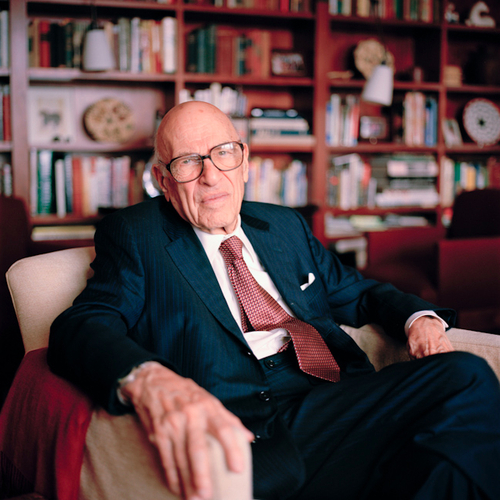

    Walter Schloss was an outlier among outliers, and yet you’ve probably never heard of him. Even I didn’t hear about him until a few years back, while I was in the process of discovering about value investing.

    Schloss graduated high school in 1934 during the Great Depression and got a job as a “runner” at a small brokerage firm. As a runner, his job was to run and deliver securities and paperwork by hand to various brokers on Wall Street.

    The next year, in a stroke of luck, when he asked his senior for a better profile at the brokerage, he was asked to read a book called Security Analysis by Ben Graham.

    After Schloss read Security Analysis, he wanted more, so he convinced his employer to pay for him to attend Graham’s classes. Subsequently, he started working during the daytime while studying at Ben Graham’s classes at night.

    Schloss became an ardent follower of Graham, and even helped him write part of The Intelligent Investor. Anyways, this was when World War II broke out and Schloss enlisted in the army for four years.

    He, however, stayed in contact with Graham, which paid off when he got an offer to work for Graham’s partnership upon returning from the war in 1946…under the man who had once rejected Warren Buffett for a job.

    So, if you wish to become a successful value investor yourself (who doesn’t?), and wonder which MBA to do or which brokerage to start your career with, you can take a leaf from Schloss’ books.

    As he showed, you don’t need a prestigious degree or a great pedigree to start your work towards becoming a sensible, successful value investor.

    Of course, Schloss had his stars extremely well-aligned in terms of getting to work alongside Graham and Buffett, but then remember that he started as just a ‘paperboy’ without a college degree, before working his way through investing stardom.

    As a matter of fact, Schloss left Graham-Newman in 1955 and, with US$ 100,000 from a few investors, began buying stocks on his own.

    But Where is Schloss Hiding?
    You may wonder why there’s not much ever written about Schloss, despite the fact that his investment track record almost compares to Buffett’s and Graham’s?

    Perhaps the reason is that Schloss’ investment philosophy was so simple that there isn’t much to say about it.

    Schloss, as his friends including Buffett reveal, hated stress and tried to avoid it by keeping things simple.

    “Investing should be fun and challenging, not stressful and worrying,” he once said.

    His son Edwin, who worked for him for many years, said this in a memoir after Schloss died in 2012 at the age of 95…

    A lot of money managers today worry about quarterly comparisons in earnings. They’re up biting their fingernails until 5 in the morning. My dad never worried about quarterly comparisons. He slept well.

    Investing Lessons from Schloss
    Keeping things simple and keeping stress away while investing are two of the several big lessons that Schloss has to teach us investors.

    When it comes to analyzing stocks/businesses, a lot of people get stressed trying to perfect their analyses, and thus work extremely hard to seek a lot of information, most of which is useless.

    But as Schloss’ life and experience teaches, unless complexity can improve the explanation of something, it is better to proceed toward simpler theories.

    While fund managers and other stock experts were breaking their heads with complex financial models and theories, Schloss stuck with the simple application of value investing that had been around for decades…at least since the time Graham was teaching. He multiplied his original capital 1,070 times over 47 years while handsomely beating the S&P 500 by simply comparing price to value.

    Warren Buffett wrote this in his 2006 letter to shareholders…

    When Walter and Edwin (his son) were asked in 1989 by Outstanding Investors Digest, “How would you summarize your approach?” Edwin replied, “We try to buy stocks cheap.”

    So much for Modern Portfolio Theory, technical analysis, macroeconomic thoughts and complex algorithms.

    Another big lesson Schloss taught was the importance of paying right prices for stocks. He perfectly mastered Graham’s teaching that you must buy stocks like you buy groceries (you want them cheap), not the way you buy perfumes (expensive is better).

    He also laid importance on buying good businesses when their stock prices fell from where he bought them the first time.

    As he said in one of the very few conference speeches he gave…

    …you have to have a stomach and be willing to take an unrealized loss. Don’t sell it but be willing to buy more when it goes down, which is contrary, really, to what people do in this business.

    Schloss also stressed about the importance of independent thinking. When asked at the same conference that given the market sometimes knows more than the investors, how can one justify whether buying a falling stock would be a right decision or not, Schloss replied…

    You have to use your judgment and have the guts to follow it through and the fact that the market doesn’t like it doesn’t mean you are wrong. But, again, everybody has to make their own judgments on this. And that’s what makes the stock market very interesting because they don’t tell you what’s going to happen later.

    Staying true to your own self and knowing our strengths and weaknesses was also what Schloss was great at.

    He told this to students at a lecture in Columbia Business School in 1993…

    Ben Graham didn’t visit managements because he thought the figures told the story. Peter Lynch visited literally thousands of companies and did a superb job in his picking. I never felt that we could do this kind of work and would either have to quit after a few years or I’d be dead.

    I didn’t like the alternatives and therefore, went with a more passive approach to investing which may not be as profitable but if practiced long enough would allow the compounding to offset the fellow who was running around visiting managements.

    I also liked the idea of owning a number of stocks. Warren Buffett is happy with owning a few stocks and he is right if he’s Warren but when you aren’t, you have to do it the way that’s comfortable for you and I like to sleep nights.

    Revisiting Schloss’ Legacy
    Schloss stuck to a strict set of rules when he was making his investment decisions, and invested purely on balance sheet analysis and valuation metrics that he knew and understood. Also, as I mentioned earlier, he never visited the company managements and if he couldn’t understand something, he would just stay away.

    As a matter of fact, both these factors – not meeting managements and avoiding things I don’t understand – have also worked very well for me in my personal capacity as an investor.

    Anyways, Schloss’ developed his investment wisdom through his closeness to Graham and Buffett and decades of practicing what really worked in the stock market.

    But as a readymade guide for us, he put together a list of 16 timeless principles for becoming a better investor. These principles were published by Schloss on a one-page note in March 1994 titled – Factors needed to make money in the stock market.

    Click here to download the original note, or click on the image below.
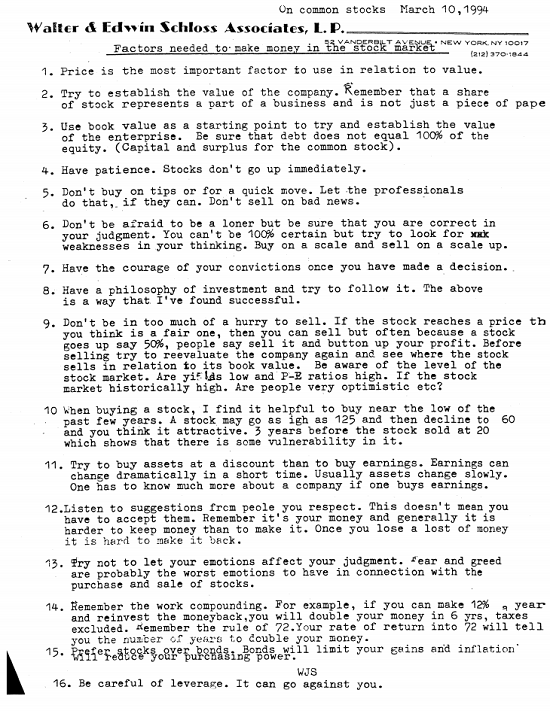

    Here is a summary of Schloss’ investment approach as he practiced over 47 long years…


    Source: The American Association of Individual Investors; * ‘Campbell Soup Companies’ meant those with a long history and that Schloss considered stable and well known
    Overall, Schloss screened for companies ideally trading at discounts to book value, with no or low debt, and managements that owned enough company stock to make them want to do the right thing by shareholders.

    If he liked what he saw, he bought a little and called the company for financial statements. He read these documents, paying special attention to footnotes.

    One question he tried to answer from the numbers was: Was the management honest (meaning not overly greedy)?

    All this paid Schloss and his investors very well, especially because he stayed true to this philosophy for a long-long time.

    Before I close, here is Buffett again on what Schloss was all about, as he wrote in his 1986 letter…

    Tens of thousands of students (who were taught Efficient Market Theory) were therefore sent out into life believing that on every day the price of every stock was “right” (or, more accurately, not demonstrably wrong) and that attempts to evaluate businesses – that is, stocks – were useless. Walter meanwhile went on overperforming, his job made easier by the misguided instructions that had been given to those young minds. After all, if you are in the shipping business, it’s helpful to have all of your potential competitors be taught that the earth is flat.

    Maybe it was a good thing for his investors that Walter didn’t go to college.

    While it might be difficult to practice Schloss’ approach (especially of buying things very cheap) in the current times of most quality businesses lacking margin of safety, there still are many lessons that we can learn from this master of deep value approach to investing.

    Schloss was truly a Super Investor, who deserved a greater limelight than he received.

    But then, thanks to being in the shadows, he was and still must be sleeping peacefully.


    More on Walter Schloss:

    The post 16 Investing Lessons from a Superinvestor the World Forgot appeared first on Safal Niveshak.

        
    19 Jan 04:15

    Of Indian Prime Ministers and their economic advisers..

    by Amol Agrawal
    India born economists (as most are not based here) perhaps lead their counterparts in their efforts to become advisers to the government. More importantly to the Prime Minister. The double standards are just all over the place. On one hand, they criticise the government for all ills of Indian economy and on the other just jump at […]
    18 Jan 05:34

    Walk and SIP

    by Muthu

    This was my last tweet for 2014:

    “One habit to cultivate in 2015: Walking for Health & SIP for Wealth. Both are excellent habits. Give it a sincere try.”

    I’m literally ‘walking’ the talk.

    I’m an inactive person. There has to be at least 150 minutes (2.5 hours) of physical activity every week to get classified as ‘moderately inactive’ instead of ‘totally inactive’.

    Being ‘moderately inactive’ is a relatively much better state than ‘totally inactive’. Please search the net if you want more details in this regard.

    I’ve been trying to walk regularly for last few years. After lot of slips and misses, stopping and starting, again stopping and restarting, doing it so many times, slowly and steadily it has become a habit by now. I never lost hope and stopped trying though I failed in my effort innumerable times.

    Now I walk 5 or 6 days every week. I walk bare minimum 30 minutes a day. I’m planning to make it 45 minutes a day before end of this year. The maximum time I plan to walk is not more than an hour. This would take another year or two to evolve.

    Some people are lucky to get good habits formed quickly. In wealth, good habits came to me much naturally and early. Not as early as I would have expected for compounding to work it wonders; nevertheless it came at a time when it matters. If I’ve not developed wealth building habits by thirties, I would not be where I expect to be in another 20 years; in my sixties.

    In health, it has taken me lot of time for a good habit to develop. I’m 42 and only now I’m able to say with confidence I’ve developed a good habit; walking regularly almost every day. My doctor tells me that I would have been in a better shape now if I had started walking at the same time I started focusing on wealth building. Despite my laziness and lack of will, by sheer repetition, despite failing ever so many times, I’m able to now develop this habit.

    Repetition is the key to habit formation. That’s why I repeatedly reinforce the same principles in my writings as well. Once a positive habit is formed and is repeatedly reinforced, result would automatically take care of itself.

    Even in wealth building, I’ve increased my monthly SIP contribution substantially from this month.

    You are all doing SIPs for wealth. I don’t know what you are doing for your health. Make it a point to do some activity for at least 150 minutes a week. We need to be healthy or at least be alive to enjoy the fruits of financial independence.

    The simple and easiest thing to do is to walk regularly.

    Like SIP, walking is a wonderful habit. Must for you. Keep trying till it becomes a habit.

    All the best.


    15 Jan 07:43

    Investing and Law of the Farm

    by Vishal Khandelwal

    Centuries ago, a Chinese King was sitting in his cabinet meeting discussing about the poor economy of his country. One economist said, “Sir, we can’t do anything about it. It’s the Law of Supply and Demand.”

    The King said, “I’m the King. I will repeal that Law!” The Cabinet kept quiet, but one brave soul said, “Sir, you cannot repeal the Law of Supply and Demand. It’s like the Law of Gravity.”

    And the King said, “I’m the King. I will also repeal the Law of Gravity!”

    Obviously, this story is purely fictional. But the message that comes out is clear – You cannot repeal some laws that govern this universe.

    Like the Law of Gravity, and…

    The Law of the Farm
    What does the Law of the Farm mean?

    It means that a farmer cannot expect to harvest a great crop unless he carefully plans for the development of that crop and works diligently and consistently over a long period of time.


    So, a farmer needs to –
    • Prepare the soil
    • Fertilize the soil
    • Plant the seed
    • Water it and nourish it continually as it grows
    • Tend to the weeds
    • Protect it from insects and diseases
    • Monitor it constantly to know exactly when the best time to harvest will be

    These things take ongoing effort throughout the whole process.

    The farmer cannot plant a crop, do nothing for six months, and then expect to have a great harvest magically.

    There are natural laws and principles that govern agriculture and determine the harvest. But, ironically, in social and corporate cultures, we somehow think we can dismiss natural processes, cheat the system, and still win the day. And there’s a great deal of evidence that seems to support that belief.

    Most students would rather cram their textbooks in one night than learn gradually for a year before sitting in exams.

    Most of us with junked, drugged bodies would want to get lean and fit by exercising vigorously for just a few hours and days.

    Most companies would dump a lot of money on projects and expect them to reap rewards instantly (look at companies that make a lot of acquisitions).

    In the stock market, most of us would want our stocks – mostly bought on tips and borrowed conviction – to fly and earn us fast returns.

    There’s no effort that most of us would want to put to earn a rich harvest (read, good returns) in the future. We wish for results in quick time.

    But then, Warren Buffett wrote this in his 1985 letter to shareholders…

    No matter how great the talent or effort, some things just take time: you can’t produce a baby in one month by getting nine women pregnant.

    As on the real farm, success in life, business, and investing comes from regular disciplined, regular effort.

    Like a farmer cannot expect to reap a bumper crop by being lazy for six months and then “cramming” to catch up, the greatest successes are built slowly and deliberately through focused, consistent, high-quality efforts on a regular basis.

    Investing is no different.

    Cramming doesn’t work in a natural system, which is based on principles. And investing possesses characteristics of a natural system over long periods of time. You can go for the quick fixes and techniques with apparent success in the short run (like four-baggers in four months). But in the long run they just don’t work.

    So, very much like in farming, in investing –

    • You reap what you sow (buy bad businesses, and you’ll lose capital permanently)
    • You must get your hands dirty (it’s important to research your investments well before you buy them)
    • You may often sow for someone else to harvest (your future self, and your future generation(s) will benefit from the compounding you do)
    • Rewards don’t come instantly, but in time (there are ample examples of successful long-term investors, but almost none of traders)
    • You must follow a sound process, and the outcome will take care of itself
    • It’s important to tend to the weeds (however careful you are, you may get stuck in bad businesses and big losses. Just cut them off!)
    • Entire process makes you a lot humble, because you understand you don’t control a lot of things (the best long term investors are the most humble beings – look at Warren Buffett, Charlie Munger, Sanjay Bakshi, Parag Parikh, Chetan Parikh, Howard Marks, and Seth Klarman)

    It’s All About Process, Efforts…and TIME
    You see, farming and investing are both about the right process and the right efforts, and then you must let time take care of things.

    But then, most people in investing miss out on the time part – the waiting part – which, by the way, is the most difficult but most important in the compounding process.

    You can learn all the right things in investing and invest in the best of businesses, but it will be futile – you won’t be able to compound your money – unless you have a long-term view.

    Like a farmer, you cannot forget to seed, water, and nurture your investments, and then think you can “cram” it all at the time of harvest, which may be 15-20 years later (when your financial goals come up).

    So please remember, in investing as in farming, a rich harvest would come to you not from finding easy shortcuts, but from disciplined, focused effort, directed tirelessly toward a desirable goal.

    Try putting the Law of the Farm to work in your investing life. I’m sure you’ll be amazed with the results over time.

        
    15 Jan 07:41

    Good years are ahead

    by Muthu

    Wishing you and your family a very happy Pongal.

    RBI has given us all a Pongal gift. It has cut repo rate by 25 basis points (0.25%).

    Raghuram Rajan has been very clear that he would start cutting rates only when he is confident that inflation has permanently come under control and the government follows a good fiscal discipline.

    He had a target of 6% inflation for January 2016 and is now confident that the same would be achieved and maintained. He envisages a long term inflation of 4% (+) or (-) 2%. So it would be in the range of 2% to 6%.

    In the last 17 months, Rajan has done a wonderful job in bringing down the inflation under a firm control.

    Rajan has also made it clear that his monetary policies would be consistent. Once he starts cutting the rate, he is likely to move only in the same direction. So we are heading for a low inflation- low interest rate regime during next few years.

    As inflation is getting lowered and interest rate comes down, investment cycle in the economy would pick up. Profitability of corporate India would go up. Margin expansion will happen.

    We expect a phenomenal performance in both equity and debt instruments in the years to come.

    You’re all very disciplined equity investors through SIP. You’ve already started experiencing the rewards for your discipline. You may not fully realise yet what kind of rewards are awaiting you in the years and decades to come.

    Other than emergency fund, we’ve been asking you to keep the FD (Fixed Deposit) money in MIPs (Monthly Income Plans). Those of you who listened to us have already been rewarded well in the last few months. For some of you who may be waiting, even now it is not late to consider MIPs. MIPs are any time product. We expect an above average performance from them in next few years.

    Good years are ahead for our country, economy and markets. Increase your participation by increasing your SIPs.

    Thanks to Rajan for giving such a sweet gift on Pongal.