Shared posts

16 Feb 07:04

Introducing: Safal Niveshak’s Value Investing Almanack

by Vishal Khandelwal

It’s easy to assume that learning ends when you’re in your early twenties. You finish college, and go into the “real world” of work. No more term papers, no more exams. A lot of people hardly ever pick up a book again – except perhaps to read on vacation.

Some people never give learning much thought. They pick up bits and pieces in an unstructured way, learning just enough to get through the job at hand.

But it’s important to understand that to accomplish great things in life, you have to keep learning. Investing is no different.

It doesn’t matter how smart you are or how knowledgeable you are as an investor. You can always learn more. To assume you’ve learned everything in investing is to stagnate, and stagnation does not bring success.

If you were to interview the most successful investors in the world today, there is a common denominator: they say they are always learning.

In fact, the simple reason investing legends like Charlie Munger and Warren Buffett are so wise and smart decision-makers is because they have never stopped learning. Instead, they have let the power of compounding work in their learning as well.

As Munger says –

Neither Warren nor I is smart enough to make the decisions with no time to think. We make actual decisions very rapidly, but that’s because we’ve spent so much time preparing ourselves by quietly sitting and reading and thinking.

Anyways, when it comes to learning, the biggest question a lot of people ask me is – “Where do I start and what should I read?”

I am always ready with my list of books worth reading again and again. But the next question is – “Who has the time to read so many books?”

Well, this is a genuine problem as most of us are busy in our work and family lives. So reading through a lot of investing books – even the best ones – and other resources to get through the best ideas is quite a task.

And then all those insights and good ideas come with associated noise. How do you know which book is relevant to you, which is not. How do you separate the wheat from the chaff? It’s such hard work.

Right? Well, not anymore!

Let me introduce…

Safal Niveshak’s Value Investing Almanack

Reading isn’t enough when you want to gain wisdom as an investor. As Charlie Munger says…

We read a lot. I don’t know anyone who’s wise who doesn’t read a lot. But that’s not enough: You have to have a temperament to grab ideas and do sensible things. Most people don’t grab the right ideas or don’t know what to do with them.

So, grabbing the right ideas is of great importance when you are reading. And knowing what to do with those ideas is equally important.

Value Investing Almanack is a brand new newsletter from Safal Niveshak, which will bring you those right, big ideas in value investing, human behaviour, and business analysis, which you must grab to become smarter in your investment decision making.

It will be a monthly newsletter, where we will cover the following –

  1. Spotlight: Big ideas from Value Investing and why applying them in your investment decision making will be a great deal
  2. Behaviouronomics: Deep analysis of human behaviour and how it impacts investment decision making
  3. StockTalk: Thorough analysis of business models of companies (without any recommendations)
  4. Business Snapshots: Quick snapshots of great and gruesome businesses
  5. BookWorm: Reviews of the best books on Value Investing and related subjects
  6. InvestorInsights: Interviews with experienced and upcoming value investors
  7. Corporate Governance: Thoughts on what companies do in terms of good and bad corporate governance and how you can separate the two
  8. Ethical Analyst: Thoughts on loose ideals of the investment industry and why ethical practices are of great importance now than ever before
  9. Life 2.0: Practical and effective ideas on living a simple, sensible life
  10. What We’re Reading: Links to a great external sources we’re reading

In short, there’s a great amount of learning packed in just one newsletter!

Imagine the amount of wisdom you can attain reading this newsletter every month.

Also imagine the amount of time you’ll save reading this one newsletter instead of searching for the best ideas from hundreds of books, websites, and other resources.

In each issue of Value Investing Almanack, we will highlight one thoughtful, provocative idea around the subjects mentioned above. Some will inspire you. Some will make you uncomfortable. All will challenge you to think outside the box.

Click here to download the first issue of Value Investing Almanack absolutely free!

Anyways, you may be wondering why I am using the word “we” here, which is a shift from “I” that I have been using all these years.

To clear the confusion, let me introduce to you my friend and Safal Niveshak tribe member Anshul Khare, who will be my partner in writing and publishing this newsletter.

Anshul works as a Software Architect in the IT industry in Bangalore. He studied chemical engineering at IIT Bombay. He is an avid reader of books from various disciplines including investing, personal finance, psychology, philosophy, spirituality with special interests in the area of human behaviour and value investing.

Anshul is a diligent learner, and one of the most humble fellows you’ll find out there – reasons enough for me to be excited to work along with him on this initiative.

Coming back to the Value Investing Almanack, click here to download the first issue absolutely free for you to check out what you can expect in the coming months.

From the next issue onwards, you can read the newsletter by subscribing to it at a fee that is nominal as compared to the immense wisdom you can attain (while saving a lot of time in searching for ideas) by reading just the Value Investing Almanack.

You can click here to subscribe now. First 200 subscribers can claim Rs 1,000 special launch discount on the newsletter fee.

Here’s to your wealth and wisdom!

    
16 Feb 04:09

The age of negative interest rates

by noreply@blogger.com (Gulzar Natarajan)
Nothing captures the consequences of the obsession of world'a major economies with monetary policy fixes to their real economy problems better than this graphic which shows the five year sovereign debt of six countries trading at negative yields.
In other words, investors are paying to hold the debt of these countries. Fundamentally, in a deflationary environment, lenders can make money even with negative interest rates. Further, if market expectations are for further decline in yields, investors can make money by buying even negative yielding bonds as long as their prices keep rising.

The ECB's big bazooka decision to purchase 60 billion euros worth sovereign bonds every month for a prolonged period has jolted central banks outside the eurozone to respond to its potential vulnerabilities. Faced with a weak eurozone and the potential for a break-up of the currency union, speculators have been piling into safer assets of economies like Denmark and Switzerland with the hope of making large profits if those currencies appreciate. Given this and the prevailing deflationary environment, the risks are mainly two-fold - appreciation of currency and accumulation of bad quality assets.

The SNB's decision in mid-January to revoke the euro-franc peg, itself put in place in September 2011 to stem an appreciating currency, was motivated by growing apprehension about the riskiness of rapidly rising stock of eurozone sovereign bonds. The result of revoking the peg was that Swiss franc appreciated over 15% overnight. In order to mitigate the adverse impact on the currency, the SNB simultaneously lowered what it costs lenders to keep money at the central bank from minus 0.25% to minus 0.75%. In contrast, Denmark, which has pegged the krone with euro, appears to believe that the negatives from currency appreciation outweigh the threats from accumulating euro-zone assets. Accordingly, since January the Danish central bank has spent about $24 bn buying euro assets and has lowered rates four times to minus 0.75% on commercial lending.

Sweden and Finland are the latest entrants to the negative interest rate club. The former lowered the benchmark interest rate, the rate at which Swedish commercial banks can take out loans from the Riksbank to minus 0.1%. Last week Finland raised $1.14 bn in a five-year bond auction at minus 0.017%, becoming the first nation in the region to pay negative rates on its debt. Apart from stemming currency appreciation, especially important for countries deeply dependent on exports, negative rates are also aimed at encouraging companies and individuals to invest and spend more and possibly stoke inflation.

It is not just countries that are seeing negative interest rates. Nestle's two year corporate bond, which is due to mature in October 2016, touched the negative territory last week. The eurozone government's austerity programs (and resultant lower deficits) and ECB's sovereign bond-buying program have shrunk the pool of government bonds available for financial institutions (which need safe bonds as collateral for short-term borrowing), forcing them to turn to blue-chip corporate debt. The stock of negative yield sovereign bonds have risen to $3.6 trillion or 16% of global sovereign bonds. See also this and this for more on negative interest rates. 
Add to Technorati Favorites
16 Feb 04:07

When should you move to an old age home?

by subra

Tough question to ask. I have no clue as to what age I will move into an old age home. By this I do not mean geriatric care, but just a place where I can get some assistance for day to day living.

For most people it is ‘when I feel I cannot live on my own I will move’ – this is like an employee saying ‘I will retire when I feel I cannot do the work assigned to me’ – it is a completely nightmarish a situation.

So using some American examples, let us see what ‘Activities of Daily Living’ that you should be able to perform (properly) to be able to live alone (or with spouse, assuming she is of the same age):

Get up from bed

Sit and Stand without any assistance

Do personal grooming properly

Use the toilet

Cook

Eat

bathe

banking – investing, make payments for utilities, etc.

shopping

walk – for your personal requirements

be alert to the service providers – maid, cook, driver, etc.

ANSWER YOURSELF honestly, and if you fail one of these tests, move into an institution which provides assisted living.

What more tests should actually be seen?

– ability to handle medication

– manage laundry

– manage security in the house

– manage phone calls

– not have a neuro / physical problem

And living alone is an absolute no no if you have a history of memory lapses, any illness which leads to fainting, …etc.

Happy to add more…

Post Footer automatically generated by Add Post Footer Plugin for wordpress.

15 Feb 03:57

Why we fail…

by subra

Most of us are very poor planners. We plan, but do not execute.

How do we solve this? by planning again. And failing again.

I met an entrepreneur who wanted to raise about Rs. 30 crores for a project. I looked at the project papers, excel sheets, etc. and came away impressed. Then I did something that he did not expect me to do. I spoke to his banker (he had a very small banking facility, but I still met the banker. There I saw some of his past promise vs. performance. It was appalling to say the least. Sure he had got lucky a couple of times, but hey that was luck, was it not. There was no pattern of client acquisition, service and letting clients go (what I call the Brahma, Vishnu, Mahesh of business). In one project he had achieved (believe me please) LESS THAN ONE PERCENT of what turnover he had projected. That project was still on.

What is there in this for you?

Let us see why this happens:

– Overconfidence: we are all overconfident of our equity picks and of our fund picks. Our own track record maybe pathetic, but that does not deter us from picking the next winner again.

– For many people the goals that they have are completely unrealistic. They would kill me if I tell them so, so the best thing is to pretend that the goals will be achieved, and wait for time to tell them that the goals are unrealistic.

– Most of us are hoping for a high ‘r’ so that we can achieve our goals, without realizing that the amount invested and for a long period are far, far more important than the ‘r’ which anyway we cannot control.

– We want to have a nice work-life balance, a BMW (at least), a 5 bhk, and retire at 30. Statistically impossible unless you are born with these things anyway.

– Assuming you achieve all this by 40, even then in a poor country like India, statistically speaking, you are noise.

– Sadly even as a banker poring over clients numbers on a monthly basis there is a limitation about what we know about a company.

– Only when an executive of the company files a paternity suit or a harassment suit do you realize what a sleazy head of HR the so called listed company had.

– We pretend we know much more than we actually do.

– ‘I do not understand’ are the 4 most precious words in Investing. Terribly under rated words.

– I know of CEOs who have no clue of their forthcoming quarterly results. Sucks.

– With experience I have learnt to love the bumbling guy with low confidence level to a confident sounding jerk. Immaterial of whether he is a CEO or an analyst. Overconfidence sucks.

Post Footer automatically generated by Add Post Footer Plugin for wordpress.

14 Feb 03:59

The Great Indian Bamboozle has to Stop

by Atanu Dey

[Edit note: This piece was written & published elsewhere in Oct 2013. The Indian political scene has changed somewhat since then, thankfully under the leadership of Prime Minister Shri Narendra Modi but evidently not enough. True that Rahul Gandhi is no longer relevant but clearly sleazy politicians like Kejriwal and his minions are successful in bamboozling the public in Delhi. This piece is, unfortunately, still relevant.]

If the people of the village, in the best traditions of their hallowed democratic processes, elect the village idiot as the King and Supreme Ruler of the village, it is hard for me to bring myself to find fault with the village idiot. It’s not the idiot’s fault that nature dealt him a lousy hand in the random genetic draw of life. He’s a congenital idiot and made no demands on being recognized as a paragon of wisdom and virtue. Based on that principle, I indicted American voters for electing some of their recent presidents, a few more than once. I can see no reason for not applying that principle to India.

Rahul Gandhi, also widely known as Pappu, is for all appearances a decent enough chap. He didn’t choose to be born to the Gandhi family any more than he sat around selecting his genes from the human gene pool. It was a random draw. He cannot be held responsible for the actions of a fairly large segment of the Indian population who wish to have him as the ruler of India’s destiny. India is a democracy, don’t you know, and the will of the people (admittedly a minority in all known cases) prevails.

India is a country of over 1.2 billion people, about 800 million of whom are desperately poor. None of us can even comprehend how those desperately poor live their lives on less than US$ 2 equivalent a day – an estimated 400 million children malnourished and with no prospects of their ever realizing their human potential; no access to clean drinking water or sanitation for hundreds of million; no chance of getting a decent education; never eating good, nourishing food or enjoying any of the marvellous goodies that modern life has to offer. Nearly 700 million are not reasonably educated and around 500 million of them are actually illiterate even in the 21st century of the Common Era.

For nearly all of its existence as an independent political entity, India has been ruled by the Congress party. That political party inherited from the British all the rules (and added a few of their own) that govern the economy. Ultimately rules are what matter and dictate the destiny of states. Economic policies, a subset of this set of rules, determine whether the country is desperately poor (such as India) or reasonably rich (such as Taiwan.) Social policies determine whether there is social peace (such as in many advanced industrialized countries) or there is internal discord (as seen in third rate countries such as Pakistan, Bangladesh, and most tragically India.)

It seems hard for me to avoid the conclusion that India’s present dire straits must be to a large extent the doing of the Congress party. But then another thought arises. It was not some heavenly diktat or supernatural force that made the Congress to have such destructive power in India. In India they take democracy seriously, as we are constantly reminded to the point of tedium. The Congress party ruled and rules because the people of India – or at least a significant proportion of them – find them worthy.

The Americans have a saying, “Fool me once, shame on you; fool me twice, shame on me.” The people could be forgiven for putting Nehru on a pedestal and worshiping him for a few years following the political independence of India. But to keep electing his entire brood of incompetent descendants whose policies have deepened poverty, divided the country on caste and religious lines, and generally made life hell for nearly all Indians, is the height of folly. Being fooled repeatedly by the same party should be a matter of extreme shame. No one needs to be so persistently stupid and gullible. Indians should collectively do what the Hindi saying advices — chullu bhar pani mein doob maro.

I have spoken to people who have had the opportunity to observe Rahul Gandhi at close quarters. A journalist friend of mine spent three days with him during the last general elections. She confided in me saying, “He’s an OK guy. Not the sharpest knife in the drawer. He’s definitely slow on the uptake, to be honest. Despite being born with a silver spoon in his mouth, he has little to show for himself. He does not have the intellectual horsepower to manage a road-side restaurant. He’d fail at that. Yet he may get to follow the footsteps of his father, his grandmother, and his great grandfather and lead India further into poverty. It’s a crying shame that he’s even in the running for the PM’s job in a country with 1.2 billion people.”

For years I have been saying that the quality of Indian leadership should make us weep and keep us awake at night not so much because the leaders are generally incompetent, lying, myopic, immoral and unethical — which evidently they are — but because the character of the Indian leaders is a sure indication of the character of Indian voters. Our choices, big and small, reveal our character powerfully and unequivocally. We show who we are by choosing who are leaders are to be.

If one believes in the theory that one’s past lives’ karma dictate one’s fortune in the current life, one would have to conclude that in their past lives Indians must have accumulated pretty horrendous bad karma. I don’t believe in the past life thing but I do believe in the theory that we produce our own karma in this very life — and then we and our children pay for our misdeeds.

It is time Indians did a bit of honest soul-searching and for once decide not to vote for morally and ethically challenged politicians. But I am not sanguine about that prospect. Carl Sagan in his important book The Demon-Haunted World pointed out that—

One of the saddest lessons of history is this: If we’ve been bamboozled long enough, we tend to reject any evidence of the bamboozle. We’re no longer interested in finding out the truth. The bamboozle has captured us. It’s simply too painful to acknowledge, even to ourselves, that we’ve been taken. Once you give a charlatan power over you, you almost never get it back.

We have been bamboozled for too long. But it is time to stop being so self-destructive. Most of all, I wish we would not vote for village idiots, regardless of how shiny their pedigree. We must get our power back.

13 Feb 04:00

Financial worries that people carry

by subra

Every person carries some financial worries or burdens, here is a list of such worries that I notice:

1. My husband handles all the money and I do not know what is happening: very common among women who want to participate in the action. Sensible too, but does not always happen. Sigh.

2. My wife does not pay attention at all about our finances: far more common than the first complaint…but does exist.

3. I am not sure that I will ever be debt free – so I will have to work till I drop dead.

4. Me and my wife shop till we drop dead, how will this impact out goals?

5. I often talk about making a will, but have done nothing about it.

6. My parents may move in anytime, and I am not financially prepared.

7. I have no clue how will I pay for college tuition fee, forget paying for my daughter’s wedding.

8. Retirement? You got to be joking, I am sure. I am just 42….and have about 20 years to go.

9. I am paying 2 emis – one for the current house and one for a house I bought in the outskirts last year. My EMI will last till my age of 54…by then I will be debt free except of course if I buy a new car…

Post Footer automatically generated by Add Post Footer Plugin for wordpress.

12 Feb 06:13

Now MAKE the resolutions work…

by subra

It is Feb and you are already lax about your health and wealth goals, right?

It happens.

How do you make the resolutions work day after day, month after month….? It is not easy, but let us try the following steps:

1. Stop criticising yourself, but do not get too complacent.

2. Tell yourself it is ok to slip up on goals and reach a lesser target – it is much better than giving up totally.

3. Make a list of your goals once again…and PRIORITIZE the goals. NOW. See which is more important…

4. Pick up the top three goals. Identify the next steps to achieve the same. START WORK ON THAT NOW.

5. Drop everything else…and work on these top 3 goals, immediately.

6. Proritize, recommit, go about achieving the goals. Simple, ain’t it?

Post Footer automatically generated by Add Post Footer Plugin for wordpress.

12 Feb 06:12

Gift to Family members – 3 awesome tips to save income tax legally

by Manish Chauhan

Most of the people in India try to save income tax by investing the money in their spouse, children and parents name. We are going to explore this topic more deeper and help you understand the exact rules applicable and how you can save more tax legally, by gifting money to your family members. Majority of people, just transfer the money to their family member account and invest that money,...

The post Gift to Family members – 3 awesome tips to save income tax legally appeared first on Jagoinvestor - Personal Finance Blog.

12 Feb 06:06

Are You Playing the Stock Market’s Favourite Game?

by Vishal Khandelwal

One of the most popular questions that a business channel anchor or an analyst asks a company’s management is – “What’s your EPS estimate for the next quarter and year?”

For those who are not aware, EPS is the short form of ‘earnings per share’ and is calculated by dividing a company’s earnings/profits by its total number of shares.

During my initial days as a stock market analyst, even I was guilty of asking similar questions about earnings, though all I wanted to hear from the managements was their long-term outlook (like for 3-5 years) and not for the next quarter or year.

The truth is that the entire investment community is undeniably fixated on the EPS.

All business newspapers, magazines, channels, and experts freely talk about quarterly earnings, EPS growth, and price to earnings multiples.

The interesting part is that the stock market also reacts to the earnings numbers.

Anyways, people’s fascination with earnings estimates is not terribly puzzling. In fact, it is perfectly rational in a market dominated by agents responsible for other people’s money but also looking out for their own interests.

But what such obsession with earnings does is that it leads investors to believe that this one number strongly influences, if not totally determine, stock prices.

This is despite the fact that EPS is not the most appropriate number to use for valuing a company.

There are several shortcomings of earnings, like:

  1. Earnings do not show whether the company is utilizing its capital profitably or not.
  2. Earnings exclude the incremental investments that a company makes in its working capital and fixed capital that are so important to support its growth.
  3. Different companies can use different accounting principles to calculate earnings, so a comparison cannot be drawn between two companies.
  4. It is easy for companies to manipulate earnings by either inflating revenues of deflating expenses.

However, notwithstanding these shortcomings of earnings, most experts love playing the earnings expectations game.

The fact is that it’s just the wrong expectations game to play.

A Game of ‘Winks and Nods’
It is hoped that the case for the unreliable link between short-term earnings and shareholder value is sufficient to discourage investors from participating in the popular earnings expectations game. This is simply because it is the wrong expectations game for investors who seek superior long-term returns.

This is true not only because of the shortcomings of earnings but because of the way the game is played.

The earnings expectations game is simply a ritual dance between management and analysts.

In fact, the former chief of the US stock market regulator Securities and Exchange Commission (SEC) Arthur Levitt called it a ‘game of winks and nods’.

In Expectations Investing, the authors Michael Mauboussin and Alfred Rappaport write:

“Analysts have to guess how much a company will earn each quarter. But a company is allowed to provide the analysts with clues, or so-called guidance, about what is thinks earnings will be. This guidance number usually shows up as the consensus estimate among analysts. If the company’s actual earnings meet or just beat the consensus, both the company and the analysts win: the stock goes up, and everyone looks smart.

The game might not sound so hard, but it requires a lot of cooperation. Companies are under enormous pressure to achieve the consensus earnings estimates while analysts rely on those same companies to help them form their earnings expectations in the first place.”

You might wonder how companies participate in this game.

Well, companies generally have two ways to play it out.

One, to manage the expectations of investors and stock market, companies guide analysts to a number that they can beat. And two, in order to beat expectations easily, they are very conservative with respect to their near-term prospects.

In simple terms, a company would feed the analysts by telling them that they expect to earn Rs 100 as EPS or earnings per share in the next quarter.

Analysts would take this number, do some calculation around it, and arrive at their own expectation of an EPS number that is somewhat close to Rs 100. They would then feed the market and investors on this expected EPS number, say Rs 95 per share.

The market and investors would then start to believe this number.

Then, when the quarter ends and the company releases its earnings report, it would say that its EPS during the quarter stood at Rs 100 per share.

Remember, this was the same number they had revealed to analysts earlier, which the analysts had chewed to spit out the Rs 95 per share number to investors.

Now, since the company has announced Rs 100 EPS against the market’s ‘expectations’ of Rs 95, the analysts call it an ‘outperformance’.

The ultimate result is that investors also start to take this as an outperformance and are willing to pay a higher price for the stock. The stock rises.

You got the game, didn’t you?

Anyways, there might be a case when this company faces a situation where investors are expecting a higher EPS (say Rs 110), and it finds it difficult to earn that much during the quarter.

What it can do in such an instance is simply use some accounting tricks to achieve that magical EPS number of Rs 110, and thus ‘meet expectations’.

Now the question is – How involved and interested are managements in this earnings expectations game?

Well, here is what a Harvard Business Review report that throws light on this…

Privately, corporate chief financial officers admit that they would like to spend less time and effort satisfying Wall Street’s demands for continuous, predictable growth. But they feel they don’t have much choice, because the cost of disappointing the Street is so high.

You see, the quarterly earnings management has become a sort of talisman for companies and those who analyze them, invest in them, or audit them. However, the fact remains that this game causes more harm than amusement.

When managers are focused on meeting or beating short-term earnings expectations, it distorts their decision making. A large part of the management’s attention is focused on keeping the analysts and markets happy.

What is more, a lot of companies willingly borrow profits from the future to make things look good in the present (how they do this is a subject of another discussion).


This entire scheme also reduces stock analysis and investing to a guessing contest. A large part of a stock analyst’s job is just to keep figuring out what the sales, or expenses, or simply profits are going to be in the next 1-2 quarters.

Ultimately, it undermines the faith that most investors have on the stock market because, every quarter, they are served some fiction, and become part of the cynicism that surrounds the meeting or beating of expectations.

Play it Safe!
Just notice the next time Indian companies announce their quarterly results. You will find most of them either meeting expectations or beating expectations!

But now you know how this entire game of ‘earnings expectations’ is fixed. What you can do to safeguard yourself against the fixers is to separate companies that are genuinely working towards better long-term performance from those that skillfully manage short-term expectations and earnings.

And how do you do that?

Just stick with companies having good businesses, safe balance sheets, and clean managements at helm.

Always remember, there’s a great appeal in the word ‘earnings’. So you have to be very-very careful and not fall into the earnings expectations trap.

In fact, here’s a new definition of EPS that you can start using from today. It’s Expectations Per Share…and the wrong kind of expectations!

    
11 Feb 08:21

By 2020 The Internet of Things Will Be Bigger Than You Think

by Alnoor PeerMohamed

We’re at yet another cross roads of how we access and use the Internet, first migrating from PCs to handheld devices and now to everyday objects and devices.

Internet of Things Market (1)

This revolution is being touted as the Internet of Things (IoT) and promises to connect our homes, workplaces and cities, making them smarter. The connected device market will soon be larger than the PC, smartphone and tablet markets combined, with an estimated 25 billion IoT devices in use by 2019.

This growth will hold massive revenue generating opportunities for companies, with the IoT market estimated to be worth $600 billion by 2019. Majority of this will be powered by software and services rather than hardware, with the overall IoT market expected to grow at 44% CAGR over the next five years.

Internet of Things Market (2)

The growth of IoT will also aid companies present in the Big Data and Cloud computing spaces. The amount of data generated by IoT devices will be massive, with the total amount of data generated estimated to hit 40,000 exabytes by 2020, as opposed to the current 10,000 exabytes.

What will drive IoT adoption?

  • Over half of the world’s population will have access to the Internet by 2019
  • Over 1 billion homes will have Wi-Fi connectivity
  • More people will own smartphones and other connected devices
  • The price of sensors in IoT devices will continue to fall

While there’s a lot of buzz surrounding the IoT in the consumer market, enterprise and industry customers will contribute to a larger chunk of the market at first. Businesses will invest close to a quarter trillion dollars in IoT by the end of the decade, with most of that going towards software and services rather than hardware.

Internet of Things Market (3)

It is expected that IoT adoption will grow across all industry sectors, but manufacturing and logistics businesses are the earliest of adopters. Partly, this is due to the increasing adoption of industrial robots, like the ones in Amazon’s warehouses that are estimated to save the company $900 million annually.

Civilian use of drones is another area which is growing massively, despite the safety, privacy and regulatory concerns. Companies like are already developing technologies to use drones to make deliveries, but for now the world’s defence forces are still the biggest buyers of UAVs.

Legacy technology companies are indeed well equipped to cater to the demands for connected devices and services, however increased investments in IoT startups are starting to pile up. In 2014 alone, Investors invested $341 million in IoT startups, up from just $193 million in 2012.

Internet of Things Market (4)

Further, IoT M&As in the January 2012 to November 2014 period amounted to $7.7 billion, with the biggest chunks of money being spent on monitoring ($3.9 bn) and connected car services ($2.8 bn).

IoT for consumers

The connected home is at the top of the list of consumers must haves, with home automation and energy applications leading the sector. The smart home market is estimated to be worth more than $1.6 billion by 2019, up from the current $200 million. The Nest smart thermostat is an early success in the sector, with an estimated quarter million units being operational by the Q1 of 2014.

Internet of Things Market (5)

While manufacturers are marketing smart home devices under the guise of energy savings, not all consumers are convinced. A survey shows 41% percent of consumers feel the IoT devices they’ve seen are gimmicky, while 58% of consumers said they won’t upgrade to IoT devices unless they’re more than just a novelty.

Early successes in the IoT for consumers market are smart TVs and connected cars. It is estimated that one-third of all homes in the US already own a smart TV, while estimates put the connected car market at 100 million units by 2020. However, there are still issues of low consumer awareness that’s hindering the growth of connected devices.

Based on insights from a BI Intelligence report

The post By 2020 The Internet of Things Will Be Bigger Than You Think appeared first on NextBigWhat.

11 Feb 08:20

Sahara Gets Its Dose of Irony, Its Rescuer Mirach was just a Mirage

by Deepak Shenoy

This Sahara thing is totally funny now.

So Sahara Chief Subroto Roy has been cooling his heels in jail for the better part of a year now. Because the courts will only let him go if he repays Rs. 10,000 cr. he owes investors. Roy had said he has the money, but was never able to prove it, so the court said bring us the 10,000 cr. and we’ll give you bail.

He’s probably not liking this jail thing so much, which is why he’s been negotiating with anyone, just about anyone who can give him the paltry sum of Rs. 10,000 cr. to get him out of there. What’s a few thousand crores between friends, he must be thinking after which he instantly realizes he has no friends.

But one turned out of thin air – California based fund Mirach capital is run by Saransh Sharma who said he’d lend the money to Roy, using the Sahara Group’s hotels in London and New York as collateral.… (Read On...)

11 Feb 08:20

Why more equities when you are young?

by subra

You hear many people tell you that when you are young you can take more risk.

Let me explain this better.

When you are young (say 22-35 years of age) you start investing small amounts in equity mutual funds. Let us say you started doing a SIP when you were 24 years of age with a princely sum of Rs. 2000. By the time YOU reached 30 years of age the SIP amount has say increased to Rs. 30,000 per month and it reached Rs. 50k per month when you are 35 (your current age). This is not a bad amount – especially if you are paying an EMI for a house / car etc.

Can you afford to put all this money in equities and equity oriented debt funds like Hdfc Prudence? The answer is yes, especially if you have a Provident fund – and there is a pf deduction also from her salary. You are still only about 70-80% in equity.

Suppose at this stage the market falls say 20% will it not hurt you? Of course it will. It will hurt badly. HOWEVER IN A GOOD PORTFOLIO IT IS NOT THE VOLATILITY THAT HURTS, it is the permanent dimmunition in capital – like buying ADAG’s Reliance Power – bought at 465 and now selling at Rs. 45….

So the younger you are, the LESS WORRIED YOU SHOULD BE of volatility. Permanent loss of capital, inflation, not being able to meet goals, ….these are the risks that you should be worrying about.

If you are worried about a temporary jerk in the market, go and read your risk chapters again….


Post Footer automatically generated by Add Post Footer Plugin for wordpress.

11 Feb 08:20

Grand Victory: Lessons for Traders

by Sudarshan Sukhani
The Delhi elections have given a truly spectacular victory to AAP (Aam Aadmi Party). Winning 67 out of 70 seats is probably a record, unlikely to be repeated by anyone.

There are many lessons for traders from the career path of the AAP.

1. AAP was created to fulfill a burning desire for an anti-establishment political group.

Lesson:
People should become traders when they have a burning desire to trade. Wanting money is NOT a burning desire.  Trade when you want to fill the need for trading, not because you want money.

2. AAP was suddenly very successful in the 2013 elections. This was beginners luck.

Lesson:
Many traders make money at the very start. This is beginners luck, but the new trader thinks it is his skill.

3. The 2013 election victory of AAP gave them the false impression that they were invincible. This caused two mistakes. First, they abandoned their government. Second, they contested 400 seats for the 2014 Lok Sabha election. The result was a catastrophe. AAP was almost finished.

Lesson:
When new traders taste profits, they start flying. They increase volume, add leverage and feel they can do no wrong. The result is almost always a disaster. The trader loses so much money that he goes out of the trading business.

4. From the ruins of disaster, AAP regrouped. They decided to focus only on Delhi. They refused to participate in the many state elections that were held, including Haryana.

Lesson:
Traders, MUST focus on the markets. They should determine the type of trades they are comfortable with, then forget about all other trading opportunities.

5. The 2015 elections have given AAP a victory even they could not have imagined. What the party did was to follow their plan, and, leave the results to God.

Lesson:
Traders should never look for earnings. What they should do is follow their plan and leave their results to the market. Often, they will be rewarded many times more than they ever imagine.

11 Feb 08:18

Story in every office…

by subra
 this is a forward that I got….I have added a few Ramayan characters…the forward had only Mahabharata characters….
Dronacharya:
The Mentor. The employee who doesn’t like working himself but is always ready to guide and train new joiners.
Bhishma:
The Loyal. The employee in a relatively senior position who happily assists the boss in spite of knowing his incompetence (because of some strange oath maybe)
Dhritarashtra:
The blind boss. He knows that everything is wrong with his project but will still let it function, without making any changes to the current processes.
Gandhari:
The Yesmen/Women. Boss’s immediate juniors who know that they are a part of an evil plan but will stay blindfolded and pretend as if nothing is happening.
Yuddhisthira: 
The ethical guy. Poor chap would never fudge timesheets and call in sick only when he is dying.
Bheema:
The angry resource. Always ready to pick up a fight with his peers, subordinates or even the bosses.
Arjuna:
The cool dude. The star performer who also knows how to sell his skills. A natural charmer, very famous among the ladies.
Nakul & Sahdev:
The good average resource. No one notices them. They keep doing their work and get average appraisals.
Duryodhana:
The Bully. Knows how to get work done, by hook or by crook. Doesn’t mind threatening the likes of Nakul and Sahdev to get his work done.
Karna:
The unsung hero. The best performer in the office but never claims credit for his work. Stays an unsung hero for all his life. Girls take him for a snobbish nerd.
Shakuni:
The evil plotter. Copies management in every mail. Escalates every trivial issue, sometimes to take credits and sometimes purely for fun.
Dhristadyumna:
The One inning wonder. The one who performs an extraordinary feat, and then basks in the glory of it for the rest of his life.
Draupadi:
The shared resource. Keeps hopping projects on boss’s advice.
Krishna:
The Ultimate Boss (MD/CEO) who knows that it is his game.
Hanuman:
The guy who has been around for long and can find anything that the company has done/ achieved /not done in the past.
Lakshman:
The boss’s junior partner in the business. To the outside world looks like a Yes man, but is a very useful resource. Will fight with the boss only inside closed doors.
Ravana:
The boss who calls a meeting typically to say “I will not return Sita and I have a great army…now tell me should I go to war”. Gives people a feeling of democracy. It is actually a dictatorship.

Post Footer automatically generated by Add Post Footer Plugin for wordpress.

11 Feb 08:16

The many mistakes of Narendra Modi

by T T Ram Mohan
Vox Populi is Vox Dei. The voice of the people is the voice of God. Whatever  your political leanings, it's hard not feel a sense of exhilaration over the outcome of the Delhi elections.The people have spoken- and how!

It's not just a vote for Kejriwal & Co. It's a vote against the NDA government. It's an expression of anger against the Modi and the BJP. That alone can explain the margin of victory of Aap.

How has this come about? Why are the voters of Delhi so angry? Let me list what I think are some of the mistakes Modi has made. Some of these points may have been made by others but I'd like to add my own little voice:

i. Choosing Kiran Bedi over the heads of long-serving leaders of the Delhi BJP: Harsh Vardhan, now a minister in Modi's cabinet, was a five-time MLA. He's known for his probity. He was discarded in favour of an outsider. Moreover, an outsider who had been baiting politicians, including Modi, until very recently. This angered not just BJP workers but the electorate. What was on display was the politics of opportunism.

ii. The Land Acquisition ordinance: This allows the government to grab people's land without their consent. The slum-dwellers of Delhi must  have reckoned that, if the government could grab land that poor people owned, they wouldn't think very hard about uprooting poor people who were sitting on land they didn't own (whatever the poll promises of the BJP).

iii. Proximity to industrial houses: We've had so many functions where the leaders of industrial houses, some of whom are close to the BJP, have showed up. It's not a good for politicians in India to advertise their proximity to industrial houses. The BJP came to perceived as the wrong AAP- Ambani and Adani Party.

iv. Making a huge spectacle of the Obama visit:Ok, you wanted to get the US president over. But was it necessary to make such a spectacle out of it? There's a difference between being comfortable with world leaders and grandstanding.

v. Flaunting the Rs 10 lakh suit: Especially on the social media, the impact of the monogrammed suit was hugely negative. People had voted in Modi because they identified with and admired his chaiwallah background. What they saw in the suit was somebody very different, a member of the Delhi elite.

Modi rode to power on the strength of the perception that he was an outsider who would bring to the capital a very different style of leadership, one that resonated with the aspirations of the aam admi. In his nine months in power, Modi began to look like any other member of the Delhi Durbar. This was disappointing. That disappointment has made its felt.

It's a setback but not the end of the road. Modi is a seasoned leader, somebody with the capacity to learn from mistakes. He must go back to being his original self, a leader with a natural empathy for the section of society from where he comes. And he has to make adaptations to the economic model he followed in Gujarat. He must not forget that, at least in the immediate future, the only economics that will work is one that is resolutely people-oriented- and seen to be so.


11 Feb 08:15

More lies and more bad money management…

by subra

Let us look at some more lies that we tell ourselves:

1. I had to go to a wedding…and had to over eat.

View: Complete lie. Even at a wedding there is a huge range of simple food – daal rice for example. We over eat because WE CHOOSE TO OVEREAT, not just because somebody asks us to. Between idli and samosa if you choose samosa..why blame the caterer? See how this applies to being ‘popular’ and ‘exciting’ while you invest.

2. You sold short when you realized that AK of  the 49 fame will come to power. The market actually went up. It is NONE of your financial business about who is the CM of Delhi. Or the PM of India. Or the president of the USA.

3. Aam dani attani, kharcha rupaiya: Collectively your family spends / plans to spend a rupee more than you earn. All the best for your investing efforts.

4. Your daughter has just got a job with a CTC of Rs. 4.5 lakhs. She claims she will fund her ‘grand marriage’. The estimated costs as of today is Rs. 40L.

View: What should you be telling her? At this net take home, it will take you a decade to put together the amount required. Stop pretending :-)

5. Simple lack of understanding of volatility, patience, compounding and inflation is hurting you much more than NOT understanding QE, Obama’s medicare, Modi’s inaction, Jaitely’s budget…et al.

6. If your definition of long term is ’till the next recession’ – you need time watching skills. Get yourself a new ‘watch’. Pun intended.

7. You are amazingly certain of the forthcoming budget, oil prices, gold futures, and of course the sensex. However you have no clue on how much you need to invest for your goals. God bless.

8. You cannot predict markets. You have never been able to. However this does not stop you from trying again.

9. Even if you got the market right last time, you did not know what to do with it. You got the market right, sector right, and the company right. Dammit, you did not buy any shares :-)

10. When Subramoney.com says buy a house with a 45% down payment, you laugh. Then you watch some business channel and get very upset that Jaitely runs a deficit budget. Look within.

Post Footer automatically generated by Add Post Footer Plugin for wordpress.

10 Feb 05:42

Bonus Stripping and the Impact of Arb Fund Unwinding on the Market

by Deepak Shenoy

You gotta hand it to Manoj Nagpal (@nagpalmanoj). (He’s a great guy with excellent insights on mutual funds!) In a conversation on the impact of converting arbitrage funds to debt funds, potentially in the budget, he spoke of the strange happenings at JM Mutual Fund’s Arbitrage scheme.

The Massive JM Fund Inflow

JM Arb Fund was one of the big recipients of investor money, which according to Manoj came in even before the budget (which was on July 10 or so). This money amounted to Rs. 5,500 cr. (approx). The entire idea was to do bonus stripping. That is:

  • Fund would announce a bonus three months later (in Oct/Nov)
  • Investors would get X units at 0 while continuing to own existing Y units at whatever cost they bought at
  • With the bonus, NAV would fall to a much smaller amount (for a 1:1 bonus, or 100% bonus, price would fall to half)
  • Investors could sell their original Y units at a short term capital loss.
(Read On...)
09 Feb 05:02

When to Sell a Stock (E-Book & Checklist)

by Vishal Khandelwal

Most investing discussions revolve around when to buy a stock. “Which stock should I buy?” is the first question that comes to your mind when you think about investments. But equally important is the question – “When should I sell a stock?”

Now, there aren’t any “10 Immutable Laws of Selling.” In fact, the answer to this question is often as difficult and subjective as deciding when to buy a stock.

But, without doubt, a disciplined sell process injects a healthy dose of Darwinism – survival of the fittest – into the portfolio. This process weeds out the weakest stocks – the ones that have deteriorated / deteriorating fundamentals or diminished margins of safety – in favour of stronger ones.

In a special report, and through a diagrammatic checklist (see below), I try to answer some of the questions around when to sell a stock. Not every selling rule under the sun may be included herein, but I’m sure what you read and see below will still be of some help to you.

Click on the image below to download the special report, or click here.


And here’s my hand-made When to Sell a Stock Checklist


Click here to open a larger image of the checklist.

Let me know your thoughts on the special report and checklist in the Comments section. Also, for the benefit of others, please share your personal rules, if any, for selling a stock.

P.S. The idea of drawing the checklist came from my friend, Anshul Khare. Thanks Anshul! :-)

The post When to Sell a Stock (E-Book & Checklist) appeared first on Safal Niveshak.

    
09 Feb 05:01

How to pay off your Marriage Loan?

by subra

An American website says that the average cost of a wedding has gone up to $ 30,000. Now if you adjust this for purchasing power this is about Rs. 10L (say).

Indian marriages cost much, much more than that. More like Rs. 20 lakhs for a decent wedding to about Rs. 1 crore for a post upper middle class wedding. Let us not go into the destination weddings and things of that genre.

Why do Indian weddings cost so much? Simply because it is the parents of the groom and the bride who do the spending. I cannot imagine the 28 year old groom and the 25 year old bride to be able to put together Rs. 30,00,000 for a grand wedding. Given a choice they would choose to have a Rs. 300,000 wedding and never more than that!

But hey, this is about marriage / wedding debt, right? So let us look at it:

1. Never borrow for a expenditure: borrowing for meeting the expenses of a wedding sounds very stupid, and should be avoided. The worst thing about borrowing for spending on the marriage ceremony is you repay on a monthly basis – and it looks like a cruel reminder of your mistake! This is the best advice…but….you know how it is…

2. Once the marriage ceremony is over, sit down an tabulate all your expenses, and see how much have you borrowed. If you have borrowed from your own company, your parents, your bank and your credit card, decide on the prioritization while repaying. Obviously you will repay the most expensive loans first, but do remember if you are not paying interest on the borrowing, there is a moral obligation to pay it off quickly – parents could be in that list.

3. Make sure that both of you do not borrow for any other luxury / need till this amount is paid off…: whether one of you is paying off the debt or both of you are, make sure that you do not go and borrow for a car, house, vacation…repay fast, because wedding loans are usually very expensive.

4. If you have a big amount of debt and it is on your credit card see if you can take a loan and repay the credit card in full. Normally credit card debt is  very expensive. So borrow from anywhere, but make sure that the loan is used to repay the credit card in full, and then start paying the marriage loan EMI. If your parents are rich enough to spare you this amount, even better, but make sure that you pay them interest and repay the loan fast. Making that offer is decency.

5. Tighten your belt and repay as fast as possible.

6. In a worst case scenario if you are going to miss a couple of instalments, be proactive and tell the banker – if possible extend the loan for a longer period or borrow afresh and/ or increase the security lying with them (if any).


Post Footer automatically generated by Add Post Footer Plugin for wordpress.

08 Feb 04:45

What's required in the budget speech of February 2015 in fiscal, financial and monetary institution building

by Ajay Shah
There are high expectations for the February 2015 budget. The budget speech is a statement of the workplan of the government for the coming year. The BJP aspires to lay the foundations for India as a mature market economy. A key component of this is setting up fiscal, financial and monetary institutions.

At the Public finance conference in December 2014, I did a talk titled `Fiscal, financial and monetary institution building'. The video is on the NIPFPMF youtube channel:

08 Feb 04:45

2400 hours of electricity for Delhi — every year?

by Atanu Dey

Kiran Bedi is funny. Unintentionally of course. Here’s why. (Click on the image below to get to the tweet.)

MWSnap151

.
.

So 2400 hours, instead of just 24 hours? Is that the total number of hours that Delhi will have electricity? And if so, total for how many years?

That reminds me of one of Steven Wrights jokes.

I went down the street to the 24-hour grocery. When I got there, the guy was locking the front door. I said, ‘Hey, the sign says you’re open 24 hours.’ He said, ‘Yes, but not in a row.’

I like his humor. He points out the obvious. For example, “Everywhere is within walking distance if you have the time.” Or, “It doesn’t matter what temperature the room is, it’s always room temperature.” More of his insanity here.

07 Feb 05:02

Wives are smarter..

by subra

Men are bad in shopping, and even in making the payment. Let us look at how we MAY be getting ripped off because of our negligence:

1. NOBODY, nobody, nobody is more interested in making sure that we get paid our salary on time and without a mistake. Keep an eye on the pay stubs / pdf pay slips every month. Companies make mistakes (hey it is your pal out there) and these mistakes should be corrected immediately. Especially if the company does not have a robust HR system in place, this becomes more important.

2. Check your Mall receipts. The kids at the counter are not trained too well, so  mistakes could happen. The pricing on the receipt happens by coding – so a cheaper biscuit could be priced like a more expensive one. A biscuit may not materially alter your bill but add a few mistakes here and there an hey! you could be down by a couple of thousand bucks in a year. At least do a test check or keep a hawks eye on the counter when he/she is billing. Also be concerned about double swipes. Unintended perhaps, but not unbilled!

3. Check your credit card statements and bank statements: Banksters is not a name that they got just like that!! be careful and keep a hawks eye on the amounts debited. Look for hidden charges, etc. Be alert.

4. Check your mutual fund statements: a friend was told that his cheque had actually bounced!! he had to go to his bank and find the details..and get back 4 years of past data. So fund houses routinely make mistakes and YOU are expected to pick the tab. Be careful. The life insurance company, the health company…all of them need proper attention.

5. Your broker’s volatility could be hurting you: So make a static portfolio…and find out at the end of the year if you had done NOTHING would you have had more money (assuming you did not put in any money during the year) …or see how much charges are you paying for every rupee of profit that you make….


Post Footer automatically generated by Add Post Footer Plugin for wordpress.

06 Feb 05:28

Nexus 4 Users: Google’s Lollipop Isn’t That Sweet After All

by Alnoor PeerMohamed

Google’s Android 5.0 Lollipop update has been lauded for bringing a completely fresh take on the OS, but since the beginning the software has had its fair share of issues.

Android Lollipop

Users of Google’s Nexus devices have been some of the worst affected by crippling bugs, starting off with the Wi-Fi bug for the Nexus 5. Now there’s word on a network issue faced by Nexus 4 users on Airtel’s network, forcing them to change SIM cards.

Soon after updating to Lollipop, the device is unable to connect to a cellular network, throwing up the message – “Your SIM card doesn’t allow a connection to this network.” Those affected with the bug say that wiping the cache partition and even factory resetting the device didn’t solve the problem.

While the issue is currently associated to limitation of bands on older Airtel SIMs, users faced no such issues running pre-Lollipop software. A baseband issues with the kernel of the new firmware seems to be like the most logical culprit, but there doesn’t seem to be a fix just yet.

So much so for Lollipop !

The post Nexus 4 Users: Google’s Lollipop Isn’t That Sweet After All appeared first on NextBigWhat.

06 Feb 05:27

Engage The Fox

by Shane Parrish

In Engage the Fox, authors Jen Lawrence and Larry Chester build on the four-stage thinking process they teach their students at the University of Toronto.

The process can be used for simple decisions, such as whether you want to get a cup of coffee, or complicated decisions, such as setting a new organizational strategy.

The process is: Gather –> Generate –> Evaluate –> Agree.

Screen Shot 2015-01-12 at 12.59.29 PM
Whenever you are faced with an issue, you first need to gather as much information as possible in order to determine exactly what is going on. One of the key thinking pitfalls is jumping to conclusions and failing to get at the root cause, and a formal information-gathering process is helpful in avoiding this.

In the case of a complex situation, it’s important to involve as many stakeholders as possible in gathering information. Not only will you get more diverse information on the table, but some people are natural gatherers who will leave no stone unturned.

In the case of a simple issue, such as whether you want to get a cup of coffee, the information gathering process will be almost instant. You’ll quickly consider if you have time to get a cup of coffee, if you have had too much caffeine already, if you have room in your coffee budget for the week, and if it might spoil your appetite for lunch. With a more complex issue, this stage might involve in-depth research and fact-finding.

Once all the information has been gathered, the next step is to generate ideas about potential solutions. In the case of a complicated issue, it’s helpful to have a number of stakeholders at the table as diversity generates more creative ideas. You might wish to do some benchmarking or other research to uncover possibilities. Even in the simple case of the cup of coffee, you could get a coffee, not get a coffee, or get a coffee later.

You could also invite your boss for a coffee and use the time to tell her about your accomplishments, or you could save the money and calories and get a beer after work instead. The goal here is to get as many ideas on the table as possible and Intuitive types, represented by the titular Fox in the book, are natural idea generators.

The next step is to evaluate the ideas on the table to determine the best one. This can be as simple as weighing the pros and cons or might require doing some in-depth analysis such as weighted average calculations based on stated organizational goals. In the case of the cup of coffee, the evaluation step might be as simple as thinking that you are thirsty and need to take a break away from your computer screen. Thinking types, as represented by Owl in the book, are particularly adept at evaluating data. (Sensing types, as represented by Squirrel, are natural gatherers.)

Finally, and most importantly, it’s essential that all of the key stakeholders agree with the decision. The more you involve everyone at the earlier stages, the easier this will be. The business world is littered with great solutions that have failed due to lack of buy-in so it’s important to engage Feeling types who focus more on how people will feel about the decision than the isolated merits of the decision itself. In the case of the cup of coffee, you might have ten great reasons to go and get a cup now, but if you are in the middle of a critical group meeting, you’ll have to consider the response of others if you were to leave mid-meeting. In the book, Dog, a natural pack animal, represents those who naturally consider the responses of others when making a decision.

In the case of very complex issues involving multiple stakeholders, the book takes the reader through an advanced thinking process that moves from situation assessment, to problem solving, through decision making, and onto action planning. At each stage of the process, the reader is reminded to gather information, generate ideas, evaluate the data, and reach agreement before moving to the next step as outlined in the chart below:

Screen Shot 2015-01-12 at 1.01.15 PM

Engage the Fox walks the reader through this in-depth thinking process as Squirrel, Fox, Owl and Dog help Hedgehog, the publisher of the Toad Hollow Gazette, reformulate his newspaper’s business strategy in the face of online competition.

--
Sponsored By: Greenhaven Road Capital: You think differently - now invest differently.

06 Feb 04:45

Sushil Kumar and his KBC winning Rs. 5 crores…

by subra

Long ago one man named Sushil Kumar won Rs. 5 crores in the KBC (2011) – and I wrote this piece

http://www.subramoney.com/2011/11/how-should-sushil-kumar-invest-his-kbc-money/

then I wrote another piece too

http://www.subramoney.com/2011/11/sushil-kumars-rs-5-crores/

today one reader says this:

Article about – Sushil Kumar, KBC winner “Fickle fame: The ‘jobless’ KBC winner with little cash” – http://www.hindustantimes.com/india-news/fickle-fame-the-jobless-kbc-winner-with-little-cash/article1-1313778.aspx

Reading your blog for past 3 years and first thing while reading above article I remembered was your following article –

http://www.subramoney.com/2011/11/sushil-kumars-rs-5-crores/

Unfortunately, its so accurate

Post Footer automatically generated by Add Post Footer Plugin for wordpress.

06 Feb 04:42

Those mountains of debt (and assets)

by Antonio Fatas
A recent report by the McKinsey Global Institute on the increasing amount of debt among advanced and emerging markets made it to the front page of many financial newspapers yesterday (e.g. the FT). The report reminds us that in many countries debt is still going up as a % of GDP, that there is limited deleveraging. The Financial Times offers an interesting graphical tool to compare debt evolution for different countries.

The data is interesting and it highlights the difficulties in deleveraging but, in my mind, it might lead to readers to reach a simplistic conclusion that is not correct: that everyone is living beyond its means, that we are not learning and that this will not end up well.

Let me start with the obvious point: your debt is someone else's assets. The increase in debt as a % of GDP can be rephrased as an increase in assets as a % of GDP. It implies that the size of financial assets and liabilities is growing relative to GDP. That is not always bad. In many cases we think the opposite: the ratio of assets (or liabilities) to GDP is referred to as financial deepening and there is plenty of empirical evidence that it is positively correlated with growth and GDP per capita.

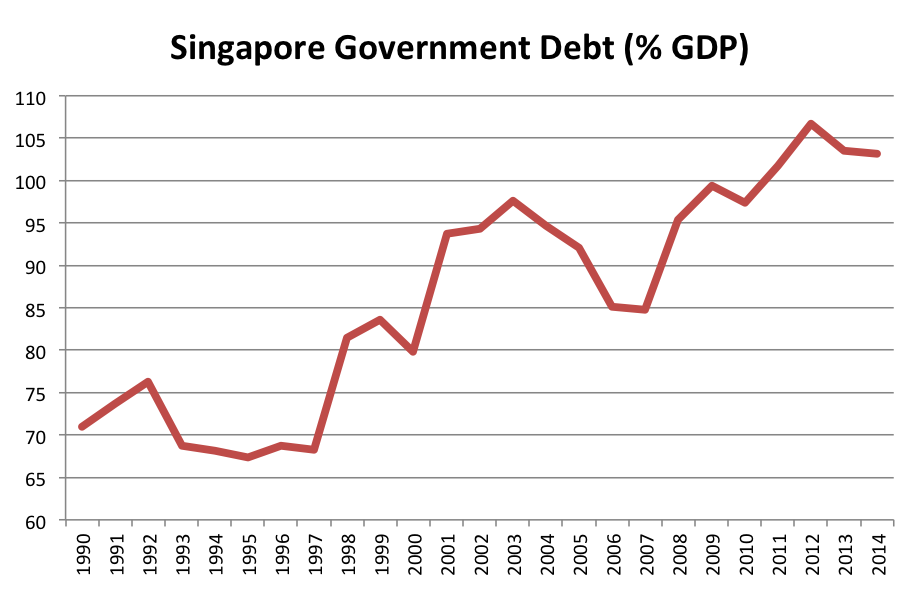
To illustrate why only looking at debt can give you a very distorted picture of economic fundamentals  let me choose a country that best illustrates this point: Singapore. In the graphical tool developed by the Financial Times one can see that government debt in Singapore has increased over the last years. Here is a longer time series from the World Economic Outlook (IMF) going back to 1990.

The current level of government debt is above a 100% (much higher than in 1990) and it puts Singapore in the same league as Spain or Ireland. But here is the problem: the government of Singapore has been running a budget surplus since 1990 (and many times a very large budget surplus).

What is going on? As the government of Singapore explains here, debt is not issued to deal with funding needs but to generate a set of Singapore government securities in order to develop a safe asset for the Singapore financial markets as well as for the compulsory national savings system called the Central Provident Fund. So while debt is very high, the value of assets is even higher and the balance sheet of the government of Singapore looks very healthy.

This is admittedly an outlier among governments, most governments do not have assets that equal in value their liabilities. But even in those cases someone is holding government debt. And it might be that government debt is held by its own citizens that are in many ways the shareholders of the government. So the consolidated balance sheet of the country might still look great (e.g. Japan). 

This argument does not deny that the actual composition and ownership of assets and liabilities matters (even if by definition they always have to match). We know well that certain credit booms are indeed associated with crisis so worrying about debt is a good idea. But one has to be very careful interpreting analysis (and newspaper headlines) that only refer to the debt side of the balance sheet. A richer analysis that understand where the assets are and how they relate to issuance of debt is necessary.

Antonio Fatás 


05 Feb 06:42

UAN – All you wanted to know about the new EPF system

by Manish Chauhan

EPFO has brought some major changes in the way it works and a new system called UAN (Unique Account Number) is in place now. This UAN is a way to simplifying the process of collecting and managing the provident fund money for employees. Background – The pain of old EPF system Before I start explaining, Let me go back a bit to help you understand a bit of background. Earlier...

The post UAN – All you wanted to know about the new EPF system appeared first on Jagoinvestor - Personal Finance Blog.

05 Feb 06:39

Micromax Is India’s Largest Smartphone Vendor. Really?

by Alnoor PeerMohamed

Micromax has apparently ousted Samsung to become the largest smartphone vendor in India, with sales clocking in at approximately 4.7 million units during Q4 2014. According to research firm Canalys the Indian brand now controls a 22% in the Indian market, as opposed to the 20% share Samsung holds.

micromax_new_logo.jpg

The report puts Micromax’s growth at a 2% quarter-over-quarter, which is consistent with what the company achieved in Q3 2014. Samsung on the other hand has suffered a 4% drop in market share during the same period, in-line with its crappy performance the world over.

Canalys estimates that 23% of smartphones shipped in India during Q4 2014 were priced under $100 (Rs 6,000), while 41% of the devices sold were priced between $100 – $200 (Rs 6,000 – Rs 12,000). The total number of smartphones shipped in India during Q4 2014 comes in at 21.6 million units, amounting to a 90% year-on-year growth in sales.

On The Flipside

Soon after the Canalys report was published, Samsung came out to dismiss the report, claiming that it was the led the Indian smartphone market thought 2014. The Korean giant said it’s market share for Q4 2014 stood at 34.3%, based on data provided by Gfk India.

Samsung’s claimed market share is far higher than what IDC’s Q3 report, which estimated the company controlled 24% of the Indian smartphone market, a whole 4% higher  than Micromax. While sales number always vary based on who’s calculating them, the massive variance in the two claimed figures here is sort of ridiculous.

IDC, which is considered the most trusted source of smartphone sales data in India hasn’t yet released its Q4 2014 report, we’re going to wait a little longer to see if Micromax has really overtaken Samsung in the Indian market.

Another fascinating finding comparing IDC’s numbers for Q3 and the recent Canalys report, is that q-o-q smartphone sales in India actually dropped. IDC’s report put smartphone sales at 23.3 million for Q3, while Canalys claims sales topped out at just 21.6 million in Q4, which equates to a 7.87% degrowth of the market.

The post Micromax Is India’s Largest Smartphone Vendor. Really? appeared first on NextBigWhat.

05 Feb 06:38

Why are there deflation fears across the world when we were warned of inflation?

by Amol Agrawal
After Eurozone, the “d” fears are hitting the Australian shores as well. Moreover, most are also worried about asset price bubbles as well. The warnings by various econs that we will only see inflation in future (barring the Krugman camp) have been proved wrong for sure. We were told that central banks can create inflation at […]
05 Feb 06:34

How To Choose A NoSQL Database?

by Guest Author

NoSQL databases are now part of web-scale architecture. The question is when to use what? Below, I try to compare the NoSQL data stores that I have worked with. Hopefully, it would be useful for programmers exploring and deciding the technology for their web-scale application.

nosql

nosql

When to use NoSQL

Before deciding on to use NoSQL instead of a SQL technology, you should ask yourself following questions about your use case (includes ACID test of your application) :

  1. Transactions vs No transactions (Do you need atomicity?)
    [Most NoSQL databases don’t support transactions]
  2. Consistent or eventual consistent (Are you okay with eventual consistency?)
    [Most support configurable consistency mode. You should test your scale with the consistency mode your application requires. For example, your performance test holds no good when done on “eventual consistency” mode and you decide to use hard consistency for your application.]
  3. Vertical vs horizontal scaling (what’s your scale? your use case need infinite scale or needs are finite?)
    [This sometimes boils down to what stage of business are you in. Don’t over-engineer of you are an early stage startup and growing < 5x a month. Postpone & focus on biz growth]
  4. Availability (No downtime? Hot failover?)
    [Some NoSQL DBs support hot failovers, some not. More below.]
  5. Do you really need a NoSQL DB. Why RDBMS doesn’t work for you?
    [Don’t use NoSQL just for the heck of it]

So, once you have decided to go for a NoSQL Data store. Next question should be key-value or document-oriented.

Key-Value vs Document-oriented

Key-value stores: If you have clear data structure defined such that all the data would have exactly one key, go for a key-value store. It’s like you have a big Hashtable, and people mostly use it for Cache stores or clearly key based data. However, things start going a little nasty when you need query the same data on basis of multiple keys!
Some key value stores are: Memcache, Redis, Aerospike.

Two important things about designing your data model around key-value store are:

  1. You need to know all use cases in advance and you could not change the query-able fields in your data without a redesign.
  2. Remember, if you are going to maintain multiple keys around same data in a key-value store, updates to multiple tables/buckets/collection/whatever are NOT atomic. You need to deal with this yourself.

Document-oriented: If you are just moving away from RDBMS and want to keep your data in as object way and as close to table-like structure as possible, document-structure is the way to go! Particularly useful when you are creating an app and don’t want to deal with RDBMS table design early-on (in prototyping stage) and your schema could change drastically over time. However note:

  1. Secondary indexes may not perform as well.
  2. Transactions are not available.

Popular document-oriented databases are: MongoDB, Couchbase.

In-memory vs disk persistence (Cache or data-store) ?

Another key concern while deciding data stores is whether you are using it as data store of your application or you are using it as a cache over your data store to scale for your traffic needs.

Once you have decided the kind of use-case you have, here are some of the popular NoSQL stores you could use:

Comparing Key-value NoSQL databases

Memcache:

  • In-memory cache
  • No persistence
  • TTL supported
  • client-side clustering only (client stores value at multiple nodes). Horizontally scalable through client.
  • Not good for large-size values/documents

Redis:

  • In-memory cache
  • Disk supported – backup and rebuild from disk
  • TTL supported
  • Super-fast
  • Data structure support in addition to key-value
  • Clustering support  not mature enough yet. Vertically scalable.
  • Horizontal scaling could be tricky.

Aerospike:

  • Both in-memory & on-disk
  • Extremely fast (could support >1 Million TPS on a single node)
  • Horizontally scalable. Server side clustering. Sharded & replicated data
  • Automatic failovers
  • Supports Secondary indexes.
  • CAS, TTL support
  • Enterprise class

When to use what? Memcache vs Redis vs Aerospike

If I am an early stage startup, I would rather prefer to go with Redis and avoid nuances of maintaining a cluster etc. If I have scaled above half a million TPS (transactions per second) where I need to scale horizontally I would go for Aerospike. I would use memcache (memcached) only when I am going really mean and want to even offload maintaining the servers – in which case I would go for hosted version of Memcached which is Amazon Elasticache.

Here’s a case study of Aerospike.

 Comparing document-oriented NoSQL databases

MongoDB:

  • Fast
  • Mature & stable – feature rich
  • Supports failovers
  • Horizontally scalable reads – read from replica/secondary
  • Writes not scalable horizontally unless you use mongo shards
  • Supports advanced querying
  • Supports multiple secondary indexes
  • Shards architecture becomes tricky, not scalable beyond a point where you need secondary indexes. Elementary shard deployment need 9 nodes at minimum.
  • Document-level locks are a problem if you have a very high write-rate

Couchbase Server:

  • Fast
  • Sharded cluster instead of master-slave of mongodb
  • Hot failover support
  • Horizontally scalable
  • Supports secondary indexes through views
  • Learning curve bigger than mongoDB
  • Claims to be faster

When to use what? MongoDB vs Couchbase

For most de-facto use cases, I would go for mongo unless my write-rate is extremely high (I would think again only when my writes are > 10% and I am doing more than few thousand transactions a second). Fast prototyping, schema-less design, on-the-fly indexes etc makes it a ideal choice for early stage traffic.

I would consider Couchbase only when I have scaled beyond a point where write-locks are becoming a problem and I do have secondary indexes and I need extremely high availability (* more on couchbase in coming posts).

Of course, there are many more databases knocking the doors like, VoltDB, FoundationDB, GraphDB etc, would try to cover them on this blog in later posts. Columnar databases – where Cassandra and Hbase are leading the stack- are used for certain use cases that would probably be part of some future posts. If you have thoughts, comments, do share here and I would try to incorporate in my posts.

[Guest article by Prashant Parashar (@sucoder) of Snapdeal.]

Image credit: shutterstock

The post How To Choose A NoSQL Database? appeared first on NextBigWhat.