Shared posts

01 Apr 08:48

How much do you need….?

by subra

How much of life insurance do you need? 

Insurance agent: Sir you need 15-25 times your income. As your current income is Rs. 50,00,000 I would suggest about Rs. 7.5 crores of income.

Very good. A 55 year old man is being pitched about 4 crores of insurance (assuming he negotiates). Premium Rs. 3L per month.

How much medical Insurance do you need?

Insurance agent: About Rs. 20L.

Comment: Amusing. He is the father of a budding doctor :-)

How much accident insurance?

Sir it is very cheap please take it for rs. 3 crores.

This man was having fun with a bank RM who had targets to meet. So after all this conversation he turned to her and asked:

How much is your income:

She said : Rs. 14-Rs.20 lakhs sir

He said: show me a term insurance of Rs. 3 crores, Medical …etc. and I will match it penny for penny….

Of course she did not show up.

Fair offer no?


Post Footer automatically generated by Add Post Footer Plugin for wordpress.

01 Apr 05:32

Indian Hardware Startups : They Are Happening And Coming of Age.

by Guest Author

Last week there was this news of Teewe raising $1.75 million from Sequoia & IndiaQuotient. So happy to know our Startup ecosystem has started accepting and realizing the potential of Hardware Startups. Now that we are at the cusp of IOT, hope this is the start and many exciting things are around the corner.Teewe-HDMI-Dongle

As many of you know even we have a small connection with hardware products. Our startup took off by building a Hardware Product – an Android based smart TV box way back in 2011-2012. We called it SAGA. We have come a long way since then. I remember there was a time when investors wouldn’t even care to know what the product did when they heard it was a hardware product.

The first reply to most emails were “we don’t fund Hardware Startups”. Many were kind enough to attribute the reasons. It went from Indian markets not being ready, competition from biggies, Notion Ink fiasco, etc the list went on. They were not wrong. India was just gearing up to smartphone revolution (i.e being more tech savvy), unlimited Broadband and decent Internet speeds had lot of catching up to do and Ecommerce was just about to explode on the scenes (important delivery mechanisms).

In absence of all the above, educating the market from scratch and delivery models by cracking deals with retail stores were very capital intensive. Somehow SAGA didn’t work out for us. We still retained the website (http://nityaalabs.com/saga).

Maybe we were too ahead of our times. Maybe we were naive and unprepared. Or maybe it’s too easy to bury your mistake under excuses. But we did learn a lot while building SAGA, and it was fun while it lasted. Product was awesome and we received decent reviews from everyone who saw it. However past is past. Now we are completely focused on AirStream and really excited for some of our new releases this week.

The important thing is that we have come of age and now the market is ripe for disruption in HW space. Maybe someday even SAGA will emerge from the ashes like a Phoenix. I look forward to that day.. till then we have other battles to win.

This is startup smile emoticon ?#?KuchBhiHoSakthaHai? ?#?AnythingCanHappen?

PS:
1. We had pitched to Sequoia in 2012 and did two meetings (they were one of the few investors who took great interest in SAGA). They have been very helpful and it was they who clearly highlighted the challenges we might face with HW and advised us to explore the software route. What they said made sense then.

2. Notion ink fiasco: This was a term used by one investor and not something which we agree with. We looked up to Notion Ink as our inspiration, they had some very original ideas. Their first product Adam started off with much fanfare but didn’t work out as per people’s expectations. Now they are making a decent come back with Cain. I have had several email exchanges with Notion Ink’s founder Rohan Shravan and I admire his perseverance a lot.

3. AirStream was originally a app we developed for SAGA, which we later customized for smartphones. I will be honest here, my first love is still SAGA smile emoticon.

[Guest piece by Jitin Pillai, founder of Airstream]

The post Indian Hardware Startups : They Are Happening And Coming of Age. appeared first on NextBigWhat.

01 Apr 05:28

Five Lessons from Daniel Kahneman

by Sudarshan Sukhani
Professor Daniel Kahneman, who shared the Nobel prize in Economics in 2002 for his work on psychology (Prospect Theory), is probably the greatest living Behavioral Economist (after all, he invented the subject!).

Here are five lessons on the Markets derived from the work and words of Mr Kahneman.

1. Be Humble.

source:  http://www.bloomberg.com/

Kahneman's research has shown that since we use overconfident, highly emotional logic in making investment decisions, the best approach is often the simplest.
Ironically, Kahneman defers to his certified financial planner for portfolio advice, Harold Evensky of Evensky, Brown & Katz in Coral Gables, Florida.
At the beginning of a lecture in Chicago on May 2, after introducing himself as a psychologist and insisting he wasn't an economist, Kahneman glanced down at Evensky sitting in the first row and quipped nervously, ``I'm intimidated by my financial adviser, he knows how little I know.''
A little humility goes a long way in successful investing. You don't need a Nobel Prize under your belt to discover that. 

2. Think in Broad Terms

source:  http://www.bloomberg.com/

Kahneman said he believes our brains are hard-wired for small decisions imbued with optimism. ``Optimism is a force in capitalism, it may be the engine of capitalism.''
The best way of cultivating the better angels of our nature? Kahneman suggests making fewer financial decisions and focusing on wealth from a big-picture perspective of several decades instead of following the market day to day.
``We are more risk neutral when we think broadly than when we think small.'' 

3.  Aim to beat inflation

source:  http://www.bloomberg.com/

By investing in index mutual funds and U.S. Treasury Inflation-Protected Securities, or TIPS, Kahneman said his primary retirement planning focus is beating inflation and maintaining steady income -- a strategy much at odds with Wall Street's mantra of maximizing return.
Keep it simple and aim to beat inflation. Don't try to beat the market. Kahneman's approach is an efficient path that won't get derailed by psychology. When it comes to investing, less is more. And if you try to do more, you'll often end up with less. 

 4. Keep track, maintain scores, be a scorekeeper.

In the financial world there is no scorekeeping mechanism. People can come on media and say whatever they want, there is no way to hold them accountable. On this subject, David says:

I think there is really too little scorekeeping. It's sort of astonishing when you think of those CFOs coming in year after year, and making predictions that make no sense, and they come back next year with the same level of confidence. There is no improvement. There is some absence of scorekeeping there.

5. Accept that we do not know the future

Many people now say they knew a financial crisis was coming, but they didn't really. After a crisis we tell ourselves we understand why it happened and maintain the illusion that the world is understandable. In fact, we should accept the world is incomprehensible much of the time. 


01 Apr 04:38

Don't read this after 1st April 2015

by Dev Ashish
Note - This is not a April Fool's day post. Hi Today is 1st April 2015. For some, its the first day of a new financial year. And for some, its a Fool's Day. But frankly speaking, each new day...has the potential to be the first day of the rest of your life. Its you who can change everything about your life. And this point is beautifully captured in quote below: If you have had troubles
01 Apr 04:38

Medical Insurance: why Indians do not like it

by subra

First of all let me tell you that I have medical insurance. I have no clue whether it will pay, how much it will pay, on what basis will the calculation will be made….literally NOTHING.

Why do I still have a policy? because it keeps my mind calm.

Why do Indians not like it?

1. It is too complicated: You may or may not believe it, but most of us cannot understand the language of a medical policy.

2. The mathematical calculation of how you will be paid a claim is very difficult to believe or comprehend.

3. Most people think “I have a company policy” and that is sufficient – this is obviously because they do not understand risk.

4. If you have a policy for Rs. 500,000 and you incur Rs. 300, 000 as expenses you think you will get paid…right? Wrong. You will be shocked to find a) room rental restrictions b) proportionate cutting of the over all bill and c) disallowed expenses..you will be lucky if you get more than Rs. 250,000. And I am being optimistic…

5. A lot of expenses are unecessarily added on by some of the hospitals….thus the default option is mis trust….


Post Footer automatically generated by Add Post Footer Plugin for wordpress.

01 Apr 04:35

Startups : A Quick Note On Your April Fool Prank

by Ashish Sinha
Nokia's Microwave Joke

Nokia’s Microwave Joke

Founders : Here is a challenge. Don’t come up with ‘X has been acquired by’ or ‘ X acquires Y’ sort of april fool prank. They are extremely boring and predictable.

Try embedding the joke in your product and see if your users can actually find out (and if it goes viral).

It will serve two purpose:

1. Beyond investor pitch, you will actually find out if your product is used the way you’d like it to. There is no better way to gauge engagement – imagine embedding the joke/prank on your homescreen and well, nobody gets it.

That’s a serious issue (and the joke is on you)!

2. If at all you are coming up with crazy PR ideas, it might force your team (or the ecosystem around your product) to think in random directions and execute on these crazy ideas (after April 1st). Time and again, many of the April fool pranks by Google/Facebook has been brought to reality by geeks. You can use this for hiring pitch :)

Whatever you do, don’t do a PR. It just shows how incapable you and your team is.

The post Startups : A Quick Note On Your April Fool Prank appeared first on NextBigWhat.

29 Mar 05:45

Some major investor mistakes….

by subra

The investor mistakes are just too many and to me everything looks major. Let me tell you the few that bother and bug me. Not because it hurts my portfolio, but I am at the receiving end if the person is known to me:

1. Going for a walk with the wrong person: People start a small SIP and they go for a walk with the wrong person! this person tells them how they can ‘create’ a HUF, how they can invest in their father in laws name, their children’s names, and how the whole amount will be tax free. God, why do they have my phone number? and why do they consider it IMMORAL to invest in equities and let me know about it? Look do what you want, you do not owe me an explanation for investing or not investing in an equity fund. Please choose your poison.

2. Focusing on immediate past results: almost everybody is convinced that Liquid funds will give about 8% return and if a liquid fund gives lesser returns than that, it is a bad fund. Well, well. You can only tell people that the past performance is not a good indicator of what to expect in the next few months or quarters. You look at history only to see the style – like why a Yuvraj is a better batsman than Rahul Dravid in a T 20 scenario. On that day how much he will score is just not known. Concentrating on the immediate past results also has another problem. In a match where say Virat Kohli scores a zero and Ashwin scores 30, you might conclude that Ashwin is a better batsman. This is obviously dangerous.

3. Asking too many WRONG questions: “If instead of investing in Wipro, if I had invested in Silverline I would have lost money, no?”. Sure you would have lost money. Why do you not invest in a mutual fund? ‘But Subra I did invest in ILFS E commerce fund and lost Rs. 5000. From then on I have stuck to bank fixed deposits. Now tell me ‘I cannot lose money in a bank fixed deposit, right?’

Honestly I have no clue how to handle this question, at least for free. If he were attending a paid lecture I could take some trouble – for a free guy the answer has to be “yes sir, you SHOULD keep all your money in a bank fixed deposit”.

4. Not knowing the difference between Real returns, and absolute returns: Most of them do not comprehend the 80% return that equities give once in 5 years and then the negative returns for say 5 years. This is so difficult for them to comprehend that they keep saying ‘this will not happen again’. This could be innumeracy, but then not understanding ‘Real returns’ and goal oriented investing is pretty stunning. ‘Goal Based Investing’ has to be the one and only focus of a retail investor. For this he/ she has to write down her/his goals and make sure that all the investments are headed in the right direction. There can be no investing if the investing is not GOAL BASED.

5. Loving simple instruments out of sheer laziness: they love fixed income products. It goes up EVERY DAY. Keep a fixed deposit with a bank with daily accrual. You get an awesome feeling that your net worth is going up EVERY DAY. Imagine if your annual income from Interest is Rs. 36, 50,000. It means your income is Rs. 10,000 every day!! This is so impressive. Everyday your income is going up and you can feel great. This can be encashed, it can be spent…and it will ALWAYS be there for you. It is easy to fall in love with such nonsense especially if you do not understand that after 20 years too it will remain the same. Such people are fixated not only about debt instruments but also the fact that it has to be in a bank. For these people even a mutual fund debt scheme looks risky (sir Investments are subject to market risk no sir, why should I invest in mutual funds). I love them. They help Jaitely to reduce the deficit.

read this also http://www.subramoney.com/2011/08/advice-for-the-small-investor/

Post Footer automatically generated by Add Post Footer Plugin for wordpress.

28 Mar 06:42

How to be Seen as a Leader at Work and get Promoted Quick

by Martin Robert Hall

nguBfbMSome people watch it happen. Some people say what happened. And some people make it happen. The world and more importantly your workplace is crying out for people who make it happen. One of the biggest mistakes people make is thinking that leadership is in a title. “I couldn’t do that, that is only for managers or senior people” people often think. I should know, I used to do that myself. Well in order to be seen as a leader or a potential leader, you must act like one. Not then, but now. There is actually a phenomenon called the bystander effect which looks at why people fail to take the lead in situations when others are also present. The research is fascinating. In one […]

The post How to be Seen as a Leader at Work and get Promoted Quick appeared first on Dumb Little Man.

25 Mar 02:01

Voluntary Deposit Scheme – use it liberally….

by subra

Many people do not know about the Voluntary Deposit Scheme at work in Mumbai.

If you are a user of Mahanagar Telephone, Mahanagar Gas or Reliance (electricity, Adag) – chances are you are if you are staying in Mumbai for a long time you use all 3 services. Let us assume that your telephone bill, gas bill and electricity bill are Rs. 1800, Rs. 1000 and Rs. 4000 per month.

This means that every month you need to keep about 7000 in your savings bank account so that you make the payment on the due date. You could either pay it online or offline. Paying offline means you need to make 3 cheques, write out the name, amount, etc. and then deposit it in a drop box. Then you need to pray that they collect it and bank it.

Or of course you could use an ECS facility – and the amount will be debited from your bank account.

You have another option too. You could pay a ‘Voluntary Deposit’ to all these 3 organisations. Say Rs. 20,000 each. All of them have a limit – please check their websites. Now if you have say Rs. 20,000 in MTNL you will be entitled to 7%p.a. interest on the unused amount. So if 1800 is removed from the fund, you will get interest on the balance of Rs. 18,200 for one year. However as and when the new bill is generated again that is deducted. You could top it up once in a while – online or offline. The interest amount is not much, but still it is higher than the savings bank account. Also immaterial of what ever amount the bill is for it is debited to your account – in the ecs mandate normally you give a limit.

This is very useful for senior citizens (do it for your parents), pays some interest, and is very convenient….

Post Footer automatically generated by Add Post Footer Plugin for wordpress.

24 Mar 01:50

Simplifying Your financial life…

by subra

I keep saying simplify your financial life…here are some steps (I myself need to take some of them…but gyaan baatnein mein kya hai…)

1. Consolidate all your accounts: Savings bank, Current account, credit card, demat account, brokerage account, life insurance, mutual funds, …first step is consolidate. Once you collect all the papers make sure that only sensible accounts remain, and all the others are closed down. This surely reduces stress of accounts becoming dormant, paying annual fee, etc.

2. Have one print out of all these accounts, but make sure that all your vendors have your email id. Check the email ids are current, and that you go green!! The advantage is that all your financial info is now in one mail id (or 2 mail ids). You could share this with your spouse and even mention the login and password in your will.

3. At least in the Mumbai context one thing sensible to do is to create a Voluntary Deposit Scheme for all your utility payments. Mahanagar Telephone, Mahanagar Gas, Reliance Infra, – the providers of telephone services, gas, and electricity ALL of them accept a voluntary deposit on which they pay 7% p.a. interest. So pay Rs. 20,000 to each of them. Every month they will deduct the bill amount, but they will continue to pay interest on the balance amount. Very convenient and useful because the interest rate is higher than the bank savings account.

4. Make sure that your children and spouse know about all of the above.

5. Pay taxes smartly – make sure you pay all the taxes, and also claim all the deductions.

6. Make your investments as smart as possible. If you are not sure about choosing your fund manager, index your portfolio.

7. Be clear about your RISK taking ability. Generally people OVERESTIMATE their risk talking ability when the markets are doing well.

8. Have your Investment strategy well articulated – obviously written and well understood by your family members.

obviously there are more…but this is not a bad start….

Post Footer automatically generated by Add Post Footer Plugin for wordpress.

23 Mar 10:35

Starting a Family : What Financial Steps to take

by Kirti
What are the financial steps to take before starting a family?  Babies are bundles of joy to their parents and the parent’s family, but  raising children costs money infact a child is your life biggest spending or investment. A new child into the family brings along the whole new set of expenses. From hospital bills to diapers to baby furniture, to day care , education costs for new parents mount quickly. For some, the reality of these expenses is daunting. Others are completely unaware of how the joy of a new child will impact their financial situation. This article lC

How much does a Baby Cost?

Why should we look at the child in terms of its cost? The child is not a cost to parents! Absolutely right, child will carry on your legacy, your family name. I am a proud mother of two children and I say that pros of having a child outweigh the cons. Quoting the tagline of the famous ad They are worth it(the trouble, the money). Interested readers can checkout Lifehacker To Have Kids or Not to Have Kids: Your Best Arguments  . The arrival of a child heralds a change in spending and saving habits. It is important to rework financial goals, ensure a clear strategy for funding them, and begin a saving and investing plan.

But along with the little slip,the pregnancy test, that says that your baby is on his way comes a price tag. The payment which starts with that pregnancy test grows faster than your child and can assume gigantic proportions. Food, clothing, and health care are just a few items that can add up into tons of expenses before adulthood. Okay so it’s expensive to raise a child. But just how expensive is it? How much money does the average  child need from the time of birth to when he or she turns 18? The answer depends on many factors. Does one parent stay at home or does the family hire nanny or a maid or will grand parents help out? Which school will  the child attend ? What stream(Engineering, Medical) your child chooses?

An estimate in Economic Times in March 2011, cost of raising a child from birth to age of majority (21 Years) for middle to upper-middle income family comes to about Rs. 55 Lakh (Rs. 5.5 Million, or about 90,000 USD as of Sep’2014) in total. You can also checkout the article in Outlook Money  in 1999 on cost for raising a child in India to see the break up of costs and compare the costs. Some excerpts from Economic Times are given below. For the full infographic checkout it out on bemoneyaware’s pinterest here or click on image below. 

Cost of raising child in India

Cost of raising child in India


Having a baby : How to manage finances ?

First let’s look at the Money question section of ET Wealth 16 Mar 2015 which talked about how parents should manage finances before having a baby.
Komal and Jas are a working couple and earn enough to enjoy a lavish lifestyle. They have been married for five years and are planning to start a family soon. It is going to be a life-changing event, so they need to modify their spending habits. They want to put the changes in place before the baby arrives. The first step, however, is to estimate the cost of raising a child. The estimate will depend on their income, savings and goals for the child.
Planning a family is a time for would-be parents to ramp up their savings net.
Komal and Jas must have 6-9 months’ expenses as savings in their emergency fund, which can be used when Komal decides to take maternity leave.
Apart from the additional expenses related to the pregnancy and the arrival of the baby, the couple need to decide whether Komal would take an extended break from work. They need to adjust their expenditure accordingly and save enough for a transition from a two income to a one-income household. They may have to reorient their monthly budget–instead of buying luxury white goods and going on holidays, they will have to use the money for higher medical care expenses and hiring a nanny for instance.It’s never too late to start planning and saving for the long-term.
Komal and Jas need to rework how they plan to fund their home loan EMI and meet other household expenses. Add to that the cost of raising a child and paying for higher education. This implies that Jas may have to rework his life insurance needs. Apart from that, health insurance and critical illness covers will also need to be taken up. All these will amount to a higher annual expenditure.
There must be a clear-cut plan about how all these increased expenses will be met. Investments will be key for ensuring the child’s future. New parents should start saving early for both short-term as well as long-term expenses. While long-term investments can be made in equity, investing for short-term goals should be made in fixed deposits and debt mutual funds.
The arrival of a child heralds a change in spending and saving habits. It is important to rework financial goals, ensure a clear strategy for funding them, and begin a saving and investing plan. A young family requires the highest capability in planning as it straddles liquidity, return, risk, short-term needs and long-term goals, all at once.
Planning for Baby
A new baby changes your family’s financial status. You have more expenses and You may suddenly be living on a lower income, if one spouse works less or not at all. So where do expecting and new parents start? Lets go through these baby steps
Start early. Take time to determine your family’s immediate financial needs as well as your long-term goals preferably before the child is born. 
Determine the costs and Prepare for emergencies. Determine the true cost of what you will need and weigh it against the new realities of your household income situation. This is particularly important if your spouse plan to leave the work for an extended period of time. Consult another new parent for a list of monthly baby expenses to get a clear picture of those costs. The chances of unexpected expenses will become much greater once the little one comes on the scene.
Get protection through proper insurance. Protection is critical. It’s time to face your own mortality and vulnerability. Insure your income , health and life through appropriate insurance  to protect your family’s financial future. For example Life insurance gives you priceless peace of mind and a guarantee that your family will be cared for financially should you die before your children are grown and on their own. If you have health insurance via a plan with your employer, review what your plan offers. You may need to make changes based on your changing life situation. And if you don’t have health insurance at all, you must a find a suitable plan for your family. Doctors are expensive.
Save for education. Education even the school education has become expensive. You have the choice of ICSE, CBSE, IGSE etc. Education has changes , Curriculum has developed, examination system has become comprehensive, classes with less students , better student to teacher ratio, parents totally dedicated to their one or two kids. Our article CBSE,ICSE,IB,IGCSE : Choosing the School and Various Boards talks about various boards in detail.
Higher education costs have been galloping.   The cost of higher education is already high and rising at 10-12% a year. Children’s education is one of the biggest cash outflows that families must plan for. A four-year engineering course costs roughly Rs 6 lakh right now.In six years, the cost is likely to touch Rs 12 lakh. By 2027, it would cost Rs 24 lakh to get an engineering degree.Images below from the Economic Times article Best ways to invest for your child’s education is to forewarn you about the rising costs and how you can prepare for your children higher education.If you have a daughter and she is currently less than 10 years old you can open Sukanya Samridhhi account for her.
Higher education is becoming more and more expensive

Higher education costs are rising

Rising Higher education costs : How to plan

How to save and invest for Child’s Higher education

Related articles:

Supporting a family is hard work. They say Forewarned is Forearmed . Be aware of the changes , emotional , financial that you need to make and make them so that you can enjoy the journey of parenthood which is 24X7 with no holidays . Many people these days are deciding to have just one child due to high expenses. How did you deal with your finances on addition of a new member in your family?  Did you/your wife leave the job? Do you think one should have just one child? What financial changes do you suggest? How are you preparing for your child higher education?

22 Mar 03:57

Clear thinking on today's RBI question

by Ajay Shah
Sugata Ghosh has an article in the Economic Times titled RBI wants to control both prices and debt market, but government refuses to oblige. Some of this needs to be seen differently. He says:

For the market, there cannot be an I-banker that's more honest and effective than RBI. It's the perfect insider with all powers — it can cancel an auction, buy or sell bonds in the secondary market to generate or absorb excess liquidity, and it regulates many of the investors subscribing to government bonds. Also, there is no debate that RBI acts in the best interest of the fisc.
Do you really want to buy bonds from someone who has insider information on how interest rates will go in the future? It's like trading against a corporate insider in the secondary market for equity. The text above violates the basic logic about why central banks, all over the world, have got out of debt management.

MOF insiders will tell you numerous stories where RBI violated the best interests of the exchequer in the pursuit of other objectives. The trouble is, when you have multiple objectives, you are accountable for none. "Why did you fail on inflation?" "Because we were chasing debt management." "Why did you fail on debt management?" "Because we were chasing inflation." Placing multiple objectives on one Agent, which internally conflict with each other, is bad management by the Principal.

The world over, we separate these things out. The central bank is accountable for delivering CPI inflation within the target zone -- and nothing else. The debt management office is accountable for delivering low cost of borrowing for the government in the long run -- and nothing else. There are no conflicts of interest. The buyer of bonds from the DMO is not worried that he's trading against an insider. The Principal is able to hold both Agents accountable; the Agents don't have plausible deniability in explaining away failure.

If RBI was such a great debt manager, why is it that every single expert committee, and the RBI board, all agreed that it made sense to unburden RBI of the conflict of interest of debt management? A little googling would dig out the logic as articulated in (1) RBI annual reports, (2) the Jahangir Aziz Working Group, (3) the M. Govinda Rao Working Group, (4) the Justice Srikrishna Commission, (5) the Percy Mistry Committee, (6) the Raghuram Rajan Committee and (7) the Vijay Kelkar Committee on MOF restructuring. Not one of these disagreed with the reforms which are now being implemented.

What RBI faces in the old arrangement is a mugs game; RBI lurches from one problem to another. It is easy to criticise RBI, but what's going on is a deeper problem, of a badly structured set of contracts where Ministry of Finance has not allocated the work properly. That deeper problem must be addressed. This is a three-pronged story: (1) Give clarity to RBI that it's job is to deliver CPI inflation; (2) Undertake bond market reforms so that RBI gets a monetary policy transmission; and (3) Unburden RBI of the investment banking function.


Sugata Ghosh also says:

Will the bond market deepen if it moves out of RBI? Ask anyone in the cosy world of bonds, and she would say 'no'.

Insiders in a closed club always love the status quo. Nobody wants to open up a closed club.

Lawyers in India do not want new players to come in.

The old BSE members did not want to admit new members, and they did not want NSE. I could easily paraphrase the above sentence and it tells you the newspaper story of 1992: "Will the stock market deepen if MOF creates NSE and opens up entry? Ask anyone in the cosy world of the BSE and she would say 'no'."

The bond market in South Bombay is a nice closed club -- only banks and PDs welcome. Thousands of sophisticated securities firms are forcibly excluded from this market. Their participation will increase liquidity and market efficiency. This is good for the exchequer, as they will get better pricing when selling into a more liquid and more efficient market.

The incumbents in a closed club market are never going to be enthusiastic about change. BSE members today make more money than they did in the old system -- but they ferociously lobbied against the change.

The fundamental law of securities market development is that we get a deep and liquid market by opening up entry barriers. By the act of opening up a closed club, the market will be made to work better.

Again, the author should consider why every single expert committee has advocated merging all organised financial trading into one regulator: SEBI (or its successor, the UFA). This includes spot or derivatives. This includes equities, bonds, commodity futures, currencies, etc.

There used to be ferocious protests from one player in commodities against this plan of unifying commodity futures into organised financial trading. We saw how that worked out, and that should give caution to journalists listening to vociferous practitioners. Now FMC is merging into SEBI. One by one, the remaining pieces should follow.
22 Mar 03:55

India real estate market fact of the day

by noreply@blogger.com (Gulzar Natarajan)
From Livemint, adding to the long list of badly indebted corporates, comes debt-laden property developers, whose problems are exacerbated by unsold inventory,

At brokerage Kotak Securities, analysts estimate unsold inventory held by a group of leading Mumbai developers alone now stands at some Rs.53,400 crore—with an additional Rs.36,800 crore of project launches in the pipeline. That puts the current, unsold area in Mumbai at almost the value of the total sold in the 2014 calendar year. The backlog, analysts estimate, could take more than a decade to clear... It now takes developers about four-and-a-half years to turn property inventory into cash, more than a full year longer than it takes developers in China, according to Thomson Reuters Starmine data.
Another article points to a study by Knight Frank India which highlights the large volumes of inventory piled up across the largest cities. For example, in Delhi, even if no more properties are added to the market, the current inventory will take about 14 quarters to be sold.
However, this glut, mainly at the middle and upper end of the market, stands in stark contrast to the severe shortage at the lower middle income and lower income level (Rs 5-20 lakhs) markets. This trend points to a market failure in the housing market, demanding public policy action. 
Add to Technorati Favorites
22 Mar 03:54

Review your direct equity portfolio…

by subra

I am not an advocate of direct equity investing, but that means nothing!! Many of the readers of this blog are direct equity investors and many many more will become one in the days to come. A few years ago I remember reading a private research report saying that about 100,000 Indian families have benefited by the direct equity investing. This figure may have actually not changed much by now. Of course one of the biggest beneficiaries of this has been brokers (reminder: I was a corporate member at NSE). Many houses, offices, other assets have been funded by brokers commission – hey that is a different story!

Let us do a quick review of your portfolio:

1. If you have less than 20 shares your portfolio may not be well diversified.

2. Put your portfolio in a website which can do an analysis. I prefer www.valueresearchonline.com. Here you will get a quick analysis of your portfolio. Giants, Large cap, Mid cap,…..and the Industry break up.

3. Once you have this industry wise listing see how near or far away you are vis-a-vis the index. You cannot be very far away from this if you are trying for an alpha to the market.

4. If you are far away from the sensex industry break up YOU better have a solid reason for that, and be careful.

5. Chances are you have a decent bunch of shares, but no where near the sensex in terms of industry allocation.

6. If you have committed less than 25% of your networth to equities, why are you doing this exercise?

7. If more than 10% of your equity portfolio is in one company / industry you better know that company inside out. Do you?

8. Are you out performing the sensex? are you out performing a Prashant Jain, a Naren Sankaran,…and the likes?

9. Is your portfolio allowing you to sleep well at night?

10. If you have some more shares in the public listed companies in a demat account, does the account have a nominee?

Returns? OMG I did not talk about that!!

Post Footer automatically generated by Add Post Footer Plugin for wordpress.

22 Mar 03:52

Government Cancels JSPL and Balco Coal Mine Allocations, These Stocks Look Lousy on the Charts

by Deepak Shenoy

The coal mine situation has become intense again. The Coal Secretary, Anil Swarup tweeted on Friday night:

Bids for Gare Palma 4/1, 4/2, 4/3 and Tara coal blocks not accepted.

— Anil Swarup (@swarup58) March 20, 2015

This changes  a lot of things. Gare Palma 4 (/2 and /3) and Tara were won by Jindal Steel and Power, and Gare Palma 4/1 was by Balco: (Livemint)

Balco had submitted a closing bid of Rs.1,585 per tonne for the Gare Palma 4/1 block while Jindal Power had submitted a closing bid of Rs.108 per tonne for the Gare Palma 4/2 and 4/3 blocks and Rs.126 per tonne for the Tara coal block.

The speculation is that these blocks were won through cartelization.

And this is how these stocks are, technically – weak, and likely to hit near term lows. Here’s Jindal Steel for you:

image

Jindal Steel has the most to lose.… (Read On...)

19 Mar 16:06

Deeds, not Words? Or, Say Less and Mean More

by David Merkel
Crawling to the first tightening move

Crawling to the first tightening move

There was a lot of hoopla yesterday over the FOMC removing the word “patient” from its statement.  But when you read the sentence that replaced the sentence containing the word patient, you shouldn’t think that much has changed:

Consistent with its previous statement, the Committee judges that an increase in the target range for the federal funds rate remains unlikely at the April FOMC meeting. The Committee anticipates that it will be appropriate to raise the target range for the federal funds rate when it has seen further improvement in the labor market and is reasonably confident that inflation will move back to its 2 percent objective over the medium term. This change in the forward guidance does not indicate that the Committee has decided on the timing of the initial increase in the target range.

There are two contingencies here, which are both subject to considerable latitude in interpretation:

  • Seeing further improvement in the labor market
  • Being reasonably confident that inflation will move back to its 2 percent objective over the medium term

I have long argued that the FOMC doesn’t have a strong theory for what they are doing, and have designed their language in speaking to the markets to maximize their flexibility.  It has not been the obfuscation of the overly confident Greenspan era, but the endless blather that comes from trying to be “transparent” and drown the market in communications, because they never quite understand us properly.

Now, for the first time in a while, the FOMC statement shrank, and for that, I thank the FOMC.  It should shrink further, and it would be better if the FOMC said nothing, and went back to pre-Greenspan practices, and let the actions of the Open Markets Desk at the New York Fed do the talking.  Deeds, not words.

Now, data isn’t the same as deeds, and they aren’t always as clear as words, but the FOMC gave us a release of the forecasts of its members yesterday.  The graphs in this piece reflect the central tendency of their estimates, giving proper weight to the dominant views, as well as less weight to the views from the outliers.

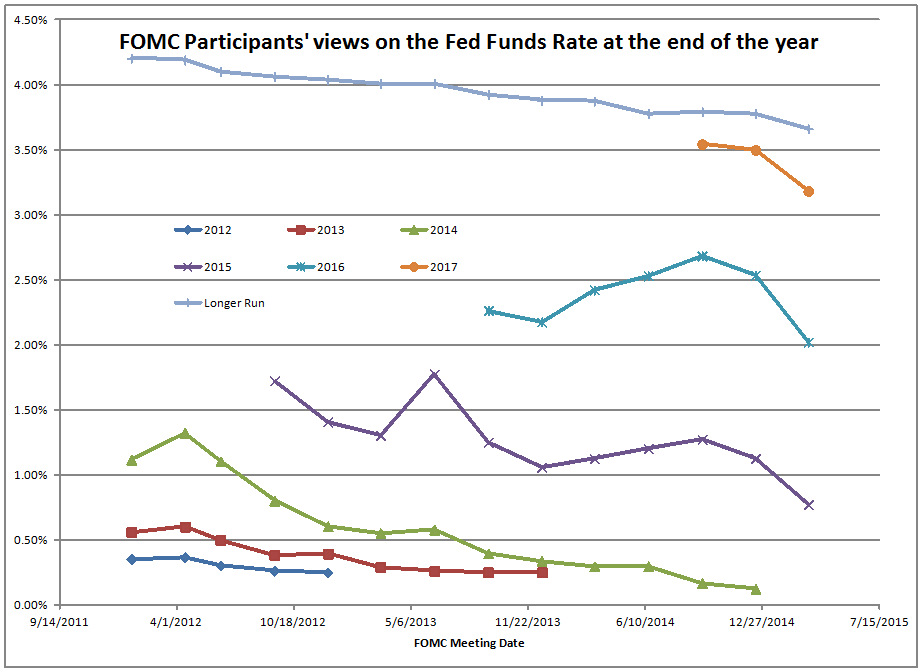
Start with the graph at the top of this article.  The average of all of the views suggests tightening in September.  Now, with 15 favoring a move in 2015, a move will likely happen this year.  If you look back through their data releases, a preponderance of opinion has pointed to 2015 since September of 2012, with never fewer than 12 members pointing to a move in 2015 since then.

But what of the shift in opinions regarding the level of the Fed Funds rate over time?  What happened to that with the removal of the “patient” language?

My but they got more dovish...

My but they got more dovish…

Look at the reduction in the expected end of year Fed Funds rate — down 0.35% in 2015 (to 0.77%), 0.51% in 2016, 0.32% in 2017, and 0.12% in the long run.  That last number is significant, because of the change in composition of those giving opinions, and it indicates a more generally dovish group.

But the downward moves in values indicate fewer tightening moves for 2015 — at present the estimate would be 2-3 quarter-percent moves. (And five more eaches in 2016 and 2017, for those who dream that savers might get some compensation, and that the government’s budget works at higher levels of interest rates)

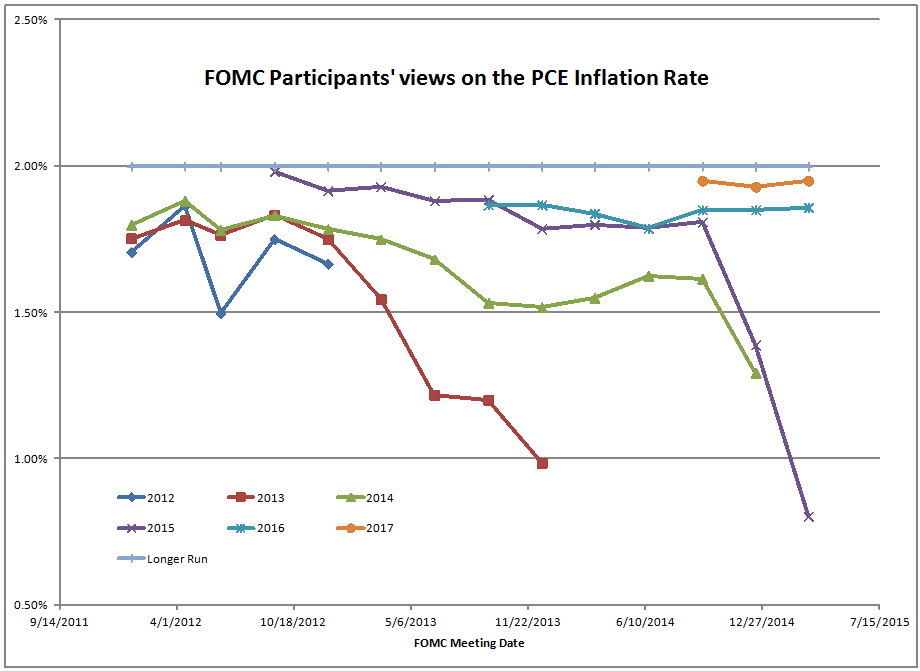
A big reason for the shift is the move in views on PCE inflation:

Still behind the deflationary curve...

Still behind the deflationary curve…

That’s a 0.59% move down in PCE inflation estimates for 2015. Odds are, it will be lower than that. The FOMC as forecasters always chase trends, and rarely get ahead of them. They also believe in the power of monetary policy to produce inflation, and more perversely, growth. As it is, their actions have produced little of either.

It does explain why their estimates for 2016 and beyond are so high. Would any of the members dare to break from the lockstep, and concede that monetary policy does not have significant power to affect the economy for good?

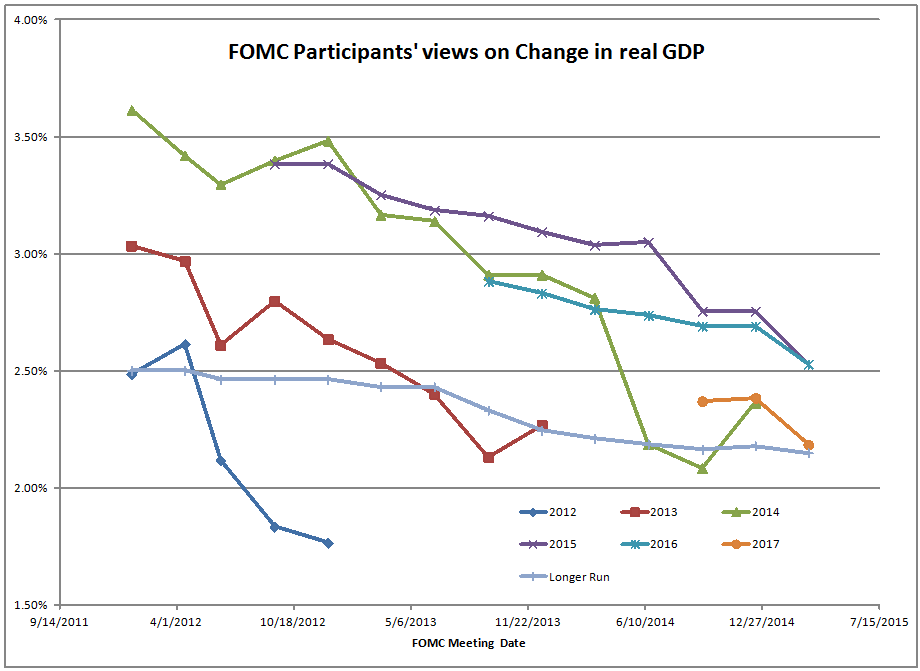
Here is the real GDP graph:

Down, down, down...

Down, down, down…

Note the continued move down in estimates for all future periods. Interesting to see the pessimistic shift.

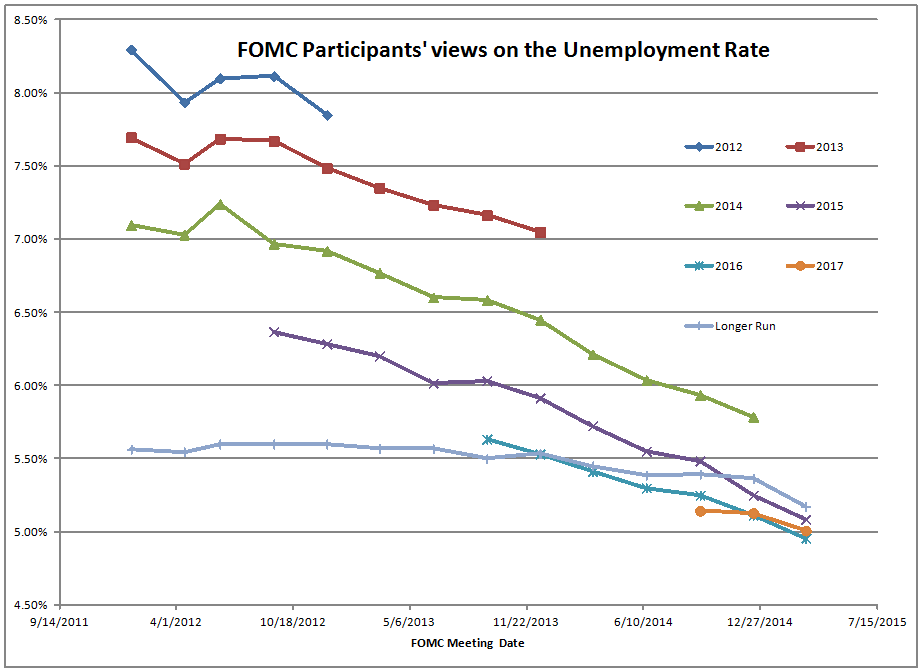
Finally, the unemployment rate graph:

Discouraged workers of the world unite, you have nothing to lose but...

Discouraged workers of the world unite, you have nothing to lose but…

There are many jobs to be had, if people will search for them, and if they think the wages are worth taking, versus alternatives of leisure, working in unreported labor markets, etc…

Conclusion

Looking at the data, the FOMC certainly isn’t hawkish at present. That is consistent with the change in language in the statement, which left timing for any future hikes in the Fed Funds rate vague, and subject to interpretation. This explains the fall in the US Dollar, and the rise in the prices of stocks, long bonds, and commodities. The markets viewed it all as continued monetary lenience, and given the composition of voting members on the FOMC, that should come as no surprise at all.

Until something breaks, expect the FOMC to continue to err on the side of monetary lenience… it’s the only thing they know.

19 Mar 16:03

The Fed Wriggles Out By Removing "Patient" From Statement

by Deepak Shenoy

The Fed went a little crazy yesterday. They didn’t want to spook the market, but they did want to say okay we’re not really in a zone that says we are going to endlessly print money any more. Because printing money is what the world has assumed is what can be had for breakfast, lunch and dinner. And any such note would have been disastrous so they had to choose carefully what they would say.

The consensus was that they would remove the word “patient” from their outlook. They did. If you ever thought, when you were in school, “what difference does Grammar make?”, then this is your lesson – just one word is what half the world was looking for.

But the rest of the statement is basically a scared Fed trying to wriggle out of this crazy position. Everything is leveraged. They know it. The economy is on steroids.… (Read On...)

18 Mar 10:43

Times Group Sends Legal Notice to Housing; Seeks 100 Crores In Damages

by Swathi P M

The Times group has sent legal notice to Housing.com CEO’s email , over his email to employees (where he has alleged that Times Group is trying malign Housing to promote MagicBricks). The email quoted that MagicBricks was attempting to raise more funds.

The entire episode was tailored over a public spat earlier between Rahul Yadav and Sequoia Capital India’s managing director Shailendra Singh over a simmering issue alleging the Times Group involvement in real estate interests through MagicBricks to defame Housing.com.

Housing Internal Email (Price: 100 Crores)

Housing Internal Email (Price: 100 Crores)

The Times Group files the defamation case after the issue was reported by few media outlet (incuding Times-owned ET). The notice asks Housing.com CEO Rahul Yadav and its directors to issue an unconditional apology, and also seeks Rs 100 crore ($16 million) in damages [source].

NextBigWhat Asks: This was an internal email – so why this kolaveri? What’s your take?

What’s your take?

The post Times Group Sends Legal Notice to Housing; Seeks 100 Crores In Damages appeared first on NextBigWhat.

18 Mar 10:41

My Spring Break Reading

by Greg Mankiw
This week is spring break at Harvard, so I have time to catch up on some pleasure reading. First up is a recent recommendation by a blog reader: The Righteous Mind: Why Good People Are Divided by Politics and Religion by Jonathan Haidt. 

The book is a few years old, but I had not heard of it. It gives readers a lens into the field of moral psychology, together with dashes of philosophy, anthropology, behavioral genetics, political science,  and even some behavioral economics.

It is a great read.  Highly recommended.
18 Mar 02:01

Seeking advice or want an argument?

by subra

Amazing how people come to me purportedly for advice. Great.

Once upon a time when I was much younger had a head full of black hair and foolish ideas, I used to feel thrilled. Would spend hours on end and come up with what I thought was a great solution. People would thank me and go away. I had no clue whether they used it or just told themselves ‘what a stupid idea’. No clue. Really no clue.

Then came a time when I used to feel bad that they did not use my advice. Financially it did not matter that they did not heed my advice. Anyway I was not billing them.

Then came a stage when I decided whom I will help and whom I will not. So now there is a very small set of kids for whom I will go out of the way, sit, teach, learn, and hand hold them through a problem. Obviously these are kids I love and I help them through career, personal, health, relationship problems, and I feel happy that I am there for them to ask. No ego / expectation that they will listen to me. They do, mostly they do. If they do not, there is a solid reason why they do not. But yes no money, no expectation, no hurt.

Now come to strangers who come to me for ‘help’. I genuinely try to help people when they come with a sensible question but see how some of the conversations go:

Me: You have too many mutual funds in your portfolio.

Reader: Maybe, but is there a reason why I should reduce them?

Me: No, you need not. But hey, you need not ask me too, right?

Or if I tell them “Sell x, y, a, b, d, and m schemes”

R: Why? x is doing well and y is just started doing well. ‘a’ i have invested for the long run and it is now only 5 years…I am sure going forward it will do well, do you not think so? b, d and m are small amounts to see how the fund is doing..see i have only 25,000 in each fund.

It is really exhausting. And doing it for free is foolish too, do you not think so too? For a fee at least some effort is sensible.

http://www.subramoney.com/2009/08/why-i-deserve-my-fees/

Post Footer automatically generated by Add Post Footer Plugin for wordpress.

17 Mar 08:02

Indian Exports and Imports fall 15%, Total Trade at 4 Yr Lows, More Than Just Oil Price Drop

by Deepak Shenoy

Even as the trade deficit falls to the lowest since September 2013, the scale of collapse of the total trade by India with the external world (merchandise only) is at a four year low. Growth in both exports and imports (year on year) is at -15%

image 

image

India’s imports have fallen in Feb 2015 to $28 billion, the lowest since September 2010. This is largely due to the drop in oil imports after the collapse in oil prices. On the other hand Exports too are at the lowest in four years, at $21.5 billion. Some exports are oil related – since we refine crude and export refined products.

February data is usually weaker than months around it as it has fewer days (by 10% ).

Oil Imports Down 55%, Non Oil Imports Shows Signs of Recovery

In what is the only positive sign, non oil imports are up 11%. This is a positive only because non-oil imports means local demand for something is good.… (Read On...)

17 Mar 08:02

Why every ADVISOR needs an advisor for himself

by subra

Every dentist goes to a dentist, right?

Every Counsellor hires a Counselor for himself -he needs it desperately.

So should every IFA have an IFA?

An Ifa thinks it is a great idea to consult an Ifa. However when it comes to his own money ..he prefers doing it himself !! Why so?

These are the following reasons why an IFA needs an IFA to manage his finances…

1. Most human beings are biased especially when it comes to their own health, finances, etc. So an IFA may not be able to see his own finances as clearly as he would like to. Or as clearly as he should. So advisors, no matter how neutral and unbiased they may be with their clients, often need the support of counselling to see their own lives through an objective perspective.

2. Advisers may lack the discipline and thoroughness when it comes to their own money -afterall they are not really answerable to any body. To bring that discipline into their own personal finance it is necessary to have a personal adviser for themselves.

3. It is an ethical responsibility for advisers to seek counselling on a regular basis to ensure they are continuously growing and working on their own issues, so that they do not bring their biases, struggles, opinions or problems when counselling their own clients.

4. Clearly in my portfolio there is an equity bias. In 2015 in the midst (or beginning or end, I do not know) it is nice to have an equity laden portfolio. However one may lack the discipline of asset allocation, reduction of concentration risk, some obvious mistakes, etc. Whereas having an independent review makes sense.

5. There could be a lot of learning for the adviser to see another adviser at work!

If you are an IFA, can you think of any other reasons for having an adviser for yourself?

Post Footer automatically generated by Add Post Footer Plugin for wordpress.

16 Mar 10:39

Bureaucrats in business: The tension between rule of law and commercial considerations

by Ajay Shah
by Anirudh Burman, Shubho Roy, Ajay Shah.

How to achieve high performance in government


In government, the route to performance lies in clarity of objectives and accountability mechanisms, grounded in the rule of law. Every transaction undertaken by a government must be grounded in a written down process, must treat all legal persons equally (Article 14 of the Constitution), must go through due process, must be open to questioning later on. All persons must have full documentation about how the government will behave under various circumstances, must be given documentation about how their transaction was processed, and explained why. Coercive actions of the State must be subject to judicial review. Purchases must be made through General Financial Rules (GFR).

How to achieve high performance in business


These bureaucratic processes have no place in the world of business.

For a firm, counterparties have no Article 14 rights. A manager must choose to give a contract to vendor A or vendor B based on an overall sense of how this will work out. The manager is not obliged to give a reasoned order or even to treat vendors equally.

In finance, private persons choose to buy equity or debt by exercising their own judgment. There is no obligation to have due process or to face audits that question commercial decisions.

This gun-slinging exercise of discretion works because the competitive market sorts it all out. Firms are kept on their toes by the accountability mechanism of the market. Firms get high speed feedback from the market about how they are faring. Good decisions yield improved profits and improved stock prices, and vice versa.

Phase I of India's journey


When Indian socialism was being constructed, the government wanted to be in business. There is a fundamental contradiction between the decision processes that are required in business when compared with the rule of law.

The solution adopted was to sacrifice the rule of law. All across the Indian state, we got politicians and bureaucrats wielding arbitrary power. The construction of Indian socialism damaged India's institutional capital.

Phase II of India's journey


In recent years, the tide has turned decisively. The Constitution of India is asserting itself. We are building the rule of law, we are restoring the institutional capital. You can no longer fudge the process for allocation of spectrum or coal mines. The old clubby ways are being stripped away, all across government.

Some people continue to yearn for the bad old days when a bureaucrat wielded unchecked power, but those days are safely behind us. As an example, see: CAG asks why Air India sold five Boeing 777s at loss to Etihad in 2013 by Mihir Mishra in today's Economic Times.

This great push towards the rule of law has one important implication: the push for the rule of law makes it  harder for the government to do business.

In the olden days, a public sector company could exercise discretion, and participate in the world of business, because the rule of law in India was in tatters. Now that India is pushing back into rebuilding the rule of law, this makes life difficult for the parts of government that are engaged in commercial activities.

On an international scale, we generally see that in countries with strong rule of law, we don't see public sector companies. The intuition that has been offered, in the past, is that there is a deeper thing called `good institutions'; in countries with good institutions, we see the rule of law and we see the absence of public sector companies. Conversely, when there is low institutional quality, we see failures on the rule of law and we see the phenomenon of public sector companies.

The main argument of this article is that there is another causal connection in the picture. A country that sets out to have public sector companies will damage the rule of law, and a country that sets out to strengthen the rule of law will damage public sector companies. Perhaps countries with strong rule of law lack public sector companies as those rule of law strictures have interfered with their functioning.

Implications for public sector companies e.g. public sector banks


In the best of times, it is difficult for bureaucrats to be in business. All over the world, there is ample evidence that government ownership of business hampers productivity. Layered on top of this is this new twist. Earlier, a bank in India could exercise more arbitrary power in trading securities, giving loans, restructuring bad loans, etc. But once public sector banks come under the full strictures of the rule of law, this becomes harder. India's drive towards the rule of law is detrimental to the concept of a public sector company that is owned by the government but engages in commercial activities.

We repeatedly hear public sector bankers complain that it's impossible to do the business of banking when placed under the myriad accountability mechanisms of the government. Their solution is that the rule of law is optional, that banks should be exempted from these requirements even when banks are owned by the government. We suggest that the solution lies in government getting out of banking.

Where is the line drawn, where a public sector company is the State?


Article 12 of the Constitution says: In this part, unless the context otherwise requires, the State includes the Government and Parliament of India and the Government and the Legislature of each of
the States and all local or other authorities within the territory of India or under the control of the Government of India.


This is important because Part III (fundamental rights) can be claimed against the State, such as equal treatment, non-discrimination, etc.

Here the word `includes' implies that this is not an exhaustive definition. The courts have developed tests to determine what `other authorities' means. The key case is Ajay Hasia. These questions turn on the issues of control and financing: (a) the degree of government control over the administration of the authority, (b) the degree of funding/ grants made to the authority, (c) power to appoint/ remove officials, etc. Based on these criteria, various kinds of entities such as public sector companies, educational institutions that receive government money, etc., have been termed state.

When the government owns less than 50% of a commercial enterprise, that organisation is generally not classified as State. However, evidence of pervasive control in such cases may lead to a judicial
determination that the entity is "state" under Article 12. For statutory monopolies or organisations with pervasive State control, even going below 50% ownership does not elude classification as State. In the case of R.D.Shetty v. International Airport Authority of India the Supreme Court stated that an entity such as the International Airports Authority could not act arbitrarily, but was subject to constitutional requirements.

It stated that, ...power or discretion of the government in the matter of grant or largesse including award of jobs, contracts, quotas, licences etc. must be confined and structured by rational, relevant and non-discriminatory standard or norm.... It then went on to say that corporations established by statute, or incorporated under law (including any company under the Companies Act) are "state"
if they satisfy certain tests based on:

  1. The source of share capital.
  2. Extent of state control over the corporation, and whether it is deep and pervasive.
  3. Whether the corporation has monopoly status.
  4. Whether the functions of the corporation are of public importance and closely related to governmental functions; and
  5. Whether, what belonged to a government department formerly was transferred to the corporation.

For a more detailed answer, see this report of the Law Commission (page 4, paras 2.3 to 2.6).

Three important issues arise related to the 1979 ruling of the Supreme Court:

  1. A business entity making a commercial decision does not hand out contracts as a "grant or largesse", but as a competitive player in the market interested in purchasing goods or services that satisfy its own requirements. To constrain it by the rule of law is to fetter its commercial decision making process.
  2. The transition of the Indian state is different from the transition of many western democracies such as the USA and UK. These democracies transitioned from laissez faire states to
    regulatory states. The Indian state on the other hand, is transitioning from a pervasive state to a regulatory state. Until not too long ago, the state ran hotels and manufactured bread. As such, most functions sought to be deregulated and/or performed by companies/ corporations are or were of public importance, and closely related to governmental functions.
  3. In India, many government functions are being privatised or handed over to government companies. A good example is telecom. Telecommunication services were first transferred to public sector companies owned by the central government, and eventually privatised.

On a related note, GFR has a rule to prevent escaping from GFR through subsidiarisation: Once government provides majority funding to a body, it must accept GFR and CAG.

This results in a situation where though de jure transfers of control, ownership and management have taken place, for government owned/ controlled corporations, there is never a complete de facto escape from the constitutional constraints on the Indian state. Such entities are unable, from the point of inception to act purely on commercial motives. It is therefore questionable whether any government
strategy that aims at greater market discipline and efficiency in a sector can be successful through the route of establishing government owned/ managed entities. Alternatively, the precedent on what constitutes "state" needs to be reviewed. The judgements on what constitutes "state" were made in the era of a pervasive state. A regulatory state must be defined differently.
16 Mar 10:36

What to Do With Losing Stocks in Your Portfolio

by Vishal Khandelwal

VIA Anniversary Offer Ends Tonight: The special anniversary discount of Rs 3,000 on our premium newsletter – Value Investing Almanack – ends tonight. Click here to subscribe now.


I met a gentleman (a friend’s brother) recently who owns 45+ stocks in his portfolio, most of which are bad businesses – he realizes that – and are deep into losses despite the decent run in the stock market over the last few years.

“What should I do with these stocks?” he asked me. And he is not the only one who’s asked me this question in the past. I have met numerous people over the past few years who have held on to bad businesses and losing stocks in their portfolios, and not knowing what to do with them.

One way people look at such stocks is – “Oh, this XYZ stock is already in a deep loss. What would I get by selling it anyways?”

Another way is – “I will sell this ABC losing stock only when I get my capital back. I don’t mind holding it for the long run.”

Well, this second thought is what creates a lot of “forced” long term investors – people who stay invested in a bad stock for the long term because they don’t think they have an option to sell it.

Nobody Likes Losing
That’s true! So why do people hang on to losing investments?

Because selling feels even worse.

The pain of a loss is substantially greater than the pleasure from a gain, researchers of investment behaviour have found.

People will go to great lengths to avoid pain. Accordingly, our inclination when facing a financial loss is to convince ourselves that the asset is going to bounce back and we will at least break even.

“It’s only a paper loss,” people would tell themselves. “It’s not a real loss until I sell.”

Anyways, one suggestion I gave to my friend’s brother was to hold on to businesses he knows are “obviously” good, and sell the ones he knows are “obviously” bad, irrespective of what those stocks have done in the past.

“Your cost price does not matter when you are looking to decide what to do with a stock in your portfolio,” I told him. “What matters is today’s stock price – assuming it’s a good business and you are looking to buy that stock afresh today – and your expected returns from it over the next 10 years.”

If you wouldn’t buy more of a stock today on which you have a loss, sell it. Don’t wait to “get even.” Chances are there are better ways to invest your money.

No well-managed store keeps obsolete goods in inventory; neither should you keep losers in your investment portfolio.

And if you think “How much more can it fall from here on?”, please note that every 90% loss begins with a 10% loss, and then goes to 20%, then 30% and so on. So, when you realize you’ve made a mistake in the matter of stock selection, it’s better to take the loss sooner, not later.

In his Owner’s Manual, distributed to Berkshire Hathaway shareholders in 1999, Warren Buffett wrote –

Do not think of yourself as merely owning a piece of paper whose price wiggles around daily and that is a candidate for sale when some economic or political event makes you nervous. We hope you instead visualize yourself as a part owner of a business that you expect to stay with indefinitely, much as you might if you owned a farm or apartment house in partnership with members of your family.

Now, “indefinitely” is a long time. Although Buffett was talking about his own company, Berkshire Hathaway, his advice applies to any well-run company. With regard to Berkshire‘s portfolio of companies, he noted in his 1996 letter to shareholders that…

We continue to make more money when snoring than when active. … [Y]ou simply want to acquire, at a sensible price, a business with excellent economics and able, honest management. Thereafter, you need only monitor whether these qualities are being preserved.

The last sentence gives us the first clue about when to sell: if the company no longer provides “excellent economics” or is no longer run by “able, honest management.” Thus, if your original investment thesis is no longer valid, consider getting out regardless of the stock price.

Time and time again, investors take profits by selling their appreciated investments (“Oh, what if I lose my gains!”), but they hold on to stocks that have declined in the hope of a rebound (“I want to get my money back!”).

If you don’t know when it’s time to let go of hopeless stocks, you can, in the worst-case scenario, see the stock sink to the point where it is almost worthless – a permanent loss of capital.

There is no guarantee that a stock will bounce back after a long decline. While it’s important not to underestimate good stocks, it’s equally important to be realistic about investments that are performing badly (because the underlying business is bad).

Recognizing your losers is hard because it’s also an acknowledgment of your mistake. But it’s important to do that sooner than later.

Don’t be afraid to swallow your pride and move on before your losses become even greater.

“And then,” as I advised my friend’s brother, “Start with a clean slate, and this time, please do it sensibly.”

The post What to Do With Losing Stocks in Your Portfolio appeared first on Safal Niveshak.

    
16 Mar 03:38

The flawed orthodoxy - case of infrastructure contracting

by noreply@blogger.com (Gulzar Natarajan)
The Economic Survey's advocacy for a strategy of "combining construction and maintenance responsibilities to incentivize building quality" in infrastructure asset creation is classic example of theory sans reality. It is also an example of how orthodox approaches can end up costing more than prudent strategies designed based on the existing market structure.

The fundamental assumption is unexceptionable - good building quality is critical to life-cycle costs, and a combination of building and construction aligns incentives to minimize life-cycle costs. But a first order requirement for this assumption to hold is that the construction contractor has a stake in operation.

In an ideal world, life-cycle costs minimization can be achieved by assembling a project development consortium of construction and operation and maintenance (O&M) contractors as well as financiers. As construction is completed, the construction contractor gradually exits, allowing the O&M contractor take over the project. But in the real world, especially in developing markets like India where the distinction between construction and O&M contractors is blurred, such tight alignment and seamless transitions rarely, if any, happen. Here, a GMR or HCC, after outsourcing the O&M to smaller contractors, sells their assets to infrastructure funds like SBI Macquarie or IDFC India Infra Fund and abruptly exits the project. This does little to align incentives towards minimizing life-cycle costs since the project developer predominantly performs the role of a construction contractor.

Conditional on the difficulty of combining construction and maintenance responsibilities, the most optimal strategy would be to de-couple the two activities. The road map,
  1. Establish a Special Purpose Vehicle (SPV)
  2. Put in place professional management and good governance practices (arms-length relationship with the government department/ministry)
  3. Construct, using mainly public funds, and off-load construction risk
  4. Stabilize the project and lower commissioning risks
  5. Contract out O&M as long-term concession
  6. Regulate the concession
The benefits are substantial. Public financing lowers the cost of capital for construction. Once the project is commissioned, real project information becomes available, which enables concessionaires to bid with far greater assurance. It also enables government agencies to write more complete contracts, which minimize re-negotiation risks. All this enhances transparency and limits political risks. On the other side of the risk assessment ledger, the biggest downside risk, which assumes significance given the country's state capability deficit, involves the governance of the SPV which is critical for both construction time and its quality. 
Add to Technorati Favorites
16 Mar 03:33

You know risks are building when newspapers have pamphlets on “training program on how to become rich in stock markets”

by Amol Agrawal
Some things never make sense. One of them is people advising others on how to become rich in stock markets. If you are that smart why not pile on the monies yourself. Why would someone waste time training others to become rich in stocks and not do it himself/herself. Even if the idea is to […]
15 Mar 03:17

Dividend Yield Analysis of Nifty in 2015 (Since last 16+ Years)

by Dev Ashish
This is the analysis of 3rd and final indicator which I track on a monthly basis in the State of Indian Markets. The previous two posts have analyzed P/E Ratio and P/BV Ratio of Nifty since 1999, i.e. a dataset of more than 16 years. The data for this and all previous analysis has been sourced from NSE’s official website (link 1 and link 2). Since data prior to 1st January 1999 is not
15 Mar 03:15

The economics of cloud computing: an Indian perspective

by Ajay Shah
When you buy computer hardware, and build a glass house in India, the costs incurred are those of:

  1. Skilled and specialised labour
  2. Electricity for computers
  3. Electricity for cooling
  4. Real estate
  5. Depreciation of hardware
  6. Cost of capital on all the equipment
  7. The problems of achieving high availability on the above.

Firms all over the world are finding that the make vs. rent choice shifts in favour of cloud computing: You shut down your glass house and rent the services of computation in the cloud, run by the likes of Amazon or Google.

Some of this flows from the universal logic of specialisation and economies of scale. Google hires Ph.D.s in aerodynamics to optimise airflow in data centres. Almost all end-user firms are unable to justify this scale of outlay. Google is able to put a data centre right next to a hydel plant and enter into a long-term contract for 100 years of electricity. Almost all end-user firms are unable to justify this kind of thinking for their data centres.

In addition to this, I think there are some interesting and uniquely Indian perspectives.

Cooling


If the ambient temperature is 5 C instead of 30 C, this reduces the cost of cooling.

Electricity


Electricity is very costly in India as the commercial sector is paying for subsidies and inefficiency. This is particularly after you take into account the complexities of ensuring high availability.

Real estate


Land is very costly in India.

Capital


Most important, the cost of capital is very high in India.

For Amazon or Google, the cost of debt capital is 4% and the cost of equity capital is 7 to 8% (in USD).

For a big listed company in India, the cost of equity capital is 15% and the cost of debt capital is 11% (in INR). For smaller companies it's much worse.

It makes a lot of sense to reduce the balance sheet size to the extent of the cost of the data centre, and replace it by a stream of rental payments to cloud computing providers outside the country.

This idea has many interesting implications. The propensity for Indian firms to rent from overseas cloud computing providers goes up when capital controls are introduced, goes down when inflation targeting works, etc.

Cloud vendors in India?


I don't see how cloud computing vendors in India can be competitive, as they face these same uphill problems of operating in India: expensive real estate, expensive electricity particularly after taking into account the HA issues, and expensive capital.

They might argue: The labour cost is lower; it's cheaper to get a Ph.D. in aerodynamics in India. My fear is that the labour cost component in the operations of a big data centre is quite small.

So far I have assumed that the core hardware (electronics + cooling) is at high seas prices. There are many mistakes in the Indian tax system, and this could easily not be the case.

Gains for end-users


Before cloud computing, if you were an end-user organisation in India, you had no choice but to deal with the problems: expensive hardware, low economies of scale in systems administration, the high cost of HA electricity and cooling, real estate and capital. Cloud computing is a big gain for India in terms of the reduction of costs that are given to end-users. Other countries will do what's their comparative advantage (producing cloud computing services); firms in India will import these services.
14 Mar 03:17

Givers Gain! No this is not about networking!!

by subra

If you think giving is easy, let me tell you it is not. Asking is even more difficult.

Giving without expecting anything in return is even more difficult. Most of us give expecting a thank you or gratitude – even that is wrong. If you believe in the phrase ‘Givers Gain’ you should be able to make giving a natural part of your life, without expecting anything in return. This is not very difficult – I know a few people who can give selflessly and their lives have been filled with happiness, exceptional returns in equity markets (difficult to believe, right?) and tremendously good personal relationships. These people had no clue that they will get all this when they were giving. They just gave because they had it and the consequences happened.

Not every body can give selflessly..read this story from Lord Krishna’s life.

Once Krishna and Arjuna were walking towards a village. Arjuna was pestering Krishna, asking him why Karna should be considered an unparallelled Donor & not him ? (Dhanveer Karna kyon, dhanveer Arjun kyon nahin?). 

Lord Krishna realized that a small lesson in humility was in place for Arjun!!

Krishna, turned two mountains into gold.

Then said, “Arjuna, distribute these two gold mountains among villagers, but you must donate every bit of it “.

Arjuna went into the village, and proclaimed he was going to donate gold to every villager, and asked them to gather near the mountain. The villagers sang his praises and Arjuna walked towards the mountains with a huffed up chest.

For two days and two nights Arjuna shovelled gold from the mountain and donated to each villager. The mountains did not diminish in the slightest.

Most villagers came back and stood in queue within minutes. Now Arjuna was exhausted, but not ready to let go of his Ego, told Krishna he couldn’t go on any longer without rest.

Then Krishna called Karna and told him to donate every bit of the two gold mountains.

Karna called the villagers, and said “Those two Gold mountains are yours. ” and walked away.

Arjuna sat dumbfounded. Why hadn’t this thought occurred to him?

Krishna smiled mischievously and told him “Arjuna, subconsciously, you were attracted to the gold, you regretfully gave it away to each villager, giving them what you thought was a generous amount. Thus the size of your donation to each villager depended only on your imagination.

Karna holds no such reservations. Look at him walking away after giving away a fortune, he doesn’t expect people to sing his praises, he doesn’t even care if people talk good or bad about him behind his back. That is the sign of a man already on the path of enlightenment”.

Giving with an Expectation of a Return in the form of a Compliment or Thanks is not a Gift, then it becomes a Trade.

” Give without expecting anything in Return.”

http://www.subramoney.com/2008/05/charity-how-to-do-ask-kabir/


Givers Gain

Post Footer automatically generated by Add Post Footer Plugin for wordpress.

13 Mar 06:13

What a 60% return in one year does to your life?

by subra

A couple of days ago I did a post saying ‘markets are up buy 40%’ – to which a couple of friends called up and said “Hey thanks to you my portfolio went up by 55%’. Thanks guys. The minute you told me that I was reminded of the donkey story.

http://www.subramoney.com/2009/02/relationship-manager-fund-manager-or-magician/

This is not about how they got a 60% return on their portfolios, it is about what it has done for their lives. Let us take the case of this person – lets name him RS.

He had about Rs. 2.5 crs. in equity funds / direct equity in December 2013. In the month of Feb 2015 /March 2015 he has about Rs. 4 crores. This is about 60% – but over a slightly longer period than one year.

What does 60% do to his portfolio? Well the question to ask is what does Rs. 1 crore addition do to his portfolio.

Assuming that his monthly expenses are about Rs. 40,000 (say Rs. 500,000 pa) - he can live another 20 years (I am assuming real returns, so that adjusts for inflation).

It means that at his age of 63 he need not worry AT ALL ABOUT needing to go back to the job market to make a living.

It means he can fool around a little with his asset allocation. He had about Rs. 2.5 crores in equities and about Rs. 1 crore in debt products. He also has a LIC annuity paying him about Rs. 28000 per month. Now with Rs. 4 crores in equities, he can afford to pull out say Rs. 1 crore from equities and put it into a Balanced fund / annuity say in a 50:50 split.

In case his daughter has a baby, he and his wife can afford to fly to Australia without expecting his daughter to pay for the ticket and the visa!! (and insurance too!!).

He can afford to travel by a comfortable mode of transport – instead of trying to travel by the cheapest mode.

He can afford at least one vacation every year.

I had held him back (still holding him back) from committing to buy a Retirement home for about Rs. 80 lakhs in Coimbatore. He can now argue that the asset is coming from the gains in the market, so he is justified …

He is of course thrilled with what has happened, but did not spend Rs. 10L to celebrate this super profits!! Just a nice dinner for him and his wife. (sensible reaction to market super profits is a very very important step in wealth creation and keeping).

He bought something really expensive (by his standards) for his son in law – a 600mm Canon lens for his DSLR camera. Google the price and be shocked please. Of course his son in law is a very good wildlife photographer, but I had the pleasure of seeing his face when he saw it. I am sure this was a brilliant gift, and I can take 99% credit for pushing the purchase. My friend says he owes me a lifetime of gratitude for that expression. Sorry, but I agree!!!!

So see the impact of a 60% return on YOUR portfolio. Kick yourself if you had too little money in equities. Make amends NOW. Over the next 5 years there will be one more year when the market gives you a 60% jump start to your portfolio. Be ready to receive it.

If you have Rs. 100,000 in equities it will mean Rs. 60,000. If you have Rs. 10 crores in equities it will mean Rs. 6,00,000, 00.

Make your choice where in the x axis you want to be. Near 100k or near 10 crores. That is YOUR call.


Post Footer automatically generated by Add Post Footer Plugin for wordpress.