
Chaitanya Patel
Shared posts
26 May 02:16
Indian Govt’s flip flop over FDI in retail: Governance involves responsibility and continuity
by Amol Agrawal
So said India’s Finance Minister in his latest attempt to justify why govt is continuing with the policy of 51% FDI in multibrand retail. It is highly ironic as the same govt opposed this policy tooth in nail while in opposition. Finance Minister Arun Jaitley on Saturday suggested the National Democratic Alliance (NDA) government would continue with the United […]
26 May 02:16
Shining shoes can be more satisfying than being a banker
by T T Ram Mohan
Read Lucy Kellaway's caustic piece in FT.
A shoeshine boy in London tells her why his job is better than a banker's:
A shoeshine boy in London tells her why his job is better than a banker's:
- “I don’t have to be clever,” he said. “I can be as dumb as I like. I’m not trying to impress anyone".
- The next good thing about the work, he said, was the satisfaction in the job itself. You take a pair of dull shoes and eight minutes later they are sparkling.
- Third, and possibly most important of all, is that shoe shining, in marked contrast to banking, gives its customers pleasure.
- Fourth, the chat is nice. According to Marc most people in the City are starved of decent conversation, and longing to tell their shoe shine man all sorts of interesting — and sometimes scurrilous — things.
- Finally, he chooses his own hours. So he shines shoes at lunchtime when trade is brisk, and works as a translator the rest of the time. There is no management, no politics.
25 May 04:48


Zoho Trolls All Public SAAS Companies ; Calls Them Post IPO Non-Profits
by NextBigWhat
Zoho has trolled all public tech (SAAS) companies urging their customers to move to Zoho, which has been bootstrapped and profitable (for the last 19 years).
The “Non-profitable SAAS Companies
Global SAAS Player’s Revenue
Salesforce Profitability
Zoho vs SAAS Companies
Zoho has launched postipononprofits.com and has taken on companies like Box,Marketo, Jive, servicenow and ofcourse, Salesforce for their unprofitable history.
This comes after the recent news of Salesforce being up for acquisition has been gaining grounds.
The post Zoho Trolls All Public SAAS Companies ; Calls Them Post IPO Non-Profits appeared first on NextBigWhat.
25 May 04:47
MBA degree…still a good option?
by subra
In the 1960s MBA was considered as a new degree and was not very popular…and it was just finding its feet. However it very quickly established itself and became popular. And like all popular things people started copying! The IIM was the place where you could do your MBA – but then clones started appearing all over the place. Things came to such a pass that every college, university, business house set up an MBA institute.
Is doing MBA a good option? I think the answer is yes.
Two things have to happen. You should go to a college which has good faculty, and attracts good students. So if you are good enough to get into an IIM A who is to even question “should you go and do your MBA?”. The answer is obvious, is it not? For the not so good / great student the decision is far more difficult to make. Should an ordinary student get into a “d” grade MBA? Again the answer seems to be yes. No, not because they will learn too many things, but because it is almost impossible to get any job with just one basic degree. At least the college allows you to meet potential employers like banks, life insurance companies, fmcg, …these companies would not even have known that you existed. So there are 2 uses of an MBA degree:
– you meet good quality students (many superior to you)
– you meet good professors who have been teaching there for years on end
– you meet corporate India – who are at your campus with the simple task of recruiting.
So go to a good MBA college – the best that your marks will take you (or what your dad can afford?)
Learn, study, unlearn, re learn…and keep the process on. Learn to organise events, be on committees for various things….and ENJOY!!!!!
Post Footer automatically generated by Add Post Footer Plugin for wordpress.
24 May 04:20


FAQ on UAN number and Change of Job
by Kirti
For an Employee whose employer is making EPFO Contribution Universal Account number or UAN number is allotted. This article answers frequently asked questions like What is UAN number , What is Member Id and how does it differ from UAN number, What is registration of UAN number, How is UAN number allotted, What happens to UAN number when one changes job, Change of Job and UAN number,Request for this Member ID is already under process, What if two UAN numbers were allotted to someone, Mismatch in UAN and Member ID.
What is UAN number?
UAN is Universal Account Number. The UAN is a 12-digit number allotted to employee who is contributing to EPF. Universal number is a big step towards shifting the EPF services to online platform and making it more user-friendly. Please note that The universal account number remains same through the lifetime of an employee. It does not change with the change in jobs.
What is importance of UAN number ?
Once you have the UAN number and you register it then you can check many details . Benefit Of Registration of UAN at UAN Member e-Sewa Portal are as follows:
- You can download the updated EPF passbook. The passbook will tell you the EPF balance broken into Employee Contribution(EE) and Employer Contribution (ER). Also deduction fro Employee Pension Scheme (EPS). Sample passbook is shown below.
- You can link your previous PF accounts (before Oct 2014) which are not linked to UAN number.
- You can upload KYC data.
- You can change mobile no and email address.
- In Future You can apply for the online PF transfer through UAN itself. Currently it’s a separate process done through Online Transfer Claim Portal (OTCP). Going forward plans are that when employee changes job and new Member ID is allotted then transfer of old Member Ids would be done automatically.
What is Member ID?
Employer submits the EPF(Employee Provident Fund) money to the EPFO (Employee Provident Fund Office) on behalf of the employee. This includes both the employee contribution, employer contribution, Employee Pension scheme. Member Id or Member Identification Numbers is the number given by EPFO to allow the employer to submit EPF money of employee. It’s like Employer opens an EPF account for its employee and contributes to that account every month. Member ID is the account number of employee in the EPFO. When the employee changes the job then the new employer will open a new account number for it’s employee in EPFO. So a new Member ID will be allotted to employee. Member ID is same as PF number earlier. So you would have as many Member ID’s as the number of employers contributing on your behalf to EPFO.
Member ID or PF Account Number is in the format given below. PF Account Number may not have Extension code. Ex: For someone who works in Bangalore the code can be BG/BNG/012345//789.
EPFO Office Code/Establishment Code(Max. 7 Digits)/Extension(Max. 3 digits)/Account Number (Max 7 digit)
How does Member ID differ from UAN number?
An employee will have one UAN or Universal Account number, which as the name implies will remain the same. It will maintain all your Member Ids. Its like you can have multiple Saving Bank account but all these are tied to your one Permanent Account Number or PAN. So when you change your job and the new employer, if contributing to EPF, gives you a new Member ID. This new Member ID has to be linked to your UAN number.
- If the employee does not have a UAN number, probably because it’s his first job or he was working before Jan 2014 when UAN number process started. Then employer will request the EPFO to generate the UAN number for its employee along with Member ID.
- For an employee who already has a UAN number the employer will submit the request to EPFO to generate new Member ID for the employee and link it to the UAN number of the employee by filling Form 11.
How is UAN number allotted?
-
The EPFO will allot employers the universal numbers of all employees for which employer makes EPF contribution.
- If the employee does not have a UAN number, probably because it’s his first job or he was working before Jan 2014 before UAN number process started. Then employer will request the EPFO to generate the UAN number for its employee along with Member ID.
- For an employee who already has a UAN number the employer will submit the request to EPFO to generate new Member ID for the employee and link it to the UAN number of the employee by submitting Form 11 filled by new employee.
- The employer would then give the number to its employees, who need to provide their KYC (know-your-customer) details to the employer.
- The KYC details of employees would then be updated online on the EPFO website by the employer.
- An employee can also upload the scanned copy of the KYC document through the EPFO website once you are done with the UAN-based registration. However, your employer has to digitally verify your KYC details.
Every UAN will be linked to one or more Member Ids upto maximum of 10. It would help to track the EPF contribution throughout the entire career.
How to check status of UAN Number Online
Visit EPFO Portal (http://uanmembe
You can use the link EPFO:Check UAN Status to verify whether UAN is allotted to you or not.

On Checking status I get Request for this Member ID is already under process. What does it mean?
When one checks the UAN status one might see message similar to Request for UAN for this Member Id ABC is already under process.(through ECR) since last 45 days.
This means that the UAN process for Member ID is processing and your UAN number will soon be generated. How soon, is anyone’s guess,It can take around 2 months, but With EPFO embracing technology it would become faster as time progresses.
What is registration of UAN number?
To see the details Once you receive the Universal account number or UAN from your employer, you have to log on to the official website http://uanmembers.epfoservices.in. Click on Activate UAN Based Registration and enter your UAN, mobile number and member ID. Once you are registered you can download your UAN card, EPF passbook, link earlier PF Member Ids etc. Our article UAN or Universal Account Number and Registration of UAN explains the process in detail.
On trying to Activate UAN I get message Mismatch in UAN and Member ID? What does it mean?
When one tries to activate the UAN one might see message similar to Mismatch in UAN and Member ID .
It means that the Member Id being used for Activation of UAN number and Member ID associated with UAN number does not match. It may be due to incorrect filling of Member Id. Member ID or PF Account Number is in the format given below.
EPFO Office Code/Establishment Code(Max. 7 Digits)/Extension(Max. 3 digits)/Account Number (Max 7 digit)
Some tips while entering Member Id
- Please select checkbox near I have Read and Understood the Instructions. (marked in Red colour in image below) to see the form
- By Selecting State and Office EPFO Office Code automatically gets filled. In case your office has multiple branches Your state may not be where you work but where your main office is situated. For example for a company with head office in Noida and branches in Pune & Bangalore. The EPF for all employees might be done at one place where the first office is situated, Noida in our example. Then even for employees in Pune and Bangalore the State to be selected is Uttar Pradesh and Office Noida.
- If your PF number does not have Extension Code leave it blank.
Activation of UAN Based Registration
What about KYC and UAN?
KYC is an acronym for Know your Customer or Know your client. It refers to due diligence activities that financial institutions and other regulated companies(LPG,telephone) must perform to ascertain relevant information from their clients for the purpose of doing business with them. Our article Know Your Customer or KYC talks about KYC in detal.
Basic purpose of KYC is to verify that you are what you are claiming to be. So your UAN number also needs KYC. KYC status is reflected in UAN card. There are two ways that KYC for UAN can be done
- Your employer asks you for KYC document and uploads it on your behalf.
- You upload scanned copy of KYC documents and employer approves it. It can be done by going to the Profile menu and selecting Update KYC Information in the Member Portal. The uploaded KYC document by the member will be approved by employer till then status of KYC will be shown as Pending. Yu need to scan the KYC document first and save it as .jpg/.gif/.png/.pdf. The size of scanned document should not exceed 300kb. multiple KYC documents out of the 8 specified KYC documents can be uploaded.
Following documents can be used for KYC:
- National Population Register
- AADHAAR
- Permanent Account Number
- Bank Account Number
- Passport
- Driving License
- Election Card
- Ration Card
What is UAN Card?
UAN Card as the name implies shows the Universal Account Number and provides details related to UAN number. Its just like PAN card. Though it’s usage is still not clear.
- Front portion of the UAN Card displays : UAN, Name, Father’s/Husband’s Name, Member-ID, (as available in the EPFO member database) Photo and KYC. If KYC of this member is uploaded by the employer, it will reflect on the front side of the UAN card by displaying Yes in front of KYC else if will reflect No
- Back side of the UAN card displays latest five Member-IDs linked with this UAN alongwith helpdesk no. and email-id.
Front part of UAN Card
Back part of UAN Card
Change of Job and UAN number
What to do when one changes job. If Universal Account Number (UAN) s already allotted then one is required to provide the same on joining new establishment to enable the employer to in-turn mark the new allotted Member Identification Number (Member Id) to the already allotted Universal Identification Number (UAN). This is done by Filling the epf-NewForm-11-with-instructions(epf) which replaces the old Form 11 and Form 13. The EPF circular of 2 Jan 2015 can be found here. Part of Form which refer to Previous Employment details and Declaration by previous employer are given below.
EPF Form 11 Previous Employment
EPF Form 11 Declaration by Previous Employer
One can download the filled copy of the Form 11 from UAN website after login by Selecting Forms->Declaration Form and filling Date of exit of Previous Employment as shown in image below.
EPF Form 11 downloaded from UAN website
Filled EPF Form 11 from UAN website
What if two UAN numbers were allotted to someone?
Yes there have been many cases when two UAN numbers were allotted to the same person. This was due to less awareness of the UAN number and during job change the new employer did not ask for UAN number or previous employer’s PF details. In such a case a person can have two UAN numbers associated in addition to two member IDs. In such a case, you are suggested to immediately report the matter either to your employer or through email to uanepf@epfindia.gov.in by mentioning your current and previous UANs. After due verification the previous UAN allotted to you will be blocked and Current UAN will be active. Later you will be required to submit your Claim to get transfer of service and fund to new UAN. How much time this would take we couldn’t find out. If readers can share their experiences with us it would be beneficial to others.
What is linking of Previous Member Id and UAN? Can one transfer claim through UAN
If you have only one UAN number but many Member Ids then you can link your previous member IDs with the present UAN number. This is useful when one needs to link one’s earlier PF account before UAN came into picture. Linking is the first step. Then one needs to transfer the earlier account . You can do so from UAN portal itself but it takes you to http://memberclaims.epfoservices.in/. Process of transferring is explained in our article Transfer EPF account online : OTCP
EPF File Transfer Claim
Name or Father’s or Spouse Name name or Date of Birth is not correct in UAN
EPFO has made a provision for change the name of EPF members. Members who wish to get their name/Fathers name/Date of Birth to be changed in the EPF Database can apply for the same through their employer along with supporting documents. One can read EPF Circular for change in name and EPF Circular for change in birthday
Supporting Documents for change in Name/Father’s Name/Spouse Name may be one of following documents
1. PAN Card 2. Voter’s ID Card 3. Passport 4. Driving License 5. ESIC Identity Card 6. Aadhaar Card 7. Bank Passbook Copy/Post office Passbook 8. Ration Card 9. Any school or education related certificate 10.Certificates issued by the Registrar of Births and Deaths 11. Certificate based on the service records of the Central/State Government organisation 12. Copy of electricity/water/telephone bill in the name of claimant 13. Letter from recognised Public Authority or public servant verifying the identify and residence.
Supporting Documents for change in Birthday may be one of following documents
1.Birth certificate issued by the Registrar of Births and Deaths 2. Education certificate/School record/leaving certificate 3. Passport. 4. Any other reliable document issued by a government department; but NO affidavit or court order merely based on member’s declaration only. 5. Certificate based on the service records of the Central/State Government organisation
References : User Manual for UAN website , UAN website
Related Articles:
- What are EPF,Pension and Insurance Changes from1 Sep 2014
- Basics of Employee Provident Fund: EPF, EPS, EDLIS
- Understanding Employee Pension Scheme or EPS
- Voluntary Provident Fund, Difference between EPF and PPF
- Tax on EPF withdrawal
- Transfer EPF account online : OTCP
- Articles related to Salaried on EPF, Variable Pay, ESOP,NPS, Income Tax, MBA, Changing jobs
22 May 02:23
A Year Isn’t A Year
by Jason Fieber
 I recently discussed how a dollar isn’t a dollar.
But I’ve also found, over time, that a year isn’t a year.
A Dollar Isn’t A Dollar
It seems that for some reason we tend to value things with a 1:1 ratio. And that’s true for both money and time.
We might compare what kind of money we could earn at a job we’d probably enjoy against an extra $10,000 or $20,000 per year at a job that’s kind of a bummer and automatically conclude that the latter must win out because it’s… just a lot more money. But is it that the right choice? Are those dollars one and the same?
I’ve realized over the last year that a dollar earned doing something I love and a dollar earned doing something I don’t enjoy are not one and the same. I value each one of them far differently. Just like a passive dollar is worth far more to me than an active dollar – due to taxes, effort, and time to procure – a dollar earned doing something I appreciate and take some pleasure in is worth much more to me than a dollar earned in an activity that kind of bums me out.
And just like a stock has both a price tag and intrinsic value – they’re rarely, perhaps never, one and the same – I’d argue so does money and time.
The Time Value Of Money
As investors, we’re all familiar with the concept of the time value of money, right?
The time value of money is basically the proposition that money in the present is worth more than the same amount of money in the future due to its potential earning ability. If money can earn a return of some type, then money is always worth more the sooner it is received.
This is basically why we invest our money and expect a reasonable rate of return on that investment.
As such, a dollar isn’t a dollar here, either. A dollar today is worth far more than a dollar in 30 years. Not only do you have the earning potential of that dollar today, but, due to inflation, a dollar in 30 years will be worth far less than a dollar today.
The Time Value Of Time
While the time value of money is a well-accepted and well-known concept in finance, the time value of time isn’t.
And that’s a shame, which is why I’m writing this article.
Just like a dollar is worth more today than it is in the future, I’d argue that, all the same, a year today is worth more than a year in the future.
Of course, you have the obvious relation to money there: You can earn money in a year now and invest that money, meaning that money can compound and very likely be worth more than the same money earned in a future year. That relates back to the time value of money.
But there’s so much more.
A Year Isn’t A Year
The future isn’t guaranteed.
As such, a year now is worth far more than a year in 20 or 30 years. After all, you might not even be alive at that point in time.
Not only that, but who knows what kind of health you might be in at some unspecified date in the future. Is financial independence more valuable at 40 years old or 70 years old? At which age are you more able to actually enjoy and maximize the value of your time?
Want to travel when you’re financially independent? How comfortable are those 20-hour flights across the world going to be in your 60s? Probably not as comfortable as they are in your 30s or 40s, which is still probably quite uncomfortable.
Walking around new cities? Tackling a 10-mile bike ride? Hiking? Getting in that afternoon jog? Staying up all night for good conversation? Checking in to a hostel?
How much easier are those activities when you’re 30 or 40 than when you’re 60 or 70?
What about just random adventure? Random chance?
I think we lose those random opportunities the older we grow and the more insulated we become.
I just recently turned 33. And I’ll tell you something. I’ve lost a bit of my edge. That sense of adventure. That sense of wonder. I don’t know if that comes with age, settling, or complacency. But I think it’s real. And that scares me. It scares me to think what kind of person I’ll be 30 years from now. Which is partly why I want to savor every minute now. Not only is the future not guaranteed, but you’re not even guaranteed to be the type of person you might expect yourself to be. And you’re certainly not guaranteed the physical or mental capacity to enjoy freedom as much in the future as you are now.
What you’re capable of – physically, emotionally, and psychologically – surely changes as you grow older. Thus, financial independence, and a year, holds so much more value for me today than it does in 30 years, when most people my age will finally be retiring.
It appears to me that there are two parabolas that exist in life. The first parabola is your age and overall capabilities. As you get older you simply become less capable. (Don’t mind the hand-drawn pics; I’m better at writing than drawing.)

And then there’s this other parabola involving your age and free time. Your available time – how much you actually own – is at its trough exactly at the same time the first parabola is at its peak.

(Notice the smile and the frown there?)
Isn’t that a shame? Isn’t it a shame that exactly when you’re most vigorous you have the least amount of free time?
And right at the time your capabilities start to kind of fade you then have the most freedom? Isn’t that backwards?
What if there were a way to change all that?
I’d argue that achieving financial independence early in life is the change.
Well, I’ve been able to sneak a peek at that change. And I think about the last year and realize how fortunate I’ve been. I’ve had just a tremendously fun time. I’ve been so busy writing, creating, inspiring, learning, sharing, and becoming a better person every single day. And I took that leap to full-time blogging because I felt I was far enough along the spectrum of freedom to leap without worry of falling.
The Value Of Becoming The Best Versions Of Ourselves
But what if I would have stayed at the car dealership? Sure, I might have a little more money. But I would have lost all of those experiences. And I’d probably be a worse person for it. How much value is in that? How much should I value each of those years – the one I lived and the other in an alternate universe where I stayed on at my full-time automotive job? Isn’t the former worth so much more?
Not only is the year I lived worth more than the one I didn’t, but it’s already come and gone. Time waits for nobody. If I didn’t take that leap of faith, the year would have passed by regardless. And I’d still be where I was. Thus, every year we have the opportunity to take ownership of in the present is worth far more than those years in the future that have not yet come to pass.
Furthermore, what value is there in becoming a better and more well-rounded person? I can certainly say I’ve learned way more working for myself than I would have ever learned staying at the car dealership. I already knew all there was to know at my old job. I mastered it. It was time to move on and try something new. Does that knowledge not also compound, like money? Think of every year you could learn something new, try something new, go somewhere new. All of those experiences add up and compound to make you a bigger and better version of yourself.
So every year you’re not making the most of every opportunity to own your own time and become the best and freest version of yourself is one less year you can compound all of that knowledge, experience, and happiness.
Thus, I think it’s important to not delay gratification.
No, not that gratification. What’s really gratifying. Freedom. Flexibility. Fun. Options. Chance. And the most important thing of all: owning our own time.
Conclusion
A dollar isn’t a dollar. And a year isn’t a year. Both of them are not only worth more today than they are in the future, but both have relative value as well.
Be the you that you want to be. And be that person as soon as possible. Opportunity is never greater than today. We’re never younger than we are right now, and it’s unlikely you’ll ever be healthier or more capable than you are today. If financial independence could be great at 60, imagine how amazing it could be at 40… or 30. Tomorrow isn’t promised. And that’s why it’s so important to take ownership of your time.
What do you think? Is a year a year? Do you value your time enough to aggressively pursue financially independence so as to enjoy your freedom as soon as possible?
Thanks for reading.
Photo Credit: jesadaphorn/FreeDigitalPhotos.net
21 May 07:23
ECB to stop giving journalists advance copies of speeches
by Amol Agrawal
Gradually central banks are going backwards on the communication and transparency bit. This blog had pointed how there was an issue with speech of one of the members of ECB (one of the most independent central banks) Now ECB has decided to act on this and decided to stop giving speech copies in advance to journalists. Though […]
21 May 07:23
What was Osama Bin Laden’s interest in Federal Reserve?
by Amol Agrawal
Actually the question should have instead been “Why wouldn’t Laden be interested in Fed”? Given how he and his team masterminded US destruction, knowledge of Federal Reserve would have been crucial. As Fed controls the financial matters not just in US but across the world as well, know how of the same would have been crucial. That […]
21 May 07:22
 Few weeks back, we discussed the mental model of Storytelling. I am going to use the same model to start this post. Let me start with a true story, and take you back to medieval India.


Latticework of Mental Models: Gresham’s Law
by Anshul Khare
This article is the fifth of this weekly series called Latticework of Mental Models, which will be authored by my friend and partner in writing the Value Investing Almanack, Anshul Khare. Anshul will write on various mental models – big ideas from various disciplines – which can help you think more rationally while analyzing businesses and making your stock investment decisions.
Few weeks back, we discussed the mental model of Storytelling. I am going to use the same model to start this post. Let me start with a true story, and take you back to medieval India.
Between the years 1324 to 1351, Delhi was ruled by an emperor named Mohammad-bin-Tughluq from the Tughluq dynasty. He had a scholastic background and spoke multiple languages. In spite of good intentions, some of the policies that he enforced during his rule backfired which made him infamous as an eccentric ruler. One such failed idea was about an experiment that he did with the local currency.
Tughluq noticed that India had very few silver coins and a comparatively larger number of bronze and copper coins. He decided to promote bronze or copper coins by passing a royal order that bronze and copper coins are to be accorded the same value (i.e., same purchasing power) as silver coins. In other words, he wanted the markets to mentally consider bronze and copper as silver itself so that 1 gram coin of bronze can buy the same goods as 1 gram of silver. It looked like a neat idea however the emperor failed to consider the law of unintended consequences.
The loophole in this strategy was that copper and bronze coins were very easy to forge. As a result the silver coins completely disappeared from markets and this led to a tremendous increase in the circulation of bronze and copper in the market because people started minting their own coins. Consequently, this led to a rise in the prices of essential commodities and a hyper-inflation like scenario. Eventually, Tughlaq had to withdraw this order and bronze and copper returned to their nominal value i.e., their value fixed by the free market. (Source: Wikipedia)
This phenomena is known as Gresham’s Law, named after Sir Thomas Gresham, an English financier who formalized this observation as a law of economics. Before moving ahead, let’s look at the formal definition of Gresham’s Law.
Gresham’s Law is a monetary principle stating that “bad money drives out good.” In currency valuation, Gresham’s Law states that if a new coin (bad money) is assigned the same face value as an older coin containing a higher amount of precious metal (good money), then the new coin will be used in circulation while the old coin will be hoarded and will disappear from circulation. (Source: Wikipedia)
I think discussion of Gresham’s Law would be incomplete without mentioning the apocryphal account of India’s most celebrated capitalist Mr. Dhirubhai Ambani’s businesses acumen. During his days in Yemen when Dhirubhai used to work as a manager in a filling station, he observed that the Yemini Rial was made of silver coins and was very much in demand in London Bullion exchange. He would collect the silver coins and melt them into pure silver to sell them into the market. Perhaps Dhirubhai was familiar with Tughluq’s adventures.
I am sure Mr. Gresham would have felt vindicated.
In the world we live today, Gresham’s Law in its original form may not find much utility. In his speech given at Harvard-Westlake school in California in January 2010, Charlie Munger said –
In economics textbooks they teach you Gresham’s Law: Bad money drives out good. But we don’t have any bad money that amounts to anything. We don’t have any coins that are worth a lot, that have precious metals that you can melt down. Nobody cares what the melt-down value of the quarter is in relationship to the dime, so Gresham’s Law is a non-starter in the modern world. Bad money drives out good.
But the new form of Gresham’s Law is ungodly important. The new form of Gresham’s Law is brought into play – in economic thought, anyway – in the savings and loans crisis, when it was perfectly obvious that bad lending drives out good. Think of how powerful that model is. Think of the disaster that it creates for everybody.
What do you do when the world’s greatest multidisciplinary thinker tells that Gresham’s Law holds tremendous insights? Well you want to explore this mental model in other fields of human endeavours. Don’t you? Let’s find out.
In Learning
In yesteryears, the sources of information were acutely limited for most people. But the story is remarkably different in the modern world where the quantum of information that an average person consumes in a week is more than what an earlier generation was exposed to in a lifetime. Although accessibility to wide array of information brings with it the advantage of better efficiency in our affairs, but can you guess what kind of risk this introduces?
It is said that an intelligent way to answer a question is to pose another question. And Gresham’s Law asks us the fundamental question: Is bad information driving out good information?
Unlike a currency whose value is easy to measure, the quality of information is not. In spite of having a strong bullshit filter, which mental models help you construct, it’s still a complex issue to separate a bad information from real knowledge. Why is it so?
Majority of the content we consume these days doesn’t cost us anything. With no money at stake, the primary criteria for choosing something to read is the attractiveness of the content. This brings us to the next question. What makes a content attractive?
Evolution has programmed us to be attentive to psychologically arousing content i.e., content that is gross, violent, or gossip which is humiliating, embarrassing, or offensive. Sadly, this isn’t really knowledge. It’s an illusion and mostly a waste of time.
Incentives of the modern media is aligned to supply us the stories we want to read — not the ones we should read. Please note that there is nothing bad about the notion of reading for entertainment, but the thin line between knowledge and entertainment is getting blurred. Most of us consume information under the illusion that our knowledge is increasing, not realizing that our precious time is getting spent in reading for entertainment.
And this is how the high quality information is driven out by cheap low cost content.
You have to brace yourself from becoming a victim of Gresham’s Law. This means that information you should ingest doesn’t always have to be interesting initially. It also means that an effort is required on your side to resist the seductive content and focus on something which may be difficult to digest.
Some of the most valuable sources of information (including books) may not consistently give you interesting information but if you keep at it, over a long term, you will end up becoming more knowledgeable and better decision maker.
Mr. Gresham would be never have imagined that his ideas will find application in information age.
In Business and Investing
In a raging bull market, where a lot of poor quality businesses become center of attraction for majority of investors, nobody talks about business fundamentals. So, in a way, the sound practices of identifying a business are ousted by greed and envy driven shortcuts.
One of the common practices among investors is selling the winners and holding on to the losers (because of sunk cost fallacy). A natural outcome is that they are left with a portfolio consisting of losers only. Gresham’s Law of investing – bad stocks driving out the good stocks from the portfolio.
Talking about culture of bad accounting practices, Warren Buffett wrote in his 1999 letter to investors –
…managers start with the assumption, all too common, that their job at all times is to encourage the highest stock price possible (a premise with which we adamantly disagree). To pump the price, they strive, admirably, for operational excellence. But when operations don’t produce the result hoped for, these CEOs resort to unadmirable accounting stratagems. These either manufacture the desired ‘earnings’ or set the stage for them in the future.
Rationalizing this behaviour, these managers often say that their shareholders will be hurt if their currency for doing deals – that is, their stock – is not fully priced, and they also argue that in using accounting shenanigans to get the figures they want, they are only doing what everybody else does. Once such an everybody’s-doing-it attitude takes hold, ethical misgivings vanish. Call this behaviour Son of Gresham: Bad account drives out good.
Charlie Munger, in his 1984 Letter to Wesco Shareholders, expressed his concerns about Gresham’s Law affecting the loan practices. He pointed out how bold (bad) loan practices were driving out the conservative (good) loan practices which could lead to widespread insolvencies in the banking industry.
The concept also applies to morals. William Ophuls writes –
As with Gresham’s Law in economics, bad values drive out good, so moral currency is continuously debased.
Unethical behavior is contagious. If you find that it’s easy to cheat and steal in an organization, it’s just a matter of time before majority of the people in that system start exhibiting dishonest and unethical behaviour. Even if everybody was absolutely honest to begin with, social proof makes it increasingly hard for any individual to behave in a good way. Watching those around you succeed for wrong reasons isn’t easy to handle. Envy is hard to counter. Such is the human behaviour.
If you closely observe, you would realize that ‘incentive bias’ and ‘social Proof’ together create the lollapalooza of Gresham’s Law. This proves how interplay of multiple behavioural biases result in extreme irrational outcomes.
In politics also, bad behavior tends to drive out higher moral values and principles. It’s not very uncommon to see young people with good intentions get into politics only to get sucked in by dark forces of so called “dirty politics”.
Conclusion
So the central idea here is that Gresham’s Law explains a lot of happenings in the world around us. Let me take the risk of sounding like a broken tape and tell you again that no mental model explains everything completely. Similarly, Gresham’s Law needs few pre-conditions to take shape i.e., a positive feedback loop reinforcing the bad behavior/practice/value etc.
Worldly wisdom requires the use of multiple mental models to understand the real life experiences. It’s said that there is nothing more dangerous than a man with an idea especially if it’s the only idea he has. So instead of swinging your single hammer in every direction, you should learn to rely on your toolbox (latticework) containing multiple instruments (metal models).
I think what Abraham Lincoln said is a great metaphor for life long learning. He said –
Give me six hours to chop down a tree and I will spend the first four sharpening the axe.
Learning multi-disciplinary ideas and building a latticework of mental models is akin to sharpening your axe. Axe sharpening doesn’t necessarily mean that you have to build a super smart brain or develop an IQ of 180. You just have to devote some time in learning the ideas that matter – the true wisdom. Wisdom that can help you cut through the crap and directly see the core.
Charlie Munger says –
I believe in the discipline of mastering the best that other people have ever figured out. I don’t believe in just sitting down and trying to dream it all up yourself. Nobody’s that smart.
According to Mr. Munger, there are about 100 or so models across the disciplines of microeconomics, physiology, psychology, elementary mathematics, hard science and engineering. And, of course, it’s not possible to learn all of them in day or a week or even in a single year. It’s a long term course and will require some efforts. But when you’ve committed yourself to a lifelong journey for seeking worldly wisdom, it’s a small price to pay. Are you ready to pay that price?
Did you just say “Yes”? I think I heard that.
I sincerely hope that you are finding some value in this Latticework series. As I said earlier, my primary motive here is to develop a better grip on these ideas myself. In an attempt to explain these ideas to you, the concepts get distilled further in my own head.
Like happiness, wisdom also increases with sharing. So carve out few minutes in your routine for sharing these ideas with your buddies.
Take care and keep learning.
The post Latticework of Mental Models: Gresham’s Law appeared first on Safal Niveshak.
21 May 03:08


3 counterintuitive secrets about earning more
by Ramit Sethi
I’m loving these posts!
On Monday, we talked about the surprise math of a dream vacation.
I say “surprising” because people put off these crazy, wild ideas for decades…even though you can break it down and actually get what you want surprisingly soon.
For example, what seems like a crazy vacation to Paris — including an awesome hotel and eating wherever you want — can sound like an impossible $10,000 trip.
Or…it can actually be a few short months of earning more money on the side. (I covered the math in Monday’s article.)
I know, I know.
The next question is, “where the hell do I earn more money?”
Today, I want to talk about 3 counterintuitive things I learned about earning more.
By the way, you won’t find many other people talking about this. It’s easier to talk about cutting back (which has its place), but fewer people, especially “experts,” can talk about earning more in a consistent, legitimate way.
Why?
They don’t know how.
I’ve made this a really meaty article so you can dig in. Enjoy!
INSIGHT #1: What’s simple to you is a big pain in the ass for someone else
When I was in college, I taught venture capitalists how to use Youtube and Myspace. And I got paid for it!!
Notice that I didn’t think of myself as a fancy consultant. Also, who the hell ever thought they could use YouTube…and get paid for it? To every college kid, YouTube/Myspace were no big deal, but these venture capitalists had no idea what they were or how to use them.
This is the funny part of earning more.
One of the first things we tell ourselves is, “What would anyone pay me for?”
Then we turn around and happily pay someone to change the oil in our car, clean our house, walk our dogs, repair a broken faucet, teach us how to dress better, build Powerpoint decks for us at work, teach us how to learn Spanish/accounting/teach our kids piano, and on and on.
We spend thousands of dollars a year on services that other people provide, yet we turn to ourselves and think we have nothing to offer!
Ridiculous.
- Maybe you’ve housetrained 6 dogs in your life.
- Maybe you love throwing really great birthday parties for kids
- Maybe you have a Pinterest addiction and now have the most organized kitchen of anyone you know
Each of those ideas could generate over $50,000/year for you.
These are all skills people will (and have) paid for.
Just this year I’ve paid people to:
- Pack my suitcase
- Return an item to the store
- Deliver a package
- Design a presentation
- Help me brainstorm an idea
- Teach me how to make cocktails
The point is, you don’t have to be a programmer or a designer to make money consulting. Just browse Craigslist in the “gigs” sections and you’ll find people are looking for all kinds of help:

By listing out your skills, strengths, and interests, you can come up with many ideas for making money on the side.

INSIGHT #2: Pricing cheaply doesn’t do your clients any favors
When we look at the math of how much you can earn on the side, what stands out?
For many of us, at least at first, the idea of making $50/hr seems lofty, let alone $100 or even $500 per hour.
When I first started consulting, I charged just $20/hr. And the truth is, a lot of people will pay you at that rate. But I quickly found that I didn’t want A LOT of clients. I wanted the RIGHT clients.
I discovered 2 surprising facts about charging low prices.
The lower my rate, the more people would try to haggle.
This was amazing to me, but true. Hundreds of my students have had this same experience.
Why is that? Logic would dictate that if you give clients a great rate, they’ll be less likely to balk at your price. But the truth is, when you price low, you attract customers that are looking for the lowest price, not the best value.
Have you ever held a garage sale? Try to sell a lamp for a dollar. You’ll have people negotiating with you. That same lamp in a high-end antique shop priced at $100 and no one would bat an eye.
People that want to pay less tend to be MORE work.
When I charged $20 for my consulting, these clients would not only argue the price, but they were also the most demanding, difficult customers to work with. Later, when I charged $2,000 per hour, these clients didn’t argue with my price and they were actually LESS stressful.
Clients that are paying a higher amount value your work and respect you more. They made a deliberate choice to invest in this service and they know your time and advice is worth it.
Think about people that want to get fit. Why are personal trainers that charge $500/month or more so much more successful than gyms like Planet Fitness. Yes, part of it is the personalized, 1-on-1 commitment. But also, $10/month is just not enough to motivate you to use their service. You’re not invested enough that it actually motivates you to go.
So, how do you get your clients invested enough to A) Pay higher prices and B) Be invested enough to value your services?
By asking them to invest in you first. The best way to find out if a client is serious is to give them some “prework.” This could be an application process, a survey, or an intake form.
This filters out the clients that aren’t ready to invest the time to work with you. If they don’t want to take the time now to fill out a simple survey, why would they take the time to follow your advice later?
Here’s a sample intake form from my Earn1K course:

INSIGHT #3: Clients are NOT paying you for your time
I’ve seen a lot of articles floating around that calculate “what’s your time worth?” as a way to determine your base rate.
This is a completely backwards way to look at pricing. Nobody cares that you think you’re worth $50 or even $20 per hour.
Nobody even really cares how long a project takes you.
If you tell me that you can build me a website in 2 weeks, does it matter to me that you spend every day from sun up to sundown working on it? Or if you spend a grand total of 10 hours?
No, I don’t care. You gave me the estimate, I’m ok with it, it doesn’t matter what happens in between if the RESULT is good.
If I pay you $5,000 for a project that brings in $20,000 in revenue, your hourly rate is irrelevant to me.
The only thing that’s relevant to me is the result.
And what we see as the result is not always what the client sees as a result.
Let me show you what I mean.
Beyond websites and cakes: finding what the customer REALLY wants
Let’s go back to the website example. If I hire you to design a website for me, I don’t actually care about the website.
I’m going say that again because it’s important. Your client doesn’t care about the website you make them.
What they care about is the result the website can get.
So as a web designer, the question you should be asking is WHY they want a website to begin with.
Is it for new leads? Or for credibility? Or so that customers can find directions to my store on Google? These are all very different results and if you create a beautiful site, but customers still aren’t finding my store, I’m not happy. You gave me a result, but the wrong result.
This works in any industry.
Say we have a cake business on the side and we specialize in Disney cakes for kids’ birthday parties. What’s the result? Some moms truly want a cake that tastes delicious. But some want a cake they can take a picture of and post on instagram or Pinterest. See how knowing the result our customer is after can dramatically change our approach?
Think of how easy it is to pitch a mom that’s desperate for that perfect Instagram photo of the party. Instead of wasting time giving samples and taste tests, you can show her what the cake and the display might look like.

This cake might taste awful but nobody cares
What would that woman pay for something like that?
In both these scenarios, our “hourly rate” is trivial if we can deliver on the result.
Here’s 7 sample questions to ask to discover the true result your client is after:
- How would you define quality?
- On a scale of 1-10, how satisfied were you with your last (vendor/consultant/etc.)? How could that have been changed that to a 10?
- What are your biggest sticking points right now? How have you been dealing with them?
- If we solved this problem, what would you do with that extra (time / resources / money / energy)?
- Of these ideas I’ve brought up, what do you like the most? What do you not like?
- What 3 specific things could we accomplish to meet this goal?
- Who else is involved in this decision?
Now it’s your turn. In the comments below, I want you to think of a time that you (or someone you know) paid someone for a service. Why did you pay for it? And what was the REAL result you were after?
Examples:
- “My wife paid someone to clean my house. She wanted our house to look nice for the holidays. The REAL result was she wanted my mother to be impressed with her.”
- “My mom paid someone to tutor me when I was in high school. I had good grades, but she wanted me to have a leg-up in school. The REAL result is she wanted me to get into a good college.”
- “I paid someone to do my accounting. I wanted to make sure it was done accurately. The REAL result is it was taking too much time and I was tired of doing it. I wanted that time to spend on things I enjoyed.”
Leave a comment below with a surprising reason you paid for something.
-Ramit
P.S. A quick clarification: In Monday’s post, I noticed that we accidentally sent out an image that was not properly purchased. We’ve corrected that and I wanted to make sure you know that we take the intellectual property of artists seriously. Thanks!
3 counterintuitive secrets about earning more is a post from: I Will Teach You To Be Rich.
21 May 03:01
Bachchans Invests In Singapore-Based Cloud Storage Startup Ziddu.
by Swathi P M
The Bachchans family has invested in a Singapore based cloud storage and e-distribution startup, Ziddu, at a valuation of $71 million.
 The family has gathered a minority stake in the eight-year-old startup. The Bachchans picked up the shares of Ziddu for $252,000 using cash from two accounts (one is Amitabh Bachchan’s account and another is a joint account with Abhishek Bachchan).
The Bachchans had to use funds in their overseas accounts to wind up the deal as banks in India needed a notification from RBI to transfer the amount.
Recently, the celebrities are seen to fancy startup funding, Yuvraj Singh’s YouWeCan Venture invested in Vyomo, an on-demand mobile platform for salons, spas and stylists, A R Rahman and Shekhar Kapur invested in creative social network Qyuki Pivots, Salman Khan invested in Yatra, Karishma Kapoor in Babyoye, Shilpa Shetty Launches Group Buying Real Estate Ecommerce Company, Cricketer Zaheer Khan invests in Exclusively.
[Image source- Wikipedia]
The post Bachchans Invests In Singapore-Based Cloud Storage Startup Ziddu. appeared first on NextBigWhat.
21 May 03:00
Huawei Launches LiteOS, A 19KB Internet Of Things Operating System
by Alnoor M Peermohamed
Huawei is preparing to launch its very own operating system that will power Internet of Things (IoT) devices called ‘LiteOS’ – named after the fact that it is just 10 kilobytes in size.

LitOS, is apparently the lightest software of its kind and can be used to power everything from wearable devices to connected cars, and will be open to all developers to create smart devices.
The company believes that there will be over 100bn Internet-connected devices by 2025, and has said that its game plan is to provide connections rather than the actual devices themselves.
This strategy is far from what many of Huawei’s closest rivals such as Xiaomi and Lenovo are planning, with both companies already releasing a host of IoT gear and planning more for the future.
Despite the small size of LiteOS, some of its key features are – zero configuration, auto-discovery and auto-networking.
Whether Huawei likes it or not, LiteOS will go head to head with Google’s Android and Microsoft’s Windows 10, which are being crammed into every possible smart device imaginable.
However, the company has already said it will not compete with other smartphone operating systems, but instead will focus on powering smart devices for consumers and businesses.
The post Huawei Launches LiteOS, A 19KB Internet Of Things Operating System appeared first on NextBigWhat.
20 May 07:37
The several U-turns of the NDA government..
by Amol Agrawal
Rohit Nigam has done a great job of summing most of them. For all you know, the current govt must actually be thanking UPA govt for starting some policies. But while in opposition NDA criticised these policies severely only to do a U-turn while being in power. And then some experts think we should thank […]
20 May 07:37
Being rich is not a child’s crime!!
by subra
Upper Middle class to Rich kind of kids are spoilt, do not understand the value of money, and generally are unfit to live life, right?
WRONG. WRONG. COMPLETELY WRONG.
Just too many people in the world are firmly of the belief that rich kids are useless!! Nothing can be further than the truth. I know one man with about Rs. 800 crore net worth who gave his son a Eurorail pass and asked him to see whole of Europe. Believe me he could have flown him first class with a ayah along to cook and take care of him. Now a typical middle class reaction to this would be? Frankly I do not know.
I know another person who had a similar net-worth and his daughter had no permission to buy a Rs. 6k dress without her mother’s consent. I know houses with upwards of Rs. 50 crore net worth where the family car is accessible only for the older members and the kids have to travel by public transport. I know kids whose pocket money is linked to some performance – an academic or a health parameter.
In many business families kids spend time in the office RIGHT from the class 8 vacation. Seeing the ropes, if not learning them.
I know friends whose kids go and work in other people’s offices, in other business lines, before they are inducted into the family business.
When I see some people comment I keep wondering if it is really value systems that they are talking about or is it jealousy. If my parents took me only by plane, and I stayed only in 3* or 5* hotels, do I have to prove to the morons around that I can go by train and stay in a dharamshala? not joking, asking….
Post Footer automatically generated by Add Post Footer Plugin for wordpress.
20 May 07:30
Most Indians Prefer Male Bosses, But Acceptance Of Women As Bosses Is Growing [Survey]
by Alnoor M Peermohamed
The inadequate representation of women in IT is one of the biggest debates that’s unfolding today, and it’s not a phenomenon restricted to India, it’s global.
Some argue that the lack of women in leadership positions is the key problem, with the whole system skewed towards favoring males. This was the crux of the Ellen Pao vs venture capital firm KPBC trial that created a global media frenzy recently.
 Looking at the larger picture, women aren’t well represented in leadership positions across most industry verticals and not just the tech sector.
TimesJobs conducted a survey in which it found that 66% of the respondents said they preferred working with a male boss, as opposed to 44% who voted for female bosses. There were, however, a few standouts that should be noted.
The preference for a female boss was higher in the media & entertainment industry, with 67% respondents saying they preferred working for a female leader. Respondents working in the FMCG sector said they had an equal preference for male and female bosses.
While the representation of men and women in leadership positions in the above two sectors is still not equal, it does indicate a greater acceptance of women at the workplace. This could be the key metric that decides if more women will hold leadership positions in the future.
Key Takeaways:
- Women prefer working for male bosses – 79% female respondents said they prefer a male boss while only 66% of male respondents said they’d prefer a male boss
- 56% of those who currently work with a female boss would like to have a male boss and 71% of those who currently work with a male boss prefer continuing
Of all the respondents that prefer male bosses, 44% rated them as considerate and understanding, 30% rated them as practical, 17% rated them as fun and flexible while 9% rated them as unbiased.
Of all the respondents that prefer female bosses, 69% rated them as considerate and understanding, 19% rated them as fun and flexible and 12% rated them as being practical. The standout here is that none of the respondents rated female bosses as unbiased.
- Junior, entry and mid-level employees say they prefer male bosses while senior professionals, especially with over 20 years, said they prefer female bosses
- 56% of respondents from mid-size organizations said they prefer female bosses
- 70% of respondents from metros and a whopping 90% of them from tier I cities/state capitals prefer male bosses
- In the case of respondents from tier II cities, 56% preferred having male bosses
- 92% respondents working in the IT/Telecom sector say they prefer having a male boss
The post Most Indians Prefer Male Bosses, But Acceptance Of Women As Bosses Is Growing [Survey] appeared first on NextBigWhat.
20 May 02:14
Reviving the litchi fruit before it becomes a symbol of inequality
by Amol Agrawal
It was just shocking to hear prices of litchis costing Rs 250 per kg in Bangalore. The prices of fruits have increased significantly in last years. So much so, one wonders whether mango people will be able to consume mangoes and other fruits in future? Or fruit consumption like Picassos, will be seen as a sign […]
19 May 09:07
Impressed with this kid!!
by subra
“Uncle I am just starting my Articles for doing CA and since I get a stipend I wish to start saving Rs. 1000 a month”
It was a 19 year old girl who made this statement…and I was really impressed. So I had to take this conversation ahead.
First her background. Her parents are also savers and investors so this girl has heard words like mutual funds, sip, equity funds, risk, insurance, etc. Her father is also a CA and there are a few CAs in the family – which means investing, corporate finance, etc. is a part of the dinner / lunch table talk.
She had done some reading and wanted me to select a fund for me. I said ‘find your own fund’ but I will help you with 3 fund houses. She found her own fund, and that too was good. There is a far greater pleasure in teaching than in sales. So the learning had started on a good footing. I asked her what her goals were.
Her goals were very typical of a upper middle class kid. She wanted to go to an Ivy League college to do her MBA – but she would consider IIM A or ISB also. She knew it would cost her Rs. 100 lakhs if she were to do it abroad and she would fund it through dad funding, scholarships, and a loan co-signed by her Mama (an US citizen).
She wanted to earn for a few years at least in the USA so that she could repay her loans, and fund her travel to the US and Europe. She would then join a big 4 firm and work in US, China, Hongkong, Dubai before she came back to India. She was already learning Chinese as a second language/ hobby – saying this could enhance her chance of getting a China posting.
She wanted to do a sip of a small amount so that she could learn to live on her earnings (small her stipend was Rs. 8k per month, but her dad was spending on her anyway). No expensive phones (uncle anything more than Rs. 8k for a phone is a criminal waste), no expensive dresses (which was anyway being funded by well to do parents), …and this kid was hoping to fund at least Rs. 2L of her requirement from her savings / investment. She was clear that she did not want PPF (too boring too long – for your gen types not for me), no bank FD (too boring), and she did not need ELSS.
She wanted to do a sip which would AUTOMATICALLY go up by Rs. 500 every year – this eliminated Franklin Templeton – because they do not have an auto top up. This brought her to Icici and Hdfc.
She dilly dallied and then chose Icici Pru Discovery fund – realizing that it is for a life time kind of an investment – she would suspend investing if she became an NRI !!
I deal with many kids, but so much of clarity at 19? I guess maturity and clarity have nothing to do with age. A 16 year old Sachin Tendulkar was mature and his friend at 43 is still acting like a baby.
Post Footer automatically generated by Add Post Footer Plugin for wordpress.
19 May 08:59
Where does Modinomics fit amidst various econ schools?
by Amol Agrawal
Brilliant post by Prof Mahesh Kulkarni. He looks at various policies started by the new govt and tries to fit them into the economics schools: What is Modinomics? Classical, neo-classical, monetarist, supply sider, demand sider, Austrian? An analysis based on different economic theories. The 2014 verdict was understandably an endorsement of both the Hindu political […]
19 May 03:27
Political Discrimination is Socially Harmful
by Atanu Dey
Justice as Individual Fairness
Any conception of justice is about the relationship between the members of a society living in cooperative arrangements for the benefit of all members. For any society that is presumed to consist of free and equal persons, the necessary conditions for ensuring justice are equal personal and political liberties, and equal opportunities. Equality before the law is fair. That is, justice is about fairness, as the great political theorist John Rawls argued. He conceives of society “as a fair system of cooperation over time, from one generation to the next.”
Fairness is a concept that operates at the level of the individual and can only be meaningfully applied to the interaction between a particular individual and other individuals or groups. When applied to a group (rather than an individual), it is merely a shorthand for saying “this applies to each and every member of the group.” In other words, the individual is the proper object of attention in any notion of fairness. Therefore, a person’s group affiliation is irrelevant for determining if the proposed action is fair to him or her.
Identity-based Discrimination
Historically, the group identity of a person has been accorded great relevance in India. For example, the kinship group known as caste is held to be relevant in political, social and economic contexts. The individual is not accorded an independent standing and instead is considered a part of the collective.
This has two very pernicious effects. First, it fragments society into groups. This leads to conflicts between groups, sometimes to violent conflict. Second, it devalues the individual and makes individual freedom impossible. The identity of the individual is lost and the group identity is forced on him or her. Willing or not, he or she is saddled with the burden of whatever the group is accused of and made guilty by association.
Individuals belong to certain groups have been discriminated by people of other groups merely because of their group identity. The “untouchables” of India is an example of this among many others. Unfortunately, identity-based discrimination is not just a historical oddity but is a present-day reality. The government of India discriminates among individuals based on which caste an Indian is born into or which religion the person professes.
The Constitution of India encodes this discrimination and helps perpetuate it to the detriment of all individuals, regardless of whether they are discriminated against or not. This often takes the form of “reverse discrimination” which essentially holds that individuals of certain groups will be penalized for deeds that the group they belong to by birth had done in the past, and for which deeds the individual had no control over. The individual is being punished for the sins of the ancestors. This is patently unfair and therefore unjust.
Historical discrimination of groups is an undeniable wrong. But that wrong was done in the past by people who are no longer living. Attempting to correct for the historical wrongs by discriminating against individuals based on their identity is futile at best and morally reprehensible.
Political Discrimination
When discrimination is used as a political lever, it leads to social harm. The task of a government is primarily to maintain peace (often through the threat of violence), prevent harms to individual and enforce property rights. Add to that basic responsibility the task of providing collective goods. These are goods that cannot be efficiently provided by the private parties voluntarily cooperating in a free market.
When discrimination is based on group identity, then it politicizes the provision and distribution of collective goods. This leads to rent-seeking and fracturing of the polity. Groups are pitted against each other and conflict
arises in the allocation of scarce collective goods. As mentioned above, this hurts all members of society, not just those who are directly discriminated against.
The Solution
The solution at its basis requires that the government treat all persons as equal and not discriminate on the basis of identity, religious or otherwise. Inequality and inequity need to be addressed, of course, but that can be done by reference to the individual — regardless of the identity. An individual should be given whatever assistance is needed and possible based solely on the circumstances of the person and not based on his or her group identity.
18 May 09:53
Markets & Competition
by Atanu Dey
Both personally and professionally I love markets. As an economist, I marvel at what the market can do. As a consumer, I am grateful for what it brings to life. It is one of the most significant inventions of humanity. Although it is an old idea, it makes the modern world possible. It is the great coordinating mechanism that creates order without orders, or “spontaneous order.” Markets enable cooperation between strangers, each of whom is motivated by self-interest (which is not the same as selfish interest) but is a necessary part of an emergent order that, in the words of Adam Ferguson, “is the result of human action, but not the execution of any human design.” Markets enable cooperation as mentioned before but their power is a consequence of competition among market participants. Let me tell you a few simple stories.
The last time I was on a transcontinental flight, I flew Cathay Pacific. As the flight was preparing to depart Hong Kong for San Francisco, the captain announced, “We are good to go. It will only be a few minutes — we’re waiting for some paper work. Our flight will arrive an hour early. So please make your phone calls to let others know. There are three areas of turbulence reported on our route. We’ll try to avoid them if possible. We don’t like turbulence any more than our passengers. Enjoy your flight.”
That was a thoughtful thing to do. The pilot could have elected to keep the information to himself but cared enough to share it. Another thing I was grateful for was their arrival preparation. In many airlines, the procedure is to wake up the whole cabin nearly two hours before landing. Not on Cathay Pacific. They did not bother people until about 15 minutes before the flight landed. People got to sleep in if they wanted. In-flight service distinguishes airlines. All things being equal, I would choose to fly Cathay Pacific.
The second story relates to some fast food I got for dinner one evening last week. It was one of those big fast food chains. I got a chicken sandwich meal to go. Came home and found the food not quite up to scratch. I called customer service. The representative apologized for the bad experience and said that someone will get back to me with 24 hours. Well, what do you know! I got a call back in 15 minutes. “I am the regional manager and my name is X. I am sorry to know you were not satisfied with our food. I will investigate the matter. In the meanwhile, I’d like to mail you two coupons for complementary meals.” I received the coupons yesterday. In any competitive market, customer service is indispensable.
In the US, retailing is one of the most competitive sectors of the economy besides being one of the largest. Two of the stores that I frequent the most are Costco and Trader Joe’s. Over the years, I have bought thousands of items from Costco. Their guarantee is simple: if you are not happy with your purchase, return it. I have returned scores of items to Costco. Once I had bought a bunch of clothes that were the wrong size. (They were meant for a friend’s wife in India.) After more than a year, I went to return them. I didn’t have receipts. They spent time figuring out how much I had paid for them and refunded the money.
The main point behind all these customer service stories is this. In a competitive marketplace, sellers compete for customers. They are in business to make a profit, which they can only do if they keep their customers satisfied. They compete on prices, quality and finally on customer service, motivated not by benevolence or altruism but because they are motivated by self-love. This competition in the market leads to lower prices, higher quality and superior customer service. It is the competitive market structure that lies at the root of socially beneficial effects. At the other end of the spectrum from the competitive market is monopoly. A monopoly faces no competitors and therefore lacks the discipline of competition. Being the only provider, customers have no choice and therefore have to take what they get.
Indians have had first hand experience of monopolies, almost always the result of government action. At one point, the government had a monopoly on telephone services and on commercial air travel. We all know the effects: high prices, extremely limited supply, poor quality and insufferable customer service. The Indian government continues to have monopolistic control over other segments of the economy — and with the attendant predictable bad outcomes. Why do public sector monopolies perform so poorly relative to competitive private sector firms? Simply stated, it is because the public sector monopoly firms have no incentive to satisfy their customers. Their deal to the customer is “take it or leave it”, knowing that the customer has no alternative but to take it.
Generally, public sector firms don’t perform as well as private sector firms. Part of the reason is that they are protected by the government. They can continue to incur losses and still continue to exist because they don’t face a hard budget constraint. The government just taxes the productive sector of the economy to subsidize the unproductive public sector firms; or worse, just prints more money — which is another way of taxing people without actually raising taxes.
Managers of public sector firms are government employees. Regardless of their performance, they get paid. They don’t have an ownership stake in the health of the firm. If they waste public resources, they don’t pay a penalty. Every time I travel by Indian railways, I find it painful to look out the window, not because of the garbage but because I cannot avoid seeing the waste of material all along the tracks. Piles of concrete sleepers (or crossties) lie deteriorating in the open; tons of unused steel rail litter every kilometer of track. That’s visible waste. Who knows how much of the budget of the railways is wasted on purchasing material that is never used. Why do they buy these if they are not being used? Perhaps kickbacks are involved.
We say that the government is the buyer. But in truth, people do the buying. It is easy to understand that in a system where wastage is not penalized, and where the buyer gets a kickback, you will find evidence of colossal wastage. In the end, the people lose. But in some ultimate sense, the people are to blame. They have willingly let the government rob them by not preventing the government from being in the business of running businesses.
It’s all karma, neh?
18 May 05:17
Advisers cannot help all clients…
by subra
When I interact with IFAs they have this major complaint: “MANY OF MY CLIENTS DO NOT LISTEN TO ME”
This is true not just for IFAs but also for other professionals like Chartered Accountants, Lawyers, doctors…How many times have you said (or heard from a fellow professional) “my client makes a mess and then expects me to clean up after him”. Why does this happen?
Well look at your own life – do you listen to your parents or well wishers or boss? No. Not always. To listen to somebody you need to FEEL the following:
1. This person is competent to advise me: If you have a tooth ache you go to a good dentist, right? You do not go to your mother or father! They love you, they care about you….BUT YOU ARE LOOKING FOR COMPETENCE and Qualifications.
2. He should feel he is getting appropriate advice: Many people “sell”. Most of the time they are suggesting solutions that may not be appropriate at all. Recently a 64 year old woman was being sold a NFO…and when she did not bite she was being pushed a pension plan. Luckily she called me…and I told her the virtues of the word ‘NO”. She just did not need any of this shit which was being pushed at her. She had a nice equity / mf portfolio and that was doing well. So, thanks, but no thanks.
3. Sincerity of advice: Some advisers do not listen long enough so the client does not feel that there has been any application of mind at all by the professional. Again a communication problem, and can be easily learnt by the professional.
4.Intimidating language: when you throw a lot of jargon clients get intimidated and get defensive. In such cases too they just do not implement what you suggested. So speak in a language that the client can understand so that he/ she accept what you are saying. Speaking in a simple language without jargon is a must!!
5. Not all clients are in the same level as you: To step into the clients shoe you have to remove your own shoe!! Just imagine how difficult it is to get into somebody else’s shoe without removing your own shoe. Many IFAs forget that the client comes from a different background, has different compulsions, may not be able to say NO to his super pushy bank RM, may be comfortable with a different asset allocation than what you have suggested – do not jump before you step into his shoe and walk a mile.
6. If you are a pure adviser you need to give a client more time to actually do things. Your own office may quickly fill up a form and log in an application the next day..but the client may not prioritize the investments. In such cases you need to be patient but firm in the follow up. Patience, patience, patience!!
7. Some clients will come to you because somebody sent them but will continue to do things their own way! Yes there are some clients who believe that they can read a few websites, spew some jargon, and think they do not need you. They came just to show off that they know as much (if not more) as you do. Let them come, talk, and go. Charge your fees and relax.
…7 is a good number to start with right?
Post Footer automatically generated by Add Post Footer Plugin for wordpress.
18 May 05:17


The shifting Chinese foreign investments strategy
by noreply@blogger.com (Gulzar Natarajan)
Much of the "Chinese investments" in Latin America and Africa have come as infrastructure (mostly transportation) project lending secured against long-term commodity supply contracts. Finalized during the long-period of commodities super-cycle, these projects were considered mutually beneficial contracts for both sides. Now that commodity prices have been falling, there is growing concern in China, best exemplified by the case of Venezuela where China has lend more than $50 bn against oil supply contracts, about the returns from these investments.
As FT reports, it has prompted a re-assessment of this strategy,
International rail contracts are a political priority for Beijing, which sees exports as a solution to China’s burdensome overcapacity in steel, rail, construction and engineering services as the economy slows. Chinese-built rail projects have been proposed for Thailand, Indonesia and central Asia. A rail programme fits Beijing’s preference for government-to-government infrastructure deals that can be allocated to state-owned companies, which remain wary of complex Latin American tax and labour laws. China engineered a merger in its two state-owned rail companies late last year to prevent them from undercutting each other in international tenders.
In simple terms, through government-to-government contracting, the Chinese engineering firms will build massive rail projects quickly using Chinese money (and also, mostly Chinese workers) borrowed by the host government. For the host country, it is a form of 'plug-and-play' infrastructure investment, having to merely show the site (and make repayments, of course), and have the project delivered in quick time, a contrast to the long-delayed and poor quality infrastructure projects that have been commonplace in the country's history. For China, if the previous strategy was about accessing secure supplies of raw materials to feed the insatiable appetite of its economy, the current one is to clean up the dregs of this orgy make up for fast declining domestic demand. It is about finding an outlet for the massive excess capacity that has been built up in steel, cement, and capital equipment (BTG, renewable generation equipment, high speed rail, etc).
When countries court foreign investment, they primarily look for foreign businesses to come and establish manufacturing facilities, transfer technology, introduce best practices, create jobs, and bring in foreign equity capital. Does Chinese investment qualify as foreign investment on any of these parameters? Not if the Chinese have their way.
But there is an undeniable opportunity for other countries if they can leverage the Chinese compulsions to their benefit. One way would be to facilitate the process of making it easier for Chinese firms to compete for domestic construction contracts. Given that the larger Chinese construction firms are world-class in their speed and quality of execution and does it cheaper than anyone else, its benefits are immense. Another option would be to let the Chinese over-capacity subsidize your economy, by importing cheap steel and equipments. But this would run afoul of local producers. The third option of Chinese lending to domestic corporates, which may be the least preferred, may also be the most forthcoming.
In any case, the host governments would have to drive a hard bargain to make such investment partnerships mutually beneficial. Else, the Chinese would leave you with plenty of trophy projects of limited utility, large debts, and bruised local industry.
But there is an undeniable opportunity for other countries if they can leverage the Chinese compulsions to their benefit. One way would be to facilitate the process of making it easier for Chinese firms to compete for domestic construction contracts. Given that the larger Chinese construction firms are world-class in their speed and quality of execution and does it cheaper than anyone else, its benefits are immense. Another option would be to let the Chinese over-capacity subsidize your economy, by importing cheap steel and equipments. But this would run afoul of local producers. The third option of Chinese lending to domestic corporates, which may be the least preferred, may also be the most forthcoming.
In any case, the host governments would have to drive a hard bargain to make such investment partnerships mutually beneficial. Else, the Chinese would leave you with plenty of trophy projects of limited utility, large debts, and bruised local industry.
17 May 02:50
Narendra Modi’s One year in office!
by subra
So Na Mo completes one year in the Corner Office. How does one look at that one year?
With mixed feelings I guess.
He is the first PM who did not worry about what people will think! So the call to build toilets and keep India clean was a brilliant move. It took 70 years for a person of that level to feel the need to wake up the country towards these basic needs.
No major reforms is not so much a problem but the cabinet is not very inspiring. Some of them standing out as terrible. Down right terrible.
Many small changes – people getting calls from MINISTRIES asking “has your mother got her pension credited” .
Brilliant foreign policy – I guess everybody will talk about this – so we need not .
It is funny that a man who said Minimum Government, Maximum Governance he takes it upon himself to tell us what to eat, what model of education you should follow,….etc.
mixed….as i said…
Post Footer automatically generated by Add Post Footer Plugin for wordpress.
17 May 02:50

The challenge with "bolder" labor market reforms
by noreply@blogger.com (Gulzar Natarajan)
Labor market reforms run into several challenges. The OECD Economic Survey of India advocates "bolder" labor market reforms. It writes,
Bolder reforms would further promote quality employment and reduce income inequality. Work on OECD countries suggests that reducing labor market dualism by narrowing the gap between the protection of permanent and temporary jobs lowers income inequality by reducing both wage dispersion and unemployment. In India, the large unorganized and informal sectors, which leave many workers with low income and virtually no social protection, contribute to labor market segmentation. Reforming labor regulations should aim at providing a minimum floor of pay and social and labor protection conditions for all workers irrespective of the status, size and activity of the firm. This would require introducing a comprehensive labor law which would consolidate and simplify existing regulations. In turn, this would reduce uncertainty surrounding regulations as well as compliance costs for manufacturing companies. Barriers to formal employment should also be reduced, in particular by abolishing the most restrictive provisions of the Industrial Dispute Act that require prior government permission for employment termination and exit decisions. At the same time, the new law should consider providing better training and assistance in job search.
While the argument is appealing, I am not sure whether it will stand the test of scrutiny, even on simple logic, leave alone political economy considerations.
Currently, starting and remaining small and informal enables firms to keep costs down (by paying lower wages and avoiding social protections and certain taxes) as well as escape regulatory requirements. In a country where more than 90% of business enterprises are small and informal, any reform involving minimum pay and social protections, as suggested by the OECD, would be a massive, even impractical, exercise of public intervention. This cannot be done by consolidation and simplification of existing regulations but would require direct executive fiat, whose enforcement poses its set of challenges and distortions.
So here is the fundamental challenge with labor market reforms. On the one hand, the vast majority of businesses in the informal sector barely manage to make ends meet even after paying far lower than minimum wages and offering no social protections. On the other, any formal regulation, even in the most liberalized form, cannot not insist on a reasonable minimum wage and social protections .
The only way to reconcile this dilemma is to acknowledge the reality that a major part of the market will have to remain outside formal minimum wage and social protections, thereby accepting the informal sector. In short, "bold" reforms involving state of art labor regulations and elimination of the informal sector may be a difficult balancing act. This leaves us with the next best reforms like consolidation and simplification of existing regulations.
The alternative, as this blog has long advocated, is to provide certain basic universal social protections - and the recently launched triptych of programs on life and accident insurance, and pensions is a step in that direction - and use its cushion to roll-back the dual-price market in labor wages. The public subsidy inherent in such programs can potentially provide the cushion, atleast to some employers, to support employer-employee financed health insurance and pensions.
However, for this to make any meaningful dent, the public subsidy accruing to these programs will have to be of a much higher magnitude. But it is clear that currently the country does not have the fiscal space to support a large enough universal social safety net.
16 May 04:14

The changing priorities of corporations
by noreply@blogger.com (Gulzar Natarajan)
John Kay makes an insightful point,
The good corporation — like the good smartphone or the good school — can be identified by what it achieves. It pays workers a living wage; it does not engage in aggressive tax avoidance. It develops the skills and capabilities of its employees and does not bewilder customers with complex tariff structures. It earns profits, reinvests some and pays a dividend to shareholders. Its executives spend more time walking around offices and shop floors than sitting in the meeting rooms of investment banks. The good corporation contributes relevant expertise to the formation of policy but does not engage in lobbying on a scale that corrupts political decision-making.
The political and social legitimacy of the market economy, and of the corporations through which it functions, cannot simply be asserted — as it has been in the market-fundamentalist rhetoric that has dominated economic policy for the past three decades. Its legitimacy has to be earned by the behaviour of the leading economic institutions. That social contract has too often been broken in recent years. And drawing attention to that breach, and the measures needed to regain trust, is an agenda that is not hostile but rather friendly to the long-term interests of the business community.
There may be a point about social internalization here. Each of those priorities indicated above - tax avoidance, confusing customers with complex tariff structures, gambling with financial products, lobbying that verges on corrupt deal-making, and so on - would have been considered outright illegal two or three decades back. Today, they are all accepted as integral to a business enterprise. In fact, the interpretation of tax non-compliance by drawing the distinction between tax evasion and tax avoidance is itself a recent phenomenon.
I am not very optimistic about whether we can do much to realign our social moral compass. But merely being aware of this insight when taking decisions or positions on various issues can itself help us take a more balanced view of such issues.
15 May 06:42
Bihar as poster boy for PDS?
by T T Ram Mohan
I had a post recently on plugging leakages in the public distribution system (PDS). I cited an article which argued that making the PDS more universal results in lesser leakage.Why? Because there is less incentive to divert from those qualifying to those not qualifying for PDS.
The evidence from Bihar appears to support this, as Jean Dreze argues in a recent article. The application of the National Food Security Act (along with other PDS reforms)- with its emphasis on more universality- appears to be resulting in lesser leakage in Bihar. The state had leakages of the order of 90 per cent. By 2011-12, it was down to around 24%. More recent surveys corroborate this piece of data.
Apart from universality, the manner in which allottees are assigned for ration cards is helping. Earlier, allottees were based on their being identified as being in the BPL category- and this was highly arbitrary. Now, allocation of ration cards is linked to the Socio-Economic and Caste Census. This is more transparent and more inclusive than the BPL identification.
Dreze says that the turnaround in PDS in Bihar is also because the NFSA and PDS are politically charged issues- politicians now have to deliver to appease the electorate.
This reinforces the point made in the earlier post: if PDS is showing such improvement, what would be the case for moving to cash transfers? We would be moving from something that is tried and tested to something that is not. And if we can't plug leakages in PDS, there's more than a fair chance we won't be able to plug leakages in cash transfers either.
The evidence from Bihar appears to support this, as Jean Dreze argues in a recent article. The application of the National Food Security Act (along with other PDS reforms)- with its emphasis on more universality- appears to be resulting in lesser leakage in Bihar. The state had leakages of the order of 90 per cent. By 2011-12, it was down to around 24%. More recent surveys corroborate this piece of data.
Apart from universality, the manner in which allottees are assigned for ration cards is helping. Earlier, allottees were based on their being identified as being in the BPL category- and this was highly arbitrary. Now, allocation of ration cards is linked to the Socio-Economic and Caste Census. This is more transparent and more inclusive than the BPL identification.
Dreze says that the turnaround in PDS in Bihar is also because the NFSA and PDS are politically charged issues- politicians now have to deliver to appease the electorate.
This reinforces the point made in the earlier post: if PDS is showing such improvement, what would be the case for moving to cash transfers? We would be moving from something that is tried and tested to something that is not. And if we can't plug leakages in PDS, there's more than a fair chance we won't be able to plug leakages in cash transfers either.
15 May 02:00
Observations and Experience!
by subra
If doing the first transaction is the start of an investment career, I have completed 36 years of investing. By any stretch of imagination this is a long term. This means I have the right to have some observations over this long haul. Let me enumerate some of them:
1. Your first step towards investing is getting a good fund manager / equity broker who will guide / mentor you: This does not change at all. I am yet to meet a good equity investor who has done well in investing without a good person to bounce ideas off, learn, experiment, talk to, etc. I am not sure FB groups are any substitute.
2. Keeping noise out is not easy: There is just too much noise in the market space, and keeping it out is an amazing skill.
3. Your college is very useful for net working, make no mistake, however from a career ‘learning’ point of view it does not matter.
4. Everything is getting faster: Including investment cycles and people running out of patience.
5. First Impressions can be very wrong: a banker, a student, a colleague, a businessman – trying HARD to impress you is a disaster waiting to happen. Frankly they could be over compensating. Superiority complex is actually inferiority complex.
6. People who drop big names sometimes do it thinking YOU cannot check back. I have sometimes been able to check back and found these guys a complete disaster and confidence lacking jokers.
7. Insider trading is exaggerated. Most Chairmen think too highly about their companies.
8. Career risk is not understood at all. This makes it the MOST UNDER RATED risk
9. There is conflict of interest for everybody: Whether it is my blog trying to influence you or Pattu’s blog trying to mathematically explain things we are trying to influence you. I am not sure whether there are any other blogs which are just blogs. Most of them are trying to sell financial planning, mutual funds, newsletter…..as long as YOU know that there is a conflict, life is fine.
10. If you are a salesman concentrate on sales. If you are a teacher concentrate on teaching. Trying to teach too much as a salesman backfires.
11. Wealth Managers have Sales targets, not Wealth. If they have wealth targets it is THEIR own wealth, surely not YOURs.
12. An interview is as useless as asking a vegetable vendor “are these vegetables fresh” – frankly what answer do you expect?
13. All forms of communication skills are under rated. Teach your kids how to communicate.
14, There are people smarter than you, richer than you, dumber than you, poorer than you – just learn that comparisons are STUPID.
15. The best investors are tucked away in some corner. I know of an investor who has beaten WB at least 2x in DOLLAR TERMS in the Indian market. No, nobody knows him. His net worth? In excess of Rs. 900 crores a couple of years ago. Stays in a down market Eastern suburb of Mumbai…ocassionally you will find him travelling by train.
16. Information stares you in your face. Biases make it difficult to see. Some biases make you innumerate and impair your ability to accept new data.
17. When you get conflicting data, normally, the more difficult to accept data is true. Look harder and investigate before dismissing the DATA.
18. Self awareness helps in life. So in financial life.
19. The market is not a place where you come to find out who you are. Vipasana or Siddha Samadhi Yoga are far better and less expensive.
Post Footer automatically generated by Add Post Footer Plugin for wordpress.
14 May 06:51
Universal Literacy
by Atanu Dey
It stands to reason that compared to the poor, rich people educate their children more. That’s because they have more wealth and can spend more on education. Rich countries therefore have a more educated population compared to the poor, which naturally implies that their populations are more literate. But since at some time in the past every currently rich and literate country was poor and illiterate, it’s interesting to ask which came first — the literacy or the wealth.
Literacy comes Before
The positive correlation between wealth and literacy suggests causation. The direction of causation can be inferred from the historical evidence. Literacy levels went up first and then economic growth followed. Those countries that are still poor today are those that have low literacy levels. This causal relationship is easily established analytically. In the previous post “What Comes Before” I noted that literacy makes agriculture more productive, makes the released labor employable in non-agricultural sectors and consequently increases productivity. Policy implications follow.
Literacy is an absolutely fundamental skill but it is also a most unnatural skill. We don’t need to be taught to speak or comprehend the spoken word. Every one of us learned naturally, without any instructions, the language(s) we were immersed in as children. But reading and writing have to be taught and learned, and usually involves considerable effort and cognitive costs. Learning that skill, however, is highly rewarding. It opens up an amazing world of ideas. Nearly all other learning requires a foundation of literacy. Without it, a person is incomprehensibly handicapped to the point of being mentally crippled in a world of ubiquitous technology.
Here’s a true story. At the guest house of a major multinational corporation in New Delhi some years ago, I asked the caretaker whether he used the internet during this spare time. The place had computers for the guests to use for the web. They were hardly used and I told the caretaker that he would be able to learn a great deal by using them. I offered to teach him the basics. He thanked me and said that he couldn’t because he was illiterate.
Speaking for myself, I would be figuratively blind, deaf and dumb if I could not read and write. Life would have been immeasurably harder for me if I had not received the education I did — all based on the fundamental learned skill of reading and writing. So it is easy for me to understand that anyone else who cannot read and write is figuratively blind, deaf and dumb. That handicap effectively closes off so many opportunities to live and to work that it predictably leads to individual poverty. Consider then what effect it has on the economy of a nation when a significant share of the population — hundreds of millions in India’s case — are not literate, leave alone not educated.
The Literacy Barrier
We live in a world awash in technology. I use the term “technology” for brevity to mean “products of technology”. It is the use of technology that increases the individual’s (and therefore the collective’s) productivity. The ability to use technology depends at a minimum on literacy. If the collective cannot use technology, it produces little and that leads to widespread poverty.
India is a poor country and poverty is widespread. There are many causes for that dismal state of affairs, ranging from poor governance and bad policies to resource constraints. But the most critical barrier to prosperity is the lack of universal literacy. No country in the history of mankind has developed without it. I would willingly eat my shoes if you can point out an exception to that necessary condition for a country’s prosperity.
Note that universal literacy is a necessary but not a sufficient condition for prosperity. So now on to the policy implications.
Around the time of India’s independence, literacy rate was around 30 percent. Now the percentage has gone up to around 60 percent. (We can quibble with those numbers but that does not affect the validity of this argument.) The absolute number of illiterates in India has gone up — from around 225 million to 480 million — since 1947. Of all the stupidities that the government then (thanks to the incompetence of Nehru & his bunch of miserable minions), not ensuring that India becomes 100 percent literate within a decade stands out as the costliest. All they did was to put the government in charge of education and quite predictably that resulted in the disaster we see today.
Did I say that Nehru was incompetent? Sorry, I meant Nehru was criminally incompetent. And those that followed him were not all that much different. No surprise there since most of them were his spawn.
I hear that there is talk of the New Delhi government making free wifi available for the public. Spending public money on luxuries when the bare essentials are unfunded is insanely bizarre and surrealistic. These people who promote such indefensible waste of public funds are following in the hallowed footsteps of Nehru the Nabob of Cluelessness.
It is possible to achieve 100 percent literacy in India. Unnatural though literacy is, it is easily mastered by all except the congenitally mentally handicapped or the very old. In 2004, I had advanced a scheme to achieve 100 percent literacy within three years. After 11 years, the proposal still stands.
In the next bit, I will probably discuss technology. If there is a demand, there will be a supply.
13 May 15:26

Whoa! Rahul Yadav Pledges All His Shares (Worth More Than 150 crores) To Housing Employees
by NextBigWhat
Rahul Yadav, the CEO of Housing.com has allotted all of his personal shares worth ~150Cr-200Cr (Rahul Yadav owns 4.5% stake in the company) to all the 2251 employees of Housing.com.
Housing.com employees will get approximately ~1 year of their annual salaries worth of Housing stocks.

Rahul Yadav, Housing CEO
He made this announcement today at the company townhall that was attended by all employees of Housing.com.
Rahul, But Why?
Candidly speaking, Rahul shares the concept :
Housing was started because of 2 reasons:
- House hunting problem is unsolved globally. Just the problem statement gives me a lot of kick
- In each and every country there are 4-5 players doing the same poor job and still not able to solve the problem. Across the globe there are 500+ players. We want to unify all and create a global giant for real estate so that the one company can afford much higher level of R&D and Technological innovation to push the category forward.
Other than these 2, there is no other factor at play here, including money! [Rahul Yadav]
“I’m just 26 and it’s too early in life to get serious about money etc.”
This just shuts the mouth of several critics who have called him an arrogant kid (read : Before you pass any judgement on Housing’s Rahul).
The post Whoa! Rahul Yadav Pledges All His Shares (Worth More Than 150 crores) To Housing Employees appeared first on NextBigWhat.
13 May 03:21
Income/Expenses For April 2015
by Dividend Mantra
 I’ve been publicly tracking my income and expenses since I initiated this blog back in early 2011. I do this for a few reasons.
First, I want to prove to the world that it’s possible to become financially independent at a relatively young age even if you don’t make a lot of money. I don’t make a six-figure income. I never have and I probably never will. But it’s not necessary. Oftentimes, people focus on income too much. Expenses are just as important, because if you make $200,000 per year, but spend $190,000 of it, you’ll never become financially independent. Conversely, bringing home $40,000, and learning to get by on half of it means you’ll likely be able to retire if you want to within 15 years or so. Making less means you have less potential income to save, but spending less means you need less passive income with which to retire off of.
The second reason I do this is because I want this to be a live look at one man’s journey. You can find countless books by financially successful people, but often it’s long after they’ve completed their trek to significant wealth that they’re then telling you how they did it. It’s easy to postulate. It’s much more difficult to actually show the whole process in action, for better or worse.
And finally, knowing that every dollar I spend is going to be published for the world to see serves as reinforcement to stay frugal. There’s been more than one occasion where I decided against a particular expense after realizing I might be a bit embarrassed to write about it.
So each month I will post my income and expenses for the previous month. I track every dollar in and out, so what you see is exactly what I earned and spent (rounded to the nearest dollar).
By the way, I use Mint and Personal Capital to track all of my expenses. Both are awesome (and free) services.
| Income From April 2015: | |
| Online Income | $3,572 |
| Other Income | $640 |
| Dividend Income | $449 |
| Total Income | $4,658 |
| Expenses From April 2015: | |
| Rent & Utilities | $528 |
| Engagement Ring | $287 |
| Groceries | $229 |
| Student Loans | $224 |
| Health Insurance | $193 |
| Restaurants | $128 |
| Email Services | $119 |
| Gifts | $98 |
| Transportation | $91 |
| Fast Food/Takeout/Coffee | $80 |
| Pharmacy | $38 |
| Cable/Internet | $27 |
| Mobile Phone | $25 |
| Amusement | $22 |
| Everything Else* | $295 |
| Total Expenses | $2,378 |
Income
The online income was yet again really fantastic. What you see here is net of quarterly estimated taxes, and I’m incredibly grateful seeing net income from writing routinely exceeding $3,000 per month. I’ve opened up on how I make money online before, and it’s pretty much the same overall formula to this day (hint: I write a lot). The only difference is that all of those income sources are producing more income now than they were last summer when I wrote that article. But I want to quickly note that I wouldn’t be making any money online if it weren’t for the support of you readers. I do my best to give back through the best content I can possibly provide, but I also wanted to take a quick moment and thank you all for your continued support.
Dividend income for April was also wonderful. But how else can you describe collecting hundreds of dollars in passive dividend income for essentially doing nothing? Make a great decision by buying stock in a high-quality dividend growth stock, and you’ll very likely be rewarded for the rest of your life. What’s not to like about that?
Other income was largely related to the sale of my car. I’m going to spread the profit out over the course of the year so as to smooth any month-to-month variances out. So this will provide a nice boost to my monthly savings rates for the rest of the year, just like it was a drag on my monthly budgets last year. The other $40 was due to a credit card cash-back reward redemption.
Expenses
*The everything else category includes expenses I don’t have a regular budget for. Almost all the expenses you see in this category were related to our wedding this past month. So that covers paperwork and the wedding ring. Not too shabby when the supposed average of a wedding in the US is now just over $25,000. We did relatively well. The only other expense in this category this month was the $16 I spent on the design of the cover for my book. I think I did pretty well there, too.
Expenses were overall quite high this month. Not only was there the wedding to pay for, but also the trip to Omaha to attend the Berkshire Hathaway Inc. (BRK.B) annual shareholders meeting (which doubled as a quasi-honeymoon for us). That’s why you see higher transportation costs this month (I had to book a rental car to get to the airport in St. Pete) and somewhat high restaurant expenditures. We went out to dinner after our wedding and then there were a couple of meals out our first night in Omaha. We refrained from going to any restaurants for the first three weeks of the month, saving all of that for the inevitable spending related to those special occasions that we knew were coming toward the end of the month. All considered, I think I did okay there.
Gift spending was also up. Claudia’s son had a birthday this month, and I paid for the cake that Claudia ordered for him. And then there was a 50th birthday party for Claudia. So I ended up covering the decorations for the party as well as most of the food. I don’t expect any more heavy gift spending for the rest of the year, save Christmas.
The engagement ring category will disappear after this month. This was the last monthly expense related to the amortization of the cost of the ring, so I’m glad that I don’t have to account for that moving forward.
I believe everything else is more or less in line. I did have to pay for an annual fee related to the MailPoet email system I use to send newsletters to readers that sign up for email alerts. That’s one less thing to worry about for the next year.
Savings
I managed to save 48.9% of my net income this month. I’m very, very pleased with that result. That’s rather impressive, in my view, when considering that I paid for a wedding and a good chunk of a honeymoon. I say a good chunk only because the hotel costs will be realized in May’s report, and we had some restaurant visits in Omaha our last two days there, both of which fell in May. But this is my best result thus far this year, and I’m slowly getting back to the savings rates I’m used to.
One of my goals this year is to save 50% of my net income throughout 2015, averaged monthly. So far, I’ve hit rates of:
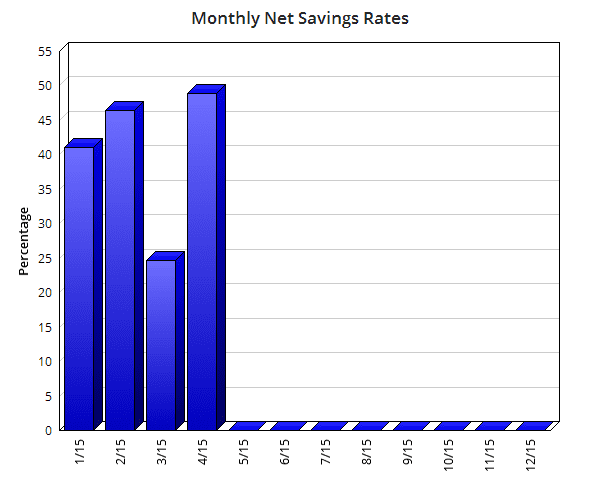
I’m now at an average of 40.3% for the year. I’m behind, no doubt about it. But I’m very confident that I can climb back and get pretty close to my goal, barring a large unforeseen expense. I’m anticipating a very strong summer of savings, as I’m really hitting my stride in terms of maximizing income right at the same time that a number of large one-time and temporary expenses are disappearing. Things are absolutely looking up for me. And this is all being done without a traditional full-time job and the comfortable paycheck that comes with. I’m very happy with how this first year of working online full time is going.
I expect May to be quite strong as well. The cash flow is looking excellent thus far here as we’re near the halfway point of the month, and most of my regular expenses are being held in check. The only major expense that I see hindering my ability to register a fantastic savings rate for May is the hotel expense for our stay in Omaha. Other than that, things look really great for May and the rest of the summer. I’m incredibly excited. Stay tuned!
How did April turn out for you? Save as much as you wanted? Are you on track to meet your savings goal this year?
Full Disclosure: None.
Thanks for reading.
Photo Credit: bplanet/FreeDigitalPhotos.net
Note: Affiliate link included.