Shared posts

16 Jun 14:02

Exports and Non-Oil Imports Drop as Trade Remains Treacherously Low in May 2015

by Deepak Shenoy

India’s trade statistics showed:

a) A trade deficit of $10.4 billion that’s about flat from the previous month

b) a 16% drop in imports and a 20% drop in exports (whoa).

image

image

Worrisome: Non oil imports also drop

Crude oil imports were lower than last year due to the drop in crude. But we saw a fall in Non oil imports. Note that Gold imports went up, so obviously its the other stuff that dropped.

image

Oil imports have ticked up from the previous month, but as you can see, non-oil imports have fallen to where they have contracted from a year earlier.

Tragic: Total Trade drops 18%

While the “flat” deficit is probably good news, it’s not really good that we’re now trading substantially lower than a year ago. As much as 18% below last year’s levels (imports+exports).

image

(Feb was low, but then it had only 28 days). May with 31 days has no such excuse.… (Read On...)

16 Jun 14:01

Stress Management

by Shane Parrish

story

I’ve come across this short story a few times recently but I can’t track down the origins. If you know the source please contact me.

A psychologist walked around a room while teaching stress management to an audience. As she raised a glass of water, everyone expected they’d be asked the “half empty or half full” question. Instead, with a smile on her face, she inquired: “How heavy is this glass of water?”
Answers called out ranged from 8 oz. to 20 oz.

She replied, “The absolute weight doesn’t matter. It depends on how long I hold it. If I hold it for a minute, it’s not a problem. If I hold it for an hour, I’ll have an ache in my arm. If I hold it for a day, my arm will feel numb and paralyzed. In each case, the weight of the glass doesn’t change, but the longer I hold it, the heavier it becomes.” She continued, “The stresses and worries in life are like that glass of water. Think about them for a while and nothing happens. Think about them a bit longer and they begin to hurt. And if you think about them all day long, you will feel paralyzed – incapable of doing anything.”

It’s important to remember to let go of your stresses. As early in the evening as you can, put all your burdens down. Don’t carry them through the evening and into the night. Remember to put the glass down!

--
Sponsored By: Greenhaven Road Capital: You think differently - now invest differently.

16 Jun 06:50

Case of Sushma Swaraj: Magazine/Newspaper curse continues to kick and ruin careers..

by Amol Agrawal
How quickly times change. This is especially true in govt and policymaking. On  the eve of one year anniversary of Indian govt, newspapers/magazines/experts voted Sushma Swaraj as the best minister in the cabinet. This blog was really surprised to read this. A senior leader like Ms Swaraj was nearly ignored for in the one year by […]
16 Jun 06:38

Advantages of simple living

by subra

First of all the clarification: A person can choose to want and have less. Choosing to want and have less are not because one lacks money, but one wants some advantages of simple living like the following….

1. Even if you choose a simple life you are still a consumer, however, you try to escape the excessive and aggressive consumer behavior being thrust on you by the media. You still have a bed, a television, a laptop, a sofa, a cupboard, a bookshelf, a music system, a cell phone, a landline, one car…..but you try to minimize what you need and therefore what you have.

2. Less car, less home, less…..surely means less debt. It also means more money in the kitty for retirement. This could also mean the ability to walk out your job at age 54 because your boss said something demeaning. The ability to walk away from a job DOES NOT MEAN YOU will walk, but the confidence that you CAN WALK is a very big source of satisfaction.

3. Less time spent in caring for the Rs. 40k watch, or the Rs. 100k music system! Simple things cost less and deliver similar results, so the need to worry is not here. You can lead a more relaxed life. So less time in worrying about cleaning, maintaining, using carefully….in a worst case scenario a cheaper possession can be just replaced.

4. Less desire to earn to show off: A person with a greater need to earn (for showing off) is under greater stress to earn money. Not that all big money comes from crime, but the temptation to commit small or big crimes comes from the insane pressure to match up with a few other individuals in life. Earning money should be a pursuit to meet your goals, not a scorecard to compare with friends.

5. Less pressure to upgrade, keep up with the Joneses, willingness to use a non Apple product, – all have their own advantages.

6. Part of the living simply brigade is also de cluttering your life – which itself reduces stress.

7. When you have 5 white shirts and 4 black pants there is less stress when you stand in front of the cupboard wondering what to wear!

8. When you start to simplify you look like a very generous person – ACTUALLY YOU ARE NOT – you are just giving away your past excesses! However giving away things (instead of keeping it in the closet for another day!) becomes a habit, and who knows you may become generous!!

9. Learning to see through empty claims – in all industries and especially in the financial industry saves you tons of money!

10. Being a better human being for the whole world, and leaving a lesser carbon footprint.

11. Most of our cities are bursting at the seams because everybody wants a 5 bhk, a SUV, a……at least you can put less stress on the environment by teaching your children to travel by public transport !!


Post Footer automatically generated by Add Post Footer Plugin for wordpress.

16 Jun 05:53

The successes and failings of India's bureaucracy

by noreply@blogger.com (Gulzar Natarajan)
The Indian states’ struggles with getting stuff done are well documented. Even when programs are apparently well designed, they generally stumble at implementation. This implementation deficit has become a reflection of weak state capability.


This malaise afflicts government agencies at all levels and across states in varying degrees. It is as much applicable to service delivery with welfare programs as it is to the large-scale regulatory failures and resultant corruption scandals that dominate headline news.   


So how it is that Indian bureaucracy delivers spectacularly with programs like Pulse Polio, elections, and Kumbh Mela? What explains the handful of outstanding examples of successes with improving maternal and child health outcomes, or women’s empowerment, or increasing access to sanitation that occasionally come from various corners of India? There are two possible answers.  


One, and relevant to the first question, is that our state is exceptional at doing things that have short duration and clearly defined destination. A common thread that goes through all these activities is meticulous planning which maps functionaries to task and time, simple and clearly defined monitoring goals, rigorous supervision, and insulation from political influence. This is generally achieved through a massive mobilization of the entire local administration, often augmented with external manpower. It helps that the short duration of these activities allows for such cross-departmental mobilization. All this is underpinned by a strong political and bureaucratic commitment at the highest levels to achieve the objective. 


The success with these activities stand in stark contrast to the egregious failure with implementation of regular government programs in the same area by the same personnel. It shines light on the sources of their implementation failure. An apolitical, adequately staffed and appropriately trained bureaucracy, when monitored rigorously gets things done. It is no surprise that all these ingredients are deficient in regular administration of government programs.  


The other examples of success are, most often, a result of individual initiative. A few fiercely committed officers bring great passion and effort into planning and implementing programs. Their energy and leadership masks the chronic deficiencies in state capability and results in the positive deviance.


There are a few features that inform the actions of all such successful officials. They make detailed plans, with clearly defined intermediate milestones and final outcomes with timelines, all of which can be monitored.  
  

They rely on some improvised information reporting system to rigorously monitor compliance. Some of the more tech-savvy among them use computer applications for internet-based reporting. Others rely on brute force reviews, done with unfailing regularity. These reviews are generally done personally at a painstaking level of granularity, to identify weaknesses and poor performers, which are then followed-up and addressed. It is no accident that their reporting systems are generally at variance from the ineffectual routine state or nation-wide reporting systems for the same program or activity.  


Another prong of their monitoring is intensive field inspections, most often done randomly and without intimation so as to validate the information from the aforementioned reports. Such personal inspections, which are often followed up with strong and certain disciplinary action on errant officials, are a strong deterrent against slacking. But given the large geographical jurisdictions, such personal inspections take up a disproportionately large amount of time and effort, and involve unfavorable work trade-offs.


A handful of motivated and sincere sub-ordinates are co-opted as internal champions in these efforts. In a few cases, committed local non-profits become important partners. The smarter among them keep open active feedback channels - through inspections and interactions with field functionaries, citizens, and political representatives - that reliably convey information on the actual implementation.

Though all these are the physical ingredients of routine bureaucratic implementation, its actual realization in a typical bureaucratic environment is unfortunately very infrequent. It is commonplace that officials are severely handicapped by an enfeebled administrative machinery, whose weaknesses are exacerbated by inadequate, poorly trained, and dis-illusioned staff. Most often, they are left to fend for themselves, in completely unknown terrain, with just a handful of people for support.


The positive deviance is due to the extraordinary level of direct personal involvement of the official. It requires huge mental bandwidth for information processing and monitoring, the ability and commitment for which is understandably possessed by only a handful of very sincere and energetic officials. Their success is despite grave deficiencies in state capability and a triumph over extreme adversity. But this triumph is, most often, a pyrrhic victory. Reflecting the deeply personal nature of such interventions, all such successes are most likely to be short-lived, failing to outlive the officials themselves.


It is therefore no surprise that mundane activities like running mid-day meal kitchens or distributing old age pensions to beneficiaries or delivering ante-natal services to pregnant women appear insurmountable systemic challenges. All these activities fail the test of routinized impersonal administration, and require the dominant presence of an exceptional bureaucrat.


Though the main focus here is on the role of All India Service (AIS) officers, much the same applies to other non-AIS officials of the state government. The successful among them overcome much greater adversity than a similar AIS officer. The point of this post is as much to highlight why things sometimes appear to work in certain places as to why its systemic replication may be difficult given our current state capability.

A bureaucracy is an impersonal rules-based organization of a group of people who work together to achieve certain defined outcomes. Bureaucracies therefore have to work on their systemic strengths rather than the personal initiative of individual bureaucrats. A capable bureaucracy is one which delivers outcomes when administered by the average bureaucrat, rather than being reliant on the serendipitous presence of an exceptional bureaucrat. The typical Indian bureaucracy, at all levels, is most likely to end up short on this test.   

Add to Technorati Favorites
16 Jun 05:52

When will the next financial crisis start?

by Amol Agrawal
When this crisis ends. T. Sabri Oncu says the liquidity issues have still not been solved despite huge amounts of QE. So one can expect more crisis to come within the 2008 crisis: The question is not “if” but “when” the next financial crisis will hit. The 2007 crisis has still not ended. The quantitative […]
16 Jun 05:51

Our history books need rewriting..

by Amol Agrawal
Sanjeev Sanyal (author of Land of the Seven Rivers: A Brief History of India’s Geography) makes a case for rewriting Indian history books: The debate over the need to re-write Indian history textbooks is heating up and, yet again, it is likely to spiral into an ugly political spat. Sadly this debate will distract from […]
16 Jun 02:39

I like the equity market…..

by subra

The title sounds like a disclaimer…and so be it.

When I said I like the equity markets I meant NOW. In June of 2015, frankly I am liking the index, and the valuations at which some of the blue chips are available. After a mid cap rally, the biggies may just play catch up? Or will they not?

Let us look at what works in favor of the Indian markets (aka Namo politically speaking):

1. The drop of the oil prices…and the revival to about $70. This is a far cry from $ 120! This has helped Na Mo reduce deficit, stabilize rupee, free price the fuels, do not underestimate the impact of all this on the economy.

2. A sensible Reserve Bank Governor! Look at the fact that the interest rates around us are all sub 5 – Australia, China, Far east, but RR does not succumb to pressure. He is holding Narendra Modi to the promises he made..and pushing hard.

3. SIP is growing at a very fast pace: the average size of the SIP is increasing and the number of people coming into the market is also increasing. Like it or lump it, ULIPs are selling like hot cakes and it is worth looking at the AUM collected by the life insurance companies. This will act as a counter to the pull away of money by the FII if it were to occur at all.

4. Some of the FII money will get pulled out of India – from debt and equity markets, but that may not impact the markets much.

5. Interest rates are headed south – especially if Modi does some path breaking stuff in the Infra funding

Sure, there are some red flags – the NPA problem, the Modi-RR combine ABILITY to comedown on banks who have created a mess, the hugely publicity seeking but relatively inexperienced cabinet, the inability of the Govt to push PSB reforms….however I am still optimistic of getting a 14% cagr over the next 5 years. So doing a SIP now makes sense – and we could be going the 2014 way…or will we?

Post Footer automatically generated by Add Post Footer Plugin for wordpress.

14 Jun 02:55

Fees fall, but fees rise too!!

by subra

Long, Long, Long time ago the biggest mutual fund schemes had about Rs. 700 crores. At that time in its wisdom mutual funds were allowed to fix their charges (as recommended by the holy Amfi to the holy Regulator)..and fees was fixed at a maximum of 2.5% p.a. and 2.25 for equity and debt funds respectively. If I am not wrong this was in the previous century.

We all know that the biggest funds now are about Rs. 17,000 crores in equity itself…so why talk much about debt.

When size increases, %age costs go down (elementary economics, right?). So your audit fees, administrative costs, rent, etc. which were used to justify the 2.5% fees HAVE ACTUALLY FALLEN, correct? and getting 1% on an AUM of Rs. 150,000 crores is lovely for a RISK FREE business, right? Wrong.

The costs have fallen in the big schemes for sure, and you are also paying less (thank yourselves not the amc – it is just a formula). However the great industry again cried wolf and got the Amc costs increased – again nothing to do with performance, just size. You need to remember that India does not have a Dalbar to tell you all this, a Mercer to tell you how much of the returns is because of luck and how much by talent. We do have tons of inside information which allows some fund managers to look smart. A couple of good deals that make the fund manager look like a genius. A continuous flow of SIP funds into under performing funds allowing the fund manager to average all the way down and/ or  push the share up to shore up the NAV.

However into this background bring in the manufacturer’s association which is bothered ONLY about size and never about efficiency. I choose a doctor, architect, lawyer by their reputation NOT BY THE SIZE OF the hospital, building or law firm. How does it matter where my surgeon performs the surgery? I go to him the individual for his brilliance not the hospital where he is going to cut me up.

I have chosen a lawyer by the brilliance that he is – and sometimes when a lot of paper work is to be done, the lawyer suggests a reasonable sized solicitor firm – NOT THE BIGGEST. So if I find a nice small sized firm (if they are around for 15 years and are small it does not impress me)..i choose the FUND MANAGER.

So if costs are not coming down it is because the investors are NOT VOTING WITH THEIR cheque book. Move your money to good performance, not just size.

Good is better than big.

Post Footer automatically generated by Add Post Footer Plugin for wordpress.

13 Jun 15:55

Bond Markets Crash, Failure of Bond Auction Today is Likely Again

by Deepak Shenoy

There’s some serious damage in the bond market in the last few days. We posted (in Premium) that Banks are likely to lose 10,000 cr. on just the extra exposure they have to government bonds. And look at how much bond yields have risen:

image

(Rising Bond Yields = Falling Bond Prices = Losses on your bond portfolios)

From the orange line (1 month back) you see how, after the Jun 02 rate cut, markets have taken longer term yield up significantly, while short term yields have fallen.

This Affects Mutual Funds, but only the Long Term Ones

Mutual Funds that hold long term bonds will be affected. Some bond funds like liquid and ultra short term funds will actually be giving awesome returns. See the short end of the yield curve – at this end there are gains, not losses, for bond holders. (But gains are muted because these are short term bonds).… (Read On...)

13 Jun 15:55

Market is simple to understand

by subra

The equity markets are simple to understand except if you try to use too much intelligence.

The markets (internationally) is driven by various factors – macro and micro. The 3 important factors that one speaks of while talking market valuation are Fundamental, Technical, and Market Sentiment.

Remember understanding equity markets is very complicated if you wish to really do a scholarly kind of a study. Let us say you wish to understand the price movement of one company Tata Power. For this you need to understand what drives energy demand, whether the total power is sold in the free market, coal pricing internationally, competitors, price of competing fuel, etc. ..even after all this you could get the price movement of Tata Power wrong. Completely wrong because in one project in Mundhra they are trapped because of a pig headed government.

If it is so difficult to predict the movement of the Index is almost impossible (and unnecessary too). Let us see the 3 factors – Fundamental, Technical, and Market sentiment.

Fundamental: Basically what drives price in any market is demand and supply. So if the supply side is less and the demand is more, prices go up. This is what happened in 2003-7. A new animal called the FII came into the market and started buying. Increasing demand for shares drove prices up. However when we talk of fundamentals we talk of : a) Earnings per share and b) Price Earning ratio. a*b is price.

Taking a running example – Earnings per share is like practice – you need to keep doing it day in and day out. So companies keep working through out the year and arrive at the earning per share. PE is like motivation, when you work hard, motivation goes up!! So companies which do well get a higher PE. This is a self fulfilling prophesy !!

I have written just 2 lines about EPS and PE – and you could actually do a PhD in each of the topics. Some valuation experts say that cash flow per share is a better measure, and PE is also impacted by sentiment…etc. in the context of this article, we will stick to these 2 lines only.

Technical factors:

The technical factors are Inflation, Money supply / Liquidity in the country and international, government policy (will the RBI lend money against capital market assets or not), the willingness of people to be in this asset class (Indians predominantly prefer government guaranteed debt), economic strength of the markets, price expectations of other competitive products like precious metals, oil, currencies, demographics, trends, market penetration for equity products, etc.

the third factor is Market Sentiment: this is the collective feeling of the individuals, the professional managers dealing with pension funds, insurance funds, etf. This is very important a factor but we are not in too much of a position to talk about this factor. We are just starting to understand this. For example when there was news starting to trickle that NaMo will become PM..market started going up. Obviously market does not go up from the day of the swearing in ceremony!! I got into PSU shares like Bhel, Ntpc, ..and EXITED when Na Mo actually came in. At that stage..the speculators need to leave and this pushes prices down.

When we talk sentiment we talk about world sentiment – Japan, US, EU, Oil prices, war by ISIS,….

However see what happens when one day the market goes down by 400, 500 or 800 points! Some idiot says “Today Greece went down by 11% but India went up 900 points” , or “Japan cut interest rates, Indian markets still went down” or “RBI cut rates by just 0.25% and therefore markets crashed”

Please understand that you do not understand, that will be a favor. A big favor.


Post Footer automatically generated by Add Post Footer Plugin for wordpress.

13 Jun 15:43

The Great Reversal: developing countries no longer the growth engine

by T T Ram Mohan
After the financial crisis, there was much talk of "decoupling". This meant that growth in the developing world would  be de-linked from that in the developed world which was weighed down by the financial sector. The developed world might suffer slow growth but, for a variety of reasons, the developing world would grow rapidly so that "convergence" - the catching up of the developing with the developed world- would happen sooner than thought. So it was for about three or four years after the crisis.

Alas, like most economic forecasts, this one has met a sorry fate. The World Bank now says that it is the developed world that will be the growth engine of the world. Developing countries will see growth slowing down- with India and China being notable exceptions. What explains the slowdown in the developing world? One can point to a range of factors, some of which are specific to a few economies:
  • China's economy is slowing down, in part inevitable following the high growth rates of several years
  • A slump in commodity prices (to which China's slowdown has contributed) is affecting several leading developing economies, notably Brazil and Rusia
  • Much of the boom in production and trade in the Asian countries was China-centred and these economies are feeling the effects of the Chinese slowdown
  • The impending reversal of interest rates in the US is a big factor. Already, emerging markets have seen huge outflows and this is likely to intensify once the Fed decides to hike interest rates. 
In short, the two great themes of the past decade- China's rapid growth and cheap credit- are now diminishing in importance.

India looks good in relation to a range of developing countries- a growth rate of around 7.5%  and a current account deficit of around 1-1.5% this year makes it a bright spot. But the global slowdown is bound to have its effect- export growth will be muted. A return to 9% growth looks very unlikely in the medium-term- we will be lucky to touch 8%.

India's big problem is that low employment elasticity of income in recent years means that 8% growth just cannot generate the jobs it needs. The signs in recent weeks of Modi emphasising equity rather than pushing for growth suggest that the PM has seen the straws in the wind.
13 Jun 15:41

Top all time 5 stories over the past 8 years…

by subra

If a blog has been running for 8 years, that itself is great news…that too considering that I make no money from the blog. Not directly not indirectly..the ad revenues surely do not justify the time spent…but hey these are the top stories…

http://www.subramoney.com/book-written-by-me/

http://www.subramoney.com/2012/08/children-in-parents-ego-emi-traps/

http://www.subramoney.com/2011/06/investing-books-the-must-read-types/

http://www.subramoney.com/2013/05/simple-steps-to-wealth/

http://www.subramoney.com/2011/09/one-word-that-can-make-you-rich/

funnily no story from 2008, 9, or 10 made it to the top 5…and nothing from 2014 and 2015 got enough hits to reach the top 5…if u have not read them…go and read more than 10,000 people (at least) have read these stories….

Post Footer automatically generated by Add Post Footer Plugin for wordpress.

13 Jun 15:35

Consumer Price Inflation Jumps Back Up To 5% in May 2015

by Deepak Shenoy

Consumer Price Inflation for May 2015 rose to 5%, rising suddenly after two months of a drop.

image

Components showed rising inflation in:

  • Fuel (we saw two retail fuel price increases in May, and guessed this last month)
  • Education, Medical costs
  • Consumption: Personal Care and Household Items

image

Food remains benign on the inflation front and here the only fear is of a bad monsoon.

There has been an uptick in Rural and Urban inflation.

image

“Core Inflation” has risen after a long time

If you take out the impact of food and fuel, the inflation index has risen suddenly:

image

Our View

While inflation has gone up, we don’t think this is a big deal just yet because the next few months have seen a sudden move up last year on the index.

However the rise in “core” inflation is surprising. In any case, RBI isn’t going to drop rates for a few months at least.… (Read On...)

13 Jun 15:30

Living Paycheck to Paycheck? Solution: Treat Savings as Monthly Bills

by Dev Ashish
A reader (whom I will not name to protect his identity), shared his question in the Financial Concerns Survey: I am unable to save any money. It is really tough. And it is not that I don’t know the benefits of saving or investing. But even then, I am not able to do it. Every month, all I can manage is to pay my ever-growing bills. Nothing more. And in past few years, the regular payments
13 Jun 15:29

Quarterly Business Review: How Effective CEOs Do it Right

by scott.gruher@salesbenchmarkindex.com (Scott Gruher)

No CEO has a crystal ball. But maybe there’s something that will serve nearly as well. Why not rely on your leadership team's experience to chart the way forward?

In a Quarterly Business Review, a company uses its past to guide future planning. The process is simple and powerful. But the key is that the CEO must conduct it well. 

That’s what we’ll talk about here.

11 Jun 02:33

Financial Ruin or Financial Harakiri….

by subra

There are many roads to the poor house. Not just for an individual in his personal life but also how a company can to be taken to bankruptcy or the doors of bankruptcy!

Let me enumerate what I have seen:

1. Get used to a high spending lifestyle – far beyond what one person on one / two salaries. So buying expensive things (camera, phone, etc.) and things with a huge maintenance cost (airconditioner, car, etc.)

2. Living for Now: People who cannot even estimate sure things like child’s school admission, college education, marriage – shock me. Not having money for emergencies is bad but not having money even for such things which EVERYBODY knows will happen is so damn stupid.

3. One of the stupidest things that people do is buy a house beyond their current needs. The whole world tells them that you buy a house only once, so buy big. Then they struggle with the EMI for a very long time.

4. Living off Credit Cards. And when one card is Maxxed out, get a new one! I know a few (very very few thankfully) people who live off 2-3 credit cards. Rolling the credit, rolling the payments, etc. is like a game for them…and they get hurt suddenly when the cycle stops.

5. Not having enough medical, car, insurance. When one medical emergency or an accident can just hurt them so bad that they do not where to look. This cuts so viciously that it takes them back by a few years if not to the poor house overnight!

6. Paying the minimum on the credit card, phone bill (OMG did you say?) , and refinancing the home loan for a longer period.

7. Postponing Investments for Retirement. If in your 30s if you think retirement is far away, you have not heard of ‘time flies’.

8. Watch too much television and believe those beautiful people will make money for you.

9. One Television Anchor told me “Subra I am doing my job well. I look good and can read off fast from a teleprompter – and that exactly Is my job”. If you think they are experts, something is wrong with you.

10. Trade like some rapid fire sale is going on! Trading is very good for the broker and does not make money for most amateurs. You need to move with the professionals to know how much they laugh about clients whom they call “Voluntary Donors to the Broker Welfare Fund”.

11. Postpone whatever sounds overwhelming. Even companies whose Boards do this go to dogs. Surprising how a collective body can refuse to see the obvious signals.

12. Whatever ‘investments’ are made are made just to reduce taxation NOW…so even here they make sub optimal choices like bank deposit for 5 years…without realizing that it is very tax inefficient.

13. Financial illiteracy as well as innumeracy is a terrible combination, but very common.

14. Not understand own portfolio and keep falling prey to the same bank, same RM, same….etc. and look like an idiot when queried about their investments.

I can only feel sorry for such people, and my advice is about 4000 years old:
“Work, save and invest”. Believe me it still holds. I would add one more to this – Learn to counter the obfuscation by the BFSI – and remember the regulator protects the powerful. If you are reading this blog, the regulator is not for you

Post Footer automatically generated by Add Post Footer Plugin for wordpress.

11 Jun 02:32

Current Account Deficit Falls to 0.2% of GDP, RBI Buys Massive Quantities of Incoming Dollars

by Deepak Shenoy

The current account deficit for the March quarter of 2015 came in at -1,286 million, which is a big relief, even if it’s marginally higher than the deficit we saw in the year earlier. It’s a tiny number in comparison with the massive CAD figures we have been used to seeing.

image

It is of course useful to see this as a % of nominal GDP, where the deficit is just 0.2%.

image 

What is a Current Account?

For a more detailed description of the current account and the Balance of Payments – Please read our descriptive post (“What is the Current Account and Balance of Payments?“)

Check out Capital Mind Premium!

Get In-Depth Macroeconomic Analysis, Market Metrics, Proprietary Capital Mind Indexes, a look into the CAPM Portfolio and More Actionable Insights, straight to your Inbox.

Take a 30-day Free Trial!

In brief, the current account is money that flows in (or out) of the country to do stuff that is not:

a) Financial investments like FDI or FII or NRI Deposits or the like (the “Financial Account”) or

b) Capital investments (like buying real estate in India, the “Capital Account”).… (Read On...)

11 Jun 02:31

Marks and Exams : Chetan Bhagat & Vir Das

by Kirti

I read this article ,  THE UNDERAGE OPTIMIST – Scored low in exams? Some life lessons from a 76 percenter  and it struck a chord somewhere, so sharing with my readers. I also shared it with my friends whose sons and daughters , especially those who are in 12th . Also an interesting video by Vir Das on your marks.

The CBSE class X and XII results came out earlier this week. As a 90% aggregate becomes as common as kissing in our movies (no big deal) and cut-offs for good colleges become insane, we wonder if there is anyone who hasn’t scored amazing marks. In the noise of high scorers, we often forget the lakhs of students who score in the fifties, sixties and seventies. We brand them mediocre. We offer them succour with a few articles that cite low scorers who became billionaires or movie stars and have headlines that scream marks don’t matter. Well, if they didn’t matter, why on earth would everyone be chasing them, is a question they don’t answer.This article is addressed to those low scorers. It’s boards. X, the overweight kid who isn’t that confident and has become even less so after the results came out. X, whose relatives and neighbours come to console him with it doesn’t matter,but deep down wonder if this boy will do anything in life. If you relate to this guy, or know someone who does, this article is for you. It isn’t a soothing balm for your low marks. These are some no-nonsense tips on what to do when you have scores that suck and people have given up on you. Here goes:

1  You are not your marks

Yes, marks are important. They make life hell of a lot easier. High marks make people think you are smart. Colleges with a brand name let you come in. Companies with a brand name come to these colleges. They give you a job, which pays rather well. You can use that money to pay bills, get married, have sex, start a family, and produce kids who you will push to get higher marks and repeat the cycle of torment. This, for most people, is life -making it as predictable, safe and stable as possible.Indian parents particularly love this zero-risk appetite life, where a monthly cash flow is assured and kids are born and raised as per plan. They have a word for it -settled. Indians love that word. We want to settle, we don’t want to roam, have adventures and fly. Settle, or in other words, produce kids, work in office, watch TV at home, repeat for a few decades, die. Toppers find it easier to settle. Nontoppers take a bit longer. A delay in `settling’, the ultimate Indian dream, is just about the only sucky thing about low marks.

2  The Game of Life is not over

These marks are in certain subjects, which are not exactly what leads to success in life. Sure, you study Maths and Science, but these are standard concepts, recycled and drilled into students and tested in the exams. The only thing high marks indicate is that the student has the tenacity and perseverance to excel at something. Hence, I am not going to say toppers don’t deserve praise. But life is more than just tenacity and mathematics.Exams don’t test creativity, imagination, people skills and communication. In life these are what matter. You build these skills through study or actual practice, and it is highly likely you will get somewhere in life. However, you must add hard work to it. Ask yourself, whether you had low marks because you don’t have aptitude for these subjects, or did you slack off ? If you slacked off, don’t do that again if you want to get anywhere in life. Take that lesson, and then build your communication, English and people skills. Learn how business works. Not everyone in India can get plum jobs, there are just way too many of us. Entrepreneurship is something a lot of youngsters will have to learn and try .

3 Strive for excellence

In whatever you do, try to excel. Excellence in board exams can be measured through marks, but over time in life, the marks will stop. What will matter is what people think of you. Your reputation, your reliability, and your word will build your own mini-brand. Once that happens, people will stop asking about your marks, or where you studied. You will be the brand.

Nobody has asked me for my marks in a long time. However, you know the boy I wrote about above? Well, that’s me. I scored that 76% in Class X. I felt horrible then, but eventually I didn’t let it define me. It doesn’t matter today. After all, you still read this article, right?

Interesting video ON YOUR MARKS – Vir Das’ Message for Kids with Exam results


Related Articles:

Marks are important as they make life easier, got good marks, next step is kind of decided. But they are not be-all , end-all of life. They open the door but what one does after door opens depends on attitude and ability to try and learn new things.  What do you say? Do you think that marks are important? How have your relationship been with marks? How has it defined you or people around you? What do you say to your children on what’s important in life?

10 Jun 09:22

Latticework of Mental Models: Kantian Fairness Tendency

by Anshul Khare

This article is the eighth of this weekly series called Latticework of Mental Models, which will be authored by my friend and partner in writing the Value Investing Almanack, Anshul Khare. Anshul will write on various mental models – big ideas from various disciplines – which can help you think more rationally while analyzing businesses and making your stock investment decisions.


I was almost at the end of a beautiful evening drive. Refreshing cold breeze gently blowing on my face through the car windows coupled with minuscule traffic was like heaven on earth. Sporting an ear-to-ear smile I felt confident that nothing in the world had the power to take away my inner peace at that moment.

But, as usual, my faithful and ever reliable nemesis, the chaos-monkey, had different plans for me that evening.

Just when I was about to take a smooth turn on a closing traffic signal, a taxi cut me off while overtaking my car. The surprising rash maneuver from the taxi called for sudden brakes and by that time signal had turned red. As a result I missed my turn because of the insensitive driving by the taxi driver.

In the next few seconds, my Buddha smile turned into an angry frown and I was thrown out of my “appreciating the good things in life” mode.

Why did I feel so agitated? Well, for one, I was ahead of the taxi and it was me who was supposed to cross the signal first.

I felt as if the taxi guy had brutally robbed off my well deserved right to take the turn before him. You might find it amusing but the incident costed me a whopping two minutes of extra wait for the traffic signal to turn green again and of course my inner peace.

“Hey, cool down buddy! You’re exaggerating and using pretty strong words to describe a petty incident.” Probably this is what you would have said in an attempt to pacify me if you were with me that day.

But how could I take it easy? It was absolutely unfair! Why unfair?

Do unto others as you would have done unto you. Sounds familiar? Well I would never have done the same thing (it’s pretty close to encroachment in my dictionary) to anybody else.

Probably the taxi driver didn’t really think it was unfair. Perhaps he’d been at the receiving end of the same treatment many times in the past that he now considered it fair to pass the buck. Or may be he was just too busy marvelling at his own driving skills. Who knows what he was thinking!

Well, before you lose interest and stop reading, let me put an end to my rant about traffic manners and being a victim of unfair treatment. I hope you would’ve guessed by now that our mental model for today has got something to do with the above incident.

So let me ask you this. Have you ever experienced this feeling of being treated unfairly? May be in some small way like when one of your utterly undeserving colleague got promoted before you. Ouch, I’ve been there! 😉

Kantian Fairness Tendency
Why is the human psyche so obsessed with the idea of fairness? Actually, it’s not just humans. Even monkey business (literally) isn’t immune to this tendency. Check out the video below (or click here), which proves that the tendency to seek fairness in all transactions is not an invention of modern man, but the behaviour has been tattooed at a much deeper level by evolutionary process.


The theory about rational human beings takes the view that people would accept any offer made to them as long as they were better off. But we know that humans are anything but rational and many studies have shown that people will reject offers they view as unfair. Our ape just validated this hypothesis in the video.

This is the matter of discussion for today. Exploring the idea of what Charlie Munger calls Kantian Fairness Tendency. It’s one of the big ideas from Philosophy.

Let’s define fairness first. The basic idea is that we have devised certain rules that, when followed by everyone, result in a pretty smooth life for all involved. The key is that everyone needs to follow along. This unsaid understanding about ‘following along’ few ‘socially acceptable guidelines for conduct’ is what constructs the framework for fairness.

When a behaviour doesn’t fall (or doesn’t seem to fall) in this framework, we label it as unfair.

From Charlie’s talk, it’s not entirely clear why he has used the word Kantian but let me still take a stab at it. The word refers to the philosophical framework created by eighteenth century German philosopher Immanuel Kant.

Kant’s ethics are founded on his view of rationality as the ultimate good and his belief that all people are fundamentally rational beings. (Source: Wikipedia)

So somebody who uses Kant’s philosophy to construct an idea about fairness is probably suffering from Kantian Fairness tendency.

Now passing a judgement on ‘what is fair’ seems pretty simple when you are the subject matter i.e., when you are evaluating the fairness in matters involving you. What about the case when you have to take a decision about ‘what is fair’ for a third person?


Before I start pouring out my own ideas, I would like to mention that Prof. Sanjay Bakshi has already compiled some of his thoughts on this topic in his blog post (which goes all the way back to year 2005). His discussion about ‘the law of higher good’ is another mental model that you need to be aware of. It kind of resolves the dilemma posed by Kantian Fairness Tendency.

Don’t miss his blog post since it covers a lot of ground for getting a better grip on the fallacy of Kantian Fairness Tendency. I have borrowed some of the quoted text from the same blog post.

Fairness and Envy
If you look at the monkey’s behaviour in the above video, it’s clear that the reward for performing a task is perfectly fair and acceptable to the monkey until the point he sees that his other monkey friend (I am just making an innocent guess about their friendship; they could have been professional rivals too) is getting a better reward for the same task. Of course, at this point, the first monkey goes berserk. He just can’t believe it. He is boiling with anger. A complete pandemonium follows in his cage.

My guess is that this extreme reaction against lack of fairness is because of envy, another mental model which we will discuss in detail some other time. However, Kantian Fairness Tendency limits the behaviour to accepting or rejecting the offered deal, whereas envy takes it to the next level (i.e., the emotional outburst) which could, and definitely would, get you into trouble.

You could say that a distorted worldview about fairness becomes the precursor to envious behaviour. That explains where the roots of envy lie.

Seeking Fairness
In the TV news when you see a guy robbing a lady, the obvious first thought is to seek punishment for the culprit. But soon the news reporter reveals that the thief’s mother was ill and he needed money for her treatment. Does this justify robber’s act as fair? May be yes. But then, is it fair to the society as a whole that anybody who needs money for a genuine cause is allowed to rob strangers?

As usual, Charlie Munger has some insights to deal with such situations. He has spoken about man’s overlove of fairness in his UCSB talk. He said –

It is not always recognized that, to function best, morality should sometimes appear unfair, like most worldly outcomes. The craving for perfect fairness causes a lot of terrible problems in system function. Some systems should be made deliberately unfair to individuals because they’ll be fairer on average for all of us. I frequently cite the example of having your career over, in the Navy, if your ship goes aground, even if it wasn’t your fault. I say the lack of justice for the one guy that wasn’t at fault is way more than made up by a greater justice for everybody when every captain of a ship always sweats blood to make sure the ship doesn’t go aground. Tolerating a little unfairness to some to get a greater fairness for all is a model I recommend to all of you. But again, I wouldn’t put it in your assigned college work if you want to be graded well, particularly in a modern law school wherein there is usually an over-love of fairness-seeking process.

Looking at the idea of fairness in isolation is akin to saying that a surgeon should refuse to operate on a patient because it will cause pain to him. Of course, an operation will cause pain (after the anesthesia wears out) and few days of inconvenience, but eventually it will prove to be a beneficial act for the patient.

So, may be, seeking fairness isn’t always wrong. What you have to know is – at what level are you seeking fairness? At an individual level, or at a group level, or at some other level altogether. Answering that question would bring some clarity as to what is fair and what isn’t.

I suggest you watch this lecture from Michael Sandel who is a professor in Harvard University. Some of the thought experiments that he discusses in his lecture are so unsettling that it seriously challenged my long held notions about morality and fairness.


The following story is from an article I read in Wall Street Journal –

During the middle ages in Europe when the court couldn’t determine if a defendant was guilty they would offer him an option. The option was to either accept the punishment for their crime or put their hand in boiling water. The idea was that God, who knew the truth, would miraculously save any suspect who had been wrongly accused.

The trick however was that a guilty person and an innocent one often respond differently to the same incentive. Typically a guilty would choose to accept the punishment instead of sacrificing his hand. An innocent who believed in God would daringly agree for boiling water test.

In the ideal scenario, nobody really goes through the boiling water test, because the defendants are proven guilty/innocent based on their intentions only.

But if nobody was ever made to go through the boiling water test in front of the crowd, the trick will lose its effectiveness. People need to at least see some defendants suffering the boiling water torture to believe in the authenticity of the test. Which means some innocent people will have to go through the torture and it would be unfair to them. In order to keep the sanity and order in society few innocents will end up being victim of unfair play.

In other words, to make an omelette you need to break some eggs. :-)

Fairness in Investing
One of the ways this bias comes into play in investing is when people expect that they should make the money in the same way they lost it, i.e., they focus on individual stocks to make money for them.

Of course, that’s what the idea is when you choose the stock to begin with. But expecting fairness in returns from the stock is a fallacy. Instead, you should make sure that you don’t lose money overall on your portfolio of stocks. No matter how much margin of safety and rigorous analysis you employ, you are bound to find (time to time) that you have a loser in your portfolio.

A natural reaction is to say, “It’s not fair. I have put in so much effort, analysis and money in this stock. It shouldn’t lose money.”

Being aware of Kantian Fairness Tendency can save you some unwanted heartache.

Now consider, for instance, a company that has historically paid good dividends to shareholders. As time goes on, if the company continues to grow and perform well, shareholders may rightly expect that their dividend should grow, too. But what if it doesn’t? What if something changes, maybe a slowdown in growth, or pressure on cash flows? And what if the company decides to cut back on dividends to preserve cash for future expansion?

Consider the example of Hawkins Cookers, which recently cut its dividend from Rs 60 per share in FY14 to Rs 45 in FY15 due to slowdown in growth and pressure on cash flows.

“It’s unfair!” lot of investors in the stock seem to be saying. “Did we pay 60x for this?”

And, when a lot of investors start singing the unfair song, this is what happens to the stock –


On the surface, this may seem fair on the part of the management, who wants to protect precious cash that would help them tide over the immediate slowdown in business. And given the management of Hawkins, it surely seems to be thinking long term. But to most people who bought the stock with unfair expectations, it’s the management and the business that now looks unfair to them!

Conclusion
Life isn’t fair, but many can’t accept this. Tolerating a little unfairness should be okay if it means a greater fairness for all. However the question ‘what is truly fair for all’ isn’t an easy one to answer.

Before I end this discussion let me put up a caveat emptor. Some of my thoughts in this article have been a result of my speculation about the utility of Kantian Fairness Tendency.

There is a non-zero possibility that my arguments and conclusions are flawed, so instead of taking them at face value, please consider them as starting points to stimulate your own independent thought process.

Goes without saying that I would be more than happy to entertain any challenging arguments from your side too. So don’t hesitate! Just shoot your thoughts in the Comments section of this post.

Everybody should believe in something. I believe in having fun and I am having loads of it by sharing these ideas with you.

Don’t break this chain of acquiring worldly wisdom. Pass it on. You will be surprised with the kind of insights that pop up in your head while you’re explaining new ideas to other people.

Although I have tried my best to compile some useful knowledge in this article, but it might so happen that the real intellectual action takes place in the Comments section. So please don’t forget to share your insights there.

Take care and keep learning.

The post Latticework of Mental Models: Kantian Fairness Tendency appeared first on Safal Niveshak.

    
10 Jun 02:30

Yoga has no Religion

by Atanu Dey

My immediate response to the assertion that “Yoga has no religion” is a flat denial. Because I know Yoga, Yoga is a friend of mine and I can truthfully attest to the fact that Yoga does indeed have a religion. He’s a Hindu. Therefore anyone making the claim that Yoga has no religion is either ignorant or is a liar (maybe both) since it is categorically and emphatically false. Do I make myself clear?

Oh, they mean the practice of yoga, the set of physical and mental exercises that originated in India and is widely used across the world for improving physical and spiritual well-being? Well, well, then let me address that “Yoga has no religion” claim. Spoiler alert: it is a stupid, meaningless statement made by the congenitally ignorant demonstrating a mentally disabling but well-deserved inferiority complex.

“Yoga has no religion” belongs to a category of statements that are syntactically sound but semantically empty like the statement “Colorless green ideas sleep furiously.” (Briefly hold the cursor over the link for a reference. Always a good idea to do so.)

The statement is indeed well-formed and has the usual English subject-predicate structure with ‘Yoga’ as the subject and the predicate ‘has no religion.’ And unless the subject refers to a human being (real or imaginary), the statement is semantic nonsense: it is neither true nor false. Meaningful statements are either true or their converse is true. Consider the statement “Cars have no possessions.” It is meaningless because neither it nor its contradiction is true. People have possessions; inanimate objects don’t.

Cars can be possessions, however. Or a car may be abandoned and therefore have no possessor. Cars can be possessed but cars do not possess. That distinction is important and worth keeping in mind if one is interested in not coming across as an imbecile.

Yoga is a technique (I am not referring to my aforementioned friend who has a PhD in material science, not spiritual science), a way of doing or thinking about things just like modern science, or motorcycle maintenance, or psychoanalysis, or minimalism, or gymnastics, or terrorism. All of those things are not people. Only people have the capacity to understand, believe in, and profess ideologies such as a religion. Thus it is meaningful to say that James has or does not have a religion. If James is a self-identified atheist, one can truthfully assert that “James has no religion.” But saying “Material science has no religion” is revealing asininity.

A related cretinous statement to “Yoga has no religion” is “Terrorism has no religion” — usually made by the same retards. Terrorism is a technique or a strategy, not a person. A terrorist is a person. Therefore a terrorist can be said to have or not have a religion. Thus, for instance, when a terrorist asserts that he is following the commands of Allah as revealed to the prophet of Islam and preserved in the Islamic holy book the Koran, and kills innocents as he blows himself up, it makes sense to say, “the terrorist is a Muslim” but it makes no sense to say “Terrorism has no religion.”

Those statements are just plain abuse of language. One does not have to take a course on general semantics or become an expert on Korzybski’s thesis to stop misuse of language. I argue for the proper use of language, and basic sanity in general.

Anyway, let’s get back to yoga — note the lower-case ‘y’. Yoga is a technique that was developed in India centuries ago, and belongs to Hinduism (and its theological off-springs such as Buddhism and Jainism) in the sense that those who created it self-identified as Hindus (regardless of whether they used the word “Hindu” or “Sanatan dharma”) and is preserved in the sacred scriptures of what is known as Hinduism. All of yoga’s ancient practitioners have been Hindus and only in modern times, have non-Hindus started using the technique. Practicing yoga does not make one a Hindu. But merely because non-Hindus or non-Indians can (and do) practice yoga does not alter the fact that yoga is a Hindu tradition and its provenance is entirely Indian.

Let me use this analogy. I love bhajans. I love Buddhist chants. I love Christian sacred music. Mozart’s “Requiem in D minor” or Bach’s “St Matthews Passion” or Handel’s “Messiah”, move me to tears. That music is absolutely, distinctly Christian. My appreciation of it does not make me a Christian, and the fact that non-Christians can relate to the music does not uproot the music from its Christian ground. Music does not have a religion but different religions have different musical traditions. Meera bhajans are Hindu; Tibetan chants are Buddhist; Gregorian chants are Roman Catholic.

Yoga is Indian and more specifically Hindu in that sense. Hindu sacred texts contain its principles; Hindus were its principal authorities; Hindus, and only Hindus, practiced it for centuries. The yoga asanas such as the Surya Namaskar are Hindu practices. The wikipedia notes, “Its origins lie in India where its large Hindu population worships Surya, the Hindu solar deity. This sequence of movements and asanas can be practised on varying levels of awareness, ranging from that of physical exercise in various styles, to a complete sadhana which incorporates asana, pranayama, mantra and chakra meditation.”

Here’s a clue that yoga is Hindu. Only Hindus name their children Yoga or Yogananada; Christians, Muslims, Jews don’t.

Indeed, many prominent Muslim and Christian authorities have issued religious edicts prohibiting their coreligionists from doing yoga. These people are quite understandably wary of yoga — it is a Hindu practice and is more than likely to “corrupt” them. Yoga is a gateway, a mechanism, a means, a road to reaching enlightenment. Enlightenment is a uniquely Indian spiritual goal. Unlike in the Abrahamic religions which focus entirely on pleasing a monotheistic god who demands absolute, unconditional obedience, the Indic religions’ goal is liberation or moksha, the removal of the illusion that one is not the supreme being.

Spiritual advancement, not obedience to some super-big-daddy-in-the-sky, is the goal of yoga. Etymologically, yoga is a cognate of “yoke” — to unite, to bind. The idea is to yoke yourself to the ultimate principle behind the universe, the universal consciousness. Yoga is essentially about mind and its control. And if one starts with the physical bits, who knows whether one will gravitate towards the non-physical bits. And that would not be very good for the proselytizing religions.

My position on who should do yoga, who should be prohibited, who should be forced, etc, is very simple. It is in keeping with my fundamental principle: do what you will. I don’t like coercion and I do not coerce. If you want to do yoga, fine. If you don’t want to do yoga, fine. Do whatever you want to do, do it to your heart’s content but don’t coerce — in yoga or anything at all.

(You may ask, what brought on this rant. Well, wonder no more. It was this tweet:

No sir, yoga is an integral part of Hinduism. Yes, it may be practiced universally but it is and will remain Hindu. Get used to it. I guess it sucks for you but you just have to suck it up.

[Free language lesson thrown in: “Suck it up”: Idiom — to accept whatever calamity, pain, suffering, anguish or whatever unpleasantness is occurring (and stoically endure it).]

I am not familiar with Shahid Siddiqui’s work but I have a hunch that he may have claimed “Terrorism has no religion.” I know that Manohar Parrikar did declare “terror has no religion.” Bombs have no religion too. Nor do planes, and automobiles. Come to think of it, my derrière has no religion, too. So what.

Anyhow, I may have gone ballistic on Parrikar on twitter. I will have to locate those tweets one of these days.)

10 Jun 02:29

Nifty Tests 2015 Lows as Market Does Five Consecutive Down Days

by Deepak Shenoy

The Nifty hits close to its lowest in 2015, with 8000 acting as a technical barrier on the way down. 2015 has now seen a big upcycle in Jan and Feb, and then a shift to a downtrend. We have now had five continuous down days.

image

We have been saying in Capital Mind Premium that stocks have been overvalued for a long time, and that a correction isn’t going to be a surprise. The question now is: will we continue the downslide or does some kind of panic support kick in here?

Note that this time around, we aren’t seeing big volumes on the downside. Panic, which usually means the big part of the downside is over, is accompanied by large volumes. We could see a lot more, even through, in industry parlance, “thoda to bounce banta hai“. (Meaning: at least a small bounce should happen))

2015’s back to square zero.… (Read On...)

10 Jun 02:28

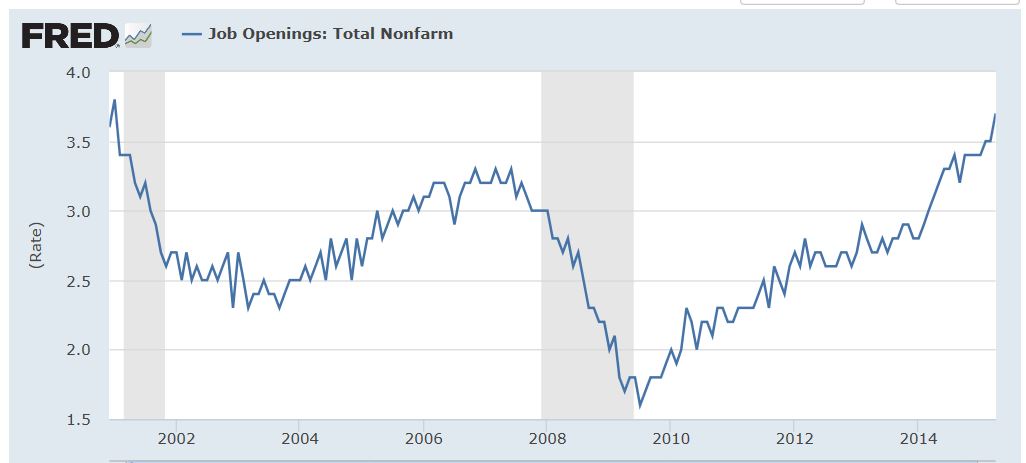
The labor market gets tighter

by Greg Mankiw
 Click on graphic to enlarge.
10 Jun 02:24

Investing in International Mutual Funds: Overview, Benefits & Risk Factors

by Guest Blogger

This post is written by Mr. Santanu Debnath, who runs a Multi-Niche Blog – MyDailyLifeTips.com.

Are you investing in Mutual funds regularly? Have you heard about International mutual funds?

If yes, then do you know why you should start investing today? If you are a regular follower of any personal finance blog or a stock market news channel, then you might have noticed everyday analysis of stock markets of various countries like Dow Jones of United States, Brazil Bovespa Stock Index, Canada S&P/TSX 60 etc. Now, one can invest on those markets as well with the help of International Mutual funds.

In this article I will share a basic overview of international mutual fund, why one should invest on such funds and what are the other facts one should know before investing in such funds.

What is International Mutual Fund

If you know the definition of Mutual fund, then the meaning of International fund is also very simple. In this fund the accumulated money will be in stock markets of other countries like USA, Brazil etc.

International mutual funds are the portfolio of equities, bonds, and money market securities traded in foreign market. Because of the diversification they offer, these funds are gaining more and more popularity.


Why one should invest in International Mutual Fund

India is a developing nation which is currently attracting many foreign investors. There are many such countries in the world, where one can invest via overseas funds and get a good exposure.

There are many benefits associated with them; like introduction to emerging markets, commodities boom, or business cycle of different markets.

If you understand the meaning of portfolio diversification, then these funds will add huge value to your portfolio. Whenever your domestic market is down, other markets may perform better and in this way your net asset will stay positive in the long run.

According to last one year’s data, the top 10 international mutual funds has shown huge returns ranging from 26% to 50%.

Investment Benefits

There are various benefits of investment in international mutual fund. If chosen wisely, your return from these are much higher compared to domestic markets.

Better Returns than other MFs: An international mutual fund provides much better returns than any other type of MFs. To avail better returns, you can have few foreign funds from different international markets.

Growth of your Principal Amount: Foreign fund investment can expand or grow your initial capital to a great extent. In case of international MF, you can choose between funds of various overseas markets. So chances are more that your amount will grow significantly.

Better Investment Portfolio: Foreign funds are mainly ideal for those investors who want a diversified investment portfolio. To get optimal returns from investment in foreign mutual funds, Investment in those funds should not have much link with the domestic market.

Risk of Investment

Besides general mutual fund knowledge, one must know few more facts before investing in these Mutual Funds.

Although by investing in Mutual funds, one actually minimizes the tension of tracking individual company’s track record; still people can’t track those companies which are based outside India. In case of International mutual fund, you may find it difficult to get information how the companies linked with those funds are performing, are there any regulatory or change in business plan happening etc. So the upcoming markets can be affected with the economical and political changes of those countries.

I believe, almost everyone invest in mutual funds after analyzing the track records of that fund. As international mutual funds are new in Indian market, you may not find enough historical data for few of them.

In stock market, any crucial news related to a company play a huge role. You might have noticed that before declaration of national election result or any company’s new policies or budget; market reacts either in a positive or negative way. As the time zone of international market is completely different from ours, there will be a risk of missing such timely updates.

Fluctuations in the currency rate of different countries can affect your investment very significantly, as it is very difficult to know the financial stability of any country. This thing completely depends up on how the local currency is trading with the international currency. E.g. if you invest in any USA based fund and you have received a return now then definitely it is better compared to what you would have received 2 years back.

Anyway, these points may not be applicable for an investor who invests for a long term point of view, rather tracking the fund performance on a regular basis.

Income tax rules on International Mutual funds

The tax liabilities will be similar to debt mutual funds only. Means a long term capital gain tax will be applicable as per below rules:

  • Without Indexation – 10% tax on capital gains
  • With Indexation – 20% tax on capital gains

Examples of International Mutual Funds

So what are the foreign funds available now? Below are examples of few mutual funds that are available currently in the international market.

  • ICICI Prudential US Bluechip Equity Fund
  • DSP BlackRock US Flexible Equity Fund
  • Mirae Asset India-China Consumption Fund
  • DWS Global Thematic Offshore Fund Growth
  • JPMorgan JF Asean Equity Off-shore

Conclusion

To conclude the article, I will say that international mutual fund will open new investment options in mutual fund segment which will provide more diversification as well as a better return. To make wise investment decision, one should do a detailed research about the international market that they consider to include in their investment portfolio.

International mutual funds are a useful way of reducing the overall risk of one’s portfolio and we can hope that these will be seriously considered by all the investors in coming days. But one should try to follow the thumb rule of 70:30 or 75:25 for domestic & international market from the mutual fund portion of their investment portfolio.

Hope you find this article useful. Share your thoughts and query related to this topic.

09 Jun 02:20

Signals of poor advise

by subra

If you attended IFA meets (where they meet to award themselves ‘best’, ‘gold’ , ‘silver’ etc.) and you hear their language you will be shocked to hear their language! Anyway that is a different post is it not? Today let us look at what the bad adviser’s language sounds like:

1. Why do you not play the market for some fantastic gains? : A guy who talks about my money as ‘play’ has no business handling it for me.

2. An adviser who says “buy this now, the product is closing on 31st…”He is simply selling a product and has a deadline. YOU do not.

3. We need to review your portfolio on a quarterly basis and adjust annually. Sorry not necessary.

4. We need to buy some Put Options on your portfolio as the short term risk in the market is high. If my portfolio manager said this to me I would be fine….not if my IFA tells me this. Do not trust your IFA to take short/ long term market calls. THEY CANNOT.

5. You need life insurance too? Why not combine life insurance and investment? It means having fewer products. By the way did I tell you my wife is a life insurance agent? So we can do all the paper work in my office!!

6. “Arre do you know I met a HNI client…and I stuck a big endowment plan on him?” – guess what he is saying to the next client?

7. I am an agent for xyz life insurance, my wife for abc …insurance, my father for def life……hey you have met a product seller – I am not saying that, HE SAID IT HIMSELF.

8. Prescribing before diagnosis, is the surest way to hell.

9. It is a proprietary model..issue the cheque favoring our firm..we will create a spv for you. One bank does that by issuing statements in your name….but your money is lying in a few mutual funds.

10. In our prop model we can get you much higher returns from equity with lesser volatility and risk. Our bond funds are in dynamic funds where he fund manager adjusts the duration himself.

11. Jargon dropping. Alpha, beta, gamma, Futures, Options, calls, tactical asset allocation, …..if he/ she throws all this at you, FLEE.

Oh there are more….wait for a later post….!!

Post Footer automatically generated by Add Post Footer Plugin for wordpress.

07 Jun 03:57

One kick 10,000 times

by Muthu

“I fear not the man who has practiced 10,000 kicks once, but I fear the man who has practiced one kick 10,000 times.” -Bruce Lee

This quote talks about power of practice, perseverance and repetition.

It is said that 10,000 hours of practice makes one an expert in a particular field. Practising one kick 10,000 times makes one a master, an opponent to be feared by even by the likes of Bruce Lee.

By doing one thing, 120 times or 240 times, you also become a successful investor. That one thing is SIP. SIP over 10 (120 times) or 20 years (240 times) brings investment success.

Studies have found that only 5% of investors do better than an index fund. For remaining 95%, it is a losing game. Since actively managed funds (the kind of funds you are investing) do well in India, by investing regularly in them for long term, you beat most other investors including professionals.

We’ve mentioned about Dalbar studies which quantifies how investors earn significantly lesser than investment returns. 95% may fall into the category of investors who earn significantly lesser than investment returns. Only 5% may make it.

Those 5% are the ones who practice one kick, 10,000 times; who follow one habit of SIP regularly without fail, 240 times.

There is no need to learn 10,000 different things like analysing macro economics, geo political factors, technical analysis, quant theories etc. Practise just one thing, only one thing, do SIP regularly without breaking even one instalment for next 20 years. This one thing would make you successful and respected by the Bruce Lees of the investment world.

One kick, 10000 times = Successful martial artist

One method (SIP), 20 years = Successful investor

All the best.


07 Jun 03:57

India and Bangladesh - the decoupling of economic and social development

by noreply@blogger.com (Gulzar Natarajan)
WSJ has a nice graphic on Bangladesh's superior social sector achievements over its larger neighbor.
The limited literature available examining Bangladesh's relative success in improving social indicators point to the role of non-profits. But, as I blogged earlier, this may be a case of representativeness bias arising from the high-profile successes of non-profits like Grameen Bank and BRAC, and the consequent under-estimation of the role of government. Given the central role of public systems in the success of social sector policies, the performances of Bangladesh and India also points to the relative success of state in the former and its failure in the latter.

As India struggles with its Clean India initiative, Bangladesh's achievement in reducing open-defecation rate from 42% in 2003 to just 3% in 2014 looks mighty impressive. A less highlighted ongoing ADB funded project is soon set to make Dhaka the first South Asian city to have a functioning 24X7 water supply system. What is it about Bangladesh's public administration and political economy that enhances its state capability?
Add to Technorati Favorites
06 Jun 02:52

Yes, Build the Buffer

by David Merkel
Photo Credit: www.SeniorLiving.Org also Ken Teegardin

Photo Credit: www.SeniorLiving.Org also Ken Teegardin

I was riding home with child number seven after a basketball practice about four months ago — this is the child that if any of mine has the capability of taking over for me someday, this is the one. She said to me, “Dad, I always knew we were better off than most, but it finally sank home to me how much better off we are than most of the people we know.”

Me: “What do you mean?”

7: “I’ve been talking with my friends after basketball practice, after church, and other times, and I hear about what happens when their parents have a $500 surprise bill for a repair, and things like that.  They have to scrape for months to deal with the added expense, and they can’t do a lot of things that they do normally while they rebuild their finances.”

Me: “Okay, so what makes us different?”

7: “We just had three disasters hit us at the same time, and you just dealt with them for the long term without making a lot of noise about it.  Had that happened to any of my friends’ families, they would not know what to do, it would be impossible for them to do it without help.”

Me: “Actually there are a few of your friends whose families would likely survive what hit us easily, but yes, you’ve hit on something that I think is the most significant initial lesson on finance for the 75% of the population on the low end of incomes.  People need to start saving early, and build a buffer against disasters, etc.  If I were going to give a talk at most churches on personal finance, I would talk only about that, and almost nothing more.  Earn, budget, save, and be generous.  After that, we can talk about investing, but it is only relevant to a minority of the population with enough discipline to save early and often, initially aiming for 3-6 months of expenses.”

7: “When did you and Mom finally have that much saved?”

Me: “Going into our marriage back in 1986.  I had been a graduate student, and your mom a high school teacher in one of the poorest school districts in California, but we still both lived low on the hog, and saved money.  That gave us enough money that we were able to buy a small house at an opportunistic time six months after we married.  Within a year, we had rebuilt the buffer, and we haven’t been without it since.”

-==–=-=-=-==-=-=–==-=-=-=-=–=-=-=-=-=-=-=-=-=-=-=-=-=-=-==-=–=-=-==-=-

In personal finance, you have to develop good habits early, and learn that life isn’t about how much you spend.  I try to teach my kids that — Seven understands it, as does three or four of her siblings.  The other three or four don’t understand, despite my best efforts — some of it seems to be personality-driven, but I have seen one or two of them change and get better at money management.  We’ll see… they are still developing.

In finance, you have to focus on what you can control.  You have reasonable control over ordinary spending.  You have less control over what you earn, and almost no control over accidents and investment returns.  Thus the first bit of advice is to live below your means and save.  The second bit is to plan against catastrophes on a reasonable level.  Insurance can be useful to protect against some of the worst outcomes.  Just remember, insurance is an expense and not an investment.

Along with the above article cited, note these four basic articles and one book review on personal finance:

The last one is useful for learning to live less expensively, while still having most reasonable comforts that others have.

Now, what I have written about above has been noted in the financial media lately regarding a study done by JP Morgan on how many people don’t keep a buffer around, no matter how much they earn.  Here are two articles that talk about that study (one, two — good articles both, read them if you can).  Personally, I’m not surprised having worked with people who earned a lot and spent to the limit.  They lived far more opulent lives than I do, but decided they would save later.

If you want to save, start now.  Most good habits have to be started now, or they won’t get started.  Most good intentions don’t die from a frontal assault, but from the idea that you have plenty of time to change.  As a result — you don’t change.  And that is not just you, it is me in my life also.  Change must start now, or it does not start.

Two more articles worth a read:

These largely follow my point of view on personal finances.  Save, protect against bad risks, and take moderate risks to earn money both in work and in investing.  You can do it too, but remember, it is not a question of knowledge, it is a question of whether you have the will to do it or not.  I wish you the best in your efforts.

Now if you haven’t done it yet, go build the buffer.

06 Jun 02:50

I Have An Idea And I Need An App For That : A 101 On App Development & Tools You Need

by Karthikeyan_NG

In the past 10 months, I have got so many requests from the fellow entrepreneurs to create the initial product for their startup, half of them are from India and the others are from outside India. Most of entrepreneurs are from engineering background and already working with a startup or a MNC, a few of them quit their company and jumped into this journey in full time, a few of them are into business development and marketing.

Even a nearby provisional store shop owner approached me for creating an app for online grocery delivery. And almost everyone is bootstrapping.

I have an idea and I need an app for it

It is awesome to see that people from every sector understands and trying to utilize the technology but most of them jump into the app market before clearly validating their idea and they end up in creating one another app with just 100s of users. Nowadays everyone wants to create and grab the market through their on demand service based startup or an uber for abc or a tinder for xyz. And almost everyone wants to just clone one another app which is already popular in the market.

Here I have listed a step to step process from my experience, on creating a successful app along with the tools that will help you to run the process smoothly. Take a hot cup of coffee or a bucket of popcorn before reading further.

Here is a list of steps you need to follow before creating an app.

Have a solid idea or a problem

Most of the successful apps in the market created out of a problem faced by the people around or the creator understood the market very clearly. If you have an app idea already, move on to the next step. Do you really face a problem in your day to day life or do you want to solve something in a bigger scale? Think about the provisional store guy. He found that all his customers are having a smartphone and also everyone wants door delivery. Right now, he is handling it by taking orders through phone and he spends most of his daytime on phone because of it. He wants to get rid of it and assign the work to a boy that he is planning to hire. He even posted a notice in front of his shop for hiring a delivery boy. He understands the market and tries to solve his problem and at the same time. This is a sample scenario on how do you plan to create an app.

Don’t worry if you don’t have an idea. Problems are there everywhere waiting for someone to solve it. Every successful app solve problems in a really bigger way than our imagination. If you are searching for app ideas in google, this is the time to stop it. It will never work in that way. Each and every object around you is created to solve a problem.

List down all the problems you face in your day to day life. For example, I still recharge 6 different wallets for my on-demand delivery services on travel, food, ecommerce and entertainment in India. I don’t want to recharge all 6 different wallets all the time. It is such a time-consuming work every time. There is no service to provide a common platform to solve this issue. Oops, did I leak a million dollar idea? There is nothing in talking about your idea outside. The execution process matters more than your idea. Go to the next step.

Whenever a new idea strikes your mind, note it down in a paper or in a tool like Google keep, Evernote, Trello.

Validate your idea

This is really an important phase before jumping into creating the app. For example, let us say you want to create online food delivery startup based out of Bangalore and you need an app to go online. Now, how do you validate your idea? Most of the time, you will have direct competitors and a very few ideas will be completely new to the market.

When you create a product, there should be customers not just use your product one day but who is ready to use it immediately. You should first analyse, existing market players in the same segment. Analyse the market size from the competitors and check their user base. There are many services to find a competitor product. If you find too many competitors, it means that your idea is already validated through them. Don’t worry about entering the market late. Think Google is not the first search engine.

If you are creating a product which doesn’t exist in the market already, that is awesome. Create a launcher page with subscription option. Use a simple google form or wufoo forms listing down your features and the questions, send it across your friends and families, facebook community users, local startup network events, meetup groups. Engage with different kinds of group and get feedback from them both online & offline and also make sure you are talking to appropriate targeted users. For an app which targets college students, you need to figure out where do students engage mostly and try to get their feedback.

Designing

This is where most of the entrepreneurs make mistake generally. Once after they validate the idea, they will immediately start looking for developers to build the app. When it comes to app, UI/UX is more important than the actual functionality. User should love the app on first sight. After validation, you should first think about the features on your app and the UI/UX involved in it.

There is a lot of tools for app prototyping like invision app. But even before going to use a tool for it, sketch your idea in a board or in a paper using pen. And make sure that you cover all the details and UI in it. UI Navigation design is more important for user experience(UX). And don’t ever mirror iOS designs, icons to Android/Windows and vice versa. They are completely different platforms with different UX patterns. There is a lot of prototyping, wireframing apps you can use before going on designing with a designer. I suggest you to use, pen and paper in the initial stage than online tools for prototyping and wireframing.

If you take most of the top applications on store, they have started with a small set of features and improved on top of it. You can’t release the stable version on your initial release. It is a continuous process. Make sure you first version has the core feature without any functionality issue and keep the UI simple and clean.

You don’t need an awesome UI. Once your wireframe is ready, find a designer who can bring life to your wireframes. Design as per the user navigation and complete the designs for core feature first. For example, if you are making an app similar to Instagram, give importance to home screen listing screen, camera screen, applying filter screen, sharing screen. That completes the main flow inside your app. That is simply enough for a good demo of your app. Think your app in that way.

Similar Tools for prototyping: Mybalsamiq, Atomic

Hire developer

You key to success is based on hiring a best developer to implement your app. Don’t be haste while hiring a developer. When you make a mistake on your first hire, the mistake will grow exponentially on further hires. You don’t need a rockstar developer but you need an all rounder with talent. You need to make sure he/she fits your culture. You don’t need people who show attitude or ego.

If you have good experience on hiring remote workers through elance.com or upwork.com go for it. Hire a developer with more experience rather than looking at the developer’s paycheck. Otherwise try to find a good developer from friend’s network. If you have enough time, hire a developer/intern directly from college. When you expect more quality, it is always suggested to hire an experienced developer.

At the end we just need to just Get Shit Done!

Invite beta users

Once your app is in a condition to show demo, get as mush as early users you can adopt. The way you distribute your app/build will be the key for your success. It will be awesome if you can find your beta customers for free of cost. It is really important at the early stage of a startup. Keep a list of all your early adopters. Here is a list of places that you can make it possible.

  • Write blog posts and post infographics if possible relevant to your idea/startup. If you are bad at making inforgraphics, go to elance.com, upwork.com to get a quality post. Make sure you publish the article in all relevant social media.
  • Join as much as relevant groups possible. Join Google+ communities, facebook communities, LinkedIn groups. When you post about your app in these groups, make sure your post doesn’t look like an advertisement. Otherwise most probably you will be kicked out of the group. It is better to post it like asking for suggestion or help in improving so that users will be interested in checking out. If you don’ know how to write content, go to fiverr.com and spend 5$ to get right content for your startup.
  • Post articles in hackernews/quora and build your reputation. When your reputation grows, you will get more visibility and more chance for a user to click on the link that you are posting. Give more importance on the quality of the content that you are posting.
  • Go to your competitors social media links especially twitter and facebook, find out unhappy customers. Try to find out the actual pain point from the customer and try helping them to resolve it.

Have marketing channels

Marketing is really important for the success of your app. Think about candy crush app, the idea behind candy crush app is from the very old bejeweled app that we were playing 10 years back. It is all about how do you roll out your app to get more users. If you have some budget for marketing, you can get paid app installs through Ad networks, facebook ad campaigns.

Always keep your press kit ready. Here is a short list of mandatory things for your press kit.

  • Brief information about your company along with logo/brand info
  • Founder’s details with headshot photos
  • Where was it founded along with date/year
  • Where do you operate it currently/business area coverage
  • Product/service information in detail
  • Pricing strategy in detail
  • Details about your clients
  • Details about your employees with photos
  • Overall market statistics
  • Short video from the founders or the product demo

Here is a small list of places to post your app for marketing and also bringing users on board. Link: Startup marketing

Create developer accounts

Based on the product/service you are offering when your app is in a beta stage, you may need to create developer accounts on the appropriate channels. Mostly on Apple’s app store, Google’s play store or Windows app store. Create account and add your developer into the console. If you have good experience with those, you can post the app yourself on store. All the stores are designed in a way that it can be used by non-developers too.

Same like the need to optimize your website for search engines, it is very important to optimize the app description on the store. You need to choose the right keywords in the title and description so that users can find you easily. For example, you are creating a clone of Instagram, if your app doesn’t show up when they search for “photo effects”, then your app literally doesn’t exist.

App analytics

Analytics decides your actual success of the app with live insights. Having 10k active users is greater than having 1 million users without any user engagement. For example, when you create an app similar to Tinder, track user engagement on every screen, keep a track of all the events fired inside the app. For example, keep track of

  • Number of active users per day
  • App open/close per user/per day
  • Number of likes/dislike counts per day per user
  • Number of mutual matches he/she gets per day
  • Number of matches a user gets per day
  • Amount of time spent on the app per day
  • Opening/editing profile page

And make your course of action plans based out of your analytics.

For tracking analytics, you can use google analytics, flurry, apsalar or hasoffers.

And at the same time, use analytics for tracking your bugs/crashes too. You can use crashlytics, crittercism or hockey SDK. It will be really helpful to understand the issues faced by the client.

Reiterate product and go for better marketing

Your analytics will be your main dashboard for your feedbacks. Keep tracking in all the app stores for reviews and ratings. Respond to customers in a professional way to resolve the issues reported by them. Get feedback from all the users and create a list of them. You DONT need to implement all the suggestions as a feature. Always keep your product simple and clean.

This sums up the steps involved in creating your first app. Oh wait, did I miss something in this list? Are you thinking about the budget? Think about building a better product before thinking about building an app within your budget. Here is a little calculation, that will help you in deciding your budget.

Think you are creating a clone like Instagram.

Budget for servers: ~100$/year from AWS/Linode/Digital ocean

Budget for developers/designers: Think the app developer will spend one month time. Excluding holidays you can consider 20 days in a month and on an average of 8 hours of work per day comes at 320 hours of work per month. If you take a minimum of 10$ per hour, the budget comes up to 3200$ per month. This is an average estimate, this will vary based on the complexity of the application and also based on region. The same amount you may need to spend for your server side developer also. You can estimate half of this budget for a designer on their work. In that case, the design must be an exceptional one.

All the best for your app’s success!

[Author- Karthikeyan NG, Co-founder and Chief Developer at Look Mobility. He is a Web/mobile/IoT apps developer, Traveller, Technology Enthusiast, Blogger]

The post I Have An Idea And I Need An App For That : A 101 On App Development & Tools You Need appeared first on NextBigWhat.

06 Jun 02:48

Role of an IFA

by subra

Many people think that the role of an IFA is to select schemes for the client and then go off into hybernation. I met a bunch of high end IFAs and realized that they do the following things which websites and FB groups cannot do for them!!

These high end IFAs (the smallest had a 3 digit crores Aum) were telling me the things that they do…enumerating what I remember:

1. Holding hand when the markets are volatile.

2. Telling them the advantages of certain portfolios vis-a-vis other types of portfolios.

3. Explaining how nominations work – Google has so much info that a common investor does not know where to start

4. Explaining how the asset allocation works – even between Large cap, Mid cap, etc.

5. Bringing in the discipline to keep the SIP and increase it on an annual basis.

6. Stopping the client from buying nonsensical products thrown at them by the bank RM

7. Explaining the qualitative factors in fund house and therefore fund selection.

8. Explaining nuances of life insurance and mutual funds

9. Helping with mandate change, folio aggregation, transmission…and finding out how difficult it is for the retail investor to deal with fund houses.

10. Hand hold during asset transitions – like selling funds to buy a house. Or investing lumpsums amounts when their parents retire, sell a house etc. Having moral and physical support very critical.

11. Help talk money across 3 generations – something which the client finds difficult.

12. Explaining asset allocation, compounding, tactical asset allocation – at the time of application

13. Goal amount calculation with the help of commercially available calculators

14. Helping people navigate through a lot of noise available on the web


…actually there are about 20 more…but my memory is slipping!

Post Footer automatically generated by Add Post Footer Plugin for wordpress.