Shared posts

15 Jul 09:28

Doctors and Investing part 2

by subra

Doctors and Investing part 1 was summarizing the state of affairs of the doctors. Now let us see what they can do about it:

1. Understand that EARNING money is easy.

2. Managing, protecting and growing it is the REAL challenge.

3. Managing means keeping proper accounts, filing returns accurately and on time.

4. Protecting your earnings (taking life insurance), not entering into transactions that you do not understand (entering into a partnership with a builder for example), being adequately insured about equipment, against mal practice, etc.

5. Growing by investing it well by creating an investment portfolio, planning for retirement (you may work till 90, but that has to be voluntary, NOT to earn money).

6. Keeping spouse’s assets out of the reach of a mal practice suit (your CA or financial planner may not how to do it, ask a lawyer)

7. Investing heavily in YOURSELF – learning, practice, etc.

8. Assets management: why you need to OWN your clinic / dispensary / hospital premises BUT can afford to stay in a rented premise.

9. Handing over the practice to juniors smoothly – even to a sibling or a child can be done smoothly and well.

10. Putting all of this together in a book, and making a will TODAY.

Post Footer automatically generated by Add Post Footer Plugin for wordpress.

15 Jul 09:27

Eight reasons why July could be an extraordinary month for Bajaj Auto

by Shiv Kukreja

This post is written by Shiv Kukreja, who is a Certified Financial Planner and runs a financial planning firm, Ojas Capital in Delhi/NCR. He can be reached at skukreja@investitude.co.in

Last quarter of FY 2015 was a nightmarish quarter for Bajaj Auto. It faced all kind of problems related to its product sales in India as well as exports outside India to countries like Nigeria, Egypt and Sri Lanka. The Company witnessed a double-digit decline in motorcycle sales in all three months of Q4, 12.24% decline in January, 20.94% in February and 22.41% in March.

While domestic motorcycle sales were down due to rural slowdown and in anticipation of new launches, commercial vehicle sales were down due to a subdued economic growth. Exports were badly hit due to an extremely violent situation in Nigeria due to elections, an order cancellation by the new Sri Lankan government and inadequate availability of dollars with Egypt & Nigeria due to a sharp fall in oil prices.

Subsequent to this extremely poor quarter, several brokerages downgraded the stock to ‘Sell’ or ‘Reduce’ or ‘Hold’ at the best. Research analysts were expecting another bad month for its sales in April and its stock price hit a 52-week low of Rs. 1912.50 on the NSE on April 30.

But, when everyone was questioning its product & sales strategy, Bajaj Auto management worked harder to improve the sales volume by reintroducing its phased out model CT100 and repackaging its popular brand Platina. This strategy worked wonderfully well for Bajaj Auto as the company started posting decent sales numbers March onwards. Since then its stock price recovered to move beyond Rs. 2600 before it became ex-dividend on July 9, a gain of around 35% in less than 50 trading days.

I think such returns are great from a large cap company like Bajaj Auto and if all goes well, there is a room for further upside in its stock price from hereon. Here I try to list some reasons which have helped and should continue to do so in moving its stock price up this month.

  1. Higher June Sales Numbers – After a negative growth for eight months in a row, the company registered a growth of 9.68% in its motorcycle sales in June. Though it was still below some analysts’ expectations, the numbers looked decent given a series of poor sales numbers by the company in the first three month of the current calendar year.
  1. Higher Expected July Sales Numbers – The Company expects its sales momentum to continue in July as well with exports & domestic sales number to be higher than June.
  1. Dividend of Rs. 50 – Though I personally never buy a stock to get its dividend, I have observed many investors do so, not only individual investors, but even institutional investors. The Company announced a dividend of Rs. 50 in May and its stock price went ex-dividend on 9th of July. The dividend will get credited into shareholders’ accounts on July 27th or 28th after the company’s AGM on July 23rd.
  1. Supreme Court Verdict on Quadricycle RE 60 – Legal tussles take very long to get resolved here in India. Such a matter involving Bajaj’s unique product, Quadricycle – RE 60, is pending with the Supreme Court and is now posted again for hearing before the court today i.e. July 15. Bajaj has high expectations that the court will clear its hurdles today and the product would soon hit the Indian roads giving the commuters a long overdue alternate to auto rickshaws. A favourable verdict would provide a very big boost to Bajaj Auto’s stock price in the short term and its financials in the long term.
  1. Rupee Fall & Highest Ever Quarterly Profit on July 23 – On the back of a recovery in its exports & domestic sales in the April-June quarter, Bajaj Auto is expected to announce its highest ever quarterly profit in excess of Rs. 1,000 crore on July 23. To give further strength to its already strong sales, US dollar appreciated considerably against the Rupee in the last quarter. Bajaj expects a higher realisation and forex gain due to such a weakness in INR.
  1. Bonus Expectations – Bajaj Auto last announced a bonus of 1:1 on July 22, 2010. With a strong quarterly show and brighter times ahead, some analysts are speculating that the Bajaj management might announce a surprise bonus issue on July 23rd as well, after a gap of 5 years. This move will provide more liquidity to the stock and the investors would definitely consider it to be a strong signal about management’s confidence in the company’s future profitability & growth.
  1. Repackaged Discover 150 – One factor, which has been hurting Bajaj’s motorcycles sales badly for quite a long period now, is the poor show by its Discover brand. The management of the company was very confident about its revival when they launched Discover 150 last year. But, it again failed to impress a large number of prospective buyers.

The management of Bajaj Auto recently announced that they have already taken some corrective measures regarding the product and they will soon launch a repackaged Discover 150, which they hope to do well this time around.

  1. Initiating Pulsar Exports – In the past 6-8 months, Bajaj has launched many variants of its most popular & profitable brand Pulsar. All its variants are getting a very good response from the customers and there is a waiting period of 1-2 months for a couple of its variants. Bajaj would also initiate the exports of its Pulsar variants this month, which could again boost its monthly exports and hence its realisations & profitability.

Though stock prices move well ahead in anticipation of an event and probably Bajaj Auto’s stock price has also moved up well in advance in anticipation of a good quarter, I think the company is standing on a very strong footing now and the factors mentioned above should further aid its stock price touch all time highs in the coming weeks and months.

15 Jul 09:25

Mega-projects and cost over-runs

by noreply@blogger.com (Gulzar Natarajan)
Excellent analysis by Bent Flyvbjerg (via Project Syndicate) of mega-projects, which, at $6-9 trillion or 8% of global GDP, is described as being ruled by an iron law of mega projects,
Over budget, over time, over and over again.
He finds that nine out of ten megaprojects (more than a billion dollar projects) suffer cost over-runs and under-estimation of costs and over-estimation of benefits are commonplace.
Most often, if not always, mega projects are driven by political economy considerations. Governments and vainglorious leaders see them as aspirational symbols and start the project without the availability of adequate financing. Given the size of these projects and the business they bring, corporate stakeholders - developers, financiers, contractors, etc - play ball with governments to get the project off the ground. The difficulties and real costs surface once construction begins. 
Add to Technorati Favorites
15 Jul 09:25

Where are India’s subject matter specialists?

by Amol Agrawal
Subject matter what is that? Specialists what is that too? Chinnu Senthilkumar of Exfinity VC fund raises questions on subject matter expertise in India: If India’s economy has to grow, it has to quickly transition from an agriculture-based economy to a combination of innovation-driven, manufacturing-driven and service-driven economy. After all, even today, close to 50% of our […]
15 Jul 09:08

Where is India's middle class?

by noreply@blogger.com (Gulzar Natarajan)
Livemint points to a Pew research work which highlights that while the global middle class (with per capita incomes more than $10 per day) has grown from 7% to 13% of total population in the 2001-11 period, nearly two-thirds continue to remain poor (less than $2 per day) or low-income. 
The income distribution barely shifted at the top half of the income ladder.
In India, while the share of poor declined from 35% to 20%, the middle income hardly changed, inching up from 1.4% to 2.6% in the same period. In fact, among all its major peers whose middle class share is more than 20% of the population, India is easily a disconcerting outlier in its middle-class share. 
This raises several disturbing questions about the country's long-term growth prospects. At 3%, those with middle class incomes and above constitute just 37 million, and is clearly not growing at a satisfactory enough rate to sustain very high economic growth rates. Simply put there aren't enough Indians around who can afford refrigerators and cars, shop at the malls, buy a house in a metropolis, send their children for management education or get treatment at Apollo hospitals, or take-off for annual vacations within the country. Further, since the stock of middle class is growing ever so slowly, the boost from the pent-up demand may be tapering off. Even doubling this estimate, assuming the Pew study is off the mark (which is unlikely given that the recently released Socio-Economic Survey of India points to similar trends), does little to minimize the concern.
Add to Technorati Favorites
15 Jul 09:08

a friend wrote a note about subramoney….caveat emptor..repeating it..

by subra

Caveat Emptor ….is of course Buyer Beware…for the readers of this blog…

Subramoney.com is a blog run by P V Subramanyam a graduate of Mumbai University. That is the only qualification he has…of course he has passed a few exams on accounting, cost accounting and secretarial functions. He is also trained as a lawyer. This has allowed him to be invited to be a member of one accounting body. That of course is not a qualification. It is a membership. Not sure if he pays the membership fees. He rejected one new institute which offered him membership. He felt paying $ 80 a year does not make economic sense (see he is a value investor).

He is an investment professional and like all investment professional he has got somethings right and many things wrong. Happily for him (and luckily as Taleb would say) his rights have been better than his wrongs. Actually it is more of compounding than spectacular success that has worked for him. So start early is not only a good thing to do, but if you follow subramoney, almost mandatory.

This is not an investment advice portal, nor is this blog an income creator or a client driver for him. To that extent he encourages you to analyze, experiment, and then invest. He has a fetish for risk control – and you can consider him a risk freak. His worst day will be when he thinks he understands risk.

Regarding markets – debt and equity – he understands that he does not understand them. He also concurs with Ken Fisher that the market is a great humiliator and finds newer ways of fooling you.

He knows that India is the most over researched market and he cannot add any value in armchair research. His research therefore restricted to reading about 40 balance sheets in a year….and understanding 5 or 6. He understands cash flow – thanks to the Gujjus and Madus in his friend circle. Most of his understanding of markets have come from talking and listening – and some theory from the 200 odd books that he claims to have read. I have no proof of his having read – so one more caveat. He knows whom to call for which balance sheet. His telephone book is awesome. He has at least one friend with a net worth in excess of Rs. 10k crores.

He is biased towards equities – but he has had fantastic runs in the debt market with debt funds, as well as bonds. In the past few years he has got upwards of 16% p.a. – and thinks it is not sustainable . He has a reasonable sized portfolio, a decent dividend, he trades, he sits with friends over Angel funding projects, is friends with a few Venture capitalists, trains at banks, mutual funds, does open workshops, and reads a lot. Reading leads to writing.

Please do not take anything on this blog as an invitation to buy, sell, short, leverage in equities, debt, real estate, gold….This is just his views, and are subject to market risks and Subra understanding risk. You must read all that he has written about the content on his blog before you can claim to understand what he writes. There are times when he wonders what he has written. So if you understand ALL that he has written, he himself would be surprised. He reads some of his stuff after a year and chuckles

‘did I really write that piece of shit’……….but is too lazy to delete them I guess. So caveat emptor.

He takes very aggressive calls with a small portion of his portfolio, but major part depends on ‘n’ of the compounding formula and not ‘r’ . For those who have forgotten the formula is  (1+r) raised to N.

so do read subramoney, do your own research, then invest. Mutual funds are good, but still needs understanding and research.

Investments of course are subject to market risk.

Reading is subject to understanding risk.

– a well wisher of Subramoney.com

PS: I like the fact that he has promised not to edit this.

Who am I: a fund manager….but subra hardly listens to me. So I am not one of the famous ones…My AUM is a digit less than what Naren manages, but I have 3 digit lesser number of clients than what he has.


Post Footer automatically generated by Add Post Footer Plugin for wordpress.

15 Jul 02:47

Aakash, the “iPad Killer”, Vaporware has Evaporated

by Atanu Dey

Aaskash, the “iPad Killer”, vaporware that the idiot Kapil Sibal promoted, has quietly evaporated in March 2015. Hindustan Times reports “India’s low cost ‘Aakash’ tablet project closed in March

“The Aakash project at IIT Bombay was closed on 31st March, 2015, after successfully completing all targets. Specifications for future upgraded version has been submitted to the government. IIT Bombay is not in knowledge of future plans,” IIT Bombay said in a reply to the RTI query.

Initially, IIT Rajasthan was entrusted with the project, which it returned to Ministry of Human Resource Development. The project then went to IIT Bombay and since then the institute had been overseeing it.

Other than procuring one lakh devices, the other targets including its sample testing in labs and establishment of over 300 Aakash centres which were engineering colleges across the country were also achieved, it said.

A total of Rs 47.72 crores was approved for the project and this amount has been spent to achieve the targets, the reply said.

Tax-payers’ money wasted on a worthless device. The Rs 47+ crores is just part of the waste. Various institutions must have had to buy those 100,000 devices. God alone knows how much was flushed down the tubes in total. Sibal should be tarred and feathered for this waste. Will that happen? No. Government officials are unaccountable for their disastrous decisions.

I told you so. I wrote an opinion in the Indian Express in Oct 2011: “Swiping without Reading” (Not my title.) I re-posted the piece on this blog, “Aakash, blue skies vaporware“. Do read the comments to that piece also.

15 Jul 02:46

A Bollywood take on the Greece crisis …

by Amol Agrawal
Prof. Manasi Phadke keeps getting better and whackier with her posts. The latest is a Bollywood take on the Greece crisis: Here is the ultimate block buster in Economics. Isme action hain, drama hain, austerity hain, reforms hain, growth hain, depression hain, there are scams galore and bro-mance to boot! How could Bollywood not move in […]
15 Jul 02:46

Mutual Funds Vs ETFs in India - Which one to choose Today, And Which one in Future?

by Dev Ashish
Note - This is a guest post by Girish Sidana, a reader and an accomplished professional working for a well-known name in Indian automobile industry. You can connect with him professional here. So over to Girish...  Most people reading Stable Investor would be fully convinced (even I am) that investing in well diversified Mutual Funds for a reasonably long period fetches the best possible
13 Jul 15:28

Greece Has To Kneel, Beg and Completely Capitulate, Says New Deal

by Deepak Shenoy

Greece finally has a deal. We don’t know if this is agreed upon in pure exhaustion after 17 hours of negotiations, but it’s something that involved total capitulation by Greece. It is even worse than the deal that Greece was getting earlier (before the referendum).

It gives Tsipras, the Greek PM, three days to get the major demands passed through the Greek parliament. We saw a few things earlier, in our post, which I’ll paste here:

image

What Now?

By July 15, Tsipras must do the following, through parliament:

  • they have to raise the sales tax, and cut pensions.
  • Any misses in the deficit/surplus expected will automatically trigger some very specific spending cuts
  • Greece must keep the statistics and the privatization piece completely independent of the Greek government (or limit the influence)

Once this is done, the parliaments of Germany, Austria, Holland, Finland and others that previously opposed a deal will have to say okay to doing the bailout.… (Read On...)

13 Jul 15:25

CPI Inflation for June 2015 at 5.4%, Highest in 8 months But Not In Troublesome Zone Yet

by Deepak Shenoy

Consumer price inflation picked up a little more than expected in June 2015, with the index moving up 5.4% more than the same time last year. This is the highest headline number since October 2014, and a little surprising since there wasn’t anything like this that was expected:

image

Both Rural and Urban inflation have perked up, and the increase in inflation is much more in rural:

image

Food inflation is up over the last month , but so are every other subcomponent  except education and housing. The upward pressure on inflation is surprisingly large.

image

And finally, what is a serious worry: Core inflation comes back up to the highest level since October 2014. Remember that core inflation is the index minus food and fuel. If we remove those, core inflation is up to 4.6%, the highest since October 2014. This is important because in October 2014, crude crashed. That took a lot of prices down.… (Read On...)

13 Jul 11:09

The Secret to Learning Anything

by Vishal Khandelwal

I’ve been trying a lot of things these days to connect my 10-year old daughter Kavya with a variety of new learnings – in life, human behaviour, how the mind works, ethics, and how to develop good lifelong habits.

To say that I have been successful in making this connection would be an overstatement. There are some aspects about such learning that Kavya easily connects with and loves what I show or tell her. But like most kids, her mind wanders away frequently, towards things that she finds more interesting and engaging.

Now, either I could worry about her lack of concentration on a few things that would really matter as she grows up, or I could let her just be herself and learn whatever she enjoys learning. Over a period of time, I have become more inclined towards the latter.

So, it was without doubt that I loved it when I read a 100-year old letter Albert Einstein wrote to his 11-year old, Hans Albert, where he laid down the secret to learning anything.

In 1915, aged thirty-six, Einstein was living in war-torn Berlin, while his estranged wife Mileva and their two sons, Hans Albert Einstein and Eduard Tete Einstein, lived in Vienna.

In November 1915, having just completed the two-page masterpiece on the theory of general relativity, Einstein sent Hans Albert the following letter –

My dear Albert,

Yesterday I received your dear letter and was very happy with it. I was already afraid you wouldn’t write to me at all any more. You told me when I was in Zurich, that it is awkward for you when I come to Zurich. Therefore I think it is better if we get together in a different place, where nobody will interfere with our comfort. I will in any case urge that each year we spend a whole month together, so that you see that you have a father who is fond of you and who loves you. You can also learn many good and beautiful things from me, something another cannot as easily offer you. What I have achieved through such a lot of strenuous work shall not only be there for strangers but especially for my own boys. These days I have completed one of the most beautiful works of my life, when you are bigger, I will tell you about it.

I am very pleased that you find joy with the piano. This and carpentry are in my opinion for your age the best pursuits, better even than school. Because those are things which fit a young person such as you very well. Mainly play the things on the piano which please you, even if the teacher does not assign those. That is the way to learn the most, that when you are doing something with such enjoyment that you don’t notice that the time passes. I am sometimes so wrapped up in my work that I forget about the noon meal. . . .

Be with Tete kissed by your

Papa.

Regards to Mama.

The Secret to Learning Anything Is…
As Einstein wrote to his son, “…the way to learn the most is…when you are doing something with such enjoyment that you don’t notice that the time passes.”

Now, this advice works wonderfully not just with a 11-year old but also with a 31 or 41 or 51-year old. Your real learning happens only when you completely enjoy what you are learning.

It’s easy for me or anyone else to ask you to be a learning machine, which is by the way a very important advice you will ever receive in life. But no one else but you must decide what you want to learn, because you know what brings you the greatest enjoyment.

But yes, whatever you want to learn – and this is an advice I also give to Kavya – the first thing you must do is to let go your natural inclination to judge yourself and your current abilities and habits as good or bad. Avoid saying things like…

  • Oh! I’m good for nothing!
  • I want to learn but I don’t know the ABC of this thing!
  • I look like a fool in this group of learned men and women.
  • I want to ask this question, but what if I look like a fool?

It’s only when we unlearn how to be judgmental, it is possible to achieve spontaneity and focus in the learning process.

W. Timothy Gallwey writes in his brilliant book The Inner Game of Tennis

…there is a natural learning process which operates within everyone – if it is allowed to. This process is waiting to be discovered by all those who do not know of its existence.

To discover this natural learning process, it is necessary to let go of the old process of correcting faults; that is, it is necessary to let go of judgment and see what happens.

Now, on how to learn, I would advice you to watch this brilliant talk at Google from Barbara Oakley


And you may also want to take up Barbara’s free course on learning how to learn.

You see, most people are held back not by their innate ability, but by their mindset. They think intelligence is fixed, but it isn’t. Your brain is like a muscle. The more you use it and struggle, the more it grows.

New research shows we can take control of our ability to learn. We can all become better learners. We just need to mold our plastic brains in the right way…a way that we love walking, and not one that others want us to walk on.

And to repeat Einstein, when you really enjoy the learning process, you can learn anything…value investing, or even how to ride a funny bicycle as shown in this video


This is my advice on learning to Kavya…and also to you. :-)

The post The Secret to Learning Anything appeared first on Safal Niveshak.

    
13 Jul 11:06

Fear: You can conquer it!

by subra

Fear is one the primal feelings of man. The way fear acted on you when you were 12 years old and when you are 82 years old will be different of course.

Some jobs / professions obviously have to deal MORE with fear than others. So an army man in combat or in the borders will be more hit by fear than a school teacher teaching in a big school in a city.

Obviously US Navy Seals, Army people, Firemen, Policemen have to be trained to handle fear. Sadly Investors are not taught to deal with this when they invest. Even while investing when you see a 8% fall in the markets in one day, we act in fear.

However how to handle fear:

1. Think of happy things, and your long term goal: Your daughter’s graduation in an Ivy League school wearing a blue shirt and a black Jacket is VERY powerful Goal visualisation. This takes your mind off the market – and you now think of using volatility  to your advantage and not hit the redeem button.

2. Continually visualize the positive outcomes – read the example in the link at the end of the story. Amazing article, I can assure you.

3. A deliberate attempt to train your body and mind in handling fear is useful. Imagine you are riding a bicycle and you think you are losing balance. We instinctively hold the cycle TIGHTER. Actually leaving the cycle and jumping off is a smarter thing to do. After all you cannot be hurt falling from 4 feet!! but we end up holding the cycle and falling and dragging. The unnecessary falling (you could have jumped), dragging, etc hurt us more than anything else.

4. Relaxing and Meditation helps us reduce the arousal and keeps us cool. So control your blood pressure – this helps improve the reaction time.

Best read the note: http://qz.com/450517/us-navy-seals-conquer-fear-using-four-simple-steps/ 

Post Footer automatically generated by Add Post Footer Plugin for wordpress.

13 Jul 11:05

Closing the gap between farmers and warehouses

by Ajay Shah
by Smriti Sharma.

Warehouses have long been considered important for holding and preserving crops. But warehouses can also potentially solve liquidity issues for farmers. Prices for commodities are depressed immediately after harvest because most farmers bring their crops to the market and this excessive supply pushes the prices down. This means that farmers have to settle for prices that may not be remunerative. If farmers could store their crops in warehouses till the time they got a better price for their produce, it could help avoid the distress sales, but farmers don't use warehouses. The reasons for that can be broadly divided into a) Lack of finance and b) lack of access to storage:

Lack of finance


Small farmers don't have the financial wherewithal to hold their crops. According to the NSSO, in the year 2013, almost 86 per cent of the Indian farmers held less than 2 hectares of land. Of these 86 per cent farmers holding less that 2 hectares of land, 80 per cent farmers held only 1 hectare of land. The same report points out that every month farmers holding upto 1 hectare of land spent Rs. 1213 more than they earned. In case of farmers with upto 2 hectares of land, the dissaving was of Rs. 469 per month. Small farmers depend on the earnings of one harvest to finance sowing the next and therefore cannot store their crops and wait.

Another reason farmers don't store their crops is because farmers need money to repay their loans. In absence of access to formal sources of finance, small and marginal farmers borrow money from arhatiyas and other middlemen at very high interest rates. Farming is a resource intensive business. Cultivating a crop requires seeds, fertilizers, pesticides, water and fuel. Farmers usually procure these inputs on credit. The arhatiyas lend money to farmers at a exorbitant interest rates ranging from 24 per cent to 45 per cent per annum. This creates a pressure on the farmers to sell their harvest as soon as possible and repay the money to the arhatiyas.

Lack of access to storage options


Warehouses are usually far from the production centres and closer to mandis. Farmers don't find it viable to transport small quantities to warehouses. This is because the transportation costs, storage charges, loading and unloading charges end up exceeding the remuneration. This is why farmers prefer to sell their produce to a local village-level middleman who can aggregate crops of various farmers and take the entire stock to the mandi.

There do exist some godowns in rural areas but such warehouses are not equipped to scientifically store and preserve the crop. The Government started Grameen Bhandaran Yojna in 2001 to encourage scientific warehousing in rural areas but this study reveals that most godowns built under the scheme did not conform to the quality parameters for scientific warehousing. When a farmer stores his crop in a warehouse, he's in effect leaving his entire wealth in the hands of people managing the warehouse. Leaving his wealth in either an unsecured place or unreliable hands is a risk that a small farmer cannot bear. Which is why, farmers are reluctant to store their produce.


How would we address these problems?


Improve quality of warehouses


Warehouses are not simply storage points. Warehousing is a combination of the product (the warehousing facility) and the service (warehouse management). Until now, the warehousing regulations in India focused only on the physical attributes of the warehouses, things such as the plinth height, ceiling and flooring. However, the warehouse service providers need to be assessed on the basis of their ability to preserve quality and make good for any losses (if incurred) to depositors. Warehousing Development and Regulatory Authority (WDRA) is currently in the process of re-writing its warehouse registration rules wherein the focus would be on the systems and processes for warehouse management, heightened disclosures and making more information available to market participants. These requirements will ensure that the warehousing space is occupied only by those who have the financial, managerial and technical strength to do the business of warehousing.

In addition, WDRA intends to bring in a system of grading warehouses which will help in differentiating warehouses as well as bridge the information gaps in the warehousing sector. The system of grading will generate and encourage a system of information creation that will be useful for farmers to identify the warehouses in their proximity that they can use to store their crops.

Bring the mandi to the warehouse


Farmers avoid going to mandi because the transportation charges, loading and unloading charges make the entire deal unviable. If WDRA registered warehouses could be recognised as sub-market yards as suggested in this article, then the distance between farmers and buyers could be reduced. Farmers could use warehouses as a point of storage until the time the market turns favourable. In the meantime, the stock could be pledged to avail loans from banks. Currently, the warehousing market largely offers a physical storage receipt against which farmers can get their stock financed. Banks lien the stock, place an external collateral management company to secure the quantity and quality of stock. With negotiable warehouse receipts issued by WDRA-registered warehouses, farmers would be able to transfer the ownership of their commodity without having to make physical deliveries. This will save costs for farmers and encourage them to store their crops in warehouses.

Achieving scale through aggregation


Small and marginal farmers with their small yields are unable to interest the buyers to procure crops from them directly. This re-inforces the dependence of farmers on aggregators. Some states in India have done away with the APMC Act to enable farmers to market their produce directly. However, farmers continue to depend on middlemen to buy their harvest and sell it further. This issue of dependence cannot be solved unless small farmers achieve scale which is also their Achilles' heel. Farmers need to aggregate their produce so that they can collectively rent warehouse, market their produce and negotiate better terms for procuring farming inputs and loans. This form of aggregations is already being tried out with farmer producer organisations (FPOs) and primary agricultural cooperatives (PACs).

Some success stories have been shared here. To encourage aggregation among farmers, NABARD has set up a Producer Organisation Development Fund (PODF) to provide credit support to any registered producer organisation by way of grants or loans or both. More steps in the same direction need to be taken.

Conclusion


Warehousing is both a need and the solution to farmers' post harvest crop management. WDRA is hoping to reform the warehousing space with better registration requirements, inspection and supervision mechanisms. This will instill a lot of confidence among the users of warehouses including the farmers and the banks. This in turn will help bridge the distance between the farmers and the warehouses.

Acknowledgement


I am grateful to Amey Sapre for insights.
13 Jul 03:43

Your wealth is a function of….

by subra

I met a well qualified man from one of the academic institutions. He is very lucky that he had a stint abroad and far more importantly his father has left him 2 big houses in Cuffe Parade and each house is worth in 2 digit crores.

He did not have much cash – but of course had a huge rental income over and above all a very satisfied family. He was very disappointed that he did not have much money – say compared to his friends in the Industry. And he said / felt that he had less money because he had earned less. So much for a person who was good at math.

I explained to this well qualified (mathematically educated) person the following:

You started earning about 33 years ago. Assuming that you had started a SIP at the age of 23 (he is now 54 so about 31 years ago) of an amount of Rs. 6k per month (he confirmed that he could afford it) and had increased it by 8% every year, and invested in the BSE sensex and it had grown at 18.5% p.a. (including reinvestment of dividend of course, we are talking IRR) the amount would have grown to about Rs. 15 crores.

However if he had grown it at 5.5% p.a. it would have grown to about Rs. 1.7 crores.

This academic had made 3 major mistakes:

– started investing late (lost the power of compounding)

– choose wrong asset class (family loved the government, and typical education class they thought talking money was stupid)

– even in the asset class of debt chose bank fixed deposit and paid Income tax at top rates, thus hurting the compounding further.

Sad is it not? that professors of math, bankers, etc. do not understand:

– start early

– be in equities (do SIP in a good fund)

– do not interrupt the compounding

– defer taxation to the point of withdrawal (debt mutual fund) instead of being taxed on an accrual basis (bank fd vs bond fund).

Is it too much to ask?

http://www.subramoney.com/2009/04/real-estate-or-sensex/


Post Footer automatically generated by Add Post Footer Plugin for wordpress.

13 Jul 03:41

Greece Has Rough Choices: Temporary Grexit or Much More Austerity

by Deepak Shenoy

The weekend is over and there is no Greece deal yet. The latest is that the European Troika are not okay with Greek PM Tsipras capitulating completely on Friday and accepting all their earlier demands, and has asked for:

image

All this, plus 50 billion euro worth of Greek assets to be taken out of Greece and placed in a Euro body which will be sold to pay back debt. And all of this has to be okayed by the Greek Parliament and the Greek government by wednesday. 

Here’s the full 4pg eurogroup document on #Greece, inc “time-out”, total amt needed (€82-6bn) & reform proposals pic.twitter.com/sKUpbykcBX

— Ed Conway (@EdConwaySky) July 12, 2015

If not this, then they suggest a “temporary” Grexit, for five years, after which Greece may be asked to return to the Euro.

Our View: This makes no sense. The idea is:

  • Humiliate Greece for using the referendum ploy and make it worse for Tsipras
  • Force Tsipras to resign because he will have no face if he accepts these terms
  • Force Greece out of the Euro in any manner possible

The last point is evident: if banks are closed for two weeks, there is now little time left.… (Read On...)

13 Jul 03:40

Income/Expenses For June 2015

by Jason Fieber

writingsavingI’ve been publicly tracking my income and expenses since I initiated this blog back in early 2011. I do this for a few reasons.

First, I want to prove to the world that it’s possible to become financially independent at a relatively young age even if you don’t make a lot of money. I don’t make a six-figure income. I never have and I probably never will. But it’s not necessary. Oftentimes, people focus on income too much. Expenses are just as important, because if you make $200,000 per year, but spend $190,000 of it, you’ll never become financially independent. Conversely, bringing home $40,000, and learning to get by on half of it means you’ll likely be able to retire if you want to within 15 years or so. Making less means you have less potential income to save, but spending less means you need less passive income with which to retire off of.

The second reason I do this is because I want this to be a live look at one man’s journey. You can find countless books by financially successful people, but often it’s long after they’ve completed their trek to significant wealth that they’re then telling you how they did it. It’s easy to postulate. It’s much more difficult to actually show the whole process in action, for better or worse.

And finally, knowing that every dollar I spend is going to be published for the world to see serves as reinforcement to stay frugal. There’s been more than one occasion where I decided against a particular expense after realizing I might be a bit embarrassed to write about it.

So each month I will post my income and expenses for the previous month. I track every dollar in and out, so what you see is exactly what I earned and spent (rounded to the nearest dollar).

By the way, I use Mint and Personal Capital to track all of my income and expenses. Both are awesome (and free) services.

Income From June 2015:
Online Income $6,245
Dividend Income $845
Other Income $657
Total Income $7,745
Expenses From June 2015:
Rent & Utilities $540
Groceries $233
Student Loans $224
Health Insurance $193
Hosting $158
Fast Food/Takeout/Coffee $157
Restaurants $84
Pharmacy $70
Cable/Internet $27
Mobile Phone $25
Amusement $22
Gifts $13
Transportation $12
Everything Else* $165
Total Expenses $1,915

Income

Well, June was absolutely incredible for income. I set a record for online income in May. And what happened in June? I blew that record away. I can’t believe it.

Much of the overall online income was actually pretty similar when looking at May’s and June’s reports. I stayed really busy in regards to writing – pumping out a massive amount of content – both here at Dividend Mantra and with freelance opportunities. Traffic was once more strong here at the site, coming in at approximately 375,000 pageviews for the month. And I continue to do my best in regards to maximizing content quality.

I’ve discussed before how I generate income online, and much is the same as it was a year ago. The main differences between then and now are simply that I write a lot more (due to having more time) and the blog continues to grow. So that has combined to increase the income rather dramatically YOY. And, of course, you readers help me tremendously whenever you sign up for products and/or services that are recommended. As always, I only recommend what I personally use and/or find value in, which is why I have so few affiliate partnerships. Thank you all for your continued support!

The one major difference between May’s online income and June’s online income (and what accounted for the increase this month) was the fact that I received my first royalty payment for my book!

This royalty amounted to approximately $1,200 for sales generated in April. April is, so far, my best month in terms of sales and the amount of income generated from the book. It drops off a bit for May’s sales and then rather dramatically thereafter. As I’ve noted before, the book will likely not amount to life-changing income for me, but I’m very proud of the project because I think that the book can lead to life-changing results for those that take the time to read it. Might not radically change my life, but I think it can (and will) change others’ lives. I hope to put something together this month discussing my experience with writing a book and what I learned from the project. I owe a big thanks to anyone and everyone that picked up a copy and/or spread the word. Means a lot to me.

Dividend income was, of course, wonderful for June. The last month of every quarter tends to be a real blockbuster for me and June was no different. Landing in at almost $850, that was one of my best months ever. That’s a ton of passive income for someone who doesn’t spend a lot of money. I’m truly fortunate that the me of 2010 decided to embark on this journey. It’s been a lot of fun. And I feel the best is yet ahead.

Other income was mostly related to the sale of my car. I’m going to spread the profit out over the course of the year so as to smooth any month-to-month variances out. So this will provide a nice boost to my monthly savings rates for the rest of the year, just like it was a drag on my monthly budgets last year. In addition to that, I also collected $57 in cash rewards from one of my credit cards.

Expenses

*The everything else category includes expenses I don’t have a regular budget for. So Claudia decided it was time for another dog. We’ve just had Diego, our little Chihuahua who knows a lot about happiness, for a few years now. But we just recently added Kiwi to the mix, another young Chihuahua who was a freebie off of craigslist. Great puppy. She’s incredibly sweet. But we also had to get her checked out by the vet. Turns out it was time for Diego’s annual visit anyhow, so that worked out perfectly. I pitched in half for the vet bill, which accounts for most of the money spent this month in this category. We also needed a new frying pan after literally wearing the nonstick coating off – that coating doesn’t exactly taste good in our food.

Speaking of food, I spent a lot there. I’ve come a long way from the days of eating ramen noodles day in and out. We ate well this past month. Perhaps a little too well, looking back on the numbers. But I’m not regretful.

Although it might look like I swing through the drive-thru at local fast food joints, the truth of the matter is I don’t. First, I don’t have a car, so that’s impossible. Second, I actually don’t eat much of it. But I categorize any food that isn’t at a sit-down restaurant as “fast” food. In addition, I’m writing more and more outside the house, patronizing a couple coffee shops within walking distance of the apartment. I spent something like $80 on these trips over the course of the last month. The me of a couple years ago would have scoffed at the notion. But I’m so much more productive (not to mention happy) when I write away from home that the additional income more than makes up for the expense. So it’s an investment of sorts.

Other than food, I think everything else is in line here. I really don’t spend that much on core expenses. $25 for the cell phone. Less than $15 on transportation. Less than $550 on shelter. I’m very pleased and content with the amount of money I’m spending, overall. Especially considering that I believe I’m living a rather high quality of life. Once you realize that material goods have little impact on long-term joy, it makes it easy to reallocate resources toward the things that do bring about lasting happiness; I’ve certainly found more happiness working from home than anything any store sells.

Savings

I managed to save 75.3% of my net income this month. I’m ecstatic! It’s been a long road back to the high savings rates I used to achieve with ease, but controlling expenses while simultaneously working hard to opportunistically increase income has turned out incredibly well. This is my highest monthly net savings rate since January 2013, so I feel like I’m getting back to the old me. I’m still very excited and very aggressive when it comes to saving money, investing, and fighting for financial independence. Haven’t lost my hunger at all.

One of my goals this year is to save 50% of my net income throughout 2015, averaged monthly. So far, I’ve hit rates of:
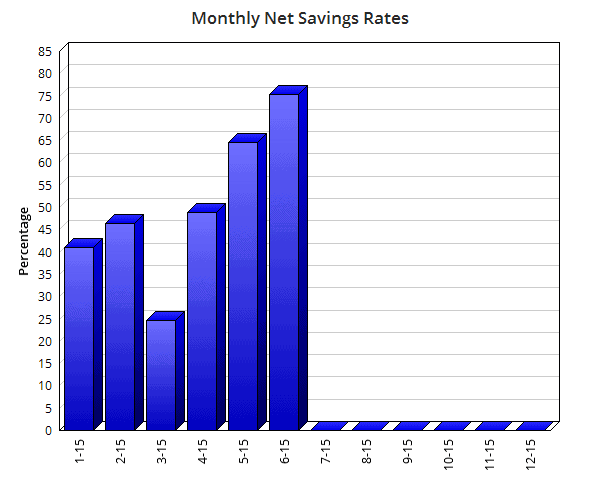
MonthlyNetSavingsRate

I’m now at an average of 50.1% for the year. Boom! Back above water. Took an insane June to get there, but I’ll take whatever I can get. Now that I’m back at the baseline I look to maintain, it’ll be slightly easier to keep at that level for the rest of the year. No more playing catch-up, which feels great.

I expect to have a fairly strong summer and fall for savings, save for the potential of some dental expenses. That should provide for a really nice margin of safety heading into the holiday season later this year. I think, from what I can see, the odds are very high that I’ll exceed my savings goal this year. Stay tuned to find out!

Did you save as much as you wanted in June? Hit your savings goals? On track for your goals this year? 

Thanks for reading.

Photo Credit: bplanet/FreeDigitalPhotos.net

Note: Affiliate link included.

13 Jul 03:38

Open Thread: Ask me anything

by Atanu Dey

h l mencken_1Long time since we had an open thread. This is an “Ask me anything” post. What’s on your mind?

Apropos nothing, let’s read Mencken. Mencken was insightful. For instance, he noted the “basic delusion that men may be governed and yet be free.”

He held politicians in very low regard.

When a candidate for public office faces the voters he does not face men of sense; he faces a mob of men whose chief distinguishing mark is the fact that they are quite incapable of weighing ideas, or even of comprehending any save the most elemental — men whose whole thinking is done in terms of emotion, and whose dominant emotion is dread of what they cannot understand. So confronted, the candidate must either bark with the pack or be lost… All the odds are on the man who is, intrinsically, the most devious and mediocre — the man who can most adeptly disperse the notion that his mind is a virtual vacuum. The Presidency tends, year by year, to go to such men. As democracy is perfected, the office represents, more and more closely, the inner soul of the people. We move toward a lofty ideal. On some great and glorious day the plain folks of the land will reach their heart’s desire at last, and the White House will be adorned by a downright moron.

That most people are not free is an easily observable fact. As an economist may put it, the demand for freedom is rather weak and therefore the supply is nearly non-existent.

The fact is that the average man’s love of liberty is nine-tenths imaginary, exactly like his love of sense, justice and truth. He is not actually happy when free; he is uncomfortable, a bit alarmed, and intolerably lonely. Liberty is not a thing for the great masses of men. It is the exclusive possession of a small and disreputable minority, like knowledge, courage and honor. It takes a special sort of man to understand and enjoy liberty — and he is usually an outlaw in democratic societies.

Would you agree?

12 Jul 13:11

Dumb Money vs. Smart Money

by Muthu

Dumb Money: Borrow and buy

Smart Money: Save and buy


Dumb Money: Instant gratification

Smart Money: Delayed gratification


Dumb Money: House is the best investment

Smart Money: House is for living


Dumb Money: Spend & Save whatever is left

Smart Money: Save & Spend whatever is left


Dumb Money: Buy high and sell low

Smart Money: Keep investing regularly


Dumb Money: Timing the market

Smart Money: Time in the market


Dumb Money: Impulsive

Smart Money: Plan


Dumb Money: Show-off wealth

Smart Money: Accumulate real wealth


Dumb Money: Banker’s delight

Smart Money: Wise Wealth Client


Dumb Money: Momentum

Smart Money: Discipline


Dumb Money: Luck

Smart Money: Skill


Dumb Money: Short term

Smart Money: Long term


12 Jul 13:05

Regulating Equity Crowdfunding Redux

In response to my blog post of a few days back on regulating crowd funding, my colleague Prof. Joshy Jacob writes in the comments:

I agree broadly with all the arguments in the blog post. I would like to add the following.

  1. If tapping the crowd wisdom on the product potential is the essence of crowdfunding, substituting that substantially with equity crowdfunding may not be a very good idea. While the donation based crowdfunding generates a sense of the product potential by way of the backings, the equity crowdfunding by financiers would not give the same, as their judgments still need to be based on the crowd wisdom. Is it possible to create a sequential structure involving donation based crowdfunding and equity based crowdfunding?

  2. Unlike most other forms of financing, the judgement in crowdfunding is often done sitting far away, without meeting the founders, devoid of financial numbers, and therefore almost entirely based on the campaign material posted. This intimately links the central role of the campaign success to the nature of the promotional material and endorsements by influential individuals. Evolving a role model for the multimedia campaigns would be appropriate, given the ample evidences on behavioral biases in retail investor decision making.

Both these are valid points that the regulator should take into account. However, I would worry a bit about people gaming the system. For example, if the regulator says that a successful donation crowdfunding is a prerequisite for equity crowdfunding, there is a risk that entrepreneurs will get their friends and relatives to back the project in a donation campaign. It is true that angels and venture capitalists rely on crowdfunding campaign success as a metric of project viability, but I presume that they would have a slightly greater ability to detect such gaming than the crowd.

12 Jul 13:03

Tough for small equity traders…

by subra

As a broker I never thought that our exchanges were clean. In fact till NSE came, the other big stock exchange BSE (its name was, The Stock Exchange, Bombay) was run like a private club. We knew that. We never pretended that it was a professionally managed organisation. Never.

Then the National Stock Exchange was born and it was well conceived and well started by R H Patil. This is circa 1993 when NSE recruited a lot of professionals (BSE recruitment was not so professional)…and some of us thought it would be different. However if you have read Ayn Rand you realize that if there is a Government organisation you can make it leak. Leak information, money, – whatever you want. And it surely did.

You could not get the settlement postponed (at BSE you could get settlements to be clubbed) or things like that, but you could get other data. As much data as you want. For a price. In fact one of the biggest data peddlers is now doing very well outside the NSE, and I am in no mood to blame him/ her. In fact there have been companies which would get details of the brokers who had short positions on their companies. It will take a book to explain what data is useful and how companies used it. However, suffice to know that getting info leaks from NSE was just as easy as getting it from BSE.

If you are an algo trader (which SEBI says it does not like) and you need speed you need speed of info too. So now the question is not whether data is leaked, it is how quickly the data is given. This means that the traders who have faster access to the data, and software that is faster to execute are benefitting at the cost of the common man. This is very common even in the US. Hopefully the SEC is monitoring that better, but software vendors have their sources. Not sure how tech savvy our regulator is. I have no clue, but some of the things in the past (remember the Hdfc amc front running case?) was a result of some smart technology work. I doubt whether our regulator is alert enough to spot this. Not saying anything because I am staying in a village near Mumbai and am not in touch with the Mumbai shenanigans over the past 12-14 years (retirement has its downside too!!). It will be nice to see Deepak Shenoy’s view on this…

The damn NSE data leakage is worth a probe which should go pretty deep into the software. While at it, probe MCX and FT too. Or whatever is left of that.

It is not a community thing…but you will not be surprised to see the domination of one community. All scams start there, do they not?

http://indiasamvad.co.in/exclusive-market-manipulated-at-national-stock-exchange-scam-runs-into-billions/

Post Footer automatically generated by Add Post Footer Plugin for wordpress.

12 Jul 13:00

China links for the day

by noreply@blogger.com (Gulzar Natarajan)
As the latest chapter of 'Capitalism with Chinese Characteristics', on financial market management, unfolds, a few snippets from the press coverage during the week. From a redacted chapter of a new World Bank report, via FT, on the Chinese state's conflicting roles as owner, promoter, and regulator of the financial system, 
Instead of promoting the foundations for sound financial development, the state has interfered extensively and directly in allocating resources through administrative and price controls, guarantees, credit guidelines, pervasive ownership of financial institutions and regulatory policies.
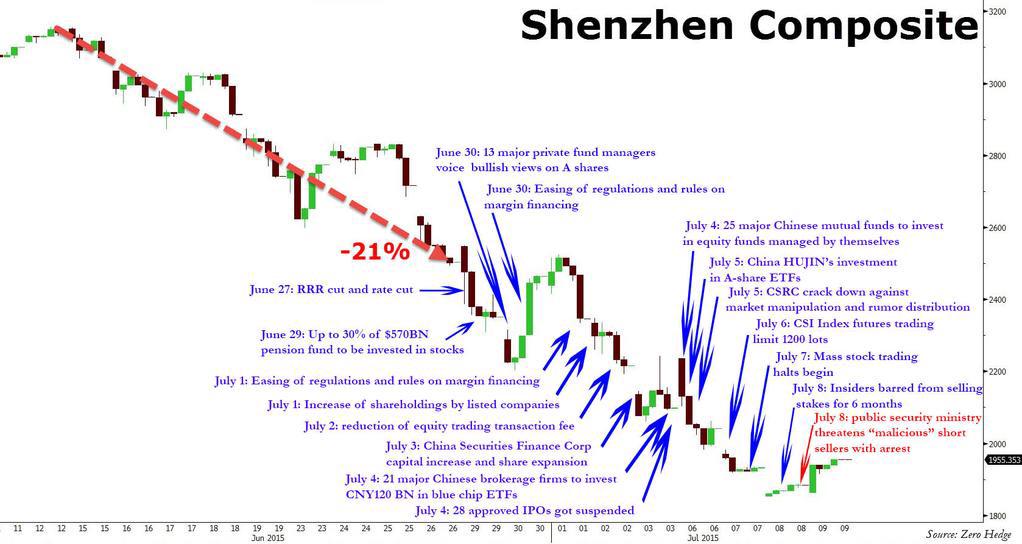
The recent stock market crash has seen the Chinese government throwing virtually everything to backstop the fall. David Pilling summarized it brilliantly,
Authorities have tried everything bar passing a law stating that stocks can only go up. With each iteration, their measures have looked more desperate. 
The World Bank report had this graphic which highlights the skewed nature of Chinese economic growth, focused more on capital allocation than productivity improvements,


The same FT report has this about the colossal waste laid out by this capital accumulation binge,
About half of all China's fixed asset investments between 2009 and 2013 - equal to about $6.8 trillion - went into "ineffective" projects, according to government research. 
And this in turn has engendered a Ponzi scheme involving banks, corporates (public and private), and savers (whose exposure to the equity markets has expanded dramatically in recent years),
A consequence of the investment boom is that many state-owned enterprises are lossmaking, while state-owned banks have lent excessively to these companies and to local governments. The authorities are urging them to lend more despite the fact that they will never be repaid in full.
Retail investors have been encouraged into investing in the equity markets, often through highly risky margin loans,  
Margin lending, in which investors borrow money from brokerages to buy stocks, soared from Rmb698bn at the end of October to a peak of Rmb2.7tn on June 18. But an unknown amount of grey-market margin lending also proliferated, funded by shadow banks through complex structures known as “umbrella trusts”... Brokerages and fund companies... encouraged the perception that government policies would drive the market higher. Investment storylines talked about “concept stocks” linked to big themes such as state-owned enterprise reform and Mr Xi’s “New Silk Road” infrastructure blueprint for Asia and Europe.
Add to Technorati Favorites
12 Jul 12:41

India real estate market fact of the day

by noreply@blogger.com (Gulzar Natarajan)
From the Indian Express,
Data collated by the realty research agency Liases Foras, from 2008 till date, show that 88 per cent of the 25.51 lakh residential projects launched across 8 cities have been delayed. 25 per cent of these projects have been delayed by more than 4 years from the promised delivery date. 
A large part of the delay is also due to the low demand. As the real estate boom peaked in the later part of the last decade, projects were initiated with the belief that 'build and they'll come'. Once the market tanked, the delays and inventory accumulation was inevitable.

A very good presentation by Liases Foras has this stunning graphic of how property prices in Greater Mumbai exploded. The average cost of a flat rose by an annual rate of 35% from Rs 27 lakh in 2004 to Rs 191 lakh in 2010.
As a reflection of the extreme form of gentrification, just 1% of the inventory (144 units) in Greater Mumbai costs below Rs 25 lakh and just 6% below Rs 50 lakh! Affordable housing has been relegated to the suburbs. 
Add to Technorati Favorites
12 Jul 12:35

Changing Job Scenario in IT

by Kirti

One of the biggest asset in finance is your earning power the ability to create the net cash flows which can repay the loans. You do not get a house loan, a car loan or a personal loan. What you get is a loan against your FORM 16, that you will be able to repay loan in future.  One of the profession which parents want their children to join is Engineering or IT,others being Medical, Lawyer,IAS. But  being an engineer now is so different from being an engineer 10 or 20 years back. Pink slip or getting laid off is now also happening in India. We’ll touch upon the challenges that IT is facing in India and try to seek answers to Are engineers facing a bleak future? We have also included an article by  former chairman of Microsoft India, Ravi Venkatesan, IT party is over. Now’s the time to reinvent or die.

IT Jobs 

Every parent whose child scores well in Science is hoping that the child gets into IIT or Medical. There are many coaching centres which have opened  up throughout India especially Kota in Rajasthan and online too, to prepare the child for IIT. Chetan’s Bhagat book Revolution 20-20 (pages 48-92) talks about coaching situation in Kota. You can read this at slideshare. An interesting debate on Quora Why do most Indians study engineering?

Since the 1990s there was rapid growth of India’s software development and Business Process Outsourcing (call center and back office). India’s IT and BPO (Business Process Outsourcing) sector reportedly employs up to 3.1 million persons directly and generates some $120 billion in revenue annually, including more than $70 billion in foreign revenue. However things have changed. More engineers, less employable engineers, weak demand in US, layoffs or pink slips are now associated with IT. 

India’s IT sector is increasingly being hammered by the world capitalist crisis, by anemic growth in the US and Europe and increasing competition from other countries with abundant cheap labour. Like many of India’s other industries, its IT sector is also being undermined by the deplorable state of public infrastructure, everything from the speed of transport and reliability of utilities to the low quality of the education provided by all but India’s premier universities and technical institutes. India’s IT and BPO sector has steadily lost business to other Asian countries, especially the Philippines, where salaries are even lower, as well as to Eastern Europe.

Indian economy is not growing at the same rate as the number of engineers.Engineering colleges have been springing up like wild mushrooms in India in the last few years. Their number has gone up from a not too modest 1,511 colleges in 2006-07 to an astoundingly high 3,345 in 2014-15.There is a mismatch in the aspirations of graduating engineers and their job readiness. 97% engineers aspire for a job in IT and core engineering. However, only 18.43% employable in IT & 7.49% in core engineering.  20-33% out of the 1.5 million engineering graduates passing out every year run the risk of not getting a job at all. For those who do, the entry-level salary is pathetically low, and has stagnated at that level for the last eight-nine years, though the prices of everything from groceries to vehicle fuel have shot up during the same period.

Two key industries which hire engineers in India- the IT and ITes and the manufacturing sector- are also hiring a lesser number of them than before. As against 76% of the 1,389 IIT Mumbai pass outs getting campus placements during the 2011-12 session, only a little above 66% out of the total 1,501 could find campus placements in 2012-13 The situation is grimmer for Tier II and Tier III colleges. The huge disparity between start out salary for top colleges and the not so highly sought after ones, which has already been highly pronounced, is expected to widen further.  Meet millions of India’s engineers – unemployed or stuck in unrelated jobs. Recently I read about Uber and Ola drivers earn up to Rs 1 lakh per month Many engineers becoming cab or auto drivers.

Job security is no longer associated with IT jobs. Layoffs is now part of every industry , especially one which is down. For example Nokia shut down it’s manufacturing factory in Chennai making 5000 people unemployed. With airlines criss airline staff got affected. In 2008 due to financial crisis people in financial industry were impacted. Pink slip is a something that many of those in IT might face in future. Mass Layoffs talks about it in detail. Kind of skills needed in the industry change with time. A decade ago needs for IT market were very different from the IT market today. Today there is high demand for jobs like data analysis, eCommerce which are high paying jobs (and high pressure too).  Our article Losing a Job : Why the Layoffs, Managing finances talks about financial moves to help you tide over the period.

IT party is over. Now’s the time to reinvent or die

Article from Times of India by  Ravi Venkatesan,former chairman of Microsoft India
India’s IT industry is unlikely to remain the amazing job engine that it has been. For the past two decades, the fastest way to increase your income has been to land a job with an IT company . The industry has provided a ticket to prosperity for mil lions of young Indians; children of security guards, drivers, peons and cooks catapulted themselves and their families firmly into the middle class in a single generation by landing a job in a BPO. Hundreds of engineering colleges mushroomed overnight churning out over a million graduates a year to feed the insatiable demand of India’s IT factories.This party is coming to an end.
A combination of slowing demand, rising competition and technological change means that companies will hire far fewer people. And this is not a temporary blip -this is the new normal. Wipro’s CEO has bravely admitted that automation can displace a third of all jobs within three years while Infosys CEO Sikka aims to increase revenue per employee by 50%. Even Nasscom, the chronically optimistic industry association, admits that companies will hire far fewer people. Not only will the lines of new graduates waiting for job offers grow rapidly longer every year, but so too will the lines of the newly unemployed as all companies focus more on utilization, employee productivity and performance. Employees doing tasks that can be automated, the armies of middle managers who supervise them and all those with mediocre performance reviews and without hot skills are living on borrowed time.
So what do you do if you are a member of these endangered species? What constitutes good career advice in these times? I’d say that the first thing is to embrace reality and recognize that the game has changed for good. The worst thing to do is be wishful and wait for the good times to return. They won’t. But there are still lots of opportunities. What’s happening in the industry is creative destruction. New technologies are destroying old jobs but creating many new ones. There is an insatiable demand for developers of mobile and web applications. For data engineers and scientists. For cyber security expertise. So for anyone who is a quick learner, anyone with real expertise, there will be abundant opportunities.
There has also never been a better time for anyone with an iota of entrepreneurial instinct. India is still a supply-constrained economy and so there is room to start every kind of business: beauty parlour, bakery , catering, car-washing, mobile, electronics repair, laundry , housekeeping, tailoring. For entrepreneurs with a social conscience, there is a massive need for social enterprises that deliver affordable healthcare, education and financial services. Not only are there abundant opportunities but startups are “in“ and there is no shame at all in failure. The ranks of angel investors are swelling and it has never been so easy to get funded.There is even a website, http:www.deasra.in, that provides step-by-step instructions to would-be entrepreneurs.
For those who prefer a good old-fashioned job, there are abundant jobs in old economy companies which are struggling to find every kind of talent -accountants, manufacturing and service engineers, sales reps. Technology is enabling the emergence of new sharing services such as Uber or Ola that enable lucrative self-employment; it is not uncommon to find cab drivers who make Rs 30,000-40,000 a month.
My main point should be clear. While India may have a big challenge overall in creating enough jobs for its youthful population, at the individual level there is no shortage of opportunities. The most important thing is a positive attitude. The IT boom was a tide that lifted all boats -even the most mediocre ones.However, this has bred an entitlement mentality and a lot of mediocrity . To prosper in the new world, two things will really matter.
The first is the right attitude.This means a hunger to succeed. Being proactive in seeking opportunities, not waiting either till you are fired or for something to drop into your lap . A willingness to take risks and the tenacity to work hard and make something a success. Humility . Frugality .
The second is the ability to try and learn new things. The rate of change in our world is astonishing; whatever skills we have will largely be irrelevant in a decade.People are also living much longer. So the ability to learn new things, develop new competencies and periodically reinvent ourselves is a crucial one. Sadly , too many of us have no curiosity and no interest in reading or learning. The future will not be kind to such people.
“The snake which cannot cast its skin has to die.“ 
Related articles: 
12 Jul 12:35

Book Review – A Bed of Red Flowers: In Search of My Afghanistan

by Manshu

I recently finished reading A Bed of Red Flowers : In Search of My Afghanistan, and I was deeply moved by this book.

This book is written by Nelofer Pazira who lived for ten years under the Soviet occupation in Afghanistan, escaped to Pakistan and emigrated to Canada from there.

The book is her story about growing up in Afghanistan, and I can’t recall reading anything sadder or more powerful in recent times. What strikes me most about her story is the drastic change that has come about in Afghanistan in just thirty or forty years, and how some parts of the story are so relatable because we have all experienced 9/11 and its after effects, but other parts of the story shock you, and surprise you.


For instance, at one point in the story Nelofer Pazira speaks about how her father saw her mother the very first time, and how she was wearing a mini skirt at the time. I was frankly quite surprised at that because I never knew Afghan society was like that at any point in history. I think a lot of us assume that Afghanistan was always the way we are used to seeing it now, but that is far from the truth. The book does a great job of presenting this contrast and giving you a good history lesson about Afghanistan written in a beautiful manner.

I will quote a couple of passages from the book to show what I mean. The first one is the passage I referred to earlier.

My father still fondly recounts their first meeting as if it were yesterday, his story like a script from a romantic movie. A young woman with long blonde hair, dressed in a miniskirt with a stylish sweater over her shoulders, smiled at him, and Habibullah’s heart was bound up with the ringlets of her hair—as he made clear in a verse he composed to mark the occasion.

The second is a passage from the time of the Taliban occupation, and reading that just leaves you aghast.

Hygiene is a problem in Niatack. None of the mud houses I’ve been to has a bathtub. Women complain that they don’t have enough water to wash their children, let alone themselves. “Could we build a couple of public bathhouses?” I ask. The Iranian authorities show us a public bathhouse. It’s for men only. “Our women don’t go to public baths,” says a man, fixing his square hat over his curly hair. “It is a question of our honour.” But no one can see them inside a closed bathhouse, I say. “No, they can’t, but knowing that women are inside the bath, other men—men who are not their husbands—can imagine that they are naked. It’s a dishonour.”

What happened in Afghanistan is a tragedy, and one that is usually viewed from the events of 9/11 and after. This book is a great story about the Afghanistan that existed before Taliban, and also of a young girl and her family that suffered through all of this.

The other thing that strikes me about the book is the author’s love for her country, and her childhood friend who she has to leave behind in Afghanistan. The stories of individual atrocities fill you with horror, but there is a sadness in the words that don’t describe an atrocity but just the passage of time and change in the course of lives of the characters. It is hard for me to describe this but you develop such an empathy with the characters in the book knowing that they are all real and have suffered through this that it has the powerful effect of making you stop and think about how those people must have felt like how the author would have felt when she didn’t receive a letter back from her friend, what were her fears, what did she do to overcome them, what was her friend thinking, was she saddened by the fact that someone was waiting to hear from her and could not. It is all very powerful.

Nelofer Pazira also actually travels back to Afghanistan in search of her childhood friend, and there is a movie called Kandahar which is inspired by this. The move is quite popular apparently, but I didn’t know about it, and have still not seen it.

All in all, A Bed of Red Flowers is a great book, and I would definitely recommend it to all of you except the ones who think they may not be able to handle the sadness that the book will fill you with.

Disclosure: The link to Flipkart is an affiliate link which means I’ll get a small commission if you buy the book from this link.

12 Jul 12:31

How To End Index Gaming

by David Merkel

There was an article at Bloomberg on gaming additions to and deletions from indexes, and at least two comments on it (one, two).  You can read them at your convenience; in this short post I would like to point out two ways to stop the gaming.

  1. Define your index to include all securities in the class (say, all US-based stocks with over $10 million in market cap), or
  2. Control your index so that additions and deletions are done at your leisure, and not in any predictable way.

The gaming problem occurs because index funds find that they have to buy or sell stocks when indexes change, and more flexible investors act more quickly, causing the index funds to transact at less favorable prices.  You never want to be in the position of being forced to make a trade.

The first solution means using an index like the Wilshire 5000, which in principle covers almost all stocks that you would care about.  Index additions would happen at things like IPOs and spinoffs, and deletions at things like takeovers — both of which are natural liquidity events.

Solution one would be relatively easy to manage, but not everyone wants to own a broad market fund.  The second solution remedies the situation more generally, at a cost that index fund buyers would not exactly know what the index was in the short-run.

Solution two destroys comparability, but the funds would change the target percentages when they felt it was advantageous to do so whether it was:

  • Make the change immediately, like the flexible investors do, or
  • Phase it in over time.

And to do this, you might ask for reporting waivers from the SEC for up to x% of the total fund, whatever is currently in transition.  The main idea is this: you aren’t forced to trade on anyone else’s schedule.  The only thing leading you would be what is best for your investors, because if you don’t do well for them, they will leave you.

Now, that implies that if you were to say that your intent is to mimic the S&P 500 index, but with some flexibility, that would invite easy comparisons, such that you would be less free to deviate too far.   But if you said your intent was more akin to the Russell 1000 or 3000, there would be more room to maneuver.  That said, choosing an index is a marketing decision, and more people want the S&P 500 than the Wilshire 5000, much less the US Largecap Index.

So, maybe with solution two the gaming problem isn’t so easy to escape, or better, you can choose which problem you want.  Perhaps the one bit of practical advice here then is to investors — choose a broad market index like the Wilshire 5000.  At least your index fund won’t get so easily gamed, and given the small cap effect over time, you’ll probably do better than the S&P 500, even excluding the effects of gaming.

There, a simple bit of advice.  Till next time.

12 Jul 12:18

China's stock market defence of 2015; India's currency defence of 2013

by Ajay Shah
The Chinese defence of stock prices [ht]:


is reminiscent of India's currency defence of 2013:


In both cases, policy makers did not get the basics of economic policy in a market economy.
11 Jul 07:38

Seven Intelligent Fanatics from India

by fundooprofessor
Yesterday, I delivered a talk titled “Seven Intelligent Fanatics from India” at Value Investing Seminar, Trani, Italy. None of the stocks of companies run by any of these seven entrepreneurs were recommended for purchase. Nor am I recommending them now. I know that some of you may disagree with me about the conclusions about some (or even […]
11 Jul 07:38

Weekend Links: July 10 2015

by Manshu

One of the most interesting things I came across this week was Google’s Deep Dream program. Basically, this is Google’s Image recognition program which they have flipped on its head to now create images.

The results are a little freaky right now, but people have already found incredible uses with it and none more incredible than what Turkish artist C.M. Kosemen has already achieved.

There are still some people who deny climate change, but Exxon actually seemed to know about this as far back as 1981.

We are all worried by the fear of rejection, and it keeps us from doing many things that we want to; 2 research backed ways to beat the fear of rejection.

I was surprised to learn that there about 7,000 Hindus and Sikhs living in Afghanistan right now, but I was not surprised to see that their condition is bad.

India’s solar push could be a gold rush for investors.

Finally, Professor Sanjay Bakshi’s great talk about seven great businessmen and companies in India.

11 Jul 07:38

Social Media Investing

by subra

I have spent a lot of time on my blog, Facebook, Twitter, and generally meeting people. Interacting with people in the real world and on social media is useful, no doubt. And even better is meeting them as a teacher, guide, coach, sales person, trainer, customer, etc. is an awesome experience. I find a new class of investor who is dependent on the social media for his investing. So let me pen my observations about this new animal called the social media person (this is not just investing, but in general):

1. For many people it is almost instinctive to ‘like': After all how can you not ‘like’ something posted by a friend, a pretty girl, or a person you like/admire?

2. I have seen ‘like’ on some of my posts within seconds of my posting: Many, if not most likes are without even reading the text.

3. Confirmatory bias: People want to read / hear what they want to hear. So it is very easy for me to say a) PPF is awesome so all your money should be in PPF b) LIC is government controlled so it is awesome c) Buy a house as soon as you can d) While investing costs are everything, fund manager competence does not matter…………..etc. etc. EVERYTHING WILL BE LAPPED UP.

4. On the social media the words like, friend, etc. have sinister meanings.

5. Sex sells. Posts with sexy pictures get shared 100x times more. I hope the people at  amazon,in, Flipkart and Homeshop TV18 ask my publisher for some sexy pictures on the cover of the book at least. I will be happy with a 100x jump in sales.

6. The title need not have too much relevance to the body of the article. Subramoney.com is a one man show. If I had to hire a person, I would ask him / her to do titling of all my 3600 articles. SEO zindabad.

7. As in real life people do not like analysis, the love bias. I have some biases – private sector fund management is superior, because it is easy to poach from a Psu amc. Or ‘Over a 10 year period equities will give better returns than bonds’. If I were to write articles with far greater facts and analysis and come to a different conclusion..people are likely reject it.

8. People want quick, confirmatory answers, it does not matter if it is wrong.

9. Investing anecdotes are far better received than scientific facts.

10. Like does not mean read, understood, implemented….it just means seen.

11. People read, pretend to understand, sound like an encyclopedia but may have bank fixed deposits and ULIPs.

12. Social Media makes everybody sound like an expert !! Even if the knowledge has been acquired from poring over books. Sadly Investment behavior is about meeting and talking to people.

13. The person making the comment or writing the article – the name – is far more important. His bias, his lack of real life experience, etc does not matter. So it is easy for BBC / WSJ to say something and get away. Then it is for people like us to break out heads….

here is a baker’s dozen…more in 2017…if I should not repeat these 13!!

Post Footer automatically generated by Add Post Footer Plugin for wordpress.