Shared posts

09 Jul 08:08

International Madness: China Shuts Itself Down, Bans Large Shareholder Sales, NYSE Shuts On A Tech-Glitch

by Deepak Shenoy

AChina’s continuing to go absolutely bonkers. After a market crash of 30% that still leaves it about 70% higher than a year back, the Chinese Authorities have banned people from selling. Which as you might realize, is the stupidest way to stop the market from crashing.

These people can’t sell for the next 6 months:

  • Shareholders that own more than 5%
  • Executives and directors of companies

And Trading Halts, and Even Cops!

To stop their shares from falling further many companies are telling stock exchanges to halt trading in their shares.

The suspensions have locked up $1.4 trillion of shares, or 21 percent of China’s market capitalization, and are becoming increasingly popular as equity prices tumble. If not for the halts, a 28 percent plunge in the Shanghai Composite Index from its June 12 peak would probably be even deeper.

Some of these companies, it seems, have pledged shares and borrowed money.… (Read On...)

09 Jul 07:30

Safal Niveshak is 4 Years Old!

by Vishal Khandelwal

Baseline information suggests that 92% of startups fail before they reach age three. Safal Niveshak, which I started four years back, has crossed this barrier…and I have been extremely lucky to come so far.

So yes, it’s time to put on the big boy pants. :-)

A lot has happened in these quick four years, but as with my four-year-old son, I’m just getting started.

Most of all, I want to thank each and every one of you for “raising” this initiative to this point — it truly could not have happened without you, dear tribe member.

I know I’ve said it before, but it bears repeating – Thank you so much for reading, for commenting, for your interest and support, for keeping me honest, for helping this entire movement of creating smarter and independent stock market investors become greater and spread wider.

You are magnificent, and I am supremely grateful for your time and attention.

I do feel very fortunate on many levels and I’ve been wanting to use this little milestone to do something special. So I’ve decided to give Safal Niveshak’s birthday to a cause that’s close to my heart – education and upliftment of children from the Nat and Kanjar tribe in rural Rajasthan (India).

I informally support this organization called the Nirvanavan Foundation, which is run by a very kind gentleman named Nirvana Boddhisatva.


Nirvana ji runs a few small village schools in Rajasthan’s Alwar district that teach 300+ children and also provide basic medical facilities to their family members. His foundation is looking to fund the purchase of various utilities for children, including food, stationery, and a minibus to ferry kids from the villages to nearby schools.

So, here’s my birthday deal. If you subscribe to my premium newsletter on Value Investing – Value Investing Almanack – today, Safal Niveshak will donate 100% of the net proceeds of the same to the Nirvanavan Foundation.

Education and healthcare of the poor is a massive problem with many complexities that make my head spin, but my hope is that this birthday, Safal Niveshak and its tribe members can do something small to make a difference.

So, if you wish to benefit from the best ideas on value investing, human behaviour, and business analysis and also help a few lives, click here to subscribe to the Almanack.

I would also be happy and honoured to hear your thoughts on your journey with Safal Niveshak so far.

Thanks again for being there!

The post Safal Niveshak is 4 Years Old! appeared first on Safal Niveshak.

    
09 Jul 03:34

Parents be careful! Terrible mistake in Retirement Funding

by subra

The generation born in the decade 1955 to 1965 is now grappling with children’s expenses, parental expenses and own retirement seeding fund pressures.

What exactly should they do?

They have a great argument: “My parents paid for all my education, and they did not hesitate” so I will too. Great. Our generation did not make too much of a demand on our parents for education. I know a friend who qualified as a Chemical Engineer and took up a job.  Along with the job he did his MBA in finance – and funded the full time course with his own earnings.

My father spent money on my Bcom and CA and it did not cost him the heavens to fund it. Our parents funded our education out of their current income, not out of doing a SIP to meet the education costs.

Times have changed, our attitude too has to change.

The earlier gen lived a simpler life. My father was very well paid but as a family we never splurged. We used to eat out a few times a year (the others in that gen did not do even that). Many of them had defined benefit pensions. Medical costs were not so high and longevity was not such a big issue as it is going to be for our generation.

And boy! have medical costs changed! Our parents may not have set up a medical fund (and thank God many of them did not need a King’s war chest to pay for their illnesses.

Education costs have just gone through the roof. Government colleges too have become expensive. IIMA today charges Rs. 25L for a one year MBA program. ISB Hyderabad is not very far behind.

The lesser known colleges are not far behind. Forget the MBA degree, if your kid were to start in an International school (even in Godforsaken suburbs of our metros IG schools costing Rs. 100,000 for a Kindergarten school are available. (Rs. 2L if you see what a reader has said yesterday).

You have already set the expectation of the kid. He knows you plan to spend Rs. 9 lakhs per annum in class 8, 9 and 10. Class 11 and class 12 cost about Rs. 30 lakhs in total. Your kid has just joined school? Double the money required. Simple.

Now this kid will do his graduation in the US – he did not do IG to do Bcom in Podar college, right? So be ready for say Rs. 4 crores for education in the USA. What if he wants to spend Rs. 84 lakhs on a hotel management degree? Will you be willing to fund him?

Soch lo……………….


Post Footer automatically generated by Add Post Footer Plugin for wordpress.

08 Jul 09:17

There is no free lunch…but..try this

by subra

Sure there is no free lunch but just in case you need some samples there it is

http://www.flipkart.com/ebooks/sample?book=9789380200644 


Post Footer automatically generated by Add Post Footer Plugin for wordpress.

08 Jul 09:17

Avoid Indexed Life Insurance Products

by David Merkel

Everyone reading should know that I am an actuary, as well as a quant and a financial analyst.  Math is my friend.

Math is not the friend of many of my readers, so I usually don’t bother them with the math.  Tonight’s post will be no different.  It stems from my time of creating investment strategies for what was at that time a leading indexed annuity seller.

What is the return that you get from an indexed annuity?  It is the return from index options, subject to a certain minimum return over a 7-15 year period. Now, on average, what is the return you get from buying any fairly priced option?  You get the return on T-bills plus zero to a slight negative percentage.  So, if the option premiums paid are cumulatively greater than the guaranteed minimum return, the product should return more than the minimum on average — but likely not much more on average.

Why is that?  Options are a zero sum game, and usually there is no inherent advantage to the buyer or seller.  There are some exceptions to this rule, but it favors at-the money option sellers, never buyers. Buying options is what happens with indexed annuity products.

Now, over any short amount of time, like 5-10 years, you can get very different results than the likely average.  That doesn’t affect my point.  With games of chance, some get get good outcomes, and other get bad outcomes.

Now, the indexed product sellers will tell potential buyers that they will never lose money if the market goes down.  True enough.   What they don’t tell you is that over the long haul, you will most likely earn more investing in one of Vanguard’s S&P 500 funds or even their Balanced Index Fund.  You may even earn more investing in their high yield fund, or even their bond market index fund.

In exchange for eliminating all negative volatility, you end up getting very modest interest credits, while still being exposed to the credit risk of the insurance company.  In an insolvency, your policy will be affected.  The state guaranty funds will likely protect you if your policy is underneath the coverage limits, but still it is a bother.

Add to that the illiquidity of the product.  Yes, you can cash it in at any time, do 1035 exchanges, etc., but before the end of the surrender charge period you will pay a fee that compensates the insurance company for the amortized value of the large commission that they paid the agent that sold you the policy.  For most people, the surrender charge psychologically locks them in.

Thus I say it is better to be disciplined, and buy and hold a volatile investment with low fees over time, rather than own an indexed annuity that will tend to lock you in, and deliver lower returns on average.  That’s all, aside from the postscript.

=–=-=-==–==-=-=-=-=-=-=-=–==-=-=–=-==-=-=-=-=–=-=-=-=

Postscript

How does an insurance company make a profit on an indexed annuity?  They take the proceeds of the sale, pay the agent, and use the rest to invest.  About 90% of the money will be invested in a bond that will cover the minimum guarantee.  The remainder will buy option premiums — the amount of money that gets applied to that is close to the credit spread on the bonds less the insurance company’s fees to pay the costs of the company and a charge for profit. Not a lot is typically left in a low yield environment like this.  The company tries to buy the most attractive options that they can on a limited budget.  Inexpensive options typically imply that most will finish out of the money, and/or when they do finish in-the-money, the rewards won’t be that large.

08 Jul 02:44

Why You Shouldn’t Buy ULIPs: After We Confuse You, We Underperform Everything

by Deepak Shenoy

I don’t generally write about ULIPs but once in a while it’s useful to see how bad these products have been. We wrote a long post about HDFC Crest which was being missold by bankers as if it was a fixed deposit.

See: Don’t Buy HDFC Crest, It’s Not a Fixed Deposit

Now there are many reasons why the ULIP is a bad product.

  • Very little insurance
  • Useless Guarantee
  • High Costs (that are removed as fees in terms of number of units, thus making it non-transparent too!)
  • Elusive Tax Benefits
  • And Lastly Substandard returns compared to other instruments.

But Just Compare Returns, No?

Forget all the fees and all that. That’s highway robbery and terribly disgusting behaviour but what you can do, these are relationship managers with targets who don’t give a damn. One day, banks will be classified as brokers and we’ll get our day in court. Meanwhile, let’s see how bad the performance of a ULIP is.… (Read On...)

08 Jul 02:44

Simple Rules: How to Thrive in a Complex World

by Shane Parrish

Simple Rules

“Simple rules are shortcut strategies that save time and effort by focusing our attention and simplifying the way we process information. The rules aren’t universal— they’re tailored to the particular situation and the person using them.”

We use simple rules to guide decision making every day. In fact, without them, we’d be paralyzed by the sheer mental brainpower required to sift through the complicated messiness of our world. You can think of them as heuristics. Like heuristics, most of the time they work yet some of the time they don’t.

Simple Rules: How to Thrive in a Complex World, a book by Donald Sull and Kathleen Eisenhardt, explores the understated power that comes from using simple rules. As they define them, simple rules refer to “a handful of guidelines tailored to the user and the task at hand, which balance concrete guidance with the freedom to exercise judgment.” These rules “provide a powerful weapon against the complexity that threatens to overwhelm individuals, organizations, and society as a whole. Complexity arises whenever a system— technical, social, or natural— has multiple interdependent parts.”

They work, the authors argue, because they do three things well.

First, they confer the flexibility to pursue new opportunities while maintaining some consistency. Second, they can produce better decisions. When information is limited and time is short, simple rules make it fast and easy for people, organizations, and governments to make sound choices. They can even outperform complicated decision-making approaches in some situations. Finally, simple rules allow the members of a community to synchronize their activities with one another on the fly.

Effective simple rules share four common traits …

First, they are limited to a handful. Capping the number of rules makes them easy to remember and maintains a focus on what matters most. Second, simple rules are tailored to the person or organization using them. College athletes and middle-aged dieters may both rely on simple rules to decide what to eat, but their rules will be very different. Third, simple rules apply to a well-defined activity or decision, such as prioritizing injured soldiers for medical care. Rules that cover multiple activities or choices end up as vague platitudes, such as “Do your best” and “Focus on customers.” Finally, simple rules provide clear guidance while conferring the latitude to exercise discretion.

***
Simple Rules for a Complex World

People often attempt to address complex problems with complex solutions. For example, governments tend to manage complexity by trying to anticipate every possible scenario that might arise, and then promulgate regulations to cover every case.

Consider how central bankers responded to increased complexity in the global banking system. In 1988 bankers from around the world met in Basel, Switzerland, to agree on international banking regulations, and published a 30-page agreement (known as Basel I). Sixteen years later, the Basel II accord was an order of magnitude larger, at 347 pages, and Basel III was twice as long as its predecessor. When it comes to the sheer volume of regulations generated, the U.S. Congress makes the central bankers look like amateurs. The Glass-Steagall Act, a law passed during the Great Depression, which guided U.S. banking regulation for seven decades, totaled 37 pages. Its successor, Dodd-Frank, is expected to weigh in at over 30,000 pages when all supporting legislation is complete.

Meeting complexity with complexity can create more confusion than it resolves. The policies governing U.S. income taxes totaled 3.8 million words as of 2010. Imagine a book that is seven times as long as War and Peace, but without any characters, plot points, or insight into the human condition. That book is the U.S. tax code.

[…]

Applying complicated solutions to complex problems is an understandable approach, but flawed. The parts of a complex system can interact with one another in many different ways, which quickly overwhelms our ability to envision all possible outcomes.

[…]

Complicated solutions can overwhelm people, thereby increasing the odds that they will stop following the rules. A study of personal income tax compliance in forty-five countries found that the complexity of the tax code was the single best predictor of whether citizens would dodge or pay their taxes. The complexity of the regulations mattered more than the highest marginal tax rate, average levels of education or income, how fair the tax system was perceived to be, and the level of government scrutiny of tax returns.

***
Overfitting

Simple rules do not trump complicated ones all the time but they work more often than we think. Gerd Gigerenzer is a key contributor in this space. He thinks that simple rules can allow for better decision making.

Why can simpler models outperform more complex ones? When underlying cause-and-effect relationships are poorly understood, decision makers often look for patterns in historical data under the assumption that past events are a good indicator of future trends. The obvious problem with this approach is that the future may be genuinely different from the past. But a second problem is subtler. Historical data includes not only useful signal, but also noise— happenstance correlations between variables that do not reveal an enduring cause-and-effect relationship. Fitting a model too closely to historical data hardwires error into the model, which is known as overfitting. The result is a precise prediction of the past that may tell us little about what the future holds.

Simple rules focus on the critical variables that govern a situation and help you ignore the peripheral ones. Of course, in order to identify the key variables, you need to be operating in your circle of competence. When we pay too much attention to irrelevant or otherwise unimportant information, we fail to grasp the power of the most important ones and give them the weighting they deserve. Simple rules also make it more likely people will act on them. This is something Napoleon intuitively understood.

When instructing his troops, Napoleon realized that complicated instructions were difficult to understand, explain, and execute. So, rather than complicated strategies he passed along simple ones, such as: Attack.

***
Making Better Decisions

The book mentions three types of rules that “improve decision making by structuring choices and centering on what to do (and what not to do): boundary, prioritizing, and stopping rules.

Boundary Rules cover what to do …

Boundary rules guide the choice of what to do (and not do) without requiring a lot of time, analysis, or information. Boundary rules work well for categorical choices, like a judge’s yes-or-no decision on a defendant’s bail, and decisions requiring many potential opportunities to be screened quickly. These rules also come in handy when time, convenience, and cost matter.

Prioritizing rules rank options to help decide which of multiple paths to pursue.

Prioritizing rules can help you rank a group of alternatives competing for scarce money, time, or attention. … They are especially powerful when applied to a bottleneck, an activity or decision that keeps individuals or organizations from reaching their objectives. Bottlenecks represent pinch-points in companies, where the number of opportunities swamps available resources, and prioritizing rules can ensure that these resources are deployed where they can have the greatest impact. In business settings, prioritizing rules can be used to assign engineers to new-product-development projects, focus sales representatives on the most promising customers, and allocate advertising expenditure across multiple products, to name only a few possibilities.

Stopping rules help you learn when to reverse a decision. Nobel Prize-winning economist Herbert Simon argued that we lack the information, time, and mental engine to determine the single best path when faced with a slew of options. Instead we rely on a heuristic to help us stop searching when we find something that’s good enough. Simon called this satisficing. If you think that’s hard, it’s even hard to stop doing something we’re already doing. Yet when it comes to our key investments of time, money, and energy we have to know when to pull the plug.

Sometimes we pursue goals at all costs and ignore our self-imposed stopping rule. This goal induced blindness can be deadly.

A cross-continental team of researchers matched 145 Chicagoans with demographically similar Parisians. Both the Chicagoans and Parisians used stopping rules to decide when to finish eating, but the rules themselves were very different. The Parisians employed rules like “Stop eating when I start feeling full,” linking their decision to internal cues about satiation. The Chicagoans, in contrast, were more likely to follow rules linked to external factors, such as “Stop eating when I run out of a beverage,” or “Stop eating when the TV show I’m watching is over.” Stopping rules that rely on internal cues— like when the food stops tasting good or you feel full— decrease the odds that people eat more than their body needs or even wants.

Stopping rules are particularly critical in situations when people tend to double down on a losing hand.

These three decision rules—boundary, prioritizing, and stopping—help provide guidelines on what to do—”what is acceptable to do, what is more important to do, and what to stop doing.”

***
Doing Things Better

Process rules, in contrast to boundary rules, focus on how to do things better.

Process rules work because they steer a middle path between the chaos of too few rules that can result in confusion and mistakes, and the rigidity of so many rules that there is little ability to adapt to the unexpected or take advantage of new opportunities. Simply put, process rules are useful whenever flexibility trumps consistency.

The most widely used process rule is the how-to rule. How-to rules guide the basics of executing tasks, from playing golf to designing new products. The other process rules, coordination and timing, are special cases of how-to rules that apply in particular situations. Coordination rules center on getting something done when multiple actors— people, organizations, or nations— have to work together. These rules orchestrate the behaviors of, for example, schooling fish, Zipcar members, and content contributors at Wikipedia. In contrast, timing rules center on getting things done in situations where temporal factors such as rhythms, sequences, and deadlines are relevant. These rules set the timing of, for example, when to get up every day and when dragonflies migrate.

While I was skeptical, the book is well worth reading. I suggest you check it out.

--
Sponsored By: Greenhaven Road Capital: You think differently - now invest differently.

07 Jul 10:20

Why You Should Focus on the B Players

by Evil HR Lady

Companies always talk about having a great A team—these are the go-getters, the ones who are looking to climb the ladder as fast as possible.

Businesses invest a tremendous amount of time and money developing these people. But what about everyone else? What about your B team? Should you work to develop them?

Krisi Rossi O’Donnell, Vice President of Staffing & Recruiting at LaSalle Network, thinks you should focus on your B players and there are many reasons why. We break them down below.

To keep reading, click here: Why You Should Focus on the B Players
07 Jul 08:53

Who should own the Jurassic World? Private or Govt?

by Amol Agrawal
It was privately owned and as in most Jurassic series, the whole thing got messed up. So did the private sector guys become too greedy and make profits just at any cost? Should it have instead been owned by govt which would have balanced profits and safety. Mark Tovey says one should keep govt away from […]
07 Jul 08:13

Regulating Equity Crowdfunding

Many jurisdictions are struggling with the problem of regulating crowd funding. In India also, the Securities and Exchange Board of India issued a consultation paper on the subject a year ago.

I believe that there are two key differences between crowd funding and other forms of capital raising that call for quite novel regulatory approaches.

  1. Crowd funding is for the crowd and not for the Wall Street establishment. There is a danger that if the regulators listen too much to the Wall Street establishment, they will produce something like a second tier stock market with somewhat diluted versions of a normal public issue. The purpose of crowd funding is different – it is to tap the wisdom of crowds. Crowd funding should attract people who have a passion for (and possibly expertise in) the product. Any attempt to attract those with expertise in finance instead of the product market would make a mockery of crowd funding.

  2. The biggest danger that the crowd funding investor faces is not exploitation by the promoter today, but exploitation by the Series A venture capitalist tomorrow. Most genuine entrepreneurs believe in doing well for their crowd fund backers. After all, they share the same passion. Everything changes when the venture capitalist steps in. We have plenty of experience with venture capitalists squeezing out even relatively sophisticated angel investors. The typical crowd funding investor is a sitting duck by comparison.

What do these two differences imply for the regulator?

  • A focus on accredited investors would be a big mistake when it comes to crowd funding. These accredited investors will look for all the paraphernalia that they are accustomed to in ordinary equity issues – prospectuses, financial data and the like.

  • The target investor in a technology related crowd funding in India might in fact be a young software professional in Bangalore who is an absolute nerd when it comes to the product, but has difficulty distinguishing an equity share from a convertible preference share.

  • Disclosure should be focused on the people and the product. Financial data is meaningless and irrelevant. As in donation crowd funding, the disclosure will not be textual in nature, but will use rich multimedia to communicate soft information more effectively.

  • Equity crowd funding should be more like donation crowd funding with equity securities being one of the rewards. This implies that the vast majority of investors should be investing tiny amounts of money – the sort of money that one may spend on a dinner at a good restaurant. It should be money that one can afford to lose. In fact, it should be money that one expects to lose. Close to half of all startups probably fail and one should expect similar failure rates here as well.

  • If such small amounts of money are involved, transaction costs have to be very low. No regulatory scheme is acceptable if it will not work for small investments of say USD 50-100 in developed markets and much lower in emerging markets (say INR 500-1000 in India).

  • Some regulatory mechanisms need to be created for protecting the crowd in future negotiations with angels, venture capitalists and strategic buyers. Apart from some basic anti dilution rights, we need some intermediary (similar to the debenture trustee in debt issues) who can act on behalf of all investors to prevent them from being short changed in these negotiations. Going even further, perhaps even something similar to appraisal rights could be considered.

  • Regulatory staff who work on crowd funding regulations should be required to spend several hours watching donation crowd funding campaigns on platforms like Kickstarter and Indiegogo to develop a better appreciation of the activity that they are trying to regulate.

In the spirit of crowd sourcing, I would like to hear in the comments on what a good equity crowd funding market should look like and how it should be regulated. Interesting comments may be hoisted out of the comments into a subsequent blog post.

07 Jul 08:04

Everybody has a view on Greece

by subra

when you hear / listen only to the MSM (Main Stream Media) in most cases you cannot get the truth.

The truth is hidden in such a way that you believe the banksters. In case you are wondering why I call them banksters read on

http://www.globalresearch.ca/greece-the-one-biggest-lie-you-are-being-told-by-the-media/5460508


Post Footer automatically generated by Add Post Footer Plugin for wordpress.

07 Jul 08:04

How I read hundreds of emails/day in less than an hour

by Ramit Sethi

I always LOL when I get emails like this:

chuckemail


I do read every email. Just like I’ve said 50,000 times to you nutcases. But for a lot of people, it’s unfathomable that somebody can actually read 1,000+ emails/day and still get work done.

HOW? How do you actually get things done without mindlessly answering a bunch of emails all day?

First, I use similar systems like the one I outlined in my book. Remember my automation system for your finances?

You can do the same with email — send everything where it needs to go, automatically.

How to put your email on autopilot

Most importantly, my goal is not to answer emails. Email is a tool. This is where so many Inbox Zero people go wrong. The goal is not zero emails in your inbox — it’s actually getting the right things done.

I don’t give a damn if I end the day with zero emails or 350. I care about getting the right things done.

One of the ways I do that is to stop waiting on responses, and instead systematize it.

For example, if I send an email about a project, but I can’t proceed until I get a response from somebody else, I need to make sure I get a response ASAP.

Like this:

saneboxramit


I’m using a tool called Sanebox to automatically remind me when I need a followup email.

I also use it to automatically elevate important emails to the top of my inbox. Others get de-emphasized and I can read them later.

The larger issue is about combining tools with psychology. Everyone “knows” what they need to do. There are also tons of tools.

The magic missing sauce is the psychology of understanding email.

Since I already use Sanebox, I partnered with them to show you how to automate your email. If I can do it with over 1,500 email/day, I know anyone can.

We curated a collection of our best tools and resources on how to effectively use email — and it’s free for IWT readers.

Pre-written email scripts to set up calls and meetings with busy people
These are these exact word-for-word scripts I tested and use daily — and also have trained my team to use.

100 Email Tricks to Make You an Email Superhero
This comprehensive guide will show you the best ways to deal with multiple email addresses, set up email “triage,” create an ideal subject line and more. Plus, 13 secrets of gmail you never knew existed.

Interview: How to sustain deep focus and maximize productivity
This extremely busy author shows you how he gets more done in a 9-5 workday than most of us get done in a week. Uncover the secrets to eliminating distraction, achieving deep focus, and how to juggle multiple projects and commitments without ever feeling overwhelmed.

An invite to a live online email “master class” hosted by SaneBox 
At the end of this live training, you’ll finally have your inbox clutter clear — not just once, but every night when you sign off — freeing up hours of time per week.

A $25 Sanebox credit
Just for being an IWT reader, you’ll get $25 off the Sanebox plugin — the exact plugin I use to keep my inbox reserved for only important emails. Everything else gets filtered automatically.

Thanks for being an IWT reader and click here to get your tools and resources.

P.S. If you’ve been an IWT reader for awhile, you know that I’m very selective about the tools and software I recommend. I wouldn’t send you this email or partner with SaneBox if I didn’t actually use and love this plugin. SaneBox has literally saved me thousands of dollars by helping my team stay ultra-focused on the most critical parts of the business.

Automate your email today →

P.P.S. If you want to take back even MORE time in your day, automating your finances is the best way to do it. I’ve taken the information from my NYT bestselling book, updated it, pulled out all of the major takeaways — and I’ve put it online, for free, as my gift to you. Check it out here.

How I read hundreds of emails/day in less than an hour is a post from: I Will Teach You To Be Rich.

07 Jul 08:04

What is the cost of one-rank-one-pension?

by Ajay Shah

by Renuka Sane and Ajay Shah.


The question


If we switch one person from a simple nominal annuity to `one rank one pension', how much more expensive does the pension become?


Backdrop of India's pension reform


The traditional civil servants pension in India has proved to be very expensive. Bhardwaj and Dave (2006) estimated that the implicit pension debt on account of current civil servants alone, was already 64.5% of GDP. If one were to add new recruits to civil services, and military personnel, this would be even higher. Pension payments were growing sharply. In December 2002, the NDA government made a decision to move new recruits into an individual account defined contribution program, the National Pension System (NPS) [link, link].


The reform was never carried over into defence even though that was long expected to be done the moment NPS had stabilised. As a consequence, we now run two parallel worlds: uniformed defence personnel are on the traditional civil servants pension while others have shifted out to the NPS if they were recruited after 1/1/2004.


The present debate concerns one-rank-one-pension (OROP). In order to understand the fiscal implications of OROP, we must calculate what it costs to produce such a pension.


Calculations about one rank one pension


A pension, which is a stream of payments while the recipient is alive, is an "annuity". There are three kinds of annuities: nominal annuity, inflation indexed annuity i.e. where the annuity value is linked to inflation, and wage indexed annuity, where the annuity value is linked to wage growth. The third is the costliest and is also generally not produced by private insurance companies worldwide. In the extreme, OROP is tantamount to wage indexation i.e. the value of the pension is linked to the wage growth. Hence, in order to price a pension, we have to price the annuity embedded in it.


The full information base required to make these calculations correctly can only be accessed through the government. In the calculations shown here, we make suitable assumptions and proceed. At every step, we have complete transparency about assumptions and computer programs. The gentle reader is requested to actually run the code, and experiment with modified assumptions. The program is written in the free statistics software system, R.


How to price a pension?


Suppose we promise 100 people (all at age 60) that we will pay them Rs.1 per day for the rest of their lives. What is the cost of such a promise today? This depends on two things: the discount rate, and the number of people of this cohort who survive every year. Lets say that the last surviving member lives upto 100 years. This implies a horizon of calculation of 40 years. So in year 1, Rs.1 per day is paid to 100 people. In year two, if 2 people die, this is paid to 98 people and so on.


An approximate survivor function


The rate at which people die away is called the `survivor function'. Our first job is to obtain a survivor function for India and to look at its graph. We use the male mortality rate (as of 2015) from the 2010 the UN Population Projections for India and convert this into the survivor function:


# Convert conditional death probabilities into the survivor function.
calculate.survivorfn 

This shows that as the age of the cohort increases, the number of people surviving decreases. Of the 100 people who start out at age 60, by age 75, roughly half are still alive.

The data used here to calculate the survival function is the mortality rate of the general population. Survival is likely to be better for those with higher income and better access to health care, as is the case with employees of the government. Hence, our use of this survivor function makes annuities appear cheaper than they are in the context of government pensions.

Pricing the annuity using this survivor function

Once we have the survivor function, we work out the NPV of the annuity. Lets say we are paying Rs.1 per day or Rs.365 per year to this cohort, and that the discount rate is 7%. What is the cost of this promise?

# Make the NPV of an annuity p, where people die off based on the
# survivor function S, when the interest rate is r, l is the number of
# years the pension has to be paid.
value.of.pension 

Why has the interest rate of 7% been chosen, for the next 40 years? Here is a long answer. The short answer: Because India now has an inflation target of 4%, and assuming this works, the real return on government bonds may work out to roughly 3 per cent.

The code above yields an answer of Rs.3,163.22. This is a little lower than the price charged by LIC for this annuity, of Rs.3,800. That is to be expected, as our survivor function is of the general population, and not of the annuitant population. Also, our calculations do not take into account the administrative costs of providing the annuity.

This gives us the price of a nominal annuity. Now let's make things more difficult, by introducing inflation indexation and wage indexation.

Pricing inflation indexed and wage indexed annuities

In order to do this, we have to make assumptions about inflation and wage growth.

India now has an inflation target of 4%. This suggests three scenarios for inflation: 3%, 4% and 5%.

We also need to make a range of assumptions for wage growth. We propose three scenarios at 7%, 8% and 9% wage growth. At the baseline scenario of 4% inflation, these correspond to 3%, 4% and 5% real wage growth.

# Do scenarios based on inflation and wage growth --
inflation 

This gives us the following annuity prices (in Rs.):

  • Inflation at 3% - 3940.37
  • Inflation at 4% - 4269.79
  • Inflation at 5% - 4644.56
  • Wage growth at 7% - 5563.41
  • Wage growth at 8% - 6128.46
  • Wage growth at 9% - 6781.57

How does all this change when retirement is at 35?

The retirement age of the military is different from that of civil services. Approximately 80% of the military retires between the age of 35-40, 18-19% retires between the ages of 54 and 60. Only about 1% retire at the age of 60. This implies that expenditure on pensions will be incurred for a lot longer than if the workforce retired at 60. We estimate the cost of a pension for a person retiring at age 35. As before, we first estimate the survival function, and then the cost of the pension under a price and wage indexed annuity.

# Retirement at 35
value.of.pension(rep(365,65), a$cooked.35[36:100]/100, 1.07,l=65)

                                       # Price indexation
p1 

The code above yields an answer of Rs.4,518.73 for the simple nominal annuity at age 35. This rises to Rs.7,488.54 for an inflation indexed annuity (assuming 4% inflation), and Rs.14,998.25 for the wage indexed annuity (assuming wage growth at 8%.).

These calculations are conservative

All the steps of this calculation have made conservative assumptions:

  • The survivor function is for the general population. Civil servants are likely to be healthier than the general population, and uniformed armed forces are likely to healthier than civil servants. When correct survivor functions are plugged into this calculation, annuity prices will go up.
  • We have used the survivor function for males. Females live longer. Some employees are women. When this is taken into account, annuity prices will go up.
  • We have used the mortality rate as of 2015. As life expectancy in India improves, this will go down, implying that more people will live till older ages. Annuity prices will go up.
  • We have assumed that RBI will deliver on its inflation target of 4%.

While our assumptions are conservative, we have assumed an extreme form of wage indexation. It is possible that some variant of OROP is constructed without full wage indexation. The estimates of the implicit pension debt would be lower in that case. We have also assumed a constant discount rate of 7%. If the discount rate is higher, the expenditures will be lower than those described here.

Summary of calculations

We treat our computation for the nominal annuity for a 60 year old as the base line. For all other cases, the extent to which it is higher, in per cent, is also shown.
At age 60:
  LIC nominal annuity 3800 +20%
  Our computation for nominal annuity 3163 +0%
  Inflation indexed at 4% inflation 4270 +35%
  Wage indexed at 8% wage growth 6128 +94%
At age 35:
  Our computation for nominal annuity 4519 +42%
  Inflation indexed at 4% inflation 7489 +136%
  Wage indexed at 8% wage growth 14998 +374%

We start at the old system: a nominal annuity at age 60. If we change this to an inflation indexed annuity, the implicit pension debt goes up by 35%. If we change this to one-rank-one-pension, the implicit pension debt goes up by 94%. If we do one-rank-one-pension at age 35, the implicit pension debt goes up by 374%.

Please experiment with alternative assumptions

Here's the R program.

Speculation

Civil servants are a tiny slice of the Indian economy. It was a real surprise when Bhardwaj and Dave, 2006, found that the implicit pension debt on account of the civil servants pension came up to 64% of GDP. This was an important impetus for the NPS reform.

Uniformed armed force personnel are also a tiny slice of the economy. Even if all they had was a nominal annuity, this could prove to be quite expensive, as the pension starts at a young age, and the health of this group is very good. On top of this, there is the problem of rapid turnaround. On a horizon of 60 years, we go through four cycles of taking in a person at age 20 who retires at age 35, who will live till 80. Therefore, for each person who is presently serving there will be four alive who are drawing pensions. We may speculate that the implicit pension debt on account of the armed forces pension may also be in the region of 50% of GDP. If so, policy changes which double or triple the value of the annuity map to 50 or 100 percent of GDP.

Policy process

When such questions are being analysed, policy makers should arm themselves with the full calculations, before making decisions.

The calculations that are needed are:

  1. Replace the general population survivor function, which we have used, with the actual survivor function for armed folk. We suspect they are much healthier than the general population.
  2. Use data for the stock of employees and pensioners, and rules about retirement, to work out the implicit pension debt associated with present or potentially modified pension arrangements.

Once such calculations are in hand, the political leadership can choose between alternative uses of the same money. E.g. 50% of GDP could pay for complete suburban metro systems for 50 cities, or for 50 aircraft carriers.

References

Towards Estimating India's Implicit Pension Debt by Gautam Bhardwaj and Surendra A. Dave, 2006. The Second International Workshop on The Balance Sheet of Social Security Pensions, Organised by PIE and COE/RES, Hitotsubashi University.

India's pension reforms: A case study in complex institutional change by Surendra Dave, page 149--170 in `Documenting reforms: Case studies from India', edited by S. Narayan, Macmillan India, 2006.

Indian pension reform: A sustainable and scalable approach by Ajay Shah, Chapter 7 in `Managing globalisation: Lessons from China and India', edited by David A. Kelly, Ramkishen S. Rajan and Gillian H. L. Goh, World Scientific, 2006.

Acknowledgments

We thank Ashish Aggarwal, Josh Felman, Shekhar Hari Kumar and Robert Palacios for valuable comments.

07 Jul 08:00

Longevity of investments maximises returns

by Muthu

CAMS is the registrar for many mutual funds in the India. It’s CEO has written an article in Businessline on insights from analysis of mutual fund data.

Five growth plans of two diversified equity schemes, two balanced funds and one ELSS fund has been chosen for this study.

If you had held on to the original investment from the launch of the scheme (20 years+), your amount would have multiplied 57 times.

On an average, the investment held for 15-20 years multiplied 24 times, 10-15 years multiplied 15 times and 5-10 years multiplied five times. The longer the duration of the fund, the higher is the multiplication.

Diversified equity schemes in this study had Rs. 2.47 crore of original investment, which has multiplied to Rs. 113.4 crore (46 times the capital).

Balanced schemes in this study had Rs. 1.34 crore of original investment, which has multiplied to Rs. 69.9 crore (52 times the capital).

The ELSS scheme in this study had Rs. 0.29 crore of original investment which has multiplied to Rs. 11.1 crore (39 times the capital).

The data shows that a very small number of retail investors stayed invested for long and gained from the investment. Staying invested has helped these investors weather the equity market volatility and bull/bear runs.

The key observations by the author are:

  • Investments held for 15-20 years multiplied money 25 times
  • Only a small fraction of investors tend to hold on for very long durations
  • Shorter time horizon generally results in lower returns

So invest regularly. Invest for long term. Stay the course through ups and downs.


07 Jul 07:56

What an inspiring story!

by subra

Monday morning you want to be inspired about finding something useful to do?


read on

http://www.upworthy.com/if-youre-homeless-and-in-college-what-do-you-do-when-the-dorms-close-she-faced-it?c=reccon1

Post Footer automatically generated by Add Post Footer Plugin for wordpress.

07 Jul 07:56

Is your housing cost hurting your retirement?

by subra

Have you ever realized that in India when you pay an EMI there is very little towards principal and much more towards interest?

When you are say 30 and you go and get a big, big housing loan, let us look at what really happens. You are young, confident, and your wife (and everybody else!!) give you solid advice “You will buy only one house, so stretch and buy a big one”. So you did stretch and you bought a house with a Rs. 50,00,000 loan. Good congratulations. You are sure you could repay Rs. 45000 per month as an EMI and so you got the loan papers. You realised that the EMI actually comes to about 52,000 including some term insurance premium adjusted over the life of the loan. You were wondering where the remaining 2k will come from, but did not bother too much.

When you went to Hdfc for the loan you were still wondering how to pay 52k per month. Then like God the Hdfc girl across the counter said ‘Sir you can reduce the EMI by increasing the tenor of the loan. Wow. You did not know that did you. So the little angel did a quick calculation and said ‘Sir your EMI is Rs. 47,616 , but the tenor will be 30 years. Your wife was cursing that there was no 40 year loan or you could have bought that 2bhk instead of the 1bhk hole in Mumbai that you bought for Rs. 72,00,000.

What exactly happened? Well in a 20 year loan you were paying an EMI of Rs. 51609 – and the total interest that you would have paid over a 20 year period would have been Rs. 73,86,261. Whereas when you changed the tenor to 30 years, your EMI surely fell to Rs. 47616 but since you are going to pay for a longer period, the interest paid will be Rs. 1,21,41,821. THUS THE INTEREST THAT YOU WILL PAY IS GOING UP BY Rs. 51 Lakhs!

Now by taking a big loan of Rs. 50L you have that much less in your Retirement corpus.

Now by taking a loan of Rs. 50L you have given away the gift of compounding to Hdfc instead of harnessing it yourself.

– the interest that you pay is about 2.5 times the amount borrowed

– the cost of your house at the end of 30 years is Rs. 2 crores (interest has to be added, right?)

– what if the RE does not appreciate by 11% per annum – the cost of your loan?

– you cannot now argue that the house has appreciated so as to augment your retirement corpus

– you will need a bigger term loan to cover the mortgage for a longer period.

I am not trying to say do not borrow or do not borrow for a long tenure (bless your soul, I am a shareholder of Hdfc and have been one for the past 35 years, so I love you for giving the compounding power to us).

Just understand what you are doing is going to @#$%^&* up your Retirement corpus.

Then choose your priorities.

Post Footer automatically generated by Add Post Footer Plugin for wordpress.

06 Jul 11:20

Why I do not do Advisory any more

by subra

Recently one person closed down his equity advisory business. I have no clue why he started and what he wanted, so I cannot comment on his business or about why he shut it down. I guess it is his call and not mine. I always find it difficult to comment on anybody whose business model I do not understand. In some cases I do not know whether the person is a shrewd brilliant businessman or just a maverick.

However, I can say why I am not in the equity advisory business. That is my call. I can choose to be in the business, have a selective clientele, choose to cap the aum and the average holding size, ….tons of options. I choose not to take the advisory model because of the following:

1. If you take money, you get obliged: If I take a salary from somebody and work he has a right to call me for a meeting, ask me for my time-sheet, find out what else I am doing – he is after all the owner of my time. So I have chosen not to take money from anybody for ALL the hours of a month. I sell my time on a day basis and it makes sense for me to sell it in units of 8 hours.

2. I deal in shares, yes, but I know what I am doing. So I take a small investment position in Manali Petro and a big trading position. In Cholamandalam Investment I take a big investment position and a small trading position. Simply because I trust the Chola management and do not trust the Manali management. However explaining this to a customer is not easy.

3. I buy a share on the way up, sell on the way up or even hold till a particular target. Sometimes on reaching the target I may extend the target if circumstances change.

4. I have held shares like MRF, LMW for a couple of decades and then exited fully. Honestly I do not expect the client to pay me parking charges for 2 decades. However PMS works as a full portfolio, not as an investment portfolio and a trading portfolio. As I am no longer a member of a stock exchange I will have to interact with a broker and trust him. That is easy to do, but difficult to explain.

5. I take quick positions and close them in some cases. In some cases I hold for Eternity. At the time of buying one has a vague idea of what one is buying – then as you like the management you keep building position. Karjaria ceramics and Essel Propack are both such shares – but now I have very little of Kajaria and almost nil of Essel. Somewhere you get exhausted or feel that the growth that you wanted is enough and then get out.

6. I bought Apollo Hospitals at Rs. 8 or 9 -as a yield share. When it turned a 20 bagger I sold. After that it has become a 6 bagger. I actually know what happened. It was a yield share, then it became a growth story and now it is a service sector darling. Articulation is useless if you can do in retrospect. When I sold I had no clue that it will go up so much. Me culpa. A client will remember it for the rest of our lives.

7. Sometimes I think too much – so I spoil a trade. Sometimes I do not think enough. So I spoil an investment. A client may not like this and may want far better explanations.

8. I have done trades in companies that I just do not remember – just because a kid analyst said ‘Sir this looks nice’ and I have said ‘If you think so, do it’. My overall experience in such trades have been good. Imagine telling a client this!!

9. I love volatility. Fund managers baulk at volatility. It has worked both ways.

10. Some of my worst trades have been when I did not listen to an analyst but used my own emotions. Crest Animation is one such shit in which I lost money. In retrospect I feel like a fool – I ignored lots of signals telling me that the company is shit. If you saw the pedigree you will blame me less!!

11. One person who had tons of research on PSU stocks in 1990 was the brother of an infamous man!! One needs to be alert, and I suspect my alertness is lower.

12. I have to stay in a high caliber environment, have an office in downtown Mumbai and meet more smart people. I have shifted to a lower end place, and do not meet enough people who challenge me intellectually. Hey this is by choice so not complaining, just stating the facts.

13. Legal costs have gone up too much, procedures far more complex, and the method of compensation too wrong. The cost of doing business with me will go up for a client, and I will not be satisfied with the amount unless it is a reasonably big sized portfolio. Employment with a fund managing team does not attract me. Does not attract me at all.

14. Simple strategies which have worked in the past for a few people I know is to do a SIP in a self created portfolio. This group of people created a portfolio out of some top performing mutual funds, and they left out the PSU stocks for about 4 years. They beat the index by a mile. DIY people can try something like that if they feel adventurous. Those are cheaper options.

Repeating: He who pays the piper calls the tune. I refuse to dance to somebody else’s tune EVERYDAY. On days that I do training I listen to what the client wants and I (think!!) deliver the same.

Post Footer automatically generated by Add Post Footer Plugin for wordpress.

06 Jul 11:17

China as development financier of emerging economies

by noreply@blogger.com (Gulzar Natarajan)
A Beyondbrics column has this listing of China's global development finance dry powder.
This is nearly double the $200 bn capital that the World Bank can call on. This is apart from the hundreds of billions of dollars that China has already invested or loaned to African and Latin American economies. It is easily more than that available with infrastructure debt funds and the like, thereby positioning the country as the most important contributor to global development finance. 
Add to Technorati Favorites
06 Jul 11:17

Why I Think Markets Will Go UP When Greece Says No

by Deepak Shenoy

Greece has voted. But we don’t know yet what they’ve voted because the words that will echo through news channels and websites for the rest of the evening will be OXI and NAI, No and Yes respectively in what is literally Greek to us. We bring to you a Q&A in the format of a person who only cares about what happens if the vote goes one way or the other.

What happens if Greece Votes Yes?

Yes means this: Dear Greek Government, Get off your high horse. We will take that shitty deal. Because we don’t have any money and the banks are shut and the ATMs are dry. The pensioners are waiting in long lines and I would like nothing more than to see them back inside their houses. Oh, I don’t care at all that 50% of Youth are unemployed and the resulting austerity in this deal will keep them that way, and probably add to elderly unemployment through cuts in spending.… (Read On...)

06 Jul 09:48

Addressing India's Affordable Housing Challenge

by noreply@blogger.com (Gulzar Natarajan)
The Ministry of Housing and Poverty Alleviation have estimated a deficit of 18.78 million housing units in 2011, with 95% among the lower income group (LIG) and below. To put this in perspective, the total number of housing units sanctioned in seven years under the flagship JNNURM is 1.44 million, of which less than 0.6 million have been completed and occupied. It is now proposed to bridge this deficit by 2022.


Public housing projects cannot make a dent on such a huge demand. Demand on such scale can be met only through the private markets. Unfortunately, the private market for affordable housing, especially for those at the lower part of the income ladder, is still-born. One of the perverse features of India’s urban housing market is that while 90% of the demand comes from those with annual incomes below Rs 500,000, whereas units for them make up just 10% of the supply.


Two factors contribute to this market failure. One, at prevailing costs, housing is simply unaffordable for the overwhelming majority of people, especially in the Tier I and Tier II cities, leave aside the metropolises. Two, the high costs of doing business in the LIG/EWS segment of the market exacerbate the problems, leaving this market commercially unviable for developers.


Alleviating this market failure requires public policy actions. The first step in bridging the affordability gap and catalyzing a vibrant private market in affordable housing is to enable access to housing mortgages. Public financing of housing in such large scale is simply impossible, leaving house-owner financing as the only alternative. Public support should come in the form of making ownership affordable.


Currently, lower income groups contribute a meagre share of mortgage origination. It is fairly reasonable to argue that this is not going to happen through market forces. Across the world, from Singapore to Mexico’s Infonavit, public policy has had a critical, often direct, role in enabling this access. The design of this arrangement has to be carefully structured as to maintain its credibility. It is fair to argue that access to mortgage market is a sine-qua-non for the achievement of the “housing for all” objective.


Once this access is enabled, the affordability gap can be bridged through a mix of subsidies and lower construction costs. Global experience shows that public subsidy in affordable housing has to come mainly in the form of interest subvention. The design of such interventions have to be carefully structured, so as to not create moral hazard and run the risk of such loans becoming non-performing assets, a reality across the country now, one which is an important factor in banks staying away from such borrowers.


A recent report on affordable housing by the McKinsey Global Institute estimated that construction costs will have to fall by 51% to support such housing demand. It advocates the lowering of construction costs through pre-cast materials, which does so both by directly reducing costs as well as lowering construction times (it is estimated that they reduce construction time by nearly a third, with resultant effects on cost of capital), use of modular construction technologies, and smart procurement approaches. But developers can leverage these benefits optimally if they are large enough.  


Another important contributor to construction costs are the transaction costs associated with dealing with public agencies and the uncertainties arising from time over-runs. It is estimated that developers require 60-100 permits of varying kinds, of which the problems faced in registration of land, its conversion, obtaining building approvals, utility connections, and occupation permits are debilitating. Taxation costs are prohibitive, as state governments have come to see the property market as primarily a revenue generation source. A 2010 McKinsey report estimated that 27% of the end-user cost of housing in Maharashtra came from taxes and levies.  


Finally, all these transactions introduce considerable uncertainty into the process, most often resulting in inordinate time delays in completing the project. It is commonplace for developers to have projects delayed by 24-36 months. The cost of capital almost doubles if a project with a two year construction timeline gets delayed by two years. While some share of the delays are also due to the vagaries of the market, delays in clearances and permits are arguably the dominant causes.


In a business where the developers leverage up heavily, cost of capital is the primary driver of profitability. Since the margins are very narrow in affordable housing, developers have limited cushion for uncertainties. The risks associated with time over-runs, with its cascading effect on cost of capital, are simply too large for developers to bear. 


The combined effect of limited reach of the mortgage market, large affordability gap, and commercially unviable construction costs has left the EWS/LIG housing market still-born. Since these constraints bind together, piecemeal approaches to addressing the problem are unlikely to be effective.


It is therefore no surprise that the current interventions that provide subsidies to developers and purchasers have had minimal impact. The Rajiv Awas Yojana (RAY) and the Affordable Housing Partnership (AHP) provide infrastructure capital grants to developers while the Rajiv Rin Yojana (RRY) and the Credit Risk Guarantee Fund Scheme (CRGFS) provide interest subvention subsidy to EWS/LIG house purchasers and credit guarantee to financiers of such units respectively. The limited uptake of these programs shows that response has not been encouraging.


Mortgage interest subsidy ought to take the largest share of public spending on affordable housing. But this requires the enablement of a mortgage market. Even with generous subsidies, catalyzing the mortgage market will require a host of enabling policies that mitigate the risk for lenders – a national credit registry (aadhaar-enabled) and/or psychometric tests to assess credit history, simplified mortgage foreclosure regulations, credit guarantees to banks on EWS/LIG mortgages etc. There may even be the need for a dedicated platform for channeling mortgage credit or an institution for mortgage re-finance.


Needless to say, any meaningful effort to create a vibrant mortgage market has to address the fundamental issue of lack of transparent market valuation of properties, distorted by the differential between the notified registration value and the actual market price. A bouquet of policies to lower stamp and registration duties, dispense with formal notification of registration values, limit circulation of black money in real estate transactions, create a database of property transactions and prices, stricter monitoring of housing finance transactions, and so on, would be necessary to address this problem.


All this has to be complemented with policies to lower construction costs through newer building technologies and processes, lower taxes, and considerably simplified approvals process. The entire process from land procurement to construction and occupation, for all housing projects, can be work-flow automated and its progress monitored on-line so as to minimize the harassment and delays in obtaining these permits. Since the vast majority of these projects are in municipal or urban development authority areas, the Urban Development Ministry in each state can be the nodal agency entrusted with the responsibility of monitoring and ensuring timely clearances. Developers can be encouraged to register into this by making such registration mandatory for loans, availing various benefits under government housing programs and so on. 


Policies like higher FSI for affordable housing schemes, transit-oriented development, and inclusive zoning, by increasing the depth and breadth of supply, too would contribute towards lowering housing costs.  Calibrated releases of the large hoardings of vacant lands in city centers with various public agencies and their densified development too can help put a downward pressure on property prices.

A mix of all of these coupled with the standard recipes - public housing projects, slum re-development, affordable housing mandates – may be necessary to make a significant dent on arguably our biggest urban development challenge. 

Add to Technorati Favorites
06 Jul 09:38

Concerns about the valuation of the broad equity market

by Ajay Shah

The macroeconomic context


A group of articles here has explored present business cycle conditions. We started at the currency defence of 2013, to the question of present business cycle conditions, and went on to the balance sheet problems of banks and non-financial firms. These three components add up to a useful picture of the macroeconomy.

In this setting, what do we see about earnings growth and the valuation of the broad equity market? This fourth component of thinking about the macroeconomy is pursued ahead.

Equity market valuation


Equity market valuation is all about two things: projected earnings growth and the discount rate required by the market. In the past, Indian equities have obtained high valuations on the strength of the high growth rate of earnings. For a long time, there has been a nice set of thumb rules about India: nominal GDP growth of 10%, top line (i.e. revenue) growth for firms of 15% and bottom line (i.e. PAT) growth for firms of 20%. Once you get comfortable around the notion of sustained 20% earnings growth, a very big valuation can be sustained.

How have things been going of late?

Figure 1: Growth of nominal profit after tax (PAT) of non-financial firms

We start with an examination of the profit after tax of non-financial firms. The method for constructing an index of nominal net profit is the same as that used for nominal net sales that's described here. In the past, this has had very high growth rates. The index rose by ten-fold in less than a decade. However, there has not been much expansion of earnings from 2006 till today. In the latest recession, which began in Q1 2012, earnings have been on a slighly negative trend.

In the lower pane, the blue line is the long run median value. After Q1 2012, i.e. in the current recession, there have been only four quarters with a bigger value for growth when compared with the long run median.

Figure 2: Growth of operating profit (PBDIT) of non-financial firms

PAT is a very small number, and is sensitive to changes in depreciation, interest and tax. To understand the dynamism of the underlying business, it's useful to look at the operating profit (PBDIT). As the graph above shows, here the picture is better in that there has been some growth after 2006. However, in the latest period, the trend growth rate is 5.65% per year, which is anemic.

Here also, the blue line is the long run median growth. In the recession which began in Q1 2012, there have been only three quarters with growth that was above this long-run median.

Figure 3: Trailing P/E of the CMIE Cospi index

This takes us to the valuation of the equity market. We use the CMIE Cospi index as a measure of the broad market. The trailing P/E is computed as today's market capitalisation divided by the sum of four latest quarterly earnings. This went up from the region of 16 to 26, an increase of 62.5%. However, the prospects of earnings growth appear to be worse than the long run median value.

This can be rationalised in one of two ways. Either the market believes that the engine of earnings growth is about to get going again, or the market now has a reduced required rate of return. The dates of the 62.5% rally line up with expectations of a majority for the BJP in the elections of 2014, which emphasises an explanation based on optimism.

It is interesting to look at the first of the three recessions in this date range: from Q4 2000 to Q1 2002. Figure 1 shows that earnings immediately took off when the recession ended. But the stock market was mistrustful for a while. All the way till 2005, the trailing P/E had not gone up; the market had not understood that it was in the biggest ever earnings expansion of India's history. P/E ratios are good cross-sectional forecasters of future earnings growth but perhaps the market is not so good at understanding the business cycle. As an example, this thinking in 2007 was out of line with the optimism of the market.

Conclusion

The currency defence of 2013 was an important negative event for the economy; it damaged confidence and hurt the economy with a sudden 440 basis point hike in the interest rate. A business cycle downturn began in Q2 2012 which has not yet ended. This has gone along with slow earnings growth. In this period, there seem to be significant balance sheet difficulties with some banks and some non-financial firms. This debt overhang hampers the recovery of the economy and adversely affects the prospects of earnings growth. It is hard to reconcile this picture with the valuation of the equity market.
06 Jul 09:33

Investor, Pay Attention

by Vishal Khandelwal

Note: This is an excerpt from the article Where Do Great (Investment) Ideas Come From, which I wrote for the May 2015 issue of our premium newsletter, Value Investing Almanack. To read the complete article and our vast archives spanning 4+ years, please click here to subscribe.


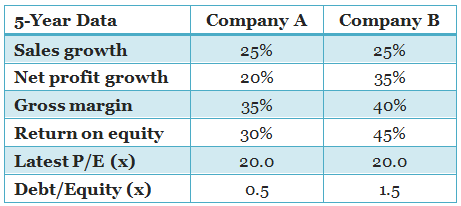
Consider that you are looking to buy a stock and the two that you come across on your screen are, say, Company A and Company B. Here are a few data points about the two companies, which are the only factors you would look at while making your decision. Look at them and think which one you would rather purchase –


Did you make a decision? Before you read on, jot down either Company A or Company B. Now I’m going to give you some more data points on these companies. No information has been changed, but some has been added.


Which stock would you rather purchase now? Again, write down your answer. I’m going to present the options a third time, again adding one new element.


Now, which of the two would you prefer?

Chances are, somewhere between the second and third lists of data, you switched your allegiance from Company B to Company A. And yet the two companies didn’t change in the least. All that did was the information that you were aware of.

This is known as omission neglect. When we fail to think about what we do not know, we underestimate the importance of missing information, and this leads us to form strong opinions even when the available evidence is weak. This can lead to bad decisions that we later regret.

For example, in the story The Adventure of Silver Blaze, Sherlock Holmes asked Inspector Gregory to consider a curious incident involving a dog. Gregory replied that nothing happened, and Holmes proclaimed, “That was the curious incident.” This clue enabled Holmes to deduce that the culprit must have been someone familiar to the victim’s dog. Most people would miss this important clue because most people, like Gregory, pay little attention to nonevents.

Now, some information is always available, but some is always silent – and it will remain silent unless we actively stir it up. In investing, such information that remains silent – or that you fail to notice – can be dangerous to your capital.

Consider my experience with the stock of Hotel Leela. I was in Bangalore sometime in early 2006 and visited Leela Palace to meet a friend who was attending a conference there. I was in awe of the property – it was grand, and amazingly beautiful.


On enquiring, I got to know that the hotel was one of the most expensive locations in India and was completely booked for the next few months.

The story was the same everywhere – most of Leela’s properties were booked for months, despite their premium pricing.

“What an amazing business!” I told myself. “Just imagine the kind of profits these guys must be making. I must have this stock in my portfolio!”

The next day, without enquiring more about Leela’s business and financial performance, I bought the stock, expecting it to be a story that was waiting to be unveiled. My premise was – Great hotel + Premium pricing + Overbooked = Great profits.

Well, it was indeed a story waiting to be unveiled…and for me! When I glanced through the company’s annual reports after buying its stock, I saw a business that was badly managed.

The debt/equity was rising, much more cash was burned than was generated, return ratios were average at best, and the profit growth had followed a highly inconsistent path. As I included more information on the company in my analysis, I started ruing my decision to buy the stock more.

Anyways, by the time I had realized and then accepted my mistake, the stock was already down around 45% from my purchase price. But I still sold it off. And thankfully so, as the company remains in doldrums and so does the stock.

Now, my idea is not to lead you to conclude that you need to gather a world of information on a business while doing its analysis (in fact, the first 20% information will tell you 80% about the business), but it’s important to pay attention and include the most important information while doing your analysis.

Don’t suffer from inattention blindness bias, as shown in this invisible gorilla experiment –


To pay attention means to pay attention to it all, to engage actively, to take everything around us, including those things that don’t appear when they rightly should. It means asking important questions (like some I listed earlier in this post) and making sure we get answers.

Even when you do this, you may not be able to emerge with the entire situation in hand, and you may end up making a choice that, upon further reflection, is not the right one after all. But it won’t be for the lack of trying.

One of the biggest lessons I learned while reading this wonderful book from Peter Bevelin, A Few Lessons from Sherlock Holmes, was that, while analyzing situations, it’s important to not jump to conclusions and instead try to collect facts as open-minded as possible.

As Mr. Bevelin quotes Sherlock Holmes…

No one can give rules for methods of thinking but it is possible to carry certain principles into operation. One is to strive to be delivered from hasty judgments.

“Men see a little, presume a good deal, and so jump to the conclusion.”

How common this is needs only a little study of our mental processes. In some this is a habit, in others a fault of education.

So the takeaway for you is to observe to the best of your abilities and never assume anything, including that absence is the same as nothing.


Note: This is an excerpt from the article Where Do Great (Investment) Ideas Come From, which I wrote for the May 2015 issue of our premium newsletter, Value Investing Almanack. To read the complete article and our vast archives spanning 4+ years, please click here to subscribe.

The post Investor, Pay Attention appeared first on Safal Niveshak.

06 Jul 09:30

Essar Oil on Fire at Rs 167 after delisting natak last year at Rs 108

by Gaurav Parikh
Essar Oil is on fire today at Rs 167 !.There are strong indicators that the Russian Oil Giant is acquiring a major stake but Company keeps repeatedly denying this Today’s extremely high abnormal volumes on BSE & NSE give a strong signal In Mid 2014 I had raised strong views on Essar Oil trying to [...]
05 Jul 05:13

Some points from meeting with Prashant Jain

by Muthu

Few days ago, I had an opportunity to attend an interactive session with Prashant Jain, one of the best fund managers in the country. I’m sharing below some of the points he mentioned in that session.

1) We are happy with what government has been doing so far. It has taken lot of right steps. Number of stalled projects is coming down. Increase in MSP has been in the range of 2% to 3% instead of 8% to 12% during the previous government. Fiscal deficit would be 3% in next 3 years.

2) Investment cycle has two components – infrastructure and industrial capex. Infrastructure capex has already started picking up. Benefits of this would be seen in the due course. This growth cycle would primarily led by the infra capex.

3) We are moving towards a low inflation regime which would last for next 5 to 10 years. We expect the inflation be to around 5% or less. Interest rates would settle marginally higher than inflation. Low interest rate would lead to good performance of bond funds for next 5 years.

4) From next year, for subsequent 3 years, we expect the earnings growth to be around 25%. This would lead to good performance of equity for next 5 years. In short, for next 5 to 10 years, we see a bright future for both debt and equity market.

5) For the last 2 years, the credit upgrades are more than the credit downgrades. We don’t expect NPAs to detoriate any further.

6) For the last 4 decades, the economy has grown at a nominal growth rate of 15%. Sensex has delivered around 17%. Good funds have been able to generate an alpha of 5% or more. This would continue to be the case for next 10 years as well.

7) $40 billion is the floating stock of midcaps. Out of the $10 billion received as equity inflows by mutual funds during last one year, $8 billion has come into midcap funds. Totally $20 billion has gone into midcaps. The midcap performance of last one year cannot be repeated. During next 2 years, large caps would outperform midcaps. In the long run (say 10 years), performance of all kind of caps would be in line with their earnings.

8) As a fund house, we don’t chase momentum. We sold technology stocks in late 1999. We were not in real estate stocks in 2007. While investing in funds, don’t keep chasing recent performance. Look for funds which beat benchmark over a 10 year period. Don’t keep switching between funds.

9) FIIs have bought $154 billion of Indian equity in the last 23 years. From 0% stake, they hold 23% of our markets now. In the same 23 year period, Indians have bought gold worth $245 billion. We’ve sold 17% CAGR asset to buy a 9% CAGR asset. Be intelligent and invest in equity.


05 Jul 05:10

Balance sheet problems of the firms and the banks

by Ajay Shah
While the official GDP numbers are showing an optimistic picture, trusted firm databases are suggesting that the recession which began in Q1 2012 has not ended.

An important dimension of this recession is the leverage of firms. On an international scale, there is increased interest in the debt `super cycle' which appears to play out distinctly from the business cycle. There are periods where households and firms are adding leverage, and these tend to be a good time for the economy. And there are periods where balance sheets are stretched, and this yields a drag on growth.

The credit boom from 9/2003 to 9/2008


This viewpoint emphasises the importance of credit booms. The great Indian credit boom took place in Y. V. Reddy's period as governor, where the pursuit of exchange rate policy gave lax monetary policy:

Figure 1: Nominal year-on-year growth of non-food credit of the banking system

The dashed lines focus on this period. Year-on-year credit growth peaked at near 40 per cent. This was the biggest-ever credit boom in India's history.

Such periods suffer from two problems. First, there is a surge in the quantity of loans being given out by banks. In such times, the level of scrutiny tends to go down. When the surge happens at the time of a business cycle expansion, it's particularly easy to be over-optimistic. Such a drastic credit surge was going to result in trouble.

These events are quite some distance away in time. This is a different time scale when compared with business cycle fluctuations. However, it appears that this credit surge matters to understanding what holds the Indian economy back today.

Credit distress of the firms


From 9/2003 to 9/2008, a lot of debt was taken on by firms. It is likely that some of this capital was misallocated by banks who gave loans to unworthy firms. Soon after that came the Lehman crisis, and soon after that the current recession began (in Q1 2012). Recessionary conditions have hampered profitability of many firms. For many firms, the combination of low profits and high debt has generated credit stress.

Figure 2: Interest cover ratio (ICR) of all non-financial firms observed in the CMIE database

The graph above shows the interest cover ratio (ICR), defined as PBDIT/interest. A firm at an interest cover ratio of 1 is in a lot of trouble: All it's operating profit is taken in paying interest.In the graph above, the blue line uses annual data, where the accounting data is of higher quality, and the black line uses quarterly data, where the data lag is lower.

At its peak, the average interest cover ratio was at 10, which means that the operating profit was 10 times the interest payment. There has been a dramatic decline in this ratio, with increased interest payments and reduced operating profit. Unlisted companies have consistently been under significant credit stress through this entire period; this low value of the interest cover ratio and its lack of time-series variation is a mystery that merits further exploration.

Figure 3: The fraction of total assets in firms where ICR < 1

Most people will agree that by the time the interest cover ratio has hit 1, the firm is in significant credit distress. The graph above shows the share of these distressed firms in the overall balance sheet size of India's large firms. This shows a period of acute distress in the late 1990s and early 2000s, where over a third of the corporate sector was in difficulty. Things got dramatically better by 2008; only 15% of the corporate sector was in credit distress. From that bottom, there's been a doubling. For the year ended 2013-14, 29.16% of the balance sheet of the corporate sector is in firms where the interest cover ratio is worse than 1. Roughly 20% of bank lending is stuck in these firms.

In a few months, we will know the situation for 2014-15. However, Figure 2 suggests that things have deteriorated when compared with 2013-14.

Credit distress and fixed investment


In an ideal world, capital should flow to firms with good projects, regardless of their present financial condition. This is not how the Indian financial system works. When a firm gets into credit difficulties, it appears to lose access to external capital. Low profits obviously hamper internal capital.

We pool all CMIE data from 1989 to 2015 and construct quartiles by the interest cover ratio, and within each quartile, report the sample mean of the growth in fixed assets (in real terms):


ICR quartile Real GFA growth
Low (ICR < 0.8) 7%
Q2 (ICR from 0.7 to 1.7) 10.4%
Q3 (ICR from 1.7 to 3.17) 14.5%
High (ICR > 3.17) 16.6%

Gross fixed assets (GFA) growth has been 16.6% in real terms for firms where the ICR was above 3.17. For the firms where the ICR was below 0.8, it was 7%. This suggests that credit distress as measured by the ICR is correlated with reduced investment.

By this reasoning, when a third of the balance sheet size of Indian firms is at an ICR < 1, this would result in a drag in investment.

Where are your borrower's yachts?


Unhealthy borrowers give unhealthy banks. Banks in India have roughly 12x leverage. When loans get into trouble, the recovery rate (correctly calculated) is probably around 25%. This means that if a bank has NPAs of 10% of total assets, then there is substantial stress. It will lose 7.5% of total assets, which will be roughly as big as the equity capital.

Figure 4: The state of bank capital

The graph above focuses on the data being reported by banks. RBI and the banks are using various methods to hide bad news, including restructuring and CDR. At the bottom is official NPA data, which is below 2% of total assets. But when we add in CDR and `restructured' assets, this comes up to 6% of total assets. Equity capital is near 8% of total assets.

These are averages for the banking system as a whole. There are undoubtedly some banks who are better than the average, and there are some banks who are worse off.

The evidence above emphasises net NPAs. In this speech on 5 May, Mr. Mundra offers facts about gross NPAs which are of course larger.

The phenomena reported on in this blog post -- firms with credit distress, that are likely to have impaired investment activity, and are likely to face difficulties in repaying to banks -- are likely to be related to the phenomenon of `stalled projects' as seen in the CMIE Capex database.

The true extent of difficulties at banks may be larger than 6% of total assets, as RBI and the banks are collaborating in hiding bad news.

Here is one anecdote. Haldia Petrochemicals is a large firm. They owe banks money and have not repaid. However, this is not classified as a non-performing asset owing to an instruction from RBI. As the story by Pranav Nambiar in the Financial Express of 26 May 2015 says:

Ashutosh Bose, CFO & executive VP, HPL, confirmed to FE the central bank has provided the special dispensation enabling bankers to treat the HPL exposure as a standard account. “We will not be treated as an NPA and banks will not have to make any provisions on our account. The special dispensation by the RBI has been given due to the nature of our business which is impacted by extraneous factors like changes in naptha prices,”

We have a banking regulator who thinks that changes in naptha prices somehow change the fact that this is a non-performing asset. We have a banking regulator who has the power to instruct banks on a transaction-by-transaction basis, under complete opacity, to disregard the (subordinate) law. We have a banking regulator who is willing to use such powers.

This is just one anecdote, where the news spilled out into the open. There is no data, in the public domain, about what "special dispensations" have been given out by RBI.

Conclusion


The credit boom of 2003-2008 and its aftermath are an important element of understanding India's macroeconomic predicament. The balance sheet difficulties of banks and their borrowers are an important part of what happens from here on. Credit distress in India today is not as bad as it was in the late 1990s. But for perhaps a third of the corporate balance sheet, there is significant credit stress.

The key thing to watch is the growth of operating profits. If PBDIT grows, then the ICR will come back into shape. From Q1 2012 onwards, we have been in a recession, and operating profit growth has stalled. Many firms are in a debt spiral where interest payments go up, operating profit fares poorly, new loans are taken to keep the ship aloft, interest payments go further up, and so on.

There may be a bit of a feedback loop going. The economy is bad, so borrowers are faring badly, so the banks are facing difficulties (even with a sympathetic regulator), so the banks give less credit to healthy firms, which further hampers the recovery. This raises the possibility of `Japanisation' where bad news is hidden, firms and banks are absorbed in dealing with credit distress, many long years go by with sluggish growth.

We must learn more about Japan, and other unhappy episodes where the debt overhang hampered the revival of growth in a sustained way. We must also learn about how India bounced back from the last credit boom of the mid 1990s. As the graphs above show, the downturn after this boom in the late 1990s featured credit distress that was worse than what we see today. There was a lot of creative destruction. Large numbers of non-financial firms went under. Their exit, and the operational improvements of the survivors, set the stage for the revival of the economy.

Policy makers need to nudge things away from the Japanisation scenario. This requires working on four fronts:

  • How to create new channels through which capital goes into healthy firms without the involvement of banks,
  • How to be less like Japan or China, where bad news is hidden and incumbent banks and firms enjoy business as usual, 
  • How to create capabilities at RBI for technically sound regulation and supervision,
  • How to resolve failed firms and banks, so as to shift capital and labour to healthy organisations.

Every now and then, there is a call for a bailout of banks and their borrowers. We need to be careful in how we approach this. The scale of the problem is large, and the available fiscal space is limited. Do we want to throw good money after bad? If regulation and supervision has failed before, why will it not fail again?
05 Jul 04:24

Swami Vivekanand: To the 4th of July

by Atanu Dey

My friend Kanchan Banerjee shared this poem by Swami Vivekanand. Kanchan wrote, “In 1898 Swami Vivekananda went to Kashmir, where he stayed on a houseboat on Dal Lake. While travelling in Kashmir with some American and English disciples, Swamiji wrote this poem on 4 July 1898, as a part of a celebration of the anniversary of the United States’ independence and asked it be read aloud during that day’s breakfast.”

To the 4th of July

Behold, the dark clouds melt away,
That gathered thick at night, and hung
So like a gloomy pall above the earth!
Before thy magic touch, the world
Awakes. The birds in chorus sing.
The flowers raise their star-like crowns —
Dew-set, and wave thee welcome fair.
The lakes are opening wide in love
Their hundred thousand lotus-eyes
To welcome thee, with all their depth.
All hail to thee, thou Lord of Light!
A welcome new to thee, today,
O Sun! Today thou sheddest Liberty!

Bethink thee how the world did wait,
And search for thee, through time and clime.
Some gave up home and love of friends,
And went in quest of thee, self-banished,
Through dreary oceans, through primeval forests,
Each step a struggle for their life or death;
Then came the day when work bore fruit,
And worship, love, and sacrifice,
Fulfilled, accepted, and complete.
Then thou, propitious, rose to shed
The light of Freedom on mankind.

Move on, O Lord, in thy resistless path!
Till thy high noon o’erspreads the world.
Till every land reflects thy light,
Till men and women, with uplifted head,
Behold their shackles broken, and
Know, in springing joy, their life renewed!

As it happened, Swamiji passed away on July 4th, 1902. He was only 39 years old. Two other great men, both connected with the American Revolution, also passed away on July 4th, in 1826: John Adams (1735-1826), age 90; and Thomas Jefferson (1743-1826), age 83. A giant of a nation was born on July 4th, and three giants passed into history on that day.

Happy 4th of July.

05 Jul 04:23

You can simplify your life!

by subra

In this modern world we all live stressed out lives..how to simplify that? Well there are possibilities

1. Use a lot of public transport: Yes it is possible. If you are senior enough choose the timings that you will work. If you are junior learn to travel by using public transport. During crowded times take an ola, during non peak times take a train. Choose between first class and second class depending on the crowd level. IT IS POSSIBLE.

2. De clutter your desk, your life, your portfolio, your wardrobe and even your friends list. Have written about this enough no. of times

3. Buy an ordinary Mobile phone – non smart.

4. Get rid of the cable, and the newspaper. Get off the Social Media (unless of course your job depends on that).

5. Get rid of credit cards and promise yourself that you will not buy anything using the credit card.

6. Track your Expenses, Income, Investments and see if you are going in the right direction.

7. Teach your children the decision making process, tell them that they are responsible for their action, and free them.

8. Track your time and see if you are happy spending the time they way you are,

No Go, Just Do it.

Post Footer automatically generated by Add Post Footer Plugin for wordpress.

04 Jul 08:55

Low level equilibrium in airline industry

by noreply@blogger.com (Gulzar Natarajan)
Livemint has a story on Air Asia's turbulent first year of operation. In a sector where six airlines each disappeared in the first five years after open-skies in 1992 and since 2009, the immediate prospects look gloomy despite the boost to profitability from low fuel price (it declined by 24% between September 2014 and January 2015, or a 12% reduction in costs since fuel represents almost half the operational cost),
India’s airlines alone have lost more than USD10 billion combined since FY2009. Airline debt stands at around USD11.3 billion, rising to close to USD14 billion if liabilities to vendors are included. At an industry level airline debt is now equivalent to more than 100% of airline revenue. In FY 2015 traffic increased and losses declined but this was largely a function of lower fuel prices. 

Prohibitive operational costs, arising from higher taxes on Aviation Turbine Fuel (ATF) and high airport access charges, cut-throat competition which has bid down ticket prices to rock bottom, strongly price sensitive customer base, and heavy regulation are cited as contributors to the woes of airline industry. But for Indigo, all other carriers have been bleeding money for a long time and there is nothing to suggest any change in fortunes. No full-service carrier has made money on a sustained basis in the Indian market since the open-skies policy era began.

While all the aforementioned are important, there is a strong possibility that India'a airline industry may be entrapped in a low-level equilibrium from where exit may not be very easy. India is unique in that it is possibly the only large airline market without a significant full-service market. Low cost carriers make up nearly three-quarters of the domestic traffic, and a significant part of the full-service market is some version of the low-cost carrier model. This has had the effect of low-balling the reference price for low cost carrier tickets, further eroding their margin for profitability. In price-sensitive markets, since prices are very sticky upwards, recovering lost-ground from price-wars has proved very difficult. The willingness of public sector banks to keep supporting sinking promoters removed a critical backstop against the commercially destructive competition to the bottom. 

The absence of a strong full service market is also explained by the overwhelming dominance of the point-to-point service business model. Since regional markets are not large enough and are fragmented, no single full service carrier has the market power to operate a hub-and-spokes model, essential to the sustainability of a full-service model. Air India, the one full service carrier with the potential to leverage its size and international traffic to develop a hub-and-spokes model with regional hubs, has failed to do so due to its own inefficiencies and lethargy. 

Ironically, the rapid expansion of market share by Indigo, expected to rise from 36.4% in end-March 2015 to 45-50% in the next two years, can potentially help the industry break-out of the low-level equilibrium. It could help the industry regain some pricing power and increase profitability. However, it runs the risk of monopolistic dynamics that could adversely affect the long-term health of the market.

Update 1 (06.07.2015)

The IPO filing information of Indigo throws up a few interesting features. One, despite the lower fuel prices, its fuel cost as a percentage of the revenue for the last three quarters of 2014 was 48.4% against 31.3% for Jet Airways. Two, its maintenance costs at 3.1% of total expenses was just one-fifth of Jet Airways. 
Add to Technorati Favorites
04 Jul 08:53

Double your money in 3 years!!

by subra

Very rarely do I use such headlines, but I am sure it is very useful to attract footfalls…so hopefully today I should get more footfalls than normal…

Anyway people who know me know that I am sceptical about the regulators. Even Raghuram Rajan – for whom I have a lot of respect – has done almost NOTHING for the common man (except holding the interest rates high for the retired person). Here I am producing an ad from Mantri builders promising to double your money in 3 years (implied rate 24% p.a.). My logic is not whether this is possible – I do not care. My Question is what are the regulators doing when such ads are being promoted.

http://www.mantri.in/webcity/double-investment/

If such ads appear with impunity why will the financial industry not feel singled out? Where the mutual fund industry cannot tell you what will happen to your money but the life insurance industry can give you illustration of what will happen to your money over the next 30 years. That too up to 2 decimal places!!

Mr. Raghuram Rajan please get these basic things in place. Empower RBI to take suo moto action against such rogue builders (whom our bankers love and are happy to lend @ 12%p.a.)..is it not surprising that they are paying 24% p.a. to you?

My basic contention is simple: The only protection you have against such ads is knowledge / education / learning. I do not care whether Mantri can deliver on this promise, but I can assure you that Mantri has zero competence to predict housing prices 3 years into the future….


Post Footer automatically generated by Add Post Footer Plugin for wordpress.

04 Jul 08:51

RBI Board Meeting: FII Limits Could Be Raised, NBFCs Might Aggregate Financial Data

by Deepak Shenoy

Foreign Investor limits on Indian Government bonds might be raised, according to Raghuram Rajan, the RBI Governor, the Hindu reported. But this will be done after consulting SEBI and there’s hardly any time frame provided.

Currently, RBI has all sorts of restrictions on foreign investments:

  • They can’t buy more than $25 billion worth of government bonds
  • And that too only with 3 year residual maturity (so no short term paper)
  • And then also, when holdings reach 90% of the limit, there are auctions in which they have to bid to buy allocations for the remaining
  • They’ve paid as much as 0.8% for such limits (which means their effective yield comes down correspondingly)
  • And then they have $5bn as a special limit for certain kinds of investors (sovereign wealth funds etc)
  • All these limits are in dollars, but converted to rupees at a rate that is historical. Currently they use about Rs.
(Read On...)