Shared posts

21 Jul 11:27

Goal or Liability? SIP or EMI?

by subra

Many people with reasonably well off parents and double incomes (however shaky one’s job is) think of themselves as rich. Well if not rich, upper middle class, but make rich choices. At times this can be funny, if it were not so serious. This actually comes from not understanding future uncertainties, return on investments, inflation, etc. – can we fix it?

Well here is an attempt.

Financial Planners use a word ‘net worth’ – this is the term that is used to express the gap between our Assets and Liabilities. It is always assumed that your net worth will be positive. If it is negative, of course it means you are bankrupt. Let us put a twist to this.

Let us look at the Balance sheet of a 35 year old man, earning Rs. 25 L a year and married to a woman aged 30 years, and earning 15 L a year. Both are well qualified and staying in a house for which they are paying an EMI. They have 2 children – one is a 7 month old toddler and the elder child is 4 years of age and about to join an International school. Their take home salary is Rs. 1.2L for Rahul and Rs. 85,000 for Aarti. Their EMI is Rs. 55,000 and takes away a chunk of their salary!

Now is the schooling / education dilemma. Rahul feels that the children should go to an International school near their house and this is likely to cost  “only” Rs 1.25L per annum. Aarti feels that Rs. 30,000 per month (eventually when the second child also goes to school) is not an affordable expense, but Rahul who just bought a second hand (6 month old) Audi A3, the school was a non negotiable.

When Aarti met me she felt that they were living beyond their means and it was not necessary. She gently reminded Rahul that the house was partly funded by his parents (or the EMI would have been higher!!). They do not pay any child care expenses because both the grandparents stay nearby and share the ‘looking after’ responsibility.

I suggested something dramatic. I said create a balance sheet. Create a Goal Sheet. Once you arrive at the Goals, put all that in the balance sheet as liabilities to be provided over the working life.

I said Mortgage is something that you owe Hdfc Ltd., Life insurance premium is something that you owe to your dependents. Goals (if you are serious about the goals and the direction of the goals) you need to treat it like a serious liability. To pretend that your current cash flows are good and using excel to extrapolate numbers is tempting and stupid. What if you are unemployed for say 5 months? What if your parent who is now not financially dependent becomes financially dependent on you after 10 years?

She was herself stunned when she saw the figures. Her Retirement fund required came to Rs. 26 crores. Her children’s education requirement came to Rs. 9 crores! He also needed to fund their vacations, cars, lifestyle etc. Aarti put all those requirements at a Rs. 10 crores.

I had to butt in and say ‘tjese are all the known things we still do not know about unknown things like parent’s illness’.

I asked Aarti to include children’s marriage, buying a second house, etc. I can assure you that I am not the most popular guy in the Rahul household!! However Rahul being a CA had very little mathematical argument against this approach.

Now the balance sheet looked like this

Liabilities: Goals Rs. 45 crores, Home Loan Rs. 40L , Car loan Rs. 13L. Assets side was just one house worth about Rs. 1.3 crores, and some ELSS worth about Rs. 5Lakhs.

I then worked out the EMI (if goals are liabilities, SIP is EMI, right?).

Now go to free fin cal and do your OWN exercise. Enough of Voyeurism. In your life it does not matter what Rahul and Aarti do.

What matters is what are your goals, and if you convert those goals to liabilities, are you solvent?

Do you have it in you to spend money on that extra car, extra vacation, etc.

THINK BEFORE YOU ACT.

Post Footer automatically generated by Add Post Footer Plugin for wordpress.

21 Jul 03:28

How Situations Influence Decisions

by Shane Parrish

Michael Mauboussin, the first guest on my podcast, The Knowledge Project, explains how our situations influence our decisions enormously in Think Twice: Harnessing the Power of Counterintuition.

Mistakes born out of situations are difficult to avoid, in part because the influences on us are operating at a subconscious level. “Making good decisions in the face of subconscious pressure,” Mauboussin writes, “requires a very high degree of background knowledge and self-awareness.”

How do you feel when you read the word “treasure”? Do you feel good? What images come to mind? If you are like most people, just ruminating on “treasure” gives you a little lift. Our minds naturally make connections and associate ideas. So if someone introduces a cue to you— a word, a smell, a symbol— your mind often starts down an associative path. And you can be sure the initial cue will color a decision that waits at the path’s end. All this happens outside of your perception.

People around us also influence our decisions, often with good reason. Social influence arises for a couple of reasons. The first is asymmetric information, a fancy phrase meaning someone knows something you don’t. In those cases, imitation makes sense because the information upgrade allows you to make better decisions.

Peer pressure, or the desire to be part of the in-group, is a second source of social influence. For good evolutionary reasons, humans like to be part of a group— a collection of interdependent individuals— and naturally spend a good deal of time assessing who is “in” and who is “out.” Experiments in social psychology have repeatedly confirmed this.

We explain behavior based on an individual’s choices and disposition and not the situation. That is, we associate bad behaviour with the person and not the situation. Unless, of course, we’re talking about ourselves. This is “the fundamental attribution error”, a phrase coined by Lee Ross, a social psychologist at Stanford University.

There are two sides to this sword as the power of situations can work for good and evil. “Some of the greatest atrocities known to mankind,” Mauboussin writes, “resulted from putting normal people into bad situations.”

We believe our choices are independent of circumstance, however, the evidence points in another direction.

***
Some Wine With Your Music?

Consider how something as simple as the music playing in a store influences what wine we purchase.

Imagine strolling down the supermarket aisle and coming upon a display of French and German wines, roughly matched for price and quality. You do some quick comparisons, place a German wine in your cart, and continue shopping. After you check out, a researcher approaches and asks why you bought the German wine. You mention the price, the wine’s dryness, and how you anticipate it will go nicely with a meal you are planning. The researcher then asks whether you noticed the German music playing and whether it had any bearing on your decision. Like most, you would acknowledge hearing the music and avow that it had nothing to do with your selection.

But this isn’t a hypothetical, it’s an actual study and the results affirm that the environment influences our decisions.

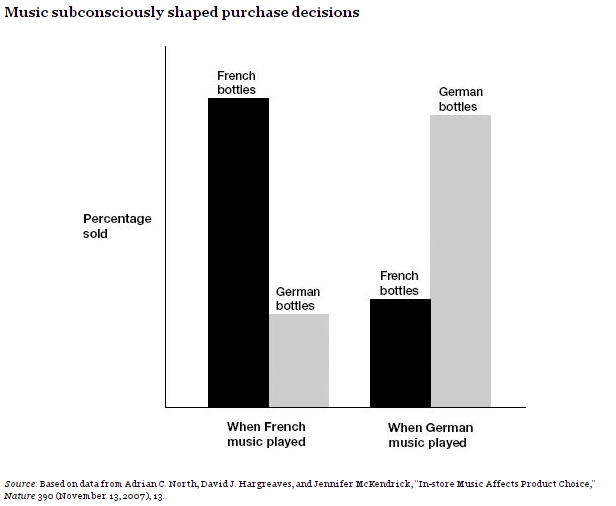
In this test, the researchers placed the French and German wines next to each other, along with small national flags. Over two weeks, the scientists alternated playing French accordion music and German Bierkeller pieces and watched the results. When French music played, French wines represented 77 percent of the sales. When German music played, consumers selected German wines 73 percent of the time. (See the image below) The music made a huge difference in shaping purchases. But that’s not what the shoppers thought.

While the customers acknowledged that the music made them think of either France or Germany, 86 percent denied the tunes had any influence on their choice.

Music_decisions

This is an example of priming, which psychologists formally define as “the incidental activation of knowledge structures by the current situational context.”1 and priming happens all the time. For priming to be most effective it must have a strong connection to our situation’s goals.

Another example of how situations influence us is the default. In a fast moving world of non-stop bits and bytes the default is the path of least resistance — that is, it’s the system one option. To move away from the default is labour intensive on our brains. Studies have repeatedly shown that most people go with defaults.

This applies to a wide array of choices, from insignificant issues like the ringtone on a new cell phone to consequential issues like financial savings, educational choice, and medical alternatives. Richard Thaler, an economist, and Cass Sunstein, a law professor, call the relationship between choice presentation and the ultimate decision “choice architecture.” They convincingly argue that we can easily nudge people toward a particular decision based solely on how we arrange the choices for them.

One context for decision making is how choices are structured. Knowing that many people opt for the default option, we can influence (for better or worse) large groups of people.

Mauboussin relates a story about a prominent psychologist popular on the speaking circuit that “underscores how underappreciated choice architecture remains.”

When companies call to invite him to speak, he offers them two choices. Either they can pay him his set fee and get a standard presentation, or they can pay him nothing in exchange for the opportunity to work with him on an experiment to improve choice architecture (e.g., redesign a form or Web site). Of course, the psychologist benefits by getting more real-world results on choice architecture, but it seems like a pretty good deal for the company as well, because an improved architecture might translate into financial benefits vastly in excess of his speaking fee. He noted ruefully that so far not one company has taken him up on his experiment offer.

(As a brief aside, I engage in public speaking on a fairly regular basis. I’ve toyed with similar ideas. Once I even went as far as offering to speak for no pre-set fee, only “value added” as judged by the client. They opted for the fee.)

Another great example of how environments affect behaviour is Stanley Milgram’s famous experiment on obedience to authority. “Ordinary people, simply doing their jobs, and without any particular hostility on their part, can become agents in a terrible destructive process,” wrote Stanley Milgram. The Stanford Prison Experiment is, yet, another example.

***

The key point is that situations are generally more powerful than we think and we can do things to resist the pull of “unwelcome social influence.” Mauboussin offers four tips.

1. Be aware of your situation.

You can think of this in two parts. There is the conscious element, where you can create a positive environment for decision making in your own surroundings by focusing on process, keeping stress to an acceptable level, being a thoughtful choice architect, and making sure to diffuse the forces that encourage negative behaviors.

Then there is coping with the subconscious influences. Control over these influences requires awareness of the influence, motivation to deal with it, and the willingness to devote attention to address possible poor decisions. In the real world, satisfying all three control conditions is extremely difficult, but the path starts with awareness.

2. Consider the situation first and the individual second.

This concept, called attributional charity, insists that you evaluate the decisions of others by starting with the situation and then turning to the individuals, not the other way around. While easier for Easterners than Westerners, most of us consistently underestimate the role of the situation in assessing the decisions we see others make. Try not to make the fundamental attribution error.

3. Watch out for the institutional imperative.

Warren Buffett, the celebrated investor and chairman of Berkshire Hathaway, coined the term institutional imperative to explain the tendency of organizations to “mindlessly” imitate what peers are doing. There are typically two underlying drivers of the imperative. First, companies want to be part of the in-group, much as individuals do. So if some companies in an industry are doing mergers, chasing growth, or expanding geographically, others will be tempted to follow. Second are incentives. Executives often reap financial rewards by following the group. When decision makers make money from being part of the crowd, the draw is nearly inescapable.

One example comes from a Financial Times interview with the former chief executive officer of Citigroup Chuck Prince in 2007, before the brunt of the financial crisis. “When the music stops, things will be complicated,” offered Prince, demonstrating that he had some sense of what was to come. “But as long as the music is playing, you’ve got to get up and dance.” The institutional imperative is rarely a good dance partner.

4. Avoid inertia.

Periodically revisit your processes and ask whether they are serving their purpose. Organizations sometimes adopt routines and structures that become crystallized, impeding positive change. Efforts to reform education in the United States, for example, have been met with resistance from teachers and administrators who prefer the status quo.

We like to think that we’re better than the situation, that we follow the decision making process and rationally weigh the facts, consider alternatives, and determine the best course of action. While others are easily influenced, we are not. This is how we’re wrong.

Decision making is fundamentally a social exercise, something I cover in my Re:Think Decision Making workshop.

1. “Automaticity of Social Behavior: Direct Effects of Trait Construction and Stereotype Activation on Action”

--
Sponsored By: Greenhaven Road Capital: You think differently - now invest differently.

21 Jul 03:28

The same rules apply

by Rohit Chauhan


The best way to analyse any asset class is to look at the long term return for it

For example
Fixed income : inflation +/- 1%
Gold : Inflation + 1.5%
Real estate : Inflation + 3-4% (or more ?)
Equities : inflation + 6-7%

Now based on timing and in some cases, asset specific skills can help you beat these returns, but over the long run no matter how much you love the asset class, these returns do hold.

In 2011-2012, even my mother who only wishes the best for her son, was encouraging me to look at Gold and real estate. When people who truly love you start recommending an asset class , for your good, that’s a good sign of a bubble.

In this case, I bought a little gold for my mother and wife and they were quite happy about it. Now that was a decent investment – one cannot measure happiness :)
 

---------------- 
Stocks discussed in this post are for educational purpose only and not recommendations to buy or sell. Please contact a certified investment adviser for your investment decisions. Please read disclaimer towards the end of blog.
21 Jul 03:27

How Donald Trump lost Rs.64,000 crores in real estate?

by Muthu

As you are all aware, Donald Trump is a billionaire real estate tycoon in USA and is currently running as one of the presidential candidates.

Donald Trump father was a multimillionaire New York real estate developer who left him a fortune which was estimated at $500 million in 1982.

Over last 4 decades, Trump has developed his father’s business to a grand level and has a current net worth of $10 billion.

He has grown his father’s real estate empire during the last 33 years at an annualised return of 9.5% or multiplying wealth by 20 times.

During the above period, to achieve this return, he took excessive risks and due to excess leverage, he has filed four corporate bankruptcies. In nut shell, he made this return by taking undue risk with great difficulty.

During the same period, S&P 500 (an index of 500 of America’s largest companies) has provided an annualised return of 11.86% or multiplied wealth by 40 times.

By simply investing $500 million in S&P 500 index in 1982 and doing nothing whatsoever for last 33 years, would have made Donald Trump’s net worth at $20 billion instead of the $10 billion he has today.

His opportunity loss of investing in real estate instead of equity is $10 billion or Rs.64,000 crores.

This is yet another example of how equity is a much better asset class than real estate in the long run.

Please note that the idea of writing this piece came from reading this article.


21 Jul 03:27

The case for Universal Health Care is weak

by Ajay Shah
by Jeffrey S. Hammer.

For years I’ve been saying “the ‘conventional wisdom’ in the field of international (or ‘global’) health is so weirdly innocent of elementary economics that no real economist who has thought about it at all could possibly support it.” By ‘conventional wisdom’ I’d include all unconditional talk of free curative primary care. Well, recent events have proved me as wrong as it is possible to be.

In a recent Lancet article (OK, that’s a clue), Dean Jamison (no surprise there) is lead author of a paper reporting on the conclusions of a committee chaired by Larry Summers that included Kenneth Arrow and George Akerlof.  It is the same old sh…stuff that unconditionally calls on every country, no matter what their circumstances, to commit to Universal Health Care where such a commitment must imply free curative primary care. It is no longer tenable for me to contend that no ‘real’ economist would say such a thing after thinking about it since we are now talking about two Nobel Prize winners and Summers after having being on a committee dealing with that very topic. So, the argument has to be made explicitly to let people think this through for themselves.

My argument can be boiled down into two parts which I will elaborate below. The first is “public policy – using the very scarce resources that poor countries have available - should first address those problems where market failures create the largest welfare losses. These losses include those resulting from an unfair distribution of income or well-being that a free market could produce.” That came straight out of the public economics (actually introductory) textbook I had as an undergraduate. Or, to quote Keynes: “The important thing for government is not to do things which individuals are doing already, and to do them a little better or a little worse; but to do those things which at present are not done at all.”

This could be simplified as “Do public goods before private goods.”

The second part of the argument could be simplified to “Do things you are capable of doing before trying things you’re not.

This is a minor, realistic, modification to public economics and is just to take the constraints on government policy seriously – both administrative and political – if such constraints will interfere with getting the policy done at all. Implementation matters. This is just common sense but it does involve some not-so-easy, if common, considerations. Politics is something I usually just rule out of bounds of my expertise but in justifying spending money (no matter how badly) in public health I regularly hear “oh, well, the money will come out of defense so it has no real opportunity cost.” No. It won’t. Or, you’d better be sure before you start.

On the administrative side: some policies are relatively easy – they can be done with the stroke of a pen or with easily written and monitored contracts. Monetary authorities can buy government bonds; most governments can get a road built (yeah, I know, that’s not always so straightforward either). Other policies are really hard. Monitoring CO2 emissions from fixed-point locations (let alone cars), identifying and updating lists of poor people, making sure school teachers are child-centric and, of course, making sure primary health care providers show up for work and apply some due diligence to their job. Some of these are really, really hard. Governments should know their own capabilities and promise those things they know they can follow through on before making promises that can’t be kept.

Good public policy has to make choices based on both considerations. Given different circumstances as far as the epidemiological profile of countries are concerned as well as substantial differences in the capacity of their governments (both of which – epidemiological profiles and government capacity - change), it is impossible to predict, before a careful analysis, which set of policies would be appropriate in which circumstance at any particular point in time. Some governments might be able to get regulation or infrastructure done well, others might have an advantage on health or education (Cuba or Iran come to mind). There is no reason to believe that all governments are equally well prepared to handle all possible public tasks. However, when “universal health care” is advocated irrespective of country circumstances, its very “universality” runs counter to this commonsensical approach.

From my perspective, two gigantic market failures characterise health markets (and problems) in poor countries. The first is the continued existence of communicable diseases many of which are combated by true public goods (or close enough). Traditional, 19th century public health problems of water, sanitation and pest (vector) control and a few immunisations were handled (or were acknowledged that they should be handled) by public authorities since the germ theory of disease was discovered. Many of these are still not done in poor countries (who now have a few more effective immunisations to work with).

I work a lot in India. Open defecation in India is a massive problem, currently being documented at length by researchers. Let me call attention to the Research Institute for Compassionate Economics in Delhi for this. The lack of sewers and sewage treatment in rapidly growing cities threatens the world with catastrophes that make Dickens’ London look benign. Can we pretend we don’t know what to do about this problem, at least in urban area? Can we pretend that money for such immediate demands will not be compromised if more money is to go to medical care? At least in some countries? Without being sure that there is no tradeoff with primary care in a country’s budget (I can attest there is such a tradeoff in India) – the “universal” part of universal health care is … irresponsible at best.

The second gigantic market failure in health is the universal (I admit – this one could be universal) failure of health insurance markets. This I learned from Professor Arrow in his 1963 paper. But what kind of health problem is most compromised when insurance markets fail, the inexpensive kind (handled in primary care centers) or the expensive kind (handled in hospitals)? I would leave this as a rhetorical question but in order to not be misinterpreted, the answer is “expensive”. (There is a specious argument going around that lots of badly diagnosed problems at primary centers lead to large overall expenditures. This is specious on the policy front since much of this mis-diagnosis is done at public facilities. At least in many countries I know of. In any case, this “depends” and needs to be examined in context before universal statements are made about it.)

So, on conventional economic grounds, there is a very good argument for government intervention on public goods and on the risk/ insurance/ hospital set of problems. Not prima facie on primary health care (medical, curative) that is implied by “universality”. Whether health care is particularly important for poor people (not from protection from risk – that falls into the insurance problem that everyone faces) must be evaluated against everything else governments might do to rectify an unfair distribution of income. Health care is not an obvious choice in comparison to food, for example, or unconditional cash transfers. I will elaborate in another post.

On grounds of the variable degree of difficulty of administering different public policies, this can’t be constant across countries and can’t be assumed to justify publicly provided or insured primary care. From evidence that money often fails to reach clinics (Gauthier and Wane) to absenteeism (Kremer et al, Chaudhury et al)) to poor quality care (Das and Hammer, Das et al) to substitution with large private sectors (sorry, cross effects, of prices or distance, of public and private sectors are really hard to pin down and largely unknown but often suspected to be large since people shop around for both (Filmer et al, Leonard)) makes the net impact of public efforts to provide primary care very doubtful in general and, in any case, questionable frequently enough to make advocacy of universal provision … irresponsible at best.

In future posts I will elaborate on the distributional effect of public spending on health, on the track record of primary care provision and on the challenges of correcting insurance market failures mostly from a public administration/ public capacity perspective. For now I just want to flag the point that advocacy of a single policy prescription for every country of something that is questionable for each of those countries is… irresponsible at best.
20 Jul 10:27

Tough Tough things to do as an Adviser

by subra

There are some very difficult questions that an IFA has to ask a new prospect. Asking an existing client is also very useful, but asking a new prospect is vital. By the time you are through with this list you will realize why it is very difficult to be a DIY investor.

1. I am very happy you have chosen me as your adviser, may I know the process that you followed to find me? : No. Not in your first meeting, but yes, over a period of time you need to find the answer to this question. Is it because you sent mailers? your client referred them? because you did a presentation in his brother’s office? Find out the reason, it will help you build.

2. You have said ‘you have a high risk tolerance’: Do you dear client realize that risk tolerance is more psychological than mathematical? When the index is at 30,000 and your portfolio tops Rs. 3 crores, you feel very confident. However, when the market dips how will your risk tolerance be? No, no, do not tell me what happened when the market fell 10%, maybe you bought more. Tell me how will you feel when there is a 78% correction (Nasdaq), a 46% correction (Sensex) or a 40% correction (Dow)? Imagine you have just been bypassed for a promotion (you are seething with rage), your wife has been asked to take complete bedrest because of the fall she had in a trekking accident, and your child has joined IG school and the fees is Rs. 15L per annum.

And the market corrects by 30%. Let me quantify it, your portfolio is now worth Rs. 2.12 crores – and you remember seeing it at 3.87 cr at its peak.

TELL ME HOW WAS YOUR RISK TOLERANCE.

3. I invest your moneys in funds managed by fund managers, so I (and the fund manager) can go wrong. At what level will you ask for my head and at what stage will you ask for the fund manager’s head. Fund managers heads are easy, I can change the fund, but my head, I will fight. Not for the fee, but to tell you that it is a process, not a product. You have a choice, but I hate losing clients because I could not explain what I was doing. How do we prepare for this? Making the ground rules helps. Can we draft the rules, please?

Markets are subject to risks, and your returns are subject to the markets. Sure I can hold your hand, but I need to know the rules in advance.

4. What is your biggest financial worry? Tell me in detail. Know your top 5 financial worries. Let me tell you how we can tackle that. Use that to judge my usefulness in your life. Not the previous quarter returns of my investors. Honestly I have no clue of what is that. Your worries should reflect that of your parents, spouse and kids. We will sort it out over a week, fair enough?

5. What makes you feel worse – the market going down after you invested? the market going up, and then coming down? market going up you NOT SELLING and the market coming down? or will you really do the SIP and wake up once in 3 years to see your statement?

6. “Meeting your Goals” to me is the only goal. I will ensure that your portfolio does that. Once you are assured that will happen will you look at your portfolio and be worried? You should be worried about the time taken for the journey. Standard deviation is my worry, done?

7. I know you did not like the 22 page questionnaire that I asked you to fill, but do you know how inconsistent you have been in risk tolerance? Behavioral Finance is a new science and the questions are not easy to construct, answer or use.

8. I can assure you that your reasonably moderate and well articulated goals will be achieved. However, when mid stream change in direction happens, life will be tough. We are aiming at ‘Goal achievement’ not relative return, or compared to Morningstar ideal portfolio how much you deviated kinda game. Those games actually divert your attention. For me blogging it fun. For you knowing what is noise and what is information is not easy. I will help you tackle the financial media. Believe me, that alone is worth the fee that I earn. Or why I charge you a fee.

Post Footer automatically generated by Add Post Footer Plugin for wordpress.

20 Jul 10:27

Secular stagnation and prospects for a new growth compact

by noreply@blogger.com (Gulzar Natarajan)
Overcoming secular stagnation (SS) is arguably one of the biggest challenge facing developed economies. The phrase, first propounded by Alvin Hansen in the context of the Great Depression and revived in 2013 by former US Treasury Secretary Lawrence Summers to describe the present times, essentially means “chronic excess of savings over investment” which serves to keep real interest rates low for a prolonged period.


It has been construed that these countries may have entered a phase of lower trend economic growth, a new normal, driven by "persistent shortfalls of demand". The most compelling argument in favor of its demand-side origins come from the fact that even a large asset bubble fuelled economic boom in the last decade was not accompanied by inflationary over-heating.


Supporters of SS hypothesis point to multiple reasons for excessive savings - rising share of incomes going to those with "high savings propensities"; increased uncertainty, greater indebtedness, and expectations of lower returns encourage people to save more; and the burgeoning surpluses of emerging economies and oil exporters which find their way to the safety and liquidity of US Treasuries. On the investment side, they point to the substantial reductions in the relative price of capital goods as well as capital intensity, reflected in the declining share of investment goods in the GDP. This is most evocatively captured in Larry Summers’ example of "WhatsApp, worth $19 bn, with 55 people in a big room with Sony, worth $18 bn, and owning lots of factories and office buildings and the like".


Then there is the challenge posed by demographics. Demographic trends affect both investment and savings. A lower population growth reduces potential output, and limits the scope for investments. An aging population means people save more to fund their retirements. A combination of excess savings, amplified by the accumulating surpluses in emerging economies, and limited investment opportunities keeps interest rates low, even negative in real terms.


Finally, there is the productivity explanation, best captured by Tyler Cowen's best-selling book, The Average is Over - all the low hanging fruits from technological and process innovations have been plucked and large productivity enhancing innovations are very difficult to come by. The combination of all these factors point to the difficulty of operating at full employment and potential output without inflating destabilizing asset bubbles. Critics though dispute the SS hypothesis pointing to the remarkable ongoing economic recovery in the US.


The conventional wisdom on responding to SS has been either monetary accommodation, using unconventional approaches like quantitative easing, or fiscal spending on infrastructure. But the former engenders resource misallocation and ruinous asset bubbles, whereas the latter is constrained by fiscally strapped governments. It is in this context that the international dimension assumes significance.


A striking feature of the SS hypothesis is its "closed economy" assumption. Since the low hanging fruits from technological innovations have been plucked, developed countries, and their firms, face a future of declining gains in productivity. Their companies, exemplified by the cash hordes at two iconic firms Apple and Google, have limited investment opportunities. The income stagnation at all but the highest income levels boosts savings and limits consumption demand. All these trends are confined to developed economies and tend to assume them living in isolation from the rest of the world.


Faced with declining investment opportunities and lower returns to capital, Econ 101 teaches us that the natural response would be to expand trade and other economic linkages. The developed economies have the technologies, businesses, and even capital, all searching for opportunities. It also faces an aging population and therefore diminished supply of labor. In contrast, emerging economies have rising productivity, remunerative investment opportunities, growing consumer demand, and a large pool of labor. The complementarity could not have been any more mutually beneficial. The scope for a new growth compact between the two economic groups could not have been more opportune.


So far, the operations of multi-national corporations has been focused on selling products produced in developed to consumers in developing countries. Imagine the potential of a market for goods and services that are essentially needed for the developing countries. What if the firms from developed countries are able to realize increasing gains in productivity by making products for developing countries? What if there are remunerative investment opportunities in developing countries? As capital flows out from developed economies, their depreciating currencies would boost exports.


Such innovation opportunities and incentives abound – massive savings in infrastructure investments from efficient construction technologies, low cost medical technologies could dampen rising health care costs, on-line instruction technologies can transform education and health care markets, and so on. The "jugaad" innovations that characterize many breakthroughs by Indian firms are an example of such opportunities. 


Developing countries are estimated to invest trillions of dollars in their physical infrastructure over the coming decade. They include investments in electricity, mass-transit, telecommunications, and urban utility systems. The potential for technological innovations to optimize cost-effectiveness in their construction, reduce various forms of operational inefficiencies, and enhance environmental sustainability is enormous.


Consider the potential for transformational change from the recent advances in data science on governance itself. Arguably the most critical governance challenge in developing countries is with translating policies and programs into their desired outcomes during implementation. An important contribution to bridging this implementation deficit can be a right combination of analytics and visualization delivered through a variety of hand-held devices. The cash hordes of the likes of Google could transform governance in developing countries in a mutually beneficial partnership.


Finally, there is the channel of migration. It is no coincidence that Japan, with the most restrictive immigration rules, is the worst affected by secular stagnation, and US, with the least restrictive immigration rules, looks the least affected by secular stagnation. Liberalizing immigration rules could be another important contributor to alleviation of SS, especially in countries facing adverse demographic shifts like Japan and Germany.

We should therefore strive to see the current problems in the developed world as a great opportunity to construct a new paradigm of economic and social co-operation between the developed and developing countries driven by mutually beneficial imperatives.

Add to Technorati Favorites
20 Jul 10:22

Real Estate To Fall Big Time, Says Ambit. The Data Seems To Agree.

by Deepak Shenoy

A big Ambit report is doing the rounds – they predict that real estate will fall big time.

We are seeing a broad-based real estate pullback, with prices correcting in most tier-1 and tier-2 cities alongside sharp drops in transaction and new launch volumes. The drivers for this slowdown are a mix of supply-side factors (banks have pulled back lending to developers) and demand-side factors (the Black Money Bill has created fear amongst speculators). The result is not just a drop in demand for building materials and challenges for lenders with big mortgage, LAP and housing finance books, but also a generalised slowdown in GDP growth, as the sector which drives 50% of India’s capex and 30% of its jobs conks off.

The drivers, they say:

  • Heavy inventory (Mumbai and Delhi have over 10 quarters of unsold apartments)
  • Property prices are falling in Tier 2 cities as well
  • Foot falls at registration offices have fallen
  • Banks have cut lending to RE esp commercial RE
  • Subsidies have been cut, so pilfering and parking in RE has been curtailed
  • Squeeze on black money through the black money bill
  • Rise in the “guidance value” rates that increase the “white” component of a purchase

Some Good Charts

ICICI has the most exposure to RE:

image

Indiabulls housing has the highest relative LAP (Loan against Property) portfolio:

image India has one of the highest spreads between rental yields and interest rates:

image

Our view:A Fall is on the Cards

We have been noticing a slow down in real estate for around a year now, and it’s looking rough.… (Read On...)

20 Jul 10:21

We need more Anandamide, not Jihadamide

by Atanu Dey

Ganja, or as it is known in the West, Marijuana is a miracle weed. Hemp is another name. The wiki notes, “Hemp is a commonly used term for high-growing varieties of the Cannabis plant and its products, which include fiber, oil, and seed. Hemp is refined into products such as hemp seed foods, hemp oil, wax, resin, rope, cloth, pulp, paper, and fuel. Other variants of the herb Cannabis are widely used as a drug, commonly known as marijuana. These variants are typically low-growing and have higher content of tetrahydrocannabinol (THC), cannabidiol (CBD), and other cannabinoids.”

I came across this National Geographic feature piece on the plant. Interesting tidbit —

Even into the middle of the 20th century, science still didn’t understand the first thing about marijuana. What was inside it and how it worked remained a mystery. Because of its illegality and tainted image, few serious scientists wanted to besmirch their reputations by studying it.

Then one day in 1963 a young organic chemist in Israel named Raphael Mechoulam, working at the Weizmann Institute of Science outside Tel Aviv, decided to peer into the plant’s chemical composition.

. . . This compound is the plant’s principal active ingredient, its mind-altering essence—the stuff that makes you high. Mechoulam, along with a colleague, had discovered tetrahydrocannabinol (THC). He and his team also elucidated the chemical structure of cannabidiol (CBD), another key ingredient in marijuana, one that has many potential medical uses but no psychoactive effect on humans.

For these breakthroughs and many others, Mechoulam is widely known as the patriarch of cannabis science. . . .

Israel has one of the world’s most advanced medical marijuana programs. Mechoulam played an active role in setting it up, and he’s proud of the results. More than 20,000 patients have a license to use cannabis to treat such conditions as glaucoma, Crohn’s disease, inflammation, appetite loss, Tourette’s syndrome, and asthma.

. . .

In 1992 Mechoulam’s quest for quantification led him from the plant itself to the inner recesses of the human brain. That year he and several colleagues made an extraordinary discovery. They isolated the chemical made by the human body that binds to the same receptor in the brain that THC does. Mechoulam named it anandamide—from the Sanskrit for “supreme joy.” (When asked why he didn’t give it a Hebrew name, he replies, “Because in Hebrew there are not so many words for happiness. Jews don’t like being happy.”)

I am more than a little pleased that ananda — supreme joy — lends it name to the naturally produced equivalent of THC. The ancient Indians knew a thing or two about joy and living. Anandamide. I think it is time that someone isolated the chemicals in the human brain that lead to murderous violence. It will then be named “jihadamide.”

20 Jul 09:57

It’s Difficult to Make Predictions, Especially About the Future

by David Merkel

It is difficult to make predictions, especially about the future.

Attributed to many people

Susan Weiner has an interesting piece as her blog on Investment Writing called Are financial predictions too risky for investment commentary writers?  I would say the answer is:

  • Yes, and
  • No, because you can’t avoid them if you are writing about investing

Why You Should Avoid Making Predictions

My leading reason for avoiding making predictions is that when you are wrong, and someone loses a lot of money, he gets really annoyed.  I can’t say that I blame them much.

Now, I might do it more if I got praise equal to the amount of annoyance.  But my experience from my RealMoney days was for every bit of praise that I would get from a correct prediction, I would get 10 bits of criticism for one that I got wrong.  That’s not much different in a way from reviews you read on the web for restaurants, hotels, service companies, etc., because people get greater motivation to write when bad service is delivered rather than good.

Why You Can’t Avoid Making Predictions

We can talk about the past, present, and the future.  We know the past reasonably well.  The present is fuzzy. We know the future not at all — we can only make guesses.  Those guesses might be educated guesses, but they are still guesses.

You could spend all your time writing about the past, but readers would ask how that can benefit them now.  Logically, they could ask “If this past situation had the result you mentioned, can I expect the same thing in this current situation that seems a lot like it?”  It’s a fair question, and if you don’t answer it, you might find that your readers go elsewhere.  They’d rather risk being burned than not get an opinion on some issue that they care about.

You could just report on the present.  Some of that is useful, like hearing color commentary at a sports game.  The same set of questions could come to you, like: “The market has been hitting new highs.  Does that mean it will hit higher highs, or is it time to take some risk assets off of the table?”  Another fair question, and readers would like an opinion.

As an aside, when I began studying nonlinear modeling, it was noted by many that nonlinear models don’t predict well.  One academic decided to take the bull by the horns, and wrote a paper that was entitled something like, “If Nonlinear Models Can’t Predict Well, Why Should We Bother With Them?”  One possible answer would be that most models don’t predict well, but that’s too discouraging for most readers.

The thing is, readers have their concerns about the future, and they want advice.  Many would rather have a false certainty than a nuanced set of possibilities.  We can’t do anything for them — they are fodder for the charlatans.

My answer for my writing is to try to be humble about the possibilities, and write things that explain thought processes rather than conclusions.

“Give a man a fish and he eats for a day.  Teach a man to fish and he eats for a lifetime.”

— Old Proverb

The trouble is, we can’t even give people easy investment ideas that will always work.  We can try to explain how to think about the question, and the possible scenarios that could result, and how likely they are.  Giving people the building blocks of investment knowledge is more valuable than handing out tips.  The building blocks have been tested, and work most of the time, but they take work to deploy.  Tips are uncertain, but neophytes love them, partly because they take almost no effort to implement.

Finally, be happy about whatever audience you get.  Largely, you will get the audience you deserve, and the criticism that goes along with it.  Just be careful, and take a page from Hippocrates that resembles the concept of margin of safety:

First do no harm.

20 Jul 09:57

Ignore news. Outperform by 56%

by Muthu

Jason Zweig mentions the following in this article.

“A psychologist had compared the investment results of people who received frequent news updates about their stocks against those who got no news at all. He found that no news is good news: Investors who were kept in the dark outperformed the news junkies by up to 56%.”

You’re aware that we always ask you to ignore the constant news flows about markets and economy. We also suggest checking and reviewing the portfolio only once a year; at the time of annual review.

Either you should learn not to react emotionally to financial news or if that is not possible, ignoring it altogether would be the best choice. You’re all not even stock investors. You invest only in equity mutual funds. As long as we are confident that our economy and corporate India would only grow in the years and decades to come; everyday news flow is completely irrelevant. What is important is getting the long term picture correct and sticking to it.

Please remember every day growth which would not make it to news is continuing to happen. As an economy, we are poised to reach $8 to $10 trillion in next 15 years. This would get reflected in the performance of corporate India and hence markets.

I wrote last month as to how CRISIL AMFI Equity Fund (a basket of equity mutual funds) has delivered an annualised return of 22.74% or multiplied money by 40 times over last 18 years. Many good funds have delivered between 40 to 100 times over last 2 decades.

In my opinion, our economy and companies have the capability to produce excellent results for next 20 years as well. I personally feel 18% annualised returns from equity funds over next one decade is very much possible. As always, the ride would be bumpy, with stomach churning volatility and with sharp ups and downs.

One way to make staying the course easier is to ignore the financial news altogether. I repeat, either ignore it or don’t emotionally react to it. I follow the latter as my profession demands I need to update myself on this stuff. Whereas you’ve the choice of completely ignoring market news.

To again quote Jason Zweig:

“…. the challenge for all investors is to consume the news without being consumed by it. Probably the single most important step you can take is to filter it wisely; taking in the news through intermediaries whose judgment you can trust.”

Choose wisely.


20 Jul 09:47

Should I Pay Debt or Invest?

by Hemant Beniwal

Many of us face this dilemma – “Should I use surplus money to pay off existing debt or should I invest?” It is not an easy decision to make. But give me an answer – why someone should take a car loan at 11%, when his Fixed Deposits are just earning taxable 8%. 11% vs 6% tax free (depending on tax slab) = 5% (on 5 lakh loan losing 25000 yearly) – it’s a simple calculation but I have seen n number of people doing this mistake. But in other cases calculations are not so simple…

paying loan vs investment

Image courtesy of jannoon028 at FreeDigitalPhotos.net

My Sister’s Story

I am writing this because I want her to read.

Let me first clarify I don’t give financial advice to any of my relatives or friends – I don’t want to mingle personal & professional relationship. I advice them to get in touch with some financial planner or I connect them with someone. Even in case of my sister I asked her to take help from some professional.

My sister & brother in law earn more than Rs 75 Lakh a year but are not able to save fraction of this amount. I feel bad about that because I claim that I am doing something in field of Financial Literacy but my family members seems to be financial illiterate. (in hindi “diye tale andhera”) They are not spend thrift (at least they feel) but there problem is very common – LOAN.

Couple of years back they hired a financial planner (I recommended the name & I know he is good at his job) & he presented the harsh reality through plan. They were not able to swallow what he recommended but still followed his suggestions for couple of months. But as they say old habits die hard – they soon lost the track & blamed financial planner for that. (this is the irony of planners life)

Idea of this article generated from what they did this month. They prepaid (Rs 10 Lakh) part of their home loan – I should be happy about that but I am not. I have no doubts that they will feel relax as their debt burden is reduced but I know once this loan is finished they will go for another – property or car. I think they should have done the calculation before taking decision + also looked at other factors. Financial assets are must for survival & achieving goals.

Sorry Manya but it’s high time. :)

Steps to take and factors to consider before you make the right choice

List down your debts

List down all the debts that you have either in an Excel spreadsheet or on paper. Write down the debt amount, interest rate and duration for each loan. Indicate if any of the loans qualify for tax deduction. For example, if you have taken an education loan either for yourself or your spouse or child, the interest payable is eligible for tax deduction. The principal and interest amount in a home loan availed of is eligible for tax deduction.

Do you have an emergency fund

Check your cash and bank balance. Do you have money to take care of emergencies, unfortunate events like medical issues, job layoffs etc. The amount should be equivalent to 3 to 6 months of your expenses depending on your lifestyle and family situation. (if you are single bread winner go for 6 mths) If you do not have enough emergency fund, use some of the surplus amount to manage that.

Calculate

Check the interest rates. Normally the personal loans or credit card debt have higher interest rates and are basically consumption oriented. It is best to pay off these loans first as the interest would only be eating into your savings account and you do not build any asset with these loans.

I got this email from citi bank – I don’t know any investment which can beat this rate.

Credit card interest rate

Pay off strategy

You have to compare the interest amount you save when you payoff the loan versus the after tax returns you generate (plus tax benefit on EMI) to decide whether it is better to pay off the loan or use it to save on tax. If you decide not to pay off, the surplus amount can be invested which will also give you returns or increase your wealth. If you take a home loan with the following details –

Loan Amount Rs. 20,00,000
Interest rate 10.50%
Tenure 10 years

You will have to pay an EMI of Rs. 26,987 per month and over 10 years, it will be Rs. 12,38,440. If you have a surplus amount of Rs. 2,00,000, 2 years after the loan tenure started, you have two choices –

  1. You can pay Rs. 2,00,000 at that time. This will save you Rs. 2,32,000. But you will lose some amount eligible for tax deduction.
  2. You have the option of investing Rs. 2,00,000 in a large cap equity based Mutual fund, you could have earned returns around 10-12% and the total investment would be worth more than Rs. 3,20,000 (even if returns are taken at 12% p.a.). Though returns are not guaranteed, if you have the ability to take risk and tolerance for risk, you might be better off investing in equity mutual funds in this scenario.

Calculators

So actually you have to do calculation at your end that how much returns I need to generate to beat what I am paying as interest. We have added couple of calculators on our website – these can help you taking important decisions on loans. financial planning

But suppose it is a credit card loan, the interest rate is high and you have to pay other fees and you might end up having an expensive loan. It is better to pay off the credit card dues with the surplus amount.

Emotional Aspect

It is important to consider your emotions. What do you like more – Being debt free or taking some risk by using the surplus to invest in some assets which might give you better returns. If you are not a good saver (my sister’s case) – it’s good to continue EMI (because it’s compulsory) & try hard to save (which is optional). THINK

You should know your risk taking ability and tolerance. Would you feel awful, if you realise later on that the equity markets or any other investment that you understand did very well and you would have made much more money investing there than paying off debt? Consider your personality and emotions before taking the decision.

Pay off debt Vs invest

To conclude, I would like to say that it is better to pay off debts that are costly to service. Paying off debt saves money. At the same time, it is important to invest in assets to generate returns and build wealth. You should use some of the surplus to pay off loans like personal loans and invest the remaining amount in assets that give optimum returns depending on your risk profile and financial goals.

Pay off the smaller loans first so that you feel good about these wins.

Will love to hear if you have ever faced such dilemma.

20 Jul 08:40

An Extraordinary Edge You Have as a Small Investor

by Vishal Khandelwal

It goes without saying that capital allocation is a CEO’s most important job. How he allocates capital over the long run is what determines the value he creates for the business and its shareholders. But the reason many CEOs fail in profitably allocating capital is their incentives, which are aligned to what they can do in the next 1-2 years than what they must do in the next 7-10 years.

This is also how most investors and money managers work – especially after a period of good performance, they would rather go for the kill in the next few months or maybe 1-2 years, than build portfolios that would do well over a 10+ year period.

“Who wants to get rich in old age?” goes the thought process. “Why not gun for a 30-40% return and retire rich in the next 10 years?”

After all, this is what simple math suggests. If you can invest Rs 5,000 per month and do that every month for 25 straight years, and at an annual rate of return of 30%, you will have almost Rs 34 crore after 25 year.

On the other hand, if you earn just 20% annually, and everything else remains same, the amount in your bank after 25 years would be just Rs 4 crore. That’s a difference of a huge Rs 30 crore.

Now most people would wonder, “Who would want to earn 20% and be left with just Rs 4 crore when you can go for the kill (read, 30%) and end with Rs 30 crore extra before you get old?”

This is perfect reasoning, my dear friend. But, if you are not a full-time investor with a great knack of pulling out winner after winner, aiming for 30% annual return from the stock market is akin to starting your climb up Mt. Everest with a dash. Especially when you start in a bull market – and a lot of the 30-percenters of the last 4-5 years have started in the bull market – and consider that you may after all be a distant cousin of Usain Bolt, it’s easy to fall for the ‘go for the kill’ mindset.

I’m sure a lot of stock market pros reading this would want to shut me up here, because they do believe they have the capabilities to earn such great returns, and sustainably. I have nothing to offer them here, but best wishes.

But if you aren’t a pro, and if you are not very old, I would suggest you to take note of the only thing you can control in your investment journey – which also happens to be your biggest advantage as an individual investor in your pursuit of creating wealth from the stock market. And what’s that?

It’s surely not the amount of return you want to earn, however much you try. That’s not in your control. But the only thing you are in complete control of is…

Time!
As an entrepreneur, here is what I count amongst the best advice I ever received on the concept of how managers can make best profitable capital allocation decisions for significant value creation. This comes from Amazon’s Jeff Bezos –

If everything you do needs to work on a three-year time horizon, then you’re competing against a lot of people. But if you’re willing to invest on a seven-year time horizon, you’re now competing against a fraction of those people, because very few companies are willing to do that. Just by lengthening the time horizon, you can engage in endeavors that you could never otherwise pursue. At Amazon we like things to work in five to seven years.

Note the big idea here – “Just by lengthening the time horizon, you can engage in endeavors that you could never otherwise pursue.”

This is also true when you are investing in the stock market. Just by lengthening the time you stay with good quality businesses – or businesses that remain good – you can create wealth you could have never thought of, and by the time you need that wealth.

Like the CEO of a privately held company who can make decisions for the future without worrying about next quarter’s earnings, you can use time arbitrage to benefit from time-tested investment processes without the worry, and often financial damage that comes from recklessly chasing quick returns.

Your Biggest Edge
There are three main sources of edge you may have as an investor –

  1. Informational – What you can know that others don’t know
  2. Analytical – How you can process what is known better than others
  3. Behavioural – How sensibly you can behave as compared to others

Now, it’s rare to possess all the three edges. It’s not impossible, but rare.

In markets that are mostly efficient, having an informational edge is difficult. Many people are doing all they can to talk to customers, suppliers and industry experts to glean further insight in to a company or an industry and profit from anomalies. And then, if you claim to possess too much of an informational edge, you run the risk of a face-off with the stock market regulator on the issue of insider information.

Then, as far as analytical edge is concerned, it can be obtained through extreme smartness and hard work. Having such an edge means that even if you have the same information as everyone else, you’ll be able to process it better than others and see what the market doesn’t see. But having such an edge is also really hard, because there are a lot of very smart people motivated to analyze things better and faster than you. You will realize this if you are intellectually honest.

So the high degree of analytical competition renders this edge a non-edge in the long run. Michael Mauboussin addresses this concept in his book, The Success Equation, where he writes –

The key is this idea called the paradox of skill. As people become better at an activity, the difference between the best and the average and the best and the worst becomes much narrower. As people become more skillful, luck becomes more important. That’s precisely what happens in the world of investing.

Anyways, that leaves the final source of edge an investor can have i.e., behavioural, or how you behave. So, while many investors may have the same information as others, or have the same analytical rigour, they behave differently.

And most of how you behave is determined by how patient you are in real life and whether you have adequate time and staying power available with you. Most people are not patient when it comes to the stock market, and despite knowing the pitfalls of behaving badly.

Now, when it comes to staying power, here is how Prof. Sanjay Bakshi defined it in his recent post

From the vantage point of the investor, staying power comes from:

1. Large number of years left to invest.
2. Ability to handle volatility through financial strength – low or no debt and significant disposable income preventing the need to liquidate portfolio during inappropriate times.
3. A frugal nature.
4. Ability to handle volatility through psychological strength.
5. A very long-term view about investing.
6. Structural advantages – investing your own money or other people’s money who will not or cannot withdraw it for a long long time.
7. Family support during tough times.

As you can see from the list above, most factors that create staying power for you as an investor are related to how you behave.

And the reason this is a great edge you have against the big, institutional investors – who otherwise may have analytical and informational edges – is that your behaviour is completely under your control as against the latter who often behave (frequently irrationally) how their clients want them to behave.

If Mr. Market and its other participants are discounting things 12-15 months down the line, and if you can look out 5-10 years, you will have a time arbitrage advantage, which is a structural advantage to have.

In short, as an individual, small investor, if you are…

  • Not chasing unreasonable returns, and
  • Invest money that you won’t need for the next 8-10 years

…you are perfectly placed to benefit from time arbitrage and take opportunities handed to you by others who are…

  • Chasing unreasonable returns and are thus more prone to making serious mistakes (if their expectations are not met),
  • Investing borrowed money that they must return, even if the markets are bad, and
  • Investing under an institutional setup and thus suffer from institutional compulsions like short term incentives.

How bigger and better an edge can you have?

To quote Warren Buffett –

The stock market is a no-called-strike game. You don’t have to swing at everything — you can wait for your pitch. The problem when you’re a money manager is that your fans keep yelling, “Swing, you bum!”

That’s about swinging (buying a good quality business) when the price is right. And then you let time take over.

To quote Buffett again…

Time is the friend of the wonderful company, the enemy of the mediocre.

Time is also your wonderful friend, dear investor. You only need to trust in it, and let its magic work.


If you can spot a great value (you can learn to do that), you just need to buy it and then sit still as long as it remains good value (difficult, but very much possible). This is the single-most profitable form of investing in the world.

It’s Not Easy, but Very Effective
I will be honest here. Time arbitrage is not easy. A few months of a falling market or seeing your stocks going nowhere can feel like years. The impulse to “do something” can be overwhelming.

Unfortunately, that impulse, more often than not, would hurt your long-term returns.

Time arbitrage, on the other hand, yields tremendous financial and psychological benefits for those with the discipline to hold fast against the noise. This is an edge worth cultivating. It costs nothing but time and can be applied by anyone, including you.

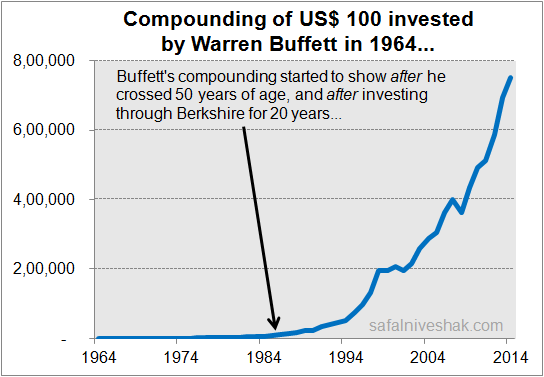
I would leave you with this chart of how Buffett compounded during his 50+ years at Berkshire…


Note from the chart that his compounding began to show after he crossed 50 years of age, and after investing through Berkshire for 20 years.

When you imagine yourself at 85, like Buffett is today, you may not see yourself come even a distant close to what he has achieved over these years. But like he did, if you can start early and keep at it, when you are 40 or 50, you would realize that you did yourself a great deed by giving your wealth time to grow, and a lot of it.

If you are not dependent on investing for your living, please don’t try to go for the kill. Be bold at your work so that you earn more, save more, and thus invest more. Don’t try to act bold in the stock market. As Howards Marks said…

There are old investors, and there are bold investors, but there are no old bold investors.

You got the point, right?

The post An Extraordinary Edge You Have as a Small Investor appeared first on Safal Niveshak.

    
20 Jul 06:21

Growing irrelevance of B-schools

by T T Ram Mohan
Everybody knows what B-schools are for. They are a screening mechanism for companies that want to hire bright people. Whether the courses they teach add value to businesses is unclear. Whether their faculty and research have anything to contribute is even less clear.

This is not a situation peculiar to any country. It's a problem that B-schools everywhere have to face up to, as is evident from an article on UK B-schools. If B-schools are not seen to be contributing much to businesses either through their students or their research, it is only natural that industry should stop perceiving much value in them. In the UK, where it's fifty years since the London  and Manchester business schools started taking in students, this seems to be happening:
Perhaps even more worrying for business schools, there is no sign that business sees them as part of the solution any more. When the UK and global banking system went into a tailspin, few called to deans and professors for help. Did anyone expect the UK government’s plan for productivity to give a leading role to business schools?....Support for business school research by UK business shrunk by over 50 per cent in real terms between 1999/2000 and 2009/2010.
Why is this happening? Because B-school research is tailored to the requirements of their hot universities rather than to industry. Academic research has become an end in itself, with little thought given to whether such research is of any use to industry:
Reports on graduate aspirations might indicate that they want learning that is applied and connected to the ‘real’ world, but the evidence suggests that business academics are engaging less and becoming more inward-looking. This reflects the “capture” of business schools priorities by their host universities. Where they can, universities are increasing their control over their favourite cash cows. Faculty naturally respond by seeking academic legitimacy rather than economic contribution. The chair of the Chartered Association of Business Schools Angus Laing might see its members as central to solving the economic challenges faced by the UK but this can pall into insignificance against a good research assessment. 
For B-schools, the implications are frightening: if the corporate world should find an alternative screening mechanism that is as effective- say, hiring bright graduates through a competitive process- where would B-schools end up? In India, it's even more frightening that there is no indication that these issues are even being raised for discussion. 
20 Jul 03:46

The Great Humiliator

by subra

When you see people make great noises about the equity market, you can only chuckle. All the learning leads you to only one thing. IT IS IMPOSSIBLE TO PREDICT MARKET DIRECTION in the short run.

repeat IT IS IMPOSSIBLE TO PREDICT MARKET DIRECTION, SPEED OF MOVEMENT, ETC. IN THE SHORT RUN.

having said that twice I should hope you have understood it. Get up every morning and read it. If somebody asks you  give a good smile and get away.

People tell me “Oh you will predict only if you are paid money…?” I have found the whole thing amusing.

Ken Fisher calls the markets  “The great humiliator” – just when you feel you have learnt everything about the market, there will be an event which will slap you real hard. Hence the word ‘the great humiliator”

http://www.institutionalinvestor.com/blogarticle/3433519/blog/bridgewaters-ray-dalio-explains-the-power-of-not-knowing.html#.VavGf6Sqqkq

Post Footer automatically generated by Add Post Footer Plugin for wordpress.

20 Jul 03:37

A practical way of generating strong and unique passwords

by Manshu

A few days ago OneMint was attacked, and embarrassingly enough someone or some machine had simply guessed my password. I now know that this wouldn’t be too hard as it would have taken a desktop PC just 3 days to figure out my password.

I have been on a mission to change my passwords since then but there are two challenges in this. You can come up and remember one strong and unique password, but it is very hard to come up and remember 20 unique ones. I say twenty because that’s the number of passwords I need for my accounts that have some financial aspect to it. If you include all of my passwords, I’m sure it would go over a 150.

The other method is to have some sort of a formula in your head to generate a unique password but my struggle so far had been that it wasn’t unique enough, or strong enough or universally acceptable enough.

I’ve overcome all of these and I have been using my current way quite successfully for the past two or three weeks, and if you currently have passwords that can be guessed within days by a desktop PC, I strongly recommend going through this post, and seeing if this method or a variation works for you.

Step 1: Setup a base formula, which means that there should be some combination of special characters, words and numbers that will always be in your passwords. For instance, you can say that all your passwords will start with “%” and end with “ghoda9873*”

Step 2: Use the name of the website in your password but with some replacements. For instance, you could say that if the website is two words like SBI India, you will only consider the first word, so SBI would be part of your password. Then you could say that “I” would always be “1” in your passwords. In this way you can make certain replacements, and come up with a unique password. In our example, a password for SBIIndia.com would be “%SB1ghoda9873*” which would take a desktop PC 2 billion years to crack!

If you use this formula a few times, and customize it to the way you’re used to thinking then you will be able to setup new passwords quite easily for all your accounts. This has the obvious drawback where if a person comes to know a couple of your passwords, they can guess the rest quite easily but it still beats having a simple one anyway.

18 Jul 06:54

Spain construction boom fact of the day

by noreply@blogger.com (Gulzar Natarajan)
One of the strongest arguments in favor of private participation in infrastructure is that lender's due diligence will discipline promoters to increase the likelihood of commercial viability. But as we have seen time and time again, financial markets lose their disciplining powers when credit is plentiful and asset markets are booming. 

FT has a nice story of the farcical fate of an airport in Spain,
A Chinese investor bid just €10,000 in an auction to buy the ghost airport of Ciudad RealThe Chinese group, Tzaneen International, was the only bidder for the vast-but-vacant airport built in the thinly populated Castilla-La Mancha region of southern Spain for a reported €1bn. Ciudad Real boasts a 4km runway — long enough to handle an Airbus A380m, the world’s largest passenger jet — and a terminal building designed to accommodate 10m customers a year. Since its completion in 2009 — a year after a decade-long construction boom turned to bust, plunging Spain into its worst recession in recent memory — the airport has been held up as one of the worst excesses of the country’s go-go years. It is seen as a prime example of the reckless ambition that drove local and regional governments to build museums, racetracks, sports arenas and oversized transport hubs up and down the country in the period leading up to the financial crisis... CR Aeropuertos, the operator of the Ciudad Real terminal, went into bankruptcy three years ago.
By any yardstick, Ciudad Real should never had such a large airport,
A provincial capital of just 75,000 inhabitants, Ciudad Real is located in a thinly populated part of Castilla-La Mancha, halfway between Madrid and Cordoba...The city is more than two hours’ drive south of Madrid, the Spanish capital, with little potential for tourism and only negligible commercial activity.  There is no significant industry in the area and the city attracts relatively few visitors, especially from outside the country. According to Spain’s national statistics office, Ciudad Real and the surrounding province typically record only between 1,300 and 5,000 overnight stays by foreign visitors every month. The contrast between the ambition and scale of the airport and the apparent lack of demand for such a terminal in the surrounding region made it an obvious symbol of the folly and excess of Spain’s boom years...The airport was originally named after Don Quixote, the hero of Miguel de Cervantes’s famous novel. The name was quickly changed, but the association with the delusional knight would prove apt: even when it was operational, the airport never handled more than a handful of flights a week.
Add to Technorati Favorites
18 Jul 06:50

Investment Philosophy or Purpose

by subra

One very important thing while investing is to know why you are making an investment. Can you make your philosophy as short as possible?

Can you say when you are making an investment why you are making the same? Or how much do you expect? or….

Can you make a statement like this for all (All your investments) :

Investment number one: Daughter’s education in a Foreign school

Year: 2023

Amount required: Rs. 3 crores

Year of starting investing: 2004

Asset class: largely equity, with a small shift to debt from the year 10% 2019, 25% in 2020, and 25% in 2021, 15% in 2022. However if one of the years from 2019..if it is a bumper year like 40% jump in equity, a full jump to debt is possible.

Held in my name, wife second holder and daughter nominee.

Expected return: really do not know, but will be happy with about 12% cagr

Instrument: Hdfc Prudence fund: 50% and Franklin India Bluechip: 50%. Shifting to a debt fund will be a fund like Templeton Opportunities fund with a 2 year YTM

Doing a onetime investment of Rs. 5Lakhs and a sip of Rs. 100,000 per month. Yearly reviews to adjust the sip amount, or the tilt towards equity or debt.

May shift schemes, but not alter the debt: equity proportion.

MAKE THIS FOR ALL YOUR INVESTMENTS, let us meet in class 2.


Post Footer automatically generated by Add Post Footer Plugin for wordpress.

17 Jul 11:16

The Dreamer and the Dream

by Atanu Dey

“I am not what happened to me, I am what I choose to become.” That’s Carl Jung (1875 – 1961). Wiki says, he “was a Swiss psychiatrist and psychotherapist who founded analytical psychology. His work has been influential not only in psychiatry but also in philosophy, anthropology, archaeology, literature, and religious studies. . . . Jung created some of the best known psychological concepts, including the archetype, the collective unconscious, the complex, and extraversion and introversion.”

A few quotes follow.

“Loneliness does not come from having no people about one, but from being unable to communicate the things that seem important to oneself, or from holding certain views which others find inadmissible.”

“As a child I felt myself to be alone, and I am still, because I know things and must hint at things which others apparently know nothing of, and for the most part do not want to know.”

“I had dreamed once before the problem of the self and the ego. In that earlier dream I was on a hiking trip. I was walking along a little road through a hilly landscape; the sun was shining and I had a wide view in all directions. Then I came to a small wayside chapel. The door was ajar, and I went in. To my surprise there was no image of the Virgin on the altar, and crucifix either, but only a wonderful flower arrangement. But then I saw that on the floor in front of the altar, facing me, sat a yogi — in lotus posture, in deep meditation. When I looked at him more closely, I realized that he had my face. I started in profound fright, and awoke with the thought: “Aha, so he is the one who is meditating me. He has a dream, and I am it.” I knew that when he awakened, I would no longer be.”

17 Jul 11:15

More reversals in British rail privatization

by noreply@blogger.com (Gulzar Natarajan)
The FT reports that the British government has decided to change the subsidy transfer mechanism to the country's railway operators. The proposal would mean that £3.9 bn annual subsidies would be transferred directly to the 22 private train operating companies (TOCs), instead of the earlier practice of granting to Network Rail, the state-owned rail infrastructure operator. The TOCs will in turn pay higher access charges to Network Rail. The entity, which controls 2500 stations, tracks, tunnels, and level-crossings, has recently been at the receiving end of widespread criticism about poor management that causes half the commuter trains to arrive late, despite the most expensive ticket prices in Europe.

This constitutes yet another reversal in Britain's tortuous rail privatization process which started in 1994. The re-nationalization of Network Rail came after a failed privatization through unbundling and formation of private infrastructure (Railtrack) and rolling stock operators. Further, before the current arrangement, Railtrack received all its income from rail access charges, and the subsidies were transferred to rail operators. The latest announcement restores status quo ante with respect to subsidy transfer channel.

So why should this be any more efficient than the earlier practice? To answer this, it is necessary to bear in mind that while access charges (a mix of fixed cost, variable usage, and capacity charges) are regulated by the Office of Rail Regulator (ORR), only half the passenger fares are regulated, with off-peak and advance-purchase prices being unregulated. This, especially with higher (and presumably closer to commercial cost recovery) access charges, makes Network Rail a more regulated entity than the TOCs and with lower commercial risks. In contrast, the TOCs face a critical restriction arising from capped passenger tariffs and face the full brunt of traffic risks. It is therefore only more efficient that the subsidy be transferred to the TOCs to make up for loss of profitability from revenue shortfalls, contingent on some service level standards. Further, this would also be more incentive compatible in so far as it would encourage the TOCs to improve passenger service delivery standards.

But on the flip side, with their upside capped, the new subsidy transfer arrangement may not do enough to incentivize Network Rail to improve operational efficiency and safety. Also, the TOCs flexibility with unregulated tariffs leaves open the possibility of abusing the subsidy system. 
Add to Technorati Favorites
17 Jul 11:14

5 More Reasons to Read Annual Reports

by Vishal Khandelwal

Here’s an old joke. A policeman sees a drunk man searching for something under a streetlight and asks what the drunk has lost. He says he lost his keys and they both look under the streetlight together.

After a few minutes, the policeman asks if he is sure he lost them here, and the drunk replies, no, and that he lost them in the park.

The policeman asks why he is searching here, and the drunk replies, “This is where the light is.”

Behavioural scientists call this the “streetlight effect”, which is a type of observational bias where people only look for whatever they are searching by looking where it is easiest.

When it comes to investing, most people suffer from the streetlight effect and search for keys (stock ideas) where it looks the easiest (stock market and stock prices). But the reality is that the stock market is rarely the place where you can find the best ideas for long term investment.

Rather, the best ideas are found by looking at businesses, studying them, and identifying which ones are doing well, which ones may continue to do well, and which ones may be going downhill.

And how do you know that?

Well, one of the most authentic resources to study a business is its Annual Report – that boring, often in black and white, document a company releases at the end of every financial year to share what it did in the year gone by.

Anyways, I am not writing today to stress upon the importance of reading annual reports, or how to read annual reports, but just to share about five new disclosures I see in the FY15 annual reports of Indian companies.

Most of these disclosures won’t help you understand much about the business quality, but give a perspective on how the top managers reward themselves.

Here are five new pieces of information that you will find interesting, if you think that annual reports are completely boring.

1. Salaries Drawn by Managers & Directors
While the companies were mandated even earlier to share the break-up of the salaries for their directors including their MD, CEO and other key personnel, they are required to disclose far more FY15 onwards, like –

  • Ratio of remuneration of each whole-time director to the median remuneration of all employees of the company
  • Increase in pay for top employees over the previous year vs increase in median remuneration
  • Increase in top management pay relative to the company’s performance.


What you can assess from tiny bits of information is whether the top managers and directors are paying themselves in or out of line with other employees, and with the company’s performance. A useful analysis can also be done with the company’s competitors.

For instance, Vishal Sikka of Infosys draws 116 times the median pay of his company, versus 89 times that Wipro’s Azim Premji earns. ICICI Bank’s CEO earned 97 times that of the median employee in FY15, while Axis Bank’s CEO earned 74 times.

Well, the negative side of availability of this data point may be that it will give the CEO whose pay is lower as compared to his/her peer’s pay – or in relation to median pay or as percentage of net profits – one more reason to ask for a pay hike next year. 😉

2. Actions of Top Shareholders
As per new disclosure norms, companies are required to provide details of what their directors and key managers did with their shareholding in the company in the past year. Details of what the top ten shareholders did during the year is also available now.


The disclosures about what directors and managers did with their shareholding is especially important here as these will suggest whether these insiders buying more into, or selling out of the company.

The details on what the top ten non-promoter shareholders did can be even more interesting. Exide’s annual report, for instance, tells me that LIC, its biggest non-promoter shareholder, brought its stake down from 7.35% at the start of FY15 to 4.85% by the end of the year. On the other hand, Amansa Holdings, one of the very few investment funds I admire, bought 1.09% of the stock during the year. Another respectable fund, Nalanda, held on to its stake in the company at 3.56%.

Now, the negative side of such a disclosure is that it may lead the mind into a sort of Authority Bias. For instance, if I like Amansa’s or Nalanda’s investment philosophies (which I do), the fact that they are buying or holding onto Exide will create a positive bias in my mind towards the business. So another devil to take care of here!

3. Indebtedness of the Business
The third key disclosure that I see in FY15 annual reports is with respect to the company’s indebtedness. Unlike the past, when one had to search through the notes and schedules to gauge the company’s debt situation, the new disclosures lay it clearly in a tabular form, details like –

  • Amount of principal due
  • Amount of interest due
  • New borrowing or repayment during the year


Overall, another nice disclosure to have that cuts down on the hard work to identify the true indebtedness of a business.

4. Dealings with Related Parties
Another welcome disclosure is that on how the business dealt with related parties (like top managers, promoters, directors or parent or associate firms) during the year. Now, a company entering into related party transactions is normal, but it’s the extent and complexity of such transactions that determines whether the dealings are comfortable or smell of something fishy (like DLF selling a large part of its properties to its subsidiary DLF Assets, and calling it as ‘sales’).

A related party transaction can be an easy way for the promoter to take cash out of the business and into his/her small, unlisted firm. So, the new requirements that all related party transactions are at market rates and at an arm’s length basis is a welcome disclosure.

What is more, if the transactions are not at market rates, the directors have to justify why the transaction was entered into in the first place.

Anyways, while not all, some related party statements can throw up nice insights on the business. Take, for instance, the related party table of housing finance major HDFC, which reveals this…


5. Key Business Details
This new section in the annual report – titled “Form No. MGT-9 Extract of Annual Return” is what gives you a quick snapshot of the business, which is helpful in case you are looking at the business for the first time. Here, you can find details like –
  • Date of incorporation of the company and its address
  • Key activities that contribute more than 10% of the revenue
  • Details of holding, subsidiary, and associate companies
  • Shareholding pattern and actions by key shareholders during the year
  • Indebtedness of the firm
  • Remuneration paid to directors and key managers

In short, this section will help you with all the basic and initial information you may need before you deep-dive into understanding the company’s business and numbers.

For instance, this is what the section on key activities looks like in Hindustan Unilever’s annual report, and which quickly reveals which segments I must really focus on while analyzing the business…


Bring Out the Annual Reports
In an article in Fortune magazine entitled “Best Advice I ever got”, legendary commodities investor Jim Rogers talked about how you can get an edge on the vast majority of people in the stock market if you simply read everything you can on a prospective investment. He said –

The best advice I ever got was on an airplane. It was in my early days on Wall Street. I was flying to Chicago, and I sat next to an older guy. Anyway, I remember him as being an old guy, which means he may have been 40. He told me to read everything.

If you get interested in a company and you read the annual report, he said, you will have done more than 98% of the people on Wall Street. And if you read the footnotes in the annual report you will have done more than 100% of the people on Wall Street.

I realized right away that if I just literally read a company’s annual report and the notes — or better yet, two or three years of reports — that I would know much more than others. Professional investors used to sort of be dazzled. Everyone seemed to think I was smart. I later realized that I had to do more than just that. I learned that I had to read the annual reports of those I am investing in and their competitors’ annual reports, the trade journals, and everything that I could get my hands on. But I realized that most people don’t bother even doing the basic homework. And if I did even more, I’d be so far ahead that I’d probably be able to find successful investments.

So, rather than ruing why you missed that latest multi-bagger stock and how you never seem to find good businesses, pick up an annual report and start reading it. You may start from the annual reports of companies you already own. And if you realize that you are not understanding a bit of what you are reading, ask yourself what that company is doing in your portfolio. Maybe you should sell that stock, simply because you do not understand the underlying business.

On the other hand, if an annual report reveals some new insights and you realize that you never looked at the business that way and that this insight was a positive one for the business’s future, maybe it’s time to buy more of that stock (in case it’s still available at reasonable valuations).

But you will never identify such issues – negative or positive – till you read annual reports.

By the way, if you need to get your hands to hard copies of more annual reports than the companies you own, here is what you can do…write a letter, like I’ve written, to the residents of your housing society…

Dear Residents,

This is to request you to kindly share the Annual Reports of companies that you may have received and are looking to discard.

I am a reader of annual reports, and am thus collecting the ones from the latest financial year 2014-15.

So, if you wish to share them, kindly leave them at the Entry Gate. I will collect from there.

Thanking you in anticipation!

With respect,
[Your Name] [Your House No.]

…and the response I’ve received, in terms of people giving me their untouched annual reports, has been pretty good. 😉

Unlike what you may believe, annual reports are interesting documents…and many times you can see the story of the business evolving if you are willing to look through the eyes of an annual report.

Just give it a chance.


Statutory Warning: This is NOT an investment advice to buy or sell shares. Please make your own decision, as blindly acting on anyone else’s research and opinions can be injurious to your wealth. I do not own any stock mentioned above. I am a registered Research Analyst as per SEBI (Research Analyst) Regulations, 2014 (Registration No. INH000000578).

The post 5 More Reasons to Read Annual Reports appeared first on Safal Niveshak.

    
17 Jul 11:11

A different take on Real Estate

by subra

Many writers including Vivek Kaul have a strong view that the existence of black money is what is pushing up the real estate prices. I have a different take. If the EXCESS SUPPLY of black money is what is holding the RE prices high, is it not the excess of BANKING money that is holding up the RE prices?

The bank’s exposure to the RE business is about 12,00,000 crore rupees. Is this a small amount of money? What about black money in RE? can we assume it is HALF the amount? so about Rs. 6,00,000 crore rupees? Is that small?

Let us say the government says:

– one person can own only one house, and all the other houses that he buys will be treated as a business

– so all the RE income from 2nd house onwards will not get capital gains benefit, will NOT be treated under Income from House prop

-will be subject to wealth tax @ 1% of the cost of acquisition

– levy service tax on rent

-levy TDS on rent @ 10k per month

All this will ACTUALLY reduce the yield on RE. No problems people buy RE for appreciation. The lesser income yield will not have an impact at all.

The bank funding is assuming that there will be a continuous 8% increase in the value of the property prices and hence there is reduced risk for the lender. People associated with the banking industry know how easy it is to evergreen the Real Estate book, do they not? So if a small builder is in trouble, go to a big builder and get the distress sale funded at a higher value. Go to a compliant valuer and you can get a value which is 3x the current prices in that location. Forget RBI even the regular auditor has no way in hell of knowing anything about the valuation reports.

Now look at Navi Mumbai. The industrial units in Rabale are slowly but surely moving their operations ot Gujarat (land is about 1/10th the price), electricity is about HALF, and labor is about 40% of Mumbai’s rate. So if there is a mega shift will prices in Mumbai go up or down? Your guess is as good as mine.

Maybe the cash element is having an impact but it is the big banks that are funding this frenzy of RE prices esp in metros…

Post Footer automatically generated by Add Post Footer Plugin for wordpress.

17 Jul 11:10

What is Liquidity? (Part VIII)

by David Merkel

Here are some simple propositions on liquidity:

  1. Liquidity is positively influenced by the quality of an asset
  2. Liquidity is positively influenced by the simplicity of an asset
  3. Liquidity is negatively influenced by the price momentum of an asset
  4. Liquidity is negatively influenced by the level of fear (or overall market price volatility)
  5. Liquidity is negatively influenced by the length of an asset’s cash flow stream
  6. Liquidity is negatively influenced by concentration of the holders of an asset
  7. Liquidity is negatively influenced by the length of the time horizon of the holders of an asset
  8. Liquidity is positively influenced by the amount of information available about an asset, but negatively affected by changes in the information about an asset
  9. Liquidity is negatively influenced by the level of indebtedness of owners and potential buyers of an asset
  10. Liquidity is negatively influenced by similarity of trading strategies of owners and potential buyers of an asset

Presently, we have a lot of commentary about how the bond market is supposedly illiquid.  One particular example is the so-called flash crash in the Treasury market that took place on October 15th, 2014.  Question: does a moment of illiquidity imply that the US Treasury market is somehow illiquid?  My answer is no.  Treasuries are high quality assets that are simple.  So why did the market become illiquid for a few minutes?

One reason is that the base of holders and buyers is more concentrated.  Part of this is the Fed holding large amounts of virtually every issue of US Treasury debt from their QE strategy.  Another part is increasing concentration on the buyside.  Concentration among banks, asset managers, and insurance companies has risen over the last decade.  Exchange-traded products have further added to concentration.

Other factors include that ten-year Treasuries are long assets.  The option of holding to maturity means you will have to wait longer than most can wait, and most institutional investors don’t even have an average 10-year holding period.  Also, presumably, at least for a short period of time, investors had similar strategies for trading ten-year Treasuries.

So, when the market had a large influx of buyers, aided by computer algorithms, the prices of the bonds rose rapidly.  When prices do move rapidly, those that make their money off of brokering trades take some quick losses, and back away.  They may still technically be willing to buy or sell, but the transaction sizes drop and the bid/ask spread widens.  This is true regardless of the market that is panicking.  It takes a while for market players to catch up with a fast market.  Who wants to catch a falling (or rising) knife?  Given the interconnectedness of many fixed income markets who could be certain who was driving the move, and when the buyers would be sated?

For the crisis to end, real money sellers had to show up and sell ten-year Treasuries, and sit on cash.  Stuff the buyers full until they can’t bear to buy any more.  The real money sellers had to have a longer time horizon, and say “We know that over the next ten years, we will be easily able to beat a sub-2% return, and we can live with the mark-to-market risk.”  So, though they sold, they were likely expressing a long term view that interest rates have some logical minimum level.

Once the market started moving the other way, it moved back quickly.  If anything, traders learning there was no significant new information were willing to sell all the way to levels near the market opening levels.  Post-crisis, things returned to “normal.”

My Conclusion

I wouldn’t make all that much out of this incident.  Complex markets can occasionally burp.  That is another aspect of a normal market, because it teaches investors not to be complacent.

Don’t leave the computer untended.

Don’t use market orders, particularly on large trades.

Be sure you will be happy getting executed on your limit order, even if the market blows far past that.

Graspy regulators and politicians see incidents like this as an opportunity for more regulations.   That’s not needed.  It wasn’t needed in October 1987, nor in May 2009.  It is not needed now.

Losses from errors are a great teacher.  I’ve suffered my own losses on misplaced market orders and learned from them.  Instability in markets is a good thing, even if a lot of price movement is just due to “noise traders.”

As for the Treasury market — the yield on the securities will always serve as an aid to mean-reversion, and if there is no fundamental change, it will happen quickly.  There was no liquidity problem on October 15th.  There was a problem of a few players mistrading a fast market with no significant news.  By its nature, for a brief amount of time, that will look illiquid.  But it is proper for those conditions, and gave way to a normal market, with normal liquidity rapidly.

That’s market resilience in the face of some foolish market players.  That the foolish players took losses was a good thing.  Fundamentals always take over, and businesslike investors profit then.  What could be better?

One final aside: other articles in this irregular series can be found here.

17 Jul 11:07

Build up of forex reserves is actually dollar colonisation

by Amol Agrawal
It is amazing to note how history is quickly forgotten. Leave history, even current times are ignored just to fit one’s agenda. There is a huge belief that it is high forex reserves which are the safeguard for Indian economy. The same reserve building was criticised greatly pre-2008 period as RBI should only do inflation […]
16 Jul 11:37

Cloud Services Eat Up Indian IT Outsourcing Earnings

by Deepak Shenoy

I’ve been bearish on IT in the longer term, and in a long post I explain why I think we are at an inflexion point for Indian IT. Over the last quarter, results have been pathetic: HCLTech, Wipro and Infy showed less than 5% earnings growth YoY, and TCS and Tech Mahindra actually showed -30% or lower earnings growth for the March quarter. While TCS had a one time component (bonus) we saw their recent results for the June quarter showing less than 5% earnings growth YoY.

And Wall Street Journal has a story on how cloud services are eating up IT sector earnings:

The value of outsourcing deals signed in 2014 shrank 17% to $120.4 billion from $145.5 billion a year earlier, according to consulting company KPMG LLC.

Indian companies are losing business to firms that have led the way into the cloud, such as International Business Machines Corp., Amazon.com Inc.

(Read On...)
16 Jul 09:11

Charts: India’s Trade 14% Lower, Even as Deficit Improves With 35% Drop in Gold and Crude Imports

by Deepak Shenoy

India’s trade continues to show two very distinct signals. First, that the deficit is down. Look at the merchandise trade stats for June 2015: the deficit is just $10 billion, which is about as low as it has been in the last few months.

image

Imports are lower both due to lower crude oil imports (due to the lower crude prices, not lower consumption) and lower gold imports (which is both due to lower gold prices and lower consumption). Gold imports are down 37% from last year (DNA) and in volume terms has fallen from 221 tonnes for the AMJ quarter 2014 to 203 tonnes in 2015. (Hindu)

This is great for the current account, where gold has been the make-or-break for us. If you take away gold imports, we actually are a surplus on the current account!

The Bad Part: Trade Volumes In The Toilet

But wait.… (Read On...)

16 Jul 09:08

My house is too small….

by subra

How often do you hear this crib? Or your wife tell you “We must get a house with at least one more room” from your wife?

What really happened? when you bought this house, it did not feel small did it? You moved from a 2 bhk with 6 members to a 2 bhk with 3 members you felt this was big, did you not? Then what happened? The house grew smaller? NO.

You bought too many things. The cycling machine which you did not use. The treadmill which your wife uses for drying small clothes. The bicycle which your society does not allow you to keep on the staircase. The extra wardrobe for your daughter’s clothes. The bookshelf that has books that you have read, hoping to read, will never read. What is the solution?

DE-CLUTTER. Throw away things that you do not need.

1. Clothes: 84 shirts – formal and informal, 37 Tee shirts, 13 running tee shirts. 31 pants, 4 cycling tee shirts. 4 running shorts. Leisure clothes – shorts, tee shirts, etc. Honestly for a 47 year old male this is  too much is it not? Come  on start with the head of the family. Come down to 20 formal shirts, 5 black pants, 10 Tee shirts, and see how your stress goes down along the need for storage!!

2. Give away one thing every day: tennis raquet, Golf kits, books, dresses, furniture – over a one year period you would have given up 365 things, and life would be better.

3. Boxes idea: Pick up 10 things that you think you need absolutely and put it in a box. If for 6 months you do not open it, give it away.

4. Many old things are connected to us emotionally: long play records, cassettes, cds – music all we ‘hope’ to listen or watch. I know somebody who has 15,000  Movie cds. He hopes to watch them when he retires. I bet by the time he retires he will not have a cd player. The technology would have changed.

5. Donate things: I have found it easy to collect bicycles for a rural school far more easily than asking people for 1k to buy a new cycle for a rural kid. Almost every house has 100 things to give away. Be ruthless. Stationery, books, vessels, clothes, electronic things, ipods, old phones, data sticks, cds, cd player, – just give them away. Of course Olx is an option, but not sure how successful that will be.

…and suddenly your house is fine. See I save you a few crores. One crore on the RE and 20L on the furnishings!!

Post Footer automatically generated by Add Post Footer Plugin for wordpress.

16 Jul 09:06

Will computers replace human intelligence in finance?

by Amol Agrawal
Prof Shiller does not think so. He says this vision of financial singularity where computers shall replace a fund manager and markets become super efficient is unlikely to happen: There is a long-recognized problem with such perfect markets: No one would want to expend any effort to figure out what oscillations in prices mean for the […]
16 Jul 03:25

Latticework of Mental Models: Contrast-Misreaction Tendency

by Anshul Khare

Do you remember my old friend, Mr. Irrational? He made a cameo appearance in Latticework series when we discussed Mean Reversion.

For the uninitiated, he is a figment of my imagination, inspired by Benjamin Graham’s Mr. Market.

One fine day, it so happened that Mr. Irrational was trying on suits in front of a shop’s three-sided mirror. The men’s tailor shop was owned by Sid and Harry. The younger brother, Harry, being less experienced, was sitting at the back of the room with all the design catalogues and price list.

Sid, elder brother and the chief tailor, who seemed to have hearing problems, was helping Mr. Irrational make a choice.

“How does this one look?” asked Mr. Irrational. He liked the dark grey colour but wasn’t sure about the woollen texture of the suit.

“Pardon me Sir. Can you please speak up little louder?” This was the third time that Sid had requested his patron to speak louder.

“I am asking, how does this suit look on me?” Mr. Irrational raised his voice. The extra decibels came with a hint of irritation. After all my friend is a soft spoken guy and shouting is considered rude in his family.

“Aha! You’re looking fabulous in this one sir! Nothing less than a business tycoon.” Sid’s artificial smile bundled with a fake compliment proved that he was a skilful salesman.

“How much does this one cost?” Mr. Irrational asked loudly. He didn’t want to repeat his sentence.

“This one sir? Let me check.” said Sid. He turned towards Harry and shouted at the top of his voice, “Harry, how much for this suit?”

Looking up from his work – Harry called back, “For that beautiful all-wool suit, nine thousand rupees.”

At this point, Sid turned to Mr. Irrational and reported, “He says five thousand rupees.”

Curbing his instincts to correct Sid, Mr. Irrational realized that Sid’s hearing problem had just thrown up an opportunity to grab a nine thousand suit for five thousand. Without even giving a second thought, he hurriedly paid five thousand to Sid and scrambled out of the shop with his “expensive means good” bargain before poor Sid could discover the “mistake”.

My question to you is this – do you think Mr. Irrational exploited Sid’s disability?

What if I told you that there is a twist in the tale? What if Sid didn’t really have a hearing problem?

As it turned out that it was an elaborate scam and Mr. Irrational was manipulated.

Sid and Harry knew something important about human behaviour: humans rarely choose things in absolute terms. We don’t have an internal value meter that tells us how much things are worth. Rather, we focus on the relative advantage of one thing over another, and estimate value accordingly.

This human behavioural bias is called Contrast-Misreaction Tendency. And that’s our mental model for today.

Contrast-Misreaction Tendency (CMT)
I’ll take Charlie Munger’s help in defining this behavioural anomaly. This an excerpt from his famous lecture on psychology of human misjudgement –

.. human nervous system can’t naturally measure in absolute scientific units, it must instead rely on something simpler. The eyes have a solution that limits their programming needs: the contrast in what is seen is registered. And as in sight, so does it go, largely, in the other sense. Moreover, as perception goes, so goes cognition. The result is man’s Contrast-Misreaction Tendency.


In the image here, the two inner rectangles are exactly the same shade of grey, but the right one appears to be a lighter grey than the left one due to the background provided by the outer rectangles. It’s the result of contrast effect.

Mr. Irrational, who was uninformed about suit business, had no clue about the value of the suit until he heard from Harry, who shouted “nine thousand rupees”. In that moment Harry had deliberately planted a price anchor in his customer’s mind. The very next moment, when Sid said “five thousand rupees”, Mr. Irrational found the suit cheap in contrast to price anchor.

Sid and Harry made their moolah even as the customer thought he got a ‘great’ deal! Unfortunately, almost every one of us, knowingly or unknowingly, has fallen for such scams in our lives.

Peter Bevelin describes the idea eloquently in his book Seeking Wisdom –

We judge stimuli by differences and changes and not absolute magnitudes. For example, we evaluate stimuli like temperature, loudness, brightness, health, status, or prices based on their contrast or difference from a reference point (the prior or concurrent stimuli or what we have become used to). This reference point changes with new experiences and context….This means that how we value things depend on what we compare them with.

If Mr. Irrational looked like a sitting duck then let me warn you that Sid and Harry aren’t the only ones who understand the importance of CMT.

Exploiters of CMT
Is it possible to influence customer’s decisions by manipulating the available options?

The answer is a resounding yes.

Consider this experiment where a group of people was asked to choose between $6 cash and an elegant pen. Most choose the cash. Another group of people was asked to choose between $6 cash, the elegant pen, or an inferior pen. Most choose the elegant pen. Why?

By adding an inferior option, a decoy if you will, which nobody chooses, people are subtly nudged towards the option (the elegant pen in this case) which can be compared to the inferior choice.

Bevelin quotes the example of real estate where this bias is a standard tool of persuasion –

Mary is looking at houses. The real estate broker knows that the house he is trying to sell Mary is in poor shape and a bad area. He starts by showing Mary bad properties in an ugly neighbourhood. Afterwards, he takes her to the house he wanted to sell all along. Suddenly this house and the area seem great in comparison to the other house she saw.

This tendency is routinely used to exploit customers buying merchandise and services.

The story isn’t much different when we end up buying that overpriced ₹25,000 leather accessory merely because the price is so low compared to our concurrent purchase of a ₹5 lacs car.

Even when people know that this sort of customer manipulation is being attempted, it will often work to trigger buying, which demonstrates that being aware of psychological ploys is not a perfect defence.

In fact the ‘predictability about our irrational behaviour’ was the premise on which Dan Ariely wrote his entertaining book, Predictably Irrational. In the following talk, Dan shows you some optical illusions to bring home the point that awareness about human biases doesn’t necessarily make you immune to them.


On a lighter note, Rolf Dobelli suggests that if you are seeking a partner, never go out in the company of your supermodel friends. People will find you less attractive than you really are. Go alone or, better yet, take two ugly friends. I haven’t validated this trick, so goes without saying –“try it at your own risk!” :)

There is another aspect of CMT which makes it very interesting. If we fail to perceive the change, due to small contrast, the mis-reaction may not trigger at all. For example, our kids grow up right in front of our eyes but we notice the change only when we look at old pictures.

Contrast, the Invisible Killer
Contrasts makes us blind to slow change until it’s too late. The reality around us seems pretty much constant, although it’s continuously changing. The change in a stimulus has to cross a certain threshold before our awareness can register it.

It’s worth mentioning here a tremendously useful mental model from Charlie Munger’s Latticework called boiling frog syndrome, described by Prof Bakshi in this wonderful blog post. He explains –

Small incremental changes tend to go unnoticed…If you put a frog in hot boiling water, he will instantly leap out of the pan and be never seen again. But, if you put a frog in a pan with room temperature water and slowly turn up the heat, he wouldn’t be able to tell the tiny incremental changes. He will boil and die.


Charlie Munger once said that many businesses die just like the boiling frog. Cognition, misled by tiny changes involving low contrast, will often miss a trend that is destiny. He further warns –

When a man’s steps are consecutively taken toward disaster with each step being very small, the brain’s Contrast-Misreaction Tendency will often let the man go too far toward disaster to be able to avoid it. This happens because each step presents so small a contrast from his present position.

To a small stimulus, only a small amount must be added. To a larger stimulus, a large amount must be added.

Warren Buffett says –

One of the problems in society is that the most important issues are often these incremental type things…But, if you keep doing it over time, the incremental problems are hard to attack because that one extra piece of pie doesn’t really seem to make a difference…but the cumulative effects of them will make a huge difference over time, just like overeating will make a huge difference over time. The time to attack those problems is early.

Sometimes it is the small, gradual, invisible changes that harm us the most.

Contrast Effect in Investing
The whole idea behind systematic investment plan (SIP) is that a small outgo (as compared to the whole salary) every month from our paycheque doesn’t pinch.

As we have seen contrast is a two sided sword, and its ill effects show up in investing also.

Have you heard of “Big Bath” accounting? For the uninitiated it’s an accounting jugglery to “manage” a company’s earnings. Sometimes, to fool the shareholders, a particular year’s poor income statement is made to look even worse by increasing expenses and selling assets.

As a result, the subsequent years, especially the very next, appear much better in contrast.

Satyam’s case is another example which shows how big accounting scams are created.

Here is what Ramalinga Raju’s aides at Satyam must have told him before the scam came to light – “If we slowly and gradually over time manipulate the numbers, the auditors won’t notice it.”

Incidentally, in this case, even the auditors were involved! But the Satyam scam did not come to light till Raju confessed of riding a tiger.

You see, contrasts may blind us to change until it’s too late. For example, we often don’t notice the bad behaviour of others (like we ignore “small” accounting manipulations at companies) if it goes sour gradually over time. Often we see reality as constant, although it gradually changes.

Similarly, we fail to notice how our money disappears. It constantly loses its value, but we do not notice because inflation happens over time. If it were imposed on us in the form of a brutal tax (and basically that’s what it is), we would be outraged.

Another area where CMT can harm is our fixation on the stock price. When you are analysing a business, it becomes extremely hard to overcome the temptation to ignore the past stock price trends. If a stock has risen recently, our subconscious screams that the stock has become expensive. A recent fall in price triggers the CMT which convinces us that the stock has become cheaper.

My advice? Don’t look at the stock price until you have analysed the business and worked out some valuation. For that matter, if you can’t avoid price based screeners, use them carefully.

Conclusion
Understand that CMT is everywhere, and that we view our world through its lens – rose coloured or otherwise.

Few psychological tendencies do more damage to correct thinking than CMT. Warren Buffett was probably referring to contrast bias when he said –

Chains of habit are too light to be felt until they are too heavy to be broken.

It’s interesting that most bad habits are formed because of this tendency but fortunately this bias, if used intelligently, can help us form good habits too. John Wooden, one of the most successful coaches in the history of basketball, observed –

When you improve a little each day, eventually big things occur … Don’t look for big, quick improvement. Seek the small improvement one day at a time. That’s the only way it happens and when it happens, it lasts.

I wanted to tell my friend, Mr. Irrational, that he was taken for a ride by his tailors but then I thought to myself, “Let me keep the poor kid happy.” After all he still believes that he stole a great deal.

But you don’t forget to include CMT in your mental model checklist. And at the same time don’t forget to make use of it for creating good habits.

Take care and keep learning.

PS: The tailor shop example was taken from Robert Cialdini’s book Influence: The Psychology of Persuasion

The post Latticework of Mental Models: Contrast-Misreaction Tendency appeared first on Safal Niveshak.

    
15 Jul 09:07

Everyone in India thinks they are ‘middle class’ and almost no one actually is

by Amol Agrawal
Another myth of Indian economy goes down. Rohan Venkataramakrishnan reports on research on India’s middle class: In a country quite as large as India, it’s hard to identify anything that actually counts as being in the “middle.” Yet most of us claim we are middle-class, no matter where we fall on the spectrum, whether compared to […]