Shared posts

28 Jul 09:13

The Ten Golden Rules of Leadership: Classical Wisdom for Modern Leaders

by Shane Parrish

The Ten Golden Rules of Leadership

How many of today’s problems are the result of leadership?

What’s lacking, the author of The Ten Golden Rules of Leadership argue, is the lack of real leadership.

Here the problem may lie with a lack of deeper, broader insights, the kind of insights that technical skill alone does not confer— the ability to see the big picture, to connect with members of the organization, to foster a meaningful and productive work environment, and to steer the corporate ship through the challenges of highly competitive markets and new technologies.

***

What is leadership?

The authors define the term “leadership” in a way that that differentiates their “interpretation from the offhanded views that too often distort the word’s meaning.”

It is the assumption of the authors that leadership is an uncommon composite of skill, experience, and ripened personal perspectives. It is, of course, the last of those elements that sets the real leader apart from those who simply “run” organizations. Ripened personal perspectives are an essential ingredient in a leader’s efforts to develop and articulate a sound corporate vision. Real leaders, people like Bill Gates and Steve Jobs, see things more rapidly than does the typical executive. At least in part, their insights are a reflection of an “inner” clarity that allows for fuller concentration on the challenges at hand.

This is why leadership cannot be “done by the numbers,” why those who have failed to comprehend the motivating subtleties in their own lives are unlikely to achieve the status of “leader.” Simply put, only those men and women who have cultivated a care fully conceived philosophy of life are ready and able to exhibit the kind of workplace mastery suggested by the term “leader.” Now for some, invoking the term “philosophy” in this context may seem strangely out of place. To one degree or another, we all have been conditioned to believe that philosophy is at best a kind of noble laziness, a speculative exercise devoid of concrete benefit. Yet it may be that many of the inefficiencies and failures that plague our managerial environments are ultimately related to an inadequate consideration of what philosophy has to offer.

***

The Ten Golden Rules of Leadership

1. Know thyself. Understand your inner world, your bright and dark sides, your personal strengths and weakness. Self-comprehension is a fundamental precondition necessary for real leadership.

2. Office shows the person. The assumption of authority brings out the leader’s inner world. It reveals whether the leader has undergone a process of honest self-discovery that allows for the productive application of power.

3. Nurture community in the workplace. Community development and positive sentiment are virtues leaders must nurture by providing the right support, guidance, and incentives.

4. Do not waste energy on things you cannot change. Do not waste resources and energies on things you cannot control, and therefore, cannot change.

5. Always embrace the truth. Effective leaders should always embrace the truth, always encourage candid criticism throughout the organization, be skeptical of flattering appraisals, and never let authority place a wedge between them and the truth.

6. Let competition reveal talent. Nurture an environment that can use the forces of competition constructively, create a platform that releases the ingenuity and creativity of your employees in pursuing corporate goals and objectives, identify subordinates who use competition as a constructive force, steer away from subordinates who use competition as a destructive force.

7. Live life by a higher code. Dedicate yourself to a higher standard of personal conduct; don’t harbor ill-will toward those who offend; be ready to assist those who are in need without asking something in return; remain calm in the face of crisis; dedicate yourself to principle without compromise; earn the trust, respect, and admiration of your subordinates through your character, not the authority conferred upon you by the corporate chart; turn authority into power.

8. Always evaluate information with a critical eye. Don’t rely upon old premises, assertions, and theories. Develop a critical mindset that accepts nothing at face value, certify the credibility and usefulness of critical information, analyze the con text that produces critical information and the messengers who convey it, and never rush to judgments.

9. Never underestimate the power of personal integrity. Personal integrity is a critical asset for real leadership. Always set an honorable agenda, adhere to a code of professional conduct, never try to justify dishonesty and deceit, rather “fail with honor than win by cheating.”

10. Character is destiny. True leadership is ultimately traceable to factors of character and personal integrity; much of what is called “destiny” lies in our hands, not in mysterious forces beyond our control.

The Ten Golden Rules of Leadership: Classical Wisdom for Modern Leaders is a worthy read for anyone looking to embark on a journey of critical self-examination. You’ll learn form the revered anctiel thinkers like Aristotle, Hesiod, Sophocles, Heraclitus, and Antisthenes.

--
Sponsored By: Greenhaven Road Capital: You think differently - now invest differently.

28 Jul 03:22

The School of Money, First Grade

by David Merkel

This post is an experiment, and not meant to be definitive. If you have any comments to improve it, leave a comment, or email me.  Thanks.

The School of Money

Most books dealing with money tend to be too advanced for average people.  If you’ve read me long enough, you know that I am pretty conservative with my finances.  That conservatism has generally worked well for me, my family, and the church that I help lead.  It’s possible this post could lead to a series of posts; let me know what you think.

First Grade — Preparing to Work

It could be our culture.  It could be the way that public schools are organized.  My guess is that parents don’t talk about it much, and think that it will happen easily.  The transition of children learning to eventually applying their learning to work is a difficult thing in a world where there are many things to do, and not enough practicality involved in education.

Part of the problem is not having or developing an attitude of service.  There is no shame in helping others.  In one sense, compensation derives from how many people you help, times how valuable your contribution to that good or service is.

So, rather than “following your bliss,” the best work comes from enabling the bliss of others.  It is rare that anyone will pay you for doing what you enjoy, and only that.  Most work involves some things that are disagreeable.  It’s important to look for the good that you can do in the midst of difficulty.  Sometimes that greatest value comes from finding a new way to deal with difficulties, and making processes more productive as a result.

Somewhere around age 15, young people need to see what areas in the economy need talent, and what sort of skills are needed.  In addition to specific skills, remember that in much of life mathematical reasoning, verbal skills, and genuine curiosity for solving problems will apply to a wide number of situations.  Remember, the economy will be different 20 years from now in ways that we do not presently fathom.  Being able to think creatively and critically, and being able to express it well in oral and written ways will never go out of fashion. (As an aside, that is one of the criticisms I hear in the local money management community.  Young people come out of college, but cannot express themselves well in writing.)

Informational interviewing at younger ages could be useful.  Even at older ages, when you get the chance to ask business owners or managers questions, ask them what are the biggest problems that they face, what keep them up at night, etc.  If nothing else, you’ll get a better perspective on what it is like to be in charge, and the headaches thereof.

Software may eliminate many jobs where analytical processes can be easily replicated by code.  Analyze any career for the threat posed by software, or, employ the software yourself to enable you to do more and better work.

You’ll need to consider whether you want to take more risk and run your own business, or less risk and work at a set of skills for someone else.  That said, you can never eliminate risk.  Most of the firms that I once worked for are out of business today, or doing business in such a way that I might not be employed by them now.  There are advantages to trying to control your own destiny, even if you fail a few times in the process.  The skills you will might come in useful if you do choose to work for someone else later.  But if you succeed, you could end up with a valuable business that helps many people — customers, employees, vendors, and of course you.  High rewards go to those who lead and structure the work of others successfully.

College is needed for many high level jobs, and sometimes a master degree or a doctorate.  In other cases, additional training at a special school or a junior college may be enough.  Even after graduation, a plethora of certification situations may present themselves.  Before entering any education situation, try to analyze whether it will genuinely pay off for you or not.  Remember, even nonprofit colleges and universities rely on students to come and pay tuition so that the schools can survive.  This is why it pays to have a range of ideas in mind of what you might like to do before going for higher education.  There is nothing worse than taking on a load of debt that is not dischargeable in bankruptcy, and having no good way to pay it off.  (Note: consider income-based repayment plans if debt is high, and income low.)

Also note that you may not find what you want to do on the first try, in addition to job obsolescence.  Sometimes the path may involve retraining.  If so, count the opportunity cost of the time and money spent.  Sometimes the best path may be indirect — get a lesser job at a firm that you might want to work for and then try to interact with those in the area that is your greater interest.  In this day and age, many employers don’t advertise positions — the only way to find out about them within a firm, or by word of mouth.  If you can show a degree of talent and diligence, greater opportunities may open up for you.

In the end, remember that your work is a means to an end of helping others, while personally benefiting in the process.  Look to the needs of others, and find a way to serve well.  In most cases, the rewards should follow.

Critical Questions

  • What human needs are not getting met?
  • Do you have an idea for a business that meets those needs?
  • Have I talked with enough different people, or read enough, to get a view of what is in demand, growing, etc.
  • What jobs pay well that don’t require college?
  • What sorts of jobs and people getting work visas for at present?
  • What education or skills do I need?  How might that change?
  • Do I have good basic reasoning skills in math, science, reading, writing, general reasoning and logic, etc?
27 Jul 09:06

Goodbye to performance appraisals?

by T T Ram Mohan
I am not bowled over by the news - rather inaccurately reported in many places- of Deloitte and Accenture doing away with performance appraisals. First, they are not doing away with appraisals, they are doing away with annual appraisals. These, they have concluded, involve too much time and money and do not produce commensurate benefit. An FT article estimates that Deloitte must have wasted £ 200 million every year on these appraisals.

Deloitte will replace its elaborate appraisal with a set of four questions. Accenture will provide appraisal on the go. All of which is fine. But it's important to understand that, while can and must improve the methodology of appraisals, we can't eliminate performance appraisals altogether. We still need to determine who are to be promoted. Where there are performance- linked incentives, we will need measurement of performance. Appraisals won't disappear.

So the real question to ask is: how do we improve appraisals? The first thing is to realise that performance is best measured over a long period, certainly more than one year. This happens in the case of promotions but not in the case of variable pay (except at the very top level). If we accept that there are serious problems with annual appraisals, we should also accept that variable pay linked to annual performance is not a great idea. It rewards a few and demoralises the many, it is prone to error and getting the quantum of reward right in a given situation is also a problem. Doing away with variable pay will substantially reduce the need for annual appraisals.

What about appraisals for promotions? Well, the most important thing, as this article in the New Yorker emphasises, is to eliminate biases to the extent possible. One way to do so is to get make sure that a person is evaluated by many people, not just by one big boss. (You can call this 360-degree feedback or whatever you like). In some businesses, we could even get customers to evaluate certain people.

The second thing is to focus intensely on selection. Once you are reasonably confident you have the right people, you don't have to worry so much about 'managing' performance. Thirdly, upto a certain level, let promotions be time-bound, in other words, go by seniority (as in the bureaucracy). Again, the logic is that if a person has come through an intense selection process, he or she should be able to do well upto a certain level. This fosters cooperation and team spirit which are more important for performance than individual effort, however accomplished an individual may be.

Annual appraisals, especially for the purpose of handing out incentives, are divisive, subject to bias and errors in measurement and a serious obstacle to team work. How many companies, including Deloitte and Accenture, have had these for a years if hard to comprehend.


27 Jul 03:36

There are no irrelevant alternatives

To a Bayesian, almost everything is informative and therefore relevant. This means that the Independence of Irrelevant Alternatives axiom is rarely applicable.

A good illustration is provided by the Joint Staff Report on “The U.S. Treasury Market on October 15, 2014”. On that day, in the narrow window between 9:33 and 9:45 a.m. ET, the benchmark 10-year US Treasury yield experienced a 16-basis-point drop and then rebounded to return to its previous level. The impact of apparently irrelevant alternatives is described in the Staff Report as follows:

Around 9:39 ET, the sudden visibility of certain sell limit orders in the futures market seemed to have coincided with the reversal in prices. Recall that only 10 levels of order prices above and below the best bid and ask price are visible to futures market participants. Around 9:39 ET, with prices still moving higher, a number of previously posted large sell orders suddenly became visible in the order book above the current 30-year futures price (as well as in smaller size in 10-year futures). The sudden visibility of these sell orders significantly shifted the visible order imbalance in that contract, and it coincided with the beginning of the reversal of its price (the top of the price spike). Most of these limit orders were not executed, as the price did not rise to their levels.

In other words, traders (and trading algorithms) saw some sell orders which were apparently irrelevant (nobody bought from these sellers at those prices), but this irrelevant alternative caused the traders to change their choice between two other alternatives. Consider a purely illustrative example: just before 9:39 am, traders faced the choice between buying a modest quantity at a price of say 130.05 and selling a modest quantity at a price of 129.95. They were choosing to buy at 130.05. At 9:39, they find that there is a new alternative: they can buy a larger quantity at a price of say 130.25. They do not choose this new alternative, but they change their earlier choice from buying at 130.05 to selling at 129.95. This is the behaviour that is ruled out by the axiom of the Independence of Irrelevant Alternatives.

But if one thinks about the matter carefully, there is nothing irrational about this behaviour at all. At 8:30 am, the market had seen the release of somewhat weaker-than-expected US retail sales data. Many traders interpreted this as a memo that the US economy was weak and needed low interest rates for a longer period. Since low interest rates imply higher bond prices, traders started buying bonds. At 9:39, they see large sell orders for the first time. They realize that many large investors did not receive this memo, or may be received a different memo. They think that their interpretation of the retail sales data might have been wrong and that they had possibly over reacted. They reverse the buying that they had done in the last few minutes.

In fact,the behaviour of the US Treasury markets on October 15 appears to me to be an instance of reasonably rational behaviour. Much of the action in those critical minutes was driven by algorithms which appear to have behaved rationally. With no adrenalin and testosterone flowing through their silicon brains, they could evaluate the new information in a rational Bayesian manner and quickly reverse course. The Staff Report says that human market makers stopped making markets, but the algorithms continued to provide liquidity and maintained an orderly market.

I expected the Staff Report to recommend that in the futures markets, the entire order book (and not just the best 10 levels) should be visible to all participants at all times. Given current computing power and communication bandwidth, there is no justification for sticking to this anachronistic practice of providing only limited information to the market. Surprisingly, the US authorities do not make this sensible recommendation because they fail to see the highly rational market response to newly visible orders. Perhaps their minds have been so conditioned by the Independence of Irrelevant Alternatives axiom, that they are blind to any other interpretation of the data. Axioms of rationality are very powerful even when they are wrong.

27 Jul 03:28

Mutual fund or ulip?

by subra

In almost all the training sessions – whether it is a relationship managers training or a independent financial analyst’s training, one complaint comes through very loudly. It goes like this:

“I have a client who invests 5 a month in a mutual fund regularly. However I am under tremendous pressure to sell him a unit linked plan with a premium of at least 60 NOW. How do I handle this?” – if you are a unit manager, financial consultant, financial adviser, business development manager, sales manager, – generally anybody interested in life insurance sales you can indentify with this question. I have said 5 – you can add ‘000s as per your convenience!

My answer is simple: In this market if you have a client who is giving you a regular business on a monthly basis – surely he believes in (and has perhaps benefitted by) SIP as a process. You should be happy for him, for your organisation, and thank him. You should seek his blessings for your career and some leads for further business.

The participants are not happy – they grumble – and say (almost audibly) trainers do not have to sell, so it is all right for ‘you’ to say this. The more sensitive guys (and gals too) say “We know this, but our superiors force us to do this….”

I am normally amused – the fact that I can afford to be in training comes from my sales background!

It reminds me of a story – the Monkey and the crocodile.

On the banks of a river there is nice huge tree – with lovely mangoes and a lot of monkeys. In the river is a big crocodile – who befriends one of the monkeys. The monkey gives the crocodile one mango a day. The crocodile shares this mango with its wife and is very happy.

One day however Mrs. crocodile tells Mr. Crocodile “if the monkey eats this fruit every day, his stomach and liver must be really sweet, let us eat him”. Mr. Crocodile protests – and says the monkey is my friend – how can you even say this? However under tremendous pressure Mr. Crocodile relents and decides to get Mr. Monkey to the Croc house.

Initially the monkey is also sceptical – and gives the normal excuses. “I cant swim”, “We are natural enemies, are we not” …but Mr. Croc who has been trained in “How to make a No to a Yes” and “Persuasion skills” and other ‘communication skills’ convinces Mr. Monkey to sit on Mr. Crocs back and is planning to take Mr. Monkey to his house.

On the way Mr. Croc (perhaps over ridden by guilt) tells Mr. Monkey – the real purpose of the visit. Mr. Monkey (usually true) who is much smarter than Mr. Croc says “I have not brought my kidney and stomach – I left it on the tree” (people say cheque book, Pan card, photograph…) – so the croc brings him back to the tree – to collect the stomach and liver. Mr. Monkey goes up the tree and thumbs his nose at Mr. Croc.

In real life however many monkeys end up in Croc stomachs.

Please remember even though we live in a democracy real incidents can only be written as stories. Like Shankar Sharma found out – we live in a political democracy and in an economic dictatorship. Like they say when in the water, you do not cross swords with a croc!

Post Footer automatically generated by Add Post Footer Plugin for wordpress.

27 Jul 03:22

10 Useful Rules of Thumb for Your Personal Finances

by Vishal Khandelwal

I had written this post in February 2012. However, given a lot of reader emails on topics covered herein, I am re-posting it.

Lately I’ve found myself using several rules of thumb when it comes to how I manage my personal finances.

A rule of thumb, while not meant to be completely accurate, is an easy way to approximate a value quickly.

Here are some rules of thumb that I practice for managing my own personal finances. I hope you will find some of these useful for your own purpose.

1. Rule of 72. The Rule of 72 states that you can divide the number 72 by whatever yield you are getting to see how long it would take for your investment to double.

For instance, if your fixed deposit earns an annual interest of 8%, it will take 9 years for your money to double (72/8).

2. The number one rule of saving money is: Pay yourself first. It’s very important to set aside your savings every month before you use the money for other things, including paying of bills. Always pay yourself before anything else.

The standard rule of thumb is to save at least 10% of your income. In this period of consistently high inflation, I believe a better goal is to aim for 20%.

Also, if you’re young, you can follow this rule of thumb – Save 10% of your income for your basic needs, 15% for comfort, and 20% to escape wherever you want.

3. When you’re saving money for retirement, the standard advice is save about 20x your gross annual income to retire. In other words, if you earn Rs 10 lac per year, you’ll need Rs 2 crore to retire. I think this rule won’t work in today’s environment because it focuses on income and not expenses (which are rising faster than the former).

I recommend a different rule of thumb: Base your retirement needs on 30x your current annual expenses. This assumes that you will live for 30 years post retirement. Of course, looking at the average Indian’s life expectancy of around 65 years, you may live lesser than 30 years post-retirement. But those additional years of savings will take care of the inflation that will see your annual expenses rise over the years.

4. I found this on the Internet, and thought it was as useful as it was clever. Your emergency fund should cover X months of expenses, where X is the current unemployment rate.

In other words, because India’s unemployment is at around 10% right now, you should aim to have enough money in the bank to cover ten months of expenses. The general rule of thumb anyways calls for a range of 6-10 months of expenses.

5. Know your risk tolerance ‘before’ you begin investing. The time to decide how much you can afford to lose in the stock market is before a crash, not after one.

6. The widely regarded asset allocation rule of thumb is to have X% of your portfolio invested in stocks, where X is equal to 100 minus your age — with the rest invested in lower-risk investments like bonds. I believe this is an incorrect way to look at things.

A better way to look at asset allocation is to first answer this question – “Am I a stock or a bond?”

The answer lies in understanding yourself – your life, and your career.

You are a bond if you have a stable job that is unaffected by the volatility of the stock markets, and you have many years left to work.

On the other hand, you are a stock if you have little years of work ahead of you, or if you work in a volatile and unpredictable field that could decline quickly with little notice (like the stock markets itself!).

So if you are a ‘bond’, have a larger part (say around 60-70%) of your portfolio in stocks to balance it out. And if you are a ‘stock’, tilt your portfolio in favour of bonds (or similar instruments).

7. Save for your own retirement before saving money for your children’s college education. They can get education loans. You can’t get retirement loans!

8. In general, save an emergency fund first; pay off high-interest debt second; and begin investing last.

9. If you’re not willing to pay cash for it, then it doesn’t make sense to buy it on credit.

10. If you get a windfall, use 1-2% to treat yourself. Put the rest in a safe place that will earn you interest and ignore it for six months. Allow the initial emotion to pass. Get over the initial urge to spend the money on a big house or a bigger car. Live your life as you had before. After you’ve had time to think about it, make your decisions.

The post 10 Useful Rules of Thumb for Your Personal Finances appeared first on Safal Niveshak.

    
27 Jul 02:49

JP Associates Gets a "Near Default" tag by CARE, Loans of Over 22,000 cr. at Stake

by Deepak Shenoy

CARE has downgraded JP Associates‘ rating to D, which means that according to CARE they are in default, or very likely to default.

image

What they say:

The revision in the ratings of the bank facilities and instruments of Jaiprakash Associates Ltd (JAL) takes into account delay in servicing of debt obligations by the company due to its weak liquidity position.

But What Do Rating Agencies Know, Huh?

The biggest problem with rating agencies is that they react late. Typically a big problem is that they are paid by the companies, not by the buyers of bonds or lenders of loans, to rate the facilities. This means if they cut the rating down, they could lose revenue. Also that they are aware of the consequences of a downgrade – that because they downgrade a company’s loans, it can make life difficult for that very company to borrow any more money. (Will have to pay higher rates as borrowers will require a lower loan)

But the point is also that when they do downgrade a company things are really really really bad.… (Read On...)

25 Jul 11:26

Doctors and Insurance

by subra

The Indian education system sadly lacks any training on financial matters. So whether you are a CA, doctor or an engineer, you actually have no clue on how to plan your personal financial life.

THIS ARTICLE is a request to doctors to see an INSURANCE professional of decent repute to understand their complex insurance requirements. There are various types of insurance that a doctor requires. Let us look at some of them:

1. Life Insurance: This is the easiest. As soon as you start earning (even a small stipend) you are eligible for TERM INSURANCE, so go and get that. If you are earning a stipend of say Rs. 50,000, many insurance companies will give you about Rs. 2 crores of LIFE INSURANCE – pure term insurance, please take it from a company you are comfortable with, and for heavens sake buy it ONLINE. YOU DO NOT NEED AN AGENT.

2. Non life insurance on the other hand should be bought through an agent who can explain to you how it works. What all need protection?

a. Medical Insurance: why does one need to explain to doctors that they need medical insurance against real big disease like cancer, kidney failure, etc. so at current prices you need to have say a Rs. 10lakh cover. This can come as a Rs. 3 lakh insurance and a Rs. 7 lakh top up cover. That combination should be cheaper.

b. Accident Insurance: buy it as a stand alone cover -NOT AS A RIDER…this works out cheaper.

c. What if you are handicapped and unable to earn? Disability insurance.

d. Insurance to cover the assets of your practice – all the equipment kept in your dispensary / clinic / hospital

e. Malpractice: with a frenzied media and a cruel, vicious anti doctor voice, the courts are actually incompetent to judge a medical case. However, they are powerful. So be very very careful about this.

Seriously speaking general insurance is far more complicated than life insurance. So seek the services of a good non life agent. In my mind this is a 35+ year old guy/female who has been dealing with doctors / hospitals for at least the past 10 years, and is up to date on all the insurance that is available. My own general insurance is bought from a guy who fits that bill – but then my life is much simpler than doctors. My agent is not very knowledgeable but fits my bill as my requirements are simple. He brings a lot of energy and surely ensures that my simple things like paying the premium on time, etc. are taken care of.

Post Footer automatically generated by Add Post Footer Plugin for wordpress.

25 Jul 04:10

Stock Valuations: Micro and Macro

by David Merkel

From a friend who is a client:

Here are a couple of things I have been pondering.

  • Market capitalization is pretty fictitious. It assumes that all the shares of a company are worth the price at which the last block sold. However, if you tried to sell all of the shares of a large company (hypothetically), the price would drop to almost zero.
  • It seems to me the primary reason the stock market goes up over time is because the money supply increases. To put it another way, if the money supply did not increase the stock market could only increase in value by increasing the % percentage of the money supply spent on stocks, which is obviously limited.

My views here might be somewhat naive. Comments/criticism/feedback welcome.

Dear Friend,

Ben Graham used to talk about the stock market being a cross between a voting machine and a weighing machine.  On any given day, economic actors vote by buying and selling shares, and in the short run, the trades happen at the levels dictated by whether the buyers or sellers are more aggressive.  That is the voting machine of the market.  In the short run, values can be pretty senseless if one side or the other decides to be aggressive in their buying or selling.

What arrests the behavior of the voting machine is the weighing machine.  The price of a stock can’t get too low, or it will get taken over by a competitor, a private equity firm, a conglomerate, etc.  The price of a stock can’t get too high, or valuation-sensitive investors will sell to buy cheaper shares of firms with better prospects.  Also, corporate management will begin thinking of how they could buy up other firms, using their stock as a currency.

I’ve written more on this topic at the article The Stock Price Matters, Regardless.  Within a certain range, the market capitalization of a company is arbitrary.  Outside the range of reasonableness, financial forces take over to push the valuation to be more in line with the fundamentals of the company.

Macro Stock Market Measures

Every now and then, someone comes along and suggests a new way to value the stock market as a whole.  I’ve run across the idea that the stock market is driven by the money supply before.  The last time I saw someone propose that was in the late 1980s.  I think people were dissuaded from the idea because money supply changes in the short run did not correlate that well with the movements in stock indexes over the next 25 years.

Now, in the long run, most sufficiently broad macroeconomic variables will correlate with levels of the stock market.  Buffett likes to cite GDP as his favorite measure.  It’s hard to imagine how over the long haul the stock market wouldn’t be correlated with GDP growth.  (Why do I hear someone invoking Kalecki in the background?  Begone! 😉 )

There are other popular measures that get trotted out as well, like the Q-ratio, which compares the stock market to its replacement cost, or the Shiller Cyclically Adjusted P/E ratio [CAPE]. All of these have their merits, but none of them really capture what drives the markets perfectly.  After all:, various market players note that the market varies considerably with respect to each measure, and they try to use them to time the market.

The best measure I have run into is a little more complicated, but boils down to estimating the amount that Americans have invested in the stock market as a fraction of their total net worth.  You can find more on it here. (Credit @Jesse_Livermore)  Even that can be used to try to time the market, and it is very good, but not perfect.

But in short, the reason why any of the macro measures of the market don’t move in lockstep with the market is that market economies are dynamic.  For short periods of time, our attention can fixate on one item or group of items.  In my lifetime, I can think of periods where we focused on:

  • Monetary aggregates
  • Inflation
  • Unemployment
  • Housing prices
  • Commercial Mortgage defaults
  • Japan
  • China
  • High interest rates
  • Low interest rates
  • Bank solvency

Profit margins rise and fall.  Credit spreads rise and fall.  Interest rates rise and fall.  Sectors of the economy go in and out of favor.  The boom/bust cycle never gets repealed, and economists that think they can do so eventually get embarrassed.

That’s what keeps this game interesting on a macro level.  You can’t tell what the true limits are for market valuation.  We can have guesses, but they are subject to considerable error.  It is best to be conservative in our judgments here, in order to maintain a margin of safety, realizing that we will look a little foolish when the market runs too hot, and when we seem to be catching a falling knife in the bear phase of the market.  Take that as my best advice on what is otherwise a cloudy topic, and thanks for asking — you made me think.

25 Jul 04:10

Living with debt and what it means for countries like India

by noreply@blogger.com (Gulzar Natarajan)
It is a sign of the times that the IMF has in the recent past departed from orthodoxy in many areas of macroeconomic management. After accommodating the possibility of capital controls, higher inflation target, and fiscal expansion even when faced with large and growing deficits, the latest mea culpa comes in the form of the possibility of "living with high debt".

At a time when many developed economies face high and growing public debt ratios, a highly contentious debate has been raging about addressing this problem. One side, represented by those advocating fiscal austerity, austerians, have been demanding policies for immediate reduction of debts. The other side, represented by Keynesians, oppose this and argue that growth recovery is the priority and the ultra-low interest rate environment demands more public spending, even if it increases the debt burden.

Now the IMF has waded into the debate, pointing to the possibility of "living with high debt". Its conclusion,
Countries facing imminent risk of a curtailment of market access, or that need to re-establish fiscal space against the risk of contingent liabilities or other shocks, naturally do not have the luxury of living with high debt. For others, the appropriate pace depends on the availability of non- (or less) distortionary sources of tax revenue. And for those countries in the fortunate position of enjoying asset price booms, the message must be that they should seize the opportunity to pay down public debt. In sum, the appropriate response to high levels of public debt depends very much on the extent of available fiscal space and other factors. There is no one-size-fits-all message: be it to pay down the debt to reduce the risk of a funding crisis or to live with the debt, letting the debt ratio decline organically through growth. Countries in the yellow and red zones in terms of fiscal space will not be in a position to “live with the debt.” But nor is it the case that countries with ample space— those firmly in the green zone—should rush to pay down their debt. 
Blessed with the IMF imprimatur, now consider the table below (numbers from here) which aggregates the debt to GDP ratios - dis-aggregated into component household, corporate, and government debts - of some of the larger Asian emerging economies from 2000...
... and from 2014.
It is evident that countries like India, Indonesia, and Philippines not only have low debt-to-GDP ratios, but also those ratios have been stable for more than a decade and even declining in recent years. In particular, household debt-to-GDP ratios for these three countries are among the lowest, and aggregate corporate debt (not that concentrated among the small proportion of the largest corporate groups) far lower than in their fast-growing peer group (during their fast-growing years). 

For these countries, in their search for economic growth leg-room, this is encouraging news. There is large potential for credit absorption among the small and medium enterprises as well as for household consumption (especially in housing and consumer durables). But the challenge is to realize this opportunity by improving credit intermediation mechanisms and getting money across to these categories of borrowers. 
Add to Technorati Favorites
25 Jul 04:08

Regrets of the Retiree

by subra

I meet a lot of people over the age of 55 – the time when people are looking forward to retirement. Invariably I ask them one question – what are your regrets in life..and the answer (financially speaking) is very interesting…

1. I wish I had done my own business: So many people feel that they should have done something on their own is not funny!! However 99% of those I meet would have failed in their business. Most of them got paid because they had a contract. Yes some of them got sacked – but luckily they found a job elsewhere so there were no financial regrets.

2. I wish I had stood up straighter: Many of the PSU bank employees felt that they could have taken a tougher stand when their bosses asked them to do something wrong, but UNIVERSALLY, all of them lacked guts and choose convenience over conscience.

3. I wish I had started saving/ investing for retirement earlier!

4. I wish I had hobbies – and wish I had developed it in my late 40s instead of now wondering what to do.

5. Wish I had approached retirement more scientifically – with a plan, strategy, etc.

6. Most of them had enough money to retire -but were largely rudderless socially.

7. Regrets about not knowing what to do in the kitchen! many of them could not make a cup of tea.

8. Stupidly paying very high taxes without realizing how taxes can be deferred. Banker Chartered accountants too!!

9. Having a life 100% concentrated on children and their lives.

10. Not having a nice big social circle – of people younger and older than them. Loneliness kills.

there could be more…but this is  a start…

Post Footer automatically generated by Add Post Footer Plugin for wordpress.

25 Jul 04:05

Weekend Links: July 24 2015

by Manshu

The Greek crisis has subdued a little, and I think I’ve not seen anything more ludicrous recently. The Greek government seemed to have ruined their case terribly, and this article does a good job in providing a brief summary of how this played out.

Germany played a leading role in working through the Greece situation, and this article shows the powerful personality of the German finance minister and his role in the proceedings.

A very unusual and cutting edge piece of research where scientists were able to connect monkey’s brains, and boost their thinking power.

A $100 million dollar grant boosts the search for aliens. 

Donald Trump has been in the news lately, and I think he is easily one of the most despicable people that I’ve seen run for a major office. An article on him, and if he has a real chance.

This is a little hard to believe but perhaps the day isn’t very far away when a drone could fly by you and hack your system through your WiFi.

Finally, it makes me very sad to read about people hunting lions in Africa. It is legal of course, you can get a permit, and most of the cases that get publicity are all legal. There is no question on the legality of it, just on the morality of it.

25 Jul 04:00

The Only Home We’ve Ever Known

by Atanu Dey

Deep Space Climate Observatory satellite took this picture of earth from 1 million miles away on July 6th.

earth-million-miles-1500-2

(Right click on image above and “Open image in new tab” to see full version.)
.
That picture is a lot closer than the photograph of planet Earth taken on February 14, 1990, by the Voyager 1 space probe from a record distance of about 6 billion kilometers (3.7 billion miles, 40.5 AU).

Pale_Blue_Dot

The caption to the picture in the wiki says, “Seen from about 6 billion kilometers, Earth appears as a tiny dot (the blueish-white speck approximately halfway down the brown band to the right) within the darkness of deep space.”

Carl Sagan’s meditations on that picture appear in his 1994 book Pale Blue Dot: A Vision of the Human Future in Space. Listen to Carl read from the book.

From this distant vantage point, the Earth might not seem of any particular interest. But for us, it’s different. Consider again that dot. That’s here. That’s home. That’s us. On it everyone you love, everyone you know, everyone you ever heard of, every human being who ever was, lived out their lives. The aggregate of our joy and suffering, thousands of confident religions, ideologies, and economic doctrines, every hunter and forager, every hero and coward, every creator and destroyer of civilization, every king and peasant, every young couple in love, every mother and father, hopeful child, inventor and explorer, every teacher of morals, every corrupt politician, every “superstar,” every “supreme leader,” every saint and sinner in the history of our species lived there – on a mote of dust suspended in a sunbeam.

The Earth is a very small stage in a vast cosmic arena. Think of the rivers of blood spilled by all those generals and emperors so that in glory and triumph they could become the momentary masters of a fraction of a dot. Think of the endless cruelties visited by the inhabitants of one corner of this pixel on the scarcely distinguishable inhabitants of some other corner. How frequent their misunderstandings, how eager they are to kill one another, how fervent their hatreds. Our posturings, our imagined self-importance, the delusion that we have some privileged position in the universe, are challenged by this point of pale light. Our planet is a lonely speck in the great enveloping cosmic dark. In our obscurity – in all this vastness – there is no hint that help will come from elsewhere to save us from ourselves.

The Earth is the only world known, so far, to harbor life. There is nowhere else, at least in the near future, to which our species could migrate. Visit, yes. Settle, not yet. Like it or not, for the moment, the Earth is where we make our stand. It has been said that astronomy is a humbling and character-building experience. There is perhaps no better demonstration of the folly of human conceits than this distant image of our tiny world. To me, it underscores our responsibility to deal more kindly with one another and to preserve and cherish the pale blue dot, the only home we’ve ever known.

The Voyager 1 spacecraft is itself a remarkable creation of human engineering and vision. It’s been on its voyage for nearly 38 years.

Voyager
The wiki notes:

The spacecraft, travelling at 40,000 miles per hour (64,000 km/h), is the farthest man-made object from Earth and the first one to leave the Solar System. Its mission has been extended and continues to this day, with the aim of investigating the boundaries of the Solar system, including the Kuiper belt, the heliosphere and interstellar space. Operating for 37 years, 10 months and 17 days as of today (July 24, 2015), it receives routine commands and transmits data back to the Deep Space Network.

The Voyager 1 reminds me of one of my favorite songs by my favorite band. “Gypsy” by the Moody Blues. It could be about Voyager 1: “Left without a hope of coming home.”

Gypsy
by The Moody Blues

A gypsy of a strange and distant time
Travelling in panic all direction blind
Aching for the warmth of a burning sun
Freezing in the emptiness of where he’d come from
Ah ah . . .
Left without a hope of coming home

Speeding through a shadow of a million years
Darkness is the only sound to reach his ears
Frightening him with the visions of eternity
Screaming for a future that can never be
Ah ah . . .
Left without a hope of coming home . . . .

Be well, do good work, and keep in touch.

24 Jul 02:46

Indian Financial Code v1.1 is out

by Ajay Shah
When the Financial Sector Legislative Reforms Commission (FSLRC) produced the draft Indian Financial Code (IFC) in March 2013, the Ministry of Finance put it out for public review and comments. This version is informally termed IFC v1.0.

Hundreds of comments were received on this first draft. Justice Srikrishna and his team worked on these comments and have come out with a revised draft Indian Financial Code. This is informally called IFC v1.1.

Today, the Ministry of Finance has put this revised draft out for public review and comments.

IFC v1.0 was the result of a thorough and careful process. Even though enormous time and effort was put into it, with the benefit of hindsight, it had numerous blemishes. With the benefit of hindsight, I feel that within IFC v1.0 there were many projects running in parallel, and their inconsistencies of approach were visible in the final product.

IFC v1.1 is a polished product. With the benefit of 853 days of elapsed time, many blemishes have been found. The code is much more orthogonalised: general concepts are consistently applied. It now reads as simple and precise English. I can't think of many laws in India which match the quality of thinking and drafting of IFC v1.1.

Where does this fit into the Indian financial reforms?


India's financial reforms are working on three tracks:

  1. The first element is the legislative process that should, at some point in the future, lead to Parliament enacting the Indian Financial Code. The February 2015 Budget Speech by Arun Jaitley said he will table this in Parliament `sooner rather than later'. The release of IFC v1.1 today is an important milestone in this legislative track.
  2. The second element is building institutional capacity to enforce the new law. In India, building high performance institutions is difficult. As with SEBI or PFRDA or NSDL, it makes sense to build the institutional capacity ahead of time so that when Parliament passes the law, it can immediately be enforced. When the law is enacted without adequate planning for the institutional capacity, this can lead to difficulties as was seen with the Companies Act, 2013.
  3. The third element is to treat FSLRC as the strategy and chip away at incremental changes within the existing legal framework to move towards this goal. This also builds institutional capacity, and reduces the complexities after the law is passed. It front-loads the gains: why not reap the fruits of improved financial sector policy sooner rather than later? Elements of this include: (1) The FSLRC Handbook, (2) the SEBI-FMC merger (backdrop and then Budget 2015), (3) shifting regulation-making power on non-debt capital controls from RBI to MOF (Budget 2015), (4) inflation targeting as the objective for RBI, (5) Finance SEZs, (6) Appeals against all financial agencies other than RBI at a tribunal named SAT.

State capacity is about well drafted laws and sound institutions that enforce these well drafted laws. The Indian malaise with chronically malfunctioning institutions is as much about badly drafted laws as about badly designed organisations. A quantum leap in the law -- the IFC -- will not solve the problem by itself. A similar quantum leap in the working of financial agencies is also required. In order to do this in a systematic way, MOF has invented a new framework involving `task forces' which lay the foundations for a financial agency before the management team is recruited.

At present, five task forces are in motion -- to build the Financial Sector Appellate Tribunal (FSAT) that will hear appeals against all financial agencies, the Public Debt Management Agency (PDMA), the Resolution Corporation (RC), the Financial Data Management Centre (FDMC) and the Financial Redress Agency (FRA).

Each of these five projects would take over three years from start to finish. One one hand, this is frustratingly slow. We need the FRA or the  FSAT or the PDMA or the FDMC or the RC yesterday. But it's not possible to do these things in reduced time. The time horizons for these projects are consistent with the time horizons for IFC to go through the parliamentary process.
24 Jul 02:46

My Wife – The Value Investor (of Precious Metals)?

by Dev Ashish
If you are married, the news of gold and silver prices falling would not come as a surprise to you. Your wife would have already told you about it. And I am no different. I have least of interests in precious metals. But things are different when it comes to my wife. "The gold prices are at multi-year lows!! So are the silver prices!!" This is the first thing I got to hear when I came
24 Jul 02:45

Who reads my blog

by subra

Well I really do not know the answer. However I can name some of the HNI readers in terms of their net worth.

One reader who reads my blog (not sure how regularly) has a net worth of about Rs. 10,000 crores. Now it does not matter that I do not name him I presume. NO, I am not naming him.

Then there are about 4-5 people in the Rs. 1000 crore net worth – a couple of them sms me and say – ‘you still write every day’. One of the guys says why do you not mention people’s names.

Then there are about 50+ people in the 100 crore + net-worth.

Then there would be friends, classmates, mini celebrities in the 20-100 crore range of net-worth. I will not be able to quantify the numbers in this category.

These are the people I know. Apart from this there could be people in the net worth range, but I do not know them.

Then there are some really well paid employees in the 2-3 crore kinda salary bracket, but I would not know their names and other details. Some of them have retired from very high posts and some continue to be there. Many of them are from the BFSI space and hence their views on the markets really matter. Some of them are my clients for training, some of them are friends, and some of them have been my clients when I was in the brokerage arena.

Then there are many young kids who will see these numbers in awe and wonder whether they will reach these numbers. Hey kids all of you will. Some of you will reach when you are in your 40s, the others will reach in your 60s. That is the magic of ‘n’ or time. If somebody were to tell my Grandad that the house in which he lived is worth upwards of Rs. 100L now, he would be stunned. He got it free. Of course that was in 1929 – and in Central Mumbai !!

The ability to understand what I write obviously varies – there are people who do not know what is equity. There are a few people who have done their PhDs in the capital market space. There is one man who keeps all his money in bank fixed deposits. He can write a 139 page on ‘What is capital market risk’. He is protected by a six digit indexed pension. What more can a son-in-law of the soil want (aka retired baboo(n)).

So it is difficult to write for such a varied audience. Their needs are different, their requirements are different, their holiday destinations are different. Their investments are different. Most of them do not have a written financial plan. None of them in the top bracket have a SIP in a mutual fund. Their expenses have NOTHING to do with their expenses. So much so that you could say that their income and expenses are living apart. Some of them are very generous and some of them are very tight fisted. One of them is very miserly in his real life -but has spent about Rs. 5 crores on building a temple in his hometown. Very difficult to say what is right or wrong. One does not know. Takes a long time.


Post Footer automatically generated by Add Post Footer Plugin for wordpress.

23 Jul 16:29

Capability vs Execution

by Keenan

A friend of mine posted this on her Facebook page.

One day, when I’m wildly (or even just mildly) successful, I’m gonna blame my parents for tricking me into thinking I was capable. I mean thanks.

This was my response to her. I put it in a meme and post on Facebook.

capabilities

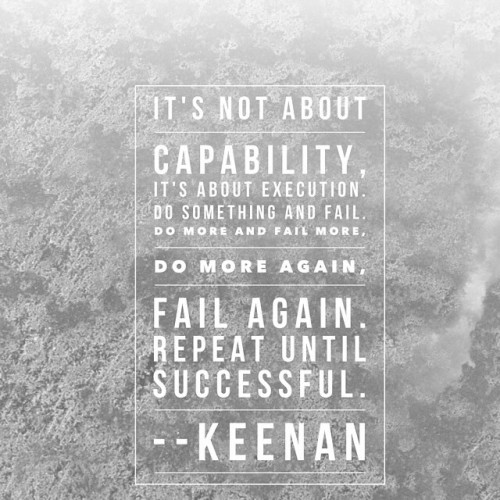
Capability is useless without execution. Capability means nothing without doing. You can’t do anything without actually trying to do it. Getting wrapped up in the idea of whether or not one is “capable” is just wasted breath.

Capability is the result of your effort to actually get out there and try. The more you try, the more capable you are.

Who cares if you’re capable?

Care about whether or not you’re willing to keep failing, keep trying, and keep learning. If you’re capable of failing and getting back up. That’s all the capability you need.


23 Jul 16:17

Constitutions Matter in our Daily Lives

by Atanu Dey

Regular readers of this blog know of my interest in constitutions and how they affect the prosperity, or lack thereof, of nations. A recent conversation with a friend prompted this line of thinking about constitutions and how they matter in our everyday life even though it may appear that constitutions are rather remote and cannot possibly be relevant in our lives.

People act, individually and collectively, within institutional constraints. These institutions are created by and embody rules that have developed historically partly through some social evolutionary process, and partly through some correctly or incorrectly conceived constructed processes.

How people play a game depends on the set of rules that the players know, observe, and rationally expect others to follow. The extended social order in which people live and work is also a game played according to a set of rules, not all of them explicitly set down on paper or deliberately constructed through some directed rational process.

In some cases, the broadest set of rules — the supreme law of the land — are written down and used as the superstructure within which all other more detailed rules are framed. The classic example of this is the US constitution which went into effect around 1789. Another example is the “Government of India Act 1935” which the British created to rule India and which forms the core of the later constructed Indian constitution.

The prosperity of a nation depends ultimately on the aggregate behavior of the people constituting it. People’s behavior, in turn, is determined by the rules and regulations that constrain and motivate behavior. Thus, the constitution in its role as the set of meta-rules has an unavoidable impact on everything that takes place on the ground.

The constitution is to a nation what character is to a person. A person’s nature or personality determines how a person behaves or responds to circumstances. Under similar situations, people respond differently based on their personalities. In a sense, the constitution defines the character of the collective we call a nation. Individuals act in response to the incentives they face, incentives that are created by the institutional settings which are ultimately derived from the constitution.

At the highest level, the constitution determines which of our activities will fall within the economic sphere and which in the political sphere. In the economic sphere, the production and consumption of goods and services are determined by voluntary exchange in markets. In the economic sphere, competition is between and among producers, and consumers choose what and how much they will buy. Activities that are removed from the economic sphere have to be allocated to the political sphere. When the government assumes control of production and distribution, consumers have to resort to political action to obtain what they want. Who gets how much of what then is a political question, not economic.

It may seem like a stretch that the choices we make in our day to day living are somehow related to a constitution that was framed decades ago (1935 for India) or even centuries ago (as in the case of the US.) But it is nevertheless true. For example, we behave differently under scarcity and abundance. If telephone services are scarce, people respond rationally by bribing the telephone provider. Whether something is scarce or not is partly technologically determined but more significantly determined by government policy. Government policy to restrict telephone services to monopolies (public or private) is constitutional, which then results in high prices and limited supply, is a consequence of the constitutional mandate to the government to interfere in the economy.

What citizens are allowed or prohibited to do is constrained by the policies that the government enacts, and the policies have to be consistent with the constitution. If the constitution were to change, the ultimate rules of the game would change, the policies (the derived rules) will change, and thus the action on the ground (the play of the game) will change, and therefore the outcome will change.

One important example. Suppose the constitution were to change so that the government was prohibited from restricting entry into the education sector. The government would then not be able to prevent for-profit institutions from running schools and colleges. That would expand competition, reduce prices, increase supply and improve quality. It would also eliminate the massive corruption that is currently present. It would also remove all the competition among various groups to get a part of the scarce supply. It would have an impact at the family level: parents and children would not be so desperately stressed.

Of course one may argue that a policy change to allow private sector into education does not need a constitutional change. Unfortunately, that kind of policy change is unlikely to happen because those in government have an incentive to prevent private sector entry. If they allow private sector entry, it will remove one of the most profitable source of bribes that they currently enjoy. Only a constitutional change will bring about policy change.

Prosperity has evaded India even after 1947 and “self-rule.” It can be argued that this is because India is not really free since it is still governed by a constitution that is primarily a set of rules designed by a colonial power to rule over its subjects. A change in the constitution is a necessary precondition for altering the rules of the game, and therefore the game itself and its outcome. The link between the constitution and what happens on the ground every day is robust and observable.

23 Jul 07:55

India’s labor market paradox: Rife underemployment and yet shortage of manpower..

by Amol Agrawal
Rahul Jacobs has a story on this Indian paradox. On one hand, we have underemployment where people are holding part-time jobs despite being highly qualified. On the other hand, there is shortage of labor is most sectors. We are actually creating more low-skilled jobs: It is a sight typical of departure gates at every airport in […]
23 Jul 07:55

Good Morning doctors!

by subra

This is likely to be the gist of my talk to Doctors on 19th July, at Hilton Hotel, Andheri, Mumbai

Good morning doctors, it is a pleasure to be addressing such a large gathering of doctors. This is the biggest group of doctors that I am addressing. Thanks for taking time to listen to me.

There is a small note that you will find in the handout given to you. That is for you to read at home. What I am talking here has NOTHING to do with that note. I am here just to give you a prescription (!!) for Wealth.

Talking about finance to doctors is an emotional topic! And I hope that I do not bore you too much. Many doctors have told me that they do not like numbers and maths and that is why they are in this profession.

Let me start by telling you a few simple things…

Like everything in life Finance is also very simple. In fact it is so simple that you will wonder why we need to train for 5 years to call ourselves accountants. Maybe we do not, but that is a different topic.

So how simple is it?

Well once you have a basic financial plan (which you can make yourself), you know where you are (what are your assets and what are your liabilities), and you know where you want to go (budget), you have to go to the sleep mode.

Ok, before you go to the sleep mode, understand the following terms

– Once you start earning you need to SAVE. Saving is a word we use for keeping money in the bank.

Once you have money in the bank you need to start investing the same. Investments happen in assets which have a wide variation in the returns )standard deviation is high) and that looks scary.

– you come from a hospital background where the investigating doctor has no reason to tell you a lie.

-in the BFSI space you can get various shades of grey. Truth is many a times partial, and in some cases it is the truth as understood by the guy who is taking to you

– knowing how the adviser is compensated is EXTREMELY Important

– there are some products which look so innocent that you will find it difficult to say no. However saying No will make you rich

– Goal clarity is an awesome thing to have, and hopefully by the time you are 40 you will be clearer in your goals

– life does not always go as per a plan. that is fine, learn that most of us are here by luck, but since we were born earlier, we can claim whatever we want

– go out there and enjoy yourself, nobody is going to ask you to go and have fun

– learn, learn, learn…………………………..and then keep learning.

– paying Income tax is voluntary only till a small level of income..beyond that it is compulsory Not paying is very painful. People whom you do not want to meet even on the road will sit inside your house making an inventory of your assets. It is too damn painful.

– at my age I have realized that honesty is a good policy. Go through your learning yourself. Believe me, it is a nice policy.

the products that will be thrown at you are ULIP, mutual funds, endowment, and housing loan.

What you need is a simple term insurance, one bank account, one credit card, and a good insurance consultant

– do not try to handle own investments unless you have family help.

-learning from the media CANNOT happen, however you may start doing something if the media eggs you on

not much more I guess…..

Post Footer automatically generated by Add Post Footer Plugin for wordpress.

23 Jul 02:56

What a Financial Advisor should be able to do

by subra

There is too much venom these days against the IFA. Not that I have not ripped them apart in my blog, but he/she has a very important role to play. I will try to say some of the things that an IFA can/ should do for the client. Whether they are equipped to, is a book in itself. Given the remuneration and other opportunities available I would not advise anybody to become an IFA.

– he (includes she) should be able to keep the client be in control of his investments

– make sure that he and the client understand every part of the portfolio – why, how to redeem, when to review, basis of change, etc. GET THE CLIENT to articulate, write and save it. His spouse too should know the details.

– avoid the inherent traps in the Financial Advisory business.

– communicate in such a way that the client understands the importance of record keeping, calculations, writing down things, communicating with other family members…etc.

– ensure that the client is not impacted by the extremely stupid short-termism in the media and mutual fund managers talks

– understand (and convey to clients) that wealth does not get built overnight. It takes decades, even generations to build up real big good wealth. If you get a good ‘r’ for a few years, YOU are lucky – actually it is the ‘n’ in the compounding formula that is important.

– explain the risks of PPF, NPS, NSc, bank fixed deposits, etc.

– explain concepts like growth option, tax deferral etc.

– explain index funds, star fund managers, temper expectations, past returns, etc.

eeks! there is a long list, dammit.

Post Footer automatically generated by Add Post Footer Plugin for wordpress.

23 Jul 02:53

Real Estate: The fall has just begun

by Muthu

In global markets, gold has fallen over 40% in last 5 years and silver has fallen over whopping 70% during the same period. Commodities prices are also crashing. The Bloomberg commodity index is now at 13 year low.

We’ve written many times in the past about various asset cycles.

In stock markets, a bull market last on an average for 5 years and a bear market for 3 years. So it takes 8 years for equity market to go through one complete cycle. So any holding period for less than 10 years or so is speculation.

For gold, a bull market last on an average of 10 years and bear market for 20 years. So it takes 30 years for gold to go through one complete cycle. What is true for gold is true for many other commodities as well. Commodities had a good run from 2002 to 2012 and it would not be a surprise if the current bear cycle last for next 2 decades.

I’m saying the above based on my extensive reading and understanding. Again the term ‘average’ can be misleading, as one bull market in stocks can be for 10 years and a bear market can be for 6 years. The given number is an average over many cycles. Each cycle may vary.

As far as real estate is concerned, based on what I discussed with people who have been observing real estate in the country for long time, they say the bull cycle is usually for 10 years and followed by bear cycle for another 10 years. A complete cycle may take usually 20 years.

It looks like the current bear cycle in real estate has started some time in 2013. Real estate had a good run between 2004 to 2013. The earlier bear cycle for real estate started in 1996 and lasted till 2003.

Ambit capital has published a detailed report recently titled “Real Estate: The Unwind and its Side Effects.” It explains how unsold apartments are rising heavily in metros and tier 1 cities, property prices have started correcting even in Tier-2 cities as well, new launches are getting reduced, number of property transactions is significantly coming down etc.

Instead of like sharp corrections in stock markets, real estate market corrections are slow and last over many years. A fall of even 50% is not uncommon. In the 1996-2003 bear cycle, properties in many part of India fell by 50%.

Assuming this bear cycle lasts for 10 years, we may expect the real estate to rise again only in the early part of next decade. One significant change which is happening to real estate is that black money in the same has started coming down. The direction is very clear. As the environment and legislations are getting tough for black money, over a period, black money would play a significantly lesser role in the years to come.

Indian real estate prices have been kept very high and unaffordable for common man due to black money. During the current bear cycle in real estate, the black money also would be largely brought under control. If that happens, in my opinion, we can no longer expect mind boggling returns in real estate even in next bull cycle. Real estate would give around 2% to 3% more than inflation. If inflation is 5%, we can expect real estate to give 7% to 8%.

In a fair market, the rental yields are close to cost of borrowing. Whereas in India, the rental yields are 2% and the cost of borrowing is 10%. As interest rates soften, the cost of borrowing would come down. As real estate prices correct, the rental yields would also go up. This would narrow the gap between rental yield and cost of borrowing.

Another thumb rule is that the value of the property should not be more than 3 times one’s annual income. If your annual income is Rs.12 lakhs, your house purchase value should be Rs.36 lakhs. I don’t know what the average income for a Chennaiite is. In the absence of data, let me just assume it is Rs.3 lakhs. A good 2 BHK in any decent suburb costs not less than Rs.75 lakhs. So a Chennaiite need 25 years of income, if he wants to own a flat in his city.

From my interaction with many people, I find that they commit not less than their 10 years income for a flat. This is not accounting for interest component.

The house price to rent ratio should be around 15. If a house cost Rs.1 Crore and the annual rent is Rs.3 lakhs; the price to rent ratio works out to 33, which is very expensive. Going by the thumb rule, if this ratio is above 20, then the cost of owning is considered higher than cost of renting. This means you would be better of paying rent.

If the above ratio is 15, then the rental yield will be 6.7% per annum (example: Property price is Rs.30 lakhs and annual rental is Rs.2 lakhs). So the ideal rental yield should not be less than 5%.

It would not be a surprise that in next few years real estate prices fall to such an extent, that the rental yields may be around 5% instead of the current 2%.

In nut shell, the bear cycle in real estate has just begun. Don’t be surprised even if there is a 50% correction over next few years. Tone down your expectation on real estate even in the next bull cycle as black money would start playing a lesser role.

Learn to accept the following returns from asset classes over long run:

Fixed Deposits: Inflation + 1%

Gold: Inflation + 1.5%

Real Estate: Inflation + 3%

Equity: Inflation + 7%


23 Jul 02:48

Tax Free Bonds of FY 2015-16 , AY 2016-17

by Kirti

In FY 2015-16 7 Public Sector Units or PSU will raise funds worth Rs 40,000 crore through Tax Free Bonds . It was a massive hit when it was last launched in 2013. This article gives overview of Tax Free Bonds,why are they popular, about tax on Tax Free Bond, Interest Rate of Tax Free Bonds, History of the Tax Free Bonds, comparison of Tax Free Bonds with other investment options.

What Tax Free Bonds are expected in FY 2015-16?

In months of Aug, Sep the following Tax free Bonds will be available. The bonds will have tenures of 10, 15 and 20 years and the interest rates are to be decided with reference to the rates of government securities.At present, yield on the benchmark 10-year gilt is 7.781 per cent.

  • The National Highways Authority of India will make the largest offering to the tune of Rs 24,000 crore
  • The Indian Railway Finance Corporation can raise funds to the tune of Rs 6,000 crore
  • The Housing and Urban Development Corporation – Rs 5,000 crore
  • The Indian Renewable Energy Development Agency – Rs 2,000 crore
  • NTPC – Rs 1,000 crore
  • Rural Electrification Corporation – Rs 1,000 crore and
  • Power Finance Corporation – Rs 1,000 crore

Power Finance Corporation (PFC) could be the first to hit the market,

What are the Tax Free Bonds?

Tax free bonds are those bonds issued for long term, for investment horizon of 10 to 15 years, in which interest earned is exempt from tax.  Tax free bonds do not provide any benefit of tax savings but only interest earned on these bonds is tax exempt. Since there is no tax on interest earned, these bonds are touted as much more attractive than bank fixed deposits. Our article Understanding Tax Free Bonds discusses it in detail.

Why are Tax-Free Bonds Popular?

  • Tax-Free Interest – Unlike fixed deposits (FDs), interest earned on these bonds is exempt from income tax for the investors. This is what makes these bonds highly popular among the tax paying retail investors and high net worth individuals (HNIs).
  • Scope of Capital Appreciation – There is no scope of capital appreciation with bank fixed deposits or company deposits as such investments are not directly linked to interest rate movement in the bond markets. Unlike bank/company deposits, tax free bonds get listed on the stock exchanges and their market value goes up when there is a fall in the interest rates. Tax Free Bonds issued during FY 2013-14 with coupon rate of 8.75% to 9% have been trading at a premium of 15-25% apart from their regular interest payments.
  • Liquidity – With tax-free bonds, you can only sell your bond holdings on the stock exchanges .
  • Highest Credit Rating – These bonds get issued by the public sector enterprises most of which are AAA rated. So, from the safety point of view, these bonds are highly secured and attract a big number of risk-averse investors. To me, it makes perfect sense to invest in these bonds as against riskier company deposits.

Taxation of Tax Free Bonds?

The unique feature of the Tax Free bonds

  • No Tax is saved when one invests in Tax Free Bonds
  • Is no tax on interest earned. That is interest is tax free.
  • This interest will be paid every year.
  • No TDS on interest as interest is tax free.
  • Interest earned has to be shown as exempt income while filing Income Tax Return ITR
  • If sold within one year one has to pay Short term Capital Gain at the normal rate,
  • If sold after one year one would have to pay long-term capital gains which are taxed at 10% without indexation and 20% with indexation. You can avoid long term capital gains by investing under section 54EC.

Interest Rate of Tax Free Bonds

An investor can earn interest rate ranging from 7.3% p.a. to 7.5% p.a. depending on the ratings assigned by a credit rating agency which are as follows. Higher the credit rating, less the interest.

  1. AAA Rated Issuer : National Highways Authority of India (NHAI) and Indian Railways Finance Corporation are AAA rated entities. will provide interest rate which is .55%  lower than similar maturity G-Sec yields.
  2. AA+ Rated Issuer HUDCO is AA+ rated entity. It will provide interest rate which is .1% above the interest rate offered by AAA rated issuer or .45% lower than G-Sec yield.
  3. AA or AA(negative) Rated Issuer will provide interest rate which is .2% above the interest rate offered by AAA rated issuer or .35%  lower than G-Sec yield. Currently none of the above permitted seven entities hold AA or AA- ratings.

History of the Tax Free Bonds

Tax Free Bonds were first issued in the financial year 2011-12  and raised Rs. 30,000 crore and subsequently in each following year but were absent in the last financial year i.e. 2014-15.

The funds raised through these bonds are usually invested in the infrastructure sectors which require funds for longer term as in comparison to any other sector.

AY Amount collected (in crore) Interest Rate Companies
2011-12 30,000 9.6 – 10.5% 6 PSUs:IRFC, NHAI HUDOC,L&T Infrastructure Finance,IFCI,LIC
2012-13 60,000 8.00 – 9.25% 5 PSUs:NHAI, PFC, IRFC, HUDCO and REC
2013-14 50,000 7.32-8.01% 9 PSU: PFC, IRFC, HUDCO, REC, IIFCL, Ennore Port, Dredging Corporation, NHB and JNPT
2014-15 - - -
2015-16 40,000 6.6-7.13% 7 PSUs: NHAI,IRFC,HUDCO,The Indian Renewable Energy Development Agency,NTPC,REC,PFC

Comparison of Tax Free Bonds with other investment options like PPF, Fixed Deposit,Tax Saving FD

Particulars Tax Free Bonds Tax Savings FD PPF FD
Deduction under section 80C No Yes Yes  No
Time of Investment When Issue Opens Anytime Anytime Anytime
Interest Rate Fixed at the Time of Investment Fixed at the Time of Investment Variate throughout the Tenure Duration  Fixed at the Time of Investment
Maturity 10-20 Years Minimum 5 years Minimum 15 Years  Variable
Taxation on Return or Interest Fully Exempted Taxable Fully Exempt  Taxable
Pre mature withdrawal Yes through Secondary Market Possible with penalty as well as by losing tax benefits No Allowed  Yes

How to buy New Tax Free Bonds in India?

You can subscribe to new tax free bonds when the Bond Issue is open for subscription. The issues will be open for few days only. The bonds can be bought in physical form or through your Demat account. The subscriber has to furnish Permanent Account Number (PAN) to the issuer of the Bonds.

In case, if you miss buying TFBs during the Public issue, you can still buy them from Secondary market through stock exchanges. But, they can be traded on the exchanges in Demat mode only.

Related Articles:

Tax free bonds locks money for long tenure at a competitive interest rate, they pay back interest every year , which is tax free,  continuing profitability of the issuing organizations over the tenure of the bonds is also a risk worth evaluating

What do you think of Tax free bonds? Did you invest in Tax free bonds in FY 2011-12 or FY 2012-13?  Where are you investing these days?What do you consider before Investing?

22 Jul 19:11

Infy: Jun 2015 Quarter Results Show Terrible Profit Growth Even Though Revenues Pick Up

by Deepak Shenoy

Infy results had come out yesterday and we do a chart thing with them:

Revenues up 7.03% : The Only Good Thing About Results

image

Profits are up 5% yoy but down 2% quarter on quarter. The only metric that works for them is quarter-on-quarter revenue growth.

EPS Growth, Too, Falls

image

Earnings Per Share has grown 5% year on year, after showing more than 20% growth last year.

Employee Growth at 11%, Utilization at 80%

image

Infy seems to have fixed the falling utilization rates and bumped it up to 80%, which means they have little scope for more productivity. (Yet, their profits fell quarter on quarter, which tells you how much of a problem this is!)

Employee net addition year on year is 11% which is probably how much their revenue will grow next year. Given that they don’t have much room for increased productivity, they will have to bank on:

  • higher billing rates or
  • higher USDINR conversion rates.
(Read On...)
22 Jul 19:11

What is the role of WPI in monetary policy?

by Ajay Shah
by Jeetendra.
 
The RBI just can't seem to catch a break. Try as it might, it just can't seem to escape controversy, even over issues that in other countries are not exactly controversial. Take the case of which particular inflation index the RBI should use as its target. For an entire decade, people debated ferociously over whether the target should be the  CPI or the WPI. Finally, about a year ago it seemed that all the arguments had been exhausted and a consensus had been reached that the CPI was best. So, Governor Rajan announced that henceforth the RBI would target the CPI.

Case closed? Not at all! It turns out that reports of the debate's death had been greatly exaggerated. On July 9 the Business Standard reported that a growing chorus of businessmen and analysts are complaining that CPI targeting has led the RBI astray, causing it to set interest rates too high. They want the RBI to target the WPI, which shows that prices are actually falling.

Did the RBI make a mistake? To answer this question one needs to go back to basics, and think about what monetary policy is trying to achieve.

The main goal of monetary policy is to provide a particular service to the population, the service of ensuring stable prices. This task is of such importance that the RBI was set up as a special institution, organisationally distinct and geographically separate from the government. When that set-up did not prove sufficient to safeguard low inflation, further reinforcements were put in place. The RBI adopted a formal inflation targeting regime, and the government in turn promised to provide the central bank with the operational independence needed to achieve the agreed inflation target. The Monetary Policy Framework Agreement, which was signed by Finance Secretary Rajiv Mehrishi and RBI Governor Raghuram Rajan on 20 February 2015, creates this formal arrangement. All this is being done because price stability is critical to the welfare of the population, especially the weaker sections who suffer badly whenever the prices of their necessities rise.

So far, so good. The problem comes when one needs to translate the universally agreed objective of price stability into a specific monetary policy stance. To do this, one needs three things. First, a specific measure of inflation. Second, a definition of what it means for this measure to be “stable”. And third, a framework (which could be based on an econometric model) for deciding what level of interest rates would best achieve the inflation objective.

In other countries, most of the debate has centred on the third issue, whereas the first two have proved relatively easy to address. Virtually all inflation targeting central banks define price stability as inflation somewhere between 2 percent and 5 percent. And they measure inflation using the CPI, because the objective is to improve consumer welfare, and the index that measures the price of consumption goods is the CPI.

In contrast, WPI is only distantly related to consumer welfare. For a start, it is unclear what the WPI is actually measuring. Its coverage is extremely limited, encompassing only the commodity-producing sectors and completely ignoring services, which constitute more than half of the economy. The few sectors that are included are then weighted according to their gross value of production, not their value-added. Consequently, the index is deeply unrepresentative of the economy.

But let’s suppose the RBI were prepared to ignore these theoretical issues. It would run immediately into some very practical difficulties. Since the WPI consists mainly of commodities, the movement of this index is heavily influenced by developments in world markets, which the RBI cannot control. The RBI cannot determine the dollar price of oil. And while it can influence the rupee price by controlling the exchange rate, this is a dangerous strategy, as the East Asian countries discovered at their peril in the late 1990s, when their exchange rate pegs collapsed in crisis. So, the reality is that the RBI cannot control the WPI, and should not try to do so.

Does that mean the RBI should just ignore the WPI? Not at all. Recall that achieving price stability – even if measured solely by the CPI – requires a framework for figuring out what level of interest rates is required to obtain this objective. And this is where the WPI does indeed come in, as do various other measures of prices.

Just not in the way that the analysts quoted in Business Standard argue. According to them, interest rates have been set on the premise that the economy and inflation are proceeding apace (as indicated by the rising CPI), whereas in reality manufacturers' prices are falling (as shown by the declining WPI). So firms are getting squeezed between high interest rates and low prices.

Firms may well be suffering from a profit squeeze. In fact, the corporate results suggest they are. But you can’t prove this by citing the WPI. That’s because the WPI does not measure output prices, the prices at which firms are selling their goods. The index that does this is the PPI, or producer price index, which unfortunately does not exist for India. Rather, the WPI is essentially a measure of input prices, because it consists mainly of commodities, which are largely inputs into production. Accordingly, a falling WPI actually increases firms' margins, improving their profitability. (Think: oil.) As a result, there’s no need, at least not from the falling WPI, to compensate firms in the form of lower interest rates.

That said, there is a kernel of truth in what the Business Standard analysts are saying. To see this, let’s go back to basics again. Very broadly, inflation occurs when aggregate demand exceeds aggregate supply. And aggregate demand is influenced by many factors, including many different price indices. Consumption decisions depend in part on interest rates adjusted for CPI inflation. Export demand depends partly on interest rates less export price inflation. And investment demand is influenced by the difference between interest rates and PPI and WPI inflation. Summing up all of these factors is impossible to do intuitively. That’s why central banks employ large econometric models to guide their policymaking.

So, in the end, the analysts quoted in Business Standard have a point. The WPI and its attendant data bank of price time series, should be taken into account, indeed perhaps is already taken into account, in the RBI’s policy-making framework. But it cannot be the object of this framework. The sole inflation target should be, indeed must be, the CPI. After more than a decade, it is really time to put this debate to rest.
22 Jul 10:31

We Eat Dollar Weighted Returns — VI

by David Merkel

One of the constants in investing is that average investors show up late to the party or to the crisis.  Unlike many gatherings where it may be cool to be fashionably late, in investing it tends to mean you earn less and lose more, which is definitely not cool.

One reason why this happens is that information gets distributed in lumps.  We don’t notice things in real time, partly because we’re not paying attention to the small changes that are happening.  But after enough time passes, a few people notice a trend.  After a while longer, still more people notice the trend, and it might get mentioned in some special purpose publications, blogs, etc.  More time elapses and it becomes a topic of conversation, and articles make it into the broad financial press.  The final phase is when general interest magazines put it onto the cover, and get rich quick articles and books point at how great fortunes have been made, and you can do it too!

That slow dissemination and gathering of information is paralleled by a similar flow of money, and just as the audience gets wider, the flow of money gets bigger.  As the flow of money in or out gets bigger, prices tend to overshoot fair value, leaving those who arrived last with subpar returns.

There is another aspect to this, and that stems from the way that people commonly evaluate managers.  We use past returns as a prologue to what is assumed to be still greater returns in the future.  This not only applies to retail investors but also many institutional investors.  Somme institutional investors will balk at this conclusion, but my experience in talking with institutional investors has been that though they look at many of the right forward looking indicators of manager quality, almost none of them will hire a manager that has the right people, process, etc., and has below average returns relative to peers or indexes.  (This also happens with hedge funds… there is nothing special in fund analysis there.)

For the retail crowd it is worse, because most investors look at past returns when evaluating managers.  Much as Morningstar is trying to do the right thing, and have forward looking analyst ratings (gold, silver, bronze, neutral and negative), yet much of the investing public will not touch a fund unless it has four or five stars from Morningstar, which is a backward looking rating.  This not only applies to individuals, but also committees that choose funds for defined contribution plans.  If they don’t choose the funds with four or five stars, they get complaints, or participants don’t use the funds.

Another Exercise in Dollar-Weighted Returns

One of the ways this investing shortfall gets expressed is looking at the difference between time-weighted (buy-and-hold) and dollar-weighted (weighted geometric average/IRR) returns.  The first reveals what an investor who bought and held from the beginning earned, versus what the average dollar invested earned.  Since money tends to come after good returns have been achieved, and money tends to leave after bad returns have been realized, the time-weighted returns are typically higher then the dollar-weighted returns.  Generally, the more volatile the performance of the investment vehicle the larger the difference between time- and dollar-weighted returns gets.  The greed and fear cycle is bigger when there is more volatility, and people buy and sell at the wrong times to a greater degree.

(An aside: much as some pooh-pooh buy-and-hold investing, it generally beats those who trade.  There may be intelligent ways to trade, but they are always a minority among market actors.)

HSGFX Dollar Weighted Returns

HSGFX Dollar and Time Weighted Returns

That brings me to tonight’s fund for analysis: Hussman Strategic Growth [HSGFX]. John Hussman, a very bright guy, has been trying to do something very difficult — time the markets.  The results started out promising, attracting assets in the process, and then didn’t do so well, and assets have slowly left.  For my calculation this evening, I run the calculation on his fund with the longest track record from inception to 30 June 2014.  The fund’s fiscal years end on June 30th, and so I assume cash flows occur at mid-year as a simplifying assumption.  At the end of the scenario, 30 June 2014, I assume that all of the funds remaining get paid out.

To run this calculation, I do what I have always done, gone to the SEC EDGAR website and look at the annual reports, particularly the section called “Statements of Changes in Net Assets.”  The cash flow for each fiscal year is equal to the net increase in net assets from capital share transactions plus the net decrease in net assets from distributions to shareholders.  Once I have the amount of money moving in or out of the fund in each fiscal year, I can then run an internal rate of return calculation to get the dollar-weighted rate of return.

In my table, the cash flows into/(out of) the fund are in millions of dollars, and the column titled Accumulated PV is the accumulated present value calculated at an annualized rate of -2.56% per year, which is the dollar-weighted rate of return.  The zero figure at the top shows that a discount rate -2.56% makes the cash inflows and outflows net to zero.

From the beginning of the Annual Report for the fiscal year ended in June 2014, they helpfully provide the buy-and-hold return since inception, which was +3.68%.  That gives a difference of 6.24% of how much average investors earned less than the buy-and-hold investors.  This is not meant to be a criticism of Hussman’s performance or methods, but simply a demonstration that a lot of people invested money after the fund’s good years, and then removed money after years of underperformance.  They timed their investment in a market-timing fund poorly.

Now, Hussman’s fund may do better when the boom/bust cycle turns if his system makes the right move somewhere near the bottom of the cycle.  That didn’t happen in 2009, and thus the present state of affairs.  I am reluctant to criticize, though, because I tried running a strategy like this for some of my own clients and did not do well at it.  But when I realized that I did not have the personal ability/willingness to buy when valuations were high even though the model said to do so because of momentum, rather than compound an error, I shut down the product, and refunded some fees.

One thing I can say with reasonable confidence, though: the low returns of the past by themselves are not a reason to not invest in Mr. Hussman’s funds.  Past returns by themselves tell you almost nothing about future returns.  The hard questions with a fund like this are: when will the cycle turn from bullish to bearish?  (So that you can decide how long you are willing to sit on the sidelines), and when the cycle turns from bearish to bullish, will Mr. Hussman make the right decision then?

Those questions are impossible to answer with any precision, but at least those are the right questions to ask.  What, you’d rather have the answer to a simple question like how did it return in the past, that has no bearing on how the fund will do in the future?  Sadly, that is the answer that propels more investment decisions than any other, and it is what leads to bad overall investment returns on average.

PS — In future articles in this irregular series, I will apply this to the Financial Sector Spider [XLF], and perhaps some fund of Kenneth Heebner’s.  Till then.

22 Jul 10:29

Latticework of Mental Models: Deprival Super Reaction Tendency

by Anshul Khare

Few weeks back when we discussed the Variable Reinforcement mental model, there was a brief mention about casino slot machines. Let me pull out that text for you –

Now that we are talking about slot machines, it’s worth mentioning another extremely intelligent aspect of slot machine design called calibrated near misses, which exploits another behavioural quirk called Deprival Super Reaction Tendency. But let me save that story for some other day.

Well, I was saving that story for today. :)

If you buy a ticket for the lottery that has the number 49 on it and the number 48 is drawn, you think, “I was so close…” BUT were you really? No you weren’t. If you have read the basics of statistics, you would know that the numbers in lottery are supposed to be random and the probability of each number is ideally same. So you weren’t anymore closer (or farther) from winning as you would have been if the number you got was 1.

However, that’s not how the gambling systems are designed.

In casinos, some slot machines receive better results (for the casino owner, not the gambler) than other machines based on the same payouts, same locations, same design, etc. How come?

The difference between the two slot machines is this – even though the overall probability of winning or losing is the same in both, one machine has a lot more “near misses” than the other one. This keeps gamblers hooked because it makes them think, “Oh! I was so close to winning. How could I miss it. Let me try again.”

The gambler tends to play more, which translates into more collections for the casino from the “doctored” machine.

Psychology of the near miss is particularly well known in the casino industry. The “near miss” potential is very reinforcing and makes people want to try again. In fact, gaming commissions, the regulatory bodies which control the casinos, are aware about this irregularity and they even allow slot machines to have unusually large number of “near misses” calibrated in the design.

Here’s another interesting video where a slot machine designer explains how intelligent design and human psychology is used to make the activity an addiction…


So much for the honesty in gambling. :-)

Now, why am I discussing gambling and slot machines? Because I want to tell you about …

Deprival Super Reaction Tendency
This irrational response to “near miss” or “almost there” is what Charlie Munger has dubbed as “Deprival Super Reaction Tendency”. It’s another super critical mental model from the field of psychology.

Let’s use the acronym DSRT because it saves screen space, computer memory, internet congestion, and my keyboard strokes. I know I have said this before but the real reason for using acronyms is that it creates an impression in reader’s mind that the author is smart. 😉

You can call DSRT a flavour of loss aversion bias, which states that the quantity of man’s pleasure from a ten-rupee gain is significantly lower than the quantity of his displeasure from a ten-rupee loss. However, the irrational reaction to loss in this scenario (taking away the almost possessed reward) is little more intense.


Peter Kaufman writes in Poor Charlie’s Almanack

If a man almost gets something he greatly wants and has it jerked away from him at the last moment, he will react much as if he had long owned the reward and had it jerked away. I include the natural human reactions to both kinds of loss experience – the loss of the possessed reward and the loss of the almost-possessed reward – under one description, Deprival Super Reaction Tendency.

It’s no wonder that this tendency isn’t just limited to humans. Evolution has ingrained this anomaly in animals also. Kaufman adds –

The Mungers once owned a tame and good-natured dog…There was only one way to get bitten by this dog. And that was to try and take some food away from him after he already had it in his mouth. If you did that, this friendly dog would automatically bite. He couldn’t help it. Nothing could be more stupid than for the dog to bite his master. But the dog couldn’t help being foolish…He had an automatic Deprival-Superreaction tendency in his nature.

You should read about Prof. Sanjay Bakshi’s tryst with DSRT, in his own words.

DSRT in Real World
It’s not just money that triggers the DSRT.

Taking away people’s freedom, status, love, friendship, opportunity, dominated territory or anything they value will results in DSRT.

Charlie Munger explains –

Deprival-Superreaction Tendency often protects ideological or religious views by triggering dislike and hatred directed toward vocal non-believers…because the ideas of nonbelievers, if they spread, will diminish the influence of views that are now supported by a comfortable environment including a strong belief-maintenance system…University liberal arts departments, law schools, and business organizations all display plenty of such ideology-based groupthink that rejects almost all conflicting inputs.

Centuries ago, DSRT was so strong that it wasn’t uncommon to subject the heretics to extreme torture and brutal death.

Coca Cola, one of the most celebrated and profitable brands in the world, was almost brought down to its knees by DSRT. In 1985, they launched a ‘New Coke’ which had different taste from the original Coke. The response was something they didn’t expect at all.

Coke was a birthright that everyone, from farmers to presidents enjoyed, together, and had for generations. Consumers felt that something had been taken away from them and replaced with something they didn’t ask for and didn’t like.

The ‘New Coke’ was a colossal failure. Coca Cola had to recall the new product and immediately bring back the original Coke.

Don’t underestimate the power of DSRT!

DSRT and Lollapalooza
One of the places where DSRT has ghastly effects is open-outcry auctions.

Social psychology experiments show that bidders in auctions often get carried away and end up bidding far more than underlying value of the objects being auctioned. Such outcomes are almost always caused by a combination of multiple forces working in the same direction. In auctions, these include greed, envy, bias from commitment (every bid is a public endorsement of the bidder’s belief that value exceeds his bid), social proof (last price from another bidder was reasonable), low contrast (every successive bid is only a tiny increment over the previous one), and DSRT.

So the best antidote to saving yourself from auctions is Warren Buffett’s advice – “Don’t go.”

And Charlie Munger says in his Psychology of Human Misjudgment lecture –

…the open-outcry auction is just made to turn the brain into mush: you’ve got social proof, the other guy is bidding, you get reciprocation tendency, you get deprival super-reaction syndrome, the thing is going away… I mean it just absolutely is designed to manipulate people into idiotic behavior.

Another area where DSRT, along with other behavioural biases, creates lollapalooza is the field of negotiations. In labour negotiations, the last thing negotiators want is the proposal to reduce wages. That’s because such decisions receive a disproportionately intense reaction from the unions due to DSRT triggered by the threat to take away something (wages, benefits etc.).

Many corporate salary structures include sign-on bonus (or retention bonus) which is given upfront with the condition that it will be recovered in case the employee leaves the organisation early. That’s a neat trick to exploit DSRT to keep the employees from quitting early.

In fact, persuasion experts (salespeople and marketing professionals) know it very well that the easiest way to convince people is to take their focus on what they will lose rather than what they might gain if they don’t use the promoted product/service.

DSRT in Investing
Peter Bevelin writes in his book Seeking Wisdom

We hate to admin we’ve lost money…we hate to sell losing stocks. It is the same as admitting to others and ourselves that we’ve made a mistake. We therefore hold on to our losers too long and sell our winners too soon. A realized loss feels worse than suffering the same loss on paper.

In fact the paper loss sometime drives people to such levels of irrationality that without questioning the quality of the business they buy more and try to average down their cost.

Loss-aversion combined with ego, writes Peter Bernstein in his book Against The Gods

…leads investors to gamble by clinging to their mistakes in the fond hope that someday the market will vindicate their judgment and make them whole.

Sadly the market doesn’t know that you’re holding on to a loser and neither does the losing stock.

Antidote to DSRT
We’ve already seen the most effective antidote against DSRT, under specific situation of auctions, is to avoid going to such places.

How do you save yourselves from the vicious design of slot machines? I suggest – “Don’t go to the casino!” But if you must, set aside a small amount of money marked as “sin money” and use that.

What to do when it comes to saving ourselves from DSRT arising out of conventional thinking? How do you deal with it at personal level and at organizational level in general?

Answer is – invite a “Devil’s Advocate”. Deliberately bring in able and articulate disbelievers of your ideas, people who hold contrary views. Make them your “adversarial collaborators”, a term introduced by Daniel Kahneman in his book Thinking, Fast and Slow.

To avoid falling for DSRT while investing in stocks, don’t focus on your purchase price. Ask: Suppose I hadn’t made the investment, would I make this investment today at current price? Don’t throwing good money after the bad money. Charlie Munger advises –

People go broke that way – because they can’t stop, rethink and say, “I can afford to write this one off and live to fight again. I don’t have to pursue this thing as an obsession – in a way that will break me.” Part of what you must learn is how to handle mistakes and new facts that change the odds. Life, in part, is like a poker game, wherein you have to learn to quit sometimes when holding a much-loved hand.

Now you know what to do when you hear the relationship manager from your bank tells you, “You will miss a 3X return if you don’t invest in our scheme.” Don’t panic. Remind yourself that it’s the DSRT play.

Knowing that our loss aversion makes us more sensitive to information that has negative implications for us, can we make use of DSRT to create positive results for us?

Here is an idea – Extending the persuasion argument about DSRT, we can motivate ourselves to adopt good habits by focusing on the information emphasizing the possible negative consequences (loss of good health, longevity) of not performing certain activities.

Conclusion
From coke to dogs, from stock market to open auctions, DSRT rules our lives.

It should be pretty obvious by now that DSRT plays an important role in understanding the human behaviour.

Awareness about behavioural biases doesn’t necessarily make us immune to them, however what we can attempt to do is to minimize their effect and increasingly make better choices.

Becoming a sensible investor is a byproduct of learning to make better decisions. Learning a new mental model today, we have added another instrument in our latticework toolbox.

As a closing thought, let me rehash what many wise men have said before – acquisition of knowledge at first may seem like a daunting task, but it’s amazing what you can achieve with a slow and steady progress – one idea at a time.

And before you realize the snowball of knowledge will start paving the path to an immensely satisfying life.

It’s said that the best gift you could ever give someone is your time, because you’re giving them something that you will never get back. So, thanks for investing your precious time with me today. I will always cherish this gift.

Take care and keep learning.

The post Latticework of Mental Models: Deprival Super Reaction Tendency appeared first on Safal Niveshak.

    
22 Jul 02:46

Addressing mis-selling in Indian finance: Lessons from South Africa

by Ajay Shah
by Sanhita Sapatnekar.

The setting


When a person seeks treatment from a doctor, he may worry about medical expenses or test results. What he probably does not worry about is a third party paying the doctor to actively damage his health, by providing unsuitable advice or administering an inappropriate medical product. In consumer finance, however, this happens all the time. Customers approach those perceived as finance experts for advice on financial products, or to buy these products. These experts often provide unsuitable advice or inappropriate financial products to the customers, because a third party is paying them to do so.

This problem is present across a large swathe of Indian household finance. As an example, a careful examination of one episode of one class of mis-selling problems has showen an estimated loss to investors of Rs. 1.5 trillion, or USD 28 billion from 2004-05 to 2011-12.

Three parties are involved in this problem:

  1. The product supplier, whose goal is to sell his products;
  2. The `middle-man', or the intermediary, who facilitates the product sale in
    return for a commission; and
  3. The customer, who may potentially buy the product.

While `financial intermediary' in general covers all financial firms, in the present context, it refers to the persons who engage in the front-end seen by customers, and not the financial firms such as mutual funds who produce the product upstream.

Just as the doctor plays both the role of providing medical advice to the patient, and occasionally that of distributing the medicine provided by the product supplier, intermediaries perform two roles in the Indian financial distribution system: they perform advisory services for customers and provide distribution services to product providers (such as mutual funds and insurance firms).

How is retail finance different from health?


The first key difference is that, unlike in the health setting, intermediaries in India sell financial products to customers but earn commissions from the product suppliers. Intermediaries are likely to focus on the potential commission they can earn when selling a particular product, rather than catering to the best interest of customers. In the health sector, this situation is less prevalent as the intermediary (i.e. the doctor) earns his income from the consumer (i.e. the patient), and not the service provider (i.e. the company providing the medicine); the doctor's financial incentives are driven by patient satisfaction. Several retail finance mis-selling episodes can be traced back to this arrangement. While advice may not be explicit, given the nature of the products, it is embedded in the distribution. The advisory role is particularly important considering that India has an estimated 65% of the population that is financially illiterate.

Second, unlike in the health sector where the type of doctor (and the type of service they are qualified to provide) is clearly defined, the retail finance distribution system in India lacks these definitions. This allows for gaps and overlaps in the type of intermediary, and therefore the service they provide (e.g. whether an intermediary is a qualified financial advisor, or just a salesperson, needs to be clearly defined before the consumer can make an informed choice on whether to take the intermediary's advice). While a patient would ordinarily not seek advice on a heart condition from a gynaecologist, a retail finance consumer may find himself taking advice from an intermediary not qualified to provide that advice, as regulations governing the type of intermediary, and therefore the type of services they are qualified to provide, are weak.

Third, a retail intermediary can play both the role of the salesperson and the advisor, because the retail finance advisory market is underdeveloped. Usually, a patient actively seeks medical advice from a doctor when he is in need of it. Medical products are therefore pull products. Under the present arrangements, the same patient may never seeks advice in the retail finance sector. This has made retail finance in India a zone of push products. This has given two groups of problems: The lack of demand for advice has hampered the development of the advice industry and the pervasive supply of advice by conflicted intermediaries is leading to bad decisions by households.

Fourth, grievance and redress mechanisms in the retail finance sector are underdevloped and inconsistently applied. Currently, each regulator is responsible for providing redress relating to products under their jurisdiction. As a result, there is no standardised service for redress, especially for consumers of complex products that fall under more than one jurisdiction. In the health sector, the ethical incentive to ensure a patient's health is maintained has resulted in enforced regulations aimed at curbing malpractice; if the doctor were to intentionally administer the wrong medicine, it is likely he would face consequences for his actions, as institutions that allow for redress are already established and developed. This factor leads to mis-selling as, unlike in the health sector, intermediaries know they are more likely to get away with selling an unsuitable product to a consumer, or giving inappropriate advice.

Mis-selling in South Africa


In the study of how mis-selling is being treated in other jurisdictions, we often turn to the UK or Australia. An interesting case study on this subject is South Africa, a country whose financial system is more comparable to India.

The South African financial distribution system has suffered from large scale mis-selling. The country's financial literacy rate is estimated to be 34% (comparable to India's 35%), and the financial distribution regulatory framework has not been effective in protecting consumers. The 2002 Financial Advisory and Intermediary Services (FAIS) Act made progress in raising intermediary professionalism, improving disclosure to clients and mitigating certain conflicts of interest. However, poor customer outcomes and mis-selling of financial products persisted. As a result, the South African Financial Services Board (FSB) initiated its own Retail Distribution Review, the findings and proposed recommendations of which were published in November 2014.

The RDR approaches the current landscape in South Africa from three perspectives:

  1. First, it looks at services provided by intermediaries. The RDR proposes clearly defining the types of services provided as advice (which is a service to the customer); intermediary services (which are services connecting product suppliers and customers); and other services provided by advisers and intermediaries (which are services to product suppliers). Further, the RDR defines types of advice an intermediary can provide. The RDR then sets proposed standards for each type of advice, including intermediary disclosure requirements and steps for mitigating and managing certain conflicts of interest.

  2. Second, the RDR looks at the relationships between intermediaries and product suppliers. In line with defining the types of advice offered, the RDR proposes definitions for the types of advisers, based on whether they are tied to one or more product supplier, or if they are independent. The RDR also sets proposes qualifying criteria for an adviser to be fully independent based on the products offered; the product supplier in connection with these products; and level of influence from product suppliers. Standards for product suppliers' responsibilities are proposed for each type of adviser as well as for non-advice sales.

  3. Third, the RDR looks at the remuneration earned for the services concerned. Among the proposals relating to remuneration, the most notable is the one banning commissions for all investment products, which comes only after the recommendations for reconstructing the retail distribution system. The recommendation states that: Product suppliers will be prohibited from paying any form of remuneration to intermediaries in respect of investment products, and from including any costs associated with intermediary remuneration in product charging structures, whether in the form of ongoing charges or early termination charges. Intermediaries will correspondingly be prohibited from earning any form of remuneration in respect of investment products other than advice fees agreed with the customer, in accordance with the applicable requirements for such fees.

Lessons for India


South Africa's financial distribution system is complex and lacks clear structure. As a result, creating legislation to address mis-selling without first restructuring the distribution system (including defining services provided and relationships between intermediaries and product suppliers) has failed as a solution, as demonstrated by the FAIS Act.

In countries such as the UK and Australia, where these definitions are already in place and redress mechanisms are well established, the focus of regulatory reform falls mostly on resolving conflicts of interest in relation to intermediary remuneration. The South African proposals also address intermediary remuneration, but only after first addressing the services provided by intermediaries and the relationship between intermediaries and product suppliers. In India (as in South Africa), the problem is twofold:

  1. A sound distribution framework needs developing before implementing changes to commission structures can be fully effective. This entails conducting a thorough review of the current retail distribution system in India, developing a clear understanding of retail distribution dynamics, and then establishing rules and regulations on the types of services provided by intermediaries; their relationship with product suppliers; disclosure norms; and qualifying requirements.
  2. Effective grievance and redress mechanisms that are consistently applied nationwide across the retail finance sector (regardless of which regulator's jurisdiction a financial product comes under) need to be developed.

In the short run, consumer protection thinking will need to be grafted on top of the present legal framework in India, which was not designed with consumer protection in mind. Financial agencies are in the process of adopting the FSLRC Handbook where Chapters 2 and 3 are about consumer protection. This article should feed into this work process.

The fuller solution, however, requires the Indian Financial Code (IFC). The IFC approaches retail finance with consumer protection as an objective, making it the regulator's responsibility to create regulations for these consumer protection provisions. The IFC defines "advice" as a "recommendation, opinion, statement or any other form of personal communication directed at a consumer that is intended, or could reasonably be regarded as being intended, to influence the consumer in making a transactional decision". Further, it defines a "retail advisor" as a "financial service provider or financial representative that gives advice to a retail consumer".

The draft law then gives the regulator powers to discharge its functions with the objective of protecting and furthering consumer interests, and promoting public awareness of financial products and financial services. The IFC then places the responsibility of making regulations for these provisions to the regulator. Under the IFC, the regulators could thoroughly review and reconstruct the retail distribution framework within these bounds.

The Ministry of Finance has established a task force aimed at creating the Financial Redress Agency (FRA) of India, as envisaged in the IFC. The FRA will be a nationwide independent agency providing redress for financial consumers across all sectors, with the ability to handle large volumes of relatively low value complaints. While this addresses the grievance redress aspect of the problem, other provisions in the IFC facilitate the second aspect, and allow for the retail distribution system to be reconstructed.

Acknowledgements


I thank Renuka Sane for valuable discussions.
22 Jul 02:45

Urban development with Chinese characteristics

by noreply@blogger.com (Gulzar Natarajan)
The latest plan from China, a megalopolis six-times New York, combining Beijing, Tianjin, and Hebei province, called Jing-Jin-Ji, with a population of 130 million,
The new region will link the research facilities and creative culture of Beijing with the economic muscle of the port city of Tianjin and the hinterlands of Hebei Province, forcing areas that have never cooperated to work together...  This month, the Beijing city government announced its part of the plan, vowing to move much of its bureaucracy, as well as factories and hospitals, to the hinterlands in an effort to offset the city’s strict residency limits, easing congestion, and to spread good-paying jobs into less-developed areas...
Jing-Jin-Ji, as the region is called, is meant to help the area catch up to China’s more prosperous economic belts: the Yangtze River Delta around Shanghai and Nanjing in central China, and the Pearl River Delta around Guangzhou and Shenzhen in southern China. But the new supercity is intended to be different in scope and conception. It would be spread over 82,000 square miles, about the size of Kansas, and hold a population larger than a third of the United States. And unlike metro areas that have grown up organically, Jing-Jin-Ji would be a very deliberate creation. Its centerpiece: a huge expansion of high-speed rail to bring the major cities within an hour’s commute of each other.
High-speed rail has a central role in this grand plan, 
Chinese planners used to follow a rule of thumb they learned from the West: All parts of an urban area should be within 60 miles of each other, or the average amount of highway that can be covered in an hour of driving. Beyond that, people cannot effectively commute. High-speed rail, Professor Zhang said, has changed that equation. Chinese trains now easily hit 150 to 185 miles an hour, allowing the urban area to expand. A new line between Beijing and Tianjin cut travel times from three hours to 37 minutes. That train has become so crowded that a second track is being laid. Now, high-speed rail is moving toward smaller cities. One line is opening this year between Beijing and Tangshan. Another is linking Beijing with Zhangjiakou, turning the mountain city into a recreational center for the new urban area... “Speed replaces distance,” Professor Zhang said. “It has radically expanded the scope of what an economic area can be.”
It is no surprise that the two central pillars of this strategy are relocating existing activity clusters (like the administrative center to the Beijing suburb of Tongzhou, and over 1200 polluting businesses outside city centers) to spread growth to newer areas and using high-speed rail to connect population centers within the large region. Both these are logistical interventions, in which Beijing has already demonstrated excellence. And with everything the Chinese do, the sheer scale is staggering. Amidst the recent gloom surrounding China, this may represent a reasonably sound potential economic opportunity for sustaining the country's investment driven growth model. 
Add to Technorati Favorites
21 Jul 10:13

YouTube videos on Filing Income Tax Return by Amlan

by Kirti

Youtube is amazing. Just like picture is worth 1000 words a, A Minute of Video Is Worth 1.8 Million Words, according to Forrester Research. And among all kind of video on youtube you also have tutorials on Filing Income Tax return by Engineer Amlan. In this article we are going to talk about Amlan’s videos on filing Income tax return, his vision of making knowledge free, how he started making videos,his future plans.

Amazing YouTube

My 10 year old visits it it daily for his school project on history of Pi, to latest song videos or even videos of how games are played, or reruns of his favourite shows. I visit it to find about solution to my children school problems (especially ExamFear which has more than THREE THOUSAND EIGHT HUNDRED (3,800) educational video lessons on Physics, Maths, Chemistry & Biology for Class 9, 10, 11 & 12 with concepts & tricks), recipes,anything that I want to learn. We have also started making some videos and uploaded them on YouTube at bemoneyaware’s Youtube channel.

Since its inception in 2005, YouTube has grown from a site devoted to amateur videos to one that distributes original content. It played an instrumental role during the Arab Spring, and has also helped jump-start the careers of Justin Bieber and Korean pop sensation Psy. Some statistics about YouTube

  • YouTube has more than 1 billion users
  • Every day people watch hundreds of millions of hours on YouTube and generate billions of views
  • The number of hours people are watching on YouTube each month is up 50% year over year
  • 300 hours of video are uploaded to YouTube every minute
  • ~60% of a creator’s views comes from outside their home country
  • YouTube is localized in 75 countries and available in 61 languages
  • Half of YouTube views are on mobile devices
  • Mobile revenue on YouTube is up over 100% y/y

YouTube channel of  Engineer Amlan

Engineer Amlan has lots and lots of tutorials on YouTube such as GO DADDY HOSTING – A Practical Perspective of thing’s,ADS,ADSENSE ,ADWORDS -Understanding with live examples,IRCTC(Explaing the online Ticket Registration system) and 10000 live cases for income tax ( Whatever your case , we have a solution ) As on Jul 20 2015 it has 9,387 subscribers  and 2,249,192 views . 

There are many tax related channels on YouTube like  Dilip Dadlani , Learn with Lodhas, which are good but they are theoretical. Amlan YouTube channel on ITR is in simple language, jargon free.  A sample image of his YouTube channel is shown below.

Youtube channel of Amlan Datta

Youtube channel of Amlan Datta

Amlan’s Mission is to make Knowledge Free , he is very passionate about it and  refers to Tagore, Vivekananda often in his videos, and as he says in his About page

Project – Make Knowledge Free —

I make this channel with a noble intent to make every common person educated of certain important things that concern everyone . I do this knowing that it stands to benefit lakhs of families – Your children , your parents , your families . A educated mind is able to appreciate thing’s in a much better manner and has less chances of being duped .

Know that ,knowledge and education is no one’s monopoly , it’s everyone’s birthright

I will relax once i finish of the mission , finance is just 1 subject

More than your subscription to my social pages , i will appreciate and feel good when yourl share your knowledge with people and help others . Life bring’s with it some pain knowing that we are all taught to be selfish by the same society that stands to benefit if a kind approach is adopted .

I beg you to adopt the kind approach of helping people by sharing knowledge so that a time shall come when every mind is truly educated.

Youtube Amlan Datta's mission make knowledge Free

YouTube Amlan Datta’s Mission make knowledge Free

Conversation with Amlan

It was so easy to contact Engineer Amlan Dutta. He has given out his mobile number on his Facebook page and YouTube videos.  I sent him a message that I want to ask him some questions and we had a 47 minutes long conversation .  You can you can listen to the recording , which he sent within 5 minutes of when the conversation ended , on Soundcloud here.

Who is Engineer Amlan?
Amlan is 2005 passout Civil Engineer working in a company. He is living with his parents in Mumbai.

How did you start making videos on Tax?

In  year 2011-12 I got the notice from income tax department, there is credit mismatch, a credit of 1 crore is being shown. I was asked to take my  Form 26AS and meet the Assessing Officer. He asked me does BHEL pays that much salary. I  then found out that Account officer while filing the TDS  for salary income has shown the consolidated TDS in my return.  There was also the case of lease agreement with my father for house which made me realise that I had not filled my income tax return properly. I also had to pay penal interest.

I realised that I did not know the subject of Income tax and started learning and sharing my information through YouTube.

How long does it take a video?

For an 1 hour of tutorial it takes around  4 hours. After making the video I have a high, something like people getting on drinking. I am very passionate and I have become addicted to making videos especially about tax. In tax season I uploaded 250 tutorials  in a day and made a 6 hour marathon video on filing ITR.

You are young, Don’t you want to spend time partying with your friends?

I have few friends, but I am not much into socializing. I go once or twice  in month with friends but I do not like going to bar where people are eyeing girls in short skirts. I am happy in spending time on making video and sharing knowledge.

What are the Future plans?

I am preparing for GMAT and want to do the  IIM Ahmedabad Fellow Programme in Management (Doctoral Programme, Equivalent to PhD) coursein  Innovation and Management in Education.

What about the Marriage plans?

My parents are after me and someone told me on Facebook next three years are going to be difficult :-)

Are there monetary benefits on making videos?

Yes I earn through Google Adsense just like Ekta Kapoor earns through her programs in TV channel. There is no hidden motive in making the videos. Infact I have made vidoes on how anyone can earn through youtube channel. I make the videos with the intent of making Knowledge free. (FYI Bemoneyaware also earns through Adsense but that happened recently only and it’s not the big amount that one can leave job )

How do you take Criticism?

Criticism if good , constructive, raises valid questions, adds values is welcome. But if someone’s intent is just to criticize, ex the voice is not good  I ignore them, but if it persists I block them.  It’s easy to criticize, when Sachin Tendulkar was playing, entire India had opinion on everything, his playing style, his bat. But how many of us can face Shane Warne the way Sachin did.  (Bemoneyaware : There is a famous quote in Hindi which translated to English is The elephant keeps walking while the dog keeps barking.)

If people think my videos are not good, please make videos and help people. My mission is to spread knowledge,  I have shown my PAN number, given out my mobile number. When experts call me to test me I speak in their language , I have collected, read books on Tax from various sources .(Bemoneyaware just like Paresh Rawal in Hindi movie OMG)

I do realise that I may make mistakes. If I make mistakes like I made in Fixed Deposit I correct it. I am trying to help people . Everyday people like an autorickshaw guy, or a girl from Kashmir contacts me though Facebook, WhatsApp and I try to help them and others by sharing what I am.

His biggest dream is 

Make knowledge free is my biggest dream. I believes that if experts from  different domains like doctors, lawyers start sharing their knowledge, do their little bit for humanity, this country where Tagore and Vivekananda lived will again become a great country.

Related Articles:

Technology has given opportunity to ordinary people like Amlan, Bemoneyaware to spread knowledge. Please do visit Amlan’s YouTube videos on Tax related stuff and do your bit,no matter how small it is, for spreading knowledge.