Shared posts

15 Aug 03:11

The madness for growth

by Rohit Chauhan

Let me share some actual data, without sharing the name of the company initially

One year return = 69%
5 year return = 75% CAGR

I don’t know about others, but in my universe this kind of performance is something to kill for. At the same time, one has to be insane to expect this kind of growth forever. If one my positions were to deliver this kind of performance, I will consider myself lucky (not smart). 

However I would not run around looking for such companies prospectively as they are like shooting stars – be glad you saw one (or hold one), but do not sit on your terrace forever waiting for one.

If an investor has an investing lifetime of 30+ years, even a 20% return will make him or her insansely rich. A 75% per annum return for 30 years ? look at the numbers below for comparison
1 lac becomes 2.37 Crs after compounding at 20% for 30 years
1 lac becomes 1,95,497 Crs after compounding at 75% for 30 years

However investors keep chasing these shooting stars


And what happens, when they are disappointed, even temporarily?


So what is the name of this mystery company? Its symphony limited

Below is the chart of the company for 5 years


The madness of growth
Is the name even important? This is not a one off case. Look for any company – good, bad or ugly. If the company shows a couple of quarter of growth, the stock price shoots up with no link to valuation, quality or sanity.
On the other hand if the music stops, even for 1-2 quarters, the response is brutal. The herd which rushed in blindly, now heads for the exit.

I don’t think this can be called investing – it’s a mad hunt for growth.

For the slowpokes like me, it is better to just sit and watch. The risk here is that the retail investor will again repeat the same lessons of the past – Buy high and sell low.
Added note: I have taken symphony limited as an example. I am not discussing the merit of this company as an investment. I may or may not hold this stock in my portfolio. The warning holds – if I discuss about gold, real estate or goat, I may or may not be buying or selling it. So please do your homework if you plan to buy anything discussed here, including the goat!
 

---------------- 
Stocks discussed in this post are for educational purpose only and not recommendations to buy or sell. Please contact a certified investment adviser for your investment decisions. Please read disclaimer towards the end of blog.
14 Aug 11:55

Use Time as an ally

by subra

Most of us cannot understand using time as an important agent in creating wealth. It takes a mathematician to appreciate that. Assuming you had bought good equities or invested in growth plans of good funds for the past say 20 years you would have got fantastic returns. It does not seem the help people EVEN if you give them examples of a Rs. 2000 per month SIP turning to Rs. 1 crore over a 18 year period.

Why does this happen? because we underestimate the power of TIME.

What we remember from the past is what our mind allows us to remember. So all the painful experiences are nicely edited and presented to us. We learn to beautifully blame others, and we remember events EXACTLY the way we want our brains/mind to remember the event.

Despite our own past experience and knowing that we cannot see the future, we claim to think that we can. So we end up choosing stocks, fund houses, portfolio managers on some hunch rather than a mathematical / logical base.

We keep reading “the past is not an indicator of the future” and repeatedly ignore that. We think only a black swan event can derail our retirement plan. Actually one mistake of expecting to die at 79 – if it becomes 97 it can completely, completely de rail our retirement plan. We think our brain will work perfectly till the last day we live. How optimistic!!

We have to use time as an ally, not as a foe. We need to understand that we do not understand the future.

Is mortality the reason we treat time as an enemy? Remember your body dies, your soul and your investment live on.

Post Footer automatically generated by Add Post Footer Plugin for wordpress.

14 Aug 11:54

A book on GOAL BASED INVESTING with calculators

by subra

this is the Index of a book called : “Goal Based Investing”

Where are you today? (balance sheet, net worth, working assets, and using assets)

Where do you want to go (Goal setting)

Resources that you have (Cash flow and amounts available for investing)

Risk profiling (this is tricky. I want a person’s asset allocation to come out of his risk profiling. If he is not happy with say 60% equity and 40% debt, HE should alter his RISK profile not just his Asset allocation)

Asset allocation: understanding that ‘future earnings’ is a very big asset from age 23 to age 53, so if that is steady (like a Gov job) then bought assets can have equity, but if the main source of income is fluctuating (like a salesman) then he needs to have more stable assets.

Mutual funds (including how to select a fund, and how ratings are useless)

Portfolio construction (requires discipline, not IQ)

Life and Health Insurance

Documents to be maintained

Mistakes to be avoided

How to stay away from new product

#########################################################

Do you think anything more has to be added. If yes, what?

PS: this index is not final, it is subject to additions AND deletions. It will not have anything like “what is a mutual fund” of ‘what is equity’ kinda stuff – and it will be math / calculator driven…

PLEASE GIVE FEEDBACK ON THE BLOG….not on FB :-) FB posts are difficult to track…

Post Footer automatically generated by Add Post Footer Plugin for wordpress.

14 Aug 03:23

The Great Big Chinese Yuan Devaluation In Perspective

by Deepak Shenoy

Yeah, yeah, the Chinese Yuan has devalued.

But let’s just see what other emerging countries have done since last August.

image

Puts things in a slightly different perspective. … (Read On...)

13 Aug 07:18

At Least Build A Small Buffer

by David Merkel

On the home front, I have been doing more basic financial counseling than usual, and I’ve had some say to me that it would be hard to build a buffer of 3-6 months of expenses.  If that is true of you, I would encourage you to build a smaller buffer of one month’s wages.  Why?

  • A change to good habits rarely happens immediately.  You gotta walk before you can run.
  • Psychological changes happen slowly, and there is a mental reward to achieving a smaller, interim goal.
  • The idea of living off of last month’s paycheck is a simple one.
  • Contra Aristotle, money is not sterile.  It tends to beget more money, once you pass a certain threshold.  Why?

There are discounts for upfront payment on large purchases, but the biggest reason is that once you get used to living on less than your full income, and living off of the buffer fund, there is a tendency for the buffer to grow.  You have begun to master a key concept:

Money has importance tomorrow that is more valuable than spending on purchases of trivial importance today.

I’m surprised at how money burns a hole in the pocket of so many people.  Spend down to the last dollar in the pocket and then some.  No wonder the credit card companies are so big and profitable.

I have another article coming up on this, but it is critical to basic financial management that you place importance on the ability to meet future needs with greater certainty.  Thus the need for the buffer, which implies saying “no” to low value and low priority spending.

It’s not a question of the intellect usually, but of the will.  When will you start making money your servant, rather than serving it?  Go build the buffer, even if it is small.  In time, with increased will power on your part, it will grow.


13 Aug 03:22

Steel Duty Hike Will Not Change Anything as Long as We Have FTAs with Japan and Korea

by Deepak Shenoy

The government has hiked the duty on certain steel products by 2.5%. This is after recently increasing duties on Steel imports by 7.5% to 10%.

I was on CNBC TV-18 earlier today speaking of stocks (Click here) when an interesting conversation happened with Mr. Seshagiri Rao of JSW Steel. (Link)

What he said was:

  • India imports around 45% of steel from Japan and Korea (read: Not China).
  • We have Free Trade Agreements (FTAs) with these countries, which restricts imposed duty to less than 1%.
  • So this 2.5% increase (or the earlier 10% and 7.5% increases) have no impact.
  • It does impact Chinese imports.
  • Imports form Japan/Korea are at $360 per tonne (landed) while China’s at $330.
  • Even in their own countries, steel is available at $500 a tonne, so in effect they are subsidizing exports
  • He recommends a “safeguard duty” of 40% to counter the threat

Whoa, Then Duty Hike Has No Impact?

(Read On...)
13 Aug 03:20

China devalues Yuan!! Omg what to do?

by subra

As long as Indians and Chinese are willing to work harder than their European and even the American counterparts….it will be cheaper to make in India and China.

What is the implications for you?

NOTHING. NOTHING. NOTHING.

KEEP doing your SIP and let the fund manager worry about whether to buy Infosys or TCS.

Let us keep doing our SIPs….


Post Footer automatically generated by Add Post Footer Plugin for wordpress.

13 Aug 03:20

What a Surprise: Inflation in July 2015 at a Delightfully Low 3.78%

by Deepak Shenoy

Inflation for July 2015 has come in at a new all time low of just 3.78%.

image

Some of this is indeed expected, as last year the index went sharply up, till September 2014, before the crude fall came and killed all elements of inflation in India.

Both Urban and Rural Inflation are down substantially:

image

Check out Capital Mind Premium!

Get In-Depth Macroeconomic Analysis, Market Metrics, Proprietary Capital Mind Indexes, a look into the CAPM Portfolio and More Actionable Insights, straight to your Inbox.

Take a 30-day Free Trial!

Apparently, food inflation has fallen tremendously:

image

Core Inflation – the move of the index minus food and fuel – has fallen too.

image

Our View:

We believe that:

  • Inflation is expected to be lower as last year at this time, crude were quite high. The effect will wear off in September. We’re only in July so August data too will be kind.
  • The monsoon isn’t too bad and we are seeing enough agriculture enthusiasm, so food prices might remain low (or not increase much).
(Read On...)
13 Aug 03:18

IIP for Jun 2015 at +3.8%, Manufacturing Rebounds and Consumer Durables Spike

by Deepak Shenoy

India’s Index of Industrial Production (IIP) grew 3.8% over the previous year, a four month high. (Largely because the headline number of 4% of April was revised down to 3.36%)

image

While this is interesting, the real story is that manufacturing continues to do well at +4.6%. Mining, however dipped below zero, and Electricity generation which had done so well recently, fell substantially.


image

In a way this is real growth, since the IIP measures production quantities, not revenues or rupee numbers. The point being: you could manufacture the same quantity of something but price it higher (inflation) to get a higher rupee number, but the real growth is number of units produced.

But let’s not kid ourselves. Even 3.8% is terrible. We should be at the 6-7% numbers to be even remotely sounding like we’re really growing.

Use based: Consumer Durables

In what is the only interesting part of this picture, IIP has grown in the consumer durables space at 16%.… (Read On...)

13 Aug 03:17

The GENCO muddle in India's power sector

by noreply@blogger.com (Gulzar Natarajan)
Business Standard reports of a Memorandum of Understanding (MoU) between BHEL and the Telangana Power Generation Corporation for three power plants with 5880 MW capacity at a cost of Rs 26,640 Cr. Since the three projects were approved before the current guidelines on mandatory tariff based bids were issued in early 2011, their tariffs would be determined under Section 62 of the Electricity Act, 2003, on a cost-plus basis. 

This draws attention to the reforms on the generation side, particularly at the level of  state generating companies or GENCOS. It is well known that most of these entities are poorly managed, corruption-ridden (on coal and other procurements), operationally inefficient (high station heat rates), over-staffed, debt-laden, and have very high construction cost which translate into high tariffs. On their revenue-side, having the last charge on discom revenues (after independent power producers,IPPs, and central power generators), they are forced into accumulating payment dues from discoms on the power sales. It is estimated that these receivables are well above Rs 1 lakh Cr and mounting. 

Consider the example of the three new Telengana Genco plants. At a time when the discoms are deep in the red, and with no signs of any improvement, and have stopped purchases across the country, such large capacity addition is unlikely to find buyers. It is most likely that their construction costs are on the higher side and will therefore generate high-cost power. This would make discoms even less interested in purchasing this power since it is unlikely that they will be able to pass on the cost of purchase in the form of higher tariffs. Further, the coal linkage (almost 30 mt would be required) and transmission capacity for the project are uncertain. It would entail more recruitment and further unionization. 

In this context, the Government of India and states should consider a few of the following options

1. All the MoUs signed by State GENCOs under Section 62 where construction has not started should be immediately annulled. These projects can be recast as Section 63 contracts, where discoms would purchase power based on competitive bids. 

2. Public finance, through PFC or REC or Public Sector Banks, should be curtailed so that GENCOs (and also discoms) do not have access to easy funding of the like that the Telangana and other GENCOs routinely access. Rigorous commercial due-diligence, in the same manner as is done to IPPs, should underpin any lending to GENCOs. 

3. The cozy arrangement whereby GENCOs fill the order books of public sector entities like BHEL, with liberal payment terms, should be broken up immediately. All Boiler-Turbine-Generator (BTG) and other procurements should be done only through competitive bidding. Such cozy arrangements between GENCOs and state entities like BHEL and PFC are inflicting enormous damage to the sector by crowding out more competitive projects and increasing the burden on consumers. 

4. Finally, GENCOs should form part of any restructuring of discom losses. Apart from their chronic distribution and commercial losses, discoms are saddled with high cost power purchase from GENCOs. States should be encouraged to sell some of their high cost generating stations. Such sales should be made conditional on buyers investing in retrofitting the stations or augmenting capacity so as to lower the cost of service.

Over the years, GENCOs have doubtless played an important role in capacity addition, especially when IPPs could not have shouldered the burden. Further, state generating stations today play an important role in keeping IPPs honest. But now, when IPPs form more than 60% of the capacity addition in recent years, the time may have come to pull the plug on state support and preferential terms, and let GENCOs compete in the market on level-playing terms with IPPs. 
Add to Technorati Favorites
13 Aug 03:15

The big, huge, massive mistake while investing

by subra

This is not an exaggeration. It is not another way of teaching you compounding. However when you read you will appreciate.

Let us assume that a young person has built up a portfolio of say Rs. 300,000 in equity mutual funds and he has opted for the dividend option. Every year he gets about 15,000 as dividend and that remains in the savings bank account. While doing his SIP he ignored this dividend and did a SIP based on his take home pay.

What happens to this Rs. 15k ? Nothing really. At the end of the year it is still sitting in the savings bank account and earning 4% interest.

Instead if he had opted for the GROWTH option, this Rs. 15,000 (technically a little more, a little amount has been lost to inefficiency in the dividend option – securities transaction tax) keeps getting added to the corpus. In the sense that the NAV keeps going up.

Similarly for a person with an equity holding portfolio – the dividends should be reinvested almost immediately. Assuming of course that he is young and living off his salary. So a person who has bought say 100 shares of Cholamandalam Investment and Finance company in 2010 for Rs. 65. He gets Rs. 500 as dividend in 2015 he should go and buy one share…this in the US is called DRIP (dividend reinvestment program). In this the company gives you SHARES instead of cash.

Not reinvesting the dividends and opting for dividend option (in equity schemes) is a real huge, terrible, massive mistake.

ALWAYS OPT FOR GROWTH OPTION. There is only one exception. In case you are short of cash to take advantage of 80C and you are investing only a portion of the Rs. 1.5L . In such cases use the dividend option so that the dividend is received in cash and you re invest – getting the tax benefit for the next year.


Post Footer automatically generated by Add Post Footer Plugin for wordpress.

12 Aug 03:39

Schopenhauer: On Reading and Books

by Shane Parrish

One of the most timeless and beautiful meditations on reading comes from the 19th-century German philosopher Arthur Schopenhauer.

Schopenhauer: On Reading and Books

Finding time to read has never been an issue for me. I read different books at different levels — you don’t put the same effort into Harry Potter as you do Seneca.  Reading is the best way to get smarter. And while I’ve always taken notes while reading to improve my ability to remember what I’ve read, I’ve had a nagging feeling that I was missing part of the work.

Perhaps, I’ve been reading too much and reflecting too little.

As I reflect more on the relationship between reading and acquiring wisdom, I discovered Schopenhauer’s classic On Reading and Books.

***

Munger Master the best

For me, reading has always been about this website’s tagline: Mastering the best of what other people have already figured out.

In The Prince, Machiavelli offered the following advice:  “A wise man ought always to follow the paths beaten by great men, and to imitate those who have been supreme, so that if his ability does not equal theirs, at least it will savour of it.”

Seneca, writing on the same subject, said, “Men who have made these discoveries before us are not our masters, but our guides.”

So it makes sense to start with the people that came before us. No matter what problem we face, odds are someone has faced it before and written about it. No need to start from scratch right?

***

We return to the fundamental questions. What does it mean to read? Is reading the path to acquiring wisdom? If not why?

These are the questions that Schopenhauer attempts to address in On Reading and Books.

When we read, another person thinks for us: we merely repeat his mental process..

Mortimer Adler believed that reading is a conversation between you and the author. On this Schopenhauer comments:

When we read, another person thinks for us: we merely repeat his mental process. It is the same as the pupil, in learning to write, following with his pen the lines that have been pencilled by the teacher. Accordingly, in reading, the work of thinking is, for the greater part, done for us. This is why we are consciously relieved when we turn to reading after being occupied with our own thoughts. But, in reading, our head is, however, really only the arena of some one else’s thoughts. And so it happens that the person who reads a great deal — that is to say, almost the whole day, and recreates himself by spending the intervals in thoughtless diversion, gradually loses the ability to think for himself; just as a man who is always riding at last forgets how to walk.

Such, however, is the case with many men of learning: they have read themselves stupid. For to read in every spare moment, and to read constantly, is more paralyzing to the mind than constant manual work, which, at any rate, allows one to follow one’s own thoughts.

Just as a spring, through the continual pressure of a foreign body, at last loses its elasticity, so does the mind if it has another person’s thoughts continually forced upon it. And just as one spoils the stomach by overfeeding and thereby impairs the whole body, so can one overload and choke the mind by giving it too much nourishment. For the more one reads the fewer are the traces left of what one has read; the mind is like a tablet that has been written over and over. Hence it is impossible to reflect; and it is only by reflection that one can assimilate what one has read if one reads straight ahead without pondering over it later, what has been read does not take root, but is for the most part lost. Indeed, it is the same with mental as with bodily food: scarcely the fifth part of what a man takes is assimilated; the remainder passes off in evaporation, respiration, and the like.

From all this it may be concluded that thoughts put down on paper are nothing more than footprints in the sand: one sees the road the man has taken, but in order to know what he saw on the way, one requires his eyes.

It’s important to take time to think about what we’re reading and not merely assume the thoughts of the author. We need to digest, synthesize, and organize the thoughts of others if we are to understand. This is the grunt work of thinking. It’s how we acquire wisdom.

This is how we acquire foundational knowledge. The knowledge that allows us to pull forth relevance when reading and bring it to consciousness. Without this foundational knowledge, we are unable to separate the signal from the noise.

No literary quality can be attained by reading writers who possess it: be it, for example, persuasiveness, imagination, the gift of drawing comparisons, boldness or bitterness, brevity or grace, facility of expression or wit, unexpected contrasts, a laconic manner, naïveté, and the like. But if we are already gifted with these qualities — that is to say, if we possess them potentia — we can call them forth and bring them to consciousness; we can discern to what uses they are to be put; we can be strengthened in our inclination, nay, may have courage, to use them; we can judge by examples the effect of their application and so learn the correct use of them; and it is only after we have accomplished all this that we actu possess these qualities.

Reading consumes time. And if we equate time with money, it should not be wasted on bad books. In an argument that pulls to mind two filters for what to read, Schopenhauer writes:

It is the same in literature as in life. Wherever one goes one immediately comes upon the incorrigible mob of humanity. It exists everywhere in legions; crowding, soiling everything, like flies in summer. Hence the numberless bad books, those rank weeds of literature which extract nourishment from the corn and choke it.

They monopolise the time, money, and attention which really belong to good books and their noble aims; they are written merely with a view to making money or procuring places. They are not only useless, but they do positive harm. Nine-tenths of the whole of our present literature aims solely at taking a few shillings out of the public’s pocket, and to accomplish this, author, publisher, and reviewer have joined forces.

There is a more cunning and worse trick, albeit a profitable one. Littérateurs, hack-writers, and productive authors have succeeded, contrary to good taste and the true culture of the age, in bringing the world elegante into leading-strings, so that they have been taught to read a tempo and all the same thing — namely, the newest books order that they may have material for conversation in their social circles. … But what can be more miserable than the fate of a reading public of this kind, that feels always impelled to read the latest writings of extremely commonplace authors who write for money only, and therefore exist in numbers? And for the sake of this they merely know by name the works of the rare and superior writers, of all ages and countries.

Arthur Schopenhauer

Knowing what to read is important but so is its inversion— knowing what not to read.

This consists in not taking a book into one’s hand merely because it is interesting the great public at the time — such as political or religious pamphlets, novels, poetry, and the like, which make a noise and reach perhaps several editions in their first and last years of existence. Remember rather that the man who writes for fools always finds a large public: and only read for a limited and definite time exclusively the works of great minds, those who surpass other men of all times and countries, and whom the voice of fame points to as such. These alone really educate and instruct.

One can never read too little of bad, or too much of good books: bad books are intellectual poison; they destroy the mind.

In Norwegian Wood, Haruki Murakami makes the argument that “If you only read the books that everyone else is reading, you can only think what everyone else is thinking.” On this Schopenhauer said:

Oh, how like one commonplace mind is to another! How they are all fashioned in one form! How they all think alike under similar circumstances, and never differ! This is why their views are so personal and petty.

On the two types of literature, Schopenhauer comments:

There are at all times two literatures which, although scarcely known to each other, progress side by side — the one real, the other merely apparent. The former grows into literature that lasts. Pursued by people who live for science or poetry, it goes its way earnestly and quietly, but extremely slowly; and it produces in Europe scarcely a dozen works in a century, which, however, are permanent. The other literature is pursued by people who live on science or poetry; it goes at a gallop amid a great noise and shouting of those taking part, and brings yearly many thousand works into the market. But after a few years one asks, Where are they? where is their fame, which was so great formerly? This class of literature may be distinguished as fleeting, the other as permanent.

Arthur Schopenhauer Books

Commenting on why we learn little from what we read, he writes:

It would be a good thing to buy books if one could also buy the time to read them; but one usually confuses the purchase of books with the acquisition of their contents. To desire that a man should retain everything he has ever read, is the same as wishing him to retain in his stomach all that he has ever eaten. He has been bodily nourished on what he has eaten, and mentally on what he has read, and through them become what he is. As the body assimilates what is homogeneous to it, so will a man retain what interests him; in other words, what coincides with his system of thought or suits his ends. Every one has aims, but very few have anything approaching a system of thought. This is why such people do not take an objective interest in anything, and why they learn nothing from what they read: they remember nothing about it.

But reading good works is not enough. We must re-read important works immediately because it aids our understanding, a concept that Mortimer Adler echoes.

Any kind of important book should immediately be read twice, partly because one grasps the matter in its entirety the second time, and only really understands the beginning when the end is known; and partly because in reading it the second time one’s temper and mood are different, so that one gets another impression; it may be that one sees the matter in another light.

And the final part of the essay I want to draw your attention to speaks to how advancement happens in a flurry of false starts, and answers the age-old question of why so many luminaries — whether scientific or even artistic — fail to be recognized in their present age as they will later come to be seen by the world.

… imagine the progress of knowledge among mankind in the form of a planet’s course. The false paths the human race soon follows after any important progress has been made represent the epicycles in the Ptolemaic system; after passing through any one of them the planet is just where it was before it entered it. The great minds, however, which really bring the race further on its course, do not accompany it on the epicycles which it makes every time. This explains why posthumous fame is got at the expense of contemporary fame, and vice versâ.

If you think Schopenhauer is for you, pick up a copy of The Essential Schopenhauer: Key Selections from The World As Will and Representation and Other Writings.

--
Sponsored By: Greenhaven Road Capital: You think differently - now invest differently.

12 Aug 03:23

Another orthodoxy falls - foreign exchange interventions may be effective

by noreply@blogger.com (Gulzar Natarajan)
Olivier Blanchard has presided over arguably the most tumultuous period in the IMF's history. His tenure as Chief Economist has seen several dramatic reversals in the conservative institution's long-held positions. Even as he enters his last lap, the latest reversal comes from an acknowledgement that foreign exchange interventions may after all be useful.

Capital flows management has emerged as one of the biggest challenges facing emerging economies. As the evidence from recent events show, no country can insulate itself from cross-border capital flows volatility. Irrespective of their economic fundamentals, markets tend to lump all emerging economies into one category. And cross-border flows are characterized by episodes of massive capital inflows followed by sudden-stops. 

The orthodoxy on capital flows, long espoused and propagated by the IMF, has advocated capital account convertibility and floating exchange rates, and the futility of policies that seek to manage capital flows. In 2011, the edifice started to crumble with the acceptance that capital controls may be useful on occasions. Now, in a just released NBER working paper, Blanchard and two others go one further step to support foreign exchange interventions to manage currency volatility arising from capital flows. They write,
Many emerging market economies have relied on foreign exchange intervention (FXI) in response to gross capital inflows. In this paper, we study whether FXI has been an effective tool to dampen the effects of these inflows on the exchange rate. To deal with endogeneity issues, we look at the response of different countries to plausibly exogenous gross inflows, and explore the cross country variation of FXI and exchange rate responses. Consistent with the portfolio balance channel, we find that larger FXI leads to less exchange rate appreciation in response to gross inflows... The magnitude of the effect is relevant from a macroeconomic perspective, suggesting that FXI can be a valid policy tool for macroeconomic management.
Comparing the respective exchange rate performances of countries following floating exchange rate (floaters) and those intervening in forex markets (interveners) in response to exogenous shocks, they find,
The difference in FXI responses between the two groups is sizeable, close to 1 percent of quarterly GDP (0.25 percent of annual GDP) on impact. Interveners display a smaller appreciation of their currencies in response to the gross inflows. Specifically, we find a 1.5 percentage point differential in appreciation between interveners and floaters over the first 3-4 quarters. The differential fades afterwards. This difference is significant, both statistically and economically... Moreover, comparing the differential between the two groups of FXI and ER responses suggests a large effect of FXI: a quarterly annualized intervention of 1 percent of GDP (0.25 percent non annualized) leads to about 1.5 percent lower appreciation on impact. There is no evidence of a different interest rate behavior between the two groups, at least on average, suggesting that neither interveners nor floaters rely on the interest rate to ‘defend’ their exchange rates in response to exogenous capital flow shocks... Consistent with the predictions of the simple model presented earlier, gross capital inflows respond equally or more markedly in intervening countries, in comparison to floaters. Gross outflows increase for both groups, pointing to an offsetting role by domestic investors, but more in floaters.
They interpret the negative correlation between the sizes of FXI and gross capital outflows as being explained by causality running from FXI to outflows. Central banks indulge in sterilized foreign exchange market interventions, which limit exchange rate depreciation, and thereby contains capital outflows. 
Add to Technorati Favorites
12 Aug 03:20

Latticework of Mental Models: Do Something Bias

by Anshul Khare

Note: This article first appeared in the March 2015 issue of our premium newsletter, Value Investing Almanack.


Do you remember Dr. Placebo and Mr. Irrational?

They teamed up for our discussion on Mean Reversion, but kind of disappeared after that.

Although Mr. Irrational did come back for Contrast Mis-Reaction but Dr. Placebo, who runs a thriving practice, has been finding it hard to take out time from his busy schedule. So this time I made him an irresistible offer. Vishal and I offered him a discount on Value Investing Almanack subscription, which he just couldn’t refuse.

As far as Mr. Irrational is concerned, he’s my buddy, almost like my alter ego. So he has to come when I ask.

Let’s enter Dr. Placebo’s clinic. He has this very interesting quote, uttered by famous scientist Blaise Pascal, displayed in the patient waiting area –

All of humanity’s problems stem from man’s inability to sit quietly in a room alone.

He hopes that his waiting patients learn something from this deep thought, but little does he realize that more than his patients, he is the one who needs to meditate over Pascal’s quote.

By this time you probably are about to lose your patience. When am I going to stop beating around the bush and come to the point? Please hang in there and allow me to hold your attention for few more seconds. All that I have said above is quite related to our mental model for today which is – Do Something Bias.

In case it sounds too simple a name for a mental model, there is another term which I learnt from Nassim Taleb and it’s called ‘Naive Intervention’. If that sounds too jargon-ish then how about ADHD?

ADHD

I am sure many of you know few friends who are so restless that they find it impossible to sit at one place quietly. They have very short attention span and can’t stay with one activity for long. In medical science this abnormality is known as ADHD (Attention Deficit Hyperactivity Disorder). What medical science doesn’t tell you explicitly that evolution (yeah, the same process which transformed monkeys into humans) has installed the seeds of ADHD in every human brain.

Calvin and Hobbes - ADHD

A survey in US revealed that the average holding period of a stock is 22 seconds. Pretty close to the attention span of a 5 year old.

Now in some cases this tendency is more pronounced and for few, with very severe symptoms of ADHD, may actually need medical treatment but for the rest of us this disorder manifests very subtly in our day to day decision making.

In an attempt to be efficient and productive we force ourselves to always stay busy with some task or other. Not being occupied gives the impression that we are incompetent and wasteful. But sometimes, quite often actually, too much activity becomes counterproductive. In psychology this flavour of ADHD is known as Do Something Bias (DSB).

19th Century American writer Henry David Thoreau said –

It is not enough to be busy; so are the ants. The question is: What are we busy about?’ Don’t confuse activity with results. There is no reason to do a good job with something you shouldn’t do in the first place.

DSB is not only wasteful but can harm you in the long term.

Ironically, even medical profession isn’t immune to the ill effects of DSB. In medical terms this is called iatrogenics, which means causing unintentional harm while trying to help.

Nassim Taleb has extensively discussed this topic in his book Antifragile. Here is an excerpt from the book –

Consider this need to do-something through an illustrative example. In the 1930s, 389 children were presented to New York City doctors; 174 of them were recommended tonsillectomies [surgically removing the tonsil, a small bell shaped piece of organ hanging inside your throat]. The remaining 215 children were again presented to doctors, and 99 were said to need the surgery. When the remaining 116 children were shown to yet a third set of doctors, 52 were recommended the surgery…note that a death occurs in about every 15000 such operations … every child who undergoes an unnecessary operation has a shortening of her life expectancy…

When you medicate a child for an imagined or invented psychiatric disease, say, ADHD or depression, instead of letting him out of the cage, the long-term harm is largely unaccounted for.

You can routinely find Dr. Placebo prescribing heavy doses of antibiotics for a minor seasonal cold. Most of these strong antibiotic drugs are hepatotoxic i.e. they have harmful effects on liver. In short them they expedite the recovery from flu but the liver damage isn’t visible immediately.

Why doesn’t he just send his patients back home with only an instruction to take rest and allow the body’s natural healing system to cure the minor cold? Taleb explains –

…the doctor who refrains from operating on a back (a very expensive surgery), instead giving it a chance to heal itself, will not be rewarded and judged as favourably as the doctor who makes the surgery look indispensable, then brings relief to the patient while exposing him to operating risks, while accruing great financial rewards to himself.

Obviously it’s not just the medical profession which is plagued with DSB. James Montier, in his book The Little Book Of Behavioral Investing, explains the prevalence of this psychological bias in the field of soccer.

During penalty kicks, 94% or the times the goal keepers either dive towards their left or towards their right. However, if they stay at the center their success rate is far higher. Explanation offered by these goalkeepers was that at least they feel they are making an effort when they dive left or right, whereas standing in the center and watching a goal scored to the left or the right of you would feel much worse.

The idea of DSB originates from the human urge to say “Look what I did for you” than “Look what I avoided for you”. This is closely related to the concept of silent evidence that we discussed in the Behaviouronomics section of first issue of Value Investing Almanack (you don’t need to subscribe to VIA, the first issue is freely downloadable).

My fears came true when I prodded Dr. Placebo little more about this –

Anshul: Doctor, don’t you know that most of these flu cases don’t need medical intervention? And these strong doses of antibiotics that you prescribe have long term harmful effects.

Dr. Placebo: Yes Anshul, you’re right. But if I don’t prescribe any medicine to my patients they feel I haven’t done anything to help them. Why would they pay a hefty fee for doing nothing? Moreover, prescribing these medicines have psychological effect also. Just because they are popping a pill makes them believe that they are getting better. Placebo effect you know! (smiling sheepishly)

Anshul: In that case you could actually prescribe them placebos. You don’t need to stuff them with toxic drugs.

Dr. Placebo: People are smart these days. Even before buying the drug they pull out their smart phones and google about the drug. If they find that I am prescribing them simple placebos they might stop coming to me or worse they might even file a malpractice lawsuit against me. Can you see my predicament?

Even though this is an imagined conversation, Dr. Placebo has a point here. Just like the Soccer situation, this is a classic lollapalooza created by incentive caused bias (also called agency problem) and DSB. In case you haven’t heard of the term lollapalooza, you must read Poor Charlie’s Almanack.

One of the culprits for triggering DSB in human mind is the overload of information. Has it ever happened that you opened the front page of the leading financial newspaper and it said “Nothing significant happened today”. For that matter majority of news (financial or non-financial) is toxic. You don’t believe me? Check out this article by Rolf Dobelli, author of bestselling book The Art of Thinking Clearly.

In Business and Investing

Let’s turn to the field of finance and see how this behavioural model explains certain peculiarities present in the markets.

The market ups and downs are natural economic cycles (very similar to a living organism whose pulse is not a straight line) and it’s the natural way of maintaining a dynamic equilibrium (supply and demand). Any human intervention (faulty government policies to bail out failing banks or printing excess money) to iron out these natural cycles only seems to help in the short run. In the long run these actions actually build up a bigger bubble and results in severe devastating markets crashes.

Any small fluctuation in the markets/economies creates an urge in policy maker’s mind to do something about it. This itch to DSB (instead of giving market some time to self-correct itself) creates unintended consequences by blowing up the severity of original boom and bust cycles.

Short term fluctuations in the stock prices is a noise that you are supposed to ignore. If you start reacting to every small portfolio fluctuations and churn your portfolio frequently, in the long run your performance will be poor.

Another interesting property of DSB is that the urge to act tends to intensify after a loss (a period of poor portfolio performance). So if your portfolio hasn’t performed well for sometime (short term), it’s very difficult to sit and do nothing about it. This is when you need to be alert and be aware of your vulnerability.

Similarly, if you have cash but no opportunity available (a common problem for value investors during bull market), you need to practice patience and remind yourself of ill effects of DSB.

Warren Buffett says –

Holding cash is uncomfortable, but not as uncomfortable as doing something stupid.

This video aptly captures the idea –

Making too many decisions also introduces something called decision fatigue. The more decisions you have to make lower the quality of each decision. Too many decisions and over activity increase the odds of failure especially in stock market investing.

How To Overcome

So how do you deal with this bias ? The cure for this irrational behaviour is patience. Let’s look at a role model in the field of professional sports (after all we are aiming to become multidisciplinary thinkers) who has successfully overcome this behavioural bias.

Even if you aren’t a big cricket fan you must be familiar with Rahul Dravid and his batting style. He is known to be the most patient batsman. Instead of swinging his bat at every ball he would patiently wait for the right one, a ball which is well inside his circle of competence (remember those perfectly executed cover drives).

That’s what made him one of the most consistent batsman in cricket history. Scoring 5 double centuries in test cricket isn’t a joke. It won’t be an overstatement if I say that Dravid’s record is akin to compounding money at 25 percent CAGR for 25 years.

So what does it mean for you when it comes to stock market investing? Does it mean that you should close your eyes and stop looking for ideas?

Not really. It definitely doesn’t mean that you should stop reading annual reports.

It means that instead of trying to score a six on every ball, if you can patiently wait for the right stock to appear at the right price, you too can become “the wall” in stock market investing.

I know sitting on the sidetracks and waiting is very boring but I hope you understand that investing is a serious game and it’s purpose is not entertainment. As legendary investor Seth Klarman puts it:

In a world in which most investors appear interested in figuring out how to make money every second and chase the idea du jour, there ’s also something validating about the message that it’s okay to do nothing and wait for opportunities to present themselves or to pay off. That’s lonely and contrary a lot of the time, but reminding yourself that that ’s what it takes is quite helpful.

What it means is that while making any decision or taking any action, you should be aware of your vulnerability for DSB. You should question yourself whether your decision is backed by sound reasons and analysis or it is just an excuse to satisfy the itch to do something.

S. Pulavarti, who manages the $ 1.5 billion UCLA endowment fund says –

I believe in making as few decision as possible. It’s like you are in jungle with a gun which has only 5  bullets. If you are told that there is tiger in the jungle, you will be very careful about when to pull the trigger. It’s the same with investments.

Conclusion

I will close this discussion with a quote from Warren Buffett –

I could improve your ultimate financial welfare by giving you a ticket with only twenty slots in it so that you had twenty punches – representing all the investments that you got to make in a lifetime. And once you’d punched through the card, you couldn’t make any more investments at all. Under those rules, you’d really think carefully about what you did, and you’d be forced to load up on what you’d really thought about. So you’d do so much better.

Take care and keep learning.


Disclosure: Safal Niveshak participates in the Amazon Associates Program, which simply means that if you purchase a book on Amazon from a link on this page, we receive a small commission. The book does not cost you any extra. We give away 100% of the commission for the betterment of the under-privileged.

The post Latticework of Mental Models: Do Something Bias appeared first on Safal Niveshak.

    
11 Aug 02:37

Mental Model: Misconceptions of Chance

by Shane Parrish

Misconceptions of Chance

We expect the immediate outcome of events to represent the broader outcomes expected from a large number of trials. We believe that chance events will immediately self-correct and that small sample sizes are representative of the populations from which they are drawn. All of these beliefs lead us astray.

***


Our understanding of the world around us is imperfect and when dealing with chance our brains tend to come up with ways to cope with the unpredictable nature of our world.

“We tend,” writes Peter Bevelin in Seeking Wisdom, “to believe that the probability of an independent event is lowered when it has happened recently or that the probability is increased when it hasn’t happened recently.” 

In short, we believe an outcome is due and that chance will self-correct.

The problem with this view is that nature doesn’t have a sense of fairness or memory. We only fool ourselves when we mistakenly believe that independent events offer influence or meaningful predictive power over future events.

Furthermore we also mistakenly believe that we can control chance events. This applies to risky or uncertain events.

Chance events coupled with positive reinforcement or negative reinforcement can be a dangerous thing. Sometimes we become optimistic and think our luck will change and sometimes we become overly pessimistic or risk-averse.

How do you know if you’re dealing with chance? A good heuristic is to ask yourself if you can lose on purpose. If you can’t you’re likely far into the chance side of the skill vs. luck continuum. No matter how hard you practice, the probability of chance events won’t change.

“We tend,” writes Nassim Taleb in The Black Swan, “to underestimate the role of luck in life in general (and) overestimate it in games of chance.”

We are only discussing independent events. If events are dependent, where the outcome depends on the outcome of some other event, all bets are off.


***

Misconceptions of Chance

Daniel Kahneman coined the term misconceptions of chance to describe the phenomenon of people extrapolating large-scale patterns to samples of a much smaller size. Our trouble navigating the sometimes counterintuitive laws of probability, randomness and statistics leads to misconceptions of chance.

Kahneman found that “people expect that a sequence of events generated by a random process will represent the essential characteristics of that process even when the sequence is short.”

In the paper Belief in the Law of Small Numbers, Kahneman and Tversky reflect on the results of an experiment, where subjects were instructed to generate a random sequence of hypothetical tosses of a fair coin.

They [the subjects] produce sequences where the proportion of heads in any short segment stays far closer to .50 than the laws of chance would predict. Thus, each segment of the response sequence is highly representative of the “fairness” of the coin.

Unsurprisingly, the same nature of errors occurred when the subjects, instead of being asked to generate sequences themselves, were simply asked to distinguish between random and human generated sequences. It turns out that when considering tosses of a coin for heads or tails people regard the sequence H-T-H-T-T-H to be more likely than the sequence H-H-H-T-H-T, which does not appear random, and also more likely than the sequence H-H-H-H-T-H. In reality each one of those sequences have the exact same probability of occurring. This is a misconception of chance.

The aspect that most of us find so hard to grasp about this case is that any pattern of the same length is just as likely to occur in a random sequence. For example, the odds of getting 5 tails in a row are 0.03125 or simply stated 0.5 (the odds of a specific outcome at each trial) to the power of 5 (number of trials).

The same probability rule applies for getting the specific sequences of HHTHT or THTHT – where each sequence is obtained by once again taking 0.5 (the odds of a specific outcome at each trial) to the power of 5 (number of trials), which equals 0.03125.

This probability is true for sequences – but it implies no relation between the odds of a specific outcome at each trial and the representation of the true proportion within these short sequences.

Yet it’s still surprising. This is because people expect that the single event odds will be reflected not only in the proportion of events as a whole, but also in the specific short sequences we encounter. But this is not the case. A perfectly alternating sequence is just as extraordinary as a sequence with all tails or all heads.

In comparison, “a locally representative sequence,” Kahneman writes, in Thinking, Fast and Slow, “deviates systematically from chance expectation: it contains too many alternations and too few runs. Another consequence of the belief in local representativeness is the well-known gambler’s fallacy.”

***

Gambler’s Fallacy

There is a specific variation of the misconceptions of chance that Kahneman calls the Gambler’s fallacy (elsewhere also called the Monte Carlo fallacy).

The gambler’s fallacy implies that when we come across a local imbalance, we expect that the future events will smoothen it out. We will act as if every segment of the random sequence must reflect the true proportion and, if the sequence has deviated from the population proportion, we expect the imbalance to soon be corrected.

Kahneman explains that this is unreasonable – coins, unlike people, have no sense of equality and proportion:

The heart of the gambler’s fallacy is a misconception of the fairness of the laws of chance. The gambler feels that the fairness of the coin entitles him to expect that any deviation in one direction will soon be cancelled by a corresponding deviation in the other. Even the fairest of coins, however, given the limitations of its memory and moral sense, cannot be as fair as the gambler expects it to be.

He illustrates this with an example of the roulette wheel and our expectations, when a reasonably long sequence of repetition occurs.

After observing a long run of red on the roulette wheel, most people erroneously believe that black is now due, presumably because the occurrence of black will result in a more representative sequence than the occurrence of an additional red.

In reality, of course, roulette is a random, non-evolving process, in which the chance of getting a red or a black will never depend on the past sequence. The probabilities restore after each run, yet we still seem to take the past moves into account.

Contrary to our expectations, the universe does not keep accounting of a random process so streaks are not necessarily tilted towards the true proportion. Your chance of getting a red after a series of blacks will always be equal to that of getting another red as long as the wheel is fair.

The gambler’s fallacy need not to be committed inside the casino only. Many of us commit it frequently by thinking that a small, random sample will tend to correct itself.

For example, assume that the average IQ at a specific country is known to be 100. And for the purposes of assessing intelligence at a specific district, we draw a random sample of 50 persons. The first person in our sample happens to have an IQ of 150. What would you expect the mean IQ to be for the whole sample?

The correct answer is (100*49 + 150*1)/50 = 101. Yet without knowing the correct answer it is tempting to say it is still 100 – the same as in the country as a whole.

According to Kahneman and Tversky such expectation could only be justified by the belief that a random process is self-correcting and that the sample variation is always proportional. They explain:

Idioms such as “errors cancel each other out” reflect the image of an active self-correcting process. Some familiar processes in nature obey such laws: a deviation from a stable equilibrium produces a force that restores the equilibrium.

Indeed, this may be true in thermodynamics, chemistry and arguably also economics. These, however, are false analogies. It is important to realize that the laws governed by chance are not guided by principles of equilibrium and the number of random outcomes in a sequence do not have a common balance.

“Chance,” Kahneman writes in Thinking, Fast and Slow, “is commonly viewed as a self-correcting process in which a deviation in one direction induces a deviation in the opposite direction to restore the equilibrium. In fact, deviations are not “corrected” as a chance process unfolds, they are merely diluted.”


***

The Law of Small Numbers

Misconceptions of chance are not limited to gambling. In fact most of us fall for them all the time because we intuitively believe (and there is a whole best-seller section at the book store to prove) that inferences drawn from small sample sizes are highly representative of the populations from which they are drawn.

By illustrating people’s expectations of random heads and tails sequences, we already established that we have preconceived notions of what randomness looks like. This, coupled with the unfortunate tendency to believe in self-correcting process in a random sample, generates expectations about sample characteristics and representativeness, which are not necessarily true. The expectation that the patterns and characteristics within a small sample will be representative of the population as a whole is called the law of small numbers.

Consider the sequence:

1, 2, 3, _, _, _

What do you think are the next three digits?

The task almost seems laughable, because the pattern is so familiar and obvious – 4,5,6. However, there is an endless variation of different algorithms that would still fit the first three numbers, such as the Fibonacci sequence (5, 8, 13), a repeated sequence (1,2,3), a random sequence (5,8,2) and many others. Truth is, in this case there simply is not enough information to say what the rules governing this specific sequence are with any reliability.

The same rule applies to sampling problems – sometimes we feel we have gathered enough data to tell a real pattern from an illusion. Let me illustrate this fallacy with yet another example.

Imagine that you face a tough decision between investing in the development of two different product opportunities. Let’s call them Product A or Product B. You are interested in which product would appeal to the majority of the market, so you decide to conduct customer interviews. Out of the first five pilot interviews four customers show a preference for Product A. While the sample size is quite small, given the time pressure involved, many of us would already have some confidence in concluding that the majority of customers would prefer Product A.

However, a quick statistical test will tell you that the probability of a result just as extreme is in fact 3/8, assuming that there is no preference among customers at all. This in simple terms means that if customers had no preference between Products A and B, you would still expect 3 customer samples out of 8 to have four customers vouching for Product A.

Basically a study of such size has little to no predictive validity – these results could easily be obtained from a population with no preference for one or the other product. This of course does not mean that talking to customers is of no value. Quite the contrary – the more random cases we examine, the more reliable and accurate the results of the true proportion will be. If we want absolute certainty we must be prepared for a lot of work.

There will always be cases where a guesstimate based on a small sample will be enough, because we have other critical information guiding the decision making process or we simply do not need a high degree of confidence. Yet rather than assuming that the samples we come across are always perfectly representative, we must treat random selection with the suspicion it deserves. Accepting the role imperfect information and randomness play in our lives and being actively aware of what we don’t know already makes us better decision makers.

--
Sponsored By: Greenhaven Road Capital: You think differently - now invest differently.

11 Aug 02:29

India Loses The Sheen of Instant Market Gratification, But Midcaps Have Saved Us. Till Now.

by Deepak Shenoy

Josh has an excellent post at The Reformed Broker: The Positive Feedback Loop is Broken.

In an uptrending market, investors are conditioned to hold onto their investments and buy more because it continues to reward them. This is true for real estate, commodities, venture capitalism and, of course, the public markets. I buy stocks, they go up, it feels good, I buy more stocks, they go up, it feels good, I buy even more stocks, they go up, it feels good…

The longer this goes on for, the more ingrained the conditioning. Tentative dip-buying gives way to confident leaps into the breach. This is why the dips become short and shallow while the recoveries become v-shaped. No time to lose!

But then, slowly, the instant gratification begins to subside. It is imperceptible at first. They’ll bounce back, they always do! But they stop bouncing back. The positive feedback loop breaks down.

(Read On...)
11 Aug 02:29

The Adviser in the Social Media…should or should not?

by subra

When I meet IFAs -generally for training them, I am asked this question:

– should we have a website facilitating transactions and

– should we have a presence in the social media.

Frankly I refuse to believe that there is an easy answer to both these questions. Let me make an honest attempt.

If you are an IFA aged about 60 and do not see your children / employees continuing to be in this business/ profession it is going to be a different answer. However if you are 35 years of age and aggressively trying to grow this business the answer would be different.

Let us look at a well enabled website – this is like having an extra telephone! It is not going to dramatically push your business up, but it will simplify things for you. If your client can access his statements, his details, do a portfolio analysis, etc. on your website, he is going to call you less. Frees up a lot of time for you and makes life simpler. Having a website or no is not a question to ask. This is almost like asking whether to have a mobile or not (remember in 1998 many IFAs were asking this question!!).

Now let us look at why the IFA should be available on the social media – LinkedIn, Facebook, have a own blog and even being on Wassup groups. I am broadly including all this in Social Media.

1. Your client is there on Social Media: If you are based out of a city, the chances are that 50% of your clients are already there on social media and are expecting to see you there. You need to adjust to them, please do not expect them to adjust to you. That will not happen, you will have to change.

2. It is not very difficult: Being on the social media is not very difficult. Yes running a blog is difficult, but many of those functions can be outsourced. You can get somebody for the technology and somebody else to create content for the blog.

3. You are in touch with your client: As long as you engage regularly with your clients on FB, on your blog, on wassup groups, ..etc. at least you are in touch with the client without intruding much on his personal time. Also once you put up the info on your blog, the client can access it any time CONVENIENT to him without bothering YOU. That is an amazing time saving tool.

4. Your competitors are there: If you are an IFA and want your customer to do a Rs. 100,000 sip do you think another IFA is your only competition? The answer is NO. Mahindra Holiday resorts, Hdfc realty, Tata Motors – all are your competitors – you are all fighting for the wallet share of the client.

5. Clients can read about other aspects of your knowledge, give a referral to other potential clients, and generally build trust in you.

I hope I need not write more or even kindle you about your options. Make your choice…

Post Footer automatically generated by Add Post Footer Plugin for wordpress.

10 Aug 10:38

Re-think your priorities

by subra

The best thing about reading Edward De Bono is that it is unlikely that you will come out unscathed by his writing. See YOUR own behavior and find out what YOU are doing WRONG.

As an adult we do many things, and for certain things we feel ashamed / embarrassed / small when we meet our friends, classmates, cousins, why even siblings and parents. This is largely because of a society driven GOALS statement. Go and review your goal statement. Do you really want to see a beautiful place? Will Coorg or Leh not do? Or is it that you want to be seen in Switzerland so that you can put it on Facebook?

1. We admire boys and girls for giving up their social life for doing hard work for a corporate. They are rewarded with more money and public praise for neglecting their parents, boyfriends (girlfriends), etc. “What a committed girl/boy”. Guilty, I HAVE DONE THAT.

2. We make women feel guilty for not spending enough time with children, but do not talk of the Father’s role. When will we?

3. We forget the story of Krishna and Samba (please Google) – a clear case of poor parenting by Lord Krishna!!

4. We have taught our kids “going to a mall is entertainment”. We would rather be found dead than be found playing frisbee with our kids in the neighboring park which is well maintained by the Municipal Corportation. HEY I live in the 3rd cleanest city in India.

5. We are embarrassed by travelling by public transport when our friends are travelling by SUVs. Remember your friend is ABUSING the environment, YOU are helping damage control.

6. We are embarrassed by the brand of clothes that we wear. Hey that is helping the brand companies. Do an experiment, but 3 branded Tee shirts and 3 unbranded ones. Remove the tags, check after 6 months. In most cases you will NOT know the difference. Remember branding is only a ‘perception’ and an expensive one at that.

7. We will see a doctor for a physical ailment but we will not seek the services of a psychiatrist. Sachin Tendulkar V. Vinod Kambli.

8. We feel ashamed to be seen in a temple with ash on our forehead. We are thrilled to be seen in a big branded pub with a CIGAR.

9. Experiment this: Wear your regular clothes and gate crash into an Elite party with expensive brands and see how inadequate you feel with your ‘favorite’ Indian brands.

10. Check: Are your goals pursuing happiness or pursuing appearances of happiness. “If I use a Cross Gold Pen people will think I am successful”. Is the Cross gold pen giving me pleasure? NO. It is being attached to that symbol of success which is giving me STRESS.

Now change the following:

– start getting embarrassed by the excess of clothing that you carry at home

– by the environment damage your car does to the environment when your driver goes to buy bread in your SUV

– by the health damage that you did to yourself over the drink party where you puked and your wife had to clean up in your friends house.

– by the excess generally and the wasted resources. Sure, you can afford it. The poor environment sadly, cannot.

Post Footer automatically generated by Add Post Footer Plugin for wordpress.

10 Aug 10:36

Chart: Nifty Aggregate Revenues and Earnings Both Dip 2% Year on Year

by Deepak Shenoy

Nifty aggregate earnings (added up) are now DOWN 2.25% from the June quarter last year. This, combined with the Nifty just 5% from all-time highs is, one might think, a little effervescent. In more understandable English terms: We are in a bubble.

image

But Markets, they can go a long way before they pop. So don’t rush to sell, unless you are scared of the volatility. But if you’re scared of volatility why are you in the markets?

The thing I do is to keep a stop loss below the current market price. 15-20% below. And who knows where markets could go – if they go up another 20% and drop, I might have made a lot more. But the understanding that this is not really driven by earnings is necessary to know when the stop loss hits and the urge is to wait because of the glorious India story.… (Read On...)

10 Aug 03:33

Thinking About Pensions, Part 1

by David Merkel

Dear Readers, I’m going to try a different format for this piece. If you think it is a really bad way to present matters, let me know.

Question: Why do pensions exist?

Answer: They exist as a means of incenting employees to work for a given entity.  It can be a very valuable benefit  to employees, because it is difficult to earn money in old age.

Q: How did we end up with retirement savings being predominantly associated with employment?

A: That’s mostly an accident of history.  First some innovative firms offered defined benefit [DB] plans [paying a fixed sum at retirement for life, often with benefits to surviving spouses, and pre-retirement death benefits] in order to attract employees.  After World War II, many unions insisted and won such benefits, and many non-union firms imitated them.

Q: Why didn’t many defined benefit plans persist to the present day?

A: In general, they were too expensive.

Q: If they were too expensive, why did they get created?

A: They weren’t expensive at first.  The post-WWII era was one of booming demand and excellent demographics — there was only a small cohort of oldsters to support, and a rapidly growing population of workers.  Also, the funding mechanisms allowed by the government allowed for low levels of initial funding to get them started, and they assumed that corporations would easily catch up at some later date.  Sadly, some of the funding was so low that there were some defaults in the 1960s, leaving pensioners bereft.

Q: Ouch.  What happened as a result?

A: Eventually, Congress passed the Employee Retirement Income Security Act in 1974.  That standardized pension funding methods and tightened them a little, but not enough for my taste.  It also created the Pension Benefit Guarantee Corporation to insure defined benefit plans.  It did many things to standardize and protect defined benefit pensions.  Protection comes at a cost, though, and costs went higher for DB plans.

Some firms began terminating their plans.  In the mid-1980s, some firms found that they could get a moderate profit out of terminating their plans.  That didn’t sit well with Congress, which passed legislation to inhibit the practice.  That indirectly inhibited starting plans — few people want to in the “in” door, when there is not “out” door.

Some firms began funding their plans very well, and the IRS didn’t like the loss of tax revenue, so regulations were created to stop overfunding of pension plans.  These regulations put sponsors in a box.  Given the extremely strong asset returns of the ’80s and ’90s, it would have made sense to salt a lot of assets away, but that was not to be.  Thanks, IRS.

Q: Were there any other factors aside from tax policy affecting DB plans?

A: Four factors that I can think of:

  • Falling interest rates raised the value of pension liabilities.
  • Demographics stopped being so favorable as people married less and had fewer kids.
  • Actuaries got pressured to be too aggressive on plan valuation assumptions, leading to lower contributions by corporations and municipalities to their plans.
  • By accident, the 401(k) was introduced, leading to an alternative pension plan design that was a lot cheaper.  Defined contribution plans were a lot cheaper, and easier for participants to understand.  The benefits were valued more than the technically superior DB plan benefits because you could see the balance grow over time — especially in the ’80s and ’90s!

Q: Why do you say that DB plan benefits were technically superior?

A: Seven reasons:

  • They were generally paid for entirely by the employer.
  • A lot more money was contributed by the employer.
  • It gave them a benefit that they could not outlive.
  • Average people aren’t good at investing.
  • Fees for investing were a lot lower for DB plans than for Defined Contribution [DC] plans.  (Employer provides a sum of money to each employee’s account.)
  • The institutional investors were better for DB plans than DC plans, because plan sponsors would go direct to money managers with talent, while plan participants demanded name-brand mutual funds that were famous.  (Famous means a lot of assets recently added, which means poor future performance.  Should you give your kids what they want, or what you know they need?)
  • If the companies could continue to afford the benefits, the benefits would be much larger in present value terms than the lump sum accumulated in their DC plans.

The last point is important, because the benefits promised were too large for the companies to fund.  Eventually, they will be too large for most states and municipalities to fund as well, but that’s another thing…

Q: So people preferred something that was easier to understand, rather than something superior, and companies used that to shed a more expensive pension system.  That’s how we got where we are today?

A: Yes, and add in the relative impermanence of most corporations and some industries.  You need a strong profit stream in order to fund DB plans.

Q: What are we supposed to do about this then?

A: Stay tuned for part two, which I will write next week.  Believe me, there are a lot of controversial ideas about this, and there are no easy solutions — after all, we got into this problem because most corporations and people did not want to save enough money for the retirement of employees and themselves, respectively.

Q: Till next time, then!


10 Aug 03:32

Mid Cap outperformance: does it mean anything

by Sudarshan Sukhani
Often, on Business TV, anchors will discuss the out-performance and  under-performance of mid caps relative to large caps. 
When mid caps are doing better, sometimes the suggestion is that the out performance suggests that the bull market is intact because there is much broader participation in the rally - because the mid caps are joining the party.
Sometimes, the mid caps are outperforming, then the anchors get worried that the bull market may be coming to an end since the mid caps are leading the way which usually happens in he fag end of a bull move.

It is easy to analyze and provide commentary suitable to the time and environment. Luckily, Such analysis does not have to be supported by any research.
But traders are not analysts. They trade with real money, therefore, any view that they develop MUST be supported by adequate knowledge.

I am giving below a chart of the Nifty and the NSE50 mid cap Index. The Blue line is the midcap and the Red line is the Nifty. Note how the Nifty outperforms sometimes, while the mid cap moves ahead at some other times.
This is normal. Often, there is sector rotation so a sector starts moving which may consist mainly of mid cap stocks. Mid cap stocks by themselves cannot predict the continuation or end of a bull market.
For traders, the above chart is providing trading setups. When the Midcap50 starts outperforming the Nifty, it may be worthwhile to focus on mid caps.


10 Aug 03:30

Indian economy weekend reading links

by noreply@blogger.com (Gulzar Natarajan)
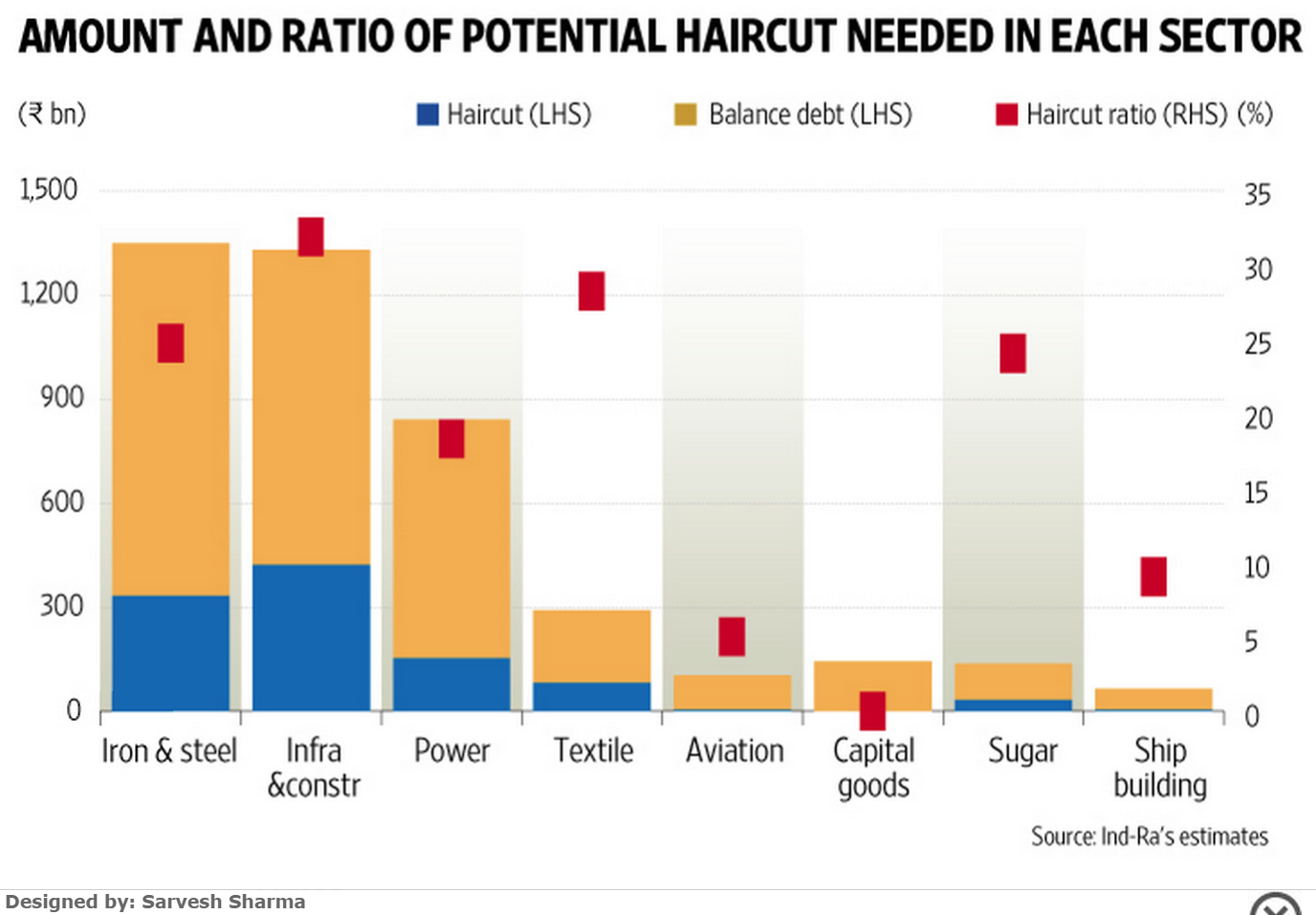
1. Livemint points to an Fitch Ratings report which claims that banks may have to take haircuts amounting to more than a trillion rupees on their exposures to power, roads, steel, and other infrastructure sectors. It is estimated that nearly Rs 93000 Cr would be on public sector banks.

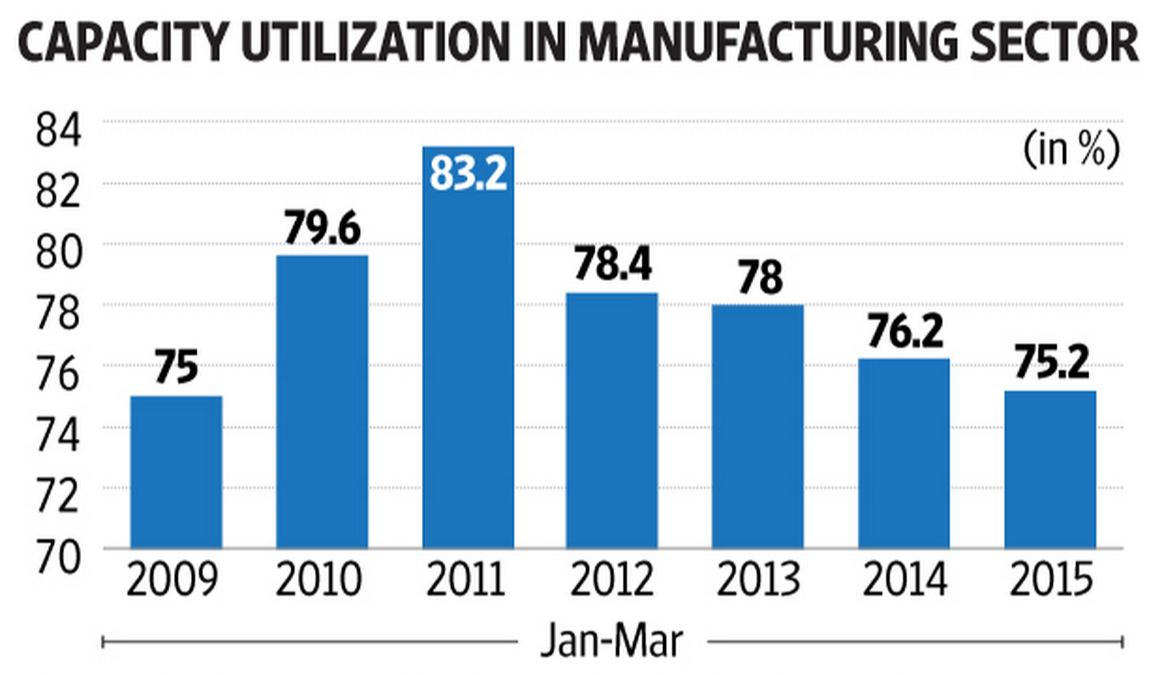
2. The RBI's latest survey on capacity utilization shows that in the manufacturing sector, it has plunged to its lowest level is seven years for the March-April quarter. Business expectations index too is declining sharply. Make in India is clearly facing very strong headwinds.
3. Mary Hallward-Driemeier and Lant Pritchett (via WSJ here) find "almost zero correlation" between the World Bank's popular Doing Business Survey's and the surveys of business enterprises done by the Bank and others across the world. The former is based on surveys of local lawyers, accountants, and other professionals and their estimations of the time and cost of complying with local regulations. The latter asks firms themselves about the costs and delays they actually deal with. 

They find that, on average, the amount of time companies tell surveyors they spend on obtaining construction permits and operating licenses, and importing goods is "much, much less" than that recorded in the DB Survey. They attribute the divergence to the "gulf in poor countries between the laws and policies that exist on the books and the ones that prevail - or perhaps don't prevail - in reality". They write,
It is commonly observed that policy implementation often deviates from the stated policy in firm-specific ways, but this hypothesis has not been easy to document. It appears that when strict rules meet weak state capability—or, more broadly, “institutions”—the rules bend and become more like individuated “deals” where outcomes are not the result of a neutral application of policy to the facts but rather have to be negotiated case by case... Given our evidence, it is a completely open question how reforms that altered the Doing Business indicators will actually affect the investment climate that most firms actually experience... firm performance was affected by measures of the variability of the policy implementation they faced, more so than the level. From this perspective, one can imagine that initiatives that have minimal impact on de jure policy but which signal a decisive shift in policy implementation might have substantial impacts on investor expectations and initiate an acceleration of growth. 
This carries a note of caution for countries like India, which have made the DB Survey the basis for their ease of doing business interventions. Tweaking the form (rules and regulations) without strengthening the state may not be very effective. Even with the best-practice form, the real constraint will be the state capability. 

4. Talking about enterprise surveys, here is a comparison of the findings from World Bank's enterprise surveys from 2006...
... and 2014 (9281 firms chose the biggest constraints among 15 business environment obstacles).
Electricity, tax rates, and corruption are the top three in both, though the informal practices and access to finance have recently emerged as important constraints. Note that labour regulations etc are marginal constraints in both periods.

5. I had blogged earlier urging caution with India's metro rail ambitions saying that global experience shows that farebox recovery ratios on railways can rarely cover half the operating expenses. Business Standard has this examination of the operating balance sheet of the Delhi Metro Rail Corporation (DMRC),
In FY14, the latest year for which DMRC finances are available, the company produced a meagre Rs 9 in revenue for every Rs 100 worth of investment in fixed assets. Specifically, the utility generated revenues of Rs 2,952 crore on a gross block of Rs 34,385 crore in FY14... Given the current interest rate of 10 per cent, a similar depreciation charge and 15 per cent expected return on equity, the capital cost for DMRC works out to be around Rs 7,500 crore per annum. Throw-in the running and maintenance costs, the DMRC system would need at least Rs 10,000 crore worth of revenues to be financially viable in the conventional sense.
DMRC operating expenses were Rs 2,136 crore or 72 per cent of its revenues from operations.The above calculation doesn’t show in DMRC numbers because it has been liberally capitalised by the government. At the end of FY14, DMRC paid-capital (or seed capital) was Rs 14,187 crore twice that of NTPC and three-times that of Power Grid Corp, two of the most capital intensive government owned companies. Besides, government tops-up DMRC equity base every year with Rs 2,100 crore pumped as equity in fiscal 2014 itself. The debt part of the DMRC has been taken care of by concessional loan from Japan’s Overseas Development Agency (ODA) at the rate of 2 per cent with 10 year moratorium on interest and principal repayment. A private sector enterprise will never get this comfort.
6. That India's power sector is in a mess is well known. Livemint points to a recent ICRA report which has a few interesting factoids about the dismal story,
In fiscal 2015, power deficit had reduced to 3.6%, but that is just the reported number. Ratings agency Icra Ltd reckons that the actual power deficit is 15%. Simply put, power plants are idle at such a high level of power deficit because state electricity boards are not buying. In the June quarter, merchant demand on the exchanges declined 22.3% from a year ago. Even on a sequential basis, it fell 9.3%, despite it being high summer. The last major power purchase agreement signed by a state electricity board was Kerala in 2013.... The accumulated losses of state discoms at the end of March 2013 were close to Rs.3 trillion. Wiping out these losses will take time. Even to recover regulatory assets—those expenses approved by state electricity regulatory commissions for recovery through future tariffs—over a period of five years, tariff hikes as high as 23% would be required in some states, such as Rajasthan.
Update 1 (21.08.2015)

More on the DMRC's finances, a foretaste of what is to come from other metros,
DMRC earned a total revenue of Rs 3,198 crore in 2013-14, including Rs 1,364 crore (43 per cent) from fare box collection and Rs 1,833 crore (57 per cent) of other revenues, including those from real estate, consultancy and external projects... The growth in revenue from fare box collection, the company’s core area of operation, has dropped sharply from 80 per cent in 2010-11 to 11 per cent in 2013-14, the latest year for which numbers are available. Also, the share of other revenues in the total revenue has risen from 43 per cent in 2009-10 to 57 per cent in 2013-14. Further, the company’s total expenses jumped 29 per cent to Rs 2,006 crore in a single year ending March 2014, indicating how profitability came under pressure. DMRC’s fares were last revised in 2009 when the minimum fare was raised from Rs 6 to Rs 8 with the maximum fare raised from Rs 22 to Rs 30. For comparison, consumer price index (CPI)-based inflation stood at 9.9 per cent a month on an average for the five year period between 2009 and 2014.
Add to Technorati Favorites
10 Aug 03:26

Maoist policies would not change China's future growth rate

by T T Ram Mohan
I found this hard to believe when I read it but it appears to be the result of solid research. If China were to revert to Maoist policies, the Chinese economy would grow on the average at 4-5% every year between now and 2050- about one percentage point lower than the growth rate projected for China under the pro-market liberal policies it has had since the 1970s. These projections have been made by four US-based economists, says a report in the FT.

The projections made for the Chinese economy under current policies are interesting:
Assuming a continuation of current policies, the paper predicts the Chinese economy will expand by 7-8 per cent for the next 10 years or so, with growth slowing to 5.2 per cent on average between 2024 and 2036 and then a rate of just 3.6 per cent between 2036 and 2050.
India's economic growth should overtake China's this year. India's superior growth rate should persist thereafter until 2050- barring unexpected political shocks.

The interesting question thrown up by the projections on China is whether the focus on continued "reforms" isn't a little overdone in India. Perhaps, the PM's instincts are right: it may be more useful to focus on implementation of existing policies than on bringing about radical policy changes that are, in political terms, a hot potat.


10 Aug 03:24

Announcing: Safal Niveshak Meetups

by Vishal Khandelwal

In his magnificent book, Think and Grow Rich, Napoleon Hill wrote –

No two minds ever come together without, thereby, creating a third, invisible, intangible force which may be likened to a third mind…When a group of individual brains are coordinated and function in harmony, the increased energy created through that alliance becomes available to every individual brain in the group.

In giving meaning to Mr. Hill’s idea, let me announce a new initiative from Safal Niveshak – Meetups @ Safal Niveshak – to bring the tribe members together, face-to-face, to channel the energy for a shared vision – simplifying the art of value investing and making it available to as many small investors as possible, around the country.

This idea is really simple – To meet regularly in small groups across cities in India…to learn and grow together in our investment journey.

While we see the meetups evolving over time, here are what we believe to be the four founding pillars of this initiative –

  1. Learning – Tribe members connect face-to-face to learn from each other’s experience in investing.
  2. Inspiring – Experienced investors in the meetup inspire new investors (the latter surely need a lot of inspiration, and the right one).
  3. Sharing – Members share their investing journeys, experiences, key learning, and big mistakes.
  4. Networking – Members in a city get connected with each other, and maybe extend the tribesmanship by becoming friends.

The goal is NOT to bring together people so that they can share/ask for stock tips or engage in any ‘intelligent’ debates. The goal IS to connect and get together to share thoughts, experiences, learning, and mistakes with others…and also learn through peer support.

There will be no teachers or gurus here. No set agendas or proposed beliefs either. The idea is to just come together face-to-face, talk, share, and learn from each other about how to invest our money sensibly.

How Does It All Start?
Here is a simple plan to start this initiative.

If you are interested to organize a meetup of investors in your city, or just join one, simply click here to fill a small form.

After collecting data of interested people, Anshul and I will finalize our travel plan to initiate the first meetups across various cities in India. Then, once we connect people in their respective cities, we will let the meetups happen and evolve on their own.

That’s the entire plan as of now.

If you think this is too rudimentary a plan, let me say that even we (Anshul and I) think the same.

But please note that we just want to sow its seeds here without any grand expectations. If it doesn’t sprout after we give it some time to work, we’ll kill it. But it’s an idea that deserves a chance and we find it too important to ignore. Who knows how big this can grow unless we give it a try.

Together We’re Better
Safal Niveshak’s journey that started four years back now craves for a wider path as more tribe members join in. And I will be happy to connect you with others living close to you on this path of helping you become simple and sensible with your hard-earned money.

Remember, together we’re better.

So if you are interested to organize a meetup of investors in your city, or just join one, simply click here to fill a small form.

We look forward to meeting you soon…and starting this new journey of learning, inspiring, and sharing to become better at how we invest.

In case you have any thoughts / suggestions on this initiative, please share in the Comments section of this post.

The post Announcing: Safal Niveshak Meetups appeared first on Safal Niveshak.

    
10 Aug 03:21

Debt instruments will not make you rich…

by subra

All of us must have some debt investments. At least that is what ‘asset allocation’ gurus will make you believe, so well, let us believe it.

HOWEVER, when somebody comes to me and says “I live frugally and save all the money that I can and keep it in Fixed deposits, Public Provident fund, national savings certificates, ….when do you think will I get rich.

I had to tell him this:

1. Debt instrument preserve your money: they preserve it exactly as it was! It does not grow in a debt instrument.

2. The ‘interest’ that you get in a debt instrument is equal to or less than inflation: Over a long period of time the interest is equal to inflation, that is all. That means the money is preserved, if at all.

3. The interest that you receive, howsoever meagre is taxed at regular rates: So if you are a tax payer a small part of the interest received is lost to taxation. In fact the bank may deduct about 10% tax, and the balance tax will have to be paid by you as an advance tax.

4. The impact of the taxation is so bad that the compounding over a long period of time is lost – or its impact reduced.

Moral of the story: Keeping your money in a debt instrument is for preserving it and not for growing it. You get rich only when your money grows, not when it gets preserved.

However while keeping in debt instruments you can do the following:

1. Keep it in an income deferred way: thus you postpone your income to the time that you withdraw and

2. Convert the income from a regular income to a capital gains kinda income.

These two steps ensure that the debt portion of your money also grows at a reasonably faster rate than a bank fixed deposit.

Have written many posts on this…so please search on the blog..using tax deferral, fixed deposit vs income funds, deferred taxation….etc….you will find the article.

http://www.subramoney.com/2013/03/debt-fund-vs-fixed-deposits/

THEN?

Just Do It!!

Post Footer automatically generated by Add Post Footer Plugin for wordpress.

10 Aug 03:20

Open Thread. Curiosity.

by Atanu Dey

APOD_Curiosity

Click on the picture to embiggen.

It is from the Astronomy Picture of the Day (APOD).

By planet Earth’s calendar, the Curiosity Mars Rover reached its 3rd anniversary on the surface of the Red Planet on August 6. To celebrate, gaze across this dramatic panoramic view of diverse terrain typical of the rover’s journey to the layered slopes of Aeolis Mons, also known as Mount Sharp. Recorded with Curiosity’s Mast Camera instrument, the scene looks south across gravel, sand ripples, and boulders toward rounded buttes. In the background, higher layers at left are toward the southeast, with southwest at panorama right. The individual images composing the view were taken on Curiosity’s mission sols (martian days) 952 and 953 since the rover’s landing on August 6, 2012.

What’s on your mind?

10 Aug 03:19

Karl Popper on the Limits of Tolerance

by Atanu Dey

“Unlimited tolerance must lead to the disappearance of tolerance. If we extend unlimited tolerance even to those who are intolerant, if we are not prepared to defend a tolerant society against the onslaught of the intolerant, then the tolerant will be destroyed, and tolerance with them. — In this formulation, I do not imply, for instance, that we should always suppress the utterance of intolerant philosophies; as long as we can counter them by rational argument and keep them in check by public opinion, suppression would certainly be unwise. But we should claim the right to suppress them if necessary even by force; for it may easily turn out that they are not prepared to meet us on the level of rational argument, but begin by denouncing all argument; they may forbid their followers to listen to rational argument, because it is deceptive, and teach them to answer arguments by the use of their fists or pistols. We should therefore claim, in the name of tolerance, the right not to tolerate the intolerant. We should claim that any movement preaching intolerance places itself outside the law, and we should consider incitement to intolerance and persecution as criminal, in the same way as we should consider incitement to murder, or to kidnapping, or to the revival of the slave trade, as criminal.”

– Karl Popper, The Open Society and Its Enemies (1945), Vol. 1, Notes to the Chapters: Ch. 7, Note 4.

“I have insisted that we must be tolerant. But I also believe that this tolerance has its limits. We must not trust those anti-humanitarian religions which not only preach destruction but act accordingly. For if we tolerate them, then we become ourselves responsible for their deeds.”

— Karl Popper. After the Open Society.

10 Aug 03:19

Witch hunt against PNs considered harmful

by Ajay Shah
by Susan Thomas.


A slightly different version of this appeared in the Indian Express today.


The Supreme Court appointed SIT on black money has asked that the ultimate beneficiary owner of every Participatory Note (PN) be traced. This brings back an old mistrust from nearly a decade ago, which careful examination suggests is misplaced. PNs help India better integrate into the global financial system. When India fixes her financial systems to become more competitive, these very PN customers will bring their business onshore.

What are PNs? PNs are one way that international investors can invest in Indian assets today. When this investor wants to invest in an Indian firm, they buy a contract from financial firms in their country. In turn, these financial firms may either choose to invest in the Indian asset. Or they can ``replicate'' Indian returns by doing financial engineering using other securities.

The investor buys a PN from a SEBI-registered Foreign Porfolio Investor (FPI). Let us call this registered FPI a "PN seller". Many times, one firm comes to buy a contract from the PN seller, and at the same time another person comes to sell it. The PN seller makes money charging fees to both. No back-to-back transaction takes place in India. The PN seller is "running a book". Sometimes the PN seller sells 100 to one person and buys 80 from another. This leaves an imbalance of 20 on his book. This net imbalance shows up as a trade in India when the FPI sells the security. This imbalance is reported as PN trades to SEBI. The PN seller is continuously selling contracts to end-users and adjusting his position in India reflecting the net imbalance. There are a number of such PN sellers in the world. Their activities are good for India because they connect the world of global finance into India.

So, PNs are a reflection of the world investment community's interest in Indian assets. When India grows, this interest will grow. The puzzle with PNs is why they exist at all. Why does the international financial investor buy a PN and not come into India directly? As with everything in finance, it about getting the best (lowest) price. There are several mistakes in Indian policy where directly trading in India means a higher price.

Three policy mistakes


India has a policy mistake in the form of the securities transaction tax (STT). Trades on Indian exchanges are charged the STT. There is no such cost for the global investor when they buy from their domestic financial firm. PN sellers are domiciled in places like London, New York or Singapore, where tax policy is done correctly and transactions are not taxed. Since the PN seller only sends his net imbalance as trades to India, the burden of the STT is lower. So customers send their orders to PN sellers.

India has policy mistakes in the form of taxation of non-residents, other than the Mauritius/Singapore channel. Some foreign investors invest in India through Mauritius or Singapore to achieve residence-based taxation. Others send their business to PN sellers, who are domiciled in places like New York, London or Singapore, where financial activities of non-residents are tax exempt, and have worked out Mauritius/Singapore vehicles to do trades in India. Hence, the PN business is helping India obtain non-resident participation in the economy, by avoiding the consequences of our flawed approach to taxation of non-residents.

India has policy mistakes on capital controls. For example, India makes it difficult for anyone to take a position on currency futures in excess of $15 million. PN sellers are domiciled in places like New York, London or Singapore, where financial regulation makes no such mistakes. By buying from a PN seller, the customer avoids this problem.

Hankering after the ultimate beneficial owner


Indian authorities want to know the ultimate beneficiary of a PN transaction. This is incorrect for three reasons.

  1. The PN related trades in India are a reflection of a net position between all buyers and sellers, it is impossible to ask who exactly is the ultimate beneficiary owner.
  2. It is when an investigation starts, that the regulator has the ability to trace the links of the chain. This suffices for regulators in 33 of the FATF signatory countries, alongside India. India is the only country asking for information about the ultimate beneficiary owner at all times.
  3. Insisting on the knowledge of the ultimate beneficiary owner will likely cause a push-back against India's attempt at extra-territorial jurisdiction. If a person in India buys a derivative in India and sells it to an investor in London, India does not have the right to ask about the London investor unless in the context of an investigation, and in cooperation with the authorities in London. Strong arm tactics for unreasonable information requests will drive up the cost of doing business in India. This is not in our interest.


Conclusion


To conclude, Indian regulators and Indian tax authorities, amongst others, have long expressed concerns about PN. A better understanding about how the PN market serves India's interest shows that this concern is misplaced. This market provides a valuable service by giving global investors a lower cost channel into Indian investments. Without this market, the cost to the global investment community in Indian investments would go up, their engagement with India would go down. This is not in India's interest. If we do want better knowledge about the beneficiary owner, we would do better to reform our tax policy, our capital controls and our financial regulation to bring the business directly into India. This would be far more effective in strengthing our regulatory control, without hampering much needed global investments into India.
09 Aug 04:43

Affordable housing - just build it!

by noreply@blogger.com (Gulzar Natarajan)
Sharon Barnhardt and Co have an NBER working paper which provides empirical proof for the widely held belief that slum relocation beneficiaries sooner or later go back to squatting. They examined the impact of a lottery-based allotment for a low-income housing colony in Ahmedabad, which moved people from a city-center slum to the suburbs. They tracked the 110 families over a 14 year period and found,
Fourteen years later, relative to lottery losers, winners report improved housing farther from the city center, but no change in family income or human capital. Winners also report increased isolation from family and caste networks and lower access to informal insurance. We observe significant program exit: 34% of winners never moved into the subsidized housing and 32% eventually exited. Our results point to the importance of considering social networks when designing housing programs for the poor... Our findings suggest that alternative policies such as neighborhood-wide relocation programs may be more appropriate for slum- dwellers. Alternatively, slum upgrading programs that do not try to move people at all may be a less wasteful approach to public housing policy in developing countries.
At a theoretical level, this is a reinforcement of the Schelling segregation model, where forced admixture of heterogeneous communities invariably result in desegregation. I have blogged about it in the context of housing and school choice.  

However, the policy takeaways suggested are pretty much dead-ends. Neighborhood-wide relocation runs into the constraint of land availability. As to slum upgradation by redevelopment (PPP or not), it is too complex and challenging to do in any reasonable scale. Slum upgradation by improving infrastructure while keeping the existing stock runs into execution challenges (5-10 feet roads, and that too varying widely, makes infrastructure augmentation a nightmare, even an impossibility) given the extremely congested nature of most slums and squatter settlements. If, for implementation in scale, upgradation of any kind is less that satisfactory and neighbourhood relocation is prohibitive, then we are left only with relocation to the suburbs as a decidedly second-best alternative. 

This blog has consistently held the view that it may be a wrong framing to assess low income housing programs in terms of its ability to retain residents. Such programs, including the recently launched Government of India's Housing for All program, should be seen as instruments to increase the supply of formal affordable housing stock. At a time when land has been priced out of the reach of low income households, any low-income stock addition happening is basically in the informal sector, most often by way of densification of already congested slums and squatter settlements. 

In fact, in view of the near absence of formal affordable housing, the low-income migrants in any case mostly squat in the suburbs. The units sold away by the original allottees are merely transferred to the newer migrants, thereby providing formal low-income housing for them. The relocation colonies, by adding to the housing stock, are actually limiting the further slumification of the city. 

Further, given the implementation challenges (identification etc), resource constraints (massive demand likely from new migrants), and the political difficulty associated (with targeting newer migrants when older ones are themselves without housing), this process of internal transactions between the original beneficiaries and the new buyers may be a less-distortionary and acceptable second-best affordable housing strategy. This would be the case even with the inevitable political cronyism that accompanies such transactions.
Add to Technorati Favorites
08 Aug 06:19

India's health care challenge in two graphics

by noreply@blogger.com (Gulzar Natarajan)
Two graphics from a Livemint inforgraphic series on India's health care system sums up the enormity of the challenge that the country's health sector may be facing.

First, like with suppressed demand of electricity (which, ironically, makes state governments who resort to 12-14 hour power cuts claim that they are power surplus!), India appears to have a massive suppressed demand for health care services, which may be reflection of the public health care access deficit. Cross-state data on illness reporting and hospitalization rates from the NSSO national health survey 2014 reveals an inverse correlation between illness reporting and hospitalization rates and the state's social indicators (and presumably per capita incomes). 

In other words, a large share of people in the country's poorest and most backward areas do not even report illness or show up in hospitals. Describing them as "missing patients", Livemint writes,
The NSSO report put the average figure for people reporting illnesses in rural India at 8.9%. But if one assumes that the true extent of under-reporting is the difference between the national average and that between the top five states in terms of reported illnesses (excluding Kerala, given that it is likely to be an outlier), the true national average will then be 15.6%. In other words, 6.7% of the rural population, or roughly 55 million people, is missing from the official estimate of the ill.
The graphic below captures the same data stratified based on rural and urban incomes and shows the inverse relationship (admittedly, some of the difference may be a measure of differences in lifestyles etc) between incomes and health outcomes,
Since poor quality of public health care facilities and affordability are arguably important contributors, this graphic on the rate of increase in health care costs is a cause of great concern.
In simple terms, even as there exists massive under-reporting of illness, undoubtedly atleast partially due to access problems, the rising health care costs are pricing more people out from accessing health care. 
Add to Technorati Favorites