Shared posts

04 Jan 06:18

In the sister blog and on Twitter during September-December 2016

The following posts appeared on the sister blog (on Computing) during September-December 2016.

Tweets during September-December 2016 (other than blog post tweets):

04 Jan 05:59

Bull run has to end soon!

by subra
The SnP 500 is on a bull run since 2009 and is one of the longest bull runs. It has to end sooner rather than later. In such a market what should one do? Well do not try to remove money and sit in cash waiting for an opportunity, but yes if you are in […]
04 Jan 05:59

Charlie Munger on the Paradox in Hold vs. Buy Decisions in Long Term Investing

by fundooprofessor
Ok, here’s a paradox for you, the long-term investor. You already know that owning, that is buying at reasonable prices and steadfastly holding on to good quality businesses, run by good quality managers is likely to be quite profitable over the long term. And so, based on this belief, you construct a portfolio of such […]
04 Jan 05:42

Service charges

by SK

So the Indian government has said that it is not mandatory for customers to pay “service charges” at restaurants. It will be interesting to see how the restaurant industry will react to this.

The basic idea of a “service charge” is a “forced tip”. Given that Indians aren’t big tippers, restaurants, about a decade ago, started levying a service charge on top of the bill, ranging from 5% to 15%. Some restaurants mention this on the menu explicitly. In others, the print is fine. Some customers have come to accept the service charge. Others fight it.

The National Restaurants Association of India hasn’t taken too kindly to the notification, and has said they’ll take the government to court on this matter. It sounds like a rather extreme reaction, but illustrates the effect of behavioural studies.

Lower end eateries typically publish menus with “all inclusive” prices. If a cup of coffee is listed at Rs. 10, you pay Rs. 10 for it. Mid-priced and higher-end restaurants, however, have defaulted to showing prices exclusive of taxes and charges. With a 5% VAT, 15% Service Tax and (typically) 5% service charge, the final bill comes out to about 25-30% higher than the labelled price.

Now, frequent restaurant goers are aware of all these charges, and that the bill will be much higher than the sticker price. If they are rational, they should be taking into account these additional charges when deciding whether to go to restaurants, and when they do, what to order.

The problem, however, is that these charges are not immediately visible at the time of ordering, and so the customers end up ordering more expensive food than they had budgeted for (after controlling for the overall price level of the restaurant itself). It is a behavioural effect, where the customers’ minds are tricked by the number in front of them rather than what they will immediately end up paying.

The order that service charge is not mandatory will now push restaurants to include them in the sticker price of the food itself (it doesn’t matter what you call it – it’s ultimately revenue to the restaurant). The immediate impact of this will be that sticker prices will have to go higher, which will put a “bigger price” in front of the customers’ eyes, and they will order less.

How much less is not clear, but the fact that the restaurants association wants to take the government to court suggests it’s not insignificant. The high end restaurant business runs on extremely low margins (think what you may of the pricing), and even a less than 5% impact on revenues can have a significant impact on the bottom line.

It will be interesting to see if the government next mandates menus to print prices inclusive of taxes. It will be another behavioural nudge, but will end up ruining the restaurant business even more.

01 Jan 07:32

Nepotism and Modi

by atanu

The word nepotism and the name Narendra Modi do not belong in the same sentence. Just read this piece The Other Modis (Dec 29, 2017 2016) in the IndiaToday magazine.

While the story is very interesting and it does show up as a shining exception to the pervasive nepotism of politicians, I am not too touched by the neglect of one’s family. Family and friends matter because they are our support and our inspiration. Certainly, nepotism is bad but not caring deeply about one’s flesh and blood is not a virtue.

Love, like charity, begins at home. If one cannot deeply love those one is closest to (whether they be family members or not), it is not likely that there is any content in the abstract love for 1.3 billion people. That great Mahatma loved all of humanity (or so he claimed) but those closest to him only felt the whip of a tyrant.

It is not my case that NM should use his political power to elevate (or even help) his family. But nothing stops him from doing what he can do in his personal capacity to help others in his family. He has money for sure. Just like any average person would, he could at least meet them occasionally and if necessary give his family material assistance from his own pocket. Agreed, meeting his family would take him away from his awesome duties but I imagine it would be a source of joy for them.

We all appreciate that Modi is a self-made man but no man is an island. Like the rest of us, he too received help from his family. We are what we are because of the unconditional support of many family and friends. Many gave us help and support even though they themselves were of modest means. It is a moral imperative that we recognize that fact and whenever possible, do what we can to show that we care.

I am in favor of people being virtuous (although I cannot claim to be virtuous) but I am wary of people who appear to be too virtuous and in the case of public figures, I am suspicious of virtue signalling.

That’s the cynic in me. Like my hero Diogenes. (See Diogenes of Sinope, the Cynic, and Learning to Eat Gruel for more on my hero.)


29 Dec 07:23

The Great Stagnation

by noreply@blogger.com (Gulzar Natarajan)
MR points to a new paper by Nick Bloom, Charles Jones, John Van Reenan, and Michael Webb which finds declining ideas TFP (research productivity per researcher, or number of new ideas per researcher) across sectors. They write,
Our robust finding is that idea TFP is falling sharply everywhere we look. Taking the U.S. aggregate number as representative, idea TFP falls in half every 13 years — ideas are getting harder and harder to find. Put differently, just to sustain constant growth in GDP per person, the U.S. must double the amount of research effort searching for new ideas every 13 years to offset the increased difficulty of finding new ideas.
They claim that the relatively stable economic growth in recent decades has been the result of increased research effort (number of researchers), which has off-set the declining ideas TFP. They find the signatures everywhere. In the economy on aggregate,
Across agriculture crops,
Even in semiconductor chips, despite the much acclaimed Moore's law,
In pharmaceuticals research for new molecular entities,
And in medical research
But their conclusion has interesting implications for growth theories,
The only reason models with declining idea TFP can sustain exponential growth in living standards is because of the key insight from that literature: ideas are nonrival. And if idea TFP were constant, sustained growth would actually not require that ideas be nonrival... fully rivalrous ideas in a model with perfect competition can generate sustained exponential growth in this case. Our paper therefore clarifies that the fundamental contribution of endogenous growth theory is not that idea TFP is constant or that subsidies to research can permanently raise growth. Rather it is that ideas are different from all other goods in that they do not get depleted when used by more and more people. Exponential growth in research leads to exponential growth in At. And because of nonrivalry, this leads to exponential growth in per capita income.
This raises questions about the prevailing intellectual property rights regime.
Add to Technorati Favorites
27 Dec 04:05

Farnam Street’s 2016 Annual Letter to Readers

by Farnam Street Team

To the readers of Farnam Street:

Most public companies issue an annual letter to shareholders. These letters present an opportunity for the people entrusted to run the company on behalf of the shareholders to communicate with the people who own the company.

Last year I started a similar tradition at Farnam Street. To a large extent, I consider you the owners of Farnam Street.

Investors, or owners, typically exchange money for shares in a company. I think your investment in Farnam Street is just as important —You trust me with something far more valuable than money: Time.

For all of us, time is finite. Reading Farnam Street means you’re not doing something else. My job is to make sure your investment is getting an above average return.

***

2016 was a record year in almost every reader-related metric.

Readership increased approximately 20 percent, which was decent. We surpassed over 100k readers to our weekly newsletter, Brain Food (OK, that’s a pretty awesome milestone. I might have even celebrated with a bottle of champagne … or two.)

Visitors spent more time on the site (a good proxy for how interested people are in the content). The bounce rate (a fancy phrase for the percentage of people who look at one page and then leave the site) continued to move in the right direction. In short we had more people who read longer and looked at more pages.

***

I think we all know that readership increased in spite of our website design, rather than because of it. Luckily, we’re tackling that problem next year thanks to the fine folks at Grain and Mortar. I can’t wait for you to see the new site.

***

I’m often asked how we grow our audience. My simple answer is met with skepticism: Our readers tell their friends and coworkers. That’s it.

This is usually followed by an endless slew of unsolicited advice on how to “exponentially increase our growth.” A typical example is the “reward” for generating controversy.

A lot of websites create controversy intentionally. They want nothing more than for 50% of their audience to love an article and 50% to hate it. Why? Because both sides will dig in and then they will talk about it. When they talk about it they’ll link back to the original site, thus driving traffic (and, even more perverse, as a byproduct of how most search engines work, these arguments typically increase search engine rankings).

You almost can’t help but admire the cleverness of this strategy, which takes advantage of hard wired defaults both in humans and search to gain an advantage. This strategy is so common these days it’s not even divergent — it’s the norm!

However easy that play is, intentionally creating controversy to get pageviews isn’t a strategy you’ll find us employing to grow quickly. While it is important to account for arguments from all sides, we’ll stick to our knitting.

While we’re open to new ideas and ways to increase the value for readers, we’re not open to gimmicks or short term strategies. We’d rather be a tree that digs its roots deep, grows slowly, and can’t be easily blown over.

***

Events

In 2016, we offered two public Re:Think Workshops (Innovation and Decision-Making) and private versions too. We continue to limit attendance at these events to ensure a good experience for everyone.

One of the most surprising things about the public events is that people get to meet people who are curious, kind, and intelligent. In short, people just like them.

The quality of individuals who attend these events continues to blow my mind. This year we had attendees from Github, Tuft and Needle, AJO, Glimmer of Hope, Warburg Pincus, Rackspace, Inspire Environmental, and two difference branches of U.S. Special Forces, to name a few.

Last year, if you recall, I was worried that we were spreading ourselves too thin with respect to the variety of topics we took on. Reducing the number of offerings in 2016 was the right thing to do as it allowed us time to relaunch the website ReThinkWorkshops.com as well as make significant improvements to the content of both Re:Think Innovation and Re:Think Decision-Making.

Our next event is Re:Think Decision-Making in Seattle this March. I hope to see you there.

Podcast

The Knowledge Project, our podcast, reached over 350,000 downloads. Which doesn’t sound like a lot until you consider that we release about one episode a month. Things on this front will largely stay the same for the time being. We already have some exceptional guests lined up for early in the new year.

Tools and More

Productivity That Gets Results, our popular productivity seminar, continues to help people avoid the traps that get in the way of being productive. We want to help you spend more time doing what you want to be doing.

The Art of Reading launched to some great feedback and success at helping people improve their information consumption. Yes, we made a course about reading.

We spend so much of our time reading these days — whether it’s email, articles, blogs, books, or reports. The dividends to getting even 5% more effective at remembering, knowing when to skim, and connecting ideas becomes a non-linear outcome.

To my knowledge, our course on reading is the only significantly student-tested course that has worked for executives, teachers, students, NFL Coaches, best-selling authors and more. But we’re making it even better.

We undertook a significant effort over the past few months to materially improve The Art of Reading, which will relaunch in as soon as the video editing is done. (There is no reason to wait to purchase it if you’re interested, existing customers will have access to all the new content for free.)

I don’t want to spoil the other things we’re working on in this space but we’ve made progress on two addition products. The first one is seminar based and should be out soon. The second is larger in ambition and scope and I’ve never seen anything like it. My hope is that we can launch this in the fall as we’ve already delayed a year to make sure we’re getting it right.

Learning Community

Online media properties are continuing to look for ways that create and capture value. The problem here is that most of these organizations want to capture more value than they create — they focus on the wrong side of the equation. This leads to a short-term engagement between creator and audience, as the latter realizes they’ve been had and moves on. Farnam Street tries to take the opposite approach: Add so much value that people want to support it.

Recently, we’ve started to incorporate some of the lessons we’ve learned running a membership program for a year back into the offering. The most apparent is that we’ve moved away from calling it the membership program and are now call it a learning community. This phrase (and our subsequent activities) bring the program much closer in line with what we are trying to create for our readers.

Last year I said that we would use some of the proceeds from the learning community to improve the quality of the regular, free, content. I think we delivered on that this year and I look forward to pushing even more next year. (And every year.)

Rest assured, the majority of FS content will always be free. If you find value in Farnam Street, we hope you’ll consider joining the learning community.

***

Team Farnam

Perceptive readers know there is more to Farnam Street than me. Last year we reached the point where I couldn’t do everything I wanted to do myself so Jeff Annello (@mungerisms) came on board. Jeff and I have worked together in the past, and I value both our friendship and the quality of thought he brings to the table. There are a lot of ideas I want to try and lots of great things to come, and we’ll continue to work with exceptional people as we go along.

***

Sponsorships

I want to thank our lead sponsor for 2016: Slack. I’ll also welcome our incoming sponsors Royce Funds, Greenhaven Road Capital, SparkBox, adventur.es, and Grain and Mortar (who are currently in the process of redesigning the site). We still have one open spot, so if you’d like to inquire about sponsoring the blog please get in touch with me.

***

2016 Report Card

Last year I offered a way to judge our progress. Let’s quickly review what I wrote so I can hold myself accountable.

Here is what you can expect and hold us accountable for in 2016:

The quality of all content will be much higher. We will do better at adding context, presenting ideas in compelling ways, adding tools to your mental tool box, making things practical, and exposing you to mental models that will help you be better at what you do. We’ll further our exploration of what it means to live a meaningful life and deepen our understanding of ourselves and the world.

The Re:Think workshops will offer a better experience. While everyone has described their experiences so far as off the charts, I see so much room for improvement that it’s hard to fathom how we’re exceeding expectations. Everything from onboarding and hotel options to the overall experience while at the event will be improved. We have an amazing team in place for the events. They consistently sell out.

The audio quality on the podcast will be much improved. I’ve already taken care of this to a large extent. Where possible, I’ll do more in-person interviews as these offer more meaningful and deeper conversations.

The experience of existing readers will not be compromised to add new readers. For a large part of the year there was an annoying little pop-up that appeared on the screen asking for your email address. This was a mistake. While it helped us grow at about 2500 readers a month, it’s annoying to some and degrades the reading experience for all. You deserve better. I fumbled here and hopefully recovered. I was aware of how annoying it was and failed to act. The allure of 100,000 readers is a strong pull — especially when my mother reminds me that her “small town” (my words, not hers) has more people than I have readers. Anyway, the pop-up is off now.

The site will function better. We will be seeking to engage a web designer in 2016 or 2017 to redesign the site to improve navigation, organization, and the overall reading experience. This is more about finding the right person or team to work with us and less about the year in which it happens.

Products will exceed your expectations. We have two new things slated to roll out in 2016 — a mini-course in January on How to Read A Book and a project I’ll reveal when the time is right. To help ensure we’re delivering at the quality and caliber you deserve, we’ve invested in hiring the right people to help design, develop, and deliver these courses. I hope you’ll offer your honest feedback.

Here is my view on how we did in 2016.

“The quality of content will be much higher.” We made much progress on this front. We still need to work on better synthesizing and connecting ideas. We need to get better at varying the length of content as we perhaps trended a little verbose toward the end of this year.

“The Re:Think workshops will offer a better experience.” While there is room for improvement. We improved the content, added some nice personal touches, and really sought to deepen our connection with readers. These events provide a way for us to do things that don’t scale but add enormous value to everyone.

“The audio quality on the podcast will be much improved.” I won’t say it’s “much improved,” but I didn’t make as many bone headed mistakes this year.

“The experience of existing readers will not be compromised to add new readers.” We held off from doing a pop up and instead offered original content to high-quality publications, such as Medium, Quartz, etc. (If you run a publication with a big audience you think would be a fit, fire off an email to support@farnamstreetblog.com).

“The site will function better.” Grain and Mortar is in the process of redesigning it now. If you have comments or suggestions, please reach out to eric@grainandmortar.com

“Products will exceed your expectations.” We’re getting better at this. The content quality is great and getting better but we still needed some help with the packaging and functionality. Sparkbox helped us redesign fscourses.com to help create a platform that pairs great infrastructure, design, and content.

Overall, I’m pleased but not satisfied.

What to expect for 2017

I won’t offer as detailed of a roadmap for next year. This year we worked on a lot of low-hanging fruit. Improvements are likely to be more incremental this year. Don’t let this unsexy statement fool you, there is significant value in the trenches.

In 2017, we will work to better synthesize, connect, and explain timeless ideas that help you make better decisions, avoid stupidity, and kick-ass at life. I’ll try to add more personal stories and anecdotes from my journey.

The learning community will continue towards an exclusive vibrant hub of learning that fosters deep connections between participants and value you can’t get anywhere else.

We’ll have a new slate of guests on the Knowledge Project, start exploring longer content such as books, and continue to offer you mental tools and tactics that deliver value and live a meaningful life.

We work hard to be the website you want to read. The website you want to immerse yourself in. The one where after 20 minutes of looking around you look up and say “I’ve found my tribe.”

2017 is also the year I start working on a few book projects. Stay tuned.

***

Where I’ve made the biggest personal mistake over the past year is thinking I can do two or more things at once successfully. Velocity is a vector dependent concept. Moving in two directions that are not 100% aligned creates drag.

There is a lot of work ahead of us.

Having no idea what tomorrow might bring, I try to prepare for an uncertain future. I show up to the office every day looking for opportunities to move forward in the best way I can. That’s usually putting one foot in front of the other and trying to make incremental progress without regressing.

Thank you for your continued time and trust in me and Farnam Street.
—Shane

--
Sponsored by: Royce & Associates – Small Cap Specialists with Unparalleled Knowledge and Experience..

27 Dec 04:05

What's the meaning of a 250% change, SA annualised?

by Ajay Shah
by Ajay Shah.

My Business Standard article of today has raised questions about the meaning of SAAR percentage changes.

When we deal with time periods of different lengths, the raw percentage change can be confusing. As an example, if I promise to convert Rs.100 into Rs.101 on a one day horizon, this is 1% return on a one-day horizon. The universal quoting convention is to express this on an annualised basis: $1.01^{365}$ is 3678%. So we would say that this investment opportunity offers 3678% returns.

Similar issues apply when dealing with month-on-month ("m-o-m") changes. If 100 becomes 110 within one month, it's confusing to say that this is a 10% change. It is expressed as $1.1^{12}$, i.e. a 213% change on an annualised basis.

When expressed as continuously compounded returns, the month-on-month annualised change is 1200*diff(log(x)) where $x$ is the levels series. This gives time series of changes which have somewhat better statistical properties for downstream use. For small values the two paths are identical, but for large values the continuously compounded values have fewer extreme values.

How much did exports change in the month of November? Here are the steps through this must be computed:

  1. The year-on-year ("y-o-y") change compares November 2016 to November 2015. It is the sum of 12 changes, one for each month. It does not tell us what happened in November 2016.
  2. We would like to compare October 2016 to November 2016 to know what happened in November 2016.
  3. But there are problems of comparison: Seasonality, Diwali.
  4. Seasonal adjustment procedures solve these. They yield a time-series of a seasonally adjusted level of exports.
  5. With this, we are permitted to compute the percentage change from October 2016 to November 2016.
  6. But this is not comparable with all the percentage changes that we are used to seeing, which are on an annualised basis.
  7. Hence, the SA levels series $x$ is converted into an annualised rate of change using the formula 1200*diff(log(x)), which is analogous to $(1+r)^{12}$. This is called the "seasonally adjusted annualised rate" (SAAR) of change. 

An interesting property of this way of thinking is that the year-on-year change is the trailing 12 month moving average. It's the average of the changes of the last 12 months. It's a slow and sluggish measure of what's going on in the economy. But the units of the two measures -- the y-o-y change and the m-o-m SAAR -- are the same.

One concrete example


We take data for heavy commercial vehicle (HCV) sales from January 1999 to November 2016. The raw values in the latest three months are: September: 28,103; October: 29,515 and November: 21,602. This shows a raw month-on-month decline (non-annualised, non-seasonally-adjusted) of 26.8% in November 2016.

We test for the possibility of Diwali effects in this series and find none. Seasonal adjustment gives SA levels for the latest three months: September: 27,028; October 31,845 and November 27,049. This shows a month-on-month decline (non-annualised) of 15.1% in November 2016.

The SAAR is 1200*diff(log(x)) where x is the seasonally adjusted levels. This yields the values of +196.8 in October 2016 and -195.9 in November 2016. Specifically, the latter value, -195.9, is 1200*(log(27049)-log(31845)).

Conclusion


When dealing with events like October 2008 and November 2016, this is the essential statistical technology for thinking about what is going on. We don't know of anyone working with Indian data, outside of NIPFP, who has this machinery working. Some people are tossing data into black boxes (e.g. Eviews) for seasonal adjustment, which is better than doing nothing, but not as good as the full thing.

To learn more about seasonal adjustment, handling Diwali, etc. see this article by Bhattacharya, Pandey, Patnaik, Shah. The page has R source code, a research paper, and pointers to user-friendly blog articles.
24 Dec 05:58

India "missing middle class" graph of the day

by noreply@blogger.com (Gulzar Natarajan)
We had argued here that India suffers from a "missing middle class". More evidence comes from the ICE 360 survey (The whole Mint series on this is informative). Globally the middle class are overwhelmingly composed of salaried workforce. In India though, less than 20% of the entire workforce is composed of salaried employees. Take out the nearly 30 million public sectors employees, and the share drops to very low single digits!
This is a strong reminder of the fact that India needs more formal jobs. This, in turn, links up with the "missing middle" in the distribution of business enterprises. Jobs get created when firms start formal and grow into middle-sized entities. Unfortunately, India has millions of enterprises which start informal as gnomes and dwarfs and remain so. Filling the "missing middle" in firm distribution therefore appears to be the path to raise the "missing middle class"!
Add to Technorati Favorites
23 Dec 04:33

Demonetisation could transform Indian banking

by The Big Picture
Demonetisation, in my view, is not primarily about black money and corruption nor  about moving to cashless economy. It's about financial deepening. This could transform Indian banking and boost the Indian economy.

Here's my article in today's BS, 

Since the article is behind a pay wall, it's reproduced below:

Way back in 1969, Indira Gandhi decided to nationalise private banks.  She summoned I G Patel, then special secretary in the ministry of finance, and gave him 24 hours to prepare a Bill for Parliament, a Cabinet note and a speech Mrs Gandhi would make to the nation. Patel dutifully carried out madam’s orders.

In his memoirs, Patel records that he would have liked the move to have been better planned. Nationalisation should have been accompanied by restructuring to produce  one or two large national banks and multiple regional banks. Little of this has happened to this day. Mrs Gandhi judged correctly that planning every detail would take her nowhere.

Mrs Gandhi’s detractors denounced the move as politically motivated. They saw it as part of her battle against the old guard in the Congress and an attempt to weaken the Swatantra Party which was backed by the private owners of the banks. They said it was an effort on Mrs Gandhi’s part to portray herself as pro-poor and anti-rich — exactly what Prime Minister Modi’s critics are saying today.

All this was, of course, true. But, then, politicians will always be driven by political motives. The most important motivation is to acquire and hold on to power. The right question to ask is whether their political motivations are married to the larger good. Bank nationalisation passes this test — and there is every prospect that so will demonetisation.

Bank nationalisation marked a watershed in India’s post-independence history. Government-owned banks spread their branch network into the interior and mopped up small savings of millions. As a result, the household saving rate jumped from 8.1 per cent of GDP in 1968-69 to 14.4 per cent in 1978-79, causing the overall saving rate to jump from 12 per cent to 21 per cent. The rise in the saving rate set the stage for an increase in the growth rate from the Hindu rate of 3.5 per cent of the previous decades to 5.5-6 per cent in the eighties.

Public sector banks’ (PSBs) access to low-cost savings in the seventies and eighties enabled them to become profitable in the post-liberalisation era. Exposing PSBs to private competition while keeping over 70 per cent of banking in the public sector allowed efficiency to improve while maintaining banking stability.

Mrs Gandhi thus created a serious disruption that yielded benefits over a long period, thanks to financial deepening. Mr Modi has done exactly the same with demonetisation — and the outcomes are likely to be very similar.

Demonetisation is not primarily a drive against black money or even a change to a less-cash economy, although it has been packaged as such. Observers are right to be sceptical on both counts. Without follow-up measures, demonetisation is unlikely to make a big dent on black money. The role of cash can come down only over a long period.

Demonetisation is best seen as carrying forward the agenda of financial deepening that commenced with bank nationalisation. The gains to banking  promise to be  substantial.

Bank nationalisation brought a large number of individuals into banking on the liabilities side. It also brought in SMEs on the asset side. Demonetisation promises to deepen individual relationships on the liabilities side. It also promises to bring a large number of merchants, traders and SMEs into banking on both the liability and asset sides. It’s a great leap forward in terms of financial inclusion.

This has the potential to transform Indian banking and revitalise it precisely at a time when a large chunk of it is moribund. Banks will have access to more deposits and a larger proportion of low-cost deposits. This should cause interest rates to decline. The fall in interest rates will be gradual, given that we cannot afford a flight of foreign funds invested in the financial markets.

Once cash flows of small businesses begin to get routed through the banking system, their accounts will become far more transparent. This will translate into more lending to small businesses which carries higher yields than corporate loans. Banks have already woken up to the potential of microfinance. The two together will give a big boost to profitability in banking.

The decline in interest rates will lead to capital gains on banks’ holdings of government securities and help recapitalise PSBs. K V Kamath estimates that the banks have gained ~1 lakh crore in the last quarter. He thinks they will gain another ~1.5 lakh crore through a one per cent decline in interest rates in the next six months. This seems too optimistic but the basic point is valid: A fall in interest rates makes the job of recapitalising PSBs easier.  No wonder bankers are upbeat about demonetisation even as economists are divided on it.

Mr Modi’s critics say he should have planned better: More notes printed in advance, more of small-denomination notes, faster recalibration of ATMs, etc. Many of the criticisms are valid. The short-term distress is very real.

But the critics miss the larger point: The most serious distress the nation faces today is not creating new jobs. Two of the most important constraints to job creation are global economic conditions and the state of Indian banking. There isn't much we can do about the first. By revitalising banking, demonetisation promises to ease the second constraint and open a path to faster growth in the medium term.

For some two-and-a-half years now, Mr Modi has proceeded cautiously, allowing himself to be guided by those familiar with the Delhi durbar. He seems to have sensed that plodding along the familiar path would not yield much — in political or economic terms. A game-changer was required. This is the risk-taking Mr Modi of the Gujarat days.

The insight of the gifted politician can often bring about a transformation in ways that cannot be arrived at through a strictly analytical process. So it was with Mrs Gandhi and bank nationalisation. So it could well turn out to be with Mr Modi and demonetisation.

22 Dec 05:17

The Self Education of Louis L’Amour

by Farnam Street Team


“That was Louis’s way – to find something of value from every printed page.”
— Daniel Boorstein

***

The author Louis L’Amour (1908-1988) was among America’s most prolific and most beloved. He wrote 105 books, most of which were fiction, and at his death in 1988 they were all still in print. Most still are today. (His prolific nature resembles another great American author, Isaac Asimov.)

Two things drove L’Amour: Adventure and a deep need for self-education. In his memoir, The Education of a Wandering Man, he makes it clear that the two went hand in hand. His travels were his way of learning by direct experience, but he augmented that with a tremendous and voracious appetite for the vicarious learning that comes through reading.

Writing in in the late 1980’s, L’Amour describes his love of the written word, a pursuit he undertook at all cost:

Today you can buy the Dialogues of Plato for less than you would spend on a fifth of whisky, or Gibbon’s Decline and Fall of the Roman Empire for the price of a cheap shirt. You can buy a fair beginning of an education in any bookstore with a good stock of paperback books for less than you would spend on a week’s supply of gasoline.

Often I hear people say they do not have the time to read. That’s absolute nonsense. In one year during which I kept that kind of record, I read twenty-five books while waiting for people. In offices, applying for jobs, waiting to see a dentist, waiting in a restaurant for friends, many such places. I read on buses, trains and planes. If one really wants to learn, one has to decide what is important. Spending an evening on the town? Attending a ball game? Or learning something that can be with you your life long?

Byron’s Don Juan I read on an Arab dhow sailing north from Aden up the Red Sea to Port Tewfik on the Suez Canal. Boswell’s Life of Samuel Johnson I read while broke and on the beach in San Pedro. In Singapore, I came upon a copy of The Annals and Antiquities of Rajahstan by James Tod.

Many of us think we don’t have the time or the inclination to keep learning, but to L’Amour this was a ridiculous idea. If he didn’t educate himself, who else would do the job? In this sense, all education is self-education.

No man or woman has a greater appreciation for schools than I, although few have spent less time in them. No matter how much I admire our schools, I know that no university exists that can provide an education; what a university can provide is an outline, to give the learner a direction and guidance. The rest one has to do for oneself.

What is the point of an education? Steven Pinker would define it more precisely years later, but to L’Amour it was pretty simple, and closely aligned with our ethos at Farnam Street: To enable one to live a better life.

Education should provide the tools for a widening and deepening of life, for increased appreciation of all one sees or experiences. It should equip a person to live life well, to understand what is happening about him, for to live life well one must live with awareness.

L’Amour was clearly a proponent of direct life experience, and he had more than most. As his memoir details, his young life saw him take on the role of a traveling hobo, sailor, amateur boxer, miner, and ranch hand, jobs that took him all around the world in search of work and adventure.

But throughout, L’Amour knew that his destiny was to become a storyteller, and he also knew that to avoid a lot of misery in life would require a massive amount of experience he couldn’t obtain directly.

So he did it through books.

It is often said that one has but one life to live, but that is nonsense. For one who reads, there is no limit to the number of lives that may be lived, for fiction, biography, and history offer an inexhaustible number of lives in many parts of the world, in all periods of time.

So it was with me. I saved myself much hardship by learning from the experiences of others, learning what to expect and what to avoid. I have no doubt that my vicarious experience saved me from mistakes I might otherwise have made—not to say I did not make many along the way.

Although he didn’t set out to learn for this reason, L’Amour also discovered an important lesson in associative pattern-matching and creativity: The brain needs to be stocked full to make interesting and useful connections.

A love of learning for its own sake creates a massive ancillary benefit. What L’Amour says about writers goes for all of us, in any profession:

I have never had to strive to graduate, never to earn a degree. The only degrees I have are honorary, and I am proud to have them. I studied purely for the love of learning, wanting to know and understand. For a writer, of course, everything is grist for the mill, and a writer cannot know too much. Sooner or later everything he does know will find its uses.

A writer’s brain is like a magician’s hat. If you’re going to get anything out of it, you have to put something in first.

I have studied a thousand things I never expected to find use in a story, yet every once in a while these things will find a place.

People who read a lot, people like L’Amour, are often asked about what should be read. Is there some program or direction to take?

The answer we give at Farnam Street and the answer L’Amour gave are about the same: You must follow your passions, follow your curiosities. Why does this work? Nassim Taleb once hit it on the head by saying that “Curiosity is antifragile, like an addiction it is magnified by attempts to satisfy it.”

Down the line, as those curiosities are pursued, the course tends to become quite clear. Trying to pursue some difficult course of study is not the way to get your engines going.

Says L’Amour:

For those who have not been readers, my advice is to read what entertains you. Reading is fun. Reading is adventure. It is not important what you read at first, only that you read.

Many would advise the great books first, but often readers are not prepared for them. If you want to study the country from which you came, there are atlases with maps and there are good books on all countries, books of history, of travel, of current affairs.

Our libraries are not cloisters for an elite. They are for the people, and if they are not used, the fault belongs to those who do not take advantage of their wealth. If one does not move on from what merely amuses to what interests, the fault lies in the reader, for everything is there.

One mistake made by would-be learners it to think that they need guidance or permission to do so. That they must take a class on Shakespeare to enjoy Shakespeare or take a guided tour of the classics in order to enjoy those.

The great works of the world are there to be enjoyed by all. (Of course, we have some recommendations for how to read books in general.) But as L’Amour guides, you must learn and read what you like, unless there is an important extenuating circumstance. Boredom creates a shut-off valve in the brain. And if you’re always reading something of even moderate depth, you simply can’t avoid learning. A continually curious mind ends up at the classics one way or another anyways.

In the end, in a thought later echoed by the technology great Andrew Ng, L’Amour believed the human mind was capable of incredible creativity, perhaps beyond what we currently believe:

Personally, I do not believe the human mind has any limits but those we impose ourselves. I believe that creativity and inventiveness are there for anybody willing to apply himself. I do not believe that man has even begun to realize who he is or what he can become. So far he has been playing it by ear, following paths of least resistance, getting by — because most others were just getting by too. I believe that man has been living in a Neanderthal state of mind. Mentally, we are still flaking rocks for scraping stones or chipping them for arrowheads. […]

We simply must free the mind from its fetters and permit it to function without restraint. Many of us have learned to supply ourselves with the raw materials and then allow the subconscious to take over. This is what creativity is. One must condition oneself for the process and then let it proceed.

If you liked this post, you might like these too:

Schopenhauer on Reading and Books – One of the most timeless and beautiful meditations on reading comes from the 19th-century German philosopher Arthur Schopenhauer.

Reading a Book is a Conversation Between You and the Author – Full ownership of a book only comes when you have made it a part of yourself, and the best way to make yourself a part of it— which comes to the same thing— is by writing in it.

--
Sponsored by: Royce & Associates – Small Cap Specialists with Unparalleled Knowledge and Experience..

22 Dec 05:16

Why doesn't India have its Internet sensation?

by noreply@blogger.com (Gulzar Natarajan)
Sample this about Tencent,
Tencent, a $225bn internet company whose social platforms have become a part of the very fabric of Chinese lives... It is, says one banker, “a social enterprise powerhouse”: under one roof, it has amassed China’s answer to Facebook, WhatsApp, Spotify, Kindle and ApplePay. Chi Tsang, internet analyst at HSBC, says Tencent has “the most killer apps in the world”. Weixin, along with the WeChat app outside China, has 846m active monthly subscribers.

Tencent also has a huge multibillion investment portfolio, ranging from stakes in Didi Chuxing, China’s biggest ride-sharing company, through to start-ups. It dabbles in artificial intelligence, electric cars and bike sharing. Its posse of champion hackers managed to gain remote control of Tesla’s Model S, forcing the US carmaker to roll out a security patch... The company employs 30,000 workers, more than half of whom are in research and development. While its home market is by far and away the largest, Tencent has an overseas presence in many sectors — its WeChat payments app can even be used at Caesars Palace in Las Vegas. “They are everywhere, the US, Europe — especially among Chinese speakers because if you want to contact business or family in China there is only one way to contact them, and that’s WeChat,” says Elinor Leung, a research analyst at CLSA...
And it has been more innovative, restrained, and principled, than their Silicon Valley peers,
"Tencent has a better corporate governance than Google or Facebook,” says Richard Windsor, founder of independent research company Radio Free Mobile, pointing to its spurning of the dual-class shareholding allowed in the US but banned in Hong Kong... Like Alibaba, Tencent “has gone well beyond copying [the west],” adds another banker. “They are inventing and reinventing what their businesses should be”. Tencent’s Moments feed on WeChat prefaced Facebook’s addition of Messenger and the $22bn acquisition of WhatsApp. Payments are another case in point. China’s online third-party smartphone payments market dwarfs that of the US: iResearch estimates it to be worth Rmb15.7tn in 2016 — 28 times the $62.5bn forecast by eMarketer for the US in 2017 — and Rmb28.5tn in 2018... 
Tencent favours a cautious approach to monetising its database of active monthly users. Rather than blitz Moments with ads and risk the sort of backlash dished out to Facebook, Tencent has restricted itself for now to a maximum of one ad per user each day. UBS estimates WeChat Moments’ ad load at about 1 per cent of non-advertising content, compared with 7-10 per cent for Facebook, leaving big scope for growth. In 2015, online advertising made up 17 per cent of revenues. China’s mobile ad market was worth Rmb90bn in 2015, according to iResearch, up 178 per cent year on year, and is forecast to grow at a compound annual rate of 54 per cent from 2015 to 2018. Yet monetising the subscribers — and its database — offers the real keys to the kingdom for China’s BAT contingent and their global peers.
The market valuation of Baidu, Alibaba, and Tencent (BAT) is more than a quarter of India's GDP. I just can't put my finger on why India struggles to produce even any local social enterprise (or any internet space) brands. And each one of its me-too e-commerce sites run the risk of being gobbled up their global competitors.

If I am to stick out my neck and make a prediction, then I will hazard one potential area where India can lead the global race and Indian companies emerge as global pioneers. The Unified Payments Interface (UPI) and the RuPay payment gateway has the potential to unlock India's internet champions. Specifically, if UPI moves ahead quickly to embrace third party payments (as it should), given the Aadhaar identify layer, it could disrupt the cards-based payments eco-system. And the identity layer opens up possibilities that go beyond that offered by online payment services like Paypal or Alipay. 

But this can happen only with a revision of the way India's government looks at catalysing markets. The Indian state has played an exceptional and far sighted role in developing public goods platforms like Aadhaar, RuPay gateway, and the UPI. It now needs to put in place a light-touch regulatory regime (with strong privacy and data security protocols) and step back to let the internet entrepreneurial eco-system play itself out with digital disruptions. Some of them, like Paytm, will surely make windfall gains, piggybacking on the public good platforms. 

But we need to have the political maturity and bureaucratic guidance to allow this market catalysis. And, given the relatively small middle-class, fragmented and largely informal market, entrepreneurs should have the vision and patience to build the platforms and play the long game. And, more importantly, they should eschew the temptation to play on things like regulatory arbitrage and crony capitalism, a characteristic feature of much of corporate governance in India.  

For a country that spares no effort to follow China, it is a great opportunity to emulate how the country created its own payment gateway, Union Pay, and let its internet champions emerge. 
Add to Technorati Favorites
17 Dec 16:33

Ask Me Anything — The Demonetization Edition

by atanu

amaMoney is important. The real economy cannot function without a stable and predictable currency. Money serves as a numéraire, which the wiki defines as “a basic standard by which value is computed . . . the numéraire is one of the functions of money, to serve as a unit of account: to provide a common benchmark relative to which the worth of various goods and services are measured.”

These days, nearly all money is fiat money issued by the central bank of an economy which is controlled (indirectly perhaps) by the government. The quantity, and therefore the “price” of money (which is the interest rate), is controlled by the central bank.

Money is also a medium of exchange. Without money, all exchanges would be reduced to barter. Barter suffers from the problem of a “double coincidence of want” which basically means that you have to find someone who has precisely what you want and who also wants what you have in exchange — an almost impossible task in a world where there are literally billions of people and millions of distinct goods and services.

Finally, money is also a store of value. People borrow and lend in money terms.

Of the three functions of money–unit of account, store value, and medium of exchange–the fact that it facilitates exchange is the most critical. Disruptions in the money supply is akin to the disruption in the air supply for a human being. Remember the rule of three: you can survive for three weeks without food, three days without water, and three minutes without air. The economy can survive a disruption in the money supply for a few weeks but not without suffering some damage.

Deliberately inducing a critical shortage of money should not be a matter of whim. The costs are immense and such a move can only be justified in the fact of clear and present danger. To use a medical analogy, it is like chemo or radiation therapy: the side-effects are nearly as damaging as the targeted malignancy.

On Nov 14th, just a few days after Nov 8th (what I call India’s 8/11), I wrote a blog post that was republished on The Quint. Yesterday I wrote another piece on the matter. Here it is, for the record. (Link to The Quint article. I should clarify that the title of the piece is not mine.)

~ ~ ~ ~ ~ ~ ~ ~ ~ ~ ~ Begin quote ~ ~ ~ ~ ~ ~ ~ ~ ~ ~ ~ ~ ~

Note Ban: A Blunt Instrument That May Spark Greater Economic Evils

In his 1848 essay ‘What is Seen and What is not Seen’, celebrated French economist Frédéric Bastiat enunciated an important truth that any action in the economic sphere produces not just one effect but a series of effects. Some of these effects, he wrote, are intended and foreseen, others are unintended, unseen and unforeseen. Furthermore, only some of the consequences are immediate while others unravel over time.

He went on to observe that “it almost always happens that when the immediate consequence is favorable, the later consequences are disastrous, and vice versa. Whence it follows that the bad economist pursues a small present good that will be followed by a great evil to come, while the good economist pursues a great good to come, at the risk of a small present evil.”

The best laid schemes of mice and men often go awry, as the poet lamented, because we are not given unbounded rationality and foresight. Therefore, it is best to exercise extreme caution when making bold moves in our personal lives.

That caution has to be multiplied a thousand-fold when an action is sure to affect untold millions of people, as when governments make potentially game-altering policies.

The Indian government’s 8 November decision to demonetize Rs 500 and Rs 1,000 notes is one such bold policy. The motivation for that action was, no doubt, benevolent. The expressed goals changed with time, from the high-minded elimination of “black money” and counterfeit currency, to the rather questionable goal of moving India towards a “cashless” digital economy.

Removing an estimated over 80 percent of cash in hand has to have dire consequences for any economy, especially one in which a vast majority of transactions involve cash.

We must remember that the act of exchange and trade, buying and selling, lies at the heart of both production and consumption, and that money is what keeps the whole system functioning. Without some form of money, most non-barter exchanges will come to a halt or at least slow down and so would the economy.

It is like when you forget your wallet at home and cannot buy what you need from the market, and it causes some inconvenience to you. Your money is still there, but you don’t have access to it. But if a few hundred million people suddenly don’t have access to money – even temporarily – the impact can not but be staggeringly negative.

Demonetisation of that scale is a blunt instrument for attempting to eliminate black money. Black money itself is only a symptom of a structural problem in the economy. Without a structural change in the system, even if the stock of black money is entirely eliminated, the flow will resume and soon enough the stock will recover.

What’s worse is the likelihood that much of the existing stock of black money will not be eliminated because people are endlessly inventive and if they have had the smarts to accumulate black money, they can be trusted to figure out ways and means to launder much of their stockpile.

The benefits of the demonetization have to be considered in relation to its costs. Only a small segment of the population are people who have black money because crooked politicians, judges, and bureaucrats, and business people with undeclared incomes are a minority in any population. Most people in India have neither the capability nor the opportunity to generate black money. Making the innocent majority pay for the sins of the culpable minority is morally wrong and economically inefficient.

The benefits are dubious at best and the costs in terms of loss of income and economic output are massive. If the government is serious about removing black money, it needs to address the root of the problem: needless heavy-handed political and bureaucratic control of the economy. That control has been in place since colonial times and the system created the incentives for people to cheat. Only by changing those incentives will people respond by not cheating. Symbolic actions, however sincerely felt and however dramatically executed, cannot begin to address deep rooted problems.

The sad fact remains that those who have the power to make those needed structural changes have the least incentive to make them since the present system is what gives them the power.

~ ~ ~ ~ ~ ~ ~ ~ ~ ~ ~ End quote ~ ~ ~ ~ ~ ~ ~ ~ ~ ~ ~ ~ ~

So there we are. This is our “Ask me anything” for December. What’s on your mind?


15 Dec 05:33

Immigration, Extinction, and Island Equilibrium

by Farnam Street Team

Equilibrium is an important concept that permeates many disciplines. In chemistry we think about the point where the rate of forward reaction is equal to the rate of backward reaction. In economics we think of the point where supply equals demand. In physics we can see how gravity is balanced by forward velocity to create things like planetary orbits.

No matter which discipline we are examining, the core idea remains the same: Equilibrium is a state where opposing forces are balanced.

In biology, equilibrium is so important that it can mean the difference between life or death; for a species, it can decide whether they will thrive or become extinct.

In The Song of the DodoDavid Quammen dives into how equilibrium affects a species’ ability to survive, and how it impacts our ability to save animals on the brink of extinction.

***

Historically, the concept of island equilibrium was studied with a focus on the interplay between evolution (as the additive) and extinction (as the subtractive). It was believed that speciation, the process where one species becomes two or more species, caused any increase in the number of inhabitants on an island. In this view, the insularity of islands created a remoteness that could only be overcome by the long processes of evolution. 

However, Robert MacArthur and E.O. Wilson, the co-authors of the influential Theory of Island Biogeography, realized that habitats would show a tendency towards equilibrium much sooner than could be accounted for by speciation. They argued the ongoing processes that most influenced this balance were immigration and extinction.

The type of extinctions we’re referring to in this case are local extinctions, specific to the island in question. A species can go extinct on a particular island and yet be thriving elsewhere; it depends on local conditions.

As for immigration, it’s just what you’d expect: The movement of species from one place to another. Island immigration describes the many ingenious ways in which plants, animals, and insects travel to islands. For instance, not only will insects hitch rides on birds and debris (man made or natural, think garbage and sticks/uprooted seaweed), animals will do the same if the debris is massive enough.

Seeds, meanwhile, make the trip in the feces of birds, which helps to introduce new plant species to the island, while highly motivated swimmers (escapees of natural disasters/predators/famine) and hitchhikers on human ships (think rats) make it over in their own unusual ways.

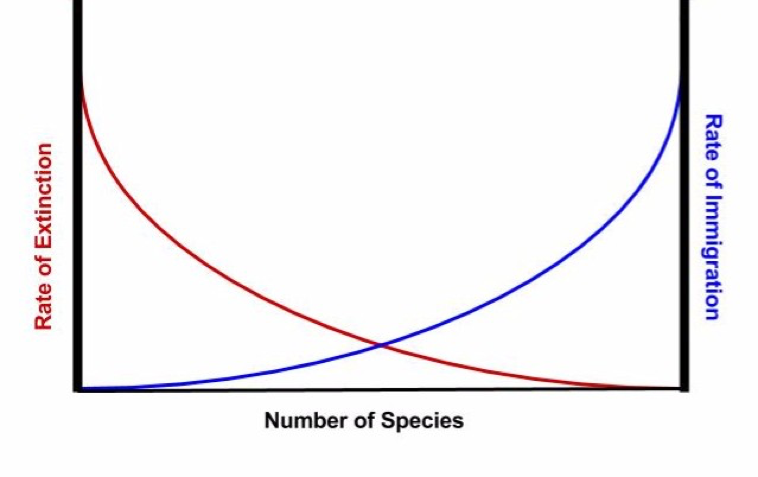
We can plot this process of immigration and extinction graphically, in a way you’re probably familiar with. Quammen explains:

picture1

The decrease in immigration rate and the increase in extinction rate are graphed not against elapsed time but against the number of species present on a given island. As an island fills up with species, immigration declines and extinction increases, until they offset each other at an equilibrium level. At that level, the rate of continuing immigration is just canceled by the rate of continuing extinction, and there is no net gain or loss of species. The phenomenon of offsetting increase and decrease – the change of identities on the roster of species – is known as turnover. One species of butterfly arrives, another species of butterfly dies out, and in the aftermath the island has the same number of butterfly species as before. Equilibrium with turnover.

So while the specific species inhabiting the island will change over time, the numbers will tend to roll towards a balanced point where the two curves intersect.

Of course, not all equilibrium graphs will look the like one above. Indeed, MacArthur and Wilson hoped this theory would be used not just to explain equilibriums, but to also help predict potential issues.

When either curve is especially steep – reflecting the fact that immigration decreases especially sharply or extinction increases especially sharply – their crossing point shifts leftward, toward zero. The shift means that, at equilibrium, in this particular set of circumstances, there will be relatively few resident species.

In other words, high extinction and low immigration yield an impoverished ecosystem. To you and me it’s a dot in Cartesian space, but to an island it represents destiny.

There are two key ideas that can help us understand the equilibrium point on a given island.

First, the concept of species-area relationship: We see a larger number of a given species on larger islands and a smaller number of a given species on smaller islands.

Second, the concept of species quantity on remote islands: Immigration is much more difficult the further away an island is from either a mainland or a cluster of other islands, meaning that fewer species will make it there.

In other words, size and remoteness are directly correlated to the fragility of any given species inhabiting an island.

***

Equilibrium, immigration, evolution, extinction – these are all ideas that bleed into so many more areas than biogeography. What happens to groups when they are isolated? Jared Diamond had some interesting thoughts on that. What happens to products or businesses which don’t keep up with co-evolution? They go extinct due to the Red Queen Effect. What happens to our mind and body when we feel off balance? Our life is impoverished.

Reading a book like The Song of the Dodo helps us to better understand these key concepts which, in turn, helps us more fundamentally understand the world.

--
Sponsored by: Royce & Associates – Small Cap Specialists with Unparalleled Knowledge and Experience..

15 Dec 05:33

Redacted Version of the December 2016 FOMC Statement

by David Merkel

==================================================================

November 2016 December 2016 Comments
Information received since the Federal Open Market Committee met in September indicates that the labor market has continued to strengthen and growth of economic activity has picked up from the modest pace seen in the first half of this year. Information received since the Federal Open Market Committee met in November indicates that the labor market has continued to strengthen and that economic activity has been expanding at a moderate pace since mid-year. FOMC shades GDP up.
Although the unemployment rate is little changed in recent months, job gains have been solid. Job gains have been solid in recent months and the unemployment rate has declined. Shades up their view on labor.
Household spending has been rising moderately but business fixed investment has remained soft. Household spending has been rising moderately but business fixed investment has remained soft. No change.
Inflation has increased somewhat since earlier this year but is still below the Committee’s 2 percent longer-run objective, partly reflecting earlier declines in energy prices and in prices of non-energy imports. Inflation has increased since earlier this year but is still below the Committee’s 2 percent longer-run objective, partly reflecting earlier declines in energy prices and in prices of non-energy imports. Shades their view of inflation up.
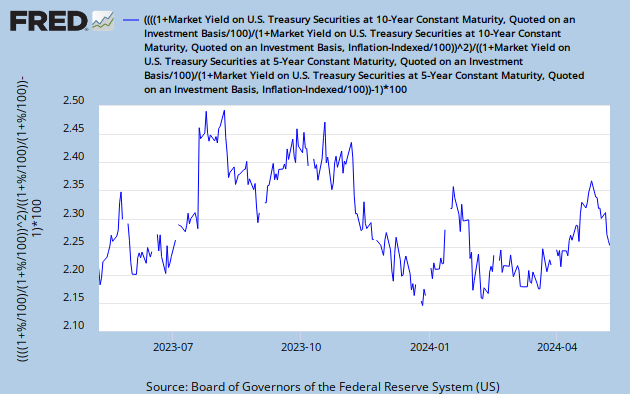
Market-based measures of inflation compensation have moved up but remain low; most survey-based measures of longer-term inflation expectations are little changed, on balance, in recent months. Market-based measures of inflation compensation have moved up considerably but still are low; most survey-based measures of longer-term inflation expectations are little changed, on balance, in recent months. No change.  TIPS are showing higher inflation expectations since the last meeting. 5y forward 5y inflation implied from TIPS is near 2.08%, up 0.24%  from November.
Consistent with its statutory mandate, the Committee seeks to foster maximum employment and price stability. Consistent with its statutory mandate, the Committee seeks to foster maximum employment and price stability. No change. Any time they mention the “statutory mandate,” it is to excuse bad policy.
The Committee expects that, with gradual adjustments in the stance of monetary policy, economic activity will expand at a moderate pace and labor market conditions will strengthen somewhat further. The Committee expects that, with gradual adjustments in the stance of monetary policy, economic activity will expand at a moderate pace and labor market conditions will strengthen somewhat further. No change.
Inflation is expected to rise to 2 percent over the medium term as the transitory effects of past declines in energy and import prices dissipate and the labor market strengthens further. Inflation is expected to rise to 2 percent over the medium term as the transitory effects of past declines in energy and import prices dissipate and the labor market strengthens further. No change. CPI is at +1.6% now, yoy.
Near-term risks to the economic outlook appear roughly balanced. The Committee continues to closely monitor inflation indicators and global economic and financial developments. Near-term risks to the economic outlook appear roughly balanced. The Committee continues to closely monitor inflation indicators and global economic and financial developments. No change.
Against this backdrop, the Committee decided to maintain the target range for the federal funds rate at 1/4 to 1/2 percent. In view of realized and expected labor market conditions and inflation, the Committee decided to raise the target range for the federal funds rate to 1/2 to 3/4 percent. Builds in the idea that they are reacting at least partially to expected future conditions in inflation and labor.
The Committee judges that the case for an increase in the federal funds rate has continued to strengthen but decided, for the time being, to wait for some further evidence of continued progress toward its objectives.   Sentence dropped.
The stance of monetary policy remains accommodative, thereby supporting further improvement in labor market conditions and a return to 2 percent inflation. The stance of monetary policy remains accommodative, thereby supporting some further strengthening in labor market conditions and a return to 2 percent inflation. Shades down their view of how accommodative monetary policy is.

They don’t get that policy direction, not position, is what makes policy accommodative or restrictive.  Think of monetary policy as a drug for which a tolerance gets built up.

In determining the timing and size of future adjustments to the target range for the federal funds rate, the Committee will assess realized and expected economic conditions relative to its objectives of maximum employment and 2 percent inflation. In determining the timing and size of future adjustments to the target range for the federal funds rate, the Committee will assess realized and expected economic conditions relative to its objectives of maximum employment and 2 percent inflation. No change.
This assessment will take into account a wide range of information, including measures of labor market conditions, indicators of inflation pressures and inflation expectations, and readings on financial and international developments. This assessment will take into account a wide range of information, including measures of labor market conditions, indicators of inflation pressures and inflation expectations, and readings on financial and international developments. No change.  Gives the FOMC flexibility in decision-making, because they really don’t know what matters, and whether they can truly do anything with monetary policy.
In light of the current shortfall of inflation from 2 percent, the Committee will carefully monitor actual and expected progress toward its inflation goal. In light of the current shortfall of inflation from 2 percent, the Committee will carefully monitor actual and expected progress toward its inflation goal. No change.
The Committee expects that economic conditions will evolve in a manner that will warrant only gradual increases in the federal funds rate; the federal funds rate is likely to remain, for some time, below levels that are expected to prevail in the longer run. However, the actual path of the federal funds rate will depend on the economic outlook as informed by incoming data. The Committee expects that economic conditions will evolve in a manner that will warrant only gradual increases in the federal funds rate; the federal funds rate is likely to remain, for some time, below levels that are expected to prevail in the longer run. However, the actual path of the federal funds rate will depend on the economic outlook as informed by incoming data. No change.  Says that they will go slowly, and react to new data.  Big surprises, those.
The Committee is maintaining its existing policy of reinvesting principal payments from its holdings of agency debt and agency mortgage-backed securities in agency mortgage-backed securities and of rolling over maturing Treasury securities at auction, and it anticipates doing so until normalization of the level of the federal funds rate is well under way. This policy, by keeping the Committee’s holdings of longer-term securities at sizable levels, should help maintain accommodative financial conditions. The Committee is maintaining its existing policy of reinvesting principal payments from its holdings of agency debt and agency mortgage-backed securities in agency mortgage-backed securities and of rolling over maturing Treasury securities at auction, and it anticipates doing so until normalization of the level of the federal funds rate is well under way. This policy, by keeping the Committee’s holdings of longer-term securities at sizable levels, should help maintain accommodative financial conditions. No change.  Says it will keep reinvesting maturing proceeds of agency debt and MBS, which blunts any tightening.
Voting for the FOMC monetary policy action were: Janet L. Yellen, Chair; William C. Dudley, Vice Chairman; Lael Brainard; James Bullard; Stanley Fischer; Jerome H. Powell; Eric Rosengren; and Daniel K. Tarullo. Voting for the FOMC monetary policy action were: Janet L. Yellen, Chair; William C. Dudley, Vice Chairman; Lael Brainard; James Bullard; Stanley Fischer; Esther L. George; Loretta J. Mester; Jerome H. Powell; Eric Rosengren; and Daniel K. Tarullo. Full agreement
Voting against the action were: Esther L. George and Loretta J. Mester, each of whom preferred at this meeting to raise the target range for the federal funds rate to 1/2 to 3/4 percent. Prior dissenters are now happy, but was a 0.25% increase enough?  Or, as Steve Hanke has said, has monetary policy had to be loose to fight lower bank leverage?

Comments

  • The FOMC tightens 1/4%, but deludes itself that it is still accommodative.
  • The economy is growing well now, and in general, those who want to work can find work.
  • Maybe policy should be tighter. The key question to me is whether lower leverage at the banks was a reason for ultra-loose policy.
  • The change of the FOMC’s view is that inflation is higher. Equities and bonds fall. Commodity prices fall and the dollar strengthens.
  • The FOMC says that any future change to policy is contingent on almost everything.
14 Dec 04:39

Thomas Schelling (April 14, 1921 – December 13, 2016) RIP

by atanu

schellingthomas-cCelebrated economist Thomas Schelling died today at the age of 95. He was the recipient of the 2005 Nobel Memorial Prize in Economic Sciences for “having enhanced our understanding of conflict and cooperation through game-theory analysis”. I note his passing because he was instrumental in my recognizing that I belonged to his tribe — that I was at heart an economist. Mere accident led me to pick up his book Micromotives and Macrobehavior (1978) at the Sunnyvale Public Library sometime back in the early 1990s. He received his bachelors degree in economics in 1944 from UC Berkeley, my alma mater. 

I have referred to Schelling a few times here. One is in the Tangled Web series of posts. Do read when you are done with this. Here are a couple of quotes from his MM&MB book:

    • These situations, in which people’s behavior or people’s choices depend on the behavior or choices of other people, are the ones that usually don’t permit any simple summation or extrapolation of the aggregates. To make that connection we usually have to look at the system of interaction between individuals and their environment, that is, between individuals and other individuals or between individuals and the collectivity.
    • What this book is about is a kind of analysis that is characteristic of a large part of the social sciences, especially the more theoretical part. That kind of analysis explores the relation between the behavior of individuals who compromise some social aggregate, and the characteristics of the aggregate.

Before reading Schelling, I used to mistakenly believe that economists primarily studied money and finance. While reading him I realized that economics was a rigorous, unsentimental investigation of how real flesh-and-blood humans behave in everyday situations. It was a subject that fascinated me and moved me to study the discipline formally.

Thank you, Thomas Schelling.


13 Dec 05:28

Fiction that Influences and Inspires

by Farnam Street Team

Reading nonfiction is a fantastic way to expand your mind and give you an edge in this world. It’s especially useful when we have a specific idea or concept that we’d like to learn more about. However, it’s important not to over-look everything we can learn from fiction.

Fiction resonates with us because it shows us truths about the human condition through great storytelling and compelling narratives. Through an engaging story we can be introduced to big ideas that just don’t resonate the same way in nonfiction: the medium allows for freedom of thought through creativity.

With this short book list, we’d like to take a look at a handful of novels that have inspired some truly extraordinary thinkers, especially today’s leaders in technology. Some of these you’re probably already aware of. Some not. But they’re all worth a look.

***

The Great Gatsby by F. Scott Fitzgerald

Considered one of Fitzgerald’s greatest works, the novel follows the story of the wealthy Jay Gatsby and his love for Daisy Buchanan during the roaring 1920s. With its focus on wealth, excess, status and privilege some have called this a cautionary tale regarding the great American dream.  It’s also just a hell of a yarn.

This is one of Bill and Melinda Gates favorite books. Mr. Gates says it’s “the novel that I reread the most. Melinda and I love one line so much that we had it painted on a wall in our house: ‘His dream must have seemed so close that he could hardly fail to grasp it.’”

It’s not only the Gateses who adore this book, the author Haruki Murakami has called it one of his favorites and Chuck Palahnuik has said it was a source of inspiration for Fight Club. “It showed me how to write a ‘hero’ story by using an apostle as the narrator. Really it’s the basis of the triangle of two men and one woman in my book, Fight Club. I read the book at least once a year and it continues to surprise me with layers of emotion.”

The Remains of the Day by Kazuo Ishiguro

The story paints a spiritual portrait of the quintessential English butler as his world changes from World War I era to the 1950s. The themes of professionalism and dignity versus authenticity are prevalent throughout the novel.

This is Jeff Bezos favorite book. “If you read The Remains of the Day, which is my favorite book of all time, you can’t help but come away and think, I just spent 10 hours living an alternate life and I learned something about life and about regret.”

Actress and UN Goodwill Ambassador Emma Watson has also cited this book as one of her favorites. “When I was growing up, my family, particularly my father, were very stoic. Part of me is very resentful of this British mentality that it’s not good to express feelings of any kind – that it’s not proper or brave.” She has said she appreciates the book for how it expressed the consequences of this type of discretion.

Catcher in the Rye by J.D. Salinger

The book that introduced us to the ever loved and ever hated Holden Caulfield. The unique narrative gives us a glimpse into the mind of a 16 year old boy and the events surrounding his expulsion from prep school.

Bill Gates has said, “I read this when I was 13. It’s my favorite book. It acknowledges that young people are a little confused, but can be smart, and see things that adults don’t.”

Salman Khan, founder of Khan Academy, also lists this as one of his favorite books.

A Wrinkle in Time by Madeleine L’Engle

The second book centered around a teenager is A Wrinkle in Time, which brings us into Science Fiction. Some of the most innovative ideas of the last two centuries (trains, planes, robots) were considered science fiction at one point and made appearances in stories before they came about in real life. Science fiction is thus a window into our visions of the future, and tells us a great deal about what people of certain eras were both looking forward to and afraid of.

A Wrinkle in Time follows high schooler Meg Murry as she travels through space and time on a quest to save her father. The novel uses Meg’s extreme/out of this world situations as a way to explore the very real trials of teenagers.

Sheryl Sandberg, COO of Facebook, has called A Wrinkle in Time her favorite book as a child.

I wanted to be Meg Murry, the admittedly geeky heroine of “A Wrinkle in Time,” by Madeleine L’Engle. I loved how she worked with others to fight against an unjust system and how she fought to save her family against very long odds. I was also captivated by the concept of time travel. I keep asking Facebook’s engineers to build me a tesseract so I, too, could fold the fabric of time and space. But so far no one has even tried. Jeff Bezos also loved the book. “I remember in fourth grade we had this wonderful contest — there was some prize — whoever could read the most Newbery Award winners in a year. I didn’t end up winning. I think I read like 30 Newbery Award winners that year, but somebody else read more. The standout there is the old classic that I think so many people have read and enjoyed, A Wrinkle in Time, and I just remember loving that book.”

Seveneves / Snow Crash / Cryptnomicon by Neal Stephenson

The sci-fi author Neal Stephenson comes up multiple times in the reading lists of some incredibly successful individuals. Above are three that seemed to come up the most.

Bill Gates has said that Stephenson’s novel Seveneves rekindled his love for sci-fci, a genre he thinks can be used as a vehicle to help people think about big ideas. With Seveneves in particular, he was struck by “the way the book pushes you to think big and long-term. If everyone learned that the world would end two days from now, there would be global panic, plus a big dose of hedonism. But what if it were ending two years from now? Would people keep going to work? Would kids go to school? If they did, what would you teach them?

The novel gives us an idea of what might happen if the world were ending and we were forced to escape to space. If that idea wasn’t interesting enough, the book also shoots forward 5,000 years and has the humans going back to what once was Earth.

Larry Page, co-founder of Google, has Stephenson’s Snow Crash in his list of favorite books.

That story takes place in a future America where our protagonist Hiro is a hacker/pizza delivery boy for the mafia in reality and a warrior prince in the Metaverse. Stephenson gives us a glimpse of a what a world would look like where much of our time and definition of self is explored in a shared virtual space and effortlessly weaves together concepts of religion, economics, politics, linguistics and computer science.

Meanwhile, Samuel Arbesman, the complexity scientist and author of The Half-Life of Facts (whom we interviewed recently), told us that Stephenson’s Cryptnomicon is one of the best books he’s ever read, saying:

The idea that there can be a book that weaves together an amazing plot as well as some really really profound ideas on philosophy and computer science and technology together, that was, I think one of the first times I had seen a book that had really done this. There were these unbelievably informational pieces. It’s also an unbelievable fun read. I’m a big fan of most of Stephenson’s work. I love his stuff, but I would say Cryptonomicon was one in particular that really demonstrated that you could do this kind of thing together.

The Foundation Trilogy by Isaac Asimov

Isaac Asimov was another author who appeared on multiple lists, his Foundation Series in particular has influenced an extraordinary number of people. The novel centers on a group of academics (The Foundation) as they struggle to preserve civilization during the fall of the Galactic Empire.

In more than one interview, Elon Musk has expressed that he was greatly influenced by the Foundation Series. He said the books taught him, “The lessons of history would suggest that civilizations move in cycles. You can track that back quite far — the Babylonians, the Sumerians, followed by the Egyptians, the Romans, China. We’re obviously in a very upward cycle right now and hopefully that remains the case. But it may not. There could be some series of events that cause that technology level to decline. Given that this is the first time in 4.5bn years where it’s been possible for humanity to extend life beyond Earth, it seems like we’d be wise to act while the window was open and not count on the fact it will be open a long time.”

The series also influenced the likes of George Lucas and Douglas Adams. Speaking of…

The Hitchhiker’s Guide to the Galaxy by Douglas Adams

The story chronicles earthling Arthur Dents’ amazing voyage through space after he escapes the destruction of Earth.

Elon Musk considers Douglas Adams one of the great modern philosophers. It was Adams that taught him that “The question is harder than the answer. When we ask questions they come along with our biases. You should really ask, ‘Is this the right question?’ And that’s hard to figure out.

It’s interesting to note that Musk happened upon the book at a time that he says he was going through and existential crisis (between the ages of 12 to 15). He first turned to Friedrich Nietzsche and Arthur Schopenhauer but found what he needed through Douglas instead. Salman Khan, founder of Khan Academy also lists this as one of his favorite books.

***

This is in no way an exhaustive list of fiction that has influenced people whom we admire, but we hope that it has inspired you to find more places for those big ideas. Happy Reading!

If you enjoyed this post, check out a few other book recommendation lists we’ve put out recently:

Book Recommendations by the Legendary Washington Post CEO Don Graham – Among his answers are his favourite fiction and non-fiction books and the book that will stay with him forever.

A Short List of Books for Doing New Things – Andrew Ng thinks innovation and creativity can be learned — that they are pattern-recognition and combinatorial creativity exercises which can be performed by an intelligent and devoted practitioner with the right approach. He also encourages the creation of new things; new businesses, new technologies. And on that topic, Ng has a few book recommendations.

--
Sponsored by: Royce & Associates – Small Cap Specialists with Unparalleled Knowledge and Experience..

13 Dec 05:26

Parents, IITJEE and arranged marriage 

by SK

For a few years after I did well in IITJEE and joined IIT madras there was a steady stream of acquaintances and acquaintances of acquantances who came home to get “gyaan” about the exam. Initially I was fun to spout gyaan but later I got bored. 

By then, though, my father and I had come up with a formula to assess the chances of the person who came home in cracking the exam. Usually they’d come in pairs, a candidate along with a parent. If the candidate spoke more than the parent, my father and I would think there was some chance that the candidate would be successful. In case the parent spoke more, though, it was a clear case of the candidate having next to no chance and going through the motions because of parental pressures. 

As I watch the wife broker marriages as part of her marriage broker auntie venture, I see something similar there as well. Some candidates represent themselves and talk to her directly. Others are mostly inaccessible and use their parents as brokers in the market. 

What the marriage broker auntie has found is that the candidates who represent themselves show far more promise in being matched in the market than those that are represented by their parents. And having being stung by candidates’ inflexibility in cases where parents represent them, the marriage broker auntie has stopped working with parents. 

Sometimes, this happens. 

“We’re looking for a boy for my sister. Anyone you know?”

“Ask your sister to call me”

“Oh but why? what will you gain by talking to her?”

A few minutes later the candidates mother calls. “Oh we’re looking for a boy for my daughter ” 

“Ask her to call me. I don’t work with parents” 

“Oh but why?” 

And that one gets marked as a case with little chances. 

do you remember this blog post I’d written a long long time back, soon after I’d met the person who is now my wife, about how being in a relationship is like going to IIT

11 Dec 05:17

Weekend reading links

by noreply@blogger.com (Gulzar Natarajan)
1. Martin Wolf captures Europe's lost decade starting first quarter of 2008,
In the third quarter of 2016, the eurozone’s aggregate real GDP was a mere 1.8 per cent higher than in the first quarter of 2008. Remarkably, real domestic demand in the eurozone was 1.1 per cent lower in the second quarter of 2016 than it had been in the first quarter of 2008... In the second quarter of 2016, eurozone nominal demand was only 6.9 per cent higher than in the first quarter of 2008. So what should it have been? Assume the trend rate of real growth is 1 per cent, while the inflation target is close to 2 per cent. Then nominal demand ought to grow at about 3 per cent a year. If policymakers had achieved that, nominal demand would have risen by about 28 per cent between the first quarter of 2008 and the second quarter of 2016... According to the Conference Board, a research group, between 2007 and 2016 real GDP per head at purchasing power parity rose 11 per cent in Germany, barely changed in France, and fell 8 per cent in Spain and 11 per cent in Italy... In the third quarter of 2016, Italy’s aggregate real domestic demand was 10 per cent lower than in the first quarter of 2008, while Spain’s was still close to 11 per cent lower, as it recovered from its post-crisis fall of nearly 19 per cent. Germany’s real demand has risen by 8 per cent over the same period. But its current account surplus has risen from 7 per cent of GDP in 2007 to a forecast of just under 9 per cent in 2016.
2. Latest work of Thomas Piketty, Emanuel Saez, and Gabriel Zucman finds that since the seventies, even as the US economy doubled and despite more than $5 trillion in annual transfers, the net incomes of those in the lower half have hardly grown. Their findings,
Since 1980, the share of total income going to the top 1 percent of earners has doubled, while the bottom half’s share has narrowed. Stagnant wages for many Americans are a major culprit. In three and a half decades, their incomes have barely changed while those at the top have tripled. The source of that income gain has also shifted at the top; more is coming from returns on investments rather than wages. That makes it harder for the bottom half, with much less capital, to catch up. 

The three graphics below capture the declining shares of pre-tax incomes of the bottom half, trends in real average pre-tax income, and the share of the income of the top 1% coming from wages and capital. The last one in particular underlines the importance of low capital gains taxes and how it disproportionately benefits the richest. 

3. Fascinating analysis by Upshot folks on Donald Trump's twitter activity. 
Their analysis of over 14000 tweets over the past two years finds that one in nine was an insult of some kind. They point to a two-pronged strategy. The primary focus is on identification of one or two main targets and vilifying them till they are no longer threatening enough. The second prong is a series of background attacks directed at a wider range of subjects.

4. Kritarchy in India is continues its disturbing march. The latest to attract the scarce time of an overburdened Supreme Court, the Chief Justice no less, is the government's demonetisation scheme. The government has rightly resisted the Supreme Court's over-reach claiming that fiscal policy is beyond judicial review. These queries and comments of the bench headed by the Chief Justice are, by any yardstick, hardly justiciable,
Can you put what you had estimated when you took the decision to scrap Rs 500 and Rs 1,000 notes? Did you make any estimation at all? Was there a plan? Or, did you take the decision just like that? If you had thought notes worth Rs 10 lakh crore would come back to the banks, did you take steps to urgently put in that much of new currency+ back in circulation? Can you produce the Cabinet note before the decision was taken... When you fixed the cap at Rs 24,000 per week on your own, you must have checked if the system can take that burden, haven’t you. See if you can fix a limit below, which the bank manager can’t send you away or ration currency. 
5. Niranjan makes an interesting point about the very low number of Indians who pay taxes and its consequence for India's democracy.
Around 48 million people file income tax returns in India; the actual number of people who pay tax is lower because of those who report zero tax liabilities. The number of people who were eligible to vote in the 2014 national election was 815 million. In other words, India has one direct tax payer for every 16 voters. The imbalance between the number of people who pay income tax on the one hand and the number of people who can vote on the other hand has profound implications for the Indian social contract. It creates political incentives for successive governments to borrow money to buy votes rather than build an effective tax system that will spur economic growth. Citizens are also less likely to put pressure on governments to spend wisely on public goods. 
Interesting given that democratic politics is intimately related to taxation. While liberals may decry this, the positive incentive effects of being part of a tax base and perverse incentives from not being part of the same should not be under-estimated.

6. Greg Ip has this on the plateauing of productivity improvements, 
The number of new drugs approved in the U.S. per dollar of research and development has fallen by half every nine years between 1950 and 2010. Approvals have risen since, though 40% are for “orphan” drugs which address diseases that afflict fewer than 200,000 people. The declining payoff to medical research is starkly illustrated by a new study by Charles Jones of Stanford University and three co-authors. It found that in the decade before 1985, years of life saved through breast cancer treatment rose steadily each year, along with the volume of research. But since 1985, improvements in mortality slowed. They calculate that each new published trial added 16 years of life per 100,000 people in 1985, and that fell to less than one year by 2006. They found the same pattern across agriculture and semiconductors: steadily declining productivity per researcher.
7. Finally, even as the debate rages on the merits of demonetization, oblivious to the difficulty of making credible judgements on such complex issues, the only thing definitive may be that it may have redefined the narrative surrounding black money. It has drawn attention to the role of black money and informal economy and their close intersection, benefits of financial inclusion, the potential of digital cash, and the need to stem the generation of future black money. And it has definitely provided a massive impetus in potentially ushering in a structural shift in the economy, in moving towards a less cash economy and shrinking the informal economy.

As far as I see there could potentially be three important debates about the scheme. Could the same benefits have been achieved without demonetization? Could the post-announcement planning and actions have been swifter and better co-ordinated? Finally, will the government follow up with the complementary measures to limit the future flow of black money? Unfortunately, none of the three have received the amount of attention and interest that they deserve.
Add to Technorati Favorites
08 Dec 13:18

Embrace the Mess: The Upside of Disorder

by Farnam Street Team

“We often succumb to the temptation of a tidy-minded approach
when we would be better served by embracing a degree of mess.”
— Tim Harford

***

The breadth and depth of products and services that promise to help us stay organized is almost overwhelming. Indeed, it would seem that to be messy is almost universally shunned, considered a sign of not being “put together,” while being tidy and neat is venerated to the nth degree.

Tim Harford has a different take. In his book Messy: The Power of Disorder to Transform Our Lives, he flips this notion around, showing us that there are situations in which disorder is beneficial, or at the very least that order has been oversold. (Tim previously introduced us to another counterintuitive thought with Adapt.)

***

One of the reasons why we put so much time and effort into being organized and tidy is because we make assumptions about what this will do for our productivity. If all our papers are neatly filed and email is neatly sorted, it will be easier to retrieve anything that’s important, right? Maybe not.

Harford cites a paper by Steve Whittaker and researchers at IBM called “Am I Wasting My Time Organizing Email?” to illustrate the fallacy.

Whittaker and his colleagues got permission to install logging software on the computers of several hundred office workers, and tracked around 85,000 attempts to find e-mail by clicking through folders, or by using ad hoc methods—scrolling through the inbox, clicking on a header to sort by (for example) the sender, or using the search function. Whittaker found that clicking through a folder tree took almost a minute, while simply searching took just 17 seconds. People who relied on folders took longer to find what they were looking for, but their hunts for the right e-mail were no more or less successful. In other words, if you just dump all your e-mail into a folder called “archive,” you will find your e-mails more quickly than if you hide them in a tidy structure of folders.

Okay, so taking the time to organize your email may not be as useful as we thought. Computers, after all, are designed as tools to help us work better and faster, so it makes sense that the simple search function would outperform us. But physical filing and keeping our work space neat makes us more productive right?

Once again, maybe not.

Quite a bit of research has been done on people’s working environments and it would seem that those with big piles of paper and/or clutter on their desks may be just as effective (and sometimes more so) than those pedantic ‘fillers.’

This is not to argue that a big pile of paper is the best possible filing system. But despite appearances, it’s very far from being a random assortment. A messy desk isn’t nearly as chaotic as it at first seems. There’s a natural tendency toward a very pragmatic system of organization based simply on the fact that the useful stuff keeps on getting picked up and left on the top of the pile.

David Kirsh, a cognitive scientist at the University of California, San Diego studies the differences between the working habits of the tidy types (he calls them ‘neats’) and the messy types (he calls them ‘scruffies’). Let’s look at what he found.

…how do people orient themselves after arriving at the office or finishing a phone call? Kirsh finds that “neats” orient themselves with to-do lists and calendars, while “scruffies” orient themselves using physical cues—the report that they were working on is lying on the desk, as is a letter that needs a reply, and receipts that must be submitted for expenses. A messy desk is full of such cues. A tidy desk conveys no information at all, and it must be bolstered with the prompt of a to-do list. Both systems can work, so we should hesitate before judging other people based on their messy desks.

So if both systems work, are there times when it’s actually more advantageous to embrace messiness?

Here Harford hits upon an interesting hypothesis: Messiness may enhance certain types of creativity. In fact, creativity itself may systematically benefit from a certain amount of disorder.

When things are too neat and tidy, it’s easy for boredom to set in and creativity to suffer. We feel stifled.

A messy environment offers disruptions that seem to act as a catalyst for new ideas and creations. If you think about it, we try to avoid these same disruptions when we focus on being more “organized.” But, if you sometimes embrace a little mess, you may be opening yourself up to more creative serendipity:

Messy disruptions will be most powerful when combined with creative skill. The disruption puts an artist, scientist, or engineer in unpromising territory—a deep valley rather than a familiar hilltop. But then expertise kicks in and finds ways to move upward again: the climb finishes at a new peak, perhaps lower than the old one, but perhaps unexpectedly higher.

Think about an “inefficiently” designed office plan that looks wasteful on the surface: What’s lost in efficiency (say, putting two departments that need to talk to each other in separated areas) can be more than made up for in serendipitous encounters.

Brian Eno, considered one of the most influential and innovative figures in music over the last five decades describes it like this:

The enemy of creative work is boredom, actually,” he says. “And the friend is alertness. Now I think what makes you alert is to be faced with a situation that is beyond your control so you have to be watching it very carefully to see how it unfolds, to be able to stay on top of it. That kind of alertness is exciting.”

Eno created an amazing system for pushing people into ‘alertness.’ He came up with something he called “Oblique Strategies” cards. He would show up at the recording studio with a handful of cards and bring them out whenever it seemed that the group needed a nudge.

Each had a different instruction, often a gnomic one. Whenever the studio sessions were running aground, Eno would draw a card at random and relay its strange orders.

Be the first not to do what has never not been done before
Emphasize the flaws
Only a part, not the whole
Twist the spine
Look at the order in which you do things
Change instrument roles

Can you imagine asking the guitarist of a group to sit behind the drums on a track? These were the type of suggestions that Eno is famous for and it seems to be serving him well; at age sixty-eight he has a new album coming out in January of 2017 and some variation of his cards have been available for purchase since first appearing for public consumption in 1975.

We all won’t be able to embrace a card from Eno’s deck. Some people do well in tidy environments/situations and some do well in messy ones — it’s probably contingent on what you’re trying to achieve. (We wouldn’t go so far as recommending a CEO be disorganized.)

Reading through the book it would seem that the key is, like most things, to give it a try. A little “intentional messiness” could go a long way towards helping you climb out of a rut. And, if you are the tidy type through and through, it’s important not to try and force that on others — you just might be taking away a good thing.

If you like the ideas in Messy, check out Harford’s other book Adapt: Why Success Always Starts With Failure, or check out another important book on things that gain from disorder, Antifragile.

--
Sponsored by: Slack - Making teamwork simpler, more pleasant, and more productive.

03 Dec 05:10

Demonetisation and interest rates

by The Big Picture
Demonetisation was widely expected to bring about a sharp fall in lending rates on account of the surge in deposits in the system. The RBI's move to impound 100 per cent of incremental deposits starting from September 16 to November 11 has raised doubts over such a decline.

The RBI has said it will review its decision on December 9 (when it announces its quarterly monetary policy). The removal of currency is hugely deflationary and the economy could do with a monetary stimulus. However, we're seeing an exit of FIIs from the debt market and the currency has fallen. Given the knock to GDP and earnings and a forecast increase in the Fed rate mid-December, the RBI will have to be careful about dropping the policy rate. It would be a surprise if it cut the rate by 50 basis points as analysts had forecast and it would not surprise me if held firm.

Over a long period, however, we can expect demonetisation to usher in lower rates. Various other benefits will also kick in, notably greater financial inclusion and a reduced use of cash. I cannot resist noting how many respected bankers are upbeat about the  move in a way in which economists are not.

My guess is that more measures to attack black money will be forthcoming after December 31. What's being attempted is a paradigm shift- or, if you like, Big Bang reform. This is what economists have long been clamouring for but they couldn't have imagined it would happen this way.

More in my article in the Hindu, Dashed expectations.
03 Dec 05:09

The joys of idleness

by Bala


Time and the Machine, by Aldous Huxley

(Nick’s Notes: Taken from here. This brief writing by Huxley is not explicitly anti-work but it has some useful and interesting commentary on how work and time cooperate with each other to reinforce a lack of interest in anything else.)

Aldous Huxley


Time, as we know it, is a very recent invention. The modern time-sense is hardly older than the United States. It is a by-product of industrialism – a sort of psychological analogue of synthetic perfumes and aniline dyes.

Time is our tyrant. We are chronically aware of the moving minute hand, even of the moving second hand. We have to be. There are trains to be caught, clocks to be punched, tasks to be done in specified periods, records to be broken by fractions of a second, machines that set the pace and have to be kept up with. Our consciousness of the smallest units of time is now acute. To us, for example, the moment 8:17 A.M. means something—something very important, if it happens to be the starting time of our daily train. To our ancestors, such an odd eccentric instant was without significance  –  did not even exist. In inventing the locomotive, Watt and Stevenson were part inventors of time.1 [emphasis mine]

Another time-emphasizing entity is the factory and its dependent, the office. Factories exist for the purpose of getting certain quantities of goods made in a certain time. The old artisan worked as it suited him with the result that consumers generally had to wait for the goods they had ordered from him. The factory is a device for making workmen hurry. The machine revolves so often each minute; so many movements have to be made, so many pieces produced each hour. Result: the factory worker (and the same is true, mutatis mutandis, of the office worker) is compelled to know time in its smallest fractions. In the hand-work age there was no such compulsion to be aware of minutes and seconds.

Our awareness of time has reached such a pitch of intensity that we suffer acutely whenever our travels take us into some corner of the world where people are not interested in minutes and seconds. The unpunctuality of the Orient, for example, is appalling to those who come freshly from a land of fixed meal-times and regular train services. For a modern American or Englishman, waiting is a psychological torture. An Indian accepts the blank hours with resignation, even with satisfaction. He has not lost the fine art of doing nothing. Our notion of time as a collection of minutes, each of which must be filled with some business or amusement, is wholly alien to the Oriental, just as it was wholly alien to the Greek. For the man who lives in a pre-industrial world, time moves at a slow and easy pace; he does not care about each minute, for the good reason that he has not been made conscious of the existence of minutes.3

This brings us to a seeming paradox.2 Acutely aware of the smallest constituent particles of time – of time, as measured by clock-work and train arrivals and the revolutions of machines – industrialized man has to a great extent lost the old awareness of time in its larger divisions. The time of which we have knowledge is artificial, machine-made time. Of natural, cosmic time, as it is measured out by sun and moon, we are for the most part almost wholly unconscious. Pre-industrial people know time in its daily, monthly and seasonal rhythms. They are aware of sunrise, noon and sunset, of the full moon and the new; of equinox and solstice; of spring and summer, autumn and winter. All the old religions, including Catholic Christianity, have insisted on this daily and seasonal rhythm. Pre-industrial man was never allowed to forget the majestic movement of cosmic time.

Industrialism and urbanism have changed all this. One can live and work in a town without being aware of the daily march of the sun across the sky; without ever seeing the moon and stars. Broadway and Piccadilly are our Milky Way; out constellations are outlined in neon tubes. Even changes of season affect the townsman very little. He is the inhabitant of an artificial universe that is, to a great extent, walled off from the world of nature. Outside the walls, time is cosmic and moves with the motion of sun and stars. Within, it is an affair of revolving wheels and is measured in seconds and minutes – at its longest, in eight-hour days and six-day weeks. We have a new consciousness; but it has been purchased at the expense of the old consciousness.


02 Dec 05:21

One Market lesson from demonetisation

by subra
There were many dire predictions about the equity market in the wake of Demonetisation. It also coincided with Donald Trump’s victory. Some of these predictions even looked correct and sounded intelligent when we heard or read it. It was proved right when I saw the S&P 500 immediately collapse 5% on the evening of the […]
02 Dec 05:18

A Dynamic Life cannot have a Static Financial Plan

by Hemant Beniwal

Life is a series of events. Some have a big impact and some have a small impact. Many of them have an impact on your financial plan. We can either be pulled and pushed by the tide or proactively manage the change. It is important to adapt the financial plan to the changes in life so that the financial plan is relevant.

If you plan once and forget about it, it will not be relevant 3 years or 5 years down the line. It is important to keep reviewing and tweaking the plan as per changes in your life so that it remains current and is relevant to the situation in your life.

a-dynamic-life-cannot-have-a-static-financial-plan

Image courtesy of Feelart at FreeDigitalPhotos.net

Let us go through some typical changes that occur in life and how adapting the financial plan helps.

1) First Job or Source of Income –

When you start earning, you have money in your hand. It has to be managed appropriately else you will leave it idle in the bank or spend it all away. Either ways, you are not helping yourself. You have to plan and review the plan on how much to spend, save and invest. ReadInvestment strategies for young people

2) Changes in life –

As you grow, there are different occurrences in your life. Marriage brings in a lot of changes in your financial life. Your spouse might have a different view of finances or you might have a dependent or your household might have two sources of income. Each of this affects the financial planning. For example, if your spouse is dependent on you financially, you might have to bring in changes in the expenditure account. You might have to buy life insurance. If both are earning, tax planning has to be done keeping both incomes in consideration. You might think of taking a joint home loan account. When children come into the picture, financial planning is a different ball game again. (one or two – can you afford a baby?) You have to tweak your budget. You might have short term and long term goals for the family – a family trip to Disneyland, college education abroad etc. You have to input these in your financial plan and have measures to achieve them.

3) Financial setbacks –

The world economy is quite connected and turbulent. A crisis in one part of the world affects finances in different parts of the world. So you might face financial setbacks. For example, after the 2008 financial crisis in U.S, the unemployment rate in countries like India increased. After Brexit pound lost almost 20% – if you were in UK, you will know how badly that will hit your planning.

You might have to leave your job or your business might go through tough times but expenses will not stop. You need to update your financial plan in such cases. You should manage the emergency fund and investments for example. Your cash inflow might be less than the cash outflow. You should plan for such situations. For example, you might have to liquidate some assets. You need to have a strategy to take care of such situations so that you are not affected extremely.

4) Financial jumps –

You might get a fat bonus or your business income might get a leap because of an upward business cycle. What will you do with the extra cash? Will you splurge on some things or invest more? Is it better to pay off the home loan?

You can take a decision once you update your financial plan to see how the change affects your  financial status. You will then be able to take a prudent decision.

5) Changes in Risk Appetite and Risk Tolerance –

Once they start earning, some people start saving using FDs. Then they buy  insurance and then graduate to investing in MFs and stocks. Some people start investments in equity from a young age. But as the only thing in life that is constant is change, people change. Their risk tolerance levels and risk appetite levels change based on knowledge, events, financial status, etc. If you have seen some of your friends lose big money in the stock market, you might decide to stay away. But then taking no risk also prevents you from doing well financially and you may change your stance on stock markets after a point of time. The financial plan should be reviewed and set as per the individuals risk quotient. But if the risk profile changes, the financial planning should also be modified.

For example, there is no point in having a larger part of the portfolio in equity if you are going to spend sleepless nights thinking about losses. It is better to balance the portfolio a bit.

Must Read5 things you should know about RISK & your investment

6) Retirement –

Retirement is a big milestone. The regular source of income stops but expenses are still there. Your children might be financially independent now. You may want to secure your health worries from a financial perspective. You will have other goals to achieve in the sunset years of life. The plan should be updated as retirement nears. You might want to stash a higher emergency fund. Your entertainment expenses might reduce as you will not have 2 weekend getaways a month. Your finances should be updated as per the changes.

7) Investments are dynamic –

Investment world is dynamic beyond our imagination. Check Infographics – 10 commandments of Investing

do it yourself investing

A regular review will help you achieve your financial goals by allowing you to incorporate personal and financial changes in the plan. It will enable you to keep a check on the investments. For example, you might have invested in an equity mutual fund 5 years back. Today the mutual fund may have changed its investment objective which does not match your reason to invest in it. What about fluctuations in PPF & FD rates? You can then make changes in your portfolio.

As you can see, life is pretty dynamic. There are changes that can be foreseen and some are unpredictable. The changes can cause physical, emotional and financial changes. It would be easier to handle all the other changes if your are finances are in order. It will one less thing to worry about.

Must share your experience of concern is the comment section.

01 Dec 12:01

More on crossing the river by feeling the stones...

by noreply@blogger.com (Gulzar Natarajan)
The two less discussed characteristic features of China's spectacular economic growth have been its brute force state capacity as well as the strategy of innovative policy experimentation at the margins. The Economist has a nice article on the emergence of Shanghai as competitor to Beijing as the cultural capital of China in the space of less than a decade. It captures these two features,
The prospect of hosting Expo 2010 helped motivate Shanghai’s local government to encourage property developers to launch an ambitious urban-regeneration programme that would reframe the city as a cultural hub. At the heart of this renewal was West Bund, a 9.4km tract of Shanghai riverside, whose old industrial buildings and former airport were to be repurposed under the manifesto “Culture First, Industry Oriented”. The same year that Expo 2010 opened, the central government announced that it would build 3,500 new museums across the country within five years. It exceeded that figure three years early, in 2012. The call to action stimulated property developers to tag museums on to many of their projects in return for tax benefits and to curry favour with local authorities. West Bund was one of the most important beneficiaries of this policy. In 2014 two landmark contemporary-art museums opened there... 
The same year also saw the introduction of Le Freeport West Bund, a bonded warehouse built to help the tax-free import, export and storage of artworks. It allows collectors to sidestep the 17% value-added tax imposed on art and the customs duty on works brought into the country. A game-changer for freeing up the movement of artworks, it is a prime example of the city’s market-friendliness. 
The efficiency of a publicly directed museum construction and mobilisation campaign to generate world class outcomes is simply awesome. Similarly, the willingness to innovate at the margins with such disruptive tax concessions, similar to what preceded Shanghai's evolution as a financial market powerhouse, is worthy of emulation. 

These, rather than its brute force borrow and invest strategy, should attract the interest of policy makers elsewhere. 
Add to Technorati Favorites
30 Nov 05:09

A deep dive into variable rewards

by Arun

This is a continuation of my previous post on variable rewards here.

In our earlier post, we had discovered that variable rewards are a key ingredient in most of the habit forming products.

Generally we tend to equate rewards with money. But however we found from our earlier examples that there are other rewards such as information, social approval etc which can be used to create habits.

So this begets the question:

What are the “rewards”  which when varied can lead to habit formation?

According to the behavior design expert, Nir Eyal, variable rewards come in three types and involve the persistent pursuit of:

  1. Rewards of the tribe 
  2. Rewards of the hunt 
  3. Rewards of the self

Image result

What the F*%&??

I completely get it. But please hang on. I promise to simplify and will be well worth your time.

1.Rewards of the Tribe (read as social rewards)

Cut the crap version: People deep down want to feel connected to others

Image result

All of us are social creatures. We crave for a sense of belonging, attention, approval and appreciation from others.

“We are social beasts and still judge one another on a daily basis”
– Rust Cohle ( a fictional character in the television series True Detective)

This can be explained by our evolutionary roots. Throughout our long history, communities were our lifelines. It was extremely difficult to survive the harsh weather conditions and the constant hunt for food as an isolated individual or family.So as a part of evolution, the need for being a part of community became ingrained in us.

In fact scientists have found out that humans have specially adapted neurons in their brain (called mirror neurons) that help us feel what others feel, providing evidence that we survive through our empathy for others.

Thus our brains typically crave for rewards that make us feel accepted, attractive, important and included in a community.

In a nutshell, it is about social rewards

A few examples:

Facebook, Twitter, Linkedin, Instagram and several other social media apps:
They collectively provide powerful social rewards on a variable basis to billions of people around the world. With every post, tweet, share or comment, users anticipate social validation. Rewards of the tribe keep users coming back and wanting more.

Image result

2.Rewards of the hunt: 

Cut the crap version: We love to search for resources (money, food, information, deals  etc)

We are excited by the thrill of the hunt.

Hunt  for  variable  material  rewards

What several centuries back used to be a hunt for food, animals, shelter has now translated into a hunt for things like money, fancy objects, information and deals.

Image resultImage result for casino slot machineImage result

Some examples,

  • Hunt for money — think slot machines
  • Hunt for deals — The Great Indian Sale on Amazon, discount sales in retail stores
  • Hunt for information — scrolling across your twitter feed, google search etc


3.Rewards of the self

Cut the crap version : We pursue self-achievement

Image resultImage result for rubik cube

These are rewards that satisfy our intrinsic need for personal excellence and a sense of competence. Basically our brains are always on the look out for new challenges to overcome. The more success we have, the happier we are.

Some examples,

  1. Video games
  2. Playing a sport

In fact there is a new concept called Gamification which involves applying game mechanics and game design techniques to engage and motivate people to achieve their goals. This is extensively used in most of the apps.

 “In every job that must be done there is an element of fun.
   Find the fun and snap!
   The job’s a game.”
                                              – Mary Poppins, the 1964 American musical fantasy comedy film

Summary:

Most of the habit forming apps combine the three types of variable rewards, thereby increasing their effectiveness in creating user habits.

As I had mentioned earlier, there are few other steps which the app designers combine along with variable rewards to get the habit formation in place. I will talk about that in my next post.

PS:

If you like the content, it would be awesome if you could drop in your comments and also consider subscribing to the blog (all posts shall be delivered directly to your inbox), because your valuable comments and subscription are my variable rewards 🙂 

If you have survived me till here, thanks a ton for reading and happy investing.


30 Nov 05:08

The Probability Distribution of the Future

by Farnam Street Team

The best colloquial definition of risk may be the following:

“Risk means more things can happen than will happen.”

We found it through the inimitable Howard Marks, but it’s a quote from Elroy Dimson of the London Business School. Doesn’t that capture it pretty well?

Another way to state it is: If there were only one thing that could happen, how much risk would there be, except in an extremely banal sense? You’d know the exact probability distribution of the future. If I told you there was a 100% probability that you’d get hit by a car today if you walked down the street, you simply wouldn’t do it. You wouldn’t call walking down the street a “risky gamble” right? There’s no gamble at all.

But the truth is that in practical reality, there aren’t many 100% situations to bank on. Way more things can happen than will happen. That introduces great uncertainty into the future, no matter what type of future you’re looking at: An investment, your career, your relationships, anything.

How do we deal with this in a pragmatic way? The investor Howard Marks starts it this way:

Key point number one in this memo is that the future should be viewed not as a fixed outcome that’s destined to happen and capable of being predicted, but as a range of possibilities and, hopefully on the basis of insight into their respective likelihoods, as a probability distribution.

This is the most sensible way to think about the future: A probability distribution where more things can happen than will happen. Knowing that we live in a world of great non-linearity and with the potential for unknowable and barely understandable Black Swan events, we should never become too confident that we know what’s in store, but we can also appreciate that some things are a lot more likely than others. Learning to adjust probabilities on the fly as we get new information is called Bayesian updating.

But.

Although the future is certainly a probability distribution, Marks makes another excellent point in the wonderful memo above: In reality, only one thing will happen. So you must make the decision: Are you comfortable if that one thing happens, whatever it might be? Even if it only has a 1% probability of occurring? Echoing the first lesson of biology, Warren Buffett stated that “In order to win, you must first survive.” You have to live long enough to play out your hand.

Which leads to an important second point: Uncertainty about the future does not necessarily equate with risk, because risk has another component: Consequences. The world is a place where “bad outcomes” are only “bad” if you know their (rough) magnitude. So in order to think about the future and about risk, we must learn to quantify.

It’s like the old saying (usually before something terrible happens): What’s the worst that could happen? Let’s say you propose to undertake a six month project that will cost your company $10 million, and you know there’s a reasonable probability that it won’t work. Is that risky?

It depends on the consequences of losing $10 million, and the probability of that outcome. It’s that simple! (Simple, of course, does not mean easy.) A company with $10 billion in the bank might consider that a very low-risk bet even if it only had a 10% chance of succeeding.

In contrast, a company with only $10 million in the bank might consider it a high-risk bet even if it only had a 10% of failing. Maybe five $2 million projects with uncorrelated outcomes would make more sense to the latter company.

In the real world, risk = probability of failure x consequences. That concept, however, can be looked at through many lenses. Risk of what? Losing money? Losing my job? Losing face? Those things need to be thought through. When we observe others being “too risk averse,” we might want to think about which risks they’re truly avoiding. Sometimes risk is not only financial. 

***

Let’s cover one more under-appreciated but seemingly obvious aspect of risk, also pointed out by Marks: Knowing the outcome does not teach you about the risk of the decision.

This is an incredibly important concept:

If you make an investment in 2012, you’ll know in 2014 whether you lost money (and how much), but you won’t know whether it was a risky investment – that is, what the probability of loss was at the time you made it.

To continue the analogy, it may rain tomorrow, or it may not, but nothing that happens tomorrow will tell you what the probability of rain was as of today. And the risk of rain is a very good analogue (although I’m sure not perfect) for the risk of loss.

How many times do we see this simple dictum violated? Knowing that something worked out, we argue that it wasn’t that risky after all. But what if, in reality, we were simply fortunate? This is the Fooled by Randomness effect.

The way to think about it is the following: The worst thing that can happen to a young gambler is that he wins the first time he goes to the casinoHe might convince himself he can beat the system.

The truth is that most times we don’t know the probability distribution at all. Because the world is not a predictable casino game — an error Nassim Taleb calls the Ludic Fallacy — the best we can do is guess.

With intelligent estimations, we can work to get the rough order of magnitude right, understand the consequences if we’re wrong, and always be sure to never fool ourselves after the fact.

If you’re into this stuff, check out Howard Marks’ memos to his clients, or check out his excellent book, The Most Important Thing. Nate Silver also has an interesting similar idea about the difference between risk and uncertainty. And lastly, another guy that understands risk pretty well is Jason Zweig, who we’ve interviewed on our podcast before.

***

If you liked this article you’ll love:

Nassim Taleb on the Notion of Alternative Histories — “The quality of a decision cannot be solely judged based on its outcome.”

The Four Types of Relationships — As Seneca said, “Time discovers truth.”

--
Sponsored by: Slack - Making teamwork simpler, more pleasant, and more productive.

28 Nov 06:58

Pizza from dominos – good and bad

by SK

Last night we decided we wanted pizza from dominos for dinner. Having been used to Swiggy, I instinctively googled for dominos and tried to place the order online.

There is one major fuckup with the dominos website – it asks you to pick the retail outlet closest to you, rather than taking your location and picking it yourself. And so it happened that we picked an outlet not closest to us.

I quickly got a call from the guy at the outlet where my order had gone, expressing his inability to deliver it, and saying he’ll cancel my order. I gave him a mouthful – it’s 2016, and why couldn’t he have simply transferred the order to the outlet that is supposed to service me?

I was considering cancelling the order and not ordering again (a self-injurious move, since we wanted Dominos pizza, not just pizza), when the guy from the outlet in whose coverage area I fell called. He explained the situation once again, saying my original order was to be cancelled, and he would have to take a new order.

Again – it wasn’t just a fuckup in the payment in the Dominos system, in which case they could’ve simply transferred my order to this new guy. So I had to repeat my entire order once again to this guy (not so much of a problem since I was only getting one pizza) and my address as well (it’s a long address which I prefer filling online).

Then there was the small matter of payment – one reason I’d ordered online was that I could pay electronically (I used PayTM). When I asked him if I could pay online for the new order he said I had to repeat the entire process of online ordering – there was no order ID against which I could simply logon and pay.

I played my trump card at this time – asked him to make sure the delivery guy had change for Rs. 2000 (I’d lined up at a bank 2 weeks back and withdrawn a month’s worth of cash, only that it was all in Rs. 2000 notes). He instantly agreed. Half an hour later, the pizza, along with change for Rs. 2000 was at my door.

The good thing about the experience was that the delivery process was smooth, and more importantly, the outlet where my order reached had taken initiative in communicating it to the outlet under whose coverage my house fell – the salespersons weren’t willing to take a chance to miss a sale that had fallen at their door.

The bad thing is that Jubilant Foodworks’ technology sucks, big time. Thanks to the heavily funded and highly unprofitable startups we usually order from, we’re used to a high level of technology from the food delivery kind of businesses. Given that Jubilant is a highly profitable company it shouldn’t be too hard for them to license the software of one of these new so-called “foodtech” companies to further enhance the experience.

No clue why they haven’t done it yet!

PS: I realise I’ve written this blogpost in the style I used to write in over a decade ago. Some habits die hard.

26 Nov 03:53

Problematic terms in the demonetisation debate

by arjun gupta
by Anirudh Burman.

The Government's move to demonetise Rs. 500 and Rs. 1000 notes, and place restrictions on withdrawals, exchanges and deposits has attracted both appreciation and criticism. This piece analyses the framework of this discourse and its implications for the economy and society. Terms like "demonetisation", "corruption", "inconvenience and hardship", "implementation" form the basis of this discourse. Interestingly, most of these terms have originated from the Government itself. This piece argues that by confining ourselves to these terms, we fail to grasp the true nature and impact of this measure.


The economic context


The Indian government's move to withdraw the legal tender status of Rs. 500 and Rs. 1000 notes has had widespread effects on the economy. Holding these beyond a certain notified date will be
illegal. Those left with these notes after December 31 will lose their wealth by a corresponding amount. There are daily reports of the plight of urban daily wage labourers, farmers and those in unbanked areas.

The economic impact of this measure is being contested. A great piece by my colleague Suyash Rai argues that the costs of imposing this measure far outweigh the benefits are likely to affect the poor and under-banked areas disproportionately and may have a modest impact on corruption at best. Others have played down the likely impact on the poor and rural areas. They have supported the demonetisation as a courageous and bold step towards a larger effort at wiping out endemic corruption and black money.

What is already safe to assert is that for better or for worse, there has been large-scale disruption within the economy. Print and electronic media, social media, daily conversations are consumed with conversations around the principle and implementation of demonetisation, and around issues of corruption and black money. Yet, most of this discourse follows a predefined framework, using terms and nomenclatures propagated by the Government. The framework of this discourse is problematic, and this framework itself may have deleterious effects on our society.

Problematic term: "Demonetisation"


Characterising the government's move as "demonetisation" is the most problematic fallacy of the current discursive framework. In this case, the Central Government has said that the RBI will refuse to honour its promise to provide legal backing to Rs. 500 and Rs. 1000 currency notes. They will effectively refuse to honour the property rights of those holding them. Every time the RBI issues a currency note, it adds a liability to its balance sheet. By refusing to honour these notes as legal tender, the RBI will extinguish its liability towards persons holding them, in effect enriching itself. In addition, substantial restrictions have been placed on exchanging old notes for new, withdrawal and exchange of money. This is a substantial interference in the rights of people from accessing their own money. This is expropriation, not demonetisation.

In its broadest sense, expropriation refers to a taking of certain items or goods by the government by refusing to honour the property rights of those holding such items or goods. Bank nationalisation was an act of expropriation. The Indian government refused to honour the property rights of the owners of banks and transferred the ownership of the banks to itself.

Land acquisition is an act of expropriation.  The government expropriates the property rights of individuals. Land reforms undertaken in the 1940s and 1950s were acts of expropriation where property held by zamindars was transferred to the states by virtue of laws passed by them.

The Vodafone tax demand by the Indian government has been alleged to be an expropriatory action as Vodafone's income is being expropriated by imposing an allegedly unfair tax on it. Expropriation need not be an absolute taking or extinguishment of property rights in all cases.

Even a high degree of restriction or interference with property rights has been held to be expropriatory in many jurisdictions worldwide. Therefore, the Government and RBI's decision to (a) withdraw legal tender status, and (b) impose severe restrictions on withdrawals from one's own account is definitely an act of expropriation.

This act of expropriation is singular, given the nature of the expropriation and the views of the political party in power. Two of its cabinet ministers favoured a debate early last year on whether the word socialist should remain in the Preamble to the Indian Constitution and its ally the Shiv Sena demanded the removal of the word (link here)! This same Government is now justifying this expropriatory act as a moral imperative.

The nature of the expropriation is much more problematic. There are at least three ways in which this expropriation is remarkable:

  1. In most cases, property rights of certain defined individuals or classes are expropriated. The owners of banks were identifiable individuals, and so were the zamindars who were expropriated when land reform laws were passed. In this case, it is not so. Property rights across the entire economy are being expropriated without distinction. At the same time, there is no single identifiable person who is being expropriated. This is likely to have societal consequences I will elaborate later.
  2. Governments usually expropriate rights, or assets - like wealth, mineral resources, land, intellectual property (through compulsory licensing). In this case, the medium of exchange in society is asset being expropriated. This is an expropriation of cash, not wealth. This is singular in the annals of expropriatory actions by governments worldwide. Many governments have demonetised currencies to combat hyperinflation, but no one has withdrawn legal tender status on currency notes in times of normalcy, and imposed restrictions on an individual's ability to hold cash at the same time. In an economy that is almost completely cash driven, and where most households hold Rs. 500 and Rs. 1000 notes as means of exchange for sustenance, this is bound to have serious repercussions.
    Money is not just a medium of exchange and a store of value, it is also, as has been argued, a source of social prestige and psychological security. In a cash-based economy like ours, people primarily derive social capital and psychological security from money in the form of cash. This expropriatory measure has therefore arguably extinguished or imperiled the social prestige and psychological security of those who relied on cash money to provide these for them.
  3. Governments usually expropriate the rich to redistribute to the poor (at least ostensibly) or to create benefits for the public good (roads, highways, etc). Bank nationalisation expropriated the rich bank owners so that Indira Gandhi could use banks as agents of poverty reduction. Land reforms were done to expropriate zamindars and redistribute land to the poor. In other countries, governments expropriate owners of oil fields and mineral deposits so that the government can channel the benefits from such resources for the public good. Since this expropriation is economy-wide, everyone's medium of exchange is being confiscated/ restricted regardless of whether they are rich or poor. However, the main brunt of the expropriatory action is on the poor. There are two main ideas being talked about with regard to what the government might do with the windfall in order to redistribute wealth to the poor. To clarify, neither the Government nor the RBI have stated or clarified on what they intend to do, and what legislative changes will need to be made. It is however worthwhile to discuss these as the two broad ideas that are being discussed -
    1. The government may improve its fiscal situation and use the fiscal space to provide income tax relief/ loan waivers. The poor are not going to benefit from income tax relief since only 4 percent of India's population pays income tax. The Sixth Economic Census of the CSO (March 2016) finds that only 2.3 percent of non-agricultural establishments received financial assistance from financial institutions. This number is likely to be the same or even lower for agricultural establishments. Loan waivers are therefore going to have minuscule impact, and benefit only those who are well-off enough to access the formal financial system.
    2. The government may, through some legislative jugglery, recapitalise banks and kick-start lending. Again, the gains are going to accrue mostly to the rich and the middle class. It is debatable as to how the unbanked and expropriated 40 percent would reap the benefits of any bank-led redistributive measure since 40 percent of the country is unbanked (Census 2011).

This is therefore, a unique expropriatory measure that expropriates from everyone in society to benefit those who suffer the least "inconvenience" from the expropriation (more on this later).
Discussing this step as an expropriatory measure brings to the fore legal protections and requirements that are concomitant with expropriation: what is the legal authority for taking away the
property of individuals? Is compensation due to those who have been expropriated and if yes, in what form? What due process is applicable to expropriatory measures taken by the Government? Coining this expropriation demonetisation is putting lipstick on a pig in its truest sense.

Problematic term: "Corruption"


Equally problematic is the way this expropriatory action has re-defined the "corrupt" and "corruption". All preceding actions against corruption taken by the Indian State in the past have been against those who have either evaded taxes or earned money by committing illegal acts. The issue was that certain people either evaded taxes or did something they were not supposed to, and such people had to be identified and punished. The voluntary disclosure scheme followed this overarching principle by encouraging people who did not pay taxes to come forward. The same principle is at play in the issue over identifying people who have stashed their illegal money abroad, and in the identification and prosecution of officials violating the Prevention of Corruption Act.

This expropriatory measure has the potential to re-define how people think about the corrupt and corruption. For one, the focus is now on confiscating corrupt wealth and black money. Identifying the corrupt and identifying individual acts of corruption has taken a backstage. Expropriation itself has become a mode of punishment. It is being suggestively implied that society has a chance to start again with a clean slate if black money is wiped out. The complete failure of the state to act against corruption is being used as an excuse to infuse society with a new kind of morality.

Second, corruption has now become a crime without a perpetrator. Multiple people I have talked to situate themselves as victims of corruption. A landlord who has built an illegal flat does
not give his tenant a lease-deed and accepts payments only in cash told me he was proud the Prime Minister had taken this step on behalf of honest people like him. An auto-wallah who confessed to driving without a permit and did not agree to go by meter railed against the corrupt during the duration of my journey. An Uber-driver praised the expropriation repeatedly while he ferried me. Close to the end of the ride he nonchalantly told me he had to drive carefully since the police had impounded his license the previous day. While these anecdotes hardly constitute statistical evidence, they are indicative of the fact that people go to great lengths to justify their actions as moral and honest.

However, the logic goes, everyone else must be corrupt if corruption is endemic enough to justify this kind of measure. This discourse is elevating the widespread cynicism and hatred against politicians, bureaucrats, the police, big business, small business and the media. Everyone feels like a victim and everyone else is suspect. But no one is a perpetrator or an agent. Everyone wants to sock it to the rich and the corrupt though no one knows who they are. So it is acceptable to take some punches yourself if the corrupt suffer in the process. The Government is at once elevating the pitch for shared sacrifice while also (most probably and hopefully, unintentionally) exacerbating the conditions for social and institutional distrust. Issues of class envy and class conflict are already coming to the fore and may get further magnified in the future.

This, in turn, is likely to create a collective psyche where no individual or institution can be trusted. No one is deserving of empathy since their corruption might be the cause of your suffering. This is happening even though the Government is at pains to explain that this will be one among many previous and future steps against corruption. By re-framing corruption as a crime without an agent through this singular action, the Government has perhaps unwittingly created the conditions in which the nature of discourse regarding solving corruption in society changes permanently.

This is a simple expropriation at its core. The object and effect of this measure are predominantly expropriatory. The confiscation of black money is an incidental benefit by design. The rhetoric of sweeping up black money and the design of the expropriatory measure do not match up to each other.

Problematic terms: "Inconvenience"


It is inconvenient to have to switch to a mobile wallet and stand in an ATM queue for 2-3 hours once a week. Many people I have spoken to are ready to suffer this inconvenience if it helps achieve the stated objective of finishing off black money in the economy. When individuals who depend on their daily wage to feed themselves and their families are laid off, this cannot be called an inconvenience. The tribulations of agricultural workers and small entrepreneurs cannot be called an inconvenience if their enterprise fails due to the lack of liquid cash. Sectors of the economy that function largely in cash are suffering disproportionately compared to those with access to plastic money and mobile wallets. There is an attempt to normalise and standardise the way the effects of this expropriation are to be thought about by using this one word to describe the depth and diversity of suffering within the economy.

There is a breadth of literature on the impact of income shocks on those who are at the lower end of the poverty line. Income shocks push many just above the poverty line back into poverty. They also push many into debt, since their savings are not sufficient to sustain themselves. Small incidents like an unanticipated illness have an outsized impact on their long-term well-being and potential for growth. The current actions of the Government have administered just such an income shock on the poorest.

The Government should have taken much more aggressive measures to protect the worst affected economic classes in society, but calling this suffering an inconvenience allows it to paper over this failure. Had the Government instead defined the consequences of this measure as a "scarcity" of currency, corresponding actions may have been discussed, and some implemented. Government actions and popular discourse during times of scarcity are motivated by a desire to ensure everyone has adequate rations to sustain themselves.
 
Scarcity creates its own social dynamics. It creates new intermediaries in the market - when food is rationed, black marketeers emerge to supply food at above-market prices. After this expropriation, intermediaries are delivering white money for black for a commission. The war against corruption is creating new forms of corruption.

Mobile applications with horrifying names like "Book my chotu" are advertising hired help who can go stand in queues for those who can afford it. Most troublingly, scarcity changes relationships in society by creating new power dynamics. Hitherto bankers were service providers. Now they are agents of rationing. They have asymmetric power compared to those standing in the queues before them. It is a credit to them that they are still providing services under conditions of extreme difficulty. On the other hand, like any agent of rationing, they are now exposed to mob fury and mob violence. The customer has now become a beggar. His/her money is locked up in a bank. The psychological security gained from holding money that I alluded to earlier has vanished. Whereas earlier he or she could demand service, now they pray they get to exchange\withdraw money, and can suffer at the hands of a capricious banker.

Conclusion


Some have argued that even if the Government wanted to take this step, it could have been timed better. But what is a good time for extinguishing property rights? Any time is equally good and equally bad. Others have argued that the step has been implemented badly. But expropriatory actions are judged first and foremost by the validity of the expropriation itself. We have been too quick to assume the validity of this measure and debate its implementation. As long as the terms of the discourse are set by those who introduced the measure, we will also be confined to their predefined moral straitjacket of honesty versus corruption, sacrifice versus timidity and sincerity versus venality. Empathy will be a casualty.

The Government has framed this step against corruption as a moral question. Should we not ask a moral question of the Government: Is it ethical for any State to expropriate the predominant means of exchange from everyone in society, especially in a poor cash-dependent economy?


The author is a researcher at the National Institute for Public Finance and Policy.
25 Nov 10:14

Latticework of Mental Models: Lucifer Effect

by Anshul Khare

Let me ask you a disturbing question.

“Would you electrocute a stranger?”

Most of you would respond with an emphatic no. But perhaps you are underestimating yourself.

I am neither doubting your character nor your sense of morality but empirical evidence suggests that human beings underestimate their own vulnerabilities that can turn them into evil. To support my claim let me take you through a fascinating experiment.

In 1971, Philip Zimbardo, a young psychologist from Stanford University, wanted to study the psychology of imprisonment i.e., study the roles people play in prison situations. So he invited students to participate in an experiment and randomly assigned them the roles of ‘prisoners’ and ‘guards’. Tests showed that all students were normal people and physically and mentally healthy. A simulated prison environment was created to mimic real-life prison conditions, where they lived for several days. As part of the role playing the ‘guards’ behaved aggressively and ‘prisoners’ behaved helplessly.

But few days into the experiment things took a nasty turn when the participants, who were playing guards, actually began to treat the prisoners as if they were non-humans. Not only that, the prisoners began experiencing depression and extreme stress. The more the prisoners acted like non-humans, the more the guards mistreated them. The experiment, that was supposed to last for two weeks, had to be abruptly ended after only six days.

Zimbardo witnessed levels of cruelty he’d never have predicted or imagined. Within no time, liberal undergraduates became sadists, tormenting their fellow students.

Often when we are in a role, we tend to act as others expect, Zimbardo said, “Even when they thought they didn’t have to meet anyone’s expectations, the role of prison guard determined their actions.”

As a consequence of this behavioural pattern, good people, under certain circumstances, can turn into bad (dishonest, evil, and even dangerous) people. Zimbardo named it as The Lucifer Effect and later wrote a book with the same title. He writes –

God’s favorite angel was Lucifer. Lucifer means “the light.” It also means “the morning star,” in some scripture. Apparently, he disobeyed God, and that’s the ultimate disobedience to authority. And when he did, Michael, the archangel, was sent to kick him out of heaven along with the other fallen angels. So Lucifer descends into hell, becomes Satan, becomes the devil, and the force of evil in the universe begin. This arc of the cosmic transformation of God’s favorite angel into the Devil, for me, sets the context for understanding human beings who are transformed from good, ordinary people into perpetrators of evil.

Coming back to our original question. Would you, or for that matter any normal person, electrocute a stranger? Knowing what you now know about Lucifer effect, the answer should be – It depends.

Depends on what? Depends on the circumstances to which a normal person is put through.

In fact, Zimbardo’s experiment was just a confirmation of what Stanley Milgram had already shown through his research a decade earlier. Milgram wanted to understand how, under Hitler’s regime in Germany, thousands of supposedly good people were induced to participate in unspeakable atrocities on fellow human beings. So he designed an experiment to study how people would respond to authority.

Participants in Milgram’s experiment were told that they were going to study the effect of mild electrical shocks on a person’s learning ability. The participant would be the teacher who was in control of a panel of electrical switches. The ‘learner’ was strapped to the shock apparatus in another room. If the learner answered a question incorrectly, teacher’s job was to flip a switch which would send an electrical shock to the learner. The shock intensity was supposed to increase with every incorrect answer, going all the way up to a deadly 450 volts. Of course, unknown to the participants, the electrical shocks weren’t real and the learner was actually Milgram’s accomplice who would act as if he’s experiencing the shocks.

The shock starts at 15-volts which is too small. But as the shock intensity increased, the guy (learner) starts screaming with pain. The confused participant is constantly reassured by the Milgram, who is wearing a lab coat with a serious look on his face (a sign of authority), “Don’t worry, please continue.”

Milgram ran this experiment on 1000 men aged between 20 and 50. Ordinary men i.e. barbers, clerks, and white-collar people.

So here’s a pop quiz for you. How many people do you think went all the way up to 450 volts?

An astonishing 65 percent people went on to flip the last switch of deadly 450 volts, even though they were uncomfortable with it, simply because they were asked to do so by the professor. Watch the video below which describes both Zimbardo’s and Milgram’s experiments.

Click here if you can’t see the video above.

Although Milgram’s experiment was a test of “obedience under authority”, it proves the point that under certain circumstance, authority bias in Milgram’s case, normal people can be made to commit horrible acts. Milgram concluded that it could have been that the millions of accomplices in the Nazis camp were merely following orders, despite violating their deepest moral beliefs.Lucifer Effect
Many people think that the line between good and evil is fixed, with them on the good side and the others on the bad side. But the cold truth is that the line is very much movable. Good people could be seduced across that line to indulge in evil acts. It’s not that everyone is vulnerable to become evil when pushed to the corner. Some are very resilient. Some are not. In fact, most are not.

Peter Bevelin, in his book Seeking Wisdom, writes –

Extreme circumstance and conditions can cause people to do things they would never do under normal circumstances. Put good people in a bad situation and their normal behavior changes.

How To Recruit A Killer?

Here’s an anecdote that brilliantly illustrates how good, honest, law-abiding, and kind people can slowly transform themselves to outright criminals.

Joe has a stable job and a comfortable life. One morning he receives an envelope containing 10,000 rupees. The enclosing letter says that he received the money because some stranger called Mr. XYZ died a day before. Surely enough, the newspaper features Mr. XYZ’s name in the obituary section. Joe is confused but decides to keep the money. The next day, he receives one more letter informing that he could get 10,000 more if yet another stranger Mr. ABC dies. Next morning the news about Mr. ABC’s demise arrives in the newspaper and so does the money at Joe’s doorstep. Soon, this becomes a routine. Joe starts liking this free money but doesn’t realise that he has secretly started wishing death for strangers. One day, the letter informs him that he would receive an unusually large sum if an old man, in a nearby hospital, dies. However, the money doesn’t come the next day and neither does the news of old man’s death in the obituary. Impatience takes Joe to that hospital where he finds the old man in the ICU. Figuring that the old man is not going to die soon, Joe ends up killing him, not realising that he has turned into a contract killer.

And this is how the slippery slope of Lucifer effect gives birth to evil.

I don’t mean to say that an evil act is justified because situations forced the person commit the crime. But if you can take your eyes off the subject and focus on the situation, you could find a pattern that will help pre-empt such situations. You would know that dealing with an honest person in a bad environment is as risky as dealing with a dishonest person. More importantly, you would know how to avoid being in such situations yourself.

One of the most important lesson that one can learn from Lucifer Effect is about empathy. When you see someone indulging in an illegal, unkind, or irrational act, don’t be impatient in judging his personality or character. Remind yourself, “Who knows, I may have done the same if put in the same situation.” This will allow you to have an unbiased and objective look at a situation and the people involved.

In his wonderful book, The Honest Truth About Dishonesty, Dan Ariely writes –

We should realize that the first act of dishonesty might be particularly important in shaping the way a person looks at himself and his actions from that point on – and because of that, the first dishonest act is the most important one to prevent. That is why it is important to cut down on the number of seemingly innocuous singular acts of dishonesty.

In his book Ariely describes many of his experiments where he proves that given a chance and right conditions most people don’t shy away from dishonesty.

Reminds me of this statement from a locksmith, “There are very few locks which can’t be broken by a professional burglar. So most locks are made to protect your house from honest people who would otherwise be lured by an open door.”

Interestingly, there’s a bright side to Lucifer effect. If people can be pushed towards the Devil’s side, they can also be pushed to commit heroic acts.

In fact, heroes are ordinary people whose social actions are extraordinary. Instead of doing nothing, they choose to act. Zimbardo tells the story of Wesley Autrey, a fifty-year-old African-American construction worker, who became New York Subway hero. A white guy fell on the train track. While 75 other people chose inaction, Wesley jumped on the tracks, pulled the white guy between the tracks, covered him and the train goes over them.

What’s the lesson here? Ordinary people, when put into extraordinary situations, become heroes. That’s Lucifer Effect in reverse.

In Investing

Most scams usually start very small with one insignificant and/or undetectable act of violation. Like taking help of creative accounting to make sure that the earnings match the guidance. In recent years, the line separating what’s legal and what’s ethical has become blurred. So it all starts small when you ignore the tiny cracks in the ethical conduct. The intention could be to do it only once but this small start (like Milgram’s participants starting with 15 volts) may lead to increasingly bigger and more serious acts of violation.

When the markets are rising, a very few corporate leaders ask “Is it right?”. Instead they begin pondering “Is it legal?” And then from that point, it’s not very far from “Can we get away with it?”

Even most of us aren’t immune to the Lucifer effect. It could start with a fake LTA receipt to claim the tax benefit or intentionally evading taxes. Or it could be as insignificant as jumping a traffic signal or offering a bribe to get one’s work done at a government office. Even before he or she realises, the slippery slope of Lucifer Effect leads them to serious offenses.

In the end, a lot of evil and dishonest acts can be traced back to a faulty systems, inadequate regulations or poor policies. There are certain businesses and industries where the incentives are structured in such a manner that it promotes lying, cheating and/or stealing. E.g. real estate business. You never know how much money is exchanging hands under the table. Which means Lucifer effect will ensure that even honest people are cornered and forced to indulge in unethical activities.

Listen to Warren Buffett’s advice on this matter. He says –

There’s plenty of money to be made in the center of the court. If it’s questionable whether some action is close to the line, just assume it is outside and forget it.

Conclusion

When Jesus said, “Hate the sin, not the sinner”, perhaps he had Lucifer effect in mind. He was asking us to focus on the sin i.e., the situations that became the fertile ground for producing sinners. The sinner is just an outcome, a symptom of the problem.

My intention here is not to tell you everything about a mental model. It’s not possible to squeeze all the details in a few hundred words. Moreover, even I have limited information about this topic at this stage. So like you, I am also learning as I write these words.

The smartest way to learn deeply about a subject is by repeatedly going through the cycles of reading and thinking. Writing and sharing are my ways to crystallize my thoughts on the subject. I hope you take this post as a starting point for your own discovery about the topic.

Since your experiences are different than mine, you have read different books, interacted with different people, and thought different thoughts, the dots that connect in your mind based on what you read here will generate different insights. Unique insights that are your own.

I hope that you would share those unique insights with the Safalniveshak tribe.

Take care and keep learning.

The post Latticework of Mental Models: Lucifer Effect appeared first on Safal Niveshak.