Shared posts

25 Nov 10:33

A pigeon from the 1950s has the answer to your facebook addiction

by Arun

It is estimated that the average person checks his mobile 150 times a day!

8 out of 10 smartphone owners check their device within 15 minutes of waking up every morning!

1/3rd of Americans say they would rather give up sex than lose their cell phones!

But, why in the world are we so addicted?

Is this a simple harmless habit formed by chance or is there a lot more than what-meets-the-eye that go behind these apps to make us addicted by design?

While there are a combination of factors which go behind our app addiction, today let us delve into what I believe is the most important contributor.

To understand this better let me press the rewind button and take you back to the 1950s.

Dr Skinner and his pigeons

skinner-pigeons.jpeg

Dr Skinner, a famous American psychologist conducted a weird experiment. He created a small box (which later on came to be known as the Skinner box) in which there is a small button which can be pecked by a pigeon and another opening below the button where the pigeon gets rewarded with food.

Image result

Basically Mr Skinner was trying to find out, if he could create a habit (in this case the pecking of the button) in the pigeon by using appropriate rewards.

In the first set of experiments, he rewarded the pigeon every time they pecked. So basically whenever the pigeon was hungry, it used to peck the button and would be regularly rewarded with food.

Now he decided to do a small tweak. This time he rewarded the pigeons randomly both on the quantity of food rewarded and frequency at which they were rewarded. So instead of the regular 1 peck and immediate food, this time he made it variable i.e say 2 pecks- food-5 pecks-food-3pecks-food and so on in a random pattern.

To his surprise, he noticed something unbelievable. Unlike the pigeons that received the same food at regular intervals, the pigeons that received variable rewards went berserk.

They started to continuously peck at the button compulsively.

In fact, one pigeon hit the button 2.5 times per second for 16 hours!

Another tapped a whopping 87,000 times over the course of 14 hours,while it got the reward only less than 1 per cent of the time!

To Skinner’s surprise, similar experiments conducted on rats also showed the same phenomenon!

Image result

So what would you have concluded if you were Skinner?

Simple. Animals can be persuaded to perform an activity more often, simply by giving a variable reward instead of promising a fixed reward.

But wait a minute..Holy shit..What if the same thing works on humans?

Brace yourself.

It just works the same with humans!

This weird rewarding system which helps create addictive behaviors is referred to as “intermittent variable rewards”


But is this stuff for real? Can you think of something that works on this concept?

The Gambling industry!

The entire gambling industry runs on this simple concept. Gamblers on the slot machines have no way of knowing how many times they have to play before they win. There is always the possibility that the next coin they put in will be the winning one. The gamblers just like Skinner’s pigeons, get addicted to the variable rewards and continue to obsessively play the slot machines.

Image result

In fact it is so addictive that, gamblers have started wearing diapers to play longer at the machines. You can read more here.

Image result

And just in case you are still skeptical, here is a stat that will blow you away..

The slot machines make more money in the United States than baseball, movies, and theme parks put together!!

Another example is the gaming industry..

Image result

Check this video to understand how games are designed using Dr Skinner’s principles:

And to give you a shocking perspective of how addictive these can become, read the below news

A 17 year old gamer died after playing it for 22 days in a row (link)

A 20 year old Xbox addict died due to blood clot after 12-hour gaming sessions (link)

Welcome to the scary world of “intermittent variable rewards”

But, why the heck, do we get addicted to variable rewards??

The answer lies in a small part of our brain called the “nucleus accumbens” or sometimes informally referred to as the “brain’s pleasure center”.

This is that same region which gets activated by sex, luxury goods, delicious food, drugs, cigarettes, alcohol etc
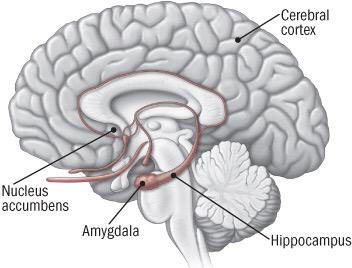
In several experiments conducted, it was found that whenever this region of the brain was triggered it created significant addiction type behavior.

Sample this:

When a set of people were allowed to press a button in a machine which in turn sent electric impulses to their “nucleus accumben region”, the subjects wanted to do nothing but continuously press the brain stimulating button. The addiction was to such an extent, that the researchers had to forcibly take the devices from subjects who refused to give it back.

Unfortunately, this is exactly the same region which gets triggered whenever there is a variable reward in offer.

Now you can understand as to what goes behind the strange addictive power of variable rewards.

So “as we get the reward, our nucleus accumbens get activated and hence eventually we will get addicted to the habit ” – goes my naive conclusion.

But hang on. This is where it gets even more interesting.

Contradictory to what I concluded, the nucleus accumben was less active when the reward was actually received!

It actually becomes most active in anticipation or craving of the reward!!

…  and  calms  when  
 we  get  what  we  want. Source:  Knutson  et  al  2001   That’s  the  ITCH we  seek  to  SCRATCH.

Wow!

So that essentially means it is not actually the reward that really matters as we normally would have thought. But rather the anticipation for that reward.

From an evolutionary point of view this is critical. This system kept us motivated to move around, learn, and survive. The rewards are not just restricted to food, drugs, sex, but also includes our search for information.

How many times have you searched for something on google, found the answer, and yet realized half an hour later that you are still online looking for more information?

Remember, that moment when you start scrolling through your facebook feeds and slowly what was supposed be 10 minutes eventually ends up becoming an hour. And you are still frantically scrolling through your feeds in search of your next reward – what are your friends up to, what’s the latest news, some nice article etc. And the key is, it is “variable”. You have no clue what reward you might find next.

Until now, if you still can’t spot the skinner’s pigeon, relax.
It’s us!

So more than the friend’s update it is the frantic scrolling in search of the next update, that is causing the brain’s pleasure center to activate.  We’re mesmerized by the prospect of another chance to find a reward – an endless search for the satisfaction that is never fully realized.

The variable rewards in social media take the form of new features,likes, feedback/responses, messages from friends, compliments, comments, new content, shares etc.

No wonder most of the popular apps have the “scroll” component (referred to as feeds) in it and work on the same principle of variable rewards.

Image result for twitter    Image result    Image result for linkedin

Other examples of variable rewards in the app world

Image result     Image result for gmail       Related image

E-Commerce sites – the thrill of searching for a new product at an awesome discount

Image result

Oops. Even our addiction to watching sports has the “variable rewards” angle to it!

Image result

If interested, you can read more about sports addiction here

And do you have this experience of switching channels in the remote of your TV without actually stopping to watching any programme..

Image result

Phew. This “variable reward” phenomenon is all around us. *Deep breathe*

Wait a minute. If this principle is used for creating negative habits, can’t it also be used for positive habits. Are there people out there doing this?

A few years back, I was trying to reduce weight and had joined a gym. It was a struggle for me to be regular and my attendance levels were extremely pathetic thanks to my low levels of discipline and will power. But astonishingly, in the last two years I have been reasonable consistent and work out 3 days per week with a fitness group called The Quad (read more about them here ). And making my job even more difficult, their classes are at 6 am in the morning which essentially means I wake up at around 5 am, three times a week!

How in the world did this miracle happen?

The key difference versus a normal gym was that workouts here are never repeated. Each and every class you go, you have no clue on what the workout is going to be.

It is the “Variable Rewards” yet again.

Confirming my suspicion, here is something that suddenly caught my attention from one of their testimonials,

the-quad-more-fun

And just when I thought, maybe I am taking it too far, I suddenly get reminded on the usual “What-happened-in-class-today?” messages from people who miss the class.


download1  download2

The variability factor definitely seems to be working.

Great. Some good news finally.Variable rewards work equally well for creating good habits!

Conclusion

Variable rewards play a significant role in habit creation and addiction.

While the power of variable rewards can be used both for good and bad addictions, unfortunately most of them lean towards the latter.

Product designers know the power of variable rewards and are applying it across various products to get us addicted. These are guys paid in millions to crack the code to our brains and get us addicted to their apps or products.

All this makes it a one sided fight and the simple truth is that we need to brace ourselves for an environment where everyone out there is coming after our most precious thingtime.

While the fight to protect our time is going to be a long drawn one, the first simple step is to acknowledge and start consciously watching out for this variable reward created cravings in our day to day lives.

Now to start addressing the problem, we also need to know about the additional techniques which complete the loop of habit forming products.

In our next post we shall learn about the entire loop, the various types of rewards and figure out some ways to have some control in the way we use these products.

If you like the content, it would be awesome if you could drop in your comments and also don’t forget to subscribe to the blog (all posts shall be delivered directly to your inbox), because your valuable comments and subscription are my variable rewards 🙂 

If you have survived me till here, thanks a ton for reading and happy investing.


25 Nov 05:02

The secret of Dubai’s success..

by Amol Agrawal
Yasser Al-Saleh, a faculty member at the MBRSG (formerly the Dubai School of Government) has a piece on Dubai model. He calls it the ABS model: As governments across the Middle East try to wean themselves off natural resources and build diversified, resilient economies, they should take some lessons from Dubai. It’s a remarkable story. In less than […]
25 Nov 04:59

The Founder Principle: A Wonderful Idea from Biology

by Farnam Street Team

We’ve all been taught natural selection; the mechanism by which species evolve through differential reproductive success. Most of us are familiar with the idea that random mutations in DNA cause variances in offspring, some of which survive more frequently than others. However, this is only part of the story.

Sometimes other situations cause massive changes in species populations, and they’re often more nuanced and tough to spot.

One such concept comes from one of the most influential biologists in history, Ernst Mayr. He called it The Founder Principle, a mechanism by which new species are created by a splintered population; often with lower genetic diversity and an increased risk of extinction.

In the brilliant The Song of the Dodo: Island Biography in an Age of ExtinctionDavid Quammen gives us not only the stories of many brilliant biological naturalists including Mayr, but we also get a deep dive into the core concepts of evolution and extinction, including the Founder Effect.

Quammen begins by t outtlining the basic idea:

When a new population is founded in an isolated place, the founders usually constitute a numerically tiny group – a handful of lonely pioneers, or just a pair, or maybe no more than one pregnant female. Descending from such a small number of founders, the new population will carry only a minuscule and to some extent random sample of the gene pool of the base population. The sample will most likely be unrepresentative, encompassing less genetic diversity than the larger pool. This effect shows itself whenever a small sample is taken from a large aggregation of diversity; whether the aggregation consists of genes, colored gum balls, M&M’s, the cards of a deck, or any other collection of varied items, a small sample will usually contain less diversity than the whole.

Why does the Founder Effect happen? It’s basically applied probability. Perhaps an example will help illuminate the concept.

Think of yourself playing a game of poker (five card draw) with a friend. The deck of cards is separated into four suits: Diamonds, hearts, clubs and spades, each suit having 13 cards for a total of 52 cards.

Now look at your hand of five cards. Do you have one card from each suit? Maybe. Are all five cards from the same suit? Probably not, but it is possible. Will you get the ace of spades? Maybe, but not likely.

This is a good metaphor for how the founder principle works. The gene pool carried by a small group of founders is unlikely to be precisely representative of the gene pool of the larger group. In some rare cases it will be very unrepresentative, like you getting dealt a straight flush.

It starts to get interesting when this founder population starts to reproduce, and genetic drift causes the new population to diverge significantly from its ancestors. Quammen explains:

Already isolated geographically from its base population, the pioneer population now starts drifting away genetically. Over the course of generations, its gene pool becomes more and more different from the gene pool of the base population – different both as to the array of alleles (that is, the variant forms of a given gene) and as to the commonness of each allele.

The founder population, in some cases, will become so different that it can no longer mate with the original population. This new species may even be a competitor for resources if the two populations are ever reintroduced. (Say, if a land bridge is created between two islands, or humans bring two species back in contact.)

Going back to our card metaphor, let’s pretend that you and your friend are playing with four decks of cards — 208 total cards. Say we randomly pulled out forty cards from those decks. If there are absolutely no kings in the forty cards you are playing with, you will never be able to create a royal flush (ace+king+queen+jack+10 of the same suit). It doesn’t matter how the cards are dealt, you can never make a royal flush with no kings.

Thus it is with species: If a splintered-off population isn’t carrying a specific gene variant (allele), that variant can never be represented in the newly created population, no matter how prolific that gene may have been in the original population. It’s gone. And as the rarest variants disappear, the new population becomes increasingly unlike the old one, especially if the new population is small.

Some alleles are common within a population, some are rare. If the population is large, with thousands or millions of parents producing thousands or millions of offspring, the rare alleles as well as the common ones will usually be passed along. Chance operation at high numbers tends to produce stable results, and the proportions of rarity and commonness will hold steady. If the population is small, though, the rare alleles will most likely disappear […] As it loses its rare alleles by the wayside, a small pioneer population will become increasingly unlike the base population from which it derived.

Some of this genetic loss may be positive (a gene that causes a rare disease may be missing), some may be negative (a gene for a useful attribute may be missing) and some may be neutral.

The neutral ones are the most interesting: A neutral gene at one point in time may become a useful gene at another point. It’s like playing a round of poker where 8’s are suddenly declared “wild,” and that card suddenly becomes much more important than it was the hand before. The same goes for animal traits.

Take a mammal population living on an island, having lost all of its ability to swim. That won’t mean much if all is well and it is never required to swim. But the moment there is a natural disaster such as a fire, having the ability to swim the short distance to the mainland could be the difference between survival or extinction.

That’s why the founder effect is so dangerous: The loss of genetic diversity often means losing valuable survival traits. Quammen explains:

Genetic drift compounds the founder-effect problem, stripping a small population of the genetic variation that it needs to continue evolving. Without that variation, the population stiffens toward uniformity. It becomes less capable of adaptive response. There may be no manifest disadvantages in uniformity so long as environmental circumstances remain stable; but when circumstances are disrupted, the population won’t be capable of evolutionary adjustment. If the disruption is drastic, the population may go extinct.

This loss of adaptability is one of the two major issues caused by the founder effect, the second being inbreeding depression. A founder population may have no choice but to only breed within its population and a symptom of too much inbreeding is the manifestation of harmful genetic variants among inbred individuals. (One reason humans consider incest a dangerous activity.) This too increases the fragility of species and decreases their ability to evolve.

The founder principle is just one of many amazing ideas in The Song of the Dodo. In fact, we at Farnam Street feel the book is so important that it made our list of books we recommend to improve your general knowledge of the world and it was the first book we picked for our learning community reading group.

If you have already read this book and want more we suggest Quammen’s The Reluctant Mr. Darwin or his equally thought provoking Spillover: Animal Infections and the Next Human Pandemic. Another wonderful and readable book on species evolution is The Beak of the Finch, by Jonathan Weiner.

--
Sponsored by: Slack - Making teamwork simpler, more pleasant, and more productive.

23 Nov 06:13

“Do Half” Applied

by David Merkel
Photo Credit: Attila Malarik

Photo Credit: Attila Malarik || In many but not all situations, doing half is a smart idea!

==================================

Four major stock indexes, the DJIA, S&P 500, Nasdaq, Russell 2000 all closes at records on the same day.  From that same article, Ryan Detrick, senior market strategist for LPL Financial said that it was the first time all of those indexes set records on the same day since December 31, 1999.

For those that missed the rally, do you feel bad about it?  Regretful?  Really, it’s too bad that the bear bug got you to the degree that you acted on it.  Those who have read me for a long time know that I often sound bearish, because I am natively bearish.  But, I don’t let it force me to take aggressive actions.  There is a point where I will hedge everything, but that is around 2600 on the S&P 500 at present.  I sit and worry a little, let Portfolio Rule Seven trim a little as my stocks hit new highs, but I won’t let cash go over 20% — we’re at about 16% now.  After I Bumped Against My Upper Cash Limit, I bought more stock — good thing too, at least in the short run.

If you think this is all a mirage, and there aren’t any structural reasons why the market should go any higher, and you are not going to do anything here — well, good for you.  Maybe you are right, and you can buy lower someday.  Just don’t get jumpy if the market continues to rise, and you don’t have much in the game.  (To those so inclined, don’t be macho fools and try to short into new highs — wait until there is some blood on the sword before shorting, something that I almost never do because of the bad risk/reward tradeoff.)

But if you are feeling jumpy and think you should get in on the action, let me give you two words: “Do Half.”  If at normal valuations you would have 60% of your assets in stocks, and you have nothing in stocks now, don’t take position above 30%.  Go up to half of a normal position.  If things continue to go up, you will be happy you have something in the market.  If things go down you can bring it up to a full position on weakness, and be grateful you didn’t go up to 60% all at once.

Now, I’m not telling you to buy anything, invest with me, or anything like that.  I just know that regret is one of the most powerful forces in the market, and lots of people make stupid decisions under its influence.  Rules that I use, like “Do Half” and the portfolio management rules are designed to keep me from making rash decisions influenced by my emotions.

The same “Do Half” rule could be applied to lightening up on bond positions and other matters, like raising cash or edging into commodities.  (I am doing neither of those now — they are just examples from others that I know.)

The main idea is to be self-controlled, and not let emotion drive you.  Investing is a business; determine your policies, and act on them, whether you do it yourself, or farm it out to others.  But if you feel that you have to do something now, then my advice to you is “Do Half.”  


But if you feel that you have to do something now, then my advice to you is 'Do Half.'
Click To Tweet


22 Nov 09:18

Using my cook as an ATM

by SK

This happened ten days before high value notes were withdrawn, and suggests nothing about my cook’s political opinions or views. 

On 30th October 2016, I paid my cook his salary for October. As it was the usual practice, I paid him in cash. He asked me if I could do an online transfer instead.

It was the first day of Diwali, and he needed to send money to his wife in Bihar. And it being Diwali, all banks were closed, and there was no way he could send money to her. So he asked me if I could do that. And if I were anyway transferring money to his wife’s account, could I send her a bit more, he asked – he would compensate me for the extra amount in cash.

And so like that I used my cook as an ATM. He gave me his wife’s account details (it was such an obscure branch that I’d to google it to find the IFSC code – wasn’t in citibank’s lookup list). I added her as a “payee” and immediately IMPSd the amount to her. And my cook gave me the extra funds I’d transferred in cash.

Later on, I told him to install his bank’s app on his newly acquired fancy phone (with a Reliance Jio sim). I’m not sure he’s done that but considering how resourceful he is, it wouldn’t be long before he does that. And more of the Bihari cooks network in Bangalore do likewise.

Nandan Nilekani, in his championing of the UPI, likes to talk about how “anybody can be an ATM” with the new technology. This was an exemplary example of that.

The only fly in the ointment was that I didn’t need cash that day – after all I’d been to the ATM earlier that morning just so that I could get cash to pay my cook – so I ended up with a lot of cash that I didn’t need. Thankfully I was able to spend it productively before the ceased to be legal tender.

Following the withdrawal of high currency notes, I told my cook I would pay his subsequent salaries by bank transfer. He gladly agreed.

22 Nov 04:30

No Pain No Gain

by Muthu

I received a document prepared by Franklin Templeton India on demonetisation. I found the same useful.

I’ve given the key points below. Please read the complete report for more details and better understanding.

1)Overall, we believe that the demonetisation exercise should help to accelerate financialisation of the Indian economy over medium to long term.

2) This measure needs to be seen in the context of other far reaching measures effected by the current government, including GST, Aadhar, Jan Dhan Yojana and Unified Payment Interface (UPI). All these measures put together should help in shifting significant portions of the informal economy (estimated at 40% of GDP) into formal economy.

3) This could in turn improve productivity by reducing frictional inefficiencies and improve the government’s tax revenues led by significantly better financial trails over medium to long term. These measures would give more flexibility for the government to manage fiscal deficit, as also potentially enable to shift to lower interest rates in India.

4) However, the demonetisation measure is likely to be negative for growth in the very near term until the level of cash in circulation reverts to normalcy. A sudden withdrawal of Rs.14 lakhs crore (9% of GDP) represents substantial monetary tightening, which could result in deflationary forces due to lower aggregate demand.

5) We believe that there exists a scope of 50 bps policy rate cut by the RBI from current levels over next one year, which may be undertaken in order to offset the deflationary impact.

6) Meanwhile, the flow of substantial cash holdings into bank deposits will mean that banking system will be flush with liquidity and CASA (Current Account and Savings Account) balances are expected to improve. As credit demand is likely to be muted for next couple of quarters, there would be very limited opportunities for banks to lend these deposits. The possibility of this money being channelised towards government securities may lead to a bond rally.

7) We expect aggressive rate cuts by banks, thus helping RBI in achieving better monetary transmission. The lower interest rates, along with a return to normalcy for cash in circulation should set the stage for a stronger recovery in aggregate demand in financial year 2017-18.

I wrote my last piece on the very next day of demonetisation. Now I’ve a better understanding of how benefit would accrue to government.

It is unlikely that the entire Rs.14 lakhs crore that was in circulation would come back to banks. Black money would be a sizeable part of this. The estimates range from Rs.1.5 lakh crore to Rs.5 lakh crore. There are some who argue that entire money would somehow find its way to banks. Even if that happens, the (earlier) untaxed part of that money would result in huge tax revenues for government.

For now, let us assume Rs.3 lakh crore does not come into bank accounts. That is the black money destroyed in this demonetisation drive. Government by necessary legislative changes can ensure that is no longer in the books of RBI as liability. As assets of RBI remain the same and liability is reduced, this excess Rs.3 lakh crore can be transferred to reserve. From reserves, RBI can eventually transfer the same to its P&L (Profit & Loss account) as income and then pay the same to government as dividend. Either government is going to tax and penalise heavily the unaccounted money coming to the system or it is going to get a hefty dividend from RBI or most likely a combination of both.

Thus black money is transferred from the hands of corrupt individuals to government of India.


22 Nov 04:28

The Green Lumber Fallacy: The Difference between Talking and Doing

by Farnam Street Team

“Clearly, it is unrigorous to equate skills at doing with skills at talking.”
— Nassim Taleb

***

Before we get to the meat, let’s review an elementary idea in biology that will be relevant to our discussion.

If you’re familiar with evolutionary theory, you know that populations of organisms are constantly subjected to “selection pressures” — the rigors of their environment which lead to certain traits being favored and passed down to their offspring and others being thrown into the evolutionary dustbin.

Biologists dub these advantages in reproduction “fitness” — as in, the famously lengthening of giraffe necks gave them greater “fitness” in their environment because it helped them reach high up, untouched leaves.

Fitness is generally a relative concept: Since organisms must compete for scarce resources, their fitnesses are measured in the sense of giving a reproductive advantage over one another.

Just as well, a trait that might provide great fitness in one environment may be useless or even disadvantageous in another. (Imagine draining a pond: Any fitness advantages held by a really incredible fish becomes instantly worthless without water.) Traits also relate to circumstance. An advantage at one time could be a disadvantage at another and vice versa.

This makes fitness an all-important concept in biology: Traits are selected for if they provide fitness to the organism within a given environment.

Got it? OK, let’s get back to the practical world.

***

The Black Swan thinker Nassim Taleb has an interesting take on fitness and selection in the real world:  People who are good “doers” and people who are good “talkers” are often selected for different traits. Be careful not to mix them up.

In his book Antifragile, Taleb uses this idea to invoke a heuristic he’d once used when hiring traders on Wall Street:

The more interesting their conversation, the more cultured they are, the more they will be trapped into thinking that they are effective at what they are doing in real business (something psychologists call the halo effect, the mistake of thinking that skills in, say, skiing translate unfailingly into skills in managing a pottery workshop or a bank department, or that a good chess player would be a good strategist in real life).

Clearly, it is unrigorous to equate skills at doing with skills at talking. My experience of good practitioners is that they can be totally incomprehensible–they do not have to put much energy into turning their insights and internal coherence into elegant style and narratives. Entrepreneurs are selected to be doers, not thinkers, and doers do, they don’t talk, and it would be unfair, wrong, and downright insulting to measure them in the talk department.

In other words, the selection pressures on an entrepreneur are very different from those on a corporate manager or bureaucrat: Entrepreneurs and risk takers succeed or fail not so much on their ability to talk, explain, and rationalize as their ability to get things done.

While the two can often go together, Nassim figured out that they frequently don’t. We judge people as ignorant when it’s really us who are ignorant.

When you think about it, there’s no a priori reason great intellectualizing and great doing must go together: Being able to hack together an incredible piece of code gives you great fitness in the world of software development, while doing great theoretical computer science probably gives you better fitness in academia. The two skills don’t have to be connected. Great economists don’t usually make great investors.

But we often confuse the two realms.  We’re tempted to think that a great investor must be fluent in behavioral economics or a great CEO fluent in Mckinsey-esque management narratives, but in the real world, we see this intuition constantly in violation.

The investor Walter Schloss worked from 9-5, barely left his office, and wasn’t considered an entirely high IQ man, but he compiled one of the great investment records of all time. A young Mark Zuckerberg could hardly be described as a prototypical manager or businessperson, yet somehow built one of the most profitable companies in the world by finding others that complemented his weaknesses.

There are a thousand examples: Our narratives about the type of knowledge or experience we must have or the type of people we must be in order to become successful are often quite wrong; in fact, they border on naive. We think people who talk well can do well, and vice versa. This is simply not always so.

We won’t claim that great doers cannot be great talkers, rationalizers, or intellectuals. Sometimes they are. But if you’re seeking to understand the world properly, it’s good to understand that the two traits are not always co-located. Success, especially in some “narrow” area like plumbing, programming, trading, or marketing, is often achieved by rather non-intellectual folks. Their evolutionary fitness doesn’t come from the ability to talk, but do. This is part of reality.

***

Taleb calls this idea the Green Lumber Fallacy, after a story in the book What I Learned Losing a Million Dollars. Taleb describes it in Antifragile:

In one of the rare noncharlatanic books in finance, descriptively called What I Learned Losing a Million Dollars, the protagonist makes a big discovery. He remarks that a fellow named Joe Siegel, one of the most successful traders in a commodity called “green lumber,” actually thought it was lumber painted green (rather than freshly cut lumber, called green because it had not been dried). And he made it his profession to trade the stuff! Meanwhile the narrator was into grand intellectual theories and narratives of what caused the price of commodities to move and went bust.

It is not just that the successful expert on lumber was ignorant of central matters like the designation “green.” He also knew things about lumber that nonexperts think are unimportant. People we call ignorant might not be ignorant.

The fact that predicting the order flow in lumber and the usual narrative had little to do with the details one would assume from the outside are important. People who do things in the field are not subjected to a set exam; they are selected in the most non-narrative manager — nice arguments don’t make much difference. Evolution does not rely on narratives, humans do. Evolution does not need a word for the color blue.

So let us call the green lumber fallacy the situation in which one mistakes a source of visible knowledge — the greenness of lumber — for another, less visible from the outside, less tractable, less narratable.

The main takeaway is that the real causative factors of success are often hidden from usWe think that knowing the intricacies of green lumber are more important than keeping a close eye on the order flow. We seduce ourselves into overestimating the impact of our intellectualism and then wonder why “idiots” are getting ahead. (Probably hustle and competence.)

But for “skin in the game” operations, selection and evolution don’t care about great talk and ideas unless they translate into results. They care what you do with the thing more than that you know the thing. They care about actually avoiding risk rather than your extensive knowledge of risk management theories. (Of course, in many areas of modernity there is no skin in the game, so talking and rationalizing can be and frequently are selected for.)

As Taleb did with his hiring heuristic, this should teach us to be a little skeptical of taking good talkers at face value, and to be a little skeptical when we see “unexplainable” success in someone we consider “not as smart.” There might be a disconnect we’re not seeing because we’re seduced by narrative. (A problem someone like Lee Kuan Yew avoided by focusing exclusively on what worked.)

And we don’t have to give up our intellectual pursuits in order to appreciate this nugget of wisdom; Taleb is right, but it’s also true that combining the rigorous, skeptical knowledge of “what actually works” with an ever-improving theory structure of the world might be the best combination of all — selected for in many more environments than simple git-er-done ability, which can be extremely domain and environment dependent. (The green lumber guy might not have been much good outside the trading room.)

After all, Taleb himself was both a successful trader and the highest level of intellectual. Even he can’t resist a little theorizing.

--
Sponsored by: Slack - Making teamwork simpler, more pleasant, and more productive.

22 Nov 04:25

Sir John Templeton’s Investment Rule Nos. 1, and 2

by subra
No. 1.  INVEST FOR MAXIMUM TOTAL REAL RETURN When you invest, your ONLY AIM has to be to increase the family’s net wealth over a long term. This means the return on invested amounts after all costs, taxes and inflation.  This is the only rational objective for most long-term investors. Any investment strategy that fails […]
20 Nov 05:18

Cash and credit redux

I have received a lot of push back against my blog post about cash being less important than credit. I would also freely admit that the evidence on the ground during this week does not suggest a smoothly functioning credit economy. But the reason for this unfortunate situation is not that cash is essential for a functioning economy. The true reason for the difficulties that we are seeing now is something more alarming – a partial disruption of credit expansion.

Cash substitutes are not emerging because there is a legitimate fear that the creation of such substitutes could be misconstrued as facilitating money laundering. For example, based on local and global historical experience, I am quite confident that if my Institute were to issue 500 rupee tokens or IOUs, it would circulate freely as money not only among the couple of thousand people on campus but also outside the campus (within a radius of a kilometre or so). A decade or two ago, during a period of shortage of small coins, many shops and institutions did issue coupons to substitute for the coins and these circulated quite freely. Today, however, probably no institution would want to tread that path for lack of clarity on how the government would react to such a move. Employers who have not been able to pay salaries in cash are not issuing IOUs which could ameliorate the cash shortage.

I firmly believe that the government should immediately step in with a public announcement that it would not frown upon the creation of temporary cash substitutes. In times like this, cash substitutes are essential because shortages lead to hoarding and much of the cash being paid out from the banks is not entering circulation, but is being locked away for future contingencies (cash could be even scarcer tomorrow than it is today). Almost everybody that I have talked to is today targeting a cash balance that is at least twice what they were holding two weeks ago. This has been the case historically as well as described very well in, for example, Andrew, A. Piatt. “Hoarding in the Panic of 1907.” The Quarterly Journal of Economics (1908): 290-299 (sorry that is behind a paywall).

As regards the feasibility of cash substitutes, I would once again link to the Irish experience that I linked to in my previous blog post. I would in addition describe the US experience of 1907. My source for this is unfortunately behind a paywall and I can only quote some material from there. The paper that I am referring to was published in the Quarterly Journal of Economics in 1908 shortly after the crisis of 1907 (Andrew, A. Piatt. “Substitutes for Cash in the Panic of 1907.” The Quarterly Journal of Economics 22.4 (1908): 497-516) and was based on extensive primary and secondary data collection. The author states that he wrote letters “addressed to banks in all cities of 25,000 or more inhabitants” and reports having got responses from 145 out of 147 such cities (response rates to mail surveys were much higher in those days than they are now!).

... we may safely place an estimate of the total issue of substitutes for cash above 500 millions. For two months or more these devices furnished the principal means of payment for the greater part of the country, passing almost as freely as greenbacks or bank-notes from hand to hand and from one locality to another. The San Francisco certificates, for instance, circulated, not only in California, but in Nevada and in south-eastern Oregon, some reaching as far east as Philadelphia, some as far west as the Hawaiian Islands. The banks of Pittsburg, on the other hand, reported remittances of certificates and checks, in denominations ranging from $1 up, from as scattered localities as Cleveland, Cincinnati, St. Louis, Chicago, Milwaukee, Duluth, Philadelphia, Danville, Va., and Spokane.

To put that $500 million number in perspective, the total coin and paper currency in circulation in the US was only about $2,800 million and the total gold coins was only $560 million (this data is from the Federal Reserve of St. Louis). In other words, cash substitutes were almost equal to the total gold coins in circulation and almost 20% of the entire gold and paper currency.

Andrew describes many different cash substitutes, but I would quote only one: bearer cheques “payable only through the clearing house,” (this clause meant they could not be redeemed for cash but could only be converted into other cash substitutes).

Last of all among the emergency devices were the pay checks payable to bearer drawn by bank customers upon their banks in currency denominations and used in all parts of the country in payment of wages and in settlement of other commercial obligations. These checks were generally “payable only through the clearing house,” ... they were not a liability of the clearing- house association or of the bank on which they were drawn, but of the firm or corporation for whose benefit they were issued.

The pay-check system reached its largest development in Pittsburg, where during the panic some $47,000,000 were issued, much of which was in denominations of $1 and $2.

Pay checks were also issued by railroads, mining companies, manufacturers, and store-keepers in a large number of other cities. Shops and stores and places of amusement in the neighborhood of their issue generally accepted them, and it is, indeed, surprising, considering their variety, their liability to counterfeit, and their general lack of security, how little real difficulty was experienced in getting them to circulate in lieu of cash

The last paragraph in the paper about cash substitutes in general is worth quoting in full:

Most of this currency was illegal, but no one thought of prosecuting or interfering with its issuers. Much of it was subject to a 10 per cent. tax, but no one thought of collecting the tax. As practically all of it bore the words “payable only through the clearing house,” its holders could not demand payment for it in cash. In plain language it was an inconvertible paper money issued without the sanction of law, an anachronism in our time, yet necessitated by conditions for which our banking laws did not provide. During the period of apprehension, when banks were being run upon and legal money had disappeared in hoards, in default of any legal means of relief, it worked effectively and doubtless prevented multitudes of bankruptcies which otherwise would have occurred.

Markets will find solutions to most problems if the government steps out of the way. In 1907, governments in the US were willing to do precisely that. Andrew quotes several official announcements during the panic of 1907 that allowed the creation of cash substitutes. For example, the following was a letter from the Government of Indiana of October 28, 1907:

To THE INDIANA BANKS AND TRUST COMPANIES:

Gentlemen,-Your bank being solvent, should it adopt the same rule that has been adopted by the banks of Indianapolis and refuse to pay to any depositor or holder of a check only a limited amount of money in cash and settle the balance due by issuing certified checks, or drafts on correspondents, such act, in this emergency, will not be considered an act of insolvency by this department.

The same rule will apply to trust companies.

P.S.-The question of your solvency is to be determined by yourselves upon an examination of your present condition.

The question today is whether the Indian government is willing to be bold and imaginative, and allow the market to find solutions to the current problems that are beyond the power of governments to solve.

20 Nov 05:12

Damming the Nile and diapers

by SK

One of the greatest engineering problems in the last century was to determine the patterns in the flow of the Nile. It had been clear for at least a couple of millennia that the flow of the river was not regular, and the annual flow did not follow something like a normal distribution.

The matter gained importance in the late 1800s when the British colonial government decided to dam the Nile. Understanding accurately the pattern of flows of the river was important to determine the capacity of the reservoir being built, so that both floods and droughts could be contained.

The problem was solved by Harold Edwin Hurst, a British hydrologist who was posted in Egypt for over 60 years in the 20th Century. Hurst defined his model as one of “long-range dependence”, and managed to accurately predict the variation in the flow of the river. In recognition of his services, Egyptians gave him the moniker “Abu Nil” (father of the Nile). Later on, Benoit Mandelbrot named a quantity that determines the long-range dependence of a time series after Hurst.

I’ve written about Hurst once before, in the context of financial markets, but I invoke him here with respect to a problem closer to me – the pattern of my daughter’s poop.

It is rather well known that poop, even among babies, is not a continuous process. If someone were to poop 100ml of poop a day (easier to use volume rather than weight in the context of babies), it doesn’t mean they poop 4ml every hour. Poop happens in discrete bursts, and the number of such bursts per day depends upon age, decreasing over time into adulthood.

One might think that a reasonable way to model poop is to assume that the amount of poop in each burst follows a normal distribution, and each burst is independent of the ones around it. However, based on a little over two months’ experience of changing my daughter’s diapers, I declare this kind of a model to be wholly inaccurate.

For, what I’ve determined is that far from being normal, pooping patterns follow long-range dependence. There are long time periods (spanning a few diaper changes) when there is no, or very little, poop. Then there are times when it flows at such a high rate that we need to change diapers at a far higher frequency than normal. And such periods are usually followed by other high-poop periods. And so on.

In other words, the amount of poop has positive serial correlation. And to use the index that Mandelbrot lovingly constructed and named in honour of Hurst, the Hurst exponent of my daughter’s (and other babies’) poop is much higher than 0.5.

This makes me wonder if diaper manufacturers have taken this long-range dependence into account while determining diaper capacity. Or I wonder if, instead, they simply assume that parents will take care of this by adjusting the inter-diaper-change time period.

As Mandelbrot describes towards the end of his excellent Misbehaviour of markets , you can  use so-called “multifractal models” which combine normal price increments with irregular time increments to get an accurate (fractal) representation of the movement of stock prices.

PS: Apologies to those who got disgusted by the post. Until a massive burst a few minutes ago I’d never imagined I’d be comparing the flows of poop and the Nile!

20 Nov 05:11

Weekend reading links

by noreply@blogger.com (Gulzar Natarajan)
1. Interesting difference between what the Chinese and Indian students, the two largest category of foreign students in the US, choose to study,
Chinese students tend to choose undergraduate courses focused on business, while Indians opt for short graduate programs in more technical subjects like science and maths... The most Indian students were studying engineering–36%, followed by math or computer science–34.9%.
2.  Fascinating graphic in the Economist which captures the Brexit-Trump moments in the rich world. It shows that positive views of globalisation are today largely confined to the developing countries.
3. The Economist points to a new paper which calculates the challenge facing defined contribution (DC) savers as they grapple with the ultra-low interest rates in developed economies,
In recent history a fairly common savings rate of 8% each year over one’s career together with other common industry assumptions, would have allowed DC savers to reach a target retirement income replacement ratio (RR) of 75%. Unfortunately, current market yields indicate that both stocks and bonds may deliver lower returns in the coming years. This may impact savers significantly: we quantify that roughly 2% lower expected returns could potentially double the required savings rate over one’s working career in order to achieve this same 75% replacement ratio.
The historical real return of 7.5% from equities is expected to decline to 5%, and that from bonds from 2.5% to 1%, thereby generating a two percentage points lower annual return of 3.5% on a standard asset allocation of 60% US equities and 40% Treasury Bonds. This means that the worker now has to save 15% a year, not the current 9%, to reach the RR of 75%. On a 2.5% real return assumption, the contributions would have to rise to 19% overall!

This and the massive unfunded liabilities of defined benefits plans makes pensions a silent crisis lurking at the edge.

4. The distortions in the Chinese corporate debt market are scary. The system of dual rating of state owned enterprises (SOEs), a stand-alone rating based on the company's balance sheet and a state-backed rating that factors in government support, confounds the problems. Consider these,
Take, for instance, Beijing Infrastructure Investment Co Ltd, which operates the city’s urban rail system. With a hefty debt load, its initial credit rating would be BB-, a risky junk bond, according to S&P. But thanks to government support, S&P gives it a final rating of A+, eight notches higher, a solid investment-grade bond... In the onshore Chinese bond market, if the stand-alone ratings applied, SOEs would face annual interest rates of more than 10% instead of the roughly 5% they are used to. Even in the Hong Kong bond market, average annual borrowing rates for SOEs should be 3.5%, based on their stand-alone profiles; that, however, falls to roughly 2% after state support is included. That amounts to a two-fifths discount on interest costs—quite the subsidy.
This is all fine as long as the government can play along and provide the implicit guarantee. But a recent willingness to let a few fail shows that the possibility of massive turbulence cannot be ruled out.

5. India demonetisation snippet of the week,
Within a day of Mr Modi’s announcement, first-class tickets on India’s longest train route, between Dibrugarh and Kanyakumari, were sold out for the next four months: they could still be bought with old money, then later refunded for new.Within a day of Mr Modi’s announcement, first-class tickets on India’s longest train route, between Dibrugarh and Kanyakumari, were sold out for the next four months: they could still be bought with old money, then later refunded for new.
6. Livemint has a four part series on corporate debt in India. Given the scale of indebtedness, the process of deleveraging is slow, thereby prolonging the pain and postponing any revival of the investment cycle. An analysis of a sample of 305 companies shows that the smallest companies are the most leveraged
Compounding the problems, their ability to meet interest costs has dipped to the lowest in a decade.
In fact, even though India has one of the lowest corporate debt to GDP ratios, its corporate indebtedness is worsened by one of the lowest interest coverage ratios. This is caused by slower revenue growth and higher interest rates in India. 
As expected, the indebtedness has taken its toll on compensation, though executive compensation rose faster than those of regular employees. The counter-party in this are the banks, whose balance sheets have been bruised as the debt piles gradually turn sour. 

7. Livemint has a graphic of the share prices of 75 politically connected firms maintained by Ambit Research, compared to those of BSE 500.
This may well be the biggest achievement of this government in Delhi, controlling corruption and crony capitalism. The contrast with the previous government's tenure is stark.

8. Finally, fascinating article on what makes the All Blacks rugby union team tick. "Clean breaks" or slipping through defensive lines, was found to be the most robust predictor of scoring points, and New Zealand towers over everyone else.
Add to Technorati Favorites
17 Nov 09:54

Why not a helicopter drop of new rupee notes?

A helicopter drop of new currency notes might be the perfect solution to the logistic problems arising out of last week’s demonetization of most of the Indian currency. The pressing logistical problems are about getting the new notes to the remote and under banked rural areas of the country. There is also a concern about solving the problems of the poor who were more reliant on currency than the rich, and have less access to credit which can substitute for cash. The simplest solution is to simply drop currency notes from the sky across the length and breadth of the country so that every Indian receives some money to carry on their daily activities without worry.

There is a strong fiscal justification for this free gift of money to every Indian. The whole purpose of the demonetization exercise is to destroy the stock of unaccounted holdings of currency in India. If we assume that 40% of the 14 trillion rupees of the old notes represent untaxed income and will not therefore be exchanged for new notes, there is a gain of over 5 trillion rupees which amounts to about 4,000 rupees for every man, woman and child in India. A helicopter drop of this magnitude would simply be a way distributing this windfall gain equally to the people of India in a kind of negative poll tax. The alternative to this equal distribution would be a reduction in the income tax rate or the GST rate which would distribute the benefits more to the rich than to the poor. In fact, the costs of demonetization are falling equally on the rich and the poor. The poor man stands in the queue for the same few hours to get his 1,000 rupees as the rich man does to get his 24,000. There is therefore every reason to spread the benefits also equally among all.

In addition, there are huge logistic benefits from a helicopter drop. It gets money directly in the hands of those who need it most without wasting their time. Farmers can spend their time harvesting the crop instead of standing in queues in a far away branch. Urban poor do not have to forsake their daily wages to go to the bank. This also ensures minimal disruption to economic activities. In fact, demonetization could become so popular among the common people that we would be able to demonetize our currency every 5-10 years instead of doing it only once in 30-40 years.

Helicopter drops of money are a well established tool in economic theory. The Nobel laureate, Milton Friedman was perhaps the first person to discuss the idea his 1969 paper on The Optimal Quantity of Money. The greatest living exponent of helicopter drops is former Fed Chairman, Ben Bernanke who endorsed the idea in his 2002 speech on deflation and has apparently been advising Japanese Prime Minister Shinzo Abe to try it. It is quite likely that apart from solving the logistics problems of demonetization, the helicopter money drop would also stimulate the economy at a time when it is facing several headwinds. It would certainly do more to increase rural spending than rate cuts by the central bank which seem to get lost in monetary transmission.

Economists are more willing to contemplate bold ideas, while politicians and bureaucrats tend to be cowardly in their approach. In India, today, we have the perfect constellation of factors that make a helicopter drop economically sensible and politically feasible. If a bill were to be moved in parliament to provide statutory basis for a helicopter drop, I am confident that almost all MPs who want to be reelected in 2019 will support the bill and it would be passed by an overwhelming majority.

In my dreams, the Indian government invites Ben Bernanke to advise it on the helicopter drop and also lets him ride the chopper on its first flight and drop the first wad of new notes with his own hands. It also invites Japanese prime minister Shinzo Abe to witness the inauguration of this programme. Today, Japanese tourists come to India to visit the holy sites of Buddhism. Perhaps, future generations of Japanese will come to India to visit the parliament which pioneered the first helicopter drop that was emulated in Japan and eventually lifted that country out of deflation. It is all a dream, but it could well become reality if the Indian government is willing to be bold and imaginative.

17 Nov 09:52

Short Note for our Clients – Trump Win & Modi’s Strike on Black Money

by Hemant Beniwal

Donald Trump wins US Presidential – against all odds & predictions. Most of the opinion Polls were giving 95% chances to Hilary until the end of Voting & then what happened is visible in this picture.

We shared this note with our Planning clients on 10th Nov 2016

poll-predictions

In 1981 Bill Gates predicted “640 KB of memory will be enough for most of the people in future”.

Not sure who said this but this is an awesome line to remind ourselves regularly – “It is difficult to make predictions, especially about the future.” In 2014 we wrote this article on TFL (you Must Read) – Predicting is not a good habit in your financial life 

You may still ask but what will happen to our investments especially equity? But my answer is I don’t know – we have not made investments for 1 month or 1 year it’s for

But my answer is I don’t know – we have not made investments for 1 month or 1 year it’s for long term. We strongly believe that businesses are here to increase their profit (including the companies that you run or work for) – people will always be interested to invest in such businesses through equity markets.

Change is tough for everyone – world & financial world may take some time to adjust but remember Nick Murray’s words “The world does not end, it only appears to be ending from time to time.”

The-world-does-not-end

Attack on  BlackMoney

It’s not the first time India did this but still lot of credit should go to current govt to take this step to curb Black Money Menace (let’s stick to the economy). In short term I see there will be some pain as Black Money in last few decades built a parallel economy. So people who are part of it – either who own it & earn tax free income on that or everyone who get’s benefited when some part of it flows to them including workers, shops, industries or anything that you can think of will freeze for some time. Real estate prices & luxury goods market will have significant impact as it was the biggest beneficiary of black money – this we always discussed in the past. Must Read: Greater Fool Theory & Indian Real Estate

cash

But for positives there’s a long list if in the future new Black money is not allowed to be created:

  • Higher Tax Collection
  • Lower tax evasion
  • May be lower tax rate in future
  • Enough liquidity in banks to give loans
  • Notes that will not be exchanged will reduce liability of RBI
  • Affordable Houses
  • Lower inflation etc

Overall it looks very positive as in next year GST will be there, which will limit opportunities for corporate to deal in black money.

Our Suggestion on this 9/11

Let’s focus on the goals & the things that we can control – so keep a check on your expenses & work hard so you don’t lose your current job or work.

And don’t believe on media – they don’t know anything that can help you in achieving your goals. Don’t focus on #Rexit #Brexit #Trump noise that is created by media – it’s their job to grab your attention to increase their TRP & advertisement revenue. No one has any clue that how an event will affect equity markets. In short-term few of them will but which one? In long term markets are slaves of earnings – if companies will generate profits, investors will pay for it. You should make a conscious effort to avoid such noises – avoid watching the financial news or reading the pink paper.

And in the end the “Serenity Prayer”:

“God grant me the serenity; 
To accept the things I cannot change; 
Courage to change the things I can; 
And wisdom to know the difference.”

PS: I have shared this in #LifePlanning newsletter if you haven’t seen this earlier – take out some time & watch this Video by one of my favorite author Nick Murray (if you want you can skip initial 4 mins intro)

Finally, a message that we frequently repeat – Investing is not a Number Game, it is a “Mind Game”.  – If you have any questions feel free to ask.

17 Nov 09:10

Financial inclusion and cash

by SK

Varad Pande and Nirat Bhatnagar have an interesting Op-Ed today in Mint about financial inclusion, and about how financial institutions haven’t been innovative to make products that are suited to the poor, and how better user interface can also drive financial inclusion. I found this example they took rather interesting:

Take, for instance, a daily wager who makes Rs200 on the days she gets work. Work is unpredictable, and expenses too can be volatile, so she has to borrow money for buying vegetables, or to pay the doctor’s fees when her children fall sick. Her real need is for a flexible—small ticket, variable amount, rapid approval—loan product that she can access instantly. Unfortunately, no institutional channel—neither the public sector bank where she has a “no frills” account, nor the MFI that she has previously borrowed from—offers such a product. She ends up borrowing from neighbours, often from the local moneylender.

Now, based on my experience in FinTech, it is not hard to design a loan product for someone whose cash flows are known. The bank statement is nothing but a continuing story of the account holder’s life, and if you can understand the cash flows (both in and out) for a reasonable period of time, it is straightforward to design a loan product that fits that cash flow pattern.

The key thing, however, is that you need to have full information on transactions, in terms of when cash comes in and goes out, what the cash outflow is used for, and all that. And that is where the cash economy is a bit of a bummer.

For a banker who is trying to underwrite, and decide the kind of loan product (and interest rate) to offer to a customer, the customer’s cash transactions obscure information; information that could’ve been used by the bank to design/structure/recommend the appropriate product for the customer.

For the case that Pande and Bhatnagar take, if all inflows and outflows are in cash, there is little beyond the potential borrower’s word that can convince bankers of the borrower’s creditworthiness. And so the potential borrower is excluded from the system.

If, on the other hand, the potential borrower were to have used non-cash means for all her transactions, bankers would have had a full picture of her life, and would have been able to give her an appropriate loan!

In this sense, I think so far financial inclusion has been going on ass-backwards, with most microfinance institutions (MFIs) targeting loans rather than deposits. And with little data to base credit on, it’s resulted in wide credit spreads and interest rates that might be seen as usurious.

Instead, if banks and MFIs had gone the other way, first getting customers to deposit, and then use the bank account for as much of their transactions as possible, it would have been possible to design much better financial products, and include more customers!

The current disruption in the cash economy possibly offers banks and MFIs a good chance to rectify their errors so far!

16 Nov 04:59

Runs on real estate companies?

by Ajay Shah
by Shubho Roy.

A new threat


Many households in India like to invest in real estate, even though this has not worked out as a great asset class. The Indian real estate business has been facing considerable difficulties in the present business cycle downturn. The recent `de-monetisation' is expected to adversely affect this sector, as there is considerable use of unaccounted cash. There is a natural analogy with the crisis of 2008, where real estate companies were one of the first places where stress became visible.

There is an additional looming problem that has not been as widely noticed. The Supreme Court has started passing orders asking real-estate companies to refund buyers of apartments in projects which have been significantly delayed:

  • Unitech was asked to refund Rs.20 Crores to 30 buyers on 19th October, (See here).
  • Parsvnath Builders was ordered to refund Rs.22 crore to 70 buyers on 18th October (See here).
  • Supertech was ordered to return deposits of 17 buyers on 6th September, 2016 (See here).

In this article, I worry that this could set the stage for runs on real estate companies. Thinking about this problem also helps us better understand the inter-relationships between corporate finance, consumer protection and bankruptcy process.

Corporate finance of Indian real estate companies


Delays by real-estate developers are not new in India. People book apartments, putting down large deposits, then wait as the developer fails to meet deadline after deadline. Many buyers have dragged developers to court, trying to pressurise them to finish the buildings. What is new is that some of these buyers do not want the apartments; they just want their deposits back. This has adverse implications for the developers, the buyers who do not want their deposits back, the real estate industry as a whole, and all other creditors of such real estate companies. When a customer asks for the refund of deposits, there are two possibilities:

  1. The buyer thinks that the real-estate developer will never be able to deliver the promised buildings; or
  2. The buyer thinks that these buildings are not the worth the money they have committed to pay for.

In a normal market, such exit by a few buyers should not matter. However, the structure of the real estate market in India is an unusual one. Most real estate firms lack formal financing. Real-estate companies usually launch a project and collect advances from the buyer. These advances are often used as fungible working capital by the company; they are pressed into service to meet the most urgent need for cash.

While this seems to be an efficient way to employ capital while the going is good; it fails when the going gets bad. This system works as long as the real estate company is able to launch new projects and get advances from them. If new project launches do not generate advances, previous incomplete projects are also in jeopardy. The business model of the companies presumes an ever increasing demand for new projects at ever increasing prices with ever increasing number of buyers willing to make advance payments.

The new real estate law [Real Estate (Regulation and Development) Act, 2016] recognises this problem and tries to partially address it. Section 4.(2).(l)(A) of the law mandates requires:

...that seventy per cent. of the amounts realised for the real estate project from the allottees, from time to time, shall be deposited in a separate account to be maintained in a scheduled bank to cover the cost of construction and the land cost and shall be used only for that purpose

However, this law applies to deposits after 2017, and not the ones already made. There is no clarity where existing deposits of buyers have been used.

A bit like banks


Under these conditions, real estate firms in India are a bit like banks.

When you deposit money in a bank, the money enters the fungible pool of deposits of the bank. When someone else withdraws money from their account, this is withdrawn from the fungible pool. Banks do not match individual deposits to individual loans. They ensure that that the overall income from all loans is higher than the bank's liability to depositors (on the whole). This works fine as long as the depositing public is confident that the bank is making more money out of its loans than it has to pay the depositors. Banks do not keep the total deposits in liquid cash waiting to be withdrawn at any moment. If they did so, they would have no money to lend. Instead, banks keep a historical average of withdrawals (net of fresh deposits) in branches to meet the requirements. This is commonly known as fractional reserve banking.

When many people lose faith in the ability of a bank to repay its depositors, we get a run on the bank. A run is when depositors try to quickly get their deposits out before everyone else. Depositors know that if they can withdraw money, before the liquid cash kept by banks runs out, they are safe. Late comers are left in the lurch, as the bank runs out of cash.

Bank-runs are sometimes a self-fulfilling prophecy. Depositors worry that the bank is out of cash and start withdrawing their deposits at the same time. Since the loans made by the bank cannot be recalled quickly, the bank fails to refund some deposits. On the other hand, if the depositors do not panic, banks may be able to recover their loans and pay out depositors in due course.

To address this problem of bank runs, multiple layered safety measures have been developed in law and in financial markets. First, banks are heavily regulated by the banking regulator which is supposed to keep a close eye on the loans they make and mandate banks to keep some of their deposits in liquid cash. Moreover, when one bank faces some unusually large withdrawals, it can borrow from other banks for a short time, at low interest rates -- commonly known as the inter-bank market. Finally, the central bank of the nation acts as the lender of last resort, if a bank is unable to borrow in the inter-bank market. This is the institutional machinery required to forestall runs on banks.

Runs on real estate companies


There is no such safety system for the Indian real estate business.

Capital expenditure by real estate companies is now in the decline. They cannot rely on the old model of launching new projects to obtain working capital which is used to complete older projects.

Real estate companies can go to banks to borrow money when faced with the problem of refunding customers. Banks have cause for concern when buyers of the apartments do not want those apartments but want their money back. The fact that some buyers are approaching courts rather than finding another person to buy-out their claim means no one is willing to buy these unfinished apartments. Therefore, most of these apartments will be finished at a loss. This makes it commercially unwise for a bank to extend more loans to an entity which will not make profits.

Apartments are not fungible in the way money is fungible. When a real estate company has multiple projects, it cannot shift buyers from one project to another. Buyers have been promised a specific apartment in a specific housing project. Real-estate companies cannot move these buyers to another project. The flexibility of real estate companies when faced with withdrawals is lower than that of a bank.

The orders of the Supreme Court can possibly give a run on real estate companies. Before the Supreme Court orders, delays in delivery was a way for the real-estate companies to ride out the problem. They could wait for real-estate markets to turn around and then complete projects. Now the Court has taken away this choice.


On one hand, the order of the Supreme Court is just enforcing the law of the land:

Promises in a contract must be kept

The more such orders the Supreme Court makes, the more money will be taken out of the real estate companies. We do not know where the builder will find the money to pay for the Court order. It could be that this money comes from someone else's deposits. As more money is taken out, this could increase the balance sheet stress in real estate companies, and make it harder for them to complete their projects. This imposes externalities: it has adverse implications for people who have not filed cases against their builders to recover their deposits (including people who have filed cases to force the builder to finish their apartments). Such people may end up being the last guys in the line in a real-estate run. Every person who gets his/her deposit back reduces the chance of the project getting completed. People who wait may neither get an apartment, nor their deposits back.

The long term prospects of the real estate sector might be better. New projects under the new law will get better protection. However, the projects presently underway, and delayed, are a large block of capital, and a large block of bank loans. Many real estate firms may not survive this storm. The new law provides them no protection. In fact, the new law prevents real-estate developers from using new projects to fund older projects, thereby harming the chances of the older projects being completed.

The orders thus have adverse consequences for the real estate sector. The Court is blindly asking the real-estate companies to return the deposits (with interest) without asking from where the money will come from. The advance/deposit money collected from individual buyers is not lying in some separate account which is clearly identifiable. It has been mixed with the general assets and resources of the company. Worse, it could have been spend in some other project. When you ask a company to return the money to these buyers: what is the guarantee that the company will not take money out of another project to pay these buyers?

Fair treatment requires the Bankruptcy Code


Buyers are on sound ground when they demand a refund. When this refund does not materialise, the solution is not specific performance but bankruptcy. If a court jumps this step, and orders companies to repay large sums of money, the court may end up unfairly prejudicing other creditors of the company.

To avoid this problem, whenever courts in the US impose a large fine on a company, it asks for a financial analysis to determine whether the company will remain solvent after paying the fine. If this analysis (by accountants) returns a negative answer; then the courts force the company into insolvency with the fine/court being the last creditor.

The Supreme Court, by ordering real-estate companies to pay large sums of money to a select set of buyers, may be doing injustice to all other parties in the case. Fair treatment of all stakeholders requires the Insolvency Resolution Process under the Insolvency and Bankruptcy Code.

The advance payed by these buyers has most likely been used up within the firm. That money no longer exists in liquid form. The financially and legally sound solution to these requests to return advances is to place these incomplete projects under liquidation and sell them at an auction to the highest bidder. The surplus from the auction should be equally distributed amongst the buyers, whether they have asked for their deposits back or not. Buyers will probably not get back their entire deposits, but at least some buyers will not unfairly prejudice others. If the new real-estate company in the auction decides to continue building, the last buyers may deposit their pay-outs to such company.

Under the environment created by the Supreme Court, there is an incentive for each buyer to run. If, in contrast, failing or delayed projects led to a bankruptcy process, there would be no incentive for each buyer to run.

Where did we go wrong?


Why did our legal and administrative system come up with the wrong answer? The root cause of this situation lies in two elements:

  1. An unforeseen use of the Consumer Protection Act, 1986.
  2. The Supreme Court trying to solve individual problems in the interim, rather than laying down an appropriate legal principle.

The Consumer Protection Act, was envisaged as a quick and lightweight judicial system for small consumer disputes. While the law does not state it, debates about the law in Parliament indicate that the law was designed to solve minor disputes about consumer goods like blenders or phones. These are small value disputes, compared with the total capital of the companies which manufacture them. If a consumer goods company is asked to replace a blender, this will (most probably) not drive the company into insolvency.

However, the law was not clearly drafted: there is no financial limit to the jurisdiction of consumer courts. Such limits are usually a feature in similar laws in other countries. This enables people to use this law to file cases involving large sums of money.

When the dispute involves millions of rupees, the economics behind fines and compensation changes. Now a single dispute can bankrupt a company. Such disputes require more disciplined thinking about contract law, company law, bankruptcy law and laws of specific performance and monetary compensation. Disputes about real estate should not be decided by consumer courts. However, the vague drafting and the definitely pro-consumer slant of the law (low court fees, lax procedure, etc.) attracts litigants to file under this law.

All the three orders of the Supreme Court are interim orders. These orders are done without finally deciding the case on merits. They seem to be minor/incidental orders where the Court has not really thought about the implications. The court is not clear about the financial implication of imposing such large financial burden on the companies. Courts have come to see bankruptcy law as inoperable. As reported in the news it seems that the bench remarked:

"We are not concerned whether you sink or die. You will have to pay back the money to homebuyers. We are least bothered about your financial status"

Such a statement seems to indicate that the Court thinks that the effect of the fine will fall only one the management/owners/promoters of the company. But a company is a much more complicated being. The financial status of the company affects not only the management, but all creditors of the company, which include other buyers who have paid deposits/advances, banks which have lent money (in turn the public which put money in the banks and the taxpayers who will re-capitalise the banks), bond-holders of the company, employees, suppliers, etc. By making the company pay these buyers (out of turn) the Court orders may end up ensuring that all these creditors (who are not at fault) are left in the lurch and unfairly lose their rights to recover their dues from the company. It is very probable that some (if not most ) of these dues are superior (or at least of the same priority) as the rights of the buyers (who want their advances back). The Court is effectively paying some customers at the expense of others, and encouraging runs on real estate companies.

The Court seems to equate the company with the promoters/management of the company, who at this point may have very little invested in the company. The company has no incentive to openly admit that these fines will affect the solvency of the company. If it does so, it is at risk of being put under administration. This would remove the current management and equity owners (who control the company's representations before the court).


The author is a researcher at the National Institute for Public Finance and Policy. He acknowledges the help of Dhananjay Ghei and Manya Nayar in this work.
15 Nov 05:35

Why PayTM is winning the payments “battle” in India

by SK

For the last one year or so, ever since I started using IMPS at scale, and read up the UPI protocol, I’ve been bullish about Indian banks winning the so-called “payments battle”. If and when the adoption of electronic payments in India takes off, I’ve been expecting banks to cash in ahead of the “prepaid payments instruments” operators.

The events of the last one week, however, have made me revise this prediction. While the disruption of the cash economy by withdrawal of 85% of all notes in circulation has no doubt given a major boost to the electronic payments industry, only some are in a position to do anything about this.

The major problem for banks in the last one week has been that they’ve been tasked with the unenviable task of exchanging the now invalid currency, taking deposits and issuing new currency. With stringent know-your-customer (KYC) norms, the process hasn’t been an easy one, and banks have been working overtime (along with customers working overtime standing in line) to make sure hard currency is in the market again.

While by all accounts banks have been undertaking this task rather well, the problem has been that they’ve had little bandwidth to do anything else. This was a wonderful opportunity for banks, for example, to acquire small merchants to accept payments using UPI. It was an opportune time to push the adoption of credit card payment terminals to merchants who so far didn’t possess them. Banks could’ve also used the opportunity to open savings accounts for the hitherto unbanked, so they had a place to park their cash.

As it stands, the demands of cash management have been so overwhelming that the above are literally last priorities for the bank. Leave alone expand their networks, banks are even unable to service the existing point of sale machines on their network, as one distraught shopkeeper mentioned to me on Saturday.

This is where the opportunity for the likes of PayTM lies. Freed of the responsibilities of branch banking and currency exchange, they’ve been far better placed to acquire customers and merchants and improve their volume of sales. Of course, their big problem is that they’re not interoperable – I can’t pay using Mobikwik wallet to a merchant who can accept using PayTM. Nevertheless, they’ve had the sales and operational bandwidth to press on with their network expansion, and by the time the banks can get back to focussing on this, it might be too late.

And among the Prepaid Payment Instrument (PPI) operators again, PayTM is better poised to exploit the opportunity than its peers, mainly thanks to recall. Thanks to the Uber deal, they have a foothold in the premium market unlike the likes of Freecharge which are only in the low-end mobile recharge market. And PayTM has also had cash to burn to create recall – with deals such as sponsorship of Indian cricket matches.

It’s no surprise that soon after the announcement of withdrawal of large currency was made, PayTM took out full page ads in all major newspapers. They correctly guessed that this was an opportunity they could not afford to miss.

PS: PayTM has a payments bank license, so once they start those operations, they’ll become interoperable with the banking system, with IMPS and UPI and all that.

14 Nov 04:53

Trumping black money

by Ajay Shah
by Suyash Rai .

On November 8, the US elected Donald Trump, and our government decided to trump black money. The move to discontinue the higher denomination notes in circulation is bold. However, boldness is not a virtue in and of itself. It needs good company. The decision creates some benefits, but it is also intrusive and disruptive.

In 1978, when the government demonetised high denomination notes (Rs.1000, Rs.5000 and Rs.10000), they were really high denomination notes: Rs.1000 in 1978 is the same as Rs.18000 today. They were a minuscule portion of currency in circulation, and only a handful of people held those notes. In contrast, today, Rs.500 and Rs.1000 are small bills. About 86 percent of currency in circulation is in these denominations. The action has consequences for almost all citizens who have cash in their wallets. How should public policy analysis think about this action? It's useful to break this up into three components:

  1. Ex-ante analysis: Is the decision sound at the time it was taken? This is a forward-looking assessment that may be proven wrong on hindsight.
  2. Concurrent assessment: Is there sound execution? This is a concurrent assessment of all the actions that are undertaken to see the idea through - maximising benefits and minimising costs.
  3. Ex-post evaluation: Did the decision achieve its objectives, and at what cost? Once the dust settles, we should look back and ask the extent to which the objectives were achieved, tote up the costs actually experienced.

In the use of the coercive powers of the State, a sound policy process starts with a good ex-ante analysis, using all the facts and logic available at the time, and then ensures proper execution. The policy process then looks back and introspects, and wonders if things could have been done better. All of us as citizens are part of this three-part thought process.

Ex-ante analysis of costs and benefits


One way to analyse a policy proposal before it is implemented is to compare its expected benefits with its expected costs. The process of doing this thinking often throws up many good ideas for how to improve an initiative, by discovering ways to achieve the same objective at a lower cost.

Expected Benefits


To consider the expected benefits of the cash ban, let us begin with the government's stated objectives. The decision is supposed to be an attack on three problems:

  1. Fake currency: the objective is to eliminate fake currency. This is achievable by this decision, as the notes are to be deposited in bank branches and post offices, and as long as these establishments run a check on those notes being deposited, this objective will be achieved. Losses will be imposed upon those unwittingly holding fake currency. The factories making the fake 500/1000 rupee notes will close down. However, (a) The pressure of work at bank branches and post offices may mean that many bad notes slip through and (b) There is no magic bullet in the fight against counterfeiters, who will now rejig their factories to counterfeit the new designs of notes. It is being reported that the new designs do not have any additional security features, in which case the counterfeiters would soon be back in business.
  2. Black money: It is useful to distinguish between black money creation, and black money storage. Black money may be created through illegal activities (eg. bribery), or through legitimate activities (eg. trading business) where all taxes were not paid. Black money is accumulated over a period of time and stored into a range of financial instruments. We should understand the likely impact on this unaccounted wealth and on future black money creation:
    • Impact on unaccounted wealth: Unaccounted wealth may be stored in many ways: rupee cash, gold, real estate, foreign currency cash, accounts in foreign countries, and other instruments. Of these, rupee cash is relatively unattractive as it earns a negative real rate of return. A 2012 study by an institute of the Ministry of Finance found that cash is the least preferred instrument for storing unaccounted wealth. Reports from raids by enforcement authorities also suggest that cash is only a small part of unaccounted wealth they find; the instruments of choice are benami properties, gold, diamonds, shares, etc. Moreover, part of unaccounted wealth is laundered, and becomes more difficult to identify. As with the white economy, only a small fraction of the total unaccounted wealth is kept as cash.

      The November 8 decision will not result in most of these persons being caught by law enforcement agencies, as they have been forewarned: everyone knows that deposits in banks of above Rs.250,000 will result in an investigation. However, persons holding unaccounted cash may have to quietly and privately bear losses. The extent of these losses depends on the rate charged by the market for laundering cash. Here is an example. Person X has Rs. 100 crore in unaccounted wealth, of which Rs. 10 crore is in cash form. Even if person X loses all the cash, much of the unaccounted wealth would still be with him. Since utility of additional wealth diminishes with increasing wealth, the net impact on his well-being would be small. However, he may sell the cash to person Y for Rs. 6 crore in new notes (to be delivered immediately or later). The person selling has taken a 40 percent loss, but still gets to keep 60 percent of the cash, and more importantly, continues to own the other instruments of unaccounted wealth. The person purchasing the cash would now launder the money through a network of persons willing to deposit it in their accounts (relatively safe for small deposits) or exchange it in banks (up to Rs. 4000) for a commission. In this example, black money only changes hands from one corrupt person to another corrupt person, but is not destroyed. It is a test of the character of many people in our society: whether they will fall for the get-rich-quick temptation to help launder some money in exchange for a cut.

      Some analysts, including the government's Chief Economic Advisor, have argued that this decision would lead to a transfer from black money holders to the central bank and to the government. This assertion raises important questions about what a central bank and government can and should do. If some cash does not return at the end of March, 2017, should the RBI simply decide to reduce its liabilities by that amount, and create a windfall profit? This seems very draconian, and makes many simplistic assumptions about the way the world works. The RBI Governor's promise on the note reads, "I promise to pay the bearer --- rupees." It does not add conditions on this promise. It is alarming to read about people in government and outside talking about consficating private wealth so brazenly. If government and central bank just give up their liability with a 4.5 month notice, it might erode faith in the currency. It would be unwise to do so. RBI should carry the liabilities on its balance sheet for the foreseeable future, and keep limited windows open for people to return their hard-earned cash. They cannot announce this in advance, but in March-end, they should consider modifying the notification to this effect.

    • Impact on black money creation: Is this decision likely to have lasting impact on the working of the black economy? That depends on the deterrence it creates in the minds of participants. Deterrence is created by one's sense of the probability of getting caught and punished. Since this decision is not likely to ensure large-scale identification, prosecution and punishment of those creating black money, it may not have a significant effect on future black money creation. One may argue that this decision creates a deterrence by limiting the opportunities for black money storage. Others may argue that this decision would force people holding black money to move to other instruments that may be easier traced. Neither of these arguments hold much water. Since the decision is expensive (discussed later), the newly issued Rs. 2000 and reintroduced Rs. 500 notes would, for the foreseeable future, serve as reliable stores of unaccounted wealth. Transactions in the black economy may move to other means, such as USD cash, gold or bitcoin, but these transactions will not go away.
  3. Terrorism and criminality: The government has pointed to the use of fake currencies by terrorists. Other commentators have highlighted the use of cash by criminals. For a short time, we may see some drop in terrorism and criminality, to the extent that terrorists and criminal organisations are organised around transactions in cash. However, high denomination notes will be back, and criminals will also change their tactics. We have not created new deterrence against terror and crime.

To summarise, the major direct benefits of this decision are likely to be: eliminating fake currency, and inflicting one-time losses upon black money stored as cash. We will ignore indirect benefits, such as the increased use of digital money, as there are other, vastly less disruptive ways to pursue those objectives.

Expected costs


We now turn to toting up the expected costs to society, where three key elements appear:

  1. Costs of low economic activity during transition period: As the means of exchange, money is the lubricant of economic activity. A sudden monetary shock disrupts the smooth working of the economy.

    Barring big cities, the adoption of electronic payment instruments is slow, and the infrastructure is weak. We have been seeing high growth rates of electronic activities, but in absolute terms, this is still very small. A 2013 survey of 3066 households in rural and urban India found that only 3.6 percent of respondents had ever done a non-cash transaction. In June 2016, there were about 75 crore debit cards, but only 12.9 crore payment transactions, which suggests that most people who are issued a debit card never use it for a purchase. Given the lack of financial development, most transactions in India use cash. The action of the government has given an 86% decline in cash in circulation. Using a broader money supply measure (currency plus demand deposits), this is a 55% shock to money supply.

    As a consequence, in the next few weeks, economic activity is likely to be sluggish, as the main means of exchange would be unavailable. There are many reports on sluggish activity in factor markets and product markets. In informal labour markets, daily laborers are not able to get work. There is a decline in registration of land and other property deals. Many product markets that rely on full or partial cash payment are affected. Anecdotally, we are hearing of a 50 percent decline in sales in many establishments in the last five days. Most of us have heard stories of people not able to pay for weddings, local travel, food, etc. We have also heard about tourists stuck in various destinations with cash they cannot use. Each day this situation persists, the costs will increase. The time spent by individuals in dealing with the crisis of cash is time that could have been used to produce GDP or to obtain utility.

    These costs will show up in the form of lower GDP growth for the affected period. It is important to note that GDP counts all output, whether the production is done with tax evasion or not. The entire impact should be considered as a cost. Money is not black unless tax has already been evaded. So, even losses imposed on black money holders due to their legimitate economic activity must be included as costs and not as benefits. At the time of production, one cannot say whether tax will be evaded on the activity.
  2. Cost of printing and delivering cash: About 22 billion printed notes would be destroyed. These would be partially replaced with new Rs.2000 notes, the redesigned Rs.500 notes, more of the old Rs.100 notes, and digital money. The process of collecting and destroying old notes, and issuing new notes, involves costs:
    • Costs incurred on printing and transporting old notes: The notes that will be destroyed were printed at the cost of about Rs. 7000 crore, and there were certain costs in distributing them all across India. These costs are now written off.
    • Costs incurred on printing and transporting new notes: There will be costs of producing and distributing the new notes. We do not know how large they are.
    • Costs of collecting, exchanging, issuing notes, reconfiguring ATMs: The banking and postal system is swamped with this activity. The man-hours expended here have costs, and could have been used in productive activities. This activity has crowded out other banking services.
  3. Cost of harassment of honest taxpayers: Government announcements seem to indicate that they will use leads from large cash deposits (greater than Rs. 2,50,000) in banks to conduct inquiries and investigations. Many legitimate cash-intensive businesses would be caught in the net, and may now face months and years of harassment. Since cash is neither black nor white, only thorough investigation can reveal its genealogy. This means there may be many fruitless investigations leading to harassment of individuals and businesses, and avoidable costs to exchequer.
  4. Other costs: We are hearing news about increased criminality in many places, as some petty traders and shops are offering to accept the old notes at discounted rates. It is too early to say whether this will have a lasting impact as increased criminality. Second, the decision has placed a large amount of cash in transit. This exposes many people to petty crime, reports of which have been trickling in. In desperation, ordinary people are getting duped in many ways. Third, there are reports of health emergencies and other problems that are getting exacerbated because of lack of money. Fourth, there are social practices that have been disrupted by the decision. For example, some people keep stash of savings hidden from their family members. Now, they have to reveal these savings to other family members, leading to emotional and social costs. Finally, there may be a decline in faith in the Indian currency, and we may see people use other store of value and medium of exchange.

To summarise, we should analyse

Benefits to society Costs to society
One time purging of fake currency Costs of low economic activity for some time
Impose losses upon persons holding unaccounted cash Costs of printing and transporting cash
Short-term disruption of cash-intensive terror and criminal activities Cost of harassment of honest taxpayers
Other costs


Comparing benefits with costs


A simple cost benefit analysis would merely quantify all costs and benefits and look at which is larger. But in this situation, there is a crucial factor to be considered - how a rupee of loss inflicted upon those with black money should be compared with a rupee of cost imposed on those with no black money. If Rs. 10 crore is loss incurred by those with black money, and Rs. 10 crore is the aggregate loss incurred by others, should they be treated as same? I think that would be unwise, and it is important to assign different weights to benefits and costs. Here is one way to assign weights to costs and benefits. Suppose someone comes to you and makes a proposition:

Assuming that your giving up some money will lead to a corrupt person losing some money, how many rupees would you be willing to lose to inflict a loss of hundred rupees upon an unknown corrupt persons?

Different individuals may offer different values based on factors such as experience of corruption; opinion about retributive justice; belief in reform by punishment; etc. This trade-off that people are willing to take tells us something about the weights that should be assigned to nominal values of costs and benefits of the decision.

In order to discover numerical values, I obtained 12 data points by posing the above proposition to 12 persons. The answers ranged from Rs. 0 to Rs. 10, and the average was Rs.2.46. The average respondent was willing to pay Rs.2.46 to inflict Rs. 100 of loss on unknown corrupt persons.

This is hardly a precise estimate. The sample was not random (though I did try to maximise the diversity within the 12 persons). Since the respondents knew me, some might be signaling virtue or posturing. We should view this as a very crude estimate. A question using `one hundred rupees' as the hypothetical loss just captures one point. My sense is that the utility function is logarithmic, with people willing to pay progressively lower amounts for each additional rupee of loss inflicted on the corrupt. For example, a person willing to pay Re. 1 to inflict Rs. 100 of loss on the corrupt may not be willing to pay Rs. 1 crore to inflict a loss of Rs. 100 crore. As the loss inflicted increases, the ratio between the cost one is willing to pay and the loss inflicted would increase, and at some point, a person would not be willing to pay any further amount.

It is also important to consider distributional consequences. Most of of the economic lives of the poor are cash-based. Daily wage earners are usually paid in cash and they spend in cash. At the end of the month, they may have no savings, but they do vigorous cash transactions during the month. They will be hard hit: each rupee has high utility value at low income levels; access to bank accounts is low; transport cost and opportunity cost of time is a larger percentage of the cash to be exchanged; and so on. Every rupee of cost imposed upon the poor should get a higher weight than that imposed on the non-poor.

Now, an obvious question is: should citizens' "willingness to pay" be the determinant of what government can ask them to pay? For instance, this is not the basis for setting tax rates. However, I would argue that this method of assigning weights by asking people their willingness to pay for loss inflicted on black money holders is quite relevant here. The cost of this decision is to be incurred over and above the direct and indirect taxes we are paying. Those taxes are meant for, among other things, catching corrupt people and inflicting losses upon them.

Without complicating this unnecessarily, we should know that people can be expected to incur only a small percentage of the losses inflicted upon those holding black money. Taking this into account, and making allowances for an elected government's power to take such decision, I think the cost that honest people can be expected to incur should be weighted up by at least ten times before comparing them with the benefits. So, if the losses inflicted upon those with black money are Rs.2 trillion, the costs for others should not be more than Rs.0.2 trillion. It seems probable that costs of this decision will outweigh its benefits, or will be quite close. What this means is that, the probability of costs outweighing the benefits or being close to the benefits may be larger than the probability of benefits outweighing the costs.

Many people seem to be proudly accepting the costs of the government's decision. They hold the assumption that their sacrifices are leading to huge losses for the corrupt. This makes it all the more important to analyse and report the full benefits and costs of the decision, so that people can understand the consequences of what is happening.

Concurrent assessment of implementation


The cost/benefit analysis is influenced by implementation. If there are a hundred ways of implementing the decision, each would induce a different set of realised benefits and costs. Government has a duty to ensure that a decision is implemented in the best possible way using all the levers available to government, which maximises benefits and minimises costs. Consider just three sets of variables:

  • Timing of the decision: The decision was announced on November 8th, with almost immediate effect (from midnight). The timing is a variable in government's control. No timing is perfect, but this timing seems flawed. First, this is one of the peak wedding seasons of the year, and weddings being cash-intensive events, the ban is causing much misery. Unless there is clear evidence to show that most of the money spent on weddings is black money, this timing is somewhat cruel. Second, one of the ways to launder money is to report it as agriculture income, which being non-taxable is all white money, unless an investigation finds over-reporting. Kharif crops were harvested in October. On the one hand, this opens possibilities for laundering, and on the other hand, it imposes losses on farmers looking to sell their produce. Agriculture wholesale markets use cash and may be unduly affected. Third, this being the festive season, many legitimate businesses are also flush with cash, which means a higher cost imposed on such businesses. If objective was to target those with large accumulated stock of cash, it could have been met even in lean season. Finally, 8 November was the date when there was a possibility that Donald Trump would become President of the US, which is a new set of risks on international scale.
  • Limits on exchange and withdrawal: The government has placed certain limits on exchange of old notes and withdrawal of new high denomination notes and old low denomination notes. These limits are the same for everybody - individuals and businesses. Did these limits need to be so low? Could the government have allowed higher limits to reduce the costs for those not holding black money? For example, if the exchange limit was Rs.10,000 and the withdrawal limit from ATMs was Rs.5000, it may have helped most households with cash required for their day-to-day activities, while still being too low for hoarders of black money. The limits of Rs.4000 and Rs.2000, respectively, have increased the costs for regular households and businesses. Moreover, government should have allowed higher limits for registered businesses on transactions in their current account, to minimise costs to businesses. Some businesses with unusually high transaction volumes could be investigated later, but it would have protected legitimate businesses.
  • Readiness of the banking and postal system: The entire banking and postal system was caught unawares. Government says that it will now take three more weeks to configure ATMs. One can understand that configuring ATMs for the new Rs.500 notes before the decision would have run the risk of giving out information that could be used to predict the government's decision. Perhaps the government could have ensured the ATMs are configured in advance for the newly issued Rs.2000 notes, which were in the works for long, and also ensured greater supply of Rs.100 notes. The situation is so bad that in small towns, most ATMs are still not dispensing cash, and branches easily run out of cash.

These are factors that are substantially in government's control, and it seems that the planning ahead of the event can be faulted.

Considering alternatives


Let us go back to the discussion on benefits and objectives. First, consider the objective of eliminating fake currency. Governments everywhere grapple with counterfeiters, and there is a standard armoury of strategems for dealing with them. Banning notes overnight is not the usual way to fight fake currency. If eliminating fake currency is the main objective, government could have announced a time period (say, 3 months) to exchange old notes for new notes. This would have eliminated fake currency, and avoided most of the costs of an overnight ban. The overnight ban decision cannot be justified by the objective of eliminating fake currency.

On black money, as discussed earlier, the main objective that this decision can reasonably achieve is to inflict losses upon those with black money stored in cash rupees. However, if we do want to solve the problem of black money, it is more important to plug avenues of tax evasion, and to go after more preferred instruments for storing unaccounted wealth (eg. real estate). All said and done, based on what we know, this decision is likely to have only a small impact on those holding black money, and almost no impact on the creation of black money.

Should governments run such experiments: Concerns about high modernism


Governments do not take the Hippocratic oath. They can inflict harm. However, when they do so, we as citizens have a right and a duty to question them. Large actions which impose more harm should elicit more questions. The government has suddenly decided to squeeze out 86 percent of currency in circulation and 55 percent of liquid money. Costs are being imposed on innocent people, and those with black money might lose just a portion of their unaccounted wealth. Is this a good bargain in economic terms? In my view, the costs may outweigh the benefits, especially if you assign proper relative weights to benefits and costs.

When State capacity is limited, we should be mindful of the load that we place upon public administration. The load, of replacing 86% of currency notes with new ones, seems to be a case of premature load bearing, and has given an organisational rout. It is better to cross the river by feeling the stones, with a large number of small moves within an overall strategy.

There are so many known unknowns, and unknown unknowns, that we cannot accurately predict the outcomes, nor can we ensure sound implementation amidst such large scale disruption. It is in the nature of governments to process information that is spread out across the economy, slowly and imperfectly. By the time feedback comes in and leads to change in policy, it is too late. Even the best public policy process will be limited by availability of information and estimation methods. This does not mean that governments shouldn't do anything. It only means that we should internalise these constraints and be modest in our aspirations for government. Complex plans of a certain nature should not be made. This is especially true in a complex, multi-layered society like India.

Governments should build on what they know from experience, and then hand the baton to the next incumbent. Trying to solve the entire problem through shock therapies is too risky. It may have huge unintended consequences. Consider an example: cash that does not come back by March-end. Government will claim that all of it was black money. We cannot assume that. In a country where citizens are generally wary of state, and steer clear of it, even those people who have, over a period of time, tucked away a lakh in cash for rainy day or a future plan might eat some losses due to fear of penal action by the State. Some people living abroad may not consider it worth their while to come back or to get to Indian bank branches in their country to exchange a few thousand rupees they may have. This is an example of known unknowns. The unknown unknowns are the unpredictable conspiracy theories and swindle schemes that might flourish on the fertile soil of ongoing chaos.

Nuclear options should be used only when other options have been tried. Experiments of this scale can be run if there are no alternatives. India still has a long way to go in strengthening the administrative structures that allow and sometimes abet black money creation. Since most of the unaccounted wealth is likely to be with those creating black money, strengthening these structures would not just plug new black money creation, it would also help confiscate unaccounted wealth. To address the problem of black money, we must focus on compliance management to plug creation of black money, and improved enforcement to crack down on unaccounted wealth. Draconian, disruptive decisions seem to admit that reform of the basic institutions of administration has failed. Has the government done all it could on those fronts? For instance, have the recommendations of Tax Administration Reforms Commission been considered and implemented? On black money, as on other issues, the best thing that a government in India can do is to first get the basics right.

Politics of black money


Why did the government take such a drastic step? To understand the answer, we must consider the context in which this decision is being implemented.

In India, there is this mass hysteria about black money. This has been created by a combination of factors: high ticket size corruption scandals; release of information showing nexus between big business and politics; widespread petty corruption; anti-corruption social movements; political mobilisation around the issue of corruption; and so on. The electorate has signaled that this is an issue that they care about. This is the context of this decision. Some have accused the government of taking the decision because of electoral considerations, while supporters of the government say this is a genuine attempt to solve a big problem. Both sides agree on the scale and seriousness of the problem, even while they disagree on intentions and means. One cannot help but wonder whether the issue has been blown out of proportion.

Most of the failures of the Indian State are being blamed on corruption. Capacity is being confused with character. It serves as a simple explanation for all the ills of our governance system. The reality, however, is much more complex.

Estimates of black money in India compare favorably with similar developing countries. In 2010, World Bank had estimated "Shadow Economies" of 162 countries. The weighted average size of the shadow economy of these countries in 2007 was 31 per cent of the official GDP, down from 34 per cent in 1999. For India, it had come down from 23.2 percent to 20.7 per cent. Some would argue that it may have increased since then, but it would still comparable favorably with most comparable countries. Just because we are not doing very badly compared to other countries does not mean that we should be complacent, but this should give us cause to reflect on how big a problem this is, and how we should solve it. This is not an emergency situation, but people perceive it to be so. Where do we go from here?

Black money creation is a problem, although perhaps not as big as it is believed to be. A bigger problem is how India can deliver high GDP growth for at least two decades, before we get into a demographic nightmare scenario. Solving both these problems - black money and sustained high growth - will require considerable improvement in the capacity of the state to perform its basic functions, which includes asserting itself on residents to take its due. If our government thinks that the black money issue is a major justification for doing difficult things, it should use it to take tough decisions that enhance administrative and regulatory capacity. It could be used to justify reforms of tax administration, government expenditure, investigation agencies, regulatory agencies, and even courts (under supervision of Supreme Court). Getting these basics right would serve us better than a large scale disruption that comes at a potentially big economic cost.

These themes are found in many fashionable problems, such as black money, corruption or inequality: they seem to get blown out of proportion and simplistic immediate solutions are then demanded. Statesmanship lies not in pandering to public opinion, but in reshaping it and channeling it towards worthy objectives that strengthen the foundations of our Republic.

Conclusion


The biggest problem in India is the lack of State capacity. State capacity lies in systematic, professional thinking. This article shows the kind of policy thinking that would have been useful in analysing the question of de-notifying the 500/1000 rupee notes. These decisions have far reaching consequences, and it would behoove us to subject them to thorough intellectual analysis, ahead of time. As we are seeing, no amount of frenetic field activity can overcome a bad policy.


The author is a researcher at the National Institute for Public Finance and Policy, New Delhi. I thank Ajay Shah for useful discussions.
14 Nov 04:35

A Tale of Two Shocks

by atanu

Two shocks rocked the world: Donald Trump’s upset victory in the US presidential elections, and the demonetization of high-denomination currency in India. Both can be expected to have profound repercussions. I will pass commenting on the tears of Hillary Clinton — delicious though they are to yours truly — except to say that to me the result was as unexpected as it was delightful.

The Indian economy experienced a massive shock with the announcement that Rs 500 and Rs 1000 currency notes will no longer be legal tender starting from just a few hours after the announcement. An astounding 86 percent of all currency was rendered worthless for transactions, and only the remaining 14 percent was expected to serve for a short term (hopefully) the myriad purposes that money usually serves in an economy. A monetary shock of that magnitude cannot but have complex intended and unintended consequences.

The intended consequence has to do with “black money.” The belief is that this will remove the unaccounted-for money out of the economy, and that it will hurt those who have heaps of cash stashed away at home. Only time will tell if that intended consequence will materialize.

If say only 70 percent of high currency notes are exchanged by Dec 31st, then we can conclude that at least 30 percent of the high denomination notes represent the amount of black money that was removed from the monetary system. That would be a good outcome. Asset price inflation in the real estate sector will slow down and thus be good for the economy.

If nearly all of the high denomination currency is exchanged for the new Rs 500 and Rs 2000 bills, it would be a clear indication that those with black money figured out a way to launder their cash. We will know the result at the start of Jan 2017. And that is when it will be clear that this “surgical strike” was a very botched operation that did more harm than good.

The unintended consequence is that the shock of withdrawal of 86 percent of the money supply will hurt economic activity. The contraction of the money supply will constrain the real economy — that fewer goods and services will be exchanged, and that means fewer good and services will be produced, and that means fewer goods and services will be consumed, and that means lower overall demand, and lower overall income, etc.

India is mostly a cash economy, unlike say an advanced industrialized economy like the US. I doubt that I have handled more than $20 in cash over the last year; credit cards and online payments suffice. In the last two weeks that I have been in India, I have spent around Rs 10,000 in cash. Except for a relatively small proportion of transactions, most people are paid in cash and spend cash. Remember that only about 7 percent of labor in India is in the formal sector.

I am not a macro economist, and so this is not an expert opinion. I look at the world through microeconomics lenses (the only lenses that makes sense since macroeconomics is a load of worthless just-so made up stories). Money is the medium of exchange, and exchange lies at the very core of an economy. Put even a little bit of sand into the machinery of exchange, and you can be assured that the gains from exchange will be lost.

You can never do only one thing. That’s what I call the First Law of Ecology — and economics too. Maybe this exercise will bury a bit of black money, maybe it won’t. But for sure this exercise will put the brakes on the real economy. Will it result in net benefits or losses? If nearly all the high denomination bills are exchanged, it will be a net loss. If a significant (say 30 percent) are not exchanged, that’s a positive. But that positive has to be weighed against the negative of the contraction of the Indian economy.

My sense it that it will be a net loss.

The problem of black money is a problem that is essentially government created. High unreasonable taxes compel tax avoidance and the generation of “black money.” Black money is the symptom; the disease is taxation. The reasonable solution is to reduce government expenditure, thus reducing the need for high taxes, and thus eliminating the phenomenon of black money.

But it will be a cold day in hell when the government considers reducing taxes. Until then, we have to silently suffer the mess. Breathe deep. This too shall pass.


14 Nov 04:25

Investing- Relevance of Regulatory Risk

by Bala

(Appears in Deccan Chronicle yesterday/today) Regulatory Risk- Generally ignored by all when markets are booming. For me, it is probably the most important factor before getting in to numbers)

Regulatory risk is something that we do not factor in to our investment analysis as a routine. Unless there is an immediate incident, our focus tends to stray away and we presume that things will not change or go on as usual.


At one level, every business or company has some regulatory risk or the other. I am not talking about regulatory risks that are common to all. For instance, change in income tax rates affects everyone uniformly and does not kill any industry. A dividend distribution tax imposition may make an impact on the investment universe and not on any one company.


There are some industries that are more vulnerable than others. These are industries that are typically seen to have some social or political impact. For example, pharmaceutical industries are vulnerable to domestic as well as global retaliatory regulations. DPCO can hurt some companies more than others. And politicians find it convenient to make headline statements like ‘make medicine affordable’. Similarly, Indian companies are known to take short cuts in getting approval for products. And when they start threatening global markets, there could be regulatory reaction from overseas in terms of bans and tariffs.


If we take the NBFCs or HFCs they are subject to a very high degree of regulatory risk. We are very cocooned in our thinking that nothing changes. We have seen sweeping changes that killed the leasing industry. RBI can kill the NBFCs by choking off the resources side to them. The banking and finance industry is generally playing with a timing mismatch of resources and applications. In this environment, any dramatic change can just kill. Micro finance companies were given a tough time by State governments impeding their recovery efforts. Banks lose money when there is politically motivated lending and write offs.


PSUs have always been high risk. However, investors seem to think that the government will let go of its manipulations and put money on them. It is a chance that government will abandon subsidies on various industries. We are seeing the slackening of price controls, but the government is not really letting go. We will not know how the government will react when the global Oil prices start going up. This kind of uncertainty is tagged permanently with some sectors that are politically sensitive and where company ownership is with the GOI. Such companies have heightened promoter as well as regulatory risk.


Often, companies or industries enjoy some temporary benefits in the form of some tax breaks (sales tax, income tax, export sops, Free Trade Zone sops) that give a kicker to earnings. Any investor would have to factor its impact and actually de-rate the valuation for such a stock. Any company or industry that gets a regulatory bonanza is skating on thin ice. When the tax breaks go off, the earnings come down to earth. I can think of the early day IT companies which had so many tax breaks. Even today, some of them do have some breaks. We have to look at any investment on its own merits. Similarly, we see imposition of anti-dumping duties on some commodities like steel. This can give a boost for some time and we have to get rational and assume that this will not last for long. Yes, some momentum traders will create a buzz and pump up the stocks.


GST is a big regulatory change that will impact some industries more than other. And the outcome will get known only after two years. Hopefully, companies that were disadvantaged because of unfair competition from the unorganized sector, may see their fortunes improving. The first two years will throw out a lot of surprising outcomes, so be prepared for a bumpy ride.


Regulatory risks hit companies like providers of Utilities (gas, electricity, energy, water etc) very hard. To encourage investment in this sector, the government may give some sops, which would be temporary in nature. Over time, they will become limited or fixed income securities as social concerns link with politics and prevent free market in these. Ideally, we should move to a situation where there is competition. Telecom is a good example of a “Utility” sector being relatively freed. It still has a regulator but the consumer is still given a choice. This means that there is more of free market in the industry rather than tight control.


Regulatory risks are a two-way thing. There is the businessman constantly lobbying to get favours for his business. And at the same time, there is a group of social activists who constantly scheme to reduce industry profits. And then there is a politician who is constantly trying to win votes by populist actions against industry in general. All of this impact investment decisions by taking away the predictability of earnings. Yes, whilst we may be able to forecast or foresee a trend with some degree of certainty, the profits are not so easy to predict when the regulatory risk is high. Regulators are capricious by nature and it is futile to use logic to anticipate the future. When you factor in the regulatory risk, it will help you to either reduce or increase your asset allocation to a given investment.


R Balakrishnan


13 Nov 10:24

Moving towards a cashless economy

by SK

In any transaction, the process of payment is a pain. It is a necessary step, of course, in that payment is what completes the transaction, but the process of payment is not something that adds any value to the transaction. If money could be magically be transferred from buyer to seller at the end of a transaction, both transacting parties would be happy.

In this context, any chosen method of payment, be it cash or credit card or cheque or bank transfer, involves some degree of pain for the transacting parties.

In case of cash, there’s the problem of counting out the money, cross checking it, finding exact change, being able to handle currency without the fear of being robbed, and making sure the currency is not counterfeit. Cheques have a credit risk, since they can bounce, not to speak of the time it takes to write one, and the time it takes for the money to get transferred.

Bank transfer requires parties to have bank accounts, and the ability of transacting parties to tell each other their account details. Credit cards have the most explicit pain of transaction – the transaction fees the merchants need to pay the acquiring bank – apart from the time and pain of swiping, entering the PIN, etc.

The reason India has so far been a primarily cash economy is that the pain of transacting through cash has been far lower than the pain through other means. Apart from the pains mentioned above, cash also has the advantage of anonymity, speed of transaction and ability to hide from the tax authorities.

So if we have to turn India closer to a cashless economy, as the current union government plans to do, we need to either increase the pain of transacting in cash, or reduce the pain of transacting through another means. The Unified Payments Interface (UPI), which was launched with much fanfare earlier this year but has spectacularly failed to take off, seeks to reduce pain of cashless transactions. The government’s efforts to get people open bank accounts through the Pradhan Mantri Jan Dhan Yojana (PMJDY) also seeks to reduce pain in non-cash transactions.

The government’s recent effort to withdraw legal tender of Rs. 500 and Rs. 1000 notes, on the other hand, seeks to increase the cost of transacting in cash – 85% of the current stock of cash in India needs to get banked in the next 50 days. This, however, is not a repeatable exercise – it can simply remove confidence in the rupee and drive people to alternate (formal or informal) currencies.

So what can be done to move India to a more cashless economy? The problem with small change has already played its part, with most auto rickshaw and taxi drivers in Mumbai supposedly willing to accept payment in digital wallets such as PayTM. If the stock for the new Rs. 2000 and Rs. 500 notes released is low, and most people have to transact using Rs. 100 notes, that will again increase the pain of transacting in cash, since the cost of handling cash might go up.

Perversely, if crime and robberies increase, that will again make people wary of handling cash. In fact, as this excellent piece in the New Yorker claims, the reason Sweden has moved largely cashless is that people got scared of handling cash after a series of cash robberies a few years ago. The cost of higher crime, however, means this is not a desirable way to go cashless.

It’s been barely three days since the new Rs. 500 and Rs. 2000 notes have been released, and there are already reports of counterfeiting in these notes. Given the framework I’ve proposed in this blogpost, it is not inconceivable that these rumours have been planted – when people become more wary of receiving large currency (thanks to the fear of counterfeiting), they want to reduce the use of such physical currency.

It’s perverse, I know, but nothing can be ruled out! As I’ve repeatedly pointed out, increased use of cash has a fiscal cost (in terms of printing and maintaining currency, apart from people not paying taxes), so the government has an incentive to stamp it out.


12 Nov 04:58

Dealing with loss of cash

by SK

Ever since Rs. 500 and Rs. 1000 notes ceased to be legal tender on Tuesday night, the internet has been full of “human stories” of people for whom tragedy has struck because they are not able to transact.

This is a valid concern – for there is a significant portion of the population without access to banking (numbers in a Mint piece I’ve sent but they’re yet to publish), and access to banking is necessary to do any transaction of reasonable size (there’s only so much you can pay with 100 buck notes).

One fallacy, though, is that people in rural areas, where access to banks and ATMs is lower compared to urban areas, are going to have it harder till the cash gets adequately replaced. While these places may be out of the way, what will help them tide it over is that everyone pretty much knows everyone else.

In Money: The Unauthorised Biography, Felix Martin argues that money is neither a store of value nor a medium of exchange. Instead, it is simply a method to keep track of debts, with the elegance being offered by the fact that money is “negotiable”. If I have a 100 rupee note, all it says is I’m owed 100 rupees. Who owes me those 100 rupees doesn’t matter. “I promise to pay the bearer the sum of one hundred rupees”, the front of the note declares. It just doesn’t matter who the “I” in question is.

In order to illustrate his theory of money, Martin gives the example of Ireland around 1970, when a six-month banking strike left the country’s financial system in tatters. Life didn’t come to a standstill, though, as people figured out ways of maintaining their credits and transferring them.

Initially, people wrote each other cheques. Despite the inherent credit risk, and the fact that they couldn’t be encashed in near future, people accepted them from people they knew. Then the cheques became negotiable, after “reputed community people” such as barmen started vouching for people’s creditworthiness. And so the economy moved along.

Debts were finally settled many months later when the banking system reopened, and people could cash in the cheques they held. A similar story played out in Argentina in the early 2000s when rampant inflation had rendered the currency useless – cities managed to invent their own currencies and life went on.

In a similar fashion, in small towns, and other communities where most people tend to know one another, people are unlikely to face that much trouble because of the cash crunch. Credit is already fairly common in such places, except that it will have to be extended for a longer period of time until the cash supply returns. It is similar in other remote unbanked areas, and perhaps even among tightly-knit communities of businessmen. Systems will spontaneously come up to extend and exchange credit, and life will go on.

The concern, however, is for the urban poor, since they tend to do a large number of transactions with people they don’t know well. In such situations, extension of credit is impossible, and people might find it hard.

11 Nov 11:20

Reasons for voting

by SK

A vote is fundamentally a blunt instrument. Each voter has exactly one vote, and this one vote needs to express the voter’s opinion on a large range of issues.

Since you are extremely unlikely to have a unique candidate for every combination of issues, a voter can’t have it all. He must be prepared to compromise on certain issues, in order to get his way on certain other issues.

This is where the voter’s preferences and objectives matter. In the longlist of issues, certain issues matter more to certain people than certain other issues. And voters usually put a “don’t care condition” on their less important issues, so that they can get their way on the more important ones.

So some voters might be okay voting in a racist if he promises to bring them jobs. Other voters might be okay to “sacrifice” cow protection because they believe the reduction in corruption is more important. Some others might be willing to throw minority citizens under the bus if that implies stronger labour protection. And so forth.

If a racist has won the election, it doesn’t mean that all those who voted for him are racist – there are surely racists among his supporter base, but many others voted for him simply because racism is not something they care that deeply about. Similarly, if a religious bigot has won, it doesn’t mean everyone who voted for him was a bigot – all it means is that bigotry was a less important issue for many of these voters.

The problem with a lot of the mainstream media and “commentariat” (in different countries) is that they somehow assume that all voters need to have the same set of preferences and priorities as them. And when that doesn’t happen, and results go against them, they start questioning the morals of their voters. An appreciation of diversity (that different people have different priorities) can help in this matter – assuming that everyone ought to have the same priorities is illiberal.

In this regard, an understanding of what voters’ priorities are is an important tool to frame campaign strategy, which can help politicians determine what areas of their manifestoes to lay more focus on. I had done this kind of an analysis prior to the Maharashtra elections two years ago, for example (based on a painstakingly elaborate survey by Daksh and the Association for Democratic Reforms).

I had taken pairs of communities, and compared them in terms of the order in which they ranked different key issues. The survey I based this on hadn’t asked for the respondents’ views on who they were voting for (that wasn’t the purpose of the survey), if we were to do this kind of preference ranking of voters of different parties, it will soon become evident why the election turned in a certain way.

Finally, the result of an election is usually a result of the issues that were on top of most voters’ priorities. The same parties with the same manifestoes across elections can lead to widely different results, only because the voters’ preferences have changed! It’s time for politicians and the media to chew on that.

11 Nov 04:45

The history of student loans goes back to the Middle Ages

by Amol Agrawal
Superb piece by Jenny Adams, Associate Professor of English at University of Massachusetts Amherst. He points how people could take student loans bu givings books as collateral: Prompted by my own anxiety about educational debt, an anxiety that intensified several years ago with the birth of my own prospective college students, I have been researching the long […]
11 Nov 04:41

Demonetisation hurts the following people badly

by subra
When you are to the Manor born or even in a middle class house, you have an identity. You have a home, and 4 meals a day – 2 unnecessary, but what the hell. Then it is easy to ‘like’ the system…but it is necessary to know how BHARAT lives too. Read on..this is from […]
11 Nov 04:41

Namo and the 56″ chest

by subra
For those who cannot see “achhe din” and the 56″ chest, I suggest a visit to a good eye doctor. This man has put EVERYTHING at risk in cleaning up – Swachha Bharat Abhiyaan – he has antagonised Adani and Ambani with some of his actions he has bugged the whole ‘bania’ community which supports […]
10 Nov 07:21

Ill gotten, gone away

by subra
Once upon a time long age before the MBAs did management consulting…there was a Milkman. He got up in the morning milked his cows and took the milk to the market to sell. On his way was a nice stream and everyday he would think of taking a dip…but time constraints held him back. One […]
10 Nov 07:05

It is not money but credit that makes the world go round

After the Indian government withdrew most of the Indian currency notes from circulation last night, there has been a fear that this would be so disruptive that the economy would just go off the cliff. I think this fear is totally misplaced. Contrary to what some economists might tell us, money does not make the world go round. We finance people know that the world actually runs on credit. Economists tend to think that credit is what you use when you run out of money. Nothing could be further from the truth. In reality, money is what you use when your credit has run out. I work for my employer on credit, my newspaper vendor sells me newspaper on credit, companies buy raw material on credit and sell their products on credit. If you find somebody having difficulty doing any of these transactions on credit, you can be sure that that somebody is a whisker away from bankruptcy.

Yes, today you will not be able to go to your neighbourhood grocery store and buy anything with the 500 rupee note in your wallet. But if you cannot buy whatever you like on credit from the same neighbourhood grocery store, then you have a very serious problem on your hand; a problem that will not go away when the banks reopen tomorrow. If you really find yourself in that position, you should be very worried and you should drop everything that you are doing, and work slowly and painstakingly on rebuilding your credit. For in a capitalist society, if you have lost your credit, you have lost everything.

So, yes, the Indian economy will be fine even though it is denuded of most of its currency for the next few days. Apart from the few people who are travelling (other than your credit card, you have no credit amidst strangers), it will not even be too inconvenient for the vast majority of people. I have no first hand knowledge of the black economy and would be reluctant to comment on that, but I suspect that this too runs more on credit than on cash. It might be premature to conclude that the economy would suffer from a fall in demand due to disruption of the black economy.

If you want historical evidence on how the world copes with disruptions to money supply, I would recommend an excellent article early this year by the Bank of England on how Ireland coped with a six month long bank strike in the 1970s. Or you could look at the experience from 19th century US in the wake of frequent bank failures and how cities and towns rebuilt their economy on alternative credit networks. Or you could read Niklas Blanchard on complementary currencies.

10 Nov 07:02

India's "breakout-of-risk-aversion" moment

by noreply@blogger.com (Gulzar Natarajan)
The decision by the Government of India to withdraw all currency notes with higher denominations from circulation with immediate effect has to be a landmark public policy decision. 

I can see two substantive dimensions to this - curtailing the circulation of black money and shrinking the informal economy. The former may be a subset of the latter. While this is an overwhelming positive on the former, there are several uncertainties on the latter. If this can significantly scale down the stock of black money, and with the measures that have been initiated to address the flow of black money (limiting cash transactions, mandatory PAN card requirements for certain purchases, more vigorous detection and enforcement etc), this move can be a masterstroke in addressing the black money problem. Importantly, more vigorous detection and enforcement will have to be put in place to detect and capture the black money stock that is currently locked up in real estate and gold and which are likely to return once these get unlocked after the new set of higher denomination currency is released. Also necessary would be more vigorous oversight on transactions in occupations like doctors and lawyers, especially at their higher end, where black money is today ubiquitous. 

At the least, with the stock diminished considerably and its future accumulation far attenuated, this is more than could have been possible with any other measure in addressing the limited issue of curtailing black money circulation. 

Maybe, follow-up with an immediate Voluntary Disclosure Scheme (VDS) over the next three weeks? One would think that, at least for a significant proportion, the benefits from such disclosures now far out-weigh the costs (losing a large share of their stock). 

On the challenge of shrinking the informal economy, the judgement may be more nuanced. And I'll address that in another post soon. All the talk about this being a move towards a cashless economy is just baloney, idle and lazy speculation that just sounds hifalutin and sexy to write about. 

Four other observations.

1. The surprise element to this has been stunning. It is a truly impressive achievement to have maintained the level of secrecy before striking. This is a genuine state capacity achievement which not too many countries, even mature democracies, could have pulled off. Teachable moment on one dimension of state capacity.

2. This would count as a true breakout-of-risk-aversion moment for the Prime Minister himself. I cannot remember anything else comparable for this government. Given the numerous uncertainties associated, and there are several of very great significance and be certain would have been repeatedly harped on by the bureaucracy, it was an amazingly bold decision. Very very rare in Indian or democratic politics anywhere in the world in recent years. 

3. Politically very astute move in re-capturing the anti-corruption agenda, whose sheen was fading and which was also moving back from the limelight. This, unlike the VDS and repatriating black money, will be perceived by most Indians, even those in rural areas. Ironically, this may precisely have been the risk mitigation source! The result could be a few electoral gains and the political space for more reforms.

4. Finally, isn't it surprising that we have had two landmark events (admittedly, in different scales) in India and US on the same day. But roles reversed, from the general trend, in terms of aspirational value. So compliments well worth it!
Add to Technorati Favorites
10 Nov 06:55

Early trends in election results and financial trading

by Ajay Shah
by Rajeeva L. Karandikar and Ajay Shah.

Financial markets and the Trump victory


Donald Trump's election victory was an unpleasant surprise for the financial markets:


On equity index futures markets, the NASDAQ and S&P e-mini futures hit their price limits and for some time, effectively stopped trading. These are dangerous situations, for as is well known in the field of risk management, these `circuit breakers' convert price risk into liquidity risk, which is in many ways a bad deal. When a market stops trading, all risk management stops.

Financial markets in the Indian general elections


On 17 May 2004, when the UPA won the election, this was quite unexpected; most people had expected five more years for the NDA. Nifty crashed dramatically and the risk management systems of financial market infrastructure institutions were tested like never before (or after). High frequency data for that episode is presently not available, hence we're not able to look inside that day.

In 2009, the election result was a positive surprise, when the UPA made it across the finish line with a weakened CPI(M). We have decent data for this day, so here are some pictures. The market was ecstatic:


The turnover on the equity index derivatives market surged:


This reminds us how important trading on such days is to financial market participants, and to the managers of financial market infrastructure institutions. These were also turbulent times, with wide fluctuations of the spot-futures basis and violations of put-call parity on options markets.

Experiences in state level elections


In November 2015, the Bihar elections threw up a surprise. Till about 10am (two hours after counting started), most TV channels were reporting that BJP and allies are ahead of JDU-RJD. Only after about 11 am, a stable picture emerged.

The early hours of counting have been misleading many times. In the last UP elections (in 2012), till about noon (4 hours after counting started) it appeared that the SP would fall well short of the majority mark and BJP would do rather well. By 10 AM, NDTV and Times Now were projecting 180 seats for SP and 100 seats for BJP. There were celebrations at the BJP HQ. In the end SP got 225 seats and BJP 50.

Can elections overwhelm financial markets infrastructure?


Imagine if, on 15th May 2014, when the counting of votes for the Lok Sabha elections had begun, the early picture as reported on TV stations was very different from final outcome. Imagine if the early indicators were showing that we were headed towards a hung Parliament. The market would have crashed. Later in the day, when the full picture emerged, the market would have swung dramatically.

Even with state elections, sometimes, the stakes are very high. Consider the coming UP elections. The BJP won 73 of 80 seats from UP in 2014. The possibilities for the BJP in 2019 critically hinge on their being popular in UP. The market will thus be watching UP closely, interpreting it as a leading indicator about the 2019 general elections.

Why might early results diverge from the final answer?


Before 1999, when elections worked with pieces of paper, early trends were a statistically good predictor. The counting methodology was to first mix all the ballot papers, and divide them in 10-12 parts which would be counted, one at a time, over roughly two days. Each of these lots (which was called "a round") was a large random sample of votes from each constituency. It is not surprising that early trends often prevailed. In 1998 and 1999, we (Rajeeva Karandikar and Yogendra Yadav) had done well by making predictions on Doordarshan about the national tally based on early counting trends.

Things have changed with the induction of Electronic Voting Machines (EVMs). They now take up one booth at a time, which is not random sampling.

Most TV channels get the counting data from one syndicated source. Viewers see the same message in numerous channels, and get lulled into the feeling that the answer is correct as it has come from multiple sources. However, this one source has had methodological problems. This is also introducing errors in the early trends.

This appears to have been at work in the surprises of the UP election in 2012. A similar situation prevailed on the counting day in Bihar 2016 elections, the difference being that on TV channel which was using its own reporters were able to report the correct picture early on.

The way forward


This article is a plea to participants in financial markets to use early trends more carefully. Wait till noon before believing what you are seeing.

Alternatively, the risk management system of clearinghouses may find it useful to have larger collateral for these few days. After all, the only day when the modern Indian financial market system was really stressed was 17 May 2004.

With EVM-based elections, the counting process is pretty rapid. Perhaps we are better off with a brief pause in trading from the start of counting to its end. The Election Commission, and the exchange institutions, should think about these possibilities.


Rajeeva L. Karandikar is Director at Chennai Mathematical Institute. Ajay Shah is a resarcher at the National Institute for Public Finance and Policy.
10 Nov 06:33

Black Money-The long battle. Some thoughts..

by Bala


The demonetization of the two largest denominations in circulation is an interesting move by the PM. Black money seems to be one and the second seems to be the counterfeit that comes across our borders. The counterfeit note is not a small issue. To put it in perspective, there is around Rs.15 lakh crore of bigger denomination notes. One report said that the extent of fake notes caught and destroyed amounts to over a lakh crore rupees! Surely, not a small issue.


Black money accumulated and in lockers and homes will either get laundered at a price or there would be some losses. Many of those with the darker shade of wealth would see some dip in their wealth.


The big thing is going to happen over the next few days. Banks will receive an inflow of nearly Rs.15 lakh crore in as people put them back for conversion to new notes. Yes it will include all kinds of money. I would think that there is bound to be a serious deficit in what comes back to the banks. Let us say Rs.14 lakh comes back. What it would mean is that black money of nearly one lakh crore rupees is immobilized or diminished forever.


Various estimates put black money at between twenty-five to seventy five percent of the official GDP figures. Cash is used today for a wide range of unreported transactions. And tax rules present an easy way to launder money. I will cite from instances that I have come across over the years:


  1. a set of professionals who accept their remuneration predominantly in cash- from the priest who comes home to the plumber, electrician, doctor, lawyer, etc who underreport income and avoid income tax, service tax etc;
  2. Traders in commodities such as chemicals, paper, pharmaceuticals, metals, hardware, etc who sell and buy a large part in cash;
  • Corporates that sell part of their daily produce in cash- could be FMCG, pharma or even engineering products;
  1. And the rent seekers- the politician, the government employee, the cop, the registrar’s office, etc.
  2. Dealers in gold and jewelry – people buy crores worth in cash.. I have seen government servants buy a few crore worth of precious stones in a matter of minutes;
  3. The Real Estate sector- from the buyer to the myriad agencies involved in giving clearances and for letting the builder violate the rules. Probably the biggest source of black money generation;
  • And of course, we all hear of politicians who become big time industrialists and landlords.


I know the list is not exhaustive. Except the salaried person, everyone has some element of money that evades taxation and would be called as ‘black money’. Even the salaried have some tax-avoided money such as the Sodexho vouchers or the non-existent Gardener salary or the birthday bash that was positioned as ‘Business conference’.


The other big cause for the parallel economy to flourish is the politicians’ need to spend to get power and retain it. And then, we have those who game the system. Gold plated projects, borrowed money and a default, which never used to be pursued.


From benign and participative tolerance, Mr Modi has taken a stance of grabbing the issue by its scruff. The chase for the NPA was the first sign. Now this move is the second blow. And in the meanwhile, much as we hate it, the Seventh Pay Commission has made government salaries substantial enough that there is no excuse for graft.


So, will this one act eliminate the parallel economy? No. But it will be a big nail in the coffin. The biggest hit would probably be the political parties who use hard cash to fund their elections. Govt officials / Real Estate players will take a hit and a cascading impact could be more loan losses for the banking sector. Gold & jewelry dealers would be stuck with some working capital. Professionals would not be facing big problems. Most of those with recurring and regular unaccounted money would have converted the flow in to other assets. Real Estate & Gold has been the favourite of most Indians.


There is a big positive impact. A lot of money from the parallel system will flow back in to the main economy. There could be some short term deflationary impact as people re-adjust to the new system with the realization that black money could be dangerous to wealth. Will it reduce corruption? There is clearly no shortage of ways. New currency note of Rs.2000 is being introduced. Counterfeiters will take time to get in to the act. So maybe we will slip in to a new regime where some series of currencies will expire and get demonetized.


On the political arena, it would be advantage BJP. They would certainly have had prior knowledge and shifted their financial planning accordingly. Other parties would be stuck with the horde of currency.


The biggest gain would accrue to the RBI. All currency notes not surrendered, would be permanent write off of liability. The RBI can theoretically use to pay this as a dividend to GOI, but it would be poor governance. Clever accounting can use this to reduce fiscal deficit, but it would be foolish. There would be some miscalculating people who would deposit more cash and end up paying taxes and penalty on ‘concealed’ income. That would be an addition to the exchequer.


Corruption is an enduring trait for humanity. However, the man on the street is more bothered about the petty corruption in the day to day dealings or the corruption by the RTO, the ration shops and government offices.


I hope that the government pushes people to higher compliance. Maybe charge a five or ten percent income tax on all salaries, no exemptions. That would reduce administrative costs and improve collections. And now the talks on the new GST with multiple rates will also leave room for graft. The ‘exemptions’ are the culprit, since powers to ‘exempt’ or to move items from one rate to another, are possible with enticement. So every system has an inbuilt scope for corruption.


Gold is another big conduit. Government has shown an unwillingness to address this segment. Like gold, Real Estate is another big area. People buy land/houses etc under Powers of Attorney and do not register the transfer. This hides true ownership. If P/A can be restricted or abolished, it would be another blow.


It is a very long battle against corruption. Mr Modi has to fight within his party too, I am sure. But this is a good beginning. If he also makes punishment severe enough ( like a minimum imprisonment of ten years to bribe givers/receivers, concealment of income ) we can see corruption coming down. Will he take this to a logical conclusion?