Shared posts

22 Aug 03:39

Quarterly Financial Reporting is Needed, Productive, and Good

by David Merkel

The following may be controversial. It also may be dull to the point that you might not care. Here’s why you should care: quarterly reporting is a useful and productive use of corporate resources, and it would be a shame to lose it because some people with a patina of intelligence think it is harmful. Who knows? Losing it might even make you poorer.

The cause for tonight’s article is a piece from the Wall Street Journal, Time to End Quarterly Reports, Law Firm Says.  Here’s the first two sentences:

Influential law firm Wachtell, Lipton, Rosen & Katz has an idea that may be music to the ears of its big corporate clients and a nightmare for some investors and analysts: end quarterly earnings reports.

Wachtell on Tuesday called on the Securities and Exchange Commission to consider allowing U.S. companies to do away with the obligatory updates, one of the most important rituals on Wall Street and in corporate America, suggesting that they distract executives from long-term goals.

The basic case is that quarterly earnings lead companies to behave in a short-term manner, and underinvest for longer-term growth, thus hurting the US economy.  I disagree. There are at least four things that are false in the arguments made in the article, and in books like Saving Capitalism from Short-Termism:

  • Quarterly earnings don’t produce value in and of themselves
  • Quarterly earnings cause most corporations to ignore the long-term.
  • Ending quarterly earnings will end activism, buybacks, and dividends.
  • Buybacks and dividends are bad uses of capital, and more capital investment, especially for long-dated projects, is necessarily a good thing.

Why Quarterly Earnings are Valuable

I’ve written a number of articles about quarterly earnings and estimates of those earnings: Earnings Estimates as a Control Mechanism, Flawed as they are, and Earnings Estimates as a Control Mechanism, Flawed as they are, Redux.  The basic idea is this: quarterly earnings results give investors an idea as to whether the companies remain on their long-term growth path or not.  As I wrote:

Most of the value of a Corporation on a going concern basis stems from the future earnings of the company.  Investors want to have an estimate of forward earnings so that they can gauge whether the company is growing at an appropriate rate.

Now, it wouldn’t matter if the system were set up by third-party sell side analysts, by buyside analysts, by companies themselves, or by a combination thereof.  The thing is investors are forward-looking, and they want a forward-looking estimate to allow them to estimate whether the companies are doing well with their current earnings or not.

Don’t think of the quarterly earnings in isolation.  A good or bad quarterly earnings number conveys information not about the current period only, but about all future periods.  A bad earnings number lowers the estimates of all future earnings, telling market players that the long-term efforts of the company are not going to be so great.  Vice-versa for a good number.

Now, in some cases, that might not be true, and the management team will say, “But we still expect our future earnings to reach the levels that we expected before this quarter.”  That still leaves the problem of getting to the high future earnings, which if missed will lead the market to reprice the stock down.

They might also use a non-GAAP measure of earnings to explain that earnings are not as bad as they might seem.  In the short-run the market may accept that, but if you do that often enough, eventually the markets factor in the many “one-time” adjustments, and lower the earnings multiple on the stock to reflect the reduced quality of earnings.

In addition, having shorter-term targets causes corporations to not get lazy in managing expenses and capital.  When the measurement periods get too long, discipline can be lost.

Quarterly Earnings Don’t Cause Most Firms to Neglect the Long-Term

Firms aren’t interested in only the current period’s earnings, but about the entire future path of earnings.  Even if the current period’s earnings meet the estimates, the job is not done.  If there aren’t plans to grow earnings for the next 3-5 years, eventually earnings won’t meet the expectations of investors, and the price of the stock will fall.  The short-term is just the beginning of the long-term.  It is not either/or but both/and.  A company has to try to explain to investors how it is growing the value of the firm — if present targets aren’t being met, why should there be any confidence that the future will be good?

Think of corporate earnings like a long-term project which has a variety of things that have to be done en route to a significant goal.  The quarterly earnings measure whether the progress toward completing the goal is adequate or not.  Now, the measure is not perfect, but who can think of a better one?

Ending Quarterly Earnings Would Not End Activism, Buybacks, and Dividends

I can think of an area in business where earnings estimates don’t play a role — private equity.  Are the owners long-term oriented? Yes.  Are they short-term oriented?  Yes.  Is capital managed tightly?  Very tightly.  All excess capital is dividended back — it as if activists run the firms permanently.

If there were no quarterly earnings in the public equity markets, firms would still be under pressure to return excess capital to shareholders.  Activists would still analyze companies to see if they are badly managed, and in need of change.  If anything, when companies would release their earnings less frequently, the adjustments to the market price of the stock would be more severe.  Companies that disappoint would find the activists arriving regardless of the periodicity of the release of earnings.

On the Use of Excess Capital

Investing, particularly for the long-term, is not risk-free.  In an environment where there is rapid technological change, like there is today, it is difficult to tell what investments will not be made obsolete.  In such an environment, it can make a lot of sense to focus on shorter-term investments that are more certain as to the success of the project.  It is also a reason why dividends and buybacks are done, as capital returned to shareholders is associated with higher stock prices, because the capital is used more efficiently.  Companies that shrink their balance sheets tend to outperform those that grow them.

As an example, large acquisitions tend not to benefit shareholders, while small acquisitions that lead to greater organic growth do tend to benefit investors.  The same is true of large versus small investments for organic growth away from M&A.  Most management teams can adequately estimate and plan for the growth that stems from incremental action. Large revolutionary investments are another thing.  There is usually no way to estimate how those will work out, and whether the prospects are reasonable or not.

In one sense, it’s best to leave those kinds of investment projects to highly focused firms that do only that.  That’s how biotech firms work, and it is why so many of them fail.  The few winners are astounding.

Or, think about how progressive Japanese firms were viewed to be in the 1980s, as they pursued long-term projects that had very low returns on equity.  All of that failed, to a first approximation, while the derided American model of shareholder capitalism prospered, as capital was used efficiently on projects with high risk-adjusted returns, and not wasted on speculative projects with uncertain returns.  The same will prove true of China over the next 20 years as they choke on all of their bad investments that yield low returns, if indeed the returns are positive.

Remember, bad investments are just expenses in fancy garb — it just takes the accounting longer to recognize the losses.  Think of Enron if you need an example, which brings up one more point: good investing focuses on accounting quality.  Accrual items on the asset side of the balance sheets of corporations get higher valuations the shorter the accrual is, and the more likely it is to produce cash.  Most long term projects tend to be speculative, and as such, drag down the valuation of the stock, because in most cases, it lowers the long-term earnings of the company.

Conclusion

If quarterly earnings are abolished, intelligent corporations won’t change much.  Investment won’t go up much, and the time horizon of most management teams will not rise much.  If you need any proof of that, look at how private equity and large mutual insurers manage their firms — they still analyze quarterly results, and are conservative in how they deploy capital.

The only great change of eliminating quarterly earnings will be a loss of quality information for equity investors.  Bond investors and banks will still require more frequent financial updates, and equity investors may try to find ways to get that data, perhaps through the rating agencies.

Other Aleph Blog Articles for Consideration

22 Aug 03:32

Ayn Rand Critiqued

by subra

Ayn Rand is a great author. No doubt about that. 2 packs of cigarettes a day, she destroyed her lungs. No doubt about that too. She spent the last few years in isolation….well well

I read Ayn Rand while in college. R A Podar college library introduced me to Ayn Rand. Then of course I bought my own copies – not sure if I bought it or my Dad bought it. He was a voracious reader, and our house was full of books – and me, my sister had full access to all the western, James Hadley chase, as well as the full Wallace, Hailey, Harold Robbins, and tons of not very famous authors. He also had Vivekananda, Churchill, Readers’ Digest books, Nehru, Gandhi…but the book that really had an impact was undeniably Ayn Rand.

She introduced us to the Virtue of Selfishness (which contradicted with Indian philosophies), Atlas Shrugged, Fountainhead – which looked like a story book, but grew on you. It is very difficult to understand equity markets – in fact the American psyche without understanding AR. You could like her or hate her, but if you are an investor you HAVE TO READ AYN RAND’S BOOKS.

One Dr. Mohammed Khan a regular to this blog is a big fan of AR – and I am not sure if he still reads this blog. He used to comment regularly and is now silent.

Here is a person who is criticising Ayn Rand. That is not new, I have myself not been a big fan of AR. However doing audit of Psu companies and reading AR ensured that I only traded in PSU stocks never took them home!! Yes I still own NTPC and owned SBI for a long time – but these were the only 2 exceptions.

Understanding Managerial Remuneration and Managerial Incentive is easy if you read AR. Here is a person who has criticized AR for changing the attitude of a full generation of Americans..read on it is spine chilling. Assuming of course that you have read AR and hate / love her. If you have read, you cannot be indifferent to her writing.

http://www.rawstory.com/2014/12/clinical-psychologist-explains-how-ayn-rand-helped-turn-the-us-into-a-selfish-and-greedy-nation/


Post Footer automatically generated by Add Post Footer Plugin for wordpress.

22 Aug 03:31

MMTC @ Rs 44~92000+ Shareholders sob on 98% Wealth Erosion!

by Gaurav Parikh
The Tag line for Government Owned and run and listed  MMTC is weepingly (sure this is a legit word!) ironic at “Touching Lives.Adding Value” Wow !…considering a 98% Shareholder Wealth Erosion inside years !  MMTC could well be My ! My ! Take Care! ….Shareholders may well say “What’s Left to Take Care !”  MMTC quotes currently [...]
21 Aug 03:24

Amtek Auto Follows The Castex Way With No Circuit Support – Crashes Over 60%

by Deepak Shenoy

We’ve spoken about Castex, which used to be Amtek India. It continues to fall to the circuit limit every day since it hit Rs. 360 a share, and is now at Rs. 86 per share and shows no sign of even trading a few shares.

The parent of that company is Amtek Auto. This company too has been hammered, and has no “circuit” protection because it’s in the Futures and Options category. It has fallen from Rs. 175 in July to Rs. 63.6 today, a 63% fall!

Here’s a daily chart:

image

And a weekly chart:

image

It’s back to the levels it was at in 2014 January.

Why the Fall?

There are way too many reasons.

  • The company has been taken off the F&O list – so there will be no further futures or options contracts after October. This stock has seen huge interest in options and futures with the number of contracts reaching market wide position limits very often.
(Read On...)
21 Aug 03:22

How can Narendra Modi help improve your Investment Portfolio?

by Dev Ashish
Now here is something for you to think about. What would happen if the current Prime Minister of India, Mr. Narendra Modi became an investor? I think he would be a really savvy investor focusing more on growth investing and less on value investing. But irrespective of the type of investor he becomes, there are 2 very important things which he has said, and which can be used in the context of
21 Aug 03:21

Cross-subsidizing inefficiencies Vs direct subsidy transfers

by noreply@blogger.com (Gulzar Natarajan)
Livemint reports that the Indian Railways is considering purchasing stressed power assets since they are an attractive opportunity to buy power assets at a cheap price. The argument for such purchases is that it would kill two birds with one stone - provide captive power assets for Railways at a cheap price and thereby de-stress the asset and help banks eliminate their non-performing loans. But does the cheap price alone make the asset attractive?

Consider this. The vast majority of power generation projects currently distressed are so because either their tariff is prohibitive or because they are unable to access assured fuel supplies. The former can happen because of high construction cost, high fuel price, or inordinate delay which cause cost over-run and accumulation of interest during construction. Since the contributory factors are not easily mitigated, if at all, the majority of these assets are most likely to remain high-cost generators. The lure of the cheap price would generally be more than off-set by the high life-cycle cost and sunk-cost effects (such projects generally require further large capital investments). After all, if the assets were really that cheap, wouldn't they be equally attractive to those with far bigger pockets, the infrastructure funds and other asset managers, leave aside other competing power generators. 

This brings us to the issue of efficiency and public policy. Governments are attracted by the prospect of such apparent free-lunches that typically ends up cross-subsidizing inefficient public entities. They are everywhere - mandating that government officials travel by Air India, forcing LIC to purchase shares during disinvestment, regulating that power generators can buy coal only from state-owned coal miners etc.

The Railways would surely have to incur higher transaction costs in running power stations and pay more (than if it were purchased from the market) to purchase that power, apart from suffering greater unionization and resultant politicization. The former would crowd-out resources available for its core activity, while the latter would exacerbate the bureaucratic inefficiencies of the organization. The cumulative costs (which are effectively another form of subsidy) of all these are most likely to be far more than the simple cross-subsidy (either as a tariff or investment subsidy) that would have enabled the project to begin generation. All this would force an otherwise efficient entity to now bear the cost of some one else's failures, with attendant knock-on effects on its operations.   

This raises the question whether governments should abjure from such stealth cross-subsidy to prop-up demand or keep running inefficient entities, with its numerous distortions, and instead directly finance them through its budget resources. Reinforcing the second welfare theorem, conditional on the political economy constraints that necessitate such choices, direct budgetary support is a cleaner and efficient approach. 
Add to Technorati Favorites
21 Aug 03:21

Gen Y retirement planning mistakes

by subra

All over the world the mistakes by young people seem to be the same. Hang on, we are all guilty of the same mistakes. Since we made the mistakes, we are requesting, pleading, with you guys not to make the same mistakes. I am calling those born post 1984 as Gen Y and these are the mistakes that I see (believe me some of them are very focused and may be doing well – well not as well as Mark zuckerberg but yes on the way to good finances). If you have seen the Bloomberg figures, it takes about 300 years income to buy a luxury flat in Mumbai. So damn it, let us ignore that !! Here are my observations:

1. Ignoring compounding: Time value of money is the most important thing in saving and investing. Every blog, speaker, writer has screamed about this. The best way to tap into this is to start saving / investing early. As early as possible. Make a start today. Do a SIP in an ELSS fund and do it from today to the rest of your life. Do not interrupt the process of compounding. If the fund in which you are investing is not doing well, start a SIP in a second fund, but do a sip in an ELSS FUND, now. http://www.subramoney.com/2008/07/start-investing-today/

2. Ignoring the power of youth: It is in your young age that you can travel the seas and look for a job in Dubai, Singapore, USA. Remember the power of earning more and therefore saving / investing more. Resistance to change means people do not want to travel for work. It is so bad that boys and girls look for a job near their house even at an young age of 30. This is so sad. On the other hand I do see some young girls willing to travel 30km everyday because they get a better paying / better learning job. There is a huge difference between getting a Rs. 18L job in Vashi (because you are staying in Kharghar) and getting a Rs. 25 lakh rupee job in Andheri. Yes you have to travel, unless you are willing to ask your family to shift house. For heavens sake, do not be geographically handicapped.

3. Most of you understand that Income MINUS Expenses = Savings. You need to change this a bit. Income MINUS Money allotted for all your goals = is available for current spending. This means you pay yourself first. You pay for your retirement, your home buying, your children’s education, your life insurance, medical insurance, etc. and then the money that is left is used for current expenditure. This forces you to learn a little about patience. Also delays the gratification. Some of you do it very well and some of you do not. Pushing all of you to do it. That is all. http://www.subramoney.com/2013/12/pay-yourself-first-means-what/

4. Listening to parents about investing: This is one of the worst crimes that some of you do. Especially true if your parents are the PPF, LIC, bank FD types of savers. The generation born in the 1950s and 60s ‘saved’ for their retirement. You cannot afford that luxury. You need to ‘invest’. So you will have to be in equities for your long term goals. So if you are investing Rs. 150,000 per annum for your 80C requirements, my suggestion is Rs. 10,000 towards term insurance, Rs. 10,000 towards PPF and Rs. 130,000 towards ELSS. In case you have a contributory provident fund, say Rs. 40,000 per year, then 10k term insurance, Rs. 1k ppf, and Rs. 79,ooo in ELSS. Maximize your exposure to equity, and do it fast. http://www.subramoney.com/2015/05/when-saving-is-better-than-investing/

also read this http://www.subramoney.com/2012/04/papa-ko-bolo/

Many of these kids do live frugally, and cutting costs is really great – savings are faster and investing that money is great. However what will really create wealth for you is geographical mobility to earn more, frugal living and investing in equity. This triumvirate is what is going to create wealth for you. All 3 are equally important. 

Post Footer automatically generated by Add Post Footer Plugin for wordpress.

20 Aug 07:56

On Slack: FIIs love Eicher, Cummins One-Timers, Goldman Gets it Right, IndiaBulls dividend…

by Gautam Jagannathan

CapM Premium Header

The Slack Discussions

The Slack group at Capital Mind Premium has been extremely active and if you haven’t been there, pop us a note by replying to this email. (If you’re a trial member this probably sound like Greek to you; it will be available when you sign up!)

Things out there are just going fantastic and we’ve only been trying to keep up! AP has had a fabulous week, with his trades netting a phenomenal return – so high, we’re scared to reveal percentages but let’s just say “very high”. 

Vashistha has been brilliant too and we’d like to thank him for all the links and insights. Also to awesome discussions on stocks and options by Japan, Sunil, Kunal, Rajesh, Dev, CoderZombie, Raj, Neerav, Anupam and so many of you that we honestly apologize for not having mentioned. 

A brief summary of some of the interesting things discussed there in the last few days:

Eicher Gets Lots of FII Love

Eicher Motors FII Holding currently is 27.5% (QoQ increase is 5.4%).… (Read On...)

20 Aug 07:10

Textbooks are a bargain

by Greg Mankiw
Compared with Harvard tuition, that is, according to Irwin Collier:
Excerpts from the Harvard Catalogue for 1874-75 with principal texts.... Incidentally, one finds that annual fees for a full course load at Harvard ran $120/year and a copy of John Stuart Mill’s Principles cost $2.50. Cf. today’s Amazon.com price for N. Gregory Mankiw’s Economics which is $284.16. If tuition relative to the price of textbooks had remained unchanged (and the quality change of the Mankiw textbook relative to Mill’s textbook(!) were equal to the quality change of the Harvard undergraduate education today compared to that of 1874-75(!!)), Harvard tuition would only be about $13,600/year today instead of $45,278.

In other words, over the past 140 years, textbook prices have risen only 114-fold, whereas Harvard tuition has risen 377-fold. 

Over this period, the CPI has risen 22-fold. So the real price of textbooks has increased about 5-fold, or a bit more than 1 percent per year.

20 Aug 02:39

Investments simplified

by subra

Educated Indians have a lot of myths about Mutual funds…and the regulator needs help! So let me do my bit….

1. Does mutual fund always invest in shares?

A share is a share in the share capital of a company. Normally mutual funds are like a bottle – their value is in what they contain. So look at your mother’s kitchen shelf. A bottle can contain salt, sugar, tea, coffee, – you do not say ‘pass the bottle’. You say pass the salt. What you mean is the ‘salt bottle’.

A mutual fund has various meaning for various people. A company advertises and sells ‘mutual fund schemes’ – the company is called ‘asset management company’. The scheme is named like this “Icici Prudential Value Discovery Fund” – this is a particular scheme which invests only in equity shares. Investors use the word mutual fund interchangeably.

A mutual fund (bottle) can contain debentures issued by companies (Bond fund), Government securities (Gilt fund), Equity shares (equity fund), Gold (Gold fund) or a combination of these (Hybrid or balanced fund).

2. What are the different types of debt funds?

Debt funds are classified on the basis of how much time the underlying investments a) take to mature and b) the level of risk in the fund. So at the lowest maturity you have ‘liquid funds’ and at the other end you have Gilt funds which invest in Government securities with the highest maturity of say 30 years. http://www.subramoney.com/2014/04/debt-products-the-full-range/

3. Why can’t we invest directly in G-secs? (emanating from Gilt funds etc)

You can. It is a very inefficient process, there is no easy way to do it, and the minimum amount is Rs. 5 crores. I have been attending seminars since 1990 about “How to improve retail participation in the G secs and Corporate debt markets’ but nothing comes off such stupid eating sessions. The mutual fund industry could also be subtly opposing it – many people may by pass them.

4. If debt funds are similar (not same) in risk profile as FDs, then how are they sometimes able to offer better rate of returns than bank FDs?

Debt funds NEVER EVER offer better returns. In fact they do not offer any returns, they GET better returns. The debt funds invest in various debt instruments. Debt instruments (like equity) are traded in the market. The market ensures that prices fluctuate – and the reasons why they fluctuate are : a)inflation,  b) expected interest rate changes c) greater demand for money d) currency fluctuations e) liquidity f) growth in the economy g) movement in the equity markets etc. etc. This alters the value of the underlying asset. So apart from the ‘yield’ or ‘return’ that they get, the bond funds also get appreciation / depreciation. This ensures a higher / lower return.

Please understand that a reverse is also possible. If you invest when the interest rates are low and interest rates are going up, your portfolio will depreciate and you will get less returns (capital loss is also possible).

5. What if the underlying company FD, CP etc defaults?

You lose money, what else? Remember the bottle? What happens if the contents are rotten / spoilt? of course you lose money.


Post Footer automatically generated by Add Post Footer Plugin for wordpress.

19 Aug 04:53

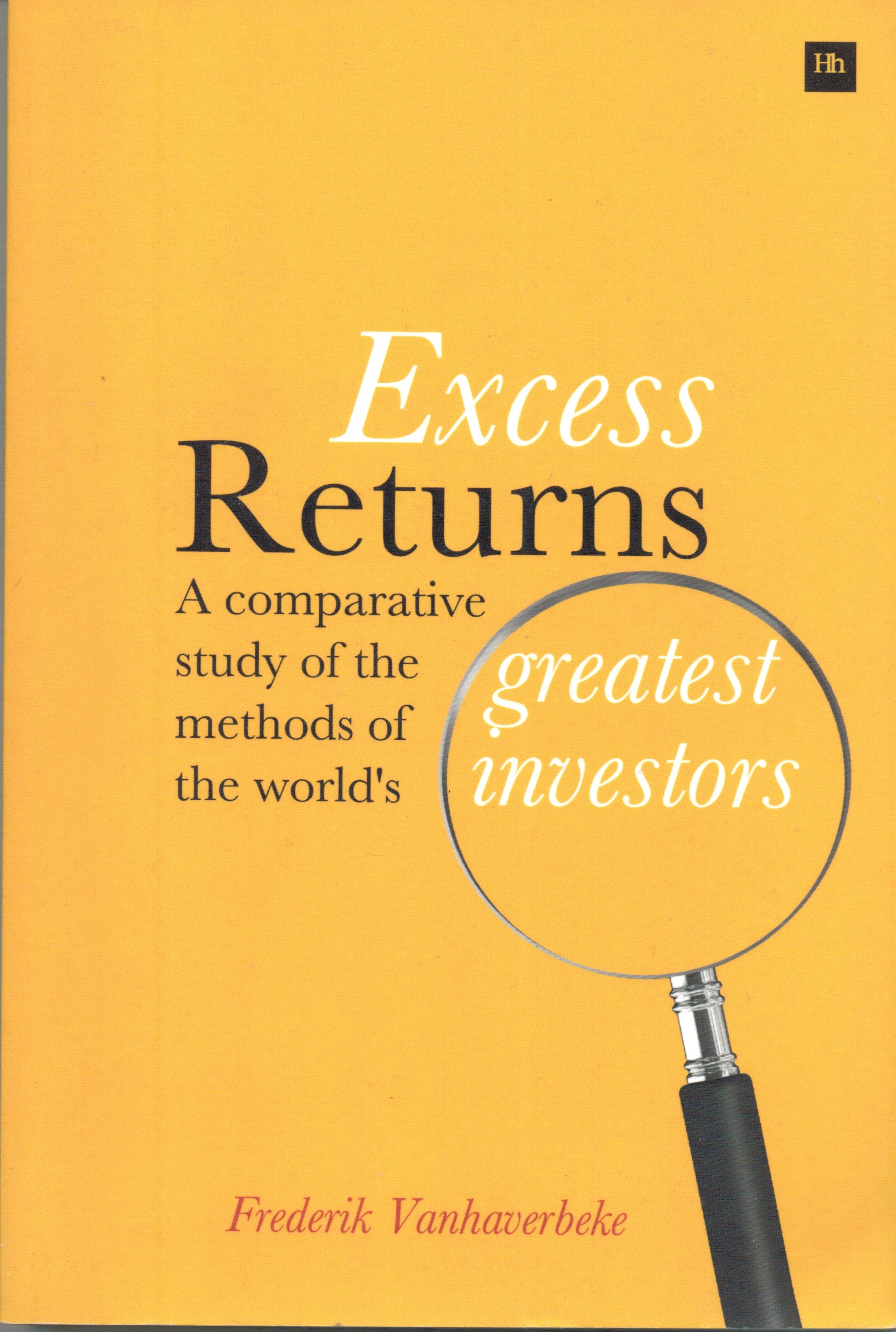
Book Review: Excess Returns

by David Merkel

Excess Returns

Suppose you wanted a comprehensive book on all of the ways that there are to get excess returns from the stock market as a type of value investor (as of year-end 2013), and you wanted it in one slim volume.  This is that book.  As with most desires there is the “be careful what you wish for, you just might get it” effect.  This book is not immune.

At Aleph Blog, I try to write book reviews that always include what sort of reader might benefit from a given book.  Because this book packs so much into such a small space, it is not a book for beginners unless they are prodigies.  If you are a beginner, better to warm up with something like The Intelligent Investor, by Ben Graham.  Beginners need time to see concepts described in greater detail, and more slowly.

Though it is a book on value investing, it is expansive in what it considers value investing.  It includes topics as varied as:

  1. Behavioral Economics
  2. Market-timing from a valuation standpoint
  3. Growth at a reasonable price [GARP] investing
  4. Private investing
  5. Shorting
  6. Event-driven investing
  7. Barriers to considering investments that keep others from buying them at attractive prices
  8. Studying informed investors (insiders & 13F filings
  9. Catalysts that may unlock value
  10. Emerging markets
  11. Financial statements
  12. Competitive Analysis
  13. Analyzing Growth Potential
  14. Analyzing Management
  15. Valuation techniques
  16. Common mistakes; why most average investors go wrong
  17. Understanding different types of industries and companies
  18. Attitudes — Modesty, Patience & Independent Judgement
  19. And more…

In a book of around 300 pages, this is ambitious.  It gives you one or two passes over important topics, so you are only getting a taste of the ideas involved.  This is also predominantly a book on qualitative investing.  Pure quantitative value investing doesn’t get much play.  Non-value anomalies don’t get much coverage.

The other thing the book lacks is a way to pull it all together in a practical way.  Yes, the last chapter tries to pull it all together, but given the breadth of the material, it gets pulled together in terms of the attitudes you need to do this right, but less of a “how do you structure an overall investment process to put these principles into practical action.”  Providing more examples could have been useful, and really, the whole book could have benefited from that.

Additional Resources

Now, if you want a greater taste of the book without buying it, I’ve got a deal for you: this is a medium-sized slide presentation that summarizes the book.  Pretty sweet, huh?  It represents the book well, so if you are on the fence, I would look at it — after that you would know if you want to buy it.


Summary / Who Would Benefit from this Book

This is a good book if you understand qualitative value investing, but want to get an introduction to all the nuances that can go into it.  If you want to buy it, you can buy it here: Excess Returns: A comparative study of the methods of the world’s greatest investors.

Full disclosure: I received a copy from the author.

If you enter Amazon through my site, and you buy anything, I get a small commission.  This is my main source of blog revenue.  I prefer this to a “tip jar” because I want you to get something you want, rather than merely giving me a tip.  Book reviews take time, particularly with the reading, which most book reviewers don’t do in full, and I typically do. (When I don’t, I mention that I scanned the book.  Also, I never use the data that the PR flacks send out.)

Most people buying at Amazon do not enter via a referring website.  Thus Amazon builds an extra 1-3% into the prices to all buyers to compensate for the commissions given to the minority that come through referring sites.  Whether you buy at Amazon directly or enter via my site, your prices don’t change.


19 Aug 04:52

2200 cr. BDA Scam: Finance Head Invested Public Authority’s Money in Mutual Funds. Who Got The Commissions?

by Deepak Shenoy

A large scam has emerged in the Bangalore Development Authority (BDA) with finance members investing money in equity mutual funds and trying to cover this up across different organizations.

Apparently, Sandeep Dash, former finance head of the BDA and the Bangalore Metro Rail Corporation (BMRCL) was a finance member in the BDA from 1997 to 2005 and:

  • allegedly created illegal temporary bank accounts (without the notice of the BDA board)
  • transferred money to those accounts and then into mutual funds, and the amount seems to be a staggering Rs. 2,202 cr.
  • told the board that the money was in fixed deposits (only 100 cr. was authorized to be in certan mutual funds)
  • Used oral instructions to transfer money around (so no trace was visible)
  • Another Rs. 5 cr was transferred to the Coffee Board, when Mr. Dash’s wife, Sharada Subramanyam, was finance director. (Source)

Dash was succeeded by Seshappa, who didn’t do things differently.… (Read On...)

19 Aug 04:29

In Praise of Slowness: Challenging the Cult of Speed

by Shane Parrish

We live in a world of scarce understanding and abundant information. We complain that we never have any free time yet we seek distraction. If work can’t distract us, we distract ourselves. We crave perpetual stimulation and motion. We’re so busy that our free time comes in 20 second bursts, just long enough for us to read the gist and assume we understand. If we are to synthesize learning and understanding we need time to think.

***

The modern storm of bits and stimulation, relents only when we sleep. (And then only if we remember to turn off the iPhone.) Lost in all of this is the art of stillness.

We live in a world with more information than ever and yet we understand less. We have come into the belief that the simple act of reading confers understanding. Worse, most of our reading is elementary reading, or skimming — a far cry from syntopical reading, which seems more fertile for the mind willing to do the work.

But that’s just it. We don’t want, or can’t find the time, to do the work that’s required to hold an opinion. It’s much easier to simply read the opinions of another and let them think for us.

What’s worse is that we get confused.

When someone else does the work we think we understand the problem better than we do. This is why Elon Musk asks questions of depth when hiring people. He wants to filter out the people who did the work from the people who took credit for the work. And so with thinking.

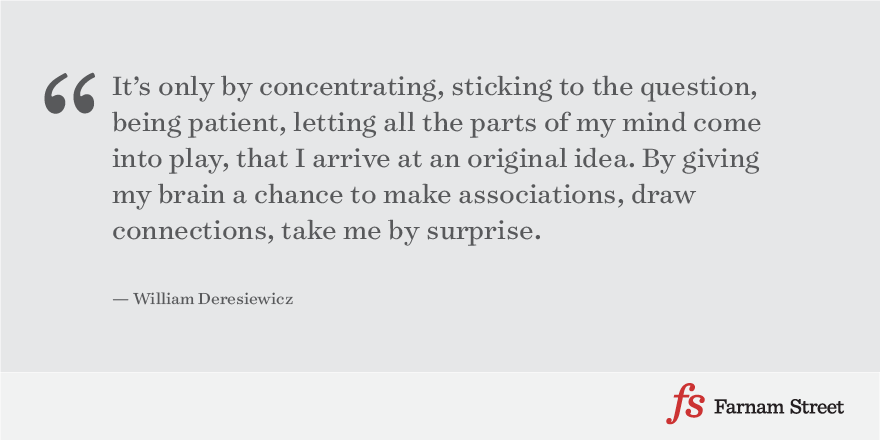
Deresiewicz concentrating

Understanding comes from focusing, chewing, and relentlessly ragging on a problem. It comes with false starts, dead ends, and frustration. Thinking requires time and space. It’s slow. It means saying I don’t know.

In short, thinking is everything the modern workplace is designed to eradicate.

We’re expected to have an opinion about everything and yet our time to think is near zero. We hold more opinions than ever but have less understanding. We don’t even understand ourselves. How could it be otherwise?

As Milan Kundera wrote in his 1996 novella Slowness, “When things happen too fast, nobody can be certain about anything, about anything at all, not even about himself.”

***

In Praise of Slowness

Larry Dossey, an American physician, coined the term “time-sickness” in 1982 to describe the belief that “time is getting away, that there isn’t enough of it, and that you must pedal faster and faster to keep up.”

Carl Honore, wrote a book, In Praise of Slowness: Challenging the Cult of Speed, to explore why we’re always in such a rush, what if anything is the cure for time-sickness, and whether it’s desirable to slow down.

The book is not an all-out declaration of war against speed.

Speed has helped to remake our world in ways that are wonderful and liberating. Who wants to live without the Internet or jet travel? The problem is that our love of speed, our obsession with doing more and more in less and less time, has gone too far; it has turned into an addiction, a kind of idolatry. Even when speed starts to backfire, we invoke the go-faster gospel.

We’ve become fast and fat.

Overwork is a health hazard in other ways, too. It leaves less time and energy for exercise, and makes us more likely to drink too much alcohol or reach for convenience foods. It is no coincidence that the fastest nations are also often the fattest. Up to a third of Americans and a fifth of Britons are now clinically obese. … One reason we need stimulants is that many of us are not sleeping enough. With so much to do, and so little time to do it, the average American now gets ninety minutes less shut-eye per night than she did a century ago.

“Inevitably,” Honore writes, “a life of hurry can become superficial. When we rush, we skim the surface, and fail to make real connections with the world or other people.” Moreover we don’t make connections with ideas. We don’t synthesize. We don’t test theories over time. We don’t play with ideas.

When everyone goes fast, most advantages brought by speed get lost. The only choice we see is that we have to go faster. It’s an arms race that I call the Red Queen Effect. David Foster Wallace summed this up perfectly when he said “Bees have to move very fast to stay still.”

The implications on thinking are fascinating. We are all fast-thinkers now.

We have forgotten how to look forward to things, and how to enjoy the moment when they arrive. Restaurants report that hurried diners increasingly pay the bill and order a taxi while eating dessert. Many fans leave sporting events early, no matter how close the score is, simply to steal a march on the traffic. Then there is the curse of multi-tasking. Doing two things at once seems so clever, so efficient, so modern. And yet what it often means is doing two things not very well. Like many people, I read the paper while watching TV— and find that I get less out of both.

In this media-drenched, data-rich, channel-surfing, computer-gaming age, we have lost the art of doing nothing, of shutting out the background noise and distractions, of slowing down and simply being alone with our thoughts. Boredom— the word itself hardly existed 150 years ago— is a modern invention. Remove all stimulation, and we fidget, panic and look for something, anything, to do to make use of the time. When did you last see someone just gazing out the window on a train? Everyone is too busy reading the paper, playing video games, listening to iPods, working on the laptop, yammering into mobile phones.

Instead of thinking deeply, or letting an idea simmer in the back of the mind, our instinct now is to reach for the nearest sound bite. In modern warfare, correspondents in the field and pundits in the studio spew out instant analyses of events as they occur. Often their insights turn out to be wrong. But that hardly matters nowadays: in the land of speed, the man with the instant response is king. With satellite feeds and twenty-four-hour news channels, the electronic media is dominated by what one French sociologist dubbed “le fast thinker”— a person who can, without skipping a beat, summon up a glib answer to any question.

In a way, we are all fast thinkers now. Our impatience is so implacable that, as actress-author Carrie Fisher quipped, even “instant gratification takes too long.” This partly explains the chronic frustration that bubbles just below the surface of modern life. Anyone or anything that steps in our way, that slows us down, that stops us from getting exactly what we want when we want it, becomes the enemy. So the smallest setback, the slightest delay, the merest whiff of slowness, can now provoke vein-popping fury in otherwise ordinary people.

Slow does not always mean slow.

Fast and Slow do more than just describe a rate of change. They are shorthand for ways of being, or philosophies of life. Fast is busy, controlling, aggressive, hurried, analytical, stressed, superficial, impatient, active, quantity-over-quality. Slow is the opposite: calm, careful, receptive, still, intuitive, unhurried, patient, reflective, quality-over-quantity. It is about making real and meaningful connections— with people, culture, work, food, everything. The paradox is that Slow does not always mean slow.

Speed is not always the best policy.

Evolution works on the principle of survival of the fittest, not the fastest. Remember who won the race between the tortoise and the hare. As we hurry through life, cramming more into every hour, we are stretching ourselves to the breaking point.

Fast eats time. One consequence of fast is that we make poor decision after poor decision. Those decisions don’t go away never to be seen again. It’s not like we make a bad decision and we’re done with it. No, the consequences are much worse. Poor decisions eat time. They come back to haunt you. They create issue after issue. They feed into the perpetual motion machine of busyness. And in a culture where people wear busyness as a badge of honor bad decisions actually lead us to think that we’re doing more.

***

Still Curious? In Praise of Slowness introduces “the Slow movement to a wider audience, to explain what it stands for, how it is evolving, what obstacles it faces and why it has something to offer us all.”

--
Sponsored By: Greenhaven Road Capital: You think differently - now invest differently.

19 Aug 04:12

Get realistic about retirement

by subra

Most of us cannot predict about the future. Tautology? Prediction is always about the future, is it not?

So a 30 year old thinks he is going to retire at 49 years and spend the next 20 years in the current home and die at a ripe old age of 70.

A 55 year old thinks Mumbai is too crowded and hot, so he is going to settle in OOty because it is cooler.

A 42 year old thinks he will sell off his existing house, invest the crores and go to a smaller town.

One person thinks that your costs come down if you can stay in a small town and DO YOUR OWN FARMING.

Thane? It is so far of!! Nerul? Omg it is too far off…Panvel? Does anybody stay there?

A 78 year old thinks that an old age home charging Rs. 8k per month as being very unreasonable.

A 80 year old with a rental income of Rs. 35k thinks 10k per month is too high, because she has paid a deposit of 1 Million Rupees.

Let me get some things clear:

A 30 year old has no clue what he is going to do in life, let alone retire, where to live in retirement etc. At the age of 30 the only thing he can / should do is to invest aggressively for his old age. He can use the money to do what ever he wants at the age of 60. Thinking about retirement now is pretty unnecessary and impossible.

The 55 year old has NO CLUE how his body will react to the cold at his age of 78, does he? So he is in some mental foolishness.

The 42 year old is in a fool’s paradise. Land, steel and cement are all commodities. With improved infra there is no reason for Real Estate to give returns more than 7% pa in India. And I maybe on the higher side!

Staying in a small town and doing your own farming: gimme a break. If you have spent 40 years of your life living in Mumbai, it is doubtful whether you will want to go to a small village and live. You will need your 24 hour electricity, 4G, doctors, nursing homes, friends, – I dare say you will not leave the city. A different town may have a different ethos which may not suit you. Stop telling lies.

Most of the people want an old home exactly where they live. Or have been used to living. So for them the ‘suburbs’ look too far away.  They forget that the house in which they are staying is now a Rs. 44,000 rupee rental property! They wish to pay Rs. 5k for stay, lunch, electricity, basic care, entertainment,….wake up guys, wake up.

Accept one thing. At 55 you do not know what you will want at 70. At 70 you really do not know what you will want at 80. You will have to live with an older person, cantenkerous self, a failing health and a failing brain. No, it is not easy and you need to reconcile yourself to a 100 year journey. Stop fooling yourself about a bad lifestyle leading to an early death. Protect yourself against a fall. Broken bones take years to heal and terribly restrict your movements. Keeping up a good mood and making new friends continuously is the only remedy. So seek a good old age home, accept that it will be ‘expensive’ because it is a people heavy business (many old age homes have a 1:1 ratio of inmates to employees) and good social contacts is absolutely necessary to be able to live. Happily or otherwise is your choice.

Read the comments of 18 August post!!


Post Footer automatically generated by Add Post Footer Plugin for wordpress.

19 Aug 04:07

The Music Pauses in China Again, and You Hear A Whoosh as Investors Scram

by Deepak Shenoy

China’s Index is falling again. After a 6% day yesterday, it’s down another 5% today.

image

According to Bloomberg:

The number of traders with more than 10 million yuan ($1.6 million) of shares in their accounts shrank by 28 percent in July, even as those with less than 100,000 yuan rose by 8 percent, according to the nation’s clearing agency. While some of the drop is explained by falling market values, CLSA Ltd. says China’s rich have taken advantage of state buying to cash out after the nation’s record-long bull market peaked in June.

Well, that’s what they will do, if the government decides to buy stocks. The government has prevented holders of more than 5% in companies from selling till November, and when November comes there will be yet another round of selling. The companies that were routed in the earlier fall decided to halt trading to hold the fall, and when they returned to the markets, they have been punished too.… (Read On...)

18 Aug 03:57

The Tale of Two Fathers

by Vishal Khandelwal

First, please ignore the “father” in the headline because this is a story about “parents”. But I couldn’t find a better headline, and thus this one.

Anyways, over the past four days, I’ve read two contrasting stories on the relationship between parents and children.

The first came from Aninda Baruah, who wrote about Google’s new CEO Sundar Pichai, who was born and bred in India. Aninda wrote about how Sundar’s parents sacrificed a lot to ensure that he got all the facilities for education. Almost all the money that his parents had saved was used to buy tickets for Sundar to fly to the US for his scholarship Master’s degree. [1]

He concluded his story thus…

…Sundar Pichai (or for that matter Satya Nadella, Indra Nooyi, Adobe CEO Shantanu Narayen), does not just owe his success to his IIT engineering degree, or Stanford University or Google. He owes it to that entire generation, including his parents, that created the culture of extreme personal sacrifice in favour of educating us.

Reading Sundar’s story, I’m sure his parents not only used their money to help their son, but also sacrificed their time to be with him through the most important times of his upbringing.

Anyways, the second story I read was from Devdutt Pattanaik, who wrote about Samba, the son of Lord Krishna and Jambavati. [2]

From disguising himself as Krishna and duping his father’s junior wives (for which Krishna cursed him), to attempting the kidnapping of Duryodhana’s daughter that led to war between the Kauravas and the Yadavas, Samba lived a chequered life. Samba is seen as a precedent of immoralities or adharma.

Devdutt traces the reason for Samba’s such behaviour to his father Krishna’s neglect. He writes…

Can we wonder if Samba was a product of his father’s neglect? For was not Krishna spending most of his time with Arjuna and the Pandavas and in the politics of Kuru-kshetra? There are hardly any stories of Krishna as father. He is friend, philosopher and guide to Arjuna, but the only stories of father and son are of tension, rage and violence.

You see the contrast in the two stories, separated by almost 5,000 years? Both showcase the relationship between a parent and child – only that the first one is of sacrifice (Sundar) and the second one of neglect (Samba). And see the consequences of both.

When parents spend time guiding their children well, the results could be amazing (both for parents and children). And when parents neglect their children, the results could be disastrous.

And we are seeing more cases of neglect these days, mostly from well-meaning parents but who are extremely busy in the ‘work’ side of their lives. As Devdutt writes…

Somewhere along the line we have attached our value and our purpose and our identity to our work and our achievements. Family is not seen as achievement. Children are not seen as purpose. They are seen as obligations, duties, by-products of existence, even collateral damage. In families we don’t feel like valorous heroes. In the 20th century, in the post-Industrialized world, family is seen as emasculating baggage.

…Parenting has been outsourced to maids, teachers, computers, videogames and grandparents….Absent parents rationalize how office is more important than the children: we need the money, the children eventually grow up, surely our needs are also important.

And so many great Krishnas in the workplace discover that they have nurtured Samba at home: sons who either follow destructive paths as they seek attention, or sons who make way away from parents, as they have grown used to not having them around. Who wins? Corporations? More workforce (husbands and wives), more hours (always on smart phones), more attention (telecoms). Corporations were supposed to create wealth for the family. Now families are creating only workers for the corporation. We have many more Krishnas in this generation and maybe many Sambas in the next.

Not Money…Your Child Needs Your Time
Warren Buffett said this to a shareholder in his 2008 meeting…

I tell the students that the most important job you have is being the teacher to your children. You are the ultimate teacher. You are this great big thing that provides warmth and food and everything else while they are learning about the world. And they are not going to change a lot when they get into graduate school…

And you don’t get any rewind button. You don’t get to do it twice. So you have to do your best as a teacher – and you teach by what you do, not by what you say, with these young things.

And by the time they have gotten to this place where they are entering formal school, they have probably learned more from you than they are ever going to learn from anybody else.

I have been working from home over the past four years. And what I have realized staying close to my 10-year old daughter is that the best time she has during the entire day is the time she spends with me, her mother, and her younger brother.

Not any toy, not any visit to the mall, not the cartoon channels, and not even the videogame…all she wants is for her parents to spend some quality time with her.

And believe me, even a child as small as 4-5 years old (I look at my son) understands clearly his priorities in life.

It’s only when we parents flip the priorities to our convenience – first provide them everything that money can buy, and only then give them our time if it’s available – that the child starts to believe that this is the way life is to be lived.

My daughter, who earlier believed that all money that I brought home came from the ATM, now knows the value of money and that it is earned by way of hard work – only because I took out time to explain this to her.

“But you work from home Vishal, and thus have all the time in the world to spend with your child,” you might say. “I don’t have that much time as I work on a job and stay out of home for a large part of my day.”

I understand that, my friend!

But then, not hours or days, what a child needs from her parents are a few minutes of ‘devoted’ time each day. Nothing else would please her!

She won’t need your money or your investments that you are making for her higher education (these are, if at all, bonuses to make her future comfortable).

All she will need is for you to spend some quality time with her – understand what else makes her happy and what makes her sad.

“Vishal is getting philosophical here!” you might wonder. “Why is he telling all this on a platform meant to discuss investing ideas?”

Well, I am writing this because all investment ideas and advice about saving and investing for a child’s future would come to naught if the child’s present is not taken care of well…less financially and more emotionally.

After all, this is what I have learned from my daughter – Children need to know that they are important. They need to know they are loved and they need to know they are secure.

Your pleasure from your new house and your latest pay raise may subside. But the amazing experience you have from the good times you spend with your child will never fade.

Your child needs time with you. She needs your undivided attention. She needs to make happy memories with you. She needs to laugh with you. She needs to learn from you.

And as Buffett said, you don’t get any rewind button. You don’t get to do it twice. So you have to do your best as a parent and teacher – and you teach by what you do, not by what you say, with these young things.

Life can pull you in a thousand directions, and you might ignore it especially when your child is little. But remember – She won’t stay little for long.

A Chinese proverb reads thus…

If you are planning for a year, sow rice; if you are planning for a decade, plant trees; if you are planning for a lifetime, educate children.

So, slow down…take some time…give some time…invest some time in your children. It may have unusually great payoffs…as Sundar’s story teaches us (and even without a payoff, you would’ve done a great job).

But What about Your Parents?
Well, this brings me to the other side of the equation, and one that is often neglected – our parents.

It amazes me when I talk to people about their family’s financial priorities. In many cases (and I’m not trying to generalize this), when I ask them what they want to save and invest for, here is the list that is drawn out, and in terms of highest to lowest priorities…

  1. Children’s education and marriage
  2. My retirement
  3. Bigger house
  4. Foreign holiday

“…and what else?” I ask.

“And what? Nothing else!” they reply.

“What about your parents? Are they not part of your family or financial priorities?”

There’s a silence…mostly followed by “Oh yeah, I forgot that!” explanations.

I can understand the reason behind this irony when children stop counting parents as part of their family (which is largely made up of “me, my wife, and my kids”) and will tell you what I understand…but before that, here’s another story…

My Story
“Study hard, Vishal! You have to become ‘something’ in life someday. Don’t waste your time roaming around here and there with your friends. Remember that these are the two most important years of your life. Go and make full use of them.”

These were my father’s words as I was packing my bags. I was going to Bombay to attend an MBA course. This was the year 2001.

I had heard such a sermon from him so many times in my life earlier. Being a civil engineer and a topper from his batch, my father is a well-educated and well-read man. He has been a very caring father, but in those days, I often took his extra care for me as interference in my life’s decisions.

He knew the payback for hard work, despite the fact that he himself could not practice engineering due to the needs of joining the family business. But he was very particular that his son needs to study hard and become “something in life someday”. My mom was no different, always pushing me to achieve higher things in life through hard work and dedication.

I was tired of their tirades and thus an MBA from Bombay was akin to ‘freedom’…from the bondage that I thought my parents had imposed on me. I was weary of the daily rants of “Do this…do that!”

“It’s my life! Why are you worried so much? Let me do things my way, and you stay clear of it!” I would imagine myself telling them at so many times.

Well, this was till the time I became a parent myself.

As I mentioned earlier, I have a daughter of 10 years, and a son of 4, and I can feel the pressure of being a parent – the immense responsibility accompanied by fear that comes from knowing that there’s someone who, if not guided by you carefully, can end up losing her way in this big-big world.

I’m sure the way I felt the pressure of my parents being behind my back, pushing me to ‘behave well, study hard, work harder’, my daughter must already be feeling it.

Let’s Take Care of Our Parents
It’s now that I realize the importance of my parents’ upbringing – the values they taught me, and the way they guided me through life’s think and thins.

And not just me, I can see this realization in a lot of my friends who are going through the same pressure of being parents…the ‘pressure’ that that they mocked at when they were children and ‘bore the brunt’ of their parents’ consistent ranting and lecturing.

It’s now that I feel that grown-up children must change their views on parenting and treat their parents exactly the way they want to get treated at their children’s hand. I know it sounds selfish, but there’s no other way for this world to get its lost love and compassion back.

“Your parents, they give you your life, but then they try to give you their life,” said Chuck Palahniuk, the noted American fiction novelist.

In today’s world, where people are so tied up in work that they can see and think nothing but themselves, the parent-child relationship is standing at the brink of a deep crisis – and that’s what I understand is the reason why many of us children keep our parents out of your financial priorities.

As a young, modern society, we seem to have lost a huge part of our compassion towards our parents. We’ve become insensitive to the core values we were taught as children. Like me, even you must have been raised by parents who believed in the validity of a handshake and touching elders’ feet, and the importance of treating others as they themselves expected to be treated.

But tragically, as our parents age, they are faced with the realization and loss of these basic rules that binds our lives.

Just step back and reflect on the dignity that is owed to your ageing parents. Keep in mind what is hard for us as children, is ten-fold harder for our parents. Know that the process of growing old brings with it moments of freedom and joy, but it also carries fear and loss of personal worth.

The “what if’s” of life has become a reality and the ageing parents find themselves torn between living an independent life, and being dependent on their children.

Remember they never left us alone or afraid, and never ignored us as children. Instead, they always kept us close at hand and heart…always watching us carefully…always present for us though all our pains and trouble…always there.

When the roles reverse (like for me and maybe you, it has already reversed), we must remember to love and treat our parents with dignity and honour — for without them, we would be nothing.

We must change the way we treat our parents – physically, emotionally, financially – by preserving their dignity as they surrender to their ageing body and weakening soul.


This is probably the best gift of gratitude we as children can offer to them. After all, most of what we’ve learned…we’ve learned from our parents. If for nothing else, they have earned the right to earn our compassion, our gratitude, and a place in our financial priorities.

I can imagine a world where every child respects his parents and gets respect from his/her child. It would indeed be a wonderful world!

What do you say?


Notes:
[1] An Entire Generation Sacrificed. And Google Gets Its New CEO
[2] Children of the Great

The post The Tale of Two Fathers appeared first on Safal Niveshak.

    
18 Aug 03:53

The Books That Influenced C. Roland Christensen

by Shane Parrish

C. Roland Christensen
I thought C Roland Christensen’s response in The Harvard Guide to Influential Books: 113 Distinguished Harvard Professors Discuss the Books That Have Helped to Shape Their Thinking was one of the more interesting. Christensen was a pioneer in the field of business strategy. We can also thank him for reviving the case method from the ancient Greeks.

In the preface to his response, he writes:

Here are the books—all old, dog-eared, reread and reread, little (no big fat volumes), most committed to memory—of my five-inch bookshelf. But they miss the greatest influence on this educator—Miss Adams, a seventh-grade teacher in Iowa City, Iowa. She introduced me to poetry, where the ultimate wisdom —the philosophy of life—is found. The first step in the development of an anthology was our study of “Miniver Cheevey” by Edwin Arlington Robinson. It is still exciting fifty-four years after that original encounter.

What Is History? by Edward H. Carr

Carr’s little book has a magnificent message—to live we must understand our historical roots. Carr gives us a way of
understanding the past so as to predict the future.

Can Man Be Modified? Jean Rostand

Rostand, a biologist, views man in a very human way, examines how science is impacting that basic humanness and then teases us with what he/she will be in future centuries.

How to Run a Bassoon Factory, or Business Explained by Mark Spade

Spade tickles the mind; with tongue in cheek, he describes business so that one laughs—even roars—at his chosen vocation.

The Insect World by J. Henri Fabre

Fabre looks at the smallest and lowest—insects—and shows us their great abilities—even wisdom. A constant reminder to look at the ordinary to see the extraordinary.

The Art of Scientific Investigation by William I. Beveridge

For the investigator, this little book is a gold mine of reflection and practical suggestion. He brings the power of scientific discipline to bear on everyday life.

Power Without Property by Adolph A. Berle, Jr.

The book raises fundamental questions about modern business organization and ownership. It outlines the quiet revolution which has changed the power bases of our industrial society.

Follow your curiosity, for more in this series check out the books that influenced E. O. Wilson, B. F. Skinner, Thomas C. Shelling, Michael J. Sandel, Jerome Kagan, Stephen Jay Gould, and John Kenneth Galbraith.

--
Sponsored By: Greenhaven Road Capital: You think differently - now invest differently.

18 Aug 03:32

Superstar Amitabh Bacchan invests a Million Dollars in Nitin Fire at Rs 42.99 !

by Gaurav Parikh
Wow ! Superstar Amitabh Bacchan has invested nearly a Million Dollars in a Bulk Deal on NSE on August 14,2015 by purchasing 1.5 Million Shares of Nitin Fire Protection Industries at Rs 42.99 ! Consequently Nitin Fire has fired up today 10 % and was on  on upper circuit at Rs 47.05 on BSE and [...]
17 Aug 03:45

Finance Is not complex!!

by subra

Personal finance is simple. However by saying ‘not complex’ i may ACTUALLY attract more viewers. That is the problem in personal finance. Most people do not show any interest at all in understanding what they have to do.

People can be classified into the following categories:

1. “Subra if you tell me this will work I am fine” : these people are known to me for say 7-10-30 years and do not think that they need to use their own mind at all. To me such people are fine, but am a little scared that in case of my death, they will not really know what to do. A few such people are in their ’70s and ’80s and without much help from others. I only hope that I outlive them. Many of them hope too!!

2. ‘Subra you are right, but I have to listen to my (X) – this X can be father, mother, son, daughter-in-law, doctor….so they end up with a terrible portfolio. They hide their endowment buying till I find out from somebody else. Such people scare me and I feel worried, IF I AM responsible for their well being. If it is a person whom I can do a ctl+alt+del I do that. Some of them are so idiotic that they keep on buying real estate, losing money on land deals (repeatedly??), keeping lots of money in bank deposits, gold, etc. I really cannot do much but just smirk.

3. ‘Subra, I agree with you that I should not buy ULIP but here is a real low cost product so I was considering it for my wife…’ HELLO ..BUT, BUT, BUT…your wife does not need LIFE INSURANCE. She is a housewife, your children are married and settled, what is wrong with you. However the bank RM will be able to get a Rs. 300,000 cheque and a committment for 5 years from a 57 year old man for his 52 year old wife, whose only daughter is married and settled down well. Sigh.

4. ‘Subra I have seen all the choices..but I think there is a role for all the 22 funds in my portfolio. I can actually explain to you why I have a midcap, a micro cap, a flexicap, a……. God, gimme a break. Even tell him the sigma of all these funds is UNDER PERFORMING an Index fund, some people like to have a very long list of growth, balanced, short term, long term , value, growth,…How do you explain to them that the best Value fund is actually called “Templeton India GROWTH FUND” . Label crazy people who will fail a blind test, but hold on to something they believe.

5. ‘Subra..I just cane back from the US..I am convinced that the best way to invest is to put money in an index fund’. Yes but Sir in India the funds that YOU have chosen are performing better than an index fund. No, Subra, I am convinced that Index fund is better than a managed fund. I wanted to remove all my money and put it in a lump-sum in an index fund. Sure Doc, great idea. Next time I need a blood test, I will do it myself.

there are more…but ..this for today..

Post Footer automatically generated by Add Post Footer Plugin for wordpress.

17 Aug 03:41

Thinking About Pensions, Part 2

by David Merkel

In part 1, I went through some of the history of defined benefit [DB] pensions using a Q&A format. I’m going to continue that in part 2.

Q: What are we supposed to do about pension policy in the US then?

A: Let me start with a quotation from an old article of mine, Replacing Defined Contributions.

Pension plan reform has to face three realities.  The first is people don’t know how much to put away for retirement.  I’ll give you a hint: for almost all people, it should be over 10% of your gross pay.  The second is that people don’t know how to invest, so hand it off to advisors who will do it for them, and cheaply.  The third is silent, and leaves a lot of money on the table — most people would be better off taking an annuity from their pension plan than a third party, or trying to manage a lump sum on their own.  This is usually an option only for defined benefit [DB] plans.

It would be nice if we could give everyone a DB plan, but as I pointed out last time, the costs would be too high.  DC [Defined Contribution] plans are inexpensive enough, but they have the above three flaws.

Q: How could we get people and firms to save more for retirement?

A: I’m not sure you can.  Present needs are large for many people, and they can’t imagine saving anything over 3%, much less 10%+ of pay.  Firms could do more, but it would raise costs, unless it is taken out of other benefits or wages.

Q: Why not “nudge” people to save more — create something that shows how far they are behind their most prudent peers?

A: Think about high school for a moment.  It’s a very peer conscious part of life for many people.  How well would an appeal go over asking the bulk of students to behave well, like the best-behaved students in the class?

Q: It might affect a few, but for the most part people are set in their ways.  They’ve already done their own implicit comparisons, and concluded that they are doing well enough relative to the peers they care about, given the circumstances.  They also might not like the comparison and say something like, “Fine for them, but I have different realities in my life.”

A: Right.  Effects should be small.

Q: Why not force people to save 10% of their pay then?

A: I think that treats adults like kids.  If they don’t want to save, let them be.  They might regret it later, or, they might say, “This is my lot in life.  I have to take care of what I think is important now, and when I am old, I’ll work if I have to.”  Also, people have an incredible ability to ignore reality if they need to.

Q: But isn’t there a public policy reason to encourage retirement plans and savings?

A: Most politicians think so, but retirement is a modern concept that with longer lifespans may not make sense in every situation.  The generation that fought WWII had a unique situation that allowed many of them to retire very comfortably that we don’t have now.  Productivity increases were larger, the demographics were right, global labor competition was a lot lower, and investment returns were a lot better.

You could look at my piece, Ancient and Modern: The Retirement Tripod for more on this.  As it is, it will be difficult to take care of the Baby Boomers to the same degree that their parents were taken care of — it doesn’t matter how you fund it — it is a humongous claim on GDP, and what will be left for those who are younger?

Q: So, you argue for freedom to choose in contributions, but you don’t argue for it in investing or distributions?

A: Uh, yes.  The main difference is that I think most people are capable of estimating their tradeoff of money now versus money in the future, and they are implicitly saying they don’t want to retire, regardless of what they say explicitly.

On investing, most people do not know what to do, and I would strip down most DC plans down to a small bunch of blended funds managed by professionals getting paid at low institutional rates.  There would be at most five funds, ranging from conservative to aggressive, with a default option that adjusts which fund a participant is in based on age.

On distributions, no one, not even professionals, are good at managing a lump sum of money to provide a stream of income.  Dig the ten reasons for that in this article.  People are capable of budgeting, so give them a fixed or slowly rising income to live off of, while investing their slack assets to cover future increases in costs.

Q: It seems inconsistent to me.

A: I’m just trying to be realistic about what people are capable of doing, and what their needs are.

Q: Why not have the government do the investing, or invest all pension monies in government debt?

I don’t think it is wise to entrust so much of the investing in the economy to a single entity.  Backdoor socialism is a real risk here.  Nor is it wise to fund the government via pensions.  Note how well the government did with Social Security.  It would be one thing if the government had used the money to improve infrastructure, but the money was generally spent on current consumption.

Q: The CFA Institute has put out their own plans for an Ideal Retirement System.  Wouldn’t that be a good idea?

A: When I was a kid, one of my friends would say to me, “If wishes were fishes, we’d all have a big fry.”  Like giving everyone a strong DB plan — it fails the cost test.  You could start doing this for a new group of retirees that would retire in the 2060s and beyond, but it is unrealistic for the present cohorts looking to retire sooner that have not saved enough individually or corporately.

Q: This is pretty dour.  Don’t you have anything encouraging to say here?

A: I would note that elderly people tend to be happier than younger people.  Some of it is coming to terms with life, grasping that many of the things that we aimed for when we were younger weren’t worth it, and taking some satisfaction in what good you have in the present.  It’s not all money based, but certainly money helps.  Some will look back at the past and say they did what was best for all their responsibilities.  Others may regret missed opportunities.

There may be some good that comes out of the American tendency toward voluntarism.  Who knows what elderly Baby Boomers might do when they put their mind to it?  Hopefully it won’t be voting more money for themselves from the public purse.

Q: Any final advice?

A: You are you own best guardian of your own retirement.  I encourage you to:

  • Save what you can.  This is one factor you can control.
  • Invest prudently, keeping fees low.  Don’t let yourself give into greed or fear.
  • Use immediate annuities to provide a minimum amount of income, and other assets for growth.
  • Make sure that you have younger friends to watch out for you.  Every older person needs advocates that can watch out for their best interests.
17 Aug 03:36

Absolutely dangerous words while investing

by subra

You have found a new adviser and you hope to build a great relationship. You are meeting him…maybe for the nth time and what are the words that you just do not want to hear:

1. Your risk tolerance is high: Hey dude, I am myself not sure how I will react to a 35%fall in my portfolio.

2. This time it is different.

3. The Midcap out performance is here to stay.

4. Derivatives

5. I can create a direct equity portfolio that will EASILY out perform Hdfc Top 200 and I Pru Discovery.

6. We will use some strategies which are normally used by Hedge funds.

7. We can EASILY ‘future-proof’ your portfolio.

8. We can predict that the interest rates will go DOWN in the near future, but over the next year it might actually go up.

9. We have some non traditional investments that I want you to consider.

10. These are portfolio houses, managers, and strategies that me and my team has carefully selected and hand picked for YOU.

11. Seeing your risk profile, we will target smooth equity returns.

12. Out performing the Sensex is easy – all our fund managers are regularly doing that, AND will continue to do so.

A dirty dozen is good no?

There is a major problem with the BFSI. Most of its players are here trying to impress the clients who want to invest. THAT is the problem. Face it, most clients want a decent REAL RETURN that will help them achieve their goals. I have not met any investor who came to “be impressed” by me. They could not care a damn about me UNLESS they were convinced of the following:

1. I will talk in a language that they can understand (I am in a minority, I know!!)

2. I will keep it simple.

3. I will repeat it more if you have not understood.

4. You do not need sexy, un-understandable products which give you sub-par returns

5. You honestly do not need weekly monitoring and monthly fund switches. Seriously you need only if we are nearing an event.

6. The best way to meet small goals is from current income. For example if you can pay his Engineering fees from your current income, do not disturb your portfolio.

7. You have led a simple life, you are continuing to lead one. Your ‘financial plan’ has to be a one sheet plan which your daughter in class 6 can understand.

Sadly there is a vested interest in selling complicated, capital protected, future proofed investments, with hedging strategies and smooth equity returns.

When you hear those words, do either of the following:

1. Ask him/ her to turn around and give a nice kick – choose which ever part of the anatomy

2. Turn around and sprint. A good 500 metres

Either way the relationship would be over.

Post Footer automatically generated by Add Post Footer Plugin for wordpress.

17 Aug 03:36

Learning equity investing

by subra

I am not convinced that Equity investing is learnt in a college. In fact it is not. If you must have a qualification, I do think the CA degree, and if your energy levels permit, the CFA degree (US) are surely a good beginning.

I benefited surely by my Law training – and wondering whether all promoters are crooks. The training as a CA helped me read the balance sheets much better than I would have read as a non CA. No doubt about that. Right from the change in method of depreciation to other accounting shenanigans, I have to thank the CA institute. Also Late P M Phadke, partner, Sharp and Tannan who made me calculate ratios (OMG these days Bloomberg gives you all this free!!). However calculating those ratios in 1983 (and making cash flow and fund flow statements – which you now get free)  still holds me in good stead. When I see assets at least I know whether it is gross assets, net assets, revalued assets minus depreciation, or something else that has gone into the numerator. If you land on the ratios from a helicopter, you keep wondering what is this ‘asset’.

Doing equity research  – to sell research reports (what else?) also meant we met bankers, merchant bankers, cantankerous promoters, nice promoters, kameena promoters. At this time we also made project reports with amazingly stupid and naive assumptions. We also met officers of big financial institutions and we learnt how with the right buttons some of them would lend knowing that it was going to be a NPA. It hardly mattered to them. We met fund managers who after a 90 minute presentation on how to manage Rs. 200 crores (remember it was 1995) would ask ‘all that is fine where should I invest my wife’s Rs. 15,000).

Doing all this research, meeting so many people connected with the market, regulators, investors, doing private placements, IPOs, secondary markets – as a broker, investor, etc. one learns well. Lost money when my broker went bankrupt, and I could not recover my money even knowing top politicians, journalists, etc. EVERYBODY knew he was playing a game, but could do nothing. At this time I was convinced that the crooks in this country can use the law much better than the law abiding citizen. Not cribbing, just recognising.

We are an illegal country as far as enforcement is concerned. You need to know people in the government, police, etc. so that nobody takes you for a ride, not to punish somebody else.

In this journey you meet people who have gone bankrupt and  people who have made, hold your breath, Rs. 10,000 crore for their families. You meet people who have read upwards of 10,000 books – mostly on investing, economics, and investor behavior. People who believe that to do equity research you need to know everything from anthropology to zoology. And some people who believe that knowing 2 good people to call for a scrip is far, far more important than 2 months of research. It is normally through books that you meet Phil Fisher, Benjamin Graham, Warren Buffett, – and quickly realize that NOTHING of that can hold in India. All these people are talking of a huge bull run in the USA – when the US controlled the world economy. India does not, so many of those rules will not apply. Then you meet big and small Indian investors – with different styles. I know people who buy only A group shares, those who never touch an A group share, those who trade daily, those who do position trades, those who hold for a mammoth 30 years, those who hold for 15 years, and as the company matures shift to a new start up. You realize that there is no one style.

You will see different styles – Value investing and Growth Investing. Frankly all investments are Value Investing. The value has to go up. Sometimes Value comes from Growth and sometimes Growth brings value!!

How does one learn ‘equity investing’. Well, to say the least, it is difficult. Read a lot. Realize that Equity is like God. All religions have their own codes, but all claim to lead there. John Templeton believed in diversification. Warren Buffett believes in concentration. However WB depends for his income from RE-insurance -which is diversification business. Rakesh Jhunjhunwala is very different from Vallabh Bhansali as far as investing styles are concerned. For a common man to know who is more successful is difficult. Mukesh Ambani is a good businessman and knows how to use his cash strategically. He used it well to acquire a strategic stake in East India Hotels and the full media business in India.

You also realize that styles come and go – but the core of all investing is Value Investing. You need to get value from your investing.

Then you meet clients – and each client has a different capacity to take risks, and capacity to sit on profits. I have clients who bought Gillette at Rs. 90. Some sold off at 120 and some holding today at Rs.2500. I know clients who filled their lives with equities and some who loved their debt portfolios. I had met a man who had fixed deposits of Rs.14 crores in 1983. He swore by debt, hated equities. Paid taxes like mad and said “it is our duty to pay taxes”. I met people with Rs. 14 crore equity portfolio and not having to file an INCOME TAX return.

Make a list of the investing Gods of India, and see if you can do a 2 year internship with them. What you learn can make you a billionaire, provided of course you keep your ego out, use your eyes and ears 4 times more than your mouth.

The worst, worst people who to learn from are those whose only success story is that they have made money in equities. If they have not dealt with clients, not done due diligence work, not done client advisory, not done client portfolio rescues – these people do not understand client behavior. Those who have no idea about client behavior, they have no business doing advisory. Markets behave rationally, investors do not.

Post Footer automatically generated by Add Post Footer Plugin for wordpress.

17 Aug 03:28

The World’s Oldest Public Policy Puzzle…

by Amol Agrawal
Aryeh Neier writes on the oldest Public Policy puzzle PPP – whether to prohibit or legalise prostitution? Prohibition has proved harmful when applied to consenting adults’ use of liquor or drugs. Bringing such practices out of the shadows encourages the development of measures that mitigate its associated evils. The same is true of transactional sex. The focus […]
17 Aug 02:51

India's construction risk problem

by noreply@blogger.com (Gulzar Natarajan)
This blog has long held the view that infrastructure projects in countries like India are optimally structured in terms of their life-cycle costs and management by off-loading construction risk and subsequent long-term contracting. The scale of construction and commissioning risks are so large that their presence distorts the incentives of any long-term concessionaire. Worse-still, private developers have limited control over such risks, which are best borne by the government.

An examination of the Project Risk Index components compiled by the Business Monitor International (BMI) reveals certain interesting insights. The BMI's index, a measure of the risk associated with carrying out an infrastructure project in the country, is calculated in terms of financing, tendering and construction, and operation. Each of these three components is dis-aggregated into three more sub-components - cost of capital, finance availability, and sophistication of financial markets (for finance); ease and credibility of tendering, potential for delays, and contract enforcement (for construction); and demand, operation, and foreign exchange (for operations). Each of the three categories and sub-categories are weighted equally, and the scores are allotted in a scale of 0-100, with the higher score representing lower risk.

The country specific risk parameters for the India shows that project risk is aggravated dramatically by construction risks. In fact, timeliness risk, a measure of time and cost over-runs, is among the highest in India, ranking a dismal 82nd among the 84 countries covered.
A comparison among all BRICS countries shows that India is the riskiest country for infrastructure projects, with construction and operation risks being the highest.
India's rambunctious democracy, with its judicial, political, and bureaucratic arms often working at cross-purposes, means that site acquisition and construction are fraught with  unknown unknows. The contributory factors are beyond the control of any private project developer, and causes inordinate delays resulting in snow-balling construction costs. While mitigating policy frameworks are essential, it is important to bear in mind that the private developers are least able to assume these risks. 
Add to Technorati Favorites
17 Aug 02:51

How humans cause mass extinctions?

by Amol Agrawal
Paul R. Ehrlich  and Anne H. Ehrlich of Stanford University have a piece on the topic. They say humans are just destroying and unbalancing the overall living scenario:   There is no doubt that Earth is undergoing the sixth mass extinction in its history – the first since the cataclysm that wiped out the dinosaurs some […]
16 Aug 05:09

Why Existing Clients Are Key to Meeting Your Quota in 2016

by scott.gruher@salesbenchmarkindex.com (Scott Gruher)

Ever heard these pearls of wisdom? 

  1. It takes a certain level of maturity to nurture and sustain a relationship.
  2. The rewards of a lasting relationship are far greater than the investment it requires.

The same is true in business. Companies at the highest levels of revenue growth maturity are great at closing sales. Making clients happy. Keeping them loyal. And enticing them to spend more over time. The more these customers spend, the higher their lifetime value (CLTV).

CLTV is the secret to strong, predictable revenue growth. As CLTV grows, customer acquisition cost (CAC) shrinks. And profits rise. In fact, a 30% reduction in CAC adds more than 10% to the bottom line. 

Below, we’ll delve into the advantages and characteristics of a high CLTV. Then we’ll explain how you can achieve the same. 

16 Aug 04:00

Land Bill setback could be a blessing in disguise

by T T Ram Mohan
The Modi government has had to backtrack on the Land Bill. Industry is howling but, on a longer view, this may not be such a bad thing.We need an approach that farmers regard as fair. Perhaps, parliament can now consider a fresh set of options.

It's not enough to say glibly that farmers should not complain as long as they are compensated and that twice the market value in urban areas and four times the market value in rural areas is good enough. The problem very often is that the market value is not easy to determine. Simply looking at recent land sales may not help, as the Economist points out, because these may distress sales made by farmers to other farmers or because the sale price may have been under-reported to dodge stamp duty.

The fact of the matter is that the true value, in acquisition for industrial use, becomes known only after the industries are set up. This means that farmers should have a 'call option' on the property that is sold to industry. The approach taken by AP Chief minister Chandrababu for the construction of a new capital for AP may well be the way to go. Naidu has offered to give back to farmers 30% of the land pool they have together contributed once the city is constructed. This is a way of providing  a call option to sellers.

The problem of dealing with holdouts- people who simply refuse- may still be there. The Economist cites a suggestion made by two economists. Ask for bids for plots close to the ones being acquired and offer these as compensation to those unwilling to sell in the acquired area.

Land acquisition is a hugely emotive issue and more so at a time when farmers are in distress. Forced and unfair acquisition is a factor underlying insurgency in many parts of the country. We need to think of new solutions. So the setback to the government on the Land Bill may well be a blessing in disguise.
16 Aug 03:27

Equity and behaviour

by Muthu

Happy Independence Day.

On this great day, firm up your resolve to achieve financial independence as early as possible. Financial independence would make life more beautiful and meaningful.

We’ve written many times in the past as to how your behaviour and only your behaviour shape your investment success.

I want to keep touching this topic once in a while so that we don’t forget the importance of the same.

Not chasing the fads in bull market and not falling prey to fear in the bear market is the key.

We’ve seen data (both India and USA) in the past that around 70% of all years markets go up and 30% it goes down.

I also read somewhere that in the long stock market history of US, the market keeps going up on 70% of the trading days.

But the sharp fall we see in 30% of the days or years are sufficient to scare us. When you see your portfolio dropping by 25% or 30%, it is absolutely fine to feel the fear. Bear markets are very nauseating. The key is not to act on the fear. ‘Do nothing and stay the course’ is the mantra you need to remember in bear markets.

You may wonder why I’m talking about bear markets now. The general opinion is that this bull market is going to last for at least some more years. Please note that even bull markets can have sharp corrections and falls. It’s good to keep reminding ourselves of the same.

Equity investing is a matter of faith, a faith in the better future of the country and hence it’s companies. If you’re not optimistic about the future of the country, equity investment is not for you. Then comes discipline; discipline of investing fixed sum every month over your working life, irrespective of ups and downs of the market. Then comes patience; of staying the course in the bear markets.

Unless otherwise stated, when we say equity investing, it always refers to the portfolio of stocks; diversified equity funds (non sectoral, non thematic). For any goals over 10 years and for simply creating wealth; equity is the way. Equity investments need to be looked in terms of decades and multi-generations. Never get into any equity investment for a period less than 10 years. Equity would beat all the other asset classes over long run and keep increasing your purchase power and wealth.

By opting for the discipline of systematic investing, you automatically buy more during down times and buy less during euphoria. This makes your purchase cost less than average cost thus paying way for above average returns. But for this discipline, we would end buying more in bull markets and not buying / selling in bear markets. A sure recipe for destroying wealth.

In India, whose future look extremely bright, equity is the best way to participate and benefit from the growth. Everyone would agree to this in a bull market. The problem starts when we see a 20% or 30% fall. Usually falls are accompanied by bad news or negative news is amplified by media to make investors scary. The best thing to do is to ignore the news and stay the course. This is the most difficult thing to do. We would hand hold you to stay the course in such times, as we did in the last bear market.

Bull market presents different set of problems. If small cap delivers outsized returns in a year, every one creates a portfolio of small cap funds. If there is an e-commerce sector fund tomorrow which delivers mind boggling returns, every one may want to put their entire net worth in the same! Not chasing fads, not falling to euphoria and sticking with the chosen portfolio is the discipline required in the bull market. In bull markets everyone would do well; some may do extremely well. What is important is how the survival and performance is over many bull and bear cycles; over many decades.

If greed and fear can be kept under check in bull and bear market respectively, you would build good wealth over long run. You would be among a small percentage of successful investors. Please note that it is normal to feel greed in a bull market and fear in a bear market. Even I feel the same. The key is not to act on the greed and fear. Over last few years, I’m fairly successful in this and that’s why I’m able to help you as well. If the financial advisor acts on impulses; how he can help his clients?! At the cost of repetition I would like to say that impulses of greed and fear are normal. Our success in investing comes by not acting on the same.

We want all of you to achieve financial independence. Also build great amount of wealth over next few decades, enjoy life, and leave a rich financial legacy for coming generations as well.


16 Aug 03:07

Weekend reading links

by noreply@blogger.com (Gulzar Natarajan)
1. The mezzogiorno, the southern part of Italy, has long been considered a poor cousin of the prosperous north. But the extent of economic divide is truly stunning,
While Italy’s economic output as a whole contracted by 0.4 per cent in 2014, it fell by 1.3 per cent in the south. Before the crisis, in 2009, the gross domestic product per capita of residents of Italy’s southern regions was 56.2 per cent of that of Italians elsewhere. By 2014, that share had dropped to 53.7 per cent, its lowest level in 15 years. More than 60 per cent of southerners lived off less than €12,000 a year in 2014, against 28.5 per cent in the rest of Italy.
2. San Francisco has borrowed a unique nudge experiment from Hamburg to stop urination at public places. It has covered nine public walls with repellent paint which makes pee spray back on the person's shoes and pant!
Public urination on city walls by night revellers is a big problem in the city and has not been controlled despite a legislation banning it as well as fines of upto $500.

3. Fabulous taxonomy of logical fallacies (via @Noahpinion)

4. As it seeks to advance its soft-power, China is doing it the only way it can, spreading wealth around to "buy respect",
And it is backing up its soft-power ventures with serious money: $50 billion for the Asian Infrastructure Investment Bank, $41 billion for the New Development Bank, $40 billion for the Silk Road Economic Belt, and $25 billion for the Maritime Silk Road. Beijing has also pledged to invest $1.25 trillion worldwide by 2025. This scale of investment is unprecedented: even during the Cold War, the United States and the Soviet Union did not spend anywhere near as much as China is spending today. Together, these recent pledges by Beijing add up to $1.41 trillion; in contrast, the Marshall Plan cost the equivalent of $103 billion in today’s dollars.
5. Bill Easterly links to this evocative photo of volleyball being played with the US-Mexico border as the net.
6. Robert Solow describes the failure of real wages to keep up with productivity in terms of 'monopoly rents', a third component to return to labor and return to capital,
There is a third component which I will call “monopoly rent” or, better still, just “rent.” It is not a return earned by capital or labor, but rather a return to the special position of the firm. It may come from traditional monopoly power, being the only producer of something, but there are other ways in which firms are at least partly protected from competition. Anything that hampers competition, sometimes even regulation itself, is a source of rent. We carelessly think of it as “belonging” to the capital side of the ledger, but that is arbitrary. The division of rent among the stakeholders of a firm is something to be bargained over, formally or informally... It is essential to understand that what we measure as wages and profits both contain an element of rent...
The suggestion I want to make is that one important reason for the failure of real wages to keep up with productivity is that the division of rent in industry has been shifting against the labor side for several decades. This is a hard hypothesis to test in the absence of direct measurement. But the decay of unions and collective bargaining, the explicit hardening of business attitudes, the popularity of right-to-work laws, and the fact that the wage lag seems to have begun at about the same time as the Reagan presidency all point in the same direction: the share of wages in national value added may have fallen because the social bargaining power of labor has diminished.
And he feels that the growth of casual labor is amplifying the trend,
This shift toward more casual labor interacts with the issue of the division of rents. Casual workers have little or no effective claim to the rent component of any firm’s value added. They have little identification with the firm, and they have correspondingly little bargaining power. Unions find them difficult to organize, for obvious reasons. If the division of corporate rents has indeed been shifting against labor, an increasingly casual work force will find it very hard to reverse that trend.
7. Brilliant essay in the Times on the punishing work culture at Amazon, the place "where overachievers go to feel bad about themselves" and one "which is running a continual performance management algorithm on its staff". 

8. Finally, a very interesting graphical representation of the quality of football matches in various European football leagues using the dynamic ELO rating data for football clubs. It maps the top 50 highest quality matches based on average quality (average of the ELO rating of the two clubs) and well-matched opponents (lowest difference in their ELO ratings)
The graphic clearly shows why the Spanish Primera League trumps all others in terms of both quality and intensity of matches. 
Add to Technorati Favorites
15 Aug 03:08

Money Learning: I wish my parents had taught me!!

by subra

“Subra I am 38 years of age, and I wish I had come to your blog earlier – it would have changed my life”. Anon reader.

I am not sure what many of these readers mean when they say that they should have come here earlier!! However let me hazard a guess. I think most of them wish that they KNEW the following and that they REALLY used it:

1. Knowing the importance of savings: Really if your parents did not teach you this, I would be surprised. Assuming you are in you 20s or 30s, your parents are the 1950 or 60’s generation, and they have been brought up being taught about frugality. YOU were taught for sure, YOU did not bother to learn.

2. The Power of small numbers: ‘Only when we came to your blog did we realize that even Rs. 40 a day is a good start’ – yes many parents would have missed teaching this. This is a illusion problem. The human mind cannot comprehend the power of compounding. Not your fault, blame God. Hey, but you did learn compounding in class 7 did you not?

3. Learning the power of Equity: Sorry, this is a class issue. Only a few communities in India invested in equities. Do not blame your parents. Blame should go to the community to which you belong, your parents, your siblings, friends, education….choose!!

4. I wish I had known about why my take home pay was much lesser than my gross!! I did not learn about taxation. I wish my employer had told me.

5. I wish somebody had told me that “Fixed deposits” to save taxes is such a ‘not cool’ kind of an idea. It is plain, downright stupid especially for a 23 year old fresh engineer. I wish my college syllabus had some basic financial knowledge chapters.

6. I wish I had understood the power of equity. At least I would have started an ELSS SIP.

7. I wish I had not listened to my Dad’s friend. He has sold me a premium of Rs. 33,000 per annum for a 30 year endowment policy. Now I am being told this is unadulterated shit. I wish my parents had not made me ‘dependant‘ on such people for financail advise.

Well, that is all for now!

Post Footer automatically generated by Add Post Footer Plugin for wordpress.