Shared posts

22 Sep 10:42

Filter Out The Noise

by Abhishek Basumallick
I have stopped blogging over the last few months to be on the right side of SEBI's guidelines. Now, that there is some amount of clarity, atleast in my mind, I have decided to continue chronicling my thoughts once more. The only change is I will restrict myself from discussing specific stocks or valuations related to stocks. 

The last few months saw a tremendous amount of volatility. We have seen both 29000 and 25000 on the Sensex since April 2015. We have seen the Green drama, the unending US Fed rate hike soap opera keeps playing in the background every few months. We are also witnessing a human tragedy of great proportions in the Syrian refugee crisis. The run-up to the US elections has started and is likely to pick up momentum in the months to come.

Closer home, the Bihar polls are heating up. Lalu-Nitish-Modi are battling it out - or so the media would want us to believe. Hardik Patel wants reservations for the Patels in Gujarat. Monsoon session in Parliament did not achieve much, again as expected. Raghuram Rajan did not decrease rates.

So, where am I going with all this? I just want to highlight that all of this is noise. I sometimes go back and read old newspapers. I am yet to see an issue where there is no news printed. There is always something going on. As an investor it is critical to filter out the noise from the signal.

The signals which are important to me as an investor are the following:

  1. Passing the GST bill - this has long term implications as it is a fundamental shift on the taxation front. This bill has been making for over a decade and we may be in the last lap of the marathon. 
  2. Land Bill - After the Singur agitation, land acquisition all over India has become a non-starter. India needs a stable land acquisition policy so that industries can realistically acquire land for projects. The government does not seem to be making much headway on this.
  3. Improvement in Corporate Results - Quarterly results in general have been quite dismal. Management of nearly all the companies' for which I have attended conference calls stated quite candidly that on the ground there is very little traction in the core sectors.
I am skeptical of a major impact of rate reduction that everyone is so keen on. I cannot think that a company will decide to invest in capacity expansion because interest rates are 0.5% down. We need some major projects in the infrastructure space either by the government or incentivized by the government through tax cuts to kick start the real economy.

In the meantime, filter out the noise and remember that in India, news channels are for entertainment ;-)

22 Sep 09:57

Mutual fund industry: bali ka bakra

by subra
    The Mutual fund industry is governed by SEBI. Great, So SEBI governs who can manage money. He should not have committed too many crimes (especially in the finance kind) and they get a license. Some famous names: Sahara, CRB, Peerless, Shriram, well what more to say? Some which refuse to grow up: Escorts, […]
22 Sep 09:51

On Slack: 2,000-Mile Odyssey, Trouble with Foodpanda, Yuan Devaluation, Yellen Rates and more…

by Gautam Jagannathan

CapM Premium Header

The Slack Discussions

The Slack group at Capital Mind Premium has been extremely active and if you haven’t been there, pop us a note by replying to this email. (If you’re a trial member this probably sound like Greek to you; it will be available when you sign up!)

A brief summary of some of the interesting things discussed there in the last few days:

#macronomics: Saudi sees no need for oil summit, best leave market alone

Top oil exporter Saudi Arabia sees no need to hold a summit of producing countries’ heads of state if such discussions would fail to produce concrete action toward defending oil prices, sources familiar with the matter said on Thursday.

http://www.reuters.com/article/2015/09/10/us-opec-oil-idUSKCN0RA26620150910

http://www.bloombergview.com/articles/2015-09-11/saudis-are-winning-the-war-on-shale

#stocks: A Negative Stock Report About Indiabulls Led to an Analyst’s Arrest and a 2,000-Mile Odyssey

When stock analyst Nitin Mangal co-wrote a research report in August 2012 telling investors to sell shares in companies that were part of the Indiabulls Group, a big Indian real-estate and financial conglomerate, he figured the company wouldn’t like it.… (Read On...)

20 Sep 13:56

Weekend reading links

by noreply@blogger.com (Gulzar Natarajan)
1. Scott Sumner on the critical role played by revenues from land sales and leases in financing infrastructure and other investments in East Asian economies,
The bigger story in China (and elsewhere in East Asia) is the government ownership of land, which provides an important share of government revenue. The Singapore government, for instance, has a monopoly on the right to "mine" (i.e. create) new land. As a result, Singapore's land area has grown rapidly, and this has generated a lot of revenue. Local governments in China rely on land sales to pay for infrastructure projects.
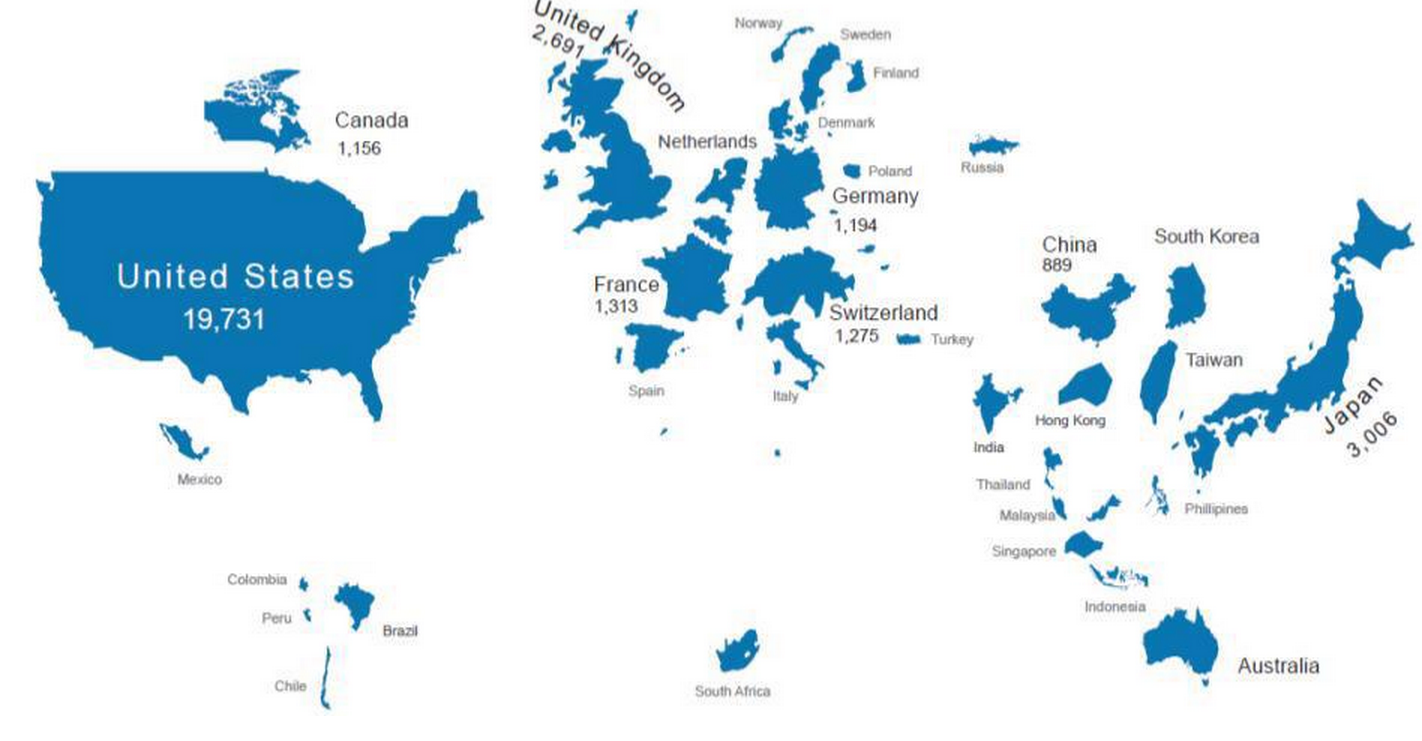
2. Countries scaled to the size of their respective stock markets
3. Martin Wolf points to the possibility of a "Made in China" global recession, one triggered by a shrinking of the country's unsustainable investment spending (46% of GDP), and its interaction with the dynamics of financial markets as the Fed tapers and credit flow reversals begin,
One channel would be a decline in imports of capital goods. Since about a third of global investment (at market prices) occurs inside China, the impact could be large. Japan, South Korea and Germany would be adversely affected. A more important channel is commodity trade. Commodity prices have fallen, but are still far from low by historical standards (see chart). Even with prices where they are, commodity exporters are suffering.

4. On the resource misallocation in US engendered by the quantitative easing policies,
But companies have been following the central bankers in rigging the market, pushing equity prices up to heady levels that may not be validated by economic growth. The “evidence” of putative value creation is short-term noise. The reality is that companies are buying shares expensively at the cost of increased leverage, which amounts to a misallocation of capital. Then there is the resurgence in mergers and acquisitions, which are now running at levels reminiscent of 2007. If we know anything about M&A it is that managers are too easily carried away by the thrill of the chase, resulting in the notorious winner’s curse. When you bear in mind that $3tn of deals have been agreed across the world since January, much of it in the US, the scope for capital misallocation is once again large.
5. After this fantastic Indian Express essay on the workload endured by ecommerce"last mile boys" in India, another in FT from China on their kuaidi is eerily similar,
Ecommerce relies on these super-cheap delivery services. Delivering a package overnight in most locations costs Rmb10-13 ($1.50-$2), about a tenth of the cost in the US, thanks to the 12-hour days worked by Mr He’s couriers. The main beneficiaries are the rising middle class, which consumes the trappings of a much richer society at a fraction of the cost... By Chinese standards the jobs pay well — Rmb5,000 a month including bonuses — but it is back-breaking. “During peak time, work starts at 7am, and doesn’t end until midnight” says Mr He. “It’s very stressful, they have to deliver 300 to 400 [packages], and have to pick up between 100 and 200, in some neighbourhoods 700 or 800 items. The entire day they are on the move, climbing stairs, when they get back they are too exhausted to move.. 

Bigger companies like ZTO have built good reputations in the industry for providing decent work conditions, but there are thousands of courier companies in China and most do not even bother to sign contracts with couriers and are only lightly regulated. Yang Zhanlu, a courier who asked for his company name to be withheld, says of his Rmb4,000 monthly salary that 25 per cent is often deducted in fines. He has been punished for knocking too loudly, or delivering too early, and has no recourse.

In UP more than 23 lakh persons have applied against 368 posts of peon in the state secretariat. The number is almost half the population of Lucknow, which is 45 lakhs. What is even more shocking is that over two lakh applicants are at least graduate with BTech, BSc, MSc and MCom degrees. Applications also include 255 candidates with a PhD degree in hand. 
An interesting explanation for the explosion in applications,
In 2006, for about 260 jobs we received 100,000 applications. But in nine years the figure has gone up so much. One reason is perhaps the easy access, because the government had distributed 1.5m laptops and people sitting in remote areas can apply at the click of a mouse. In 2006, applications were made offline.
7. Amidst all the gloom surrounding the coverage on China, very little analysis has been done on the scenario that while its manufacturing output may be slowing, it is possible that the country can recalibrate towards consumption as a driver of economic growth and generate a greater share of growth from its services sector. Nicholas Lardy sings a contrarian tune,
The skeptics have taken insufficient notice of China’s progress in transitioning to its new model of economic growth, one less dependent on expanding industrial output, investment, and exports and more dependent on expanding private consumption expenditure. After a decade of relative stagnation, since the first half of 2012, China’s services sector has become the main driver of its economic growth. The services sector has grown continuously more rapidly than GDP, and its share of the economy now exceeds that of industry. Expanding demand for services such as health care, education, entertainment, and travel generates little or no demand for industrial goods, electric power, or freight transport. The demand for passenger transport, in contrast to freight, is soaring as domestic tourism booms.


The expanded role for the services sector reflects a continuous four-year rise in the private consumption share of GDP. The cumulative increase is not yet large, but it is a sharp change from the previous decade when the share fell continuously. China’s average level of per capita income is now at a sufficiently high level that a growing share of consumption is for services rather than goods such as food and clothing. The rising share of private consumption expenditure is feeding off increases in disposable income—which have exceeded the pace of GDP growth for several years—and a slightly reduced household savings rate. The relatively rapid growth of disposable income is in turn the result of the continued rapid growth of wages and an improved rate of job creation in sectors with higher incomes than agriculture. All of this growth—in consumption, disposable income, wages—is hard to square with the skeptics’ view that China is in an extreme slump.

In effect, China is in a virtuous circle. Since the services sector is much more labor intensive than industry, the rising demand for services feeds into more rapid growth of nonagricultural employment, helping to sustain rapid wage growth despite the slowdown in GDP growth since the 2000s. In turn, these lead the growth of disposable income to outstrip that of GDP, feeding back into rapidly rising private consumption expenditure, particularly for services.
It is debatable as to whether these trends have become sustainable, as is being claimed, or may reverse when the industrial production and infrastructure investments slow down. But with low baseline of domestic debt and consumption share, the re-calibration prospects should not at all be discounted.

8. On the much-discussed employability problem across Indian economy, this graphic from a report by EY on India's Higher Education shows that almost half the graduates are not employable in any sector.
9. Robert Reich points to concentration of market power in the digital market,
Google runs two-thirds of all searches in the United States. Amazon sells more than 40 percent of new books. Facebook has nearly 1.5 billion active monthly users worldwide. This is where the money is. Despite an explosion in the number of websites over the last decade, page views are becoming more concentrated. While in 2001, the top 10 websites accounted for 31 percent of all page views in America, by 2010 the top 10 accounted for 75 percent. Google and Facebook are now the first stops for many Americans seeking news — while Internet traffic to much of the nation’s newspapers, network television and other news gathering agencies has fallen well below 50 percent of all traffic. Meanwhile, Amazon is now the first stop for almost a third of all American consumers seeking to buy anything. Talk about power.
Supporters would point to the disruption that has been the characteristic of the information technology industry over the last two decades. But a counter-view, that appears not far-fetched,is that this churn was due to the initial stages of development of the IT sector and now that the industry has matured, the winners may be consolidating their positions.

10. Finally, nice graphic about the nationality of the largest group of migrants (outside Mexico) to each US state

Add to Technorati Favorites
20 Sep 13:46

The problems with a public investment-led growth strategy for India

by noreply@blogger.com (Gulzar Natarajan)
Srinivas Thiruvadanthai makes a good case for a public spending driven economic growth restoration strategy for India. I agree with the broader thrust, though I am not persuaded that many of the assumptions will hold as readily as envisaged. Consider the following,

1. The assumption that the rising corporate free-cash flows would lead to investment spending once the public spending kicks-off may not prove right. What if the free-cash flow is being used to deleverage, as is the case in many sectors? Does the government have the requisite fiscal fire-power (in size and time) that would enable the deleveraging to play out enough to ignite the investment cycle? Even assuming this fiscal space is available, is it just a deleveraging problem or are there other factors involved? What if many of the corporate investments are simply commercially unviable and insolvent (it would not be a stretch to assume that a large proportion of the infra projects are simply insolvent, and in some like steel, significant parts of the sector itself may be under water)? By itself, market is unlikely to force such projects/corporates to liquidate. We may need more aggressive actions by creditors, which in turn runs into institutional challenges like bankruptcy code etc?

2. The assumption about current account deficit moderating may not play out. It may be that oil stays low for some time, but gold, especially with the return to normalcy in US (and potential uptick in inflation), may start to recover, though not to the same previous levels. In any case, the last four months, gold imports have been rising. And once public investment cycle starts, the imports of equipments (even mineral ore commodities etc) etc will rise forcing up the imports. And, with no prospect of exports rising, the pressure on CAD may not be as benign as is being thought of. 

3. The assumption about inflation remaining under control too may not be correct. From everything we have seen, the Indian economy simply does not have the capacity to sustain very high growth rates for more than 3-4 years. From cement to pulses, once the supply and demand side expands, constraints will start to bind, driving up inflationary pressures. This is a constant theme in the speeches of the RBI Governor himself. 

4. Finally, the flow Vs stock juxtaposition of the public debt, while logically unexceptionable, may be less so in the real world. Given the impending return to normalcy in US credit markets, the continuing global economic weakness and uncertainty in the global financial markets which are unlikely to disappear anytime soon, the professed desire of India to attract patient foreign capital in infrastructure, and its recent history of macroeconomic imbalances, the global credit markets (rightly or wrongly, a fact beyond anyone's control) may not view a return to higher fiscal and current account deficits as good signal. And we all know that these things impose significant costs on open economies, however good the fundamentals, once the volatility strikes and sudden stop ensues. As to our comfortable debt stock, the high inflation has undoubtedly been the key player in keeping it low. Now that inflation is low, the trajectory of the stock remains to be seen.

However, having said this in provocation, public spending in infrastructure should go up considerably, even at the risk of slightly bumping up the twin deficits. In its absence, with exports not an option, corporate balance sheets weak, banks under stress, and household spending not broad-based enough, there is simply no engine to restore growth and the economy may remain entrapped in the gridlock for long enough to do irreparable damage.

A more broader case to be cautious about a public investment led growth strategy is made out in an earlier post here
Add to Technorati Favorites
20 Sep 13:43

Two Bits of Advice for the Fed

by David Merkel
Photo Credit: DonkeyHotey

Photo Credit: DonkeyHotey

Here are two ideas for the Fed, not that they care much about what I think:

1) Stop holding regular press conferences and holding regular meetings.  Only meet when a supermajority of your members are calling for a change in policy.  Don’t announce that you are holding a meeting — perhaps do it via private video conference.

Part of the reason for this is that it is useless to listen to commentary about why you did nothing.  You may as well have not held a meeting.  Another reason is that governors could act more independently if a meeting can’t be called unless a supermajority of voting members calls for it.

Yet another reason is that the frequent and long communication has not eliminated the Kremlinology that exists to interpret the Fed.  When changes to the FOMC statement are small, they get over-interpreted — remember the “taper” comment?  Far better to say nothing than to repeat yourself with small meaningless variations.

Along with that, you could eliminate issuing statements altogether, and go back to the way things were done pre-Greenspan.  Need it be mentioned that monetary was executed better under Volcker and Martin?  We don’t need words, we need to feel the actions of the Fed.  That brings me to:

2) Stop trying to support risky asset markets.  It is not your job to give equity or corporate bond investors what they want.  If you do that, too much liquidity gets injected into the system, creating the financial bubbles of 2000 and 2007-9.

Instead, give the risk markets some negative surprises.  Don’t follow Fed funds futures; make them follow you.  Show them that you are the boss, not the slave.  Let recessions do their good work of clearing out bad debts, and then the economy can grow on a better basis.  Be like Martin, and take away the punchbowl when the party gets exciting.

Do these things and guess what?  Monetary policy will have more punch.  When you make a decision, it will actually do something.

Realize that policy uncertainty is not poison for risk markets. It forces businessmen to avoid marginal ideas — things that only survive when the weather is fair.  The accumulated underbrush of bad debts doesn’t keep building up until the eventual fire is impossible to control.

If were going to have fiat money, do it in such a way that bubbles do not develop, which means not caring about the effects of policy on risky asset markets.  This might not be popular, but it would be good for the economy in the long run.

-==-=–==–==–=-=-=-=-=-=-=-=-=-=-=-=-=-=-=–=-=

As a final note let me end with one chart from the recent data from FOMC participants:

central tendency_1915_image001

I suspect the FOMC will tighten in December, but remember that the FOMC doesn’t have a roadmap for the environment they are in, and they are acting like slaves to the risky asset markets.  Another burp in the markets, and lessening policy accommodation will be further delayed.


20 Sep 13:42

Restaurants, deliveries and data

by SK

Delivery aggregators are moving customer data away from the retailer, who now has less knowledge about his customer. 

Ever since data collection and analysis became cheap (with cloud-based on-demand web servers and MapReduce), there have been attempts to collect as much data as possible and use it to do better business. I must admit to being part of this racket, too, as I try to convince potential clients to hire me so that I can tell them what to do with their data and how.

And one of the more popular areas where people have been trying to use data is in getting to “know their customer”. This is not a particularly new exercise – supermarkets, for example, have been offering loyalty cards so that they can correlate purchases across visits and get to know you better (as part of a consulting assignment, I once sat with my clients looking at a few supermarket bills. It was incredible how much we humans could infer about the customers by looking at those bills).

The recent tradition (after it has become possible to analyse large amounts of data) is to capture “loyalties” across several stores or brands, so that affinities can be tracked across them and customer can be understood better. Given data privacy issues, this has typically been done by third party agents, who then sell back the insights to the companies whose data they collect. An early example of this is Payback, which links activities on your ICICI Bank account with other products (telecom providers, retailers, etc.) to gain superior insights on what you are like.

Nowadays, with cookie farming on the web, this is more common, and you have sites that track your web cookies to figure out correlations between your activities, and thus infer your lifestyle, so that better advertisements can be targeted at you.

In the last two or three years, significant investments have been made by restaurants and retailers to install devices to get to know their customers better. Traditional retailers are being fitted with point-of-sale devices (provision of these devices is a highly fragmented market). Restaurants are trying to introduce loyalty schemes (again a highly fragmented market). This is all an attempt to better get to know the customer. Except that middlemen are ruining it.

I’ve written a fair bit on middleman apps such as Grofers or Swiggy. They are basically delivery apps, which pick up goods for you from a store and deliver it to your place. A useful service, though as I suggest in my posts linked above, probably overvalued. As the share of a restaurant or store’s business goes to such intermediaries, though, there is another threat to the restaurant – lack of customer data.

When Grofers buys my groceries from my nearby store, it is unlikely to tell the store who it is buying for. Similarly when Swiggy buys my food from a restaurant. This means loyalty schemes of these sellers will go for a toss. Of course not offering the same loyalty program to delivery companies is a no-brainer. But what the sellers are also missing out on is the customer data that they would have otherwise captured (had they sold directly to the customer).

A good thing about Grofers or Swiggy is that they’ve hit the market at a time when sellers are yet to fully realise the benefits of capturing customer data, so they may be able to capture such data for cheap, and maybe sell it back to their seller clients. Yet, if you are a retailer who is selling to such aggregators and you value your customer data, make sure you get your pound of flesh from these guys.

20 Sep 13:22

Real life example for equity in retirement

by Muthu

After I wrote today’s piece, I thought I should have given an example of how this concept of withdrawal from equity would have worked in a real life scenario.

There are SIP calculators everywhere. SWP calculators are limited in numbers and not functional in many places. I found a working SWP calculator in Sundaram mutual fund’s website (http://www.sundarammutual.com/returncalc/returncalc.htm).

I assumed that someone invested Rs.1 crore in Sundaram Select Midcap 10 years ago and has withdrawn Rs.1 lakh every month. So the withdrawal rate works out to fixed 12% per annum. For ease of illustration, I’ve assumed withdrawal every single month in the last 10 years; even when markets fell by 50% in 2008 crisis.

So the total amount withdrawn during the last 10 years is Rs.1.2 crores; more than the initial corpus of Rs.1 crores.

Do you know what is the value of the investment today after withdrawing Rs.1.2 crores?

Rs.3.2 crores

The initial capital has multiplied by 3.2 times even after withdrawing 12% per annum and also going through the biggest financial crisis after great depression.

Had the same been invested in debt fund, the withdrawal would have been only around 8%. The investor would have withdrawn Rs.80 lakhs over last 10 years and would be left with the same Rs.1 crore.

Considering that for debt funds, withdrawals are taxable and for equity funds withdrawals are tax free from 2’nd year onwards; makes it even a better proposition.

What we explained in the previous piece is a good way to manage your wealth and income during retirement.

This example further validates what we said.


17 Sep 04:46

5 Things I Learned from Elon Musk on Life, Business and Investing

by Vishal Khandelwal

Here’s a simple question someone asked on Quora – Will I become a billionaire if I am determined to be one and put in the necessary work required?

Here’s how a lady answered this –

No.

One of the many qualities that separate self-made billionaires from the rest of us is their ability to ask the right questions.

This is not the right question.

(Which is not to say it’s a bad question. It just won’t get that deep part of your mind working to help you — mulling things over when you think you’re thinking about something else — sending up flares of insight.)

You’re determined. So what? You haven’t been racing naked through shark-infested waters yet. Will you be just as determined when you wash up on some deserted island, disoriented and bloody and ragged and beaten and staring into the horizon with no sign of rescue?

We live in a culture that celebrates determination and hard work, but understand: these are the qualities that keep you in the game after most everybody else has left, or until somebody bigger and stronger picks you up and hurls you back out to sea. Determination and hard work are necessary, yes, but they are the minimum requirements. As in: the bare minimum.

A lot of people work extremely hard and through no fault of their own — bad luck, the wrong environment, unfortunate circumstances — struggle to survive.

How can you *leverage* your time and your work?

Shift your focus away from what you want (a billion dollars) and get deeply, intensely curious about what the world wants and needs. Ask yourself what you have the potential to offer that is so unique and compelling and helpful that no computer could replace you, no one could outsource you, no one could steal your product and make it better and then club you into oblivion (not literally). Then develop that potential. Choose one thing and become a master of it. Choose a second thing and become a master of that. When you become a master of two worlds (say, engineering and business), you can bring them together in a way that will a) introduce hot ideas to each other, so they can have idea sex and make idea babies that no one has seen before and b) create a competitive advantage because you can move between worlds, speak both languages, connect the tribes, mash the elements to spark fresh creative insight until you wake up with the epiphany that changes your life.

The world doesn’t throw a billion dollars at a person because the person wants it or works so hard they feel they deserve it. (The world does not care what you want or deserve.) The world gives you money in exchange for something it perceives to be of equal or greater value: something that transforms an aspect of the culture, reworks a familiar story or introduces a new one, alters the way people think about the category and make use of it in daily life. There is no roadmap, no blueprint for this; a lot of people will give you a lot of advice, and most of it will be bad, and a lot of it will be good and sound but you’ll have to figure out how it doesn’t apply to you because you’re coming from an unexpected angle. And you’ll be doing it alone, until you develop the charisma and credibility to attract the talent you need to come with you.

Have courage. (You will need it.)

And good luck. (You’ll need that too.)

Well, the lady answering this was Justine Musk, the ex-wife of Elon Musk. And what she described above can easily be taken as a description (to the tee) of her ex-husband, who has set on a journey to save the human race from self-imposed or accidental annihilation – through his ventures in space (SpaceX), electric cars (Tesla Motors) and solar power (SolarCity).


I’ve been reading a lot on Elon Musk over the past few weeks and months. But when I got down to write about my learnings from his life and experiences, I realized most things about him were those I could have never learned in several lives, because I could have never practiced them in one.

What Musk is doing is just out of this world stuff (literally). And then, like there was just one Steve Jobs, there is just one Elon Musk.

As I first started reading about Musk, it was easy for me think of him as rash, arrogant and abusive, and was pitiful of people who worked under him.
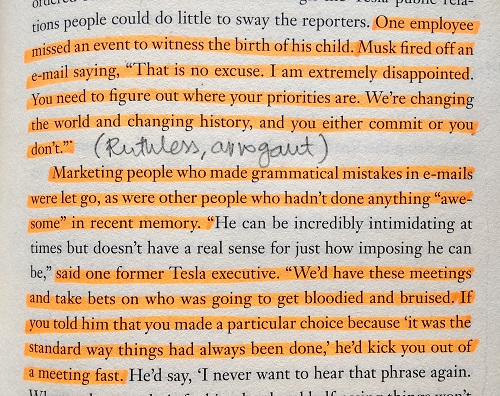

Source – Elon Musk’s Biography by Ashlee Vance
In fact, my thoughts were validated when I read this from one of his employees’ postings on Quora – “Working with him isn’t a comfortable experience, he is never satisfied with himself so he is never really satisfied with anyone around him…the challenge is that he is a machine and the rest of us aren’t.”

And then, this frustrated anonymous commenter concedes that the way Elon is “is understandable” given the enormity of the task at hand, and that “it is a great company and I do love it.”

The more I’ve read about him, and the more I’ve tried to look at his side of the picture, my respect for him and his vision has just increased day after day.

Before I write more about Elon, and a few lessons from him that I think I can apply to my life and work, let me ask Sir Richard Branson to explain briefly his thoughts about man who comes closest to the real-life version of Iron Man’s Tony Stark –

Whatever skeptics have said can’t be done, Elon has gone out and made real. Remember in the 1990s, when we would call strangers and give them our credit-card numbers? Elon dreamed up a little thing called PayPal. His Tesla Motors and SolarCity companies are making a clean, renewable-energy future a reality…his SpaceX [is] reopening space for exploration…it’s a paradox that Elon is working to improve our planet at the same time he’s building spacecraft to help us leave it.

Every generation produces a few people who change the world. It’s important for us to study such people. for there’s a lot we can learn from them.

Apart from the clichéd ones like take risks, follow your passion, be optimistic, never give up, think long term, and take criticism into your stride, here are my five big-big learnings from Elon Musk –

1. First Principles, First
Ralph Waldo Emerson wrote…

As to methods there may be a million and then some, but principles are few. The man who grasps principles can successfully select his own methods. The man who tries methods, ignoring principles, is sure to have trouble.

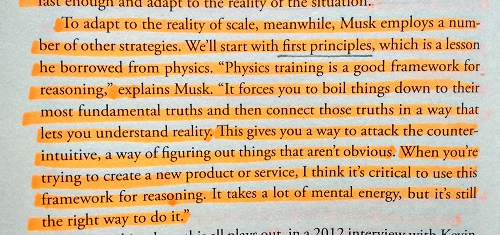
Boiling things down to the most fundamental truths – first principles – and then reasoning up from there, is one of the big ideas I’ve absorbed from my reading about Musk.

Source – Elon Musk’s Biography by Ashlee Vance
“The normal way we conduct our lives is we reason by analogy,” he said in an interview. “With analogy we are doing this because it’s like something else that was done, or it is like what other people are doing. With first principles you boil things down to the most fundamental truths…and then reason up from there.”

In simpler words, first principles thinking helps you to edit out complexity from your decision making so that you can focus on the most important things that matter to that decision. Let me explain with an example from Musk’s life and how he used first principles to start SpaceX.

If you are trying to estimate the cost of building a rocket, the simple way would be to look at the products available in the market, and add up all the costs. That’s analogy-based thinking – “Let me pay what others are paying for this product.”

But what Musk and his team did was that they figured out what the necessary parts of a rocket are (like its battery) and then found out how much the raw materials of those parts would cost.

In an interview, this is what Musk said about his usage of first principles in the rocket business –

Someone could – and people do – say battery packs are really expensive and that’s just the way they will always be because that’s the way they have been in the past. They would say, “It’s going to cost $600 / kilowatt-hour. It’s not going to be much better than that in the future.”

But when you think in first principles, you start asking fundamental questions, like Musk did…

What are the material constituents of the batteries? What is the spot market value of the material constituents? It has carbon, nickel, aluminum, and some polymers for separation, and a steel can. Break that down on a materials basis, if we bought that on a London Metal Exchange, what would each of these things cost?

Oh jeez, it’s $80 / kilowatt-hour. Clearly, you need to think of clever ways to take those materials and combine them into the shape of a battery cell, and you can have batteries that are much cheaper than anyone realizes.

The result of such thinking was astonishing. According to early Tesla and SpaceX investor Steve Jurvetson, using first principles, Musk calculated that the raw materials for building a rocket actually were only 3% of the sales price of a rocket at the time. By applying vertical integration and the modular approach from software engineering, SpaceX could cut launch price by a factor of ten and still enjoy a 70% gross margin!

Anyways, let me now put the first principles thinking to investing. Most people would ask – “How can I learn to invest like Warren Buffett” (thinking by analogy, which will not take you too far).

Instead of this, how about asking – “How can I improve myself to become a better investor than I am currently?” And then – “What areas should I work on to become a better investor?”

Here are the most fundamental rules you must know and practice if you want to become a sensible investor –

  • Look at stocks as part ownership of a business
    • Learn to understand businesses, and differentiate between good and bad ones
    • Think like an owner, and don’t enter stock market for short term excitement…but for long term profits
  • Look at Mr. Market – stock price fluctuations – as your friend rather than your enemy
    • Avoid looking at daily stock prices and getting worried or excited when they are falling/rising
    • Avoid making an investment decision based on what the stock is doing – instead consider what the underlying business is doing
  • Never forget margin of safety – the three most important words in investing
    • Always pay lot less than what the stock is quoting at
    • Only consider businesses that are simple to understand and simple to run, so that the probability of the management doing something wrong is less
    • Build a good understanding of the business you are getting into, which also provides a margin of safety

Only if you can focus on these principles, and make them your guideposts, you do not need to search for any other success mantra in your investment lifetime.

2.Think in Probabilities
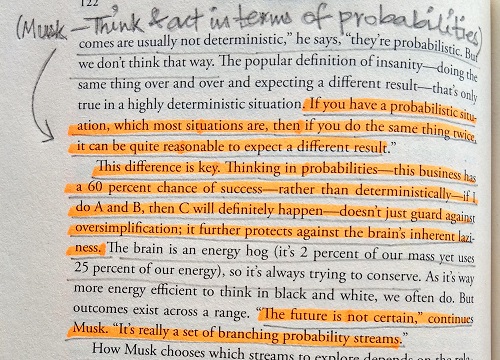
Another one of Musk’s big lessons is to think in terms of probabilities, especially when you are pursuing things that are bold, and even otherwise.

Source – Bold by Peter Diamandis
“The future is not certain,” Musk says. “It’s really a set of branching probability streams.”

When you think in terms of probabilities, rather than being overconfident that anything you do would succeed, you are better prepared to guard against risks that might ensue. Musk said in an interview…

I think in general you always want to try to think about the future, try to predict the future. You’re going to generate some error between the series of steps you think will occur versus what actually does occur and you want to try to minimize the error. That’s a way that I think about it. And I also think about it in terms of probability streams. There’s a certain set of probabilities associated with certain outcomes and you want to make sure that you’re always the house. So things won’t always occur the way you think they’ll occur, but if you calculate it out correctly over a series of decisions you will come out significantly ahead.

This is such an important lesson for investors – think in terms of probabilities, that things can go wrong as probably as they could go right. Risk is, after all, the probability of permanent loss of capital. It’s thus so important to avoid investments where this probability – of permanent loss of capital – is high.

Predicting that the Sensex would touch 40,000 in 2 years is deterministic. But saying that there’s a 20% chance of the Sensex touching 40,000 in 2 years is probabilistic. In this second scenario, there’s a bigger 80% chance that the Sensex would not touch 40,000…and this is what the experts making predictions on business media would never tell you. They would make bold predictions, without letting you know that they deeply believe that the prediction will most probably not come true.

3. Probabilities are (Sometimes) Irrelevant
Musk says …

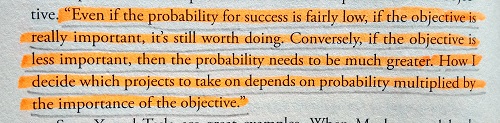
If something is important enough, even if the odds are against you, you should still do it.

Now, this lesson from Musk is an antithesis of the one above i.e., thinking and acting in terms of probabilities. Here, Musk is bringing the ‘objective’ into the picture.

Source – Bold by Peter Diamandis
If something is important enough, he says, even if the odds are against you, you should still do it. He has often mentioned that both Tesla and SpaceX had way less than 50% chance of being successful. But then…

I thought these were things that needed to be done. So even if the money was lost, it was still worth trying.

Now you cannot apply this lesson to investing, because here things that must not be done, must not be done. There’s no great purpose you can aim to achieve by betting on stocks for the short term, buying bad businesses, and indulging in reckless speculation.

I am sure when investors get into such troublesome things, where the probability of success in very low, they are not thinking – “I want to change the world doing this.”

Such things are never worth doing, unlike when you wish to get into something that would really benefit those around you…like educating people, starting an NGO, building schools and hospitals, or like Musk, building green cars.

This goes to the point Justine Musk made in the answer I shared at the start of this post –

Shift your focus away from what you want (a billion dollars) and get deeply, intensely curious about what the world wants and needs…The world doesn’t throw a billion dollars at a person because the person wants it or works so hard they feel they deserve it. (The world does not care what you want or deserve.) The world gives you money in exchange for something it perceives to be of equal or greater value: something that transforms an aspect of the culture, reworks a familiar story or introduces a new one, alters the way people think about the category and make use of it in daily life.

Given that he was on the verge of losing it all several times in his career and personal life, I’m sure Elon Musk didn’t ask himself, “What are some of the best ways I can make money or improve my life?” Instead, he must have often asked himself, “What are some of the problems that are likely to affect the future of humanity?”

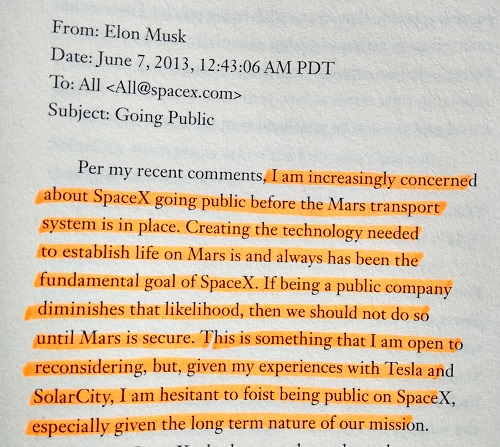
Read any of his interviews or any of the books written on him, and you will rarely (maybe, never) find a mention of “profit”. Rather, Musk only discusses how he plans to create businesses that serve the humanity – like SpaceX’s goal to make humanity into a multi-planetary species, or Tesla’s goal to accelerate the world’s movement toward having environment-friendly electric cars.

Like, here is what he wrote to SpaceX employees, showing his concern for going public…

Source – Elon Musk’s Biography by Ashlee Vance
In his fight, Musk is battling the giants of the US military-industrial complex, and the established car makers, but then he continues to fight to improve the world.

4. Imagine
Here’s a note from Ashlee Vance’s biography of Musk…


Source – Elon Musk’s Biography by Ashlee Vance
Visual thinking is a great way to understand complex or potentially confusing information, and also a way to organize your thoughts and improve your ability to think and communicate.

Imagine someone talking to you, and starting with the word – “Imagine…”

You are completely hooked, isn’t it?

Consider this excerpt from Richard Feynman’s The Pleasure of Finding Things Out, where his father helps him visualize about dinosaurs –

We had the Encyclopedia Britannica at home and even when I was a small boy my father used to sit me on his lap and read to me from the Encyclopedia Britannica, and we would read, say, about dinosaurs and maybe it would be talking about the brontosaurus or something, or tyrannosaurus rex, and it would say something like, ‘This thing is twenty-five feet high and the head is six feet across,’ you see, and so he’d stop and say, ‘let’s see what that means. That would mean that if he stood in our front yard he would be high enough to put his head through the window but not quite because the head is a little bit too wide and it would break the window as it came by.’ Everything we’d read would be translated as best as we could into some reality and so I learned to do that – everything that I read I try to figure out what it really means, what it’s really saying by translating.

Then consider how Warren Buffett visually convinced me why gold was a bad investment…

I will say this about gold. If you took all the gold in the world, it would roughly make a cube 67 feet on a side… Now for that same cube of gold, it would be worth at today’s market prices about $7 trillion dollars – that’s probably about a third of the value of all the stocks in the United States… For $7 trillion dollars… you could have all the farmland in the United States, you could have about seven Exxon Mobils, and you could have a trillion dollars of walking-around money… And if you offered me the choice of looking at some 67-foot cube of gold and looking at it all day, and you know me touching it and fondling it occasionally…Call me crazy, but I’ll take the farmland and the Exxon Mobils.

I’ve tried my hands at visual thinking this way…


So, visual thinking is not a new lesson that I would attribute to Elon Musk. But imagine the kind of businesses he is building, to save the world (imagine!), which he had originally visualized when he was under ten years of age.

When it comes to investing, you can avoid yourself a lot of pain by just visualizing your life after you’ve lost a lot of money trading and speculating in the stock market. If the visuals unnerve you, don’t do anything that would get you into such a situation. That’s also the concept of inversion.

I personally used visual thinking when I was deciding about quitting my job to start Safal Niveshak to help small investors become better at their investment decision making. Of course, when I had started planning my future after a job, the first visual was that of – not being successful in my future work, getting over my savings, and having to return to a job.

But another visual I saw was of helping people, enjoying the freedom of doing things my way, and spending a lot of time with my family. And I thank my stars that this was more powerful than the visual of losing everything.

5. Teach Yourself
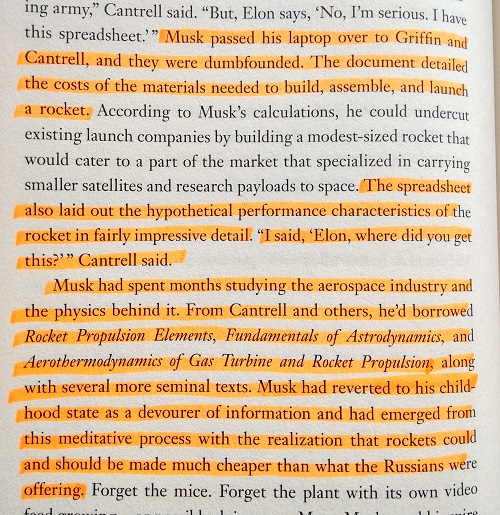
Again, not a new lesson but just the way Musk did it is amazing. Here’s a note from his biography…

Source – Elon Musk’s Biography by Ashlee Vance
Musk had a bachelor’s degrees in physics and economics from the University of Pennsylvania, I’m sure those did not prepare him to run his space company SpaceX.

Jim Cantrell, an aerospace consultant at the time Musk was starting out with SpeceX, became its first VP of business development and Musk’s industry mentor when the company launched in 2002. As per him, Musk taught himself rocket science by reading textbooks and talking to industry heavyweights.

“He would quote passages verbatim from these books,” Cantrell said in an interview. “He became very conversant in the material.”

Apart from teaching himself from books, Musk also got headlong into learning from other people’s expertise. Cantrell says, “It was as if he would suck the experience out of them. He truly listens to people.”

These are wonderful attributes to have – teaching yourself things you are passionate about, and then keep learning…from books and people.

Learning about space is surely difficult, but learning how to invest sensibly isn’t so. But then, you must bring the passion and willingness to learn on the table…or no books or courses would help you.

Bonus Lesson – Believe in the J-Curve
It’s easy to consider Elon Musk and his advance in space, electric cars, and solar power as ridiculously rapid. But that’s not the case at all.

SpaceX was founded in June 2002, and Tesla in July 2003…that’s around 12-13 years back.

So, while we are seeing huge acceleration in what these companies can do, these have not been overnight successes. It’s only that they have become better (and rapidly now) with time.

So, what we are really seeing with Musk’s businesses are the returns on the far side of the J-curve.
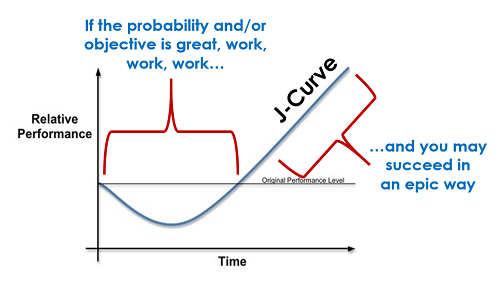

In private equity, the J-curve is used to illustrate the historical tendency of private equity funds to deliver negative returns in early years and investment gains in the outlying years as the portfolios of companies mature.

In business, the J-curve signifies the accelerated payoff from investments made in the past, which suggests that it’s not always a great idea to reject companies that are running negative cash flows as of now, because they may be investing for a highly cash-rich future. Only that you must ensure sufficient margin of safety in case the curve doesn’t become a J, and never picks up after falling of the initial cliff.

As an investor or a businessmen, it’s important to believe in the J-curve effect when considering good businesses or ventures to invest in – though after considering the probability of the effect taking place (you may not want to apply the J-curve thinking with most e-commerce businesses).

Is Musk Steve Jobs 2.0?
Elon Musk may give an impression of being the next Steve Jobs, but I see a few dissimilarities between the two. Most important of them is their focus. While Jobs was intensely focused on what the consumer wanted, Musk is focused on what the humanity needs. Of course, both have been super achievers in their chosen field and have been great storytellers, Musk is busy pushing the limits of human ability.

The genius of Steve Jobs lied in marketing technology as an extension of a human being. It’s to his credit that while humanity will survive without an iPhone or an iPad or any such toy, an Apple fan may not.

But Musk is aiming for something spectacular. Of course, dramatic risks accompany just about everything he does. But his seems to possess a level of conviction that is intense and exceptional, and which is a lesson so hard to learn for anyone.

A Risky Life?
One lesson I may never take from Musk is that of working hard enough to not care about my health and personal life. Here’s a note from his biography…


Source – Elon Musk’s Biography by Ashlee Vance
Musk expects entrepreneurs to work 80 to 100 hours a week, or around 11-14 hours a day, seven days a week, if they want to create a dent on history.

Well, I have nothing to add here because I aim for 3-4 hours of work a day, and am doing just fine in my own objectives in life.

The J-curve also works with your health, and things can get really out of order (in the negative sense) if you don’t care of your body for a long period of time. So this is one lesson – of working super hard even at the risk of compromising your health – I would never take from Elon Musk.

But then, there’s a lot to learn from this man who has given us hope and renewed faith in what technology can do for mankind.

Hail Musk!

The post 5 Things I Learned from Elon Musk on Life, Business and Investing appeared first on Safal Niveshak.

    
17 Sep 04:44

The 'asymmetric contracting' risk with auctions

by noreply@blogger.com (Gulzar Natarajan)
The Economic Times reports that the just concluded FM radio auctions resulted in aggressive bidding in the metros and no bidders in 13 towns,
With bids in metro cities that far exceed what operators had expected, the auction has the broadcast industry wondering if it is subscribed to the winner's curse. The bid price for a station in Mumbai was Rs 122.8 crore, Delhi Rs 169.2 crore and Bangalore Rs 109.3 crore, while 38 stations in 13 cities had received no bids at all because of high reserve prices. Just these three metro circles account for 45% of the total bids received... For the major cities there is now a significant scarcity premium... this is a direct result of reducing the number of stations being auctioned in the "premium" locations — top cities into which all operators will rush, in order to preserve their businesses.

After the tumult surrounding sordid crony capitalism in the discretionary allocation of natural resources, India has embraced auctions with vengeance. Coal, telecom spectrum, mineral resources, and now petroleum reserves are being auctioned and notional receipts are being booked. Nobody doubts the intent behind these auctions and everybody applauds the efficiency with which they are being carried out. But the long-term sustainability of these auctions may not be as robust as it appears (more on this is in a later post). Is it therefore a case of the cliched 'operation successful, but patient dead'?

Most infrastructure projects in developing countries are characterized by several uncertainties. The commonest problem relates to site allocation and environmental and other clearances, which are par for the course for any project, and whose delays immediately translate into cost escalation. Then, there are the market risks, arising from lower than expected traffic forecasts or smaller market. Finally, there are the inevitable costs associated with rent-seeking, which no entrepreneur can escape. 

Under ideal conditions, market participants factor in all these elements when they make their bids, resulting in market-competitive price discovery. But in the real world, market participants suffer from cognitive biases (over-estimations of their ability to control the pace and trajectory of the development, in accordance with their laid out plans), and ex-ante overlook these factors when making their bids. Developers instinctively refuse to acknowledge errors in their business cases. Since these real factors generally always strike, the successful bidders are ex-post left with no option but to resile from their commitments. They skimp on their investments or renegotiate. The tortured fate of infrastructure projects, in the form of stalled projects, is for all to see. 

All this, coupled with winner's curse and moral hazard (from the inevitability of renegotiations), generates an asymmetric contracting, where efficiency in the price discovery process intersects with inefficiencies in the project development eco-system, amplified by human cognitive biases, resulting in a low-level equilibrium. But the politics associated with the auctions system, especially given the context in which it was embraced, may prove insurmountable to permit any tinkering with it, leave aside replacement. 
Add to Technorati Favorites
11 Sep 03:38

Rich Temples of India

by bemoneyaware

Balaji, the world’s richest god at Tirupati, has now opened a demat account to enable devotees to donate shares and securities, after finding it a tedious task to get physical share certificates dropped in Hundi transferred on his name. Considered the first globally for a shrine management, Tirumala Tirupati Devasthanams (TTD) has opened demat account (1601010000384828) with the Stock Holding Corporation of India. Tirumala Venkateswara Temple, also known as Tirupati Balaji, is considered to be one of India’s richest temple and receives crores of rupees, precious metals and stock certificates in donations every year. The temple, as of August 2014, had around 5,000kg of gold deposited with various banks in India. Read this and then saw rerun of Oh My God!  A question came to the mind “How rich are our temples?” Which are the richest temples in India?

Every year millions of visitors throng religious places owing to the rich heritage and cultural significance these temples carry. They offer many precious assets to the temple as a token of their respect and faith. Let’s take a look at some of the richest temples of India.

Padmanabhaswamy Temple, Kerala

Padmanabhaswamy temple, Kerala  is one of the 108 Divya Desams of Lord Vishnu at Thiruvananthapuram, Kerela.  Thiruvananthapuram is named after Vishnu, the word literally means the land of Sri Anantha Padmanabhaswamy.The principal deity Vishnu is enshrined in the “Anantha Sayanam” posture, the eternal yogic sleep on the serpent Adisheshan. In line with the Temple Entry Proclamation, only those who profess the Hindu faith are permitted entry to the temple and devotees have to strictly follow the dress code. The temple and its assets belong to Lord Padmanabhaswamy, and were for a long time controlled by a trust, headed by the Travancore Royal family. However, for the present, the Supreme Court of India has divested the Travancore Royal Family from leading the management of the temple.

Temple shot to fame on 7th July 2011, after the assets worth more than Rs. 1,00,000 crore(around US$22.3 billion) were found from 5 secret cellars of the temple  , without even calculating the antique value of the objects. The treasure that was found : Antique gold ornaments, Sack full of Diamonds, Golden idol of Mahavishnu worth Rs. 500 Crore, Golden Crowns, Golden Bow, 17 kg of gold coins(dating back to the East India Company period), Gold in shape of rice trinkets(Weighing one tone! ), 18 feet long golden necklace weighing 2.5 kg, Thousands of pieces of antique jewellery studded with diamonds and emeralds, Golden Vessels. YouTube video Pictures of Padmanabhaswamy Temple Treasure. Even with only five of the eight vaults being opened (three vaults and all their ante-chambers still remaining closed), the treasure found so far is considered to be by far the largest collection, of items of precious metals and precious stones in the recorded history of the world

When was the temple built? There are many legends which are handed down through the centuries. One such legend which finds a place in the old palm leaf records of the Temple, as also in the famous grantha entitled  Ananthasayana Mahatmya, mentions that it was built by a Tulu Brahmin hermit named Divakara Muni. On the 950th year of Kali Yuga a reinstallation of the idol was done. In the 960th Kali year King Kotha Marthandan built the Abhisravana Mandapam. Srimad Bhagavatha says that Balarama visited this Temple, bathed in Padmatheertham and made several offerings. Some well known scholars, writers and historians, like the late Dr. L.A.Ravi Varma of Travancore, have expressed the view that this Temple was established on the first day of Kali Yuga (which is over 5000 years ago).   More at http://www.sreepadmanabhaswamytemple.org/History.htm

Padmanabhaswamy-Temple Richest temple in India

Padmanabhaswamy-Temple

Tirumala Tirupati Venkateswara Temple, Andra Pradesh

Also known as Tirupati Balaji temple, Website: http://www.tirumala.org/,  is the most sacred and second richest temple of India. It is situated in Trimula in Andra Pradesh and is the major pilgrimage destination of South India  The Temple is dedicated to Lord Venkateswara, an incarnation of Vishnu, who is believed to be appeared here to save mankind from trials and troubles of Kali Yuga. Hence the place has also got the name Kaliyuga Vaikuntham and Lord here is referred to as Kaliyuga Prathyaksha Daivam.  Venkateswara is known by many other names: Balaji, Govinda, and Srinivasa Lord Balaji is worshipped in this temple.. Tirumala  Hills comprises seven peaks, representing the seven heads of Adisesha. Hence the temple is also referred to as “Temple of Seven Hills”.

Tirupati temple

Tirupati temple

Donations are repayment of loan to Kuber taken by Vishnu for his marriage : Lord Vishnu bore human form as Srinivasa, left Vaikuntam, in search of Lakshmi, reached Tirumala Hills and started meditating. Lakshmi was angry with Vishnu because she felt sage Bhrigu insulted Vishnu by kicking him but Vishnu had apologised. It is believed that Srinivasa had to make arrangements for his wedding to Padmavati. Lord Kubera credited money to the god Venkateswara for his marriage with Padmavati. Srinivasa sought a loan of one crore and 11.4 million (11,400,000) coins of gold from Kubera and had Viswakarma, the divine architect, create heavenly surroundings in the Seshadri hills. Together, Srinivasa and Padmavathy lived for all eternity while Goddess Lakshmi, understanding the commitments of Lord Vishnu, chose to live in his heart forever. In remembrance of this, devotees go to Tirupati to donate money in Venkateswara’s hundi (donation pot) so that he can pay it back to Kubera.

Why people donate their hair at Tirupati : When Lord Balaji was hit by a shepherd on his head, a small portion of his scalp becomes bald. There is no hair growth over there and Gandharva princess Neela Devi noticed it. She feels “such an attractive face should not have a flaw”. Immediately she cuts a portion of her hair and with her magical power she implants it on his scalp. Then Lord Balaji notices her sacrifice as hair is the beautiful aspect of Female, he promises her that all his devotees who come to his abode should render their hair to him and she would be the recipient of all that hair received. Hence it is believed that hair offered by the devotees is collected by Neela devi.

Some interesting Facts about the temple:

  • Tirupati’s Venkateswara deity is clad with about 1000 kgs of gold!
  • Around 50,000 pilgrims visit the temple every day
  • Every day around 150,000 laddus are made at the temple to serve the devotees. The revenue from the sale of laddu annually is more than 11 million rupees.
  • It is said that people drop bags of gold and at times even diamonds at the feet of Sri Venkateshwara.
  • The temple gets up to Rs 650 crore in donations every year.

Thondaiman, ruler of the ancient Thondaimandalam (present day Kanchipuram) (capital: Kanchipuram, just south of modern day Chennai), is believed to have first built the temple after visualizing Lord Vishnu in his dream. He built the Gopuram and the Prakhara, and arranged for regular prayers to be conducted in the temple. Later on the Chola dynasty vastly improved the temple and gave rich endowments.  Tirumala Tirupati Devasthanams(TTD) is operated by a Board of Trustees that has increased in size from five (1951) to eighteen (2015). The daily operation and management of TTD is the responsibility of an executive officer who is appointed by the Government of Andhra Pradesh. Highlights of The Tirumala Tirupati Devasthanams (TTD) annual budget of Rs.2530.10 crores for the year 2015-16, TTD APPROVES ANNUAL BUDGET FOR THE YEAR 2015-16,

  • TTD expected to receive Rs. 905 crores from capital funds (as kanuka) from devotees, which would be the major earner, while Rs.300 Special Entry Darshan was expected to fetch a minimum of Rs. 215 crores for the financial year.
  •  TTD is expecting to garner Rs.98.5cr on accommodation and Rs.50crores through Arjitha Seva tickets.
  • The payment of wages and salaries was expected to be the major outgo, to the tune of Rs. 482 crores.
  • Estimated Rs. 200cr towards the sale of human hair,
  • Rs.150cr has been allotted on Engineering works, Rs.118.6cr for HDPP, Rs.94.45cr on educational institutions, Rs.62.81cr on TTD-run hospitals.
  • Towards the development of Health and Sanitation the estimated budget is Rs. 109.71cr,
  • Vigilance and Security department is Rs.55.88cr.

Tirumala Tirupati Devasthanams (TTD) officials indicated in Aug 2015 that 4.5 tonnes of gold have been deposited in banks and that the temple administration is in the process of depositing one more ton of the yellow metal in the State Bank of India soon. Calculated at today’s rates, the total cost of the 5,500 kg ‘disclosed’ gold with the TTD stands at Rs 1,320 crore. Reference: Tirumala has 4.5 tonnes of gold in banks, gets 80kg as yearly interest

Saibaba Temple, Shirdi

Sai temple of Shirdi, http://shrisaibabasansthan.org.in/, is located at Shirdi, a town in the west Indian state of Maharashtra. approximately 296 Kilometers from Mumbai. It was established in 1922 to carry out the services of Shri Sai Baba. Shri Saibaba of Shirdi lived between 1838 and 1918, whose real name, birthplace and date of birth are not known. An Indian spiritual guru and a fakir, Shri Saibaba in Shirdi was regarded with great reverence by both Hindu and Muslim followers. Lord Sai lived in a mosque and after death his body was cremated in a temple. It is the third wealthiest temple in India where millions of devotees of different religions and castes visit everyday.

Shirdi Saibaba Temple is managed by Shirdi Sai Sansthan Trust(SSST). The SSST has received Rs 22,84,00,000 through donations, either in ‘hoondis’ (cash boxes) or online in the past three (financial) years from 2012-13 to 2014-15,   The Trust has Rs 1,413 crore as fixed deposit in different nationalised banks, and as per today’s market rates, also possesses 376 kg gold worth Rs 100 crore, silver valued at Rs 14 crore and diamonds worth Rs 7 crore.The SSST is currently running two hospitals and a number of schools, carrying out ‘Annadaan’ (food donation) besides providing residential arrangement at reasonable rates for devotees, giving free ‘ladoos’ and free ‘prasad’, and providing ‘bhojan’ (food) at cheap rates. Ref: Times of India Shirdi Saibaba temple witnesses huge spurt in donations

Siddhivinayak Temple of Mumbai

The Shree Siddhivinayak Ganapati Mandir,: http://www.siddhivinayak.org/, is a Hindu temple dedicated to Lord Shri Ganesh. It is located in Prabhadevi, Mumbai, Maharashtra.It was originally built by Laxman Vithu and Deubai Patil on November 19, 1801. also stands firmly in the list of richest temples in India. Well known celebrities and VIPs visiting this temple is a common sight here. The dome over Ganesha is coated in 3.7 kilos of gold that was donated by a Kolkata-based businessman. On an average, the monumental Siddhivinayak Temple sees anywhere between 25,000 to 2 lakh devotees flocking in everyday to just get a glimpse of their beloved Ganesha.  The temple owns hundreds of kilos gold ornaments and fixed deposits.

Siddhivinayak temple has earned a special blessing, ISO 9001:2008 certificate  labelled FS 636570.  for devotee management as well as its social and educational welfare schemes. One of the shrine’s largest donations was made in May 2015 when it donated Rs 34 crore towards the state’s drought relief plan. The temple trust also gave Rs 1.5 crore to Wadia Hospital, which set up 20 neonatal ICUs. It allocates around Rs 1 crore each year to outstation patients suffering from heart, liver and kidney ailments as well as accident victims or those who require knee replacement. A sum of Rs 25,000 per patient is forwarded to treating hospitals.

Temple is thronged by 25 thousand to 2 lakh people every day. Yes, you guessed it right! The annual income of the Siddhivinayak Temple ranges from Rs 48 crore to Rs 125 crore. The dome over the main shrine of Ganesha is coated with 3.7kg gold. The black stone idol of Lord Ganesha found in this temple is around 200 years old. The temple was converted to a six storeyed building in 1990.

In 2004, the Siddhivinayak Ganpati Temple Trust, which operates the temple, was accused of mismanaging donations. Consequently, the Bombay High Court appointed a committee headed by retired judge V P Tipnis to scrutinize the trust’s donations and probe the allegations. The income of this temple including donations goes upto Rs 48 crore every year. The dome over Ganesha is coated in 3.7 kilos of gold that was donated by a Kolkata-based businessman.

Vaishno Devi, Kashmir

Vaishno Devi Mandir is a very popular Hindu temple dedicated to the Hindu Goddess Durga , located at the Trikuta Mountains in the state of Jammu and Kashmir. The Holy Cave is situated at an altitude of 5200 ft. The Yatris have to undertake a trek of nearly 14.5 km from the base camp at Katra. Darshans are open round the clock throughout the year. At the culmination of their pilgrimage, the yatris see three natural rock formation known as Pindies inside the holy cave.

This temple is one of the oldest in the country. It gets more than 4.5 million visitors every year and an income of Rs 500 crore annually. Since the year 1986, when the Shri Mata Vaishno Devi Shrine Board (commonly called Shrine Board) was formed, the management of the Shrine and regulation of the Yatra(the journey) has been vested in the Board. The Board has undertaken a number of developmental activities aimed at making the Yatra a comfortable and satisfying experience for the Yatris.The Governor of the state of Jammu and Kashmir by virtue of his office is the ex-officio Chairman of the Board. He nominates nine members in the Board at the policy making level. The Board continues to reinvest the offerings and donations received in carrying out improvements in various kinds of Yatri facilities.

There are other temples like  Golden Temple (Amritsar),Meenakshi Temple(Madurai),Jagannath Temple(Puri),Kashi Vishwanath Temple(Varanasi),Somnath Temple(Gujarat),Guruvayurappan Temple(Kerala) also where millions of devotees visit.

Related Articles:

Are we GOD LOVING or are we GOD FEARING PEOPLE? Are we erasing or reducing ours sins by bribing the god? Do we offer it as as a Votive or Mannat  in Hindi or Mokku in Telugu after our request is fulfilled by the god or we Expect our  family to be blessed with more wealth if they donate to the God or we expect something in return?

11 Sep 03:37

Resurgence of the left in UK and US

by T T Ram Mohan
Political pundits are watching with some astonishment the resurgence of the left in the UK and- of all places- the US.

In the UK, Jeremy Corbyn is positioning himself for the leadership of the Labour party on September 12. That doughty champion of market forces, The Economist, does not approve one bit:
For him no policy is too dog-eared, no intellectual dead-end too futile. Public spending? Yes, please. Higher taxes? Soak the capitalists and the landlords. State ownership? Nationalise the railways and utilities, get the private sector out of public services and reopen the coal mines. If that were the secret of prosperity, Britain would never have fallen apart in the 1970s and Tony Blair would not have won three elections at the head of a modernised centre-left Labour Party.
In the US, Bernie Sanders stands a slender chance of emerging as a shock Democratic candidate. He may end up getting pitted against Donald Trump, the Republican's own shock candidate who leads the ratings. An article in the Economist describes Sanders' broad political position:
A typical Sanders speech resembles a 90-minute sermon on modern America’s ills, delivered in the growling tones of his native Brooklyn. Hunched over a lectern, snowy hair aquiver with emotion, the 73-year-old’s usual targets include the “greed, recklessness and dishonesty” of Wall Street bankers, the malign influence of billionaire political donors, and the “abysmally low” wages that blight the lives of working families. Change will be hard, Mr Sanders warns audiences, and will require a “political revolution”. He is not joking (the senator rarely jokes). His proposals include moving towards a Canadian-style health system with publicly funded care for all, free tuition at public universities and a trillion-dollar infrastructure plan intended to create 13m jobs.

...Mr Sanders detects a chance in 2016 to lead a national uprising, drawing strength from the millions of working Americans who loathe mainstream politicians, news outlets and the economic status quo. Paraphrasing Franklin D. Roosevelt, he told the rally in Boone: “If the Koch brothers and the billionaire class hate my guts, I welcome their hatred.”
The Economist doesn't think that either Corbyn or Sanders can actually emerge as leaders of their respective parties.

BJP leader Varun Gandhi has a comment on this in the Hindu. He ascribes the resurgence to rising inequality. Gandhi's prescriptions for inequality would, perhaps, find easier acceptance in the Congress than in the BJP:
To cut inequality, we need to raise the level of minimum wages, strengthen collective bargaining, and improve employment benefits. Women need equal wages, flexible work environments and better childcare facility. We need better regulation of business, especially for rent-seeking sectors. Climate change requires a systemic response, with enhanced environmental protection.. With new demands for reservation based on economic criteria, the old politics of ethnic, racial and caste based reservation or affirmative programmes will soon die. 
Well, I am not sure the issue is just inequality, although it is an important factor. There is widespread discontent about the economy, for one thing. More importantly, perhaps, a profound dissatisfaction with mainstream candidates and parties and a yearning for something very different. Trump's appeal is precisely on the latter count, although I cannot fathom how he appeals to black voters.

Some of this is reflected in Indian politics as well. Aap undoubtedly has won out because of its anti-establishment orientation. The resistance to reforms reflects a growing realisation that a disproportionate chunk of the economic pie has gone in favour of business and corporate interests.  The BJP's retreat from the Land Bill and its reluctance to privatise government banks are acknowledgements of the realities on the ground. It's hard to think of any party moving decisively to the right in the near future. 


10 Sep 03:43

1965 war: a Pakistani view

by T T Ram Mohan
I read and re-read this assessment of the 1965 war in Pakistan's Dawn newspaper with some amazement. It is scathing in its comments on the handling as well as the outcome of the war on the Pakistani side:
In fact, the war was started when we launched Operation Gibraltar in early July 1965, infiltrating thousands of Pakistani soldiers into India-occupied Kashmir under the assumption that Kashmiris would rise in revolt against the Indian forces. That never happened and within weeks the entire operation had collapsed. Meanwhile, the Indian forces launched a counteroffensive occupying parts of Azad Kashmir.
Subsequently on Aug 30, we launched Operation Grand Slam that was meant to capture the strategic town of Akhnur and to cut off held Kashmir from India. But it was too late. Another disaster happened when halfway through Grand Slam, the command was changed giving more time to the Indians to recoup and gather reinforcements. As a result this operation too ended in a fiasco.
About the Indian offensive on the Lahore front, the writer says:
...the persons most surprised were the president and the army chief when the Indians launched the attack on Sept 6. Ayub was woken up at four in the morning and given the news of Indian advances towards Lahore by an officer of the air force on reconnaissance duty. Ayub telephoned Gen Musa who said he had also heard the news but was waiting for confirmation!
 The author concludes:
Air Marshal Nur Khan, who led the air force, achieving complete superiority over the Indian air force, called it a wrong war that was planned “for self-glory rather than in the national interest”. History has to be put straight so that the mistakes are not repeated.
On the 1967 war, have you come across anything half as self-critical and objective in the Indian media? If the leading newspaper of a country can carry such an article, I would submit that there is something very right about that country. It cannot be a failed state, indeed, it is a country steadfastly battling any descent in that direction.

I have been an admirer of Dawn for many years now. Its liberalism is not confined to India-Pakistan relations. It has a thoroughly modern and reformist view on matters internal to Pakistan as well. Those who want Pakistan to be a vibrant democracy, free from the taint of terrorism, and also want that India and Pakistan should live together in peace must make it a point to read Dawn.


10 Sep 03:33

The Two Types of Knowledge

by Shane Parrish

In The Art of Thinking Clearly, Rolf Dobelli tells the following story about Max Planck.

After receiving the Nobel Prize in Physics in 1918, Max Planck went on tour across Germany. Wherever he was invited, he delivered the same lecture on new quantum mechanics. Over time, his chauffeur grew to know it by heart: “It has to be boring giving the same speech each time, Professor Planck. How about I do it for you in Munich? You can sit in the front row and wear my chauffeur’s cap. That’d give us both a bit of variety.” Planck liked the idea, so that evening the driver held a long lecture on quantum mechanics in front of a distinguished audience. Later, a physics professor stood up with a question. The driver recoiled: “Never would I have thought that someone from such an advanced city as Munich would ask such a simple question! My chauffeur will answer it.”

Charlie Munger, the billionaire business partner of Warren Buffett frequently tells this story in speeches. Why? He elaborates in a 2007 address to USC Law. The point of the story is not the quick wittedness of the protagonist, but rather – to echo Richard Feynman – it’s about making a distinction between the two types of knowledge.

In this world we have two kinds of knowledge. One is Planck knowledge, the people who really know. They’ve paid the dues, they have the aptitude. And then we’ve got chauffeur knowledge.

They have learned the talk. They may have a big head of hair, they may have fine temper in the voice, they’ll make a hell of an impression.

But in the end, all they have is chauffeur knowledge. I think I’ve just described practically every politician in the United States.

And you are going to have the problem in your life of getting the responsibility into the people with the Planck knowledge and away from the people with the chauffeur knowledge.

And there are huge forces working against you. My generation has failed you a bit… but you wouldn’t like it to be too easy now would you?

Real knowledge is when people do the work. This is so important that Elon Musk tries to tease it out in interviews. Then we have the people who don’t do the work. While they’ve learned to put on a good show they lack understanding. The problem is that it’s difficult to separate the two.

One way to tease out the difference between Planck and chauffeur knowledge — is to ask them why.

In The Art of Thinking Clearly Dobelli goes on:

With journalists, it is more difficult. Some have acquired true knowledge. Often they are veteran reporters who have specialized for years in a clearly defined area. They make a serious effort to understand the complexity of a subject and to communicate it. They tend to write long articles that highlight a variety of cases and exceptions. The majority of journalists, however, fall into the category of chauffeur. They conjure up articles off the tops of their heads or, rather, from Google searches. Their texts are one-sided, short, and— often as compensation for their patchy knowledge— snarky and self-satisfied in tone.

The same superficiality is present in business. The larger a company, the more the CEO is expected to possess “star quality.” Dedication, solemnity, and reliability are undervalued, at least at the top. Too often shareholders and business journalists seem to believe that showmanship will deliver better results, which is obviously not the case.

One way to guard against this is to understand your circle of competence.

Dobelli concludes:

Be on the lookout for chauffeur knowledge. Do not confuse the company spokesperson, the ringmaster, the newscaster, the schmoozer, the verbiage vendor, or the cliché generator with those who possess true knowledge. How do you recognize the difference? There is a clear indicator: True experts recognize the limits of what they know and what they do not know. If they find themselves outside their circle of competence, they keep quiet or simply say, “I don’t know.” This they utter unapologetically, even with a certain pride. From chauffeurs, we hear every line except this.

--
Sponsored By: Greenhaven Road Capital: You think differently - now invest differently.

10 Sep 03:28

Charts: Crude Price Drop Helps The Government The Most; Incomes Flat While Indirect Taxes Go Up

by Deepak Shenoy

For all the talk of the lower prices of crude, India’s crude input costs have dropped significantly:

image

This should have been excellent for us, because despite the rupee depreciation (from 61 last October to 66 now) is still a 45% drop from last year!

image

But it’s not really reflecting in the price of petrol in the country. And by that I mean the difference is quite substantial. In Delhi, Petrol prices are down just about 10% from October 2014 (when crude fell) and Diesel a better but still much lower 25% off.

image

Helping India: Only Fiscally?

The Difference in the fall in crude prices versus what we have seen in petrol/diesel is largely the increase in excise (and CVD) on petrol and diesel. The government collects approximately Rs. 8,000 crores per month on the average increase in duties on fuels of about Rs. 8 per liter.

What does this do? Removes the fuel subsidy which was largely used to keep the fuel prices for Indian consumers LOWER than should have been done so that we don’t pay more.… (Read On...)

10 Sep 03:23

Enter SoBoGoS: The Sovereign Gold Bond Scheme Explained In A Way That Won’t Put You To Sleep

by Deepak Shenoy

Yay! We have a new way to buy gold. The Sovereign Bonds Gold Scheme has arrived, and I will call it Sobogos.

First, if you are looking for unbiased versions, please read the draft here. What follows in this post has a lot of snark.

The Objective

Because people like you keep buying gold in bars and coins – a full 300 tons worth of it every year – India has to import the yellow metal and pay precious dollars for it. 300 tons is, let’s see, 1 ton is 1000 kg. Each kg of gold costs about Rs. 25-30 lakh rupees, which is 50,000 dollars. 1000 kg or one ton then is 50 million dollars. And 300 tons is a whopping $15 billion. That is a lot of money.

So to save that, you are going to be convinced to buy Gold Bonds instead. SO that saves you from having to actually buy gold coins or bars, and you will still benefit from the increase in price of gold.… (Read On...)

10 Sep 02:46

Could payments banks eat the private banks' CASA lunch?

The Reserve Bank of India (RBI) has granted “in principle” approval to eleven new payment banks and has also promised to license more in future. Many of the licensees could prove to be fierce competitors because of their deep pockets and strong distribution networks. For the incumbent banks, the most intense competition from the new entrants will probably be for the highly profitable Current and Savings Accounts (CASA) deposits which are primarily meant for payments. And it is here that the complacency of incumbents banks could provide an opening to the new payment banks.

In the late 1990s and early 2000s, new generation private banks innovated on technology and customer service and gained significant market share from the public sector banks. However, in recent years, some complacency seems to have set in; customer service has arguably deteriorated even as fees have escalated. Public sector banks have caught up with them on ATM and online channels; and in any case these channels are rapidly being overtaken by mobile and other platforms. In fact, India may not need any more ATMs at all.

In this competitive landscape, payment banks could gain significant market share if they are sufficiently innovative and provide better customer service than the incumbents. Unlike mainstream banks which have to worry about investments and advances and lots of other things, payment banks can be totally focused on serving retail customers. Since their survival would depend on this sharp focus, there is every likelihood that they would turn out to be more nimble and innovative in this segment.

The ₹100,000 limit on balances at the payment banks means that initially it would be the rural CASA that would be at risk. But if payment banks do a good job, the limit may be raised to a much larger level (maybe ₹500,000) over a few years. At that point, urban CASA will also be at risk of migration. It will be easy for RBI to raise the limit because the balances have to be invested in Government Securities and so customer money is subject only to operational risk.

eWallets could prove to be another competitive weapon in attacking the urban CASA segment. Large segments of the Indian population are uncomfortable with online credit card usage and with netbanking. A few years ago, eCommerce firms in India used Cash on Delivery (COD) to gain acceptance. However, COD is not scalable and it is breaking down for various reasons. In the last year or so, eWallets have begun to replace COD, and these too could pose a threat to traditional payment services. All banks are trying to launch eWallets and mobile banking apps, but I am not sure that traditional banks have a competitive advantage here. In fact, a customer who is worried about online security might well prefer to have an eWallet with a small balance for online transactions instead of exposing his or her main bank account to the internet. In this context, the payment banks may find that the ₹100,000 limit does not pose a competitive disadvantage at all.

All this is of course good news for the customer.

10 Sep 02:42

Twelve reasons to like Jeb’s tax plan

by Greg Mankiw
Jeb Bush has released a tax plan.  Here are some elements of it that I find attractive:
  1. It lowers the top rate on personal income to 28 percent, the same rate as the bipartisan 1986 tax reform.

  2. It broadens the base by capping the use of itemized deductions.

  3. It eliminates the deductibility of state and local taxes, so low-tax states and towns no longer subsidize high-tax ones.

  4. It maintains the deductibility of charitable giving, encouraging private solutions to social problems.

  5. It reforms the tax treatment of secondary earners and seniors, who are more responsive to tax incentives than primary earners.

  6. It eliminates the stealth marginal tax rates from PEP and Pease.

  7. It eliminates the estate tax, so the tax system no longer penalizes those who want to help their children and grandchildren.

  8. It lowers the corporate tax rate to be close to international norms.

  9. It moves from a global to a territorial tax system, like most other nations have.

  10. It eliminates the deductibility of interest expenses, putting debt finance and equity finance on a more level planning field.

  11. It includes full expensing of investment expenditure, moving the system toward a consumption-based tax.

  12. It expands the earned income tax credit for childless taxpayers, strengthening the social safety net.
Here is an assessment of the plan by John Cogan, Martin Feldstein, Glenn Hubbard, and Kevin Warsh.
09 Sep 08:53

Latticework of Mental Models: Inversion

by Anshul Khare

Watch this one minute video [1] and when you’re done smiling, think about the problem in a rational way.

At first, the problem seemed that the kid had his head stuck between the iron bars. Although nobody saw how the kid’s head really got trapped in the first place – they just assumed that he somehow managed to slide his head through the narrow bars. Naturally, the intuitive solution was to pull the head in the same way it got stuck – which obviously didn’t seem to work.

But the right solution appeared when people stood the problem on its head (no pun intended) i.e., instead of trying to pull the head they pushed in the body through the trap. They inverted the problem and voila! Problem solved.

That’s called principle of inversion. It’s a common trick used by mathematicians but rarely practiced outside the discipline of mathematics. Carl Jacobi, a German mathematician, said, “Invert, always invert”, expressing his belief that the solution of many hard problems can be clarified by re-expressing them in inverse form.

Charlie Munger, the business partner of Warren Buffett and Vice Chairman at Berkshire Hathaway, came up with his own version of Jacobi’s maxim –

All I want to know is where I am going to die so that I’ll never go there.

Munger is 91 years now so I guess his strategy has worked out pretty darn well so far.

It is not enough to think about difficult problems one way. You need to think about them forwards and backwards. “Indeed,” says Munger, “many problems can’t be solved forward.” You should read how inversion was used by one of Munger’s family members to guess the correct answer to a trivia question [2].

Roger von Oech’s Creative Whack Pack is a great tool to instil Munger’s way of thinking – combining various ideas from different spheres of life and joining them to create a process of thinking creatively. Here is what the Inversion card says –

creative_whack_pack_2

Reversing how you look at a situation can open up new possibilities and dislodge assumptions. Example: When everyone else is gazing at a glorious sunset, why not turn around to see the blues and violets behind you? What do you notice when you look at a coffee cup? Its design or color? Reverse your focus and look at the space inside – that’s what gives it its functional value.


Inversion and Proofreading

In this short video [3], a chess grandmaster walks us through retrograde analysis, which is a method to solve game positions in chess by working backwards from known outcomes. Even if you don’t play chess, you should watch it because it has interesting insights about problem solving.

As mentioned in the video, reading a text backwards reveals glaring errors which aren’t normally caught while you’re reading forward.

The reason this trick works is because when you are proofreading, especially your own work, your brain has a tendency to start skimming through the material and jumping from one sentence to the next. When it does this, it is very difficult to catch mistakes because you can very easily look past them as you are reading. When you go through your essay or article backwards you will catch more mistakes because each sentence is taken out of context so that you can focus on it by itself. Also, it’s easier to spot errors when you view words in a different order.

This cool inversion hack tricks your brain into looking at everything in a different way.

Subtractive Knowledge

Another useful way to think about forward vs backward thinking is to model them as additive vs subtractive measures. Additive measures manifest in form of an urge to do something about a problem which may not need any intervention [4]. Subtractive measures adhere to the philosophy of “don’t try to fix something which ain’t broken.”

Nassim Taleb calls this ‘subtractive epistemology’. He argues that the greatest and most robust contribution to knowledge consists in removing what we think is wrong. According to him we know a lot more about what is wrong than what is right. What does not work, that is negative knowledge, is more robust than positive knowledge. This is because it’s a lot easier for something we know to fail than it is for something we know that isn’t so to succeed. He dubs this philosophy as Via Negativa.

Taleb has written a whole book, The Black Swan [5], based on this idea that the absence of evidence doesn’t qualify as the evidence of absence. In other words, just because all the swans, that have been observed so far, are white doesn’t prove that all swans are white. Since one small observation (spotting a black swan) can conclusively disprove a statement – all swans are white – while millions can hardly confirm it, disconfirmation is more rigorous than confirmation.

Avoiding Stupidity

Inverting the problem not just helps you in solving the problem, but it will also help you in avoiding trouble.

So how does this idea translate into practice? It’s a choice between avoiding stupidity and seeking brilliance.

A lot of success in life and success in business, says Munger, “comes from knowing what you really want to avoid-like early death and a bad marriage.” He continues –

What will really fail in life? What do we want to avoid? Some answers are easy. For example, sloth and unreliability will fail. If you’re unreliable it doesn’t matter what your virtues are, you’re going to crater immediately. So, faithfully doing what you’ve engaged to do should be an automatic part of your conduct. Of course you want to avoid sloth and unreliability.

It’s a common knowledge that to succeed you should find role models and follow them. But it would be equally effective, and perhaps even more, to find anti-models – people you don’t want to resemble when you grow up. And then avoid the path they took.

In Business and Decision Making

John Paul Getty, an American business tycoon, said –

In every business deal or transaction, identify the worst thing that can possibly go wrong, and then make sure it doesn’t happen.

Donald Keough in his book The Ten Commandments for Business Failure [6] (a book recommended by Warren Buffett) used the inversion principle by showing the direct paths to failure. He talks about things like – not taking risks, being inflexible, playing the game too close to the foul line, etc. These are precisely the things that one can do to ensure a failure in business. Hence avoid them like a plague.

Jeff Bezos, founder and CEO of Amazon, used the inversion principle to break his dilemma about leaving a high paying job and starting Amazon. He recounts –

When you are in the thick of things, you can get confused by small stuff. I knew when I was eighty that I would never, for example, think about why I walked away from my 1994 Wall Street bonus right in the middle of the year at the worst possible time. That kind of thing just isn’t something you worry about when you’re eighty years old. At the same time, I knew that I might sincerely regret not having participated in this thing called the Internet that I thought was going to be a revolutionizing event. When I thought about it that way … it was incredibly easy to make the decision.

Have you heard of post-mortem technique? When a project fails, typically the stakeholders get together and do the root cause analysis trying to figure out the reason for failure and possible learnings from the mistake. It’s a good practice but it’s not sufficient. You need to again apply the inversion principle here. How?

Instead of doing post-mortem at the end, why not do a premortem at the beginning. Sounds confusing? Here is how it’s done.

Before getting started, assume that the project has failed (or in case of a personal decision, assume that it has backfired) one year down the line. That done, run your imagination wild and come with possible reasons for failure. So in a premortem, you think of ways in which the project in its current form is destined for failure before the launch [7]. It’s not easy but if you want to exploit the inversion mental model, it’s something which you should definitely give a try.

In Investing

In his Art of Investing workshops, Vishal talks about the concept of reverse DCF. The idea is that instead of asking what’s the present value of future cash flows, ask what growth rate market is assuming to justify the present value of future cash flows. Valuation, being an imprecise art, is a good candidate for inversion.

By thinking forward (i.e. by estimating present value of future cash flows), we are prone to making mistakes. By thinking backward, we create a sanity check on thinking forward.

From perspectives on floats to risk arbitrage – everything can be investigated using the lens of inversion. And there is only one place where you can find truck loads of such insights about how to use inversion for stock analysis. That’s Prof. Sanjay Bakshi’s blog [8]. Just go and search for the word “inversion” on his blog – the results would keep you busy for weeks.

Remember Warren Buffett’s rules of investing?

Buffett’s Rules of Investing
Rule 1: Don’t lose money.
Rule 2: Don’t forget rule 1.

Notice the core message here. It’s not focussing on how to make money, instead it asks you to invert the problem and ensure that you don’t lose money. Put simply, to implement the inversion principle in stock picking, you need to focus less on –

  1. How to earn great returns, and more on how to avoid permanent capital loss;
  2. How to pick the great stocks, and more on how to avoid the dangerous ones;
  3. Things to do for investing success, and more on things to avoid for investing failure.

Conclusion

The inversion trick is a very powerful idea because it de-biases us. Backward thinking makes us more objective. And in business and life, just as in algebra, inversion will help you solve problems that you can’t otherwise handle.

Every time you learn a new mental model your scaffolding, to retain information in useful way, becomes stronger.  A wise man once said – A man’s mind stretched to a new idea never goes back to its original dimensions.

I hope that practicing inversion will stretch your mind and build stronger thinking muscles which will make you a better decision maker.

Take care and keep learning.

The post Latticework of Mental Models: Inversion appeared first on Safal Niveshak.

    
09 Sep 03:22

On multitasking, queues and call centres

by SK

Queues and call centres, with linear processing, are inefficient as they result in low utilisation. 

I recently read this excellent article by Tim Harford about multitasking.  In this, he talks about research which says that multitasking makes you ineffective because of high cost of context switching, something that I’ve come to learn over the last three years. He also has this nice piece on ADHD here:

“You’re letting more information into your cognitive workspace, and that information can be consciously or unconsciously combined,” says Carson. Two other psychologists, Holly White and Priti Shah, found a similar pattern for people suffering from attention deficit hyperactivity disorder (ADHD).

It would be wrong to romanticise potentially disabling conditions such as ADHD. All these studies were conducted on university students, people who had already demonstrated an ability to function well. But their conditions weren’t necessarily trivial — to participate in the White/Shah experiment, students had to have a clinical diagnosis of ADHD, meaning that their condition was troubling enough to prompt them to seek professional help.

This piece, however, is not about multitasking at the personal level. It is not about ADHD, either. It is about Adigas, and Citibank, and call centres.

As I had mentioned in a blog post yesterday, I visited Vasudev Adigas in Jayanagar 8th block on Sunday, after a really long gap. They have completely revamped and redesigned the restaurant, changing the place of the cash counter, food counters, kitchens and what not. Most of the design is good, and speeds up processes. Except for the cash counter.

A “feature” of cash counters at South Indian fast food restaurants is that there is no queueing. Counters are placed in a way that people can crowd around it from all directions. While this leads to some confusion and encourages bad behaviour, it also ensures that the person at the cash counter is always productive. If one customer is dillydallying about her order, the cashier can simply process another order before the first customer has made up her mind.

The new cash counter here, however, have very restricted access which makes it hard for the guy at the counter to multitask. As a consequence, his utilisation is low (customer take time to make up their minds), and the average wait is longer. And there is no queueing either, so there is no reduction in bad behaviour also.

For a similar reason, call centres are ineffective – they result in low utilisation on the part of both the customer and the call centre “executive”. It is unlikely that you spend all your time talking, and there is significant amount of time wasted in being put on hold or listening to boilerplate messages.

For example, I need to talk to Citibank because they’ve issued me a new debit card but haven’t sent me a PIN. When I call them, I’ll have to enter my account number multiple times, waste time listening to their options read out in a linear fashion and simply wait listening to random music when they inevitably put me on hold. On the “executive”‘s side, there will be time taken to verify stuff – when they are stuck with me while they might be serving another customer instead.

Call centres are a vestige of the 1990s (or earlier outside India), when phones were plentiful and internet not so. A significantly superior mechanism is to replace the call centre with chat – either through a web interface or through an app. Chat allows both the customer and the executive to multitask, and not waste time in meaningless tasks. Authentication can be superior to that on the phone, no time is lost navigating (since nothing needs to be read out linearly), and utilisation of both the customer and the executive is really high.

Yet, Citibank doesn’t offer this option. Neither do a lot of other supposedly progressive organisations. And that is disrespect to the time of both their customers and their “executives”. Hopefully, they’ll offer a chat option soon.

As for Adigas, the redesign has been after their new PE money came in. I’m less bullish about their changing their billing counter design.

09 Sep 03:17

Conspiracy of the Rich

by subra
The biggest cheating in the Financial Services business is done by the Government of India. No I am not talking about Income tax.  I am talking about LIC. The government runs LIC and to help LIC it created a section 80C. Most people have got addicted to this section and to this product. So people […]
09 Sep 03:16

Talk @ Google: The Prejudices of Mr. Market

by fundooprofessor
I had the privilege of addressing Googlers at their wonderful campus recently. You can see the video from here. Transcript from here. Filed under: Security & Business Analysis
09 Sep 03:16

The service marketplace paradox

by SK

This came out of a conversation a few weeks back, and resurfaced in a conversation yesterday. There is a fundamental paradox in service marketplaces – the more useless the general quality of service is, the more useful the marketplace. Let me explain.

Let us take the market for plumbers, for example. There are several hyperlocal service marketplaces in India (like HouseJoy or LocalOye) which supply plumbers on demand. Their biggest challenge is offline transactions (as this article about US-based HomeJoy describes) – once two sides of the market are introduced to each other, they take further transactions online.

Thus, there is a huge amount of activity and value taken offline once the introduction has been made, as the long tail of the client/pro relationship takes hold. Clients are perpetually motivated to move their pro relationships off platform, because it’s one less intermediary to go through to directly access the pros they love.

In other words, once I’ve discovered a plumber through HouseJoy (for example), and find his work to be good, the next time I need a plumber I’ll simply call him rather than call HouseJoy (cutting out the middleman). If the plumber is reliable and produces reasonable service, HouseJoy has practically lost me as a customer for plumbing services for a long time.

On the other hand, if the plumber I used the first time is good but not reliable (doesn’t arrive on time the next time I call him), I’m likely to use HouseJoy (or a competitor)  the next time round. In other words, the worse the service providers are (in terms of reliability, not quality of work), the greater the likelihood of the platform getting business!

This is the fundamental paradox of service marketplaces. When services are reliable, you don’t need a marketplace. So if you need a marketplace only if services are unreliable, the server side of the marketplace is full of unreliable people. The hope, and the value that the marketplace adds, is that by aggregating a bunch of unreliable people, some level of reliability is guaranteed. The question is how sustainable this is.

Think of this another way – the level of reliability offered by a marketplace can be described as the sum of reliability of service providers and reliability of the marketplace itself. So for a given level of overall reliability, the marketplace adds more value if individual service providers are less reliable!

Extending this model to other marketplaces and services is left as an exercise to the reader. Feel free to use the comments section to write your analysis.


08 Sep 11:47

Who's afraid of the Seventh Pay Commission?

by T T Ram Mohan
The Seventh Pay Commission looms. This is already giving rise to serious apprehensions about the impact on the fisc and negative comments about a government workforce that is said to be overpaid at the lower levels. Here are the standard comments and my responses to these:

i. SPC award will damage the fisc: Total pay of central and state government employees is 5% of GDP. The government projects a pay increase on the average of 16%. This translates into an impact on the fisc of 0.8%. Amortised over five years, the impact is 0.16%- hardly something to get worked up about.

ii. Where is the need for a Pay Commission every 10 years when government employees get DA increases? : Well, over a ten year period, after taking into account DA increases as well the annual increment of 3%, pay typically rises by less than 50%. This is less than the rise in nominal GDP of around 100%. After the Pay Commission hike, we get an increase in 10 years that is slightly below the nominal GDP increase (so pay and allowances as a proportion of GDP have fallen). The increase is way below what happens in the private sector. If the Pay Commission hike were not there, it would become difficult for government to compete for talent at the top, even after taking into account non-pay benefits such as job security, prestige, etc

iii. Government workforce is bloated and needs pruning: It has got bloated in recent years mainly on account of increases in police and paramilitary forces. We need more doctors, teachers, engineers, etc. Pay and allowances as a proportion of total government revenues has been falling by 1% every year. This is not downsizing as conventionally understood- that is, reduction in numbers of personnel. But, in financial terms, it is certainly downsizing. Wages are becoming less and less of a burden on government revenues, which is to be expected when central government revenues grow at 17% and the rise in annual wages is way below that.

The explosion in pay in the private sector is creating huge inequalities in Indian society. Pay in government should be seen as a sort of corrective to private sector excesses. It is not as much of a problem in fiscal terms as it used to be (although you could always argue that savings in wages can be used for other purposes).

It would best to accept periodic pay rises as a given and to focus instead on training and capacity building in the work force. Don't fret about the cost, instead get the best out of the workforce in terms of service delivery.

More in my article in the Hindu, Seventh Pay Commission is no ogre.


08 Sep 09:45

How Much is that Asset in the Window?

by David Merkel
Photo Credit: Kevin Dooley || At the Ice Museum, ALL of the assets are frozen!

Photo Credit: Kevin Dooley || At the Ice Museum, ALL of the assets are frozen!

This article is another experiment. Please bear with me.

Q: What is an asset worth?

A: An asset is worth whatever the highest bidder will pay for it at the time you offer it for sale.

Q: Come on, the value of an asset must be more enduring than that.  You look at the balance sheets of corporations, and they don’t list their assets at sales prices.

A: That’s for a different purpose.  We can’t get the prices of all assets to trade frequently.  The economic world isn’t only about trading, it is about building objects, offering services… and really, it is about making people happier through service.  Because the assets don’t trade regularly, they are entered onto the balance sheet at:

  • Cost, which is sometimes adjusted for cost and other things that are time-related, and subject to writedowns.
  • The value of the asset at its most recent sale date before the date of the statement
  • An estimated value calculated from sales of assets like it, meant to reflect the likely markets at the time of the statement — what might the price be in a deal between and un-coerced buyer and seller?

Anyway, values in financial statements are only indicative of aspects of value.  Few investors use them in detail.  Even value investors who use the detailed balance sheet values in their investment decisions make extensive adjustments to them to try to make them more realistic.  Other value investors look at where the prices of similar companies that went private to try to estimate the value of public equities.

Certainly the same thing goes on with real estate.  Realtors and appraisers come up with values of comparable properties, and make adjustments to try to estimate the value of the property in question.  Much as realtors don’t like Zillow, it does the same thing just with a huge econometric model that factors in as much information as they have regarding the likely prices of residential real estate given the prices of the sparse number of sales that they have to work from.

Financial institutions regularly have to estimate values for variety of illiquid assets in a similar way.  I’ve even been known to help with those efforts on occasion, though management teams have not always been grateful for that.

Q: What if it’s a bad day when I offer my asset for sale?  Is my asset worth less simply because of transitory conditions?

A: Do you have to sell your asset that day or not?

Q: Why does that matter?

A: If you don’t need the money immediately, you could wait.  You also don’t have to auction the asset if you think that hiring an expert come in and talk with a variety of motivated buyers could result in a better price after commissions.  There are no guarantees of a better result there though.

The same problem exists on the stock market.  If you want the the money now, issue a market order to sell the security, and you will get something close to the best price at that moment.  That said, I never use market orders.

Q: Why don’t you use market orders?

A: I don’t want to be left at the mercy of those trading rapidly in the markets.  I would rather set out a price that I think someone will transact at, and adjust it if need be.  Nothing is guaranteed — a trade might not get done.  But I won’t get caught in a “flash crash” type of scenario, or most other types of minor market manipulation.

Patience is a virtue in buying and selling, as is the option of walking away.  If you seem to be a forced seller, buyers will lower their bids if you seem to be desperate.  You may not notice this in liquid stocks, but in illiquid stocks and other illiquid assets, this is definitely a factor.

-==-=-=–=-==-=-=–=–=-==–=-=-=-=-=-=-=-=

That’s all for now.  If anyone has any ideas on if, where, or how I should continue this piece, let me know in the comments, or send me an e-mail.  Thanks for reading.


08 Sep 03:38

Coffee, sugar and cream

by SK

A couple of weeks back, my wife and I had a long discussion on the operations of the coffee counter at Maiya’s in Jayanagar. It was an interesting discussion since while I was extremely familiar with the operations there (having gone there almost every other day for the last year), the wife was seeing them for the first time.

My hypothesis was that it was the structure of the coffee+tiffin combo and not accounting for multiple orders in one ticket that caused the congestion. The wife’s diagnosis was rather different – she recognised the sugar counter as the bottleneck.

Most South Indian restaurants have ready two kinds of boiling milk – one with sugar and one without, and your choice of milk (or a linear combination) can be added to decoction to make coffee of the required sweetness for you. Maiya’s does it differently. They only have unsweetened milk, and you need to add the sugar yourself.

So there is sugar placed in a bowl beyond the coffee counter where you add the sugar, get yourself a spoon (inconveniently placed before the coffee counter which means you stretch across) and go on while stirring the coffee. For non-regular customers (my untested hypothesis is that most Maiya’s customers are regulars), this is a novelty and leads to inefficiency of the full queue.

The wife argued that if Maiya’s were to keep both sweetened and unsweetened milk (like other restaurants), sugar could come pre-mixed in the coffee and the bottleneck could be eliminated. Since the barista doesn’t multitask (he fills exactly one cup at a time), there is no problem in miscommunication, etc.

The problem is that turnover of the unsweetened milk in other establishments is not high enough to maintain quality. The thing with the milk is that it needs to be constantly stirred, or at least poured from, for cream to not form in it (such cream can make the coffee gross). When the demand for a particular kind of milk (usually unsweetened) is low, it is not stirred enough, and cream forms. And then when you ask for coffee without sugar (or “less sugar” – remember linear combinations of the milks are possible) you end up with cream in your coffee.

This happened to me twice in the last three days. On Saturday I was having coffee at Hatti (opposite Maiya’s), asked for “strong, less sugar”, which meant I got some of the unsweetened milk, which means there was cream in my coffee. I had to spit out some to make it palatable. And the story repeated itself at the Vasudev Adigas in Jayanagar 8th Block on Sunday. Nice tasting coffee made gross by the cream.

It is to solve this problem that Maiya’s perhaps has only one kind of milk – it is constantly boiling away and being poured from, and there is no cream. And you get superior quality coffee. For which I’m willing to pay a premium.

08 Sep 03:36

Zee Promoter Company Borrows 2,200 Cr. , Has No Cash Flows, Negative Net Worth, Rated A+ on Shares Pledged and Franklin Templeton MF owns 800 cr. of That Debt

by Deepak Shenoy

Why are we so trusting of rating agencies? The recent drama with Amtek Auto and the restriction on redemptions to 1% by JP Morgan AMC on two of its funds is a glaring example of where rating agencies have failed to identify problems early.

In two more examples, it’s apparent that rating agencies have rated debt very high when they shouldn’t at all be given that kind of rating, at least in my opinion

Take the case of Sprit Textiles Private Limited. This is a promoter company of Zee and Dish TV, and is owned by Subhash Chandra and the promoter group. Let me quote the rating agency, Brickwork, on specific aspects of their rating.

STPL is a part of Essel Group belonging to Mr Subhash Chandra and family. The company primarily acts as a holding company for the group. The Company has two directors on board -Mr. Sanjeev Chaudhary and Mr.

(Read On...)
08 Sep 03:28

Characterising network effects

by SK

Met a bunch of people for drinks this evening. Most of the conversation was just okay. But there was this little bit about network effects. Where I figured out how to calculate whether network effects are present in an industry. It all came out of Kingsley claiming that the age of network effects is over, and there are no more network effects left.

The discussion presently moved to how you discover whether there exist network effects in different industries. Does the fact that  Amazon’s marketshare is nowhere close to that of a monopoly mean that there are no network effects in e-commerce marketplaces? Doesn’t Google have network effects in that given the larger number of people searching on the platform, there are more clicks and more opportunity for learning (for Google) and hence better results?

At a point of time in the conversation, I made the statement that Google (in particular and search engines in general) has “partial network effects”, in that more users means more learning and hence more results. And that for this reason Bing or any other competitor can’t match up.

So how can we characterise whether an industry has network effects, and if so, to what degree? Thinking about it, it’s rather simple. In a “normal” non-networked industry, the value of the user base is directly proportional to the number of users. Going by Metcalfe’s Law, in a fully networked industry, the value of the user base is directly proportional to the square of the number of users. An industry with “partial network effects” should surely have its value a power between 1 and 2 of the number of users?

Here’s how we figure out how networked an industry is. Take all the players in the industry and tabulate the size of the user base and the value of each of the players (excluding very small players). Plot them on a log-log plot, and measure the slope. If the slope of this log-log plot is close to 1, it means that the industry is not networked at all. If the slope is close to 2, it means it has “full network effects”. And the numbers in between represent the spectrum of possible values.

Rather simple, isn’t it? This is why I love drinking sessions, for they allow you to unleash such thoughts. Oh, and I “recorded” this thought by sending a WhatsApp voice message with the gist of the above content to Hariba. He replied with “keep them coming” or some such thing, but this was all it was for this evening.

08 Sep 03:27

Scaling up 'transactional' reforms

by noreply@blogger.com (Gulzar Natarajan)
The biggest challenge facing many of the Indian government’s marquee Swachh Bharat Mission (SBM) is its effective implementation. In fact, this challenge is true of many other public policy interventions.

The conventional scale-up strategy for any program involves uniform norms and components, implementation guidelines, and monitoring protocols. This one-size-fits-all approach, while appropriate for some activities, fails badly for many others.

Consider the two examples. One, construction of school buildings is largely a logistics based activity, to be implemented in scale by following guidelines and progress monitored by collecting quantifiable information. Much the same applies to building any other infrastructure, supplying goods, enrolling children, and so on. These activities are amenable to the conventional one-size-fits-all implementation. Two, ensuring that class-room instruction translates into student learning outcomes is more transaction, where outcomes are critically dependent on the quality of engagement that takes place in the classroom. It is difficult to reduce such quality-driven transactional interventions into a set of guidelines, much less monitor them using quantifiable parameters. The same holds true of the engagement between a physician and patient, an extension service officer and farmer, a nutritionist and mother, and so on. In fact, it is true of any intervention that demand behavioral changes like maintaining cleanliness, eschewing open defecation, conserving energy and water, encouraging savings habit, and so on. Such activities fail the test of top-down implementation.

The economist Lant Pritchett describes the former as “thin” activities, which are informational, and the latter as “thick” activities, which are transactional. The former are more logistics bound, whose scale up can be achieved through information based monitoring. In contrast, the latter are transactional, whose success is critically dependent on the quality of human interface at the cutting edge of implementation. Therefore, the achievement of learning outcomes is a function of the class teacher's ability and willingness to teach in a manner that enables student learning. Much the same applies to doctors treating patients, extension officers advising farmers, and nurses promoting the importance of nutrition among expectant mothers. They are also true of behavioral change campaigns like eliminating open-defecation, preventing littering, encouraging savings habits, or conserving water and energy. In all these cases, the repeated transactional nature of the activity makes it difficult to reliably capture its quality. They cannot therefore be decreed into implementation.

An examination of successful implementation of such interventions reveals a non-linear implementation trajectory. Far from universal, one-size-fits-all implementation, such interventions get scaled up in an organic manner. A much discussed recent example is Bangladesh’s impressive success with its campaign to rid the country off open-defecation.

Such interventions therefore require a more nuanced and gradual scale-up strategy. One approach would be to identify target groups where the program is likely to be more receptive and encourage them as internal champions of change. This could be done by supporting and building capacity in such positive deviances within the target group. Each positive deviance would act as a domino, with the potential to favorably influence those groups within its network or surroundings. Further, community mobilization is vital to the success of such interventions. This requires enlisting the support of local non-profits and people’s organizations. The intervention will take firm root over a period of time.

Given the constraint of time for leaders in electoral democracies, a two-pronged approach can be adopted. While a basic version of the intervention is implemented across the state or country in the business as usual sense, a more focused implementation strategy can be adopted for the identified positive deviances. Public policy should help expedite program diffusion by close engagement with the positive deviances, holding them up as local change agents, supporting leaders inclined to whole-heartedly embrace the intervention, building capacity among those positively inclined groups, etc.

Programs like SBM and efforts to improve learning outcomes would do well to take a leaf out of this play book and embrace this nuanced scale-up strategy. With SBM, those already existing shining examples of small towns and villages which have done remarkably well to improve their sanitation through community engagement should be encouraged to assume the role of spear-heading the campaign, atleast in their neighborhood.

Another approach would be to focus initially on interventions that can become totemic symbols of the campaign and generate adequate positive externalities that spill over into the remaining parts. For example, a SBM campaign focused on keeping important public places – transit stations, parks and squares, schools and hospitals, and government offices – clean can, over time, potentially nudge the civic sensibilities of citizens into maintaining personal hygiene and keeping their environment clean. Such campaigns would have to be supported with adequate personnel and financing, and complemented with focused and long-drawn monitoring.

In any case, standard norms and components based, one-size-fits-all scale-up strategies with aggressive time-lines are most certain to be ineffective with such interventions. A more nuanced and  multi-dimensional approach sustained over a longer period may be necessary. 
Add to Technorati Favorites
07 Sep 04:04

Amtek Auto and Mutual Funds: Use Side Pockets, not Gates

JPMorgan Mutual Fund has gated (restricted redemptions from) two of its debt funds which have large exposure to Amtek Auto which is in distress. A gate is better than nothing, but it is inferior to a side pocket. I would like to quote from a proposal that I made in a blog post that I wrote in October 2008 when the NAVs of many debt oriented mutual funds were not very credible:

At the very least what is required today is a partial redemption freeze to ensure that nobody is able to redeem units of mutual funds at above the true NAV of the fund. Anybody who wants to redeem should be paid 70% or 80% of the published NAV under the assumption that the true NAV would not be below this. The balance should be paid only after the true NAV is credibly determined through asset sales.

Unlike the generalized distress of 2008, what JPMorgan funds are facing today is distress limited to a single large exposure. According the July portfolio statement, Amtek Auto was about 15% of the NAV of the Short Term Income Fund. Even if this is valued at zero, the fund can pay out 85% of the NAV to everybody. (For the India Treasury Fund, Amtek is only 5% of NAV, so the fund can pay out 95%). Essentially, my proposal is what is known in the hedge fund world as a side pocket: the holding in Amtek Auto should go into a separate side pocket until it is liquidated and the value is realized. The rest of the money would remain in the normal mutual fund which would be open for unrestricted redemption (as well as for fresh investment).

The gate has two big disadvantages:

  1. The gate is not total: redemptions are not stopped, they are only restricted to 1%. This means that some redemptions are taking place at a wrong value. The money that is being paid out to this 1% is money that is partly money stolen from the remaining investors.

  2. The gate rewards the mutual fund for its own incompetence. A fund which has made a bad investment choice would be punished in the market place by a wave of redemptions. That is the competitive dynamic that encourages mutual funds to perform due diligence for their investment. A gate stops the redemption and shields the fund from this punishment.

It is possible that the mutual fund offer document might not contain a provision for a side pocket. But the Securities and Exchange Board of India (SEBI) as the regulator certainly has the power to issue directions to the fund to use this method. Let us see whether it acts and acts quickly.