Shared posts

06 Oct 03:22

5 Mindset Shifts That Helped Me Lose 40 Pounds

by Osha Key

before_after_2Although many people focus on diet and exercise programs to achieve weight loss, I believe that the most important and often overlooked factor is a person’s mindset. At the start of my career as a nutritionist I soon realized that losing weight and becoming healthy is not primarily about food, exercise or other lifestyle habits. Don’t get me wrong, what you put in your mouth and how you move your body matters. However, it is clear to me that having a huge appetite, craving unhealthy foods, and experiencing blood sugar swings, low energy and laziness, are just manifestations of some deep and real causes. My own success at losing over 40 lbs. of fat, as well as my experience working with hundreds of women, has […]

The post 5 Mindset Shifts That Helped Me Lose 40 Pounds appeared first on Dumb Little Man.

05 Oct 10:41

The Dumb Get Confident, The Intelligent Get Doubtful

by Keenan

In 1995, McArthur Wheeler walked into two Pittsburgh banks and robbed them in broad daylight, with no visible attempt at disguise. He was arrested later that night, less than an hour after videotapes of him taken from surveillance cameras were broadcast on the 11 o’clock news. When police later showed him the surveillance tapes, Mr. Wheeler stared in incredulity. “But I wore the juice,” he mumbled. Apparently, Mr. Wheeler was under the impression that rubbing one’s face with lemon juice rendered it invisible to videotape cameras ( Fuocco, 1996 ).

We bring up the unfortunate affairs of Mr. Wheeler to make three points. The first two are noncontroversial. First, in many domains in life, success and satisfaction depend on knowledge, wisdom, or savvy in knowing which rules to follow and which strategies to pursue. This is true not only for committing crimes, but also for many tasks in the social and intellectual domains, such as promoting effective leadership, raising children, constructing a solid logical argument, or designing a rigorous psychological study. Second, people differ widely in the knowledge and strategies they apply in these domains ( Dunning, Meyerowitz, & Holzberg, 1989 ; Dunning, Perie, & Story, 1991 ; Story & Dunning, 1998 ), with varying levels of success. Some of the knowledge and theories that people apply to their actions are sound and meet with favorable results. Others, like the lemon juice hypothesis of McArthur Wheeler, are imperfect at best and wrong-headed, incompetent, or dysfunctional at worst.

Perhaps more controversial is the third point, the one that is the focus of this article. We argue that when people are incompetent in the strategies they adopt to achieve success and satisfaction, they suffer a dual burden: Not only do they reach erroneous conclusions and make unfortunate choices, but their incompetence robs them of the ability to realize it. Instead, like Mr. Wheeler, they are left with the mistaken impression that they are doing just fine. As Miller (1993) perceptively observed in the quote that opens this article, and as Charles Darwin (1871) sagely noted over a century ago, “ignorance more frequently begets confidence than does knowledge” (p. 3).

The Dunning/Krueger Effect author David Dunning is going to be on The Word this Thursday at 11:00 MST.  You don’t want to miss this.

Find out where you’re at risk of succumbing to the Dunning/Krueger effect.

Word Call to Action


05 Oct 09:39

On Slack: The low profile Professor, UBS from LIBOR to Gold Rigging Scandal, Suzlon is back , Mukesh-Anil bhai bhai and More….

by Gautam Jagannathan

CapM Premium Header

The Slack Discussions

The Slack group at Capital Mind Premium has been extremely active and if you haven’t been there, pop us a note by replying to this email. (If you’re a trial member this probably sound like Greek to you; it will be available when you sign up!)

A brief summary of some of the interesting things discussed there in the last few days:

#general: Iran Plans to Increase Oil Export by 500,000 Barrels per Day by December

Iran expects to increase its oil exports by 500,000 barrels a day by the end of November or early December with deliveries to Asian countries, the head of the National Iranian Oil Company said. Iranian oil imports to Asian countries, such as China and South Korea, which had expressed their interest in the Iranian oil supplies, will begin sooner than to the Western, Ali Kardor was cited by The Wall Street Journal.… (Read On...)

05 Oct 07:08

Bring on the Blook

by SK

I’m normally not one to notice such stuff, but I was randomly browsing my site stats the other day and found that I had published 1997 posts till then (not including the three that I’d published and subsequently withdrew for various reasons). I’ve written two more posts after that which makes this one the 2000th post on this blog (including its predecessor). It’s taken a bit more than 11 years (I started blogging in August 2004) to reach this milestone.

A couple of years back, I’d considered writing a “blook”. “Blook“, for the uninitiated, is a book that is based on a blog. So you don’t really write a blook. You simply compile posts from your own blog, fix them in a logical order, write a foreword, and there it is! Back when I had considered the blook, I thought I didn’t have enough good posts on this blog. And then set myself a target of “another 200 blog posts”. I forget when I set this target. It doesn’t matter.

If I’ve written 2000 blog posts so far, I’m sure at least a 100 (5%) of them are pretty good, and good enough to share with a wider world than my readers? So this time, I’m seriously considering publishing a blook.

I’m looking for an editor to assist me in this exercise. The job of the editor is to go through my 2000 blog posts, and identify a 100 or so “good posts” (which are in a sense “timeless”) and figure out a way to compile and curate and put them together under  themes, perhaps, in order to compile a blook. I could possibly do it myself, but I might be biased, and attached in unhealthy ways to certain posts, so I’d prefer a trusted third party to take this up.

So if you think you can edit my blog into a blook, or know someone who can do that, please do let me know. I’m really serious about it this time. We can figure out a “structure” to compensate your efforts. And you will get editing credits for the blook.

A little celebratory speech before that: when I started writing in 2004, little did I know that I would hit 2000 blog posts one day. I thank all my readers, loyal and disloyal. I thank people who have cared to comment on this blog over the years (excluding the spambots), for it’s they who’ve kept me going. I thank people who’ve  brought up subjects from this blog for discussion in social gatherings. And last but not the least, I thank my wife, who I met through this blog (it’s predecessor to be precise), and who constantly berates me for not writing enough about her!

Oh, and don’t forget the blook!

05 Oct 06:47

On 2ab, Communal Harmony and Economic Growth

by SK

I’ve used the concept of “2ab” once before, a day after the Prime Minister used the term in a much lampooned remark, to explain why we need Net Neutrality. I turn to the same concept again to explain why communal harmony is necessary for economic growth.

Some 4-5 days back, a mob entered the house of one Muslim guy who was allegedly cooking beef, and lynched him to death. In response, rather than booking the mob, the police sent meat sample from the victim’s house to “test if he was actually cooking beef” – as if its confirmation as beef would justify the murder.

I’ve mostly been off social media (and hence not fully following the story) since then, but RSS leader Tarun Vijay hasmade some remarks about “lynching on suspicion being wrong“, and star Indian Express columnist Pratap Bhanu Mehta has laid the blame at the Prime Minister’s feet. Mehta writes (HT: V Anantha Nageswaran):

The blame for this has to fall entirely on Modi. Those who spread this poison enjoy his patronage. This government has set a tone that is threatening, mean-spirited and inimical to freedom. Modi should have no doubt that he bears responsibility for the poison that is being spread by the likes of Culture Minister Mahesh Sharma and Vijay — whether through powerlessness or design is irrelevant. But we can be grateful to Vijay for reminding us that the threat to India’s soul emanates from the centre of power, almost nowhere else. It is for that centre, and Modi in particular, to persuade us otherwise.

Now there were two kinds of people Modi appealed to when he came to power in a resounding victory last year – bigots and aspirers. The former hoped that Modi would “teach a lesson to the Muslims”. The latter hoped that Modi would help accelerate economic growth, after a mostly useless and scam-ridden UPA2 government. And Modi might have thought that these two goals are compatible (else it would make no sense to court these two constituencies). Even in theory they are not.

The Gross Domestic Product (GDP), whose growth rate is seen as a bellwether of the economy’s performance, is a measure of the amount of trade. Trade can be external (let’s set that aside for now) and internal. There are many factors that determine the extent of internal trade (trade between the people of the country), but at the margin, it is proportional to the number of possible pairs of people who can trade with each other.

In other words, trade is another of those quantities that follows Metcalfe’s Law, and depends on strong network effects. If the number of people in a place (region or country or state or city) is N, and if everyone can trade with one another, the number of possible trading relationships is N^2.

Despite the development of the rule of law and Contract Acts and court-brokered dispute settlements, people typically trade with other people they can trust. In the past, this meant that certain families or communities had a monopoly over trade. Over time, with the development of laws and contracts and courts, this has expanded. Yet, people still hesitate to trade with people they don’t trust.

So what happens when there is communal or caste disharmony? Then you will not trust someone who belongs to another caste or community or religion because of the person’s community (and notwithstanding the person’s personal characteristics). And if you don’t trust them, you don’t trade with them. And what does this mean for the total volume of trade?

It’s time to bring out our (a+b)^2 expansion. If you have two communities of sizes a and b, in the absence of trust between the communities, the total trade in the community is ceteris paribus proportional to a^2 + b^2. If the two communities live harmoniously and have enough mutual trust that communal differences have no bearing on trade, the total trade in the community is ceteris paribus proportional to (a+b)^2. The difference between the two? 2ab of course!

Communal distrust and the lack of communal harmony ends up restricting the number of possible trading partners for each person, and thus we lose out in terms of the correlation term. In other words, bigotry costs us in terms of GDP growth.

Lastly, even if the government of the day is concerned more about the welfare of one particular community over another, communal harmony makes sense. For by creating distrust, people belonging to the government’s favourite community are denied trade with people of the less favoured community. And this adversely impacts the more favoured community!


05 Oct 06:41

Big investment blunders..

by subra
I am not sure if these are the biggest investment blunders…but here is my take: Not understanding portfolio risk: ‘Equity’ is risky. ‘Mutual funds means equity’. ‘You have benefited from equity, does not mean we will. ‘Sip does not always work’.  These are statements I hear regularly. To me all this comes from not being […]
05 Oct 06:32

Putin's masterstroke- for now

by T T Ram Mohan
I happened to watch CNN and BBC the other day and was transfixed by the press conference on Syria given by Sergey Lavrov, Russia's foreign minister to the press corps at the United Nations. It was a brilliant performance. Lavrov was polite, firm, combative and, above all, came across as principled and honest. It was the performance of a man who is a diplomat to his fingertips. 

Lavrov left behind a memorable quote on why the  Russians were not confining their bombing to ISIS and instead targeting some other groups:
If it looks like a terrorist, if it acts like a terrorist, if it walks like a terrorist, if it fights like a terrorist, it’s a terrorist, right?
Yes, right, indeed. The US-led coalition's strategy of bombing ISIS while at the same time undermining the one force in Syria that can put up a fight against it, namely, the Assad government, has produced nothing but chaos and unimaginable suffering to the people of Syria. As Lavrov put it, the idea that if Assad were made to disappear, the fight against ISIS would be successful was not "serious". Lavrov's plea for "some honest journalism" was also appropriate- the western media's demonisation of Assad has simple not helped the cause of fighting ISIS. Nor its willingness to turn a blind eye to the western coalition's decision to undertake bombing in Syria without a mandate from the UN.

Russian president Vladimir Putin's spirited address to the UN helped place the Syrian problem in perspective:
We must look at the situation in the Middle East and Northern Africa already mentioned by the previous speaker. Of course, political and social problems have been piling up for a long time in this region, and people there wanted change. But what was the actual outcome? Instead of bringing about reforms, aggressive intervention rashly destroyed government institutions and the local way of life. Instead of democracy and progress, there is now violence, poverty, social disasters and total disregard for human rights, including even the right to life.
I’m urged to ask those who created this situation: do you at least realize now what you’ve done? But I’m afraid that this question will remain unanswered, because they have never abandoned their policy, which is based on arrogance, exceptionalism and impunity. 
Putin's decision to intervene in Syria- with aircraft, tanks and other arms to the Syrian government plus 2000 Russian military advisors- is, perhaps, the first decisive action we have seen in the bloody war. The intention is to help shore up the legitimate government in Syria, reduce opposition from terrorist groups other than ISIS and get the world to focus single-mindedly on the threat posed by ISIS. There are, of course, other objectives. Russia would like to maintain its foothold in the Middle East. It would like to project itself as a global power. And it would like to move western attention away from sanctions imposed in the wake of its intervention in Ukraine.  However, the primary objective undoubtedly is stem the chaos and suffering in Syria. To quote from Putin's address again:
We should finally admit that President Assad’s government forces and the Kurdish militia are the only forces really fighting terrorists in Syria. Yes, we are aware of all the problems and conflicts in the region, but we definitely have to consider the actual situation on the ground.
Dear colleagues, I must note that such an honest and frank approach on Russia’s part has been recently used as a pretext for accusing it of its growing ambitions — as if those who say that have no ambitions at all. However, it is not about Russia’s ambitions, dear colleagues, but about the recognition of the fact that we can no longer tolerate the current state of affairs in the world.
The US is mightily upset- President Obama has warned that Russia will get trapped in a 'quagmire'- but much of Europe has maintained an eloquent silence (with the exception of Britain's PM). Europe is being swamped by refugees from Syria. It has every interest in any action that carries the promise of stemming the inflows into Europe.

There are, of course, imponderables in the situation. If the US and its allies in the Gulf were to attempt to shore up the non-ISIS opposition to Assad at all costs, the fighting would drag on interminably. Any extended intervention would pile up costs for Russia and any loss of Russian lives would erode domestic support for Putin. For now, however, Putin's decision to intervene is a masterstroke that holds out the possibility that Syria will not disintegrate as Iraq and Libya did.


05 Oct 06:27

EPFO Mobile App , SMS Service and Missed Call : Employee Provident Fund

by bemoneyaware

EPFO has launched a mobile application App and other phone-based services to access PF account details for its over 3.54 crore subscribers, 49.22 lakh pensioners and 6.1 lakh employers. This article covers ,What are the new services introduced by EPFO? What is Mobile App of EPFO? What is SMS based EPF service? What is Missed Call service? How to use them?

Overview of the EPFO Mobile App, SMS service, Missed Call

EPFO has launched a mobile application App and other phone-based services to access PF account details. The services are

  • Mobile Application (EPFO Mobile App)
  • SMS based UAN Activation and
  • Missed Call service

EPFO Mobile App: Once the new mobile application from the EPFO website is downloaded, the members would be able to activate their UAN accounts from their mobile phones and can also access their accounts to view monthly credits and details available with EPFO. EPF pensioners can also access their pension disbursement details through this mobile app. The employer can also view remittance details. EPFO’s new mobile application is available on EPFO’s website and is in APK format so works only on Android phones. Android application package (APK) is the package file format used by the Android operating system for distribution and installation of application software and middleware.

SMS Service: A new SMS-based UAN activation service was also launched, which enables members to activate their accounts by sending an SMS to 7738299899. Once UAN is activated, the member becomes eligible for all services under the programme such as credit alerts, passbooks and the like. This new service is helpful mainly to those members who may not have easy access to computers or smartphones. EPFO already has in place a Short Code SMS service, which helps members get their details along with contribution and PF balance through an SMS to 7738299899.

The format of the SMS is EPFOHO UAN followed by first three characters of preferred language.

For example, if  you would like to receive SMS in English, you should send an SMS as EPFOHO UANENG to 77382 99899. The EPFO would send the members details available with it along with details of the KYC seeded, last contribution and Total PF balance.

SMS Services by EPFO in English and other languages

SMS Services by EPFO in English and other languages

Missed Call:A missed call to 011 22901406 ,at no cost, will fetch the user all the required details. This facility is available only to UAN members.

EPFO Mobile App

EPFO has been upgrading itself on technology front to access the EPF account access and transfer of EPF account. The new EPF Mobile App is another initiative to let people access there EPF details.  Mobile Application can be used by employees, pensioners and employers.

How to Download the Mobile App?

You can download the mobile App from EPFO webpage to download EPFO Mobile App. It is in APK format so works only on Android phones. Android application package (APK) is the package file format used by the Android operating system for distribution and installation of application software and middleware. The App is not available at Google Play store. When you download please turn-on Allow Installation of apps from unknown sources under the Security settings on your android phone. The App looks as shown in image below:

EPF Mobile App for Employees,Pensioners and Employers

EPF Mobile App for Employees,Pensioners and Employers

Employees and EPF Mobile App

  • They can activate their UAN (Universal Account Numbers)
  • They can access  EPF account for viewing monthly deposits through the passbook option
  • They also view your EPF account details available with EPFO.

How to activate UAN on EPFO Mobile App?

If you have not activated the UAN then you can do it through the Mobile App. The process is similar to activating UAN on Desktop which is covered in our article UAN or Universal Account Number and Registration of UAN. First Get your UAN number.  Visit http://uanmembers.epfoservices.in/ and click on the Know your UAN Status blinking on the top left corner.

In the Mobile App

  • Select Member. You will see two options Activate UAN and Balance/Passbook.
  • Select  Activate UAN.
  • Enter details such as Establishment Code, Extn(000), Employee Number and UAN and your Mobile number. Establishment Code and Employee number are from the PF Number or Member ID , which is usually available in the payslip issued by the employer. If any details are missing, you need to contact your employer.
  • Check on the Declare above details pertain to me and are correct situated below the UAN activation form.
  • Click Activate
EPF Mobile App UAN Activate

EPF Mobile App UAN Activate

How to check Balance / Download Passbook through EPFO Mobile App?

In the Mobile App

  • Select Member. You will see two options Activate UAN and Balance/Passbook.
  • Select  Balance/Passbook.
  • Enter 12 digit UAN number
  • Enter Mobile Number tied to your UAN account.
EPFO Mobile App Find Balance

EPFO Mobile App Find Balance

The details are as shown in image below. By Clicking View Passbook you can see the passbook.

EPF Mobile App Details on PF balance

EPF Mobile App Details on PF balance

EPF pensioners and EPFO Mobile App

Pensioners can access their pension disbursement details through the mobile App.  In the EPFO Mobile App

  • Select Pensioner.
  • Enter PPO number and Date of Birth.
  • Click Submit.
EPFO Mobile App Pensioners

EPFO Mobile App Pensioners

Employers and EPFO Mobile App

Employers can check EPF deposit or remittances status through EPFO Mobile App.

In the EPFO Mobile App

  • Select Employer.
  • In TRRN Status, enter the 13 digits TRRN (Temporary Return Reference Number)
  • Click Show Status
EPFO Mobile App for Employers

EPFO Mobile App for Employers

Related Articles:

EPFO has launched a mobile application App and other phone-based services to access PF account details for its  subscribers. EPFO has been upgrading itself on technology front to access the EPF account access and transfer of EPF account. The new EPF Mobile App, SMS Based service and Missed Call are other initiatives to let people access there EPF details. Did you use EPFO Mobile App? Did you use EPFO SMS Service? Did you use EPFO Missed Call service?How was the experience?


05 Oct 06:21

Long-term Relationships and Credit Scores

by David Merkel
Photo Credit: Vladimir Pustovit || But do they have compatible credit scores?

Photo Credit: Vladimir Pustovit || But do they have compatible credit scores?

Unlike many commentators, I tend to think credit scores are a good thing. In a big world, it is difficult for large financial institutions to figure out the most import “C” of the four Cs of Credit — Character.  Credit scores offer an imperfect but generally useful shortcut in what is often an anonymous world.

In my last article on the topic, I noted that in addition to lending, credit scores are used in renting, insurance, employment, and a wide number of other areas.  One new place where credit scores could prove useful is analyzing a prospective spouse.  An academic paper suggests the following:

  • Birds of a feather flock together — in general, people tend to enter into long-term relationships those with similar credit scores.
  • Relationships with higher credit scores tend to last longer.
  • Those with larger gaps in the credit scores have a higher probability of the relationship ending sooner.

Though the paper is more broad than marriage, I am going to shift over to marriage for the rest of this article.  Why?  Every now and then, I get called in to do marriage counseling, typically along with my pastor and fellow elders.  I’m not perfect, so my marriage isn’t perfect, but it is very good.

Marriages tend to fail because the husband and wife disagree on goals or methods for the partnership that they have entered into.  Common disagreements and problems involve:

  • Money
  • Sex
  • Children — number, methods of raising
  • Lack of companionship — shared goals, responsibilities, etc.
  • Bad communication patterns
  • Sins that need to be repented of — anger & abuse, adultery & related, laziness, substance abuse, disdain, lying, etc.
  • And more — there are more ways to get it wrong than to get it right, just as there are more wrong answers on tests than right answers.

I’m only going to handle the money issue here, though laziness, lying, bad communication, and lack of clearly specifying and agreeing to goals play a large role in money problems.  Going back to my earlier article on credit scores, you might recall that I said that credit scores were a moderately accurate measure of moral tendency on average.  Quoting:

Honoring agreements that you have entered into is an important indicator of your personality.  Those who do not repay are on average less moral than those that repay.  Those that are net creditors on average made efforts that net debtors did not.

Credit scores are important.  In a specific way, they measure your willingness to keep your word.  Anytime you enter into a debt contract, you make a promise to repay.  If you fulfill your promise to repay, you impress others as one of good moral character.  If you don’t repay, it is vice-versa, you appear to be of low moral character.  (Note: I am excluding those that got hoodwinked by lenders that defrauded borrowers in a variety of ways.  That said, if you can be hoodwinked, that says something else about you, and that may have an impact on your creditworthiness as well.)

Now, before I continue, these concepts work on average, and not always in particular.  I have helped some at the edge of society with gifts and loans.  In some cases there is a cascade of bad events that the most intelligent would have a hard time facing.  Being wise helps, but there are some situations that would tax the soul of anyone, and be difficult to claim that they were blameworthy; it’s just the way things happened.

The “keeping your word” part is important for marriage.  After all, marriage begins with a simple public promise of mutual fidelity between a man and a woman.  If you can’t keep your word in one area, i.e., paying off a debt, your ability to keep your word in another area, marital fidelity, may be less likely as well.  As such, it shouldn’t be too surprising that those with higher credit scores tend to have longer lasting relationships on average.  They keep their word better, and will tend to have fewer money problems, because they manage their finances well.

As for the couples that have dramatically different credit scores between the two of them, there is the possibility that the more responsible one will get fed up with the lack of discipline on the part of his/her spouse.  Or, the one with less self-controlled spouse will grow to disdain the one trying to bring order.  If not handled properly, it can lead to a breakup — no one wants to feel their resources are being wasted, and no one likes constant criticism.

No Determinism Here

For those that do have difficulties here, I can tell you that you can change.  It is not a question of ability, but of willingness to do so.  The same is true in saving any marriage.  Ask, “Is this the way I wanted things to end up?  Didn’t I have better goals than this?”  and then get to: “Am I willing to give up my bad habits, my purely personal interests, my pride, for the good of my spouse?  Am I willing to work in the best interests of the both of us, even if I don’t get everything I want?”

Tough stuff.  It’s a wonder that any marriages hang together.  But change is possible, and it usually begins with a shared commitment to agree on goals, execute those goals faithfully, leaving behind laziness, overspending and over-committing (taking on too much debt).  Dave Ramsey and many others are good counselors in this area.

If you have never budgeted before, it will be time to do so.  Again, there are many good guides on the Internet, and at bookstores.  Find one that fits your personality and go with it.  (I have never kept a budget in my life, so I would have a hard time advising there.  I don’t spend much on myself, and neither does my wife.)

Telling you that you can raise your credit score is superfluous.  That’s a symptom, not the disease.  If you manage household finances well, and keep your word on paying debts on time, that will take care of itself.  The harder thing is changing the bad habits of spending incautiously.

Now, in the short run, for couples where the two parties are different with willingness to manage money well, there is another solution if both parties are willing to do it.  The one that is less disciplined with money should cede management of finances to the one that is more disciplined.  The one that is more disciplined then gives the one that is less disciplined a regular allowance (mutually agreed upon).  To husbands I would add that if the wife is the one who is better the money, cede that to her, and don’t let your pride get in the way.  Be grateful that you have a bright and responsible wife, and take delight in it.  Far better to have an orderly and well-run household than to have a household that is failing.

This is up to both parties to the marriage to make it work.  It is easy to be selfish, and hard to accept the fact that we are flawed in the way that we handle relationships.  Once humility comes (something that I need too), and communication improves, then real progress can be made in repairing household finances, and hopefully bigger things as well — life isn’t all about money.  But when money is badly handled, it is an engine of relationship destruction.

Thus, if you have money problems in marriage, choose wisely, be humble and unselfish, and do what is best for the one that you pledged to love till death do you part.

05 Oct 06:13

Government as engine of innovation

by noreply@blogger.com (Gulzar Natarajan)
Mariana Mazzucato has a brilliant TED talk on government as investor, risk-taker, and innovator which questions the conventional wisdom on private sector as leading technology innovation with cognitively striking examples of Apple and the pharmaceuticals industry. 

Driving home the message that government, and not entrepreneurs, is the real engine of innovation, she informs that the NIH funds 75% of all revolutionary new drugs and that all the core technologies of iPhone (internet, cellular communications, GPS, solid-state memory, siri, touch-screen, capacitive sensors, and microchips) were the result of public innovation. She claims that government spending on research and innovation does more than fix market failure, it creates new products and whole markets. Further, interestingly, this and most other similar innovations and their commercial exploitation is largely confined to the United States. 
She argues that there is no substitute for long-term, patient government funding for scientific innovation and though the private sector in turn should be allowed to build on these innovations there should be a mechanism to plough back a bigger share of their profits to refinance more public spending on research. She gives the example of Finland's state research agency, SITRA, which retained its investments in Nokia and used the returns to finance newer research areas. 
Add to Technorati Favorites
05 Oct 06:12

2 Colorful 'Periodic Tables' of Asset Allocation - Useful Visualizers for Financial Goal Planning

by Dev Ashish
One of the most important concepts in financial planning is Asset Allocation. And without doubt I can say that, majority of people don’t get it right. That is the reason, these people end up with inadequate funds, when the goal-date arrives. And that is inspite of having saved and invested diligently, for years. I have been pouring over books, online resources and talking to many*, who have
05 Oct 06:10

India's healthcare quality gap

by noreply@blogger.com (Gulzar Natarajan)
India's healthcare system, as I had blogged earlier, mirrors education as an example of a massive governance failure. Just as with the poor learning outcomes in education, the quality of health care is seriously compromised, as is borne out by a large and growing body of research.

This graphic from a cross-country comparison of vignettes (providers are given hypothetical cases and responses/questions compared to a checklist of essential nationally accepted set of procedures) and direct observation of the doctor-patient interaction by Jishnu Das, Jeff Hammer, and Ken Gordon is revealing,
They document the time spent, number of exams done, and medicines given across providers based on their effort levels (itself a measure of all the three).
Another study benchmarking quality of care in four countries, based on the percentage of mandatory tasks (as in a checklist) completed by the providers shows,
Shockingly, even the top quintile of Indian doctors (sample of public and private providers in clinics in Delhi), perform worse that their counterparts in Tanzania, Indonesia, and Paraguay on all the four diarrhea procedures as well as on different measures of effort. They write,

Doctors in Tanzania complete less than a quarter of the essential checklist for patients with classic symptoms of malaria, a disease that kills 63,000-96,000 Tanzanians each year. A public-sector doctor in India asks one (and only one) question in the average interaction: "What's wrong with you?"... We find that the quality of care in low-income countries as measured by what doctors know is very low, and that the problem of low competence is compounded due to low effort - doctors provide lower standards of care for their patients than they know how to provide. 
They construct a competence index (constructed by applying Item Response Theory to the responses of doctors to various types of patients) of providers based on their responses and finds out,
As an indicator of how poor overall competence is, a doctor in India has to be above mean competence in the sample to have a better than even chance of not harming the patient.
They compare the relative performances of three categories of doctors based on their competence and effort,
First, private doctors without an MBBS complete just over 20 percent of all essential tasks, but they are doing pretty much all they know to do—the constraint on their performance is competence. Second, private doctors with an MBBS knew 40 percent of the essential tasks, but in actual practice were completing only 25 percent of them. The constraint on their performance is effort. Third, the gap between competence and practice among public-sector doctors is even higher—these doctors knew to complete 30 percent of essential tasks, but actually completed only 8 percent. Here, the constraint on performance is clearly effort.
This dynamic is captured by the graphic below,
Just in case, one is tempted to explain away these findings claiming that the patient load in India is massive, the findings remain robust when controlled for patient case loads. 
Add to Technorati Favorites
05 Oct 06:04

Jinnah, the Realist v. Gandhi, the Delusional Megalomaniac

by Atanu Dey

When a fist fight breaks out between two people, the first step is to immediately separate the two combatants. Bystanders quickly pull the fighters apart and effectively stop the escalation of violence. This action is prompted by intuition and basic common sense. If two people can’t ever get along, it makes no sense in forcing them to be in each other’s faces. This idea that people who cannot get along should be separate is not exactly quantum mechanics. But somehow it seems that the great celebrated Mr Mohandas Gandhi could not — or would not — understand it. His one-time friend and fellow Congress leader, and later the leader of the All India Muslim League, Mr Mohammed Ali Jinnah, understood that idea very well. Clearly Jinnah was intellectually superior to Gandhi (which, I hasten to add, does not elevate Jinnah’s intelligence very much) and certainly more rational.

Below is an excerpt from a speech that Jinnah: Presidential address by Muhammad Ali Jinnah to the Muslim League, Lahore, 1940.

It is extremely difficult to appreciate why our Hindu friends fail to understand the real nature of Islam and Hinduism. They are not religions in the strict sense of the word, but are, in fact, different and distinct social orders; and it is a dream that the Hindus and Muslims can ever evolve a common nationality; and this misconception of one Indian nation has gone far beyond the limits and is the cause of more of our troubles and will lead India to destruction if we fail to revise our notions in time. The Hindus and Muslims belong to two different religious philosophies, social customs, and literature[s]. They neither intermarry nor interdine together, and indeed they belong to two different civilisations which are based mainly on conflicting ideas and conceptions. Their aspects [=perspectives?] on life, and of life, are different. It is quite clear that Hindus and Mussalmans derive their inspiration from different sources of history. They have different epics, their heroes are different, and different episode[s]. Very often the hero of one is a foe of the other, and likewise their victories and defeats overlap. To yoke together two such nations under a single state, one as a numerical minority and the other as a majority, must lead to growing discontent, and final. destruction of any fabric that may be so built up for the government of such a state.

When Jinnah says, “our Hindu friends fail to understand the real nature of Islam and Hinduism”, he is referring to Gandhi and other Congress leaders. Gandhi was a delusional megalomaniac. He believed that since he wanted “Hindu-Muslim” unity, the universe will bend to his desire because he was sincere. Hindus and Muslims of India will continue to pay the price of Gandhi’s idiocy for decades to come. I hope the next Muhammad Ali Jinnah is more successful in separating the two and building a decent wall between the two.

Good fences make good neighbors.

04 Oct 03:02

Health SIP

by Muthu

Wealth SIP is investing your money regularly (monthly) in equity funds.

Health SIP is investing your time regularly (daily) for doing exercise.

I wanted to exercise regularly for at least a year before writing this piece.

From last October to March, I was going regularly for walk, 3 kms a day.

A friend of mine told me about Dr. Kannan Pughazendi and his excellent fitness centre, SPAARC Institute.

I met the Doctor in April and visited the fitness centre. I was very impressed.

I immediately enrolled and started doing exercises for one hour a day.

The institute works 6 days a week and I try to make it for 5 days a week. I’ve been regular for the last 6 months.

For every practitioner, they assign a teacher. The teachers are well trained and qualified Physiotherapists. Each and every practitioner has a personal trainer.

Because of my health condition and low fitness level, my teacher is mentoring me to progress slowly and steadily.

First 6 months was focused solely on lot of stretches and muscles strengthening.

In a week, first 2 days would be for lower body exercises, next 2 days would be for abdominal exercises and the last 2 days would be for upper body exercises.

Now I’ve started first step in cardio; cycling for 15 minutes a day. Mostly by next month, depending on the progress in cycling, I would be on treadmill.

The focus for next 6 months would be on cardio and weight reduction.

I’ve been completely cured of the back pain which was troubling me for more than a decade. I no longer take any medication for back pain.

More than anything, my confidence level about fitness has increased a lot. I’m confident of achieving average fitness in next one year. This is significant as I started from a very sub-normal level.

I see many practitioners who are even in their seventies, come and exercise regularly every day. Many from the institute participate in marathons.

Once someone practices daily fitness regime for 3 years or so, they are encouraged and trained to go for marathons

I’ve told you earlier that if god gives me life, I want to practice as a personal financial advisor till the age of 70. I’ve added one more item to the list. I would like to exercise daily, well into my seventies. The institute tells me that it is doable and I want to do it.

The idea of writing in detail about my practice is to underscore the importance I’ve started giving for health and fitness for the last one year.

I’ve a request for you. If you are not in a position to do anything else, at least walk every day for 30 minutes. As you invest your money monthly for building wealth, start investing your time daily for building health.

Wealth and health building should go hand in hand. If someone like me who used to gasp for breath while climbing stairs can start aiming for marathon in the years to come, how much someone who is already fit can accomplish?

In our country, as much as we ignore equity, we ignore exercise as well. As equity is indispensable for building wealth; exercise is must for building health and staying fit.

You’re all doing wealth SIP.

I strongly urge you to start health SIP as well.


03 Oct 02:09

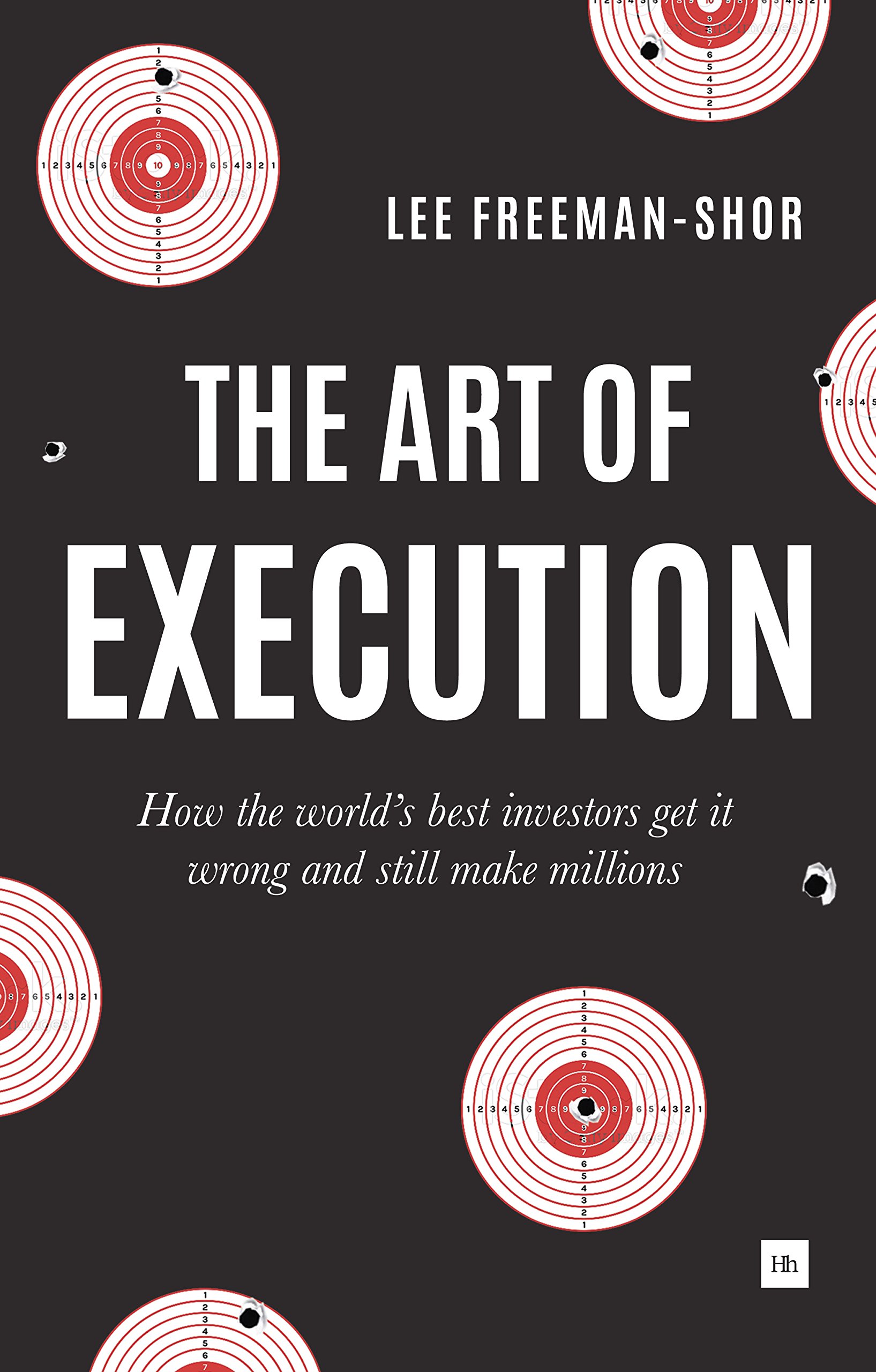
Book Review: The Art of Execution

by David Merkel

81WYYrgZEkL

Some books are better in concept than they are in execution.  Ironically, that is true of “The Art of Execution.”

The core idea of the book is that most great investors get more stocks wrong than they get right, but they make money because they let their winners run, and either cut their losses short or reinvest in their losers at much lower prices than their initial purchase price.  From that, the author gets the idea that the buy and sell disciplines of the investors are the main key to their success.

I know this is a book review, and book reviews are not supposed to be about me.  I include the next two paragraphs to explain why I think the author is wrong, at least in the eyes of most investment managers that I know.

From my practical experience as an investment manager, I can tell you that your strategy for buying and selling is a part of the investment process, but it is not the main one.  Like the author, I also have hired managers to run a billion-plus dollars of money for a series of multiple manager funds.  I did it for the pension division of mutual life insurer that no longer exists back in the 1990s.  It was an interesting time in my career, and I never got the opportunity again.  In the process, I interviewed a large number of the top long-only money managers in the US.  Idea generation was the core concept for almost all of the managers.  Many talked about their buy disciplines at length, but not as a concept separate from the hardest part of being a manager — finding the right assets to buy.

Sell disciplines received far less emphasis, and for most managers, were kind of an afterthought.  If you have good ideas, selling assets is an easy thing — if your ideas aren’t good, it’s hard.  But then you wouldn’t be getting a lot of assets to manage, so it wouldn’t matter much.

Much of the analysis of the author stems from the way he had managers run money for him — he asked them to invest on in their ten best ideas.  That’s a concentrated portfolio indeed, and makes sense if you are almost certain in your analysis of the stocks that you invest in.  As such, the book spends a lot of time on how the managers traded single ideas as separate from the management of the portfolio as a whole.  As such, a number of examples that he brought out as bad management by one set of managers sound really bad, until you realize one thing: they were all part of a broader portfolio.  As managers, they might not have made significant adjustments to a losing position because they were occupied with other more consequential positions that were doing better.  After all, losses on a stock are capped at 100%, while gains are theoretically infinite.  As a stock falls in price, if you don’t add to the position, the risk to the portfolio as a whole gets less and less.

Thus, as you read through the book, you get a collection of anecdotes to illustrate good and bad position and money management.  Any one of these might sound bright or dumb, but they don’t mean a lot if the rest of the portfolio is doing something different.

This is a short book.  The pages are small, and white space is liberally interspersed.  If this had been a regular-sized book, with white space reduced, it might have taken up 80-90 pages.  There’s not a lot here, and given the anecdotal nature of what was written, it is not much more than the author’s opinions.  (There are three pages citing an academic paper, but they exist as an afterthought in a chapter on one class of investors. It has the unsurprising result that positions that managers weight heavily do better than those with lower weights.)   As such, I don’t recommend the book, and I can’t think of a subset of people that could benefit from it, aside from managers that want to be employed by this guy, in order to butter him up.

Quibbles

The end of the book mentions liquidity as a positive factor in asset selection, but most research on the topic gives a premium return to illiquid stocks.  Also, if the manager has concentrated positions in the stocks that he owns, his positions will prove to be less liquid than less concentrated positions in stocks with similar tradable float.

Summary / Who Would Benefit from this Book


Don’t buy this book.  To reinforce this point, I am not leaving a link to the book at Amazon, which I ordinarily do.

Full disclosure: I received a copy from a PR flack.

If you enter Amazon through my site, and you buy anything, including books, I get a small commission.  This is my main source of blog revenue.  I prefer this to a “tip jar” because I want you to get something you want, rather than merely giving me a tip.  Book reviews take time, particularly with the reading, which most book reviewers don’t do in full, and I typically do. (When I don’t, I mention that I scanned the book.  Also, I never use the data that the PR flacks send out.)

Most people buying at Amazon do not enter via a referring website.  Thus Amazon builds an extra 1-3% into the prices to all buyers to compensate for the commissions given to the minority that come through referring sites.  Whether you buy at Amazon directly or enter via my site, your prices don’t change.

03 Oct 02:06

“October Effect on Stock Markets” and Other Financial Nonsense

by Dev Ashish
With arrival of October, there were bound to be some noise among investors and traders about the October Effect on stock markets. I am adding to the noise, with this data-driven post. :-) If you haven’t heard about this effect before, then here is a short primer borrowed from Investopedia: October Effect is a theory that stocks tend to decline during the month of October. It is
03 Oct 02:04

Open Thread: The Directed Society

by Atanu Dey

Long time since we had an open thread. So say what you will. Today’s quote is by Walter Lippmann (1889 – 1974), the celebrated American writer, political commentator and journalist. I am currently reading his book The Good Society (1937). A brief quote below the fold.

I have sought to examine this design of the future not only in its fascist and its communist embodiment but also in the gradual collectivism of democratic states, trying to determine whether a society can be planned and directed for the enjoyment of abundance in a state of peace … I have come finally to see that such a social order is not even theoretically conceivable … I realized at last that a directed society must be bellicose and poor. If it is not both bellicose and poor, it cannot be directed. I realized then that a prosperous and peaceable society must be free. If it is not free, it cannot be prosperous and peaceable. It took me some time after that to understand that this was no new discovery, but the basic truth which the liberals of the eighteenth century taught at the beginning of the modern era.

03 Oct 02:04

Weekend Reading Links

by noreply@blogger.com (Gulzar Natarajan)
1. Dani Rodrik makes and assessment of India's economic prospects that deserves the attention of policy makers. When asked about the world's most over-rated economy by Tyler Cowen, Dani replied,
I think India, because I think the kind of growth that India has had, I don’t think it’s sustainable. Partly going back to our earlier discussion about premature deindustrialization. I think they have these plans to significantly strengthen their manufacturing base. I just don’t see it happening. I think India can grow at 4, 5 percent per year on a sustainable basis. I don’t think it’s going to be 8 or 9 percent. When this sinks in, I think there’s going to be a negative overreaction, would be my fear.
One could quibble about whether it is 4 or 5 or even 6, but I would tend to agree that 8-9% on a sustainable basis looks more hope than realism. India just does not have the base - infrastructure, consumers, industries, public spending, agricultural productivity, credit, and skilled labor - to support such growth for too long. These deficiencies feed into the other and constrains rapid growth, beyond very short bursts. On top of all these stand the biggest deficiency of them all, weak state capability. 

2. Lant Pritchett is as provocative on learning outcomes as only he can be,
If you want to find a child who lacks education today, the place to find them is in school. That’s because nearly all children are in school. That’s the good news. Governments have built schools and hired teachers. Parents have seen that schooling is key to their child’s future and are sending their children to school... But the bad news is that hundreds of millions of children are starting school, going day after day, year after year, but not really learning. One study found that almost three-quarters of a recent cohort of youth in Zambia were innumerate and six of 10 illiterate. But only 7% of these youth had not attended school. In fact, half of those who were innumerate and a third who were illiterate had not just started school but completed grade 6. These children were being schooled but not educated.
And interesting the call for greater research on learning outcomes,
Research will be an integral part of reaching learning goals. Knowing what you need to know isn’t the same as knowing it or knowing how to do it... Progress on learning goals requires getting systems of education on a much faster pace of improvement. But too little is known about how to do that – which accounts in part for the slow progress. The British government has recognised that and is funding research to generate the practical knowledge needed to improve systems of education.
3. Fascinating map (via FT) that captures the average monthly cost of renting a one bedroom flat within a kilo meter of all London's 250-odd tube stations. See the larger version here
The FT summarizes the affordability challenge,
For the 250-odd Tube stations in London, only a quarter have one bedroom flats costing £1,000 a month or less to rent. As you might expect, these locations are all concentrated at the extremities of lines, meaning a long journey and £225 a month for a zones 1-6 Travelcard. Across the capital, the average rent for a one-bedroom flat within walking distance of a Tube station works out to £1,327. And there are 20 locations where, if you were mad enough, it would cost you above £2,000 a month (all bang in the centre).
Here are interesting sites which show which areas in London are more accessible by bicycles or public transport, another which trades-off average commute times and average rents, and this map of rents on each tube line.

4. Guardian points to the findings from the World Bank-Gallup Global Findex Survey 2014, which asked over 150,000 respondents in 143 countries how and why they access financial services. As the map shows, the North-South divide is clearest in terms of where people spend their borrowed money.
Unlike the North, where mortgage dominates borrowing, in the South the largest share of loans are consumed by education and health care. In India, 21% of people took loans to finance health care needs, 10% to finance education, 9% for business, and just 4% for mortgage.  

5. I have blogged earlier about the corrosive political economy impact of the assault on incentives. A disturbing trend may have been initiated by the Maharashtra government in imposing a "drought surcharge" on items like fuel, liquor, cigarettes, jewelry etc for a period of five months to raise Rs 16 bn in tax revenues. Cash-strapped governments are likely to adopt policy interventions like these to circumvent the constraints imposed by the forthcoming national GST.

6. Early this week, the IMF released its assessment of emerging market corporate debt. The graphic below shows the status of non-financial corporate debt to GDP ratio of the largest emerging economies. 
Developing countries quadrupled their corporate borrowings from $4 trillion in 2004 to well over $18 trillion in 2014.

7. On the back of declining corporate capex investments comes news of fall in capital expenditure by public sector units (PSUs). Underlining the weak demand conditions, the Business Standard finds that the capex by 36 largest listed PSUs, who have been sitting on a cumulative cash reserve of over Rs 2000 bn, declined by 23.5% to Rs 1290 bn in 2014-15.

An RBI survey of ex-ante capital expenditure investment decisions of Indian corporates found that in 2014-15, 830 firms intended to invest in Rs 1459 bn, as against 1056 companies' investment plans for Rs 2081 bn in 2013-14. The time phasing of the investment intentions of these companies indicate likely investments worth Rs 1933 bn in 2014-15, 27% lower than 2013-14.

8. The Institute of International Finance (IIF) estimates that net capital inflows into emerging economies may turn negative for the first time this year, with more a trillion dollars of outflows as repayments of foreign currency loans by EM corporates, especially in China. 
The IIF estimates that indebtedness at EM non-financial corporates has risen five-fold over the past decade to $23.7 trillion. This is a good illustration of the scale of potential debt induced instability,
The IIF estimates that currency depreciation has increased corporate debt in Brazil by an amount equal to 7.3 per cent of gross domestic product, and 6.2 per cent in Turkey, for example.
9. The latest figures on stalled projects in India being tracked by CMIE points to an increase in their stock from Rs 8.8 trillion to Rs 9.9 trillion over the three months to end-September 2015. Interestingly, nearly a quarter of projects are stalled due to lack of promoter interest or commercial unviability. 
The stalling rate, or stock of stalled projects as a share of all projects under implementation rose to 11% in the last quarter, up from 9%.

10. Finally, amidst all the concerns about Japan's low female workforce participation rate, MR points to this graphic which shows that Japan has overtaken US in female workforce participation.
Funny that this fact escaped the attention of everyone calling for the release of third arrow of Abenomics.
Add to Technorati Favorites
01 Oct 07:14

Monthly Moves: Flat September Hides a Volatile Index, and Will October Live Up To Its Fame?

by Deepak Shenoy

image

As you can see, the big deal now is October, which has the lowest average return, the second lowest median return and the second highest volatility (Standard Deviation) in the year. Perhaps because of results as well!

Annual Returns Now -4%

Year to Date returns are negative, and if we look at “Till September” returns for all years, we find that the trend till September typically determines the “up/down” for the full year (only 3 of the last 20 years showed otherwise).

image

And The Sensex Too

As a trader you would find it funny to hear of the Sensex as a return benchmark, but apparently many people track it and we have data for a longer period. So here goes:


image

Here’s wishing for a wild October!… (Read On...)

01 Oct 07:14

What metallurgy can tell us about India’s history?

by Amol Agrawal
Most nation histories are studied from the angle of politics and sometimes from economics as well. However, looking at shaping of history from a scientific lens is as exciting and could be more informative as well. Evolution of metals and science is critical to shaping any country/nation/state. Anil Kumar Suri has a nice piece on looking at […]
01 Oct 06:48

Latticework of Mental Models: Framing Effect

by Anshul Khare

“Is it okay to smoke a cigarette while praying to God?” a young man asked his father, a religious man.

“Of course it’s bad. It’s a great sin and very disrespectful act,” the father replied. He was disturbed with his son’s atrocious question.

“But last time you told me that to get rid of my addiction I should start praying while smoking. Didn’t you say that?” It seemed to him that his father was contradicting himself.

“No my son! Don’t confuse smoking-while-praying with praying-while-smoking,” the father explained.

“But what’s the difference?” the son was perplexed.

“There is a difference. A huge difference. I don’t know what but my brain tells me that there is.”

Now before we get started on a debate about the validity of father’s argument, let me clarify that the reason I brought up this anecdote was to highlight an important mental bias which plays out in our affairs very subtly.

In fact somebody made a TV commercial [1] on the same line of thought and I found it very amusing.

Even school kids are learning this trick to manipulate their unsuspecting elders.

SN-Post-homework

The kid knows – “It’s not what you say, it’s how you say it.” That, in short, is Framing.

The way you frame the options is very important. How a message is communicated affects the way it is received. Framing has strong implications on our behaviour. Even small and seemingly inconsequential changes in the wordings of a problem can result in large changes of preferences.

In his book, The Art of Thinking Clearly [2], Rolf Dobelli writes –

Glossing is a popular type of framing. Under its rules, a tumbling share price becomes ‘correction’. An overpaid acquisition price is branded ‘goodwill’. In every management course, a problem magically transforms into an ‘opportunity’ or a ‘challenge’. A person who is fired is ‘reassessing his career’. A fallen soldier – regardless of how much bad luck or stupidity led to his death – turns into a ‘war hero’. Genocide translates to ‘ethnic cleansing’.

Now, it may just seem an intelligent play of words. And one might be tempted to explain this human behaviour by a simple logic – different words arouse different level of emotional response. But if you stop there, you’re going to miss a very critical idea here. There is more juice than meets the eye.

It turns out that Framing is a cognitive bias and hence a very important mental model from psychology. It says people react differently to a particular choice depending on whether, and especially when, it is presented as a loss or as a gain.

We find “99% fat free” food products enticing but if the same message says “contains 1% fat”, it would trigger a different response from us. Just by rearranging the available set of options, people can be nudged to opt for a specific choice.

It’s not only a clever marketing trick to sell products but it can effectively be used by policy makers to increase compliance and even for improving our relationships. In case you want to dig deeper on this, Richard Thaler has written a book called Nudge [3], which primarily deals with the idea of designing choice architectures.

What scientists and psychologists have found is that people tend to avoid risk when a positive frame is presented but seek risks when a negative frame is presented. Gain and loss are defined in the scenario as descriptions of outcomes (e.g. lives lost or saved, disease patients treated and not treated, lives saved and lost during accidents, etc.).

Framing and Loss Aversion

Framing is an outcome of our aversion to losses. Evolution has programmed our brain to seek loss minimization instead of gain maximizing. As a result our brains, subconsciously, are always choosing the path of least pain.

Let’s assume that there is a way to quantify or measure the human emotions of pain or pleasure and let’s say the units for that measure is ‘aha’. So, ideally, loss of say Rs 100 should give you a pain of 10 ahas and gain of Rs 100 will fetch you a pleasure of 10 ahas. Right?

Not really! The fact of the matter is that the pain of losing Rs 100 is little more, something like 15 ahas.

Nobel Prize winning psychologist Daniel Kahneman, who is considered the father of behavioural economics, describes an experiment in his book Thinking, Fast and Slow [4]

We introduced our discussion of framing by an example that has become known as the “Asian disease problem”:

Imagine that the United States is preparing for the outbreak of an unusual Asian disease, which is expected to kill 600 people. Two alternative programs to combat the disease have been proposed. Assume that the exact scientific estimates of the consequences of the programs are as follows:

If program A is adopted, 200 people will be saved.
If program B is adopted, there is a one-third probability that 600 people will be saved and a two-thirds probability that no people will be saved.

A substantial majority of respondents choose program A: they prefer the certain option over the gamble.

The outcomes of the programs are framed differently in a second version:

If program X is adopted, 400 people will die.
If program Y is adopted, there is a one-third probability that nobody will die and a two-thirds probability that 600 people will die

Look closely and compare the two versions: the consequences of programs A and X are identical; so are the consequences of programs B and Y. In the second frame, however, a large majority of people choose the gamble.

So we see that the way in which an uncertain possibility is presented may have a substantial effect on how people respond to it. And many a times this has serious implications.

For example, when asked whether they would choose surgery in a hypothetical medical emergency, many more people said that they would when the chance of survival was given as 80 percent than when the chance of death was given as 20 percent.

As you can see, it’s not the trivial matter about to-eat-or-not-to-eat that 99% fat free ice cream. It’s the matter of life and death and still people, under the spell of Framing, falter in thinking rationally.

Framing in Investing

The problem of Framing surfaces in investor behaviour in numerous ways. Let’s look at some of them.

One of the common mistakes made by early investors in stock market is to sell their winning stocks and hold on to their losers. It’s called Disposition Effect which is an instance of narrow framing. Here’s an excerpt from Jana’s blog [5]

…One of the main reason for this is we like winning more than losing. Also we have a mental account for each stock that is in our portfolio and we want to close every account with a gain. We keep an internal score for each stock. Instead of looking at the overall portfolio performance we look to gain from every stock. This narrow framing is called as disposition effect and it leads to selling winners and holding losers.

So narrow framing, a flavour of framing effect, is our inability to zoom out on the situation. This creates a faulty perspective. To explain this with the help of an example. Let’s say we toss a coin and offer you the following bet –

On heads, you win Rs 60.
On tails, you lose Rs 40.

Should you accept or reject the bet? Most people would reject it.

What if you had an option to accept a series of such bets, say 100 coins tosses each with the same offer? Now it becomes an attractive proposal, because over a series of multiples tosses, the probability of head and tail is 50-50. So even if you lose money on some of the bets, your net gains are going to be much closer to the expected value of this bet i.e., Rs 10 per bet. That’s roughly the idea behind broad framing.

Kahneman writes –

The combination of loss aversion and narrow framing is a costly curse. Individual investors can avoid that curse, achieving the emotional benefits of broad framing while also saving time and agony, by reducing the frequency with which they check how well their investments are doing. Closely following daily fluctuations is a losing proposition, because the pain of the frequent small losses exceeds the pleasure of the equally frequent small gains. Once a quarter is enough, and many be more than enough for individual investors. In addition to improving the emotional quality of life, the deliberate avoidance of exposure to short-term outcomes improves the quality of both decisions and outcomes.

So now you have another reason to get rid of your portfolio tracker. :)

Breaking the Frame

So how do you overcome Framing? Peter Bevelin, author of the must read book, Seeking Wisdom [6], suggests –

The answers we get depend on the questions we ask. The British philosopher Herbert Spencer said: “How often misused words generate misleading thoughts.” Consider how a statement, problem, consequence, or question is presented. How is it worded? What is its context? Are we considering certain features and ignoring others? Emotional, selective and appealing frames influence us.

The second strategy is to invert the problem statement. That’s called principle of inversion [7]. By doing so, some of the things which usually remain hidden from your view, because of your intuitive brain, resurface and you get a fresh view.

Scientists have also discovered that using a foreign language reduces decision-making biases. Some experiments show that framing effect disappears when choices are presented in a foreign tongue. That probably happens because when you’re using your native language, your thinking is more intuitive. The moment you’re asked to reframe the problem in a different language, your brain comes out of the auto-pilot mode and it has to employ a deliberate mode of thinking. Kahneman calls it your system 2 – the rational, deliberate and slower mode of thinking.

Other remedies include looking at the problem from different vantage points [8] and also making provision for probabilistic thinking [9].

Conclusion

In his book Kahneman writes –

A remarkable aspect of your mental life is that you are rarely stumped … The normal state of your mind is that you have intuitive feelings and opinions about almost everything that comes your way. You like or dislike people long before you know much about them; you trust or distrust strangers without knowing why; you feel that an enterprise is bound to succeed without analyzing it.

This overconfidence in our intuitive abilities for making crucial decisions in work and life can do us in. The fact is you’re probably not as effective at making decisions as you could be. Nobody is.

But we can get better by learning about human behavioural quirks that can bring down the quality of our decisions.

Behavioural finance, the place where psychology meets money, is increasingly becoming a very important subject for everybody. It’s no more a thing academic interest for scientists. It’s mainstream now. The day isn’t far when awareness about human behavioural biases would become as essential as driving a car or using a computer.

If you’re reading this, I can say you’re already ahead in the game. Not the game of “who knows more” but the game where knowing few essential ideas go a long way in reducing errors and increasing the quality of life.

Take care and keep learning.

The post Latticework of Mental Models: Framing Effect appeared first on Safal Niveshak.

    
01 Oct 06:39

Right direction

by Muthu

As you are aware, we’ve always been very bullish on the future of India.

We were growing despite not having a good leadership.

We now have an able and effective leadership as well.

According to FT data service, in the first half of 2015, India has become the number one FDI (Foreign Direct Investment) destination in the world.

According to World Economic Forum, in global competitive ranking, we have moved 16 places from 71 to occupy the 55th position.

Steep fall in global commodity (including crude) prices has put us in a sweet spot.

We have a great central bank governor. He was the key in pulling us out of 2013 crisis. Though rupee has fallen to dollar during the last 2 years, it has gained across every other world currency. Not only that when other emerging market currencies faced a rout against dollar, our fall was very less.

Rajan has been focusing on’ killing the inflation forever’. From double digits two years ago, CPI inflation is expected to stabilise at 5.8% in January 2016 and at 5% in March 2017.

Interest rates have been falling and are expected to fall further in the medium term. It would not be a surprise if we become a low inflation and low interest rate economy.

FD rates are around 7.5% and may fall even to 6% in next 2 years in line with above.

Small savings interest rates also would start coming down.

Equities tend to do very well in the falling interest rate scenario. Debt oriented funds like MIPs also would do well over next 3 years.

Prime Minister wants us to focus on becoming a $20 trillion economy from the current $2 trillion. I’m confident that this would happen over next 2 decades.

Our GDP per capita is a meagre $1600. Even China’s per capita and GDP is 5 times that of ours.

We are growing from a very low base and hence would grow at a higher rate for next 2 decades to come. If one can have right temperament, be patient and stay the course; investing in Indian equities is a no brainer.

Equities would deliver phenomenal returns in the decades to come and we are moving in the right direction.

All that is needed is participation in the journey and staying the course.


01 Oct 06:38

What explains RBI's surprise rate cut?

by T T Ram Mohan
The RBI's rate cut of 50 basis points was a huge surprise to everybody. I would have thought the market reaction would be ecstatic. It hasn't quite been that although the market indices have risen. I argued for a 50 bp cut in an article in the Hindu (Hemmed in by the safety net) on September 28 but did not expect the RBI to oblige.

So, what caused the RBI governor to change his mind?

Many analysts point to the global economy, the inflation rate being within the 6% target for January 2016 and the downward revision in the growth rate for India to 7.4%. And yet, none of these was seen as influencing the RBI in the run-up to the budget. It's also hard to buy the contention that the RBI has tilted in favour of growth: the governor is sticking to the glide path for inflation and is setting his sights on bringing inflation down to 5% by 2017. That being the case, the RBI would have been more comfortable delivering a cut of just 25 bp. Why a 50 bp cut?

My guess is that the steep cut has to do with the NPA and capital position of public sector banks. The woes of the steel industry have been added to those of the infrastructure sector and there's no let up in pressure on the NPA front. There's only so much additional capital the government can provide. However, banks are holding to excess SLR securities- around 29% of liabilities against the mandated 21.5%. A rate cut boosts the value of these holdings and gives capital gains to banks. This helps them make provisions against growing NPAs. In the process, the rate cut does provide  a stimulus to the economy and especially to retail credit.

If the market response has been somewhat tepid, it could be because it's hard to conclude that this is the beginning of a round of rate cuts. Instead, as the governor mentioned, the RBI has front-loaded rate cuts, delivered these at one go. It's unlikely that there is much more to look forward to in the year ahead, especially if the Fed rate hike comes through.

We need to get growth over 8%. It would have helped if the governor had reiterated his commitment to the 6% target for January 2016 and omitted any mention of a target for 2017. That he did not do so suggests that bringing down inflation further remains the priority.


01 Oct 06:36

On Slack: Rating agencies caught napping, Tom Hayes aka “The Fixer”, Amtek default, Modi’s Bureaucracy and More….

by Gautam Jagannathan

CapM Premium Header

The Slack Discussions

The Slack group at Capital Mind Premium has been extremely active and if you haven’t been there, pop us a note by replying to this email. (If you’re a trial member this probably sound like Greek to you; it will be available when you sign up!)

A brief summary of some of the interesting things discussed there in the last few days:

#general: Will Piramal Realty Prove To Be Lucky For Warburg Pincus And Goldman Sachs?

“It is a clear case of oversupply in Thane, with no demand,” says Ahuja, who is one of the 300 registered agents among a crop of 2,000 largely unorganized ones who have mushroomed over the past five years in Thane.

http://www.outlookbusiness.com/the-big-story/lead-story/will-piramal-realty-prove-to-be-lucky-for-warburg-pincus-and-goldman-sachs-1936

Mumbai Rent

#general: Anil Ambani mystery reflects poorly on India

Here’s a mystery. How did two companies run by Reliance founder Anil Ambani manage to invest $250 million in a related company without anyone in the firm realising?… (Read On...)

01 Oct 05:08

On Slack: Saudi meltdown, Longmay 100,000, Monetary policy, CARE downgrades and more, at Capital Mind

by Gautam Jagannathan

CapM Premium Header

The Slack Discussions

The Slack group at Capital Mind Premium has been extremely active and if you haven’t been there, pop us a note by replying to this email. (If you’re a trial member this probably sound like Greek to you; it will be available when you sign up!)

A brief summary of some of the interesting things discussed there in the last few days:

#general: Iran Plans to Increase Oil Export by 500,000 Barrels per Day by December

Iran expects to increase its oil exports by 500,000 barrels a day by the end of November or early December with deliveries to Asian countries, the head of the National Iranian Oil Company said. Iranian oil imports to Asian countries, such as China and South Korea, which had expressed their interest in the Iranian oil supplies, will begin sooner than to the Western, Ali Kardor was cited by The Wall Street Journal.… (Read On...)

01 Oct 04:45

Henry David Thoreau on Success

by Shane Parrish

Henry David Thoreau On Success

In the classic Walden, Henry David Thoreau echoes Warren Buffett on having an inner scorecard and defining your own success:

If one listens to the faintest but constant suggestions of his genius, which are certainly true, he sees not to what extremes, or even insanity, it may lead him; and yet that way, as he grows more resolute and faithful, his road lies. The faintest assured objection which one healthy man feels will at length prevail over the arguments and customs of mankind. No man ever followed his genius till it misled him. Though the result were bodily weakness, yet perhaps no one can say that the consequences were to be regretted, for these were a life in conformity to higher principles. If the day and the night are such that you greet them with joy, and life emits a fragrance like flowers and sweet-scented herbs, is more elastic, more starry, more immortal — that is your success. All nature is your congratulation, and you have cause momentarily to bless yourself. The greatest gains and values are farthest from being appreciated. We easily come to doubt if they exist. We soon forget them. They are the highest reality. Perhaps the facts most astounding and most real are never communicated by man to man. The true harvest of my daily life is somewhat as intangible and indescribable as the tints of morning or evening. It is a little star-dust caught, a segment of the rainbow which I have clutched.

[…]

Our whole life is startlingly moral. There is never an instant’s truce between virtue and vice. Goodness is the only investment that never fails.

A bit later he writes, in perhaps one of the most important passages in the book,

I learned this, at least, by my experiment: that if one advances confidently in the direction of his dreams, and endeavors to live the life which he has imagined, he will meet with a success unexpected in common hours. He will put some things behind, will pass an invisible boundary; new, universal, and more liberal laws will begin to establish themselves around and within him; or the old laws be expanded, and interpreted in his favor in a more liberal sense, and he will live with the license of a higher order of beings. In proportion as he simplifies his life, the laws of the universe will appear less complex, and solitude will not be solitude, nor poverty poverty, nor weakness weakness. If you have built castles in the air, your work need not be lost; that is where they should be. Now put the foundations under them.

And finally …

Why should we be in such desperate haste to succeed and in such desperate enterprises? If a man does not keep pace with his companions, perhaps it is because he hears a different drummer. Let him step to the music which he hears, however measured or far away. It is not important that he should mature as soon as an apple tree or an oak. Shall he turn his spring into summer? If the condition of things which we were made for is not yet, what were any reality which we can substitute? We will not be shipwrecked on a vain reality.

--
Sponsored By: Greenhaven Road Capital: You think differently - now invest differently.

01 Oct 04:38

HCL Tech Loses A Client, Warns on Profits, Demonstrates Excellent Use of English

by Deepak Shenoy

HCL Tech has announced a profit warning:

image

To summarize:

  • Revenue growth will be bad
  • Due to currency issues, their USD earnings are going to be down 80bps. But who cares about USD earnings – we should care about rupee earnings, which at 66 to the USD is juicy right? Right?
  • One customer – a fairly rich one, apparently – is leaving. They are in the “process of disengagement” which is pretty cool lingo to use if you’ve been fired. (You’re being disengaged from the company. Now go.)
  • And then, there is a “skewness in revenue growth due to transition timelines for complex engagements especially in infrastructure services“. My head is spinning. Or, my cranial vortex is exhibiting centrifugal motion. (I could get a job writing press releases)
  • And that is pretty darn good English if you ask me. Not that it gets the message across but perhaps that was an intended consequence.
(Read On...)
01 Oct 04:31

Winner's curse in auctions - minerals and telecom spectrum in India

by noreply@blogger.com (Gulzar Natarajan)
It was inevitable and it now has surfaced on the horizon. Livemint points to a PwC/CII report that the power project developers who bid aggressively to secure coal blocks in recent auctions are reluctant to mine them on the face of the government's decision to cap fixed charges based on regulatory considerations. 

All the power sector coal-block auctions had gone into forward-bids, where not only would developers not pass on the cost of coal to customers, but, in some cases, even pay the government an additional premium (over and above the mandatory royalty and reserve price). It was claimed that the 66 blocks, awarded through auctions and allotments to state-owned firms, will generate revenues of Rs 3.35 trillion and electricity tariff benefits worth Rs 693 bn to consumers. Power producers, instead of bidding at a discount on the reserve price, even offered to give money to the government. Since you cannot buy something and give that free for 25-30 years, these bidders, all of whom have sunk investments in plants which are currently idle and bleeding money, were presumably betting on "smuggling" in the fuel costs elsewhere.
It was abundantly clear during the auctions that the developers had bid aggressively for fuel in the hope that they could recover the costs by transferring it into the fixed capacity charges for the untied part of the plant capacity (aside from the already existing PPA) and/or by the sale of the 15% of generation capacity as merchant power. Livemint also points to an ICRA report which estimated the under-recovery in fuel cost in the range from Rs.0.39/kwh to Rs.1.02/kwh on a levelized basis over a 25-year period and the aggregate under-recovery for the bidders at Rs.8 billion in FY2015-16 and about Rs.18 billion by FY 2017-18. 

At that time, Partha Bhattacharyya, who knows a thing or two about coal mining, had this interesting observation in an oped,
However, whether it is conducive to promoting sustainable mining depends only on the premise that the bidders be fully aware of the implications of their actions. Unfortunately, self-destructive bidding is not unknown in the Indian context. Bidding for ultra mega power projects (UMPPs) has provided examples in the not too distant past, with winners throwing up their hands after finding it impossible to deliver power at the offered price. Analyses of the root cause in all of these cases indicate an inadequate core competence in coal mining or coal sourcing as the underlying reason. In the present case of bidding among end-users, the possibility of a similar inadequacy cannot be ruled out.
Now that the government has capped the fixed capacity charges and the spot markets are down on their knees, the developers have no choice but to take unsustainable losses. In fact, even if the government had not capped the fixed charges, it is unlikely that developers would have been able to realize higher charges given the perilous state of discom finances. It is undeniable that the lack of clarity in the tender documents on the calculation of capacity charges and the failure to quell the doubts in unambiguous terms before the auctions encouraged the aggressive bids.

Much the same story is repeating in telecommunications, with call drops being the commonest manifestation. Irrespective of whether the spectrum available is adequate or not, it cannot be denied that telecom operators, who bid very aggressively in the 3G auctions, have, for some time now, been skimping on capacity improvement investments. As Shyam Ponappa describes, there are other failures arising from the quest for revenues maximization,  India's telecoms spectrum market,
India brought in more operators than other markets, didn't provide as much commercial spectrum, fragmented what it had, and priced it out of sight. Consequently, substantial spectrum is idle with the government, while large operators with very little spectrum and the legacy of underdeveloped fixed networks have over 100 million customers each, with high voice and growing data usage. This situation is likely to worsen as more spectrum holdings come up for renewal.
The widely acclaimed telecoms spectrum auctions realized revenues worth nearly $17 bn. Unlike with coal, spectrum already under use by incumbents was re-allocated through auctions. This left existing operators, who have massive fixed investments, with little choice but to bid aggressively to retain their spectrum. The net result is that India has become one of the costliest telecoms spectrum markets.
The exorbitant cost of spectrum adds to other headwinds that telecoms operators have to navigate. Though one of the fastest growing telecoms market in the world by customer-base, operator margins are squeezed by the lowest average revenue per user (ARPU) of about $3, less than a tenth elsewhere. This is exacerbated by cut-throat competition, with nearly ten operators in each circle. And now, the high cost of spectrum has sharply increased the debt burden of  operators, leaving them with little room to raise resources to invest on network expansion, maintenance, and upgradation.

This leaves operators with no option but to raise tariffs significantly, which will certainly constrain demand, and thereby work against the government's ambitious Digital India objectives. In a highly price-sensitive market where just one in hundred have access to high-speed broadband, and where the baseline penetration of data-services is very small, affordable prices are critical to expanding both customer base and services. 

The aggressive bids made both in the reverse auction (for coal blocks designated for power plants) and forward auction (for non-use specified blocks), and telecoms spectrum, and the attendant squeezing of possible margins, raises more questions about the unqualified acceptance of auctions in the allocations of natural resources.

There is a compelling argument that in the spectrum and mineral allocation auctions, government's immediate fiscal considerations have crowded-out larger sectoral objectives. In other words, the details of the auction design may have been skewed towards maximizing auction revenues than sustainable introduction of new technologies into the telecoms market or delivery of power at a reasonable price and rate of return. 

Interestingly, this skew may reflect the institutional power balance within the Ministries of Government of India, in particular the balance between the Ministry of Finance (MoF) and the respective line Ministries, Power and Telecommunications in this case. The MoF has a very hands-on approach in any such contract formulation, applying due diligence that invariably revolves around the binary "public interest" touchstones of expenditure control and/or revenues maximization. The recommendations of the respective regulatory commissions tend to get sidelined in the face of "public interest". The recent history of scandals and the chaotic investigations and prosecutions that followed, may have only amplified this trend. Not only have the advocates of "public interest" become stronger, the voices of the primary stakeholders, the respective Ministries, have become more wary of being seen to be doing anything which would appear to support the private market participants.  

To the extent that the operator or developer's cost is directly translated as the government's revenues, the MoF's role is clearly that of an agent of the government. Therefore, if the MoF prevails in setting the terms of contracting in such auctions and the departments abdicate their responsibilities as neutral arbiters in the auction, it necessarily becomes an one-sided contract. Winner's curse and renegotiations invariably follow.   

One of the oldest axioms of life is that there is no free lunch. The examples of natural resource auctions and public private partnerships (PPPs), which governments have come to view as as a resource mobilization opportunity and the latter as a means to avoid committing large resources for infrastructure investments, and their respective failings, are forceful reiteration of this axiom.
Add to Technorati Favorites
01 Oct 03:39

High Risk Advisory Practice

by subra
Why is the Advisory practice far more risky today? Simply because of the media noise. Also there are too many players with poor knowledge but far better marketing skills. This means that if there is an adviser who removes the sheen from the advice there is likely to be no respect for the person. Let […]
30 Sep 03:15

Does SIP work always?

by subra
What an amazing question. Give me enough data and time, I can torture the data enough to tell you how you can lose money in SIP as well as how SIP can make you a millionaire, OTHER CONDITIONS REMAINING SAME. If you had sold at every peak (weekly) and bought at every bottom (obviously weekly) […]