Shared posts

30 Sep 03:34

What We Did Not Expect, Happened: 50 Basis Point Rate Cut!

by Deepak Shenoy

RBI has cut rates by 50 basis points – which is 0.50%. That means everything is cheaper! Even in stock markets! (Nifty is currently lower. But it’s seriously crazy so who knows where it will be by the time I finish writing)

So the history is like this, and from today, the repo rate will be 6.75%

image

Repo is the rate at which banks borrow for their requirements from RBI overnight. In recent times, banks have only parked excess cash with the RBI, so this rate may make no difference. Even today, after the rate cut, when there was a repo auction for 15,000 cr. the banks only took 8,000 cr. of it:

image This rate cut won’t make a difference immediately but it will require them to cut rates.

Outlook: Not good for world, and we have to stoke demand for India

The summary of the statement is:

Since our last review, the bulk of our conditions for further accommodation have been met.

(Read On...)
30 Sep 03:34

Different kinds of democracies..

by Amol Agrawal
Dani Rodrik and Sharun Mukand have this insightful piece on political economy of democracies: There are more democracies in the world today than non-democracies, according to data from Polity IV.1 Yet, few of those are what we would call liberaldemocracies – regimes that go beyond electoral competition and protect the rights of minorities, the rule of law, […]
30 Sep 03:32

11 Misconceptions about Meditation

by Shane Parrish

Misconceptions about Meditation
Meditation isn’t easy. It takes time and energy. Some people wonder why they should bother with meditation at all.

Here is an inversion of meditation. This is what Meditation isn’t.

There are a number of common misconceptions about meditation. The same things come up over and over.

In Mindfulness in Plain English, Henepola Gunaratana deals with 11 of these preconceptions one at a time.

Misconception 1: Meditation is Just a Relaxation Technique

The bugaboo here is the word just. Relaxation is a key component of meditation, but vipassana-style meditation aims at a much loftier goal. The statement is essentially true for many other systems of meditation. All meditation procedures stress concentration of the mind, bringing the mind to rest on one item or one area of thought. Do it strongly and thoroughly enough, and you achieve a deep and blissful relaxation, called jhana. It is a state of such supreme tranquillity that it amounts to rapture, a form of pleasure that lies above and beyond anything that can be experienced in the normal state of consciousness. Most systems stop right there. Jhana is the goal, and when you attain that, you simply repeat the experience for the rest of your life. Not so with vipassana meditation. Vipassana seeks another goal: awareness. Concentration and relaxation are considered necessary concomitants to awareness. They are required precursors, handy tools, and beneficial byproducts. But they are not the goal. The goal is insight. Vipassana meditation is a profound religious practice aimed at nothing less than the purification and transformation of your everyday life.

Misconception 2: Meditation is Going Into a Trance

Here again the statement could be applied accurately to certain systems of meditation, but not to vipassana. Insight meditation is not a form of hypnosis. You are not trying to black out your mind so as to become unconscious, or trying to turn yourself into an emotionless vegetable. If anything, the reverse is true: you will become more and more attuned to your own emotional changes. You will learn to know yourself with ever greater clarity and precision. In learning this technique, certain states do occur that may appear trancelike to the observer. But they are really quite the opposite. In hypnotic trance, the subject is susceptible to control by another party, whereas in deep concentration, the meditator remains very much under his or her own control. The similarity is superficial, and in any case, the occurrence of these phenomena is not the point of vipassana. As we have said, the deep concentration of jhana is simply a tool or stepping stone on the route to heightened awareness. Vipassana, by definition, is the cultivation of mindfulness or awareness. If you find that you are becoming unconscious in meditation, then you aren’t meditating, according to the definition of that word as used in the vipassana system.

Misconception 3: Meditation is a Mysterious Practice That Cannot be Understood

Here again, this is almost true, but not quite. Meditation deals with levels of consciousness that lie deeper than conceptual thought. Therefore, some of the experiences of meditation just won’t fit into words. That does not mean, however, that meditation cannot be understood. There are deeper ways to understand things than by the use of words. You understand how to walk. You probably can’t describe the exact order in which your nerve fibers and your muscles contract during that process. But you know how to do it. Meditation needs to be understood that same way— by doing it. It is not something that you can learn in abstract terms, or something to be talked about. It is something to be experienced. Meditation is not a mindless formula that gives automatic and predictable results; you can never really predict exactly what will come up during any particular session. It is an investigation and an experiment, an adventure every time. In fact, this is so true that when you do reach a feeling of predictability and sameness in your practice, you can read that as an indication that you have gotten off track and are headed for stagnation. Learning to look at each second as if it were the first and only second in the universe is essential in vipassana meditation.

Misconception 4: The Purpose of Meditation is to Become Psychic

No. The purpose of meditation is to develop awareness. Learning to read minds is not the point. Levitation is not the goal. The goal is liberation. There is a link between psychic phenomena and meditation, but the relationship is complex. During early stages of the meditator’s career, such phenomena may or may not arise. Some people may experience some intuitive understanding or memories from past lives; others do not. In any case, these phenomena are not regarded as well-developed and reliable psychic abilities, and they should not be given undue importance. Such phenomena are in fact fairly dangerous to new meditators in that they are quite seductive. They can be an ego trap, luring you right off the track. Your best approach is not to place any emphasis on these phenomena. If they come up, that’s fine. If they don’t, that’s fine, too. There is a point in the meditator’s career where he or she may practice special exercises to develop psychic powers. But this occurs far down the line. Only after the meditator has reached a very deep stage of jhana will he or she be advanced enough to work with such powers without the danger of their running out of control or taking over his or her life. The meditator will then develop them strictly for the purpose of service to others. In most cases, this state of affairs occurs only after decades of practice. Don’t worry about it. Just concentrate on developing more and more awareness. If voices and visions pop up, just notice them and let them go. Don’t get involved.

Misconception 5: Meditation is Dangerous and a Prudent Person Should Avoid it

Everything is dangerous. Walk across the street and you may get hit by a bus. Take a shower and you could break your neck. Meditate, and you will probably dredge up various nasty matters from your past. The suppressed material that has been buried for quite some time can be scary. But exploring it is also highly profitable. No activity is entirely without risk, but that does not mean that we should wrap ourselves in a protective cocoon. That is not living, but is premature death. The way to deal with danger is to know approximately how much of it there is, where it is likely to be found, and how to deal with it when it arises. That is the purpose of this manual. Vipassana is development of awareness. That in itself is not dangerous; on the contrary, increased awareness is a safeguard against danger.

Misconception 6: Meditation is for Saints and Sadhus

It is true, of course, that most holy men meditate, but they don’t meditate because they are holy men. That is backward. They are holy men because they meditate; meditation is how they got there. And they started meditating before they became holy, otherwise they would not be holy. This is an important point. A sizable number of students seems to feel that a person should be completely moral before beginning to meditate. It is an unworkable strategy. Morality requires a certain degree of mental control as a prerequisite. You can’t follow any set of moral precepts without at least a little self-control, and if your mind is perpetually spinning like a fruit cylinder in a slot machine, self-control is highly unlikely.

There are three integral factors in Buddhist meditation— morality, concentration, and wisdom. These three factors grow together as your practice deepens. Each one influences the other, so you cultivate the three of them at once, not separately. When you have the wisdom to truly understand a situation, compassion toward all parties involved is automatic, and compassion means that you automatically restrain yourself from any thought, word, or deed that might harm yourself or others; thus, your behavior is automatically moral.

Misconception 7: Meditation is Running Away from Reality

Incorrect. Meditation is running straight into reality. It does not insulate you from the pain of life but rather allows you to delve so deeply into life and all its aspects that you pierce the pain barrier and go beyond suffering.

Misconception 8: Meditation is a Great way to get High

Well, yes and no. Meditation does produce lovely blissful feelings sometimes. But they are not the purpose, and they don’t always occur. Furthermore, if you do meditation with that purpose in mind, they are less likely to occur than if you just meditate for the actual purpose of meditation, which is increased awareness. Bliss results from relaxation, and relaxation results from release of tension. Seeking bliss from meditation introduces tension into the process, which blows the whole chain of events. It is a Catch-22: you can only experience bliss if you don’t chase after it. Euphoria is not the purpose of meditation. It will often arise, but should be regarded as a byproduct.

Misconception 9: Meditation is Selfish

It certainly looks that way. There sits the meditator parked on a little cushion. Is she out donating blood? No. Is she busy working with disaster victims? No. But let us examine her motivation. Why is she doing this? The meditator’s intention is to purge her own mind of anger, prejudice, and ill will, and she is actively engaged in the process of getting rid of greed, tension, and insensitivity. Those are the very items that obstruct her compassion for others. Until they are gone, any good works that she does are likely to be just an extension of her own ego, and of no real help in the long run. Harm in the name of help is one of the oldest games.

Misconception 10: When you Meditate, you Sit Around Thinking Lofty Thoughts

Of course, lofty thoughts may arise during your practice. They are certainly not to be avoided. Neither are they to be sought. They are just pleasant side effects. Vipassana is a simple practice. It consists of experiencing your own life events directly, without preferences and without mental images pasted onto them. Vipassana is seeing your life unfold from moment to moment without biases. What comes up, comes up. It is very simple.

Misconception 11: A Couple of Weeks of Meditation and All My Problems will go Away

Sorry, meditation is not a quick cure-all. You will start seeing changes right away, but really profound effects are years down the line. That is just the way the universe is constructed. Nothing worthwhile is achieved overnight. Meditation is tough in some respects, requiring a long discipline and a sometimes painful process of practice. At each sitting you gain some results, but they are often very subtle. They occur deep within the mind, and only manifest much later. And if you are sitting there constantly looking for huge, instantaneous changes, you will miss the subtle shifts altogether. You will get discouraged, give up, and swear that no such changes could ever occur. Patience is the key. Patience. If you learn nothing else from meditation, you will learn patience. Patience is essential for any profound change.

Mindfulness in Plain English is worth reading.

--
Sponsored By: Greenhaven Road Capital: You think differently - now invest differently.

30 Sep 03:28

2 Common Traps to Avoid When Choosing a Career

by Ramit Sethi

You want a career you love, right?


One that’s interesting, challenging, financially rewarding, and that makes all of your friends say, “Damn, how did you land that job?”

Everyone wants that kind of a career, but most people settle for a string of jobs.

Why does this happen?

Today I want to introduce you to two common but rarely discussed “traps” that kill most career hopes so you can get past them and choose a career that’s right for you.

Trap #1 – Following your passion

Commencement speakers, career “experts,” and parents throw around “follow your passion” advice all the time. It’s no wonder people believe that if you’re not following your passion, you’re somehow getting it wrong.

But what are you supposed to do if you don’t know what your passion is?

Are you supposed to just sit around and think your way into it? Take some career quiz that’ll spit out a list of jobs you should be passionate about?

Kill me now.

I get so mad when I read most of the career advice out there because it’s unspecific at best, and blatantly wrong at worst. (Don’t believe me, check out the worst career advice ever.)

All of us want to find work we love to do, and then get paid for it, but our passion isn’t just going to fall from the sky – we have to pursue it.

In this video, I explain my take on passion. Pay close attention to 2:22 where I explain where most people go wrong when thinking about passion and how you can take a different approach.


You’ll be much better off if you spend time getting good at something. Once that happens, it’s likely the passion will follow.

Okay, now that you’ve let go of the need to figure out what your passion is, it’s time to take a look at some of the thoughts that might be getting in your way.

Trap #2 – Thinking you need specific credentials to have a career you love

Over the past 11 years I’ve taught hundreds of thousands of people how to save money, earn money, and automate their finances. And I’m not a Certified Financial Planner or CPA.

I’ve also helped thousands of people who lack the “right” credentials and experience find their Dream Job, and I’ve never taken a career counseling or career coaching class in my life.

Yes, sometimes credentials do matter. If you want to be a cardiothoracic surgeon, then you better get some initials next to your name, but there are plenty of people who’ve reached the top of their field without racking up a list of traditional credentials and experiences.

So, what separates those who move forward despite their supposed lack of credentials and those who just cross their fingers and hope the perfect career lands in their lap?

Mindset.

When it comes to going after something that feels a little bit out of reach, our invisible scripts hold us back.

Take choosing a career. You’ll often hear people give up before they even start with lines like:

  • “I didn’t go to an Ivy League school so I’ll never get an interview at the company I want to work for.”
  • “I work really hard so I should be given more opportunities. It shouldn’t be so hard to get noticed.”
  • “I don’t know the right people.”
  • “I don’t have the right credentials so I’ll never get a job in my field of choice.”

Sound familiar?

Invisible scripts keep you stuck and prevent you from having a career you love. That’s why the smartest people relentlessly identify and dismantle their invisible scripts. Others let their scripts control them.

Here’s one easy way to start liberating yourself from your scripts: Pretend you’re already perfect.

Pretend you already have the “right” credentials and the “right” experiences for the career path you’d like to pursue.

If this were the case, how would you approach your job search differently?

  • “I’d ask for a meeting with a top performer.”
  • “I’d network more aggressively.”
  • “I’d apply for the job I really want and tell them exactly how I’d change the company in that role.”

No, you may not be perfect, but that doesn’t mean you can’t do all of the things mentioned above. It’s funny how clear people get on the best steps to take when they get rid of the barriers and just pretend they’re already perfect.

When you act as if you’re already perfect, you stop focusing on what you think you’re missing and start moving toward the career you want.

Choosing a career you’ll love

Now that you’ve avoided the 2 key traps that kill most careers, it’s time to actually choose your career — and I have a special bonus for you today that’ll make it really easy for you.

Sign up below and get instant access to my 46-minute video, The 80/20 Guide to Finding Your Dream Job. I go in depth on how to find your dream job and share detailed strategies, mindsets, and stories about how to short-circuit the process that so many people waste time on.

Choose a career you will love. Sign up below to get instant access to my exclusive video, The 80/20 Guide to Finding Your Dream Job


Name:
Email:
100% privacy. No games, no B.S., no spam.

2 Common Traps to Avoid When Choosing a Career is a post from: I Will Teach You To Be Rich.

30 Sep 03:19

Fed’s ZIRP policy and Banks’ Net Interest Margins

by Amol Agrawal
Why is it that banks want Fed to increase rates? Some say, that higher rates will lead to higher net interest margin for the banks. But Noah Smith says there is hardly any linkage between the two. First of all, if we simply look at the history of interest rates and net interest margins, we don’t see […]
29 Sep 03:47

On Slack: ETF Rush, 7,269-cr penalty, Motherson Sumi, Economic Revival, Yellen speaks and more, at Capital Mind

by Gautam Jagannathan

CapM Premium Header

The Slack Discussions

The Slack group at Capital Mind Premium has been extremely active and if you haven’t been there, pop us a note by replying to this email. (If you’re a trial member this probably sound like Greek to you; it will be available when you sign up!)

A brief summary of some of the interesting things discussed there in the last few days:

#general: Will Piramal Realty Prove To Be Lucky For Warburg Pincus And Goldman Sachs?

It is a clear case of oversupply in Thane, with no demand,” says Ahuja, who is one of the 300 registered agents among a crop of 2,000 largely unorganised ones who have mushroomed over the past five years in Thane.

http://www.outlookbusiness.com/the-big-story/lead-story/will-piramal-realty-prove-to-be-lucky-for-warburg-pincus-and-goldman-sachs-1936

#general: Goldman Sachs joins the ETF rush

Trenches are being dug in the next big battleground for the investment industry, as Goldman Sachs’s asset management arm launches its first exchange traded fund to snag some of the billions of dollars pouring into the next generation of passive investment products.… (Read On...)

29 Sep 03:47

India Cements To Hive Off Chennai Super Kings on Oct 9, Sounds Like A Lottery Ticket?

by Deepak Shenoy

India Cements will give shares of Chennai Super Kings Ltd. (The company that owns the IPL team) to all its shareholders, for free. The record date is October 9, 2015.

So you get a chance to own the Chennai Super Kings if you buy India Cement Shares now or before October 7, and hold them through the record date. You get one share of the Chennai Super Kings owning company if you own a share of India Cement.

image

Apparently, there is no major value being ascribed to India Cements:

  • Stock Price: Rs. 76.9
  • Futures Contract Price (October): Rs. 77.0

Typically, in such arrangements people would believe that the stock price of India Cements will fall (to account for the value in the CSK team) on the record date. The October Futures contract, which expires 29 Oct (much after the record date) should be trading at a lower price to reflect this fall.… (Read On...)

29 Sep 03:45

Large sites and universally accessible blocks

by SK

Currently reading this paper by Brelsford, Martin, Hand and Bettencourt of the Santa Fe Institute (did I tell you I just got my first MOOC certificate from this institute last week?) on the topology of cities. I have only a rudimentary understanding of topology (thanks to an excellent session with Dr. V Vinay), but considering that I know Graph Theory fairly well, I’ve been able to follow the paper so far.

The paper talks about “universally accessible blocks” in cities, which is basically about blocks where each unit can be accessed directly by road without going through other units. Developed cities, the paper argues, has mostly universally accessible blocks, while non-universally accessible blocks are artefacts of non-developed countries and old cities.

The problem with non-univerally accessible blocks is that the “inner units” in such blocks (which are not directly accessible by road) are mostly deprived of public and emergency services and this affects the  quality of life in such blocks. The paper, for example, talks about mostly slums having such architecture, and that newly developed cities usually try to have universally accessible blocks.

When Bangalore was developed in a planned fashion starting in the 1950s (led by the “City Improvement Trust Board” which later morphed into the “Bangalore Development Authority”), a number of new areas were designed for large houses. Large sites were allotted, and regulations framed such that buildings on such sites be sparse (they were called “bungalow sites”). The part of Bangalore I live in, Jayanagar, for example, has a large concentration of such bungalow sites.

While in theory such sites make sense, the fact is that not too many people were enthused about sparse buildings on such sites. So they took advantage of loopholes in regulation (even best designed policies have loopholes) to build multiple buildings on the site. Later on, these sites got partitioned into smaller sites, with at least one building on each smaller site. As a result of partitioning, a large number of units thus created were not “accessible”.

Allotting big sites and getting people to build big houses on them in order to “lead development” into a new area might have been a great idea in theory, but the fact that most people could not afford to build such big houses and loopholes in regulation resulted in non-accessible units! Of course it results in lower infrastructure costs (since the road network is sparser than is necessary), but it comes at a price since not everyone has equal access to infrastructure.

As a wise man once said, #thatzwhy we need strong regulation.

29 Sep 03:45

Media and Investing

by subra
At the outset let me make it clear. I am as much a part of the media as much as Cnbc or ET Now. I have appeared in many channels. I write for the print media and for the electronic media. Mostly for free, some times I am paid. Normally if I am paid I […]
29 Sep 03:43

Is India a hospitable environment for India-related finance

by Ajay Shah
by Anjali Sharma, Kanwalpreet Singh, Rajat Tayal, Rohini Grover, Susan Thomas.

Competition in finance


There is an assumption in India that financial services and products connected with India can only exist through the aegis of financial firms and markets in India. As a consequence, there tends to be little discussion on international competition for India-related finance.

There are, indeed, elements of finance which are not amenable to international competition. For example, setting up bank branches in Nagpur is something which can only take place in Nagpur. However, for a growing class of situations, Indian customers of finance, or non-resident customers of India-related finance, now have choices:

  • Indian firms can choose between raising equity or debt capital within India or abroad.
  • Non-residents have a choice of buying the equity of Indian companies by coming to Indian exchanges (NSE or BSE), or by sending orders go to overseas venues (e.g. London Stock Exchange or the New York Stock Exchange) when Indian companies list abroad.
  • Derivatives settled in cash can trade anywhere. Outside India, exchanges and the OTC market  trade derivatives on the rupee, on Nifty, on Indian interest rates, on India-related credit risk, etc. This gives non-residents a choice about whether orders go to India or to overseas rivals.

These developments have taken place over the last decade, changing the dynamics of what is possible for domestic and foreign investors. This has brought international competition to confront Indian financial institutions and systems.

This competition is good for the Indian economy. When an Indian firm is able to access debt overseas, it overcomes the limitations of the Indian credit market. This is good for India. Similarly, when an Indian firm is able to obtain equity capital overseas, overcoming the problems of the Indian primary market for equity, access to capital for India goes up. This is good for India.

When non-resident investors take exposure in Indian assets, they face financial risks such as the rupee risk, Nifty and single stock price risk. To the extent that they are able to reduce risk, this is good for India. For example, a non-resident investor who has given a dollar-denominated loan to an Indian firm, or a foreign firm who has FDI in India, should be able to reduce their risk by trading in derivatives. These include sovereign Indian credit default swaps (CDS), single stock CDS, rupee derivatives, Nifty derivatives, Indian interest rate derivatives, etc. Whether these are available in domestic markets or in competing markets off-shore, the presence of these markets encourages higher foreign participation in Indian assets.

Hence, the emergence of greater competition against Indian financial producers, which gives reduced prices and higher quality, is good for India.

Expected and actual outcomes


India has a natural edge in global competition for India-related finance. As an example, consider trading in Nifty derivatives. The information is formed in India. The most liquid market is in India, created by the trading of hundreds of thousands of thinkers, and decision makers in India. Once India is the most liquid market, this would suck in all order flow, which would help further increase the liquidity. The most reasonable outcome is one where India owns one hundred percent of the market share. However, the outcome that has come about over the last decade is starkly different.

Precise estimates of turnover are difficult to obtain. But most estimates suggest that it is reasonable to think that roughly half of the global trading in the rupee and in Nifty is now taking place outside India. In 2008, the share of the overseas market was roughly 0%. Since then, this share has gone up to roughly 50%. There is a possibility that the share of the overseas market could further increase in the days to come.

Implications: Loss of revenues in India


An order that comes to the Indian financial system induces export of financial services. A basket of revenues comes with the basic order. This includes securities broking, legal services, research, accounting and travel. All these revenues are lost when the order goes to an off-shore market such as Dubai or Singapore.

We believe that a conservative estimate of the total services revenues associated with each order is approximately 0.25%. As there is a buyer and a seller for each unit of turnover, this implies a total revenue stream associated with turnover of 0.5%. Given the extent of international competition that Indian finance faces, what is the size of the revenue at stake?

If turnover is \$1 billion per day, or \$250 billion per year, this would imply a revenue stream of \$1.25 billion per year. This is Rs.83.75 billion per year. In other words, each \$1 billion per day of overseas activity is a loss of financial services exports revenue for India of Rs.83.75 billion per year.

But how much turnover is taking place outside India? This is hard to estimate and there is no unambiguous answer. We believe the answer lies between \$10 billion to \$50 billion per day. If all this business came to India, it would yield additional financial services export revenues of between Rs.83.75 billion per year to Rs.4.18 trillion per year.

Implications: Loss of domestic market liquidity


If an order flow of between \$10 billion/day and \$50 billion/day were added to domestic financial markets, this would yield a quantum leap in market liquidity and market efficiency. The reduced capabilities of domestic financial markets is the second consequence of the loss of market share. This may have an adverse impact for India that is even greater than the headline grabbing figure for the loss of export revenues.

Tackling the problem of the loss of market share


In June 2013, in recognition of the importance of the problem as one requiring research analysis and policy responses, the Ministry of Finance setup a `Standing Council of International Competitiveness of the Indian Financial Sector'. The Standing Council is chaired by the Secretary of the Department of Economic Affairs. IGIDR FRG has been the technical team for the Standing Council.

On 7 September 2015, the Standing Council released Volume 1 of its Report. There is likely to be a Volume 2 that follows shortly after. The Standing Council is likely to establish a rhythm of work where it is continuously watching the space of international competitiveness of the Indian financial system, and making recommendations with remedial actions to the Ministry of Finance.

The Standing Council has diagnosed four classes of problems which have generated this loss of market share of the onshore market.

  1. Problems in domestic financial regulation. In many situations, there are flaws in domestic financial regulation which are harming the onshore financial system.

  2. Taxation. The global financial system sends orders to financial centres which have `residence-based taxation', where non-residents are not part of the tax base as seen by the local authorities. Apart from the Mauritius treaty, this is not how India works.

  3. Capital controls. The global financial system sends orders to financial centres where the frictions are minimal. India's capital controls actively introduce friction which deters financial services exports.

  4. Unpredictability of policy changes. In a mature market economy, there is a consistent economic policy philosophy shaping policy pathways. In a mature market economy, rule of law procedures are used when changing laws or regulations. These two features create predictability about changes in policy. India suffers from flaws in both respects. As a consequence, market participants are frequently suprised by unexpected changes in policy. This enhanced political/regulatory risk deters investments in building organisational capital. It is safer for a global financial firm to build an INR derivatives business in a place like Singapore or London, rather than committing resources to build that same organisational capital in Bombay.

Looking forward


The ongoing process adopted by the Standing Council is to render policy advice to the Ministry of Finance, through which these four classes of problems can be addressed. This line of thinking constitutes one more impulse to undertake deeper reform of Indian finance.
29 Sep 03:40

How to overcome the paradox of choice

by Ramit Sethi

Options are good, right?

homemadejams


Not necessarily.

Think about the last time you were in a grocery store. What kind of soap did you buy? What brand of cereal? Likely, it was one you’d had before — even if you aren’t completely satisfied with it.

Why is that? The reason is that there are just too many options for you to evaluate each one. So, your brain goes to the default.

You are not alone.

Consider this experiment:

“Shoppers at an upscale food market saw a display table with 24 varieties of gourmet jam. Those who sampled the spreads received a coupon for $1 off any jam. On another day, shoppers saw a similar table, except that only six varieties of the jam were on display. The large display attracted more interest than the small one. But when the time came to purchase, people who saw the large display were one-tenth as likely to buy as people who saw the small display.”

How can you compare 24 different types of jam? You can’t. That’s why the overwhelmed shoppers choose nothing. This is the Paradox of Choice in action.

Of course, this isn’t just about jam or groceries. The paradox of choice affects many areas of our life. BIG areas like our finances, our career, and even our productivity.

What happens when we have too many choices

The truth is, we have limited cognition and willpower and when we waste it processing minor decisions such as what type of jelly or soap to buy, this is what happens:
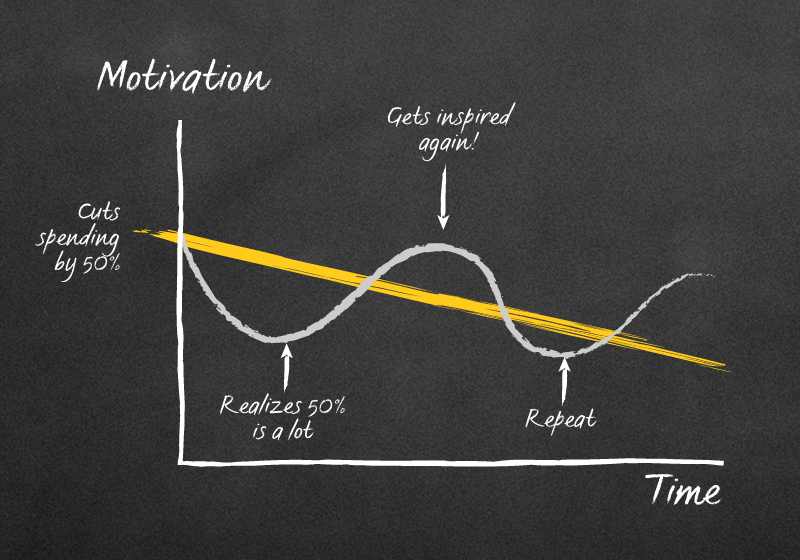
motivationgraph


Even when we’re motivated to do big things — save money, find a new job, or finally finish that looming project — we don’t get it done.

But we’re not doomed to this pattern forever. By understanding how our brain works, we can take steps to reduce or even eliminate the effect of the paradox of choice when it really matters.

What to do about the paradox of choice

If you want to live a Rich Life, focus on the four or five big wins. Get a dream job. Negotiate your salary. Invest automatically so you don’t have to think about it. It’s not a decision.

This type of focus short-circuits the paradox of choice. If you do these four or five things, it doesn’t matter how many lattes you buy. It doesn’t matter if you buy a small Coke or a large Coke. You don’t have to worry about the never-ending stream of little questions because those micro decisions are irrelevant in the grand scheme of things.

In other words, you don’t have to worry about which type of spaghetti sauce is the most affordable per ounce because you’re earning enough not to care. Grab the one that looks most interesting and move on with your day.

Today, I want to show you how focusing on just three Big Wins can help you reduce the paradox of choice in your life.

Big Win  #1: Eliminate the paradox of choice in your finances

Think about the 50+ money decisions you have to make today: Should you save more? What should you cut down on? What about investing — real estate or stocks or index funds? Pay off debt? Did you send in that Comcast bill on time? Is it time to rebalance your portfolio?

Faced with an overwhelming number of choices, most people respond in the same way: They do nothing.

As I said in my NYT best-selling book, I Will Teach You To Be Rich:

The idea that — gasp! — there is too much information is a real and valid concern. “But Ramit,” you might say, “that flies in the face of all American culture! We need more information so we can make better decisions! People on TV say this all the time, so it must be true! Huzzah!” Sorry, nope. Look at the actual data and you’ll see that an abundance of information can lead to decision paralysis, a fancy way of saying that with too much information, we do nothing. Barry Schwartz writes about this in The Paradox of Choice: Why More is Less:

…As the number of mutual funds in a 401(k) plan offered to employees goes up, the likelihood that they will choose a fund — any fund — goes down. For every 10 funds added to the array of options, the rate of participation drops 2 percent. And for those who do invest, added fund options increase the chances that employees will invest in ultraconservative money-market funds.

For the exact step-by-step system to stop wasting mental energy on your money, I created the free Ultimate Guide to Personal Finance (including entire chapters from my NYT best-selling book).

No overwhelming choices here. Just the few tactics I’ve discovered and perfected for automating and optimizing your money. You can manage your money in less than an hour a month and start spending on things you love, guilt-free.

ugpersonalfinance


Big Win #2: Eliminate the paradox of choice in your career

The paradox of choice is a very real problem when looking for a job — and it starts early. Remember high school? What do I want to do? What electives should I take? What college should I go to?

At 15 (or younger) we’re told we’re deciding our fate for the rest of our lives. The trouble is our choices are nearly endless.

The decisions don’t stop there — What should I major in? What about a minor? Should I get my master’s or get a job? If I go back to school, how will I make money? Can I start my own business? What if I have multiple passions?

Our parents don’t get this. They’re like, “Go get a good job! They have really good benefits!” I once went home during college and a family friend was visiting. He worked at a very large consumer-packaged goods company and believed I was a lost soul who needed advice. Imagine my face when he gave me this advice:

“Ramit, you should join this company. You work here 30 years, you’ll have a MILLION DOLLARS when you retire!”

I looked at him in disbelief. A million? That’s it? 30 years from now?

See, we don’t WANT to work at the same company for 30 years. But at the same time, we’re stuck choosing among 2, 3, sometimes 10 different ideas. What if we choose the wrong one and close all the other doors?

In the video below, I explain how to get a handle on what you really want to do and narrow down your choices in a systematic way:


Big Win #3: Eliminate the paradox of choice and get more done

When we don’t focus on the Big Wins, our brain is constantly using our precious energy on all the little things we have to worry about — the dirty laundry, what to eat for dinner, when to call mom.

Even when we’re not aware, our brain is working on solving these minute problems — leaving less mental capacity for working on the big stuff. Which means we’re constantly making a choice like should I worry about the laundry or worry about my career. The result? Again, we do nothing.

When you look at masters of their craft, you’ll notice that they’ve always built routines for the ordinary parts of life, so they can focus on what they’re best at.

For example, Steve Jobs wore turtlenecks every day so he didn’t have to worry about clothes. And professional athletes stock their fridges with vegetables and lean protein so they don’t have to decide between cake and celery.

You can build microsystems in your daily life that eliminate the paradox of choice so we can focus on what really matters.

Watch this video to learn how to eliminate the effect of the paradox of choice so you can finally tackle your to-do list.


Bonus Win: How to eliminate worry with the Worry Vault technique

New sources of stress will always pop up in our day-to-day lives.

A few years ago, I stumbled across a simple technique for eliminating these little stressors and worries so I can focus on what really matters. No more choosing minute-by-minute or wasting my willpower and cognition.

You can learn it in this free bonus video: “Eliminate 99% of Your Worries With This One Simple Technique.”

In the video, you’ll learn:

  • How to stop worrying about what you can’t control
  • Simple ways you can clear your mind and sleep better every night.
  • My “Worry Vault” technique — so you never have to stress about little things again.

I bet you can find at least 3 things you could put in your “Worry Vault” today and never stress about them again.

Enter your email for instant access to the free video: Eliminate 99% of Your Worries With This One Simple Technique.”


Name:
Email:
100% privacy. No games, no B.S., no spam.

How to overcome the paradox of choice is a post from: I Will Teach You To Be Rich.

29 Sep 03:15

What Would Happen If You took a loan of Rs 5 Lacs and Invested in Nifty?

by Dev Ashish
Caution: Don’t do it without giving it a serious thought and knowing all the risks. For common investors, it is one of the riskiest things which they can do in stock markets. Common investors are better off avoiding mistakes than looking for multibaggers. Avoiding mistakes means not doing anything stupid with their money. It means having reasonable expectations and behaving reasonably. I
29 Sep 03:10

Meeting interesting people…

by subra
If you walk on the road and travel by public transport you meet really different types of people. I met one man who is a moneylender who charges 10% per DAY INTEREST. Ridiculous, right? Well, not so fast. He is an employee of a brilliantly run UNREGISTERED money lending company with insignificant NPA. He lends […]
29 Sep 02:43

A housing market for the super-rich?

by noreply@blogger.com (Gulzar Natarajan)
A few weeks back I had blogged about how property prices in Mumbai had exploded over the last decade, pricing all but a handful of those at the very highest level of the income ladder out of the market. As Michael Skapinker writes, this is true of London too,
Tiny apartments for £750,000. Family homes in the millions. This is in areas that, in recent memory, were poor and rundown. You can venture into neighbourhoods that still are, but you won’t do much better. The average London home cost £493,000 in February, according to the Office for National Statistics. And renting is no easier, taking a large chunk out of all but the highest salaries. Average London rents grew by 3.2 per cent in 2014-15, compared with 1.5 per cent in the rest of England... Many middle-class professionals are struggling to live in London: teachers, university lecturers, doctors, journalists. Look at the job ads. A senior house doctor in the urology department at University College Hospital: annual salary £30,002 to £47,175, plus a small London supplement. Assistant professor in international political economy at the London School of Economics: £51,908.

It was not always this way. Twenty-four years ago, when we bought a house in one of London’s loveliest neighbourhoods, our neighbours were, and still are, people who do the jobs described in these ads. None of us could afford to move into the area now.It is difficult to see how the successful candidates will find somewhere to live in a city where house prices are many multiples of their salaries... London boasts some of the world’s leading research hospitals and scientific institutes. Who will staff them? And if well-qualified professionals cannot afford to live in London, what of all those essential workers on even lower salaries: nurses, ambulance drivers, firefighters?

So, we live in an age where housing is unaffordable not only to the foot-soldiers of urban growth (janitors, small-service providers, small traders, lower-level public officials, and informal sector workers), but also to the knowledge workers and higher-level service professionals (senior public officials, academicians and researchers, professionals, and managers). In all these cases, a house of a standard that their parents (or the earlier generation) with similar relative incomes would afford, is simply out of reach, even if they use all their life-savings for the house. 

In the bigger cities on average, a Rs 10 million house (itself, a fast increasing lower limit), with a 30% upfront payment, would require an EMI of nearly Rs 75000, on a 25 year loan at an average of 12% interest rate. Assuming a third of income goes for housing, only families with annual income of around Rs 2.5 million can afford this. On the demand-side, in 2011-12, just 1.3% of all tax payers, or 3.9 lakh people in a country of 1.1 billion, had income above Rs 2 million! Multiply the number four fold, 1.6 million, and you realize that the affordability gap is staggering by several orders of magnitude. 

At the risk of repetition, it is abundantly clear that all urban housing, but for a marginal proportion at the top of the income ladder, has become unaffordable. Given the acute scarcity of vacant land within the city, the only answer to the problem is to go up vertically. Policies that promote addition of stock - higher FAR and lower property taxes (for vertical units), especially along transit corridors, coupled with release of large land banks locked up with various public entities - should take the center-stage of government's urban housing policy. This should complement the traditional affordable housing policies for the poor, like public housing programs, infrastructure grants, and mortgage interest subsidies. 

In fact, public policy should be tailored towards increasing the stock of housing, of any kind, without being unduly concerned with the details of means-testing and other regulation. For sure, this would result in some diversion to "ineligible" beneficiaries. But the demand is too huge at every level (except at the top-most tier), affordability heavily skewed, and the supply too limited for us to be micro-managing the housing market through unenforceable regulation. 

Further, as cities like London, Paris, and New York are finding out, it is also necessary to ensure that housing units and trophy properties do not become pure and highly remunerative investment avenues, which end up squeezing the housing supply itself. Underlining this, it is estimated that 28% of the wealth held by ultra-high net-worth Asian individuals (wealth above $30 mn) was in real estate, to 8% by Europeans and 6% by Americans. A telescopic property taxation system, with very high property tax rates for larger houses, and prohibitive enough vacant land tax on large land parcels, may be necessary to deter such rent-seeking. 
Add to Technorati Favorites
28 Sep 04:40

B R Shenoy — What Should be the Objective of Planning? (1961)

by Amol Agrawal
A piece on History of Indian economic thought and by a forgotten stalwart – Prof. BR Shenoy. What is interesting is how these ideas are so relevant today. Prof Shenoy says rise in GDP does not mean economic development: The Prime Minister initiated the Third Plan debate in the Lok Sabha last month, spoke with […]
28 Sep 04:35

PM Modi in Silicon Valley

by Atanu Dey

Oh what a circus, oh what a show. Silicon Valley NRIs have gone to town. Over the visit of the Indian PM Narendra Modi.

Thousands have gathered in the SAP Center in San Jose, CA, to hear the great man speak. A lot of self-congratulatory speeches will be made, and the successes of NRIs in the US recounted. There is only one truth that will not be mentioned: that all these NRIs are in the US because they voted with their feet. They voted with their feet and came to the US because of what India is. This fact should actually shame Indians and its leaders. But instead they are oblivious to its implications. And it will be a cold day in hell when Indian leaders will ask themselves, these questions: “Why is it that so many hundreds of thousands of Indians vote with their feet? Why do they create wealth for themselves and for those foreign lands instead of creating wealth in India? Could it be because in India the government of India has put massive barriers to the creation of wealth?”

Dear PM Modi, when the circus is over, when the performers have done their song and dance, when the photos have been taken, when the NRIs have all patted themselves on a great event they made possible, do ponder the simple question of why are there so many NRIs? Because there is another phrase that describes these NRIs — economic refugees and economic migrants. When will India be such a place that there will be very few NRIs to welcome Indian politicians in foreign countries?

I don’t mean to rain on the parade but those questions need some attention if not a response.

I remain an NRI supporter of yours,
Atanu

28 Sep 04:34

Governments Don’t Create Corporations

by Atanu Dey

Governments of successful economies don’t create large corporations.

The economic prosperity of a country is usually the consequence of the economic freedom that its citizens have. Entrepreneurs create a large number of small enterprises. Some of these grow up to become giant globe-spanning multinationals not because of government largesse but because some of those small enterprises created value for its customers and grew organically as more people found its goods and services worth buying.

Google, Facebook, etc etc, were not conjured up by some politician, or a bureaucracy, or through government diktat, or any “Make in India” type marketing campaign. For large corporations to grow in India, what is needed is an environment that is conducive to the small enterprise. This will of course not happen because there’s little hoopla one can engage in by freeing the little guy.

Let me haul a comment from the archives:

As it happens, any successful economy is a connected network of self-directed people and firms who do what they have to do, mainly out of self-interest. It is certainly not a neat set of large “investors” working in splendid isolation, shielded from the rest of the economy. A modern economy is best characterized as an ecosystem of diverse people and firms. It is a web of interrelated and interdependent economic agents whose actions are coordinated spontaneously by the market without the intervention of any centralized planning authority.

So you cannot have a set of rules that treat large firms differently from other economic actors. Why? Because every firm depends on the presence of other firms. If you don’t have small firms, you don’t have large firms. If there are missing markets, then all firms are affected. You cannot bring some firms under any umbrella without at the same time keeping out others from under that umbrella.

A large firm like Google depends on firms of every size — large, medium, small — to provide it with goods and services that it should not bother producing in-house. It has to focus on its core competency. A Google can not arise and prosper in a place where it cannot rely on the presence of firms that have complementary competencies.

Google did not arise from some government program that promoted the search engine industry or the advertising industry. It arose spontaneously because the economy provided all the innumerable inputs that are required for Google to do its job of combining them to produce its output. This is true of any large modern firm: it depends on every other industry. Google’s inputs come from every firm of the global economy, either directly or indirectly.

You cannot mandate nor conjure up a Google in your economy. Wishful thinking and fanciful promotions about “Make a Google, Twitter & Facebook in India” will not work. If the conditions are right, if the ecosystem exists, these will arise unbidden. The job of the government is to figure out what are the barriers to any firm — regardless of size — and remove them. The ecosystem will grow. That’s the nature of the world.

But if the conditions are not right, even if the government lays out the red carpet, nothing will happen.

The economy is really an ecosystem. If you have a sunny mild climate, adequate water, fertile soil and the absence of pests, things will grow. Leave it alone and it will soon become a healthy, balanced system. It will not be a monoculture.

If your field is not producing anything, it is best to take a bit of time and ask why your seeds are not growing. It is pointless to fund an advertising campaign promoting the idea “Our Fields are Great for Produce” and expect to reap a rich harvest. The seeds don’t care about ads; they only work if the conditions are right.

No bold and drastic measures need to be taken. Make sure that you are not poisoning the fields and get out of the way.

Thanks to Amit Chaubey for pointing to the comment.

28 Sep 04:27

A catalogue of risk

by Rohit Chauhan
Beta – This is the term used by academics to represent risk. In other words, for them volatility is equal to risk. This definition of risk makes sense, if one is a short term trader, but is completely useless for an investor.


I have never used beta or any such silly measures to evaluate risk and as an individual investor could not care less for an academic definition of risk.

In my view risk is multifaceted, fuzzy and grey and it cannot be boiled down to a single number. It is not even possible to minimize all forms of risk at the same time – for example you can minimize the risk of a quotational loss on your portfolio by increasing the cash component, but that increases the risk of missing out on the gains if the market moves upwards.


In a set of posts, i am going to list some of the risks which come to my mind. I will try to explain these risks and give some example too. In the end, I will share a framework which I use to think and make investment decisions.  As always, if you are expecting a magic formulae at the end, you will be disappointed.

I am going to break down an investor’s risk in two sections – Risks faced by investor independent of the company/ stock and the business related risks of a specific investment. This post will cover the risks faced by all investors, irrespective of the type of investments.


Stage of life/ Age risk

This is a widely understood form of risk – As one grows older and approaches retirement, the capacity to bear risk reduces. As a 25 year old, one can afford to lose a large portion of one’s portfolio and can still recover from it as one has a long working life ahead. I personally managed to lose almost 25% of my portfolio in my 20s and although it hurt emotionally, it did not make much of a dent on my long term networth.


I personal think that all kinds of experimentation and trial and error should be done by an investor as early in their working life as possible. However once you cross late 30s or 40s, it is important to focus on risk reduction and avoid losing a large portion of your portfolio (small losses are however inevitable in equity investing)

The duration / cash flow needs


This is usually but not always related to the age of an investor. A younger investor can afford to take a very long term view of his or her investments and think in terms of multiple decades. An investor in his or her late 50s however has several cash flow needs on the horizon such as education for children and hence needs to design the portfolio accordingly. As a result, any capital which is needed in the next 5 years, should not be invested in equities. If you do so, you are exposing yourself to the risk that the market would drop at the time when this invested cash is needed, turning a temporary loss to a permanent one.


The interesting point is that this advantage is usually wasted by the younger investors. I have rarely seen investor in their 20s who are patient and long term oriented. At this stage in life, one usually feels invincible and smart. On top of that if you have graduated from some of the top colleges in the country, you close to 100% sure that you will beat the market in your sleep.

A majority of such over confident guys (and they are mostly guys) get their back side kicked and blame everyone else for their failure. A few however are sensible enough to realize their stupidity and work to fix it over time.


Emotional/ Attitude risk

This is a rarely discussed risk. Let me explain what I mean by this – One can call this temperament or maturity. There are some people who have temperamentally more suited to the stock market as they are calm, humble and eager to learn. In addition these people do not get swept by greed or fear. As a result such people are able to do fairly well over the long term.


On the other hand, you will often find people who are eager to invest in equities but are impatient and bring a level of arrogance to the stock market. They seem to believe that the stock market owes them high returns. As a result a lot of them assume that all they need to do is to buy some random stock touted by a talking head on TV and the money will start rolling in.

This attitude is however not specific to any age or gender, though I have seen it mostly in men. Women either stay away from financial decisions or if they are forced to manage it, are far more sensible as they realize their limitations.


Lack of knowledge + arrogance + greed/ fear is guaranteed recipe for disaster.
Knowledge risk

This is a risk a majority of investors in india face due to the huge amount of misinformation and misguidance by the financial services industry.


A lot of investors have been exposed to the traditional forms of investments such as fixed deposits or gold/ real estate. They are however approached by banks/ brokers and other financial agents from time to time on mutual funds, stocks or insurance and I have personally found that majority of this advice is toxic (see my post here on ULIPs).

The only way to manage this risk is to educate yourself on the basics and never to listen blindly to your friendly broker/ agent whose interest is in the commissions and often not your financial well being.


Inflation/ Cost of living risk

Quite self explanatory, but a very under-appreciated risk. A lot of people assume that if they invest in fixed income options, they have taken care of their investment needs. My own parents were guilty of this mistake in the past.


This risk unfortunately is a very slow and stealthy form of risk where one thinks that his money is growing, but in reality one is falling behind in terms of buying power. This risk comes to bite you at absolutely the wrong time – retirement. At that time, you realize that the nestegg is not sufficient to take care of a lot of your needs. In such cases, in absence of a social safety net, one either has to continue working or depends on others to make ends meet.

I see a lot of educated and young people in my own family ignore this risk to their peril.


Leverage risk

Leverage risk is commonly understood as the leverage taken by an investor in his portfolio. I prefer to expand this further and consider all forms of non –investing leverage too. For example, if you have a big home loan and other forms of leverage in the form of personal and car loans, then your flexibility as an investor is greatly reduced.


Lets say an individual earns around 10 lacs per year and  has around 50 lacs as various forms of loans. This individual is paying around 50% of his earnings as debt repayment. If this individual has around 10-15 lacs as savings, can he or she really afford to invest in a highly volatile small cap fund ? If this was the financial profile of an individual in 2008, he or she would have panicked  and sold all their stocks at the bottom.

I have personally looked at leverage in the above manner and worked to ensure that my total debt to networth never exceeds 30-40%. This ensures that my debt servicing is within control and any fluctuations in the stock market, will not force me to liquidate my positions to manage this debt.


Professional risk

I have never seen this risk discussed, but I think it influences your investing behavior a lot. If you have a full time profession (job or a business) which will put food on the table irrespective of how the stock market behaves, it is bound to impact your risk appetite.


A stable well paying job allows one to take a long term view and invest without worrying about the market volatility. On the other extreme if your monthly expenses depend directly on the stock markets – either from capital gains or through employment as a financial intermediary, then your risk appetite is greatly reduced.
A combination of risk

It may appear that several of the risks I have pointed out are overlapping in nature. I would agree with that and my post is not provide an exhaustive and non overlapping list of risks faced by an investor. The idea is to look at some risks which are faced by an investor, outside of the specific investment itself.


A lot of times, it is the combination of risks which become financially fatal for an individual. Lets say an individual does not save enough early in his or her career, and due to the inflation risk realizes later in life that his nest egg is not going to be sufficient. In absence of sufficient knowledge about various forms of investments, this investor under the influence of a unscrupulous broker may make wrong investment choices. Such an investor can get hurt very badly during a market downturn. I think I may have described the unfortunate situation for a lot of senior citizens.

I have tried to cover risks which are independent of the type of instrument chosen for investing. I think these risks play an important role in determining the nature of one’s investments and the kind of returns one can make. In the next post, I will discuss about the various forms business risks one needs to keep in mind when investing in equities.


I still stand by my post below on managing  non – investing risks
http://valueinvestorindia.blogspot.com/2014/04/shortest-investment-book.html


----------------
Stocks discussed in this post are for educational purpose only and not recommendations to buy or sell. Please contact a certified investment adviser for your investment decisions. Please read disclaimer towards the end of blog.
28 Sep 04:01

Central bank independence: India does better than Turkey and Brazil?

by T T Ram Mohan
Well, that's what an article in the FT claims. Both Turkey and Brazil have inflation targeting as the objective of their central banks, as India does now. But both countries have missed their targets- thanks to political pressures, according to the article:
Recep Tayyip Erdogan, Turkey’s president, has repeatedly tried publicly to bully the central bank into cutting interest rates, calling its governor a “traitor” and evoking the peculiarly paranoid notion of an “interest rate lobby” that was damaging Turkey by demanding high borrowing costs.

In Brazil, the central bank is still part of the finance ministry, and its head is answerable to the president. Its governors are also appointed by the president and have no fixed terms. In last October’s election, Marina Silva, the Brazilian Socialist party candidate, argued strongly that the central bank had done too little to control inflation in an election year because of political pressure from Dilma Rousseff, the president.
In India, in contrast, the author contends, the RBI has managed to get on with its job of containing inflation, thanks to a determined person at the top. So it's best to leave inflation targeting to technocrats free from any political interference.

Well, matters are not that simple. Inflation targeting is not the norm amongst central banks. The Fed does not follow inflation targeting nor does the Bank of England. Secondly, if we even believe in inflation targeting, leaving matters entirely to the RBI is not a great idea. There is always need for an external input. And government nominees are not necessarily handmaidens of the government. Economists nominated by the government have their own reputations to protect. Indeed, one could argue that they are, perhaps, better placed to act independently that some of those inside RBI, as the latter would have their own career ambitions to worry about and have every incentive to stay on the right side of the government.

Lastly, what constitutes 'optimal' or 'threshold' inflation is not easily determined. The RBI has set itself a target of 6% for January 2016. A recent paper in EPW points out that there is a wide range for inflation thresholds, as estimated by various studies. One study, which covered 127 countries in the period 1960-92, found that the inflation threshold is as high as 20% if outliers (those with hyperinflation of over 40%) are excluded from the sample. The EPW paper itself places the threshold at 11% for Asia, 23.5% for Latin America and the Caribbean, and 23.6% for sub-Saharan Africa.

There could be costs - in terms of lost output- to keeping inflation below a threshold if the the threshold is incorrect. Given the difficulties in estimation, there is a good chance that the threshold is indeed incorrect. That's why being fixated on inflation targeting may not be a good idea. Politicians, including those in Turkey and Brazil, may have a point when they complain about the monetary polices of their central banks.


28 Sep 04:01

How Much is that Asset in the Window? (II)

by David Merkel

Q: So what is an asset worth?

A: I thought we talked about that.

Q: Yes, but we never really got through it.  Suppose on a nonvolatile day I want to sell $100 in shares of an open end mutual fund.  Now suppose I want to sell 5% of the total shares of the same fund.  What are my mutual fund shares worth?

A: This problem isn’t any different than that for an individual stock.  Liquidity carries a price.  If you want to buy or sell a lot at any given time, and you are the one demanding the trade be done, you will have to pay up for that privilege.  People who are less motivated than you will have to receive compensation for taking the other side of the trade.

Q: But on a mutual fund, why should the price move on a big trade?  Shouldn’t everything be tradable at the closing NAV?

A: Can you sell the whole world at the close?  To whom?  Where will you get all of the cash?

Q: Huh?

A: Only a tiny fraction of all the assets in the world trade on any given day.  There isn’t a lot of reason for most assets to trade — in the long run, we make money when we hold , not when we trade.  Trading itself is a small net economic loss, with money paid to brokers.

This is why there are primary markets, secondary markets, and within secondary markets, block trades.  Any big trade in stocks or bonds requires special handling — either a trader has to break it up into a bunch of little trades, or he has to hand it off to a specialist who finds someone willing to take the other side as a whole for a price concession, or the block trader takes the trade himself for a concession and tries to cover the position through small trades.

The thing is, there is not one price for an asset at any given point, but many prices — and they change depending upon how many want to buy or sell, and how quickly.  More buyers?  Crawl up the supply curve.  More sellers?  Slide down the demand curve.  There is no one price — and when we do name one price, it is a shortcut — a convenience.

Q: I find that confusing.

A: Look, economics has almost always moved in the direction of greater subjectivity over time.  An asset does not necessarily have the same value to you as it does to someone else.  Consider my house as an example.

Q: I’ve been to your house — it’s a bit of a hovel.  You couldn’t pay me to live there.

A: And I love it.  I have a lot of happy memories there.

Q: Aren’t we off track?  There’s a lot of difference between a unique house, and a share of a mutual fund.

A: That is only true because we sell identical tiny slices of a mutual fund.  If you wanted to sell all of the assets of the mutual fund as a whole, it is the same problem.

Liquidity in markets is always limited.  Always.  A small stream of trades helps validate prices for a given asset and related assets, but is inadequate to answer the question of what happens to the price when you want to do a big trade in a short period of time.  After all, supply and demand curves are theoretical constructs — it’s not as if you can look them up in the daily newspaper.

Q: What’s a newspaper? 😉

A: Humph.  Are we done yet?

Q: I guess for now.  Are you going to write anything regarding the SEC’s proposal on open end mutual funds and ETFs regarding liquidity?

A: Probably.  I had a knee-jerk response to it, but as I read more about it, I became convicted that I had to study it more before I birthed bits and bytes into the cold abyss of the internet.  Remember, last time I wrote, I sent it to the SEC, and even talked with their legal staff.  Off the cuff most of the difficulties could probably be solved by loads that get paid to the mutual funds any time shares are created or liquidated, but that’s just a bias.  I like simple solutions because perfect regulations are a terror — perfection is impossible, so write something simple that covers 90% of it, and ignore the rest.

But all for now — my main question to myself is whether I have enough time to do it justice.  There’s their white paper on liquidity and mutual funds.  The proposed rule is a monster at 415 pages, and I may have better things to do.   If I do anything with it, you’ll see it here first.

Q: Until then.

28 Sep 03:58

Weekend reading links

by noreply@blogger.com (Gulzar Natarajan)
1. Livemint reports that thermal plant capacity utilization levels have touched lows last seen 15 years back. It points out that while capacity addition grew at 13.7 annually in the three years to 2015, consumption grew at just 6%.
The weakness of the consumption may actually be grossly understated by the growth figures, which in 2014-15, was an apparently healthy 8%. In the Indian electricity context, where demand is heavily suppressed by load-shedding and diesel and other high cost generation, any increase in demand is a mixture of both reduction in suppressed demand and actual increase due to new economic activity. In fact, contrary to the CEA figure of 4%, the rating agency ICRA estimates the true power deficit to be about 15%. Therefore, the headline figures are likely to be an over-estimate of the actual demand growth.

2. The boom in engineering college seats, which increased by over 250% in the 2006-07 to 2012-13 period, has burst. The AICTE estimates that nearly 600,000 of the 1.67 million engineering college seats in the country's 3470 engineering colleges may have to be shut down. More on the carnage in technical education,
Educational institutions have sought the AICTE’s permission to close down around 1,973 courses in technical subjects, citing a poor employment scenario and flagging student interest in 2015. The regulator has allowed the discontinuation of 757 such courses this year... Of the 757 technical and professional courses or departments that have been allowed to shut, the overwhelming majority of 556 were engineering courses, followed by 89 in pharmacy, 57 in computer application and 54 management, according to the regulator. In addition, some 83 colleges, including 46 management and 31 engineering colleges, have closed down so far this year. As much as 45% or 345 of the technical education courses closed so far this year are in Telangana and Tamil Nadu alone.
This is a timely reminder about what can happen when things grow faster than the system can support.

3. Livemint points to this research report by brokerage Nirmal Bang which finds India's Gross Financial Savings (GFS) to have touched a 25 year low in 2014-15 and is declining further,
According to the Reserve Bank of India (RBI) data, NFS of Indian households increased from 7.4% of GDP in FY14 to 7.7% last year. Although it is the highest level in the past four years, it remains way below the average of ~10% in the post-liberalisation period. The increase in NFS was primarily driven by the collapse in financial liabilities, as GFS fell to 9.8% of GDP, marking its lowest level in the past 25 years. A detailed look at GFS shows that households increased their exposure to risky assets (up 76% YoY) and long-term safe assets (up 25%), while their savings in deposits (on incremental basis) declined 25% in FY15. As risky assets account for only 4% of GFS, increased exposure to shares and debentures failed of offset the negative impact of deposits (which account for ~50%), as a result of which GFS fell last year. While NFS was up in FY15, the collapse in financial liabilities indicates lower physical savings, which forms a larger portion of total household savings. Consequently, the latter may have been lower in FY15. Not only this, a look at leading indicators reveals that GFS may have declined further in FY16.Incremental bank deposits are down ~22% YoY in the first five months of FY16, while currency holdings slipped by ~25%. Moreover, addition to assets under management of mutual funds was also down ~8% YoY in April-August 2015. Overall, households’ (gross) financial savings are most likely to have declined further this year.
4. Revealing Larry Summers quote as told by Elizabeth Warren,
After dinner, “Larry leaned back in his chair and offered me some advice,” Ms. Warren writes. “I had a choice. I could be an insider or I could be an outsider. Outsiders can say whatever they want. But people on the inside don’t listen to them. Insiders, however, get lots of access and a chance to push their ideas. People — powerful people — listen to what they have to say. But insiders also understand one unbreakable rule: They don’t criticize other insiders.
5. Fascinating article on the heavily subsidized Japanese rice farming sector and the JA-Zenchu rice farmers union, which has campaigned to limit imports, and keep out corporate farming,
Since the 1970s, Japan has effectively paid farmers not to grow rice, the so-called “set-aside” programme that has used hefty subsidies to encourage an ever greater proportion of Japan’s 2.5m hectares of rice paddy to lie fallow. In 1971, some 541,000 hectares were out of use. Today, the total stands at just over 1m hectares. “Even at that level of paddy fields out of use, JA is finding that it is still too small to maintain the desired price because demand is continuously declining. Also, rice farmers are reaching the limit of how much area they want to set aside: for emotional reasons, they want to keep on farming rice and are too old to learn the completely different skills of growing barley or wheat.
6. Doesn't this cartoon reliably caricature the hyper-sensationalistic, night-time news television in India?
7. The latest MGI report on gender disparity and economic growth shows that India can raise its incremental output by about 16%  or $ 0.7 trillion by 2025 if it merely matches the increase in female labor force participation rate of the fastest growing country in the region.  

India sits with Middle East and North Africa in its gender disparities. But increasing women's workforce participation would, more than enabling public policies, require large-scale social transformation on a scale equivalent to that which led to the weakening of caste barriers in Indian society over the later part of nineteenth century and early part of the twentieth century.
Add to Technorati Favorites
28 Sep 03:56

Reining in megalomaniacal bosses

by T T Ram Mohan
Power corrupts and absolute power corrupts absolutely. We've all heard Lord Acton's famous dictum. And we have seen it happening all the time, whether in politics or in a corporation. The trillion dollar question is: what do we do about it?

Many, if not most, management gurus think sermonising or indoctrination is the answer. Exhort managers to live up to "values". Train leaders to be  "caring". Tell those at the top that being "selfless' or "service-oriented" is the secret of true leadership. And so on. And how do we do this? Well, by talking about the "lessons in leadership" to be learnt from Gandhi or Mandel. Or the Gita and the Mahabharata.

In other words, the emphasis is on turning people at the top or those headed for the top into evolved souls. The entire leadership industry thrives on this sort of stuff. It's amazing how popular leadership programmes are. I guess that's because they generate a 'feel-good' factor in participants at least for a short while before reality catches up.

It should apparent to the meanest intelligence that this is a load of rubbish. If sermons could have created a better world, we should have had paradise on earth by now. I point out in my recent book, Rethinc: what's broke at today's corporations and how to fix it, that the whole idea that people get corrupted after they get into positions of power is a mistaken one. Would-be leaders have all the hallmarks of corruption before they get into positions of power. Leadership is acquired through the single-minded and ruthless pursuit of self-interest. It's acquired by discarding "values", setting aside compunction or guilt and focusing on the big prize that people get to the top (leaving aside a few exceptions). So, to expect leaders of corporations to be something different, once they assume power, is sheer delusion.

As Schumpeter puts it in a recent column in the Economist, there is a Donald Trump in every leader, meaning that egomania is to be expected at the top. The answer to that is not try to change leaders into something different- that would require some feat of genetic engineering. It is to take it as a given that leaders will have a dark side to their personalities and to create checks and balances that limit the damage they can do.

One common way is to split the post of chairman and CEO (and to make sure it's not the CEO who brings the chairman on board). Another, which I propose in my book, is to have independent directors appointed by different constituents: institutional investors, large lenders, employees, etc. A third is to foster dissent within the organisation by actively rewarding people who speak up. (The CEO may not like this but the board must find ways to do it). I propose the use of prediction markets as a way of letting diverse views influence decisions instead of having the big boss take all of them.

I also think term limits are a great idea. The US, by law, limits presidents to two terms. It doesn't matter how wonderfully a president has performed or how young he is.(Presidents in recent years have faded into retirement even before reaching their sixties). IIMA, by convention, limits the director to one term of five years.

Do not for a moment think that leaders can be changed into wonderfully balanced, compassionate people. Take it as a given that those at the top will tend to abuse their powers. Find ways to limit such abuse.


28 Sep 03:54

US corporate disclosure delays

Corporate disclosures rules in the US still permit long delays more appropriate to a bygone age before technology speeded up everything from stock trading to instant messaging. Cohen, Jackson and Mitts wrote a paper earlier this month arguing that substantial insider trading occurs during the four business day window available to companies to disclose material events. The paper studied over forty thousand trades by insiders that occurred on or after the event date and before the filing date; the analysis demonstrates that these trades (which may be quite legal) were highly profitable.

Cohen, Jackson and Mitts also document that companies do usually disclose information much earlier than the legal deadline: about half of the disclosures are made on the same day; and large firms are even more prompt in their filing. But nearly 15% of all filings use the full four day delay that is available. In the early 2000s, after the Enron scandal, the US SEC tried to reduce the window to two days, but gave up in the face of intense opposition. I think the SEC should require each company to monitor the median delay between the event and the filing, and provide an explanation if this median delay exceeds one day. Since there are on average about four filings per company per year, it should be feasible to monitor the timeliness over a rolling three year period.

Another troubling thing about the US system is the use of press releases as the primary means of disclosure. Last month, the SEC filed a complaint against a group of traders and hackers who stole corporate press releases from the web site of the newswire agencies before their public release. What I found most disturbing about this case was that the SEC went out of its way to emphasize that the newswire agencies were not at fault; in fact, the SEC redacted the names of the agencies (though it was not at all hard for the media to identify them). Companies disclose material events to a newswire several hours before the scheduled time of public release of this information by the newswire; the newswire agencies are not regulated by the SEC; they are not required to encrypt market sensitive data during this interregnum; there are no standards on the computer security measures that the newswires are required to take during this period; a group of relatively unsophisticated hackers had no difficulty hacking the newswire websites repeatedly over a period of five years. And the SEC thinks that no changes are required in this anachronistic system.

28 Sep 03:53

Is there no "missing middle" in India's industry?

by noreply@blogger.com (Gulzar Natarajan)
Livemint recently had a graph which pointed to research which questions the hypothesis of "missing middle" in India's manufacturing. It shows that mid-sized firms (employing 100-1000 people) are the country's biggest employers.
Economists Chang-Tai Hsieh and Peter Klenow have this graphic which too does not reveal any missing middle.
The claim of "missing middle" comes from the work of Anne Krueger and others and is reflected in the graphic below taken from this IFC report.
Economists Chang-Tai Hsieh and Benjamin Olken question the "missing middle" hypothesis and claim that the "missing middle" came due to transformation of data (a bimodal distribution emerges when firms are categorized into three groups of less than 10, 10-49, and 50 and more employees) and using the distribution of employment share by firm size and not the (more relevant) distribution of the number of firms by size.
Their analysis leads to the following conclusions,
First, while there are fewer middle-sized firms in developing countries than developed countries, there is no missing middle in the sense of a bimodal distribution. Second, the average product of labor and capital is significantly lower in small firms when compared to larger firms. This is important because some theories say that small firms do not grow because they face high marginal costs of capital; if so, the marginal product of the capital that they do have should be higher. While we do not directly observe the marginal product of capital, it appears that the average product of labor and capital is significantly lower in small firms when compared to larger firms. To the extent that marginal and average costs move together, this fact suggests that large firms rather than small firms are the ones suffering the large fixed costs or shortage of capital that could stifle their growth.

Third, we consider the possibility that regulatory obstacles generate a missing middle, but find no evidence of meaningful discontinuities in the firm size distribution. We focus on regulations that kick in at a certain size threshold and test whether there are an unusually large number of firms right under the threshold and an unusually small number of firms right above the threshold: specifically, we focus on a size threshold of 100 employees in India where various labor regulations kick in; a revenue threshold in Indonesia above which firms are required to pay value-added tax; and a revenue threshold in Mexico above which firms face higher tax rates. However, we find no economically meaningful bunching of firms around these thresholds, which suggests that stories based on thresholds due to formality or regulations are unlikely to be causing major distortions in the economy.
The last point and the graphic above assumes significance in light of the conventional wisdom in India that restrictions on labor retrenchment for firms with more than 100 workers has been responsible for keeping firms small and unproductive. As can be seen, there is no statistically significant discontinuity as the firm size approaches 100 (the small kink seen for informal firms would amount to just 418 firms for all of India!). The authors also do not see any discontinuity that is claimed by conventional wisdom around tax notches in Indonesia and Mexico. While the restriction imposed by the Industrial Disputes Act is undoubtedly distortionary, there is little empirical evidence to suggest that it is an important constraint, leave aside being a binding one.

Apart from the bi-modal distribution, another interpretation of the "missing middle" is the absence of sufficient number of intermediate sized firms. This assumes significance since firms generally start small and only a small proportion of them grow into large enterprises, leaving a significant share of intermediate sized firms. Given that the greatest marginal job creation and value addition happens when small firms grow into intermediate size ones, the deficiency of such firms is a matter of undoubted concern for India.

Anyways, missing middle or not, the bigger problem for India's economy is the small size of its overwhelmingly vast majority of firms and their very low productivity, which does not increase with time. Neither do plants grow as they age...
... nor does their productivity rise with age.

This is the nature of the beast that the country needs to overcome. Improved ease of doing business, better infrastructure, access to affordable credit, steady supply of skilled man power, and less of corruption are all essential ingredients in this pursuit. In any case, the works of economists like Chang-Tai Hsieh exploring the reasons for the wide income differentials across nations draw attention to the role of resource misallocation across sectors, across firms within a sector (small Vs big), and within firms (negligence on management practices) as possible contributors to the dominance of such dwarfs and unproductive firms. 
Add to Technorati Favorites
28 Sep 03:42

Praying for a crash?

by subra
If you are young and investing for a goal a couple of decades away, you should be praying for a CRASH, not for a bull market. Do I need to show you your returns if you had invested in 2007 vs post crash in 2008. However, it is not easy to invest when the market […]
27 Sep 05:21

Failure of a business, bank or country…same steps

by subra
A business shows many signs of failure. The first of course is poor client relationships. Clients leave, the business still talks bravely. Slowly as the clients leave the cash flow dries. Market murmurs imminent death, but the management is still brave in its talk. Some of the key people leave. There is a cash crunch. […]
27 Sep 05:20

Expanding IMPS

by SK

I hate carrying and transacting with cash. I find it extremely inconvenient and ineffective. The only place where I’m happy carrying and transacting with cash is Spain, where there is a high rate of pickpocketing, and carrying cash puts a floor on your downside.

There are several reasons to this. Cash is messy and dirty. Cash is prone to mutilation. Change is a massive problem. Even from the point of view of the central bank, printing currency costs significant money. When splitting bills at dinners I’m usually the guy who uses his card and “friendTMs”.

Recently (much belatedly, as I figured), I discovered IMPS. This service by the National Payments Corporation of India allows you to transfer money realtime. I used it once to transfer money between two bank accounts held (at different banks) by me. The “funds received” SMS arrived before the “funds transferred” SMS. It’s actually real time.

I had to make a payment to someone else last week and I had a problem with my ATM Card. Using the Citibank Mobile App, I discovered I could pay him up to Rs. 1000 without a second factor authentication, and only knowing his account number and bank IFSC code. The transaction took less than a minute. If he has a “MMID”, I could do the transfer using that ID and his mobile number, without him giving me his bank details. Again instantaneously.

So I’ve started wondering what prevents the tender coconut guy down the road (with whom I have a perennial change problem since a coconut costs Rs. 25, and 5 rupee notes/coins are hard to come by) putting up a board with his mobile number and MMID so that I can pay him through IMPS. I wonder the same about other vendors that I encounter in daily life.

The problem is one of product management and pricing. One reason credit cards haven’t taken off as much in India is that many vendors are concerned about the (~2%) interchange fees they pay on every transaction. So far I haven’t been charged for IMPS (at either end). Popularising and marketing it needs funding, though, and some kind of transaction fee structure needs to be figured out.

Currently, you have apps like Pockets, PingPay or Chillr that allow IMPS transfers. The beauty of these apps is that they eliminate the need for sharing MMID (which recipients have shared with the app on registration), and money can be transferred using the recipient’s Mobile Number only. The problem, though (as I had mentioned in this LinkedIn piece), is that these apps are currently building walls around banks, not permitting interoperability.

Since transactions take place on IMPS, there is no technical constraint. It’s about the war between these apps which prevents inter-bank integration. Given the network effects, though, it makes eminent sense for these platforms to merge and consolidate (or for one to “beat” the other), since this will unleash the “2ab term”.

Having watched the payments sector in a while now, I’m fairly bullish that electronic and mobile payments will take off in a rather large way here. What I’m not so clear about is what kind of pricing model will emerge, who will pay for it, and who will ultimately make money from it.

27 Sep 05:17

Indians Make it in the USA, not in India

by Atanu Dey

Prime Minister Modi is visiting the SF Bay area this weekend. Entreaties to “Make in India” will echo all around. Sadly, little attention has been given to why Indians themselves are unable to make in India, or even make it in India. Indians make it anywhere except in India. Particularly, Indians make it in the US. They are immensely successful as entrepreneurs and as top level managers in major corporations in the US. Why?

I wrote this in February earlier this year. Here it is, for the record.

Indians are not congenitally stupid. They are quite capable of getting things done. Creating schools and colleges is well within the capacity of Indians. The fact that the Indian education system is so worthless cannot be explained by the incompetence of people; it can only be explained by the fact that the government has a stranglehold on the system. Why would the government do that? Because of simple economics.

The economics of monopoly control explains the problem with India’s education system parsimoniously. If you want to make super-normal profits (what economists call “rents”), you cannot get it in a competitive market. You have to restrict entry of suppliers in the market and become the monopolistic supplier. Competition within the market always erodes rents. To capture the rents, the government can effectively shift competition within the market to competition for the market. Entry barriers is one way to effect this.

The government has entry barriers, major and minor. In essence, entry can be obtained by bribing the government. This reduces competition within the market and shifts the competition to “for the market.” One ex-chief minister of a major state of India is particularly infamous for controlling all entry into the education sector in the state and is reputed to have amassed a fortune valued at tens of billions of dollars. The high prices people have to pay to get a seat even in a worthless college in the state ends up in part in that man’s pocket. Rationally, therefore, some people make the decision to send their kids abroad if they can afford it.

Entry barriers guarantee low quality and high prices. Where there are no entry barriers, competition within the market guarantees a range of prices commensurate with quality and adequate supply. It also guarantees the absence of rents. These aspects of competitive markets make it particularly unattractive to the politicians. Rents are attractive to those who control. In this case, the politicians do the controlling and therefore collect the rents. That leads to high prices. Then there is the additional feature of a controlled market: low supply. When the supply is low, the politicians can ration out the limited supply to various favored groups in exchange for political support. This is where the caste- and religion-based quotas come into play. Naturally this is bad for the people as it fractures society along caste and religious lines. But it is good for the politicians.

The story is broadly simple. The constitution mandates the government involvement in the education sector. This is of course justified on the spurious grounds that education is a very critical sector and therefore the people cannot be trusted free-entry into providing that service. Government involvement in the sector politicizes education. The politicization of education corrupts the sector. In the end, the people suffer while the politicians enjoy the fruits of office.

The Modi government wants foreigners to invest and “Make in India.” Why would they want to make in India when people in India themselves are not allowed to make in India? I cannot fathom the logic of preventing Indians from doing things and then attempting to persuade outsiders to please do their business in India. It is time that the government removes all barriers to entry into the education sector. That will have the salutary effect of making education in India, lowering prices and raising quality. It will also save India a lot of foreign exchange that is lost to schools abroad. That will make India into a place where you won’t have to do a song and dance about “Make in India.”

Source: Make India first to “Make in India”. Feb 2015.

27 Sep 05:09

2. Goodbye, Yogi Berra

by Atanu Dey

Four days ago, Tuesday, I was in NJ. It was the end of a very hectic East coast visit. I returned the rental car around 9 AM. I had put around 1,500 miles (about 2,500 kms) on it doing trips to Washington DC, Philadelphia, New York City, and Boston. The Hyundai Elantra was comfortable and spacious but it handled turns rather uncertainly. Could have been due to the tires but it could also be because I am used to a firmer suspension on my Saab 9-3. Anyhow, the rest of the day was spent in transit from Newark NJ to San Jose CA on Southwest Airlines. The layover was in Austin TX, a city famous for its music (Austin City Limits).

Upon arrival late evening, I got to know that Yogi Berra had passed away that day in Caldwell NJ. Although I have no interest in baseball, I had always loved “Yogi Berra-isms”. Indeed, I consider knowing them as part of a complete American education. In the final exams I set for econ courses I have taught, I always included one bonus question for extra points: “What is your favorite Yogi Berra-ism?” I kid you not.

You might wonder how he got the name “Yogi” when his actual name was “Lawrence Peter Berra.” The NYTimes obituary reports:

As a boy, Berra was known as Larry, or Lawdie, as his mother pronounced it. One day in his early teenage years, he and some friends had gone to the movies and were watching a travelogue about India when a Hindu yogi appeared on the screen sitting cross-legged. His posture struck one of the friends as precisely the way Berra sat on the ground as he waited his turn at bat. From that day on, he was Yogi Berra.

One of the most famous Yogi Berraisms is “It’s like déjà vu all over again.” It’s so well known that people tend to add the “all over again” every time they want to say déjà vu. Here are a few Yogi Berraisms.

“Thanks, you don’t look so hot yourself.” — After being told he looked cool.

“I always thought that record would stand until it was broken.”

“Yeah, but we’re making great time!” — In reply to “Hey Yogi, I think we’re lost.”

“If the fans don’t come out to the ball park, you can’t stop them.”

“Why buy good luggage? You only use it when you travel.”

“It’s never happened in the World Series competition, and it still hasn’t.”

“How long have you known me, Jack? And you still don’t know how to spell my name.” — Upon receiving a check from Jack Buck made out to “bearer.”

“Baseball is 90% mental — the other half is physical.”

“A nickel isn’t worth a dime today.”

“If you can’t imitate him, don’t copy him.”

And for those who like to steal hotel towels (not me, I swear), the truth of this one will hit home:

“The towels were so thick there I could hardly close my suitcase.”

Yogi, thank you and goodbye. I’m glad you were around.

{Part 1 of this series: “Turbulence in Houston.”}

27 Sep 05:07

More Defaults: GMR Infra’s Tollway in Hyd (Due to No-Sand Rules) and the mega 7800 cr. issue with Jaypee Infratech

by Deepak Shenoy

In yet another tollway default, an SPV owned by GMR Infra has had delays in servicing debt, and has been downgraded to D (default) status by CARE. GMR Hyderabad Vijaywada Expressway Pvt Ltd (GHVEPL) has an incredible excuse for their troubles:

GHVEPL is located in the state of Telangana and Andhra Pradesh. Post bi-furcation of the state, both the state governments have formulated the sand mining policy, banning movement of minor minerals (especially sand) across the state border. Further, states have imposed levy of new taxes like octroi and entry tax on movement of goods across the state border. Due to such changes in the policies, the commercial vehicle traffic on account of movement of sand has drastically reduced from the projected traffic. Commercial vehicles contribute significant amount of revenues. This has severely impacted the revenues and cash flow of the company resulting in slight delay in payments.

So now it’s like “Oh we can’t pay because you won’t allow sand to be moved”, so we’re going to default.… (Read On...)