Shared posts

12 Oct 03:45

Indian Plywood Industry - Value Migration On The Way

by Abhishek Basumallick
The Indian Plywood industries is at the cusp of a new era. Over the last few years, the organised players (Century Ply, Green Ply, Kitply etc) have been growing at double the rate of the overall industry. This signifies that there is value migration happening from the unorganised unbranded products to the organised branded ones. The overall organised sector is growing 20-25% CAGR. Organised sector is 30% of the overall plywood sector.

The overall plywood industry size is Rs. 180 billion (source: Greenply AR 2015). The MDF industry size is Rs. 13 billion growing at 15-20% over the last 5 years. MDF is engineered wood made from wood (fibres), glued together using heat, resin and pressure. It is also a superior substitute for cheap unorganised plywood. It faces competition from imports. Demand in this sector is driven by ready-made modular furniture, modular kitchen, ready-to-move into offices/retail outlets, a need to substitute low quality plywood, affordability, increasing awareness of customers of better alternatives and shortage of time.

The Indian govt has imposed a ban on new licenses for manufacturing due to the environmental impact. This will help the existing majors.
Growth Levers
GST & its impact
    • Remove inter-state tax anomalies
    • Remove differential with unorganized sector hence a value migration from unorganized to organized players
   
Other growth levers
    • Home renovation cycle is declining
    • India's per capita income rising along with disposable income
    • Rising urbanisation and aspiration levels amongst people
    • Govt focus on "Housing for All" -- Rs 22,407 crores allocated by FinMin for 2015 to create 6 cr (2 cr urban + 4 cr rural) complete houses by 2022
    • Government Announcement regarding construction of 100  smart cities    
    • Focus by HFCs on Tier-2, Tier-3 locations

Over the short term (< 1 year), the industry may have moderate growth owing to the subdued demand in real estate sector. However, the growth levers are likely to kick in over the medium term (2-3 years). The industry looks to have bright prospects over the long term (10 years). It would be interesting to keep a watch on Century, Green and any new player in this space.
12 Oct 03:45

Suzlon – the turnaround story or too early to talk about it?

by subra
When I met Tulsi Tanti for the first time in 2005 or 2006 I was impressed with his guts. He was like bankers say not impressive with the word document but was very strong on excel. Luckily I was still nursing some wounds of my mistake of buying another entertainment stock, so I did not […]
12 Oct 03:41

Big Billion Sale: Flipkart, Amazon, SnapDeal and Tips to avoid Overspending

by bemoneyaware

Flipkart has announced its Big Billion Day sale starting 13 October till 17. Amazon has also announced its Great Indian Festive Sale. Interestingly, the date falls between 13 and 17 October. SnapDeal is holding special Monday sales since 28 Sep 2015. It is Sale Time in India with everyone offering a sale. This article talks about What is the Big Billion Sale Days? Have Big Billion Sale Days happened before and How was the experience?E Commerce Market in India,Tips for Big Billion Sale Day, Tips to Avoid Overspending.

What is the Big Billion Sale?

Big Billion Sale are day or days when aim is to sell goods worth 1 billion Indian Rupees within 24 hours. Big Billion Day is equivalent to the popular Black Friday sale that takes place in the US. Black Friday is the Friday following Thanksgiving Day in the United States (the fourth Thursday of November). Since the early 2000s, it has been regarded as the beginning of the Christmas shopping season in the US, and most major retailers open very early and offer promotional sales.

The year-end festival season is traditionally India’s busiest buying and gifting time for all things starting from fashion to furniture. Nearly 40 per cent of consumer spending on buying clothes and goods in India takes place between September and December, the festival season that includes Dussehra and Diwali. For online retailers, the festival season represent a big sales surge as Indians are expected to splurge an estimated $6 billion on clothes, electronics and home products, representing a three time jump from last year’s festival season.

Flipkart and Snapdeal in 2014 on such days sold products worth an estimated Rs 600 crore each. Flipkart faced a lot of flak for issues faced by customers during its Big Billion Day sale in Oct 2014 and Flipkart was forced to apologize. But it still sold over 2 million items, and it achieved $100 million in GMV (gross merchandise value) in 10 hours.

  • Flipkart has announced its Big Billion Day sale starting 13 October till 17. Exciting offers across 70 product categories will be up for customers in the app-only shopping event.
    • 13th – 17th October: Amazing Discounts on all Fashion & Lifestyle Products
    • 14th – 17th October: Great Discounts on Home & Kitchen Appliances
    • 15th – 17th October: Buy Mobiles at Mind Blowing Prices
    • 16th and 17 October: Get BIG Savings on Electronics & Automotive
    • 17th October: Books & More
  • Amazon India has also announced its Great Indian Festive Sale. Interestingly, the date falls between 13 and 17 October,  Unlike Flipkart’s Big Billion Day, which is an app-only shopping event, Amazon India will allow customers access the deal on the web as well. However, it has some special deals for app users like privilege to access the deals 15 minutes before it hits the website and 15% additional cashback for HDFC card users.
  • Snapdeal announced that will be holding a special Monday Electronics Sale on 12 Oct where shoppers can avail of discounts across personal devices, home appliances, and electronics.Snapdeal has kicked off the Diwali sale season in earnest with the launch of one-day Snapdeal Preview Monday Sale offering discounts up to 70% in certain categories. It later announced that it had recorded a ten-fold spike in sales that day.

Here’s what you can expect from the Flipkart Big Billion Days sale this year:

  • Flipkart is promising an almost glitch-free user experience, a larger inventory going on sale rather than a small number of products going at dirt cheap prices, and a better and quicker delivery experience.
  • In terms of deals, expect the Flipkart Big Billion Days sale to offer great deals on select smartphones, big-screen TVs, large appliances, wireless speakers, external hard drives, memory cards, books, computers and laptops, tablets, and other gadgets.

Have Big Billion Sale Days happened before and How was the experience?

On 6 October 2014, Flipkart had it’s Big Billion Day. Amazon India had a Diwali Dhamaka Week that kicked off from 8 October 2014 in India. But they didn’t go down well. Flipkart faced a lot of flak for issues faced by customers during its Big Billion Day sale. Customers complained of cheating on discount, wrong prices, site crashes and several other problems. Flipkart was forced to apologize. But it still sold over 2 million items worth more than 1 billion!

Some products had genuine discounts such as Under the sale, Flipkart offered Nokia 1020 at Rs 19,999 which is about 60 per cent less than its launch price. But for many product it seemed that the discounts were in fact the original price of products. Take for instance the 64GB USB pen drive manufactured by Transcend. The price mentioned is Rs 49,999 , and the device is claimed to be offered for a price of Rs 2,299 which represents a near 95% discount which seems really unrealistic. On an average, a Transcend 64GB pen drive can be purchased for Rs 2,500 flat without discounts from any online (and offline) retailer in India. n another instance, a MacBook Air, after discounts showed a cost of Rs 56,490 on Flipkart, on Big Billion Day. Competitors such as Snapchat offered the same device for Rs 50,000.

Various buyers who ordered products from Flipkart on Big Billion Day reported that their orders were automatically cancelled, with a refund due in the next seven days. Product stocks were displayed as available during the time the user placed his order on Flipkart, which were later cancelled. The same product was seen on sale at a higher price hours later which means they are definitely not out of stock! They took to social media websites to express their dismay over the performance of the Flipkart website during the sale scheme.

E Commerce Market in India

According to a 2014 report by Morgan Stanley, three players have pulled ahead in the online marketplace. Flipkart leads with a 44 per cent share of the $6.3 billion Indian e-commerce market, by Gross Merchandise Value (GMV). Snapdeal is No.2 with 32 per cent share, while Amazon, a late starter in India, launched in June 2013, has 15 per cent. Amazon touched $1 billion in sales in 2014. For the company, India is the fastest-growing international market. India’s e-commerce market, although small in comparison to China’s or the United States’, is expected to rise swiftly to be worth over $32 billion by the end of the decade.

By December, India will have 60 million users buying goods online, 50 per cent more than at the beginning of this calendar year, mainly due to a higher smartphone penetration, improved internet bandwidth and an increasing number of stores’ online presence. Additionally, decision-making on purchase of goods online is increasingly shifting towards the young – the 15-25-year-olds who are comfortable using smartphones and transacting online. Google estimated the total gross merchandise value (GMV) of Indian e-commerce transactions to touch over $10 billion in the year to December 2015, more than twice the $4.5 billion in 2014.  The most popular product categories during the Billion Days sale are electronics, computers and accessories, and smartphones.  Things that people buy online in India Ref: 2015 State of Industry

Top products sold in Ecommerce

Top products sold online

These e commerce companies are not profitable. It is widely believed that Flipkart, Snapdeal and Amazon burn more than $100 million of cash every month. Flipkart has the highest cash burn rate but then it also raised the largest amount. Snapdeal has raised close to $1 billion in 2014, while Amazon India is backed by a parent which has pledged $2 billion investment in the Indian marketplace. All will probably need even more money. To win market share, all three discount constantly and add to their already humungous losses. Flipkart, in 2013/14, ran losses of Rs 400 crore whereas Snapdeal lost Rs 265 crore, and Amazon Rs 321 crore. Some estimates say

Business Today The battle of the big boys Flipkart vs Snapdeal vs Amazon

Tips for Big Billion Sale Day

Here are some tips to help you sail through the Big Billion Days sale:

  • Flipkart Billion Day Sale is going to be available only on Flipkart’s apps. Amazon would offer better options on Apps.   Keep your apps updated before to ensure a smooth user experience. Make sure you are on a reliable connection while making a purchase. The biggest deals usually go live on the first day of the Big Billion Days sale so make sure you don’t miss out on those.
  • Make a list of products that you’re keen on buying. Browsing promotional sales isn’t a great user experience unless you know what you want. Going through a sale on an app could be painful too. Search for them on the app before you start browsing all items on sale. Keep a wishlist ready on the app to help you out.
  • Keep your contact information like delivery addresses and payment information saved. You want faster checkout to ensure a deal doesn’t go out of stock by the time you’re done paying. Keep in mind that e-commerce companies tend to block payment methods like cash on delivery during promotional sales like the Flipkart Big Billion Days.
  • Compare before you make a decision. If you come across a deal that’s absolutely worth it, don’t waste time thinking. But if you’re having second thoughts, don’t make a purchase without quickly comparing the prices on other major online retailers like Amazon, Snapdeal and Paytm. The other online stores are also expected to run promotional sales and you might get a better deal there.
  • See which credit or debit cards give better deals. For example during Flipkart Big Billion Days sale. example Use credit or debit cards issued by State Bank of India, Citibank and Standard Chartered to get even more discounts and cash back

Tips to Avoid Overspending

With discounts and deals aplenty this festive season one can overspend or spend on things that one doesn’t need. How to avoid it

  1. Have a plan: Don’t buy for sake of buying. Allocate a realistic sum for festive shopping. Make your shopping list and then divide the total spend among the various items–clothes, shoes, gifts etc or atleast allocate a certain sum towards discretionary spend and put a limit, on any unplanned, impulse spend .
  2. Don’t get tempted: Try not to spend on arbitrary goods, even if they are available at a discount. While making your shopping list, ensure you include only those things that you really need. Look for deals, for the goods on your shopping list, but be mindful of not splurging on impulse shopping, goaded by discounts. For instance, advertisements like 10% discount on gift shopping of more than 3,000 is so tempting. But 10% of 3000 is Rs 300. Is it a gain of Rs 300 or a loss of Rs 1,200?  Don’t go overboard on the amount that you have set? Question your buying decision :is the purchase of value?
  3. Wait it out:  Don’t rush into buying things. Allow the initial excitement around a discount special offer to settle, before you make a purchase. If you were just charmed by some splendid advertising, and didn’t really want a particular item, a little waiting out will break that spell, and you will be glad you didn’t waste your hard-earned money. What seems irresistible at first sight, after a while, quite often, loses its lucre. If you can try writing down three reasons why you need a particular item and why you don’t need it. That can also help you make a more rational decision.
  4. Opt for cash on delivery The ease of making payment through cards and via the Net can blind one to the fact that he is losing his money. This is especially evident when making online purchases.Plastic money and Net banking are often a big reason why people overspend, say experts.  With an avalanche of the hypnotic 50% off, up to 70% off’ ads, there is little the shopper can do, particularly when all it takes to avail of them is just a plastic card. Replace the card with actual fiat money, and the spell breaks. So, it is best to opt for cash on delivery when you order things online. The sight of parting with your money will deter you from ordering things you do not really need.
Note: There is a poll embedded within this post, please visit the site to participate in this post's poll.

Amazon, Flipkart and SnapDeal are going to be tempting customers in the Indian online retail market. Do Customer stand to benefit from the big fight of the online retailers? Did you pickup any deals as part of Snapdeal Preview Monday Sale?  Are you excited about the Big Billion Sale Days? Will there be online fireworks?

12 Oct 03:38

Nato hypocrisy on Syria

by T T Ram Mohan
The US and its Nato allies have no strategy on Syria, they only have outrage over Russian actions. That's because a year's bombing by Nato has produced no results on the ground other than bringing Syria closer to disintegration. The reason is simple enough. Nato has been bombing ISIS and it has also been weakening the Syrian regime headed by Assad. Naturally, the outcome is a draw- and untold suffering for the people of Syria.

Enter Russia with a clear agenda, namely, to shore up Assad against all jihadists, ISIS, Al Nusra whoever. This is the only approach that can resolve the crisis in Syria, if at all.

Read this excellent article by a British military expert.
12 Oct 03:38

What is Asba? Why is it not popular?

by subra
What is “ASBA”? ASBA means “Application Supported by Blocked Amount”.  ASBA is an application containing an authorization to block the application money in the bank account, for subscribing to an issue. If an investor is applying through ASBA, his application money shall be debited from the bank account only if his/her application is selected for […]
12 Oct 03:34

Why Time Value of Money is a Big Deal?

by Dev Ashish
One of the basic concepts of saving and investing is the Time Value of Money. I am sure you would have also thought about it in reverse. Your time has money value. After all, when you are in job, you are trading your time for money. Isn’t it? Many of you might already know about it. But I get a lot of mails from people whose questions clearly show that there is some confusion about the concept
10 Oct 03:50

The many spectacles of Jurgen Klopp

by SK

I haven’t been a big fan of my last  two pairs of spectacles. The last one, especially, was chosen carefully after a rather long search across several stores. Yet, within a week or two of purchase, I knew it wasn’t a great choice. Somehow it didn’t look as good on me as I imagined it would. And it’s been hardly four months since I bought it, but I’m already looking for a new pair.

While there are several people whose spectacle frames I’ve much admired, no one comes close to new Liverpool F.C. manager Jurgen Klopp. Not realising that he has several pairs of spectacles, I’ve tweeted on many occasions that I want “Jurgen Klopp spectacle frames”. And then somehow forgotten it when at the optician’s.

With Klopp scheduled to be unveiled as the new Liverpool F.C. manager today (he signed his contract yesterday), the Guardian has put out a nice graphic called “the many faces of Jurgen Klopp”. As far as I’m concerned, though, I don’t care about the faces at all. All I care about are the spectacles! Each one better than the other.

So I present to you, “the many spectacles of Jurgen Klopp”. Watch off!

And while at it, tell me where I can procure such spectacle frames – most stores in Bangalore don’t stock good big matte-finished frames. And don’t tell me LensKart or some such online seller – buying a pair of spectacles is like buying a pair of shoes – you need to feel them, try them on and feel comfortable in them before buying.

10 Oct 03:48

Capsule – 09 Oct: Bulk Deals and Delivery Volume Shockers!

by Gautam Jagannathan

We are starting a new “Capsule” series which will come to you on a regular basis, of data that is revealed in the markets but needs to be collated, cleaned and filtered to make tradeable sense. We’d love your feedback.

Here is a summary of Bulk Deal transactions in this week. A Bulk deal is a trade, where total quantity bought or sold is more than 0.5% of the number of equity shares of the company. 

The snapshot below excludes the Intra Day Trade, Promoter Exchange and Deals which are not significant in terms of Stock price or Deal value.

Bulk 09102015

  • Arvind Infrastructure – Ace Investor Porinju Veliyath, MD & Portfolio Manager – Equity Intelligence has bought stocks worth 0.9 Cr. The stock recently tasted its 52 week high of Rs. 80 (7-Oct-15).
  • Shree Pushkar Chemicals – M.B. Agarwal and H.D Agarwal have netted a little over 0.15 Cr.
(Read On...)
10 Oct 03:48

A Venture Capitalist Who Insider-Traded the Apollo Cooper Deal, Also Stole $65 Million By VC Fraud

by Deepak Shenoy

In strange occurances in the VC world, WSJ has an incredible story:

A boyish 43 years old, Iftikar Ahmed ticked every box of the immigrant success story, going from Harvard Business School to Goldman Sachs Group Inc. and then landing as a partner at one of the oldest venture-capital firms in the country. He and his wife owned a mansion in Greenwich, Conn., and two apartments on Park Avenue in Manhattan, and gave large sums to local and Indian charities.

Yet before Mr. Ahmed fled the U.S. in May, he allegedly stole $65 million through a series of frauds that prosecutors and regulators said became increasingly brazen over the years and that exploited the trust-based culture of the venture-capital firm, Oak Investment Partners. Regulators said Mr. Ahmed began to commit fraud within months of joining Oak in 2004.

Mr. Ahmed’s former colleagues at Norwalk, Conn.-based Oak found that he used doctored deal documents, phony exchange rates and fake invoices to siphon off millions of dollars into secret bank accounts, according to prosecutors and regulators.

(Read On...)
10 Oct 03:48

Mis-selling or Mis-buying?

by subra
I have been asking this question for a very long time. And I have no answer. When a person goes and drinks Pepsi he is destroying his health. When he gets addicted to some sugary shit like Kellogs cornflakes he is destroying his health. When he chooses to watch television he is destroying his mental […]
09 Oct 10:57

Anglo American

by noreply@blogger.com (Saj Karsan)
In general, I hate mining companies. They burn cash when times are good, and they burn cash when times are bad. They always seem to forget that they are in a cyclical industry, so when times are bad...

[[ Please visit site to read more ]]
09 Oct 09:54

How to Live and Invest Without Failure

by Vishal Khandelwal

Early this year, a close friend of mine, Rajiv, had his eyes set on finishing the Mumbai half-marathon (approx. 21 km) in less than 180 minutes.

So, crossing the finish line in 160 minutes was something of a major triumph for him. He was genuinely happy.

One another friend, Sameer, ran the same distance and recorded the exact same time of 160 minutes. However, this guy wanted to cover the distance in 150 minutes or less. Consequently, he was shattered.

He described his experience as a massive failure and as a result, his mind and body language were both a reflection of his belief (the belief that he had failed).

Sameer could have labelled his run many things but he chose ‘failure’.

He labelled it a failure. He believed it a failure. He lived it a failure. Subsequently, he was genuinely miserable.


The Labels We Live
As an investor, I have been guilty of living a labelled life many times over in the past. So when I expected a 20% annual return and ended up with 21%, I proudly labelled it ‘victory’. But when I expected a 30% return and closed with 25%, it was miserably labelled ‘failure’.

Over the years, I’ve come to realize the immense power in the labels we put on each of our life event.

I could have called my ‘failure’ a lesson, or simply, an experience. In reality, my misery was not about the stock I picked or the return I earned; it was about me. Like in Sameer’s case, his misery was not about the run or the time he clocked; it was about him.

If the time (150 minutes) was the cause of the misery then everybody who recorded that time would have ‘failed’ also. Clearly, they didn’t. Like everyone who earned a 20% return from that stock wasn’t a failure just because a moron (that is me) expected to earn a 25% return!

You see, our miseries in life are not about poor returns we earn in investing or slow time we post in marathons but rather the labels we attach to each of our achievements, and the herculean power we give to such labels.

We are just a speck in this wonderful creation of God called Earth. But the size we accord to a small failure (or even a success) is sometimes bigger than what the entire Universe can hold into itself.

Can You Choose NOT To Fail?
I have learned a lot of life lessons just seeing my daughter grow up. Like when she was just a year old and was trying to take her first steps and repeatedly fell down, she tried again…and again…and again.

Sometimes she laughed. Sometimes she cried. Sometimes she laughed and cried at the same time. But she kept trying and trying…laughing and crying.

She did not labelled her experience. She just enjoyed it.

Unlike us adults, our babies don’t know the possibility of a failure, so they happily keep falling down until one day they take a few steps, and then a few more. Before long, they’re jumping and running. All their trying pays off.

They fall but never fail.

As grown-ups, what if we also simply choose not to fail?

As an investor, what if you can shrug off a loss from a stock, tell yourself, “Well, let me take the lessons from this mistake (if it was a mistake) and work better to find another opportunity,” and simply let it go – instead of saying, “Oh, investing is not my cup of tea, so let me avoid it!”?

I think the biggest problem we all face in our lives – investing or otherwise – is that we fear to start doing things just because we fear to fail…because we give too much power to the label of “failure”.

What life has to teach us is that stuff happens, but we don’t need to give each of our experiences a label. Good, bad, hard, easy, success, failure etc. do not exist but as labels in our minds. All we need to do to hold our head high is to break through these labels.

Anyways, I want to leave you with a beautiful video I watch every time I am feeling down. This guy is living an “unlabelled” life, and how beautifully he’s living it!


And here is J.K. Rowling at Harvard in 2008, speaking about the benefits of failure, and how she dealt with them in her own journey from living the life of a young divorced mother near poverty to becoming the creator of a series of books that have sold more than 400 million copies, earned her over a billion dollars and created the opportunity for her to do what she’s here to do…


Rowling says (emphasis mine)…

…why do I talk about the benefits of failure? Simply because failure meant a stripping away of the inessential. I stopped pretending to myself that I was anything other than what I was, and began to direct all my energy into finishing the only work that mattered to me. Had I really succeeded at anything else, I might never have found the determination to succeed in the one arena I believed I truly belonged. I was set free, because my greatest fear had been realised, and I was still alive, and I still had a daughter whom I adored, and I had an old typewriter and a big idea. And so rock bottom became the solid foundation on which I rebuilt my life.

You might never fail on the scale I did, but some failure in life is inevitable. It is impossible to live without failing at something, unless you live so cautiously that you might as well not have lived at all – in which case, you fail by default.

Failure gave me an inner security that I had never attained by passing examinations. Failure taught me things about myself that I could have learned no other way. I discovered that I had a strong will, and more discipline than I had suspected; I also found out that I had friends whose value was truly above the price of rubies.

The knowledge that you have emerged wiser and stronger from setbacks means that you are, ever after, secure in your ability to survive. You will never truly know yourself, or the strength of your relationships, until both have been tested by adversity. Such knowledge is a true gift, for all that it is painfully won, and it has been worth more than any qualification I ever earned…

If you have ever failed in life or investing, and recovered, you will clearly understand what Rowling says in this lecture. And if you haven’t failed as yet (which seems impossible), you will be better prepared for the future.

The post How to Live and Invest Without Failure appeared first on Safal Niveshak.

    
09 Oct 09:53

Why investors lose money in equity markets

by subra
There is a lot of talk about markets fluctuating, algo trading, high speed trading..etc. as the reasons why people money. High speed trading is nothing new. At various points in time various ‘hi speed’devices have been used. For example even when the Telegraph was used in 1840 for the first time the the US markets, […]
09 Oct 04:31

Instant Gratification is Hazardous to your Wealth

by Hemant Beniwal

We live in the world of everything ‘Instant’. We can live off instant noodles and coffee. We like something that we see and can have it delivered to us by ordering online. We can acquire the latest gadgets as soon as they are launched or sometime before they are launched. We need not wait for our salary to be credited to our account to buy something. We can always buy ‘NOW’ and pay later using credit cards.
This is very different from the earlier generations who knew how to wait. They had to wait for a letter to get news from their dear ones. They had to wait till they had saved up enough cash to buy a luxury item. Today we really do not want to wait or even do not have the patience to wait for anything. Of course, technology has helped to speed up things and it has many advantages. But has it improved the quality of our life. We just keep doing things to get short-term satisfaction, but this results in lesser success when it comes to long-term goals, feeling of satisfaction and balance.

Instant Gratification
It is more so in the case of financial goals. You want to buy the new car launched even though it is not a necessity but do not think of the long-term financial needs. You want to go to the fancy restaurant and blow up a lot of money which could be saved for a rainy day just because your neighbour went there. You buy some financial products without much thought just to save some tax. You are satisfied in the short-term as you feel good with your latest purchase or feel proud about saving some money. But will this matter in the long-term finances. The car will be expensive to maintain – the EMIs will become a burden. The tax-saving product might not fit into your investment plan leading to financial imbalance.
Do you think you are more contended than people of the earlier generation with a similar lifestyle? Mostly the answer would be “No” considering the stress and discontentment around. What can we do about this?
They say, “Great things come to people who can wait.” We need to understand the concept of delayed gratification. It means selecting something that will stop you getting something instantly for the satisfaction of getting something better later. This will help in our personal finance and even other aspects of life.

How do we embed delayed gratification habit in our life:

1) Strike a balance –

It is good to have a balance between instant gratification and long-term satisfaction. You might want to spend on some things which you really like for short-term gratification and save the rest for long-term goals. If you keep stopping yourself from spending on what you really like, there can be negative consequences. You might feel low, inferior to others and if it gets to you, you might let loose and really go overboard on expenses completely disregarding long-term goals.

2) Pay cash –

When you are tempted to buy something which is not a need, try to pay by cash. When you see real money being spent, you might think twice the next time. You would think more logically when making saving/spending decisions.

3) Create a Financial Plan –

It is of utmost importance to create a financial plan. The plan will have the details of income, expenditure, assets and liabilities. It will have the short-term and long-term financial goals. It will have the steps, investments to be made etc. to achieve the goals. This will help put things in perspective and when you are tempted to satisfy your wishes instantly, you will check if this spending fits with the plan or not.

4) Manage Investments better –

You have some mutual funds or blue chip stocks with you and the stock market is on an upward trend. You might be tempted to sell them for instant gratification. Have you thought what would you do with the sales proceeds? If the stocks have more potential, in the long run, it might be better off to hold on to them which might not give you instant gratification but the delayed gratification might lead on to higher profits. Similarly, you might be holding on to investments which are not performing well and do not have the potential to give you good returns. You might be holding on to them to have a false sense of comfort or to avoid admitting you made a mistake. It is better to sell them off and cut your losses. You would feel bad at making a loss but in the long run, it is better for your finances.

5) Avoid Temptation –

It is difficult to avoid temptation. We are tempted to buy things, go for ‘sale offers’ at malls and eat and drink in excess. We are tempted to have what others have. These things make you feel good in the near term but are not good for your long-term finances. You have to think rationally and responsibly before making any decision to spend or save. Instead of giving in to impulse purchases, you could take some time out and list the reasons for the purchase. More often than not, there will not be a concrete reason to make that purchase and you would be convinced not to buy.

6) Education and Career –

You have to plan your education as per your interest, scope for the future and financial means. You might join a course because your friends have enrolled in it and you fear the unknown in a new or different course. You might feel comfortable for some time but then if the course is not something you enjoy or something that will use your potential, it is a waste and it will affect your future life in many ways. Similarly, you should choose your job or income opportunity with careful thought. High paying jobs are not the best necessarily. You should look at various aspects like the company profile, your career path and potential in the chosen subject area. This will ensure that long-term career is taken care of.

We do not think of the long-term finances when we make impulse decisions on buying and selling. It is important to keep an eye on the long-term financial rewards and make sure that short-term gratification does not mess up our finances.

Must share – how you hold your horses…

09 Oct 04:24

Learning from the Past, Part 6 [Hopefully Final, But It Won’t Be…]

by David Merkel
Photo Credit: Tony Webster || Bridges can collapse -- so can leverage...

Photo Credit: Tony Webster || Bridges can collapse — so can leverage…

This is the last article in this series… for now.  The advantages of the modern era… I went back through my taxes over the last eleven years through a series of PDF files and pulled out all of the remaining companies where I lost more than half of the value of what I invested, 2004-2014.  Here’s the list:

  1. Avon Products [AVP]
  2. Avnet [AVT]
  3. Charlotte Russe [Formerly CHIC — Bought out by Advent International]
  4. Cimarex Energy [XEC]
  5. Devon Energy [DVN]
  6. Deerfield Triarc [formerly DFR, now merged with Commercial Industrial Finance Corp]
  7. Jones Apparel Group [formerly JNY — Bought out by Sycamore Partners]
  8. Valero Enery [VLO]
  9. Vishay Intertechnology [VSH]
  10. YRC Worldwide [YRCW]

The Collapse of Leverage

Take a look of the last nine of those companies.  My losses all happened during the financial crisis.  Here I was, writing for RealMoney.com, starting this blog, focused on risk control, and talking often about rising financial leverage and overvalued housing.  Well, goes to show you that I needed to take more of my own medicine.  Doctor David, heal yourself?

Sigh.  My portfolios typically hold 30-40 stocks.  You think you’ve screened out every weak balance sheet or too much operating leverage, but a few slip through… I mean, over the last 15 years running this strategy, I’ve owned over 200 stocks.

The really bad collapses happen when there is too much debt and operations fall apart — Deerfield Triarc was the worst of the bunch.  Too much debt and assets with poor quality and/or repayment terms that could be adjusted in a negative way.  YRC Worldwide — collapsing freight rates into a slowing economy with too much debt.  (An investment is not safe if it has already fallen 80%.)

Energy prices fell at the same time as the economy slowed, and as debt came under pressure — thus the problems with Cimarex, Devon, and to a lesser extent Valero.  Apparel concepts are fickle for women.  Charlotte Russe and Jones Apparel executed badly in a bad stock market environment.  That leaves Avnet and Vishay — too much debt, and falling business prospect along with the rest of the tech sector.  Double trouble.

Really messed up badly on each one of them, not realizing that a weak market environment reveals weaknesses in companies that would go unnoticed in good or moderate times.  As such, if you are worried about a crushing market environment in the future, you will need to stress-test to a much higher degree than looking at financial leverage only.  Look for companies where the pricing of the product or service can reprice down — commodity prices, things that people really don’t need in the short run, intermediate goods where purchases can be delayed for a while, and anyplace where high fixed investment needs strong volumes to keep costs per unit low.

One final note — Avon calling!  Ding-dong.  This was a 2015 issue.  Really felt that management would see the writing on the wall, and change its overall strategy.  What seemed to have stopped falling had only caught its breath for the next dive.  Again, an investment is not safe if it has already fallen 80%.

There is something to remembering rule number 1 — Don’t Lose Money.  And rule 2 reminds us — Don’t forget rule number 1.  That said, I have some things to say on the positive side of all of this.

The Bright Side

A) I did have a diversified portfolio — I still do, and I had companies that did not do badly as well as the minority of big losers.  I also had a decent amount of cash, no debt, and other investments that were not doing so badly.

B) I used the tax losses to allow a greater degree of flexibility in investing.  I don’t pay too much attention to tax consequences, but all concerns over taking gains went away until 2011.

C) I reinvested in better companies, and made the losses back in reasonably short order, once again getting to pay some taxes in the process by 2011.  Important to note: losses did not make me give up.  I came back with vigor.

D) I learned valuable lessons in the process, which you now get to absorb for free.  We call it market tuition, but it is a lot cheaper to learn from the mistakes of others.

Thus in closing — don’t give up.  There will be losses.  You will make mistakes, and you might kick yourself.  Kick yourself a little, but only a little — it drives the lessons home, and then get up and try again, doing better.


Full disclosure: long VLO — made those losses back and then some.

09 Oct 04:23

Capsule – 08 Oct: Bulk Deals and Delivery Volume Shockers!

by Gautam Jagannathan

We are starting a new “Capsule” series which will come to you on a regular basis, of data that is revealed in the markets but needs to be collated, cleaned and filtered to make tradeable sense. We’d love your feedback.

Here is a summary of Bulk Deal transactions in this week. A Bulk deal is a trade, where total quantity bought or sold is more than 0.5% of the number of equity shares of the company. 

The snapshot below excludes the Intra Day Trade, Promoter Exchange and Deals which are not significant in terms of Stock price or Deal value.

Bulk Deals-08Oct 

  • Goldstone Infratech: The Shah family & friends continue their buying streak. They now have over 39 lakh shares worth 6.8 Cr making them the largest non-promoter holders at 10.84%.
  • Hindustan Media Ventures: HDFC Mutual Fund has sold the investment made in Hindustan Media Ventures to the tune of 6 Cr., a part of which has been grabbed up by Kotak Mahindra and Lavender Investments.
(Read On...)
09 Oct 04:23

The Meaning of History

by Shane Parrish

In the audio version of The Lessons of History you can find excerpts of interviews with the authors Will and Ariel Durant.

I think the audio book is worth picking up just for these alone.

Here is one excerpt from the interviews, not the book, where Will Durant talks about whether history makes sense.

Well, a lot of people have thought that. Voltaire thought that history is the record of the crimes and absurdities of mankind. I thought that was a very unworthy definition. I should say history is the record of the activities of mankind and it has two sides — one is the crimes and absurdities and the other is the contributions to civilization, the lasting developments which enabled each generation to proceed with a larger heritage than the one before. And that to me is the meaning of history.

The Meaning of History
[…]

The meaning of history is that it is man laid bare. You see there are two ways of arriving at a large perspective, which would be a definition of philosophy, a large perspective. One is by studying the external world through science in all its aspects. You come to some general conclusion then, the way Hebert Spencer did, approaching it from that point of view, as an engineer. The other is to examine how man has behaved for the last six or ten thousand years and consequently history becomes the best guide we have to what man is and we have to presume that one of the lessons of it is that he continues to behave basically, in each generation, as he behaved in the generation before. His instincts are the same, the basic situations that he faces are the same. Naturally he makes similar responses: he makes poetical organizations, he makes love affairs, he over-eats, and so forth so that the present is the past rolled up for action and the past is the present unrolled for understanding.

***

Still curious?Check out Three Lessons of Biological History.

--
Sponsored By: Greenhaven Road Capital: You think differently - now invest differently.

09 Oct 04:21

Are large fund managers problematic?

Last month, I read four seemingly unrelated papers which all point towards problems posed by large fund managers.

  1. Ben-David, Franzoni, Moussawi and Sedunov (The Granular Nature of Large Institutional Investors) show that the stocks owned by large institutions exhibit stronger price inefficiency and are also more volatile. They also study the impact of Blackrock’s acquisition of Barclays Global Investors (which the authors for some strange reason choose to identify only as “a mega-merger between two large institutional investors that took place at the end of 2009”). Post merger, the ownership of stocks which was spread across two fund managers became concentrated in one fund manager. The interaction term in their regression results show that this concentration increased the volatility of the stocks concerned. On the mispricing front, they show that the autocorrelation of returns is higher for stocks that are held by large institutional investors; and that stocks with common ownership by large institutions display abnormal co-movement. They also show that negative news about the fund manager (increase in the CDS spread) lead to an increase in volatility of stocks owned by that fund.

  2. Israeli, Lee and Sridharan (Is There a Dark Side to Exchange Traded Funds (ETFs)? An Information Perspective) find that stocks that are owned by Exchange Traded Funds (ETFs) suffer a decline in pricing efficiency: higher trading costs (measured as bid-ask spreads and price impact of trades), higher co-movement with general market and industry returns; a decline in the predictive power of current returns for future earnings); and a decline in the number of analysts covering the firm. They hypothesize that ETF ownership reduces the supply of securities available for trade, as well as the number of uninformed traders willing to trade these securities. Much the same factors may be behind the results found by Ben-David, Franzoni, Moussawi and Sedunov.

  3. Clare, Nitzsche and Motson (Are Investors Better Off with Small Hedge Funds in Times of Crisis?) argue that on average investors were better off investing with a small hedge fund instead of a large one in times of crisis (the dot com bust and the global financial crisis). They speculate that bigger hedge funds might attract more hot money (fund of funds) which might lead to large redemptions during crises. Smaller hedge funds might have less flighty investors and more stringent gating arrangements. Smaller hedge funds might also have lower beta portfolios.

  4. Elhauge (Horizontal Shareholding as an Antitrust Violation) focuses on problems in the real economy rather than in the financial markets. The argument is that when a common set of large institutions own significant shares in firms that are horizontal competitors in a concentrated product market, these firms are likely to behave anticompetitively. Elhauge discusses the DuPont-Monsanta situation to illustrate his argument. The top four shareholders of DuPont are also four of the top five shareholders in Monsanto, and they own nearly 20% of both companies. The fifth largest shareholder of DuPont, the Trian Fund, which did not own significant shares in Monsanto, launched a proxy contest criticizing DuPont management for failing to maximize DuPont profits. In particular, Trian complained that DuPont entered into a reverse payment patent settlement with Monsanto whereby, instead of competing, DuPont paid Monsanto for a license to use Monsanto’s patent. Trian’s proxy contest failed because it was not supported by the four top shareholders of DuPont who stood to gain from maximizing the joint profits of DuPont and Monsanto. I thought it might be useful for the author to compare this situation with the cartelization promoted by the big investment banks in 19th century US or by the big banks in early 20th century Germany or Japan.

09 Oct 04:20

Two Danger Signs For The Yarn Industry Which Will Impact Our Exports Big Time

by Deepak Shenoy

There’s something dangerous happening in the yarn industry. There are two points of immediate worry for the industry, specifically in Yarn.

Yarn Prices Crash 30%

Firstly, Yarn prices have declined 30% from last year, and the damage has hit exporters. The slowdown in China, our largest export market (33% of our yarn exports are to China), has impacted sales and shipments.

“About 40-50 per cent of the textile production is exported and China is one of the big markets. But China is striving to push exports by making the pricing of its products attractive in the global markets. With more stocks in hand here, the prices will fall drastically in the absence of corrective measures,” said M Anantha Reddy, general secretary of the Telangana Spinning and Textile Mills Association. “A few players are looking for restructuring of their debt,” he said. Stocks of finished goods at mills have increased as buyers refused to lift the stock because of decline in prices, he added.

(Read On...)
09 Oct 03:41

A Feature, Not a Bug

by Greg Mankiw
A few weeks ago, a poll asked people what were the first words that they thought of when they heard the names of the various presidential candidates.  For Hillary Clinton, "liar" and "untrustworthy" ranked high.  Many commentators saw this result as a problem for her.

I bring this up now because Clinton just came out against the TPP trade deal, even though the Obama administration strongly favors it and Clinton previously favored it.  I don't know of any poll of economists on TPP, but an overwhelming majority of the profession agrees that "Past major trade deals have benefited most Americans."  I would guess that TPP would also poll well among economists.  FYI, here is CEA chair Jason Furman singing the praises of TPP, and here is an open letter from a sizeable group of past CEA chairs.

So, will those economists who like Clinton start to turn against her?  I doubt it.  My guess is that most of them don't believe what she is now saying.  They expect that once she moves back into the White House, she will return to the moderate view of trade deals that her husband championed.  In other words, they are counting on her being untrustworthy.  If they had reason to doubt her mendacity, then they would start to worry.
09 Oct 03:40

Savings glut and financial imbalances

by Antonio Fatas
Martin Wolf in today's Financial Times discusses the reasons for low interest rates and suggests some interesting scenarios for the years ahead. I agree with most of what he says but I have doubts about the role that he assigns to central banks.

Let me start with the arguments with which I agree 100%. The logic of the Bank for International Settlements that low interest rates are the outcome of central banks managing to keep interest rates artificially low for decades is "wildly impossible". And the main reasons are that we have no economic model (or evidence) that suggests that central banks are able to manipulate real interest rates for decades and we do not either have any model (or evidence) that supports the idea that a central bank policy of low interest rates will not generate substantial inflation.

As Martin Wolf argues, any explanation for low interest rates has to start with some version of the savings glut hypothesis. Economic, demographic and social changes have expanded the desire to save among a significant portion of the world economy and this has kept interest rates low. This is an explanation that is consistent with any economic model that has an intertemporal dimension built into it and there is plenty of evidence that supports it.

What is the role of monetary policy in this story? Martin Wolf believes that because of the increase in desire to save in the world, central banks

"in seeking to deliver the monetary conditions needed for equilibrium between savings and investment at high levels of activity, the central bank has to encourage credit growth"

Here is where I am not sure I follow Martin's argument. Why do central banks have to encourage credit growth? The fact that there is a savings glut that puts lower pressure on interest rates already means that somewhere in the world there will be an increase in credit/borrowing. There is no need for central banks to encourage credit. We can talk about whether central banks could have discouraged it, whether they had the tools and whether it was within their mandate, but there is no need to have central banks driving the process of credit growth to make the story consistent with what we have observed.

What makes the description of the dynamics of interest rates and financial flows that result from a savings glut difficult is the fact that we need to understand heterogeneity among economic agents (individuals, companies, governments). And this heterogeneity, combined with a regulatory framework that is limited, can drive dynamics that are unhealthy, excessive and lead to bubbles and financial crisis.

If there is a savings glut and interest rates are coming down this is a signal for someone to borrow more. Some of that borrowing will for sure be reflected in increase leverage because it will take the form of house purchases and creation of mortgages. Within some countries (e.g. China) we might observe that while the country as a whole saves, the private sector increases its internal debt exposure and leverage because of the exchange rate policies, government demand for foreign safe assets and capital controls that are part of their financial environment. There are plenty of stories like these that are triggered by a significant change in the economic scenario (lower interest rates) that might result in the financial imbalances that lead to crisis. The same way new technologies can create bubbles and financial instability (as in the 90s), the savings glut generated new and possibly excessive behavior as economic agents adapted (and not always well) to the new equilibrium.

Martin Wolf finishes with some thoughts on what come next. This is a difficult exercise as it requires a good understanding of economic trends across all regions in the world. There are some short-term forces that are playing against the savings glut hypothesis: oil producers countries are quickly reducing their saving, in some cases turning them into borrowers. But this is more than compensated by the Euro area that has become a large saver after the borrowers (Greece, Spain,...) have brought their current account deficits to zero while the savers (Germany, Netherlands) have not changed their behavior. So interest rates are likely to stay low and the saving surplus of some countries will have to be absorbed somewhere else (although it is not clear that the surpluses will be larger than in the past). Yes, this means a "credit boom" somewhere else but this should not always be a recipe for imbalances.

What the world is missing is investment demand. The real tragedy is that investment in physical capital has been weak at the time when financial conditions have been so favorable. Why is that? Jason Furman (and early the IMF) argues that the best explanation is that this the outcome of a a low growth environment that does not create the necessary demand to foster investment. And this starts sounding like a story of confidence and possibly self-fulfilling crises and multiple equibria. But that is another difficult topic in economics so we will leave that for a future post.

Antonio Fatás 
09 Oct 03:19

The challenge with monetary policy transmission in India

by noreply@blogger.com (Gulzar Natarajan)
Even as the RBI delivered larger than expected rate cuts, its transmission remains a matter of concern. After immediately announcing a cut in its base rate by 40 basis points, the State Bank of India (SBI), the country's largest lender, has now decided to limit the reduction in new home loan rates to 15-20 basis points.  

Their deeply stressed balance sheets naturally encourage banks to immediately pass on the cuts into deposit rates and limit the pass-through into lending rates, so as increase their net interest margins. A more fundamental reason is the nature of the bank liabilities itself. Unlike in the advanced economies and even the larger emerging economies, Indian banks are heavily dependent on bank deposits to finance their asset purchases. The graphic below shows the share of total deposits in the banks' total liabilities.
Clearly, deposits as a share of total liabilities is easily the highest in India among all large emerging economies. Since a significant share of deposits have interest rates locked-in, the banks ability to immediately reduce their cost of capital in response to the reduction in repo rate is constrained. In contrast, in the advanced economies, deposits make up just half of total liabilities, with the remaining coming from various types of borrowings, including inter-bank lending, which can be immediately swapped for lower cost borrowing once the central bank lowers the benchmark rate. 

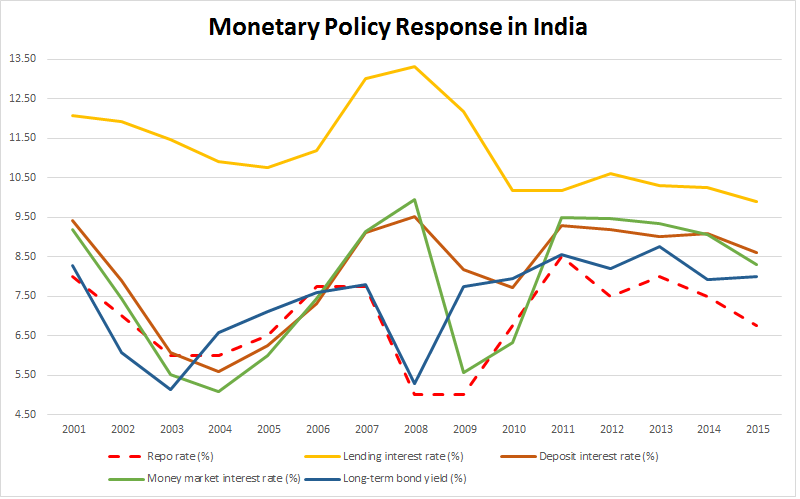
This also contributes to a wedge between the bank lending rate on the one hand, and long-term bond yields and the money market rates, which in turn gets transmitted across the fixed-income markets in general. 
As can be seen from the graph constructed with EIU data, the wedge between the lending rate (here, taken as the SBI base lending rate) and the money market rate and 10 year government bond yields is considerable. Encouragingly, the wedge has been on a decreasing trend. It is therefore no surprise that short term commercial paper and similar instruments become more attractive for short-term borrowers following a central bank repo rate reduction. 
Add to Technorati Favorites
08 Oct 03:35

Super-specialisation in cricket

by SK

Cricket has always been a reasonably specialised sport. You are either a batsman or a bowler or a wicketkeeper or an all-rounder. If you’re a bowler, you’re classified based on your bowling arm and the speed at which you bowl and the spin you impart the ball (last two are not independent). If you’re a batsman you’re classified based on your batting stance and whether you’re an opener or a middle-order batsman.

In Test cricket, there’s further specialisation if you’re a middle-order batsman. You have specialist Number Threes, like Rahul Dravid or Ricky Ponting. You have specialist Number Fours, like Sachin Tendulkar or Younis Khan. Five and six are fungible, but a required ability for both these positions is the ability to bat with the tail.

In One Day cricket, too, there’s some degree of specialisation within the middle order but it’s not to the same extent as in Test Cricket. In One Day cricket, batting orders are more flexible and situation-based. You do have specialist threes (Dravid and Ponting again come to mind) and sixes (usually hitters) but the super-specialisation is not as much as in Test Cricket.

A logical extension of this would be that in T20 cricket, which is played over an even shorter duration and where batting orders are even more flexible, you don’t need even as much of specialisation as in ODIs. However, Siddharth Monga argues in this piece that this lack of specialisation is why India isn’t doing as well as it could in T20s (having just lost the home series to South Africa).

In other words, what Monga is arguing is that Kohli, Raina and Sharma are all similar batsmen and effectively Number Threes for their IPL franchises, and when they are arranged 2-4 or 3-5 in the Indian national team, two of them are effectively batting out of position.

It would be interesting if Monga is indeed right and that T20s require a higher degree of specialisation than ODIs. It is also interesting that India’s number 6, MS Dhoni, bats like a typical number 5 in T20s, accumulating for a while before going bonkers. Maybe T20 will end up as a much more specialised sport than Tests? That would be interesting to watch.

07 Oct 16:09

Notes on the SEC’s Proposal on Mutual Fund Liquidity

by David Merkel


I’m still working through the SEC’s proposal on Mutual Fund Liquidity, which I mentioned at the end of this article:

Q: <snip> Are you going to write anything regarding the SEC’s proposal on open end mutual funds and ETFs regarding liquidity?

A: <snip> …my main question to myself is whether I have enough time to do it justice.  There’s their white paper on liquidity and mutual funds.  The proposed rule is a monster at 415 pages, and I may have better things to do.   If I do anything with it, you’ll see it here first.

These are just notes on the proposal so far.  Here goes:

1) It’s a solution in search of a problem.

After the financial crisis, regulators got one message strongly — focus on liquidity.  Good point with respect to banks and other depositary financials, useless with respect to everything else.  Insurers and asset managers pose no systemic risk, unless like AIG they have a derivatives counterparty.  Even money market funds weren’t that big of a problem — halt withdrawals for a short amount of time, and hand out losses to withdrawing unitholders.

The problem the SEC is trying to deal with seems to be that in a crisis, mutual fund holders who do not sell lose value from those who are selling because the Net Asset Value at the end of the day does not go low enough.  In the short run, mutual fund managers tend to sell liquid assets when redemptions are spiking; the prices of illiquid assets don’t move as much as they should, and so the NAV is artificially high post-redemptions, until the prices of illiquid assets adjust.

The proposal allows for “swing pricing.”  From the SEC release:

The Commission will consider proposed amendments to Investment Company Act rule 22c-1 that would permit, but not require, open-end funds (except money market funds or ETFs) to use “swing pricing.” 

Swing pricing is the process of reflecting in a fund’s NAV the costs associated with shareholders’ trading activity in order to pass those costs on to the purchasing and redeeming shareholders.  It is designed to protect existing shareholders from dilution associated with shareholder purchases and redemptions and would be another tool to help funds manage liquidity risks.  Pooled investment vehicles in certain foreign jurisdictions currently use forms of swing pricing.

A fund that chooses to use swing pricing would reflect in its NAV a specified amount, the swing factor, once the level of net purchases into or net redemptions from the fund exceeds a specified percentage of the fund’s NAV known as the swing threshold.  The proposed amendments include factors that funds would be required to consider to determine the swing threshold and swing factor, and to annually review the swing threshold.  The fund’s board, including the independent directors, would be required to approve the fund’s swing pricing policies and procedures.

But there are simpler ways to do this.  In the wake of the mutual fund timing scandal, mutual funds were allowed to estimate the NAV to reflect the underlying value of assets that don’t adjust rapidly.  This just needs to be followed more aggressively in a crisis, and peg the NAV lower than they otherwise would, for the sake of those that hold on.

Perhaps better still would be provisions where exit loads are paid back to the funds, not the fund companies.  Those are frequently used for funds where the underlying assets are less liquid.  Those would more than compensate for any losses.

2) This disproportionately affects fixed income funds.  One size does not fit all here.  Fixed income funds already use matrix pricing extensively — the NAV is always an estimate because not only do the grand majority of fixed income instruments not trade each day, most of them do not have anyone publicly posting a bid or ask.

In order to get a decent yield, you have to accept some amount of lesser liquidity.  Do you want to force bond managers to start buying instruments that are nominally more liquid, but carry more risk of loss?  Dividend-paying common stocks are more liquid than bonds, but it is far easier to lose money in stocks than in bonds.

Liquidity risk in bonds is important, but it is not the only risk that managers face.  it should not be made a high priority relative to credit or interest rate risks.

3) One could argue that every order affects market pricing — nothing is truly liquid.  The calculations behind the analyses will be fraught with unprovable assumptions, and merely replace a known risk with an unknown risk.

4) Liquidity is not as constant as you might imagine.  Raising your bid to buy, or lowering your ask to sell are normal activities.  Particularly with illiquid stocks and bonds, volume only picks up when someone arrives wanting to buy or sell, and then the rest of the holders and potential holders react to what he wants to do.  It is very easy to underestimate the amount of potential liquidity in a given asset.  As with any asset, it comes at a cost.

I spent a lot of time trading illiquid bonds.  If I liked the creditworthiness, during times of market stress, I would buy bonds that others wanted to get rid of.  What surprised me was how easy it was to source the bonds and sell the bonds if you weren’t in a hurry.  Just be diffident, say you want to pick up or pose one or two million of par value in the right context, say it to the right broker who knows the bond, and you can begin the negotiation.  I actually found it to be a lot of fun, and it made good money for my insurance client.

5) It affects good things about mutual funds.  Really, this regulation should have to go through a benefit-cost analysis to show that it does more good than harm.  Illiquid assets, properly chosen, can add significant value.  As Jason Zweig of the Wall Street Journal said:

The bad news is that the new regulations might well make most fund managers even more chicken-hearted than they already are — and a rare few into bigger risk-takers than ever.

You want to kill off active managers, or make them even more index-like?  This proposal will help do that.

6) Do you want funds to limit their size to comply with the rules, while the fund firm rolls out “clone” fund 2, 3, 4, 5, etc?

Summary

You will never fully get rid of pricing issues with mutual funds, but the problems are largely self-correcting, and they are not systemic.  It would be better if the SEC just withdrew these proposed rules.  My guess is that the costs outweigh the benefits, and by a wide margin.

07 Oct 09:21

Latticework of Mental Models: Alternative Histories

by Anshul Khare

Note: This article first appeared in the February 2015 issue (free to download) of our premium newsletter, Value Investing Almanack.

Let me make an offer to you which has a potential to make you richer by couple of million dollars and that requires an effort not more than wiggling a finger. Would you be interested?

“What’s the catch?” That would be your first question, right?

Well, I’ll leave it to you to figure out the catch. So here is the deal, in fact I’ll let Nassim Taleb, author of Fooled By Randomness, do the explaining –

Imagine you are offered $10 million to play Russian roulette, i.e., to put a revolver containing one bullet in the six available chambers to your head and pull the trigger[no effort, I told you!]. Each realisation would count as one history, for a total of six possible histories of equal probabilities. Five out of these six histories would lead to enrichment; one would lead to a statistic, that is, an obituary with an embarrassing (but certainly original) cause of death.



Although, Russian roulette is a hypothetical situation, a thought experiment, but it highlights a big flaw that exists in how we perceive the reality. Taleb adds –

The problem is that only one of the histories is observed in reality; and the winner of $10 million would elicit the admiration and praise…the public observes the external signs of wealth without even having a glimpse at the source.

So can you see how we are blind to alternative histories? The silent events i.e., the events which could have happened but didn’t. In the language of behavioural finance this irrationality is known as Survivorship Bias. The outcome which is visible, ‘survived’ and the ones which didn’t survive are hidden.

In effect, the general belief is that if the outcome is good, the process and decisions made to arrive at that outcome must have been sound.

Alas, life doesn’t follow such straight patterns. The randomness and ‘external factors’ play a defining role in life and, as we will see later in this post, in investing too. Taleb notes –

Reality is far more vicious than Russian roulette. First, it delivers the fatal bullet rather infrequently, like a revolver that would have hundreds, even thousands, of chambers instead of six. After a few dozen tries, one forgets about the existence of a bullet, under numbing false sense of security…

…one is thus capable of unwittingly playing Russian roulette and calling it by some alternative “low risk” name. We see the wealth being generated…people lose sight of their risks. The game seems terribly easy and we play along carelessly.

ALternateHistoryWhat are these Russian roulette(ish) games in real life, you may ask. Using debt to buy things (especially the things that you don’t need) is one such game. Buying stocks on debt or on margin is another.

And then comes along somebody who warns investors not to play this simple looking (but risky) game, but his advice is ignored.

Say you engage in a business of protecting investors from rare events and say nothing happens during the period. Some of them will complain, “You wasted my money on insurance last year, the factory didn’t burn, it was a stupid expense. You should only insure for events that happen.”

Another unintended outcome of alternative history blindness is that we grow confident about our understanding of the game. We rationalize the causal link between the event and the associated outcome (also known as Narrative Fallacy or Hindsight Bias). Our thinking becomes outcome-centric.

In a wonderful book Everything is Obvious, the author, Duncan J. Watts writes –

In a variety of lab experiments, psychologists have asked participants to make predictions about future events and then reinterviewed them after the events in question had taken place. When recalling their previous predictions, subjects consistently report being more certain of their correct predictions, and less certain of their incorrect predictions, than they had reported at the time they made them.

An interesting experiment (you must read this) was designed to simulate parallel worlds and the results of this experiment proved that the role of randomness in success is bigger than we usually imagine.

Does it mean that we should ignore the past and stop making plans for the future? Of course not! It just means that we should have a healthy skepticism towards predictions and explanations that are served to us by others (including the ones served by our own lizard-brain).

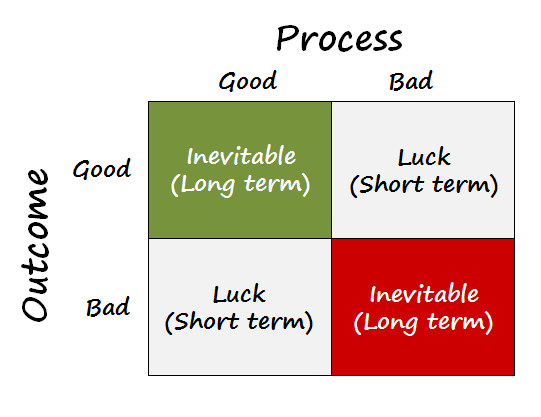
You should first focus on the path/process that was followed to achieve the outcome. A good process ensures a good outcome over long term. The following matrix is helpful in understanding the importance of ‘good process’ in decision making.
process_outcome_matrix

In Investing

As Taleb writes in his book –

…in time, if the roulette-betting fool keeps playing the game, the bad histories will tend to catch up with him. Thus, if a twenty-five-year-old played Russian roulette, say, once a year, there would be a very slim possibility of him surviving until his fiftieth birthday – but, if there are enough players, say thousands of twenty-five-year-old players, we can expect to see a handful of (extremely rich) survivors (and a very large cemetery).

If you draw a parallel to this in the stock market, in a field populated by thousands of traders, speculators, and people buying stocks on leverage, at the end of a say 10-15 years, you may still find a very few lucky survivors, but there will also be a very large cemetery (of those who destroyed wealth using the same routes).

Sometimes, people are indeed aware of the risks inherent in Russian roulette kind of investing, and they still do it. However, the quality of money earned this way (a stressful process) is not the same as the one earned by non-fatal means like sensible, patient, long-term investing without borrowing other people’s money (stress-free process).

Of course, in the end, you may earn a similar amount of money either ways – through day trading, speculation, and leverage OR patient, long-term investing – but the former’s dependence on randomness is greater than the latter’s.

To the accountant, they would be identical; to your next door neighbour too. Yet, deep down, you know that they are qualitatively different.

As an investor, you may want to minimize the heart-wrenching rides that you may experience during the course of investing period. This is how Prof. Sanjay Bakshi concluded in his article on “Return per unit of stress” –

“My advice to those who ignore the stress part of the equation but focus only on returns per unit of risk: You cannot take it away with you, so what’s the point of all that stress, just for the money?”

The legendary Howard Marks wrote this in one of his memos to shareholders in 2006…

In the investing world, one can live for years off one great coup or one extreme but eventually accurate forecast. But what’s proved by one success? When markets are booming, the best results often go to those who take the most risk. Were they smart to anticipate good times and bulk up on beta, or just congenitally aggressive types who were bailed out by events? Most simply put, how often in our business are people right for the wrong reason?

The people Marks is referring to are the ones Taleb calls “lucky idiots,” and in the short run it’s certainly hard to differential between them and skilled investors.

Here is what Marks wrote in a 2002 memo…

I find that I agree with essentially all of Taleb’s important points.

  • Investors are right (and wrong) all the time for the “wrong reason.” Someone buys a stock because he or she expects a certain development; it doesn’t occur; the market takes the stock up anyway; the investor looks good (and invariably accepts credit).
  • The correctness of a decision can’t be judged from the outcome. Nevertheless, that’s how people assess it. A good decision is one that’s optimal at the time it’s made, when the future is by definition unknown. Thus, correct decisions are often unsuccessful, and vice versa.
  • Randomness alone can produce just about any outcome in the short run. In portfolios that are allowed to reflect them fully, market movements can easily swamp the skillfulness of the manager (or lack thereof). But certainly market movements cannot be credited to the manager (unless he or she is the rare market timer who’s capable of getting it right repeatedly).
  • For these reasons, investors often receive credit they don’t deserve. One good coup can be enough to build a reputation, but clearly a coup can arise out of randomness alone. Few of these “geniuses” are right more than once or twice in a row.
  • Thus, it’s essential to have a large number of observations – lots of years of data – before judging a given manager’s ability.

Invert, Always Invert!

Although Survivorship Bias is a serious cognitive bias and leads to erroneous decision making, I believe it can be used for our benefit also. Using the idea of inversion, let me make an attempt to find a useful way to exploit this bias.

It’s actually a nice little hack related to the concept of alternative history. I frequently use this imagination trick to increase the quality of my day to day life.

Right now I am sitting on a comfortable chair, writing on my laptop while sipping an organic tea. But there is another possible path that history could have taken. In that alternative path, I imagine being born in a poor African country where (forget internet or even electricity) one has to walk 5 miles every day to fetch drinking water.

Thinking about this alternative history forces my mind to be grateful for all the blessings that are present in my life right now. After all alternative histories aren’t just about Russian roulettes and investing.

Conclusion

Warren Buffett’s appendix to the fourth revised edition of The Intelligent Investor describes a contest in which each of the 225 million Americans starts with $1 and flips a coin once a day. The people who get it right on day one collect a dollar from those who were wrong and go on to flip again on day two, and so forth. Ten days later, 220,000 people have called it right ten times in a row and won $1,000.

Buffett writes, “They may try to be modest, but at cocktail parties they will occasionally admit to attractive members of the opposite sex what their technique is, and what marvellous insights they bring to the field of flipping.”

After another ten days, we’re down to 215 survivors who’ve been right 20 times in a row and have each won $1 million. They write books titled How I Turned a Dollar into a Million in Twenty Days Working Thirty Seconds a Morning and sell tickets to seminars.

“Worse yet,” Buffett writes, “they’ll probably start jetting around the country attending seminars on efficient coin-flipping and tackling skeptical professors with, “If it can’t be done, why are there 215 of us?”

If you don’t know how to separate a good process from a bad one, you’ll surely fall for these ‘efficient coin-flipping’ wizards.

Learn to focus on the process more than the outcome. Use common sense and your own thinking to filter out the outcome-centric hindsight-heavy theories.

Take care and keep learning.

The post Latticework of Mental Models: Alternative Histories appeared first on Safal Niveshak.

    
07 Oct 04:28

The Psychology of Risk and Reward

by Shane Parrish

The Psychology of Risk and Reward

An excerpt from The Aspirational Investor: Taming the Markets to Achieve Your Life’s Goals that I think you’d enjoy.

Most of us have a healthy understanding of risk in the short term.

When crossing the street, for example, you would no doubt speed up to avoid an oncoming car that suddenly rounds the corner.

Humans are wired to survive: it’s a basic instinct that takes command almost instantly, enabling our brains to resolve ambiguity quickly so that we can take decisive action in the face of a threat.

The impulse to resolve ambiguity manifests itself in many ways and in many contexts, even those less fraught with danger. Glance at the (above) picture for no more than a couple of seconds. What do you see?

Some observers perceive the profile of a young woman with flowing hair, an elegant dress, and a bonnet. Others see the image of a woman stooped in old age with a wart on her large nose. Still others—in the gifted minority—are able to see both of the images simultaneously.

What is interesting about this illusion is that our brains instantly decide what image we are looking at, based on our first glance. If your initial glance was toward the vertical profile on the left-hand side, you were all but destined to see the image of the elegant young woman: it was just a matter of your brain interpreting every line in the picture according to the mental image that you already formed, even though each line can be interpreted in two different ways. Conversely, if your first glance fell on the central dark horizontal line that emphasizes the mouth and chin, your brain quickly formed an image of the older woman.

Regardless of your interpretation, your brain wasn’t confused. It simply decided what the picture was and filled in the missing pieces. Your brain resolved ambiguity and extracted order from conflicting information.

What does this have to do with decision making? Every bit of information can be interpreted differently according to our perspective. Ashvin Chhabra directs us to investing. I suggest you reframe this in the context of decision making in general.

Every trade has a seller and a buyer: your state of mind is paramount. If you are in a risk-averse mental framework, then you are likely to interpret a further fall in stocks as additional confirmation of your sell bias. If instead your framework is positive, you will interpret the same event as a buying opportunity.

The challenge of investing is compounded by the fact that our brains, which excel at resolving ambiguity in the face of a threat, are less well equipped to navigate the long term intelligently. Since none of us can predict the future, successful investing requires planning and discipline.

Unfortunately, when reason is in apparent conflict with our instincts—about markets or a “hot stock,” for example—it is our instincts that typically prevail. Our “reptilian brain” wins out over our “rational brain,” as it so often does in other facets of our lives. And as we have seen, investors trade too frequently, and often at the wrong time.

One way our brains resolve conflicting information is to seek out safety in numbers. In the animal kingdom, this is called “moving with the herd,” and it serves a very important purpose: helping to ensure survival. Just as a buffalo will try to stay with the herd in order to minimize its individual vulnerability to predators, we tend to feel safer and more confident investing alongside equally bullish investors in a rising market, and we tend to sell when everyone around us is doing the same. Even the so-called smart money falls prey to a herd mentality: one study, aptly titled “Thy Neighbor’s Portfolio,” found that professional mutual fund managers were more likely to buy or sell a particular stock if other managers in the same city were also buying or selling.

This comfort is costly. The surge in buying activity and the resulting bullish sentiment is self-reinforcing, propelling markets to react even faster. That leads to overvaluation and the inevitable crash when sentiment reverses. As we shall see, such booms and busts are characteristic of all financial markets, regardless of size, location, or even the era in which they exist.

Even though the role of instinct and human emotions in driving speculative bubbles has been well documented in popular books, newspapers, and magazines for hundreds of years, these factors were virtually ignored in conventional financial and economic models until the 1970s.

This is especially surprising given that, in 1951, a young PhD student from the University of Chicago, Harry Markowitz, published two very important papers. The first, entitled “Portfolio Selection,” published in the Journal of Finance, led to the creation of what we call modern portfolio theory, together with the widespread adoption of its important ideas such as asset allocation and diversification. It earned Harry Markowitz a Nobel Prize in Economics.

The second paper, entitled “The Utility of Wealth” and published in the prestigious Journal of Political Economy, was about the propensity of people to hold insurance (safety) and to buy lottery tickets at the same time. It delved deeper into the psychological aspects of investing but was largely forgotten for decades.

The field of behavioral finance really came into its own through the pioneering work of two academic psychologists, Amos Tversky and Daniel Kahneman, who challenged conventional wisdom about how people make decisions involving risk. Their work garnered Kahneman the Nobel Prize in Economics in 2002. Behavioral finance and neuroeconomics are relatively new fields of study that seek to identify and understand human behavior and decision making with regard to choices involving trade-offs between risk and reward. Of particular interest are the human biases that prevent individuals from making fully rational financial decisions in the face of uncertainty.

As behavioral economists have documented, our propensity for herd behavior is just the tip of the iceberg. Kahneman and Tversky, for example, showed that people who were asked to choose between a certain loss and a gamble, in which they could either lose more money or break even, would tend to choose the double down (that is, gamble to avoid the prospect of losses), a behavior the authors called “loss aversion.” Building on this work, Hersh Shefrin and Meir Statman, professors at the University of Santa Clara Leavey School of Business, have linked the propensity for loss aversion to investors’ tendency to hold losing investments too long and to sell winners too soon. They called this bias the disposition effect.

The lengthy list of behaviorally driven market effects often converge in an investor’s tale of woe. Overconfidence causes investors to hold concentrated portfolios and to trade excessively, behaviors that can destroy wealth. The illusion of control causes investors to overestimate the probability of success and underestimate risk because of familiarity—for example, causing investors to hold too much employer stock in their 401(k) plans, resulting in under-diversification. Cognitive dissonance causes us to ignore evidence that is contrary to our opinions, leading to myopic investing behavior. And the representativeness bias leads investors to assess risk and return based on superficial characteristics—for example, by assuming that shares of companies that make products you like are good investments.

Several other key behavioral biases come into play in the realm of investing. Framing can cause investors to make a decision based on how the question is worded and the choices presented. Anchoring often leads investors to unconsciously create a reference point, say for securities prices, and then adjust decisions or expectations with respect to that anchor. This bias might impede your ability to sell a losing stock, for example, in the false hope that you can earn your money back. Similarly, the endowment bias might lead you to overvalue a stock that you own and thus hold on to the position too long. And regret aversion may lead you to avoid taking a tough action for fear that it will turn out badly. This can lead to decision paralysis in the wake of a market crash, even though, statistically, it is a good buying opportunity.

Behavioral finance has generated plenty of debate. Some observers have hailed the field as revolutionary; others bemoan the discipline’s seeming lack of a transcendent, unifying theory. This much is clear: behavioral finance treats biases as mistakes that, in academic parlance, prevent investors from thinking “rationally” and cause them to hold “suboptimal” portfolios.

But is that really true? In investing, as in life, the answer is more complex than it appears. Effective decision making requires us to balance our “reptilian brain,” which governs instinctive thinking, with our “rational brain,” which is responsible for strategic thinking. Instinct must integrate with experience.

Put another way, behavioral biases are nothing more than a series of complex trade-offs between risk and reward. When the stock market is taking off, for example, a failure to rebalance by selling winners is considered a mistake. The same goes for a failure to add to a position in a plummeting market. That’s because conventional finance theory assumes markets to be inherently stable, or “mean-reverting,” so most deviations from the historical rate of return are viewed as fluctuations that will revert to the mean, or self-correct, over time.

But what if a precipitous market drop is slicing into your peace of mind, affecting your sleep, your relationships, and your professional life? What if that assumption about markets reverting to the mean doesn’t hold true and you cannot afford to hold on for an extended period of time? In both cases, it might just be “rational” to sell and accept your losses precisely when investment theory says you should be buying. A concentrated bet might also make sense, if you possess the skill or knowledge to exploit an opportunity that others might not see, even if it flies in the face of conventional diversification principles.

Of course, the time to create decision rules for extreme market scenarios and concentrated bets is when you are building your investment strategy, not in the middle of a market crisis or at the moment a high-risk, high-reward opportunity from a former business partner lands on your desk and gives you an adrenaline jolt. A disciplined process for managing risk in relation to a clear set of goals will enable you to use the insights offered by behavioral finance to your advantage, rather than fall prey to the common pitfalls. This is one of the central insights of the Wealth Allocation Framework. But before we can put these insights to practical use, we need to understand the true nature of financial markets.

--
Sponsored By: Greenhaven Road Capital: You think differently - now invest differently.

07 Oct 04:23

Banks Are Not Benefiting From The Rate Cut: They Are Not Borrowing From The RBI

by Deepak Shenoy

You think banks are benefiting from the RBI rate cut? The RBI rate cut reduces the rate at which RBI lends money to banks. So banks would benefit if they were borrowing money from the RBI,

They are not.

Here’s yesterday’s “money market update” from RBI:

image

There’s a lot of stuff out there but in order to not confuse you:

  • Repo = what banks borrow from RBI
  • Reverse Repo = what banks give to the RBI as excess money they have
  • Marginal Standing Facility = Bank borrowing but at higher rate

You can see from here that despite the rate cut, banks aren’t going all gung ho and borrowing from the RBI.

Check out Capital Mind Premium!

Get In-Depth Macroeconomic Analysis, Market Metrics, Proprietary Capital Mind Indexes, a look into the CAPM Portfolio and More Actionable Insights, straight to your Inbox.

Take a 30-day Free Trial!

From July, here’s how the situation has been:

image

For most of the last three months, banks are not borrowing money from the RBI at all.… (Read On...)

07 Oct 04:22

India's anemic credit growth

by noreply@blogger.com (Gulzar Natarajan)
Some commentators point to the sharp increase in non-bank credit growth, especially commercial paper (CP) issuances, as a positive sign and a reflection of corporate investment revival despite non-food bank credit growth still languishing in single-digits. Never mind that short-term CP is hardly a relevant metric of investment revival. In any case, how do the numbers stack up?

In 2014-15, net CP issuance rocketed from a negative Rs 26.4 bn in 2013-14 to Rs 866.54 bn in 2014-15, and Rs 1054 bn in the first five months of 2015-16. In the same period, equity and bonds raised by private corporates rose from Rs 116.8 bn to Rs 170.6 bn to Rs 97.93 bn for the same three periods respectively. A comparison of the bank and total non-food credit growth, which combines both bank and non-bank (CP, capital markets, PSU bonds, public financial institutions disbursements etc) credit, reveals the following graphic.
This should not come as a surprise since bank lending dwarfs other forms of financing in India's narrow financial markets. In 2014-15, the total non-food bank credit was Rs 64,420 bn or 51.3% of GDP, while the combined non-food credit was Rs 66,859 bn or 53.3% of GDP. Even taking FDI at 1.7% of GDP and external commercial borrowings at about $30 bn (1.2% of GDP) estimated for 2015, it becomes clear that all types of non-bank credit sources are almost a rounding error.

A more plausible inference from the spurt in the CP issuance is that even as stressed banks refused to pass on the rate cuts, the declining money market yields forced down the rates for, especially short-term credit like CP. The resultant spurt in CP issuance is therefore a proximate reflection of weakness in the banking sector than revival of the corporate investment cycle.  
Add to Technorati Favorites
06 Oct 06:18

Giving former Indian PM Narasimhan Rao due credit for 1991 changes…

by Amol Agrawal
Praveen Patil comments on the recent Jairam Ramesh book on 1991 crisis and changes thereon. He wonders why people do not give any credit to then PM Narasimha Rao. The entire credit has been taken by then FM Dr. Manmohan Singh. All this is sop ridiculous as without the PM’s confidence, Finance Minister could have hardly done anything. […]
06 Oct 03:18

Violence and Development

by Atanu Dey

A couple of quotes related to violence and development.

“. . . all societies must deal with the problem of violence. In most developing countries, individuals and organizations actively use or threaten to use violence to gather wealth and resources, and violence has to be restrained for development to occur. In many societies the potential for violence is latent: organizations generally refrain from violence in most years, but occasionally find violence a useful tool for pursuing their ends. These societies live in the shadow of violence, and they account for most of human history and for most of today’s world population. Social arrangements deter the use of violence by creating incentives for powerful individuals to coordinate rather than fight.”

Source: In the Shadow of Violence: Politics, Economics, and the Problems of Development. Edited by Douglass C. North, et al. Cambridge Univ Press 2013.

“Political development occurs when people domesticate violence, transforming coercion from a means of predation into a productive resource. Coercion becomes productive when it is employed not to seize or to destroy wealth, but rather to safeguard and promote its creation.”

Source: Prosperity and Violence: The Political Economy of Development. Robert H. Bates. (2001)

A related post worth a read is “Of Kakistocracies, Principals and Agents.