Shared posts

19 Oct 03:50

A Bigger Brick in the Wall of Worries

by David Merkel

I have my list of concerns for the economy and the markets:

  1. Unexpected Global Macroeconomic Surprises, including more from China
  2. Student Loans, Agricultural Loans, Auto Loans — too much
  3. Exchange Traded Products — the tail is wagging the dog in some places, and ETPs are very liquid, but at a cost of reducing liquidity to the rest of the market
  4. Low risk margins — valuations for equity and debt are high-ish
  5. Demographics — mostly negative as populations across the globe age
  6. Wages in the “developed world” are getting pushed to the levels of the “developing world,” largely due to the influence of information technology.  Also, technology is temporarily displacing people from current careers.

But now I have one more:

7)  Nonfinancial corporations, once the best part of the debt markets, are beginning to get overlevered.

This is worth watching.  It seems like there isn’t that much advantage to corporate borrowing now — the arbitrage of borrowing to buy back stock seems thin, as does borrowing to buy up competitors.  That doesn’t mean it is not being done — people imitate the recent past as a useful shortcut to avoid thinking.  Momentum carries markets beyond equilibrium as a result.

If the Federal Reserve stimulates by duping getting economic actors to accelerate current growth by taking on more debt, it has worked here.  Now where is leverage low?  Across the board, debt levels aren’t far from where they were in 2008:

As such, I’m not sure where we go from here, but I would suggest the following:

  • Start lightening up on bonds and stocks that would concern you if it were difficult to get financing.  How well would they do if they had to self-finance for three years?
  • With so much debt, monetary policy should remain ineffective.  Don’t expect them to move soon or aggressively.
  • Fiscal policy will remain riven by disagreements, and hamstrung by rising entitlement spending.
  • Long Treasuries don’t look bad with inflation so low.
  • Leave a little liquidity on the side in case of a negative surprise.  When everyone else has high debt levels, it is time to reduce leverage.

Better safe than sorry.  This isn’t saying that the equity markets can’t go higher from here, that corporate issuance can’t grow, or that corporate spreads can’t tighten.  This is saying that in 2004-2006, a lot of the troubles that were going to come were already baked into the cake.  Consider your current positions carefully, and develop your plan for your future portfolio defense.

19 Oct 03:45

How many people in India are rich in 2015?

by Muthu

Every October, Credit Suisse publishes the global wealth report.

This year also they have published the report.

For last few years, we are sharing some interesting data points from the above report.

For the purpose of the report, they have taken into account only adult population.

For dollar to rupee conversion, the rate assumed is 1 USD = Rs.65.

A country is considered rich, if the average wealth per person is over $100,000 (Rs.65 lakhs).

The richest country in the world is Switzerland with average wealth per person of $567,122 (Rs.3.68 crores).Switzerland is the only country in the world where the average wealth per person has crossed half a million dollars.

The top ten richest countries in the world are Belgium, Denmark, Norway, Singapore, Sweden, Switzerland, Australia, France, UK and USA.

The average net worth of an individual in the world is $52,400 (Rs.34 lakhs).

71% of the world population has wealth less than $10,000 (Rs.6.5 lakhs).

21% of the world population has wealth between $10,000 (Rs.6.5 lakhs) to $100,000 (Rs.65 lakhs).

7.4% of the world population has wealth between $100,000 (Rs.65 lakhs) to $1 million (Rs.6.5 crores).

0.6% of the world population has wealth more than$1 million (Rs.6.5 crores).

The top 1% of the population owns 50% of the total assets.

If you’ve wealth of $759,900 (Rs.4.94 crores), you’re among the wealthiest 1% of the world.

Wealth of $68,800 (R.44.7 lakhs) would put you among top 10% of the world population.

If you’ve wealth of $3210 (Rs.2.09 lakhs), you’re among the wealthiest 50% of the world.

We are a poor country and we know it. We are growing very rapidly and therein lies opportunity for us to create wealth in next couple of decades.

95% of the population in India has wealth below $10,000 (Rs.6.5 lakhs).

3% of the country is classified as middle class having wealth above $13,700 (Rs.8.9 lakhs).

0.3% of our population is worth above $100,000 (Rs.65 lakhs).

There are 1.85 lakh people who are worth above $1 million (Rs.6.5 crores).

There are 2080 people who have above $50 million(Rs.325 crores).

There are 940 people who have above $100 million (Rs.650 crores).

Total wealth of the country is $3.4 trillion predominantly in real estate and gold.

The average wealth per individual is $4352 (Rs.2.82 lakhs) and the median wealth is $868 (Rs.56,420).

Median wealth means that half of our population has less than Rs.56,000 as wealth.

Count your blessings.

Help and give opportunity to the less privileged.


17 Oct 13:52

Snowden’s German TV Interview

by Atanu Dey

This video is from 26th January, 2014. Truthdig.com has the details: The Edward Snowden Interview the U.S. Media Didn’t Want You to Watch. Excerpts from it below the video.

“Every time you pick up a phone, dial a number, write an email, make a purchase, travel on the bus carrying a cell phone, swipe a card somewhere, you leave a trace, and the government has decided that it’s a good idea to collect it all, everything, even if you’ve never been suspected of a crime.”

That revelation is actually from a second interview given by former Central Intelligence Agency and former National Security Agency (NSA) contractor Edward Snowden, this time to German broadcast giant ARD.
And even though ARD is the second largest public broadcaster in the world (after the British Broadcasting Company), and Snowden’s message easily unearths the largest violations of the Constitution by the US to date, our dinosaur media does not believe this is mainstream enough to cover.

To be clear, you cannot find the 30-minute interview – released via the international video-sharing site LiveLeak on Jan. 27 – on one single American news outlet.”

17 Oct 05:03

Charts: Imports and Exports Both Fall 25% in September 2015

by Deepak Shenoy

The Trade Deficit for September came in at the lowest in five months even though exports and imports were flat.

image

Last September was awesome for India with very high imports and exports, so the fall in percentage terms was very high.

image


And the problem is as much in non-oil imports as it is in oil imports. The worldwide commodity price drop has taken effect:

image

Check out Capital Mind Premium!

Get In-Depth Macroeconomic Analysis, Market Metrics, Proprietary Capital Mind Indexes, a look into the CAPM Portfolio and More Actionable Insights, straight to your Inbox.

Take a 30-day Free Trial!

And with that we bring you the last bit:

image

Total trade has indeed fallen off a cliff in terms of growth. The base effect will have magnified the September numbers but the trend is down, down and down.

Our View

Have exports and imports bottomed out? The market’s rally makes one think this is so.… (Read On...)

17 Oct 05:00

Rating Achievements Through “Rate of Growth”

by Atanu Dey

“. . . how absurd it is to judge relative performance by rate of growth, which is as often as not evidence of past neglect rather than of present achievement. In many respects it is easier and not more difficult for an undeveloped country to grow rapidly once an appropriate framework has been secured.”

Source: F. A Hayek. The Political Order of a Free People. 1979. Page 190. Volume 3 of Law, Legislation and Liberty.

16 Oct 04:41

Du Runsheng, world’s most influential yet ignored economist?

by Amol Agrawal
Not even heard of the name. Apparently he was the main economic thought behind China’s 1978 rural transformation. Here is a story.. Last week, Du Runsheng passed away at the ripe old age of 102. The death of the “father of rural reform” was widely covered in China and Hong Kong, as Du’s proteges include […]
16 Oct 04:36

Forms to avoid TDS,15G, 15H, and EPF Withdrawal Forms Form 19, Form 20,Form 10C,Form 10D,Form 51F

by bemoneyaware

This article lists the various forms, Form 15G & 15H to avoid TDS such as for Fixed Deposit or EPF Withdrawal before 5 years. It also lists the various forms one needs for EPF Withdrawal and EPS Pension.

Form 15G & Form 15H: Avoid TDS

The Income Tax Department has announced a new procedure regarding Form 15G & Form 15H  starting 1st October 2015. Key Changes are given below. Our article How to Fill Form 15G? How to Fill Form 15H? discusses the process of filling form 15G/15H in detail.

  • Forms have been simplified. Gone are the various schedules like Schedule 1,2 etc
  • Introduction of Electronic mode of filing Form 15G & 15H as an Alternate to Paper Form. No procedural rules has been prescribed as regard to filing of Form 15G. However, It seems Form 15G & 15H can be filed using Internet Banking facility or Similar facility for in case of Other institution which are making payment as provided in Section 197(1) or 197(1A) or 197(1C). –
  • The person responsible for making a payment or the Deductor shall allot a UIN (Unique Identification Number) to each Form 15G and Form 15H received.
  • The Deductor shall mention the particulars of these Form 15G & Form 15H received during any quarter of the financial year along with the unique identification number allotted by him in TDS Quarterly Statements, whether or not any TDS has been deducted by him.
  • The Deductor is no longer required to submit physical copy of Form 15G & Form 15H to the Tax Department.
  • However, these forms must be maintained by the Deductor for a period of 7 years from the end of the financial year in which these are received

The forms required for different categories have been listed below :

 Category of Tax Payer Income Tax Section New Form  Old Form
Individual:Senior Citizen Sub-section (1C) of section 197A  New-Form-15G Form15H (pdf)
Individual:Non senior Citizen Sub-sections (1) and (1A) of section 197A  New-Form-15H Form15G (pdf)
Trusts/SocietiesAvailable from Assessing Officer  15AASample form(pdf)

Banks which allow submission of Form 15G & Form 15H Online

Banks like State Bank of India allow for online submission of Form 15G & Form 15H. .

Generating Form 15G/15H online

Generating Form 15G/15H online

Please note that
• Form 15 G/H will be generated branch- wise.
• In case of Joint Accounts, form 15 G/H will be generated for the first account holder.

The YouTube Video on How to Fill Form 15G/15H online from State Bank of India Tutorials shows how to Submit Form 15H/Form 15G online. This video was published in Sep 2015 before the New Guidelines for Form 15G/15H were introduced. So it shows how to fill the old form.

EPF Withdrawal and Pension Forms

You can withdraw from EPF and EPS if you are unemployed for 2 months. You can also wait for two months to get a new job and then you can get your PF Account transferred to the new Account. However, in case of not getting the job , apply for the settlement before 36 months from leaving the last job as no interest will be paid after 36 months and the account will become inoperative.

If person passes away while in service or before claiming EPF and EPS, his family can claim EPF & EPS. Various forms required are listed here. Our article Basics of Employee Provident Fund: EPF, EPS, EDLIS, EDLI, Employee Deposit Linked Insurance SchemeHow to get information about EPF balance : Annual Statement, SMS, E-Passbook discusses the basics of EPF ,EPS and EDLI.

How to withdraw from EPF and EPS

You can withdraw EPF both the employee and employer contribution by submitting Form 19.

Withdrawal from Employee Pension Scheme, EPS,  depends on if you have more than 10 years of contribution to EPF. If you have more than 10 years of contribution to EPS you will get a Scheme Certificate.  You can apply for Withdrawal Benefit or Scheme Certificate through Form 10C for retaining the Pension Fund Membership. Retention of the membership will give advantage of adding any future period of membership under the Fund and attain eligible service of 10 years to get pension. The Family Pension Benefits will also be admissible in
case of death of member if before 58 years of age even with less than 10 years of eligible service.

If you are between 50 to 58 years and have done more than 10 years of EPS Contribution then you can also opt for Pension. But this will be reduced Pension. the Pension will be paid at a reduced rate from the date of leaving service or opted date or 50 years age, whichever is later. The pension will be calculated as admissible on completion of 58 years and will be reduced by 4% for each year backward.

You can withdraw EPF both the employee and employer contribution by submitting Form 19. Regarding EPS contribution the form that one can fill are given in table below

Your Age EPS Contribution Form Instructions
Less than 50 years Less than 10 Years 10C Withdrawal/Scheme Certificate
Less than 50 years More than 10 Years 10C Scheme Certificate(No Withdrawal benefit allowed)
Between 50 years to 58 years More than 10 Years 10C/10D Scheme Certificate or reduced Pension
Between 50 years to 58 years Less than 10 Years 10C Withdrawal/Scheme Certificate
Above 58 years Less than 10 Years 10C Withdrawal
Above 58 years More than 10 Years 10D Pension

 EPF Forms when the member dies

When the Member dies then Nominee/Beneficiary/Legal heir (as applicable) has to Apply for

  • For Final Settlement of PF through FORM 20
  • For EDLI Insurance amount through FORM 5IF , if Member was in service.
  • For Monthly Pension through FORM 10D if member had completed 10 years of service and Withdrawal through Form 10C if member has contributed less than 10 years of service.  Form 10D for claiming the Pension benefits, in case:
    • (i) The claimant is a family member (Spouse/child below 25 years age as on date of death of member)
    • (ii) Nominee for Pension, in case the member had no family and had nominated such nominee for Pension
    • (iii) Dependent Parents, in case the member had no family at the time of his/her death and had not nominated any one for Pension.

Form 10C for withdrawal Benefit, in case the member had died after 58 years of age and had not completed 10 years of service as on date of crossing 58 years age

Documents Required

  • Death certificate,
  • Guardianship certificate issued by a competent court of law, if the application is preferred by a guardian other than the natural guardian of minor member/nominee/family member/legal heir.
  • Copy of blank/cancelled cheque so that the payment may be sent through electronic mode in the claimant’s account.

You can withdraw EPF both the employee and employer contribution by submitting Form 20. Regarding EPS contribution the form that one can fill are given in table below

Members Age EPS Contribution EPF Form Instructions
Less than 58 years and working 10D

51F

For Monthly Pension through Form 10D

EDLI Insurance through 51F

Less than 58 years and not working 10D For Monthly Pension through Form 10D
More than 58 years and working More than 10 Years 10D

51F

For Monthly Pension through Form 10D

EDLI Insurance through 51F

More than 58 years and  working Less than 10 Years 10C

51F

For Withdrawal Form 10C

EDLI Insurance through 51F

More than 58 years and not working More than 10 Years 10D Pension
More than 58 years and not working Less than 10 Years 10C Withdrawal

Download EPF forms

Download EPF related Forms from EPFO website at Which Claim Form to Submit or from our website

Write your Mobile Number on top of form to get SMS alerts

When the member dies:

If you have filled these forms and would like to share a filled sample then please do email us at bemoneyaware@gmail.com or leave message in comment. It would help other readers.

    1. My Age is Below 58 Years.

      Please Apply
      For Final Settlement of PF through FORM 19  [How to Fill]
      AND
      For Pension through FORM 10D  [Instructions]


  1. My Age is Above 58 Years (Left due to disability after 58 Years Age).


    • I Have Not Completed 10 Years of Eligible Service as on Date Of Leaving.Please Apply
      For Final Settlement of PF through FORM 19  [How to Fill]
      AND
      Withdrawal Benefit from Pension Fund through FORM 10C  [Instructions]


    1. Member died while in service before 58 years Age.

      Nominee/Beneficiary/Legal heir (as applicable) To Apply for
      For Final Settlement of PF through FORM 20  [Instructions]
      AND
      For Monthly Pension through FORM 10D  [Instructions]
      AND
      For EDLI Insurance amount through FORM 5IF


    1. Member died while in service after 58 Years Age.
        • Member had Completed 10 Years of Eligible Service.Nominee/Beneficiary/Legal heir (as applicable) To Apply for
          For Final Settlement of PF through FORM 20  [Instructions]
          AND
          For Monthly Pension through FORM 10D  [Instructions]
          AND
          For EDLI Insurance amount through FORM 5IF


      • Member had Not Completed 10 Years of Eligible Service.Nominee/Beneficiary/Legal heir (as applicable) To Apply for
        For Final Settlement of PF through FORM 20  [Instructions]
        AND
        For Withdrawal Benefit from Pension Fund through FORM 10C  [Instructions]
        AND
        For EDLI Insurance amount through FORM 5IF
    2. Member died away from service before 58 years Age.

      Nominee/Beneficiary/Legal heir (as applicable) To Apply for
      For Final Settlement of PF through FORM 20  [Instructions]
      AND
      For Pension through FORM 10D  [Instructions]


  1. Member died away from service after 58 Years Age.
      • Member had Completed 10 Years of Eligible Service.Nominee/Beneficiary/Legal heir (as applicable) To Apply for
        For Final Settlement of PF through FORM 20  [Instructions]
        AND
        For Pension through FORM 10D  [Instructions]


    • Member had Not Completed 10 Years of Eligible Service as on date Crossing 58 Years Age.Nominee/Beneficiary/Legal heir (as applicable) To Apply for
      For Final Settlement of PF through FORM 20  [Instructions]
      AND
      For Withdrawal Benefit from Pension Fund through FORM 10C  [Instructions]
16 Oct 04:36

Trading Rules for Successful trading

by Sudarshan Sukhani
Following are some highlighted points from a post by Jean Folger about the rules which successful traders follow

 Treat trading like a business

As a hobby, trading quickly gets expensive; as a job, trading can be discouraging because there is no such thing as a regular pay check: Rather than thinking in terms of a hobby or job, it is important to approach trading as a business.
Like any business, trading incurs expenses, losses, taxes, uncertainty and risk, and these factors must be taken into account. The key to developing a successful trading business is good planning, both for the overall business and for the actual trading. 

Always use a trading plan


Risk only what you can afford to lose

Use technology to your advantage

Electronic trading has been around for a while, but the tools that are available to modern traders are constantly improving and evolving. 
Using outdated technology can put a trader at a severe disadvantage. Trading is a competitive business, and it is best to assume that other market participants are taking full advantage of available trading technology. As with many other businesses, being (and remaining) competitive in trading means keeping up with technology.  

Know your exit strategy


To read full post by Jean Folger, click here 


16 Oct 04:35

As an Investor, you have to Understand “Law of the Farm”

by Hemant Beniwal

Stephen Covey, the famous motivational author and speaker created the term – ‘The Law of the Farm’. What is the law of the farm and how is such a term connected to personal finance?

Law of the Farm

The Law of the Farm states that a farmer will have a good harvest only if he plans and works diligently over a period of time in the farm. He has to do many tasks at the right time in the right order if he wants to get a bumper crop.  The farmer has to prepare the field, plant the seeds, nourish the soil and seeds, water the plants, provide protection to the plants from insects, diseases and stray animals and birds, take care of weeds and watch over the crops regularly. This will help him get a good harvest. If the farmer just plants the seeds and expects them to grow to crops on their own, he is mistaken. He is going against the ‘Law of the Farm’ and cannot expect to reap good results.

the law of farm

This law applies to many aspects of our life. For example, you can do well in your studies if you are disciplined and work hard and smart consistently. A tennis player has to spend hours training and practicing. She has to work on her fitness, game strategy and mental strength continuously to compete  at the highest levels.

Similarly, we have to plan our finances, take different steps at different times and monitor and review our progress to achieve financial freedom. Winning a lottery or selling out your business or company will get you a lot of money but if you don’t take care of it and plan well, you might squander it all. People who are successful investors have worked on their investments for many years and are able to delay gratification and do not believe much in quick successes.

Let us look at the various ways farming and investing are similar –

Prepare your financial Plan

Just like a farmer readies the land before cultivating it, you should prepare your financial plan stating your objectives, steps to achieve your objectives and parameters to measure your success.

Execute your plan

Once the land is ready, the farmer sows the seeds. He should plant generously. He should constantly cultivate and fertilize the field. He should water the crops regularly. The farmer bears the risk in terms of weather conditions etc. which he cannot predict. But he studies a threat from insects and birds etc. and finds the right time to plant seeds and takes precautionary measures. Similarly as an investor, you need to take calculated risks to get optimum returns. You need to research before you invest.

Protect your finances

For a farmer, it is important to protect the crops. He has to work at weeding. He has to build fences around the field to protect from stray animals. He has to plant in such a way and such time that crops are protected from unfavourable weather conditions.

Even small Farmer tries to saw two crops – to avoid losses due to price fall of one item due to cyclical nature of food prices. Similarly, you cannot invest all your money in one basket – diversify. You have to take steps to mitigate losses and protect investments from the downside. You have to be careful of where you invest and review on regular intervals.

Be Patient

Just like you cannot reap the harvest fast, you cannot become rich overnight. It takes time for investments to give good returns. It is not smart to sell some stocks just because they have reached near their highs. They might have more potential. Similarly, stocks and Mutual Funds units will not rapidly increase in value. You have to be patient to reap the rewards of a good investment plan.

Keep working towards your financial goals

A farmer has to keep working in his field. He also gives a break to the field from cropping so that the soil gets replenished. But even then, he takes care of the land and soil. Similarly, you have to keep working towards achieving financial independence. If you are not actively doing anything with your investments, you should take other steps like getting your documentation in order or checking if nominations are in place. You can update your financial knowledge as well. These steps will help you in easing the way to reach your financial goals.

It is not easy to follow the Law of the Farm as we want shortcuts for everything including financial success. We want to put minimum effort and get maximum returns. In farming, you cannot ready the soil, plant the seeds and put the required water and fertilisers in a few days and expect to get a good harvest. Similarly, you cannot cram all your investment strategies in a small time frame and expect them to be a success. You might make money in a few quick trades, but that will not work in the long run and nor will they help you achieve your financial objectives.

Do remember that, in investing just as farming, you need to focus your efforts on the goal and work with dedication and discipline to reap a good harvest. You need to make the right efforts, take the right decisions at the right time in a continuous manner to get successful results.

These points may sound so simple but in reality most of the investors don’t follow. Tell me a good reason why most of the investors join the party at the peak of  an asset bubble. 

16 Oct 04:09

The Reasons We Work

by Shane Parrish

Why do you go to work? Chances are it’s got something to do with money. But as most of us know, it’s more complicated than that. “There is a spectrum of reasons why people do their jobs,” write Neel Doshi and Lindsay McGregor in Primed to Perform: How to Build the Highest Performing Cultures Through the Science of Total Motivation. “Understanding that spectrum is the key to creating the highest levels of performance.”

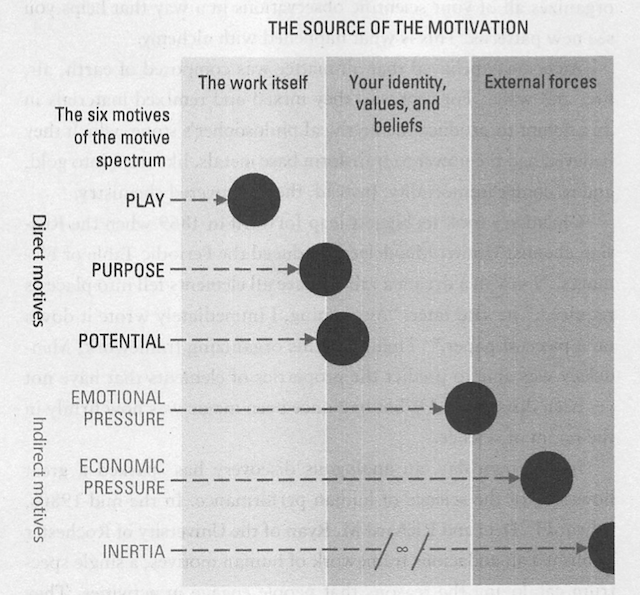
The authors argue there are six reasons we do anything. The first three they call indirect motivations and the latter three are direct motivations.

The Reasons We Work

The Direct Motives

Play

You’re most likely to lose weight—or succeed in any other endeavor— when your motive is play. Play occurs when you’re engaging in an activity simply because you enjoy doing it. The work itself is its own reward. Scientists describe this motive as “intrinsic.”

Play is what compels you to take up hobbies, from solving crossword puzzles to making scrapbooks to mixing music. You may find play in weight loss by experimenting with healthy recipes or seeking out new restaurants that offer healthy options. Many of us are lucky enough to find play in the workplace too, when we do what we do simply because we enjoy doing it.

Curiosity and experimentation are at the heart of play. People intrinsically enjoy learning and adapting. We instinctively seek out opportunities to play.

[…]

Play at work should not be confused with your people playing Ping Pong or foosball in the break room. For your people to feel play at work, the motive must be fueled by the work itself, not the distraction. Because the play motive is created by the work itself, play is the most direct and most powerful driver of high performance.

Purpose

A step away from the work itself is the purpose motive. The purpose motive occurs when you do an activity because you value the outcome of the activity (versus the activity itself). You may or may not enjoy the work you do, but you value its impact. You may work as a nurse, for example, because you want to heal patients. You spend your career studying culture because you believe in the impact your work can have on others. Dieters may not enjoy preparing or eating healthy meals, but they deeply value their own health, an outcome of healthy eating.

You feel the purpose motive in the workplace when your values and beliefs align with the impact of the work. Apple creates products that inspire and empower its customers, a purpose that is compelling and credible. …

The purpose motive is one step removed from the work, because the motive isn’t the work itself but its outcome. While the purpose motive is a powerful driver of performance, the fact that it’s a step removed from the work typically makes it a less powerful motive than play.

Potential

The potential motive occurs when you find a second order outcome (versus a direct outcome) of the work that aligns with your values or beliefs. You do the work because it will eventually lead to something you believe is important, such as your personal goals.

Dieters motivated by potential eat healthfully to achieve other things they care about—the ability to run faster on the football field, for example, or to keep up with their kids. When a company describes a job as a good “stepping-stone,” they’re attempting to instill the potential motive.

These are the direct motives. Direct because they generally connect to the work itself.

As a result, they typically result in the highest levels of performance. If you remember only one thing from Primed to Perform, it should be that a culture that inspires people to do their jobs for play, purpose, and potential creates the highest and most sustainable performance.

Not all motives correlate with higher performance. Motives that don’t connect to the work itself typically reduce performance.

The Indirect Motives

Emotional Pressure

The first indirect motive, emotional pressure, occurs when emotions such as disappointment, guilt, or shame compel you to perform an activity. These emotions are related to your beliefs (your self- perception) and external forces (the judgments of other people). The work itself is no longer the reason you’re working.

You may practice the piano so you don’t disappoint your mother. You may stay in a job because its prestige boosts your self-esteem. A dieter may eat healthy meals because he’s embarrassed by how he looks, or because he feels guilty when his partner catches him with his hand in the cookie jar.

In each case, the motive is not directly connected to the work. It is indirect.

When your motive to work is emotional pressure, your performance tends to suffer. … High-performing cultures reduce emotional pressure. … [E]motional pressure is the weakest of the three indirect motives. The effects of economic pressure can be much worse.

Economic Pressure

Economic pressure is when you do an activity solely to win a reward or avoid punishment. The motive is separate from the work itself and separate from your own identity (see Figure 3 for an illustration of this separation). In business, this often occurs when you’re trying to gain a bonus or a promotion, avoid being fired, or escape the bullying of an angry boss. Economic pressure can occur outside the workplace, whenever you feel forced to do something.

[…]

The biggest misconception about the economic motive is that it is strictly a matter of money. In a study we conducted involving more than ten thousand workers, we looked to see how the economic motive changes with household income. We expected to find that the people with the least income experienced the highest economic pressure. Instead, we learned that income and the economic motive were statistically unrelated. People at any income level can feel economic pressure at work.

This is an important insight. Money alone does not cause the economic motive.

[…]

There are situations where money works, and situations where it doesn’t. It all depends on whether or not the reward or punishment is the motive behind the activity, and whether the activity would benefit from adaptive performance.

Inertia

The most indirect motive of all is inertia. With inertia, your motive for working is so distant from the work itself that you can no longer say where it comes from—you do what you do simply because you did it yesterday. This leads to the worst performance of all. … As destructive and insidious as it is, inertia is surprisingly common in the workplace.

I’ll have more to say on culture but needless to say, this is only one lens.

--
Sponsored By: Greenhaven Road Capital: You think differently - now invest differently.

16 Oct 04:02

American Obesity

by Greg Mankiw
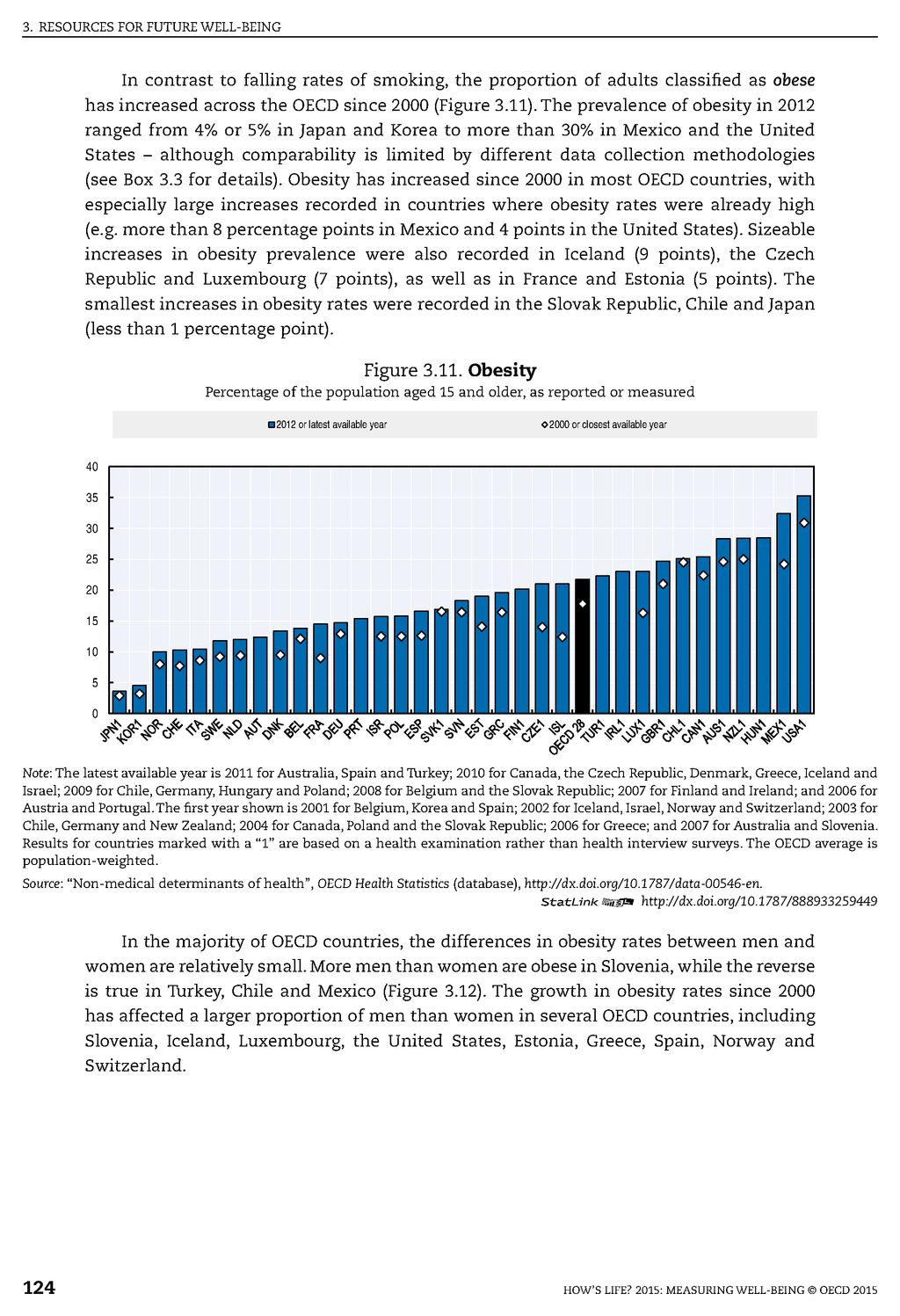
Critics of the U.S. health care system often say things like, "The United States spends more money than anyone else on health care but some other nations have better life expectancy." The next time someone starts making statements like that, keep in mind this chart.  It is a useful reminder that differences in health outcomes depend on a lot more than differences in the system for delivering medical care.

Source. Click on graphic to enlarge.
16 Oct 04:01

Revisiting IPOs

by SK

I’ve written several times (here, here and here) that the IPO pop is unfair to existing shareholders since they end up selling the stock cheaper than necessary. Responses I’ve received to this (not all on the blog comments) have mostly been illogical and innumerate, talking about how the pop “increases the value of the entrepreneurs’ holdings”, and that the existing shareholder “should be happy that the value has gone up” rather than wondering why he sold his shares at the low value.

Thinking about this in the context of the impending Cafe Coffee Day IPO, I realised that a pop is necessary (though not maybe to the extent of the MakeMyTrip and LinkedIn pops), because investors need some incentive to invest in the IPO rather than buying the stock in the secondary market after listing.

Secondary markets have superior price discovery compared to primary markets since the former have several (close to infinite) attempts at price discovery, while the latter have only one attempt. Also, prices in the secondary market change “slowly” (compared to the price difference between primary and secondary market), so even if someone has invested at a price they later have dissonance with, they can reverse the investment without incurring a high cost.

For this reason, if you want to invest in a company and want to know that you are paying a “fair price”, investing in secondary markets is superior to investing in primary markets. In other words, you need a higher incentive in order to buy in primary markets. And this incentive is provided to you in the form of the IPO pop.

In other words, the IPO pop is an incentive paid to the IPO buyer in exchange for investing at a time when the price discovery is in a sense incomplete and cannot be particularly trusted. Rather than pricing the IPO at what bankers and bookbuilders think is the “fair price”, they will price it at a discount, which offers IPO investors insurance against the bankers having made a mistake in their pricing of the IPO.

And how much to underprice it (relative to any “fair price” that the bankers have discovered) is a function of how sure the bankers are about the fair price they have arrived at. The greater their confidence in such a price, the smaller the pop they need to offer (again, this is in theory since investors need not know what fair price bankers have arrived at).

The examples I took while arguing that the IPO pop is unfair to existing shareholders were MakeMyTrip and LinkedIn, both pioneers in some sense. LinkedIn was the first major social network to go public, much before Facebook or Twitter, and thus there was uncertainty about its valuation, and it gave a big pop.

MakeMyTrip was a travel booking site from India listing on NASDAQ, and despite other travel sites already being public, the fact that it was from an “emerging market” possibly added to its uncertainty, and the resulting high pop.

So I admit it. I was wrong on this topic of IPO pops. They do make sense, but from a risk perspective. Nothing about “wealth of existing shareholders increases after the pop”.

16 Oct 03:51

The Proper Role of a Government

by Atanu Dey

People should be free to do whatever they can and wish to do. But that does not give license to people to do such things that cause harm to others. Since it would be too inefficient for each of us to individually protect himself or herself from harm by others, it is prudent to collectively create a mechanism that provides “policing services” that prevent anyone from causing harm to others, and in case harm is caused, to provide a means for the redressal of the harm and the punishment of the culprit. This fundamental function of providing policing services is the government’s proper role. Thus the proper role of the government must be limited to restraining people from harming others but not to forcing people into doing particular things.

In other words, the government’s job is solely to protect the negative right of every person, namely the right to be unharmed by others. Of course, there has to be a mechanism for determining what actions are harmful to others. The design of the mechanism that determine the rules — the rules of just conduct — has to be specified by a set of meta-rules. These meta-rules we call the constitution.

16 Oct 03:49

GDP growth is not exogenous

by Antonio Fatas
Ken Rogoff in the Financial Times argues that the world economy is suffering from a debt hangover rather than deficient demand. The argument and the evidence are partly there: financial crises tend to be more persistent. However, there is still an open question whether this is the fundamental reason why growth has been so anemic and whether other potential reasons (deficient demand, secular stagnation,…) matter as much or even more.

In the article, Rogoff dismisses calls for policies to stimulate demand as the wrong actions to deal with debt, the ultimate cause of the crisis. As he argues, given that government expenditures have kept expanding (he uses the number for France at 57% of GDP) it is hard to argue in favor of more spending.

But there is a perspective that is missing in that logic. The ratio of debt or government spending to GDP depends on GDP and GDP growth cannot be considered as exogenous. Assuming that the path of GDP is independent of the cyclical stance of the economy does not sound reasonable but, unfortunately, it is the way most economists think about a crisis. A crisis is seen as a temporary deviation of output but the trend is assumed to be driven by something else (innovation, structural reforms,..). But that logic runs contrary to evidence on the way investment and even R&D expenditures behave during a crisis. If growth is interrupted during a crisis output will never return to its trend. The level of GDP depends on its history, what economists call hysteresis. In that world reducing the depth of a crisis or shortening the recovery period has enormous benefits because it affects long-term GDP.


[To be fair to economists, we are all aware of the persistent dynamics of GDP, but at the theoretical level we tend to explain it with models where the stochastic nature of the trend is responsible for the crisis itself rather than assuming that other factors caused the crisis and the trend reacted to them.]


In a recent paper Olivier Blanchard, Eugenio Cerutti and Larry Summers show that persistence and long-term effects on GDP is a feature of any crisis, regardless of the cause. Even crisis that were initiated by tight monetary policy leave permanent effects on trend GDP. Their paper concludes that under this scenario, monetary and fiscal policy need to be more aggressive given the permanent costs of recessions.


Using the same logic, in an ongoing project with Larry Summers we have explored the extent to which fiscal policy consolidations can be responsible for the persistence and permanent effects on GDP during the Great Recession. Our empirical evidence very much supports this hypothesis: countries that implemented the largest fiscal consolidating have seen a large permanent decrease in GDP. [And this is true taking into account the possibility of reverse causality (i.e. governments that believed that the trend was falling the most could have applied stronger contractionary policy).]


While we recognize that there is always uncertainty when estimating this type of macroeconomic dynamics using one particular historical episode, the size of the effects that we find are large enough so that they cannot be easily ignored as a valid hypothesis. In fact, using our estimates we calibrate the model of a recent paper by Larry Summers and Brad DeLong to show that fiscal contractions in Europe were very likely self-defeating. In other words, the resulting (permanent) fall in GDP led to a increase in debt to GDP ratios as opposed to a decline, which was the original objective of the fiscal consolidation.


The evidence from both of these paper strongly suggests that policy advice cannot ignore this possibility, that crises and monetary and fiscal actions can have permanent effects on GDP. Once we look at the world through this lens what might sound like obvious and solid policy advice can end up producing the opposite outcome of what was desired.

Antonio Fatás


16 Oct 03:45

Leveraging bilateral finance in metro-rail projects

by noreply@blogger.com (Gulzar Natarajan)
The tenders for the third phase of Mumbai metro rail for 32.5 km at Rs 231.36 bn between Cuffe Parade in South Mumbai and Santacruz Electronics Export Processing Zone at Andheri have been received. The project will be financed with a Rs 133.25 bn soft loan from JICA, Rs 34.28 bn central share in the form of equity and debt, Rs 40.17 bn state government share, and Rs 7.77 bn from the Mumbai International Airport Ltd. The stretch, expected to be completed by 2019-20, will have 27 stations, with all but one being underground. 

Interestingly, among the nine selected bidders for the seven sections, there are only two Chinese contractors. Further, none of the biggest Chinese metro rail contractors, China Railway Construction Corporation (CRCC) or China Railway Rolling Stock Corporation (CRRC), which have been bidding aggressively across the world and have bagged contracts in Mexico, Argentina, and Boston, figure among the successful bidders. Given the competitive advantage of these firms, it is inconceivable that they would not have succeeded in winning atleast some of the packages. As I have blogged earlier, India's best hope of leveraging Chinese capital and construction technologies is to get Chinese contractors bid in such large construction contracts across India.

Did the central role of Japanese lending play a role in keeping them away? In any case, this raises an interesting tender design dimension. Countries like China, Japan, Germany, and South Korea have in recent months shown great interest to invest in India. There is already an established mechanism for private investments by their respective companies. But none exists for investments supported by bilateral loans from that country. Currently, bilateral loans are finalized through negotiations.

So how about a tender design where Chinese or Japanese bidders structure their bids contingent on the bilateral loan? In other words, the contractor negotiates the terms of the financing with its government and offers its bid accordingly. In a competitive bid process, each bidder has the incentive to negotiate the most favorable financing terms with their national governments. The bids become a proxy for competitive price discovery in the terms of bilateral loans. In order to avoid infringing WTO regulations, once the bids are finalized, the loan can be contracted between the two national governments. Or do the transaction costs associated with this structuring offset the gains by way of more efficient price discovery?
Add to Technorati Favorites
15 Oct 03:56

5 Big Questions on IPOs…Answered

by Vishal Khandelwal

The IPO season is back with a bang. First, the company behind the Cafe Coffee Day chain Coffee Day Enterprises will hit the markets today with its IPO to raise around Rs 1,150 crore or US$ 176 million. Then, later this month, India’s only profitable airline, Indigo, will open subscriptions to its Rs 2,500 crore or US$ 400 million IPO.

These are not anywhere close to the biggest of big IPOs India has seen, so rest assured that we are not at the peak of a bull market. :-)

But like all IPOs in the past, it’s very important for you as an investor to be careful and not give in to the hype and excitement that surrounds public issues. Towards this, here are my responses to the five key questions you may have about investing in IPOs. I also share below a template for analyzing an IPO document.

5 Questions on IPOs…Answered
1. What is an IPO?
IPO is the full form of Initial Public Offering, which means that this is the first time the underlying company is issuing its shares in public.

Some other definitions of this term, as defined by Benjamin Graham in his book The Intelligent Investor, include –

  • It’s Probably Overpriced, or
  • Imaginary Profits Only, or even
  • Insiders’ Private Opportunity

Graham’s definitions are more appropriate, given the way IPOs have been in the past. They have created wealth for insiders (promoters etc), while profits for minority investors have been imaginary. And they have mostly been overpriced in relation to the underlying assets and profits of the businesses.

2. Why don’t IPOs make money for small investors?
Now that’s simple to answer – Because (most) IPOs are not created that way i.e., to let small investors make money. Yes, in good times when the investor sentiment is on the extremely positive side, you can expect to make some money on the listing day. But even that is mostly imaginary – as the IPO valuations already capture in the future growth and more of it. Plus, the entire thought of waiting for listing gains goes against the very grain of owning businesses for the long term.

3. Why are most IPOs overpriced?
People assume an IPO is an opportunity to “get in at lower prices”. In reality, by the time you buy shares of a company in its IPO, other parties have almost always invested earlier at lower prices – often, much lower prices. Before you even knew about the company, there probably were three or four rounds of private investment, and the per-share price of ownership usually goes up with each round.

In fact, one of the big incentives for an IPO is so that previous investors – founders, venture capital firms, large individual investors – can “cash out” at least a portion of what they’ve invested. That is why most IPOs are often expensively priced.

They are not priced to offer you a piece of the business at cheap or reasonable prices, but to find “bigger fools” who can get in when the “privileged few” are getting out.

4. So why do most investment bankers and analysts recommend IPOs?
Don’t believe them! When an investment banker says an IPO is “cheap and attractive,” first know that his or her incentive lies in first fixing the IPO price (whatever the promoter wants) and then working backwards to justify the same.

It’s important to understand that the investment bankers and underwriters of IPO are simply salesmen. The whole IPO process is intentionally hyped up to get as much attention as possible. Since IPOs only happen once for each company, they are often presented as “once in a lifetime” opportunities for the promoters and other large shareholders to cash out.


Promoters and investment bankers thus create stories that are vivid – by using terms like “listing gains”, “bright future”, “long-term story” – and entice you to believe them as soon as you hear them. You must avoid getting charmed by that vividness. Try to go behind the beauty of that vividness, and scrutinize the IPO to see if it is really so bright and beautiful.

In other words, you need to get past the “bright and shiny” stuff that surrounds IPOs because it’s easy to fall into the trap given that so many others around you are falling for the same.

Don’t buy a stock only because it’s an IPO – do it because it’s a good investment.

5. Okay, how do I scrutinize an IPO i.e., do my own homework, before deciding whether to apply for an IPO or not for long term investment?
Here is an IPO analysis template I have created which you can use to analyze any IPO. I have used the case of the IPO that opens today – Coffee Day Enterprises (CCD). But this is not my analysis of CCD or a view on its IPO, but just a template on how you can study any IPO to decide why you should not apply to it. 😉

Click here to download the template (10 MB PDF) or read it in the panel below…


Final Word on IPOs
Here are some thoughts on IPOs from a few of the investing legends…

Warren Buffett wrote in his 1993 letter…

[An] intelligent investor in common stocks will do better in the secondary market than he will do buying new issues…[IPO] market is ruled by controlling stockholders and corporations, who can usually select the timing of offerings or, if the market looks unfavourable, can avoid an offering altogether. Understandably, these sellers are not going to offer any bargains, either by way of public offering or in a negotiated transaction.

When Buffett issued Class-B shares of Berkshire, he made sure that it wasn’t a typical IPO. He wrote in his 1997 letter…

Our issuance of the B shares not only arrested the sale of the trusts, but provided a low-cost way for people to invest in Berkshire if they still wished to after hearing the warnings we issued. To blunt the enthusiasm that brokers normally have for pushing new issues—because that’s where the money is—we arranged for our offering to carry a commission of only 1½%, the lowest payoff that we have ever seen in common stock underwriting. Additionally, we made the amount of the offering open-ended, thereby repelling the typical IPO buyer who looks for a short-term price spurt arising from a combination of hype and scarcity.

The dot com crash of 2000 was preceded by hundreds of IPOs where the underlying business was literally nonexistent. In his 2001 letter, Buffett wrote…

The fact is that a bubble market has allowed the creation of bubble companies, entities designed more with an eye to making money off investors rather than for them. Too often, an IPO, not profits, was the primary goal of a company’s promoters. At bottom, the “business model” for these companies has been the old-fashioned chain letter, for which many fee-hungry investment bankers acted as eager postmen.

Benjamin Graham wrote in The Intelligent Investor

In every case, investors have burned themselves on IPOs, have stayed away for at least two years, but have always returned for another scalding. For as long as stock markets have existed, investors have gone through this manic-depressive cycle.

In America’s first great IPO boom back in 1825, a man was said to have been squeezed to death in the stampede of speculators trying to buy shares in the new Bank of Southwark. The wealthiest buyers hired thugs to punch their way to the front of the line. Sure enough, by 1829, stocks had lost roughly 25% of their value.

In Chapter 6 of his book, Graham wrote…

Our one recommendation is that all investors should be wary of new issues—which means, simply, that these should be subjected to careful examination and unusually severe tests before they are purchased. There are two reasons for this double caveat. The first is that new issues[IPO] have special salesmanship behind them, which calls therefore for a special degree of sales resistance. The second is that most new issues are sold under “favorable market conditions”—which means favorable for the seller and consequently less favorable for the buyer.

Charlie Munger said this in Berkshire’s 2004 meeting…

It is entirely possible that you could use our mental models to find good IPOs to buy. There are countless IPOs every year, and I’m sure that there are a few cinches that you could jump on. But the average person is going to get creamed. So if you’re talented, good luck.

To which Buffett added…

An IPO is like a negotiated transaction – the seller chooses when to come public – and it’s unlikely to be a time that’s favorable to you. So, by scanning 100 IPOs, you’re way less likely to find anything interesting than scanning an average group of 100 stocks.

Buffett also said…

It’s almost a mathematical impossibility to imagine that, out of the thousands of things for sale on a given day, the most attractively priced is the one being sold by a knowledgeable seller (company insiders) to a less-knowledgeable buyer (investors).

The late Mr. Parag Parikh wrote in his book, Value Investing and Behaviour Finance…

It’s safe to conclude that IPOs, which seem like a good investment vehicle are, in reality, not so. In fact an IPO is a product which is against investor interest, as it is mostly offered to investors when they are willing to pay a higher and outrageous valuation in boom times.

Prof. Sanjay Bakshi wrote this in a 2000 article …

Any kind of rational comparison of long-term returns in the IPO market and the secondary market would show that investors do far better in the latter than in the former…IPOs are one of the surest way of losing money in the long run.

Four characteristics of the IPO market makes it a market where it is far more profitable to be a seller than to be a buyer. First, in the IPO market, there are many buyers and a only a handful of sellers. Second, the sellers, being insiders, always know more about the company whose shares are to be sold, than the buyers. Third, the sellers hold an extremely valuable option of deciding the timing of the sale. Naturally, they would choose to sell only when they get high prices for the shares. Finally, the quantity of shares being offered is flexible and can be “managed” by the merchant bankers to attain the optimum price from the sellers’ viewpoint.

But, what is “optimum” from the sellers’ viewpoint is not the “optimum” from the buyers’ viewpoint. This is an important point to note: Companies want to raise capital at the lowest possible cost, which from their viewpoint means issuance of shares at high prices. That is why bull markets are always accompanied by an surge in the issuance of shares.

You get the message, right?

Hype and excitement doesn’t necessarily equate to a good investment opportunity. And IPOs are mostly about that – hype and excitement.

If we get back into a bull market and the IPO line lengthens, I’m afraid you’ll have plenty of opportunities to see that I’m right. :-)

The post 5 Big Questions on IPOs…Answered appeared first on Safal Niveshak.

    
15 Oct 03:52

Black Money Laundered Through Bank of Baroda’s Delhi Branch, Dummy Imports Worth 6,000 cr. Found

by Deepak Shenoy

Bank of Baroda’s officials in their Ashok Vihar (Delhi) branch seem to be doing something really shady. More than 6,000 cr. was found to have been transferred abroad, into shady accounts, from that tiny little branch, and here’s what LiveMint had to report:

In total, between 1 August 2014, when the irregular remittances to foreign accounts first began, till 31 July this year, an amount of Rs.6,172.92 crore was transferred, the report shows.

In its statement to the stock exchanges, the bank claimed that around Rs.3,500 crore was remitted through 38 accounts to nearly 400 entities in Hong Kong and the UAE. It admitted that the Ashok Vihar branch did not follow Foreign Exchange Management Act rules.

And now, six people have been arrested, including two senior officials of BoB and one from HDFC bank.

In essence, adding from an Indian Express report:

  • Some businessmen created dummy companies in Hong Kong and India
  • They exported overvalued products and generated fake bills, and received import remittances from those countries
  • They claimed a “duty drawback” from the government (which pays back the duties paid as inputs, when you have exported the output)
  • Then they paid for “imports” back from these locations, so the money would go back out.
(Read On...)
15 Oct 03:48

Are You an Outsider Trying To Change A Broken System?

by Shane Parrish

Joseph Tussman

Elizabeth Warren was one of the key architects in the U.S. government’s response to the financial crisis. In her memoir, A Fighting Chance, Warren draws our attention to the troubling reality of high-level Washington.

One particular anecdote is worth noting for its penetrating insight into how the world actually works.

Warren was a member of the Congressional Oversight Panel, which, she writes, “couldn’t change a system that seemed hellbent on protecting the big guys and leaving everyone else by the side of the road.”

In 2009 after the panel had produced its third report, concluding that the risks to the American taxpayers were far greater than Treasury let on, Lawrence H. Summers, then the director of the National Economic Council and a top economic adviser to President Obama, “leaned back in his chair and offered me some advice,” Ms. Warren writes.

Larry’s tone was in the friendly advice-category. He teed it up this way: I had a choice. I could be an insider or I could be an outsider. Outsiders can say whatever they want. But people on the inside don’t listen to them. Insiders, however, get lots of access and a chance to push their ideas. People — powerful people — listen to what they have to say. But insiders also understand one unbreakable rule: They don’t criticize other insiders.

And that is how the world inside government and organizations often works. You’ve been warned.

--
Sponsored By: Greenhaven Road Capital: You think differently - now invest differently.

15 Oct 03:14

FATCA is now operational…

by subra
If you are a green card holder or a US citizen and investing abroad (7 countries initially) and about 130 countries in 2 years time..well the data is going to your IRS. This means even if you have unintentionally or by mistake not declared some income / asset in your home country, you could be […]
14 Oct 03:55

Emergence of fake wedding markets in Argentina..

by Amol Agrawal
As large number of people are no more marrying in the Latin American country, there is still the demand for being part of the celebrations. So this has led to a fake wedding market in Argentina where people pay to be invited and everything is fake (HT MR Blog)! “It all started two years ago […]
14 Oct 03:55

Who won the Nobel Prize?

by Atanu Dey

Actually nobody “won” any Nobel prize in anything ever. Nobody wins a Nobel prize in anything simply because “to win” implies a contest that participants engage in. Nobel prizes — and other prizes of that nature such as the Indian “Bharat Ratna” — are awarded to certain people or institutions based on the judgement of a select group of people. This process of selecting an awardee is more subjective than say the process by which we decide who won the 100-meter dash in the Olympics in 2004 because in the latter uninvolved bystanders can agree whether or not Charlie crossed the finish line ahead of the other sprinters. In the case of Nobel prizes, people outside the selection committee can — and do — disagree with the judgement of the committee.

As it happens, I think the Nobel Peace Prize is a joke, although I am sure that the Peace Prize committee takes its job very seriously. War criminals being awarded the Peace Prize no longer raises eyebrows. Henry Kissinger (how I’m missin’ ya) was awarded the prize. A quick search to refresh Kissinger’s atrocities finds this:

Former US Secretary of State Henry Kissinger, the notorious war criminal responsible for an estimated 3 to 4 million deaths during the Vietnam War including the bombing of Cambodia was awarded the Nobel Peace Prize in 1973. He was responsible for the overthrow of President Salvador Allende of Chile and installed Fascist General Augusto Pinochet which created a “Police State” among the Chilean population. Kissinger also was instrumental in giving support to one of the worst dictatorships in human history, the Khmer Rouge under Pol Pot. Henry Kissinger committed many other crimes including genocide under both Presidents Richard Nixon and Gerald Ford as an “advisor” under the NSA (National Security Agency) and as Secretary of State. President **** **** was also awarded the Nobel Peace Prize although he was in office less than a year. **** has expanded Drone wars in Pakistan and Yemen, opened several US military bases in Colombia and one in Chile, he ordered a war in Libya without congressional approval, maintained a military presence in Iraq and escalated the war in Afghanistan. ****’s record of peace on the international level is questionable. **** said that he was “Surprised” and “deeply humbled” after he received the award. He said the Nobel Peace Prize is a “Call to Action”, meaning more war. It is fair to say that the US government has been involved in many “actions” across the world, whether militarily or economically that has done more harm than good.

Only astonishing hypocrisy, gross cynicism, blind ignorance, and staggering hubris in the committee can explain these results.

14 Oct 03:51

Hunter S. Thompson on Living versus Existing

by Shane Parrish

Security

Hunter S. Thompson’s letter to Hume Logan on finding your purpose and living a meaningful life is one of the most popular posts to ever appear on Farnam Street.

One reader found it so valuable he dug into Thompson’s work in search of more wisdom. He ended up printing out a copy of Thompson’s “Security” and mailed it to me.

Thompson, for his part, lays out some timeless wisdom yet again.

Security … what does this word mean in relation to life as we know it today? For the most part, it means safety and freedom from worry. It is said to be the end that all men strive for; but is security a utopian goal or is it another word for rut?

Let us visualize the secure man; and by this term, I mean a man who has settled for financial and personal security for his goal in life. In general, he is a man who has pushed ambition and initiative aside and settled down, so to speak, in a boring, but safe and comfortable rut for the rest of his life. His future is but an extension of his present, and he accepts it as such with a complacent shrug of his shoulders. His ideas and ideals are those of society in general and he is accepted as a respectable, but average and prosaic man. But is he a man? Has he any self-respect or pride in himself? How could he, when he has risked nothing and gained nothing? What does he think when he sees his youthful dreams of adventure, accomplishment, travel and romance buried under the cloak of conformity? How does he feel when he realizes that he has barely tasted the meal of life; when he sees the prison he has made for himself in pursuit of the almighty dollar? If he thinks this is all well and good, fine, but think of the tragedy of a man who has sacrificed his freedom on the altar of security, and wishes he could turn back the hands of time. A man is to be pitied who lacked the courage to accept the challenge of freedom and depart from the cushion of security and see life as it is instead of living it second-hand. Life has by-passed this man and he has watched from a secure place, afraid to seek anything better What has he done except to sit and wait for the tomorrow which never comes?

Turn back the pages of history and see the men who have shaped the destiny of the world. Security was never theirs, but they lived rather than existed. Where would the world be if all men had sought security and not taken risks or gambled with their lives on the chance that, if they won, life would be different and richer? It is from the bystanders (who are in the vast majority) that we receive the propaganda that life is not worth living, that life is drudgery, that the ambitions of youth must he laid aside for a life which is but a painful wait for death. These are the ones who squeeze what excitement they can from life out of the imaginations and experiences of others through books and movies. These are the insignificant and forgotten men who preach conformity because it is all they know. These are the men who dream at night of what could have been, but who wake at dawn to take their places at the now-familiar rut and to merely exist through another day. For them, the romance of life is long dead and they are forced to go through the years on a treadmill, cursing their existence, yet afraid to die because of the unknown which faces them after death. They lacked the only true courage: the kind which enables men to face the unknown regardless of the consequences.

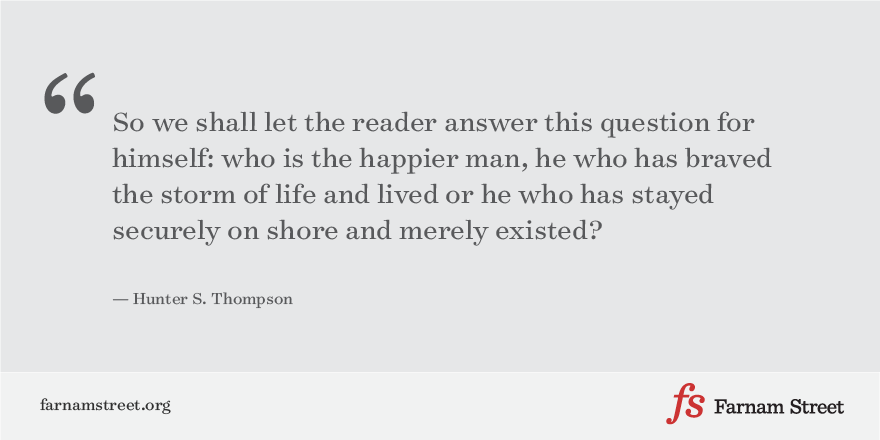
As an afterthought, it seems hardly proper to write of life without once mentioning happiness; so we shall let the reader answer this question for himself: who is the happier man, he who has braved the storm of life and lived or he who has stayed securely on shore and merely existed?

--
Sponsored By: Greenhaven Road Capital: You think differently - now invest differently.

14 Oct 03:46

Should you buy a house?

by subra
Frankly Indians over build and then we all over buy. If there are more assets than users (forget buyers, that we have enough) it is obvious that rental properties will be available… Currently in the building that we live there are 84 flats available for usage and in the past 6 months about 4 flats […]
14 Oct 03:35

Drafting better laws

by Ajay Shah
Deepak Patel has a useful article in today's Business Standard about the problems of poorly drafted laws.

Badly drafted laws and the problem of State capacity


It is widely understood that badly drafted laws induce legal risk. Some of this is at the level of syntax, e.g. the use of ambiguous words like "shall" or "may". Far more important is the semantic content. When it is not clear what the law says, government officials and private persons are continually at sea in thinking about what is to be done.

Badly drafted laws are about much more than legal risk, however. They go to the heart of India's crisis of State capacity. Our challenge is to go from government organisations which are shambolic rulers, to high performance organisations which are precisely structured agents of Parliament.

Parliamentary law is the contract between the principal (Parliament) and the agent (a government agency).  In India, these laws are often riddled with vague objectives (e.g. "the welfare of the people"), expansive powers (e.g. "any action that is necessary") and inadequate accountability mechanisms (e.g. lack of a mechanism for appeal or lack of a proper board of directors). Bad laws mishandle the principal-agent relationship and lay the foundation for pervasive failure on the part of the agent. The laws that have created organisations ranging from SEBI to RBI to the CBI are riddled with problems, and have caused low performance on the part of these agencies. A quantum leap in the laws is of essence in the task of achieving State capacity in India.

A key foundation of low State capacity in India is badly drafted law. State apparatus is integral to the process of drafting law in India. This gives a vicious cycle, as bad laws $\rightarrow$ low State capacity $\rightarrow$ bad laws. Getting to good quality laws, at present, is going against the grain. A great deal of effort is required to break with this vicious cycle, to get a first wave of high quality laws, which will induce better working of the State, which can potentially kick off a virtuous cycle.

How to do better: Contracting between the Principal and Agent


Private parties mitigate the risks of failure by applying skepticism and precision to the contracts they draft: A company might use a well-written contract to bind, motivate and monitor the canteen services vendor it has hired. The Principal does not believe the Agent is benevolent and means well. The Principal writes a contract which constraints the Agent into delivering results. The drafters of laws should apply at least the same level of skepticism and precision for writing a "contract" which establishes a government agency and asks it to do work.

How to do better: An analogy with computer software


A computer program is a precise set of instructions which tells the hardware what to do. In similar fashion, law is the precise set of instructions which tells a government agency what to do. Writing law is like computer programming. The law is written, it is enacted by Parliament, and then it induces certain effects. We would like for those effects to be the ones that we desire.

When computer programs are written, there is extreme care about every single letter of the code. A small core of high skill persons is given the ability to touch the code. Every little detail matters. There is a sense of craftsmanship about the product. We do not allow random people to make even minor edits in the code.

A similar culture is required when drafting law. The ability to touch the code should be restricted to small teams of very high skill. Every little detail should be thought through with great care. There should be an extreme sense of craftsmanship about the product.

With computer software, it is relatively easy to take an interim version, load it into the hardware, and try to run it. If the code is incorrect, we know fairly soon that there are problems. The trouble with law is that there is no easy way to visualise what will happen when a proposed text is enacted. This requires imagination and visualisation, grounded in deep domain knowledge. The teams which draft law have to thus be deeply grounded not just in law but in the domain knowledge. Every small proposed change must be exposed to extreme scrutiny by very capable people.

The journey to better laws in 11 steps


How can law be drafted better? The following principles are useful:

  1. Be wary of incumbents. "Do not judge your own cause" is a principle of natural justice, and this requires excluding incumbent agencies from the legislative process. The canteen contractor should not be given a say in the drafting of the canteen contract. In similar fashion, incumbent agencies should not be given a say in the drafting of laws which shape their objectives, powers and accountability mechanisms as they will exert their influence in favour of more power and less accountability.
  2. Malleability vs. the agency problem. Many laws achieve malleability by leaving procedural details to be written in the future in subordinated legislation. We should, however, be mindful of giving power to the canteen contractor to reshape the objectives, the powers and the accountability mechanisms of the canteen contractor. This principle guides the scope for powers given to the agent to write law.
  3. The Joint Secretary cannot manage these projects. The scale of time and effort that goes into a well drafted law is very large. Example. It is generally not possible for senior government officials (e.g. joint secretaries) to put in this kind of time. A different organisational arrangement is required.
  4. Writing law is different from reading it. Most lawyers in India are used to treating the law as given, and thinking about transactions or litigation. Writing law is a very different skill. It is primarily a skill that requires a combination of domain knowledge and public administration. Years of experience as a legal practitioner is not adequate preparation for writing law.
  5. Premature coding. In drafting projects, there is a temptation to start coding prematurely. It feels satisfying, particularly for lawyers, to be writing code. However, it makes more sense to first grow roots in the domain knowledge, and write sophisticated documents that articulate the thought process of the proposed law. This thinking process is a necessary preamble before the first line of code is written. There is an old adage in project management: `plan in haste, repent in leisure'. A long slow process is required, that builds clarity of mind, and results in a reasoned document of drafting instructions, after which the drafting can commence.
  6. Access control in the drafting / editing process. A very small team of persons should be constructed which has the ability to make changes to the draft. The management process should eschew edits coming in from people who are not fully steeped in the thought process of the law.
  7. The need for continuity and absorption. It is very hard for a new person to fully understand the logic of a large code. It is even more dangerous for a new person to propose or make changes in a large code without fully understanding it. High continuity of personnel who will own and refine a code, over long periods of time, is required. These personnel should be fully immersed in all aspects of the law, so as to keep all the moving parts in their heads, and be able to effortlessly and immediately see the implication of a change in Section $i$ for the working of Section $j$.
  8. Break with our traditional writing style. High levels of craftsmanship are required, with the use of modern English and simple direct precise sentences. The traditional Indian writing style is a recipe for introducing legal risk, executive discretion and ultimately in producing low State capacity.
  9. Gear up for a detailed law. A canteen contract of 1000 words, which is a skimpy high level statement, is almost surely a bad contract. It takes a lot of work to precisely write down a sound contract. In similar fashion, most Indian parliamentary laws have inadequate detail. We should go into drafting projects knowing that the parliamentary laws of the future will be much more detailed than those of our past.
  10. Given enough eyeballs, all bugs are shallow. Draft law should be put through elaborate processes of expert peer review, and public comment, in order to identify flaws ahead of time.
  11. Code reuse -- but in the future. Most existing law and jurisprudence in India has a high defect rate. Hence, law drafting projects should be skeptical about the existing landscape and try to replace it with clean building blocks for India's future. There are opportunities for code reuse -- but only in our future.

Conclusion


We are stuck in the wrong equilibrium. Most laws in India today are poorly drafted. Badly drafted laws are at the foundation of low State capacity in India today. As arms of the State presently play a dominant role in the drafting of laws, there is a vicious cycle there. If we don't make a big push to do law $n+1$ properly, by default, it will be mediocre. The normal processes are stacked in favour of failure.

The minimum required step up is from the conventional drafting quality up to the standards of commercial contracts. The SEBI Act (say) should match the quality of a commercial contract in terms of precision, level of detail, and a skeptical approach to the principal-agent problem. This level of improvement is relatively easy to obtain, in the sense that myriad detailed commercial contracts are being drafted by lawyers in India every day.

The bigger step up is to think of law as the DNA of government. The law is the computer code which is loaded into government. When this code runs, it has legal effects. This requires bringing public administration and economic thinking in envisioning the legal effects of every line of the code. The standards of craftsmanship and perfection which are found in the best computer programs are required in writing law.

Acknowledgments


I thank Pratik Datta and Arjun Rajagopal for useful discussions.
    14 Oct 03:21

    Mobility and access to better opportunities

    by noreply@blogger.com (Gulzar Natarajan)
    The debate on capitalism and widening inequality is far more complex than appears at first sight. For example, consider this from a review of Caroline Freund's new book,
    At the World Economic Forum in Davos this year, Winnie Byanyima, executive director of Oxfam International, referred to the relief charity’s findings that the richest 1 per cent of the world’s population would own more than 50 per cent of the world’s wealth by 2016. In response, Sir Martin Sorrell, chief executive of WPP, the advertising group, said: “I make no apology for having started a company 30 years ago with two people and having 179,000 people in 111 countries and investing in human capital each year to the tune of at least $12bn a year.”
    Ms Freund's taxonomy of the super-rich in the emerging world shows that such wealth is largely self-made, and the share of inherited wealth is continuously declining. Obviously, I do not imagine that she is trying to justify widening inequality on this ground, though many others argue vehemently that if anybody can become super-rich, then what is wrong with the dynamics whose one consequence is widening inequality. What gives?

    Rationalization of widening inequality on grounds of self-made wealth (as against inherited wealth) overlooks the important point that even access to the opportunity to create self-made wealth is increasingly an ovarian lottery - function of where (country, city/region, locality, and family) you are born. When all is said and done, you are, largely (because of), where are you are born!

    Malcolm Gladwell, chronicler par excellence of the less-discussed, has a fascinating essay in New Yorker where he explores the unintended positive consequence of the dislocation caused by Hurricane Katrina on the black population of New Orleans. He argues that by being forced out from the excruciating poverty and blight of pre-Katrina New Orleans black neighborhoods, the nearly 80,000 black population which moved out of the city in its aftermath were presented with an opportunity for social and economic mobility they would otherwise have not had. 

    In this context, he writes about the acclaimed work of Raj Chetty, Nathaniel Hendren, and others which documented economic mobility across the US and found the dominant influence of people's immediate socio-economic environment in their life outcomes. He writes,
    Moving matters: going to a neighborhood that scores high on those characteristics from one that does not can make a big difference to a family’s prospects... Suppose you look at parents who earn in the first quintile—that is, the bottom fifth of the U.S. income distribution. What are the odds that one of their children will—by the time that child reaches adulthood—make it into the top fifth of the income distribution? Those odds, they found, vary dramatically from one city to the next. In San Jose, for example, the probability is 12.9 per cent... At the other end of the spectrum is Charlotte, North Carolina, where the probability is 4.4 per cent: a poor child is almost three times more likely to reach the top in San Jose than he or she is in Charlotte.
    In a second analysis, Chetty and Hendren assigned a value to every major metro area in the country, according to how much more (or less) a child can expect to earn depending on the city where he or she grew up. The No. 1 urban area, by this measure, is Seattle, at 11.6 per cent: by the age of twenty-six, the child of a family in Seattle earning just above the poverty line will make 11.6 per cent more than would otherwise have been expected. The place bonus for Minneapolis is 9.7 per cent; in Salt Lake City, it is 9.2 per cent. Coming in last on the list of the hundred largest commuting zones in the country, by contrast, is Fayetteville, North Carolina, which has a place penalty of negative 17.8 per cent: the child of a poor person in that city will end up earning substantially less than he or she would otherwise have earned, simply by having been raised in Fayetteville.
    So how did moving out of New Orleans improve access to opportunities and likelihood of better life outcomes?
    In the Chetty-Hendren-Kline-Saez analysis, New Orleans has a bottom-to-the-top probability of 5.1 per cent, which is half a percentage point behind Detroit. And the place bonus / penalty for New Orleans? Minus 14.8 per cent, which puts it ninety-ninth out of the top hundred biggest urban areas in the country, ahead of only Fayetteville.
    So is moving poor people out of their existing neighborhoods the best poverty reduction strategy? Unfortunately, as with everything in life, there are no such neat and simple solutions. The problems starts when the partial equilibrium findings of Chetty, Hendren et al intersects with the general equilibrium dynamics that are triggered by such mass movements,
    If too many poor African-Americans move into a middle-class neighborhood, then the middle class leaves—robbing the community of many of the things that the movers came in search of.
    This is apart from the other major consequences of inequality, on which I have blogged repeatedly - the capture of political decision making and the inhibition of economic growth itself
    Add to Technorati Favorites
    14 Oct 03:15

    Twitter or Newswires: Are regulators behind the curve?

    Last week, I read two stories that made me wonder how regulators are far behind the curve when it comes to new media.

    First, Business Insider reported that after the newswire hacking scandal (which I blogged about last month), Goldman Sachs was considering announcing its earnings on Twitter instead of on the newswires. Of course, such reports are often speculative and nothing may come of it, but it indicates that at least some organizations are taking the new media seriously.

    Second, was an amendment to the New York Stock Exchange (NYSE) rules on how companies should release news to the public (h/t CLS Blue Sky Blog):

    Currently, section 202.06(C) ... on the best way to release material news ... is outdated as it refers to, among other things, the release of news by telephone, facsimile or hand delivery. Instead, the Exchange proposes ... that listed companies releasing material news should either (i) include the news in a Form 8-K or other Commission filing, or (ii) issue the news in a press release to the major news wire services.

    The regulators have finally decided to shift from obsolete media to the old media; the new media is not even on the horizon.

    13 Oct 06:23

    Stop being impressed by the following…

    by subra
    The journey from ‘having’ to ‘being’ is not an easy one. If you have had a deprived child hood, you may not yet be mentally ready for minimalisation. When you simplify things like deciding to have only white shirts and black pants, you are making a choice. If you are really rich and your servants […]
    13 Oct 04:08

    The Case for a Carbon Tax

    by Greg Mankiw
    13 Oct 04:08

    3 Reasons Why Most Entrepreneurs Drop Out Of The Race, Here’s How To Prevent It.

    by Rosemary Nonny Knight

    iStock_000019376643SmallIt is so easy right now to start a business working out of your home but it is not actually quite so easy to make that business, start making you money. And this is where a lot of entrepreneurs find themselves. And this is why a lot of entrepreneurs quit. How can you make sure that you do not become one of these people that this happens to? Do you know these three major issues that cause entrepreneur to drop out of the race? 1. Stuck in Reverse Are you stuck looking back at all the mistakes you have made and the reasons why you think you cannot succeed as an entrepreneur? Maybe you think that because no one in your family has ever done […]

    The post 3 Reasons Why Most Entrepreneurs Drop Out Of The Race, Here’s How To Prevent It. appeared first on Dumb Little Man.

    13 Oct 04:07

    India Needs a New Constitution

    by Atanu Dey

    Human societies are rule-based. Rules not just define human societies but rules also differentiate between societies. Sufficiently large collectives of of people (say 100,000 or more) are indistinguishable in terms of their endowments because we all belong to the same species and we are just random draws from the same gene pool with minor variations. IF that is so, then what’s the origin of the inequality we observe in the wealth of nations? Why is Burundi not as wealthy as Sweden? The answer is that different societies follow different sets of rules, and the outcomes differ. Out of all the rules, norms, customs and traditions of a people, the formalized high-level set of rules is called the constitution.

    In the following piece, co-authored with Rajesh Jain, I argue that India needs a new constitution. It was published today in Quartz. Here it is, for the record.

    Why India needs a new constitution

    The widely acknowledged fact that non-resident Indians are successful in the US in general—and the Silicon Valley in particular—stands in sharp contradistinction to the fact that Indians are not very successful in promoting India’s prosperity. Even after seven decades of Independence, the country has failed to become a developed nation.

    The question why that is so needs an answer not for any academic reason, but because the prosperity of more than a billion people hinges on it. Without understanding the precise reasons for India’s continued under-performance, it is unlikely that it will break out of this trap.

    A quick review of factors that could potentially prevent a country’s economic growth is useful. Among those factors that destroy all possibilities of wealth creation are devastating foreign invasions or protracted wars; decades-long chronic internal civil conflict; frequent country-wide natural disasters such as earthquakes, floods and droughts; acute lack of natural resources; total lack of human, social and cultural capital, among others.

    Clearly, in India’s case, those factors do not apply—either individually or in combination. That leaves two factors that were not mentioned but could explain India’s case. One is divine decree and the other is poor governance. Assuming that the gods are not maliciously inclined towards India, we focus on the government factor.

    The claim made here is that the proximate reason for India’s lack of progress are policies that prevent sustained growth, and that these policies ultimately derive from the Constitution of India.

    Economic policies flow from the type of government and its objectives. Growth-oriented governments implement policies that promote economic development. Contrast that with governments that implement extractive policies, which retard or altogether prevent development, primarily because extractive policies are not consistent with development. It is the Constitution that directly determines what kind of government a nation has, and thereby indirectly the economic policies.

    Economic policies have consequences. How an economy performs depends on policies that the government implements. Nobel prize winning economist Douglass North observed that “economic history is overwhelmingly a story of economies that failed to produce a set of economic rules of the game (with enforcement) that induce sustained economic growth.”

    Is there any reason to expect Indian governments to be exploitative? History provides a plausible answer. For nearly a century, India was under comprehensive colonial British rule. As can be rationally expected, the government that the British imposed on India was not primarily directed towards development, but rather towards extraction. That is only reasonable because wealth extraction is the rationale for colonial rule.

    The British, therefore, created the institutional structures, which necessarily includes the government that controlled India through comprehensive government control of the economy. This structure administration and control was left intact when the British decided to leave India, and was taken over by the government of Independent India. Although India attained political independence from the British raj, Indians did not become free of a controlling—and extractive—government.

    Independence brought political freedom to Indians, but not economic freedom. The positive correlation between economic freedom and the prosperity of a country is so robust that the causal link between the two is impossible to miss or deny. Countries with the most economic freedom are the most prosperous. Consider the Fraser Institute’s Economic Freedom of the World: 2015 Annual Report, in which they rank 157 countries for the year 2013. In the first quartile, the most economically free, you find the prosperous large advanced industrialized countries such as the UK (10th rank), the US (16th), Japan (26th) and Germany (29th). The fourth quartile is the least free and understandably economically backward countries like Iran, Brazil, Argentina and Venezuela. India falls near the bottom of the third quartile (114th), behind Mexico (93rd), Russia (99th) and China (111th).

    As noted at the beginning, Indians are not incapable of creating wealth. Where they have economic freedom, they do prosper. Indian Americans constitute the most economically successful of all ethnic groups in the US, with a median annual household income of around $100,000, which is nearly double that of the US as a whole. This fact is noteworthy because it points to a fundamental structural difference between India and the US even though they are both large democracies. This is a consequence of the “different rules of the economic game,” which arises from differences in the Constitutions of the two countries.

    India’s Constitution is very large, gives the government enormous powers to intervene in the economy, allows the government to enact laws that discriminate among citizens based on attributes such as sex, religion, and caste, restricts freedom of speech, and limits the right to property. In short, it allows deliberate political and economic exploitation. The US constitution, by contrast, is short, grants freedom of speech, protects property rights, prohibits discrimination among citizens, and limits the power of the government.

    The most salient distinction between the US and Indian Constitutions lies in the relationship between the people and the government that the two define. The US Constitution places the people as the principal and the government as its agent. This is evidenced in the limits that the Constitution imposes on hthe power of the US Congress. The Indian Constitution places the government as the principal and the people as its agent—as can be expected of a government that is essentially colonial in nature. Like the British government before it, the governments of post-1947 India impose what’s known as the “permit, permission, license, quota control raj.”

    The deleterious effects of the license-control-quota-permit raj are too evident. Economic policies frame the economic environment and, therefore, the economic opportunities. Competent people who lack economic opportunities vote with their feet—if they are able to—in search of greater economic freedom. Looked at it this way, Indian Americans are economic migrants and economic refugees. The wealth they create for themselves and their adopted country is immense, but it also represents the wealth that could have been potentially created in India but was lost. The government of India, while celebrating the successes of NRIs, must also do a bit of soul-searching and ask why so many Indians are compelled to leave India.

    India is a functioning democracy. General elections are regularly held and power is transferred routinely and peacefully. Every election is met with great hope that with different political leaders, that things will change for the better. But, although the governments and leaders change, there is very little real change. Regardless of which party or coalition of parties is in power, the policies hardly change.

    Nobel laureate economist, James Buchanan Jr, wrote, “It is folly to think that ‘better men’ elected to office will help us much, that ‘better policy’ will turn things around here. We need, and must have, basic constitutional reform, which must of course be preceded by basic constitutional discourse and discussion. This is our challenge.”

    The conclusion has to be that India’s problem is structural and systemic, and not idiosyncratic. If the Constitution were to change, the ultimate rules of the game would change, the policies (the derived rules) will change, and thus the action on the ground (the play of the game) will change, and therefore the outcome will change.

    India needs a new Constitution that is consistent with a nation of free individuals living in a complex, modern, large economy. This modern Constitution has to be one that guarantees economic freedom to the individual, prohibits the government from making any laws that discriminate among citizens, guarantees freedom of speech and the press, prohibits the government from entering into businesses that are properly the domain of the private sector, and so on. In other words, India needs a Constitution that protects the comprehensive freedom of the individual: economic, social and political.

    India’s journey will not be successful by doing a new paint job on the car, or even getting a more competent driver, if the basic problem is under the hood. Perhaps India needs a new engine because the old one is broken and can never deliver the power needed for the journey.