Shared posts

12 Nov 04:38

Happy Diwali 2015! Our Predictions For The Year Ahead

by Deepak Shenoy

It’s Deepavali again! Or Diwali! And in the festival of lights, it’s time for us to make predictions and give you our piece of gyan that we end up doing every year. We’ve already talked about how our predictions panned out last year. For this year, we predict the following:

  • Stock markets will see turmoil in the coming months, with volatility increasing as it has in the recent past, except we’ll see a lot more. While we struggled to see a 20% move last year we’ll see many 20% moves in the coming months, on the index.
  • The Indian Economy will slow down yet again. This time there will not be much jugglery to save the numbers. The slowdown will be on the back of lower discretionary spending and increase in taxes by the government, which will attempt to increase its spending through political packages.
  • Bank stocks will see a LOT more NPAs coming on to their books and credit growth will fall substantially until they get their act together and raise capital.
(Read On...)
11 Nov 04:18

Bihar verdict: the bare numbers

by T T Ram Mohan
The people of Bihar have spoken. So have the political pundits who pretend to be able to read their minds. And what do explanations do the pundits have for the verdict? The BJP's brand of intolerance and communal politics will not pay. The RSS chief did great damage with his comments on rethinking caste-based quotas. Nitish Kumar did a great job on the development front. The BJP top brass was arrogant in its dealings with local  leaders and this led the latter to switch off. Modi hurt the pride of the people of Bihar with his comments about the DNA of the Bihari. And so on.

Alas, the numbers tell a rather more prosaic story. Two is less than three but two plus two is greater than three. In the 2014 Lok Sabha polls and in the 2010 assembly polls, the JD (U) of Nitish Kumar and the RJD of Laloo Yadav went it alone. In 2015, they formed an alliance. The anti-BJP vote thus got consolidated and translated into a massive win for the Mahaghatbandhan (MGB).

Let's look at the numbers (taken from ET, Nov 9). In 2010, the NDA had a vote share of 23.3%. This rose to 34.1% in 2015, an increase of nearly 11 percentage points. In 2014, the NDA had polled 39.4% of the vote share, so, yes, relative to the peak of 2014, the NDA has seen a decline of around 5 percentage points. The MGB vote share declined from 43.8% in 2010 to 41.9% in 2015. In 2014, the vote share was almost the same as in 2010- 43.5%. Note that the MGB too lost vote share relative to 2014 albeit of only 1.6 percentage points.

A simple reading of the verdict would be:
  • The MGB is more popular today than the NDA which was also the case in 2010
  •  The NDA has become more popular in 2015 than it was in 2010 and the MGB less so.
  •  Relative to 2014, both the NDA and the MGB are less popular; the decline in popularity of the NDA has been greater.
What about the individual members of the alliances?  The JD (U) vote share has fallen from 22.6% in 2010 to 16.8%, so Nitish Kumar is less popular today than he was five years. The RJD vote share is almost intact- 18.84%. and 18.5%. The BJP's vote share has soared by 16.5% in 2010 to 24.6% in 2015 (although there is a decline of 5 percentage points relative to 2014).

What inferences can we draw from these numbers? Well, the following:
  • Arun Jaitley is right in saying that it was the political arithmetic that is primarily responsible for the BJP's defeat
  • By having the largest vote share amongst all parties, the BJP has emerged as the leading party in Bihar
  • But for Laloo Yadav retaining his popularity, the MGB may well have lost the election. So, it was not Nitish Kumar's development record but Yadav's caste base that helped the MGB romp home
  • The decline in BJP vote share relative to 2014, to some extent, reflects the wearing off of the party's sheen in recent months. One can speculate about the factors that have caused this.
  • The consolidation of the anti-BJP vote is absolutely crucial to the victory of the non-BJP parties. Any rift that emerges will damage the MGB's chances
  • If the BJP is able to get back to its vote share of 2014- by showing better results on the economy, by playing the Hindutva card more adroitly, etc- its fortunes in Bihar will be very bright indeed.
In short, the BJP may have lost a battle but could still win the war. 


11 Nov 04:15

Why Early Decisions Have the Greatest Impact and Why Growing too Much is a Bad Thing

by Farnam Street Team

I never went to Engineering school. My undergrad is Computer Science. Despite that I’ve always wanted to learn more about Engineering.

John Kuprenas and Matthew Frederick have put together a book, 101 Things I Learned in Engineering School, which contains some of the big ideas.

In the author’s note, Kuprenas writes:

(This book) introduces engineering largely through its context, by emphasizing the common sense behind some of its fundamental concepts, the themes intertwined among its many specialities, and the simple abstract principles that can be derived from real-world circumstances. It presents, I believe, some clear glimpses of the forest as well as the trees within it.

Here are three (of the many) things I noted in the book.

***

#8 An object receives a force, experiences stress, and exhibits strain.

force-stress-strain

Force, stress, and strain are used somewhat interchangeably in the lay world and may even be used with less than ideal rigor by engineers. However, they have different meanings.

A force, sometimes called “load,” exists external to and acts upon a body, causing it to change speed, direction, or shape. Examples of forces include water pressure on a submarine hull, snow loads on a bridge, and wind loads on the sides of a skyscraper.

Stress is the “Experience” of a body—its internal resistance to an external force acting on it. Stress is force divided by unit area, and is expressed in units such as pounds per square inch.

Strain is a product of stress. It is the measurable percentage of deformation or change in an object such as a change in length.

#48 Early decisions have the greatest impact.

Early Decisions Have Greater Impact

Decisions made just days or weeks into a project—assumptions of end-user needs, commitments to a schedule, the size and shape of a building footprint, and so on—have the most significant impact on design, feasibility, and cost. As decisions are made later and later in the design process, their influence decreases. Minor cost savings sometimes can be realized through value engineering in the later stages of design, but the biggest cost factors are embedded at the outset in a project’s DNA.

Everyone seems to understand this point on the surface and yet few people consider the implications. I know a lot of people who make their career on cleaning up their own mess. That is, they make a poor initial decision and then work extra hours while running around with stress and panic as they clean up their own mess. In the worst organizations these people are promoted for doing an exceptional job.

Proper management of early decisions produces more free time and lower stress.

#75 A successful system won’t necessarily work at a different scale.

Systems Scale

An imaginary team of engineers sought to build a “super-horse” that would be twice as tall as a normal horse. When they created it, they discovered it to be a troubled, inefficient beast. Not only was it two times the height of a normal horse, it was twice as wide and twice as long, resulting in an overall mass eight times greater than normal. But the cross sectional area of its veins and arteries was only four times that of a normal horse calling for its heart to work twice as hard. The surface area of its feed was four times that of a normal horse, but each foot had to support twice the weight per unit of surface area compared to a normal horse. Ultimately, the sickly animal had to be put down.

This becomes interesting when you think of the ideal size for things and how we, as well intentioned humans, often make things worse. This has a name. It’s called iatrogenics.

Let us briefly put an organizational lens on this. Inside organizations resources are scarce. Generally the more people you have under you the more influence and authority you have inside the organization. Unless there is a proper culture and incentive system in place, your incentive is to grow and not shrink. In fact, in all the meetings I’ve ever been in with senior management, I can’t recall anyone who ran a division saying I have too many resources. It’s a derivative of Parkinson’s Law — only work isn’t expanding to fill the time available. Instead, work is expanding to fill the number of people.

Contrast that with Berkshire Hathaway, run by Warren Buffett. In a 2010 letter to shareholders he wrote:

Our flexibility in respect to capital allocation has accounted for much of our progress to date. We have been able to take money we earn from, say, See’s Candies or Business Wire (two of our best-run businesses, but also two offering limited reinvestment opportunities) and use it as part of the stake we needed to buy BNSF.

In the 2014 letter he wrote:

To date, See’s has earned $1.9 billion pre-tax, with its growth having required added investment of only $40 million. See’s has thus been able to distribute huge sums that have helped Berkshire buy other businesses that, in turn, have themselves produced large distributable profits. (Envision rabbits breeding.) Additionally, through watching See’s in action, I gained a business education about the value of powerful brands that opened my eyes to many other profitable investments.

There is an optimal size to See’s. Had they retained that $1.9 billion in earnings they distributed to Berkshire, the CEO and management team might have a claim to bigger pay checks, they’d be managing ~$2 billion in assets instead of $40 million, but the result would have been very sub-optimal.

Our pursuit of growth beyond a certain point often ensures that one of the biggest forces in the world, time, is working against us. “What is missing,” writes Jeff Stibel in BreakPoint, “is that the unit of measure for progress isn’t size, it’s time.”

***

Other books in the series:
101 Things I Learned in Culinary School
101 Things I Learned in Business School
101 Things I Learned in Law School
101 Things I Learned in Film School

--
Sponsored By: Greenhaven Road Capital: You think differently - now invest differently.

11 Nov 04:04

By Mistake: 6 Things You Do That Kill Your Productivity

by Emily Johnson

Startup Stock PhotosThere are not so many people who know the art of time management well. However, all people want to be productive. In short, being a productive person means to complete tasks faster without sacrificing the quality. Obviously, it is a great thing to learn, but we all reduce our productivity in different ways, even without knowing that. If you are interested in increasing your productivity (but not reducing), read on… #1. Sleeping Many people believe that waking up earlier (or going to sleep later) is a key to success, as they might have more time to complete their tasks. Some workers sleep 4-5 hours per night to be able to work more. In fact, having a healthy sleep (around 7-9 hours per night) helps you […]

The post By Mistake: 6 Things You Do That Kill Your Productivity appeared first on Dumb Little Man.

11 Nov 04:03

My equity call NOW

by subra
Rarely do I give a call on equity – I mean specifically on what I am doing. I am sure about my strategy, I am not sure about my timing. I am sure that the next few years (say 3) it will not be Fmcg and Pharma stocks, so I will be light on those. […]
11 Nov 03:35

A blueprint for overcoming systemic risk

by Ajay Shah
by Avinash Persaud.

It is a testament to the need of getting financial regulation right, that almost ten years since the emergence of a crisis in sub-prime mortgages in the US, those countries most affected by the unfolding credit crunch are still struggling to put it behind them. Yet, recent announcements over the amount of capital banks are required to hold against risky assets and what constitutes capital reveals that the fundamental flaws that plagued the last approach to regulation remain. The Financial Stability Board, created by the G20 nations, announced on November 9, 2015, that the most systemically important lenders must have a total loss absorbing capacity, including bail-in securities, equivalent to at least 16% of risk-weighted assets in 2019, rising to 18% in 2022. Financial regulation has yet to find its compass.

Too many financial supervisors consider regulation to be an exercise in “de-risking”. They seek to curb risk by requiring banks to put up biting amounts of capital against risks. However risk shares much with the first law of thermodynamics: energy can neither be created or destroyed, just transformed. When we effectively tax risk in one place it shifts to where it is un-taxed, like shadow banks. When we find it there and tax it again, it merely shifts once more, perhaps to non-financial institutions and so on. The logical extension of this approach is that risk will keep on shifting until it ends up where we can no longer see it. That is not a good place for risks to be. The exercise should instead be about incentivising risk to flow out of dark corners, to where it is best absorbed.

Another fundamental flaw is the notion of risk-sensitivity on which the recently announced capital requirements are built. This idea suffers from the post hoc ergo propter hoc fallacy. Banks don’t topple over from doing things they know are risky; but from doing things they were convinced were safe before they turned risky. Against loans they think are risky, banks demand extra guarantees, collateral, interest and repayment reserves. Against their reported risk-weighted assets, they were never as well capitalised as just before the crisis. Its not the things you know are dangerous that kill you. And under the risk-sensitive approach they had the least capital against those assets the models thought were safe before they turned bad.

If that was not bad enough, in their practice of risk-sensitivity, banks, corralled into using the same risk models and data sets, ended up buying the same assets that the models calculated had the best yield to safety ratio in the past. They were then forced to exit these crowded trades at the same time when there was a disturbance in volatilities and correlations. What has been generously called the Persaud Paradox of market-sensitive risk management – the observation of safety creates risks – reveals the common fallacy of composition of regulation: Trying to rid individual financial institutions of risk does not make the financial system safe.

A further fundamental error is the treatment of different risks as if they can be added up together and the aggregate amount of risk hedged with capital independently of how it is made up. The inconvenient reality is that different types of risk require different hedges and capital is not always the best hedge. Moreover, the right hedge for one risk may make another risk greater. For instance, the way to hedge liquidity risk (which is the risk that were you forced to sell an asset tomorrow it would fetch a far lower price than if you could wait to find an interested buyer) is by having long-term funding to tide you over. If markets became illiquid and you were short-term funded, no tolerable amount of capital would save you. Credit risks, on the other hand (the risk that someone defaults on payments to you) rise the more time you have. Matching credit risk to long-term funding would increase credit risks. The way to hedge credit risks is diversify across assets, not time, and have capital to make up the possible short-fall.

The solution to these three fundamental flaws to the current approach to regulation is presented in my recently published book: Reinventing Financial Regulation. The key mechanism of any solution is incentives. Although many see bad and unethical behaviour in the crisis, most of the behaviour that contributed to the crisis was incentivised and would have taken place anyway because of these incentives. Banks sold credit risks to institutions that had no capacity to hedge or absorb credit risks, because they had to put up capital against credit risks and the special purpose vehicles, insurance firms and hedge funds that bought them did not. In place of the credit risks that banks could have diversified across their customers, banks bought illiquid instruments that they could not so easily hedge when markets froze, like long-term mortgages, loans to private equity investments and indecipherable combinations of credit instruments. They did so because illiquid assets had higher yields but regulatory capital was driven off the credit rating. Locking up bankers is a satisfying rallying call but will not work to moderate the booms that lead to the busts if we do not also address the incentives.

Financial institutions should be required to put up capital or reserves against the mismatch between each type of risk they hold and their innate capacity to hold that risk. Risk capacity is not risk appetite. It is not determined by your ability to measure the economic cycle, which collectively we have proven to be bad at, but the ability to naturally hedge a risk. Risk-sensitivity needs to move over for risk capacity. Institutions with long-term funding or liabilities like life insurers or pension funds would likely end up not having to put up capital for liquidity mis-matches but against the lack of diversity of their credit risks. Banks with their short-term funding would probably have to put up a lot of capital against maturity mismatches, but little additional capital if their credit risks were well diversified.

The consequence would be that banks would be incentivised to sell good-quality credit but low-liquidity assets, like infrastructure bonds, to insurance companies and buy in liquid but low-quality credit risks, like corporate bonds, that they could hedge better than others. We would get risk transfers that strengthened the financial system, the exact opposite of those we had in the run up to the financial crisis when risks ended up where there was least capacity to hold them, amplifying the inevitable crisis. The economy as a whole would be able to take more risks, more safely. This would not require onerous levels of capital or bond investors that are somehow supposed to be better at gauging risks than bankers, because risks would be where they could be absorbed and where if they blew up, they would not take down the entire financial system.
10 Nov 04:10

Centralised and decentralised parties

by SK

In the spirit of the just-concluded Assembly Elections in Bihar, here is my attempt at political theorising, which Nitin Pai classifies as “political gossip”.

During the ten years of UPA rule at the Union government, the opposition BJP lacked a strong centre. The central leadership was bereft of ideas following defeat in the 2004 General Elections, and this was badly shown up in the 2009 General Elections when the BJP put in an even worse performance.

All was not lost, however. The lack of strong political leadership at the centre had meant that BJP units in different states managed to thrive. Narendra Modi became Chief Minister of Gujarat in 2002 (albeit following a directive by the BJP central leadership), and won three consecutive elections there. His track record as Gujarat CM was pivotal to him getting elected as Prime Minister in 2014.

Around the same time, Shivraj Singh Chouhan emerged as a strong leader in Madhya Pradesh, and Vasundhara Raje, who had once before been chief minister in Rajasthan, came back with renewed strength. Manohar Parrikar was a strong Chief Minister in Goa. The period also saw the BJP forming its first state government in South India under BS Yeddyurappa.

This state-level buildup of strength was key in driving the BJP (and Modi, who had managed to appoint himself leader) to success in the 2014 parliamentary elections. Modi brought on his trusted aide from Gujarat Amit Shah as the president of the party.

While the objective of capturing the Union Government had been met, this created a new problem for the party – it had a strong centre once again. And the strong centre has meant that regional leaders now have less chances to thrive. After Modi and Parrikar moved to the Union government, relative lightweights have been installed as chief ministers of Gujarat and Goa, respectively.

Chouhan and Raje have been implicated in scandals (related to the Vyapam recruitment and Lalit Modi, respectively). Yeddyurappa has been kicked upstairs as National Vice President of the party. Elections are being fought in the name of Modi and Shah rather than projecting a strong state leader. No chief ministerial candidate was projected in the recent Bihar poll debacle. The Haryana chief minister was a nobody when he was installed. Lightweight Kiran Bedi was projected in the Delhi polls, which ended in a massacre for the party.


In other words, ever since Modi and Shah came to power a year ago, the  BJP has been showing promise towards becoming a “high command driven” party, like the Congress before it. The Congress, which has looked rather clueless since the last days of its 2nd UPA government, should serve as a good example to the BJP in terms of what might happen to an over-centralised party.

The BJP has its own template on how strong state level leadership can lead to success, yet it looks like it’s in danger of discarding its own successful formula and following the Congress path to failure.

09 Nov 08:00

Another 3.5 years

by Muthu

As with any major event, there is lot of noise around Bihar elections

As I’ve mentioned before, I’m not a sympathiser of any particular political party.

My voting pattern has varied from election to election.

I personally feel that our prime minister is doing a good job.

There is a government which is really working and an administration focused on delivering.

According to FT data service, in the first half of 2015, India has become the number one FDI (Foreign Direct Investment) destination in the world.

According to World Economic Forum, in global competitive ranking, we have moved 16 places from 71 to occupy the 55th position.

We’ve moved up few ranks in ease of doing business in India.

Subsidies have been greatly reduced (thanks to falling crude prices as well) and direct benefit transfer is a superb move to reduce leakages.

Fiscal and current account situation have improved vastly during last one year.

Investment cycle in the infrastructure space has been kicked off.

Millions of bank accounts for the poorest of the poor have been opened in last 18 months; something which we were unable to do even in last few decades.

Stalled projects are reducing and government machinery is moving.

Coal and spectrum auction was done very well in a transparent manner.

Five year road map has been evolved for Railways and the department under Suresh Prabhu is really doing well.

Cleanliness, construction of toilets- very critical but often ignored things got focus from the highest office of the land.

Labour reforms; which was never attempted before has started getting the focus of this government.

Around 20 kilometres of roads are being laid every day.

In the din of Bihar elections, crucial power sector reforms announced last week has not been sufficiently covered by media.

Roads, Railways, power, spectrum, coal, shipping- all moving in transparent and right direction.

This government has another 3.5 years to go.

We would start seeing results on the ground in next couple of years.

I’m confident that India of 2019 would be much better than what it was in 2014.

I’m always bullish on the future of India irrespective of the party in power.

It is just that our prime minister has increased that bullishness.

Wishing you and everyone in the family a very happy Diwali.


09 Nov 06:25

Emilie Wapnick: Why Some of us Don’t Have One True Calling

by Farnam Street Team

What do you want to be when you grow up? Well, if you’re not sure you want to do just one thing for the rest of your life, you’re not alone. In this illuminating talk, writer and artist Emilie Wapnick describes the kind of people she calls “multipotentialites” — who have a range of interests and jobs over one lifetime. Are you one?

See, the problem wasn’t that I didn’t have any interests — it’s that I had too many. In high school, I liked English and math and art and I built websites and I played guitar in a punk band called Frustrated Telephone Operator. Maybe you’ve heard of us.

This continued after high school, and at a certain point, I began to notice this pattern in myself where I would become interested in an area and I would dive in, become all-consumed, and I’d get to be pretty good at whatever it was, and then I would hit this point where I’d start to get bored. And usually I would try and persist anyway, because I had already devoted so much time and energy and sometimes money into this field. But eventually this sense of boredom, this feeling of, like, yeah, I got this, this isn’t challenging anymore — it would get to be too much. And I would have to let it go.

But then I would become interested in something else, something totally unrelated, and I would dive into that, and become all-consumed, and I’d be like, “Yes! I found my thing,” and then I would hit this point again where I’d start to get bored. And eventually, I would let it go. But then I would discover something new and totally different, and I would dive into that.

This pattern caused me a lot of anxiety, for two reasons. The first was that I wasn’t sure how I was going to turn any of this into a career. I thought that I would eventually have to pick one thing, deny all of my other passions, and just resign myself to being bored. The other reason it caused me so much anxiety was a little bit more personal. I worried that there was something wrong with this, and something wrong with me for being unable to stick with anything. I worried that I was afraid of commitment, or that I was scattered, or that I was self-sabotaging, afraid of my own success.

If you can relate to my story and to these feelings, I’d like you to ask yourself a question that I wish I had asked myself back then. Ask yourself where you learned to assign the meaning of wrong or abnormal to doing many things. I’ll tell you where you learned it: you learned it from the culture.

--
Sponsored By: Greenhaven Road Capital: You think differently - now invest differently.

09 Nov 06:23

Solar power's mobile telephony moment?

by noreply@blogger.com (Gulzar Natarajan)
Evangelists claim that we are at the cusp of a solar power boom, with the potential to disrupt and transform the power sector. Recent developments in India lend more credence to such claims. In India, in the latest round of solar auctions, US renewables major SunEdison bid a very low tariff of ₹4.63 a kWhr (or 7 cents) for 500 MW in an NTPC developed solar park in Kurnool, Andhra Pradesh. This tariff is way below Tamil Nadu's 15 year contract last year to purchase thermal power from four developers at ₹4.91 per kWhr.  Since the solar plant is in a fully developed park with transmission lines and involves PPA with NTPC, the promoter's risks are significantly hedged.

At the upstream side, the spectacular declines in the prices of solar panels (Swanson's law - everytime cumulative solar panel production doubles, its cost declines 20%) and the resultant 'grid-parity' with conventional sources mean that solar has the potential to radically alter the energy mix, though it comes with attendant grid management challenges. Downstream, solar's flexibility in scale allows for decentralized generation, raising the possibility of leapfrogging legacy networks and threatening the current distribution business models. 

The FT has this article about the solar power disruption, 
For decades the electricity industry has been a cautious and conservative business, but the plunging prices of solar panels, down by about two-thirds in the past six years, have woken it up with a bang. Dynamic rooftop solar power companies have entered the market, in the most radical change to electricity supplies since the industry was born in the 19th century. It has been described as the equivalent of the mobile revolution in telephony, or the PC in computing.
And about what drives the disruption, it writes,
The price of the panels has fallen so far that it is now less than a quarter of the cost of an installed system. It is the other costs, including sales and installation, that have become critical, and the companies have been working hard to make the process smoother and faster... Three years ago a typical installation would have taken two or three days; now it can generally be done in a day and, if straightforward, a crew can do one in the morning and another in the afternoon.
The other crucial innovation is in financing... The system is worth $31,000 fully installed, which would have been a prohibitive expense. Solar power works for households because they had to pay nothing up front. Promoters like SolarCity still owns the system, and the households pay a monthly bill for the solar power they generate, at a lower rate than they are paying for the remainder of their electricity, which still comes from the utility. The contract is for 20 years but after five they will have the option to buy the system for its depreciated value or just continue their contract. SolarCity, meanwhile, packages up the revenue streams from installed systems in structured finance funds, which companies including Google, Bank of America and Credit Suisse invest in...
And then China. China’s solar-cell production rocketed from just 50 megawatts of generation capacity in 2004 to 23,000 megawatts in 2012, by which time it was supplying more than 70 per cent of the world market... China’s soaring exports, helped by its lower labour and environmental costs, pushed many manufacturers in other countries out of business. Those who were left pressured their governments to launch anti-dumping investigations, and in 2012 the US imposed duties on Chinese solar imports, followed by the EU in 2013. 
Currently, the solar boom in US is underwritten by the federal Investment Tax Credit (ITC), which is 30% of the cost of a residential system, and the state rules on 'net metering', whereby the utility bills consumers based on their net consumption (usage minus the production by panels) without charging any grid management or capacity charges and by paying the same tariff for the power sold by the consumers. Both these run into problems when the scale increases. In a country like India, where recent solar additions have been coming without investment subsidy, it is the latter that poses concern.

Until they plug-off completely from the grid, households are critically reliant on the grid for stabilizing the unstable solar supply and meet their remaining requirement. But if they are allowed to sell power to the grid at the same price as their purchase price, it would not include the cost of both establishing and maintaining the grid as well as stabilizing it with base-load and peaking plants. The battle between utilities and residential solar companies is already making news in places like Nevada, offering a portend of things to come,
NV Energy (a residential solar company) points out that although they may be using less power from the utility’s grid, solar homes are still connected to it. It argues that under the present system, customers with net metering are not paying their fair share of the costs of the grid, including all the wires and transformers and gas and coal-fired power plants that lie behind them, ready to be called on if needed... There will be a great future for rooftop solar but it has to be done in such a way that makes sure the company and the investors investing in that fixed grid are rewarded appropriately... As their market share grows, however, so will the pain for the traditional utilities, and the battles are likely to become more intense.
Another disruptive force in the sector will come from storage sources, which in turn is most likely to be driven by the ambitions of many electric car companies like Tesla. Though currently constrained by technology and cost factors, it may not be prudent to discount the possibility that storage market may be about to enter a very fast growth trajectory
Lux Research estimates the installed base of grid storage in October 2015 to include 841 projects worldwide, with a total of 1,788MW in power — equivalent to a large nuclear station — and 3,460MWh in stored energy. Annual growth rates since 2011 have been 33 per cent in power and 20 per cent in energy... Complementary research by Frost & Sullivan values the global market for utility-scale, grid-connected storage at $460m in 2014 and estimates that it will reach $8.3bn in 2024... The home storage market is growing particularly fast, says Lux Research, with nearly 14,000 battery units installed in the first nine months of 2015 — more than double the annual number of residential units deployed in 2014. Tesla will begin to ship its Powerwall before the end of this year, and Lux expects Tesla to overtake all other residential storage suppliers, with 29,000 home units to be installed during 2016.
This is all the more so given the state of research in newer technologies like flow-batteries which store energy in chemical fluids contained in external tanks (instead of the battery as in case of solid-electrode batteries) and thereby decouple the two main components - the electrochemical conversion hardware through which the fluids are flowed (which sets the peak power capacity) and the chemical storage tanks (which set the energy capacity). This in turn means that the amount of energy storable is limited only by the size of the tanks, which can be large and kept in the basement or roof of a house. 

So what does this mean for India's ambitious solar power targets? It is critically dependent on catalyzing an eco-system of solar providers (already present), storage suppliers (currently absent), aggregators like SolarCity (absent), and financiers (absent). While the last two will emerge in response to market signals, currently the storage market is the constraint, and may well continue to be so for the foreseeable future. This also means that solar becoming a disrupter by leap-frogging like mobile telephony will have to wait.

An even bigger immediate obstacle in the solar ambitions will be the grid management challenges. The intermittent nature of renewables necessitates the availability of adequate variable capacity, which will keep rising as the renewables capacity itself increases. Such variable capacity is typically provided by hydel, gas, and nuclear plants, all of which form just a quarter of the country's capacity and widely scattered across a country beset with transmission capacity bottlenecks. In the circumstances, the country's nearly 60% thermal plants have to be retrofitted to serve as peaking plants. This will have to be complemented with upstream investments in strengthening and expanding the transmission capacity. 

Finally, even without storage, the extremely poor quality of existing supply coupled with the declining solar prices will encourage some of the high-value consumers (malls, hospitals, gated communities etc) to install solar panels. This could very adversely affect the distribution companies, who are dependent on precisely the same consumers for their fiscal balancing. In fact, this may even have the potential to set in motion dynamics that can discipline distribution companies and force cost-recovery based tariffs. But it also raises regulatory concerns, where discoms will start demanding higher fixed capacity charges for providing the balancing load to consumers who rely on off-grid solar. 
Add to Technorati Favorites
08 Nov 17:48

Change takes time

by subra
Many people crib about Narendra Modi not being effective. I am a supporter of Na Mo and will remain so. So this post is not meant for the nay sayers, but for the people who have some understanding of how things work. In this country if I get a nod from the government for an […]
07 Nov 16:54

Happy times for investing

by subra
Well, if you are an investor, you have to be an optimist. Rather, ONLY if you are an optimist will you look at equity investing. By the time you can act on this note the Bihar results would be out. Honestly to me the outcome does not matter. Yes the next state election is far […]
07 Nov 16:41

E-Com Investors Realize Folly Of Disregarding Rakesh Jhunjhunwala’s Advice In Wake Of Local Banya, Tiny Owl & Zomato Fiascos

by Arjun
E-Com Investors Realize Folly Of Disregarding Rakesh Jhunjhunwala’s Advice In Wake Of Local Banya, Tiny Owl & Zomato Fiascos
Though old-school investors of the proven caliber of Rakesh Jhunjhunwala, Prem Watsa, Samir Arora and others offered sensible advice, new-age investors behaved like drunken sailors and poured billions of dollars into dubious e-com ventures run by college dropouts. Now, these ventures are proving to be bottomless pits and the investors are wailing over their losses
07 Nov 08:00

Demystifying the UDAY State SEB Reform Program: A 21,000 cr. Hit to Lenders

by Deepak Shenoy

Power reforms are here! The press note introduces UDAY, The Ujjwal Discom Assurance Yojana.

The problem currently is that

  • State Electricity Boards (called Distribution Companies or DISCOMs) are in deep trouble
  • They have a lot of debt – 4.3 lakh crore as of March 2015
  • They are hugely loss making – 3.8 lakh crore of accumulated losses as of March 2015
  • They pay huge interest costs on that debt, at 14% to 15%
  • And it’s really a government debt (of the state government) because the state owns them
  • So the UDAY piece will help, But how?
  • They will reduce cost of debt (interest rates)
  • They will reduce the cost of power
  • States will be forced to not keep losses in DISCOMS since they have to show that debt in their fiscal statements, so ‘fiscal discipline
  • It will push them to be more efficient

But How?

Firstly they’ll muck around the debt.… (Read On...)

06 Nov 03:51

Leading with Care

by Farnam Street Team

Peter Thiel

An excerpt from The Moment of Clarity: Using the Human Sciences to Solve Your Toughest Business Problems:

Not long ago, we met an executive from a global pharmaceutical company. He had been participating all day in a workshop on the future of health care and was standing outside the hotel, catching some fresh air. We talked about how the health-care business was changing and what challenges the company was facing with rising health-care costs , low R& D productivity, and a broken sales model . We asked him his thoughts on the challenges ahead.

He looked at us with somewhat tired eyes, squinted up in the sky, and said, “Well, first, I am going to have myself a big, fat sushi dinner, and then I suppose I will get back to the office tomorrow and do the usual stuff— you know: hire some people, fire some people, and make some strategies.”

He was not being ironic. He was being brutally honest about a feeling that many executives feel from time to time: What does it matter, anyway? Over time, as management has become increasingly professionalized, you can sense a kind of nihilism or loss of meaning in the executive layers. This sense of nihilism is strongest in large corporate cultures where management is seen as a profession in and of itself with no strong connection to what the company actually makes or does. What happens when satisfaction from work comes from managing— reorganizing, optimizing the operation, hiring new people, and making strategies— and not from producing something meaningful? How do you feel when it doesn’t really matter whether you make beauty products, soft drinks, fast food, or musical instruments?

If you can’t relate to what you’re doing, ultimately you don’t care. If you don’t care, everything becomes properties. As a consumer you see the differences between businesses that care and those that don’t. Caring about what you do and your customers won’t make you successful, but not caring will almost certainly result in failure over time.

Philosopher Martin Heidegger claimed that care — what he called sorge — is what makes us human.

--
Sponsored By: Greenhaven Road Capital: You think differently - now invest differently.

06 Nov 02:49

The latest social experiment in China - social and moral credit scores!

by noreply@blogger.com (Gulzar Natarajan)
I have blogged earlier that the bigger concern from China is that its social and political liberalization may not keep pace with its economic liberalization, thereby constraining those channels which have to drive its next stage of growth. 

In fact, as this New Yorker article points out, the Chinese government seems to be going in the reverse direction. The country is apparently planning a social credit system (SCS) by 2020, which seeks to capture the social, moral, and financial history of its citizens, and "encourage keeping trust and punish breaking trust",
It aims to compile a comprehensive national database out of citizens’ fiscal, government, and possibly personal information. First publicized, last year, in a planning document published by the State Council, S.C.S. was billed as “an important component part of the Socialist market-economy system,” underwriting a “harmonious Socialist society.” Its intended goals are “establishing the idea of a sincerity culture, and carrying forward sincerity and traditional virtues,” and its primary objectives are to raise “the honest mentality and credit levels of the entire society” as well as “the over-all competitiveness of the country,” and “stimulating the development of society and the progress of civilization.”
And the manner in which the government proposes to do this, while reflective of its "crossing the river by feeling the stones" approach, is appalling its invasion of privacy and quest for social engineering, 
The Chinese government... maintains a Web site that allows any citizen to check what serve as proxies for other people’s credit ratings, including court judgments and other interactions with the state. The site uses data from thirty-seven central government departments and is run with help from Baidu, China’s main search engine, which is privately owned but submits to the rules of the state. Similarly, S.C.S. will likely elicit help from major private enterprises to manage various segments of its operation. Prior to its rollout, now planned for 2020, the government will observe how eight private companies come up with their own “social credit” scores under state-approved pilot projects...

Alibaba, the world’s biggest online shopping platform, creates an incentive for customers to use its own payment service (also part of Alipay) by raising the Sesame Credit scores of those who do. The company makes no secret of its interest in accessing the payment history of its four hundred million users, to make judgments about their creditworthiness and character. “Someone who plays video games for ten hours a day, for example, would be considered an idle person, and someone who frequently buys diapers would be considered as probably a parent, who on balance is more likely to have a sense of responsibility,” Li Yingyun, Sesame’s technology director, told Caixin, a Chinese magazine. In some ways, Tencent’s credit system goes further, tapping into users’ social networks and mining data about their contacts, for example, in order to determine their social-credit score.

The information-harvesting tactics of Alibaba and Tencent play to their advantages and exploit the companies’ unique points of access to their users. For the Chinese government, this is exactly the sort of competitive strategizing that might ultimately prove instructive to the construction of its own omniscient system. Indeed, part of what has kept the Party in command over the decades is its pairing of authoritarian imperative with adaptability—a willingness to evolve its mechanisms of control with the technology of the times. To maintain the regime’s political power, the state has already leveraged the market and, for example, erected the Great Firewall. Engineering the lives of its citizens by way of a comprehensive database seems almost like the logical next step.
It is a testament to India's democratic vibrancy and political maturity that there is such pre-emptive hostility and abhorrence to such ideas, despite the country being technologically and systemically ahead of China in being able to do precisely the same. This is surely one area where China has a lot to learn from its southern neighbor. Score India 1, China 0 on this!
Add to Technorati Favorites
05 Nov 11:20

To app or not to app

by SK

The difference between using an app and a website is in terms of the costs. The app reduces the per-transaction cost, thanks to customisations and additional user information it possesses. There is a fixed cost in using the app, though, in terms of time, memory and bandwidth incurred in installing it, and user data that the app collects.

The costs of using an app versus using a website, as a function of the number of transactions, is illustrated in the figure here (this is simplified but not far from the truth):

app webThis is the graph you need to keep in mind when you are trying to take your product app-only or web-only. Labels from the graph have been removed on purpose.

For low levels of usage, there is no point in installing an app (unless the reduction in marginal cost is dramatic), for the fixed cost is not going to justify the benefit that the app offers. When the usage is high, it makes sense for the user to install the app, since the fixed cost will amortise over the larger number of transactions.

When a service goes app-only (as is the fashion in India nowadays), it loses the long tail of low volume users who see no value in incurring the fixed cost of keeping the app. On the other hand, a web-only service is likely to lose power users since they have to incur the higher marginal cost each time.

So if you are starting a new service and are wondering whether to launch the service on app first or web first, think of the frequency with which your customers will be using the service, and the incremental value you can add if they use the app (be realistic about these estimates). If it is either a high-frequency service (like email or news, for example) or a service where the value added through the app is massive (like Uber, which can read the user’s location), you better lead with an app.

On the other hand, if the service is low-frequency and the quality of experience in app and web need not be dramatically different, it makes sense to lead with the web offering and add an app later only to hold on to your power users.

From this perspective, I’m not convinced of the logic of Indian companies such as Flipkart and Myntra (which are shopping sites, which most users don’t use that often) to go app only. India being a ‘mobile-first’ nation is at best an excuse.

Postscript

The above graph also explains why businesses offer attractive incentives to customers to install the app – to mitigate the high fixed cost of installation. The problem is that the fixed cost is borne not just during installation but also over time (app occupying phone space, snooping on you and sending you notifications), so smart users take advantage of these incentives and uninstall the apps after immediate use.


05 Nov 04:39

The Creative Process in 10 Acts

by Farnam Street Team

“It’s good to understand that it’s all a process and it’s going to take you to a new place. And I try to remind myself … to enjoy the process.”

***

In this short video, Tiffany Shlain, founder of the Webby Awards, offers creative process in ten acts based on her experience in film and art. Consider this an extension to Graham Wallace’s model of the four stages of the creative process and how we gain creative insight.

1. The Hunch
Any project starts with a hunch, and you have to act on it. It’s a total risk because you’re just about to jump off a cliff, and you have to go for it if you believe in it.

2. Talk About It
Tell your family, tell your friends, tell your community … they’re the ones who are going to support you on this whole treacherous journey of the creative process, so involve them, engage them.

3. The Sponge
I’m going to tons of art shows, I’m watching a lot of movies, I’m reading voraciously. I’m asking questions … and I’m just sponging up ideas and trying to formulate my own idea about the subject.

4. Build
I love the word filmmaker because it has maker in it. My team and I are … building an armature — the architecture for the project.

5. Confusion
Dread. Heart of Darkness. Forest of fire, doubt, fear, every project has this stage for me. But as hard as it is — and it is really hard — any project always gets infinitely better after I’ve rumbled with all of my fears.

6. Just Step Away
Take a breather — literally just step away from the project. And I’ll build this into the schedule. Let it marinate — don’t look at it or think about it.

7. The Love Sandwich
To give constructive feedback, always snuggle it in love — because we’re only human, and we’re vulnerable … Set expectations for where you are in the project, then ask questions in a way that allows for the love sandwich: First, “What works for you?” Then, “What doesn’t work for you?” Then, “What works for you?” again. If you just ask people for feedback, they’ll go straight for the jugular.

8. The Premature Breakthroughlation
You’ll find in a project that you’ll have many small breakthroughs — and you have to celebrate those breakthroughs, because they’re ultimately going to lead to the big breakthrough, which will happen.

9. Revisit Your Notes
I always do this throughout the project, but especially during that last home stretch. Those late nights. Usually near a deadline. … I revisit all my notes and think back, and always find a clue — that missing link that brings it all home.

10. Know When You’re Done

--
Sponsored By: Greenhaven Road Capital: You think differently - now invest differently.

05 Nov 04:39

Quantifying life

by SK

During a casual conversation on Monday, the wife remarked that given my interests and my profession (where I mostly try to derive insights from data), she was really surprised that I had never tried using data to optimise my own life.

This is a problem I’ve had in the past – I can look at clients’ data and advise them on how exactly to build their business, but I’m thoroughly incapable of doing similar analysis of my own business. I berate people for not using data and relying too much on “gut”, but “gut” is what I use for most of my own life decisions.

With this contradiction in mind, it made sense for me to start quantifying my life. Except that I didn’t know where to start. The first thing you think of when you want to do something new is to buy new gadgets for it, and I quickly asked the wife to pick up a Fitbit for me on her way back from the US next month. She would have none of it – I should use the tools that I have, she said.

I’ve tried logging stuff and writing diaries in the past but it’s mostly been tedious business (unless I’ve had to write my diary free form, which I’ve quite liked). A couple of days is all that most logs have lasted before I’ve lost interest. I hate making checklists (looking at them psyches me out), I maintain my calendar in my head (thus wasting precious memory space) and had nightmares writing notes in school.

A couple of times when I’ve visited dieticians or running coaches I’ve been asked to make a log of what I’ve been eating, and I’ve never been able to do it for more than one meal – there is too much ambiguity in the data (a “cup of dal” can mean several things) to be entered which makes the data entry process tedious.

This time, however, I’m quite bullish about maintaining the log that the wife has created for me. Helpfully, it’s on Google Docs, so I can access it on the move. More importantly, she has structured the sheet in a way that there is no fatigue in entry. The number of columns is more than what I would have liked, but having used it for two days so far, I don’t see why I should be tired of this.

The key is the simplicity of questions, and amount of effort required to fill them in. Most questions are straightforward (“what time did you wake up?” “what time did you have breakfast” etc.) and have deterministic answers. There are subjective questions (“quality of pre-lunch work”) but the wife has designed them such that I only need to enter a rating (she had put in a 3-point Likert scale which I changed to a 5-point Likert scale since I found the latter more useful here).

There are no essays. No comments. Very little ambiguity on how I should fill. And minimal judgment required.

I might be jumping to conclusions already (it’s been but two days since I started filling), but the design of this questionnaire holds important lessons in how to design a survey or questionnaire in order to get credible.
1. Keep things simple
2. Reduce subjectivity as much as possible
3. Don’t tax the filler’s mind too much. The less the mental effort required the better.
4. Account for NED. Don’t make the questionnaire too long else it causes fatigue. My instructions to the wife was that the questionnaire should be small enough to fit in my browser window (when viewed on computer). This would have limited the questions to 11 but she’s put 14, which is still not too bad.

The current plan is to collect data over the next 45 days after which we will analyse it. I may or may not share the results of the analysis here. But I’ll surely recommend my wife’s skills in designing questionnaires! Maybe she should take a hint from this in terms of her post-MBA career.

05 Nov 04:38

The Rupee Slides Back To 65.5 And Will Face An Uphill Battle Against The Dollar

by Deepak Shenoy

The Rupee has slid slowly to Rs. 65.5 to a dollar, after a couple weeks of being under Rs. 64. In our premium letter earlier (requires subscription) we had capped the rise of the rupee and spoke about how it would reverse since the inflows were only about FIIs buying rupee debt, and that they had finished up their new increased limits.

Against the rupee, we have seen a sharp rise in the value of the dollar and the Pound, while the Yen and Euro have been in a short-term downtrend.


image

image

Since we were at 66.8 a few days back, it doesn’t seem too bad to have a conversion rate of 65.6 now. But it’s turning!

There are good reasons for this: Foreign investment is slowing and indeed, reversing. FII sales have been steady in the last few days.

Check out Capital Mind Premium!

Get In-Depth Macroeconomic Analysis, Market Metrics, Proprietary Capital Mind Indexes, a look into the CAPM Portfolio and More Actionable Insights, straight to your Inbox.

(Read On...)
05 Nov 04:36

BLRC hands over the draft Insolvency and Bankruptcy Bill

by Ajay Shah
The Bankruptcy Legislative Reforms Committee has submitted its report and has signed off on the draft Insolvency and Bankruptcy Bill. Today, the Ministry of Finance has released the report on Rationale and Design and the draft bill on its website.
05 Nov 04:36

On Lump Sum Distributions

by David Merkel

In general, people don’t do well with amounts of money significantly larger than they are used to handling.  The most obvious example of that is people who win lotteries.  The money typically gets wasted — bad purchases, bad investments.

Thus I would encourage you to be very careful with any large distributions of money that you might receive.  Examples include:

  • Life insurance settlements
  • Disability insurance settlements
  • Structured settlements arising from winning a court case over a tort against you.
  • Lotteries
  • Pension lump sums
  • Inheritances
  • Big paydays, if you are one of the rare ones in a high-paying short career like entertainment or sports

There are three problems with lump sums — receiving them, investing them, and rate of their use for consumption.  Let me take these topics in the order that they should occur.

Receiving a Lump Sum

Let’s start with the cases where you have a stream of payments coming where a third party comes to you and says that you can get all of the money now.  I am speaking of structured settlements and inheritances where trusts have been structured to dole out the money slowly.  There is one simple bit of advice here: don’t do it.  Take the payments over time.  None of the third parties offering to give you cash now are giving you a good deal, so avoid them.

Then there are the cases where an insurance company is making the payments from a disability claim, a structured settlement, a lottery, a pension buyout, or an annuity that someone bought for you on your life.  The insurance company will be more fair than any third party, because they aren’t usually looking to make an obscene gain, just a big one, because it reduces their risk, and cleans up their balance sheet, so they can do more business.  One simple bit of advice here: still don’t do it.  You can do better by taking payments, and building up money for larger purchases.  Be patient.

People do best when they receive money little by little.  When they get money materially faster than the speed at which they have previously earned money, they tend to waste it.  It is almost always better not to take a lump sum if you have the option to do otherwise.

The last set of situations is when the party that owes the set of payments offers you a lump sum.  It could be a life insurance company, a defined-benefit pension plan, a lottery, or some option uncommonly granted by another payor.  I would still tell you not to do it, but the issue of getting cheated is reduced here for a variety of reasons.

The defined benefit plan has rates set by law at which it can cash you out, so they can’t hurt you badly.  That said, you will likely not earn enough off of your investments with safety to equal the stream you are giving up.  The lottery is often similarly constrained, but do your homework, and see what you are giving up.

One place to take the lump sum is with life insurance companies off of a death benefit.  The rates at which they offer to pay an annuity to you are frequently not competitive, so take the lump sum and invest it wisely.

Economically, the key question to ask on a lump sum versus a stream of payments is what you would have to earn to replicate the stream of payments.  Most of the time, the stream is worth more than the lump sum, so don’t take the lump sum.

The second question is more important.  Can you be disciplined and not waste the lump sum?  Ask those close to you what your money habits are like, if you don’t know for sure.  Ask them to be brutally honest.

Investing the Lump Sum

Again, one nice thing about taking payments, is that you don’t have to invest the lump sum.  If you do take the lump sum:

  • First, pay off high interest rate debts.
  • Second, avoid buying big things and calling them investments.  Don’t buy a big house when you don’t need a big one.
  • Third, don’t invest in any of your relatives’ or friends’ business ventures.  Tell them you try to keep personal affection and money separate.  It avoids hurt feelings.
  • Fourth, look at the time horizon of your real needs.  Plan for retirement, college, etc.  Invest accordingly — get a trustworthy adviser who will help you.  Trustworthiness is the most important factor here, with competence a close second.
  • Fifth, don’t so it yourself, unless you have developed the skill to do it previously.  If you want to do it yourself, you will have to gauge whether the various markets are rich or cheap in order to decide where to invest.  For some general, non-tailored advice, you can look at articles in my asset allocation category.  As an aside, don’t invest in anything unusual unless you are an expert.

Receiving Spending Money from Your Investment Fund

The first thing is to decide on a spending rule: many use a rule that says you can take 4% of the assets from the fund.  My rule is a little more complex, but will keep you safer, and adapt to changing conditions: as a percentage of assets, take 1% more than the yield on the 10-year Treasury Note, or 7% if less.  At present, that percentage would be 2.21% + 1% = 3.21%.

Whatever rule you use, be disciplined about your spending.  Don’t bend your spending rule for any trivial reasons.  Size your budget to reflect your income from your investment fund and all of your other income sources.

Conclusion

Remember that most people who get a lump sum end up wasting a lot of it.  The only thing that can keep you from a similar fate would be discipline.  If you don’t have discipline, don’t take a lump sum.  Take the payments over time.  That will give you the maximum benefit from what is a very valuable asset.

05 Nov 04:12

Latticework of Mental Models: Twaddle Tendency

by Anshul Khare

Open any financial news channel and often you can find a so called expert being interviewed on his opinion about the direction of the stock market and health of the economy.

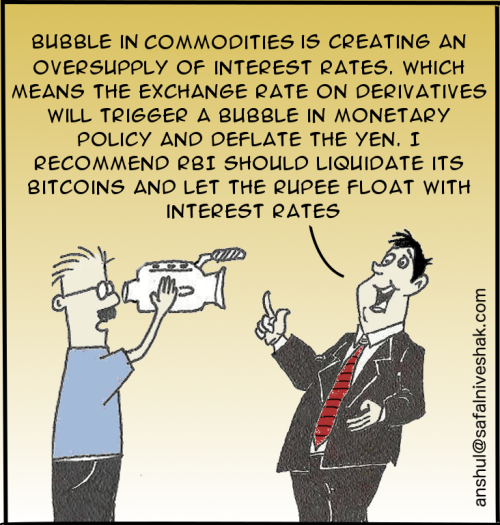
On being asked such macro questions, the answer usually goes something like this –
twaddle

Maybe the gentleman above has a point. But I just don’t see it. Do you? All I see is that his verbal diarrhea was completely useless.

In most cases, the right (and honest) answer is  – I don’t know.

But how can experts not know? They are interviewed because they’re supposed to know about everything. And even if they don’t know, what is Google for? All the facts and figures are few key strokes away, so it’s a sin to not have an opinion about everything, especially if you’re considered an expert and probably being compensated by pay per word.

So does it mean you are entitled to have an opinion on a subject just because you know a lot of facts and figures about it?

The more books I read, bigger is the realization that “I don’t know” is usually the most honest answer and also the toughest one, more so if the questions are about complex world around us.

Then why is it that we find it so hard to acknowledge our ignorance?

I don’t know the answer to that but my guess is that saying “I don’t know” puts the human ego at risk, and to avoid looking like fools, people end up talking something which usually is crap.

That reminds me of this quote from Plato –

Wise men speak because they have something to say; Fools because they have to say something.

This ‘need to say something’ when one doesn’t have anything useful to say is what Charlie Munger dubs as Twaddle Tendency.

The word ‘twaddle’ means a speech or writing that is silly, trivial, pretentious and not true. In other words – nonsense.

Twaddle tendency is the smoke screen created by shallow thinkers to hide their ignorance. The unnecessary jargons and pompous language is used to disguise the intellectual laziness and half-baked ideas.

Sometimes this trick works, but only for a short while. And many a times this twaddle tendency is so obvious that it’s embarrassing. See what happened with this girl who ended making a big fool of herself.

Click here to watch the video.

It wasn’t her ignorance about the subject but her unwillingness to say, “I don’t know” that put her into real trouble. She felt she had to say something smart so she just twaddled.

Like other behavioural biases, this tendency is also tattooed deep into human behaviour and probably evolution is the culprit behind this. Often, if the person is not prepared to answer he or she will simply make something up instead of saying nothing at all.

Recently I met an accomplished value investor and asked his feedback about how to make Safal Niveshak more valuable for its readers. Instead of falling for the Twaddle Tendency and make up something, he did the most honest thing.

He said, “I can’t give you an answer off the cuff. Let me think about it.” It’s rare to find people like that.

According to Munger, people waste a lot of time talking about meaningless stuff which then leads to equally meaningless activities.

In Poor Charlie’s Almanack, Charlie Munger describes an interesting experiment …

A trouble from the honeybee version of twaddle was once demonstrated in an interesting experiment. A honeybee normally goes out and finds nectar and then comes back and does a dance that communicates to the other bees where the nectar is. The other bees then go out and get it.

Well some scientist, clever like B. F. Skinner [perhaps Charlie’s favorite scientist], decided to see how well a honeybee would do with a handicap. He put the nectar straight up. Way up. Well, in a natural setting, there is no nectar a long way straight up, and the poor honeybee doesn’t have a generic program that is adequate to handle what she now has to communicate.

You might guess that this honeybee would come back to the hive and slink into a corner, but she doesn’t. She comes into the hive and does an incoherent dance. Well, all my life I’ve been dealing with the human equivalent of that honeybee. And it’s a very important part of wise administration to keep prattling people, pouring our twaddle, far away from the serious work.

In 1998 Wesco meeting, Charlie added …

I try to get rid of people who always confidently answer questions about which they don’t have any real knowledge. To me they are like the bee dancing its incoherent dance. They are just screwing up the hive.

Twaddle is perhaps harmless for the twaddler (if there is such word) except that he loses respect in the eyes of wise people. But if you’re at the receiving end and your bullshit filter isn’t strong enough to separate the twaddle from real talk, then you run a risk of not only wasting your time hearing the trash talk but may also end up losing your money and resources.

In fact, most of the talking heads on financial TV (even the non-financial ones) are dishing out twaddle.

Charlie Munger is quite fond of the word and has used it at multiple occasions.

It’s obvious that if a company generates high returns on capital and reinvests at high returns, it will do well. But this wouldn’t sell books, so there’s a lot of twaddle and fuzzy concepts that have been introduced that don’t add much.

~ Charlie Munger, WESCO annual meeting, 2000

I think the notion that liquidity of tradable common stock is a great contributor to capitalism is mostly twaddle. The liquidity gives us these crazy booms, so it has as many problems as virtues.

~ Charlie Munger, BRK Annual Meeting, 2004”

At Farnam Street, Shane Parrish writes…

While we all hold an opinion on almost everything, how many of us do the work required to have an opinion?

The work is the hard part.

You have to do the reading. You have to talk to anyone you can find and listen to their arguments. You have to think about the key variables that govern the interests. You have to think about your biases and incentives.

You have to think not emotionally but rationally.

And you need to become your most intelligent critic. Part of doing that means you need to have the intellectual honesty to kill some of your best loved ideas.

Only then, when you can argue better against yourself than others can you hold an opinion.

After you’ve done that, after you’ve done the work, that is the time you can say “Hey, I can hold this view, because I can’t find anyone else who can argue better against my view.”

Simply regurgitating facts and anecdotes doesn’t add any value to an argument. Unless somebody has struggled with an idea and spent some mental energy thinking about it, his or her knowledge is pretty superficial, second hand and precursor to a twaddle.

Munger says, “I never allow myself to have an opinion on anything that I don’t know the other side’s argument better than they do.”

Unless one qualifies Munger’s test to have an opinion, whatever he or she speaks on a subject, especially with overconfidence, is possibly just twaddle.

In his book The Art of Thinking Clearly, Rolf Dobelli summarizes the idea very well …

Verbal expression is the mirror of the mind. Clear thoughts become clear statements, whereas ambiguous ideas transform into vacant ramblings. The trouble is that, in many cases, we lack very lucid thoughts. The world is complicated, and it takes a great deal of mental effort to understand even one facet of the whole. Until you experience such epiphany, it’s better to heed Mark Twain: ‘If you have nothing to say, say nothing.’ Simplicity is the zenith of a long, arduous journey, not the starting point.

So how do you identify a twaddle?

Whenever you hear a talk or read a statement with signs of overconfidence, colored with hindsight bias, suggesting anecdotal evidences, predictions about unknowables, and high sounding complicated jargons, you can be pretty sure that the person is either lying or mad and possibly both.

Having a latticework of mental models greatly helps in filtering out the balderdash thrown at you. Multidisciplinary thought process helps you build a strong bullshit filter.

I don’t know who said this but there is some degree of truth to this statement –

Unsolicited advices are like armpits. Everyone has one and they stink.

Based on my personal experience I know when something needs to be ignored – when somebody pulls me aside and gives a free and especially an unsolicited advice.

Here’s how Elon Musk cuts through the twaddle when he is recruiting people …

When you struggle with a problem that’s when you understand it…when I interview people, I ask them to tell me about the problems that they worked on and how they solved them. And if someone is really the person who has solved it then he would be able to answer it at multiple levels…if they aren’t then you can say ..oh! this isn’t the person who really solved the problem. Because anyone who struggles hard with a problem, never forgets it.

It’s amazing how quickly you can find somebody’s edge of knowledge. Just ask why a couple of times and you can see how deeply that person has thought through the problem or issue. That’s what Musk means by ‘multiple levels’.

And do you know the most dangerous form of twaddle? It’s the one which you tell yourself.

Because the easiest person to fool is always yourself, says Richard Feynman.

So keep asking WHY from yourself. This simple trick will accelerate your learning like anything.

Take care and keep learning.

Update: Our tribe member, Ankit Kanodia, shared an example of annual report containing twaddle. You can download the annual report from here. Check out page 16. The company, Sanwaria Agro Oils Limited, refers to itself as Dabur. It’s not just a copy paste blunder, but shows how little thought they have put into their most important communication letter.

The post Latticework of Mental Models: Twaddle Tendency appeared first on Safal Niveshak.

    
05 Nov 03:45

All That is Good and Living in Us

by Atanu Dey

Nirad C Chaudhuri (1897 – 1999) dedicated his book, The Autobiography of an Unknown Indian (1951), to the British Empire.

To the memory of the British Empire in India,
Which conferred subjecthood upon us,
But withheld citizenship.
To which yet every one of us threw out the challenge:
“Civis Britannicus sum”
Because all that was good and living within us
Was made, shaped and quickened
By the same British rule.


“Every one of us”? How modest of him to speak on behalf of all Indians.

Sure, the Bengali babu, Mr Chaudhuri, wanted desperately to be considered British. Civis Britannicus sum is the Latin for “I am a British citizen”. To each his own, I say. But to declare that what he feels to be true about himself to be the general condition is unwarranted. Everything that was good and living in him may have been made and shaped by the British rule but that hardly exhausts the possibilities for others. Much of what is good and alive in Indians predate the rape of India by Muslim and European invasions.

I believe it is too early to dismiss the British Empire as a memory. Indians are still under the subjecthood of dead Britishers — their proxies being the generations of politicians, police and bureaucrats that took over control in 1947 after the British formally departed. They administer a colonial raj as laid out in the Indian constitution.

marktwain This idea is, not surprisingly, absolutely abhorrent to most Indians who bristle at the suggestion that they are not really free. Indians love to believe that they are free and independent. The alternative is unthinkable because it would imply that they have been fooled. Mark Twain recognized that “it’s easier to fool people than to convince them that they have been fooled.”

Incidentally, the autobiography by NCC is held in very high regard by the British. The wiki notes:

Over the years, the Autobiography has acquired many distinguished admirers. Winston Churchill thought it one of the best books he had ever read. V. S. Naipaul remarked: “No better account of the penetration of the Indian mind by the West – and by extension, of the penetration of one culture by another – will be or now can be written.” In 1998, it was included, as one of the few Indian contributions, in The New Oxford Book of English Prose .

There’s something admirable about the British: they reward loyalty and recognize their most dedicated Indian supporters. The greatest of those loyal servants of the British Empire was undoubtedly Mr Mohandas Gandhi. They even made a hagiographic movie about him in 1982. It was a great propaganda success. Richard Attenborough’s Gandhi was nominated for 11 Oscars and won 8 of them. Pretty good show, eh?

Mr Chaudhuri also makes the cut. He was awarded the CBE (Commander of the Order of the British Empire) in 1992. No doubt, if he had been alive today, NCC would have lined up to return his Sahitya Akademi Award which he received in 1975 for his biography on Max Müller, Scholar Extraordinary. Of course, Herr Müller reviled India’s tradition, and that made him an appropriate hero for the British and their subjects.

05 Nov 03:36

More on the secular stagnation debate

by noreply@blogger.com (Gulzar Natarajan)
The main argument in favor of the extended period of extraordinary monetary accommodation has been that it would provide the space for balance sheets to heal and the economy to get back to pre-crisis growth trajectory. Now, what if a return to the pre-crisis growth path may no longer be possible, for whatever reasons?

Economists like Robert Gordon have for some time now been cautioning about a productivity growth slow-down. Tyler Cowen had popularized this trend in his book "Average is Over", claiming that all the low-hanging fruits of recent technology revolutions have been plucked and actual productivity enhancing innovation has reached a plateau. Larry Summers has sought to provide a theoretical framework to the underlying trends by resuscitating Hyman Minsky's 'secular stagnation' hypothesis. Essentially, declining investment demand, induced by a variety of long-term structural factors, have forced down the Wicksellian natural interest rate to historic low levels, with limited prospects of a recovery for the foreseeable future. 

The supporters of unconventional monetary policy responses, led by Paul Krugman, have argued that such policies will not only help repair distressed household and corporate balance sheets, but also stoke the inflationary expectations required to restore consumption and an exit from the liquidity trap. They have claimed that central bankers could "credibly promise to be irresponsible" and unhinge inflationary expectations. While they also support fiscal policy measures, all those are made conditional on the persistence of monetary accommodation.

In this context, a recent dialogue between Larry Summers and Paul Krugman is instructive. Krugman, one of cheer-leaders of ever more monetary accommodation, assumes a return to pre-crisis growth path. But Summers describes the belief in pre-crisis recovery taking hold as a 'deus ex machina' event, and writes,
The essence of the secular stagnation and hysteresis ideas that I have been pushing is that there is no assurance that capitalist economies, when plunged into downturn, will, over any interval, revert to what had been normal. Understanding this phenomenon and responding to it seems the central challenge for macroeconomics in this era... I suspect it will lead to more emphasis on fiscal rather than monetary actions in depressed economies.
Krugman has grudgingly accepted the possibility that a return to pre-crisis normalcy may not be possible, thereby making policy response that much harder. If we agree to Summers' point that pre-crisis growth may not be a possibility, then low interest rates are here to stay, thereby making government borrowings, especially to finance much-needed investments in infrastructure in the US less of a problem. But the flip side of this argument is that this too may have limited traction as a growth driver and may end up down a slippery slope, as Japan is today. While the US does not face as bad a demographic headwind, Japan's struggles with the use of fiscal expansion in triggering growth draws attention to the limitations of fiscal policy itself in such circumstances. 

In any case, all this would also mean that the US has followed Japan and, possibly, Europe, into a long period of low growth rates, with attendant drag on the emerging markets and the world economy itself. 
Add to Technorati Favorites
04 Nov 07:08

Happy Birthday, Tibor Scitovsky

by Atanu Dey

Early in my study of economics in the 1990s, I came across Tibor Scitovsky’s 1976 book “The Joyless Economy: an inquiry into human satisfaction and consumer dissatisfaction.” Reading it, I realized that I was in the presence of a kindred spirit. I read that book with delight and an increasing understanding of what economics was all about. It was about humans and how they attempt to satisfy their innate drives, most of which derive from their biology and their evolutionary history as primates. Though I lived only a few miles from him (he lived in Stanford), I did not know it then and therefore never attempted to meet him. I later got to know that I also shared my birthday with him. Here’s how.

While at UC Berkeley in the 1990s, I once attended a guest lecture by Amartya Sen. At the end of the lecture, since he was a fellow Bengali, I went up and introduced myself. We spoke very briefly but I did mention to him that we shared our birthday — Nov 3rd. The next time I saw Prof Sen was also at a lecture at UC Berkeley a couple of years later. I recall that this time the topic was about the economics of populations, and I was distinctly dissatisfied with his analysis. In any case, I did go up to say hello to him after the talk.

I went up to him and said, “Hello, Prof Sen, my name is Atanu.” I was quite surprised and gratified that he immediately recalled our previous meeting. He said entirely unprompted, and I quote verbatim, “Atanu, I am happy to report that we are in good company. I found out recently that we share our birthday with Tibor Scitovsky.”

As many of the readers of this blog know, I am opposed to the leftist ideology that Prof Sen subscribes to. I am a classical liberal in the tradition of Hayek and Buchanan. Yet, even though I profoundly disagree with Prof Sen on the fundamental philosophical questions — and admit that he is far superior to me in raw intelligence and I can never ever attain the level of his scholarship — I recall with pleasure knowing from him that I share my birthday with Prof Scitovsky (1910 – 2002).

Happy Birthday to you, Profs Scitovsky and Sen.

04 Nov 03:58

Ladder Theory and Local Optima

by SK

According to the Ladder Theory, women have two “ladders”. One is the “good ladder” where they rank and place men they want to fuck. The rest of the men get placed on the “friends ladder”. Men on the other hand have only one ladder (though I beg to disagree).

The question is what your strategy should be if you end up on top of the “wrong” (friends) ladder. On the one hand, you get your “dove“‘s attention and mostly get treated well there. On the other hand, that’s not where you intended to end up.

Far too many people at the top of the friends ladder remain there because they are not bold enough to take a leap. They think it is possible to remain there (so that they “preserve the friendship”) and at the same time make their way into the dove’s good ladder.

Aside 1: The reason they want to hold on to their friendship (though that’s not the reason they got close to the dove) can be explained by “loss aversion” – having got the friendship, they are loathe to let go of it. This leads them to pursuing a risk-free strategy, which is unlikely to give them a big upside.

Aside 2: A popular heuristic in artificial intelligence is Hill Climbing , in which you constantly take the path of maximum gradient. It can occasionally take you to the global maximum, but more often than not leaves you at a “local maximum”. Improvements on hill climbing (such as Simulated Annealing) all involve occasionally taking a step down in search of higher optimum.

Behavioural economics and computer science aside, the best way to analyse the situation when you’re on top of the friends ladder is using finance. Financial theory tells you that it is impossible to get a large risk-free upside (for if you could, enough people would buy that security that the upside won’t be significant any more).

People on top of the friends ladder who want to preserve their friendships while “going for it” are delusional – they want the risk-free returns of the friendship at the same time as the possibility of the grand upside of getting to the right ladder. They should understand that such trades are impossible.

They should also understand that they might be putting too high a price on the friendship thanks to “loss aversion”, and that the only way to escape the current “local optimum” is by risking a downward move. They should remember that the reason they got close to their dove was NOT that they end up on the friends ladder, and should make the leap (stretching the metaphor). They might end up between two stools (or ladders in this case), but that might be a risk well worth taking!

PS: this post is not a result of my efforts alone. My Wife, who is a Marriage Broker Auntie, contributed more than her share of fundaes to this, but since she’s too lazy to write, I’m doing the honours.


04 Nov 03:56

Nifty Fifty is 20 today ~ from 1000 to 8000 ~ Cause to Celebrate at just 11% CAGR !?

by Gaurav Parikh
Nifty Fifty was born with a base of 1000 on November 3,1995,a year after NSE’s Equity Segment was born Today it’s over 8000 computing to a CAGR of just  11% though it’s gone up over 700% in the period and become an eight bagger Cause to Celebrate !? Come on Buck up Nifty !!! Or [...]
03 Nov 10:45

Don’t be a Miser in Retirement (Or Ever)

by David Merkel

My last article, One Dozen Thoughts on Dealing with Risk in Investing for Retirement, was a mashup of two of my older articles Managing Money for Retirement and From Stream to Shining Stream.  I wrote as a submission to a Society of Actuaries request for essays on the topic of Post Retirement Needs And Risk Committee Managing Retirement In Light Of Diverse Risks.  I added more material, chopped out some of the weaker stuff, and tried to rewrite it to have a consistent tone, etc.  As Susan Weiner, our go-to person on investment writing says, “The best writing is rewriting.”  Given some of the responses I got, the article was well received.  Hopefully the folks at the SOA will like it as well, but it will probably be the least technical essay they receive.  It also still has some typos.  Oops.  So it goes.

There was one comment on the article that I would like to highlight.  Here it is:

The other thing to watch for with retirement spending is not spending enough of your investments, especially in early retirement. Many studies have shown that actual spending in retirement decreases by around 50% from age 55 to age 80. One study in Germany showed that people’s wealth actually started increasing again in their 70’s as their pension incomes exceeded their lifestyle costs, with the resultant increase in savings.

People need to think about this in how they structure their retirement spending. It may make complete sense for someone with a $1 million portfolio and a standard government pension to spend $800,000 of that $1 million by age 80, leaving a $200,000 cushion for the lower cost part of their lives as most of their day-to-day living expenses will be covered by their pension.

People need to spend their money when they are active and mobile and able to enjoy it. I think the financial press needs to talk about this more, so people are not scared into not spending their money until it is too late.

The author of the book that I most recently reviewed, Carlos Sera, gave one of his sayings on page 97 of his book:

“There is a fine line between over-saving and under-living.”

That particular story dealt with a couple that had been especially frugal, and after not earning all that much, at retirement had $6 million.  They had a traditional marriage, and the husband handled the money entirely.  He worked until 72, retired due to incapacity, and on the day of his retirement, he handed his wife a check for $3 million.

She thought it was a joke, so for fun she tried to cash the check.  To her surprise, the check cleared.  Then came the bigger surprise — her amazement gave way to anger!  All the years of self-denial, and they were this well-off!  There were so many things she denied herself along the way, and now both of them were too old to truly enjoy their riches.

There’s more to the story… the point the author goes for is mostly abut how husbands and wives should learn to cooperate on the shared tasks of household economic management, so that both are on the same page, and they can be agreed on goals and methods.

I agree with that, and would add that the best approach on spending versus saving is what I would call a conservative version of the “middle way.”  Make sure that you are provident, but balance that with contentment and a happy enjoyment of what you have.  Life is meant to be lived.

Yes, it is good to be prudent and frugal, but not to the point where you amass a lot of assets and never enjoy them.

[Now for those not crazy about Christianity, you can skip to the end.]

In Ecclesiastes 5:13-20, Solomon says [NKJV]:

There is a severe evil which I have seen under the sun: riches kept for their owner to his hurt.  But those riches perish through misfortune; when he begets a son, there is nothing in his hand.  As he came from his mother’s womb, naked shall he return, to go as he came; And he shall take nothing from his labor which he may carry away in his hand.  And this also is a severe evil— just exactly as he came, so shall he go. And what profit has he who has labored for the wind?  All his days he also eats in darkness, And he has much sorrow and sickness and anger.

Here is what I have seen: It is good and fitting for one to eat and drink, and to enjoy the good of all his labor in which he toils under the sun all the days of his life which God gives him; for it is his heritage.  As for every man to whom God has given riches and wealth, and given him power to eat of it, to receive his heritage and rejoice in his labor—this is the gift of God.   For he will not dwell unduly on the days of his life, because God keeps him busy with the joy of his heart.

Ecclesiastes 4:8 and 6:1-3 say similar things, and are cited by the Larger Catechism in question 142, where it says:

What are the sins forbidden in the eighth commandment?

The sins forbidden in the eighth commandment, besides the neglect of the duties required, are, theft, robbery, man-stealing, and receiving any thing that is stolen; fraudulent dealing; false weights and measures; removing landmarks; injustice and unfaithfulness in contracts between man and man, or in matters of trust; oppression; extortion; usury; bribery; vexatious lawsuits; unjust inclosures and depopulations; engrossing commodities to enhance the price, unlawful callings, and all other unjust or sinful ways of taking or withholding from our neighbor what belongs to him, or of enriching ourselves; covetousness; inordinate prizing and affecting worldly goods; distrustful and distracting cares and studies in getting, keeping, and using them; envying at the prosperity of others; as likewise idleness, prodigality, wasteful gaming; and all others ways whereby we do unduly prejudice our own outward estate, and defrauding ourselves of the due use and comfort of that estate which God hath given us. [Emphasis mine]

Along with questions 140 and 141, they summarize most of what the Bible teaches on ethics in economics.  My emphasis is the last phrase “defrauding ourselves of the due use and comfort of that estate which God hath given us.”

This may be a surprise to some, but (among other things) God wants us to enjoy life.  That is not the highest goal, but God commends it through the voice of Solomon in Ecclesiastes multiple times.

Now, not everyone in Christianity thinks this way.  John Wesley famously said, “Earn all you can.  Save all you can.  Give all you can.”  This is admirable as far as it goes, and Wesley’s life reflected it.  He was very industrious, frugal, provident and generous.  But in the middle of his life, he did not purchase and enjoy some blessings, in an effort to give more to the poor.

Why?  Black tea was relatively expensive back then, and the lower classes were spending too much of their money on the relative luxury of tea.  Wesley liked tea a lot, but gave it up for two reasons: to set a good example to the poor, and have more money to give to aid the poor.  (He also abstained from alcohol, fasted several days a week, and ate cheaply when he did eat.)  That said, occasionally bothered him that some of the money he gave to the poor got spent by them on tea.  Oh well.  With something that is not in itself a sin, it was probably better to let people spend their money as they saw fir, and not discourage them by arguing that tea was a wasteful luxury.

I would amend Wesley and say it this way, “Earn a competent amount.  Save a good portion of it.  Give to poorer brothers who are ailing, despite doing their best.  After that, enjoy the blessings God has given you.”

There is a reason why God is portrayed in the Parable of the Lost Son as a generous man who throws a party when his younger son repents of riotous living, while the older son (representing the Pharisees) is portrayed as a miser.  God is generous, while many religious people get proud of what they have achieved, seemingly apart from God, and resent those who get gifts, while they themselves work.  This is parallel to salvation, which cannot be purchased no matter how hard we work, but must be received as a gift from Jesus, who did all the work for those who would receive the gift of salvation.  Echoing that, C. S. Lewis in The Screwtape Letters portrays God as jolly when “the patient” gets a girlfriend, while the demon Screwtape boasts of the grand austerity of Hell.

Closing this section, I would simply say take care of all your other obligations to God, but if God has given you something legitimate to enjoy, then enjoy it, and don’t feel guilty.  Rather, take the opportunity to thank and praise God for the blessings he brings.

Conclusion

Assets and money are tools.  They are valuable, but they are a means to an end.  Use them to enjoy life, while being prudent as you do so.

03 Nov 08:40

Vaastu Shaastra

by SK

My apartment has allegedly been built according to the principles of Vaastu Shaastra. I wasn’t particularly particular about this – in fact, I wouldn’t have minded my apartment NOT following the Vaastu Shaastra if that meant I could get it for cheaper. One such apartment wasn’t available, though, (I presume that market is illiquid), so I settled on this one.

There are several aspects to Vaastu Shastra, at least a subset of which has been followed while designing my apartment, but I will focus on one – the position of the master bedroom. Vaastu Shaastra dictates that the master bedroom be in the south-west corner. I can think of a few practical reasons for this, such as not being woken up with the first rays of sun, and getting the South-Westerly monsoon breeze.

The problem, however, is that the Southwest monsoon is now over and the North-East monsoon has begun. And my bedroom is insanely hot. Irrespective of what windows I open, the South-Westerly location means that most of the time the room is deprived of the cool rain-bearing wind blowing over Bangalore from the North-Easterly direction! From a practical standpoint, the design is not great.

While I believe that most of our “traditions” and “customs” have some scientific backing, my problem is with blind implementation – reading the letter of the ancient rule rather than with the spirit.

And with Vaastu Shaastra, based on the wind patterns here, my sense is that it was not designed for Bangalore, and we have just followed the rules here without analysing their merits. The Vaastu Shaastras, I suspect, were developed somewhere up north (in the Swat Valley, perhaps?), where there was no North-East monsoon. Hence these cool rainbearing winds have been completely left out from the calculations.

And our builders, in their infinite wisdom and guided by televangelists, have decided to adopt these Shaastras by the letter without suitably modifying them for local conditions.

Woresht.

PS: Thinking about it, the Vaastu fascination is to cut decision fatigue when it comes to designing residences. It provides automatic formulae to lay out the house, so you can mindlessly design it and not feel bad about not consulting an architect.