Shared posts

20 Nov 13:57

Karnataka is Hoarding Pulses! Despite Seizing 25,000 tons of Pulses from Hoarders, It’s Disposed of Just 1.5% of the Catch

by Deepak Shenoy

So pulse prices have been going up and I get sticker shock everytime I go to buy dal. But apparently I should curse the state of Karnataka for hoarding pulses.

After the imposition of stock limits on pulses, any trader having more pulses than the limit will see the excess seized. Karnataka has seized the maximum amount of pulses from traders among states, as per a press release. Karnataka has seized 25,446 tonnes of pulses, where the next highest state in terms of seized pulses is Chattisgarh which is 1/5th lower at 5448 tonnes.

And yet, Karnataka has disposed only a piddly 371 tonnes of, or just 1.5% what they’ve seized!

Chattisgarh has gotten rid of about 30%, Madhya Pradesh about half, and Delhi and Rajasthan about 8-10%.

Pulses Seized and disposed by State Karnataka hoards the most

It’s no wonder we are seeing pulse prices spiralling – if they seize these pulses why don’t they get rid of them in markets fast?… (Read On...)

20 Nov 13:55

The Single Best Interview Question You Can Ask

by Farnam Street Team

In Peter Thiel’s book, Zero to One: Notes on Startups, or How to Build the Future — more of an exercise in thinking about the questions you must ask to move from zero to one — there is a great section on the single best interview question you can ask someone.

Whenever Peter Thiel interviews someone he likes to ask the following question: “What important truth do very few people agree with you on?

This question sounds easy because it’s straightforward. Actually, it’s very hard to answer. It’s intellectually difficult because the knowledge that everyone is taught in school is by definition agreed upon. And it’s psychologically difficult because anyone trying to answer must say something she knows to be unpopular. Brilliant thinking is rare, but courage is in even shorter supply than genius.

The most common answers, according to Thiel, are “Our educational system is broken and urgently needs to be fixed.” “America is exceptional.” “There is no God.”

These are bad answers.

The first and the second statements might be true, but many people already agree with them. The third statement simply takes one side in a familiar debate. A good answer takes the following form: “Most people believe in x, but the truth is the opposite of x.”

[…]

What does this contrarian question have to do with the future? In the most minimal sense, the future is simply the set of all moments yet to come.

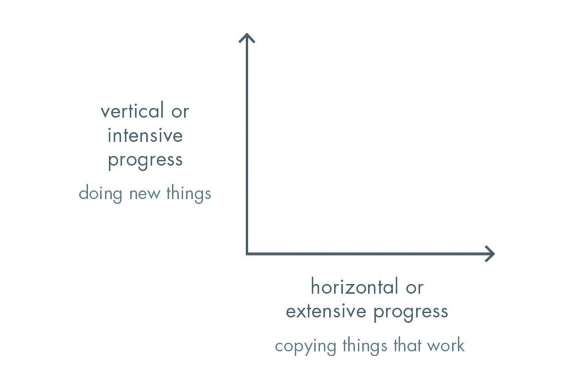
We hope for progress when we think about the future. To Thiel, that progress takes place in two ways.

Horizontal or extensive progress means copying things that work— going from 1 to n. Horizontal progress is easy to imagine because we already know what it looks like. Vertical or intensive progress means doing new things— going from 0 to 1. Vertical progress is harder to imagine because it requires doing something nobody else has ever done. If you take one typewriter and build 100, you have made horizontal progress. If you have a typewriter and build a word processor, you have made vertical progress.

best interview question peter thiel

At the macro level, the single word for horizontal progress is globalization— taking things that work somewhere and making them work everywhere. … The single word for vertical, 0 to 1 progress, is technology. … Because globalization and technology are different modes of progress, it’s possible to have both, either, or neither at the same time.

Peter Thiel
Here is Thiel’s answer to his own question:

My own answer to the contrarian question is that most people think the future of the world will be defined by globalization, but the truth is that technology matters more. Without technological change, if China doubles its energy production over the next two decades, it will also double its air pollution. If every one of India’s hundreds of millions of households were to live the way Americans already do— using only today’s tools— the result would be environmentally catastrophic. Spreading old ways to create wealth around the world will result in devastation, not riches. In a world of scarce resources, globalization without new technology is unsustainable.

--
Sponsored By: Greenhaven Road Capital: You think differently - now invest differently.

20 Nov 13:54

Poke the Box: Combine Ideas

by Anshul Khare

Let’s Start with Safal Niveshak
Just in case you missed any of this on Safal Niveshak over the last few weeks…

Book Worm
In last fifty years Warren Buffett has recommended quite a few books in his lectures and writings. But there is one book that can boldly claim to have found its way to Warren Buffett’s reading desk. And that book is ‘The Success Equation’, authored by Michael Mauboussin.

Michael belongs to the breed of those rare investment strategists who have spent their life puzzling over the really crucial questions in the world of decision making. He is an expert in one of the most debatable topic in the field of business strategy i.e. role of luck in defining the success for an individual as well as an organization.

The central idea discussed in Mauboussin’s book is the spectrum called Skill Vs Luck Continuum.

The world we live in today has become terribly interconnected. This introduces a high degree of complexity which in turn leads to lot of randomness and unpredictability in the outcomes of events. When this randomness operates at an individual level, it translates to either good or bad luck.

Still there are many activities which are fairly simple and usually have predictable outcomes based on the level of skills exhibited by the participants.

So there are one set of activities dominated by luck and other set of activities ruled by skill. The real trick however is to not only differentiate between the two kind of situations but to acknowledge that this differentiation doesn’t usually come with recognizable boundaries. The complexion of reality is a blend of skill and luck both.

Skill-Luck continuum is an imaginary linear scale where on the far right are activities that rely purely on skill such as running, swimming, chess, etc. On the far left are activities that depend on luck and involve no skill. Roulette or the lottery are few examples.

Mauboussin argues that in skill dominated situations, following a good process almost always leads to a good outcome. On the other hand, in a luck dominated world a good process also leads to a good outcome but only over time.

It’s a fascinating book that forces you to reflect on your decision making process. If this book deserves to be on Buffett’s desk, there is no reason you shouldn’t have this in your bookshelf too.

Stimulate Your Mind
Here’s some amazing content we read in recent times…

Poke of the Week – Combine Ideas


Charlie Munger said, “The surest way to wealth is to deserve it.”

If you want to be successful, your work has to be valuable for other people. The more value you’re able to deliver to your society, to your country, to your tribe – the more wealth gets attracted towards you.

Now, being valuable requires you to be skilful in your art. Average won’t cut it. You have to be above average, far above. Malcolm Gladwell, in his book Outliers, argues that one needs to spend at least 10,000 hours of practice in an activity to qualify as a world class expert in that field.

Unfortunately, attempting to become a world class  in any activity is quite an arduous task. But what you can do is find a niche which may require a combination of multiple skills and then become a master in that. The idea is to combine several ideas.

ptb-19

“The time has come,” the walrus said, “to talk of many things: of shoes – and ships – and sealing wax – of cabbages – and kings.” Combining unusual ideas is at the heart of creative thinking. The ancients mixed soft copper and even softer tin to create hard bronze. Gutenberg combined the wine press and the coin punch to create moveable type and the printing press.

What different ideas can you combine?

(source: Creative Whack Pack)

James Altucher suggests …

“…get good at three, four, or five things. Then find the intersection. Then become the best in the world at that intersection. That’s how you can pretend to do your special purpose. When I say “get good” it doesn’t mean 10,000 hours of practice with intent. May be it means 1000 hours. Or even less. Then if you’re good at five things you’re now the only one in the world who has put 1000s of hours into the intersection. Now you’re the best in the world at that.”

Scott Adams, creator of famous cartoon strip Dilbert, writes in his book

“I’m a perfect example of the power of leveraging multiple mediocre skills. I’m rich and famous cartoonist who doesn’t draw well. At social gatherings I’m usually not the funniest person in the room…none of my skills are world-class…but when my mediocre skills (meagre business skills and fairly ordinary writing talent) are combined,  they become a powerful market force…With each new skill, my odds of success increased substantially.”

So that’s the big idea for today.

Isolated ideas and skills aren’t much useful until you find a way to combine them, layer one over other, find connections, and synergies, and build something useful.

It’s doesn’t matter how many ideas you have. What matters is how many meaningful connections can you create between those ideas.

Don’t forget the role of luck.

Don’t ignore skills either.

Connect the dots.

Don’t settle and don’t forget to keep learning.

Stay happy, stay blessed and keep poking.

With respect,
Vishal & Anshul

The post Poke the Box: Combine Ideas appeared first on Safal Niveshak.

    
19 Nov 04:12

Nudging with Amazon Prime

by noreply@blogger.com (Gulzar Natarajan)
From Times on how Amazon uses its Amazon Prime ($99-a-year free two-day shipping and a host of free music, video, TV shows, and books) subscription service, which is estimated to grow by 10 m to 40 m by end of this year, to nudge shoppers,
Growth in Prime subscriptions matters because Prime alters the psychology of shopping. Once you’ve prepaid for shipping, you tend to start more of your shopping excursions at Amazon. According to some estimates, people spend three or four times as much with Amazon after they sign up to Prime...
But this “Prime effect” is key to Amazon’s long-term profitability. Analysts at Morgan Stanley reported recently that “retail gross profit dollars per customer” — a fancy way of measuring how much Amazon makes from each shopper — has accelerated in each of the last four quarters, in part because of Prime. Amazon keeps winning “a larger share of customers’ wallets,” the firm said, eventually “leading to a period of sustained, rising profitability.
The article lays out how Amazon has slowly built up a massive retail logistics infrastructure, apparently insurmountable for competitors, that appears to be now paying off and which positions the company comfortably to dominate the market for many years. It has built more than 100 (and growing) warehouses to store, package, and ship goods, which lowers logistics costs and allows the company to pass on benefits to customers by way of lower prices. And, Jeff Bezos has been patient,
What has been key to this rise, and missing from many of his competitors’ efforts, is patience. In a very old-fashioned manner, one that is far out of step with a corporate world in which milestones are measured every three months, Amazon has been willing to build its empire methodically and at great cost over almost two decades, despite skepticism from many sectors of the business world.
And Bezos has the deep pockets of its rollicking cloud computing service arm, Amazon Web Services (AWS), which has similarly built out massive computer storage infrastructure and rents out server space, to expand the Amazon's e-commerce business even more.

What could be a disruption? Amazon relies on stocking and selling its own products. But in many countries, including China and India, the e-commerce sites mainly connect buyers and sellers, taking a cut on each transaction. This model has proved successful because it enables the large numbers of legacy small retailers (and even small manufacturers) to directly sell to the end-users, thereby eliminating their transaction costs. But Amazon could as well do the same in these markets, as is happening, and use its other offerings to create a better shopping experience and induce a stickiness among them.

Add to Technorati Favorites
18 Nov 15:18

Easy In, Hard Out (III)

by David Merkel

A while ago I wrote two pieces called “Easy In, Hard Out.”  The main idea was to illustrate the difficulties that the Federal Reserve will face in removing policy accommodation.   In the past, the greater the easing cycle, the harder the tightening cycle.  I don’t think this time will be any different.

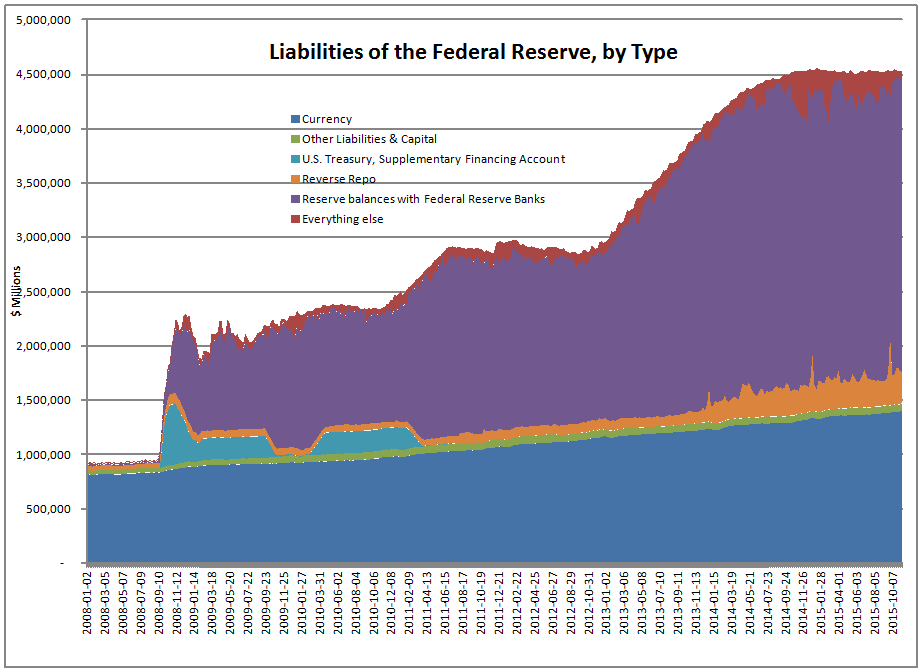
In the last two pieces, I showed three graphs to illustrate how the Fed’s balance sheet has changed.  I’m going to show them again now, updated to 11/11/2015.  Here’s the graph showing the liabilities of the Federal Reserve — i.e. what the Fed eventually has to pay back, occasionally with interest:

I’ve added a new category since last time — reverse repurchase agreements (“reverse repos”) because it has gotten big.  In that category, you have money market funds (etc.) lending to the Fed to pick up a pittance in interest.

As you might note — as the balance sheet has grown, all categories of liabilities have grown.  The pristine balance sheet composed mostly of currency is no more — it is only around 30% of the liabilities now.  The biggest increase in reserve balances at the Fed — banks lending to the Fed to receive a pittance in interest, because they have nothing better to do for now.

I’ve considered doing an experiment, and I might do it over the next few weeks.  I went to my copy of AAII Stock Investor, and pulled out the contact data for 336 banks with market capitalizations of over $100 million.  I was thinking of calling 10 of them at random, and asking the following questions:

  • What has the Fed’s ZIRP policy done to your business?
  • Do you have a lot of money on deposit at the Federal Reserve?
  • When the Fed raises the short-term interest rate, what do you plan on doing?
  • Then, the same questions asking them about their competitors.
  • Finally, who has the most to lose in this situation?

It could be revealing, or it could be a zonk.

One more interesting note: reverse repos and my “all other” category have become increasingly volatile of late.

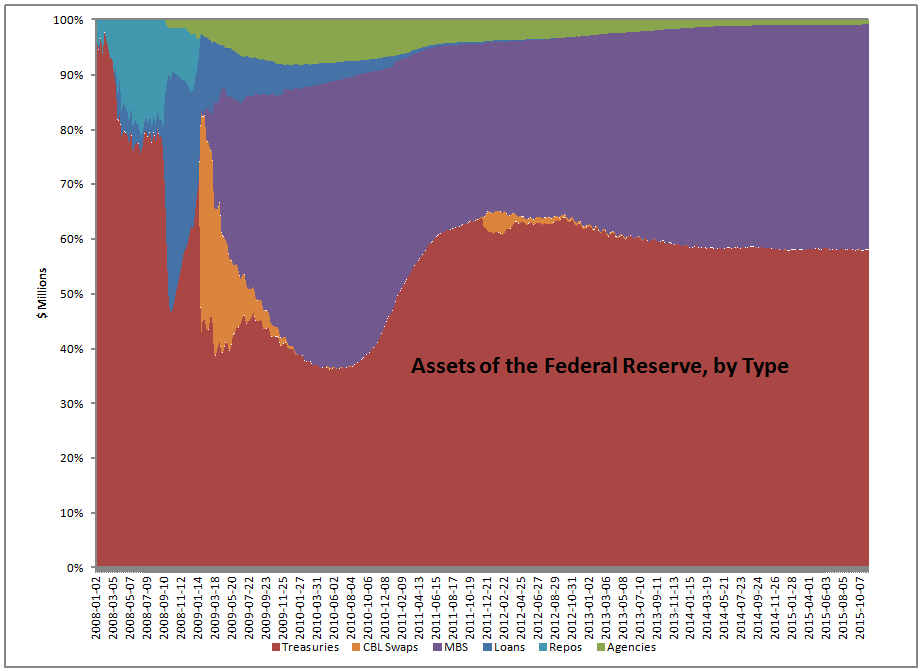
Here’s my next graph, with the asset class composition of the Fed’s balance sheet:

The Fed has gone from a pristine balance sheet of 95% Treasuries to one of 60/40 Treasuries and Mortgage-backed securities [MBS].  MBS are considerably less liquid than Treasuries, particularly when you are the largest holder of them by a wide margin — I’ve heard that it is 25% of the market.  The moment that it would become public knowledge that you were a seller, the market would re-rate down in price considerably, until holders became compensated for the risk of more MBS supply.

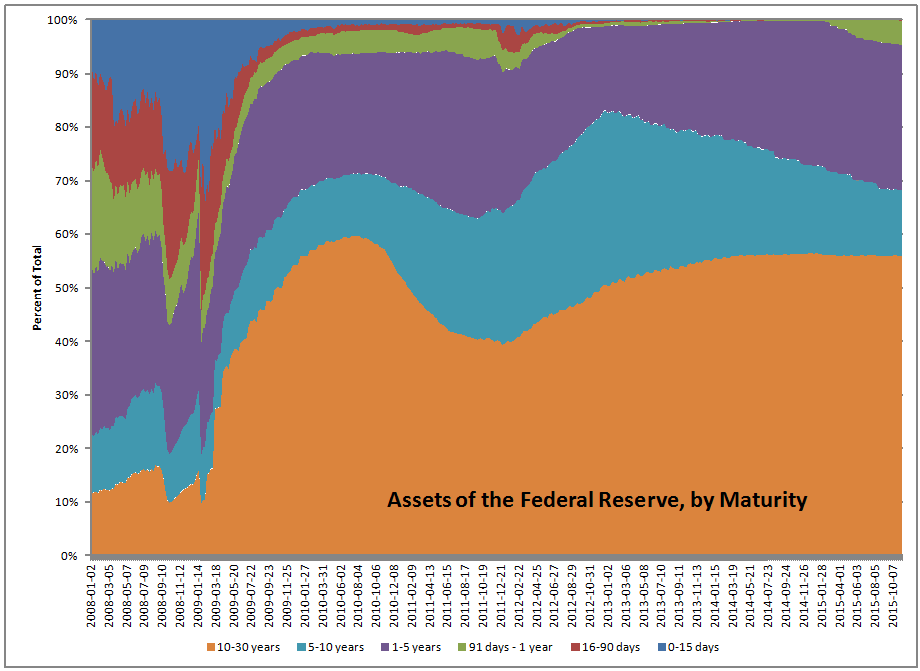
Finally, here is the maturity graph for the assets owned by the Fed:

The pristine balance sheet of 2008 was very short in its interest rate sensitivity for its assets — maybe 3 years average at most.  Now maybe the average maturity is 12?  I think it is longer…

Does anybody remember when I wrote a series of very unpopular pieces back in 2008 defending mark-to-market accounting?  Those made me very unpopular inside Finacorp, the now-defunct firm I worked for back then.

I see three hands raised.  My, how time flies.  For the three of you, do you remember what the toxic balance sheet combination is?  The one lady is raising her hand.  The lady has it right — Illiquid assets and liquid liabilities!

In a minor way, that is the Fed now.  Their liabilities will reprice little as they raise rates, while the market value of their assets will fall harder if the yield curve moves in a parallel shift.  No guarantee of a parallel shift, though — and I think the long end may not budge, as in 2004-7.  Either way though, the income of the Fed will decline rapidly, and any adjustment to their balance sheet will prove difficult to achieve.

What’s that, you say?  The Fed doesn’t mark its assets to market?  You got it.  But cash flows don’t change as a result of accounting.

Now, there is one bit of complexity here that was rumored at the Cato Conference — supposedly the Fed doesn’t use a prepayment model with its MBS.  If anyone has better info on that, let me know.  If true, the average life figures which are mostly in the 10-30 years bucket are highly suspect.

As a result of the no-mark-to-market accounting, the Fed won’t show deterioration of its balance sheet in any conventional way.  But you could see seigniorage — the excess interest paid to the US Treasury go negative, and the dividend to its owner banks suspended/delayed for a time if rates rose enough.  Asking the banks to buy more stock in the Federal Reserve would also be a possibility if things got bad enough — i.e., where the future cash flows from the assets could never pay all of the liabilities.  (Yes, they could print money together with the Treasury, but that has issues of its own.  Everything the Fed has done with credit so far has been sterile.  No helicopter drop of money yet.)

Of course, if interest rates rose that much, the US Treasury’s future deficits would balloon, and there would be a lot of political pressure to keep interest rates low if possible.  Remember, central banks are political creatures, much as their independence is advertised.

Conclusion?

Ugh.  The conclusions of my last two pieces were nuanced.  This one is not.  My main point is this: even with the great powers that a central bank has, the next tightening cycle has ample reason for large negative surprises, leading to a premature end of the tightening cycle, and more muddling thereafter, or possibly, some scenario that the Treasury and Fed can’t control.

Be ready, and take some risk off the table.

18 Nov 04:52

How People Make Big Decisions

by Farnam Street Team

We all go through psychological steps when we make big decisions. Some people call this the “existential cycle,” which really has four stages: doing, contemplating, preparing, and experimenting.

***

Echoing Tolstoy on regret avoidance, Sebastian Bailey and Octavius Black write in Mind Gym: Achieve More by Thinking Differently:

These four stages are much like exercises in risk management. No one wants to look back on his or her life at some point and say I wish I would have or If only I had.

While there are other ways, the existential cycle helps us make life changing decisions — like who to marry, where to work, and where to live.

The first stage, “doing,” is where you spend most of your life: It is your settled, equilibrium position. The doing may be all sorts of things— writing emails, riding horses, reading books, washing up, going to meetings, listening to lectures, cooking, dancing, running, sharing stories with friends, telling jokes, or making love. Of course, these are not done all at the same time (not unless you’re really talented). Whatever the activity may be, and however enjoyable or dull it is, you are doing it and it tends to keep you occupied.

Sometimes we get to “contemplating,” where we consider whether or how things would be different. What would life be like if you move to California? (Hint: It won’t make you happier.)

Then occasionally we move to “preparing.”

You search on the web for real estate agents in San Diego or Key West, find out what property prices are, check weather patterns, possibly even visit your preferred destination on your next vacation. You have moved beyond imagining how things could be different to investigating the practical options for how to make them different.

Finally you make the change.

You leave your job, buy a house, and move all your possessions. This stage is called “experimenting.” After you’ve settled in and started the beachside bar you’d dreamed about, this becomes your normal way of living, and you are once again in a state of doing.

The process isn’t overly complicated or hard. The challenge becomes moving through it at the right pace in a way that aligns with your principles.

How-People-Make-Big-Decisions

The Doing Magnet

As you travel around your cycle, you will have conversations with yourself that stop you from moving on to the next stage and instead take you back to doing.

Sometimes these thoughts can be very sensible and prevent you from wasting time or following the wrong path. But sometimes, unfortunately, they prevent you from both spotting and taking opportunities that could dramatically improve your life. The trick lies in recognizing the internal conversations and being able to make an informed decision about whether to listen to them or to ignore them and move on.

When the Doing Magnet is Weak

Irrational exuberance are those people who are forever saying things like I wish I hadn’t rushed into that or If only I’d thought about it first. Rather than never crossing the Rubicon, they’re happy to head over far too easily— without ever considering the size of the army on the other side. In terms of the existential cycle, their doing magnet is relatively weak— the centrifugal momentum of the next new thing is stronger than the gravitational force of the status quo.

If you find that you can’t hold down a job, you can’t keep a relationship, you spend money on a whim, or you haven’t gotten around to making your home into a place you like living in, and you regret it, then you may be suffering from a form of irrational exuberance. The best advice in this situation is this: spend longer at the preparing stage before wading across your Rubicon.

For example, consider one of these choices:

  • Think through all the possible disadvantages of taking this course of action as well as the advantages— really make an effort to present the case for caution on this occasion.

  • Contrast the allure of the new situation with how your existing life might improve even if you don’t make this big change. People who are always moving on to new jobs often fail to consider how their current jobs could get better. A new job may be attractive, but it is wrong to assume the old one will stay the same. New possibilities could open up. What happens when your boss moves on?

  • Contemplate the bigger and better gains and pleasures you could have if you didn’t always go for instant gratification. Could the gratification get more gratifying?

  • Consider any decisions you made in the past that led to situations you later regretted. What can you learn from these that will help you make a wiser decision this time.

If you Want to Improve, you have to Cross the Rubicon

“Do. Or do not. There is no try.” — Yoda

You have a choice in how you run your life. There is no “can’t,” only “will” and “won’t.” The trick is knowing why you are, or aren’t, moving around the existential cycle and, in particular, crossing your Rubicon. Like we’ve said, the right thing isn’t to always cross or always not cross. The right thing is to understand why you want to cross or don’t want to cross, and then make your decision.

Nevertheless, none of us want to live our lives in a constant state of doing. I might not be in good enough shape today to swim 2.4 miles, but that doesn’t mean I won’t be in the future. Plus, our reasons for remaining in one state may not be strong. At some point, in certain aspects of our lives, if we want to progress, we must cross the Rubicon.

A decision to not cross the Rubicon based on the wrong reasons— when catastrophic fantasies rule our mind-sets— is what causes people to look back on their lives and think If only. … All of us who have looked back and been proud of what we have done have crossed the Rubicon at least once and maybe many times.

There’s a famous Latin maxim, carpe diem, which translated means “seize the day.” The question you have to ask yourself is, When it comes to crossing Rubicons, just how much of a Caesar am I prepared to be?

--
Sponsored By: Greenhaven Road Capital: You think differently - now invest differently.

18 Nov 04:46

The search for the optimal PSC

by noreply@blogger.com (Gulzar Natarajan)
In a departure from existing investment recovery model of production sharing contracts (PSCs) in oil and gas blocks allotted for exploration, India's Ministry of Petroleum and Natural Gas now proposes to adopt the revenue sharing model in all their future PSCs. The “bidders will bid the percentage of revenue that they will share with the government against two revenue scenarios—when revenue is less than or equal to lower revenue point or when revenue is more than or equal to the higher revenue point”. It also proposes to permit them to price and market gas as well as bid for areas/blocks of their choice (open acreage licensing).

In the former, the explorer recovers the entire capital investment before revenues or profits are shared, whereas in the latter, the revenue/profit sharing starts as soon as the production begins. Accordingly, while the investments risks are mitigated in the back-loaded sharing model, the latter transfers all the risks to the explorer and leaves the government as a rent seeker. The former runs into problems of valuation of investments made, with explorers incentivized to gold-plate their investments, while the latter is far simpler to monitor and suits a risk-averse bureaucracy.

I have blogged earlier on India's most famous gas pricing controversy, challenges of PSCs, and the dilemma for governments between maximizing auction revenues and allowing commercial viability. While the decision for the most appropriate type of PSCs is a difficult one to make, I have written in favor of a more nuanced approach, with a slight preference for a hybrid capital investment recovery model. The preference was also motivated by the fact that India does not have large oil reserves and is almost completely dependent on oil and gas imports, thereby making any new production a bonus.

My concern with the revenue sharing model is more fundamental. Given the risks involved with deepwater oil exploration, especially in an area not known for rich deposits, India needs to attract the major international oil exploration firms with the expertise and technology required to prospect efficiently. But a PSC where all the risks vests with explorers and the government is a passive rent-seeker may discourage the major firms, especially at a time of low international oil prices with not-so-promising medium term prospects. 

The major exploration firms will find the proposed structure attractive only if the technical and political risks are low enough and commercial attractions large enough. The PSC structure may be one militating factor too many.  
Add to Technorati Favorites
17 Nov 03:51

Free will, an illusion

by Muthu

It’s some time in 2010.

I went through months of serious introspection and stumbled upon a conclusion that there is no free will. Everything is determined. Call it destiny, god’s will or randomness; things happen on their own. If you ask me to prove my conclusion, I would not be able to do it. But I’ve strongly internalised this concept.

It is not that I’ve not felt this way before 2010. Even in mid nineties, when I used to regularly visit Ramanasramam, similar thoughts strongly used to occur and then fade away.

From 2010, it slowly and steadily started becoming a regular occurrence.

It has made my everyday life much better. To quote Sam Harris “Losing a belief in free will has not made me fatalistic—in fact, it has increased my feelings of freedom. My hopes, fears, and neuroses seem less personal and indelible. “

Though by design, I’m a believer in God; I started reading Sam Harris, Richard Dawkins and Christopher Hitchens after this change.

If you’re interested, please read ‘Free Will’ by Sam Harris. It’s a small, 83 pages and insightful book.

This faith in lack of free will has made me less religious and less ritualistic. It has also brought more compassion and depth.

In everyday life, I act as if both I and others have free will. My faith in lack of freewill and actions with a strong sense of free will may look contradictory to others. That is what I’m comfortable with. And it works well for me.

To quote Ramesh Balsekar:

“The human being lives on fictions. For example, the human being knows that the sun is stationery and that it is earth that is in movement but nonetheless in his daily life he accepts the fiction that sun rises and sets. So the understanding is that all this is an illusion and that you do not have free will, but in life you must act as if you have free will.”

I’ve shared with you in the past some quotes I like on this subject. I feel like sharing the same with you again.

1) “Everything is determined, the beginning as well as the end, by forces over which we have no control. It is determined for the insect as well as for the star. Human beings, vegetables, or cosmic dust, we all dance to a mysterious tune, intoned in the distance by an invisible piper.”- Albert Einstein

2) “Once you realize that all happens by itself, call it destiny, or the will of God, or mere accident, you remain as witness only, understanding and enjoying, but not perturbed. You are only responsible for what you can change. All you can change is only your attitude. There lies your responsibility.”- Nisargadatta

3)  “Whatever this body is to do and whatever experiences it is to pass through was already decided when it came into existence. This is not to be taught to all. Even if we tell them, it will lead to endless discussion.”- Ramana

4)   “If the moon, in the act of completing its eternal way around the earth, were gifted with self-consciousness, it would feel thoroughly convinced that it was traveling its way of its own accord on the strength of a resolution taken once and for all.  So would a Being, endowed with higher insight and more perfect intelligence, watching man and his doings, smile about man’s illusion that he was acting according to his own free will.”- Albert Einstein

5) “Whatever is happening is bound to happen. There is a series of events; a scenario is written down. So according to the scenario, things happen. There is no volition as far as an individual is concerned; things happen on their own. When that is seen, there is already a certain peace of mind.”- Nisargadatta

6)  “Whatever is destined not to happen will not happen, try as you may. Whatever is destined to happen will happen, do what you may to prevent it. This is certain. The best course therefore is to remain silent.”- Ramana

7)  “I do not believe in freedom of will. Schopenhauer’s words, ‘Man can indeed do what he wants, but he cannot want what he wants’, accompany me in all life situations and console me in my dealings with people, even those that are really painful to me. This recognition of the unfreedom of the will protects me from taking myself and my fellow men too seriously as acting and judging individuals and losing good humour.” – Albert Einstein

8)  “In reality things are done to you, not by you. Your desire just happens to you along with its fulfillment or non-fulfillment. You can change neither. You may believe that you exert yourself, strive and struggle. Again, it all merely happens, including the fruits of the work. Neither is by you and for you.”- Nisargadatta

9) “You can do what you decide to do—but you cannot decide what you will decide to do.” – Sam Harris


17 Nov 03:32

Your investing enemy: your brain

by subra
The human brain is great, make no mistake about that. The worry is ‘how useful is it when it comes to investing or even trading. The answer is : It is not useful at all. When man was in the hunting stage he knew that ever tiger killed and every deer was food. Surely a […]
16 Nov 11:23

What is FATCA and Should You Care That It’s Not Really A Weight Loss Program?

by Deepak Shenoy

The US has new act: the Foreign Account Tax Compliance Act (FATCA) which will allow it to strong-arm foreign financial organizations (like mutual funds or banks) to report to them all of the financial dealings of US taxable entities outside the US.

The US taxes all its citizens on worldwide income even if they are non-resident. Meaning, if you are a US citizen living in India, you have to report all income to the US and pay US taxes on such income. Some Indian tax benefits – like no long term capital gains tax for shares for example – will not apply in the US, so while you don’t pay tax in India, you will have to pay tax on this in the US.

Even US based Non Resident Indians (NRIs) that invest in Indian stocks or real estate need to declare their investments in the US. But it’s been difficult for the US to even know that such investments exist.… (Read On...)

16 Nov 04:12

Chart: Nifty’s Aggregate Profit Growth Goes Negative, For Three Consecutive Quarters of Contracting Profits

by Deepak Shenoy

The NSE’s Nifty has 50 companies. That index is the top 50 companies in India by market-capitalization (technically, free-float market cap, meaning shares that aren’t owned by the promoters)

If you add up the revenues and profits of these companies, and you compare the aggregate numbers with the aggregates of the previous year (of the same companies), you see how the performance is of the Index as a whole. Given that revenues and profits tend to be skewed towards the bigger producers, this does skew the index towards the biggies – for instance, an ACC has a quarterly profit of just Rs. 100 cr. or so, while TCS has a quarterly profit of over Rs. 6,000 cr.

However, the aggregate numbers will usually smooth out any smaller issues, and is a useful way to look at the index as a whole.

The problem? Well, we’ve had three lousy quarters now, of falling profits, and of falling revenues.… (Read On...)

16 Nov 04:11

A Visual History of Human Knowledge

by Farnam Street Team

Infographics expert Manuel Lima, who brought us the amazing The Book of Trees: Visualizing Branches of Knowledge, has a TED talk on how knowledge grows, which ends up being a fascinating history of visualizations as well as an insightful look into our cultural urge to map what we know.

For a long period of time, we believed in a natural ranking order in the world around us, also known as the great chain of being, or “Scala naturae” in Latin, a top-down structure that normally starts with God at the very top, followed by angels, noblemen, common people, animals, and so on. This idea was actually based on Aristotle’s ontology, which classified all things known to man in a set of opposing categories, like the ones you see behind me. But over time, interestingly enough, this concept adopted the branching schema of a tree in what became known as the Porphyrian tree, also considered to be the oldest tree of knowledge.

The branching scheme of the tree was, in fact, such a powerful metaphor for conveying information that it became, over time, an important communication tool to map a variety of systems of knowledge. We can see trees being used to map morality, with the popular tree of virtues and tree of vices, … with these beautiful illustrations from medieval Europe. We can see trees being used to map consanguinity, the various blood ties between people. We can also see trees being used to map genealogy, perhaps the most famous archetype of the tree diagram. … We can see trees even mapping systems of law, the various decrees and rulings of kings and rulers. And finally, of course, also a very popular scientific metaphor, we can see trees being used to map all species known to man. And trees ultimately became such a powerful visual metaphor because in many ways, they really embody this human desire for order, for balance, for unity, for symmetry.

However, nowadays we are really facing new complex, intricate challenges that cannot be understood by simply employing a simple tree diagram. And a new metaphor is currently emerging, and it’s currently replacing the tree in visualizing various systems of knowledge. It’s really providing us with a new lens to understand the world around us. And this new metaphor is the metaphor of the network. And we can see this shift from trees into networks in many domains of knowledge.

We can see this shift in the way we try to understand the brain. While before, we used to think of the brain as a modular, centralized organ, where a given area was responsible for a set of actions and behaviors, the more we know about the brain, the more we think of it as a large music symphony, played by hundreds and thousands of instruments. This is a beautiful snapshot created by the Blue Brain Project, where you can see 10,000 neurons and 30 million connections. And this is only mapping 10 percent of a mammalian neocortex. We can also see this shift in the way we try to conceive of human knowledge.

These are some remarkable trees of knowledge, or trees of science, by Spanish scholar Ramon Llull. And Llull was actually the precursor, the very first one who created the metaphor of science as a tree, a metaphor we use every single day, when we say, “Biology is a branch of science,” when we say, “Genetics is a branch of science.” But perhaps the most beautiful of all trees of knowledge, at least for me, was created for the French encyclopedia by Diderot and d’Alembert in 1751. This was really the bastion of the French Enlightenment, and this gorgeous illustration was featured as a table of contents for the encyclopedia. And it actually maps out all domains of knowledge as separate branches of a tree.

But knowledge is much more intricate than this. These are two maps of Wikipedia showing the inter-linkage of articles — related to history on the left, and mathematics on the right. And I think by looking at these maps and other ones that have been created of Wikipedia — arguably one of the largest rhizomatic structures ever created by man — we can really understand how human knowledge is much more intricate and interdependent, just like a network.

--
Sponsored By: Greenhaven Road Capital: You think differently - now invest differently.

16 Nov 04:10

Mythology, writing and evolution: Exodus edition

by SK

I watched half of Exodus: Gods and Kings last night (I’d DVRd it a few days back seeing it’s by Ridley Scott). The movie started alright, and the story was well told. Of Moses’s fight with Rameses, of Moses being found out, of his exile and struggle and love story and finding god on a mountain. All very nice and well within the realms of good mythology.

And then Moses decides to hear god’s word and goes to Memphis to free his fellow Hebrews. There’s a conspiracy hatched. Sabotage begins. Standard guerrilla stuff that slaves ought to do to revolt against their masters. Up to that point in time I’d classified Exodus as a good movie.

And then things started getting bad. God told Moses that the latter wasn’t “doing enough” and god would do things his way. And so the Nile got polluted. Plants died. Animals died. Insects attacked. Birds attacked (like in that Hitchcock movie).  What had been shaping up to be a good slave-revolt story suddenly went awry. The entire movie could be described by this one scene in Indiana Jones and Raiders of the Lost Ark:

When you see the guy twirling the sword, you set yourself up for a good fight. And then Indiana just pulls out a gun and shoots him! As a subplot in that movie, it was rather funny. But if the entire plot of a movie centres around one such incident (god sending the plague to Egypt, in this case), it’s hard to continue watching.

Checking out the movie on IMDB, I realised that it has a pretty low rating and didn’t recover its investment. While this is surprising given the reputation of Scott, and how the first part of the movie is set up and made, looking at the overall plot it isn’t that surprising. The problem with the movie is that it builds on an inherently weak plot, so the failure is not unexpected.

It did not help that I was reading mythology, or a realistic mythological interpretation, earlier in the day – the English translation of SL Bhyrappa’s Parva. In that, Bhyrappa has taken an already complex epic, and added his own degrees of complexity to it by seeking to remove all divinity and humanise the characters. Each major character has a long monologue (I’m about a third into the book), which explores deep philosophical matters such as “what is Dharma”, etc.

While moving directly from humanised philosophical myth to unabashedly religious story might have prevented me from appreciating the latter, it still doesn’t absolve the rather simplistic nature of the latter myth. I admit I’m generalising based on one data point, not having read any Christian myth, but from this one data point, it seems Christian myth seems rather weak compared to Hindu or Greek or Roman myth.

My explanation for this is that unlike other myths, Christian myth didn’t have enough time to evolve before it was written down. While the oral tradition meant that much valuable human memory was wasted in mugging up stories and songs, and that transmission was never exact, it also meant that there was room for the stories to evolve. Having been transmitted through oral tradition for several centuries, Hindu, Greek and Roman stories were able to evolve and become stronger. Ultimately when they got written down, it was in much evolved “best of” form. In fact, some of these myths got written down in multiple forms which allowed them to evolve even after writing came by.

While writing saves human memory space and prevents distortions, it leaves no room for variations or improvisation. Since there is now an “original book”, and such books are determined to be “words of God”, there is no room for improvisation or reinterpretation. So we are left with the same simplistic story that we started of with. I hope this explains why Exodus, despite a stud director, is a weak movie.

16 Nov 04:08

How much should you have invested FOR RETIREMENT at milestone birthdays?

by subra
For most Subramoney readers this title should not come as a surprise. I have been an advocate of start early, keep increasing and get equity oriented in your investing…so this is a good question to ask. In a perfect world a fee only financial planner should be able to tell you how much you would […]
16 Nov 04:07

Your Parents are not your Emergency Fund. Your Children are not your Retirement Fund.

by Dev Ashish
Your Parents are not your Emergency Fund. Your Children are not your Retirement Fund. Strong and thought-provoking statements. Isn’t it? I am sure many of you will be having gut-wrenching experience right now after reading the title of this post. And many of you will also be feeling scared about your financial unpreparedness. But if that is not the case, then you are a lucky person who
15 Nov 05:39

Fact, not fiction

by Muthu

Rs.1 lakh invested in Franklin India Bluechip Fund in December 1993 is worth Rs.83.17 lakhs in September 2015. Money multiplied by 87 times in 21+ years. This works out an annualised return of 22.43%.

Rs.1 lakh invested in HDFC Tax Saver in March 1996 is worth Rs.94.32 lakhs in September 2015. Money multiplied by 94 times in 19+ years. This works out an annualised return of 26.24%.

These are facts, not fiction.

In India, diversified equity funds (non sectoral, non thematic) have done very well over last 2 decades.

CRISIL AMFI Equity Fund Performance index has provided an annualised return of 22.74% over last 18+ years.

As pointed out in our previous posts, only around 2% of investors stay beyond 10 years in an equity fund. These are the people who enjoy the above kind of returns.

We would be completing 10 years in our profession next year. We have many investors who have been staying invested for 9 years, 8 years etc. In next couple of years, many of our investors would have held to their portfolio for 10 years or more.

I’m happy that you would all see power of compounding in your portfolio in next few years. Many are seeing even now and are happy with their decision.

Whatever we do; all our activities, interactions, meetings, tweets, blogs etc. are to reinforce and ensure that you stay the course. My goal is each one of you should be able to see for yourself, in your portfolios, the benefits of not churning the portfolio, staying the course without interruption, patience, power of compounding and long term investing.

Though doing nothing and sitting tight may be very boring and difficult, the results of the same would be extremely rewarding.

Think of equity as a multi decades and multi generational investment. You would get returns better than any other asset class. Not only that you would create huge wealth and be financially independent.

If you are not investing long term money into equity, it is a wasted opportunity.

As a country, we have a very long way to go and grow to be economically powerful.

Participate and benefit from the journey by investing in equity funds.

Note: The above data is from fund fact sheets duly verified with Valueresearch as well.


14 Nov 06:27

Weekend reading links

by noreply@blogger.com (Gulzar Natarajan)
1. Conventional wisdom would have it that the troubles of commodity producers are due to the slowdown in China. Merryn Webb in FT feels that there is another dynamic at play, the massive capital investment cycle since the turn of the millennium which has left commodity markets flush with excess capacity and supply,
When China started to go nuts for urbanisation and infrastructure, commodity prices rose alongside this frenzy and so did the profits of the big mining companies. Then the spending started: annual mine production rose by 20 per cent a year from 2000 to 2011. Banks doubled and then tripled the size of their commodity teams. New players poured in (small- and medium-sized miners were raising $30bn a year on the equity market by 2011). Mining capital expenditure rose from $30bn a year to $160bn. By 2014, a cumulative $1tn had been invested. Supplies soared — global iron production rose 125 per cent in a decade. And then commodity prices and mining share prices duly collapsed.
The natural end-game for such commodity boom and busts are mine closures, mothballing, and reduced CapEx. Over time, the excess capacity will shrink and prices will rise. The Minsky cycle repeats. 

2. Ashok Gulati draws attention to the very high levels of agriculture subsidies across countries in the form of high output prices, low input prices, direct income support, or crop insurance. Most countries have very high producer support estimates (PSE) which capture the levels of support to farmers as a share of gross farm revenues. He makes the case for sharp increase in agriculture support, mainly as direct income transfers to Indian farmers,
One of the reasons behind China’s spectacular achievement on the agri-front is the level of support given to farmers. China’s PSE level increased from 2 per cent in 1995-97 to 19 per cent in 2012-14. For Indonesia, the PSE has gone up from 4 per cent to 21 per cent over the same period. There are no PSEs available for India, but subsidies on major inputs like fertilisers, power, irrigation, and agri-credit — the main policy instruments through which the government supports farmers — hover between 6-8 per cent of the value of agri-output (2012-14)... The Chinese government has realised the limitations of using pricing policy to provide inputs at cheaper rates. It has begun making direct payments for input subsidies to farmers at a flat rate per unit of land. Overtime, aggregate amount of transfer has increased from 12 billion yuan in 2006 to 107.1 billion yuan in 2014 (about $17bn). The government has also increased the coverage under crop insurance to 73 million yuan per hectare (45 per cent of total planted area in 2013) by providing premium subsidy of 80 per cent.
I am not sure what should be the strategy on this. Unless there are wrinkles within the numbers, it does appear to contradict the arguments of those demanding pruning down of agriculture subsidies in India. Instead, we may need to increase, and sharply at that, the level of subsidies. But the types of subsidies may need to be revisited. Price support, farm power, fertilizer subsidies etc may not be the most efficient means to support farmers. Investment in irrigation infrastructure, massive expansion of extension services including leveraging technology, the creation of linkage infrastructure (godowns and cold storages), and direct income support may be a more effective strategy. 

3. L&T have announced the sale of Kattupalli Port near Chennai to Adani Port and Special Economic Zone Ltd (APSEZ). The deep-water, all-weather port, which started operations in January 2013, has the capacity to handle 1.2 million TEU of container traffic and dry-bulk and break-bulk cargo. This follows, the L&T's sale of Dhamra port in Odisha to APSEZ in May 2014. It appears to signal a trend of segmentation in the ports sector, with construction contractors like L&T building the port and then exiting by selling to port operators like APSEZ, which have greater expertise in attracting cargo and developing an eco-system for a port. Also, as I have blogged earlier, the creeping nature of such acquisitions by one developer raises concerns about monopoly and competition.

4. Vox has a map of countries scaled to the amount of aid received from the US, which underlines the importance of politics in aid financing.
5. Also in Vox a color-coded mapping of Africa's ethnic diversity. Uganda and Liberia are the most ethnically diverse. An interactive version of the map is here
6. China continues its investment-driven growth strategy. Despite a professed commitment to renewable energy sources and declining capacity utilization of thermal power plants, the country has been building coal powered plants unabated. The Times writes about
... a glut of coal-fired power plants — an astounding 155 planned projects received a permit this year alone, with total capacity equal to nearly 40 percent of operational coal power plants in the United States... In the first nine months of this year, state-owned companies received preliminary or full approval to build the 155 coal power plants that have a total capacity of 123 gigawatts, the report said. That capacity is equal to 15 percent of China’s coal-fired power capacity at the end of 2014. .. Greenpeace estimated that if the 155 plants operated at typical levels for new projects, they would emit 560 million metric tons of carbon dioxide annually, equal to Brazil’s total energy emissions.
This raises questions about the country's renewables commitment and the commercial viability of renewable energy sources,
The construction boom — with capital costs estimated by Greenpeace at $74 billion — is a clear sign that China remains entrenched in investment-driven growth, despite promises by leaders to transform the economic model to one based on consumer spending. It also raises questions about whether China is weaning itself from coal as quickly as it can and whether officials are sufficiently supporting nonfossil fuel sources over coal, which is championed by some state-owned enterprises... Renewable-energy interests — wind, solar and hydropower — are pushing back against coal-fired power plants, which have 40-year life spans. They say the rising number of coal plants prevents other energy sources from selling electricity on the grid and attracting more investment. They want the government to move faster with its promised “green dispatch,” giving priority to low-carbon electricity sources.
Add to Technorati Favorites
14 Nov 02:58

CPI Inflation Rises to 5% in October, On a Lower Base Last Year

by Deepak Shenoy

Consumer Price Inflation came in at 5% for October, the highest in four months. A good reason was the base effect – last year, the index had tapered off and the difference shows in the higher inflation numbers.

Consumer Price Inflation Chart

What we should really worry about is that if the slope of the inflation curve continues as is, we will easily see 7% inflation.

Components: They’re Starting To Go Up Again

While it’s not a major source of worry just yet, here’s how the Inflation numbers stack up on a component wise look – it seems like food is going back up, as are fuel costs, personal care, and even transport. Fuel costs are up largely due to higher taxes.


CPI Components Inflation

Rural Inflation Outstrips Urban

In the countryside there’s a much higher concentration of food prices in the commodity basket used, so a spike in food prices means higher inflation for the villagers.… (Read On...)

14 Nov 02:58

Credit card limit: should you raise it?

by subra
I have a credit card with a Rs. 56k limit and this is about 15 years old at least. Every year Icici bank calls me and says ‘we are happy to increase your limit..please send and sms….’ I do not respond, as i do think that this limit is NEVER breached ..and anyway I do […]
14 Nov 02:55

Regional Pravasi Bharatiya Divas, Los Angeles 2015

by Atanu Dey

rpbd2015 I will be in Los Angeles this weekend. There’s a “Regional Pravasi Bharatiya Divas” (regional non-resident Indian day) in LA. Details here.

I have never been to one. I am going to this one to basically check out what the tamasha is all about. Many years ago I had attended the mother of all tamashas — a PanIIT meeting.

“What’s PanIIT?” you say. It’s a meeting of a group of completely self-absorbed engineers from IITs with very inflated egos who congratulate themselves on how astonishingly amazing they are and how they are the almighty’s gift to humanity, if not the entire creation. Go read my report on the 2006 PanIIT meeting that was held in Mumbai. Also see my thoughts on the 2008 PanIIT where I talk about the funding of new IITs.

14 Nov 02:55

The British Engineered India’s Poverty

by Atanu Dey

Prime Minister Narendra Modi’s visit to the UK is generating a lot of enthusiastic support from many, as expected. I don’t waste time on following the hoopla. It’s all a sideshow that wastes real resources that India can ill afford but gets done because those who enjoy the pomp and circumstance don’t bear the costs. Indian taxpayers — which we must remember are not just those who pay income tax but it includes even the poorest of the poor — pay for the politicians, bureaucrats and their hangers-on to live it up. It is another symptom of the deep malady that inflicts India: Colonial rule.

Rulers Changed, not the Rules

All this present bonhomie between the two nations — the colonizer and the colonized — conceals the fact that the British raped India. There’s no polite way to put it. They raped, pillaged and looted India. And that’s not the worst of the tragedy. The worst bit is that although the British left, Indians did not become free. I claim that if India was not free before Aug 1947, then India continued to be just as not free even after Aug 1947. Read the constitution of India and you will find that it is at its essence a set of rules which empowers the government (and its immense bureaucracy) to rule Indians.

The racial composition of the rulers changed. There was no change in the fact that the government was still the master and the people were its servants. The rulers changed, not the rules.

The British made those rules. Therefore they were good for the British rulers and bad for Indians. That the rules the British made for ruling India were bad is really an understatement. But from the point of view of the colonizers, the British, it was the most rational thing to do. Put yourself in the position of a colonial ruler. What kind of policies and rules would you put in place?

The most rational set of rules for a colonial power is to have extractive and exploitative rules. What’s the point of colonizing if not to extract and exploit? You don’t colonize a far-away foreign land with hundreds of millions of people on a lark. You do it for profit. And to do that, you have to be ruthless. Your goal is not development. Your goal isn’t even to cause misery. The misery and poverty that follows is a side-effect, an unintended consequence even.

“I hate Indians. They are a beastly people with a beastly religion.”

Let me give you just two examples. The Bengal Famine of 1943. It was almost entirely due to the British that around 4 million people starved to death. Countries offered to donate food and help. For example, Canada wanted to give 100,000 tons of wheat. And the United States made a similar offer.

But Mr Winston Churchill (Mr David Cameron’s predecessor, Prime Minister 1940-45 and 1951-55) refused to have the food sent to India. He said, “I hate Indians. They are a beastly people with a beastly religion.” The famine was their own fault, he said “for breeding like rabbits.” At the same time that people were starving, food was being exported out of Bengal to support British troops.

(Reference: Churchill’s Secret War: The British Empire and the Ravaging of India during World War II. The Ugly Briton.)

Dirty Business

Mr Churchill’s hate for Indians was not remarkable at all. It was the general attitude of the English. Judging by the things that they did, it is easy to see that the English despised Indians. In a sense, they had to probably hold their noses as they went about stealing from India. Their disgust was overcome only by avarice.

There were a few thousand British expatriates in India to run the colonial government of India. These expats had to be induced to be in India and were given a “hardship allowance”. Britishers in the Indian Civil Services (the IAS is the new name for it) were the highest-paid civil servants in the world. Those high salaries for paid for by the “beastly people with a beastly religion”. Thieving from filthy people is a dirty business but someone has to do it, and for that they need to be paid more than usual.

The theft that India suffered under the British is hard to estimate. It will probably run in trillions of dollars in today’s terms. But here’s just one very tiny example.

Grand Theft, not Petty Larceny

The SS Gairsoppa was a British merchant ship. It left Calcutta bound for England in 1941. It’s cargo? Among other things such as tea, it carried 240 tons of silver for the British mint. German u-boats sank it in the Atlantic. It was discovered 70 years later in 2011. That silver was valued at over $200 million in 2012. As per international maritime law, finders keepers.

(Reference: New York Times.)

The main thing to remember here is that India is not just poor, it has been impoverished. India has been made poor.

A rapacious colonial government can only make rules that benefit itself, and not the people it rules over. The tragedy of India is that India inherited the rules that the British had made — and that is a major part of the problem of underdevelopment that India faces today.

The British laid the foundation for India’s poverty, and the post-independence governments of India built on that foundation a nation that hosts the world’s largest number of illiterates, the largest number of desperately poor people, etc. And those in government have a wonderful time.

It’s all karma, neh?

14 Nov 02:50

Children and money attitude…

by subra
So here is Children’s Day – a good day for parents and children to take stock financially speaking! Most parents like to think they are helping their children by helping them financially. Especially if you are doing well – but in many cases even if you are not doing so well. Take the case of […]
13 Nov 07:57

The limits of grassroots empowerment

by Ajay Shah

Citizens -> Government


Ever since Plato, we have known that direct democracy does not work well. When faced with a question like one-rank-one-pension, we will not get the right answer by asking the people. The mechanism that works better is to have a representative democracy, also termed a "republic", where the people elect representatives who write law. The recourse to referendums where the people vote is a bad way to organise things.

With modern technology, the transactions costs of voting are no longer a barrier. It's quite easy to conceive of mobile phones offering one or two resolutions on which the people vote, every day. However, the voice of the people is not a good way to run a country, as the people do not have knowledge of the machinery of government. The people should be involved at a deeper question of values and objectives. The people should elect representatives who will pursue objectives that the people like. The voice of citizens should shape the priorities of their representatives, but it is the representatives should get engaged with the wonkish details.

Shareholders -> Firms


The same three step process is found with firms. Shareholders are the ultimate beneficiaries of well run firms. But shareholders are seldom the right source of decisions about the management of firms. Shareholders should recruit a board of directors who would then be akin to the legislature of the firm.

With modern technology, the transactions costs of voting are no longer a barrier. It's quite easy to conceive of mobile phones offering one or two resolutions on which the shareholders vote, everey day. However, the choice of shareholders is not a good way to run a company, as shareholders do not have knowledge of the machinery of the firm.

Customers -> Firms


Josh Dzieza has an article in The Verge about customers rating employees of firms, and thereby working as supervisors of employees, which links to similar themes. The article has an element of outrage about micromanagement of employees, which I don't share. All management is about principal-agent problems, and if customers help improve monitoring of employees, in general, that's a good thing. (In equilibrium, more intrusive supervision may go with higher wages, if many employees dislike that level of monitoring).

But I think there is a deeper point here which is worth mulling about. Is putting customers in charge a bit like putting shareholders in charge or putting voters in charge? Customers may not always choose things that are best for organising production. Managers, and not customers, have the full picture of how production is organised. The best price / performance for customers may not come from giving too much power to customers.

Conclusion


Ubiquitous computer and telecom technology has made it possible to organise the world in ways that empower the grassroots. To many people, this is instantly attractive, as a way of breaking away from the hierarchical power structure of the pre-technological world. We are always sympathetic to voters or shareholders or consumers being empowered with mobile phones.

There are places where hyper-empowered citizens are a good thing. But this is not true in general. Most of the time, we will need management who take responsibility for organising things in ways that are good for voters, shareholders or consumers.
13 Nov 07:39

September IIP Disappoints as Manufacturing Tanks; Where is the Make-in-India?

by Deepak Shenoy

The Index of Industrial Production (IIP) for Sep 2015 hits a snag as it falls to a low 3.6% year on year growth. This is much lower than August.

image

Manufacturing Disappoints Big Time

image

While Electricity went up a lot, mining declined to just 3%. The big disappointment though was the fall in Manufacturing IIP where we saw it plummet to 2.6%.

This is very disappointing, as we were supposed to see Manufacturing carry the India story forward.

If you look at the Use based indexes:

image

(Click to enlarge)

Nearly all of the indexes are looking downwards.

Our View: Lousy Manufacturing Data

Was September a really bad month? It wasn’t apparent then. But IIP data is remarkably unreliable so we shouldn’t rush to make a lot of conclusions just yet. All we know is that the recent high in growth numbers was temporary, especially in the Manufacturing sector.

October’s numbers will be good.… (Read On...)

13 Nov 06:32

The flaw in universal banking

by T T Ram Mohan
It's never too late for a mea culpa. John Reed, who drove the transformation of Citibank into a universal bank with the merger with the Travelers Group in 1998, now thinks the universal banking model is fatally flawed. He gives two reasons:
One was the belief that combining all types of finance into one institution would drive costs down — and the larger the institution the more efficient it would be. We now know that there are very few cost efficiencies that come from the merger of functions — indeed, there may be none at all. It is possible that combining so much in a single bank makes services more expensive than if they were instead offered by smaller, specialised players.

The second thing we were wrong about has to do with culture — and this turns out to be very serious. Mixing incompatible cultures is a problem all by itself. It makes the entire finance industry more fragile. This is what I mean by an unstable cultural balancing act at the core of universal banking and, the restructurings and management changes we are now seeing in European financial institutions.
As is now clear, traditional banking attracts one kind of talent, which is entirely different from the kinds drawn towards investment banking and trading. Traditional bankers tend to be extroverts, sociable people who are focused on longer term relationships. They are, in many important respects, risk averse. Investment bankers and their traders are more short termist. They are comfortable with, and many even seek out, risk and are more focused on immediate reward. In addition, investment banking organisations tend to organise and focus on products rather than customers. This creates fundamental differences in values. 
The first explanation has merit, although Jamie Dimon of JP Morgan would not agree. The second explanation applies to universal banks whose investment banking income is derived mostly from trading activities. It would not apply to universal banks whose investment banking activities have mostly to do with underwriting and advisory work or to banks that are not exposed to non-banking activities such as asset management, insurance, etc because these activities are carried out by independent, affiliate companies in a group (as in the case if HDFC Bank or ICICI Bank).

Thus, the problem is not universal banking per se but the particular model of universal banking that became the norm in the US. The Indian model of universal banking has been very successful indeed because Indian banks' exposure to investment banking is related to merchant banking activities and not to proprietary trading.


13 Nov 06:26

Why restaurant food delivery is more sustainable than grocery delivery

by SK

I’ve ranted a fair bit about both grocery and restaurant delivery on this blog. I’ve criticised the former on grounds that it incurs both inventory and retail transportation costs, and the latter because availability of inventory information is a challenge.

In terms of performance, grocery delivery companies seem to be doing just fine while the restaurant delivery business is getting decimated. Delyver was acquired by BigBasket (a grocery delivery company). JustEat.in was eaten by Foodpanda. Foodpanda, as this Mint story shows, is in deep trouble. TinyOwl had to shut some offices leading to scary scenes. Swiggy is in a way last man standing.

Yet, from a fundamentals perspective, I’m more bullish on the restaurant delivery business than the grocery delivery business, and that has to do with cost structure.

There are two fundamental constraints that drive restaurant capacity – the capacity of the kitchen and the capacity of the seating space. The amount of sales a restaurant can do is the lower of these two capacities. If kitchen capacity is the constraints, there is not much the restaurant can do, apart from perhaps expanding the kitchen or getting rid of some seating space. If seating capacity is the constraint, however, there is easy recourse – delivery.

By delivering food to a customer’s location, the restaurant is swapping cost of providing real estate for the customer to consume the food to the cost of delivery. Apart from the high cost of real estate, seating capacity also results in massive overheads for restaurants, in terms of furniture maintenance, wait staff, cleaning, reservations, etc. Cutting seating space (or even eliminating it altogether, like in places like Veena Stores) can thus save significant overheads for the restaurant.

Thus, a restaurant whose seating capacity determines its overall capacity (and hence sales) will not mind offering a discount on takeaways and deliveries – such sales only affect the company kitchen capacity (currently not a constraint) resulting in lower costs compared to in-house sales. Some of these savings in costs can be used for delivery, while still possibly offering the customer a discount. And restaurant delivery companies such as Swiggy can be used by restaurants to avoid fixed costs on delivery.

Grocery retailers again have a similar pair of constraints – inventory capacity of their shops and counter/checkout capacity for serving customers. If the checkout capacity exceeds inventory capacity, there is not much the shop can do. If the inventory capacity exceeds checkout capacity, attempts should be made to sell without involving the checkout counter.

The problem with services such as Grofers or PepperTap, however, is that their “executives” who pick up the order from the stores need to go through the same checkout process as “normal” customers. In other words, in the current process, the capacity of the retailer is not getting enhanced by means of offering third-party delivery. In other words, there is no direct cost saving for the retailer that can be used to cover for delivery costs. Grocery retail being a lower margin business than restaurants doesn’t help.

One way to get around this is by processing delivery orders in lean times when checkout counters are free, but that prevents “on demand” delivery. Another way is for tighter integration between grocer and shipper (which sidesteps use of scarce checkout counters), but that leads to limited partnerships and shrinks the market.


It is interesting that the restaurant delivery market is imploding before the grocery delivery one. Based on economic logic, it should be the other way round!

13 Nov 06:12

Stronger: Developing Personal Resilience and Becoming Antifragile

by Farnam Street Team

How is it that some people come back from crushing defeats while others simply give in? Why does adversity make some people and teams stronger and render others ineffective?

These are the questions that George Everly Jr., Douglas Strouse, and former Navy SEAL Dennis McCormack explore in their book Stronger: Develop the Resilience You Need to Succeed.

According to them, there are five factors of personal resilience.

1. Active Optimism. Optimism is more than a belief, it’s a mandate for change. It’s the inclination to move forward when others are retreating. This mandate can be so strong that it can become a self-fulfilling prophecy.

2. Decisive Action. Optimism is not enough. You must be decisive and act in order to rebound. As Clare Boothe Luce observed, “Courage is the ladder on which all the other virtues mount.” You must acquire the courage to make difficult decisions.

3. Moral Compass. Use honor, integrity, fidelity, and ethical behavior to guide your decisions under challenging circumstances.

4. Relentless Tenacity, Determination. Persistence can be omnipotent. As comedian Jonathan Winters once quipped, “If your ship doesn’t come, swim out to meet it!” Be persistent, while at the same time knowing when to quit.

5. Interpersonal Support. Who has your back?

Resilience, as you’d expect, has a biological as well as psychological background.

Before you can develop resilience, however, you need to know yourself.

Sun Tzu, the Chinese military strategist, wrote, “He who knows the enemy and himself will never in a hundred battles be at risk.”

Increasing Decisiveness and Taking Personal Responsibility

The authors talk about how to overcome indecision and increase personal responsibility.

1. Problem: Paralyzing fear of failure

Solution: Never forget this simple guiding principle: Anything worth having is worth failing for. And don’t forget the words of Friedrich Nietzsche: “What does not kill me makes me stronger.”

As I wrote in my post on mistakes: “Just because we’ve lost our way doesn’t mean that we are lost forever. In the end, it’s not the failures that define us so much as how we respond.”

2. Problem: Fear of ridicule for being different. It’s no fun to be laughed at.

Solution: Most people ridicule what they do not understand. In his 2008 bestselling book Outliers, author Malcolm Gladwell makes a cogent argument that extraordinary success is often predicated upon being different. Gladwell describes people who were not only different but possessed what many thought of as liabilities.

3. Problem: Procrastination. Waiting too long to act. The desire to wait until the moment of absolute certainty before making a decision can be compelling.

Solution: What we too often fail to understand is that almost all opportunities come with time limits. As we wait for that moment of absolute certainty, we also see the window of opportunity become smaller, until the opportunity is lost. In the words of Mark Twain, “I was seldom able to see an opportunity until it had ceased to be one.”

If you are procrastinating because a task seems overwhelming, simply use the “Swiss cheese” technique. This is a method recommended by time management expert Alan Lakein in his book How to Get Control of Your Time and Your Life. Rather than avoiding something because it seems overwhelming, break it into smaller, more manageable, component tasks and do the more manageable tasks at a time. (Also see my webinar on how to be way more productive.)

I’ll skip a few and hit on information overload.

6. Problem: Being overwhelmed by too much information, too wide a scope, or too little time.

Remember the 80/20 Rule: 80 percent of your problem comes from 20 percent of the potential sources. It’s a derivation of the skewed (non-Bell-shaped) distribution of Power Law statistics. For example, 80 percent of all healthcare costs come in the last 20 percent of your life. Eighty percent, or more, of polluting vehicle emissions come from only 20 percent of all vehicles. Eighty percent of casualties in a terrorist attack will be psychological as opposed to physical. You get the point. So rather than view problems as being universal and paralyzing, search for the applicability of the 80/20 Rule. Focus on the minority of potential sources that may account for the majority of the problem. Then, if appropriate, apply your resources to the 20 percent. Malcolm Gladwell concludes that if you use this approach, you may actually be able to solve a problem rather than simply palliatively manage it.

Try practicing Occam’s razor (a.k.a. the law of simplicity): When faced with competing alternative courses of action or competing conclusions, choose the one that rests upon the fewest assumptions.

Also consider whether the problem is a mystery or a puzzle.

In the end the authors sum up the lessons they’ve learned on human resilience.

The seven characteristics of highly resilient people are:

1. Optimism
2. Decisive action
3. Honesty
4. Tenacity
5. Interpersonal connectedness
6. Self-control
7. Calm, innovative, nondogmatic thinking.

The authors spend a great deal of time on the first 5 factors which they see as sequential.

Coming back full circle to the five factors they now re-write them:

1. Active Optimism. Active optimism is more than a hope or a belief. It’s a mandate to bounce back, to be successful, to avoid being a victim. Active optimism is the belief that you can be an agent of change. Optimism breeds self-confidence that can become a self-fulfilling prophecy when it is honed with a dose of realism. Optimistic people are often viewed as more attractive to others than are pessimists. But the optimistic mandate to be resilient alone is not enough. It must lead to …

2. Decisive Action. You must act in order to rebound. You must learn to leave behind the comfort of the status quo and make difficult decisions. To paraphrase Mark Twain, if all you do is sit on the right track and wait for something to happen, it will. You will get run over. Or, perhaps at least an opportunity will be lost. Being decisive is hard. That’s why it’s rare. But by being decisive you distinguish yourself from others, usually in a positive way. As such you may then become the beneficiary of the halo effect, a lasting positive regard in the eyes of others. Making hard decisions to act is made easier when based upon a …

3. Moral Compass. There are four points to our moral compass: honor, integrity, fidelity, and ethics. Use them to guide your decisions under challenging circumstances. Simply do what is right and just. Your actions always have consequences. Consider the consequences of your actions not just for you but for others as well. Once your decisions have been made, employ …

4. Relentless Tenacity, Determination. In 1989 Woody Allen was credited with proffering the notion that about 80 per cent of success is showing up. We can modify that notion somewhat and say success often comes to those who not only show up but tenaciously show up. Show up and carry with you a relentless defiance of failure (but keep in mind that success may have to be redefined occasionally). Marine General Oliver Smith is quoted in Time magazine about his change of direction during the Korean War’s Battle of Chosin Reservoir. He said, “Retreat, hell! We’re not retreating, we’re just advancing in a different direction.” To find hidden opportunities and aid in physical and psychological energy, rely upon . . .

5. Interpersonal Support. Remember, no person is, nor ever should be, an island. Great strength is derived from the support of others. Going through life alone means no one has your back. Surround yourself with those of a compassionate heart and supportive presence. Knowing when to rely upon others is a sign of strength and wisdom. Supportive relationships are most commonly earned, however. Give to others. Be supportive without any expectation of a return. It will be the best external investment you can ever make.

Stronger: Develop the Resilience You Need to Succeed goes on to explore these five aspects in greater detail.

--
Sponsored By: Greenhaven Road Capital: You think differently - now invest differently.

13 Nov 05:59

Bankruptcy reforms: It's not the ranking that matters

by Ajay Shah
by Rajeswari Sengupta.

India lacks a single, comprehensive law that addresses all aspects of insolvency of an enterprise. The current system of corporate insolvency resolution is characterised by a fragmented legal framework, and weak institutions. The absence of a well-functioning resolution mechanism results in poor outcomes in terms of timeliness of resolution, recovery rate, as well as costs associated with insolvency proceedings. These problems have also contributed to the ongoing balance sheet crisis of banks and their borrowers. In response to these problems, in 2014, the Ministry of Finance set up the `Bankruptcy Legislative Reforms Committee' (BLRC), to recommend a consolidated insolvency and bankruptcy resolution code that would be applicable to all non-financial enterprises and would replace existing laws and resolution guidelines. The report and draft bill of BLRC were released on 4 November 2015.

In recent times, the Indian government has taken great interest in addressing the problems of doing business in India and improving India's rank in the World Bank's `Doing Business' report. One of the parameters evaluated in this report is `Resolving Insolvency'. India's current rank in the ease of `Resolving Insolvency' is 136 in the world, which is roughly the same as the overall rank for India, which is 130. Reform of the corporate insolvency resolution framework is therefore an important element in the overall agenda of improving India's ease of doing business ranking.

In this article we ask the question: What would the legislative reform proposed by the BLRC do, for India's score in `Resolving Insolvency' in the `Doing Business' rankings?

The draft bill lays out a formal resolution process that is a significant improvement on the procedures currently in place. It provides for collective making decision by creditors, aims to lower information asymmetry in decisions through the use of information utilities, gives the right to initiate insolvency proceedings to both debtor and creditors, clarifies the role of the adjudicating authority, facilitates the conduct of insolvency proceedings by professionals, creates a calm period when a moratorium is imposed and negotiations can take place, specifies well defined penalties for fraud, and provides for a linear flow of events from viability assessment to resolution. In terms of the insolvency resolution process, the proposed law looks good on paper. If enacted, it will result in the ancillary benefit of improving India's score in the `Resolving Insolvency' parameter in the `Doing Business' report.

It is important to emphasise  that the World Bank's `Doing Business' rankings reflect a de jure approach of evaluating what should happen under the stated law, as opposed to what does happen in practice. If a bill, which meets certain criteria, is enacted, the ranking of a country in ease of `Resolving Insolvency' will improve even if the working of the insolvency resolution process, on the ground, diverges from what is intended in the law.

Impact of BLRC proposals on India's `Strength of Insolvency Framework Index' score


The overall `Resolving Insolvency' parameter consists of two indicators: `recovery rate' and `strength of insolvency framework index'. In this article, we focus on the second: the `strength of insolvency framework index'. This indicator analyses the strength of the legal framework applicable to insolvency proceedings and tests whether a country has adopted internationally recognised good practices in the area of insolvency resolution. We analyse the change that could come about for India's score in this indicator if the draft bill is passed by the Parliament.

The `strength of insolvency framework index' is the sum of four component indices. Each component index in turn consists of multiple sub-components, ranked on a scale of 0-1. The overall `strength of insolvency framework index' is measured on a scale of 0-16, with cumulative scores across 16 sub-components.

Indicator Present scenario (DB 2016) Under the new bill
Strength of insolvency framework (0-16) 6.0 12.0
A. Commencement of proceedings (0-3) 2.0 2.5
Procedures available to debtor Liquidation only (0.5) Reorganisation & Liquidation (1.0)
Creditor filing for debtor's insolvency Yes, Liquidation only (0.5) Yes, Reorganisation Only (0.5)
Basis for insolvency commencement Inability to pay debts (1.0) Inability to pay debts (1.0)
B. Management of debtor's assets (0-6) 3.0 5.5
Continuation of contracts supplying essential goods & services No (0.0) Yes (1.0)
Debtor's rejection of overly burdensome contracts Yes (1.0) Yes (1.0)
Avoidance of preferential transactions Yes (1.0) Yes (1.0)
Avoidance of undervalued transactions Yes (1.0) Yes (1.0)
Debtor obtaining credit post commencement No (0.0) Yes (1.0)
Priority to post commencement credit No (0.0) Yes, over all creditors (0.5)
C. Reorganisation proceedings (0-3) 0.0 1.0
Creditors voting on proposed reorganisation plan No (0.0) Yes (1.0)
Dissenting creditors receive at least as much as in liquidation No (0.0) No (0.0)
Creditor class-based voting & equal treatment No (0.0) No (0.0)
D. Creditor participation (0-4) 1.0 3.0
Creditor approval for selection/appointment of IP No (0.0) Yes (1.0)
Creditor approval for sale of debtor's assets No (0.0) Yes (1.0)
Creditor right to request information from insolvency representative No (0.0) No (0.0)
Creditor right to object to decisions accepting/rejecting claims No (0.0) Yes (1.0)

By this calculation, the enactment of the draft insolvency bill would improve India's `strength of insolvency framework' index from 6.0 to 12.0. This would place India ahead of developed economies such as Canada, France, Hong Kong, New Zealand, Netherlands, Norway, Singapore, and United Kingdom; emerging economies such as China, Colombia, Indonesia, Malaysia, Mexico, Peru, Russia, Thailand, Turkey, and Vietnam, and at par with Australia, and Sweden.

Similar analysis is required for the other element, the `recovery rate', so as to fully assess how the present proposals for bankruptcy reform would change the overall `Resolving Insolvency' score for India in the `Doing Business' rankings.

Limitations of this thinking


Many times, in economic measurement, we are able to observe the de jure status, but what really matters is the de facto outcome. This distinction is an important one when using the World Bank's `Doing Business' scoring.

On a de jure basis, the draft bill will improve India's score in the ease of `Resolving Insolvency' parameter, and there may be some merit in this as a first step. However, while we would like to have an improved `Doing Business' score, we in India should primarily focus on de facto outcomes about recovery rates, and not be satisfied with de jure improvements alone. If the latter were the sole objective, cosmetic changes to the Companies Act 2013 is all that is required.

In a recent paper, Hallward-Driemeier and Pritchett, 2015 show that there is practically no correlation between the findings recorded in the `Doing Business' report and the ground realities of doing business. This derives from the large gaps that often exist between laws and regulations on paper, and the manner in which these are enforced in reality, especially true of developing countries.

For instance, one of questions asked in the World Bank questionnaire is: Does the insolvency framework allow a creditor to file for insolvency of the debtor? While the answer to this would be `Yes' if the draft bill proposed by BLRC is enacted, in reality the filing process might be too cumbersome in the absence of good enabling infrastructure. This, in turn, would affect the timeliness of resolution and might also distort incentives for creditors to trigger insolvency proceedings to begin with. But these issues are ignored owing to the way in which the question is designed.

The BLRC report has emphasised the substantial scale of institution building, and State capacity construction, that is required in order for the insolvency and bankruptcy processes to work well. Effective implementation of the draft insolvency bill requires building four institutional pillars:

  1. A private competitive industry of information utilities
  2. A private competitive industry of insolvency professionals
  3. Adjudication infrastructure
  4. A well-functioning regulator

There are several concerns about the draft bill on these four areas. Much more work is required on these fronts, in terms of strengthening the draft bill and implementing it.

Focusing on improving India's ranking in the ease of doing business report is thus problematic. There is a danger of engaging in `isomorphic mimicry' where the reform process gains legitimacy by adopting `international best practices' in the drafting of the bill without actually obtain the desired outcome. We need to devote energy and resources to a full implementation plan that involves perfecting the law, creating good institutions and building adequate State capacity. The outcomes that matter are recovery rates, equal treatment of unsecured creditors, treatment of bond holders, etc. -- not the Doing Business ranking.
13 Nov 05:52

Basic Lessons on Corpus Creation…

by subra
  You wish to create a big corpus over a long period of time. You know that serious wealth creation is a multi decade, multi generational goal. So what are the very important steps that are needed to achieve that wealth creation goal? Let me tell you some of the very important ones: Learn and […]
12 Nov 04:35

India's productivity challenge

by noreply@blogger.com (Gulzar Natarajan)
Sometime back this op-ed had argued in favor of a development strategy that combined economic growth with productivity for India. The latter assumes great significance for India, given that it lags woefully behind its aspirational peers.

A comparison of the country's capital investment productivity reflects the inefficiencies in utilization of capital. The small and fragmented nature of India's informal sector dominated manufacturing sector would be a major contributor to the very high ICORs.
Much the same can be said about labour productivity, which is orders of multiples below that of its peers. Interestingly, despite the sustained period of economic boom and higher GDP percapita in PPP terms than Indonesia, China has a lower labor productivity. It highlights the important role that capital investment has played in that country's growth.
It is therefore only natural that India enjoys very high catch-up growth potential. But while India's labor productivity growth has been second only to China, it has fallen sharply behind China.
It is not just growth that matters, the quality of growth is as much important. 
Add to Technorati Favorites