Shared posts

04 Dec 06:49

Crack The Fat Loss Code: 7 Unconventional Rules To Shed Fat (and keep it off)

by Eric Weinbrenner

Kick_the_habitAre you fed up yet? With all of the competing, confusing information out there, losing fat can seem almost impossible. Maybe you’ve tried every diet and fitness program in existence; or maybe you’re at square one, with no idea where to start – either way, I can help. In order to find a simple solution to weight loss, we need to go back to the basics. Fat loss doesn’t have to be about complicated formulas or eating foods you hate. In fact, if you can master a few nutritional principles, losing fat and rediscovering the six-pack abs that faded a few Budweisers back is certainly doable. Today, you’ll discover seven Lean Living rules that will allow you to lose fat for the long-term. 1. Forget […]

The post Crack The Fat Loss Code: 7 Unconventional Rules To Shed Fat (and keep it off) appeared first on Dumb Little Man.

02 Dec 16:23

The GDP In Charts: Deflation Helps Indian Economy Grow 7.4% But Nominal Growth at 6%

by Deepak Shenoy

India’s GDP growth in the Sep 2015 quarter came in at 7.4%, which would be awesome, except that it’s the “real” GDP, which is the number that you can see (“nominal” GDP) minus inflation. This time, apparently, the nominal GDP growth was LOWER than real GDP, at 6.04%, which means inflation is negative.


Real vs Nominal GDP Growth India

This kinda sorta makes sense, you might think. Look, the oil price crash (which happened at the end of September last year) has seen the oil prices fall tremendously. We have seen nominal GDP growth fall tremendously in December 2014. Metal prices have now crashed. Much about everything in the rest of the world is running on lower prices.

But for India as a whole, consumer price inflation is still above 5% and remember that consumption by private entities forms a huge part (over 60%) of the GDP. Which begs the question – what fell so much to offset it?… (Read On...)

02 Dec 16:23

I continue to be optimistic about India

by subra
I read about 2oo pages a day..well most of the days to be more truthful..and one of the things I received was a mail from an equity brokerage friend…a fellow CA of similar vintage.. this is based on his mail…views are mine he says: India’s GDP grew at at 7.4% against expected 7.3%. > This GDP […]
02 Dec 16:22

Why I failed as an entrepreneur?

by subra
Had this long chat with a friend who is a successful entrepreneur and he was summarizing what he did right and what he did wrong..so some time for us to look at ourselves. In the year 2000 a few of us had an option to take VC money and become a real big broker – […]
02 Dec 16:16

Stocks That Can Double, Can Give You Trouble

by David Merkel
Photo Credit: Grant || Lotsa zinc there

Photo Credit: Grant || Lotsa zinc there

I haven’t written about promoted penny stocks in a long time.  Tonight I am not writing about promoted stocks, only penny stocks as promoted by a newsletter writer.  He profits from the newsletter.  Ostensibly, he does not front-run his readers.

Before we go on, let me run the promoted stocks scoreboard:

Ticker Date of Article Price @ Article Price @ 12/1/15 Decline Annualized Dead?
GTXO 5/27/2008 2.45 0.011 -99.6% -51.5%  
BONZ 10/22/2009 0.35 0.000 -99.9% -68.5%  
BONU 10/22/2009 0.89 0.000 -100.0% -100.0%  
UTOG 3/30/2011 1.55 0.000 -100.0% -100.0% Dead
OBJE 4/29/2011 116.00 0.000 -100.0% -100.0% Dead
LSTG 10/5/2011 1.12 0.004 -99.6% -74.2%  
AERN 10/5/2011 0.0770 0.0001 -99.9% -79.8%  
IRYS 3/15/2012 0.261 0.000 -100.0% -100.0% Dead
RCGP 3/22/2012 1.47 0.180 -87.8% -43.4%  
STVF 3/28/2012 3.24 0.070 -97.8% -64.7%  
CRCL 5/1/2012 2.22 0.001 -99.9% -87.2%  
ORYN 5/30/2012 0.93 0.001 -99.9% -85.4%  
BRFH 5/30/2012 1.16 1.000 -13.8% -4.1%  
LUXR 6/12/2012 1.59 0.002 -99.9% -86.3%  
IMSC 7/9/2012 1.5 0.495 -67.0% -27.9%  
DIDG 7/18/2012 0.65 0.000 -100.0% -100.0%  
GRPH 11/30/2012 0.8715 0.013 -98.5% -75.4%  
IMNG 12/4/2012 0.76 0.012 -98.4% -75.0%  
ECAU 1/24/2013 1.42 0.000 -100.0% -94.9%  
DPHS 6/3/2013 0.59 0.005 -99.2% -85.5%  
POLR 6/10/2013 5.75 0.005 -99.9% -94.2%  
NORX 6/11/2013 0.91 0.000 -100.0% -97.5%  
ARTH 7/11/2013 1.24 0.245 -80.2% -49.3%  
NAMG 7/25/2013 0.85 0.000 -100.0% -100.0%  
MDDD 12/9/2013 0.79 0.003 -99.7% -94.5%  
TGRO 12/30/2013 1.2 0.012 -99.0% -90.9%  
VEND 2/4/2014 4.34 0.200 -95.4% -81.6%  
HTPG 3/18/2014 0.72 0.003 -99.6% -95.9%  
WSTI 6/27/2014 1.35 0.000 -100.0% -99.9%  
APPG 8/1/2014 1.52 0.000 -100.0% -99.8%  
CDNL 1/20/2015 0.35 0.035 -90.0% -93.1%  
12/1/2015 Median -99.9% -87.2%


If you want to lose money, it is hard to do it more consistently than this.  No winners out of 31, and only one company looks legit at all — Barfresh.

But what of the newsletter writer?  He seems to have a couple of stylized facts that are misapplied.

  1. Every day, around 45 stocks double or more in price.
  2. Some wealthy investors have bought stocks like these.
  3. Wall Street firms own these stocks but never recommend them to ordinary individuals
  4. The media censors price information about these stocks so you never hear about them

Every day, around 45 stocks double or more in price.

That may be true, but most of those that do double or more in price don’t do so for fundamental reasons; they are often manipulated.  Second, the stocks that do double in price can’t be found in advance — i.e., picking the day that the price will explode.  Third, the prices more often fall hard for these tiny stocks.  Of the 30 stocks mentioned above that were not dead at the time of the last article, 10 fell more than 90% over the 10+ month period.  13 fell less than 90%, 1 broke even, and 7 rose in price.  The median stock fell 61%.  This was during a bull market.

Now you might say, “Wait, these are promoted stocks, of course they fell.”  Only the last one was being actively promoted, so that’s not the answer.

My fourth point is for the few that rise a lot, you can’t invest in them.  The stocks that double or more in a day tend to be the smallest of the stocks.  Two of the 30 stocks listed in the scoreboard rose 900% and 7100% in the 10+ month period since my last article.  How much could you have invested in those stocks?  You could have bought both companies for a little more than $10,000 each.  Anyone waving even a couple hundred bucks could make either stock fly.

So, no, these stocks aren’t a road to riches.  Now the ad has stories as to how much money people made at some point buying the penny stocks.  The odds of stringing several of these successful purchases in succession, parlaying the money into bigger and bigger stocks that double is remote at best, and your odds of losing a lot of it is high.

This idea is a less classy version of the idea promoted in the book 100 to 1 in the Stock Market.  If it is difficult to find the 100-baggers 30 years in advance, it is more difficult to find a stock that is going to double or more tomorrow, much less a bunch of them in succession.  You may as well go to Vegas and bet it all on Double Zero on the roulette wheel four times in a row.  The odds are about that bad, as trying to get rich buying penny stocks.

The ad also lists three stock that at some point fit his paradigm — MeetMe [MEET], PlasmaTech Biopharmaceuticals, Inc. (PTBI) which is now called Abeona Therapeutics Inc. (ABEO), and Organovo (ONVO).  All of these are money-losing companies (MeetMe may be breaking into profitability now) that have survived by selling shares to raise cash.  The stocks have generally been poor.  Have they had volatile days where the price doubled?  At some point, probably, but who could have picked the date in advance, and found liquidity to do a quick in-and-out trade?

The author lists five future situations as a “come on” to get people to subscribe.  I find them dubious.

As for wealthy investors, he mentions two: Icahn pulling of a short squeeze on Voltari (difficult to generalize from), and Soros with PlasmaTech Biopharmaceuticals, Inc.  It should be noted that Soros has a big portfolio with many stocks, and that position was far less than 1% of his assets.  In general, the wealthy do not buy penny stocks.

As for brokers and the media not mentioning penny stocks, that is being responsible.  The brokers could get in hot water for recommending or buying penny stocks even under a weak suitability standard.  The media also does not want to be blamed for inciting destructive speculation.  Retail investors lose enough money through uninformed trading, why encourage them to do it where fundamentals are typically quite poor.

I’ve written two other pieces on less liquid stocks to try to explain the market better: On Penny Stocks and Good Over-the-Counter “Pink” Stocks.  It’s not as if there isn’t value in some of the stocks that “fly under the radar.”  That said, you have to be extra careful.

Near the end of the ad, the writer describes how he is being extra careful also.  Many of his rules make a lot of sense.  That said, following those rules will get you boring companies that won’t double or more in a day.  And that’s not a bad thing.  Most significant money is made slowly — it doesn’t come in a year, much less in a day.

That said, I recommend against the newsletter because of the way that it tries to attract people.  The rhetoric is over the top, and appeals to those who sense conspiracies keeping them from riches, so join my club where I hand out my secret knowledge so you can benefit.

In summary, as a first approximation, don’t invest in penny stocks.  The odds are against you.  Fools rush in where angels fear to tread.  Don’t let greed get the better of you — after all, what is being illustrated is an illusion that  retail investors can’t generally achieve.

01 Dec 08:01

New Year Resolutions…homework to be done..

by subra
“I hate this job and want to quit” – a person who has worked 17 years made that statement. “I really want to lose weight” she said..just as she reached for her second gulab jamun. Do we always MEAN what we say? In this world of too much talk and too much content, stop judging […]
01 Dec 06:42

Economics Is About Scarcity, Property, and Relationships

by Amol Agrawal
Michael McKay in an interesting conversation with a friend explains pretty much all there is to economics: The other day I was having coffee with a new friend, a retired businessman who had customized luxury cars in California. I mentioned I had recently retired from owning an investment firm and had studied economics for many years, […]
30 Nov 04:44

Open letter to Raghuram Rajan

by subra
I could have called it the wish list also, but I chose to call it the Open Letter…here it is Dear Sir, You have done a good job of managing the RBI – and there are many people saying that. Yes you are the rock star, half marathon running, well educated, articulate RBI governor which […]
27 Nov 05:38

More on empowered elected Mayors for Indian cities

by noreply@blogger.com (Gulzar Natarajan)
I have made the case for empowered and directly elected Mayors for India's largest cities here and here. The graphic captures the priorities of even the most well-intentioned and smartest non-political Municipal Commissioners of Indian cities. The priorities are clearly skewed towards the short-term and very little thinking and effort goes into the city's long-term growth. 
Ironically, it is the politics surrounding an empowered Mayor (how powerful that individual would be against the local legislators and members of Parliament, even the Chief Minister in the case of the metropolitan cities) that comes in the way of such a reform. This may prove insurmountable.

A compromise would be to have directly elected Mayors to head metropolitan development authorities, with a few critical responsibilities which involve co-ordination among many local governments and departments. They could include affordable housing, economic growth and job creation, and transportation planning. 
Add to Technorati Favorites
27 Nov 05:35

Constitution, Government, Economy – Part 1

by Atanu Dey

Society

In the extended social order we call society, individual persons are the basic interacting units who attempt to realize their individual objectives, individually and collectively. Some of these objectives or goals can be realized by organizing privately, and others only through collective actions. Organized private activity is called “the market” which meets the private needs of the people. For those goals which require collective action, collective decisions have to be made.

That is what “government” is. In James Buchanan’s view, government is “that complex of institutions through which individuals make collective decisions, and through which they carry out collective as opposed to private activities.” And “politics” according to him “is the activity of persons in the context of such institutions.”

In this view, government is not some supra-individual agency that is separate from individuals which makes decisions for them. Government is “by the people” in the sense that people constitute a government for their own collective purposes.

Economy

Buchanan views the economy in a similar vein. “It is that complex of institutions that emerges as a result of the behavior of individual persons who organize themselves to satisfy their various objectives privately, as opposed to collectively. Thus, the economy and the government are parallel set of institutions, similar in many respects, and, of course, intersecting at many separate points.”

We need to underline the fact that the economy is about individual persons, their individual preferences, their individual goals and objectives. The operative word is “individual” and not some abstract collective.

The salient point in this view of individuals, the economy and government is that people choose to organize collectively to create institutions that help them achieve the goals that they set for themselves. The government is an agent of the people, who are the principals, created by the people to meet their collective goals. As the people’s agent, government is charged with a certain set of duties — and only those duties — that it must perform to the satisfaction of the people. If government fails to discharge that duty, then the people as the principals have the right to replace the government. One can think of the people as the owners of a firm, and the government as managers of the firm hired by the people.

Constitution

The “contract” between the people and government is a set of rules which specifies what the government must do, what resources are available to it to carry out those mandatory duties, and the restrictions on what the government is prohibited from doing. This contract is the “constitution.” This institution is an instrument that defines the relationship between the government and the people, and places the people as the ultimate decision makers who have effective, though indirect, control over the government.

The extended social order we call society is extended in two different senses. First of course it includes not some but all members of society. Second, it is temporally extensive. Overlapping generations of people exist in the social order. Rules that persist over time provide continuity and stability to the social order. The constitution is that set of “top-level rules of the game” that are relatively few, relatively inflexible, general and persist across generations, or periods.

The “constitutional stage” is when the top-level rules are chosen. Once the constitution is chosen, it sets the stage for many consecutive in-period games. In the post-constitutional stage, in-period rules are made which are more flexible for meeting contingencies, more particularized in their operation and less permanent than the constitutional rules. The in-period rules may change from period to period but they have to be consistent with the constitutional level rules.

Unanimity Requirement

Thus the constitutional rules define a large space (or state-space) of possibilities, and the in-period rules generate some specific outcome which identifies which of the many possibilities is actualized. As long as the constitution is based on enduring principles, the constitution does not need to be amended frequently. A constitution is also short since it lays out the foundational rules only. These are inflexible by design. Within that structure of rules, flexible in-period rules can be made as required that are designed to expire in a few years. Only the in-period rules need to be changed to meet the needs of a dynamic world.

For allocative efficiency in any collective venture, the primary condition is unanimity in agreement. If any party to an agreement does not give voluntary consent, it leads to loss of efficiency. This directly implies that the constitution — as the foundational rules — must be unanimously agreed on. To serve the “public purpose”, we first need to define what it means. For it to have any content, the purpose has to be publicly agreed upon. That is, private interests must not dictate the purpose for it to be public.

Only those rules can be included in the constitution that are agreeable to all, and not just to some majority. That means majoritarian voting is inadequate for the purposes of defining the constitutional rule. However, in-period rules can be subject to majoritarian voting (or majoritarian democracy.) These in-period rules, resulting from majoritarian democracy where 50%+1 votes legitimize them, are expected to change as the majorities shift in successive periods.

This 2-stage process of determining rules of the game — the constitutional stage that requires unanimity, and the in-period rules that require only a majority — balances stability and allocative efficiency with flexibility.

Protection of Individual Rights

The constitutional level rules include rules that guarantee and protect (in the sense that they are put beyond the reach of any group, institution, coalition or government) certain rights to individuals. Note that the individual is at the center of these guarantees, not some collective. Next, the collective agrees that there should be a government, an agency whose primary function is to protect those rights of the individual, not some subgroup or coalition of groups.

The starting point of a constitution is therefore to enumerate the rights of citizens and then outline the duty of the government duly constituted to protect those rights. This leads to the details of the structure of the government. Given this motivation for the existence of government, obviously the government has a crucial but a limited role in the extended order of society. Most critically, the constitution has to enumerate the limited powers of the government. This is so because the government is not the sovereign — the supreme ruler or ultimate power.

Types of Government

In a monarchy, the king is the sovereign. His word is the law, and he himself is above the law. In an autocracy, the dictator is the sovereign. In communism, the communist party leaders are sovereign. In a majority-rule democracy, any majority is the sovereign.

In a republic individuals elected by citizens have the power to make laws. So in a sense, we may conclude that there is “rule of law” in republics. But if the elected representatives have the freedom to make any laws that they wish, then it is not a rule of law in any meaningful way. The lawmakers make the laws that suit them, and therefore they are above the law.

If those forms of organizing society are unacceptable to all (that is, unanimously unacceptable), then we consider a constitutional republic. In a constitutional republic, the people are not the sovereign unlike in a democracy; nor are the elected representatives of the people the sovereign, unlike in a republic. In a constitutional republic, the constitution is the sovereign, and the people have the freedom to choose their representatives who are constrained by the constitution to make only those laws that is consistent with the constitution.

By design, a constitutional republic does not admit a paternalistic government. The people are presumed to be mature enough to be capable of choosing their representatives in government. They cannot therefore simultaneously be considered to be incapable of managing their day to day affairs. Most importantly, the people are presumed to make their private choices without interference by the government, however well-meaning. That is, there is no cause for government intervention into the economy.

In this conception of the government, it is not the role of the government to manage or “develop” the economy. The development of the economy emerges out of the workings of that complex of institutions that the people voluntarily create to meet their private objectives, individually and collectively.

We should note that the government cannot develop an economy for a simple reason: it is not even theoretically possible. No institution or agency can manage or control a large, modern, complex economy. Attempting to manage an economy (centralized planning) is not just futile but as has been demonstrated wherever it has been tried, to fail disastrously.

What then is the role of the government with regards to the economy? First and foremost, it has to ensure that the conditions for the efficient working of the economy are obtained. These conditions include the protection of private property, freedom to trade, freedom of individuals to contract with others, to enforce those contracts, and create a dispute resolution mechanism.

What is the role of the government with regard to the society? The first thing is to ensure the freedom of the individual. The individual in a well-ordered society has to be free from coercion from others, including coercion from the government. Is coercion ever justified? Coercion is justified only to the extent that the individuals in society freely and unanimously agree to it. This agreement will be forthcoming in case the benefits to the individuals exceed the costs.

This implies that the government may not coerce anyone to achieve some goal defined as “the public good.” The problem with “the public good” lies with its definition. There are as many definitions of “the public good” as there are people, and all of them are potentially mutually incompatible.

For anything to be “the public good”, the minimal requirement is that every member of the public agree to it. In other words, only such a thing can be considered “the public good” that enjoys unanimous consent. For someone to agree on “the public good”, clearly the private benefit of that has to exceed the private costs because only then would that someone volunteer consent. This also means that where “the public good” is defined by some private interest, then it cannot be “the public good” by definition. When private interests dictate “the public good”, it amounts to coercion which is unethical and immoral.

The most important concern in the context of “the public good” is that the government must be prohibited from defining it. That’s because “the public good” is most often abused and becomes an instrument for the government to cater to narrowly defined private interests.

Erecting a barrier between the private interests of some and what is in the interests of every individual of society is a fundamental function of the constitution. That is, the constitution has to debar the government from passing any law that discriminates among individuals. This is “the generality principle”: that all laws must be equally applicable to all, and no laws should be allowed that apply differentially to people based on some identifiable characteristics such as caste, religion, etc.

A government which has the power to make discriminatory laws is, paradoxically, a weak government. Special interests would then have the motivation to bend the government to its will. For instance, if the government could make special provisions for people of caste A, then that would mobilize caste A people to bring down the government in case their caste-related provisions are not made. But if the government is prevented by the constitution from giving special treatment to any caste, then it would be pointless to engage in the zero-sum game of seeking special treatment by anyone.

But what about “disadvantaged people?” As certain as death, the fact is that not all individuals in society are equally capable of helping themselves. Some need help in the form of charity from their fellow beings. The operative phrase is “from their fellow beings.” That does not, and should not, imply that the government has any business in making transfers to some individuals in society at the expense of other individuals. Taking from one to give to another under the threat of violence (violence is promised on those who don’t pay taxes) is not charity but coercion.

Charity, both in the case of the giver and the receiver, is a personal matter. It is a private matter because its effects are private and there are no spillovers (externalities, in other words) to uninvolved third parties. How much charity to give and to whom is as private a matter for an individual as is his choice in all his other bilateral trades. The government has no role in dictating to an individual what to trade with whom, and similarly has no role in dictating how much to give and to whom.

The constitution must prohibit the government from engaging in any form of foreign or domestic “charity”. (“Charity” because the word is rendered meaningless when violence and coercion is involved in the act, as it necessarily does when the government gets in on the act.) Certainly, privately the citizens should be free to collectively organize charitable institutions and help the needy. The government’s role is limited to, as in all other cases, the prevention of fraud and deception under the guise of charity.

The necessary corollary of this constitutional bar on government charity is that foreign “charitable organizations” should also be prohibited because no self-respecting, self-sufficient society should have to depend on the charity of foreigners.

The prohibition against the government engaging in charity derives from a general rule which applies to a range of specific cases. The rule is that third parties have no role in transactions that involve only two parties and which don’t have any spillover effects (negative or positive) on third parties. If A wants to trade with B, and the trade does not cause any harm to anyone else, then no one, especially the government, should interfere in the trade.

If it’s not the government’s role to “develop the economy”, or to “help the needy”, or to “morally improve the society”, what then is the role of the government?

That I shall take up in the part 2 of this post. Should the government run railways, airlines, hotels, hospitals, bakeries, schools, educational institutions, and produce a variety of goods and services that the economy can produce on its own? The short answer is no.

We will address those and other points in subsequent posts.

27 Nov 05:31

JP Morgan Might Offload Amtek Auto’s Troubled Bonds to a Vulture Fund at a Haircut

by Deepak Shenoy

Amtek Auto’s bonds have been held by JP Morgan AMC, now in a segregated fund. The 200 crore worth bonds are it seems, in some kind of a deal with a vulture fund, SSG Capital Management. (Source: Economic Times)

While SSG plans to directly buy out the Rs 200 crore debenture holding held by JPMorgan, Amtek intends to settle the issue of the remaining Rs 600 crore debentures with the banks and realign the debt with Amtek’s future cash flows, multiple sources close to the negotiations told ET.

TERMS & CONDITIONS

But SSG wants JPMorgan AMC to offer the debentures at a decent discount as well as the Amtek management to provide additional security besides stringent payment conditions – terms that the management is yet to agree.

“The fund has put the terms before the management and they have almost agreed to the terms. The negotiations are on and are in an advance stage,” said one of the sources.

(Read On...)
27 Nov 05:30

Poke the Box: Embrace your constraints

by Anshul Khare

Let’s Start with Safal Niveshak
Just in case you missed any of this on Safal Niveshak over the last few weeks…

Book Worm
If you are familiar with the terms ‘value investing’ and ‘behavioural biases’ then chances are that you have heard about ‘checklists’ too. The idea of checklist has been made popular in recent times by Dr. Atul Gawande through his book The Checklist Manifesto.

A surgeon by profession, Dr. Gawande is also a prolific writer and deep thinker. Charlie Munger was so impressed with one of his article that he mailed him a $20,000 cheque as a thank you.

The first insight that I found in his book is the important distinction between errors of ignorance and errors of ineptitude. Gawande writes …

We have two reasons that we may fail – The first is ignorance – we may err because science has given us only a partial understanding of the world and how it works. The second type of failure is because we fail to apply correctly the knowledge that exists. For nearly all of history, people’s lives have been governed primarily by ignorance. But in the modern world science has filled in enough knowledge to make ineptitude as much our struggle as ignorance…Knowhow and sophistication have increased remarkably across almost all our realms of endeavour.

The complexity of modern world has made us more prone to mistakes which are potentially avoidable. He argues …

Defeat under conditions of complexity occurs far more often despite great effort rather than from a lack of it …The capability of individuals isn’t proving to be our primary difficulty, whether in medicine or elsewhere…Yet the failures persist despite remarkable individual ability.

The solution to this problem came from a totally unexpected place. Airline industry. In 1930’s airlines started using checklists to eliminated human errors and it turned out to be a remarkably effective tool.

..Checklists remind us of the minimum necessary steps and make them explicit. They not only offer the possibility of verification but also instill a kind of discipline of higher performance.

This was a remarkable discovery and a brilliant example of cross pollination of ideas across unrelated disciplines.

When Dr. Gawande came to know about Mohnish Pabrai and Guy Spier, noted value investors and known for winning the auction to have lunch with Warren Buffett,  and their success at using checklists, he interviewed them.

Mohnish had deviced a written checklist based on his personal mistakes and also mistakes by other investors like Warren Buffett and Charlie Munger. His checklist allowed him to move faster and systemically through investment decisions.

It’s difficult to accept that such a humble tool like a checklist can be so effective at improving the results but this book has numerous examples and case studies which support the premise that checklist do work. In the end, checklist is not a mere formula but a means of self awareness.

So nobody can create a checklist for you. You have to come up with your own checklist and then improve it constantly by analysing failures.

Atul Gawande is a master storyteller and his book is nothing less than a medical thriller. If you want to make your weekend useful, pick up Gawande’s book!

Stimulate Your Mind
Here’s some amazing content we read in recent times…

  • The single best interview question you can ask. For that matter, Peter Thiel’s Zero to One is a must read.
  • The value of ‘overvalued’ stocks. A very useful and though provoking post from Rohit Chauhan.
  • The founder and CEO of Symphony Ltd., Achal Bakheri, was invited by Prof. Sanjay Bakshi to share his experience and insights with MDI students. Watch it here.
  • Apart from greed and fear, there’s a third emotion of investing which requires constant management. It’s called boredom.
  • An unconventional indian billionaire is spearheading the project to invent simple solutions which can impact lives of billions of people. He sounds like the indian version of Elon Musk.
Poke of the Week – Embrace your constraints

Most lives are filled with too much stuff but what do you really need, not want, to live a happy life?

Let’s invert the question. What can you live without?

People think of constraints as giving something up instead of gaining something. But if you give away your TV, you gain back all the hours it used to suck from your life.

So embrace your constraints because they can weedout the non-essential noise from your life.

Consider Twitter. What makes it the world’s most effective communication medium? It’s the constraint of squeezing your thoughts into 140 characters.

“It was the constraint of the two-week hackathon that led to the creation of Twitter.”, Biz Stone, co-founder of Twitter, says, “One of the first decisions we made about Twitter, something that never changed, was that each message would be limited to 140 characters or fewer.”

In his book, Things a Little Bird Told Me, Stone writes …

“Constraint inspires creativity. Blank spaces are difficult to fill, but the smallest prompt can send us in fantastic new directions. In business, constraints emerge from the time you have to finish a project, the money you have to invest in it, the people you have to build it, or the space to you have complete it. These limitations, counterintuitively, can actually enhance productivity and creativity. Think about the question “How was your day?” The answer is almost always “Fine.” But putting constraints on the question—“How was your lunch with Steve?”—yields a much more interesting answer.

Embrace your constraints, whether they are creative, physical, economic, or self-imposed. They are provocative. They are challenging. They wake you up. They make you more creative. They make you better.”

As this whack-pack card suggests, setting a deadline is one of the most useful hack for creative artists. And don’t forget, every body is an artist.

PTB-20

Limiting the options gives you a place to start and scarce resources make you focus on the most important aspect of your work.

You think lack of money is stopping you? It may sound ironical but one of the most interesting problems that many rich people face is to control their urge to solve every problem by throwing money at it.

You see, too much money poses a threat for your creativity at being resourceful.

So take a look at your constraints. If they look like road blocks, look again! May be they have the potential to become the stepping stones of your future success.


Don’t ignore your mistakes. Learn from them.

Even better, learn from others mistakes also because mistakes are the raw material for an effective checklist.

Embrace your constraints.

Stay happy, stay blessed and keep poking.

With respect,
Vishal & Anshul

The post Poke the Box: Embrace your constraints appeared first on Safal Niveshak.

    
26 Nov 04:21

Quantitative easing, share buybacks, and secular stagnation

by noreply@blogger.com (Gulzar Natarajan)
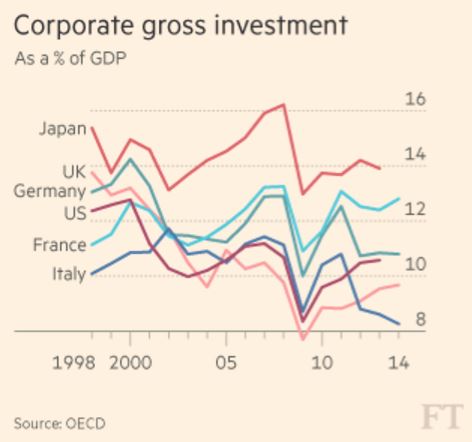
Martin Wolf lays out the reasons for the persistent low-interest rate environment. He attributes this to the "savings glut", arising not just from emerging market foreign exchange surpluses but also from the rising pile of retained surpluses of corporates from developed economies. These surpluses have been financing fiscal deficits in Japan and accumulation of foreign assets in the case of Germany. The first graphic points to the rising corporate gross savings.
However, the rising savings have been accompanied by declining corporate investment, a reminder of the secular stagnation argument.
These trends have led to accumulation of corporate retained earnings.
A significant portion of this is being used to buyback shares and return money to investors. In fact, corporates, especially in the US, have sought to leverage the ultra-low rate environment to finance the share buybacks. So much so that stock buybacks have overtaken aggregate dividends as the main form of corporate payout. These low rates and the resultant high equity risk premium make it prudent for businesses to replace costly equity financing with cheaper debt. The largest US corporates have been leading this market distorting trend. Apart from being an important contributor to fuelling the equity market boom, the resultant reduction in equity base has further inflated corporate surpluses. 

The BIS has documented that in the 2009-14 period, US non-financial corporates repurchased $2.1 trillion in shares and raised $1.8 trillion in net bond financing. 
Clearly, the extended period of quantitative easing and resultant ultra-low interest rates have served to amplify the effects of secular stagnation. 
Add to Technorati Favorites
25 Nov 06:18

Money Attitude of the rich people

by subra
I do not mean the mega rich of the country, I have no clue how a Azim Premji or a Mukesh Ambani talk about money to their families. I am talking of people much lower in the order..but would be worth a few MILLION US $. So let me call them $ millionaires. Money problems […]
25 Nov 03:45

Richard Feynman On Fooling Ourselves Into Believing What Isn’t True

by Farnam Street Team

Richard Feynman Cargo Cult Science

Richard Feynman has long been one of my favorites — for both his wisdom and heart.

Reproduced below you can find the entirety of his 1974 commencement address at Caltech entitled Cargo Cult Science.

The entire speech requires about 10 minutes to read, which is time well invested if you ask me. If you’re pressed for time, however, there are two sections I wish to draw to your attention.

In the South Seas there is a Cargo Cult of people. During the war they saw airplanes land with lots of good materials, and they want the same thing to happen now. So they’ve arranged to make things like runways, to put fires along the sides of the runways, to make a wooden hut for a man to sit in, with two wooden pieces on his head like headphones and bars of bamboo sticking out like antennas—he’s the controller—and they wait for the airplanes to land. They’re doing everything right. The form is perfect. It looks exactly the way it looked before. But it doesn’t work. No airplanes land. So I call these things Cargo Cult Science, because they follow all the apparent precepts and forms of scientific investigation, but they’re missing something essential, because the planes don’t land.

You’re probably chuckling at this point. Yet many of us are no better. This is all around us. Thinking is hard and we fool ourselves, in part, because it’s easy. That’s Feynman’s point.

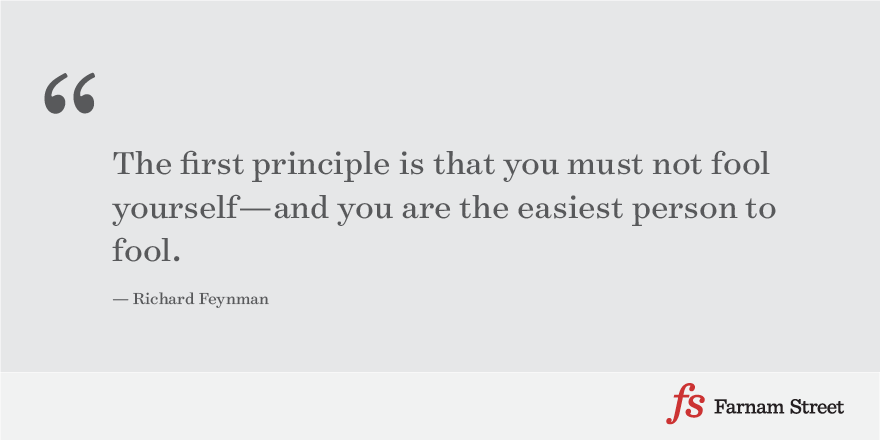
The first principle is that you must not fool yourself—and you are the easiest person to fool. So you have to be very careful about that. After you’ve not fooled yourself, it’s easy not to fool other scientists. You just have to be honest in a conventional way after that.

Your job is to find the current cargo cults.

When we start a project without determining what success looks like … when we mistake the map for the territory … when we look at outcomes without looking at process … when we blindly copy what others have done …. when we confuse correlation and causation we find ourselves on the runway.

***

Cargo Cult Science

During the Middle Ages there were all kinds of crazy ideas, such as that a piece of rhinoceros horn would increase potency. (Another crazy idea of the Middle Ages is these hats we have on today—which is too loose in my case.) Then a method was discovered for separating the ideas—which was to try one to see if it worked, and if it didn’t work, to eliminate it. This method became organized, of course, into science. And it developed very well, so that we are now in the scientific age. It is such a scientific age, in fact, that we have difficulty in understanding how­ witch doctors could ever have existed, when nothing that they proposed ever really worked—or very little of it did.

But even today I meet lots of people who sooner or later get me into a conversation about UFOs, or astrology, or some form of mysticism, expanded consciousness, new types of awareness, ESP, and so forth. And I’ve concluded that it’s not a scientific world.

Most people believe so many wonderful things that I decided to investigate why they did. And what has been referred to as my curiosity for investigation has landed me in a difficulty where I found so much junk to talk about that I can’t do it in this talk. I’m overwhelmed. First I started out by investigating various ideas of mysticism, and mystic experiences. I went into isolation tanks (they’re dark and quiet and you float in Epsom salts) and got many hours of hallucinations, so I know something about that. Then I went to Esalen, which is a hotbed of this kind of thought (it’s a wonderful place; you should go visit there). Then I became overwhelmed. I didn’t realize how much there was.

I was sitting, for example, in a hot bath and there’s another guy and a girl in the bath. He says to the girl, “I’m learning massage and I wonder if I could practice on you?” She says OK, so she gets up on a table and he starts off on her foot—working on her big toe and pushing it around. Then he turns to what is apparently his instructor, and says, “I feel a kind of dent. Is that the pituitary?” And she says, “No, that’s not the way it feels.” I say, “You’re a hell of a long way from the pituitary, man.” And they both looked at me—I had blown my cover, you see—and she said, “It’s reflexology.” So I closed my eyes and appeared to be meditating.

That’s just an example of the kind of things that overwhelm me. I also looked into extrasensory perception and PSI phenomena, and the latest craze there was Uri Geller, a man who is supposed to be able to bend keys by rubbing them with his finger. So went to his hotel room, on his invitation, to see a demonstration of both mind reading and bending keys. He didn’t do any mind reading that succeeded; nobody can read my mind, I guess. And my boy held a key and Geller rubbed it, and nothing happened. Then he told us it works better under water, and so you can picture all of us standing in the bathroom with the water turned on and the key under it, and him rubbing the key with his finger. Nothing happened. So I was unable to investigate that phenomenon.

But then I began to think, what else is there that we believe? (And I thought then about the witch doctors, and how easy it would have been to check on them by noticing that nothing really worked.) So I found things that even more people believe, such as that we have some knowledge of how to educate. There are big schools of reading methods and mathematics methods, and so forth, but if you notice, you’ll see the reading scores keep going down—or hardly going up—in spite of the fact that we continually use these same people to improve the methods. There’s a witch doctor remedy that doesn’t work. It ought to be looked into: how do they know that their method should work? Another example is how to treat criminals. We obviously have made no progress—lots of theory, but no progress—in decreasing the amount of crime by the method that we use to handle criminals.

Yet these things are said to be scientific. We study them. And I think ordinary people with commonsense ideas are intimidated by this pseudoscience. A teacher who has some good idea of how to teach her children to read is forced by the school system to do it some other way—or is even fooled by the school system into thinking that her method is not necessarily a good one. Or a parent of bad boys, after disciplining them in one way or another, feels guilty for the rest of her life because she didn’t do “the right thing,” according to the experts.

So we really ought to look into theories that don’t work, and science that isn’t science.

I tried to find a principle for discovering more of these kinds of things, and came up with the following system. Any time you find yourself in a conversation at a cocktail party—in which you do not feel uncomfortable that the hostess might come around and say, “Why are you fellows talking shop?’’ or that your wife will come around and say, “Why are you flirting again?”—then you can be sure you are talking about something about which nobody knows anything.

Using this method, I discovered a few more topics that I had forgotten—among them the efficacy of various forms of psychotherapy. So I began to investigate through the library, and so on, and I have so much to tell you that I can’t do it at all. I will have to limit myself to just a few little things. I’ll concentrate on the things more people believe in. Maybe I will give a series of speeches next year on all these subjects. It will take a long time.

I think the educational and psychological studies I mentioned are examples of what I would like to call Cargo Cult Science. In the South Seas there is a Cargo Cult of people. During the war they saw airplanes land with lots of good materials, and they want the same thing to happen now. So they’ve arranged to make things like runways, to put fires along the sides of the runways, to make a wooden hut for a man to sit in, with two wooden pieces on his head like headphones and bars of bamboo sticking out like antennas—he’s the controller—and they wait for the airplanes to land. They’re doing everything right. The form is perfect. It looks exactly the way it looked before. But it doesn’t work. No airplanes land. So I call these things Cargo Cult Science, because they follow all the apparent precepts and forms of scientific investigation, but they’re missing something essential, because the planes don’t land.

Now it behooves me, of course, to tell you what they’re missing. But it would be just about as difficult to explain to the South Sea Islanders how they have to arrange things so that they get some wealth in their system. It is not something simple like telling them how to improve the shapes of the earphones. But there is one feature I notice that is generally missing in Cargo Cult Science. That is the idea that we all hope you have learned in studying science in school—we never explicitly say what this is, but just hope that you catch on by all the examples of scientific investigation. It is interesting, therefore, to bring it out now and speak of it explicitly. It’s a kind of scientific integrity, a principle of scientific thought that corresponds to a kind of utter honesty—a kind of leaning over backwards. For example, if you’re doing an experiment, you should report everything that you think might make it invalid—not only what you think is right about it: other causes that could possibly explain your results; and things you thought of that you’ve eliminated by some other experiment, and how they worked—to make sure the other fellow can tell they have been eliminated.

Details that could throw doubt on your interpretation must be given, if you know them. You must do the best you can—if you know anything at all wrong, or possibly wrong—to explain it. If you make a theory, for example, and advertise it, or put it out, then you must also put down all the facts that disagree with it, as well as those that agree with it. There is also a more subtle problem. When you have put a lot of ideas together to make an elaborate theory, you want to make sure, when explaining what it fits, that those things it fits are not just the things that gave you the idea for the theory; but that the finished theory makes something else come out right, in addition.

In summary, the idea is to try to give all of the information to help others to judge the value of your contribution; not just the information that leads to judgment in one particular direction or another.

The easiest way to explain this idea is to contrast it, for example, with advertising. Last night I heard that Wesson Oil doesn’t soak through food. Well, that’s true. It’s not dishonest; but the thing I’m talking about is not just a matter of not being dishonest, it’s a matter of scientific integrity, which is another level. The fact that should be added to that advertising statement is that no oils soak through food, if operated at a certain temperature. If operated at another temperature, they all will—including Wesson Oil. So it’s the implication which has been conveyed, not the fact, which is true, and the difference is what we have to deal with.

We’ve learned from experience that the truth will out. Other experimenters will repeat your experiment and find out whether you were wrong or right. Nature’s phenomena will agree or they’ll disagree with your theory. And, although you may gain some temporary fame and excitement, you will not gain a good reputation as a scientist if you haven’t tried to be very careful in this kind of work. And it’s this type of integrity, this kind of care not to fool yourself, that is missing to a large extent in much of the research in Cargo Cult Science.

A great deal of their difficulty is, of course, the difficulty of the subject and the inapplicability of the scientific method to the subject. Nevertheless, it should be remarked that this is not the only difficulty. That’s why the planes don’t land—but they don’t land.

We have learned a lot from experience about how to handle some of the ways we fool ourselves. One example: Millikan measured the charge on an electron by an experiment with falling oil drops and got an answer which we now know not to be quite right. It’s a little bit off, because he had the incorrect value for the viscosity of air. It’s interesting to look at the history of measurements of the charge of the electron, after Millikan. If you plot them as a function of time, you find that one is a little bigger than Millikan’s, and the next one’s a little bit bigger than that, and the next one’s a little bit bigger than that, until finally they settle down to a number which is higher.

Why didn’t they discover that the new number was higher right away? It’s a thing that scientists are ashamed of—this history—because it’s apparent that people did things like this: When they got a number that was too high above Millikan’s, they thought something must be wrong—and they would look for and find a reason why something might be wrong. When they got a number closer to Millikan’s value they didn’t look so hard. And so they eliminated the numbers that were too far off, and did other things like that. We’ve learned those tricks nowadays, and now we don’t have that kind of a disease.

But this long history of learning how to not fool ourselves—of having utter scientific integrity—is, I’m sorry to say, something that we haven’t specifically included in any particular course that I know of. We just hope you’ve caught on by osmosis.

The first principle is that you must not fool yourself—and you are the easiest person to fool. So you have to be very careful about that. After you’ve not fooled yourself, it’s easy not to fool other scientists. You just have to be honest in a conventional way after that.

I would like to add something that’s not essential to the science, but something I kind of believe, which is that you should not fool the layman when you’re talking as a scientist. I’m not trying to tell you what to do about cheating on your wife, or fooling your girlfriend, or something like that, when you’re not trying to be a scientist, but just trying to be an ordinary human being. We’ll leave those problems up to you and your rabbi. I’m talking about a specific, extra type of integrity that is not lying, but bending over backwards to show how you’re maybe wrong, that you ought to do when acting as a scientist. And this is our responsibility as scientists, certainly to other scientists, and I think to laymen.

For example, I was a little surprised when I was talking to a friend who was going to go on the radio. He does work on cosmology and astronomy, and he wondered how he would explain what the applications of this work were. “Well,” I said, “there aren’t any.” He said, “Yes, but then we won’t get support for more research of this kind.” I think that’s kind of dishonest. If you’re representing yourself as a scientist, then you should explain to the layman what you’re doing—and if they don’t want to support you under those circumstances, then that’s their decision.

One example of the principle is this: If you’ve made up your mind to test a theory, or you want to explain some idea, you should always decide to publish it whichever way it comes out. If we only publish results of a certain kind, we can make the argument look good. We must publish both kinds of result. For example—let’s take advertising again—suppose some particular cigarette has some particular property, like low nicotine. It’s published widely by the company that this means it is good for you—they don’t say, for instance, that the tars are a different proportion, or that something else is the matter with the cigarette. In other words, publication probability depends upon the answer. That should not be done.

I say that’s also important in giving certain types of government advice. Supposing a senator asked you for advice about whether drilling a hole should be done in his state; and you decide it would be better in some other state. If you don’t publish such a result, it seems to me you’re not giving scientific advice. You’re being used. If your answer happens to come out in the direction the government or the politicians like, they can use it as an argument in their favor; if it comes out the other way, they don’t publish it at all. That’s not giving scientific advice.

Other kinds of errors are more characteristic of poor science. When I was at Cornell. I often talked to the people in the psychology department. One of the students told me she wanted to do an experiment that went something like this—I don’t remember it in detail, but it had been found by others that under certain circumstances, X, rats did something, A. She was curious as to whether, if she changed the circumstances to Y, they would still do, A. So her proposal was to do the experiment under circumstances Y and see if they still did A.

I explained to her that it was necessary first to repeat in her laboratory the experiment of the other person—to do it under condition X to see if she could also get result A—and then change to Y and see if A changed. Then she would know that the real difference was the thing she thought she had under control.

She was very delighted with this new idea, and went to her professor. And his reply was, no, you cannot do that, because the experiment has already been done and you would be wasting time. This was in about 1935 or so, and it seems to have been the general policy then to not try to repeat psychological experiments, but only to change the conditions and see what happens.

Nowadays there’s a certain danger of the same thing happening, even in the famous field of physics. I was shocked to hear of an experiment done at the big accelerator at the National Accelerator Laboratory, where a person used deuterium. In order to compare his heavy hydrogen results to what might happen to light hydrogen he had to use data from someone else’s experiment on light hydrogen, which was done on different apparatus. When asked he said it was because he couldn’t get time on the program (because there’s so little time and it’s such expensive apparatus) to do the experiment with light hydrogen on this apparatus because there wouldn’t be any new result. And so the men in charge of programs at NAL are so anxious for new results, in order to get more money to keep the thing going for public relations purposes, they are destroying—possibly—the value of the experiments themselves, which is the whole purpose of the thing. It is often hard for the experimenters there to complete their work as their scientific integrity demands.

All experiments in psychology are not of this type, however. For example, there have been many experiments running rats through all kinds of mazes, and so on—with little clear result. But in 1937 a man named Young did a very interesting one. He had a long corridor with doors all along one side where the rats came in, and doors along the other side where the food was. He wanted to see if he could train the rats to go in at the third door down from wherever he started them off. No. The rats went immediately to the door where the food had been the time before.

The question was, how did the rats know, because the corridor was so beautifully built and so uniform, that this was the same door as before? Obviously there was something about the door that was different from the other doors. So he painted the doors very carefully, arranging the textures on the faces of the doors exactly the same. Still the rats could tell. Then he thought maybe the rats were smelling the food, so he used chemicals to change the smell after each run. Still the rats could tell. Then he realized the rats might be able to tell by seeing the lights and the arrangement in the laboratory like any commonsense person. So he covered the corridor, and, still the rats could tell.

He finally found that they could tell by the way the floor sounded when they ran over it. And he could only fix that by putting his corridor in sand. So he covered one after another of all possible clues and finally was able to fool the rats so that they had to learn to go in the third door. If he relaxed any of his conditions, the rats could tell.

Now, from a scientific standpoint, that is an A‑Number‑l experiment. That is the experiment that makes rat‑running experiments sensible, because it uncovers the clues that the rat is really using—not what you think it’s using. And that is the experiment that tells exactly what conditions you have to use in order to be careful and control everything in an experiment with rat‑running.

I looked into the subsequent history of this research. The subsequent experiment, and the one after that, never referred to Mr. Young. They never used any of his criteria of putting the corridor on sand, or being very careful. They just went right on running rats in the same old way, and paid no attention to the great discoveries of Mr. Young, and his papers are not referred to, because he didn’t discover anything about the rats. In fact, he discovered all the things you have to do to discover something about rats. But not paying attention to experiments like that is a characteristic of Cargo Cult Science.

Another example is the ESP experiments of Mr. Rhine, and other people. As various people have made criticisms—and they themselves have made criticisms of their own experiments—they improve the techniques so that the effects are smaller, and smaller, and smaller until they gradually disappear. All the parapsychologists are looking for some experiment that can be repeated—that you can do again and get the same effect—statistically, even. They run a million rats—no, it’s people this time—they do a lot of things and get a certain statistical effect. Next time they try it they don’t get it any more. And now you find a man saying that it is an irrelevant demand to expect a repeatable experiment. This is science?

This man also speaks about a new institution, in a talk in which he was resigning as Director of the Institute of Parapsychology. And, in telling people what to do next, he says that one of the things they have to do is be sure they only train students who have shown their ability to get PSI results to an acceptable extent—not to waste their time on those ambitious and interested students who get only chance results. It is very dangerous to have such a policy in teaching—to teach students only how to get certain results, rather than how to do an experiment with scientific integrity.

So I wish to you—I have no more time, so I have just one wish for you—the good luck to be somewhere where you are free to maintain the kind of integrity I have described, and where you do not feel forced by a need to maintain your position in the organization, or financial support, or so on, to lose your integrity. May you have that freedom. May I also give you one last bit of advice: Never say that you’ll give a talk unless you know clearly what you’re going to talk about and more or less what you’re going to say.

--
Sponsored By: Greenhaven Road Capital: You think differently - now invest differently.

25 Nov 03:44

Latticework of Mental Models: Gambler’s Fallacy

by Anshul Khare

Let’s start with a small riddle.

A man, probably a statistician, believes that his next child will be a girl since his wife has already borne him three sons.

Do you find his argument convincing?

The argument intuitively doesn’t feel right. Isn’t it? But why?

We’ll circle back to this puzzle but before that let me indulge you in another interesting thought experiment.

Imagine yourself as a spectator in a coin flipping tournament. You notice that in one of the plays, the coin has landed on heads for 5 consecutive flips. If you were given an opportunity to bet on the next flip, would you bet on heads or tails?

I know you’re a value investor and don’t believe in speculating or gambling away your hard earned money on frivolous coin flipping tournaments, but this being a thought experiment I would request you to play along.

So what’s your answer?

The basic concepts of probability tells us that for random events like coin flips, both the head or tail are equal likely. In other words the probability of a head and a tail are both 1/2 (0.5).

So using my elementary knowledge of probability, I would reason that the universe will try to balance out the too many heads.

When I use this argument to put my bet on tails, I am falling for a bias called Gambler’s Fallacy.

The Gambler’s Fallacy is the mistaken belief that, if something happens more frequently than normal during some period, it will happen less frequently in the future, or that, if something happens less frequently than normal during some period, it will happen more frequently in the future (presumably as a means of balancing nature).
(source: Wikipedia)

That explains why our statistician friend’s argument is flawed. The gender of the fourth child is causally unrelated to any preceding chance events or series of such events. His chances of having a daughter are no better than 1 in 2 i.e., 50-50.

With independent events (the gender of kids, result of toss using a fair coin, etc.) there is no harmonising force at work. The coin doesn’t know that it had landed heads in the last 5 tosses.

The most famous example of the gambler’s fallacy occurred in a game of roulette at the Monte Carlo Casino in 1913 when the ball fell in black 26 times in a row. This was an extremely uncommon occurrence, although no more or less common than any of the other 67,108,863 sequences of 26 red or black. Gamblers lost millions of francs betting against black, reasoning incorrectly that the streak was causing an “imbalance” in the randomness of the wheel, and that it had to be followed by a long streak of red. (source: Wikipedia)

So why is it called a gambler’s fallacy? Because it’s rampant among gamblers and speculators.

There was a guy who claimed that he had a scientific way of playing the lottery. He diligently maintained a spreadsheet of winning numbers and would bet on those numbers which had appeared the least. Alas! another victim of Gambler’s fallacy.

Now if a coin (a fair one) has equal probability (50:50) of turning heads or tails then why is it fallacious to expect a tail after 5 consecutive heads? That’s a fair question to ask.

To answer that, let me take help from Daniel Kahneman. In his book, Thinking Fast and Slow, Danny writes …

People expect that a sequence of events generated by a random process [coin toss] will represent the essential characteristics [equal probability of head and tail] of that process even when the sequence is short [few tosses]. In considering tosses of a coin for heads or tails, for example, people regard the sequence H-T-H- T-T-H to be more likely than the sequence H-H-H-T-T-T, which does not appear random, and also more likely than the sequence H-H-H-H-T-H, which does not represent the fairness of the coin. Thus, people expect that the essential characteristics of the process will be represented, not only globally in the entire sequence, but also locally in each of its parts. A locally representative sequence [the sequence of 5 heads which you observed], however, deviates systematically from chance expectation: it contains too many alternations and too few runs.

Another consequence of the belief in local representativeness is the well-known gambler’s fallacy. After observing a long run of red on the roulette wheel, for example, most people erroneously believe that black is now due, presumably because the occurrence of black will result in a more representative sequence than the occurrence of an additional red. Chance is commonly viewed as a self-correcting process in which a deviation in one direction induces a deviation in the opposite direction to restore the equilibrium. In fact, deviations are not “corrected” as a chance process unfolds, they are merely diluted.

Kahneman’s insights are remarkable. So if you didn’t understand the above two paragraphs, please read them slowly and then re-read them.

Now if you were given an opportunity to bet on many such tosses, say 100 tosses, what would be your strategy for betting? Again the assumption being that it’s a fair coin (with no specific bias for either head or tail) and with the knowledge that probabilities are still 50:50.

Kahneman explains this using an anecdote about famous economist Paul Samuelson. He writes …

The great Paul Samuelson—a giant among the economists of the twentieth century—famously asked a friend whether he would accept a gamble on the toss of a coin in which he could lose $100 or win $200. His friend responded, “I won’t bet because I would feel the $100 loss more than the $200 gain. But I’ll take you on if you promise to let me make 100 such bets.” Unless you are a decision theorist, you probably share the intuition of Samuelson’s friend, that playing a very favorable but risky gamble multiple times reduces the subjective risk.

Samuelson’s friend was pretty smart. He understood that Gambler’s fallacy arises out of a belief in a law of small numbers, or the erroneous belief that small samples must be representative of the larger population. Hence he was willing to bet on the aggregate outcome of bigger sample size than a single outcome.

You probably noticed that I have been mentioning the use of a fair coin for our tosses. A fair coin ensures the pre-condition for a gambler’s fallacy to hold true, i.e. independent events.

Gambler’s Fallacy – Reversed!

If I told you that in the same coin tossing tournament, there is play where the coin has turned heads for 50 consecutive tosses. What would you bet on for the 51st coin toss?

The probability of that happening, using a fair coin, is 1 in a 1100 trillion but there’s also a chance that the coin is biased. A biased coin or an imperfect roulette wheel can also lead to outcomes like 5 consecutive heads but for totally different reasons. In these cases the gambler’s fallacy might superficially seem to apply, when it actually does not.

If you suspect that you’re dealing with a biased coin or a loaded dice, it’s reasonable to expect that long streak of skewed outcomes are not due to randomness. But sometimes human brain takes it too far in the other direction when a belief in the idea of hot hand takes root.

This is the reverse of gambler’s fallacy, also known as hot hand fallacy. It originates from basketball where players who scored several times in a row are believed to have a hot hand, i.e. are more likely to score at their next attempt.

In cricket, players are often declared to be “in-form” and are expected to consistently perform above average until the form lasts. Perhaps a hot-bat fallacy! :)

At first the idea of gambler’s fallacy might look paradoxical to the mental model of mean reversion but it’s not. In his book, The Art of Thinking Clearly, Rolf Dobelli explains the subtle difference between the two.

…if you are experiencing record cold where you live, it is likely that the temperature will return to normal values over the next few days, If the weather functioned like a casino, there would be 50% chance that the temperature would rise and a 50% chance that it would drop. But the weather is not like a casino. Complex feedback mechanisms in the atmosphere ensures that extremes balance themselves out.

So, take a closer look at the independent and interdependent events around you. Purely independent events really only exist at the casino, in the lottery and in theory. In real life, in the financial markets and in business, with the weather and your health, events are often interrelated.

Which means a domain prone to truly random and independent events, like a casino, is more prone to gambler’s fallacy. However, in systems which behave like complex adaptive systems i.e. prone to self correction, both mean reversion (negative feedback loops) and extreme outcomes (positive feedback loops) are a possibility.

In Investing

In stock markets how many times have we heard, ‘whatever goes up must come down’ or ‘how much more can it drop?’.

These beliefs are a manifestation of gambler’s fallacy in investor’s behaviour. Vishal is fond of quoting the example –

A stock that falls 95%, first fell 90% and from that level fell another 50%.

When Warren Buffett said, “turnarounds seldom turn” he probably had gambler’s fallacy in mind.

Expecting that the future events will smoothen out the stock prices, just because it has been falling for ‘n’ continuous trading days, is an irrational way of thinking.

Sometimes investors abruptly change their belief from gambler’s fallacy to hot-hand fallacy. When their patience runs out, having lost money by betting on outcomes which are supposedly “long overdue”, they tend to go overboard in assuming that a stock has come to its “form” and will continue it’s trend. They bet heavily on the new “trend” and right then the tide turns and the roaring market makes a mincemeat out of those unsuspecting hot-hand believers.

Conclusion

Typically humans intuitively find it hard to deal with randomness as a result we tend to put a tremendous amount of weight on previous events, believing that they’ll somehow influence future outcomes. Gambler’s fallacy dictates that the idea of “balancing force of the universe” is a baloney.

Today’s idea requires you to understand the basics of probability. If you aren’t acquainted with the basic probability concepts, you need to learn it else you might end up like the proverbial (as described by Charlie Munger) single legged man in an ass-kicking contest.

You must have noticed that I have referred to quite a few mental models which have appeared in this series before, and you might be feeling overwhelmed finding so many links.

Please understand that as you learn more ideas, you are bound to find more and more connections between those ideas. And that’s how a useful worldview is created – by constructing a framework of interconnected ideas.

That’s what a real latticework looks like. Building such a latticework serves the purpose of saving us from biggest errors in thinking and decision making – in our private lives, at work or in business.

Take care and keep learning.

Further reading:
[1]: Prof. Bakshi’s lecture notes on Bayesian Equation.

The post Latticework of Mental Models: Gambler’s Fallacy appeared first on Safal Niveshak.

    
24 Nov 12:32

Economy can shrug off Seventh Pay Commission impact

by T T Ram Mohan
All the doomsaying we heard before the report of the Seventh Pay Commission(SPC) has turned out to be nonsense. The hike in pay is a modest 16%, with a total increase of 23.55 per cent after taking into account allowances and pension. Let me spell out the impact:
  • Fiscal deficit: The impact on the central government is 0.46% of GDP which reduces to around 0.4% of GDP once taxes are taken into account. A correct way to look at the impact is to amortize this impact over a business cycle. If amortized over, say, five years, the annual impact is a piffling 0.08%
  • Output and growth: Government spending on pay will rise. Analysts think this will be expansionary as it was during the time of Sixth Pay Commission. They are wrong. On the last occasion, higher pay was allowed to translate into a higher fiscal deficit. This time, the finance ministry has said the targeted reduction in fiscal deficit from 3.9% of GDP in 2015-16 to 3.6% of GDP in 2016-17 will be adhered to. This means that increased pay will be offset by reductions on other accounts. The pay hike will, therefore, not be expansionary
  • Inflation: For the same reason as above, the pay hike will not have a significant inflationary impact
  • Sectors: Higher spending by government employees can provide a modest stimulus to sectors such as real estate, consumer goods and automobiles. The stimulus will be modest because the increases in pay are not very large.
 The SPC has improved terms for pensioners considerably but the outcome falls short of one rank, one pension. Earlier, retireees used to be placed at the minimum of the new pay bands corresponding to the levels at which they retired. Now, they will be given increments corresponding to the increments they got above the minimum. This is a huge benefit to pensioners.But it's not one rank, one pension. All retired professors don't get the same pay- there will be a difference depending on the number of years for which they served as professor.

Critics of Pay Commissions have said that the tail is government is too long and the head too small. This can change if the government wishes. There will be large retirements in the C and D categories. These can be left unfilled and the government can instead hire in larger numbers at the officer level. In the years ahead, there is a great opportunity to right size the government and bring in diverse skills.

Overall numbers have been growing mainly in the ministry of home affairs (police and paramilitary forces), not so much in most other ministries and departments. The SPC provides data that shows that India's bureaucracy in relation to the population is much smaller than that of the US.

The other criticism of Pay Commissions is that they have not emphasised performance and productivity adequately. The Sixth Pay Commission had proposed a performance-related incentive scheme (PRIS). The SPC notes that it hasn't quite taken off because of numerous operational difficulties. It also notes correctly that performance measurement in government is rather difficult. It is less difficult in the private sector where performance can be measured against defined commercial targets (although even this is done badly in most private firms). The SPC proposes performance related pay linked to a new framework.

My sense is that operationalising this framework will prove just as difficult as the Sixth Pay Commission PRIS. The focus in government should be primarily on collective performance as measured by independent audits, the reports of which are made transparent. There should be penalties for collective under- performance (such as delayed promotions and even compulsory retirement). Financial rewards for good performance should be for a team as a whole and the amounts should be quite modest. Anything else will create havoc in government.

There is a strong case for creating a separate management audit department in the CAG. All government departments, agencies, regulators and autonomous institutions must come under its purview. The management audit should focus not just on outcomes but also on internal processes and governance and should cover HR issues. Where processes and governance are weak, it will be reflected in outcomes. A management audit should capture these before outcomes are undermined.

More on the SPC report in my article in the Hindu, Why we  must not grudge them a pay hike


24 Nov 06:49

Hard Work is a Bitch

by Kira Moore

Hard work is a bitch!

Tiger Woods hits 1,000 balls AFTER each round in a Major.  Lindsey Vonn spends 8 hours a day in the gym, 5 days a week.  Michael Phelps spent 40 hours a week in the pool, and that didn’t count his gym time or road time.

Hard work is a bitch and the truth is you have no idea what hard work really is. If you want to make Presidents club, if you want to make a lot of money…. If you want that promotion to Sales Manager or to Chief Sales Officer, you need to work your ass off. You have to put in unrealistic effort.

Here’s the problem, we’ve been conditioned not to work hard.  We’re pounded with things like Work-Life Balance, or terms like Workaholic suggesting that working too hard is a bad thing.   We’re told that working hard is the way to success but then told if we work too hard, we’re not being healthy.

We celebrate superstars who achieve greatness, yet chastise those putting in the time to achieve greatness.That’s one hell of a paradox we’ve created isn’t it?  Here is the deal, no matter what it is you want, if you want to be the best — you have to work your ass off.  You have to learn what hard work really is, because I can tell you right now, if you’re like most people, you have no clue what hard work is. Most people find hard work to be unreasonable and they are right. Hard work is unreasonable and this is where the win is.

Hard work takes more effort, time, pain, focus, and sacrifice than most of us are willing to put in and that’sthe beauty of it all.  Be happy most people think hard work is unreasonable, because they won’t do it.  Those who think hard work is unreasonable, don’t work hard – and that’s your in.

 Now go bust your ass!

24 Nov 03:10

Ignore Sensex

by Muthu

As on 30th September 2015, the one year return of Sensex was -1.79%. During the same period the CRISIL AMFI equity performance index, which is an index to measure the performance of actively managed funds in India, has provided a one year return of 9.44%. An alpha of 11.23%.

I’ve written an article earlier as to how this CRISIL AMFI index has delivered a return of 22.74% for the period 1’st April 1997 (the date this index was constituted) to 31’st March 2015. During the same period Sensex has provided an annualised return of 12.36%. So CRISIL AMFI index has generated an alpha of 10.38% over 18 years.

Alpha denotes the margin by which mutual funds have outperformed the indices.

For the last 18.5 years (as on 30the September 2015), actively managed funds have delivered annualised return of 21.86%.

Though Sensex itself has provided decent returns over long run, actively managed equity funds (where you invest your money) has done phenomenally well in India.

The CRISL AMFI Equity fund index has never given a negative return for any 5 year period on a daily rolling basis since inception.

Though for convenience we use Sensex in many illustrations, please note that actively managed funds have done much better than Sensex.

Ignore Sensex.

Focus on funds.


24 Nov 03:04

Tax Incentives Have Distorted Our Economy. Remove Them and We’ll Win.

by Deepak Shenoy

I went on a twitter rant about how we deal with incentives:

1/ India has wrongly placed too much on tax incentives. From zero taxed exports to tax credit for home loans, we’ve distorted our economy.

— Deepak Shenoy (@deepakshenoy) November 23, 2015

2/ Take IT. Why didn’t the IT majors build great software for India? Because STPI (and then SEZ) rules said zero tax if you exported.

— Deepak Shenoy (@deepakshenoy) November 23, 2015

3/ If you sold to India, you had to pay tax on profits. If you had 75% exports, 25% local you paid tax on the 25%.

— Deepak Shenoy (@deepakshenoy) November 23, 2015

4/ Why bother with local at all? Discourage. Overquote. Do not invest. When the STPI sunset came in 2010, stuff for India happened.

— Deepak Shenoy (@deepakshenoy) November 23, 2015

5/ SEZs. We get tax free exports plus duty drawbacks for exports. Why?

(Read On...)
24 Nov 03:04

Counting backwards to the next recession

by Antonio Fatas
In most advanced economies business cycles can be well characterized by a succession of long expansion phases that are interrupted by short recessions. Given this pattern it is sometimes natural to think about the length of expansions as a key feature that describes the business cycle. While other variables matter (such as the depth and length of recessions), in the case of the US and to some extent in the case of European countries, the parameter that has changed the most across cycles is the length of the expansion phase.

In the case of the US (using the NBER business cycle dates), in the post-WWII period expansions have lasted from 12 months in the expansion ending in 1981to 120 months in the expansion ending in 2001. The current expansion is already 77 months long, longer than the previous expansion of 2001-2007.

While counting months is not a good way to forecast the timing of the next recession it is at least a reminder that there is another recession waiting for us in the not-so-distant future. And when we start counting backwards to the next recession a key questions is whether we will be ready for it. In particular, will monetary policy be back to normal and able to react to it?

Interest rates have not yet moved away from zero in either Europe, the U.S. or Japan. This is, of course, very unusual given the length of the expansion. Another way to see how unusual monetary policy and interest rates look like is to plot the difference between long-term rates and the central bank rate.
For the case of the US we can see that this difference (the term premium) has stayed very high since the 2008-09 recession. Unlike in previous expansion where after two to four years the term premium started declining (mostly through increases in the short-term rate), in this case the number remains unusually high. 

There is a positive reading of the chart that suggests that we are far from the next recession. Under the assumption that the term premium has to get very close to zero before a recession happens, it will take a while before we see the next one. But that reading ignores the fact that today short-term rates are not normal, they are stuck at the zero lower bound. Recessions do not happen because the term premium decreases, recessions happen for other reasons and it happens to be that the term premium moves with the cycle. But this expansion is not like the others because of the constraints on short-term rates so it might possibly be that the difference with long-term rates will this time be a really bad indicator of how close we are to a recession.

And this second reading the chart reminds us of the risk that we are facing if the next recession is somewhere in the near future and monetary policy has not had the time to go back to normal, to go back to levels of short term rates that allow for a decrease in these rates that is consistent with what we have seen in previous recession. And entering the next recession in Europe or the U.S. with interest rates that are too close to zero does not sound like a good idea and in addition there is a lot of uncertainty given that we have not seen such a case in the recent business cycles. 

So in addition to all the reasons why we want economic conditions and monetary policy to quickly go back to normal, there is an additional sense of urgency from the scenario that in the near future there is either a domestic or global event that causes the next recession. So in a world with very low interest rates central banks and government need to look forward and make sure that planning for the next recession is part of their strategy to ensure the fastest possible recovery from the previous one.

Antonio Fatás
24 Nov 03:01

Writing a will

by subra
There are 3 ways you can write a will: Go to the Internet and download a will format. Fill up the details, take a printout get it signed by 2 people and leave it in your cupboard, and maybe a scanned copy in your gmail account. Brilliant, if nothing goes wrong. Go to a lawyer […]
23 Nov 05:13

An agenda for distribution sector reforms

by noreply@blogger.com (Gulzar Natarajan)
I blogged earlier on my skepticism with power sector reforms. My concerns arise from deep-rooted fundamental problems that afflict the sector and not the details of the financial restructuring plan. 

On the face of it, the distribution side of power ought to be technically the simplest to manage. Power flows without any transactional engagement by the discom. The purely operational transactions done by the discom are secondary and just three - repair and restore supply when interrupted, replace non-working meters, and do periodic operation and maintenance (O&M). And then there are the management issues of releasing new services, spot-billing, and theft detection and disconnection. The discoms do none of these to any reasonable degree of satisfaction. State capability and political economy constraints bind big-time. And even if we get this right, we run into the twin challenges of free farm power and low tariffs. 

The limited technology adoption, archaic processes, low level of professional competence among field-level engineers (a reflection of our workforce employability crisis), limited large and credible enough local service providers (spot-billing, transformer and other equipment servicing, O&M contracting of services etc), unionization, corruption etc are first order problems. They are amplified many times over by weak state capability, sensitive electoral politics, and inherently complex nature of the problem, all of which make technology adoption, howsoever beneficial, a very difficult challenge.

I have blogged earlier here, here, and here on this and am being deliberately provocative in arguing that technology solutions like GIS, SCADA (maybe DA, but surely not SC), DTR (transformer) metering etc are not going to happen in even our best discoms (power point presentations in conferences and seminars apart!) anytime for the foreseeable future. In a difficult and constraining environment, a strategy that focuses on these first-best solutions is certain to crowd-out the effective implementation of even feasible second-best solutions. It would detract from the effectiveness of supervision and make the best the enemy of the good!

So what is the way out? Understand the problem, acknowledge it, and then start work on it. As a first-order and non-negotiable requirement, discoms need to measure and audit its energy distribution and bill and collect from services, the equivalent of plain good governance in the distribution side. But this requires real-time metering of feeders, consumer mapping under each feeder (and keeping track of the dynamic downstream LV network), and then rigorous monitoring and enforcement. And the same with billing services, replacing non-working meters, and collecting dues. Simple as it appears, given the environment, this is a super-difficult challenge and unlikely to happen in quick time. Without arguing for a sequential approach to reform, this is an essential pre-requisite for any other reform. 

Technology can be useful here, but not as top-down GIS/SCADA/AMR solutions, as is currently being advocated. The best strategy is to make available the full spectrum of technology and re-engineering options available in the market and let discoms adopt what they can sustain and suit them best. Different categories of technology interventions in energy audits should be implemented across and within discoms and technology solutions should be allowed iterate and evolve. Given the size of the country, the three orders of the interventions (multiple discoms, multiple areas within a discom, and different technologies) should, if done in a focused manner, over a period of time, throw up technologies that emerge as successes and can diffuse into scale.
Add to Technorati Favorites
23 Nov 04:06

Nick Murray: Ten investment pointers

by Muthu

Some time ago, I’ve mentioned about Nick Murray and his must read book ‘Simple Wealth, Inevitable Wealth’.

My strong faith in equity as the preferred vehicle for both asset accumulation and distribution got validated by the above book. I’m happy that someone has thought on similar lines like me before:-)

I’m pleased to share with you below ten investment pointers provided by Nick Murray:

1) I believe that the fundamental investment risk is not losing one’s money, but outliving it.

2) I believe, therefore, that the only safety lies in the accretion of purchasing power.

3) I believe that the great long term risk of stocks is not owning them.

4) I believe that everything you need to know about the movement of stock prices can be summed up in 8 words: The downs are temporary; the ups are permanent.

5) I process the experience which most people describe as a “bear market” in two different words: big sale.

6) I don’t believe in Individual Stocks, I believe in managed portfolios of stocks.

7) I believe that dollar cost averaging (SIP) will make the dumbest person in the world wealthy. Hey, look at me: it already has.

8) I love volatility.

9) I’m not afraid of being in the next 25% down tick. I am afraid of missing the next 100% uptick.

10) I believe that, prior to retirement, people should own as close to 100% equity as they can emotionally stand. Then, after retirement, I believe they should own as close to 100% equities as they can emotionally stand.


23 Nov 03:54

Big Idea from a Super Investor: Howard Marks on Contrarianism

by Anshul Khare

Note: This article formed part of the May 2015 Special Report sent to subscribers of our premium newsletter Value Investing Almanack.


What do you do if Warren Buffett calls you personally and offers to write the foreword for your book? First, you write the book as soon as possible and second, you make it worthy and useful enough to deserve an endorsement from Buffett. (source: Google talk)

That’s precisely what Howard Marks did with his book –The Most Important Thing: Uncommon Sense for the Thoughtful Investor. He runs Oaktree Capital, a $90 billion hedge fund, and has more than four decades of investing experience. Just like Buffett he has been writing memos to his investors for last twenty five years.

These client memos contain insightful commentary and a time-tested philosophy about sensible investing. Howard Marks is not only a super investor but a thoughtful author too. His writings are not to be missed and that’s what Buffett seems to say in this statement –

When I see memos from Howard Marks in my mail, they’re the first thing I open and read. I always learn something, and that goes double for his book.

In this post, I try to draw one big lesson from his writings and offer them to you for reflection. The big idea for today is contrarian investing. Let’s dive in right away.

What is contrarianism?

Can you guess one of the popular mantras during bull markets? It’s – Trend is your friend. The irony is that a trend is a product of social proof i.e. it’s the direction where the crowd is going. And it’s quite natural for people to feel comfortable being part of a herd. Why?

Thousands of years ago when Homo Sapiens was evolving(they still are albeit the changes are unnoticeable), staying in a herd and following your group ensured safety from predators and hostile environment. However the modern world doesn’t have the risks that plagued the hunter-gatherer environment of our ancestors.

Alas! the evolutionary instincts haven’t had a chance to fade away completely. Human beings still crave the comfort and safety of a herd. And to a large extent this behavioural bias is very useful in most of the social context.

In stock market, following the crowd is usually considered safe albeit it leaves you with mediocre results. But occasionally, when the mania sets in, the crowd stampedes off the cliff. And this is the time when going against the crowd (backed by independent thinking, and not just to prove that you are a contrarian) can potentially generate extraordinary profits.

Contrarianism starts with an attitude of healthy skepticism. Skepticism doesn’t just translate to questioning the delusional optimism during market euphoria. It also means questioning the excessive pessimism during market depression.

Marks writes in his book –

Skepticism is usually thought to consist of saying, “no, that’s too good to be true” at the right times. But I realized in 2008 – and in retrospect it seems obvious – that sometimes skepticism requires us to say, “no, that’s too bad to be true.”

Contrarianism is profitable!

It’s interesting as well as funny that even though the crowd creates the highest and lowest points in the market, at these very inflexion points the crowd itself is wrong. Obviously the sensible thing to do at these times is to diverge from the herd opinion.

Contrarianism might seem like an act of valor but there is a sound reasoning behind it. The heart of value investing is identifying assets at prices less than their true value. If everybody comes to know about the mispriced asset, market efficiency kicks in to quickly close the gap between price and intrinsic value. Hence converging of popular opinions about an investment idea eliminates its profit potential. So, by definition, a profitable strategy has to be a contrarian one to begin with. Marks explains –

If everyone likes it, it’s probably because it has been doing well. Most people seem to think outstanding performance to date presages outstanding future performance. Actually, it’s more likely that outstanding performance to date has borrowed from the future and thus presages subpar performance from here on out.

During a severe market selloff, you don’t only get a desired low price but you can also build sizeable positions because of high available volumes, which is hard to get during stable market conditions.

In the following quote, Warren Buffett effectively urges us to be contrarians –

The less prudence with which others conduct their affairs, the greater the prudence with which we should conduct our own affairs.

When markets are moving sideways, following the crowd generates an average return. But when markets are going through inflexion points, following the crowd can turn out to be extremely dangerous for your financial health.

Of course the market extremes are a rarity and it’s not advisable that you always wait at sidelines for these extremes in the hope of deploying the contrarian strategy. However, an awareness about these opportunistic moments can boost your long term performance.

But it ain’t easy!

Talking about contrarianism is easy but practicing it can be hard. Our super investor writes –

Just don’t think it’ll be easy. You need the ability to detect instances in which prices have diverged significantly from intrinsic value. You have to have a strong-enough stomach to defy conventional wisdom (one of the greatest oxymorons) and resist the myth that the market’s always efficient and thus right.

There are several reasons which make contrarianism a difficult game to play. Holding a contrarian view is uncomfortable and can be emotionally taxing. It’s a lonely job and a game of patience. The only thing that can sustain you in this game is confidence in your own decision-making process. For that matter, a contrarian strategy is a by-product of sound thinking and rational analysis. Marks writes –

Not only should the lonely and uncomfortable position be tolerated, it should be celebrated. Usually – and certainly at the extremes of the pendulum’s swing – being part of the herd should be reason for worry.

In fact it won’t be an overstatement for a beginner if I say that a contrarian view which doesn’t make him or her uncomfortable isn’t a contrarian view at all. The good thing is that once you become an experienced contrarian investor, your comfort zone shifts to a position outside the herd. That’s why most of the superinvestors have repeatedly labeled the depressed markets as less risky environment.

A word of caution from Marks –

…we never know how far the pendulum will swing, when it will reverse, and how far it will then go in the opposite direction…we can be sure that, once it reaches an extreme position, the market eventually will swing back toward the midpoint (or beyond)…however, because of the variability of the of the many factors that influence markets, no tool – not even contrarianism – can be relied on completely.

Contrarianism shouldn’t be practiced for its own sake. You must know why the crowd is wrong.

Reminds me of this incident which happened with a senior citizen who was driving down the highway when his mobile phone rang. Upon answering, he heard his wife’s voice urgently warning him, “Honey, I just heard on the news that there’s a car going the wrong way on the highway. Please be careful!”

“Hell,” said the old man, “It’s not just one car. It’s hundreds of them!”

Don’t be the only one driving  on the wrong side. The disaster would be inevitable.

Consider what Warren Buffett wrote in his 1990 letter to investors –

…[It doesn’t mean], however, that a business or stock is an intelligent purchase simply because it is unpopular; a contrarian approach is just as foolish as a follow-the-crowd strategy. What’s required is thinking rather than polling. Unfortunately, Bertrand Russells observation about life in general applies with unusual force in the financial world: Most men would rather die than think. Many do.

When your hypothesis is diverging from crowd, it must be grounded on reasons and analysis. In Marks’ words –

Your view of value has to be based on a solid factual and analytical foundation, and it has to be held firmly. Only then will you know when to buy or sell. Only a strong sense of value will give you the discipline needed to take profits on a highly appreciated asset that everyone thinks will rise nonstop, or the guts to hold and average down in a crisis even as prices go lower every day.

There is a huge difference between being a contrarian and being a blind contrarian. In one of his recent interviews, Professor Bakshi clarifies the difference –

To me contrarian investing is not about betting against the crowd. It’s about having an independent mind….Some people mistakenly believe that automatically betting against the market i.e. being a blind contrarian is a good investment strategy. That’s a foolish way to think about it and the functional equivalent of driving on the wrong side of the road – which is sure to eventually cause an accident.

Contrarianism as a strategy is apt at the time of market excesses and most of the time there aren’t any market excesses. So it’s should not be relied on all the time.

The current environment is quite upbeat and people are riding on a bull market but this is the time when you should heed the advice from people who have seen this before not once but multiple times. Howard Marks warns –

Good times teach only bad lessons: that investing is easy, that you know its secrets, and that you needn’t worry about risk. The most valuable lessons are learned in tough times.

I am confident that the insights from Howard Marks’ hard-earned wisdom can create a superior long term investing performance for every investor.

For that matter, any investor who is serious about learning the art of value investing should read (and re-read) all the client memos written by Marks and goes without saying that his book – The Most Important Thing – should become your constant companion.

The post Big Idea from a Super Investor: Howard Marks on Contrarianism appeared first on Safal Niveshak.

    
23 Nov 03:53

Simplify Income tax for Senior Citizens

by subra
Arun Jaitely normally I do not like to tell people how to do their jobs. However what you do impacts a lot of people. I deal with a lot of senior citizens and I have the following requests to make to you: We are a country that has no Social Security, so please do not […]
22 Nov 03:41

The Achal Bakeri Lecture @ MDI

by fundooprofessor
On 17 November, Achal Bakeri, founder and CEO of Symphony Limited, delivered a fantastic talk to my students at MDI. Many students later told me or wrote to me that they accumulated more wisdom in this lecture than any other lecture they had attended. For me too, it was a wonderful learning experience to meet […]
21 Nov 02:11

Incremental changes better

by subra
Assume you have had some problems..you are 5′ 9″ tall ..and your weight is 114kg. Suddenly you fall in love with yourself and want to come to a weight of about 80kg. How will you go about doing it? Go to a surgeon and remove the extra fat with surgery. Then do a stomach stapling […]
20 Nov 13:48

On Currencies that are Not a Store of Value

by David Merkel

Photo Credit: Jason Wesley Upton || Of course this isn't China...

Photo Credit: Jason Wesley Upton || Of course this isn’t China…

I know this is redacted, but it is advice to a reader in a really remote area of the world.  You might find it interesting.

I am currently with the XXX team in XXX.  We are taking about trying to budget the [project] with the inflation of the past months being 50%. And September being 91%. I think XXX would appreciate your thoughts on the likely economic and inflation situation. They are trying to decide whether to move to working on dollars. And how to budget if they stay in the [local currency].

Dear [Friend],

One question that may not matter so much… is the inflation rate 50-91%/year, or 50-91%/month?  The reason I ask this is if that is the rate per month, then you should try to do as much business as you can in dollars, and/or treat the local currency like a hot potato… don’t hold onto it long – it is not a store of value.  It is normal in such a situation for another currency to become the practical currency when inflation gets that high… even if it is illegal.

If the rate is 50-91%/year, that’s not great to work with, but prices are still moving slow enough for you to have some degree of a planning horizon in the local currency.  Still, any big transactions should be done in dollars, unless you are certain that you are getting a favorable rate in the local currency.

As for budgeting, it could be useful to do the budget in both currencies.  This will help to raise the natural question of what happens if you don’t have the right currency.  Here’s what I mean: ask what currencies you would naturally use to transact to accomplish your goals – look at both revenues and expenses.  If you find your expenses are mainly in dollars or euros, but revenues are in the local currency, you will need to do one of two things.  Either a) try to charge in hard currency terms, or raise revenue rates regularly, or b) build in a significant pad in local currency terms for the things you would typically buy in a hard currency.

Feel free to send me a spreadsheet on this.  As an aside, you can tell XXX that I have little trust that the situation will improve rapidly.  The government is too corrupt, its budget way out of balance, and any revenue from oil is down.  It would take a hero willing to end the corruption, and then survive ending it, in order for the inflation to stop.

In closing, the following paragraph is illustrative, and not strictly relevant:

I realize that you all aren’t investing in the country, but if you were, I would give the following advice: invest in land.  In a nation where there are no securities market, and the government is the cause of the inflation, land is the only thing that retains value.  AIG used to do this all the time in countries, particularly when they couldn’t remit their earnings there back to the US.  As they say in Argentina, “The wealthy preserve their wealth by owning land.”  So long as land is not expropriated, it protects wealth against governments who steal via inflation.  Gold is similar, but where you are, something that light and valuable could easily be stolen.

Anyway, I missed you at XXX, and hope and pray that you are doing well.  If you or anyone else on the team has questions on this, just let me know.  I’ll make time for you.

In Christ,

David

20 Nov 13:40

Terrorism has little economic impact

by T T Ram Mohan
The attacks on Paris in recent days have raised concerns about the potential impact of such acts on economies and markets. Don't take the prophets of gloom seriously. Terrorism has little impact on the economy.  I have always argued thus and was happy to see an article in the FT corroborating my view.

Terrorism involves attacks on some places in a city. The city may shut down for a few days, some economic centres may suffer damage, there could some loss of output. However, this is an insignificant fraction of national output and registers merely as a blip. Terrorism could have some impact on tourism and it could affect foreign investment. But for this to happen, it has to be sustained and widespread. This is not common.

The modern economy has two great strengths. First, it is greatly decentralised. Secondly, growth depends more on knowledge capital, embodied in people and published work, than on physical capital. Both these make for enormous resilience in economies.

The effect of decentralised production was best exemplified in the ability of Germany to maintain production in the face of savage bombing in the dying months of World War II. By spreading out production and thanks to the genius of Albert Speer, the armaments minister in the Third Reich, Germany war production remained not very far from its peak despite daily bombing raids mounted by the Allies. It was not aerial bombing but boots on the ground- and mostly Russian boots- that brought Hitler's Germany to its knees.

In the more modern period, Sri Lanka's economy grew at a brisk pace even when the LTTE's ability to strike was formidable. India itself has known insurgencies in various parts for long spells but this has had little impact on the economy. The 9/11 attack in the US was shrugged off by the markets despite the large damage it caused. The fear at that time was that global economic integration brought about by the spreading out of the production chain would be imperilled. This did not happen. Any risk of terrorism simply gets priced into costs and the premium is not large.

The current bout of militancy is bound to impact migration into the west. But world labour flows have been largely controlled, so the incremental impact will not be much. Over a long time frame, adverse demographics makes greater migration into the west inevitable. The west will be selective about whom it lets in, screening will be tighter but, finally, large flows of people will happen.

More importantly, growth is driven overwhelmingly by increases in efficiency brought about knowledge capital as economist Solow showed decades ago. The destruction of physical capital and even the deaths of large numbers of people does little to degrade the availability of knowledge capital. This was true even in past centuries when marauding conquerors burnt down cities - only for these cities to rise from the ashes. Think also of Somnath being rebuilt umpteen times after the raids by Mohammed Ghazni. If this could happen in the past when knowledge was largely embodied in peiopel, think of the possibilities today when knowledge is diffuse and universally accessible at the click of a mouse.

If wars waged on a titanic scale could not stop the growth of economies, terrorist acts are no more than mosquito bites on the surface of the world economy. We will live in fear, human rights will be encroached upon, the quality of life may suffer. But material well being will not be affected by terrorism. There is, of course, one exception. That is terrorists getting hold of a seriously dirty bomb. We must fear terrorism because of that one possibility. Random attacks, with all the sorrow they cause, the world can take in its stride.